Article

QCA: Quantum Computational Approach for Internet of Things with 5G Connectivity

by
Shitharth Selvarajan
1,*,
Hariprasath Manoharan
2,
Adil O. Khadidos
3 and
Alaa O. Khadidos
4
1
School of Built Environment, Engineering and Computing, Leeds Beckett University, Leeds LS1 3HE, UK
2
Department of Electronics and Communication Engineering, Panimalar Engineering College, Poonamallee, Chennai 600123, India
3
Department of Information Technology, Faculty of Computing and Information Technology, King Abdulaziz University, Jeddah 21589, Saudi Arabia
4
Department of Information Systems, Faculty of Computing and Information Technology, King Abdulaziz University, Jeddah 21589, Saudi Arabia
*
Author to whom correspondence should be addressed.
Information 2025, 16(1), 5; https://doi.org/10.3390/info16010005
Submission received: 7 August 2024 / Revised: 6 November 2024 / Accepted: 13 December 2024 / Published: 25 December 2024
(This article belongs to the Special Issue Internet of Things and Cloud-Fog-Edge Computing)

Abstract

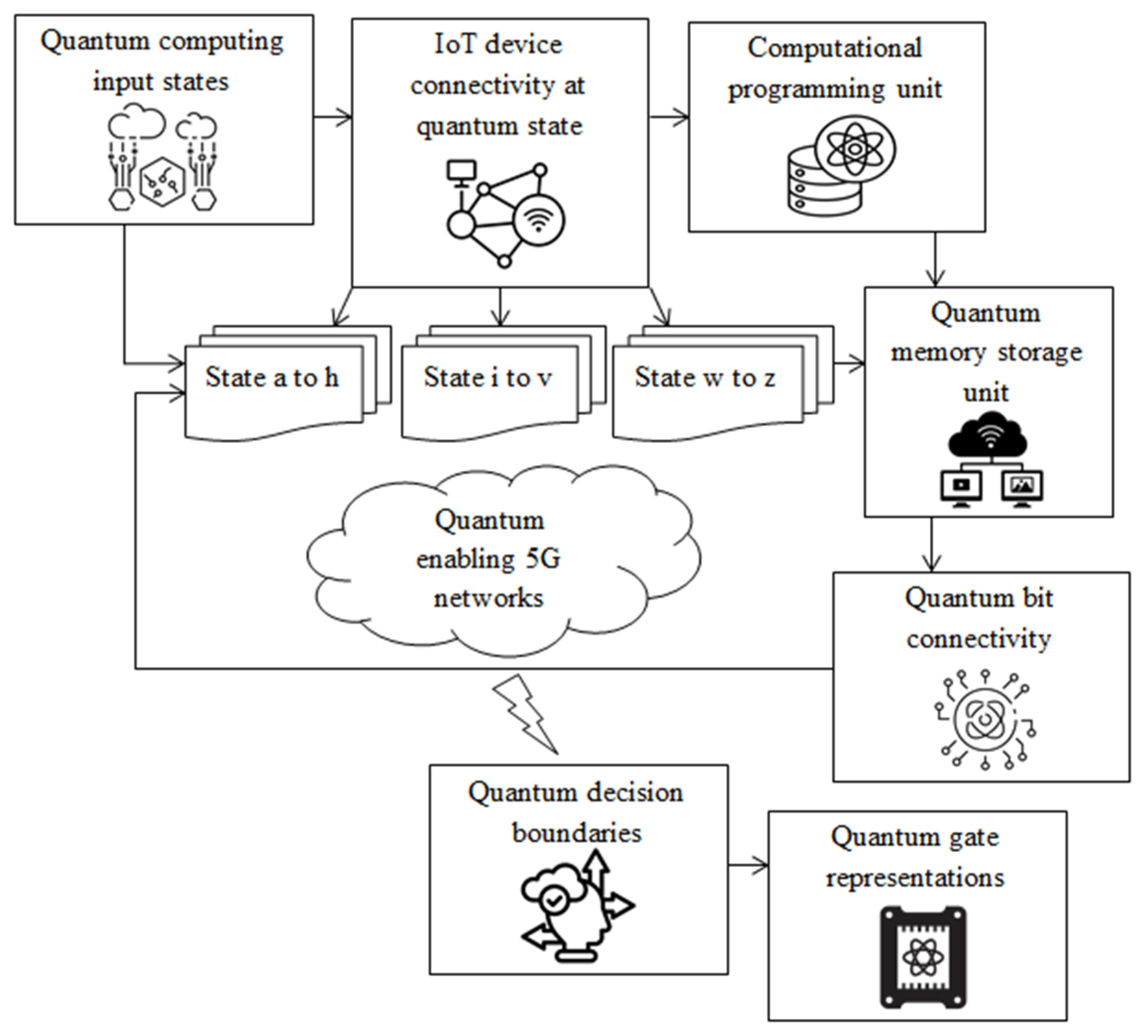
In this paper, the need for a quantum computing approach is analyzed for IoT applications using the 5G resource spectrum. Most of the IoT devices are connected for data transmission to end users with remote monitoring units, but there are no sufficient data storage units, and more data cannot be processed at minimized time periods. Hence, in the proposed method, quantum information processing protocols and quantum algorithms are integrated where data transmissions are maximized. Further, the system model is designed in such a way for checking the external influence factors that prevent the IoT device from transmitting data to end users. Therefore, with corresponding signal and noise power, it is essential to process the transmissions, thereby increasing data proportions at end connectivity. Once quantum computations are performed, then it is crucial to normalize IoT data units, thus establishing control over entire connected nodes that create a gateway for achieving maximum throughput. The combined system model is tested under four cases where the comparative outcomes prove that with reduced queue reductions of 12%, it is possible to achieve a maximum throughput of 99%.
Keywords: quantum computing; internet of things (IoT); fifth generation networks (5G); communication units quantum computing; internet of things (IoT); fifth generation networks (5G); communication units
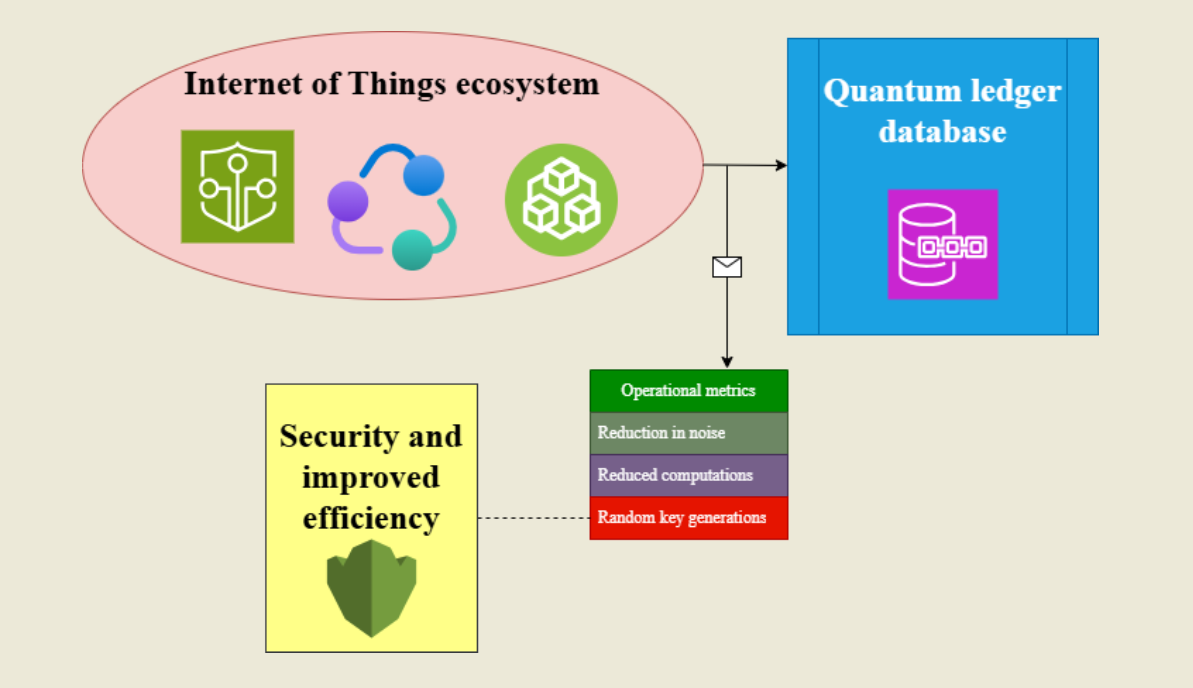
Graphical Abstract