1. Introduction
As world leaders begin preparing for a post-2030 agenda, with most Sustainable Development Goal (SDG) targets already off-track, the choice ahead is stark: continue with technocratic box-checking, or embrace the fundamental transformation the goals originally promised. Building on my earlier work advocating for a planetary health perspective on SDG implementation [
1,
2], I argue that a recalibration is overdue. The limits of SDG metrics [
3,
4], the case for a wellbeing economy [
5,
6,
7,
8,
9,
10], and the exclusion of Indigenous governance from development decision-making [
11,
12,
13] are each, individually, well established in the literature. What remains underspecified is how these three critiques connect: this Perspective’s contribution is to show, through a systems-thinking lens that makes power relations explicit, how planetary health and the wellbeing economy can be translated into concrete governance mechanisms rather than left as parallel diagnoses, and to specify criteria by which “transformation” could actually be recognized in practice.
1.1. The SDGs: A Global Blueprint Reduced to Metrics
The Sustainable Development Goals (SDGs), adopted by all United Nations member states in 2015, were envisioned as a global blueprint for a just, inclusive, and sustainable future by 2030. Encompassing 17 goals ranging from poverty eradication and quality education to climate action and reduced inequalities, the SDGs were built on the principle of “leaving no one behind.”
Yet that transformative vision has too often been reduced to a technocratic exercise in indicator-tracking and box-ticking, where fragmented efforts and disproportionate reliance on numeric indicators obscure the power dynamics and structural inequities that shape outcomes [
3]. A development framework that can count trees planted, but fails to address the systems driving deforestation, or to include the communities whose knowledge could prevent it, is clearly missing the point. While data remains essential, the transformation promised by the SDGs cannot be achieved through metrics that ignore who controls decision-making processes and who bears the costs of current systems.
1.2. Beyond Metrics: What the SDGs Are Missing
Over time, SDG monitoring has become increasingly driven by indicator reporting, often at the expense of community leadership and the original transformative vision the goals once promised. While metrics provide comparability and accountability, these indicators create the illusion of progress: comparable numbers, tidy dashboards, upward arrows. Yet they rarely capture the lived experiences of people on the ground, the ecological limits of growth, or the power structures that determine who wins and who loses. As I have shown in earlier work, attempts to link health equity with the land–water–energy nexus within the SDG framework often expose persistent integration gaps, with equity considerations sidelined in favor of technical efficiency [
2].
This technocratic approach obscures several blind spots. First, SDG implementation has largely ignored systemic power imbalances that determine who participates in development decisions and who reaps the benefits [
3]. Metrics may track poverty reduction without questioning wealth concentration, or note environmental improvements without examining the extractive corporate practices that cause degradation [
3,
4]. Second, universal indicators often silence contextual knowledge systems, particularly Indigenous worldviews that treat health, economy, and ecology as inseparable domains [
11]. Third, the economic logic underpinning many targets prioritizes growth, frequently at odds with planetary boundaries, and creates trade-offs that pit ecological sustainability against development goals [
14,
15].
Perhaps the most damaging omission is the lack of community governance mechanisms that would enable affected populations to lead their own development processes. Instead of participatory decision-making, SDG implementation often relies on consultation models that maintain existing power structures while creating an illusion of community engagement [
16]. This results in interventions that may improve indicators while failing to address the relational and structural determinants that community members identify as priorities [
3].
Two distinct claims are often conflated in critiques like this one, and it is worth separating them. The first is that indicators are frequently used badly: reported without disaggregation, decoupled from the communities they describe, or treated as ends rather than proxies. This is a problem of implementation practice, and better indicator design or more participatory data governance could in principle address it. The second, stronger claim is that some indicators are inadequate by construction, because the underlying theory of change treats a symptom as the target: GDP growth as a proxy for wellbeing, or hectares reforested as a proxy for ecological integrity, regardless of who reports the number or how carefully. The argument developed here is closer to the second claim for the SDGs’ economic and governance targets specifically, while accepting that many social and health indicators are undermined mainly by the first, more remediable, problem. The distinction matters because it changes what counts as a fix: better monitoring will not resolve a target built on a category error, but it can resolve poor implementation of an otherwise sound one.
Because “transformation” is invoked frequently in this literature without being defined, it is worth stating explicit criteria before using the term further. In the argument that follows, a change counts as transformative, rather than incremental, to the degree that it does three things: (i) shifts binding decision-making authority toward the communities affected by a policy, not merely their consultation; (ii) targets a structural driver of an outcome, for example land tenure, capital mobility, or fiscal rules, rather than only its downstream indicator; and (iii) is accountable to those communities on an ongoing basis, through mechanisms communities can invoke without external permission, rather than accountable upward to a funder or ministry. These three criteria are used in
Section 5 to distinguish which post-2030 proposals are transformative in this specific sense and which remain, more modestly, improved management of the existing system.
Addressing these blind spots requires moving beyond metrics toward frameworks that center equity, ecological sustainability, and shared decision-making. The wellbeing economy, with its rejection of GDP growth as the dominant measure of progress, offers one pathway. Planetary health, which insists that human and ecological systems are inseparable, offers another. Together, they provide a foundation for reimagining the SDGs, not as a dashboard of numbers, but as a blueprint for just and sustainable futures.
2. The Wellbeing Economy and Planetary Health: Complementary Lenses
Two studies already do much of this redefinition work separately. The wellbeing economy movement redefines what progress means; planetary health sets the ecological boundaries within which progress can unfold. Read together, rather than as parallel critiques, they change what SDG implementation would need to look like.
The wellbeing economy movement critiques the dominance of GDP as the primary yardstick of societal progress. It argues instead for policies that prioritize collective wellbeing, social equity, and ecological regeneration over extractive growth [
5,
6,
7,
8,
9]. This movement recognizes that true development cannot be measured solely through economic output but must encompass multidimensional wellbeing that includes social cohesion, cultural vitality, environmental health, and community self-determination [
10].
National experiments such as New Zealand’s Wellbeing Budget [
17] are important steps forward, broadening measures of success to include child welfare, mental health, and environmental sustainability. Iceland’s wellbeing-economy reforms show a similar reorientation at the national level [
18]. In Scotland, the clearest evidence is more local than national: Glasgow’s use of the Doughnut Economics framework to structure multi-stakeholder wellbeing planning [
19] demonstrates what such alignment can look like at the city scale, though it should not be read as evidence that wellbeing budgeting has been institutionalized across Scottish national policy.
Yet, even these innovations remain vulnerable to reductionism. Without meaningful redistribution of decision-making power, “wellbeing” risks being translated into yet another set of indicators, another dashboard to manage, rather than a transformative reordering of priorities. True transformation requires coupling alternative metrics with community power, while ensuring that wellbeing is not only measured differently but pursued through processes that redistribute decision-making authority and center those most affected by inequities [
20,
21]. The wellbeing economy explicitly challenges the assumption that economic growth automatically translates to improved quality of life, instead advocating for redistributive policies and regenerative practices that operate within planetary boundaries while prioritizing collective flourishing over individual accumulation [
22]. This shift is especially critical for Indigenous communities, whose self-determination and holistic worldviews are often sidelined in national policy frameworks despite their long-standing stewardship of ecological systems [
11].
While the wellbeing economy reframes what societies value, planetary health clarifies the boundaries within which those values must be pursued. Planetary health, defined as the health of human civilization and the natural systems on which it depends [
15], offers an integrated approach to understanding how ecological degradation undermines human health and development [
23,
24]. It invites us to move away from reactive, siloed strategies and towards anticipatory, multisectoral actions rooted in systems thinking and relational accountability to communities.
Taken together, these two frameworks shift the conversation away from narrow efficiency metrics toward a more systemic and justice-oriented vision of development. Their combined potential lies in how they are operationalized: not as abstract global agendas, but as community-driven frameworks that center equity, redistribute power, and hold systems accountable to those most affected by inequities [
16,
25].
Engaging the Strongest Counterarguments
The account above treats the wellbeing economy, planetary health, and community governance as under-realized rather than mistaken. A more skeptical reading is available. Historical-materialist critiques of the SDGs argue that global sustainability governance survives, and is even strengthened, by leaving capitalist accumulation dynamics unexamined: indicators, wellbeing budgets, and multi-stakeholder frameworks can all be absorbed into existing governance without disturbing who owns capital, land, or the means of production, which is precisely why they are politically tractable in the first place [
26]. A related line of argument, drawing on classical political economy, would ask whether “community governance” and “power redistribution” are coherent policy goals at all outside a structural account of class, capital mobility, and the state’s dependence on growth for legitimacy and revenue [
27]. On this view, the reforms discussed in this paper—Advisory Circles, equity-weighted indicators, and Health Equity in All Policies (HEiAP)—are superstructural adjustments that leave the deeper political economy of extraction intact, and could even function to legitimate it.
This critique should be taken seriously rather than answered away. It is likely correct that none of the mechanisms proposed here can, on their own, resolve the tension between a growth-dependent state and ecological limits; that tension is a legitimate object of the political economy Leichtweis and Manioudis and Meramveliotakis call for, and is outside this paper’s scope. The narrower claim made here is more modest: within the existing multilateral architecture that SDG implementation will continue to operate through until at least 2030, whether decision-making authority sits with communities or with technical bureaucracies is not a superstructural detail but changes material outcomes: who is displaced by a conservation project, whose land is used for offsets, whose knowledge counts as evidence. Community governance is therefore treated here as a necessary, if insufficient, condition for transformation, not a substitute for confronting growth-dependent political economy. Where this paper’s proposals in
Section 5 stop short of that deeper confrontation, that limit is acknowledged rather than obscured.
3. Operationalizing the Vision: From Frameworks to Practice
When planetary health and the wellbeing economy are applied to the SDGs through community-governed approaches, the result is a more honest and actionable vision: one that accepts planetary limits, redistributes decision-making power, and embraces multidimensional understandings of progress. However, it is one thing to critique GDP, call for planetary stewardship, or propose equity as the core of development; it is another to translate these frameworks into practice. Translating these integrated frameworks into concrete policy mechanisms remains a significant challenge.
Existing cross-sectoral policy models such as Health in All Policies (HiAP) were designed to respond to this challenge and break down silos and integrate health considerations across government sectors. However, in practice, they often remain conceptual and face persistent implementation barriers [
28,
29]. Its equity-focused evolution, Health Equity in All Policies (HEiAP) [
30], offers a sharper tool for embedding distributional justice and power redistribution into policy design [
20]. Yet even these frameworks require mechanisms to operationalize them through genuine community governance. Without such power-sharing structures, HEiAP risks defaulting to interdepartmental coordination rather than achieving the systemic change it promises.
Integrating HEiAP with the wellbeing economy principles, particularly approaches that prioritize redistribution, ecological boundaries, and community leadership, offers one promising but still underdeveloped pathway for translating planetary health and the wellbeing economy into practice [
20,
31]. This gap between transformative vision and operational tools remains one of the most critical barriers to fulfilling the SDGs’ original promise.
Beyond HEiAP, other operational frameworks such as Raworth’s Doughnut Economics [
14] and the Wellbeing Economy Governments (WEGo) alliance have begun to demonstrate alternatives through wellbeing budgets, participatory policymaking, and new dashboards of progress. These three frameworks are not interchangeable, and the case for drawing on all of them is that each addresses a different institutional barrier: HEiAP targets bureaucratic silos between government departments; Doughnut Economics supplies the ecological-and-social boundary framework that indicator sets otherwise lack; and WEGo functions as a policy-learning network through which national governments negotiate what wellbeing budgeting means in practice. None of the three, on its own, specifies who governs the trade-offs between them when they conflict, for example, when a wellbeing budget’s growth constraint reduces the fiscal space a HEiAP process would need to fund a community’s stated health priority. That gap is precisely what a systems-thinking approach, developed in the next section, is positioned to address; without it, these efforts risk remaining isolated innovations rather than catalysts for transformation.
4. The Role of Systems Thinking in Reclaiming SDG Transformation
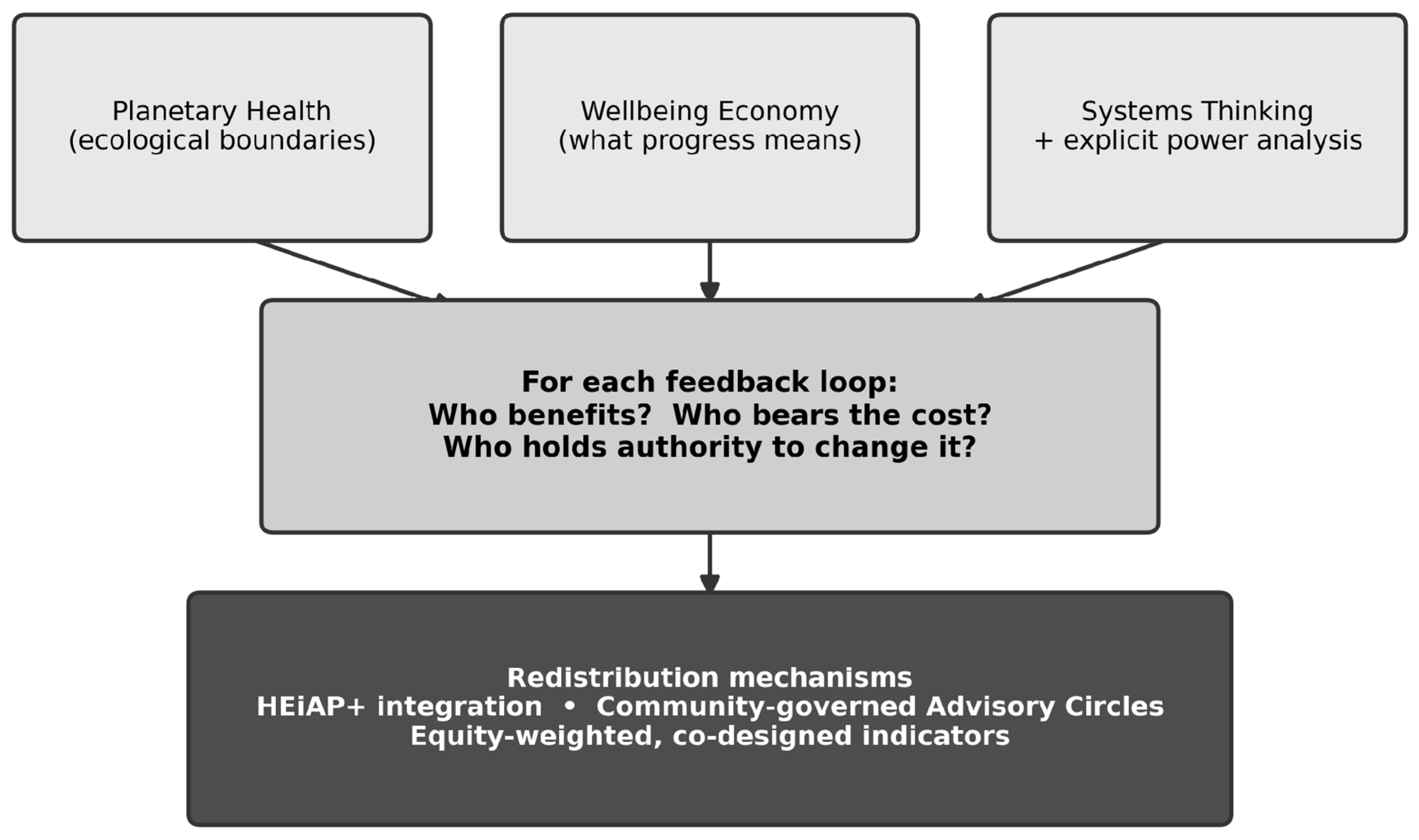
Section 3 identified a gap: three complementary frameworks with no shared account of who governs their trade-offs. Systems thinking is proposed here as that connective layer, on the condition that it is practiced with explicit power analysis built in, not as a neutral mapping exercise. Concretely, this means three things: identifying feedback loops that current indicator sets treat as separate variables; mapping who benefits from a given loop and who bears its costs; and specifying, for each loop, which actor currently holds the authority to change it and what would be required to redistribute that authority to the community bearing the cost [
3].
Figure 1 sets this out schematically.
Carbon offset schemes make the three-part method concrete. The feedback loop conventional evaluation tracks is narrow: tonnes of carbon sequestered against tonnes purchased, reported as a single ratio. A systems view maps the fuller loop: a corporation buys credits tied to a reforestation or conservation project and continues or expands emissions elsewhere on the strength of that purchase, while the project constrains land use for the community holding or claiming the land, often without free, prior, and informed consent [
11], and frequently for a duration that outlasts the durability of any legal protection currently on offer. Three known failure modes follow directly from this structure rather than from implementation error: additionality is difficult to verify because the counterfactual, whether the forest would have been cleared anyway, is unobservable; leakage relocates the deforestation or emissions the credit was meant to prevent to an unmonitored parcel nearby; and permanence is not enforceable against a future government, corporation, or fire. Who bears the cost of each failure mode is not symmetric with who captures the benefit: the purchasing corporation books an emissions reduction immediately and irreversibly, while the community whose land is enrolled bears open-ended tenure and livelihood risk for a benefit, climate stability, that is diffuse and global rather than local. A power-sensitive systems approach makes this asymmetry visible where a project-level carbon-accounting metric cannot, because that metric is scoped in a way that excludes the actors bearing the residual risk. Community governance is the lever this analysis points to: land tenure and veto rights held by the affected community, rather than consent obtained once at project inception, would change who bears the risk from the failure modes above, not merely how the project is reported.
A systems approach informed by planetary health and the wellbeing economy must center relational accountability to communities and community governance [
11]. This means elevating community knowledge systems that understand health, economy, and ecology as inseparable. Indigenous worldviews, for example, embed relational accountability and intergenerational ethics at the core of governance; principles that conventional development approaches often overlook. By centering these perspectives, systems thinking moves beyond consultation models toward genuine community governance and power-sharing arrangements where communities govern research and policy design processes [
11].
Ultimately, the promise of systems thinking is not simply analytical but political. It equips us to reveal root causes, unintended consequences, and leverage points for change, while ensuring that solutions emerge from community wisdom rather than external expertise. For the SDGs to reclaim their transformative intent, systems thinking must be deployed not as a technical tool, but as a framework for redistributing power, centering marginalized voices, and holding global development accountable to both people and planet.
5. Charting a Post-2030 Agenda
With the 2030 deadline looming and most targets off track, the imperative to rethink our global development architecture becomes more urgent. The convergence of planetary health, the wellbeing economy, and systems thinking offers a powerful framework for the next phase, but only if these ideas are grounded in community governance rather than elite dashboards or managerial reforms.
A post-2030 agenda cannot simply add new indicators or tweak existing ones. That would repeat the very errors that have led to the current impasse, treating development as a technical exercise rather than a political and relational process. Instead, the future must be built around concrete integration mechanisms that redistribute power, embed Indigenous and community knowledge systems, and align governance with planetary boundaries.
Using the three transformation criteria set out in
Section 1.2, three types of claim should be distinguished here, since collapsing them is part of what made the original conclusion an overreach: first, evidence-supported lessons: national wellbeing-budget experiments show governments can operationalize non-GDP metrics at scale [
17,
18], and a large-sample review of SDG-referencing policy shows the goals have had real, if uneven and largely non-transformative, political effects [
4]; second, proposed directions and mechanisms this paper argues for, but that have not yet been implemented or evaluated at the scale being proposed: community-governed Advisory Circles with binding authority over local implementation, equity-weighted indicators co-designed with affected communities, and systems-mapping exercises that make leverage points and power-holders visible before a policy is finalized [
3,
12]; third, a normative recommendation that does not reduce to either of the above: that decision-making authority itself, not only budget lines or indicator sets, should be redistributed toward affected communities, a claim defended here on grounds of justice and epistemic inclusion rather than on evidence that it produces better outcomes, since the mechanisms that would generate that evidence do not yet exist at scale. Such approaches move beyond tokenistic consultation and begin to institutionalize community sovereignty over decision-making.
Implementation must shift from top-down metric reporting to community-owned tools that communities can use to hold governments accountable. This transition requires breaking the silos between public health, environmental science, and economics while confronting power imbalances in global governance and centering marginalized voices, not as beneficiaries, but as leaders and co-designers [
13]. It calls for a radical redistribution of political attention and economic investment, from short-term returns to long-term resilience guided by community priorities.
Above all, a post-2030 agenda must resist the temptation to repackage the SDGs in new dashboards and global reports. The task ahead is not better management of the same system but a radical reimagining of what progress means: a shift from growth to flourishing, from extraction to regeneration, and from top-down decision-making to community-governed transformation.
6. Conclusions: Toward Integrated Futures
Nearly a decade after the 2030 Agenda was launched, its transformative spirit has been constrained less by a shortage of frameworks—this Perspective has discussed three well-developed ones—than by the absence of mechanisms that redistribute decision-making authority itself. That is the gap this paper has tried to specify rather than restate: not another call for better metrics or more integration, but an account of what integration would need to do to meet the transformation criteria set out in
Section 1.2, together with an acknowledgment, following the discussion in “Engaging the Strongest Counterarguments,” of how far short of confronting growth-dependent political economy that account still falls.
Academics must lead in advancing transdisciplinary research that centers community governance and challenges dominant metrics. Policymakers must embed equity, ecology, and community authority in budgetary and legislative frameworks. Development actors must shift from extractive models to relational, regenerative systems of care that honour community leadership and Indigenous knowledge systems.
The window for incremental change is closing. A post-2030 agenda must rise from the convergence of crises with the courage to chart a new path; one guided by community wisdom, planetary boundaries, and relational accountability. One that restores not only ecosystems, but also relationships and decision-making power to those who understand that health, economy, and ecology are inseparable.