1. Introduction
Early environmental protection efforts emerged from practical land and wildlife management practices that inadvertently preserved biodiversity by limiting the over-exploitation of natural resources [
1,
2,
3]. Protected forests, conservation areas, and large green spaces historically reduced habitat loss and slowed species decline during periods of rapid industrial expansion [
4]. As industrialization intensified and transportation became more accessible in the nineteenth and twentieth centuries, ecological disturbances associated with pollution, land degradation, and resource extraction became increasingly visible [
5,
6]. In contemporary urban and peri-urban settings, publicly accessible green spaces and forested areas play a critical role in mitigating air pollution, moderating urban heat islands, and enhancing biodiversity across North America, Europe, the Middle East, and Asia [
7].
Scientific research, policies, and activists have raised sustained concerns about environmental degradation and climate change for several decades [
8]. International policy discussions have framed climate change as a growing risk to human security and well-being, as well as to global cooperation [
9], while Indigenous and community-based perspectives have emphasized the lived experience of environmental change and ecological disruption [
6,
8,
10]. Empirical research has demonstrated that anthropogenic climate warming is contributing to more frequent and more destructive weather-related disasters, including wildfires, floods, heatwaves, and temperature variability [
8,
11,
12]. These environmental changes have disrupted food systems, reduced agricultural productivity, and strained ecosystems in multiple regions worldwide [
13]. While reductions in freshwater availability have been observed in some areas [
14], recent evidence suggests that deteriorating air quality, particularly during severe wildfire seasons, has become an increasingly visible and measurable pathway through which climate change affects public health and contributes to instability [
15,
16,
17,
18,
19,
20,
21,
22,
23].
Between 2020 and 2025, large-scale population movements toward major urban centres and more temperate regions have accelerated in response to climate-related stressors, including extreme heat, declining food production, and recurrent environmental disasters [
15,
16,
17]. Although these dynamics have long-term socioeconomic and geopolitical implications, acute health effects are already evident through air pollution, heat exposure, and food insecurity [
18,
24,
25,
26]. Limited access to clean air, potable water, and adequate nutrition further compounds population health vulnerabilities [
13,
14]. Environmental pressures linked to climate change have also been associated with rising geopolitical instability and political polarization in several regions [
19]. Historical climate research, including analyses of the sixth-century “Little Ice Age,” illustrates how abrupt climatic shifts can catalyze societal instability when combined with existing structural vulnerabilities [
20,
27,
28].
Recent global modelling studies revealed that air pollution-related mortality imposes a considerable burden on populations worldwide. For example, global deaths attributable to air pollution may exceed 8 million annually, although earlier modelling studies have frequently reported lower estimates of around 3 million deaths per year [
29,
30,
31]. In addition, prior research has quantified the global economic burden, indicating substantial welfare losses from exposure to air pollution. Canada’s 2023 wildfire season, in which over 15 million hectares of land burned, displacing thousands of residents and exposing large urban populations to hazardous smoke concentrations, marked a critical threshold [
22]. Evidence from a University of Chicago report suggests that 2023 may have been the most severe year for air pollution exposure since 1998, with climate-driven particulate matter significantly reducing population life expectancy [
23]. Ongoing wildfire-related environmental pollution is expected to shorten the average lifespan across populations in Canada by at least 2 years across all age groups [
23].
Recent evidence suggests that deaths associated with air pollution are far more numerous than previously estimated. For instance, Yin et al. predicted that ambient PM
2.5 exposure was associated with approximately 8.4 million deaths globally and significant economic costs [
31]. Similarly, Lelieveld et al. [
30] reported that total air pollution-related mortality may exceed 8 million annually, with approximately 5.13 million deaths attributable specifically to fossil-fuel-related emissions. These findings highlight the scale of the global burden and the importance of distinguishing between total air pollution and its anthropogenic components. From a planetary health perspective, air pollution is more than an isolated form of environmental exposure; it reflects the broader disruption of interconnected ecological, economic, and human systems [
32]. Planetary health scholarship emphasizes that human health and wellbeing are inseparable from the stability of Earth’s natural systems, including climate regulation, air quality, biodiversity, and sustainable energy systems [
32]. Within this broader context, air pollution imposes significant health and economic burdens, illustrating how environmental degradation can affect population health, productivity, and societal well-being. Recent studies have further strengthened the economic rationale for climate mitigation by demonstrating substantial ancillary health and environmental gains resulting from improved air quality [
33,
34]. In the United Kingdom of Great Britain and Northern Ireland (UK), net-zero pathways involving transitions in the transportation and building sectors were estimated to generate millions of life-years gained and economic benefits exceeding £150 billion through reductions in particulate matter exposure and increased physical activity [
33,
34]. These findings from the UK suggest that climate mitigation policies may produce substantial near-term public health benefits in addition to long-term climate stabilization benefits. These relationships are consistent with planetary health perspectives emphasizing the interdependence of environmental and human systems.
These findings raise pressing policy questions: How can nations pursue economic growth during the early stages of the AI revolution while safeguarding air quality and environmental sustainability? How can international cooperation address the disproportionate impact of air pollution on nations with smaller Gross Domestic Product (GDP) while ensuring that technological progress contributes to long-term economic stability? These challenges align closely with the emerging field of planetary health, which recognizes that environmental degradation, climate instability, and social inequities are deeply interconnected rather than separate policy domains [
35,
36]. Consequently, reducing air pollution may generate co-benefits beyond mortality reduction, including potential improvements in environmental sustainability, ecosystem resilience, and broader societal well-being [
35,
36,
37]. Furthermore, from the perspective of rational choice and harm reduction, prioritizing measures to reduce human exposure to airborne pollutants is among the most immediate and cost-effective strategies for preventing premature mortality, sustaining productivity, and lowering the destabilizing influence of a fluctuating climate over the coming decades.
1.1. Darwinian Theory, Biological Regulation, and Ecosystem Resilience (Conceptual Framing)
Darwinian theory and ecological resilience are used here only as broad conceptual frameworks to illustrate how rapid environmental change can affect biological, ecological, and human systems over time. Unlike long-term evolutionary adaptation, contemporary climate change is occurring over relatively short timescales, limiting the capacity of ecosystems and human societies to adjust gradually to environmental disruption [
24]. Empirical research has linked climate change to disruptions in food systems, emerging diseases, natural disasters, and crop disease risks [
13,
38,
39,
40], water stress and freshwater insecurity [
14], extreme heat and temperature-related mortality [
26,
28,
41], and wildfire-related air quality deterioration [
21,
22,
23]. These environmental pressures may increase ecological instability and heighten vulnerabilities to health and livelihoods, particularly in regions with limited adaptive capacity [
25,
26,
38,
41]. In this study, these concepts are used only to contextualize the broader planetary health implications of air pollution and environmental degradation. Analogies to biological regulation/homeostasis are employed only for pedagogical purposes, not as literal equivalences.
While ecological systems do not exhibit homeostasis in the same physiological sense as organisms, environmental science commonly describes ecosystems through concepts such as resilience, equilibrium, stability, and threshold effects, which refer to the capacity of ecological systems to absorb disturbance without shifting into degraded or less functional states [
12,
42,
43,
44]. Significantly, ecological resilience operates across different spatial and temporal scales and involves feedback mechanisms that differ fundamentally from those governing cellular or organismal physiology.
At broader scales, when environmental disturbances exceed the buffering capacity of ecological systems, recovery becomes increasingly complex without substantial intervention or long recovery periods. Climate-driven stressors—including prolonged heat exposure, altered precipitation patterns, and degraded air quality—can push ecosystems beyond critical thresholds, resulting in regime shifts that compromise ecosystem services essential to human health and economic productivity [
25,
26,
38,
41]. These dynamics should not be conflated with physiological failure but rather understood within the established literature on nonlinear environmental change and threshold effects.
Small absolute fluctuations in global atmospheric temperatures or ocean levels can therefore have disproportionately large impacts when they occur rapidly and interact with existing ecological and social vulnerabilities. Climate research shows that rising temperatures can intensify extreme events [
11,
12], worsen wildfire-related air pollution [
21,
22,
23], increase heat-related health risks [
26,
28,
41], and place additional pressure on food and water systems [
13,
14,
38]. These effects cascade into human systems, contributing to population displacement, economic instability, and heightened geopolitical tension. In this context, rising air pollution, food insecurity, forced migration, and conflict are not symbolic reactions of nature but measurable consequences of accelerated environmental change acting on interconnected ecological, economic, and political systems.
1.2. Harm Reduction and Rational Choice (Conceptual Framework)
Together, these broader environmental and planetary health perspectives provide context for understanding why assessing the financial consequences of pollution-attributable health outcomes, such as mortality, may be relevant to public health- and sustainability-oriented policy discussions. Harm reduction and rational choice are employed in this study as conceptual frameworks for policy prioritization, not as epidemiological or economic models [
43]. Harm reduction is grounded in an evidence-based approach that seeks to minimize immediate and preventable harm, particularly premature mortality [
45]. At the same time, rational choice theory emphasizes decision-making that weighs costs, benefits, and opportunity costs under resource constraints [
43]. Together, these frameworks help explain why evaluating the economic burden of air pollution-related harms is relevant to contemporary policy decisions.
In the context of environmental health, harm reduction does not imply eliminating all pollution-related risks, but rather prioritizing interventions that yield the most significant and most immediate reductions in avoidable deaths [
43]. From a rational-choice perspective, monetizing premature mortality attributable to air pollution enables policymakers to compare the societal costs of inaction with those of mitigation strategies using a standard economic metric. The present study adopts this perspective to highlight the scale of financial loss associated with continued breathing of air polluted by harmful emissions, particularly fine airborne particulate matter (PM
2.5) and surface-level ozone (O
3).
Evidence from population-based studies indicates that prolonged exposure to ambient air pollutants, including ozone (O
3) and, particularly, fine particulate matter (PM
2.5), contributes to elevated rates of early mortality. The adverse effects are most pronounced for cardiovascular and respiratory conditions, including coronary heart disease, chronic respiratory illnesses, and lung malignancies [
29]. The economic valuation of death risk is well established in environmental and regulatory economics, particularly through the Value of a Statistical Life (VSL) framework. The VSL approach has been widely adopted in policy analysis for several decades, including in regulatory impact evaluations undertaken by the United States Environmental Protection Agency (US EPA) and other governmental bodies [
46,
47].
This literature provides both the theoretical foundation and empirical basis for monetizing reductions in mortality risk in environmental policy contexts [
46,
47]. Accordingly, the present study does not propose a new valuation method but rather applies established economic approaches to previously reported global mortality estimates to illustrate the magnitude of the associated economic costs. Importantly, this study does not model disease incidence, progression, or mortality risk, nor does it generate new epidemiological projections. Instead, it relies on previously published global estimates of air pollution-attributable premature deaths and applies an economic valuation framework to quantify their tangible and intangible costs.
Within a harm-reduction framework, the economic valuation of premature mortality serves a specific purpose: to quantify the preventable loss associated with polluted air and to inform the prioritization of interventions that reduce exposure to PM2.5 and O3. The analysis focuses on productivity losses and the broader societal value of life cut short, rather than on clinical disease pathways. In this sense, harm reduction aligns with the valuation framework by emphasizing avoidable mortality as the outcome of interest. At the same time, rational choice justifies using economic estimates to guide policy trade-offs.
1.3. Research Rationale and Question
Rather than proposing an alternative economic system or pathway, this study aims to quantify the financial consequences of maintaining current levels of air pollution exposure. The study draws on published global estimates of deaths attributable to PM2.5 and O3 exposure to quantify the broader economic burden of air pollution. This burden is assessed through two complementary dimensions: market-related losses arising from forgone labour-force participation and economic output and non-market welfare losses associated with premature death. The present analysis focuses specifically on PM2.5 and O3 because these pollutants are the most consistently incorporated into large-scale global mortality assessments and international burden-of-disease models. While nitrogen dioxide (NO2) is also an important traffic- and fossil-fuel-related pollutant associated with adverse health outcomes, its inclusion was beyond the scope of the current modelling framework and may involve overlapping exposure pathways with PM2.5. In some epidemiological frameworks, disentangling NO2-specific effects from correlated PM2.5 exposure remains methodologically challenging.
Accordingly, the primary research inquiry is as follows:
What are the estimated annual tangible and intangible economic costs associated with early deaths associated with exposure to ozone (O3) and fine particulate matter (PM2.5) at the global level?
While an expanding literature has explored the implications of air pollution (e.g., economic and health) at community or global scales, important gaps remain in the conceptual integration of these findings within broader planetary health and policy-oriented frameworks [
35,
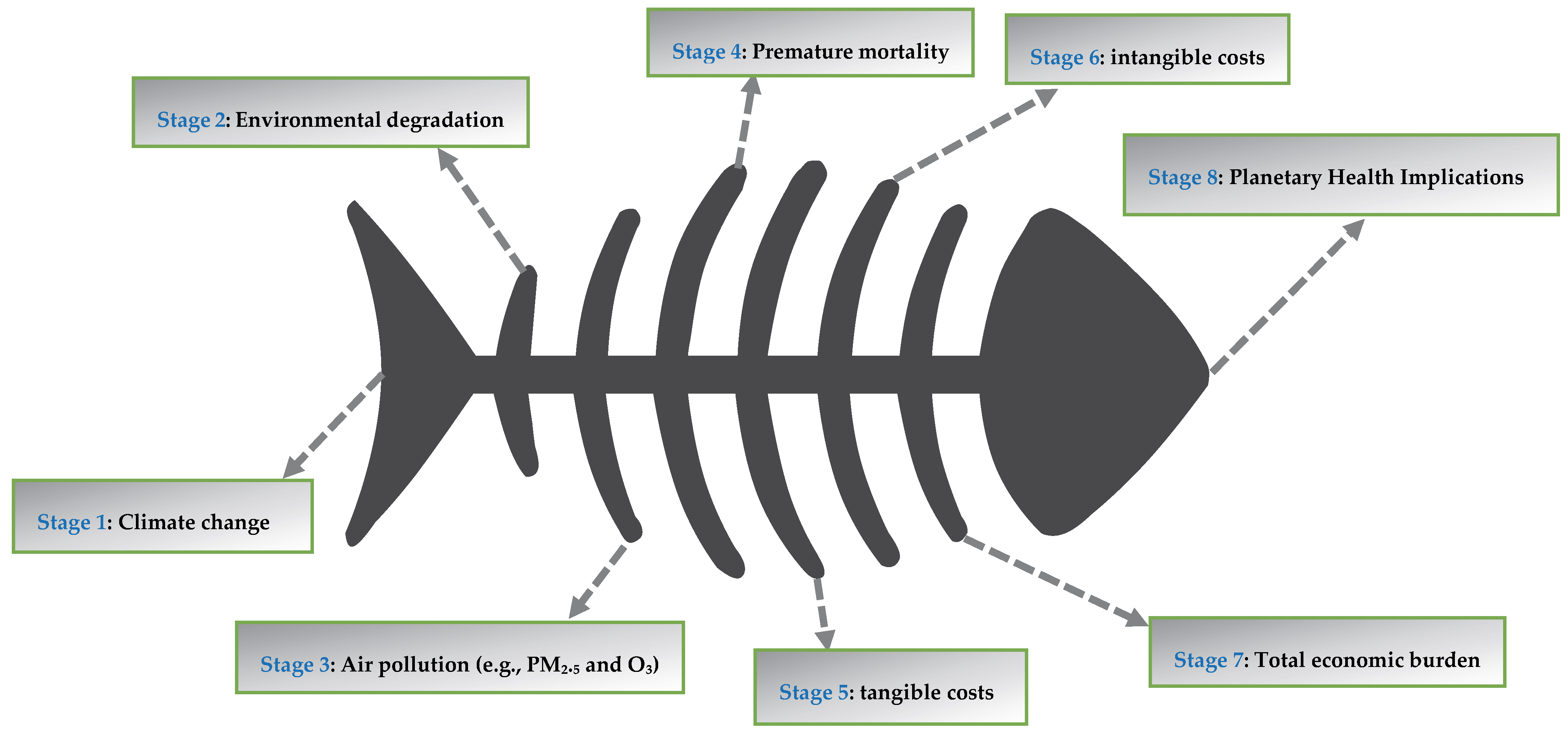
36]. Existing research often focuses primarily on mortality estimation, disease burden, or economic valuation in isolation, with comparatively little attention to how air pollution simultaneously affects interconnected ecological systems, economic productivity, social stability, and human well-being. In addition, relatively few studies have explicitly applied harm-reduction perspectives to frame air pollution mitigation as an immediate and practical planetary health intervention. The present study seeks to address these gaps by synthesizing existing mortality estimates within a broader economic and planetary health framework intended to support policy-relevant interpretation of the societal consequences of air pollution. The quantitative component is intended to provide an approximate illustration of the potential scale of the economic impacts of air pollution-attributable mortality, while the broader discussion situates these findings within planetary health, sustainability, and harm-reduction frameworks. The uniqueness of the present study does not stem from the development of a new epidemiological or economic modelling technique. Rather, its contribution lies in integrating established economic valuation approaches with planetary health and harm-reduction perspectives to support a broader, systems-based interpretation of the societal burden of air pollution. While previous global burden studies have primarily focused on estimating mortality, disease burden, or economic valuation in isolation, the present analysis seeks to connect these findings to interconnected questions of environmental sustainability, economic resilience, social well-being, and policy prioritization within a planetary health framework, as seen in
Figure 1.
By framing air pollution-related mortality in economic terms, the study seeks to support evidence-informed policymaking by clarifying the scale of preventable loss associated with inadequate air quality protection, in a way that aligns with the principles of harm reduction and rational choice.
3. Results
The results demonstrate that premature mortality linked to air pollution is associated with substantial global economic costs across multiple disease categories. Beyond quantifying mortality-related costs, the findings suggest that air pollution-related mortality may have implications extending beyond health outcomes to encompass economic productivity and societal welfare. The analysis also highlights the disproportionate contribution of cardiovascular and respiratory illnesses to the overall economic burden associated with air pollution exposure.
Table 2 presents the economic estimates derived from earlier global mortality assessments reporting approximately 3 million annual deaths attributable to air pollution [
29]. These mortality estimates form the basis of the quantitative calculations presented in this study. More recent studies have reported substantially higher mortality burdens [
30,
31]; therefore, the economic values reported here should be interpreted as conservative estimates rather than comprehensive representations of the current global burden. However, more recent studies suggest that air pollution may contribute to a global death toll that is substantially higher, with estimates exceeding 8 million deaths per year [
30,
31]. The estimates used in this study are therefore conservative and should be interpreted within the context of earlier modelling frameworks. For cardiovascular diseases, the estimated tangible cost is approximately US
$526 billion (range: US
$566–965 billion), while the corresponding intangible cost is approximately US
$25.6 trillion (range: US
$9–33 trillion).
For respiratory illnesses, including COPD and asthma, the tangible cost is approximately US$203 billion (range: US$219–373 billion), while the intangible cost is approximately US$9.88 trillion (range: US$3.48–12.8 trillion). For lung cancer, the tangible cost is approximately US$48.9 billion (range: US$52.6–89.7 billion), and the intangible cost is approximately US$2.38 trillion (range: US$0.84–3.07 trillion).
Overall, the total tangible economic burden associated with air pollution-related mortality is approximately US
$789 billion annually, while the total intangible costs are approximately US
$37.8 trillion annually. Sensitivity analysis suggests that tangible costs range from approximately US
$849 billion to US
$1.45 trillion, while intangible costs range from approximately US
$13.3 trillion to US
$48.8 trillion. Taken together, these findings suggest that the societal impacts of air pollution extend beyond direct health outcomes to include significant economic and welfare consequences globally. The results support consideration of air pollution within broader planetary health and sustainability frameworks, particularly given the interconnected relationships between environmental degradation, population health, economic resilience, and social well-being [
35,
36].
4. Discussion
Unlike traditional burden-of-disease studies that primarily quantify mortality or eco-nomic loss, the present study emphasizes the broader planetary health implications of air pollution by linking mortality-related costs to interconnected ecological, social, and sustainability-related systems. The results provide an approximate illustration of the potential magnitude of the economic and societal burden associated with air pollution-related premature mortality. While the analysis is based on simplified global assumptions and previously published mortality estimates, it nevertheless contributes to discussions of planetary and environmental health by highlighting the broader interconnected relationships among environmental degradation, public health, economic productivity, and societal well-being. The annual global costs of premature deaths linked to exposure to ambient air pollution range from approximately US
$940.9 billion to US
$37.8 trillion, depending on whether tangible or intangible valuation approaches are applied. From a planetary health perspective, the findings reinforce the interconnected nature of environmental, economic, and human systems [
32,
35,
36]. Air pollution may also reflect broader ecological and energy system disruptions associated with fossil-fuel dependence. The substantial mortality and economic burdens identified in this study suggest that environmental degradation may contribute to broader challenges affecting human well-being and economic resilience. In this sense, improving air quality represents both a public health intervention and a broader planetary health strategy aimed at supporting healthier relationships between human systems and the natural environments on which they depend. These estimates reflect the substantial economic burden associated with avoidable deaths attributable to PM2.5 and O3 exposure, as documented in the epidemiological literature. Importantly, this study does not estimate mortality risk or disease incidence; instead, it monetizes previously reported premature mortality using established valuation methods. As such, the findings should be interpreted as an indication of the magnitude of preventable loss, rather than a projection of future health outcomes.
An expanding scientific literature has sought to estimate the worldwide financial consequences of air pollution and its associated health effects. Notably, the World Bank and IHME have developed comprehensive models that incorporate demographic structure, survival probabilities, and labour market dynamics to estimate the economic burden of pollution-related mortality [
32]. Compared to these approaches, the current study provides a simplified valuation intended to highlight the magnitude of global costs rather than to replicate detailed country-level modelling. For example, Yin et al. [
31] estimated global welfare losses associated with PM
2.5-related mortality in the trillions of US dollars, while the World Bank and IHME [
32] similarly reported major economic losses attributable to pollution-related premature mortality. Compared with these studies, the current analysis yields somewhat lower estimates of mortality and costs because it relies on earlier mortality assumptions of approximately 3 million annual deaths and applies a simplified global valuation framework.
More recent studies, including Lelieveld et al. [
30], suggest substantially higher mortality burdens exceeding 8 million deaths annually, particularly when fossil-fuel-related emissions are considered. Differences across studies likely reflect variations in epidemiological assumptions, pollutants included, mortality attribution methods, demographic adjustments, and valuation approaches such as VSL estimation. Nevertheless, the overall direction of findings across studies consistently supports the conclusion that air pollution represents a major global economic and planetary health challenge [
35,
36].
An important consideration is that not all sources of air pollution are anthropogenic or fully preventable. Recent research has distinguished between total air pollution-related mortality and deaths attributable specifically to fossil-fuel combustion, the latter representing a more policy-relevant and potentially avoidable component [
30,
31]. For example, the analysis presented by Lelieveld et al. [
30] suggested that fossil-fuel-related air pollution contributes to roughly 5.13 million deaths worldwide each year, suggesting that a substantial proportion of the total burden could be mitigated through energy system transitions. In addition, numerous international studies demonstrate that reductions in air pollution often generate economic benefits that equal or exceed the costs of mitigation measures [
61,
62,
63,
64]. Studies examining agricultural emissions, energy-sector emissions, and broader air pollution control strategies have reported substantial reductions in premature mortality and corresponding economic gains following emission reductions [
61,
62,
63,
64]. These findings reinforce the argument that investments in pollution control should be examined not purely as environmental expenditures but also as public health and economic investments [
61,
62,
63,
64].
The scope of the analysis is restricted to immediate health effects, excluding potential downstream, indirect, or long-term consequences and economic impacts of air pollution, and does not account for the broader long-term benefits of reducing greenhouse gas emissions, including avoided climate-related mortality. As a result, the estimates presented here should be interpreted as a partial estimate of the benefits of air pollution reduction, and a comprehensive assessment of fossil-fuel mitigation would likely yield substantially larger total benefits when both air-quality and climate-related impacts are considered.
An extensive body of literature has investigated the worldwide economic consequences of air pollution, encompassing both health-related costs and productivity losses, including analyses of PM
2.5-related mortality and associated welfare losses. More recent estimates also indicate that the number of pollution-related deaths occurring worldwide is higher than the earlier figures used in this study [
29]. The findings are in line with prior cost–benefit analyses demonstrating the economic value of air-quality regulation. For example, empirical evaluations of PRC’s air pollution control strategies have reported substantial net benefits, with estimated annual gains of CNY 748.2 billion and benefit–cost ratios exceeding 6:1 [
65]. Comparable benefit–cost ratios have been observed for NO
2 reduction policies [
66] and for the PRC’s National Air Pollution Control Plan [
67]. Together, these findings suggest that investments in air pollution mitigation can generate economic returns that substantially exceed implementation costs, reinforcing the relevance of air quality policy as a harm-reduction strategy. The impacts of air pollution are unevenly distributed across populations and regions. Low-income regions, marginalized populations, and regions with limited environmental protections frequently experience disproportionate exposure to pollution and climate-related health risks. This inequitable distribution of environmental harm further supports the relevance of planetary health frameworks, which emphasize justice, equity, and the protection of vulnerable populations within broader ecological systems.
While the present analysis focuses specifically on-air pollution-related mortality, it is important to acknowledge that climate change affects health through multiple pathways [
32,
68,
69,
70]. Rising temperatures, for instance, have been associated with increased cardiovascular events, heat-related mortality, and reduced labour productivity [
32,
68,
69,
70,
71]. The World Health Organization (WHO) estimates that approximately 489,000 deaths are attributable to heat exposure annually, although isolating heat-specific mortality remains methodologically challenging [
28,
71]. These impacts are particularly pronounced in densely populated regions with limited access to cooling infrastructure. However, these pathways are not incorporated into the current valuation model and therefore should be considered complementary rather than additive to the air pollution estimates presented here.
In addition to air pollution and heat exposure, other environmental stressors associated with fossil-fuel-based transportation systems—such as noise pollution have been implicated in numerous harmful health conditions and socioeconomic consequences, including impaired sleep, cardiovascular disorders, psychological distress, and diminished work performance [
72,
73]. Another important consideration involves NO
2, which is strongly associated with transportation emissions and fossil-fuel combustion. Although NO
2 has been linked to respiratory and cardiovascular health risks in prior research, the present analysis focused on PM
2.5 and O
3 because these pollutants are more commonly used in global mortality burden assessments. Future research incorporating NO
2-specific mortality and economic estimates may present a more complete assessment of the broader societal impacts of urban and traffic-related air pollution. The present analysis is restricted to premature mortality and does not include other important health and environmental impacts. These include temperature-related morbidity and mortality [
28], noise-related health impacts such as sleep disturbance and stress [
72,
73], and broader ecosystem effects that may influence long-term population wellbeing [
12,
44]. The inclusion of these factors would substantially increase the total estimated economic burden, potentially severalfold, as suggested by prior environmental health and economic assessments. As such, the estimates presented in this study should be interpreted as conservative lower-bound approximations of the complete range of health, economic, and social impacts attributable to air pollution.
Despite regulatory progress in several high-income countries, poor air quality remains an important public health concern worldwide. Although Canada and the United States have implemented policies that have substantially reduced PM
2.5 concentrations, the growing prevalence and intensity of wildfires in recent decades have eroded many of these improvements, increasing population exposure to air pollution and contributing to persistent adverse health effects [
22]. Moreover, national ambient air quality standards in many countries remain above the WHO reference threshold of 5 µg/m
3 for annual PM
2.5 exposure, indicating persistent gaps between evidence-based recommendations and regulatory practice [
22].
Encouragingly, recent developments in Europe demonstrate that large-scale transitions away from fossil fuels are feasible. In 2023, several European countries generated more electricity from renewable sources than from fossil fuels, with renewables accounting for more than 30% of overall energy generation across the European Union and approximately 50% of electricity generation, including hydropower [
74,
75]. These shifts were accelerated by concerns around energy security following geopolitical disruptions, illustrating how policy incentives and external shocks can catalyze rapid structural change. While this study does not directly evaluate energy system transitions, the findings underscore the potential economic benefits of policies that reduce reliance on pollution-intensive energy sources.
5. Limitations
An important limitation of this evaluation is that it relies on earlier global mortality estimates of approximately 3 million deaths annually. More recent modelling studies suggest that the worldwide mortality impact of air pollution may be substantially higher. The decision to retain earlier mortality estimates was made to preserve consistency between the underlying disease-specific mortality categories and the economic valuation framework employed in the present study. Future research could apply the same valuation framework to newer mortality estimates to assess the potential implications of higher contemporary burden estimates. As such, the economic estimates presented here likely represent conservative approximations of the true global burden. The analysis is restricted to the economic assessment of premature deaths resulting from exposure to ambient air pollution. It does not account for other health or environmental consequences of climate change, such as morbidity, heat-related illness, flooding, food insecurity, displacement, or ecosystem degradation. As a result, the estimated costs likely understate the total societal burden of pollution-intensive economic systems.
Moreover, the valuation relies on fixed VSL estimates rather than country-specific willingness-to-pay data. While this approach is common in global assessments, it does not capture heterogeneity in income, preferences, or risk perception across regions. The use of a uniform global income proxy further limits sensitivity to differences between high- and low-income settings. The simplified global valuation framework employed in this study cannot fully capture regional differences in socioeconomic conditions, labour market structures, healthcare access, environmental governance, or population vulnerability. Exposure to air pollution and its associated health and economic consequences is distributed unevenly across countries and communities, with marginalized and lower-income populations often facing disproportionately greater risks. Consequently, the estimates presented here should be interpreted as broad global approximations rather than precise representations of the burden experienced by specific populations or geographic settings.
Furthermore, although intangible cost estimates provide a broader measure of welfare loss, contingent valuation-based approaches are known to produce higher estimates than productivity-based methods. This study, therefore, presents both tangible and intangible estimates to reflect uncertainty rather than a single, definitive cost. Finally, values are referenced to a single base year and purchasing power parity adjustments are not applied in the main estimates, which may affect cross-country comparability. In addition, the current analysis does not account for non-fatal health outcomes, including morbidity, disability, reduced quality of life, and indirect economic effects such as noise pollution and environmental degradation.
These omitted factors are known to add significantly to the overall burden of air pollution and, if included, would likely substantially increase the total estimated costs, potentially by an order of magnitude. Therefore, the findings presented here should be interpreted as conservative estimates of the true societal burden. Furthermore, the current study does not explicitly incorporate NO2, despite its recognized association with transportation emissions, fossil-fuel combustion, and adverse respiratory outcomes. The exclusion of NO2 reflects the study’s reliance on existing global mortality frameworks primarily focused on PM2.5 and O3. Consequently, the estimated economic burden presented here may underestimate the full health and societal impacts associated with air pollution exposure.
The analytical framework employed in this study is intentionally simplified, relying on secondary mortality estimates and generalized economic assumptions rather than de-tailed epidemiological or econometric modelling. Accordingly, the estimates should be interpreted as approximate indicators of mortality-related economic burden. Broader societal, geopolitical, and planetary health implications are discussed as conceptual and policy-relevant interpretations of the findings rather than direct empirical outputs of the model.
6. Conclusions
Air pollution remains a major and preventable contributor to global premature mortality, particularly through exposure to PM
2.5 and O
3. Despite regulatory advances in some jurisdictions, only a small number of countries currently meet the WHO’s air quality guidelines, and population exposure remains widespread [
25,
29]. The evaluation reported in this study shows that the societal costs of air pollution-related mortality are substantial, even when limited to mortality alone.
Beyond mortality estimates alone, the findings highlight the broader interconnected relationships between environmental degradation, economic productivity, public health, and long-term societal resilience. From a planetary health perspective, air pollution can be viewed as part of a broader systems-level challenge associated with fossil-fuel dependence and environmental degradation. Consequently, interventions aimed at reducing air pollution may yield broader co-benefits beyond mortality reduction, including improved environmental sustainability, strengthened public health resilience, and enhanced societal well-being.
By framing air pollution through harm-reduction and rational-choice perspectives, this study highlights the value of prioritizing interventions that yield immediate, measurable reductions in preventable deaths. While the analysis does not propose an alternative economic system or model future health outcomes, it provides evidence relevant to contemporary policy frameworks concerned with air quality, public health, and environmental sustainability. Efforts to limit exposure to air pollution are among the fastest ways to generate meaningful public health benefits and improve population health while supporting long-term economic stability.
Continued reliance on pollution-intensive systems risks perpetuating avoidable mortality and economic loss, whereas policies aligned with cleaner energy and transport systems offer the potential for substantial health and welfare gains. The evidence generated by this evaluation also supports important implications for public policy. Strengthening air quality regulations; accelerating the transition toward cleaner, renewable energy systems; investing in sustainable public transportation; and reducing dependence on fossil-fuel-intensive infrastructure may yield substantial benefits for public health and the economy. From a planetary health perspective, coordinated policy strategies designed to address multiple challenges concurrently, including environmental sustainability, air quality, public health, and social equity, may provide particularly important long-term benefits. In addition, prioritizing pollution reduction in highly exposed urban regions and vulnerable populations may help reduce both health inequalities and the wider social, economic, and health consequences of air pollution exposure.
However, the implications of these findings are unlikely to be uniform across all coun-tries and regions. Differences in industrialization, energy systems, environmental regulation, healthcare infrastructure, socioeconomic inequality, and population vulnerability may substantially influence both exposure to air pollution and the associated economic burden. Low- and middle-income countries, densely populated urban regions, and communities with limited environmental protections may experience disproportionately greater health and economic impacts. Accordingly, while the broader conclusions of this study are globally relevant, policy responses and mitigation priorities will necessarily vary according to regional environmental, economic, and social conditions.
Future research should integrate morbidity, climate-related heat impacts, and distributional effects to provide a broader evaluation of the gains associated with improved air quality. More broadly, the findings support the growing planetary health literature demonstrating that human wellbeing, environmental sustainability, and economic resilience are fundamentally interconnected. Policies that reduce air pollution and dependence on pollution-intensive energy systems may contribute not only to reductions in premature mortality but also to broader environmental, economic, and public health benefits. Future planetary health strategies may benefit from integrated approaches that simultaneously address environmental sustainability, social equity, public health protection, and sustained economic stability.