1. Introduction
The publication of
Tianzhu Jiangsheng Chuxiang Jingjie 天主降生出像经解 marked an important, successful step in the dissemination of Christian culture through a pictorial perspective in Late Ming China. Researchers should therefore study
Jingjie within a larger cultural context to reveal its relationship with other translations and original written Christian works in Late Ming China; this is expected to help us understand how and for what purpose
Jingjie was compiled. However, most scholars have focused on translated or natively written Christian Chinese books since there are far fewer pictorial books compared to textual books. According to Qiaoyan Song’s study based on previous research by Cunxun Qian and Zezong Xu, Jesuit missionaries brought over thousands of Western books to China, but only hundreds of them were either written or translated into Chinese and are related to religion (
Q. Song 2011). Of these books, only a few are dedicated to demonstrating Christianity illustratively, with pictures and images treated mainly as visual companions to text, for example, Gospel stories and spiritual exercises. Most related studies thus focus on translation or dissemination aspects rather than pictorial perspectives. For instance, Gianni Criveller theorized the Jesuits’ overall apostolate strategies through detailed case studies of missionaries and their publications (
Gianni et al. 2003), while Nicolas Standaert further revealed the cultural and historical context of most Late Ming Christian textual books (
Standaert 2001). Zongze Xu, on the other hand, summarized all Jesuit-authored or -translated books under different categories (
Xu 2010), and Louis Pfister and Chengjun Feng also collected Jesuit books with author biographies (
Pfister and Feng 1995). These studies above are highly focused on textual works. Only a limited number of scholars, such as Yi Qu, have concentrated on illustration analysis. However, the Sinicization and dissemination of Christianity in Late Ming China was achieved through both textual and illustrative works. Analyzing illustrative works thus helps to analyze this Sinicization from a pictorial perspective, with
Tianzhu Jiangsheng Chuxiang Jingjie being one of the most representative examples.
Tianzhu Jiangsheng Chuxiang Jingjie 天主降生出像经解 is a Sinicized version of
Evangelica historiae imagines, which is an illustrative Gospel story book by Jerome Nadal that depicts the life of Christ (
Nadal 1593). Both
Jingjie and
Song Nianzhu Guicheng 诵念珠规程treat
Evangelica historiae imagines as the authoritative reference for their layout, character, background, and other design elements. However, the illustrations in
Guicheng were over-modified with Chinese elements that partially deviated itself from Christianity;
Jingjie rectified this, and this rectification helped to justify Christianity in Late Ming China from a pictorial perspective.
Jingjie also reinforces prior textual works, such as
Tianzhu Shiyi 天主实义 and
Tianzhu Jiangsheng Yanxing Jilue 天主降生言行纪略, which allowed the Late Ming Chinese to learn about Christianity both textually and illustratively. It is therefore possible to analyze the dissemination of Christianity in Late Ming China from a pictorial perspective, to help clarify how the Jesuits Sinicized Christianity in this era.
Moreover,
Jingjie is one of the most representative examples of balancing Christian imagery with Chinese elements while preserving Western design and art style, and as the first illustrative book about the life of Christ in Chinese, its content has been studied from various perspectives. In contrast,
Song Nianzhu Guicheng 诵念珠规程leans more heavily toward meditation instruction than telling stories about the life of Christ. It is difficult to determine the exact number of versions and copies of
Jingjie in existence today; Yuming Sun claims there are 37 copies of
Jingjie, but only nine copies in the Vatican, two copies in Paris, and one copy each in Rome, Munich, Gottingen, and at Harvard University (
Sun 2003) can be accounted for. Hui Xie also claims there are over 30 copies in existence, and that they were printed in three separate periods, namely, the Late Ming, early Qing, and Qing Kangxi periods (
Xie 2021). In addition, both Sun and Xie discovered that the earliest version of
Jingjie is the 1637 Fujian publication with 57 illustrations and a foldable map of Jerusalem; this was later modified through a name change to
Tianzhu Jiangsheng Yanxing Jixiang 天主降生言行纪像 with six illustrations with the map of Jerusalem removed (
Sun 2003;
Xie 2021). These varying versions and copies form the basis of academic studies from historical, cultural, and pictorial perspectives.
The historical perspective focuses on the publication of
Jingjie within Giulio Aleni’s preaching journey.
Jingjie is studied to examine Aleni’s preaching accomplishments and how Jesuits situated Catholicism in Late Ming China. Nicolas Standaert considers
Jingjie as an illustrative translation of the life of Christ, with Gospel images, that complements the textual translation,
Tianzhu Jiangsheng Yanxing Jilue 天主降生言行纪略, which was also published by Aleni (
Standaert 2001, pp. 622–23). These two books telling the story of the life of Christ were later printed as one combined book in the 18th century (
Zhu 2011, p. 29). Regarding Aleni,
Jingjie was published during his most successful preaching period in Fujian (
G. Song 2019, pp. 97–98;
Pan 2013, pp. 17–19). In fact, publication of religious texts was common in the Late Ming Fujian period, allowing Aleni to publish
Jingjie with potential financial support from the local Christian community (
Y. Gao 2006;
Zou 2014, pp. 10–18). Hui Xie also indicates that Aleni intentionally preserved the original printing plates for later reprints (
Xie 2021). These studies reveal Aleni’s preaching strategy, with
Jingjie as a case study.
The cultural perspective is established on historical documents that treat
Jingjie as a cross-cultural product that reflects how Christianity was situated in Late Ming China. This requires researchers to explore the compilation of
Jingjie through Jesuit missionary documents. Dunne argued that
Jingjie exemplifies the Jesuit dissemination of stories of the life of Christ to preach Catholicism in Late Ming China (
Dunne 1962, pp. 276–78). In
Jingjie’s forward, Aleni stated that, as the very first illustrative book about the life of Christ in Chinese, it allows Chinese Christians to meditate on the Gospel under Jesuit guidance (
Gianni et al. 2003, pp. 249–53). The primary visual reference for
Jingjie is
Evangelica historiae imagines, which was published in 1593 and introduced to China in around 1604 (
Mo 2002, pp. 63–64), for which Giulio Aleni noticed the importance of referencing Western Gospel illustrations. Instead of fully replicating
Evangelica historiae imagines, Aleni modified the original illustrations with Chinese motifs to make
Jingjie an illustrative Christian book for the Late Ming Chinese (
Gu 2005, pp. 133–44). With these historical and cultural analyses, further study through a pictorial perspective is possible.
The pictorial perspective refers to the study of
Jingjie through illustrative Christian books from Late Ming China. This perspective is based on two types of comparative studies. In the first, different versions and copies of
Jingjie are compared. Yi Qu found that
Jingjie has been published many times with different narration orders and illustration numbers; this requires more detailed study (
Qu 2025, pp. 106–16). Xie further highlighted the many reprints, thus indicating the popularity of
Jingjie; however, during the Qing dynasty Kangxi 康熙 period, the volume was heavily modified, with the book’s name and forward changing and fewer illustrations included (
Xie 2021). These modifications were made to remove the Ming context amid political sensitivity in the Qing dynasty. Comparing different versions and copies serves as a pictorial extension to aid historical studies of
Jingjie. The second type of comparative study focuses on
Tianzhu Jiangsheng Chuxiang Jingjie,
Evangelica historiae imagines, and
Song Nianzhu Guicheng. Comparing the illustrations in these books helps to reveal the strategic change in how Christianity was situated in Late Ming China. In her most recent book, Qu systematically analyzed
Jingjie from the aspects of art style, design, motif, and content, summarizing most existing studies (
Qu 2025, pp. 103–248). Specifically, Qu showed that Aleni selected and re-designed multiple original scenes from
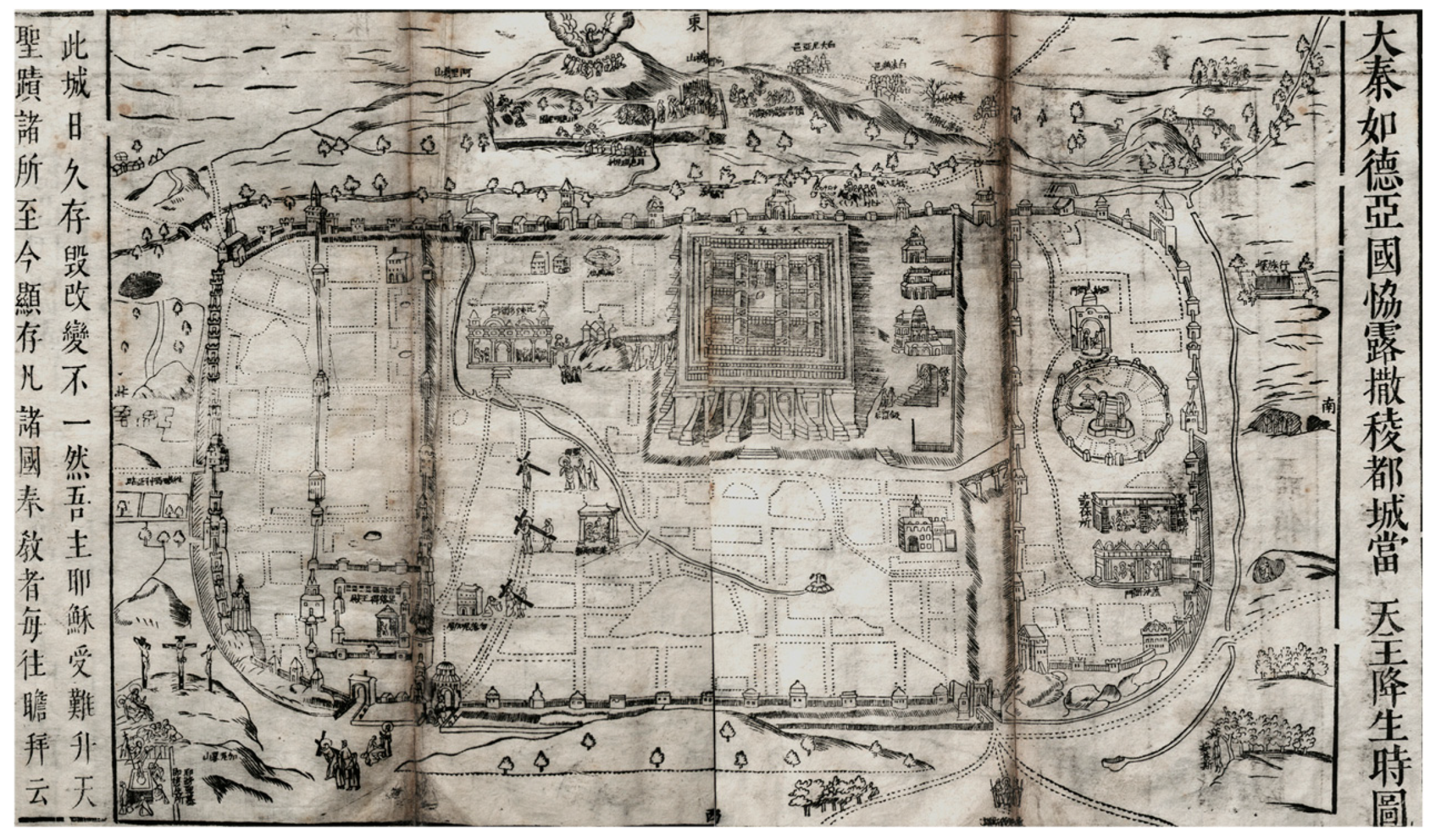
Evangelica historiae imagines and added a map of Jerusalem and Gospel images to illustratively educate the Late Ming Chinese about Christianity. The map of Jerusalem is a simplified version of the original map designed by Christian van Adrichem in 1584, and it was added to increase the historical and geographic believability of Christ’s life stories for Chinese audiences (
X. Wang 2020). The image of Christ was adapted from multiple different works that have been thoroughly analyzed. As for other depictions, most were replicated and re-designed with Chinese elements. For instance, the Chinese landscape painting style, such as Cun texturing 皴法 for mountains and stones (
Xiao 2024), is notable in
Jingjie, for example, in
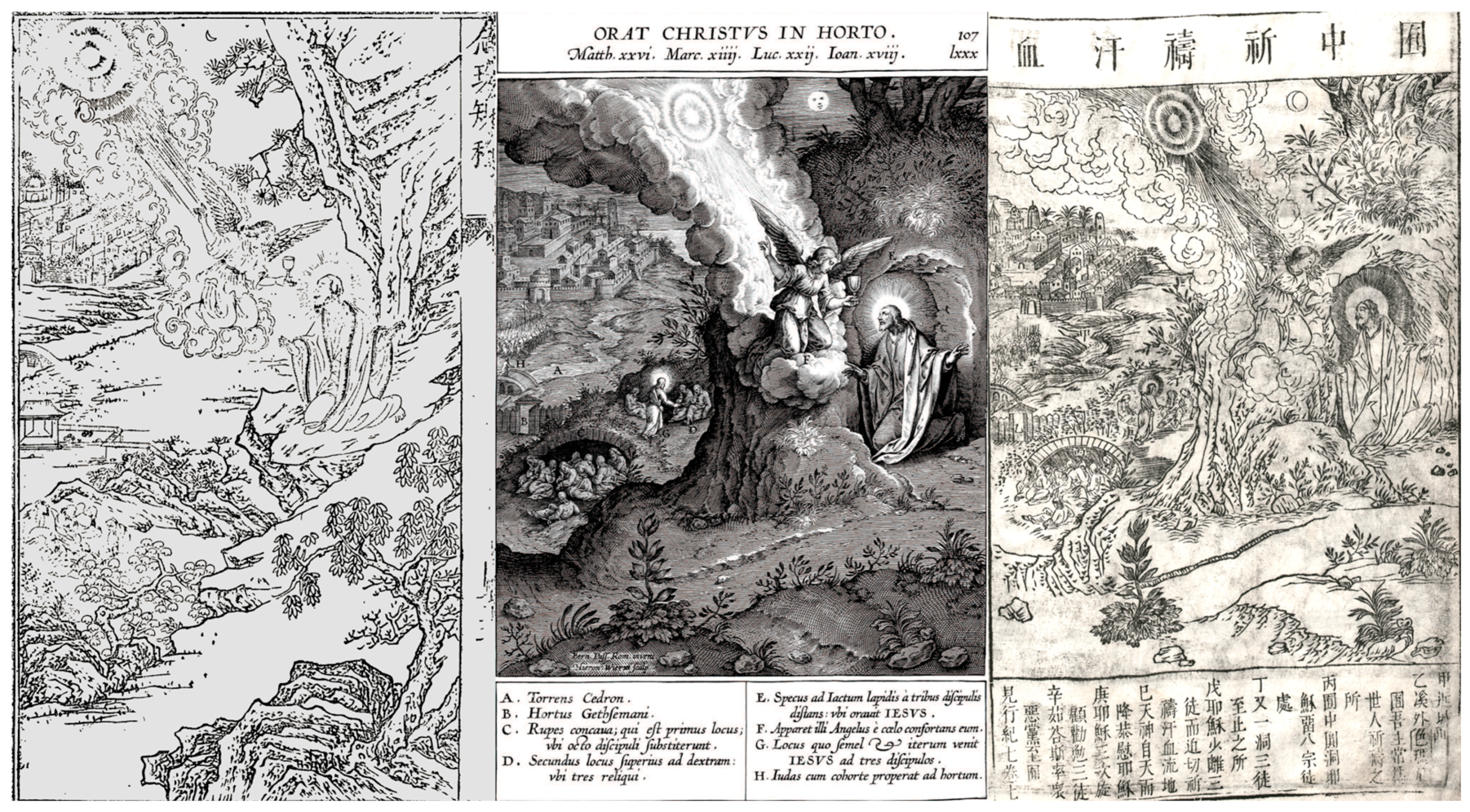
Jesus Praying in Gethsemane, which utilizes this style for the background of the Garden of Gethsemane. Most of these analyses are included in Qu’s new book, but there are still many
Jingjie scenes which have yet to be thoroughly studied from a pictorial perspective.
In modern research, further examination of the scenes re-designed and re-composited by Aleni in Jingjie is necessary, as it will help to reveal the connection between Jingjie and the Jesuits’ “complement of Confucianism and the replacement of Buddhism 补儒易佛” strategy from a pictorial perspective. Additionally, the Daoism element in Jingjie should be noted for its role as a complement to Confucian motifs for the Chinese readership. This further allows us to clarify Christian stories through the transformation of Chinese and Western images.
2. Apostolate Through Sinicized Christian Books
The apostolate in Late Ming China was initiated literarily through textual Christian books, either translated or originally written in Chinese, and then expanded to illustrative books, the aim being to better disseminate Christianity. This helped expand the Chinese Christian community among both the literati elite and general public. To achieve this, missionaries utilized different types of books (scientific, philosophical, moral, Christian) to build a trust-worthy impression of Christianity for the Late Ming Chinese (
Gianni et al. 2003, pp. 50–52). Matteo Ricci initially realized how effective the literary apostolate was in his earlier missionary journey to Zhaoqing 肇庆 (
Ricci et al. 2010, pp. 170–72), and then decided to use non-religious Western books for greater intrigue to grow Chinese interest in Christianity (
Bernard and Guan 1993, pp. 587–89). This allowed missionaries to present themselves as Xiru 西儒, meaning scholars from the West (
Standaert 2001, p. 604;
Li and Gao 2025), thereby situating Christianity in a Confucian context while giving the impression of being knowledgeable (
Shi 2019, pp. 108–21, 151–57). It also allowed missionaries to gain respect from the Chinese literati elite with apostolate potential, thus leading to direct apostolate 直接传教 and indirect apostolate 间接传教 strategies for encouraging non-Christian Chinese to learn about Christianity (
Gianni et al. 2003, p. 51). Specifically, an indirect apostolate is an act of Catechism for non-Christian Chinese to justify Christianity through philosophical or moral books, such as Ricci’s
Tianzhu Shiyi 天主实义 (
Gianni et al. 2003, p. 52;
Standaert 2001, p. 612). A direct apostolate refers to teaching and guiding Christian practice through Christian books for converted Chinese (
Y. Wu 2016), including by using both textual and illustrative Christian volumes such as Aleni’s
Tianzhu Jiangsheng Yanxing Jilue 天主降生言行纪略 and its complementary illustrative version
Tianzhu Jiangsheng Chuxiang Jingjie 天主降生出像经解. These Christian books helped to educate both the converted Chinese literati elite and the general public about Christian stories, images, and theories, thus reinforcing the development of the Chinese Christian community through books.
2.1. The Initiation of Sinicization
Literary apostolate was started with Sinicization for efficient preaching in the Late Ming China, primarily by Jesuit missionaries such as Matteo Ricci and Michele Ruggieri. For Ricci especially, the dissemination of Chinese Christianity was like planting seeds to cultivate religious fruit on China (
Ricci et al. 2010, p. 2). In this case, books are the seeds. In the late 1580s, it became clear that apostolate through verbal communication was, at that time, not as effective as via written books (
Ricci et al. 2010, pp. 171–72). In 1584, Ricci collaborated with a Chinese Christian translator to publish Ruggieri’s manuscript about catechism under the title
Tianzhu Shilu 天主实录, meaning true account of God (
Dunne 1962, p. 29). This was the first Christian book published in Chinese, and it inspired missionaries to write and translate more Christian books for Chinese audiences. For better literary apostolates, Jesuit missionaries also actively learned Chinese and translated Chinese books to better introduce Christianity into the Late Ming Chinese context (
Gallagher 1953, pp. 157–58). Ricci argues that literary apostolates helped convert the Late Ming Chinese, from the top elite down to the general public (
Gianni et al. 2003, p. 43). Through years of dedication, many textual Christian books were published, such as
Tianzhu Shengjiao Yueyan 天主圣教约言,
Shengjiao Rike 圣教日课, and
Tianzhu Shengxiang Lueshuo 天主圣像略说, to introduce Christian stories, theories, and practice into Late Ming China. This required missionaries to re-interpret Christian books for Chinese readership.
For literary apostolates in Late Ming China, introducing Christian books in Chinese was the first step. It began with integrating Buddhism and Confucianism contexts into textual Christian books, which subsequently influenced illustrative Christian books. The overall strategy was to infiltrate and further integrate into Chinese culture. This decision is based on three factors: the previous failed entrance of Francis Xavier, the later suggestions offered by the Governor of Liangguang 两广总督 Chenduan 陈端, and the new apostolate plan drafted by Alessandro Valignano (
Ricci and Gallagher 1953, pp. 117–27;
L. Song 2011, pp. 12–18;
Standaert 2001, pp. 310–11). As a pioneer, Xavier found it difficult to directly enter Late Ming Chinese society as a Christian priest or regular foreigner (
Latourette 2009, pp. 85–88). Learning from that previous failure, Valignano drafted a new plan based on his observations and preaching experiences. Standaert summarized this into four major characteristics: “(1) accommodation or adaptation to Chinese culture, (2) propagation and evangelisation ‘from the top down’, (3) Indirect propagation by using European science and technology, (4) openness to and tolerance of Chinese values” (
Standaert 2001, pp. 310–11). This plan proved successful under Ricci’s execution; the earlier attempt involved accommodating Christianity as a Buddhist-like identity. At first, Rugierri and Ricci disguised themselves as Buddhist monks in an attempt to enter Late Ming China (
Latourette 2009, pp. 91–94). In combination with a literary apostolate strategy, earlier Christian book in Chinese introduced missionaries as monks, such as
Tianzhu Shilu 天主实录. Following this came the illustrative guidance of Christian spiritual exercises named
Song Nianzhu Guicheng 诵念珠规程, which also contains various Buddhist-like designs characterizing Jesus. However, the accommodation of Buddhist style was soon abandoned as the literati had little respect for this and because of the confusion between Buddhist monks and Christian priests (
Dunne 1962, pp. 34, 46). Additionally, Ricci realized that the low respect towards Buddhist figures did not benefit the apostolate process, leading to a strategic shift in which missionaries were presented instead as Xiru 西儒 (scholars from the West) (
Latourette 2009, pp. 91–94;
Standaert 2001, pp. 362–64). This changed the approach to the preaching of both textual and illustrative Christian books, such as Giulio Aleni’s
Tianzhu Jiangsheng Yanxing Jilue 天主降生言行纪略 and
Tianzhu Jiangsheng Chuxiang Jingjie 天主降生出像经解. This reflects the strategic shift from utilizing Buddhist-like imagery to illustrating Western Christian images with Chinese elements.
Nevertheless, Sinicized Christian illustrations were not printed in Christian books in the beginning, but were printed as Chinese woodprint sample for advertising. Early in 1606, four pages of Christian images were printed in a Chinese woodprint collection named
Chengshi Moyuan 程氏墨苑, which are collected as Christian prints sample along with other religious prints (
He 2013, pp. 309–11). The first official Christian image collection was the
Song Nianzhu Guicheng by Jean de Rocha; however, it mainly illustrates guided meditations rather than Christian stories (
X. Wang 2021). Moreover, the Christian images in
Guicheng did not preserve the original designs in
Evangelica historiae imagines; the art style was overly modified with Buddhist-like character design and a Chinese layout. This reflects an earlier Sinicization strategy of distributing apostolates with Buddhist visual elements (
Gianni et al. 2003, pp. 32–33).
2.2. Accommodation of Buddhist Presentation for Introducing Christianity
Introducing Christian books to the Late Ming Chinese required accommodation to Chinese culture, which led to earlier adaptation to Chinese Buddhism. Alessandro Valignano and Michele Ruggieri discovered that the key to accommodation is to talk, write, dress, and behave according to Chinese customs (
Gu 2001). In earlier stage, Valignano suggested missionaries should wear Buddhist clothing for declare their religious status (
Gianni et al. 2003, p. 48). This required missionaries to study Chinese culture with Buddhist elements to better explain Christianity to a Chinese readership; however, this may have led to intentional misuse of Chinese context (
Fu 2007, pp. 112–18;
Li et al. 2024). This is how missionaries initially introduced themselves. For instance, Ruggieri presented himself as “Tianzhuguo Seng 天竺国僧,” which means “monk from India,” in the original version of
Tianzhu Shilu 天主实录 named
Xinbian Xizhuguo Tianzhu Shilu 新编西竺国天主实录. It first integrated the five constant virtues of Confucianism (仁义礼智信) to introduce the righteousness of Christian practice to China (
Zhang 2015;
Standaert and Dudink 2002). However, the Chinese Buddhist context was removed in newer versions of
Shilu, in which the Confucian context was preserved (
Li 2005). Later, Jean de Rocha published
Song Nianzhu Guicheng 诵念珠规程 (
Rocha 1619), which was the first illustrative Christian story book in Chinese. This book was more original, as the Christian images were designed with recognizable Buddhist and Chinese garden features. For example, the
Jesus Praying in Gethsemane scene, originally from
Evangelica historiae imagines, was presented differently in
Guicheng, as Jesus’s character design is similar to that of Bodhidharma, and he is communicating with an angel in a Chinese garden (
Figure 1). These illustrations are more aesthetically friendly to Late Ming Chinese.
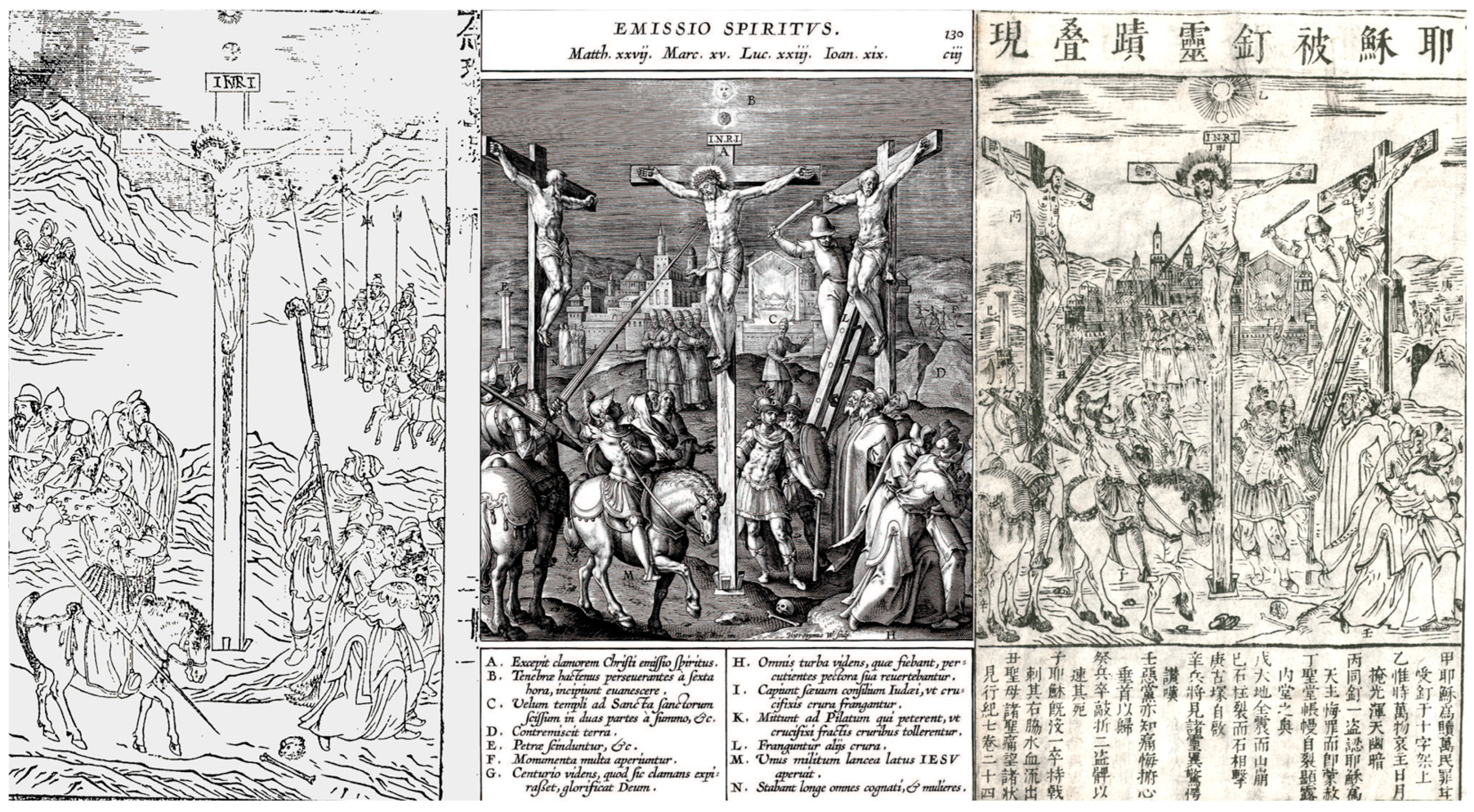
However, these illustrations were overly modified with Chinese elements; most of the original layout and character design from
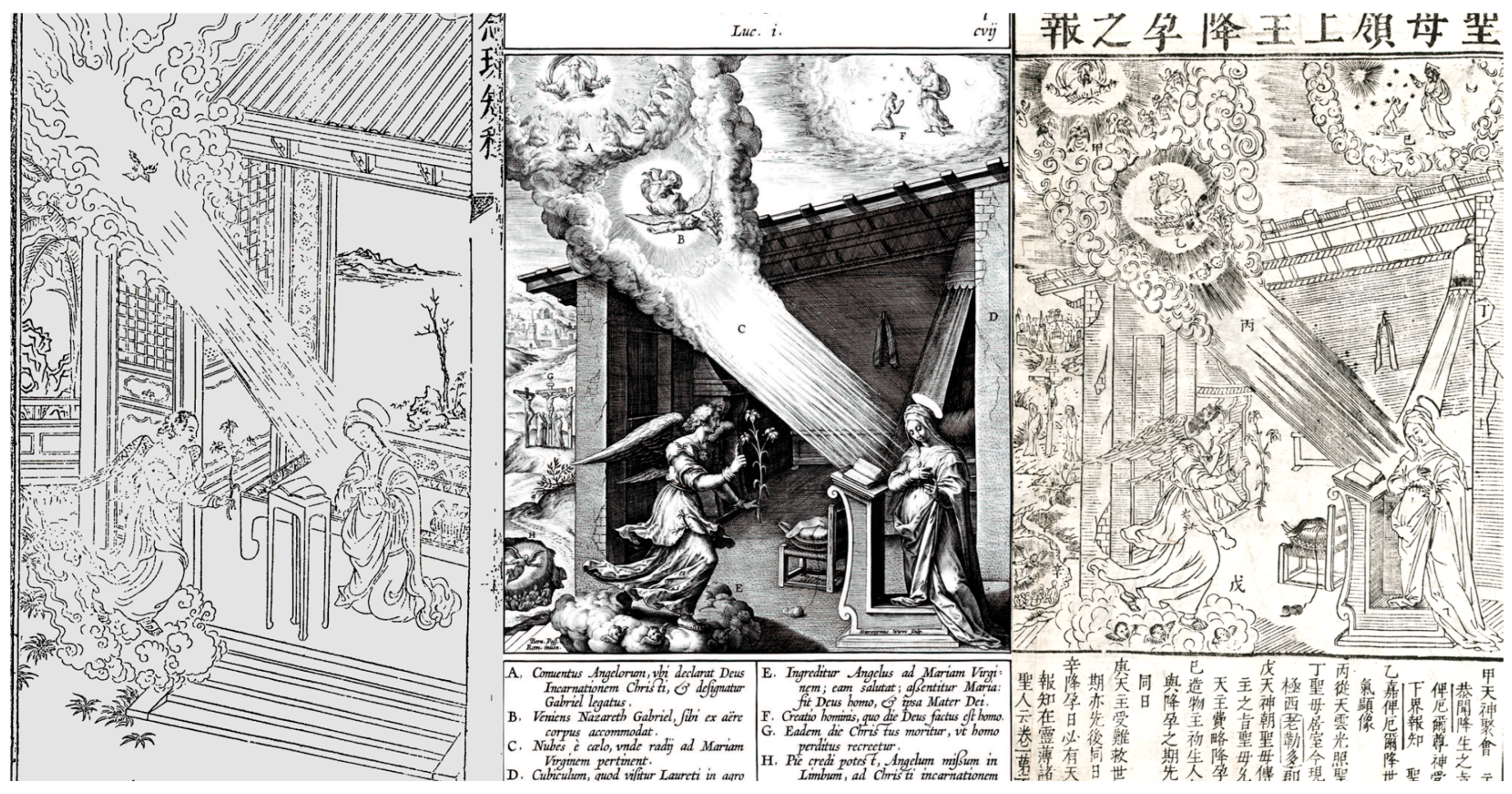
Evangelica historiae imagines was overwritten. For instance, Maria, Jesus’s mother, is presented in a Chinese literati’s house in the
Annunciation scene of
Guicheng (
Figure 2). This may have led to a false impression that Jesus was from China. These overly modified images are common in
Guicheng and may have led to a false understanding of Christian stories. More importantly, local Chinese in the Late Ming period knew that Jesus is not from China. Therefore, illustrating Christian stories with a purely Chinese layout and character design may have triggered suspicion regarding Christianity’s credibility. Missionaries soon realized that borrowing Chinese Buddhist elements was not ideal because the Buddhist identity was fully respected by Chinese literati elite. Thus, Buddhist-like presentation is not an ideal vehicle for introducing Christianity to the Chinese literati community in the Late Ming period (
Latourette 2009, pp. 94, 132). Thus, Ricci suggested that Valignano should present Christian missionaries as Confucian instead of Buddhist figures, allowing for the integration of Christian elements with Chinese-friendly presentation (
Qi and He 2013, pp. 116–24). This led to another Sinicization strategy called “complement of Confucianism and the replacement of Buddhism 补儒易佛”, in which Buddhism was replaced with a Confucianism-based approach (
Li 2005, pp. 87–92). To better achieve this, Jesuits also introduced Western science, such as meteorology, to reinforce their knowledgeable status (
H. Wang 2020). This was also supported by the Late Ming Chinese Christian Guang-qi Xu 徐光启 through the introduction of his
Tianshui Xifa 泰西水法, which encouraged the “complement of Confucianism and the replacement of Buddhism” strategy for disseminating Christianity (
Xu 2010). Confucianism was the dominant cultural context in Late Ming China and, therefore, leveraging Confucianism was a reasonable strategy for situating Christianity in a Chinese context. However, replacing Chinese Buddhism with Christianity remained difficult since Buddhism had been part of Chinese culture for centuries. As
Guicheng noted, the first illustrative introduction of Christian imagery featured a Buddhist-like presentation.
Considering the above, it was necessary to visually differentiate Christianity from Buddhism. The answer to this problem was presented in Ruggieri’s
Tianzhu Shilu 天主实录—denying and replacing the authority of Buddhism, for instance, by defining the Buddha figure as possessed icon, and claiming the Lord as the true God (
Standaert and Dudink 2002). With this definition, Buddhists become adorers of false icons who did not know the true God. This exemplifies the strategy of redefining Buddhist icons and replacing them with Christian icons from
Evangelica historiae imagines.
2.3. Corrective Adaption with Western Christian Images
To foster true Christianity among the Late Ming Chinese, corrective adaption that preserved Western design based on
Evangelica historiae imagines was necessary. Giulio Aleni attempted this through both textual and illustrative means by introducing books about the life of Christ (
J. Lin 1995). These are known as the three “Tianzhu Jiangsheng 天主降生,” the themed Christian books
Tianzhu Jiangsheng Yanxing Jilue 天主降生言行纪略,
Tianzhu Jiangsheng Yinyi 天主降生引义, and
Tianzhu Jiangsheng Chuxiang Jingjie 天主降生出像经解 (
Pan 2009). Among these books,
Jilue and
Jingjie tell the life of Christ chronologically, providing various material to disseminate Christianity. Aleni published
Jilue first to introduce a textual version of Christ’s life and then later published
Yinyi as theoretical discussion on
Jilue. He finally published
Jingjie as an illustrative version of
Jilue. These books stay true to Christ’s life stories, with chronological storytelling that introduces Christ and discusses why He came to the human world (
S. Gao 2015).
Jilue,
Yinyi, and
Jingjie clearly differentiated themselves from the other Chinese religious context and represented Western Christian with necessary Chinese elements.
Aleni first practiced his corrective adaption textually in
Jilue that both translated and re-organized the Gospel stories to explain the life of Christ for the Late Ming Chinese (
Che 2023). He clarified the originality and terminology of Christianity in the preface of
Jilue (
Xu 2010, pp. 28–29). This helped to distinguish Christians from others. The rest of the book continued chronologically to recount the life of Christ through Gospel stories. To achieve this, Aleni translated and simplified
Vita D.N. lesu Christi with additional emphasis on historical and geographic elements to create a biographic impression (
Pan 2009). For content that was not compatible with Confucianism, Aleni modified or annotated the original version according to Chinese tradition and Confucian morality; for example, modified the content about despising tax collector 税吏 or counter to xiao 孝 that is not compatible for Chinese culture (
S. Gao 2015;
Gianni et al. 2003, pp. 230–33). These strategies made
Jilue a Chinese-friendly version of Christ’s life story.
Later, Aleni wrote
Tianzhu Jiangsheng Yinyi 天主降生引义 as theoretical introduction to
Tianzhu Jiangsheng Yanxing Jilue 天主降生言行纪略 that justified the righteousness of both Christ and Christianity in China. To accomplish this, Aleni answered three crucial questions: Why was God born as Christ in the mortal world? Why was Christ born in the West instead of China? Why did Christ have to suffer? Essentially, the answers to these questions explained the incarnation of Christ (
Standaert 2001, p. 622). Although they often overlapped with the content of Aleni’s other Christian books, such as
Sanshan Lunxue Ji 三山论学纪 and
Kouduo Richao 口铎日抄 (
Gianni et al. 2003, p. 327), Aleni re-organized the content to support cross-cultural communication and to justify the righteousness of Christianity by quoting Chinese history, for example, through explaining the necessity of suffering by quoting the “Praying for Rain in Sang Forest 桑林祈雨” story of Chengtang 成汤 (
Gianni et al. 2003, pp. 298–95).
Yinyi also differentiated Christianity from Confucianism by presenting Confucianism as part of human comprehension and experience without superiority. It is clear that
Yinyi was catechism intended to reinforce the presentation of Christianity, as well as explain the meaning of Christ’s life story.
At last, Aleni compiled
Jingjie as pictorial corrective adaption, which is the first illustrative Chinese publication about life of Christ that kept the majority of designs and art style from
Evangelica historiae imagines. It was a visualization of
Jilue that illustrates Christ’s life with Chinese annotations. It corrected the over-modification of Christian images with Chinese elements observed in
Song Nianzhu Guicheng, in which elements of the original
Evangelica historiae imagines images were replaced with Chinese features, such as architecture, interiors, gardens, and landscapes. These images projected a false impression that these Christian stories took place in China. To establish more authoritative Christian images for the Late Ming Chinese from a Jesuit perspective, Aleni used
Evangelica historiae imagines as a primary reference. This book, published in 1593 by Jeronimo Nadal, contains etchings depicting Christian stories in a Western art style. It was the direct reference for Giulio Aleni to creating the first illustrative Chinese book about the life of Christ, named
Tianzhu Jiangsheng Chuxiang Jingjie 天主降生出像经解. Compared to Rocha’s
Guicheng, Aleni’s
Jingjie successfully reproduced the design of
Evangelica historiae imagines in a Chinese wood engraving style, but with a necessary re-design and re-compilation. There are three versions of
Jingjie, with varying numbers of illustrations: 57 scenes, 58 scenes, and 51 scenes (
Xie 2016, pp. 122–28). All scenes were carefully selected from
Evangelica historiae imagines by Aleni and designed with minor Chinese art influence and motifs. Thus,
Jingjie was the first illustrative Christian Chinese book to relay Christ’s life for Late Ming Chinese audiences. Its main content requires further examination.
3. Sinicized Approach to Compiling Jingjie
The main purpose of
Jingjie was to introduce Christ’s life to the Late Ming Chinese, which required Aleni to situate the life of Christ in traditional Chinese history for Chinese audiences. To achieve this, Aleni accommodated the Confucian context to re-introduce and disseminate Christianity through books (
L. Wu 2009). For a visual introduction, more specifically, Aleni used
Evangelica historiae imagines as his primary reference, in addition to other Western illustrative Christian books and paintings as secondary references, to selectively re-design or re-composite Christian images to include Chinese elements. Aleni selectively adapted these resources and compiled them in chronological order, using a map of Jerusalem as geographic evidence and Christ’s icon as an illustrative introduction to Jesus. The published outcome was
Tianzhu Jiangsheng Chuxiang Jingjie. Standaert considers
Jingjie “a Chinese adaptation of
Vita D.N. lesu Christi by Ludolphus de Saxonia” with
Evangelica historiae imagine as a reference, because it only provides commentary on meditation and does not include Christian storytelling (
Standaert 2001, p. 623). This is a reasonable opinion since
Vita D.N. lesu Christi presents a chronological tale of Christ’s life. Yet, from a pictorial perspective,
Jingjie is an illustrative book that introduces the life of Christ; therefore, it is better to separate Aleni’s adaption of
Jingjie into two aspects: the illustrative and the narrative. The illustrative adaption was mainly based on
Evangelica historiae imagines, and the narrative adaption was based on
Vita D.N. lesu Christi. It is also a visualization of Aleni’s earlier work
Tianzhu Jiangsheng Yanxing Lueji 天主降生言行纪略, which also describes Christ’s life in text.
Ever since the first publication of
Jingjie, many modified versions have emerged. In the latest version, the title was changed to
Tianzhu Jiangsheng Yanxing Jixiang 天主降生言行纪像, and the map of Jerusalem was removed. Hui Xie considers this latest version as a Qing dynasty copy; he also observed that the original version had 57 scenes, while another contains an extra scene with a different artistic style from the previous scenes (
Xie 2016, pp. 122–28). All versions present two essential scenes as an introduction, the Christ icon and
The Birth of John the Baptist Foretold scene, but they may be in reverse order. To better analyze
Jingjie, it is necessary to study the original version of 1637 (
Giulio 1637), to reveal Aleni’s decision-making when compiling Christian imagery for a Chinese readership.
3.1. Sinicized Biographic Nature of Jingjie
Since Christianity treats the life of Christ as real history, Aleni had to introduce it as history in a biographic form. However, there was already a Chinese tradition of documenting people and including geographic information, which had existed since the Pre-Qin 先秦 era. This can be widely observed in
Chinese Official histories 二十四史, where a chapter on geography provided necessary proof of specific landscapes and territories. The
General Catalogue of Complete Library of Four Treasures 四库全书总目 also included historical geography as “Zhi 志” (
Yong and Ji 2000). “Zhi” often includes a map for readers to learn about local environments and resources (
Yong and Ji 2000). In other words, maps are an important element of Chinese historical documents.
The first version of
Jingjie contained a map of Jerusalem at the beginning. The map was named 大秦如德亚国恊露撒稜都城当天主降生时图, meaning “the city of Jerusalem in the Western Judea nation when Jesus was born” (
Figure 3). This provided a realistic historical impression of Jesus’s credibility for Chinese audiences (
X. Wang 2020). The
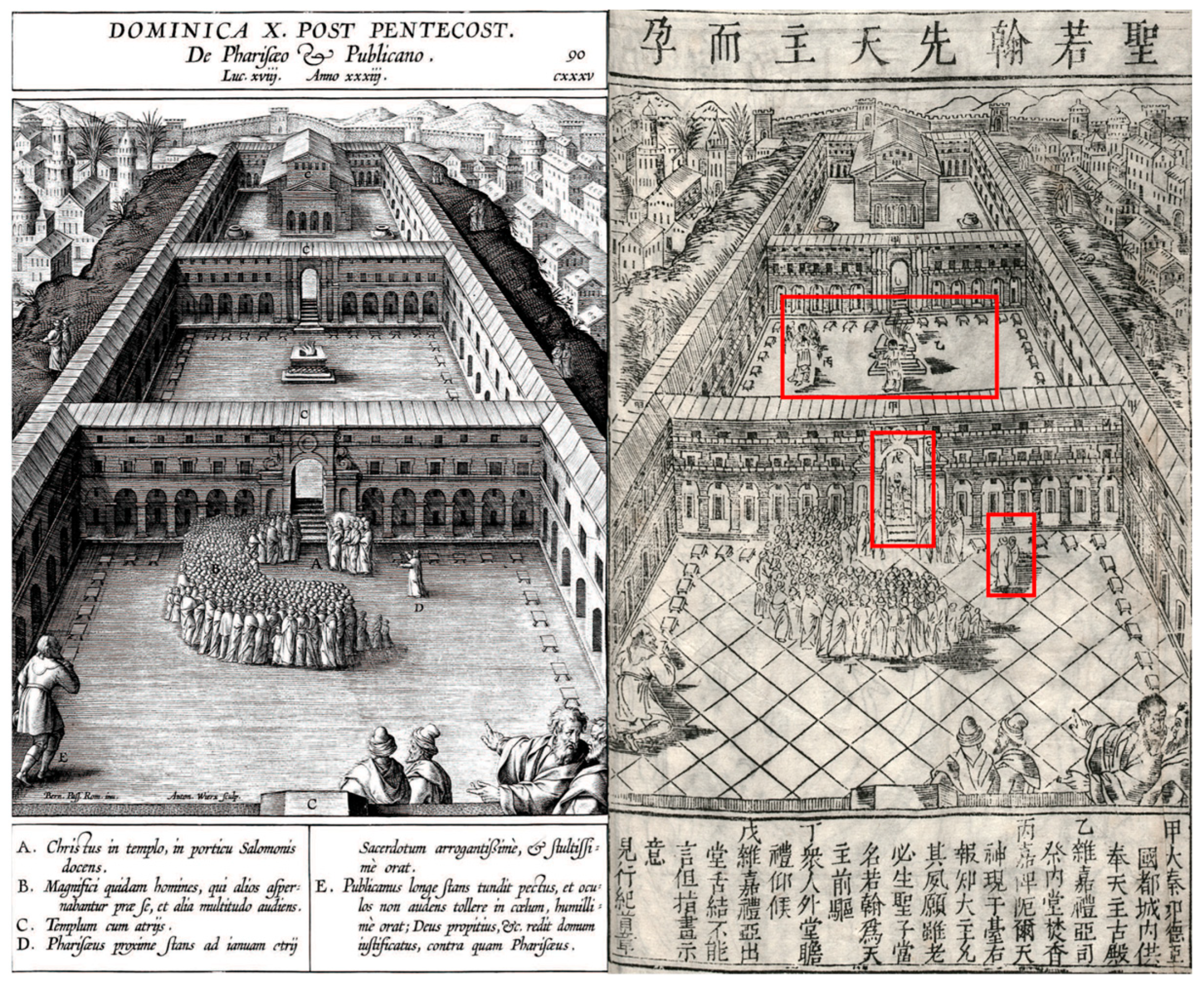
Shengruohan Xian Tianzhu Eryun 圣若涵先天主而孕
(The Birth of John the Baptist Foretold) scene, originally the 90th scene of
The Parable of the Pharisee and the Tax in
Evangelica historiae imagines, illustrates the prophetic story about the birth of Saint John. This scene takes place in the holy temple of Jerusalem, which is at the center of the Jerusalem map. Aleni used this scene in a close-up of the Jerusalem map to further introduce the holy temple in Jerusalem. However, the scene was also re-designed according to its title,
Shengruohan Xian Tianzhu Eryun, to emphasize its credibility as a historical event regarding location. These two scenes helped to establish a biographic interpretation of Jesus’s story (
Qu 2025, pp. 166–68, 240–44). They also hint at the relationship between Jesus and John the Baptist for Catholic purposes. Following these introductions, the life of Christ was unveiled through illustrations.
This approach helped to establish an essential precedent that the story of the life of Christ was biographic documentation of a historical event. As an adaption of
Evangelica historiae imagines and the illustrative companion to
Jilue,
Jingjie visualized various scenes with real-world surroundings that made the depictions of Christ’s life convincing (
Qu 2025, pp. 165–69). However, not all scenes were fully replicated from
Evangelica historiae imagines; some were re-composited or re-designed. Re-compositing is to reorganizing scenarios or elements from multiple scenes from
Evangelica historiae imagines or illustrations from different books, while the latter involves. Re-designing is to reconstructing the storytelling and cultural context. Both were performed for Sinicization purposes.
3.2. Re-Compositing for Introducing Christ
Two types of re-compositing techniques were used in
Jingjie to introduce Christ: re-composite from multiple sources, and re-composite different scenes from
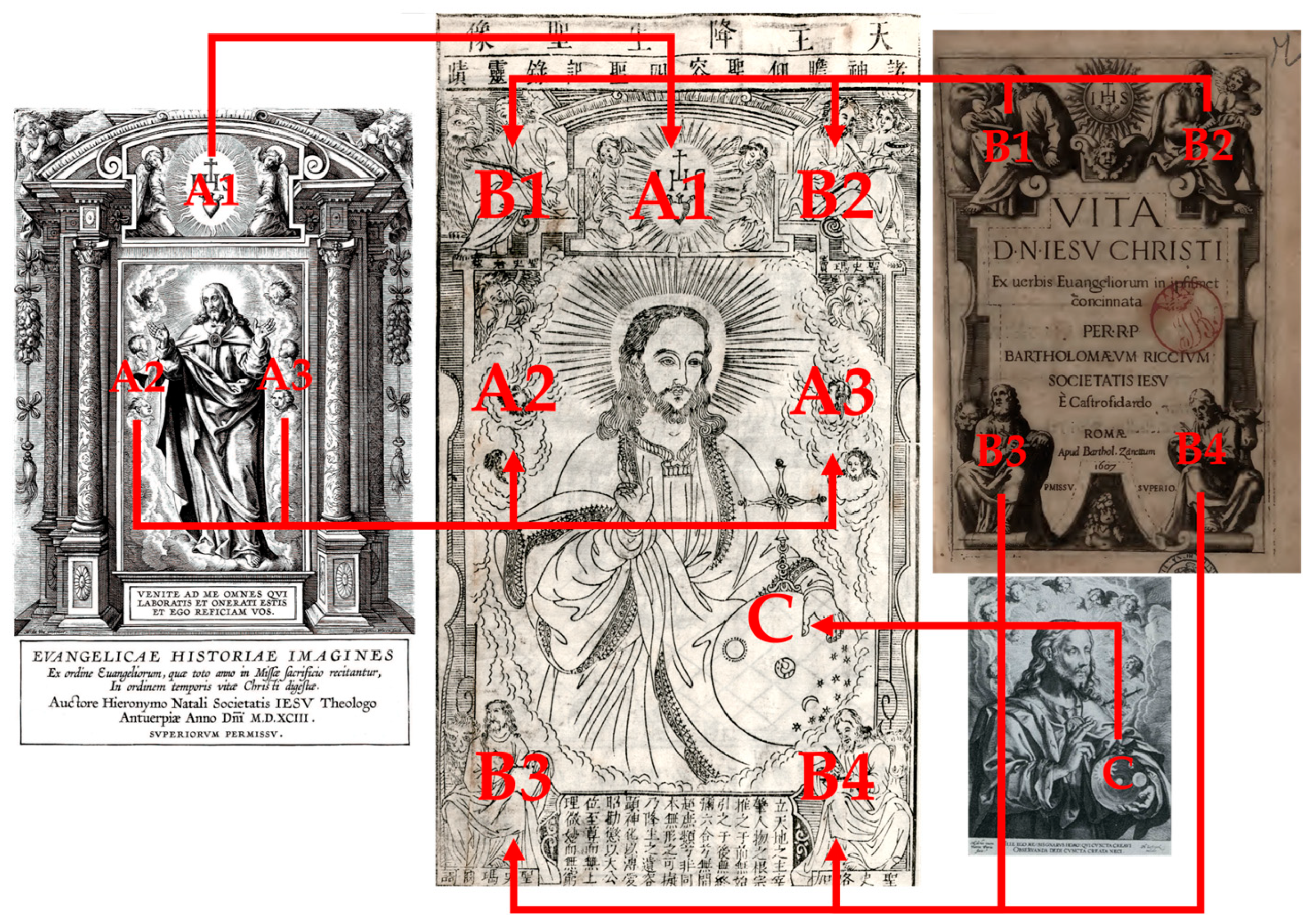
Evangelica historiae imagines. The only example of the first type is the image of Christ Savior in
Jingjie, there named
Tianzhu Jiangsheng Shengxiang 天主降生圣像, and is a combination of multiple resources, such as
Evangelica historiae imagines,
Vita D.N. Iesu Christi (
Ricci 1607), and
Salvator mundi by Maarteen de Vos (
Ojeda 2005). The design of this icon was referred from different resources, creating an image of Christ using Gospel elements (
Figure 4); however, the original reference for the Christ figure itself has not yet been identified (On the right bottom corner of
Figure 4 is the
Salvator Mundi image that was engraving after Maarten de Vos by Hieronymus Wierix).
The second type of re-compositing technique is to take identical scenario from different scenes in
Evangelica historiae imagines and composite them into one scene in
Jingjie. According to Yi Qu, there are six scenes that are the combination of two to three original scenarios (
Qu 2025, pp. 189–206), such as
Xijia Jishui Huazhong 西加汲水化众 or
Wenwu Ershi Lianzang Yesu 文武二仕殓葬耶稣. The most similar is
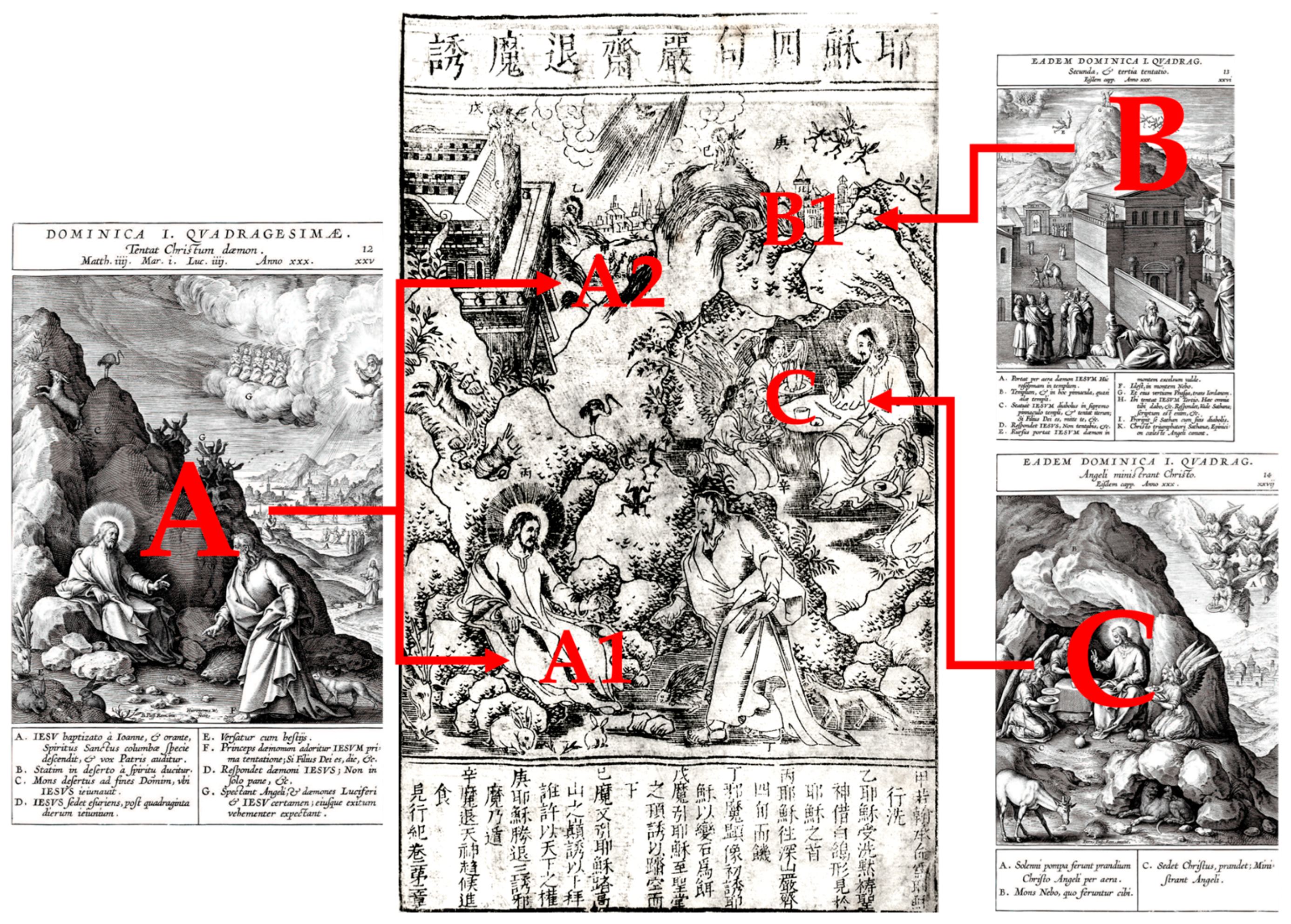
Yesu Sixun Yanzhai Tuimoyou 耶稣四旬严斋退魔诱, which is a combination of the 12th, 13th, and 14th scenes from
Evangelica historiae imagines and describes the Quadragesima and how Jesus overcame the demon’s temptation (
Figure 5).
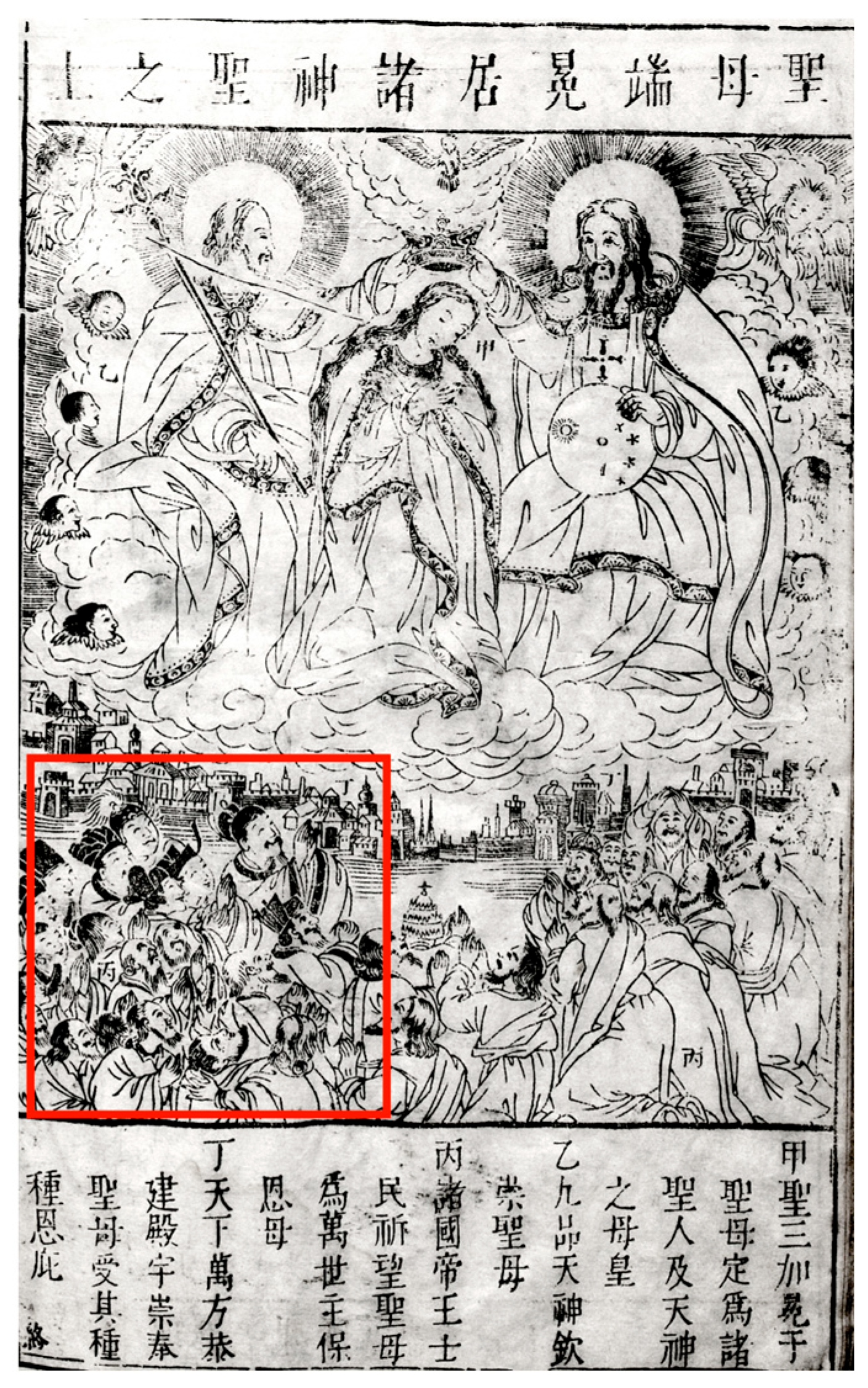
These types of re-composited scenes combine characters, props, and layouts from different images into one illustrative scene, although the source images vary in size and narrative order. Notably, Jingjie kept the same narration techniques used in Evangelica historiae imagines, labeling different illustrations alphabetically to guide storytelling. However, Jingjie uses celestial stems, such as Jia 甲, Yi 乙, Bing 丙, and Ding 丁, instead of the alphabet for Chinese-friendly guidance. This helped Chinese audiences to better understand the life of Christ.
3.3. Re-Design for Chinese Readership
To better illustrate Christian stories for Chinese readership, Aleni used two re-design strategies: storytelling re-design and context re-design. The first strategy can be observed in the
Shengruohan Xian Tianzhu Eryun 圣若涵先天主而孕 (
The Birth of John the Baptist Foretold) scene (
Figure 6). This scene was re-designed based on the original scene from
Evangelica historiae imagines to convey the prophesy of the birth of John the Baptist (
Qu 2025, p. 166). It features a metaphoric Confucian element design that is not visible. Qu considers
The Birth of John the Baptist Foretold to exhibit a narration design that is parallel to
Praying at Nishan Mountain in the illustrative biography
Kongzi Shengji Tu 孔子圣迹图, which describes the prophetic birth of Confucious (
Qu 2025, p. 167). It was re-designed to convince Chinese Christians that the birth of Christ after Saints is reasonable, hinting that Confucious is a Christian saint sent to prepare the Chinese for Christianity (
Qu 2025, pp. 165–68). This is an example of the re-designing-for-storytelling approach to utilizing Confucian elements observed in
Jingjie.
The second strategy was to demonstrate compatibility with Chinese cultural context through re-design, in which Confucian and Daoist motifs were often incorporated. For instance, the
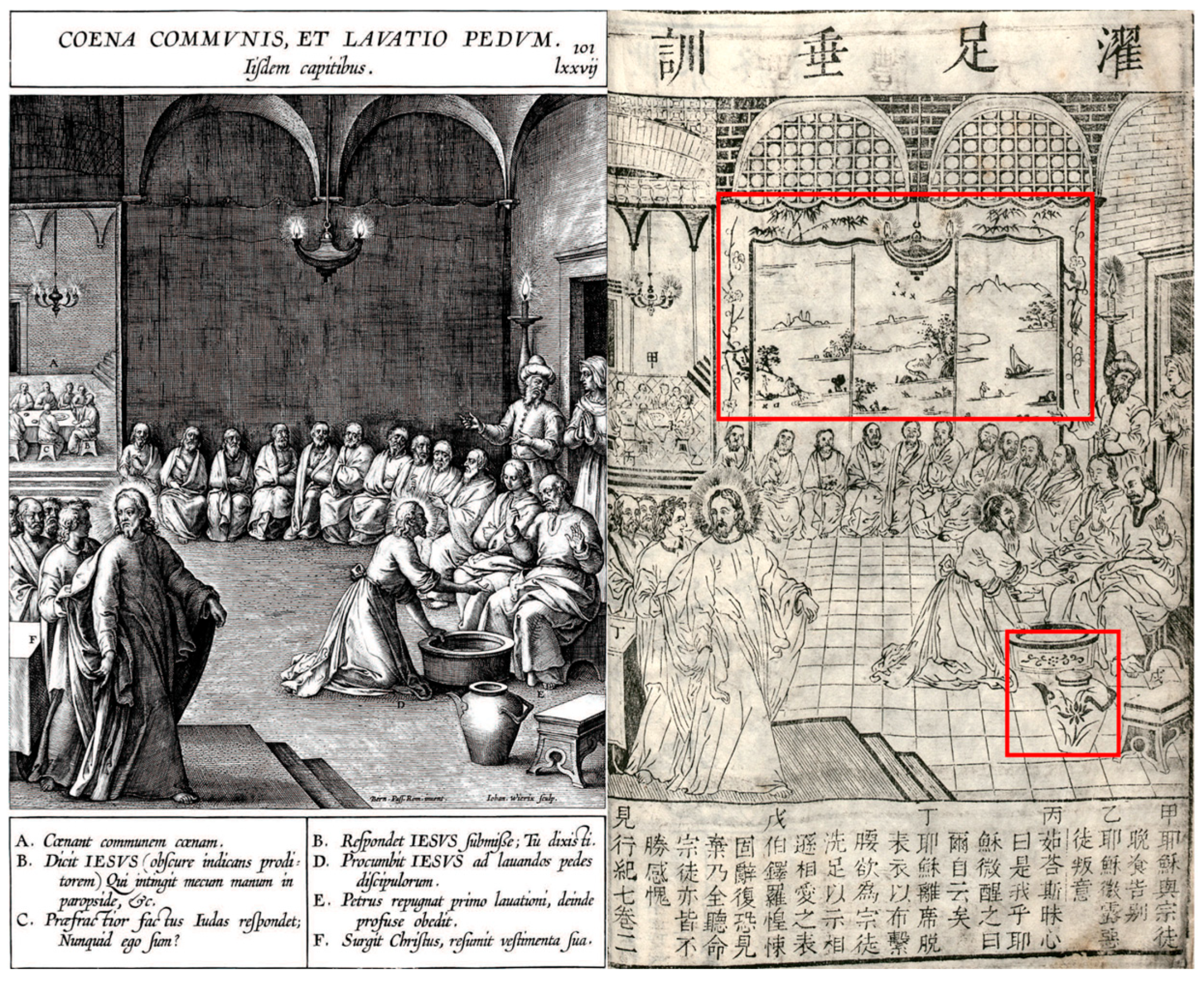
Zhuozu Chuixun 濯足垂训
(Washing the Disciple’s Feet) scene includes a Chinese folding screen in the background and Chinese ceramicware with classic Confucian and Daoism motifs, such as bamboo, plum blossoms, a Chinese landscape, and fishermen with a boat (
Figure 7). The bamboo and plum blossoms represent two of the Four Jun-zi 四君子 in Confucianism that represent integrity and perseverance (
Liu and Chen 2014, pp. 1–11).
These elements help Chinese audiences to associate Christ with bamboo and plum blossoms, portraying Christ as Jun-zi. Moreover, the Chinese landscape and fisherman motifs are important elements that represent Daoist hermit culture in both Chinese literature and paintings (
He and Li 2024). However, it is hard to know whether the application of Daoist motifs was intentional or simply for decoration purposes, since these are common motifs in Chinese landscape paintings that an engraver may have used out of habit instead of intentionally. Nevertheless, the Daoist motif highlights the inner superiority of Christ. In the
Zhuozu Chuixun scene in particular, the use of bamboo, plum blossom, a Chinese landscape, and fisherman motifs further strengthens Christ’s nobleness in both Confucian and Daoist contexts. These are good examples of how original Western design and art styles are integrated with Chinese elements in
Jingjie.
In addition, the chiaroscuro feature in Nadal’s
Evangelica historiae imagines was re-designed with traditional Chinese painting texturing techniques called 皴法 (Cun texturing) in
Jingjie. Cun texturing was developed to paint geologic textures using accumulated lines or dots and is ideal for simulating the chiaroscuro feature (
Xiao 2024). Chinese wood engravers could successfully use accumulated lines or dots to illustrate tone and shade to achieve the chiaroscuro feature, illustrating a perceivable physical world with light and shadow. Moreover, perspective drawing was also replicated. The use of these techniques create art that matches what people generally see in reality and was able to successfully create a refined impression of Christian art with Chinese elements.
As outlined above, Aleni applied three adaptation strategies in Jingjie: replication, re-compositing, and re-design from other resources. He took the storytelling logic from Vita D.N. Iesu Christi and the Gospel images to create a simplified illustrative representation of the life of Christ. Aleni also reinforced the “complement of Confucianism and the replacement of Buddhism 补儒易佛” strategy in Jingjie to successfully tell the Western Christian story visually for the Late Ming Chinese. This was a major improvement over Rocha’s Guicheng, shifting the presentation of Christianity from a Buddhism-like religion to a Western religion with Chinese-friendly features. What follows is a further analysis of the transformation of Christian stories in Chinese and Western images.
5. Conclusions
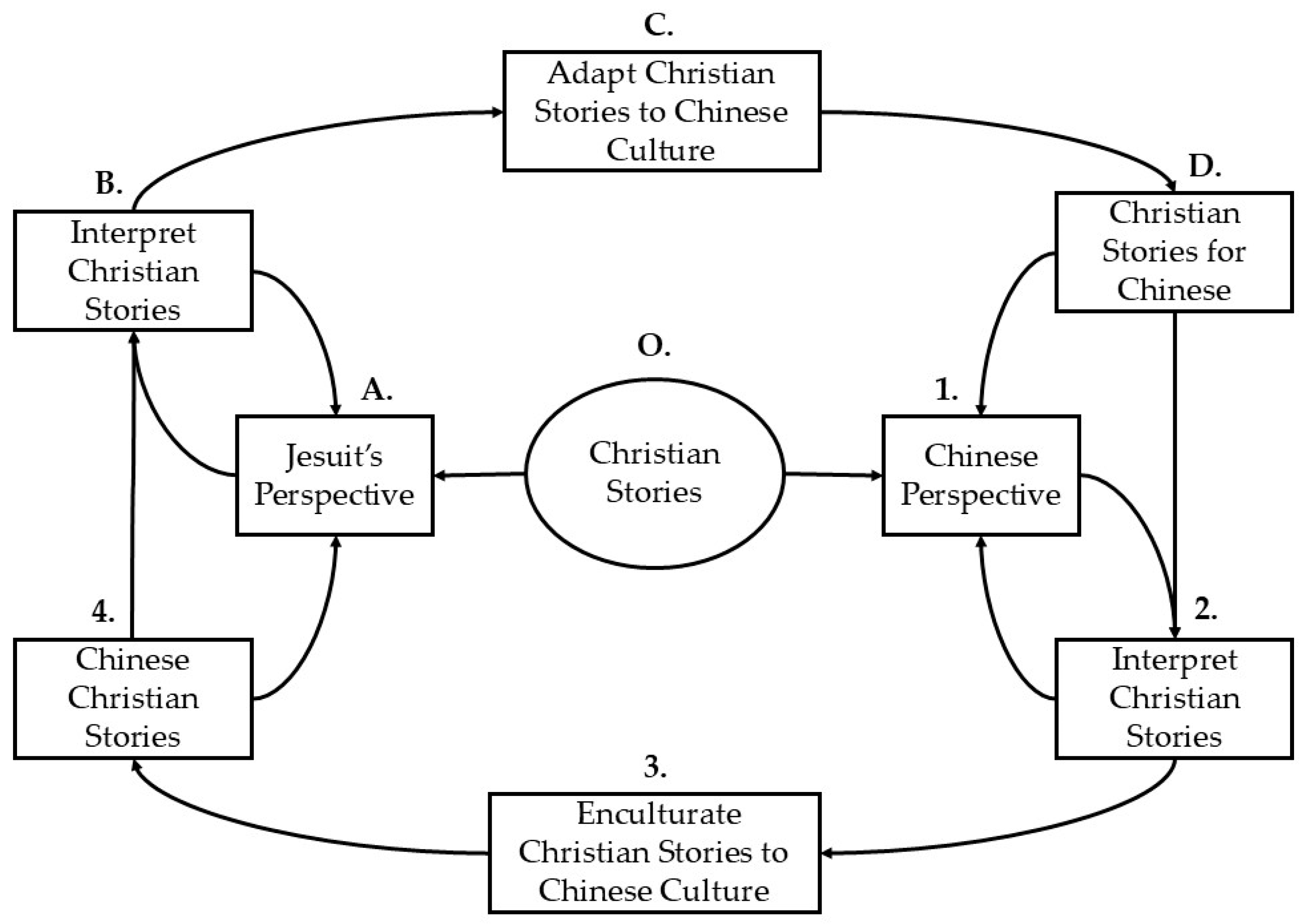
This article examines Tianzhu Jiangsheng Chuxiang Jingjie, which introduces the story of Christ through the replication, re-design, and re-compositing of scenes and elements from different resources, compiled in a chronological order. It is also based on Aleni’s previous publications, including Tianzhu Jiangsheng Yanxing Jilue and Tianzhu Jiangsheng Yinyi, which introduced and discussed the life of Christ in writing. Jingjie is a visualization of these previous works. When compiling Jingjie, Aleni used Evangelica historiae imagines as the primary visual reference but adapted the storytelling logic from Vita D.N. lesu Christi. Following the tradition of Chinese historians, Aleni compiled Jingjie in a biographical style, using the map of Jerusalem to reinforce a historical impression. To better introduce the image of Christ, he also re-designed it using different sources, with Gospel elements to strengthen its Christian presentation with a Western design and art style. In some scenes, most of the design features present in Evangelica historiae imagines were preserved as a response to the “complement of Confucianism and the replacement of Buddhism” strategy and to make up for the over-modification of Christian images in Guicheng. In fact, Rocha’s Guicheng is an earlier exploration of visual Sinicization, transforming the Christian story using Chinese imagery for Chinese Christian storytelling. It immersed Christian stories within Chinese context, design, and art style by Chinese artists. The artists selectively re-designed the Christian images from Evangelica historiae imagines, to address the scene’s theme. It demonstrated the artists’ deep understanding of the Christian spirit, for example, through the Passion of Christ scene. This is indicative of the Chinese perspective in retelling Christian stories in an illustrative form. It reveals the over-modification of the original design from Evangelica historiae imagines, as evidenced by the Bodhidharma-like Christ figure in the scene Jesus Praying in Gethsemane, which reduces the faithfulness to the Christian story. Thus, Aleni’s Jingjie is a justified response to Guicheng that explores a preservation approach to transformation. The preserved design and art style are evident in Jingjie, used to enrich the Christian story with the Chinese context. In addition, the integration of Confucian and Daoist elements not only highlights the integrity and nobleness of Christ, but also hints at His spiritual superiority. Therefore, when compiling Jingjie, Aleni remained honest to the character and layout of Evangelica historiae imagines while integrating necessary Chinese elements. This preserved the authorship for re-telling Christian stories from the Jesuit perspective. This also reveals a round of circular interpretation based on Evangelica historiae imagines, which resulted in Guicheng and Jingjie. Rocha employed the Chinese perspective to interpret Evangelica historiae imagines illustratively to produce Guicheng; Aleni preserved the Western design and art style to re-interpret Evangelica historiae imagines from a Jesuit perspective with Chinese elements, resulting in Jingjie. Hence, Tianzhu Jiangsheng Chuxiang Jingjie functions as a tool for both the justification and interpretation of Christian stories for the Chinese readership through illustrations. Both Guicheng and Jingjie reinforce the Sinicization and dissemination of illustrative Christian stories in Late Ming China.
It is necessary to state that this article does not explore the artists and engravers of Jingjie due to a lack of historical evidence. As for a statistical analysis of all Christian images in Jingjie, Qu has charted one in the appendix of her book The Society of Jesus and Christian Art in the Late Ming Dynasty, where versions and narration orders are specified. In addition, the influences of Jingjie in China and the Christian world are not covered in this paper due to the limited number of historical documents. More in-depth analyses focused on each image in Jingjie should be carried out in future research. By examining the Sinicization and dissemination of Christian stories in Late Ming China through Jingjie, this study offers a complementary input from a pictorial perspective.