Article

Missionary Lexicography as Knowledge Infrastructure: Wilhelm Lobscheid’s English and Chinese Dictionary (1866–1869) and Knowledge Circulation in East Asia

by
Ying Xiong
Faculty of Foreign Languages, The Open Unviersity of China, Beijing 100039, China
Religions 2026, 17(9), 1097; https://doi.org/10.3390/rel17091097 (registering DOI)
Submission received: 28 July 2026 / Revised: 11 September 2026 / Accepted: 17 September 2026 / Published: 19 September 2026

Abstract

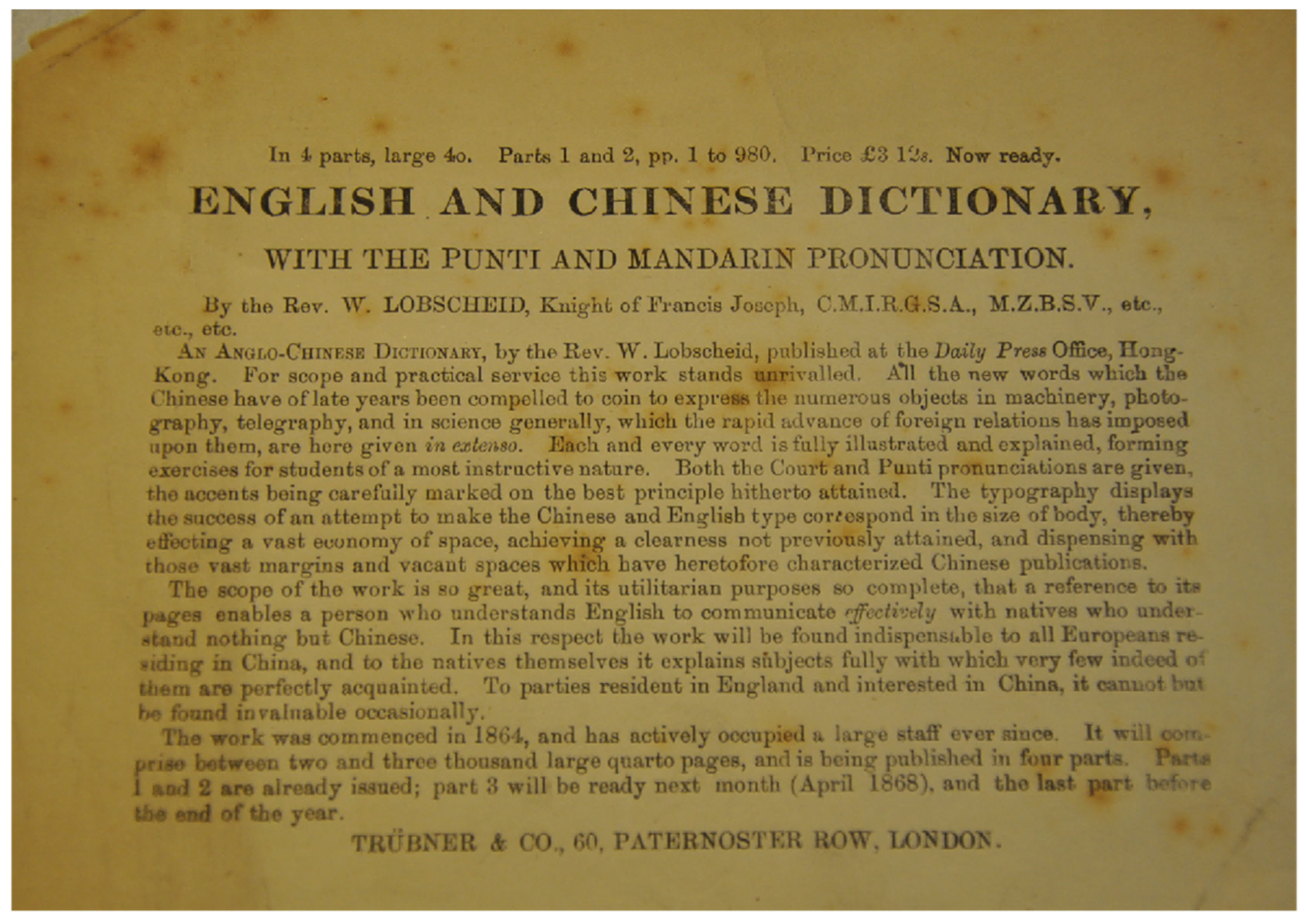
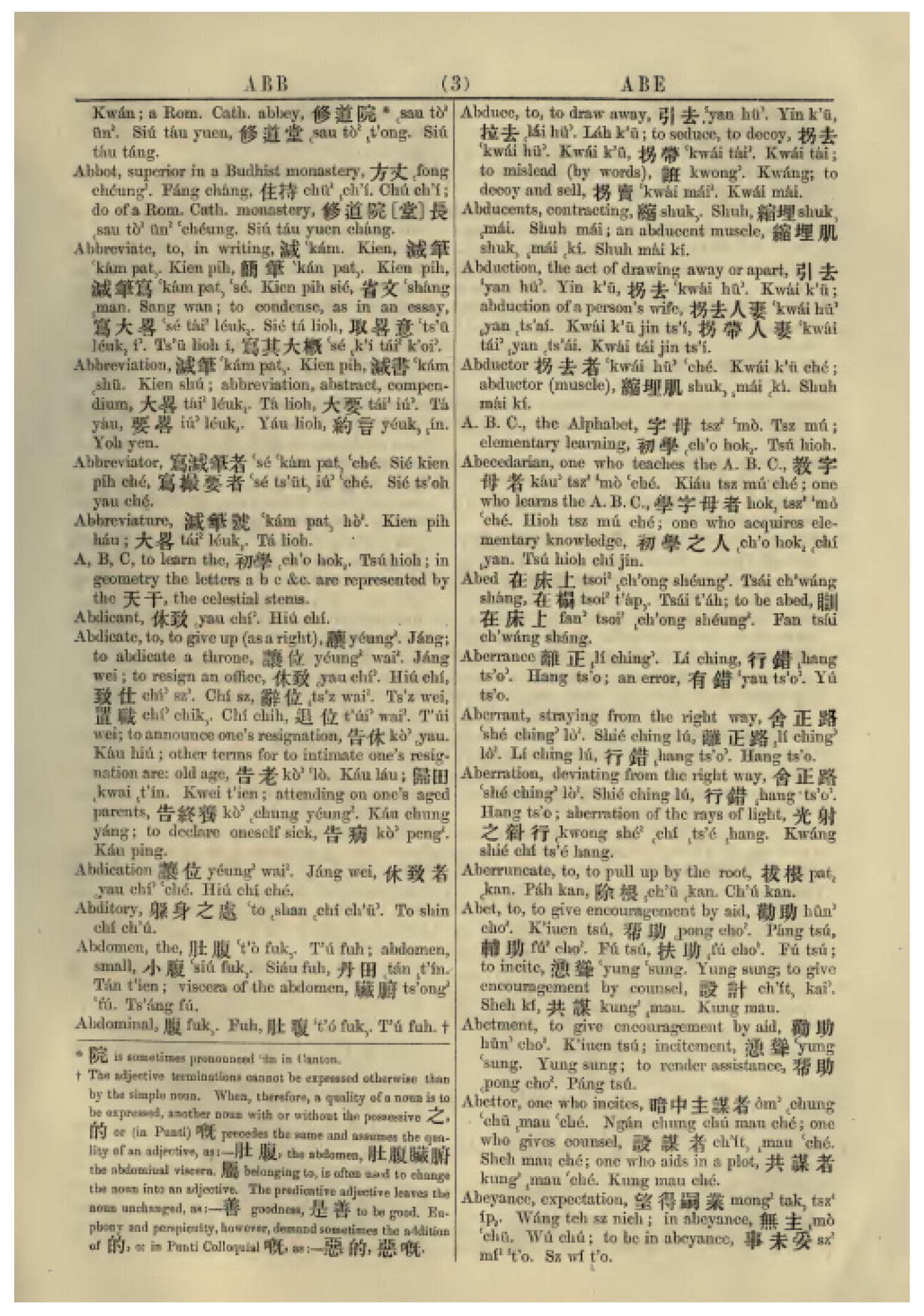
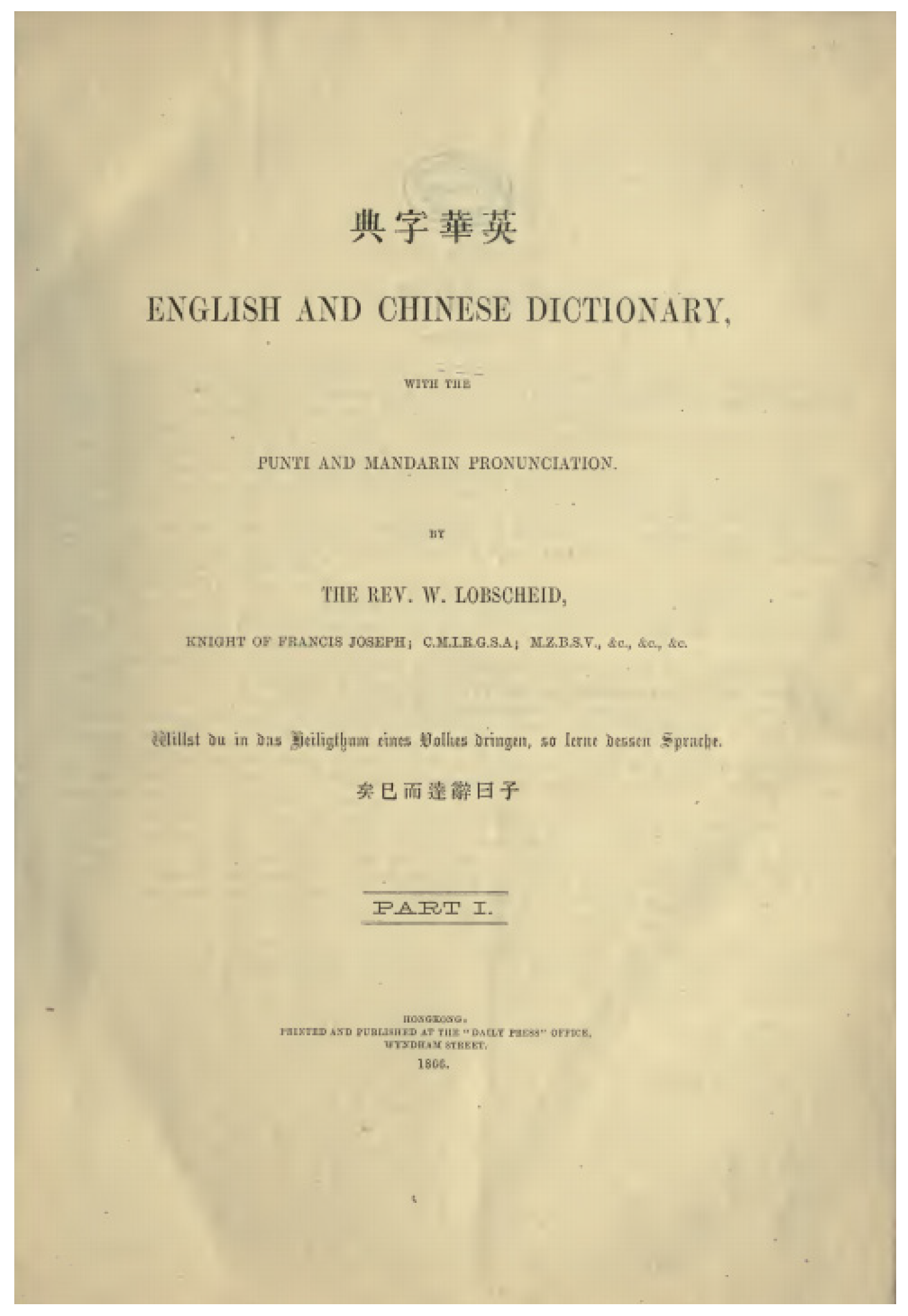
Research on Christianity in modern China has largely focused on missionaries, churches, and Chinese Christians, while the knowledge infrastructures created through missionary activity have received less attention. Taking Wilhelm Lobscheid’s four-volume English and Chinese Dictionary (1866–1869) as a case study, this article combines conceptual history, language-contact history, and global history to examine missionary lexicography as a medium of knowledge production and circulation. It argues, first, that the dictionary emerged from institutional networks linking missionary societies, schools, printing presses, colonial education, and local linguistic resources. Second, through the reuse of inherited concepts, the formation and reorganization of modern terminology, and localized definitions, the dictionary mediated scientific, institutional, theological, and social vocabularies rather than simply transferring them. Third, its reception and adaptation in Japan contributed to multidirectional conceptual circulation within East Asia, although different terms followed distinct trajectories. The article proposes “missionary lexicographical knowledge infrastructure” as a historically grounded analytical concept and outlines a research roadmap that moves from individual missionaries to institutional networks, from evangelization to knowledge production, and from linear diffusion to translingual and regional circulation.
Keywords: Wilhelm Lobscheid; English and Chinese Dictionary (1866–1869); missionary lexicography; knowledge circulation; conceptual mediation; missionary lexicographical knowledge infrastructure; translingual practice; Christianity in modern China; East Asia Wilhelm Lobscheid; English and Chinese Dictionary (1866–1869); missionary lexicography; knowledge circulation; conceptual mediation; missionary lexicographical knowledge infrastructure; translingual practice; Christianity in modern China; East Asia