1. Introduction
In nineteenth-century China, Christian missionaries not only sought to spread the Gospel but also participated in the production and circulation of knowledge. Through their work in education, medicine, and publishing, missionaries and Chinese participants helped give Chinese expression to Christian doctrine and to knowledge in such fields as science, medicine, and law. In this process, bilingual dictionaries brought together headwords, Chinese equivalents, pronunciation information, and examples, offering resources for expressing unfamiliar concepts in Chinese. Research on missionary lexicography has examined the transformation of Western concepts into Chinese lexical resources through dictionary compilation and terminology translation (
Tao and Wan 2024), while research on missionary periodicals has highlighted the role of publication, circulation, and readers’ interpretations in the dissemination and localization of Western knowledge (
Song and Tan 2025).
Taking Wilhelm Lobscheid’s four-volume English and Chinese Dictionary (1866–1869) as a case study, this article reconsiders the relationship between missionary activity and the production of modern knowledge. It focuses on how missionary and scholarly networks, the conditions of print production, and local linguistic resources jointly shaped the dictionary, and on how its lexical materials were selected, reorganized, and reused in East Asian contexts.
Drawing on Liu’s account of meaning-making through translingual practice (
Liu 1995) and Conrad’s emphasis on relationality and transregional connections in global history (
Conrad 2016), this article examines changes in the meanings and subsequent uses of lexicographical materials across different linguistic and social settings. It also considers their trajectories of transmission and adaptation, including possible paths of recirculation. To analyze these processes, this article proposes “missionary lexicographical knowledge infrastructure” as an analytical concept, which helps explain how collaborative compilation, linguistic resources, publishing conditions, and regional networks jointly supported the production and reuse of lexicographical knowledge. Within this framework,
English and Chinese Dictionary1 serves as an important textual node connecting these conditions. Through its arrangement of entries, definitions, and examples, it mediated between different languages and traditions of knowledge, giving the resulting expressions relatively stable forms and making them available for reorganization in subsequent use.
The analysis shows that the English and Chinese Dictionary emerged from intersecting networks of missionary activity and knowledge production. It mediated knowledge through the reuse of inherited concepts, the reorganization of terminology, and localized definitions, while its reception and adaptation in Japan also drew it into regional knowledge circulation and conceptual reconfiguration within East Asia. On this basis, the article offers a dictionary-centered approach to the history of Christianity in modern China: it situates individual missionaries within the knowledge infrastructures of which they formed a part, examines the connections between missionary institutions and other educational, publishing, and scholarly institutions, and considers the relationship between knowledge production and regional circulation through the formation and reuse of dictionary entries. By attending to specific institutional conditions and linguistic practices, this case contributes to a fuller understanding of the interaction between Christian missionary enterprises and the transformation of knowledge in modern China.
2. Literature Review: Missionary Lexicography and Knowledge Circulation
2.1. Bilingual Dictionaries and Missionary Language Practices
The nineteenth century was an era marked by the early rise of globalization and a crucial period in which Sino–Western knowledge relations underwent profound restructuring. After the Industrial Revolution, technological progress gave rise to numerous new objects, disciplines, and ideas in the West. These forms of knowledge entered East Asia through channels such as trade, missionary activities, and education. In the nineteenth century, language functioned as both the carrier of knowledge and the medium through which information circulated. Social transformation generated new vocabulary and concepts, while language became the key mechanism through which new knowledge entered local contexts and acquired social and intellectual efficacy. In this sense, the bilingual dictionaries compiled by missionaries were not merely linguistic tools but important interfaces through which modern knowledge was mediated, reorganized, and circulated across languages and regions.
The essence of a bilingual dictionary lies in establishing relatively stable conventions governing the lexical correspondences between the two language systems. Such correspondences, however, are not objective facts pre-existing between the two languages. Because languages are generally characterized by anisomorphism (
Zgusta 1971), full equivalence is relatively rare, and the correspondences between lexical items must often be constructed by the compiler through translation, paraphrase, examples, and the configuration of context. Consequently, a bilingual dictionary is not merely a neutral instrument for recording language, but a knowledge medium that performs both descriptive and normative functions (
Svensén 2009). Rather than simply presenting lexical relations between two languages, it also participates in the historical processes of linguistic standardization, knowledge classification, and conceptual formation through the selection of headwords, the arrangement of definitions, and the organization of examples. These discussions provide a point of departure for examining how dictionaries mediate knowledge.
Missionary lexicography in China also had an earlier Jesuit tradition. The
Portuguese–Chinese Dictionary associated with Michele Ruggieri and Matteo Ricci in the late sixteenth century, together with the manuscript dictionaries, grammars, and translation practices produced by later Jesuits, formed part of an accommodationist missionary strategy and provided linguistic materials for early European Sinology (
Dong and Yang 2025). Nineteenth-century Protestant missionaries likewise regarded language learning as an important condition of missionary work, while the compilation of English–Chinese dictionaries was also connected with the needs of trade, educational activities, and the translation of science and technology (
Tao and Wan 2024). Lobscheid’s dictionary should therefore be situated within this longer history of Christian language practices and examined in relation to the specific conditions of nineteenth-century printing and use.
2.2. Research on the Compilation, Terminology, and Circulation of the English and Chinese Dictionary
The four-volume
English and Chinese Dictionary 《英华字典》 (1866–1869), compiled and published by the German missionary to China Wilhelm Lobscheid (1822–1893), has been hailed as “representing the highest achievement of nineteenth-century Western-authored Chinese–foreign-language lexicography” (
Shen 2011a, p. 97). Existing research has already assessed its compilational features and academic value from the standpoint of lexicography (
Gao 2011;
R. Li 2024), and has examined Lobscheid’s life and the compilation and publication of the dictionary through textual and biographical study (
Xiong 2014).
At the lexical and terminological level, studies have investigated the translation methods used for scientific and technological terms (
Gao 2018a), medical terminology (
Gao 2018b;
Zhang and Guo 2023), and machine-related vocabulary (
X. Li 2019); others have examined the relationship between the
English and Chinese Dictionary and the modern transformation of such concepts as aesthetics (
Li and Wang 2023) and fiction (
Jiang 2024). These studies have laid an important foundation for understanding the lexicographical value and terminological-historical significance of
English and Chinese Dictionary.
At the level of lexicographical genealogy and regional circulation, Shen’s studies (
Shen 2010,
2011b) situate the relevant dictionaries within the history of modern Sino–Japanese lexical exchange and the development of Chinese–foreign-language dictionaries, thereby providing a foundation for analyzing the coinage, reception, and shared use of Chinese-character terms. This scholarship makes the dictionary’s reception in Japan, and its relationship to regional lexical change, a question this article is able to pursue further.
However, existing studies have not fully integrated the study of the compilation and circulation of English and Chinese Dictionary into the broader context of nineteenth-century Protestant missionary networks, nor have they sufficiently understood it as a knowledge medium in the history of Christianity in modern China. As a result, the structural role of Christian missionary enterprises in facilitating cross-cultural knowledge production, mediation, circulation, and conceptual formation has not yet been fully revealed. This article argues that the significance of the English and Chinese Dictionary should not be confined to the fields of lexicographical history or translation history but should be re-examined from an interdisciplinary perspective that brings together the history of Christianity in modern China, intellectual history, and conceptual history.
2.3. Interpretive Approaches to Knowledge Circulation
More significantly, two influential approaches are relevant to the interpretation of cross-cultural knowledge exchange. One can be traced back to the “Western impact–Chinese response” paradigm represented by Teng Ssu-yü, John K. Fairbank, and others (
Teng and Fairbank 1954). This paradigm organizes the narrative of modern Chinese history around a series of Chinese responses to Western impact. Its later applications have often been criticized for their tendency toward Western-centrism, insofar as they tend to construe the transformation of modern China as a process in which knowledge and institutions were transmitted from the West to China, while China responded passively, and to take Western experience as the measure of China’s historical transformation (
Cohen 1984). Another interpretation is represented by Lydia H. Liu’s notion of “translingual practice” (
Liu 1995). This approach seeks to move beyond traditional “influence studies” and instead examines how new words, meanings, and discourses entered local languages, acquired legitimacy, and were creatively used through cross-linguistic contact. In doing so, it highlights the active role of local linguistic resources and regional networks in the formation of concepts. This approach also resonates with global history’s emphasis on relationality, multidirectional flows, and decentered perspectives (
Conrad 2016).
This article aligns itself with the latter approach and seeks, through the lexicographical case of
English and Chinese Dictionary, to provide an analytical framework for the study of the history of Christianity in modern China from the perspectives of intellectual history and conceptual history. Research on missionary publications has also expanded to encompass knowledge production, reading, and practices of localization. For example, Song and Tan’s study of
The Chinese Weekly 《大同报》 shows that missionary print culture was not only a medium for transmitting Western learning but also a space in which Chinese intellectuals appropriated, interpreted, and localized such knowledge (
Song and Tan 2025). Their study suggests that the production and use of publications provide a means of examining the concrete connections between missionary enterprises and changes in knowledge.
3. Key Concepts and Methodology
3.1. Missionary Lexicographical Knowledge Infrastructure
Drawing on Edwards’s definition of knowledge infrastructure (
Edwards 2010, p. 17), this article understands the generation, maintenance, and circulation of knowledge as a networked process jointly constituted by people, institutions, technologies, texts, and media and examines the durable relationships through which these elements worked together. On this basis, it proposes the historically grounded analytical concept of “missionary lexicographical knowledge infrastructure.” The term refers not merely to missionary dictionaries as textual products, but to the socio-technical and institutional assemblage formed by missionary societies, schools, hospitals, mission presses, colonial educational institutions, Chinese collaborators, local linguistic resources, lexicographical traditions, and transregional networks of circulation. Within this infrastructure, dictionaries served as mediating interfaces through which modern concepts were selected, translated, semantically negotiated, textually stabilized, and made available for further circulation. Lobscheid’s
English and Chinese Dictionary was an important textual node within this knowledge infrastructure. Through the dictionary, concepts became readable, searchable, citable, and could be further adapted across different linguistic and regional contexts.
3.2. Knowledge Circulation, Translingual Practice, and Conceptual History
The term “knowledge circulation,” as used in this article, denotes a multidirectional and cyclical process through which knowledge is selected, translated, reconfigured, stabilized, and reinterpreted across linguistic, institutional, and regional boundaries. This understanding draws on Lydia Liu’s notion of “translingual practice” (
Liu 1995), and focuses on how relations of meaning between languages are formed, reinterpreted, and legitimated through translation and use. The conceptual-historical approach adopted here is primarily informed by Reinhart Koselleck’s tradition of
Begriffsgeschichte (
Koselleck 1985), with particular attention to the semantic transformation and social embedding of concepts in historical time. Its global-historical perspective draws on
Conrad’s (
2016) methodological emphasis on multidirectional flows, relationality, and transregional entanglements, situating the movement and adaptation of dictionary materials within interconnected institutional and social contexts. Accordingly, this article understands the circulation of knowledge through
English and Chinese Dictionary as a historical process involving translation, conceptual mediation, textual stabilization, and regional reinterpretation across China, Japan, and wider East Asian knowledge networks.
3.3. Sources, Case Selection, and Analytical Procedures
This study adopts a qualitative historical and comparative approach. Its primary corpus consists of the four volumes of Lobscheid’s
English and Chinese Dictionary (1866–1869), including its English and Chinese prefaces, together with selected entries from the fields of theology, science, education, medicine, law, and finance. These entries were selected because they represent different ways of conceptual mediation: the reuse of inherited concepts, the formation and reorganization of modern terminology, and the construction of localized definitions. The analysis compares Lobscheid’s renderings with earlier missionary dictionaries and traces their subsequent adaptation in Meiji-period Japanese lexicography and, where evidence permits, their later circulation in Chinese-language contexts. Conceptual history is used to examine semantic change and social embedding (
Koselleck 1985), while translingual practice and global history provide frameworks for analyzing linguistic negotiation and multidirectional circulation (
Liu 1995;
Conrad 2016).
The exposition follows a progressive sequence of “missionaries—knowledge infrastructure—knowledge production—knowledge circulation—conceptual formation,” while the analysis is organized around three interrelated levels: institutional infrastructure, lexical and conceptual mediation, and regional circulation. At the first level, the article examines the missionary, educational, publishing, and local collaborative networks that made the compilation of the dictionary possible. At the second level, it analyzes how inherited Chinese concepts, newly formed terminology, and localized definitions mediated scientific, institutional, theological, and social vocabularies. At the third level, it traces the adaptation, institutional reinforcement, reinterpretation, and recirculation of selected terms within East Asia. Taken together, these levels allow the article to move from the institutional conditions of missionary lexicography to the mechanisms of knowledge formation and, ultimately, to the regional processes through which concepts acquired new meanings and social efficacy.
4. Lobscheid’s English and Chinese Dictionary as Missionary Lexicographical Knowledge Infrastructure
This section examines the first analytical level of missionary lexicographical knowledge infrastructure: the institutional networks that supported the production and circulation of lexicographical knowledge.
4.1. Lobscheid and the Motivation for Compiling the Dictionary
Wilhelm Lobscheid was sent by the Rhenish Missionary Society (RMS) in 1847 and arrived in Hong Kong in 1848. His subsequent missionary and educational activities in South China provided an important setting for his engagement with Chinese languages and texts (
Shen 2014, pp. 21–22;
He 2015, pp. 133–34). His later lexicographical work brought this experience into relation with the needs of missionary activity, education, and cross-cultural communication.
Lobscheid’s lexicographical work was not an isolated endeavor but was embedded within the broader knowledge production system of nineteenth-century Protestant missionaries. From Robert Morrison’s arrival in China, missionary communities gradually developed a knowledge transmission mechanism centered on language learning, lexicographical compilation, textual translation, and educational practice. Within this process, dictionaries, as a key form of knowledge infrastructure, became essential media for cross-linguistic communication and knowledge transformation. Robert Morrison’s
A Dictionary of the Chinese Language, in Three Parts 《华英字典》 (1815–1823), Walter Medhurst’s
English and Chinese Dictionary 《英华字典》 (1847–1848), Wilhelm Lobscheid’s
English and Chinese Dictionary 《英华字典》 (1866–1869), and Samuel Wells Williams’
A Syllabic Dictionary of the Chinese Language 《汉英韵府》 (1874) constituted key nodes in the nineteenth-century Protestant missionary lexicographical network (
Morrison 1815–1823;
Medhurst 1847–1848;
Lobscheid 1866–1869;
Williams 1874). Successive compilers, to varying degrees, drew on earlier works and formed a cumulative structure of knowledge production, a dynamic particularly evident in their prefaces and lexicographical practices. In the preface, Lobscheid described his use of his predecessors’ works in a single account: “These he has perused and compared with great care—selecting from all, such information as after mature deliberation and discussion was deemed the most correct, succinct, and intelligible” (
Lobscheid 1866–1869, Part I, Preface, para. 5). At the same time, he maintained that existing dictionaries were “in a measure out of date and behind the age” (
Lobscheid 1866–1869, Part I, Preface, para. 3). He thus explicitly positioned his own work as a combination of inheritance and revision, further revealing the networked character of missionary knowledge production.
Wilhelm Lobscheid’s institutional affiliation underwent several changes, yet his lexicographical practice consistently relied on the missionary institutional networks of different periods. Lobscheid returned to Europe for health reasons in 1851 (
Return of a Missionary 1851). Later that year, he left the Rhenish Missionary Society. In 1852, he was appointed the first medical missionary agent of the Chinese Evangelisation Society (CES), and returned to China for the second time the following year, continuing his missionary and medical work from a base in Hong Kong (
Shen 2014). In 1857, he left the CES and was appointed Inspector of Government Schools, working with James Legge and others in Hong Kong’s educational administration (
He 2015;
Wang 1996;
Hung 2014). He edited and published several school textbooks, including
The Thousand Character Classic,
Medhurst’s Trimetrical Classic, and
Odes for Children with Notes, and in 1859 published
A Few Notices on the Extent of Chinese Education and the Government Schools of Hongkong, in which he systematically presented his observations on education (
Lobscheid 1859;
He 2015). In 1862, he returned to China for the third time, participated in the founding and administration of the Mission Institute in Hong Kong, and taught there, while devoting most of his energies to writing and publishing (
Lobscheid 1872).
English and Chinese Dictionary (1866–1869) was produced during this later stage of his career. Work on the dictionary began in November 1864. Its four Parts were published successively by the Daily Press Office on Wyndham Street in Hong Kong; Part I appeared in 1866, and the complete work was issued by 1869 (
Lobscheid 1866–1869, Part I, Publisher’s Notice;
Shen 2014). Accordingly, Lobscheid’s dictionary should be understood as the outcome of his long-term experience across several missionary institutions, including RMS and CES, and as a work ultimately completed at the intersection of colonial educational administration and missionary publishing in Hong Kong.
Lobscheid linked the expansion of Sino–Western exchange, the emergence of new terminology, and the need for an up-to-date reference work in the dictionary’s preface. He first observed that the existing dictionaries were all out of print and that “the want of a comprehensive
English and Chinese Dictionary has for some years been much felt by the students of both languages” (
Lobscheid 1866–1869, Part I, Preface, para. 2). He then pointed to specific examples—steamships replacing sailing vessels, the manufacture of ordnance, the chemical industry, photography, gas, and proposed railways—to illustrate the rapid changes in China’s material conditions. He argued that this process “has given rise to the necessity of the introduction of a great number of words in the Chinese vocabulary, previously unknown to this people” and stated that he therefore “deemed it imperative to translate and explain in this work, all those scientific words which have been added to the English language during the present century for the purpose of denoting terms for those discoveries in the arts and sciences in which the present age has been so prolific” (
Lobscheid 1866–1869, Part I, Preface, para. 4). In addition, in a letter to Ludwig von Rohden dated 10 March 1872, now held by the Archiv- und Museumsstiftung der Vereinten Evangelischen Mission (VEM) in Wuppertal, Lobscheid described the compilation of a comprehensive dictionary as an important part of his missionary mandate in China (
Lobscheid 1872).
From the perspective of conceptual mediation, when a dictionary simultaneously serves the threefold functions of language learning, commercial exchange, and the articulation of new knowledge, the role of the dictionary shifts from that of a passive recorder to an active participant, intervening in the processes of selecting and introducing modern concepts. More importantly, within the logic of nineteenth-century Protestant missionary knowledge production, lexicographical compilation was never merely a technical exercise in philology; rather, it extended the missionary enterprise by making the linguistic, conceptual, and institutional frameworks of Christian civilization meaningful and effective within the Chinese context. It was precisely this close integration of missionary purpose and lexicographical practice that enabled English and Chinese Dictionary to transcend the functional boundaries of a conventional language reference work, becoming a central medium of knowledge production and circulation within the missionary network.
4.2. Missionary Institutions as Knowledge Infrastructure
The network formed by nineteenth-century Protestant missionary activities in China was not merely an interpersonal network, but a complex system that integrated knowledge production, information circulation, institutional support, and print circulation. It provided the fundamental institutional conditions for the production and circulation of English and Chinese Dictionary.
At the institutional level, the mission stations, schools, hospitals, and printing presses established by various missionary societies in treaty ports formed the material foundation of this network. In Lobscheid’s case, his position as Inspector of Schools placed him at the administrative core of Hong Kong’s colonial education system. This allowed him to gain systematic insight into the linguistic needs of school instruction. Such experience in educational administration likely informed his emphasis on clarity of definition and pedagogical usability in
English and Chinese Dictionary, thereby establishing a relatively direct institutional link between the dictionary and school education in Hong Kong. At the level of interpersonal and intellectual exchange, Lobscheid’s scholarly interactions with contemporary missionaries had a direct impact on the quality of his lexicographical work. Alexander Wylie’s bibliographical description and promotion of
English and Chinese Dictionary reflected mechanisms of mutual recognition within the missionary scholarly community (
Wylie 1867, p. 282), while Medhurst’s earlier dictionary offered a documented point of comparison for lexical translation and compilation (
Medhurst 1847–1848;
Lobscheid 1866–1869, Part I, Preface). This internal mechanism of knowledge accumulation and transmission within the missionary community meant that each dictionary was progressively developed on the basis of preceding works. At the level of publication, printing presses in Hong Kong provided the necessary technical infrastructure for the publication of
English and Chinese Dictionary and integrated it into broader networks of print circulation and distribution.
The cross-regional mobility of missionaries constituted another important feature of this knowledge network. However, the dictionary’s subsequent circulation in Japan cannot be attributed solely to missionary channels: commercial publishers, lexicographers, teachers, and other educational users all participated in selecting and rearranging its materials.
Lobscheid also stood at the intersection of missionary and secular scholarly networks. The dedication in Part I of the
English and Chinese Dictionary shows that he dedicated the work to three figures outside missionary circles: C. R. von Lepsius, professor at the University of Berlin and a member of the Royal Prussian Academy of Sciences; Dr. Karl von Scherzer, a member of the Austrian circumnavigation expedition aboard the
Novara; and G. Overbeck, Austrian and Prussian consul in Hong Kong (
Lobscheid 1866–1869, Part I, Dedication). During the
Novara’s visit to Hong Kong in the summer of 1858, Lobscheid accompanied members of the expedition to Canton, assisted them in acquiring Chinese books, and provided them with information about China and its inhabitants. Scherzer specifically thanked him in the expedition report, noting that he was thoroughly conversant with Chinese and had exerted himself to the utmost on behalf of the scientific corps. He also recorded that Lobscheid possessed a collection of rare Chinese works on geography, natural science, history, philology, and numismatics (
Scherzer 1861–1863, vol. 2). This episode clearly reflects the overlapping relationship between missionary work and the scholarly world. Through such connections, linguistic and bibliographical knowledge acquired locally in China entered European scientific networks.
Seen in this light, English and Chinese Dictionary emerged from intersecting missionary, commercial, colonial educational, and scholarly networks. The dictionary itself may be understood as a textual outcome of that institutional system. This also suggests that the schools, hospitals, and printing presses established by missionaries and their Chinese collaborators were not merely vehicles of evangelism and charity, but knowledge-producing apparatuses that participated in China’s modernization and deserve further attention in histories of Christianity in modern China. Recovering this dimension is therefore an important task for a research roadmap on the history of Christianity in modern China.
4.3. The Participation of Chinese Collaborators and Local Knowledge Resources
The knowledge production embodied in
English and Chinese Dictionary was likewise inseparable from the participation of Chinese collaborators and local knowledge resources. The first volume of the dictionary contains a Chinese preface by Zhang Yutang, in which he praised Lobscheid’s work. This assessment by a Chinese literatus indicates that, from the moment of its publication, the dictionary entered a local Chinese system of evaluation and was understood—and endorsed—as an extension of Chinese lexicographical and exegetical traditions (
Lobscheid 1866–1869, Part I, Chinese Preface).
The English preface provides further evidence of collaborative work. Lobscheid particularly acknowledges the services of Ho Atsik, whom he identifies as a pupil of the late Rev. F. Genähr. He also thanks an unnamed graduate who collected information from relevant professional departments (
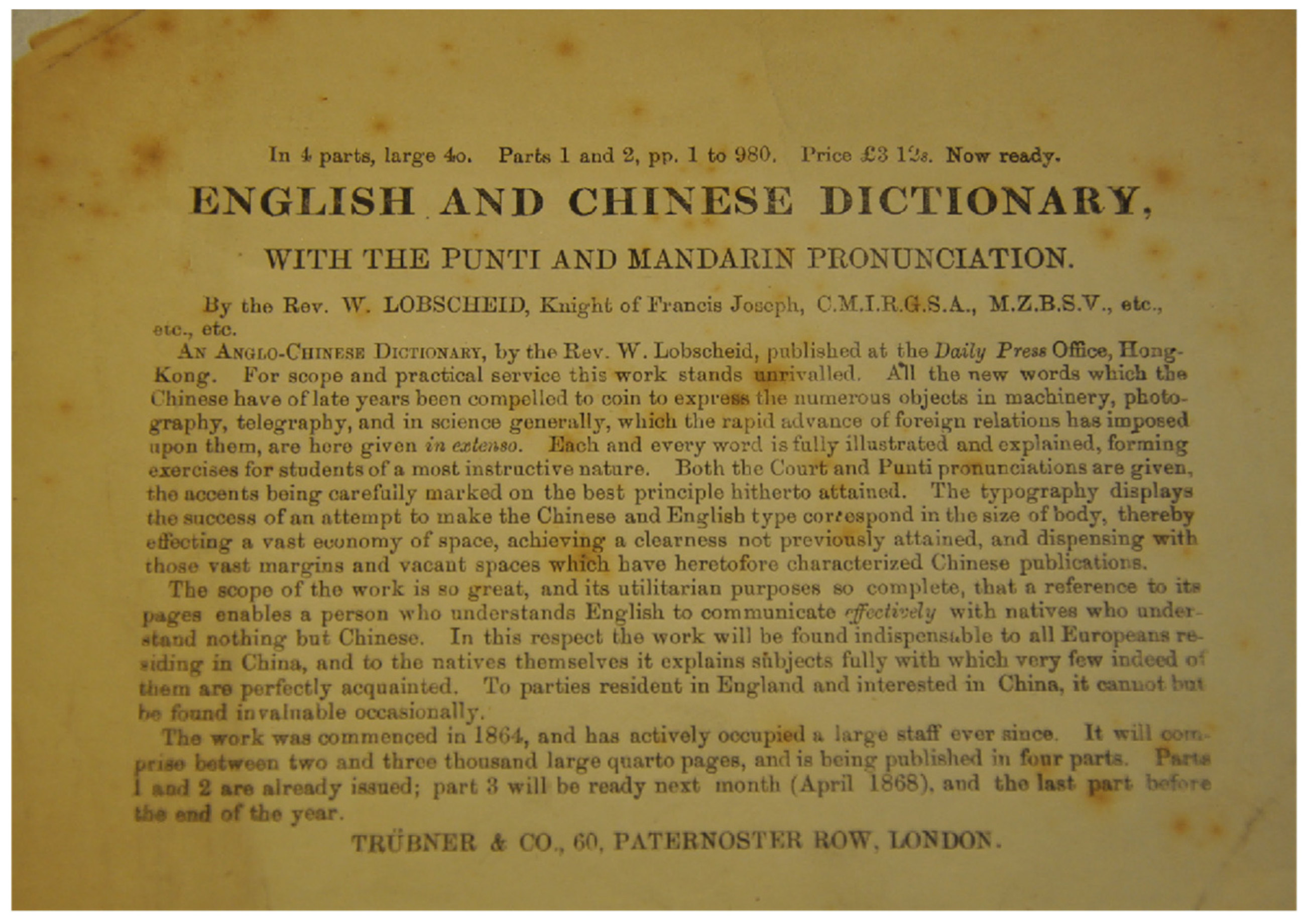
Lobscheid 1866–1869, Part I, Preface). These acknowledgments identify some participants and offer limited indications of their contributions, although they do not establish the full composition of the workforce or its division of labor. A Trübner & Co. advertisement (
Figure 1) likewise reports that the dictionary had occupied a large staff since work began in 1864 (
Trübner & Co. ca. 1868). The advertisement does not specify the staff’s identities or distinguish compilation from proofreading, typesetting, and printing. Read together, these sources establish the collaborative character of production while leaving many details of its organization unresolved.
More fundamentally, the dictionary’s extensive mobilization of traditional conceptual resources such as li 理 (principle) and dao 道 (the Way) demonstrates that the Chinese intellectual tradition was an active site of conceptual production: it was precisely existing Chinese conceptual categories, word-formation patterns, and intellectual frameworks that provided the semantic soil in which Western modern vocabulary could take root. In other words, what is embodied in English and Chinese Dictionary is a form of Sino–Western knowledge interaction grounded in local linguistic resources and local collaborators, rather than a one-way importation of knowledge. This, in turn, suggests that the history of missionary knowledge production in modern Chinese Christianity should also be understood as a history of the participation of Chinese collaborators and locally embedded knowledge resources.
4.4. The Structural Sources and Modern Lexicographical Features
Early dictionaries, such as Morrison’s
Dictionary of the Chinese Language, were largely modeled on the
Kangxi Dictionary 《康熙字典》 and thus remained constrained to some extent by classical Chinese lexical and textual traditions. By contrast, Lobscheid’s compilation drew on multiple sources: its English headwords and definitional methods drew on Webster’s
An American Dictionary of the English Language (
Webster 1844;
R. Li 2024), while its Chinese renderings and lexicographical structure built upon the Protestant missionary English–Chinese lexicographical tradition represented by Medhurst’s
English and Chinese Dictionary, and also incorporated established Chinese lexicographical resources such as the
Kangxi Dictionary 《康熙字典》. For this reason,
English and Chinese Dictionary was regarded as a nineteenth-century “East–West convergence of lexicographical traditions” (
R. Li 2024). This multi-source mode of compilation—using the English lexical system as its structural basis while integrating missionary and Chinese lexical resources—embodied a form of bidirectional integration of Eastern and Western knowledge. Compared with earlier works, Lobscheid’s dictionary adhered more closely to the organizational principles of modern Western lexicography in its selection of entries and definitional practices. In terms of its coverage of new concepts, precision of definitions, and use of illustrative examples, the dictionary exhibited stronger characteristics of modern lexicography and represented an important development in the history of bilingual dictionary compilation.
This shift in compilation principles significantly reshaped the role of the dictionary in cross-cultural knowledge mediation. By grounding the work in the English lexical system,
English and Chinese Dictionary was primarily oriented toward the emerging modern conceptual system in nineteenth-century English-speaking societies. This orientation enabled the compiler to exercise selective mediation in determining which modern concepts should be introduced into the Chinese linguistic world. More importantly, at the level of English headwords and definitional practices, Lobscheid drew substantially on Noah Webster’s lexicographical approach. Webster’s conception of lexicography emphasized that dictionaries should respond to changes in language and society by incorporating newly emerging vocabulary, especially terms arising from science, technology, and the institutions and lived experience of American society (
Micklethwait 2000).
An American Dictionary of the English Language not only recorded word forms and meanings but also endowed the dictionary with a function of knowledge synthesis that went beyond that of an ordinary linguistic reference work, through etymological explanations, definitions, illustrative examples, and related encyclopedic notes. The incorporation of this principle further enhanced the modern orientation of
English and Chinese Dictionary and strengthened its role in the cross-cultural mediation and circulation of modern knowledge.
A frequently overlooked contextual factor is that Lobscheid’s native language was German rather than English. His extensive reliance on Webster’s definitional system therefore reflects his deliberate use of established English-language lexicographical resources to enhance the structural coherence and explanatory capacity of his dictionary. More broadly, Lobscheid’s reliance on Webster illustrates how Anglo-American lexicographical resources entered nineteenth-century missionary knowledge networks and were subsequently selected, adapted, and reworked in an English–Chinese dictionary compiled in Hong Kong.
4.5. Material Form and the Dictionary as a Knowledge Interface
Printed by the Daily Press in Hong Kong, the four parts covered A–C (1866), D–H (1867), I–Q (1868), and R–Z (1869) (
Lobscheid 1866–1869). The large-quarto work has main-text pagination running to page 2013 and is commonly described as containing more than 50,000 English headwords (
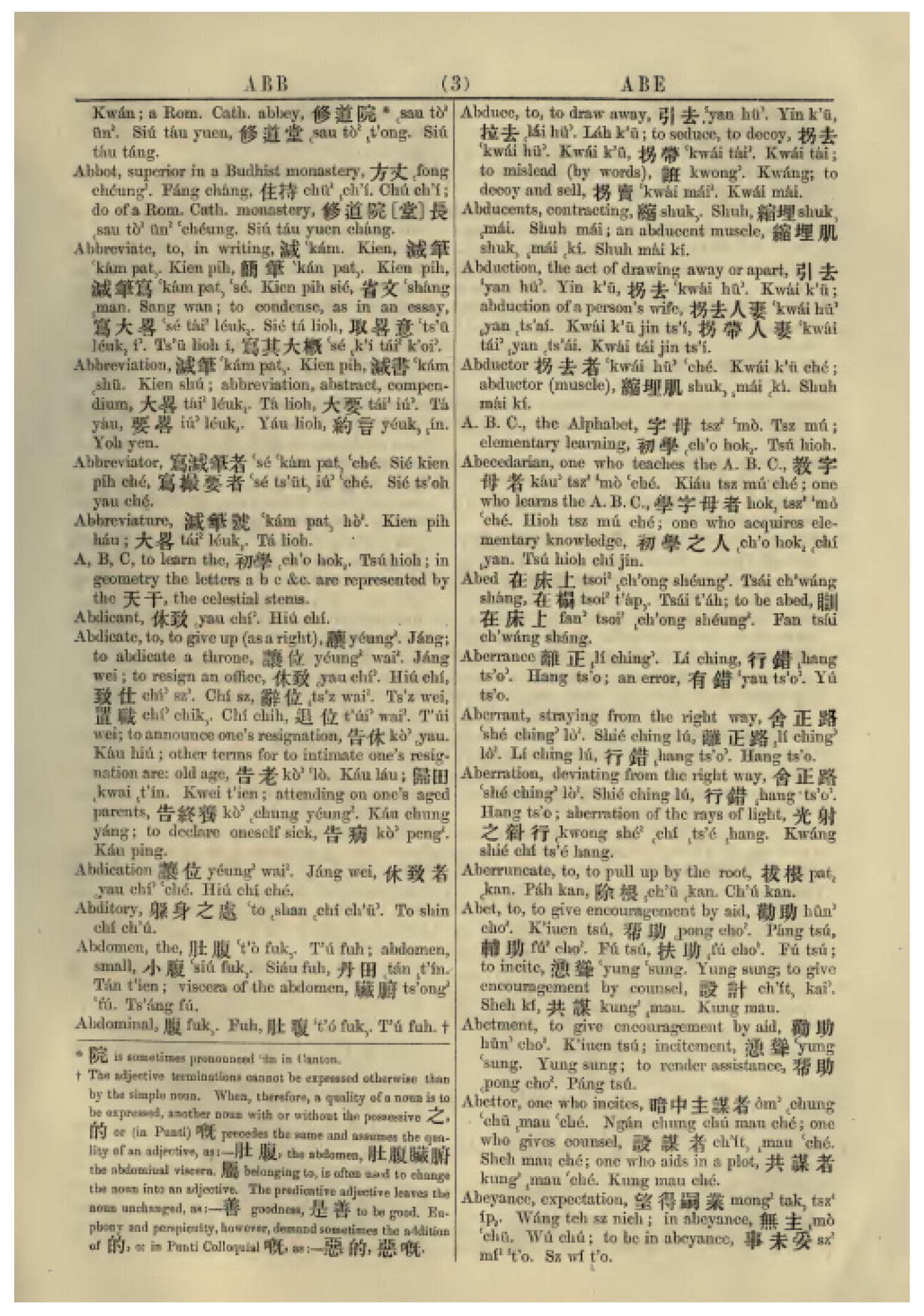
Gao 2011, pp. 149–50). Entries are arranged alphabetically. The specimen page reproduced in
Figure 2 shows a two-column layout, with abbreviated guide words at the top indicating the alphabetical range. An entry may combine an English headword and definition with Chinese equivalents, Punti (Cantonese) and Mandarin pronunciations, related expressions, examples, cross-references, and editorial notes. These components bring information about meaning, pronunciation, and usage together within individual entries.
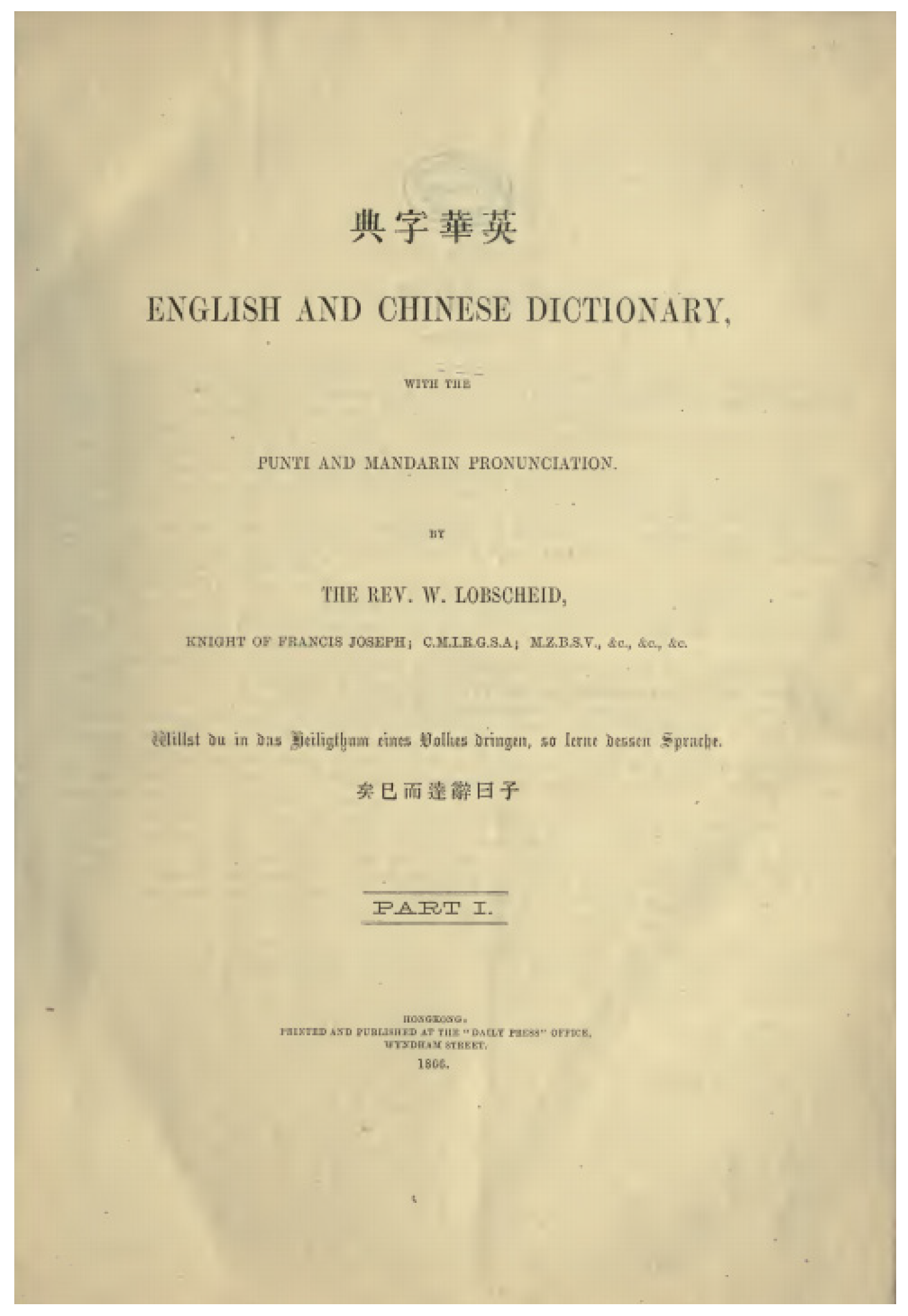
Figure 2 and
Figure 3 reproduce a specimen page and the title page, respectively, illustrating the work’s stated linguistic scope and the presentation of its lexical material.
Compared with earlier English–Chinese dictionaries compiled by Morrison, Medhurst, and others, Lobscheid’s English and Chinese Dictionary began to shift from a “linguistic tool” toward a “knowledge interface for modern concepts.”
First,
English and Chinese Dictionary significantly expanded both its lexical scale and epistemic coverage, bringing a wide range of English headwords into correspondence with Chinese equivalents and explanations. It systematically incorporated new concepts from modern science, institutions, and social practice into its lexicographical structure, building on the scientific and practical vocabulary already present in earlier missionary dictionaries (
Gao 2018b;
Tao and Wan 2024). At the same time, religious vocabulary and secular modern lexical items coexisted within the dictionary. A large number of Christian theological terms, biblical expressions, and ecclesiastical organizational concepts were translated alongside the systematic introduction of vocabulary related to modern science, political institutions, and economic life. This juxtaposition reflects nineteenth-century Protestant missionaries’ holistic understanding of the relationship between “civilization” and “faith,” namely that the dissemination of Christianity and the transmission of modern knowledge constituted two dimensions of a single civilizational mission within their discursive framework. In this sense,
English and Chinese Dictionary can be understood as a linguistic enactment of what missionaries conceived as a Protestant civilizational mission.
Second, as
Shen (
2011b) has noted, Lobscheid moved beyond the constraints of translating the Kangxi Dictionary by drawing directly on Webster’s dictionary for his headword selection, offering richer Chinese equivalents, more precise definitions, and more extensive English illustrative examples. From the perspective of conceptual mediation, the extent to which foreign concepts could be understood by Chinese readers depended not simply on the existence of direct lexical equivalents but on whether these concepts were embedded within interpretable definitional structures.
Third, Lobscheid extensively employed English orthographic conventions to represent Cantonese pronunciation, thereby aligning the dictionary more closely with the linguistic reality of Hong Kong and Guangdong. This localization of phonological notation enabled the dictionary to enter more effectively into domains such as commerce, education, and translation practice, thereby enhancing its potential for circulation and diffusion across East Asia.
5. Conceptual Mediation: Translation, Naming, and Localization
At the second analytical level, missionary dictionaries functioned as sites of conceptual mediation: processes through which concepts were selectively articulated, reconfigured, and provisionally stabilized in Chinese through translation. In Lobscheid’s dictionary, this mediation took three principal forms: the reinterpretation of existing Chinese concepts, the formation and reorganization of modern terminology, and the construction of localized definitions. Together, these practices constituted the linguistic dimension of the broader process of knowledge circulation examined in this article.
This understanding of conceptual mediation draws on
Liu’s (
1995) account of “translingual practice,” which emphasizes that words, meanings, and discourses were not simply transferred between languages but were produced and legitimated through linguistic contact within specific historical and social contexts. The historical significance of Lobscheid’s
English and Chinese Dictionary therefore lies not only in the new terms it recorded, but also in the varied strategies through which it rendered Western scientific, institutional, theological, and social concepts intelligible within Chinese semantic frameworks while also reshaping those frameworks (
Table 1). These strategies were, in turn, informed by Protestant missionaries’ theological commitments and visions of civilization, which helped shape the selection and interpretation of the concepts presented in the dictionary.
5.1. Appropriating Traditional Conceptual Resources
When dealing with highly abstract modern disciplinary and scientific concepts, Lobscheid frequently drew on traditional Chinese conceptual resources, using old terms to carry new meanings and grafting foreign abstract concepts onto existing intellectual frameworks. This practice corresponds closely to Zhang Yutang’s praise in the preface to the first volume of
English and Chinese Dictionary, where he commended Lobscheid for “
chong chou jiu xu bie chu xin quan 重抽舊緒別出新詮 (revived old threads and offered new interpretations)”(
Lobscheid 1866–1869, Part I, Chinese Preface).
For example, in rendering “aesthetics,” Lobscheid used expressions such as “the principle of beauty” (
jiamei zhili 佳美之理) and “the principle of aesthetic appreciation” (
shenmei zhili 审美之理) (
Lobscheid 1866–1869, Part I, p. 32). The term
li originally belonged to the core conceptual vocabulary of traditional Chinese thought; in
English and Chinese Dictionary, however, it was reactivated to explain “principles” or “theoretical grounds” in the sense of modern knowledge. In this way, a Western disciplinary concept acquired an acceptable form of expression in Chinese. Similarly, under “electricity,” the expressions “the way of electricity” (
dianqi zhi dao 电气之道) and “the principle of electricity” (
dianqi zhili 电气之理) rendered its scientific sense through the Chinese categories of
dao 道 and
li 理 (
Lobscheid 1866–1869, Part II, p. 712). Under “school,” Lobscheid included xuexiao 学校 alongside other Chinese educational designations (
Lobscheid 1866–1869, Part IV, p. 1546). This use of existing educational vocabulary provided readers with familiar terms through which to interpret the English concept. This strategy of resemanticizing inherited vocabulary had earlier precedents in Jesuit accommodation. In
Tianzhu Shiyi 天主實義 (
The True Meaning of the Lord of Heaven, first published in 1603), Matteo Ricci identified the Christian
Tianzhu 天主 with the
Shangdi 上帝 named in the ancient Chinese classics, drawing on passages from the
Shijing 詩經 (
Book of Odes), the
Shangshu 尚書 (
Book of Documents), and other canonical texts (
Ricci 2016, pp. 97–101). He also used
linghun 靈魂 to refer to the human soul and distinguished it from the vegetative and sentient souls within an Aristotelian-Scholastic framework (
Ricci 2016, pp. 119–21;
Hong 2024, p. 3). Rather than simply adopting ready-made equivalents, Ricci assigned new theological meanings to inherited Chinese terms. Nineteenth-century Protestant missionaries also used inherited vocabulary in theology, science, and institutional knowledge; the comparison indicates a shared problem of conceptual accommodation. Lobscheid’s use of traditional categories such as
li 理 and
dao 道 can therefore be understood as a later development of this broader practice of conceptual accommodation. In this sense, the strategy of giving old terms new meanings was not merely a translation technique; it also enabled Chinese linguistic and intellectual resources to participate actively in the reorganization of modern knowledge.
5.2. Reorganizing and Creating Modern Terminology
For concepts related to modern institutions, education, medicine, finance, and scientific knowledge, Lobscheid was confronted not merely with a problem of “translation,” but with one of “naming,” since many of these objects had no ready-made equivalents within the traditional Chinese conceptual context.
The term
yiyuan 医院 (hospital) illustrates the reorganization of institutional vocabulary. Although
yi 医 and
yuan 院 were familiar Chinese morphemes, their combination could name a Western-style medical institution. Under “hospital,” however, Lobscheid listed yiguan 醫館, yiyuan 醫院, and yiju 醫局 in parallel, with 醫館 first (
Lobscheid 1866–1869, Part II, p. 970). The entry therefore offered competing designations. Its contribution lay in recording and organizing a usable lexical field, whose subsequent trajectories are compared in later part of the article.
It is necessary here to note the missionary knowledge background behind the term yiyuan 医院 (hospital). The establishment of medical institutions by nineteenth-century Protestant missionaries in China formed an important part of medical missions as a broader missionary strategy. Lobscheid himself possessed medical knowledge and had engaged in medical missionary work. Thus, the entry of yiyuan 医院 (hospital) into English and Chinese Dictionary as a modern institutional term was not a matter of conceptual translation alone, but can be situated within the broader context of missionary medical practice. It not only recorded Chinese designations for Western-style medical institutions, but also embedded the modern medical institutions introduced by missionaries within the Chinese conceptual system. This case clearly shows that the creation of terminology in English and Chinese Dictionary did not take place in the study alone but was closely connected with the concrete social practices of missionaries in China.
Lobscheid’s innovative approach is further evident in his treatment of chemical elements. His
English and Chinese Dictionary listed forty-nine element names, including more than twenty represented by newly coined characters (
Xiong 2014, pp. 94–95). These forms generally used
xing 行 as a graphic frame within which components associated with the translated terms were inserted. Lobscheid’s scheme anticipated, but did not fully coincide with, the more systematic nomenclature that Xu Shou and John Fryer developed in
Huaxue Jianyuan 化學鑑原, a Chinese adaptation based primarily on David Ames Wells’s chemistry textbook (
Wells 1871). In this work, Xu and Fryer generally assigned a single character to each element, combining a classificatory radical—such as
jin 金,
shi 石,
qi 氣, or
shui 水—with a phonetic component derived from the foreign name (
Chang 2004;
Gugler et al. 2026). Although Lobscheid’s earlier experiment may have influenced later practice, the available evidence does not establish a direct line of transmission. Its significance therefore lies less in having standardized Chinese element names than in documenting an early stage of experimentation that preceded the more systematic and influential nomenclature of the 1870s.
From the perspective of conceptual history, the strategy of creating and reorganizing modern terminology reflects the reconstruction of modern knowledge classification within Chinese. The entry of terms such as “hospital” and the names of chemical elements into the dictionary meant that modern systems of education, medicine, and science began to acquire linguistic visibility in Chinese. The comparisons in
Table 2 show how selected Chinese equivalents were retained or modified in the Japanese adaptations examined here. In this sense,
English and Chinese Dictionary provided a foundational textual resource for the later stabilization of modern concepts in East Asia.
5.3. Localized Definitions and Construction of Contexts of Use
Another important feature of English and Chinese Dictionary in the translation of modern concepts lies in its use of localized definitions and contextualized explanations. Through these strategies, concepts carrying specific institutional backgrounds and social functions became intelligible within the late Qing Chinese context.
Lobscheid rendered “police” as terms such as
buting 捕厅 (police office),
guanchai 官差 (official runners), and
lüyi 绿衣 (green-clad officers). These translations drew on public-order systems, administrative functions, and constabulary roles familiar to Chinese readers, thereby providing an initial cognitive framework for understanding this foreign institutional concept. By locating functionally comparable roles within the local institutional order, Lobscheid enabled users to grasp the basic social functions carried by the term “police.” In treating “lawyer,” Lobscheid primarily adopted
zhuangshi 状师, a term already present in local legal practice, as its Chinese equivalent, and further used (
ming)
zhuangshi (明)状师 (“advocate”) and
an zhuangshi 暗状师 (“solicitor”) to explain the differentiated functions of legal professionals in Hong Kong. This analogical strategy relied on the existing experience of
zhuangshi 状师 in local legal practice while at the same time effecting an initial semantic reconfiguration of the Western division of legal professions (
Qiu 2011).
From the perspective of missionary knowledge practice, the localized treatment of institutional terms such as “police” and “lawyer” reflects a dual understanding of Chinese social institutions among nineteenth-century Protestant missionaries. On the one hand, through missionary and educational activities, they closely observed the workings of Chinese society and accumulated substantial local knowledge. On the other hand, the accumulation of such knowledge also served missionary purposes: only by understanding Chinese institutions could missionaries introduce Western modern institutional concepts in acceptable forms and thereby provide a linguistic foundation for a program of social reform framed within Christian civilization (
Wong 2017). In other words, Lobscheid’s strategy of localized definition was the linguistic crystallization of missionaries’ cross-cultural practical experience, rather than merely a technical choice in translation.
The three strategies described above were intertwined in the translation, definition, and circulation of specific lexical items, together constituting the basic pathways through which
English and Chinese Dictionary dealt with concepts of modernity (see
Table 3). From the perspective of conceptual mediation and circulation, the significance of the dictionary lies not only in its rendering of modern concepts from the English-speaking world into forms intelligible in Chinese but also in its provision of an initial textual platform through which competing translations could enter broader Chinese and East Asian knowledge networks. The ability of some translated terms to endure and become stabilized depended on whether they could adapt to existing habits of Chinese expression, correspond to new institutional practices, and be repeatedly used in subsequent dictionaries, translated works, newspapers and periodicals, and regional circulation. It follows that the formation of modern concepts was a continuous process of conceptual competition, selection, and legitimation. Some terms, such as “hospital,” became stabilized because of their semantic transparency, institutional support, or frequency of use; others, though recorded in the dictionary, were eventually replaced or eliminated in the competition among concepts because their forms of expression were overly explanatory and failed to enter wider contexts of use. It was in this process that
English and Chinese Dictionary both preserved multiple possibilities from the early stage in which modern concepts entered the Chinese-speaking world and participated in the preliminary stabilization of certain translated terms, thereby laying a foundation for subsequent dictionary compilation, translation practices, and regional circulation within East Asia.
6. From China to Japan and Beyond: East Asian Circulation and Divergent Conceptual Trajectories
The third analytical level shifts from the internal structure of the dictionary to the regional circulation of its lexical materials, tracing how terms and definitions were adapted, institutionally reinforced, reinterpreted, or independently reformulated in different East Asian contexts.
English and Chinese Dictionary attracted attention from the moment of its publication. The following year, Alexander Wylie gave the dictionary a separate entry in his
Memorials of Protestant Missionaries to the Chinese, noting that “Anglo-Chinese Dictionary; with Punti and Mandarin Pronunciation. 4to. Only two out of four parts are yet published. It is advertised to be completed about December, 1868; the whole comprising 2000 large quarto pages” (
Wylie 1867, p. 282). However, after completing the final volume, Lobscheid was forced to leave Hong Kong in haste, an episode associated in later scholarship with difficulties in the dictionary’s reception in China (
Xiong 2014).
This obstruction in circulation itself deserves closer analysis. Existing research suggests that difficulties in the dictionary’s reception in China were associated, on the one hand, with Lobscheid’s forced and hasty departure from Hong Kong after completing the final volume, and, on the other, with the involvement of the British diplomat William Frederick Mayers. Owing to prejudice against Lobscheid’s German identity, Mayers reportedly ordered the removal of the prefaces that Lobscheid had written for the dictionary (
Xiong 2014). This case indicates that missionary knowledge production was always situated at the intersection of multiple forces, including missionary institutions, colonial politics, and individual circumstances. An imbalance between any of these forces could profoundly alter the circulation and reception of a knowledge product.
Alongside the reported difficulties in its Chinese reception, the dictionary subsequently found an important readership in Japan, where it entered new lexicographical and educational contexts. This occurred at a critical moment in Japan’s scholarly transformation, when scholars of Rangaku were increasingly turning to the study of English and urgently needed effective reference works. English and Chinese Dictionary met this pressing demand and thereby entered the internal circulation of knowledge within East Asia.
Its entry into Japan was facilitated not only by the circulation of missionary publications among East Asian treaty ports, but also by the active adaptation of Lobscheid’s dictionary by Japanese scholars and publishers. One important example was the
Eika Wayaku Jiten 英華和訳字典 (
A Dictionary of the English, Chinese and Japanese Languages), translated by Tsuda Sen and others, corrected by Nakamura Keiu, and published between 1879 and 1881. By adding Japanese translations to the English–Chinese material, this work recast Lobscheid’s dictionary as a trilingual reference work adapted to the linguistic and educational needs of Meiji-period readers. A separate development was Inoue Tetsujirō’s revised and enlarged edition of Lobscheid’s dictionary, published in 1884 as the
Teizō Eika Jiten 訂増英華字典. These two works represented distinct but related forms of Japanese appropriation: the former expanded the dictionary through Japanese translation, whereas the latter revised and enlarged its original lexicographical content (
Tsuda et al. 1879–1881;
Lobscheid 1884).
Through these translations, revisions, and reprints, Lobscheid’s translated terms, definitions, and conceptual categories entered Meiji-period Japanese lexicographical practice. Japanese scholars did not simply reproduce the original dictionary; they selected, translated, revised, and reorganized its materials in accordance with Japan’s linguistic conventions, educational needs, and emerging institutional contexts. Some terms were directly retained, others were modified, and still others acquired more specialized meanings within Japan’s developing disciplinary system. This process created the conditions under which concepts initially mediated through Chinese could be reworked in Japan and, in some cases, subsequently recirculated into China.
To make explicit what, precisely, circulated,
Table 2 compares four concepts across Lobscheid’s dictionary, the
Eika Wayaku Jiten, and Inoue Tetsujirō’s revised edition, together with their subsequent literary or institutional trajectories. The cases represent four distinct patterns, including semantic reconfiguration, institutional reinforcement, regional differentiation, and lexicographical persistence, and are used to establish lexical availability and textual mediation rather than to presume coinage or direct borrowing.
Taken together, these four cases show that Lobscheid’s dictionary functioned less as a repository of fixed equivalents than as a lexicographical component of a broader knowledge infrastructure through which competing forms could be recorded, transmitted, and selectively reworked. Xiaoshuo illustrates semantic reconfiguration; yinhang, institutional stabilization; yiyuan, regional differentiation; and the terminology of the museum, the persistence of inherited lexicographical forms despite a different institutional choice. Their trajectories were neither uniform nor unidirectional: dictionaries could preserve and circulate a lexical field without determining which form would later become standard, while literary, medical, and administrative practices could authorize meanings or terms not privileged by the source dictionary. The evidence therefore supports claims about lexical availability, mediation, and selective adaptation, but not, in every case, direct borrowing or linear descent from Lobscheid.
7. Conclusions: A New Roadmap, Limitations, and Future Directions
From the perspective of global conceptual history, Lobscheid’s English and Chinese Dictionary functioned as a mediating text in the circulation of modern knowledge in East Asia. Through lexical selection, semantic negotiation, textual stabilization, and regional circulation, it rendered concepts intelligible within Chinese semantic frameworks and made them available for adaptation and reinterpretation across East Asia. Examining these interconnected processes at three levels—institutional infrastructure, lexical and conceptual mediation, and regional circulation—this article offers a roadmap for studying how missionary lexicography participated in knowledge formation within the history of Christianity in modern China.
Viewing the dictionary as knowledge infrastructure should not obscure its limitations. Its cumulative mode of compilation placed inherited expressions, dialectal forms, explanatory paraphrases, and newly proposed equivalents side by side without consistently indicating their register, geographical range, degree of currency, or institutional status. This abundance expanded the lexical repertoire available to readers, but it also made it difficult to distinguish established usage from tentative translation. Its reception was likewise uneven. Lobscheid’s abrupt departure from Hong Kong and the limited circulation of the completed work constrained its contemporary influence in China, while its reception in Japan depended on selective translation, revision, and educational repurposing rather than straightforward transmission. The dictionary thus offered lexical possibilities rather than predetermined outcomes: adoption depended on accessibility, editorial mediation, institutional demand, and local linguistic practices, while many of its proposed forms were later modified, displaced, or independently recreated.
The present study’s purposive selection of entries also limits conclusions about the distribution of these features across the dictionary. A useful next step would be to build a small-scale historical dictionary database from a systematically selected sample spanning all four volumes. Quantitative comparison of entry structures, sense divisions, equivalents, pronunciation information, examples, and editorial notes could clarify the distribution of its lexicographical features. Establishing how particular forms were adopted, modified, or displaced would still require independent evidence of use and reception.
For the history of Christianity in modern China, this infrastructural perspective brings the production and reuse of linguistic resources into focus alongside evangelization and church development. It places missionary agency within the institutional relationships and collaborative practices through which knowledge acquired usable forms. The deeper significance of Lobscheid’s English and Chinese Dictionary lies not simply in its provision of an English–Chinese dictionary but in the way it demonstrates how modern knowledge acquired new life through lexicography and through interactions across linguistic, institutional, and regional boundaries. A dictionary was therefore not merely an endpoint of knowledge transmission, but one of the institutional and textual starting points of modern knowledge formation. What the history of Christianity in modern China needs to examine is not only what missionaries transmitted but also how they participated in the co-formation of the modern Chinese world of knowledge.