1. Introduction
The relationship between religion, nationalism, and political violence is not produced only through episodes of direct conflict or overtly religious mobilization. It also develops through the security discourses, institutions, and symbolic practices that define the nation, distinguish legitimate citizens from suspect populations, and determine whose use of force is represented as necessary, protective, or patriotic. In such contexts, militarization may become more than the expansion of military capacity. It can also function as a political and ideological process through which national identity is reconstructed, authority is performed, and exclusionary understandings of belonging acquire legitimacy. The study of religion and violence therefore requires attention not only to explicitly religious actors or violent events, but also to the broader political structures through which religious majoritarianism becomes embedded in state power, security policy, and national narratives.
Militarization is especially important to this process because military power is rarely presented as a neutral or purely technical instrument. Defence expenditure, military modernization, domestic arms production, and strategic autonomy can be invested with wider symbolic meanings. They may be represented as evidence of sovereignty, national revival, technological progress, collective discipline, and strong leadership. When these meanings become connected to a dominant religious or civilizational understanding of the nation, militarization may reinforce state capacity while simultaneously reproducing particular hierarchies of citizenship and belonging. It can help establish a political common sense in which the strong military, the strong state, and the authentic nation appear inseparable.
India under Narendra Modi provides a significant case through which to examine this intersection. India’s defence trajectory has long been shaped by border disputes, nuclear rivalry, regional competition, and recurring tensions with China and Pakistan. These pressures have encouraged military modernization and reinforced the country’s pursuit of strategic autonomy and defence self-reliance (
Ganguly 2015;
Basrur 2017;
Mohan 2019;
Behera 2021). The growth of India’s military capacity and defence-industrial base therefore predates the Modi government and cannot be reduced to the political transformation that followed 2014. Nevertheless, the post-2014 period represents a qualitatively distinct phase in the political meaning attached to defence and security.
Under Modi, rising defence expenditure, military reform, domestic arms production, and initiatives such as Make in India and Atmanirbhar Bharat have been presented as responses to external dependence and strategic vulnerability while also serving as manifestations of national resurgence, civilizational confidence, technological modernity, and decisive political leadership. Defence policy has consequently become more visible within domestic political discourse and more closely tied to the language of national pride and political achievement. At the same time, this transformation has unfolded alongside the consolidation of Hindu nationalism as a dominant political project. Hindu identity has increasingly been positioned as the cultural core of the nation, while Muslims, Kashmiris, dissenting voices, and those labelled “anti-national” have often been represented through the language of suspicion, insecurity, and threat. In this setting, militarization does not simply reflect the state’s external security priorities. It also intersects with struggles over national identity, citizenship, political authority, and the boundaries of legitimate belonging.
Existing scholarship provides important explanations for different aspects of this transformation, but these explanations have largely developed along separate analytical tracks. One body of research examines India’s military modernization, strategic culture, defence-industrial development, and pursuit of strategic autonomy in relation to regional rivalry, border insecurity, nuclear competition, procurement dependence, and great-power aspirations (
Matthews 1989;
Johnston 1995;
Jones 2009;
Ganguly 2015;
Basrur 2017;
Mohan 2019;
Behera 2021;
Hall and Ganguly 2022;
Bulut 2026). This literature offers valuable insight into the strategic and material foundations of India’s defence trajectory. However, it tends to approach military capacity and defence localization primarily as responses to external threats, technological dependence, or geopolitical ambition.
A second body of scholarship focuses on the rise in Hindu nationalism and the political transformation of India under Modi. These studies emphasize majoritarian identity, populist leadership, ontological insecurity, masculinized political discourse, the decline of secular pluralism, and the redefinition of national belonging (
Jaffrelot 2010;
Kaul 2017;
Kinnvall 2019;
Ghosh 2020). This literature demonstrates how Hindu nationalism has moved beyond electoral rhetoric to become a broader project reshaping the state, public culture, citizenship, and the relationship between majority and minority communities. Yet defence policy, military symbolism, and defence localization often remain secondary within these accounts.
A third strand of research examines domestic production, economic nationalism, technological autonomy, and self-reliance under initiatives such as Make in India and Atmanirbhar Bharat. These studies help explain how domestic production has been linked to development, competitiveness, sovereignty, and state capacity. However, defence localization is often treated mainly as an industrial, economic, or technological policy rather than as an ideological resource through which national pride, strong leadership, Hindu majoritarian identity, and political authority are brought together.
The central gap, therefore, lies not in the absence of scholarship on Indian militarization, Hindu nationalism, or defence self-reliance, but in the limited attention paid to their intersection. Existing studies rarely examine how military expansion and defence localization simultaneously operate as strategic policies, symbols of national resurgence, mechanisms of political legitimation, and resources for the consolidation of majoritarian identity. They also pay comparatively less attention to how the fusion of military power, national security, and Hindu nationalism can normalize exclusionary and coercive understandings of citizenship without necessarily taking the form of direct or openly religious violence.
Against this background, the article asks: How have militarization and defence localization during the Modi era contributed to the consolidation of Hindu nationalism and the production of political legitimacy in India? It further considers how this relationship shapes majoritarian understandings of national belonging, the securitization of minority identities, and the political normalization of coercive forms of authority.
The article argues that although India’s militarization and pursuit of defence self-reliance have deep historical roots, the Modi era represents a qualitatively distinct phase in which military power, defence localization, strategic autonomy, and national security have become more fully incorporated into a Hindu majoritarian political project. Through narratives of national pride, self-sufficiency, civilizational resurgence, and strong leadership, defence policy has acquired a broader ideological function. Militarization in this period remains shaped by external threats and strategic calculations, but it also becomes performative and politically productive. It helps present the government as the defender of national honour, links military strength to a majoritarian conception of the nation, and contributes to the normalization of exclusionary understandings of citizenship and political authority.
The article does not argue that militarization automatically produces religious violence. Rather, it shows that when military power and national security are articulated through a Hindu majoritarian framework, they can contribute to an environment in which minority identities are securitized, coercive state practices are more readily defended, and exclusionary forms of belonging acquire greater political legitimacy. In this sense, the relationship between religion and violence extends beyond direct physical acts to the ideological and institutional processes that render unequal citizenship, surveillance, repression, and majoritarian coercion more acceptable.
To explain this transformation, the article brings the strategic culture approach into dialogue with a Gramscian understanding of hegemony. Strategic culture helps explain how historical experience, elite perceptions, external threats, and aspirations for great-power status shape India’s security preferences (
Johnston 1995;
Gray 1999;
Jones 2009). Yet it is less able to explain how these preferences are translated into political consent and broader societal attachment. A Gramscian approach complements this perspective by emphasizing cultural leadership, ideological direction, and the production of common sense through which a particular political project is presented as natural, necessary, and nationally representative (
Gramsci 1971;
Bieler and Morton 2004). The combination of these approaches makes it possible to analyse both why India pursues military capacity and how that pursuit becomes connected to Hindu nationalism, national identity, and political legitimacy.
The article makes three contributions. First, it extends the literature on Indian militarization beyond explanations centred primarily on external threats, regional rivalry, and strategic autonomy by examining the domestic political and ideological effects of defence expansion. Second, it contributes to scholarship on Hindu nationalism by showing how military power, defence production, and self-reliance policies become incorporated into the construction of majoritarian legitimacy and exclusionary understandings of national belonging. Third, it conceptualizes defence localization not merely as an industrial or technological strategy, but also as a symbolic and hegemonic project through which national pride, state power, strong leadership, and political authority are connected. In doing so, the article also contributes to broader debates on religion and violence by demonstrating how religious majoritarianism may be reinforced through security institutions, military symbolism, and the political normalization of coercion, even when violence itself is not the sole or immediate object of analysis.
Methodologically, the study employs a multi-source research design combining quantitative trend analysis with qualitative document and thematic analysis. Data on defence expenditure are drawn primarily from the Stockholm International Peace Research Institute dataset covering the period from 1949 to 2024 and are assessed alongside complementary indicators from the World Bank and relevant Indian institutions. Trends in external dependency, domestic production, and localization are reconstructed through official reports, policy documents, annual statements, and institutional releases, particularly those produced by the Press Information Bureau and the Department of Defence Production. Government speeches, leadership statements, and policy texts are analysed thematically to identify recurring frames relating to national pride, self-sufficiency, strategic autonomy, the strong state, and the idea of a “New India.”
The study also draws on 33 semi-structured interviews conducted between 2024 and 2025 with members of the Indian diaspora in the United Kingdom. These interviews were originally conducted within a broader research project examining the Indian diaspora in the UK and are incorporated here for a specific analytical purpose: to explore how political narratives concerning militarization, nationalism, security, and national belonging are received, interpreted, and contested beyond India’s territorial boundaries. The interview component is therefore used as a qualitative window onto the social resonance of the political discourses examined in the article rather than as a proxy for Indian public opinion. Participants included civil society representatives, activists, academics, students, asylum seekers, opinion leaders, and individuals affiliated with different diaspora groups. The sample consisted of 12 women and 21 men and was recruited through a combination of purposive and snowball sampling. Political orientation was not used as a formal sampling criterion, and participants were not systematically classified according to party or organizational affiliation. Nevertheless, the interviews reflected a range of political positions, including critical perspectives on Hindu nationalist politics as well as views that resonated with themes commonly associated with Hindu nationalist discourse. The interviews addressed perceptions of nationalism, political authority, security, identity, minority exclusion, and the changing relationship between the Indian state and society. They were transcribed and analysed thematically. The interviews are not treated as statistically representative of either the Indian population or the Indian diaspora as a whole; rather, they provide qualitative evidence of how militarized and majoritarian political discourse is experienced, interpreted, supported, or contested within a transnational setting.
The article proceeds in five sections. The first develops the theoretical framework by combining strategic culture with a Gramscian approach to hegemony and political consent. The second traces the historical development of militarization and defence localization in India, highlighting both continuities and changes across different periods. The third examines the relationship between Hindu nationalism, security discourse, and majoritarian identity politics. The fourth analyses how defence expenditure, localization policies, military symbolism, and strategic autonomy are mobilized in the production of political legitimacy during the Modi era. The fifth considers how the expansion of the defence sector reinforces Hindu nationalism and shapes broader patterns of identity, exclusion, and political authority. Taken together, the article demonstrates that militarization in contemporary India is not only a response to external insecurity, but also a political and ideological process through which Hindu majoritarianism, national identity, and hegemonic legitimacy are reproduced.
2. Militarization, Strategic Culture, and the Construction of Hindu Nationalism in Contemporary India
Militarization in India, the development of the defence industry, and localization policies are often examined through a security lens. Tensions with external actors, border disputes, and regional power competition have certainly shaped the importance attached to the defence domain (
Bulut 2024). However, in the Modi era, this process cannot be understood solely as a response to external threats. The transformation of the defence domain has also become intertwined with the redefinition of national identity, the expansion of societal support, and the legitimation of Hindu nationalism (
Kinnvall 2019). Militarization, therefore, signifies not only the growth of military capacity but also a broader ideological and political transformation (
Sariaslan 2023). Strategic culture provides an important basis for understanding this process.
India’s strategic culture highlights the need to interpret security policy not only through current threats or balance-of-power calculations (
Mohan 2019;
Pant et al. 2018), but also through historical experience, political tradition, and conceptions of national identity (
Nandan 2018;
Wilkinson 2015). As
Johnston (
1995) argues, strategic culture consists of the historical and cognitive frameworks that shape states’ security preferences. In India’s case, despite claims that this culture is fragmented or weak (
Sardar 2024), it is better understood as multi-layered yet durable (
Bieler and Morton 2004). This helps explain why military capacity is tied not only to defence requirements but also to India’s aspiration to be recognized as a great power.
Militarization should therefore be read not only as technical development in the defence domain but also as part of the state’s effort to present itself as stronger, more autonomous, and more effective. The growth of the defence industry, military modernization, and localization policies are not aimed solely at neutralizing threats (
Aras and Kandemir 2023). These developments also reflect India’s effort to overcome historical dependency and make its great-power ambitions visible. In this sense, militarization is both material and symbolic.
Yet strategic culture alone cannot explain how this pursuit of power becomes socially accepted or politically legitimized. While it clarifies why states pursue power and how their preferences are shaped by history, elite worldviews, and assumptions about the use of force (
Johnston 1995;
Jones 2009), it does not fully explain the production of political consent. In India’s case, militarization is not merely a technical response to external rivals but also an attempt to overcome historical vulnerability, affirm sovereignty, and display great-power status (
Gray 1999;
Paik and Park 2020;
Parashar 2018). For this reason, the strategic culture approach must be complemented by a Gramscian understanding of hegemony.
From a Gramscian perspective, political power rests on a combination of coercion, consent, cultural leadership, and ideological direction (
Gramsci 1971). Hegemony is the ability of a dominant political project to present its worldview as natural and in the common interest (
Bieler and Morton 2004). In India, the BJP’s fusion of defence, national security, domestic production, national pride, and strong leadership within a single political narrative reflects such a hegemonic process (
Destradi 2026). Respect for the military, localization in the defence industry, and the image of a ‘strong India’ are framed not simply as policies, but as common sense to which wide segments of society become emotionally and ideologically attached (
Riantoko and Prasojo 2023;
Kumar Jain 2014;
Parashar 2018). Militarization thus extends beyond the expansion of security capacity and functions as a mechanism of consent production that normalizes a particular vision of national identity and reinforces political legitimacy.
Gramsci’s (
1971) concept of the organic intellectual further clarifies this process. Actors who translate and circulate the concepts of a political project play a central role in hegemonic construction. From this perspective, Modi acts as an ideological mediator who links defence policies to economic development, national honour, civilizational rise, and Hindu identity (
Jaffrelot 2010). Strategic culture explains why the state gravitates toward power; Gramscian hegemony explains how and why that pursuit is embraced by society.
Within this framework, militarization in Modi-era India cannot be reduced to an obligatory response to external threats or to the technical preferences of state elites. Rather, it acquires meaning at the intersection of historically shaped security understandings and ideologically constructed political legitimacy (
Jaffrelot 2010). Defence policies thus reflect established security preferences while also serving as instruments for mobilizing society around a particular worldview. By combining defence, national pride, strong leadership, and domestic production within a single political narrative, the BJP transforms the defence domain into a political arena that fosters emotional and ideological attachment among broad social segments (
Hindutva Watch 2007). In this way, military power becomes linked to national honour and leadership legitimacy.
Modi’s role is important within this broader political and ideological structure. Rather than treating him as the sole originator of these narratives, this article understands his leadership as operating within the wider BJP-RSS political project and the longer institutional development of Hindu nationalism. In Gramscian terms, political leadership helps translate and circulate an ideological framework in ways that make it accessible to wider audiences (
Bieler and Morton 2004). Modi performs this mediating role by simplifying and popularizing defence and localization discourses and by connecting them to wider narratives of national resurgence, self-reliance, and political strength. Concepts such as ‘New India’ and ‘Atmanirbhar Bharat’ should therefore be understood as part of a broader political project through which state capacity, economic independence, domestic production, and national pride are articulated together (
Parashar 2018).
The reconstruction of national identity constitutes a third critical dimension of this discussion. Contemporary Hindu nationalism selectively reinterprets the past to ground a new understanding of national identity (
Anand 2011;
Nandan 2018). The pluralist and secular vision associated with the Nehruvian state provides an important point of contrast, but the pre-2014 period should not be treated as an uncomplicated secular counterpoint to the Modi era. Religious symbolism, communal accommodation, and majoritarian tendencies were also present within Congress politics, particularly from the 1980s onward, even though Congress continued to formally identify itself with secular and pluralist principles (
Pardesi and Oetken 2008;
Aras and Baser 2026). The distinction advanced here is therefore one of political centrality, ideological articulation, and degree rather than an absolute rupture. In the Modi era, religion, history, civilization, and security have been brought together more systematically within a political framework that places Hindu identity at the centre of national belonging and increases pressures on religious minorities (
Bulut 2021;
Sariaslan 2023). Hindu nationalism should therefore be understood not simply as cultural revival or electoral rhetoric, but as a broader project through which the state redefines national identity through political discourse and security policy. In this context, militarization and localization function as both the material and symbolic foundations of this new identity (
Bansal and Dhaliwal 2022;
Biswas 2021;
Kinnvall 2019).
The central question, then, is which conception of national identity militarization reinforces. Military discourse is never neutral; it is always tied to a particular imagining of the nation. The rise in Hindutva has been further institutionalized through the relationship between the Rashtriya Swayamsevak Sangh (RSS), a Hindu nationalist volunteer organization, and the BJP, contributing to the consolidation of a majoritarian political language that privileges Hindu identity in definitions of national belonging (
Andersen and Damle 2019). Militarization is therefore not simply an outward display of power. It provides a more exclusionary answer to the domestic question of “who are we?” by identifying the strong military, state, and the nation with Hindu identity.
This study’s most important argument concerns the role of localization policies in this process. Localization in the defence domain stands at the intersection of militarization, national identity, economic development, and strategic autonomy. To understand the Modi era, strategic autonomy, economic ambition, identity reconstruction, and India’s global aspirations must be analysed together (
Kinnvall 2019). At the same time, the relationship between Hindu nationalism and economic development has become increasingly important, while the tension between neoliberalism and nationalism has emerged as a key feature of the period (
Ghosh 2020). Localization cannot therefore be seen merely as a technical attempt to reduce external dependency; it is also politically and ideologically charged.
This tension is particularly visible in the defence domain. Modi-era India seeks deeper integration into the global economy and expanded strategic partnerships (
Basrur 2017), while simultaneously emphasizing domestic production, strategic autonomy, national distinctiveness, and civilizational identity (
Chopra 2024). In this context, localization signifies modernization and competitiveness (
Ganguly 2015), but also serves as a symbolic resource for nationalist politics (
Nielsen et al. 2026). This enables the BJP to frame defence policies not only as strategic necessities but also as markers of political achievement, national honour, and a resurgent India.
The relationship between militarization and Hindu nationalism should therefore not be understood as linear but as mutually reinforcing. Militarization provides Hindu nationalism with symbolic power, political legitimacy, and emotional mobilization, while Hindu nationalism in turn places militarization on a terrain of broader social acceptance (
Andersen and Damle 2019). Localization policies strengthen this link further. Taken together, these dynamics show that militarization and localization in Modi-era India are not merely security strategies. They are also part of a broader transformation in which strategic culture is reinterpreted, societal consent is expanded, majoritarian identity becomes more visible, and political power consolidates its legitimacy. For this reason, the following sections examine militarization and localization as military and economic processes that have also acquired broader political significance in the construction and consolidation of Hindu nationalism.
3. The Historical Development of Militarization and the Quest for Localization in India’s Defense Industry
Militarization in India and localization in the defence industry cannot be explained solely by contemporary security threats. Their historical development must be understood in relation to the colonial military legacy, post-independence security priorities, external dependency, and the long-standing pursuit of strategic autonomy. This broader trajectory helps explain why the defence domain accelerated so markedly in the Modi era.
The institutional roots of the Indian military lie in the colonial period. Under British rule, the army was socially unbalanced and recruited disproportionately from particular ethnic and regional groups, especially Punjabis and Pashtuns. As
Wilkinson (
2015) shows, Indian nationalists viewed this inherited army with suspicion, seeing it less as a national institution than as an instrument of colonial rule. Rebalancing its social composition therefore became an important post-independence goal. This legacy also helps explain why the military was treated cautiously for a long period.
This caution shaped Nehru’s early approach to defence. His anti-colonial and non-aligned outlook led him to prioritize India’s moral and diplomatic weight over large-scale military power. As
Behera (
2021) notes, Nehru regarded a strong policing order as more urgent than a conventional military build-up. That approach was decisively challenged by the 1962 Sino-Indian War, which exposed the costs of neglecting defence capacity and marked a turning point in India’s security thinking. From then on, defence policy emerged as a core state priority. India’s military strengthening accelerated further during the Indira Gandhi era. As
Ganguly (
2015) notes, Pakistan’s military modernization with American support, combined with expanding regional threat perceptions, pushed India toward higher defence spending and more systematic capacity-building. Under Cold War conditions, defence policy became important for India’s position in the regional balance of power.
The domestic-security dimension of militarization also became particularly visible during the 1980s. Operation Blue Star in June 1984, in which the Indian Army entered the Golden Temple complex in Amritsar during the confrontation with Sikh militants, generated profound political and communal consequences. The operation was followed by unrest among sections of Sikh military personnel and, in October 1984, by the assassination of Indira Gandhi by two of her Sikh bodyguards. The anti-Sikh violence that followed further demonstrated how military institutions, communal identity, and domestic security had become intertwined (
Grewal 1991;
Singh and Shani 2021). These episodes are important for the present argument because they show that the use of military and coercive power in managing internal political conflict, as well as the tensions surrounding communal identity and security, long predated the Modi era.
The foundations of India’s defence industry also date back to the early post-independence period.
Matthews (
1989) argues that although arms production was relatively new in India, the institutional basis of the modern defence industry developed under statist and developmentalist policies. The Industrial Policy Resolution of 1948 encouraged state-led industrial growth in strategic sectors, including defence production. Yet because arms manufacturing required advanced technology, research capacity, and industrial infrastructure, India could not achieve self-sufficiency quickly. External dependency therefore remained unavoidable, particularly through procurement from countries such as Britain and France.
From the 1970s onward, the language of self-sufficiency and self-reliance became more prominent in the defence domain. Although official reports emphasized modernization and gradual self-sufficiency, a significant gap remained between discourse and capacity. As
Behera (
2021) demonstrates, India in the 1980s remained heavily dependent on the Soviet Union in several key areas, including air defence, combat aircraft, and armoured vehicles. Localization thus became linked not only to industrial policy but also to the broader goal of strengthening foreign policy independence.
From the late 1980s and especially during the 1990s, India’s approach entered a more pragmatic phase. Rather than attempting to build a fully closed defence economy, it sought to manage external dependency through co-production, licensed production, and technology transfer. As Pardesi and Matthews note, while India became one of the world’s largest arms importers between 1997 and 2004, it also pursued joint development programmes and offset arrangements to strengthen domestic capabilities (
Pardesi and Matthews 2007). Localization in this period was therefore gradual and adaptive rather than absolute.
The Pokhran-II nuclear tests of 1998 and the Kargil War of 1999 marked another major threshold in India’s defence trajectory. These developments accelerated defence spending, enhanced the public legitimacy of military modernization, and increased the visibility of the defence industry. As a result, defence capacity increasingly came to signify not only strategic necessity but also national honour and regional status. This historical trajectory would acquire a distinctly different political meaning under the BJP, especially during the Modi era.
The turning points included in
Table 1 were selected as analytical markers rather than as an exhaustive chronology of India’s military history. The cases correspond to periods associated with substantial shifts in defence expenditure, strategic posture, military doctrine, or defence-industrial policy and therefore provide comparable reference points for tracing longer-term changes in India’s militarization. Their purpose is to identify major moments of strategic reorientation and sustained expenditure change rather than to imply that other military, political, or domestic-security crises were insignificant.
As can be seen in
Table 1, military expenditure in India has followed longer-term and more sustained upward trends rather than sudden and short-lived spikes following conflicts. While notably high rates of increase are observed particularly in the periods of 1962 and 1998–1999, the post-2000 period shows this increase becoming more stable. The post-2014 period, in turn, points to a phase of accelerated militarization in terms of both the rate of increase and its continuity. However, this historically expanding militarization has been shaped largely by threat perceptions and security needs; yet during the Modi era, this process has increasingly acquired a character associated with power projection, national prestige, and the production of political legitimacy.
During the Modi era, the defence domain has become far more visible and politicized than in previous periods. A strong military, defence modernization, and reduced external dependency have become central elements of government discourse. The creation of the Chief of Defence Staff position, the commissioning of a domestically built aircraft carrier, and the restructuring of state-controlled defence firms reflect this shift. At the same time, localization in the defence sector has been tied to broader political-economic projects and presented as a marker of self-sufficiency. Yet this process has also intensified criticism that the military is being politicized and used as a symbolic instrument of political legitimacy (
PTI 2023).
So, the pursuit of militarization and localization in India’s defence industry is not a sudden development unique to the Modi era. This process has been shaped along a long historical trajectory extending from the colonial legacy to post-independence security ruptures, and from external dependency to the pursuit of strategic autonomy. Nevertheless, the Modi era represents a new phase in this historical trajectory. During this period, defence capacity and the localization objective have been linked more directly to security and development policies and to national identity, political legitimacy, and nationalist mobilization. These point to the defence domain having moved beyond being a strategic policy area to becoming one of the central instruments of political legitimacy production. This in turn reinforces the thesis of how this historical legacy has been articulated with Hindu nationalism, security discourse, and the BJP’s political strategies.
4. Hindu Nationalism, Security, and Majoritarian Identity Politics
To understand why militarization in Modi-era India cannot be viewed as an increase in military capacity, it is necessary to examine the ideological foundation upon which this process rests. This foundation is most clearly visible in the re-centring of Hindu nationalism and its political expression, Hindutva. In its most general sense, Hindu nationalism is a form of majoritarian nationalism advocating the supremacy of Hindu national identity over other religious and ethnic identities (
Anand 2011). In this respect, Hindutva is not merely a discourse of cultural belonging or religious revival; it is also a political project that seeks to determine who constitutes the nation, who belongs fully within it, and around which values the state should be organized (
Kaul 2017). The RSS, Hindu Mahasabha, Bharatiya Jana Sangh, and ultimately the BJP line are structures that have carried this project in different periods through different means. Particularly with the rise in the BJP, Hindutva has moved beyond being an ideological tendency present in social life, becoming one of the dominant political axes shaping state policies and the debate over national identity (
P. Bhatt 2019;
Palshikar 2015).
The historical background is of course important for understanding this transformation. After all, Hindu nationalism is not a new phenomenon in modern Indian politics; rather, it has an ideological history extending back approximately a century. However, its centralization at the level of the state and its acquisition of broad social legitimacy accelerated particularly after the 1990s, entering a new phase after 2014. The demolition of the Babri Masjid, attacks on Muslims in Ayodhya, and various incidents of anti-minority violence demonstrate that Hindu nationalism’s capacity to generate social polarization is considerably older (
Mukta 2000). The assassination of Gandhi by Nathuram Godse was also one of the early and striking examples of Hindu extremism in modern Indian politics (
Godse 2023).
Nevertheless, the principal political significance of these events lies in the Hindu right’s translation of identity politics into a majoritarian language. As
Kaul (
2017) points out, the weakening of Congress under allegations of corruption, leadership assassinations, and minority appeasement facilitated the growing visibility of majoritarian politics. This process transformed the Hindu right from merely an ideological focal point into a mass political option. The rise in the BJP in 1998 and the new era subsequently shaped around Narendra Modi in the 2000s are the product of this long trajectory.
Castrogiovanni (
2025) offers an important conceptual contribution at this point. According to Castrogiovanni, the Modi era represents a phase in which Hindu nationalism has been carried from a marginal position to the dominant political axis, directly transforming the discourse of national identity. Within this, the encouragement of Hindu practices in the public sphere, the centralization of symbolic projects, and the presentation of Hindu identity as the natural core of national identity are all parts of this ideological transformation. During the Modi era, national identity is moving away from being defined within a secular and pluralist citizenship framework, settling onto a distinctly Hindu majoritarian line. These dynamics are also visible in the interview material. One Muslim respondent interviewed in Edinburgh, reflecting on their experience as a university student in India, described growing pressure on campus in connection with political and ideological contestation among student organizations:
“Day by day I felt increasing pressure at university because I was Muslim. RSS was not active in my university at the time; ABVP had a presence but was not particularly active. Once RSS began supporting ABVP to break the influence of AISA and SFI, anyone who expressed a dissenting view suddenly began to face pressure. The results speak for themselves: Najeeb has been missing for ten years, an assassination attempt was made on Ghosh (she survived with injuries), Akhtarishta continues to face mobbing, and Bhardwaj is no longer even permitted into the laboratory at the university. The system forces you to become an outcast even if you do not wish to be forgotten.”
(interview conducted in Edinburgh, 23 December 2024)
The central question is therefore which understanding of national identity militarization in India reinforces. The discourse of the military, defence, and security is never neutral or context-free; it is always constructed and legitimized in the name of a particular imagining of the nation (
Nielsen et al. 2026). During the Modi era, this imagining of the nation is seen to be defined with clarity along the axis of the Hindu majority. The rise in Hindutva as an ideology centred on Hindu cultural and religious supremacy has been further institutionalized through the RSS–BJP nexus, a process that has contributed to the consolidation of a majoritarian political language (
P. Bhatt 2019;
Palshikar 2015). A respondent similarly described how perceived ideological conformity could extend into employment, travel, family life, and professional interactions:
“When applying for a job in India, you are investigated down to your caste. If you are not ideologically close to certain groups, finding work is already difficult. If you are opposed to them, even if you go abroad, you face all kinds of pressure at regular intervals. They never leave you alone either your family is called and asked about your situation, or when you enter the country some official asks about your activities and questions certain things. If you have married with a foreigner, you have already become that country’s agent. Every time I attend a conference, the first question is which caste you belong to, the second is how attached I am to their culture. Everything in my life, whether I want it or not, presents itself as a requirement of this political system.”
(interview conducted in London, 13 March 2025)
Militarization should therefore not be understood solely as an outward-facing display of power. It performs the function of placing the answer to the question “who are we?”. The link established between a strong military, a strong state, and a strong nation is identified with Hindu identity, contributing to Hindu nationalism’s transformation from a cultural or religious discourse to a more comprehensive national project supported by the state’s security and defence policies (
Malji 2018).
The convergence of this process with security politics is one of the distinguishing features of the BJP era. Hindu nationalism during this period does not produce a discourse of cultural supremacy; it also constructs the ‘other’ within a security case. Muslim minorities, Kashmir, ‘anti-national’ elements, separatists, and at times dissenting social voices are all represented within the same security logic (
C. Bhatt 2020). This approach removes the protection of the nation from being a matter of border defence and links it to the control and suppression of internal social differences. The sustained military presence in Kashmir, internet blackouts, legal immunity, and continuous surveillance are also practical extensions of this security logic (
Hamid 2019). A respondent interviewed in Cambridge described how this security environment was perceived from a diasporic position, particularly through concerns about mobility, belonging, and continuing family ties to India:
“Kashmir has now become an entirely irresolvable matter of status. No one can claim the decisions taken regarding Kashmir are aimed at resolving the hardships of those living in the region. People (who live in India) criticize you for having a different status, as if it were some kinds of privilege. If you are outside the country, you are already a potential traitor. Even if it becomes known you exchanged greetings with a Pakistani citizen in the UK, you cannot re-enter India. Everything is moving toward monopolization. The only difference for us here is that even if we wanted to live a different life, our family elders remain in our homeland. Being part of the diaspora is something like that, I suppose.”
(interview conducted in Cambridge, 3 April 2025)
Article 370 of the Indian Constitution had provided Jammu and Kashmir with a special constitutional status and a degree of political autonomy. In August 2019, the Modi government effectively revoked this status and subsequently reorganized the former state into the Union Territories of Jammu and Kashmir and Ladakh. This change is particularly significant for the present discussion because it became closely associated with the BJP’s broader discourse of national integration and territorial unity (
Sit 2019).
Castrogiovanni (
2025) regards this step as one of the principal policies aligned with Hindu nationalist ideals and consolidating the BJP’s support base. Similarly, the Ram Temple issue emerges as the materialization of ideological goals that the Hindu nationalist movement had long pursued. Although the abrogation of Article 370 was officially justified through stability discourse, it can also be read as the imposition of majoritarian national identity over Muslim-majority spaces (
Sit 2019). For this reason, Kashmir has become a particular space in which Hindu nationalism becomes intertwined with the security language and the majoritarian interpretation of national unity is applied on the ground. A respondent connected these concerns more explicitly to nationalist discourse, defence-industry growth, and the perceived costs of political criticism:
“One day a cleric had a dream. I am not sure how many people died the following day. Such events have become a power tool [that] unifies certain major groups internally. Every developing state rising on nationalist discourse uses this arrangement. The story is the same for India. What a coincidence that as economy grows, the main growth sector is the defence industry. When we look at development programs, we see that the main items are built around the defence industry. If you criticize this situation, it opens an even greater trouble for you….”
(interview conducted in Birmingham, 9 May 2025)
At this point, the Gramscian framework regains importance. As discussed in the second section, hegemony cannot be reduced to repression or coercion; it also depends on the production of consent. The BJP’s fusion of defence, security, national pride, and Hindu identity along the same discursive line is related to this production of consent. Hindutva has not generated ideological loyalty across elections; it has constructed a majoritarian common sense by presenting the Hindu majority as the natural subject of the state.
Palshikar’s (
2015) finding that public opinion became more receptive to Hindutva arguments after 2002 and less inclined to question violence against minorities is particularly relevant in this regard.
Zain (
2021) reveals how Modi used social media with the discourse of Hindutva 2.0, New India, and correcting past wrongs. In this way, the state’s security language and majoritarian national belonging are transformed into a mutually reinforcing hegemonic formation. A 2013 speech by Narendra Modi illustrates how military service, national pride, political leadership, and national unity were brought together within this discourse:
“The way they have respect for all the creeds, the way all of them are working together just to serve the mother nation, there cannot be a better example of secularism. I salute our defence forces which in the real senses have maintained the pride and glory of secularism in India and have made this nation proud. […] The Indian Army which is just dedicated to the service of this nation, which is living with the tradition of respecting every creed, the politicians of Delhi are committing the sin of colouring this great institution in the dirty politics of religion and creed..!”.
This hegemonic structure does not remain at the level of discourse alone. As
Sariaslan (
2023) discusses in relation to cow protection policies and legal regulations concerning cattle trade, many areas of everyday life have also become part of Hindu nationalist politics. Beef bans, lynchings, social exclusion, and instances of everyday violence against Muslims demonstrate that majoritarian ideology is not state-centred. This pattern of majoritarian exclusion is not confined to Hindu–Muslim relations. Christian communities have also faced anti-conversion mobilization, attacks on religious institutions, and forms of vigilante violence, demonstrating that the boundaries of religious belonging produced by Hindu majoritarian politics extend beyond the Muslim minority (
Bauman 2020;
Jaffrelot and Schoch 2021).
Thus, Hindu nationalism is simultaneously reinforced from above through state policies and consolidated from below through forms of social polarization and cultural conflict. It is therefore insufficient to evaluate contemporary Hindu nationalism merely as a cultural revival or an electorally driven discourse. What is at stake here is a more comprehensive project that redefines national identity through historical memory, security language, and political leadership.
Modi-era Hindu nationalism constructs a majoritarian national identity through cultural symbols, security policies, and state discourse (
Biswas 2023). This identity privileges the Hindu majority as the authentic national community while representing Muslims, Christians, and other minority communities through unequal and, in some contexts, securitized forms of belonging (
Biswas 2023;
Jaffrelot and Schoch 2021). Security here is therefore not a matter of protection against external threats but is simultaneously the legitimization of majoritarian belonging at the level of the state. For security discourse has become one of the most effective instruments for enhancing the social legitimacy and emotional appeal of Hindu nationalism (
Karakuş 2025). It is for this reason that the following section examines how this majoritarian identity politics is directly articulated with militarization and localization policies, and how it is transformed into the production of political legitimacy during the Modi era.
5. Militarization, Localization, and the Production of Political Legitimacy in the Modi Era
Militarization in India has a long historical trajectory and is not unique to the Modi era. However, after 2014, this process acquired a new political significance. What distinguishes the Modi era is that defence and security policies have been employed both to enhance state capacity and to produce political legitimacy, project national prestige, and mobilize Hindu nationalist sentiment at the mass level (
Hall and Ganguly 2022). It is therefore insufficient to look only at expenditure increases or defence modernization to understand militarization during the Modi era; what truly matters is how this increase is presented, through which discourses it is legitimized, and within which ideological framework it is embedded.
At this point, the relationship between neoliberalism and nationalism becomes determinative. Modi-era India, on the one hand, seeks greater integration with the global economy, aims to attract foreign investment, and works to expand its strategic partnerships; while on the other, it asserts with increasing force the discourses of domestic production, national distinctiveness, strategic autonomy, and civilizational identity (
Castrogiovanni 2025;
Dash 2022). Although this may appear contradictory at first glance, it in fact constitutes one of the most distinctive features of the Modi era. The defence domain is the arena in which this tension becomes most visible. This enables the BJP to present defence policies as a strategic necessity.
The social circulation of Make in India and Atmanirbhar Bharat also demonstrates this. The RSS circles’ combination of the Make in India discourse with calls for a boycott of Chinese goods reveals that localization has become an industrial policy (
Patel 2020). Nevertheless, evaluating this discourse solely through its economic content also falls short. Modi’s development and self-sufficiency discourse has frequently been subject to criticism for its sloganistic character. The characterization of Atmanirbhar Bharat as “big on slogans, low on content” illustrates how blurred the line between economic program and political propaganda has become (
Sen and Vater 2020). Yet precisely for this reason, the political effect of this discourse should not be underestimated. Modern political legitimacy is established through the delivery of concrete outputs, the persuasive circulation of the expectation of success, the image of a strong leader, and the narrative of national resurgence.
In this context, the Gramscian hegemony approach regains importance. During the Modi era, defence and localization have become part of precisely such a consent production mechanism (
Hall and Ganguly 2022). The defence industry is thereby removed from the domain of technical expertise and comes to be associated with the masses’ sense of honour, belonging, and achievement (
Philip 2025). One of the most striking examples of this dynamic emerged after the Pulwama attack of 14 February 2019, when a suicide bomber targeted a convoy of India’s Central Reserve Police Force in Jammu and Kashmir, killing 40 personnel. The attack was claimed by Jaish-e-Mohammed and was followed by Indian airstrikes on Balakot in Pakistan later that month. These events were initially framed as responses to a major security threat, but they also became highly salient within domestic political discourse. The aftermath also reinforced Modi’s image as a strong, protective, and decisive leader. As
Vaishnav (
2019) demonstrates, following the Pulwama attack, national security discourse moved to the centre of the electoral campaign, while the subsequent airstrikes generated a heroic public narrative centred on Modi’s leadership. The use of military imagery in electoral campaigns and the direct articulation of the military and security in party propaganda stand as one of the most concrete examples of how militarization merges with the production of political legitimacy. Military operations may serve the foreign-policy purposes of deterrence or retaliation, but they can also function as performative events that make leadership decisiveness and state power visible to domestic audiences.
The distinction between threat-driven and performative militarization gains importance. Militarization in India has historically been shaped largely by security threats and regional conflicts (
Parashar 2018). However, during the Modi era this military capacity growth has not remained a reactive instrument against threats. It has become part of the production of power display, national prestige, and political performance. Defence policies have moved beyond the realm of technical state decision-making to become symbolic instruments that foster emotional ties between the electorate and political leadership, mobilize national pride, and strengthen the BJP’s political brand. The politicization of the defence domain through propaganda forms such as selfie points, or the direct presentation of military achievements as achievements of the government, are striking examples of this transformation (
Sarkar 2023).
Public opinion research also points to the social resonance of this discourse. The fact that a significant proportion of respondents in India Today’s 2021 survey expressed positive views of the Atmanirbhar Bharat initiative suggests that presenting defence and economic policies as part of a national success narrative resonates with sections of the public (
India Today 2021). Similarly, Pew Research Center data show that there exists a widespread majoritarian foundation establishing a strong link between Hindu identity and ‘true Indianness’ (
Sahgal et al. 2021). This foundation also explains why defence and security discourse can be more readily converted into ideological mobilization. A respondent, recalling changes in intercommunal relations and experiences of displacement, described how these political divisions had affected everyday belonging and attachment to the nation:
“In the past, all faiths respected one another’s. During Eid al-Adha, meat was eaten and we offered meat to neighbours of other faiths who came to visit. Certain neighbours forced us into exile in the city. In the early days, life in the city was normal too, but after a while Muslims began to gather in the same neighbourhoods. There were raids on our homes at night. Then those people sent their children to RSS camps, and those same people began calling us traitors. If you ask, perhaps they would call me India’s disgrace right now. Why? Because you don’t think like them, you belong to a different religion, that’s all. You may feel respect when you look at your flag, but you are unaware that even those left in the minority no longer feel any respect for the flag.”
(interview conducted in London, 14 January 2025)
Militarization and localization in the defence domain during the Modi era, while representing a continuation of historically sustained strategic trends, have acquired a new quality (
Nielsen et al. 2026). This new quality lies in the direct articulation of defence capacity with political performance, economic modernization with Hindu nationalism, and national prestige with party legitimacy. Understanding militarization in contemporary India therefore requires examining threat perceptions, how it is displayed, how it is legitimized, and with which identity politics it converges. In this respect, the Modi era represents a phase in which militarization in India has moved beyond security needs to become a visible instrument of political legitimacy, national prestige, and ideological mobilization.
6. The Impact of Growing Militarization and the Development of the Defence Sector on Hindu Nationalism
The relationship between militarization and Hindu nationalism in Modi-era India should not be understood as unidirectional; rather, the two processes reinforce one another. The expansion of defence capacity, the development of the defence industry, and the acceleration of localization policies have not remained merely technical responses to security needs. Together, they have created a political terrain that strengthens the social and political legitimacy of Hindu nationalism. In this context, militarization has served not only to expand India’s capacity to respond to external threats, but also to reinforce nationalist mobilization, political authority, and majoritarian conceptions of national identity.
The articulation of the self-sufficiency discourse with Hindu nationalism has become visible through the defence sector. Following the 2020 Ladakh border conflict, the Swadeshi Jagran Manch combined its call for a boycott of Chinese goods with the discourse of Make in India, demonstrating how localization had expanded from industrial policy into a broader instrument of nationalist mobilization (
Patel 2020). Similarly, Modi’s repeated invocation of Atmanirbhar Bharat in his 2020 Independence Day speech illustrates how the initiative was framed through narratives of national self-reliance, external vulnerability, and strategic competition (
Business Today 2020). Defence and localization here become a political narrative that rallies society around a particular understanding of national identity.
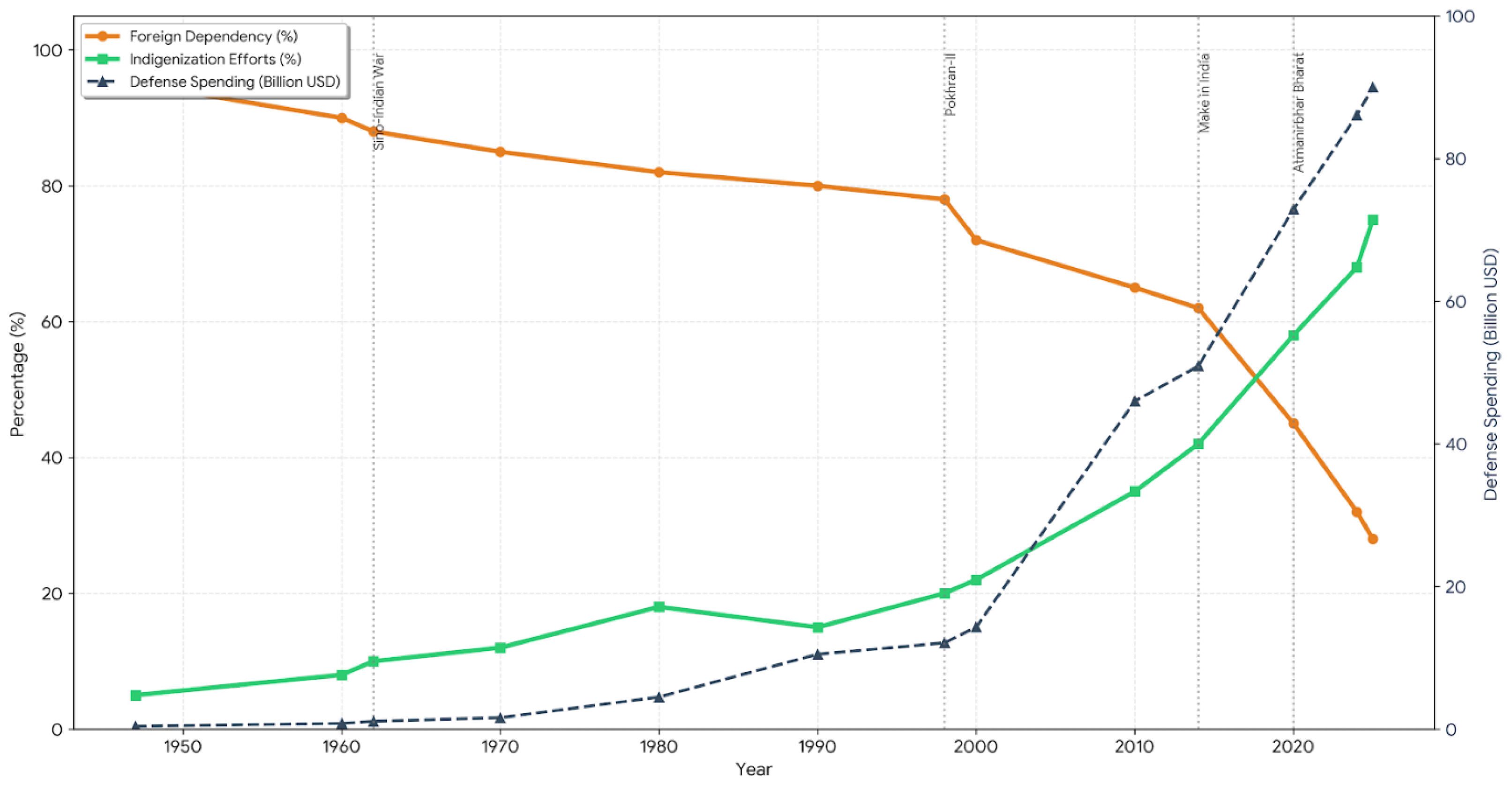
The reinforcement of Hindu nationalism through the transformation of the defence sector can be traced at the level of concrete political and institutional practices. When the data is examined, it becomes apparent that defence expenditure in India has increased markedly following certain key strategic turning points. Military capacity, which remained quite limited in the post-1947 period, began to expand with the 1962 Sino-Indian War; acquired a more institutional character in the 1980s through the Soviet strategic partnership; and following the 1998 Pokhran-II nuclear tests and the 1999 Kargil War, defence modernization became a permanent state priority. The most striking transformation, however, emerges after 2010. As illustrated in
Figure 1, the rise in defence spending from 46 billion dollars in 2010, to 50.9 billion dollars in 2014, to 72.9 billion dollars in 2020, and to 86.1 billion dollars in 2024 demonstrates that militarization has become so structurally entrenched that it can no longer be explained solely as a response to periodic security crises. The corresponding changes in foreign dependency and indigenization are summarized in
Table 2.
Parallel to this increase, the gradual reduction in external dependency and the rise in localization rates also demonstrate that the transformation in the defence sector is a process that has been given political meaning. Indeed, the data shows that external dependency has declined from 95 percent in 1947 to 32 percent in 2024, while localization efforts have risen from 5 percent to 68 percent. In particular, the launch of the Make in India initiative in 2014 and the direct articulation of the Atmanirbhar Bharat discourse with the defence sector in 2020 reveal that this transformation has acquired new content from the perspective of Hindu nationalist politics. At this stage, defence investments have become ideological instruments carrying the discourses of independence, national honour, self-sufficiency, and a strong state. In other words, the development of the defence sector has, from the BJP’s perspective, both generated strategic capacity and created a domain of domestic political legitimacy that strengthens Hindu nationalism (
Sharma and Gupta 2026).
In this context, the politicization of defence is part of a broader process of party branding. As Sarkar recounts, the Ministry of Defence’s initiative to set up Modi and Atmanirbhar Bharat-themed selfie points drew criticism to the effect that defence institutions were being politicized (
Sarkar 2023). Such practices demonstrate that the military and defence establishments are being pushed beyond being neutral state institutions to become symbolic instruments that reinforce the BJP’s nationalist brand (
Soper and Fetzer 2018). The defence sector is therefore an instrument through which the party presents itself as strong, modern, and the primary representative of national security.
This transformation is also linked to muscular Hindu nationalism. As Banerjee notes, military responses to Pakistan or decisions regarding the status of Kashmir are frequently read as a muscular assertion of Hindu power (
Banerjee 2025). This demonstrates that defence and security policies are related to a political language that reinforces the psychological and symbolic supremacy of the Hindu majority. Military power thus nourishes the cultural and emotional aesthetics of majoritarian politics.
The mechanism identified here is one of political articulation rather than direct causation. The expansion of military capacity and defence localization provides material and symbolic resources associated with strength, autonomy, and national achievement. Political discourse connects these resources to narratives of national resurgence, strong leadership, and a Hindu-majoritarian understanding of belonging. From a Gramscian perspective, the repeated circulation of these connections helps transform particular political interpretations of defence and security into forms of common sense and consent (
Gramsci 1971;
Bieler and Morton 2004). Militarization does not in itself produce religious violence; its significance for the present analysis lies in the way security and military power can become embedded in a majoritarian political framework that securitizes minority identities and makes exclusionary or coercive practices more politically defensible.
In parallel with this, the development of the defence sector can also be read through the lens of techno-nationalism. As
Philip (
2025) emphasizes, the growth of defence production and technological capacity serves international image, autonomy, and strategic status. In this respect, the growth of the defence industry gives Hindu nationalism an international dimension by linking domestic technological capacity to India’s strategic autonomy, global status, and image as a rising power.
However, this process also carries serious social risks. The close articulation of defence capacity and militarization with majoritarian politics increases the risks of exclusion, insecurity, and political pressure, particularly for Muslim minorities. The
Lokniti-CSDS Survey (
2023) found that only 15 percent of Muslims indicated that they would vote for the BJP, while 57 percent expressed dissatisfaction with the government, clearly demonstrating this sense of alienation. Gallup data also reveals that Muslims feel less secure due to Hindu aggression (
Gallup 2011). These findings suggest that militarization and security discourse may contribute to the reinforcement of existing social hierarchies.
Taken together, these developments demonstrate the multiple ways in which growing militarization and the transformation of the defence sector have become connected to Hindu nationalist politics. Under the BJP government, defence policies continue to serve national security objectives while acquiring wider roles in majoritarian politics, political legitimation, national pride, and mass mobilization. At the same time, however, this process carries substantial social and political risks alongside its strategic and economic benefits. The intertwining of militarization with party politics may damage the impartiality of defence institutions, while its convergence with majoritarian identity politics may create greater exclusion and pressure on minorities. For this reason, the expansion of the defence sector in Modi-era India constitutes an important mechanism through which Hindu nationalism is reproduced socially, politically, and symbolically.
7. Conclusions
This study argues that militarization in India cannot be understood exclusively as a response to external threats. Particularly during the Modi era, it has become closely connected to the reconstruction of national identity, the production of political legitimacy, and the consolidation of Hindu nationalism. Border disputes, nuclear rivalry, recurring tensions with China and Pakistan, and broader regional security concerns continue to shape India’s defence policies. Yet the central finding of the article is that this long-standing trajectory has acquired a distinct political and ideological meaning since 2014. Militarization no longer operates only as a technical response to strategic insecurity. It also functions as a hegemonic practice through which national belonging is redefined, majoritarian political imaginaries are normalized, and political authority is reinforced.
The first central finding concerns the relationship between continuity and transformation. India’s emphasis on defence capacity predates the Modi government and has been shaped by the colonial military legacy, post-independence security ruptures, the 1962 Sino-Indian War, recurring conflict with Pakistan, the 1998 nuclear tests, and the post-Kargil drive for modernization. The Modi period nevertheless marks an important threshold at which this historical trajectory has acquired a more explicitly political and ideological content. Militarization remains threat-driven, but it has also become increasingly performative. Military capacity, defence modernization, and strategic autonomy continue to be presented as necessities of national security while increasingly serving as visible demonstrations of national resurgence, leadership strength, and political achievement.
The second finding concerns the limits of strategic culture as a standalone explanation. Strategic culture helps explain India’s long-standing attachment to military capacity, strategic autonomy, and great-power status. It does not, however, fully account for how these objectives are translated into wider political consent. By combining strategic culture with a Gramscian perspective on hegemony, the article shows how the BJP brings defence, national security, domestic production, national pride, and strong leadership together within a single political narrative. These policies are thereby represented as natural, necessary, and expressive of the national interest. Militarization thereby becomes part of a hegemonic formation sustained through coercion, consent, emotional attachment, and the production of political common sense.
At the centre of this process lies the redefinition of national identity. Modi-era Hindu nationalism advances a more explicitly majoritarian understanding of the nation, intensifying political tendencies that existed in earlier periods while moving away from the pluralist and secular principles formally associated with the post-independence state. Defence and security discourses contribute to this transformation by connecting the strong military, the strong state, and the strong nation to Hindu identity. Militarization therefore participates in the production of more exclusionary answers to the question of who belongs to the nation, who represents it, and who may be viewed as suspect, disloyal, or threatening.
The article also shows that defence localization should not be understood only as an industrial, technological, or economic strategy. Initiatives such as Make in India and Atmanirbhar Bharat seek to reduce external dependence and strengthen domestic production, but they also circulate as symbols of self-sufficiency, national pride, civilizational resurgence, and decisive leadership. The defence sector thus becomes an important arena in which economic development, strategic autonomy, political legitimacy, and Hindu majoritarian identity intersect. This reveals the hybrid character of the Modi era, in which global integration and neoliberal reform coexist with domestic self-assertion, economic nationalism, and civilizational discourse.
A further finding concerns the performative dimension of militarization. Rising defence expenditure, domestic production, defence exports, military reforms, and military operations function as displays of state power directed at both domestic and international audiences. The political use of the post-Pulwama airstrikes illustrates how military action can be transformed into a narrative of decisiveness, national honour, and strong leadership. Militarization in this sense becomes a political stage on which state capacity, party legitimacy, and symbolic authority are publicly enacted.
The article does not suggest that militarization automatically produces religious violence. Rather, it demonstrates that when military power, national security, and defence self-reliance are articulated through a Hindu majoritarian framework, they may contribute to the normalization of exclusionary forms of citizenship, the securitization of minority identities, and the political legitimation of coercive practices. The relationship between religion and violence therefore extends beyond direct acts of physical violence to the ideological and institutional processes that can make surveillance, repression, unequal belonging, and majoritarian coercion appear more necessary or politically defensible.
These dynamics have important social and political consequences. The convergence of militarization and majoritarian politics may deepen existing hierarchies, intensify minority insecurity, and increase the vulnerability of Muslims and other marginalized groups. Security discourse can transform social and political differences into matters of loyalty and threat, thereby contributing to polarization and democratic erosion. Militarization must therefore be examined in terms of its strategic effects as well as the forms of citizenship, authority, exclusion, and political consent that it helps produce.
The article contributes to the literature in three principal ways. First, it centres the domestic political and ideological dimensions of militarization in India rather than treating defence expansion primarily as a response to external threats. Second, it combines strategic culture with Gramscian hegemony to analyse both the historical foundations of security policy and the processes through which that policy becomes socially and politically legitimized. Third, it conceptualizes defence localization and the defence industry as components of majoritarian identity politics and hegemonic legitimacy rather than merely as instruments of industrial development or strategic autonomy. The Indian case consequently demonstrates that militarization is a strategic phenomenon with deeply political, ideological, and social consequences.