1. Introduction
Throughout the history of the United States and before, Freemasons have been meeting together regularly. Freemasonry, an order that began among stonemasons in the late sixteenth century, continues to this day with a group meeting at least monthly in most towns and cities in the country. The Ancient and Accepted Scottish Rite, which is a ritualistic system of Freemasonry established in 1801 in Charleston, South Carolina, claimed this as its definition of Masonry in 1878: “A continuous advance, by means of the instruction contained in a series of Degrees, toward the Light, by the elevation of the Celestial, the Spiritual, and the Divine, over the Earthly, Sensual, Material and Human in the Nature of Man” (
Liturgy of the Ancient and Accepted Scottish Rite of Freemasonry, for the Southern Jurisdiction of the United States, Part I 1878, p. 20). This definition suggests that at least by the mid-nineteenth century, there was an active interest in philosophical inquiry and orientation toward the transcendent. This orientation led to an active music-making life within the lodge system, which in its early days appeared for enjoyment, then flowered to meaningful ritualistic use, and then faded to almost complete nonuse in recent years.
As the earlier definition suggests, Masonry describes itself as an advance toward “the Light,” which generally refers to knowledge of the transcendent, as far as can be sorted out without sectarianism. This lack of sectarianism, however, has drawn some degree of criticism from the Roman Catholic Church, for instance, in which two popes have issued encyclicals against the fraternity for what they call its “universalism,” or as easily, that the Masonic Order claims some moral authority over its membership.
1 For this reason, Catholics are said to be in a state of sin if they are in the fraternity.
2 This has been less the case in France and Austria, two predominantly Catholic countries with thriving Masonic presences, including the membership of composers Giacomo Meyerbeer in France (a dedicated member of three different lodges in Paris)
3 and that of Wolfgang Amadeus Mozart in Austria (a member of Beneficence Lodge and True Concord Lodge in Vienna).
4 Freemasonry no doubt has had some controversy over the changing political landscape of the world from 1717 to the present;
5 nevertheless, the fraternity has continued as a space for men, at least in intent, to associate in order to develop their own sense of connection to the nature of reality and to transcendence.
It teaches through rituals called “Degrees,”
6 which are essentially like school grades: the first called the “Entered Apprentice,” the second called the “Fellow Craft,” and the third called “Master Mason.” Different versions of Freemasonry have degrees that continue in that succession, but the first three are internationally similar enough that the first three degrees tend to receive the most attention. The United States operates generally in one of two systems (called “rites”), the York Rite and the Ancient and Accepted Scottish Rite. Lodges that operate the first three degrees are generally called “blue lodges,” which in the United States operate using the York Rite’s version of those degrees. Regardless of system, though, there has constantly been some kind of music making involved in United States Freemasonry. Certainly, the York system (whose degrees are mostly set forth through the 1802 book
The Freemason’s Monitor by the Rhode Islander Thomas Smith Webb) emphasizes the power of music in its Fellow Craft Degree, which states,
Music teaches the art of forming concords, so as to compose delightful harmony, by a mathematical and proportional arrangement of acute, grave and mixed sounds. This art, by a series of experiments, is reduced to a demonstrative science, with respect to tones, and the intervals of sound. It inquires into the nature of concords and discords, and enables us to find out the proportion between them, by numbers.
The context of this explanation is among the other liberal arts and sciences, which Webb indicates are the means of understanding the nature of reality and finding moral applications and analogies that assist in transcendence toward spiritual transformation. Indeed, Freemasonry’s rituals frequently refer to the teachings of Pythagoras, whose understanding of music as a means of reflecting the transcendent order of the universe deeply informs Freemasonry’s understanding of music. By the late nineteenth century, the Ancient and Accepted Scottish Rite described music according to these terms as well in the thirtieth degree, describing music according to its natural progression toward transcendence:
This system [that is, with only grammar, rhetoric, logic, and arithmetic] also was found insufficient. It gave no basis for the Moral Law. It accounted for nothing Spiritual, nor even for the phenomena of vegetation. It assigned to the Deity no moral motive for exercising the power of creation. It removed Him too far from the Universe and annulled all sympathy between Him and His work. This Universe was foreign to Him, a machine manufactured by Him in which He could feel only that gratification which the workman feels in the product of his art and skill. Therefore men began to see, in the revolutions of the spheres all arranged so as never to interfere with each other, in the alternation of the seasons and of the hours for rest and labor, in the eternal genesis of living creatures, in the phenomena of growth, something more than the exercise of mechanical skill on the part of the Creator. They found that musical notes proceeded by octaves and were connected with, and could be represented by, numbers; they connected all musical sounds in nature with one universal harmony and imagined that the spheres, revolving in their orbits, made exquisite music and thought that the law which made their movement eternal was not two opposing mechanical forces, but One law of Harmony, in which something more than the mechanical genius of the Deity played a part and was the lawgiver. They saw the same law of harmony in the nature of man, in the birth and death of things, in growth and in decay; and thus they connected all the phenomena of nature with the incessant movements of the Stars and made all these the result of that one law of Harmony, which sense the word Music has in this Degree—the Harmony of Equilibrium, resulting everywhere from the opposite action and tendency of contraries.
The degree here is assigning to music some rather important ideas. These go back at least to the Ancient Greeks, who saw music as purely number in ratio; it was the realest form of relation among invisible things. It goes back to Aristotle as well, who spoke of
harmonia, the idea that things have a perfect relationship with one another in ways that one may inspect and occasionally find. According to Boethius, the ancients believed that music that one can hear is only one manifestation of music (
Boethius 1989, p. 10). Music itself is what organizes those pitches and rhythms, but music is not the pitches and rhythms.
The York ritual’s explanation of music evolved over the nineteenth century as well. An example is from the 1868 publication General Ahiman Rezon, which was a book of Masonic lectures, many of which are quoted in United States rituals. It says this about music:
Is that elevated science which affects the passions by sound. There are few who have not felt its charms, and acknowledged its expression to be intelligible to the heart. It is a language of delightful sensations, far more eloquent than words; it breathes to the ear the clearest intimations; it touches and gently agitates the agreeable and sublime passions; it wraps us in melancholy, and elevates us in joy; it dissolves and inflames; it melts us in tenderness, and excites us to war. This science is truly congenial to the nature of man; for by its powerful charms the most discordant passions may be harmonized, and brought into perfect unison; but it never sounds with such seraphic harmony as when employed in singing hymns of gratitude to the Creator of the universe.
The sense by the end of the nineteenth century was that music itself was a high art that had certain effects on the mood, which helped hearers to appreciate the lessons of Freemasonry, which otherwise may sound too elementary to consider seriously.
If both the American York Rite and the Ancient and Accepted Scottish Rite declare that music is a seventh of the means available to comprehend reality, then music no doubt receives particular emphasis in the rituals of American Freemasonry.
2. Music in Lodges
One might imagine for a moment a formal gathering of Freemasons in the eighteenth century in the United States. They might be meeting on the second floor of a tavern in Boston, having finished the labor of taking on new members and proceeding to a meal. The Meal has ritualized toasts punctuated by shared music making. One member rises and starts singing “The Enter’d ’Prentices Song”:
Come let us prepare, we brothers that are assembled on merry occasion. Let’s drink, laugh, and sing: our wine has a spring; here’s a health to an accepted Mason!
Then the rest of those assembled repeat back, “Let’s drink, laugh, and sing, our wine has a spring; here’s a health to an accepted Mason!” Then the soloist launches into the next stanza, the second of six, each lining out some small humorous point about them having secrets that others do not possess. “The world is in pain our secrets to gain and still let them wonder and gaze on. They ne’er can divine the word or the sign of a Free and an Accepted Mason.” The members, laughing with each other, then sit down to conclude the meal. This is much of how one might have encountered sung music in lodges in the early years of the United States.
One might as easily imagine a lodge meeting in the late nineteenth century. Darkness outside has fallen, the interior lights are small gas-powered flames punctuating the wall, three candles are lit by the altar. The opening ritual has nearly concluded when the lodge, dressed in black frock coats and still standing, begins to sing this to the tune Rockingham:
How blest the sacred tie that binds in sweet communion kindred minds! How swift the heavenly course they run, whose hearts, whose faith, whose hopes are one! Together oft they seek the place where friendship smiles on every face; how high, how strong their raptures swell, there’s none but kindred souls can tell. Nor shall the glowing flame expire, when dimly burns frail nature’s fire; then shall they meet in realms above, a heaven a joy, a heaven of love.
They then, smiles on all faces, sit down to begin their meeting. Once business is completed and the closing ceremony has concluded, the brothers encircle and sing again, to the tune of Sicilian Mariners:
Now we part! What sad emotion fills each brother’s kindly heart, as amid the world’s commotion each retires to take a part. Let us, round this sacred altar, all our solemn vows renew; never waver, never falter, each be steadfast, firm, and true.
They then retire to eat together and remind each other why they associate as Masons, the melody still quietly humming along in their minds as they walk or ride home.
Masonic music has a history as long as the fraternity’s history,
7 including original compositions for the lodge by the Austrian Enlightenment composer Wolfgang Amadeus Mozart, the nineteenth-century English composer Henry John Gauntlett, and the twentieth-century Finnish composer Jean Sibelius. The United States Lodge system, however, has its own distinct pattern of musical uses and sources, which this article aims to trace.
3. Lodge Music in the Eighteenth Century
John Anderson’s 1734 edition of
Constitutions of the Freemasons, which was the first Masonic book published at all on the American continents, contains a few songs to be sung at times of conviviality.
8 The “Enter’d ’Prentice’s Song” mentioned earlier was one of them,
9 though the tune appears older, as the mid-twentieth-century Masonic scholar Arthur Sharp traces the tune to 1719 with the text “On the Queen’s Progress to the Bath” (
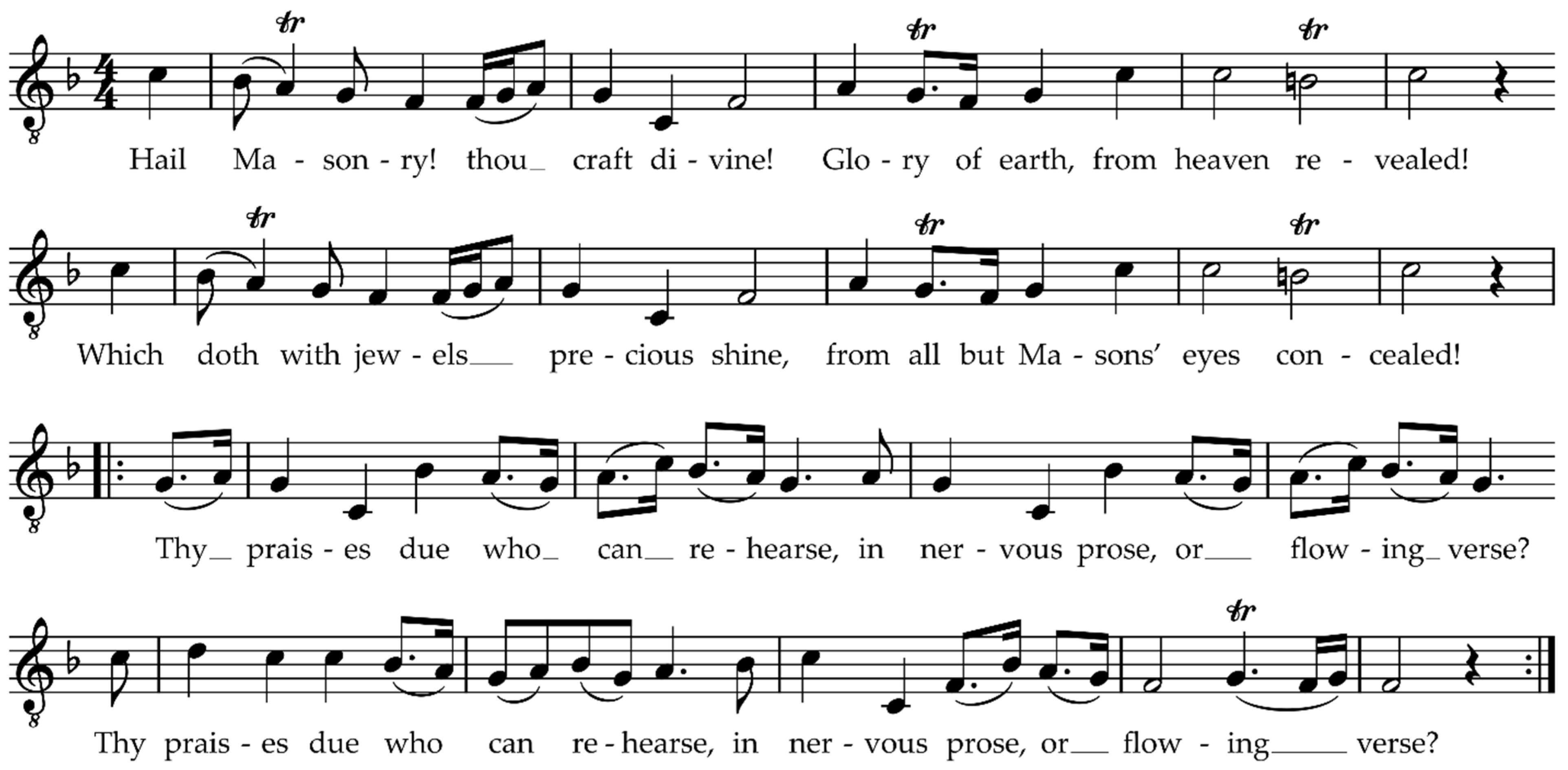
Sharp 1953, p. 84). Another song out of that collection is similar, the “Fellow Craft’s Song.” This one is not given notated music in the
Constitutions,
10 but Johann Lampe, who was a successful opera composer at the time in London, set it to a tune in 1739.
11 It has several verses, the last of which allows for the insertion of the current year’s Grand Master. It reveals that Masons of the eighteenth century were relatively comfortable with ornamentation when possible, having eight trills per stanza.
Figure 1 shows the first verse.
This song asks if it is possible to sing the correct amount of praise to the order, as it is something precious and divine. Further verses continue that “As men from brutes distinguished are,/A Mason other men excels,” and “A Lodge, thus built, for Ages past/Has lasted, and will ever last.” Continuity in the existence of the ideals behind Masonic work is a frequent theme in these songs. The idea that men should trust and love each other is evidently worth more than a song, but a song exists nonetheless.
“The Master’s Song”—also called “The History of Masonry,” penned by James Anderson himself—is a recitation of the history of Masonry from Adam to the then Grand Master. The song has references to biblical and historical figures in this order: Adam, Cain, Seth, Enoch, Noah, Nimrod, Mizraim, Japheth, Shem, Abram, Moses, Aholiab, Bezaleel, Samson, Solomon, Pythagoras, Euclid, Archimedes, Vitruvius, Augustus, and Athelstan. The story of all these people is one of the perseverance of geometrical skill and how that skill, taught in different environments in different ways, led to the building of society’s buildings (and thus society itself through connection with the divine concept of beauty). Here is an excerpt:
Adam, the first of humane Kind,/Created with Geometry/Imprinted on his Royal Mind,/Instructed soon his Progeny/Cain and Seth, who then improv’d/The lib’ral science in the Art/Of Architecture, which they lov’d,/And to their Offspring did impart.
Though the music of this era is especially centered on conviviality, it still carries with it a connotation of the desire to connect to the ancient past through song. While it was common in early Masonic publications to trace the Masonic tendency (the “advance toward the Light”) back to Adam, the fact that the first publication in the Americas contained a song to that effect may suggest that the desire for men to associate with other virtuous men was itself something that God implanted in the mind of Adam. No doubt, to sing this work together, linking the then Grand Master (the head of a sovereign jurisdiction of Masons) to Adam, was a way to ritualistically connect the members to a sense of transcendent knowledge. If someone merely stood up and read the lyrics to the song as if it were a research paper, it would no doubt lose this ritualistic element. Nevertheless, the chorus (which is in a different time signature, from triple to duple) points out that the “Royal Art” is something that exists beyond words: “Who can unfold the Royal Art?/Or sing its Secrets in a Song?/They’re safely kept in Mason’s Heart,/And to the ancient Lodge belong.” Again, the theme is that song, despite evidently being one of the most transcendent ways to express shared thought, falls short of the ideals that these songs evoke.
4. Lodge Music in the Nineteenth Century
Music-making slowly morphed over the course of the next century, but the lodge kept most of its music making at refreshment until much later.
Poole (
1928), writing for Quatuor Coronati Lodge in 1927, pointed out that it may not be fair to separate ritual music from convivial music, since “the ceremonies were worked in the same room as that in which the table was spread,” and that the lines in the eighteenth century were somewhat blurred between labor and refreshment. Nevertheless, the distinction becomes clearer in context in Masonic song books.
In David Vinton’s 1816 songbook
The Masonick Minstrel (
Vinton 1816), printed in Dedham, Massachusetts, the entire book gives musical suggestions for times of refreshment, and almost never ritual. One exception is in it—“Solemn Strikes the Funeral Chime,” a dirge based on a composition by Mozart’s contemporary Ignaz Pleyel. Context would suggest that this would be unsuitable for a banquet. This song is still sung in a few jurisdictions in the United States during their rituals.
Other than that dirge, that collection includes mostly jovial songs, like “Mister Speaker,” which is an example of a “catch,” or a round, which brothers could learn and sing with each other easily. The catch genre itself goes back to England’s pub scene in the 1600s, some bawdier than others, but these catches are much cleaner than those. “Mister Speaker” is a round that pokes fun at parliamentary procedure with its outbursts from the assembly. The lyrics are “Mister Speaker, though ‘tis late, I must lengthen the debate. Question, question, hear him, hear him, sir I shall name you if you stir, order, order, pray support the chair.” The catch is the work of Joseph Baildon as the last entry in his undated, non-Masonic, late-eighteenth-century work,
A Collection of Glees and Catches, where the catch is called simply, “The Debate” (
Baildon n.d., p. 59). This catch makes fun of the debate structure itself—it has a real function in helping the vexations become loveable amusements.
The Masonick Minstrel also includes a few songs for Templar and Royal Arch gatherings (York Rite higher degrees), but still mostly for use at convivial times. Nevertheless, Vinton explains in the front matter of this book:
The compiler consequently has extended his researches throughout the stores of melody, “from grave to gay, from lively to severe;” and completed a selection containing pieces, which without, as well as within the pale of Masonry, may occupy a distinguished place, and exhilarate the lodge, the parlour, or the social circle. … It was the compiler’s object, and he believes he has effected it, to enlarge and deepen the fountain of innocent amusement; to blend wit with sentiment, and excite mirth, without tarnishing the purity of manners.
The songs are both silly and clean, but generally not for a lodge at labor. This music “exhilarates the lodge” and “excites mirth.”
Many books of Masonic music appeared in the United States in the nineteenth century. Two years later, Luke Eastman published Masonick Melodies. Eastman prefaces this collection with these words,
The want of success in most of the former productions of this kind has shown that the craft are not yet provided with a book, which satisfactorily unites harmony with sentiments, corresponding with the pure and benevolent principles of their Institution. The Compiler assures them that his best exertions have been used to present a work free from vulgar and objectionable sentiments, and which contains nothing but what will harmonize with their moral designs. The musick is of an approved style, and at the same time simple and may be read by those of moderate musical acquirements.
Eastman here admits to being mindful of the need of “moral” sentiments in selecting suitable Masonic music. This Eastman collection’s title lines out its way of categorizing music: songs, duets, glees, catches, canons, hymns, odes, dirges, and choruses. A hymn starts the collection with the text,
“Let there be Light!” Th’Almighty spoke! Refulgent streams from chaos broke, t’ illume the rising earth! Well pleased the great Jehovah stood, the power supreme pronounced it good, and gave the planets birth! In choral numbers Masons join, to bless and praise this light divine!”
Parent of Light! Accept our praise, who shed’st on us thy brightest rays, the light that fills the mind; by choice selected, lo! We stand, by friendship joined, a social band, that love, that aid mankind. In choral numbers Masons join, to bless and praise this light divine!
The widow’s tear, the orphan’s cry, all wants our ready hands supply, as far as power is given; the naked clothe, the prisoner free, these are thy works, sweet Charity; revealed to us from Heaven. In choral numbers Masons join, to bless and praise this light divine!
It is clear then that when someone writes a song to be sung about Masonry, the theme is essentially the same: that the “advance toward the Light” is something that transcends the organization itself, is worth remarking upon, and links members not only to Masons of the past and future, but also to all who have espoused virtue and beauty. Brothers of American lodges knew how to read music. The catches show a side of Masonic life where Brothers were trying to figure out interesting ways to amuse themselves. They clearly seemed to sing because they enjoyed singing, not from compulsion.
By 1858, one of the most popular Masonic songbooks in history,
The Masonic Harp, was published by George Wingate Chase in Boston. It had mostly ritual music using more music notation, suggesting perhaps that Masons at this point were even more musically literate, which well matches the mass cultivation of written music from the efforts of people like Lowell Mason and other nineteenth-century music educators and publishers. It also suggests a shift away from a Masonic practice that Paul Nettl to the French
parodie, “which is simply to set the given text to any convenient melody in vogue; that the poem should be sung to some particular ‘Tune’” (
Nettl 1957, pp. 191–92). The expectation was clearly that at least someone in the lodge could read music and teach particular tunes to the assembled brothers.
Sion M. Honea wrote the preface for a facsimile edition of this that was published in the Masonic Book Club in 1998. He wrote that this was “clearly the most successful and popular of all American [Masonic] songbooks.” He is writing as a librarian, seeing more copies of this in the various libraries in the United States than any other Masonic songbook.
This collection contains primarily hymn-like three-part tunes with several texts associated with each one. For opening a meeting of Knights Templar, the tune Rockingham, used earlier with “How blest the sacred tie that binds,” gets this text: “The peace which God alone reveals, and by his word of grace imparts, which only the believer feels, direct, and keep and cheer our hearts. And may the holy Three in One, thee Father, Word, and Comforter, pour an abundant blessing down on every soul assembled here.” This collection assumes the lodge can learn a tune pretty quickly and use it for several purposes. For instance, Old Hundredth, which most mainline Protestants know as “Praise God from whom all blessings flow,” gets fifteen different texts, for instance, “Be thou, O God, exalted high, and as thy glory fills the sky, so let it be on earth displayed, till thou art here as there obeyed.” To close a lodge, Brothers could use this melody and sing, “Come, brothers, ere tonight we part, join every voice and every heart; one solemn hymn to God we’ll raise, one closing song of grateful praise. Here, brothers, we may meet no more, but there is yet a happier shore; and there, released from toil and pain, dear brothers, we shall meet again.”
All in all, there are 402 different songs in this collection, accomplished through sharing 105 melodies among them. It also reprints a few melodies from Anderson’s Constitutions, like the Master’s Song. This also includes a few more popular style songs, like “Do They Miss Me at Lodge,” a parody of “Do they miss me at home,” which would later be a popular Civil War tune.
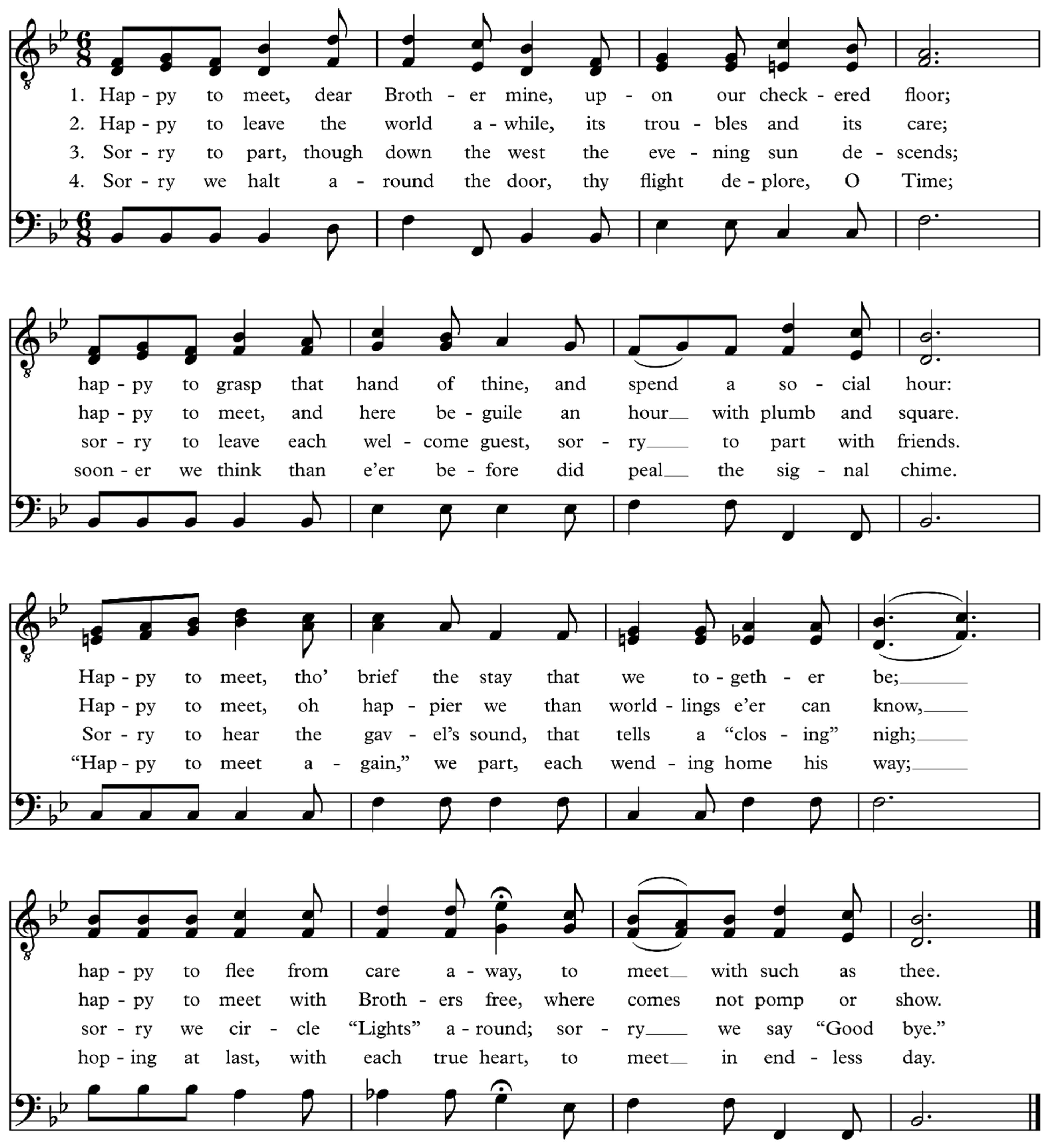
An original sentimental song is on page 138, “Happy to Meet,” which follows what it claims to be an old Masonic toast, “Happy to meet, sorry to part; happy to meet again” (see
Figure 2).
It is typical of the collection, having three accessible sung parts. The lyrics comment on cultivating a sense of fraternalism among members, as well as escape from life’s troubles through association. It focuses entirely on the feelings surrounding parting from each other at the end of the meeting.
In 1881, something quite different appears as a gift to Masons in the United States from Matthew Cooke, the Honorary Grand Organist of the Supreme Council of the Ancient and Accepted Scottish Rite, Southern Jurisdiction. This was the
Music for the Ritual of the Various Degrees of the Ancient and Accepted Scottish Rite (
Cooke 1881). He was an antiquarian, now best known as the owner of the “Cooke Manuscript,” the second oldest Masonic document. He was an accomplished musician living in England. He maintained good relations with Henry John Gauntlett, who wrote not only the popular Christmas tune “Once in Royal David’s City” but also four tunes for use in this collection. Cooke also knew of other Masons who composed music, trying to favor them for the music in his collection. These include Samuel Sebastian Wesley and his father Samuel Wesley, both Grand Organists in the United Grand Lodge of England. Samuel’s father was Charles Wesley, one of the co-founders of the Methodist movement.
This collection is a four-volume set of music that is designed specifically for the degrees and ceremonies of the Ancient and Accepted Scottish Rite, according to the usage of the Southern Jurisdiction. It elegantly maps onto times that those rituals call for music, including the three craft degrees of the Southern Jurisdiction. To be clear, the ritual scripts called for specific times for specific music, not to be heard in the background but to be focused on. At no point is music called to be played simultaneously with spoken words. Music is intended in the AASR as a means of setting intention, reconfiguring the mind from distraction into the present moment, and elevating sung words through beauty.
In the collection, degree music is in Volume 1, Volume 2 has the Constitution and Installation music for all the bodies, Volume 3 has music for the youth ceremonies (Baptism, Louveteau, and Adoption), and Volume 4 has music for the AASR funeral offices. They are geared toward an organist of moderate skill, who would likely teach the choral works to members beforehand.
Unlike the other songbooks discussed, this one was not published for public consumption. One can only really find this Cooke collection at older domiciles of the AASR. Officially, the AASR’s ritual (at least until the Supreme Council authorized a ritual revision in 1999) was split into several different books among which a reader would have to switch to piece together the whole script—the Ritual, which was missing several key moments and words; the Secret Work which supplied them; the Legenda, which contains extra lectures; the Morals and Dogma, which contains each degree lecture to be given or summarized after each degree before closing; the Liturgy, which is mostly memory aids plus a few extra lectures; and the Music, which is this set. This collection is very much a part of the ritual of the AASR. The music alternates between keyboard and sung music. Much of it comes from mid-to-late-nineteenth-century opera, quite a bit of Felix Mendelssohn Bartholdy, some Louis Spohr, and plenty of chant both in accompanied unison Latin and multi-part English.
An example from this collection is the Lodge of Perfection Installation Ode, “Fall, O Fall, Ye Words of Anger,” which happens about halfway through the ceremony. The Ritual calls for these words to be set and sung while the installing officer approaches the topic of loving the imperfect. The last paragraph from that officer is,
“But the swarming of the unworthy into the Temples is only one symptom of the disease, which itself is the diminution of the spirit of Loving-kindness, the lessening of kindly interest in the welfare of each other, the mere acquaintanceship that has so largely and lamentably taken the place of the good old Masonic brotherhood. Masons assemble, and part as they met, not better friends, not even better acquainted, sometimes not knowing each other. They assemble and make Masons, and go away not remembering their faces. … Let the regeneration begin here. Live together here, all of you, as Masons should; for the life of Masonry is but a useless life, so long as this work remains undone.”
12
Then immediately is sung this Ode:
“Fall, O fall, ye words of anger, like the leaves when autumn blows! Like the May-blooms on the river; like the moonlight on the snow! Fall like seed in barren places, fall like raindrops in the sea; Idle words, foredoomed to perish, vanish from the memory.
Gentle words of loving kindness fall like graceful summer rain! Like soft sunshine on earth’s bosom, like sweet music heard in pain; like the dew on thirsting roses, like God’s manna from the skies; fall, soft accents of affection, bearing fruit that never dies.”
Then immediately the installing officer has the Master of Ceremonies place the elected officers at the altar to receive their vow of office. By all appearances, this text is by Albert Pike. This tune is by Henry John Gauntlett, who had earlier lost interest in Masonry after joining, but Cooke convinced him to return to active work in the fraternity by showing him Pike’s revision of the degrees (
Cooke 1881, p. xiii). Something about these rituals deepens appreciation of initiation itself, which Gauntlett’s compulsion to write for the collection shows; music deepens the immediacy of the present moment. It seems to stamp out regrets of the past and worries about the future.
5. Lodge Music in the Twentieth and Twenty-First Centuries
As the twentieth century progressed, attention seems to have shifted away from Cooke’s aesthetic and toward more popular styles of music. Part of that included several choirs of men being formed in a few larger bodies of the AASR.
13 By the present day, nearly all of them have dwindled away. According to conversations with Masons from across the country, the consensus seems to be that when one visits a lodge, the odds of communal singing are low. If music is suddenly brought into one of these lodges that has only used spoken words for several years, the sense in those bodies is that suddenly the room has become more focused on the gravity of what is transpiring. Singing and music making is still present outside of the United States in varying degrees,
14 but within the country, by the middle of the twentieth century, even singing and toasting during meals had dwindled to nothing. Conviviality, even by late century, had diminished in many American lodges, in favor of an alcohol-free, quiet meal before lodge. Before this shift, these after-lodge gatherings were punctuated with the lodge singing songs together. These songs often had nothing to do with Masonry at all—they were just enjoyable social activities for them. Sea shanties, love songs, and, as the century went on, music from Tin Pan Alley made Masonic gatherings into a more deeply social environment through communal singing.
In 1906, John Philip Sousa, himself a Freemason, warned that recording technology would one day completely replace the public’s love of singing with a passive enjoyment of recorded sound. He painted several alarming pictures, including this one:
There was a time when the pine woods of the north were sacred to summer simplicity, when around the camp fire at night the stories were told and the songs were sung with a charm all their own. But even now the invasion of the north has begun, and the ingenious purveyor of canned music is urging the sportsman, on his way to the silent places with gun and rod, tent and canoe, to take with him some disks, cranks, and cogs to sing to him as he sits by the firelight, a thought as unhappy and incongruous as canned salmon by a trout brook.
He wrote in this same essay another picture,
Under such conditions, the tide of amateurism cannot but recede, until there will be left only the mechanical device and the professional executant. Singing will no longer be a fine accomplishment; vocal exercises, so important a factor in the curriculum of physical culture, will be out of vogue! Then what of the national throat? Will it not weaken? What of the national chest? Will it not shrink? When a mother can turn on the phonograph with the same ease that she applies to the electric light, will she croon her baby to slumber with sweet lullabys, or will the infant be put to sleep by machinery?
Clearly Sousa saw music as chiefly a social thing, rather than a commodity produced only by professionals. Throughout the nineteenth century, though singing was generally something nearly everyone did (to greater or lesser levels of skill), there was still a small minority of professional practitioners cultivating the skill of high-level music making in universities, conservatories, and in private lessons. That strain of music being carefully cultivated, notated, taught, and performed continues to this day, largely in a master-student relationship at universities and conservatories. That professional music world works closely with recording technology for mass enjoyment. Sousa himself softened his views about the evils of recording technology in 1925, when he began recording his quite cultivated band for the enjoyment of the public (
New Music Machine Thrills All Hearers at First Test Here 1925).
The trend of professional musicians being recorded and listened to continues. More people today listen to classical music than at any other time in history. Heather Mac Donald, quoting Harvey Sachs in
City Journal in 2010, pointed this out: “Beethoven’s Eroica Symphony premiered before an audience of 100 at most. These days, probably 10,000 people are listening to it during any given 24-h period, either live or on record” (
Mac Donald 2010). Mac Donald is sharing an optimistic view of the state of cultivated music today. She, however, does not speak against the general loss of communal singing.
No doubt, thanks to the commercial success of recording music, it has been kept relatively healthy and attended to. What Sousa warned about, though, still happened. While the joys of recording technology grew, and indeed people started just passively listening to music instead of ever making it with each other, very few people stuck around the social music scene to keep it healthy. Even with today’s flourishing of musicians of high skill, many Masonic bodies instinctively use recordings (some transferred from quite low fidelity sources in the 1970s) instead of live music in degree work.
Why does singing, then, which only 150 years ago the overwhelming majority of people did together, seem out of reach for lodges and other organizations? The answers are mostly practical—those who say that they cannot sing are often actually saying that they have not cultivated singing up to the point of being professional, which is how they typically do hear music. Society, musically, has become more perfectionistic, indeed to the point that few non-musicians know the same songs. This gets exacerbated by Masonry itself, whose activity often centers around making a social activity as perfect as possible, be it physical pageantry, word memorization, keeping the room tidy, and dressing a bit better. If the members feel that their singing is so far below acceptability that it will disturb the peace of the lodge, then it is no wonder that they do not sing. As evidenced by the large number of Masonic music collections over the last 300 years, singing was something of which “our ancient Brethren knew the value,” as Pike put it about periods of communal refreshment.
Nevertheless, when live music is used in rituals, which today is a revival effort occasionally reported to the author, the report generally includes that it helped those present to focus on the experience of initiation. Music has traditionally had that power in Freemasonry during rituals; it also has a similarly moving power at convivial times. In these senses, then, music aids Freemasonry’s frequent phrase of developing “love of God and love of others”—initiatory focus helps the Mason to love God, while convivial music helps them to love others. As a song for opening in The Masonic Harp puts it,
Genius of Masonry descend, in mystic numbers while we sing; enlarge our souls, the craft defend, and hither all thy influence bring. Oh may our voice to friendship move; be virtue ours in all its parts; let justice, harmony, and love, come and possess our faithful hearts.