Educational Communication, Religiosity, and the Integral Health of the Family: A Critical Analysis of Contemporary Research


Abstract
1. Introduction
2. Religiosity and Spiritual Values as Resources for the Holistic Health of the Family: An Analysis of Empirical Research
2.1. Religion, Religiosity, and Spirituality in the Context of Contemporary Social Transformations
2.2. Religiosity and the Quality of Marital Relationships
2.3. Religiosity in Child-Rearing and the Construction of Family Relationships
2.4. Religiosity as a Resource Strengthening Family Resilience in Crisis Situations
3. Interpersonal Communication and Religious Values as a Mechanism of Family System Cohesion and Health
3.1. Family Systems Theory Perspective
3.2. Quality of Communication and the Stability of Family Bonds
3.3. Religion as a Stabilizing Factor in Family Communication and the Family System
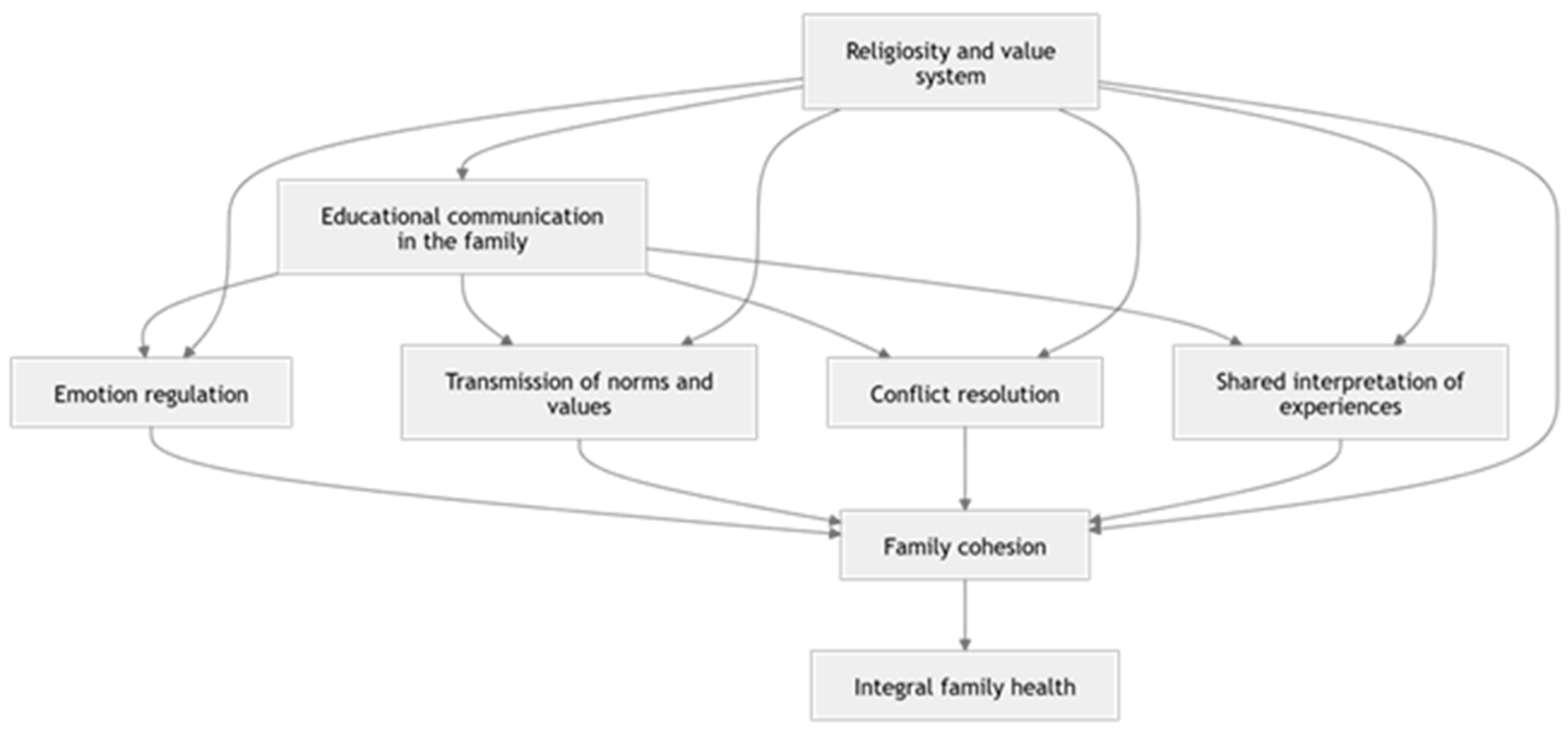
3.4. Authorial Conceptual Model: Educational Communication as a Mediating Mechanism Between Religiosity and Family Health
4. Conclusions
Funding
Institutional Review Board Statement
Informed Consent Statement
Data Availability Statement
Conflicts of Interest
References
- Aman, Jaffar, Jaffar Abbas, Mohammad Nurunnabi, and Shaher Bano. 2019. The relationship of religiosity and marital satisfaction: The role of religious commitment and practices on marital satisfaction among Pakistani respondents. Behavioral Sciences 9: 30. [Google Scholar] [CrossRef] [Scilit] [PubMed]
- Bellah, Robert N. 2017. Religion in Human Evolution: From the Paleolithic to the Axial Age. Cambridge: Harvard University Press. [Google Scholar]
- Bengtson, Vern L., Norella M. Putney, and Harris Susan Cannon. 2013. Families and Faith: How Religion Is Passed Down Across Generations. Oxford: Oxford University Press. [Google Scholar]
- Berc, Gordana, Slavica Blažeka Kokorić, and Anita Dučkić Sertić. 2017. Strengthening family cohesion through shared participation of family members in religious activities in Croatia. Journal of Religion & Spirituality in Social Work: Social Thought 36: 326–45. [Google Scholar] [CrossRef] [Scilit]
- Berger, Peter L. 2011. The Sacred Canopy: Elements of a Sociological Theory of Religion. New York: Open Road Media. [Google Scholar]
- Bowen, Murray. 1966. The use of family theory in clinical practice. Comprehensive Psychiatry 7: 345–74. [Google Scholar] [CrossRef] [Scilit] [PubMed]
- Bowen, Murray. 1978. Family Therapy in Clinical Practice. New York: Jason Aronson. [Google Scholar]
- Davie, Grace. 2007. The Sociology of Religion. London: SAGE. [Google Scholar]
- Davie, Grace. 2015. Religion in Britain: A Persistent Paradox. Hoboken: John Wiley & Sons. [Google Scholar]
- Davis, Kingsley. 1984. Human Society. New York: The Macmillian Company. [Google Scholar]
- Durkheim, Emile. 1990. Elementarne formy Życia Religijnego. Warszawa: PWN. [Google Scholar]
- Gottman, John M. 1999. The Marriage Clinic: A Scientifically Based Marital Therapy. New York: Norton & Company. [Google Scholar]
- Grogan-Kaylor, Andrew, Viktor Burlaka, Julie Ma, Shawna Lee, Berenice Castillo, and Iuliia Churakova. 2018. Predictors of parental use of corporal punishment in Ukraine. Children and Youth Services Review 88: 66–73. [Google Scholar] [CrossRef] [Scilit] [PubMed]
- Gurrentz, Benjamin T. 2017. Religious dynamics and marital dissolution: A latent class approach. Marriage & Family Review 53: 185–205. [Google Scholar]
- Hervieu-Léger, Danièle. 2005. Religion as a Chain of Memory. Nova Religio 8: 128–29. [Google Scholar] [CrossRef] [Scilit]
- Houtart, François, and Jean Remy. 1959. Eglise et Societe on Mutation. Paris: Maison Mame. [Google Scholar]
- Joas, Hans. 2013. The Sacredness of the Person: A New Genealogy of Human Rights. Washington: Georgetown University Press. [Google Scholar]
- Joas, Hans. 2015. Do We Need Religion?: On the Experience of Self-Transcendence. New York: Routledge. [Google Scholar]
- Joas, Hans, and Skinner Alex. 2021. The Power of the Sacred: An Alternative to the Narrative of Disenchantment. Oxford: Oxford University Press. [Google Scholar]
- Jocson, Rosanne M., and Aileen S. Garcia. 2021. Religiosity and spirituality among Filipino mothers and fathers: Relations to psychological well-being and parenting. Journal of Family Psychology 35: 801. [Google Scholar] [CrossRef] [Scilit] [PubMed]
- Langlais, Michael, and Siera Schwanz. 2017. Religiosity and relationship quality of dating relationships: Examining relationship religiosity as a mediator. Religions 8: 187. [Google Scholar] [CrossRef] [Scilit]
- Leonhardt, Nathan D., Dean M. Busby, Veronica R. Hanna-Walker, and Chelom E. Leavitt. 2021. Sanctification or inhibition? Religious dualities and sexual satisfaction. Journal of Family Psychology 35: 433–44. [Google Scholar] [CrossRef] [Scilit] [PubMed]
- Mahoney, Annette. 2010. Religion in families, 1999–2009: A relational spirituality framework. Journal of Marriage and the Family 72: 805–27. [Google Scholar] [CrossRef] [Scilit] [PubMed]
- Minuchin, Salvador. 1974. Families and Family Therapy. Cambridge: Harvard University Press. [Google Scholar]
- O’Dea, Thomas F. 1966. The Sociology of Religion. Englewood Cliffs: Prentice-Hall. [Google Scholar]
- Olson, David H. 1993. Circumplex Model of Marital and Family Systems: Assesing Family Functionning. In Normal Family Processes. Edited by Froma Walsh. New York: The Guilford Press, pp. 104–37. [Google Scholar]
- Olson, David H. 2000. Circumplex Model of Marital and Family Systems. Journal of Family Therapy 22: 144–67. [Google Scholar] [CrossRef] [Scilit]
- Olson, David H., Candyce S. Russell, and Douglas H. Sprenkle. 1989. Circumplex Model: Systematic Assesment and Treatement of Families. New York: Routledge. [Google Scholar]
- Pargament, Kenneth I. 2001. The Psychology of Religion and Coping: Theory, Research, Practice. New York: Guilford Press. [Google Scholar]
- Perry, Samuel L. 2016. Spouse’s religious commitment and marital quality: Clarifying the role of gender. Social Science Quarterly 97: 476–90. [Google Scholar]
- Petts, Richard J. 2011. Parental religiosity, religious homogamy, and young children’s well-being. Sociology of Religion 72: 389–414. [Google Scholar] [CrossRef] [Scilit]
- Stearns, Melanie, and Cliff McKinney. 2019. Perceived parent–child religiosity: Moderation by perceived maternal and paternal warmth and autonomy granting and emerging adult gender. Psychology of Religion and Spirituality 11: 177–87. [Google Scholar] [CrossRef] [Scilit]
- Subchi, Imam, Rena Latifa, Netty Hartati, Desi Nahartini, Atik Yuliani, and Mumin Roup. 2019. The in fluence of religiosity, cultural values, and marital commitment to infidelity in marital life. Journal of Critical Reviews 6: 51–58. [Google Scholar]
- Taylor, Charles. 2007. A Secular Age. Cambridge: Harvard University Press. [Google Scholar]
- Walsh, Froma. 2012. Family resilience: Strengths forged through adversity. In Normal Family Processes. Edited by Walsh Froma. New York: Guilford Press, pp. 399–427. [Google Scholar]

Disclaimer/Publisher’s Note: The statements, opinions and data contained in all publications are solely those of the individual author(s) and contributor(s) and not of MDPI and/or the editor(s). MDPI and/or the editor(s) disclaim responsibility for any injury to people or property resulting from any ideas, methods, instructions or products referred to in the content. |
© 2026 by the author. Licensee MDPI, Basel, Switzerland. This article is an open access article distributed under the terms and conditions of the Creative Commons Attribution (CC BY) license.
Share and Cite
Pomarańska, R. Educational Communication, Religiosity, and the Integral Health of the Family: A Critical Analysis of Contemporary Research. Religions 2026, 17, 846. https://doi.org/10.3390/rel17070846
Pomarańska R. Educational Communication, Religiosity, and the Integral Health of the Family: A Critical Analysis of Contemporary Research. Religions. 2026; 17(7):846. https://doi.org/10.3390/rel17070846
Chicago/Turabian StylePomarańska, Renata. 2026. "Educational Communication, Religiosity, and the Integral Health of the Family: A Critical Analysis of Contemporary Research" Religions 17, no. 7: 846. https://doi.org/10.3390/rel17070846
APA StylePomarańska, R. (2026). Educational Communication, Religiosity, and the Integral Health of the Family: A Critical Analysis of Contemporary Research. Religions, 17(7), 846. https://doi.org/10.3390/rel17070846