Information, Agency, and the Trinity


1
School of Natural and Computing Sciences, University of Aberdeen, Aberdeen AB24 3UE, UK
2
Edinburgh Theological Seminary, Edinburgh EH1 2LS, UK
Religions 2026, 17(7), 782; https://doi.org/10.3390/rel17070782 (registering DOI)
Submission received: 6 May 2026
/
Revised: 17 June 2026
/
Accepted: 23 June 2026
/
Published: 29 June 2026
(This article belongs to the Special Issue No God, No Science? Reassessing the Relationship Between Theology and Modern Science)
Abstract
Theology and science has, for traditional sciences, been a two way street. It should be no surprise then that foundational issues in semantic information theory and AI may provide insights into religious dogmas: in this case, the Christian doctrine of the Trinity. In the early days of information theory and AI, Donald M. Mackay developed two particular theories based on his research in these domains: complementarityand logical indeterminism. Each of these gives insight to the nature and behaviour of agents (artificial and natural). He also applied these theories to provide further understanding of different aspects of the Trinity. In this paper, we will see how extended and corrected versions of these can provide an understanding of why the Godhead must be multi-personal. Complementarity gives an illustrative model of the Godhead given that He is triune, whereas modal indeterminism shows why incarnation requires multi-personality (the economic Trinity). Here, we also extend the analysis to the ontological Trinity and argue that modal indeterminism also necessitates that each individual person of the Godhead cannot be absolutely omniscient (but only omniscient after their Person): only the Godhead can be absolutely omniscient. This has implications for the general relation between the persons of the Trinity, and suggests that absolute omniscience requires the unity of classical theism.
1. Introduction
“No sooner do I conceive of the one than I am illumined by the splendour of the three; no sooner do I distinguish them than I am carried back to the one.”Gregory of Nazianzus
Much of the discussion on relations between science and theology has focussed on issues of compatibility, as though science were the epitome of rationality, and faith as something in need of strong justification, something irrational (believed in spite of the evidence). Of course, this has been challenged and debunked many times, in many places and by many people (Brooke 1991; MacKay 1974b).
In practical terms, the specific issues have tended to relate to the hard sciences, such as physics (cosmology and quantum theory), biology (evolution), or environmental science (climate change). However, with the recent upsurge of interest in, and deployment of, AI systems, there has been a corresponding increase in literature relating AI and religion (Singler and Watts 2024; Xu 2025). Yet it remains rare for a scientific domain to be a source for serious consideration on the nature of God: that has tended to be an aspect of natural theology that has utilised other topics (e.g., love). Nonetheless, semantic information coupled with an ability to reason and reflect (which has been a theoretical hallmark of Al from its earliest days) does, as we shall see, provide a means of insight into the nature of God as a personal being.
There are two fundamental truths in the sphere of Science and Theology: that all models are false (though some are useful (Box 1979)), and that the doctrine of the Trinity is foundational to Christianity. Given this, for the purposes of this paper, we use the term “theology” to refer to Christian theology: Christian doctrine in general, but in particular to the doctrine of the trinity.
Christianity is unique amongst monotheistic religions. It is the only one that holds to the fact that there is one God (in accordance with the Shema, (Deut. 6:4) while maintaining that this one God subsists in three consubstantial persons. The doctrine of the Trinity is one of the oldest doctrines, with a long and sometimes convoluted history. The two main strands are still classical theism and social trinitarianism (the latter claims it roots in the Cappadocian Fathers, though that claim is controversial). This in turn has resulted in debates on the relation between the persons (including subordination, functional and otherwise). More recently, within analytic theology, these have been carried on by means of models and analogies such as the constitution model from a marble statue analogy (Brower and Rea 2005), or Cereberus for the social trinity (Moreland and Craig 2003), and a reintroduction of monarchianism (Sijuwade 2022)). The resulting literature is vast, and the general discussion is outside the scope of this paper, but Gerald Bray has provided a comprehensive discussion of the history of, and debates surrounding, the doctrine (G. Bray 2014). Nonetheless, one comment is necessary to focus and ground what follows: much of what is written is based on interpretations of scripture that are themselves written in the context of salvation history, and as such are descriptive of trinitarian activity in the world. This perhaps lends weight to Rahner’s rule, that the economic trinity is the immanent trinity (Rahner 1970). However, as we shall see, that cannot be the case.
Various attempts have been made over the centuries to develop arguments for the Trinity from nature, or at least independently of scripture. For example, Richard of St Victor (Richard of St Victor 2011), who based the attempt on ‘love’ and whose ideas have been analysed and developed recently by Bray (D. Bray 2022b); or Jonathan Edwards, who believed he could prove the Trinity from contemplation of the mind (Edwards 1980), though this has been challenged by a number of authors,1 with Edwards views being likened to pantheism (Hodge 1940) (or at the very least panentheism (Crisp 2015)).
While it may not be possible to prove that there is a trinitarian God by means of natural theology (which should not come as a surprise given how difficult it has been to demonstrate it from the Old Testament alone), it may be possible to show that if there is a God, that Godself must be multi-personal. That in itself would be sufficient to distinguish Christianity from other monotheistic religions. As such, an argument of this kind would, if successful, have significant apologetic value in that context.
In the early days of information theory and AI, Donald M. Mackay, a pioneer in both these domains, who later turned to neuroscience, developed theories based on his research that he applied in different ways to the Trinity. In this paper, we will see how extended and corrected versions of these theories can provide an understanding of why the Godhead must be multi-personal. Therefore, in the rest of this paper, we shall see how arguments arising from information and AI, the most modern of sciences, may provide insight into the most foundational of Christian doctrines.
2. Information Theory and AI for Theology
Information, and its communication, is at least as old as humanity.2 The philosophy of information as an independent area (with a name) is a recent addition to academic discourse, though Luciano Floridi considers that it goes back at least to Plato (Floridi 2015).
In recent times, modern electronics have brought about an upsurge of interest in information theory. This was first formalised by Shannon with his “Mathematical Theory of Communication” (Shannon and Weaver 1949). As he expressed it, it was a purely syntactical approach to information. What mattered was that whatever was sent from a transmitter should be measurable (as an amount of information) and have means of ensuring and assessing that the same information arrived at a receiver, regardless of what the message meant (if anything). Later, as the philosophy of information developed, the issue of semantics came to the fore, and along with it the question of what should qualify as semantic information. The first and most famous answer to that question was provided by Bar-Hillel and Carnap. They viewed the information content as the inverse of the probability of the message being true, but this gives rise to a paradox whereby the most informative message is a contradiction; which in turn gave rise to an ongoing debate about the relation between truth and semantic information. Those who follow Bar-Hillel and Carnap see truth as something that supervenes on information, and is not essential to it. That is, a piece of information may be true or false. The opposite point of view is taken by those who hold to the veridicality thesis: in order to qualify as information, a message must be true. False information is akin to a “false friend”, that is not a friend at all (regardless of appearance). Rather, if the message is false, it is misinformation. The two most famous proponents of this view are Dretske (Dretske 1999) and Floridi (Floridi 2011). We will assume this view is correct herein.
One thing the advent of quantum mechanics did was to undermine the materialism of the 19th century, giving rise to the quip that quantum mechanics is “the dreams that stuff is made of”. This led Arthur Eddington to consider that “the stuff of the world is mind stuff” (Eddington 1929, p. 276) and, following him, Floridi could reflect that “it is information all the way in” (Floridi 2011, p. 271). There was then, amongst theologians and others, an interest in, and assessment of, the information perspective as applied to Theology. This is captured, for example, in a recent collection (Davies and Gregerson 2014), where there are a spectrum of views represented, including a focus on physical information a la Shannon with a shift in emphasis towards the physical rather than the material. However, that which is most relevant to this paper is in the work of Keith Ward, who in recognising both physical and semantic information sees God (spirit) as the ultimate informational principle (Ward 2014).
In parallel with these developments, the question of whether and how computer systems could be used to reason in a manner similar to humans was addressed. This ability was predicted in the 19th century by Ada Lovelace. The question became a serious topic of study after WW2 when electronic computing became a reality, and with Turing’s famous “test” (still the “holy grail”) (Turing 1950). This endeavour came to be called Artificial Intelligence. In the years since then, there have been many ups and downs, though the current trend is up, and its embedding in society suggests it is not going to slide any time soon.
These technologies were developed in the context of science and technology in general, and Christians have been intimately involved (Coghill 2023b).
Historically, in the 12th century, Ramon Lull devised his Ars Magna to automate logical arguments, primarily to resolve theological disputes. This sentiment was echoed by Leibniz in the enlightenment, who looked forward to the day when formal logic could be used to settle all disagreement. More recently, the person who perhaps did the most to relate information and AI to theology and philosophy was Donald M. MacKay, a world-leading scientist in the areas of AI and neuroscience. MacKay’s major contributions to philosophy and theology were what he termed “complementarity” (MacKay 1958, 1968a, 1974a) and “logical indeterminism” (LI), (MacKay 1960, 1967, 1973) each of which he applied in different respects to the doctrine of the Trinity (MacKay 1974a, 1991). We shall present extended and corrected versions of these and see how they fair in providing models of the Trinity (Coghill 2023a).
2.1. Complementarity
MacKay proposed two forms of complementarity: (i) hierarchical, which is the version he used for his proposed solution to the “mind/body” problem (which he saw as applying to both artificial and natural agents), and (ii) non-hierarchical, in which the complementary relations provide different perspectives at the same “level”.
The non-hierarchical form is most clearly illustrated by dimensionality reduction (something that is familiar in data science) whereby, in order to get a better handle on what the important features of the data are, one or more dimensions of the data space are removed or ignored. This does not necessarily involve any loss of actual data.
To illustrate this, consider a 3-D object in 3-space with coordinates of points (x, y, z). Every point of the object may be projected onto one of three two dimensional planes: call these , , and . Here, when the projections are done, each plane contains all the object’s points, but each one has lost a particular relation. That is, for example, the projection will not contain the information about each point’s position relative to the z-axis, etc.
MacKay utilised this to show how things that may appear contradictory are not necessarily so. Consider two points A and B with 2-D co-ordinates and . We are then told that the two co-ordinates are the same (i.e., ) but A and B are different points. If the world is known, or thought to be, 2-D, then this is a plain contradiction. However, if there are further dimensions that we may or may not be aware of, then there is not necessarily any contradiction. It may simply be that A and B have a different value for another dimension, say, z.
Returning to our illustration, one may possibly see that each point in the original is present in the lower dimensional space by getting them to flash when selected. This reflects the essence of the distinction between a contradiction and a paradox, and gives pointers to its resolution in certain circumstances (MacKay 1968b).
The hierarchical form of complementarity captures the fact that a description may be complete with respect to one particular domain, but says nothing about how it relates to another equally relevant domain. One of MacKay’s favourite illustrations of this was an advertising sign constructed from a number of light bulbs (these days, it could be pixels on a screen). An electrical engineer could give a complete description of the physics of the lights in terms of voltage and current, and why they light up, without saying anything about the message they are communicating. In fact, the message is not relevant to them. On the other hand, a linguist could give a complete description of the syntax, grammar, and semantics of the message, without ever mentioning the physical attributes of the sign. Again, that would not be relevant to them, as the same message could be conveyed by means of another physical medium. MacKay, when talking about AI and neuroscience, viewed the physical and agential aspects (which for human persons is the brain and mind) as standing in a hierarchical complementary relation, which he referred to as “duality without dualism” (MacKay 1982). As far as he was concerned, it is persons that think, not brains.
Hierarchical complementarity is very closely related to Davidson’s idea of “supervenience” (Davidson 1970), though predating it by a couple of decades, and it is arguably more general than supervenience. The similarity (identity) between the two can be seen from the definition of the relation between two hierarchically complementary entities. One A, say, is higher than the other, call it B, if it is possible to change B in some way without substantially affecting A, but not vice versa. Thinking again about the message embodied in the set of light bulbs, it would be possible for several bulbs to fail without changing the meaning of the message. On the other hand, if the message were to change, this would require a change in the layout of the light bulbs. This aspect, then, is the same as the basic definition of supervenience, though the latter does not incorporate anything equivalent to non-hierarchical complementarity.
2.2. Personal Reflection (Agents and Agency)
MacKay arrived at his theory of LI in the context of AI, from which he applied it to neuroscience. In this, he built on his view that mind and body are correlated as complementary entities—in this case, in a 1-1 correspondence. The key term in discussions such as this is “person”. This has had a stable meaning for the past few hundred years.3 It is generally accepted that to qualify for personhood, an entity must exhibit at least the following characteristics: reason, morality, and self conscious reflection. However, pinning down what constitutes these is more controversial. Examples of what make up personhood range from Hume’s “collection of perceptions” at the empiricist end to Clark’s “congeries of propositions” at the dogmatist end. The latter is closer to what we will consider as the description, namely an “informational organism” or “inforg”, a term coined by Floridi (Floridi 2014) in developing his Philosophy of Information. While that spectrum originally arose in the context of natural personhood, the term ’inforg’ applies equally to AI and natural persons.
In the case of LI, MacKay identifies a twofold indeterminacy. The first indeterminacy was that no person could have complete knowledge of their own brain or mental state, and the second followed from that: namely, that even in a fully deterministic universe, any cognitive agent would have libertarian free will. The second of those is outside the scope of this paper, though it has been criticised, corrected, and developed by Coghill, who showed that there is a problem with the original arguments.4 The arguments in both cases are corrected and extended by constructing them in terms of modal logic. Coghill referred to the extended and improved version as Modal Indeterminism (MI), and this is the version that will be used throughout the rest of the paper (Coghill 2026).
To explain MI, consider a hypothetical world containing instrumentation capable of mapping a subject’s brain completely and accurately.5 This would allow the derivation of a complete specification of a subject’s thought (i.e., their mental state). Of course, in order to be useful, this world also has to contain superhuman persons capable of assimilating and understanding this specification. Consider a possible world, , in which an observer, , has such an instrument and is using it to observe the brain state, B, of a subject . In this world, has complete information of the brain state, and hence the mental state (because of the one-to-one correspondence) of , and can even use this information to predict how will behave in the near future. Now consider a world, , in which , having done the observations, informs of the specification, or a world , in which attempts to use the instrument to observe their own brain. In these worlds, the brain state of will be unknown by both and —in the former case, because communicating the information to renders it out of date, and in the latter case, because trying to observe their own brain sets up a positive feedback that cannot reach a stable equilibrium (an analogy is the feedback howl of a loudspeaker).
In either case, the brain state, B, does not exist for .
More recently, David Wolpert (acknowledging his debt to MacKay) has postulated computational and mathematical structures that he refers to as inference devices, IDs. An ID may be an artificial or a natural agent (and would include AI robots as well as scientists in this category). He proved that no ID can have complete information of its own content. The implication of this is that no person, finite or infinite, can possibly have complete information or knowledge of their own thoughts (Wolpert 2018). These arguments have obvious implications for the nature of the Trinity that we will return to later.
So far, we have only looked at the situation that arises (in different worlds) where only one subject is being observed. One can go on to ask what would happen if there were two or more subjects in dialogue, say and , who were able simultaneously to observe each other’s brain state, and . Here, with a little reflection, we can see that since each is observing the other, observing themselves, each will try to construct a specification, or map of the other’s brain state, which of necessity will contain a map, or at least an attempt at a map of their own brain state. That is, will contain an attempted map of , and vice versa. This is impossible for the same reasons as given above. This situation identifies a coupled system consisting of and , neither of whom can possess knowledge of the complete system.6
On the other hand, an external observer, , in a world, , may have this knowledge, again only in where there is no communication with either or .
Wolpert also considers the scenario in which there are multiple IDs. He also concludes that they would not have complete knowledge, but for different reasons. Because he sees IDs as simply mathematical structures, he is quite happy to reduce multiple IDs to a single one by means of a union operation. This does indeed show that the multiple IDs in his formulation cannot have complete knowledge, but at the cost of loss of individual personhood (and hence of multiplicity). MI retains individuality, which will be important for what follows, but is also better as a representation of agency in general.
Given this situation, and limitations on knowledge, we can go on to explore what insights this might provide for the doctrine of the Trinity.
3. Informational Trinitarian Models
3.1. A Basic Trinitarian Model
“There are three persons in the Godhead; the Father, the Son, and the Holy Ghost: And these three are one God, the same in substance, equal in power and glory.”Westminster Shorter Catechism Ans. 6.
As was noted above, in non-hierarchical complementarity, all the relevant information is contained in each complement, though information on some relations is lost. But, to reiterate, a key feature of this is that all the points of the original object are still present in the projection. This idea of projection is distinct and different from the perspective one gets by looking at photographs of an object such as a house. In these, one is presented with some features of the house (but not all the points) and a different set of features for each perspective (e.g., the front view or side view), and some would not be visible at all (i.e., those inside the house).
In applying this as a model to illustrate the Trinity, then, MacKay presented an analogy whereby each person of the Trinity is seen as a “projection” of the one God. Here, we can view persons as inforgs and the projections as existing in an information (rather than physical) space. Each point is an item of information, or proposition. As in the discussion above, everything that is in the Trinity is in the three persons (nothing is missed out), but each person has a unique feature that distinguishes them from the other persons (unbegotteness, begotteness, and procession).
To further see how this serves as a model to illustrate (and only to illustrate) the Trinity, we can consider one particular analysis and criticism of it: that of James Anderson (Anderson 2007). Anderson correctly identifies that MacKay distinguishes between hierarchical and non-hierarchical complementarity, but does not appear to present MacKay’s model of the Trinity on its own terms. He gives two statements of the Trinity that he thinks undermine complementarity as an adequate model.
- T1:
- There is one God: Father, Son and Spirit. The Father is God, the Son is God, and the Spirit is God.
- T2:
- God exists as three persons: Father, Son and Spirit. The Father is not the Son, the Father is not the Spirit, and the Son is not the Spirit.
As Anderson points out, (T1) alone may be taken to suggest modalism, and (T2) alone may give rise to tri-theism. He considers then that the paradoxes of the two are not resolved by MacKay’s complementarity. Maybe so, but let us reframe these statements to get a better picture of how they might fare. Here the space is informational (not physical) and so the term “object” is an informational object (in fact an informational agent/organism, or inforg). The information space could be of infinite dimension, in which case the three subspaces would also be infinite. For convenience, we present the illustration in terms of the 3-space discussion above (with the number of points in each plane also being infinite):
- T1′:
- There is one object, : , , and . The is the object, the is the object, and the is the object.
- T2′:
- The object exists as three planes: , , and . The is not the , the is not the , and the is not the .
The parallels are clear. To reiterate, we are only considering the extent to which complementarity is an adequate and useful model, but not a complete specification. Comparison of (T1) and (T2) with (T1′) and (T2′) makes clear that it is. Anderson, at several points, seeks to relate putative solutions by means of “numerical identity”, or as he sometimes puts it, “something very close to numerical identity”. Given that in the illustration, every point of the object is included in each projection, and as a model, each point can be information or a proposition, and in fact the relations still exist (though the information regarding these relations is no longer available), this surely qualifies as illustrating something “very close to numerical identity”, especially since we are dealing with infinite propositions (items of information).7 Also, we can parallel Anderson’s assertion and note that if applied to the Trinity, T1′ on its own implies modalism and T2′ implies tri-theism, but together they avoid both. This serves as an interim conclusion, and we shall return to it later.
It must be emphasised that this model is illustrative (MacKay called it a metaphor). In that capacity, it does not suggest that the Godhead must be multi-personal, but given that God is Trinity, it does provide an explanatory model of how that multi-personality can be understood in general terms.
3.2. The Ultimate Multi-Personality of the Godhead
In Section 2.2, we presented arguments that a single person cannot have complete knowledge of their own mental state, but that another superhuman person could have such knowledge. The different scenarios in which these held were seen as being in different modal worlds (on pain of contradiction). This finding is sound. We can go further and say that this remains the case regardless of who that “person” is: human, AI,8 or divine.
One major observation regarding the implications of MI for the nature of God is that:
…by taking seriously the concept of dialogue with God, you have made untenable any Single Person model of the Deity. This, I think, is non-trivial. Speak of the Deity as the Author of our space-time – and you can use personal categories, of course, as the Bible does, and as classical theistic theology does –, and you are speaking of the Person of the Creator. But speak of God as One who can enter into dialogue with his created agents, and you are speaking of One for whom the knowledge He will have of those with whom He enters into dialogue is not the knowledge of the Creator without the space–time He has created. Or, to put it the other way round, the One in dialogue with agents in space–time logically cannot have the knowledge that the Author outside space-time (for whom space-time is one fact) can have.9
That is, God the Father, who in this context knows all things about His creation, cannot be the same person who is in dialogue with it, since to be in dialogue is to be ignorant of some aspect of the creation, for the reasons given above. God in dialogue is manifested most clearly in the Incarnation, in the person of Jesus Christ.10
This argument as to why God must be multi-personal, based on what it would be possible for God incarnate to know, applies only to what is often referred to as the Economic Trinity. This is as far as MacKay went, and while it is a useful contribution in that it identifies why the creation is as it is, it does not say anything about the Ontological Trinity (that is, why the Godhead is as it is independently of their relation to creation).
Here, we extend the analysis to explore what, if anything, it says about the Ontological Trinity.
3.3. The Ontological Trinity
As we have noted previously, Floridi identifies artificial agents and human persons as “Informational Organisms” (Inforgs) (Floridi 2014, p. 93), with information here being “true propositions.”11 From a theological perspective, Gordon Clark defines a person as a “congeries of propositions”.12 Now, a person may be more than that, and most likely is, but they are at least that (and as noted earlier, will have self awareness and reasoning capabilities), and for our purposes this definition will suffice.
With this definition in hand, we can revisit what has been said about knowledge of the mind state; let us now call that M, which is purely informational (i.e., there is no physical correlate, since according to classical theism, God is spirit). Here, then, the specification of M is the complex of propositions that constitute it. To reiterate: there is no complete specification that any person would be correct to believe about themselves, for the simple reason that for them, that specification does not exist. True, the knowledge of the persons of the Godhead is intuitive whereas ours is discursive, but that is about how we know not what we do or can know. The point is a logical one. So, if something does not logically exist for a person, then that person cannot know it regardless of their mode of knowing. It is this aspect of MI that suggests, from an ontological point of view, that God must be multi-personal. We have noted that this feature of MI is robust and implies that a single person cannot be “absolutely omniscient,” they can only be “omniscient after their Person” (to borrow and bend a phrase from Spinoza13), since there is one thing that that person cannot know, which another person could. Hence, with respect to the Abrahamic religions, one either must give up on omniscience or singleness of personhood.
We can see pointers to this in the Incarnation and Economic Trinity. In Matthew 24: 36 (also recorded in Mk 13:32), Jesus says: “But concerning that day and hour no one knows, not even the angels of heaven, nor the Son, but the Father only.” The traditional interpretation is that Jesus is ignorant here according to His humanity, but still omniscient according to His divinity. No doubt He is ignorant of many things according to His humanity, but the problem here is that the title “The Son” is a divine title!14 We have no problem with God’s omnipotence despite the fact that the Father was not, and indeed could not be, incarnate, nor eternally generate, but we do seem to have a problem with God’s omniscience if each of the persons of the Trinity does not know exactly the same things. As we shall see, this is not necessary, and in fact, from the above arguments, not even possible, but that does not do any damage to the omniscience of the Godhead.
We can expand on this to show how it would work. As with the previous case, while a single person cannot have complete knowledge of themselves, a second person can possess complete knowledge of them. Consider then two persons, A and B, each of whom is omniscient after their person. If they were independent (de-coupled), in, say, different worlds, then between them, they would have complete knowledge of the overall situation. That is, A would have complete knowledge of B and B (in the different scenario) would have complete knowledge of A. At this stage, the situation is akin to “distributed knowledge” as defined for knowledge-based agents (Fagin et al. 1995). Now, we have already seen that if these two are put together into a single system, then neither of them can have complete knowledge of the system of which they are a part. What they would have in that case is: A would have complete knowledge of B, minus that part of B that contains their knowledge of A, and vice versa. Here, the knowledge remains distributed and each person remains omniscient after their person.
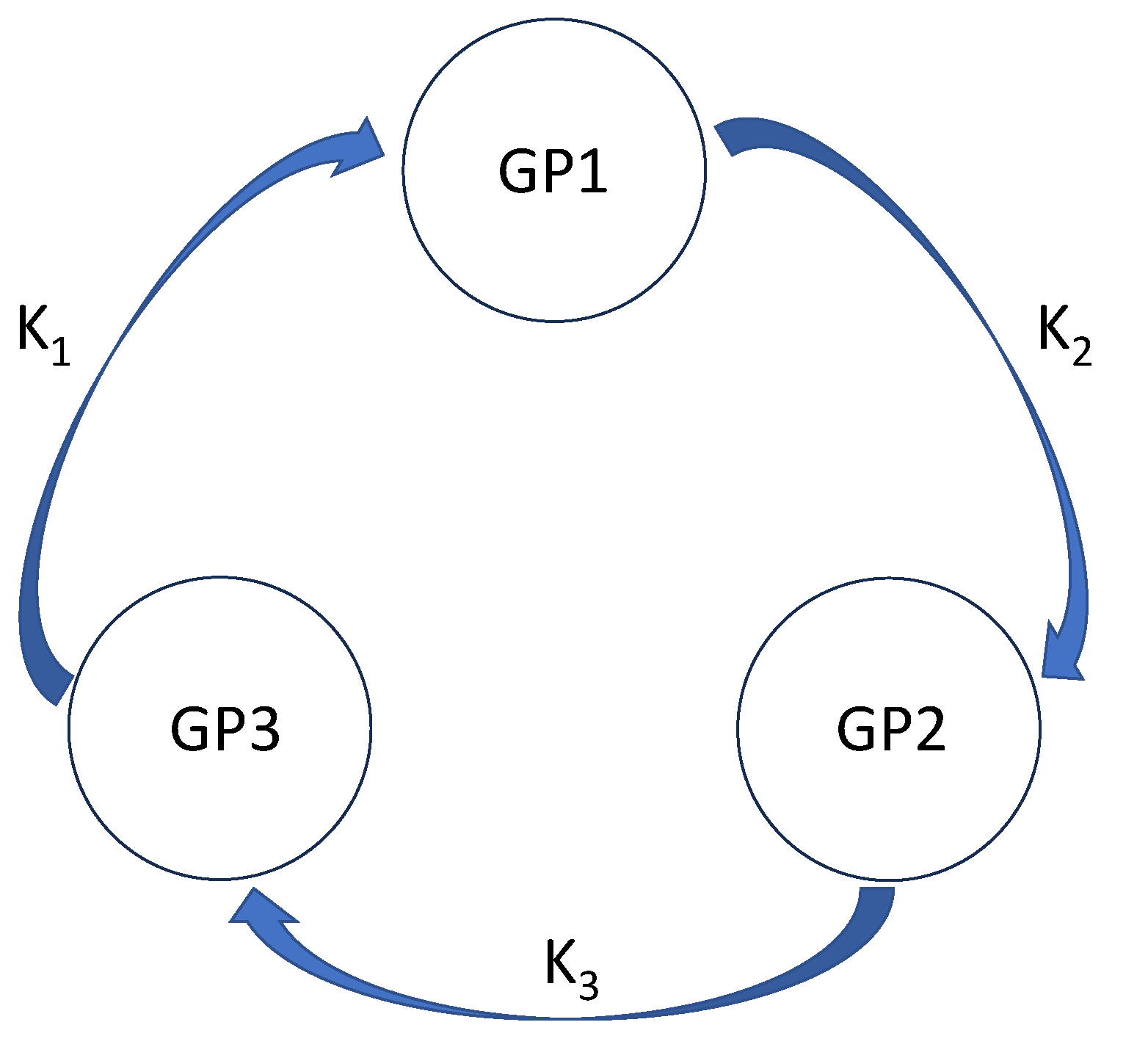
Relating this, then, to the Trinity, gives a clear individuation between the persons of the Trinity, since they share all knowledge in common (and have a single will) except for those particular propositions that are individual to each person. This is depicted schematically in Figure 1. Once the persons of the Trinity have been individuated in this way, it is not possible to identify the Godhead as another person because being “tri-personal” is inconsistent with being a person! That is, the “Third Man” argument would be ineffective here (Taylor 1949, pp. 355–56) (as, in fact, it was ineffective in its original context).
At this point, we need to ask how the persons are related. Unlike in the case of the superhuman, these persons are divine, and omniscient after their person, and that gives us further aspects to explore. Firstly, if each person were a separate god, then one would have polytheism, but also a situation where no god was absolutely omniscient. In fact, absolute omniscience would be rendered impossible. Second, it is not obvious how a “social” relation would overcome this problem: since each person in the social Trinity would be omniscient (after their person) the best that could be achieved would be similar to the distributed knowledge mentioned above, so that the society would contain all knowledge but with no single personal being that was absolutely omniscient (but the oneness needed, however construed, must allow for absolute omniscience and being multi-personal).
On the other hand, if the persons were related as in classical Christian theism, whereby each person is individuated by what they know (and don’t know), and other than that they have the same knowledge and a single will, then the single multi-personal God will be absolutely omniscient, as one would expect.
Up to this point, there is no necessity for Trinity as such. All that has been said could apply in a binatarian (or even a quaternatarian) context. Ultimately, then, the exact number of persons in the Godhead is identified by means of special revelation. All that we have shown is that the Godhead must be multi-personal on pain of incoherence. Nonetheless, in a manner similar to Richard of St Victor (D. Bray 2022b), we can consider that to mirror logical or epistemological categories requires three persons. That is, logic (and mathematics etc.) have three fundamental relations: reflexivity, symmetry, and transitivity.
Here, this can apply to the persons of the Trinity. Each person may reflect on their own knowledge (just not completely). A pair of persons can each know that the other knows certain things. For one person to know that a third person knows something via the knowledge of a second person is transitive, and three persons are needed for it to be the case. This only hints at three-ness because although three is a minimum requirement, there is no maximum. That is, it will work for a chain of n persons (). Hence, we can posit that there must be at least three; only Scripture informs that there are exactly three.15
4. Some Final Thoughts
In this paper, I have presented two models of the trinity that are grounded in information theory (specifically semantic information) and AI. They are built on and extend the approach of Donald M. MacKay. While the models were presented separately, they are not unconnected. One way to see this is by following through what was said in Section 3.1 regarding the information space. There, each point in the space is a piece of information or proposition (or each subspace could take that role). This is very similar to Clark’s definition of a person as a “congeries of propositions”, and hence an inforg. However, this model does not exhibit any reflective properties, but if one adds them in, one has the situation proposed in the context of MI. Or, to put it another way: as we noted in Section 4, the information space on its own does not demand that God be multi-personal, but given that He is, it provides a useful model; on the other hand, MI does demand that God must be multi-personal (at least if He is to be absolutely omniscient). Putting these two together provides an even stronger informational model of the Trinity that favours traditional classical theism over the alternatives, with the possible exception of Crisp’s chastened theism (Crisp 2019, chap. 4).
An important objection that may arise regards the distinction made between omniscience “after-its-person” and “absolute”, in that it may appear to undermine the oneness in essence (or being, or reality), and simplicity of the Godhead. However, I do not think this is the case. One key thing about God (whether viewed in respect to the Godhead or to the individual persons) is that He cannot contradict Himself, nor believe a contradiction. As highlighted above for a single person, there is one truth that is not available to them, because to believe it would be tantamount to believing a contradiction. So, that does not undermine the essence. On the other hand, the knowledge in the tri-personal Godhead holds all knowledge without contradiction and so, again, the essence (or being and reality) is maintained.
Another issue, or controversial view, that this model may serve to resolve is that of Cornelius Van Til, who stated categorically that God was both one person and three persons (van Til 1974), though Frame states that he was using the term “person” in different senses (Frame 2002, loc 8850). The apparent reason for this was to ensure that the one God of the Old Testament (the Trinity) was personal and was not restricted to one of the persons (the Father). We can have sympathy with this. However, laying aside the spectre of contradiction, this will not work for the reasons given above regarding single persons. On the other hand, the absolutely omniscient tri-personal Godself does satisfy the criteria for being the one God of the Old Testament (the God who could refer to Himself in both singular and plural terms) and so captures the spirit of Van Til’s aim.
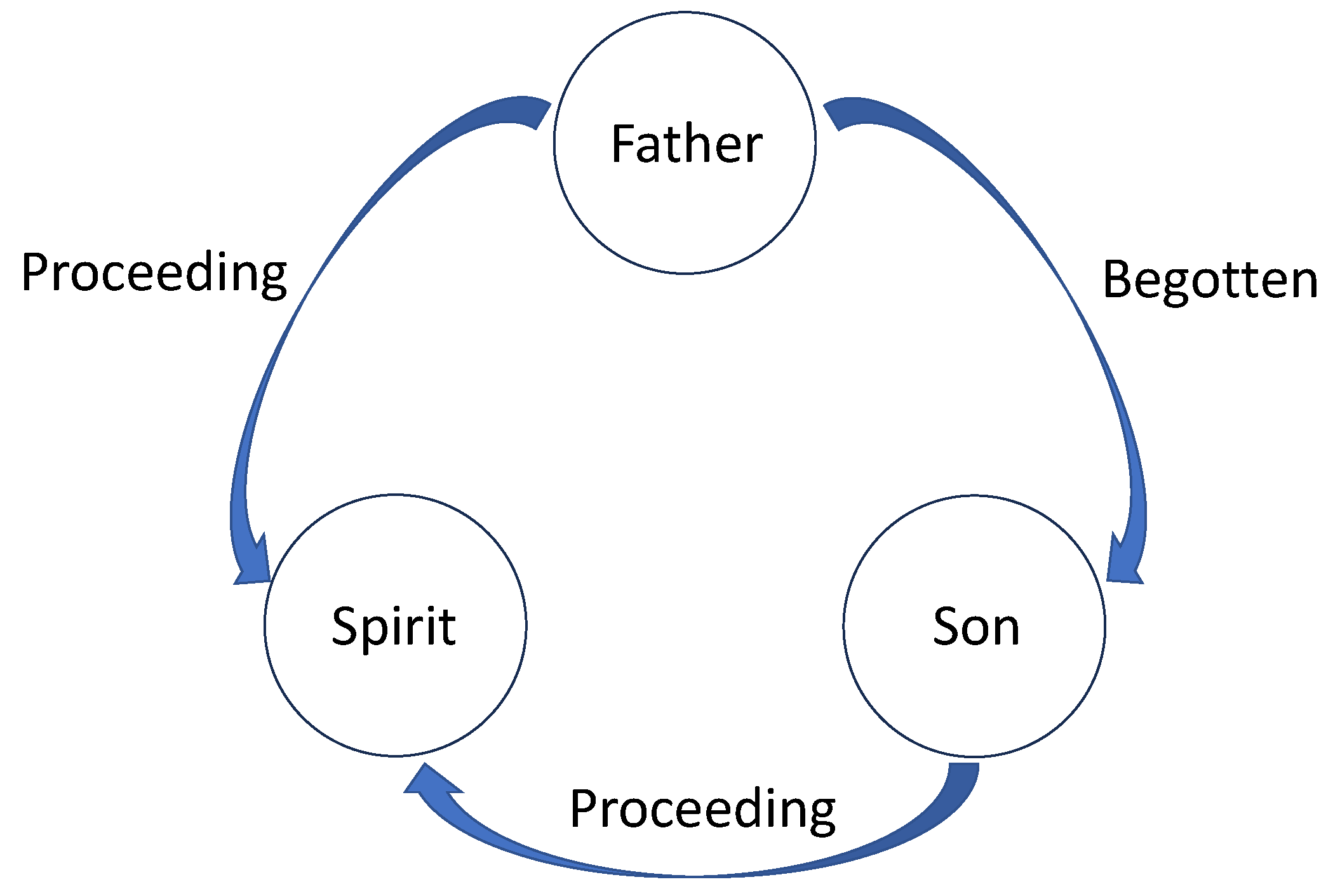
As a final point relating to the distinction between the economic and immanent Trinity, the model proposed herein, while not in any way claiming completeness, highlights one reason why, contra Rahner, the economic Trinity cannot be the immanent Trinity. Figure 2 shows the relation between the persons in the economic Trinity. It is clear from this that that structure will not work for the immanent Trinity, given what has been argued herein, because then the Father would be ignorant of Himself, and no other person would have the requisite knowledge. Hence, the Trinity would lack absolute omniscience.
The model of the immanent Trinity presented shows each person as identical, and God in their own right (or “autotheos”, to use Calvin’s term). This undermines any suggestion of monarchianism, or subordination. Even ideas of origin are removed, though this is true also of the economic Trinity since the relations of Fatherhood and Sonship do not necessarily identify directions of origin,16 because just as to be a son requires a father, so to be a father requires a child, son in this case.17
While it has not been shown definitively here that God must be tri-personal, that is no real problem. The necessity of multi-personality is sufficient to rule out all forms of unitarianism.18 The exact number of persons in the Godhead is then determined by special revelation (scripture) and none the worse for that.
Of course, none of these considerations will perturb those who do not consider that God need be perfect nor omniscient (though here the issues remain, since MI applies to all self knowledge).
As was mentioned in the introduction, there have been a number of attempts to demonstrate the Trinity from natural relations. To close this discussion, it may prove useful to briefly compare what is proposed here to one of these.
The most famous attempt is that of Richard of St Victor, mentioned above, who based his arguments on love (D. Bray 2022b, 2022a). The argument pivots on the supposition that “other love” is a greater kind of love than “self love”. If that is accepted it is a relatively short step to seeing that for God to have maximal greatness, He must be able to maximally love. Therefore there must be more than one. Unfortunately, in this context, there is no compelling reason to suppose that other-love is in fact greater than self-love.19 The two greatest commandments place love for God as first (for us that is other-love, but not for God Himself), and love for your neighbour (the other) on par with (i.e., not greater than) love for oneself (“you shall love your neighbour as yourself”), so if there were only a unitarian God, his self-love would still be maximal, and since he would be the only one, so would his greatness. That is, while a focus on love does not rule out multi-personality, it does not necessitate it either, as required by the argument. On the other hand, one can see this as being related to the non-hierarchical complementarity illustration in that while it does not demonstrate multi-personality (Trinity), given that God is triune, it can help explain why the law of love is as it is.
This contrasts with the position presented here. The key point is that logically, on pain of contradiction, God must be multi-personal. How many persons is a matter for special revelation. None of this affects (and certainly does not undermine) the mystery of the Trinity. What is argued is that God must be multi-personal, not how; and we can agree with St Cyril of Jerusalem: “Believe that God has a Son; don’t pry into how exactly He has a Son.” (St Cyril of Jerusalem c350).
In conclusion, we can briefly reiterate the main findings of this paper: that information and AI can serve as a natural means to gain insight into the nature of the Trinity. That is, we see that Godself must be multi-personal (in both economic and immanent perspectives) and this personhood, understood in informational terms, can be modelled as a complex of truths in an infinite information space. This model favours classical theism and maintains the glorious mystery of the Trinity.
Funding
This research received no external funding.
Institutional Review Board Statement
Not applicable.
Informed Consent Statement
Not applicable.
Data Availability Statement
All the data in this article were collected by literature research, as indicated in the footnotes. I am content for that data to be shared.
Acknowledgments
The author would like to thank Ximian Xu and Thomas Davis, as well as the anonymous reviewers and academic editor, for helpful comments and suggestions for this paper.
Conflicts of Interest
The author declares no conflicts of interest.
| 1 | |
| 2 | |
| 3 | So, in this context, doing backwards etymology to the latin “persona” as “mask”, or even that which could be taken to court, is of little value. |
| 4 | The original LI was shown to be guilty of the modal fallacy: conflating the necessity/inevitability of the consequent with the necessity/inevitability of the consequence. |
| 5 | The method described is applicable to both artificial and natural agents; it is easiest to explain it by means of super-human agents. For application to AI agents, see (Coghill, forthcoming). |
| 6 | This is analogous to Popper’s observation, that no person can have complete knowledge of a system of which they are themselves a part (Popper 1950). |
| 7 | This is reminiscent of the old saying: “Nearly all the points in the plane do not lie on the x-axis. There are however an infinite number of exceptions.” |
| 8 | Should it ever happen. |
| 9 | |
| 10 | I leave aside the theological issue that it is Christ who “upholds all things by His powerful word” Heb 1:3 (ESV). All persons of the Trinity are involved in everything in creation, but particular things have one person to the fore. |
| 11 | |
| 12 | “[Man] is a congeries, a system, sometimes an agglomeration of miscellany, but at any rate a collection of thoughts” (Clark 1985, p. 106). |
| 13 | de Spinoza (2017). Here, Spinoza refers to his definition of God as “absolutely infinite,” which he distinguishes from the Christian definition of God, whom he considers to be only “infinite after his its kind.” |
| 14 | As, of course, is the term “Father.” They represent personal distinctions in the Trinity. |
| 15 | MacKay, in presenting his original argument regrading the Economic Trinity, was quite clear that he did not consider it a proof of the existence of God, simply that the God who is must be multi-personal. On the other hand, since we are extending this to the Ontological Trinity, we must take account of one of the criticisms levelled at the Ontological Argument (OA), namely that even if it were valid, it would not be a proof of the the existence of the Christian God (as Trinity). However, the OA is based on ‘perfections’, and one such is omniscience. If any deity possessing omniscience must, on pain of contradiction, be multi-personal, then this could be used as part of the OA, which would bring it a step closer to demonstrating the existence of the Triune God. |
| 16 | |
| 17 | One can point out that “Sonship” does not imply subordination. In historical terms David was greater than his father Jesse, and of course “great David’s greater son” was Jesus. |
| 18 | Which is ironic given that the origins of unitarianism were based on the lack of explicit trinitarian language in scripture, and the sufficiency, even ostensible necessity of a single person on philosophical grounds. |
| 19 | Of course, Richard’s arguments are more sophisticated than can be presented here, though Bray sees their cogency as a separate issue (D. Bray 2022a, p. 503). |
References
- Anderson, James N. 2007. Paradox in Christian Theology: An Analysis of Its Presence, Character, and Epistemic Status. Milton Keynes: Paternoster. [Google Scholar]
- Augustine, Aurelius. 417. On the Trinity. [Google Scholar]
- Box, G. E. P. 1979. Robustness in the strategy of scientific model building. In Robustness in Statistics. Edited by R. L. Launer and G. N. Wilkinson. New York: Academic Press, pp. 201–36. [Google Scholar]
- Bray, Dennis. 2022a. Critical ressourcement and evaluativecorrection in trinitarian theology: A case study on richard of st victor’s de trinitate. International Journal of Systematic Theology 24: 480–504. [Google Scholar]
- Bray, Dennis. 2022b. Richard of st victor’s argument from love and contemporary analytic theology of the trinity. TheoLogica: An International Journal for Philosophy of Religion and Philosophical Theology 6: 69–80. [Google Scholar] [CrossRef]
- Bray, Gerald. 1993. The Doctrine of God. Downers Grove: IVP. [Google Scholar]
- Bray, Gerald. 2014. A History of Christian Theology: A Trinitarian Approach. Singapore: Crossway. [Google Scholar]
- Brooke, John Hedley. 1991. Science and Religion. Cambridge: CUP. [Google Scholar]
- Brower, Jeffrey E., and Michael C. Rea. 2005. Material constitution and the trinity. Faith and Philosophy 22: 57–76. [Google Scholar] [CrossRef]
- Clark, Gordon H. 1985. The Trinity. Jefferson: The Trinity Foundation. [Google Scholar]
- Coghill, George M. 2023a. A Critical Analysis of Donald M. Mackay’s Contribution to Theology and Science. Master’s thesis, Edinburgh Theological Seminary & University of Glasgow, Glasgow, UK. [Google Scholar]
- Coghill, George M. 2023b. Artificial intelligence (and christianity): Who? what? where? when? why? and how? Studies in Christian Ethics 36: 604–19. [Google Scholar]
- Coghill, George M. 2026. On the modal indeterminacy of a free choice. Ethics & Politics XXVIII: 1–10. [Google Scholar]
- Coghill, George M. Forthcoming. Providence, chance and AI prediction. In The T&T Clark Handbook on AI and Religion. Edited by X. Xu and G. M. Coghill. London: T & T Clark. [Google Scholar]
- Crisp, Oliver D. 2015. Jonathan Edwards Among the Theologians. Grand Rapids: Eerdmans. [Google Scholar]
- Crisp, Oliver D. 2019. Analyzing Doctrine. Waco: Baylor University Press. [Google Scholar]
- Davidson, Donald. 1970. Mental events. In Experience and Theory, 1st ed. Edited by L. Foster and J. W. Swanson. Oxford: Clarendon Press, pp. 207–24. [Google Scholar]
- Davies, Paul, and Neils Henrik Gregerson, eds. 2014. Information and the Nature of Reality. Cambridge: CUP. [Google Scholar]
- de Spinoza, Benedict. 2017. The Ethics, Part I, Definition VI (Tr. R. H. Elwes). Project Gutenberg. Available online: https://www.gutenberg.org/files/3800/3800-h/3800-h.htm (accessed on 15 August 2023).
- Dretske, Fred I. 1999. Information and the Flow of Knowledge. Chicago: CSLI. [Google Scholar]
- Eddington, A. S. 1929. The Nature of the Physical World, 1st ed. Cambridge: CUP. [Google Scholar]
- Edwards, Jonathan. 1980. The mind. In The Works of Jonathan Edwards. Edited by W. Anderson. New Haven: Yale University Press, pp. 336–37. [Google Scholar]
- Fagin, Ronald, Joseph Y. Halpern, Yoram Moses, and Moshe Y. Vardi. 1995. Reasoning About Knowledge. Cambridge: MIT Press. [Google Scholar]
- Floridi, Luciano. 2011. The Philosophy of Information, 1st ed. Oxford: OUP. [Google Scholar]
- Floridi, Luciano. 2014. The 4th Revolution. Oxford: OUP. [Google Scholar]
- Floridi, Luciano. 2015. The Best Books on the Philosophy of Information. Available online: https://fivebooks.com/best-books/luciano-floridi-philosophy-information (accessed on 15 August 2023).
- Frame, John. 2002. The Doctrine of God. Philipsburg: P&R. [Google Scholar]
- Gleick, James. 2012. The Information: A History, a Theory, a Flood. New York: Harper Collins. [Google Scholar]
- Hodge, Charles. 1940. Systematic Theology. Grand Rapids: Eerdman’s. [Google Scholar]
- MacKay, Donald M. 1958. Complementarity ii. Proceedings of the Aristotelian Society suppl. vol XXXII: 105–22. [Google Scholar]
- MacKay, Donald M. 1960. On the logical indeterminacy of a free choice. Mind 69: 31–40. [Google Scholar] [CrossRef]
- MacKay, Donald M. 1967. Freedom of Action in a Mechanistic Universe. The Eddington Lecture. Canbridge: CUP. [Google Scholar]
- MacKay, Donald M. 1968a. The sovereignty of god in the natural world. Scottish Journal of Theology 21: 13–26. [Google Scholar] [CrossRef]
- MacKay, Donald M. 1968b. What makes a contradiction? Faith and Thought: The Journal of the Victoria Institute 97: 7–14. [Google Scholar]
- MacKay, Donald M. 1973. The logical indeterminateness of human choices. British Journal for the Philosophy of Science 24: 405–8. [Google Scholar] [CrossRef]
- MacKay, Donald M. 1974a. Complementarity in scientific and theological thinking. Zygon 9: 225–44. [Google Scholar] [CrossRef]
- MacKay, Donald M. 1974b. The Clockwork Image. London: IVP. [Google Scholar]
- MacKay, Donald M. 1982. Ourselves and our brains: Duality without dualism. Psychoneuroendocrinology 7: 285–94. [Google Scholar] [CrossRef] [PubMed]
- MacKay, Donald M. 1991. Behind the Eye. Oxford: Blackwell. [Google Scholar]
- Moreland, J. P., and William Lane Craig. 2003. Philosophical Foundations for a Christian Worldview. Lisle: IVP. [Google Scholar]
- Popper, Karl. 1950. Indeterminism in quantum physics and in classical physics, i. British Journal for the Philosophy of Science 1: 117–33. [Google Scholar] [CrossRef]
- Rahner, Karl. 1970. The Trinity. Translated by Joseph Donceel. New York: Herder and Herder. [Google Scholar]
- Richard of St Victor. 2011. On the trinity. In Trinity and Creation: A Selection of Works by Hugh, Richard and Adam of St Victor. Edited by Boyd Taylor Coolman and Dale M. Coulter. New York: New City Press, pp. 194–382. [Google Scholar]
- Shannon, Claude, and Gilber Weaver. 1949. The Mathematical Theory of Communication. Urbana: University of Chicago Press. [Google Scholar]
- Sijuwade, Joshua Reginald. 2022. The logical problem of the trinity: A new solution. Religions 13: 809. [Google Scholar] [CrossRef]
- Singler, Beth, and Fraser Watts, eds. 2024. The Cambridge Companion to Religion and Artificial Intelligence. Cambridge: CUP. [Google Scholar]
- St Cyril of Jerusalem. c350. Catechetical Lectures 11: 18–19. Available online: https://www.newadvent.org/fathers/310111.htm (accessed on 15 August 2023).
- Taylor, E. A. 1949. Plato: The Man and His Work, 6th ed. London: Methuen & Co. [Google Scholar]
- Turing, Alan M. 1950. Computing machinery and intelligence. Mind 59: 433–60. [Google Scholar] [CrossRef]
- van Til, Cornelius. 1974. An Introduction to Systematic Theology. Nutley: P&R. [Google Scholar]
- Ward, Keith. 2014. God as the ultimate informational principle. In Information and the Nature of Reality. Edited by Paul Davies and Niels Henrik Gregersen. Cambridge: CUP, chap. 13. pp. 357–81. [Google Scholar]
- Warfield, Benjamin B. 2014. Biblical Doctrines. New York: Charles Scribener and Sons. [Google Scholar]
- Wolpert, David H. 2018. Theories of knowledge and theories of everything. In The Map and the Territory: Exploring the Foundations of Science, Thought and Reality. Edited by Shyam Wuppuluri and Francisco Antonio Doria. Berlin/Heidelberg: Springer, pp. 165–84. [Google Scholar]
- Xu, Ximian. 2025. The Digitalised Image of God: Artificial Intellgence, Liturgy, and Ethics. London: Routledge. [Google Scholar]
Figure 1.
A model of the Ontological Trinity. Here, we do not distinguish between the persons according to their function, so GP is “Godhead Person”, and Kn refers to the knowledge by one person of another. The arrows are unidirectional for one world, to avoid complicating the diagram. Obviously, there is knowledge in the opposite direction as well.
Figure 1.
A model of the Ontological Trinity. Here, we do not distinguish between the persons according to their function, so GP is “Godhead Person”, and Kn refers to the knowledge by one person of another. The arrows are unidirectional for one world, to avoid complicating the diagram. Obviously, there is knowledge in the opposite direction as well.

Figure 2.
An Economic Trinitarian model.

Disclaimer/Publisher’s Note: The statements, opinions and data contained in all publications are solely those of the individual author(s) and contributor(s) and not of MDPI and/or the editor(s). MDPI and/or the editor(s) disclaim responsibility for any injury to people or property resulting from any ideas, methods, instructions or products referred to in the content. |
© 2026 by the author. Licensee MDPI, Basel, Switzerland. This article is an open access article distributed under the terms and conditions of the Creative Commons Attribution (CC BY) license.
Share and Cite
MDPI and ACS Style
Coghill, G.M. Information, Agency, and the Trinity. Religions 2026, 17, 782. https://doi.org/10.3390/rel17070782
AMA Style
Coghill GM. Information, Agency, and the Trinity. Religions. 2026; 17(7):782. https://doi.org/10.3390/rel17070782
Chicago/Turabian StyleCoghill, George M. 2026. "Information, Agency, and the Trinity" Religions 17, no. 7: 782. https://doi.org/10.3390/rel17070782
APA StyleCoghill, G. M. (2026). Information, Agency, and the Trinity. Religions, 17(7), 782. https://doi.org/10.3390/rel17070782
Note that from the first issue of 2016, this journal uses article numbers instead of page numbers. See further details here.