1. Introduction
Female epistolary writing, particularly that produced in convent environments during the modern period, emerges as a field of historiographical research of notable relevance. Convents and monasteries were privileged spaces for the development of writing by women, where the need for literacy for the exercise of administrative and religious positions resulted in a vast documentary corpus. This includes not only administrative records and accounts of exemplary lives, but also a rich correspondence of varied content, including of a contentious nature, going beyond the walls of the cloister and connecting with the outside world.
Against this backdrop, the present article situates the correspondence of the nuns of Convent of Santa Monica in Goa (also known as Monicas) as an integral part of a transoceanic written culture, in which female agency in Portuguese Asia found in the epistle a primary instrument for social intervention. The study focuses specifically on the material produced by these religious women between 1721 and 1738—years marked by a severe contention with Archbishop D. Fr. Inácio de Santa Teresa, amidst a broader jurisdictional crisis involving religious orders in the
Estado da Índia.
1 The intensity of this dispute generated a profuse documentary apparatus, through which the sisters mobilized writing to safeguard privileges, garner support across various spheres, and confront opponents. In light of this documentation, the primary objective of this analysis is to investigate the discursive positions and self-representation strategies adopted by the senders, examining how they dialogued with or collided against the pressures arising from the archepiscopal quarrel. In doing so, the research adopts a perspective that prioritizes the complexity of conventual life, distancing itself from binary interpretations that reduce it to spaces of either absolute autonomy or mere punitive seclusion, aiming instead to unveil the multifaceted nature of the female experience within the cloister.
Studies focusing on the female world within this colonial context remain limited, although recent decades have witnessed a growing body of scholarship dedicated to this theme. Alongside traditional works, such as the multi-volume study by
Correia (
1948–1954), several investigations focus on the social condition of women in the Portuguese East. Notable among these are the scholarship of
Boxer (
1975) and
Coates (
1998;
2002, pp. 67–81) and studies focusing spatially on Goa by
Figueiredo (
1933),
Gracias (
1996,
2007),
Maria (
2002), and
Kamat (
1995). For the Far East—particularly Japan, Macau, and the Philippines—more recent scholarship has emerged.
Penalva’s (
2011) book, derived from her doctoral dissertation, examines the peculiarities of the female presence in Macau, a theme also explored in articles by Leonor Diaz de Seabra, Maria de Deus Beites Manso (
Seabra 2006, pp. 197–208;
Seabra and Manso 2014, pp. 105–33), and
Sousa (
2006, pp. 151–72). Meanwhile,
Ward (
2009) addresses the presence of Christian women in Japan, while the scholarship of
Apolo (
2002, pp. 221–38),
Owens (
2017), and
Martínez Cuesta (
1992, pp. 511–20) offers critical insights into female institutions in the Philippines.
With specific regard to the Convent of Santa Monica in Goa, historiography long tended to approach the institution through predominantly institutional, biographical, or artistic lenses. In traditional and theological studies dedicated to the trajectory of its founder, Archbishop D. Frei Aleixo de Menezes, the convent often appeared as a mere appendix or simply one among the prelate’s multiple political–religious achievements in the
Estado da Índia (
Alonso 1964,
1992;
da Costa 1940,
1986), although pioneering analyses gradually shed light on the community’s daily life (
D’Abreu 1882;
Alonso 2001). Another significant strand developed within the field of Art History, driven by the rich ornamentation of the building on Monte Santo, which stands out as one of the few remaining and reasonably preserved structures of “Golden Goa” (
de Azevedo 1959,
1970;
Serrão 2010,
2011). When addressing political and economic dynamics, the literature tended to emphasize macro-structural power networks and the monastery’s jurisdictional tensions with local authorities, highlighting conflicts with the Municipal Council (
Câmara) of Goa and, later, the severe eighteenth-century dispute with Archbishop D. Fr. Inácio de Santa Teresa (
L. d. Rocha 1973;
Bethencourt 1995;
Subrahmanyam 1998;
Alves 2012;
Mendes 2015).
In recent decades, however, investigations into the Augustinian universe and female enclosure in the
Estado da Índia have undergone a significant methodological renewal, paving the way for patrimonial, comparative, and gender-focused analyses (
de Azevedo 2011;
Pombinho 2014). In the Brazilian academic landscape, the works of
Gonçalves (
2005,
2013,
2015) on female mysticism and the role of the order’s defenders, such as Frei Diogo de Santa Anna, have been vital to the field, providing a foundation for research dedicated to the spiritual economy and survival strategies of the Monicas (
Vigas Oliveira 2012,
2023). This movement to recover the voices, cultural practices, and subjectivity of these cloistered women gained new dimensions with the recent contributions of
Michon and Smith (
2021,
2025), which sheds light on intramural textual production. This interpretive shift aligns with a broader effort to rethink historical asymmetries and the agency of subjects long invisibilized by official overseas narratives, as evidenced both by the Special Issue “Women, Children, and Enslaved People in the Portuguese Empire in Asia”, published by the journal Ler História and organized by
Vigas Oliveira and Ehalt (
2024), and by the recent collective volume
Construtoras de Impérios (
Polónia 2025).
Research concerning female epistolary writing in Portuguese Asia, particularly during the eighteenth century, encounters significant obstacles stemming from a paucity of scholarship and the fragmented nature of archival documentation when compared to the historiographical landscapes of Portugal or Brazil. Nevertheless, the study of letters penned by the Monicas benefits from a critical dialogue with Portuguese historiography. In this field, investigations into figures such as Joana do Louriçal and the Marquise of Alorna have elucidated various expressions of female agency, albeit within specific historical constraints. More recently, within the Portuguese context,
Shibata (
2020) examined how the correspondence from the Marquise of Alorna to her daughter functioned as both a normative and strategic tool within eighteenth-century aristocratic dynamics, aimed at safeguarding family memory and a curated feminine ideal. Concurrently, in the religious sphere,
Queirós (
2023) interprets the 1779 rejection by the Royal Censorship Board of Joana do Louriçal’s sixty-two letters to her confessor as indicative of a shift in Portuguese Enlightenment sensibilities—a period increasingly characterized by an aversion to Baroque practices, such as public or severe penances.
In the colonial context, more recent research on Portuguese America reveals that epistolary writing was not a resource used only by elite women.
Cardenete and Monte (
2025) realized how letters served as an instrument of resistance and the search for freedom even for enslaved women, whose letters in Minas Gerais became tools in the fight against the violence they suffered. Meanwhile,
de Freitas and Alencar (
2017) identified women in the hinterlands of Ceará who used letters of land grants to secure property rights. However, regarding Portuguese Asia, despite chapters by
Manso (
1995) on the portrayal of Indian women in Jesuit correspondence, and by
Fernandes (
2008), which analyzed requests for mercês (royal grants) submitted by women in Goa, to date, only the thesis
As mônicas no Vale dos Lírios (
Vigas Oliveira 2019) and the article “Cartas de freiras” (
Vigas Oliveira 2020) specifically address the use of letters by women—namely, the Augustinian nuns.
This cloistered world, however, was far from socially uniform; rather, the heterogeneity of Goa’s female conventual community mirrored the Baroque complexity of colonial society, much like the dynamics
Burns (
2008, pp. 104–5) observed in the convents of Cuzco, which served as repositories of power and privilege. The population of Goa was characterized by a rigid social and racial stratification that dictated a woman’s status and potential for agency. According to
Gracias (
1996, p. 31), women were primarily divided between non-Christians (Hindus and Muslims) and Christians. The Hindu population was governed by the intricate caste system (
varna and
jati), a concept that, as
Dumont (
2008, pp. 69–81) suggests, was further shaped by Portuguese interpretation. Within the Christian sphere, native women (
canarins) maintained adapted caste structures, while those of Portuguese descent were subdivided into
reinóis (born in Portugal),
castiças (born in India of Portuguese parentage), and
mestiças (daughters of Portuguese men and native women).
The status of Christianized women in Goa underwent significant transformations, including the prohibition of
sati and infanticide, alongside the granting of inheritance rights. Nevertheless, formal education remained largely neglected until the mid-eighteenth century, when Pombaline reforms began to encourage primary instruction in the
Estado da Índia (
Velinkar 2008, p. 5). Within this landscape of selective privileges, Agnelo Fernandes identified groups of women who, between the sixteenth and nineteenth centuries, successfully petitioned for
mercês (royal grants). Notable among them were the
bailadeiras (women who served in Hindu temples), who, despite being neither of Portuguese origin nor Christian converts, established influential concubinage relationships with Portuguese men. Through these unions, they accumulated wealth and secured royal grants for their maintenance, often defying ecclesiastical and civil efforts to restrain them (
Gracias 1996, pp. 104–8). Other beneficiaries included the
órfãs d’el-Rei—noble but impoverished maidens sent from Portugal for strategic marriages—who received dowries in the form of administrative appointments (
Coates 1998, pp. 194–95). Additionally, the wives, daughters, and widows of Crown officials frequently claimed rewards based on the services of their male relatives, securing prerogatives such as fortress commands or lucrative commercial voyages for their heirs or future husbands (
Fernandes 2008, pp. 8–26).
In this scenario, the community of the Convent of Santa Monica constituted a kaleidoscopic space, encompassing a spectrum that ranged from the Portuguese elite to recent converts and enslaved individuals. This conventual microcosm mirrored the pluralities and tensions inherent in the Goan social structure analyzed by historians such as
Xavier (
2014, pp. 111–33). Far from being a homogeneous environment, the cloister replicated these broader stratifications: on one side stood the ‘black-veiled’ nuns, dedicated to contemplation and possessing an active political voice; on the other were the servant women, maids, and enslaved persons who sustained the nuns’ aristocratic lifestyle (
Vigas Oliveira 2023, pp. 92–164). The distinctiveness of these religious women, however, lay in the relative institutional autonomy afforded by the convent—notwithstanding male ecclesiastical supervision—and a degree of administrative and economic power seldom attained by laywomen, who remained subject to the legal guardianship of fathers, husbands, or sons. If, as
Lavrin (
2016, p. 119) posits, “within the internal circle of government, the nuns had complete autonomy and exercised total control over themselves,”
2 it is highly probable that they would leverage every means at their disposal to vigorously defend such prerogatives against the direct interference of ecclesiastical prelates or civil authorities.
It is precisely within this historiographical gap concerning female epistolography that the arrival of D. Fr. Inácio de Santa Teresa at the Archdiocese of Goa in 1721 becomes pivotal. His appointment was in line with King João V’s policy of promoting reformist ‘political bishops’ (
Paiva 2006, pp. 147–70). As a supporter of the Jacobite movement, Santa Teresa advocated for strict customs, the revaluation of the Council of Trent (1545–1563), and the reform of religious institutions (
Souza 2004). Upon his arrival, he imposed rigorous examinations on the clergy, actions that brought him into direct confrontation with various orders disputing authority amidst a broader jurisdictional crisis (
Alves 2012, p. 47;
Mendes 2015, vol. 1, p. 106). In an archbishopric characterized by the publication of numerous pastoral letters and excommunication sentences, his conflicts with the Jesuits involved the missions and parishes in the villages near Goa; in the case of the Franciscans, he likewise endeavored to remove them from their parishes, predicated on claims of evangelical inefficiency; and with the Augustinians, he interfered in their internal administration and prohibited provincial licenses to return to the Kingdom without episcopal approval. The religious orders resisted these measures through polemical writings—aimed at disqualifying the prelate’s arguments—and the election of the Bishop of Malacca, D. Fr. Manuel de Santo Antônio, as Conservator. This move exploited the post-Tridentine tension between episcopal authority and the privileges granted to the orders by the Apostolic See (
Mendes 2012, pp. 75–80, 121;
Alves 2012, pp. 196–98). Thus, while the archbishop perceived the orders’ interference as a usurpation of his prerogative, the religious communities adamantly defended the exemptions that shielded them from direct episcopal control.
The struggle involving the nuns is situated precisely within this contentious framework, as the prelate initiated a regime of surveillance and discipline over the community, seeking to impose structural changes on conventual governance and internal order. This dispute precipitated a profound schism within the religious house, leading to the emergence of two antagonistic factions: the ‘
desobedientes’
3 (disobedient)—led by the deposed prioress, Sister Magdalena de Santo Agostinho—and the ‘
obedientes’ (obedient) who supported the archbishop’s determinations and his favored successor, Sister Brites do Sacramento
4.
This confrontation culminated between 1732 and 1734 when the rebel nuns, in a radical act of defiance, transgressed their vow of enclosure and fled the convent. For over six months, they sought refuge in the Viceroy’s Fortress—a structure then largely derelict (
L. Rocha 1979, p. 249). The episode and its aftermath transcended the cloister, mobilizing a wide array of local and metropolitan authorities in the
Estado da Índia and Europe, including the Viceroys, the provincials of various religious orders, King D. João V, cardinals, and the Jesuit Superior General. Far from being an isolated phenomenon, the nuns’ resistance was bolstered by material and spiritual support from the archbishop’s adversaries, notably the Jesuits and the Bishop of Malacca. The specter of an escalating scandal transformed the Monicas’ cause into a potent political weapon against what they characterized as the tyranny of D. Fr. Inácio de Santa Teresa, whom they accused of infringing upon their constitutional rights. Although the king initially attempted to mediate by counseling conciliation and expressing displeasure with both parties, the Viceroy D. Pedro Mascarenhas, Count of Sandomil—whose administration began in 1732—served as the important arbiter. Nevertheless, as the impasse persisted, the King intervened decisively on 15 April 1736, decreeing ‘perpetual silence’ on the matter (
Vigas Oliveira 2019, p. 354). This royal mandate signaled the formal conclusion of the crisis, which effectively ended with the election of a new prioress in January 1738.
Through their correspondence, the Monicas did not merely defend themselves, but constructed their own “truths” and negotiated privileges. This perspective recovers them as “flesh-and-blood” women, showing how their agency—bound to the convent’s autonomy—propelled a deliberate resistance against the control of Archbishop Santa Teresa. The rhetoric of the letters, reflecting Patrizia Violi’s “dialectic of proximity and distance, of presence and absence” (cited by
Imach 2004, p. 38), helps decode this agency under severe constraints; from this perspective, the flight to the Fortress of the Viceroys ceases to be a desperate act and assumes the role of a political tactic to force civil intervention and safeguard their status. The case thus illustrates how women in the
Estado da Índia instrumentalized the very structures of power (Church, Crown, and kinship) to exercise a political agency that challenges silenced subalternity, defining the battlefield of this conflict.
Accordingly, the structure of this article is organized into three sections. First, the
materials and methods section presents the documentary corpus—consisting of 99 letters either authored or signed by the nuns—and details the qualitative approach used to systematize the data and identify the persuasive strategies embedded in their writing. The subsequent section, dedicated to the results, analyzes the fragmentation of the cloistered community into antagonistic factions and the rhetorical and linguistic nuances employed by the nuns to mobilize various spheres of authority in the
Estado da Índia, Lisbon, and Rome. Finally, the discussion examines how kinship networks and the strategic occupation of the Viceroy’s Fortress consolidated a policy of resistance against the attempts at absolute control by Archbishop D. Fr. Inácio de Santa Teresa.
2. Materials and Methods
The documentary corpus covering the period of the conflict (1720–1738) comprises 458 documents dispersed across institutions in Lisbon, Goa, and the Vatican: the Academia das Ciências de Lisboa (Lisbon Academy of Sciences, 14 items); the Arquivo Histórico Ultramarino (Overseas Historical Archive, 76); the Arquivo Nacional da Torre do Tombo (National Archive of Torre do Tombo, 205); the Biblioteca da Ajuda (Ajuda Library, 7); the Biblioteca Nacional de Portugal (National Library of Portugal, 66); the Arquivo Histórico de Goa (Historical Archive of Goa, currently the Directorate of Archives and Archaeology—Goa; 80); and the Arquivo Secreto do Vaticano (Vatican Secret Archives, 10). Of this total, the present analysis focuses on a subset of 99 letters penned by the religious women themselves, encompassing signed originals, as well as copies embedded within argumentative dossiers—a customary practice at the time to disseminate information in favor of a given faction. By privileging these missives, this study gains direct access to cloistered voices, exposing the subjectivities and strategic agency deployed by the Monicas amidst tensions and conflicts.
Despite the profusion of eighteenth-century correspondence relative to previous periods, certain interpretive limitations must be acknowledged. As
Monte (
2013, p. 116) observes, contemporary access is strictly restricted to what was safeguarded by the state administration of the period. This fragmentary nature is further illuminated by
Anastácio (
2007, p. LVIII), who compares preserved epistolary collections to a permanently incomplete jigsaw puzzle. For Anastácio, incompleteness is an inherent feature of these documentary sets, given that the entirety of an epistolary exchange is rarely preserved; she emphasizes that letters often record merely the remnants of communications that orality could not contain. Thus, the surviving corpus must be read as a lacunary and discontinuous record, alerting the researcher to the structural absences that shape historical narratives.
Within the Goan context, the dispersion of documents among distinct institutions and the fortuitous nature of their preservation reinforce this lacunary record, preventing the seamless reconstruction of past dialogues. However, even though many pieces of this mosaic remain lost, the surviving material constitutes sufficient testimony to map the tensions, agency, and resistance of the nuns of Santa Monica during their years of crisis.
To grasp the documentary corpus in its entirety, the initial organization using spreadsheets sought to visualize the producers, recipients, and chronological sequence of the documents, while respecting their temporal order and original groupings (such as attachments and copies). However, to overcome the constraints of analyzing such an extensive volume, a database was implemented, proving to be a far more efficient management tool. This digital transition was fundamental to systematizing the source content by integrating fields for archival location, date, typology, senders, recipients, descriptive summaries, and transcriptions. Through this strategy, it became possible not only to store and preserve the content of documents—some of which are in poor physical condition—but also to facilitate future access to primary sources that reveal distinctive aspects of female religious life. Ultimately, the use of the database enabled an approach anchored in the qualitative analysis of this corpus, aiming to comprehend the dynamics of power, agency, and self-representation manifest in the correspondence of the Goan nuns.
The foundation of this research rests upon the recovery of a primary documentary corpus capable of illuminating the agency and writing of the Goan Monicas. The conventual crisis of 1721–1738—as detailed in the thesis
As mônicas no Vale dos Lírios (
Vigas Oliveira 2019)—generated a textual mass that, although scattered, remains essential to deciphering both intramural and extramural tensions. The distinct locations of these sources reflect the transnational dimension and complexity of the power networks orbiting the convent. This dispersion is far from accidental; it materializes the global scale of a conflict that involved multiple civil and ecclesiastical spheres, stretching from Lisbon to Rome. Therefore, while this archival fragmentation poses challenges, it also offers an opportunity to reconstruct communication circuits of the time. With the aim of analyzing the letters qualitatively to recover these women’s voices, the data was organized according to the parameters established by Andrée Rocha:
The letter obeys certain structural norms that frame its proper substance. In the sequence when?, where?, to whom?, what?, by whom? that may be applied to it, the what factor—the core and motivation of the text—is evidently paramount. However, the other elements (place, date, recipient, and signature) are only ostensibly external and secondary.
Drawing from Rocha’s framework, it is understood that not only the textual content of the letters, but also their dates, locations, recipients, and, above all, the signatures they bear, are essential for identifying both the epistolary models employed by the religious women and the characteristics of the community at the time of writing. These parameters were adapted to the heterogeneity of the monastic corpus, allowing for the inclusion of petitions, protests, and formal representations. These distinct formats posed no impediment to the subsequent analysis, as they shared the same communicative and argumentative nature as the missives themselves.
3. Results
In line with
A. C. Rocha (
1965, p. 16), for whom dating allows the temporal placement of the “making and content of the message,” a chronological analysis of the corpus reveals an evolution in the nature of the religious women’s writing. During the initial period, spanning from 1720 to May 1732, writing of a communal nature predominated, manifesting in missives signed on behalf of the entire community or bearing the signatures of nearly all the nuns. Comprising 7.07% of the archival collection (seven documents), these records demonstrate an apparent unison and a strategic effort to sustain a united front against episcopal pressures.
From mid-1732 onward, the outbreak of the schism within the religious community fragmented epistolary production into the factions of the ‘disobedient’ and the ‘obedient.’ This polarization catalyzed an intensification of writing, deployed by both sides as a tool to legitimize their claims and discredit their opponents. The dissident group was the most prolific, accounting for 56.57% of the corpus (56 documents), whereas the obedient faction penned 36 letters (36.36%). This quantitative disparity signals not only the vigor of the ‘disobedient’ faction’s efforts but, above all, the urgency of substantiating their challenge to authority and rallying support across various spheres, given their position of contestation against the established power.
For the Monicas, writing was a way to resist and adapt to an intercontinental temporality, maintaining links with authorities in Goa, Lisbon, and Rome despite the rigor of the enclosure reinforced since the Council of Trent. Thus, the geographical origin of these letters transcends mere spatial data to become a
locus of enunciation, revealing the tension between monastic isolation and active participation in the dynamics of power. As Imach suggests, writing exposes “the tension between the world and the convent, the outside and the inside” (
Imach 2004, p. 49). Distancing themselves from the mundane content of the Marquise of Alorna’s letters to her daughter (
Shibata 2020) or the
odor of sanctity present in letters addressed to confessors, these missives resemble the freedom-seeking letters written by enslaved women in Minas Gerais, in colonial Brazil (
Cardenete and Monte 2025, p. 2), where epistolary writing could assume distinct functions as a means of survival and resistance
5. In Goa, the epistle neutralized the limitations of mandatory enclosure, offering the religious women a channel of influence. The space of writing thus becomes an essential hermeneutic element: through it, the nuns bridged spatial and social gaps, integrating themselves into the imperial network and attempting to shape, through their narratives, the actions of their recipients.
This intentionality to influence the spheres of power is directly reflected in the very configuration of the communication networks mobilized by each group. As previously mentioned, the quantitative and qualitative analysis of the documentary corpus points to a striking asymmetry in epistolary production and the breadth of these circuits. While the circulation of letters from the obedient nuns tended to be strictly vertical and centralized—essentially restricted to the two highest echelons of local power: Archbishop D. Fr. Inácio de Santa Teresa and the Viceroy, the Count of Sandomil—only two exceptions to this closed institutional circuit were located. These consist of a letter addressed directly to the royal power and another, undated, destined for the convent’s procurator. The latter, preserved as a copy annexed to a dispatch from the Count of Sandomil dated 18 November 1734, most likely points to Diogo Gonçalves Lobão, an official appointed by the archbishop himself to the house’s procuracy. This pattern reiterates that the group loyal to the prelacy operated predominantly within official channels and predefined hierarchies, delegating their defense to the formal structure of colonial and ecclesiastical governance.
In contrast, the disobedient nuns mobilized a broad and heterogeneous spectrum of interlocutors, turning the multiplication of communicative channels into an imperative tactical necessity. They articulated transversal support within the regular clergy, actively corresponding with leaders of the Augustinians—such as the provincials Friar Paulo da Silva and Friar Jozeph da Ressurreição—the Province of Madre de Deus, and the Society of Jesus, the latter represented by Father João Marques and Brother Antonio Fernandes. Additionally, they called upon the secular clergy in the figure of Father Manoel Vaz Carrão, a cleric who had been chosen by the archbishop himself to act as the convent’s procurator. Beyond ecclesiastical connections, the dissidents’ dense social network reached the summit of the local civil administration—including the viceroy and the interim governors Dom Christovão de Mello and Thome Gomes Moreira—extending to the Inquisitors of Goa and officials of the bureaucratic–judicial apparatus, such as the scribe Francisco João da Sylveira and Captain Jozeph Gonçalvez da Silveira. This social web also projected itself beyond the Goan setting: in addition to appealing directly to King D. João V, the disobedient nuns sought to sensitize the upper echelons of the metropolitan ecclesiastical hierarchy through missives sent to high Roman prelates, presumably the influential Cardinals da Mota or da Cunha. Thus, a sophisticated political agency becomes evident, capable of mapping and operating within the jurisdictional fractures and rivalries of the Portuguese Empire in favor of their factional cause.
Consequently, an analysis of these recipients reveals the distinct tactics deployed by each faction during the conventual crisis, confirming
A. C. Rocha’s (
1965, p. 18) thesis that the choice of interlocutor invariably conditions the style and candor of a text. The Augustinian nuns adapted their tone and language with a keen awareness of imperial hierarchies. While letters to local authorities, such as the Viceroy and the Archbishop, overflowed with heated grievances aimed at destabilizing the governance of the prelate Santa Teresa, correspondence sent to the Kingdom operated on a different scale. The discourse in the local context was one of confrontation and resentment—as exemplified by Sister Brites’ complaints regarding the “pandemonium” and verbal violence of Sister Magdalena—revealing the intensity of the internal strife and the nuns’ willingness to use the written word to expose the frictions of daily cloistered life. Conversely, when addressing King João V or Rome, the rebels adopted a register marked by formality and reverence. Transmuting their image into “
indignas esposas de Jesus Cristo” (unworthy spouses of Jesus Christ) and “
filhas súditas” (subject daughters), they deployed a rhetoric of submission to neutralize the accusations of insubordination weighing against them. By imploring “
protecção régia” (royal protection) or ecclesiastical intervention to remedy their “
males” (ills), this calculated shift in tone served to ensure that the archbishop’s narrative did not remain uncontested.
This reading aligns closely with the interpretation proposed by
Chowning (
2006, pp. 70–71) regarding the letters of the abbess of the Mexican convent of La Purísima, Antonia del Santísimo Sacramento. In these letters—beyond the “violent temperament” noted by the convent’s vicar, Juan de Villegas—traits of a significant strength of character manifest, which allowed her to confront influential secular authorities. In both cases, the pen functioned as a tool of power that extended beyond the walls of the cloister. As demonstrated in
Nas Clausuras de Goa (
Vigas Oliveira 2023), the cells of the Goan Monicas did not isolate them from the political conjunctures of the Portuguese Empire; rather, they actively embedded them within communication networks to shape the perception of their cause and safeguard their autonomy.
In the only discovered missive of the “obedient” nuns addressed to King João V, they adopted a rhetoric of preserving order to delegitimize Sister Magdalena’s faction. They accused her of violating not only the vow of enclosure—both during their flight to the Viceroy’s Fortress and through their intense correspondence with various individuals—but also the vow of poverty, by manufacturing goods to win over supporters. Aligning with
Imach’s (
2004, p. 38) perspective, this type of writing served to formulate “institutional policies” in an attempt to convince the monarch that the rebellion stemmed from illicit communications with influential religious figures and relatives. By presenting themselves as the guardians of “true obedience,” the obedient faction thus sought to reinforce their governing legitimacy against the “subtlety” and “caprice” of their adversaries.
6In their correspondence with the Viceroy and the Archbishop, however, the language of the obedient faction assumed a more intimate and dramatic tone, characterized by resentment and the exposure of physical and emotional frailties. A clear example of this posture is found in the missive addressed to the Viceroy, the Count of Sandomil, in which Sister Brites do Sacramento lays bare the strain on her endurance:
[…] and increasingly constant in continuing to subject me to insults unworthy of being mentioned before Your Excellency; for, Most Excellent Lord, Your Excellency may consider how a Prelate can live with her obedient Nuns so mistreated, and already under such shocks, with so little hope for life that, were it lawful to ask God for Death.7
By framing herself as a “
maltratada” (mistreated) leader plagued by such “
sobressaltos” (shocks), the prelate instrumentalized her suffering as a political argument, going so far as to invoke the desire for death in the face of the tribulations she endured. Furthermore, by describing themselves as “
enfermas e achacosas” (sick and ailing) women—incapable of halting the violent advance of the rebels who were seizing vital convent spaces, such as the choir and the pantry, and preventing them from performing the divine office and mental prayer
8—the obedient nuns deployed supplication and claims of helplessness as deliberate strategies to appeal to their superiors and demand punitive intervention. This calculated subservience aimed to safeguard episcopal jurisdiction and reinforce the legitimacy of Sister Brites’s own internal governance. However, this rhetoric of absolute dependence also showed signs of fracture when the religious women felt abandoned by their superiors,
9 indicating that the pen was wielded not merely to perform obedience, but to demand the protection rightfully owed to the “spouses of Christ.”
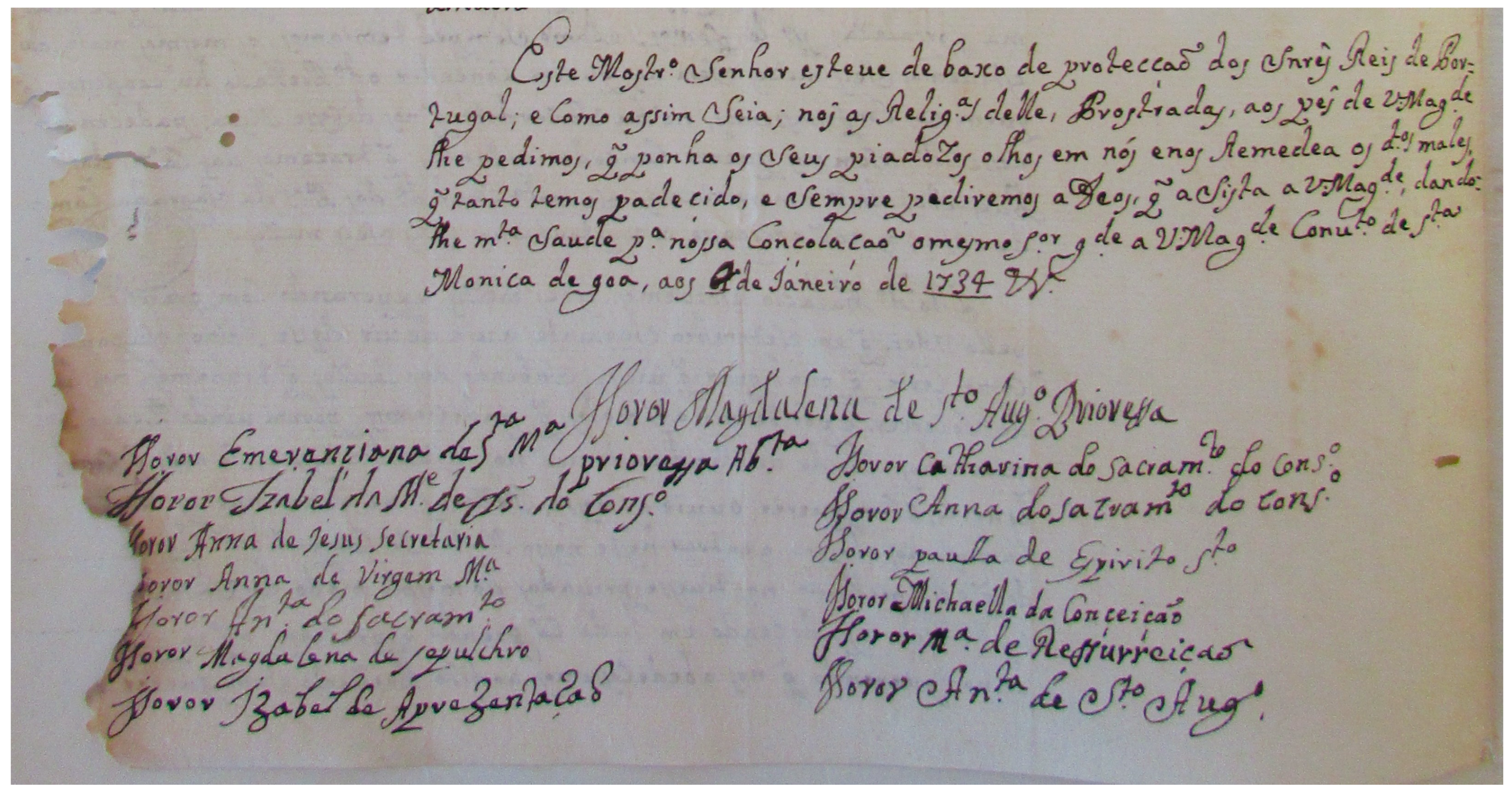
The analysis of signatures in the correspondence of the Goan religious women serves as an instrument to confirm the organizational structure and socio-political profile of the Santa Mônica community. Far from being random, the order of the rebel nuns’ signatures mirrored a strict hierarchy (
Figure 1): when signed by the entire group, the document was headed by the prioress and subprioress, followed by the “
prioresas absolutas” (absolute prioresses)—those who, by virtue of the prestige of having held the highest office, retained a seat on the council. These were followed by the scribe and other conventual office-holders, then by those without office, and, ultimately, the novices, pupils, and lay sisters. Such paratextual details allow for the mapping of the distribution and legitimation of authority within the cloister, clearly distinguishing the decision-making centers from the subaltern positions occupied by those who signed last.
By cross-referencing the Monicas’ letters (e.g.,
Figure 1) and the
Rol da Comunidade10 with the study on the social structure of Goan cloisters (
Vigas Oliveira 2023, pp. 92–164), it becomes evident that the signatories’ profiles reveal both their social origins and educational backgrounds. The humanistic script—tending toward roundness and displaying uniform strokes among the different nuns—suggests a basic, homogeneous literacy acquired within the convent itself under the guidance of a single teacher or model. Although this article does not aim to conduct a philological study, clear similarities can be observed with
López’s (
2017) analysis of female writing in eighteenth-century Spain, highlighting instructional patterns that shaped these women’s expression.
Firstly, female education in the Portuguese Empire tended to prioritize moral and domestic training to the detriment of purely intellectual development, reflecting a broader European dynamic of exclusion and protection. As
Ariès (
2014, pp. 236–38) points out, the consolidation of modern school systems from the eighteenth century onward tended to isolate and protect women, keeping girls tied to the old traditional structure of family socialization or protective conventual enclosures, with the intent of safeguarding their modesty and preparing them exclusively for the duties of the private sphere. Even with the advancement of Enlightenment ideals, which began to justify female literacy as a useful mechanism for the basic education of children, instruction remained limited to the rudiments of reading and writing, entirely subordinate to the learning of domestic crafts such as embroidery, sewing, and cooking.
In the specific case of Portugal, although Enlightenment intellectuals began to grant a new visibility and consideration to women in their pedagogical reform projects, this inclusion in socio-educational proposals remained strictly bounded by the demands of social regeneration, family utility, and public morality (
Alves-Jesus and Franco 2022, p. 11). The Pombaline Reforms marked a redefinition of this educational landscape, signaling the transition to a state-supervised model aimed at breaking the hegemony of religious orders in education. Even so, written culture reached the female universe in a controlled manner, predominantly through conduct manuals and pious texts that operated as efficient instruments of social and religious control. In differentiating the Franco-British Enlightenment from its Spanish–American counterpart,
Cañizares-Esguerra (
2001, pp. 266–68) argues that, far from representing a secular break along the anticlerical lines of the former, the Spanish–American Enlightenment was characterized by a state-guided utilitarian pragmatism, regalist control, and the bureaucratic optimization of traditional corporations, without dispensing with the institutional support of the Church. Given the similarities identified with the Portuguese context, in which “the traditions of the Baroque did not disappear but had a lasting and powerful influence” (
Cañizares-Esguerra 2001, p. 268), it can be argued that this educational transition reflected the specific characteristics of what may be termed the Iberian Enlightenment.
In Goa, the Pombaline Reforms marked the transition of education to a more secularized model, breaking with the hegemony of religious orders. Until this milestone, female education was provided by
casas de recolhimento [houses of recollection] or by the Convent of Santa Mônica. However, in the case of the latter, admission was restricted to young women who would later enter religious life. For them, access to knowledge constituted a functional prerequisite: the nuns needed to read the divine office and manage the community’s assets, which rendered writing an indispensable management tool for institutional life (
Vigas Oliveira 2015, pp. 203–10). Thus, this conventual literacy and familiarity with financial and legal documentation did not constitute an archaic deviation from secular modernity; rather, they aligned directly with the administrative rationality of this Catholic world—a space in which the institutional networks of the Church operated as dynamic axes of social engineering, documentary control, and global power.
Consequently, certain characteristics can be observed in the letters of the Augustinian nuns that may evidence a modest education, yet one that served the practical needs of daily cloistered life. There is a fragmented handwriting style, characterized by the separation of letters, which aligns with what Raquel María López López, in her analysis of eighteenth-century Hispanic female writing, termed an “absence of a continuous stroke of the letterforms” (
López 2017, p. 89). This feature suggests a poorly trained or medium-to-medium–low-level hand. Nevertheless, while Sister Magdalena and Sister Brites displayed a direct writing structure in their shorter missives, in the descriptive letters addressed to the king, the former resorted to an excessive use of long sentences and sparse punctuation. As Michon demonstrated, “A phrase will remind her of something and, as in casual speech, she will digress to flesh out this idea, and then seamlessly return to her original point” (
Michon and Smith 2021, p. 14). Furthermore, the letters also exhibit “features typical of orality” (
López 2017, p. 89), manifested in the use of expressions very close to spoken language. Notable examples include, among others, Magdalena’s use of the word “violencencia” instead of “violencia”
11 [violence], or Brites’s use of “cumessaõ” instead of “começão”
12 [start].
The use of honorific pronouns is also noteworthy. According to López, “the letter participated in the pact or ‘social contract,’ making the correct use of formulas of respect for the recipient’s position indispensable”. The use of these conventional structures by Spanish and Brazilian women and Goan nuns alike “provides data regarding the social structures of the period” (
López 2017, p. 87), revealing the norms of sociability and discursive strategies employed to legitimize their actions before instances of power. In the case of the
corpus studied here, the addressing of letters is predominantly observed through honorific pronouns that functioned as markers of hierarchy and respect. In this sense, the formulas
“Vossa Illustrissima” and
“Illustríssimo Senhor” were reserved for Archbishop Dom Frei Inácio de Santa Teresa, while viceroys, such as the Count of Sandomil, were addressed as
“Vossa Excelência” or
“Excelentíssimo Senhor,” in strict observance of the writing customs of the time, as pointed out by
Freire (
1786, pp. 436–37). According to
López (
2017, p. 87), although the eighteenth century moved toward greater simplicity compared to the previous Baroque period, rigor in the choice of pronouns remained fundamental to situating interlocutors within the social structures of the time.
This awareness of epistolary conventions is chiefly observed in the missives addressed to King Dom João V, in which the nuns used the vocative
“Senhor” at the top of the page and
“Sua Magestade” in the body of the text. This practice, although diverging from the colonial letter model proposed by
Bellotto (
2002, pp. 39–43), aligns with
Monte’s (
2013, p. 231) findings on letters from São Paulo, suggesting that this was a consolidated form of dialogue with royal power during the period. The same rigor applies to letters addressed to ecclesiastical authorities—possibly Cardinals da Cunha and da Mota—who were addressed as
“Eminentíssimo Senhor” and
“Vossa Eminência.” The conformity of these formulas with
Freire’s (
1786, p. 433) prescriptions, combined with the cross-referencing of Archbishop Santa Teresa’s correspondence, supports the hypothesis identifying these recipients. As
López (
2017, p. 87) highlights, the choice of register and formulas of respect was determined not only by the subject matter but, above all, by the relationship with the recipient and the sociolinguistic characteristics of the sender, demonstrating that the Goan nuns mastered the codes of the written culture of their time.
The presence or absence of certain signatures on documents, such as the protest of 7 January 1732,
13 serves as a barometer of the rift between the “obedient” and “disobedient” factions, although the numerical fluctuation between the groups—caused by deaths or by some being unable to sign—gives rise to historiographical divergences (
Alves 2012, p. 180;
L. Rocha 1979, p. 246). Despite the accusations of forgery made that same year,
14 which sought to diminish the political weight of the dissidence, the signatures ratify that the rebels, led by Sister Magdalena de Santo Agostinho, comprised about two-thirds of the community. By gathering signatures from women without an active voice (lay sisters, novices, and pupils) to lend volume and weight to their demands, the insurgents used correspondence as a tool for collective pressure. Aware of the inner workings of the empire, the rebels sought to project an image of unity and widespread discontent to sensitize the authorities.
Beyond this strategy, it is worth noting that the signatures also contribute to an understanding of the social exclusion strategies adopted during the conflict. The case of the pupil Bibiana de São Miguel, whose signature appears on the letters of the obedient women, exemplifies how family connections and social status could influence each woman’s position in the dispute. Bibiana, described as a “daughter of the Church” in the
Livros das profissões15 and possibly linked to one of the religious women among the obedient faction, lacked the networks of influence enjoyed by the nobility and was excluded by the insurgents. In a letter, Sister Brites denounced that, in December 1732, the rebels had forcibly taken over the seminary where the pupils stayed and expelled Bibiana.
16 This action suggests that the rebellion was not merely an act of religious disobedience, but a violent defense of the nobility and the privileges of birth of the insurgents against those who did not possess the same networks of influence, revealing a dynamic that served both to consolidate political alliances and to demarcate social boundaries.
Finally, the Monicas’ missives offer a glimpse into the structure and daily life of the convent. In the introduction to their transcription of one of Sister Magdalena’s letters addressed to the king, Daniel Michon and D. A. Smith emphasize how in just a single letter it is possible to catch a glimpse of “the nuns’ daily routines, from the daily rituals of the Divine Office to the seasonal festivals and their elaborate celebrations,” but above all “the jealousy, desire, and egoism that drove everyday life” (
Michon and Smith 2021, p. 2). However, beyond the isolated view of a single missive, expanding the corpus allows us to confront the “truths” constructed by both factions. Through tropes such as courtly humility, supplication, the denunciation of tyranny, and self-victimization, the disobedient (as well as the obedient) articulated distinct strategies of persuasion and legitimation. In the following lines, we will seek to understand how the nuns exercised their agency, intervening in the course of events and operating within the communication norms of the time to project multiple self-representations.
4. Discussion
The analysis of the nuns’ divergent views regarding the conventual conflict elucidates the complexities of the female experience within an environment that was simultaneously sacred and colonial. As Teresa Malatian describes, the eighteenth century was marked by the central role that letters acquired in the expression of sentiments and life experiences (
Malatian 2009, p. 196), rendering the analysis of epistolary discourse an indispensable tool for capturing the nuances of these women’s subjectivity.
The agency of the Augustinian nuns of Goa cannot be dissociated from the discursive sophistication present in their correspondence. Far from constituting a space of passive isolation, the cloister emerges as a stage for intense power struggles, wherein the “pragmatic-communicative function” of the epistle neutralized the limitations imposed by enclosure (
Imach 2004, p. 38). To comprehend this course of action, it is necessary to situate these religious women within a framework of subalternity that was not merely gendered, but also religious and colonial, even though they belonged to the Portuguese-descended elite of the
Estado da Índia. Similarly to other women in Goa who resorted to the imperial bureaucracy to petition for royal favors (
mercês), the nuns mobilized their social standing and literacy to transform the convent into an active political actor amidst jurisdictional disputes, rendering the convent walls “porous” to external dynamics.
The Convent of Santa Monica can be conceived as an intersection point between local and global scales, integrated into a network of relations that connected Goa, Lisbon, and Rome. In this scenario, female agency was heightened by the nuns’ ability to navigate institutional rivalries, particularly regarding the contentious jurisdiction of D. Fr. Inácio de Santa Teresa. The governance of this “controversial archbishop” (
Mendes 2015) was marked by a state of permanent conflict, and he was frequently described by opponents as an authoritarian and intransigent prelate. As
Alves (
2012, p. 216) observes, the prelate perceived that the “scandals and relaxations” he sought to rectify were backed by interests that directly confronted his power.
Although the alignment between the rebels and the religious orders is evident in accounts of the assistance provided during the group’s refuge in the Fortress of the Viceroys, the documentary
corpus contains few missives addressed to Jesuits or Augustinians. Only twelve letters have been located—written by sister Magdalena de Santo Agostinho (on behalf of her faction), sister Catharina do Sacramento, and occasionally sister Francisca de São José and the lay sister Joanna de Jesus
17—addressed to the provincials of the Jesuits, the Capuchins (Province of Madre de Deus), and the Augustinians. Although the scarcity of located missives reflects the inherently lacunary nature of the epistolary archive previously discussed, the density of these relationships should not be underestimated. For instance, in a letter to Father João Marques (Provincial of the Society of Jesus) dated 17 September 1734, sister Magdalena demonstrates a grasp of the flows of information circulating outside the cloister walls by requesting his strategic intervention: “[…] as the long-awaited time of the
Naos do Reino [Ships of the Kingdom] approaches […] and we know that the Enemy does not sleep […] we ask Your Paternity to act with all due diligence and commitment […] because, out of respect for Your Paternity, they will be able to work much good with us”.
18 The plea for diligence and commitment to such addressees demonstrates that the Monicas did not merely seek spiritual protection, but actively articulated the authority and prestige of the Society as a political shield.
Simultaneously, the rebels instrumentalized the rivalry between the Archbishop and the Holy Office, demonstrating full awareness of the inquisitorial process accusing Dom Frei Inácio de Santa Teresa of Jansenism and authoritarianism (
Mendes 2012, p. 92). The litigation, which began in 1725 at the Inquisitorial Court of Goa, was transferred to Lisbon so that the local institution could avoid a direct confrontation with the prelate, who enjoyed strong royal backing and whose premises regarding evangelization aligned with the directives of the Goan institution itself. In the metropolis, the process dragged on for years, reflecting a broader clash between opposing political visions regarding tolerance toward native populations and the governance of the
Estado da Índia (
Souza 2006, p. 67). The case concluded only in 1737 following Rome’s intervention, when Pope Clement XII acquitted the prelate. For Evergton Souza, this decision represented a “theological triumph of the prelate of Goa over his adversaries—among whom, in this case, was the Portuguese Inquisition” (
Souza 2006, p. 71). Beyond the doctrinal sphere, the episode exposed a complex jurisdictional dispute in which the Inquisitor-General sought to “demonstrate the hegemony of inquisitorial power over episcopal power” (
Alves 2012, pp. 242–43).
Thus, by proposing that the governance of the convent be transferred to the inquisitors of Goa following the breach of enclosure, the nuns launched a direct challenge to episcopal jurisdiction. This stance became evident when they formulated their “conditions”
19 to return and remain within the cloister after the initial violation of their vow of enclosure—which occurred in April 1732, when they fled to seek the protection of D. Christóvão de Mello, interim governor of Goa and father of Sister Luisa Madre de Deus
20, out of fear of severe punishment by the Archbishop (
Vigas Oliveira 2019, p. 378). By stipulating that the temporal and spiritual administration of the house be handed over to two inquisitors, the Monicas demonstrated that they operated as informed political subjects, capable of converting theological and institutional conflicts into instruments of resistance to safeguard their autonomy and delegitimize the prelate’s authority.
On another front of action stood the relatives of the “disobedients”. Despite the absence of direct records of correspondence with family members, Sister Brites’s allegations that “leading seculars of this City” had “the door open to their communications and deal with the Rebel Nuns”
21 confirm that the communication between these nuns and their relatives was constant and decisive. The maintenance of these support networks, which extended beyond the strictly religious sphere to encompass political and military elites, underscores that the Convent of Santa Mônica was not an isolated island, but rather a nexus of local influences. In this regard, the historiographical assertion that they were merely led by clergymen and relatives—as maintained by
L. Rocha (
1979, p. 260) and
Mendes (
2015, vol. 1, p. 175)—fails to capture the complexity of these women’s agency. Their actions reveal a keen awareness of their dual privilege: the autonomy conferred by religious status and the political capital derived from their social origins. Letters, therefore, functioned as active channels of intervention that allowed the dissident group to breach the cloister walls and alter the external correlation of forces in their favor.
Within this scenario, the resistance of the Augustinian nuns reveals itself as a political practice shaped by different phases of tension and negotiation. To comprehend this phenomenon, it is indispensable to mobilize the concept of gender as a category of historical analysis proposed by Joan Scott. According to the author, gender functions as a constitutive element of social relations based on perceived differences between the sexes, as well as a primary way of signifying relationships of power (
Scott 1995, p. 86). In the case of the Goan nuns, gender articulated with the ecclesiastical hierarchy and the colonial structure to forge a space where writing functioned as the primary vector of intervention in the public sphere. Drawing from Scott’s premises, it is observable that these women instrumentalized their female identity to negotiate spaces of autonomy within a markedly colonial and patriarchal environment. Their resistance did not imply a rejection of religiosity; on the contrary, it unfolded into an intricate “power game” in which writing was wielded as a fundamental tool for safeguarding collective and subjective interests. Through this web of contestation strategies, the factions converted the silence prescribed by enclosure into an arena of political agency, demonstrating that formal submission was frequently a strategy for preserving their influence and freedom of action.
In the initial stage of the conflict against Archbishop D. Fr. Inácio de Santa Teresa (a period spanning from 1720 to May 1732), the nuns sought to restore traditional privileges, such as the right to Augustinian confessors, by drawing upon a calculated courtly humility. As Cardenete and Monte observe, “the presence of terms indicating this humility before the addressee was a sign of courtesy” (
Cardenete and Monte 2025, p. 8), and female writing of the period frequently adopted expedients of “self-diminution” before superior authorities. Thus, in 1721, by declaring themselves to be “at the feet” of the monarch, “as a community” and “bathed in tears,”
22 the Monicas mobilized a rhetoric of fragility as an instrument of political pressure. Throughout this period, tension intensified as the prelate attempted to impose rigid disciplinary reforms, transmutating the initial plea into a more incisive defense of conventual autonomy.
From May 1732 onward, when the radicalization of the rebels manifested in the breach of enclosure and the consolidation of internal polarization, Sister Magdalena contested the deposition from her office and the legitimacy of Sister Brites. To this end, she utilized writing not only as an expression of passionate outbursts, but also as part of an orchestrated action to defend the “common good” and the privileges of the house against episcopal intervention—a dynamic characteristic of this type of rebellion, as
Chowning (
2006, p. 81) pointed out in her study on the internal crisis at the Convent of La Purísima in Colonial Mexico.
In her narrative, Magdalena justified the flight to the Fortress of the Viceroys as an imperative of survival in the face of the Archbishop’s “tyrannies,” evoking “the great evils that could befall us for having thus opposed his disorders, since we were aware that he was coming to the said Monastery to launch grenades, to imprison some, to banish others to Macau, and to remove others from this Monastery and place them in the
Recolhimento da Serra of this city”
23. Faced with these threats, which sought to punish even the lower strata of the conventual hierarchy, the “disobedients” assumed a posture of radical inflexibility, declaring that “for which reason we are exposed to die rather than render him such obedience”
24. This fear and the drastic rhetoric that accompanied it were entirely well-founded: the prelate had already sent a 60-year-old lay sister who served as the porter to the
Recolhimento de Maria Madalena (
Vigas Oliveira 2019, p. 378).
By invoking an alleged miracle in the opening of the cloister doors, Magdalena constructed a rhetoric that legitimized religious transgression in the name of divine justice. In her letters, the nun reported in detail—and, at times, with calculated exaggeration—the fears shared by the nuns in the face of the prelate’s punitive actions. The description of the “flight” to the abandoned Fortress of the Viceroys in her “
Relação”
25 reveals an agency that goes beyond the passivity expected of enclosed women, even in a circumstance considered desperate. This transgressive posture demonstrates that, for the dissident group, silence did not constitute an option.
Female agency also manifested among the “obedient”
Mõnicas. In addition to Sister Brites do Sacramento, figures such as Sister Olaya de Jesus Maria, Sister Thereza do Sacramento, and Sister Elena de Madre de Deus resorted to writing to vocalize their positions. They projected their self-representation from a discursive repertoire that finds an echo in other latitudes of the Catholic empires. This posture resembles the model mapped by Margareth Chowning in the Mexican convent, in which the “Obedient, or Well-Adjusted, Nuns (Nonrebels)” showed themselves to be “deeply devout and respectful of male authority” (
Chowning 2006, p. 48). Through their missives, the Goan “obedients” validated the episcopal procedures while complaining about the actions of the rebels, who had gone “outside of this Convent, residing outside of it for more than six months, from which followed not only the great scandal of their departure but an even greater one”, a space where “they lived with open doors to speak and communicate with their partisans and secular relatives”
26. By reporting their own version of the breach of the vow of enclosure, these nuns constructed a narrative of delegitimization of the dissident sisters, transferring the responsibility for the disorders to the external influence of Augustinians, Jesuits, and kinship networks. This discursive strategy evidences that, for the group loyal to the Archbishop, writing functioned as an instrument of moral and institutional restoration—an effective weapon in the dispute over the control of the narrative and conventual governance.
The persistence of female agency in both groups at Santa Mônica reveals itself even in the imminence of death, a moment when the pen was mobilized to ensure sovereignty over one’s own end. In 1734, the letters of Sister Antonia da Anunciação
27 and Sister Elena de Madre de Deus
28, written on their deathbeds, demonstrate the use of writing to request sacraments and confessors, challenging the ecclesiastical blockade imposed by the conflict. As
Morujão (
2008, p. 172) observes, the
“bem-morrer” (“dying well”) in a religious community constituted the crowning of a life dedicated to divine graces, requiring specific funeral rituals that guided the quest for perfection. Therefore, these individual examples reinforce that the act of writing configured a final and definitive manifestation of the will and identity of these religious women in the face of restrictions.
However, the destination of these supplications also exposes the pragmatism and the distinct political tactics of each faction. Sister Elena—belonging to the obedient faction—forwarded her clamor to the viceroy, who played a crucial role as a mediator in the conflict. For her part, Sister Antonia—a member of the rebel dissidence—resorted to Father Manoel Vaz Carrão. It is worth noting that her choice does not indicate a political alignment of the cleric with the rebellion, but rather a calculated strategic skill: since he was a canon and a secular priest under the direct jurisdiction of the Archbishop—to whom the obedient nuns themselves frequently had recourse—sending him a missive was the fastest and safest route to ensure that the request for spiritual assistance was fulfilled without the hindrances and suspicions that would weigh upon a letter addressed to an Augustinian or a Jesuit. Thus, the nun’s action ratifies the discernment with which the Monicas decoded the local bureaucratic cogs, since they knew how to direct their pleas both to their declared supporters and to those aligned with the prelate’s faction.
Concerning discursive strategies, the disobedient nuns employed a rhetoric of victimization and denunciation to destabilize episcopal authority. By self-identifying as “
indignas espozas de Jesus Cristo” (unworthy spouses of Jesus Christ) while labeling the archbishop as “tyrannical,” they wielded a language of appeal to piety to sway distant addressees, while simultaneously maintaining a resolute tone before the Viceroy. The strategic use of lexicons such as “
padecíamos” (we suffered) and “
clamando” (crying out), as opposed to terms like “
tiranias” (tyrannies) and “
desordens” (disorders) to describe the prelate’s actions, reveals a deliberate construction of a narrative of resistance that legitimized the insurrection. In contrast, the obedient nuns positioned themselves as the legitimate guardians of cloistered order and discipline. Through denunciations—such as those by Sister Brites against the leadership of Sister Magdalena, alleging that the latter invented “
Injurias de Varias Castas para me dizer […] dizendo que naõ sou Prellada”
29 (injuries of various kinds to tell me […] saying that I am not Prelate)—they sought the support of authorities to restore observance and legitimize their own institutional position. Ultimately, both groups demonstrated a mastery of the tactics embedded in
Hespanha’s (
2012, p. 70) “model of simulation/dissimulation behavior,” utilizing epistolary formality to convey their own version of what occurred inside the cloister and between themselves and the Archbishop.
Even after the subsiding of tensions between the male religious orders and the Archbishop in 1736, the rebel Monicas maintained their resistance, centering their grievances on the demand for a new election for prioress. The impasse was only resolved in late 1737, when a council composed of theologians and civil authorities, convened by royal decree, redefined the direction of the conflict. Faced with this new scenario, Sister Magdalena de Santo Agostinho proved to be particularly pragmatic: in a letter dated 3 December of that year, she declared herself resigned to “perpetual silence,” accepting the jurisdiction of D. Frei Inácio de Santa Teresa as the “legitimate prelate,” obeying him “in everything that conforms to our rule and statutes, from whom we take the blessing.”
30 This submission, however, can be seen as a strategic retreat. By formally conceding in the realm of obedience, Magdalena secured royal protection and the promise of an election, aware that her faction, being the majority, would regain institutional control of the cloister.
The astuteness of this strategy was confirmed on 18 January 1738, with the rise of Sister Catarina do Sacramento
31 to the office of prioress, who continued the management of conventual interests and the defense of autonomy against the prelate’s impositions, albeit more discreetly. The episode underscores the resilience, principally, of Sister Magdalena who—unlike the dissident leaders in Mexico who faded into obscurity, as
Chowning (
2006, p. 254) points out—knew how to lead her fellow sisters through a tumultuous period, ensuring the stability of the convent while keeping in mind the transience of local authorities. She understood the logic governing the rotation of the Portuguese colonial apparatus. She knew that both the Archbishop—who would eventually be transferred to the Bishopric of Algarve in 1739 (
Alves 2012, p. 251)—and Pedro Mascarenhas—whose viceroyalty would end in 1741—would return to the Kingdom at some point, but the community of Santa Mônica would remain operational, reaffirming its capacity for self-management and political negotiation.
This institutional perennity and capacity for articulation invite us to mobilize the perspective of
Scott (
1992, p. 63), for whom gender analysis must function as a tool to deconstruct historical and social categories, revealing the mechanisms of power that sustain and transform them over time. Such an approach aids in the quest to recover the nuns as “flesh-and-blood” women, distancing them from the normative models imposed by the Church and the stereotypes that still persist regarding the cloister. Thus, the agency of these religious women, intrinsically linked to the relative institutional autonomy of the convent, allowed them to design a policy of resistance against the attempt of Archbishop D. Fr. Inácio de Santa Teresa to reestablish absolute control over the female community—and, consequently, to intensify their actions against other religious orders.
It is precisely from this field of forces that it becomes productive to cross Scott’s lens with Gayatri Spivak’s theoretical provocation in
Can the Subaltern Speak? (
Spivak 2010). At first glance, the rebellious Monicas found themselves in a subaltern condition: they were women embedded in a strictly patriarchal universe, religious women under the jurisdiction of a prelate considered tyrannical, and colonial subjects on the periphery of the
Estado da Índia. However, unlike the figure of the Spivakian subaltern, who is often silenced by the very structure of representation, the nuns of Goa utilized their position of local nobility and their literacy to force their voices to be heard. They challenge the classic model of subalternity by refusing to be silenced by the prevailing mechanisms of representation. They did not speak from a muted margin; on the contrary, they used their position of local nobility and their literacy to constrain and mobilize higher civil and ecclesiastical authorities, forcing their demands to be heard.
In this way, epistolary writing functioned as a skillful manipulation of the “code of the speakable” (
Imach 2004, p. 39), operating a fundamental cleavage within Indo-Portuguese social structures. While the efficacy of their letters elevated the cloister conflict to the status of an affair of State, their wealthy socioeconomic condition distanced them from the subalternity that marked the lives of other women in the colony (
Vigas Oliveira 2023, pp. 92–104). The resistance of the Monicas, therefore, did not aim at the subversion of colonial hierarchies, but rather at the maintenance of their privileges. For the community, falling into disgrace before royal power was out of the question, which required their strategies of contestation to remain formally anchored within the thresholds of legality and normativity.
This agency, exercised within the norms, found its material foundation in the convent’s function in Goa’s economy. By managing properties, administering endowments, and operating as a credit institution (
Vigas Oliveira 2023, pp. 207–39)—much like contemporary civil and religious institutions—the Monicas possessed a financial dimension inseparable from their political resistance. The clash with the Archbishop was thus configured as a strategic struggle for the maintenance of institutional autonomy and the resources that allowed them to mobilize their networks of influence and force their voices to be heard.
This capacity for financial and social intervention helps elucidate that, within the Indo-Portuguese society of Goa, the nuns were embedded in a different kind of subalternity than laywomen. Women such as the
órfãs d’El-Rei (maidens sent from Portugal), the
casadas (women married to Portuguese men or their descendants), or even the
bailadeiras (women who served in Hindu temples) were not devoid of agency. As
Coates (
1998),
Gracias (
1996), and
Fernandes (
2008) point out, they utilized administrative channels to send petitions and plead for
mercês (favors) from the Crown. However, while the survival and requests of these secular women depended more directly on male guardianship, the Augustinian nuns enjoyed a greater autonomy within the conventual space. Even as they remained subject to male superiors, they were sustained not only by their social origins but also by their religious status and institution.
In this sense, the nuns’ agency went beyond individual supplication: whether “disobedient” or “obedient,” they acted corporately to defend collective privileges. In this scenario, the intersectionality of gender, race, and class becomes evident in the actions of the rebel Monicas, as the habit and social capital were converted into tools of political resistance capable of cornering authorities in a way that laywomen could not.
It is precisely this action from the power structures that allows the alignment of the Goan nuns’ case with the debates proposed by authors such as
Ballestrin (
2017, p. 1046). By extending Spivak’s concept to other historical contexts, it is argued that agency in colonial settings frequently manifests through “subaltern feminisms”—scenarios in which resistance does not occur in an external or pure opposition to the system, but rather through tactical negotiation with colonial and patriarchal structures themselves. Under this theoretical lens, the letters of the Augustinian nuns cease to be mere correspondences and reveal themselves as the documentary vestige of this “other” female agency. By strategically manipulating rhetorics of submission and victimization, they exerted a highly effective political pressure, subverting the silencing imposed by the Church and male authorities. Writing operated, therefore, as a tool for constructing their identity and experience, allowing them to instrumentalize the female condition itself to activate networks of protection—a dynamic utilized both by the rebels, when accusing the archbishop of tyranny, and by the obedient ones, when seeking out the prelate to defend themselves against the former.
5. Conclusions
The primary objective of this study was to investigate the discursive positions and self-representation strategies adopted by the Augustinian nuns of the Convent of Santa Monica of Goa through their epistolary correspondence. The central thesis defended herein demonstrates that the letters and petitions of these religious women exceeded the devotional or administrative sphere, configuring themselves as strategically mobilized channels for intercontinental political agency. During the years of conflict with Archbishop Dom Frei Inácio de Santa Teresa, the Monte Santo cloister revealed itself to be a territory of intense political contestation and jurisdictional flexibility.
The analysis of the documentary corpus allowed for the observation of discursive patterns conditioned by the factional cleavage that split the monastic community after 1732. As demonstrated, female agency assumed markedly corporate and collective contours: while the majority and dissident faction, under the leadership of Sister Magdalena de Santo Agostinho, mobilized a dense network of interlocutors that included ecclesiastical and civil authorities—functioning as a tactic of institutional survival to ensure their narrative directly confronted the prelate’s authority—the minority loyal to the prelate, captained by Sister Brites do Sacramento, instrumentalized their own physical and emotional frailties in missives addressed mostly to the Viceroy, Count of Sandomil, and the Archbishop—converting the rhetoric of absolute subservience and helplessness into a tactic to demand punitive intervention and legitimize their contested internal governance. The implications of these results indicate that the Monicas knew how to convert their relative autonomy and kinship networks into political capital, challenging previous historiographical interpretations that reduced them to passive playthings of male clerical conflicts.
These findings gain a new theoretical dimension when inserted into the debates on the functioning of the legal and political structures of the Portuguese colonial empire. In light of Hespanha’s formulations on legal pluralism, the
direito comum (ius commune) was characterized by an “enormous flexibility, reflected in the fact that local law imposed itself on general law and that, in practice, the particularities of each case—and not abstract rules—decided the legal solution” (
Hespanha 2012, p. 11). In imperial dynamics, the law remained almost always a secondary element vis-à-vis doctrine and jurisprudence, so that “the permanence of local law and institutions was the rule, despite the proclamation of a common legal order throughout the empire” (
Hespanha 2016, p. 68). In this sense, the legal system of the peripheries was not centralized; it operated as “a machine for weaving legal webs of different colors and resistances” (
Hespanha 2016, p. 74).
This flexible and decentralized architecture dialogues directly with the theses of Jorge Cañizares-Esguerra and Adrian Masters regarding the centrality of writing and the political agency of subjects. For these authors, “paperwork justice was massively bottom up and participatory in nature, enabling vassals of almost all social backgrounds to forcefully challenge the New World’s emerging local” (
Masters and Cañizares-Esguerra 2020, p. 6). From this perspective, the colonial Council functioned, to a large extent, as a passive institution, “waiting for and inviting the petitions of vassals […] in an attempt to maintain constant bottom-up communication and eke out a degree of post-facto control” (
Masters 2023, p. 37). In this interactive process, rulers and the ruled operated a co-creation of legislation, given that “royal decrees were simply verbatim copies of letters sent by vassals of many social backgrounds (including male and female elites and commoners of countless ethnic backgrounds) to the King and his Council of the Indies” (
Masters and Cañizares-Esguerra 2020, p. 1). This dynamic illustrates that state formation resulted from communicative processes that ultimately empowered both the Crown and its subjects (
Masters 2023, p. 8).
It is precisely within this normative and discursive entanglement that the experience of the Convent of Santa Monica is inscribed. As demonstrated throughout this article, the nuns displayed a clear understanding of this multifaceted legal system and knew how to employ the prevailing civil, ecclesiastical, and hierarchical norms to express their colonial demands. The paperwork mobilized by the Augustinian nuns not only served to check the advance of archiepiscopal power but also integrated the cloister into this machinery of imperial petitions and litigation, utilizing legal fiction to shape and transform their own concrete world.
Therefore, it was due to their knowledge of these norms and the epistolary formulas utilized at the time that the voices of the Monicas were effectively heard before higher authorities. They skillfully capitalized on the characteristics and interpretive loopholes of the legal system to transform their resistance into a legitimate defense of the convent’s privileges and autonomy. In this manner, they were capable of substantiating extreme actions—including the breach of the cloister—presenting disobedience toward local authorities as a safeguard for their institutional prerogatives—the legal validity of which, as
Hespanha (
2016, p. 75) underscores, was accepted provided it did not offend the fundamental pillars of the Christian worldview.
This political use of petitions and requests to negotiate spaces and resist institutional pressures within the Portuguese Empire was also employed by women of average means, who appealed to the Overseas Council to secure rights, dowries, and subsistence. Suely de Almeida points to the existence of a colonial woman “who fights against forms of domination, who reacts to the most varied pressures encountered in daily life—actions in which she at times acquiesces to order as a way to survive and resist, and at other times confronts the institutions and the society of her time” (
de Almeida 2005, p. 13). However, when contrasting the experience of the rebel Monicas with other conventual conflicts across Catholic modernity, the specificity of the Goan case stands out.
In the context of New Spain, the nuns of the Convent of La Purísima generated a flurry of petitions and letters addressed to King Charles III to “use royal power to subvert ecclesiastical process” and resist the reform of the
vida común (communal life) (
Chowning 2006, p. 155). However, in the long run, local ecclesiastical authorities and vicars general simply “just did not seem to take their problems and petitions very seriously” (
Chowning 2006, p. 239), resulting in the exhaustion and progressive political overshadowing of their dissident leadership. In turn, the case of the Poor Clares of the Convent of the Encarnação, on Madeira Island, illustrates a radical reaction in which the religious women went out “through the streets of the city desperately […] appealing to the king and the people against the despotic government that [the bishop] practiced against them” (
Trindade 2011, p. 199). To mitigate the prelate’s punishments, the local secular elite was mobilized to draft a petition to Rome seeking absolution to safeguard the interests and privileges of the noble families who held the
padroado (patronage) of the house (
Trindade 2011, pp. 195, 199–200).
However, the sisters of Goa demonstrated a singular capacity for corporate articulation and long-term resistance that subverted these other—practically coeval—outcomes of swift silencing or institutional disregard. By exploiting the jurisdictional ambiguities of the Estado da Índia, allying themselves with the archbishop’s rival male orders, and leveraging the cyclical turnover of colonial offices, the rebel Monicas sustained a stalemate for nearly two decades. The breach of the cloister for over six months and the practical de facto deposition of the leadership chosen by the prelate culminated, in 1738, in a transition of power that restored institutional control to the “disobedient” faction, demonstrating an unparalleled resilience when compared to other conventual crises.
This finding allows for the expansion of classic theoretical analyses on gender and subalternity. The experience at Monte Santo validates Joan Scott’s critique of historical essentialism, challenging perspectives that treat the category of “woman” as a universal and stable entity. For the author, gender must be analyzed as a discursive construction and a primary way of signifying relationships of power, produced through symbols, norms, and institutions (
Scott 1995, p. 86). From this perspective, the examination of the Monicas’ epistolography demonstrates that the cloister, although regulated by the precepts of the Council of Trent, never translated into absolute isolation. Rather, it configured itself as a territory of constant negotiation and strategic porosity, in which the identities of the nuns were reconstructed according to pressing political needs. Furthermore, by critically engaging with
Spivak’s (
2010) theoretical provocation regarding the voice of the subaltern, it is observed that the Monicas distanced themselves from a heavy silencing; although they were subjected to the obvious patriarchal and colonial oppressions of Indo-Portuguese society, their belonging to the local elite and their functional literacy allowed them to skillfully manipulate the ‘code of the sayable.’ With this, they broke the subaltern silence that muted most women of their era, converting their pragmatic writing into an effective instrument of political pressure.
In sum, this article offers a contribution to the fields of Women’s History and colonial studies of the Portuguese Empire in Asia, by recovering the subjectivity and political agency of historical subjects long rendered invisible by official overseas narratives. Notwithstanding the lacunary nature of the preserved epistolary archive, it was possible to demonstrate that the pen wielded by the Goan nuns constituted a remarkably solid and enduring tool of power. Ultimately, it can be asserted that the pragmatic correspondence of the Convent of Santa Monica ceases to be the record of an isolated dissidence to figure—alongside the worlds of the Marquesa de Alorna, Joana do Louriçal, and the enslaved women of Minas Gerais—as a testament to the plurality, audacity, and political strength that defined women’s writing in the eighteenth century.