

Article

In the Beginning Was the Redeeming Word: Tolstoy’s Spiritual Influence on the Genesis of Wittgenstein’s Tractatus

1
Institute of Foreign Philosophy, Peking University, Beijing 100871, China
2
Department of Philosophy, University of Aberdeen, Aberdeen AB24 3FX, UK
3
Institute für Philosophie, Humboldt-Universität zu Berlin, D-10099 Berlin, Germany
*
Author to whom correspondence should be addressed.
Religions 2026, 17(6), 730; https://doi.org/10.3390/rel17060730
Submission received: 27 April 2026 / Revised: 25 May 2026 / Accepted: 26 May 2026 / Published: 18 June 2026
(This article belongs to the Special Issue New Work on Wittgenstein's Philosophy of Religion—Part 2)

Abstract

This article discusses the influence of Leo Tolstoy on Ludwig Wittgenstein’s early philosophy. In particular, we elucidate the influence that Wittgenstein’s reading of Tolstoy’s Gospel in Brief had on the genesis of the Tractatus Logico-Philosophicus, in inspiration, structure, and content. Central to our account is the idea of ‘the redeeming word (das erlösende Wort)’, which Wittgenstein sought in ‘liberating’ us from the problems of philosophy, liberation that had a deep spiritual and ethical purpose.

1. Introduction

There is a lot of miscellaneous commentary and anecdotal evidence concerning the influence of Tolstoy’s religious thinking on Wittgenstein, but very little detailed study. There is also debate amongst biographers about whether Wittgenstein had some kind of religious conversion or mystical experience during the First World War, and commentators themselves have changed their minds on this. In an early paper, for example, Brian McGuinness doubted that Wittgenstein had any mystical experience during the war (McGuinness 1966, p. 308), but in his later biography, he accepted that Wittgenstein had a religious conversion, describing it as “a felt rebirth, which led Wittgenstein to give up all his possessions and to lead a quite different life, a life devoted to these other, inner, religious goals” (McGuinness 1988, p. 273).
In this paper, we argue that Wittgenstein was indeed influenced by Tolstoy and by his Gospel in Brief, in particular, which he read during the war. Whether this led to a religious conversion is unclear, but the influence was undoubtedly spiritual, affecting not just his personal life but also his philosophical thinking. When we look carefully at the development of his ideas in the months that followed the day he began reading the Gospel in Brief, we can see a significant deepening of his conception of his logical project, culminating in the very design of the Tractatus. Spirit works in mysterious ways, which is rarely made clear explicitly, but we can provide an overview of this deepening, with judicious use of ‘redeeming’ words (to use one of them), to show the profound influence that we are now convinced Tolstoy had on Wittgenstein’s early philosophy.
We first sketch some historical background, including specifying which text of the Gospel in Brief Wittgenstein read, and then elucidate the key ways in which Tolstoy’s work influenced the Tractatus in inspiration, structure, and content.

2. Historical Background

Wittgenstein may well have encountered Tolstoy’s work when growing up in Vienna (see Janik and Toulmin (1973), pp. 119, 161ff.), but he would certainly have become aware of Tolstoy’s religious writings when reading William James in 1912. Wittgenstein wrote to Russell on 22 June 1912 that “Whenever I have time I now read James’s ‘Varieties of religious exp[erience]’. This book does me a lot of good.” (Wittgenstein 2008, p. 30). James discusses Tolstoy, most notably, in the chapters on ‘The Sick Soul’ and ‘The Divided Self’, where he offers an account of Tolstoy’s ‘melancholy’, arising from his sense that life was meaningless, and his recovery through recognition that God and true living were one and the same. True living involves rejection of “the superfluities and insincerities, the cupidities, complications, and cruelties of our polite civilization”, as James ([1902] 2012, p. 147) puts it. James cites a passage from Tolstoy in which Tolstoy claims that this recognition saved him from suicide, and Wittgenstein was later to claim that reading Tolstoy’s work saved him from suicide.1
Whatever acquaintance with Tolstoy’s writings Wittgenstein may have had earlier, however, the key moment undoubtedly came on 1 September 1914, shortly after he enlisted in the Austrian army at the beginning of the First World War. He had just started serving on the patrol ship Goplana when it stopped along the Vistula, and he bought a copy of Tolstoy’s Gospel in Brief in a bookshop in Tarnów. He began reading it that same day, describing it in his notebook as a “wonderful [herrliches] book” (PN, 2.9.14, 40).2 He subsequently reported that he always carried it around with him as a talisman (PN, 11.10.14, 60), and he became known among his fellow soldiers as “the one with the gospels” (Janik and Toulmin 1973, pp. 200–1; H. Wittgenstein 1984, p. 3; McGuinness 1988, p. 220; Monk 1990, p. 116.).
Which version of the Gospel in Brief did Wittgenstein buy? There were two German translations available at the time: one by F. W. Ernst under the title Kurze Auslegung des Evangelium, published by Hugo Steinitz of Berlin in 1891 (Tolstoy 1891), and the other by Paul Lauterbach, under the title Kurze Darlegung des Evangelium, published by Phillip Reclam of Leipzig in 1892 (Tolstoy 1892). The two translations are not based on the same original manuscript.3 The evidence suggests that Wittgenstein bought the Reclam version, one reason being that it was copies of this version that Wittgenstein later gave to his friends (Chover 2010, p. 108). In the Reclam version, the title of Tolstoy’s introduction is ‘Die Erkenntnis des Lebens’, while in the Steinitz translation it is ‘Verstehen des Lebens’. In his notebooks, in referring (implicitly) to Tolstoy’s ideas, Wittgenstein uses the term ‘Erkenntnis’ rather than ‘Wissen’, suggesting that he had the Reclam translation (NB, p. 81; see below).
The Reclam edition, as it was in 1914, can be accessed online in facsimile via the University of California.4 The text begins with a preface in which Tolstoy explains that it was extracted from a larger work that he was writing at the time. The Gospel in Brief was a condensed version of the third part, which we discuss below. The first part was published as A Confession (Tolstoy [1897] 1987), on which James drew—translating from the French version—in his account of Tolstoy’s religious conversion. The second part was a critique of traditional Christian teaching, and the fourth part was an exposition of the ‘true meaning’ of Christian teaching.

3. Influence on Wittgenstein

Tolstoy describes the Gospel in Brief as his own synthesis of the four Gospels, “organized according to the meaning of the teaching” (Tolstoy 2011, Preface, p. xv). The book has twelve chapters, with an important preface and introduction, and concludes with a version by Tolstoy of The First Epistle of John. It is a complete reworking of the texts of the four gospels and not simply a compilation or précis. The book requires study in itself, but it is not our purpose to compare it with the ‘authorized’ Bible versions, since it is Tolstoy’s Gospel that enthralled Wittgenstein, not the ‘original’ Gospels. Before we look at its influence on the structure and content of the Tractatus, let us consider the fundamental inspiration that it provided.

3.1. Inspiration

Tolstoy’s Gospel in Brief was written in response to a spiritual crisis that he underwent in 1878, when he asked who he was and what the purpose of his life was, as he reports it in his preface. To escape his despair, he decided to study Christian teaching, comparing how it directed people’s lives in practice with how it was understood by the Church. He became convinced that the Jesus that emerged from his own reading of the Gospels was not the same as that promoted by the Church: Jesus was not (literally) the son of God but simply a great man who had recognized and expressed a deep truth that resonated with others, whatever their culture. It was this deep truth that he sought to formulate as clearly and succinctly as he could in his book. Here is how he summarizes it in his introduction:
The Gospel proclaims that the source of all things is not an external God, as people think, but a knowledge of life. And therefore, in place of that which people call God, the Gospel posits a knowledge of life.
Without knowledge there is no life. Every man is living only because he has knowledge. … Realizing the truth that man’s life comes from knowledge, [Jesus] gave people a teaching and a model life of knowledge in the flesh.
Previous doctrines expressed themselves as laws dictating what one must do and not do in order to serve God. The teaching of Jesus Christ is based on a knowledge of life. … The path of life can only be seen when one recognizes that the knowledge located within, as it arises from the source of all knowledge, is the basis for everything.
(Tolstoy 2011, p. 3)
This teaching is spelled out in the twelve chapters that follow, thematically paired so that the main claim made in the second chapter in each pair can be taken to follow from the main claim made in the first (see below).
The brilliance of Tolstoy’s conception of his project and the courage with which he pursued it must have impressed Wittgenstein as much as it does us, especially at a time when Wittgenstein was struggling to bring his own thoughts together into the philosophical treatise that he wanted to write. If Tolstoy was able to distil the whole of the Gospels (and Christian teaching) into a relatively short text, then Wittgenstein may well have been encouraged to do the same for philosophy. As he read and re-read the Gospel in Brief, as he carried it around with him everywhere, and aside from its specific content, it must surely have provided him with a model for his own work.

3.1.1. Wittgenstein’s Spiritual Crisis

Wittgenstein acquired Tolstoy’s Gospel in Brief as he was beginning to face his own spiritual crisis. He had volunteered to join the Austrian army partly out of a sense of duty, but primarily, it seems, as “a test of fire of character” (“eine Feuerprobe des Charakters”), as he put it in his coded notebook on 10 August 1914.5 His initial idealism soon waned, however, as he was assigned the job of looking after the searchlight on the Goplana as it patrolled along the Vistula. His shipmates, he wrote, are “a bunch of swine”, unbelievably crude, stupid, and malicious (15.8.14). He realized that it would be much more difficult to think about logic than he had hoped, and he resolved to remain as calm as possible in his external behaviour to keep his mind free for his work.
It was in this context that Wittgenstein bought Tolstoy’s Gospel in Brief on 1 September and began reading it straightaway. Although he describes it as ‘wonderful’, he also notes that it was not what he expected (2.9.14). Perhaps he thought that it would be closer to the actual Gospels, but it soon becomes clear what appealed to him: Tolstoy’s injunction to live in the spirit, with ‘knowledge of life’ being identified with God. This had an immediate effect on him. On 4 September, he notes that his work is going well, and the following day he writes that “I am on the way to a great discovery”, feeling more ‘sensual’ (‘sinnlich’) as a result. On 8 September, he reports that he has been working hard every day, reading a lot in Tolstoy’s ‘Erläuterung’, as he puts it. After noting again that he has been working well, on 12 September, he writes:
Over and over I say to myself in the spirit of Tolstoy’s words: “Man is powerless in the flesh but free through the spirit.” May the spirit be in me!
This becomes a constant refrain in his coded notebooks thereafter: remarks on how hard he has worked each day are accompanied by pleas that the spirit be in him. (Here, and throughout this chapter, ‘Geist’, as used both by Wittgenstein and in the German translation of Tolstoy’s Gospel, is rendered as ‘spirit’.).
Tolstoy’s Gospel in Brief clearly helped strengthen Wittgenstein’s mind in blocking out the hostility from his shipmates and concentrating on his work—by which he meant his philosophical thinking. This practical benefit should not be underestimated. His coded notebooks reveal how tormented, depressed, and scared he often was during the war, and reading Tolstoy’s book constantly reminded him that there was a higher life to take refuge in: the life of the spirit. “I am spirit & therefore I am free”, he wrote on 13 October; “my spirit speaks in me against my depression”, he wrote a week later. The more profound influence, however, concerned the way that Tolstoy’s own spirit influenced Wittgenstein’s philosophical spirit, as a detailed reading of Wittgenstein’s notebooks, both coded and uncoded, shows. Even today, we have no edition of those notebooks that include both coded and uncoded remarks, as written on the left-hand (verso) and right-hand (recto) pages, respectively. Yet we can only see Wittgenstein’s spiritual development if we read both alongside one another.

3.1.2. Attaining a Clear Overview

Two terms and two metaphors enter Wittgenstein’s notebooks in the weeks after he began reading Tolstoy’s Gospel, which do not occur earlier in his recorded writings and which suggest the subtle influence that Tolstoy’s work had on his conception of his philosophical project. The first term is ‘overview’ (‘Überblick’), which makes its appearance on 21 September when Wittgenstein writes: “Yesterday worked hard but not very hopeful since I lack the right overview [Überblick]”. A similar comment is made on 25 September: “Worked quite hard but without real confidence. I still lack an overview which makes the problem appear unsurveyable [unübersehbar].” This is repeated on 29 September:
I still don’t see clearly and have no overview. I see details without knowing how they fit into the whole. I thus sense every new problem as a burden. Whereas a clear overview would show that each problem is the main problem and a view [Anblick] of the main questions doesn’t exhaust but strengthens it.
If we look at the corresponding remarks in the uncoded part of his notebook, then we can begin to make sense of what Wittgenstein means. The notebook begins on 22 August 1914 with the claim that “Logic must take care of itself” (Wittgenstein 1921, 2023, hereafter TLP, 5.473), which Wittgenstein goes on to remark is “an immensely deep and important insight” (2.9.14; NB, p. 2). He explores this in the pages (and days) that follow, discussing, most notably, the idea of the logical identity between sign and signified (4.9.14; NB, pp. 3–4), after which he makes the claim mentioned above that he is on the way to a “great discovery” (5.9.14). What this logical identity consists in is what he is trying to understand, and it is in this context that he makes his remarks about not having an overview. What Tolstoy offers in his Gospel in Brief is a very clear overview of what he sees as the essential message of the Gospels, and it is not far-fetched to suggest that Wittgenstein wanted to achieve something similar in the domain of logic.
Did a great discovery soon come, and if so, what was it? The obvious suggestion here is the idea of a proposition being a picture, which first comes to him on 29 September, although this was a day on which he reports that he was still looking for an overview, as quoted above. After doing so, however, he notes that he also worked in the evening, this time “not without success”, so he may well have felt that he was nevertheless getting there. He says something similar on 2 October, and then on 3 October, he writes excitedly: “A proposition says something only insofar as it is a picture!” The italics and exclamation suggest that this is a genuine insight, though in his coded remarks the next day, he reports that, “After a brief upturn my work today has again stalled.” So this key idea had still not been fitted into the overview for which he was seeking.
He talks again of finding it hard to gain an overview on 14 October, but by then a different methodological idea enters his thinking, anticipated by a remark he makes on 9 October about there being “at least one fundamental thought outstanding [ausständig]”, i.e., still required to solve his problems. This suggests an even subtler influence that Tolstoy may have had on Wittgenstein’s conception of his project.

3.1.3. The Redeeming Word

One of Wittgenstein’s most intriguing and revealing methodological ideas is that of the ‘erlösende’ word or thought. The term comes from the verb ‘lösen’, meaning ‘solve’, ‘resolve’, ‘release’, but ‘erlösen’ also has the primary sense of ‘redeem’, as reflected in calling Christ the ‘Erlöser’—the ‘Redeemer’ or ‘Saviour’. Wittgenstein first uses the term in a remark in the coded part of the notebooks on 17 October, after several days of quite hard work thinking about the problem of how general propositions are connected to the world. He writes:
Yesterday worked very hard; the knot tightened more and more [der Knoten zog sich immer mehr zusammen] but I found no solution [Lösung]. … Will the erlösende thought come to me? Will it come??!! … Worked very hard. Somewhat overwhelmed by it. Amassed a great deal of material without being able to organize it. But this crush of material I take as a good sign. Remember how great the blessing of work is!
What does Wittgenstein mean by ‘erlösende’ here? Given the reference to a ‘knot’ (‘Knoten’) and a ‘solution’ (‘Lösung’), it would be tempting to think that it means ‘resolving’, with untying a knot as the guiding metaphor. But Wittgenstein talks here of the knot tightening, not loosening.6 The reference to a mass of material, however, suggests a different idea: that the ‘erlösende’ thought or word is required to release him from a problem. With this in mind, we will render ‘erlösende’ as ‘redeeming’ in what follows. Such a redeeming thought or word might be an organizing principle that ‘liberates’ him from the crush of the material he has amassed, by tying together the various strands of his thinking. As we will see, such organizing principles are indeed what Wittgenstein eventually finds and formulates.
The verb ‘erlösen’ is used several times in the German translation of Tolstoy’s Gospel in Brief, such as in talk of ‘delivering’ us from evil at the beginning of chapter 11. There is no talk of the ‘erlösende’ word or thought, but what Tolstoy is offering us are undoubtedly words intended to ‘redeem’ us. Tolstoy’s project is precisely one of liberation, releasing us from the mistaken views and misguided practices of Christian teaching and into the pure life of the spirit.
Wittgenstein uses the term ‘erlösende’ four other times in his notebooks, the next two in the coded part and the final two in the uncoded part. Here are the occurrences in the coded part, written on consecutive days:
Worked quite well. But I still cannot express the one redeeming word. I go around it and quite close but I’ve still not been able to grasp it.
(21.11.14)
The redeeming word not expressed. Yesterday it was on the tip of my tongue [lag es mir einmal ganz auf der Zunge]. But then it slides back again.
(22.11.14)
Here what is interesting is Wittgenstein’s sense that the redeeming word or thought is there to be expressed, waiting on his tongue, to use a metaphor that takes a slightly different form in German than in English. He frequently reports in his (coded) notebooks when he feels he is on the verge of a discovery, as if he knows that the spirit is in him and is praying for it to finally deliver him from his problems.
Most significant of all in this context, however, is what Wittgenstein says in the corresponding uncoded part of his notebook—the only remark, in fact, that he makes in that part on 22 November:
At this point I am again trying to express something that doesn’t let itself be expressed.7
This is a fundamental theme of Wittgenstein’s early thinking, which we might see as first appearing in his letter to Russell on 16 January 1913, in which he writes that a correct theory of symbolism must show the different kinds of things (NB, p. 122). This manifests itself further in the opening remark of his ‘Notes to Moore’ of April 1914: “Logical so-called propositions show [the] logical properties of language and therefore of [the] Universe, but say nothing.” (NB, p. 108; cf. TLP, 6.12)
This suggests a reason, of course, for why Wittgenstein found it difficult to find redeeming words: that he was illegitimately trying to express what can only be shown. And here it is significant, too, that Wittgenstein gives no examples of redeeming words or thoughts. The closest he comes is on 20 January 1915, when he remarks in his uncoded notebook that, “Generality is essentially connected with the elementary FORM”, and immediately goes on: “The redeeming word—?” (NB, p. 39).8 Although opaque, his remark connects with a key idea that Wittgenstein does have, that all the logical operations are already contained in the elementary proposition (see especially TLP, 5.47). So, something like this might be a candidate for being a redeeming thought.
Wittgenstein managed to work reasonably well around the time of making this remark. He is very clear, for example, about what he wanted to achieve: “My whole task consists in explaining the nature of the proposition” (22.1.15; NB, p. 39). But from the end of January until the middle of April, his uncoded notebooks contain very little (NB, pp. 40–41), and his coded notebooks record almost every day how little work he has done, if any. On 26 February, he writes that he is considering suicide, and on 7 March that he is so psychologically shattered (seelisch abgespannt) that he cannot let the spirit into him, feeling “like a burnt-out oven full of slag and filth”. This is reflected in one of the few corresponding uncoded remarks, on 8 March: “My difficulty is only an—enormous—difficulty of expression”. This may be a euphemism, but he clearly felt that the spirit had left him.
The low point is reached on 12 April, when Wittgenstein writes that, “I cannot get from the nature of the proposition to the individual logical operations!!!” On 15 April, he goes on: “I just can’t bring out how far the proposition is the picture of the situation. I am almost inclined to give up all my efforts.—— ——” (NB, p. 41).9 “Nothing new occurs to me anymore!”, he exclaims in the corresponding coded entry (15.4.15). Gradually, however, he begins working again, and the uncoded part of the notebook from 24 April (when he simply records in the coded part “I am working.—”) to 22 June (when the notebook ends) is full of philosophical remarks (NB, pp. 42–71). By contrast, the coded part only contains 14 brief entries, the last being: “Working very hard! Despite the most repulsive circumstances.”
As to the content of his philosophical remarks, two are relevant for our discussion here. The first confirms what was said about Wittgenstein’s use of the metaphor of the knot: “Just don’t pull the knot tight before being sure of having got hold of the right end” (13.5.15; NB, p. 47). He is concerned not with disentangling the knots of a philosophical problem but with tying together, into a compact form, the various strands of his thinking to provide a clear view of it. The second offers a parenthetical comment on what becomes his account of tautology and contradiction in the Tractatus (5.143): “(The redeeming word, by the way, has not yet been spoken here.)” (3/6/15; NB, p. 54). Wittgenstein is clearly still searching for the redeeming word(s).
Tragically, for our understanding of the genesis of the Tractatus, the next notebook, covering the period from 23 June 1915 to 15 April 1916, is missing. But we do have a notebook (MS 104) that Wittgenstein began sometime in the summer of 1915. This does not record Wittgenstein’s daily thoughts as before, but begins in an astonishing way—with what become the first six main propositions of the Tractatus, together with several of the propositions at the next level down in the numbered structure that is also introduced here. In the light of what we have already seen, it suggests that Wittgenstein finally found both the overview and the redeeming words for which he had been searching. Indeed, the overview is provided through the redeeming words, and the redeeming words are connected so as to provide that overview—pulling together the various strands of his thinking into the knot that he wanted to finally tighten. This is remarkable in itself in showing Tolstoy’s influence, but even more striking is the way that the very structure of the Tractatus—in its core—mirrors the structure of the Gospel in Brief, as we will now see.10

3.2. Structure

In his preface to the Gospel in Brief, in explaining how he has divided the book into twelve chapters, Tolstoy summarizes their main claims to give “the meaning behind them”, as he puts it. As well as pairing them as inferences, the claims are also chained together by the use of key words, which we have underlined in what follows:
  • Man is the son of an infinite source, the son of this father and not by the flesh, but by the spirit.
  • And therefore man should serve this source in spirit.
  • The life of all people has a divine source. It alone is holy.
  • And therefore man should serve this source in the life of all people. That is the father’s will.
  • Only serving the father’s will can bring truth, i.e., a life of reason.
  • And therefore the satisfaction of one’s own will is not necessarily for true life.
  • Temporal, mortal life is the food of the true life—it is the material for a life of reason.
  • And therefore the true life is outside of time, it exists only in the present.
  • Life’s deception with time: the life of the past or the future hides the true life of the present from people.
  • And therefore man should strive to destroy the deception of the temporal life of the past and the future.
  • The true life is not just life outside of time—the present—but is also a life outside of the individual. Life is common to all people and expresses itself in love.
  • And therefore, the person who lives in the present, in the common life of all people, unites himself with the father—with the source and foundation of life. (Tolstoy 2011, pp. xv–xvi)
As this summary makes clear, the main claim of each even-numbered chapter is seen as an inference from the main claim of the preceding chapter, so that one could think of there as being six chapters, as Tolstoy himself notes (Tolstoy 2011, p. xv). But the chaining of the key concepts is also significant, not least in the light of Wittgenstein’s ideas of an overview and a redeeming word. For what Tolstoy provides here is an overview of his book through a carefully connected series of redeeming words. It is through this conception of an elucidatory project that Tolstoy exercises his deepest influence on Wittgenstein’s early thinking.
Around nine months after the seed of this conception was planted in him by Tolstoy, Wittgenstein gave birth to the Tractatus in the form in which we know it—as having a core structure of six main propositions, to which further propositions were successively added as elaborations in a decimal notation, and a final, seventh proposition added a year or so later (probably between January and June 1917). Here are those first six main propositions, as they first appeared with a gap left for the actual general form of a truth-function, which Wittgenstein did not fill in until later:
1
The world is everything that is the case.
2
What is the case, a fact, is the obtaining of states-of-things.
3
A logical picture of facts is a thought.
4
A thought is a senseful proposition.
5
A proposition is a truth-function of elementary propositions.
6
The general form of a truth-function is: [ ].
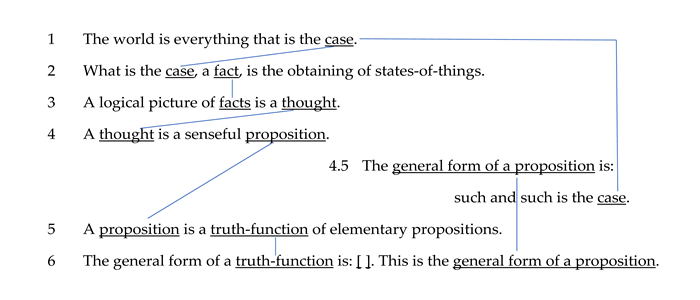
Each of these can be seen as a redeeming proposition, with their conjunction articulating the framework of Wittgenstein’s vision of the relationship between language, logic and the world, which he felt resolved all the problems with which he had been dealing—redeeming us from the various misconceptions and false theories of previous philosophers, most notably, Frege and Russell. Most significantly, however, these redeeming propositions are chained to provide the core of the overview that he had been seeking, in just the way that Tolstoy’s main claims had been chained. We can bring this out in the diagram below, not only underlining the key concepts but also showing how they are chained. To show how the sixth proposition loops back to the first proposition, we also add the second sentence of 6 and the last sentence of 4.5 (both of which came later):Religions 17 00730 i001
What Wittgenstein also introduces, at this turning point in his thinking, is the decimal numbering system by means of which he was able to explain and elaborate on these core propositions, selecting other remarks from his notebooks and writing new ones. 4.5, for example, is the fifth comment on 4, concluding with the informal characterization of the general form of the proposition: such and such is the case. As can be seen from the diagram above, this connects 6 back to 1, completing the circle of redeeming words that provides the overview Wittgenstein wanted in its most succinct form. This, too, reflects the closing of the circle in Tolstoy’s overview, the final reference to the ‘source’ in the twelfth claim taking us back to the idea of an infinite and divine ‘source’ in the first.
The creation of the core chained propositions of the Tractatus, and its elaboration in a tree structure of numbered remarks, is one of the most brilliant achievements in the history of philosophy. This is not the place to explain, even in outline, how it managed to bring all of Wittgenstein’s ideas together and (supposedly) solve all the problems of philosophy “in essence”, as he put it in his preface.11 But when we notice the similarity with the core structure of Tolstoy’s Gospel in Brief, then Tolstoy’s spiritual influence on Wittgenstein strikes us, at any rate, as incontrovertible.

3.3. Content

3.3.1. Overview

Tolstoy had a significant influence not only on the genesis and structure of the Tractatus but also on its content. In the space available here, we can only gesture at some of the further influences and connections. In the table that follows, after summarizing the parallels between the Gospel in Brief and the Tractatus that we have just discussed, we list some of the further connections, citing the relevant passages. Further papers could be written under each of the headings. We confine ourselves here to making a few brief comments on some of them, the selection governed by the further light they shed on Tolstoy’s influence on the spirit of Wittgenstein’s thinking. After the table, we elaborate on two connected Tolstoyan themes which, in our view, influenced the ethical content of the Tractatus.12
TolstoyWittgenstein
Structure and distillation
In the beginning was the knowledge of life.In the beginning was the redeeming proposition.
Gospel in Brief divided into six (paired) chapters, “organized according to the meaning” (Preface, p. xv), + conclusion.Tractatus divided into six main propositions, offering an account of the ‘meaning’ of a proposition, + the final proposition 7.
Preface and conclusion frame the chapters.Preface and 7 frame 1–6 of the Tractatus.
The chapter ‘meanings’ chained.The six main propositions chained.
Distillation of the Gospels.Distillation of early philosophy.
Extraordinary intellectual courage in seeking to distil the Gospels.Gave Wittgenstein the confidence to do something analogous in philosophy.
Comprehensibility
Written in everyday language.
“Tolstoy apparently tried to write his new work so that it was above all else understandable to the working Russian people” (Tolstoy 2011, p. xiii).
Written in everyday German, though with some (semi-)technical terms used.
“What can be said at all can be said clearly” (Preface).
“The proof that this reading is correct lies not in reasoning out separate passages, but in the unity, clarity, simplicity and fullness of the teaching itself and on its correspondence with the internal feelings of every person who seeks truth” (Preface, p. xix).Passages should indeed be reasoned out, but the ‘unity, clarity, simplicity and fullness’ of the ideas of the Tractatus are also important.
Clarification, not history
“I do not look at Christianity as a strictly divine revelation, nor as a historical phenomenon, but I look at Christianity as a teaching that gives meaning to life” (p. xxi).Philosophy not a revelation, nor a historical phenomenon, but a clarification of the meaning of language and logic.
“studying Christianity, I found next to this source of the pure water of life an illegitimate intermixture of dirt and muck that had obscured its purity for me” (p. xxii).“Philosophy should make clear and delimit sharply thoughts that are otherwise, as it were, cloudy and blurred.” (4.112)
“I sought the answer to the question of life, not to theological or historical questions” (p. xxii).“What has history to do with me? Mine is the first and only world!” (2.9.16, NB, p. 82)
Clarifying what we all know
“I interpret only that which we all know, and confirm it with what we can all see” (p. 29).
“I do not teach any sort of new faith, I just teach what everyone knows within themselves” (p. 125).
So, too, Wittgenstein thought that he was only making clearer what we already know.
On his view, there are no doctrines or theories in philosophy (4.112).
“There can be no proofs of my teaching” (p. 79).
“It is impossible to prove the truth. Truth proves everything else” (p. 90).
“external proofs are unnecessary” (p. 96)
So, too, Wittgenstein claims in his preface to offer ‘truths’ in his treatise.
Ethics and living in the present
“only life in the present is true life” (p. 95).“If eternity is understood not as endless temporal duration but as timelessness, then someone who lives in the present lives eternally” (6.4311; cf. NB, p, 75).
“The solution to the riddle of life in space and time lies outside space and time” (6.4312).
“Reward and punishment, debasement and exaltation, do not exist for someone who understands the teaching” (p. 95).“It is clear, though, that ethics has nothing to do with punishment and reward in the ordinary sense” (6.422).
Knowledge of life
“The Gospel proclaims that the source of all things is not an external God, as people think, but a knowledge of life. And therefore, in place of that which people call God, the Gospel posits a knowledge of life.
Without knowledge there is no life. Every man is living only because he has knowledge.” (p. 3)
‘Knowledge of life’ is the central idea of the framing of the Gospel in Brief.
“Suppose that man could not exercise his will, but had to suffer all the misery of this world, then what could make him happy?
How can man be happy at all, since he cannot ward off the misery of this world?
Through the life of knowledge [Leben der Erkenntnis].
The good conscience is the happiness that the life of knowledge preserves.
The life of knowledge is the life that is happy in spite of the misery of the world.
The only life that is happy is the life that can renounce the amenities of the world.
To it the amenities of the world are so many graces of fate.” (13/8/16; NB, p. 81)
Sole discussion of ‘the life of knowledge’, but with no explicit reference to Tolstoy.

3.3.2. Two Specific Aspects of Content: An Ethical Point of the Tractatus

We now focus on two of the parallels in the table: the injunction to live in the present and ‘knowledge of life’. These two themes in Tolstoy’s Gospel are connected, and as such, we treat them together. Through our analysis, suggesting at least one ethical ‘point’ to the Tractatus, we show that there is an overall spiritual affinity between Tolstoy and the early Wittgenstein.
Although Wittgenstein famously claimed that its whole point was ethical,13 the Tractatus itself says very little explicitly about ethics; only a few of its propositions can be construed as such. Some of what is said expressly is noted in the table above, together with some parallel passages in the Gospel, although there are other parts of the Tractatus which can be seen as ‘ethical’, broadly construed—for example, the discussion of the ‘world of the happy’ in 6.43 and the comment that God does not reveal himself in the world in 6.432. Wittgenstein had a broad conception of what constitutes ethics, as shown in his later ‘Lecture on Ethics’ (Wittgenstein 1965), which we can plausibly assume reflects his view when the Tractatus was composed. He goes beyond the Moorean definition of ethics as a “general enquiry into what is good” to include enquiry into what is ‘valuable’ and the ‘meaning of life’, encompassing “what makes life worth living, or [enquiry] into the right way of living”, as he later put it (Wittgenstein 1965, p. 5). His conception of ethics therefore includes religious and spiritual matters, and we elaborate on his conception of God and religion below.
The question then is: what exactly is the ethical message of the Tractatus as influenced by Tolstoy’s Gospel? The answer lies partly in the injunction to live life in the present (Gospel, p. 95;14 Tractatus, 6.4311–2) and partly in the question of how to live the life of the happy person (6.43). The remark in 6.4312 about the solution to the riddle of life lying outside space and time is consistent with a more inward-looking approach to life, and a recurring theme in Tolstoy’s religious writing is the message from the Gospels that the Kingdom of God is within us.15 This is reflected in the very title of the book he published in 1894, The Kingdom of God is Within You (Tolstoy 1894), the subtitle being ‘Christianity not as a mystic religion but as a new theory of life’. The theme is evident in the Gospel in Brief—for example, in his remark that “The spirit confirms that the life within us is an eternal life” (Tolstoy 2011, p. 162). As noted in the table above, Tolstoy elaborates on this and concludes that only life in the present is true life, and that “within people’s souls, the kingdom of heaven lives……[t]he true life of fulfilling the father’s will is not the life that has passed or the life that will be, but life right now” (Tolstoy 2011, p. 97).
This is where the connection with Tolstoy becomes significant: appreciating his ethical stance helps us understand what Wittgenstein was getting at. We have seen that Tolstoy’s book was a great help to Wittgenstein in enduring the hardships of war from September 1914 onwards. Wittgenstein clearly wanted to apply Tolstoy’s message in practice, as is evident from his coded notebooks at the time, when he repeatedly remarks on how he is powerless in the flesh but free in the spirit. He recognizes in himself the ‘sick soul’ of which James had spoken in discussing Tolstoy (James [1902] 2012, p. 120ff.), as illustrated in Wittgenstein’s describing himself at one point as feeling “like a burnt-out oven full of slag and filth” (see Section 3.1.3 above).
Liberation from this is through the spirit, living in the present—in a sense, a personal, spiritual therapy. The entreaty to focus on the present is, of course, a well-known therapeutic practice for those who are depressed or otherwise overwhelmed. It is a feature in recovery programmes, where the focus on living in the day, in the hour, assists the recovery process. Wittgenstein might be understood as wanting to convey this therapeutic message to us in the Tractatus, and such concern with the spiritual health of others continued throughout his later life, as illustrated in his primary school teaching, his hospital porter work, and his work on wound shock in Newcastle during the Second World War.
The second Tolstoyan theme relates to Wittgenstein’s conception of religion, as part of his broader ethical–spiritual concerns. Tolstoy replaces ‘God’ with ‘reason’ or ‘knowledge’ and emphasizes that this is not some external being but a knowledge of life (see the passage quoted in Section 3.1 above). Tolstoy’s introduction to his Gospel is entitled ‘Knowledge of Life’. This is clearly his own redeeming idea, but what exactly does it mean? He insisted that the Greek word ‘logos’, as used at the beginning of the Gospel of John, usually rendered as ‘word’ in New Testament scholarship, meant ‘reasoning’, understood as grounded in ‘knowledge of life’.16 As he writes, “In the beginning stood the knowledge of life, as the foundation of all things. Knowledge of life stood in the place of God. Knowledge of life is God.” (Tolstoy 2011, p. 4). While Wittgenstein does not address this explicitly in the Tractatus, he does allude to it in the remarks he wrote in his notebook on 13 August 1916 (as quoted in the table above), when he was under fire on the warfront. A month earlier, in the coded part of his notebooks, he had written: “To believe in a God means to understand the question as to the meaning of life. … Only those who live in the present, not in time, are happy.” (PN, 8.7.16, p. 180). Here, again, we have his therapeutic message, living in the present being seen as the key to being happy.
Notice that Wittgenstein refers to ‘a God’ in the passage above. He does not think of ‘God’ as some external ‘higher power’, but a spiritual realm within us: “The meaning of life, i.e., the meaning of the world, we can call God… Prayer is thinking about the meaning of life” (PN, 4.7.16, p. 176). “God does not reveal himself in the world”, he later writes in the Tractatus (6.4321); the meaning of life is to be sought within us. This is a key idea, but it follows from Tolstoy’s conception of God as knowledge of life.
Based on the Gospel of John, Tolstoy writes: “The knowledge of life consists of knowing that God is life and goodness and that in life and goodness there is no death or evil” (Tolstoy 2011, p. 159). At least one of the ethical ‘points’ of the Tractatus, to use Wittgenstein’s own word, is the entreaty to live in the present, and as such to lead the happy life. It is not a stretch to see obtaining ‘knowledge of life’ as endeavouring to understand or know how to live one’s life. This is consistent with Tolstoy’s comment in his introduction:
No one has seen and no one can know the external God, and therefore the service of an external God cannot govern life. The path of life can only be seen when one recognises that the knowledge located within, as it arises from the source of all knowledge, is the basis for everything.
(Tolstoy 2011, p. 3)
It also accords with Tolstoy’s larger message that the kingdom of God is within us.
In terms of Wittgenstein’s conception of religion and God, Engelmann (1967) suggests that Wittgenstein was not interested in ‘God’ as the creator of the world, but with the notion of a final judgement.17 This is consistent with other biographers’ comments. The lack of interest in the more supernatural or mystical aspects of the concept of God or the Trinity, for example, is consistent with Tolstoy’s aim in the Gospel in Brief: “Why do I need to know that he [Jesus] was resurrected? Good for him if he was! For me what is important is knowing what to do, and how I should live.” (Tolstoy 2011, p. 3). On the wider conception of spiritual and religious matters, Engelmann also comments that, where Wittgenstein refers to the mystical at 6.522, this is not a “bluish haze surrounding things”, as Engelmann reports Wittgenstein to have remarked (Engelmann 1967, p. 98). Wittgenstein’s idea of mysticism is not an attempt to “paint a picture of our world beyond (either before or after death), about which we cannot speak” (1967, p. 79). Connected to this is what Engelmann refers to as Wittgenstein’s “ever-recurring thought” that ethical values and religious considerations—about the meaning of life—are not something found in the world, but are seen from ‘outside’ (1967, p. 98).

4. Conclusion

The Tractatus, in the form in which we know it, originated in a connected set of redeeming words that Wittgenstein wrote down at the beginning of a new notebook in the summer of 1916 to provide an overview of his ideas. We have argued in this paper that the inspiration for this came from his reading of Tolstoy’s Gospel in Brief, which also offers a connected set of redeeming words presenting an overview of Tolstoy’s distillation of the essential message of the Gospels. It is appropriate to talk of ‘inspiration’ here, as there is a deep spiritual affinity between Tolstoy and Wittgenstein in the way they each saw their project and its execution, an affinity that has not been appreciated to date as much as we think it should.
There is much more detailed work to be done on Tolstoy’s influence on the content of the Tractatus and on Wittgenstein’s broader ethical and religious views. Whether Wittgenstein had a religious conversion or mystical experience cannot be known for sure, but it seems clear that his conception of religion was shaped by Tolstoy’s work. Secularizing the Christian message of the Gospels, without appealing to an external God or mystical realm, but instead emphasizing the role of the inner self and the importance of living in the present, was offered by Tolstoy as a therapy for life’s problems, and the influence of this emphasis can be seen very clearly in Wittgenstein’s writings, especially in his notebooks but also in the remarks from 6.4 onwards of the Tractatus. How far this influence carries through to his later writings is an open question, but redeeming words in answering this are a matter for further work.

Author Contributions

This research article was a product of the two co-authors in full and equal collaboration—in conception, methodology, research, writing, and revising. For the record, M.B. wrote the first draft of Section 3.1 and Section 3.2, and F.B. wrote the first draft of the rest. All authors have read and agreed to the published version of the manuscript.

Funding

This research received no external funding.

Institutional Review Board Statement

Not applicable.

Informed Consent Statement

Not applicable.

Data Availability Statement

No new data were created or analyzed in this study. Data sharing is not applicable to this article.

Acknowledgments

Talks by one or other of us based on our work on this paper have been given at various places, and for fruitful discussion we would like to thank audiences at Peking University in October 2024, Hubei University, Zhejiang University, and Tsinghua University in November 2024, the University of Aberdeen in June 2025, the University of Potsdam in October 2025, and Shanxi University in November 2025. We are also grateful to the participants in Michael Beaney’s Research Colloquium at the Humboldt University in Berlin, where Wittgenstein’s philosophy is a regular topic of discussion, especially to those who gave written and verbal feedback on an early version of this paper presented in June 2024.

Conflicts of Interest

The authors declare no conflicts of interest.

Notes

1
See Wittgenstein’s letter to Ludwig von Ficker, postmarked 24 July 1915, in which he writes that the book “virtually kept me alive”. Urging Ficker to read it, he goes on: “If you are not acquainted with it, then you cannot imagine what an effect it can have upon a person.” (Tr. in Luckhardt (1979), p. 91).
2
All references to Wittgenstein’s notebooks are to either Notebooks 1914–1916 (2nd edn. Wittgenstein [1961] 1979), hereafter NB, or Private Notebooks 1914–1916 (Wittgenstein 2022), hereafter PN. All translations, however, are our own, with page numbers given to the German text.
3
See Chover (2010), p. 107. Certainly, the preface of the Steinitz version contains a little more than the Reclam version, mainly on the details of the larger work Tolstoy refers to as being in progress.
4
https://archive.org/details/kurzedarlegungde00tols/page/n3/mode/2up (accessed on 20 January 2025). The Steinitz version can also be accessed at: https://books.google.co.uk/books?id=LgQXAAAAYAAJ&printsec=frontcover&source=gbs_ge_summary_r&cad=0#v=onepage&q&f=false (accessed on 20 January 2025). The two English translations which are referred to are by Condren (Tolstoy 2011) and Hapgood (Tolstoy 2010). In what follows, we cite the Condren translation.
5
As is now well known, the notebooks contain a coded part for his more private thoughts and an uncoded part for his philosophical remarks. While both parts have now been published (and translated into English), it is regrettable that there is still no edition that includes them both, as we go on to say in the main text: it is required if we are to understand Wittgenstein’s development.
6
Marjorie Perloff translates the key phrase as “the knot has become steadily less tight” (PN, p. 65). This is a revealing error of translation, suggesting that she cannot escape the metaphor of ‘untying’ a knot.
7
This marks the point in Perloff’s translation of the coded notebooks where she starts including remarks from the uncoded part, quite rightly. And she provides a better translation of “etwas… was sich nicht ausdrücken läst” (as “something that won’t let itself be expressed”) than Anscombe (who renders it as “something that cannot be expressed”). Wittgenstein’s use of the ‘middle voice’ here and in the Tractatus is arguably significant (see Narboux 2014), though it is not easy to capture fluently in English (see Beaney 2023, p. 89).
8
Anscombe translates this as “The key word—?”, which really does no justice to Wittgenstein’s idea of ‘das erlösende Wort’.
9
It has been suggested by Martin Pilch (personal communication) that the dashes here indicate prayers.
10
There has been some recognition of this, most notably by Westergaard (2009), but the account that we offer here analyses and spells it all out in much more detail.
11
For an outline of this, as well as a fuller account of the development and importance of the tree structure of the Tractatus, see Beaney (2023).
12
There has been some recognition in the secondary literature of Tolstoy’s ethical influence on the early Wittgenstein, but we are not aware of any detailed or extended treatment, nor recognition of the extent of the influence as we see it.
13
Undated letter to von Ficker, sending him the manuscript of the Tractatus, in Luckhardt (1979), p. 94.
14
There are many other places in the Gospel in Brief where there is an entreaty to live in the present and in the spirit, beginning with his summary of his main claims in the preface, as cited in Section 3.2 above.
15
The root derivation of the phrase is Luke 17.20–21, quoting Jesus to the Pharisees: “The Kingdom of God is not coming with things that can be observed; nor will they say, ‘Look, here it is!’ or ‘There it is!’ For, in fact, the kingdom of God is within you”. The Greek is τοῦ θεοῦ ἐντὸς ὑμῶν ἐστίν. This is paraphrased in the Gospel in Brief on p. 28.
16
Bartlett (2013), p. 287. Bartlett goes into a little detail about the translation process from Greek to Russian.
17
Engelmann (1967), p. 77. This is Engelmann’s recollection and impression of Wittgenstein’s thinking at the end of 1916, at a crucial time when he was completing the Tractatus. Proposition 7 was added within a few months of his time spent with Engelmann.

References

  1. Bartlett, Rosamund. 2013. Tolstoy: A Russian Life. London: Profile Books. [Google Scholar]
  2. Beaney, Michael. 2023. ‘Introduction’ to Tractatus Logico-Philosophicus. Translated by Michael Beaney. Oxford: Oxford University Press, pp. xiii–lxvii. [Google Scholar]
  3. Chover, Joan B. Llinares. 2010. The early Wittgenstein, Tolstoy’s Kurze Darlegung des Evangelium and Nietzsche’s Der Antichrist. In Doubt, Ethics and Religion. Wittgenstein and the Counter-Enlightenment. Edited by Luigi Perissinotto and Vicente Sanfelix. Frankfurt: Ontos Verlag. [Google Scholar]
  4. Engelmann, Paul. 1967. Letters from Ludwig Wittgenstein: With a Memoir. Edited by Brian McGuinness. Oxford: Basil Blackwell. [Google Scholar]
  5. James, William. 2012. The Varieties of Religious Experience. Edited by Matthew Bradley. Oxford: Oxford University Press. London: Longmans, Green, and Co. First published 1902. [Google Scholar]
  6. Janik, Allan, and Stephen Toulmin. 1973. Wittgenstein’s Vienna. New York: Simon and Schuster. [Google Scholar]
  7. Luckhardt, C. Grant, ed. 1979. Wittgenstein: Sources and Perspectives. Hassocks: Harvester Press. [Google Scholar]
  8. McGuinness, Brian. 1966. The Mysticism of the Tractatus. Philosophical Review 75: 305–28. [Google Scholar] [CrossRef] [Scilit]
  9. McGuinness, Brian. 1988. Wittgenstein: A Life: Young Ludwig 1889–1921. London: Duckworth. [Google Scholar]
  10. Monk, Ray. 1990. Ludwig Wittgenstein: The Duty of Genius. London: Jonathan Cape. [Google Scholar]
  11. Narboux, Jean-Philippe. 2014. Showing, the Medium Voice, and the Unity of the Tractatus. Philosophical Topics 42.2: 201–62. [Google Scholar] [CrossRef] [Scilit]
  12. Tolstoy, Leo. 1891. Kurze Auslegung des Evangelium. Translated by F. W. Ernst. Berlin: Hugo Steinitz. [Google Scholar]
  13. Tolstoy, Leo. 1892. Kurze Darlegung des Evangelium. Translated by Paul Lauterbach. Leipzig: Phillip Reclam. [Google Scholar]
  14. Tolstoy, Leo. 1894. The Kingdom of God is Within You. Translated by Constance Garnett. London: William Heinemann. [Google Scholar]
  15. Tolstoy, Leo. 1987. A Confession. Translated by Jane Kentish. London: Penguin Books Ltd. First published 1897. [Google Scholar]
  16. Tolstoy, Leo. 2010. The Gospel in Brief. Translated by Isabel Hapgood. London: Darton, Longman and Todd. [Google Scholar]
  17. Tolstoy, Leo. 2011. The Gospel in Brief. Translated by Dustin Condren. New York: Harper Collins. [Google Scholar]
  18. Westergaard, Peter Kurt. 2009. A Note on Wittgenstein’s Tractatus and Tolstoy’s Gospel in Brief. In Language and World: Papers of the 32nd International Wittgenstein Symposium. Edited by Volker A. Munz, Klaus Puhl and Joseph Wang. Kirchberg am Wechsel: Austrian Ludwig Wittgenstein Society, vol. 17, pp. 456–59. [Google Scholar]
  19. Wittgenstein, Hermine. 1984. My Brother Ludwig. In Recollections of Wittgenstein. Edited by Rush Rhees. Oxford: Oxford University Press, pp. 1–11. [Google Scholar]
  20. Wittgenstein, Ludwig. 1921. (TLP) Tractatus Logico-Philosophicus. Annalen der Naturphilosophie 14: 185–262, Translated by C. K. Ogden and F. P. Ramsey, London: Routledge, 1922, 2nd edn. 1933. [Google Scholar]
  21. Wittgenstein, Ludwig. 1965. A Lecture on Ethics. The Philosophical Review 74: 3–12, Lecture given in 1929. [Google Scholar] [CrossRef] [Scilit]
  22. Wittgenstein, Ludwig. 1979. (NB) Notebooks 1914–1916, 2nd ed. Edited by G. H. von Wright and G. E. M. Anscombe. Translated by G. E. M. Anscombe. Oxford: Blackwell. First published 1961. [Google Scholar]
  23. Wittgenstein, Ludwig. 2008. (WC) Wittgenstein in Cambridge: Letters and Documents 1911–1951. Edited by Brian McGuinness. Oxford: Blackwell. [Google Scholar]
  24. Wittgenstein, Ludwig. 2022. (PN) Private Notebooks 1914–1916. Translated by Marjorie Perloff. London: W. W. Norton & Company. [Google Scholar]
  25. Wittgenstein, Ludwig. 2023. (TLP) Tractatus Logico-Philosophicus. Translated with an Introduction and Notes by Michael Beaney. Oxford: Oxford University Press. [Google Scholar]
Disclaimer/Publisher’s Note: The statements, opinions and data contained in all publications are solely those of the individual author(s) and contributor(s) and not of MDPI and/or the editor(s). MDPI and/or the editor(s) disclaim responsibility for any injury to people or property resulting from any ideas, methods, instructions or products referred to in the content.

