1. Introduction
On the morning of 14 April 2022, the streets of Somvār Peṭh and Rāstā Peṭh in the old city of Pune were successively inhabited by three different processions. Before sunrise, a small group of Sikhs walked barefoot through the neighborhood in a prabhāt pherī, chanting devotional hymns as they circled back to the local gurudwara. A few hours later, the same streets were transformed by a lavish Jain rath yātrā marking Mahāvīr Jayantī, complete with decorated chariots, brass-bands, monks, and volunteers sweeping and purifying the road ahead of the deity. By late afternoon, traffic was halted altogether as large crowds gathered for Ambedkar Jayantī, a politically charged procession honoring B. R. Ambedkar that drew participants, floats, amplified music, and heavy police presence.
These events did not overlap in time, yet they unfolded along partially shared routes, on the same calendar day, within a dense and religiously plural urban environment. Their coexistence was not accidental. It was the outcome of careful coordination, tacit negotiation, and an embodied understanding of when and how different communities could occupy the street without colliding. Religious difference on this day was coordinated through timing, scale, and rhythm, allowing multiple communities to inhabit shared streets through practices of tacit adjustment and temporal sequencing.
This article takes this ordinary yet highly choreographed day as an entry point into a broader inquiry into how religion inhabits urban public space in the multi-religious urban space of contemporary India. Recent scholarship on religion and urbanity in India has increasingly emphasized the city not merely as a backdrop for religious practice, but as a space actively produced through ritual movement, sensory regimes, infrastructure, and competing claims to visibility (
Chaudhuri 2022). Based on ethnographic fieldwork conducted in 2022, it examines how Sikh, Jain, and Ambedkarite communities in Pune temporarily claim, traverse, and transform shared streets through religious and quasi-religious processions. Focusing on material practices, bodily presence, and sensory regimes, it asks how religious plurality is lived and negotiated in everyday urban life, and how political forces seek to instrumentalize these events without fully determining them.
The study forms part of a longer-term research project on urban religion in Pune that investigates how religious sites and practices are produced, maintained, transformed, and sometimes erased in the old city. Earlier work emerging from this project examined the proliferation of wayside shrines in urban India as forms of everyday and often spatially defiant religiosity, highlighting how small-scale sacred installations actively reshape the experience and negotiation of public space (
Larios and Voix 2018). The Somvār and Rāstā Peṭhs (neighborhoods) were established during the Maratha and Peśvā periods, in 1636 and 1779 respectively and are today among the most densely populated and religiously diverse areas of Pune. Within a relatively small area, one encounters Hindu temples and wayside shrines, Jain
derāsars, mosques and
dargāhs, churches, a synagogue, a major gurudwara, Buddhist and Ambedkarite sites, as well as numerous informal and ephemeral religious installations nested within residential and commercial spaces. This dense religioscape is not static. It is continually reshaped by migration, urban redevelopment, political mobilization, and changing patterns of religious practice. Historical work on Pune has likewise shown how shrines and neighborhood formations have long been intertwined with the production of urban social space and local forms of belonging (
Preston 2002).
The coexistence described here should not be understood as taking place in a politically neutral urban environment. Pune’s old neighborhoods have long been shaped by competing claims to belonging, including caste politics, communal mobilization, linguistic regionalism, and anxieties around migration. In Rāstā Peṭh in particular, South Indian communities have at times been marked as culturally “outside” the Maharashtrian city, despite their long-standing presence and their participation in Hindu devotional life. Such histories matter because they show that shared streets are not simply spaces of benign pluralism. They are also spaces in which difference has been classified, politicized, and at times mobilized as hostility. Scholarship on Dalit urban mobilization has likewise shown how neighborhoods can become politically reconfigured through anti-caste activism, processional claims to public space, and the strategic reshaping of urban environments (
Jaoul 2012). The relative smoothness with which the processions of 14 April unfolded therefore requires explanation, not because conflict is inevitable, but because coexistence in this setting is historically situated and practically achieved.
Scholars have long noted that religious processions in South Asia are potent sites for the articulation of community, power, and conflict (
Cashman 1975;
Jaffrelot 1998;
Davis 2005). Much of this literature has focused on Hindu–Muslim relations and on moments when public religious performances escalate into communal violence. More recent work has also approached processions as performative claims to urban space and visibility, emphasizing how movement, embodiment, and infrastructure shape the production of public religiosity in the city (
Gupta 2022). While this work remains crucial, it risks reducing processions to flashpoints of antagonism and overlooking the everyday negotiations that make coexistence possible in multi-religious urban settings. By turning attention to three minority communities in a predominantly Hindu city, this article shifts the analytical focus from spectacular conflict to the more fragile, contingent practices through which shared space is managed.
To do so, the article draws on Henri Lefebvre’s theory of rhythmanalysis as a framework for understanding how biological, social, political, and religious rhythms intersect to produce everyday urban space. Rather than treating streets as neutral conduits for movement or as static backdrops for ritual action, rhythmanalysis foregrounds timing, repetition, duration, and embodied movement. It allows us to see how religious presence in the city is not simply a matter of territorial control, but of synchronizing activities, intensities, and sensory registers. Who occupies the street, for how long, at what time of day, with what sonic and material force, and under what conditions of authorization becomes central to understanding how religious difference is lived (
Lefebvre 2004). Subsequent scholarship on the geographies of rhythm has further demonstrated how repetition, movement, embodiment, and temporality structure the experience of urban space and collective life (
Edensor 2010).
Approaching processions through rhythm also complicates common distinctions between the religious and the secular. While the Sikh and Jain events are explicitly framed as religious holidays, Ambedkar Jayantī occupies an ambiguous position as a civic celebration, a political rally, and, for many participants, an expression of Buddhist and anti-caste religiosity. Examining these events together highlights how religion in the city is not confined to formally consecrated spaces or clearly bounded traditions, but emerges through practices that blur institutional, political, and devotional domains, resonating with broader approaches to everyday religion and lived religiosity (
Orsi 2012).
The article argues that attention to rhythm provides a productive analytical lens for understanding everyday religion in urban India. It reveals how coexistence in the city is not simply given, but continuously maintained through temporal coordination, embodied discipline, infrastructural regulation, and everyday practices of adjustment among communities, residents, and state authorities. By following the rhythms of religious processions across a single day in Pune, the study contributes to broader debates on religion, urban space, and public life, showing how power, identity, and belonging are negotiated through contingent forms of sharing, temporal coordination, and embodied adjustment in the streets of the city.
2. Materials and Methods
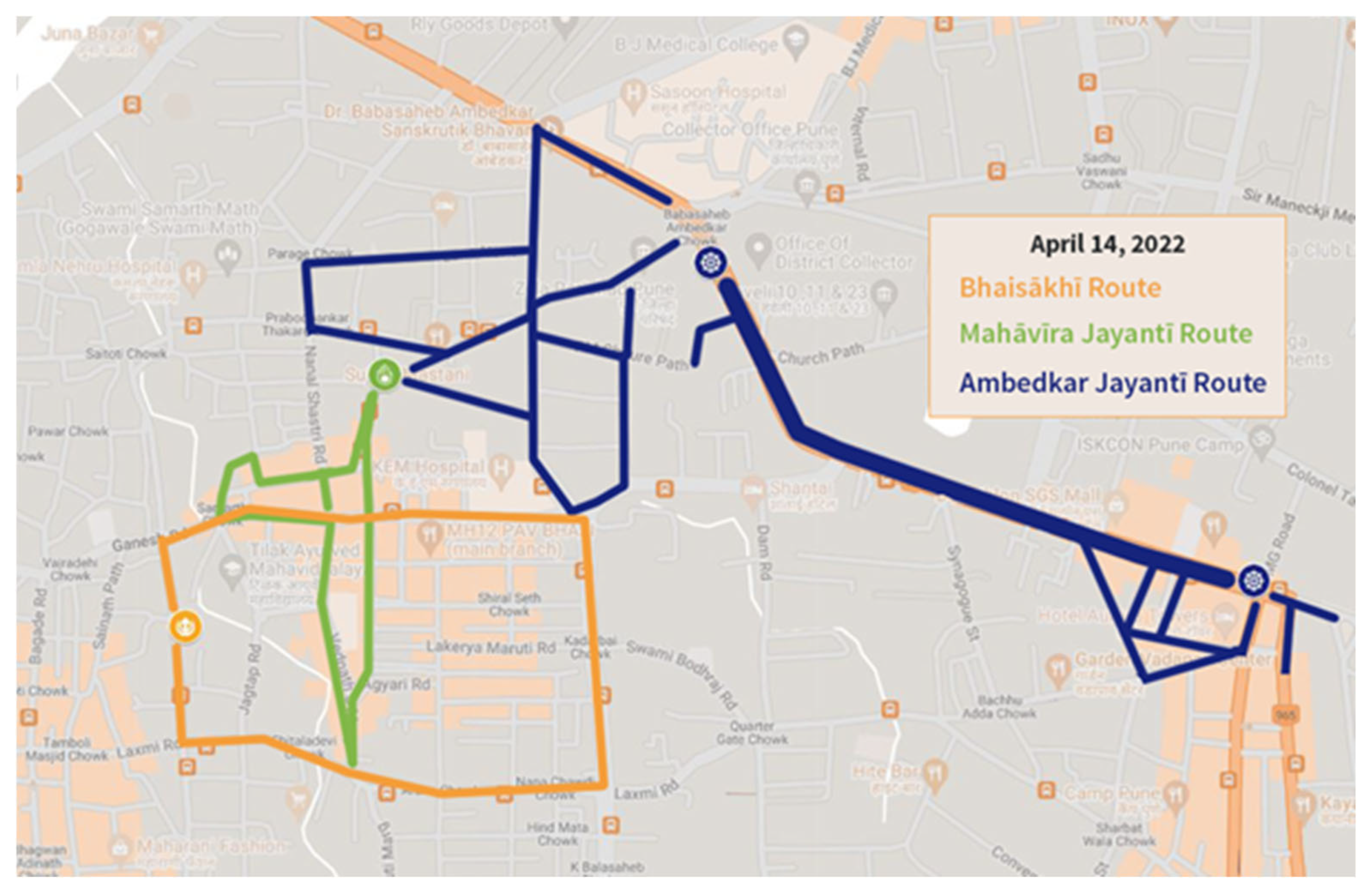
This article is based on qualitative ethnographic fieldwork conducted in the historic neighborhoods of Somvār Peṭh and Rāstā Peṭh in Pune, Maharashtra. This contribution stems from a longitudinal project on urban religion that examines the production and dynamics of religious spaces and their associated communities in contemporary Pune. With a multi-disciplinary approach rooted in anthropology and religious studies, this research project examines several religious sites such as temples, wayside shrines, churches, mosques, and makeshift altars in an area that roughly covers two neighborhoods in the old city of Pune (
Figure 1). It seeks to elucidate how these sites are produced, maintained, transformed, and erased, and thus how these sites contribute to shaping everyday religion in urban India. In this article, however, I do not attempt to detail the diverse celebrations that I documented and participated in, nor to discuss all the religious sites considered for this study, but rather focus on public religious processions marking significant commemorative events among Sikh, Jain, and Ambedkarite communities, all of which occurred on the same calendar day but unfolded at different times and according to distinct ritual and political logics.
The empirical material draws on participant observation conducted before, during, and after the processions, including sustained presence along procession routes, at points of congregation, and in adjacent streets and marketplaces. These observations were complemented by informal conversations with participants, organizers, local residents, shopkeepers, and passers-by, as well as by semi-structured interviews with key interlocutors involved in organizing or regulating the events. Attention was paid not only to verbal discourse but also to embodied practices, sonic environments, pacing, pauses, and the affective atmospheres produced through collective movement.
Visual and sonic materials form an integral part of the dataset. Photographs, short video recordings, and audio recordings were produced in situ to document procession routes, soundscapes, crowd formations, and interactions with the urban environment. These materials were not treated as illustrative supplements but as analytical resources that informed the interpretation of rhythm, repetition, and interruption in the production of public religious space. Fieldnotes were written or voice-recorded contemporaneously and expanded shortly after each observation period, with particular attention to temporal sequences and moments of friction or convergence between different forms of movement.
The analytical framework of the study is informed by Henri Lefebvre’s theory/method of rhythmanalysis, which foregrounds the intersection of biological, social, political, and spatial rhythms in the production of everyday life. Rather than treating religious processions as discrete ritual events, this approach allows for an examination of how repetition, timing, speed, sound, and bodily coordination interact with the rhythms of urban infrastructure, labor, and governance. Rhythmanalysis thus serves not as a rigid method but as a heuristic for attending to the temporal textures through which religious presence becomes perceptible and contestable in the city (
Lefebvre 2004).
All research was conducted in accordance with established ethical standards for ethnographic research. Participants were informed about the aims of the study, and verbally informed consent was obtained where interactions extended beyond casual public observation. Given the public nature of the events studied and the focus on collective practices rather than identifiable individuals, ethical review and approval were not required under applicable institutional guidelines. Visual materials included in the analysis were selected to avoid identifying individuals in sensitive contexts.
The data generated during this study are not publicly archived due to ethical and privacy considerations, particularly with regard to visual and audio recordings. However, the materials are securely stored by the author and are available on reasonable request for scholarly purposes, subject to appropriate ethical safeguards.
3. Results
3.1. Shared Dates, Distinct Communities
The choice of 14 April 2022 as the focal point of this analysis is motivated not only by the temporal overlap of multiple commemorative events, but also by the fact that the three communities examined here, Sikh, Jain, and Ambedkarite, constitute minorities within a predominantly Hindu area of Pune. Scholarship on intercommunal relations in India has long focused on Hindu-Muslim encounters, often framing public religious events primarily through the lens of conflict or riot (e.g.,
Freitag 1989;
Jaffrelot 1998). While this body of work remains essential, it has also contributed to sidelining other configurations of religious plurality. More recent scholarship has increasingly drawn attention to shared and overlapping religious spaces beyond binary communal frameworks, approaching coexistence as a negotiated and uneven process shaped by accommodation, hierarchy, and everyday interaction.
1 By examining three minority communities sharing the same urban environment on the same calendar day, this article seeks to shift attention toward how communally drawn boundaries intersect with other social processes, including caste, political mobilization, and everyday urban governance.
In addition to the three processions discussed below, 14 April 2022 also coincided with the Malayali and Tamil New Year, celebrated respectively as Viṣu and Puttāṇṭu. These two communities are numerically significant in Rāstā Peṭh, and their presence is particularly visible during the holiday through domestic rituals, temple visits, and commercial activity. However, as neither community organized a procession in the streets on that day, and for pragmatic reasons of scope, they are not included in the present analysis. Their absence from public processional space is nevertheless analytically relevant, especially given that Maharashtrian Hindus often perceive these South Indian communities as culturally distinct, despite shared religious affiliation.
2Before turning to a comparative analysis of how streets are shared through rhythm, it is necessary to briefly introduce the three commemorative events and their associated processions as they unfolded in Somvār Peṭh and Rāstā Peṭh.
Baisākhī marks both a spring harvest festival and the founding of the Khalsa by Guru Gobind Singh in 1699. Following the execution of his father, the ninth Sikh Guru Tegh Bahadur, Guru Gobind Singh instituted the Khalsa as a collective oath that imposed a distinct outward form upon its initiates, rendering them immediately recognizable as Sikhs. This codification of practice and appearance profoundly reshaped Sikh religious life and remains central to Sikh self-understanding today.
3In Pune, Baisākhī is celebrated with a range of rituals and cultural programs, including the prabhāt pherī, or “morning round,” which has become a common element of major Sikh holidays. The largest and oldest gurudwara in the city is located in Gaṇeś Peṭh, a neighborhood adjacent to Rāstā Peṭh, and the prabhāt pherī on Baisākhī follows a route that passes extensively through Rāstā Peṭh, thereby sharing ritual space with other communities celebrating that day.
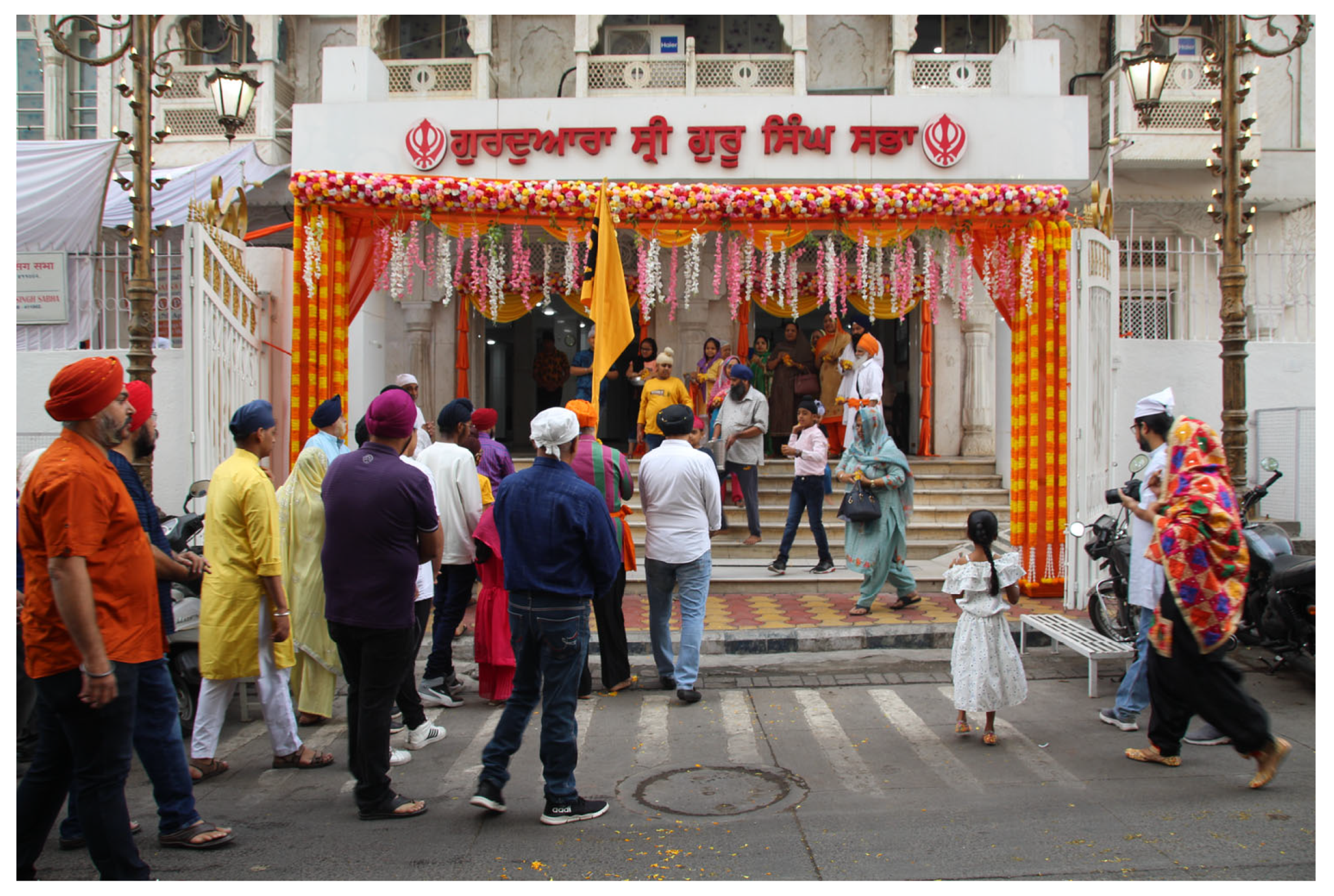
During my fieldwork, the prabhāt pherī began around 6:30 a.m. and was composed of approximately sixty participants. The procession was led by a garlanded, barefoot man carrying the niśān sahib, the Sikh flag, which is worshipped before departure from the gurudwara. The procession moved slowly through the still quiet streets of Rāstā Peṭh, creating a modest yet clearly recognizable devotional presence in the neighborhood. He was followed by a group of mostly middle-aged and elderly men, an approximately equal number of women, and a smaller group of children. Devotional songs were led by designated callers using booklets or smartphones, accompanied rhythmically by a simple drum, tambourine, cymbals, and sleigh bells distributed among participants. The procession was rather solemn in tone: there was no dancing, no additional banners, and no festive display beyond the coordinated bodily movement of the group.
All men wore turbans and visibly carried the
kirpan, while women covered their heads with veils and wore modest everyday clothing. Some participants, unfamiliar with the hymns, simply walked in silence. Traffic at this early hour was minimal, and the size of the procession did not require police presence. According to one of the procession leaders, however, the event had been authorized by the Pune Municipal Corporation, and the police had been informed in advance. Traffic control was handled informally by participants themselves, including children who mimicked the gestures of elders in guiding passing vehicles. After approximately ninety minutes, the group returned to the gurudwara, where they were welcomed with flower petals and collective chanting before sharing a langar breakfast of chai and samosas (
Figure 2).
4Mahāvīr Jayantī commemorates the birth of Mahāvīra, the last of the twenty-four Tīrthaṅkaras of Jainism, traditionally dated to 599 BCE. Across Jain communities, the holiday is marked by fasting, charitable acts, temple rituals, and cultural programs. A central feature of the celebration is the rath yātrā or śobha yātrā, a chariot procession that publicly honors Mahāvīra. In Somvār Peṭh, the Śrī Ādeśvara Bhagavān Jain Derāsar, affiliated with the Śvetāmbara Jain community of Rajasthan, serves as the focal point for these celebrations and is the largest Jain temple in the two neighborhoods under study.
The
rath yātrā began around 9:00 a.m., shortly after the Sikh
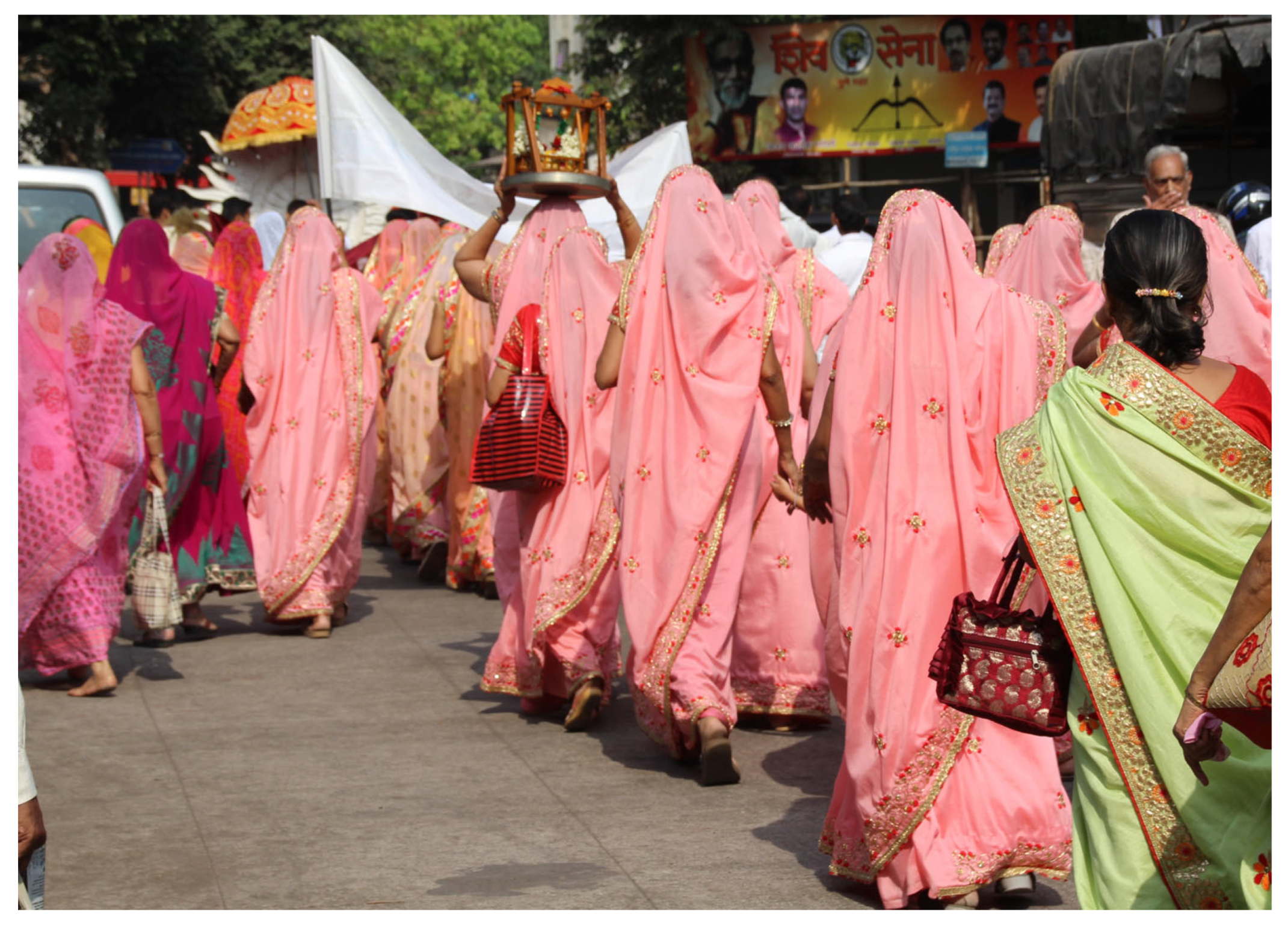
prabhāt pherī had concluded, ensuring no temporal overlap between the two processions. The Jain procession was considerably larger and more elaborate (
Figure 3). It was organized by the temple committee and structured into distinct groups, including a children’s cycling group carrying Jain flags, multiple women’s groups dressed in festive saris and organized around thematic tableaux, a brass-band in white and gold uniforms, and a sound van providing musical accompaniment. Two Śvetāmbara monks, especially invited for the occasion, led the central segment of the procession, followed by a palanquin bearing a representation of Mahāvīra and a wooden chariot drawn by white horses, carrying a carved image of the Tīrthaṅkara and a woman representing his mother.
Volunteers swept the streets, sprinkled flowers, and poured milk and sandalwood water along the route. Although the procession required significant logistical coordination, police presence was minimal and largely symbolic. When asked, most participants were unaware that a Sikh procession had taken place earlier that morning. Organizers, however, confirmed that the start time had been adjusted to avoid overlap, partly in response to municipal guidance and partly in anticipation of the much larger Ambedkar Jayantī procession scheduled for later in the day.
Ambedkar Jayantī marks the birth of B. R. Ambedkar and is celebrated annually on 14 April according to the Gregorian calendar. Unlike the Sikh and Jain holidays, it is officially classified as a secular public holiday, a bank holiday, and a dry day. Yet the boundaries between civic, political, and religious domains are notably blurred. Many Ambedkarites in Pune have converted to Navayana Buddhism, following Ambedkar’s own conversion in 1956, and the celebrations frequently incorporate Buddhist imagery, symbols, and devotional practices. Makeshift shrines honoring both Ambedkar and the Buddha are erected along procession routes, and Buddhist slogans, flags, and songs circulate alongside political messages.
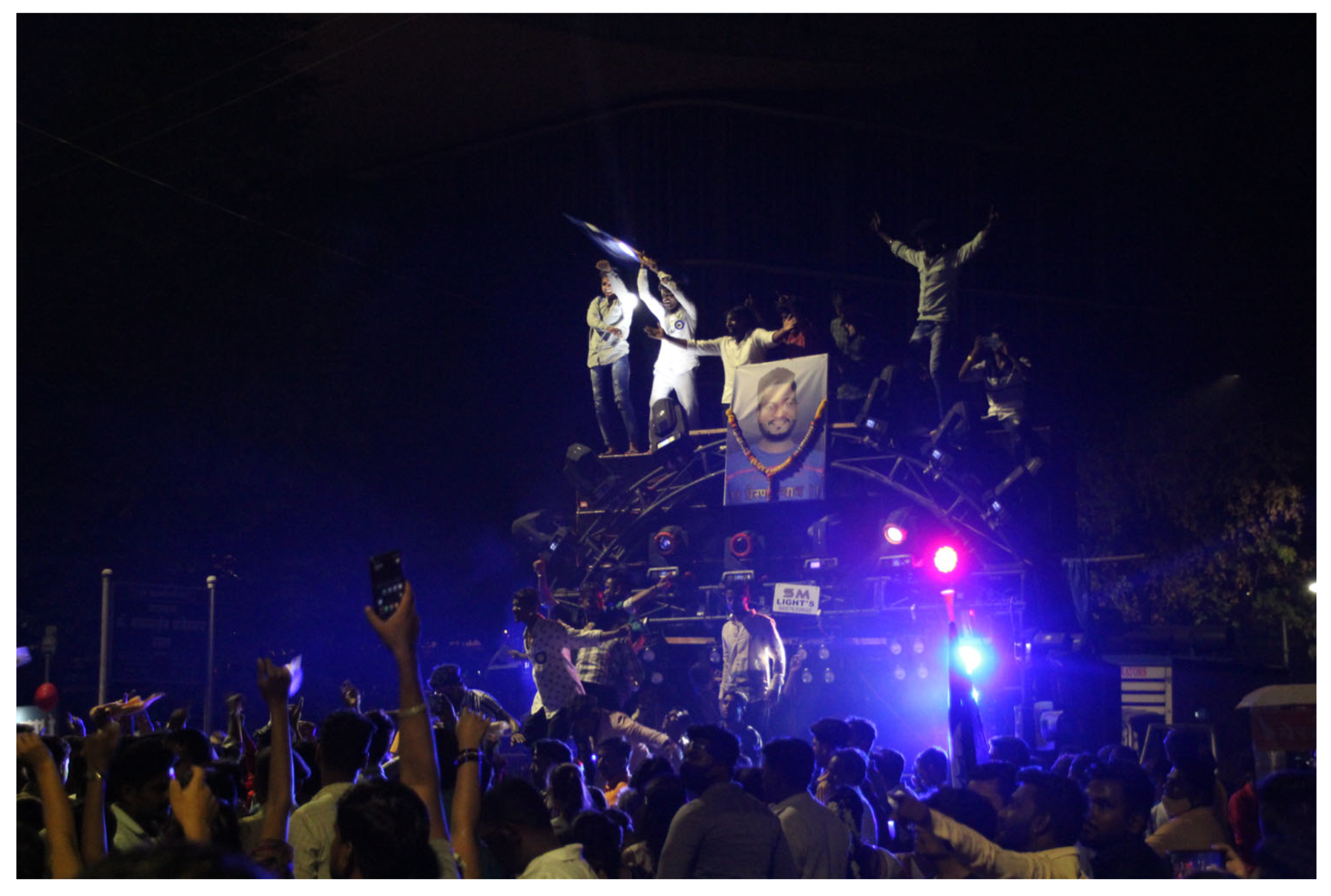
5The Ambedkarite procession was by far the largest and most assertive of the three. Streets in Somvār Peṭh and Rāstā Peṭh were closed from early evening onwards, police barricades were installed, and traffic was diverted to accommodate large crowds and multiple floats. Floats, banners, portraits of Ambedkar, and amplified sound transformed the street into a dense field of political and commemorative presence (
Figure 4). While there was little direct overlap with the earlier procession routes, many participants gathered in streets previously traversed by the Sikh and Jain events. Had these processions occurred simultaneously, congestion and potential conflict would have been difficult to avoid.
The temporal separation of these processions was not accidental, nor solely the product of spontaneous accommodation between communities. Religious processions in Pune are coordinated through a combination of municipal regulation, police oversight, routinized scheduling, and informal negotiation between organizers, local political actors, and neighborhood residents. Particularly in densely populated areas such as Somvār Peṭh and Rāstā Peṭh, municipal authorities encourage staggered timings and partially differentiated routes in order to minimize congestion and prevent overlap between events. Over time, these arrangements have become socially predictable, producing an informal yet widely shared understanding of when and how different communities may occupy the street. The governance of public religion thus operates not only through formal authorization, but through accumulated forms of practical coordination calibrated to anticipated scale, duration, and sonic intensity.
The differing scales and tonalities of the three processions cannot be understood solely through theological or ritual distinctions between the communities involved. They also reflect uneven forms of demographic presence, spatial embeddedness, and urban reach within Pune itself. While the Sikh procession centered on a large multistoried gurudwara serving a comparatively smaller local community, the Jain procession drew on a denser mercantile and residential network within the surrounding neighborhoods. The Ambedkarite celebration, by contrast, extended well beyond the immediate area, attracting participants from multiple parts of the city and producing a far larger transformation of public space. These differing scales shaped not only the number of participants, but also the sonic intensity, duration, visibility, and logistical demands of each event, producing distinct ways of inhabiting and rhythmically reorganizing the street.
Taken together, these three commemorations illustrate how religious and quasi-religious communities inhabit shared urban space not through simultaneous occupation, but through carefully calibrated temporal sequencing. The streets of Somvār Peṭh and Rāstā Peṭh are not neutral backdrops for ritual action, but resources managed through timing, anticipation, and tacit agreement. It is this temporal choreography that enables coexistence on a day marked by multiple claims to public visibility.
3.2. Sound, Movement, and Embodied Rhythms
Across the three processions, sound and movement functioned as primary means through which religious and political presence was made perceptible in the street. Recent scholarship in sound studies and religion has emphasized how sonic practices actively produce ethical, political, and spatial forms of public life in urban environments (
Sykes 2015). Rather than serving merely as expressive or decorative elements, sonic practices structured how bodies moved, how long they occupied space, and how different forms of presence were calibrated in relation to one another. The streets of Somvār Peṭh and Rāstā Peṭh were not simply traversed; they were rhythmically activated through tempo, repetition, and volume.
In the Sikh prabhāt pherī, sound was deliberately restrained. Devotional hymns were chanted collectively, supported by a sparse percussive ensemble consisting of a small drum, tambourine, cymbals, and sleigh bells. The tempo was steady and unhurried, producing a sonic environment that neither overwhelmed the neighborhood nor demanded active engagement from passersby. This controlled soundscape allowed the procession to blend into the early morning rhythms of the city, aligning itself with the relative quiet of dawn. The absence of amplified sound, combined with the disciplined pacing of the walkers, rendered the procession audible primarily to those in close proximity. Sound here marked presence without asserting dominance.
Movement in the prabhāt pherī was similarly regulated. Participants walked in loose formation, maintaining a consistent pace that accommodated elderly members and children alike. There were no abrupt stops, accelerations, or gestures of spectacle. The bodily discipline of the procession reflected an ethic of modest visibility, in which religious practice was enacted publicly yet without disruption. Even traffic negotiation followed this rhythm: vehicles slowed, paused briefly, and resumed, often guided informally by participants themselves. This mutual adjustment produced a fleeting synchronization between devotional movement and everyday urban circulation.
The Jain rath yātrā introduced a more elaborate rhythmic configuration. Here, sound was present but carefully moderated. Brass band music alternated with periods of relative quiet, allowing moments of heightened sonic presence to be interspersed with pauses for darśan. Announcements from the sound van provided coordination rather than continuous auditory saturation. The rhythm of the procession was punctuated by stops at key points along the route, where Jain residents could pay respects to the image of Mahāvīra and the accompanying monks. These pauses temporarily reoriented the flow of the street, slowing not only the procession itself but also the movement of pedestrians and vehicles nearby.
Bodily movement in the Jain procession was highly choreographed. Participants were organized into distinct groups, each with a clearly defined role and position. Volunteers continuously adjusted spacing, ensuring that the palanquin, monks, and chariot remained visually central. The deliberate slowness of the procession contrasted with the linear tempo of urban traffic, imposing an alternative rhythm that required accommodation rather than confrontation. This rhythmic imposition was reinforced by material practices: sweeping the street, sprinkling liquids, and scattering flowers transformed the asphalt into a temporarily sacralized surface, one that demanded careful navigation from all who crossed it.
The Jain procession combined disciplined coordination with an unmistakable element of spectacle. Decorated floats, carefully coordinated clothing, jewelry, and orderly group formations rendered affluence and social confidence publicly visible, yet these displays remained framed by controlled movement, moderated sound, and an emphasis on aesthetic order. This mode of public presence projected restraint rather than excess and was locally associated with a cultivated or “civilized” visibility. The Ambedkarite procession, by contrast, mobilized scale, volume, amplified sound, and digital imagery as key expressive resources, producing a more forceful sonic and visual transformation of the street. While both processions were celebratory, they drew on different repertoires of public expression shaped by distinct social positions, histories of marginalization, and claims to urban space.
The Ambedkarite procession produced a markedly different sonic and kinetic regime. Amplified music, slogans, and speeches generated a dense and expansive soundscape that extended far beyond the immediate procession route. Unlike the earlier events, sound here was explicitly assertive, functioning as a tool for collective mobilization and political visibility. The volume and repetition of slogans created a forward-driving momentum that compelled attention, even from those not directly participating. Sound did not merely accompany movement; it propelled it.
Movement in the Ambedkarite march was correspondingly expansive and uneven. Large groups advanced in waves, interspersed with floats and vehicles carrying portraits, banners, and amplified sound systems. The pace shifted constantly in response to crowd density, police barricades, and collective surges of chanting and response. Participants frequently paused to gesture, chant slogans, or react to calls from loudspeakers, producing alternating moments of compression and release within the flow of the procession. This dynamic rhythm transformed the ordinary temporal order of the street more thoroughly than the earlier events. Traffic was not merely slowed or diverted; it was suspended altogether.
Despite these differences, the three processions shared an underlying logic of embodied coordination. Each relied on participants’ ability to attune their bodies to collective movement, to modulate speed, spacing, and responsiveness. This attunement was not formally instructed in most cases; it was learned through repeated participation and familiarity with similar events. The capacity to “read” the street to anticipate when to advance, pause, or yield was unevenly distributed, reflecting differences in age, experience, and authority within each community.
6Sound also functioned as a boundary marker between events. The subdued devotional chanting of the
prabhāt pherī gave way to the measured musicality of the Jain procession and finally to the saturated sonic field of Ambedkar Jayantī. These shifts were temporally sequenced rather than simultaneous, preventing direct acoustic competition. The absence of overlapping soundscapes was not incidental; it was a crucial condition for coexistence. Organizers, municipal authorities, and residents all appeared aware that simultaneous sonic occupation would likely generate friction, particularly given the political charge of Ambedkarite sound practices.
7Taken together, these observations suggest that the sharing of streets in Pune is governed as much by sonic and kinetic rhythms as by formal spatial arrangements. Sound and movement do not merely express religious identity; they actively structure how long space can be occupied, how intensely presence can be asserted, and how different forms of public religiosity are sequenced across time. Rhythm, in this sense, emerges as a practical knowledge through which religious plurality is managed in everyday urban life.
3.3. Visibility, Affect, and the Politics of Presence
If sound and movement structured how the processions unfolded in time, visibility shaped how they were read, interpreted, and responded to by those who encountered them. Across the three events, religious and political presence was rendered legible through bodies, objects, dress, and iconography. Yet visibility did not operate uniformly. Each procession calibrated how much it sought to be seen, by whom, and under what conditions, producing distinct affective atmospheres in the street.
In the Sikh prabhāt pherī, visibility was understated and internally oriented. The most prominent visual markers were the niśān sahib carried at the front of the procession and the embodied signs of Sikh identity worn by participants, turbans, veils, and kirpans. These markers made the group immediately recognizable to those familiar with Sikh practice, yet they did not seek to capture attention beyond the immediate vicinity. Participants walked without banners, floats, or visual amplification, and there was little attempt to address or interpellate onlookers. Visibility here functioned less as a claim to public space than as a confirmation of collective discipline and devotional continuity.
Observers responded accordingly. Most residents encountered the procession fleetingly, pausing at doorways or glancing from balconies before resuming their activities. A small number of Sikh neighbors joined temporarily as the group passed their homes, while others acknowledged the procession through gestures of respect without stepping into the street. Affect was subdued, characterized by calm attentiveness rather than excitement. The early hour further limited the number of spectators, reinforcing the impression that the procession was not meant to transform the street into a stage, but to pass through it with minimal disturbance.
The Jain rath yātrā cultivated a different visual economy. Here, visibility was carefully orchestrated and highly aestheticized. Participants wore coordinated festive clothing, thematic tableaux were arranged around aspects of Mahāvīra’s life, and the chariot itself served as a moving focal point. The procession invited spectatorship, encouraging Jain residents to step into the street to offer darśan and briefly engage with the image of Mahāvīra and the accompanying monks. Visibility was thus expansive, but it remained internally focused, directed primarily toward the Jain community itself.
Affect in the Jain procession was celebratory yet restrained. Pride, devotion, and reverence circulated among participants and observers, reinforced by the careful management of space and movement. The visual centrality of the chariot and monks organized attention hierarchically, drawing the gaze inward rather than outward. Non-Jain residents often watched with curiosity or polite distance, occasionally navigating around the procession to continue daily routines. The spectacle did not demand participation, but it did command respect, temporarily reordering the visual field of the street without provoking friction.
The Ambedkarite procession mobilized visibility in a far more assertive manner. Portraits of Ambedkar, banners bearing slogans, flags incorporating Buddhist symbols, and decorated floats transformed the street into a dense field of visual claims. Unlike the previous two processions, which emphasized continuity and ritual repetition, this march foregrounded historical rupture and political assertion. Visibility here was not merely about being seen, but about making a statement that could not be ignored. As Nicolas Jaoul has argued, Dalit processions often function precisely as forms of public assertion through which subordinated communities visibly reconfigure urban hierarchies and claims to citizenship (
Jaoul 2007).
Participants actively engaged with onlookers through slogans, gestures, and amplified speech, collapsing the distinction between procession and audience. The affective atmosphere was charged, oscillating between celebration, defiance, and collective pride. Police barricades, uniforms, and traffic diversions became part of the visual landscape, underscoring the exceptional status of the event. While many residents observed from the sidelines, others joined spontaneously, swelling the procession as it moved through the neighborhood. Portraits of Ambedkar, blue flags, Buddhist symbols such as the dharmacakra, and references to the Indian Constitution, which was frequently displayed, quoted, or symbolically carried as a foundational text, functioned not only as markers of collective identity but also as forms of public pedagogy, addressing onlookers and passers-by as potential participants or interlocutors. Through repetition, amplification, and circulation in public space, this iconography rendered histories of exclusion, struggle, and aspiration visible, while framing constitutional values as moral and quasi-scriptural resources in the public sphere.
Despite these contrasts, moments of tension were notably rare. This relative absence of overt tension should not be understood as effortless harmony, but as the outcome of long-standing familiarity with such events. Residents appeared to possess an embodied sense of what kinds of visibility were to be expected at different times of day, how long disruptions would last, and when it was appropriate to engage or withdraw. Shopkeepers adjusted shutters, pedestrians rerouted themselves, and vehicles waited or turned back without overt confrontation. These micro adjustments constituted a form of everyday governance that operated alongside formal regulation.
Visibility, then, was inseparable from affect and power. To be visible in the street was to negotiate recognition, legitimacy, and tolerance. The Sikh and Jain processions asserted presence through restraint and ritual coherence, while the Ambedkarite march did so through amplification and scale. Each mode carried different risks and demands, and each relied on tacit agreements about timing, duration, and intensity. The politics of presence in Pune’s streets unfolded through differentiated forms of visibility, embodied coordination, and calibrated ways of appearing and being seen that allowed multiple claims to coexist within a shared urban frame.
3.4. Instrumentalization and Everyday Negotiation
While the three processions differed markedly in scale, tone, and visibility, all unfolded within a shared field of regulation, authorization, and political interest. Streets did not become available for religious occupation simply through devotional intent; they were opened, closed, and managed through a combination of municipal permissions, informal coordination, and accumulated local knowledge. What emerged from the events of 14 April 2022 was not a rigid system of control, but a layered process of negotiation in which state authorities, religious organizers, political actors, and residents each played distinct yet overlapping roles.
Formal authorization was most explicit in the case of the Ambedkarite procession. Given its size, political charge, and predictable impact on traffic, police presence was substantial. Barricades, traffic diversions, and visible policing signaled the exceptional status of the event. Political leaders and local party representatives were also present, using the procession as an opportunity to align themselves publicly with Ambedkar’s moral and symbolic authority. Banners, slogans, and speeches reflected contemporary political agendas, particularly those framed around equality, recognition, and anti-caste mobilization.
8Yet even here, instrumentalization did not fully determine the meaning or dynamics of the event. Many participants framed their presence not in electoral terms but as an act of remembrance, respect, and collective assertion of dignity. Makeshift shrines, devotional gestures, and Buddhist symbols coexisted with political messaging, blurring distinctions between civic ritual, religious practice, and protest. The procession functioned simultaneously as a public holiday, a political rally, and a quasi-religious event, without resolving these registers into a single narrative.
In contrast, the Sikh and Jain processions were only lightly regulated. Although both had received prior authorization from the Pune Municipal Corporation, police presence was minimal or absent. Responsibility for traffic management and crowd control fell largely to volunteers and participants themselves. This reliance on internal discipline reflects long-standing patterns of trust between these communities and municipal authorities, as well as the predictability of their events in terms of timing, duration, and scale.
9Crucially, negotiation extended beyond formal interactions with the state. Organizers adjusted start times, routes, and pacing in anticipation of other events, sometimes without direct communication between communities. Knowledge about when another procession would pass, how long it would last, and which streets would be affected circulated informally through neighborhood networks. Shopkeepers, residents, and informal vendors acted on this knowledge, preparing for disruption or opportunity by closing early, adjusting schedules, or positioning themselves strategically along routes.
These negotiations were not always explicit. Much of the coordination occurred through what might be described as tacit agreement, an embodied understanding of how public religious life unfolds in these neighborhoods. The decision by Jain organizers to delay their procession slightly to avoid overlapping with the Sikh prabhāt pherī exemplifies this logic. No formal conflict had occurred, nor was one anticipated, yet adjustment was deemed necessary to maintain smooth circulation. Similarly, the absence of overlap between the earlier religious processions and the Ambedkarite march was widely recognized as essential, given the latter’s scale and political intensity.
Political instrumentalization, where it occurred, was thus constrained by these everyday practices. While parties and leaders sought visibility, they operated within an established temporal order that limited how long and how forcefully space could be occupied. Overstepping these bounds risked not only administrative intervention but also erosion of local goodwill. The effectiveness of instrumentalization therefore depended less on symbolic content alone than on successful alignment with existing rhythms of the neighborhood.
What emerges from these observations is a form of urban governance that operates below the level of formal policy. The sharing of streets is sustained through repeated acts of adjustment, anticipation, and restraint. Authority is dispersed among municipal bodies, religious institutions, political actors, and ordinary residents, none of whom exercise complete control. Rather than eliminating tension, this system manages it, allowing multiple claims to public space to coexist without escalating into open conflict.
In this sense, instrumentalization and negotiation are not opposing forces but intertwined processes. Political actors rely on established religious rhythms to legitimize their presence, while religious communities navigate political visibility to protect their ability to inhabit public space. The streets of Somvār Peṭh and Rāstā Peṭh thus emerge as sites where power is enacted through differing capacities to occupy, transform, and rhythmically reorganize urban space.
4. Discussion
Reading the three processions together foregrounds the street not as a neutral conduit or a passive backdrop, but as a space continuously produced through rhythmic occupation. What emerges from Somvār Peṭh and Rāstā Peṭh is not simply the coexistence of multiple religious traditions in proximity, but a patterned choreography through which these traditions come into relation with one another. The sharing of streets, in this sense, is less a matter of spatial tolerance than of negotiated timing, embodied pacing, and calibrated intensity.
Henri Lefebvre’s concept of rhythmanalysis (2004) offers a particularly productive lens for grasping this dynamic. Rather than treating public religious events as isolated spectacles or symbolic claims to territory, rhythmanalysis draws attention to repetition, duration, tempo, and synchronization as constitutive elements of everyday urban life. Each procession examined here introduces a distinct rhythm into the street: the subdued, steady cadence of the Sikh prabhāt pherī; the carefully modulated tempo of the Jain rath yātrā, punctuated by pauses for darśan; and the forceful, expansive rhythm of the Ambedkarite march, driven by amplified sound and collective assertion. These rhythms do not merely unfold in space; they actively reorganize it, temporarily reordering hierarchies of movement, attention, and authority.
Crucially, these religious rhythms intersect with the linear temporalities of the city: work schedules, traffic flows, commercial routines, and administrative regulation. The processions neither suspend everyday life entirely nor leave it untouched. Instead, they produce moments of intensified presence that require adjustment from residents, shopkeepers, and municipal actors alike. Lefebvre’s distinction between cyclical and linear rhythms is particularly helpful here. Religious calendars and commemorative dates impose cyclical repetitions, while urban infrastructure and governance operate through linear scheduling. It is at the points where these temporal orders meet, and occasionally rub against one another, that negotiation becomes visible.
Approaching processions through rhythm also complicates dominant narratives in the study of religion and public space in South Asia. Much scholarship has emphasized moments of breakdown: riots, clashes, and overt conflict, particularly in Hindu-Muslim contexts. While such moments remain analytically important, they risk obscuring the everyday practices through which religious plurality is managed most of the time. The Pune case suggests that coexistence in the city depends on ongoing forms of temporal coordination, embodied adjustment, and practical familiarity through which multiple rhythms of public presence are continually recalibrated.
The boundaries between these processional publics were not always experienced as rigid by participants themselves. One young Jain man whom I encountered during the Mahāvīr Jayantī procession played an active coordinating role in the event, helping manage one of the floats while dressed in festive attire associated with the celebration. When I encountered him again two days later during a Hanumān Jayantī celebration in another part of the neighborhood, he was participating just as enthusiastically alongside Hindu friends from the area. The shift between these contexts appeared unremarkable to him and to those around him, reflecting ordinary forms of sociability and shared urban belonging within the old city. Such moments complicate any straightforward reading of processions as expressions of neatly bounded communal identities. They also suggest that the rhythmic sharing of urban space depends not only on institutional coordination, but also on overlapping social relations and habitual forms of familiarity that cut across formal religious distinctions.
This perspective is particularly illuminating when examining minority religious communities. The Sikh and Jain processions demonstrate modes of public religiosity that emphasize restraint, predictability, and internal coherence. Their ability to occupy the street relies on aligning devotional practice with the city’s rhythms, minimizing friction by avoiding sonic saturation or prolonged disruption. The Ambedkarite procession, by contrast, operates through deliberate disruption, using scale, sound, and visibility to assert political and moral claims. Yet even here, disruption is temporally bounded and regulated, unfolding within a recognized window that allows it to be absorbed into the city’s rhythm rather than overwhelm it.
The discussion of Ambedkar Jayantī further complicates distinctions between religion, politics, and the secular. Although officially classified as a civic holiday, the event mobilizes religious imagery, devotional gestures, and Buddhist symbolism alongside political messaging. From a rhythmanalytic perspective, what matters is not categorical classification but how practices are enacted in time and space. Ambedkarite processions reveal how political mobilization draws on religious forms of embodiment and repetition to produce collective presence, blurring institutional boundaries while remaining legible within the urban order.
Attention to rhythm also foregrounds the embodied dimension of public religion. Movement, sound, and pacing generate forms of belonging that are felt as much as articulated. Participants experience the city through heat, fatigue, crowd density, sonic intensity, and bodily proximity. These sensory dimensions are not secondary to religious meaning; they are constitutive of it. The ability to move together, to endure, to wait, and to adjust becomes a form of practical competence through which religious life is enacted in public.
Finally, focusing on rhythm highlights a form of urban governance that operates alongside formal regulation. While municipal authorities authorize routes and deploy police when necessary, much of the work of managing religious plurality occurs through everyday negotiation. Organizers adjust schedules, residents recalibrate routines, and participants modulate intensity in response to anticipated reactions. Authority is thus dispersed, enacted through practice rather than centralized control. The sharing of streets emerges not as a fixed arrangement, but as an ongoing accomplishment.
Taken together, the Pune processions suggest that urban religious plurality is best understood not as a static spatial configuration, but as a temporal achievement. Streets are shared not because differences disappear, but because they are continually recalibrated through rhythm. This insight invites comparative attention to how timing, repetition, and embodied movement shape religious coexistence in cities beyond South Asia, particularly under conditions of heightened political polarization, urban redevelopment, and intensified surveillance.
5. Conclusions
This article has approached religious processions in Pune not as exceptional moments of ritual excess or as simple extensions of identity politics, but as rhythmically structured practices through which everyday urban space is continually produced, negotiated, and shared. By following three processions unfolding in the same neighborhoods on the same calendar day, the analysis has shown how religious and quasi-religious presence in the city is enacted through temporally situated acts of movement, sound, and embodied coordination.
Attending to rhythm makes it possible to move beyond interpretations that frame public religious events primarily in terms of territorial control or symbolic domination. In Somvār Peṭh and Rāstā Peṭh, the street does not function as a space to be claimed once and for all, but as a resource accessed through timing, duration, repetition, and intensity. The Sikh prabhāt pherī, the Jain rath yātrā, and the Ambedkarite march articulate distinct modes of inhabiting the city, each drawing on different ethical orientations, historical memories, and political grammars. Their coexistence depends on a patterned choreography of temporal coordination, embodied adjustment, and practical familiarity through which multiple claims to public space are sequenced, negotiated, and accommodated over time.
The article has also shown that the management of religious plurality in the city cannot be understood solely through formal regulation or legal frameworks. While municipal authorities play a visible role in authorizing routes and controlling traffic, much of the work of coexistence occurs through everyday practices of anticipation, adjustment, and restraint. Organizers calibrate start times, participants modulate sonic and bodily intensity, and residents adapt routines in response to expected disruptions. These practices constitute a form of urban governance that is practical, embodied, and historically sedimented.
By foregrounding rhythm as an analytical lens, this study contributes to broader debates on everyday religion, urban religiosity, and public space in South Asia. It suggests that religious life in the city is shaped not only by institutions, ideologies, or moments of conflict, but by temporal practices that make difference livable in shared environments. Rhythm draws attention to how power, identity, and belonging are negotiated through the careful calibration of presence in time, through embodied coordination, and through everyday practices of adjustment that make shared urban life possible.
Future research might extend this approach comparatively, examining how rhythmic configurations differ across cities, religious traditions, and political contexts, or how they are reshaped under conditions of intensified surveillance, digital mediation, and urban redevelopment. In Pune, as elsewhere, the street remains a fragile but vital site of religious life. Its rhythms do not erase difference or tension, but they provide practical and embodied means through which shared urban life can be continuously negotiated and maintained.