1. Introduction
This article discusses the relationship between religious diversity (RD) and the rights of religious minorities (RMs) in the European Union (EU) states. Do these rights differ depending on the level of RD in a country? If so, does an increase in RD strengthen or weaken RBM rights?
To answer these questions, the article makes use of the
Religious Diversity Index developed by the Pew Research Center (
https://www.pewresearch.org/religion/2026/02/12/religious-diversity-around-the-world/, accessed on 2 May 2026) and the data from the
Atlas of Religious and Belief Minority Rights in the European Union Countries (
Atlas;
http://atlasminorityrights.eu). The
Pew Index measures the degree of RD in several states, including EU countries, while the
Atlas measures the rights enjoyed by RMs in sixteen EU countries. By comparing these two sets of data, it will be possible to assess whether there is a correlation between RD and RM rights, and whether this correlation is positive or negative.
As many sociologists have pointed out, RD can be considered from different angles and therefore acquire different meanings (
Beckford 1999, p. 57;
2019, pp. 9–33). For example, it may refer to an increase in the variety of religious groups operating within a country, the coexistence of different beliefs and practices within the same religious group, the extension of the category of religion to include spiritual movements that were previously considered extraneous, and other factors. Without underestimating the significance of these distinctions, it should be noted that both the
Pew Index and the
Atlas adopt an institutional notion of RD. The
Pew Index measures RD based on the number of members of each religious organisation, while the
Atlas measures the rights enjoyed by minority religious organisations. This shared institutional approach to RD and RM rights enables a comparison between the two measurements.
Given the process of religious diversification occurring across the world, including in Europe, one might expect the rights of RMs to be respected and promoted more. Countries with few and small RMs are supposedly less prone to recognise minority rights than countries with many and large RMs, who potentially have the strength to effectively campaign for the recognition of their rights (
Modood and Sealy 2023). However, the
Atlas does not confirm this hypothesis. The
Atlas data shows that EU countries with greater religious diversity do not promote these rights any more than EU countries where this diversity is less pronounced. Rather, the former present a smaller gap between the rights granted to the majority church and those granted to RMs.
This article offers a possible explanation for this apparent paradox in its final section. It begins with a brief discussion of the process of religious diversification in EU countries and its impact on their legal systems. It then provides an overview of the Atlas project, examining the effect of religious diversification on the promotion of RM rights, their distribution among RMs, and the relationship between minority and majority rights. Finally, it considers the Atlas data in light of EU states’ reluctance to accept legal pluralism.
Before starting this examination, the notion of promotion of RM rights and its implications, which is the main subject of the
Atlas measuring, must be clarified (
Henrard 2009).
Members of religious minorities are entitled to freedom of religion, equal treatment, and non-discrimination. They are also entitled to all other human rights accorded to individuals and groups, regardless of whether they belong to the majority or a minority group. This is the essence of the ‘right to be equal’ that minorities have fought hard to secure. However, RMs argue that religious freedom and equal treatment are insufficient because they do not eliminate their structural status of inferiority. Therefore, minorities demand that states not only grant freedom of religion and equal treatment, but also promote RM identity and ensure RM participation in the social, cultural, and political life of the country where they live, including decision-making processes concerning issues of interest to them. These requests are included in international provisions that oblige states to “encourage conditions for the promotion” of minority identity (
United Nations 1992, art. 1), or more precisely, to “promote the conditions necessary for persons belonging to national minorities to maintain and develop their culture, and to preserve the essential elements of their identity, namely their religion, language, traditions, and cultural heritage” (
Council of Europe 1995, art. 4). Other provisions confer to persons belonging to minorities the right “to participate effectively in cultural, religious, social, economic and public life” (
United Nations 1992, art. 2). These rights and obligations imply that states must adopt positive measures, such as exemptions or the recognition of special rights, to respect minority identities and enable their development when necessary. Such actions form an integral part of the ‘right to be different’, which, for minorities, is just as important as the right to be equal (
Ferrari 2021, pp. 19–34).
As we will see in the paragraph devoted to the Atlas research project, the Atlas distinguishes between the ‘right to be equal’ and the ‘right to be different’ by allocating different scores when measuring RM rights.
2. Religious Diversification in Europe
According to the Pew Research Center, Europe is a continent characterised by moderate religious diversity. It has fewer RMs than the Asia-Pacific and sub-Saharan African regions, but more than Latin America, the Middle East, and North Africa. Although the number of Christians is declining, Christianity remains the dominant religion in Europe. However, the number of unaffiliated people is growing rapidly, as is the Muslim population, albeit on a smaller scale. Comparing data from 2020 with that from 2010 reveals a clear trend: the Christian population has declined (from 74.6% to 67.1%, a fall of 7.6%), the number of unaffiliated people has grown (from 18.7% to 25.3%, an increase of 6.6%), and the Muslim population has risen, albeit by a smaller percentage (from 5.3% to 6.0%, an increase of 0.7%). The number of followers of other religions has not changed significantly. Together, they account for less than 2% of the total population—too few to have a real impact on the legal systems of EU countries (
Hackett et al. 2025a).
Breaking down these numbers by country reveals significant differences (
Hackett et al. 2025b). Of the 16 EU countries considered by the
Atlas, the
Pew Religious Diversity Index ranges from 5.9 in France to 0.1 in Romania. Seven countries are below the average of 3.4 (Denmark, Italy, Greece, Croatia, Portugal, Poland and Romania), while eight are above it (France, Belgium, Estonia, Sweden, Spain, Austria, Finland, and Hungary). This suggests that countries with low RD level tend to be located in Southern and Eastern Europe (with the exception of Denmark), while countries with high RD level tend to be located in Central and Northern Europe (with the exception of Spain) (
Table 1).
Pew’s data shows that the increase in religious diversity in Europe is primarily due to a rise in the number of Muslims and unaffiliated individuals (‘nones’). For various reasons, the fact that this diversification has primarily involved these two groups has significantly impacted how European legal systems have reacted to the change.
The growth of the Muslim population in Europe is primarily the result of migration. Due to its scale and speed, this growth has fuelled tensions and conflicts, turning the Muslim presence in Europe into a political issue. All EU countries have been confronted with new issues relating to the construction of mosques, the wearing of religious symbols, infant circumcision, the ritual slaughter of animals, the provision of halal food and various marriage and family issues. Security concerns have exacerbated tensions and hindered a pragmatic, fact-based approach to these issues. In some countries, such as Italy, this has resulted in the Muslim community being excluded from the legal recognition granted to other comparable religious minorities (
Coglievina 2016). In others, such as Austria and Spain, Muslims have been granted a legal status similar to that of the most important religious minorities (
Potz 2021;
Ferreiro and Moreras 2021). However, the aforementioned issues have not been addressed through the categories and tools of legal pluralism. Even in these countries, the Muslim community is included in a legal system designed for other religious minorities (mostly Christian), which does not address its specific needs. Consequently, while the Muslim community has been granted the same rights as other religious minorities (which is an important step forward), this has not involved the recognition of rights directly connected to Muslim identity. In conclusion, the growth of the Muslim presence in Europe has not triggered a process of recognising their specific needs and demands. Rather, due to the conflicts surrounding this growth, it has contributed to increasing diffidence towards granting legal recognition to religiously based differences (
Nielsen 2014–2025;
Papadopoulou 2022).
The impact of the growing number of ‘nones’ on minority rights should also be analysed (
Balazka 2020). The ‘nones’ are defined by a negative term, which is no coincidence but rather indicates the heterogeneity of this group. This term encompasses atheists, humanists, agnostics, and people with no interest in religion, as well as individuals with their own spirituality who do not identify with any religious organisation. This heterogeneity makes it difficult to consider the ‘nones’ as a minority, since a prerequisite for this status is the willingness of the group’s members to preserve and cultivate their distinct identity (
Capotorti 1979, pp. 567–73). It is true that this group includes members of atheist and humanist organisations who claim to be a minority based on their beliefs, and who request legal status similar to that of religious minorities. However, they constitute a small fraction within the larger group of ‘nones’: most ‘nones’ simply do not identify with any religious group or organisation, nor do they claim to have an identity that should be protected and promoted. For this reason, the growth of ‘nones’ has not significantly impacted the promotion of religious minority rights.
This does not mean that the legal systems of EU states did not react to religious diversification. As we will see in the next paragraph, significant progress has been made in reducing the gap between the rights of the majority and minorities.
3. The Impact of Religious Diversification on the Legal Status of RMs in the EU Countries
The establishment of the EU in the West and the collapse of communist regimes in the East are the primary channels through which RD has entered the legal domain in Europe. In the West, the European unification process has weakened the religious homogeneity of member states, prompting them to establish new legal frameworks to include RMs. Religious groups that were minorities in one country were often majorities in another and this fact could no longer be ignored once national borders became more permeable and a supra-national space emerged. As a consequence, in countries with a tradition of concordats with the Catholic Church, agreements have been introduced that apply the concordat model to RMs, albeit with less favourable terms. In countries with a state church, reforms have been approved that reduce the state’s confessional character, thereby narrowing the gap between the rights granted to the majority church and those granted to RMs. In Eastern Europe, the fall of communism has led to the establishment of an entirely new system of state-religion relations. With the EU and USA blessing, laws on freedom of religion and religious organisations have been enacted, granting religious minorities a legal status comparable to that of the majority religion, though not equal (
Doe 2011).
Of course, not all problems have been solved. So-called new religious movements remain largely on the margins of this process of inclusion, which has mostly involved traditional RMs. As already noted, the growing presence of Muslim communities, particularly in Western Europe, has not yet been adequately accommodated by the legal systems of many EU countries and continues to be a source of tension and conflict. In many countries, religiously radical groups such as Jehovah’s Witnesses (
Knox and Baran 2025) and Evangelical Protestants continue to face social and, in some cases, legal discrimination. Nevertheless, despite these limitations, the process triggered by European unification and the fall of communism, and supported by the work of the European Court of Human Rights (
Fokas and Richardson 2018), has eliminated most of the restrictions and discrimination that hindered the activities of many RMs, representing significant progress towards fulfilling their long-standing demand for the ‘right to be equal’ (
Robbers 2019).
The situation becomes less positive when we consider the other right claimed by RMs: the ‘right to be different’. Religious diversification has had less of an impact in this area. Family law is regulated by uniform legislation across all EU countries, with national states applying similar provisions to regulate marriage, divorce, adoption, and dowries. These provisions leave little room for the recognition of different religious norms. Decisions made in religious courts rarely have legal relevance within state legal systems. Issues connected to the manifestation of religious identity in public spaces, such as wearing religious symbols, the ritual slaughter of animals, the circumcision of infants, and the provision of halal and kosher food in public institution canteens, continue to be controversial. Generally speaking, the legal systems of EU states are reluctant to recognise the right to manifest religious identity in the public sphere. This is a broader issue that extends beyond the borders of RMs. As shown in the Lautsi case concerning the display of crucifixes in Italian public schools (
Temperman 2012), even symbols of the majority religion have only been accepted in the public sphere after being reconceptualised as an expression of a cultural rather than religious tradition. This reluctance to accept public manifestations of religious faith stems from the principle that the public sphere should be neutral and free from religious connotations in a secular state (
Laniel 2016). However, this principle has had a different impact on majority and minority religions: while the culturalisation of religion and its symbols and practices has maintained the presence of the majority religion in the public sphere, this has not been the case for RMs, whose symbols and practices frequently differ from those accepted in a country’s cultural tradition. This explains why the right to be different for RMs is still not fully respected.
Against this backdrop, the Atlas data should be examined, bearing in mind that it indicates general trends which can differ significantly within each country depending on national political and legal decisions. However, before doing so, a brief explanation of the Atlas content, aim and methodology is necessary.
4. The Atlas Research Project
The
Atlas measures the extent to which RM rights are respected, promoted and restricted. It considers 12 RM groups: Buddhist communities, the Catholic Church, the Church of Jesus Christ of Latter-Day Saints, Hindu communities, Islamic communities, Jehovah’s Witnesses, Jewish communities, Orthodox churches, Protestant churches (mainline and evangelical), Scientology and Sikh communities. Following the case-law of the
European Court of Human Rights (
2022, pp. 8–12), belief organisations (i.e., atheist, agnostic, and humanist organisations) are also considered, as they propose world and life conceptions which, although not grounded in supernatural elements, seek to address fundamental questions concerning human existence and destiny, as religious organisations do. The research project aims to cover all EU member states, but for the time being it considers 16 EU countries: Austria, Belgium, Croatia, Denmark, Estonia, Finland, France (excluding Alsace-Moselle), Greece (excluding Western Thrace), Hungary, Italy, Poland, Portugal, the Republic of Cyprus, Romania, Spain and Sweden
1. Five policy areas have been analysed so far. These are: the legal status of RMs; religious education in public schools; marriage and family; religious symbols; and spiritual care in prisons, hospitals and the armed forces.
The
Atlas measures the rights of minorities through three indices: the promotion index (P-index), the equal treatment index (E-index), and the majority–minority gap index (G-index). All of these indices use international minority rights standards as a benchmark (
United Nations Office of the High Commissioner for Human Rights n.d.-a, Minority Rights).
The P-index measures the extent to which RM rights are respected and promoted within the 15 EU countries as a whole, in each individual country, and in each policy area. ‘Respect’ and ‘promotion’ are not synonymous. ‘Respect’ means ensuring that the rights granted to individuals or groups under international human rights standards are not violated. ‘Promotion’ means creating the conditions that enable minority members to enjoy these rights, foster their identity and facilitate their participation in the social, cultural and political life of their country, as set out in international minority rights standards. The
Atlas uses a scale ranging from −1 to 1: ‘0’ is allocated when international standards protecting freedom of religion, equal treatment and non-discrimination are respected (
United Nations Office of the High Commissioner for Human Rights n.d.-b, Special Rapporteur) and the same rights granted to the faithful of the majority religion are extended to RM members (i.e., ‘the right to be equal’ is respected); ‘0’ to ‘−1’ is allocated when these rights are not respected, RM rights are restricted and the minimum level of protection required by international standards concerning religious freedom and equal treatment is not granted; and ‘0’ to ‘1’ is allocated when RM members benefit from special measures that promote their identity (i.e., ‘the right to be different’ is legally recognised).
States do not promote RM rights equally; often, one RM is granted more rights than another. In fact, the deepening divide between ‘included’ and ‘excluded’ RMs is one of the most worrying features of the system for regulating minorities in EU states, with ‘included’ RMs having improved their legal status, but ‘excluded’ RMs remaining at the bottom of the recognition ladder. The E-index measures the equal treatment of RMs by the state. A score of ‘0’ indicates maximum equal treatment among RMs, while a score of ‘1’ indicates minimum equal treatment, as some RMs enjoy rights denied to others. It should be noted that ‘equal’ treatment does not necessarily mean ‘fair’ treatment, as RMs may be subjected to equally restrictive treatment. A state that has a good score in the E-index but a bad score in the P-index is likely to promote poorly the rights of all or at least most RMs. This is why the E-index and the P-index should always be considered together. Furthermore, it should be made clear from the outset that different treatment does not necessarily constitute discrimination. Different legal provisions may be justified if they correspond to distinct RM characteristics: an RM with millions of members cannot always be regulated in exactly the same way as one with a few hundred. These provisions may also be necessary to promote minority rights, as members of an RM may have particular needs that can only be met through a special provision. Once again, the only way to dispel these doubts is to consider the P- and E-index together. The Atlas E-index merely signals the existence of these differences and leaves the assessment of their legitimacy and opportunity to an analysis of the social and legal context in which RMs operate.
Thirdly, the G-index measures the difference in rights granted to the religious majority and to RMs in each country, on a scale ranging from 0 (minimum difference) to −1 (maximum difference).
Finally, it is important to bear in mind that the Atlas is a legal project and instrument. It measures the rights granted by a legal system, not those de facto enjoyed. Sometimes, a gap exists between entitlement to rights and their effective enjoyment. However, the fact that a right is legally recognised, even if it is not fully implemented, is significant.
Once the Atlas’s aim, methodology and content have been clarified, it is possible to examine its data concerning the relationship between RD and RM rights.
5. The Atlas Data
The Atlas data illustrates the complex relationship between RD and RM rights.
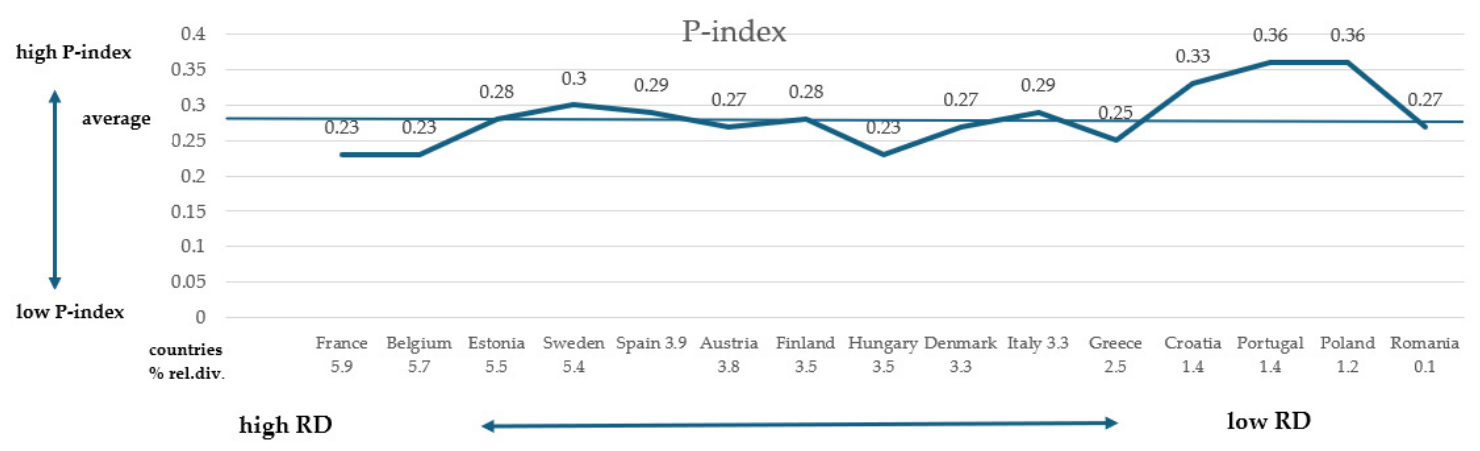
The first graphic (see
Figure 1) illustrates the impact of RD on the promotion of RM rights.
The main indication of
Figure 1 is that RD does not encourage the promotion of minority rights. The average P-index rate is 0.28 and the average RD rate is 3.4. Of the eight countries with an above-average RD rate (in descending order: France, Belgium, Estonia, Sweden, Spain, Austria, Finland, and Hungary), four have a rate of RM rights promotion below the P-index average (France, Belgium, Austria and Hungary), two are above average (Sweden and Spain), and two equal the average (Estonia and Finland). Of the seven countries with an RD rate below average (in descending order: Denmark, Italy, Greece, Croatia, Portugal, Poland, and Romania), four have a promotion rate above the P-index average (Italy, Croatia, Portugal, and Poland), and three have a promotion rate below average (Denmark, Greece, and Romania). The average promotion rate for the latter seven countries is 0.30, compared to an average of 0.26 for the former eight countries. While the difference between the two groups of countries is not substantial, it is clear that the promotion of RM rights is not dependent on a country’s RD rate.
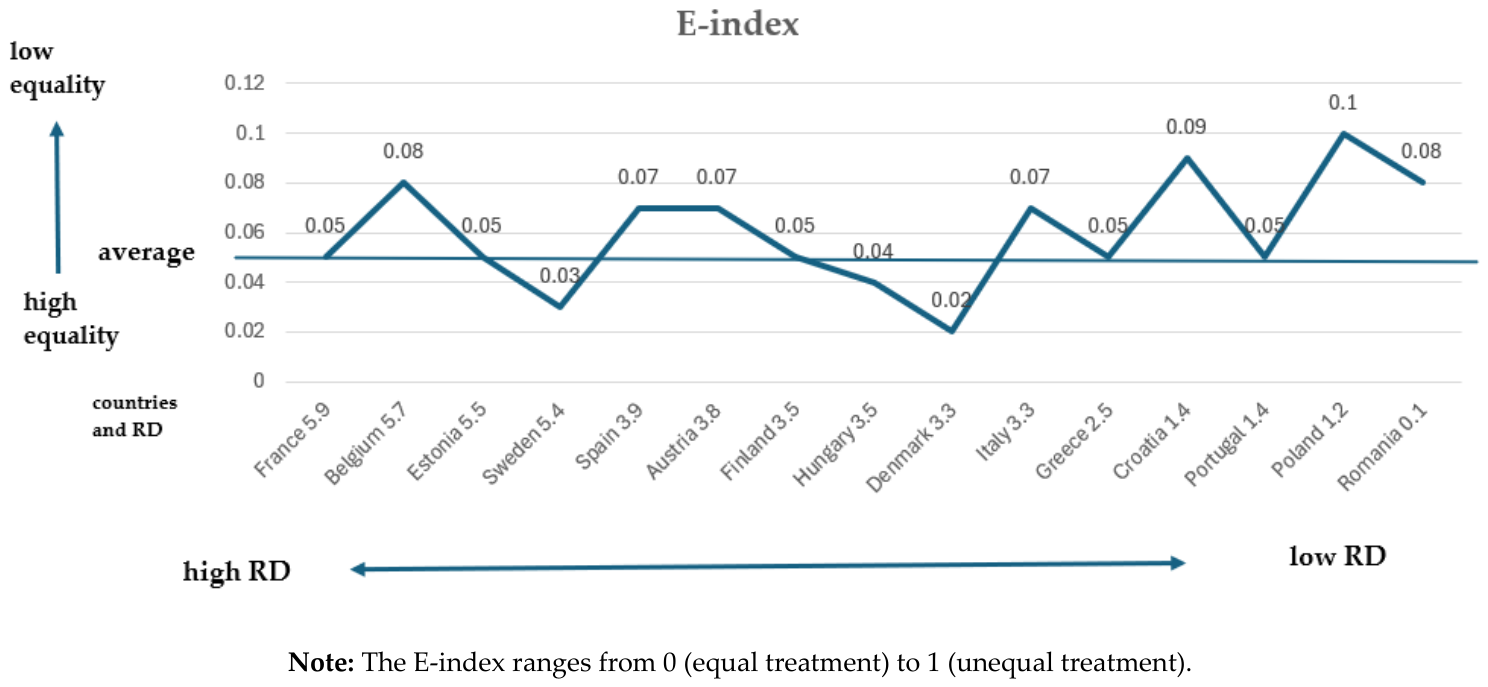
The second graphic (see
Figure 2) measures the equal treatment of RMs and offers a different picture.
Figure 2 clearly indicates that countries with a RD rate below average are characterised by low equal treatment of RMs. The average E-index rate is 0.05 and, as mentioned earlier, the average RD rate is 3.4. Of the countries with below-average RD rates, only Denmark has a good equal treatment score; Portugal’s score is the same as the average. The other five countries perform poorly. They therefore distribute rights among RMs unequally. A mixed picture emerges for countries with above-average RD rates: two have a good equal treatment score (Sweden and Hungary), three score poorly (Belgium, Spain and Austria) and three equal the E-index average (France, Estonia and Finland). The difference between these two groups of countries is confirmed by the average equal treatment rate: the ‘high RD’ group has an average of 0.05, compared to an average of 0.06 for the ‘low RD’ group (“0” indicates maximum equal treatment).
When the P and E indexes are compared, only Sweden scores well in both among the countries with a high RD; with the partial exception of Portugal, which has a good P-index score and an average E-index score, no country with a low RD score performs well in either index. This reveals a negative correlation between promotion and equal treatment, independent of the countries’ RD: countries that promote RM rights—both those with a high RD and those with a low RD—distribute them unequally among RMs, and countries with a good equal treatment rate have a poor promotion index score. This suggests that the promotion of RM rights is selective, resulting in inequality. Conversely, equal treatment is often granted at the expense of promoting rights, meaning that RMs are treated equally because their rights are equally unpromoted.
Finally, the
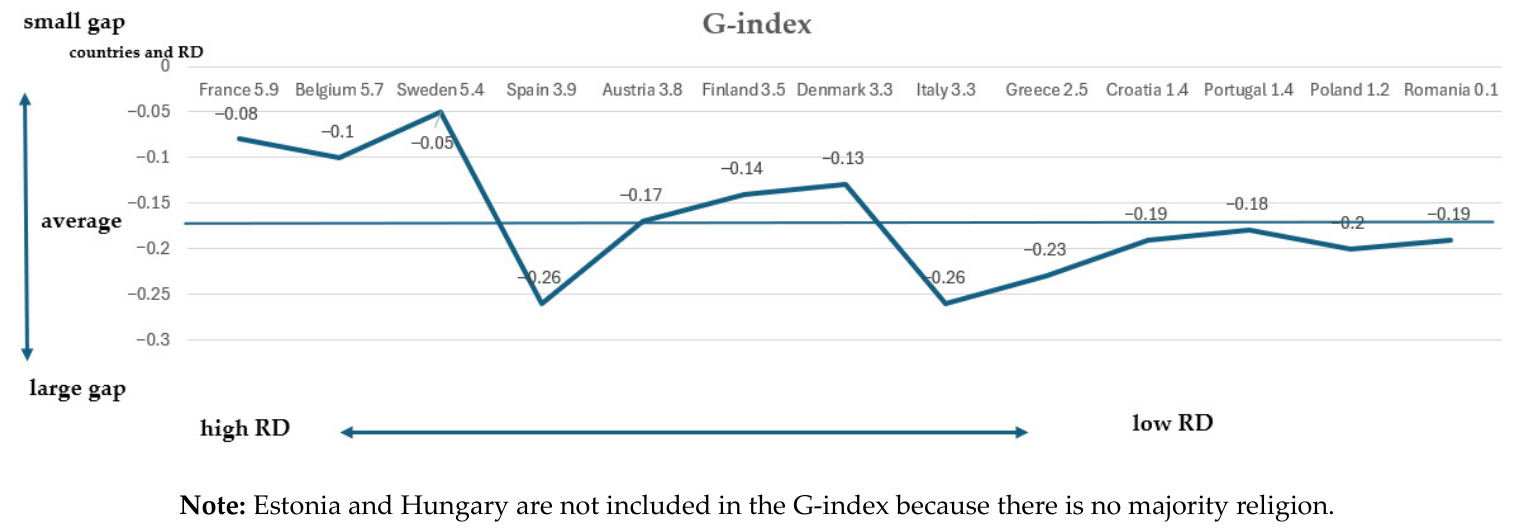
Atlas provides a third graphic (see
Figure 3) that measures the gap between the rights granted to the majority religious organisation and those granted to RMs.
The G-index, shown in
Figure 3, provides a clearer picture. It shows a strong correlation between a low RD rate and a large gap between majority and minority rights (six out of seven countries with a low RD rate are below the G-index average (−0.17), meaning that RMs enjoy far fewer rights than the majority religious organisation). There is also a significant correlation between a high RD rate and a small gap between the rights of the majority and minority religious organisations (five out of six countries have an E-index that is higher than or equal to the average). Clearly, the most important effect of RD is reducing the gap between majority and minority rights.
In terms of individual states, Sweden confirms its excellent position in this index, while Romania is the only state with a negative score in all three indices.
6. Promotion of RM Rights and Legal Pluralism
The Atlas data provides three key insights. Firstly, it shows that an increase in a country’s RD does not correspond to an increase in the promotion of RM rights. Secondly, it suggests that countries with low RD are less likely to grant equal treatment to RMs than countries with high RD. Thirdly, it indicates that a high level of RD reduces the disparity between the rights granted to the majority Church and those granted to minority religious organisations.
To interpret these findings coherently, we must return to the distinction between the ‘right to be equal’ and the ‘right to be different’, with which we began. The Atlas P-index awards positive scores to states that ensure the rights of RMs to be different by enacting legal measures that promote their identity and foster participation in social life in their own way. The G-index indicates the states in which the difference in rights enjoyed by RMs and the religious majority is smallest. States with high RD score well in the latter index and less well in the former. This suggests that RD has had a positive impact on the ‘right to be equal’ by giving RMs (or, more precisely, some of them) rights similar to those of the majority Church, and a less positive impact on the ‘right to be different’, as states with a high RD do not score particularly well in the index that measures the promotion of minority rights. In other words, the pattern of rights enjoyed by the majority religious organisation has been extended to a certain extent to a number of RMs, but no new pattern of rights has been created to meet their specific needs.
This peculiar impact of the process of religious diversification on RM rights—consisting not of their promotion, but of the extension of some majority rights to RMs—may be explained in different ways. Here, I will propose one explanation without claiming that it is the only one. Growing RD has not yet resulted in greater promotion of RM rights because EU states are reluctant to embrace legal pluralism as a strategy for managing religious diversity. Promoting RM rights implies not only accepting RD as a social fact to be legally regulated but also offering minority members the right to access rules that differ from those available to the majority. In the field of law, this requires a certain degree of legal pluralism, which is a necessary component of promoting minority rights (
Ferrari 2020;
van der Ven 2008).
The expression “legal pluralism” may refer to different things, the most common of which is the existence of more than one legal system in the same geographical space defined by the boundaries of a nation state (
Davies 2010). At the heart of the problem lies the challenge of conceiving a nation’s identity in plural terms. In modern European history, the inability to address this challenge has prompted the creation of confessional states, where national identity was directly linked to the particular religion professed by the majority of the population. It later emerged in the development of secular states, where full participation in the national identity requires acceptance of the secular nature of the state and its institutions. While not equating these two forms of state, both are based on the assumption that national identity must be singular and cannot be plural. When religion is at stake, religious plurality is confined to the private sphere, except for the majority religion in confessional states. The process of European unification did not change this picture: as we have seen, it reinforced the right to equality for RMs, but did not result in more legal pluralism.
Promoting RM rights is therefore impossible without a paradigm shift that allows conceiving and achieving a national identity based not only on coexistence, but also on development of different political, cultural, and religious collective identities within the same public space.
This paradigm shift allows the issue of minorities to be approached differently. Minorities are no longer viewed as disadvantaged social groups in need of special protection due to their vulnerability. Instead, they are recognised as integral components of a national society that is plural by design. This allows the majority–minority dialectic and the issue of minority rights to be viewed differently. While a minority presupposes a majority, in a context where social and legal pluralism is the norm, the distinction between majority and minorities loses some of its meaning. Minority rights cease to be exceptional, as it happens within a political and legal order based on uniformity, and becomes part of the norm in a system that accepts diversity as a structural component.
Of course, legal pluralism must be sustainable; in other words, it must fit within a framework that respects human rights (
Ferrari 2020). The religious rules that deny equal rights to spouses in their mutual relations, in the relations with their children, in matter of inheritance cannot produce any effect in state legal systems. However, under the law of EU countries, there is ample scope to make progress in increasing legal pluralism without compromising respect for human rights. The right to abstain from work on days prescribed by one’s religion, the right to obtain food that complies with religious requirements in the canteens of public institutions, and the right to wear religious symbols in public spaces–to give just a few examples of legal measures promoting RM identity without infringing human rights–are not yet recognised in all EU countries.
It would be naïve to think that a legal model like the one described in these last pages is able to solve the problem of RM rights and claims. Within the same State, there will always be an unbalanced relationship of power between the largest and the smallest religious groups, between communities of people who stand for consolidated convictions and traditions and communities that strive to assert alternative principles and values. There will always be new, marginalised, controversial social formations that will have to fight for their rights. For these reasons, the recognition of minorities and their rights will continue to be an open issue, with deep roots in a social, political and cultural humus that is resistant to any merely legal intervention. However, law also has a role to play and the model of legal pluralism can be particularly effective in relation to the State “duties of differential treatment to accommodate the separate identity of minorities and their ways of life” (
Henrard 2016, pp. 157–58). These duties would no more be the exception, as minority rights are today, but would be part of a process of inclusion that is inherent to a State inspired by legal pluralism. In the horizon of cultural and religious diversity looming over Europe, this is a viable and, arguably, desirable option.