1. Introduction
The paradoxical relationship between capitalism and religion represents one of the most enduring tensions in modern society. While capitalism promotes material accumulation and market rationality, religious traditions emphasize spiritual values and transcendent meaning. Yet these seemingly divergent forces have coexisted and often reinforced each other throughout history (
Weber 1958;
Tawney 1922). Capitalism and religion are seen as synergistic and complementary, providing a moral dimension to economic activity (
Brooks 2023), while simultaneously religion challenges the ethical orientation of capitalism (
Douthat 2021). This paradox acquires new complexity in the context of sustainability: how do individuals reconcile market ideology, religious commitments, and environmental stewardship in an era of ecological crisis?
Since the fall of the Berlin Wall and communism, capitalism has become the only system governing the global economy, associated with a form of globalization that is itself capitalist and liberal, defended and praised by some—
Norberg (
2001),
Majumdar (
2016)—but also criticized and denigrated by others (
Stiglitz 2002;
Gray 2015). Despite extensive theoretical debate, empirical inquiry into how religious belief systems shape the relationship between capitalist ideology and sustainability attitudes remains surprisingly limited. Capitalist logic permeates everyday life, spreading uncertainty and ephemeral relationships across economy, work, politics, and education (
Jameson 1991;
Sennett 2006). This is a system characterized by the commodification of all areas and aspects of our lives (
Leys and Harriss-White 2012), extending to the commodification of nature and common resources (
Harvey 2004). Yet capitalism continues to evolve despite criticism and crises (
Cassidy 2025), with scholars exploring possibilities for a system capable of regenerating itself with an emphasis on sustainability and resilience (
Fullerton 2025). Sustainability is now being introduced into economic and financial operations in several countries and is becoming increasingly visible and emphasized by making it visible through disclosure and audit and more aesthetically pleasing (aesthetic form) (
Yunita 2025). Contemporary approaches to climate risk increasingly conceptualize it as an economic and financial risk, prioritizing market-based assessment and management over purely environmental, scientific, or moral frameworks (
Taeger and Beunza 2026).
System Justification Theory illuminates how individuals psychologically justify and sustain support for market arrangements despite mounting inequality and ecological degradation (
Jost and Banaji 1994;
Jost et al. 2003). Fair Market Ideology (FMI) defends the belief that the market economy is the fairest and most effective mechanism for achieving economic development and social order (
Jost and Hunyady 2005), while Economic System Justification (ESJ) refers to the tendency to legitimize and defend the dominant economic system as fair, effective, and necessary (
Jost et al. 2004;
Jost 2019). Simultaneously, religiosity continues to shape values and behaviors across multiple domains, from ethical decision-making to environmental engagement (
Saroglou 2011;
Suhartanto et al. 2024). Religious traditions provide both critiques of capitalist excess and frameworks for reconciling market participation with spiritual commitments, suggesting that religiosity may function as a boundary condition that shapes how economic ideology translates into sustainability orientation, a possibility that warrants systematic empirical investigation.
Critical gaps persist in literature at the intersection of these domains. While research has separately examined religiosity’s relationships with economic attitudes or environmental behavior, few studies integrate capitalist ideology, religiosity, and sustainability within a unified framework. Existing work has not yet sufficiently assessed how religiosity relates to perceptions of capitalism’s fairness and legitimacy through constructs such as FMI and ESJ (
Jones et al. 2022;
Giacomin et al. 2023). Although
Martinez et al. (
2021) observe that sustainable business practices often assume quasi-religious characteristics, and
Jones et al. (
2022) demonstrate that religiosity and capitalist ideology can function as complementary forces, no empirical study has directly tested whether religiosity moderates the relationship between market ideology and sustainability concern. Moreover, much scholarship treats religiosity as monolithic or focuses narrowly on single traditions, overlooking their multidimensional nature which may yield more nuanced insights into how religious commitment conditions the capitalism–sustainability nexus (
Hill 2005;
Saroglou 2011).
This study addresses these gaps by empirically examining the interrelationships among FMI, ESJ, religiosity, and sustainability attitudes among Catholics and Protestants in the United States. The central research question asks: how does religiosity moderate the relationship between capitalist ideology, measured through FMI and ESJ, and sustainability attitudes? This encompasses whether FMI and ESJ positively relate to religiosity, whether these ideologies inhibit or promote environmental concern, and whether religiosity functions as a moderating mechanism between market support and sustainability orientation. Three objectives guide the inquiry: (1) establishing the direct relationships between capitalist belief systems and sustainability attitudes; (2) testing religiosity’s moderating role between economic ideologies and sustainability orientations; and (3) advancing theoretical understanding of how ideological, spiritual, and environmental belief systems interact in contemporary society.
The United States provides an ideal empirical context for this investigation, combining strong capitalist ideology with relatively high religiosity among developed nations, a conjunction that has shaped American culture since the early nineteenth century (
Slaughter 2020). In early 19th-century America, faith was embedded in markets and enterprises, shaping their modes of operation (
Slaughter 2023), and this tradition continues to influence contemporary American consciousness. The issue of morality in markets is as important today as it was in the past (
Slaughter 2020). The nation’s diversity in religious traditions and environmental attitudes offers the heterogeneity necessary to detect nuanced relationships among constructs. From Protestant work ethic traditions that historically underpinned capitalist development to Catholic social teachings emphasizing ecological responsibility, American religiosity embodies varied approaches to economic and environmental questions. As the world’s largest economy and second-largest carbon emitter, the United States plays a decisive role in global sustainability transitions, emphasizing the broader significance of understanding how its citizens reconcile market ideology, religious belief, and ecological concern.
A quantitative study was conducted with 600 U.S. participants to test the proposed model using structural equation modeling. Results revealed that economic system justification exerts a significant negative effect on sustainability attitudes, while religiosity demonstrates a significant positive influence. Fair market ideology showed no significant direct effect on sustainability attitudes. Although the overall moderating effects of religiosity were not significant in the full sample, multigroup analysis uncovered important demographic variations: religiosity significantly buffered the negative impact of fair market ideology on sustainability attitudes among younger participants and moderated the relationship between economic system justification and sustainability among middle-aged participants and higher-income groups. These findings suggest that religiosity’s role in shaping how capitalist ideology affects environmental concern varies across demographic segments.
This study makes three principal contributions. First, it extends System Justification Theory by empirically linking free-market ideology (FMI) and economic system justification (ESJ) to religiosity and sustainable attitudes, demonstrating how economic ideologies intersect with spiritual belief systems in shaping orientations toward sustainability in its broader social, ethical, and economic dimensions. Second, it advances the sustainability literature by identifying the conditions under which religiosity operates as a moderating mechanism, offering a more nuanced understanding of the demographic boundaries that shape when religious commitment attenuates the influence of capitalist ideology on sustainable attitudes. Third, responding to calls for context-sensitive approaches, the study shows that the capitalism–religiosity–sustainability nexus varies across age and income groups, suggesting that efforts to foster sustainable attitudes and behaviors should be tailored to specific demographic profiles.
The article proceeds as follows: a review of Catholic and Protestant perspectives on capitalism traces the evolution from early skepticism to qualified acceptance; an examination of FMI and ESJ as ideological supports for market systems establishes the theoretical foundation; an exploration of religiosity’s multidimensional nature and its relationships with economic ideology develops the conceptual framework; hypotheses linking these constructs to sustainability attitudes and proposing religiosity’s moderating role are then presented; the methodology and data collection procedures are described; results including direct effects and moderation analyses are reported; and finally, theoretical implications, practical applications, limitations, and future research directions are discussed.
2. Theoretical Overview
2.1. The Spirit of Catholic and Protestantism Capitalism
2.1.1. A Brief Historical Overview
The birth of capitalism as a system can be traced back to the first commercial exchanges in the Middle Ages and the Renaissance, long before the Industrial Revolution (
Cotta 1977). Even before the appearance of capitalism as an economic and social system, the church was always present to transmit a message aimed at defining the relationships between money, economy and human beings. Historically and traditionally, the Christian religion transmitted principles rather than a real economic program (
John 1991). Throughout history, religion has always been present in people’s lives through worship, children’s programs, education, preaching the word, baptizing, burying someone when they pass away, showing up at the hospital, mutual aid and charity association, moral support and other activities of a social and humanitarian nature (
DeYmaz and Michel 2023). Christianity is a transcendentalist religion; it teaches the autonomy of the spiritual in relation to temporal structures and histories. The church is not supposed to have any wisdom about economic matters and critical economic situation, but it encourages its members to struggle and to wrestle to achieve greater justice to fulfill the mission of God (
Hordern 1994).
2.1.2. Catholic and Protestantism Capitalism
Among the first writings concerning the relation between man and the ownership, Saint Augustin considers possessions as a gift from God, but he warns against the harmful effects of accumulating material possessions, “Possessions have been given by God for the purpose of achieving the human good, but the excessive attachment to such goods so endangers man’s salvation that he should be willing to jettison them, abandoning any claim to ownership at the peril of his soul” (
Dougherty 2003).
Saint Thomas Aquinas gave a solid argument for private property (
Aquinas 1947, I–II, Q. 66, a. 1–2). He considers private property as a natural law justification and a component of the
ius gentium—the law of all peoples (
Aquinas 1947, II–II, Q. 57, a. 3). The main elements of his argument are that private property engenders good stewardship and management, supports order in society, helps maintain peace and provides benefits within communities (
Spencer 2013). Contrary to popular belief, the Church does not condemn wealth, as long as it serves mankind and the common good (
Aquinas 1947, II–II, Q. 118, a. 1) “
The possession of riches is not in itself contrary to virtue, since riches may be used both well and ill. Accordingly, it is not the possession of wealth but the inordinate affection for it that is sinful.” Saint Thomas discusses the ethics of sales and the right price, which should not be set too high or too low. It also condemns the unfairness of manipulated prices (
Aquinas 1947, II–II, Q. 77, a. 1) and usury (II–II, Q. 78, a. 1). Albertus Magnus, a Dominican friar inspired by St. Thomas Aquinas, accepts profit and legitimizes it if it is moderate, legitimate and honest (
Magnus 1890). The Catholic Church, even though it has not firmly or explicitly condemned capitalism, has often been accused of early skepticism toward the capitalist system, particularly during the 19th and early 20th centuries (
Novak 1982).
Another influential perspective on capitalism, rooted in the Protestant tradition, is articulated in the work of Max Weber. Weber saw capitalism as not only economic, financial, and entrepreneurial, but also moral, psychological, and cultural. Human values play a key role in his thinking. The ascetic Protestant tradition emphasizes ascetic personal habits (
Weber and Kalberg 2013). It considers work as a devotional commitment and a moral duty rooted in faith. Ascetism and frugality play a key role in the human thought of Weber (
Berger 2011). He encouraged profit reinvestment to share the benefits and maintain a suspicious attitude toward luxury, which characterizes the spirit of capitalism (
Weber 2001). Weber was indirectly inspired by Calvin, who was never a fervent defender of capitalism, but through his theology, doctrine and teachings created a fertile ground for the development of capitalism. Values such as work as a divine vocation, ascetic behavior, ethical and moral discipline have largely imbued Weber (
Parsons 1958).
Max Weber emphasizes how Protestant religious and spiritual values played a key role in shaping the “spirit of capitalism”. However, in modern capitalist societies, many of the ethical and religious foundations he described have gradually eroded. The structure of the capitalist system places individuals under intense pressure, as they operate in highly rationalized environments driven by productivity, profit, and efficiency. This often leads to a loss of meaning, feelings of alienation, and burnout; experiences that resonate with Weber’s metaphor of the “iron cage” (
Weber 2001,
1958). It is widely acknowledged that Protestant cultural traditions and values not only encouraged the formation of capitalist beliefs but also contributed significantly to the development of a pro-market mindset (
Hayward and Kemmelmeier 2011).
2.1.3. Convergence Between Catholic and Protestantism Capitalism
The differences between the Catholic and Protestant points of view largely faded during the 20th and 21st centuries. Today, both schools of thought accept the legitimacy of private property and enterprise, people from different religions admit the fairness and the legitimization of capitalism (
Jost et al. 2003), while at the same time voicing criticism of the excesses of the system: social inequality, consumerism, and the dehumanization of work. Modern global capitalism, dominated by finance and the unbridled race for profit and limitless accumulation, has only brought their respective visions closer together (
Streeck 2014). Today we witness a global capitalist norm (
Strange 1996). The Catholic Church’s encyclicals Rorum Novarum (
Leo XIII 1891) and Centisums annum (
John 1991). insist on the equitable distribution of wealth, the place of the human being today, and man’s generosity towards his brother. While John Paul II, through Centisums annum, recognizes the merits and benefits of capitalism, and advocates the legitimacy of the market economy when it serves the human person and the common good. He denounces the glaring imbalances of the modern economy, criticizing its excesses, notably social exclusion, consumerism, and the loss of an ethical sense in the economy. The Protestant churches, especially the Reformed and Lutheran ones, adopt the same ethical discourse on social justice, human dignity and environmental responsibility, which has also been amply shared by the Catholic church in Laudato Si (
Francis 2015). Some cultural divergences remain regarding the concept of work: in Protestant doctrine, it is seen as a vocation, whereas in Catholic tradition, it is more often regarded as a duty (
Weber 1958;
Berger 2011;
Novak 1982). All supporters and defenders of the capitalist system are now convinced of the need to reconfigure institutions so that they can regulate and mitigate the crises of capitalism (
Shibata and Bailey 2024). Political leaders and government institutions are now aware that institutional innovation and local adaptation can be sources of resilience or transformation in capitalist economies (
Lane and Wood 2009).
2.2. Economic System Justification and Fair Market Ideology as Dimensions of System Justification Theory
2.2.1. System Justification Theory
System Justification Theory (SJT) posits that individuals are psychologically motivated to defend, justify, and maintain the existing social, economic, and political systems in which they live (
Jost and Banaji 1994). This motivation persists even when the system disadvantages them, as people prefer arrangements that provide order, stability, and meaning (
Durkheim 1982). By rationalizing the status quo, individuals reduce uncertainty, cognitive dissonance, and anxiety, thereby avoiding the perceived chaos that systemic change might bring (
Luhmann 1995).
Systems derive their persistence from mechanisms that maintain equilibrium and stability. Social institutions and norms endure because individuals, organizations, and laws interact in ways that preserve and often strengthen existing structures (
Parsons 1951;
Bertalanffy 1968;
Ashby 2003). People adhere to established rules because disrupting the system would create disorder, and systems evolve through adaptation that ensures their survival (
Darwin [1859] 2008). Importantly, a system cannot be understood by examining its parts in isolation; legitimacy, obedience, and acceptance emerge from holistic interactions among all elements (
Bertalanffy 1968). This explains why systems maintain social legitimacy and why people justify arrangements that confer authority and social order, providing a framework for communal coexistence (
Tyler 1990).
2.2.2. Economic System Justification
Economic System Justification (ESJ) represents a psychological attitude whereby individuals perceive the existing economic system as fair, legitimate, and desirable, even when persistent inequalities affect certain populations. ESJ leads people to accept economic disparities as natural, inevitable, or justified (
Jost and Thompson 2000;
Jost et al. 2003). This psychological mechanism motivates populations to rationalize economic and social disparities as deserved outcomes, thereby defending the prevailing economic order.
2.2.3. Fair Market Ideology
Fair Market Ideology (FMI) holds that free markets are intrinsically fair and efficient in distributing resources, such that economic outcomes, income, wealth, and status, legitimately reflect individuals’ merit, effort, and productivity. This ideology tolerates market inequalities with minimal government intervention, viewing markets as self-correcting and morally sound (
Jost and Thompson 2000;
Jost and Burgess 2000). FMI frames capitalism as a system based on merit and performance, promoting a worldview where success is deserved and outcomes are morally justified (
Jost et al. 2003). Beyond economic efficiency, FMI serves a moralizing function, upholding the belief that markets distribute rewards according to individual desert (
Anderson 1995).
ESJ and FMI function as complementary ideological mechanisms. While ESJ provides psychological motivation to rationalize economic hierarchies, FMI reinforces this by emphasizing beliefs in market fairness and meritocracy (
Brandt 2013). Together, they reduce uncertainty, justify inequality, and stabilize support for prevailing economic systems.
Proponents assert that capitalism fosters efficiency, innovation, and growth while ensuring freedom, wealth creation, consumer choice, meritocracy, property rights, and global competition (
Smith 1976;
Ricardo 1951;
Mises 1949;
Hayek 1944;
Friedman 1962;
Schumpeter 1942). However, critics challenge these justifications.
Sandel (
2012) argues that market logic now governs all aspects of modern life, leaving little room for moral reflection.
Bourdieu (
1998) contends that meritocracy masks privilege under the guise of fairness.
Piketty (
2014) demonstrates empirically how systemic forces, rather than individual effort, often determine economic outcomes, perpetuating inequality.
Despite these criticisms, capitalism remains the dominant global economic ideology. Psychological motivations and cognitive biases lead even dissatisfied individuals to accept the system as inevitable and fair (
Jost and Banaji 1994). The belief in equal opportunity, whether real or perceived, sustains ideological support and helps individuals reconcile inequality with hopes of upward mobility (
Kluegel and Smith 1986). Globalization has further entrenched free market legitimacy, amplifying its reach while intensifying its social costs and moral concerns (
Fukuyama 1992).
2.3. Religiosity
Religiosity encompasses the multifaceted ways individuals internalize and express their religious commitments across various aspects of life.
Giacomin et al. (
2023) describe religiosity as the degree to which people actively engage in religious rituals and uphold faith-based principles in their everyday actions. This concept goes beyond mere identification with a religion, capturing the depth of spiritual involvement and the impact of sacred beliefs on personal conduct and worldview. According to
Hill (
2005), although some evidence supports the idea of religiosity as a single unified construct, a substantial body of research demonstrates that it is better understood as multidimensional, particularly when focusing on people who actively practice their faith. There is broad scholarly agreement that, breaking down religious experience into distinct yet interrelated dimensions, offers valuable insights into how faith shapes individual lives and influences human behavior across diverse contexts (
Saroglou 2011).
Building on
Saroglou’s (
2011) framework, religiosity can be understood through four core dimensions: doctrinal beliefs, emotional rituals, moral norms, and a sense of community. These align with distinct psychological processes—believing, bonding, behaving, and belonging—that each serve specific roles such as seeking existential meaning, experiencing spiritual emotions, maintaining moral discipline, and fostering a lasting collective identity.
The believing dimension represents the intellectual and meaning-making aspects of religious experience, focusing on individuals’ acceptance of transcendent realities and their integration of sacred worldviews. It describes how people conceptualize the connection between supernatural forces and human existence, forming the cognitive foundation of religious life. As a psychological resource, this dimension helps address epistemic uncertainty by offering coherent explanatory frameworks that guide individuals through complex questions of reality, purpose, and human significance. It encompasses various forms of transcendent conceptualization, from personal deities to impersonal spiritual principles, unified by the recognition of realities that extend beyond ordinary human experience.
The bonding dimension encompasses the experiential and emotional aspects of religious practice, emphasizing how ritual activities cultivate profound connections with the sacred and with fellow practitioners. It includes both solitary spiritual practices, such as contemplation or meditation, and communal ceremonies that evoke shared experiences of transcendence. Whether performed privately or collectively, religious rituals serve as pathways to self-transcendent states that link individuals with perceived divine realities and their inner spiritual essence. The bonding dimension also supports emotional regulation and creates opportunities to transcend ordinary consciousness, fostering both personal spiritual growth and a sense of communal spiritual unity.
The behaving dimension concerns how religious frameworks shape moral reasoning and guide ethical decision-making in everyday life. It reflects religion’s fundamental role in establishing normative standards that define righteous and unrighteous conduct according to sacred teachings. Religious moral systems typically set elevated ethical expectations that exceed conventional social norms, encouraging virtues such as sacrificial altruism, humility, and disciplined self-restraint in the face of impulsive desires. In addition, religious traditions uphold sacred prohibitions, absolute moral boundaries that resist utilitarian trade-offs and often relate to ideals of purity and reverence for the divine. Ultimately, the behaving dimension illustrates how religious commitments inform concrete lifestyle choices and moral priorities that distinguish committed believers from their secular counterparts.
The belonging dimension encompasses the social and identification aspects of religious participation, including affiliation with faith communities and the integration of religious heritage into personal identity. Although this dimension shares features with secular group membership, religious communities exhibit distinctive characteristics that set them apart from other social organizations. Such groups typically maintain authoritative structures, whether personal, symbolic, or institutional, that provide normative guidance and validate new developments within the tradition. They also preserve narratives and symbols that link historical legacy with contemporary experience and future aspirations, fostering a sense of participation in an eternal or transhistorical reality. Ultimately, the belonging dimension fulfills fundamental human needs for social connection and collective meaning-making while supporting identity formation within contexts that transcend individual existence.
Although
Saroglou’s (
2011) framework distinguishes four dimensions of religiosity, these dimensions are theoretically and empirically interconnected facets of a single overarching religious orientation.
Saroglou (
2011) emphasizes that strong evidence supports a higher-order factor of religiosity, with the different dimensions being importantly interrelated, especially in general population samples that include both religious and nonreligious individuals. The 4-BDRS scale was explicitly designed to allow aggregation into a global religiosity index when administered to such samples (
Saroglou et al. 2020). The distinctiveness between dimensions becomes more pronounced among exclusively religious samples and when researchers aim to predict dimension-specific outcomes. In the present study, which draws on a general U.S. population sample and examines how overall religious commitment conditions the relationship between capitalist ideology and sustainability attitudes, a composite measure of religiosity is appropriate. The theoretical interest lies in whether the depth and breadth of an individual’s religious engagement, spanning beliefs, emotional bonding, moral commitments, and communal identification, collectively influence the way market ideologies translate into environmental and social attitudes.
2.4. Economic System Justification, Fair Market Ideology, and Sustainability
Sustainability attitudes refer to an individual’s values, beliefs, and orientations regarding the protection of the environment and the promotion of social and economic wellbeing (
Kaiser et al. 1999;
Stern et al. 1995). These attitudes are commonly assessed using the Sustainability Attitudes Scale (SAS), which evaluates responses to statements capturing ecological, economic, and social dimensions of sustainability (
Zwickle and Jones 2017).
The relationship between Fair Market Ideology (FMI) and sustainability attitudes is nuanced and context dependent. On the one hand, endorsement of FMI can be negatively associated with sustainability when environmental reforms are framed primarily as state regulation or government intervention, and thus perceived as a threat to market autonomy, provoking resistance and dampening pro-environmental engagement (
Heath and Gifford 2006). On the other hand, when sustainability is articulated within a commercial logic that emphasizes innovation, market efficiency, and economic opportunity, FMI can align positively with sustainability goals (
Feygina et al. 2010;
Schultz and Zelezny 2003). In such contexts, sustainable practices are interpreted as extensions of market dynamism rather than as constraints on it.
Consistent with a market-aligned framing of sustainability, we expect individuals higher in FMI to report more favorable sustainability attitudes. The United States offers a compelling context for this hypothesis, as the nation has historically embedded moral meaning in markets, a pattern visible since the early nineteenth century when faith and enterprise co-shaped economic life (
Slaughter 2020;
Slaughter 2023). In this setting, where sustainability is increasingly framed through market-based innovation rather than state-led regulation, and individuals who endorse fair market ideology may perceive sustainable practices as congruent with their economic worldview.
H1: Fair Market Ideology (FMI) is positively associated with sustainability attitudes.
Economic System Justification (ESJ) reflects the tendency to view existing economic arrangements as fair, legitimate, and desirable, even when they reproduce social and economic inequalities (
Jost and Thompson 2000). While FMI focuses on beliefs about market fairness and meritocracy, ESJ captures a broader defensive motivation to protect the economic status quo from perceived threats. In the environmental domain, ESJ is often associated with resistance to sustainability initiatives when such reforms are perceived as systemic critiques requiring structural change (
Feygina et al. 2010). Unlike market-driven sustainability solutions that align with FMI, deeper environmental reforms may signal that the current system is flawed, a conclusion that high-ESJ individuals are psychologically motivated to reject. Consequently, individuals high in ESJ may adopt less favorable sustainability attitudes, as endorsing environmental reform would imply acknowledging limitations in the system they are motivated to defend.
H2: Economic System Justification (ESJ) is negatively associated with sustainability attitudes.
2.5. Religiosity and Sustainability
Emerging research reveals that religious beliefs and values play a powerful role in shaping how people and organizations approach sustainability.
Suhartanto et al. (
2024), studying 565 Indonesian consumers across Muslim, Christian, and Hindu communities, found that religiosity does not merely influence green purchasing decisions directly but operates through deeper channels of environmental concern, knowledge, and collective responsibility. Notably, this pattern holds regardless of faith tradition, though the underlying mechanisms differ considerably. Those practicing Eastern religions like Hinduism and Buddhism often embrace sustainability through beliefs in interconnectedness and karma, while followers of Christianity and Islam navigate more complex tensions between divine providence and earthly stewardship (
Johnson et al. 2023). The influence of religiosity extends well beyond personal choices.
Martinez et al. (
2021) suggest that when companies adopt sustainable practices, they undergo a transformation akin to a value conversion, with committed actors championing a sustainability-oriented logic over traditional profit-focused orthodoxy. At the small business level, religiously committed owners translate their spiritual values into concrete environmental and social practices (
Wisker et al. 2019), particularly when these values have been reinforced over years of experience (
Dar and Jamal 2024). Importantly, not all forms of religious engagement carry equal weight.
Johnson et al. (
2023) found that genuine, intrinsic religious commitment predicts environmental concern far more strongly than superficial, socially motivated religious participation.
Ives and Kidwell (
2019) further argue that religious communities possess unique narrative resources about caring for creation and future generations that can mobilize collective action in ways that purely rational arguments cannot.
These patterns are corroborated by recent empirical work across diverse national contexts.
Riegel (
2023) found that both church membership and the centrality of personal religiosity predicted more favorable ecological value orientations among a large German sample.
Shah and Asghar (
2024) demonstrated that religiosity significantly predicted pro-environmental attitudes among Pakistani respondents, even after accounting for confidence in government and legal awareness.
Minton et al. (
2022), in a cross-cultural study spanning Singapore, Thailand, and the United States, showed that religiously grounded ethical values drive both sustainability behaviors and consumer well-being, with the strength of these relationships varying across cultural settings.
This converging evidence suggests that religiosity operates as a fundamental driver of sustainability orientation. Whether through direct teachings about creation care, the cultivation of collective responsibility, or the transformation of worldviews that reframe environmental protection as sacred duty rather than economic burden (
Martinez et al. 2021), religious commitment consistently emerges as a positive force for sustainable attitudes. The robustness of this relationship across diverse faith traditions (
Suhartanto et al. 2024), coupled with its manifestation at both individual and organizational levels, points to an underlying mechanism whereby spiritual values fundamentally shape environmental consciousness. Given this theoretical and empirical foundation, we hypothesize.
H3: Religiosity is positively associated with sustainability attitudes.
2.6. The Moderating Role of Religiosity
The relationship between market-oriented ideologies and sustainability attitudes is neither direct nor uniform; rather, it is contingent upon the psychological and cultural resources individuals draw upon to reconcile potentially competing value systems. We propose that religiosity functions as a critical moderating variable in this relationship, amplifying or attenuating the effects of fair market ideology (FMI) and economic system justification (ESJ) on sustainability attitudes depending on the nature and intensity of religious belief. This proposition rests on several interlocking theoretical arguments. First, the findings of
Jones et al. (
2022) demonstrate that religiosity and capitalist ideology operate not as antagonistic orientations but as complementary psychological dispositions that, when held concurrently, enhance subjective well-being and life satisfaction. This complementarity suggests that religiosity does not merely coexist with market ideologies but actively shapes how individuals interpret and act upon their economic beliefs. Specifically, religiosity provides an ethical and moral scaffolding that enables individuals to navigate the psychological tension between endorsing free market principles, characterized by competition, meritocracy, and individual responsibility, and embracing pro-environmental commitments that often require collective action and systemic change. Second, the relationship between religiosity and system-justifying beliefs is inherently complex and context-dependent, as
Laurin et al. (
2008) observe. Traditional and conservative religious orientations tend to reinforce economic system justification by framing social and economic hierarchies as expressions of a divinely ordained moral order, thereby legitimizing existing inequalities and strengthening adherence to capitalist structures. Conversely, progressive religious orientations challenge the perceived legitimacy of economic systems, viewing them as morally deficient and advocating transformative social and economic change (
Kay et al. 2008). This heterogeneity implies that religiosity does not exert a uniform influence on the FMI–sustainability or ESJ–sustainability relationships; rather, its effect is conditional upon the specific theological orientation, doctrinal emphasis, and moral framework that characterize an individual’s religious belief system. Third, fair market ideology itself resonates differentially across religious traditions. As
Weber (
1958) classically argued, FMI aligns closely with Protestant and traditional Catholic values of discipline, self-control, and moral accountability, suggesting that highly religious individuals within these traditions may experience greater congruence between their market beliefs and their religious identities. In such cases, religiosity may strengthen the positive association between FMI and sustainability attitudes by transforming sustainable practices into spiritually meaningful, value-laden endeavors that fulfill both economic and moral imperatives. However, in contexts where market logic operates as a secular moral system that supplants traditional religious authority, emphasizing personal achievement and autonomy over communal obligation (
Norris and Inglehart 2011), religiosity may weaken or even reverse the effects of FMI on sustainability by introducing competing moral claims that prioritize stewardship, humility, and collective responsibility over individualistic market virtues. Fourth, religiosity equips individuals with unique psychological resources, including belief in a higher moral order, confidence in divine justice, and access to supportive faith communities, that moderate how they respond emotionally and behaviorally to the outcomes of capitalist systems (
Jones et al. 2022). Religious individuals who endorse economic system justification may be more psychologically equipped to accept market-generated inequalities and risks without experiencing cognitive dissonance, freeing them to channel their economic agency toward sustainability goals as expressions of spiritual obligation rather than mere rational calculation. Conversely, those lacking strong religious commitments may find the tension between system justification and sustainability more psychologically taxing, resulting in weaker or negative associations between these constructs. Thus, religiosity operates as a boundary condition that determines the strength, direction, and psychological mechanisms through which market ideologies translate into sustainability attitudes. By activating internal belief systems, providing moral coherence, and offering existential meaning that contextualizes economic participation within a broader framework of faith-based ethics, religiosity moderates the complex interplay between FMI, ESJ, and environmental commitment.
Building upon this theoretical foundation, we advance the following moderation hypotheses:
H4: Religiosity moderates the relationship between fair market ideology and sustainability attitudes, such that the association is stronger (more positive) among individuals with higher levels of religiosity than among those with lower levels of religiosity.
H5: Religiosity moderates the relationship between economic system justification and sustainability attitudes, such that the association is stronger (more positive) among individuals with higher levels of religiosity than among those with lower levels of religiosity.
4. Findings
4.1. Descriptive Statistics
The results in
Table 2 present the descriptive statistics for the study of variables through means and standard deviation, along with the skewness and kurtosis to evaluate the normality. The results revealed that religiosity exhibited the highest mean score with low standard deviation (Mean = 4.00, SD = 0.811) indicating that the participants generally demonstrate high level of religiosity. Moreover, the economic system justification variable had the lowest mean score (Mean = 2.855, SD = 1.078), indicating a moderate level of economic system justification among the participants. In terms of normality, all skewness values were in the acceptable range of −2 and +2, as well as kurtosis values between −7 and +7 (
Kim 2013), and thus normality was assumed.
4.2. Exploratory Factor Analysis (EFA)
To determine whether or not the measurement items are aligned with their underlying factors, the exploratory factor analysis (EFA) is used in this study. Based on
Hair et al. (
2020), EFA using promax rotation was implemented to estimate the number of factors to extract.
All items were included in the first EFA. However, two of these items were dropped (SAS3 and REL2) because of low factor loading (<0.7), as suggested by
Hair et al. (
2020). Their elimination enhanced the construct reliability and average variance extracted values.
The findings of the EFA for the refined model verify that four distinct factors are present, which account for 62.787% of the extracted variance.
The results show that the KMO measure of the sampling adequacy is 0.943, and the Bartlett test of the sphericity of the correlation measure gives χ2 = 14,682.948 with df of 666 and a p-value of 0.000 < 0.05. Therefore, all the items loaded on their related constructs, ensuring the underlying factor structure.
4.3. Common Method Bias
The common factor analysis was performed to evaluate the presence of common method bias in the data. The results revealed that all items for all the constructs (religiosity, sustainability, economic system justification, and fair market ideology) show a minimal difference in loadings (below 0.2) between the original loadings and the common latent factor loadings. This verifies that common method bias does not pose a problem for this study.
4.4. Confirmatory Factor Analysis of the Measurement Model
Two steps were used to evaluate the fit of the measurement model. First, confirmatory factor analysis (CFA) was conducted to verify the model fit indices. Then the reliability measures, convergent and discriminant validities were introduced.
4.4.1. Measurement Model Fit Indices
The confirmatory factor analysis (CFA) results indicate that it fits very well based on the cutoff criteria of
Hu and Bentler (
1999). The findings in
Table 3 show χ
2/df = 2.412, CFI = 0.939, TLI = 0.934, SRMR = 0.041, and RMSEA = 0.049.
4.4.2. Reliability and Validity Analysis
Reliability of the measurement, convergent validity, and discriminant validity were determined based on
Hair et al. (
2020).
Table 4 shows Cronbach’s alpha, composite reliability, standardized factor load, and average variance extracted (AVE) of the four constructs used in the study. The results showed that reliability of the measurements is obtained. Both composite reliability (CR) and Cronbach’s alpha of all measures are above the 0.7 threshold. As a result, internal consistency is assumed.
In addition, convergent validity is achieved when the average extracted values of all constructs are above 0.5 (
Hair et al. 2020;
Fornell and Larcker 1981). As indicated in
Table 4, the AVE value of all constructs is above 0.5, which establishes convergent validity.
Ultimately, discriminant validity is confirmed when the square root of AVE for each measure exceeds the outer correlations (
Hair et al. 2020). The findings in
Table 5 demonstrate adequate discriminant validity for the suggested model. The square root of AVE for every measure exceeds its correlations with other constructs. Therefore, the model satisfies the fit measurements and is valid for further analysis.
4.5. Structural Equation Analysis (SEM)
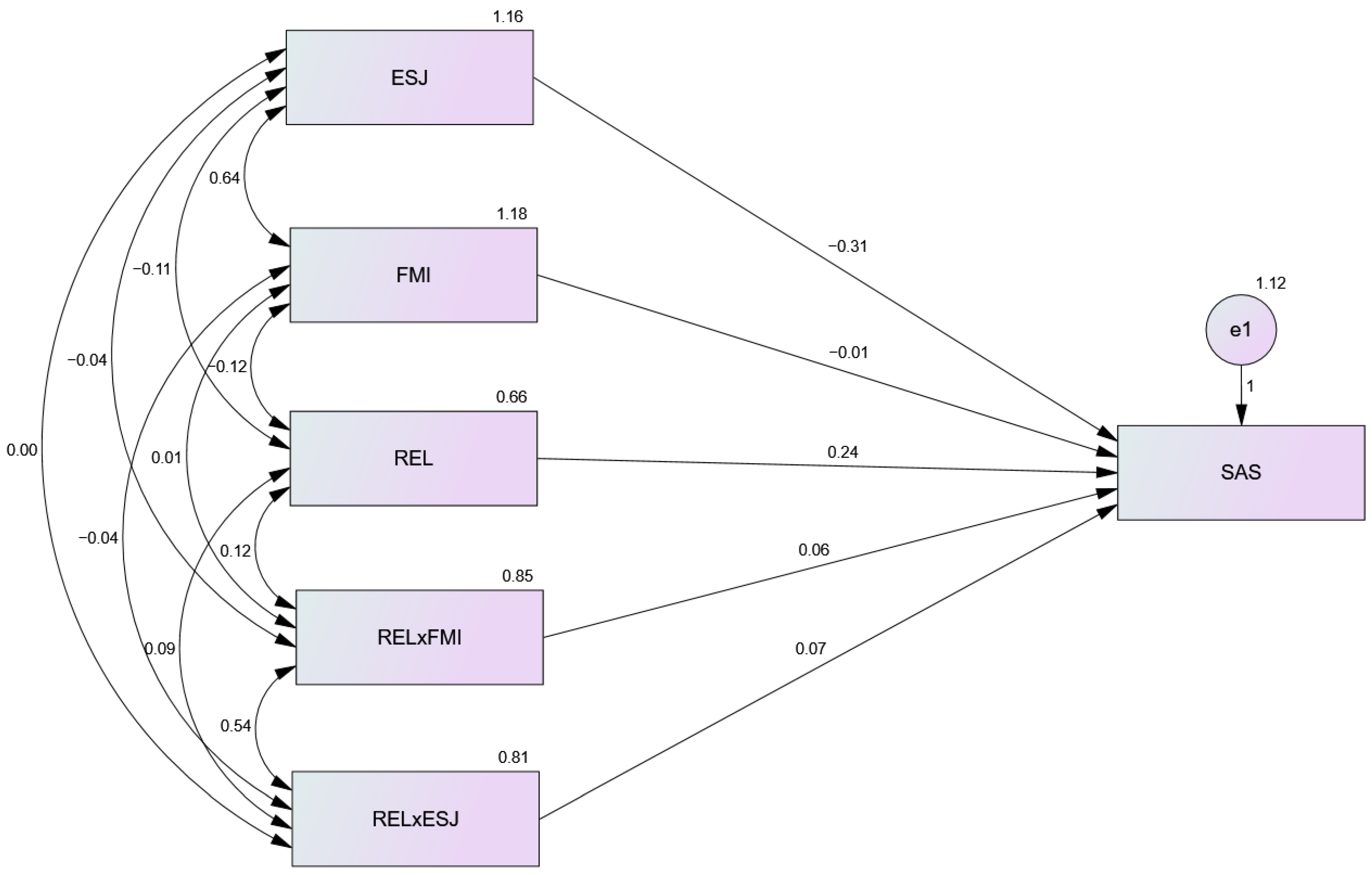
The findings regarding the validation of the hypotheses for the model are shown in
Figure 1. The results in
Table 6 reveal that the fair market ideology has no significant effect on sustainability attitude (
p-value > 0.05), rejecting the first hypothesis, which indicates that even if participants believe in the fairness of the free market, it does not influence their sustainability attitude.
In contrast, economic system justification (ESJ) has a significant negative effect on sustainability attitude (β = −0.309, p-value < 0.001) supporting the second hypothesis, suggesting that participants who strongly believe in the justification of the economic system tend to have low attitudes toward sustainability.
In contrast, religiosity showed a significant positive influence on sustainability attitude (β = +0.238, p-value < 0.001), indicating that participants who scored higher level of religiosity tend to have a stronger sustainability attitude. Therefore, this supports the third hypothesis.
Furthermore, the results reveal that the moderating effect of religiosity is not significant, as the interaction with both ESJ (β = 0.065, p = 0.298) and FMI (β = 0.068, p = 0.282) showed an insignificant effect on sustainability attitudes, which rejects the fourth and fifth hypotheses. This suggests that religiosity, in general, neither enhances nor weakens the effect of system justification or fair market beliefs.
4.6. Multigroup Analysis (MGA)
In this section, the multiple group analysis results are provided to investigate the existence of significant differences in the results according to income and age.
Prior to us undertaking the analysis, two invariance conditions were confirmed, namely configural and metric invariance (
Kline 2023).
4.6.1. Configural Invariance
To evaluate configural invariance, Confirmatory Factor Analysis (CFA) should be utilized to assess the fit of the unconstrained model. Configural invariance is confirmed when the data indicates that the measurement model adequately fits all groups under investigation (
Byrne 2016).
Table 7 results showed that the unconstrained multigroup measurement model of both variables, income and age, was borderline acceptable as indicated by the following statistics: χ
2 = 5680.09 in income and 5898.87 in age,
p = 0.000 for both, χ
2/df = 1.520 in income and 1.578 in age, CFI = 0.874 in income and 0.863 in age, and RMSEA = 0.030 in income and 0.031 in age. Therefore, it can be concluded that the model of measurement fits the data of all groups, and there is configural invariance.
4.6.2. Metric Invariance
Metric invariance assures that the loadings of the factors are identical in different groups, meaning that the underlying basic meaning of the construct is identical.
To evaluate metric invariance, two types of models are compared in this study: a baseline model that allows the estimation of the factor loadings of the two groups separately and an invariance model that assumes that the factor loadings are equal in all groups. The differences between the two nested models under consideration are demonstrated with the help of the chi-square difference test and the ΔCFI (
Meade et al. 2008). The metric invariance is evidenced by a chi-square difference test having a non-significant result and a ΔCFI value below 0.01.
The results in
Table 8 indicate that the metric invariance is supported for both income and age, with the change in the ΔCFI being 0.001, which is less than 0.01. Furthermore, the χ
2 difference was not statistically significant for both income and age, with
p-values of 0.231 and 0.220 being greater than the 0.05 significance level. The necessary conditions for metric invariance were met.
4.6.3. Testing MGA Path Differences
The results in
Table 9 show that none of the paths in the model are statistically different across various income groups (
p-value > 0.05). However, it was observed that the interaction between religiosity and economic system justification has a significant influence on sustainability attitude for the group with
$150,000 or above annual income (β = 0.273,
p-value = 0.047 < 0.07), despite the non-significant differences across other groups. This indicates that religiosity could reduce the negative effect of economic system justification on sustainability attitude.
Table 10 reveals that two paths in the model are statistically significant (
p-value < 0.05). In particular, the effect of economic system justification on sustainability attitudes shows significant differences across age groups. A significant negative effect of ESJ on SAS was observed in participants who were aged 41–50, 51–60, 71, and above.
Likewise, there are significant differences in the interaction effect of religiosity and fair market ideology on sustainability attitudes among age groups. The significant positive impact on SAS was present between the participants aged 21–30 and 31–40, showing that religiosity may be an important factor to mitigate the negative impact of fair market ideology on sustainability attitudes. It was also found that the interaction between religiosity and economic system justification has a positive impact on sustainability attitude among participants aged 41–50, even though there was no significant difference among other groups. This indicates that religiosity could reduce the negative influence of economic system justification on sustainable behaviors.
6. Implications of the Study
6.1. Theoretical Implications
This study closes several persistent gaps at the intersection of economic ideology, religious belief, and environmental orientation. First, whereas prior scholarship treated FMI and ESJ as functionally equivalent expressions of market legitimation, the present findings establish their theoretical independence for sustainability outcomes. The null FMI effect coupled with robust negative ESJ effects demonstrates that beliefs about market fairness operate through different cognitive–motivational channels than defensive system preservation. This distinction carries substantial implications: sustainability resistance stems not from endorsing market principles per se, but from psychological investments in defending existing arrangements against perceived threats.
Second, the study addresses a notable gap in the literature regarding the role of religiosity in relation to economic ideology and sustainability. While prior research has shown that religiosity can operate alongside capitalist ideology to support individual well-being, and that sustainability adoption may assume quasi-religious characteristics, no empirical work has examined whether religiosity conditions the translation of market ideology into sustainability-oriented attitudes. The study’s conditional moderation findings address this question while simultaneously adding complexity: religiosity does not function as a uniform moderating force, but rather as a demographically contingent one, with its buffering capacity activated only under specific life-stage and material conditions, varying across age cohorts and income strata.
Third, the age-graded patterns advance understanding of how ideological commitments crystallize across the life course. The iron cage Weber diagnosed finds empirical specification: system justification constrains sustainability orientation most powerfully among those whose biographical investments in capitalist structures run deepest. Conversely, younger cohorts exhibit ideological architectures permitting coexistence between economic legitimacy and environmental concern, a generational difference with theoretical implications for understanding how system-justifying motivations develop and solidify over time.
Last, the income-specific moderation among the affluent addresses longstanding questions about status and system support. Religious commitment introduces countervailing moral obligations precisely where material self-interest would most strongly reinforce system defense, suggesting that spiritual resources can disrupt the otherwise tight coupling between economic position and ideological motivation.
6.2. Practical Implications
For sustainability practitioners, the findings suggest that messaging strategies require demographic calibration. Among younger populations, initiatives may benefit from framing that integrates market logics with faith-based notions of stewardship. Among middle-aged and older groups, communications that emphasize system-compatible reforms rather than fundamental transformation are likely to encounter less psychological resistance.
Religious institutions possess underutilized capacity for advancing sustainability-oriented attitudes and practices. The observed direct positive relationship between religiosity and sustainability validates the relevance of faith-based programming grounded in stewardship, responsibility, and the common good. Moreover, the moderation findings indicate that faith communities can play a critical role in helping adherents reconcile active participation in market systems with commitments to sustainability across social, ethical, and long-term economic dimensions. This integrative capacity addresses a tension that secular sustainability discourse often struggles to resolve, particularly where market logics are perceived as incompatible with sustainable ways of living.
Corporate sustainability efforts, particularly those targeting affluent constituencies, may achieve greater resonance and legitimacy when framed through ethical and spiritual vocabularies rather than relying solely on instrumental or efficiency-based rationales. By appealing to moral responsibility, purpose, and long-term stewardship, such approaches can engage values that extend beyond short-term economic calculus and speak to deeper motivations shaping sustainable attitudes and behaviors. This value-based framing may be especially effective in contexts where market success coexists with heightened moral reflection, enabling firms to align sustainability commitments with both economic participation and broader societal responsibilities.
Policymakers confronting ESJ-based resistance among established demographic groups should recognize that opposition often reflects identity-protective cognition rather than mere self-interest. Policy designs perceived as affirming rather than threatening existing arrangements will prove more tractable than those requiring acknowledgment of systemic inadequacy.
6.3. Limitations of the Study and Future Research
Some limitations warrant acknowledgment. The U.S. context, while theoretically appropriate given its distinctive conjunction of capitalist ideology and religious vitality, limits generalizability to societies with different political economies or religious landscapes. Cross-national replications, particularly in contexts where religiosity and market ideology assume different configurations, would help establish the boundary conditions of the proposed model.
Additionally, both religiosity and sustainability attitudes were treated as unitary constructs in the present study. Although this approach is consistent with the scale authors’ recommendations and with the study’s focus on global moderating effects, it does not capture potentially differential dynamics across specific subdimensions. Future research could disaggregate religiosity into its four constituent dimensions of believing, bonding, behaving, and belonging to examine whether certain facets of religious commitment are more effective than others in buffering the negative effects of system justification on environmental concern. Similarly, employing more differentiated sustainability instruments would allow researchers to investigate whether religiosity and capitalist ideology exert varying influences on ecological, economic, and social dimensions of sustainability.