1. Introduction
Liu Mu 劉牧, courtesy name Changmin, was a Northern Song scholar-official from Pengcheng who entered government service under Emperor Zhenzong 真宗 and rose to the position of Erudite of the Court of Imperial Sacrifices (
taichang boshi 太常博士) under Emperor Renzong 仁宗. Liu Mu’s thought was later regarded as marking the beginning of Song-dynasty Yi diagram studies. The configurations of the
Hetu and
Luoshu 河圖洛書 that he formulated sparked protracted debates that continued from the Northern Song through the Qing dynasty, making them one of the most contested issues in the history of
Yijing studies 易學. Historical sources on Liu Mu’s life are sparse. Of his scholarly writings, only the
Yishu gouyin tu 易數鉤隱圖 in three fascicles, with a supplementary fascicle of
Yilun jiushi 遺論九事, survives; his
Xinzhu Zhouyi 新注周易 in ten fascicles and
Guade tonglun 卦德通論 in one fascicle are lost (
Tuotuo 1985, p. 5034). As for his intellectual lineage, Liu Mu inherited from Fan Echang 範諤昌 a numerological approach to
Yijing interpretation; the move of explicitly naming the diagrams
Hetu and
Luoshu and anchoring them within the sage-transmission lineage, however, was Liu Mu’s own constructive contribution. Whether this lineage can be traced further back to Chen Tuan 陳摶 has been examined in detail by Hu Wei’s 胡渭
Yitu mingbian 易圖明辨, and need not be rehearsed here (
W. Hu 2008, pp. 88–89). What can be established through the citations of others is that beyond his innovations in diagrammatic reasoning, Liu Mu also held distinctive views on classical exegesis, favoring a historically grounded approach that prioritized practical efficacy and contextual judgment. His friend Shi Jie 石介 preserved Liu Mu’s reading of the
Shi hexagram 師卦, and Zhu Zhen 朱震 recorded his interpretation of the fourth line of the
Jie hexagram 解卦, both of which reflect this orientation (
Shi 1984, pp. 199–200;
Z. Zhu 2020, p. 121)—consistent with a career trajectory in which he was reassigned from a ritual post to a frontier position and valued for his strategic acumen.
Before the modern period, discussion of Liu Mu’s Yijing scholarship operated almost entirely within the xiang-shu 象數 versus yi-li 義理 binary, concentrating on questions of historical provenance, transmission genealogy, and xiang-shu procedures of derivation. Qing evidential scholarship (kaozheng xue 考證學) brought this orientation to its peak. In the wake of this critical reassessment, Liu Mu’s Yijing studies lost much of their standing within the classical exegetical tradition and largely ceased to be regarded as a viable interpretive approach to the Yijing. Yet the verdict of evidential scholarship could not foreclose the question of intellectual significance. Modern and contemporary scholars have accordingly shifted their focus away from the classical status of the Hetu and Luoshu and toward the question of what the diagrams carry and how they carry it. Within this shared concern, scholarship since the modern period has developed along two main lines.
The first line of inquiry extends the
xiang-shu versus
yi-li analytical framework. Scholars such as Zhu Bokun 朱伯崑 and Lin Zhongjun 林忠軍 situate Liu Mu’s diagram learning as a phase within Song
xiang-shu scholarship and treat it as a continuation of the Han-dynasty
xiang-shu tradition (
B. Zhu 1994;
Lin 1998). This paradigm retains vitality, but it encounters a ceiling when applied to Liu Mu: within its terms, inquiry stops at the question of whether the diagrammatic reasoning is internally coherent and cannot advance to ask what kind of intellectual concerns and substantive content Liu Mu’s diagram learning, understood as an original hermeneutical paradigm, actually carried.
The second line of inquiry emerged in the late nineteenth and early twentieth centuries, reconsidering the signifying mechanisms of
Yijing thought through a semiotic-logical lens. Yan Fu 嚴復 was the first to register the semiotic implications of
Yijing in a comparative Chinese-Western context (
Yan 1981, p. 202); Hu Shi 胡適 introduced the term “symbol” (
fuhao 符號) into the interpretation of Yi images (
S. Hu 1983, p. 36); and Mou Zongsan 牟宗三, incorporating a logical perspective, defined hexagrams and lines as “logical propositions” and “simple propositions”, respectively, elevating
xiang-shu to the status of the basic formal condition through which
Yijing generates representations of the world and structures of meaning (
Mou 2003, p. 4). At this stage, semiotic readings were confined to hexagram and line images; Song diagrams had not yet come into view. This limitation was first overcome in the scholarship of Taiwan and Hong Kong in the 1990s: Zhao Zhongwei 趙中偉 identified Yi diagram studies as a distinctive system of symbolically mediated image-thinking (
Zhao 1999, p. 1); Zheng Jihong 鄭吉雄 revealed the high degree of mathematical formalization in Liu Mu’s diagrams (
Zheng 2008, p. 46); and Lin Zhongjun’s later work offered a more systematic account of the semiotic character of the Song Yi diagram tradition (
Lin 2023). More recently, Zhang Guangbao 張廣保 has further clarified the numerical-diagrammatic logic of Liu Mu’s thought by emphasizing his method of using numbers to form diagrams and his claim that
Yi images ultimately return to
Yi numbers (
Zhang 2025). Western scholarship has more recently developed sustained engagement with these questions. Skonicki situates the
Yishu gouyin tu within the broader intellectual history of the Northern Song, arguing that Liu Mu’s doctrines are best understood not in isolation, but as building blocks of a comprehensive cosmological vision in which numbers and diagrams serve as keys to the actual structure of cosmic generation and transformation (
Skonicki 2018). Holger Schneider, drawing on contemporary diagram theory (
Diagrammatik), reads the
Yishu gouyin tu as a form of argumentation conducted through the medium of black-and-white dot diagrams, analyzing how diagrammatic reasoning achieves transfers between different sign systems and presents arguments spatially in ways that linear prose cannot (
Schneider 2022). In its essential orientation, Western scholarship extends the second line of inquiry developed in China.
What neither line of inquiry has pressed is a prior question: what grounded the authority of Liu Mu’s numerological system within the intellectual culture of the early Song? The historical conditions under which that authority became persuasive, and the role played in its construction by Liu Mu’s reinterpretation of the Yijing’s yarrow-stalk divination, are derivative aspects of this more fundamental issue. It is from this question that the present article takes its point of departure.
2. Religious Dimensions: Institutional and Political Contexts
Liu Mu’s
xiang-shu system acquired real intellectual and political traction in the early Song, but the source of its authority cannot be located at the level of technical procedure alone. To locate it requires specifying what this article means by the “religious dimensions” of his
Yijing scholarship. The term does not refer to any doctrinal affiliation or independent theological program. It refers, rather, to two related functions: how Liu Mu’s system grounds moral and political norms in a sacred cosmic order that transcends human convention, and how that same system preserves within its numerological structure a dimension of mystery irreducible to rational derivation. The analysis of these two levels draws on frameworks supplied by C. K. Yang and Rudolf Otto, respectively. According to Yang, diffused religion differs from institutional religion precisely in that its theology, cultus, and personnel are “so intimately diffused into one or more secular social institutions that they become a part of the concept, rituals, and structure of the latter” (
Yang 1961, p. 294)—functioning not as an independent system but as an undergirding force for the secular social order. To ask about the religious dimensions of Liu Mu’s
Yijing scholarship in this sense is to ask how it grounds the binding force of moral and political norms in an understanding of the natural order of heaven-and-earth, rather than in human convention. This broader problematic was already central to Song
Yijing thought, where the
Yijing functioned as a medium for articulating the relation between heaven-and-earth and human values, and for securing a constant moral foundation within a changing social and political world (
Smith et al. 1990, p. 3, viii). Within this tradition, as Chen Ruihong has shown, Song diagrammatic numerology did not draw on
Yijing resources alone, but also found in the
Hongfan 洪範 tradition a necessary theoretical basis (
R. Chen 2022). Otto, in turn, draws our attention to a dimension of the sacred that rational order cannot exhaust: the numinous, which he characterizes as “perfectly sui generis and irreducible to any other” experience, and which “cannot, strictly speaking, be taught, it can only be evoked, awakened in the mind” (
Otto 1958, p. 7). Rational order cannot substitute for this mystery; it can only make room for it. This second dimension will be developed in the article’s later discussion of spiritual forces (
guishen 鬼神) and the yarrow-stalk method.
Direct evidence that Liu Mu’s religious framework was linked to official moral instruction appears in the section “Human Beings Partake of the Five Phases” in the
Yishu gouyin tu. There Liu Mu maps the Five Phases onto the five cardinal virtues—wood onto humaneness (
ren 仁), fire onto ritual propriety (
li 禮), earth onto trustworthiness (
xin 信), metal onto righteousness (
yi 義), and water onto wisdom (
zhi 智)—and argues that human beings, as the most responsive of all creatures between heaven and earth, are endowed with precisely these moral natures. Those who reject the Five Constants (
wuchang 五常), he concludes, fall short of what their own nature demands (
Liu 1989, p. 18). This chain of reasoning grounds the authority of moral and political norms not in human institution but in the natural order of heaven and earth. The same continuity is visible at the level of the hexagram sequence as a whole: commenting on the conclusion of the sixty-four hexagrams with
Jiji 既濟 and
Weiji 未濟, Liu writes that this ending “displays the admonition of flourishing and decline, rectifies the righteousness of ruler and minister, clarifies the importance of discernment and caution, and completes the kingly way… How great is the teaching of the sages!” (
Liu 1989, p. 41). For Liu Mu, the cosmological symbols and numbers of the
Yijing are always resources for grounding the moral and political order in something sacred, never expressions of a self-sufficient religious faith.
This orientation had both an institutional and an intellectual genealogy. Institutionally, Liu Mu served as Erudite of the Court of Imperial Sacrifices, the central agency of the Song state’s ritual system. According to the “Treatise on Official Positions” in the
Song shi 宋史 (
Zhiguan zhi 職官志), the core responsibility of this position was to “deliberate on and determine the ritual forms of the Five Rites (
wuli 五禮), and to review proposed changes on the basis of the classics” (
Tuotuo 1985, p. 3884). The work of classical interpretation and the legitimation of ritual order were built into the position itself, not incidental to Liu Mu’s scholarly activity. It is therefore directly relevant that his second-generation disciple Wu Mi 吳秘 presented Liu’s writings to the court in 1041 and received an edict of commendation in return. Intellectually, Liu Mu trained under Sun Fu 孫復 at Taishan 泰山, within a scholarly circle committed to grounding moral and political norms in the classics and reconstructing the moral order through Confucian ritual, an orientation that his
Yijing scholarship directly reflects (
Shi 1984, p. 223).
The political context is equally important. Liu Mu entered official service under Emperor Zhenzong and completed his major writings under Renzong, and the contrast between these two reigns is essential background. The shadow cast by the “Heavenly Books” (
Tianshu 天書) affair of the Zhenzong reign is particularly significant. According to the
Xu zizhi tongjian changbian 續資治通鑑長編, the scheme originated with Wang Qinruo’s 王欽若 counsel that artificially produced auspicious omens (
xiangrui 祥瑞) could serve the same political function as genuine ones (
Li 2004, pp. 1506–7)—a strategy that reinforced imperial authority by fabricating divine signs. The backlash was swift and lasting. Sun Shi 孫奭 submitted repeated memorials declaring that “heaven does not speak—how could there be a book?” and denouncing the practice as a fabrication of divine authority (
Li 2004, pp. 1700–1). Renzong curtailed the Daoist ritual apparatus the affair had generated at the outset of his reign (
Li 2004, pp. 2316–17), and Ouyang Xiu 歐陽修’s later condemnation of the episode as one of Zhenzong’s cardinal failures confirmed its status as a negative precedent (
Ouyang 2001, p. 2746). By the Renzong period, the fabrication of divine sanction had been discredited not merely as a moral failure but as a political one.
Against this background, the
Hetu and
Luoshu had acquired acute political sensitivity in the Renzong reign. Their status now became inseparable from the question of how sacred authority could be invoked without repeating Zhenzong’s discredited precedent. Liu Mu’s solution was to anchor the
Hetu and
Luoshu within the chain of sage transmission. In doing so, he replaced the authority of divine portents with that of classical transmission, preserving the symbolic prestige of the
Hetu and
Luoshu while stripping them of their association with political mythology. The wide circulation and enthusiastic reception of his writings under Renzong (
Chao 2006, p. 249;
Z. Chen 2006, p. 511) reflects how precisely this strategy met the intellectual demands of the age.
Zhan Shichuang has documented the Daoist elements in Liu Mu’s writings and traced their sources (
Zhan 1996, pp. 1–6), but genealogical origin and interpretive orientation are distinct questions. The channel through which symbolic materials enter a system of thought does not determine how those materials are deployed; from an exegetical standpoint, what a thinker does with a symbol reveals far more about the orientation of his thought than where the symbol came from. Liu Mu’s
Hetu and
Luoshu are a case in point. They are consistently drawn back into the Confucian classical framework of cosmic order and the principles of human nature (
xingming 性命). Precisely how this reorientation was achieved, and how the
Hetu and
Luoshu were detached from the
chenwei apocryphal tradition and repositioned within the framework of classical argumentation, is the question the next section addresses.
3. The Symbolic Vehicle: Hetu and Luoshu Between Apocryphal Myth and Classical Authority
The strategy outlined above had a necessary precondition. Before the Hetu and Luoshu could be relocated within the framework of classical exegesis, the symbols themselves had to be fundamentally recast. This section examines how that remaking was accomplished, and what the transformed symbols were asked to do within Liu Mu’s Yi studies system.
Few symbols in Chinese intellectual history have generated so much interpretive labor on so slender a textual foundation as the
Hetu and
Luoshu. The
Xici 系辭 disposes them in a single sentence: “The Yellow River produced
Hetu; the Luo River produced
Luoshu; the sages took them as models” (
Huang and Zhang 2007, p. 392). The passage establishes their connection to the creation of the
Changes and nothing more: no form, no content, no further elaboration. References scattered across the
Shangshu 尚書, the
Liji 禮記, and the
Analects 論語 treat the
Hetu as either a material object or an auspicious omen, but none adds substantive information, and none mentions the
Luoshu. The earliest traceable references to the
Luoshu appear only in Han-dynasty sources, where it figures in accounts of a heavenly document descending to the sage-king Yu 大禹 and is already associated with the “Nine Categories” (
jiuchou 九疇) and the “Nine Palaces” (
jiugong 九宮).
In the Han dynasty, the Hetu and Luoshu were appropriated within the chenwei 讖緯 apocryphal tradition and became deeply politicized. Through these symbols, Han rulers and their supporters constructed a narrative in which heavenly signs validated the authority of the sovereign. Emperor Zhenzong’s “Heavenly Books” affair can be understood as a continuation of this narrative pattern. By the Renzong reign, this history had placed the Hetu and Luoshu in a genuinely difficult position. On the one hand, the Xici explicitly names them as the source from which the sages modeled the Changes, and no serious interpreter of the Yi could simply set them aside. On the other hand, they had long been associated with accounts lacking historical credibility and with the instrumental use of sacred symbols for political purposes. Therefore, how to restore their standing within the classical tradition became a very intractable problem.
Liu Mu’s response began with an act of critical clearance. He rejected the
chenwei apocryphal texts outright: works such as the
Chunqiu wei 春秋緯 and the
Zhonghou 中候 were of unknown authorship, he argued, and their contents were entirely without evidential value. The problem, however, was not confined to the apocryphal tradition itself. Kong Yingda 孔穎達 had absorbed portions of that tradition into his commentaries, with the result that his accounts of the
Hetu and
Luoshu in the
Zhouyi zhengyi 周易正義 and the
Shangshu zhengyi 尚書正義 were wholly mistaken (
Liu 1989, p. 32). For Liu Mu, Kong Yingda’s errors were symptomatic of a broader hermeneutical failure, one in which the authority of commentators had come to override rather than serve the original purport of the classics, with the result that “the discussions of many worthies depart in large measure from the purport of the classical texts” (
Liu 1989, p. 33).
On this basis, Liu Mu confined his interpretation strictly to the
Xici as the sole textually reliable source. Textual reliability, however, was only the first step. Liu Mu further grounded his account in authorial authority, arguing that when Confucius, as author of the
Xici, referred to the
Hetu and
Luoshu, he was in fact describing Fuxi’s drawing of the trigrams. The
Hetu and
Luoshu, Liu Mu concluded on the authority of Confucius, could only belong to the age of Fuxi (
Liu 1989, p. 32). Yu was a later interpreter whose moral and intellectual qualities had equipped him to carry the tradition forward (
Liu 1989, p. 33). Yu’s true contribution, on this account, lay in rendering the
Luoshu into written form, thereby enabling its transmission to later generations.
Yet even textual reliability and authorial authority, taken together, did not exhaust the basis of Liu Mu’s case. Underlying both was a more fundamental claim about the source of the
Hetu and
Luoshu’s authority. That authority, he argued, resided in the numerical structure of the diagrams themselves. The numbers arranged in the
Hetu yield identical sums in every direction, a symmetry so precise and internally coherent that it could only be the product of cosmic operation and could not have been “fabricated by later generations” (
Liu 1989, p. 33). No apocryphal tradition could supply this kind of ground, and none could undermine it.
The two diagrams, moreover, were not parallel but complementary. The
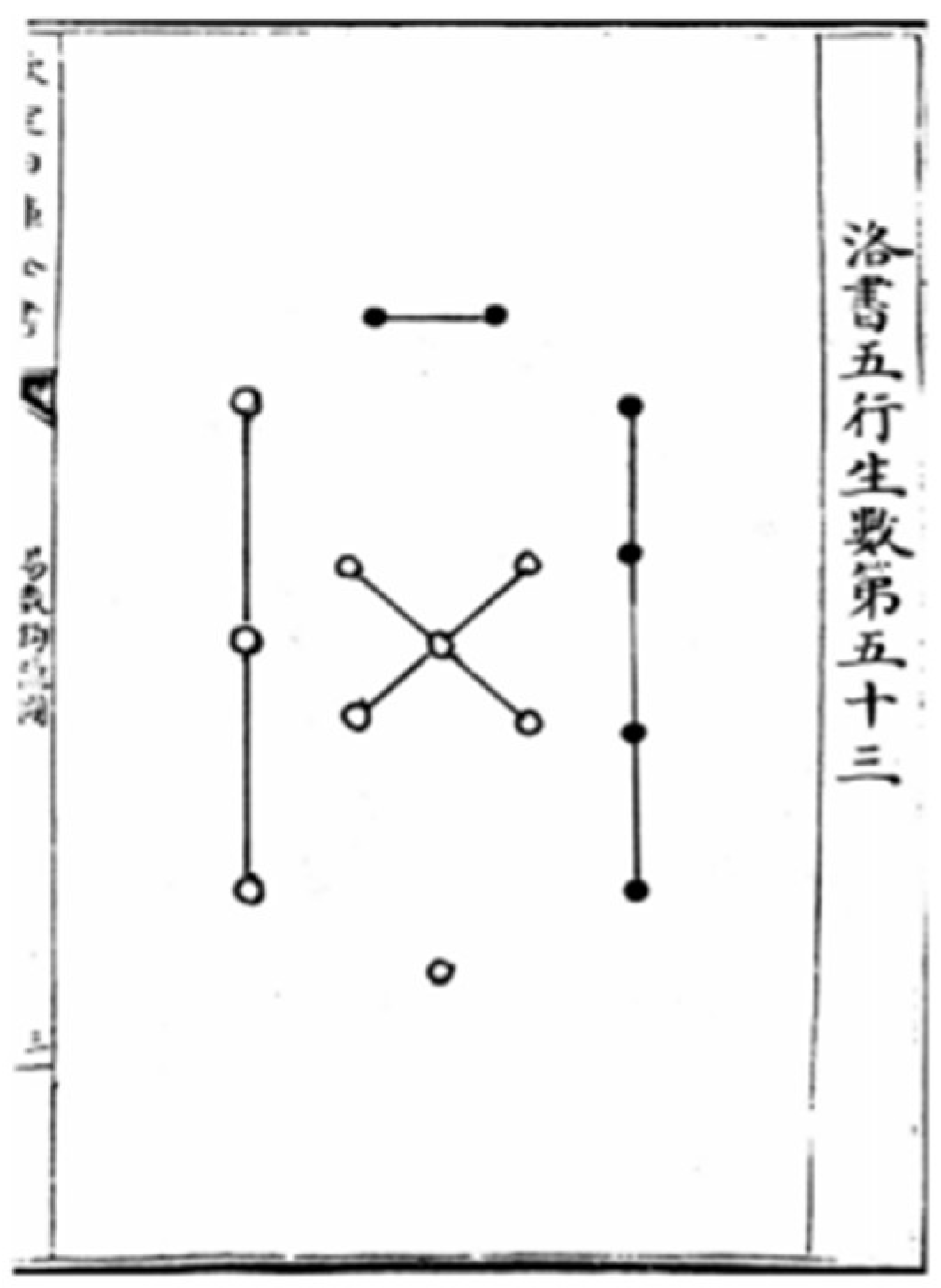
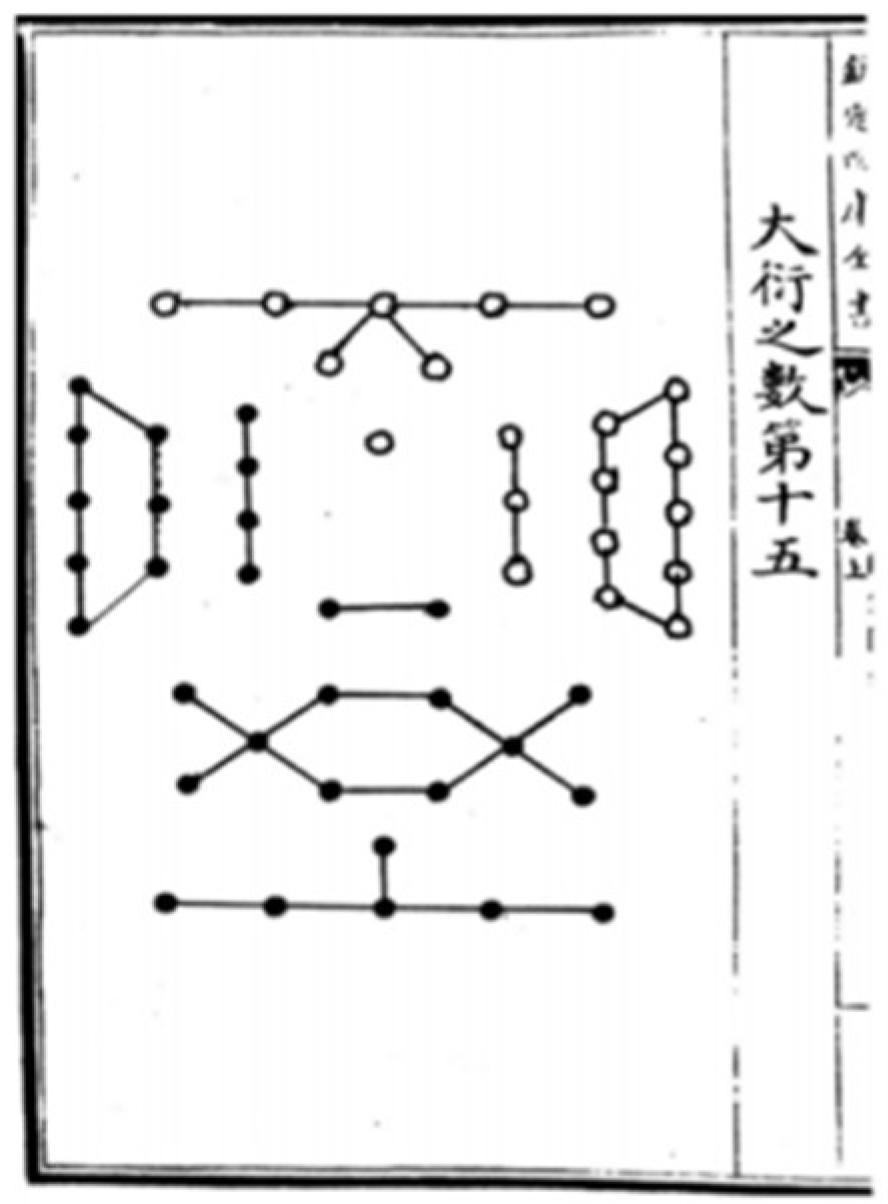
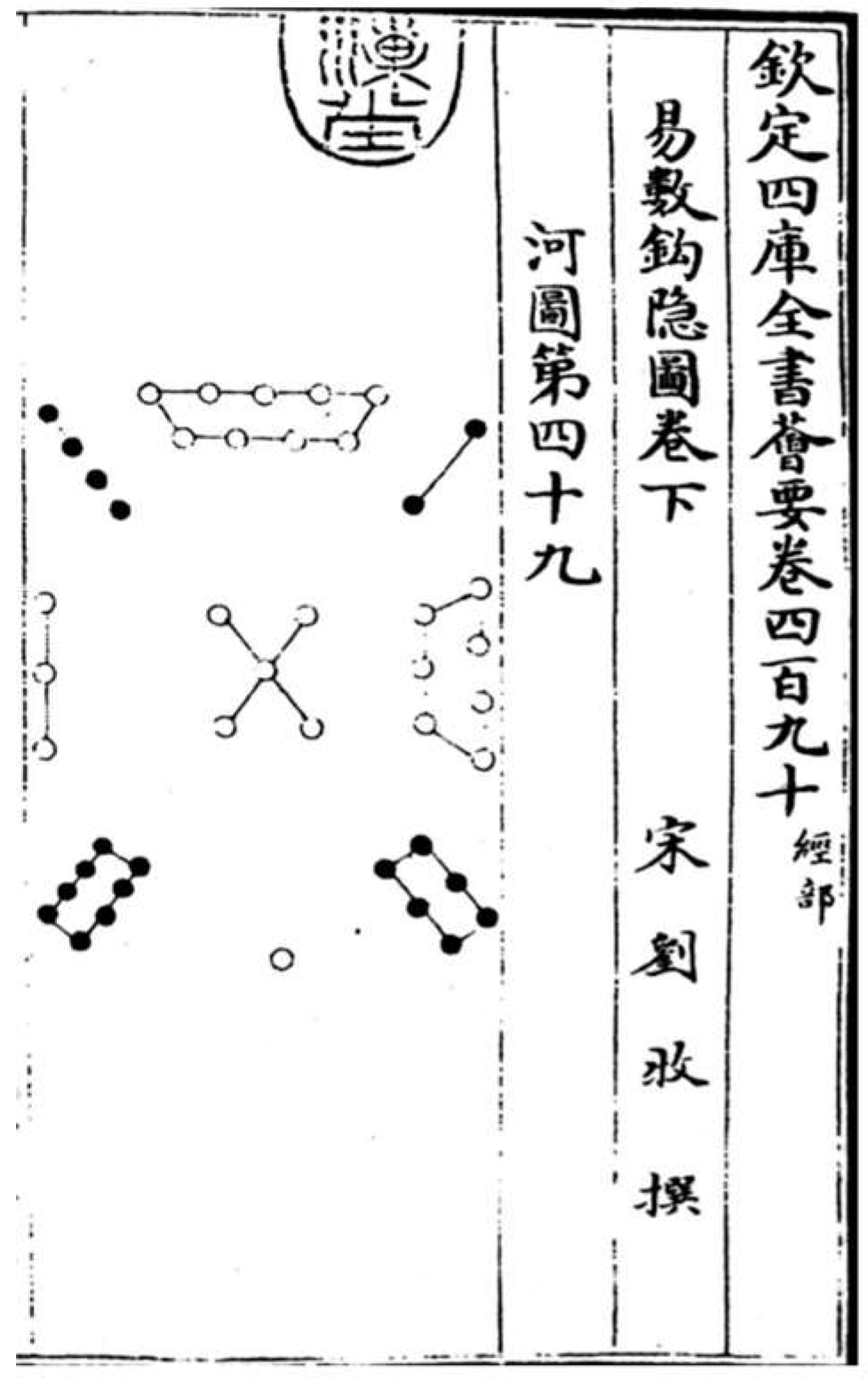
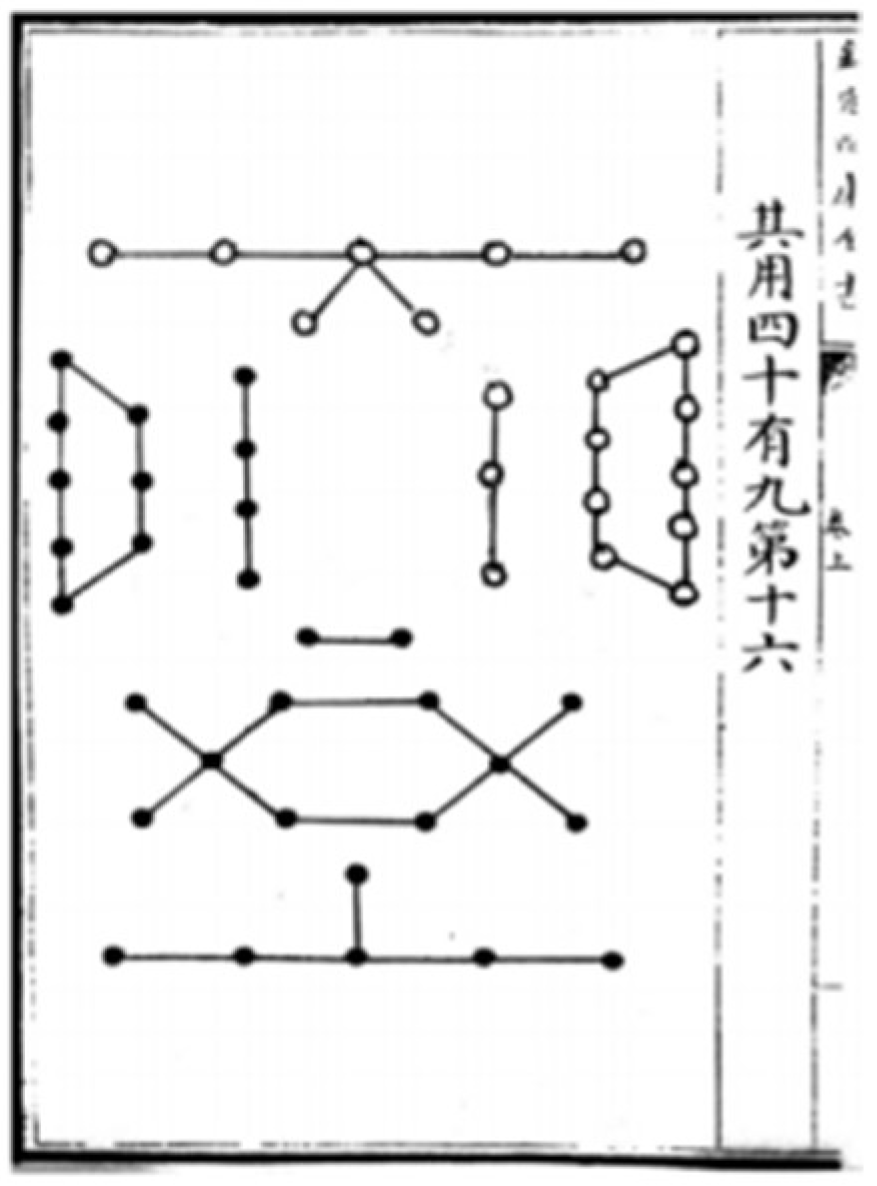
Hetu, totaling forty-five, images the numbers of the Four Images 四象 and Eight Trigrams 八卦, containing the Five Phases in their abstract, uninstantiated form (
Figure 1). The
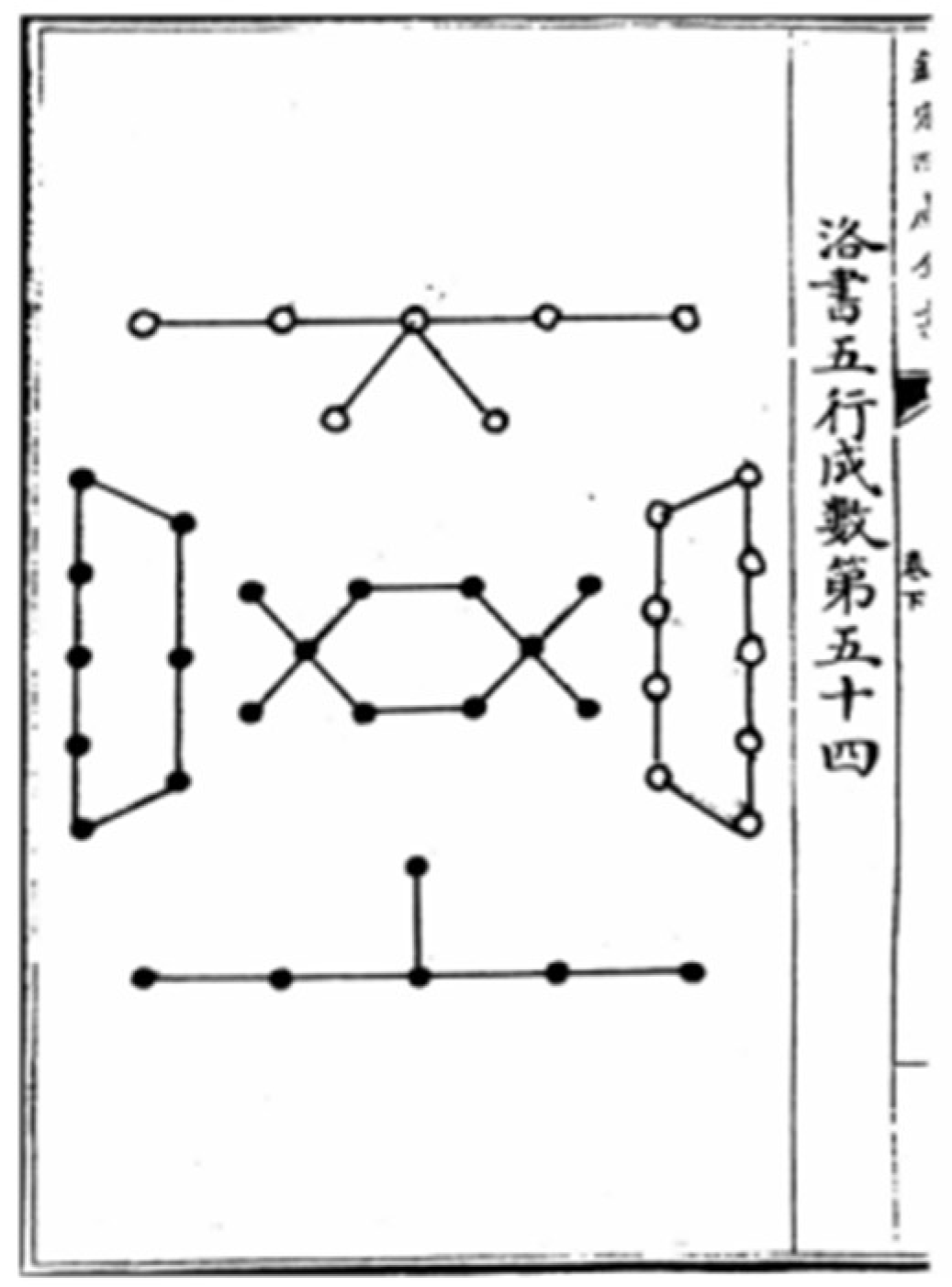
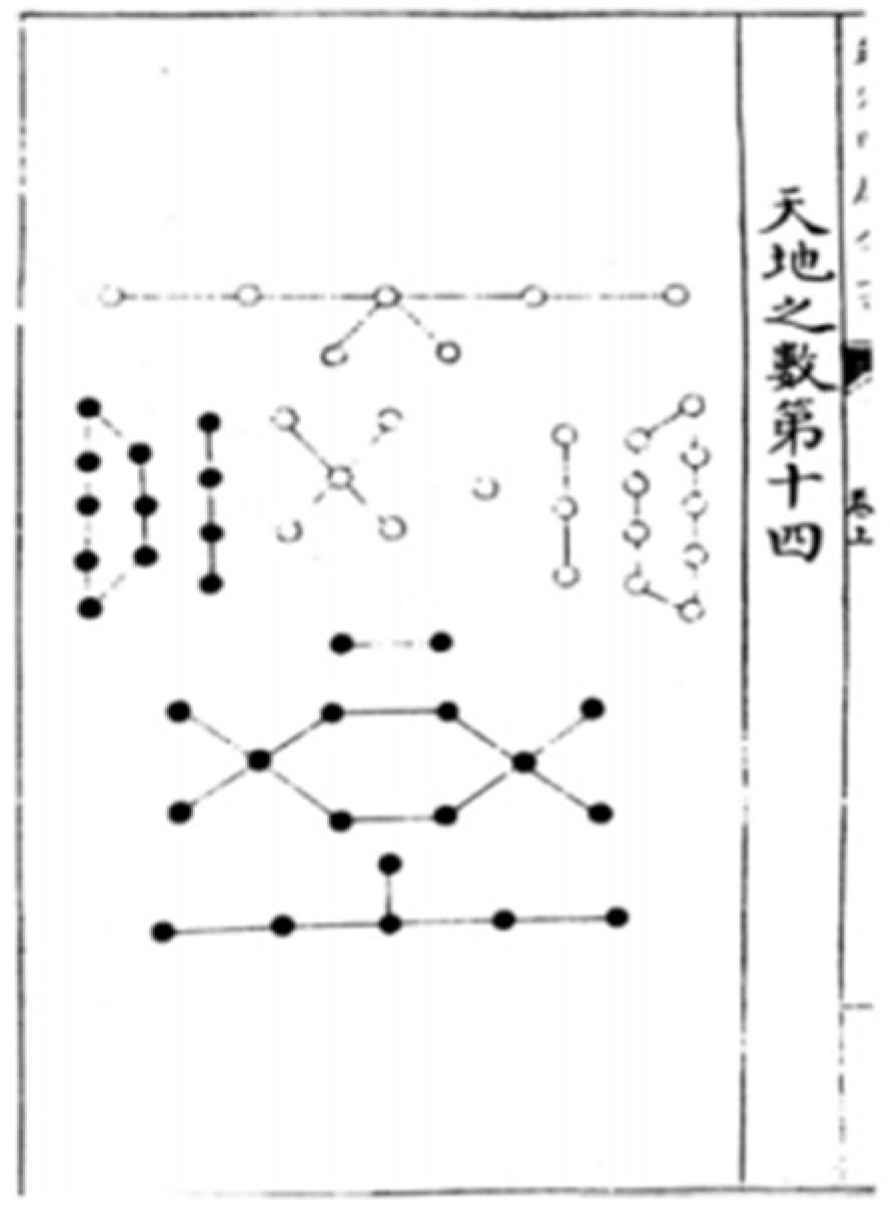
Luoshu, totaling fifty-five, figures the complete process by which those abstract elements are actualized into the determinate forms of the physical world (
Figure 2 and
Figure 3). The difference in ten between them represents the number of earth, marking the threshold between the metaphysical and the physical. Neither diagram is sufficient alone: together they figure a cosmos in which the two orders are continuous (
Liu 1989, p. 33).
Numerical structures of such depth, Liu Mu held, could only be grasped by those with both the moral cultivation and the intellectual capacity of a sage. The transmission lineage therefore admitted of only one possibility. As he put it: “Without Fuxi, the
Hetu and
Luoshu could not have been drawn; without King Wen 周文王, the trigrams could not have been elaborated; without the Duke of Zhou 周公, the line images could not have been set forth; and so Confucius said, ‘Now that King Wen is gone, is not culture preserved here in me?’” (
Liu 1989, p. 33). The narrative of heavenly portents was fully replaced by the narrative of sage transmission.
Within the history of Yi studies, this reconstruction had a significant theoretical consequence: it opened a new direction for interpreting the hexagram and line images. The dominant method of Han-dynasty
xiang-shu scholarship, rooted in the “looking up and looking down” (
yanguan fucha 仰觀俯察) doctrine of the
Xici, worked by correlating hexagram images with natural phenomena, thereby extending the range of what the symbols could signify. The concern was always with elaborating the meaning of existing images, not with recovering the principles on which the sages had originally constructed them. Kong Anguo 孔安國 had already proposed that “the
Hetu corresponds to the Eight Trigrams, and the
Luoshu to the Nine Categories” (
Kong 1990, p. 159), but left the observation undeveloped. As Hu Wei records in
Yitu mingbian, the preface to
Yishu gouyin tu states that “images are established from numbers” and that one “must reach the utmost of numbers in order to know the root” of the
Yijing (
W. Hu 2008, p. 95). Liu Mu’s decisive move, then, was to treat numerical order as prior to the hexagram images themselves, and as the key to the cosmological ground those images disclose.
Through this sequence of moves, the Hetu and Luoshu completed a transformation within Liu Mu’s system. Once stripped of their apocryphal and political associations, the Hetu and Luoshu were repositioned as the foundational interpretive basis of the Changes itself.
4. The Logic of Unified Order: Numerical Derivation and the Continuity of Heaven and Humanity
The question now is what cosmological work these transformed symbols were asked to perform—specifically, how Liu Mu built from them a unified order in which the human moral domain and the natural world are not merely analogous but continuous.
The triad of Heaven, Earth, and Humanity (
sancai 三才) described in the
Xici encodes precisely this relationship: the human moral order is not independent of the natural order but continuous with it. For Liu Mu, what runs through all three is the way of yin and yang, numerically expressed as two. The six-line structure of each hexagram follows directly: six is the product of two and three, of yin-yang and the triad (
Liu 1989, p. 18). Every hexagram in the
Changes, on this reading, images a specific situation constituted by the dynamic relationship among heaven, earth, and humanity.
The reasoning Liu Mu follows here is worth making explicit, because it governs his entire system. He begins with the numerical values associated with the constituent elements of a given symbol, derives their possible combinations through arithmetic, and then maps the results onto concepts whose philosophical content matches the numerical structure. The goal is coherence between the numerical and the philosophical levels, and this procedure governs everything that follows.
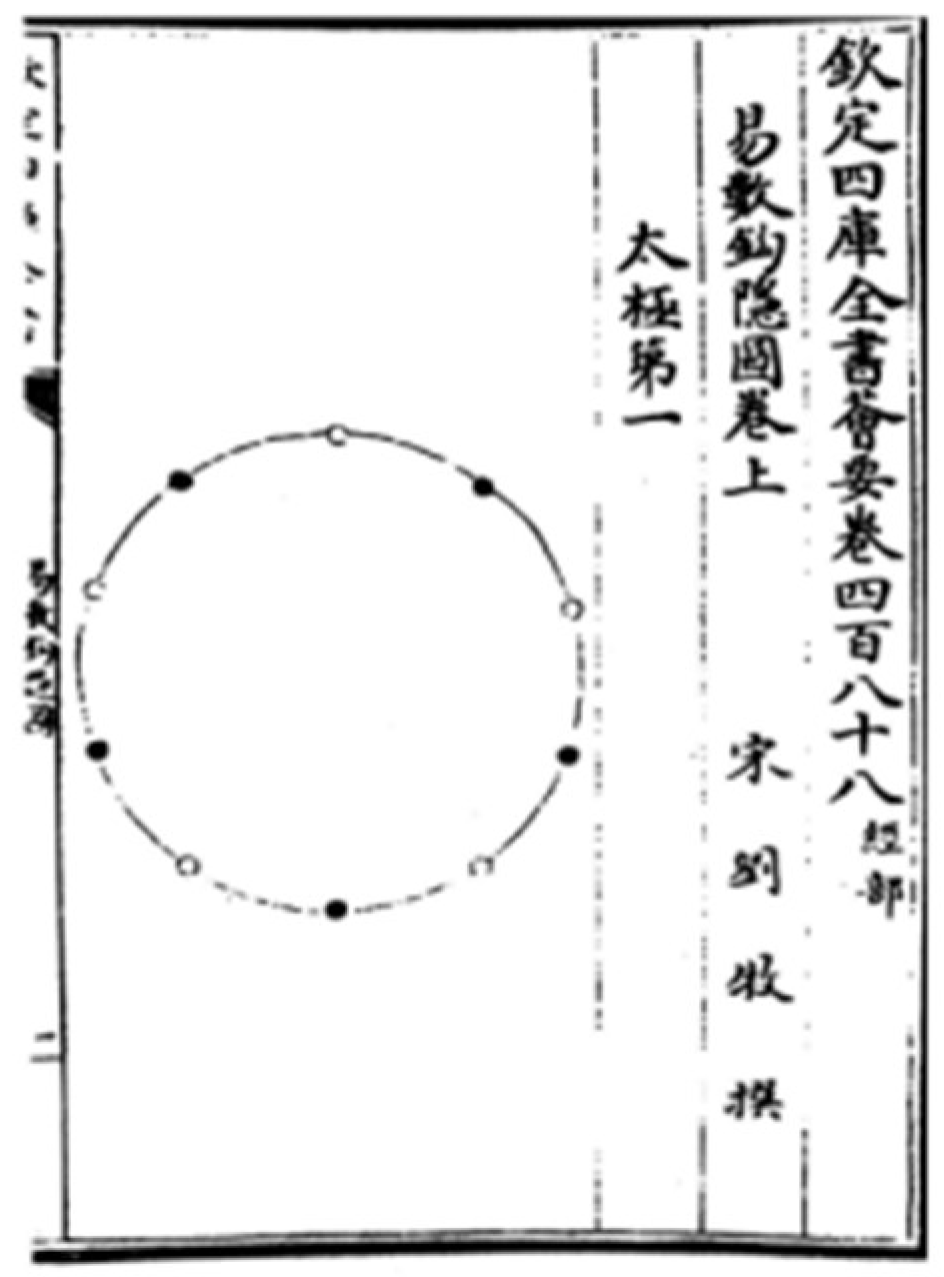
Before developing his numerical derivations, Liu Mu established the metaphysical premises on which the entire system rests. The first is that “the Supreme Ultimate (
taiji 太極) is a single
qi 氣” (
Figure 4). Liu Mu rejected Wang Bi’s interpretation of the Supreme Ultimate as “non-being” (
wu 無), arguing instead that before yin and yang have differentiated, they subsist as a unified primordial
qi (
Liu 1989, p. 11). The Supreme Ultimate names this state: not the absence of being, but a phase in which the potential for differentiation is present but not yet actualized. As the origin and starting point of cosmological generation, the Supreme Ultimate is above all something that is, and its numerical correlate is one. The unfolding of world order is accordingly a process of generation from one to many.
The second premise is that “the alternation of yin and yang constitutes the Way.” If the Supreme Ultimate is the origin of generation, yin and yang are its mechanism. Neither yin alone nor yang alone can sustain the generative process; only their interaction produces the numinous efficacy from which the Four Images, and ultimately the myriad things, emerge (
Liu 1989, p. 16). The numerical correlate of this interactive mechanism is two, and it is on this basis that change in all things and situations is grounded.
The third premise is that “what is unfathomable in yin and yang is called spirit” (
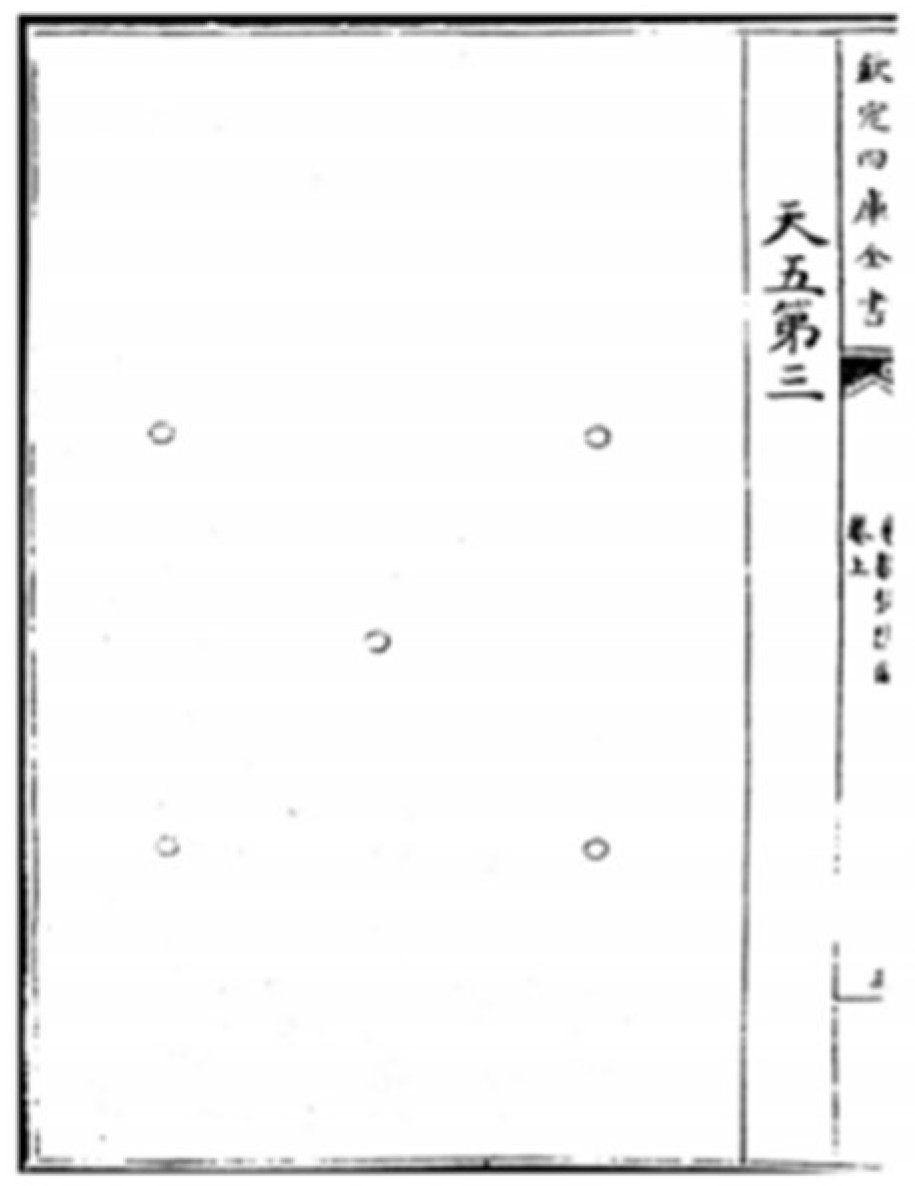
shen 神). If the sequence two-four-eight, corresponding to yin-yang, the Four Images, and the Eight Trigrams, represents the regular and determinable dimension of natural generation, the indeterminate dimension is lodged in the number five (
Figure 5). Among the numbers one through ten, Liu Mu assigned one through four as generative numbers (
shengshu 生數) of the Four Images and six through nine as completing numbers (
chengshu 成數) of the Four Images. Heaven’s Five (
tianwu 天五) stands at the boundary between these two sets, belonging fully to neither, and it is this position that makes it both the pivotal element that “occupies the center and governs transformation” and something that resists direct definition. Liu Mu could only say of it: “One does not know what kind of thing it is; one forces a name upon it and calls it the qi of central harmony; one does not know why it is so, yet so it is” (
Liu 1989, p. 4). Once the way of the triad is complete, five “withdraws and conceals itself in the hidden” (
tuicang yu mi 退藏於密), meaning both that it cannot be directly observed or known and that it does not act independently. As Liu Mu put it: “Heaven’s five is not unused; rather, it is what uses the Four Images”—in practice, five is lodged within the completing numbers seven, eight, nine, and six (
Liu 1989, p. 4).
This arrangement gives Liu Mu’s cosmology a distinctive tension. The order of the cosmos is numerically derivable and follows intelligible principles, but behind those principles operates a coordinating and animating force that cannot itself be directly grasped. Change is orderly, but it is not mechanical.
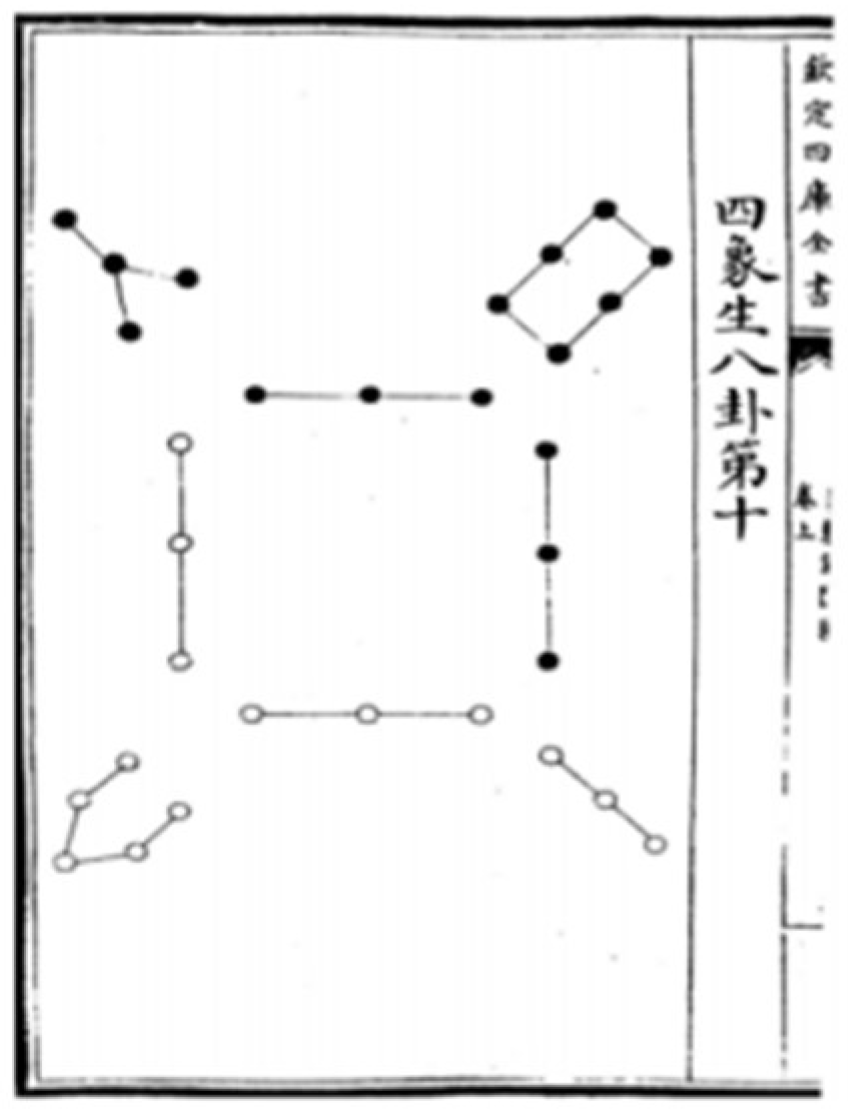
How this order unfolds concretely begins with the Four Images. The Four Images belong to the metaphysical order, representing the first differentiation of
qi across the spatial and temporal directions. Through the four completing numbers (six, seven, eight, and nine), they correspond to the four elemental qualities of metal, wood, water, and fire, and generate in turn the eight trigrams (
Figure 6). It is worth noting that Liu Mu distinguished between two uses of “Four Images” in the
Xici. The first, as discussed above, refers to the numerical basis for generating the Eight Trigrams. The second, in the phrase “the Yi has Four Images by which it shows,” refers to four symbolic categories: auspicious, inauspicious, regretful, and transformative (
Liu 1989, p. 7). Kong Yingda had conflated the two, and further glossed “Four Images” as concrete physical substances such as metal, wood, water, and fire. For Liu Mu, this was not merely a textual error. If the Four Images are understood as already formed physical things, the inferential chain from the Two Modes to the Eight Trigrams breaks at its midpoint, and the fundamental distinction between the metaphysical and physical orders collapses with it.
These trigrams are categorical images that precede the existence of individual things. The transition from the metaphysical to the physical order, however, is not yet complete. Of the Five Phases, earth remains unaccounted for, and its number is ten. Once ten is incorporated, the numbers one through ten together constitute what Liu Mu calls the “generative numbers of the Five Phases” (
wuxing shengcheng shu 五行生成數), spanning the full arc of cosmological generation. Their sum is fifty-five, identical to the “numbers of heaven and earth” (
tiandi zhi shu 天地之數) recorded in the
Xici. For Liu Mu, this equivalence was not incidental. It revealed that the numerical structure of cosmological generation and the numerical structure of heaven and earth are one and the same, confirming that the order of the cosmos is, at its deepest level, numerically self-consistent (
Liu 1989, p. 34).
The
Hetu (totaling forty-five) and the
Luoshu (totaling fifty-five) carry the numerical structure before and after the incorporation of earth’s number ten, corresponding to what the
Xici identifies as the Way (
dao 道) and concrete implements (
qi 器), respectively. As Liu Mu put it, the
Changes “contains within itself both the Way and concrete implements; this is why the sages required both diagrams to compose it” (
Liu 1989, p. 26).
Because the sages composed the
Changes on the basis of the natural numerical patterns of heaven and earth, all normative content within it, including ethics and political order, is grounded in the natural order rather than in human convention. For Liu Mu, norms are not instituted by human decision but are identical with the principles by which things naturally operate. The moral qualities associated with the Five Phases are not imposed on human life from without; the teaching of the Five Constants is their natural extension into the domain of human relations. As Liu Mu wrote, “in the working of the triad, without the Five Phases not even a moment can proceed” (
Liu 1989, p. 18). The same continuity runs through the sequence of the sixty-four hexagrams. Beginning with
Qian 乾 and
Kun 坤 as the “root of creative transformation,” moving through
Kan 坎 and
Li 離, which “begin and complete the ten thousand things,” to
Xian 鹹 and
Heng 恒, which “sustain the ancestral temple,” and concluding with
Jiji 既濟 and
Weiji 未濟, this sequence is not an arbitrary arrangement but a complete derivation from cosmological generation to the order of ritual and governance (
Liu 1989, p. 41). For Liu Mu, to follow the teaching of the Five Constants and to accord with the way of heaven and earth were one and the same thing. It is this identity that gives political and moral norms their authority, rooting them in the natural operation of the cosmic order rather than suspending them from the surface of human institution.
Yet to read Liu Mu’s system as a form of rationalism would be a misreading, and an understandable one. His reliance on numerical derivation and his commitment to internal coherence as the standard of his Yi studies framework give it the appearance of a self-sufficient rational system. But spiritual forces and the yarrow-stalk method are also situated within this numerical order, representing a dimension that numerical derivation can neither exhaust nor replace. This is the subject of the following section.
5. Spiritual Forces and Divination: A Classical Exegesis of the Yarrow-Stalk Method
Liu Mu’s account of spiritual forces and divination turns on his interpretation of three numbers in the
Xici: the supreme number of heaven and earth (
tiandi ji shu 天地極數), fifty-five (
Figure 7); the great expansion number, fifty (
Figure 8); and the number of yarrow stalks used in divination, forty-nine (
Figure 9). The two successive reductions between these numbers had been a focal point of commentarial dispute across the centuries.
On the first reduction, from fifty-five to fifty, Han Kangbo 韓康伯’s commentary had simply sidestepped the question of why five is subtracted, while Kong Yingda held that the two numbers bear no direct relationship to each other. Liu Mu rejected both positions. The numbers used in yarrow-stalk divination, he argued, are precisely what represent the patterns of heaven and earth, and to leave the reduction unexplained is to abandon the interpretive task. His explanation returned to the principle established earlier: Heaven’s Five “withdraws and conceals itself in the hidden.” Since five does not operate independently but is always already lodged within the four completing numbers of the Four Images, the great expansion number represents what is operationally available within the total structure. As Liu Mu put it, the great expansion number is the number of heaven and earth in use; because Heaven’s Five does not act independently, the great expansion number is less than the supreme number of heaven and earth by five (
Liu 1989, p. 10). The supreme number fifty-five is the complete structure of the numerical system, its
ti 體; the great expansion number fifty is the operationally available portion of that structure, its
yong 用. The difference in five marks the boundary between structure and operation.
On the second reduction, from fifty to forty-nine, Liu Mu found the Han-dynasty commentators uniformly unconvincing. Jing Fang 京房, Ma Rong 馬融, Zheng Kangcheng 鄭康成, and Gu Huanyun 顧懽雲 had each selected a number from the set of heaven and earth numbers and imposed it on the problem from outside, none of them working from the internal logic of the yarrow-stalk structure itself (
Kong 1990, p. 154;
Liu 1989, p. 12). The only accounts Liu Mu took seriously were those of Wang Bi and Han Kangbo, both of whom recognized that the reduction pointed toward something that the numerical framework alone could not contain.
Wang Bi approached the problem through the concept of the Supreme Ultimate. Using the formula “what is unused is what allows use to penetrate; what is not a number is what allows numbers to be completed,” he argued that the Supreme Ultimate, corresponding to the number one, operates not as a term within the numerical system but as its underlying condition. It is precisely because the Supreme Ultimate stands outside the categories of number and use that it can pervade the working of the forty-nine stalks without appearing as one of them (
Kong 1990, p. 154). Han Kangbo pressed this logic further. Moving through a series of paired oppositions, use and non-use, number and non-number, being and non-being, he concluded that the withheld one is the Supreme Ultimate, and the Supreme Ultimate is non-being, the undifferentiated ground that precedes and exceeds all determinate things. The finite numbers of yarrow-stalk divination, on his reading, gesture toward this ineffable horizon without ever reaching it (
Kong 1990, p. 155). Taken together, Wang Bi and Han Kangbo drew the second reduction toward a metaphysics of absence.
Liu Mu’s response to Han Kangbo was selective. He accepted the premise that the withheld one is what makes the operation of the other numbers possible, a point consistent with his own reading of Heaven’s One as occupying a position of sovereign stillness. What he rejected was the metaphysical conclusion Han Kangbo drew from this premise. His objections operated on two levels. At the level of classical exegesis, the
Xici states plainly that “the Yi has a Supreme Ultimate,” and the word “has” (
you 有) forecloses any interpretation that identifies the Supreme Ultimate with non-being. Liu Mu further argued that reading the Supreme Ultimate as non-being was Han Kangbo’s own addition, not a faithful rendering of Wang Bi’s original position (
Liu 1989, p. 11). At the numerical level, Liu Mu identified an internal inconsistency in Han Kangbo’s position. Within the numerical framework, Heaven’s Five is already accounted for as the number that withdraws and conceals itself, and this withdrawal explains the reduction from fifty-five to fifty. If one then applies the same logic to Heaven’s One, treating it too as a number that withdraws and conceals itself, the question immediately arises: why was this withdrawal not accounted for at the earlier stage? To have two numbers operating by the same principle of concealed withdrawal, with no explanation of why they withdraw at different moments in the derivation, is to leave the structure without a coherent internal logic.
Liu Mu’s own account of why Heaven’s One is withheld rested on a different kind of argument. Heaven’s One does not participate in the yarrow-stalk operation because, as the sovereign of cosmic transformation, it possesses the highest heavenly virtue and therefore has no need to act directly (
Liu 1989, p. 12). The logic here is that of a ruler whose authority is expressed precisely through non-action: it is because the highest authority already embodies the fullest virtue that it need not demonstrate itself through direct intervention. Yarrow-stalk divination is a human practice of attuning to the natural patterns of heaven and earth in order to discern what is auspicious or inauspicious. Within this practice, the absence of Heaven’s One is not a deficiency in the system but a deliberate structural feature. It functions as a symbol at the operational level, representing the inaccessibility of the Supreme Ultimate as the ultimate ground of the cosmos (
Liu 1989, p. 38).
Taken together, Liu Mu’s objections to Han Kangbo reveal two fundamental disagreements, the first concerning the nature of number itself. For Han Kangbo, numbers are humanly instituted signs whose authority derives from their symbolic function. For Liu Mu, numbers are structures that manifest naturally within heaven and earth. Heaven One, Earth Two, Heaven Three, Earth Four: these emerge at the very moment yin and yang first differentiate, prior to any human assignment of meaning. It is precisely this non-human origin that gives numbers their power to connect the human and the cosmic. From the perspective of the diviner, only by manipulating a count of stalks that strictly corresponds to the numerical patterns of heaven and earth can one attune to the actual course of change in things. The sacred authority of numbers and the validity of divination results both rest on the same foundation: that numbers are not of human making.
The second disagreement concerned ontological commitment. Han Kangbo’s identification of the Supreme Ultimate with non-being carried a consequence that Liu Mu found unacceptable: if being derives from non-being, heaven and humanity inhabit fundamentally different orders, and no continuous medium connects them. Humanity belongs to the world of what exists; the ultimate ground of the cosmos does not. The gap between them can at best be bridged symbolically, never genuinely traversed. Liu Mu’s insistence that the cosmological origin is a form of being, as discussed in
Section 3, appears to be driven by precisely this concern. Only if the origin is itself something that exists can the
qi of heaven and earth and the
qi of human beings belong to a single continuous sequence of generation and transformation. And only on that basis can the way of heaven and the way of humanity, the natural order and the moral order, constitute a genuine unity rather than a symbolic correspondence between two heterogeneous worlds. Liu Mu’s rejection of the philosophy of non-being was, at its deepest level, an argument about the continuity of heaven and humanity, and through that argument, an attempt to secure the metaphysical foundation that moral norms require: not a symbolic analogy with the cosmos, but a ground that affirms their real existence within it.
Where exactly do spiritual forces stand within Liu Mu’s system? They cannot be reduced to natural regularities, nor can they be supernatural forces operating outside the numerical order, since that would reintroduce precisely the kind of portent narrative Liu Mu had worked to dismantle. His readings of three passages in the
Xici that bear on spiritual forces reveal his answer. The first passage states that “the numbers of heaven and earth amount in all to fifty-five; it is by means of these that transformation is accomplished and spiritual forces set in motion.” Kong Yingda read this as placing spiritual forces outside the numerical order: the numbers of heaven and earth express the transformations of yin and yang, and spiritual forces move by means of those transformations without themselves being numerical in nature. Liu Mu’s reading was directly opposed. Because the numbers of heaven and earth are identical in sum to the generative numbers of the Five Phases, the numerical structure is complete in itself, and it is this completeness that makes the operation of spiritual forces possible. Spiritual forces are not what the numbers point toward as signs point toward referents; they are the numinous efficacy inherent in the operation of the numerical structure itself (
Liu 1989, p. 5). The second passage states that “spirit has no fixed location, and the
Changes has no fixed form.” For Liu Mu, both the inscrutability of spirit and the formal inexhaustibility of the
Changes are grounded in the internal complexity of the numerical structure, not in any void that lies behind it.
The third passage states that “refined
qi constitutes things, and the wandering of the ghost constitutes change; it is in this way that one comes to know the conditions of spiritual forces.” Kong Yingda took this as a description of spiritual forces as the process of
qi gathering and dispersing (
Kong 1990, p. 149). Liu Mu showed no interest in that question. When he cited this passage, he did not treat it as a text requiring independent exegesis but placed it at the end of his argument about the generative numbers of the Five Phases, as a confirmatory reference rather than a subject of inquiry in its own right (
Liu 1989, p. 4). For Liu Mu, spiritual forces arise within the numerical order and share its abstract character; the question of what they look like in concrete manifestation simply does not arise. What Kong Yingda took as the central problem is, within Liu Mu’s framework, not a problem at all.
For Kong Yingda, spiritual forces are transcendent beings external to the human world, and divination is an act of consultation in which the diviner poses questions and awaits their response, a practice he describes as “taking counsel with spiritual forces” (
Kong 1990, p. 178). For Liu Mu, this account misses what divination actually is. Since spiritual forces are already embedded within the numerical structure, the significance of yarrow-stalk divination lies not in any dialogue with external beings but in the practice of manipulation itself. Each step of the yarrow-stalk procedure recorded in the
Xici, from the initial gathering of the forty-nine stalks to the final formation of a hexagram, corresponds precisely to a stage in the cosmological sequence of generation and transformation. The entire operation is an active enactment of the numerical patterns of heaven and earth (
Liu 1989, p. 42).
Strict correspondence alone, however, does not explain why yarrow-stalk divination can attune to the numinous workings of heaven and earth. If the procedure were simply a form of numerical derivation, it would be indistinguishable from arithmetic calculation, and its results would be nothing more than a reproduction of known regularities rather than a genuine resonance with the actual course of cosmic change. The crucial element, Liu Mu argued, is the deliberate withholding of Heaven’s One. By omitting it from the operation, the practitioner builds a gap into the procedure, a space reserved for what cannot be directly grasped. Calculation is a closed logic: given the conditions, the result follows, and nothing remains outside the derivation. Yarrow-stalk divination, by contrast, withholds Heaven’s One as a matter of deliberate design, acknowledging within the operation itself that there is a position no calculation can ever fill. It is this intentional structural gap that gives yarrow-stalk divination the character of a religious ritual.
This structural gap is the specific site within Liu Mu’s system where the numinous finds its place. As introduced at the outset of this article, Otto’s account of the numinous insists that it cannot be reached through instruction or derivation; it can only be evoked in an encounter to which the practitioner opens themselves. Yarrow-stalk divination is, within Liu Mu’s system, the Yi studies form of precisely this encounter. By manipulating a count of stalks that corresponds strictly to the numerical patterns of heaven and earth, the practitioner moves, through ordered action, toward the numinous workings of the cosmos that cannot be directly grasped. That numinous quality can only be approached through the practice itself; it is not something derivation can reach.
What yarrow-stalk divination is, within Liu Mu’s system, can now be stated clearly. It is neither a means of communicating with external spiritual forces nor a form of pure rational calculation. It is a ritual whose outward form is a numerical operation and whose deliberate inner gap preserves a space that reason cannot close.
6. Conclusions
The argument of this article suggests that the question of authority in Liu Mu’s Yi studies cannot be answered at the level of xiang-shu structure or semiotic mechanism alone. In the intellectual climate of the Renzong reign, the authority of the Hetu and Luoshu rested not simply on their effectiveness as interpretive tools but on the dual foundation Liu Mu constructed for them. The objectivity of the numerical patterns of heaven and earth furnished a sacred ground for political and moral norms that transcended human convention, while the structural gap built into the yarrow-stalk procedure carved out, within an otherwise derivable rational order, an irreducible space for genuine encounter with cosmic mystery. The internal unity of these two dimensions is what constitutes the religious character of Liu Mu’s Yi studies, and it is precisely this dimension that existing xiang-shu scholarship and semiotic approaches have left unaddressed.
Within the intellectual history of the Renzong reign, Liu Mu’s solution carried a specific historical significance. Emperor Zhenzong’s “Heavenly Books” affair had pushed the narrative of divine portents to its political extreme, leaving any classical interpretation that invoked mystical authority vulnerable to the same stigma. At the same time, stripping the political and moral order of its sacred grounding entirely and reducing it to a human construct was equally unavailable as an option for the classical revival of the Renzong period. Liu Mu’s solution opened a third path between these two positions. By replacing the discourse of heavenly portents with the authority of sage transmission, and by grounding the sacred order in the objectivity of cosmic numerology rather than in miraculous signs, he preserved the binding character of that order without reproducing the political mythology that had been discredited.
The deeper support for this solution was a continuity between heaven and humanity at the ontological level. Because the cosmological origin is primordial qi rather than non-being, the qi of heaven and earth and the qi of human beings belong to a single unbroken sequence of generation and transformation. Natural order and human moral order thereby constitute a genuine unity rather than a symbolic correspondence between two heterogeneous realms. It is this ontological foundation that allows numerical cosmology to serve as a metaphysical ground for the political and moral order, rather than merely an analogical parallel to it.
Acknowledging the intellectual significance of Liu Mu’s solution, however, also requires acknowledging its internal limits. Liu Mu established a framework for the continuity of heaven and humanity at the ontological and cosmological levels, but his system offered no concrete path for how a person might internalize and realize that continuity in practice. Numerical derivation presents the objective structure of the cosmic order; the inner correspondence between that structure and the human mind is, in Liu Mu’s system, presupposed rather than argued for. That presupposition is internally consistent at the cosmological level, but it provides no point of entry that a practitioner could take up from within their own subjectivity.
What the Neo-Confucian thinkers later undertook was precisely to transform that presupposed correspondence into a question that could be pursued inward. The concept of li 理, inherent both in the structure of the cosmos and in the human mind, carries ontological and normative force simultaneously, and it is this dual character that makes the continuity of heaven and humanity something a person can grasp from within rather than merely observe from without. The problem Liu Mu left open, how a person moves from knowing the structure of the cosmos to actually cultivating themselves in accordance with it, was one that Neo-Confucian thinkers would find it necessary to address, even as they disputed many of the specific positions Liu Mu had taken.
Liu Mu’s Yi studies represented an early Northern Song attempt to articulate a unified order of heaven and humanity. It accomplished the transfer of sacred authority from miraculous signs to numerical structure, and grounded the continuity of heaven and humanity in a coherent ontological framework. Together, this transfer and the gap it left mark Liu Mu’s place in the intellectual history of the Song dynasty: his work defined a problem space that Neo-Confucianism would inherit, transform, and in important respects move beyond.