1. Introduction
Quyang County (
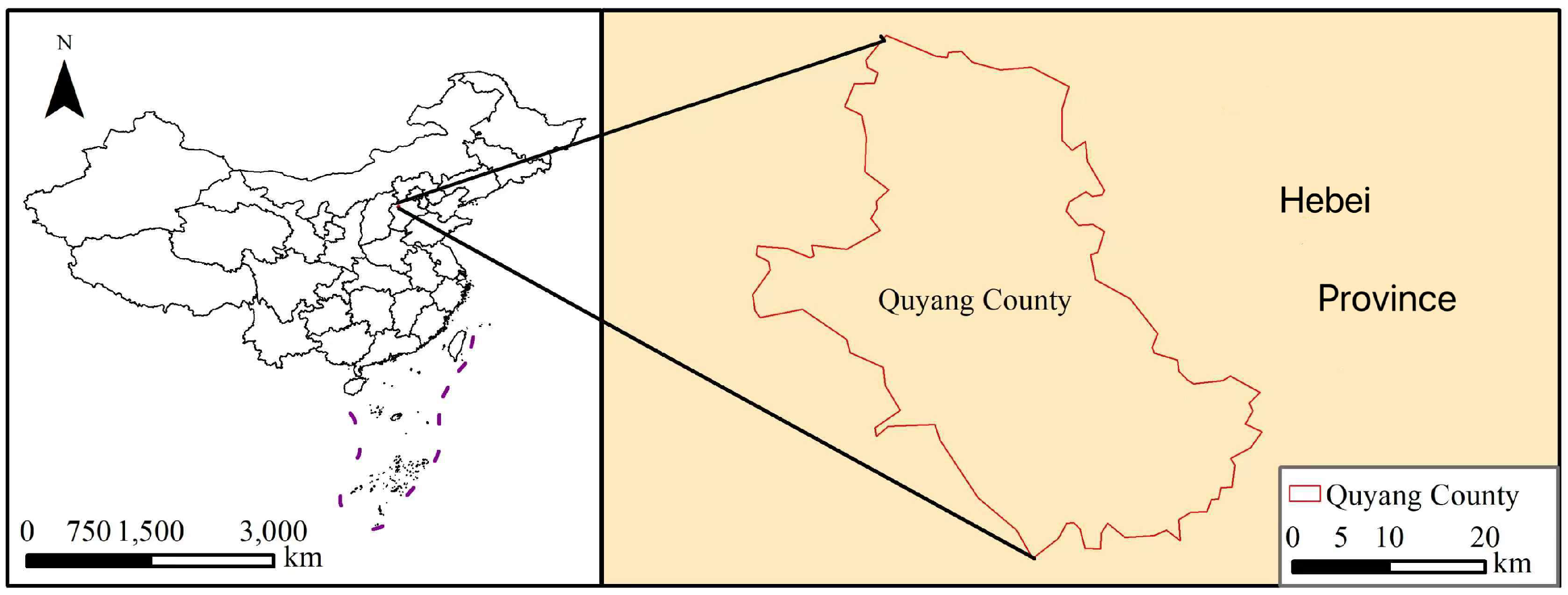
Figure 1) is situated on the eastern foothills of Mount Taihang 太行 and is administered by Ding 定 Prefecture in Zhili Province (present-day Baoding 保定 City, Hebei Province). The
Commentary on the Water Classic (
Shuijing zhu 11. 289) records, ‘The city lies on the sunny side of a bend in the mountains, hence the name Quyang’ (
cheng zai shanqu zhi yang, shi yue quyang 城在山曲之陽,是曰曲陽).
Historically, Quyang County had two temples dedicated to the Northern Peak (Beiyue 北嶽), an upper temple and a lower temple. The upper temple stood in the northern valley of Mount Heng 恆, approximately seventy kilometres northwest of the county (
Zhang and Ma 2009), while the lower temple was located in Quyang County itself. During the Wei and Jin periods (220–420), the lower temple was further divided into eastern and western parts. According to the
Commentary on the Water Classic (
Shuijing zhu 11. 289), ‘In the late Han dynasty, chaos and warfare blocked the mountain routes. This site once had the lower terrace shrine. Since the mid-Jin period, local clans have annually recorded their names and performed rituals here in accordance with ancestral customs. During the Wei and Jin periods, it was reorganised into two temples, east and west, with erected steles, watchtowers (
que 闕), ritual grounds, and arrayed cypresses before the temple.’ The Western Temple no longer survives, and the Eastern Temple corresponds to today’s Northern Peak Temple in Quyang. This temple was first constructed during the reign of Emperor Xuanwu of the Northern Wei dynasty (499–515) and was rebuilt in the Zhenguan period (627–650) of the Tang dynasty (
Overmyer 2009, p. 37). Its extant main structures (
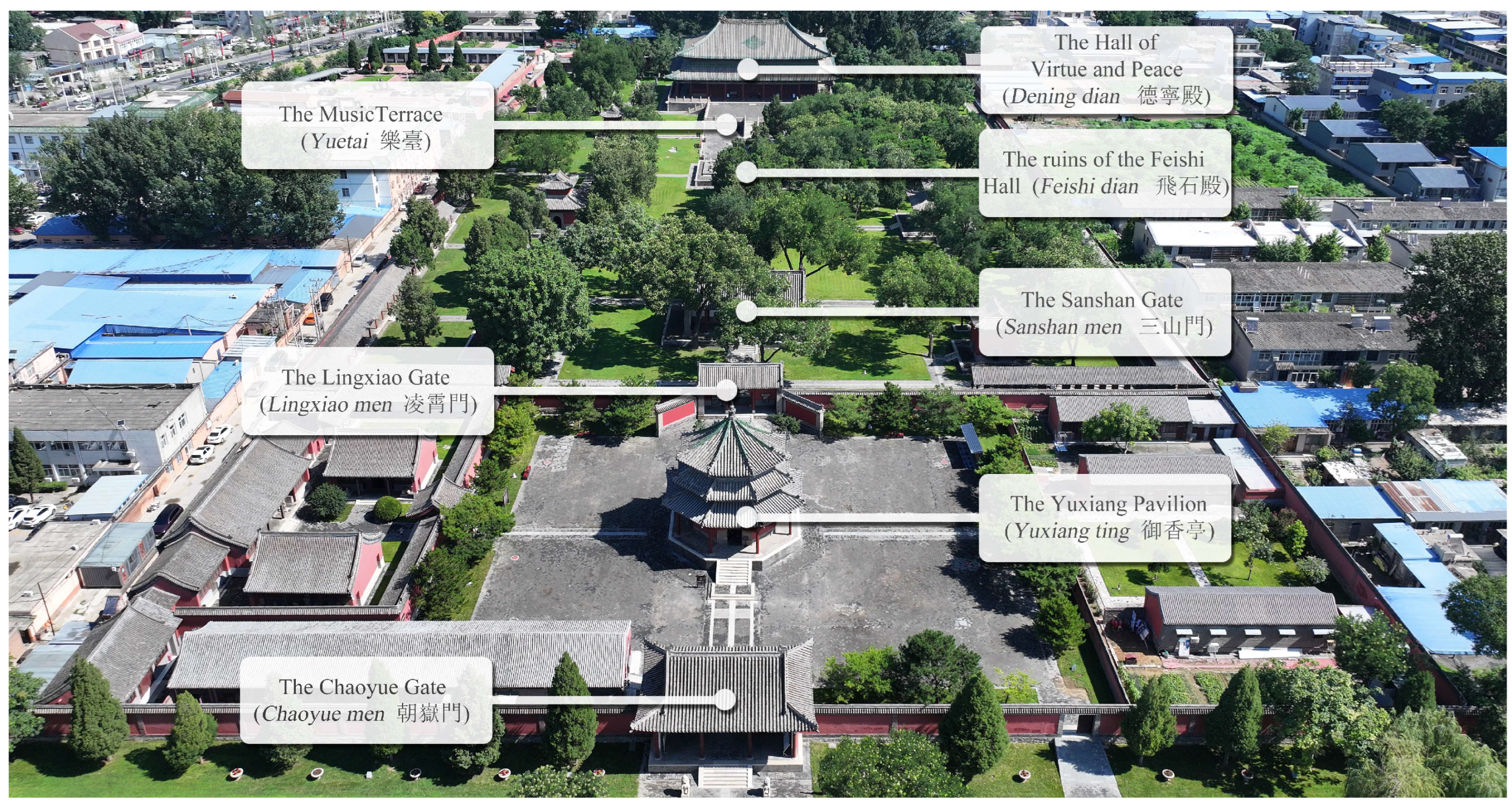
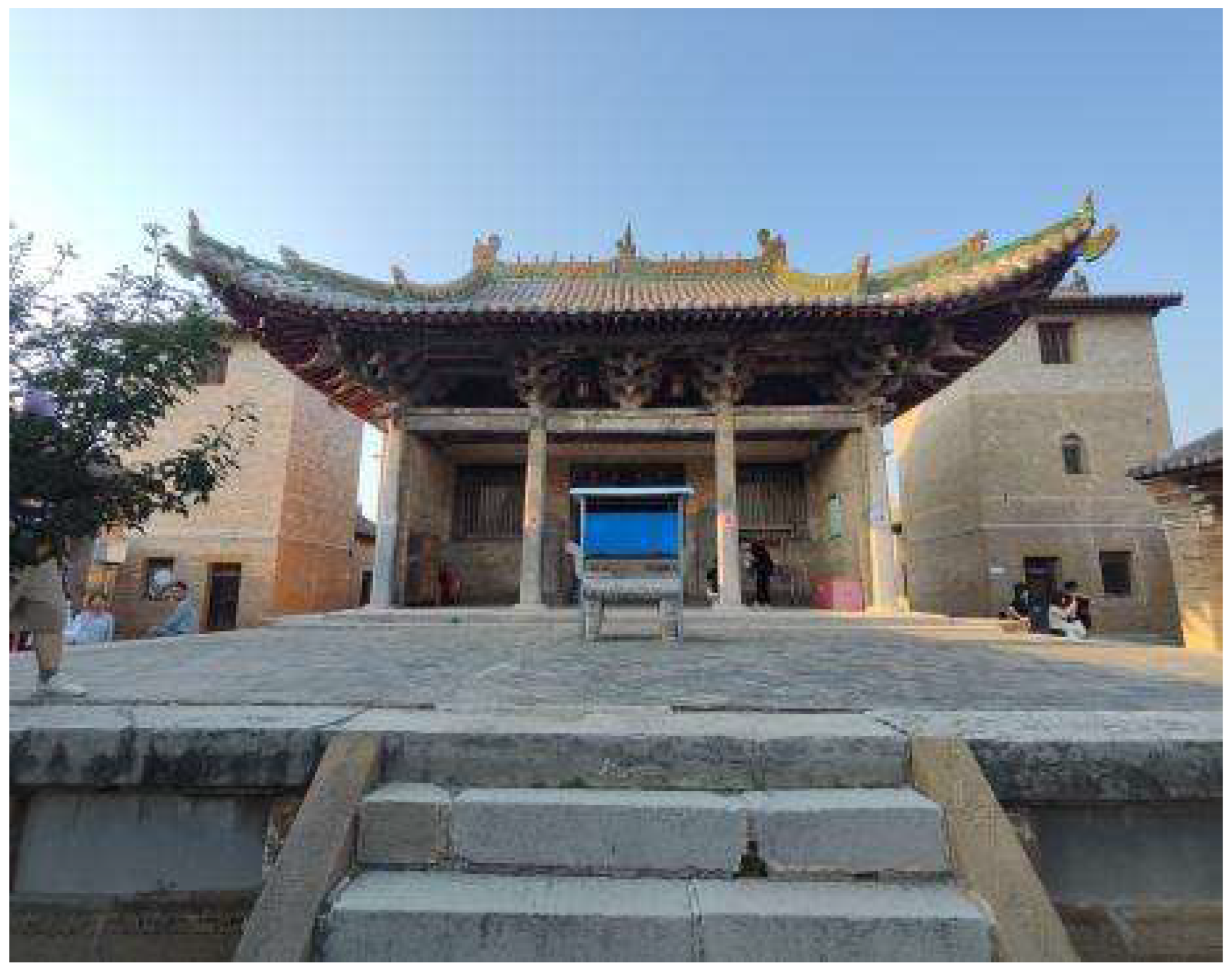
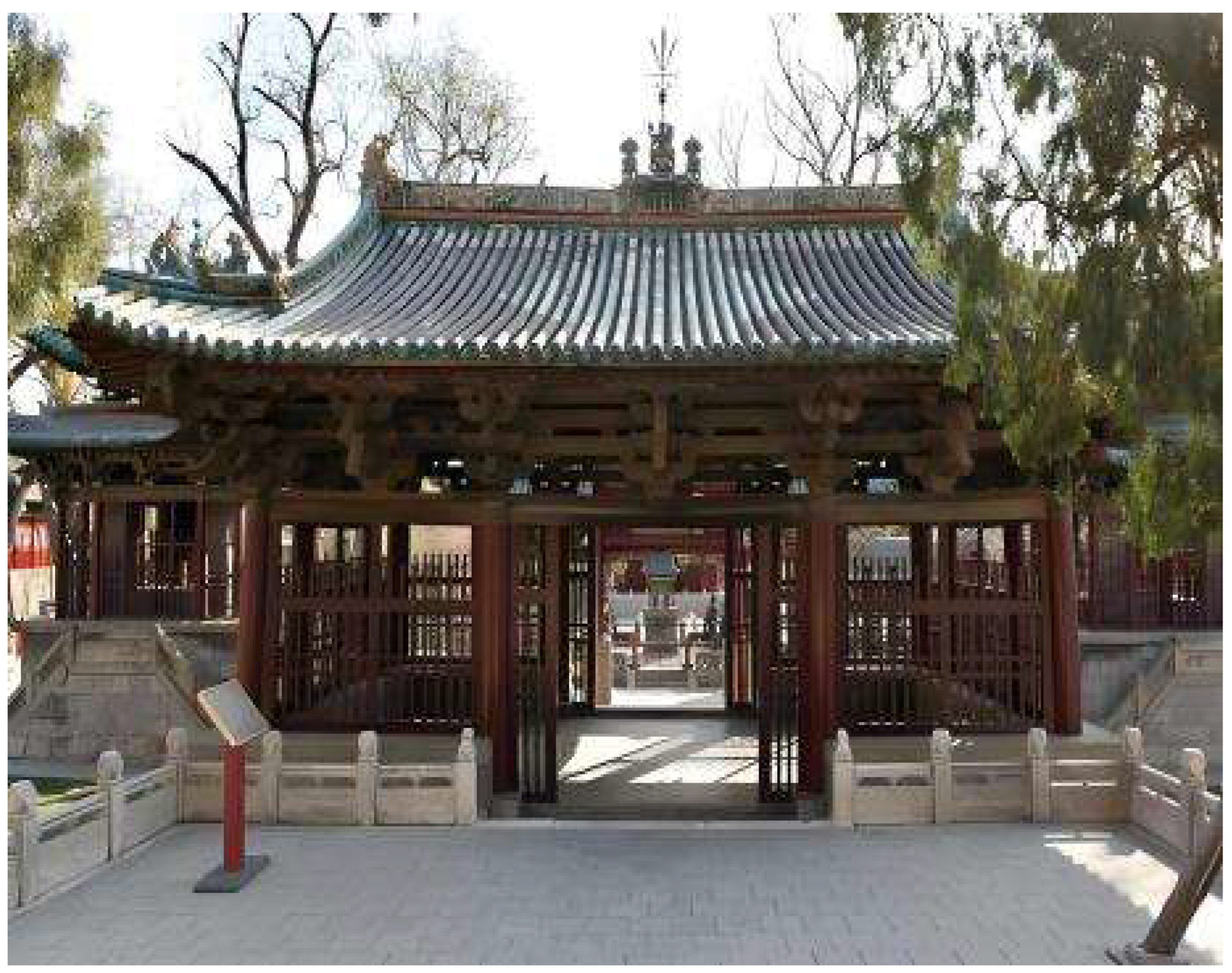
Figure 2) include the Chaoyue Gate (
Chaoyue men 朝嶽門), the Yuxiang Pavilion (
Yuxiang ting 御香亭), the Lingxiao Gate (
Lingxiao men 凌霄門), the Sanshan Gate (
Sanshan men 三山門), the ruins of the Feishi Hall (
Feishi dian 飛石殿), the Music Terrace (
Yuetai 樂臺), and the Hall of Virtue and Peace (
Dening dian 德寧殿).
1
Figure 1.
Location map of Quyang County, Hebei Province, China.
2
Figure 1.
Location map of Quyang County, Hebei Province, China.
2
Figure 2.
Extant Core Buildings of the Northern Peak Temple, Quyang, Hebei.
Figure 2.
Extant Core Buildings of the Northern Peak Temple, Quyang, Hebei.
The Northern Peak Temple in Quyang was constructed to worship the ancient Northern Peak, Mount Heng.
3 Together with Mount Tai泰 in the east, Mount Hua 華 in the west, Mount Song嵩in the centre, and Mount Heng 衡 in the south, it forms the sacred Five Peaks (
wuyue 五嶽) of China. The cult of the Five Peaks originated in the early inhabitants’ reverence for mountains and rivers. By the pre-Qin period, sacrifices to mountains and rivers had already become common ritual practices. Pre-Qin texts, such as the
Book of Documents (
Shangshu 尚書) and the
Zuo’s Commentary (
Zuozhuan 左傳), contain references to the Four Peaks (
siyue 四嶽), which subsequently developed into the Five Peaks (
Zhou 2012;
Jia 2022), as noted in the
Rites of Zhou (
Zhouli 5. 1441): ‘Offer blood sacrifices to the Soil and Grain, the Five Gods, and the Five Peaks’. Yet, there was no specific reference to what the Five Peaks were at that time. It was not until the reign of Emperor Xuan 宣of the Han dynasty (r. 74–48 BC) that the appellation ‘Five Peaks’ became firmly established.
The ‘Treatise on Sacrifices’ of the Book of Han (Hanshu, cited in Wuli tongkao 47. 2008) records, ‘From this time onward, ceremonial rituals were regularly conducted at all the Five Peaks and the Four Rivers. The Five Peaks are the Eastern Mount Tai at Bo; the Central Mount Taishi 太室 at Songgao; the Southern Mount Qian 灊 at Qian; the Western Mount Hua at Huayin; and the Northern Mount Chang 常 at Shangquyang.’ Mount Chang is actually Mount Damao 大茂, located in Baoding. In the seventeenth year of the Shunzhi reign (1660) of the Qing dynasty, the sacrificial rite to the Northern Peak was relocated from Mount Chang to Mount Tianfeng 天峰 in Hunyuan 渾源 County, Datong 大同, Shanxi Province (Qing shilu 138. 1065).
In this article, temples are broadly classified into ‘official-sacrificial temples’ and ‘popular cult temples’ according to their construction, management, and officiants. ‘Official-sacrificial temples’ refer to those built and managed primarily by government authorities and in which officials performed sacrifices in accordance with the state ritual system.
4 ‘Popular cult temples’ denote those constructed and maintained by local communities and serving as venues for popular worship.
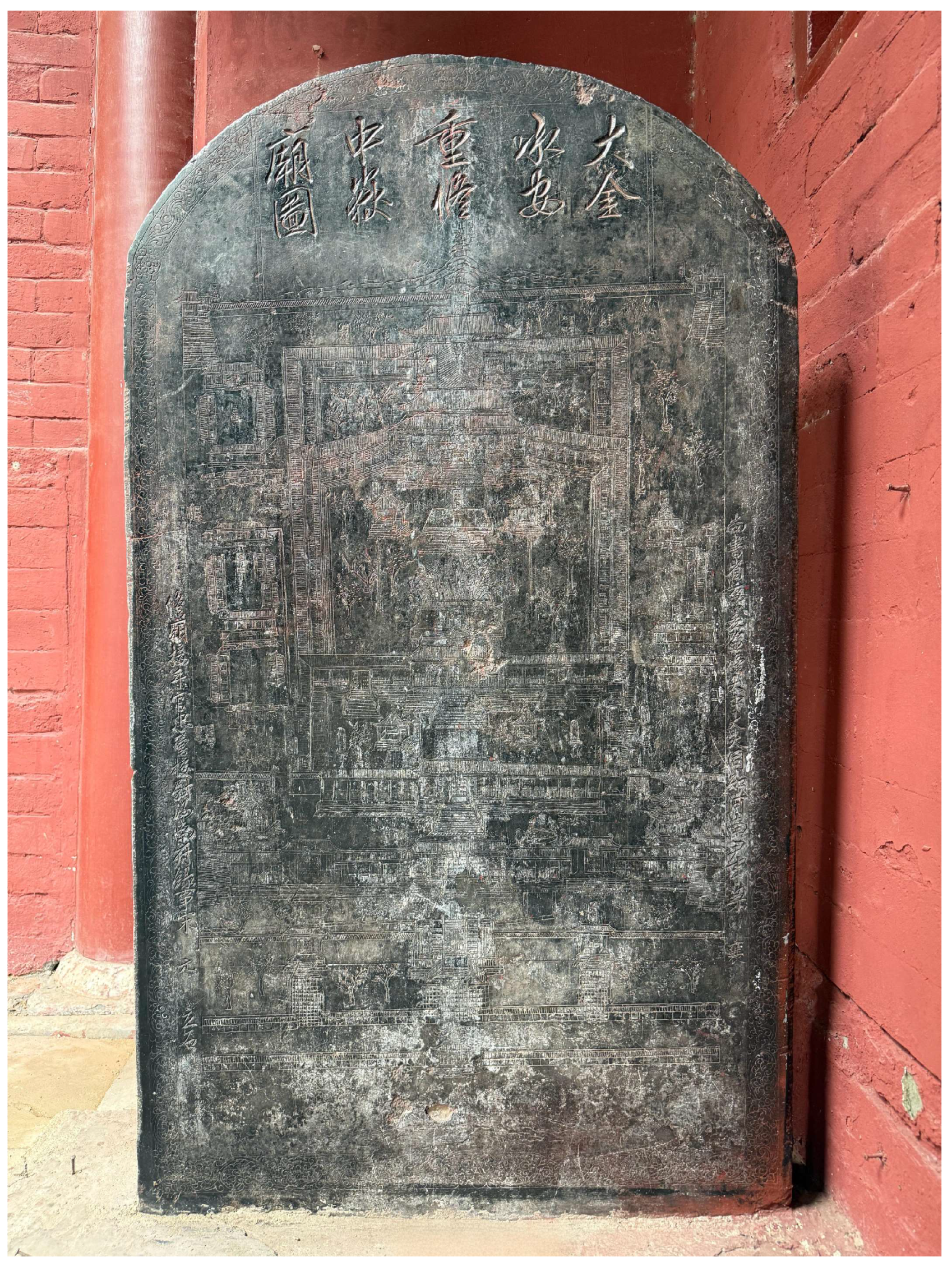
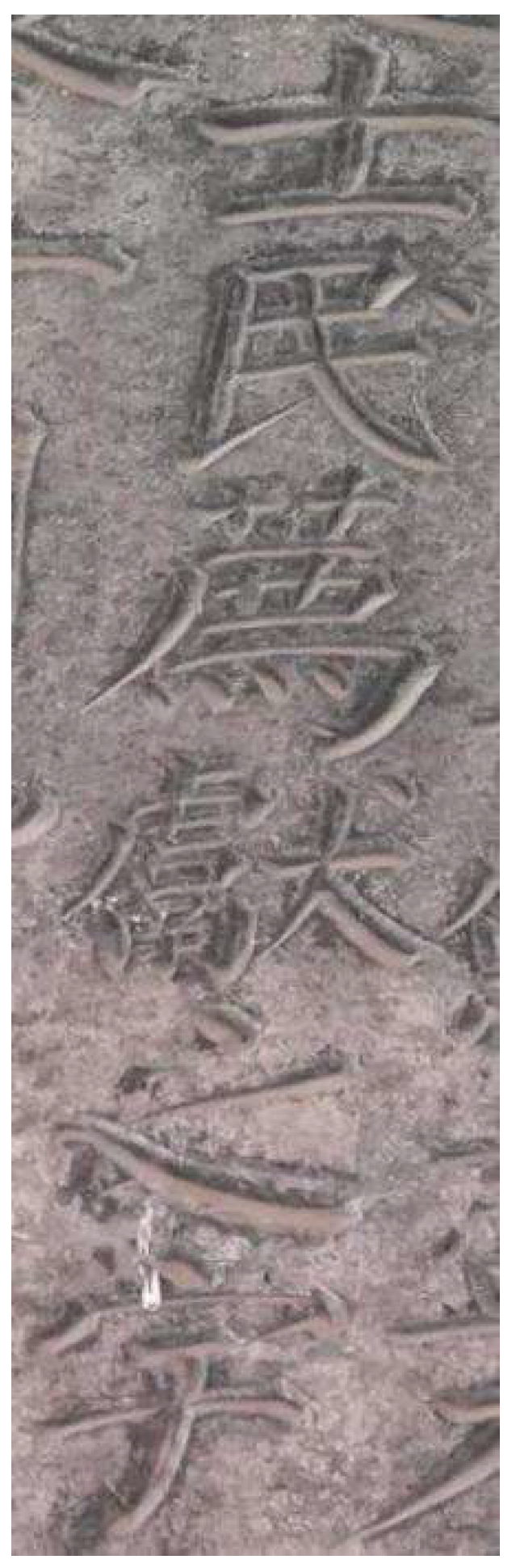
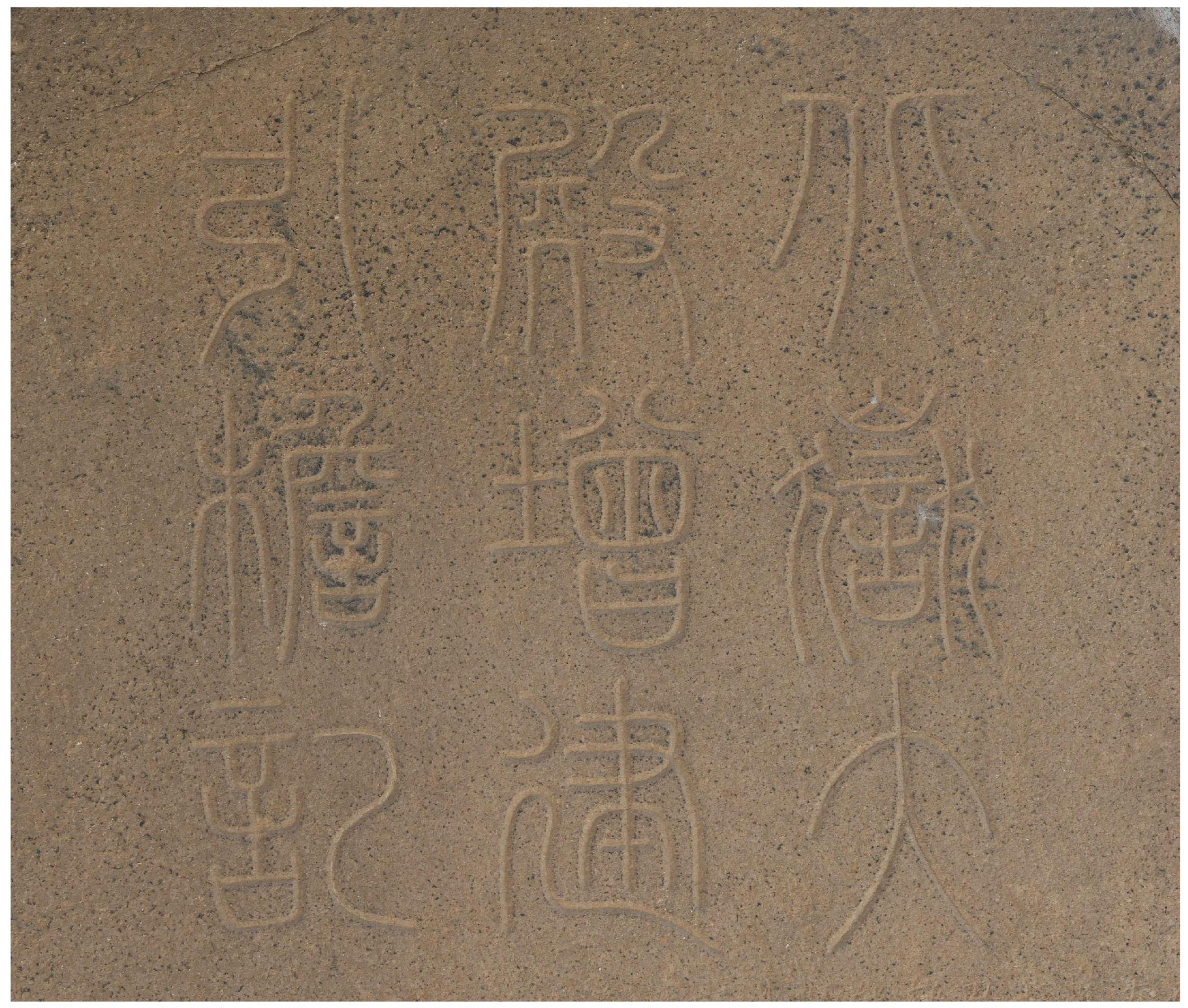
Based on the level of sacrificial protocol, official-sacrificial temples can be further divided into ‘state sacrificial temples’ and ‘local official temples’. The former were temples where sacrifices were offered by the emperor or his appointees, whereas the latter were overseen by local officials. Before relocating the ritual site of offering sacrifices to the Northern Peak from Mount Chang to Mount Tianfeng in 1660, the Northern Peak Temple in Quyang had served as a state sacrificial temple. Within the temple compound, 137 extant inscriptions related to the Northern Peak Temple have been preserved. There are some highly valuable temple stele inscriptions. For example, the Stele of Wang Chuzhi (Wang Chuzhi bei 王處直碑), dated to the second year of the Zhenming 貞明 reign (916) of the Later Liang period, contains the phrase ‘front altar, rear garden (qiantan houwan 前壇後菀)’; the Great Song Record of the Renovation of the Northern Peak Temple (Dasong chongxiu beiyuemiao ji 大宋重修北嶽廟記), dated to the second year of the Huangyou 皇祐 reign (1050) of the Northern Song dynasty, notes ‘a hall for presenting sacrificial offerings by the common people (shimin jianxian zhi yu 士民薦獻之宇)’; the Record of Adding Overhanging Eaves to the Main Hall of the Northern Peak Temple (Beiyue dadian zengjian yinyan ji 北嶽大殿增建引檐記), dated to the fourth year of the Shaosheng 紹聖 reign (1097) of the Northern Song dynasty, records the ‘yinyan 引檐 (overhanging or projecting eave)’; and there are three Line-engraved depictions of temples dated to the second year of the Da’an 大安 reign (1210) of the Jin dynasty, the fourteenth year of the Hongwu 洪武 reign (1381) of the Ming dynasty, and the twenty-sixth year of the Jiajing 嘉靖 reign (1547) of the Ming dynasty. These inscriptions provide crucial empirical evidence for reconstructing the sacrificial space of the Northern Peak Temple.
The term ‘sacrificial space’ is used in two senses: first, to refer to the core sacrificial space, the designated areas within the temple specifically reserved for sacrificial performances, and second, to refer to the temple complex as a whole. Cross-referencing the stele inscriptions with the depictions of temples from the Jin dynasty and the Ming dynasty reveals that the construction of the sacrificial space at the Northern Peak Temple in Quyang was a joint effort between the state and the local community. This collaboration manifested in two main ways: first, during the Northern Song period, the temple contained spaces for both official and popular sacrifices, collectively constituting the sacrificial space of the temple, and second, the temple itself was constructed through the joint efforts of the government and the local community.
Building on this understanding, the central research question of this study is how the sacrificial space inside the Beiyue Temple evolved under the combined influence of official and popular practices. To address this question, this study draws on architectural remains, inscribed steles, and temple diagrams, employing an integrated methodology of field investigation, textual analysis, and cross-referencing of images and documents. The analysis unfolds in four steps. First, the ‘front altar, rear garden’ is examined to investigate the form and function of early state ritual altars. Second, the ‘hall for presenting sacrificial offerings of the common people’ and the ‘overhanging eave’ are analysed to show how folk ritual spaces were incorporated into state temples. Third, extant temple diagrams are used to trace the complete evolutionary trajectory of ritual and performative spaces at the Northern Peak Temple, Quyang. Finally, from both synchronic and diachronic perspectives, this study reveals the characteristic pattern of ‘joint official–popular construction’. By integrating these findings, this study challenges the conventional view that state-sanctioned temples lacked spaces for popular worship, while providing crucial evidence for the historical development of the sacrificial hall (xiandian) and pavilion-style stages (wuting) in Chinese temple theatre.
2. What Is ‘Front Altar, Rear Garden’?
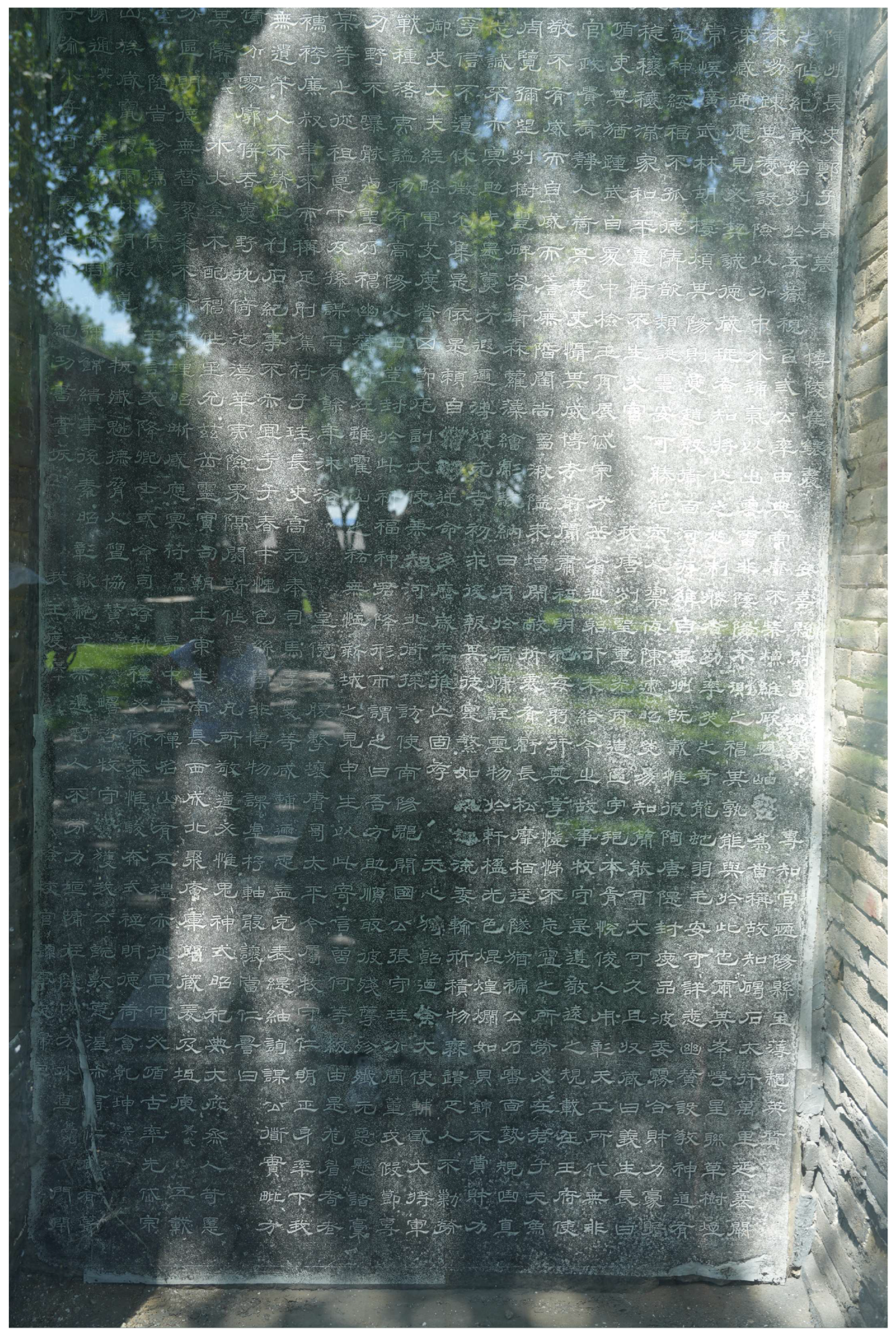
To investigate the early form of ritual and performative spaces at the Northern Peak Temple in Quyang, the reference to ‘front altar, rear garden’ in the
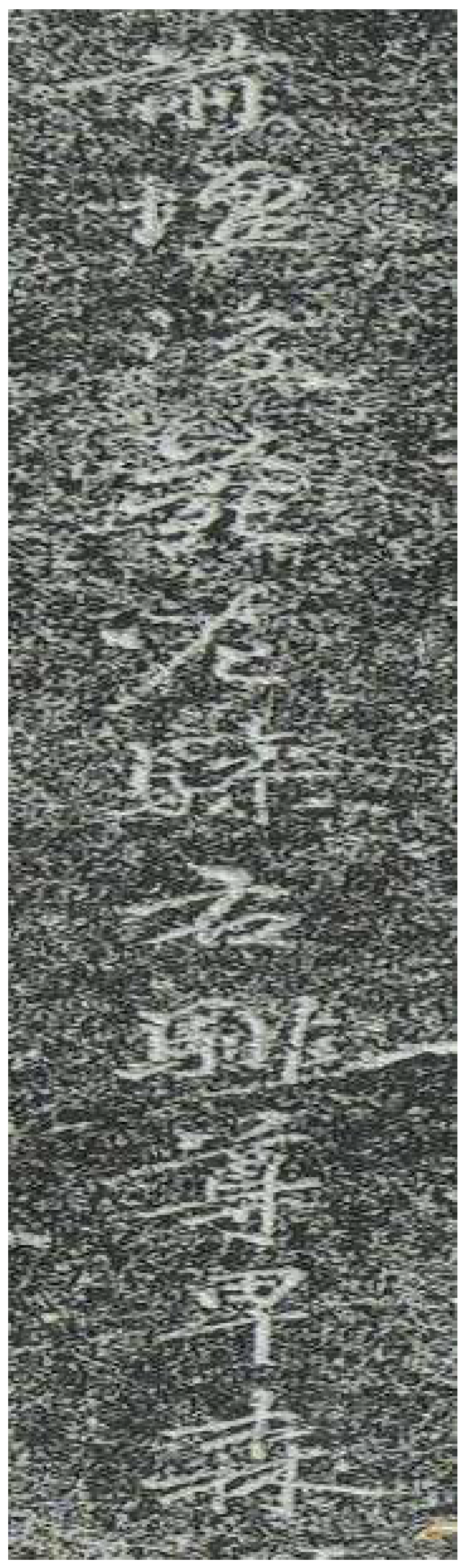
Stele of Wang Chuzhi (
Figure 3) (
Limin Wang 2013, p. 120) serves as a crucial piece of evidence.
5 The character 壇 (
tan) refers to the ritual and performative space within the Northern Peak Temple during the Five Dynasties period (907–960). The precise time of its construction remains blurred. According to the
Commentary on the Water Classic, ‘During the Wei and Jin dynasties, there were two temples to the east and west, with erected steles, watchtowers, altars, ritual grounds, and rows of cypress trees in front of them’ (
Shuijing zhu 11. 289). This indicates that a ritual altar and ground already existed in front of the temple complex during the Northern Wei period. In the stele inscription, the character 菀 (
wan) functions as a graphic variant of the character 苑 (
yuan). As recorded in the second-century Chinese dictionary,
Explaining Graphs and Analysing Characters (
Shuowen jiezi 15.187), ‘
yuan is a place for raising birds and beasts’. Thus, the term originally referred to an enclosed area for keeping animals and was later extended to mean a garden or courtyard. Thus, the phrase
hou wan 後菀 likely refers to the garden formed between the rear wall of the temple complex and the main hall.
Before the Han dynasty, the worship of the Five Peaks was conducted through the ritual of liaoji 燎祭 (burnt offerings). The ‘Treatise on Sacrificial Rites to Heaven and Earth’ (Fengshan shu 封禪書) in the Records of the Grand Historian (Shiji 28. 3432) notes, ‘In the second month of the year, Emperor Shun undertook an eastern inspection tour and arrived at the Great Ancestral Mountain, Mount Tai. There he burned offerings and performed sacrifices to the mountains and rivers […] In the eleventh month, he proceeded to the Northern Peak, that is, Mount Heng, where the ceremonies were all conducted in the same manner as those at Mount Tai’. After the Han dynasty, the construction of temples for enshrining deities gradually became prevalent, and the tan 壇 emerged as a standard ritual feature within temple architecture. As the Book of Han (Hanshu 4. 126) records, ‘I [the emperor] have had the privilege of holding the sacrificial victims and jade tokens to offer sacrifices to the Supreme Deity and the ancestral temples. Since I came to power, fourteen years have now passed, and the days have grown long. Being neither diligent nor enlightened, I am deeply ashamed to have long governed the country. Hence, he extensively expands all ritual altars and jade tablets’. The entry of the Zhen River (Zhenshui 溱水) in the Commentary on the Water Classic (Shuijing zhu 11. 902) reads, ‘Below lies a divine temple, its back leaning against the cliff and its front facing the stream; the altar stands solemn and empty’. This temple was situated beneath a cliff in an exceptionally remote location, yet it still featured an altar. Such evidence illustrates the prevalence of altar construction within temple complexes of the period.
Before the Tang dynasty, ritual altars generally adopted a three-tiered structure. As recorded in the ‘Basic Annals of Emperor Xiaowu’ (Xiaowu benji 孝武本紀) of the Records of the Grand Historian (Shiji 28. 3432), ‘The altar of Taiyi consisted of three concentric layers (Taiyitan tansangai 泰一壇,壇三垓)’. Similarly, the Gongyang’s Commentary on the Spring and Autumn Annals (Chunqiu Gongyang zhuan 7. 4849) states, ‘Duke Zhuang 莊 stepped onto the altar’, to which the Eastern Han Confucian scholar Zheng Xuan 鄭玄 (AD 127–200) adds the annotation, ‘The altar was a mound three chi high, with three steps leading up to it’. When referring to the Daiyue Temple in Tai’an, the Commentary on the Water Classic (Shuijing zhu 24. 580), citing the Record of the Campaign (Congzheng ji 從征紀), a now-lost geographical and literary work compiled by Wu Jizhi 伍輯之during the Liu Song period (420–479), notes, ‘There were three successive gates and four towers, and a three-tiered altar, over one zhang in height and eight zhang in width’. The form of the altar in the Northern Peak Temple during the Northern Wei period was likely consistent with this structure.
However, the
Stele of Wang Chuzhi was inscribed in 916, nearly four centuries after the reign of Emperor Xuanwu (r. 499–515) of the Northern Wei. The character 壇 (
tan) in the inscribed text may have two possible meanings: (1) a ritual altar or (2) an open terrace (
lutai 露臺)
6. There are four reasons. First, as Feng Junjie 馮俊傑 (
Feng 2014, p. 8) argues, ‘from the Han dynasty through to the Sui, Tang and Five Dynasties periods, temple altars that also served as performance stages continued to be used, although there was a tendency for them to be replaced by open terraces’. The open terrace first appeared in temple architecture during the Tang dynasty. For instance, ‘In the second year of Zhide reign (757) of the Tang dynasty, the Daoist priest Li Guozheng 李國正 petitioned the imperial court, requesting permission to construct a spiritual pathway to the celestial realm for the imperial family’s divine system, by means of establishing an Upper Palace of Heavenly Splendour (Tianhua shanggong 天華上宮) and an open terrace atop a mountain peak thirty
li south of Zhaoying County’ (
Jiu Tangshu 130. 3618). By the Song dynasty, open terraces had become a common architectural feature within temple complexes (
Che 2001b, p. 26;
W. Yan 2020), while no records of the construction of three-tiered ritual altars have been found. Therefore, when the
Stele of Wang Chuzhi was erected, it is possible that the altar within the Northern Peak Temple had already been replaced by an open terrace.
Second, during the transition between ritual and performative spaces within temple complexes, the two structures may have been referred to interchangeably, with the ‘open terrace’ being called the
tan. This phenomenon is analogous to the later practice in which, even a century after the introduction of theatre stages into temples, such stages were still referred to as dance towers (
wulou 舞樓) or music towers (
yuelou 樂樓). Some scholars, such as
Ma (
2014), suggest that the open terrace represents a continuation of the square mounds and square altars established during the Zhou dynasty (1045–256 BC). Although no definitive evidence directly confirms that the open terrace evolved from the square mounds or square altars of the Zhou and subsequent periods, the terrace and the altar appear to have become functionally equivalent within temple contexts. During the process in which the open terrace gradually replaced the altar as the principal space for ritual and performance, a mixed use of the two terms occurred.
Third, the Northern Peak Temple was a state sacrificial temple, similar in nature to the Houtu Shrine (Houtu ci 后土祠) in Fenyin 汾陰 (
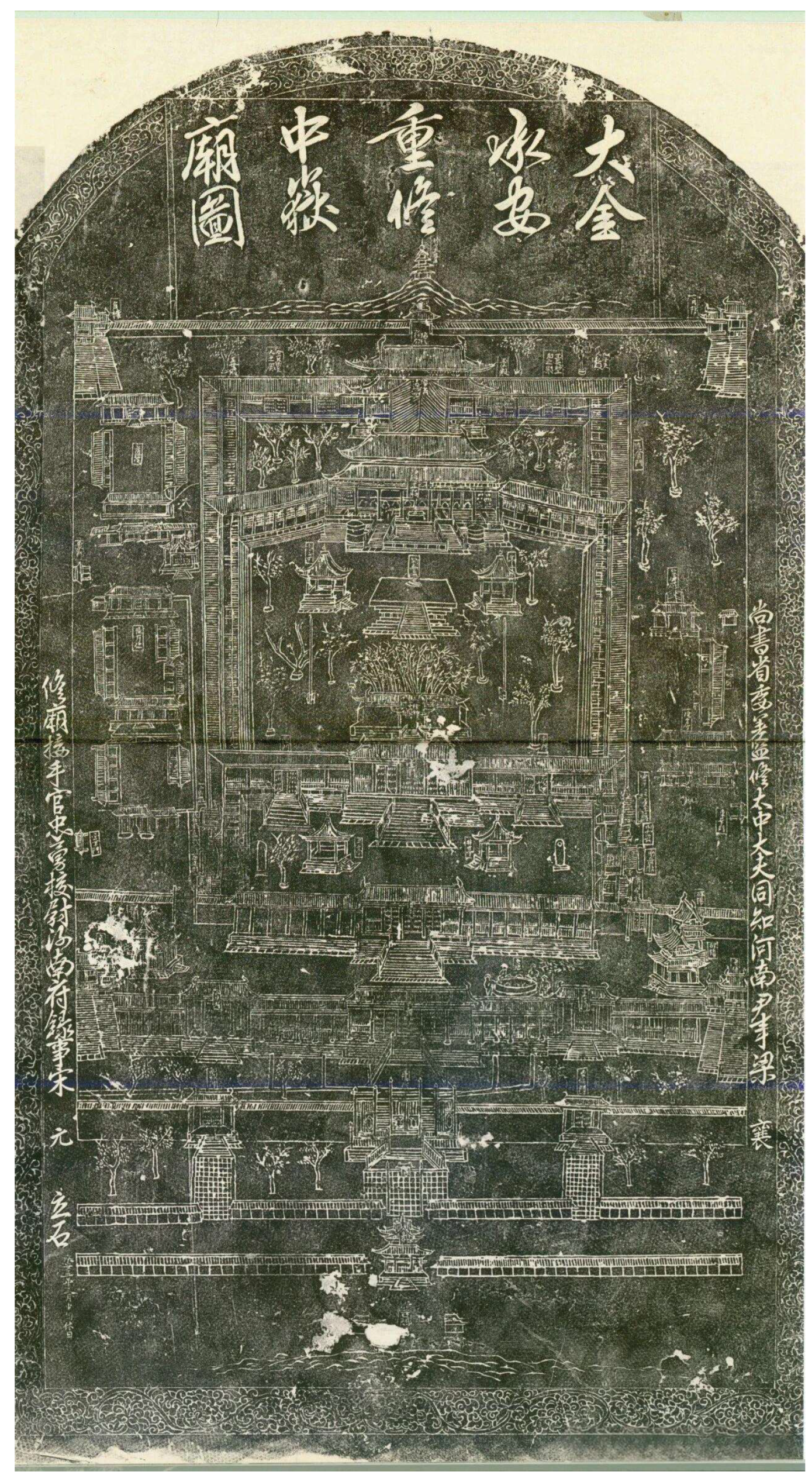
Figure 4) and the Central Peak Temple (Zhongyue miao 中嶽廟) in Dengfeng 登封. Both of the temples preserve depictions of their architectural layouts: the
Diagram of Houtu Shrine from the Dazhong Xiangfu 大中祥符 reign (1008–1016) of the Northern Song dynasty (
S. Wang 1963) and the
Diagram of the Central Peak Temple from the fifth year of the Cheng’an reign (1200) of the Jin dynasty (
Figure 5 and
Figure 6). In the
Diagram of Houtu Shrine, the main hall is preceded by the platform of the sealed stone container (
fengshi kui 封石匱) (
Che 2001b), an open terrace, a mountain gate, and a memorial archway. The platform of the sealed stone container is formed by the burial of a stone container and was unrelated to the altar.
In the
Reconstruction Plan of the Central Peak Temple from the Cheng’an Reign of the Jin Dynasty (
Dajin Cheng’an chongxiu Zhongyue miao tu 大金承安重修中嶽廟圖), only the open terrace and the main gate are shown in front of the main hall. In addition, within the Northern Peak Temple, the
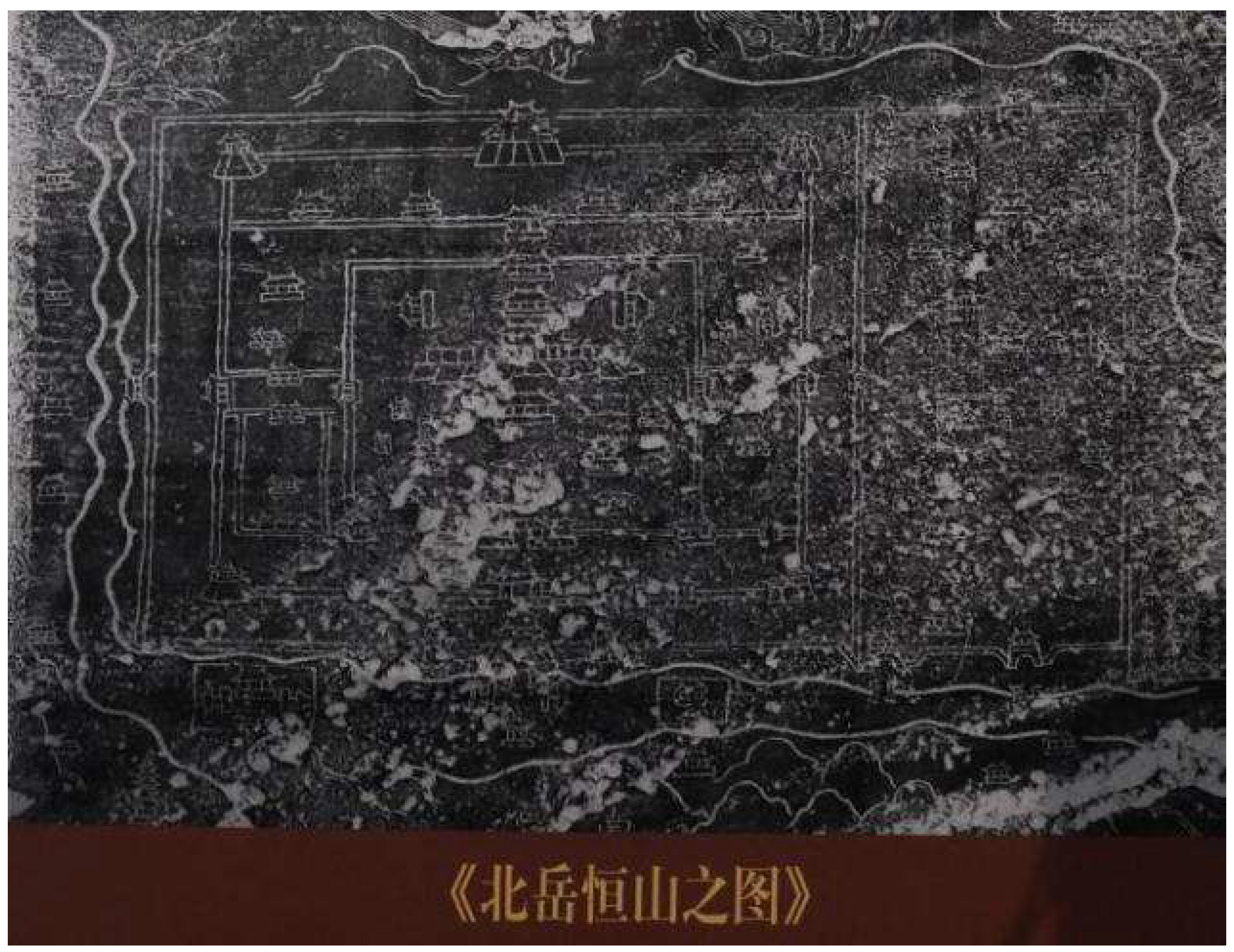
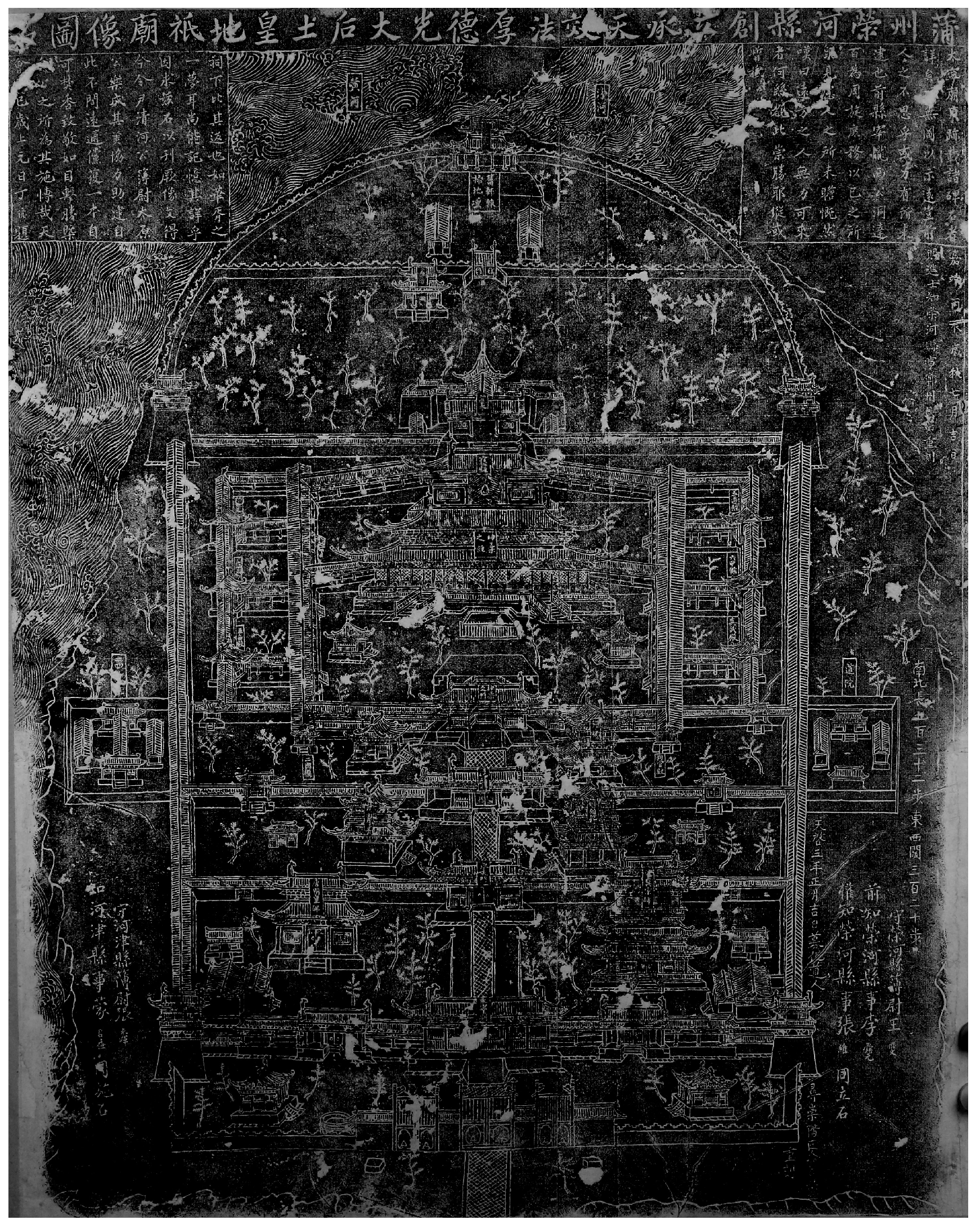
Diagram of the Northern Peak (
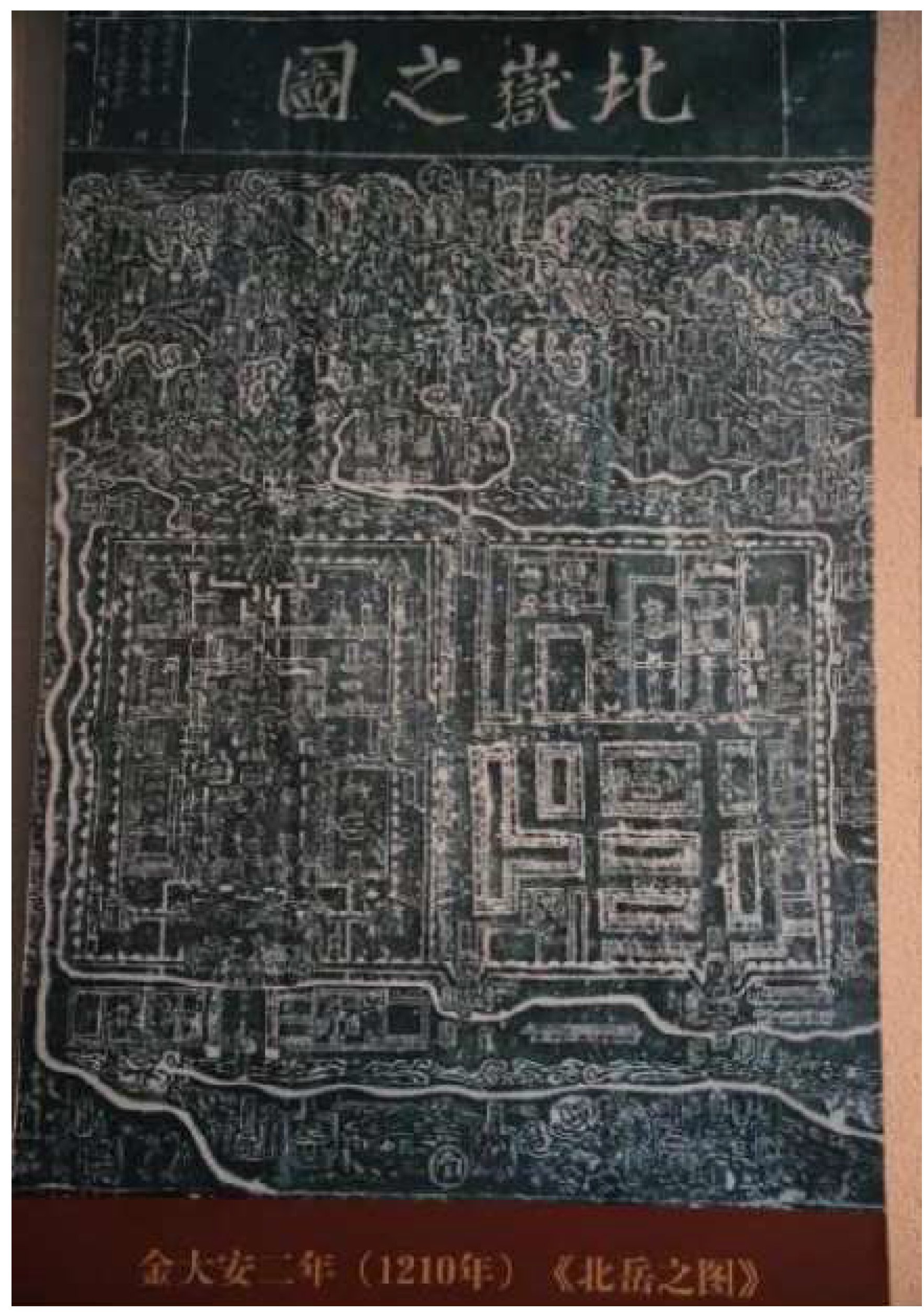
Beiyue zhi tu 北嶽之圖), dated to the second year of the Da’an reign (1209–1211) of the Jin dynasty, also depicts a terrace situated before the main hall (
Figure 7). Moreover, from the Five Dynasties through to the Jin dynasty, none of the stele inscriptions within the Northern Peak Temple mention the rebuilding of the sacrificial altar or the construction of the terrace. Therefore, it is highly likely that the word
tan referred to in the stele actually denotes the terrace.
In summary, there are likely two structural forms of the tan mentioned in the Stele of Wang Chuzhi. One is a triple-level square platform functioning as the sacrifice altar and the other is a single-level square platform corresponding to the open terrace. The sacrifice altar served multiple purposes, including housing the divine tablets, presenting sacrificial offerings and ritual music and dance performances, and other ritual activities (
Ni 2024). However, once the sacrifice altar was placed within the temple, its function of housing the divine tablets was effectively superseded by the main hall. Consequently, its remaining roles, namely, for sacrifice and performance, became largely consistent with those of the terrace. This functional convergence is one of the key reasons why the terrace could replace the altar as the principal venue for temple-based sacrificial performances.
3. What Is the ‘Hall for Presenting Sacrificial Offerings’?
The construction of the Hall for Presenting Sacrificial Offerings (
jianxian zhi yu 薦獻之宇) at the Northern Peak Temple in Quyang in the second year of the Huangyou reign (1049–1054) of the Song dynasty marked a significant shift in the functional layout of the temple’s ritual space and signalled a heightened level of public participation in its sacrificial practices (
Figure 8). It also provides key empirical evidence for examining the nomenclature and functions of temple-based ritual performance spaces during the Song-Jin period. According to the
Record of the Reconstruction of the Northern Peak Temple dated 1050, ‘Thus, the traces of dilapidation and decay were thoroughly renewed. Moreover, within its courtyard, a structure for presenting sacrificial offerings was erected for the common people, so that they might not profane the deity and, in doing so, render it even more revered’ (
Limin Wang 2013, p. 48).
The hall for presenting sacrificial offerings was a dedicated space constructed specifically for the populace to present sacrificial offerings. In functional terms, it was largely equivalent to the so-called ‘dance pavilions’ (wuting 舞亭) or ‘dance towers’ (wulou 舞樓) found in temple complexes established during the Song-Jin period, all of which combined dual functions: serving as venues for offering sacrifices and for housing performances.
The original meaning of the word jian 薦 is ‘grass’. This word could be used to mean both ‘consumption’ and ‘offerings to the deities’. According to the Explaining Graphs and Analysing Characters (Shuowen jiezi 19.1991), ‘Jian refers to the grass eaten by animals. In antiquity, when a unicorn-like beast was presented to the emperor, he asked: “What does it eat, and where does it dwell?” The reply was: “It eats jian.”’. The word jian was later extended to mean ‘to present’ or ‘to offer’. As stated in the Correct Meaning of the Rites of Zhou (Zhouli zhengyi 2. 62), ‘The former king used music to exalt virtue and solemnly offered it to the High Deity’.
The original sense of xian 獻 refers to a sacrificial dog, and it subsequently came to mean ‘to present’ or ‘to offer’. The Explaining Graphs and Analysing Characters (Shuowen jiezi 19. 2024) notes, ‘Xian refers to a dog used in ancestral temple sacrifices; when the dog was well-fattened, it was used as an offering’, and Duan Yucai 段玉裁 annotates, ‘Xian originally denoted offerings of dogs in sacrificial rites, and was later extended to refer to all acts of presenting offerings’ (Shuowen jiezi zhu 11. 476). The word jianxian 薦獻 first appears in the Eastern Han period (AD 25–220): ‘Those who perform jianxian are in the ancestral temples’ (Maoshi fujian 19. 464). Thus, jianxian means ‘to present offerings’. Compared to the use of either character alone, the word conveys a stronger sense of reverence and piety, which is why jianxian became a preferred expression in sacrificial contexts.
In this light, the expression of the Hall for Presenting Sacrificial Offerings in the Great Song Record of the Reconstruction of the Northern Peak Temple refers to a structure designated for the presentation of sacrificial offerings, whose primary functions were to display sacrificial items and perform ritual music and dance.
Ritual performance spaces within temple complexes of the Song-Jin period can be broadly divided into three categories by name. The first is the terrace. The second category consists of ‘dance stage-’ type structures, such as the dance pavilion (
wuting 舞亭), the dance courtyard (
wuting 舞庭), and the dance tower (
wulou 舞樓). The third category is ‘sacrificial hall-’ type structures, including the hall for presenting sacrificial offerings (
jianxian zhi yu), the tower for presenting sacrificial offerings (
jianxianlou 薦獻樓), the tower for offering sacrifices (
xianlou 獻樓), the hall for offering sacrifices (
xiandian 獻殿), and the hall of worship (
baiting 拜廳).
Luwei Wang (
2015, p. 158) has suggested that
The differences in these names stem from variations in the emphases of popular understanding. The so-called tower for offering sacrifices highlights the intrinsic nature of the sacrificial activities; whether involving material offerings or the intangible offering of music and dance, they are all dedicated to the deity’s consumption. By contrast, the terms of the dance pavilion and the dance tower emphasise the external form of the sacrificial activities, naming the buildings according to their performative function.
In addition, the normative attributes of ritual performative regulations constitute another crucial factor contributing to the divergence in naming. Drawing on both primary and secondary sources (
Bianjing yiji zhi 10. 165;
Dangshan dishiqidai caigong chanshi beiming;
Daoguang henei xianzhi 21. 417;
Guangxu lishui xianzhi 17. 534;
Che 2001a, p. 28;
Luwei Wang 2016, p. 101;
Che and Yao 2020, pp. 2–91), we identified twenty-two examples of ritual performance spaces with clearly documented names in Song–Jin temples (see
Table 1 for details). Among these, three instances occur within state sacrificial temples: the Hall for Offering Sacrifices (
xiandian 獻殿) at the Huiling Abbey (Huiling guan 會靈觀) in Kaifeng 開封; the Hall for Presenting Sacrificial Offerings (
jianxian zhi yu 薦獻之宇) at the Northern Peak Temple in Quyang; and the Hall for Offering Sacrifices at the Jin Shrine (Jinci 晉祠) in Taiyuan 太原.
7 Each contains the character 獻 (
xian) in its name, prominently expressing the notion of ‘offering’ (
xian).
There are a total of nineteen documented cases in which ‘popular cult temples’ built during the Song–Jin period had dedicated spaces for ritual performances, each with a clearly designated name. Among these, eleven are named with terms related to ‘dance’ (wu 舞), seven are designated with terms related to ‘offering’ (xian 獻), and one is named with the word ‘worship’ or ‘worshipping (bai 拜).
Overall, during the Song–Jin period, ritual performance spaces in state sacrificial temples were consistently designated as ‘the hall for offering sacrifices’ (xiandian), whereas those in popular temples were predominantly called a ‘dance pavilion’ (wuting). In brief, the names of ritual performance spaces in temple complexes during the Song–Jin period were closely linked to the normative attributes of the temple’s ritual and performative regulations.
Two principal factors contribute to this phenomenon. First, the hall for offering sacrifices originally functioned as a ritual space within imperial mausoleums, and, thus, its construction within temple complexes has a clear historical origin. As early as the Zhaoling 昭陵 Mausoleum of Emperor Taizong of the Tang dynasty (r. 626–649), the hall for offering sacrifices was already in place (
Zhang and Wang 2006). ‘The hall for offering sacrifices was a place for sacrificial commemoration at the tomb and for the display of objects used by the deceased during the person’s lifetime’ (
Q. Wang 2021, p. 327). It is therefore evident that the hall for offering sacrifices was an officially recognised sacrificial space, and its adoption in temple contexts to denote ritual performance spaces is reasonable.
Second, terms related to the hall for offering sacrifices were used widely and generically to designate sacrificial performance spaces within temple complexes. Examples include: the hall for offering sacrifices at Huiling Monastery in Kaifeng; the Hall for Presenting Sacrificial Offerings at the Northern Peak Temple in Quyang; the Offering Tower at the Sanzong Temple (Sanzong miao 三嵕廟) in Hexi Village, Gaoping, Shanxi Province; the Palace for Presenting Sacrificial Offerings (
jianxian zhi dian 薦獻之殿) at the Effective Rock Temple (Lingyan si 靈岩寺) in Jinan Shandong Province; the hall for offering sacrifices at the Houtu Temple in Sanyuan County, Shaanxi Province; and the hall for offering sacrifices at the Zhengxian Temple (Zhengxian miao正顯廟) in Nanjing, Jiangsu Province (see
Table 1).
By contrast, designations of ‘dance stage-’ type structures in the Song–Jin period were most commonly found in the southern part of Shanxi Province. The terms related to ‘the dance pavilion’ (wuting) can be regarded as a region-specific designation for temple ritual performance spaces, and the character 舞 wu (dance) merely highlights the musical–choreographic component of the sacrificial acts without encompassing the entire sacrificial process. For this reason, ritual performance spaces within state sacrificial temples in the Song-Jin period consistently employ terms associated with ‘sacrificial hall-’ type structures rather than ‘dance stage-’ type structures.
According to
Table 1, apart from the Hall for Presenting Sacrificial Offerings at the Northern Peak Temple, there are nine known instances of buildings within Song–Jin temple complexes whose names incorporate the terms ‘Presenting Sacrificial Offerings’ or ‘Offering’. Among these, two survive in physical remains: the base of the Tower for Offering Sacrifices dated to the third year of the Zhenglong reign (1158) of the Jin dynasty at the Temple of Two Immortals (Erxian miao 二仙廟) in Xili Village, Gaoping (
Figure 9), and the Hall for Offering Sacrifices dated to the eighth year of the Dading reign (1168) of the Jin dynasty at the Jin Shrine in Taiyuan (
Figure 10). Both buildings feature a horizontally oriented rectangular layout. Notably, the Tower for Offering Sacrifices in the Temple of Two Immortals is also referred to as the Tower for Presenting Sacrificial Offerings, whose name is highly similar to that of the hall for presenting sacrificial offerings at the Northern Peak Temple in Quyang.
Given that the ritual performance space at the Northern Peak Temple is likewise named jianxian, its architectural form was likely similar to those of the two aforementioned structures: a horizontally oriented rectangular building situated along the central axis of the complex and constructed atop a raised platform. The structure may have been enclosed by walls on both sides or, alternatively, may have remained open on all four sides.
The hall for presenting sacrificial offerings at Quyang Northern Peak Temple was most likely situated in the central area of the courtyard, at a certain distance from the main hall. Three considerations support this inference. First, the stele inscription explicitly states, ‘Moreover, within its courtyard, a structure for presenting sacrificial offerings of the common people was erected’, indicating clearly that the word ting 庭 refers to the courtyard, and therefore the hall for presenting sacrificial offerings must have been located within the courtyard. Second, as discussed above, the temple also contained an altar, which is for sacrifice, while the expression ‘of the common people’ (shimin 士民) modifying the hall for presenting sacrificial offerings shows that this structure was reserved for popular participation in offerings, in contrast to the altar, which served official sacrificial rites. Thus, the hall for presenting sacrificial offerings should have stood behind the altar, maintaining a spatial separation from the main hall. Third, in the Depiction of the Northern Peak dated to the second year of the Da’an reign of the Jin dynasty, a horizontally oriented rectangular structure appears between the terrace and the gate of the courtyard. Its location strongly suggests that it may represent the position of the hall for presenting sacrificial offerings.
In summary, the hall for presenting sacrificial offerings was most likely a horizontally oriented rectangular building erected upon a raised platform and set at a certain distance from the main hall. Its primary functions would have been to provide a space for the common people to display sacrificial offerings and perform ritual music and dance.
4. What Is the ‘Overhanging Eave’?
Although the hall for presenting sacrificial offerings provided a designated space for popular sacrifice, it proved insufficient to accommodate the practical needs of large-scale popular sacrificial activities. Consequently, in the fourth year of the Shaosheng reign (1094–1098) of the Northern Song dynasty, overhanging eaves (yinyan 引檐) were added to the front of the main hall to accommodate the growing demands of popular sacrificial rituals.
On the reverse side of the stele inscription, the
Record of Adding Overhanging Eaves to the Main Hall of the Northern Peak Temple (
Figure 11) records, ‘Here are listed the funds, materials, artisans, supervisors, and overseers responsible for the construction of peeking eaves (
shanyan 閃檐) in front of the main hall’ (
Limin Wang 2013, p. 53). This indicates that the overhanging eave and the peaking eave were two different designations for the same architectural structure.
According to the inscription, the overhanging eave of the Northern Peak Temple was located in front of the main hall; the character 引 (yin) itself indicates that the structure was closely attached to and extended from the main hall. The inscription further states that ‘the transverse span was increased by more than one zhang’. The character 衡 (heng) functions as a graphic variant of the character 橫 (heng) and means an east-west orientation, as evidenced in ‘Hengmen’ 衡門 (‘Beneath the Lintel Gate’), a poem in the section of ‘Airs of Chen’ (Chenfeng 陳風) of the Book of Songs (Maoshi zhengyi 77.123), which reads, ‘Beneath the Lintel Gate, one may rest and dwell,’ with Mao’s commentary explaining that the Lintel Gate refers to a gate formed by a horizontal beam (Maoshi zhengyi 77.123). By contrast, the character 袤 (mao) denotes a north-south orientation; the Shuowen dictionary records that ‘north-south is called mao’ (Shuowen jiezi 15. 1689). These definitions indicate that both the width (east-west) and the depth (north-south) of the extended eave exceeded one zhang.
Xu Yitao 徐怡濤, in
An Architectural Archaeological Study of the Jiwang Temple at Wanrong, Shanxi, measured the actual lengths of the
chi used in the Song dynasty in sixteen cases and obtained an average value of 31.6 cm (
Xu 2016, p. 42). Since ten
chi equal one
zhang, the width and depth of the extended eave can therefore be estimated to fall between approximately 3.16 m and 6.32 m.
As the main hall of the Quyang Northern Peak Temple was a state sacrificial structure, repaired and administered by the government, its width necessarily exceeded 6.32 m. The overhanging eave thus represented an extension of the central bay (mingjian 明間) of the main hall’s front eave; once constructed, its plan would have formed a convex layout.
However, in the
State Building Standards (
Yingzao fashi 營造法式), there are no records of architectural elements termed the overhanging eave or the peaking eave; instead, only the term
ban yinyan 版引檐, referring to eaves that project over a fascia board, is utilised. According to
Liang (
2001, pp. 184–85), ‘All even overhanging the board are applied beyond the outer edge of the eaves. On top of the projecting rafters are installed the lintel blocks, cantilever arms, the overhanging eave, and small subsidiary eaves in continuous succession.’ This indicates that the even overhanging the board was a timber component installed outside the eaves and therefore could not be identical to the overhanging eave mentioned in the stele inscription.
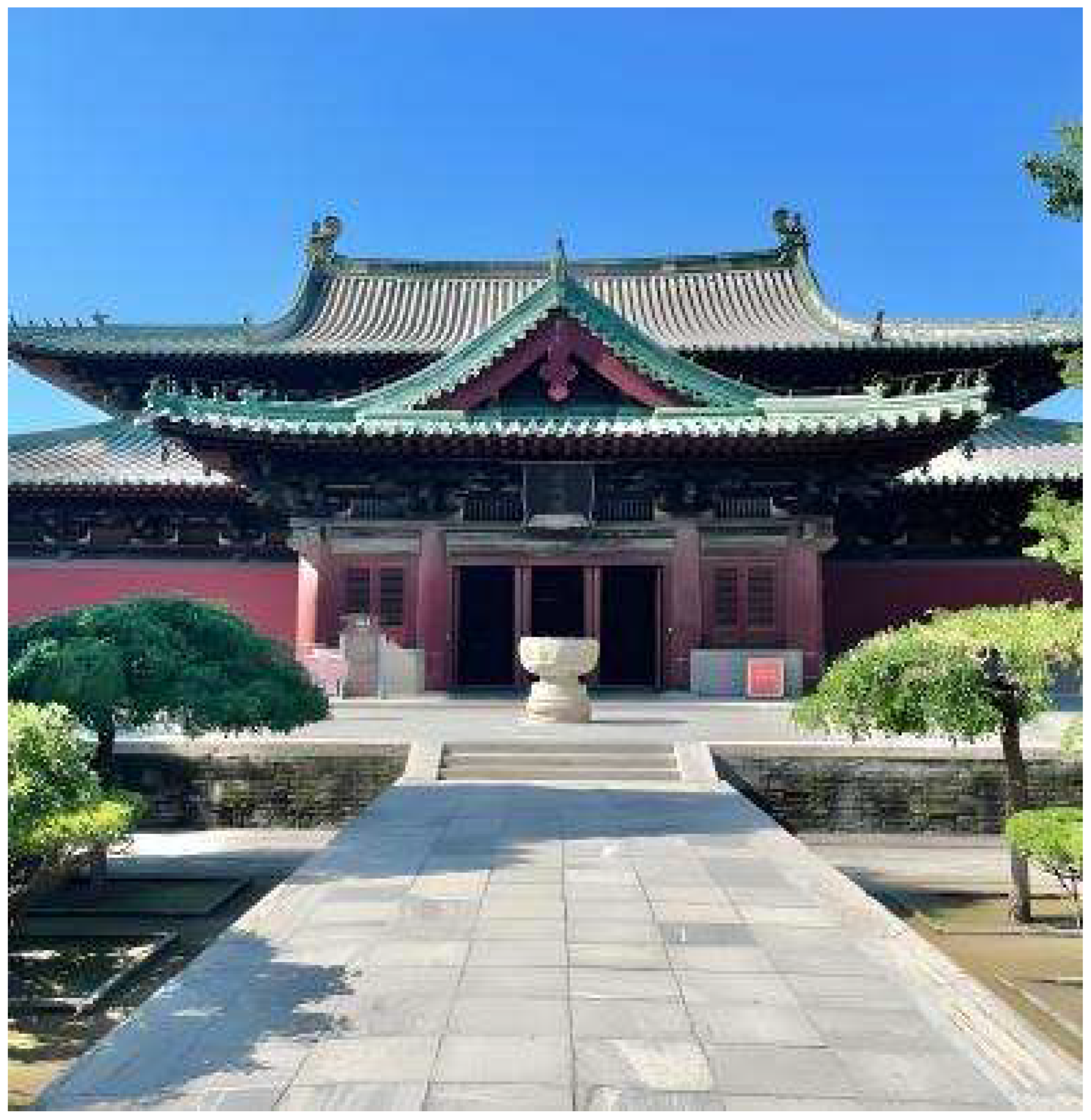
Based on the description in the stele inscription and evidence from extant temple architecture, the overhanging eave in front of the main hall of the Northern Peak Temple should have corresponded to the architectural type known in the Northern Song period as the Turtle-head House (
guitou wu 龜頭屋). The
State Building Standards already contains references to the Turtle-head House (
Yingzao fashi 11. 310), a term used in traditional large-scale timber architecture to denote portions of a building that project forward or backward from the main structure. In the Ming and Qing periods, this architectural form was referred to as a ‘hugging building’ (
baosha 抱廈). The Main Hall of Longxing Monastery (Longxing si 隆興寺) in Zhengding was originally constructed in the fourth year of the Huangyou reign (1052) of the Northern Song dynasty. The Turtle-head House projecting from the front of the hall closely corresponds in form to the overhanging eave described in the stele inscription (
Figure 12). The Turtle-head House is structurally connected to the main hall and projects forward as an integrated whole, with a form resembling the head of a turtle. The mutual corroboration between architectural remains and epigraphic evidence allows us to conclude with reasonable certainty that the overhanging eave referred to in the
Record of Adding Overhanging Eaves to the Main Hall of the Northern Peak Temple is of the same architectural type as the Turtle-head House.
The construction of the overhanging eave attached to the main hall of the Northern Peak Temple was closely associated with the ritual needs of the populace. The stele inscription records, ‘The temple complex was generally complete, yet compact rather than spacious, in a manner befitting an imperial residence. Along the southern eaves of the main hall, the space was narrow and constrained, leaving no room to move. Whenever sacrificial offerings were abundant, people pressed against one another; people holding offerings were registered, standing only a few inches from the deity’s seat. Amid the mingled stench of blood and decaying offerings, people could not help but cover their noses—how, then, could the resplendent immortals and sacred beings, companions of Heaven, be willing to accept such offerings in accordance with imperial intent’ (
Limin Wang 2013, p. 53).
Although the architectural layout of the Northern Peak Temple was largely complete, the space available during ritual performances remained severely restricted. Sacrificial offerings were placed beneath the eaves of the main hall. Once these offerings began to decay, the resulting odour was unbearable. If even the worshippers found it necessary to avert their noses and frown in discomfort, it was inconceivable that the deities would willingly receive such offerings. It was precisely under these circumstances that the addition of the overhanging eave to the main hall became necessary. This evidence indicates that providing a covered space for popular ritual practice constituted the primary function of the overhanging eave of the main hall.
The stele inscription also provides a detailed account of the offerings presented by the populace during ritual ceremonies: ‘The illusionary arts were marvellous and ingenious, showcasing the performers’ utmost mastery of their craft. Their shows featured ceremonial robes, carpets, footwear, prized horses, gold and jade ornaments, as well as exotic birds and animals—an array of sights and sounds that offered the highest degree of visual and auditory delight, defying the power of words to describe them fully’ (Jinwenzui 36. 514).
Here, the term illusionary arts (
huanji 幻技) was one of the many forms of the hundred shows (
baixi 百戲) popular since the Han dynasty. According to ‘Variety Entertainment’ in the
Institutional History of the Tang Dynasty (
Tanglü shuyi jianjie 1. 79),
Variety Entertainment had existed throughout successive dynasties under various names; it did not belong to regimented court music but comprised the mixed performances of actors and entertainers, including singing, dancing, and instrumental playing, collectively referred to as baixi. These performances included bell-jumping, sword-throwing, ladder-climbing, rope-walking, pole-climbing […] and other illusionary arts.
On the basis of the inscription, it can be established that by no later than the fourth year of the Shaosheng reign of the Northern Song,
baixi performances were already staged within state sacrificial temples. The phenomenon whereby
baixi entertainers and musical performances incurred substantial expense was therefore not confined to popular or local cult temples alone (
Li et al. 2013, p. 46).
Within the Northern Peak Temple in Quyang, the hall for presenting sacrificial offerings was constructed in 1050, while the overhanging eave appended to the main hall was added in 1097. With an interval of only forty-seven years between the two constructions, it is highly likely that the hall for presenting sacrificial offerings and the overhanging eave coexisted within the temple complex and together served the ritual and performative functions of sacrificial ceremonies at the Northern Peak Temple.
5. The Evolution of Ritual and Performative Spaces at the Northern Peak Temple
The altar, the hall for presenting sacrificial offerings, and the overhanging eave together constitute the key nodes in the evolution of ritual and performative spaces at the Quyang Northern Peak Temple. Building on this framework, and in conjunction with three engraved temple plans dating respectively to the second year of the Da’an reign of the Jin dynasty, the fourteenth year of the Hongwu reign of the Ming dynasty, and the twenty-sixth year of the Jiajing reign of the Ming dynasty, it is possible to sketch in broad terms the developmental trajectory of ritual and performative spaces at the Quyang Northern Peak Temple.
Compared with textual sources, visual materials offer greater immediacy, precision, and spatial clarity. The approach of using images to substantiate history serves to corroborate written records and compensate for their limitations. For this reason, the three engraved temple plans preserved at the Quyang Northern Peak Temple are crucial for investigating the evolution of its ritual and performative spaces from the Song period onwards.
The discussion above, based on textual sources, demonstrates that the reconstruction of ritual and performative spaces at the Northern Peak Temple during the Five Dynasties and Northern Song periods corresponds closely with the
Diagram of the Northern Peak (
Beiyue zhi tu 北嶽之圖) dated to the second year of the Da’an reign of the Jin dynasty.
8 By contrast, the
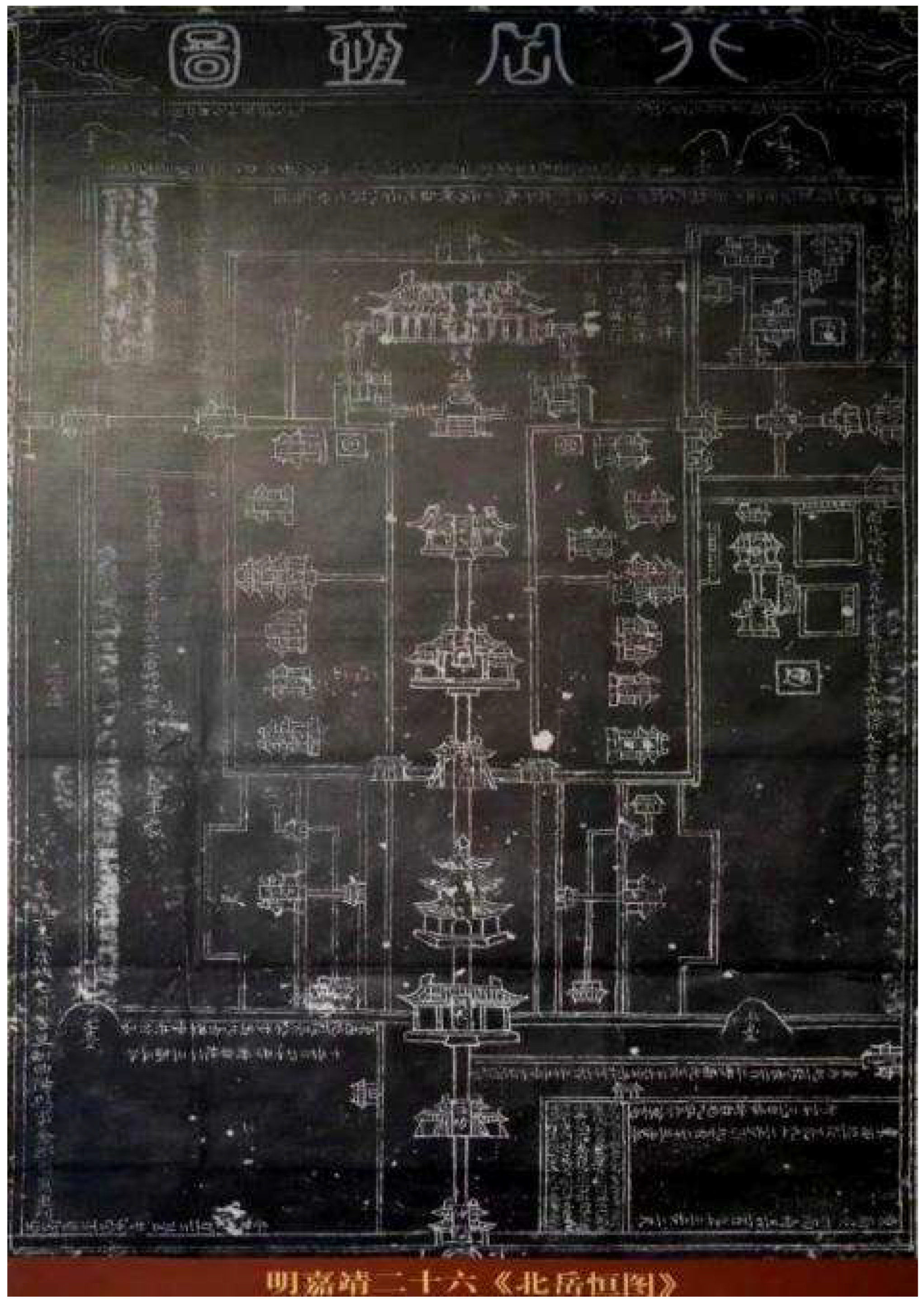
Diagram of the Northern Peak Heng (
Beiyue Heng tu 北嶽恆圖) of the twenty-sixth year of the Jiajing reign of the Ming dynasty (
Figure 13) depicts only a music terrace in front of the main hall. This layout corresponds to that of the present-day Quyang Northern Peak Temple, yet differs markedly from the arrangement shown in the
Diagram of the Northern Peak. It may therefore be inferred that substantial reconstruction and reconfiguration of the temple complex took place between 1210 and 1547.
In the
Diagram of the Northern Peak, the open terrace depicted within the Northern Peak Temple complex remains spatially separate from the main hall. By contrast, in the
Diagram of the Northern Peak of Mount Heng (
Beiyue Hengshan zhi tu 北嶽恆山之圖) of the fourteenth year of the Hongwu reign of the Ming dynasty (
Figure 14), no independent open terrace is shown. On this basis, the construction of the music terrace in front of the main hall can be dated to the period between 1210 and 1381. As the music terrace is structurally integrated with the platform of the main hall, its construction is likely to have coincided with that of the main hall itself. Indeed, the main hall of the Northern Peak Temple is known to have undergone a major reconstruction around the seventh year of the Zhiyuan reign (1270) of the Yuan dynasty.
The plaque mounted on the main hall, the Hall of Virtue and Peace (Dening zhi dian 德寧之殿), bears the inscription, ‘By special imperial decree, the hall was reconstructed under the auspices of Li Tingrui 李庭瑞, an official serving as the Transport Commission of Zhending Circuit, with the inscription composed at the command of the Perfect Man Chengming 誠明; the construction was funded by a donor and completed on the first day of the first month of the seventh year of the Zhiyuan reign of the Great Yuan.’ Zhang Zhijing 張志敬, known by the religious appellation Perfect Man Chengming, was the seventh-generation grand master and supreme leader of the Quanzhen Daoist School.
The
Stele Inscription with Preface on the Deeds of the Perfected Master Chengming, Successor of the Orthodox Daoist Lineage (
Xuanmen sifa zhangjiao zongshi Chengming zhenren daoxing beiming bing xu 玄門嗣法掌教宗師誠明真人道行碑銘並序), dated to the seventh year of the Zhiyuan reign (1270) of the Yuan dynasty, records that ‘The temple complexes of the Five Peaks and River Deities had largely fallen into ruin after the warfare of the late Jin period. The Imperial Household Treasury therefore allocated one hundred thousand strings of Yuan Treasure Notes to the Master, commissioning him to oversee the repair works’ (
Chen 1988, p. 601). This inscription accords with the record preserved on the plaque of the Hall of Virtue and Peace, indicating that the main hall of the Northern Peak Temple underwent a major renovation around the seventh year of the Zhiyuan reign of the Yuan dynasty. It is highly likely that during this renovation, the previously freestanding open terrace was transformed into a music terrace physically connected to the main hall, a spatial configuration that has continued to the present day.
Although the Quyang Northern Peak Temple was officially designated as the state shrine for worshipping the Northern Peak deity, from the Northern Song period onwards, it gradually incorporated spaces associated with popular ritual and performative practices. The evolution of ritual and performative spaces within the temple may therefore be understood as following two distinct trajectories: the official state ritual place and the popular ritual place. The evolution of official ritual and performative spaces extended from the initial establishment of the temple through to the Yuan dynasty, progressing from the altar to the open terrace, and ultimately to a music terrace structurally integrated with the main hall. By contrast, spaces associated with popular ritual and performative activities were gradually incorporated from the Northern Song period onwards and, by the Yuan period, had entered into an overlapping configuration with the official ritual spaces. This latter trajectory evolved from the hall for presenting sacrificial offerings, and the overhanging eave to a music terrace likewise integrated with the main hall.
The Book of Rites (Liji zhengyi 5. 2746) records, ‘The Son of Heaven sacrifices to Heaven and Earth, to the four directions, to mountains and rivers, and to the Five Sacrifices, completing them annually. The feudal lords perform sacrifices to the four directions, to mountains and rivers, and to the Five Sacrifices, completing them annually. The grand masters sacrifice to the Five Sacrifices annually and preside over the sacrifices to their ancestors. As for established sacrifices, none dares to abolish those that exist, nor dares to institute those that do not. To sacrifice to that to which one is not entitled is called an over-sacrifice. Over sacrifices bring no blessing’.
Therefore, in pre-Qin China, only the Son of Heaven and the feudal lords were entitled to offer sacrifices to mountains and rivers. Prior to the Tang dynasty, when the aristocratic clan system remained deeply entrenched and traditional ritual norms were strictly stipulated, temple complexes therefore contained only sacrificial altars or open terraces designated for official state rituals.
During the Tang and Song dynasties, concepts of rites and music gradually permeated and became disseminated among the populace. By the Song dynasty in particular, the rites-music system underwent profound changes, encapsulated in the notion of ‘rites descending to the common people’ (
li xia shuren 禮下庶人) (
Yang 1994;
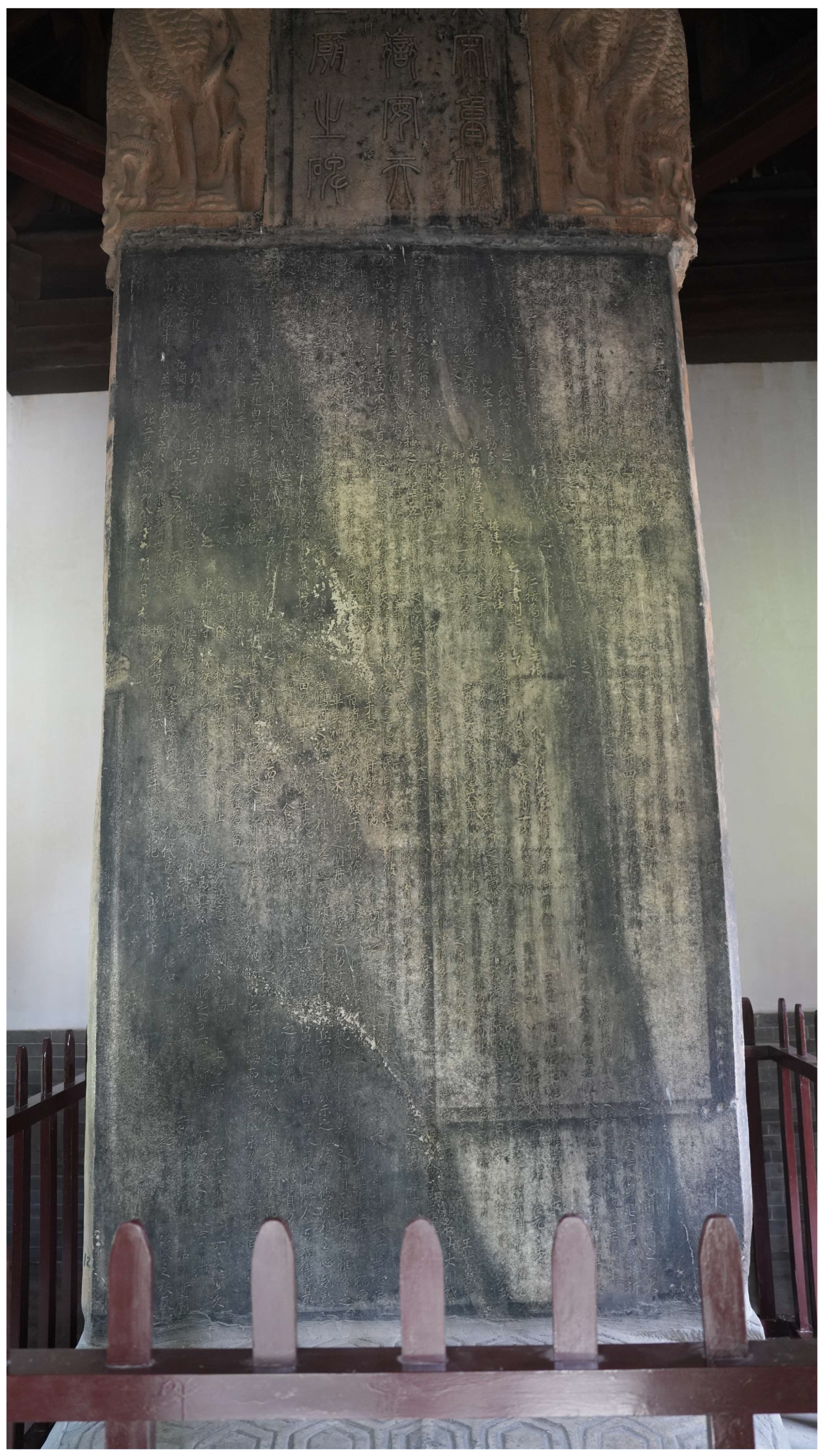
Luwei Wang 2015, p. 47). Influenced by this shift, popular participation in sacrificial practices came to constitute an important component of ritual activity within state sacrificial temples. Evidence from the Quyang Northern Peak Temple illustrates this development. The Great Tang Record of the Northern Peak Temple (
Datang Beiyue shenmiao zhibei 大唐北嶽神廟之碑) (
Figure 15), dated to the twenty-third year of the Kaiyuan 開元 reign (735) of the Tang dynasty, records that ‘The people of the Heshuo were notably diligent in ritual purity and sincerity, and those praying for silkworms and grain were numerous; such activities were especially intense at the end of spring and at the beginning of autumn and winter, with the third month of each season being particularly so’ (
Quan Tang wen 299. 3037). Likewise, the
Collected Imperial Edicts of the Song Dynasty (
Song dazhaoling ji 117. 399) notes regarding the Houtu Temple in Wanrong County that ‘Railings were installed around the main hall; when commoners offered prayers and thanksgiving sacrifices, they were permitted only to bow within the courtyard, and officials, unless conducting formal sacrificial rites, were likewise not allowed to enter the main all’. Only after state sacrificial temples had gradually accommodated popular forms of worship did the construction of spaces for popular ritual and performative activities within these temple complexes become possible.
By the second year of the Huangyou reign of the Song dynasty, the Quyang Northern Peak Temple had already constructed a hall for presenting sacrificial offerings. The
Record of the Great Song Renovation of the Northern Peak Temple provides two explicit reasons for the construction of the hall for presenting sacrificial offerings. First, it ensured that popular sacrificial practices would not constitute a profanation of the deity; second, through the addition of a space specifically designated for popular ritual and performative activities, the deity was rendered all the more august (
Limin Wang 2013, p. 48). Beyond these considerations, the construction of the hall for presenting sacrificial offerings and the overhanging eave at the Northern Peak Temple is also closely related to the performance pavilions commonly found in popular cult temples associated with popular religious beliefs.
In his exploration of ‘The Origins and Development of Offering Halls in Temple Architecture’,
Che (
2005a, p. 36) notes that ‘during the Song dynasty, performance pavilions and performance towers emerged in certain temples in rural areas of northern China’. The construction of the hall for presenting sacrificial offerings at the Northern Peak Temple was very likely influenced by such architectural forms. However, owing to its status as a state sacrificial temple, a dance pavilion was not built directly; instead, the hall for presenting sacrificial offerings, designated for offerings by officials and commoners, was constructed within the courtyard.
The original intention behind the construction of the hall for presenting sacrificial offerings at the Quyang Northern Peak Temple was to provide a space for popular worship to prevent the profanation of the deity. In practice, however, this arrangement failed to achieve the desired effect. Worshippers continued to place offerings directly in front of the deity’s statue, resulting in severe crowding during periods of intense ritual activity. Consequently, in the fourth year of the Shaosheng reign of the Song dynasty, the overhanging eave was added to the main hall. The form of this newly constructed overhanging eave appears to have closely corresponded to that of the so-called ‘Turtle-head Performance Pavilion’ (guitou wuting 龜頭舞亭) commonly found in Song dynasty rural temples, thereby more effectively accommodating popular ritual needs.
The
Record of Adding Overhanging Eaves to the Main Hall of the Northern Peak Temple states that ‘The magical entertainments presented astonishing and intricate feats, showcasing both their specialised skills and everyday techniques.’ (
Limin Wang 2013). This situation closely parallels that described in the
Dreams of Splendour of the Eastern Capital (
Dongjing menghua lu 8. 206), which records that ‘Community Festival Performances were presented upon open terraces, with offerings numbering in the tens of thousands, and
baixi performances staged continuously from early morning onwards’. The difference, however, lies in the fact that at the Quyang Northern Peak Temple, the venue for offerings and performances was not an open terrace but rather the overhanging eave attached to the main hall and the hall for presenting sacrificial offerings located within the courtyard.
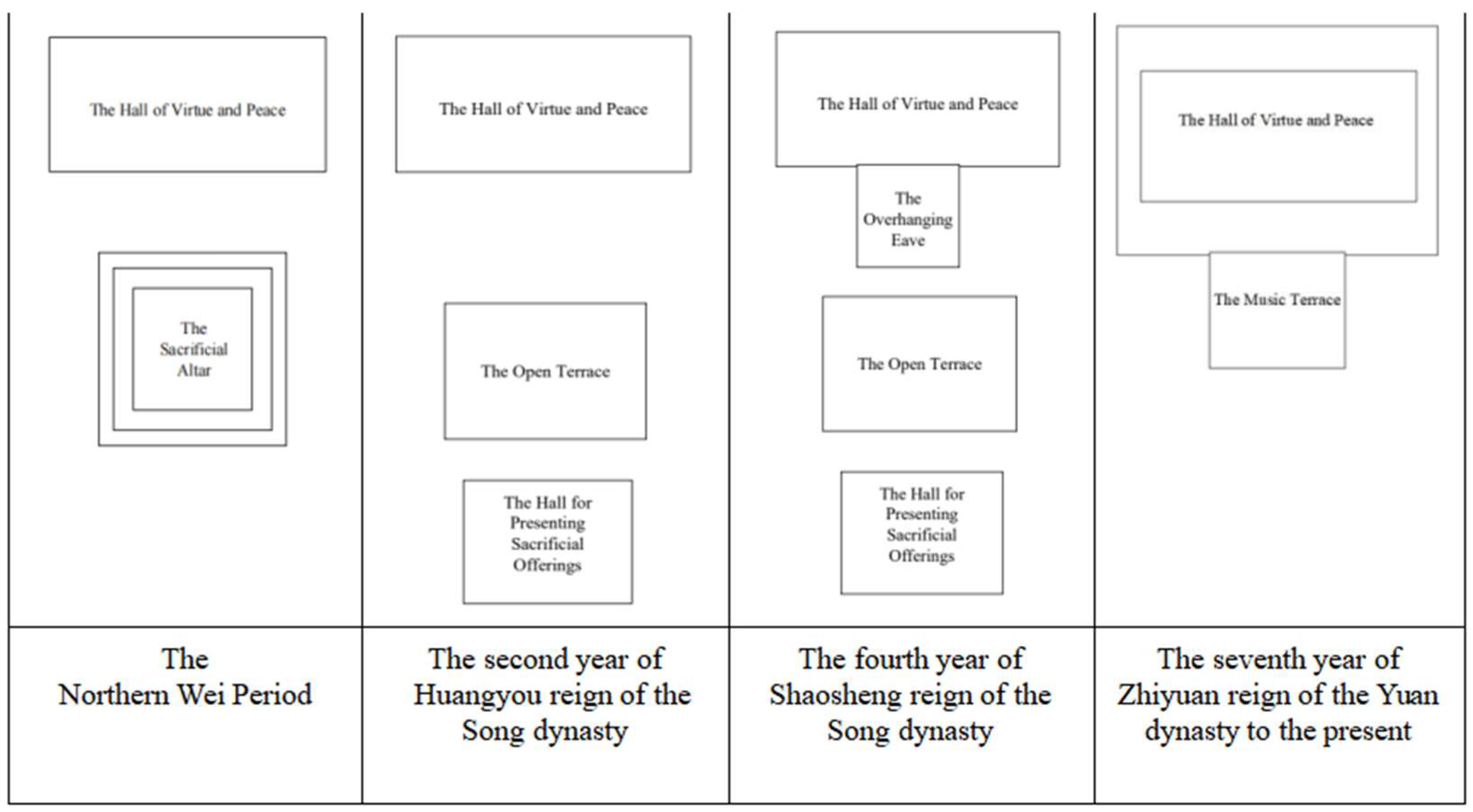
At this point, the developmental trajectory of ritual and performative spaces at the Quyang Northern Peak Temple becomes broadly clear. The altar of the Northern Wei period evolved into an open terrace by the Tang and Song dynasties. In the second year of the Huangyou reign of the Song dynasty, a hall for presenting sacrificial offerings designated for offerings by officials and commoners was constructed, followed by the addition of the overhanging eave in front of the main hall in the fourth year of the Shaosheng reign of the Song dynasty. Around the seventh year of the Zhiyuan reign (1270) of the Yuan dynasty, the earlier ritual and performative structures were dismantled and replaced by the music terrace constructed in front of the main hall. This spatial configuration has remained in place to the present day. To render this process of transformation more visually explicit, it is here represented in diagrammatic form (
Figure 16).
6. Official–Popular Construction of the Northern Peak Temple
During the Northern Song period, the Quyang Northern Peak Temple combined both official ritual and popular ritual spaces, clearly demonstrating the collaboration between state and popular forces. In addition, the construction and renovation of the temple itself were accomplished through joint participation by official authorities and the local community, further demonstrating this collaboration. From a synchronic perspective, the Quyang Northern Peak Temple in the Song dynasty already exhibited a pattern of ‘joint official–popular construction’, which means that construction involved both official funding and contributions from the populace. From a diachronic perspective, the temple underwent a transformation from a state sacrificial temple to a popular cult temple. In the seventeenth year of the Shunzhi reign (1660) of the Qing dynasty, official state sacrifices to the Northern Peak were transferred to Hunyuan County in Shanxi Province. Thereafter, responsibility for managing temple construction shifted from the state to the local community, and funding mechanisms changed accordingly, from official budget or state-organised fundraising to popular donations or the liquidation of temple property.
The Quyang Northern Peak Temple underwent a transition from a state sacrificial temple to a popular cult temple. However, even during the period in which it functioned as a state sacrificial institution, the construction and renovation of the temple were not undertaken solely by official authorities but instead displayed a pronounced character of ‘joint official–popular construction’.
The Petition for the Issuance of Ordination Certificates to Repair the Northern Peak Temple (Qi jiangdudie xiu Beiyue miao zhuang 乞降度牒修北嶽廟狀), dated to 1049 or the first year of the Shaosheng reign of the Song dynasty, states, ‘On numerous occasions, successive prefectural officials and supervisory commissioners submitted petitions requesting either the allocation of funds or the issuance of ordination certificates to finance the repair of the temple. All were approved by ministerial directives, yet the instructions merely required that the provisions be followed and that funds be drawn from revenues generated through charitable endowments. In recent years, however, the populace has repeatedly suffered from natural disasters and poor harvests; consequently, such charitable revenues have been minimal. […] It is therefore requested that fifteen blank ordination certificates be issued and sold to raise the necessary funds. Should the court not approve the issuance of ordination certificates, the temple presently possesses over one thousand three hundred taels of silver ritual vessels, which have not been used; permission is therefore sought to sell these items in order to procure timber and other building materials’ (Su Shi wenji biannian jianzhu 37. 487). This document demonstrates that during the Northern Song period, the funding sources for the construction and repair of state sacrificial temples comprised at least five distinct channels: (1) direct allocations of funds from the court; (2) the issuance and sale of ordination certificates (dudie 度牒); (3) revenues derived from charitable endowments (shili qianwu 施利錢物); (4) interest income generated through exchange operations (huiyi xi qian 回易息錢); and (5) the sale of temple property.
Ordination certificates originated during the Southern and Northern Dynasties as official documents issued by the court to provide monks and nuns with legal recognition of their clerical status. By the Song dynasty, however, ordination certificates had acquired multiple additional functions, including social relief, the mobilisation of military funds, and the financing of construction projects (
Ch’en 1956, pp. 310–20;
Guo 2014). When the court issued ordination certificates, local governments were permitted to sell them in exchange for cash; to this extent, ordination certificates functioned as marketable, value-bearing instruments (
Ch’en 1956, pp. 318–19;
Jin 2021). The ‘revenues derived from charitable endowments’ refers to money and goods donated by believers, with donors comprising both officials and members of the general populace. The above quote, which states that, ‘in recent years, however, the populace has repeatedly suffered from natural disasters and poor harvests; consequently, such charitable revenues have been minimal,’ indicates that, in this context, such donations were primarily made by ordinary people. ‘Interest income generated through exchange operations’ denotes profits derived from commercial activities. The word
huiyi 回易, which emerged during the Sui-Tang period, corresponds broadly to what would today be termed exchange or trade. Its basic forms included direct commercial operations, currency and securities transactions, and lending and mortgage activities. During the Sui-Tang period, such
huiyi activities were, for the most part, conducted by governmental authorities (
Wang and Shi 2011). As indicated above, Xue Xiang 薛向 once employed
huiyi interest funds administered by the Pacification Commission (
Anfu si 安府司) to finance repairs to the Northern Peak Temple. Since the Pacification Commission was a key military–administrative institution at the circuit level during the Song dynasty, the
huiyi interest funds under its control likewise constituted official state assets.
Although the five sources of funding mentioned in the Petition for the Issuance of Ordination Certificates to Repair the Northern Peak Temple were predominantly official in nature, popular donations already constituted one recognised channel of financial support, as evidenced by the court’s directive that repairs be ‘drawn from revenues generated through charitable endowments’. This indicates that, during the Northern Song period, the role played by popular forces in the construction and repair of state sacrificial temples had already been formally acknowledged by the authorities. Members of the populace not only contributed money and goods when making pilgrimage offerings but also directly donated funds and materials specifically for temple repair and construction projects.
The
Revised Gazetteer of Quyang County (
Chongxiu Quyang xianzhi 重修曲陽縣誌) compiled during the Guangxu reign provides a detailed record of popular contributions made during the construction of the overhanging eave appended to the main hall of the Northern Peak Temple in the fourth year of the Shaosheng reign of the Northern Song dynasty, including donations of funds, materials, and labour.
9 It notes, ‘the donation made by the Grand Consort, amounting to forty-seven strings and 547
jiao. […]donors of timber, including Ma Zhen of Beisha Village; donors of nails, including Zhang You […]’ (
Chongxiu Quyang xianzhi 13. 674–675).
The stele of the
Record of Adding Overhanging Eaves to the Main Hall of the Northern Peak Temple, likewise dated to the fourth year of the Shaosheng reign of the Song dynasty, further states, ‘The expenses involved amounted to around a million. Although the project was undertaken by imperial order, those who came to worship understood that the authorities wished them to contribute. Some provided materials, some provided labour, and some provided specialised skills; each was willing to exhaust whatever resources they possessed, and no prohibitions were imposed. Only thus was the project brought to completion’ (
Limin Wang 2013, p. 53).
These sources indicate that the construction of the overhanging eave attached to the main hall of the Quyang Northern Peak Temple was approved and supported by the state. At the same time, throughout the construction process, popular donations of funds, materials, and labour were neither restricted nor rejected. Rather, the project was completed through the combined efforts of official authorities and the local community.
The phenomenon of joint official-popular construction within state sacrificial temples was by no means exceptional. For example, the
Record of the Reconstruction of the Central Peak Temple (
Chongxiu Zhongyue miao ji 重修中嶽廟記), dated to the second year of the Qiande reign (964) of the Northern Song dynasty, records, ‘Accordingly, public officials were selected and appointed to supervise the work at the temple. In less than a month, the corridors were filled with precious goods, currency, and silks donated. Custodians were then appointed to manage these contributions in anticipation of the renovation, and the military officer Sun Xi 孫禧 was subsequently dispatched to conduct the survey’ (
Lü 2014, p. 224).
The
Stele of the Great Jin Dynasty on the Reconstruction of the Eastern Peak Temple (
Dajin chongxiu Dongyue miao bei 大金重修東嶽廟碑), dated to the twenty-second year of the Dading reign (1182) of the Jin dynasty, states, ‘From the Household Treasury, funds amounting to 160,000 strings of cash were disbursed, together with 246 taels of gold; in addition, voluntary contributions from the populace amounted to several hundred thousand, and materials were transported from the Southern Capital to supplement the supply’ (
Tao 2015, p. 163).
Likewise, the
Stele of the Great Jin Dynasty on the Reconstruction of the Central Peak Temple (
Dajin chongxiu Zhongyue miao zhi bei 大金重修中嶽廟之碑), also dated to the twenty-second year of the Dading reign of the Jin dynasty, records, ‘The local officials assigned the expenses to the Transport Commissioner of the circuit, which disbursed public treasury and combined them with the surplus remaining from donations previously offered to the temple; after verifying the amounts, payments were disbursed at regular intervals’ (
Lü 2014, p. 188).
These records indicate that by no later than the Song–Jin period, the joint official-popular effort had already become a common mode of construction and renovation for state sacrificial temples. This situation stands in sharp contrast to that of the pre-Qin period (Liji zhengyi 5.1268). By the Song-Jin period, state sacrificial temples not only permitted popular participation in worship, but popular donations had also become an important source of funding for temple repair and reconstruction.
The emergence of joint official-popular construction in state sacrificial temples can be attributed primarily to two factors. First, although state sacrificial temples were administered by official authorities, by the Tang and Song periods, most such temples had already evolved into ritual spaces shared by both officials and the populace. During the Northern Song period, the Quyang Northern Peak Temple went further by constructing spaces specifically designated for offerings by officials and commoners. As donating funds for temple construction was regarded as an important expression of reverence for the deity, members of the local populace also participated actively in temple reconstruction projects.
Second, popular donations for temple repair helped to alleviate fiscal pressures on the state, and official authorities generally supported such practices. For instance, the
Petition for the Issuance of Ordination Certificates to Repair the Northern Peak Temple states that repairs were to be financed ‘through charitable endowments’ (
Su Shi wenji biannian jianzhu 37. 487). Similarly, the
Stele of the Great Jin Dynasty on the Reconstruction of the Central Peak Temple records that expenses were met by ‘combining them with the surplus remaining from donations previously offered at the temple; after verifying the amounts, payments were issued in due course’ (
Lü 2014, p. 188). These records demonstrate that popular donations constituted an important source of funding for temple repair and reconstruction, and that such contributions were explicitly endorsed by official authorities.
From a diachronic perspective, the Quyang Northern Peak Temple likewise exhibits a pronounced character of ‘joint official-popular construction’. In the seventeenth year of the Shunzhi reign (1660) of the Qing dynasty, the court issued an edict that state sacrifices to the Northern Peak be transferred to Datong in Shanxi Province; from that point onwards, the Quyang Northern Peak Temple no longer functioned as the principal state shrine for the worship of the Northern Peak deity (
Qing shilu 138. 1065). Prior to this change in 1660, repairs and renovations to the temple required imperial approval, and funding was either provided directly by the state or organised through officially led fundraising efforts. For example, the
Stele Inscription of the Restoration of the Temple of Antian King at the Northern Peak during the Great Song Dynasty (
Dasong xiu Beiyue Antianwang miao beiming 大宋修北嶽安天王廟碑銘) (
Figure 17), dated to the second year of the Chunhua 淳化 reign (991) of the Song dynasty, records, ‘Censorial officials ascended the terrace, bearing imperial credentials and organising the workforce; palace officials assembled craftsmen and supervised the project’ (
Xue and Wang 2000, p. 117).
After 1660 or the seventeenth year of the Shunzhi reign of the Qing dynasty, repairs to the Quyang Northern Peak Temple were largely initiated by local gentry, with funding derived entirely from popular donations and the sale of temple property. For example, the
Stele Inscription on the Reconstruction of the Northern Peak Temple (
Chongxiu Beiyue miao zhi beiji 重修北嶽廟之碑記), dated to the twenty-fifth year of the Daoguang reign (1845) of the Qing dynasty, records, ‘In the year of Renyin 壬寅, the recommended man Yang Wukui, together with the temple custodian Xu Benying and others, all petitioned for the repair of the temple, though I was concerned about the lack of funds. […] After clearing away tangled growth and removing dead and decayed trees, opening blocked pathways and clearing obstacles, a number of trees were obtained and exchanged for cash amounting to 6400 strings […] The director of the undertaking found the task difficult, whereupon Lan Guang once again contributed personal funds as a lead donor, raising a further 500 strings’ (
Limin Wang 2013, p. 176).
Similarly, the
Stele Inscription on the Reconstruction of the Ancient Northern Peak Temple (
Chongxiu gu Beiyue miao beiji 重修古北嶽廟碑記) dated to the twenty-third year of the Guangxu reign (1897) of the Qing dynasty records, ‘The assembled gentry accordingly withdrew, and on the basis of the circumstances submitted a petition to the provincial authorities, which received official approval. In total, more than forty cypress trees within the temple precincts were felled, yielding over 8000 strings of cash’ (
Limin Wang 2013, p. 129). These accounts demonstrate that as the institutional status of the temple changed, both the management of repairs and the sources of funding for the Quyang Northern Peak Temple underwent a corresponding transformation, from official control to popular organisation and financing.
7. Conclusions
In summary, the ritual spaces of the Quyang Northern Peak Temple were primarily the result of a joint construction effort by official authorities and the local community. From the perspective of temple construction, a clear pattern of ‘joint official-popular construction’ had already emerged at the Quyang Northern Peak Temple during the Northern Song period. After the seventeenth year of the Shunzhi reign of the Qing dynasty, as the institutional status of the temple changed, responsibility for construction and maintenance shifted from official authorities to the local community, while funding sources likewise transitioned from direct state expenditure or officially organised fundraising to popular donations or the sale of temple property. This constitutes one major manifestation of official-popular collaboration.
From the perspective of the typology of ritual and performative spaces, the Northern Peak Temple contained not only the altar designated for official state sacrifices but also structures intended for popular worship, including the hall for presenting sacrificial offerings and the overhanging eave attached to the main hall. This represents a second manifestation of collaboration between official and popular forces. The construction of the hall for presenting sacrificial offerings and the overhanging eave during the Northern Song period at the Quyang Northern Peak Temple therefore possess significant historical value for the study of the evolution of theatrical and performative spaces within Chinese temple architecture.
First, this finding challenges the prevailing assumption that state sacrificial temples of the Northern Song period did not establish ritual performative spaces specifically for popular worship. At the Northern Peak Temple, the hall for presenting sacrificial offerings designated for offerings by officials and commoners had already been constructed in the second year of the Huangyou reign of the Song dynasty, and the overhanging eave was further added to the main hall in the fourth year of the Shaosheng reign of the Song dynasty. Both structures served the ritual needs of the populace. This demonstrates that, as early as the Northern Song period, state sacrificial temples had already incorporated spaces for popular ritual and performative activities, indicating that state sacrificial temples and popular ritual performative spaces were not positioned in a relationship of strict opposition.
Second, this study further clarifies the evolutionary trajectory of the hall for offering sacrifices within Chinese temple architecture. In his Chinese Temple Theatres, Che Wenming 車文明 (2005b, p. 60) proposes that the hall for offering sacrifices originated in imperial mausolea and, owing to the influence of royal architecture, pavilion-type performance structures in popular temples also came to be termed the hall for offering sacrifices. This argument is persuasive insofar as the designation of the hall for offering sacrifices in popular temples was indeed influenced by royal architectural models. However, the earliest studies previously identified the hall for offering sacrifices within a temple context as the one constructed in the fifth year of the Dazhongxiangfu reign (1012) of the Song dynasty at Huiling Monastery in Kaifeng, an institution that likewise functioned as a state sacrificial temple. Moreover, in 1050, the Quyang Northern Peak Temple had already constructed a hall for presenting sacrificial offerings within a state sacrificial temple. By contrast, the earliest known structure of the hall for offering sacrifices in a rural popular temple is the offering tower of the Sanzong Temple (Sanzong miao三嵕廟) in Hexi Village, Gaoping, dated to the first year of the Zhenghe reign (1111) of the Song dynasty, which postdates the hall for offering sacrifices in the Huiling Monastery by ninety-nine years. These chronological relationships suggest that the hall for offering sacrifices was not transmitted directly from imperial mausolea to popular cult temples. Rather, it appears to have first influenced state sacrificial temples and only subsequently spread from these to popular temples.
Third, this study further substantiates the structural rationality of the Northern Song period’s ‘Turtle-head Performance Pavilion’ being positioned in close proximity to the main hall. In ‘The Evolution of Rural Temple Theatres in Northern China during the Song, Jin, and Yuan Periods’, Yan Baoquan 延保全 argues that ‘during the Song dynasty, performance towers or pavilions were built in locations that later came to be known as the hall for offering sacrifices, and it was only in the Jin and Yuan periods that such structures gradually moved away from the main hall’ (
B. Yan 2011). The location of the overhanging eave attached to the main hall at the Northern Peak Temple provides further confirmation of the validity of this argument.
The tendency for the dance pavilion to be situated close to the main hall is closely related to popular ritual traditions. The
Record on the Imperial Decree for the Preservation of the Itinerant Temple of King Tang (
Chicun Tangwang xingmiao zhi ji 敕存湯王行廟之記), dated to the third year of the Kaibao reign (970) of the Northern Song dynasty, states, ‘On both sides of the door of the hall, offerings were advanced in magnificent array, including tributes from Persia and ivory-made qilin’ (
An and Zhang 2019). Likewise, the
Record of Adding Overhanging Eaves to the Main Hall of the Northern Peak Temple records, ‘Whenever sacrificial offerings were abundant, people pressed against one another; people holding offerings were registered, standing only a few inches from the deity’s seat’ (
Limin Wang 2013, p. 53). Both inscriptions attest to a popular tradition of ‘approaching the deity and performing the sacrifice (
jinshen er si 近神而祀)’, which constitutes an important reason why dance pavilions in Song dynasty temples were often built adjacent to the main hall. In Song dynasty temples, the dance pavilion combined the dual functions of ritual offering and performative presentation. As the entertainment aspect of ritual performances gradually intensified, performance structures inevitably came to be positioned at some distance from the main hall, yet the tradition of ‘approaching the deity and performing the sacrifice’ remained unchanged. It was under these circumstances that the hall for offering sacrifices, in the strict sense, began to enter temple complexes. From the Yuan and Ming periods onwards, the axial arrangement of the main hall, offering hall, theatre stage, and gatehouse became a standard spatial configuration in most temples (
Che 2005b, p. 34).