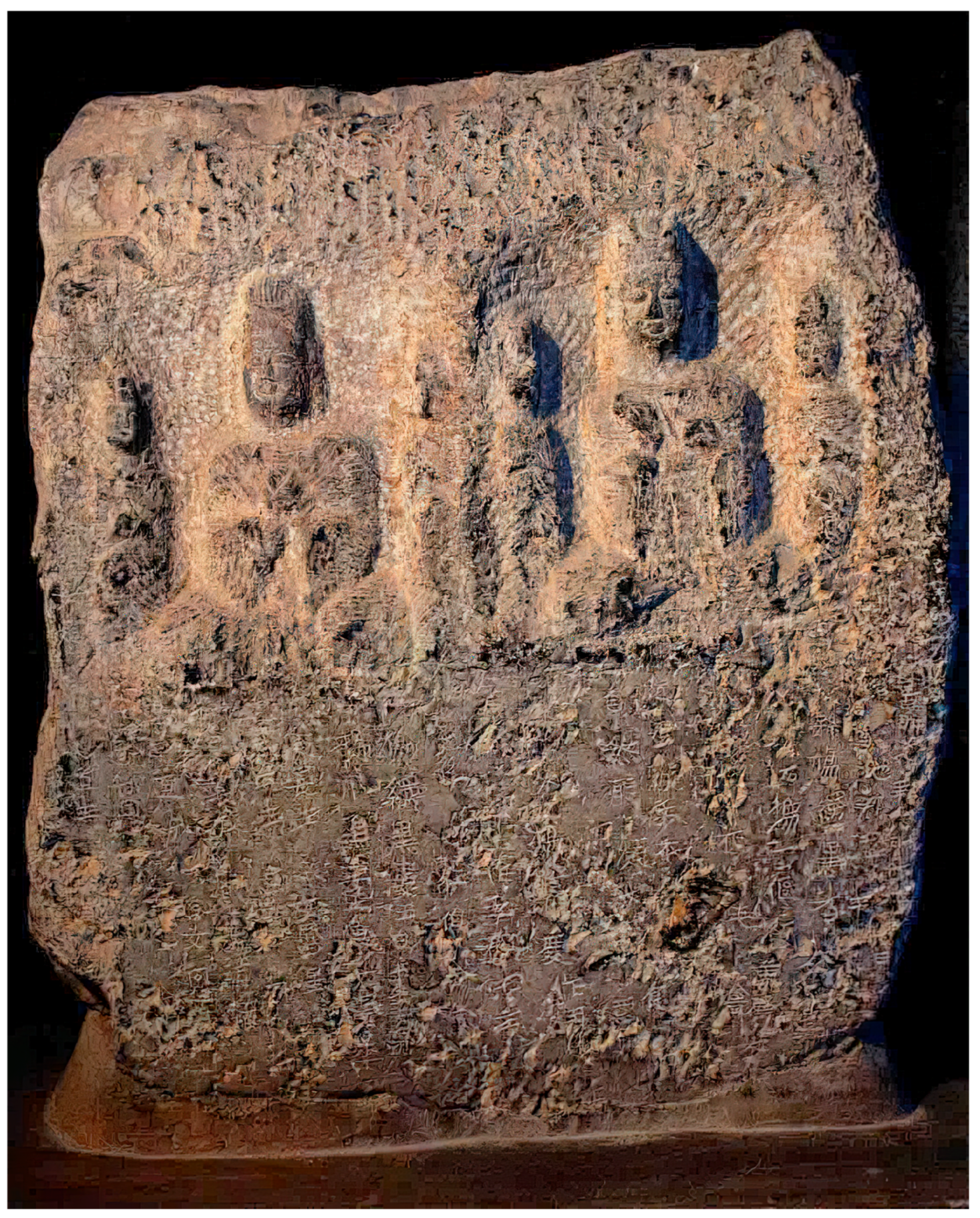
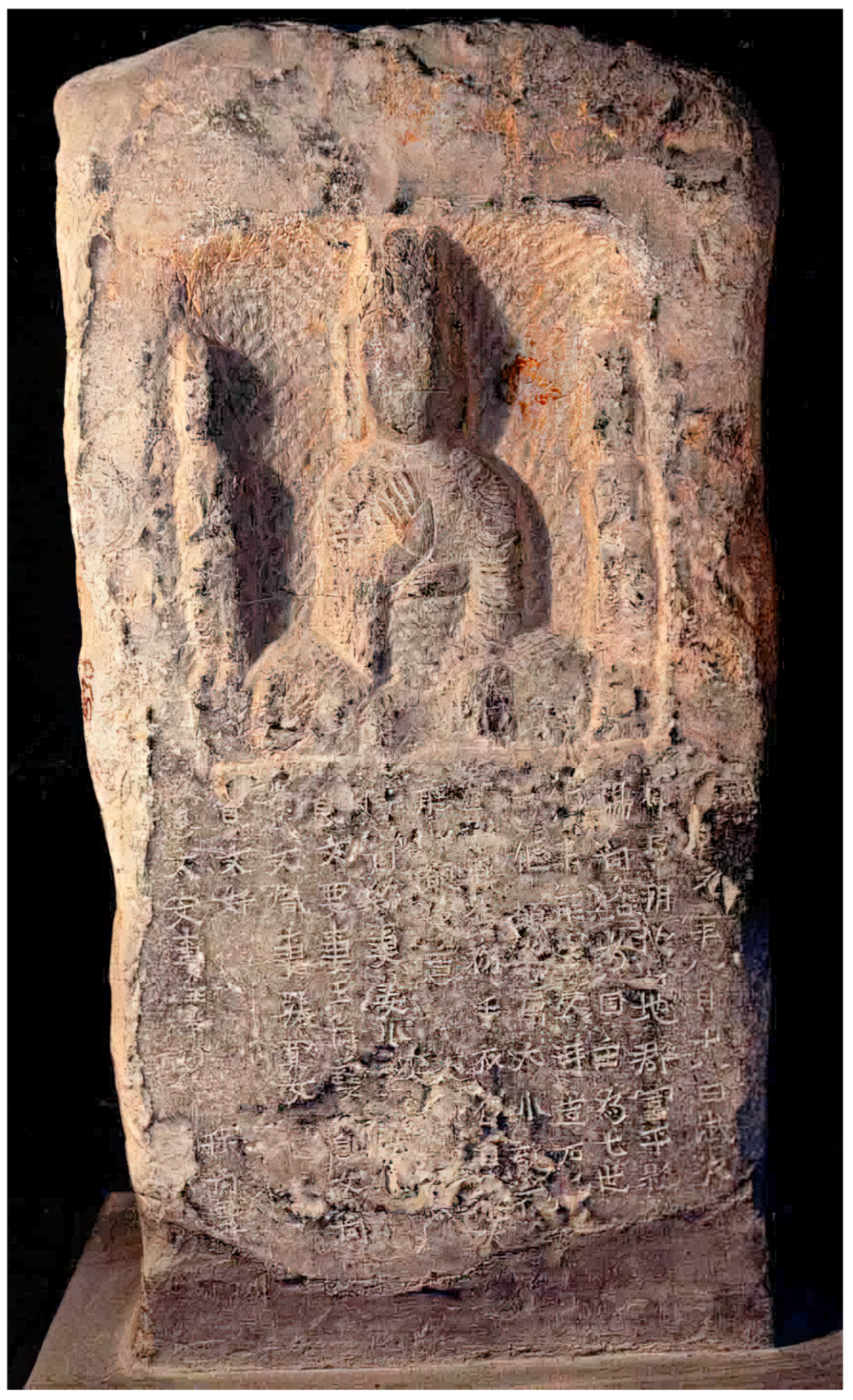
Exploring Daoist-Practicing Families in the Northern Dynasties Through Family-Sponsored Statues

Abstract
1. Introduction
2. General Overview of Daoist-Practicing Families in the Northern Dynasties
3. Social Stratification of Daoist-Practicing Families in the Northern Dynasties
3.1. Prominent Clans
3.1.1. The Qi Clan
3.1.2. The Li Family
3.2. Commoners
3.3. Characteristics of Statues-Making and Religious Life Across Different Strata
4. Belief Structures of Daoist-Practicing Families in the Northern Dynasties
4.1. Whole Family Practicing Daoism
4.1.1. Daoist Yao Boduo Stele of 496 CE 北魏太和廿年道民姚伯多造像碑
4.1.2. Li Yuanhai Made Celestial Worthy Stele of 572 CE 北周建德元年李元海造原始天尊像碑
4.1.3. The Stele for Lord Lao Made by the Male Official Jiang Zuan in 565 CE 北齊天統元年男官姜纂造老君像碑
4.2. Concurrent Veneration of Daoism and Buddhism
4.2.1. Zhu Qi Brothers Stele of 512 CE 北魏延昌元年朱奇兄弟造像碑
4.2.2. Li Tanxin Stele of 562 CE 北周保定二年李曇信造像碑
4.3. Daoist-Buddhist Interaction and Its Causes
4.3.1. Interaction Within “Whole Family Practicing Daoism”
- (1)
- Daoist Yao Boduo Stele of 496 CE
- (2)
- Li Yuanhai Made Celestial Worthy Stele of 572 CE
- (3)
- The Stele for Lord Lao Made by the Male Official Jiang Zuan in 565 CE
4.3.2. Social and Cultural Background for the Emergence of Daoist–Buddhist Interaction
- (1)
- Social Climate of the Concurrent Veneration of Daoism and Buddhism
- (2)
- Similar Religious Functions of Daoism and Buddhism
- (3)
- Popular Attitudes towards Daoism and Buddhism
5. Daoist Affiliations and Lived Religious Practices Behind Family-Sponsored Statues
6. Conclusions
Funding
Institutional Review Board Statement
Informed Consent Statement
Data Availability Statement
Conflicts of Interest
| 1. | The Jinshi Cuibian 金石萃編 (Wang 1977, p. 671) provides a relatively detailed list of official titles in the “General Discussion on Northern Dynasties Buddhist Steles (北朝造像諸碑總論).” |
| 2. | As recorded in the Feng Shenyu Stele of 505 CE 北魏正始二年馮神育造像碑: “The true [one illegible character] Daoist adherent Feng Shenyu, together with two hundred members of the same association… erected a stone statue… may all association members, across seven generations, along with their karmic relatives, dwell in eternal joy, with enduring wishes fulfilled as desired… (真□道民馮神育同邑二百人等……造立石像……諸邑七世以來生緣眷屬,住居常樂,恆在願願從心……)”; The Shi Family Stele of 523 CE 北魏正光四年師氏七十一人造像碑 states: “Seventy-one members of the united clan association,… with shared intent, erected one stone statue (合宗邑子七十一人等,……邑等右發共心,立石像一區).” |
| 3. | For example, the Wu Hongbiao Stele from the Northern Wei Dynasty 北魏吳洪檦造像碑 records: “Therefore, the Daoist adherent Wu Hongbiao, along with his brothers and uncles… erected a stone statue… praying that all members of the Hongbiao household, young and old… (是以道民吳洪檦兄弟叔父……興建石像一區……下願檦家口大小……)” The Li Tanxin Stele of 562 CE 北周保定二年李曇信造像碑 states: “The Buddhist disciple Li Tanxin and his brothers, diminishing their household possessions, reverently commissioned a stone niche containing images of Śākyamuni, Taishang Laojun, and the honored bodhisattvas (是佛弟子李曇信兄弟等,減割家珍,敬造釋迦、太上老君諸尊菩薩石像一區).” |
| 4. | The statue remains mentioned in the article were transcribed on-site by the author. |
| 5. | By “Daoist-practicing families,” I refer to households in which either all or some members are Daoist adherents and, as a family unit, engage in Daoist religious activities, including the making of Daoist statues. Statue-related Daoist practices involve altar establishment, visualization, and other established Daoist fasting rituals associated with the roles of “Inspector of the Retreat,” “Server of Scriptures,” “Server of Incense,” and “Server of Lamps.” (See Y. Zhang forthcoming). |
| 6. | “The reliance on family status refers to the ranks and emoluments inherited from ancestors, which do not necessarily prevent descendants from being foolish or ignorant (夫門資者,乃先世之爵祿,無妨子孫之愚瞽) (Linghu 1971, p. 386).” |
| 7. | From the Qi Maren Stele of 521 CE 北魏正光二年錡麻仁造像碑. |
| 8 | From the Qi Maren Stele of 572 CE 北周建德元年錡馬仁造老君像碑. |
| 9. | “General Appeasing the East” was a rarely documented military title in historical records. Zhang Zhenglang’s research identifies it as a military position of relatively high rank: it held the third pin (品) in the Wei 魏, Jin 晉, and Liu-Song 劉宋 dynasties; during the seventh year of the Tianjian 天監 era under Emperor Wu of Liang 梁武帝, it was classified as the twentieth ban (班) within the twenty-four-grade military hierarchy; under the Chen 陳 dynasty, it was adjusted to correspond to the third pin; in Northern Wei it also held the third pin; by Northern Qi 齊 it had become a sinecure for meritorious military officers; and in Northern Zhou 周 it corresponded to the seventh ming (命) in the ranking system (See Z. Zhang 1990, p. 261). “Military Governor” (dudu 都督) was also a military role established within the garrison system of Northern Zhou. The “Chief of the Feathered Forest” is not documented in historical sources. |
| 10. | “County Rectifier” was an official title responsible for evaluating and ranking the status of scholar-official families. According to the Comprehensive statutes (Tongdian 通典), “After the Wei 魏 dynasty’s reform, large, medium, and small County Rectifier were established at the provincial, commandery, and county levels.” (See Du 1988, p. 327) During the Northern Wei dynasty, especially in its early and middle periods, the County Rectifier wielded significant authority. In the Northern Qi 齊 dynasty, it was classified as a “liunei bishi” (流內比視) official position. The Sui 隋 dynasty did not establish this position due to naming taboos. (See Z. Zhang 1990, p. 172). |
| 11. | In contrast to the commoner class, the relational networks within prominent clans were comparatively more complex. For instance, individuals such as religious clergy and local officials participated in the commissioning of statues. Examples of the former include the Zhu Qi Brothers Stele of 512 CE 北魏延昌元年朱奇兄弟造像碑, the Governor-in-Chief Fan Nuzi Stele of 532 CE 北魏太昌元年都督樊奴子造像碑, and the Li Tanxin Stele of 562 CE 北周保定二年李曇信造像碑. Examples of the latter include the Qi Maren Stele of 521 CE 北魏正光二年錡麻仁造像碑and the Wu Hongbiao Stele from the Northern Wei Dynasty 北魏吳洪檦造像碑. |
| 12. | From the Qi shizhen Stele of 520 CE 北魏神龜三年錡石珍造像碑. |
| 13. | From the Daoist Yao Boduo Stele of 496 CE 北魏太和廿年道民姚伯多造像碑. |
| 14. | From the Jiao Wenxian Made Four-sided Stele in 554 CE 西魏恭帝元年焦文賢造道教四面像碑. |
| 15. | From the Li Tanxin Stele of 562 CE 北周保定二年李曇信造像碑. |
| 16. | From the Qi Maren Made Lord Lao Stele in 572 CE 北周建德元年錡馬仁造老君像碑. |
| 17. | As seen on the reverse side of the Feng Changshou Made Daoist Stele from the Northern Wei Dynasty 北魏馮萇壽造道像碑, three figures are carved: the left one is labeled “Master Yin” (尹先生), and the right one “Master Zhang Ling” (張陵先生). The votive prayer on the Wu Hongbiao Stele from the Northern Wei Dynasty 北魏吳洪檦造像碑 records: “Master Zhang and Master Yin, through refining essence, manifested their traces; they contributed money and rice to aid the creation of the statue, ceasing only upon achieving the Dao (張君、尹生,因精成顯跡,錢米助像,成道乃止).” The votive prayer on the obverse side of the Daoist Yao Boduo Stele of 496 CE 北魏太和廿年道民姚伯多造像碑 states: “The illustrious Master Yin, in subtle accord with profound principle (洸洸尹生,妙契玄理).” |
| 18. | See note 13 above. |
| 19. | From the Wu Hongbiao Stele from the Northern Wei Dynasty 北魏吳洪檦造像碑. |
| 20. | See note 14 above. |
| 21. | Regarding the principal deity depicted on the stele, the following scholars have conducted further research: Li Song 李凇 and Liu Zhaorui 劉昭瑞 read the inscription as “Stone Statue of the August First Ruler (皇先君文石像),” with Li Song noting that the principal deity should be a painted stone statue of the Taishang Laojun 太上老君. Liu Zhaorui argued that the principal deity is Laozi 老子 and identified this stele as the earliest Laozi stele discovered in China to date. Zhang Yan 張燕, Zhang Xunliao 張勛燎, and Luo Hongcai 羅宏才, however, read the inscription as “Stone Statue of the August Venerable Sovereign 皇老君文石像.” Zhang Yan believed the principal deity to be a statue of Laojun 老君. Zhang Xunliao suggested that “August Venerable Sovereign” likely refers to a unique deity within the Louguan Dao 樓觀道 tradition. Luo Hongcai proposed that the principal deity on the stele may vary and could represent Daoist deities such as the Yuanshi Tianzun 元始天尊, the Taishang Daojun 太上道君, or the Taishang Laojun 太上老君. (See S. Li 1995, pp. 46–48; Z. Liu 1996, pp. 302–18; Zhang and Zhao 1996, p. 125; X. Zhang 2006, p. 739; Luo 2008, pp. 278–300). |
| 22. | Regarding the influence of the southern Lingbao jing tradition on Daoist statues of the Northern Dynasties, see (Y. Zhang 2022, pp. 127–36). |
| 23. | The titles “nanguan” and “nüguan” also appear in other statue-related records, such as: Male Official Fu [one illegible character] Made Four-sided Daoist Statue of 499 CE 北魏太和廿三年男官傅□造四面道像碑, Male Official Yao Daozhen Made Lord Lao Statue of 564 CE 北周保定四年男官姚道珍造老君像, the Stele for Jade Emperor Double Image Made by the Female Official Wang Ashan of 527 CE 北魏隆緒元年道民女官王阿善造玉皇雙像, and the Female Official Zhang Dingrong Made Lord Lao Stele of 562 CE 北齊河清元年女官張定容造老君像碑. |
| 24. | Regarding the terms “nanguan” and “nüguan”, see also the following scholarly studies: Jan Fontein regarded nanguan” and “nüguan” as Daoist priests, i.e., Daoist clergy; Zhang Zexun 張澤珣 argued that both should be associated with the Way of the Celestial Masters (Tianshi Dao 天師道); Sun Qi 孫齊 similarly linked them to the Way of the Celestial Masters, noting that “nanguan” refers to male Daoist officials, specifically the “libationers” (jijiu 祭酒) in the Way of the Celestial Masters. (See Fontein 1981, p. 95; Z. Zhang 2003, p. 84; Sun 2019, p. 223). |
| 25. | From the Wei Wenlang Stele of 424 CE 北魏始光元年魏文朗造像碑. |
| 26. | As seen in examples such as the [two illegible characters] Xing Statue of 501 CE 北魏景明二年□□興造像, and the Wang Fanglüe Made Sumeru Pagoda in 536 CE 東魏天平三年王方略造須彌塔. |
| 27. | As seen in examples such as the Biqiuni Faqing Statue of 510 CE 北魏永平三年比丘尼法慶造像, and the Xie Baoming and Others Stele of 533 CE 北魏永熙二年解保明等造像碑. |
| 28. | From the Two Hundred and Fifty Members of the Association Stele of 567 CE 北周天和二年合諸邑等二百五十人造像碑. |
| 29. | From the Yuwenda Stele of 570 CE 北周天和五年宇文達造像碑. |
| 30. | From the Gou Clan Stele of 585 CE 隋開皇五年緱氏造像. |
| 31. | From the Xu Jinghui Stele of 588 CE 隋開皇八年徐景暉造像碑. |
| 32. | As seen in the following examples from Northern Zhou steles: General Who Pacifies the East Stele of 562 CE 周保定二年征東將軍造像碑, Zhang Cao Statue of 562 CE 北周保定二年張操造像, Biqiu [one illegible character] Sui and One Hundred and Twenty Others Stele of 562 CE 北周保定二年比丘□歲等一百廿人造像碑, Association Member Ji Qian and Others Statue of 566 CE 北周天和元年邑子紀乾等造像, and Jing Tan, Yang Gong, and Eighty Others Stele of 572 CE 北周建德元年景曇、楊恭八十人等造像碑. |
| 33. | For example: the Yang Ashao Stele of 500 CE 北魏景明元年楊阿紹造像碑, the Yang Manhei Stele of 500 CE 北魏景明元年楊縵黑造像碑, 20 People of the Family Stele of 521 CE 北魏正光二年舉家廿人造道像碑, the Wu Hongbiao Stele from the Northern Wei Dynasty 北魏吳洪檦造像碑, the Qiu Chensheng Stele of 524 CE 北魏正光五年仇臣生造像碑, the Female Official Zhang Dingrong Made Lord Lao Stele of 562 CE 北齊河清元年女官張定容造老君像碑, the Qi Maren Made Lord Lao Stele of 572 CE 北周建德元年錡馬仁造老君像碑, and the Disciple of Pure Faith Meng A-fei Made Stele for Lord Lao in 577 CE 北齊建德六年清信弟子孟阿妃造老君像碑. |
| 34. | Regarding the integration of Buddhism and Daoism by Kou Qianzhi’s Northern Way of the Celestial Masters, many scholars have conducted extensive discussions. See (Tang and Tang 1961, pp. 64–77; L. Xie 2014, pp. 16–20). |
| 35. | From the 70 Members of the Association Stele of 548 CE 西魏大統十四年邑子七十人等造像碑. |
| 36. | See note 15 above. |
| 37. | See note 25 above. |
| 38. | From the Shi Family Stele of 523 CE 北魏正光四年師氏七十一人造像碑. |
References
- Bokenkamp, Stephen. 2007. Ancestor and Anxiety: Daoism and the Birth of Rebirth in China. Berkeley: University of California Press. [Google Scholar]
- Bokenkamp, Stephen R. 1983. Sources of the Ling-pao Scriptures. In Tantric and Taoist Studies in Honor of R. A. Stein 2. Edited by Michel Strickmann. Brussels: Institut Belge des Hautes Études Chinoises. [Google Scholar]
- Bokenkamp, Stephen R. 1996–1997. The Yao Boduo Stele as Evidence For ‘Dao-Buddhism’ of the Early Lingbao Scriptures. Cahiers d’Extrême-Asie 9: 55–67. [Google Scholar] [CrossRef] [Scilit]
- Daoxuan 道宣. 2014. Xu Gaoseng Zhuan 續高僧傳 [Further Biographies of Eminent Monks]. Beijing: Zhonghua Shuju Chubanshe, vol. 6. [Google Scholar]
- Du, You 杜佑. 1988. Tongdian 通典 [Comprehensive statutes]. Beijing: Zhonghua Shuju Chubanshe, vol. 14. [Google Scholar]
- Fontein, Jan. 1981. Inscription on Taoist Statues. In Proceedings of the International Conference on Sinology: Art History Section. Taipei: Academia Sinica, pp. 95–99. [Google Scholar]
- Hou, Xudong 侯旭東. 2015. Wu Liu Shiji Beifang Minzhong Fojiao Xinyang: Yi Zaoxiangbei Wei Zhongxin De Kaocha 五六世纪北方民众佛教信仰: 以造像记为中心的考察 [Northern People’s Buddhist Beliefs Seen Through Donor’s Inscriptions in the 5–6th Centuries]. Beijing: Zhongguo Shehui Kexue Chubanshe. [Google Scholar]
- Huijiao 慧皎. 1992. Gaoseng Zhuan 高僧傳 [Biographies of Eminent Monks]. Beijing: Zhonghua Shuju Chubanshe, vol. 11. [Google Scholar]
- Kamitsuka, Yoshiko 神塚淑子. 1999. Rikuchō jidai no dōkyō zōzō: Shūkyō shisōshiteki kōsatsu o chūshin ni 六朝時代の道教造像——宗教思想史的考察を中心に [Daoist Sculptures of the Six Dynasties Period: A Focus on Religious and Ideological Perspectives]. In Rikuchō Dōkyō Shisō No Kenkyū 六朝道教思想の研究 [Studies on Six Dynasties Daoist Thought]. Tokyo: Sōbunsha. [Google Scholar]
- Li, Defan 李德範. 1999. Dunhuang Daozang 敦煌道藏 [Dunhuang Daoist Canon]. Beijing: Zhonghua Quanguo Tushuguan Wenxian Suowei Fuzhi Zhongxin. [Google Scholar]
- Li, Fengmao 李豐楙. 2002. An examination of the stele inscription and Jiyue images for the Li Yuanhai made Celestial Worthy stele of 572 北周建德元年李元海等造元始天尊碑記及妓樂圖考. In Daoyuan Binfen Lu: Liu Cunren Jiaoshou Bashiwu Sui Zhushou Lunwenji 道苑繽紛錄:柳存仁教授八十五歲祝壽論文集 [Treasury of Daoist Literature: A Festschrift in Honour of Professor Liu Ts’un-yan on His Eighty-Fifth Birthday]. Edited by Cheukyin Lee 李綽然 and Mansing Chan 陳萬成. Hong Kong: Shangwu Yinshuguan. [Google Scholar]
- Li, Song 李凇. 1995. Beiwei Yao Boduo daojiao zaoxiang bei zhuzun zhi ming kaobian 北魏姚伯多道教造像碑主尊之名考辨 [A Textual Analysis of the Principal Deity’s Name on the Yao Boduo Daoist Stele of the Northern Wei Dynasty]. Chinses Daoism 中國道教 3: 46–48. [Google Scholar]
- Li, Song 李凇. 2012. Zhongguo daojiao meishushi 中國道教美術史 [A History of Chinese Daoist Art]. Hunan: Hunan Meishu Chubanshe. [Google Scholar]
- Li, Yanshou 李延寿. 1974. Beishi 北史 [History of the Northern Dynasties]. Beijing: Zhonghua Shuju Chubanshe, vol. 64. [Google Scholar]
- Linghu, Defen 令狐德棻. 1971. Zhoushu 周書 [Zhou History]. Beijing: Zhonghua Shuju Chubanshe, vol. 23. [Google Scholar]
- Liu, Kangle 劉康樂, and Lin Han 韓琳. 2008. Beiwei zongjiao guanli tizhi chutan 北魏宗教管理體制初探 [A Preliminary Study on the Religious Management System of the Northern Wei Dynasty]. Religious Studies 宗教學研究 3: 198–200. [Google Scholar]
- Liu, Shufen 劉淑芬. 2017. Cibei Qingjing: Fojiao Yu Zhonggu Shehui Shenghuo 慈悲清凈:佛教與中古社會生活 [Compassionate Purity: Buddhism and Social Life in Medieval China]. Beijing: Beijing Shangwu Yinshuguan. [Google Scholar]
- Liu, Zhaorui 劉昭瑞. 1996. Beiwei Yao Boduo daojiao zaoxiang bei kaolun 北魏姚伯多道教造像碑考論 [A Study of the Yao Boduo Daoist Stele of the Northern Wei Dynasty]. Studies in Daoist Culture 道家文化研究 9: 302–18. [Google Scholar]
- Luo, Hongcai 羅宏才. 2008. Zhongguo Fodao Zaoxiangbei Yanjiu: Yi Guanzhong Diqu Wei Kaocha Zhongxin 中國佛道造像碑研究: 以關中地區為考察中心 [The Study of Chinese Buddho–Daoist Sculpted–Image Stele: Centered on the Guanzhong Area]. Shanghai: Shanghai Daxue Chubanshe. [Google Scholar]
- Mollier, Christine. 2008. Buddhism and Taoism Face to Face: Scripture, Ritual, and Iconographic Exchange in Medieval China. Honolulu: University of Hawai ‘i Press. [Google Scholar]
- Nickerson, Peter Samuel. 1996. Taoism, Death and Bureaucracy in Early Medieval China. Ph.D. dissertation, University of California, Berkely, CA, USA. [Google Scholar]
- Ouyang, Xiu 欧阳修, and Qi Song 宋祁, eds. 1975. Xin Tangshu 新唐書 [New Book of Tang]. Beijing: Zhonghua Shuju Chubanshe, vol. 199. [Google Scholar]
- Qian, Zhongshu 錢鐘書. 1979. Guanzhui Bian 管錐編 [Limited Views]. Beijing: Zhonghua Shuju Chubanshe. [Google Scholar]
- Raz, Gil. 2014. Conversion of the Barbarians’: [Huahu 化胡] Discourse as Proto Han Nationalism. The Medieval History Journal 17: 255–94. [Google Scholar] [CrossRef] [Scilit]
- Schipper, Kristofer. 1985. Taoist Ordination Ranks in the Tunhuang Manuscripts. In Religion und Philosophie in Ostasien: Festschrift für Hans Steininger zum 65. Edited by Gert Naudorf, Karl-Heinz Pohl and Hans-Herrman Schmidt. Wurzburg: Königshausen and Neumann. [Google Scholar]
- Schipper, Kristofer. 1994. Purity and Strangers: Shifting Boundaries in Medieval Taoism. T’oung Pao 80: 61–81. [Google Scholar] [CrossRef] [Scilit]
- Shen, Yue 沈約. 1974. Songshu 宋書 [Song History]. Beijing: Zhonghua Shuju Chubanshe, vol. 77. [Google Scholar]
- Sima, Guang 司馬光. 1956. Zizhi Tongjian 資治通鑑 [Comprehensive Mirror for Aid in Governance]. Beijing: Zhonghua Shuju Chubanshe, vol. 141&145. [Google Scholar]
- Sun, Qi 孫齊. 2019. Ruicheng daojiao sanbai nian shi: Yi Beichao Sui Tang zaoxiang wei zhongxin de kaocha 芮城道教三百年史——以北朝隋唐造像為中心的考察 [Three Hundred Years of Daoism in Ruicheng: An Investigation Centered on Statues from the Northern Dynasties, Sui, and Tang]. Tang Research 24: 207–65. [Google Scholar]
- Tang, Yongtong 湯用彤, and Yijie Tang 湯一介. 1961. Kouqianzhi de zhuzuo yu Sixiang: Daojiao shi zalun zhi yi 寇謙之的著作與思想——道教史雜論之一 [Kou Qianzhi’s Works and Thoughts: A Miscellaneous Discussion on the History of Daoism, Part One]. Historical Research 歷史研究 5: 64–77. [Google Scholar]
- The Ekottarika Āgama (Zengyi Ahan Jing 增壹阿含經), fascicle 28. 1924–1932. In Taishō Shinshū Daizōkyō 大正新修大藏經 [The Revised Tripitaka Compiled in the Taishō Era]. vol. 2, pp. 706a–708b.
- Wang, Chang 王昶. 1977. Jinshi cuibian 金石萃編 [Compendium of Bronze and Stone Inscriptions]. In Shike Shiliao Xinbian 石刻史料新編 [Historical Materials from Stone Inscriptions, A New Compilation]. Series 1; Taipei: Xinwenfeng Chubanshe, vol. 1. [Google Scholar]
- Wei, Shou 魏收. 1974. Weishu 魏書 [Wei History]. Beijing: Zhonghua Shuju Chubanshe, vol. 45, p. 114. [Google Scholar]
- Wei, Zheng 魏徵. 1973. Suishu 隋書 [Sui History]. Beijing: Zhonghua Shuju Chubanshe, vol. 35. [Google Scholar]
- Xie, Lujun 謝路軍. 2014. Kouqianzhi yu fojiao 寇謙之與佛教 [Kou Qianzhi and Buddhism]. Journal of the Party School of Harbin Committee of CPC 哈爾濱市委黨校學報 2: 16–20. [Google Scholar]
- Xie, Shiwei 謝世維. 2013. Da Fan Mi Luo: Zhonggu Shiqi Daojiao Jingdian Dangzhong de Fojiao 大梵彌羅:中古時期道教經典當中的佛教 [The Great Brahma Fills the Heavens: Buddhism in Medieval Daoist Scriptures]. Taipei: The Commercial Press. [Google Scholar]
- Ye, Changchi 葉昌熾. 1994. Yushi 語石 [Inscriptions]. In Yushi Yushi Yitong Ping 語石 語石異同評 [Epigraphic Studies: Critical Annotations on Stone Inscriptions]. Beijing: Zhonghua Shuju Chubanshe. [Google Scholar]
- Zhang, Xunliao 張勛燎. 2006. Archaeological Research on Daoist Statues of the Northern Dynasties 北朝道教造像的考古研究. In Zhongguo Daojiao Kaogu 中国道教考古 [Chinese Archaeology of Daoism]. Edited by Xunliao Zhang 张勋燎 and Bin Bai 白彬. Beijing: Xianzhuang Shuju. [Google Scholar]
- Zhang, Xunliao 張勛燎. 2010. Beichao daojiao zaoxiangbei zaiyanjiu 北朝道教造像碑再研究 [Re-discussion on the Daoist Stelae of the Northern Dynasties]. Southern Ethnology and Archaeology 南方民族考古 6: 163–206. [Google Scholar]
- Zhang, Yan 張燕, and Chao Zhao 趙超. 1996. Bei Chao Fodao Zaoxiangbei Jingxuan 北朝佛道造像碑精選 [Selected Northern Dynasties Buddhist and Daoist Stelae]. Tianjin: Tianjin Guji Chubanshe. [Google Scholar]
- Zhang, Yuan 張媛. 2022. Yishu yu zongjiao de jiaojie: beichao daojiao zaoxiangbei de kongjian jian’gou yu xinyang biaoda 艺术与宗教的交界: 北朝道教造像碑的空间建构与信仰表达 [The interface of art and religion: The spatial construction and belief expression of the Daoist stelae in the Northern Dynasties]. Journal of Nanjing University of the Arts (Fine Arts & Design) 南京艺术学院学报 5: 127–36. [Google Scholar]
- Zhang, Yuan 張媛. forthcoming. Examining Northern Dynasties Family Structure Through family-sponsored Statue Remains.
- Zhang, Yuan 張媛, and Liu Rui 劉睿. 2025. Cong heyi zaoxiang yicun kan beichao daojiao yiyi 從合邑造像遺存看北朝道教義邑 [Daoist Association in the Northern Dynasties: Perspectives from Communal Statues]. Archaeology and Cultural Relics 考古與文物 1: 103–4. [Google Scholar]
- Zhang, Zexun 張澤珣. 2003. Beiwei Guanzhong Daojiao Zaoxiangji Yanjiu: Diyu de zaongjiao wenhua yu yishihuodong 北魏關中道教造像記研究: 地域的宗教文化與儀式活動 [The Daoist Epigraphs of the Northern Wei Dynasty: A Study of the Guanzhong District’s Religious Culture and Ritualistic Activities]. Ph.D. dissertation, Chinese University of Hong Kong, Hong Kong, China. [Google Scholar]
- Zhang, Zhenglang 張政烺. 1990. Zhongguo Gudai Zhiguan Dacidian 中國古代職官大辭典 [Grand Dictionary of Official Titles in Ancient China]. Zhengzhou: Henan Renmin Chubanshe. [Google Scholar]
- Zürcher, Erik. 1980. Buddhist Influence on Early Taoism: A Survey of Scriptural Evidence. T’oung Pao 66: 84–147. [Google Scholar] [CrossRef] [Scilit]
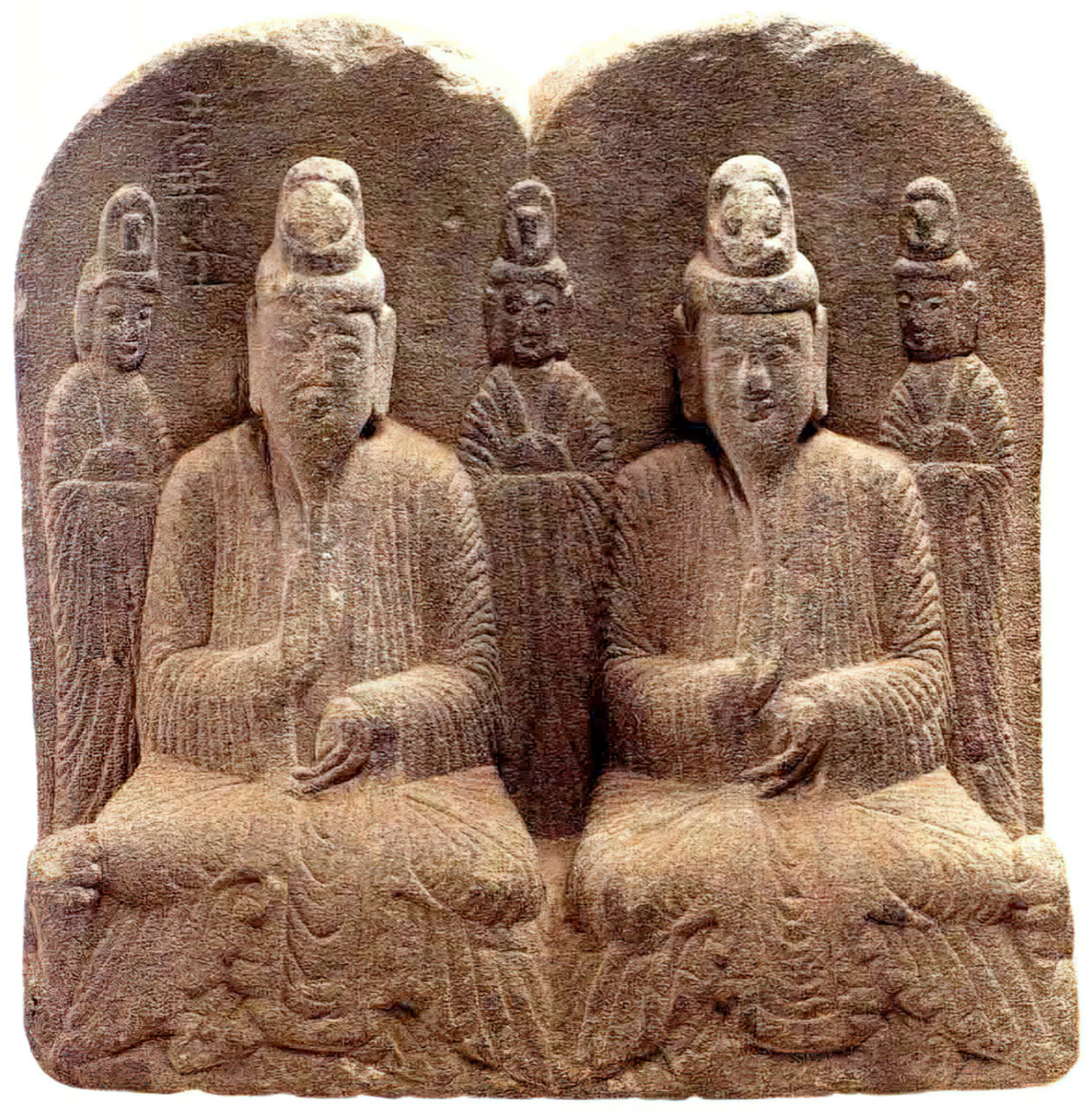
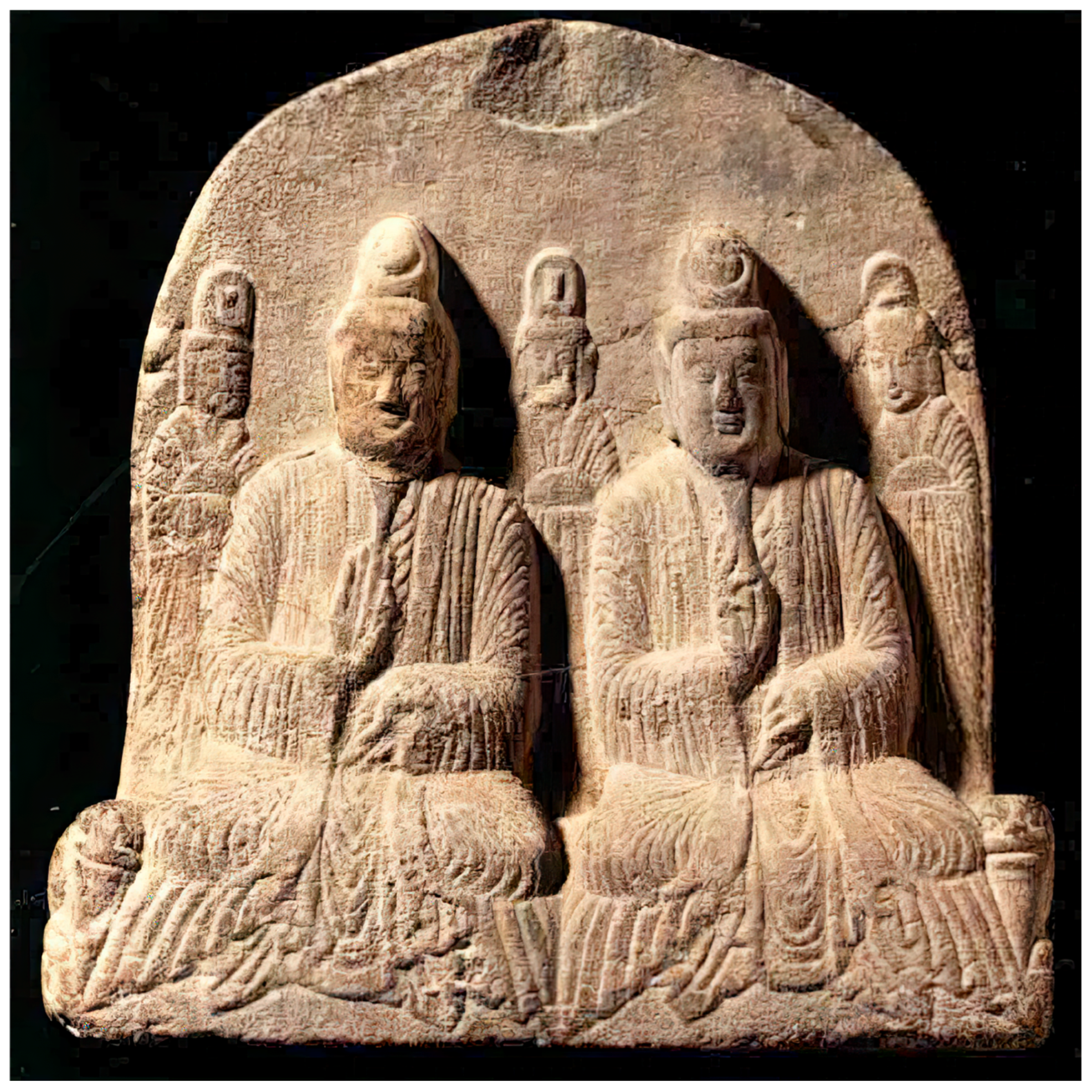



| Date (CE) | Findspot | Current Location | Family Structure | Social Status | Religious Affiliation | Source |
|---|---|---|---|---|---|---|
| 424 | Yaozhou, Shaanxi | Yaowangshan Forest of Steles | 4 generations | Commoner | Daoist-Buddhist | Wei Wenlang Stele |
| 496 | Yaozhou, Shaanxi | Yaowangshan Forest of Steles | Clan | Prominent Clan | Daoist | Daoist Yao Boduo Stele |
| 499 | Unknown | Yaowangshan Forest of Steles | Clan | Commoner | Daoist | Daoist Liu Wenlang Stele |
| 500 | Yaozhou, Shaanxi | Yaowangshan Forest of Steles | 2 generations | Commoner | Daoist | Yang Ashao Stele |
| 500 | Yaozhou, Shaanxi | Yaowangshan Forest of Steles | 3 generations | Commoner | Daoist | Yang Manhei Stele |
| 512 | Huaxian, Shaanxi | Forest of Steles Museum | 4 generations | Prominent Clan | Daoist-Buddhist | Zhu Qi Brothers Stele |
| 513 | Jingyang, Shaanxi | Unknown | 2 generations | Commoner | Daoist | Zhang Xiang Made Celestial Worthy Stele |
| 514 | Yaozhou, Shaanxi | Yaowangshan Forest of Steles | 4 generations | Commoner | Daoist | Zhang Luanguo Stele |
| 518–520 | Yaozhou, Shaanxi | Yaowangshan Forest of Steles | 4 generations | Commoner | Daoist-Buddhist | Zhang Anshi Stele |
| 521 | Yaozhou, Shaanxi | Yaowangshan Forest of Steles | 6 generations | Prominent Clan | Daoist | Qi Maren Stele |
| 521 | Unknown | Private Collection | Unknown | Commoner | Daoist | 20 People of the Family Stele |
| 524 | Yaozhou, Shaanxi | Yaowangshan Forest of Steles | 4 generations | Commoner | Daoist-Buddhist | Qiu Chensheng Stele |
| 527 | Unknown | National Museum of China | 3 generations | Commoner | Daoist | The Stele for Jade Emperor Double Image Made by the Female Official Wang Ashan |
| 531 | Huaxian, Shaanxi | Forest of Steles Museum, | 3 generations | Prominent Clan | Daoist-Buddhist | Zhu Fubo Stele |
| 532 | Fuping, Shaanxi | Fuping County Cultural Relics Office | Clan | Prominent Clan | Daoist-Buddhist | Governor-in-Chief Fan Nuzi Stele |
| 533 | Unknown | Fuxian Museum | 2 generations | Commoner | Daoist | Daoist Sun Boyin Stele |
| 534 | Unknown | Osaka City Museum of Art | 2 generations | Commoner | Daoist | Daoist Wu [illegible] Statue |
| Northern Wei | Unknown | Field Museum of Natural History, Chicago | Clan | Prominent Clan | Daoist | Feng Changshou Stele |
| Northern Wei | Yaozhou, Shaanxi | Yaowangshan Forest of Steles | Clan | Prominent Clan | Daoist-Buddhist | Fumeng Clan Stele |
| Northern Wei | Yaozhou, Shaanxi | Yaowangshan Forest of Steles | 6 generations | Prominent Clan | Daoist | Wu Hongbiao Stele |
| 508–515 | Yaozhou, Shaanxi | Yaowangshan Forest of Steles | 2 generations | Prominent Clan | Daoist | Wang Shibao Daoist Stele |
| 554 | Unknown | Osaka Municipal Museum of Art | 6 generations | Prominent Clan | Daoist | Jiao Wenxian Made Four-sided Stele |
| 556 | Unknown | Forest of Steles Museum | 3 generations | Commoner | Daoist | Four-Sided Stele |
| Western Wei | Unknown | Forest of Steles Museum | 2 generations | Commoner | Daoist-Buddhist | Qiu Seng Buddha-Dao Stele |
| 561 | Xi’an, Shaanxi | National Museum of China | 2 generations | Commoner | Daoist | Daoist Ma Luozi Stele |
| 562 | Yaozhou, Shaanxi | Yaowangshan Forest of Steles | 3 generations | Prominent Clan | Daoist-Buddhist | Li Tanxin Stele |
| 564 | Unknown | Field Museum of Natural History, Chicago | 2 generations | Commoner | Daoist | The Stele for Lord Lao Made by Magistrate Xu Duo from Huxian |
| 564 | Unknown | Museum of Fine Arts, Boston | 3 generations | Commoner | Daoist | The Stele for Lord Lao Made by the Male Official Yao Daozhen |
| Northern Qi | Yanshi, Henan | Shangcheng Museum, Yanshi | 2 generations | Commoner | Daoist | The Stele for Lord Lao Made by the Male Official Jiang Zuan Stele |
| Northern Zhou | Unknown | Unknown | 3 generations | Commoner | Daoist | Daoist Quan He Made Celestial Worthy Stele |
| 568 | Unknown | Tokyo University of the Arts | 2 generations | Prominent Clan | Daoist | Daoist Du Chong [one illegible character] Made Lord Lao Stele |
| 569 | Unknown | Unknown | 2 generations | Commoner | Daoist | Daoist Cai Zhenhu Made Lord Lao Stele |
| 572 | Unknown | Forest of Steles Museum | Clan | Prominent Clan | Daoist | Qi Maren Made Lord Lao Stele |
| 572 | Ruicheng, Shanxi | Arthur M. Sackler Gallery | 4 generations | Prominent Clan | Daoist | Li Yuanhai Made Celestial Worthy Stele |
| 577 | Yanshi, Henan | Shangcheng Museum, Yanshi | 2 generations | Commoner | Daoist | Disciple of Pure Faith Meng A-fei Made Stele for Lord Lao |
| Northern Zhou | Unknown | Yaowangshan Forest of Steles | 3 generations | Commoner | Daoist | Liu Nansu Stele |
| Northern Zhou | Unknown | Forest of Steles Museum | 4 generations | Commoner | Daoist-Buddhist | Ren Run Stele |
| 561–600 | Yaozhou, Shaanxi | Yaozhou District Museum | 4 generations | Prominent Clan | Daoist | Ma Bao Stele |
Disclaimer/Publisher’s Note: The statements, opinions and data contained in all publications are solely those of the individual author(s) and contributor(s) and not of MDPI and/or the editor(s). MDPI and/or the editor(s) disclaim responsibility for any injury to people or property resulting from any ideas, methods, instructions or products referred to in the content. |
© 2026 by the author. Licensee MDPI, Basel, Switzerland. This article is an open access article distributed under the terms and conditions of the Creative Commons Attribution (CC BY) license.
Share and Cite
Zhang, Y. Exploring Daoist-Practicing Families in the Northern Dynasties Through Family-Sponsored Statues. Religions 2026, 17, 369. https://doi.org/10.3390/rel17030369
Zhang Y. Exploring Daoist-Practicing Families in the Northern Dynasties Through Family-Sponsored Statues. Religions. 2026; 17(3):369. https://doi.org/10.3390/rel17030369
Chicago/Turabian StyleZhang, Yuan. 2026. "Exploring Daoist-Practicing Families in the Northern Dynasties Through Family-Sponsored Statues" Religions 17, no. 3: 369. https://doi.org/10.3390/rel17030369
APA StyleZhang, Y. (2026). Exploring Daoist-Practicing Families in the Northern Dynasties Through Family-Sponsored Statues. Religions, 17(3), 369. https://doi.org/10.3390/rel17030369