2. The Virgin Martyrs Tapestry
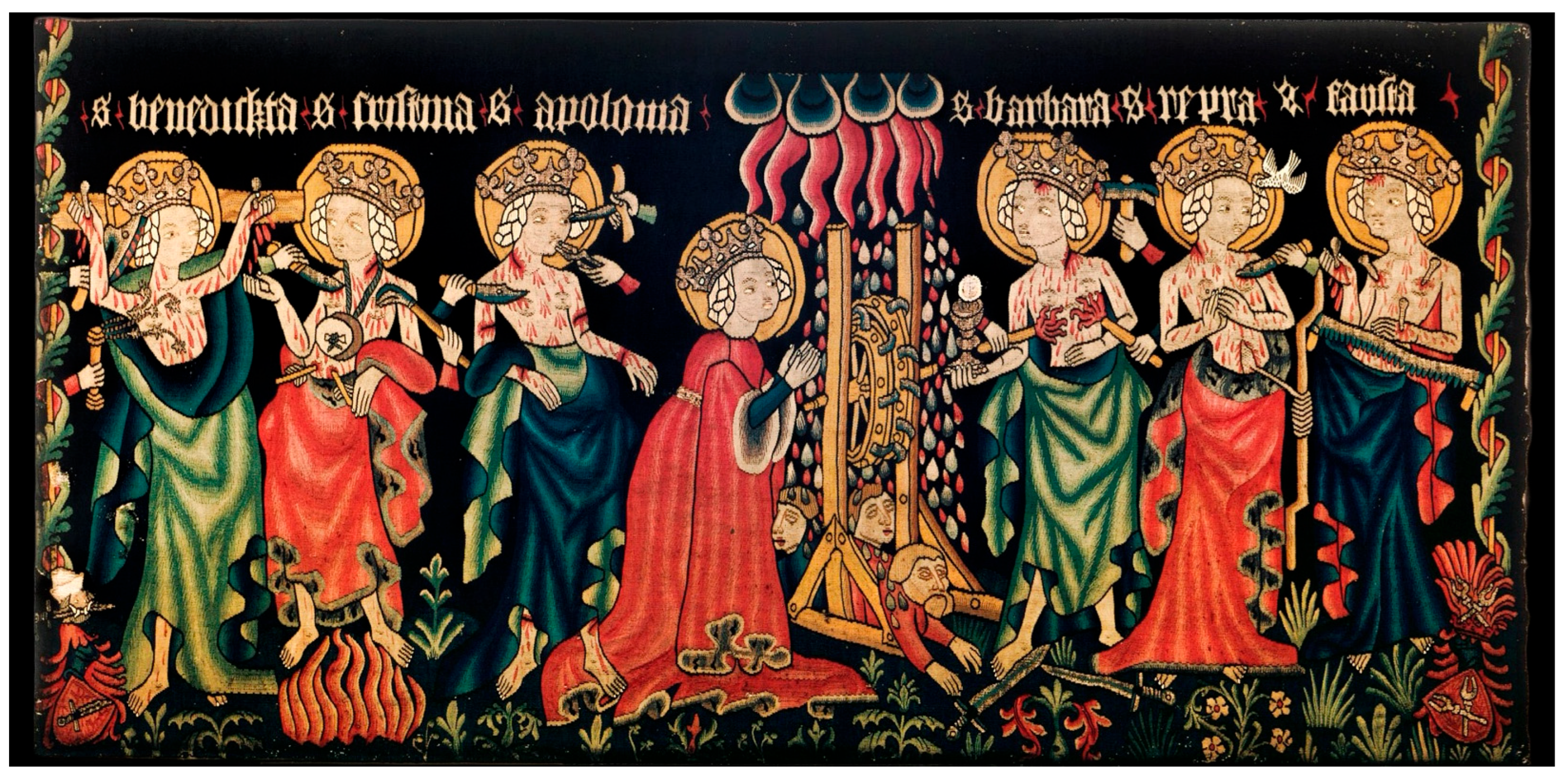
The Virgin Martyrs Tapestry was woven in Nuremberg around 1430 and donated to St. Sebald by Konrad Kress.
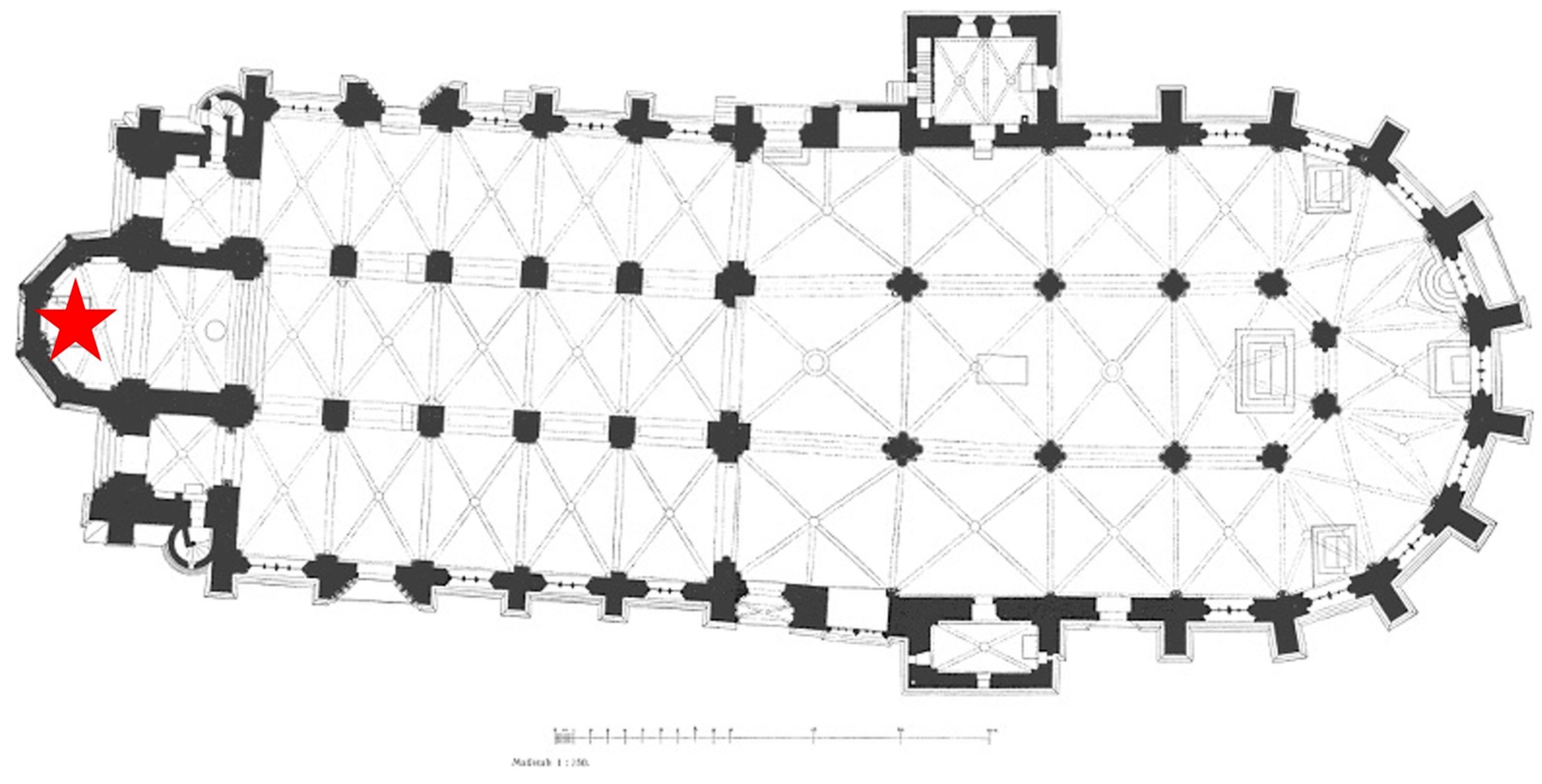
1 The Kress family crest, and that of Konrad’s wife Walpurga Waldstromer, are woven into the lower corners of the tapestry. The tapestry’s horizontal configuration is typical of textiles used as antependia, hung in the front of altars. According to the fifteenth-century sacristan’s manual from the Nuremberg church of St. Sebald, the tapestry, referred to as the “Jungfrauen Tuch” in the manual, was displayed at an altar in the western choir dedicated to St. Katherine of Alexandria (
Figure 2;
Gümbel 1929, pp. 11, 37). Saints Barbara and Agatha were also venerated at the altar, making the tapestry of “other holy virgins who had likewise died for their faith” a “suitable decoration” for the altar, though Saint Agatha herself does not appear in the weaving (
Weilandt 2007, pp. 220–21;
2010, p. 45).
Tapestries are distinct from most other types of woven fabrics, in which the weft and warp are evenly visible in the woven cloth, and from embroidery, in which colorful threads are freely stitched on top of an existing fabric. Rather, tapestry is a weft-faced weaving technique in which colorfully dyed wool, silk, and sometimes gilded weft threads are tightly packed into a plain linen warp that is completely hidden by the weft in the final product. Tapestries are most often woven on a vertical loom instead of the horizontal looms frequently used for weaving large amounts of plain-woven fabric. The weaver would work. The final tapestry, the design of which may be draped as a cartoon, or full-scale drawing, behind the warp to guide the weaver, is created by carefully weaving the colorful weft threads, wound onto a simple bobbin, horizontally over and under the linen warp, which is tautly dressed vertically onto the loom, packing the weft down tightly with a comb or pick. Barbara Baert notes that, “perhaps no single handcraft is as primordial as weaving,” while noting the enduring power of woven images within medieval Christianity that “served many generations” and “carry the fingerprints of salvation history and intense devotion” (
Baert 2007, p. 39).
The woven antependium at the center of this research depicts the martyrdom of seven early Christian virgins. The saints depicted in the Virgin Martyrs Tapestry are, from right to left: Benedicta († ca. 362), Christina († ca. 250), Apollonia († ca. 249), Katherine of Alexandria († ca. 305), Barbara († ca. 300), Reparata († 3rd century), and Fausta († ca. 305–311).
2 Of the seven martyrs in the tapestry, Katherine and Barbara had the most significant cult followings and were explicitly venerated at St. Katherine’s altar in St. Sebald. The other saints in the tapestry, though thematically suitable as virgin martyrs, have no explicit affiliation with the altar or the donor families.
This subject matter, considered specifically within as a woven textile, could exemplify connections between virgin martyrs and the gendered craft of fiber. Another virgin martyr not portrayed in the tapestry, Agnes, is commonly closely associated with wool (and by extension spinning thread and weaving cloth) via the lamb which is her most recognizable attribute. Baert considers these relationships between virginity, the lamb, wool, gender, and weaving in her analysis of Saint Agnes’ martyrdom (
Baert 2007, pp. 233–38). And while Agnes is not explicitly depicted in the Virgin Martyrs Tapestry, the iconography of the lamb as virginal purity stands as a correlation between the wool of the tapestry and the subject matter of the virgin martyrs represented.
In the tapestry, the virgins are depicted enduring tortures that far exceed those reported in common hagiographic texts.
3 Saints’ legends were widely circulated in the form of popular hagiographic tales, such as Jacobus de Voragine’s thirteenth-century text,
Legenda Aurea (The Golden Legend), or the fifteenth-century German compilation,
Der Heiligen Leben (The Lives of the Saints).
Der Heiligen Leben was even copied in monastic workshops in Nuremberg around the time the Virgin Martyrs Tapestry was woven in the city and then printed, published, and distributed throughout German-speaking territories during the later fifteenth and early sixteenth centuries (Der Heiligen Leben, p. xiii). Additionally, saints’ lives and martyrdom scenes were among the most popular subjects of early woodcuts and engravings, altarpieces, sculptures, and textiles throughout Europe during the entire Middle Ages and beyond.
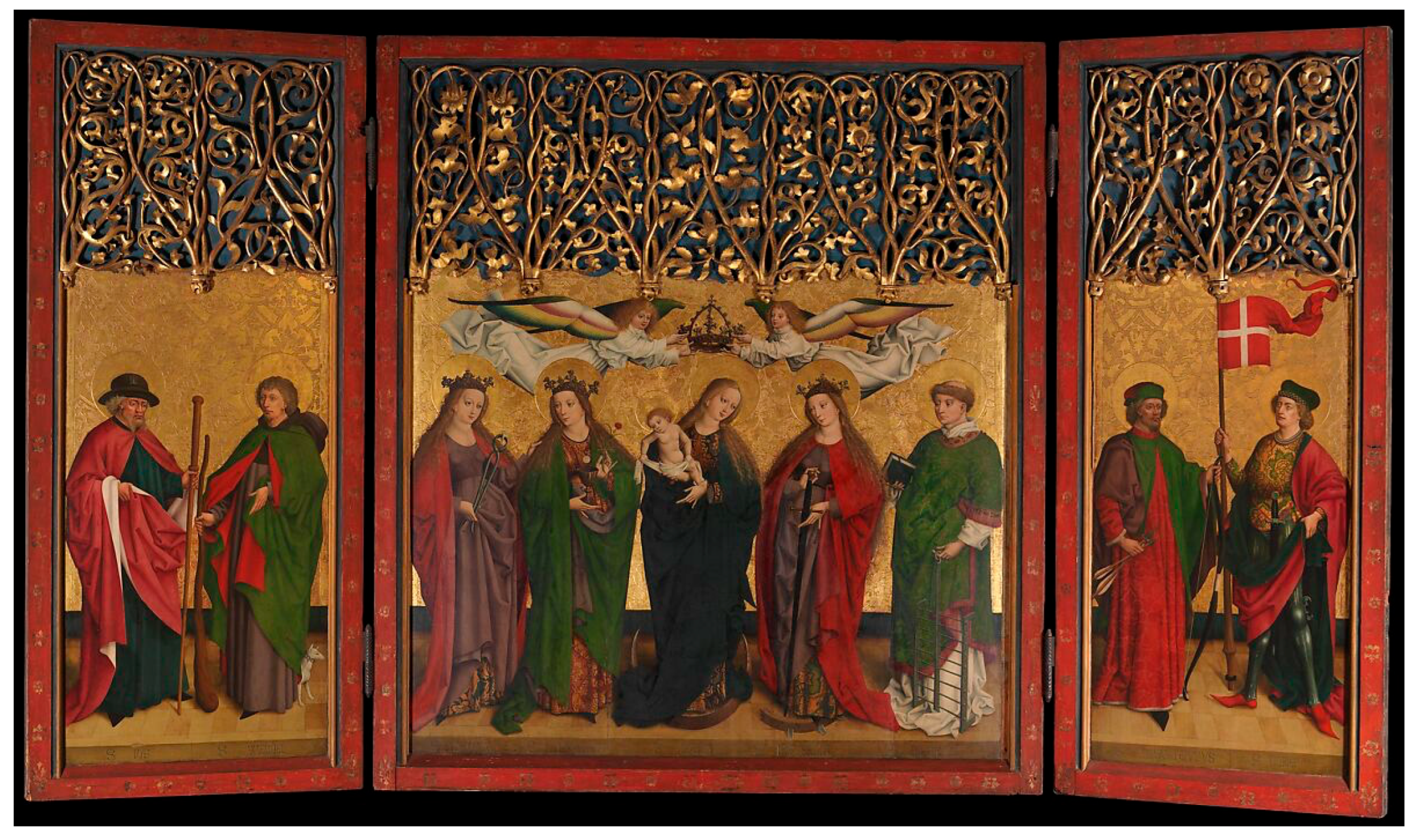
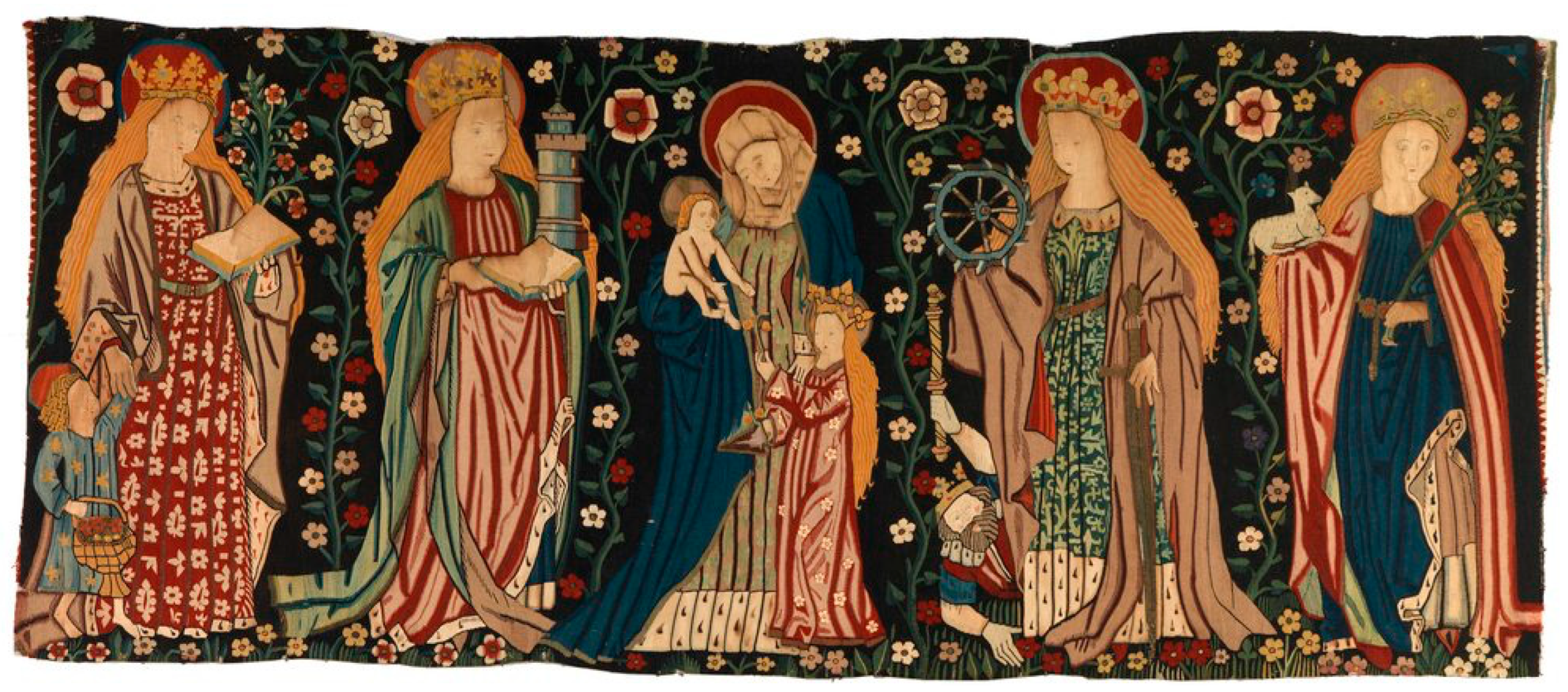
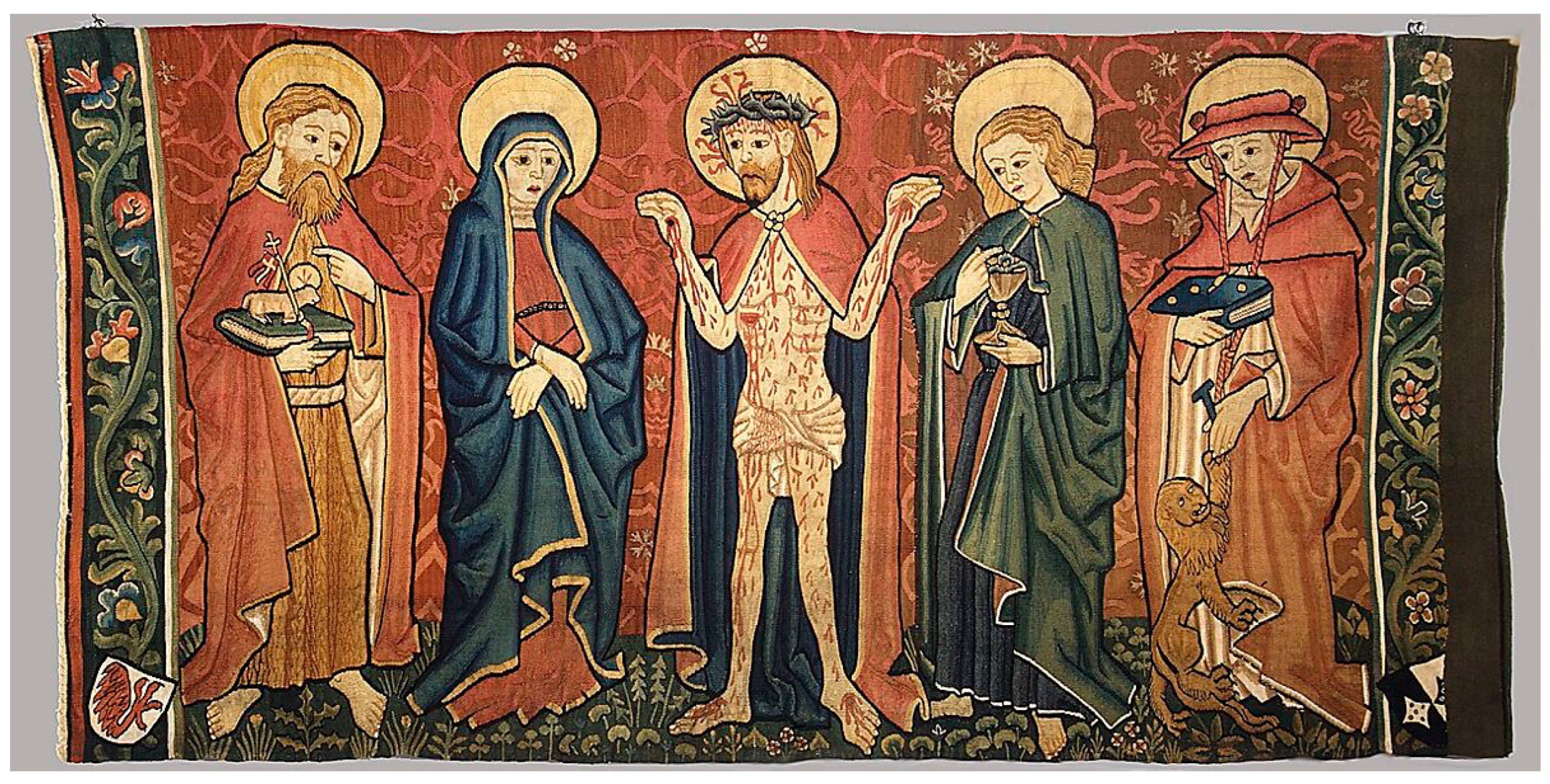
However, this depiction of multiple virgin martyrs—all in the throes of torturous martyrdom within the same panel—is quite rare. In comparable antependia and altarpieces with multiple saints, such as in the two images below, the figures are shown iconically with the attributes of their martyrdom or a martyr’s palm, but not narratively during their martyrdoms (
Figure 3 and
Figure 4). The nakedness of multiple martyrs in a single image is also an unusual aspect of the Virgin Martyrs Tapestry, as saints depicted in groups are typically clothed.
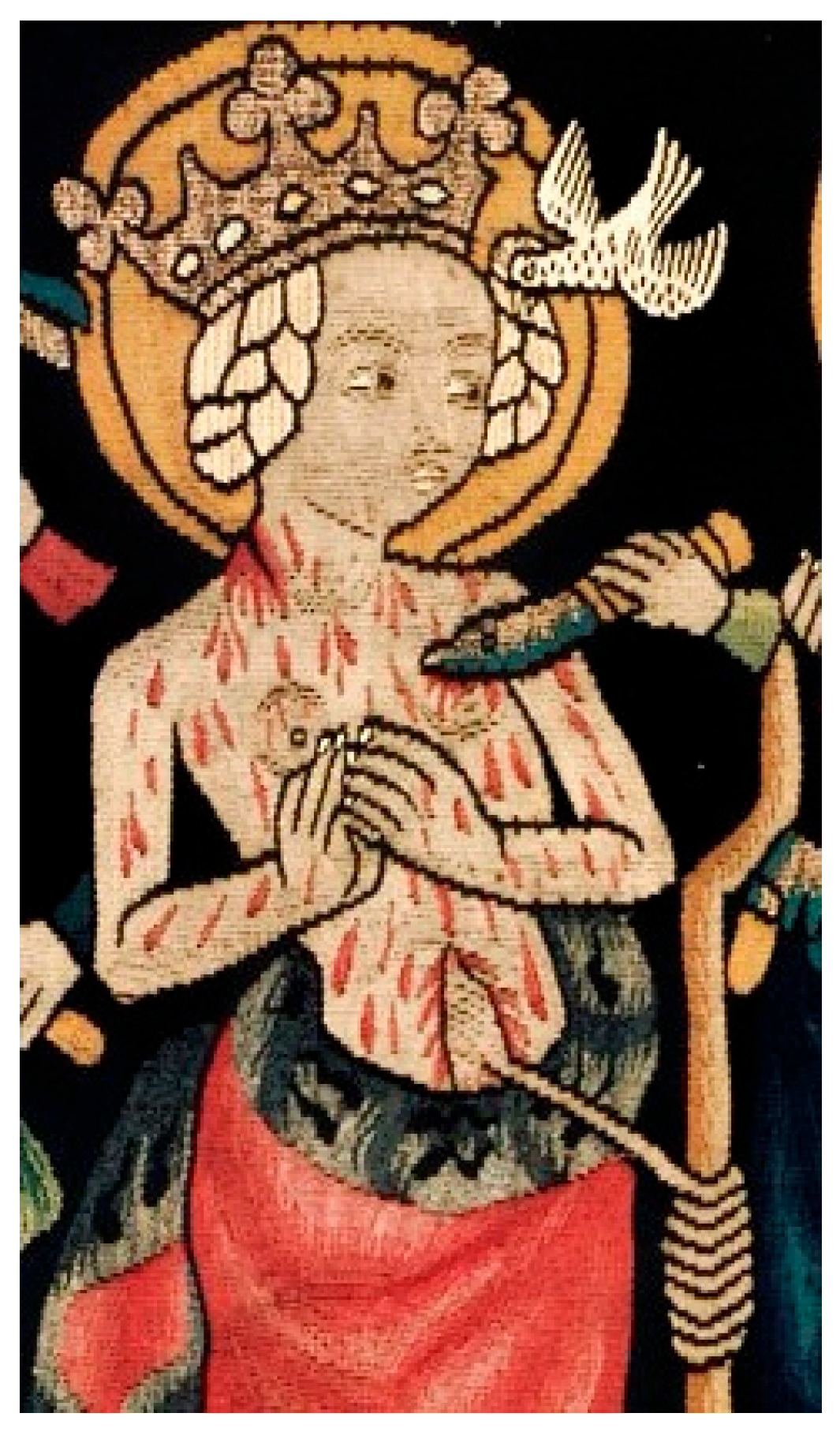
Instead of following the standard depiction, the virgins in this antependium are stripped to bare their bloodied wounds, hands raised in a gesture of acceptance. They are represented in a manner echoing common characteristics of contemporary Man of Sorrows imagery, which prominently features the wounds of Christ’s Passion on his exposed body, rather than the usual mode of a group of clothed and iconic saints holding their attributes (
Figure 5). Carol Straw notes the passive acceptance of suffering as a Christ-like virtue in which martyrs are shown to be “suffering bravely, not fighting valiantly” (
Straw 2002, pp. 41–43). By deviating from the standard iconography of a group of virgin martyrs, the antependium stresses the parallels between the virgins’ martyrdom and Christ’s redemptive suffering throughout the Crucifixion. In addition to this reference to the Man of Sorrows, Christ’s martyrdom will be considered again in the following section, in relation to
arma Christi allusions within the tapestry’s enigmatic visual program.
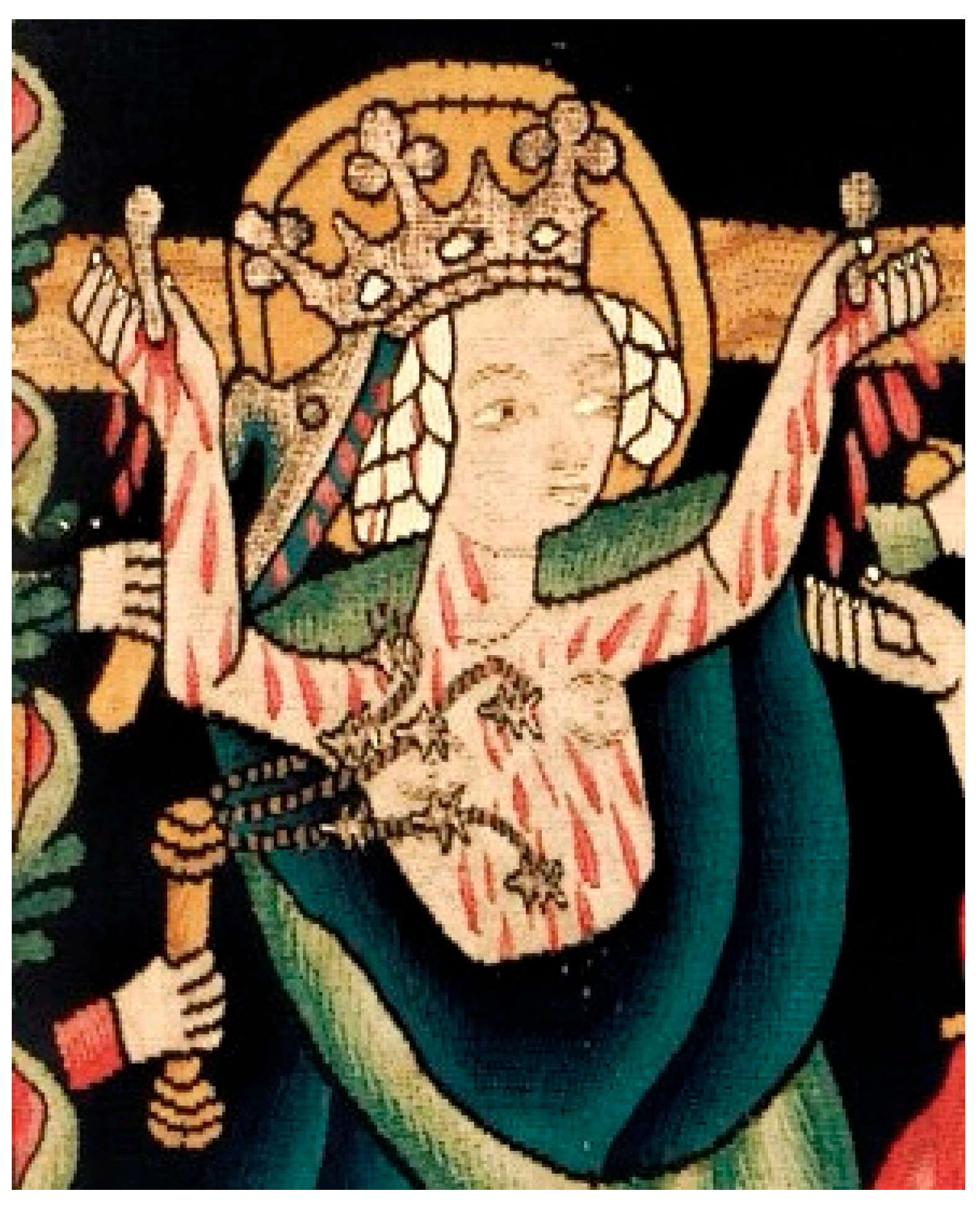
The tapestry depicts Benedicta crucified and whipped with a barbed scourge. In
Der Heiligen Leben, Benedicta is celebrated for her work to spread Christianity throughout the Diocese of Soissons (
Der Heiligen Leben, pp. 605–6). Benedicta endured unspecified tortures for her Christian beliefs, but her wounds miraculously healed each night after they were inflicted (
Figure 6). Her father, a wealthy senator, was enraged by her recovery and is said to have taken it upon himself to behead her with the executioner’s ax.
Next to Benedicta, Christina is shown with flames beneath her feet, arrows through her stomach, knives at her breasts, and a mill stone around her neck. Christina’s legend is a conflation of two women by the same name in Tyre, Lebanon and Bolsena, Italy (
Der Heiligen Leben, pp. 273–76). After refusing to make pagan sacrifices for her father, she destroyed his idols and was then condemned to death. She was beaten and imprisoned before her father ordered that her “tender members” be removed (
Figure 7). Then, after the breaking wheel and burning at the stake did not kill Christina, a large mill stone was tied around her neck, and she was thrown into the sea. She survived the attempted drowning, and she had her tongue cut out so that she could not speak, at which point she threw the severed tongue at her torturers. Finally, Christina was executed with several arrows to her stomach and heart.
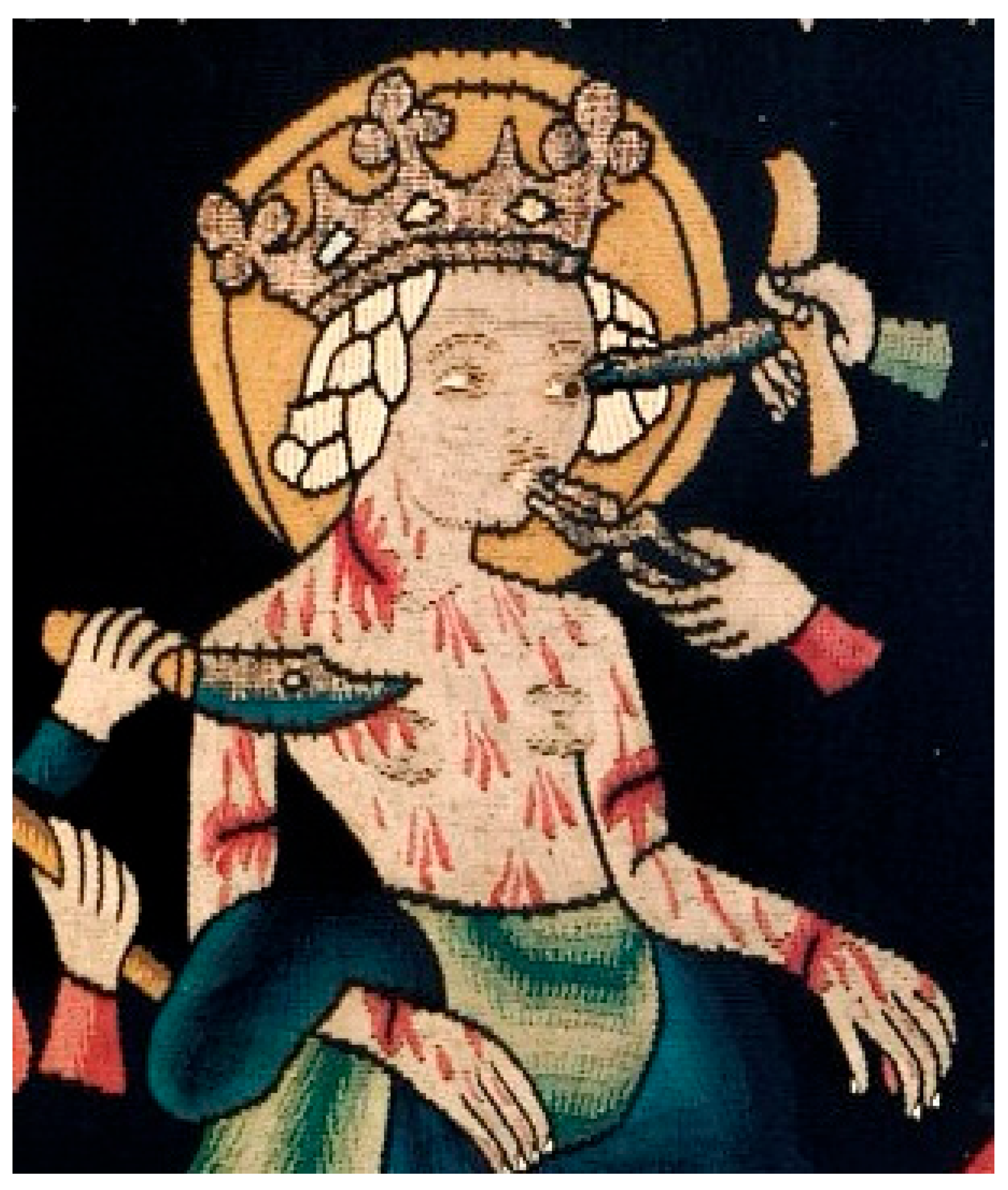
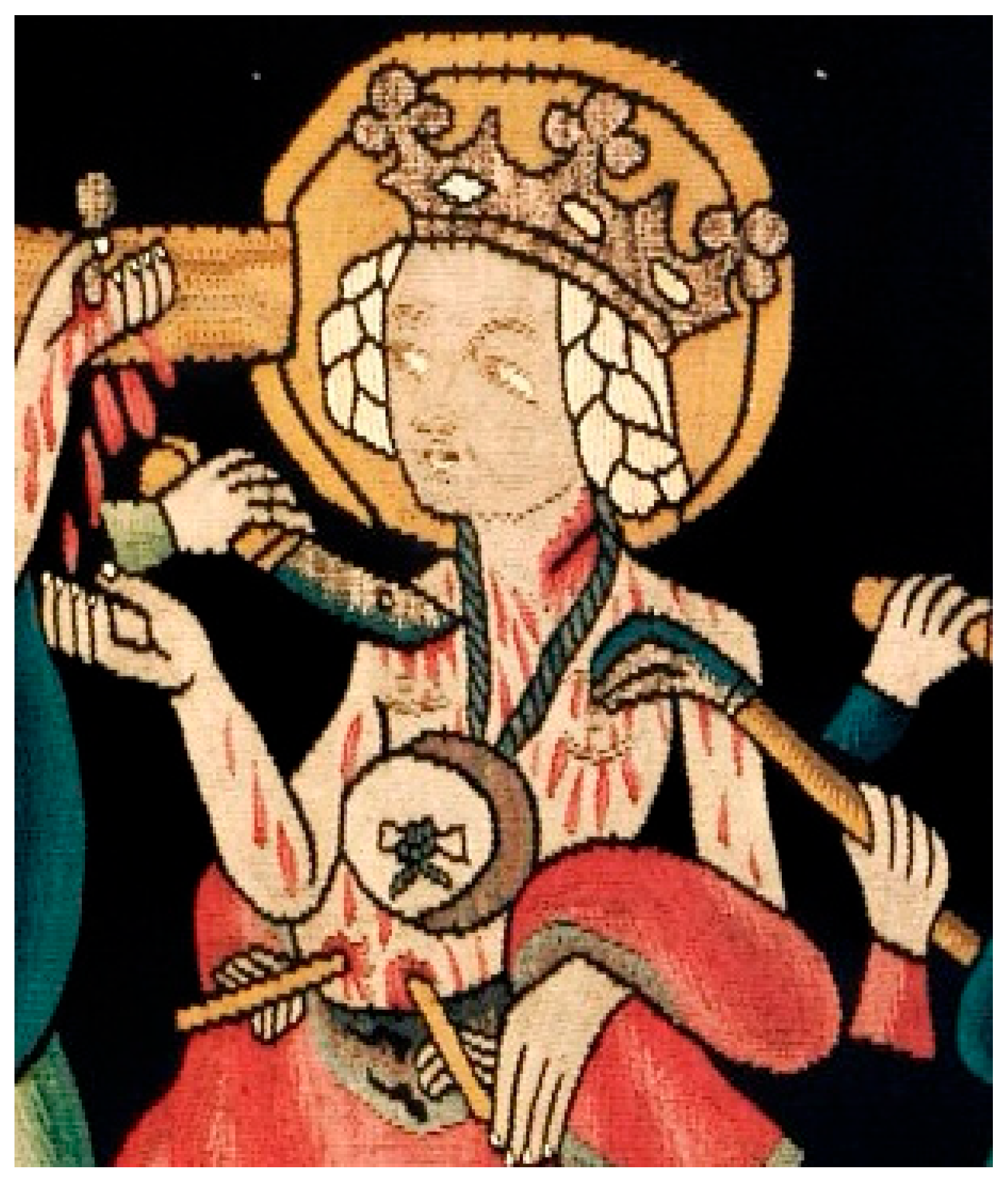
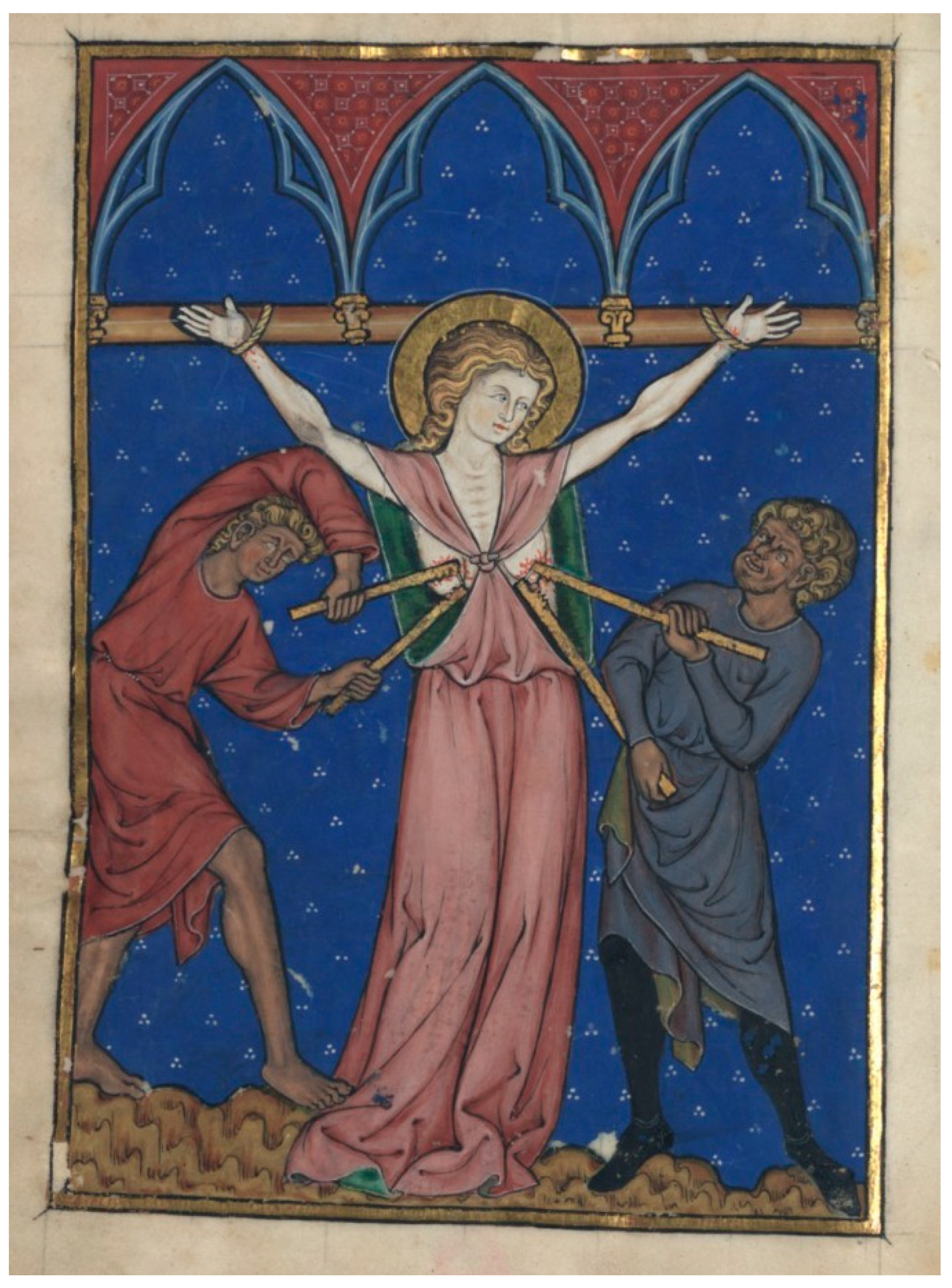
The third virgin depicted on the antependium is Apollonia. She is shown with a sharp instrument at her temple, pincers pointed toward her mouth, and a large knife cutting one of her breasts. According to her legend, Apollonia was an
elderly virgin woman, though she is almost never represented this way pictorially (
A. Butler 1962, p. 286). She famously had her teeth pulled out with pincers, which is the most common depiction of her martyrdom (
Figure 8). Then, threatened with death in the fire if she did not deny Christ, Apollonia willingly jumped into the flames and died to preserve her virginity and faith.
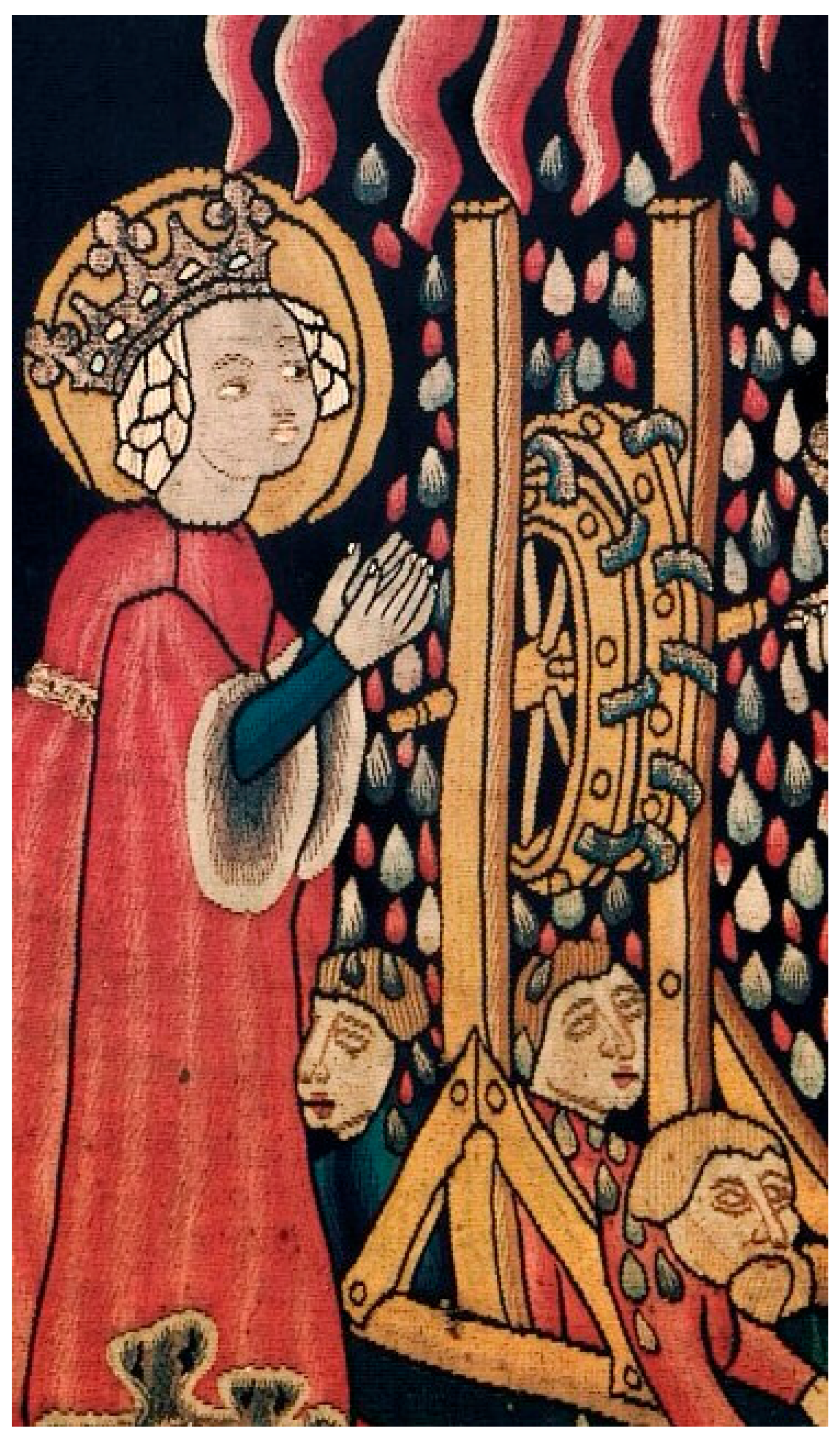
In the center of the antependium, Katherine of Alexandria is kneeling, awaiting decapitation. Behind her, the breaking wheel explodes into flames, crushing her pagan tormentors beneath the wreckage. Katherine was an extremely prominent virgin martyr saint in the Middle Ages, known for her intellect and her conversion efforts in Alexandria before her martyrdom (
Ashton 2000, pp. 122–27). Katherine popularly debated with pagan philosophers and converted to Christianity many who listened to her speak. For this, she was imprisoned but continued to convert several high-ranking officials in the emperor’s court, including his Queen. She was condemned to torture and death on the breaking wheel. But before she was attached to the wheel, it miraculously exploded, killing the on-lookers and torturers with its flying debris (
Figure 9). She was finally beheaded, and her body was carried to heaven by a host of angels.
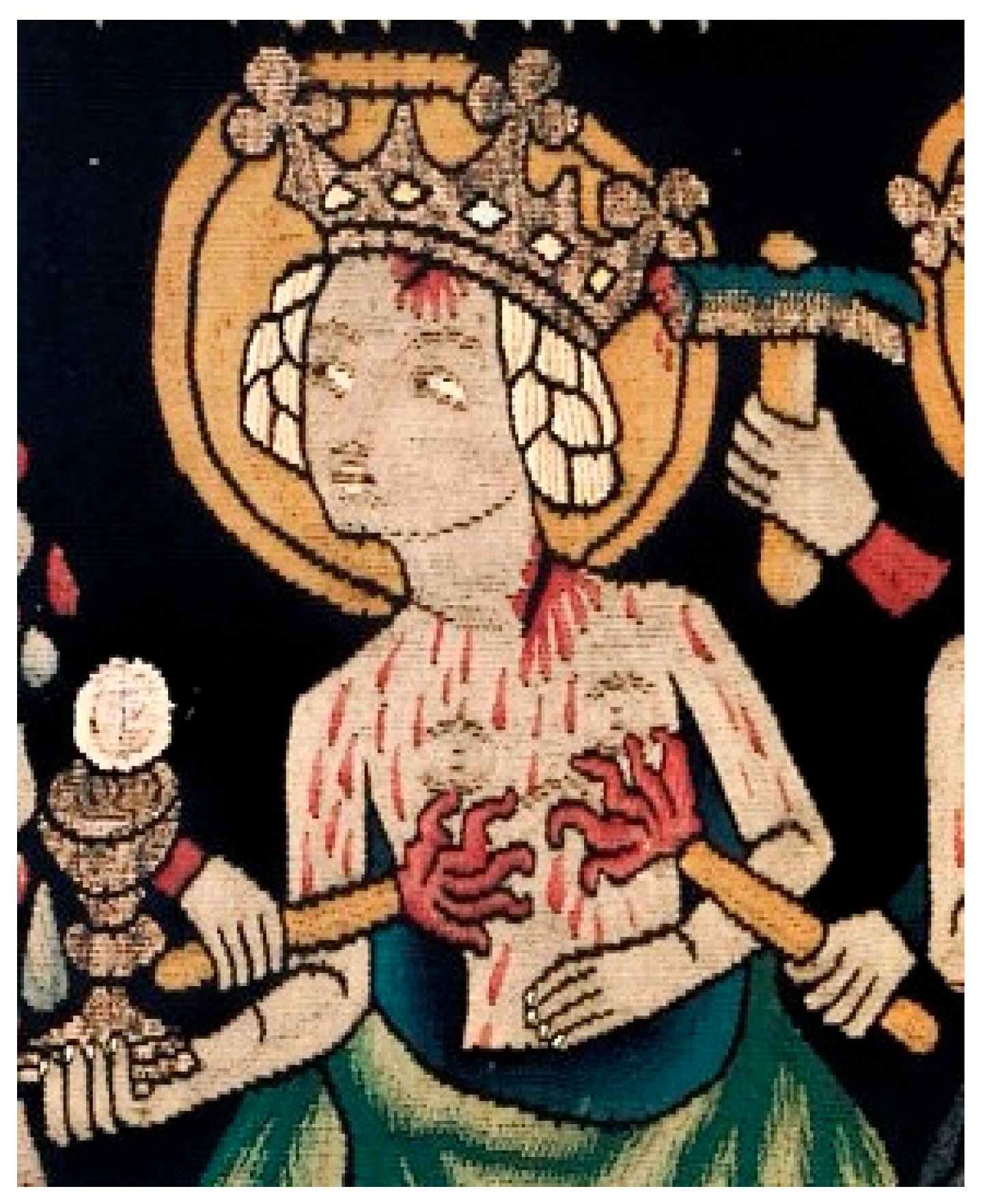
Looking toward Katherine and the wheel, Barbara is depicted with a Eucharistic chalice. Two swords lie at her feet, while her breasts are burned with flaming torches, and a hammer is pointed at her face. Barbara was a prevalent saint in the Middle Ages and is commonly depicted with the Eucharist and a tower (
Figure 10). Her legend claims that her father locked her away in a tower to keep her secluded, where she studied and prayed before being baptized in secret (
A. Butler 1962, p. 487). Her father was outraged when he heard of her conversion to Christianity. Publicly slandered by her father, her breasts were scalded with hot irons. After withstanding horrific tortures, she was finally beheaded. Her father, who beheaded Barbara himself, was struck dead by lightning shortly after.
The last two saints depicted in the Virgin Martyrs Tapestry are less commonly depicted than the others, and their legends are difficult to reconstruct with any consistency. Reparata is shown in the tapestry with a dove near her head, a knife to her breast, and her intestines being wound out by a windlass. Gathered from multiple sources, her legend states she survived tortures by fire before being beheaded, at which point her soul emerged from her body in the form of a white dove (
Figure 11;
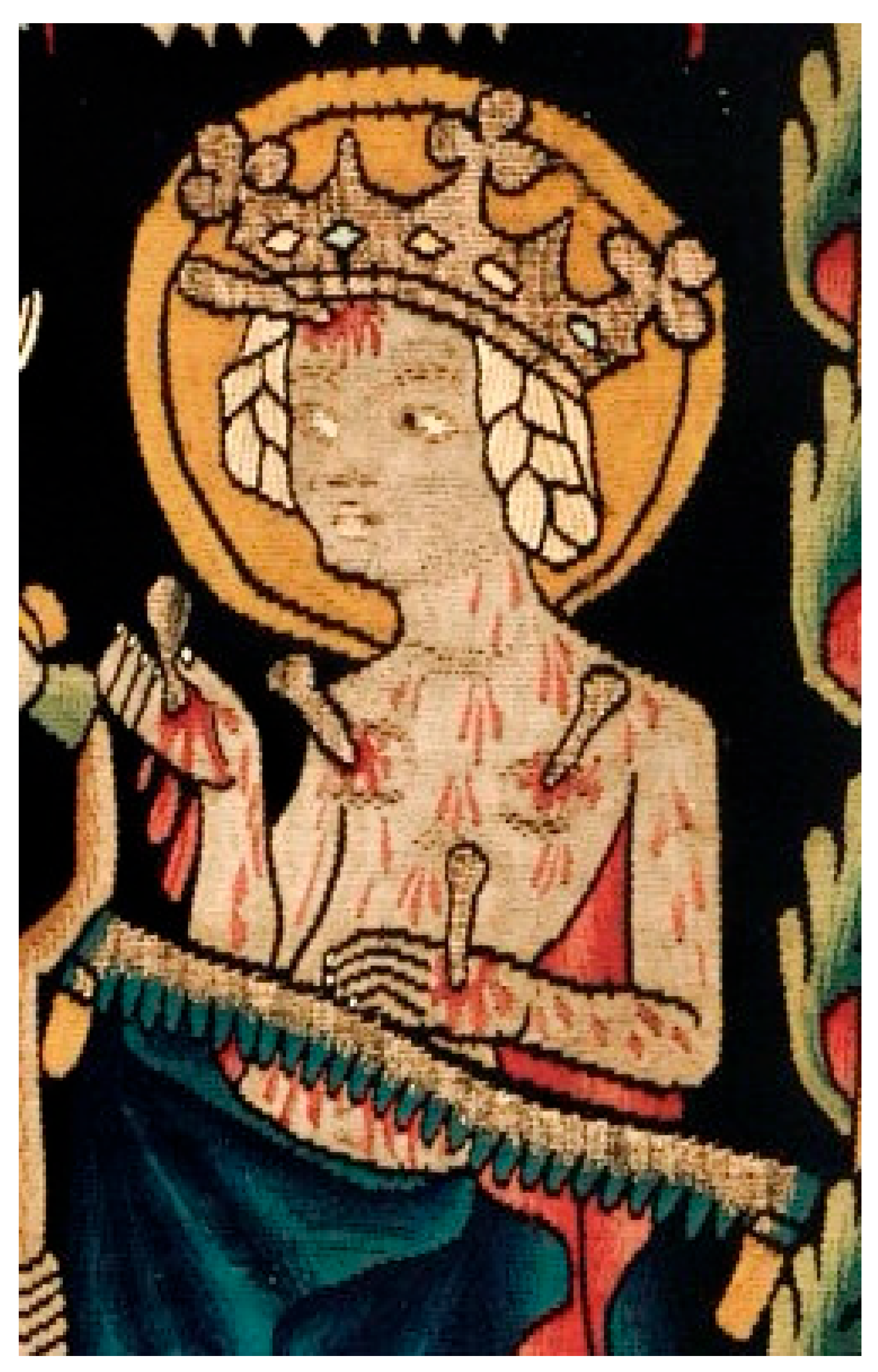
A. Butler 1962, p. 62). Lastly, Fausta is shown with nails in her forehead, hands, and breasts, and a two-man crosscut saw intersects her torso. One account claims her torturers locked her in a trunk and attempted to saw her in half, but the trunk and Fausta remained unharmed (
Figure 12). A girl of only thirteen, Fausta is said to have converted her executioner, who was martyred with her because of his conversion (
Mombritius 1910, pp. 532–35).
3. Torturing Hands
Normally in narrative martyrdom scenes, menacing male torturers or emperors overseeing the execution represent the societal “power” inflicting the pain on the martyrs. Often, phallic references are present in the form of sword shafts, bulging codpieces, or suggestively placed belt knots (
Caviness 2001, p. 115;
Easton 1994, p. 88). These suggestive elements exemplify the gendered and sexualized nature of the violent martyrdom scenes. In addition to narratively depicting the hagiographic legend of the martyr, the representation of a torturer is a locus for hatred and blame. As viewers of martyrdom scenes would identify with the Christian faithful and feel sympathetic toward the vulnerable martyr, so too would they be angry at the torturer for inflicting pain on the virginal body of their victim.
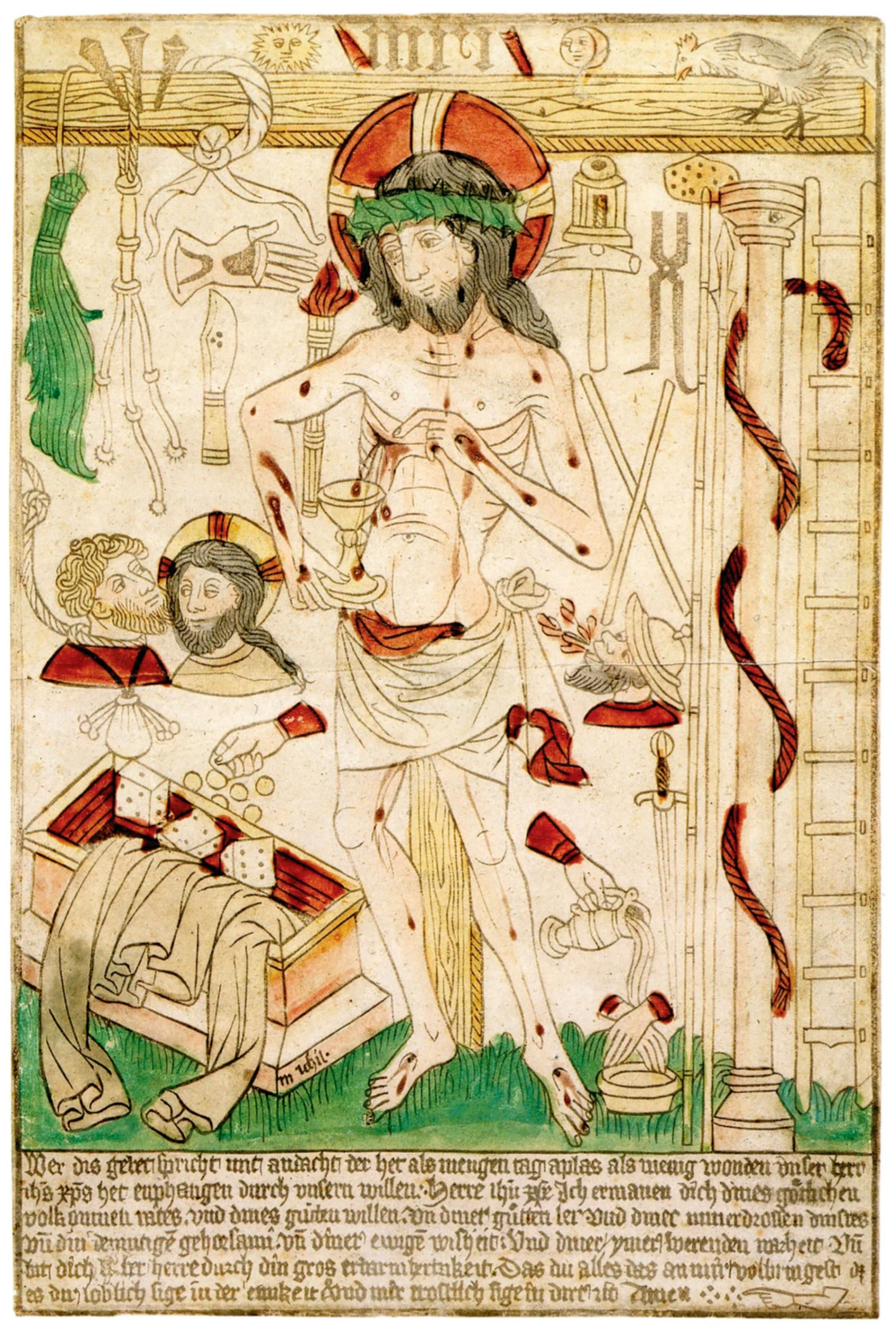
However, in the Virgin Martyrs Tapestry, there are no torturers to loathe or blame. Rather, floating hands carry out the heinous acts of mutilation. Knives, swords, saws, hammers, torches, and rakes are wielded by hands belonging to unseen tormentors. These disembodied hands are not capable of being the locus for hatred, blame, or repulsion, and so, viewers are forced to focus their attention on the bloody bodies of the martyrs. While the weapon-wielding hands in the tapestry are rare, and perhaps even unique, in depictions of martyrdom, some visual similarities can be identified in elaborate Man of Sorrows and
arma Christi iconography of the period (
Figure 13 and
Figure 14). For late medieval Christians, Christ’s suffering and sanctity were integrally linked. As opportunities for devotional contemplation on the wounded body of Christ, the Man of Sorrows as well as the
arma Christi, the weapons used during the Passion and Crucifixion, were commonly depicted elements in medieval art.
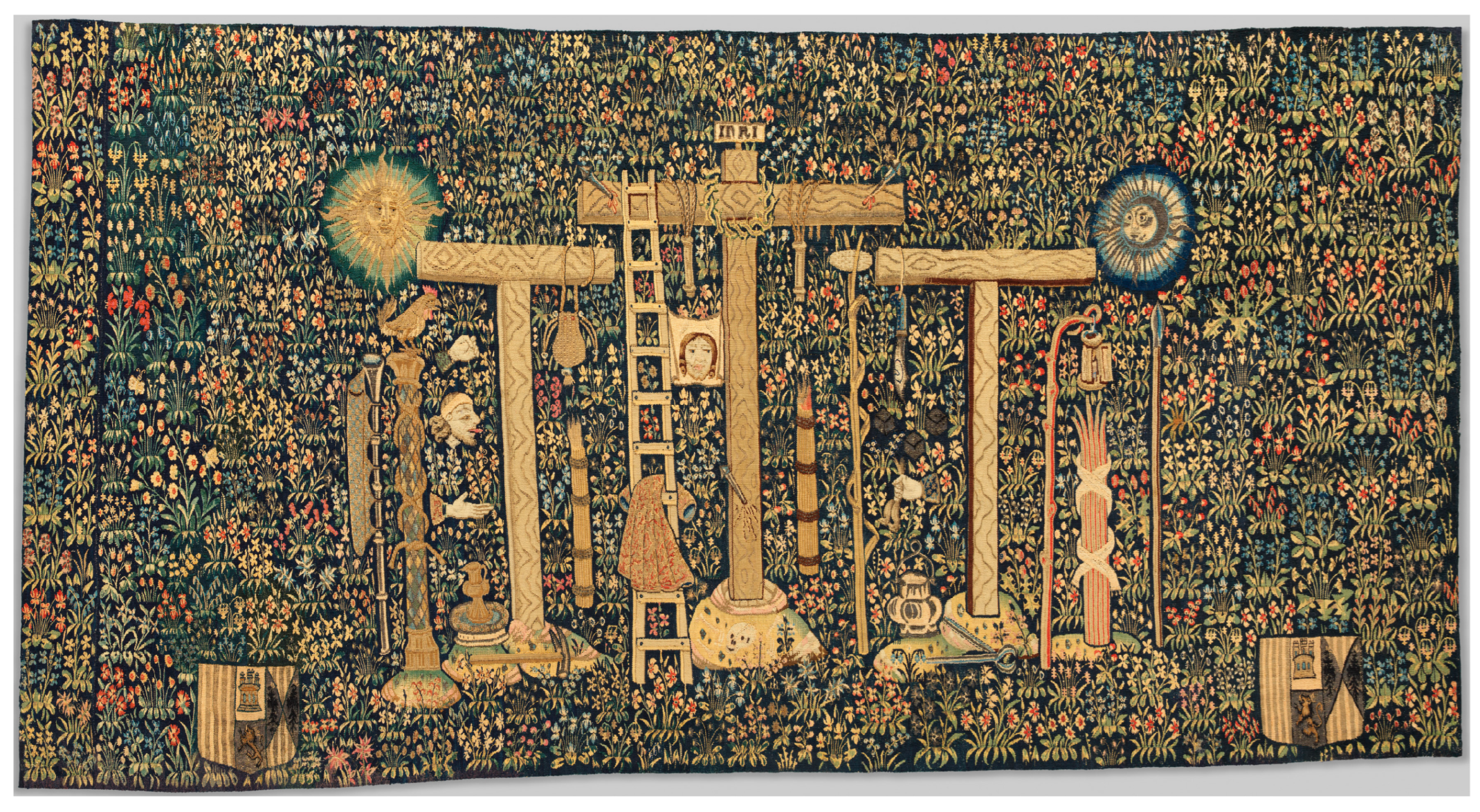
The ever-expanding array of motifs evident within a late fifteenth-century tapestry of the
arma Christi includes: knives and swords, a blindfold, the crown of thorns, crossed rods, a pillar wrapped in rope, nails, hammers, a sponge on a pole, spear, ladder, tongs, rooster, dice, a sun and moon, the isolated side wound, Christ’s body on the cross or entombed, Jews spitting in Christ’s face, or two hands, one holding a clump of Christ’s hair and the other open as if about to strike (
Hirsh 1996, pp. 131–36). The spitting Jew, the clasped hand with hair, and the striking hand are references to the Mocking of Christ, in which Christ is spat on, slapped, and has his hair pulled. The depiction of a Jew spitting in Christ’s face is sometimes rendered as a levitating, disembodied head, and the two hands may be shown floating in space while they enact their mockery. These features, woven into a densely packed millefleur tapestry background, reward viewers for patient looking as they are not immediately apparent.
The Virgin Martyrs Tapestry promotes a visual program in which the tortured female saints are likened to the crucified Christ, as evident in these iconographic similarities with the Man of Sorrows altar frontal, Man of Sorrows and
arma Christi woodcut, and the
arma Christi tapestry (
Figure 5,
Figure 14 and
Figure 15). Their bared and bloodied bodies are presented, passively accepting their fates as the weapons of their demise are wielded around them. Again, this composition stands in stark contrast to the common portrayal of a group of martyr saints, fully clothed and iconically posed side by side carrying their attributes. Therefore, it is possible to consider the saints’ depictions in the tapestry as “Women of Sorrows” accompanied by the
arma Christina,
arma Barbara, and so on.
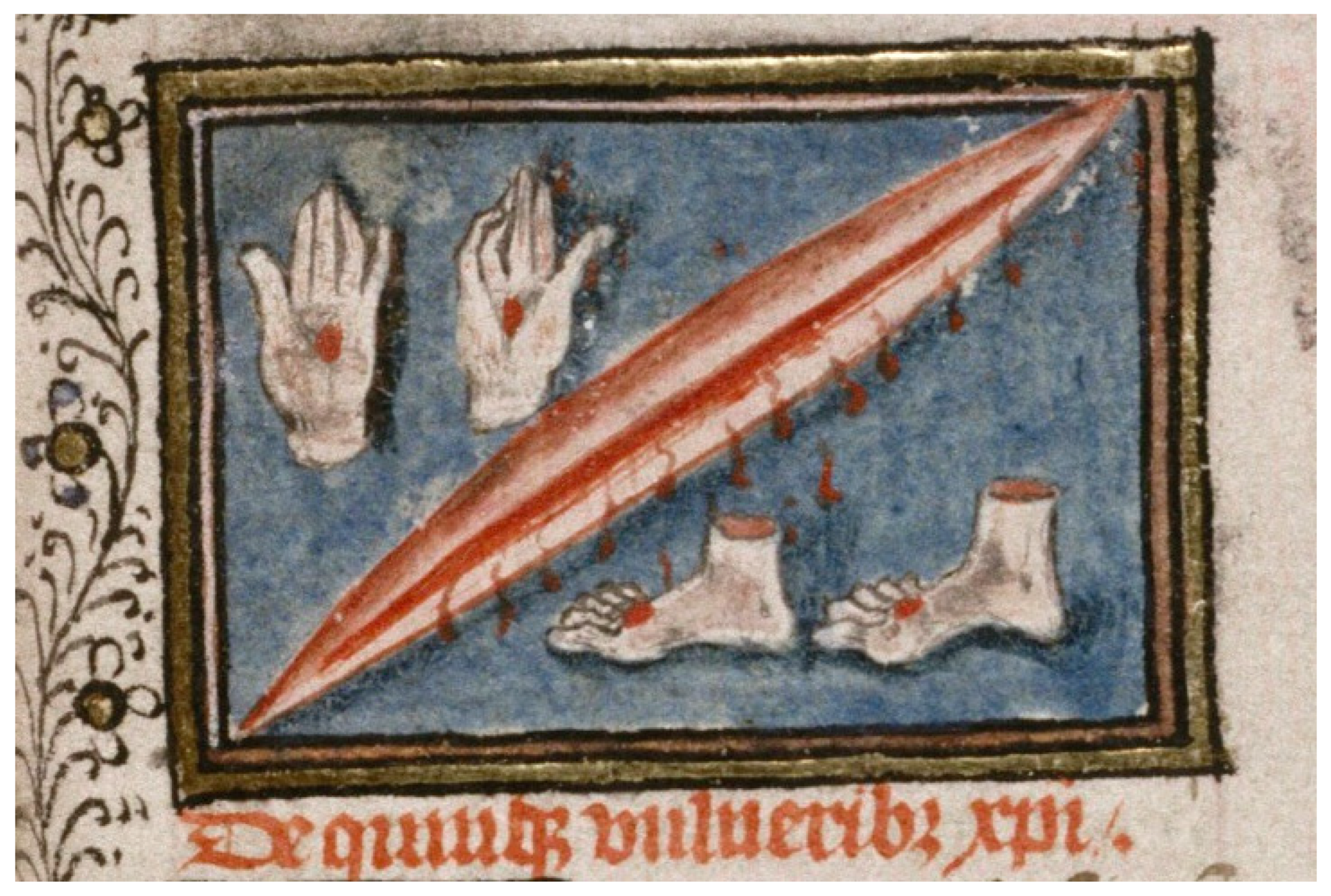
Additional comparative images worth noting are late medieval depictions of Christ’s Crucifixion wounds. Though they are not
torturing hands, but rather
tortured hands, some images of the wounds suffered by Christ during his own martyrdom bear striking visual similarities with the Virgin Martyrs Tapestry (
Figure 15). Christ’s incorporeal bleeding hands, feet, and side wound are presented for devotional contemplation (
Easton 2010, pp. 395–414).
4 While not entirely similar, these visual motifs of isolated and disembodied hands are concurrent with the torturing hands in the Virgin Martyrs Tapestry, making the pain inflicted visible and accessible to viewers.
While viewers are focused on the battered bodies of the virgins, the disembodied hands in the tapestry allow for, and may even encourage, viewer participation in the mutilation of the virgins. Through devotional methods such as “affective devotion,” viewers of the antependium could cast themselves within the composition to participate in the scene depicted (
Lindgren 2009, p. 58). The puppet-like hands of the torturers in the tapestry appear a convenient invitation to place oneself in the position of the torturers. To put on these “torturous gloves,” as they become in this situation, affords participant/viewers the occasion to maim and disfigure the virginal bodies of the women in the tapestry. Scholars such as Madeline Caviness have posited that viewers of virgin martyrdom scenes have a choice as to whether they will identify with the victim or with the torturer (
Caviness 2001, p. 85). As the imaginary operators of the torturing hands, viewers would have the opportunity to cut, stab, burn, rip, and saw the virgins’ bodies.
4. Pain and Torture
Through numerous iconographic choices, the Virgin Martyrs Tapestry makes it clear that the endurance of pain and torture on the flesh is a commonality between virgin martyr saints and Christ himself. Critical research about pain and suffering contributes to our understanding of artworks portraying brutal tortures or executions like those woven into the Virgin Martyrs Tapestry. Elaine Scarry’s pivotal book,
The Body in Pain: The Making and Unmaking of the World, analyzes the ways pain and torture affect people and societies (
Scarry 1987, pp. 3–59). Esther Cohen and Robert Mills have effectively demonstrated the ways that martyrs’ pain and suffering were interpreted in the context of late medieval Christianity as a reflection of
imitatio Christi (
Cohen 1995;
Mills 2005).
Elaine Scarry demonstrates that the experience of pain is a wholly unique state, specifically because suffering resists objectification in language. Pain is often private, unknowable to any person outside the one who is in pain, and human language is incapable of verbally objectifying or capturing the excruciating personal experience. Scarry asserts that this inexpressibility of pain is the primary reason scholars and societies often ignore those in pain.
In the Virgin Martyrs Tapestry, the saints not only suffer inexpressible pain, but are also silenced by their perpetual representation in the tapestry with stoic faces and closed mouths. Though silent, the martyrs’ pain is given visual form through the depiction of their wounds in the Virgin Martyrs Tapestry. The weapons of torture, gaping lacerations, and gratuitous blood depicted on the bodies of the martyrs are the outward signifiers of suffering. Scarry relates that wounds or weapons can be considered visible objectifications of pain that serve to “convey something of the felt experience of pain to someone outside the sufferer’s body” (
Scarry 1987, p. 15). The externalization and objectification of pain through the depiction of wounds and weapons lead to Scarry’s claim that, “a weapon is an object that goes into the body and produces pain… it lifts the pain out of the body and makes it visible” (
Scarry 1987, p. 56).
The outward expression of pain through the weapons, blood, and wounds in the Virgin Martyrs Tapestry brings about a tension between one’s internal experience of pain and any public awareness of that pain. Scarry dissects the notion that it is possible, even probable, to be oblivious to others’ pain because of the intensely personal nature of that pain (
Scarry 1987, p. 52). And so, when pain is made external and objectified in the form of wounds, a clash between private and public occurs. This tension is compounded in the Virgin Martyrs Tapestry because of its public display at the Altar of St. Katherine in St. Sebald in Nuremberg where visitors to the church would have had the opportunity to view the pain of the virgins in a public environment.
The infliction of pain and the public display of broken bodies play central roles in understanding the societal dynamics of torture. The pain inflicted on the virgin martyrs and the egregious depiction of wounds and weapons in the Virgin Martyrs Tapestry emerge from the Ancient Roman practice of torturing and executing Christians in the third and fourth centuries. The women were cruelly tortured to cajole them into renouncing Christ and God. When they refused to deny their faith, they were killed.
For Ancient Romans and Early Christians, those responsible for the martyrs’ mutilation used torture to bolster the illusion of their authority. Elaine Scarry analyzes the common tactic of inflicting real pain to create the fiction of power (
Scarry 1987, p. 18). Scarry calls the act of torture a “wholly convincing spectacle of power” (
Scarry 1987, p. 27). In Scarry’s framework, the act of torture comprises three steps. First, pain is inflicted on a person. Second, the pain inflicted increases and is objectified or externalized to be visible to others. Lastly, the objectified pain is denied as pain and recast or redefined as power. The power rhetoric of torture also dictates that the torture be publicly visible and displayed repeatedly to ensure the myth of a powerful regime is internalized for would-be dissenters. Scarry refers to this obsessive, repeated display of pain and power as a “grotesque piece of compensatory drama” (
Scarry 1987, pp. 27–28).
Scarry’s proposed relationship between real pain and perceived power is exemplified in the exaggerated violence shown in the publicly visible and repeatedly displayed Virgin Martyrs Tapestry. However, late medieval Christian attitudes toward the martyrs’ acceptance of the pain and suffering may have subverted the message that the torturers were the powerful ones. Robert Mills notes that Scarry’s framework is best applied to instances of “actual torture,” rather than medieval hagiographic legends in which “the martyr repudiates torture’s dualistic disposition by valorizing bodily suffering as a source of agency and power” (
Mills 2005, p. 158). Instead of lending power to the torturer, the martyr’s suffering “is transformed from being a mark of passive, powerless victimization to becoming a central signifier of God’s present existence… a palpable sign of God’s presence in the world” (
Mills 2005, p. 157). The wounded martyr was also a visible representation of the power and glory of God, “who gave those humans the ability to withstand atrocious sufferings” (
Cohen 2010, p. 234).
Not only are the martyr’s wounds a sign of God’s presence and power, but also an avenue toward an embodied method of
imitatio Christi, the imitation of Christ (
MacKendrick 1999, p. 69). In fact, Irina Metzler has investigated medieval attitudes toward physical impairment and the wounds inflicted on martyr saints as enduring beyond death just as Christ’s did (
Metzler 2006, pp. 56–58). Metzler charts changing attitudes toward disfigurement from Augustine to Bonaventure, noting that it is a consistently held belief that martyr saints will bear their scars (“those proofs of valor”) even in resurrection when all other bodies will be restored (
Metzler 2006, p. 56). Once again, the martyrs are described in the same terms as Christ.
In the Christian tradition, “sanctity was achieved by imitating Christ, and the imitation of Christ was the imitation of his Passion, not his life” (
Cohen 1995, p. 60). This notion that pain might be useful and, in fact, positive, rather than an evil to be avoided at all costs, is a concept Ester Cohen calls “philopassianism” (
Cohen 1995, pp. 51–54). In fact, Cohen suggests that “suffering was not to be dismissed, vanquished, or transcended: suffering was to be felt with an ever-deepening intensity” (
Cohen 2010, p. 4). In the visual arts, the willing acceptance of pain and suffering is often exemplified in the stoic faces or acquiescent gestures (hands raised to signify surrender or resignation) of Christ and the martyrs. It is important to stress the necessity of the martyrs’ surrender to and acceptance of pain and suffering during their tortures, as it imitates Christ’s willing sacrifice during his Passion.
Regarding virgin martyrs specifically, some medieval scholars promoted the idea that women’s bodies were more tender and sensitive than men’s (
Cohen 2010, p. 215). By extension, women were more likely to denigrate their flesh through asceticism in the mid- to late Middle Ages when the connection between women and the body was more pronounced (
MacKendrick 1999, p. 70). Following this trajectory, the female virgins’ bodies were the most sensitive to the pains inflicted during martyrdom. Considering Cohen’s notion of philopassianism, the female virgins’ overwhelming sensitivity to bodily pain, their acceptance of their torture, and their willing surrender to pain were central components of their sanctification (
Cohen 2010, p. 229).
5. Gendered Violence & “Becoming Male”
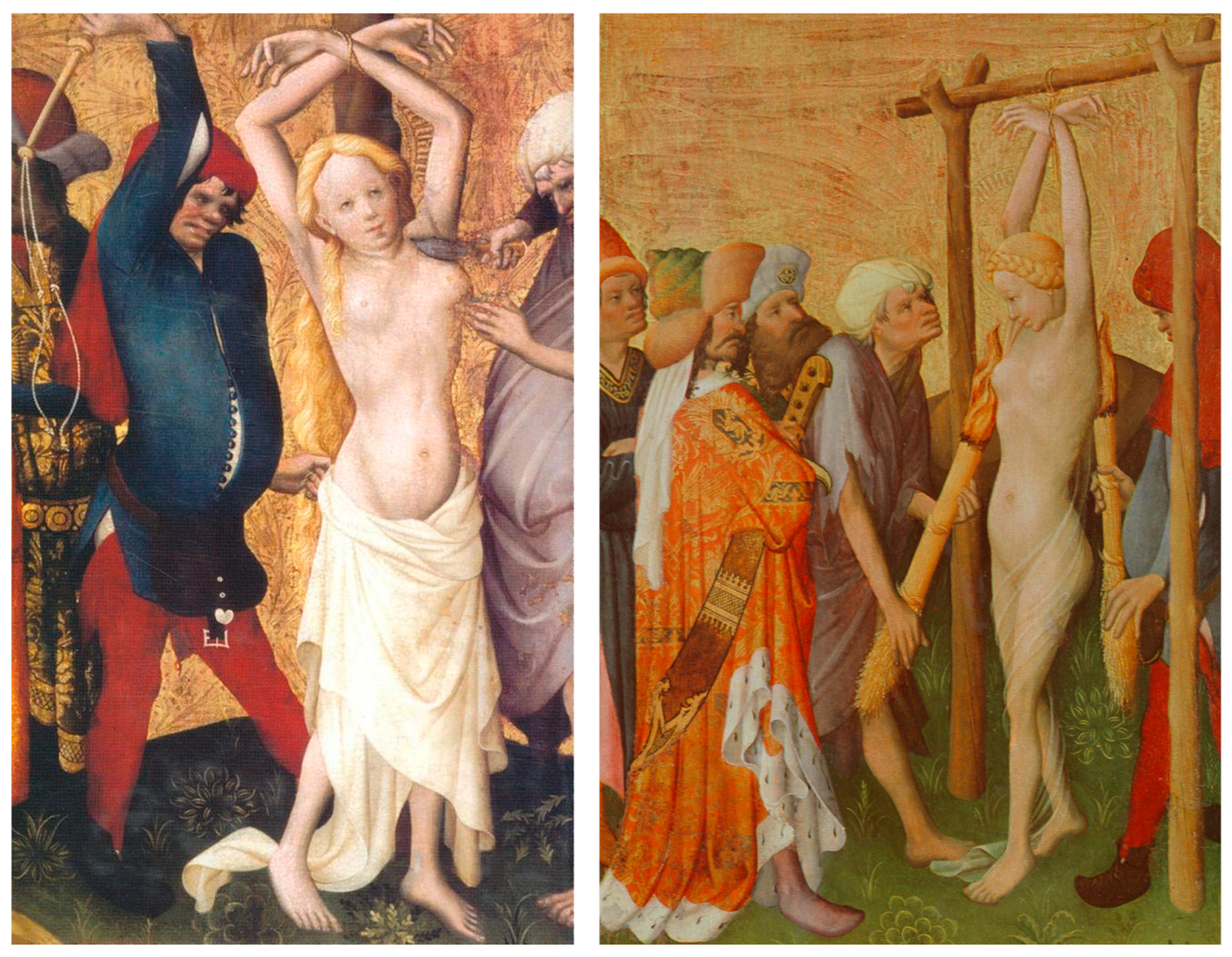
In the Virgin Martyrs Tapestry, the martyrs’ sensitive flesh is emphasized, as their bared breasts are targeted in ways undeniably intended to denigrate their femininity. For example, all the women except for Katherine are shown stripped to the waist with their breasts being tortured by knives, whips, nails, or flames. This gruesome depiction of mutilated breasts does not correspond with most of the legends, given only some accounts of Christina’s and Barbara’s legends specifically state that their breasts were maimed. Benedicta, Apollonia, Reparata, and Fausta are (to my knowledge) never recorded as having their breasts mutilated during their martyrdom, despite their representation in the Virgin Martyrs Tapestry.
Breast torture is often a conspicuous element of images of Barbara’s martyrdom, as is most notoriously evident in Master Francke’s early fifteenth-century altarpiece (
Figure 16). The eroticized depictions on the altarpiece are largely the focus of Robert Mills’ analysis of medieval attitudes toward the torture of virgin martyrs (
Mills 2005). In fact, the paintings have also been referenced to invoke the notion of “religious pornography” or to suggest Barbara is shown “vulnerable to gang rape” (
Mills 2005, p. 109).
Notably, Saint Agatha’s hagiographic legend famously includes the torturous removal of her breasts. In art, she is frequently depicted displaying her severed breasts on a platter, or narratively shown bound as her breasts are stabbed, cut, or pincered (
Figure 17;
Easton 1994, pp. 83–118). Despite the Virgin Martyrs Tapestry’s hyper-focus on breast mutilation, Agatha’s martyrdom is not among the women depicted.
5 It is unclear why a celebrated virgin martyr like Agatha, perhaps the saint most well-known for breast mutilation, is excluded from the antependium. While her name is not assigned to any of the figures on the tapestry, her legend is implied to viewers who are reminded of her martyrdom upon viewing the tortured breasts of the saints depicted.
The common topos of breast mutilation in the lives of female virgin saints like Agatha has received scholarly attention from feminist art historians Madeline Caviness, Margaret Miles, and Martha Easton.
6 Scholars have generally settled on the terms “mastectomy” or “amputation” to describe the removal of breasts in martyrdom narratives, but these terms fail to communicate the horrific nature of the act depicted. Even the phrase “forced mastectomy” has the guise of surgical precision, which is lacking in the tortures executed against the women in the Virgin Martyrs Tapestry.
Caviness explores the sado-erotic implications of virgin martyrdom scenes like those in the tapestry, noting that “sexual shaming and physical punishment were integrally related” (
Caviness 2001, p. 85). The combination of excruciating pain and bare breasts comprises the framework for sado-erotic fantasies to be acted out. Easton suggests the torturers focus their aggression on the virgins’ breasts in some accounts because, often, the torturer is a rejected suitor of the virgin (
Easton 1994, p. 97). In several virgins’ textual legends, the rejection of a suitor to maintain chastity is the beginning of the end for the women. In these instances, the breasts of the virgins could be interpreted as useless to the male torturers because the martyrs’ breasts are available for neither sexual nor maternal functions. Because the women’s “virginal bodies were unavailable for sex,” the authorities (men) endeavored to destroy that which they desired but could not attain (
Caviness 2001, p. 36).
To a modern sensibility, the targeted aggression toward the virgins’ breasts is decidedly misogynistic. However, within a late medieval Christian context, virgin martyrs were celebrated for their stoic endurance and voluntary acceptance of physical suffering. By willfully withstanding their torturous executions, the virgin martyrs are viewed as Christ-like. In this way, female martyrs can be interpreted as earning “a more positive valuation of the fleshliness with which they were customarily associated as women in medieval culture” (
Mills 2005, p. 128). Mills goes so far as to suggest virgin martyrs subvert the male gaze when “the virgin body is visualized at the very moment when it is most vulnerable,” and the women’s “inactivity—passivity even—can communicate power” (
Mills 2005, pp. 118–19).
Christian women seeking to negotiate late medieval ideas about gender could transcend their gender (by accepting their painful fate) or deny their gender by adopting masculine characteristics to “become male.” “Becoming male” is a theme among virgin martyrs, as is evident in the trends of torturing breasts and shaving hair during a woman’s martyrdom. By targeting the saint’s breasts or pulling and cutting her hair, the traits of the saint which are directly related to her femininity are destroyed. Therefore, she “becomes male.” Margaret Miles defines the process and theory of “becoming male” as follows: “Christian women accepted “becoming male” as a characterization of their behavior that was consonant with their resolute choices, and their courageous and triumphant behavior. “Becoming male” removed the female body from the realm of secular, social, and sexual arrangements and made it the ally of the religious self, no longer to be defined by, or associated with, the biological or social functions of women’s bodies” (
Miles 1989, p. 62).
There are instances in which women intentionally disfigured themselves so that they would not be viewed as attractive to men, and their virginity would remain unthreatened. These so-called “heroics of virginity” or “sacrificial mutilations” are evident in medieval ascetic Ebba of Coddingham’s life (
Schulenburg 1986, p. 48). Ebba was said to have “cut off her nose, together with her upper lip unto the teeth” to repulse any potential suitors (
Schulenburg 1986, p. 48). Women could also masculinize themselves through certain behaviors or characteristics, such as rationality, intellect, self-discipline, or physical and emotional strength. Though the promise of empowerment and respect earned through “becoming male” seems beneficial, I contend that it is still an example of misogyny enacted under the veil of empowerment. It creates a problematic system in which women were (and often still are) forced to “become male” to earn respect.
7Within the Virgin Martyrs Tapestry, I would argue that the six women flanking Katherine are depicted in the process of “becoming male.” They have stoic faces, insinuating dominance over their emotions. They are depicted in the process of their tortures, insinuating their flesh is still female and needs lashing to purge their perceived weakness. The breasts, though maimed, are depicted, which serves to remind viewers that the martyrs shown in the tapestry are, in fact, still women. Though clearly shown as female, there are instances in the tapestry that would recall commonly depicted male martyrdoms to informed viewers. Benedicta is whipped and crucified like Christ, Reparata’s intestines are wound onto a windlass like Erasmus, and Christina is pierced with arrows like Sebastian.
In contrast to Benedicta, Christina, Apollonia, Barbara, Reparata, and Fausta, who are depicted in the tapestry as in the process of “becoming male,” I assert that Katherine has already achieved a level of masculinity. Katherine of Alexandria was often described as having a brave spirit, wealth, education, and modest behavior. Her life and martyrdom were originally recorded by her confessor, Eusebius, before the year 340 (
Beatie 1977, p. 786). In his
Legenda Aurea, Jacobus de Voragine credits Katherine with “resisting temptations to which normal women would have succumbed” (
McInerney 2003, p. 192). Already, it is obvious that Katherine is elevated above “normal women.”
Sometimes even referred to as a “prodigy,” her
vita claims Katherine surpassed her teachers intellectually and debated with philosophers about complex theological issues. A twelfth-century French version of
La Vie de Sainte Catherine related the events of her life in such a way that her intellect was emphasized—even over her sexual purity, which defines most other virgin martyrs (
McInerney 2003, p. 181). In the text, written by Clemence of Barking, Katherine is portrayed as the “active pursuant of martyrdom, not its passive victim.” Here, Katherine is aligned with the masculine feature of activeness, rather than the feminine flaw of passivity (in spite of the Christ-like virtue of passively accepting suffering).
8The masculine characteristics from Katherine’s textual legends are echoed in her portrayal in the Virgin Martyrs Tapestry. Katherine’s depiction stands in stark contrast to the women on either side of her. She is kneeling, fully clothed, and no visible wounds or blood are evident on her body, compared to the others who are half-naked, wounded, and bloody. By concealing Katherine’s breasts beneath her clothing, the designers of the tapestry de-emphasized her feminine anatomy. In fact, there is no suggestion of breasts at all underneath Katherine’s clothing. She is fully covered: her feet do not peek out from beneath her dress, her arms are concealed with sleeves, and the neckline of her dress modestly reaches her collarbones. Katherine is shown as a modest figure, not as the sexualized object of desire that the other women potentially exemplify. Therefore, she can be interpreted as more masculine, and by extension, as having “become male.”
In addition to her clothing, Katherine is set apart from the other women in the tapestry by her kneeling position in the center of the composition. Following the gazes of Katherine and Barbara, it becomes apparent that the women are making eye contact. Barbara holds the Eucharist out toward Katherine, who reaches her praying hands toward the chalice and wafer. Katherine’s level-headed piety at the moment of her martyrdom is a signifier of her masculinity. Many female martyrs were reported to have slandered their torturers, but Katherine, like most male martyrs, remained dignified and stoic throughout.
9 In the Virgin Martyrs Tapestry, Katherine embodies this cool, calm, and collected attitude.
Katherine of Alexandria is hailed as an exemplary female martyr in the Middle Ages, which may seem ironic given the decidedly “masculine” representation of her characteristics. Katherine’s “becoming male” is one path toward veneration as a virgin martyr. Additionally, the women enduring their torture stoically and willfully endows them with a similar agency to that earned by Christ at the Crucifixion. The duality of the suffering flesh evident in Benedicta, Christina, Apollonia, Barbara, Reparata, and Fausta set against the dignified Katherine in the center offers a striking parallel with the dual nature of Christ as a suffering man who is also the triumphant God.
6. Conclusions
The representation of gendered violence in the tapestry seems, especially to modern viewers, to vividly illustrate strong hatred toward women. Discourses of medieval misogyny permeated monastic literature, medical practices, and legal systems, often with specific anxieties articulated regarding female sexuality and anatomy (
Bynum 1995, p. 16;
Bloch 1987, p. 1). Medieval theologians assigned “weak” characteristics, such as materiality, passivity, corporeality, and spontaneity to women (
Miles 1989, p. 56). On the other hand, men were considered more active, rational, and inclined to mind and thought. The promotion of the myth that women are passive and weak creates an environment in which women are made to internalize that message and, in fact, become passive and weak (
Miller 1999, p. 45). Within this misogynistic structure, women participate in devaluing the feminine experience as one that is inferior in relation to the male experience (
Easton 1994, p. 106).
However, the tapestry’s program clearly draws parallels between the virgin martyrs depicted and Christ himself. The women are exposed and battered, stoically accepting their fates, surrounded by the instruments of their tortures. This configuration imitates Christ as seen in common contemporary artwork depicting the Man of Sorrows and arma Christi. That Christian salvation rests in the suffering body of Christ during the Passion is mirrored in the pain inflicted upon the virginal bodies of the martyrs. The positive empowerment granted through pain and suffering is problematic by modern standards.
Regarding gender, the virgin martyrs willfully accepting the denigration of their most feminine anatomy are celebrated as brave while Katherine is frequently celebrated for her masculine traits (demonstrated by her kneeling and level-headedness in the center of the composition). This duality also exemplifies the complexity of Christ’s roles as a flesh-and-blood human and a divine God. Once again, it is a problematic conclusion that this could be interpreted as women needing to accept painful suffering or deny their femininity to gain divine favor and imitate Christ. These modern conclusions of gendered violence require nuanced, complex, and often contradictory interpretations to gain a full understanding of late medieval attitudes.
In this paper, I have endeavored to analyze an enigmatic depiction of virgin martyrs in a fifteenth-century antependium textile from St. Sebald in Nuremberg. The Virgin Martyrs Tapestry’s subject matter is narratively and iconographically rich and employs several unique characteristics that align the virgin martyrs portrayed with Christ. Discourses about hagiography, pain and torture, and gendered violence inform interpretations of the composition. This in-depth investigation of the Virgin Martyrs Tapestry reveals the ways in which medieval and modern viewers of the tapestry may have interpreted the complex depiction of the seven virgin martyrs.