Artificial Intelligence and Interreligious Dialogue: Emerging Implications for Faith-Based Organizations


Abstract
1. Introduction
- How can AI tools support dialogue in FBOs while respecting theological and cultural/religious plurality?
- What ethical and practical challenges arise from using AI to translate, analyze, and synthesize religious and non-religious texts in dialogue settings?
- How can FBOs develop a sustainable, human-centered framework for integrating AI into IRD?
2. Review of Related Literature
2.1. Artificial Intelligence and IRD
2.2. Interfaith Dialogue and Technology
2.3. AI Interaction in Interreligious Dialogue Through Translation, Analysis, and Synthesis of Religious Texts
3. Methodology
4. Results
4.1. Linguistic and Communicative Capacities
4.2. Thematic and Comparative Research Functions
4.3. Interactive Dialogue and Educational Engagement
4.4. Visual, Ethical, and Strategic Dimensions
4.5. Synthesis
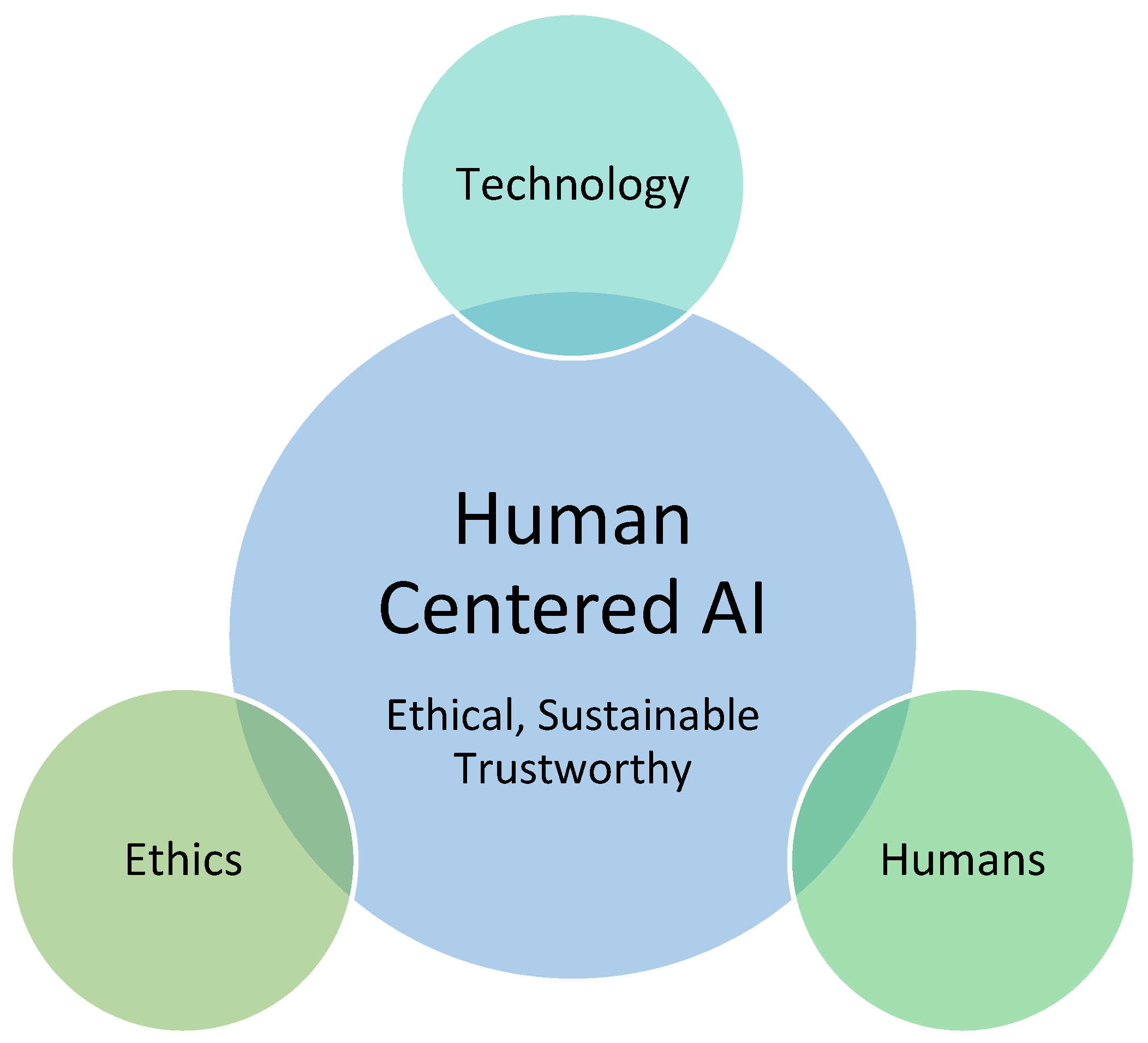
5. Discussion: The AI–IRD Integration Framework
5.1. Conceptual Foundations
5.2. Ethical Dimension
5.3. Technological Dimension
5.4. Human Dimension
5.5. Synthesis
6. Limitations and Future Research
7. Conclusions
Funding
Institutional Review Board Statement
Informed Consent Statement
Data Availability Statement
Conflicts of Interest
References
- Abu-Nimer, Mohammed. 2020. Interreligious Dialogue and the Path to Reconciliation. In Multi-Level Reconciliation and Peace-Building. London and New York: Routledge. [Google Scholar]
- Agence France-Presse. 2025. Virtual Jesus? People of Faith Divided as AI enters Religion. Available online: https://www.gmanetwork.com/news/scitech/technology/961319/virtual-jesus-people-of-faith-divided-as-ai-enters-religion/story/ (accessed on 26 February 2026).
- Ahmad, Khlood, Mohamed Abdelrazek, Chetan Arora, Muneera Bano, and John Grundy. 2023. Requirements practices and gaps when engineering human-centered Artificial Intelligence systems. Applied Soft Computing 143: 110421. [Google Scholar] [CrossRef]
- Ahmed, Saif, Ayesha Akter Sumi, and Norzalita Abd Aziz. 2025. Exploring Multi-Religious Perspective of Artificial Intelligence. Theology and Science 23: 104–28. [Google Scholar] [CrossRef]
- Arora, Suvrat. 2025. People Are Using AI to Talk to God. BBC. October 18. Available online: https://www.bbc.com/future/article/20251016-people-are-using-ai-to-talk-to-god (accessed on 1 November 2025).
- Ashraf, Cameran. 2022. Exploring the Impacts of Artificial Intelligence on Freedom of Religion or Belief Online. The International Journal of Human Rights 26: 757–91. [Google Scholar] [CrossRef]
- Banchoff, Thomas. 2012. Interreligious Dialogue and International Relations. In Rethinking Religion and World Affairs. Edited by Thimothy Samuel Shah, Alfred Stepan and Monica Duffy Toft. Oxford: Oxford University Press, pp. 204–16. [Google Scholar]
- Brown, Tom, Benjamin Mann, Nick Ryder, Melanie Subbiah, Jared D. Kaplan, Prafulla Dhariwal, Arvind Neelakantan, Pranav Shyam, Girish Sastry, Amanda Askell, and et al. 2020. Language models are few-shot learners. Advances in Neural Information Processing Systems 33: 1877–901. [Google Scholar]
- Campbell, Heidi A., and Ruth Tsuria. 2021. AI, Religion, and the Future. London: Routledge. [Google Scholar]
- Campos, Victor, Brendan Jou, and Xavier Giro-i-Nieto. 2017. From pixels to sentiment: Fine-tuning CNNs for visual sentiment prediction. Image and Vision Computing 65: 15–22. [Google Scholar] [CrossRef]
- Chandra, Rohitash, and Mukul Ranjan. 2022. Artificial intelligence for topic modelling in Hindu philosophy: Mapping themes between the Upanishads and the Bhagavad Gita. PLoS ONE 17: e0273476. [Google Scholar] [CrossRef] [PubMed]
- Chatterjee, Anjan. 2022. Art in an age of artificial intelligence. Frontiers in Psychology 13: 1024449. [Google Scholar] [CrossRef]
- Chrostowski, Mariusz, and Andrzej J. Najda. 2025. ChatGPT as a modern tool for Bible teaching in confessional religious education: A German view. Journal of Religious Education 73: 75–94. [Google Scholar] [CrossRef]
- Clarke, Matthew, and Vicki-Anne Ware. 2015. Understanding faith-based organizations: How FBOs are contrasted with NGOs in international development literature. Progress in Development Studies 15: 37–48. [Google Scholar] [CrossRef]
- Clooney, Francis X., and Klaus von Stosch, eds. 2018. How to Do Comparative Theology. New York: Fordham University Press. [Google Scholar]
- Coeckelbergh, Mark. 2020. AI Ethics. Cambridge, MA: MIT Press. [Google Scholar]
- Cornille, Catherine. 2013. Conditions for Inter-Religious Dialogue. In The Wiley-Blackwell Companion to Inter-Religious Dialogue. West Sussex: Blackwell Publishing. [Google Scholar]
- Corpuz, Jeff Clyde G. 2021. Religions in action: The role of interreligious dialogue in the COVID-19 pandemic. Journal of Public Health 43: e236–e237. [Google Scholar] [CrossRef]
- Corpuz, Jeff Clyde G. 2025a. Faith and Artificial Intelligence (AI) in Catholic Education: A Theological Virtue Ethics Perspective. Religions 16: 1083. [Google Scholar] [CrossRef]
- Corpuz, Jeff Clyde G. 2025b. Toward Grassroots Interfaith Dialogue: The Role of a Faith-Based Movement. Religions 16: 345. [Google Scholar] [CrossRef]
- Council of Europe. 2008. White Paper on Intercultural Dialogue—“Living Together as Equals in Dignity”. Available online: https://www.coe.int/en/web/campaign-free-to-speak-safe-to-learn/-/white-paper-on-intercultural-dialogue-living-together-as-equals-in-dignity-2008- (accessed on 17 February 2026).
- Daggers, Jenny. 2013. Postcolonial Theology of Religions: Particularity and Pluralism in World Christianity. New York: Routledge. [Google Scholar]
- Dorobantu, Marius. 2024. Could Robots Become Religious? Theological, Evolutionary, and Cognitive Perspectives. Zygon: Journal of Religion and Science 59: 768–87. [Google Scholar] [CrossRef]
- Dupuis, Jacques. 1997. Toward a Christian Theology of Religious Pluralism. Maryknoll: Orbis. [Google Scholar]
- EWTN. 2026. Vatican to Use AI to Translate Masses at St. Peter’s into 60 Languages in Real Time. Available online: https://ewtnvatican.com/articles/ai-live-translation-st-peters-masses-60-languages (accessed on 26 February 2026).
- Floridi, Luciano. 2019. The Ethics of Artificial Intelligence. Oxford: Oxford University Press. [Google Scholar]
- Francis, Pope. 2015. Laudato Si. Vatican City: Libreria Editrice Vaticana. Available online: https://www.vatican.va/content/francesco/en/encyclicals/documents/papa-francesco_20150524_enciclica-laudato-si.html (accessed on 9 February 2026).
- Francis, Pope. 2020. Fratelli Tutti. Vatican City: Libreria Editrice Vaticana. Available online: https://www.vatican.va/content/francesco/en/encyclicals/documents/papa-francesco_20201003_enciclica-fratelli-tutti.html (accessed on 9 February 2025).
- Geraci, Robert M. 2010. Apocalyptic AI: Visions of Heaven in Robotics, Artificial Intelligence, and Virtual Reality. Oxford: Oxford University Press. [Google Scholar]
- Herzfeld, Noreen. 2024. Is an AI-generated icon an icon? A case study in artificial intelligence and Christian spirituality. Spiritus: A Journal of Christian Spirituality 24: 281–94. [Google Scholar] [CrossRef]
- Hick, John, and Paul F. Knitter. 2005. The Myth of Christian Uniqueness: Toward a Pluralistic Theology of Religions. Wipf and Stock Publishers. [Google Scholar]
- Human-Centered AI. 2023. Research Groups. Available online: https://hcai.site/groups/ (accessed on 9 February 2026).
- Interfaith Alliance. 2025. The Rise of AI Generated Hate Content. Available online: https://www.interfaithalliance.org/post/the-rise-of-ai-generated-hate-content (accessed on 1 March 2026).
- Jolley, Jason R., and Luciane Maimone. 2022. Thirty years of machine translation in language teaching and learning: A review of the literature. L2 Journal 14: 26–44. [Google Scholar] [CrossRef]
- Knitter, Paul. 2002. Introducing Theologies of Religions. Ossining: Orbis Books. [Google Scholar]
- Kolb, Jonas. 2021. Modes of interreligious learning within pedagogical practice. An analysis of interreligious approaches in Germany and Austria. Religious Education 116: 142–56. [Google Scholar] [CrossRef]
- Lee, Sangmin-Michelle. 2023. The effectiveness of machine translation in foreign language education: A systematic review and meta-analysis. Computer Assisted Language Learning 36: 103–25. [Google Scholar] [CrossRef]
- Leo XIV, Pope. 2025. General Audience St Peter’s Square Wednesday, 29 October 2025 [Multimedia]. Available online: https://www.vatican.va/content/leo-xiv/en/audiences/2025/documents/20251029-udienza-generale.html (accessed on 1 November 2025).
- Mackey, Andrew Ambrose, and Ghanem Ayed Elhersh. 2026. Debating Divinity Through AI: Christian-Muslim Responses to Artificial Dialogues on YouTube. In Oxford Intersections: Social Media in Society and Culture. Edited by Laeeq Khan. Online edition. Oxford: Oxford Academic. [Google Scholar] [CrossRef]
- Makimei, Hidde, Shuai Wang, and Willem van Peursen. 2025. Seeing the words: Evaluating AI-generated biblical art. arXiv arXiv:2504.16974. [Google Scholar] [CrossRef]
- Metwally, Amal Abdelsattar, and Wagdi Rashad Ali Bin-Hady. 2025. Exploring human vs. AI-powered translation to metonymic expressions: A case study of the Holy Quran. Social Sciences & Humanities Open 12: 101615. [Google Scholar] [CrossRef]
- Mohsen, Mohammed Ali, Sultan Althebi, and Mohammed Albahooth. 2023. A scientometric study of three decades of machine translation research: Trending issues, hotspot research, and co-citation analysis. Cogent Arts & Humanities 10: 2242620. [Google Scholar] [CrossRef]
- Mukhidova, Olima. 2023. The importance of transversal competencies in the training of future teachers. International Scientific Journal Science and Innovation 2: 328–32. [Google Scholar]
- Osmer, Rick. 2008. Practical Theology. An Introduction. Grand Rapids: William B. Eerdmans. [Google Scholar]
- Osmer, Rick. 2011. Practical theology. A current international perspective. HTS Teologiese Studies/Theological Studies 67: 156–62. [Google Scholar] [CrossRef]
- Panikkar, Raimon. 1999. The Intrareligious Dialogue. New York: Paulist Press. [Google Scholar]
- Papakostas, Christos. 2025. Artificial Intelligence in Religious Education: Ethical, Pedagogical, and Theological Perspectives. Religions 16: 563. [Google Scholar] [CrossRef]
- Phan, Peter. 2004. Being Religious Interreligiously: Asian Perspectives on Interfaith Dialogue. Maryknoll: Orbis Books. [Google Scholar]
- Phan, Peter. 2022. Pope Francis and Interreligious Encounter. Theological Studies 83: 25–47. [Google Scholar] [CrossRef]
- Pope, Elizabeth M. 2021. Facilitator Guidance during Interfaith Dialogue. Religious Education 116: 369–82. [Google Scholar] [CrossRef]
- Quirós-Fons, Antonio. 2025. Religious Freedom in the Age of AI and Surveillance: Mapping the Field and Charting Future Research Directions. The Review of Faith & International Affairs 23: 104–16. [Google Scholar] [CrossRef]
- Race, Alan. 1993. Christians and Religious Pluralism: Patterns in the Christian Theology of Religions, 2nd ed. London: SCM Press. [Google Scholar]
- Rähme, Boris, and Inken Prohl. 2025. Religious Studies Approaches to the Intersection of Artificial Intelligence and Religion: Formations Analogous to Religion. Religion 55: 573–95. [Google Scholar] [CrossRef]
- Riedl, Mark O. 2019. Human-centered artificial intelligence and machine learning. Human Behavior and Emerging Technologies 1: 33–36. [Google Scholar] [CrossRef]
- Shneiderman, Ben. 2022. Human-Centered AI. Oxford: Oxford University Press. [Google Scholar]
- Shormani, Mohammed Q., and Abdulrahaman Alfahad. 2025. Artificial Intelligence or Human: The use of ChatGPT in the academic translation for religious texts. Sage Open 15: 21582440251343954. [Google Scholar] [CrossRef]
- Susan, Kemigisha. 2025. Artificial Intelligence: Investigate the Implications of AI on the Work of the Holy Spirit, Including the Potential for AI to Facilitate or Hinder Spiritual Growth. Advances in Social Sciences Research Journal 12: 27–33. [Google Scholar] [CrossRef]
- Swidler, Leonard. 2014. Dialogue for Interreligious Understanding: Strategies for the Transformation of Culture-Shaping Institutions. In Interreligious Studies in Theory and Practice. New York: Palgrave MacMillan. [Google Scholar]
- Tsuria, Ruth, and Heidi A. Campbell. 2021. “In My Own Opinion”: Negotiation of Rabbinical Authority Online in Responsa within Kipa.co.il. Journal of Communication Inquiry 45: 65–84. [Google Scholar] [CrossRef]
- UNESCO. 2021. Recommendation on the Ethics of Artificial Intelligence. Available online: https://www.unesco.org/en/articles/recommendation-ethics-artificial-intelligence (accessed on 10 February 2025).
- Weidinger, Laura, Jonathan Uesato, Maribeth Rauh, Conor Griffin, Po-Sen Huang, John Mellor, Amelia Glaese, Myra Cheng, Borja Balle, Atoosa Kasirzadeh, and et al. 2022. Taxonomy of risks posed by language models. Paper presented at 2022 ACM Conference on Fairness, Accountability, and Transparency, Seoul, Republic of Korea, June 21–24; pp. 214–29. [Google Scholar]
- Wolf, Alain. 2012. Intercultural Identity and Inter-Religious Dialogue: A Holy Place to Be? Language and Intercultural Communication 12: 37–55. [Google Scholar] [CrossRef]
- World Council of Churches. 2025. African Church Leaders Explore Artificial Intelligence. Available online: https://www.oikoumene.org/news/african-church-leaders-explore-artificial-intelligence (accessed on 17 February 2026).
- World Council of Churches. 2026. Panel Discussion Focuses on Risks of AI—And How Faith Communities Respond. Available online: https://www.oikoumene.org/news/panel-discussion-focuses-on-risks-of-ai-and-how-faith-communities-respond (accessed on 28 February 2026).
- Xu, Wei. 2019. Toward human-centered AI: A perspective from human-computer interaction. Interactions 26: 42–46. [Google Scholar] [CrossRef]
- Xu, Wei, Marvin J. Dainoff, Liezhong Ge, and Zaifeng Gao. 2023. Transitioning to human interaction with AI systems: New challenges and opportunities for HCI professionals to enable human-centered AI. International Journal of Human–Computer Interaction 39: 494–518. [Google Scholar] [CrossRef]
- Yao, Dedo Williams Johannes. 2024. The Role of Artificial Intelligence in Shaping Religion and Social Studies. Convergence Chronicles 5: 334–42. [Google Scholar]
- Zhang, Jing, Wenlong Song, and Yang Liu. 2025. Cognitive bias in generative AI influences religious education. Scientific Reports 15: 15720. [Google Scholar] [CrossRef] [PubMed]


| AI Tool/Category | Primary Function | Application in Interreligious Dialogue (IRD) | Benefits for FBOs & Interfaith Engagement | Ethical Considerations |
|---|---|---|---|---|
| Machine Translation (e.g., neural MT systems) | Automatic translation of text/speech | Facilitates communication across language barriers in interfaith settings; enables access to sacred texts in multiple languages | Expands inclusivity; supports shared liturgical or dialogical events | Risk of mistranslation of doctrinal nuance; cultural faith sensitivity |
| Semantic Text Analysis (e.g., topic modeling, sentiment analysis) | Extracts themes and emotional tone from large text corpora | Identifies shared ethical concepts across scriptures; maps patterns in religious discourse | Deepens understanding of convergences/divergences; informs curriculum design | Algorithmic bias; interpretive oversimplification |
| Cross-Textual Synthesis Tools (e.g., AI summarization, knowledge graphs) | Generates condensed, relational insights across texts | Compares sacred texts for thematic parallels; supports comparative theology | Enhances scriptural literacy; aids interreligious teaching resources | Reductive synthesis may mask context-specific meanings |
| Dialogue Agents/Conversational AI (e.g., chatbots trained on multi-faith data) | Interactive Q&A and conversation simulation | Community engagement; educational support in interreligious forums | Scales outreach; supports exploratory learning | Ontological concerns about simulated understanding; pastoral integrity |
| Speech Recognition & Voice Assistants | Transcribes and responds to spoken language | Accessibility for dialogue events; real-time interpretation | Improves participatory access for diverse communities | Accuracy across accents/ritual language; privacy |
| Image & Symbol Recognition (e.g., multimodal AI) | Identifies visual religious symbols and contexts | Supports analysis of religious art in comparative research; digital archives | Cultural education; shared heritage mapping | Misclassification of sacred imagery may offend |
| Ethics & Fairness Frameworks (e.g., audit tools, fairness evaluation) | Detects bias and promotes accountable AI systems | Ensures dialogical AI respects diverse traditions; mitigates exclusionary outcomes | Strengthens trust; aligns with human-centered values | Requires ongoing theological criteria for justice |
| Collaborative Filtering & Recommendation Systems | Suggests relevant content based on user patterns | Tailors interfaith educational materials to participants’ interests | Personalized learning pathways; adaptive IRD resources | Echo chambers; reinforcement of stereotypes |
| Predictive Analytics | Models likely outcomes from data patterns | Assesses potential impacts of dialogical initiatives (e.g., participation trends) | Informs strategy for sustainable IRD programming | Quantification of faith dynamics may overlook lived nuance |
Disclaimer/Publisher’s Note: The statements, opinions and data contained in all publications are solely those of the individual author(s) and contributor(s) and not of MDPI and/or the editor(s). MDPI and/or the editor(s) disclaim responsibility for any injury to people or property resulting from any ideas, methods, instructions or products referred to in the content. |
© 2026 by the author. Licensee MDPI, Basel, Switzerland. This article is an open access article distributed under the terms and conditions of the Creative Commons Attribution (CC BY) license.
Share and Cite
Corpuz, J.C.G. Artificial Intelligence and Interreligious Dialogue: Emerging Implications for Faith-Based Organizations. Religions 2026, 17, 354. https://doi.org/10.3390/rel17030354
Corpuz JCG. Artificial Intelligence and Interreligious Dialogue: Emerging Implications for Faith-Based Organizations. Religions. 2026; 17(3):354. https://doi.org/10.3390/rel17030354
Chicago/Turabian StyleCorpuz, Jeff Clyde G. 2026. "Artificial Intelligence and Interreligious Dialogue: Emerging Implications for Faith-Based Organizations" Religions 17, no. 3: 354. https://doi.org/10.3390/rel17030354
APA StyleCorpuz, J. C. G. (2026). Artificial Intelligence and Interreligious Dialogue: Emerging Implications for Faith-Based Organizations. Religions, 17(3), 354. https://doi.org/10.3390/rel17030354