1. Introduction
Scholars have long recognized that the concepts of yin and yang form a foundational framework for the development of Chinese philosophy (including Confucianism, Daoism, Buddhism, and so forth). Some scholars interpret yin as encompassing feminine qualities or representing women, while yang is seen as symbolizing masculinity or men. Others understand yin and yang as the two lines in the sixty-four hexagrams of the
Zhouyi (周易, the
Book of Changes). Some scholars also view yin and yang as two types of
qi (氣, the vital force) in the universe, while others interpret them as symbols of all opposing forms (cf.
Raphals 1998;
Wang 2012;
Pang-White 2016;
Zhang 2019). Additionally, the dynamic interplay between yin and yang has even been variously interpreted as a correlative cosmology, a model of correlative thinking, or a paradigm of “yinyang”
1 philosophy (
Needham 1956, pp. 280–81;
Graham 1986, pp. 25–41;
Hall and Ames 1995, pp. 136–80;
Wang 2012, pp. 6–17;
Fung 2010, pp. 296–306;
Nylan and Loewe 2010, pp. 398–409). Recent scholarship has sought to bring these yin–yang conceptual frameworks into dialogue with feminist issues.
This inquiry has drawn attention to passages in ancient Daoist texts that highlight feminine values and imagery. For example, scholars have emphasized the prominence of terms such as
ci (雌 female) and
pin (牝 female animal) (
Lai 2000, p. 133;
Pang-White 2016, pp. 275–79), the metaphor of
tianxiamu (天下母 the mother of the world) (
Small 2024, p. 255), the concept of
rouzhi (柔知 the Supple Way of Knowing) (
Wang 2022, pp. 201–13), and even the claim that the Dao in
Daodejing (道德經)
2 articulates “a philosophy in the feminine” (
Ma 2016, p. 246). In addition, some further argue that Daoist philosophy can rectify the gender-discriminatory tendencies, likely caused by Dong Zhongshu 董仲舒 (BC 179–104) in the Han dynasty with his ideological slogan of “men are superior and women are inferior” (男尊女卑), and provide a more egalitarian theory of gender (
Tan 2024, pp. 237–40). Others contend that Daoist philosophy goes beyond feminism by better emphasizing the status of
ziran (自然 nature) and the feminine (
Liu 2022, pp. 276–82). On the basis of such interpretations, certain researchers assume that Daoist thought should be characterized as forms of “female worship,” in which yin occupies the central position (
Zhan 1990, pp. 3–5;
Zou and Chen 2023, p. 1).
As explored by the scholars mentioned above, Daoism shows a high degree of receptivity to feminism, and in some ways, it even surpasses certain gender theories. Existing scholarship has convincingly demonstrated that yin and yang are relational forces characterized by fluidity and mutual dependence. However, when this dynamic model is applied to gender issues—especially to the concept of “gender harmony”—serious misunderstandings persist. On the one hand, many discussions of gender harmony, especially in contemporary feminist critiques, assume that harmony necessarily involves compromise, sacrifice, or subordination by one party (often women). On the other hand, feminist models of gender equality often rely on static or binary frameworks that unintentionally reproduce new forms of inequality. This paper argues that these problems stem from a failure to distinguish between different models of yin–yang operation.
Rather than proposing a new interpretation of yin–yang philosophy
3, this paper distinguishes between two types of yin–yang operation and examines how this distinction reshapes our understanding of gender harmony. To support this argument, the second part of this paper will present two models of the operation of yin and yang: the cyclical-dynamic model versus the fixed-hierarchical model. This section will draw on classical texts from the pre-Qin to the Han period, such as
Zuozhuan (左傳 the
Zuo’s Commentary on the Spring and Autumn Annals),
Zhouyi,
Shijing (詩經 the
Book of Odes),
Liezi (列子),
Wenzi (文子), and Dong Zhongshu’s
Chunqiu Fanlu (春秋繁露
Luxuriant Dew of the Spring and Autumn Annals). Through careful textual analysis, the cyclical-dynamic model views yin and yang as fluid, interdependent, coexisting forces in an endless cycle of life and cosmic vitality, whereas the fixed-hierarchical model perceives them as fixed, independent, and hierarchical value clusters where yin or yang occupies the central position and embraces an a priori position.
The third part of this paper will draw on both philosophical Daoist and religious Daoist canons to demonstrate that Daoist yin–yang philosophy more closely aligns with the first model, i.e., the cyclical-dynamic model. These texts emphasize that yin and yang are two forms of qi in the cosmos, and that the smooth circulation and interaction of yinqi (陰氣) and yangqi (陽氣) ensure the harmonious development of all things. The imbalance of yin and yang not only gives rise to natural disasters but also leads to the emergence of illnesses in the human body. Through the transformation and circulation of these two kinds of qi, the rhythms of the cosmos resonate in synchrony with the rhythms of the human body and become effectively interconnected. Within this vast, transforming cosmos governed by a dynamic and cyclical order, both yin and yang have their own functions and values. The metaphysical foundations of either “yang is superior and yin is inferior” (陽尊陰卑) or “yin is superior and yang is inferior” (陰尊陽卑) are therefore not valid. Through relationships of shengjiang (升降 rising and descending), liubian (流變 transformation and flux), tiaohe (調和 harmonization), wangfu (往復 alternation), and shengmie (生滅 generation and extinction), yin and yang form an interdependent and endlessly generative cosmic energy.
Since Daoist thought supports the cyclical-dynamic yin–yang model, we should not, through this lens, agree with the interpretation of gender harmony as hierarchical subordination. On the one hand, based on Nussbaum’s and Hinsch’s research, academia tends to assume that gender harmony still involves a compromise with the side that holds a value priority. Whether the side requiring compromise is male or female, this compromise itself contradicts the ideal principle of gender equality. On the other hand, the cyclical-dynamic yin–yang model avoids this issue, as it does not presuppose a value hierarchy. Instead, both yin and yang can take the dominant role depending on the changing circumstances. By drawing an analogy between this model, a gender harmonious model without a hierarchy can be proposed.
The conclusion of the paper presents advantages and limitations of this model, and reaffirms that it is not a universal solution for resolving the dilemmas of gender equality. Instead, it provides an alternative approach to achieving gender equality. Compared to the fixed and universal principle of gender equality, this dynamic and concrete principle of gender harmony is better able to achieve the well-being and flourishing of women.
2. Two Models of Yin–Yang: Cyclical-Dynamic vs. Fixed-Hierarchical
While scholars, such as Lisa Raphals, Robin R. Wang, Karyn Lai, and Lili Zhang have persuasively articulated yinyang as a relational, non-hierarchical, fluid, and mutually dependent framework, their analysis primarily focuses on yin and yang as concepts for a philosophical worldview or theoretical constructions. The purpose of this section is to summarize two different models from the perspective of historical typology, focusing on their operation and arguing that different operational modes generate fundamentally different implications for gender relations. To better explain how yin and yang operate, we will briefly outline the original meanings of these two concepts.
According to Xu Shen’s 许慎 (58–148 CE) Shuowen Jiezi (說文解字 the Explaining Graphs and Analyzing Characters), yin is defined as “a closed door, the south bank of a river and the north side of a mountain” (關也,水之南,山之北也), while yang refers to “height, brightness” (高明也). From Xu’s record, yin and yang were not used together, and the things they referred to had no inherent connection. Additional textual evidence can be found in what is probably the earliest Chinese dictionary, the Erya (爾雅 A Dictionary of Classical Terms), which states, “the south of a mountain is yang, and the north bank of a river is yang” (山南為陽,水北為陽). The record in the Erya does not directly link yin and yang either. But it provides the possibility that the two are correlative or opposite, and the later widely circulated explanation—“the south of a mountain and the north of a river are called yang; the north of a mountain and the south of a river are called yin” (山南水北稱為陽,山北水南稱為陰)—is very likely derived from this text.
According to Zhang’s research, the earliest connection between yin and yang may have occurred during the Warring States period. She further speculates that this connection likely originated from the
Taiyi Shengshui (太一生水
the Great One Generates Water) chapter, which reads, “the spiritual of luminous further join with each other, thereby forming yin and yang. Yin and yang further join with each other, thereby forming the four seasons” (神明複相輔也,是以成陰陽。陰陽複相輔也,是以成四時) (cf.
Cook 2012, pp. 344–45;
Zhang 2019, pp. 72–74). As the changes of yin and yang here likely imply the alternation between night and day, Zhang insists that they are metaphors or symbols of natural phenomena. By referencing Ma Xulun’s 馬敘倫 (1884–1907) perspective, she points out that in the pre-Qin era, yin and yang had two additional layers of meaning, i.e., yang means
kai 開 and yin equals “clouds blocking the sun” (雲覆日也) and “mist” (靄) (cf.
Zhang 2019, p. 73). She believes that the above-mentioned concepts are unrelated to gender. In line with this, we can infer that both yin and yang are descriptions of natural phenomenon and have no inherent value priority.
If we trace back to the Spring and Autumn period, yin and yang not only represented natural elements in the cosmos, but there are also records suggesting that they could be applied to human affairs. For example, the earliest Chinese historical work the
Zuozhuan states,
The Tian (天 Heaven) has six qi, which give rise to the five tastes, manifest as the five colors, correspond to the five sounds, and lead to the six ailments. These six qi are: yin, yang, wind (feng 風), rain (yu 雨), and the alternation of the light (ming 明) and darkness (hui 晦). They are divided into the four seasons and arranged into five periods. When excessive, they bring disasters. Excessive yin causes cold diseases, excessive yang causes heat diseases, excessive rain leads to abdominal diseases, excessive darkness causes confusion and mental disorders, and excessive light causes heart diseases. When a woman is in a yang state bur during the dark times, excess leads to internal heat, confusion, and pestilence-like ailments.
天有六氣,降生五味,發為五色,徵為五聲,淫生六疾,六氣曰陰,陽,風,雨,晦明也,分為四時,序為五節,過則為菑,陰淫寒疾,陽淫熱疾,雨淫腹疾,晦淫惑疾,明淫心疾,女陽物而晦時,淫則生內熱惑蠱之疾。
From this passage, we can see that yin and yang originally referred to the
qi in the universe. The movement of
qi generates tastes, colors, sounds, and diseases. Although the
Zuozhuan does not explain how these six types of
qi produce the aforementioned phenomena, it can be clearly inferred from the above text that an orderly (
xu 序) flow generates five different outcomes, while disorderly movement leads to disasters.
Lisa Raphals has pointed out that this passage seems to be self-contradictory. She noted that, “it identifies women with dark
qi, but also with yang
qi and diseases of internal heat. Commentators have sought to explain the passage in the light of later correlative systems by taking yang here to mean yin following yang, or by alluding to yang in the heart of yin. A simpler possibility is that at this time yin and yang were not specifically correlated to gender as yin/female and yang/male” (
Raphals 1998, p. 147). From her explanation, we can see that there were two different interpretations of how yin and yang were applied to human affairs at that time: one supporting a hierarchical relation where yang plays a dominant role, and the other supporting a non-hierarchical relationship where yin and yang are natural elements (aka.
qi).
Let us first examine how the non-hierarchical yin and yang operate by referencing the texts from that time. In the Gong Liu (公劉) section from the Shijing, Gong Liu’s personality was described as “his radiance like a mountain, observing the interplay of yin and yang” (既景迺岡、相其陰陽). If we set aside the description of Gong Liu’s noble character and focus on the meaning of yin and yang, they refer to the two sides of a mountain: the side facing the sun and the side facing away from it. As yin and yang are the two sides of a mountain, then, according to the changing position of the sun, yin and yang also change their positions accordingly. There may even be instances where, as Wang often mentions in her writings, yin transforms into yang and yang transforms into yin. This does not imply that the essence of yin or yang changes, but rather that their positions shift. The side that originally faces the sun may, in certain parts, transform into the side that is more yin. We call this cyclical and recurring change in the yin–yang operation the “cyclical-dynamic model” (hereafter, “Model A” for the sake of argument).
Model A can also be found in another pre-Qin text, the
Zhouyi. On one hand, yin and yang correspond to the moon and the sun, i.e., “the meanings of yin and yang are corresponding to the sun and moon” (陰陽之義配日月). On the other hand, yin and yang are represented by the
yinyao (陰爻 yin lines) and
yangyao (陽爻 yang lines) in the sixty-four hexagrams, e.g., “observing change of yin lines and yang lines to establish the hexagrams” (觀變於陰陽而立卦). Here, the sun and moon are used as metaphors, directly highlighting the cyclical and changing nature of the yin–yang operation, which is more explicit than in the
Shijing. From the symbolic perspective of the hexagrams and their lines, this cycle becomes even more complex, as it evolves into sixty-four different situations and corresponding solutions, depending on the different positions and hexagrams. Just as Robin R. Wang noticed, “in their [yin and yang] earliest uses, yin and yang are not substances but functions of something, and they are inevitably attached to relationships or contexts. Any fixed definitions of yinyang will, thus, lead to a problematic understanding of the terms” (
Wang 2012, p. 24, slightly revised). We thus do not focus too much on the specific connotations of yin and yang, but rather direct our attention to the patterns of their operation.
Therefore, the next task at hand is to discuss what Model A’s ideal form should be. Chapter 42 of the
Daodejing is highly insightful, as it states “everything carries yin on its shoulders and yang in its arms. And blends these vital energies (
qi) together to make them harmonious (
he)” (萬物負陰而抱陽,中氣以為和) (
Ames and Hall 2003, p. 295, slightly revised). Given that this passage follows the description of how the Dao generates the “marid things” (萬物), Ames and Hall not only treat yin and yang as two forms of universal
qi in their translation, but also point out the contradictory relationship between the two in their subsequent commentary. They wrote, “yin and yang is a vocabulary of contrast, suggesting the possible width of experience and the degree of its diversity. Particular events in the world emerge as unique combinations of this diversity. In this creative process, it is a balancing and harmonizing of extremes that is most productive” (ibid, p. 298). At this point, we consider the ideal state of Model A to be harmony. This harmony is, on the one hand, governed by the cyclical and repetitive natural laws that drives its operation, and on the other hand, achieved through the ability to adapt to different situations with varying solutions. Therefore, Model A allows for the diversity/difference of things and does not present a value hierarchy between them. Its most significant characteristic is that it is constantly changing.
Next, we turn to the operation of the hierarchical yin–yang relationship. According to Robin R. Wang’s research, texts that explicitly associate yin and yang with hierarchical gender order can be traced back to Dong Zhongshu of the Han dynasty (
Wang 2005, pp. 212–14). Two theoretical developments support this claim. The first is the shift from the “harmony of heaven and human beings” (天人和一) to the “unity of heaven and human beings” (天人合一). The second is the systematic association of yang with
xing (性 human nature) and
ren (仁 benevolence), and of yin with
qing (情 emotion) and
tan (貪 greed).
Although Wang reveals the underlying shift from harmony to unity and from the natural realm to the moral realm, a deeper examination suggests that an important reason behind this transformation is to sustain the hierarchical order required by imperial rule at the time. By incorporating the theories of yin–yang and the “Five Phases” (五行), Dong used the doctrine that “Heaven is above and Earth is below” (天尊地卑), originally found in the Zhouyi, and extended it to the sphere of human relations. In this framework, the positional polarity between Heaven and Earth becomes a normative model for social hierarchy, culminating in the gender principle that “yang is superior and yin is inferior” (陽尊陰卑). Through this reinterpretation, the hierarchical social order was provided with both theological and ethical justification.
In his influential work Chunqiu Fanlu, Dong Zhongshu further systematizes this hierarchical understanding of yin and yang. In the well-known chapter “yang is superior and yin is inferior” (陽尊陰卑), he asserts that “although a man may be of low status, he is still considered yang; although a woman may be of high status, she is still considered yin” (丈夫雖賤皆為陽,婦人雖貴皆為陰). In the same chapter, Dong repeatedly emphasizes that the positions of yin and yang are derived from Heaven and Earth. From a natural perspective, Heaven is above and Earth is below; therefore, Dong believes that “human rituals” (礼) and social norms should also reflect this principle, with yang occupying the superior position and yin the inferior one.
Dong further moralizes the distinction between yin and yang. He notes that the differences between yin and yang are not only “in terms of above and below, in size, in strength and weakness” (在上下,在大小,在強弱), which are natural distinctions, but also “in the virtuous and the unworthy, in good and evil” (在賢不肖,在善惡), asserting that “all the is evil belongs to yin, and all that is good belongs to yang” (惡之屬盡為陰,善之屬盡為陽). Within this framework of guiyang (貴陽 valuing yang), cosmological structures are no longer merely descriptive; they become normative principles governing ritual hierarchy, political authority, and human relations.
In this conceptual transformation, the positional distinction between Heaven and Earth (above/below) is moralized into an evaluative hierarchy (superior/inferior), and then mapped onto gender categories through the systematic identification of Heaven with yang and Earth with yin. This shift—from descriptive differentiation to value-laden hierarchy—exemplifies what we define as the fixed-hierarchical model of yin–yang operation (hereafter, “Model B” for the sake of argument).
The variant of Model B can also be observed in other texts, namely, “worshiping yin.” In the
Heshanggong Laozi4, female animals are attributed to the yin category (cf. “the female animal is of the yin type” 牝者,陰類也), placing yin and yang in an oppositional relationship and emphasizing that when these two opposites come into conflict, the yin side will prevail (cf. “yin overcomes yang” 陰勝陽 or “yin can eliminate yang” 陰能消陽). It is important to note that although the emphasis on yin in the
Heshanggong Laozi was intended to correct the excessive glorification of yang in society at the time, it does indeed suggest that yin occupies a dominant position in the yin–yang relationship. Even so, in texts such as the
Wenzi and
Liezi, we can still observe that these Daoist textual evidence still regard the intersection of yin and yang (a type of harmony) as more important in the ideal relationship between them. For instance,
Wenzi records that, “when the heaven’s
qi does not descend, and the earth’s
qi does not rise, yin and yang are not in harmony” (天氣不下,地氣不上,陰陽不通). If yin and yang do not intersect, operate independently, and yin is superior to yang, the direct result of this would be disorder from the natural world to the human world. In the
Liezi, there is a passage that describes this kind of disorder. It writes, “the
qi of yin and yang do not intersect, therefore the distinction between cold and heat is lost; the light of the sun and moon does not shine; therefore the distinction between day and night is lost. The people do not eat and wear clothes and sleep excessively. Every fifty days, they wake from a dream, and what they do in the dream is real, while what they see upon waking is false” (陰陽之氣所不交,故寒暑亡辨;日月之光所不照,故晝夜亡辨。其民不食不衣而多眠。五旬一覺,以夢中所為者實,覺之所見者妄).
As can be seen from our previous discussions, Dong’s version of Model B emphasizes a static, unchanging, and hierarchical operational mode. In this model, even the ideal harmonious state is achieved through one side dominating or eliminating the other. The version of Model B found in Heshanggong Laozi, Wenzi, and Liezi resembles more of a compensatory or corrective approach. They suggest that the ideal yin–yang operation model is still one type of “harmony,” but this harmony does not demand sameness; rather, it requires a balance between different entities.
It is important to note that there is no inherent superiority or inferiority between these two operational modes. This paper merely summarizes two different yin–yang operational logics based on careful textual analysis. The following section will analyze, in conjunction with philosophical Daoist and religious Daoist texts, which model better aligns with the Daoist understanding of yin–yang operation.
3. Why Daoist Thought Aligns with Model A
To better discuss which operational model of yin–yang is adopted by philosophical Daoism and religious Daoism, the following section will examine how they view yin–yang, using the Zhuangzi 莊子and Lingbao Wuliang Duren Shangpin Miaojing (hereafter the Durenjing 度人經 Book of Salvation for short) as representative texts. There are 38 instances in the Zhuangzi where yin and yang are mentioned, and in most cases, they appear together. In the “Great Source as Teacher” (Dazongshi 大宗師) chapter, yin and yang are two kinds of qi:
Sir Transport took ill. Sir Worship went to see him. Sir Transport said, “How great is the Creator of Things, making me all tangled up like this!” For his chin was tucked into his navel, his shoulders towered over the crown of his head, his ponytail pointed toward the sky, his five internal organs at the top of him, his thigh bones took the place of his ribs, and his yin and yang energies in chaos
子輿有病,子祀往問之。曰:「偉哉!夫造物者,將以予為此拘拘也!曲僂發背,上有五管,頤隱於齊,肩高於頂,句贅指天。」陰陽之氣有沴。
Here, yin and yang are two essential, dynamic, and natural forms of flowing universal energies that are inherent in the human body. Their balanced interaction is crucial for maintaining the operation of the universe, the world as a whole, as well as the health of the human body. When these two energies are in disorder, it may lead to the development of diseases (see Sir Transport case). As the
Zhuangzi rightly observed, “yin and yang were in harmonious stillness, the ghosts and spirits brought no disturbances, the four seasons found their right measures, the ten thousand things remained unharmed, so no living thing met with a premature death” 陰陽和靜,鬼神不擾,四時得節,萬物不傷 (
Ziporyn 2020, p. 132). The harmonious operation of yin and yang ensures that all things in the cosmos remain in their proper places. Moreover, it should be noted that, in the
Zhuangzi’s texts, yin and yang are not assumed to have any inherent value hierarchy.
In addition to the above quote, there are many similar passages in the
Zhuangzi that support the underlying yin–yang Model A, which emphasizes circulation, change, and harmony. A vivid example can be found in “the Spinning of the Heavens” (
Tianyun 天運) chapter of the
Zhuangzi, which states,
For perfect music—which is perfect joy—must start out by resonating with human affairs while also according with the inherent structures of the Heavenly. It must run its course through all the Five Virtues but still accord with what is unforced in things, their spontaneous self-affirmations. Only then can it concordantly adjust the four seasons within it, bringing all things into its great harmony. The four seasons arrive in it one after the other, and all things are produced accordingly. Now flourishing, now declining, the peaceful and warlike in it group into their own regularities. Sometimes clear, sometimes turbid, the yin and the yang adjust to each other to form a harmony
夫至樂者,先應之以人事,順之以天理,行之以五德,應之以自然,然後調理四時,太和萬物。四時迭起,萬物循生;一盛一衰,文武倫經;一清一濁,陰陽調和
This metaphorical harmonious model of yin and yang, using music as an analogy, can be understood on several levels. First, the optimal model between yin and yang is harmony. This harmony is the result of their mutual adjustment. Second, the harmony of yin and yang requires respect for human affairs, natural principles, and
ziran itself. Therefore, yin and yang do not have a fixed ratio, but rather adjust their importance according to the situation. Third, the principle of cyclical life is the key to the harmony of yin and yang. Just as the cycles of the four seasons—spring, summer, autumn, and winter—repeat endlessly, so too do the rises and falls of things. These cycles represent the idea that the harmony of yin and yang can only be maintained through dynamics.
Model A is also mentioned in other chapters of the Zhuangzi. In the “Repairing the Inborn Nature (Shanxing 繕性)” chapter, when Zhuangzi explores human nature (人性), he also mentions that the ideal state is “yin and yang were in harmonious stillness” (陰陽和靜). Here it means that when yin and yang harmonize according to the natural laws, people will achieve the ultimate state of tranquility. It should be noted that Model A does not contradict the ultimate state of tranquility. Since the harmony of yin and yang is reflected in human nature, it means that humans should be able to align with this cosmic force, follow natural laws, and ultimately achieve a state of tranquility where humans are united with all things. In other words, this is what Zhuangzi refers to as “all things are nourished by it, without their knowing it” (萬物畜而不知). Only by aligning with the cyclical and dynamic rhythm of the yin–yang universal forces can one effectively cope with the complexities and changes in human affairs. By responding differently to various situations, one can ensure the tranquility of their human nature.
According to the Durenjing—the opening volume of the religious Daoist collection Daozang (道藏)—yin and yang not only appear as paired concepts, but it is also clearly stated that yin and yang are two creative forces of the universe, and through their mutual interactions and alternating transformations, they give birth to the marid things. Based on this observation, the following will argue that religious Daoism supports Model A rather than Model B.
In the
Yin Yang Huasheng Pin (陰陽化生品) chapter of the
Durenjing, it states:
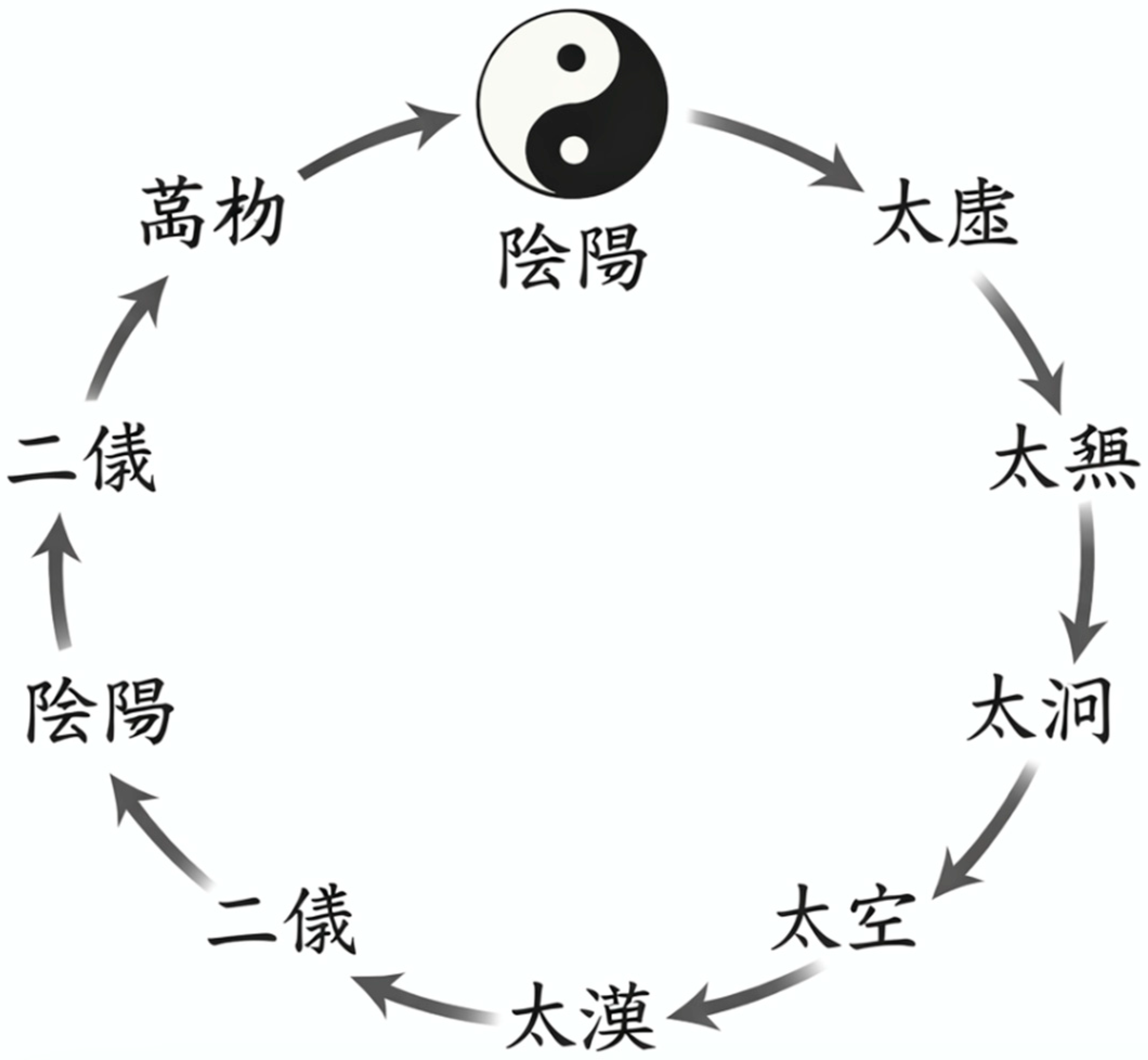
Yin and yang as two things originally have no specific names. Through conciliation, they achieve the change and the connection with the marid things. Through the following actions: rises and falls, obedience and resistance, softness and hardness, internal and external, yin and yang, dragon and tiger, the Great Void (taixu 太虚) emerged. The Great Void gives rise to the Great Non-being (taiwu 太無), the Great Non-being gives rise to the Great Penetration (taidong 太洞), the Great Penetration gives rise to Great Emptiness (taikong 太空), and the Great Emptiness gives rise to the Great Desolation (taimo 太漠). The Great Desolation transforms to yin and yang at the outermost edge of the empty, mysterious, and the boundless realm. Within this process, the Great Desolation gives birth to the Two Forms (eryi 二儀). The Two Forms give birth to the Three Powers (sancai 三才 aka. Heaven, Earth, and Human beings), and the Three Powers give birth to the marid things.
陰陽二物,元本無名,以其相求,變化所通。一浮一沉,一順一逆,一剛一柔,一內一外,一陰一陽,一龍一虎,含孕構精,故乃化生太虛。太虛生太無,太無生太洞,太洞生太空,太空生太漠。太漠者,在空玄無極之表,交變陰陽,以生二儀。二儀生三才,三才生萬物。
This text not only provides crucial support for Model A, but also enriches the cyclical part. Compared with the
Zhuangzi, this paragraph not only explicitly establishes yin and yang as the fountainhead of the cosmos but also articulates their constant cyclical transformation with greater concreteness. It shows that yin and yang, as an overarching concept encapsulating all relative and complementary phenomena, are mutually dependent and cannot exist without the other.
Moreover, this text unfolds Model A vividly in religious Daoism: “Yin and Yang → the Great Void → the Great Non-being → the Great Penetration → the Great Emptiness → the Great Desolation → Alternating Transformation of Yin and Yang → the Two Forms → the Three Powers → the Marid Things” (陰陽 → 太虛 → 太無 → 太洞 → 太空 → 太漠 → 陰陽 → 二儀 → 三才 → 萬物) (See
Figure 1). This provides a clear insight into the generative process through which yin and yang bring forth the marid things. Their interplay is not a static, linear generative nexus—contrasting with the fission–based model of ceaseless self-fragmentation and generation derived from the
Zhouyi, i.e., “the Supreme Ultimate gives birth to the Two Forms; the Two Forms generate the Four Images; the Four Images generate the Eight Trigrams” (太極生兩儀,兩儀生四象,四象生八卦). Rather, it depends on the mutual interaction, interfusion and transformation of yin and yang to perpetually generate new entities, which will revert to the very interfusion of yin and yang when evolving to a certain phase. Hence,
shengsheng (生生 creative creativity) constitutes the most foundational tenet within Model A’s operation.
There are several other key points in the above passage that require further explanation and clarification. One is the term jiaobian (alternately transform 交變) used in the operation of yin and yang. As the beginning of the universe’s creation of the marid things, yin and yang gradually differentiate into paired concepts such as rising and falling and following and opposing through transformation. However, in the Great Desolation, an important shift occurs: it is described as “yin and yang alternately transform.” This suggests that the two forces must exchange positions (at least as a possibility) in order to generate new things, such as the Two Forms. This cyclical-dynamic creation relies on the continuous alternating transformation of yin and yang. Therefore, in this process of movement, yin and yang inevitably do not have a hierarchical relationship. At different stages of creation, either yin or yang may dominate and take the leading role.
Secondly, the cyclical model is a spiral, upward-moving cycle. From the above passage, we can observe that yin and yang are mentioned three times in total. The first time, they are presented as the primordial forces of the universe’s origin, not as specific entities but rather as symbolic representations of paired concepts. The second time, yin and yang are presented as opposites that emerge from these two creative forces, with yin and yang being paired alongside concepts like rising and falling and inner and outer. This expresses the idea of two complementary opposites. The third time, yin and yang, after undergoing a long process of creative creativity, revert back to the alternating transformation of yin and yang. After exchanging positions and roles, they give birth to the Two Forms, the Three Powers, and the marid things. In such a cycle, neither yin nor yang is superior to the other. Therefore, no hierarchical relationship can form. Instead, they exist in a mutually fulfilling, inseparable relationship.
Third, the verb sheng (生 give birth to) is crucial here. We see that the key to yin and yang as the primordial forces of the universe, which give birth to the marid things, lies in sheng. However, this sheng encompasses not only the meaning of life being conceived through the union of male and female, a common explanation in ancient China for the generation of the marid things, but also the ongoing exchange of positions and roles between yin and yang that sustains the universe’s continuous cycle. Model A of the universe’s continuous generation is itself a reproduction of the natural process of the transformation and generation of the real world. Therefore, shengsheng, the creative process of continual generation, is the key to maintaining the cyclical-dynamic operation within the Daoist yin–yang philosophy. Based on the above context, we can reasonably conclude that religious Daoism also supports Model A. Moreover, it reveals the internal generative logic.
However, there is still one question that remains unanswered: what happens if yin and yang do not operate according to Model A? For example, in some other chapters of the Durenjing, the concept of “yin and yang being out of balance (陰陽不調)” is mentioned. What does this imply for how the universe should be managed when it fails to operate according to its established laws?
If we return to the texts of philosophical Daoism, it is easy to see that such chaos can lead to natural disasters, and when yin and yang fail to operate according to the established yin–yang philosophical model, it can result in diseases in the human body. For instance, in the “External Things (Waiwu 外物)” chapter in the Zhuangzi, it is recorded that “when the yin and yang act awry, heaven and earth are greatly perturbed” (陰陽錯行,則天地大絯). This phrase describes how the non-interaction and condensation of yin and yang can lead to natural anomalies such as thunderstorms and the clash of water and fire. It also illustrates a contradictory phenomenon of “fire in water” (水中有火), symbolizing a series of chain reactions after the breakdown of order. Moreover, this disordered yin–yang relationship can cause an imbalance in the “human heart-mind and nature” (人心和人性), as the heart-mind is meant to be “connected between heaven and earth” (系於天地之間). The human body is a reflection of the universe.
Religious Daoism addresses the consequences of yin–yang imbalance in a much more direct manner. Such imbalance is discussed almost everywhere in the Durenjing in relation to nature, state affairs, domestic affairs, and human affairs in general. For example, in Chapter four Yongyan Jieyun Baoshi Shengping Pin (永延劫運保世升平品), it very specifically enumerates the various harms caused by the loss of harmony between yin and yang. When “yin and yang are out of balance” (陰陽不調) happens, the abnormal phenomena it causes include but are not limited to, “four seasons are out of order” (四時失度), “epidemics spread, causing death and injury to the people” (疫毒流行,兆民死傷), and “natural disasters” (天災). From the perspective of religious Daoism, any anomaly in the cosmos will trigger a chain reaction in human affairs. Therefore, in the Durenjing, the concept of “yin and yang being out of balance” is mentioned 47 times, and each time it refers to Daoist rituals such as prayers for blessing and disaster prevention. From a religious perspective, these prayers are meant to help people live better lives, free from natural disasters and the disturbances of human affairs. Thus, whether from the philosophical or religious standpoint, if they seek to ensure people’s well-being and prosperity, Daoism advocates for yin and yang harmony rather than imbalance.
Another religious Daoist text, the Yuanshi Shuo Xiantian Daodejing Zhujie (元始說先天道德經註解), outlines more specific measures to ensure that the development of the marid things aligns with Model A. It initially establishes that yin and yang hold equal positions, stating “yin and yang are equally marvelous” (陰陽同妙). Based on this equality, yin and yang become the dual aspects of the Dao. When undivided, the Dao is both yin and yang, and when divided, yin and yang operate according to the principle of Goodness (善). The text further describes how yin and yang, as “qi numbers” (氣數), manifest: “thus from one comes two, from two comes three, from three comes yet three, continuing to an innumerable number. Although scattered, the divine passes through thousands and tens of thousands, involved in the process of numbers, but beyond numbers” (故自一而二,自二而三,三而又三,以至於不可勝數。唯神雖散,而千萬涉於數而非數). This culminates in the endless, spiraling process of the universe’s cyclical ascent.
In this cyclical, infinite ascent, the continuous process of change, yin and yang not only exist as two creative forces on an ontological level but also, on a cosmological level, they manifest the universe’s endless cycle of transformation through relationships such as rising and descending, transforming and changing, alternating, and generation and extinction. The reason that Model A is able to regulate human affairs lies in the phrase mentioned in the Durenjng: “when yin and yang harmonize and transform, the Dao enters the body” (陰陽順化,生道入身). In other words, through the transformation and circulation of these two kinds of qi (yin and yang), the rhythms of the cosmos resonate in synchrony with the rhythms of the human body and become effectively interconnected. In addition, as long as the harmonious non-hierarchical cyclical transformation of yin and yang is maintained, the cosmic rule of creative creativity can enter human society, becoming the key to guiding and regulating human affairs. Therefore, both philosophical Daoism and religious Daoism support Model A, where yin and yang are cyclical, dynamic, and harmonious without hierarchical relationships.
4. Gender Harmony: A Daoist Approach to Gender Equality
Since we have already shown that both philosophical Daoism and religious Daoism support Model A, where yin and yang coexist harmoniously without hierarchical relations, the main task of this section is to challenge a stereotypical interpretation of gender harmony that relies on sacrificing one party to achieve balance. Such hierarchical interpretations reflect the operation of Model B, which emphasizes “sameness” or uniformity as a criterion. In contrast, when Model A is applied to gender relations, it does not prescribe fixed roles or equal outcomes. Instead, it emphasizes situational responsiveness, mutual transformation, and alternating contributions, where neither men nor women occupy a permanently dominant position; dominance itself is contextual and temporary.
To understand why Model B underlies current interpretations of gender harmony, we can look to prominent feminist scholarship. For example, Martha Nussbaum uses the concept of “innocent harmony” to describe harmony in Chinese philosophy (
Nussbaum 1986, p. 78;
1990, p. 131). She argues that harmony is often achieved through compromise and sacrifice, which typically fall upon women. In this type of harmony, uniformity is emphasized, and the standards of that uniformity are often set by the dominant party. Accordingly, gender harmony can, in effect, reproduce inequality. Similarly, Bret Hinsch notes that in early Chinese thought, harmony came to be applied to femininity and intimate female affairs, and it was perceived as grounded in hierarchy:
“Considering that harmony became increasingly applied to femininity and the most intimate spheres of female affairs, it is significant that harmony itself came to be perceived as a relationship grounded in hierarchy”
In this context, harmony implies subordination, with women positioned under men. The logic behind this approach closely resembles Dong Zhongshu’s idea of “men are superior, women are inferior.” In both cases, harmony between yin and yang is achieved through a fixed, hierarchical structure (Model B), where one side dominates while the other’s qualities or demands are suppressed.
By contrast, Model A follows a different logic. From a Daoist perspective on gender harmony, hierarchy is inherently excluded. Both sides exist in a constant state of change, with no permanent dominance. From a metaphysical perspective, the Daoist cyclical-dynamic yin–yang model provides a theoretical foundation for genuine gender equality. First, privileging one value over another often generates inequality, but Model A denies hierarchical distinctions. As shown in the
Durenjing, in a cyclical structure, any entity can be above or below at different times; “above” does not necessarily mean good, and “below” does not necessarily mean bad. Second, equality often demands sameness, yet, as Xinyan Jiang notes, ignoring biological differences between men and women and requiring identical physical labor does not achieve true equality (
Jiang 2000). A dynamic, harmonious model allows us to envision an alternative form of equality that respects difference.
Before assessing whether this Daoist interpretation of gender harmony can serve as a model of gender equality, it is useful to introduce two widely recognized models of equality in contemporary scholarship. According to Chenyang Li, one model is absolute equality, where both parties are exactly the same, and the other is proportional equality, which bases fairness on proportional input and output (
Li 2012, pp. 295–313). Applied to gender, the two models either require men and women to be identical or that their contributions and rewards are strictly proportional. Setting aside debates about which model is preferable, the cyclical-dynamic harmony of Daoism does not correspond exactly to these equality models. However, it addresses the dilemma identified by Lili Zhang: equality often coexists with inequality, since the premise of equality presupposes some form of inequality. Attempts to impose uniform equality can ironically reinforce practical inequalities, ignoring natural differences and distinctions (
Zhang 2019, pp. 44–50). This dilemma reflects the logic of Model B, which Daoism explicitly opposes in favor of a non-hierarchical, dynamic, harmonious Model A.
Model A can support a deeper form of gender equality. At the metaphysical level, yin and yang have equal status and equal roles in creation. If they are seen as symbolic of male and female, gender is equally important at the foundational level. Within this operational model, both yin and yang can assume a dominant role depending on context. Applied to gender relations, the model allows flexibility: individuals may display more masculine or feminine traits, either partner may contribute more depending on the situation, and communities can benefit from autonomous, context-sensitive decisions. Since no side is pre-assigned priority, the model fundamentally challenges the roots of inequality.
Thus, gender harmony in Daoist thought should not be confused with the concept of gender equality as it is commonly understood in feminist theory. Daoism’s approach to harmony, in Model A, is not about achieving uniformity or balance through sameness, but through the dynamic alternation and mutual transformation of gender roles. Rather than seeking a static type of equality, the cyclical-dynamic yin–yang model proposes a framework where gender roles are not fixed but can shift and adapt in response to the needs of the individuals involved. This approach better aligns with feminist principles of flexibility, diversity, and autonomy, offering a Daoist approach to gender equality.
5. Conclusions
In this paper, we have examined two distinct models of yin–yang operation and their implications for understanding gender relations. Model B, exemplified by Dong Zhongshu’s interpretation of yin–yang cosmology, establishes a fixed hierarchical structure in which yang is consistently privileged over yin. Within such a framework, gender harmony is maintained through stable and predetermined roles. In practice, this model often requires the compliance or sacrifice of women in order to preserve social order, thereby reinforcing hierarchical gender relations.
By contrast, both philosophical Daoism and religious Daoism present a different understanding of yin and yang, which this paper identifies as the cyclical-dynamic model (Model A). In this model, yin and yang do not exist in a permanent hierarchy but instead participate in ongoing processes of mutual generation, transformation, and alternation. Neither yin nor yang is inherently superior. Harmony, therefore, does not arise from fixed dominance but from dynamic balance and reciprocal transformation.
From an ethical perspective, Model A provides a more flexible conceptual framework for thinking about gender relations. Because yin and yang are understood as fluid and mutually transformative, masculine and feminine qualities are not fixed or essentialized categories. Rather, they shift in response to context, situation, and individual agency. Such an approach allows gender roles and identities to be understood as dynamic and relational rather than rigidly prescribed. In this sense, the Daoist cyclical-dynamic yin–yang model opens conceptual space for women’s freedom, well-being, and flourishing by resisting the assumption that social harmony requires the structural subordination of one gender to the other.
At the same time, it is important to recognize the limitations of this framework. The Daoist Model A does not by itself eliminate the structural inequalities, institutional barriers, or systemic forms of oppression that women face in contemporary societies. Nor does it offer concrete political or legal mechanisms for addressing gender injustice. Instead, its primary contribution lies at the philosophical and conceptual level: it challenges deeply embedded hierarchical assumptions about gender harmony and provides an alternative way of imagining relational harmony without fixed superiority.
For this reason, the Daoist yin–yang model should be understood not as a replacement for contemporary feminist equality but as a complementary philosophical resource. Its emphasis on relational harmony, contextual responsiveness, and cyclical transformation resonates in important ways with contemporary care ethics, which similarly emphasizes relationality, responsiveness, and the moral significance of interdependence. From this perspective, equality does not require uniformity but instead emerges through dynamic relational harmony. As suggested in the Zhuangzi through the notion of qiwu (齊物 the equalization of things), difference does not necessarily imply hierarchy. Applied to gender relations, this perspective encourages a view in which diversity, transformation, and contextual adjustment become central to social harmony.
In summary, the Daoist cyclical-dynamic yin–yang model offers a philosophical framework that reimagines gender harmony without hierarchy. While it cannot resolve the structural inequalities that women continue to face, it provides an important conceptual resource for thinking about gender in ways that support flexibility, autonomy, and cyclical transformation. By emphasizing relational harmony rather than fixed dominance, this model contributes to broader philosophical discussions about how cultural traditions may offer resources for promoting women’s freedom, well-being, and flourishing in contemporary society.