Article

Animal Symbolism and Sacred Landscape from the Goddess Temple at Niuheliang: The Bear, Eagle, and Owl in Perspective

College of Humanities, Yangzhou University, Yangzhou 225009, China
Religions 2026, 17(3), 333; https://doi.org/10.3390/rel17030333
Submission received: 9 December 2025 / Revised: 1 March 2026 / Accepted: 2 March 2026 / Published: 6 March 2026
(This article belongs to the Special Issue Temple Art, Architecture and Theatre)

Abstract

The Goddess Temple at Niuheliang, located in Chaoyang City, Liaoning Province, is the earliest known temple excavated in China, offering profound insights into Neolithic religious architecture. Built during the Neolithic era, this sacred site reflects a deliberate integration of geographical features and early spiritual beliefs. The temple demonstrates a mythologically inspired architectural landscape, shaped by the local terrain and animal symbolism. Its design principles are evident in three main aspects. First, the alignment of the temple along the central axis of Niuheliang Mountain and its bird-shaped architecture—resembling an eagle and an owl—may embody the belief in sacred birds as intermediaries between humans and deities. Second, the goddess head within the temple mirrors the contours of Bear-Headed Mountain (Xiongshoushan 熊首山), suggesting a deliberate visual alignment between the goddess image and the form of the mountain. Third, the bear-shaped clay sculpture inside the temple conceptually links to Bear-Headed Mountain, potentially reflecting a widespread belief in the Celestial Bear (Tianxiong 天熊). This fusion of topography and myth exemplifies a distinctive approach to constructing sacred space in early Chinese religious culture, where the natural environment was not merely a backdrop but an active medium for expressing cosmological ideas. The Niuheliang Goddess Temple thus stands as a purposefully created mythological world, revealing the ancestors’ complex and sophisticated engagement with the natural landscape and spiritual beliefs.

1. Introduction

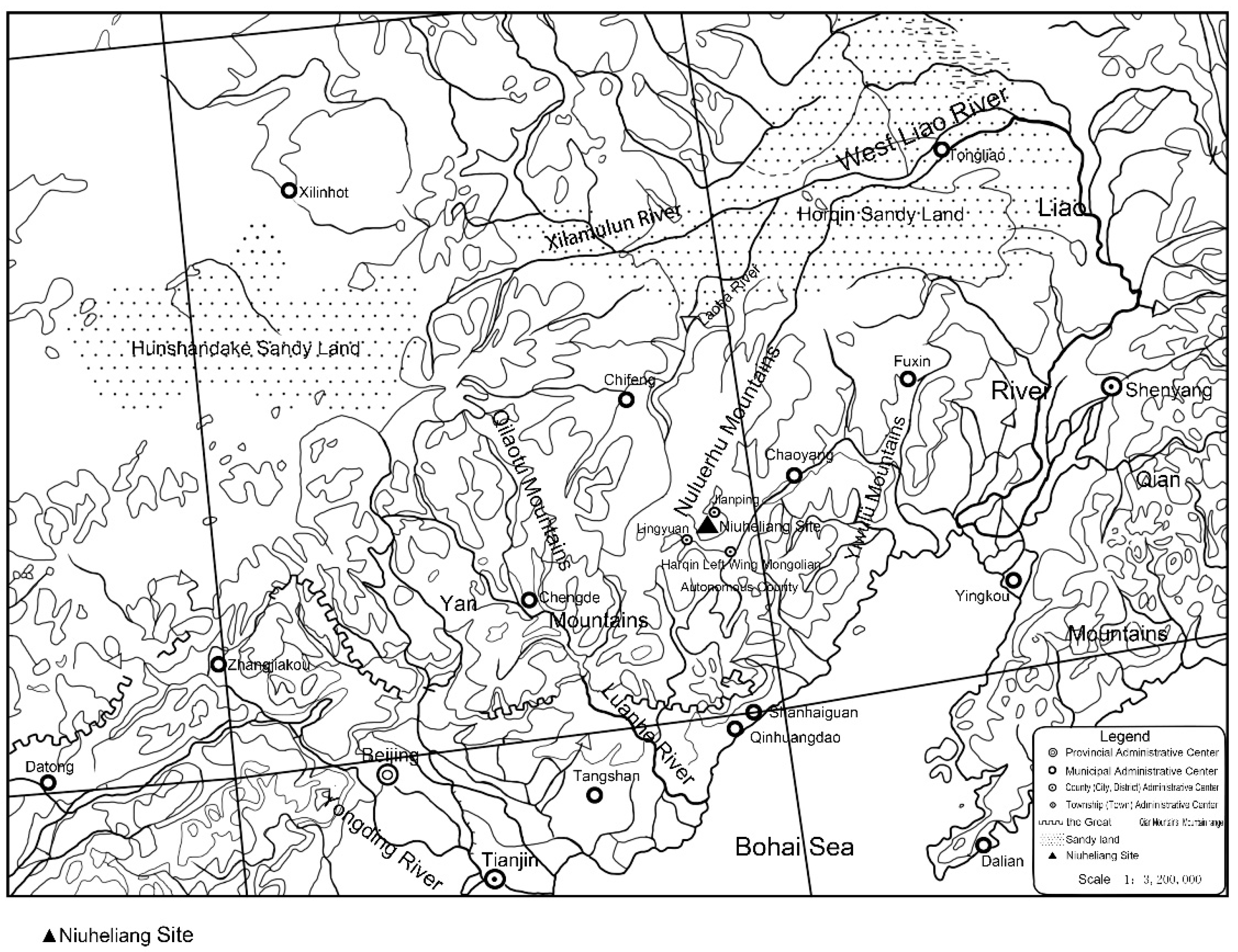
The Goddess Temple, known as Nüshenmiao 女神廟 in Chinese, at Niuheliang 牛河梁, located in Chaoyang 朝陽 City, Liaoning Province, is the earliest temple ever excavated and documented in China, dating back approximately 5500 years (c. mid–late 4th millennium BCE; see discussion below). The Goddess Temple is situated in the central part of the main ridge of Niuheliang, at the boundary between Lingyuan 淩源 City and Jianping 建平 County in western Liaoning Province, and it functioned as the core structure of the Niuheliang site complex of the late Hongshan 紅山 Culture (Figure 1). The Niuheliang site complex is a large-scale Neolithic ritual site complex independent of residential areas, comprising 16 major sites and 26 minor sites (Zhang et al. 2013, p. 5). This complex includes three key categories of important sites: first, a large, irregularly shaped semi-subterranean structure, namely, the Goddess Temple; second, a group of rectangular cairn burials (jishizhong 積石塚) containing at least 13 tombs; and third, several stone-built circular structures (referred to as “circular altars” (yuanxing jitan 圓形祭壇)) and a large pyramidal architectural altar (referred to as “square altar” (fangxing jitan 方形祭壇)). The entire Niuheliang site complex is spatially organised with the Goddess Temple and the mountain platform (shantai 山台) at its centre, the massive pyramidal structure at the forefront, and the cairn burials on the various ridges forming a surrounding ring. This forms an integrated landscape layout characterised by the tripartite combination of temple, altar (tan 壇), and tomb (zhong 塚) (Guo 1997, pp. 38–39).
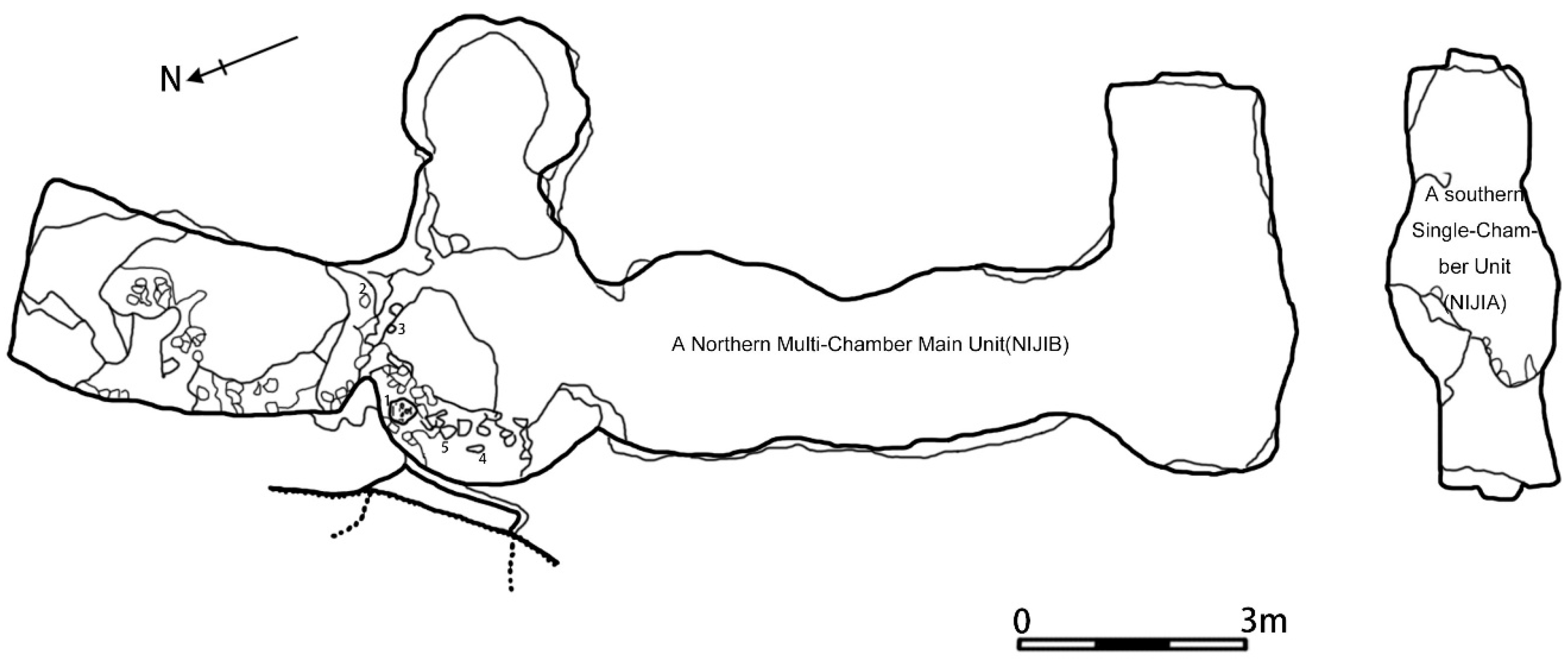
The Goddess Temple represents the core area of the entire Niuheliang site complex, distinguished by its unique geographical setting, distinctive architectural form, and the exceptional richness of its unearthed cultural relics. Located near the crest of the second ridge (zhongliang 中梁) at Niuheliang, the temple stands at an elevation of 671.3 m above sea level, marking the northernmost point of the Hongshan Culture site group at Niuheliang. A substantial mountain platform oriented north–south lies directly to the north of the temple (Liaoning Sheng Wenwu Kaogu Yanjiusuo 2012, [hereinafter (LNSWWKGYJS 2012) p. 17], while approximately 10 km to the south of the temple rises a mountain known locally as Mulan 木蘭 Mountain,1 whose profile distinctly resembles the head of a bear (or, in some interpretations, a boar. According to the archaeological excavation report (LNSWWKGYJS 2012, p. 17), the Goddess Temple is a semi-subterranean structure consisting of a northern multi-chamber main unit and a southern single-chamber unit, covering a total area of approximately 75 m2 and oriented 20° west of south. The northern multi-chamber unit is an elongated structure (longer north–south and shorter east–west) with interconnected chambers forming a single continuous architectural whole, measuring 18 m in length from north to south, with a maximum width of 9 m and a minimum width of 2 m from east to west. This unit is laid out as seven interconnected chambers: a central chamber, a northern chamber, an eastern chamber, a western chamber, and three southern chambers. The central chamber is connected to the eastern, western, and northern chambers via passages, among other spatial relationships. The southern single-chamber unit is situated 2.65 m south of the northern unit, with a pit opening measuring 6 m in transverse length and a maximum width of 2.65 m. Excavations at the Goddess Temple have unearthed a large number of cultural relics, including anthropomorphic and zoomorphic sculptures and ceramic ritual vessels. Anthropomorphic sculptures are the most numerous, followed by zoomorphic sculptures.
Since its initial excavation in 1983, the Goddess Temple site has remained a focal point of ongoing academic scrutiny within archaeological circles. Scholarly investigations into the temple remains centre primarily on four interrelated key areas, summarised below to establish the research context and the gap this paper addresses.
First, regarding chronology, scholarly consensus generally attributes the construction of the temple to the late Hongshan Culture (LNSWWKGYJS 2012, p. 17; X. Zhang 1991, p. 735; Suo and Li 2007, p. 59). This attribution has, however, provoked debate, with subsequent scholarship proposing alternative assessments. These include a suggested date around c. 3500 BCE (Nelson 1995, p. 3), often discussed alongside radiocarbon analysis of a wooden post from the Goddess Temple yielding 4970 ± 80 BP and 4975 ± 85 BP, calibrated to 3625 BCE and 3630 BCE (Sun and Guo 1986, p. 19). (These calibrations and their relation to any “c. 3500 BCE” estimate should be presented consistently; see Section 1 note above.) Other proposals include the argument that the temple was constructed between the upper and lower layers of stone cairn burials (Guo 2010, p. 276), the view that it predated the stone cairn complexes (Zhu 2013, p. 170), and assignment of the temple to the middle Hongshan period (Gao 2019, p. 69; Gao 2021, p. 123).
Second, in relation to the nature and function of the temple, scholarly discourse has converged predominantly around two primary positions, one advocating a single primary function and the other multiple functions, with the former representing the mainstream view: most researchers identify the site as a ritual and pilgrimage centre dedicated to goddess worship,2 while Su Bingqi 蘇秉琦 and his colleagues specifically characterise it as a sacred space for venerating the collective female ancestor of the Hongshan people (Su 2019, p. 101; Liu 2022, p. 16). Derivative arguments further frame it as a centre for ancestral worship (Tian 2004, p. 72; Guo 2006, p. 48), a sacred locality for propitiating fertility (Bu 2016, p. 74), and a venue for sexual intercourse rituals (Ren 1993, p. 12). Some research additionally emphasises the complex role of the temple in shaping social, religious, and political authority (Zhang et al. 2013, p. 21), while the multifunctional interpretation remains a minority view with limited scholarly support for the argument that the temple integrated display, communication, and sacrificial functions (H. Zhang 2018).
Third, with regard to the architectural design principles of the temple, scholarly analysis has identified three significant interpretive frameworks: a meaningful spatial relationship between the temple and Bear-Headed Mountain (Mulan Mountain) (Barnes and Guo 1996, p. 211), the embodiment of avian symbolism (eagles and owls) in the structural form of the temple (Q. Wang 2025, pp. 29–30), and the incorporation of astronomical principles the Northern Dipper constellation into the layout of the temple (Dong and Zhu 2016, p. 72).
Finally, research on the generative setting of the temple has largely focused on natural and economic contexts (Mo et al. 2002; Yuan and Zhu 2012). A critical gap persists, however: existing scholarship has not adequately addressed the mythological and belief frameworks that may have shaped the siting, form, and symbolic programme of the temple as an integrated sacred landscape.
From this overview, it is apparent that research on the Goddess Temple has focused predominantly on material and morphological attributes, while often overlooking the interconnections between the site and the belief and cultural elements of its context. More significantly, discussion has largely overlooked a central question: why did the Hongshan ancestors at Niuheliang deliberately choose this seemingly isolated location for constructing the Goddess Temple and other associated ritual sites? If this location and its topography mattered, what symbolic or cosmological logic structured that choice?
This paper addresses that gap by asking, what principles governed the construction of the Goddess Temple at Niuheliang as a sanctified architectural landscape? The analysis proceeds along three interrelated lines of evidence: (1) the plan and external form of the temple, interpreted through avian symbolism (eagle and owl) and evaluated against the artefactual record; (2) the clay goddess head, especially its morphology and its spatial/visual relationship to Bear-Headed Mountain; and (3) bear- and eagle-related sculptural fragments and broader bear-related assemblages across the Niuheliang complex. Grounded in comparative mythology and archaeology, the study argues that the Hongshan ancestors intentionally fused natural landforms with animal symbolism and indigenous ritual logics to produce a coherent sacred landscape. In doing so, it provides a mythological reference framework for interpreting prehistoric architectural landscapes in China, while reducing an overreliance on purely external/formal readings divorced from belief context.

2. Eagles and Owls: Shamanic Mythology in the Form of the Goddess Temple

As Neolithic cultural remains of the Hongshan Culture at Niuheliang, the Goddess Temple was a sacred ritual structure dedicated to the enshrinement of goddess sculptures. Concurrently unearthed within the Goddess Temple were a clay-sculpted head of the goddess, fragmentary clay sculptures of two animal types (bears and eagles), as well as other cultural remains. Within its archaeological context, all architectural designs associated with the Goddess Temple, alongside the remains recovered from within the Goddess Temple, can be associated with the goddess cult. Therefore, when investigating the architectural landscape of the Goddess Temple, its external form constitutes one of our primary focal points.
From the contextual perspective of the Goddess Temple site (Figure 2), a top-down perspective looking east to west reveals that the northern multi-chambered section bears a striking resemblance to an eagle in flight: its head is orientated westward in a diving posture, with wings outstretched to the north and south. The southern single-chambered section closely resembles a standing owl, with its head facing west, wings folded against its body, and talons positioned beneath the tail feathers. Both the eagle and owl forms face westward, creating a visual correspondence between the northern and southern segments of the temple. This architectural configuration suggests that the designers of the Goddess Temple may have intended to convey esoteric cosmological ideas through such symbolic representation. Theoretically, interpretations of the external form of the Goddess Temple may vary according to the observer’s vantage point. Accordingly, this paper treats “eagle” and “owl” readings as interpretive hypotheses that must be tested against associated finds and broader cultural patterns.
Why interpret the plan as eagle- and owl-like at all? A comparative-mythological lens provides one reason: across many prehistoric and shamanic systems, birds mediate between realms. But analogy alone is insufficient; the interpretation must also be supported by contextual evidence from Niuheliang itself.
It is therefore instructive to examine relevant perspectives from mythological archaeology pertaining to prehistoric goddess cults to extract pertinent cultic information regarding eagles and owls. The archaeologist Gimbutas (1974, 1989, 1991, 2001) demonstrated that in Old Europe during the period 6500–3000 BCE, a goddess-centred mythological system was prevalent. Within this system, the goddess was revered as the supreme deity, while male deities occupied subordinate roles. This goddess encompassed multiple personas and functional attributes: the conception, nurturing, death, and regeneration of life. She was also represented through diverse symbolic forms, including celestial symbols, abstract geometric patterns, and human and animal motifs, all of which were manifestations of the goddess. Specifically, solar and lunar symbols, V-shapes, M-shapes, Z-shapes, and spirals were symbolic of the Nurturing Goddess; pregnant women, mothers holding infants, bears, hinds, elks, rams, and wild cows embodied the Generative Goddess; and owls, vultures, cuckoos, eagles, doves, and wild boars typified the Goddess of Death and Regeneration. This body of evidence reveals that within the Old European mythological system, both eagles and owls are thought to have served as symbolic totems of death and regeneration, and may be considered key manifestations of the goddess.
Although the Goddess Temple at Niuheliang does not “belong” to the Old European system, prehistoric mythological thought was widespread across Neolithic societies. Therefore, it is plausible that the goddess venerated at Niuheliang shared certain broad functional attributes—life, death, regeneration—and that animals and birds could have served as symbolic vehicles for those attributes. Scholars such as Nelson have identified the Niuheliang goddess with the later Chinese deity Xihe 羲和, endowed with authority over the sun and moon (Nelson and Rosen-Ayalon 2002, p. 80). However, Xihe is a comparatively late mythological elaboration, and direct identification risks anachronism. Moreover, evidence remains insufficient to confirm that the Niuheliang goddess governed celestial bodies. A more cautious interpretation is that the clay assemblage of the temple reflects a complex goddess cult with multiple figures and roles, in which the prominent clay head may represent a high-status goddess image without requiring a single fixed identity. On this basis, interpreting the plan of the temple as encoding eagle and owl symbolism remains plausible but must be substantiated archaeologically.
Several of Gimbutas’s works have been highly contested. Numerous scholars argue that she neglects the generative contexts of symbols and images, detaching them from their cultural and social milieux and interpreting symbolic significance in a static vacuum (Tringham and Conkey 1998, pp. 22–45; Meskell 1995, pp. 74–86). Nevertheless, this paper argues that Gimbutas’s synthesis—used cautiously—offers a comparative point of reference rather than a template.
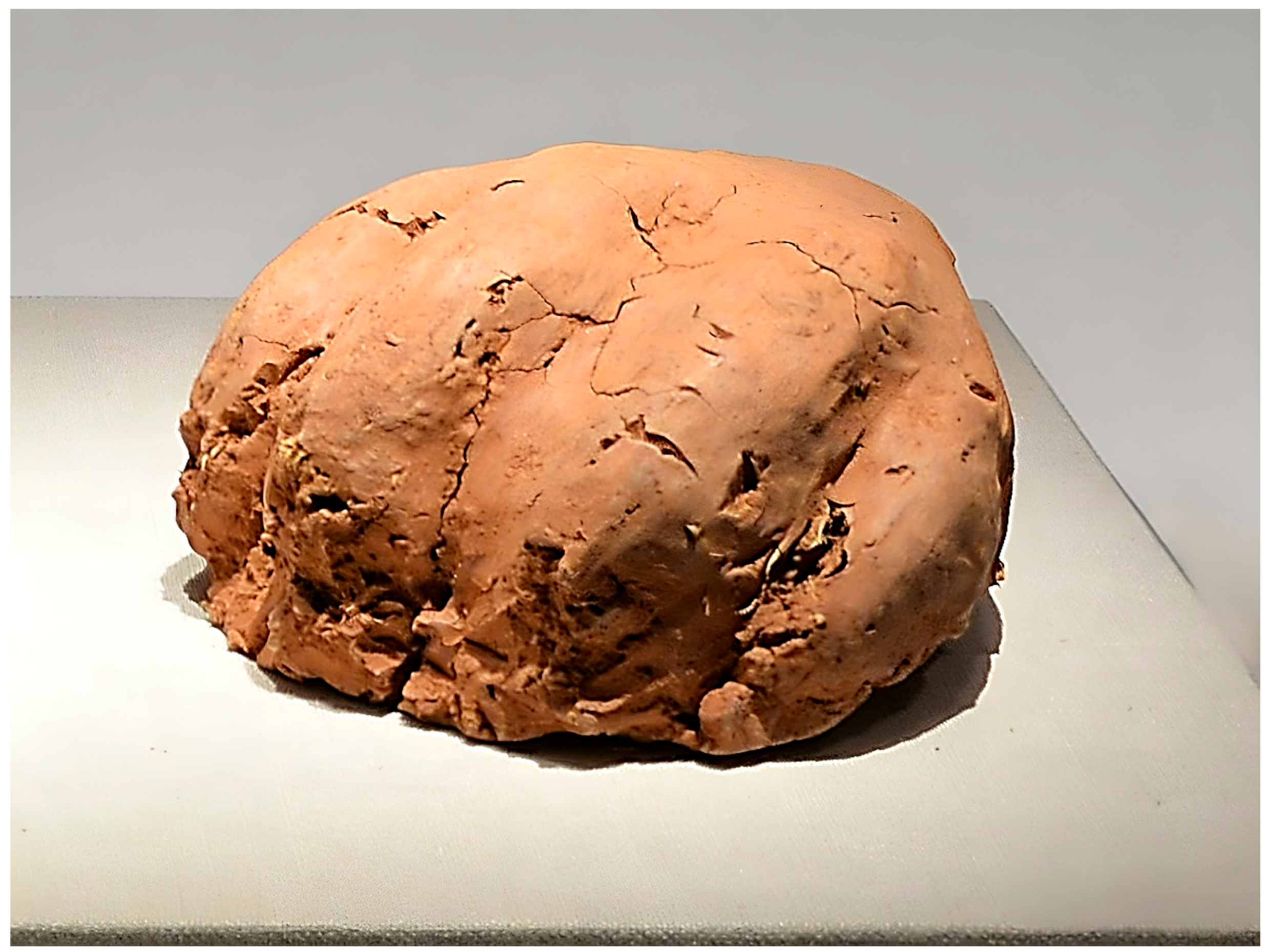
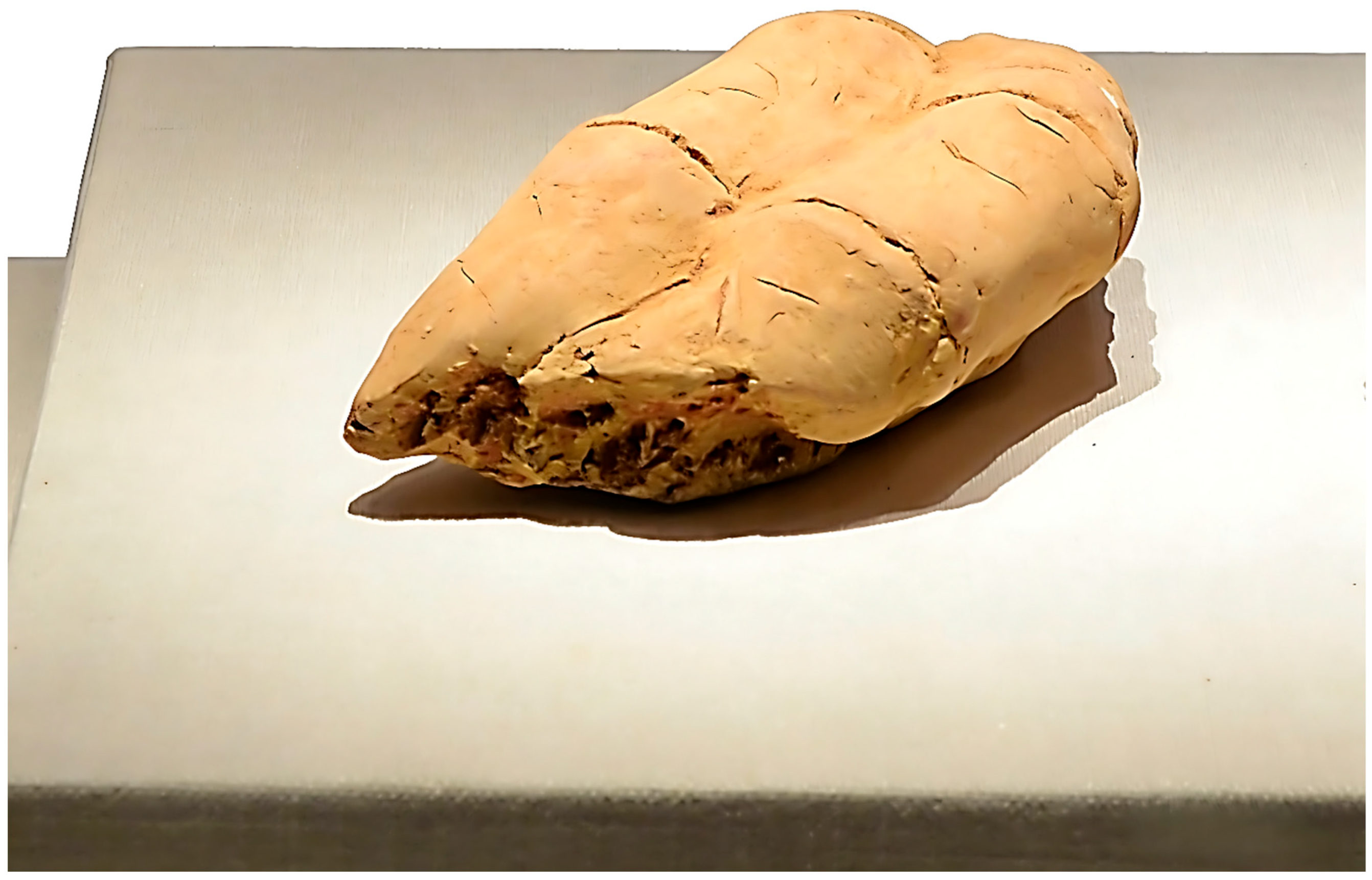
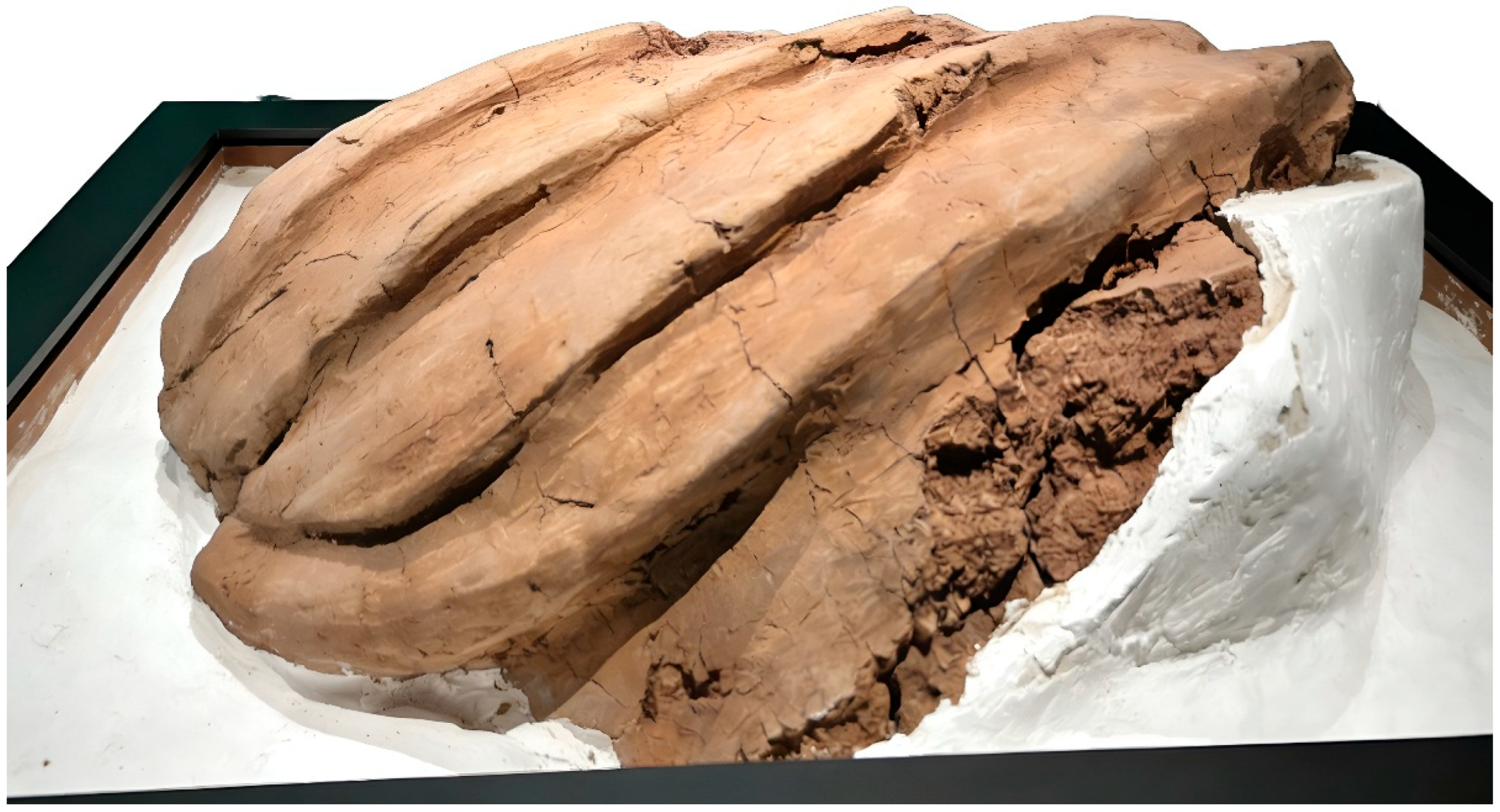
The northern multi-chambered section of the Goddess Temple was designed in the form of an eagle. This proposed design intent is supported by contextual finds. A pair of clay-sculpted eagle claws (Figure 3) and eagle wings (Figure 4) were excavated from the northern wall of the northern multi-chambered section. Discovered in a relatively concealed space within the Goddess Temple, they correspond to the clay-sculpted head of the goddess, the bear mandible, and the bear claws unearthed on the western side of the central chamber. Research by Jiao Tianlong indicates an association between the bear mandible and claws and the goddess venerated at the Goddess Temple (Jiao 2001, p. 59). These findings suggest that the eagle occupied a high status within the belief system of the population associated with the Goddess Temple, and may have served as an attendant to the goddess or an extension of her divine agency.
Furthermore, two eagle-shaped jade artefacts were unearthed within the site area associated with the Goddess Temple: one is a steatite eagle head3, and the other is an eagle-shaped object made of the xiuyan 岫巖 jade. Their differing materials and the likely varying social status of their owners attest to the significance of the eagle among the inhabitants of Niuheliang, as well as wearing practices across all social strata. Examining the broader Hongshan cultural area, as well as earlier cultural areas across Northeast China, reveals that jade eagle-shaped artefacts appear to have been relatively common. For instance, such artefacts have been excavated at the Fengxia 豐下 site in Beipiao 北票 city (c. 1950–1600 BCE, Lower Xiajiadian 夏家店 culture)4 in Liaoning Province (Liaoning Sheng Wenwu Ganbu Peixunban 1976), the Hutougou 胡頭溝 site (3500–3000 BCE, late Hongshan culture)5 in Fuxin 阜新 City, Liaoning Province (Fang and Liu 1984), and the Banlashan 半拉山 site (c. 3500–3000 BCE, late Hongshan culture)6 in Chaoyang City, Liaoning Province (Liaoning Sheng Wenwu Kaogu Yanjiusuo and Chaoyang Longcheng Qu Bowu Guan 2017). Initially, due to limited scholarly understanding, reports classified these objects variously as “jade plaques”, “jade birds”, or “pendant-shaped jade bird ornaments”. However, based on their biological features, namely, triangular heads, long sharp beaks, and long tail feathers, they are most commonly identified as representations of eagles. This has led scholars to suggest the possibility of an eagle cult across Northeast China during the Hongshan Culture period (Sun and Qi 2007, p. 198).
Evidence of eagle symbolism appears earlier still. The Xinkailiu 新開流 site (c. 4000–3000 BCE, Xinkailiu 新開流 culture) yielded a 7.3 cm long eagle-head carving crafted from animal bone (Heilongjiang Wenwu Kaogu Gongzuodui 1979, p. 512), polished to a smooth finish. This bone eagle-head artefact has been interpreted as a ritual ceremonial implement associated with high status, consistent with the postulated function of the jade eagle-shaped artefacts near the Goddess Temple. From the above, it is evident that the eagle-shaped artefacts at the Niuheliang site were unlikely to have been ordinary artefacts; they were more probably sacred ceremonial objects with special functions. However, due to the lack of relevant written evidence, specific uses remain uncertain. Accordingly, later mythological and ethnographic materials must be used cautiously, as analogic aids rather than direct proofs.
Since the cultural region of Niuheliang falls within the broader distribution of shamanic traditions in Northeast Asia, we may begin by examining shamanic perceptions of eagles. Shamanism is recognised as an indigenous religion centred on attaining ecstatic states (Halifax 1979, p. 3). In classic formulations, its core tradition is distributed across Siberia and Central Asia. The cosmological framework conceptualises a universe stratified into three realms—celestial, terrestrial, and subterranean—connected by an Axis (Eliade [1964] 1992, p. 259). While exhibiting regional inflexions, shamanic traditions in Northeast China adhere fundamentally to this tripartite cosmology. The shaman, as a mediator capable of traversing these realms, undertakes soul journeys during altered states of consciousness: ascension to solicit blessings, descent to retrieve souls, or travel to acquire esoteric knowledge. These journeys are facilitated by animal spirit allies, notably avian species and carnivores (Balzer 1996, p. 308)
A contemporary ethnographically documented case from the Wild Spirit Ritual (yeshen ji 野神祭), practised in the Mangka 莽卡 Manchu township along the Songhua River in Jilin Province, describes the shaman donning a ritual headdress adorned with a divine eagle motif, brandishing a shamanic drum imitating an eagle’s flight patterns, and chanting ritual incantations to conjure the eagle deity (Jin and Wang 1992). Originating from modern anthropology, such evidence cannot be projected uncritically into the Neolithic; nevertheless, it provides a useful interpretive analogy insofar as certain shamanic motifs can persist over long durations.
The conceptual link between the eagle and its shamanic role may be grounded in the perceived congruence between the core biological characteristics of the eagle and the shamanic cosmology. With visual acuity four to eight times that of humans, a maximum flight altitude of 4000 to 6000 m, and the ability to sustain flight for 10 to 12 h during migration, the eagle possesses the acute “celestial vision” and stamina required for shamans to enter an ecstatic trance, making it the foremost zoomorphic spirit helper for shamans. In shamanic visions, the shaman is believed to transform into an eagle, overlooking the cosmos with quasi-divine insight. Notions of shaman–eagle fusion appear in various forms in the shamanism of Northeast China. For instance, Manchu shamanic oracles state that the spirit of the mother eagle incarnated as the first female shaman (Yuguang Fu 2023, p. 90). The Manchu mythic epic, The War in Heaven (Tiangong dazhan 天宮大戰), published in 2009, recounts how a divine eagle nursed an infant girl who later became the first great shaman (Fu and Jing 2009, p. 70). The Yakut and Daur peoples similarly maintain traditions in which shamans descend from a divine eagle (Xu 2013, p. 33). These traditions are chronologically late in recorded form, but may reflect enduring oral motifs relevant as analogic context.
Current scholarship supports a close association between the Niuheliang site and shamanism. Scholars, including Sarah M. Nelson, have documented the presence of substantial shamanic elements at the Niuheliang site (Nelson and Stencel 2006). In terms of tangible material manifestations, Fang Dianchun 方殿春 and Hua Yubing 華玉冰 argue that the ritual altars, Goddess Temple, mortuary systems, jade artefacts, and pottery artefacts at Niuheliang all correlate with shamanic ritual practices (Fang and Hua 2007, pp. 47–48). Zhou Xiaojing 周曉晶 posits that most jade artefacts recovered from Niuheliang functioned as shamanic ritual paraphernalia, with the eagle likely acting as a zoomorphic spirit helper mediating communion of the shaman with the divine realm (Zhou 2006, p. 84). Guo Dashun 郭大順 hypothesises that the individual interred with the standing jade figurine from the large-scale Tomb M4 at Locality 16 was likely a preeminent shaman (Guo 2008, p. 84). It may therefore be inferred that the Goddess Temple functioned as a shamanic ritual site. The eagle-motif iconography of the northern multi-chambered structure reflects shamanic beliefs centred on the divine eagle, whereas the owl-motif iconography of the northern single-chambered structure likely reflects shamanic beliefs centred on owls. This interpretive framework is further validated by the widespread distribution of owl-shaped artefacts dating to the Hongshan Cultural period.
Owl-shaped artefacts from the Hongshan Culture period can be categorised into two types: naturalistic owl-shaped artefacts and abstract hooked-cloud jade plaques, with the latter being more prevalent. Between 1983 and 2003, ten cloud-form jade artefacts were unearthed at the Niuheliang site, all of which were associated with individuals of high social status. Additionally, a double-owl-headed jade artefact was discovered at Locality 2 of the Niuheliang site, belonging to a high-status adult male. Archaeological inventories indicate that a total of five naturalistic owl-shaped artefacts7 have been excavated from Hongshan Culture sites, including one turquoise owl-shaped artefact unearthed outside the square foundation of the Dongshanzui 東山嘴 (c. 4700–2900 BCE) sacrificial site. Furthermore, numerous owl-face motifs have been identified in the rock art at Kangjiawanzi 康家湾子 Chutoulang 初頭朗 Town, Songshan 松山 District, Chifeng 赤峰 City, Inner Mongolia, dating to the Hongshan Culture period on stylistic and contextual grounds (Zhou and Wu 2022, pp. 846–54). The number of owl-shaped artefacts significantly exceeds that of eagle-shaped artefacts. Ye Shuxian 葉舒憲 proposes that the spiral eye motifs carved on owl-shaped jade artefacts symbolise the cyclical regenerative life force of the Bird Goddess (Ye and Zu 2009, p. 80). However, there is no evidence for the existence of a supreme Bird Goddess concept within the known frameworks of either the Hongshan Culture or shamanism. A more plausible interpretation is that the owl may have functioned as a protective deity of the physical body of the shaman and was recognised as a primary divine bird among the twelve sacred avian deities in shamanism (Yan Fu 2022, p. 47). Among the Mongolian Oirat (Weilate 衛拉特) tribes, an ancestral origin myth holds that “the owl is the father and the tumour tree is the mother” (Dan and Ge 2008, pp. 258–59), demonstrating that the owl was venerated as a sacred bird that guards the infant descendants of their ancestors. Additionally, shamans of the Yakut people, a Manchu subgroup indigenous to Northeast China, adorn the tops of their ritual headdresses with owl feathers to simulate the divine eagle and invoke its presence. Based on anthropological fieldwork among shamanic communities in Northeast China, this evidence provides valuable comparative material for interpreting the eagle worship at the Niuheliang site, despite their chronological separation. It can therefore be inferred that the naturalistic owl-shaped artefacts of the Hongshan Culture functioned as wearable ritual paraphernalia, while the larger cloud-form jade artefacts served as sacred ceremonial artefacts, both acting as tools for communion of the shaman with the divine. Both types acted as instruments through which shamans could commune with the divine.
From the foregoing, the owl-motif iconography of the southern single chamber not only aligns with owl status as a sacred helper spirit but also supports a broader interpretive link between the goddess cult and avian mediators. Based on the comprehensive evidence outlined above, it can be concluded that the morphology of the building remains of the Goddess Temple at the Niuheliang site appears to represent a deliberate creation by the Hongshan ancestors, based on their shamanic mythological perceptions of two sacred avian beings, eagle and owl. This reading is further strengthened when ecological context is treated as enabling rather than determinative. During the Hongshan Cultural period, western Liaoning formed a forest-steppe ecotone with temperate deciduous broadleaf forests and grassland elements (e.g., Artemisia spp.), yielding mosaic habitats supportive of raptors. These ecological conditions likely contributed to the cultural salience of eagles and owls as visible and powerful local species.

3. The Clay-Sculpted Goddess Head and Bear-Headed Mountain: A Visual Correspondence in Contour

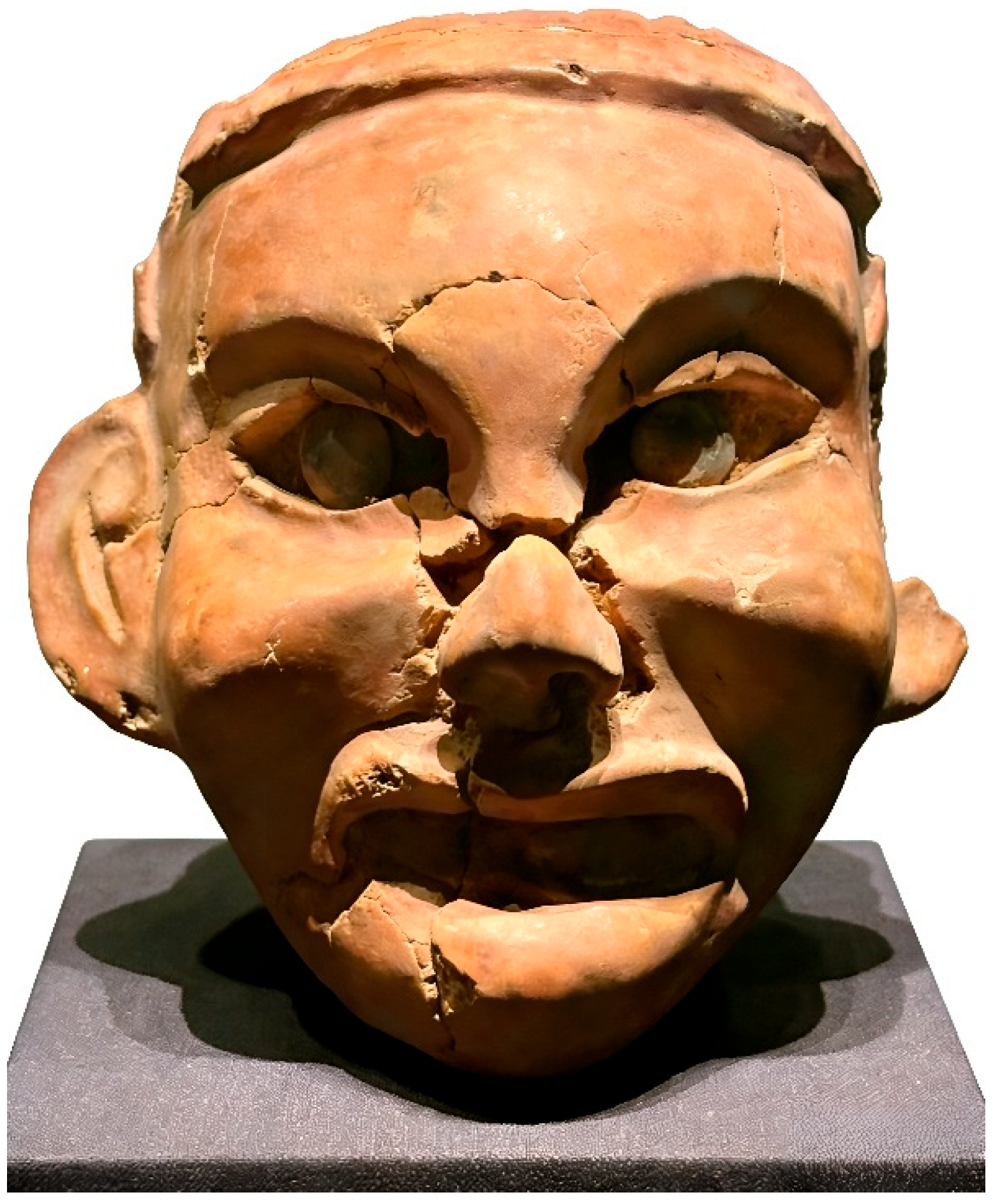
Among the numerous remains unearthed at the Goddess Temple, the clay-sculpted female head, designated as the clay-sculpted goddess head (Figure 5), is a find of particular significance. It was excavated from the western side of the central chamber within the northern multi-chambered complex of the temple, with the head of the clay-sculpted goddess oriented towards the northeast and the face of the clay-sculpted goddess head facing slightly westward. The section above the crown is missing. The forehead is adorned with a hoop-shaped ornament, and vertical strap-shaped ornaments are present at the temples. The eyes are inlaid with grey jade to serve as eyeballs; the surfaces of the jade eyeballs are polished to a smooth, convex finish, while the reverse sides of the jade eyeballs are crafted into peg-like forms and deeply inset into the eye sockets. The clay-sculpted goddess head has an overall height of 22.4 cm, a width of 21 cm from ear to ear, and a maximum thickness of 14 cm. It features a broad forehead, high cheekbones, a broad skull, and a wide mouth. The right ear is completely preserved, but the anatomical details of the right ear are simplified; the left ear is missing. The facial expression is serene. Researchers from the Niuheliang excavation team hypothesise that the reverse side of the clay head was originally affixed to the temple wall, thus identifying the clay-sculpted goddess head as a representative example of high-relief sculpture (LNSWWKGYJS 2012, p. 19).
Academic discourse on the clay-sculpted female head currently centres on the identity and status of the clay-sculpted female head; the prevailing view holds that the goddess was both a tutelary deity of the polity and a syncretic figure embodying ancestral and celestial deities (Tian and Wen 2020). Drawing on the above research findings, it can be concluded that the clay-sculpted female head unearthed at the Goddess Temple possesses an extremely important and unique identity and status in the context of the entire Niuheliang site and even within the cultural context of Prehistoric China.
Scholars diverge regarding the functional attributes of the Goddess of Niuheliang: some argue that she functioned as a protective deity safeguarding the community (Sun and Guo 1986; Tian and Wen 2020); others emphasise fertility (D. Wang 2020). However, monofunctional interpretations may under-contextualise the assemblage in which the head was embedded. Moreover, the head was not the sole female iconographic representation: numerous fragments of clay female figurines were unearthed, belonging to six or seven distinct individuals, in three size categories (three times life-size, twice life-size, and life-size). This suggests that the temple may have contained multiple goddess images or female ritual figures with differentiated roles. Therefore, it is plausible that the Niuheliang goddess cult did not express a single fixed iconography or a singular function. Rather than insisting on a single identity, the evidence is more consistent with a complex cultic repertoire in which female divinity could encompass protection, regeneration, and social cohesion. As Sun and Guo (1986, p. 23) note, this is not merely an isolated clay head but part of a broader sculptural setting.
The excavation context of the clay head reveals distinctive spatial characteristics. It was unearthed from beneath the northern wall on the western side of the central chamber. The head was positioned with the face directed upwards and the cranium oriented towards the northeast, meaning the forehead pointed northeast and the chin northwest. This alignment emphasises a western-facing orientation, corresponding to the westward orientation of the eagle and owl iconography proposed for the northern and southern segments of the temple. This repeated westward emphasis warrants interpretation, but must be tied to a clear argument about directional symbolism (e.g., ritual movement, liminality, or cosmological mapping), rather than simply noted.
A core question requiring elucidation is why the clay head displays these distinctive sculptural attributes. One interpretive avenue emerges by shifting the analytical frame outward, from the temple interior to the prominent mountain facing the complex.
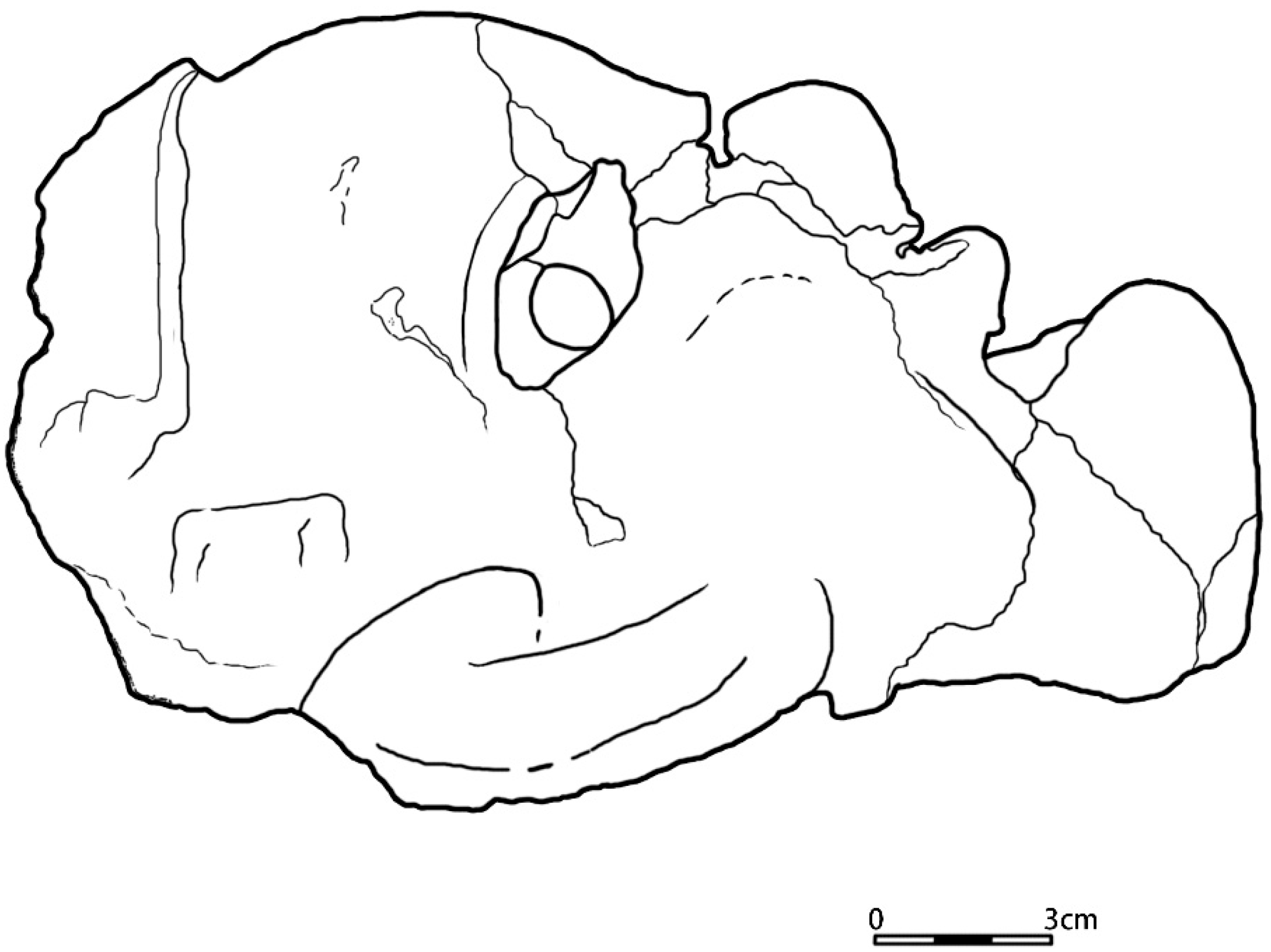
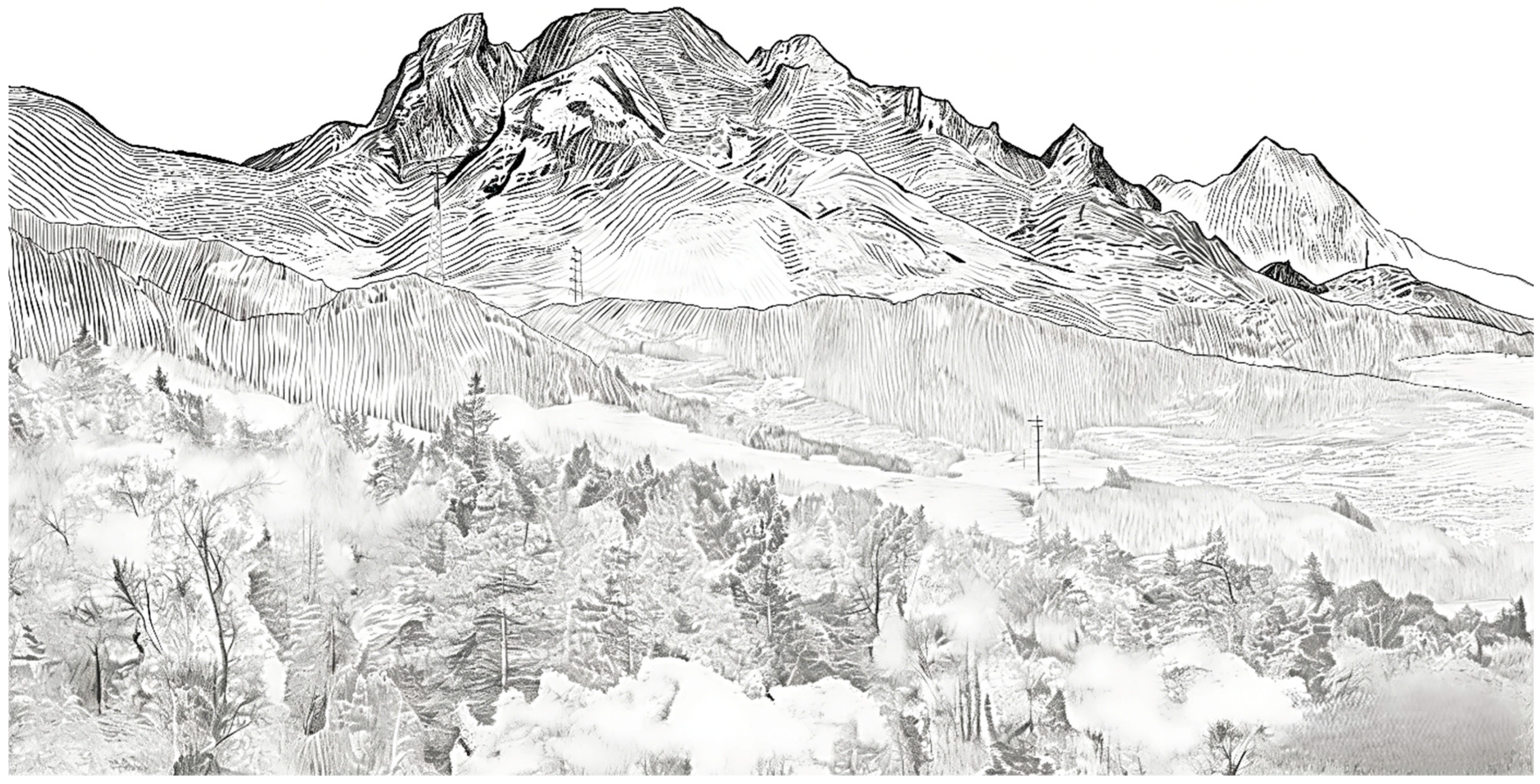
The profile of the clay-sculpted goddess head (Figure 6) demonstrates notable morphological congruence with the topographic silhouette of Bear-Headed Mountain (Figure 7). When observed from left to right, Bear-Headed Mountain presents as a scaled-up form of the profile of the clay-sculpted goddess head, with specific anatomical features including the circumferential forehead ornament, forehead contour, nasal profile, oral structure, mandibular contour, and malar eminences of the face displaying a striking correspondence with the form of the mountain.
This morphological parallelism offers a potential explanation for why the Hongshan communities selected this location: Bear-Headed Mountain, endowed with sacred properties through perceived resemblance, may have been understood as a hierophanic medium embodying the goddess’s countenance. This is an interpretive claim and should be framed cautiously: the correspondence may indicate deliberate alignment, but alternative explanations (perceptual patterning, later naming traditions) should be acknowledged briefly.
Notably, Mulan Mountain resembles a bear’s head when viewed from the front and the profile of the clay head when viewed from the side (a perfect fusion of the goddess and the bear), producing a powerful visual fusion of goddess and bear, thus becoming the primary marker for the construction of the Niuheliang site. This dual readability could have strengthened the role of the mountain as a key marker within the Niuheliang sacred landscape. It is thus evident that the spatial domain of the Goddess Temple at Niuheliang embodies dual layers of sacrality: architecturally, as a ritual centre, and topographically, through the perceived correspondence between Bear-Headed Mountain and the clay head’s profile. Together, these suggest that Hongshan communities constructed their cult centre within a purposefully designated sacred space.
The equating of goddess imagery to bear iconography is not limited to Niuheliang. Investigations at the Hamashan 蛤蟆山 site in Chifeng unearthed a bear figurine crafted from shell material (a “bear-shaped shell ornament”), now housed in Chifeng Museum. Excavated in association with it was a shell-carved anthropomorphic female figure. Their co-occurrence suggests that the bear could function as a theriomorphic incarnation associated with female divinity. As Ye Shuxian notes, this pattern supports a symbolic correlation between bear iconography and goddess imagery in Hongshan contexts (Ye 2006, p. 76). Here, too, the claim is strongest when framed as “suggestive” rather than definitive, unless a broader corpus is demonstrated
Our investigation of the mountain facing the Goddess Temple at Niuheliang confirms its significant association with bear worship traditions. This distinctively shaped mountain has a summit elevation of 858.8 m. While unremarkable in height, it features steep terrain and crisscrossing gullies; coupled with its frequent spectacle of a rolling sea of clouds, it has gained the cultural status of a “sacred mountain” (Shengshan 聖山) within local belief systems. This peak is also known as Mulan Mountain, a toponym derived from folk traditions linking Hua Mulan’s military campaigns of leading troops to resist enemies in the region. Preserved structural remains designated as the “Hua Mulan Troop Assembly Platform” (Hua Mulan tunbing dianjiang tai 花木蘭屯兵點將台) provide physical evidence for this naming tradition, demonstrating that the objective existence of the mountain predates its human-assigned names, which have evolved dynamically across different historical periods. Furthermore, excavators of the Niuheliang site named it Boar-Headed Mountain (Zhushoushan 豬首山) or Bear-Headed Mountain based on the combined morphological features of the peak from a specific viewing angle.
The distinctive appearance of the mountain has attracted significant scholarly attention. Based on the abundance of suid remains in prehistoric Northeast China, it has been in-ferred that pig veneration existed at Niuheliang. Separately, the shape of the mountain has been interpreted as resembling the head of a boar. However, her core evidence—the clay-modelled animal mandible found with the goddess—has been identified as a bear rather than a pig. And no pig-related artefacts have been attested at Niuheliang, whereas bear-related remains are relatively abundant. Based on field investigations, Guo Dashun observes that the mountain more closely resembles a bear’s head and proposes designating it “Bear Mountain.” He further suggests that the community may have selected the Goddess Temple location to establish visual correspondence with this bear-headed peak (Guo 2005, p. 120). We concur with Guo’s interpretation insofar as bear-related remains provide material support for a bear-centred reading of the landscape (Guo 2005, p. 120).

4. The Bear Deity and Bear-Headed Mountain: The Dynamics of Belief and Sacred Landscape

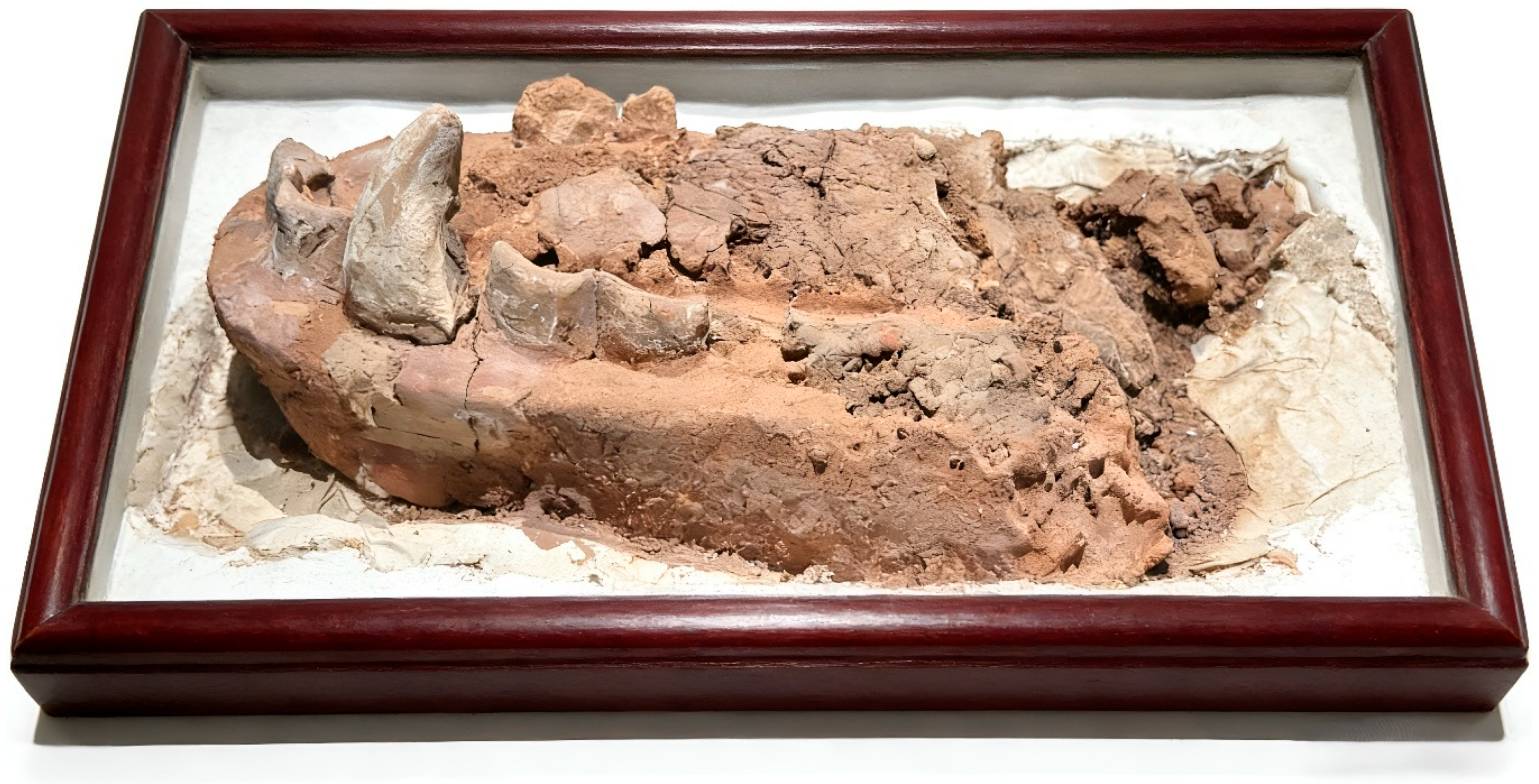
In total, 20 bear-related artefacts have been recovered at the Niuheliang site (see Table 1). Excavations at the Goddess Temple yielded four of these artefacts, comprising one bear skull and three fragments of clay bear sculptures: comprising one bear mandible (Figure 8) and two bear claws (Figure 9). Notably, these clay fragments were retrieved from the ceiling of the central chamber within the northern multi-room section of the temple, with the clay bear skull positioned facing north and in close spatial proximity to the clay head sculpture of the goddess (LNSWWKGYJS 2012, p. 25). According to Guo Dashun these fragments formed part of a single clay bear sculpture depicted with outstretched forepaws atop the temple structure (Yang and Yang 2020, p. 25). This association indicates the bear held exceptional ritual status; its placement near the goddess image indicates a close connection between bear symbolism and the goddess cult within Hongshan belief systems at Niuheliang.
Further excavations uncovered additional bear-associated materials, including five jade bear-dragon ornaments, one three-holed jade with dual bear heads, and nine Asian black bear skeletons. The five perforated jade bear-dragons, notable for their size, likely functioned as ritual paraphernalia mediating between heaven and earth. Further research suggests that the triple-perforated jade ornament with double bear heads may have functioned as a sacred implement for cosmic mediation, with bear im-agery carrying significant symbolic weight. These interpretations should be presented as hypotheses grounded in form, context, and comparative symbolic logics, rather than as established facts. Consequently, while bear-shaped jade artefacts may have functioned as ritual conduits, bear skeletal remains may have carried additional connotations within prehistoric ritual practice.
The discovery of substantial black bear remains across the ritual complex—including the temple, altars, and burial areas—reflects bear hunting and suggests that bears could have fulfilled a dual role as sacrificial offerings and as objects of veneration. In this regard, the Bear Wind Burial Ritual8 of the Oroqen people offers a comparative framework.the Oroqen traditionally regard bears as ancestors, consume bear meat while preserving the skull, and place the skeleton in trees exposed to wind. The Oroqen practise shamanism, which may share structural similarities with ritual practices at Niuheliang. Used cautiously, this analogy supports (but does not prove) the hypothesis that a comparable veneration of bear bones may have been present at Niuheliang.
Taken together, the patterned presence of bear remains and bear imagery suggests elevated ritual status for the bear at Niuheliang, potentially comparable to that of ancestral or goddess-linked figures. This interpretive frame also offers a plausible rationale for why clay bear fragments occur in such close proximity to the goddess image within the temple.
From the above discussion, it can be inferred that the Hongshan communities at Niuheliang may have held a tripartite understanding of bears: first, bears served as helper spirits within shamanic systems, with bones and effigies used in sacrificial rituals; second, bears symbolised cycles of death and rebirth (often analogised to hibernation); and third, bear symbolism was closely integrated with goddess worship at the temple. However, the claim that bear worship “preceded” goddess worship is difficult to establish archaeologically; it is safer to state that bear symbolism appears structurally prominent within the ritual programme of the temple.
The bear remains at Niuheliang were distributed across the temple, altars, and burials. This distribution indicates that bear symbolism permeated multiple ritual domains: temple sacrifices, altar ceremonies, and mortuary practices. From clay bear effigies in the temple to bear-related jade objects in burials and bear bones across the complex, the evidence suggests a coherent bear-related symbolic system spanning material and ritual dimensions.
Bear worship at Niuheliang is not unique. Research indicates that bear-related beliefs were widespread across Northeast China during the Hongshan Culture and earlier periods (Shao and Wang 2019). Brown bear fossils at the Jinniushan 金牛山 site in Dashiqiao 大石橋 City, Yingkou 營口 City, Liaoning Province, dating back 160,000–200,000 years (Jinniushan Lianhe Fajuedui 1976, p. 123), show long-term human–bear co-presence in the region. Cave bear bones at the Shoushan Xianrendong 壽山仙人洞 site (c. 20,000–10,000 BCE, Late Palaeolithic) in Huadian 樺甸市 City, Jilin Province (Chen et al. 2013, p. 57), along with brown bear teeth from Xinkailiu (c. 5400–4400 BCE) (Heilongjiang Wenwu Kaogu Gongzuodui 1979, p. 518), indicate bear exploitation and possibly ritualised consumption. The full-round stone bear sculpture from Baiyin Changhan 白音長汗 site (c. 5200–4800 BCE, Zhaobaogou Culture) in the Inner Mongolia Autonomous Region (Neimenggu Zizhiqu Wenwu Kaogu Yanjiusuo 2004, p. 204), and a bear-related stone object from Linxi 林西 County, Inner Mongolia, may suggest associations between bear imagery and seasonal cycles (Ye 2007, p. 62). The full-round stone bear head sculpture and stone axe (shiyue 石鉞) from the Banlashan site in Chaoyang City, Liaoning Province, may represent a sceptre-like set symbolising identity and status. Notably, at the Zhengjiagou 鄭家溝 site (c. 3300–2800 BCE, Late Hongshan Culture) in Hebei Province, newly excavated in 2024, a painted clay bear head (possibly a sceptre head) was unearthed alongside artefacts including jade bear-dragon, jade locust, triple-linked jade bi disc (yubi 玉璧), jade axe, and jade bodkin (yuxi 玉觹9). Because this is a recent excavation, the bibliographic record must be verified carefully and framed in preliminary terms (e.g., “reported,” “announced,” “preliminary excavation report”). From a mythological perspective, these jade artefacts may serve as ritual implements and symbols of power and identity. Excavation staff reportedly noted that Zhengjiagou belongs to the late Hongshan Culture and lies near Bear-Ear Mountain within the Yinshan 陰山 range (Gong et al. 2025, p. 23). If confirmed, this would provide an additional example of how bear-related landscape perception could intersect with site placement. In shamanic traditions, shamans enter ecstatic states and summon spirit guides. In Altai traditions, the bear can be construed as a helper spirit aiding ascent or descent journeys (Eliade [1964] 1992, pp. 88–89). Comparable motifs appear in other shamanic narratives (Halifax 1979, pp. 178–79). The heuristic significance lies in the possibility that the bear functioned as a helper spirit for shamans at Niuheliang, enabling ritual mediation between realms.
Among Tungusic-speaking peoples, bears are venerated as ancestors and addressed with kinship terms. Evenki terms include heke 合克 for male bears and ewo 鄂我 for female bears (Chao 2012, pp. 307–8). In the Evenki Bear Wind Burial Ritual, the bear’s face is positioned east (Wu 1989, p. 85). As a contemporary practice, this may offer analogic insights into deposition and orientation practices at Niuheliang. However, any claimed “precise correspondence” should be softened unless the orientations are demonstrably identical and statistically meaningful.
Among the Tungusic-speaking peoples, bears are venerated as ancestor sand addressed with kinship terms. Evenki terms include heke 合克, for male bears and ewo 鄂我, for female bears (Chao 2012, pp. 307–8). In the Evenki Bear Wind Burial Ritual, the bear’s face is positioned east (Wu 1989, p. 85), and the face of the bear is typically positioned facing east (head to the east, feet to the west) (Wu 1989, p. 85). As a contemporary practice, this may offer analogic insights into deposition and orientation practices at Niuheliang. However, any claimed “precise correspondence” should be softened unless the orientations are demonstrably identical and statistically meaningful.
If directional emphasis is consistent across multiple features, it may suggest patterned symbolic orientation. At minimum, the repeated alignment motifs strengthen the case that the arrangement of the goddess head, bear imagery, and the facing mountain was meaningful within the ritual logic of the site.
Furthermore, in Northeast Asian shamanic traditions, bear paws, teeth, bones, and skulls function as ritual implements and protective amulets (Wu 1989, pp. 86–88). This provides comparative context for the presence of bear remains both in the temple and across the broader site area. Overall, the patterned distribution of bear materials suggests a meaningful presence consistent with a bear-centred symbolic system, rather than accidental deposition.

5. Conclusions

In summary, we can draw the following three conclusions:
First, as the earliest temple site ever excavated in China, the overall landscape of the Goddess Temple at Niuheliang is unlikely to have been a product of chance; it appears to have been a sacred space carefully constructed by Hongshan communities based on mythological concepts. Specifically, both the morphology and structure of the temple foundations, as well as the cultural remains housed within, can be understood as having been conceived in relation to animal symbolism within Hongshan belief systems. This encompasses two key aspects. On one hand, notions of divine birds mediating between realms plausibly informed the plan forms of the northern and southern sections, reinforced by eagle-related clay fragments and wider avian iconography. On the other hand, the perceived correspondence between the clay goddess head and Bear-Headed Mountain, coupled with bear-related clay fragments and bear assemblages, supports the interpretation that goddess worship and bear symbolism were profoundly intertwined. Framed cautiously, the mountain may have operated as a natural carrier through which goddess and bear meanings were projected and stabilised within the ritual landscape.
Second, as the core structure of the Niuheliang site, the sacred landscape of the Goddess Temple can be seen as arising from the dynamic interplay of mythological concepts, the natural environment, and indigenous beliefs, and illustrates one distinctive manner in which early Chinese religious culture constructed sacred space. This encompasses two levels of interpretation: The first aspect is that the landscape of the Goddess Temple is fundamentally a composite ritual sacred landscape, formed by the temple structure itself, the fragments of clay bear and eagle sculptures housed within it, and the Bear-Head Mountain opposite the temple. It is essentially a sacred architectural entity constituted through the mutually formative interplay among the architecture, the artefacts contained within it, and the mountain terrain. This landscape structure embodies the distinctive approach to sacred space construction in early Chinese religious culture: the natural environment was not merely a scenic backdrop to the architecture, but likely served as an essential vehicle for conveying and expressing cosmological concepts. The second aspect is that the landscape of the Goddess Temple at Niuheliang is itself a complex symbolic system. Centred on goddess worship, it incorporates shamanic beliefs in three animal species—the bear, eagle, and owl—as its symbolic vehicles against the natural mountain backdrop, contributing to the formation of the mythological core of the late Hongshan Culture. In this sense, the sacred landscape of Niuheliang is not merely the visual setting of the temple, but also a fundamental material vehicle for constructing the mythological cosmology of the late Hongshan Culture.
Third, animals played a formative conceptual role in constructing the sacred space of the Goddess Temple. The bear, eagle, and owl are central, with the bear most prominent. Bear-related beliefs underpinned the symbolic linkage between the temple and Bear-Headed Mountain and informed the internal organisation of the temple and bear-related clay fragments. Eagle- and owl-related beliefs were instrumental in shaping the temple’s external morphology and avian-related remains. This animal-centred system is also linked to the geography of the region and subsistence patterns. The Hongshan cultural zone, encompassing Niuheliang, is characterised by hunting and fishing economies that likely fostered sustained human–animal interdependence, while the ecotone habitat of the region supported bears and raptors. Under the combined influence of geography, subsistence economy, and shamanic analogues, the animal-symbolic system of the Goddess Temple emerges as an integrated ritual landscape: a synthesis of landform, artefact, and mythic cognition rather than an architectural object alone.

Funding

This research received no external funding.

Institutional Review Board Statement

Not applicable.

Informed Consent Statement

Not applicable.

Data Availability Statement

Data available in a publicly accessible repository.

Conflicts of Interest

The author declares no conflicts of interest.

Notes

1
Given the striking resemblance of the mountain to the head of the bear, most scholars prefer the designation “Bear-Headed Mountain”. This nomenclature is accordingly adopted throughout this paper.
2
While scholars differ somewhat in their specific formulations, they generally concur that the Goddess Temple at the Niuheliang site served as a ritual centre, specifically a sacred space dedicated to the conduct of special ceremonies. For specific references, see: Ching et al. (2017, p. 8); Drennan et al. (2017, p. 53); Ge and Lu (2025, p. 97); Han (2022, p. 236); Hinsch (2004, p. 63); Liaoning Sheng Wenwu Kaogu Yanjiusuo and Zhongguo Renmin Daxue Lishi Xueyuan (2014, p. 8); Linduff et al. (2004, p. 53); Nelson (1994, p. 5; 2001, p. 80; 2002, p. 13; 2016, p. 117); Ran (2022, p. 120); Scarre and Fagan (2016, p. 158); Underhill (2008, p. 554).
3
The burial occupant was an adult female of high social standing. This steatite eagle head was excavated alongside a jade artefact designated as a “comb ornament with two anthropomorphic heads and three perforations”. The original archaeological report described this steatite object as a “phoenix head”, a terminological designation that has been the subject of scholarly debate, as the phoenix is a later, mythological construct within Chinese tradition. Based on a comparative analysis of the morphological characteristics of jade eagle-form artefacts from this period and the specific features of this relic, the author identifies it as an eagle head. For further details, see LNSWWKGYJS (2012, vol. 1, p. 94).
4
Owing to the complete decomposition of the skeletal remains, the gender of the burial occupant is indeterminable, though the excavators confirmed the individual was an adult. This jade eagle was recovered in association with eight other jade artefacts, including one hooked-cloud jade plaque; two jade rings (yuhuan 玉環); one oblique-mouthed tubular jade artefact; two perforated jade bi discs; and one tubular jade bead. The nature of this assemblage indicates the elevated social standing of the burial occupant. While the excavation report categorises this piece as a “jade bird”, its specific morphology corresponds closely to ornithological characteristics of an eagle; therefore, the author, along with other scholars, favours its identification as a “jade eagle”. For detailed context, see LNSWWKGYJS (2012, vol. 2, p. 418).
5
The excavation report designates this artefact as a “jade plaque”; however, based on its formal attributes, the author and other scholars argue that it should be identified as an eagle. For further details, see Liaoning Sheng Wenwu Ganbu Peixunban (1976, p. 208, Figure 16.1).
6
The excavation report identifies this jade artefact as a “jade bird”. However, its distinctive characteristics, including a triangular head and long sharp beak, correspond more closely to the anatomical features of an eagle. For further details, see Fang and Liu (1984, p. 3, Figure 7.8).
7
A total of five realistic owl-shaped artefacts have been recovered from Hongshan Culture sites. These include two jade owls from the Hutougou site (Fang and Liu 1984), two jade owls from the Nasitai 那斯台 site in Balinyouqi Banner, and one turquoise owl from the Dongshanzui site.
8
The Bear Wind Burial Ritual of the Oroqen people constitutes a distinct ritual of bear veneration, encompassing a set of codified procedures and taboos infused with profound reverence for the bear as a totemic ancestor. Firstly, hunters must determine the sex of the bear and conduct gender-specific handling of the animal as an act of deference. They then sever the head of the bear and insert a wooden stave into it to ward off perceived spiritual retaliation, before the group gathers to kneel in collective supplication, seeking forgiveness from the spirit of the bear. During the butchering of the carcass of the bear, great care is taken to handle the blood vessels, and bear meat is distributed for consumption in accordance with the sex of the bear. Finally, all the bones of the bear are collected intact. Senior clan elders preside over the solemn Bear Wind Burial Ritual, reciting ceremonial incantations as they inter the wrapped skull of the bear in a tree. This act ensures the spirit of the bear finds rest and completes the ritual reconciliation between humans and bears. This holistic ritual system encapsulates the deep reverence of the Oroqen people for bears and their ancient animistic worldview, which emphasises harmonious coexistence with the natural world. For a detailed account of the rituals and their interpretation, see Zhao and Liang (2008).
9
The jade yuxi is an ancient Chinese ritual jade artefact characterised by an elongated, curved or slightly tapered form, typically measuring between 5 and 15 cm in length. It often features a pointed tip, sometimes carved with zoomorphic or abstract designs, and a perforated base for suspension. Originally functioning as a practical tool for untying knots, it later evolved into a ceremonial ornament associated with status, authority, and spiritual symbolism. In ritual contexts, it was worn or buried with the deceased as an object believed to facilitate communication between the human and divine realms.

References

  1. Balzer, Marjorie Mandelstam. 1996. Flights of the Sacred: Symbolism and Theory in Siberian Shamanism. American Anthropologist 98: 305–18. [Google Scholar] [CrossRef]
  2. Barnes, Gina L., and Dashun Guo. 1996. The Ritual Landscape of ‘Boar Mountain’ Basin: The Niuheliang Site Complex of North-Eastern China. World Archaeology 28: 209–19. [Google Scholar] [CrossRef]
  3. Bu, Gong 蔔工. 2016. Niuheliang jisi yizhi jiqi xiangguan wenti 牛河梁祭祀遺址及其相關問題 [The Niuheliang Sacrificial Site and Related Issues]. In Bugong Kaogu Wencun 卜工考古文存 [Collected Archaeological Works of Bu Gong]. Beijing: Kexue Chubanshe 科學出版社 [Science Press], pp. 72–81. [Google Scholar]
  4. Chao, Ke 朝克, ed. 2012. Zhong Guo Ewenke Zu 中國鄂溫克族 [The Ewenki People in China]. Yinchuan: Ningxia Renmin Chubanshe 寧夏人民出版社 [Ningxia People’s Publishing House]. [Google Scholar]
  5. Chen, Quanjia 陳全家, Hailong Zhao 趙海龍, Fagan Wang 王法崗, and Chunxue Wang 王春雪. 2013. Huadian Xianrendong yizhi chutu de dongwu huashi yu baofen 樺甸仙人洞遺址出土的動物化石與孢粉 [Animal Fossils and Pollen from the Xianrendong Site in Huadian]. Renleixue Xuebao 人類學學報 [Acta Anthropologica Sinica] 1: 52–62. [Google Scholar]
  6. Ching, Francis D. K., Mark Jarzombek, and Vikramaditya Prakash. 2017. A Global History of Architecture. Hoboken: John Wiley & Sons. [Google Scholar]
  7. Dan, Bi 丹碧, and Lijie Ge 格·李傑, eds. 2008. Meng-Han Duizhao Tuote Wenzi Weilate Menggu Lishi Wenxian Yibian 蒙漢對照托忒文字衛拉特蒙古歷史文獻譯編 [A Translated Compilation of Historical Documents of the Oirat Mongols in Todo Script with Mongolian-Chinese Comparison]. Urumqi: Xinjiang Renmin Chubanshe 新疆人民出版社 [Xinjiang People’s Publishing House]. [Google Scholar]
  8. Dong, Jie 董婕, and Chengjie Zhu 朱成傑. 2016. Niuheliang Hongshan Wenhua Yizhi Sheji Sixiang Yanjiu 牛河梁紅山文化遺址設計思想研究 [Research on the Design Concepts of the Niuheliang Hongshan Culture Site]. Shenyang: Liaoning Kexue Chubanshe 遼寧科學技術出版社 [Liaoning Science and Technology Publishing House]. [Google Scholar]
  9. Drennan, Robert D., Xueming Lu, and Christian E. Peterson. 2017. A Place of Pilgrimage? Niuheliang and Its Role in Hongshan Society. Antiquity 91: 43–56. [Google Scholar] [CrossRef]
  10. Eliade, Mircea. 1992. Shamanism: Archaic Techniques of Ecstasy. Translated from the French by Willard R. Trask. Princeton: Princeton University Press. First published 1964. [Google Scholar]
  11. Fang, Dianchun 方殿春, and Baohua Liu 劉葆華. 1984. Liaoning Fuxin xian Hutougou Hongshan wenhua yuqi mu de faxian 遼寧阜新縣胡頭溝紅山文化玉器墓的發現 [Discovery of a Hongshan Culture Jade Tomb at Hutougou, Fuxin County, Liaoning]. Wenwu 文物 [Cultural Relics] 6: 1–5. [Google Scholar]
  12. Fang, Dianchun, and Yubing Hua 華玉冰. 2007. Liaoxi qu jizhong kaogu xue wenhua zhong “Saman shi” de yicun (shang) 遼西區幾種考古學文化中 “薩滿式” 的遺存(上) [Remains of a ‘Shamanic’ Nature in Several Archaeological Cultures of the Western Liaoning Region (Part 1)]. Liaoning Sheng Bowuguan Guankan 遼寧省博物館館刊 [Liaoning Provincial Museum Journal] 2: 42–51. [Google Scholar]
  13. Fu, Yan 富岩. 2022. Hongshan Yuqi Jiexi 紅山玉器解析 [Analysis of Hongshan Jade Artifacts]. Beijing: Xianzhuang Shuju Youxian Gongsi 線裝書局有限公司 [Thread-Binding Books Publishing House Co., Ltd]. [Google Scholar]
  14. Fu, Yuguang 富育光. 2023. Saman Jiao Yu Shenhua 薩滿教與神話 [Shamanism and Mythology]. Beijing: Shangwu Yinshuguan 商務印書館 [The Commercial Press]. [Google Scholar]
  15. Fu, Yuguang, and Wenli Jing 荊文禮, eds. 2009. Tiangong Dazhan, Xilin Anban Mafaj 宮大戰, 西林安班瑪發 [The War in the Heavenly Palace, Xilin Anban Mafa]. Changchun: Jilin Renmin Chubansh 吉林人民出版社 [Jilin People’s Publishing House]. [Google Scholar]
  16. Gao, Yunyi 高雲逸. 2019. Niuheliang yizhi “Nüshen Miao” yu jishi zhong niandai de zai renshi 牛河梁遺址”女神廟”與積石塚年代的再認識 [Reconsideration of the Dates of the ‘Goddess Temple’ and Stone Mound Tombs at the Niuheliang Site]. Bianjiang Kaogu Yanjiu 邊疆考古研究 [Research of China’s Frontier Archaeology] 2: 63–74. [Google Scholar]
  17. Gao, Yunyi. 2021. Zai lun Niuheliang yizhi “Nüshen Miao” de niandai 再論牛河梁遺址”女神廟”的年代 [Another Discussion on the Date of the ‘Goddess Temple’ at the Niuheliang Site]. Diyu Wenhua Yanjiu 地域文化研究 [Regional Culture Study] 3: 115–23. [Google Scholar]
  18. Ge, Yanze, and Ruiyu Lu. 2025. Evaluating the Impact of Monumental Landscapes on Population Aggregation in Hongshan Culture. Asian Archaeology 9: 97–108. [Google Scholar] [CrossRef]
  19. Gimbutas, Marija. 1974. The Gods and Goddesses of Old Europe, 7000–3500 B.C: Myths and Cult Images. London: Thames and Hudson. [Google Scholar]
  20. Gimbutas, Marija. 1989. The Language of the Goddess. London: Thames and Hudson. [Google Scholar]
  21. Gimbutas, Marija. 1991. The Civilization of the Goddess: The World of Old Europe. San Francisco: Harper San Francisco. [Google Scholar]
  22. Gimbutas, Marija. 2001. The Living Goddesses. Berkeley: University of California Press. [Google Scholar]
  23. Gong, Zhanqing 龔湛清, Wen Zexing 溫澤星, Zhang Bingrui 張丙瑞, and Jun Li 李軍. 2025. Cong Xuanhuan Zhengjiagou yizhi xin faxian zai kan beifang wenming jiaphui de “Sanchakou” 從宣化鄭家溝遺址新發現再看北方文明交匯的“三岔口” [Re-examining the ‘Confluence’ of Northern Civilizations from the New Discoveries at the Zhengjiagou Site in Xuanhua]. Dazhong Kaogu 大眾考古 [Popular Archaeology] 6: 19–25. [Google Scholar]
  24. Guo, Dashun 郭大順. 1997. Zhonghua wuqian nian wenming de xiangzheng—Niuheliang Hongshan wenhua tan miaozhong 中華五千年文明的象徵—牛河梁紅山文化壇廟塚 [A Symbol of Five Thousand Years of Chinese Civilization: The Altar, Temple, and Mound Complex of the Hongshan Culture at Niuheliang]. In Niuheliang Hongshan Wenhua Yizhi yu Yuqi Jingcui 牛河梁紅山文化遺址與玉器精粹 [The Niuheliang Hongshan Culture Site and the Essence of Its Jades]. Edited by Liaoning Sheng Wenwu Kaogu Yanjiusuo 遼寧省文物考古研究所. Beijing: Wenwu Chubanshe 文物出版社 [Cultural Relics Publishing House], pp. 38–39. [Google Scholar]
  25. Guo, Dashun. 2005. Hongshan Wenhua 紅山文化 [The Hongshan Culture]. Beijing: Wenwu Chubanshe 文物出版社 [Cultural Relics Publishing House]. [Google Scholar]
  26. Guo, Dashun. 2006. Hongshan wenhua yu Zhong Guo wenming qiyuan de daolu yu tedian 紅山文化與中國文明起源的道路與特點 [The Hongshan Culture and the Path and Characteristics of the Origin of Chinese Civilization]. In Hongshan Wenhua Yanjiu—2004 Nian Hongshan Wenhua Guoji Xueshu Yantaohui Lunwen Ji 紅山文化研究—2004年紅山文化國際學術研討會論文集 [Research on the Hongshan Culture: Proceedings of the 2004 International Academic Conference on the Hongshan Culture]. Edited by Chifeng Xueyuan Hongshan Wenhua Guoji Yanjiu Zhongxin 赤峰學院紅山文化國際研究中心. Beijing: Wenwu Chubanshe文物出版社 [Cultural Relics Publishing House], pp. 45–54. [Google Scholar]
  27. Guo, Dashun. 2008. Hongshan wenhua”Yuwuren”de faxian yu “Saman shi wenming” de youguan wenti 紅山文化”玉巫人”的發現與”薩滿式文明”的有關問題 [The Discovery of the ‘Jade Shaman’ of the Hongshan Culture and Issues Related to ‘Shamanic Civilization’]. Wenwu 文物 [Cultural Relics] 10: 80–87. [Google Scholar]
  28. Guo, Dashun. 2010. Niuheliang yizhi suojian dongbei nanbu zaoqi juluo yanbian y u wenming Jincheng 牛河梁遺址所見東北南部早期聚落演變與文明進程 [Early Settlement Evolution and the Civilizational Process in the Southern Northeast as Seen at the Niuheliang Site]. In Zhongguo Juluo Kaogu de Lilun Yu Shijian: Jinian Xinzhai Yizhi Fajue 30 Zhounian Xueshu Yantaohui Lunwenji (Diyi Ji) 中國聚落考古的理論與實踐:紀念新砦遺址發掘30周年學術研討會論文集(第一輯) [Theory and Practice of Settlement Archaeology in China: Proceedings of the Academic Symposium Commemorating the 30th Anniversary of the Excavation of the Xinzhai Site (Volume 1)]. Edited by Zhongguo Shehui Kexueyuan Kaogu Yanjiusuo 中國社會科學院考古研究所 and Zhengzhou Shi Wenwu Kaogu Yanjiuyuan 鄭州市文物考古研究院. Beijing: Kexue Chubanshe 科學出版社 [Science Press], pp. 273–86. [Google Scholar]
  29. Halifax, Joan. 1979. Shamanic Voices: A Survey of Visionary Narratives. New York: E.P.Dutton. [Google Scholar]
  30. Han, Jianye. 2022. Remains of Sacrificial Offerings to Heaven and the Concept of Reverence for Heaven in the Neolithic Age of China: Features at the Gaomiao, Niuheliang, and Lingjiatan Sites. Frontiers of History in China 17: 224–46. [Google Scholar]
  31. Heilongjiang Wenwu Kaogu Gongzuodui 黑龍江省文物考古工作隊. 1979. Mishan xian Xinkailiu yizhi 密山縣新開流遺址 [The Xinkailiu Site in Mishan County]. Kaogu Xuebao 考古學報 [Acta Archaeologica Sinica] 4: 491–518. [Google Scholar]
  32. Hinsch, Bret. 2004. Prehistoric images of women from the North China Region: The origins of Chinese Goddess worship? Journal of Chinese Religions 32: 47–82. [Google Scholar] [CrossRef]
  33. Jiao, Tianlong. 2001. Gender Studies in Chinese Neolithic Archaeology. In Gender and the Archaeology of Death. Edited by Bettina Arnold and Nancy L. Wicker. Walnut Creek: Altamira Press, pp. 51–64. [Google Scholar]
  34. Jin, Jizi 金吉子, and Honggang Wang 王宏剛. 1992. Saman yingji yu manzu yingwu 薩滿鷹祭與滿族鷹舞 [Shamanic Eagle Sacrifice and Manchu Eagle Dances]. Heilongjiang Minzu Congkan 黑龍江民族叢刊 [Heilongjiang National Series] 1: 85–89. [Google Scholar]
  35. Jinniushan Lianhe Fajuedui 金牛山聯合發掘隊. 1976. Liaoning Yingkou Jinnoushan Faxian de disi ji buru dongwu qun jiqi yiyi 遼寧營口金牛山發現的第四紀哺乳動物群及其意義 [The Quaternary Mammalian Fauna Discovered at Jinniushan, Yingkou, Liaoning, and Its Significance]. Gujizhui Dongwu Xuebao 古脊椎動物學報 [Vertebrata Palasiatica] 2: 120–27. [Google Scholar]
  36. Liaoning Sheng Wenwu Ganbu Peixunban 遼寧省文物幹部培訓班. 1976. Liaoning Beipiaoxian Fengxia yizhi 1972 nina chun fajue baogao 遼寧北票縣豐下遺址1972年春發掘簡報 [Excavation Report of the Fengxia Site in Beipiao County, Liaoning, Spring 1972]. Kaogu 考古 [Archaeology] 3: 197–210. [Google Scholar]
  37. Liaoning Sheng Wenwu Kaogu Yanjiusuo, ed. 2012. Niuheliang: Hongshan Wenhua Yizhi Fajue Baogao: 1983–2003 Niandu (Shang), 牛河梁:紅山文化遺址發掘報告:1983~2003年度(上) [Niuheliang: Excavation Report on the Hongshan Culture Site: 1983–2003 Season (Volume 1)]. Beijing: Wenwu Chubanshe 文物出版社. [Google Scholar]
  38. Liaoning Sheng Wenwu Kaogu Yanjiusuo, and Zhongguo Renmin Daxue Lishi Xueyuan 中國人民大學歷史學院. 2014. Nian Niuheliang Yizhi xitongxing quyu kaogu diaocha yanjiu 2014年牛河梁遺址系統性區域考古調查研究 [Systematic Regional Archaeological Survey and Research at the Niuheliang Site in 2014]. Huaxia Kaogu 華夏考古 [Huaxia Archaeology] 3: 3–8. [Google Scholar]
  39. Liaoning Sheng Wenwu Kaogu Yanjiusuo 遼寧省文物考古研究所, and and Chaoyang Longcheng Qu Bowu Guan 朝陽市龍城區博物館. 2017. Liaoning Chaoyang shi Banlanshan Honshan wenhua mudi de fajue. 遼寧朝陽市半拉山紅山文化墓地的發掘 [Excavation of a Hongshan Culture Cemetery at Banlanshan in Chaoyang City, Liaoning]. Wenwu 文物 [Cultural Relics] 2: 3–34. [Google Scholar]
  40. Linduff, Katheryn M., Robert D. Drennan, and Gideon Shelaeh. 2004. Early Complex Societies in NE China: The Chifeng International Collaborative Archaeological Research Project. Journal of Field Archaeology 29: 45–73. [Google Scholar] [CrossRef]
  41. Liu, Guoxiang. 2022. An Initial Study of the Jade Articles from the Niuheliang Site. Chinese Archaeology 2: 15–17. [Google Scholar]
  42. Meskell, Lynn. 1995. Goddesses, Gimbutas and New Age archaeology. Antiquity 69: 74–86. [Google Scholar] [CrossRef]
  43. Mo, Duowen 莫多聞, Xiaoyan Yang 楊曉燕, Hui Wang 王輝, Shuichneg Li 李水城, Dashun Guo 郭大順, and Da Zhu 朱達. 2002. Hongshan Wenhua Niuheliang yizhi xingcheng de huanjing beijing yu rendi guanxi yanjiu 紅山文化牛河梁遺址形成的環境背景與人地關係研究 [Environmental Background and Human-Land Relationship Studies on the Formation of the Niuheliang Site of the Hongshan Culture]. Disiji Yanjiu 第四紀研究 [Quaternary Sciences] 2: 174–81. [Google Scholar]
  44. Neimenggu Zizhiqu Wenwu Kaogu Yanjiusuo 內蒙古自治區文物考古研究所, ed. 2004. Baiyin Changhan: Xinshiqi Shidai Yizhi Fajue Baogao 白音長汗:新石器時代遺址發掘報告 [Baiyinchanghan: Excavation Report on a Neolithic Site]. Beijing: 科學出版社 Kexue Chubanshe [Science Press]. [Google Scholar]
  45. Nelson, Sarah M. 1994. The Development of Complexity in Prehistoric Northern China. Sino-Platonic Papers 63: 1–17. [Google Scholar]
  46. Nelson, Sarah M. 1995. Ritualized Pigs and the Origins of Complex Society: Hypotheses Regarding the Hongshan Culture. Early China 20: 1–16. [Google Scholar] [CrossRef]
  47. Nelson, Sarah M. 2001. Hongshan. In Encyclopedia of Prehistory: Volume 3: East Asia and Oceania. Edited by Peter N. Peregrine and Melvin Ember. Boston: Springer, pp. 77–81. [Google Scholar]
  48. Nelson, Sarah M. 2002. Introduction. In The Archaeology of Northeast China: Beyond the Great Wall. Edited by Sarah M. Nelson. London: Routledge, pp. 1–18. [Google Scholar][Green Version]
  49. Nelson, Sarah M. 2016. Shamans, Queens, and Figurines: The Development of Gender Archaeology. London: Routledge. [Google Scholar]
  50. Nelson, Sarah M., and Myriam Rosen-Ayalon. 2002. Ideology, Power, and Gender: Emergent Complex Society in Northeastern China. In Pursuit of Gender: Worldwide Archaeological Approaches. Edited by Sarah M. Nelson and Myriam Rosen-Ayalon. Walnut Creek: Altamira Press, pp. 73–80. [Google Scholar]
  51. Nelson, Sarah M., and R. Stencel. 2006. Archaeoastronomical Evidence for Wuism at the Hongshan Site of Niuheliang. Available online: https://www.Semanticscholar.org/paper/Archaeoastronomical-Evidence-for-Wuism-at-the-Site-Nelson-Matson/892f011ee00745d925bf18f3ac52fd41853b71f9 (accessed on 19 November 2025).
  52. Ran, Weiyu. 2022. Sustaining Ritual: Provisioning a Hongshan Pilgrimage Center at Niuheliang. Ph.D. dissertation, University of Pittsburgh, Pittsburgh, PA, USA, December 11. [Google Scholar]
  53. Ren, Fen 任芬. 1993. Shilun Hongshan wenhua Liaoxi “Nüshen Miao” de xingzhi 試論紅山文化遼西”女神廟”的性質 [A Preliminary Discussion on the Nature of the ‘Goddess Temple’ of the Hongshan Culture in Western Liaoning]. Zhaowuda Mengzu Shizhuan Xuebao (Zhexue Shehui Kexue Ban) 昭烏達蒙族師專學報(哲學社會科學版) [Journal of Zhaowuda Mongolian Teachers’ College (Philosophy and Social Chinese Science Edition)] 4: 10–13. [Google Scholar]
  54. Scarre, Chris, and Brian M. Fagan. 2016. Ancient Civilizations, 4th ed. London: Routledge. [Google Scholar]
  55. Shao, Guotian 邵國田, and Dongli Wang 王冬力. 2019. Cong Defu bowuguan Xiong diaoxiang deng dongwu zaoxing qianxi shiqian xiong totem chongbai 從德輔博物館熊雕像等動物造型淺析史前熊圖騰崇拜 [A Preliminary Analysis of Prehistoric Bear Totem Worship Based on Bear Sculptures and Other Animal Forms from the Defu Museum]. Jilin Shifan Daxue Xuebao (Renwen Shehui Kexue Ban) 吉林師範大學學報(人文社會科學版) [Journal of Jilin Normal University (Humanities & Social Science Edition)] 6: 15–30. [Google Scholar]
  56. Su, Bingqi 蘇秉琦. 2019. Zhongguo Wenning Qiyuan Xintan中國文明起源新探 [A New Exploration of the Origins of Chinese Civilization]. Beijing: 生活·讀書·新知三聯書店 [SDX Joint Publishing Company]. [Google Scholar]
  57. Sun, Li 孫力, and Wei Qi 齊偉. 2007. Cong honshan wenhua ying tuteng chongbai kan Gouyunxing yupei liqi gongneng de yanbian 從紅山文化鷹圖騰崇拜看勾雲形玉佩禮器功能的演變 [The Evolution of the Function of Hooked Cloud-shaped Jade Pendants as Ritual Implements Viewed from the Eagle Totem Worship of the Hongshan Culture]. Liaoning Sheng Bowuguan Guankan 遼寧省博物館館刊 [Liaoning Provincial Museum Journal] 2: 190–200. [Google Scholar]
  58. Sun, Shoudao 孫守道, and Dashun Guo. 1986. Niuheliang Hongshan wenhua Nüshen touxiang de faxian yu yanjiu 牛河梁紅山文化女神頭像的發現與研究 [Discovery and Research on the Goddess Head Sculpture of the Hongshan Culture at Niuheliang]. Wenwu 文物 [Cultural Relics] 8: 18–24. [Google Scholar]
  59. Suo, Xiufen 索秀芬, and Shaobing Li 李少兵. 2007. Niuheliang yizhi Hongshan wenhua yicun fenqi chutan 牛河梁遺址紅山文化遺存分期初探 [A Preliminary Periodization of the Hongshan Culture Remains at the Niuheliang Site]. Kaogu 考古 [ Archaeology] 10: 52–61. [Google Scholar]
  60. Tian, Guanglin 田廣林. 2004. Hongshan wenhua “Tan, Miao, Zhong” yu Zhong Guo gudai zongmiao, lingqing de qiyuan 紅山文化 “壇、廟、塚” 與中國古代宗廟、陵寢的起源 [The ‘Altar, Temple, Mound’ of the Hongshan Culture and the Origin of Ancient Chinese Ancestral Temples and Mausoleums]. Shixue Jikan 史學集刊 [Collected Papers of History Studies] 2: 68–73. [Google Scholar]
  61. Tian, Guanglin, and Qian Wen 文茜. 2020. Niuheliang “Nüshen Miao” jiqi chutu renxing nisu zaoxiang xingzhi yanjiu 牛河梁”女神廟”及其出土人形泥塑造像性質研究 [Research on the Nature of the Niuheliang ‘Goddess Temple’ and the Excavated Humanoid Clay Sculptures]. Diyu Wenhua Yanjiu 地域文化研究 [Regional Culture Study] 1: 97–105. [Google Scholar]
  62. Tringham, Ruth, and Margaret Conkey. 1998. Rethinking Figurines: A Critical View from Archaeology of Gimbutas the “Goddess” and Popular Culture. In Ancient Goddesses: The Myths and the Evidence. Edited by Lucy Goodison and Christine Morris. London: British Museum Press, pp. 22–45. [Google Scholar]
  63. Underhill, Anne. 2008. China, Neolithic Cultures. In Encyclopedia of Archaeology. Edited by Deborah M. Pearsall. Amsterdam: Elsevier, Vol. 2, pp. 554–69. [Google Scholar]
  64. Wang, Dongli. 2020. Cong Hongshan Nüshen touxiang de faxian zuisu Zhong Guo beifang yuanshi zongjiao de zuxian chongbai 從紅山女神頭像的發現追溯中國北方原始宗教的祖先崇拜 [Tracing Ancestor Worship in the Primitive Religions of Northern China from the Discovery of the Hongshan Goddess Head Sculpture]. Hubei Meishu Xueyuan Xuebao 湖北美術學院學報 [Hubei Institute of Fine Arts Journal] 1: 16–23. [Google Scholar]
  65. Wang, Qian 王倩. 2025. Monili xianshi: Hongshan shenhua de fangsheng xue 模擬現實:紅山神話的仿生學 [Simulating Reality: The Bionics of Hongshan Mythology]. Shenhua Yanjiu Jikan 神話研究集刊 [Studies in Mythology] 12: 29–30. [Google Scholar]
  66. Wu, Bing’an 烏丙安, ed. 1989. Shenmi de Saman Jiao 神秘的薩滿教 [The Mysterious Shamanism]. Shanghai: Shanghai Sanlian Shudian上海三聯書店 [Shanghai Joint Publishing Company]. [Google Scholar]
  67. Xu, Changhan 徐昌翰. 2013. Hezhe minzu de shuochang xushi chuantong: Yimakan. In Yimakan Jichneg 赫哲民族的說唱敘事傳統:伊瑪堪 [The Narrative Singing Tradition of the Hezhe People: Yimakan]. Edited by Song Hongwei 宋宏偉. Harbin: Heilongjiang Renmin Chubanshe 黑龍江人民出版社 [Heilongjiang Renmin Chubanshe]. [Google Scholar]
  68. Yang, Pu 楊樸, and Yang Yang 楊暘. 2020. Niuheliang Nüshenmiao de zhenxiang zai jiemi. 牛河梁女神廟的真相再揭秘 [Revealing the Truth of the Niuheliang Goddess Temple Again]. Jilin Shifan Daxue Xuebao (Renwen Shehui Kexue Ban) 吉林師範大學學報(人文社會科學版) [Journal of Jilin Normal University (Humanities & Social Science Edition)] 1: 25–31. [Google Scholar]
  69. Ye, Shuxian 葉舒憲. 2006. Lang tuteng haishi Xiong tuteng? Guanyu Zhong Hua zuxian tuteng de bianxi yu fansi 狼圖騰還是熊圖騰?關於中華祖先圖騰的辨析與反思 [Wolf Totem or Bear Totem? Analysis and Reflection on the Ancestral Totems of the Chinese Nation]. Zhongguo Tushu Pinglun 中國圖書評論 [China Book Review] 10: 73–77. [Google Scholar]
  70. Ye, Shuxian. 2007. Xiongtuteng: Zhonghua Zuxian Shenhua Tanyuan 熊圖騰:中國祖先神話探源 [The Bear Totem: Exploring the Origins of Chinese Ancestor Myths]. Shanghai: Shanghai Jinxiu Wenzhang Chubanshe 上海錦繡文章出版社 [Shanghai Splendid Articles Publishing House]. [Google Scholar]
  71. Ye, Shuxian, and Xiaowei Zu 祖曉偉. 2009. Hongshan wenhua “Gouyun xing yuqi” wei “Xiaoxing yupai” shuo 紅山文化 “勾雲形玉器” 為 “鴞形玉牌” 說 [The Hypothesis that the ‘Hooked Cloud-shaped Jade Artifacts’ of the Hongshan Culture are ‘Owl-shaped Jade Plaques’]. Minzu Yishu 民族藝術 [National Arts] 4: 74–81. [Google Scholar]
  72. Yuan, Haibing 原海兵, and Hong Zhu 朱泓. 2012. Niuheliang Hongshan Wenhua renqun quchi de tongji yu fenxi 牛河梁紅山文化人群齲齒的統計與分析 [Statistics and Analysis of Dental Caries in the Hongshan Culture Population at Niuheliang]. Renleixue Xuebao 人類學學報 [Acta Anthropologica Sinica] 1: 60–70. [Google Scholar]
  73. Zhang, Hai, Andrew Bevan, and Guo Dashun. 2013. The Neolithic Ceremonial Complex at Niuheliang and Wider Hongshan Landscapes in Northeastern China. Journal of World Prehistory 26: 1–24. [Google Scholar] [CrossRef]
  74. Zhang, Hongbo 張洪波. 2018. Niuheliang shenmiao manyi 牛河梁神廟漫議 [Casual Discussion on the Niuheliang Temple]. Liaoning Sheng Bowuguan Guankan 遼寧省博物館館刊 [Liaoning Provincial Museum Journal] 11: 102–5. [Google Scholar]
  75. Zhang, Xingde 張星德. 1991. Hongshan wenhua fenqi chutan 紅山文化分期初探 [A Preliminary Periodization of the Hongshan Culture]. Kaogu 考古 [Archaeology] 8: 727–36. [Google Scholar]
  76. Zhao, Jinhui 趙金輝, and Wei’an Liang 梁偉岸. 2008. Xiong de Fengzang yizhi: elunchun ren xiong tu teng tanxi 熊的風葬儀式:鄂倫春人熊圖騰探析 [The Funeral Ritual of the Bear in the Wind: An Analysis of the Bear Totem of the Oroqen People]. Hulunbeier Xueyuan Xuebao 呼倫貝爾學院學報 [Journal of Hulunbuir University] 3: 34–36. [Google Scholar]
  77. Zhou, Xiaojing 周曉晶. 2006. Hongshan wenhua yuqi de changing linian yu shiyong gongneng yanjiu 紅山文化玉器的創型理念與使用功能研究 [Research on the Creative Concepts and Functional Use of Jades in Hongshan Culture]. Liaoning Sheng Bowuguan Guankan 遼寧省博物館館刊 [Liaoning Provincial Museum Journal] 1: 95–108. [Google Scholar]
  78. Zhou, Yushu 周玉樹, and Jiacai Wu 吳甲才, eds. 2022. Chifeng Yanhua (xia) 赤峰岩畫 (下) [Rock Art in Chifeng (Volume 2)]. Beijing: Kexue Chubanshe 科學出版社 [Science Press], pp. 846–54. [Google Scholar]
  79. Zhu, Naicheng 朱乃誠. 2013. Zhong Guo zaoqi wenming de Hongshan moshi 中國早期文明的紅山模式 [The Hongshan Model of Early Chinese Civilization]. In Hongshan Wenhua Xueshu Yantao Hui Wenji 紅山文化學術研討會文集 [Collected Papers of the Academic Conference on the Hongshan Culture]. Edited by Liaoning Sheng Wenwu Kaogu Yanjiusuo. Shenyang: Liaoning Renmin Chubanshe 遼寧人民出版社 [Liaoning People’s Publishing House], pp. 168–88. [Google Scholar]
Figure 1. Plan of the Goddess Temple Foundation at Niuheliang (map by Xu Hongxia 徐紅霞).
Religions 17 00333 g001
Figure 2. Plan of the Goddess Temple Foundation at Niuheliang (map by Xu Hongxia). 1. Head of the clay figure, 2 and 4. hands of the clay figure, 3. upper arm of the clay figure, 5. shoulder of the clay figure (map by Xu Hongxia).
Religions 17 00333 g002
Figure 3. Fragment of a clay-sculpted eagle’s claws (photograph by the author). Excavated between 1983 and 1985 from the ‘Goddess Temple’ (Locus 1) at the Niuheliang site in Lingyuan, Chaoyang, Liaoning Province, China (N1J1B:9-1), the piece measures 13.5 cm and 14.5 cm in length. Collection of the Liaoning Provincial Institute of Cultural Relics and Archaeology.
Religions 17 00333 g003
Figure 4. Fragment of a clay sculpture of an eagle’s wing (photograph by the author). Excavated between 1983 and 1985 from the ‘Goddess Temple’ (Locus 1) at the Niuheliang site in Lingyuan, Chaoyang, Liaoning Province, China (N1J1B:9-2). Remaining length: 46.0 cm; width: 24.0 cm. Collection of the Liaoning Provincial Institute of Cultural Relics and Archaeology.
Religions 17 00333 g004
Figure 5. Clay-sculpted goddess head (replica) within the Goddess Temple (photograph by the author). Excavated in 1983 from the ‘Goddess Temple’ (Locus 1) at the Niuheliang site in Lingyuan, Chaoyang, Liaoning Province, China (N1J1B:1). Remaining height: 22.5 cm; face width: 16.5 cm; width across ears: 23.5 cm. Eye sockets: 6.2 cm in length; distance between eyes: 3.0 cm; nose: 4.5 cm in length, 4.0 cm in width; ears: 7.5 cm in length, 3.5 cm in width; mouth: 8.5 cm in length; height of lips (in relief): 2.0–2.5 cm. Collection of the Liaoning Provincial Institute of Cultural Relics and Archaeology.
Religions 17 00333 g005
Figure 6. Profile view of the clay-sculpted goddess head (drawn by Xu Hongxia).
Religions 17 00333 g006
Figure 7. Bear-Headed Mountain (viewed from the Goddess Temple) (drawn by Xu Hongxia).
Religions 17 00333 g007
Figure 8. Fragment of a clay sculpture of a bear’s mandible (photograph by the author). Excavated between 1983 and 1985 from the ‘Goddess Temple’ (Locus 1) at the Niuheliang site in Lingyuan, Chaoyang, Liaoning Province, China (N1J1A:7). The fragment is made of straw-tempered clay and features teeth, with notably elongated canines coated in white pigment. As the excavation report has not yet been published, dimensions for this fragment are not available. Collection of the Liaoning Provincial Institute of Cultural Relics and Archaeology.
Religions 17 00333 g008
Figure 9. Fragment of a clay sculpture of a bear’s paw (photograph by the author). Excavated between 1983 and 1985 from the ‘Goddess Temple’ (Locus 1) at the Niuheliang site in Lingyuan, Chaoyang, Liaoning Province, China (N1J1B:8-2). Height: 7.5 cm; length: 14.5 cm; width: 12.0 cm. Collection of the Liaoning Provincial Institute of Cultural Relics and Archaeology.
Religions 17 00333 g009
Table 1. Bear remains unearthed at the Niuheliang site *.
ProvenanceArtefact NameMaterial Quantity
Goddess TempleAsiatic black bear craniumBear bone1
Goddess Temple
(on the cliff face 12 m south)
Left mandibleBear bone1
Goddess TempleClay-sculpted mandibleClay1
Goddess TempleClay-sculpted bear clawsClay2
Niuheliang Site IIAsiatic black bear bonesBear bone6
Niuheliang Site VAsiatic black bear bonesBear bone1
Niuheliang Site AreaAsiatic black bear bonesBear bone1
Section H4-4, Niuheliang SiteAsiatic black bear bonesBear bone1
Tomb 4, Burial Mound 1, Niuheliang Site IIJade bear-dragonJade2
Tomb 14, Niuheliang Site XVIJade bear-dragonJade1
Tomb 1, Niuheliang Site XVIThree-holed jade plaque with dual bear headsJade1
Niuheliang Site AreaJade bear-dragonJade2
* Source: Dates from LNSWWKGYJS (2012).
Disclaimer/Publisher’s Note: The statements, opinions and data contained in all publications are solely those of the individual author(s) and contributor(s) and not of MDPI and/or the editor(s). MDPI and/or the editor(s) disclaim responsibility for any injury to people or property resulting from any ideas, methods, instructions or products referred to in the content.