1. Introduction
Morality books—known in Chinese as “books that exhort people to do good”—can be traced to the Song period. They were widely circulated instructional texts that promoted ethical norms through didactic preaching on karmic consequences 因果報應, urging readers to cultivate goodness and eliminate evil. In vernacular usage, such works were also called “admonitory writings for the world” 勸世文 or books of causality 因果書. More broadly, the term morality books may encompass vernacular moral manuals produced by diverse lineages and groups to encourage virtuous conduct and the accumulation of merit. Since their emergence, these texts have engaged an unusually broad social spectrum: from the imperial court, high officials, and the educated elite to religious devotees, folk performers, and ordinary villagers, all of whom participated in their compilation, dissemination, reading, public explication and performance, and practical enactment (
Brokaw 1991, p. 226). A frequently cited example is Empress Renxiao Xú 徐氏, consort of the Ming Yongle emperor (1362–1407), who “selected [materials from] Nǚxiàn 女憲 and Nǚjiè 女誡 to compose twenty chapters of Nèixùn 內訓, and further compiled exemplary sayings and good deeds from the ancients to produce morality books, which she promulgated throughout the realm” (Zhang 1974, p. 3510). Large corpora of morality books were produced not only within the “three teachings” (Confucianism, Buddhism, and Daoism) but also across the many forms of popular religion that flourished in the Ming–Qing period. In terms of content, morality books typically comprise three major components: (1) divine revelations or oracles, usually brief, presented either as doctrinal “scriptural” texts 經 or in verse; (2) commentaries and exegeses on these materials, including homiletic interpretations, anecdotal narratives illustrating retributive consequences for various offenses, and excerpted quotations from classical texts, philosophers, and other revealed writings; and (3) ledgers of merit and demerit, designed to facilitate the calculation and recording of one’s merits and demerits. Since morality books are inherently cumulative and anthological, these elements often appear in combination.
Scholarly engagement with morality books began relatively early, and the field has since developed a substantial and mature body of research. In 1934, He JianCun 賀箭村 compiled the three-volume
Great Dictionary of Morality Books Past and Present 古今善書大辭典, which contained 169 entries on morality books. Although this work is no longer extant, portions were preserved through their incorporation into You Zi An’s
Golden Admonitions for Moral Transformation: A Study of Qing Morality Books 勸化金箴: 清代善書研究 (1999). In the 1960s, the Japanese scholar Sakai Tadao (
Sakai 1960), inspired by Hattori Unokichi and Oyanagi Shigeta, “rediscovered” morality books through Daoist studies and produced a systematic, richly documented account of morality books and related materials. His study addressed, among other topics, morality books, “precious scrolls” 寶卷, the public proclamation of the “Sacred Edicts” 聖諭, the publication of morality books, their overseas dissemination, and their textual and performative forms. Sakai further conceptualized these developments as a late-Ming/early-Qing “morality book movement” 善書運動, a framing that has proven highly influential. Other Japanese scholars extended this line of inquiry—for example,
Sawada (
1975) authored
Studies on Precious Scrolls 《宝巻の研究》, and
Yoshioka (
1951) published work such as “On a Genealogy of Ledgers of merit and demerit Thought” 功过格思想の一源流. Subsequently, scholars including
Hiroshi Okuzaki (
1978) and
Susumu Fuma (
1997) continued along this trajectory, treating morality books as a crucial entry point for understanding the sociocultural structure of Ming–Qing society. Chinese-language scholarship has likewise made foundational contributions. Works by Zheng Zhiming 鄭志明 (
Zheng 1988), You Zi An (
You 1999,
2005), Chen Xia 陳霞 (
Chen 1999,
2023), Wu Zhen 吳震 (
Wu 2016), and Leung Angela Ki Che 梁其姿 (
Leung 2001), among others, have systematically advanced research on the compilation and editing of morality books, bibliographical and textual criticism of editions and variants, and the relationships between morality books and broader social phenomena—thereby laying much of the groundwork for the field. In Anglophone scholarship,
Cynthia Joanne Brokaw (
1991,
1993) approaches the topic through the lens of social stratification in the Ming–Qing era, examining the functions and ideological effects of ledgers of merit and demerit produced by different social groups.
Eberhard (
1967), in
Guilt and Sin in Traditional China, draws primarily on morality books to discuss the roles of guilt and sin in Chinese society, especially among popular social strata.
Kleeman (
1994) and
Robert L. Chard (
1990) examine the backgrounds and historical formation of the common “delegated fate” deities 託命神 frequently encountered in morality books, notably Wénchāng Dìjūn 文昌帝君 and the Kitchen God 灶君.
Mair (
1985) offers a detailed discussion of different versions of the “Sacred Edict(s),” tracing their printing and circulation as well as their linguistic and intellectual features. A number of studies shift attention to Taiwan and modern contexts.
Philip Clart (
1996) investigates the production of newly revealed morality books in Taiwan at the “Temple of the Martial Sage, Hall of Enlightened Orthodoxy” 武廟明正堂, the scriptural materials involved, and the institutional significance of completing a morality book.
Paul R. Katz (
1999), drawing on systematic corpora of spirit-writing 扶鸞 texts published by Taipei’s Chih-nan 指南宮, examines the interaction between morality books and debates over Taiwanese identity.
Chi-shiang Ling (
2005) provides an empirical analysis of the contemporary prevalence of “morality books” in Taiwan, their readership composition, and their concrete effects in inculcating religious belief and sustaining moral order.
Other contributions broaden the historical and thematic scope.
Vincent Goossaert (
2020) traces the historical development and internal connections between Daoist “divine statutes” in the Song–Yuan period (eleventh-fourteenth centuries)—variously termed “ghost statutes” 鬼律 or “heavenly statutes” 天律—and morality books.
Shin-yi Chao (
2009) examines how
The Precious Volume of Bodhisattva Zhenwu Attaining the Way 真武菩薩得道寶卷 mobilizes the authority of Zhenwu the Perfected Warrior 真武大帝 to promote moral norms championed by popular sectarian traditions, including devotion to the Eternal Venerable Mother 無生老母, injunctions against killing, vegetarianism, and the accumulation of merit and virtue.
Smith (
2009) highlights the pragmatic functions of morality books in mobilizing charitable action.
Julia K. Murray (
2007) and
Maria Franca Sibau (
2018), adopting cross-media perspectives centered respectively on narrative illustration and seventeenth-century vernacular short fiction, analyze how these media inherit yet also rework—and at times move beyond—the morality books’ logic of karmic causality and consequences.
Gareth Fisher (
2011) argues that the practices of printing, circulating, and discussing Buddhist “morality books” have been an important driver of the revival of lay Buddhism in contemporary China. Finally, scholars working on print culture and reading practices situate morality books within the moral projects of modern publishing capitalism and urban elites (
Kiely 2011).
Bell (
1996), for her part, theorizes how print technology—by conjoining textual traditions associated with the three teachings—transformed the production and circulation of morality books into a distinctive form of religious moral practice with powerful capacities for social integration.
Within contemporary environmental ethics, the global “Anthropocene” crisis has renewed attention to the limits—and in some cases the failure—of scientific–normative models of governance. Scholars have therefore argued that the key to addressing the crisis lies in rethinking humanity’s place within the natural world (
Kinsley 1995, pp. xvi–xvii). This line of inquiry is often traced to Lynn White Jr.’s influential 1967 intervention, which located the cultural roots of the modern ecological crisis in civilizational and religious contexts. In White’s account, the Christian notion of humanity’s “dominion” over all things bears a structurally “mirror-like” relationship to an ecological worldview that instrumentalizes nature; hence his well-known conclusion: “Since the roots of our trouble are so largely religious, the remedy must also be essentially religious” (1207). During the 1980s and 1990s, debates in what came to be termed “religion and ecology” (or religious ecology) proliferated and continue to resonate today. A growing body of scholarship (
Marshall 1994;
Nasr 1996;
Kinsley 1995;
Rockefeller and Elder 1992;
Tucker and Grim 1994;
Tucker and Berthrong 1998;
Callicott 1989,
1997;
Coward 1995) has shown that religion cannot be reduced to an agent of ecological degradation. Religious traditions can also reconfigure relationships between humans and nonhuman beings: myths, religious visions, moral systems, and ethical responsibilities are intertwined with how communities conceptualize—and enact—their connections with the more-than-human world. In “Beyond the Enlightenment Mentality,” Du Weiming proposes three spiritual resources for transforming the contemporary Enlightenment mindset and, thereby, for constructing a sustainable global ecological ethics: (1) critically reexamining modern Western traditions in order to move beyond entrenched dualisms; (2) drawing on non-Western axial civilizations—especially Confucianism—to cultivate a non-individualistic modernity; and (3) learning from so-called “primal” traditions a sense of reciprocity with nature and rootedness in the world (
Gottlieb 2003, pp. 285–86). As research has deepened, major religious traditions (including Christianity, Islam, Buddhism, and Daoism) have been shown to contain rich resources for ecological thought. Against this background, “popular religion”—a form of religiosity grounded in local knowledge and everyday practice—has often been sidelined in mainstream scholarship, and the ecological wisdom embedded in such practices remains underappreciated. J. Baird Callicott similarly calls for “a genuine multicultural network of environmental ethics,” arguing that an “evolutionary–ecological environmental ethic” should “embrace and unite, as well as complement, the traditional and indigenous environmental ethics so far reviewed” (
Callicott 1997, p. 187). In the face of the urgent yet intractable Anthropocene crisis, a religious ecological perspective grounded in global dialogue is thus not merely desirable but an imperative.
The key to the religion–ecology nexus lies in how religious traditions define and regulate relations between humans and the nonhuman world. Within this nexus, animals—arguably the most ethically “visible” nonhuman other—bring into sharp relief both the tensions and the normative principles at stake in these relations (
Kowalski 1991, p. 99). Over roughly the past decade, scholarship on animals and religion has expanded rapidly (
Gross and Vallely 2012;
Gross 2014;
Moore 2014;
Waldau and Patton 2006;
Deane-Drummond et al. 2013;
Sterckx 2002). The flagship journal Religions has likewise curated themed issues such as “Animals and World Religions” and “Religion, Animals, and X,” among others. Although research on morality books is already extensive, the intersections of shànshū with animals—and, more broadly, with ecological concerns—remain comparatively underexamined. Yet canonical and early texts already articulate explicit prohibitions against harming living beings. For instance, the
Tract of Taishang on Action and Response 太上感應篇 states “One must not harm even insects and plants.” 昆蟲草木猶不可傷 (
Daozang vol. 27, 1988, p. 19), and
The Illustrated Explanation of Tract of Taishang on Action and Response 太上感應篇圖說 further glosses this principle as follows: “To harbor compassion and empathy for all living things is called benevolence. Examples include fishing with a line but not with a net, hunting birds in flight but not while they roost, refraining from killing creatures when they emerge from hibernation, and not breaking plants when they are in their growing season” 隱惻矜恤於物, 謂之仁。 如釣而不網、弋不射宿、啟蟄不殺、方長不折之類 (
Zangwai daoshu vol. 12, 1992, pp. 101–2). A Daoist morality book likely compiled in the Yuan period, the
Wénchāng Dìjūn Yīnzhì Wén 文昌帝君陰騭文, similarly instructs practitioners to “Relieve people in distress as speedily as you must release a fish from a dry rill [lest he die]. Deliver people from danger as quickly as you must free a sparrow from a tight noose” (Suzuki 1906, p. 18), and to adopt concrete disciplines such as “Buy captive animals and give them freedom. How commendable is abstinence that dispenses with the butcher! While walking be mindful of worms and ants. Be cautious with fire and do not set mountain woods or forests ablaze. Do not go into the mountains to catch birds in nets, nor to the water to poison fishes and minnows” (p. 20). Such passages suggest that morality books’ concern for living creatures is not incidental; rather, it points to a systematic religious–ecological vision that warrants fuller articulation. On the one hand, morality books provide a metaphysical warrant for ecological governance through frameworks such as the “Way of Heaven” 天道 and “hidden virtue” or “yīnzhì”
1 陰騭, together with schemas of karmic consequences and moral resonance. On the other hand, they deploy “quantifiable” moral technologies—most notably ledgers of merit and demerit—to embed ethical commitments in everyday life, transactional behavior, household order, and the public practices of local communities. For these reasons, the religious–ecological perspectives articulated in morality books can be read as a reservoir of premodern resources for contemporary, global ecological governance.
Among the foundational figures of environmental ethics, Albert Schweitzer, in discussing texts such as the
Tract of Taishang on Action and Response, underscored the rigor of their demands for compassion toward animals. On this basis, he cautioned against reducing such ecological sensibilities to a mere transplantation of a foreign doctrine of “nonviolence” into Chinese ethical traditions (
Schweitzer 1957, pp. 84–86).
Goossaert (
2019) may be regarded as a pathbreaking scholar in this subfield. In “Animals in Nineteenth-Century Eschatological Discourse,” he observes that amid the sociopolitical turbulence of the nineteenth century—especially the upheavals surrounding the Taiping era—newly authored morality books attributed the violence and “destruction suffered by humans” 劫 to human brutality toward animals, framed as “karma”. This configuration, he argues, generated a distinctive eschatological discourse (p. 181) and captured a historical moment in which care for animal lives was imagined as moral redemption and as a means of averting or mitigating human catastrophe. In The Beef Taboo in China: Agriculture, Ethics, Sacrifice (
Goossaert 2025), Goossaert further contends that morality books, by mobilizing karmic causality, recast bovine protection from a purely religious ideal into a secular necessity aimed at safeguarding agricultural productivity. Rather than appealing to radical notions of animal rights, these texts articulate a hierarchical animal ethic grounded in Merit-Repaying Gratitude: because cattle possess the merit of laboring in the fields, consuming them is construed as cruel and ungrateful—and, moreover, as a profanation of “civilization” (p. 138).
Philip Clart (
2007), in “Generals, Pigs, and Immortals: Views and Uses of History in Chinese Morality Books” argues that pigs and other animals in morality books function as vehicles of moral judgment. They are not “merely” animals but suffering souls; by depicting their tragic fates, such narratives seek to frighten and admonish human audiences into observing traditional moral norms (e.g., loyalty and filial piety) and to reinforce particular political and historical imaginaries (e.g., anti-communism and patriotism) (p. 212).
Barbara R. Ambros (
2021), meanwhile, traces how the Ming eminent monk Yunqi Zhuhong’s teachings on “Abstain from Killing and Practice Life Release” spread to Japan and profoundly shaped Edo-period legal policy, social ethics, and popular religious practice. Although
Louis Komjathy (
2022) does not focus directly on morality books and animals, his proposal of a Daoist “animal contemplation” as a form of “shared animality” offers suggestive conceptual resources for responding to ecological crisis.
At present, bibliographical, religious–historical, and social–historical scholarship on morality books is exceedingly rich, with well-established thematic lines concerning Daoist “saving-the-world-from-catastrophe” traditions, karmic consequences, cross-media circulation, local philanthropic associations and “Charitable Hall” 善堂 networks/popular religion, as well as print culture and vernacular moral education. Yet the “morality books–animals–ecology” intersection remains comparatively thin. Relevant insights are often dispersed across animal history, the social history of consequences discourse, histories of dietary taboo, or studies of eschatological narrative. We still lack an integrated account that brings animal ethics, ledgers of merit and demerit, and consequences narratives into a single explanatory framework—the morality book religio-ecological mechanism (MB-REM). In other words, existing studies tend to treat morality books in isolation and rarely undertake fine-grained comparative readings that situate morality books—and their animal ethics in particular—within contemporary frameworks of environmental ethics. Finally, discussions of morality books are typically framed as historical narratives; when contemporary reflection is offered, it is often limited to questions of dissemination and moral efficacy, leaving underdeveloped both a normative assessment of the system’s present-day translatability and a clear account of its limitations.
This article addresses three interrelated research questions. First, how did Ming–Qing morality books, organized around the triadic core of “Animals–Ledgers of Merit and Demerit–Karmic Consequences” constitute an actionable MB-REM? More specifically, how did the quantified moral technology of the Ledgers of merit and demerit interlock with the eschatological “final settlement” of karmic consequences, and how did their coupling generate system-level effects across (a) the formation of individual ecological awareness and (b) modalities of social critique and/or social discipline? Second, when MB-REM is placed in dialogue with contemporary debates in environmental ethics and animal rights, what key homologies and differences emerge—with respect to moral subjects and objects, justificatory grounds, mechanisms of action, and institutional interfaces—between MB-REM and approaches such as “anti-speciesism/animal welfare–rights/personhood–the capabilities approach–care ethics and anti-domination–interspecies political communities”? Third, because many contemporary religious thinkers focus on developing environmental ethics rather than reiterating religious accounts of the natural order (
Nasr 1996, p. 5), the central challenge becomes one of critical translation. Building on the analysis above—and while acknowledging the persistence of instrumental motives (the pursuit of blessings) and residual anthropocentrism within the morality book system—how might we, by combining a relational paradigm with normative reflection, translate MB-REM’s relational causal networks and mobilizational dynamics into a revised MB-REM that is more publicly defensible, more amenable to institutional implementation, and better able to engage the institutional character of modern animal issues?
In light of the foregoing problem-consciousness and the article’s chapter-by-chapter progression, this study’s anticipated contributions are fivefold. First, it proposes a triadic analytical framework—Ledgers of merit and demerit–Karmic Reincarnation Narrative-Animal Ethics—that elevates animal-oriented concern in morality books from scattered entries and anecdotal materials to a theoretically tractable object of inquiry. It shows how “quantifiable” moral technologies, together with the ultimate legitimation supplied by causal and retributive narratives, jointly constitute a coherent normative system, thereby clarifying the internal architecture of MB-REM. Second, it reconstructs the generative logic of Ming–Qing morality book animal ethics along two dimensions: moral technology and narrative practice. On the one hand, it demonstrates how ledgers of merit and demerit proceduralize ethical demands, embed them in everyday routines, and render them replicable across contexts. On the other hand, it explicates how karma narratives supply transcendent value-arguments as well as affective mobilization, thereby shaping a distinctive ecological subject and a particular structure of moral sensibility. Third, at the level of mechanism, the article specifies how Ledgers of merit and demerit technologies and karma narratives become coupled and achieve social diffusion. This, in turn, brings into view the dual character of the morality book religio-ecological vision—simultaneously a mode of value mobilization and a technique of social discipline or governmentalization. In doing so, the study offers an operational explanatory model for how ethical norms were institutionalized and transmitted in traditional society, treating MB-REM as an analytic handle rather than approaching morality books solely as textual artifacts. Fourth, it introduces Ming–Qing morality books as a Chinese case of thought and social practice into contemporary debates on animal rights and environmental ethics. Through theoretical juxtaposition, conceptual translation, and normative evaluation, it differentiates the homologies and divergences between MB-REM and major contemporary trajectories, including anti-speciesism, rights/personhood arguments, the capabilities approach, care ethics and anti-domination, and proposals for interspecies political communities. This comparative work clarifies both the conceptual resources through which MB-REM can enter dialogue and the structural constraints that prevent its direct transplantation. Fifth, the article repositions the morality book experience within contemporary ecological thought, particularly the tension between deep ecology and social ecology. It highlights MB-REM’s capacity to connect individual ethical practice with the production of social order, while also offering a systematic critique of its instrumental motivations, residual anthropocentrism, and the risks of governmentalized misuse. On this basis, it articulates both the possibilities and the limits of a “modern morality book” proposal, providing a Chinese point of reference for contemporary religious ecology and environmental ethics that combines historical depth with normative reflection.
2. The Moral Calculus of Animal Ethics: Animal Representation and the Ledgers of Merit and Demerit Mechanism in Ming–Qing Morality Books
This article selects Ming–Qing morality books as its primary corpus for three reasons. First, the Ming–Qing period witnessed a florescence of morality book production, during which the relevant discursive and practical apparatus—including what this study conceptualizes as MB-REM—reached a comparatively mature and well-articulated form. Second, advances in printing technology and the rise of popular culture in the Ming–Qing era enabled morality books to circulate widely; compared with the Song period and the post-Republican era, these texts exerted broader and more sustained social influence. Third, as the syncretic configuration of the “three teachings” (Confucianism, Buddhism, and Daoism) approached a more fully developed form, the religio-ecological vision articulated in morality books came to integrate Confucian this-worldly pragmatism with Daoist and Buddhist concerns for transcendent karmic consequences. This composite intellectual formation opens a space for sustained dialogue with contemporary environmental ethics. Given the internal complexity of morality books as a heterogeneous corpus, an obvious methodological question follows: how should one negotiate the relationship between an overarching MB-REM and the variability of individual texts? The strategy adopted here is twofold. First, the analysis is anchored in widely influential, “mainstream” Ming–Qing morality book texts—such as Wénchāng Dìjūn ledgers of merit and demerit 文昌帝君功過格, Shí Jiè ledgers of merit and demerit 十戒功過格, and Yùlì Bǎochāo 玉曆寶鈔—from which it distills religio-ecological ideas that plausibly functioned as broadly shared norms and interpretive frames. Second, when particular texts articulate distinctive or exceptional positions, these are examined within the wider intellectual and discursive constellation in order to assess whether they are representative or instead register shifts in ecological consciousness associated with a specific period and/or locale. In this way, the study seeks to keep in view the interplay of generality and specificity, as well as diachronic change and synchronic variation, rather than reducing the corpus to either an abstract system or a collection of unrelated particulars.
As a genre, morality books are closely bound up with animals. As
Goossaert (
2019) notes, “From the genre’s earliest days, respect for life was always a major injunction of morality books, along with social and familial relationships, care for the poor and the weak, honesty in business, and respect for the gods” (p. 182). In Ming–Qing morality books, animal-related materials exhibit a pronounced stratification. At the most basic level, these texts foreground a practical ethic of abstaining from killing and releasing life, articulated through the moral exhortation of karmic-causal tales and the “moral micro-calculus” of the Ledgers of merit and demerit. At an intermediate level, they disclose an internal linkage between humans and animals within cycles of karmic consequences and rebirth 業報輪迴: while a hierarchical valuation of life often remains in place, the texts nonetheless decenter anthropocentrism to a significant degree. At the deepest level, they articulate a religious ideal of the equality of all sentient beings, grounded in a sensibility of the animation of all things and an ultimate concern for the flourishing of life. Integrated with Ledgers of merit and demerit practices and karmic frameworks, these layers yield an eco-religious vision of the Anthropocosmic that is simultaneously normative and efficacious—an inner architecture that can be analytically captured as a multi-layered MB-REM.
I begin at the most fundamental level: the relationship between animals and the Ledgers of merit and demerit. Following Cynthia J. Brokaw’s definition—“The ledgers of merit and demerit are a category of morality book (morality books, literally, ‘good books’), a genre of literature that as a whole became very popular in the sixteenth and seventeenth centuries……What distinguishes the ledgers from other ‘good books’ is their form. As lists of good and bad deeds, the ledgers are ‘how-to’ books, describing quite specifically what deeds one should do to earn reward, and what deeds one should avoid doing to escape punishment. Most, but not all, of the ledgers quantify the deeds they list, assigning a certain number of merit or demerit points to each” (
Brokaw 1991, pp. 3–4)—this article draws on close textual analysis to characterize the treatment of animals within the Ledgers of merit and demerit system in terms of two defining features: calculability and operability. Concretely, this entails (1) the scoring and tabulation of merit and demerit for killing and for saving life, and (2) a stratified valuation of life that assigns differentiated moral weight to different forms of living beings—together constituting the minimal, ledger-centered layer of MB-REM.
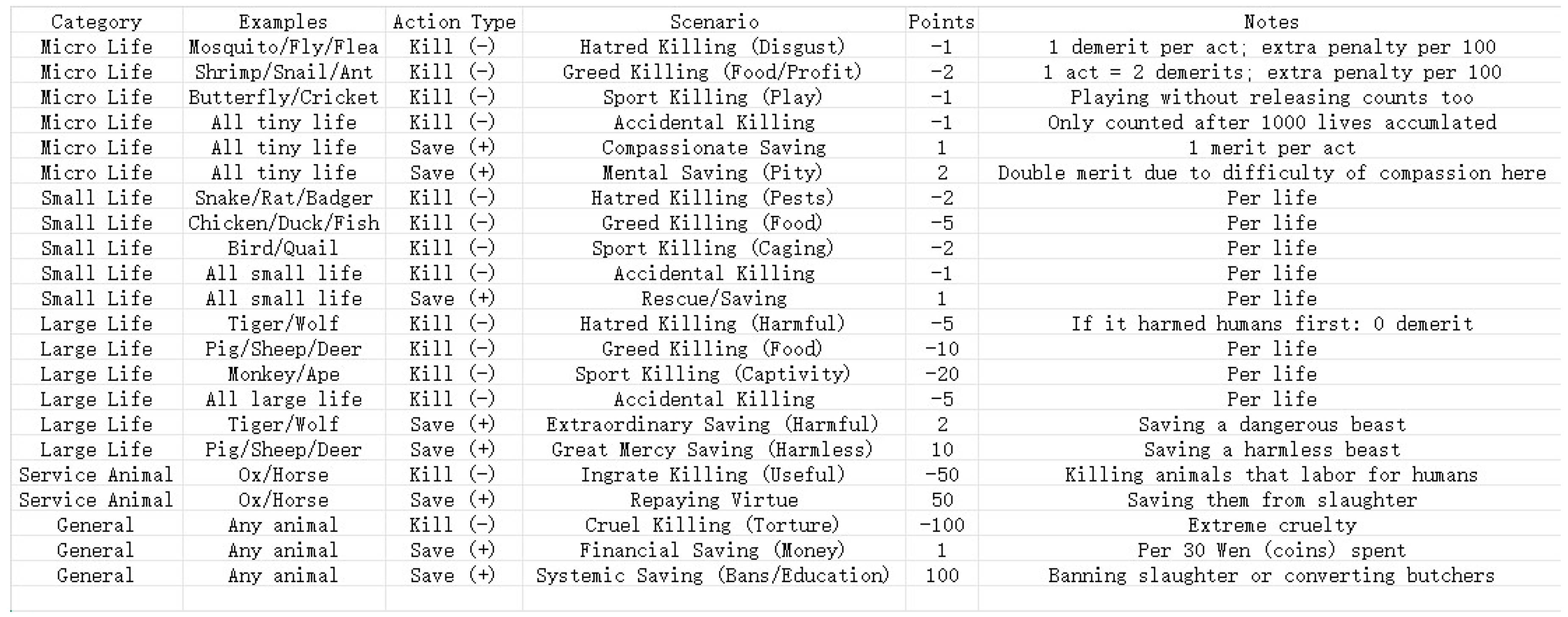
In Ming–Qing ledgers of merit and demerit, animal ethics occupies a strikingly prominent place. Entries not only specify with precision which acts count as “merit” 功 and which as “demerit” 過; they also calibrate their quantification by species or type, the agent’s motive, and the consequences of the act. The Shí Jiè ledgers of merit and demerit classifies animals into three ranked categories, such that killing or saving different grades of animals carries different moral weights. Killing insignificant life 微命—“The most foolish of all living creatures is called the ephemeral insect” 一切生物之最蠢者。 曰微命 (p. 43) (e.g., mosquitoes, flies, fleas, lice, shrimp, snails, etc.) incurs the least demerit; killing lesser life 小命 (beings “with some awareness,” such as snakes, rabbits, chickens, geese, pheasants, etc.) incurs a medium demerit; and killing higher life 大命 (beings “with greater awareness,” such as tigers and wolves, pigs and sheep, deer, cattle and horses, etc.) incurs the greatest demerit. Yet category alone is not decisive: degrees of intent and malice further stratify even within insignificant life. Killing out of aversion (e.g., mosquitoes and flies) is recorded as one demerit per instance; once the number exceeds one hundred lives, an additional one demerit is added, and one thousand lives are recorded as ten demerits. Killing out of greed for food or profit (e.g., shrimp, snails, clams) is recorded as two demerits per instance; exceeding one hundred lives adds two more demerits, and one thousand lives are recorded as twenty demerits. Unintentional killing (e.g., accidental harm caused by burning fields or irrigating crops) is treated more leniently: up to one thousand lives are recorded as one demerit. Killing for amusement (e.g., fighting crickets, slapping butterflies) is recorded as one demerit per life; even if no life is taken, merely “playing with” a creature and not releasing it is still recorded as one demerit. The ledger also extends culpability beyond direct killing. Instructing others to fish or hunt is recorded as ten demerits per instance. Manufacturing instruments for killing is recorded as fifty demerits per device, with the rationale stated explicitly: “The creation of killing implements is called universal killing. One implement accounts for fifty transgressions, as the sacred text teaches. All killing through fishing, hunting, butchering, and slaughtering throughout one’s lifetime is taught by those who create killing implements. When one person manufactures a killing implement, the killings by a thousand people all stem from it. Therefore, the hidden laws regard this with particular severity” 置造殺器曰普殺。 一器為五十過乩訓曰。 凡漁獵屠膾。終身之殺。 皆置造殺器之人所教也。 一人造殺器。 千人之殺皆因之。 故陰律獨重 (Zangwai daoshu 1992, vol. 12, p. 43).
Analogous sub-stratifications apply to lesser life and higher life, but the text also introduces special provisions. For lesser life, killing for the sacrifice of “heterodox” spirits or for extravagant banqueting is recorded as two demerits per life (with additional demerits counted separately if the act also involves promoting heresy and extravagance). For higher life, killing tigers or wolves that have already harmed humans incurs no demerit and may even count as merit; killing tigers or wolves that have not harmed humans is recorded as five demerits, while killing for profit is recorded as ten demerits. Killing domestic pigs and sheep or wild deer out of greed for food or profit is recorded as ten demerits per life, whereas killing for “ritual occasions,” military or governmental needs, or to support and nourish one’s parents is “not a demerit.” Raising wild animals in captivity (e.g., keeping deer or gibbons) is recorded as ten demerits per case. The ledger also assigns moral weight to affective and bystander positions. Rejoicing at fishing or hunting profits, or rejoicing when an enemy is killed, yields demerit as well: one demerit for insignificant life or lesser life and two demerits for higher life. Likewise, “seeing killing and not saving” is recorded as one demerit for insignificant life or lesser life and two demerits for higher life. Discarding carcasses or bones is recorded as twenty demerits, while abuse that results in death is recorded as one hundred demerits per life. Merit for saving life is calculated in a similarly differentiated manner, keyed to both animal category and the costs incurred (effort, time, and money). For insignificant life, a spontaneous release prompted by circumstance is recorded as one merit per instance, with additional merit scaled by number of lives (100 lives = 1 merit; 1000 lives = 10 merits). An intentional release involving laborious rescue is likewise recorded as one merit per instance, again with additional merit scaled by number of lives. Purchasing creatures for release is recorded as one merit for 100–1000 lives, with additional merit beyond 1000 lives; monetary expenditure is also credited at the rate of one merit per thirty pence. Digging ponds or opening enclosures, and broadly promoting release-life practices, credits the initiator with one hundred merits. For higher life, saving creatures that have harmed humans (e.g., tigers and wolves) is recorded as two merits; saving harmless creatures (e.g., pigs, sheep, deer) is recorded as ten merits; and saving creatures “that have merit for the world” (e.g., cattle and horses) is recorded as fifty merits. Devising means to prohibit the slaughter of cattle and dogs, or persuading butchers and hunters to change occupations, is recorded as one hundred merits (whereas mere verbal exhortation without effect is recorded as one merit). For any animal, if one witnesses killing and cannot rescue yet nonetheless generates a compassionate, grieving response, it is recorded as one merit per instance—except that for insignificant life it is recorded as two merits, since compassion for insignificant life is deemed harder to arouse. Not destroying nests or eggs is recorded as one merit per instance, and persuading others to refrain from such harm is likewise recorded as one merit. Persuading others to release life is credited at ten merits for each person who complies. Persuading someone not to engage in breeding-for-slaughter or killing professions is recorded as one merit per instance, rising to twenty merits if the person thereafter permanently abstains (pp. 43–47).
In the
Wénchāng Dìjūn ledgers of merit and demerit (
Figure 1), the provisions are in some respects more “specialized” than those discussed above, registering a finer-grained calibration of animal-related merits and demerits within the ledger-centered layer of MB-REM. The text specifies, for example: “caging or tethering birds/animals for a month incurs 1 demerit” 籠繫禽畜一月一過; “failing to show compassion toward exhausted work-animals incurs 2 demerits” 不憐畜力疲頓二過; “burying animals that died naturally earns 1 merit, doubled if the animal is deemed capable of repaying humans” 葬自死禽獸一功, 有力報人者加二倍; and “refusing to eat when one knows an animal was killed for oneself earns 1 merit” 見殺聞殺為己殺不食一功 (
Zangwai daoshu vol. 12, 1992, pp. 233–34). The Jǐngshì ledgers of merit and demerit 警世功過格 further urges withdrawal from hunting and butchery as occupations, articulating graded incentives and sanctions through entries such as: “Persuading people to give up hunting, fishing, and slaughtering: if they listen but do not comply, one merit; if they comply, ten merits; if they reform, one hundred merits. (If one engages in hunting oneself and is able to reform, one thousand merits” 勸化人弋獵屠釣, 囘心不從一功, 從者十功, 改者百功。 自行弋獵而能改者, 千功 (
Zangwai daoshu vol. 12, 1992, p. 74); and “Saving the life of a domesticated animal that is helpless (such as pigs or sheep) earns three merits” 救一無力於人之畜命, 豬羊之類。 三功 (p. 76). Together, these entries illustrate how animal-centered moralization is rendered both quantifiable and implementable, while also extending beyond individual conduct to occupational reform and quasi-regulatory governance within the operative repertoire of MB-REM.
Observation suggests that the scoring of merits and demerits across different ledgers may display a degree of “inflation,” yet the underlying calculus remains broadly consistent. The magnitude of merit or demerit is shaped by several recurrent factors: whether an animal is considered capable of repaying kindness; the degree of an animal’s intelligence—specifically, whether it is imagined to possess something akin to human empathy and rationality; and the closeness of the human–animal relationship, that is, whether the animal is a domesticated companion or partner. This last factor also underscores the centrality of plow-oxen to agrarian production. This hierarchical valuation of life closely resembles the Confucian “differential order pattern” (差序倫理, in Fei Xiaotong’s 費孝通 1910–2005 sense). It is anthropocentric: the extent to which different animals are socially entangled with humans, and the degree to which they are endowed with “human-like” qualities, help determine the size of merit or demerit. In turn, this structure shapes how individuals imagine interests and harms in human–animal interactions, thereby modulating practices of killing and saving life. At the same time, the complexity and cruelty of the act imposed on animals—an index of “humaneness” itself—also differentiates the moral weight assigned. Notably, the ledgers foreground animal claims through categories keyed to human moral sensibility, which constitutes one of their distinctive features. Thus, confining animals, destroying nests, and disturbing hibernation are recorded as demerits; abusing animals or mutilating corpses is treated as major demerit, whereas avoiding overworking animals, feeling grief upon witnessing animal death, vegetarian practice, burying dead animals, and refraining from harming innocents are recorded as merits. Such entries register a strikingly fine-grained concern for animals in the Ming–Qing period. Overall, the animal-related features of Ledgers of merit and demerits may be summarized as follows: (1) the numerical quantification of ethical conduct; (2) a conversion logic through which merits and demerits may be offset against one another
2; (3) strict proceduralizing and operability
3; (4) encyclopedic scope, with fine-grained classificatory detail; (5) a largely this-worldly religious orientation in which moral calculation is tightly integrated with everyday life; (6) a regime of divine surveillance that underwrites ledger practice, such that record-keeping functions not only as self-examination but also as an accountable act performed before the gods, often in the hope of securing blessings or extending lifespan; and (7) an emphasis on human agency rather than moral and destiny fixity, enabling practitioners to experience themselves as, in effect, holding their own fate in hand—an experiential dimension crucial to how MB-REM becomes actionable.
3. Causal Legitimation and Affective Mobilization: Animal Representation and Karmic Narratives in Ming–Qing Morality Books
The paper turns next to the intermediate level: the relationship between animals and karma. Following M. Hiriyanna’s definition—“the doctrine extends the principles of causation to the sphere of human conduct and teaches that, as every event in the physical world is determined by its antecedents, so everything that happens in the moral realm is preordained” (
Hiriyanna 1995, p. 46)—it is important to note that Christian “retribution” and the Indic/East Asian notion of karma are not the same. Retribution is typically construed as God’s personalized, sovereign judgment, whereas karma operates more like an impersonal law of moral causality: one’s suffering or congenital disability, for example, may be understood as the consequence of wrongdoing in a previous life. Within karmic theory, the cyclical temporality of rebirth makes death part of the causal mechanism rather than merely a punitive endpoint; both reward and punishment may unfold across successive lives. Retribution, by contrast, presupposes a linear temporality in which the individual awaits a single, definitive judgment—entry into heaven or descent into hell. It is often grounded in original sin and a more fatalistic anthropology, with Jesus Christ redeeming humanity; accordingly, repentance and faith are prioritized over the accumulation of merit. Karma, by contrast, implies the possibility of self-salvation: wrongdoing can be offset through conduct, and it is action rather than belief that reorients one’s destiny. In what follows, I focus on three dimensions that are particularly salient for the animal-related workings of MB-REM: (1) extended causality spanning hell and the present world, (2) the symbolic valences of animals, and (3) animal spirituality and the theme of repaying.
The extended causality linking hell and the present world—together with retributive cycles of rebirth—finds one of its most vivid expressions in morality book representations of animals. Wolfram Eberhard, for example, suggests that late-imperial moral discourse presupposes “a great, but limited, number of souls,” which at any given historical moment may appear “in human or in animal shape,” whether in China or elsewhere. Within this conceptual horizon, shifts in population could be read as indices of moral fluctuation: a decline in humans might coincide with an increase in animals (
Eberhard 1967, pp. 43–44). In Ming–Qing morality books, the narrative machinery of karma rests on long-standing religious-cultural assumptions about rebirth, causal consequences, and occult merit. These assumptions do not treat humans and animals as categorically opposed forms of beings; rather, they position them within a shared reincarnational system in which they can transform into one another and remain causally entangled. Consequently, human actions toward animals are imagined to “return” to the human agent in one form or another. Yet this system remains hierarchically ordered: humans are generally construed as superior within the karmic economy, and animal embodiment frequently appears as a punitive consequence of prior wrongdoing—human souls becoming animals as part of the penalty for sins accrued in previous lives. This hierarchical yet entangled structure is forcefully expressed in
Jièshā Wén 戒殺文: “All beings cherish life, and every creature clings to survival. How can one justify slaying another’s body to satisfy one’s own appetite? ……By committing such boundless evil karma, one forges deep enmity lasting ten thousand lifetimes. Once impermanence strikes, one immediately falls into hell……suffering torment among sword-trees and knife-mountains. When the punishment ends, one still returns as an animal. Grievance begets grievance in endless consequences, life for life in ceaseless repayment……dying by snake or tiger, by blade or weapon, by execution, or by virulent disease—all are consequences born of killing” 人人愛命, 物物貪生, 何得殺彼形軀, 充己口食?……造此彌天惡業, 結成萬世深仇, 一旦無常, 即墮地獄……劍樹刀山, 受罪畢時, 仍作畜類。 冤冤對報, 命命填還……或死蛇虎, 或死刀兵,或死刑囚, 或死毒病, 皆殺生所感也 (Zhuhong 1589, p. 47). Once a person falls into the animal realm, returning to human status is depicted as requiring multiple cycles of rebirth; moreover, the reborn social position is often cast as abject and low-ranked (for instance, a general who kills excessively is said to be reborn as a dog for many lives and only after a millennium becomes a prostitute). Prior to such rebirth, the sinner must also endure the torments of hell.
The Yùlì Bǎochāo describes hell in detail as a transitional station leading into animal rebirth: “All those wicked souls who were unfilial during their lifetime or who killed living beings excessively, after enduring the tortures inflicted by the hells of various courts, are delivered to the Chamber of Reincarnation Transformation. There, they are first beaten to death with peach blossom branches. After death, they transform into ‘jian’ (the ghost of a ghost), have their appearance completely altered, and are sent through narrow winding paths to be reborn as animals” 凡是在世不孝、 及殺生繁多的凶魂, 受過各殿的地獄所施加的苦刑後, 經發交轉劫所內的, 先用桃花枝抽打致死。 死後化為‘魙’(ㄐㄧㄢˋ, 鬼死為魙), 將他改頭換面, 發進羊腸小路, 投胎為畜生 (Danchi 1890, p. 78). It further portrays animal existence itself as an extended ordeal unfolding across vast temporal spans: “All beasts, birds, fish, and insects must endure tens of thousands, thousands, or hundreds of cycles of karmic suffering before their karmic consequences have run their course. Viviparous creatures such as cattle and horses; oviparous beings like dragons, turtles, snakes, and birds; those born from moisture, such as maggots; and those born by transformation, such as butterflies and bees—all must continuously undergo rebirth under the workings of karma, unable to escape these four modes of birth” 所有的禽獸、魚蟲, 要經過上萬、上千、上百次淪墮的劫難, 才能受苦期滿。 像胎生的牛馬等禽獸; 卵生的龍龜蛇鳥; 濕化生的蝴蝶、蜜蜂、蛆蟲之類, 都是要不斷地輪回受報, 在此四生中, 不得出離 (p. 78). It adds that “Only when the predestined tribulation is fulfilled, and if one can refrain from taking the life of any living creature for three consecutive lifetimes, may one be reborn as a human again” 等到劫數已滿, 若能連續三世不傷生物之命, 方可使再投生為人 (p. 78). In this way, the text links (especially) killing to postmortem punishment, animal rebirth, and the protracted suffering through which “human form” may eventually be regained. To validate this causal logic, the compilers often append illustrative narratives, including dream accounts in which wrongdoers disclose their animal rebirth and plead with family members for redemption—for example: “A year later, the silk store owner suddenly passed away…… ‘I caused the death of an entire impoverished family, and the netherworld refuses to let me be reborn as a human. I have been condemned to enter the body of a pig……the one with spots on its body is me” (p. 168). Beyond “this-worldly” recompense, morality books also depict postmortem rewards (even though, in principle, all persons pass through hell): “If one can cherish life, practice the release of living beings and abstain from killing……and exhort others to practice these virtues……one’s blessings and longevity will be increased and extended. Should one encounter calamity or violence, one will also be delivered from it. After death, regardless of merit or lack thereof, one will be spared from suffering in the various hells and will be sent directly to the First Court to be assigned rebirth in a blessed land” 若能愛惜物命, 放生戒殺…… 及勸人行此數事者…… 增延福壽。 若遭殺劫, 亦能解脫。 死後, 不論有無功德, 免入各獄受苦, 概送第一殿, 配生福地 (p. 55). In this idiom, rescuing animals can offset other transgressions, enabling the virtuous to evade infernal suffering and secure a favorable rebirth; blessings, moreover, are depicted as durable and expansive, extending beyond the individual to the family line across both life and death.
The symbolic valences of animals form an integral component of the karmic system. Animals may become deities, and they may also appear as embodiments or epiphanies of divine agency. In Terry F. Kleeman’s edited and translated
Zitong dijun huashu 梓潼帝君化書, Zitong dijun is described as having been, in an early phase, a viper: “But long before he received any of these exalted titles, he was the viper. From his solitary cave atop Sevenfold Mountain, this giant poisonous serpent summoned thunder and storm to do his bidding” (
Kleeman 1994, p. xi). His eventual deification is attributed not to brute force or thaumaturgic prowess—traits often valorized in other gods and spirits—but to a repertoire of virtues. Across his manifestations as god, human, and dragon, he repeatedly foregrounds virtue as well as loyalty and filial piety, insisting, for instance, that “those who rely solely on virtue flourish, while those who rely solely on might perish. ……Now these five brothers……were from the start lacking in virtue and take physical strength as their occupation” (p. 197). Whereas many divinities sustain their status through blood offerings (sacrifice) or displays of violence, he is portrayed—even in human incarnations—as obsessively devoted to the Confucian classics. This becomes the decisive ground for his appointment by the celestial sovereign as “Wenchang, the Divine Lord of Zitong,” the deity presiding over literary achievement: “Because of my unstinting devotion to the classics through many incarnations as a scholar, the Thearch commanded me to take charge of the Cinnamon Record” (p. 291). In this sense, Wenchang’s trajectory from animal to deity functions as a moral metaphor for humans: as an embodiment of the natural world, he is depicted as overcoming his own animality, cultivating the comportment of the Confucian gentleman, and restraining power so that anger does not license arbitrary action. More broadly, many morality book narratives figure animals as embodiments of divine agency.
In the Zàojūn Bǎojuàn 灶君寶卷, for example, “The ‘Kitchen God’ 灶君 and all the saints show mercy and compassion, manifesting in myriad wondrous and strange forms. Peculiar events occur in broad daylight under clear skies, while roosters crowing at midnight startle people awake. Swarms of rats screech upon the roof beams, and yellow dogs scratch at pond banks before the main gate. The Kitchen God’s household reports that these are omens; I urge you to turn back and cultivate a virtuous heart” 竈君諸聖發慈悲, 變化多端奇怪形。 青天白日生奇怪, 半夜雞鳴驚醒人。 老鼠成群樑上叫, 黃狗扒潭當大門。 竈君家通報是應, 勸你回頭發善心 (Yuan 1995, p. 300). Here the Kitchen God, in order to warn the world, manifests through uncanny animal forms (such as swarming rats or a yellow dog) to frighten and admonish wrongdoers into repentance. In the story of “Yáng Bǎo Huángquè” 楊寶黃雀, “Yang Bao saw a golden oriole that had been injured and fallen to the ground……He took it home and kept it in a cloth box, feeding it with yellow flower stamens……Suddenly one morning it transformed into a young man dressed in yellow robes, who bowed before Bao and presented him with a pair of jade rings, saying: ‘I grant you a lifespan of ninety-three years, and for four generations your descendants shall hold the position of Three Excellencies’” 楊寶見一黃雀, 被傷墜地……因收於巾箱中, 採黃花蕊飼之……忽一朝變為黃衣少年, 見寶下拜, 持玉環一雙贈之, 曰:‘俾爾壽年九十三而終, 子孫四世為三公’ (Zhang 1597, p. 4). Yang Bao’s rescue of the injured sparrow thus becomes a paradigmatic instance of repaying a benefaction, insofar as the bird is revealed as a divine envoy or embodiment who later assumes human form to repay the kindness and to prophesy high office for Yang’s descendants. Finally, morality books also mobilize animal imagery as moral shorthand. The Zàojūn Bǎojuàn states, for example, “Maliciously instigating lawsuits and stirring up trouble, with a Buddha’s mouth but a serpent’s heart” 刁唆詞訟是非, 佛口蛇心 (Yuan 1995, p. 298).
Tan Qiao’s 譚峭 (860–968) Huàshū 化书 similarly frames human predation and moral shame through animal analogies: “If the sandalwood’s fragrance and desires do not cease, and the impulse to kill and harm continues unabated, then even though feathered and furred creatures cannot speak, they will surely regard me as a greedy wolf or a wild boar; and even though scaled and shelled beings lack understanding, they will surely name me as a great whale or a giant weasel. How can I find peace in this? Should I not feel ashamed?” 夫檀臭欲不止, 殺害之機不已。 羽毛雖無言, 必狀我為貪狼之與封豕; 鱗介雖無知, 必名我為長鯨之與巨鼬也。 胡為自安焉? 得不恥呼? (Tan 1996, p. 42). At the same time, the Huàshū also attributes moral exemplarity to animals: “The crow feeds its parents, which exemplifies benevolence. The falcon shows mercy to the unborn, which exemplifies righteousness. The bee has its ruler, which exemplifies propriety. The lamb kneels to nurse, which exemplifies wisdom. The pheasant does not mate twice, which exemplifies faithfulness” 烏反哺, 仁也。 隼憫胎, 義也。 蜂有君, 禮也。 羊跪乳, 智也。 雉不再接, 信也 (pp. 41–42). In this way, animal conduct becomes a repertoire through which human moral vocabulary is articulated. Finally, the Wénchāng Dìjūn Yīnzhì Wén offers the simile “Helping those in urgent need is like saving fish stranded in a dried-up rut; rescuing those in peril is like freeing a sparrow caught in a tight net” 濟急如濟涸轍之魚, 救危如救密羅之雀 (Zangwai daoshu vol. 12, 1992, p. 431), mapping human predicaments onto animal situations to awaken conscience and mobilize compassionate action—an affective and symbolic dynamic central to the narrative layer of MB-REM.
Animal spirituality and the motif of repaying function in many morality book narratives as a this-worldly karmic return—a concrete, proximate manifestation of karma that folds human conduct back upon the human agent through nonhuman mediators. As Roel Sterckx observes, “The notion that sages were able to exert a moral authority over the animal world also underpinned references to the spontaneous guardianship by wild animals of future cultural heroes and sage-rulers” (
Sterckx 2002, p. 151). Early Chinese moral imaginaries thus often presupposed a continuity between human and animal moral capacities; morality books inherit this premise while further embedding it within a retributive causal economy. The
Shuǐjìng Lù 水鏡錄 preserves numerous accounts of animal “spirituality,” portraying animals as agents endowed with discernment, affect, and responsiveness. Animals know how to evade death and seek life: “When caught they flee, even lice know to evade death; before the rain they move, even ants still cling to life” 逢擒則奔, 蟣虱猶知避死; 將雨而徙, 螻蟻尚且貪生. They display kin-feeling and fear: “The doe pitying her fawn licks its wounds until her tender heart breaks; the ape fearing death sheds sorrowful tears at the mere sight of a bow’s shadow” 憐兒之鹿, 舐瘡痕而寸斷柔腸; 畏死之猿, 望弓影而雙垂悲淚. Their attachment to offspring is portrayed as no different from that of humans: “Birds and beasts also love their young. To celebrate the birth of my child by causing the death of another’s offspring—how can one’s conscience be at peace with this?” 禽畜亦各愛其子, 慶我子生, 令他子死, 於心安乎? Cattle, moreover, are depicted as trembling and weeping at death: “How can one say they have no understanding? Facing death, they tremble with fear. Unable to speak, tears flow as if weeping. ……How do you know that in past lives, they were not your own kin?” 豈謂無知, 臨死觳觫。 口不能言, 流淚若哭。……焉知夙生, 非爾眷屬. Animals also appear in dreams to seek rescue: “With broken body yet life preserved, I beheld the white wall while hearing the sutras; seeking survival in dire straits, the yellow-robed monk appeared in my dreams” 乃至殘軀得命, 垂白壁以聞經; 難地求生, 現黃衣而入夢. Finally, the text suggests that human bodies at death may manifest animal signs: “The butcher of sheep, at the point of death, bleats like a lamb from his mouth; the seller of eels, nearing his end, has his head gnawed as if by eels” 屠羊者, 垂死而口作羊鳴; 賣鱔者, 將亡而頭如鱔嚙 (
Daozang vol. 36, 1988, pp. 315–17).
Such motifs suggest not only a responsive resonance between humans and animals, but also a shared life essence through which animals can serve as vehicles for the enactment of the “Way of Heaven” and karmic causality. When animals repay, they are not mere narrative ornaments; they function as the executive medium of consequences, making MB-REM’s causal logic experientially immediate. This is explicitly moralized in exhortative texts such as Jièshā Wén: “In households that abstain from killing, blessings and merit manifest in countless ways, too numerous to fully enumerate. If one can further practice life release according to one’s means, purchasing and rescuing creatures whenever encountered, regardless of how small or insignificant the life form may be, as long as one can save them from death and preserve their lives……such merit and virtue are truly immeasurable. In the present life, one swiftly obtains the benefits of wealth, prosperity, and longevity, and at life’s end, one receives the reward of rebirth in the Pure Land” 戒殺之家, 福報種種, 難可具陳。 若更能隨力放生, 遇物買救, 不論微形細命, 但能脫死全生……此種功德, 更是難量, 現前速獲富貴壽考之休, 臨終並得淨土往生之報 (Zhuhong 1589, p. 47); and Rénshòu Bìjiàn 仁壽必鑑: “In the course of walking, standing, sitting, and lying down, ordinary people witness all living beings casting themselves into mortal peril—like moths drawn to flame, like insects falling into webs, like birds caught and wounded, like ants being trampled underfoot. Through skillful means, one should rescue and protect them, enabling them to preserve their lives intact. This is precisely what those blessed with fortune and longevity ought to do” 凡人於行住坐臥之間, 見一切眾生投身死地, 如蛾赴燭,如蟲墮網, 如鳥雀被傷, 如螻蟻被踏之類, 方便救護, 使獲生全, 此皆福壽長者之所當為也 (Guo, pp. 17–18).
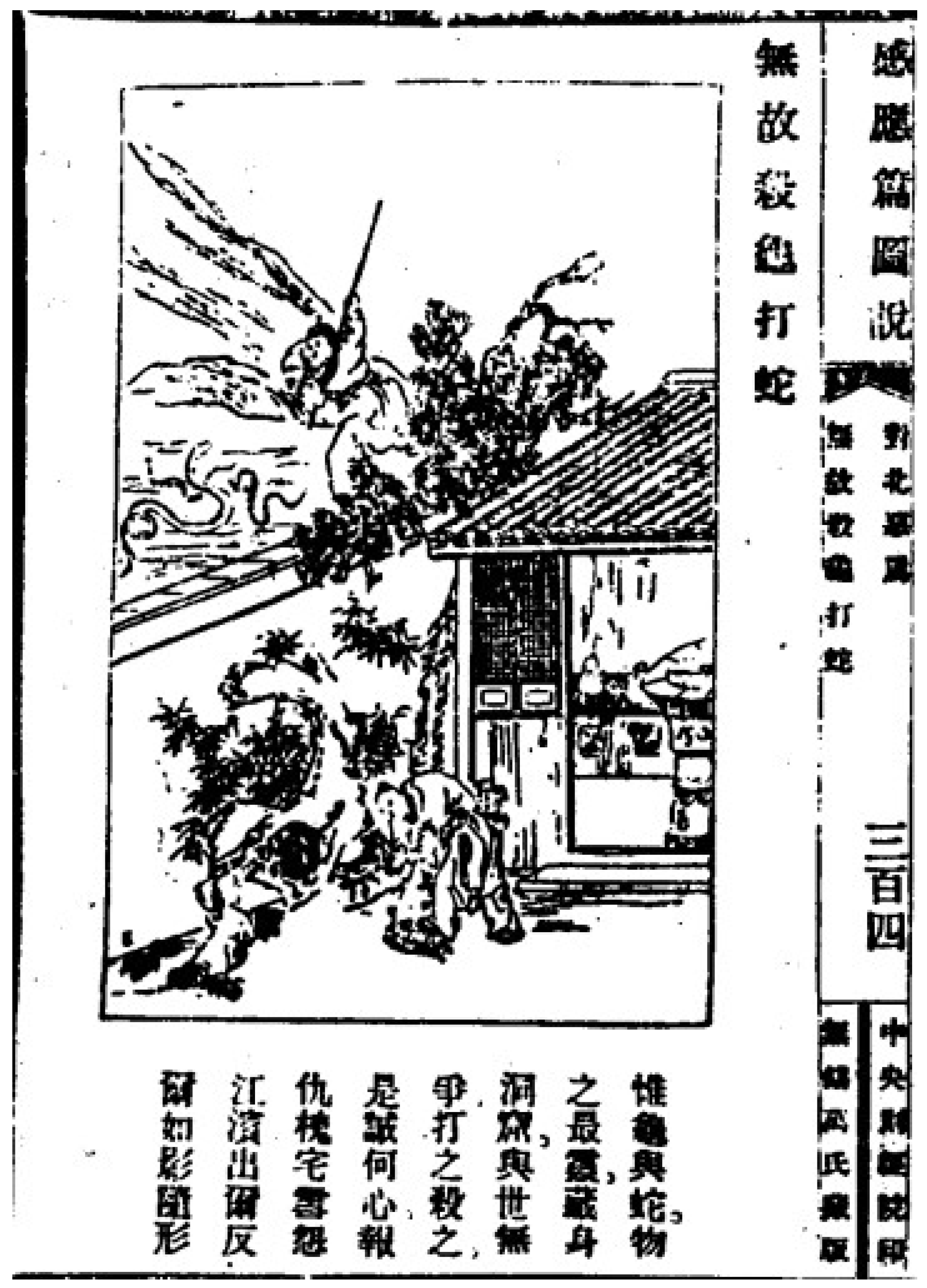
Within this affective-causal regime, spirituality is construed as a cross-species capacity for empathy and responsiveness that can convert animals from passive recipients of human action into active moral arbiters. In the lifeworld configured by Jièshā Wén and Rénshòu Bìjiàn, human mercy toward “the humble and the fragile” is not merely a one-way act of charity; it is better understood as the deposit of “moral capital” into a vast cosmic credit system, whose returns may be deferred to the afterlife or realized as near-term recompense in the present world. The Illustrated Explanation of Tract of Taishang on Action and Response (
Figure 2) offers a vivid illustration through the story “Killing turtles and beating snakes without cause.” Zhu Youbin, convinced that eating turtle is highly restorative, purchases a rare “Nine-Tailed Turtle” 九尾龜—presented as a manifestly numinous being—and, despite an admonition—“Easy to tie up a turtle, hard to let it go” 縛龜容易放龜難, a warning that hints at the binding force of causal entanglement—insists on killing and cooking it. Later, while washing his face on a boat below Jinshan, he is dragged under by a large hand rising from the water (the giant turtle) and drowns, leaving no remains. Cheng Jingzhong, by contrast, beats a group of snakes drinking water for no reason and purely for amusement, killing several small snakes while the large snake escapes. He later encounters a beautiful woman (the large snake’s transformation), pays money on her behalf, and is lured by lust into drinking at her home. Upon returning, he finds that “Flesh and bone all wasted away, only the hair remains” 骨肉盡消, 只存頭髮: his body dissolves into blood and water, while servants report only a “fishy snake smell” 蛇腥氣 and discover that the “mansion” was in fact an earthen burrow marked by “The Trace of the Coiled Serpent” 蛇盤之跡. Counterposed to these cautionary tales, the same text appends well-known historical legends that emphasize the blessings generated by lifesaving. The Yuzhou prefect Mao Bao purchases and releases a white turtle, later surviving defeat and a river crossing when he feels a “stone” supporting his feet—only to discover that it is the turtle he once freed. The “Medicine King” Sun Simiao (541–682) 孫思邈 rescues an injured small snake (a dragon’s child), is invited to the Dragon Palace, refuses treasure, and receives instead “Prescription Thirty” 藥方三十, later incorporated into the
Prescriptions Worth a Thousand in Gold 千金方 (Li 2004, pp. 1171–72). Taken together, these narratives teach that karma can take the form of immediate, intramundane return. Humans should sustain reverence toward life in the natural world and must not harm it arbitrarily; cruelty and greed invite disaster, whereas compassion and benevolence may yield unforeseen blessings and forms of wisdom—precisely the affective and mobilizational work performed by the narrative layer of MB-REM.
In sum, the karmic consequences of taking life range from descent into hell and rebirth in the animal realm to a shortened lifespan, the loss of office and fortune, grievous illness, and even imprisonment in chains; conversely, the karmic recompense for protecting life includes mental clarity and liberation, immeasurable blessing, longevity, and domestic well-being. “Not that there will be no recompense—only that the time has not yet arrived.” Within the morality book system, animals are by no means inert or passive objects. They are depicted as spiritually efficacious beings capable of resonant responsiveness with humans, and even as embodiments of nature and the divine that administer punishment and bestow blessing. Human wrongdoing may at any moment precipitate a “fall” into animal form; likewise, through the accumulation of goodness and sustained cultivation, animals may return to human embodiment and even attain deification. This cyclical karmic economy expands the human–animal relationship into a broader human-nature relationship and, ultimately, a relationship between the human and the cosmos, thereby grounding an egalitarian ecological vision of the animation of all things. More specifically, animal-centered karmic discourse in morality books exhibits several characteristic features: (1) regularity—consequences for good and evil is framed as an objective cosmic law from which there is no escape; (2) non-immediacy—recompense is not necessarily instantaneous but is often temporally deferred; (3) transgenerational extension—fortune and calamity do not affect only the individual but may extend to descendants; (4) the prominence of “hidden virtue”
4 陰德 and its heavenly recompense, understood as outweighing the benefits of publicly recognized “visible goodness” 陽善 and worldly reputation; (5) the claim that unseen karmic sanction 陰律 is more stringent and inescapable than empirical, state-administered law 陽律; (6) the fine-grained differentiation—and in many cases the quantification—of recompense; and (7) despite the rigor of karmic causality, a consistent emphasis on moral agency: through repentance and proactive practice—correcting faults and doing good—one may avert misfortune and even redirect what appears to be a fixed destiny.
4. The Operating Logic of Religious Ecology in Ming–Qing Morality Books: Mechanistic Coupling and Social Diffusion of Ledgers of Merit and Demerit and Karma
Finally, I delve into the deepest level: an eco-religious vision of the Anthropocosmic that emerges from the coupling of Ledgers of merit and demerits and karma narratives, and that is marked by both normativity and efficacy. In concrete moral practice, practitioners did not use Ledgers of merit and demerits in isolation. Instead, they routinely deployed them alongside other morality book texts and, in some cases, even formed social organizations to monitor and discipline their own ecological conduct (for example, the Yunqi Society required members to keep Ledgers of merit and demerits and to report to the organization at regular intervals;
Smith 2009, p. 119). On the basis of close textual analysis, this article examines the operation of MB-REM along four interrelated dimensions: (1) killing, protecting life, and sacredness; (2) auspicious and adverse recompense and mechanisms of social supervision; (3) the synergy between officially promoted morality texts and vernacular storytelling; and (4) reciprocal ecological-ethical relations.
Killing, protecting life, and sacredness. Killing and protecting life are, in one sense, matters of individual moral conduct; yet once rendered calculable within Ledgers of merit and demerits, they are elevated into acts that implicate a sacred cosmic order—above all, the infernal-juridical order that underwrites karmic adjudication. Protecting life is thus framed not merely as an expression of sympathy, but as cherishing life in accordance with the generative work of “Heaven and Earth” 參贊化育, whereas killing becomes an act against Heaven, opposed to the natural order. In this way, life-protecting practices acquire sacred significance as acts that sustain cosmic order. By positing a rigorous karmic mechanism and placing ledger practice under divine surveillance and judgment, morality books make supernatural intervention constitutive of moral consequence, thereby sacralizing the outcomes of these actions. In the late Qing in particular, and especially under conditions of warfare and disaster (e.g., the Taiping upheavals and drought), protecting life could even be invested with a soteriological mission of “rescuing from calamity” (
Goossaert 2019, p. 188). Moreover, morality books often attribute moral qualities such as “righteousness” 義 and “filial piety” 孝 to animals and at times treat them as bearers of a sacred order; to kill them, on this account, is not merely harm but profanation. Individual cruelty and benevolence are thereby translated into disclosures of the Way of Heaven, as if one were constantly observed by the gods and obligated to discipline every word and deed. Where self-discipline fails, heteronomous constraint—backed by divine surveillance and retributive sanction—intervenes to prevent the actor from relinquishing a conscience toward animals.
Auspicious and adverse recompense and mechanisms of social supervision. Yan Maoyou 顏茂猷 (1578–1637), in the Díjí Lù 迪吉錄, offers an extended moral exhortation that explicitly relocates humans within a shared cosmological field of life: “People all say that Heaven and Earth create and nourish living beings to sustain humanity, yet they fail to realize that humans are but one among myriad creatures between Heaven and Earth. Only by cultivating truth, cherishing life, and participating in the cosmic order of nurturing all things can humans claim superiority over other creatures. Otherwise, what difference is there between us and mindless beasts? Those consumed by greed, anger, and bloodlust, who use others as instruments of mutual destruction—once they enter the netherworld, their transformations become unpredictable. Just as owls seize birds and tigers devour humans, would we then say that Heaven and Earth created them for their sustenance? ……Put yourself in the position of these creatures and contemplate this” 人盡謂造物生畜養人, 不知人亦天地間一物耳。 能修真好生, 參贊位育,方靈於物。 不然, 與蠢動何異? 貪嗔嗜殺, 假手相啖, 一入冥途, 則轉換不可知矣。 如梟攫鳥, 如虎吃人, 亦將謂天地生以養之乎? ……設身入物性中, 一思之 (Yan 1628–1644, p. 11). As moral discourse, this is not in itself exceptional; comparable admonitions appear across many religious traditions. What is distinctive, however, is how such exhortation is operationalized through ledger practice. Yan translates the imperative into a program of action through the Díjí Lù Gé 迪吉錄格, which lists “Benevolent Medicine Saves the Insect” 仁術救蟲 as a meritorious deed and frames even minor acts of protection as morally expansive: “Even insects and ants receive care and support; teaching one’s descendants to benefit the world—this is what is meant by saving countless lives without leaving one’s door.” 蟲蟻隨在扶持, 教成子孫濟世, 是謂不出門, 救萬命 (p. 75). Crucially, Yan also institutionalizes this moral program through the creation of a social organization (the Yunqi Society). Membership is governed by quantified ethical obligations and collective scrutiny: “For those who join the society, the standard is uniformly set at one hundred thousand merits according to the ‘Merit and Demerit Register.’ Each member shall keep a ‘Record of Merits and Demerits,’ recording entries according to their conscience. On meeting days, these records shall be presented for mutual exhortation and examination.” Such systematic deployment of morality book materials was by no means rare. Here, the Ledgers of merit and demerit become an obligation each member is expected to fulfill; the quantified logic of merit and demerit objectifies moral action and renders it administrable through a concrete organization, while a putatively absolute third party—Heaven—is positioned as the ultimate judge. This triangulation of self-reporting, communal oversight, and transcendent adjudication illustrates how MB-REM operates not only as an individual technique of ethical self-fashioning but also as a mechanism of social supervision and moral governance.
Synergy between officially promoted morality texts and vernacular storytelling. As an orthodox Confucian scholar, Liu Zongzhou opposed instrumental, profit-seeking invocations of causal consequences in the main text of his Rénpǔ; yet, tellingly, he nonetheless mobilized the narrative repertoire of “responsive” tale collections to activate moral memory. As one study notes, “Even serious Confucian scholars like Liu Zongzhou, when writing Renpu in response to Ledger of Merit and Demerit, boldly adopted the narrative techniques of karmic consequences story collections in his Renpu to evoke people’s memories of good deeds and their rewards among historical Confucian figures” (
Wu 2016, pp. 5–6). In other words, even while resisting ledger-style moral accounting, Liu drew on popular narrative techniques to make moral causality vivid and socially persuasive—an instance of how the narrative layer of MB-REM could be selectively appropriated within elite Confucian projects. Victor H. Mair further observes that the Qing court extended Ming precedents by issuing an imperial edict in 1659 that institutionalized the “Village Compact” 鄉約 and mandated public proclamation of the “Six-Character Sacred Edict” 聖諭六言 on the first and fifteenth days of each lunar month, using language intended to be readily comprehensible. Because court-issued moral injunctions—especially Yongzheng’s “Amplified Instructions on the Sacred Edict” 聖諭廣訓—were composed in classical Chinese and thus difficult for ordinary listeners, literati-officials compiled a large body of vernacular explanatory texts (e.g., “Direct Explanation of the Amplified Instructions on the Sacred Edict” 聖諭廣訓直解). The proclamation itself was often accompanied by solemn rituals, thereby establishing authority, or, in local practice, evolved into entertainment forms resembling professional storytelling, thereby attracting audiences. As Mair puts it, “This was accomplished by making the written Sacred Edict or one of its amplifications available to virtually everyone who could read and, further, by strongly encouraging this literate segment of society to verbalize its teachings for the nonliterate or semiliterate” (
Mair 1985, p. 357). Late-Ming and early-Qing charitable organizations (e.g., Tóngshànhuì 同善會) likewise recognized the limits of print for nonliterate communities. They thus transformed morality book contents into oral, colloquial “vernacular lectures” 俗講 or simple rhymed verses, often combined with ritualized recitation, so that moral instruction could circulate with the mnemonic force and narrative accessibility of folktales (
Leung 2001, pp. 51–52).
The obligation of the strong to assist the weak was readily transferred into discourses of poor relief. In this process, animals emerged as a prominent metaphor for vulnerable human populations. As Joanna Handlin Smith notes, “For proponents and detractors alike, the practice of liberating animals had become a common point of reference and provided much of the vocabulary that they would use when discussing aid for the poor and needy: compassion for fellow living beings; the importance of life; and the responsibility of large, powerful creatures for the small, needy, and feeble” (
Smith 2009, p. 15). This portability of ethical language is also evident at the level of institutional practice. In 1636, Qi Biaojia 祁彪佳 (1603–1645) and his companions reportedly discussed an epidemic at a gathering of a Society for Liberating Animals and, on that occasion, decided to establish a medical dispensary 施藥局 to provide treatment for the poor. The membership base of the animal-release society thus became the organizational backbone of the dispensary. As Smith further observes, “The analogy was further implied by the actions of the same benefactors, who, like Qi Biaojia, easily alternated between saving animals and aiding the poor……Thus it was out of one meeting of the Society for Liberating Animals 放生社, in 1636, that Qi and his comrades touched upon the subject of an epidemic then raging through their community and decided to establish a dispensary for the distribution of free medicines” (p. 38). The ease with which these actors moved between liberating animals and assisting the poor suggests that, within MB-REM’s broader moral economy, life-protection functioned as a transferable ethic linking human–animal relations to social welfare practice. Indeed, such initiatives—beginning with institutions like medical dispensaries—helped catalyze the proliferation of benevolent associations and Charitable Halls across China, with growing numbers of charitable organizations becoming integrated into local regimes of governance (see Susumu Fuma’s scholarship).
Finally, returning to the article’s central question—how we might move from the relationship between morality books and animals to an account of an integrated MB-REM—it is crucial to note that, in conventional secular imaginaries, humans and animals are typically positioned within a subject–object hierarchy (humans as masters, animals as resources). By contrast, the morality book system advances claim such as “Even maggots in a cesspit are human beings,” which radically shortens the perceived distance between humans and animals. It prompts readers to recognize that animals are not merely “things” to be driven, consumed, or instrumentalized, but living beings endowed—like oneself—with affective capacity and spiritual efficacy. Moreover, the coupling of Ledgers of merit and demerits and karmic adjudication destabilizes the boundary between “self” and “nature.” If the animal before one’s eyes may be a relative or friend from a previous life, and if one’s present conduct may return as misfortune or blessing, then harming or rescuing nature becomes, in effect, harming or rescuing oneself and one’s kin across both past and future. Many morality book narratives thus stage a bidirectional interaction: human rescues animal → animal rescues human; human kills animal → animal exacts repayment in life or debt. What is disclosed here is a finely calibrated “moral ecosystem” in which no act is isolated or left “off the ledger.” Human interventions in the natural world (inputs) are expected to return—transformed—to the human actor (outputs). This feedback structure is presented as a sacred ecological order. Animals, as carriers of that order (and of worldly fate), press humans to formulate concrete rules of ecological protection and—through the moral consequences attached to environmental conduct, and through institutions such as the Charitable Hall—to acquire a sense of responsibility toward animals and other forms of life, together with corresponding patterns of action. In short, through the integrated operation of merit–demerit calculation and karmic adjudication, animals no longer exist as external objects beyond the bounds of human society. Instead, they become crucial nodes that link the present world with hell (as vehicles of rebirth), connect humans with the Way of Heaven (as media of resonance), and serve as indices for assessing individual fortune and loss (as markers of “peace” or disorder)—a logic that ultimately extends from animals to nature as such, yielding an Anthropocosmic horizon.
Within this framework, the natural world is not a silent backdrop but a spiritually charged network saturated with moral tension and continually responsive to human conduct. In certain extreme moments, the subject–object hierarchy is even inverted: animals, by virtue of their numinous efficacy, may come to stand above humans, thereby reordering the human place within the cosmos. The implication is that humans are not sovereign masters of the universe but only one component within a broader cosmological nexus and thus must inhabit the world with a posture of weak anthropocentrism—extending reverence and care even to what appears most trivial, such as discarded written paper. As the Wénchāng Dìjūn Yīnzhì Wén puts it: “Purchase animals to set them free, observe vegetarian fasts and abstain from killing. Watch carefully for insects and ants when walking, prohibit fire to avoid burning forests and mountains. Light lanterns at night to illuminate travelers’ paths, build ferries to help people cross rivers. Do not climb mountains to trap birds, do not approach waters to poison fish and shrimp. Do not slaughter cattle used for plowing, do not discard written paper” 或買物而放生, 或持齋而戒殺。 舉步常看蟲蟻, 禁火莫燒山林。 點夜燈以照人行, 造河船以濟人渡。 勿登山而網禽鳥, 勿臨水而毒魚蝦。 勿宰耕牛, 勿棄字紙 (Zangwai daoshu vol. 12, 1992, p. 431). In this cooperative ecological order, one relinquishes claims to human superiority and seeks favorable karmic outcomes through mutual aid—beginning with the smallest, most quotidian acts.
Finally, it is worth noting that reverence for written paper 敬惜字紙 may appear, at first glance, to bear no direct relation to ecology. Yet the respect and awe for life that it encodes brings into relief a distinctive feature of morality book religio-ecological thought. In the
Wénchāng Xīzì ledgers of merit and demerit Lǜ文昌惜字功過律, we read: “The ancient sages created written characters. They drew hexagram patterns and turtle shell forms, and distinguished bird tracks—these became written script” 古聖人制成文字。 卦畫龜形, 而分鳥跡, 是文字也 (
Wenchang xizi gongguo lü, p. 3). Here writing is not treated as a purely human invention ex nihilo. Rather, it is framed as something the sages “discovered” or “modeled” by observing animals (bird and beast tracks, turtle patterns) and the forms of nature. To cherish and protect written paper, then, is ultimately to revere the generative artistry of the natural world itself. The same text further stipulates that soiled written paper should not be burned directly but must instead be “I washed it and dried it in the sun” 曝而曬之. This requirement tacitly suggests that environmental damage (the defilement of written paper) can be repaired, but only at a cost—specifically, the labor of washing and drying—after which the object may re-enter natural circulation (through burning and returning to earth and water). The moral-ecological stakes are stated with striking severity: “Any household that defiles or damages written characters will inevitably suffer the calamity of plague with no possibility of salvation” 凡家有糟蹋字跡者, 必罹疫劫毫無挽救 (p. 2). In this idiom, minute moral practices within human society (such as whether one treats written paper with reverence) are imagined disrupting or stabilizing the qì
5氣 system of the natural world. This reflects an Anthropocosmic sensibility in which nature and humanity form a responsive system of resonance: human “superiority” is not given but is achieved through virtue, and once one does evil and damages the circulation of qì in nature, one can no longer maintain one’s footing within the world one inhabits. Accordingly, in the morality book worldview, we live within a fluid cosmos constituted by qì, where all beings are tightly interconnected through resonance. There are no purely passive objects, only a communion of spiritually efficacious subjects in a world in which all things have spirit. Confronted by the gaze of animals (and nonhuman others), humans are called to exercise agency by cultivating a form of weak anthropocentric responsibility. By restraining the deployment of human power—accumulating merit rather than demerit as far as possible—one may, even while caring for animals and pursuing personal well-being, move toward an ultimate harmony that encompasses humanity and the cosmos. Having established that morality books do indeed configure an integrated MB-REM, the remainder of this article will examine its concrete modes of operation, historical conditions of emergence, strengths, and limitations through contextualized analysis—an approach distinct from the contemporary theoretical dialogue undertaken in the following section.
Before proceeding to a fine-grained analysis, one must confront a methodological doubt about attributing “systematic” religio-ecological value to morality books across the historical–contemporary divide. When present-day scholars examine a historically situated phenomenon, it is difficult to avoid the risk of speaking for historical actors—asserting that a “mechanism” or “system” exists where the claim may amount to a self-referential, purely logical construction imposed from without. Moreover, Wang Rongzu 汪榮祖 argues that explosive population growth in the Ming–Qing period generated environmental pressures: by the early Qing, China’s forest cover had reportedly fallen from an ancient level of 49% to 26% (
Wang 2010, p. 98). The expansion of zones of human activity also produced a survival crisis for large wild animals; species such as the giant panda and the tiger faced extinction-level threats. If morality books were truly effective, why did ecological conditions worsen? As Mary Evelyn Tucker and John A. Grim caution, “Furthermore, it is clear that theories and practices vary greatly when they are studied in historical context.” “The disjuncture between ideals and reality will temper our expectations; at the same time, it will prod us toward more functional solutions” (
Tucker and Grim 1994, p. 12). We cannot infer from the presence of ecological “wisdom” that historical societies did not damage their environments; the gap between ideals and realities should both moderate our expectations and push us toward solutions with greater functional traction. For this reason, the present study must, as far as possible, restore the original contexts in which morality book discourses—and, by extension, MB-REM as an analytic reconstruction—were articulated and mobilized. At the same time, as J. Baird Callicott argues, environmental ethics is nested within a worldview (
Callicott 1997, p. 5). For ordinary people in the Ming–Qing era, vernacular morality books and didactic causality tales constituted a major portion of accessible knowledge. Official proclamations of the Sacred Edict, together with the lectures and practices of local benevolent associations and charitable halls, likewise permeated popular life—distinct from the elite evidential scholarship that dominated certain Qing intellectual circles. In this sense, morality book animal ethics plausibly did shape non-elite moral imaginations, even reaching a level of broad social familiarity. Relatedly, scholars such as
Xiao et al. (
2015) note that both the Ming and the Qing experienced climatic anomalies associated with the Little Ice Age, yet the Qing mitigated crises through large-scale resettlement and disaster-relief systems—developments that correlate, at least historically, with the flourishing of morality books and charitable institutions in the same period. The crucial task, then, is not to deny the disjuncture between ideals and realities, but to work through it: to extract from within that very gap, resources for addressing contemporary environmental–ethical problems and for articulating an ecocentric environmental ethic that can be publicly defended and institutionally operationalized today.
Ming–Qing morality books articulate a relatively complete religio-ecological mechanism—what this study terms MB-REM—across four dimensions: ontology (a view of life), ethics (a value system), praxis (action guidance), and ultimate concern (Karma and “world-saving” amid catastrophe). Ontologically, this framework dec enters anthropocentrism by affirming the spiritual equality and mutability of sentient beings. Within the six paths of rebirth depicted in morality book cosmology, the boundary between humans and animals is fluid rather than fixed: an evildoer may become an animal in a future life, while a righteous dog that accumulates goodness may be reborn as human. This doctrine of “mutual transformation between humans and beasts” undermines any claim to absolute human sovereignty. Texts such as the Shèngshī Lù 聖師錄 preserve stories of “righteous tigers” 義虎, “righteous oxen” 義牛, and “filial dogs” 孝犬 (Xu 2014, pp. 360–64), attributing to animals recognizably human moral affects (loyalty, righteousness, filiality). To recognize animals as possessing “moral subjectivity” and “spiritual efficacy” is to insist that nature is not merely a stock of resources, but a moral community composed of beings capable of perception and feeling. Ethically, the quantified value regime of “ecological merit and demerit” incorporates environmental conduct into a system of moral bookkeeping, thereby giving life-protection a sacralized form of soft coercion. One might call this a specifically Chinese “karmic calculus of ecological consequences”: it converts diffuse slogans about environmental protection into determinate moral scores, makes the protection of animals a daily practice to be regularly audited, and thereby installs an exceptionally stringent regime of ecological self-discipline.
At the level of ultimate concern, a theology of “killing-calamity” and ecological disaster interprets natural catastrophes as moral consequences of ecological destruction, functioning as a mechanism of crisis warning and moral diagnosis. Late-Qing morality books in particular intensify proclamations that catastrophe is imminent and identify excessive “killing karma” as a root cause of warfare, epidemics, and floods or droughts. This amounts to an “ecological theodicy,” or a form of ecological theological justice: environmental disaster is no longer framed as a contingent natural event, but as a cosmic backlash provoked by human violence against life (killing). To “avoid catastrophe,” the only viable path is to cease killing and to practice life release. Relatedly, taboo regimes—such as prohibitions against burning mountains and forests or poisoning fish and shrimp—are not merely measures of resource management but expressions of reverence for nature’s sacredness. Functionally, fear-based retributive taboos could operate in ways analogous to protected areas or seasonal fishing bans. Finally, in the domain of praxis, morality books foster an organized ecology of relief that moves from individual self-cultivation toward a socialized movement of ecological protection. Through images (e.g., Hùshēng Tú 護生圖), songs (e.g., Jièshā Gē 戒殺歌), and public lecturing (oral “explication” of morality books), they disseminated the ideal of cherishing life across popular society. In this sense, morality books functioned as premodern “textbooks” of environmental education, using accessible media to accomplish wide-ranging moral formation. Moreover, the institutionalization of charitable halls and animal-release associations marks a shift from doctrinal discourse to NGO-like social practice. Animal-release associations, in effect, constituted early forms of animal-protection organization in China: through pooled funds, the redemption of animals from slaughter, and designated release sites, they implemented concrete forms of ecological compensation and mutual monitoring—often explicitly structured through the evaluative discipline of the Ledgers of merit and demerit.
The distinctive—and arguably defining—operational feature of MB-REM lies in the quantification and bookkeeping of morality, which in turn distinguishes it from Daoist, Buddhist, and other religious-ethical formations. As the Japanese scholar Kubo Tokuo 窪德忠 (1913–2010) noted, “Apart from China, there is probably no other country in the world that uses numerical scores to measure the degree of good and evil in behavior and has such guidebooks for virtuous conduct” (
Kubo 1987, p. 268). Unlike more fatalistic understandings of destiny, Ledgers of merit and demerits emphasize the possibility of altering one’s fate through the accumulation of “merit points,” and thus display pronounced this-worldly pragmatism and a strong accent on personal agency. They link moral self-cultivation directly to concrete interests—success in the civil service examinations, the securing of heirs, the extension of lifespan—suggesting that once virtue accumulates beyond a certain threshold, calamity may be converted into blessing. Unlike generalized moral exhortation, the Ledgers of merit and demerit take the form of an extraordinarily detailed, highly actionable checklist, covering virtually every domain of life. Moreover, it is not merely a generic moral manual: it can be tailored to different social strata, occupations, and situational contexts through specialized normative prescriptions. In scoring their own acts of killing and protecting life, practitioners explicitly connect conduct to karma and personal destiny; attention to contextual nuance and moral “realness” thus pervades the smallest movements of everyday life. The ledger also makes visible a process of cultivating moral capacity toward animals. Much like a game’s reward structure, morality book norms can be gradually internalized; at the same time, the “scoreboard” renders one’s progress in ecological capability legible, generating self-motivation and affective investment. This long-duration monitoring makes the formation of ecological literacy more controllable and sustainable. Relatedly, the point system offers a subtle way of alleviating the predicament of moral perfectionism: it acknowledges the complexity of human nature and the incremental character of ethical practice, permits failure, yet provides pathways for remediation and improvement—thereby supplying practical operability for an otherwise idealized ecological vision.
In summary, MB-REM displays several defining features. Egalitarianism of life in the natural world. Texts such as Rén yǔ Wù Tóng 人與物同 articulate an explicit parity between humans and nonhuman beings: “The desire to live and the fear of death are shared by both humans and animals; the love and attachment to kin are shared by both humans and animals; the pain and suffering when facing slaughter are shared by both humans and animals” 貪生畏死, 人與物同也; 愛戀親屬, 人與物同也; 當殺戮而痛苦, 人與物同也 (Yuan 1995, p. 278). The text locates difference not in any inherent moral hierarchy, but in contingent capacities—intelligence, language, and force—through which humans exploit animals’ inability to defend themselves or to “testify” to their suffering: “The differences are as follows: humans possess intelligence while animals lack it; humans can speak while animals cannot; human strength is great while animal strength is feeble. Because animals have no intelligence, they cannot conceal themselves; because they cannot speak, they cannot communicate their plight; because their strength is weak, they cannot overcome us. Consequently, people claim that the value of life bestowed upon animals is not equal to our own and thus proceed to kill and consume them” 所以不同者, 人有智, 物則無智; 人能言, 物則不能言; 人之力強, 物之力則微弱。 人以其無智, 不能自蔽其身; 以其不能言, 而不能告訴; 以其力之微弱, 不能勝我, 因謂物之受生, 與我輕重不等, 遂殺而食之 (p. 278). On this view, killing and consuming animals precisely because they cannot resist or plead their case constitutes a failure of benevolence. Xu Qian’s 徐謙 (1871–1940) Wù Yóu Rúcǐ 物猶如此 similarly urges readers to extend the Five Relationships and Eight Virtues across species by analogy, insisting that humans and animals share one lifeblood, depend on one another for life, and all possess spiritual sensibility—hence they deserve sympathetic concern (Xu 2014, p. 274). An annotation to the “shooting birds” 射飛 passage in the Tract of Taishang on Action and Response offers an explicitly cosmological grounding for this continuity: “The God said: When chaos was divided, heaven and earth assumed their positions; the pure qi became heaven, the turbid qi became earth; the yang essence became the sun, the yin essence became the moon, and the essences of the sun and moon became the stars. Harmonious qi became humans, lateral qi became beasts, thin qi became birds, and teeming qi became insects. Species propagate through mutual causation, unite and reproduce, each following their karmic consequences with respective causes and conditions. Yet, how do humans differ from flying creatures? What the Zhao Lun states—“Heaven and earth share the same root with me, all things form one body with me”—is not false speech” 太上曰: 混沌既分, 天地乃位; 清氣為天, 濁氣為地; 陽精為日, 陰精為月, 日月之精為星辰; 和氣為人, 傍氣為獸, 薄氣為禽, 繁氣為蟲。 種類相因, 會合生育, 隨其業報, 各有因緣。 然則, 人之與飛有以異乎? 肇論所謂天地與我同根、萬物與我一體非誑語也 (Zangwai daoshu vol. 27, 1992, p. 59). Humans and “natural things” thus share a common root in Heaven-and-Earth’s generative processes, providing a metaphysical basis for extending moral concern beyond the human.
Attribution to deities and the creation of sacred authority. Although morality book compilers were often local gentry and literati, many texts were authored under the names of gods or immortals (e.g., Wenchang, Guandi 關帝, Lüzu 呂祖) and presented as products of spirit-writing. This attribution confers sacred status on the texts themselves—and, by extension, on the ecological norms they prescribe—while transcendent supervision by deities and the infernal bureaucracy increases the likelihood that such norms will be treated as binding.
Concrete, contract-like normativity—and ongoing revision in response to ecological conditions. Morality books offer exceptionally specific prescriptions that resemble a form of social contract, and they were repeatedly revised as environmental problems and local circumstances shifted. Accordingly, they vary across periods and regions, and editors often modified content to fit local ecologies—for instance, watery environments in the south could yield stronger emphases on fishing-related prohibitions. The Quànjiè Shí Niú Quǎn Wú Lín Yú Dānshì 勸戒食牛犬無鱗魚單式 even provides an adaptable template for individualized abstention lists: “A certain person, a native of a certain county, wishes to abstain from eating cattle, dogs, and several other species. This is published and circulated as a model. In addition to the mandatory abstention from cattle and dogs, those who wish to abstain from other animals such as rabbits, turtles, weasels, eels, frogs, carp, conger eels, snails, and black fish may add their own annotations, and a complete list will be issued accordingly” 某人, 系某縣人, 願戒牛犬幾種。 照樣刊列讓行。 除牛犬必戒外, 他如兔、龜、鼬、鱔、蛙、鯉、鰻、螺、烏魚之類, 有願戒者添註, 當給成單 (Jin 1990, pp. 192–93). This suggests that individuals (and counties) could tailor prohibitions to local customs or personal commitment by specifying distinct lists of animals to avoid. Relatedly, scholars such as Barbara R. Ambros and Paul R. Katz have noted the localized specificities of morality book production and use in Japan and Taiwan.
More than books: accompaniment to institutionalized and organized charitable action. Morality books were not merely textual vehicles for exhortation; they often accompanied—and helped organize—institutionalized charity. As You Zian observes, “The virtuous use charitable halls as their places of activity and regard moral texts as the cohesive center of their spiritual practice” (
You 1999, p. 15). Drawing on Yu Zhi’s 餘治 (1809–1874)
Déyī Lù 得一錄 (vol. 7) and Susumu Fuma’s research on the history of benevolent associations and charitable halls, we can see that Ming–Qing figures such as Tao Wangling 陶望齡 (1562–1609), Yu Chunxi 虞淳熙 (1553–1621), Chen Yongzhuo 陳用拙, Qi Biaojia, Chen Longzheng 陳龍正 (1585–1645), and Wang Chongjian 王崇簡 (1602–1678) established animal-release associations across regions to enact abstention-from-killing and life-release practices collectively, generating considerable social influence. “
Regulations for Releasing Captive Animals into Official Rivers” 放生官河規條, preserved in
Déyī Lù, records concrete governance procedures (Wu 1869, pp. 491–93)—issuing admonitory notices, deliberating regulations, collecting funds, appointing managers, erecting boundary markers, prohibiting fishing and hunting, and enforcing rewards and punishments—suggesting that an incipient but relatively complete institutional system of animal protection had already emerged. In this practice-based ecology, moral actors often organized periodic conservation activities around charitable halls, combining ledger-based self-accounting with collective action; karma’s transcendent surveillance further pressed individuals to translate ecological conscience into practice.
Protecting life by following “natural” rhythms rather than absolute abstention. Unlike strict forms of absolute vegetarianism, morality books typically advocate abstention from killing in a qualified, situationally regulated sense—captured in maxims such as “Fish with a line but not with a net; hunt birds but not those roosting at night; refrain from killing creatures newly awakened from hibernation; spare the young and growing” 釣而不網、弋不射宿、啟蟄不殺、方長不折. That is, one should use and develop nature in ways consonant with dào 道. The Tract of Taishang on Action and Response glosses “Hunting in the Spring Moon” 春月燎獵 as a paradigmatic violation precisely because spring is “The time when all things come into being” 萬物發生之候: “Spring is the season when all things come to life. To hunt relentlessly is already a violation of the benevolence that nurtures life. Yet to further set fire during such hunts causes grasses and trees to wither and scorch, and countless hibernating creatures to perish in ashes. When Heaven is giving birth to life, we instead slaughter it—such transgression is truly grave!” 春為萬物發生之候, 縱獵不已, 已傷生生之仁。 乃復以縱之火, 則草木由之而枯焦, 百蟄因之而煨燼。 是天方生之我輒戕之, 罪斯大矣! (Zangwai daoshu vol. 12, 1992, p. 367). The gravity of the offense lies in acting against Heaven’s generative timing; by implication, comparable practices may be framed as less severe in other seasons insofar as their ecological consequences—and their violation of cosmic rhythm—are not construed as equally extreme.
The emergence and flourishing of MB-REM can be situated against several interlocking historical conditions. Ecological resources generated by the “Unity of the Three Teachings” 三教合一. Morality books draw on—and recombine—multiple doctrinal repertoires: Confucian theories of benevolence and resonance between Heaven and humans; Buddhist ethical schemes such as the five precepts and ten wholesome deeds, together with karmic consequences; and Daoist notions of “accumulating good to eliminate evil,” as well as the doctrine of “inherited burden”
6 承負. These resources allow morality books to synthesize the this-worldly realism characteristic of Confucian and popular religious practice with the transcendental horizons of Buddhism and Daoism, producing an ecological moral imaginary that is simultaneously practical and otherworldly. A Ming–Qing corrective to Song-Ming Neo-Confucianism. In response to what was perceived as an empty, overly abstract discourse on mind and nature among certain Neo-Confucian thinkers, late-Ming intellectuals such as Li Zhi (1527–1602) 李贄 advanced more human-centered perspectives, arguing that meeting basic needs—food and clothing—could itself count as “supreme goodness.” This shift provided a justificatory framework for popular moral activism: the energetic promotion of good deeds, efforts to mitigate the survival crises of vulnerable groups, and (in the present context) heightened attention to animals and life protection.
The rise of print, the spread of elementary education, and the expansion of the gentry stratum. Qing printing industries reduced the cost of books and enabled morality books to circulate in large quantities at low prices, and often to be distributed for free through widespread “gift editions.” Catherine Bell argues that China experienced a “boom in printing” after the sixteenth century (late Ming), a development closely tied to the proliferation of morality books (
Bell 1996, p. 159). Rapid commercialization and rising literacy likewise meant that more people had both the leisure and the interpretive competence to engage morality book narratives, including their ecological stories and moral logics. A shift in literati orientation from “politics” to “society.” From the mid-Ming onward, as political conditions deteriorated, many scholar officials lost confidence in the ideal of “realizing the Way through the ruler.” They therefore redirected attention toward lower social strata, seeking to rebuild social order through popular moral instruction and communal reform. In this climate, widespread perceptions of official corruption—often expressed in stark moral language—could also intensify eschatological sensibilities. Within the traditional Chinese framework of resonance, practices such as rescuing animals and cherishing life could be imagined not only as personal virtues but also as acts capable of reversing broader social decline, thereby linking ecological conduct to projects of moral governance and social stabilization.
The strengths of MB-REM can be summarized as follows. Fine-grained prescriptions for human–animal conduct. The normative program is not exhausted by a simple prohibition on killing. Requirements such as refraining from disturbing animals during hibernation exemplify an attentive, humane ethic that extends to the temporal rhythms and vulnerabilities of nonhuman life. Multimedia modes of transmission. Morality book instruction circulated not only as written text but also through images, vernacular fiction, storytelling performance, and theatrical forms, making it more accessible to non-elite audiences. High narrative density and affective immersion. Given historically low levels of literacy in late imperial China, didactic narrative provided an especially effective vehicle for cultivating ecological-ethical sensibilities. Stories invite identification, create experiential entry into moral situations, and thereby enable ecological norms to be internalized rather than merely assented to in the abstract. Repositioning animals as relatively “subject-like” rather than as objects or resources. In morality book discourse, animals shift from being merely “grammatical objects” to becoming ontological subjects. Whereas animals in many religious narratives function primarily as symbols for human concerns, morality books often treat them as bearers of agency, affect, and spiritual efficacy. This reconfiguration checks human ego-expansion: animals—construed as naturally situated in a state of selflessness—become moral mirrors that recalibrate human self-understanding. By placing humans and animals within the same rebirth system, morality books further incline human agency toward compliance with divine injunctions: when confronted with “silent yet devout” animals, the human will be rendered more accountable. As Stephen R. L. Clark puts it, “In a way the animal is more pious than man, because it fulfils the divine law more completely than man ever can……He [man] can deviate, he can be disobedient, because he has consciousness” (
Deane-Drummond et al. 2013, p. 28). Most importantly for MB-REM, animals are frequently portrayed as possessing a kind of moral-adjudicative capacity—able, within the causal economy of consequences, to “judge” and “decide” by mediating karmic return—thereby occupying an ethically salient subject position within the religious moral order.
The potential risks of MB-REM can be sketched along several dimensions. Instrumental moralism and the collapse of public good into private benefit. By foregrounding self-cultivation for the sake of personal recompense, the system can slide into a utilitarian mentality of “protecting animals for profit,” collapsing public-minded concern into private calculation. In this vein, Wang Yangming (1472–1529) 王陽明 criticizes the reduction of goodness to a market exchange: “Doing good is the inherent duty of a scholar and gentleman. Yet now people seek blessings in the afterlife and expect rewards as if conducting business transactions in the marketplace—I am truly ashamed of this. If there were no karmic consequences of fortune or misfortune, would that mean good deeds need not be done?” 爲善自是士人常分, 今乃歸身後福, 取報若市道然, 吾實恥之。 使無禍福報應, 善可不爲耶? (Lin 1614, p. 13). A related debate—often framed around Liu Zongzhou and Lu Shiyi, as well as figures such as Yuan Huang and the Taizhou School 泰州學派—charged that Yuan Huang’s system was permeated by gongli (instrumental profit-seeking). Doing good for the sake of recompense was said to taint the purity of morality, whereas the true gentleman should “uphold what is right without calculating gain” 正其誼不謀其利. Brokaw captures the same structural irony through a striking metaphor: “You forget the trap once you have caught the fish; you forget the snare once you have caught the hare”—that is, ledger users tended to neglect moral cultivation once they had obtained the desired reward (
Brokaw 1991, p. 128). Morality book compilers were well aware that many people pursued goodness in order to transform fate or secure blessings; to the extent that the genre deliberately caters to this psychology, virtuous action risks becoming a technique for private gain rather than a practice grounded in an intrinsic valuation of life as such—that is, a genuinely public good.
Residual anthropocentrism and pragmatism rather than thoroughgoing biotic egalitarianism. Even where morality books affirm the circulation and continuity of life, their normative architecture often retains hierarchical valuations—whether grounded in utility (animals deemed “useful” to humans) or in bodily size and cognitive capacity. Within such a framework, an animal’s worth is not anchored primarily in its own life, but in its relation to human interests: the more “useful” or “important” the animal is to humans, the higher its moral value; conversely, the less it serves human needs, the lower its standing. “Moral calculus” as a governance technology and its susceptibility to eco-authoritarian appropriation. The ledger’s moral arithmetic can be mobilized as a social-management device oriented toward an abstract “overall good” (humanity’s future, Gaia-style holism, “the ecosystem”) and a pre-given set of rules, while marginalizing concrete individuals and context-specific judgment. The historical record already hints at this tendency: “Qi Biaojia also attempted to implement the ‘merit and demerit ledger’ system in the military. He established two registers in the army for ‘merits’ and ‘demerits,’ using a merit conversion method to determine rewards and punishments……His so-called ‘merit conversion’ approach could be said to have deeply grasped the essential principles of the ‘merit and demerit ledger’ system.” Such thorough datafication and instrumentalization of moral conduct anticipates the logics of modern technocratic governance and, in its extreme forms, can resemble authoritarian or even fascistic management (
Wu 2016, p. 262). More broadly, a stance of “moral omnipotence” that reduces social, political, and ecological problems to individual virtue risks severing moral diagnosis from socio-structural realities. Arithmetic ethics and the commensurability of merit and demerit. When goodness becomes calculable and exchangeable, merit can appear to “offset” wrongdoing; some ledger designs even record only demerits. Brokaw notes that Li Yu “was the most entertaining commentator on the ironies of the system of merit accumulation……he was simply amused by the hypocrisy of an ethical system that put a price tag on goodness, that made charity into a kind of currency for the purchase of a son” (
Brokaw 1991, p. 125). Popular narratives satirize wealthy merchants who attempt to “buy” a son through donations, and late-Ming vernacular fiction such as The Plum in the Golden Vase offers the notorious figure Ximen Qing 西門慶, who boasts that by spending his fortune on “good deeds” he can preserve “astronomical riches” regardless of sexual violence or other crimes—an extreme extrapolation of the logic that “merits can offset demerits.” It is precisely this logic that motivates Liu Zongzhou’s Rénpǔ and the proposal of demerit-only ledgers: recording merits invites pride and instrumental desire, whereas recording one’s faults sustains “vigilance in solitude” 慎獨.
Watchfulness over the solitary self. Superstition, intimidation, and epistemic debris: the absolutization of consequences. Morality books can be saturated with fear-inducing infernal imagery and heterogeneous materials, including pseudoscientific and credulous notions that treat karmic causality as an all-purpose explanatory key. Texts such as Holy Emperor Guan’s True Scripture to Awaken the World 關聖帝君覺世真經 deploy direct threats—“Mock my words, and your head shall be severed, your body dismembered! If you betray my teachings, prepare to face my blade!” “戲侮吾言, 斬首分形!” “若負吾教, 請試吾刀!” (Tang 1996, pp. 117, 119)—to intimidate nonbelievers. Works like Shàonián Wànjīn Liángyào 少年萬金良藥 can also embed erroneous understandings of physiology—for example, treating ordinary bodily processes as fatal depletion—thereby conflating moral education with medical misinformation (Yuan 1995, pp. 47–48). In the most expansive versions, natural events, dynastic rise and fall, and personal life-and-death fortunes are all subsumed under spirits’ manipulation and retributive causality, sometimes supplemented by talismans, hellscapes, and other fear technologies. Reproduction of hierarchical order and “stupidifying” governance. Some morality texts explicitly reinforce feudal hierarchies and promote ideological compliance among lower social strata. The Bù Fèi Qián Gōngdé Lì 不費錢功德例 enjoins deference, restraint, and obedience in ways that can legitimate domination. Ānfèn Gē 安分歌 further counsels the poor to accept their lot, abandon contestation, and even relinquish reasonable claims: “Life is all ordained by fate, so why seek more? ……If you didn’t cultivate virtue in past lives, you suffer now, so why complain? ……Deceiving others brings disaster while showing mercy brings fortune, so why divine? ……When impermanence comes, all worldly matters cease, so why the rush?” 一生都是命安排, 求甚麼? ……前世不修今受苦, 怨甚麼?……欺人是禍饒人福, 卜甚麼? 一旦無常萬事休, 忙甚麼? (Yuan 1995, p. 114). Such materials embed MB-REM within a broader moral-political project that can discipline subaltern subjects rather than empower them. The commonplace distinction—“The supremely wise……need not read virtuous books to know goodness; the utterly foolish, even when reading virtuous books, gain no understanding. Only those of average disposition may become either good or evil”—also implies an elitist pedagogy that targets “middling” people for moral management, potentially reinforcing paternalistic governance rather than fostering reflective ethical agency.
Overall, the most salient contribution of MB-REM lies in its sustained capacity to loosen—and to rewrite—the modern imagination of the “human/animal” divide as an ontological and ethical boundary, and to do so through a form of religion-as-moral-technology. As Aaron Gross puts it, “we think about who we are by thinking about what—or who—animals are” (
Gross and Vallely 2012, p. x). Yet in much modern Western thought, “the animal” is repeatedly constructed as “the root other or antitype of the human” (
Gross 2014, p. 10), a boundary mechanism through which the human subject secures its own self-certainty. Derrida’s critique of “the Animal” in the singular targets precisely this gesture: the violent compression of heterogeneous nonhuman lives into a homogenized category is not merely conceptual laziness, but an erasure of alterity and a form of epistemic violence (
Derrida 2008, p. 32). Agamben further names this mechanism the “anthropological machine” (
Agamben 2004, p. 37): “the human” is not a naturally given substance, but a product continuously generated through the exclusion, repression, and expulsion of “animality”; lives classified as “animal” are thereby rendered more readily disposable “bare life,” exterior to rights and ethical regard. Against this structure, morality books do not stably install animals as the “root other” of the human. Within their rebirth-consequences cosmology, the human–animal boundary is not an unbridgeable ontological rupture, but a reversible and mobile passage indexed to moral causality: humans may fall into animal form through killing karma and other evils, while animals may, through virtues such as “righteousness,” “filial piety,” and “repaying kindness,” attain higher rebirths and even sacralization. In other words, morality books do not manufacture the human subject by excluding animality. Rather, by foregrounding mechanisms such as “mutual transformation between humans and animals,” cycles of vendetta and retributive repayment, and reciprocal circuits of benefaction and return, they compel human actors to glimpse their own past and future within the life of the other. The animal is no longer merely a resource-object but becomes a relational node governed by the same moral-causal law as the human.
In this regard, a long-circulating traditional tale “The sheep took the knife in its mouth and hid it under the wall”
7 羊銜刀而藏之牆下 is emblematic in its symbolic charge. The sheep is not a passive “thing” awaiting slaughter; it intervenes in human order through an explicit will to live and strategic action, compelling recognition of an animal subject position endowed with affect, intention, and agency. The story thus destabilizes the default grammar of “animal = mute object” while also prompting an ethical shift in perspective—what if I were in its position?—so that “killing a sheep” ceases to be a merely technical kitchen operation and becomes an act folded into a total calculus of cosmic bookkeeping, infernal penal order, and worldly fortune. More importantly, morality books do not stop at “sympathizing with animals” at the level of ideas. They embed cross-species ethics within moral technologies that are executable, traceable, and socially scalable. The Ledgers of merit and demerit translates animal ethics into a fine-grained point-value system, compressing the abstract injunctions of “abstaining from killing–releasing life–protecting life–cherishing life” into repeatable behavioral lists and routines of daily self-accounting. Karma narratives, meanwhile, supply an ultimate mechanism of settlement and a powerful affective engine—fear, guilt, hope for blessing, and the desire to avert catastrophe—placing individuals under the pull of two temporal orders at once: on the one hand, the pragmatic calculations of ordinary life (longevity, heirs, examination success, the avoidance of misfortune); on the other, the extended causality guaranteed by rebirth and hell (immediate versus deferred recompense, individual versus descendant). It is within this double constraint that a distinctive ecological subject is produced: at once a self-monitoring moral accountant and a karmic agent whose actions unfold under the gaze of transcendent judgment. Consequently, morality books reconfigure the human–animal binary not simply by proclaiming “the equality of sentient beings,” but by re-inscribing animals within a shared causal network through the coupling of quantifiable ethics, redeemable fate, and imaginable cross-life solidarities. When the animal before one’s eyes may be a kin member, a creditor, a benefactor repaying kindness, or a divine manifestation, harming animals becomes tantamount to incurring high-risk moral debt within a moral ecosystem; protecting animals becomes a realistic pathway for accumulating moral capital, repairing relations, and averting calamity within the same system. For precisely this reason, MB-REM can both mitigate the absolutist posture of anthropocentrism and retain residues of utilitarianism and hierarchical valuation. That tension is simultaneously its value and its object of critique: it is not a pure animal rights doctrine, but a composite of ecological ethics and social discipline, organized around relations, causality, and practical moral technologies.
5. Ming–Qing Morality Books in the Contemporary Horizon of Animal Rights and Environmental Ethics: Theoretical Comparison, Conceptual Translation, and Normative Assessment
As argued above, Ming–Qing morality books, through the quantifying procedures of Ledgers of merit and demerits and the ultimate “final accounting” supplied by karmic narratives, reconfigure animals from resource objects into relational nodes embedded within a shared causal network, thereby loosening the modern boundary between “human” and “animal.” However, reconstructing a historical mechanism does not, by itself, establish its contemporary normative significance. In a field of contemporary animal ethics whose central vocabulary turns on rights, personhood, welfare, capabilities, and institutional justice, it remains necessary to clarify how the moral justifications and practical action-mechanisms of morality books should be understood and evaluated. Accordingly, section five situates MB-REM within current debates in animal rights and environmental ethics and proceeds through three tasks: theoretical comparison, conceptual translation, and normative assessment.
From the vantage point of contemporary environmental ethics, a wide range of proposals has been advanced for reconfiguring human–animal relations. Utilitarianism—associated with Peter Singer and, historically, Jeremy Bentham—argues that the central moral question is not “Can they think rationally?” but rather “Can they suffer?”. As Singer formulates it, “The limit of sentience (using the term as a convenient if not strictly accurate shorthand for the capacity to suffer and/or experience enjoyment) is the only defensible boundary of concern for the interests of others” (
Singer 1990, pp. 8–9). On this account, equality does not require granting animals the same rights as humans (e.g., voting rights); rather, it requires giving equal consideration to like interests—above all, the shared interest in not suffering. This approach is often credited with a universalizable and logically systematic structure. Because it does not depend on any particular religious commitment, it can, in principle, travel across cultural boundaries and serve as a theoretical basis for modern legal frameworks and international norms. Critics, however, contend that animals are not merely passive bearers of pain and pleasure; they are agents who must act, socialize, and play. On this view, focusing exclusively on pain and pleasure while neglecting activity is a fundamental mistake. Against a purely sentience-centered framework, Steven Wise’s “Nonhuman Rights Project” argues that certain animals—primarily great apes, elephants, and cetaceans—should be recognized as holders of legal rights and “personhood,” insofar as they exhibit capacities commonly associated with humans, such as autonomy, self-consciousness, and complex cognition. As Wise states it, “While it may be arguable that a chimpanzee is not a ‘person,’ there is no doubt that it is not merely a thing” (
Wise 2019, p. 381). Based on this, the project has pursued litigation seeking legal personhood and the writ of habeas corpus for chimpanzees and elephants. The 2022 New York case concerning the Asian elephant “Happy” attracted international attention
8. Although the court ultimately did not rule that “an elephant is a person,” a minority dissenting opinion insisted that “to deny Happy’s personhood is merely to lay bare the narrowness of our law”.
In Fellow Creatures, Christine Korsgaard develops what is often described as a Kantian approach that revises Kant’s original tendency to treat animals as mere “tools.” She argues that we must regard animals as “ends in themselves,” rather than merely as means. On this view, animals possess intrinsic value grounded in what they are, not because they resemble us or because they function as by-products of human self-evaluation. As she puts it, “The final good came into the world with animals, for an animal is, pretty much by definition, the kind of thing that has a final good—a good, in the sense that might matter morally” (
Korsgaard 2018, p. 21). Although pioneering, this line of argument can be criticized—along the lines advanced by Martha C. Nussbaum in
Frontiers of Justice: Disability, Nationality, Species Membership (2006) and more recently in
Justice for Animals (2024)—as a version of the “So Like Us” approach. In Nussbaum’s reading, grounding protection in the possession of human-like capacities risks narcissism and anthropocentrism. As she writes, “Most obviously, it validates and plays upon the unscientific and anthropocentric idea of the scala naturae with us at the top. Some animals get favorable treatment, but only because they are (almost) like us” (
Nussbaum 2024, p. 30). Nussbaum therefore advances the Capabilities Approach (CA), according to which the aim of justice is to ensure that every sentient creature has a genuine opportunity to live a flourishing life appropriate to its characteristic form. This entails formulating, for each species, a list of capabilities, including life, bodily health, bodily integrity, senses and imagination, emotions, social affiliation, play, and related dimensions of functioning. As she summarizes, “According to the CA, each sentient creature……should have the opportunity to flourish in the form of life characteristic for that creature” (
Nussbaum 2024, p. xxiv). The approach aligns with many moral intuitions, yet critics note its practical indeterminacy: how should a species’ key capabilities be identified, and how should conflicts be adjudicated when human development projects collide with animals’ habitat claims? Moreover, relative to Singer’s more readily graspable imperative of suffering reduction, the CA is conceptually more complex and may be less easily mobilized for broad public uptake.
Ecofeminism discloses deep structural affinities between men’s oppression of women and humanity’s domination of animals and nature, and it therefore urges that animals and environments be approached through an ethics of care and an anti-domination lens. Carol J. Adams, for example, analyzes the interconnection of meat-eating culture with patriarchy in
The Sexual Politics of Meat (2010). On this account, patriarchal culture elevates “male/rationality” over “female/nature,” adopting toward women, animals, and the earth a shared orientation of control and instrumental use. This perspective offers a powerful critique of latent androcentrism in some strands of animal ethics—for instance, an overinvestment in rationalist arguments and a corresponding neglect of affect and relationality. As Adams writes, “The patriarchal structure of the absent referent that renders women and animals absent as subjects, collapses referent points, and results in overlapping oppression, requires a combined challenge by feminism and vegetarianism” (
Adams 2010, p. 219). In this optic, the cultural construction of masculinity is partly secured through claims to meat and through the control of others’ bodies. At the same time, some critics charge that opposition to killing animals rests on empty superstition or sentimental “women’s mercy,” rather than on sound reason and rigorous moral inference.
In
Zoopolis: A Political Theory of Animal Rights, Sue Donaldson and Will Kymlicka argue that much traditional animal rights theory concentrates on animals’ “negative rights” (e.g., not to be killed, not to be tortured), but remains inadequate for addressing the dense and ongoing entanglements of human–animal interaction (overlapping habitats, urban wildlife, and other forms of unavoidable cohabitation). Under such conditions, they contend, a more appropriate model is one of coexistence that takes animal subjectivity seriously. Drawing on citizenship theory, they differentiate three broad relational categories. First, domesticated animals are characterized by historically produced interdependence with humans and thus “some animals should be seen as full citizens of the polity because of the way they’ve been bred over generations for interdependence with humans (domesticated animals)” (
Donaldson and Kymlicka 2011, p. 14). Second, wild animals should be treated in terms of territorial sovereignty and autonomy, as members of independent political communities. Third, liminal animals—those who live among humans without being domesticated—are conceptualized as “denizens,” that is, residents within a shared political space. On this basis, Donaldson and Kymlicka advocate changes in law, urban planning, and public policy that would acknowledge animals’ rights of residence and their standing as members of political communities. A central objection, however, is that animals cannot perform civic duties in the conventional sense, raising the question of whether the language of citizenship grants rights under a title that cannot, strictly speaking, be fulfilled.
Building on the foregoing discussion, this section situates morality book religio-ecology (MB-REM) within contemporary debates in animal rights and environmental ethics through three coordinated tasks—theoretical comparison, conceptual translation, and normative assessment—thereby laying the groundwork for a subsequent proposal of a revised morality book model responsive to present-day concerns. Theoretical comparison does not assimilate Ming–Qing morality books to any single contemporary doctrine (e.g., animal rights theory or utilitarianism). Rather, it positions them within the broader genealogy of animal and environmental ethics in order to examine how they (i) define moral subjects, (ii) generate justificatory reasons, and (iii) secure compliance. Accordingly, the comparison targets three dimensions.
(1) Moral community boundaries and animal standing. In the rebirth-consequences cosmology of morality books, animals appear as relational nodes governed by a shared causal law. Moral consideration often arises through mechanisms such as mutual transformation between humans and animals, debt and reciprocity (including the repaying of kindness), and cycles of retaliatory consequences. Contemporary animal ethics, by contrast, more often grounds standing in sentience, autonomy and self-consciousness, intrinsic value, species-specific capabilities for flourishing, or political membership. The task, then, is to specify where a relation–causality account can illuminate sentience-, personhood-, value-, capabilities-, or citizenship-based approaches—for example, by foregrounding animal subjectivity and destabilizing a rigid human/animal binary—and where it is incommensurable, as when moral status depends on afterlife settlement, kinship-like debts, or karmic accountancy, potentially generating exclusionary or hierarchical effects.
(2) Normative reasons and justificatory structure. Morality book injunctions against killing and requirements for life protection are typically grounded in karmic narrative—causal consequences, cosmic justice, and relational debt. Contemporary theories, by contrast, foreground public reasons: suffering minimization and equal consideration; rights and personhood; duties to treat animals as ends; capabilities-based guarantees of flourishing; or care- and anti-domination-oriented critique. The task is to identify the value-currency MB-REM mobilizes—fortune and misfortune, debt, and causal feedback loops—and to determine how it relates to the vocabularies of rights, welfare, capabilities, justice, and anti-domination. A central tension emerges: while many contemporary theories resist the anthropocentric logic of “worthy only if like us,” morality books—despite alleviating the human–animal rupture—may reintroduce an exchange logic through seeking blessings and avoiding calamities.
(3) Action mechanisms and institutional interfaces. Morality books are distinctive not only for their ethical claims, but also for their operative mechanisms: Ledgers of merit and demerits proceduralize, list, and quantify life protection, while karmic narratives supply durable affective mobilization and an ultimate “final settlement,” together yielding an executable and socially diffusible apparatus. Contemporary debates more often translate moral claims into law, policy instruments, and designs for multispecies cohabitation (e.g., personhood litigation, capabilities-based institutions, or citizenship and denizenship frameworks). The comparative problem is whether morality book mechanisms can illuminate pathways from individual ethics to public institutions, and what gaps appear when they confront modern legal entitlement structures and the systemic nature of industrial violence (e.g., factory farming).
Conceptual translation differs from comparison in that it asks how morality book concepts can enter contemporary normative debate—becoming publicly intelligible and assessable—without erasing their historical and religious specificity. Translation is not a mere substitution of traditional terms with modern vocabulary, nor a simple “modernization” into an already established theory. Instead, it constructs a commensurable interface between discursive regimes by preserving MB-REM’s structural features—relationality, causality, technologized practice, and narrative mobilization—while rendering them examinable under contemporary standards in ethics and political philosophy. Four issues are central.
(1) Making core terms discussable. Concepts such as Ledgers of merit and demerits, karma, mutual transformation between humans and animals, karmic debts and the repaying of kindness, and abstaining from killing and practicing life release should be reframed as analyzable theoretical objects rather than dismissed as superstition. For example, ledgers can be treated as moral technologies that proceduralize, quantify, and render ethical demands traceable; karma can be read as a justificatory and motivational mechanism that extends responsibility across long time horizons; and transformation and repayment narratives can be interpreted as structures of cross-species relational responsibility that position animals as “responsible others.”
(2) Demarcating commensurable and non-commensurable elements. Translation should not aim at complete secularization or excise the religious kernel for acceptability. It must distinguish what can be rendered as publicly defensible reasons from what functions primarily as internal mobilizing resources within particular faith communities. Infernal punishment and explicit worldly recompense may not be shared as public reasons; however, their structural intuitions—extended consequence, accumulative relational debt, and cross-temporal responsibility—may be rearticulated in terms of intergenerational responsibility, ecological debt, relational repair, or the management of risk and externalities.
(3) Building an interface from mobilization to institutions. Because contemporary animal ethics demands legal and policy implementation, translation must ask whether ledger-like practices of list-making and traceability can be transformed into modern norms, campaigns, educational devices, or policy tools, and whether karma’s motivational drivers (fear, guilt, hope for blessing) can be replaced—under de-religionized conditions—by publicly shareable motivations (compassion, justice-sensitivity, responsibility ethics, anti-domination). The aim is to avoid two failures: ideas without pathways and discipline without justice.
(4) Avoiding two symmetrical misreadings. Translation should resist both over-modernizing readings (treating morality books as proto-animal rights theory or proto-ecological holism) and de-theorizing readings (reducing them to superstition or folklore). A feasible middle approach acknowledges real differences and tensions in concepts and justificatory logics while treating MB-REM as a resource for analysis and, where warranted, critical appropriation.
Normative assessment is indispensable because comparison maps positions and translation builds an interface, but neither determines whether MB-REM is normatively acceptable today, or under what costs and conditions. Assessment proceeds in four steps.
(1) Clarify evaluative standards and baselines. At a minimum, assessment must articulate (i) threshold standards internal to contemporary animal and environmental ethics (anti-cruelty, non-discriminatory recognition of animals as moral patients, vigilance toward domination and exploitation, and the public defensibility of reasons), and (ii) structural standards derived from relational paradigms and plural ontologies (networks of relation, responsivity-based obligations, and the institutional conditions of cohabitation).
(2) Identify normative strengths. MB-REM may remedy certain contemporary blind spots by undermining the construction of animals as the “root other.” Through structures such as human–animal mutual transformation, karmic debt and the repaying of kindness, and causal feedback loops, it converts cross-species ethics from sympathy into responsive responsibility. Through the ledger, it translates life protection into list-based, traceable, and replicable daily practices. Through karmic narratives, it provides a long-horizon moral temporality that supports anticipatory self-restraint. Methodologically, these strengths suggest that theories confined to abstract argument or institutional blueprints may fail to generate durable social mobilization without sustained attention to subject formation and everyday practice.
(3) Specify structural defects and non-trivial costs. Four risks require concrete elaboration: (i) instrumentalized motivation (seeking blessings and avoiding calamities) that recodes concern for animals as self-accumulation and conflicts with intrinsic-value, rights, or anti-domination frameworks; (ii) graded hierarchies of life that distribute concern unevenly and may undermine anti-speciesism; (iii) disciplinary governance potentials, insofar as quantification and punitive imaginaries enable self-surveillance and heteronomous enforcement and may be captured by governance logics; and (iv) weak institutional interfaces when confronting modern structural violence (industrial farming, laboratory systems, market chains, and policy structures).
(4) Answer a post-translation feasibility question. The section should yield a framework that differentiates appropriable elements, elements requiring revision, and risk-management constraints. Appropriable elements include relational ontology, imaginaries of cross-species solidarity, scalable mechanisms of daily practice, and grassroots mobilization capacity. Elements requiring revision include karmic exchange and blessing-seeking motives, value-orderings that harden hierarchies of life, and fear-centered punitive narratives. Risk management concerns boundary-setting under institutionalization: how to reconfigure a translated MB-REM into a non-coercive, publicly defensible, participatory framework rather than replicating moral surveillance and disciplinary power.
Taken together, these tasks show that morality books are neither a straightforward animal rights doctrine nor a self-contained thesis in environmental ethics. Instead, they are religio-moral technologies in which value mobilization, subject formation, and mechanisms of social discipline are closely intertwined. Their contemporary significance therefore depends less on endorsing “life protection” in the abstract than on whether ecological ethics can acquire durable public efficacy across the space between subjective transformation and institutional change. Here Gottlieb’s diagnosis of “global ethics” is instructive: even in the absence of agreement about cosmological origins, a minimal practical consensus—“we must save the world”—is required (
Gottlieb 2003, p. 654). In parallel, Shek’s analysis suggests that morality books could function as a contract-like mechanism of local normative integration, coordinated through the mediating role of “enlightened” elites (
Shek 1980, pp. 147–48). Taken together, these observations indicate that MB-REM’s “effectiveness” derives from fusing justificatory reasons, mobilizing mechanisms, and social order into an operational dispositive. This is also why the divergence between deep ecology and social ecology becomes an illuminating frame: the former emphasizes inward reorientation of value and consciousness, while the latter foregrounds structural critique and institutional reconstruction.
Section 6 returns to this tension to test whether a “modern morality book” project can combine mobilizing mechanisms with institutional reflexivity, and thus to assess its prospects and limits.
6. Conclusions: Insights from the Tension Between Deep Ecology and Social Ecology: The Possibilities and Limits of a “Modern Morality Book” Proposal
Arne Næss coined “deep ecology” in 1973 (“The Shallow and the Deep, Long-Range Ecology Movement(s).”), distinguishing shallow ecology—reformist environmentalism focused on pollution/resource depletion for the health and prosperity of industrial societies—from deep ecology, which targets deeper principles (diversity, complexity, autonomy, decentralization, symbiosis, egalitarianism, classlessness) and articulates “Seven Principles of Deep Ecology”
9 Central commitments include: a relational “total-field” view that rejects a humanity/environment opposition, treating organisms as “knots” in a biospheric network; biospherical egalitarianism affirming (in principle) equal rights of life-forms to live and flourish; the claim that anthropocentrism harms even humans; diversity and symbiosis as coexistence/cooperation rather than destructive competition; an anti-class stance against stratification and exploitation as obstacles to self-realization; the extension of ecological principles to relations among groups and nations; the warning that anti-pollution/resource policies become “shallow” if pursued in isolation at the cost of other principles (e.g., producing social injustice); an emphasis on complexity as organic integration; and a preference for local autonomy and decentralization to strengthen self-sufficiency, shorten decision chains, lower energy use, and enhance ecological resilience.
For Næss, deep ecology is not only a scientific program but an Ecosophy—philosophical wisdom combining values and policy orientation (
Naess 2017, p. 119). Under its influence,
Devall and Sessions (
2001) systematizes deep ecology around self-realization and biocentric equality: humans should transcend an isolated ego-self, identify with a broader organic whole (nature), recognize intrinsic equality of beings, and relinquish the presumed right to destroy richness and diversity for non-vital needs; ecological transformation thus presupposes a transformed ecological consciousness.
Murray Bookchin’s 1980s critique (“Social Ecology versus Deep Ecology: A Challenge for the Ecology Movement”) targets deep ecology’s social myopia (neglect of social roots), an abstract “humanity” that erases differences between oppressors and oppressed, “deep Malthusian” eco-brutalism, the alleged absurdity of biocentric equality, and theoretical incoherence/mysticism. He reframes the key problem: “whether an ecologically oriented society can be created out of the present anti-ecological one” (
Bookchin 1987). Social ecology accordingly emphasizes (i) the social roots of ecological crisis, (ii) a non-hierarchical cooperative society, (iii) an evolutionary account of humans as “second nature”
10 (culture, society, reason) continuous with “first nature,” rather than a pathogenic “virus/cancer,” and (iv) rational, conscious, concrete intervention and institutional transformation.
Defenders such as Alan Drengson (
Drengson et al. 2011) stress that Ecosophy invites a personal ecological philosophy and the internalization of ecological ethics as a way of life, not merely external regulation. Deep ecology is also associated with transpersonal psychology
11: a “trans-human” expansion of concern beyond human-centered psychology (p. 110), oriented to techniques for changing consciousness and overcoming the “human superiority complex” (p. 113), thereby moving from ego-centered selfhood to an expanded ecological Self (self-realization).
Peter Marshall juxtaposes the traditions in
Nature’s Web: Rethinking Our Place on Earth. Deep ecology is organized around “biocentric equality” and “self-realization,” defending nature’s intrinsic value independent of human use, yet often criticized as “misanthropic.” Social ecology locates ecological crisis in “hierarchy” and “domination,” advocating decentralized “face-to-face communities,” but may underplay the distinctive role of human rationality and social evolution (“second nature”)
12 Marshall further warns that deep ecology can blur human distinctiveness—“We lose sight of the individual self in an unending flow of Eco-la-la” (
Marshall 1994, p. 424)—by dissolving uniqueness and rationality into abstraction. He thus proposes a “Libertarian Ecology” that is deep (root-level questioning), social (domination of nature begins in society), and libertarian (liberation of humans/nonhumans, society/nature) (p. 429). Its core is ethical pluralism: no single moral theory resolves every environmental problem; ecological ethics must remain flexible. Marshall therefore endorses animal rights, ecocentric impartiality attentive to both individual interests and system flourishing (diversity, richness, stability), a minimum-harm principle (some harm is unavoidable but should be minimized), and an emancipatory horizon seeking liberation for both humanity and nature.
Several authors advocate for bridges across the polarity. Paul Messersmith-Glavin reads Gary Snyder as a potential reconciliation: deep ecology’s resources in consciousness/religion/philosophy can energize motivation, while social ecology’s critique of domination and institutional orientation prevents ecological politics from collapsing into empty moralism or dangerous anti-human simplifications (
Messersmith-Glavin 2012, pp. 260–61). Mathew Humphrey argues that divergent understandings of “nature” shape each camp’s normative justifications and political prescriptions (
Mathew 2000, p. 265): one foregrounds humility and wilderness protection, the other active, rational ecological community management. Roy Krøvel similarly distinguishes a rational, social-justice-attentive “Nordic” Næssian deep ecology from a radicalized “American” variant prone to misanthropic/Malthusian tendencies; he proposes an “ethics of ignorance” and precaution because complex systems’ consequences are unpredictable
13. For Krøvel, the 1980s–1990s conflicts were a “missed opportunity,” and global warming now requires combining deep ecology’s ontological resources with social ecology’s practical repertoire (
Krøvel 2013, p. 40)—i.e., sustained dialogue to enable timely understanding, effective response, and global collective action. Zack Walsh likewise argues that complex sustainability crises require shifting research/practice/education from a technocratic paradigm to a relational one, foregrounding relational ontology, epistemology, and ethics and avoiding a rigid split between “nature” and “society” (
Walsh et al. 2021).
West et al. (
2024) and colleagues similarly locate Anthropocene roots in a modernist–colonialist paradigm dividing nature from society; their literature review identifies five interwoven relational currents, with systemic–analytical and structural–metabolic orientations aligning with social ecology, and Indigenous-kinship and posthumanism-performative orientations resonating more with deep ecology
14. The most promising strategy, they argue, is not forcing unification, but—respecting plural ontologies—seeking cooperative pathways of transformation.
In shorthand, deep ecology is often read as “inward-looking” (transforming consciousness and values), while social ecology is “outward-looking” (transforming institutions and structures). Yet recent scholarship increasingly destabilizes this boundary, searching for practicable pathways to ecological resolution. At stake is whether the ecological crisis is primarily a misorientation of value/subjectivity or a systemic product of domination and social structure; this fault line shapes normative argument. Deep ecology tends to ground nonhuman intrinsic value in an ontological–axiological register and explain motivation through expansion of an “ecological self.” Social ecology traces domination of nature to domination within society (hierarchy, capitalist logics, rule), emphasizing reason, democracy, and non-hierarchical organization as conditions of transformation. Each perspective reveals the other’s blind spots: deep ecology risks abstract holism, mysticism, or misanthropic simplification; social ecology can underplay value-motivation, affective mobilization, and religio-cultural resources. Approached through religious spirituality, however, a third pathway might be conceivable.
The present section returns to the deep-ecology/social-ecology debate to ask where morality books belong: do they resemble a deep-ecological “turn to values,” a social-ecological structural critique, or—as a religio-moral technology—do they connect the poles? This question is crucial because the morality book system’s strengths and risks derive from the same dual structure: (i) subject formation and moral sensibility calibrated through a samsāra–karma cosmology and imaginaries of causal justice; and (ii) ethical demands proceduralized through trackable moral techniques—above all merit/demerit ledgers—embedded in social circulation and everyday discipline. Morality books are thus neither “pure inward transformation” nor “pure external critique,” but a composite apparatus linking value mobilization, subject formation, and the production of order.
Analytically, the deep/social dispute can be abstracted into two axes in productive tension: an ontological/axiological axis (intrinsic value, nonhuman ethical concern, ecological self, consciousness-turn) and a political-institutional axis (social roots, critique of hierarchy/power, institutional reconstruction, collective action). Disagreements such as wilderness protection versus ecological community management, or humble restraint versus active intervention, then appear as different emphases within one structure: foregrounding the alterity/limits of action versus foregrounding human agency (“second nature”) and institutional shaping of ecological lifeworld. Placing morality books within this framework clarifies their hybrid profile. Narratively, motifs such as human–animal transmutation, debts/reciprocity of gratitude, and causal loops of consequences cultivate a relational account of life that loosens the modern human/animal rupture. Institutionally, ledger quantification and dissemination mechanisms render ethical requirements executable, reproducible, and diffusible—tending empirically toward micro-institutionalization.
This mediating structure connects “inward” value mobilization with “outward” disciplinarian practice, making ecological ethics a sustainable form of everyday conduct. It also addresses a standard critique of deep ecology (weak institutional interfaces) and partially compensates a common diagnosis of social ecology (occasional deficits in value-motivation and mobilizing resources). Yet it is not automatically a “third way”: morality book institutionalization leans toward moral discipline and self-governance rather than rights protection, public policy, or critique of structural violence; and its value mobilization often relies on exchange logics of blessing/consequences that can re-entrench utilitarian motives and hierarchical valuation of life.
Whether morality books can genuinely bridge the deep/social ecology tension depends on acknowledging their historical efficacy while critically rewriting their motivational structures, value hierarchies, and power risks. A “modern morality book” should not merely replicate traditional forms; it should reorganize traditional resources under a relational paradigm and within contemporary normative vocabularies—preserving strengths in everyday practice, subject formation, and social diffusion while remedying shortcomings in addressing modern institutional problems. Concretely, this requires three reorientations. (1) Axiologically, it must shift from retributive exchange to publicly articulable reasons grounded in relational responsibility, minimum harm, and shared flourishing. (2) Institutionally, it must translate ledger-style practice lists into a democratic, participatory action framework spanning education, community norms, policy advocacy, and interfaces with legal institutions, so that moral technique becomes cooperative governance rather than discipline. (3) Politically, it must introduce anti-domination and anti-hierarchical principles, together with precautionary design to guard against both hierarchical valuation of life and governance-oriented misuse. This section does not “synthesize” deep and social ecology into a single doctrine; rather, it tests feasibility within their tension. Overweighting subject transformation risks depoliticized exhortation; overweighting structural critique risks forfeiting the tradition’s mobilizing resources and its pathways for maintaining everyday practice. Viability therefore requires a dynamic balance: sustaining commitment to nonhuman intrinsic value while confronting systemic institutional harms and cultivating durable subject formation while advancing publicly justifiable and institutionally implementable action.
Sarah Allan’s
The Way of Water and Sprouts of Virtue (1997) is a key inspiration. Her reconstruction presents early Chinese cosmology as holistic: the sacred is immanent in nature’s ceaseless generativity, and humans should cultivate morality and social order by emulating nature’s operations—especially water’s movement and vegetal growth. Water models wuwei 無為 and shùnshì 順勢: non-contending, enabling co-flourishing attuned to terrain and regularity rather than coercive transformation. Virtue and human nature are likewise figured as “sprouts/shoots” requiring patient cultivation; ethical life is sensitive to seasonality and right timing 時 rather than forced acceleration. Within this cosmology, humans and animals belong to wanwu 萬物, and qi circulates across humans, animals, and the natural world (
Allan 1997, p. 74); the Laozi repeatedly situates humans as one among the myriad beings, with dao operating like water—“doing nothing” yet enabling beings to unfold spontaneously (p. 116). If MB-REM (
Figure 3) is rearticulated today, it should retain these two images: water as wuwei/shùnshì and virtue as sprouts requiring careful cultivation.
Built on a relational paradigm, a “modern morality book” becomes a meta-framework of relational becoming, mutual conditioning, and reciprocal responsiveness rather than a monolithic manifesto. Its premise is plural ontologies—“a world of many worlds”: boundaries between “human/nature” and “human/animal” are not fixed partitions but relational configurations continually generated and recalibrated through practices, institutions, and ethical responses. This paradigm has two practical capacities: (i) it can translate traditional morality book ethos (“protecting life,” self-examination, everyday moral work) into publicly discussable grammar—responsibility, harm, symbiosis, repair—without requiring shared metaphysics; and (ii) it can serve as an interface connecting morality book resources to contemporary animal rights positions, capability theory, and ecological justice, treating rights as minimal constraints/recognitions within relations and capabilities as context-realizable conditions for beings to live and flourish.
Because it does not require convergence on ultimate justificatory grounds, a relational paradigm can support cross-civilizational inclusion and collaborative potential. In Indigenous ecological worldviews, Callicott emphasizes that “spirituality” is not a supernatural add-on but an immanent ethical sensitivity and a mode of relational attunement (
Callicott 1989, p. 194). To conceive nature as multiple “societies” or “tribes” is to reposition humans as one community among many—within a polycentric ecological community of neighbors, kin, and partners. The same paradigm can also engage Shintō traditions by foregrounding embodied experience—perception, presence, touch, and awe—as an ethical point of departure. In Islamic traditions, al-Sharīʿah extends duties into the natural order, including prohibitions against polluting flowing water (
Rockefeller and Elder 1992, p. 93); within a relational register, water is no longer a mere resource-object but a medium that sustains multispecies life and communal order. On this basis, different civilizations need not be forced into a single metaphysical scheme. They can instead co-construct workable ethical common ground around relational conditions of cohabitation: reducing harm, repairing relations, sustaining symbiosis, and securing multispecies flourishing.
Methodologically, Ledgers of merit and demerits and karma exhibit a structural homology to social ecology and deep ecology, respectively. Ledgers of merit and demerits translate ethical requirements into recordable, trackable, and replicable repertoires of action and diffuse them socially—an institutional-mechanistic dimension resonant with social ecology. Karma mobilizes causal feedback loops and imaginative projection of consequences to evoke risk awareness and responsibility, paralleling deep ecology’s consciousness-ontology dimension. Rewoven into a “modern morality book,” these elements suggest a symbolic third path: an inward shift in value that supplies durable motivational energy, paired with outward institutional design that provides executable routes for action. Yet, because both mobilize and discipline, they require explicit critical boundaries. If co-opted by power, Ledgers of merit and demerits can slide toward surveillance and behavioral scoring—an “ecological performance” regime that flattens complexity into quantifiable loyalty and legitimizes eco-authoritarianism, even eco-fascism. If karma is absolutized as a substitute for natural regularities, it can devolve into anti-scientific superstition, displacing empirical inquiry and weakening policy efficacy. The third path must therefore “de-abuse” both components: preserve the ledger’s organizational capacity for cooperative governance without extending it into monitoring and preserve karma’s ethical function as a warning horizon without displacing scientific explanation and reflective reasoning. It must be guided by scientifically informed understandings of complex systems, calibrated through public reasons and relational responsibility, and oriented to avoiding the twin dangers of mechanized authoritarianism and mystified anti-rationalism.
Beyond ecological responsiveness, a modern morality book project promises stronger affective and value-based mobilization: spirituality can be immanent in the relational network of “the myriad beings as numinous/sentient,” enabling ecological concern to arise from within rather than as mere compliance. Wang Yangming’s remark about witnessing animals’ suffering and feeling an irrepressible compassion exemplifies a “forming one body” ethic that reworks anthropocentrism into mutual recognition within a multispecies community
15 (Wang 2019, pp. 162–63). A modern morality book approach thus seeks to cultivate stable ecological character and durable habits through everyday moral work, extending from individual self-cultivation toward public-oriented ecological praxis.
Normatively, such a project can endow environmental ethics with three faculties: reason (weighing long-term goods and extended consequences against short-term calculation), intuition (apprehending nature’s self-flourishing beyond anthropocentrism), and imagination (attending to other beings’ needs, including the practical exercise of imagining “becoming” a mountain, orchard, or vulture in order to unsettle species boundaries and enable multispecies resonance). The aim is a relational reconstruction that honors nonhuman intrinsic value while preventing ecological ethics from hardening into moral grandstanding or a technology of governance. As Anne Whyte asks, “What good are ……moral imperatives ……without a steadfast moral compass?” (
Coward 1995, pp. 57–58). Read as a warning-signal device, karma highlights approaching ecological-ethical thresholds; Ledgers of merit and demerits, as operable pathways, translate the scale of crisis into revisable quotidian mechanisms of practice. Together, karma and Ledgers of merit and demerits make a third path conceivable: one that neither relinquishes commitment to nonhuman intrinsic value nor evades the systemic harms inflicted by modern institutions, while linking individual cultivation to public action and institutional transformation.