1. Introduction
This resource-balance view aligns with Conservation of Resources (COR) theory, which frames parental burnout as emerging when chronic caregiving strains valued resources, and highlights “resource caravans” and contextual “passageways” that shape access to protective assets (
Halbesleben et al. 2014;
Hobfoll 2011,
2012;
Hobfoll et al. 2018). Narrative reviews of parental burnout likewise distinguish clustered risk factors—such as chronic overload, perfectionistic standards, limited emotion-focused skills, and constrained support—from protective resources in parents and family systems (
Mikolajczak and Roskam 2018;
Mikolajczak et al. 2023;
Roskam et al. 2018).
Religiosity is a plausible meta-resource in this framework: it can organize lower-order resources—existential (meaning in life), systemic (family functioning), and interpersonal (perceived social support)—and channel them toward adaptation. Religious frameworks offer meanings, norms, and narratives that help caregivers interpret adversity and endure chronic stress (
Frankl 1959;
Pargament 1997;
Park 2005) and are embedded in communities that provide social capital and can be associated with better health and flourishing (
VanderWeele 2017a,
2017b). From a family-resilience perspective, belief systems, communication, cohesion, and flexibility are central processes through which families withstand and rebound from chronic strain (
Patterson 2002;
Walsh 2003,
2016a,
2016b). Frankl’s logotherapy adds a more specific lens by emphasizing the “will to meaning” and the role of meaning in making suffering intelligible and worth enduring (
Frankl 1959,
1988), consistent with contemporary meaning-making models (
Park 2005,
2010) and with work portraying religiosity as a durable guide in the human search for meaning (
Pargament 1997;
Park 2010).
Meaning in life is typically differentiated into the presence of meaning and searching for meaning (
Steger et al. 2006). Empirical syntheses indicate that the presence of meaning is reliably associated with better mental health, whereas searching for meaning is more ambivalent and can show small adverse associations with well-being—particularly when global meaning is low (
He et al. 2023;
Li et al. 2021;
Park and George 2013). A meta-analysis of purpose in life—a construct closely related to discovered meaning—similarly shows that higher purpose is linked to fewer depressive and anxiety symptoms across clinical and non-clinical samples (
Boreham and Schutte 2023).
Perceived social support is an adjacent interpersonal domain often linked to stress and burnout. In stress-buffering accounts, perceived support can reduce the impact of stressors or support coping (
Cohen and Wills 1985). In the broader religion-and-health literature, associations between religiosity/spirituality and mental health appear to be largely indirect, operating through psychosocial resources such as social support, meaning, and adaptive coping (
VanderWeele 2017a,
2017b). Within family systems, religiosity can also shape organizational patterns and shared rituals, thereby strengthening resilience processes (
Patterson 2002;
Walsh 2016b).
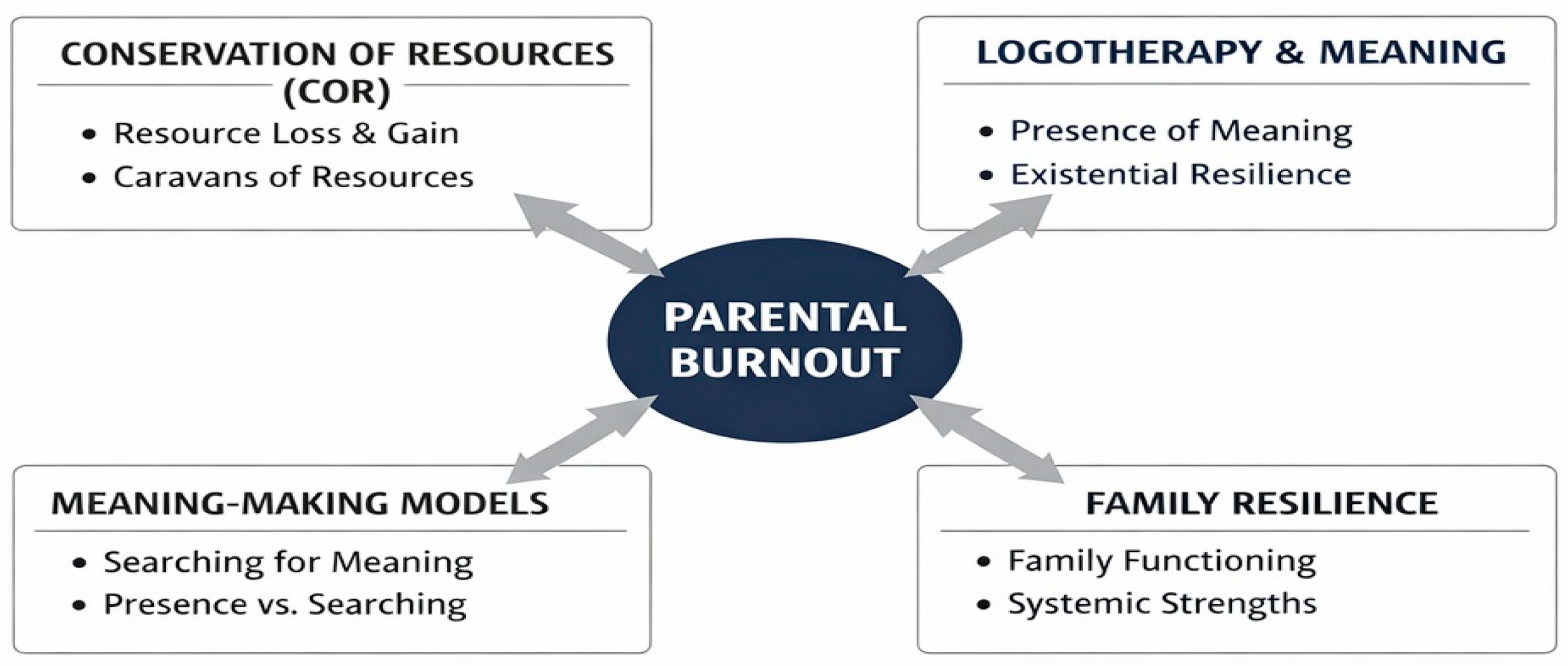
Building on these lines of work, we frame the religiosity–parental burnout link within an integrated model (
Figure 1) grounded in four theoretical anchors: COR (resource loss/gain dynamics and resource “caravans” shaped by contextual passageways;
Hobfoll 2011,
2012;
Hobfoll et al. 2018), logotherapy (meaning as a core existential resource under chronic strain;
Frankl 1959,
1988), meaning-making models (presence vs. searching for meaning as distinct processes (
Park 2005,
2010;
Steger et al. 2006), and family resilience/system perspectives (family functioning as a systemic protective resource;
Patterson 2002;
Walsh 2003,
2016a,
2016b). These frameworks motivate treating religiosity as a distal orientation linked to parental burnout mainly through proximal existential and family-systemic resources, and comparing alternative mediation specifications as ordering-compatibility tests rather than evidence of temporal causation.
In the present study, religiosity was operationalized as the centrality of religion (
Huber and Huber 2012;
Zarzycka et al. 2020). We tested whether religiosity relates to parental burnout indirectly through existential resources (presence and searching for meaning in life) and family-systemic resources (family functioning), while considering perceived social support as an adjacent interpersonal domain. Analyses followed a benchmark–sensitivity logic: Model A served as the benchmark, whereas Models B/C tested whether conclusions about the two core resources (presence of meaning and family functioning) depend on their assumed ordering, interpreted as ordering-compatibility rather than temporal precedence. Beyond documenting whether religiosity relates to parental burnout, the present study clarifies how this association unfolds through meaning-centred and family-level resources.
2. Materials and Methods
2.1. Evolution of the “Religiosity–Parental Burnout” Models
Our modelling strategy combined theory-driven specification with limited, transparently reported model evolution. Guided by COR theory and Frankl’s logotherapy, we first specified a parallel mediation benchmark (Model A), in which religiosity was treated as a higher-order orientation linked simultaneously to existential, family-systemic, and interpersonal resources. After estimating this reference model, we introduced two serial extensions (Models B and C) to examine, in a theory-consistent way, whether the observed associations were more compatible with an existential-first versus a family-first ordering of the two most stable resources. Given the cross-sectional nature of the data, these serial specifications are not treated as tests of temporal precedence. Instead, they serve as competing sensitivity models around the same empirical core pattern. Accordingly, similarity between the meaning-first (B) and family-first (C) results is interpreted as evidence consistent with equifinality (i.e., that the data do not privilege a single serial ordering) rather than as support for one fixed causal sequence.
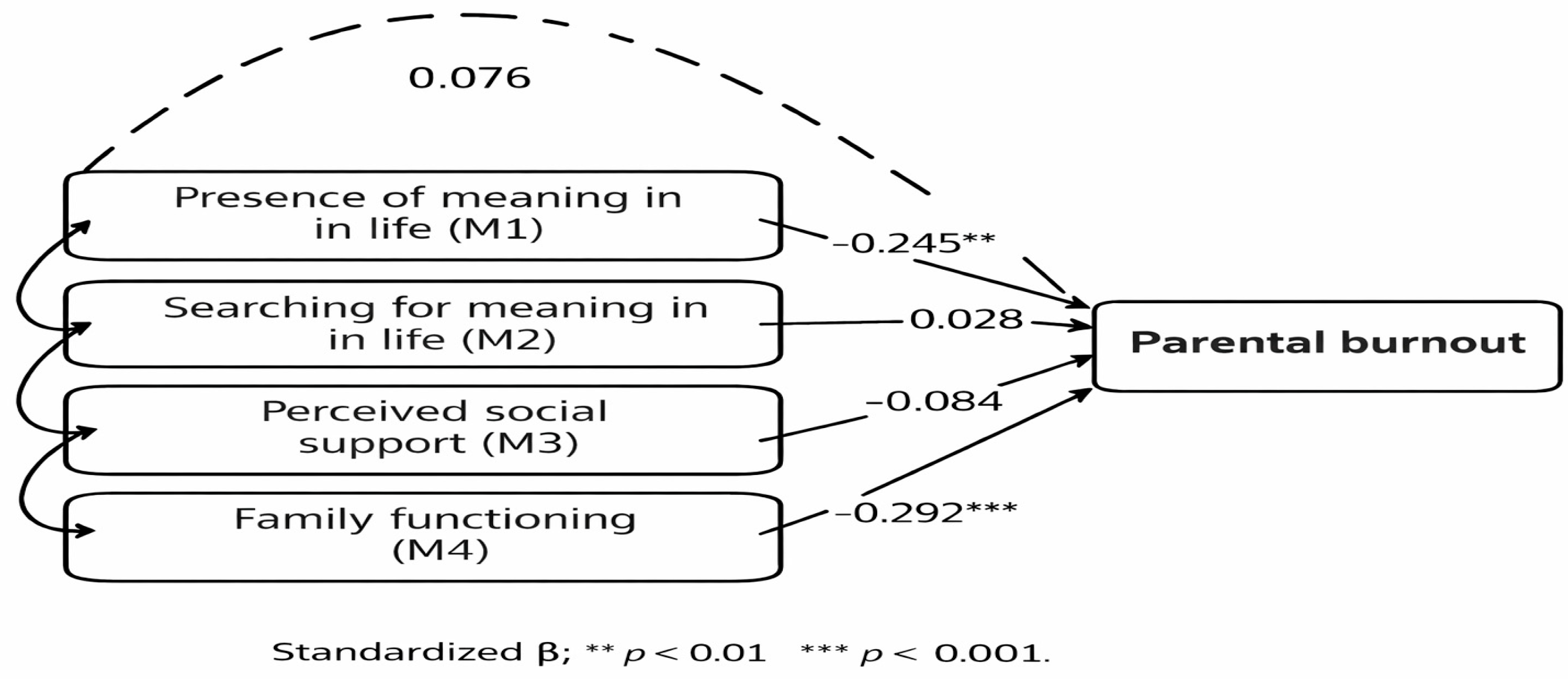
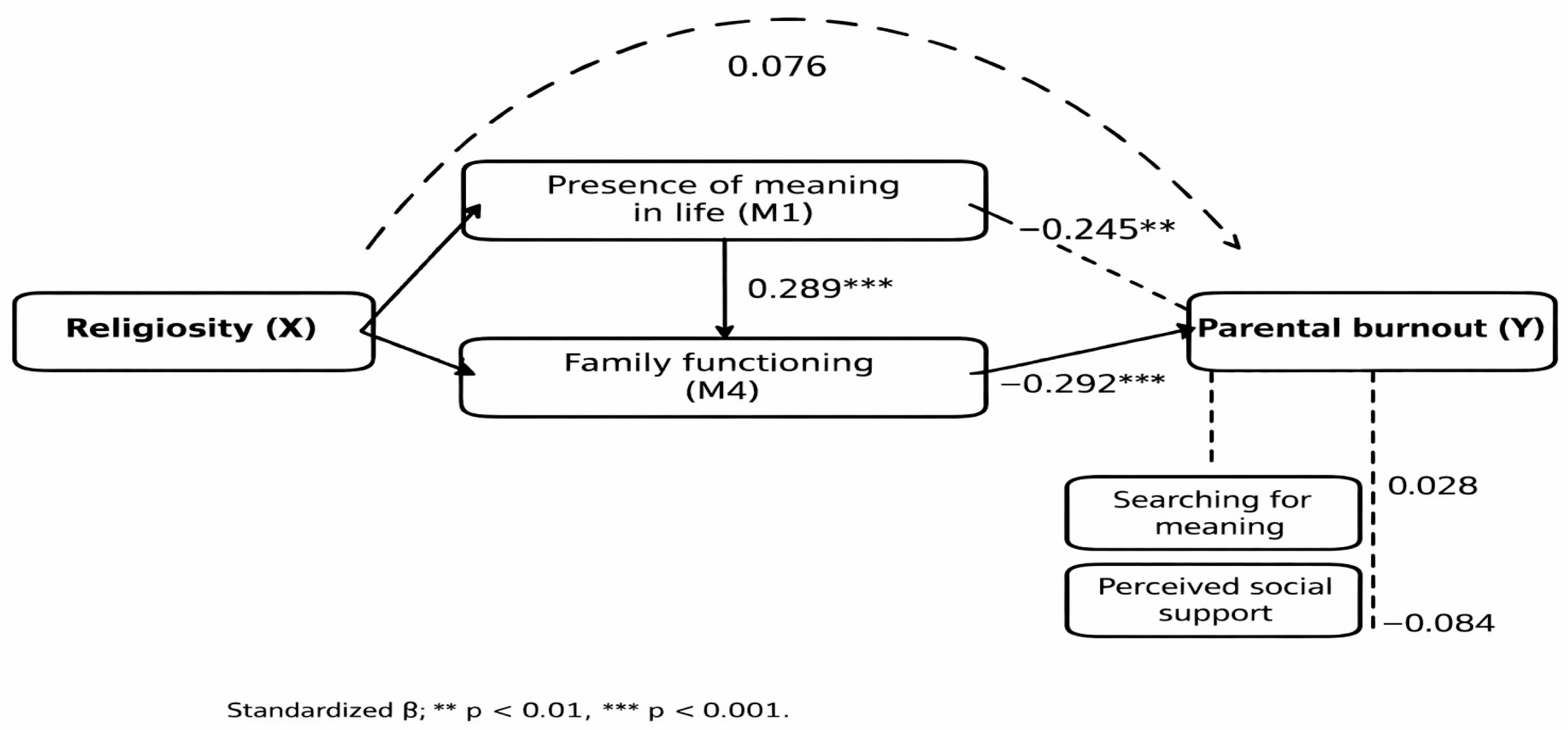
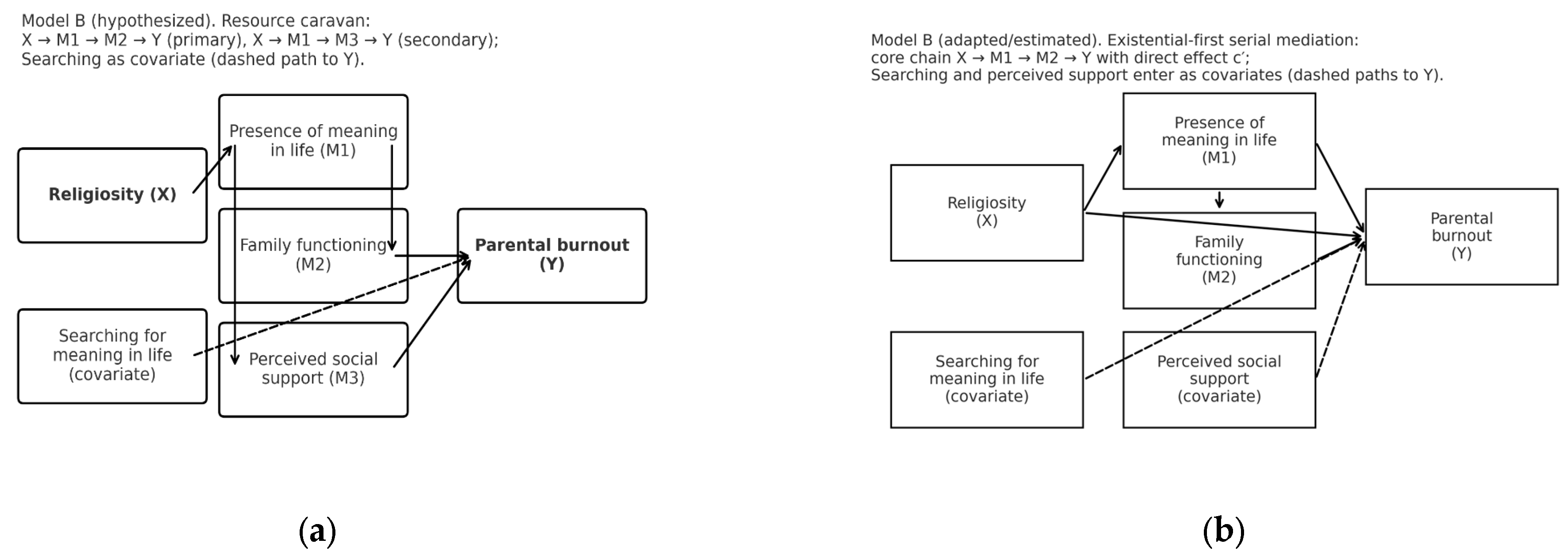
Notation note (Models B/C). To maintain consistent notation across models, we retain the parallel-model mediator labels (M1 = presence of meaning in life, M2 = searching for meaning in life, M3 = perceived social support, M4 = family functioning). The serial sensitivity specifications involve M1 and M4 only, with the mediator link set to M1 → M4 in Model B (meaning-first) and M4 → M1 in Model C (family-first), while M2 and M3 are included as covariates in the outcome equation.
2.1.1. Parallel Mediation—Benchmark Pattern (Model A)
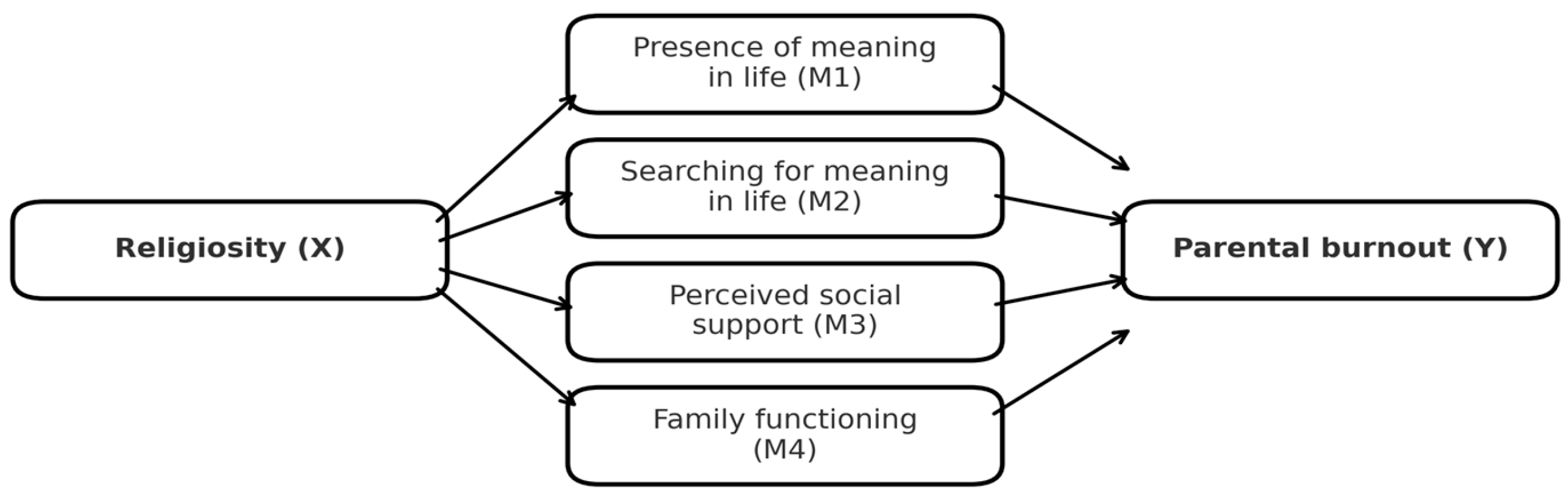
In Model A, religiosity (X) was examined in a parallel multiple-mediation framework with four candidate resources—presence of meaning in life, searching for meaning in life, perceived social support, and family functioning (M1–M4)—predicting parental burnout (Y). The model estimates unique indirect effects through each mediator while allowing correlations among mediators, without imposing directional relations. Conceptually, Model A provides a benchmark for identifying which resources are most closely associated with lower parental burnout (
Appendix A,
Figure A1).
2.1.2. Serial Model B: Existential-First Sequence (Conceptual and Estimated)
Drawing on Frankl’s meaning-centred account, the
ex ante existential-first specification (
Appendix A,
Figure A2a) positioned presence of meaning (M1) upstream of family functioning (M4) and perceived support (M3) as candidate pathways linking religiosity (X) to burnout (Y), with searching for meaning (M2) treated as potentially ambivalent. The estimated Model B (
Appendix A,
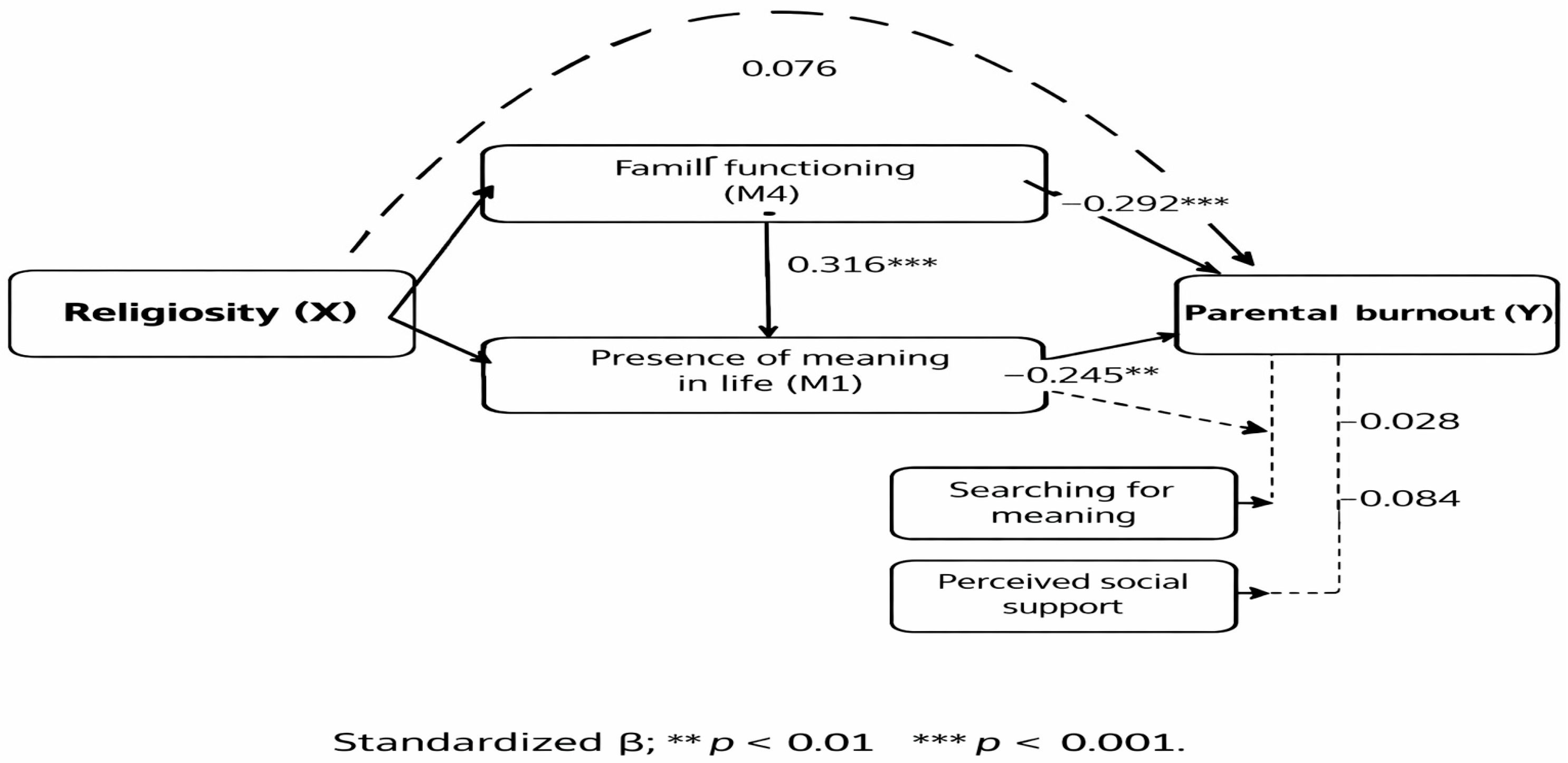
Figure A2b) implemented a focused serial structure in which X predicted the two core resources (M1 and M4), and a directional link between them was specified (M1 → M4), yielding two specific indirect effects (X → M1 → Y; X → M4 → Y) and one sequential indirect effect (X → M1 → M4 → Y). Searching for meaning and perceived social support were entered as covariates in the outcome equation. This serial ordering is interpreted as an ordering-consistency test rather than evidence of temporal precedence.
2.1.3. Serial Model C: Family-First Sequence
In a final step, we added a complementary family-first serial model (Model C), grounded in family resilience and systemic perspectives. This specification was introduced as a sensitivity check after estimating the parallel benchmark (Model A) and the meaning-first serial specification (Model B), to examine whether the substantive conclusions depend on the assumed ordering of the two core mediators.
Conceptually, Model C proposes a reversed ordering of the two core mediators relative to Model B. Religiosity (X) is entered as a predictor of both family functioning (M4) and presence of meaning in life (M1), while the family-first assumption is implemented by specifying a directional link between the mediators (M4 → M1). Statistically, this corresponds to a serial mediation structure with the two core mediators reversed relative to Model B, with perceived social support and searching for meaning in life entered as covariates in the outcome equation. As with Model B, this specification is interpreted as a competing ordering tested for compatibility with the observed associations rather than as a temporal claim.
2.2. Hypotheses and Analytic Logic
Drawing on Frankl’s meaning-centred account and a resource-based perspective, we treated religiosity (CRS centrality) as a distal orientation expected to relate to parental burnout mainly through downstream existential and family-systemic resources rather than via a strong zero-order association. Analyses followed a benchmark–sensitivity logic: Model A (parallel mediation) served as the confirmatory benchmark, whereas Models B and C probed whether conclusions about the two focal resources depend on their ordering in a serial chain (meaning-first vs. family-first). Given the cross-sectional design, serial orderings are interpreted as tests of ordering compatibility (equifinality), not temporal precedence.
Primary (Model A; confirmatory) hypotheses:H1. Religiosity will relate to lower parental burnout primarily through a negative total indirect effect via the candidate resources entered in parallel.
H2a–H2b (core resources). Indirect effects through presence of meaning in life (H2a) and family functioning (H2b) will be negative.
H2c–H2d (secondary). Indirect pathways via perceived social support and searching for meaning are treated as secondary and may be weak or absent once core resources are included.
H3 (exploratory). The residual direct association (c′) after accounting for mediators is exploratory and, if nonzero, will be interpreted as model-specific residual variance (compatible with inconsistent mediation).
Sensitivity (Models B/C; ordering tests):RQ1. Do conclusions about the core resources depend on whether meaning is upstream of family functioning (Model B) or vice versa (Model C)?
RQ2. Is there evidence for a nonzero sequential indirect component in either ordering, and does it materially change the total indirect effect relative to Model A?
2.3. Measures
Meaning in life. Meaning in life was assessed with the Meaning in Life Questionnaire (MLQ;
Steger et al. 2006; Polish adaptation:
Kossakowska et al. 2013), which distinguishes Presence of meaning (MLQ_P) and Searching for meaning in life (MLQ_S). Consistent with Frankl’s meaning-centred perspective, Presence reflects an established, life-orienting sense of purpose, whereas Searching may indicate ongoing or unsettled meaning-making and, under chronic strain, can function as an index of existential tension rather than a ready resource (
Boreham and Schutte 2023;
George and Park 2016;
Frankl 1959;
Park 2010;
Park and George 2013;
Steger 2012). In analyses, MLQ_P score was treated as an existential resource, whereas MLQ_S was treated as a potentially ambivalent indicator.
Family functioning. Family functioning was assessed with the Family APGAR Scale (
Smilkstein 1978; Polish adaptation:
Szałachowski and Tuszyńska-Bogucka 2025). The scale includes five items (Adaptability, Partnership, Growth, Affection, Resolve) rated on a Likert-type scale, with higher scores indicating better perceived family functioning.
Perceived social support. Perceived social support was measured with the Multidimensional Scale of Perceived Social Support (MSPSS;
Zimet et al. 1988; Polish adaptation:
Buszman and Przybyła-Basista 2017), capturing support from family, friends, and significant others. We focused on perceived (rather than received) support because stress and coping models emphasize that appraisals of available resources shape responses to demands, and because support is most protective when matched to relevant stressors (
Cohen and Wills 1985;
Kaniasty 2020;
Rui and Guo 2022). This focus is also compatible with evidence that religiosity relates to health largely through relational and meaning-related pathways (
VanderWeele 2017a,
2017b).
Religiosity. Religiosity was operationalized with the Centrality of Religiosity Scale (CRS;
Huber and Huber 2012; Polish adaptation:
Zarzycka 2007), which assesses the salience of religious contents across five domains (ideological beliefs, religious experience, private practice, public practice, intellectual interest). We interpret CRS results as indexing
centrality (a stable frame of reference) rather than doctrinal content or situation-specific coping.
Parental burnout. Parental burnout was measured with the Parental Burnout Assessment (PBA;
Roskam et al. 2018; Polish adaptation:
Szczygieł et al. 2020), capturing emotional exhaustion, emotional distancing, reduced parental fulfilment, and contrast with one’s previous parental self.
Total scores. For parsimony, we computed total scores for all instruments except the MLQ to reduce model complexity, limit multicollinearity, and facilitate interpretation of indirect effects (
Hayes 2022). MLQ Presence and MLQ Searching were analysed separately, consistent with the scale’s structure and guidance (
Li et al. 2021;
Steger et al. 2006;
Steger 2012). The psychometric properties of the tools we used are presented in
Appendix A,
Table A1.
2.4. Study Design
The study used a cross-sectional, correlational design to examine indirect mechanisms linking religiosity to parental burnout. Drawing on meaning-centred and resource-based accounts, we treated religiosity (CRS centrality) as a distal orientation expected to relate to burnout through lower-order resources spanning existential (presence and searching for meaning) and family-systemic/interpersonal domains (family functioning; perceived social support). All constructs were assessed via self-report questionnaires at the individual level, with a fixed set of sociodemographic covariates. Analyses followed a benchmark–sensitivity logic: Model A served as the benchmark, whereas Models B/C tested whether conclusions about the two core resources depend on their ordering (meaning-first vs. family-first), with searching and perceived support retained as covariates in the outcome equation.
2.5. Analytic Strategy
Estimation. Unless stated otherwise, main-text models used z-standardized continuous predictors winsorized at the 1st–99th percentiles, baseline (non-winsorized) estimates are reported in
Appendix A,
Table A3. Model formulations follow Hayes’ PROCESS templates: the benchmark parallel mediation (Model A) is equivalent to PROCESS Model 4, whereas the serial specifications (Models B and C) are equivalent to PROCESS Model 6 (
Hayes 2022). Mediation models were estimated with OLS and HC3 standard errors (
Long and Ervin 2000). Indirect effects were evaluated using two-sided 95% percentile bootstrap CIs (B = 1000; seed = 42), with evidence for an indirect effect inferred when the CI excluded zero (
Preacher and Hayes 2008). Unless noted otherwise, all tested models were adjusted for sex, age, number of children, marital/relationship status, and education (dummy-coded where applicable). Robustness checks addressed influential observations (Cook’s D > 4/
n) and multicollinearity (VIF) and are reported in
Appendix A,
Table A4. Given the cross-sectional design, serial specifications are interpreted as ordering-consistency tests rather than temporal causation (
Maxwell and Cole 2007). Analyses were conducted in Python (version 3.14) using the statsmodels package (v. 0.14.3), together with standard scientific computing libraries including NumPy, pandas, SciPy, and scikit-learn. To avoid ambiguity about notation, note that continuous variables were z-standardized; therefore, OLS coefficients for continuous paths can be interpreted as standardized effects. In the text, we denote indirect effects as β_indirect, but these are the standard product-of-coefficients estimates reported as “Indirect effect (β)” in Panels B of tables in the main text and
Appendix A.
Robustness checks. We repeated the bootstrap for indirect effects with 5000 resamples (B = 5000) and obtained largely similar confidence intervals and conclusions. We also tested the Presence × Search interaction in the outcome equation to probe a common conditional interpretation of searching for meaning (
Appendix A,
Table A5,
Table A6,
Table A8 and
Table A9). The only substantive exception was the Model B indirect pathway via family functioning, which shifted from significant to non-significant when the number of bootstrap resamples increased to B = 5000 (
Appendix A,
Table A8); we therefore treat this particular channel as fragile.
2.6. Assumption Checks and Preliminary Analysis
Descriptives and correlations (
Table 1) indicated that religiosity correlated positively with presence of meaning, perceived social support, and family functioning, and negatively with searching for meaning. Presence of meaning and family functioning showed the strongest negative associations with parental burnout; perceived support was more modestly related, whereas searching was weakly positively related. Intercorrelations among meaning, support, and family functioning were moderate, consistent with clustering of resources.
2.7. Sample Characteristics
Participants were recruited via convenience sampling through online parenting groups and social media. Data were collected between September 2022 and January 2023 using an online questionnaire. Eligibility criteria were: (a) age ≥ 18 years, (b) being a parent/legal guardian of at least one child, and (c) sufficient Polish proficiency. No incentives were offered. Missing data were low and primarily item-level. Scale scores were computed according to scoring manuals; when occasional item nonresponse occurred, a score was computed if at least 80% of items were completed (otherwise set to missing). One case was excluded due to missingness on key variables, yielding a final analytic sample of N = 339. Because recruitment relied on posts shared in open online parenting groups and social media, the total number of individuals exposed to the invitation is unknown; therefore, a formal response rate could not be calculated. This recruitment strategy entails potential self-selection, as parents who are more active in online communities or more interested in the study topic may have been more likely to participate.
Analyses used complete-case data for variables included in a given model; effective Ns are reported in the corresponding tables when they differ. The sample comprised 232 women (68.2%) and 108 men (31.8%). Mean age was 44.98 years (SD = 7.72). Participants reported an average relationship duration of 16.40 years (SD = 8.45; range = 2–42) and a mean of 1.78 children (SD = 0.75; range = 1–4). Most were in formal/stable partnerships (~56%), followed by informal partnerships (~24%) and single parents (~16%); other arrangements accounted for ~4% (
Appendix A,
Table A2). The majority reported higher education and rated their health and financial situation as good or very good. The sample, therefore, reflects relatively high life stability, which may attenuate burnout levels and constrain variability in stress-related processes. Findings should be interpreted with caution regarding generalizability to more socioeconomically strained populations. In addition, because recruitment relied on convenience sampling via online groups, the sample may overrepresent more engaged, higher-functioning parents, further limiting generalizability.
4. Discussion
Religiosity as a Meaning-Centred Resource under Chronic Caregiving Strain. From a meaning-centred perspective, the relevance of religiosity for parental burnout lies not in stress reduction per se, but in its capacity to sustain orientation, purpose, and coherence under conditions of chronic caregiving strain. In line with Frankl’s logotherapy, suffering becomes psychologically bearable when it is intelligible and anchored in a personally endorsed “why.” The present findings align with this proposition by showing that religiosity operates as a meta-resource: it supports a consolidated presence of meaning and facilitates the translation of this meaning into everyday family practices—such as communication, routines, and mutual responsiveness—that are directly implicated in burnout resilience. Notably, once these meaning-centred and family-system resources were accounted for, neither global perceived social support nor an unsettled search for meaning contributed additional explanatory value. This pattern is theoretically informative. It suggests that while searching for meaning may reflect existential tension under strain, it is the presence of meaning—already stabilized and experientially accessible—that confers protection. Clinically, this interpretation cautions against assuming that religiosity or generic support alone buffers parental stress. Instead, it points to the importance of interventions that strengthen meaning in parenting roles and enhance concrete family-system functioning. In this way, the findings refine Frankl’s central proposition by illustrating how meaning-oriented resources are instantiated in everyday family life under sustained caregiving demands.
Religiosity as a meta-resource and a resource caravan: small, context-sensitive effects. Religiosity can be interpreted as a meta-resource insofar as it provides interpretive frames, moral commitments, and identity anchors that can shape appraisals and support routinized practices in daily life. At the same time, the broader mental-health literature suggests that religion/spirituality–mental health associations are typically small and heterogeneous. Meta-analytic and umbrella-review evidence indicate that effects vary by the facet of religiosity assessed, the outcome domain, and the study design (
Brečka et al. 2024;
Halbesleben et al. 2014). Longitudinal evidence further shows that the direction and size of religion–mental health links can change when within-person processes are modeled, suggesting that religious engagement may sometimes respond to distress rather than causally reducing it (
Prati 2024). These findings motivate a cautious interpretation: religiosity may function less as a direct “buffer” and more as a source of meaning-making and behavioral scripts that become protective when translated into concrete family functioning (
VanderWeele 2017a,
2017b).
Why presence of meaning matters—and why searching can look different. Presence of meaning in life emerged as a robust mediator. Parenthood-focused research suggests that a stronger presence of meaning in parenthood is associated with more positive parenting-related functioning and experiences (
Dong et al. 2025). This aligns with meta-analytic evidence that meaning “presence” is reliably associated with lower psychological distress, whereas meaning “search” is more often associated with higher distress, especially when it reflects unresolved questions or unmet needs (
He et al. 2023). In the present context, religiosity may support parental functioning by supplying a coherent narrative for caregiving, thereby strengthening the “presence” component, while not necessarily reducing ongoing searching (e.g., during periods of instability or mismatch between ideals and lived experience) (
Park 2010;
Steger et al. 2006).
Family functioning as a core resource in the burnout ecology. Family functioning was the second robust mediator and remained consequential regardless of model specification. Recent reviews converge on the idea that parental burnout is tightly coupled with couple and co-parenting processes, including day-to-day coordination, fairness in the division of labor, conflict management, and the predictability of family routines (
Ren et al. 2024). Interdependent and dyadic work similarly links non-supportive co-parenting dynamics to higher burnout (
Favez and Bader 2024). In related research on parenting stress and burnout, relationship quality and marital satisfaction have been identified as proximal pathways through which stress translates into exhaustion and disengagement (
Blanchard et al. 2025;
Xu et al. 2024). Longitudinal evidence also suggests that fluctuations in stress and social support covary with parental burnout trajectories, highlighting the importance of sustained relational resources rather than one-time “support availability” (
Holopainen et al. 2025). In line with the robustness checks, the Model B family-functioning-only indirect effect should be treated as borderline/fragile (
Appendix A,
Table A8), even though the association between family functioning and burnout in the outcome equation was stable across models.
Configuration rather than temporal sequence: interpreting the ordering tests. The two serial specifications were treated as ordering-consistency tests rather than evidence of temporal causation. In cross-sectional data, a statistically nonzero sequential component indicates that a proposed ordering is compatible with the observed pattern of associations, not that resources activate in a fixed temporal sequence. The present results were robust to whether meaning in life or family functioning was placed upstream, which supports a configuration interpretation: parents report less burnout when both existential and family-system resources are relatively intact. This reading fits a “resource caravan” view in which resources cluster and reinforce one another, and it underscores why ordering comparisons are best used to check the plausibility of competing conceptual models rather than to infer temporal dynamics (
Mikolajczak et al. 2023).
Why global perceived support did not add an indirect pathway. Global perceived social support did not add a detectable indirect effect once meaning and family functioning were included. This null finding is consistent with a growing view that support is most protective against parental burnout when it is parenting-specific and behaviorally enacted—particularly via co-parenting support, shared caregiving load, and reductions in conflict—whereas broad global perceived support may be too distal to register as a distinct mechanism once family functioning is modeled (
Favez and Bader 2024;
Kaniasty 2020;
Ren et al. 2024). Moreover, psychological-process work suggests that support can matter conditionally: in one recent model, emotion-regulation strategies and perceived support jointly related to parental burnout, implying that support may function as an enabling context rather than a stand-alone mediator (
Lin et al. 2022).
Potential costs: searching, spiritual struggles, and the small positive residual. Although the residual direct effect (c′) was not statistically distinguishable from zero, its small positive sign is theoretically compatible with potential costs of certain forms of religiosity in parenting contexts. Contemporary research differentiates negative religious coping from broader religious/spiritual struggles and shows that both prospectively predict psychological distress (
Cowden et al. 2022). Such struggles can involve guilt, perceived inadequacy, or perceived divine punishment, and they may be amplified when parenting ideals are experienced as moral imperatives. Evidence from coping research during COVID-19 also suggests that specific coping styles—rather than religiosity per se—are associated with symptom burden (
Holopainen et al. 2025;
Pankowski and Wytrychiewicz-Pankowska 2023;
Pereira et al. 2024). Complementing this, protective-factor research on parental burnout during the COVID-19 pandemic indicates that resilience, optimism, and humor are linked to reduced parental burnout and better parental well-being under prolonged stress (
Enav et al. 2024). Against this backdrop, the non-mediation by generic searching for meaning is interpretable as well: searching is not uniformly beneficial and can signal unresolved tension, which may coincide with spiritual struggles and contribute to residual risk (
He et al. 2023;
Mancini et al. 2023;
Pargament et al. 2011). Given that c′ is small and not statistically distinguishable from zero, we treat these potential-cost interpretations as hypotheses about heterogeneity and competing pathways (e.g., negative religious coping or spiritual struggles) rather than as evidence that religiosity increases burnout (
Exline et al. 2014).
Limitations. Several limitations qualify the present findings. First, the design was cross-sectional and correlational. Accordingly, indirect effects should be interpreted as a statistical decomposition of associations rather than evidence of temporal mediation; the serial specifications (Models B/C) are best read as ordering-consistency tests rather than demonstrations of causal sequence (
Maxwell and Cole 2007). Second, all constructs were assessed via self-report in a single survey wave, which may inflate associations through shared method variance and does not capture within-family dynamics as they unfold in daily routines (
Podsakoff et al. 2003;
Shiffman et al. 2008). Relatedly, the study focused on perceived (global) social support, which may be less proximal to parenting strain than parenting-specific or received support (
Haber et al. 2007).
Third, generalization beyond the studied context should be made with caution. The sample reflects one cultural setting and a digitally engaged parent population, which may limit applicability to contexts differing in religious climate, family policy, or parenting norms (
Bethlehem 2010). Consistent with this contextual sensitivity, covariate diagnostics indicated associations of education and marital/relationship status with burnout; future research should examine whether the proposed pathways vary across these groups.
Fourth, religiosity was operationalized as centrality of religiosity—a broad orientation—rather than specific practices or coping strategies. While this choice fits the meta-resource framing, it may mask heterogeneity, including negative religious coping and spiritual struggles that could contribute to the small positive residual direct effect (c′) (
Huber and Huber 2012;
Pargament et al. 2011). Future research should employ longitudinal or intensive repeated-measures designs, incorporate practice-based indicators and differentiated religious coping, and include multi-informant or behavioral indicators of family functioning (
De Los Reyes and Kazdin 2005).
Implications and directions for future work. The applied implication follows directly from the indirect-effect pattern: prevention and intervention efforts may be more effective when they strengthen stable meaning in parenting and improve everyday family functioning (communication, routines, co-parenting coordination), rather than simply intensifying religiosity or offering diffuse reassurance of support. Intervention-oriented research provides early evidence that structured, skills-based programs—such as cognitive-behavioral stress-management approaches tailored for parents—can reduce parental burnout (
Urbanowicz et al. 2023). Future work would benefit from longitudinal designs that separately model within-person change and between-person differences, include parenting-specific support measures (instrumental co-parenting, division of labor, conflict processes), and assess negative religious coping and spiritual struggles directly to test whether they account for small positive residuals in the religiosity–burnout association (
Prati 2024;
Ren et al. 2024). Education and marital/relationship status showed omnibus associations with parental burnout (
Appendix A,
Table A5) and may therefore be candidates for moderation tests in future work (e.g., moderated mediation), rather than being treated only as covariates.
Conclusion. Religiosity was associated with lower parental burnout mainly through a configuration of higher presence of meaning in life and better family functioning. Global perceived support and searching for meaning did not provide unique mediation once core resources were included. A small positive c′ point estimate co-occurred with protective indirect effects and should, therefore, be interpreted cautiously until potential cost-related mechanisms are measured directly. Put metaphorically, religiosity may be a lighthouse rather than a breakwater: it does not remove the storm, yet it can illuminate a sense-making route and support coordinated family routines that help parents endure ongoing demands with less burnout.