1. Introduction
The Neo-Confucian philosopher Yi I 李珥 (1536–1584), better known by his pen name Yulgok 栗谷, has long occupied a central place in the intellectual history of the Chosŏn
1 dynasty (1392–1910). Celebrated for his influential contributions to Korean Neo-Confucian thought, he emphasized moral self-cultivation and an effective, just governance of the people (
Ro 1989). For centuries, his reputation was primarily that of a scholar-official whose writings shaped literati discourse and Neo-Confucian philosophical reasoning. Yet, under the Park Chung Hee (Pak Chŏng-hŭi, 1961–1979) administration, the public memory of Yi I underwent a profound transformation. Beginning in 1962, with the prominent contribution of President Park himself, the state promoted a radically new image of Yulgok, recasting him not primarily as a Neo-Confucian philosophical thinker, but as an exemplar of patriotic nationalism and strategic foresight. Through his public speeches, the president disseminated Yulgok’s image as an advocate for military preparedness, an interpretation that served the Park regime’s political objectives.
The present article investigates how this shift emerged, analyzing a series of state-sponsored initiatives: the establishment of the Yulgok Festival in 1962, the creation of public monuments such as the 1969 Yulgok statue in Sajik Park (Seoul), the decision to feature the philosopher on the 5000 wŏn banknote in the 1970s, and the large-scale reconstruction of Ojukhŏn (his birthplace) in 1975–1976. Taken together, these actions constituted a coordinated program of public memory management, through which the state asserted itself as the principal custodian of Yulgok’s legacy. By examining several intersecting practices (state ritual, monumentality, material culture, and heritage reconstruction) this article argues that Yulgok was instrumentalized to legitimize Park Chung Hee’s developmental state and its emphasis on military power. Methodologically, the article combines archival research with discourse analysis. Primary source material from the Park era, such as presidential speeches, heritage management reports, and newspaper articles, serves as the basis for examining how state actors articulated a revised image of Yulgok and made him widely known to the public.
Scholars of memory politics during the Park era have highlighted similar appropriations of historical figures for political use. A detailed examination of Admiral Yi Sunsin’s commemoration at Hyŏnch’ungsa in the 1960s and 1970s emphasized the transformation of local ritual practices into mass, nationalist spectacles, unfolding under President Park’s close supervision (
S. Park 2010).
Sîntionean (
2020) showed how the same regime used Yulgok’s mother, Sin Saimdang, as a symbol of female domesticity in order to mobilize housewives in the state’s modernization projects. Although her commemoration evolved alongside Yulgok’s, it remained deeply overshadowed by his, and she continued to be remembered primarily as his mother, as in premodern times. Situating T’oegye Yi Hwang against broader political and cultural contexts,
Cho (
2018, p. 79) found that, during the Park era, the philosopher “became the symbol of rational economic activities,” although “we have no concrete historical record supporting this interpretation.” Cho argues that, as the state expanded the field of T’oegye studies in the 1970s, it also monopolized the creation of practices honoring the scholar, and this control rendered him largely inaccessible to the citizens.
My exploration of Yulgok’s memory takes a different approach: the Park government never intended to disseminate Yi I’s works and make them easier to understand for the general public, because they required a profound understanding of Neo-Confucian metaphysics. The only work highlighted by the regime was “The proposal to train one hundred thousand soldiers” (K.
Sip man yangbyŏngsŏl), which does not exist; historians are uncertain if it ever existed (
Min 2012). The study of his extant works was relegated to a limited number of scholars, and their findings never received visibility outside of academic circles, which is why this aspect was not examined here. The Park regime relied on the image of a relatable Yulgok, almost dissociated from his philosophical works and conveniently transformed into a military strategist. For this image, understanding Yulgok’s oeuvre was not even necessary. The state wanted to control the discourse on Yulgok and use him politically, so it created a superficial image of Yulgok, lacking the rigor of academic study. Nevertheless, the regime made sure this image became very visible in the public space. The state’s appropriation of Yulgok exemplifies how historical figures can be reinterpreted to embody contemporary political values, illustrating the interplay between memory, power, and the use of tradition in modern Korean history.
The process of reinterpreting Yulgok is not singular to South Korea. North Korea has produced its own multiple frameworks for representing Yi I and explaining his work.
Glomb (
2015) has shown that the discourses surrounding the philosopher have evolved over time: in popular culture, he is a model of virtue for children, while in historical scholarship he can be regarded as either a figure emblematic of the conservative feudal establishment, or a “progressive scholar attentive to the needs of the masses” (
Glomb 2015, p. 182), depending on the ideological lenses through which scholars view his works. But most importantly, North Korean scholars too emphasize the patriotism of Yulgok, attributing to him the proposal to create a defense army (
Glomb 2015, pp. 185–86)–an idea that first appeared during the colonial period (1910–1945), as shown below.
2. State Ritual and the Reframing of Yulgok as a Patriot
During the 1960s, elite cultural inheritance, particularly Confucianism, became an object of sustained critique. Park Chung Hee’s early writings reveal a deep skepticism toward the cultural legacy of the Chosŏn dynasty, which he characterized as a “limited culture” (
C. H. Park 1962, p. 72). For Park, national development required a decisive break from what he perceived as the negative legacy of the Chosŏn rule: the indolence of the yangban elite, their lack of initiative, their tendency toward fatalism, escapism, and passive accommodation to reality, as well as an overall lack of critical discernment (
C. H. Park 1962, pp. 75–76). Yet Park did not reject the Chosŏn past wholesale. Instead, he selectively elevated figures that could be aligned with a future-oriented nationalism, most notably King Sejong and Admiral Yi Sunsin, whose intellectual creativity and martial accomplishments were framed as exemplary resources for nation-building (
C. H. Park 1962, pp. 83–85, 90–91). This early text thus shows the direction of Park’s later cultural policy, based on hero worship and militarized virtue. This ambivalent positioning toward Confucianism reflects a broader intellectual landscape identified by
H. Kim (
2024), who traces how Confucian traditions were neither simply repudiated nor uncritically embraced in post-liberation Korea, but instead reconstructed through competing narratives of stagnation and modernization. As Kim demonstrates, while one strand of discourse continued to blame Confucianism for Korea’s historical failure, another, gaining traction in the mid-1960s, sought to reconcile Confucian values with modernization by reinterpreting them as latent or “sprouting” forms of modernity. Under the Park regime’s modernization drive, influenced by both domestic developmentalism and international modernization theory, Confucianism increasingly became a political and ideological resource rather than a historical burden. Park Chung Hee’s early denunciation of Confucian elite culture, combined with his later selective recuperation of Confucian heroes, thus exemplifies the regime’s broader strategy: not the abandonment of tradition, but its reinvention as a tool of authoritarian modernization. Yulgok’s commemoration can be better understood within this framework.
In 1962, after observing an amphibious training exercise on Chumunjin Beach on October 10, Park Chung Hee decided to visit Kangnŭng City and the tourist attractions located in its vicinity. It was during this visit that the president urged the local authorities to establish Kangnŭng as an appealing tourist destination. His vision for the city capitalized on Kangnŭng’s connection to Yi I, since both the philosopher and his mother had been born there. Park instructed the authorities to preserve the Ojukhŏn residence
2 properly and to organize an annual festival dedicated to Yulgok as a “folkloric event showcasing the distinct features of the region” (
Kyŏnghyang sinmun 1962a). Park showed concern that the citizens were forgetting the great accomplishments of the ancient sages (
Chosŏn ilbo 1962), a recurring theme that would continuously shape his cultural policies during his time in office. At first glance, the president’s visit to Kangnŭng and his rhetoric are completely unremarkable; his biography abounds in anecdotes of such working visits during which he took an interest in local cultural affairs. What distinguishes this particular visit is the far-reaching implications it has had on the regional commemoration of Yulgok: the festival suggested by the president was organized soon afterwards and has been an annual tradition in Kangnŭng ever since. Moreover, his personal interest in Ojukhŏn would eventually transform the place tremendously in order to embody a carefully selected vision about the past.
The first edition of the “Yulgok Festival” (K.
Yulgokche) took place on 6 November 1962, less than a month after Park Chung Hee’s visit to Kangnŭng.
3 Organized by local authorities in cooperation with Yulgok’s descendants, the memorial ceremony took place at Ojukhŏn, in front of Mongnyongsil, the room where Yi I was born. Its stated purpose, according to Kangwŏn Province Governor, was “to honor Yulgok’s profound learning and to internalize his spirit of saving the nation and aiding the people” (
Munhwajaech’ŏng 2000, pp. 52–53). The festival attracted a large audience of thirty thousand people and featured a writing contest, traditional music and dance performances, as well as fireworks (
Tonga ilbo 1962a). The public visibility of the event was heightened by the presence of Park Chung Hee himself, accompanied by high-ranking officials from the government and foreign diplomats. Beyond its commemorative function, however, the festival’s scale and Park’s personal participation signaled the state’s appropriation of Yulgok as a political symbol.
The festival provided an early occasion for the president to articulate a new vision of national identity and modernization through the commemoration of a Confucian statesman. His speech points to the specific values that the state sought to inscribe into Yulgok’s commemoration:
“We have brought upon ourselves the evil trend of sadaejuŭi (‘serving the great powers’) by forgetting all the great aspects of our own ancestors and by regarding only the ancestors of others as worthy. This has trapped us in a sense of inferiority and has become the root of all national vices.
Quoting Yulgok’s great ideals, such as ‘governing the people with righteousness and enlightening them’ (K. chŏngsi yangmin kyomin) and ‘national prosperity and military power’ (K. puguk kangbyŏng), one might say, ‘Had we properly inherited and practiced these principles, we could have avoided the stigma of being a backward nation today.’ If we preserve our national unity and remain firmly devoted to our national identity, even advanced cultures and foreign knowledge can become part of our own development. When we reflect on how Yulgok’s ‘training of one hundred thousand soldiers’ (K. sip man yangbyŏng) plan failed due to factional strife, ultimately leading to foreign invasions and national disgrace, we must deeply engrave in our hearts that, from now on, only nationwide unity, free from factional divisions, can be the true path to national revitalization.”
This early speech of Park Chung Hee launched a long-lasting trope about Yulgok as the promoter of a military strategy that would strengthen the state. Attributing the Chosŏn dynasty’s historical weakness to subservience to the great powers, Park urges a return to national values and warns against neglecting Korea’s own cultural heritage. Yi I, however, is not mentioned for his philosophical works and his contribution to Neo-Confucian thought. Instead, his work as a political statesman is repurposed as the embodiment of both moral governance and military strength, suggesting Yulgok’s contemporary relevance. Park is reframing age-old principles, such as Xunzi’s (a Confucian philosopher of the third century BCE) ancient principle of “national prosperity and military power” (K.
puguk kangbyŏng) (
Cho and Park 2019), as models for contemporary statecraft. These precepts echo Park’s developmental state; therefore, he invokes them to justify reform, civilian discipline, and militarization.
The emphasis on military strength stems from a proposal attributed to Yulgok that has never been properly attested, commonly referred to as “The proposal to train one hundred thousand soldiers” (K.
Sip man yangbyŏngsŏl). Although it is not mentioned in the
Annals of King Sŏnjo (r. 1567–1608, K.
Sŏnjo sillok), the proposal appears in the
Revised Annals of King Sŏnjo (K.
Sŏnjo sujŏng sillok), in 1582. Yi I, who was a Minister of Justice at the time, is reported to have said: “We must train one hundred thousand soldiers in advance in order to prepare for unforeseen upheavals” (
Sŏnjo sujŏng sillok, 1582, month 9, day 1, first record).
4 Scholars question the authenticity of this plan, given its conspicuous omission from the
Annals of King Sŏnjo. The mention of one hundred thousand troops was a later addition to the annals, possibly fabricated by the Western faction (K. Sŏin) to elevate Yi I’s status as their ideological leader (
Min 2012, pp. 161–62). The earliest record of Yi I’s proposal can be found in his biography (K.
Yulgok haengjang), compiled in 1597 by Kim Changsaeng (1548–1631), one of Yi I’s disciples, but this text dates Yulgok’s proposal to 1583, raising doubts about its reliability.
Min (
2012, p. 158) notably notes that studies doubting the credibility of “The proposal to train one hundred thousand soldiers” started to appear only after the 1980s. It is possible that the strong official discourse disseminating the image of Yulgok as a military strategist during the Park Chung Hee regime discouraged any critical assessment of the historical accuracy of the “one hundred thousand soldiers” plan.
Min (
2012) also doubts that Yulgok foresaw Toyotomi Hideyoshi’s attack (the Imjin War, 1592–1598) and instead feared the Jurchen threat from the north. Although Yi did indeed submit a six-point proposal (K.
Simu yukcho) in 1583, during his tenure as Minister of Defense, he only talked about the necessity of raising a large military force, without specifying the figure of one hundred thousand troops. In any case, if it was ever formulated, Yi I’s warning that a disaster was imminent and it was necessary to secure the nation’s defense was overlooked by the politicians of his time.
Although the Park regime eventually made intensive use of Yulgok’s image as a military strategist, the idea did not originate with President Park. This image started to form during the colonial period. In that historical context, Yulgok’s framing as the author of “The proposal to train one hundred thousand soldiers” was less a neutral recovery of Chosŏn thought than a historically conditioned construction, shaped by colonial anxieties about state failure, leadership, and international relations. In an essay from 1929, historian Mun Il-p’yŏng situated Yulgok’s proposal within a broader critique of Chosŏn political culture, which overemphasized “an empty and rigid moral absolutism”, while disparaging military affairs (
Mun 1929). According to Mun, chief state councillor Yu Sŏng-nyong dismissed Yulgok’s proposal “outright, on the grounds that, in an age of peace and stability, military preparedness was not an urgent matter” (
Mun 1929). This sort of “uniquely keen international discernment” (
Mun 1929) was further attributed to Yulgok in texts sporadically published in the
Chosŏn ilbo newspaper during the colonial period. A text from 1933 praised Yulgok’s “clarity of foresight” for predicting that “within no more than ten years, there will surely arise the danger of total collapse”–presumably a reference to the Imjin War (
Chosŏn ilbo 1933). Another newspaper column elevated Yulgok to the status of a tragic military strategist whose vision was thwarted by factional politics (
Chosŏn ilbo 1935). Read together, these colonial-era writings show how Yulgok’s image as a prophetic military thinker gradually took shape during the colonial period and laid the groundwork for later appropriations.
The Park Chung Hee regime exaggerated these ideas and instrumentalized them to legitimize authoritarian militarism and the centrality of security to the modern Korean state. The fact that Yulgok’s contemporaries disregarded his warnings made him an even more eloquent case. President Park attributed the Chosŏn government’s failure to act on Yulgok’s warnings to partisan strife, and then reworked the philosopher’s message into a call for political and social unity under strong leadership, implicitly Park’s leadership. This political use of Yulgok’s memory created grounds to delegitimize political dissent and justify the suppression of the opposition.
The presidential speech at the inaugural festival dedicated to Yulgok was not a singular case of referencing the philosopher as a hero militating for national defense. The president repeatedly used Yulgok as a pretext to hint at how political dissent and conflict can affect the economic and political governing strategies. Park Chung Hee reiterated his vision of Yulgok on the occasion of the fourth “Yulgok Festival,” on 15 October 1965. In his commemorative address, Park drew a sharp contrast between the long peace that followed the founding of the Chosŏn dynasty and the eventual decay brought on by partisan strife, self-interested officials, and complacent rulers. According to Park, Yulgok stood out among his compatriots for anticipating potential foreign aggression and upholding national defense:
“In light of this, we cannot help but recall the great achievements of Teacher Yulgok, who, in a time of national crisis, confronted the corruption and stagnation of his era. With keen insight and appropriate policy proposals, he sought to create a turning point for the revival of the nation. […] He also promoted the ideal of autonomy and equality, rejecting servile dependence on foreign powers and instilling pride in being an independent nation. This legacy resonates with us today with renewed urgency and meaning.”
“Yet, more than his profound scholarship and exceptional insight, what moves us most deeply today is his far-sighted vision: despite the envy and ridicule of treacherous officials, he steadfastly upheld his patriotic mission of saving the nation and the people, and even ten years before the event, foresaw the Japanese invasion, advocating the raising of one hundred thousand soldiers. When we reflect that, had his proposal been heeded at the time, the calamities of the Imjin and Chŏngyu Wars–the origin of our nation’s tragedy–might have been prevented, our reverence for him deepens all the more.”
Park Chung Hee articulates here the prevailing approach to the state-led commemoration of Yulgok, emphasizing his political thought rather than his contribution to the history of Korean Neo-Confucianism. In fact, President Park never engaged in his speeches with Yulgok’s philosophical works and concepts. The metaphysical concepts of the so-called “Four-Seven Debate” and the intellectual refinement of “sagehood” (
Cawley 2019, pp. 83–91;
Sancho 2025, p. 277) would have been difficult to grasp for those unfamiliar with Neo-Confucian philosophy, and even harder to transform into political agendas of the developmentalist state. Instead, Park always focused on the glorification of Yulgok as a patriotic statesman, an emphasis that conveniently aligned with Park’s militarized leadership. Yulgok’s insistence on preventive strategies for national defense echoed the Park regime’s prioritization of national goals. Through Park’s public interventions at commemorative events such as the festival, Yulgok gradually became a discursive trope through which the government could claim that national defense and anticommunism take priority over political discord. Other events commemorating Yi I during the 1960s and 1970s (
Table 1) will gradually disseminate this trope, making Yulgok distinctly visible in the public space.
Another enduring legacy of the Park regime’s interest in Yulgok is the festival itself, a clear example of what
Hobsbawm and Ranger (
1983) termed an “invented tradition.” Although the festival was a modern state initiative, the government framed it as a cultural custom rooted in Korea’s Confucian past. It has been organized annually since 1962 (with the sole exception of 2019, 2020, and 2021, due to public health restrictions), and still carries the main features it initially had. During the Park regime, the event combined ritual and spectacle, featuring the ancestral ceremony, lantern parades, alongside exhibitions of relics and cultural artifacts, lectures on Yulgok’s philosophy, literary competitions, calligraphy contests, art exhibitions, and archery tournaments (
Kangwŏndo Chibang Munhwajae Kwalliguk 1976, p. 60). Although the festival included lectures on Yulgok’s oeuvre, the festival was still a form of performance for public consumption, and only marginally an invitation to engage with his work. The festival’s focal point was the ancestral ritual (K.
cherye) dedicated to Yulgok at Ojukhŏn and performed by government officials from Kangwŏn Province. In 1962, during the inaugural edition of the festival, President Park was the chief officiant (K.
ch’ohŏn’gwan) (
Tonga ilbo 1962a;
Ch’oe 2021), even though Yulgok’s own descendants were present. This act reproduced, in form if not in lineage, the commemorative sacrifices of the Chosŏn dynasty, in which, as
S. Park (
2011, pp. 40–42) explains, sacrifices at the state level were based not on familial lineage but on a broader political conception of inheritance. When offering rites for Koryŏ monarchs, loyal subjects, or military heroes, the Chosŏn royal court used these commemorative events as a “legitimating mechanism for the production of authority” (
S. Park 2011, p. 42). In the absence of blood ties, the court could appropriate the memory of those ritually honored and embed political meanings in such acts of sacrifice. Seen from this perspective, Park Chung Hee’s assumption of the main ritual role during the ancestral rite at Ojukhŏn generates a form of continuity with Chosŏn-era tradition. It also represents an instance of what
Hobsbawm (
1983, p. 1) calls an “invented tradition,” a carefully staged continuity with the premodern past. President Park’s role as the chief officiant in 1962 was a potential source of moral legitimacy for the new regime, because it situated the modern state within an imagined genealogy of righteous rulers and proper ritual decorum.
In the subsequent editions of the festival, the ancestral rites were performed by government officials from Kangwŏn Province, effectively replacing Yulgok’s descendants in their ritual roles. In this way, the state deprived the lineage of the moral obligation, central to Confucian propriety, of conducting ancestral ceremonies. This pattern closely mirrors the commemoration of Admiral Yi Sunsin’s birthday, celebrated annually at Hyŏnch’ungsa on April 28 since 1962. President Park Chung Hee attended the event each year, while representatives of the central government took over the ritual duties traditionally held by Yi’s descendants, thereby transforming a familial rite into a state ceremony. Through the president’s regular participation, the commemoration gradually expanded from a local observance to a national ritual of political significance (
S. Park 2010, pp. 8–11), embodying the state’s broader strategy of appropriating Confucian symbols to consolidate moral and ideological legitimacy. Both the commemoration of Admiral Yi Sunsin’s birthday and the Yulgok Festival illustrate how the state claimed ownership over the memory of historical figures it found politically useful and decided how they should be commemorated.
K.-o. Kim (
1996, pp. 217–18) suggests that Park Chung Hee changed his stance toward Confucianism as a political strategy, aimed at securing the votes of social elites supporting Confucianism and strong local Confucian traditions, especially in the North Kyŏngsang Province. Indeed, the commemoration of Yulgok proceeded in close parallel with that of T’oegye Yi Hwang, the philosopher most closely associated with Andong’s Confucian heritage. Parts of Tosan Sŏwŏn, the academy memorializing T’oegye in Andong, were designated treasures (K.
pomul) no. 210 and no. 211 on 21 January 1963–the same date on which Yulgok’s birthplace, Ojukhŏn, received protected status. Tosan also underwent extensive repairs and transformation between 1966 and 1970, and T’oegye was dedicated a statue in 1970 as part of the so-called “Statue Movement.” In 1975, his portrait was placed on the 1000 wŏn banknote. All these events closely mirrored the memorialization steps taken for Yulgok within a similar time frame, suggesting a coordinated strategy rather than isolated acts of remembrance. Through this process, the regime imbued the figure of T’oegye with new meanings as well, becoming a “symbol of diligence and frugality” (
Cho 2018, p. 78), a moral image used in the state rhetoric surrounding economic development and national discipline. Such commemorative practices should therefore be understood not merely as attempts to expand electoral support or appease Confucian traditionalists, but as part of a broader ideological project. By selectively mobilizing Confucian figures and values, the Park regime reframed Confucianism as a moral foundation for authoritarian modernization, promoting loyalty to the state (K.
ch’ung) and filial piety (K.
hyo) as ethical principles that legitimized hierarchy, discipline, and obedience within both the family and society at large.
3. The Public Visibility of Yulgok
If the festival dedicated to Yulgok remained a largely local tradition, confined to Kangnŭng City and the Kangwŏn Province, the Park Chung Hee regime undertook a series of deliberate actions to elevate Yi I to a figure of national prominence. By the late 1960s and especially throughout the 1970s, the state made sustained efforts to expand Yulgok’s public visibility and to transform him into one of the best-known icons of the modern nation. This process took very concrete forms, like the erection of a large statue of Yulgok in Seoul and the decision to feature his image on the 5000 wŏn banknote, thereby embedding him into the everyday visual landscape of South Korea.
As scholars of memory and monumentality have noted, the commemorative power of statues lies precisely in their public presence and accessibility (
Dickenson 2021), their ability to assert collective memory (
Johnson 2002) in visible, permanent form. Through the sponsorship of such monuments, the state not only directs public attention toward selected historical figures and events but also actively shapes the narrative through which they are remembered and interpreted. The creation of a statue of Yulgok in Seoul constituted one such opportunity for the regime to reframe the philosopher as a hero defending the nation.
Yulgok’s statue in Sajik Park (Seoul) was erected as part of a larger movement to commemorate historical figures, entitled “The Statue Movement” (K.
Tongsang kŏllip Undong). It was initiated by the
Seoul Sinmun newspaper in 1966, as part of a broader effort to replace the decaying plaster statues in the capital. The idea appeared when Yi Han-sang, the director of P’ungjŏn Industries, received the “5.16 Minjoksang” Award that year in the industrial category, and donated his prize money (500,000 wŏn) to the newspaper (
Chosŏn ilbo 1968). What began as a private act of patriotic generosity soon evolved into a public campaign that would reshape the city’s monumental landscape, aligning it with the regime’s vision of national pride. The capital stakes of the movement were the selection of historical personalities commemorated through statues and the discourse associating the statues with certain values. Originally,
Seoul Sinmun conducted a public survey in order to select symbolic figures and appointed a “Committee for Building Statues of Patriotic Martyrs” (K.
Aeguk sŏnyŏl chosang kŏllip wiwŏnhoe) to decide who should be commemorated. But the list of memorialized heroes was ultimately appropriated and changed by the government, with an overwhelming preference for Confucian scholars and premodern military heroes. The influence exercised by the government in the selection process superseded the ways in which citizens wanted to memorialize the past with the regime’s ideological agenda, focused on modernization, anticommunism, and national security. Between 1968 and 1972, a total of fifteen statues were built (thirteen in Seoul, one in Suwŏn, and one in Taejŏn) (for a list of the statues, see
Chŏng 2007, p. 346). Some of Korea’s most iconic monuments emerged from this movement, notably the statues of Admiral Yi Sunsin on Sejongno and King Sejong at Tŏksugung Palace, both completed in 1968 as the first two statues to be erected under the campaign. The statue of Yi Sunsin was sponsored by President Park himself, who wanted to set an example for future donors.
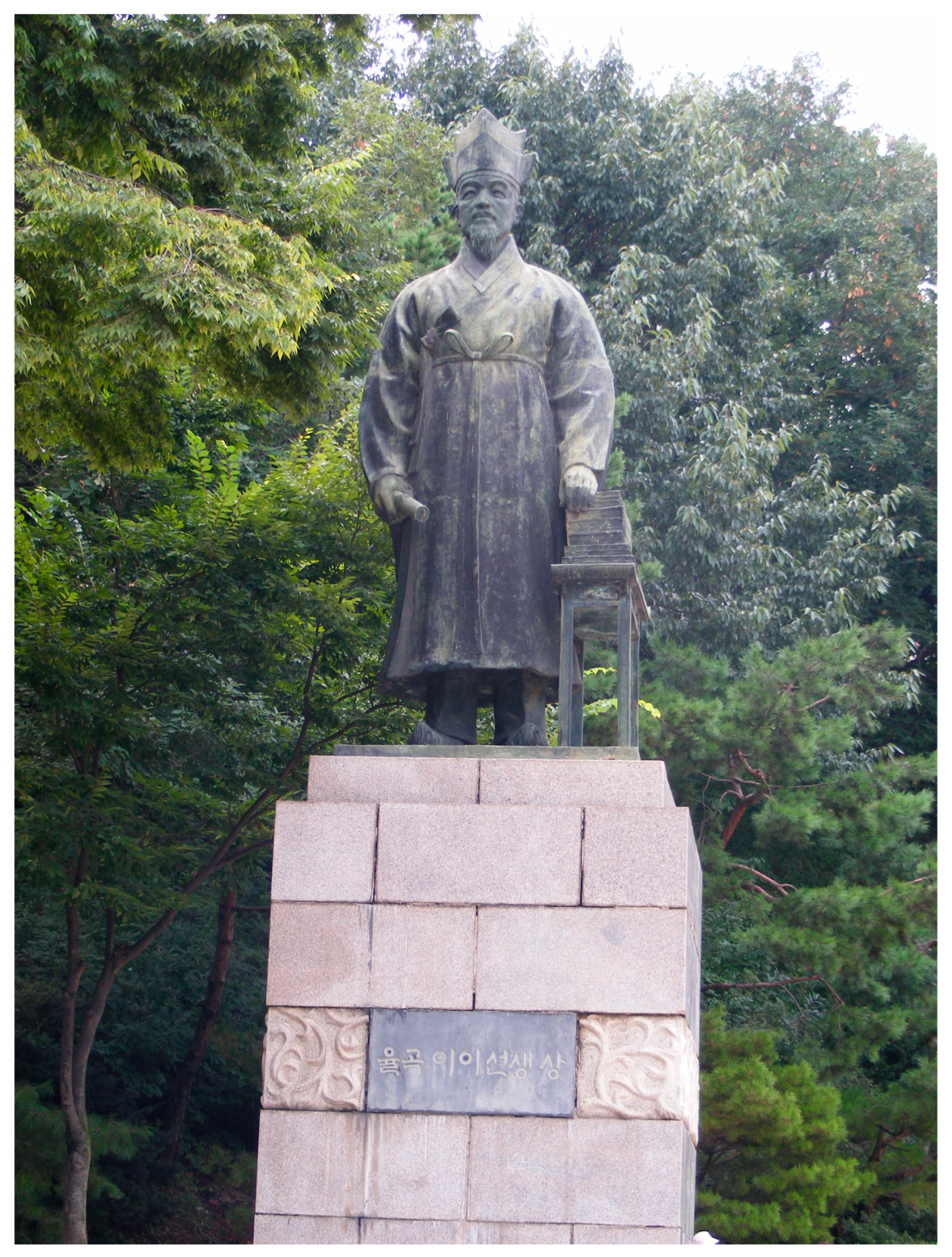
The statue dedicated to Yulgok (
Figure 1) was created by Professor Kim Chung Sook (Kim Chŏng-suk, 1917–1991) from Hongik University, hailed as the first female Korean sculptor. Unveiled on 9 August 1969, it was sponsored by Yi Yang-gu, the director of the Tongyang Cement (currently Sampyo Cement) (
Tonga ilbo 1969). The work presents Yulgok in a dignified, upright posture, emphasizing his authority as a scholar-official and moral exemplar. Its scale and placement in a prominent urban location in Seoul ensured that Yulgok became a visible figure in the national public landscape. Coupled with other commemoration practices (
Table 1), the statue made Yulgok a widely recognizable national figure, accessible to citizens who did not participate in Confucian rituals or regional commemorations in Kangnŭng. In this way, the monument functioned as an instrument of public pedagogy and state-sponsored memory, reinforcing the government’s effort to elevate Yulgok as a symbol of national defense.
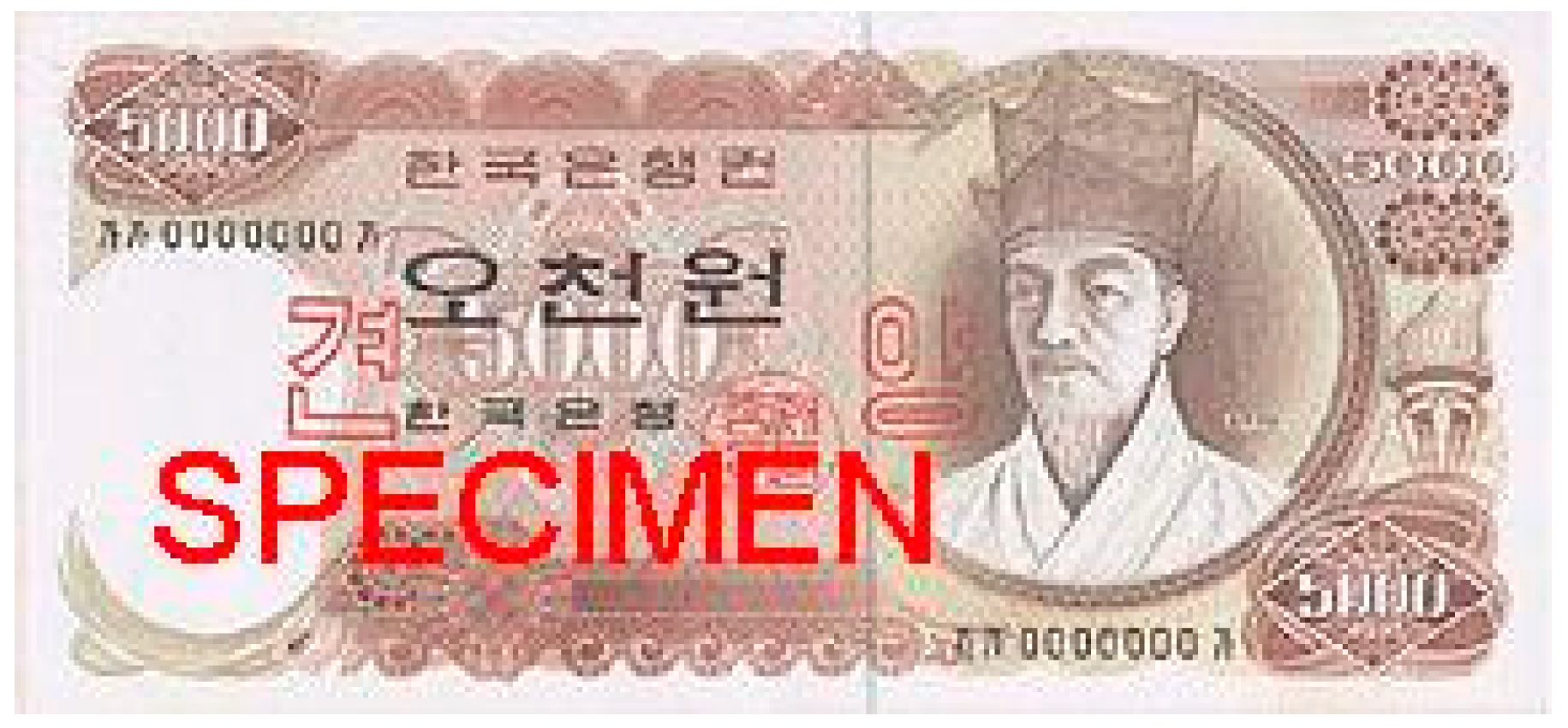
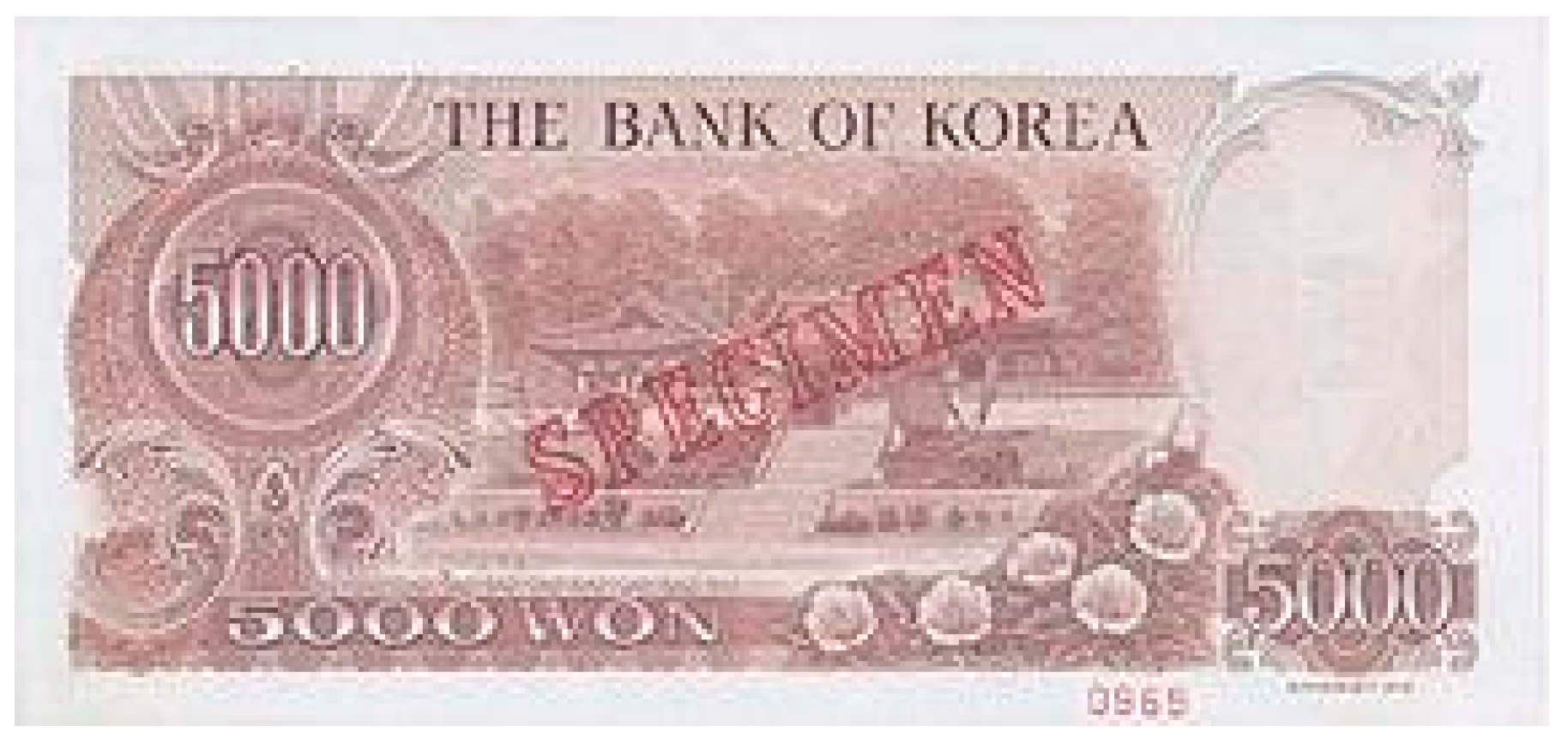
Yulgok’s public visibility increased even more when his image was incorporated into the design of Korean banknotes. At the beginning of the 1970s, with the expansion of the economy and rising prices, the state issued 5000 wŏn banknotes for the first time. It was the largest denomination in circulation until June 1973, when 10,000 wŏn banknotes first appeared. Circulated from 1 July 1972, the 5000 wŏn banknote featured Yulgok’s portrait on one side (
Figure 2), and the Bank of Korea Museum on the other. Since South Korea lacked the manufacturing technology for producing the printing plates for banknotes at the time, the government outsourced the production to the British company De La Rue. But allowing a foreigner to draw Yulgok’s appearance proved problematic: the portrait was immediately perceived as excessively Westernized, “not looking like a Korean” and admittedly “a bit strange,” in the words of the Bank of Korea governor at the time (
Chosŏn ilbo 1972). The controversy, coupled with government efforts to disseminate historically accurate portraits of national heroes, prompted the Ministry of Culture and Information (K.
Munhwa Kongbobu) to launch in 1973 a “Standard Portrait System” (K.
P’yojun yŏngjŏng chedo). Under this initiative, painter Lee Jong-sang (Yi Chong-sang, pseudonym Illang, b. 1938) created the definitive portrait of Yulgok, still in circulation today. Since no officially recognized portrait of Yi I had been passed down through history, authenticity verification entailed only the clothing details, while the expression of the philosopher was entirely the creation of Lee Jong-sang. Five thousand wŏn banknotes printed with this new portrait replaced the old ones in 1 June 1977, to correct what was perceived at the time as a flagrant historical inaccuracy. It was from this moment that Ojukhŏn started to appear on the banknote (
Figure 3), as it had undergone a massive transformation the previous year. The state corrected something perceived as inaccurate and, at the same time, advertised the new Ojukhŏn.
4. The Remaking of Ojukhŏn
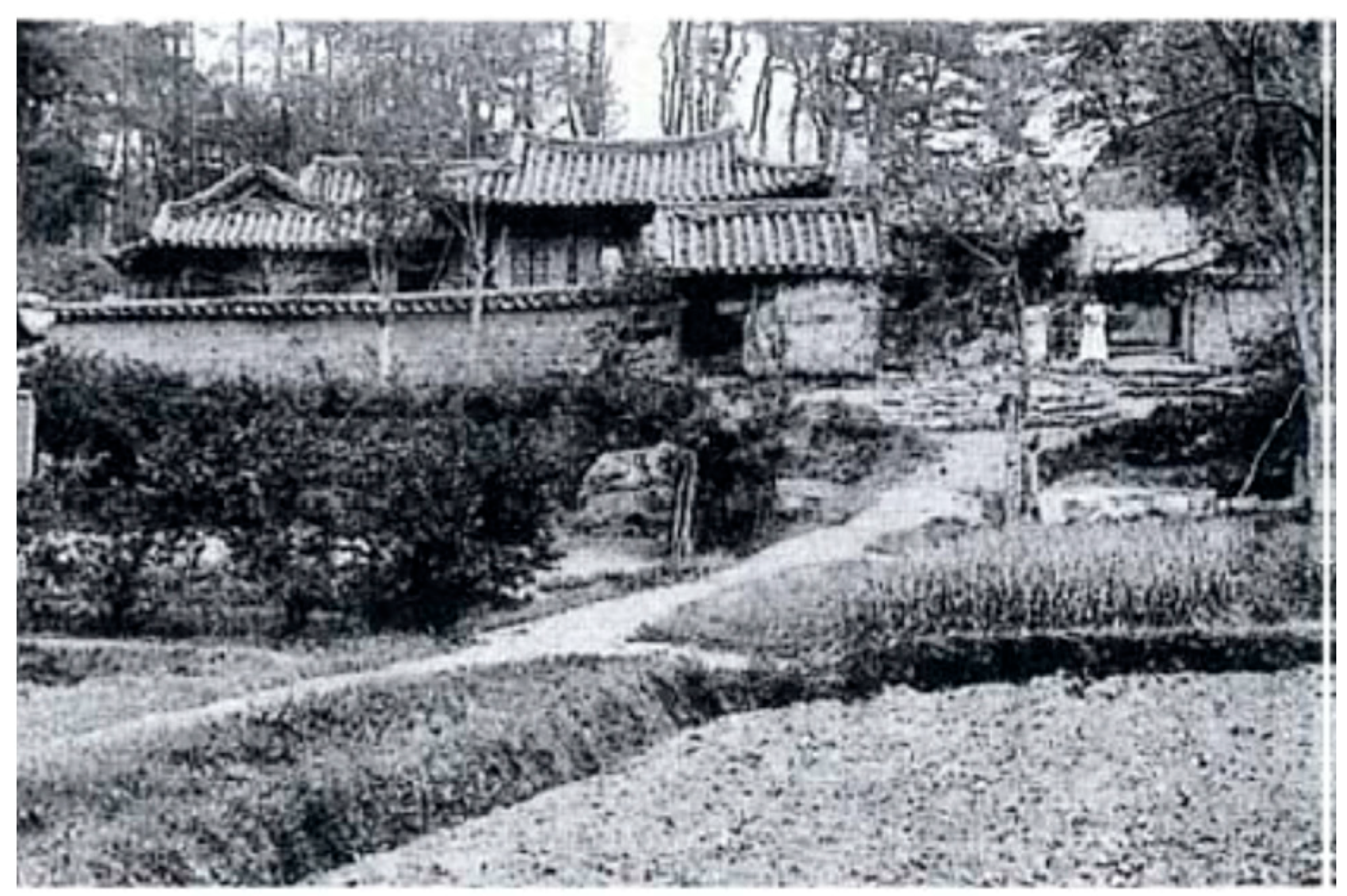
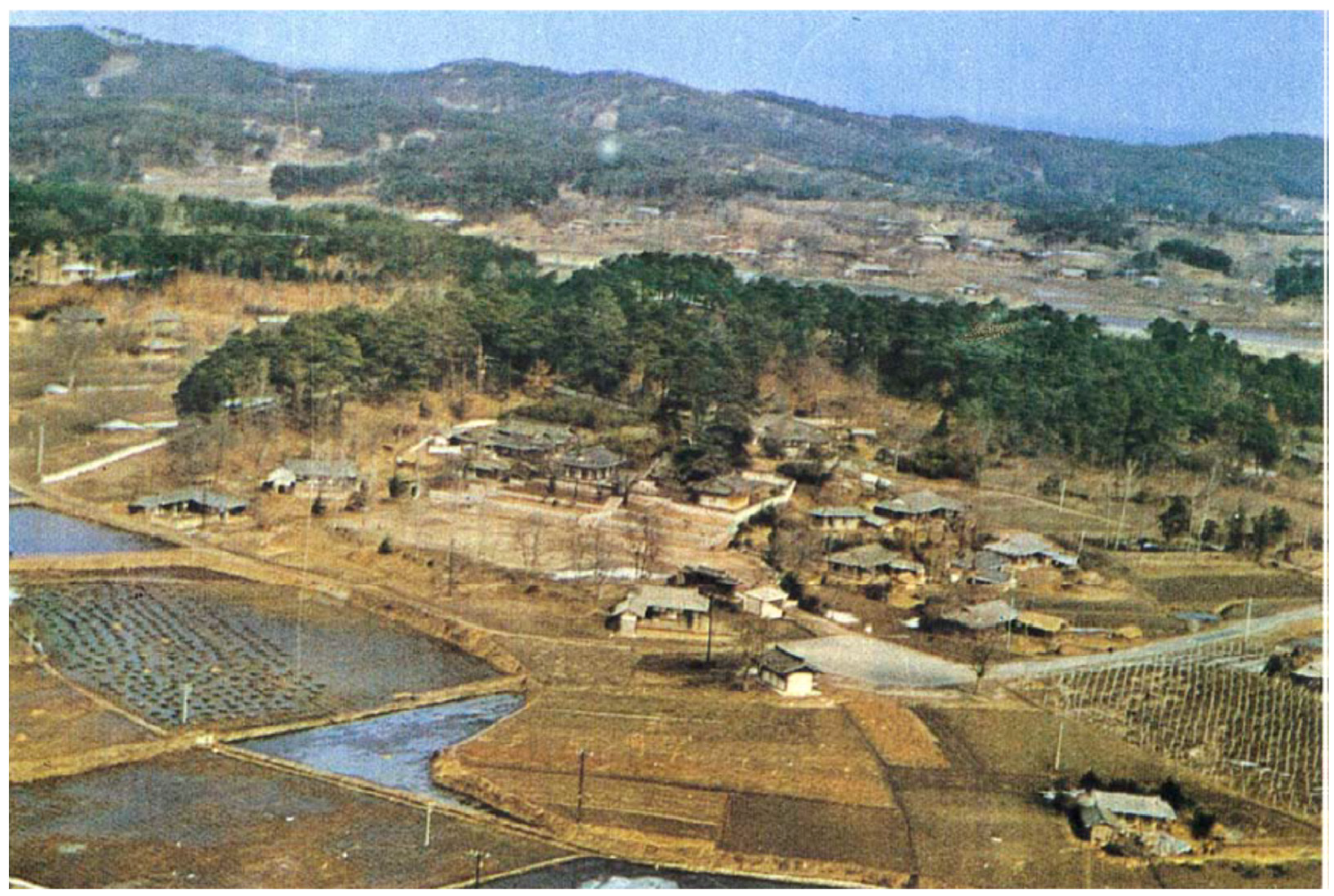
At the beginning of the 1960s, when President Park Chung Hee took an interest in Yulgok, the philosopher’s birthplace, Ojukhŏn, was a residential space typical of Chosŏn dynasty aristocratic homes (
Figure 4), surrounded by thatched-roof houses and rice paddy fields. Over the centuries, the place had become a place of pilgrimage and reverence for Yulgok’s followers. Even King Chŏngjo (r. 1776–1800) visited the place in 1788, and ordered the construction of a building to preserve Yulgok’s personal belongings and his portrait. As one of the oldest preserved Korean houses, the residence was designated a treasure (K.
pomul) on 21 January 1963, for its architectural value and its association with both Yulgok and his mother, Sin Saimdang. However, this did not deter the authorities from undertaking a full-scale transformation of the residential space and its surroundings in 1975–1976.
This was part of a movement encompassing historic sites (K.
sajŏk, such as fortresses, graves and monuments dedicated to heroes, battlefields and other sites related to national defense, Confucian shrines) selected for full-scale “repair and restoration” (K.
posu pogwŏn saŏp). The Office of Cultural Properties (K. Munhwajae Kwalliguk, hereafter the OCP), the institution managing heritage at the time,
5 called these restoration projects “purification projects” (K.
chŏnghwa saŏp) or “sacralization projects” (K.
sŏngyŏghwa saŏp). The term “purification” referred to the deliberate removal of what was deemed inaesthetic, inappropriate in scale or design, or simply occupying space that was destined for new constructions. As shown in earlier research (
Sîntionean 2021), these projects were not mere restorations but systematic efforts to reimagine heritage sites so that they embodied both tradition and the national identity of a modern Korea. Under the guidance of the OCP and often following direct presidential orders, historic places were “cleansed” of elements deemed inappropriate and reconstructed to fit an idealized vision of Korean tradition. These interventions combined grandiose monuments with the construction of buildings imitating Chosŏn-era architecture using cement, enlargement of historic buildings or complete reconstructions, and tiered landscapes. By the time Ojukhŏn’s remaking was finished in 1976, these purification projects already had an established pattern, which had been experimented with in tens of other places
6 before and was simply implemented at Ojukhŏn over the course of just a few months.
Ojukhŏn was among the historic sites targeted by President Park Chung Hee for purification, because it had to accurately display the values embodied and promoted in the dominant discourse about Yulgok. In January 1974, the president instructed Kangwŏn Province officials to make a purification plan and then visited the site himself on 14 October 1975, to give personal instructions for the project. Between these two moments, the provincial authorities had bought the land surrounding Ojukhŏn (10,695
pyŏng of land, the equivalent of 35,355 m
2), compensated land owners for the farming crops (
Kangwŏndo Chibang Munhwajae Kwalliguk 1976, p. 80), and were preparing to demolish all the village houses (K.
min’ga) in the area (
Figure 5). Besides, the current owners of Ojukhŏn had to be compensated as well. They were the descendants of Kwŏn Ch’ŏgyun (Yulgok’s cousin on the maternal side) (
Munhwajaech’ŏng 2000, p. 54) and were still living at the residence. The decision to have them move out reflects a pattern of disinheritance and removal of Yulgok’s descendants, already evident in their exclusion from the main ritual roles during the festival.
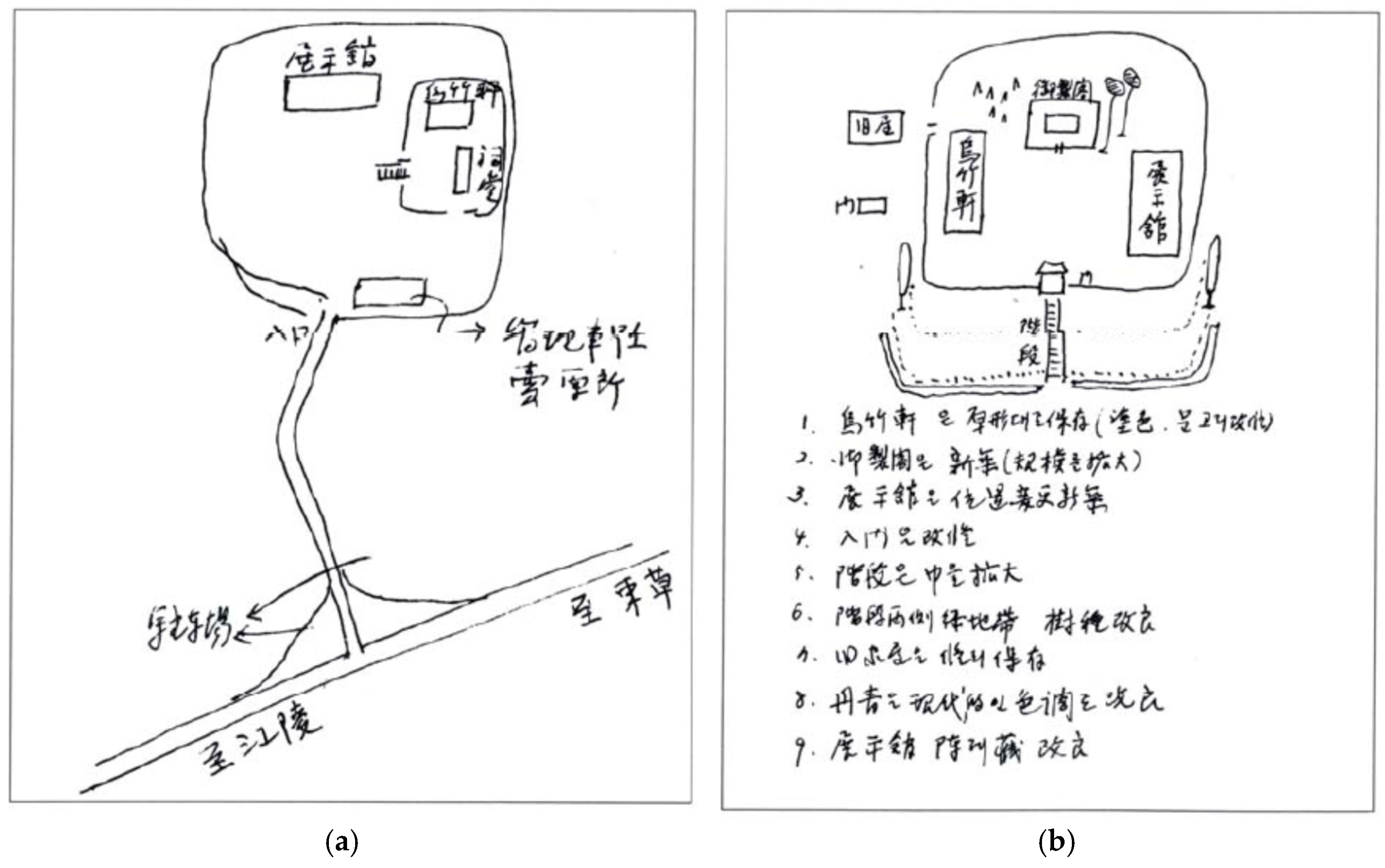
During his visit in October 1975, President Park stressed that Ojukhŏn was preserved inappropriately in a number of ways, and made a list of things that had to be done immediately, complete with two hand-made sketches of the purification plan (
Figure 6a,b). The list of requirements formulated by the president can be summarized as follows (based on
Kangwŏndo Chibang Munhwajae Kwalliguk 1976, pp. 77–81). First, the entire Ojukhŏn site should be repaired and preserved, whereas the Ojukhŏn building should be preserved in its current state. This is completely paradoxical, because the changes envisioned by the president implied a sweeping transformation of the site. This indicates that the understanding of “preservation” (K.
pojon) at the time was poorly understood by the authorities, including members of the OCP, who carried out the purification projects. Far from meaning to maintain something in its present form and ensure its authenticity and integrity, the 1970 notion of preservation allowed a significant degree of physical alterations, as long as Ojukhŏn (and other sites) expressed the intended discourse about Yulgok, modernization and national identity.
Second, Park Chung Hee required that Ŏjegak be demolished and rebuilt, motivating that the building’s origins and structure were inappropriate for holding the portrait of Yulgok, enshrined there in 1965. Ŏjegak was a small structure built after King Chŏngjo visited Ojukhŏn in 1788, upon hearing that Yi I’s personal belongings were kept in Kangnŭng. These were an inkstone and the land transfer deed, a document signed by Yulgok in 1579, attesting that he transferred his land to his maternal cousin, Kwŏn Ch’ŏgyun. The inkstone is engraved with an inscription commemorating the king’s visit and also with his own handwritten remarks. On this occasion, King Chŏngjo ordered the construction of Ŏjegak to ensure the proper preservation of Yulgok’s relics. It was indeed smaller in size and looked modest in comparison with the new buildings planned within the purification project, which were more imposing (most notably among them, the Munsŏngsa Altar, discussed below). The disappearance of Ŏjegak in 1975 due to demolition reveals that the historicity of the buildings did not constitute the deciding factor in preserving them or not. This small house commemorated a historical moment in the past of Ojukhŏn—a king’s visit—but it was still not deemed historical enough in itself, in order to be preserved. Instead, form and size seem to have prevailed in the decision process, at least in the case of buildings considered non-essential. The OCP eventually rebuilt Ŏjegak in 1987, in an attempt to recover something that had been unnecessarily lost during the excessive purification projects of the 1970s.
Third, the Yulgok Memorial Hall, built just a decade earlier, in 1965, was labeled too small for hosting exhibitions and inappropriately located, so the president ordered that it be demolished, rebuilt, and museum displays remade. This illustrates a trial-and-error pattern typical of purification projects, in which the OCP repeatedly reworked any element that failed to reach the president’s expectations (
Sîntionean 2021, p. 351).
Fourth, the residence in which the descendants of Kwŏn Ch’ŏgyun used to live should be preserved in its original form (K.
wŏnhyŏng), but the stonewall surrounding it should be rebuilt in the style of Kyŏngbokkung Palace’s outer wall. Purification projects often integrated architectural elements from the royal palaces of the Chosŏn dynasty, such as roof shapes and decorative patterns on stonewalls (
Sîntionean 2021, pp. 345, 355), due to their perceived elegance and refinement. In the case of Ojukhŏn, this strategy prioritized the aesthetic beauty of the final outcome, but disregarded the inconsonant and anachronistic integration of royal architecture into the residential spaces of Ojukhŏn.
Fifth, the parking lot was deemed too small for the two hundred thousand yearly visitors. Moreover, its position in 1974 was considered inappropriate, and the access road was too narrow. These aspects had to be corrected, given the popularity of the Yulgok Festival, held here. By the mid-seventies, the festival had grown in proportions, lasting two or even three days (in October) and drawing thousands of participants. In 1975, the attendance reached one hundred thousand people (
Kyŏnghyang sinmun 1975), so the purification project prepared the site for a large number of visitors. Besides the enlarged parking lot, the plan included a modernized entry road (new foundation and pavement), rest areas in a large plaza, information boards, a ticket booth, and toilets. All purification projects entailed this kind of modernization and preparation for large groups of tourists, an indication that the government envisioned the transformed historic sites as places of patriotic education and civic pilgrimage.
Sixth, since the state became the owner of the site, a new administration office had to be built on the precincts of Ojukhŏn to facilitate the control of the local authorities and the OCP over the property. The descendants of Kwŏn Ch’ŏgyun stopped inhabiting the place, ending the de facto status of Ojukhŏn as a traditional residential space.
And finally, the president set a deadline for the work–April 1976. The OCP was to make a plan integrating all these instructions and convey it to the provincial governor. Then, the project was to be carried out under the supervision of a director in modern construction, the OCP president, and the governor of Kangwŏn Province. The need for a specialist in modern architecture was most likely connected to the president’s expectation that the landscape architecture would change completely, in order to create the kind of tiered landscapes common in the purification projects.
Park Chung Hee’s hand-drawn sketches (
Figure 6a,b) created a visual guideline about his expectations.
Figure 6a shows that he wanted a paved access road leading to a large plaza where the new administration office and the parking lot would be situated. This large space would occupy the position previously held by the village houses that surrounded Ojukhŏn until 1975. Then, there were stairs leading from the plaza to an inner court, and, from there, other rows of stairs, following the elevation of the ground in two levels, led to the Ojukhŏn building (
Figure 6b). Paradoxically, the Ojukhŏn building, which was supposed to be the central focus of the site, was not highlighted in the new, recreated landscape. In the inner court designed in
Figure 6b, it stood modestly to the left, while the elevated axis along the stairs led to the Munsŏngsa Altar. This was a completely new creation, designed to hold Yulgok’s official portrait and built in 1976, higher than all the other buildings (
Munhwajaech’ŏng 2000, p. 106). As visitors ascended the stairs, they were expected to focus on the imposing altar before them and take in the site’s carefully constructed sense of grandeur.
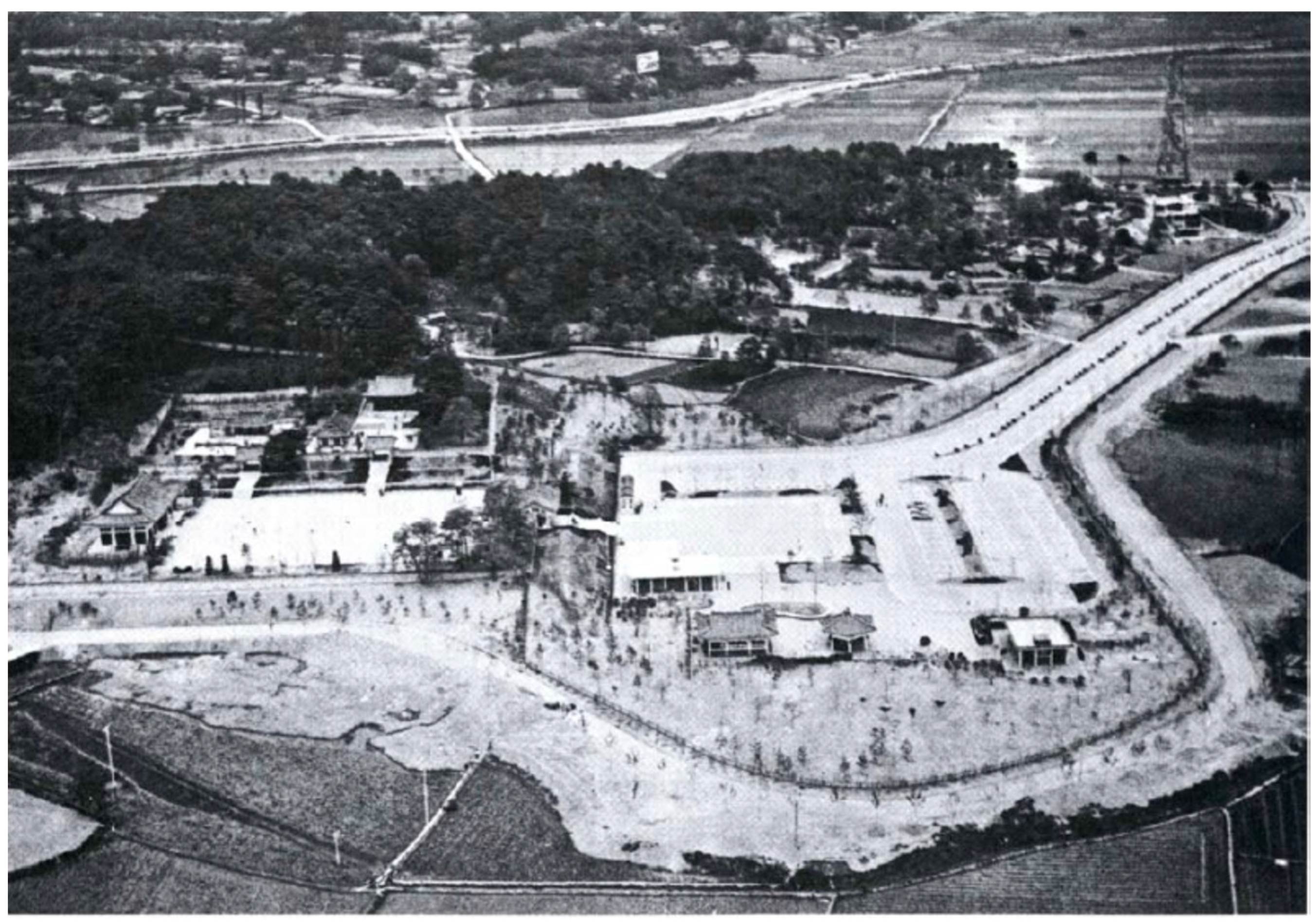
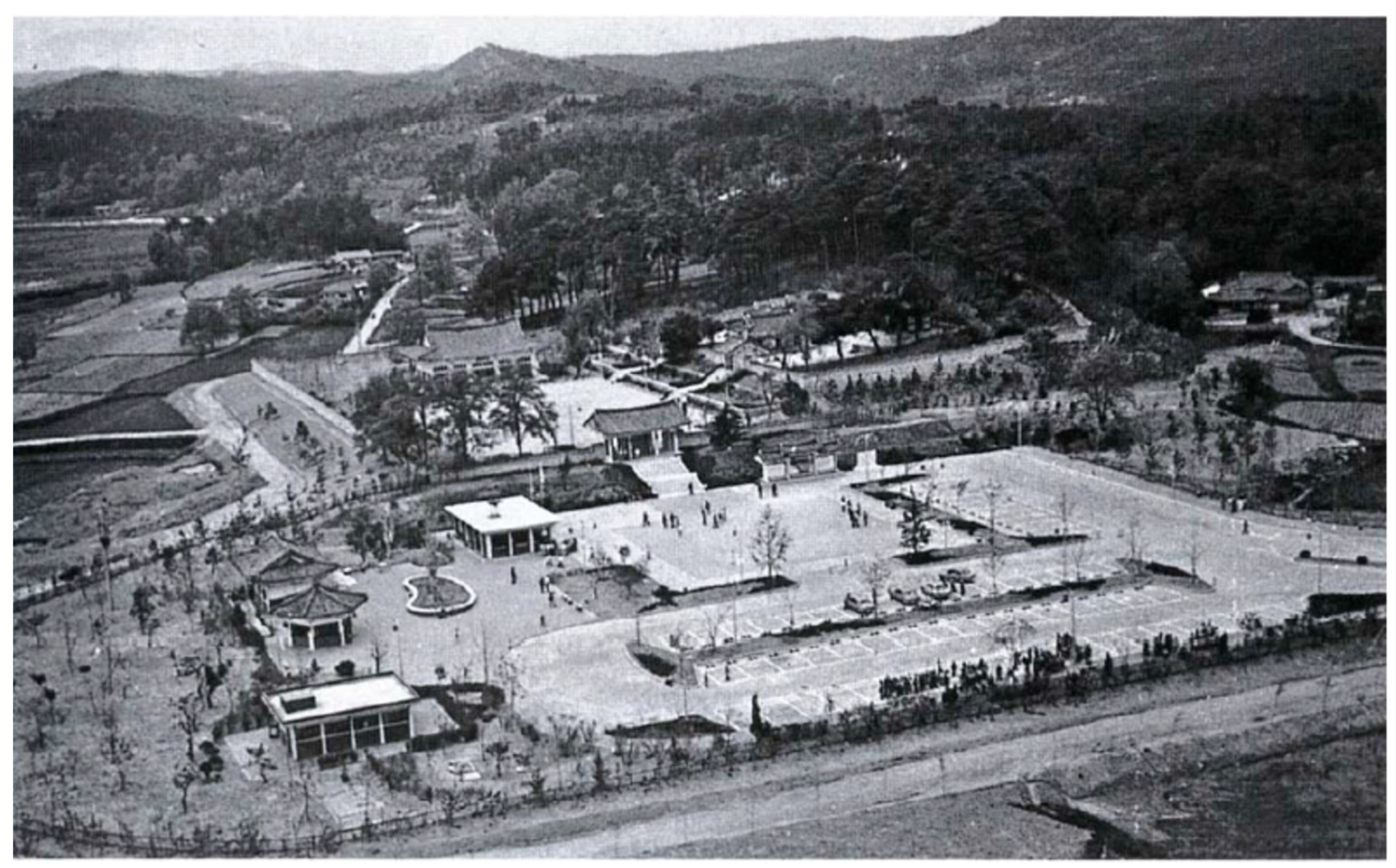
The president made the sketches on 14 October 1975, and the construction work began immediately, only two weeks later (28 October). By 30 April 1976, the list of necessary changes formulated by Park Chung Hee had been enforced to the letter, as can be seen in the photographs of the completed project (
Figure 7 and
Figure 8). In just a few months, the village houses disappeared, and Ojukhŏn was transformed from a residential space to a theme park dedicated to the memory of Yulgok and, to a lesser degree, his mother (
Sîntionean 2020)–an atmosphere lasting to this day (
Vermeersch 2013). The purification of Ojukhŏn demonstrates that, by the mid-1970s, the state had fully consolidated its authority over the public forms through which Yulgok could be commemorated. In effect, the government determined not only the ritual practice of commemoration at Ojukhŏn, but also the spatial and aesthetic framing of his memory. With the transformation of Ojukhŏn, it was clear that Yulgok’s memory had become a national asset managed closely by the state.