1. Introduction
In the midst of rapid social upheaval and moral disintegration in mid-19th-century Joseon Dynasty, the Donghak (Eastern Learning, 東學) movement emerged with a dual task: to critique the existing Confucian order and to envision a different and better alternative. Upon a closer look, however, we see that scholarly assessments of Donghak’s relationship to the Confucian tradition remain divided.
On one side, some scholars interpret Donghak as a radical religious movement that sought to overcome the metaphysical dualism of orthodox Neo-Confucianism and its endorsement of a rigid social hierarchy, while highlighting Donghak’s affinities with shamanism, Catholicism, or Buddhism (
J.-H. Kim 2005;
Lee 2014;
Bae 2020). Alternatively, Suun’s theology of serving the Heavenly Lord (侍天主) and his teachings on inner cultivation are seen as rooted more in mystical religious experience than in Confucian ethics (
Han 2004).
On the other side, there are scholars who argue that Donghak did not reject Confucianism wholesale but instead selectively appropriated and restructured its moral vocabulary to construct a distinct theological–ethical framework. They point to recurring Confucian terms—such as “shining forth bright virtue” (明明德), “heart” (心), and “respect” (敬)
1—in the
Donggyeong Daejeon, suggesting that these are not mere borrowings but indicators of a structural transformation of the Confucian conceptual framework (
Bak and Yun 2021;
Kun Wang 2023;
Yun 2025).
While these two perspectives delineate distinct interpretive directions, the present study aligns with the latter, which views Donghak not as a rupture from Confucianism but as a creative transformation within it (
Y.-H. Kim 2008;
Hwang 2015). By clarifying how Donghak’s adaptation of the Confucian conceptual framework embodies both continuity and innovation, this study aims to contribute to resolving the long-standing interpretive divide in Donghak scholarship. The present study takes up the second approach that aims to show that Donghak adapted the Confucian conceptual framework. After all, the founder of Donghak, Choe Je-u (崔濟愚, pen name Su-un 水雲, 1824–1864)
2, had long prepared for the traditional civil service examination (科擧試驗), devoting himself to the study of the Four Books (Sishu, 四書)—namely, the
Analects (論語), the
Mencius (孟子), the
Great Learning (大學), and the
Doctrine of the Mean (中庸). This sustained engagement with Confucian classics may have left discernible traces in Donghak’s foundational scripture, the
Donggyeong Daejeon (東經大全).
3The scholarship following the second approach suggests that Donghak restructured inherited Confucian categories through theological recontextualization rather than simple replication. Yet most existing interpretations remain hermeneutic in nature, lacking empirical investigation into how Confucian terms and concepts are actually deployed within Donghak’s textual corpus. The precise degree and pattern of conceptual overlap between the two traditions thus remain insufficiently mapped. As
Cawley (
2012) observes in the context of Catholic texts, even externally introduced ideas were not received passively but were resemanticized within the conceptual frameworks of late Joseon Neo-Confucianism. Although Donghak emerged indigenously rather than through foreign transmission, its transformation of inherited Confucian categories follows a similar logic of creative recontextualization.
This study addresses that methodological gap by conducting a comparative analysis of the
Donggyeong Daejeon and the Four Books using text mining techniques.
4 Preprocessed classical Chinese corpora were subjected to word frequency analysis, keyword-in-context (KWIC), conceptual co-occurrence mapping, and semantic network visualization. The empirical findings were then integrated into subsequent hermeneutic interpretation, not as deterministic indicators of conceptual importance but as heuristic cues that guide interpretive exploration of how Donghak appropriated and transformed Confucian ideas within its theological system.
The investigation centers on two interrelated research questions:
- (1)
To what extent, and in what manner, do the core concepts in the Donggyeong Daejeon correspond to the key terms of the Confucian Four Books?
- (2)
How does Donghak rearrange and transform these inherited concepts to establish its own theological and ethical system?
By addressing these questions, the study reveals that Donghak neither mimics nor severs itself from Confucianism. Rather, it reappropriates its core moral lexicon in the service of constructing a new religious language. Through this conceptual realignment, Donghak reconfigures the moral and metaphysical foundations of the inherited tradition. Furthermore, by applying computational methods to reconstruct the conceptual networks within and between these corpora, the study proposes a novel methodological framework for tracking conceptual shifts across East Asian religious and philosophical traditions.
2. Materials and Methods
2.1. Data Selection
Among the key scriptures authored by Su-un that represent early Donghak thought are the Donggyeong Daejeon (東經大全) and the Yongdam Yusa (龍潭遺詞). The Donggyeong Daejeon is a collection of classical Chinese texts composed by Su-un, which encapsulate the core doctrines and conceptual structure of Donghak thought. In contrast, his other work, Yongdam Yusa, is not suitable for quantitative textual analysis, as it is written in vernacular Korean using the gasa poetic form rather than in classical Chinese. For example, the term “heaven” appears not as the character 天 but as the Korean expression “Hanulnim” (한울님). Accordingly, this study selected the Donggyeong Daejeon as the sole text for analysis, based on its linguistic consistency and suitability for computational methods.
For the Confucian corpus, among the vast range of classical texts, this study selected the Four Books (the
Analects, the
Mencius, the
Great Learning, and the
Doctrine of the Mean) as annotated by Zhu Xi (朱熹, 1130–1200) in his Collected Commentaries on the Four Books (四書集註.
Sishu Jizhu). These texts served as core instructional materials for Neo-Confucianism
5 and were compulsory in the civil service examinations of Joseon dynasty, directly shaping the intellectual context of Su-un’s era. Moreover, the Four Books are the most closely linked Confucian texts to the
Donggyeong Daejeon, frequently cited within it and sharing numerous key concepts, thus making them a valid comparative basis for conceptual analysis.
As detailed in the
Supplementary Materials, the texts used for analysis are as follows: (1) the Mokcheon edition (Gye-mi Jungchun-pan, 1853) of the Donggyeong Daejeon obtained from the official website of the Cheondogyo Central Headquarters;
6 and (2) the Four Books as provided by the Chinese Text Project (CTEXT),
7 based on Zhu Xi’s commentarial edition. The total character counts for each text are 5301 characters for the
Donggyeong Daejeon and 54,634 characters for the Four Books. All data were preprocessed for contextual and quantitative analysis and served as the basis for subsequent frequency and co-occurrence analyses. During preprocessing, 115 function words—including grammatical particles, conjunctions, pronouns, numerals, and time/spatial expressions—were identified and removed as stopwords. The complete stopword list is publicly available via OSF (Open Science Framework). Jieba-based N-gram analysis was additionally conducted to verify the appropriateness of unit segmentation. As most key concepts appeared as single-character 1-g, the study adopted 1-g as the primary unit of analysis (
Gries and Ellis 2015).
8 Although higher-order n-grams (2-g and above) were briefly examined for reference, they did not yield significant insights; details are provided in the
Supplementary OSF Files. To account for differences in corpus size, proportional frequency normalization was applied, calculating character frequency per 100 characters (
Gries 2010, pp. 271–72).
2.2. Data Analysis
This study does not treat frequency as a direct indicator of theological or conceptual importance. Instead, frequency patterns serve as heuristic cues to guide interpretive analysis, whose validity ultimately depends on hermeneutic contextualization rather than numerical prominence.
First, the relative frequency of shared conceptual terms was calculated based on the total character count and the frequency of occurrence in both the
Donggyeong Daejeon and the Four Books. For each concept, both the absolute count and the proportional frequency (%) were computed; the results are summarized in
Table 1. Specifically, proportional frequency was calculated as the ratio of each concept’s occurrences to the total number of characters in the respective textual corpus. Based on this, the top 15 shared concepts were selected using a Combined Ratio (%), which was derived by summing the proportional frequencies for each concept across the two corpora. This Combined Ratio served solely as a comparative ranking metric and was not a normalized value.
Second, a KWIC (Key Word in Context) analysis
9 was conducted for each of the 15 concepts with the highest relative frequency. For each concept, its surrounding context was extracted within a ±10-character window, and the most frequently co-occurring word within that window, along with its proportional occurrence rate, was identified. The resulting percentage indicates the proportion of contexts in which the top co-occurring word appears relative to all KWIC instances for the given concept. These results are presented in
Table 2, offering a quantitative overview of the conceptual associations most closely linked to each keyword in both corpora.
Third, to compare the relational structure of key concepts in the
Donggyeong Daejeon and the Four Books, a co-occurrence network analysis
10 was performed. Using the 15 most frequent concepts based on relative frequency, all co-occurring concept pairs within a ±30-character window were extracted to construct a semantic network. The frequency of each co-occurring pair was applied as the edge weight, and the total weight of edges connected to each node was calculated as the node strength. To enhance interpretability and ensure reproducibility, this study adopts a simplified additive approach—calculating node strength as the sum of co-occurrence frequencies—to approximate conceptual centrality, rather than employing complex graph-theoretical indices.
Table 3 presents the top 10 co-occurring concept pairs by absolute frequency in each corpus, while
Table 4 lists the top 10 nodes by node strength, indicating the centrality of each concept in the semantic network.
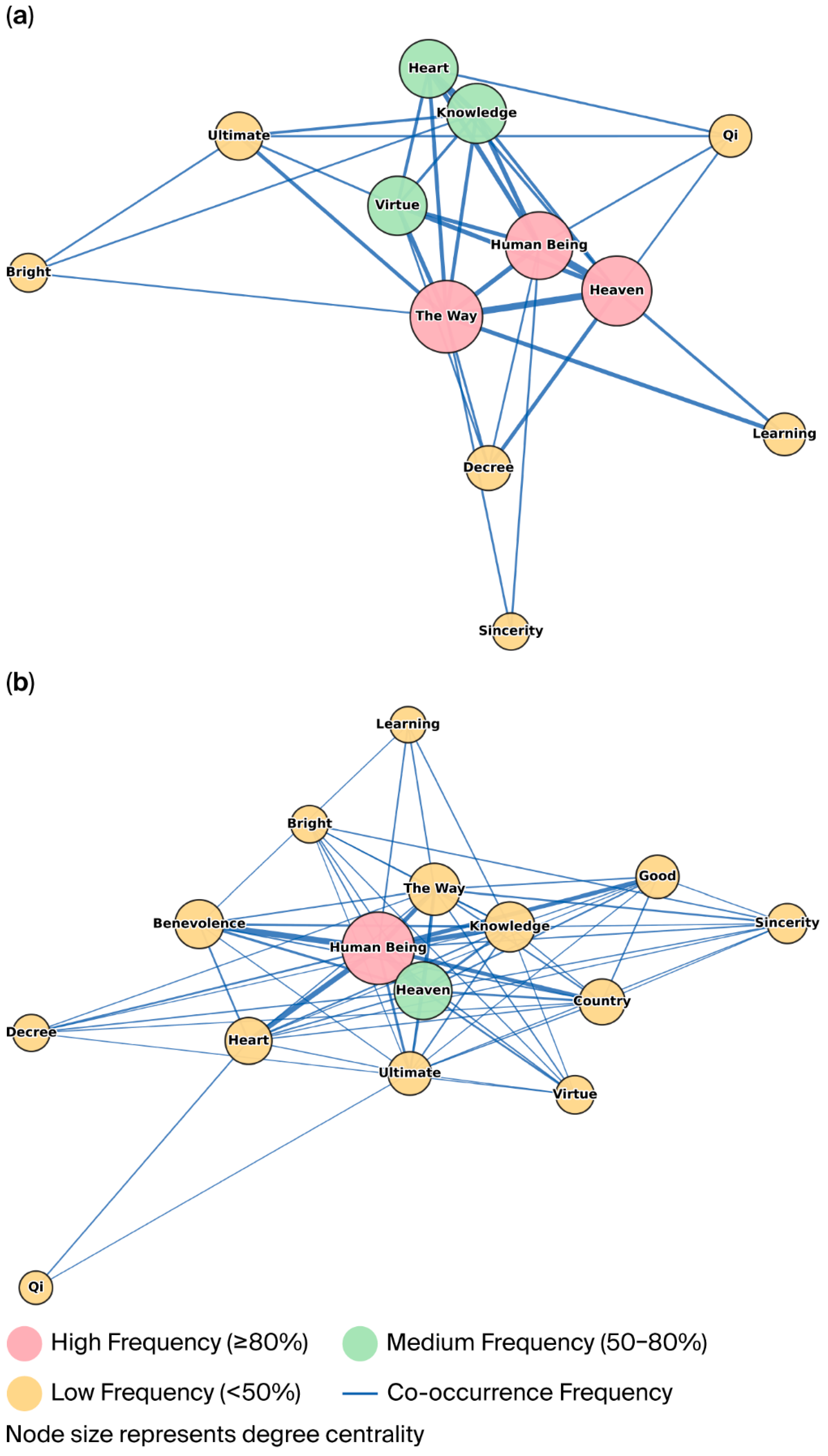
Fourth, a two-dimensional visualization of the co-occurrence networks was generated using networkx (v3.4.2) and matplotlib (v3.9.2). Nodes were depicted as circles, and co-occurrence relationships were indicated by blue edges, allowing for intuitive interpretation of the conceptual structure. Node size and color varied according to node strength: the top 20% were colored pink (Most Important), the next 30% green (Important), and the bottom 50% yellow (Less Important). Edge thickness was proportional to co-occurrence frequency, visually emphasizing stronger relationships. The spring_layout algorithm was applied to position highly connected nodes near the center and less connected nodes toward the periphery. Only co-occurrences with a frequency of 10 or more were visualized to highlight the core conceptual relationships. These visualizations are presented in
Figure 1a,b.
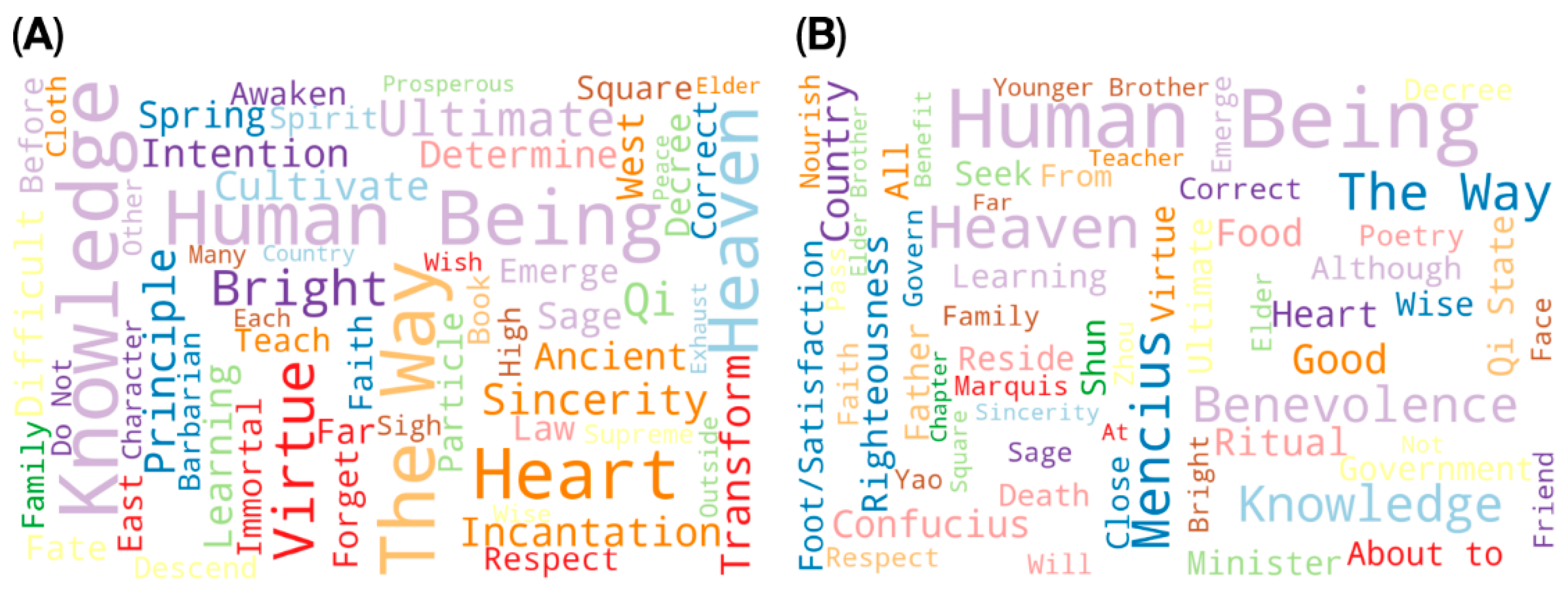
Finally, to visually compare key concepts across the two corpora, a word cloud analysis was conducted. The top 60 concepts by relative frequency were extracted, with font size scaled between 12 pt and 130 pt according to frequency. A paired color map was used for visual differentiation, and word placement alternated between horizontal and vertical orientations to optimize spatial layout. The results are shown in
Figure 2.
This study prioritized transparency and reproducibility as core methodological principles. To this end, the entire analytical environment and data processing workflow were systematically documented, and all data, code, and visualization outputs were made publicly available via the Open Science Framework (OSF). Analyses were performed using Python (v3.13), with core libraries such as pandas (v2.2.2), networkx (v3.4.2), and jieba (v0.42.1). Code development and implementation were supported by Cursor AI (build 0.38). All results were exported in standardized formats (CSV, PNG), and analytical parameters were consistently fixed to ensure reproducibility.
Table 1.
Top 15 Shared Conceptual Characters by Relative Frequency in the Donggyeong Daejeon and the Four Books.
Table 1.
Top 15 Shared Conceptual Characters by Relative Frequency in the Donggyeong Daejeon and the Four Books.
| Rank | Concept
(Chinese Character) | Donggyeong Daejeon
Count (%) | The Four Books Count (%) | Combined Ratio11 |
|---|
| 1 | Human being (人) | 68 (1.283) | 921 (1.686) | (2.969) |
| 2 | Knowledge (知) | 80 (1.509) | 287 (0.525) | (2.034) |
| 3 | The Way (道) | 68 (1.283) | 304 (0.556) | (1.839) |
| 4 | Heaven (天) | 57 (1.075) | 416 (0.761) | (1.837) |
| 5 | Heart (心) | 57 (1.075) | 143 (0.262) | (1.337) |
| 6 | Virtue (德) | 35 (0.66) | 109 (0.2) | (0.86) |
| 7 | Ultimate (至) | 26 (0.49) | 115 (0.21) | (0.701) |
| 8 | Bright (明) | 26 (0.49) | 69 (0.126) | (0.617) |
| 9 | Benevolence (仁) | 1 (0.019) | 283 (0.518) | (0.537) |
| 10 | Learning (學) | 16 (0.302) | 111 (0.203) | (0.505) |
| 11 | Qi (氣) | 22 (0.415) | 27 (0.049) | (0.464) |
| 12 | Sincerity (誠) | 19 (0.358) | 57 (0.104) | (0.463) |
| 13 | Country (國) | 6 (0.113) | 174 (0.318) | (0.432) |
| 14 | Good (善) | 5 (0.094) | 177 (0.324) | (0.418) |
| 15 | Destiny (命) | 13 (0.245) | 89 (0.163) | (0.408) |
Table 2.
KWIC-Based Top Co-occurring Characters by Concept in the Donggyeong Daejeon and the Four Books.
Table 2.
KWIC-Based Top Co-occurring Characters by Concept in the Donggyeong Daejeon and the Four Books.
| Rank | Concept
(Chinese Character) | Top KWIC Co-Occurring Character (Rank1) |
|---|
| Donggyeong Daejeon KWIC | (%) | The Four Books
KWIC | (%) |
|---|
| 1 | Human being (人) | Heaven (天) | 41.176 | Heaven (天) | 12.595 |
| 2 | Knowledge (知) | Heart (心) | 27.5 | Human being (人) | 31.359 |
| 3 | The Way (道) | Heaven (天) | 35.294 | Human being (人) | 24.013 |
| 4 | Heaven (天) | Human being (人) | 49.123 | Human being (人) | 27.885 |
| 5 | Heart (心) | Knowledge (知) | 38.596 | Human being (人) | 58.042 |
| 6 | Virtue (德) | The Way (道) | 60 | Heaven (天) | 21.101 |
| 7 | Ultimate (至) | Qi (氣) | 46.154 | Heaven (天) | 26.956 |
| 8 | Brightness (明) | The Way (道) | 34.615 | Sincerity (誠) | 31.884 |
| 9 | Benevolence (仁) | Righteousness (義) | 100 | Human being (人) | 37.456 |
| 10 | Learning (學) | The Way (道) | 93.75 | The Way (道) | 21.622 |
| 11 | Qi (氣) | Ultimate (至) | 54.546 | Will (志) | 59.259 |
| 12 | Sincerity (誠) | Faith (信) | 57.895 | The Way (道) | 45.614 |
| 13 | Country (國) | Peace (安) | 50 | Human being (人) | 28.736 |
| 14 | Good (善) | Heart (心) | 80 | Human being (人) | 41.808 |
| 15 | Destiny (命) | Heaven (天) | 107.692 | Heaven (天) | 21.348 |
Table 3.
Top 10 Conceptual Co-occurrences by Strength in the Donggyeong Daejeon.
Table 3.
Top 10 Conceptual Co-occurrences by Strength in the Donggyeong Daejeon.
| Rank | Donggyeong Daejeon | The Four Books |
|---|
| Top_Connection | Frequency | Top_Connection | Frequency |
|---|
| 1 | Human being—Heaven | 57 | Human being—Heaven | 235 |
| 2 | Heaven—The Way | 53 | Human being—Benevolence | 190 |
| 3 | Heart—Knowledge | 35 | Human being—Heart | 165 |
| 4 | Human being—The Way | 34 | Human being—Knowledge | 146 |
| 5 | Human being—Heart | 34 | Human being—The Way | 130 |
| 6 | Heaven—Virtue | 33 | Human being—Good | 123 |
| 7 | Human being—Knowledge | 33 | Human being—Country | 117 |
| 8 | Learning—The Way | 31 | Heaven—The Way | 97 |
| 9 | Virtue—The Way | 31 | Human being—Ultimate | 65 |
| 10 | Human being—Virtue | 28 | Benevolence—Heaven | 61 |
Table 4.
Top 10 Conceptual Co-occurrences by Strength in the Four Books.
Table 4.
Top 10 Conceptual Co-occurrences by Strength in the Four Books.
| Rank | Donggyeong Daejeon | The Four Books |
|---|
| Node | Node_Weight | Node | Node_Weight |
|---|
| 1 | The Way (道) | 263 | Human being (人) | 1328 |
| 2 | Heaven (天) | 240 | Heaven (天) | 734 |
| 3 | Human being (人) | 221 | The Way (道) | 527 |
| 4 | Knowledge (知) | 161 | Knowledge (知) | 478 |
| 5 | Virtue (德) | 155 | Benevolence (仁) | 436 |
| 6 | Heart (心) | 149 | Heart (心) | 377 |
| 7 | Ultimate (至) | 81 | Country (國) | 350 |
| 8 | Destiny (命) | 63 | Ultimate (至) | 282 |
| 9 | Learning (學) | 51 | Good (善) | 270 |
| 10 | Qi (氣) | 50 | Sincerity (誠) | 191 |
3. Results
Table 1 displays the relative frequency of key conceptual terms found across both the
Donggyeong Daejeon and the Four Books. Notably, “human being” (人), “knowledge” (知), “the Way” (道), and “Heaven” (天) appear with similarly high frequency, registering combined ratios of 2.969, 2.034, 1.839, and 1.837, respectively.
Table 2 illustrates the co-occurrence patterns among “human being” (人), “Heaven” (天), and “the Way” (道) based on KWIC (Key Word in Context) analysis. Specifically, “human being” co-occurred most frequently with “Heaven” in both corpora—41.176% in the
Donggyeong Daejeon and 12.595% in the Four Books. Likewise, “Heaven” most frequently co-occurred with “human being”—49.123% and 27.885%, respectively—highlighting a strong mutual association. “The Way” exhibited its highest co-occurrence with “Heaven” in the
Donggyeong Daejeon (35.294%) and with “human being” in the Four Books (24.013%). These results suggest a conceptual triangle in which human being, Heaven, and the Way are closely interlinked.
Notably, “qi” (氣) and “sincerity” (誠) exhibited the highest co-occurrence with different associated terms in each corpus, with percentages approaching or exceeding 50%. In the Donggyeong Daejeon, “qi” most frequently co-occurred with “ultimate” (至) at 54.546%, while in the Four Books it co-occurred most with “will” (志) at 59.259%. “Sincerity” showed its highest co-occurrence with “faith” (信) in the Donggyeong Daejeon at 57.895%, and with “the Way” (道) in the Four Books at 45.614%. These results indicate that, despite shared terms, the semantic networks differ significantly between the two textual collections.
Table 3 presents the top co-occurring term pairs by absolute frequency. In the
Donggyeong Daejeon, the pairs “human being”—“Heaven” (57 occurrences), “Heaven”—“the Way” (53), and “human being”—“the Way” (34) form a balanced triangular structure, reflecting a coherent semantic network. In contrast, the Four Books exhibits a hierarchical network centered on “human being”, with prominent pairs including “human being”—“Heaven” (235 occurrences), “human being”—“benevolence” (190), and “human being”—“heart” (165), indicating a strong anthropocentric structure.
Table 4 further confirms this structural difference through an analysis of node strength. While “the Way”, “human being”, and “Heaven” rank as the top three nodes in both corpora, the
Donggyeong Daejeon shows balanced node strengths (263, 221, 240, respectively), whereas “human being” dominates in the Four Books with a node strength of 1328, compared to 572 (“Heaven”) and 481 (“the Way”), reflecting a pronounced hierarchical center.
The network graphs (
Figure 1a,b) make these differences visually clear. In the
Donggyeong Daejeon, “human being,” “Heaven,” and “the Way” are all highlighted in pink (Most Important) and form a central triangular structure with thick, closely connected edges. By contrast, in the Four Books, “human being” occupies the central position, while “Heaven” and “the Way” are placed peripherally, forming a hierarchical semantic network. The word cloud visualizations (
Figure 2) reinforce this structure. In both corpora, “human being,” “Heaven,” and “the Way” are the most visually prominent, confirming that these three concepts form a shared ideological core.
In summary, both textual corpora exhibit a common conceptual framework centered on “human being” (人), “Heaven” (天), and “the Way” (道). However, the relational patterns among individual terms differ markedly. In particular, “sincerity” (誠) and “qi” (氣) are associated with distinct terms in each corpus, reflecting divergent semantic networks and intellectual orientations. These data-driven findings will be further interpreted in the following section, focusing on Donghak’s theological reconfiguration and its reinterpretation of Confucian categories.
4. Interpretive Discussion
The following three subsections interpret the quantitative results within Donghak’s theological framework.
Section 4.1 examines the cosmological triad of human being (人), Heaven (天), and the Way (道), which constitutes the structural core shared by both the
Donggyeong Daejeon (東經大全) and the Four Books.
Section 4.2 explores how sincerity (誠), one of the most pivotal moral concepts in Confucianism, is redefined in Donghak as a faith-oriented form of theological praxis.
Section 4.3 turns to the concept of
qi (氣), tracing its transformation from an ethical medium of self-cultivation to an ontological principle that embodies divine reality. Taken together, these discussions show how the linguistic patterns revealed through text mining illuminate Donghak’s doctrinal evolution—specifically, its reinterpretation of Confucian moral discourse as a monistic theology grounded in divine immanence.
4.1. “Heaven’s Heart Is the Human-Heart” (天心卽人心): Rearticulating Confucian Cosmology in Early Donghak
The doctrinal architecture of early Donghak, namely its internal conceptual and ethical order, is grounded in a cosmological triad—human being (人), Heaven (天), and the Way (道)—whose semantic and conceptual configurations strongly echo those of early Confucian thought. In both corpora, these terms do not function independently but form a network of mutually implicating ideas that frame the moral and ontological order. The textual data drawn from the
Donggyeong Daejeon confirms that these three nodes—human being (人), Heaven (天), and the Way (道)—emerge as statistically central and semantically interdependent, mirroring the Confucian emphasis on the alignment between human conduct and cosmic principle (
Li 1999;
Keping Wang 2019).
In Confucian canonical texts, the interrelation of Heaven (天) and human being (人) is articulated through an evolving metaphysical syntax. In the
Analects, Heaven (天) appears as a revered and inscrutable moral force—“Without knowing Heaven’s Mandate, one cannot be a true junzi” (不知命,無以為君子也,
Analects 12.4;
Legge 1971)—implying a moral order so fundamental that it demands reverence rather than rational grasp. Confucius famously remarked, “One who offends Heaven has no one to whom one can pray” (獲罪於天,無所禱也,
Analects 3.13;
Legge 1971), underscoring the inviolability of the Heavenly order. In
Mencius 7A:1, this sense of reverent submission to Heaven evolves into the doctrine of “serving Heaven” (事天), wherein the human heart becomes the locus of moral awareness aligned with Heaven’s will. As Mencius says in the passage, “One who fully develops one’s mind knows one’s nature. Knowing one’s nature, one knows Heaven” (盡其心者, 知其性也; 知其性, 則知天矣) (Mencius 7A:1;
Huff 2017).
This metaphysical trajectory culminates in the
Doctrine of the Mean (中庸), where the unification of the Heavenly Way (天道) and the Human Way (人道) is most explicitly articulated. The text declares, “What Heaven has conferred is called our nature; to follow our nature is called the Way” (天命之謂性,率性之謂道) (
Doctrine of the Mean, chap. 1). In this synthesis, human moral cultivation becomes the medium through which cosmic harmony is realized. Consequently, Confucian cosmology gradually evolves from a transcendental to an immanent ethical framework, wherein Heaven is no longer merely revered but actualized within human conduct (
Back 2016).
It is within this cosmological and ethical continuum that Donghak’s doctrine of “humans are Heaven” (人是天)
12 must be situated (
Y.-H. Kim 2011, p. 50). Far from being a rupture from Confucian orthodoxy, “humans are Heaven” rearticulates the long-standing Confucian aspiration toward “the unity of Heaven and humans” (天人合一). As several scholars have shown, the
Donggyeong Daejeon (東經大全) does not merely appropriate Confucian terms, but repositions them within a theological schema that intensifies their ontological proximity (
Park 2003). Whereas the
Doctrine of the Mean (中庸) emphasized harmony between Heaven (天) and human nature (性), Donghak identifies the human being as the site of Heaven’s immanence. Humans do not merely reflect Heaven; they embody it (
Seong 2022).
This cosmological and ethical continuity is further substantiated by the results of the co-occurrence network analysis (see
Figure 1a,b). In both corpora, the recurring triad of human being (人), Heaven (天), and the Way (道) emerges as ideologically central, reflecting a profound structural resonance between Donghak and the Confucian tradition. Yet, Donghak does not merely preserve these inherited categories; rather, it reconfigures them within a moral-theological framework that renders their ontological relations more immanent and embodied. This doctrinal transformation is most vividly expressed in the repositioning of the concept of Sincerity (誠), which will be the focus of
Section 4.2.
In short, the cosmological logic of the Donggyeong Daejeon (東經大全) demonstrates a critical yet respectful engagement with the Confucian framework. It neither abandons nor merely mimics Confucian cosmology but reconfigures it to elevate the human subject as the sacred locus of cosmic realization.
4.2. Sincerity (誠) Rooted in Faith (信): The Theological Reconfiguration of Sincerity in Early Donghak
Among the central normative terms found in the Four Books (四書), few occupy as structurally pivotal a position as sincerity (誠). In Confucianism, and particularly in the
Doctrine of the Mean (中庸), sincerity (誠) denotes not only the apex of moral cultivation but also the ontological basis of cosmic harmony (
Min 2018, pp. 32–33). “Only those who are utterly sincere can fully realize their nature,” the
Doctrine of the Mean (中庸) declares, “and in fully realizing their nature, they assist in the transforming and nourishing process of Heaven and Earth” (唯天下至誠為能盡其性, 盡其性則能盡人之性, 盡人之性則能贊天地之化育) (
Doctrine of the Mean, chap. 23).
Here, sincerity (誠) functions as an ontological mediator between the human being (人) and Heaven (天), but its realization is rooted in a moral framework of self-cultivation (
Chen 2009). The ethical telos of Confucianism, therefore, is not merely behavioral rectitude but a state of ontological transparency wherein one’s nature resonates with the cosmic order.
However, this ideal remains situated within the boundaries of moral cultivation and philosophical abstraction, without extending into a concrete mode of theological praxis. sincerity (誠), in this context, functions as the culmination of ethical self-cultivation rather than as an enacted form of divine engagement (
Tu 1989, pp. 107–12).
In contrast, Donghak reconfigures sincerity (誠) not as a metaphysical ideal but as a faith-based praxis grounded in discernment and commitment. Su-un addresses this point in the concluding section of “Sudeokmun” (修德文), a chapter in the Donggyeong Daejeon (東經大全), as follows:
“In our religion, the mind (心) that believes has sincerity (誠). If we analyze the term faith (信) it is composed of man and word. Among words, some are true and some are false. Choose true words, and reject false words, and then think again and decide firmly. Faith is not believing any other words after a firm decision has been made. If one would practice in such a way, he will achieve sincerity. The principles of sincerity and faith are not so far apart. The word faith is based on the terms human and word, and the word sincerity is composed of word and achievement. Thus, first have faith and then sincerity.”
13
This formulation of sincerity (誠) reveals a semantic reorientation. While in the
Doctrine of the Mean (中庸), sincerity (誠) is conceptually aligned most closely with the Way (道)—suggesting an ontological culmination of moral alignment with the Way (道)
14—the
Donggyeong Daejeon (東經大全) presents a different network: here, Sincerity (誠) is most intimately linked with faith (信) (see
Table 2, Rank 12). This lexical association suggests a theological reconfiguration of sincerity from an abstract moral principle to a faith-driven practice of discernment and speech.
Such a view entails a paradigmatic shift. While Confucianism posits sincerity (誠) as an innate capacity to be actualized through self-cultivation, Donghak treats it as a state to be achieved through faithful practice. As
Yun (
2025) has shown, this shift reflects Donghak’s move from Confucian metaphysics to a theology of internalized sincerity, in which the moral subject aligns with divine presence through faith (信).
Importantly, this theological reconfiguration does not reject the Confucian framework. Instead, it reframes it from within. The doctrinal progression from faith (信) to sincerity (誠) preserves the structural arc of cultivation while reorienting its telos from ontological completion to spiritual communion. What was once an ideal of cosmological alignment becomes, in Donghak, a faith-based mode of religious practice.
In sum, sincerity (誠) in Donghak no longer signifies a mere ethical culmination, but rather a performative sincerity realized through faith (信)—a sincerity (誠) that binds the moral subject to divine immanence.
Unlike Confucianism—especially the Doctrine of the Mean, where sincerity (誠) signifies an ontological alignment with the Way (道)—Donghak redefines sincerity as an existential mode of theological practice. Rather than rejecting the Confucian framework, Donghak redirects its metaphysical arc: cultivation leads not to ontological completion, but to a faith-based communion with the indwelling divine. Sincerity thus marks not the culmination of self-cultivation but the beginning of divine encounter. This theological turn also provides the conceptual basis for overcoming Neo-Confucian dualism between li (理) and qi (氣), allowing Donghak to develop a monistic qi-philosophy grounded in cosmological immanence. Within this framework, the notion of “ultimate energy” (至氣) emerges—not as a metaphysical abstraction, but as the medium of divine-human continuity, which the next section will explore.
4.3. From Flood-like Vital Energy (浩然之氣) to Ultimate Energy (至氣): The Theological Reconstruction of Qi (氣) in Early Donghak
The concept of
qi (氣) has long occupied a central place in East Asian cosmology, ethics, and self-cultivation. In early Confucian texts such as the
Analects and the
Mencius,
qi (氣) was often invoked in relation to vital energy (
Shun 1997, p. 68). Particularly in
Mencius 2A:2, the phrase “flood-like vital energy” (浩然之氣) described a morally cultivated force that fills the space between Heaven and Earth (天地) when nurtured through righteousness (義) and inner integrity (直). However, in the classical period,
qi (氣) remained primarily an ethical and psychophysical notion associated with personal cultivation rather than an ontological foundation of the cosmos. That is, in early Confucianism,
qi (氣) functioned not as a metaphysical principle of unity, but rather as a medium for ethical cultivation.
It was not until later thinkers such as Zhang Zai (張載, 1020–1077) that
qi (氣) became the ontological substratum of all existence. In his “Rectifying Ignorance” (正蒙), Zhang Zai articulated a monistic metaphysics wherein the universe and all beings were unified by
qi (氣), thereby providing a cosmological foundation for Confucian ethics (
Chan 1969). Yet even in this mature form, and was subordinated to the principle of
li (理) in the Cheng-Zhu (程朱) school that became the orthodox form of Neo-Confucianism in China and Korea. Thus, the dualistic framework of
li (理) and
qi (氣) dualism became entrenched, limiting the full ontological actualization of
qi (氣).
Su-un, the founder of Donghak, radically reimagined the role of
qi (氣) within a theological and ontological framework that went beyond both early Confucian moral psychology and Neo-Confucian dualism. In the
Donggyeong Daejeon (東經大全), Su-un introduces the notion of “ultimate energy” (至氣) as the highest and most sacred form of
qi (氣), one that simultaneously animates the universe and dwells immanently within the human heart (
Ch’oe 2007, p. 65). This move signals a decisive shift toward a pantheistic monism, wherein all beings are constituted and connected by divine
qi (氣). Importantly, this framework avoids any bifurcation between spirit and matter, or between the divine and the human, thus rejecting both Catholic dualism and Neo-Confucian dualism of
li and
qi (氣) (
Yun 2025).
This ontological reformulation of
qi is also reflected in Donghak’s central religious practice, cultivating one’s heart and aligning one’s vital energy (修心正氣, Kr.
susim jeonggi). While echoing
Mencius’s exhortation to nourish the flood-like vital energy (浩然之氣) through moral integrity, Su-un’s reinterpretation embeds this cultivation within a theological teleology. More specifically, whereas the flood-like vital energy (浩然之氣) is cultivated through the continuous practice of moral goodness,
susim jeonggi (修心正氣) is cultivated through a distinctly religious act—namely, the recitation of the 21-character “Master’s Incantation,” (呪文) (
Song 2023, p. 69). In this sense,
susim jeonggi (修心正氣) becomes both a spiritual discipline and an ontological alignment with the divine.
Unlike the Confucian texts in which
qi is often associated with terms such as “heart” (心) or “will” (志), reflecting its function within personal moral self-cultivation, the
Donggyeong Daejeon prominently links
qi (氣) with
zhi (至, ultimate), (see
Table 2, Rank 11) signaling its reconceptualization as the ultimate divine force.
Moreover, Su-un’s concept of “ultimate energy” (至氣) enables a theological elevation of
qi (氣) that supports Donghak’s ethical universalism and soteriological claims. As set forth in the “Master’s Incantation,” (呪文) the practitioner declares: “Serving the Heavenly Lord, I am granted immortality, and being limitless, I shall know all things.” Here, immortality (不死, Kr.
bulsa) and omniscience are not traits of an individual soul, but rather states attained through identification with “ultimate energy” (至氣), which constitutes the divinity pervading all beings. In this light,
qi (氣) is no longer a medium of cultivation alone, but the very substance of divine reality (
Ch’oe 2007, p. 66).
By reconceptualizing
qi (氣) in this way, Donghak bridges the divide between Confucianism and shamanic-spiritual traditions without collapsing into esotericism. It appropriates the Confucian vocabulary of cultivating one’s heart (修心, Kr.
susim), sincerity (誠), and
qi (氣), while reinvesting these terms with theological significance. This reformulation offers a uniquely Korean monism grounded in indigenous spirituality and classical thought, resisting both Western dualism and Confucian formalism. In so doing, Su-un’s theology of
qi (氣) completes the trajectory begun by the early Confucians, bringing to fruition the long-standing ideal of “the unity of Heaven and humans” (天人合一) (
Park 2003, p. 88).
5. Conclusions
This study has demonstrated that the Donggyeong Daejeon (東經大全) does not merely inherit Confucian terminology but systematically reconfigures it within a distinct theological and ontological framework. Rather than mimicking or rejecting the Confucian tradition, early Donghak reappropriates its conceptual lexicon—particularly the key terms Heaven (天), and sincerity (誠), and qi (氣)—to articulate a unique moral theology grounded in panentheistic monism. For example, the Donggyeong Daejeon (東經大全) replaces the Confucian teleology of sincerity (誠)—understood as ontological alignment with the Way (道)—with a faith-based praxis grounded in spiritual communion. Similarly, qi (氣), which in the Four Books is primarily moralized through cultivation of the mind (心), becomes in Donghak a medium of divine immanence—articulated as the “ultimate energy” (至氣) that unites Heaven (天) and humanity (人).
Such reconfiguration does not constitute a random amalgamation of inherited terms but a deliberate “semantic translation” across intellectual paradigms. The result is not a fusion of traditions, but a transformation of Confucian ethical discourse into a spiritual language that integrates divine immanence, ethical cultivation, and cosmological unity. Donghak retains the formal structure of Confucian moral progression while redirecting its telos toward ontological participation in the divine.
For instance, in contrast to the Four Books, where qi (氣) is typically associated with terms like “heart” (心) or “will” (志) and situated within the personal sphere of moral cultivation, the Donggyeong Daejeon (東經大全) most frequently co-associates qi (氣) with zhi (至, ultimate). This lexical pairing signals a significant shift: qi (氣) is no longer a psychophysical medium for ethical development, but the “ultimate energy” (至氣) through which all beings are animated and unified. This panentheistic understanding enables Donghak to move beyond the dualisms that characterize both Neo-Confucian li (理)—qi (氣) metaphysics and Catholic soul–body dichotomies.
Similarly, the transition from faith (信) to sincerity (誠) in the Donggyeong Daejeon (東經大全) represents not a metaphysical culmination, as in the Doctrine of the Mean (中庸), but a faith-driven praxis of moral discernment. This reinterpretation reframes sincerity (誠) as a performative and theological alignment rather than an abstract ontological virtue. It situates ethical speech and inner conviction at the heart of spiritual realization.
Furthermore, this study employed computational text analysis—such as word frequency analysis, keyword-in-context, and semantic co-occurrence mapping—not as deterministic proof but as heuristic evidence that guides interpretive understanding of how Confucian terms are recontextualized within Donghak’s theological system. Quantitative patterns revealed structural parallels alongside conceptual divergence, highlighting how Donghak repurposed Confucian vocabulary not as a rhetorical veneer but as the foundation of a new theological grammar.
In sum, the Donggyeong Daejeon (東經大全) should be understood not as a syncretic scripture that eclectically borrows from various traditions, but as a coherent intellectual project that rearticulates the Confucian conceptual system within a theological framework. This transformation is accomplished through the reconfiguration of two pivotal concepts. First, qi (氣) is redefined as “ultimate energy” (至氣), integrating all beings into a single ontological continuum suffused by divine vitality. Second, sincerity (誠), originally treated in Confucianism as a metaphysical foundation, is expanded into a mode of divine communion actualized through faith (信). This shift unfolds within the Confucian cosmology in which human being (人), Heaven (天), and the Way (道) mutually resonate to form a harmonious order. While Donghak inherits this cosmological continuum, it internalizes it into a theological structure wherein Heaven’s principle operates immanently within the human mind through divine awareness and participation. Humanity is thus portrayed not merely as a moral respondent to Heaven but as a divine locus that embodies its life and truth.
In this sense, early Donghak represents a Korean reconfiguration of Confucian humanism grounded in a theology of divine immanence. The study therefore contributes not only to understanding Donghak’s doctrinal innovation but also to broader discussions on conceptual transformation, intertextual appropriation, and the emergence of indigenous theology in East Asia.
Supplementary Materials
The Supplementary Material for this article has been deposited at OSF and is available at
https://osf.io/jmp5h (accessed on 18 September 2025). The primary source text (Donggyeong Daejeon) is also available from the Cheondogyo Central Headquarters:
https://www.cheondogyo.or.kr (accessed on 18 September 2025). The Four Books, annotated by Zhu Xi (四書集註), retrieved from Chinese Text Project (CTEXT):
https://ctext.org/si-shu-zhang-ju-ji-zhu (accessed on 18 September 2025).
Author Contributions
Conceptualization, B.B., K.-H.M. and M.J.; Methodology, B.B., K.-H.M. and M.J.; Validation, B.B., K.-H.M. and M.J.; Formal analysis, B.B., K.-H.M. and M.J.; Investigation, B.B., K.-H.M. and M.J.; Resources, B.B.; Data curation, B.B., K.-H.M. and M.J.; Writing—original draft, B.B.; Writing—review & editing, B.B.; Visualization, B.B., K.-H.M. and M.J.; Supervision, B.B.; Project administration, B.B.; Funding acquisition, B.B. and K.-H.M. All authors have read and agreed to the published version of the manuscript.
Funding
This study was supported by 2023 Research Grant from Kangwon National University. This study was supported by 2021 Research Grant from Sungshin Women’s University.
Institutional Review Board Statement
Not applicable.
Informed Consent Statement
Not applicable.
Data Availability Statement
Data available in a publicly accessible repository. The data presented in this study are openly available in the Open Science Framework (OSF) at
https://osf.io/jmp5h/ (accessed on 18 September 2025).
Acknowledgments
The authors would like to express sincere gratitude to the anonymous reviewers for their invaluable comments and suggestions, which greatly improved the quality of this paper. The author used OpenAI’s ChatGPT (version GPT-5, OpenAI, 2025) to assist in language editing and proofreading of this manuscript. The author is fully responsible for the content and interpretation of the text.
Conflicts of Interest
The authors declare no conflicts of interest.
Notes
| 1 | Kun Wang ( 2023) argues that the Donghak doctrine of “Threefold Respect” (三敬); “respect for Heaven” (敬天, Kr. gyeongcheon), “respect for human beings” (敬人, Kr. gyeongin), and “respect for all things” (敬物, Kr. gyeongmul) inherits and develops the Confucian emphasis on respect (敬). In particular, he highlights how “respect for all things” (敬物) extends the scope of ethical concern from human relations to all beings, thereby establishing a more inclusive moral framework. |
| 2 | Following standard scholarly convention, this paper refers to Choe Je-u by his pen name, “Su-un.” |
| 3 | Su-un’s writings reveal his deep familiarity with classical learning. In the Donghak text “Sudeokmun” (修德文), he laments: “Having failed to devote myself earnestly to the study of letters, I have forfeited my aspirations of soaring into the blue clouds.” The idiom “the blue clouds” (靑雲) refers to the pursuit of success through the state examination system, signaling his early ambition for officialdom. While his status as a son of a concubine (庶子) may have precluded him from formal eligibility, there is little doubt that he received a traditional Confucian education and aspired to intellectual achievement ( Lim 2003, p. 127). |
| 4 | The selection of the Four Books as the Confucian comparator corpus is deliberate. As foundational texts in both classical Confucianism and Neo-Confucian orthodoxy, the Analects, Mencius, Great Learning, and Doctrine of the Mean not only shaped East Asian moral discourse but also served as the core curriculum for civil service education in Joseon Dynasty. These texts constituted the philosophical and ethical substratum from which Su-un initially formed his worldview. They thus provide a historically and conceptually grounded basis for assessing how Donghak appropriated, reinterpreted, or departed from inherited Confucian categories. |
| 5 | Zhu Xi outlines the pedagogical order of the Four Books in Zhuzi Yulei (朱子語類, Vol. 40, compiled by Zhu et al. ( 1986), Zhonghua Shuju), stating: “One must first read the Great Learning to establish the framework, then the Analects to set the foundation, followed by the Mencius to observe moral unfolding, and finally the Doctrine of the Mean to grasp the subtle insights of the ancients”. |
| 6 | |
| 7 | |
| 8 | A representative study that applied data-mining techniques at the single-character level to classical Confucian texts is Hu et al. ( 2021). |
| 9 | KWIC (Key Word in Context) analysis, also known as concordance analysis, is one of the most effective tools for displaying all instances in which a specific keyword appears within a corpus. This method presents the keyword alongside its immediate left and right contexts, allowing researchers to examine the positional patterns and usage variations of the term throughout the text ( Carradini and Swarts 2023, p. 87). |
| 10 | Co-occurrence network analysis visualizes the relationships (edges) among key terms (nodes) that appear within a defined range in a text, enabling the exploration of semantic structure and conceptual interconnections. This method transforms linear textual data into a two-dimensional semantic network based on word proximity and co-occurrence patterns ( Segev 2022, p. 9). |
| 11 | Combined Ratio is a non-normalized sum of relative frequencies from both corpora, used only for ranking. |
| 12 | The doctrine of “humans are Heaven” (人是天)” was first articulated by Choe Sihyeong (崔時亨, pen name Haewol 海月, 1827–1898), the second leader of Donghak, as a theological development grounded in the thought of Suun Choe Jeu. |
| 13 | “大抵此道 心信爲誠 以信爲幻 人而言之 言之其中 曰可曰否 取可退否 再思心定 定之後言 不信曰信 如斯修之 乃成其誠 誠與信兮 其則不遠 人言以成 先信後誠” (“Sudeokmun”, Ch’oe 2007, pp. 19–20). |
| 14 | In the Doctrine of the Mean (中庸), Sincerity (誠) is described as the “Way of Heaven” (天之道), while the human task is to “become sincere” (誠之者). This pairing underscores the ontological role of sincerity as a cosmic moral axis, culminating in the alignment of human nature with the Way (道). See Doctrine of the Mean, Section 20. |
References
- Back, Youngsun. 2016. Confucian Heaven: Moral Economy and Contingency. European Journal for Philosophy of Religion 8: 51–77. [Google Scholar] [CrossRef]
- Bae, Byeongdae. 2020. Comparative and Historical Analysis of Early Donghak: Cross-Religious Dialogue between Confucianism and Catholicism in 19th-Century Korea. Religions 11: 608. [Google Scholar] [CrossRef]
- Bak, Huisuk, and Cheolhyeon Yun. 2021. A Consideration of Difference between Confucianism’s ‘Myeongmyeongdeok (明明德)’ and Donghak’s ‘Myeongmyeonggideok (明明其德)’. The Korea Journal of Donghak Studies 60: 341–86. (In Korean). [Google Scholar] [CrossRef]
- Carradini, Stephen, and Jason Swarts. 2023. Text at Scale: Corpus Analysis in Technical Communication. Fort Collins: WAC Clearinghouse. [Google Scholar]
- Cawley, Kevin N. 2012. Deconstructing Hegemony: Catholic Texts in Chosŏn’s Neo-Confucian Context. Acta Koreana 15: 15–42. [Google Scholar] [CrossRef]
- Chan, Wing-tsit. 1969. A Source Book in Chinese Philosophy. Princeton: Princeton University Press. [Google Scholar]
- Chen, Yun. 2009. Revealing the Dao of Heaven through the Dao of Humans: Sincerity in The Doctrine of the Mean. Frontiers of Philosophy in China 4: 537–51. [Google Scholar] [CrossRef]
- Ch’oe, Che-u. 2007. Donggyeong Daejeon (The Great Scripture of Eastern Learning). Translated by Suk-San Yoon, and Yong-Choon Kim. Lanham: University Press of America. [Google Scholar]
- Gries, Stefan Th. 2010. Useful Statistics for Corpus Linguistics. In A Mosaic of Corpus Linguistics: Selected Approaches. Edited by Aquilino Sánchez and Moisés Almela. Bern: Peter Lang, pp. 269–91. [Google Scholar]
- Gries, Stefan Th., and Nick C. Ellis. 2015. Statistical Measures for Usage-Based Linguistics. Language Learning 65: 228–55. [Google Scholar] [CrossRef]
- Han, Ja-Kyoung. 2004. The Religious Character of the Donghak. Donghak Yeongu 16: 157–85. (In Korean). [Google Scholar]
- Hu, Bo, Fugui Xing, Miaorong Fan, and Tingshao Zhu. 2021. Research on the Evolution of “Ren” and “Li” in SikuQuanshu Confucian Classics. Frontiers in Psychology 12: 603344. [Google Scholar] [CrossRef] [PubMed]
- Huff, Benjamin. 2017. Servants of Heaven: The Place of Virtue in the Confucian Cosmos. International Communication of Chinese Culture 4: 271–98. [Google Scholar] [CrossRef]
- Hwang, Jong-Won. 2015. Three Ideological Origins of the Deity in Donghak: Focused on How Shamanism, Catholicism, and Confucianism Are Related. Studies in Confucianism 32: 193–226. (In Korean). [Google Scholar] [CrossRef]
- Kim, Jung-Ho. 2005. Traditional Anti-Confucian Political Thoughts in East Asia and Donghak. The Korea Journal of Donghak Studies 9: 149–80. (In Korean). [Google Scholar]
- Kim, Yong-Hwi. 2008. Donghak, Confucianism, and Western Learning. Journal of The Korean Society of Confucian Studies 15: 131–48. (In Korean). [Google Scholar] [CrossRef]
- Kim, Yong-Hwi. 2011. Choe Je-u’s Philosophy. Seoul: Ewha Womans University Press. (In Korean) [Google Scholar]
- Lee, Hyo-dong. 2014. Spirit, Qi, and the Multitude: A Comparative Theology for the Democracy of Creation. New York: Fordham University Press. [Google Scholar]
- Legge, James, trans. 1971. The Four Books: Confucian Analects, The Great Learning, and the Doctrine of the Mean. New York: Dover Publications. [Google Scholar]
- Li, Shenzhi. 1999. Reflections on the Concept of the Unity of Heaven and Man (‘Tian Ren He Yi’). In Chinese Thought in a Global Context. Edited by Karl-Heinz Pohl. Leiden: Brill, pp. 115–28. [Google Scholar]
- Lim, Taehong. 2003. The Influence of Confucianism on the Formation of Donghak. Journal of New Religions 9: 1–30. (In Korean). [Google Scholar]
- Min, Hwanggi. 2018. A Study on Cheng (誠) Thought and the Relationship between Heaven and Man in Zhongyong (中庸). Studies in Philosophy of East-West 87: 31–58. (In Korean). [Google Scholar]
- Park, Kyung-Hwan. 2003. Donghak and Confucianism. The Korea Journal of Donghak Studies 5: 75–105. (In Korean). [Google Scholar]
- Segev, Elad, ed. 2022. Semantic Network Analysis in Social Sciences. London: Routledge. [Google Scholar]
- Seong, Haeyoung. 2022. The Unique Concept of God in Donghak (東學, Eastern Learning): An Emanation of the Religious Experiences of Suun Choe Jeu. Religions 13: 531. [Google Scholar] [CrossRef]
- Shun, Kwong-loi. 1997. Mencius and Early Chinese Thought. Stanford: Stanford University Press. [Google Scholar]
- Song, Bonggu. 2023. The Comparative Study on Hoyeonjigi by Mencius and Susimjeonggi by Donghak. The Korea Journal of Donghak Studies 66: 49–75. (In Korean). [Google Scholar] [CrossRef]
- Tu, Weiming. 1989. Centrality and Commonality: An Essay on Confucian Religiousness. Albany: State University of New York Press. [Google Scholar]
- Wang, Keping. 2019. A Rediscovery of Heaven–Human Oneness. In Chinese Culture of Intelligence. Singapore: Springer, pp. 1–23. [Google Scholar]
- Wang, Kun. 2023. From “Respect” in Confucianism to “Three Respects” in Korean Donghak. International Journal of Sino-Western Studies 24: 169–77. [Google Scholar] [CrossRef]
- Yun, Cheolhyeon. 2025. A Comparative Study on the Differences Between the Mind Philosophies (Simhak) of Donghak and Confucianism. The Korea Journal of Donghak Studies 74: 85–132. (In Korean). [Google Scholar] [CrossRef]
- Zhu, Xi, Xingxing Wang 王星賢, and Jingde Li 黎靖德. 1986. Zhuzi Yulei (朱子語類). Beijing: Zhonghua Shuju, vol. 40. (In Chinese) [Google Scholar]
| Disclaimer/Publisher’s Note: The statements, opinions and data contained in all publications are solely those of the individual author(s) and contributor(s) and not of MDPI and/or the editor(s). MDPI and/or the editor(s) disclaim responsibility for any injury to people or property resulting from any ideas, methods, instructions or products referred to in the content. |
© 2025 by the authors. Licensee MDPI, Basel, Switzerland. This article is an open access article distributed under the terms and conditions of the Creative Commons Attribution (CC BY) license (https://creativecommons.org/licenses/by/4.0/).