


Material Aurality: Sound Milieu(s) in the Guthlac Roll
Abstract
1. Introduction
2. Auditory Imagery: Predictive Processing and Sonified Environments
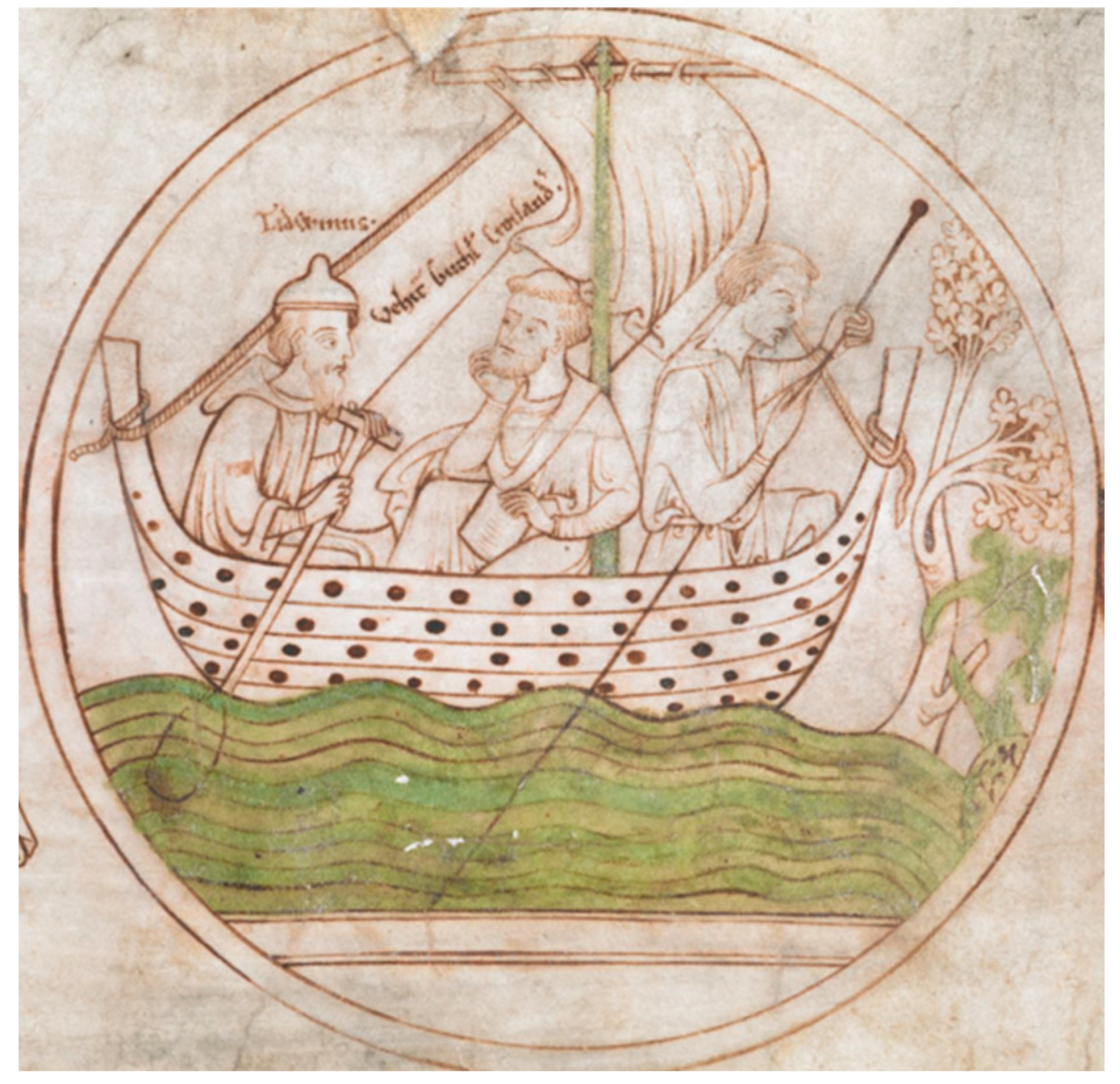
Quo audito, vir beatae recordationis Guthlac illum locum monstrari sibi a narrante efflagitabat. Ipse enim imperiis viri annuens, arrepta piscatoria scafula, per invia lustra inter atrae paludis margines Christo viatore ad praedictum locum usque pervenit; Crugland dicitur.
Felix’s text is rich with descriptive detail which, as I have argued previously, is a deliberate attempt to depict the physical environment in a realistic and vivid way, in order to render the reader an ‘eyewitness’ to the events in the fens (B. E. Brooks 2019, pp. 173–82). The primary descriptive information in the VSG is, however, environmental rather than focused on the structure of the boat, the motions of the individuals within it, and the manner in which the boat is propelled through the ‘invia lustra’ (‘trackless bogs’). Felix’s use of the nondescript Anglo-Latin noun scaphula (‘small boat’), modified by the adjective piscatorius (‘of or relating to fishing or fishers’), gives little imaginative detail; likewise, the common verb pervinere (‘to come through to, arrive at’) semantically portrays not much more than the successful end of a journey.15 The other textual iterations from which the Harly Roll’s illustrator could potentially have drawn echo Felix’s narrative, providing even less descriptive detail. The anonymous late ninth-century Old English Prose Guthlac (OPEG) mentions Tatwine and a boat, utilising the equally vague Old English noun scip (‘ship’), removing Felix’s adjectival addition, and depicting the journey with common Old English verbs of motion, gan (‘to go’), faran (‘to go, travel, or journey’), and cuman (‘to come’) (Kramer et al. 2020, p. 156). In both Orderic Vitallis’ early twelfth-century paraphrase and Peter of Blois’ prose from the late twelfth to early thirteenth century, Felix’s wording is maintained with no additional detail: ‘scafula […] piscatoria’ (‘fishing boat’), with equally general lexis of motion being employed, the verb veho ‘to bear, carry, convey, draw’) in Orderic, and the past participle ‘adductus’ from the verb adducere (‘to bring (a thing) to (a place or person)’) in Peter, respectively (Chibnall [1969] 1990, pp. 326–27; Horstmann 1901, p. 701).16 Even in Henry of Avranches’ later florid verse, there is only a slight variation with the noun cymba (‘boat’), the familiar adjectival designation ‘piscatoria’, and the slight shift in motion to Guthlac implying he will take himself to Crowland with the verb transferre (‘to carry across from one place to another’) (Townsend 2014, pp. 24–25).17(‘Guthlac, the man of blessed memory, on hearing this, earnestly besought his informant to show him the place. Tatwine accordingly assented to the commands of the man and, taking a fisherman’s skiff, made his way, travelling with Christ, through the trackless bogs within the confines of the dismal marsh till he came to the said spot; it is called Crowland’)
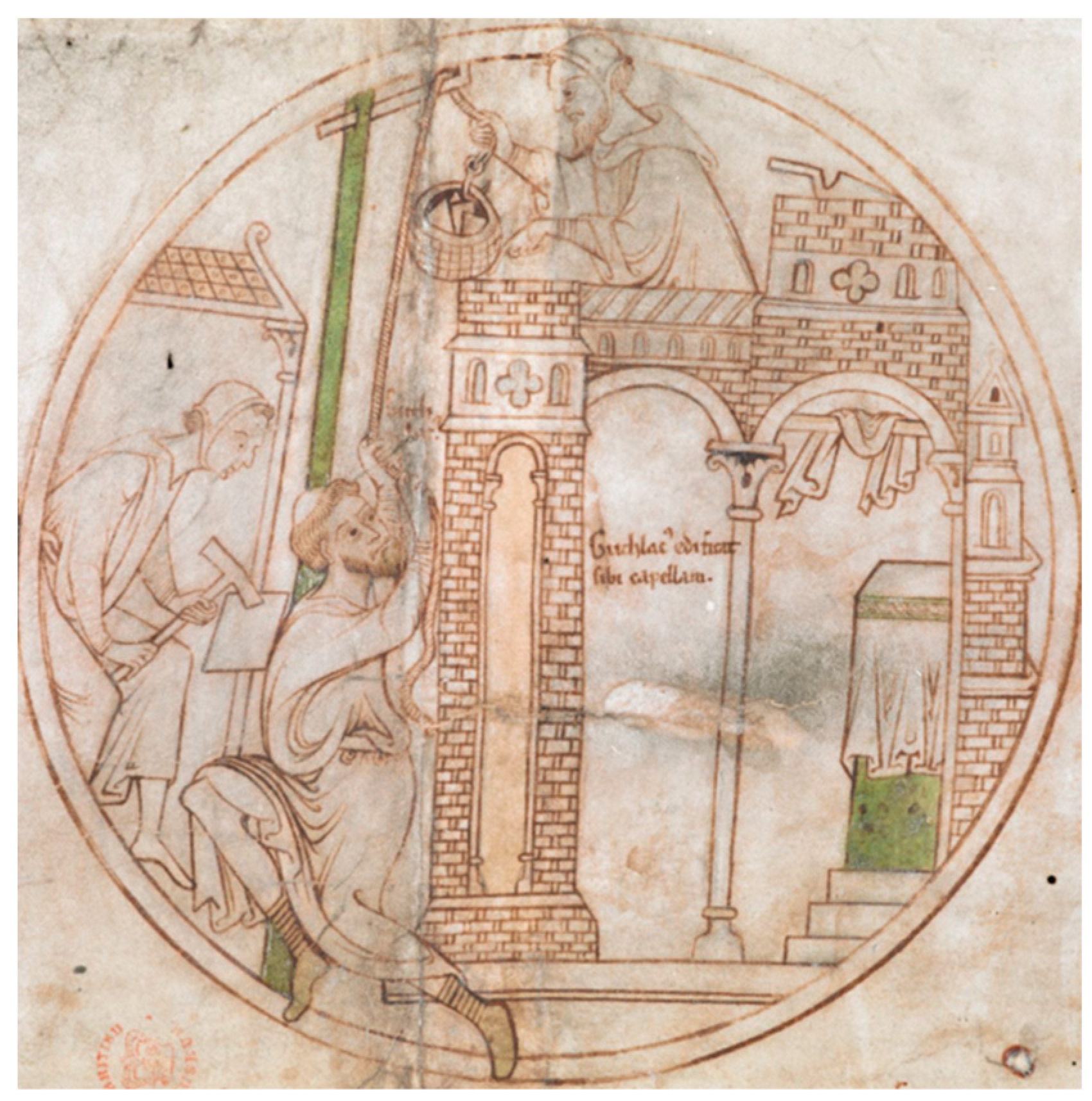
Erat itaque in praedicta insula tumulus agrestibus glaebis coacervatus, quem olim avari solitudinis frequentatores lucre ergo illic adquirendi defodientes scindebant, in cuius latere velut cisterna inesse videbatur; in qua vir beatae memoriae Guthlac desuper inposito tugurio habitare coepit.
The depiction, while deliberately echoing eremitic precedent, continues Felix’s emphasis on the vivid physicality of the Fens, including his lengthy description of the much-debated tumulus upon which the hermitage is set.26 The subsequent Guthlac textual corpus once again largely follows Felix, emphasising the tumulus and the saint’s small dwelling, though both Orderic and Guthlac B omit the scene.27 The OEPG employs geographical lexis from charters with the noun hlæw (‘barrow, burial mound’) while employing the nondescript noun hus (‘building, house’) for the structure; Peter uses the broader noun cumulus (‘heap, mound, or barrow’) and copies Felix’s tugurium (‘hut, shelter, small dwelling’); Henry, as Nuding highlights, includes place-based details, including the local materials from which Guthlac constructed his hut: ‘stature modice de limo construit et de/paruis uiminibus cannisque palustribus edem’ (‘he built a structure of moderate size from mud and small rushes and canes’) (Kramer et al. 2020, pp. 160–61; Horstmann 1901, p. 703; Townsend 2014, ll. 295–96; Nuding 2022, pp. 129–31).28 The rendering of the episode in Guthlac A is something of an outlier, not only in its divergent topography, wooded hills rather than sodden fens, but also in its overarching emphasis on Guthlac’s spiritual battle over the land.29 Scholarly debate on the lexical choices of the poet, with Guthlac as bytla (‘builder’) raising up the structure (‘arærde’), and its relationship to dating the poem continues, but the scene, whatever its spiritual implications, depicts Guthlac as lone builder.(‘Now there was in the said island a mound built of clods of earth which greedy comers to the waste had dug open, in the hope of finding treasure there; in the side of this there seemed to be a sort of cistern, and in this Guthlac the man of blessed memory began to dwell, after building a hut over it’).
3. Sounding Silent Ink: Auditory Imagery and the Bestial Horde
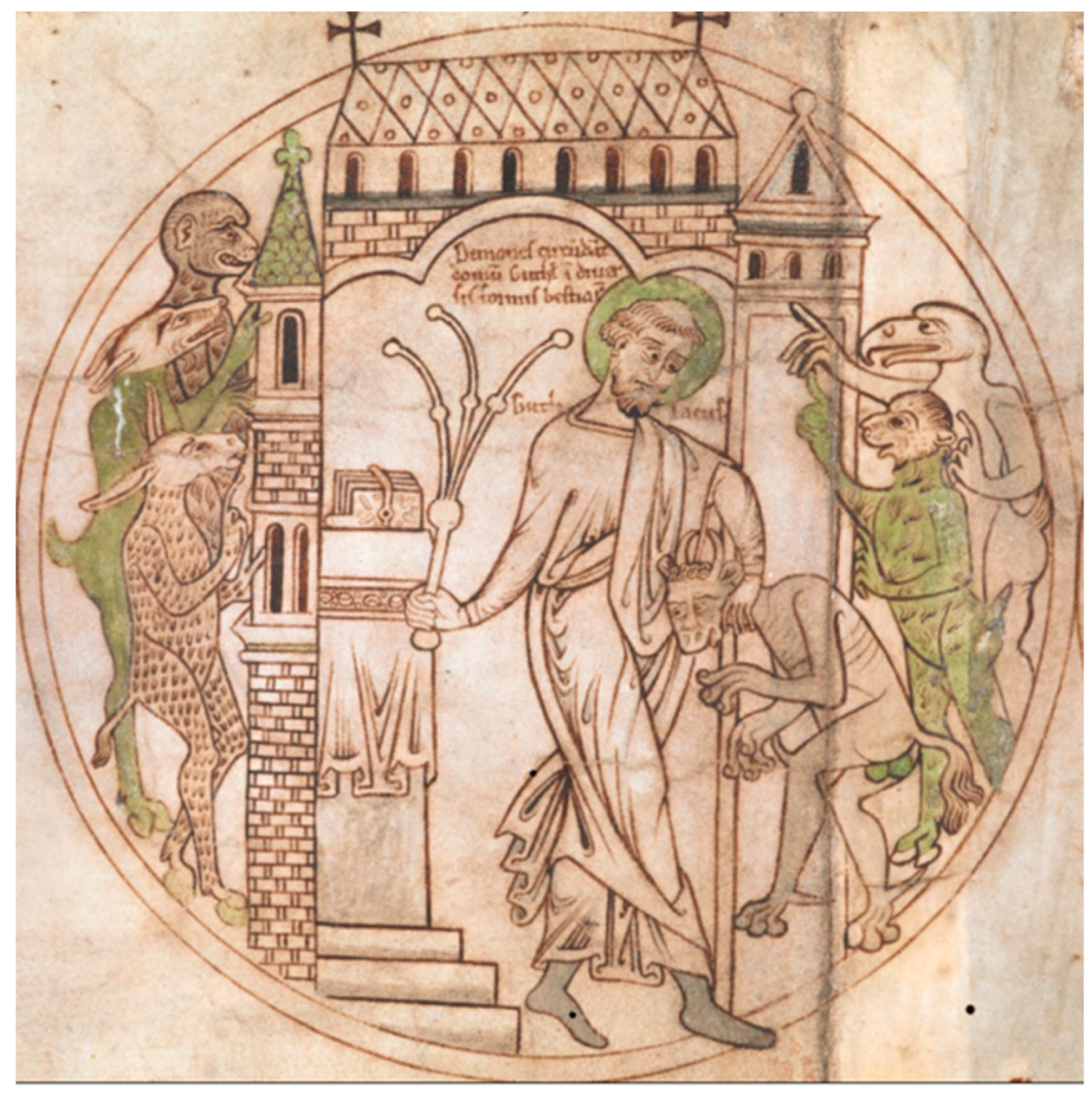
| Nam leo rugiens dentibus sanguineis morsus rabidos inminebat; taurus vero mugitans, unguibus terram defodiens, cornu cruentum solo defigebat; ursus denique infrendens, validis ictibus brachia commutans, verbera promittebat; coluber quoque, squamea colla porrigens, indicia atri veneni monstrabat, et ut brevi sermone concludam, aper grunitum, lupus ululatum, equus hinnitum, cervus axatum, serpens sibilum, bos balatum, corvus crocitum ad turbandum veri Dei verum militem horrisonis vocibus stridebant.33 | (‘Thus a roaring lion fiercely threatened to tear him with its bloody teeth: then a bellowing bull dug up the earth with its hoofs and drove its gory horn into the ground; then a bear, gnashing its teeth and striking violently with either paw alternately, threatened him with blows: a serpent too, rearing its scaly neck, disclosed the threat of its black poison: to conclude briefly—the boar with its grunting, the wolf with its howling, the horse with its whinnying, the stag with its belling, the serpent with its hissing, the ox with its lowing, the raven with its croaking, made harsh and horrible noises to trouble the true soldier of the true God’) (Colgrave 1956, pp. 114–15). |
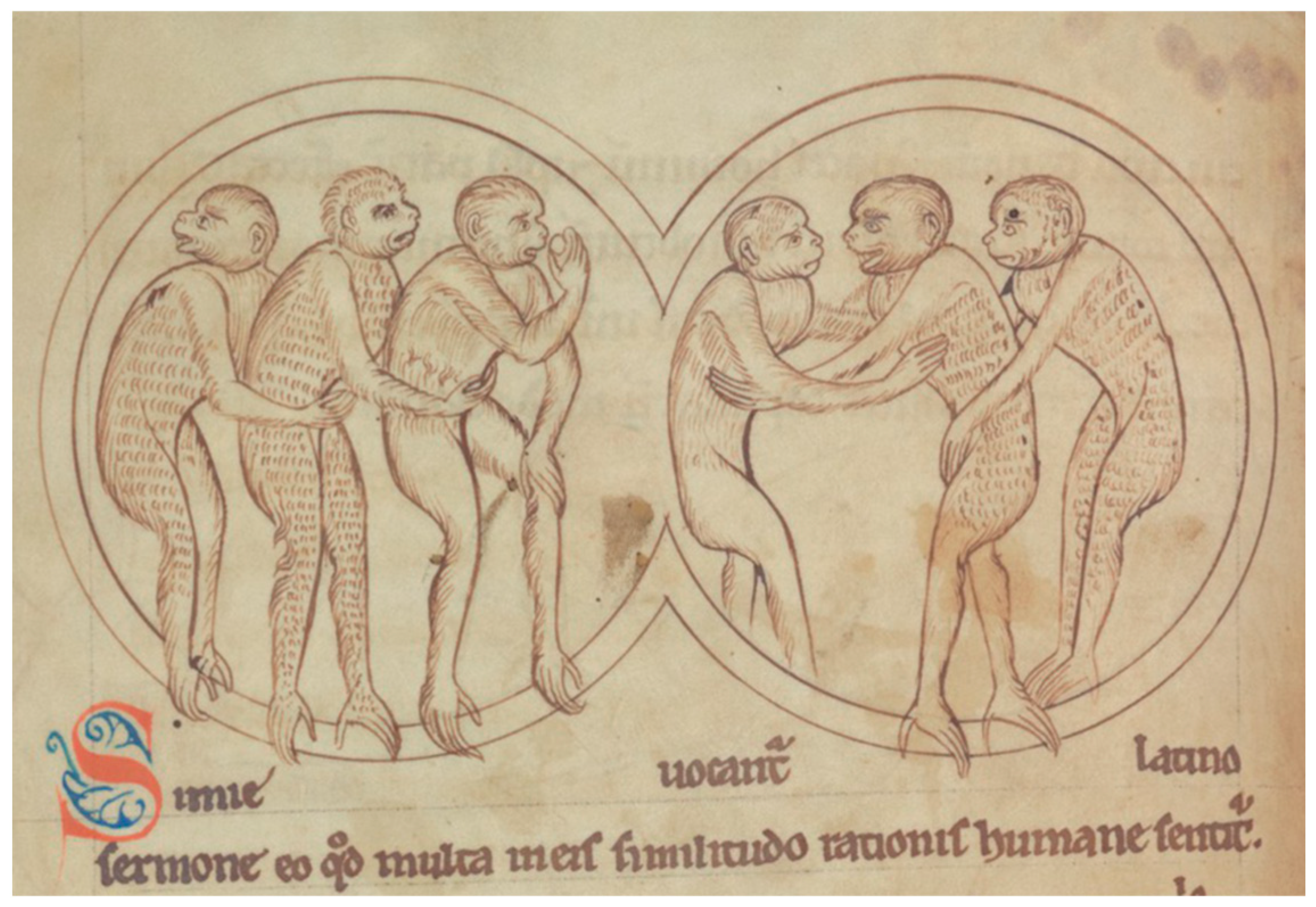
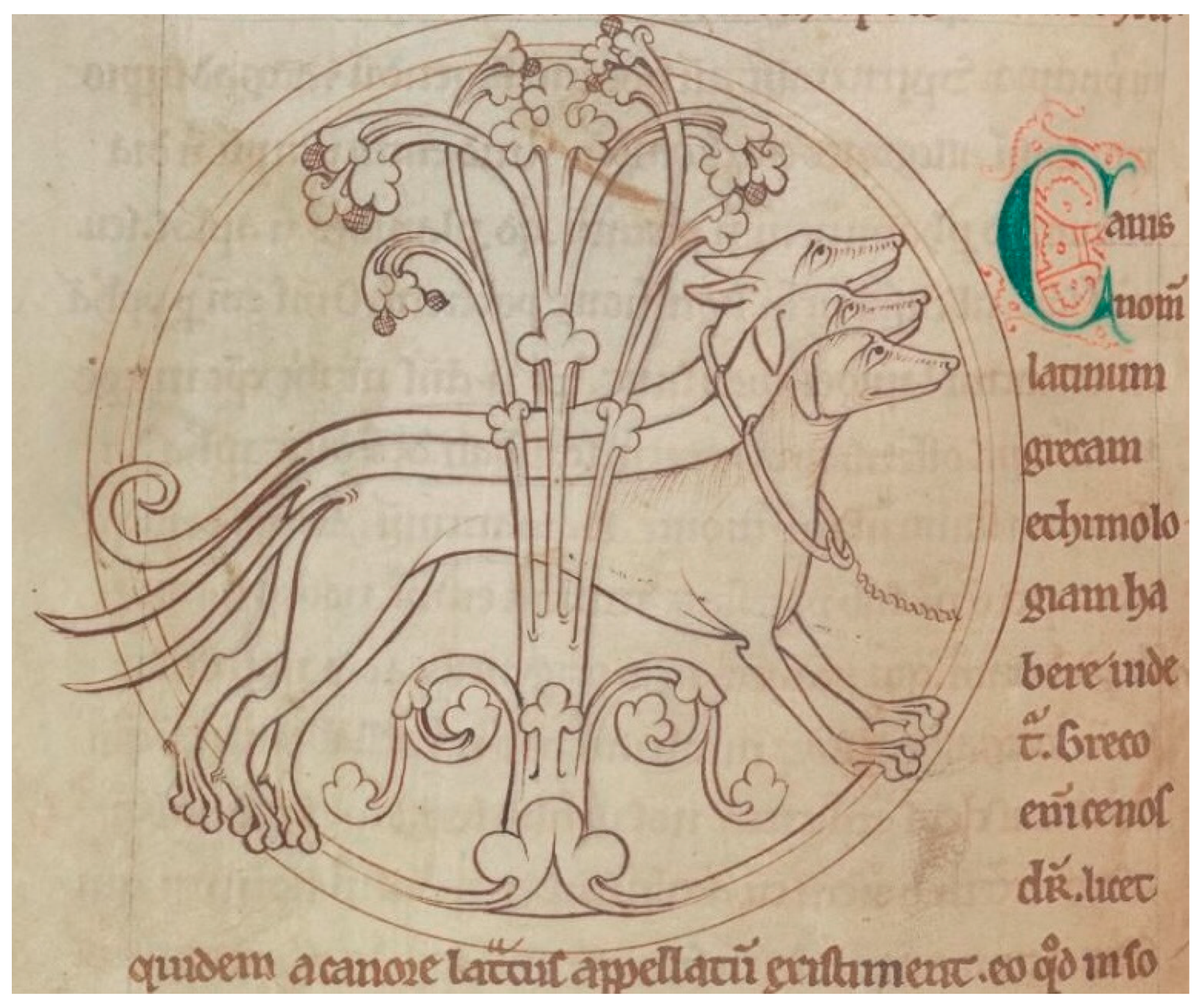
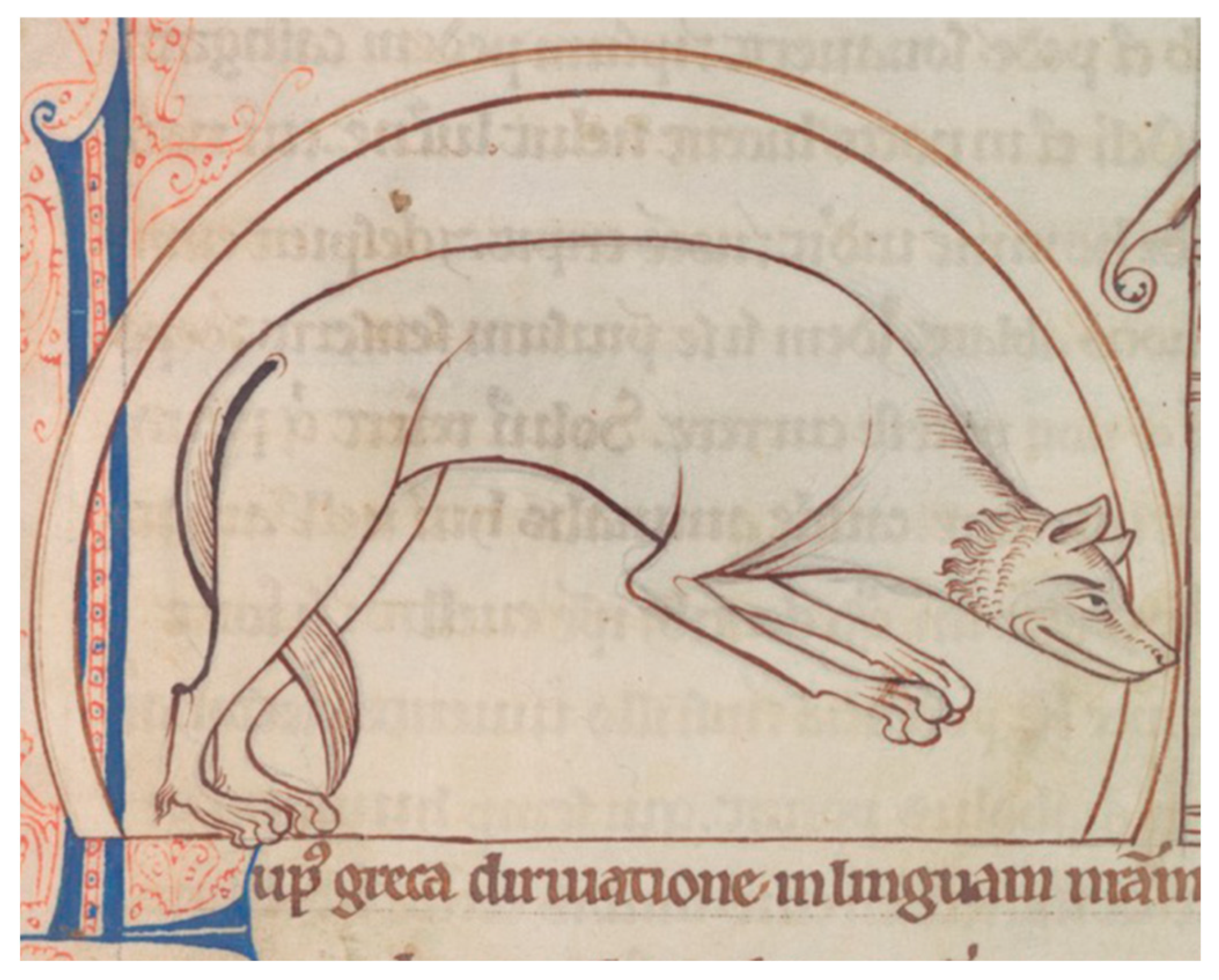
- There is, arguably, an equal correspondence with the wolf on f. 17r (Figure 6), with similar snout, eye, head shape, and a similar thicker eyebrow-like line (though the forms are not identical).
- Given the prevalence of the wolf in every text that includes the bestial horde scene, apart from Guthlac B, it is possible that a wolf might be intended here.40 The animal on the bottom left of Figure 3 is clearer, a donkey or wild ass, which is referenced only in the later texts, with Peter’s ‘asinus rudens’ (‘ass braying’) and Henry’s reference to Midas, ‘rudere Mydam’ (‘Midas brays’) (Townsend 2014, l. 763; Horstmann 1901, p. 708). This departure could also be connected to the allegorical traditions evidenced in the Cambridge Bestiary, as the onager or wild ass on f. 25r is said to symbolise the devil sonically, braying about night and day seeking his prey.41
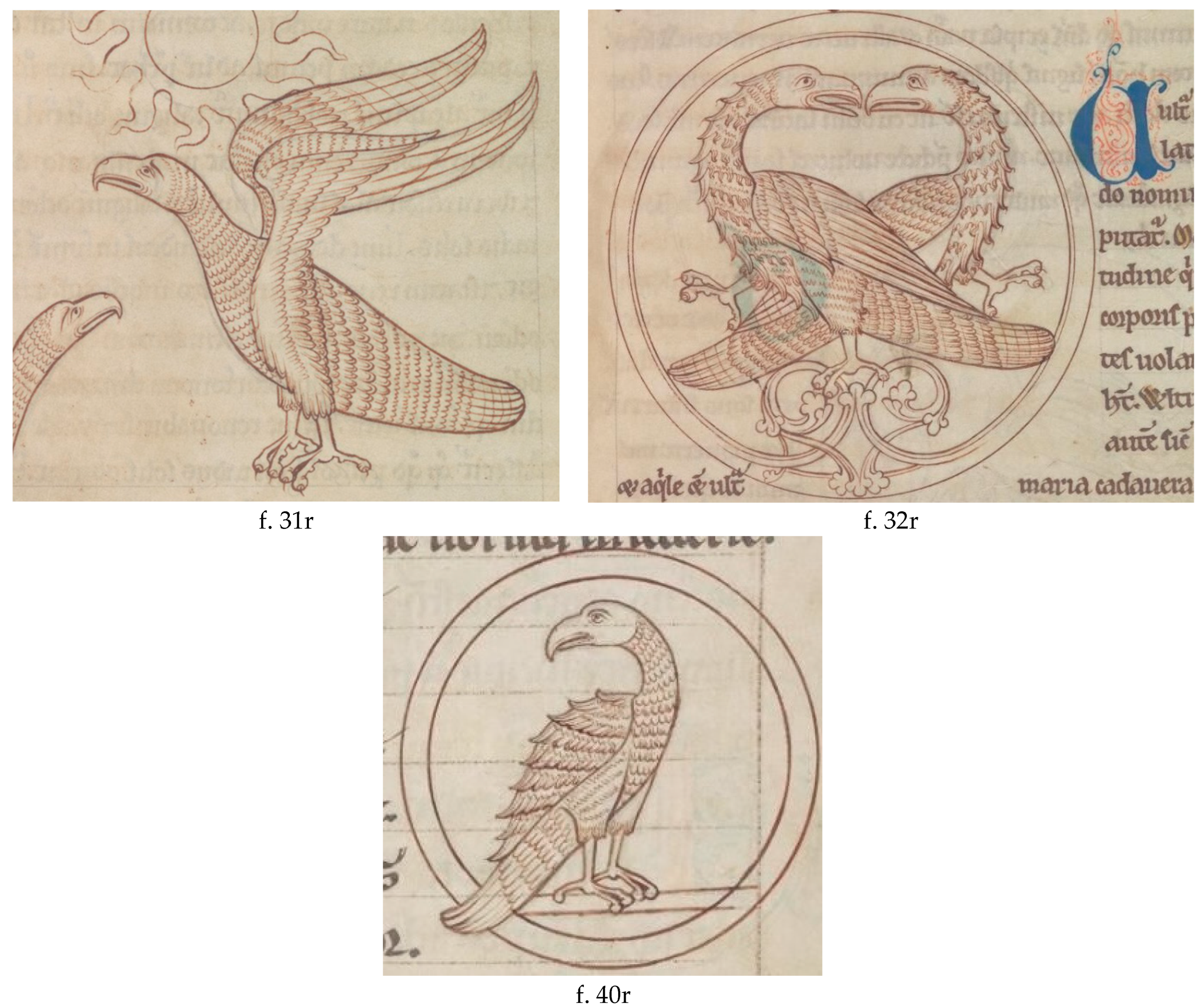
- Guthlac textual tradition only mentions a crow or raven, and though the Cambridge Bestiary has lost several folios, one of which likely included an image of these birds, connected bestiary manuscripts reveal little similarity between the Roll and depictions of those birds. In keeping with the animals on the left of the Roundel, it is possible a hawk was intended here, as the animal allegorically represents the devil as tempter of worldly riches (Beal 2025, pp. 173–74). The head in the middle of the right side of Figure 3 is the most enigmatic, corresponding to no animal I can find in the secondary family Bestiary tradition, with Roberts’ cat unlikely for both allegorical and visual reasons.43 The final bestial demon, about to be whipped by Guthlac, is either a bull or ox, both of which are mentioned in the texts.44
4. Material Auralities: Image and Song
Egerton: 5a. Iam insurgunt tempramenta/et diuersa in tormenta/hinc propellit zabulus. b. Set contempsit blandimenta/penas spernens et figmenta/hostis dei famulus.
(‘Now people rise up against his moderation and in hostile torments the devil drives him away. /But he has despised the enticements, scorning the enemy’s punishments and inventions, a servant of God’)
VSG: ‘Sanctus itaque Christi famulus, armato corde signo salutari, haec omnia fantasmatum genera despiciens, his vocibus usus aiebat’.
The description of the end of the bestial horde scene, when Guthlac has successfully warded off the demon-animal’s attack, is mirrored here in Versicle 5, where ‘dei famulus’ echoes the VSG’s ‘Christi famulus’, and ‘penas spernens et figmenta hostis’ echoes the VSG’s ‘omnia fantasmatum genera despiciens’. While the terms are not identical, they are synonymous in general meaning. The centrality of the bestial horde scene, with its inclusion in all but Orderic Vitalis’ summary of Felix’s text, is being reflected here in the sequence. The potential for a unified multimodal engagement with the saint’s narrative, in which vibrations of meaning and sound abound, relying on both the power of predictive processing and deliberate auditivisation, through both the Roll and sequence is tantalising.(‘And so the holy servant of Christ, arming his breast with the sign of salvation and despising all phantoms of this sort, uttered these words’)
5. Material Auralities: Beyond Hagiography
6. Conclusions
Funding
Institutional Review Board Statement
Informed Consent Statement
Data Availability Statement
Conflicts of Interest
| 1 | For discussions on the prominent role of sound and hearing in medieval religious experience, see (Keller 2014, pp. 195–216, esp. p. 200). I would like to thank the following for their invaluable help in the research and development of this article: Francis Leneghan, Mike Bintley, and Helen Appleton. |
| 2 | |
| 3 | There is some overlap between my combined methodology and (Foys 2014, pp. 459–62), particularly in his critique of ocularcentrism and reflections on the ‘linguistic noise of Beowulf’ and, citing Richard Brilliant, the graphic noise of the Bayeux Tapestry (p. 462). |
| 4 | For an overview of these ideas see (Lauwereyns 2018; Chow et al. 2014; Ogi et al. 2019; Tiihonen et al. 2024). |
| 5 | It should be noted that this is connected to his wider notion of ‘Auditivity’ in which ‘auditive competence—a person’s basic ability to hear sounds’ is combined with their ‘auditive literacy—i.e., the ability, based on a person’s experience of listening to various sounds, to decode their meanings in a specific socio-cultural context or to refer to such sounds’ (p. 155). |
| 6 | Guthlac’s tradition lends itself to such study as the extant Guthalc material covers a wide chronological range, several genres, and several forms, with the saint appearing in prose and poetic vitae (in Old English, Anglo-Latin, and Middle English), in manuscript images, as well as in stone sculpture. While the Roll as extant is largely intact, it should be noted that there are likely two or three missing drawings in the beginning of the sequence as the manuscript has been cut. See (Roberts 2020, p. 243). The manuscript will hereafter be referred to as the ‘Harley Roll’. |
| 7 | See, for example, (Roberts 2020, p. 262), who notes that the translation ‘provides a plausible terminus post quem for the Harley Roll; the script used in titles and labels is best described as protogothic, supporting a date not much beyond c.1200’. See also (Bacola 2012, p. 145; Nuding 2022, p. 120), who likewise place the creation of the role in the late twelfth century. |
| 8 | |
| 9 | The text will hereafter be referred to as the ‘Cambridge Bestiary’. |
| 10 | See (Roberts 2020, p. 262, n. 41) for the wood carvings, and (Nuding 2022, pp. 120–23) for wall paintings and enamel decorations. |
| 11 | The application of such approaches to the medieval period are confronted with the inherent difficulty of chronological and contextual difference, arising as they do from our contemporary moment and its cultural, historical, linguistic, and philosophical milieu. Scholars have long interrogated the ways in which medieval experience, emotional, intellectual, physical, spiritual, are encoded in text and image, from Vincent Gillespie’s exploration of the sensorium (Gillespie 2014), to Barbara Rosenwein’s argument for situating emotional experience in what she calls ‘emotional communities’ (Rosenwein 2015, p. 3), to Mary Carruthers wok on memory (Carruthers 2008, 2013), to recent embodied participatory approaches as seen in Lauren Mancia’s Cambridge Element, Embodied Epistemology as Rigorous Historical Method (Mancia 2025). All this complexity notwithstanding, there is little evidence that the fundamental structure of the human brain, however embedded within and developed from its historical and cultural milieu, has changed dramatically enough in the intervening centuries for the approaches used in this article to be invalid. |
| 12 | See (Bacola 2012, pp. 47–54), who describes the period as the ‘Longchampe Revival’, and how after being installed as abbot of Crowland in 1191, ‘his forty-six year abbacy marked an even more prolific stage in Crowland’s development in which new texts were commissioned, visual representations and architectural settings constructed and new relics promoted’ (p. 47), and (Roberts and Thacker 2020, p. xxxvii). |
| 13 | Of the possible textual influences for the image, the following do not include the scene: the Old English poems Guthlac A and Guthlac B. |
| 14 | All references to and translations of the VSG from (Colgrave 1956). |
| 15 | Felix does not seem to employ the verb with any special significance here or elsewhere in the VSG. Pervenio appears twelve times, and with the exception of a single use describing Easter Day arriving (‘dies Paschae pervenit’, p. 154), refers to people mundanely coming to a location, including Guthlac to Repton (‘monasterium Hrypadun usque pervenit’, p. 66), and Æthelbald returning to see Guthlac’s corpse after he died (‘ad corpus ipsius pervenit’, p. 164). All definitions for Latin come from (Ashdowne et al. 2018) unless otherwise indicated. |
| 16 | For the dating of the texts, see (Chibnall [1969] 1990, p. 46; Roberts 2020, p. 267). |
| 17 | Roberts convincingly argues that it is unlikely the Roll artist would have used Henry’s text, particularly given the dating of the Roll to within a decade of 1196. See (Roberts 2020, p. 267). |
| 18 | For an authoritative discussion of clinker-built boat construction, see (McGrail 2001, pp. 207–17). |
| 19 | It should be noted that the episode’s importance to the post-conquest Guthlac cult was such that a version of it likely appears in the bottom of the famous tympanum sculptures over the west doorway of the extant abbey church. Though elemental erosion has made precise comparison difficult, most scholars agree these are related. See, for example, (Roberts 2020, p. 265; Bacola 2012, p. 52). |
| 20 | See also (Hutchinson 1994, p. 188). |
| 21 | All images of the Harley Roll are reproduced by kind permission of the British Library. |
| 22 | See also (Carver 2014). |
| 23 | See, for example, (Chisholm 2010). |
| 24 | It should be noted that the Harley Roll artist is working within established conventions, particularly concerning the depiction of moving water through a green tinted wash. A similar style, for example, can be seen in several slightly later manuscripts of Matthew Paris, including Royal MS 14 C VII, ff. 134v and 116v, as well as Corpus Christi College Cambridge MS II, f. 50v, though these all depict journeys at sea. Similarities can also be found in the Aberdeen Bestiary, particularly f. 1v showing the creation of the waters and firmament. The Harley Roll’s use is, however, distinct in its specific connection to the surrounding landscape, its riverine focus, its narrative and hagiographical importance to the Guthlac cult, and its reception context which often involved river journeys in order for the Roll itself to be viewed. |
| 25 | See (B. E. Brooks 2019, p. 180), where I highlight Felix’s use of both the Evagrian Vita Antonii and St Jerome’s Vita Pauli. |
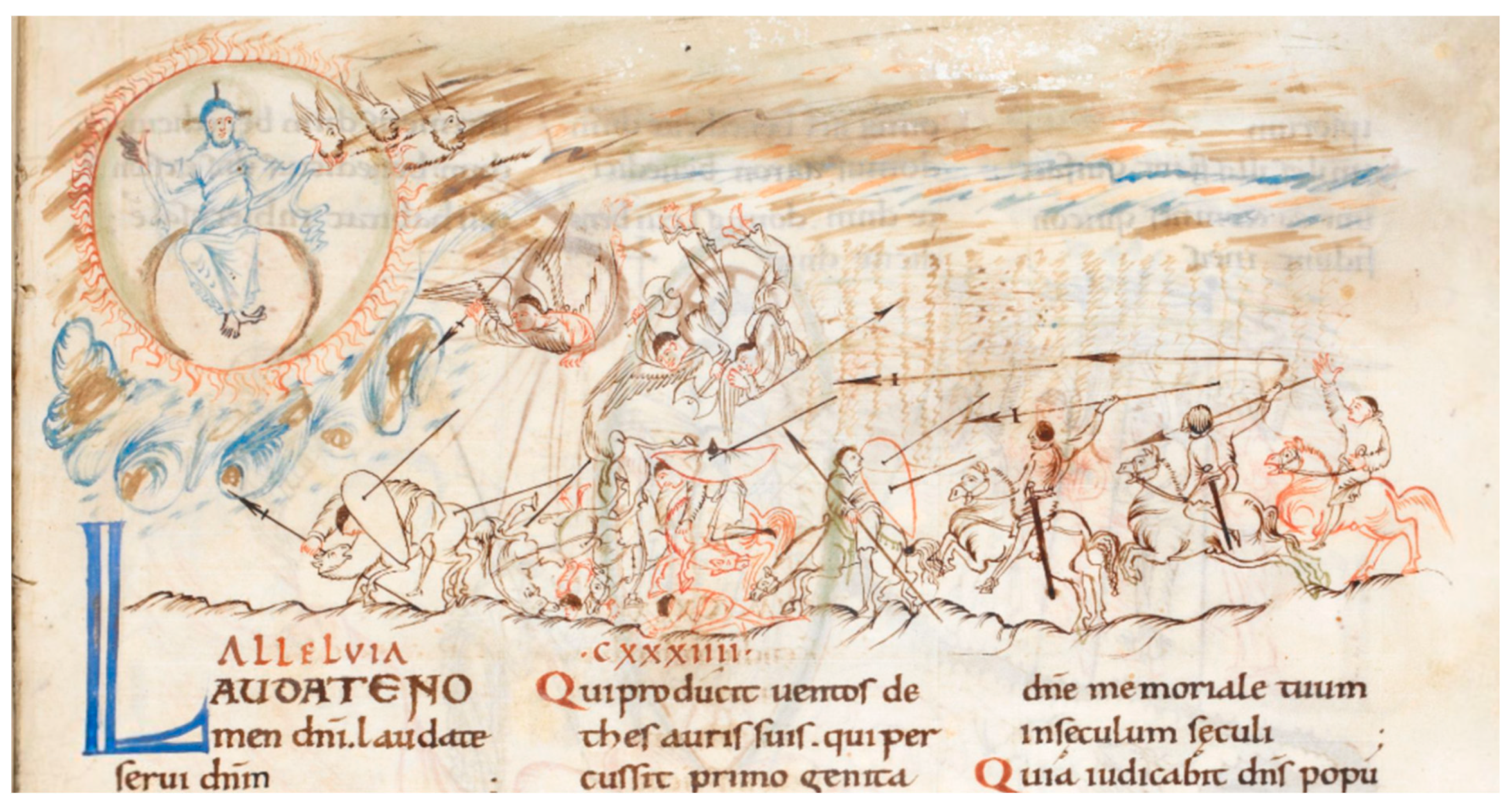
| 26 | Scholarship on Guthlac’s chosen mound is extensive, often analysing it via several texts together. See, for example, (Noetzel 2014; Clarke 2006; Wright and Willmott 2024; Estes 2017, pp. 98–107; Semple 2002, pp. 252–53; Hooke 1998, p. 99). |
| 27 | Orderic does later in Book 14 describe Guthlac returning to his ‘chosen hermitage’ (‘electam heremum’), while Guthlac B references the eremitic cell with the curious plural form of the noun wic in l. 894a (‘a dwelling, settlement, or a collection of houses’) (Chibnall [1969] 1990, pp. 326–27). |
| 28 | Text and translation for Henry’s text from Townsend’s edition (Townsend 2014). |
| 29 | |
| 30 | For an overview of Crowland Abbey and its architectural development, see (Alexander 2020). |
| 31 | See, for example, (Nuding 2022, pp. 63–64) with relation to Guthlac A and land disputes, and pp. 132–41 with relation to ongoing land disputes in the thirteenth-century as seen in Henry’s verse Life of Guthlac. |
| 32 | While it is difficult to ascertain the specific intensity of such an event without extensive archaeoacoustic research, modern studies can be used as reasonable analogues to get a sense of the level of sound produced. For example, a report by the University of Washington found that masonry restoration workers dressing stone with hand tools like hammers experience sound in the 87–105 dB (A) range (the study did not distinguish between hammers, mallets, and sledges), above the level (85 dB) at which hearing protection is required. See https://depts.washington.edu/occnoise/content/masonryrestorationIDweb.pdf (accessed on 20 July 2025). |
| 33 | Italics added for emphasis and comparison. |
| 34 | Guthlac B, ll. 907–8a. Orderic and Guthlac A omit this episode. All references to Guthlac B from (Bjork 2013). |
| 35 | The number of bestial demons alters from text to text. Roberts notes that the ‘roll’s six beasts, as opposed to the ten named by Felix, come closer to the revolving tally of seven deadly sins so often symbolized by animals’ (Roberts 2020, p. 253). |
| 36 | All images of Cambridge, University Library, MS Ii.4.26 are reproduced by kind permission of the Syndics of Cambridge University Library. |
| 37 | For an overview see (Clark 2006; Cavell 2022). |
| 38 | All quotations taken from the digital manuscript, which I have normalised here. See also (Beal 2025, p. 172), who discusses the equivalent text in the Aberdeen Bestiary. |
| 39 | See (B. E. Brooks 2021, p. 165). |
| 40 | There is also considerable allegorical potential with the wolf, as the Bestiary tradition attests. See (Beal 2025, pp. 166–68). |
| 41 | The animal depicted in f. 25r is a close resemblance to the Roll, though it must be said that the eyebrow in the Roll is closer in form to the curly eyebrow of the assinus on the top of the folio rather than the onager on the bottom. |
| 42 | While Roberts sees this as an eagle, the host of positive allegorical interpretations of eagles makes this somewhat unlikely. |
| 43 | See Cambridge Bestiary, f. 28r. The most closely related manuscripts consulted for this article are the following: Aberdeen, University Library, MS 24; Oxford, Bodleian Library, MS Ashmole 1511; London, British Library, MS Add. 11283; and the Worksop Bestiary, New York, Morgan Library and Museum, MS M.81. |
| 44 | Felix specifies it as an ox, ‘bos balatum’, while the OPEG, Peter, and Henry, all specify it as a bull (fearr and taurus respectively). |
| 45 | Compare with roundel 7 in which the demons bodily carry St Guthlac into the air. |
| 46 | See Harley Roll, f.8r. |
| 47 | Parker further notes that in both the sequence and the image in roundel 6, they ‘choose to mention angels much earlier in the narrative of Guthlac’s life—specifically, after the building of a church and before the appearance of the devil—and the fact that this conjunction occurs in two creations from Crowland, possibly both from the twelfth century, may be evidence of their interaction’ (293). |
| 48 | Text and translation from (Parkes 2020, p. 297). |
| 49 | It should be noted that some sections were likely created later. |
| 50 | For example, see (Noel 1995, p. 81), who highlights how a harp on f. 70r by Artist F is ‘very different in form to the ones in Utrecht’, and was likely drawn from ‘artist F’s own experience with harps’. It should be noted that the text for the psalms, while modelled on the Utrecht Psalter, comes from the Romanum version rather than Utrecht’s Gallican version, and also that the scribe for quires ten and eleven of the Harley Psalter (Scribe 1), did not follow the exemplar in the physical placing of the psalm text. Further still, Scribe 1 completed his text before artist F drew the illustrations. This situation allows Noel to argue that the ‘the mould of the illustrations was determined by the script, and it differed radically from Utrecht that recreation of its compositions was frequently impossible’, and therefore artist F’s illustrations consequently stem partly from this situation (pp. 76–77). |
| 51 | Psalm 134: 7: ‘Educens nubes ab extremo terrae, fulgura in pluviam fecit; qui producit ventos de thesauris suis’ (‘He brings up clouds from the end of the earth: he has made lightnings for the rain. He brings forth winds out of his stores’); 10: ‘Qui percussit gentes multas, et occidit reges fortes’ (‘He smote many nations, and slew mighty kings’). Latin biblical quotations from (Weber and Gryson 2007), and all translations are my own. |
| 52 | It should also be noted, given the monastic context of the manuscript, that the notion of clouds crashing together to make thunder was part of established descriptions of the workings of God’s world. See Bede, De natura rerum, XXXVIII (Jones et al. 2003, p. 221). |
| 53 | All images for the Utrecht Psalter from Utrecht University’s online special collections: https://psalter.library.uu.nl/page/159 (accessed on 15 May 2025). |
| 54 | All images of the Harley Psalter are reproduced by kind permission of the British Library. |
| 55 | It should also be noted that the early eleventh century, during which the principal work of the Harley Psalter was accomplished, saw the Danish raids on Canterbury, during which Archbishop Ælfheah was taken hostage and eventually killed in 1012. |
References
- Alexander, Jennifer S. 2020. Crowland Abbey Church and St Guthlac. In Guthlac: Crowland’s Saint. Edited by Jane Roberts and Alan Thacker. Donington: Shaun Tyas, pp. 298–315. [Google Scholar]
- Ashdowne, Richard, David Howlett, and Ronald Latham, eds. 2018. Dictionary of Medieval Latin from British Sources. Oxford: Oxford University Press. [Google Scholar]
- Bacola, Meredith Anne. 2012. Dissemination of a Legend: The Texts and Contexts of the Cult of St Guthlac. Ph.D. thesis, Durham University, Durham, UK. [Google Scholar]
- Bacola, Meredith Anne. 2020. Vacuas in auras recessit? Reconsidering the Relevance of Embedded Heroic Material in the Guthlac Narrative. In Guthlac: Crowland’s Saint. Edited by Jane Roberts and Alan Thacker. Donington: Shaun Tyas, pp. 72–85. [Google Scholar]
- Beal, Jane. 2025. The Devil’s Threat in Medieval Bestiaries: Recognizing and Resisting Evil in the Dragon, Serpent, Wolf, Fox, Ape, Whale, Hawk, Partridge, and Raven. Ítaca. Revista de Filologia 16: 149–86. [Google Scholar] [CrossRef]
- Bjork, Robert E., ed. and trans. 2013. The Old English Poems of Cynewulf. Dumbarton Oaks Medieval Library. Cambridge: Harvard University Press. [Google Scholar]
- Black, John R. 2004. Tradition and Transformation in Text and Image in the Cults of Mary of Egypt, Cuthbert, and Guthlac: Changing Conceptualizations of Sainthood in Medieval England. Ph.D. thesis, University of North Carolina at Chapel Hill, Chapel Hill, NC, USA. [Google Scholar]
- Brooks, Britton Elliott. 2019. Restoring Creation: The Natural World in the Anglo-Saxon Saints’ Lives of Cuthbert and Guthlac. Cambridge: D. S. Brewer. [Google Scholar]
- Brooks, Britton Elliott. 2021. Biophonic Soundscapes in the Vitae of St Guthlac. English Studies 102: 155–79. [Google Scholar] [CrossRef]
- Brooks, Britton Elliott. 2022. The Sound-World of Early Medieval England: A Case Study of the Exeter Book Storm Riddle. In Ideas of the World in Early Medieval English Literature. Edited by Mark Atherton, Kazutomo Karasawa and Francis Leneghan. Turnhout: Brepols, pp. 203–22. [Google Scholar]
- Brooks, Francesca. 2016. Sight, Sound, and the Perception of the Anglo-Saxon Liturgy in the Exeter Book Riddles 48 and 59. In Sensory Perception in the Medieval West: Manuscripts, Texts, and Other Material Matters. Edited by Simon Thomas and Michael Bintley. Turnhout: Brepols, pp. 141–58. [Google Scholar]
- Butler, Shane. 2019. Principles of Sound Reading. In Sound and the Ancient Senses. Edited by Shane Butler and Sarah Nooter. London: Routledge, pp. 233–55. [Google Scholar]
- Carruthers, Mary. 2008. The Book of Memory: A Study of Memory in Medieval Culture, 2nd ed. Cambridge: Cambridge University Press. [Google Scholar]
- Carruthers, Mary. 2013. The Experience of Beauty in the Middle Ages. Oxford: Oxford University Press. [Google Scholar]
- Carver, Martin. 2014. Travels on the Sea and in the Mind. In The Maritime World of the Anglo-Saxons. Edited by Stacey S. Klein, William V. Schipper and Shannon Lewis-Simpson. Tempe: Arizona Center for Medieval and Renaissance Studies. [Google Scholar]
- Cavell, Megan, ed. 2022. The Medieval Bestiary in English: Texts and Translation of the Old and Middle English Physiologus. Peterborough: Broadview Press. [Google Scholar]
- Chibnall, Marjorie, ed. and trans. 1990. Orderic Vitalis. Historia ecclesiastica. In The Ecclesiastical History of Orderic Vitalis. Oxford: Clarendon Press, vol. 2. First published 1969. [Google Scholar]
- Chisholm, Michael. 2010. The Medieval Network of Navigable Fenland Waterways I: Crowland. Proceedings of the Cambridge Antiquarian Society 99: 125–38. [Google Scholar]
- Chow, Ho Ming, Raymond A. Mar, Yisheng Xu, Siyuan Liu, Suraji Wagage, and Allen R. Braun. 2014. Embodied Comprehension of Stories: Interactions between Language Regions and Modality-Specific Neural Systems. Journal of Cognitive Neuroscience 26: 279–95. [Google Scholar] [CrossRef] [PubMed]
- Clark, Willene B. 2006. A Medieval Book of Beasts: The Second-Family Bestiary: Commentary, Art, Text and Translation. Woodbridge: Boydell. [Google Scholar]
- Clarke, Catherine A. M. 2006. Literary Landscapes and the Idea of England, 700–1400. Cambridge: D. S. Brewer. [Google Scholar]
- Clarke, Catherine A. M. 2012. Writing Power in Anglo-Saxon England: Texts, Hierarchies, Economies. Cambridge: Cambridge University Press. [Google Scholar]
- Colgrave, Bertram, ed. and trans. 1956. Felix’s Life of Saint Guthlac: Texts, Translation and Notes. Cambridge: Cambridge University Press. [Google Scholar]
- Estes, Heidi. 2017. Anglo-Saxon Literary Landscapes: Ecotheory and the Environmental Imagination. Amsterdam: Amsterdam University Press. [Google Scholar]
- Foys, Martin K. 2014. A Sensual Philology for Anglo-Saxon England. Postmedieval: A Journal of Medieval Cultural Studies 5: 456–72. [Google Scholar] [CrossRef]
- Frenze, Maj-Britt. 2018. Holy Heights in the Anglo-Saxon Imagination: Guthlac’s Beorg and Sacred Death. The Journal of English and Germanic Philology 117: 315–42. [Google Scholar] [CrossRef]
- Gardiner, Mark. 2014. Hythes, Small Ports, and Other Landing Places in Later Medieval England. In Waterways and Canal-Building in Medieval England. Edited by John Blair. Oxford: Oxford University Press, pp. 86–109. First published 2007. [Google Scholar]
- Gillespie, Vincent. 2014. The Senses in Literature: The Textures of Perception. In A Cultural History of the Senses in the Middle Ages, 500–1450. Edited by Richard G. Newhauser. London: Bloomsbury, pp. 153–73. [Google Scholar]
- Hooke, Della. 1998. The Landscape of Anglo-Saxon England. London: Leicester University Press. [Google Scholar]
- Hooke, Della. 2014. Uses of Waterways in Anglo-Saxon England. In Waterways and Canal-Building in Medieval England. Edited by John Blair. Oxford: Oxford University Press, pp. 37–54. First published 2007. [Google Scholar]
- Horstmann, Carl, ed. 1901. Peter of Blois. Vita Sancti Guthlaci. In Nova Legenda Anglie: As Collected by John of Tynemouth, John Capgrave, and Others, and First Printed, with New Lives, by Wynkyn de Worde. Oxford: Clarendon Press, vol. 2. [Google Scholar]
- Hsieh, Po-Jang, Jaron T. Colas, and Nancy Kanwisher. 2012. Spatial Pattern of BOLD fMRI Activation Reveals Cross-Modal Information in Auditory Cortex. Journal of Neurophysiology 107: 3428–32. [Google Scholar] [CrossRef] [PubMed]
- Hutchinson, Gillian. 1994. Medieval Ships and Shipping. The Archaeology of Medieval Britain, 3. London: Leicester University Press. [Google Scholar]
- Iosifyan, Marina, Anton Sidoroff-Dorso, and Judith Wolfe. 2022. Cross-Modal Associations between Paintings and Sounds: Effects of Embodiment. Perception 51: 871–88. [Google Scholar] [CrossRef] [PubMed]
- Jones, Charles W., Calvin B. Kendall, M. H. King, and Fr. Lipp, eds. 2003. Bede Venerabilis: Opera Didascalica, Corpus Christianorum Series Latina, 123 A. Turnhout: Brepols. [Google Scholar]
- Keller, Hildegard Elisabeth. 2014. Sensory Media: From Sounds to Silence, Sight to Insight. In A Cultural History of the Senses in the Middle Ages. Edited by Richard G. Newhauser. London: Bloomsbury Academic, pp. 195–216. [Google Scholar]
- Kelly, Kimberly. 1989. Forgery, Invention and Propaganda: Factors behind the Production of the Guthlac Roll (British Museum Harley Roll Y.6). Athanor 8: 1–13. [Google Scholar]
- Kramer, Johanna, Hugh Magennis, and Robin Norris, ed. and trans. 2020. Anonymous Old English Lives of Saints. Cambridge: Harvard University Press. [Google Scholar]
- Lauwereyns, Jan. 2018. Beyond Prediction: Self-Organization of Meaning with the World as a Constraint. In Advances in Cognitive Neurodynamics (VI): Proceedings of the Sixth International Conference on Cognitive Neurodynamics–2017. Singapore: Springer, pp. 383–90. [Google Scholar]
- Lewis, Liam. 2022. Animal Soundscapes in Anglo-Norman Texts. Cambridge: Boydell & Brewer. [Google Scholar]
- Lima, César F., Nadine Lavan, Samuel Evans, Zarinah Agnew, Andrea R. Halpern, Pradheep Shanmugalingam, Sophie Meekings, Daniel Boebinger, Manuel Ostarek, Carolyn McGettigan, and et al. 2015. Feel the Noise: Relating Individual Differences in Auditory Imagery to the Structure and Function of Sensorimotor Systems. Cerebral Cortex 25: 4638–50. [Google Scholar] [CrossRef] [PubMed]
- Mancia, Lauren. 2025. Embodied Epistemology as Rigorous Historical Method. Cambridge: Cambridge University Press. [Google Scholar]
- McGrail, Seán. 2001. Boats of the World: From the Stone Age to Medieval Times. Oxford: Oxford University Press. [Google Scholar]
- Noel, William. 1995. The Harley Psalter. Cambridge: Cambridge University Press. [Google Scholar]
- Noetzel, Justin T. 2014. Monster, Demon, Warrior: St. Guthlac and the Cultural Landscape of the Anglo-Saxon Fens. Comitatus: A Journal of Medieval and Renaissance Studies 45: 105–31. [Google Scholar] [CrossRef]
- Novák, Radomil. 2020. Sound in Literary Texts. Neophilologus 104: 151–63. [Google Scholar] [CrossRef]
- Nuding, Emma. 2022. Fenland Pilgrimage: A Literary History of Guthlac of Crowland, Medieval to Modern. Ph.D. thesis, University of York, York, UK. [Google Scholar]
- Ogi, Manabu, Tatsuya Yamagishi, Hiroaki Tsukano, Nana Nishio, Ryuichi Hishida, Kuniyuki Takahashi, Arata Horii, and Katsuei Shibuki. 2019. Associative Responses to Visual Shape Stimuli in the Mouse Auditory Cortex. PLoS ONE 14: e0223242. [Google Scholar] [CrossRef] [PubMed]
- Parkes, Henry. 2020. Musical Portraits of St Guthlac. In Guthlac: Crowland’s Saint. Edited by Jane Roberts and Alan Thacker. Donington: Shaun Tyas, pp. 277–97. [Google Scholar]
- Proverbio, Alice Mado, Guido Edoardo D’Aniello, Roberta Adorni, and Alberto Zani. 2011. When a Photograph Can Be Heard: Vision Activates the Auditory Cortex within 110 ms. Scientific Reports 1: 54. [Google Scholar] [CrossRef] [PubMed]
- Roberts, Jane. 2020. Guthlac on a Roll: BL, Harley MS Y.6. In Guthlac: Crowland’s Saint. Edited by Jane Roberts and Alan Thacker. Donington: Shaun Tyas, pp. 242–73. [Google Scholar]
- Roberts, Jane, and Alan Thacker. 2020. Introduction to Guthlac’s Life and Cult. In Guthlac: Crowland’s Saint. Edited by Jane Roberts and Alan Thacker. Donington: Shaun Tyas, pp. xv–xlvi. [Google Scholar]
- Rosenwein, Barbara. 2015. Generations of Feeling: A History of Emotions, 600–1700. Cambridge: Cambridge University Press. [Google Scholar]
- Semple, Sarah. 2002. Anglo-Saxon Uses and Perceptions of Prehistoric Monuments in Anglo-Saxon Society. Ph.D. thesis, University of Oxford, Oxford, UK. [Google Scholar]
- Sharpe, Richard. 2020. The Twelfth-Century Translation and Miracles of St Guthlac. In Guthlac: Crowland’s Saint. Edited by Jane Roberts and Alan Thacker. Donington: Shaun Tyas, pp. 485–553. [Google Scholar]
- Shores, Rebecca. 2021. Sounds of Salvation: Nautical Noises in Old English and Anglo-Latin Literature. In Meanings of Water in Early Medieval England. Edited by Carolyn Twomey and Daniel Anlezark. Turnhout: Brepols, pp. 109–26. [Google Scholar]
- Tiihonen, Marianne, Niels Trusbak Haumann, Yury Shtyrov, Peter Vuust, Thomas Jacobsen, and Elvira Brattico. 2024. The Impact of Crossmodal Predictions on the Neural Processing of Aesthetic Stimuli. Philosophical Transactions of the Royal Society B 379: 20220418. [Google Scholar] [CrossRef] [PubMed]
- Townsend, David, ed. 2014. Life of Guthlac. In Saints’ Lives: Henry of Avranches. Dumbarton Oaks Medieval Library. Cambridge: Harvard University Press, vol. 1. [Google Scholar]
- Weber, Robert, and Roger Gryson, eds. 2007. Biblia Sacra Iuxta Vulgatam Versionem, 5th ed. Stuttgart: Deutsche Bibelgesellschaft. [Google Scholar]
- Wright, Duncan W., and Hugh Willmott. 2024. Sacred Landscapes and Deep Time: Mobility, Memory, and Monasticism on Crowland. Journal of Field Archaeology 49: 280–99. [Google Scholar] [CrossRef]
Disclaimer/Publisher’s Note: The statements, opinions and data contained in all publications are solely those of the individual author(s) and contributor(s) and not of MDPI and/or the editor(s). MDPI and/or the editor(s) disclaim responsibility for any injury to people or property resulting from any ideas, methods, instructions or products referred to in the content. |
© 2025 by the author. Licensee MDPI, Basel, Switzerland. This article is an open access article distributed under the terms and conditions of the Creative Commons Attribution (CC BY) license (https://creativecommons.org/licenses/by/4.0/).
Share and Cite
Brooks, B.E. Material Aurality: Sound Milieu(s) in the Guthlac Roll. Religions 2025, 16, 1522. https://doi.org/10.3390/rel16121522
Brooks BE. Material Aurality: Sound Milieu(s) in the Guthlac Roll. Religions. 2025; 16(12):1522. https://doi.org/10.3390/rel16121522
Chicago/Turabian StyleBrooks, Britton Elliott. 2025. "Material Aurality: Sound Milieu(s) in the Guthlac Roll" Religions 16, no. 12: 1522. https://doi.org/10.3390/rel16121522
APA StyleBrooks, B. E. (2025). Material Aurality: Sound Milieu(s) in the Guthlac Roll. Religions, 16(12), 1522. https://doi.org/10.3390/rel16121522