The Return of Cranes: Migratory Birds, Local Cults and Ecological Governance in China


Abstract
1. Introduction
2. White Swan Temple or White Crane Temple?
In the second year of the Yongping era of Emperor Ming of the Han Dynasty [59 CE], an imperial edict was issued to the counties and prefectures to build the temple of the Transcendent of Gouqu in Danyang (Note [Tao Hongjing’s commentary]: When the Three [Mao] Lords first attained the Dao and rode upon white hu atop the mountain, locals from various villages witnessed these events and offered prayers for its miraculous efficacy; accordingly, a temple was collectively established at the east of the mountain, and named it the “White hu Temple.” During sacrificial ceremonies, some heard voices, saw the white hu within the tents, or heard instrumental music, prompting the villagers rush to offer sacrifice. This temple still exists today in Ping’a Village, at the east of the mountains. There is a woman surnamed Yin serves as the invoker.6 Subsequently, various villages at the west side of the mountains built their own temples—the temple at the west of the Elder Mao peak was known as Wuxu Temple and that on the back mountain of Middle Mao peak as Shuxu Temple—with both holding annual drum and dance ceremonies accompanied by communal blood sacrifices, though they are now managed by Buddhists7 and are no longer affiliated with the transcendent immortals.).
漢明帝永平二年,詔敕郡縣,修守丹陽句曲真人之廟(按三君初得道,乘白鵠,在山頭時,諸村邑人互見,兼祈禱靈驗,因共立廟於山東,號曰白鵠廟。每饗祀之時,或聞言語,或見白鵠在帳中,或聞伎樂聲,於是競各供侍。此廟今猶在山東平阿村中。有女子姓尹為祝。逮山西諸村,各各造廟,大茅西為吳墟廟,中茅後山上為述墟廟,並歲事鼓舞,同乎血祀,蓋已為西明所司,非復真仙僚屬矣)。8
Shengyuan Temple, formerly known as the White Crane Temple, was originally a dedicated sanctuary for the Transcendent Lord of Controller of Destiny. It was located to the west of Middle Mao peak. During the Tianbao era (742–756), an imperial edict ordered the restoration of the shrine buildings, with ordinated Daoist priests performing rites and self-cultivation there, and included of the temple in the official sacrificial register. In the eighth year of the Zhenghe reign (1118), the prefectural official of Jiankang, Yu Su, petitioned the emperor to be bestowed its present official plaque. In the third year of the Jianyan reign (1129), the shrine was destroyed by thieves through arson. In the fourteenth year of the Shaoxing reign (1144), the Daoist priest Mao Zongbai rebuilt the temple to the south of its original foundation.
昇元觀,舊白鶴廟,司命真君專祠也,在中茅西。天寶間,詔修祠宇,度道士焚修,列於祀典。政和八年,建康守臣俞粟奏賜今額。建炎三年,為盜焚毀。紹興十四年,道士茅宗白重建於故基之南。(MSZ, p. 271)
3. The Etymological Crane
4. The Biological Crane
5. When Birds Carry Immortals: Animism Reframed at Maoshan
Periods of Imperial Verifications in the Book of Documents states: The realm of the Queen Mother lies in the wilds of the Western Wastes. In ancient times Mao Ying, styled Shushen; Wang Bao, styled Zideng; and Zhang Daoling, styled Fuhan, together with the Nine Sages and the Seven Perfected, all who obtained transmission of the scriptures went in audience to the Queen Mother at the Gate of Kunling. At that time Shushen and Daoling attended upon the Most High Lord of the Way. They rode in a nine-canopied carriage, drew the reins of a chariot borne by flying horned dragons, crossed the Peaks of the Piled Stones, forded the Ferry of the Weak Current, passed over the White Waters, and mounted the Black Waves. In the blink of an eye, they turned and gazed back, then paid court to the Queen Mother below the gate. Zideng kept a fast of purity for three months, and the Queen Mother bestowed upon him the Pure Scripture of Jade Splendor and Precious Radiance on the Seven Celestials. Lord Mao, following Lord Wang of Western City, went to the White-Jade Tortoise Terrace to make his court to the Queen Mother and begged for the Way of long life, saying: ‘I, Mao Ying, am of an unworthy body; I admire the lifespan of dragons and phoenixes. With a being as fragile as the morning fungus, I wish to seek the term that accumulates the new moons.’ The Queen Mother took pity on his diligent intent and told him: ‘Formerly I studied under the Celestial Worthy of Primordial Beginning and the August Heaven’s Emperor Lord of Bosang. They transmitted to me the Jade Pendant and the Golden Ornament, and the Way of coiling and refining the Two Lumina. Ascend above to the Great Ultimate; below, bring about the Ten Directions. Irrigate the Moon and masticate the Sun, thereby enter the Gate of Heaven. Its name is the Scripture of the Mysterious Perfected. I now confer it upon you. You should practice it regularly and diligently.’ Thereupon she commanded Lord Wang of Western City to explain it to him point by point and transmit it. She also bestowed the precious book Dispersing Prescriptions of the Four Youths. As for King Mu of Zhou, he ordered up the Eight Steeds along with the Seven Selected Retainers. With the dappled and the red chargers, setting hoof as if upon the colts of Mount Li, he harnessed the wheels of a flying chariot. Bo Yao guided the car; Zao Fu stood as right-hand driver. They sped like wind and flashed like lightning for three thousand li, passing through the lands of Bolü and Wufu, and the fields of the Rhinoceros-Jade and Mysterious Pool. On an auspicious day of jiazi, giant soft-shelled turtles, crocodiles, fishes, and tortoises formed a bridge, and thus they crossed the Weak Water. They then ascended to the wilds of Mysterious Park and the Langfeng Peak on Kunlun mountain, and were guests of the Queen Mother. The Son of Heaven Mu carried a white gui tablet and layered brocades as his offering to extend the Queen Mother’s years. He sang the Ballad of White Clouds, carved stone to record his traces on the summit of Mount Yan, and returned to the Central Lands.
《尚書帝驗期》曰:王母之國,在西荒之野。昔茅盈字叔申、王褒字子登、張道陵字輔漢,洎九聖七真,凡得受書者,皆朝王母於昆陵之闕焉。時叔申、道陵侍太上道君,乘九蓋之車,控飛虯之軒,越積石之峰,濟弱流之津,渡白水,凌黑波,顧眄倏忽,謁王母於闕下。子登清齋三月,王母授以《瓊華寶曜七辰素經》。茅君從西城王君,詣白玉龜臺,朝謁王母,求乞長生之道曰:盈不肖之軀,慕龍鳳之年,欲以朝菌之脆,求積朔之期。王母愍其勤志,告之曰:吾昔師元始天王,及皇天搏桑帝君,授我以玉珮金璫二景纏練之道,上行太極,下造十方,溉月咀日,以入天門,名曰《玄真之經》,今以授爾,宜勤修焉。因敕西城王君,一一解釋以授焉。又授寶書《四童散方》。洎周穆王滿命八駿與七萃之士,驊騮赤驥,蹈驪山子之乘,駕以飛輧之輪,柏夭導車,造父為右,風馳電逝三千里,越剖閭無鳧之鄉,犀玉玄池之野。吉日甲子,黿鼉魚龜為梁,以濟弱水,而昇崑崙玄圃閬風之野,而賓於王母。穆天子持白珪重錦,以為王母之壽。歌白雲之謠,刻石紀跡於弇山之上,而還中土矣。(DZ 1032, 114.6b-8a)28
6. Eternal Return of the Pilgrims
Only on the eighteenth day of the third lunar month do both public and private individuals converge in large numbers—several hundred chariots and four to five thousand persons, Daoist and secular alike, resembling the throng of a bustling city. Yet their collective action is limited to merely ascending the mountain together and chanting the Lingbao scriptures; once the ceremony is over, they disperse without exhibiting the profound sincerity or intimate commitment of those who truly wish to see the gods and transendents. Even if, on occasion, one or two individuals of utmost sincerity are present, they are nonetheless overwhelmed by the clamor, ultimately failing to achieve the concentrated focus required for self-realization.
唯三月十八日,公私雲集,車有數百乘,人將四五千,道俗男女狀如都市之眾。看人唯共登山,作靈寶唱讚,事訖便散,豈復有深誠密契、願睹神真者乎?縱時有至誠一兩人,復患此喧穢,終不能得專心自達。39
7. Protection of Flora and Fauna: The First Millenia (Fifth to Tenth Century)
“Thus, we stripped off our belts and stepped onto the green earth, leaving behind our caps at the red palace gates. We held hands and drove eastward, establishing our abode on this mountain. We located the water source and relocated rocks to lay our foundation. We climbed cliffs and chopped wood, traversed ridges and carried baskets of plants. Our strength was spent in climbing and building, and our energy exhausted in running back and forth. Our skin turned sallow, but we did not lament exposure to the elements. Our minds were empty and desolate, but we paid no heed to hunger and cold.”
於是褫帶青墀,掛冠朱闕;攜手東驅,創居茲嶺。脈潤通水,徙石開基;登崖斲乾,越壟負卉。筋力盡於登築,氣血疲乎趨走。肌色憔悴,不以暴露為苦;心魂空慊,寧顧飢寒之弊。(MSZ, p. 300), (H. Tao 2009)
“I humbly acknowledge: Mount Gouqu, where the scriptures of Immortals describe it as the heavenly abode of Jintan Huayang. The mountains and rivers are majestic and divine, and it is the capital of the South. Since the Han and Jin dynasties, its spiritual efficacity has been widely known to the world. It was usually forbidden prohibited logging and grazing here, and temples and palaces were built to pray for good fortune and blessings.”
臣謹按:句曲山,於仙經爲金壇華陽之天,山川神秀,據束南一都會,漢晉以還,世著靈蹟,往往禁樵牧,營館御以祈福祥。(MSZ, p. 382)
“In the seventh year of the Dahe reign, a memorial was submitted requesting the renewed prohibition of foraging and hunting. All seasonal sacrifices ceased to involve the slaughter of animals. By imperial edict, an inscribed stele was erected at the Ziyang Temple.”
[大和]七年,奏請重禁採捕,四時祭祀咸絕牲牢,奉敕書,立石紫陽觀。(MSZ, p. 205)
“Runzhou. Three Mao Mountains. The Great Mao Mountain: Toward the west, there is the Taiping Abbey located three li to the plain. Toward the south, there is the south gate of Huayang grotto, Chongyuan Abbey and Daoist Patriarchal Hall of within three li to the plain. Toward the east, four li to the plain. The Long Ridge and Green Ridge stretches continuously to the northeast, combined with the plain as its boundary. Toward the north, [it is] connected to the Ridge of Accumulated Gold, and there are also the west gate of Huayang grotto and ancestral halls inside. The Middle Mao Mountain: There are the Three Mao shrine and ancestral halls within three li to the flat roads to the west, and the Ridge of Accumulated Gold to the south, with the Little Mao Mountain to the north. The Little Mao Mountain: three li to flat roads to the west, extending to the Dragon Pool, pond of Transcendent Guo and Ziyang Abbey in the northwest, Toward the south, it connects to Middle Mao Mountain. Toward the east, it is three li to the plain. Towards the north, it connects to Daheng mountain. There locates Yankou grotto and ancestral temple. Towards the north, three li from the alchemical hall in Daheng mountain.”
潤州三茅山。大茅山:西面到平地路三里,內有太平觀。南面到平地路三里,內有華陽洞南門,崇元觀道祖院。東面到平地路四里,東北長嶺,綠嶺腳不斷接連,並平路是界。北面連積金嶺,內有華陽洞西門及祠宇。中茅山:西面到平地路三里,內有三茅廟及祠宇。束面到平地路三里。南面連積金嶺,北面連小茅山。小茅山:西面到平地路三里,西北至雷平豢龍池,郭真人塘、紫陽觀。南面連中茅山,東面到平地三里,北面連大橫山,內有燕口洞並祠宇。北至大橫山鍊丹院三里。(MSZ, p. 68)
“A petition from Sun Zhiqing, the Daoist in charge of ritual propriety at the Three Maoshan Temples and others: The Huayang Grotto-Heaven is the abode of the assembled transcendent immortals. Formerly, by imperial favor, hunting, firewood-gathering, and seasonal burning in autumn and winter were all prohibited; likewise, throughout the four seasons of sacrifice, livestock offerings were entirely prohibited. Yet following tumultuous times, the original decree was lost, and the people no longer adhered to past mandates. Encroachments thus deepened, and forests were indiscriminately felled on the pretext of long-standing custom. We humbly request a renewed prohibition, supported by proper regulations and enforced by designated officials under strict supervision. Only then can this sacred site be kept in strict order, ensuring the peace of the palaces and monasteries and restoring the original boundaries and prohibitions as before.”
右茅山三觀威儀道士孫智清等狀:華陽洞天,衆真靈宅,先奉恩旨,禁斷戈獵樵蘇,秋冬放火,四時祭祀,咸絕牲牢。自經艱難,失去元敕,百姓不遵舊命,侵佔轉深,探伐山林,妄稱久業。伏請重賜禁斷,準法護持,差置所由,切加檢察。庶得真場嚴整,官觀獲安,具元禁疆界如前。(MSZ, p. 68)
“The official document descended from the Central Secretariat to the three abbeys at Maoshan and others: By imperial edict, this numinous mountain Gouqu, home of the grotto-palaces—has been revered by successive sovereigns, who deemed it proper to ban the cutting of timber and gathering of firewood, thus demonstrating solemn respect. Henceforth, within Maoshan’s boundaries, the populace must not be allowed to hunting, foraging, felling trees, or burning the forests. We further entrust the prefectural and county authorities to enforce this prohibition rigorously. In accord with the imperial edict, we hereby issue this document. On the fourth day of the tenth month in the seventh year of Dahe era. Attested by Li Deyu, Vice Director of the Central Secretariat, concurrently in charge of state affairs, and by Niu Shi, Acting Right Premier, also in charge of state affairs.”
中書門下牒茅山三觀等:奉敕,句曲靈山,洞宮所在,恭惟列聖,嘗亦欽崇,宜禁樵蘇,以申嚴敬。其茅山界內,並不得令百姓戈獵採伐及焚燒山林。仍委州縣,切加禁止。牒至準敕,故牒。大和七年十月四日。中書侍郎,平章事李德裕,檢校右僕射,平章事牛使。(MSZ, p. 68)
“Huayang Grotto-Heaven is a blessed-land in Jinling, a convergence of myriad immortals and a source of auspicious fortune. Hence, its magnificent altars and halls, abundant offerings, and bans on logging and grazing have long been preeminent throughout the realm. Its roots stretch far back to ancient times. During the Shengli era, officials lapsed in their duty, allowing the revered grounds to become overgrown with weeds. Yet when numinous spirits gather and subtle transformations occur, the mountain’s revival inevitably depends on remarkable individuals.”
華陽洞天,金陵福地,羣仙之所都會,景福之所興作,故其壇館之盛、薦享之殷、樵牧之禁,冠於天下,其所由來舊矣。聖曆中微,官失其守,望拜之地,多所榛蕪。若乃真靈翔集、玄眖肸蠁,興復之蹟,必假異人。(MSZ, p. 339)
“Thus, from Liangchang Cave to Leiping Mountain—about ten li of land that had fallen under encroachment—he purchased it outright. No one was permitted to gather firewood or graze animals at will, nor to set up graves indiscriminately. He planted trees to cover the wilderness and set pines as a gateway; roads and bridges had to remain accessible, overgrowth had to be cut away. He built a square altar upon the summit of Leiping hill and a lofty pavilion in front of Liangchang grotto. By morning rites, there was a place for sincere devotion; for daily sojourning, a spot to rest one’s carriage. The old routes of Jiangba and the ancient domain of Qinwang regained a solemn clarity, as splendid again as the flourishing times of Kaiyuan and Tianbao era [during the Tang].”
於是由良常洞至雷平山,十里而近,入於萌隸者,盡購贖之。芻蕘不得輒至,墟墓不得雜處。藝樹蔽野,植松爲門,川梁必通,榛穢必剪。建方壇於雷平之上,造高亭於良常之前。朝修有致誠之地,遊居有稅駕之所。姜巴古陌,秦望舊封,肅然清光,復如開元、天寶之盛矣。(MSZ, p. 339)
In the past, there was a Lingbao Cloister on the right side of Ziyang; on the old foundations of the Transcendents’ Terrace, tall grasses had overgrown in abundance. The master [Wang Qixia] exhausted his resources to rebuild the halls anew. He spared no effort to ensure that it was built to perfection. No distance was too far for him [to travel for this purpose]. The Governor of Wuling, Prince Kang, donated one million coins, and the Prince Liang constructed a cluster of halls; all those who aspired to the Way assisted in this endeavor. Within less than a year, both new and old palaces were completed—entirely owing to the master’s exertions. In ancient times, Great Wei once summoned a carriage to Xiangcheng, and those in Gengsang were transformed—thus, when there is will to seek the Dao, however slight, appears, the response is as swift as an echo.”
先是,紫陽之右有靈寶院焉,真臺故基,鞠爲茂草。先生殫罄資用,克構殿堂。有開必先,無遠弗屆。都督武陵康王奉錢百萬,梁王造殿一區,向道之徒,咸助厥事,曾未周歲,惟新舊宮,皆先生之力也。昔大隗致襄城之駕,庚桑化畏垒之人,是知道心唯微,其應如響。(MSZ, p. 340)
“At that time, there was a Daoist named Jing Ruoxu who worked in harmonious concert with like-minded persons. They guided and supported one another, managing their affairs with scrupulous diligence and responding to the world with heartfelt sincerity. Their accomplishments were faultless and thus highly commendable. The esteemed Master [Wang Qixia] ensured that in the summer of the Da Renzi year (952), he meticulously recorded the number of houses and the boundaries of properties, petitioning the court in the capital to enforce the prohibition in the counties by appointing Deng Qiyi as the supervisor of Maoshan. Once his tasks were completed, he passed away within a few days. It is said that he was then summoned by the immortals, though those unaware remained ignorant of the matter.”
時則有若道士經若虛,協規同志,是攝是贊,幹事以恪,感物以誠,績用不愆,斯實尤賴。先生以保大壬子歲夏四月,悉書夫屋室之數、疆畔所經,請命於京師,申禁於郡縣,以授茅山都監鄧君棲一。能事既畢,數日而化。期命玄應,昧者不知。(MSZ, p. 340)
8. Crane Festivals, Afforestation and Habitat Destruction: The Second Millenia (Eleventh to Twentieth Centuries)
“On the eighteenth day of the third lunar month each year, Daoists from all directions gather to pay homage to Lord Mao. During the period of ritual fasting, white cranes are often seen circling overhead, and this event has thus come to be known as the ‘Crane Festival’”.
每歲三月十八日,四方道人畢集,禮謁茅君。齋時多有白鶴翔遶,因傳谓鶴會焉。(MSZ, p. 270)
Record of the Listener, Jia series, juan 11, tale 18: “Mei Xian Encounters a Stranger”: “Mei was asked to go to Maoshan in Danyang, to join the crane festival in the third month. There is a cave on the mountain; common people who wish to enter must carry a torch, yet they cannot go more than a few dozen steps.”
夷堅甲志卷第十一十八事。梅先遇人。令往丹陽茅山。預三月鶴會。山有洞。常人欲入。須秉燭。然極不過數十步即止。(Yijianzhi, Hong 1981, p. 91)
Record of the Listener, Ding series, juan 6, tale 14: “A Maoshan Daoist”: “In the third month of the Guiyou year of Shaoxing, Qin went with his nephew Tun to attend the crane festival at Maoshan.”
夷堅丁志卷第六十四事。茅山道人。紹興癸酉三月。秦同其侄焞。詣茅山觀鶴會。(Yijianzhi, Hong 1981, p. 588)
Record of the Listener, Ding series, juan 11, tale 14: “Daoist Tian”: “Each year in the third month, there would be a crane festival at Maoshan, which he wished to attend with his disciples, but something always came up to stop him. In the spring of the Renwu year, he finally managed to go.”
夷堅丁志卷第十一十四事。田道人。每歲三月。茅山鶴會。欲與其徒偕往。必有故而輟。紹興壬午之春。始獲一游。(Yijianzhi, Hong 1981, p. 626)
“During the Bingxu year of the Wanli era, the Daoist Yan Xiyan came from Wudang mountain to look for a place to build a hermit and was impressed here; at that time, high officials and ministers, along with other Daoist enthusiasts in pursuit of the Dao, joined forces to reclaim the encroached land and construct a meditation chamber from which they could observe the Daoists from four distant places. His disciple, Jiang Benshi, then cleared the mountain of brambles and planted tens of thousands of pine, cypress, peach, and apricot trees, thereby restoring the former splendor of the luxuriant valley.”
萬曆丙戌中,道人閻希言自武當來胥宇而善之,一時公卿大夫慕道餐風者相與,協力歸其侵地,構靜室以瞻羽流之四轃者。其徒江本寔又翦山之荊棘雜植松栢桃杏以萬計,於是鬱岡之勝頓還舊觀。49
“The most disappointing thing about visiting Maoshan is that there are no trees on the mountain and the mountains are so barren that there is nothing to see. We have now started to cultivate the woodland and found that the soil below the mountain is fertile and can be used for forestry, even for tree planting and wheat and beans. It is a pity that the mountain people are so lazy that they have always ignored such land.”
到茅山最為失望者,即滿山無樹,山崗濯濯,一覽無餘。茲林場已開始墾植,發現山下原隰,土壤肥沃,非但可以造林,即樹藝麥菽,亦未嘗不可。山民懶惰成性,一向棄而不用,豈不可惜歟?
“On Nanzhen Street there is an office of the Jiangsu Provincial Forestry Bureau; this is because Maoshan has been designated as a forest farm this year. Currently, thousands of local laborers are being mobilized to clear and cultivate the mountain, with plans to initially plant seven million trees within this year and to gradually expand the project thereafter.”
南鎮街上有蘇省造林事務所辦事處,蓋因今年已劃茅山為林場,目下正集民伕千人,滿山開墾,預計本年內先植林木七百萬株,自後將逐漸推廣焉。
9. Concluding Remarks
Funding
Institutional Review Board Statement
Informed Consent Statement
Data Availability Statement
Acknowledgments
Conflicts of Interest
Abbreviations
| LST: Beijing tushuguan cang Zhongguo lidai shike taben huibian 北京圖書館藏中國歷代石刻拓本匯編 [Collected Rubbings of Chinese Stone Inscriptions from the Beijing Library]. 100 vols. Comp. Beijing tushuguan jinshi zu 北京圖書館金石組. zhengzhou: zhongzhou guji chubanshe, 1989–1991. |
| DZ: Daozang 道藏 [Daoist Canon], numbers following (Schipper and Verellen 2004), references to volume and page numbers from Daozang 道藏 (Sanjia ben 三家本), Beijing wenwu 北京文物, Shanghai shudian 上海書店 and Tianjin guji chuban she 天津古籍出版社 1988 edition, in thirty-six volumes. |
| MSZ: Maoshan zhi 茅山志 [Maoshan Gazetteer], referring to the critical edition by Wang et al. (2016). |
| T: Taishō shinshū daizōkyō 大正新脩大藏經, Edited by Takakusu Junjirō 高楠順次郎 and Watanabe Kaigyoku 渡邊海旭. Tokyo: Taishō shinshū daizōkyō kankōkai/Daizō shuppan, 1924–1932, as accessed via CBETA: Chinese Buddhist Electronic Text Association. CBReader 2X v0.8.5, 19 December 2023. |
| 1 | “Authentic Lineage of Lord Mao” (Maojun zhenzhou 茅君真冑), collected in the chapter “Records of the Three Gods” (sanshin ji 三神記) in the Maoshan gazetteer (Maoshan zhi 茅山志, hereafter cited as MSZ), critical edition by Richard G. Wang 王崗 based on Yuchen Temple 玉晨觀 edition dated to 1551. See (G. Wang et al. 2016, p. 131). According to Isabelle Robinet’s study (Robinet 1984, 2:389–98), among several extent hagiographies of Lord Mao, the hagiography compiled in the juan 5 of MSZ, titled Annals of the Three Deities and the Authentic Lineage of Lord Mao (Sanshenji Maojun zhenzhou 三神紀茅君真冑) is the most reliable and complete version of hagiography of Lord Mao, tutelory god of Maoshan. See also a recent critical translation of this study in Chinese by Zhang Can 張粲 and Lü Pengzhi 呂鵬志 with several corrections, (Robinet 2021). I am very grateful to Edgar Yuanbo Mao for his generous help in achieving a much more poetic rendering of the English translation of this poem. |
| 2 | Building on Wang Peiwei’s recent reassessment of Schipper’s conceptualization of ‘Daoist Ecology’ (P. Wang 2025), I concur that sacred mountains are braided sites where “geography, geology, and human society proper” interweave, and that ‘Daoist ecology’ is practice-centered and locally grounded in material conditions such as ‘plants, herbs, and stones’. My study of Maoshan sources complements this picture by recasting the mountain not merely as refuge or ‘shatter zone’ but as an interface linking temple calendars, imperial regulation and local associations; it also shifts the focus from scenic conservation to phenology, with ritual events keyed to ‘rhythms of nature’, as various studies of the present Special Issue have shown. At the same time, this study aims to provide evidence that conservation outcomes hinged on durable institutions aligned with the seasonal cycles and ecological rhythms, not on ethical intention alone; when species declined or institutions faltered, protection slid into ‘ecological nostalgia’ (Angé and Berliner 2020). In this sense, the case study of Maoshan exemplifies a more granular model of ritual–phenological governance of local ecology. |
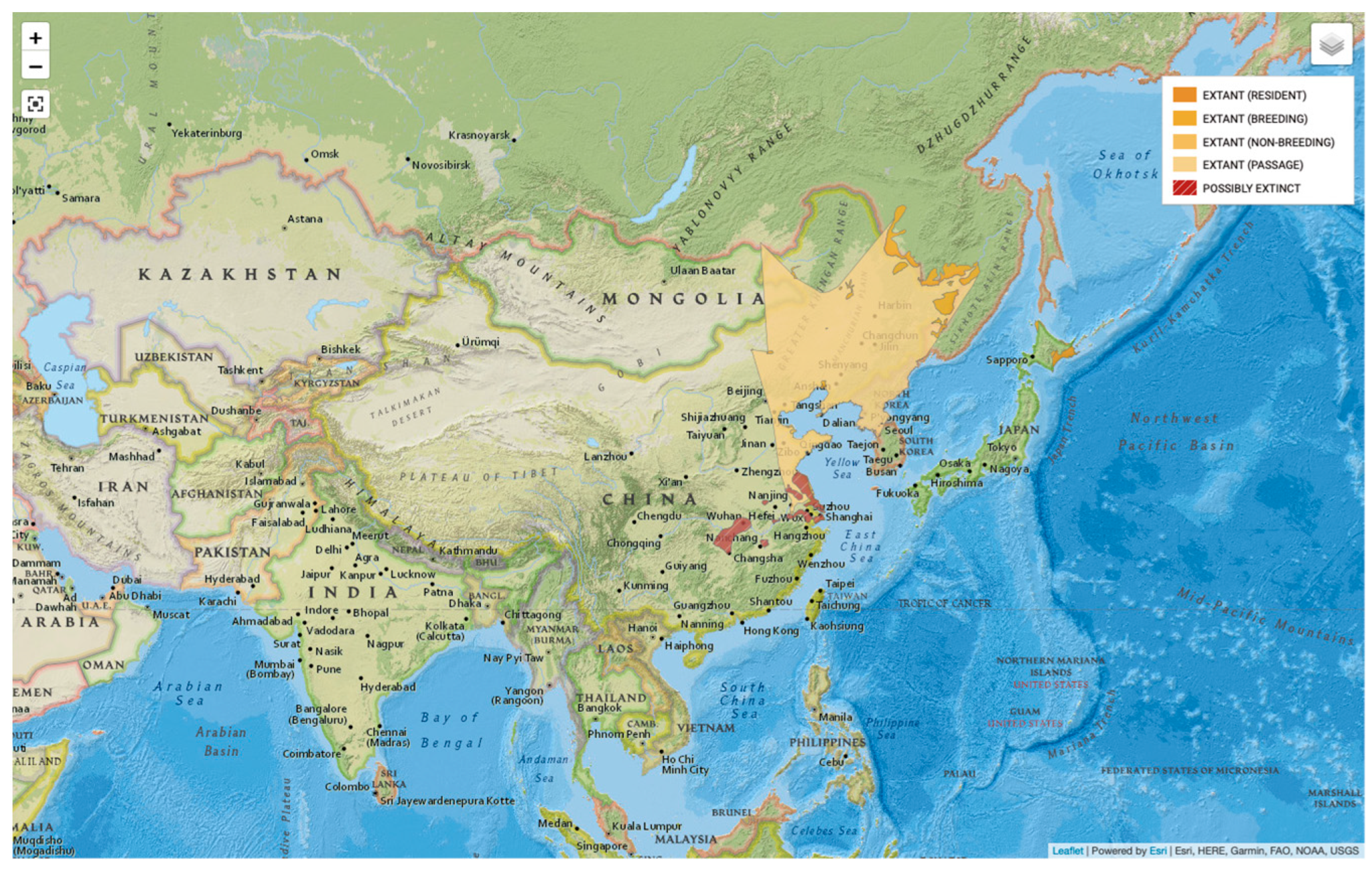
| 3 | Grus japonensis, as represented in Figure 1. They are listed as Vulnerable under criteria A2ac+4ac; C1 according to The IUCN Red List of Threatened Species, see: https://www.iucnredlist.org/species/22692167/213488064, accessed on 30 August 2025. For more about cranes species, see two recent publications: (Nakamura 2018; Wessling 2022). |
| 4 | I adopt a longue durée perspective for this study, as it mirrors elite Chinese habits of collating things, notions, and precedents across time: not merely a calendrical timeline but a historically situated practice of linking phenomena—sometimes chronological, often not—in order to track patterned continuities and refigurations. See (Sterckx et al. 2019, p. 3). |
| 5 | For a comprehensive introduction and selected translation of this work, see (Bokenkamp 2020). |
| 6 | I thank Daniel Burton-Rose and Kim Jihyun for the helpful reminder that zhu 祝 is best rendered as “invoker”. The translation aligned with Liji 禮記 usages in which zhu denotes the ritual official who vocalizes prayers and announcements. “Spirit-medium” is also defensible in later and vernacular contexts where trance and spirit-writing are attested, while “shaman” is a comparative, etic label with a large secondary literature and its own baggage. In this passage from the Declarations of the Perfected at issue, however, the text does not provide decisive evidence that the woman surnamed Yin was possessed, or that she undertook spirit travel, or—conversely—that “zhu” here implies nothing beyond a ritual functionary. In other words, the phenomenology is indeterminate, and the emic title zhu should not be over-specified. Where I engage the shamanism literature, I do so heuristically to frame possible ritual modalities rather than to assert that this case was shamanic in a strict sense. |
| 7 | Ximing 西明 likely refers to Ximing Pavilion (ximing ge 西明閣) in the imperial Xiaoyao Park (xiaoyao ge 逍遙園) in Chang’an 長安, where Kumārajīva (344–413 AD) translated and produced scriptures. See Kumārajīva’s biography (Chu sanzang jiji 出三藏記集, T 2145, 14.101b, reproduced in Gaoseng zhuan 高僧傳, T 2059, 2.332b), (Pettit 2013, 47n97) and the recent comprehensive study on Ximing monastery 西明寺 by Venerable Zhan Ru 湛如, (Zhan 2022). |
| 8 | Zhen’gao jiaozhu, j. 11, Jishengqu, p. 361. |
| 9 | Scholars interested in studying shamanism in China would be advised to consult the bibliography on “Shamanism in China”, generously compiled and shared by Barend ter Haar, see https://bjterhaa.home.xs4all.nl/shamanism.htm, last updated on 26 March 2025, accessed on 30 August 2025. |
| 10 | I am very grateful to Kim Jihyun for prompting this clarification. The episode of Mao Ying’s apotheosis dated to 1 BCE is preserved not in contemporaneous Han sources but in the Shangqing Inner Biographies (Neizhuan 內傳)—revelatory hagiographies received at Maoshan (364–370 CE) through the spirit-medium Yang Xi and later compiled and annotated by Tao Hongjing in the Declarations of the Perfected. As Kim Jihyun’s study of the genre emphasizes, in the fourth-century social context, Neizhuan do not, like official histories, record the life and words of historical figures, but rather, “it is a secret instruction to reveal the whole process of becoming a Perfected Being of the celestial realm of Highest Clarity, with the guide of religious practices and the essential list of canonical scriptures for transcendence“ and thus, function as manuals of cultivation and maps of sacred space (Kim 2014). As their chronological anchors and historical claims (e.g., Han-era dates) primarily serve revelatory legitimation rather than documentary historiography. They should therefore be read with caution as evidence for the Han period. |
| 11 | 白鵠者,是服九轉還丹,使能分形之變化也。(MSZ, p. 132). |
| 12 | According to (Wessling 2022, p. 11), its origin is *gérh2-no- (likely translated as “cry”), which is related to *gar- (“sound, call”), *g(w)erdh- (“hear, sound”), and *g(w) Rgh- (“lament”). In Celtic, *gérh2-no- is said to have transformed to garano. The etymological terms associated with cranes were also used to name the crane habitats. As cited by Wessling, a 2018 study conducted by Lorcan O’Toole suggests that many Irish place names are probably derived from the fact that they were former crane territories. O’Toole further suggests that hundreds of place names of Gaelic origin in mainland Europe that begin with “Cor” or “Kor” date from the Bronze Age and are also related to crane habitats. |
| 13 | “Chen She shijia 陳涉世家”, Shiji 史記, Sima (1959). |
| 14 | We will discuss one unique usage of the blood of white hu (baihu zhi xue 白鵠之血) appeared in Mutianzi zhuan 穆天子傳 (DZ 291) in the following sections. |
| 15 | First, hu was used as ornamental image: ”yuan hu shi yu” 緣鵠飾玉 in juan 3, p. 82. Second, as culinary object, i.e., in the commentary by Wang Yi, he mentioned that the reference of hu 鵠 came from Yi Yin’s 伊尹 entry into office by cooking the soup using hu: ”言伊尹始仕,因緣烹鵠鳥之羹,修玉鼎,以事於湯.” It was referred to as food also in juan 9, p. 168 and juan 10, p. 178; Third, as aspirational symbol, i.e., “寧與黃鵠比翼乎?” in juan 6, p. 138; “鴻鵠” in juan 10, p. 181 and in juan 13, p. 195; “huang hu” 黃鵠 in juan 11, pp. 186, 187; The usages of hu 鵠 is distinct from the usage of he 鶴, which was also used as numinous symbol, signaling a bird of longevity and transcendence distinct from the more utilitarian hu usages above. In particular in the combination of “xuan he” 玄鶴, as in juan 13, p. 199; juan 16, pp. 248, 257; juan 17, p. 267; “kong he” 孔鶴 in juan 15, p. 222. At times, the textual variants have been noted by the commentator, i.e., “鶴, 一作鵠” in juan 16, p. 257; “鵠,一作鶴” in juan 17, p. 264. All quotations taken from (Wang 2015). |
| 16 | For example, the usage of “Honghu” 鴻鵠 in Xin xu 新序 by X. Liu (1985). Especially juan 1, p. 11; juan 2 p. 24, 27; juan 5, p. 88; juan 10, p. 172. |
| 17 | There are two prominent mentions of egg of hu (huluan 鵠卵), both used to emphasize its incompatibility with other animal species. First instance is “[…] but though the Yue hen can’t hatch swan eggs” 越雞不能伏鵠卵 in Zhuangzi 莊子. Original portions fourth century BCE, completed in the second century BCE. See juan 8.1, gengsang chu di ershisan 庚桑楚第二十三, (Guo 1961, p. 775). Translation from (Lynn 2022, p. 408). The second instance is “A bee’s honeycomb cannot hold a goose egg.” 蜂房不容鵠卵 in Huannan zi 淮南子 [The Master of Huainan]. Compiled under the supervision of Liu An 劉安 (180–122 BCE), 139 BCE. See juan 13, Silun xun 汜論訓, (Liu 1989, p. 448). Translations from (Liu 2010, p. 512). |
| 18 | I am grateful to Daniel Burton-Rose for his insightful comment on this point. |
| 19 | Liexian zhuan 列仙傳, attributed to Liu Xiang 劉向 (77–8 or 6 BCE), DZ 294. |
| 20 | Regarding Shenxianzhuan, as pointed out by a recent study by Vincent Goossaert (Goossaert 2021), it should be noted that any attribution of specific texts within Shenxianzhuan to Ge Hong, even in its earliest known versions, remains highly uncertain. This uncertainty derives from a broader pattern observed in the transmission history of the Shenxianzhuan, where the earliest citations are typically fragmentary, offering little narrative elaboration. In contrast, the more developed and rhetorically sophisticated versions, are almost certainly the product of later editing and rewriting. Whereever applicable, the version cited and translated here is drawn from the Extensive Records of the Taiping Era (Taiping guangji 太平廣記), an expansive compilation of anomaly tales assembled in the early eleventh century. This anthology, which gathers hundreds of accounts from the medieval and Tang periods, is not merely a repository of inherited stories, but a site of substantial literary reshaping. As such, it raises Important historiographical questions concerning the layers of accretion, authorial intervention, and ideological framing that mediate our access to earlier Daoist narrative traditions. Shenxian zhuan jiaoshi 神仙传校释, edited by Hu Shouwei 胡守為, is based on the Siku quanshu edition, which is of disputed reliability; for a discussion of the relevant issues, see (Campany 2002, pp. 122–24). |
| 21 | “Wei Kangshu shijia diqi 衛康叔世家第七”, juan 37, (Sima 1959). |
| 22 | “英後遂大交通方士,作金龜玉鶴,刻文字以為符瑞。” in “Chuwang Ying” 楚王英,juan 42, “Guangwu shiwang liezhuan di sanshi’er” 光武十王列傳第三十二, Houhan shu 後漢書, Fan (1973, p. 1429). |
| 23 | Verellen considers the earliest datable association of Mount Crane Call with the founding Celestial Master Zhang Daoling 張道陵 appears in third-fourth-century sources—Chen Shou’s Sanguo zhi (late 3rd c.) (S. Chen 1985) and Chang Qu’s Huayang guo zhi (mid-4th c.)—with further notices in Fan Ye’s Hou Hanshu and in later Daoist compilations (the Shenxian zhuan, as preserved in Taiping guangji and Yunji qiqian). Verellen also notes that the toponym circulates under two near-homophonous graphs—Mount Crane Call (Heming shan 鶴鳴山) and Mount Swan Cry (Huming shan 鵠鳴山) and that “the call of the crane, mount of the immortals, signaled an ascension” (Lishi zhenxian tidao tongjian, 18.5a), see (Verellen 2003, 59n76). |
| 24 | I am grateful to Daniel Burton-Rose for this insightful observation, which helped me foreground the contrast between mountain-dweller and flatland perspectives and consider Daoism’s role in mediating between them. |
| 25 | I follow the definition of “Sinosphere” in a recent publication by David A. Bello and Daniel Burton-Rose, which means ”not limited to the vast area known as China: it radiated out to diverse cultural groups intertwined through their mutual use of Sinitic characters—an area we refer to as the Sinosphere”, see (Bello and Burton-Rose 2023, p. xviii). |
| 26 | The IUCN Red List of Threatened Species, see: https://www.iucnredlist.org/species/22692167/213488064, accessed on 10 September 2025. |
| 27 | According to the Jurong county gazetteer published in 1994, “the area experiences four distinct seasons, with an average annual temperature of 15.1 °C, around 2116 h of sunshine, approximately 1000 mm of precipitation, and a frost-free period lasting 229 days. These favorable natural conditions are highly conducive to the growth of both plants and animals.” See (Jurong xian difangzhi bianzuan weiyuanhui 1994, p. 1) |
| 28 | A frequently cited earliest reference to the name “Mao Ying” appears in an apocryphal (chenwei 讖緯) text titled Periods of Imperial Verifications in the Book of Documents (Shangshu diyanqi 尚書帝驗期) (Goossaert and Berezkin 2012). In a critical comments by the compilers of this text, Yasui Kōzan 安居香山 and Nakamura Shōhachi 中村璋八 (Yasui and Nakamura 1994, p. 387), this text reads: ‘王母之國在西荒。凡得道授書者,皆朝王母於昆侖之闕。王褒字子登,齋戒三月,王母授以瓊花寶曜七晨素經。茅盈從西城王君,詣白玉龜臺,朝謁王母,求長生之道,王母授以玄真之經,又授寶書,童散四方。洎周穆王駕黿鼉魚鱉為梁,以濟弱水,而升昆侖玄圃閬苑之野,而會于王母,歌白雲之謠,刻石紀跡于弇山之上而還。’ Despite its frequent citation, however, the text of Periods of Imperial Verifications in the Book of Documents is obscured by complex issues of transmission and authenticity. First of all, the dating of this text is difficult, not least because the original text is no longer extant; what remains derives from scattered quotations in later sources. As Yasui Kōzan and Nakamura Shōhachi noted: “All of those which collects this text ends with ‘Kunlun zhique’ (昆侖之闕). Yunji qiqian 雲笈七籤 (DZ 1032) cited this text with more details. Yulan (御覽) follows Yunji qiqian but only quoted partially” (Yasui and Nakamura 1994, p. 387). Yunji qiqian and Taiping yulan themselves reliant on Daoist compilations such as the Records of the Assembled Transcendents of the Fortified Walled City (Yuncheng jixian lu 墉城集仙錄, DZ 783) by Du Guangting 杜光庭 (850–933), see (Cahill 2006). A recent study by Cao Jianguo 曹建国 has discovered inconsistencies and possible misquotations in these references, leading some to question whether Shangshu diyanqi existed as an independent text or whether it was conflated with similarly titled Verifications of Imperial Mandates in the Book of Documents (Shangshu diming yan 尚書帝命驗). Cao also note that the relevant passages in Periods of Imperial Verifications in the Book of Documents may have been interpolated from later Daoist hagiographical works, complicating efforts to determine a definitive Han-dynasty origin (Cao 2014). |
| 29 | “天子乃遂東南翔行,馳驅千里,至於巨蒐。之人奴,乃獻白鵠之血,以飲天子,因具牛羊之湩,以洗天子之足,及二乘之人。甲戌,巨嵬之奴觴天子於焚留之山。” For a French translation, see (Mathieu 1978). |
| 30 | The earliest extant edition is the Daozang reprint, see (Schipper and Verellen 2004, p. 113). |
| 31 | The commentary of the scholar and author Guo Pu 郭璞 (276–324) to Mu tianzi zhuan survives with the Ming Daoist canon edition of this text. Guo lived in Luoyang 洛陽 for five years, until 310. On the eve of the Disaster of Yongjia 永嘉之亂—when Han Zhao forces sacked Luoyang and captured Emperor Huai of Jin—he joined the southward migration that accompanied the Western Jin’s collapse and the shift to the Eastern Jin. One of Guo Pu’s commentary calls for our attention, where he claimed that the usage of dong (湩) as milk was specific in the region of Jiangnan, “湩,乳也。今江南人亦呼乳為湩”. This commentary was thus written no earlier than 310, the year when he settled in Jiyang 暨陽, present Jiangyin county in Jiangsu. See also (Xiao 1998). |
| 32 | For an image of Qin bronze crane, see https://bmy.com.cn/impor_collections/421.html (accessed on 30 September 2025). |
| 33 | For a recent study on Han apocryphal texts, see (Zhao 2019), in particular Chapter 2–3, pp. 49–98 and Appendix 5–6, pp. 209–16. |
| 34 | As this text is attributed to Li Zun 李遵; hereafter it will be referred to as “Li Zun edition”. |
| 35 | I am grateful to Jihyun Kim for pointing out to me that the exact dating of the births and ascensions of the Perfected (zhenren 眞人) is a distinctive feature of the Shangqing inner biographies (neizhuan 內傳). |
| 36 | “茅君在帳中與人言語,其出入或發人馬,或化為白鶴。” from Han-Wei edition of Shenxianzhuan Maojun 神仙傳.茅君, quoted in (Chang 2008, 96n27, p. 153). |
| 37 | “君曰:”仙道有’九轉神丹’,服之,化為白鵠。” Zhen’gao, 5.4a/(2006) p. 170. |
| 38 | More on Tao Hongjing’s alchemy, see (Strickmann 1979). |
| 39 | “Sanyue shiba ri 三月十八日”, jishengqu diyi 稽神枢第一, Zhen’gao, j.11, (2006) p. 364. This passage has been discussed by many scholars, including but not limited to (Chang 2008, p. 97; Wei 2014; J. Tao 2021; Q. Sun 2024). |
| 40 | I am grateful to Vincent Goossaert who made me aware by personal communication on 6th February 2023 that Yuan Bingling 袁冰凌 has worked on this hypothesis earlier. However, I have not seen this work yet. |
| 41 | Here I use “cosmic” following Jihyun Kim’s analytic sense of “cosmos”, which “refers to the totality of space and time as textured by the Chinese numerological system of the ten heavenly stems and twelve earthly branches.” On this basis Kim distinguishes “cosmopraxis” (practitioner’s open mode of engagement that aligns with, suspends, and re-patterns that field) from “cosmotechnique” (codified, transmissible procedures such as ritual sequences, petitions, talismanic operations, visualization and breath regimens, and alchemical recipes, all timed to tune, recalibrate, or temporarily invert specific spatiotemporal correspondences). See (Kim 2025). |
| 42 | For a recent critical edition of Bencao jing jizhu, see (H. Tao 2023). |
| 43 | Based on my ongoing research on Zhongguo gudai hulinbeike jicun 中國古代護林碑刻輯存 (Ni 2018), I have compiled a (non-exhaustive) Chinese terms to the effect of a prohibition of deforestation such as “護林, 護山, 禁伐, 禁燬林, 封禁, 禁約, 封山, 山禁, 永禁不伐, 樵伐, 禁伐” and on afforestation: “植松柏”. |
| 44 | I understand “Cai 採” here refering to any kind of gathering, such as picking medicinal plants, wild fruits or collecting firewood. |
| 45 | Pan Shan Zhi, ch. 5:3a-4a. As cited in (Menzies 1994, pp. 67–68). |
| 46 | According to a study by He Anping, Xu Xuan was a close friend of Daoist Wang Qixia 王栖霞 (882–943), the nineteenth Maoshan Patriarch, see (Hu 1995, p. 112). Not only Xu wrote poems dedicated to him, i.e., “Presented to Master Wang Zhensu“ (zeng Wang Zhensu xiansheng 赠王贞素先生), he also wrote the epitaph for Wang, see (He 2021a). |
| 47 | See (MSZ, pp. 76–77), ‘今下潤州、昇州,候宣命到,於茅山四面立定界址,嚴行指揮,斷絕諸色人並本山官觀祠宇主首以下,自今後不得輒有樵採斫伐及放野火焚爇,常令地分巡檢官吏、耆老、壯丁覺察檢校,如有違犯,即便收捕,押送所屬州縣勘斷訖,令眾半月,滿日疏放。如斫伐數多,情理難恕,即仰收禁,奏候指揮,當行决配。’ |
| 48 | This pattern is consistent with Hamayon’s observations on the sensitive balance maintained between shamanic groups and the animals they revered, where she notes “the spirits of wild species cannot be deceived” (Hamayon 2016, pp. 240–42), highlighting the inherent respect and care required with wild animals and their spirits. Moreover, the fading of cranes from Maoshan sources after the first millennium likely reflects a two-fold shift: early festival mediation by spirit-mediums—evident in drum-and-dance rites and avian portents associated with the Three Mao Lords—was progressively assumed and regularized by institutional Daoists in the medieval period, even as growing environmental pressures and habitat degradation around Maoshan reduced the birds’ actual presence. I am grateful to Kim Jihyun for sharing with me this insight. |
| 49 | The stele is found in (LST 1989, 59:87). The inscription of this stele is found in Gu Qiyuan 顧起元 “Record of the Reconstruction of Qianyuan Abbey at Maoshan” (Maoshan chongjian qianyuanguan ji 茅山重建乾元觀記), in Gu Qiyuan’s Lanzhen caotang ji – wenji 嬾真草堂集·文集, Siku jinhui shu congkan bubian 四庫禁燬書叢刊補編, 19.4b. See also Gu Qiyuan 顧起元, “Record of the Reconstruction of Qianyuan Abbey at Maoshan” (Maoshan chongjian qianyuanguan ji茅山重建乾元觀記) in (Xuzuan Gourongxian Zhi 1974, 17.73a–74b). For my study on this stele and history of Quanzhen Daoism at Maoshan, I benefited greatly from email exchanges with Richard G. Wang in December 2022, as well as from Marianne Bujard’s close reading and thoughtful feedback on an early draft in January 2023, and from Vincent Goossaert’s constructive suggestions following my presentation at his graduate workshop at EPHE on 13 February 2023. While I continued to refine my own analysis, a major study by Sun Yiping on the Yanzu lineage and the spread of Quanzhen Daoism at Maoshan was published in 2024, providing a comprehensive treatment of the subject, see (Y. Sun 2024). |
| 50 | Such as Reeves’s pheasant, Syrmaticus reevesii, listed as Vulnerable under criteria A2cd+3cd+4cd;C2a(i) according to The IUCN Red List of Threatened Species, see: https://www.iucnredlist.org/species/22679346/131873938, accessed on 30 August 2025. |
| 51 | Listed as Critically Endangered under criteria A2ad according to The IUCN Red List of Threatened Species, see: https://www.iucnredlist.org/species/1272/3375181, accessed on 30 August 2025. |
| 52 | I am very grateful to Stéphanie Homola for bringing the studies by Stephan Feuchtwang and William Matthews on this topic to my attention on the conference “French Anthropology of the Chinese Worlds” (Assises de Anthropologie Française des Mondes Chinois) at INALCO, Paris from 17–19 September 2025. |
References
Primary Source
(LST 1989) Beijing tushuguan cang Zhongguo lidai shike taben huibian 北京圖書館藏中國歷代石刻拓本匯編 [Collected Rubbings of Chinese Stone Inscriptions from the Beijing Library].100 vols. Comp. Beijing tushuguan jinshi zu 北京圖書館金石組. zhengzhou: zhongzhou guji chubanshe, 1989–1991.(Wang 2015) Chuci 楚辭. Edition Chuci buzhu 楚辭補注. Comm. Wang Yi 王逸 (fl. 89–158); sub-comm. Hong Xingzu 洪興祖 (1090–1155). Beijing: Zhonghua shuju, 2015.Chu sanzang jiji 出三藏記集, T 2145.(DZ 1988) Daozang 道藏. Beijing, Shanghai and Tianjin: Beijing wenwu 北京文物, Shanghai shudian 上海書店 and Tianjin guji chuban she 天津古籍出版社, 1988.(T 2059) Gaoseng zhuan 高僧傳, T 2059.(Fan 1973) Houhan shu 後漢書 (398–445). Fan, Ye 范曄. Beijing: Zhonghua shuju, 1973.(Liu 1989) Huannan zi 淮南子 [The Master of Huainan]. Compiled under the supervision of Liu An 劉安 (180–122 BCE), 139 BCE. Edited by Liu Wendian 劉文典, Huainan honglie jijie 淮南鴻烈集解. Beijing: Zhonghua shuju, 1989.Huayang guo zhi 華陽國志. By Chang Qu 常璩 (fl. 350). In Huayang guo zhi jiaobu tuzhu 華陽國志校補圖注. Edited by Ren Naiqiang 任乃強. Shanghai: Guji chuban she, 1987.Lanzhen caotang ji wenji 嬾真草堂集·文集, Gu Qiyuan 顧起元 (1565–1628), Siku jinhui shu congkan bubian 四庫禁燬書叢刊補編, 311 vols., Beijing: Beijing chubanshe, 1998.Liexian zhuan 列仙傳, attributed to Liu Xiang 劉向 (77–8 or 6 BCE), DZ 294.(MSZ 2016) Maoshan zhi 茅山志 [Gazetteer of Maoshan], Liu Dabin 劉大彬, and Jiang Yongnian 江永年, eds. Critical edition by Wang Gang 王崗 (Richard G. Wang), Shanghai: Shanghai Guji chubanshe 上海古籍出版社, 2016.Mu tianzi zhuan 穆天子傳 [Biography of Mu, Son of Heaven]. DZ 291.Panshan zhi 盤山志 [Gazetter of Pan mountain], in Zhongguo fosizhi congkan 中國佛寺志叢刊, Yangzhou: Guangling shushe, 2006.(S. Chen 1985) Sanguo zhi 三國志, Chen Shou 陳壽. Peking: Zhonghua shuju, 1985.(Ge 2010) Shenxianzhuan 神仙傳, Ge Hong 葛洪 (283–343), fragments in (Campany 2002). See also a critical edition based on Siku quanshu edition of Shenxianzhuan, Shenxian zhuan jiaoshi 神仙传校释. Edited by Hu Shouwei 胡守為. 1st ed. Beijing: Zhonghua shu ju, 2010.(Sima 1959) Shiji 史記. Sima Qian 司馬遷. Beijing: Zhonghua shuju, 1959.Taiping guangji 太平廣記, Li Fang 李昉 (925–996), Beijing: Zhonghua shuju, 1961.Taiping yulan 太平御覽, Li Fang 李昉 (925–996), Yingyin wenyuange siku quanshu 景印文淵閣四庫全書, Taibei: Shangwu yinshuguan, 1986.(X. Liu 1985) Xin xu 新序. Liu, Xiang 劉向 (79–8 BCE). Beijing: Zhonghua shuju, 1985.Yaoxiu keyijielu chao 要修科儀成律鈔,by Zhu Faman 朱法滿 (early 8th c.). DZ 463.(Hong 1981) Yijianzhi 夷堅志. Hong Mai 洪邁 (1123–1202). Beijing: Zhonghua shuju, 1981.Yongcheng jixianlu 墉城集仙錄. Du Guangting 杜光庭 (850–933). DZ 783.Yunji qiqian 雲笈七籤 (ca. 1028) [Seven Baskets from the Cloudy Satchel], comp. Zhang Junfang 張君房, DZ 1032, ed. Li Yongsheng 李永晟. Beijing: Zhonghua shuju, 2003.Zhen’gao 真誥 [Declarations of the Perfected]. 499. Edited by Tao Hongjing 陶弘景 (456–536). DZ 1016. Critical Edition: Zhen’gao jiaozhu 真誥校註 (Declarations of the Perfected, Collated with Commentary), compiled by Tao Hongjing 陶弘景 (pp. 452–536), edited with commentary by Yoshikawa Tadao 吉川忠夫 and Mugitani Kunio 麥谷邦夫; edition Beijing: Zhongguo shehui kexue chubanshe, 2006.(Guo 1961) Zhuangzi 莊子 [Master Zhuang]. Original portions fourth century BCE, completed in the second century BCE. Ed. by Guo Qingfan 郭慶藩, Zhuangzi jishi 莊子集釋. Beijing: Zhonghua shuju, 1961.Secondary Literature
- Ali, Sálim. 1979. Bird Study in India: Its History and Its Importance. Azad Memorial Lectures 1978. Azad Bhawan: Indian Council for Cultural Relations. [Google Scholar]
- Angé, Olivia, and David Berliner, eds. 2020. Ecological Nostalgias: Memory, Affect and Creativity in Times of Ecological Upheavals. New York: Berghahn Books. [Google Scholar]
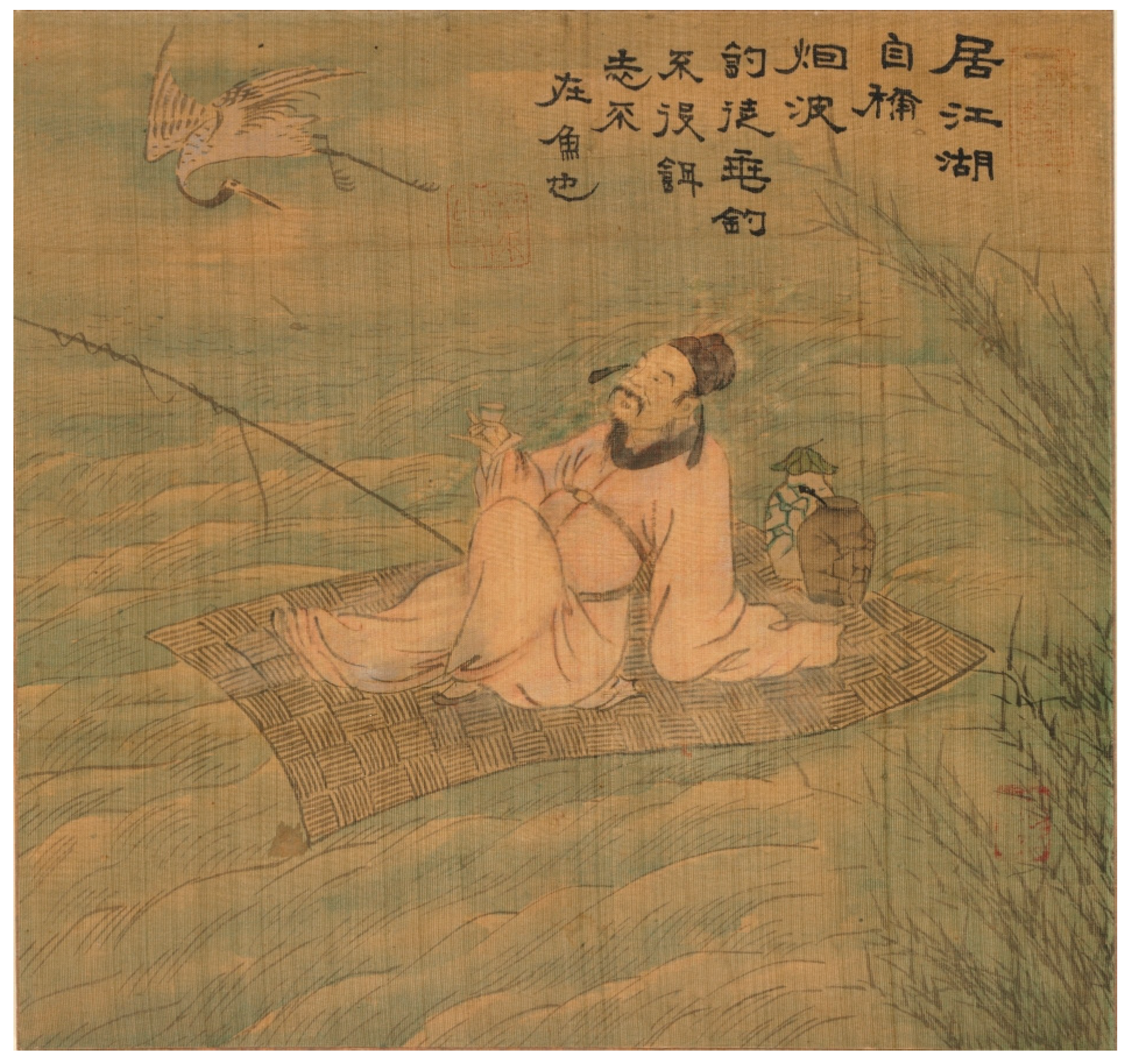
- Anonymous. n.d. Poet Fisherman. 장지화 어부사 (張志和漁父詞), 1800s. Album Leaf from a Set; Ink and Color on Silk; 22.5 x 24 cm (8 7/8 x 9 7/16 in.) John L. Severance Fund 1990.70. Cleveland Museum of Art. Available online: https://www.clevelandart.org/art/1990.70 (accessed on 30 August 2025).
- Bello, David Anthony, and Daniel Burton-Rose. 2023. Insect Histories of East Asia, 1st ed. Seattle: University of Washington Press. [Google Scholar]
- Bokenkamp, Stephen R. 2020. A Fourth-Century Daoist Family: The Zhen’gao, or Declarations of the Perfected. Oakland: University of California Press, vol. 1. [Google Scholar]
- Brook, Timothy. 2023. The Price of Collapse: The Little Ice Age and the Fall of Ming China. Princeton: Princeton University Press. [Google Scholar]
- Brown, Tristan G. 2023. Laws of the Land: Fengshui and the State in Qing Dynasty China, 1st ed. Princeton: Princeton University Press. [Google Scholar] [CrossRef] [Scilit]
- Burton-Rose, Daniel. 2022. The Environmental History of East Asia: Intraregional, Transnational, and Translocal Connections. 한국과학사학회지 (The Korean Journal for the History of Science) 44: 365–86. [Google Scholar] [CrossRef] [Scilit]
- Cahill, Suzanne E. 2006. Divine Traces of the Daoist Sisterhood. “Records of the Assembled Transcendents of the Fortified Walled City” by Du Guangting (850–933). Gulfport: Three Pines Press. [Google Scholar]
- Campany, Robert Ford. 1996. Strange Writing: Anomaly Accounts in Early Medieval China. Albany: State University of New York Press. [Google Scholar]
- Campany, Robert Ford. 2002. To Live as Long as Heaven and Earth: A Translation and Study of Ge Hong’s Traditions of Divine Transcendents. Oakland: University of California Press. [Google Scholar]
- Cao, Jianguo 曹建国. 2014. Weishu Zhong de Xiwangmu Gushi Bianzheng—Jianlun Daozangben Yongcheng Jixianlu de Zhenwei Wenti 緯書中的西王母故事辨證——兼論道藏本《墉城集仙錄》的真偽問題 [Textual Discriminations of Stories of Xi Wangmu]. Changjiang Xueshu 長江學術 3: 60–66. [Google Scholar]
- Chang, Chaojan 張超然. 2008. Xipu、jiaofa Jiqi Zhenghe: Dongjin Nanchao Daojiao Shangqing Jingpai de Jichu Yanjiu 系譜、教法及其整合:東晉南朝道教上清經派的基礎研究 [Lineages, Doctrines and Integration: A Foundational Study of the Shangqing School of Taoism in the East Jin and Southern Dynasties]. Taipei: National Chengchi University 國立政治大學. [Google Scholar]
- Chen, Bixia, Chris Coggins, Jesse Minor, and Yaoqi Zhang. 2018. Fengshui Forests and Village Landscapes in China: Geographic Extent, Socioecological Significance, and Conservation Prospects. Urban Forestry & Urban Greening 31: 79–92. [Google Scholar] [CrossRef] [Scilit]
- Chen, Chiao-Yi 陈桥驿. 1965. Gudai Shaoxing Diqu Tianran Senlin de Pohuai Ji Qi Dui Nongye de Yingxiang 古代绍兴地区天然森林的破坏及其对农业的影响 [The Removal of the Natural Forest Cover of Ancient Shaoshing and Its Influence on Agriculture]. Geographia Sinica 地理学报 31: 129–41. [Google Scholar]
- Chen, Guofu 陳國符. 2014. Daozang Yuanliu Kao 道藏源流考. Shanghai: Zhonghua shuju. [Google Scholar]
- Chen, Peixuan 陈姵瑄. 2020. Sanmao xushi zai wenxian zhong de xingtai liubian 三茅叙事在文献中的形态流变 [The morphological flux of the Sanmao narrative in the literature]. Yuejiang xuekan 阅江学刊 12: 107–17. [Google Scholar]
- Chittick, Andrew. 2020. The Jiankang Empire in Chinese and World History, 1st ed. Oxford Studies in Early Empires. Oxford: Oxford University Press. [Google Scholar] [CrossRef] [Scilit]
- Chiu, Chung-Lin 邱仲麟. 2011. Ming Qing Shanxi de shandi kaifa yu senlin kanfa—Yi jinzhong, jinnan wei zhongxin de kaocha 明清山西的山地開發與森林砍伐-以晉中、晉南為中心的考察. Danjiang shixue 淡江史學 23: 33–70. [Google Scholar] [CrossRef]
- Coggins, Chris. 2003. The Tiger and the Pangolin: Nature, Culture, and Conservation in China. Honolulu: University of Hawai’i Press. [Google Scholar]
- Descola, Philippe. 2013. Beyond Nature and Culture. Translated by Janet Lloyd. Chicago and London: The University of Chicago Press. [Google Scholar]
- Domańska, Ewa. 2017. Animal History. History and Theory 56: 267–87. [Google Scholar] [CrossRef] [Scilit]
- Eliade, Mircea. 1954. The Myth of the Eternal Return. Bollingen Series 46; New York: Pantheon Books. [Google Scholar]
- Eliade, Mircea. 1959. The Sacred and the Profane: The Nature of Religion. New York: Harcourt Brace Jovanovich. [Google Scholar]
- Elvin, Mark. 2004. Retreat of the Elephants: An Environmental History of China. New Haven and London: Yale University Press. [Google Scholar]
- Fang, Jin-qi, and Zhiren Xie. 1994. Deforestation in Preindustrial China: The Loess Plateau Region as an Example. Chemosphere 29: 983–99. [Google Scholar] [CrossRef] [Scilit]
- Feuchtwang, Stephan. 2014. Too Ontological, Too Rigid, Too Ahistorical but Magnificent. Hau: Journal of Ethnographic Theory 4: 383–87. [Google Scholar] [CrossRef] [Scilit]
- Gąsiorowski, Piotr. 2013. Gruit Grus: The Indo-European Names of the Crane. Studia Etymologica Cracoviensia 18: 51–68. [Google Scholar]
- Gesterkamp, Lennert. 2017. The Synthesis of Daoist Sacred Geography: A Textual Study of Du Guangting’s Dongtian Fudi Yuedu Mingshan Ji (901). 道教研究學報:宗教、歷史與社會 Daoism: Religion, History and Society 9: 1–39. [Google Scholar]
- Girardot, Norman J., James Miller, and Xiaogan Liu. 2001. Daoism and Ecology: Ways Within a Cosmic Landscape. Religions of the World and Ecology. Cambridge, MA: Center for the Study of World Religions, Harvard Divinity School: Distributed by Harvard University Press. [Google Scholar]
- Goossaert, Vincent. 2005. The Beef Taboo and the Sacrificial Structure of Late Imperial Chinese Society. In Of Tripod and Palate: Food, Politics, and Religion in Traditional China. Edited by Roel Sterckx. New York: Palgrave Macmillan. [Google Scholar]
- Goossaert, Vincent. 2021. La confiance et le besoin. Impressions d’Extrême-Orient 13. [Google Scholar] [CrossRef] [Scilit]
- Goossaert, Vincent. 2025a. Prohibited Mountains and Forests in Late Imperial China. Religions 16: 71. [Google Scholar] [CrossRef] [Scilit]
- Goossaert, Vincent. 2025b. The Beef Taboo in China: Agriculture, Ethics, Sacrifice. Translated by Barbara R. Ambros. Honolulu: University of Hawai’i Press. [Google Scholar]
- Goossaert, Vincent, and Rostislav Berezkin. 2012. The Three Mao Lords in Modern Jiangnan Cult and Pilgrimage between Daoism and Baojuan Recitation. Bulletin De L’École Française D’Extrême-Orient 99: 295–326. [Google Scholar]
- Granet, Marcel. 1919. Fêtes et Chansons Anciennes de La Chine. Paris: Ernest Leroux. [Google Scholar]
- Grebnev, Yegor. 2025. Confining Nature to a Diagram: Origins and Evolution of the System of Seventy-Two Hou 候. T’oung Pao 111: 3–52. [Google Scholar] [CrossRef] [Scilit]
- Hamayon, Roberte. 1990. La Chasse à L’âme: Esquisse d’une Théorie du Chamanisme Sibérien. Mémoires de la Société d’ethnologie 1. Nanterre: Société d’ethnologie. [Google Scholar]
- Hamayon, Roberte. 2016. Why We Play: An Anthropological Study. Translated by Damien Simon. Chicago: HAU Books. [Google Scholar]
- He, Anping 何安平. 2020. Tao Hongjing 《Shou Lu Jingyou shilaiwen》yanjiu 陶弘景《授陆敬游十赉文》研究. Zong jiao xue yan jiu 宗教學研究 4: 36–43. [Google Scholar]
- He, Anping 何安平. 2021a. Pingsheng xinshi xiang xuanguan—Xu Xuan yu Daojiao 平生心事向玄关——徐铉与道教. Ningbo da xue xue bao. Ren wen ke xue ban 34: 88–94. [Google Scholar] [CrossRef]
- He, Anping 何安平. 2021b. Wangzhe Zhi Shi: Tangdai Gaodao Li Hanguang de Shengping Yu Shiye 王者之師:唐代高道李含光的生平與事業. Zhonghua Wenshi Luncong 中華文史論叢 141: 183–218. [Google Scholar]
- He, Bilai 賀碧來/Isabelle Robinet. 2021. Taiyuan Zhenren Maojun Neizhuan Jieti 《太元真人茅君內傳》解題. Translated by Zhang Can 張粲 and Lü Pengzhi 呂鵬志. Journal of the Institute for Chinese Classics Sudies 古典文獻研究 24: 174–84. [Google Scholar]
- Hu, Fuchen 胡孚琛, ed. 1995. Zhonghua Daojiao Da Cidian 中华道教大辞典. Beijing: Zhongguo shehui kexue chubanshe. [Google Scholar]
- Inglis, Alister D. 2006. Hong Mai’s Record of the Listener and Its Song Dynasty Context. Albany, NY: State University of New York Press. [Google Scholar]
- Jurong xian difangzhi bianzuan weiyuanhui 句容縣地方志編纂委員會, ed. 1994. Jurong xianzhi 句容縣志. Nanjing: Jiangsu renmin chubanshe. [Google Scholar]
- Kaltenmark, Max. 1953. Le Lie-sien tchouan (biographies légendaires des immortels taoïstes de l’antiquité). Paris: Université de Paris, publications du Centre d’études sinologiques de Pékin. [Google Scholar]
- Kim, Jihyun 김지현 金志玹. 2014. Naiden ni okeru dōgyo syugyō no katei to sekai no kōjō 内傳にみる道敎修行の過程と世界の構造 [Daoist Practice and Structure of the World: Seen through Inner Biographies]. Jongyo wa munhwa 종교와 문화 [Religion and Culture] 26: 185–217. [Google Scholar]
- Kim, Jihyun 김지현 金志玹. 2025. Elaborating Correlation with Space–Time in the Daoist Body: Following and Reversing Nature. Religions 16: 890. [Google Scholar] [CrossRef] [Scilit]
- Kleeman, Terry F. 2016. Celestial Masters: History and Ritual in Early Daoist Communities. Harvard-Yenching Institute Monograph Series; Cambridge, MA: Harvard University Asia Center. [Google Scholar]
- Kominami, Ichirō 小南一郎. 1984. Chūgoku No Shinwa to Monogatari: Ko Shōsetsu No Tenkai 中国の神話と物語り: 古小説の展開 [Chinese Myths and Legends: The Development of Ancient Fiction]. Tokyo: Iwanami Shoten. [Google Scholar]
- Lander, Brian. 2014. State Management of River Dikes in Early China: New Sources on the Environmental History of the Central Yangzi Region. T’oung Pao 100: 325–62. [Google Scholar] [CrossRef] [Scilit]
- Lander, Brian. 2020. Birds and Beasts Were Many: The Ecology and Climate of the Guanzhong Basin in the Pre-Imperial Period. Early China 43: 207–45. [Google Scholar] [CrossRef] [Scilit]
- Lander, Brian. 2021. The King’s Harvest: A Political Ecology of China from the First Farmers to the First Empire. New Haven and London: Yale University Press. [Google Scholar]
- Lewis, Mark Edward. 2009. The Mythology of Early China. In Early Chinese Religion, Part One: Shang Through Han (1250 BC-220 AD). Edited by John Lagerwey and Marc Kalinowski. Early Chinese Religion. Leiden: Brill, vol. 21/1. [Google Scholar] [CrossRef] [Scilit]
- Li, Binhai 李炳海. 2019. Mu Tianzi zhuan zhong Zhuoyaoshi, Guzhanshi, Jusou ji suochu diming kaolun 《穆天子传》中浊繇氏、骨飦氏、巨蒐及所处地名考论 [An Investigation of the Zhuo Yao Clan, the Gu Zhan Clan, Ju Sou, and the Place Names Where They Lived in the Mu Tianzi Zhuan]. Minzu wenxue yanjiu 37: 147–53. [Google Scholar]
- Li, Yonggang 李永刚. 2005. Maoshan Daojiao 茅山道教. Jintanshi maoshan daojiao wenhua yanjiu zhongxin zu 金坛市茅山道教文化研究中心组. Nanjing: Dongnan daxue chubanshe. [Google Scholar]
- Liu, An, King of Huainan. 2010, The Huainanzi: A Guide to the Theory and Practice of Government in Early Han China. Translated and Edited by John S. Major, Sarah A. Queen, Andrew Seth Meyer and Harold Roth, with Additional Contributions by Michael Puett and Judson B. Murray. Translations from the Classics. New York: Columbia University Press.
- Lowdermilk, Walter Clay, and T. I. Li. 1930. Forestry in Denuded China. The Annals of the American Academy of Political and Social Science 152: 127–41. [Google Scholar] [CrossRef] [Scilit]
- Lynn, Richard John. 2022. Zhuangzi: A New Translation of the Sayings of Master Zhuang as Interpreted by Guo Xiang. New York: Columbia University Press. [Google Scholar]
- Major, John S. 1993. Heaven and Earth in Early Han Thought: Chapters Three, Four, and Five of the Huainanzi. Albany, NY: State University of New York Press. [Google Scholar]
- Major, John S. 2008. Animals and Animal Metaphors in the Huainanzi. In Asia Major. Star Gazing, Firephasing, and Healing in China: Essays in Honor of Nathan Sivin. Taipei: Academia Sinica, vol. 21, pp. 133–51. [Google Scholar]
- Marks, Robert B. 1996. Commercialization Without Capitalism: Processes of Environmental Change in South China, 1550–1850. Environmental History 1: 56–82. [Google Scholar] [CrossRef] [Scilit]
- Marks, Robert B. 2005. Why China? Environmental History 10: 56–58. [Google Scholar]
- Mathieu, Rémi. 1978. Le Mu Tianzi Zhuan: Traduction Annotée, Etude Critique. Mémoires de l’Institut des Hautes Etudes Chinoises. Paris: Collège de France, Institut des Hautes Etudes Chinoises, vol. 9. [Google Scholar]
- Matthews, William. 2017. Ontology with Chinese Characteristics: Homology as a Mode of Identification. Hau: Journal of Ethnographic Theory 7: 265–85. [Google Scholar] [CrossRef] [Scilit]
- Matthews, William. 2022. Cosmic Coherence: A Cognitive Anthropology Through Chinese Divination. Asian Anthropologies. New York: Berghahn, vol. 13. [Google Scholar]
- McNeill, John R. 2003. Observations on the Nature and Culture of Environmental History. History and Theory: Studies in the Philosophy of History 42: 5–43. [Google Scholar] [CrossRef] [Scilit]
- Menzies, Nicholas K. 1994. Forest and Land Management in Imperial China. Studies on the Chinese Economy (Houndmills, Basingstoke, England). New York: Macmillan and St. Martin’s Press. [Google Scholar]
- Miller, Ian M., and Chris Coggins. 2024. Lines of Fate: Fengshui Forests and the Moral Ecology of Resilience in Subtropical Southern China. The American Historical Review 129: 1451–73. [Google Scholar] [CrossRef] [Scilit]
- Miller, Ian Matthew. 2020. Fir and Empire: The Transformation of Forests in Early Modern China. Weyerhaeuser Environmental Book. Seattle: University of Washington Press. [Google Scholar]
- Nakamura, Futoshi. 2018. Biodiversity Conservation Using Umbrella Species: Blakiston’s Fish Owl and the Red-Crowned Crane. Ecological Research Monographs. Singapore: Springer. [Google Scholar]
- Ni, Genjin 倪根金, comp. 2018. Zhongguo Gudai Hulin Beike Jicun 中國古代護林碑刻輯存. Nanjing: Fenghuang chubanshe 鳳凰出版社. [Google Scholar]
- Penny, Benjamin. 2008. Liexian Zhuan 列仙傳 Biographies of Exemplary Immortals. In The Encyclopedia of Taoism, 1st ed. Edited by Fabrizio Pregadio. Routledge Encyclopedias of Religion and Society. London and New York: Routledge. [Google Scholar]
- Pettit, Jonathan Edwin Eugene. 2013. Learning from Maoshan: Temple Construction in Early Medieval China. Ph.D. thesis, Indiana University, Bloomington, IN, USA. [Google Scholar]
- Pirazzoli-t’Serstevens, Michèle. 2009. Death and the Dead: Practices and Images in the Qin and Han. In Early Chinese Religion: Part One: Shang Through Han (1250 BC-220 AD). Edited by John Lagerwey and Marc Kalinowski. Leiden: Brill. [Google Scholar]
- Pregadio, Fabrizio, ed. 2008. The Encyclopedia of Taoism, 1st ed. Routledge Encyclopedias of Religion and Society. London and New York: Routledge. [Google Scholar]
- Pregadio, Fabrizio, ed. 2020. The Man-Bird Mountain: Writing, Prophecy, and Revelation in Early China. International Journal of Divination and Prognostication 2: 29–82. [Google Scholar]
- Robinet, Isabelle. 1984. La Révélation du Shangqing dans l’Histoire du Taoïsme. Paris: École Française d’Extrême-Orient, vol. 2. [Google Scholar]
- Rols, Johan. 2021. Les Interdits de Destruction de la Faune et de la Flore de l’Antiquité Tardive au haut Moyen-Âge Chinois. Ph.D. thesis, Université Paris Sciences et Lettres, Paris, France. [Google Scholar]
- Schafer, Edward H. 1980. Mao Shan in T’ang Times. Boulder: Society for the Study of Chinese Religions. [Google Scholar]
- Schafer, Edward H. 1983. The Cranes of Maoshan. In Tantric and Taoist Studies in Honour of R.A. Stein. Edited by Michel Strickmann. Mélanges Chinois et Bouddhiques. Bruxelles: Institut Belge des Hautes Etudes Chinoises, vols. 20–22. [Google Scholar]
- Schafer, Edward H. 1985. The Snow of Mao Shan: A Cluster of Taoist Images. Journal of Chinese Religions 13: 107–26. [Google Scholar] [CrossRef] [Scilit]
- Schipper, Kristofer. 1965. L’Empereur Wou des Han dans la légende taoiste, Han Wou-ti Nei-Tchouan. Publications de l’École française d’Extrême-Orient. Paris: École française d’Extrême-Orient, vol. 58. [Google Scholar]
- Schipper, Kristofer. 2001. Daoist Ecology: The Inner Transformation. A Study of the Precepts of the Early Daoist Ecclesia. In Daoism and Ecology: Ways within a Cosmic Landscape. Edited by Norman J. Girardot, James Miller and Xiaogan Liu. Religions of the World and Ecology. Cambridge, MA: Harvard University Press. [Google Scholar]
- Schipper, Kristofer. 2018. Zhongguo chuantong wenhua zhong de ziran zhexue yu qi guangfan yingxiang 中国传统文化中的自然哲学及其广泛影响(特别参考道教自然保护区) [Natural Philosophy in Traditional Chinese Culture and Its Extensive Influence (Special Reference to Taoist Nature Sanctuary)]. Dongtian fudi yu dongya wenhua yixiang gongzuo huiyi 洞天福地与东亚文化意象工作会议 [Workshop on Taoist Natural Sanctuaries and East Asian Cultural Imageries], National Center of Cultural Heritage, Tsinghua University 清华大学国家遗产中心. October 24. Available online: https://www.youtube.com/watch?v=fySUlPG2v-4&t=8s (accessed on 27 October 2025).
- Schipper, Kristofer, and Franciscus Verellen, eds. 2004. The Taoist Canon: A Historical Companion to the Daozang. Dao Zang Tong Kao. Chicago: University of Chicago Press. [Google Scholar]
- Seidel, Anna. 1983. Imperial Treasures and Taoist sacraments: Taoist roots in the apocrypha. In Tantric and Taoist Studies in Honour of R.A. Stein. Edited by Michel Strickmann. Mélanges Chinois et bouddhiques XXI. Brussels: Institut Belge des Hautes Études Chinois, vol. 2. [Google Scholar]
- Shen, Jiezhou 沈芥舟. 1935. Maoshan Youji 茅山游记. Lüxing Zazhi 旅行杂志 9: 47–48. [Google Scholar]
- Shenbao 申報. 1919. Shang You Kenshan Zhidi Gaizao Linye Shi Qingshui Jianzhu Dongxia Zuyi Dizhi Hunchao 上游墾山之地改造林業使淸水建瓴東下足以抵制渾潮, 水利協會請浚太湖呈文(續). Shenbao, October 9.
- Shenbao 申報. 1928. Ji Xindu Xinnian Zhi Xiao Maoshan 記新都新年之小茅山. Shenbao, January 29.
- Shenbao 申報. 1935. Bo Maoshan Zaolin Jingfei Yiwanyuan, Su Shengfu Zhi Jueyi Shijian 撥茅山造林經費一萬元, 蘇省府之决議事件. Shenbao, October 19.
- Stanley-Baker, Michael, J. E. E. Pettit, and Dolly Yang. 2023. A Medieval Daoist Drug Geography: The Jinye Shendan Jing as a Novel View on the Circulation of Medical Knowledge in Asia. Religions 14: 835. [Google Scholar] [CrossRef] [Scilit]
- Sterckx, Roel, Martina Siebert, and Dagmar Schäfer, eds. 2019. Animals through Chinese History: Earliest Times to 1911. Cambridge, UK: Cambridge University Press. [Google Scholar]
- Strickmann, Michel. 1979. On the Alchemy of T’ao Hung-Ching. In Facets of Taoism: Essays in Chinese Religion. Edited by Holmes Welch and Anna K. Seidel. New Haven: Yale University Press. [Google Scholar]
- Strickmann, Michel. 1990. The Consecration Sūtra: A Buddhist Book of Spells. In Chinese Buddhist Apocrypha. Edited by Robert E. Buswell, Jr. Honolulu: University of Hawaiʻi Press. [Google Scholar]
- Strickmann, Michel. 2002. Chinese Magical Medicine. Edited by Bernard Faure. Asian Religions & Cultures. Stanford: Stanford University Press. [Google Scholar]
- Sturman, Peter C. 1990. Cranes above Kaifeng: The Auspicious Image at the Court of Huizong. Ars Orientalis 20: 33–68. [Google Scholar]
- Sun, Qi. 2024. The Celestial Masters and the Origins of Daoist Monasticism. Religions 15: 83. [Google Scholar] [CrossRef] [Scilit]
- Sun, Yiping 孫亦平. 2024. Cong Qianyuanguan Bei Kan Yanzupai Xingqi Ji Quanzhendao Zai Maoshan de Chuanbo 從《乾元觀碑》看閥祖派興起及全真道在茅山的傳播 [The Rise of the Yanzu Lineage and the Spread of Quanzhen Taoism on the Maoshan Mountains According to the Records on Qianyuan Temple Stele]. Quanzhen Dao Yanjiu 全真道研究 13: 74–89. [Google Scholar]
- Tao, Hongjing 陶弘景. 2009. Shou Lu Jingyou Shilaiwen 授陆敬游十赉文. In Tao Hongjing Jijiao Zhu 陶弘景集校注. Edited by Jinzhou Wang 王京州. Shanghai: Shanghai guji chubanshe. [Google Scholar]
- Tao, Hongjing 陶弘景. 2023. Bencao Jing Jizhu 本草經集注. Edited by Jiakui Wang 王家葵. Nanjing: Fenghuang chuban she 鳳凰出版社. [Google Scholar]
- Tao, Jin 陶金. 2021. Dongtian Fudi Yuanxing Yu Qi Jingdian Chanshi Zhengao Jishengqu Zhong de Shengdi Maoshan ‘洞天福地’原型及其经典阐释——《真诰·稽神枢》中的圣地茅山 [The Archetype and Its Classical Interpretation of the “dongtian Fudi”—The Sacred Mountain Maoshan in 《Zhen’gao Jishenqu》]. In 2019 Diyijie Dongtian Fudi Yanjiu Yu Baohu Guoji Yantaohui Lunwen Ji 2019 年第一届洞天福地研究与保护国际研讨会论文集 [Proceedings of the First International Symposium on the Study and Conservation of Heavenly Grottos and Blessed Land 2019]. Edited by Zhou Lü 吕舟 and Guanghai Cui 崔光海. Beijing: Kexue chubanshe. [Google Scholar]
- Tsuzuki, Akiko 都筑晶子. 2009. Trans. Fu Chenchen 付晨晨. Liuchao Houqi Daoguan de Xingcheng 六朝后期道馆的形成. Weijin Nanbeichao Suitangshi Ziliao 魏晋南北朝隋唐史资料 25: 226–246. [Google Scholar]
- Verellen, Franciscus. 1989. Du Guangting (850–933): Taoïste de cour à la fin de la Chine Médiévale. Mémoires de l’Institut des Hautes Études Chinoises. Paris: Institut des Hautes Études Chinoises. [Google Scholar]
- Verellen, Franciscus. 2003. The Twenty-Four Dioceses and Zhang Daoling: The Spatio- Liturgical Organization of Early Heavenly Master Taoism. In Pilgrims, Patrons, and Place. Edited by Phyllis Granoff and Koichi Shinohara. Vancouver: University of British Columbia Press. [Google Scholar] [CrossRef] [Scilit]
- Wang, Gang 王崗 (Richard G. Wang), Dabin Liu 劉大彬, and Yongnian Jiang 江永年, eds. 2016. Maoshan zhi 茅山志 [Gazetteer of Maoshan]. Shanghai: Shanghai Guji chubanshe 上海古籍出版社. [Google Scholar]
- Wang, Peiwei. 2025. Kristofer Schipper (1934–2021) and Grotto Heavens: Daoist Ecology, Mountain Politics, and Local Identity. Religions 16: 977. [Google Scholar] [CrossRef] [Scilit]
- Wei, Bin 魏斌. 2014. Jurong Maoshan de Xingqi Yu Nanchao Shehui 句容茅山的兴起与南朝社会 [The Rise of Mt Mao in Jurong County and the Southern Dynasty Society]. Lishi Yanjiu 历史研究 3: 22–41. [Google Scholar]
- Wessling, Bernhard. 2022. The Call of the Cranes: Expeditions into a Mysterious World. Cham: Springer. [Google Scholar]
- White, Richard. 1999. The Nationalization of Nature. The Journal of American History 86: 976–86. [Google Scholar] [CrossRef] [Scilit]
- Will, Pierre-Etienne. 1990. Bureaucracy and Famine in Eighteenth-Century China. Translated by Elborg Forster. Stanford: Stanford University Press. [Google Scholar]
- Xiao, Liming 萧黎明. 1998. Cong guozhu suoyin fangyan deng cailiao kan eryazhu, fangyanzhu wancheng shijian ji xianhou 从郭注所引方言等材料看《尔雅注》、《方言注》完成时间及先后. Qiannan minzu shifan xueyuan xuebao 黔南民族师范学院学报 1: 39–41. [Google Scholar]
- Xinbian Han Wei congshu bianzuan zu 新编漢魏叢書编纂組. 2013. Xinbian Han Wei congshu 新编漢魏叢書, 1st ed. Xiamen: LuJiang chubanshe. [Google Scholar]
- Xinwenbao 新聞報. 1926. Maoshan Xiangchuan Zhi Huojing 茅山香船之火警. Xinwenbao 新聞報, April 19.
- Xue, Lei. 2019. Eulogy for Burying a Crane and the Art of Chinese Calligraphy. Seattle: University of Washington Press. [Google Scholar]
- Xuzuan Gourongxian Zhi 續纂句容縣志. 1974. Zhongguo Fangzhi Congshu 中國方志叢書. Taipei: Chengwen chubanshe 成文出版社. [Google Scholar]
- Yasui, Kōzan 安居香山, and Nakamura Shōhachi 中村璋八, eds. 1994. Weishu jicheng 緯書集成. Shanghai: Shanghai guji chubanshe. [Google Scholar]
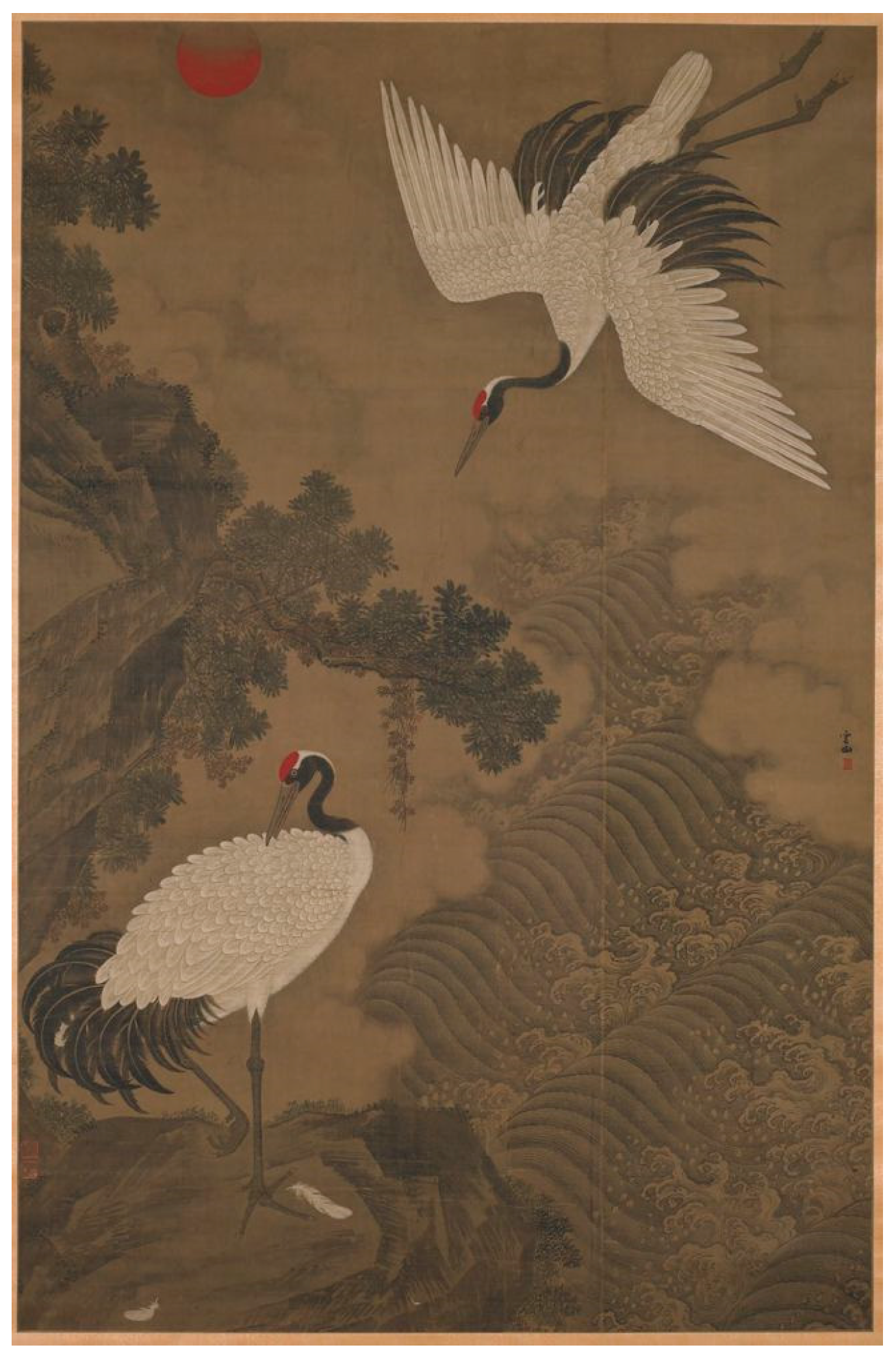
- Ye, Qiao 葉喬. 1893. Two Cranes and Sun, undated. Hanging scroll; colors on silk; 224.5 x 146.5 cm (Painting), 392 x 157.8 cm (mount). Gift of DuBois Schanck Morris, Class of 1893 (y1947–1958). Princeton University Art Museum. Available online: https://artmuseum.princeton.edu/art/collections/objects/23593 (accessed on 30 August 2025).
- Zhan, Ru 湛如. 2022. Ximing Dongxia Tangdai Chang’an Ximingsi Yu Sichou Zhi Lu 西明東夏:唐代長安西明寺與絲綢之路. Beijing: Zhonghua shuju. [Google Scholar]
- Zhang, Meng. 2021. Timber and Forestry in Qing China: Sustaining the Market. Seattle: University of Washington Press. [Google Scholar]
- Zhang, Yanan, Yongqiang Zhao, Hao Chen, Shicheng Lv, and Ping Zuo. 2018. Analysis on Population Change of Red-crowned Cranes in its Wintering Habitat Yancheng During 1983~2017. Sichuan Environment 37: 154–159. [Google Scholar]
- Zhao, Lu. 2019. In Pursuit of the Great Peace Han Dynasty: Classicism and the Making of Early Medieval Literati Culture. Albany, NY: State University of New York Press. [Google Scholar]
- Zheng, Qijun. 2024. Divine Medicine: Healing and Charity Through Spirit-Writing in China. Religions 15: 1303. [Google Scholar] [CrossRef] [Scilit]
- Zheng, Qijun. 2025. Making Maoshan Great Again: Religious Rhetoric and Popular Mobilisation from Late Qing to Republican China (1864–1937). Religions 16: 97. [Google Scholar] [CrossRef] [Scilit]


Disclaimer/Publisher’s Note: The statements, opinions and data contained in all publications are solely those of the individual author(s) and contributor(s) and not of MDPI and/or the editor(s). MDPI and/or the editor(s) disclaim responsibility for any injury to people or property resulting from any ideas, methods, instructions or products referred to in the content. |
© 2025 by the author. Licensee MDPI, Basel, Switzerland. This article is an open access article distributed under the terms and conditions of the Creative Commons Attribution (CC BY) license (https://creativecommons.org/licenses/by/4.0/).
Share and Cite
Zheng, Q. The Return of Cranes: Migratory Birds, Local Cults and Ecological Governance in China. Religions 2025, 16, 1419. https://doi.org/10.3390/rel16111419
Zheng Q. The Return of Cranes: Migratory Birds, Local Cults and Ecological Governance in China. Religions. 2025; 16(11):1419. https://doi.org/10.3390/rel16111419
Chicago/Turabian StyleZheng, Qijun. 2025. "The Return of Cranes: Migratory Birds, Local Cults and Ecological Governance in China" Religions 16, no. 11: 1419. https://doi.org/10.3390/rel16111419
APA StyleZheng, Q. (2025). The Return of Cranes: Migratory Birds, Local Cults and Ecological Governance in China. Religions, 16(11), 1419. https://doi.org/10.3390/rel16111419