


The Black Mirror of the Pupil of the Eye: Around the Eye that Sees and Is Seen: Ibn al-ʿArabī, Bill Viola


Abstract
1. Introduction
“I stood in the ‘light of the invisible’ (nūr al-ghayb) […]”.That to contemplate God, one must become the pupil of His eye.“O eye of my eye!”Muḥyī l-Dīn ibn al-ʿArabī, Kitāb al-tajalliyāt (Book of Theophanies), theophanies 75, 84
“Actually, I meant in the sense of images of invisible things”.“I felt like I had glimpsed an invisible image”.“Well, Five Angels for the Millennium concerns what you can’t see […]”.“As an artistic problem, how to use a visual medium to represent invisible things greatly attracted me. Video was showing me invisible things all the time […]”.Bill Viola, in conversation with Hans Belting
Nonbeing is a mirror, the world is its reflection, and manis the eye of this reflection, beholding the hidden Viewer.You are the reflection’s eye, and it is the light of the eye.The Light of the eye is seeing itself through your eye!
2. “You Are Seeking Me and I Am Seeking You”
“Guard me like the apple of your eye (shomreni ke-īshōn bath ʿāyin)”.Psalms 17:8
Faced with Lancelot’s affirmation that he was looking for the Grail, Guenièvre will outline the limits of his endeavor: “Ce n’est pas le Graal. C’est Dieu que vous vouliez. Et Dieu n’est pas un objet qu’on rapporte. [“He is not the Grail. He is God what you wanted. And God is not an object that is brought”]. To then draw the picture that led to this meaningless adventure: “You have acharné, you have tué, pillé, incendié, et puis vous avez jetés les uns contre les autres comme des fous, sans vous connaître” [“You fought each other, you killed, looted, burned, and then you threw yourselves against each other like madmen, without knowing each other”]. No less disturbing will be the way in which Bresson is going to comment, at the beginning of the film, on Lancelot’s evaluation of his failure before Artus: “Mes mains sont vides” [“My hands are empty”]. The insert of a very close-up of the indifferent eye of a horse follows, unexpectedly, the declaration of the knight.
By superimposing Arthur’s remark over the eye of the horse, the notion of a mystery that must remain unsolvable may be equated with the quest for something that must remain unattainable.
The fact that God is only a word in the mouths of the characters does not mean that he occupies a place of pure convention in their universe. […] God is part of a reality (mythical, legendary, historical, whatever) that no one disputes but that cannot be represented.
Lancelot du Lac can also be seen through the eye of the horse. […]Three times, the black, immense, exorbitant eye of a horse will signal a loss, a rout, or a failure. […]“The domain of the cinematograph is the domain of the unspeakable”. [Robert Bresson]
Truth-glory be to Him-spoke to me on the following Friday night, while I was in one of those states I have mentioned, and said to me, “Were you conscious that I was sitting beside you last night in My majesty and beauty? My face was next to yours, with a mirror in My hand reflecting My face and yours. I was looking into your face and through your face I was looking into the mirror, in which both faces appeared”. It was as if I was looking at the glory of Truth-glory to Him. I cried out and wept repeatedly. I sighed and implored His perfect goodness and extreme generosity, until He adorned [manifested] Himself with the garb of His power, and thus He saw me through Himself, for He knew that the temporal is unable to confront the eternal and the glories of pre-eternity during the manifestation of oneness and eternity. In the dawn of His majesty, time, temporality, and space vanish like the feathers of a bird in the fire of Abraham. He transcends all speculation and every thought that crosses the hearts of any of His creatures.
The Sufi poets and mystics are another inspiration to Viola, among them the twelfth-century Sufi master Rūzbihān Baqlī: “he appeared to me in the form of divinity, holiness, and transcendence…. Then he said, ‘You are seeking me, and I am seeking you; if you look, you will find me in yourself, without taking the journeys of the hidden.’” (quoted in Steinbock 2009, p. 89). Baqlī’s statement anticipates Viola’s quest to discover the holy through art.
Dentro gli occhi di cristallodello scriba di Saqqara,riflessa nelle sue pupille d’infinito,lenta ho visto passare un giornouna nuvola del cielo di Parigi.Attraverso una nuvola gli occhi,dentro gli occhi millenni[Inside the crystal eyesof the scribe of Saqqara,reflected in his pupils of infinity,slow I saw pass one daya cloud from the sky of Paris.Through a cloud the eyes,within eyes millennia]
3. The “Eye” by Which God Sees Himself: The Contemplant Is the Contemplated
Hence this is clear: I behold (mī-nigaram) you through your eyes”.Sayf-i Farghānī (d. 749/1348) 1341–44/1962–65, 2: 308–3
The simultaneous scales represented in the live video/water system draw a connection to the traditional philosophy or belief that everything on the higher order of existence reflects, and is contained in, the manifestation and operation of the lower orders. This idea has been expressed in ancient religious terms as the symbolic correspondence of the mundane (the earth) and the divine (the heavens) and is also represented in the theories of contemporary physics that describe how each particle of matter in space contains knowledge or information about the entire system.
Many are the descriptions of Bill Viola’s installation, He Weeps for You. Here, I shall simply borrow the one that best expresses what I feel about the work. I find my own feelings reflected in the words of Andrew Solomon: “He Weeps for You, from 1976, is lyrical and upsetting. You enter a dark room and, more or less by instinct, walk to a small, spotlighted area. In front of you is a copper pipe, at the end of which a drop of water is slowly forming. Behind the pipe is a video camera. On the wall to your left is a giant video projection that shows a drop of water. As you stand there, trying to make sense of this, you notice that there seems to be a human figure contained in the drop of water. You peer quizzically at it, and it peers quizzically at you. It is your reflection in the water droplet, and as the droplet gets bigger and fatter, your image becomes larger and clearer until it nearly fills out and falls from the pipe, and you see your image shattered. The drop hits an amplified drum, and a deep boom sounds through the room, as though a small bomb had fallen. By the time you have reoriented yourself, the next drop is beginning to swell from the tip of the copper pipe, and on the wall, there you are, in it again”. [Andrew Solomon, “Bill Viola’s Video Arcade”, in The New York Times Magazine, 8 February 1998, p. 6].
The Gnostic’s apprenticeship consists in learning to practice fidelity to his own Lord, that is, to the divine Name with which he, in his essential being, is invested, but at the same time to hear the precept of Ibn ʿArabī: “Let thy soul be as matter for all forms of all beliefs”. One who has risen to that capacity is an ʿārif, an initiate, “one who through God sees in God with the eye of God”. Those who accept and those who decline are subject to the same authority: the God in function of whom you live is He for whom you bear witness, and your testimony is also the judgment you pronounce on yourself. […]On the other hand, God can be known to us only in what we experience of Him, so that “We can typify Him and take Him as an object of our contemplation, not only in our innermost hearts but also before our eyes and in our imagination, as though we saw Him, or better still, so that we really see Him. […]If then you perceive me, you perceive yourself.But you cannot perceive me through yourself.It it through my eyes that you see me and see yourself,Through your eyes you cannot see me. […]In short, this “mystic physiology” operates with a “subtile body” composed of psycho-spiritual organs (the centers, or Chakras, “lotus blossoms”) that must be distinguished from the bodily organs. For Ṣūfism the heart is one of the centers of mystic physiology. Here we might also speak of its “theandric” function, since its supreme vision is of the Form of God (ṣurat al-Ḥaqq)–this because the gnostic’s heart is the “eye”, the organ by which God knows Himself and reveals Himself to Himself in the forms of His epiphanies (not as He inwardly knows Himself, for in its quest of the Divine Essence even the highest science can go no further than the Nafas al-Raḥmān). […]If the heart is the mirror in which the Divine Being manifests His form according to the capacity of this heart, the Image that the heart projects is in turn the outward form, the “objectivization” of this Image. Here indeed, we find confirmation of the idea that the gnostic’s heart is the “eye” by which God reveals Himself to Himself. We can easily conceive of an application of this idea to material iconography—to the images created by art. When contemplating an image, an icon, others recognize and perceive as a divine image the vision beheld by the artist who created the image, it is because of the spiritual creativity, the himma, which the artist put into his work. Here we have a compelling term of comparison by which to measure the decadence of our dreams and of our arts. […]And since Creation means essentially theophany, the relation between the creativity of the heart and perpetually recurrent Creation can again be defined by the idea that the gnostic’s heart is the “eye” by which the Divine Being sees Himself, that is, reveals Himself to Himself. […]The spiritual progression from the state of simple believer to the mystic state is accomplished through an increasing capacity for making oneself present to the vision by the Imagination (istiḥḍār khayālī): progressing from mental vision by typification (tamthīl) by way of dream vision (rūʾyā) to verification in the station of walāya, imaginative witnessing vision (shuhūd khayālī) becomes vision of the heart (shuhūd bi’l-qalb), that is to say, vision through the inner eye (baṣīra), which is the vision of God by Himself, the heart being the organ, the “eye”, by which God sees Himself: the contemplant is the contemplated (my vision of Him is His vision of me).
Thus, He suggests that knowledge of Him is inferred from knowledge of ourselves. Whenever we ascribe any quality to Him, we are ourselves [representative of] that quality, except for the quality of His self-sufficient Being. Since we know Him through ourselves and from ourselves, we attribute to Him all we attribute to ourselves. […] He describes Himself to us through us. If we witness Him we witness ourselves, and when He sees us, He looks on Himself.(Fuṣ. IV, Ibn al-ʿArabī 1980, pp. 54–55)
II] Now there are some people who perceive this imaged-object (al-mutakhayyal) with the eye of (physical) sensation, and there are others who perceive it with the eye of imagination. Of course, I’m referring here to (our perceptions) in the waking state, since during sleep (everyone) definitely perceives with the eye of imagination. […] For you perceive what is imagined (al-khayal) with the eye of imagination, not with the eye of (physical) sensation. […]Regarding that we (wrote these verses):When my Beloved appears to me, withwhich eye do I see Him?With His eye, not with mine: for nonesees Him but Him!(This is only) in accordance with the transcendence of His Station and confirming His Words, since He says: “The gazes do not perceive Him, [but He perceives the gazes]” (6:103), and He did not specify any particular Abode (of this world or the next), but sent it as an Verse unrestricted (in its applicability) and as a definite, confirmed matter. For none other than Him perceives Him, so it is with His eye—may He be praised!—that I see Him, as in (the famous divine saying in) the sound ḥadīth-report: “… I (God) was his gaze through which he sees”.
Those who love God occupy, in relation to the cosmos, a position analogous to that of the pupil in the eye. [The pupil is called in Arabic, literally, ‘the man of the eye’].Although man is endowed with multiple organs, he does not contemplate and see except through his eyes exclusively. Well, then, the eyes occupy in him a position analogous to the one that lovers have in the cosmos.
As for favors or gifts of the first kind, they can result only from a divine Self-revelation, which occurs only in a form conforming to the essential predisposition of the recipient of such a revelation. Thus, the recipient sees nothing other than his own form in the mirror of reality. He does not see reality Itself, which is not possible, although he knows that he may see only his [true] form in It. As in the case of a mirror and the beholder, he sees the form in it but does not see the mirror itself, despite his knowledge that he sees only his own and other images by means of it. God makes this comparison so that the recipient of a divine Self-revelation should know that it is not Him Whom he sees. The analogy of a mirror is the closest and most faithful one for a vision of a divine Self-revelation.Try, when you look at yourself in a mirror, to see the mirror itself, and you will find that you cannot do so. This is so much the case that some have concluded that the image perceived is situated between the mirror and the eye of the beholder. This represents the greatest knowledge they are capable of [on the subject]. […] In your seeing your true self, He is your mirror, and you are His mirror, in which He sees His Names and their determinations, which are nothing other than Himself.(“The Wisdom of Expiration in the Word of Seth”, Ibn al-ʿArabī 1980, p. 65)
While we might take this as speaking metaphysically of the transcendent God being witnessed in His manifestation, the context in which this poem actually appears in Ibn ʿArabī’s Futūḥāt is much more far-reaching, revealing, and pertinent to our discussion of naẓar. He begins Chapter 63 (on the remaining people in the barzakh between this world and the resurrection) by identifying imagination as the crucial element in the Prophet’s saying, ‘Worship God as if you see Him’. The nature of a barzakh (isthmus), he writes, is to separate known from unknown, non-existent from existent, by virtue of the faculty of imagination. As a metaphor for the inability of the human mind to perceive the truth itself directly, he uses one of his favorite examples, an image seen in a mirror: while the observer does not change, the image seen varies according to the size and type of the mirror—the image may appear huge or tiny. The form is simultaneously oneself and not oneself; what one observes is both an accurate image and an illusion at the same time. Such is the nature of observing images, whether in the sensory world or the dreamworld, for in this sense, the forms that are seen in a dream.Ibn ʿArabī goes on to discuss how those for whom reality is unveiled (kashf) can directly see the truth of things in this world and how some of them possess a subtle knowledge that allows them to distinguish between their two eyes, the eye of imagination and the eye of the senses. He notes that naẓar has a very particular function in fixing the object of perception:The people of unveiling can see in their waking state what dreamers see in their sleep, and they can see the dead after they have died, just as they see in the next world the forms of actions being weighed and evaluated… [T]here are some people who perceive this imagined form with the eye of the senses, and there are some who perceive it with the eye of imagination. Here I am talking about the waking state, for during a dream, it is always with the eye of imagination. When a human being wishes to distinguish in the waking state what something is, in this world or on the Day of Resurrection, they should look at (yanẓur ilā) the imagined form, and they should tie it down with their observation (naẓar). [Ibn al-ʿArabī, Futūḥāt, vol. 1:305](Hirtenstein 2022, pp. 77–78; cf. 79–80, 83)
So know that the heart is a polished mirror—all of it is a face—that does not (itself) ever “rust”. So if someone should say about it that it rusts—as in the Prophet’s saying: “Certainly hearts tarnish like iron”, in the hadith that concludes “the polishing of the heart is through remembrance of God and recitation of the Qur’an…”—that is because the heart has become preoccupied with knowing the secondary causes (al-asbāb), the apparent workings of this world, instead of with knowing God. So, its attachment to what is other than God has “rusted over” the face of the heart in that it blocks the Self-manifestation (tajalli) of the Truly Real in that heart.The divine Presence is perpetually manifesting Itself, and one could never imagine It ever veiling Itself from us. So when this heart fails to receive that (divine Self-manifestation) from the directions of the praiseworthy and revelatory divine “addressing” (speaking to us), because it has received something else instead, then its act of receiving that something else instead, then its act of receiving that something other (than God) is what is referred to (in the scriptures) as “tarnishing”, “veils”, “looking”, “blindness”, “rust”, and the like. For in fact, the Truly Real Himself is (perpetually) bestowing this knowing on you in the heart, except that (your heart) is (preoccupied with) knowing something other than God—although the Knowers of and through God know that in reality, (that distracted heart) too is actually knowing of and through God.
ān ki ū rā chashm-i dil shud dīdibāndīd khwāhad chashm-i ū ʿayn al-ʿayān[He whose heart’s eye becomes his very watchman,his eye will see the acme of clairvoyance.]
[497] Likewise, one day Mowlānā was expressing subtle points about the meaning of: ‘The believer is a mirror of the believer.’ He said: ‘One of God’s names is the Believer, and similarly the bondsman is called a believer. “The believer is a mirror of the believer” means therefore that his Lord reveals Himself in it.’The Creator of souls made a mirror of water and mudAnd then He held it up in front of Himself.Whenever the sun shines into a mirror,What can the mirror do but say: ‘I am the sun’?[19] […] Mowlānā said: “By God, it is just as your blessed eye beheld. For God forbid your eye (dīda) would ever report what it had not seen (nā-dīda)! And every eye (dīda) which confides in this visionary eye (dīda-ye dīdār-dīda) will become one of the people of vision (ahl-e dīda) so that invisible matters are seen (dīda) by it”.Your eye that sees the unseen is a master like the Unseen.May this vision and gift not decrease in the world.The man (mardom) who cannot see has a black face.The man with [higher] sight is a mirror of the moon (māh).But who in the world sees the man of your (inward) eye
Learning to see the form of the world as a huge, distorted reflection is one of the main points of Buddhist teachings. You can trace this idea even farther back to the Upanishads, the foundational Hindu texts that are among the primary sources of the self-knowledge tradition. One of the central teachings they emphasize is for the Knower to “know the Knower”. It is learning to recognize the mirror, the water surface, within ourselves. We live with these realities, but they are invisible because we don’t know how to step outside of ourselves in order to see them for what they really are.(Bill Viola, in conversation with Hans Belting; Walsh 2003, p. 207)
When God’s gaze reached Moses, Moses’ being was annihilated: God looked at Himself through his gaze.To see a spiritual event (vâqeʿe didan) is also to receive a message from beyond. Opening the eyes (chashm bâz shodan) is the highest step towards God. It comes after the stage of knowledge (ʿelm), and then that of the imaginative faculty (khayâlâti). The Encounter of the Divine Real is the divine Real’s view of Himself from His servant. The spiritual master looks through the light of God. The believer is a seer. He sees in full vision, having arrived in the Presence of God. Only he who enters the gaze of God can see them.(Charles-Henri de Fouchécour, in Shams de Tabriz 2017, p. 478)
(1) If he happens to see (the beloved) in (his) dream, it is because he has turned his face toward himself. His whole being [or realization (yāft)] has become the eye, and the eye has totally become the face, and he has turned the face to the beloved, or to her form, which is imprinted on his being. […](3) Now, when the lover sees (the form of) the beloved in his dream, what happens is that he sees something on the surface plane of the heart, and thus he transmits the awareness to knowledge so that he has a notion of what is behind the veils.
For the human eye represents the world with its various colours. The outer circle of white corresponds to the sea of Ocean that surrounds the other world. The next colour represents the country which is surrounded by the sea. A third colour in the middle of the eye corresponds to Jerusalem, which is the centre of the world. Finally, there is the pupil of the eye, which reflects the beholder and is the most precious part of all. It corresponds to Zion, which is the central point of the universe, in which the reflection of the whole world can be seen and where the abode of the Shĕkhīnāh, who is the beauty and focus of the world, is found. Thus, is the eye the inheritance of the world, and when the father leaves it, it is inherited by the son.
4.8. Centr. Sem. *ba/u(ʾ)ba/u(ʾ)-(at)- ‘pupil of the eye’: Heb. *bābā ‘eye-ball’ (KB: 106; in the phrase bābat hā-ʿayin ‘b. of the eye’), Jud. bābītā, babtā ‘pupil of the eye’ (Ja.: 136; in combination with ʿēnā ‘eye’), Syr. bābәtā ‘pupilla (oculi); oculus’ (Brock.: 62), Arab. buʾbuʾ- ‘prunelle, pupille (de l’œil)’ (BK: 1 78; attested without, and in combination with, ʿayn- ‘eye’). […]4.9. Egyp. (Pyr.) ḥwn.tἰmy.tἰr.t ‘Pupille’ (EG III: 53), lit. “the girl that is in the eye”: ḥwn.t ‘Mächden, Jungfrau’ (ibid.); ἰmy.t, an adjective (nisbah) meaning “that one (f.) which is in, she who is in”, derived from the proposition ἰm ‘in’ (ibid. I: 72); ἰr.t ‘Auge’ (ibid.: 106).A similar semantic shift is attested in Indo-European:4.10. Lat. pūpula, pūpilla (WH: 2 390; < pūpa ‘Mächden; Püppchen’). Borrowed into English (pupil of the eye), German (Pupille) and other languages.
Finally, consider Tiqqunnei Zohar, § 37, 78a, wherein it is stated explicitly that the three colors of the rainbow correspond to the three colors of the eye, which correspond in turn to the three shells of the foreskin surrounding the Shekhinah, or the three shells of the nut. Precisely through these colors, the Shekhinah assumes the title “pupil of the eye”, bat ʿayin, the point that is the sign of the covenant concerning which it is said, “I will see her to remember the everlasting covenant” (Genesis 9:16).
Also relevant in this context is another passage in Perush ha-Merkavah, MS Paris–BN 850, fol. 69a (cf. 74a) and the parallel in Sode Razayya, ed. Weiss, p. 151, where Eleazar connects the word sod, “mystery”, with ʿayin, the Hebrew letter whose numerical value is seventy, the same as sod. The word ʿayin, however, also refers to the eye. More specifically, Eleazar notes that “in the pupil of the eye is the countenance of the cherub”.
Blessed and exalted is the Name, which is majestic in valor, for He is One, who unites with his powers, like the flame of a fire that is united with its colors. Moreover, His powers emanate from His Unity like the light of the eye, which issues forth from the pupil of the eye. These are emanated from those, like a scent from a scent or a candle-flame from a candle-flame, since this emanates from that and that from something else, and the power of the emanator is within that which was emanated. The emanator, however, does not lack anything.
This is what the Sages meant about the verse “And the Lord passed by before him, and proclaimed”. He is one and united as the flame of fire that is unified in its hues as hinted in this verse, “that the Lord thy God, is a consuming fire”, and all the emanation from him is emanated as the light outgoing from the blackness of the eye.
4. “The Eye in Which I See God Is the Same Eye in Which God Sees Me”
“I beg you, be my eye that I may see you through you […]”.Muḥyī l-Dīn ibn al-ʿArabī, Kitāb al-tajalliyāt, Theophany 85.O Lord, when you look upon me with an eye of graciousness, what is your seeing other than your being seen by me? In seeing me, you, who are deus absconditus, give yourself to be seen by me. No one can see you except insofar as you grant that you be seen. To see you is not other than that you see the one who sees you.Nicholas of Cusa, De visione dei, chap. 5, § 15.
A person who is so established in the will of God wants nothing else but what is God and what is God’s will. If he were sick, he would not want to be healthy. All pain is a joy to him; all multiplicity is simplicity and unity, if he is really steadfast in the will of God. Even if the pain of hell were connected to it, it would be joy and happiness for him. He is free and has left himself, and he must be free of everything that he is to receive. If my eye is to see color, it must be free of all color [Aristotle, Soul 2.7 (429b). Cf. Comm. Jn. n. 100 and Bened. 1 (Essential Eckhart, pp. 100, 220)]. If I see blue or white, the sight of my eye, which sees the color, this very thing that does the seeing, is the same as what is seen by the eye. The eye in which I see God is the same eye in which God sees me. My eye and God’s eye are one eye and one seeing, one knowing, and one loving”. [Objected to by the Cologne censors. Eckhart replied by quoting Augustine, Trin. 9.2. Cf. Comm. Jn. n. 107].(Meister Eckhart, in McGinn 1986, pp. 269–70)
When the soul is blind and sees nothing else, it sees God, and this has to be the case. A master says, “The eye in its purest state, when it is free of all color, sees all color”.It is not just the case that the eye as a whole must be free of color. It must also be free of color as a part of the body if one is to recognize color. Whatever is free of color enables one to see all color, even if it were down below as part of the foot. God is that kind of being that contains all beings within itself.
The experience of ekstasis, described by Plotinus in this one very striking passage, when the soul is raised outside of itself, is also described in terms of vision and light. [VI 9, 11, 23] Although he says that it would be better not to speak in dualities, the light metaphor is the best way to describe that which is scarcely visible except in an unknown mode. [VI 9, 11, 22–23]. Plotinus explains the vision as a unity of seer and seen: ‘for there is no longer on thing outside and another outside which is looking in, but the keen sighted has what is seen within. [V 8, 10, 35–36; see also V 8, 11] Thus, the object and the act of vision have become identical. [VI 7, 25, 14–16] To become sight, that is, to become nothing but true light, is to become ‘the eye which sees the great beauty’. [I 6, 9, 24–25] Unity, expressed in terms of vision and sight, tends to always give the impression that there must be an object of the vision, but Plotinus is emphatic that the act of vision itself is the object of the vision. Meister Eckhart likewise explains unity with God in such metaphorical terms as ‘oculus in quo video deum, est ille idem oculus in quo me deus videt. Oculus meus et oculus dei est unus oculus et una visio vel videre et unum cognoscere et unum amare’.
That God alone can see and know Himself is an adage of universal significance that is stated with its own nuances by the spiritualities of East and West. […] This eternal truth is what Ibn ʿArabī notes in the present chapter. “I, you cannot see me through this eye, which is yours, therefore I give you the divine eye. Look, then, at my sovereign yogic power”.This remarkable theophany of the eye is conceived in interrogative form, as are two other brief chapters (Th. 88 and 92). Other sentences on the mirror-heart and visionary reciprocity foreshadowed the answer to the question, “By what eye do you see Him?” (See Th. 24, and Th. 81, § 135: By my eye you see Me and yourself). If “no one has ever seen God” (St. John, prologue v. 18), and if “eyes cannot reach Him” (Qur. 6:103), knowledge of who He is requires a complete disappropriation of self. The ephemeral cannot reach the Eternal unless it absorbs its non-being into its true being. This places the follower of the union before the necessity of total annihilation in order to assimilate to Him. In this sense, it is possible to say that God “admits similitude” (Th. 94, n. 2). […]It has been noted that tawḥīd implies the identity of the Contemplator and the Contemplated who is God (Th. 66, § 111). […]Let us admire the rhythmic balancing of these propositions, which mark the reciprocity of the act of vision, the unifying ray between the gaze of God and that of man. Since it is God who, by lending man his own gaze, truly becomes the “apple of his eye” after having made him blind to the world and to everything that is not Him. Hence the vow in the next chapter [Theophany 85]: “Please be my eye so that I may see you through you. In this theophany, the lover and the beloved are united by the same gaze, each of which contemplates the other. This meditation is inspired by the ḥadīth qudsī: “I am the eye through which my servant sees”. In his commentary, the Shaykh clarifies that God reveals Himself to you in accordance with your essence. For the Beloved sees you through your eye, just as you see Him through His eye. If He revealed Himself in accordance with His majesty, you would succumb and be annihilated. Ḥallāj said it in his own way in this verse: “I saw my Lord with the eye of my heart, and I said to Him, who are You? He said to me: You”.
Vision, the human sensor of light, is conflated with light because there is no vision without light, and if God is the light of heaven and earth, as the Quran affirms, then seeing can only occur through a divine agency. Thus, in the mystical approach, the core element of the scientific discourse, baṣar, becomes the necessary divine agency of seeing. In this sense, baṣar becomes the very spirit or secret of human vision, without which seeing is not possible.Naẓar is then the necessary framework within the bounds of which visual recognition of forms becomes possible, while ruʾya is the act of seeing through which visual perception of external reality takes place.The semantic peculiarities of the Arabic language, expressed through several terms, concepts, and metaphors associated with the act of seeing, contribute to the spiritual understanding and interpretation of the nature of visual perception. The Arabic word aʿyān, plural of ʿayn, literally ‘eye’, is used to refer to external entities as well as to notable personalities. The pupil, the eye’s aperture, through which light penetrates to make vision possible, is called insān, literally ‘man’ or ‘human being’. Thus, the ‘eye’s man’ (insān al-ʿayn) is the receptor of light (nūr); it is, as it were, the spirit of baṣar with which humans see. Metaphorically, the act of seeing captures the binding relationship between divinity and humanity: God sees the world through man (insān) and it is the light of divinity that penetrates the eye’s human center in order to make vision possible. Explaining the meaning of insān (‘man’ and ‘pupil’), Ibn ʿArabī writes [Fuṣūṣ al-ḥikam, ed. by Abu al-ʿAla ʿAfīfī (Beirut: Dār al-Kitāb al-ꜤArabī), 1946, 50]:[H]e is to God (ḥaqq) as the pupil (insān al-ʿayn) is to the eye, with which vision (naẓar) occurs and which is referred to as baṣar. It is for this reason he is called insān (at once pupil and man), for God sees his creatures through him (being the pupil of God’s eye) to show his mercy upon them.(Akkach 2022, p. 27; cf. p. 28)
The end of the affair: The lover sees the Beloved as his own mirror, and himself as the mirror of the Beloved. […]Sometimes the Beloved’s quest grasps the skirt of the lover, saying, “Is not the desire of the pious drawn out endlessly, their desire to meet Me?” And sometimes the lover’s desire raises its head from the neck of the Beloved’s cloak and declares, “Verily I desire them more than they desire Me!” (HQ). Sometimes the Beloved Himself becomes the lover’s sight, that He might say, “I saw my Lord with the eye of the Lord. I asked ‘Who art Thou?’ and He answered ‘Thou.’” Sometimes the lover becomes the Beloved’s voice and says, “Grant him protection till he hears the words of God” (IX:6).
5. The Heart of the Gnostic Is like a Mirror in Which the Microcosmic Form of the Divine Self Is Reflected
This [knowledge] cannot be arrived at by the intellect by means of any rational thought process, for this kind of perception comes only from a divine disclosure, from which is ascertained the origin of the forms of the Cosmos receiving the spirits. The [above-mentioned] formation is called Man and Viceregent [of God]. As for the first term, it stems from the universality of his formation and the fact that he embraces all realities. In reality, he is the pupil of the eye through which the act of seeing takes place. Thus, he is called insān [meaning both man and pupil], for it is by him that Reality looks on His creation and bestows Mercy [of existence] on them. He is Man, the transient [in his form], the eternal [in his essence]; he is the perpetual, the everlasting, the [at once] discriminating and unifying Word. It is by his existence that the Cosmos subsists, and he is, in relation to the Cosmos, as the seal is to the ring, the seal being that place whereon is engraved the token with which the King seals his treasure.
We can fairly say that for Ibn ʿArabī the human self is to be properly viewed as essentially and unequivocally a point of vision (or a locus of awareness) which acts as a mirror in the unitive Divine act of Self-Expression. […]Man is to God that which the pupil is to the eye (the pupil in Arabic is called “man within the eye”), the pupil being that by which seeing is effected; for through him (that is to say, the Universal Man), God contemplates His creation and dispenses His mercy.
As Ibn ʿArabī explains in the chapter on Ādam (to be treated in the next section), the entire universe, as the manifestation of the divine Names and Attributes, is also a mirror of God; but it is the human being who polishes (potentially) this mirror and brings together all the “discrete things and properties that have been diffused and scattered all over the immense universe” into sharp focus in the mirror of his intellect so that God may view His Names and Attributes in it. For, although God needs no mirror other than Himself in order to “view” and know Himself, nevertheless, as Izutsu explains, “the Absolute has also an aspect in which it is an Essence qualified by Attributes. And since the Attributes become real only when they are externalized, it becomes necessary for the Absolute to see itself in the ‘other’. Thus the ‘other’ is created in order that God might see Himself therein in externalized form” (Izutsu, Sufism, and Taoism, 220). This divine image, therefore, comes into sharpest focus in the heart of the gnostic, which, being well-polished by detachment from created things, reflects without distortion the divine Names and Attributes.
6. Bill Viola and the Abyssal Look of the Pupil of the Eye
“The ideal mirror, around since the beginning of humankind, is the black background of the pupil of the eye”. […] The pupil is the boundary, and veil, to both internal and external vision”.Bill Viola, “Video Black—The Mortality of the Image”
I Do Not Know What It Is I Am Like is a personal investigation of the inner states and connections to animal consciousness that we all carry within. The work is in five parts and functions like a map of the animal psyche. Images of animals mediate a progression from an initial stage of “pure being” (a herd of bison moves within a vast open landscape, the camera confronts the glaring eye of an owl), proceeding through stages of the rational and the physical orders (a researcher is at work in his study, images flicker past at the limits of perception), finally arriving at a state beyond logic and the laws of physics (devotees participate in a Hindu fire ritual; a fish comes out of a mountain lake, soaring over the treetops to come to rest on the floor of a pine forest).As the gateway to the soul, the pupil of the eye has long been a powerful symbolic object in the search for knowledge of the self. The color of the pupil is black. It is on this black background that you see your self-image when you try to look closely into your own eye or into the eye of another. It is through this blackness that we confront the gaze of an animal, partly with fear, with curiosity, with familiarity, and with mystery. We see ourselves in its eyes while sensing the irreconcilable otherness of an intelligence ordered around a world; we can share in body but not in mind.Black is a bright light on a dark day [cf. Sabistarī verse], like staring into the sun, the intensity of the source producing the darkness of the protection of the closed eye. It is the black we “see” when all the lights have been turned off, the space between the glowing electron lines of the video image, the space after the last cut of a film, or the luminous black of the nights of the new moon. If there is a light there, it is only the light searching in the dark room that, limited by the optical channel within its beam, assumes there is light everywhere it turns.
The eye is the symbol of the Holy Trinity, like the eye from which the glycerine tear drops in Man Ray’s most famous photograph. The human eye is reflected in the eye of the camera. The owl sees in the dark; the artist has switched on the lamp and is sitting at his desk. It is still night. […]Bill Viola presents his claim that I Do Not Know What It Is I Am Like in the form of a journey [the title of the second section of the video is ‘The Language of Birds’, inspired by Farīd al-Dīn ʿAṭṭār’s Manṭiq al-ṭayr (The Language of Birds)]. It is a visual reflection on and off the inside [bāṭin] and outside [ẓāhir], birth and death, nature and its manifestations, time, and the slowing down of time. Viola drives his sentence through true abysses in the quest for identity. The gates are opened, and the Ego is hounded or carried over glowing embers without coming to any harm.
I relate to the role of the mystic in the sense of following a via negativa—of feeling the basis of my work to be in unknowing, in doubt, in being lost, in questions and not answers—and recognizing that personally, the most important work I have done has come from not knowing what I was doing at the time I was doing it.
The generative work of unknowing—the illuminating power of obscurity, the life-giving character of emptiness, or even annihilation—entails several related operations that we can see as central to both the Rigveda’s riddle hymn and Viola’s work: above all, the operation of likeness, or resemblance, and the endlessly creative association, reference, and resonance entailed in that operation. […]And then unexpectedly, in the mirror of an owl’s eye—in a recognizable, and thus partly familiar, but still, in the end, deeply foreign gaze—the artist records, through the technology of his zoom lens, his own reflected image. He thus makes visible to himself a self-image that is grounded in the darkness of this animal mystery (and he also makes visible to us, the work’s viewer, the otherwise invisible co-creator of the image we are seeing). He comes to see himself through the reflection of a gaze he can acknowledge but not inhabit or occupy.Through this technologically mediated experience of animal enigma, Viola sees a logic he signals likewise in the spiritual practice of Eckhart’s mystical tradition, where emptiness or void is a ground of reception and therefore generative. The image depends on a darkness that exceeds—by preceding and succeeding—any and every image, and that unimaginable darkness finds an image, which itself is an image, in the pupil. Viola comments on two striking and suggestive phenomena entailed in the experience of pupil gazing, both of which disallow my ever grasping the ground of my own image: first, the operation of infinite reflection, which Viola calls to our attention as “the first visual feedback”. Because “the tiny person I see on the black field of the pupil also has an eye within which is reflected the tiny image of a person…and so on”, I can never actually get to the bottom of my own image. A second principle of pupil gazing that Viola notes is that the more I “lean in” to see and comprehend, to grasp or take hold of my own image in its ground, the more the image itself grows and thus eclipses my vision of that ground. [Viola, “Video Black–The Mortality of the Image”, 1990, in Viola 1995, p. 206] The image is a function, then, not only of darkness but also of distance.The kind of infinite reflection that Viola records through the human-animal encounter in I Do Not Know What It Is I Am Like relates directly to forms of spiritual practice that have long been central to the mystical theological traditions that inspire his work. “The black pupil”, he writes, “also represents the ground of nothingness, the place before and after the image, the basis of the ‘void’ described in all systems of spiritual training. It is what Meister Eckhart described as ‘the stripping away of everything, not only that which is other but even one’s own being.’” [Viola, “Video Black–The Mortality of the Image”, in Viola 1995, p. 207] Such stripping away, as Viola notes in a short text on I Do Not Know What It Is I Am Like, is essential to the kind of self-knowledge that both he and the traditions of mystical theology—and their distinctive anthropology—explore: We find ourselves in otherness, enigma, or darkness because, and insofar as, the image in which we become visible to ourselves is grounded in the unimaginable and conditioned by the invisible.As a gateway to the soul, the pupil of the eyehas long been a powerful symbolic image andevocative physical object in the search forknowledge of the self. The color of the pupil isblack. It is on this black that you see yourself-image when you try to look closely intoyour own eye, or into the eye of another…the largeness of your own image, preventingyou an unobstructed view within. [Viola, “I Do Not Know What It Is I Am Like”, 1986, in Viola 1995, p. 143]In I Do Not Know What It Is I Am Like, it is the gaze of an animal that functions as the artist’s mirror—much as the gaze of God can function as the soul’s mirror in the traditions of mystical anthropology, where, created in the image and likeness of God, I am imaged in and likeness. “We see ourselves in its eyes”, Viola writes, “while sensing the irreconcilable otherness of an intelligence ordered around a world we can share in body but not in mind”. [Viola, “I Do Not Know What It Is I Am Like”, 1986, in Viola 1995, p. 143]Through this encounter with a nonhuman gaze and against the background of his engagement with the traditions of mystical theology and anthropology, Viola can be understood to find broader principles of human self-knowledge.
Life is with the spirit, with reason, and with maʿrifa. Moreover, the spirit is a light, the reason is a light (3), and maʿrifa is a light (4). Every light has sight. The sight of reason is connected to the sight of the spirit and the fine substance of the spirit. It is set apart and pure, being located in the eye. If you look at the pupil of the eye, you will see the delicacy and the fine substance in the black of the pupil. This is the fine substance of the spirit, which is like water. The sight of the spirit is in the pupil of the eye. Indeed, that shining light within the pupil is the sight of the spirit, whereas the brightness (ḍawʾ) [of things] comes from outside. Perception of the colors takes place between the light that is in the pupil and the brightness that is outside. As long as these two do not come together, a person cannot perceive colors with his eyes. (5) This is so for all men in general.
7. Blackness, the Repository of the Secret or Mystery (sirr)
“As the Sufi say, ‘Know darkness in order to understand the light’”.Bill Viola, in conversation with Hans Belting
What guided me towards this exercise was a statement by the Sufi master of the 20th century, Hazrat Inayat Khan, who had said: “The Sufi studies darkness to understand light”. So I started studying darkness, constantly thinking about blackness, and I found very interesting things, particularly in which refers to the traditional color theory in the East”.
Blackness [siyāhī], if you but knew, is the Light of the Essence;Within the darkness flows the Water of Life.Blackness absorbs the eye’s weak light.Abandon vision since this isn’t its place.The dervish’s “black face in the two worlds”reaches the all-comprehensive Supreme Darkness [sawād-i aʿẓam].What can I say about this most subtle secretof a luminous night within a dark day [shab-i ruwshan miyān-i rūz-i tārīk]?In this revelation, which is luminous theophany,I have many words, but silence is better.
Unlike the rest of Islam, Shīʿism possesses a highly developed religious iconography. Among the circle of the Sixth Imām, Jaʿfar Ṣādiq (d. 148/765), it will be worth our while to mention the curious and endearing figure of Hishām ibn Sālim Jawālīqī (Shahrastānī, Milal, pp. 87–88). He seems to have been one of those who drew all the implications from their Imāmism, clashing head-on with the prudish dialectic to which the first theologians of orthodox Islam constrained themselves. He taught that God has a human form and a body, but a subtile body consisting neither of flesh nor blood. He is a brilliant, radiant light. He has five senses like a man and the same organs. Abu ʿIsà al-Warrāq (d. 247/861) notes in the doctrine of our Imāmite a trait which shows a remarkable sense of the coincidentia oppositorum: God possesses abundant black hair, which is black light (nūr aswad). One wonders whether Stoic terminology is concealed beneath the statement that God is a “body” (an immaterial body, to be sure, since it is in the subtile state).
At the time that the Holy One, blessed be He, created it. He extended it like a pavilion, as stated, “For can any understand the extensions of the clouds, the tumults of His pavilion” (Job 36:29). “The extensions”, this is the light that sparkles from the Marvelous Light [ha-ʼōr ha-muflaʼ, i.e., the first of a series of the lights, which emanated from the primordial darkness], extended by the power of the Unity like a garment. Its brilliance strengthens and shines on the hidden Unity of this marvelous power. Therefore, it is the Marvelous Light itself, for from the magnitude of its shining light that shines brilliantly, it is darkened from illuminating in relation to human perception. It is like the strong sun, since no one can gaze on the essence of its brilliance; for if one would gaze on it, the pupils of his eyes would darken, and he could not open them owing to the magnitude of the brilliant light, which grows stronger and shines. Thus did the Holy One, blessed be He, darken this Marvelous Light from the perceptions of every creature. Nor did He allow any creature in the universe to perceive its truth as it really is. […]When it arose in the mind of the Holy One, blessed be He, to prepare the planting of the supernal flags, the Marvelous Light spread out over His Unity. Thus, it is stated, “He spread His cloud above him” (Job 26:9). Immediately, He brought into being all the creatures that emanated from the power of the Marvelous Light—a bright light shining with a green color that shines with all types of radiance, shininess, and strong radiance. Then the Holy One, blessed be He, shone this light in a pure, brilliant radiance that gained strength and became known through the purity of the Marvelous Light. This light was generated from His Innermost, like the light of the eye, which issues forth from the pupil of the eye, from which the light sparkles. This light, which is known by the color iridescent green, is called ḥashmal. When it was created, it grew stronger in the brilliant and pure light and shone brightly from the pressure of the Marvelous Light that is fixed in the Unity.
In many countries throughout the world, black is the color of mourning. Echoing this ineffable finality, in European culture, black is considered to be an outside color, the condition of the “absence of light”. The focal point for black in our lives is the pupil of the eye, a portal to the tiny chamber in the center of the eyeball, where darkness is necessary to resolve the original parent of the artificial image.Since the means of the artistic creation of images are now the laws of optics and the properties of light, and the focus is the human eye, it was only a matter of time before someone thought to hold up a mirror. The ideal mirror, around since the beginning of humankind, is the black background of the pupil of the eye. There is a natural human propensity to want to stare into the eye of another or, by extension, oneself, a desire to see seeing itself, as if the straining to see inside the little black center of the eye will reveal not only the secrets of the other but of the totality of human vision. After all, the pupil is the boundary and veil for both internal and external vision.Looking closely into the eye, the first thing to be seen, indeed the only thing to be seen, is one’s own self-image. This leads to the awareness of two curious properties of pupil gazing. The first is the condition of infinite reflection, which is the first visual feedback. The tiny person I see on the black field of the pupil also has an eye within which is reflected the tiny image of a person … and so on. The second is the physical fact that the closer I get to having a better view into the eye, the larger my own image becomes, thus blocking my view within. These two phenomena have each inspired ancient avenues of philosophical investigation and, in addition to the palpable ontological power of looking directly into the organs of sight, were considered proof of the uniqueness and special power of the eyes and the sense of sight.Staring into the eye is an ancient form of autohypnosis and meditation. In the Alcibiades of Plato, Socrates describes the process of acquiring self-knowledge through the contemplation of the self in the pupil of another’s eye or in the reflection of one’s own.Socrates (describing the Delphic inscription “gnothi seauton”): I will tell you what I think is the real advice this inscription offers. The only example I find to explain it has to do with seeing. … Suppose we spoke to our eye as if it were a man and told it, “See thyself” … would it not mean that the eye should look at something in which it could recognize itself?Alcibiades: Mirrors and things of that sort?Socrates: Quite right. And is there not something of that sort in the eye we see with? … Haven’t you noticed that when one looks someone in the eye, he sees his own face in the center of the other eye, as if in a mirror? This is why we call the center of the eye the “pupil” (puppet): because it reflects a sort of miniature image of the person looking into it. … So when one eye looks at another and gazes into that inmost part by virtue of which that eye sees, then it sees itself.Alcibiades: That’s true.Socrates: And if the soul too wants to know itself, must it not look at a soul, especially at that inmost part of it where reason and wisdom dwell? … This part of the soul resembles God. So, whoever looks at this and comes to know all that is divine—God and insight through reason—will thereby gain a deep knowledge of himself.
How a soul can know itself is explained by thinking of how an eye can see itself. An eye can see itself by looking at its reflection in the pupil of another eye; similarly, a soul can know itself by contemplating its ‘reflection’ in the intellect of another soul. Moreover, an eye can see itself best by looking at its reflection in a mirror; similarly, a soul knows itself best when it uses the best of intellectual mirrors and contemplates the way that it is reflected in God. […]e5 τῶι ὀϕθαλμῶι … 6 ἔνεστί τι τῶν τοιούτων: The immediate point is, of course, that reflections are visible in the pupil of an eye, as in a mirror. But we should also recall that the mirrors used in ancient Greece had a reflecting surface that was round, like the pupil: see the diagrams in Lenore O. Keene Congdon, Caryatid Mirrors of Ancient Greece (Congdon 1981, p. 5) […]132a2 ὄψει ‘pupil’. That ὄψις is here applied to the pupil is shown by comparison of the ὄψις with a mirror: the pupil is that part of the eye in which a visible reflection is formed. The word can, however, be applied not only to the pupil and other organs of sight (LSJ s.v. ὄψις ii.c–d), but also to more or less anything connected with vision: the sensory capacity itself, its operations, and its objects. See 132e5n. on ᾧι ὁρῶμεν for a guess about why such an ambiguous word is used. a3 ὃ δὴ καὶ … καλοῦμεν: Since the mirror is not itself the image but the place where the image is formed, ὅ here must have for its antecedent, not the single word κατοπτρῶι, but the phenomenon described by the entire phrase τὸ πρόσωπον … κατοπτρῶι.
Socrates: … And isn’t there something like that in the eye, which we see with?Alcibiades: Certainly.Socrates: I’m sure you’ve noticed that when a man looks into an eye his face appears in it, like in a mirror (hōsper en katoptrōi). We call this the ‘pupil’ (korē), for it’s a sort of miniature (eidōlon) of the man who’s looking. (132e)The eye is not so much a window into the soul of the beloved as a mirror of the soul of the lover himself. Looking into the beloved’s eye—at the pupil, to be exact—the lover sees himself reflected in miniature (eidōlon). But of course, this is an analogy, for the lover is in fact supposed to look at the beloved’s soul, not the eye: “Then if the soul, Alcibiades, is to know itself, it must look at a soul, and especially at that region (topon) in which what makes a soul good, wisdom, occurs, and at anything else that is similar to it” (133b). Just as the eye has a pupil, so the soul has a “region”, its best part (beltiston), than which nothing is “more divine” (theioteron), namely “the part in which knowing and thinking (to eidenai te kai phronein) take place” (133c). In fact, “this part of [the soul] resembles the divine (tōi theōi), and someone who looked at it and grasped everything divine (pan to theion gnous)—vision and intelligence (thean te kai phronēsin)—would have the best grasp of himself as well” (133c). To behold the best part of the soul of another is to behold all that is divine, and to behold such is to behold and comprehend oneself, as if in a mirror, as if seeing oneself reflected in the pupil of another’s eye. […]In Alcibiades I, instead of the mirror making possible a preening, ocular self-cultivation (à la Diogenes Laertius’s Socrates), we witness “the idea of reflection as an impersonal way for us to ‘see’ the divine in all of us”.
When my Beloved reveals Himself, with what eye do I see Him?With His eye, not mine, for none other than Him sees Him.
In the poem and the Tarjumān’s final verses, the poet declares he has fallen for a girl in Ajyād (a height near Mecca), then immediately and emphatically corrects himself, stating that she lives instead deep in the suwād (black) of his liver. As mentioned above in reference to poem 17, the term evoked the black humor (melancholia) of Greek medicine. At the same time, blackness here, as throughout the Tarjumān, indicates the deep interior of something, a place of intimacy, the repository of the secret or mystery (sirr), the innermost core of the heart. In that deep space, the beloved resides. In his chapter on love in Meccan Openings, Ibn ʿArabī quotes two unattributed verses expressing the contradictory realities faced by the lover-mystic: the lover complains that the beloved is somewhere far away when that same beloved lives deep within. In the Meccan Openings poem, the loved ones are found within the black (that is, the pupil) of the lover’s eye and beneath his ribs (Ibn al-ʿArabī 1972–, vol. 5, ch. 178, pp. 593–94). The lover looks without, but they are in the dark center of his perception. He sighs for those who dwell near (or within) his lungs.How strange that I yearn for them and longingask about them while they’re with meMy eyes weep for them but they’re therein their blackness. I sigh and they line my ribsA similar dynamic occurs near the end of Ibn ʿArabī’s Niẓām preface: “She dwells among the noble; and she camps among the brave–and in the black pupil of the eye, and deep within the heart”. (Ibn al-ʿArabī 2021, p. 279)Around this abyssal blackness of the pupil, Viola writes:The medieval Neoplatonists practiced meditating on the pupil of the eye, or speculation, a word that literally means “mirror gazing”. The word contemplation is derived from the ancient practice of divination, where a templum is marked off in the sky by the crook of an auger to observe the passage of crows through the square. Meditation and concentration both refer to the centering process of focusing on the self.The black pupil also represents the ground of nothingness, the place before and after the image, the basis of the “void” described in all systems of spiritual training. It is what Meister Eckhart described as “the stripping away of everything, not only that which is other but even one’s own being”.In ancient Persian cosmology, black exists as a color and is considered to be “higher” than white in the universal color scheme. This idea is derived in part from the color of the pupil. The black disk of the pupil is the inverse of the white circle of the sun. The tiny image in “the apple of the eye” was traditionally believed to be a person’s self, his or her soul, existing in complementary relationship to the sun, the world-eye. […]So, black becomes a bright light on a dark day, the intense light bringing on the protective darkness of the closed eye—the black of the annihilation of the self.Fade to black …
Colors are like the world of existence. Above them lies white, which symbolizes Being (the principle of all states of cosmic reality) and unites all the colors, and below them is black, which symbolizes nothingness. Black, of course, possesses another symbolic significance—that of the non-being of the Divine Essence, which lies above even the plane of Being and is dark only because of the intensity of its light. It is referred to by some Sufis as the black light (nūr-i siyāh). Between these extremes of light and darkness lies the spectrum of colors, like the degrees of existence. […]As it is through white that color is made manifest, so through black it remains hidden, “hidden by its very brightness”. Black is “a bright light in a dark day”, as only through this luminous black can one find the hidden aspects of the Divine. This perception comes through the black of the pupil, which, as the center of the eye, is symbolically the veil to both internal and external vision. Black is the annihilation of self, a prerequisite to reintegration. It is the cloak of the Kaʿbah, the mystery of Being, the light of the Majesty, and “the color of the Divine Essence”.
As often in Ibn ʿArabī’s poems, the word ʿayn can mean ‘the very self’ (as translated here), but also ‘the eye’ or ‘the essence’. The eye has lyric and sensual connotations. The essence belongs to Ibn ʿArabī’s metaphysics. […]The next poem [‘I saw a Girl…’] [Bulāq, pp. 310–11/Basaj, p. 291] again encompasses three thematic environments: the love lyric, the Qur’anic paradise, and Ibn ʿArabī’s own metaphysical terminology. The key term here is sight (naẓar), the one world that recurs throughout the poem and ties it together while gaining a more metaphysically charged meaning as the piece progresses. The poem can be understood as consisting of three sections of three verses each, finished with a one-line cap. in the first three verses, the poet describes a vision:
[Raʾaytu jāriya, Dīwān, p. 291]The root of ḥawar has, among other things, the meaning “to be of a well pronounced black and white so that the one brings out the other better (said of eyes whose bloom is round and dark black)”, from which the Qur’anic expression biḥūrin ʿīnin is derived, evoking the eyes of the beautiful creatures populating Paradise, the houris (44, 54; 52, 20). This image already appears in ante-Islamic poetry, but it contains an obvious Qur’anic allusion that should be retained in the translation because it immediately marks an ambiguity and a shift in meaning between the lyrical and the mystical register, foreshadowing the paradisiacal evocations of verses 7 y 8.[Raʾaytu jāriya, metro al-basīṭ]Contrary to McAuley, and although the name Al-Kabīr, “the Infinitely Great”, is one of the Divine Names, we believe that Ibn ʿArabī here refers to Man and not God. If all creation is manifestations/image of God (verse 10), Man is His most perfect image (only he can apprehend Him), and in this he virtually contains divine perfection. This is, of course, Man as God’s lieutenant or representative (khalīfa, “caliph”, Qur’an 2:30), whom Ibn ʿArabī calls “the perfect Man” (al-insān al-kāmil), personified by the Prophet Muḥammad but present in potential in every human being. The ḥadīth tells us, “God created Adam according to His form”. As such, man is the “confluence of the two seas”, the one in whom the higher and lower realities are united, the intermediary (or “isthmus”, barzakh) between God and the universe. In Arabic, the word insān means “human being” but also “apple of the eye” because, says Ibn ʿArabī, “he is in relation to God what the pupil is in relation to the eye: it is through him that God looks upon the world and shows mercy” (see poem 15, “The Freshness of the Eye” [Mā qurratu l-ʿayn], note III). One cannot fail to recall Pascal’s famous text on man between the two dizzying infinities, the infinitely great and the infinitely small.
8. “God Is the Seer, the Seen, and Sight Itself”
Nonbeing is the mirror of Absolute Being. v. 133The Real’s brilliant reflection appears in it. /…/Since nonbeing was in its own essence pure, v. 137from it appeared the ‘Hidden Treasure.’ /…/Nonbeing is a mirror, the world is reflection, and man v. 139is the eye of this reflection, beholding the hidden Viewer.You are the reflection’s eye and It the light of the eye. v. 140The light of the eye is seeing itself through your eye! /…/When you look well into the heart of this matter, v.142God is the seer, the seen, and sight itself.Know the world is a mirror from head to foot,In every atom are a hundred blazing suns.If you cleave the heart of one drop of water,a hundred pure oceans emerge from it.If you examine closely each grain of sand,A thousand atoms may be seen in it.In its members a gnat is like the Nile.The heart of a barley-corn equals a hundred harvests,A world dwells in the heart of a millet seed.In the wing of a gnat is the ocean of life.In the pupil of the eye a heaven:What though the grain of the heart be smallIt is a station of the Lord of both worlds to dwell therein.(in italics, the verses 144–150 quoted by Viola 1995, p. 43)
I’m no sure if her beauty mask is my heart’s refection v. 793or if my heart mirrors the mark on that lovely Face,if my heart came from the reflection of her mole, v. 794or if the reflection of the heart is manifesting There.Whether heart is on her Face or She within the heart v. 795is a secret that is utterly concealed from me.Yet if this heart of mine is the mirror of her mole, v. 796why should I have so many varied states?
On the other hand, the enlightened gnostic Sufi (ʿārif) who bothers to verify the reality of things (muḥaqqiq) “beholding Divine Unity before him, sees the inward light of (Divine) Being everywhere”, Shabistarī tells us in the Garden of Mystery. (GR 9). Lāhījī, interpreting this line, characterizes this perfect mystic or “realizer (muḥaqqiq)” as a “perfect being to whom the reality of things as they truly are is manifest. This ideal reality (maʿnā) however, is only fathomed by one who has realized the degree of Divine unveiling (kashf-i ilahī) and in sheer clarity of Vision (ʿaīn al-ʿayān, [literally, through the ‘Eye-of-Eyes’] witnesses that God (Ḥaqq) is the Reality of everything, perceiving that no other being besides the One Absolute Being exists—the existence of all other entities being something merely superimposed and relative”. (SGR 58)
Non-being is a mirror,the world is the image reflected in it and manis like the eye of that imagein which the invisible Person is hidden.The term “world” (ʿālam) means that by which something is known, in the sense that it is a means, an instrument for knowing God. In the previous verses, it has been said that non-being, the archetypal essence, represents a mirror and is itself non-existent. What is reflected in that mirror is the image of a unique Reality, of an absolute Being.In this verse, the master says that the “world” is the image of that unique Being reflected in the mirror. And since the human being is the sap and perfection of this image, if we compare the world reflected in the mirror to a person, the human being is the eye of this person, and God, who is the Person whose image is reflected in the mirror, is like the pupil of this eye.You are the eye of the image, and He is the light of the eye;with the gaze of that eye, He sees Himself.[In the second part of the verse, Shabistarī repeats the term dīdah four times. In Persian, the word dīdah means both the eye and the glance].The world is the image of God’s Being reflected in the mirror of non-being; the human being is the eye of this image, and God is the light of this eye, the faculty of vision of this eye.When a person looks at himself in the mirror, everything that is in the person is in his reflection in the mirror; therefore, the image also has an eye, and just as in the eye of the person who looks there is his whole image, so also in the eye of the image there is the whole person, but invisible in him. Therefore, the faculty of vision of the eye, which is God, is hidden in the eye of the image, which is the human being, and this means that God looks at and contemplates Himself through the human being. In other words, God beholds His beautiful face through the eyes of man.
“Man”, says Lāhījī, “is the eye of the world, whereby God sees his own works”.The whole Sufi system follows as a logical consequence of this fundamental assumption. Sense and reason cannot transcend phenomena or see the real Being that underlines them all, so sense and reason must be ignored and superseded in favor of the ‘inner light,’ the inspiration or divine illumination in the heart, which is the only faculty whereby men perceive the Infinite. Thus enlightened, men see that the whole external phenomenal world, including man’s ‘self,’ is an illusion, non-existent in itself, and, in so far as it is non-existent, evil because a departure from the one real Being. Man’s only duty is to shake off this illusion, this clog of Not being, to efface and die to self, and to be united with and live eternally in the one real Being—“The Truth”. In this progress to union, external observances and outward forms profit little because they keep alive the illusion of duality, of man’s self-righteousness, of his personal agency and personal merit, whereas the true course is to ignore all reference to self—to be passive, that God may work—and then the Divine Light and grace will enter the chamber of man’s heart and operate in him without impediment, draw him to “The Truth”, and unite him with “The One”. […]Reason, looking at the Light of lights, is blinded by excess light, like a bat by the sun. This annihilation of the mental vision caused by its proximity to the Light of lights—this consciousness of its own nothingness caused by its approach to Being—is the highest degree of perception that a contingent being can attain. When the contingent seer attains this state of annihilation of his phenomenal self, the true light is revealed to him as a spiritual illumination streaming in on his soul.The phenomenal world is in itself Not being, wherein are reflected, as in a mirror, the various attributes of Being. By a species of radiation or effluxion of waves of light from Being, each atom of Not being becomes a reflection of someone’s divine attribute. These effluent atoms of being are ever striving to rejoin their source, but so long as their phenomenal extrusion lasts, they are held back from reunion with their divine source.
Water is our source and our mirror,there is no duality between us and the sea;the world, from one end to the other, is a mirror,but look well, this mirror is none other than ourselves.Pay attention and look in my eye (ʿayn),and you will see our reality identical to Reality (al-Ḥaqq).In all mirrors there is only a reflection,behold this Reflection and clear your doubt.Look at the drop, the stream, the wave,then look for the sea and recognise your identity in all water.Make a cup made of wine and fill it with wine,yes, water and the glass of water are identical.I expound to you the secret of Oneness (tawḥīd),One Self and infinite reflections.
The reflection of [God’s absolute] Self shines in the Nothingness [of the created universe] as in a mirror [...] So does a layer of water [the heart of the Gnostic] in which the rays of the sun [the spirit—rūḥ—of God] are reflected shine with a thousand radiances. But if the star disappears over the horizon or is covered with clouds, all radiance is extinguished, for its existence is dependent on the sun, whereas the sun is not dependent on the layer of water or the reflection. The layer of water is the mirror of the sun, just as nothingness is the mirror of absolute Being, and the images formed on the surface of the water show the universe of creation. [...]The Universe is an image of absolute Being, that is to say, of God, an image reflected by the mirror of nothingness, and man is an eye upon this image. If we look into the glass, we can perceive our minuscule image reflected in our pupil; in the same way, man, who is that eye, reflects God. Man carries in his heart the reflection of God—the reflection of infinite Beauty.
In a formula of extreme conciseness, Rūzbehān declares: “From now on the mystic, absent himself, sees God through God (bī-khōd Ḥaqq-rā be-Ḥaqq bīnad). He sees, indeed, but at the same time, it is not he who sees. It is God who sees for him; he is the eye through which God contemplates himself, which again means: “The above has become the below, and vice versa”. Now, at the extreme limit of its ecstatic perfection, the experience of love is expressed in the same terms. This is why the exemplary couple of Majnūn and Layla, the Tristan and Isolde of Persian and Arabian “romanticism”, has been offered inexhaustibly to the meditation of the Faithful of Love among the Sufis.An anonymous glossator, a rūzbehānian of the Safavid period, in order to illustrate the case of the mystical lover, totalising in himself, through the perfection of his love, the two modes of being, that of the lover (ʿāshiqī) and that of the beloved (maʿshūqī), introduces here two famous verses attributed sometimes to Majnūn, sometimes to Ḥallāj: “I am the one (or the one) I love; the one (or the one) I love is me; we are two spirits immanent in one body”. “Then”, he says, “when this spiritual state reaches the limit of its perfection, it is God himself who, through his own eternal gaze, contemplates his own eternal face”. The mystical lover, Majnūn, is the eye through which God contemplates Himself, and for this reason, he is the love through which God loves Himself as the object of this love. “All that is not this indivisible instant, declared Rūzbehān, “is only the world of the duality of objects. Meditate on this strange thing: it is myself who, myself absent, is the lover of myself (man bar man bī-mān ʿāshiq-am). I never cease to contemplate myself, while being absent myself. So, who am I then?” The only possible answer is suggested by this allusive poem:In search of the Grail of Jamshīd [jām-i Jam (shīd)] I roamed the world,Not a day did I rest, not a night did I sleep.But when I heard from the master the description of the Grail of JamshīdThat Grail that reveals the world, behold: it was myself.
It is this occultation, this return of the creature to himself, that Rūzbehān, analyzing it with the penetration of the greatest masters of Sufism, designates as the supreme Test, the Test of the Veil. On all planes of being: Angels, prophets, Friends of God, and earthly pilgrims—the drama reappears. One emerges victorious only on the condition that the paradoxical meaning of the famous Sufi maxim is resolved experimentally: “He who knows himself knows his God”. Only then does divine jealousy cease, because if it is true that God wants to be known eternally (i.e., now) by a Witness (shāhid), this Witness cannot be other than himself. Therefore, the knowledge that this Witness has of Him must be nothing other than the knowledge that He Himself has of this Witness. The gaze of this Witness, like that of the Prophet in his supreme vision, must “not deviate or overstep (53/17)”. This Witness must realize that if he is God’s Witness, it is because he himself is the mirror, the eye, through which God contemplates himself. Because God alone can know God and God alone can attest to God, the Contemplator (shāhid) becomes the Contemplated (mashhūd), the lover becomes the beloved. Through this transfer of contemplative and testimonial activity to the real Subject, it can no longer be said that God is looked upon by the creature; but the latter, having been brought to a state of pure transparency by the effacement of his egotistical self, is now, in and through his own gaze, looking at God himself. Creation, as divine contemplation, is not an object distinct from the very act of this contemplation; it is the organ, the mirror, and the eye, since without the organ of vision, nothing is seen. When the Veil has become a mirror, and then the test is overcome. But Rūzbehān also knows it: the common man ignores it, and the drama of the human condition is there in this unconsciousness. […]Now, for there to be an Other, there must be this opacity, this darkness of a being stopping at itself, at the non-being of its pretensions, its ignorance, even its devotions. If he poses as an Other, he cannot look at God, since God can only be looked at by himself. God can only look at a world that looks at itself—that is to say, at his own eyes that look at him in this world. That is why the world that wants to be other (whether by agnosticism or by piety) is not a world that God looks at. It is literally a world that God does not look at. […]These are simultaneously the focal points of the divine Gaze among the earthly and the eyes through which God contemplates his creation, or rather, contemplates himself in it. They are simultaneously the eyes through which he contemplates them, for they are like so many mirrors on which the sun’s ray falls to reflect itself on the world. It is through them that other eyes come to open to the Gaze, of which they then also become the contemplation. At the heart of Rūzbehān’s doctrine, we find the same essential intuition as that expressed by one of the greatest mystics of the West, Master Eckhart, in the fourteenth century, in this statement: “The gaze by which I know God is the same gaze by which God knows me”. The identity of this mutual, mutually conditioned gaze is the secret of the theophanies that filled Rūzbehān’s life: his enchantment, his loving ecstasy before all forms of beauty, can only be understood in the light of this Gaze.
A little further on, there is a long account of a spiritual event that took place while Rūzbehān was in his ribāṭ (“convent”) in Shirāz. “Then”, he writes, “He clothed me with His Attributes and made me one with His Essence. Then I saw myself as if I were Him (thumma raʾaytu nafsī ka-annī huwa)… Then I returned from that state and descended from the degree of Lordship (rubūbiyya) to that of servitude (ʿubūdiyya)”. [Kashf al-asrār, p. 111]. Let us quote again this last confidence in relation to what we have said about the “transparency” of the saint and his role as a privileged theophanic place: “Once, I was sitting during the first half of the night with my son Aḥmad who was suffering from a violent fever, and it was not long before my heart melted with anxiety. Behold, suddenly I saw God in His aspect of Beauty. He showed kindness to my son and to me. Ecstasy and agitation seized me […] I said to Him, “O my God, why do You not speak to me as You spoke to Moses? He answered me, “Is it not enough for You that he who loves You loves Me and he who sees You sees Me?” [Kashf al-asrār, p. 117]
The “vision of the mirror” (Unveiling: 84) is particularly significant in the relationship that God has with the saint. God is obliged to mention this vision to Rūzbehān who had not perceived it. God sees himself at the same time as Rūzbehān in the mirror (Unveiling: 84). “Did you not understand that I was sitting by your side last night in the aspect of beauty and majesty? My face was facing yours. I held a mirror in My hand that reflected My face and yours. I was looking at your face, and I was looking from your face to the mirror in which My face and yours appeared. The mention of this vision immediately provokes a wonderful ecstasy. However, this is a vision that Rūzbehān did not experience because it is a vision of God himself. […]The key to the aesthetic relationship is thus to be found in the nature of the vision, of which the mystic is unaware. It is God who sees himself in the mirror. God, in seeing himself, redoubles himself. But he does not only see himself. He also sees the saint. His doubling produces a doubling. For God, the I of the saint is instituted without his knowledge by the double vision of the original face of Rūzbehān and of his reflection next to that of God in the mirror. Significantly, while God sees himself only in the mirror, he sees both the reality of others and his own reflection. God thus asserts himself in the vision only by doubling himself, while the saint is perceived in his reality and his double. Paradoxically, the absolute, the only one that is, God, is not perceived as reality, whereas the relative, the one who is not really, the saint, is perceived as irreducibly there, but only by another. The condition for the maintenance of the mystic’s I is that he is not for himself. Thus, only God is in relation to himself and can say he is I and determine his place. To be an I, the mystic is reduced to being the you of the one to whom the discourse is addressed. The creaturely I can therefore always be only a you, and the creative project is in this absence of substance of the mystical I, this I that can never truly perceive itself otherwise than through the discourse of an absolutely other, God.
This black spot (nuqṭa-yi siyāh), which is the center of light, is a reflection of your mole (khāl) in the garden (ḥadīqa—or the small pupil [ḥudaiqa]?) of (my) gaze.
As an entrée as to how and why Love creates creation, let’s start with the beloved’s cheek, the beauty mark, or mole on it, and the relationship Hafiz establishes between this beauty mark (sounds better than mole) and the pupil of the eye. In the process, we will also encounter Hafiz’s referential poetic style, wherein referring to and comparing the qualities of one thing establishes, at least in part, the qualities of another.In this case, nothing is better suited for expressing the infinity of the infinite and how it relates to the finiteness of creation than the pupil of the eye. The eye’s pupil is round, minute, and black, yet it is able to contain vast vistas of sight and the effulgence of light. Hafiz makes it clear that the pupil’s ability to contain limitless sight is because it is a reflection of the beauty mark on the Beloved’s cheek, and by doing this, Hafiz establishes this beauty mark as representing all of creation:I holdthe pupil ofmy eyedear asit isa copy ofyourHindubeauty mark.I hold in great esteem the black of the surface of my eyes, because for the soul it is a copy of the drawing of Your mole of a Hindu [beauty] black [mark].If you want to eternally decorate the whole world,tell the zephyr to remove the veil (burqaʾ) from Your face for an instant!On the page of the gaze (luh-i baṣar) the point of Your mole cannot be drawn,except by resorting to the black of the ink (midād) of the pupil of the eye.
ap’-’-l: The eyeball, or globe of the eye, with pupil in center, called “apple” from its round shape. Its great value and careful protection by the eyelids automatically closing when there is the least possibility of danger made it the emblem of that which was most precious and jealously protected. The Hebrew terms for it were ʿishon, diminutive of ʿish, “man”, little man, or mannikin, referring perhaps especially to the pupil, probably from “the little image one sees of himself when looking into another’s pupil” (Davies’ Lexicon). “He kept him (Israel) as the apple of his eye” (De 32:10); “Keep me as the apple of the eye”, literally, “as the apple, the daughter of the eye” (Ps 17:8). “Keep my law (the Revised Version, margin “teaching”) as the apple of thine eye” (Pr 7:2). Compare Pr 7:9 where it is used to denote what is the center (American Revised Version, “in the middle of the night”; the English Revised Version “in, the blackness of night”; margin “Hebrew pupil [of the eye]”); babhah perhaps an “opening”, “gate”; others regard it as a mimetic word akin to Latin pupa, papilla (“He that toucheth you toucheth the apple of his eye”, i.e., Yahweh’s; Zec 2:8); bath-ʿayin, “daughter of the eye”; “Give thyself no respite, let not the apple of thine eye cease” (La 2:18), which means, either “sleep not”, or “cease not to weep”. kore, “young girl”, “pupil of the eye”: “He (the Lord) will keep the good deeds (the Revised Version (British and American) “bounty”) of a man as the apple of the eye” (Ecclesiasticus 17:22); the Septuagint also has kore in all instances except La 2:18, where it has thugater, “daughter”.(W. L. Walker Apple, of the Eye—International Standard Bible Encyclopedia)
In the beginning of another ġazal, Ḥāfiẓ once again illustrates the relation between the eye and the heart: ‘Mein Augenmann hat nur dein Angesicht im Blick, | mein wirres Herz gedenkt nur deiner.’ Wohlleben’s translation of mardum-i dīda as Augenmann (pupil of the eye) can be traced back to Hammer-Purgstall’s translation. Rosenzweig-Schwannau also uses this translation. The modern reader may overlook the intellectual significance and poetic potential of mardum-i dīda, which appears to be an archaic variant of the commonly used word mardumak-i chashm (pupil of the eye). On closer inspection, however, it becomes clear that this word combination is a calque of the Arabic insān ul-ʿayn. Bearing this fact in mind allows us to better understand the couplet cited above. The loan translation is constructed as follows. The first component, insān, is translated as mardum, based on the literal meaning of the Arabic word—‘human’. Along the same lines, the word ʿayn is translated as čašm or dīda. In his lexicon, Lane glosses insān ul-ʿayn as follows: ‘The image that is seen [reflected] in the black of the eye’ and ‘what is seen in the eye, like as is seen in a mirror, when a thing faces it’. Then Lane offers the following translations: ‘pupil’ or ‘apple of the eye’. The same explanation can be found in lexicons from the ninth century onward, such as Adab al-kātib (ninth century), Kitāb at-talḫīṣ fī maʿrifat-i asmāʾ al-ašyāʾ (tenth century), and Šarḥ maqāmāt ul-ḥarīrī (thirteenth century). Exploring these lexicons further clarifies the image that Lane mentions in his lexicon: the reflection on the black mirror of the pupil of the eye is the image of the person who looks into it. In the first chapter of Fuṣūṣ ul-ḥikam, Ibn ʿArabī describes the self-disclosure of the One as Its casting of Its own image upon the mirror. In this image, the relation between humans and the One is likened to the relation between the pupil of the eye (insān ul-ʿayn) and the eye; the pupil is the window through which sight is possible. In a qaṣīda, ʿIrāqī describes the primordial state in which his being is formed. In the penultimate couplet, he poses a rhetorical question: ‘If I am not the pupil of the eye of that Beloved, | Why of all the world I bear the name human.’ In another verse in one of his famous strophic poems, he asserts, ‘I am the pupil of the eye of the world’. At first, this may appear to mean simply that humans are the creatures most dear to the universe—the apple of its eye. Yet the verse has a deeper meaning. We can better understand this verse by consulting Šabistarī’s Gulšan-i rāz. (Šabistarī was a Sufi master contemporary to Ḥāfiẓ and the work in question was written in verse.) This book clarifies the principles of Sufism and gives an allegorical interpretation of some of the tropes found in Sufi love poetry. […]Šabistarī suggests that the One’s reflection, cast upon the mirror of non-being (ʿadam), generates the image of the whole universe in the shape of a person. Each atom of this cosmic image contains the same image, but there is only one mirror (in the cosmic image itself) capable of reflecting the image in its entirety—i.e., the pupil of the eye of this cosmic image. This dark mirror in the cosmos is humanity: ‘Non-being is the mirror, the universe, the image and the human | Like the pupil of the image in which the person is concealed’. Šabistarī describes the image of the Beloved in the pupil of the eye as the light by which the eye perceives; what it sees is the face that is in front of it. Finally, he mentions: ‘If you take a deep look into this matter, | It is He who is the seer, the eye and the sight’. ʿIrāqī claims that the human is the insān ul-ʿayn of the Beloved as well as of the world; the likeness humans bear to the whole image of the Beloved is their essence (ʿayn), and this image is active in their eyes (ʿayn) perceiving the world of the diversifications of the One through the light that is again the image of the One itself. This claim is another articulation of the inner connections between the humanity of humans, the heart (ʿayn in the meaning of ‘essence’ and ‘likeness’), and the eye that perceives the One in Its diversifications. The relation between the eye and the heart allows us to appreciate Ḥāfiẓ’s couplet quoted above, in which he claims that the pupil of his eye gazes upon nothing but the face of the Beloved and that his heart, as an intellectual faculty, is ruled by nothing but the images of the Beloved. This view of the sight and perception of the phenomena corresponds to Ḥāfiẓ’s turn toward natural and human beauty, which he understands as a noble act that entails going beyond one’s limited selfish interests and recognizing the Beloved as the only source of Beauty. In the following couplet, Ḥāfiẓ describes his view of being a lover. He personifies the image of the Beloved in his pupil (mardum-i čašm) while his heart actively explores the garden of the world (bāġ-i ʿālam): ‘Was ist das Ziel des Herzens bei Betrachtung des WeltGartens? | Mit Hilfe [mit der Hand] der Pupille von deiner Wange Rosen zu pflücken.’ The image of the Beloved comes to life, extending His or Her Hand beyond the reflecting surface of Ḥāfiẓ’s pupil (mardum-i čašm) to gather flowers from the garden of the world, which is identified with the face of the Beloved. Ḥāfiẓ thereby becomes what he claims to be in the opening verse of this ġazal (385)—the famous lover in the city of Shiraz. The pupil of the eye extends its activity between the heart that is formed by the Beloved (and that desires the Beloved) and the world that reflects the Beloved.
I mentioned that the mole [khāl] stands for the Beloved on its most infinite, non-entified level. I also pointed out that ʿIrāqī, uniting the traditions of A. Ġazzālī and Ibn ʿArabī, holds that the beloved has a direct presence in the lover’s faculty of appreciation of beauty. Next, I examine whether this relation extends to the relation between the mole and the Beloved and the eye of the lover.Ḥāfiẓ illustrates the relation between the mole of the Beloved and the eye of the lover in the following verses:Savād-i dīda-yi ġam-dīda-am ba ašk ma-šuyKi naqš-i ḫāl-i tu-am hargiz az naẓar na-ravadDo not with tears wash out the black of my grief-experienced eye,Because the reflection of your mole should never leave my sight.Īn nuqṭa-yi sīyāh ki āmad madār-i nūrʿAksīst dar ḥadīqa-yi bīniš zi ḫāl-i tuThis black spot that has become the pivot of light,In vision’s garden-plot is a reflection of your mole.As we see in these verses, the mole [khāl] is mentioned in direct relations to the eye [dīda]. The pupil (or insān ul-ʿayn) of the lover is repeatedly described as a reflection of the mole of the Beloved. This reflected image is repeatedly described as a reflection of the mole of the beloved. This reflected image is repeatedly referred to as a permanent mark. Furthermore, this image of the mole is described as the source of light and sight. Early instances of these two metaphors can be found in the works of Sanāʾī and ʿAṭṭār. […]The other pivotal principle in Sufi adoration of beauty that finds articulation in ʿIrāqī’s work is the relation between the eye [dīda] and the heart [dil] of the lover. Both contain an image of the Beloved, which unites the faculty of appreciation of beauty (the eye) and the ontological ground of humanity (the heart). But the relations between the eye and the heart of the lover, I argue, are mediated by the (distinct) connection that each has to the mol of the Beloved. In the previous sub-section, I discussed the first of these connections—the connection between the mole of the Beloved and the eye of the lover. In this sub-section, I show that the heart of the lover likewise bears a connection to the Beloved’s mole. […]Cast in the depths of the human heart, the image of the mole of the Beloved is the ontological ground of the human being (żamīr). The image of the mole also forms the pupil of the eye, which allows the human being to recognize the unity (of the mole) in the multiplicity (of the down and tress).
The heart of the lover, therefore, which holds up the mirror in which the Beloved views Her or His own attributes, is the locus of this ontological ground. The significance of the eye and its relation to the heart is evident from Ḥāfiẓ’s frequent mentions of his pupil and its activity. I situated the metaphor of the pupil in the Divan within its larger allegorical context—namely, Ibn ʿArabī’s Fuṣūṣ, ʿIrāqī’s poetic works, and Šabistarī’s Gulšan-i rāz, which describes the phenomenal world as an image of the Beloved cast upon the mirror of non-being (hyle). In that image, the Beloved’s pupil represents humanity, uniquely receptive to the whole image of all the attributes of the Beloved and able to reflect on the One that is facing it—in the mirror’s reflected image, only the pupil is still a mirror. (That is why the pupil is the apple of the eye of the universe.) The inner connection between the heart and the eye shows that the human being’s appreciation of beauty and pursuit of love are the activities of the immanent image of the One, capable of recognizing that all phenomena share a likeness to the One Beloved. This active faculty also constitutes the humanity of humans and accounts for Ḥāfiẓ’s ability to perceive the divine acts of diversification in everything he perceives. This perception accounts for his constant practice of ogling (naẓar-bāzī)—literally, ‘glance-playing’—which makes him the eternal lover that he is.
9. Conclusions
Manāẓir is the plural of manẓar, from the root n.ẓ.r., which means primarily “to look, to view, to perceive with the eyes”. The literal sense of the term manẓar is “a place in which a thing is looked upon” or a “locus of vision”. ʿUlā is the plural form of the adjective aʿlā, meaning “higher”. Hence, the manāẓir al-ʿulā are the “higher loci of vision”. As a technical term in cosmology, “higher” is contrasted with “lower” (afsal). The “higher world” is the invisible real world, inhabited by angels and spirits. The “lower world” is the visible realm, inhabited by bodies. Hence the “lower loci of vision” would be the things that we perceive with our sensory eyes, or our “sight” (baṣar), while the “higher loci of vision” are the things we perceive through the inward, spiritual faculty called by such names as “insight” (baṣīra), “unveiling” (kashf), and “tasting” (dhawq). The “organ” through which a human being perceives the invisible and higher things is the heart (qalb). Even God Himself may be seen with the heart, and in his commentary, the Shaykh frequently reminds us of the famous ḥadīth qudsī, “Neither My heavens nor My earth encompass Me, but the heart of My servant with faith does encompass Me”.
A number of years ago, Viola handed me a text from his library. Its title was History of Islamic Philosophy, and the following passage was underlined in pencil, with the words “of ideas” added in Viola’s finely penciled script at the end:This realm is called the Realm of Ideas and the mundus imaginalis. It is beyond the world of sense perception and beyond extended space [makān] but below the realm of intellect [ʿālam al-ʿaql]. It is an intermediary realm between the two. Everything imagined by the mathematicians, such as shapes (round, oblong, square, etc.), quantities (large, small, one, two, etc.), and bodies (cubes, tetrahedrons, spheres, etc.) and whatever relates to them such as rest, position, idea shape [hayʼah], surface, line, point and other conditions all exist in this intermediary realm. This is why philosophers refer to the [study of] it as “intermediate philosophy” or “intermediate science”. … Everything seen [and heard] in dreams such as oceans, lands, loud noises and persons of stature, all of them are suspended Forms not in space nor situated. … Archetypes of all known things on Earth exist as luminous Forms in this realm. … [of ideas]. (Maḥmūd Shahrazūrī, quoted in Ziai 1996, p. 479)The author of the passage is the thirteenth-century thinker Shams al-Dīn Muḥammad ibn Maḥmūd Shahrazūrī [d. after 688/1288], writer of an enormous philosophical encyclopedia called in English Metaphysical Tree [al-Shajarah al-ilāhiyyah]. In that book, according to Hossein Ziai, “the intermediary realm [al-ʿālam al-mithāl] is considered a ‘real’ place where all manner of extraordinary phenomena, both good and evil, are said to occur”. (Ziai 1996, p. 479) This passage intrigued me, as it seemed to shed light on much of what I experience in Viola’s art—on the “luminous forms” that we experience in Ascension and the extended catalog, or should I say encyclopedia, of experiences witnessed in I Do Not Know What It Is I Am Like. The dreamland may be the place inhabited in Viola’s Pneuma, with its immersive environment of projected images.
Funding
Institutional Review Board Statement
Informed Consent Statement
Data Availability Statement
Conflicts of Interest
References
- Aflākī, Shams al-Dīn Aḥmad-e. 2002. The Feats of the Knowers of God (Manāqeb al-ʿārefīn). Translated from the Persian by John O’Kane. Leiden: Brill. [Google Scholar]
- Akkach, Samer. 2015. The Eye of Reflection: Al-Nabulusi’s Spatial Interpretation of Ibn Arabi’s Tomb. Muqarnas. An Annual on the Visual Cultures of the Islamic World 32: 79–95. [Google Scholar] [CrossRef] [Scilit]
- Akkach, Samer. 2022. Naẓar: The Seen, the Unseen, and the Unseeable. In Naẓar. Vision, Belief, and Perception in Islamic Cultures. Edited by Samer Akkach. Leiden and Boston: Brill, pp. 12–32. [Google Scholar]
- Amiel, Vincent. 2014. Lancelot du Lac. Lyon: Presses Universitaires de Lyon. [Google Scholar]
- Amir-Moezzi, Mohammad Ali. 1992. Le Guide divin dans le shîʿisme originel. Aux sources de l’ésotérisme en Islam. Paris and Lagrasse: Verdier. [Google Scholar]
- Amir-Moezzi, Mohammad Ali. 2006. La religion Discrète. Croyances et pratiques spirituelles dans l’islam shiʿite. Paris: J. Vrin. [Google Scholar]
- Ardalan, Nader, and Laleh Bakhtiar. 1973. The Sense of Unity. The Sufi Tradition in Persian Architecture. Foreword by Seyyed Hossein Nasr. Chicago and London: The University of Chicago Press. [Google Scholar]
- Ardalan, Nader, and Seyyed Hossein Nasr. 1988. Shiʿism and Art. In Shiʿism. Doctrines, Thought, and Spirituality. Edited by Seyyed Hossein Nasr, Hamid Dabashi and Seyyed Vali Reza Nasr. Albany: State University of New York Press, pp. 330–40. [Google Scholar]
- Austin, Ralph W. J., trans. 1980. Ibn al-ʿArabī: The Bezels of Wisdom [Fuṣūṣ al-ḥikam]. Preface by Titus Burckhardt. Mahwah: Paulist Press. [Google Scholar]
- Baqlī, Rūzbihān ibn Abī al-Naṣr al-. 1996. Le Dévoilement des Secrets et les Apparitions des Lumières [Kashf Al-asrār wa mukāshafāt al-anwār]. Journal Spirituel du maître de Shîrâz. Presented and translated from Arabic by Paul Ballanfat. Paris: Seuil. [Google Scholar]
- Baqlī, Rūzbihān ibn Abī al-Naṣr al-. 2015. El jazmín de los enamorados [ʿAbhar al-ʿāshiqīn] y El desvelamiento de los secretos [Kashf al-asrār wa mukāshafāt al-anwār]. Persian edition, foreword and notes by Dr. Javad Nurbakhsh. Madrid: Nur. [Google Scholar]
- Bashier, Salman H. 2004. Ibn al-ʿArabī’s Barzakh. The Concept of the Limit and the Relationship between God and the World. Albany: State University of New York Press. [Google Scholar]
- Beierwaltes, Werner. 1978. Visio Absoluta: Reflexion als Grundzug des göttlichen Prinzips bei Nicolaus Cusanus. Sitzungsberichte der Heidelberger Akademie der Wissenschaften 1: 5–33. [Google Scholar]
- Beneito, Pablo. 2005. El lenguaje de las alusiones: amor, compasión y belleza en el sufismo de Ibn ʿArabī. Murcia: Editora Regional de Murcia. [Google Scholar]
- Bernier, Ronald R. 2014. The Unspeakable Art of Bill Viola. A Visual Theology. Oregon: Pickwick. [Google Scholar]
- Brenk, Frederick E. 1992. Darkly beyond the Glass. Middle Platonism and the Vision of the Soul. In Platonism in Late Antiquity. Edited by Stephen Gersh and Charles Kannengiesser. Notre Dame: University of Notre Dame Press, pp. 39–60. [Google Scholar]
- Carabine, Deirdre. 1995. The Unknown God. Negative Theology in the Platonic Tradition: Plato to Eriugena. Leuven: Peeters W.B. Eerdmans. [Google Scholar]
- Chaumont, Éric, Eric Chaumont, Denise Aigle, Mohammad Ali Amir-Moezzi, and Pierre Loryeds, eds. 2003. Autour du regard. Mélanges Gimaret. Louvain: Peeters. [Google Scholar]
- Chittick, William C. 1989. The Sufi Path of Knowledge. Ibn al-ʿArabī’s Metaphysics of Imagination. Albany: State University of New York Press. [Google Scholar]
- Chittick, William C. 1994. Imaginal Worlds. Ibn al-ʿArabī and the Problem of Religious Diversity. Albany: Sate University of New York Press. [Google Scholar]
- Chittick, William C. 1998. The Self-Disclosure of God. Principles of Ibn al-ʿArabī’s Cosmology. Albany: State University of New York Press. [Google Scholar]
- Chodkiewicz, Michel. 1986. Le Sceau des saints. Prophétie et sainteté dans la doctrine d’Ibn Arabî. Paris: Gallimard. [Google Scholar]
- Chodkiewicz, Michel. 1993. The vision of God according to Ibn ʿArabi. In Prayer and Contemplation. Edited by Stephen Hirtenstein. Oxford: Muhyiddin Ibn ʿArabi Society, pp. 53–67. [Google Scholar]
- Christianson, Gerald, and Thomas M. Izbicki, eds. 1996. Nicolas of Cusa on Christ and the Church. Essays in Memory of Chandler McCuskey Brooks for the American Cusanus Society. Leiden: E. J. Brill. [Google Scholar]
- Cimino, Antonio, and Pavlos Kontos, eds. 2015. Phenomenology and the Metaphysics of Sight. Leiden and Boston: Brill. [Google Scholar]
- Coates, Peter. 2002. Ibn ʿArabi and Modern Thought. The History of Taking Metaphysics Seriously. Oxford: Anqa. [Google Scholar]
- Congdon, Lenore O. Keene. 1981. Caryatid Mirrors of Ancient Greece. Technical, Stylistic and Historical Considerations of an Archaic and Early Classical Bronze Series. Mainz am Rhein: P. von Zabern. [Google Scholar]
- Corbin, Henry. 1971–1972. En Islam Iranien. Aspects Spirituels et Philosophiques. 4 vols. Paris: Gallimard. [Google Scholar]
- Corbin, Henry. 1978. The Man of Light in Iranian Sufism. Translated from the French by Nancy Pearson. London and Boulder: Shambhala. [Google Scholar]
- Corbin, Henry. 1981. Rûzbehân Baqlî de Shîrâz. In Henry Corbin. Directed by Christian Jambet. Paris: L’Herne, pp. 150–67. [Google Scholar]
- Corbin, Henry. 1997. Alone with the Alone. Creative Imagination in the Ṣūfism of Ibn ʿArabī. Princeton: Princeton University Press. [Google Scholar]
- Daʿadli, Tawfiq. 2019. Esoteric Images. Decoding the Late Herat School of Painting. Leiden and Boston: Brill. [Google Scholar]
- Dobie, Robert J. 2010. Logos and Revelation. Ibn ʿArabi, Meister Eckhart, and Mystical Hermeneutics. Washington, DC: Catholic University of America Press. [Google Scholar]
- Elias, Jamal J. 1993. A Kubrawī Treatise on Mystical Visions: The Risāla-yi nūriyya of ʿAlāʾ ad-dawla as-Simnānī. Muslim Word 83: 68–80. [Google Scholar] [CrossRef] [Scilit]
- Elias, Jamal J. 1995. The Throne Carrier of God: The Life and Thought of ʿAlāʾ ad-dawla as-Simnānī. Albany: State University of New York Press. [Google Scholar]
- Ernst, Carl W. 1996. Rūzbihān Baqlī: Mysticism and the Rhetoric of Sainthood in Persian Sufism. Richmond: Curzon. [Google Scholar]
- Font, Domènec. 2006. La última mirada. Testamentos fílmicos. Valencia: Ediciones de la Filmoteca. [Google Scholar]
- Gauville, Hervé. 2017. Lancelot du Lac. Crisnée: Yellow Now. [Google Scholar]
- Ghazzālī, Aḥmad. 1986. Sawāniḥ. Inspirations from the World of Pure Spirits. The Oldest Persian Sufi Treatise on Love. Translated from the Persian with a Commentary and Notes by Nasrollah Pourjavady. London: Kegan Paul International. [Google Scholar]
- Ḥāfiẓ Shīrāzī, Shams al-Dīn Muḥammad. 1359/1980. Dīwān-i Khwāja Shams al-Dīn Muḥammad Ḥāfiẓ. Edited by Parvīz Nātil Khānlarī. 2 vols. Tehran: Intishārāt-i Khawārazmī. [Google Scholar]
- Ḥallāj, al-Ḥusayn ibn Manṣūr al-. 2002. Diván. Edition and Translation from the Arabic by Milagros Nuin and Clara Janés. Farīd al-Dīn ʿAṭṭār, Sobre Ḥusayn b. Manṣūr Ḥallāj. Translated from the Persian by Clara Janés and Ahmad Taheri. Madrid: Ediciones del Oriente y del Mediterráneo. [Google Scholar]
- Hamadhānī, ʿAyn al-Quḍāt al-. 1341/1962. Tamhīdāt. Edited with an Introduction by Afif Osseiran. Tehran: Intishārāt-i Manūchihrī. [Google Scholar]
- Hanhardt, John G. 1997. Bill Viola: Fire, Water, Breath. Exh. cat. (New York: Guggenheim Museum SoHo, 18 January–23 March 1997). New York: Guggenheim Museum SoHo. [Google Scholar]
- Hanhardt, John G. 2017. Bill Viola. Exh. cat. (Bilbao: Museo Guggenheim, 30 June–9 November 2017). Edited by Kira Perov. Bilbao: Museo Guggenheim Bilbao, and La Fábrica. [Google Scholar]
- Hanhardt, John G. with contributions by Carlson, Thomas A., and Perov, Kira. 2019. I Do Not Know What It Is I Am Like. Exh. cat. (Philadelphia: Barnes Foundation, 30 June–15 September 2019). Philadelphia, New Haven and London: Barnes Foundation and Yale University Press. [Google Scholar]
- Hanhardt, John G., and Maria-Christina Villaseñor organizers. 2002. Bill Viola. Going Forth by Day. Exh. cat. (Berlin: Deutsche Guggenheim, 9 February–5 May 2002). New York: Guggenheim Museum Publications. [Google Scholar]
- Herbert, Lynn M. coord. 2002. The Inward Eye: Transcendence in Contemporary Art. Exh. cat. (Houston: Contemporary Arts Museum, 8 December 2001–17 February 2002). Houston: Contemporary Arts Museum. [Google Scholar]
- Hirtenstein, Stephen. 2022. Human Looking, Divine Gaze: Naẓar in Islamic Spirituality. In Naẓar. Vision, Belief, and Perception in Islamic Cultures. Edited by Samer Akkach. Leiden and Boston: Brill, pp. 63–87. [Google Scholar]
- Hopkins, Jasper. 1985. Nicholas of Cusa’s Dialectical Mysticism. Text, Translation, and Interpretive Study of De visione dei. Minneapolis: A.J. Banning Press. [Google Scholar]
- Ibn al-ʿArabī, Muḥyī l-Dīn. 1948. Kitāb iṣṭilāḥāt al-ṣūfiyya. In Rasāʾil Ibn ʿArabī. Hyderabad-Deccan: The Dāiratu l-Maʿārifi l-Osmania. [Google Scholar]
- Ibn al-ʿArabī, Muḥyī l-Dīn. 1969. Kitāb al-ʿabādila. Cairo. [Google Scholar]
- Ibn al-ʿArabī, Muḥyī l-Dīn. 1972–. Futūḥāt al-makkiyya, al-. Cairo, 1911. Reimpr. Beirut: Dār Ṣādir, s.d. Cairo: Al-Hayʾat al-Miṣriyyat al-ʿĀmma li l-Kitāb. [Google Scholar]
- Ibn al-ʿArabī, Muḥyī l-Dīn. 1980. The Bezels of Wisdom [Fuṣūṣ al-ḥikam]. Translation and introd. by R.W.J. Austin; pref. by Titus Burckhardt. New York: Paulist Press. [Google Scholar]
- Ibn al-ʿArabī, Muḥyī l-Dīn. 1996. Dīwān. Edited by Aḥmad Ḥasan Basaj. Beirut: Dār al-Kutub al-Ilmiyya. [Google Scholar]
- Ibn al-ʿArabī, Muḥyī l-Dīn. 2016. Le Grand Dîwân. Poems Selected and Translated by Omari Hammami and Patricia Mons. Paris: Albin Michel. [Google Scholar]
- Ibn al-ʿArabī, Muḥyī l-Dīn. 2021. The Translator of Desires [Turjumān al-ashwāq]. Poems. Translated by Michael Sells. Princeton and Oxford: Princeton University Press. [Google Scholar]
- Idel, Moshe. 1988. Studies in Ecstatic Kabbalah. Albany: State University of New York Press. [Google Scholar]
- Ingenito, Domenico. 2020. Beholding Beauty: Saʿdi of Shiraz and the Aesthetics of Desire in Medieval Persian Poetry. Leiden and Boston: Brill. [Google Scholar]
- ʿIrāqī, Fakhr al-Dīn. 1982. Divine Flashes [Lamāʿāt]. Translated and Introducted by William C. Chittick and Peter Lamborn Wilson. Preface by Seyyed Hossein Nasr. Mahwah: Paulist Press. [Google Scholar]
- Izutsu, Toshihiko. 1971a. The Concept and Reality of Existence. Tokyo: Keio Institute of Cultural and Linguistic Studies. [Google Scholar]
- Izutsu, Toshihiko. 1971b. The Paradox of Light and Darkness in the Garden of Mystery of Shabastarī. In Anagogic Qualities of Literature: Yearbook of Comparative Criticism. Edited by Joseph P. Strella. Pennsylvania: University Park, Volume 4, pp. 288–307. [Google Scholar]
- Jay, Martin. 1993. Downcast Eyes. The Denigration of Vision in Twentieth-century French Thought. Berkeley: University of California Press. [Google Scholar]
- Jennings, Arthur Charles, and William Henry Lowe assisted in parts by Lowe, M.A., Rev. W. H. 1884. The Psalms with Introductions and Critical Notes, 2nd ed. London: Macmillan and Co. [Google Scholar]
- Karbassian, Malihe. 2018. The Meaning and Etymology of Barzakh in Illuminationist Philosophy. In Illuminationist Texts and Textual Studies. Essays in Memory of Hossein Ziai. Edited by Ali Gheissari, John Walbridge and Ahmed Alwishah. Leiden and Boston: Brill, pp. 86–95. [Google Scholar]
- Kogan, Leonid, and Alexander Militarev. 2003. Non-trivial semantic shifts in Semitic. S. Maisel’s “isosemantic series” applied to anatomic lexicon. In Semitic and Assyriological Studies Presented to Pelio Fronzaroli by Pupils and Colleagues. Wiesbaden: Harrassowitz, pp. 286–300. [Google Scholar]
- Köhler, Ludwig, Walter Baumgartner, Johann Jakob Stamm, and Mervyn Edwin John Richardson. 1994–2000. The Hebrew and Aramaic Lexicon of the Old Testament with Supplemental Aramaic Volume. 5 vols. Leiden and New York: E. J. Brill. [Google Scholar]
- Lauter, Rolf, ed. 1999. Bill Viola: Europäische Einsichten/European Insights: Werkbetrachtungen/Reflections on the Work of Bill Viola. Munich: Prestel. [Google Scholar]
- Lewisohn, Leonard, ed. 1992. The Legacy of Mediæval Persian Sufism. Foreword by Dr. Javad Nurbakhsh; Introducted by Seyyed Hossein Nasr. London: Khaniqahi Nimatullahi Publ., SOAS Centre of Near and Middle Eastern Studies. [Google Scholar]
- Lewisohn, Leonard, ed. 2014. The Philosophy of Ecstasy. Rūmī and The Sufi Tradition. Bloomington: World Wisdom. [Google Scholar]
- London, Barbara, ed. 1987. Bill Viola: Installations and Videotapes. Exh. cat. (New York: The Museum of Modern Art, 16 October 1987–3 January 1988). New York: The Museum of Modern Art. [Google Scholar]
- Lumbard, Joseph E. B. 2016. Aḥmad al-Ghazālī, Remembrance, and the Metaphysics of Love. Albany: State University of New York Press. [Google Scholar]
- Machado, Antonio. 1970. Poesías completas, 9th ed. Madrid: Espasa-Calpe. First published 1969. [Google Scholar]
- Marcotte, Roxanne D. 2011. Suhrawardī’s Realm of the Imaginal. In Ishraq: Islamic Philosophy Yearbook 2. Moscow: Vostochnaya Literatura Publishers, pp. 68–79. [Google Scholar]
- Masciandaro, Franco, and Peter Booth. 2017. Dante | Hafiz. Readings on the Sigh, the Gaze, and Beauty. [S.l.]: KAF Press. [Google Scholar]
- Massignon, Louis ed. and trans. 1955. Le Dîwân d’ál-Ḥallâj, 2nd ed. Paris: Paul Geuthner. First published 1931. [Google Scholar]
- McAuley, Denis E. 2012. Ibn ʿArabī’s Mystical Poetics. Oxford: University Press. [Google Scholar]
- McGinn, Bernard with the collaboration of Frank Tobin and Elvira Borgstadt, ed. 1986. Meister Eckhart: Teacher and Preacher. Preface by Kenneth Northcott. New York, Mahwah and Toronto: Paulist Press. [Google Scholar]
- Melcher, Ralph, Dörte Zbikowski, and Reto Krüger. 2000. Bill Viola: Stations. Exh. cat. (Karlsruhe: Museum für Neue Kunst, 16 April—1 October 2000). Edited by Götz Adriani. Ostfildern-Ruit: Hatje Cantz. [Google Scholar]
- Michaeli, Hiwa. 2019. Goethe’s Faust and the Divan of Ḥāfiẓ. Body and Soul in Pursuit of Knowledge and Beauty. Berlin and Boston: De Gruyter. [Google Scholar]
- Mishra, Umesha, and Sir Ganganatha Jha. 1942. The Chāndogyopanishad (A Treatise on Vedānta Philosophy Translated in English with The Commentary of Śaṅkara). Poona: Oriental Book Agency. [Google Scholar]
- Morris, James W. 1995. Divine “Imagination” and the Intermediate World: Ibn ʿArabī on the Barzakh. Postdata 2: 42–49, 104–9. Available online: http://hdl.handle.net/2345/2208 (accessed on 1 December 2021).
- Morris, James W. 2005. The Reflective Heart. Discovering Spiritual Intelligence in Ibn ʿArabi’s Meccan Illuminations. Louisville: Fons Vitae. [Google Scholar]
- Morrissey, Fitzroy. 2020. Sufism and the Perfect Human: from Ibn ʿArabī to al-Jīlī. London: Routledge. [Google Scholar]
- Morrissey, Fitzroy. 2021. Sufism and the Scriptures. Metaphysics and Sacred History in the Thought of ʿAbd al-Karīm al-Jīlī. London and New York: I. B. Tauris and Bloomsbury Publishing. [Google Scholar]
- Murata, Kazuyo. 2017. Beauty in Sufism. The Teachings of Rūzbihān Baqlī. Albany: State University of New York Press. [Google Scholar]
- Neutres, Jérôme scientific dir. 2014. Bill Viola. Exh. cat. (Paris: Grand Palais, Galeries nationales, 5 March–21 July 2014). Paris: Réunion des musées nationaux. [Google Scholar]
- Papan-Matin, Firoozeh, and Michael Fishbein collab. 2006. The Unveiling of Secrets (Kashf al-Asrār). The Visionary Autobiography of Rūzbihān al-Baqlī (1128-1209 A.D.). Leiden and Boston: Brill. [Google Scholar]
- Parmiggiani, Claudio. 2010. Una fede in niente ma totale. Florence: Le Lettere. [Google Scholar]
- Pipolo, Tony. 2010. Robert Bresson. A Passion for Film. Oxford: Oxford University Press. [Google Scholar]
- Plato. 2001. Alcibiades. Edited by Nicholas Denyer. Cambridge: Cambridge University Press. [Google Scholar]
- Plotino [Plotinus]. 1982–1985. Enéadas. 3 vols. Introductions, translations and notes by Jesús Igal. Madrid: Gredos. [Google Scholar]
- Radtke, Bernd, and John O’Kane. 1996. The Concept of Sainthood in Early Islamic Mysticism. Two Works by Al-Ḥakīm al-Tirmidhī. Abingdon and Oxon: RoutledgeCurzon. [Google Scholar]
- Ross, David A., and Peter Sellars exhibition curators. 1997. Bill Viola. New York: Whitney Museum of American Art. Paris: Flammarion. [Google Scholar]
- Rukn al-Dīn Shīrāzī, Masʿūd ibn ʿAbd Allāh. 1359 h.sh./1980. Nuṣūṣ al-khuṣūṣ fī tarjamāt al-Fuṣūṣ. Edited by Rajab ʿAlī Mazlūmī. Tehran: Muʾassasah-ʾi Muṭālaʿāt-i Islāmī, Dānishgāh-i Mak’gīl, Shuʿbah-ʾi Tihrān, bā hamkārī-i Dānishgāh-i Tihrān. [Google Scholar]
- Rūmī, Jalāl al-Dīn. 1336/1957. Kulliyyāt-i Shams yā dīwān-i kabīr. 10 t. in 9 vols. Edited by Badīʿ al-Zamān Furūzānfar. Tehran: Intishārāt-i Dānishgāh-i Tehran. [Google Scholar]
- Rūmī, Jalāl al-Dīn. 1987. Rubâʿiyyât. Translated from Persian by Eva de Vitray-Meyerovitch and Djamchid Mortazavi. Paris: Albin Michel. [Google Scholar]
- Ruspoli, Stéphane, trans. 2000. Le livre des théophanies d’Ibn ʿArabî [Kitāb al-tajalliyāt]. Paris: Les Éditions du Cerf. [Google Scholar]
- Rypka, Jan. 1951. Dans l’intimité d’un mystique iranien. In L’âme de l’Iran. Directed by Renet Grousset, Louis Massignon and Henri Massé. Paris: Albin Michel, pp. 93–112. [Google Scholar]
- Sed, Nicolas. 1981. La mystique cosmologique juive. Paris and Berlin: Éditions de l’École des Hautes Études Sociales, Mouton. [Google Scholar]
- Shabistarī, Maḥmūd. 1371 h.sh./1992. Gulshan-i rāz, surūda-yi Shaykh Maḥmūd Shabistarī, bā kashf al-abyāt wa arjāʿ ba dah sharḥ-i chāpī wa farhang-i Gulshan-i rāz. Edited by Aḥmad Mujāhid and Muḥsin Kiyānī. Tehran. [Google Scholar]
- Shabistarī, Maḥmūd. 1880. Gulshan I Raz. The Mystic Rose Garden. The Persian text, with an English translation and notes, chiefly from the Commentary of Muhammad bin Yahya Lahiji by E. H. Whinfield, M.A. London: Trübner & Co., Ludgate Hill. [Google Scholar]
- Shabistarī, Maḥmūd. 2007. Garden of Mystery: The Gulshan-i rāz of Mahmud Shabístarí. Translated by Robert Abdul Hayy Darr. Bartlow: Archetype. [Google Scholar]
- Shabistarī, Maḥmūd. 2008. El jardín del misterio [Gulshan-i rāz] [includes: Commentary according to Moḥammad Lāhiŷi]. Edited by Javad Nurbakhsh. Translated into Spanish by Mahmud Piruz and Carlos Diego. Madrid: Nur. [Google Scholar]
- Shāh Niʿmat Allāh, Walī. 1347/1969. Kulliyyāt-i ashʿār-i Shāh Niʿmat Allāh Walī Kirmānī. Edited by Javād Nūrbakhsh. Tehran: Intishārāt-i Khāniqāh-i Niʿmat Allāhī. [Google Scholar]
- Shams al-Dīn Tabrīzī. 2017. La quête du Joyau. Paroles inouïes de Shams, maître de Jalâl al-din Rûmi. Translation, Introduction and notes by Charles-Henri de Fouchécour. Paris: Les Éditions du Cerf. [Google Scholar]
- Shayegan, Daryush. 1995. The Visionary Topography of Ḥáfiẓ. In Ḥáfiẓ. The Green Sea of Heaven. Fifty ghazals from the Díwán of Ḥáfiẓ. Translated by Elizabeth T. Gray, Jr. Ashland: White Cloud Press, pp. 15–34. [Google Scholar]
- Sinai, Nicolai. 2015. Al-Suhrawardī on Mirror and Suspended Images (muthul muʿallaqa). Arabic Sciences and Philosophy 25: 279–97. [Google Scholar] [CrossRef] [Scilit]
- Stang, Charles M. 2016. Our Divine Double. Cambridge: Harvard University Press. [Google Scholar]
- Steinbock, Anthony J. 2009. Phenomenology and Mysticism. The Verticality of Religious Experience. Bloomington: Indiana University Press. [Google Scholar]
- Stoichita, Victor I. 1996. El ojo místico. Pintura y visión religiosa en el Siglo de Oro español. Madrid: Alianza. [Google Scholar]
- Subtelny, Maria E. 2002. Le monde est un jardin. Aspects de l’histoire culturelle de l’Iran médiéval. Paris: Association pour l’Avancement des Études Iraniennes. [Google Scholar]
- Suhrawardī, Shihāb al-Dīn Yaḥyā. 1976. L’Archange empourpré. Quinze traités et récits mystiques. Translated from Persian and Arabic by Henry Corbin. Paris: Fayard. [Google Scholar]
- Syring, Marie Luise curator and ed. 1992. Bill Viola. Unseen Images/Nie gesehene Bilder/Images jamais vues. Exh. cat. (Düsseldorf: Stadtische Kuntshalle Düsseldorf, 1992). Düsseldorf: R. Meyer. [Google Scholar]
- [The] Zohar. 2003–2017. Pritzker Edition. 12 vols. Translation and commentary by Daniel C. Matt, Nathan Wolski and Joel Hecker. Stanford: Stanford University Press. [Google Scholar]
- Townsend, Chris, ed. 2004. The Art of Bill Viola. London: Thames and Hudson. [Google Scholar]
- Valabregue-Perry, Sandra. 2017. Imagery of Light in Medieval Kabbalah. In Light in a Socio-Cultural Perspective. Edited by Ruth Lubashevsky and Ronit Milano. Newcastle upon Tyne: Cambridge Scholars, pp. 93–107. [Google Scholar]
- Valentini, Valentina, ed. 1993. Bill Viola. Vedere con la mente e con il cuore. Taormina Arte 1993. VIII Rassegna Internazionale del Video d’Autore. Roma: Gangemi Editore. [Google Scholar]
- Van Lit, L. W. C. 2017. The World of Image in Islamic Philosophy. Ibn Sīnā, Suhrawardī, Shahrazūrī, and Beyond. Edinburgh: Edinburgh University Press. [Google Scholar]
- van Loopik, Marcus. 1991. The Ways of the Sages and the Way of the World. The Minor Tractates of the Babylonian Talmud: Derekh ʾEretz Rabbah, Derekh ʾEretz Zuta, Pereq ha-Shalom. Translated on the basis of the manuscripts and provided with a commentary by Marcus van Loopik. Tubinga: J.C.B. Mohr (Paul Siebeck). [Google Scholar]
- Verman, Mark. 1992. The Books of Contemplation. Medieval Jewish Mystical Sources. Albany: State University of New York Press. [Google Scholar]
- Viola, Bill. 1995. Reasons for Knocking at an Empty House. Writings 1973–94. Edited by Robert Violette. Introduction by Jean-Christophe Ammann. Cambridge and London: Thames and Hudson, The MIT Press, Anthony d’Offay Gallery. [Google Scholar]
- Viola, Bill. 1996. The Eye of the Heart. A Portrait of the Artist. A Film by Mark Kidel. Bristol: Calliope Media, [DVD video]. [Google Scholar]
- Viola, Bill. 2005. I Do Not Know What It Is I Am Like. Production manager and additional camera, Kira Petrov; produced by Bill Viola in association with The Contemporary Art Television Fund; a project of The Institute of Contemporary Art, Boston, and WGBH New Television Workshop. DVD. Amsterdam: Éditions À Voir. [Google Scholar]
- Walsh, John, ed. 2003. Bill Viola: The Passions. Exh. cat. (Los Angeles: J. Paul Getty Museum, 24 January–27 April 2003; London: The National Gallery, 22 October 2003–4 January 2004). Essays by Peter Sellars and John Walsh. A conversation between Hans Belting and Bill Viola. Sources and notes by Bill Viola. Visual documentation by Kira Perov. Los Angeles and London: Getty Publications. [Google Scholar]
- Wolfson, Elliot R. 1994. Through a Speculum That Shines. Vision and Imagination in Medieval Jewish Mysticism. Princeton: Princeton University Press. [Google Scholar]
- Wolfson, Elliot R. 1995. Weeping, Death, and Spiritual Ascent in Sixteenth Century Jewish Mysticism. In Death, Ecstasy, and Other Worldly Journeys. Edited by John J. Collins and Michael Fishbane. Albany: State University of New York Press, pp. 209–47. [Google Scholar]
- Wolfson, Elliot R. 2005. Language, Eros, Being. Kabbalistic Hermeneutics and Poetic Imagination. New York: Fordham University Press. [Google Scholar]
- Wolfson, Elliot R. 2021. Suffering Time. Philosophical, Kabbalistic, and Ḥasidic Reflections on Temporality. Leiden and Boston: Brill. [Google Scholar]
- Ziai, Hossein. 1996. The Illuminationist Tradition. In History of Islamic Philosophy. Edited by Seyyed Hossein Nasr and Olivier Leaman. London and New York: Routledge, pp. 465–96. [Google Scholar]
- Zōhar. 1984. Zōhar, 6th ed. 3 vols. Edited by Reuven Margaliot. Jerusalem: Mosad ha-Rav Kook. [Google Scholar]
- Zunzunegui, Santos. 2001. Robert Bresson. Madrid: Cátedra. [Google Scholar]
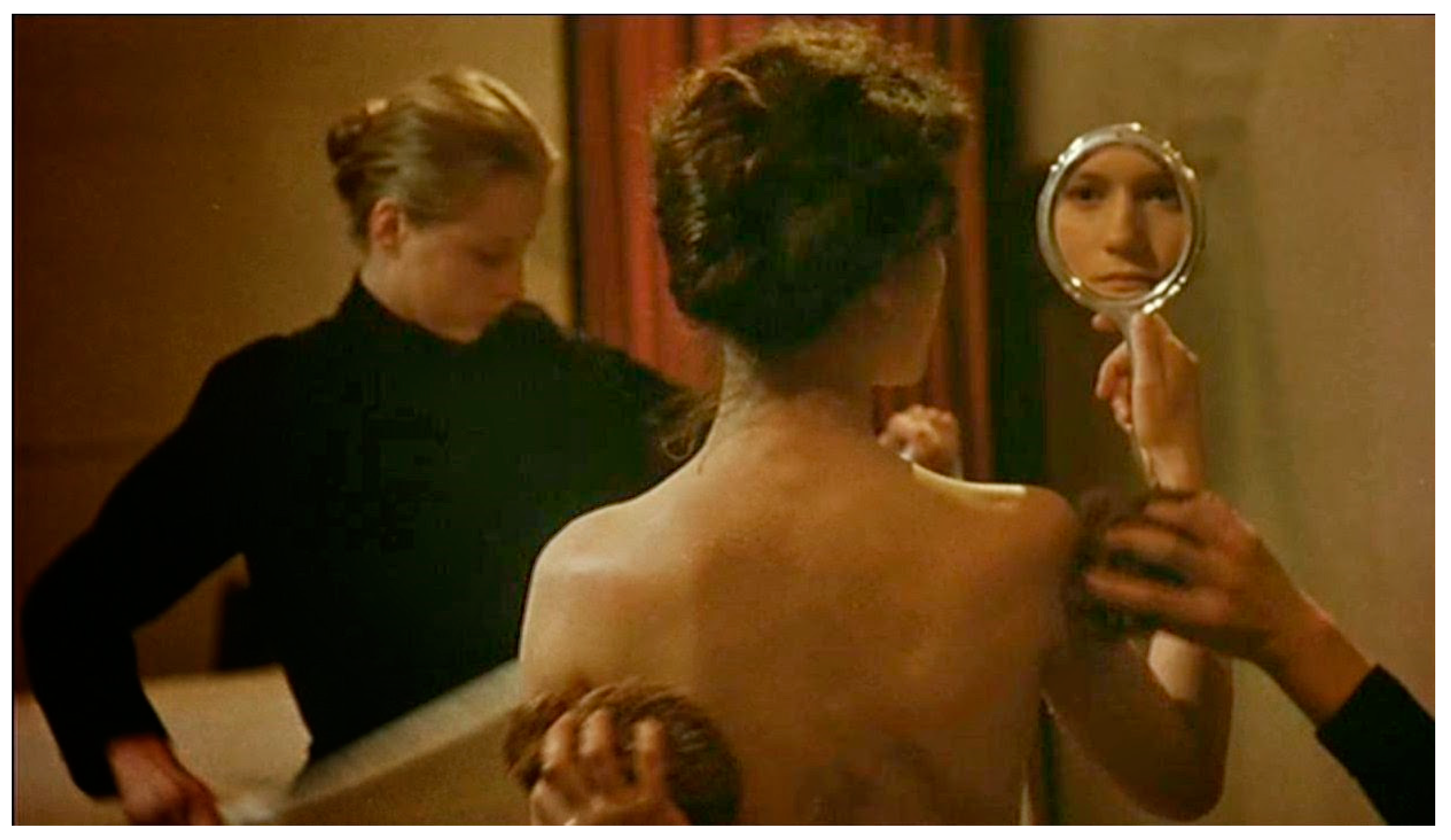
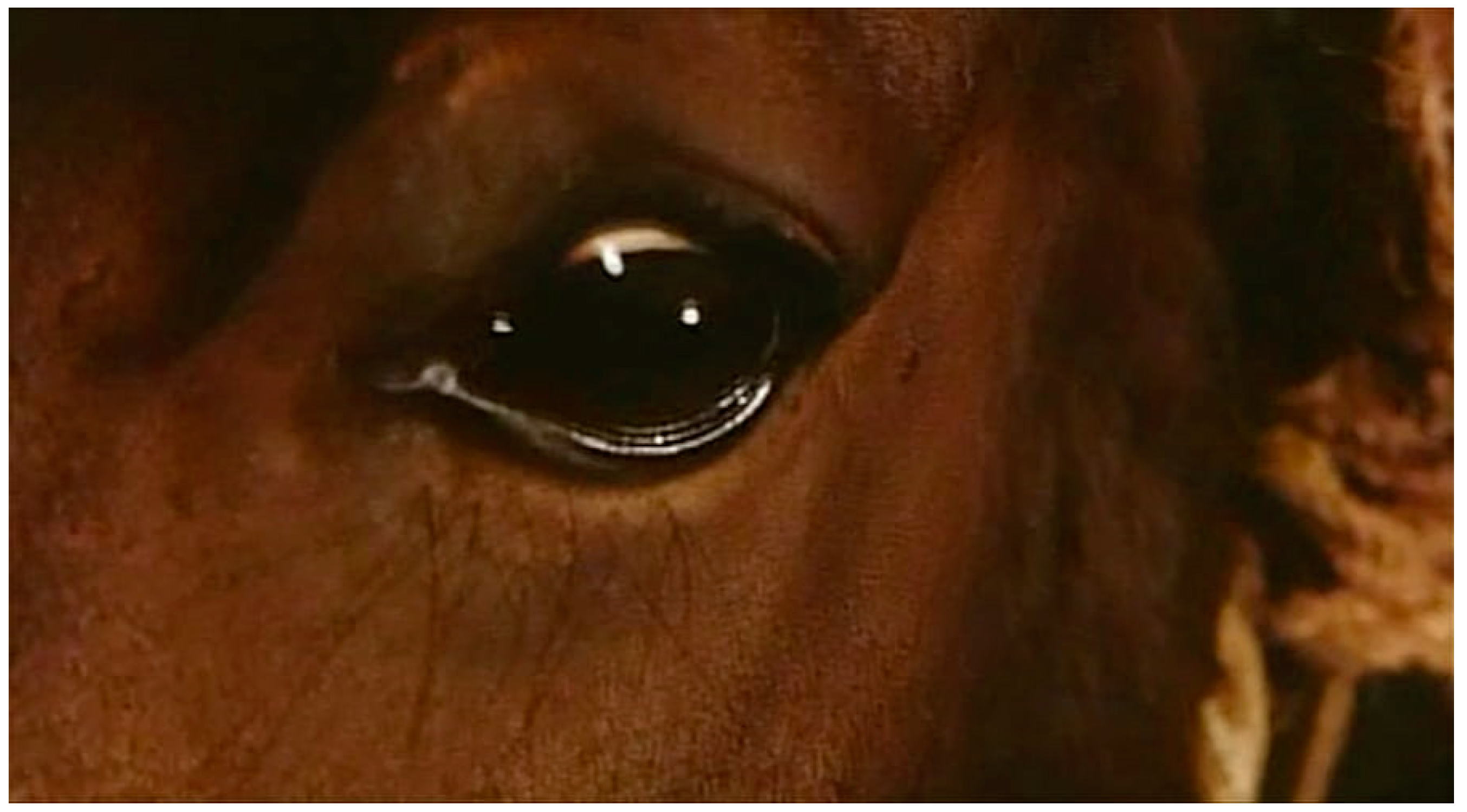
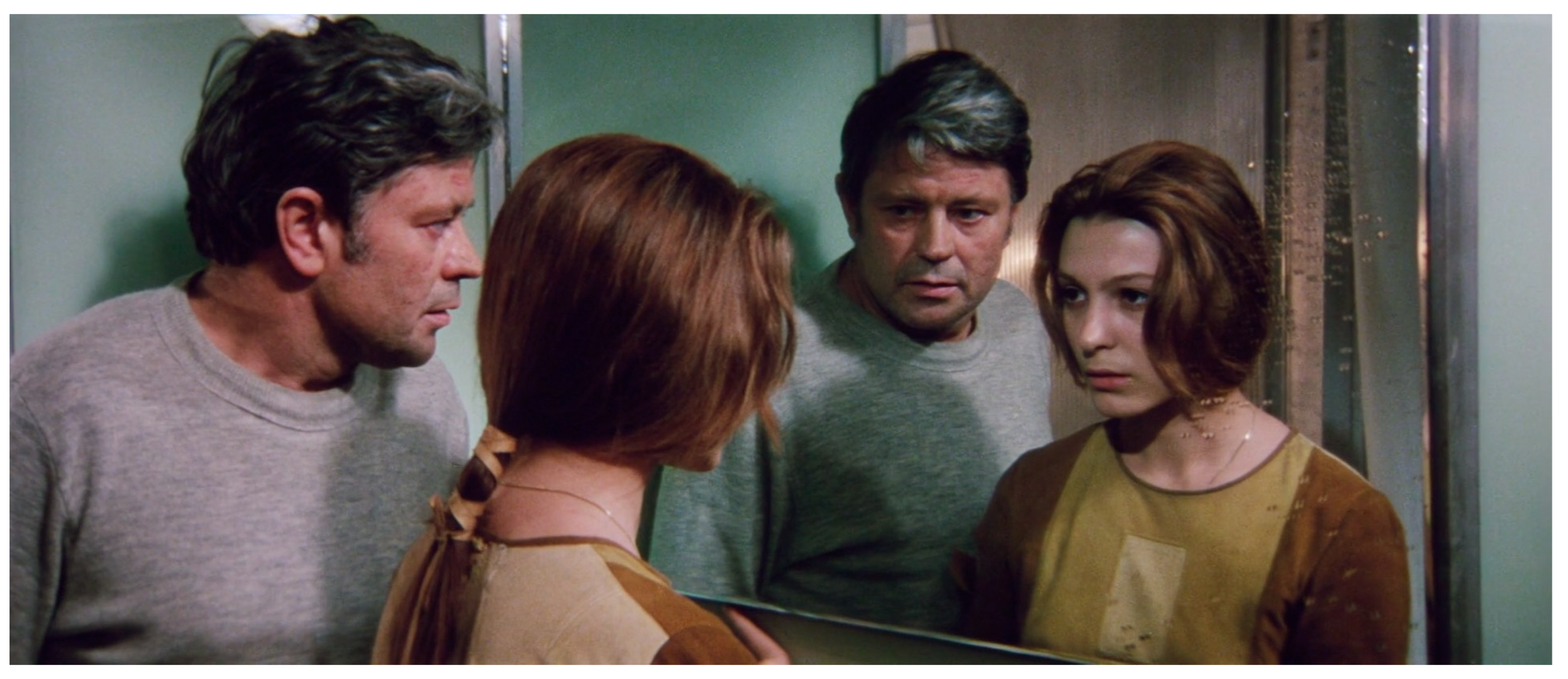
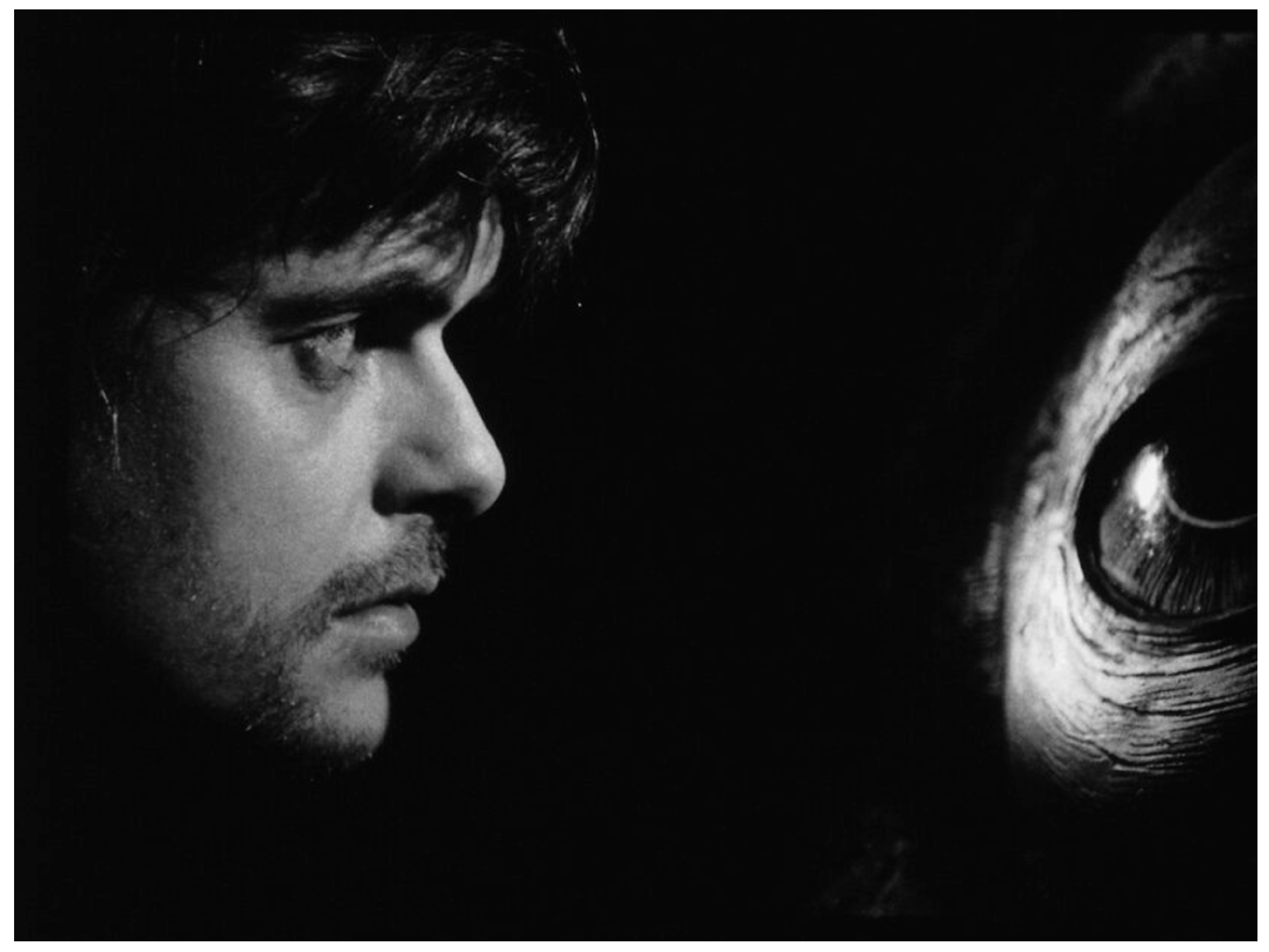
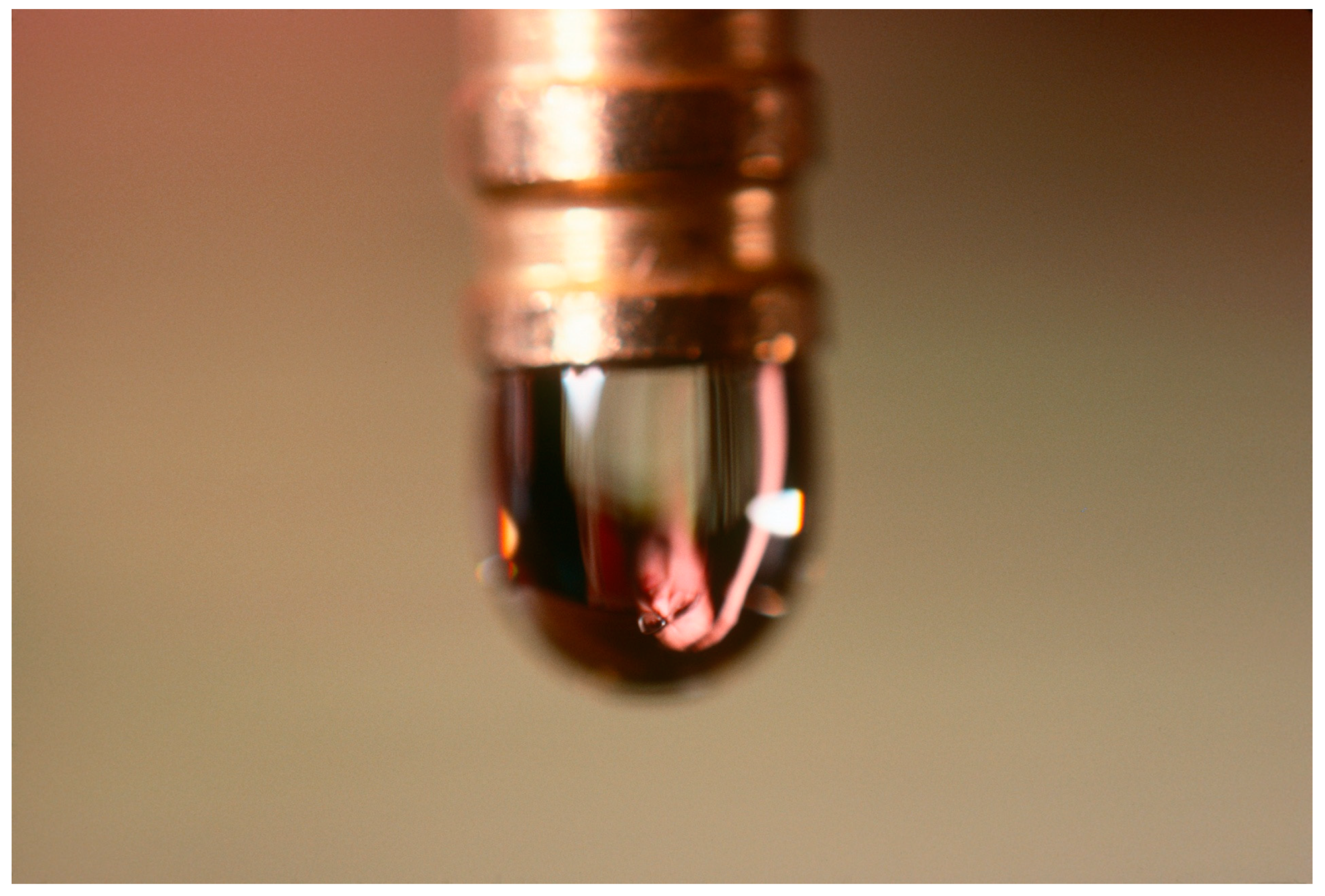
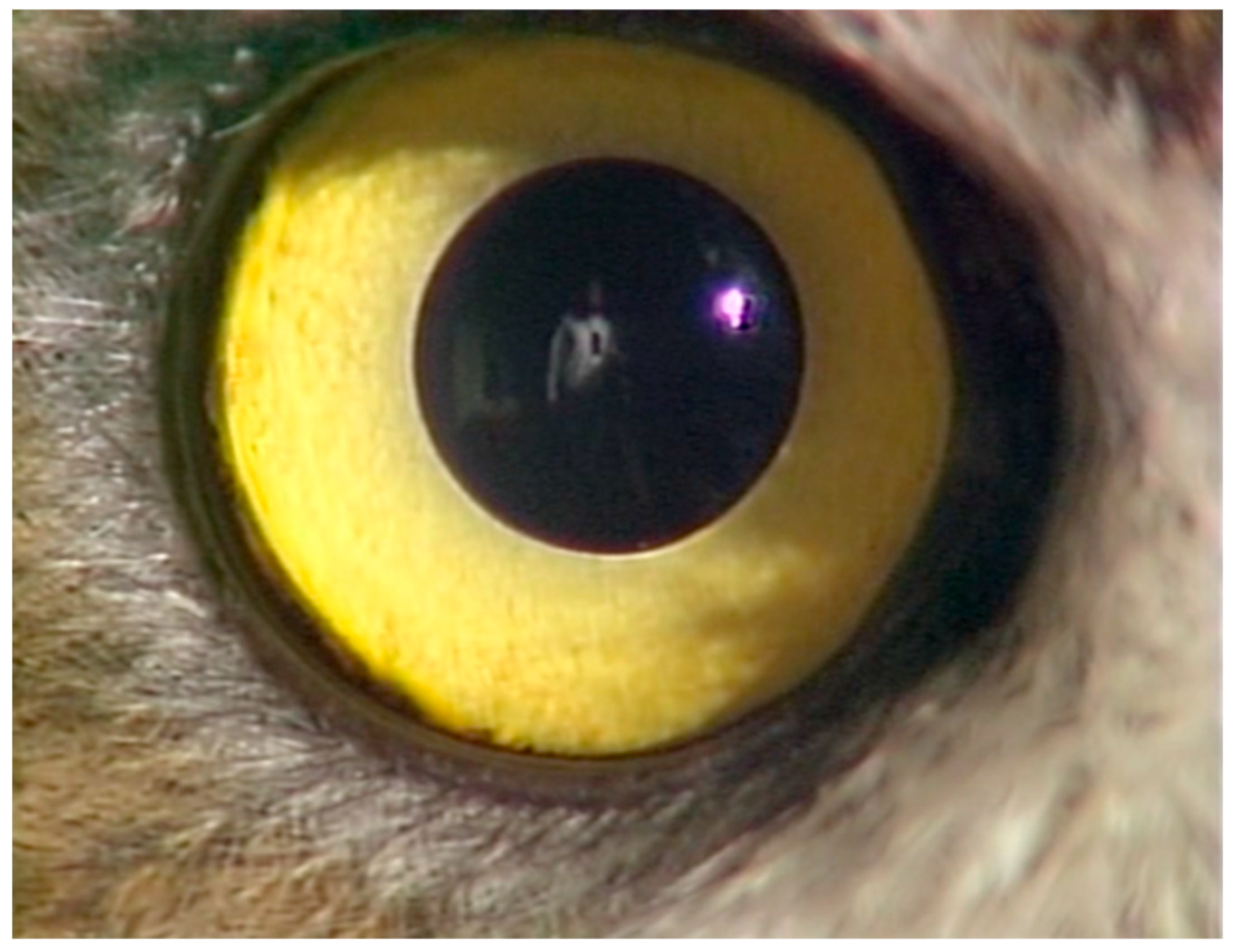
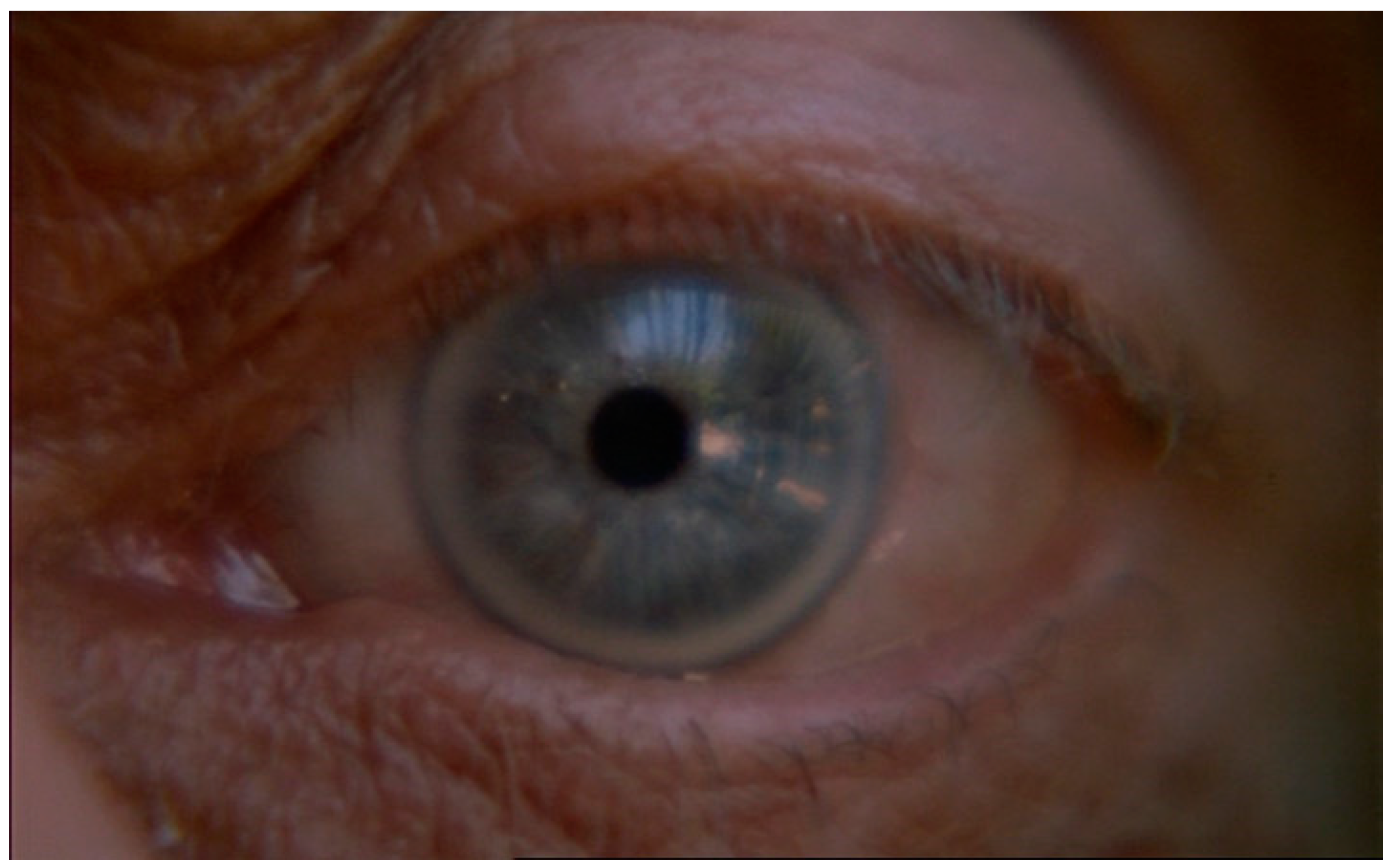
Disclaimer/Publisher’s Note: The statements, opinions and data contained in all publications are solely those of the individual author(s) and contributor(s) and not of MDPI and/or the editor(s). MDPI and/or the editor(s) disclaim responsibility for any injury to people or property resulting from any ideas, methods, instructions or products referred to in the content. |
© 2023 by the author. Licensee MDPI, Basel, Switzerland. This article is an open access article distributed under the terms and conditions of the Creative Commons Attribution (CC BY) license (https://creativecommons.org/licenses/by/4.0/).
Share and Cite
Gonzalo Carbó, A. The Black Mirror of the Pupil of the Eye: Around the Eye that Sees and Is Seen: Ibn al-ʿArabī, Bill Viola. Religions 2023, 14, 994. https://doi.org/10.3390/rel14080994
Gonzalo Carbó A. The Black Mirror of the Pupil of the Eye: Around the Eye that Sees and Is Seen: Ibn al-ʿArabī, Bill Viola. Religions. 2023; 14(8):994. https://doi.org/10.3390/rel14080994
Chicago/Turabian StyleGonzalo Carbó, Antoni. 2023. "The Black Mirror of the Pupil of the Eye: Around the Eye that Sees and Is Seen: Ibn al-ʿArabī, Bill Viola" Religions 14, no. 8: 994. https://doi.org/10.3390/rel14080994
APA StyleGonzalo Carbó, A. (2023). The Black Mirror of the Pupil of the Eye: Around the Eye that Sees and Is Seen: Ibn al-ʿArabī, Bill Viola. Religions, 14(8), 994. https://doi.org/10.3390/rel14080994

