Article

Portuguese Version of the Spiritual Well-Being Questionnaire: Validation Study in People under Assisted Reproductive Techniques

1
Centre for Interdisciplinary Research in Health, Institute of Health Sciences, Universidade Católica Portuguesa, 1649-023 Lisbon, Portugal
2
Instituto de Medicina Preventiva e Saúde Pública, Faculdade de Medicina, Universidade de Lisboa, 1649-028 Lisboa, Portugal
3
Federation University Australia, Ballarat, VIC 3350, Australia
4
School of Rural Health, University of Melbourne, Parkville, VIC 3010, Australia
*
Author to whom correspondence should be addressed.
Religions 2022, 13(5), 400; https://doi.org/10.3390/rel13050400
Submission received: 14 February 2022 / Revised: 21 April 2022 / Accepted: 23 April 2022 / Published: 26 April 2022

Abstract

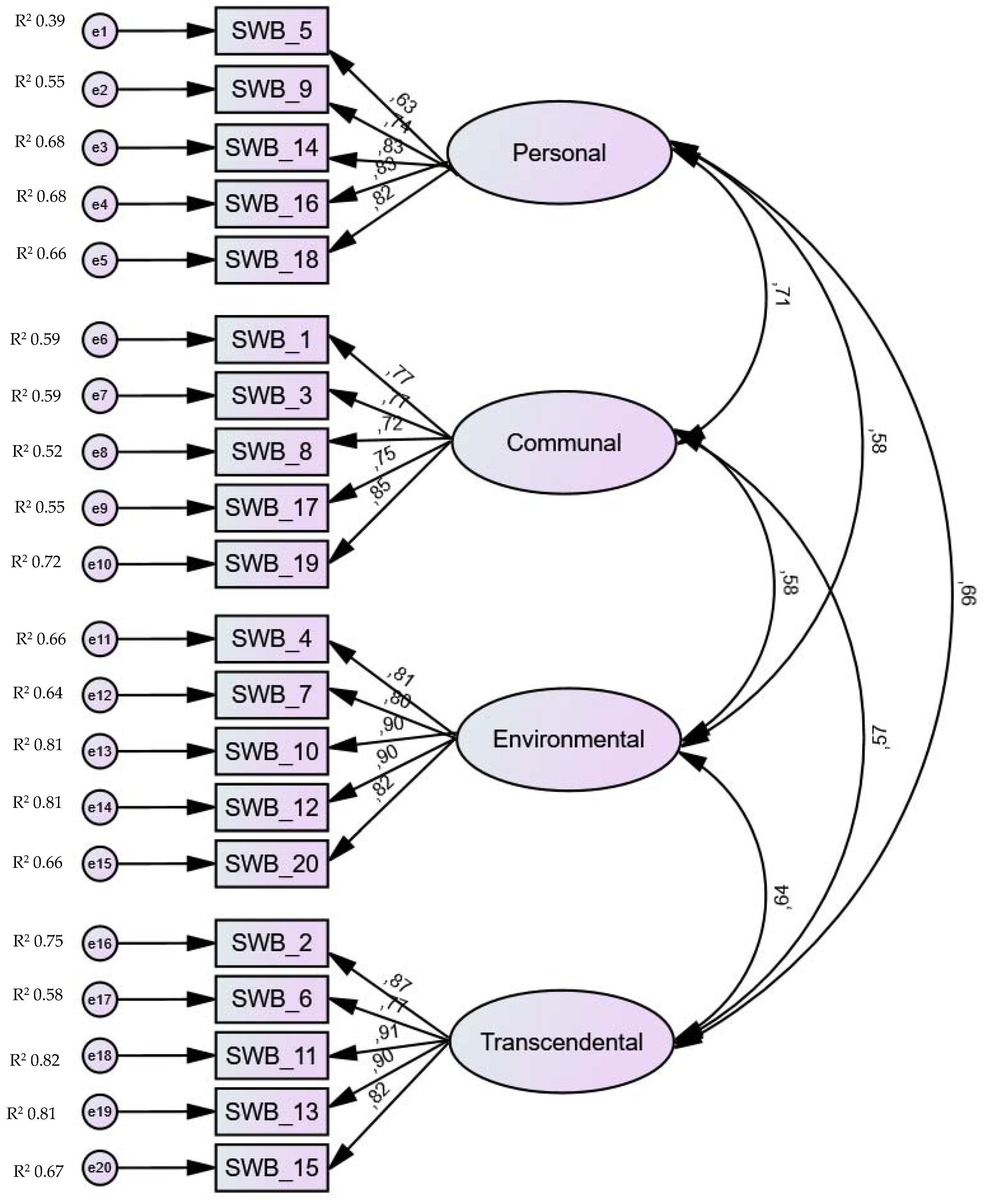
Attention has been given to the experience of individuals undergoing assisted reproductive techniques. However, only recent literature has focused on the spiritual journey triggered by such an event and highlighted the nurses and midwives’ roles in the assessment of the spiritual needs of those living with infertility. This study aimed to perform a psychometric test of the factor structure of the Portuguese version of the Spiritual Well-being Questionnaire in a sample of people undergoing assisted reproductive techniques. This descriptive cross-sectional study was conducted between September 2019 and June 2020 on a sample of 104 Portuguese adults attending fertility treatment. An online questionnaire was released on fertility-related websites. A confirmatory factor analysis was conducted on six hypothesized models of the instrument. The findings provided evidence of an adequate internal consistency of the instrument, and the validity and reliability of the oblique four-factor model was confirmed. Spiritual well-being had a significant association with the nature of infertility and a higher score was achieved by participants that perceived religion as very important. This study provides a validated tool for nurses and midwives to assess spiritual well-being and promote an integrated reproductive healthcare approach. Further longitudinal research with bigger samples would provide more evidence of the spiritual needs of people living with this condition.
Keywords: adult; assisted reproductive techniques; factor analysis; infertility; instrument validation; spirituality; spiritual well-being; nursing; population-based study adult; assisted reproductive techniques; factor analysis; infertility; instrument validation; spirituality; spiritual well-being; nursing; population-based study