Article

A Stochastic Approach for Evaluating the Reliability of a MASS and Assessing the Compliance with the IMO Regulatory Framework


by
Pietro Corsi
1,2,*,
Sergej Jakovlev
1,3,
Massimo Figari
4 and
Vasilij Djackov
1
1
Department of Marine Engineering, Klaipeda University, 92294 Klaipeda, Lithuania
2
RINA Services S.p.a., 16128 Genova, Italy
3
Department of Telecommunications, VSB-Technical University of Ostrava, 708 00 Ostrava, Czech Republic
4
Department of Naval Architecture, Electric, Electronic and Telecommunication Engineering (DITEN), Genoa University, 16145 Genova, Italy
*
Author to whom correspondence should be addressed.
J. Mar. Sci. Eng. 2026, 14(9), 814; https://doi.org/10.3390/jmse14090814
Submission received: 27 February 2026 / Revised: 20 April 2026 / Accepted: 20 April 2026 / Published: 29 April 2026
(This article belongs to the Section Ocean Engineering)

Abstract

The introduction of Maritime Autonomous Surface Ships (MASSs) requires reliable engineering methods to demonstrate safety levels comparable to those of conventional manned vessels. This paper presents a mission-based stochastic reliability framework for the comparative assessment of manned and unmanned ship configurations, with a focus on engineering design and verification. The methodology is based on Reliability Block Diagrams (RBDs), where ship missions are decomposed into critical functional subsystems and evaluated over mission-limited operational profiles. To address the uncertainty inherent in component failure data for autonomous systems, Mean Time to Failure (MTTF) values are treated as stochastic variables rather than fixed parameters. A Monte Carlo simulation approach is used to propagate uncertainty from component level to overall mission reliability, producing probability distributions of mission success. The proposed framework is applied to a Search and Rescue Patrol Vessel, comparing manned and unmanned configurations under identical mission scenarios and durations. Results indicate that, for moderate uncertainty levels, the unmanned configuration achieves equal or higher mission reliability, while increasing uncertainty reduces the statistical separation between the two solutions. The approach provides a practical and replicable tool to support reliability-driven design decisions for autonomous marine systems.

1. Introduction

Two of the main motivations for the development of Maritime Autonomous Surface Ships (MASS) are to enhance safety, and to decrease the environmental risk associated with ships operation.
The reason why the ‘autonomy’ is considered a safer operation is because it should drastically reduce errors associated with the navigation of the vehicle; the absence of the human in command is expected to reduce the risk associated with the most common hazards, for example, the fatigue of the crew, the distractions, and information overload [1].
However, the possibility to have human errors associated with the design of the ship remains, namely “design error”. Furthermore, the increasing reliance on information systems, and the possible sharing of the conning station among different control systems and/or operators, creates new hazards related to the potential loss of information and leads to new types of “human errors” [2,3].
On the other hand, to make autonomy really safe, ship’s technical systems are required to show very high reliability, given that no one is available onboard for repairs. According to IMO a MASS can operate independently by human intervention with the requisite to have the same safety level of a conventional vessel. Despite the simple definition, MASS deployment presents several challenges that span technical, regulatory and infrastructural domains [4], mainly because the safety assurance is not well established yet.
Several methodologies have been proposed in the literature [5], and the industry generally adopts the safety assurance schemes by the Classification Societies [6,7]. Also, the role of Administrations is becoming strategic in ensuring innovation within the applicable regulatory framework [8,9]. Most of the safety assurance methodologies are based on the risk analysis principles where probability and consequences of undesired events are computed and compared against acceptance levels through an acceptance matrix. The main drawback of this method is that probability and consequence are usually assessed qualitatively, causing difficulties when trying to accurately trace the procedure for future reference.
The approach proposed in this article is based on the mission reliability concept: the new technology is considered acceptable if the achieved mission reliability is at least equal to or greater than the current technology. The idea behind the method is to assess the probability of success of the ship mission, with and without crew, for all types of missions used to design the ship. It is a design-centered approach meant for certification purposes. Reliability modeling offers a structured way to quantify failure risks and system behavior, which is essential for demonstrating compliance with the IMO MASS Code and MASS IACS Class Rules. These frameworks adopt a goal-based approach, requiring autonomous vessels to prove safety levels equivalent to or higher than those of conventional ships. With respect to state-of-the-art mission reliability analysis, the proposed approach handles the inherent uncertainties embedded in the reliability models by using a stochastic Mean Time to Failure (MTTF) for each component, modeled with a normal distribution.
The results of this approach consist of the distribution of the probability of mission success, for both unmanned and manned designs, with the probability of exceedance used as risk KPI.
The novelty of the study lies in the application of a stochastic RBD–Monte Carlo reliability framework to Maritime Autonomous Surface Ships (MASS), explicitly addressing uncertainty in failure data and enabling a quantitative, mission-based comparison between manned and autonomous vessel configurations.
The remainder of the paper is structured as follows. Section 2 discusses the literature review, Section 3 presents the Stochastic reliability method, Section 4 presents a case study where a structured comparison between manned and unmanned vessel configurations under identical operational profiles is shown. Section 5 details the simulation results, followed by the conclusions.

2. Literature Review

The development of Maritime Autonomous Surface Ships (MASSs) represents a transformative step for the global maritime industry, offering improved operational safety, reduced labor dependency, and higher efficiency in logistics chains. This evolution is driven by advances in artificial intelligence, sensor fusion, and control systems which, when integrated with high-availability hardware architectures, support the implementation of autonomous behaviors at sea [1].

2.1. The Regulatory Framework for MASSs

The regulatory framework applicable to MASSs is complex and not unified at the international level. Several countries have published guidelines or issued directives concerning the operation with autonomous ships and at international level; IMO is going to publish the non-mandatory IMO MASS CODE in 2025 [10,11]. This Code defines four degrees of autonomy for MASS operations, ranging from conventional manned vessels with automated systems (Degree 1) to fully autonomous vessels capable of independent decision-making and control (Degree 4). These levels serve as a functional foundation for classification and certification frameworks [12,13,14],
Despite the conceptual and technological progresses, existing regulatory structures remain under development. The IMO MASS Code, currently non-mandatory and focused on cargo vessels, is expected to become mandatory by 2032, even if military and passenger applications are not addressed.
While MASSs have demonstrated promising capabilities in testbed environments and early deployments [15,16] widespread adoption requires a unified global certification frame-work that should address technological innovation and actual regulation, particularly in terms of navigation capability in remote operations, collision avoidance strategies, communication and cybersecurity, automation and machinery control system, final testing and validation of all these points. [17,18,19,20,21,22,23,24]
MASS development is further influenced by a variety of national projects and EU initiatives. Examples include the Yara Birkeland [15], the Mayflower [4], and the ReVolt, each demonstrating different degrees of autonomy, energy efficiency, and real-world testing success. The European Union, through programs such as MUNIN, AUTOSHIP, and MOSES, has actively supported both technical innovations and regulatory harmonization for MASSs [9,25,26,27,28,29,30,31,32].
However, a key challenge lies in reconciling fragmented regulations across Flag States especially whenever international navigation is required. While IMO promotes a harmonized international framework, countries like Norway, Japan, and the UK have developed localized approval mechanisms, ranging from goal-based codes of practice to customized certification systems [33,34,35,36,37,38]. Most of the IACS Classification Societies have anticipated the IMO’s roadmap by publishing MASS-specific guidelines (e.g., RINA GUI 35) [7], often emphasizing a risk-based and modular approach. The common approach of these regulations is aimed at demonstrating that an unmanned vessel is at least as safe as its manned equivalent. For this reason it is important to define a scientific methodology for the evaluation of the MASS reliability that can be replicated an unlimited number of times, in order to use it for reducing the risk associated with a specific MASS operational profile, as well as to provide a technical response to the challenge of assessing the reliability between a manned and an unmanned vessel configuration.
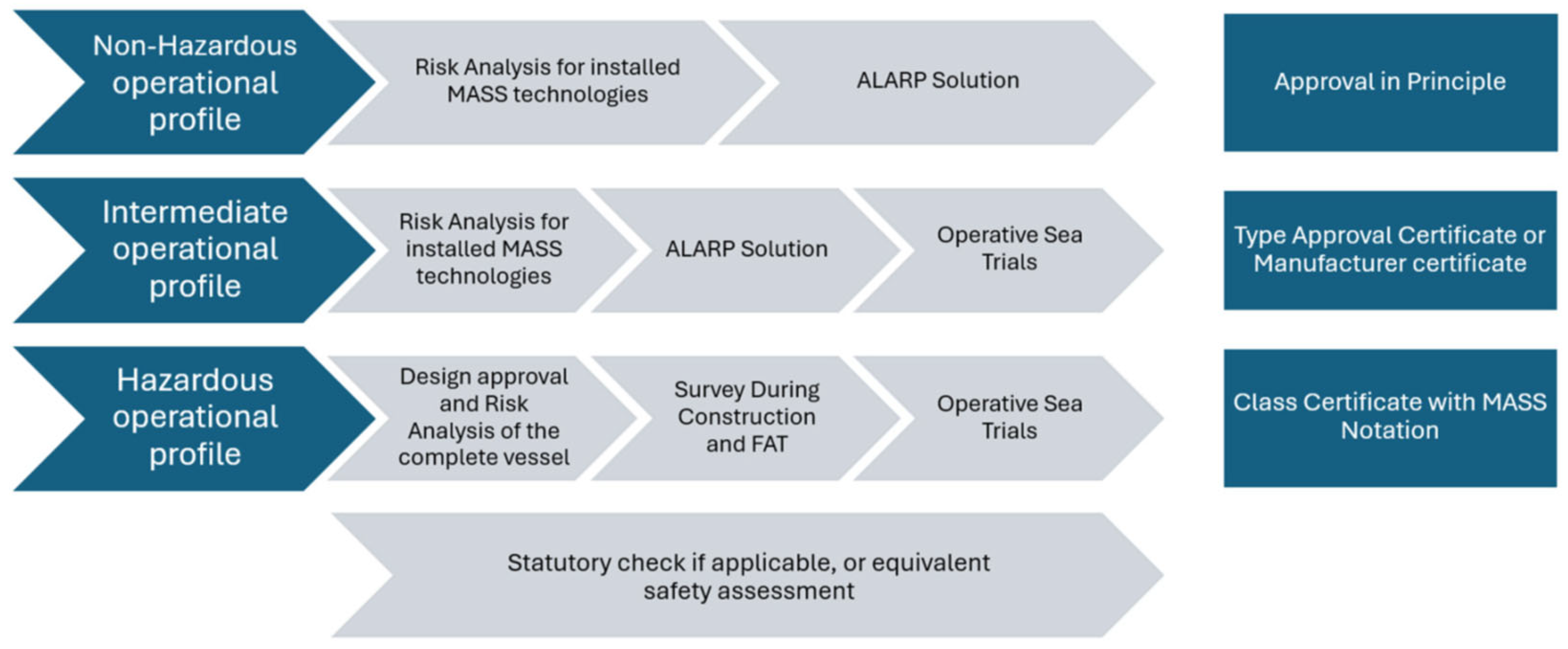
The Regulatory framework applicable to a MASS is the foundation of [39] where a structured pathway to facilitate the certification and operation of MASSs, addressing technical, operational, and safety considerations is outlined (Figure 1).
In the following paragraph, the state of the art of reliability and availability models applied to marine system and autonomous ships is analyzed.

2.2. Reliability and Availability in MASS Systems

Reliability assessment has become a central pillar in marine engineering, particularly with the increase in automation level, digitalization, and in the last year with the introduction of the autonomous ships. Historically, system reliability in marine and offshore sectors was primarily managed using deterministic, failure-rate-based approaches used in system design and in preventive maintenance policy making. These traditional frameworks—often drawn from aviation and defense sectors, such as Reliability-Centered Maintenance (RCM) developed by the U.S. Navy in the 1970s [40]—provided structured guidelines for managing risk of failure, but have proven insufficient in capturing the multi-dimensional, stochastic, and operational complexities of modern ship systems [41]. The increasing integration of autonomous functionalities, high-speed data acquisition and regulatory pressures has necessitated the evolution toward adaptive, intelligent reliability frameworks capable of supporting proactive and condition-based decision-making under uncertainty.
In any case these traditional methods for the evaluation of reliability could be well applied for the analysis of different system solutions and to compare a traditional vessel with an autonomous one.
In conventional ship systems, particularly those operating without automation, equipment degradation is typically driven by a mix of mechanical wear, material fatigue, environmental exposure and maintenance delays. Studies by Ait Allal et al. [42,43] illustrate how critical systems such as the Sea Water Central Cooling System and Main Engine Lubricating Oil system are subject to failure due to corrosion, pump malfunction and insufficient monitoring, often resulting in costly engine failures and operational downtime. Using classical methods like Fault Tree Analysis (FTA) and Failure Mode and Effects Analysis (FMEA), these works identify system vulnerabilities and suggest design improvements and redundancy strategies that are essential for adaptation to unmanned ship operation.
Edge et al. [44] and Abaei et al. [45] further develop this perspective by considering the requirements of autonomous and optionally manned platforms. In particular, the “Tx Ship” concept and machinery reliability framework for Unattended Machinery Plants (UMPs) underscore that future ship architectures must prioritize availability and fault tolerance over cost or fuel efficiency. Abaei et al. propose a Multinomial Process Tree (MPT) model coupled with Bayesian inference to predict the behavior of critical systems without human intervention, highlighting how systems such as the main engine and gearbox must be continuously monitored for degradation, with real-time diagnostic and prognostic tools supporting remote decisions.
These developments are consistent with trends in system reliability engineering that integrate probabilistic and AI-based models to enhance predictive power and responsiveness [46,47,48]. As detailed in Chapter 2 of Developing an Advanced Reliability Analysis Framework by Daya and Lazakis [49], a major paradigm shift is underway: reliability modeling now often relies on hybrid architectures combining Dynamic Fault Tree Analysis (DFTA), Bayesian Belief Networks (BBNs) and FMECA for comprehensive maintenance support. DFTA expands the classical FTA by introducing sequence and time-dependent failure logic through specialized gates, enabling accurate representation of conditional dependencies and repairable component behavior [50,51]. These dynamic gates are especially useful in modeling standby systems or time-delayed failures typical for marine engine rooms.
In parallel, FMECA provides the subjective grounding required to integrate human expertise and operational constraints into reliability evaluation. This is particularly critical where data availability is limited or where failures are influenced by contextual factors such as operator competence, design limitations, and maintenance culture [52]. FMECA allows for component prioritization based on severity, likelihood, and criticality elements that are further refined using structured risk matrices or weighted evaluation mechanisms.
In Daya and Lazakis [53], this hybrid framework was applied to an Offshore Patrol Vessel (OPV) and most of the machinery system have been modeled; through machine learning algorithms the model recommended real-time maintenance strategies—shifting between Planned Maintenance System (PMS), Condition Monitoring (ConMon) or Corrective Action based on operational status and component behavior.
The move toward intelligent reliability frameworks is also aligned with industry efforts to digitalize operations and meet regulatory requirements such as the ISM Code [54] and data standards defined by ISO 19847/19845 [55,56]. Real-time data acquisition from sensors onboard ships, combined with high-throughput analysis can process nonlinear, high-dimensional data to detect anomalies such as overheating, pressure drops, or acoustic irregularities before they evolve into failures.
In addition to technical component reliability, the recent literature has emphasized the growing importance of Human Reliability Analysis (HRA) in autonomous and semi-autonomous operations. Traditional HRA models, originating from nuclear and aerospace sectors, require significant adaptation to be relevant in maritime contexts where human error is filtered through remote interfaces and control centers. These methods are valuable for modeling latent conditions (i.e., hidden problems within the system), procedural failures and oversight challenges that might impact the success of automated or semi-autonomous marine operations.
Pereira de Abreu et al. [57] have called attention to the need for Human Reliability Analysis (HRA), especially in scenarios where MASS are remotely supervised. As Pereira de Abreu et al. [57] discuss, even in systems with minimal crew, human roles persist through remote supervision, decision-making, and response to alarms or automated diagnostics.
Traditional HRA methods—such as Human Error Assessment and Reduction Technique (HEART) and Standardized Plant Analysis Risk Human Reliability Analysis (SPAR-H)—should be applied to the remote-control architectures, human–machine interfaces and cognitive overload under complex supervisory conditions. These methods are essential for identifying latent system conditions, procedural deviations and oversight failures that may not be captured by technical reliability models alone but can have profound implications on system safety and mission success.
Lee, S. M et al. [58] proposes a local route planning algorithm for MASS that integrates fuzzy inference systems, ship domain concepts, and velocity obstacle methods to perform real-time collision avoidance in compliance with COLREGs rules. The study emphasizes the importance of modeling encounter situations and decision-making processes to ensure safe navigation under dynamic operational conditions [58,59,60]. The same main author developed a collision risk inference system based on COLREGs-compliant rules using an adaptive neuro-fuzzy approach, incorporating multiple navigational parameters such as CPA, ship domain and encounter dynamics. The proposed framework enables a more comprehensive assessment of collision risk by explicitly modeling decision-making processes and regulatory constraints [61].

2.3. Stochastic Reliability Modeling

Deterministic models such as RBD, FTA, FMEA and FMECA have long been the standard in marine engineering to identify potential failure paths. In MASS application, these models are essential for early design-stage analysis and for satisfying IMO MASS Code or IACS Class Society requirements like RINA GUI 35 [7] or CCS “i-Ship” frameworks [6]. However, their applicability is inherently limited by simplifying assumptions, most notably the hypothesis of stochastic independence between components and the use of constant, deterministic failure rates.
As system complexity increases, particularly in highly automated and autonomous architectures, dynamic and dependent behaviors become non-negligible. Components may interact through load-sharing mechanisms, standby redundancy, on-demand activation, failure propagation or common-cause failures, while system configurations may change due to maintenance policies or phased-mission characteristics. Under these conditions, classical static RBDs and FTs may lead to oversimplified or optimistic reliability estimates. To overcome these limitations, Distefano and Puliafito proposed Dynamic Reliability Block Diagrams as an extension of conventional RBDs, enabling the modeling of dependent and time-varying failure behaviors and configuration changes driven by repair, maintenance and mission-phase effects [58].
Their work demonstrates that dynamic reliability formalisms are necessary whenever the assumption of independence between system elements is violated.
In parallel, state-based and probabilistic approaches have been increasingly adopted to address uncertainty and data scarcity, which are particularly critical in autonomous ship applications. Abaei et al. proposed a reliability assessment framework for unattended machinery plants based on a Multinomial Process Tree coupled with Hierarchical Bayesian Inference, explicitly designed to cope with limited historical data and uncertain disruptive events in autonomous ship operations [61]. Their results highlight that uncertainty in failure behavior and the absence of onboard human intervention significantly affect system reliability and must be explicitly represented in quantitative models.
More recent studies in reliability engineering have further emphasized the importance of accounting for multisource uncertainty and performance degradation. Reliability degradation models show that variability in manufacturing tolerances, material properties, environmental conditions and operational stresses can substantially influence system-level reliability outcomes, even when nominal design parameters remain unchanged [39,62,63].
These findings reinforce the need to treat failure parameters as stochastic quantities and to propagate uncertainty from component level to system level rather than relying on single-point estimates.
Simulation-based stochastic frameworks, including Monte Carlo techniques, offer a practical compromise between analytical tractability and modeling fidelity [58,64,65].
Such approaches allow analysts to relax strict assumptions on failure rate determinism, to incorporate heterogeneous probability distributions, and to evaluate the sensitivity of mission success to uncertainty in reliability data [61].
Stochastic programming formulations have shown that reliability can be quantified for complex system topologies and arbitrary failure distributions, where closed-form analytical solutions are no longer feasible [59].
Within this context, the stochastic reliability approach adopted in the present work aims to preserve the transparency and design-oriented structure of RBD modeling while explicitly addressing uncertainty in input failure data. By treating component Mean Time to Failure (MTTF) values as random variables and propagating their variability through Monte Carlo simulations, the proposed method enables a probabilistic comparison between manned and unmanned vessel configurations under identical mission profiles. This approach is consistent with the goal-based safety philosophy underpinning the IMO MASS Code, allowing compliance to be demonstrated in terms of mission success probability rather than through deterministic or purely qualitative risk metrics.
From a certification perspective, (Figure 1) recent studies emphasize that the approval of Maritime Autonomous Surface Ships increasingly relies on risk-informed and goal-based approaches, where compliance is demonstrated through quantitative evidence of reliability, availability, and fault tolerance rather than prescriptive design solutions [40]. This highlights the importance of probabilistic reliability models capable of addressing uncertainty and limited operational experience when demonstrating safety equivalence between manned and unmanned vessel configurations.

3. Material and Methods

In this section the methodology and data taken into account in the calculation applied for the analysis are presented.
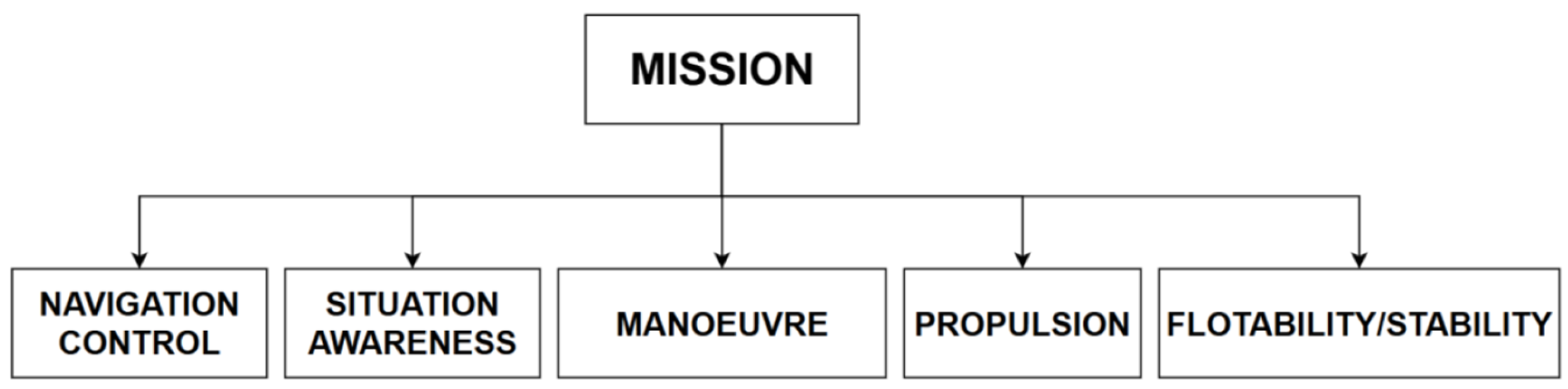
The ship mission is decomposed hierarchically into a number of critical functions/subsystems—Navigation Control, Situation Awareness, Propulsion, Maneuver, Stability, (Figure 1). Each function/subsystem is further divided into sub-modules down to the last single components/units. The reliability of the subsystems and of the mission itself is computed using Reliability Block Diagrams (RBDs), assuming exponential failure distribution, where the reliability (R) and the Main Time To Failure (MTTF) of the i-th element are expressed as
R i t = e λ i t
where λ i is the constant failure rate of the component and (t) is the mission time. The MTTF is defined as the expected value of the time to failure and for an exponential distribution is given by
λ i = 1 M T T F i
This formulation enables a direct link between failure rate data and reliability evaluation within the Reliability Block Diagram (RBD) framework. Series and parallel configurations are then used to compute subsystem and system-level reliability according to standard RBD rules, assuming statistical independence between component failures.
The analysis assumes independence between component’s failures and is limited to mission-based time horizons, rather than the full life cycle of the vessel.
The analysis requires a scenario definition, i.e., mission type and mission duration, used to compute the RBD model.
Input data MTTFi represents a major challenge; multiple sources, including OREDA database (Offshore & Onshore Reliability Data) [66,67], other reliability databases, classification society documentation and manufacturer manuals, have been considered. The MTTF implemented in the model are reported in Appendix C.
To describe the “MTTF” of the crew element in the RBD, an alternative approach has been considered. EMSA (European Maritime Safety Agency) publishes annual overviews of marine casualties and incidents in EU waters; these reports classify events into categories such as “human error,” “technical failure,” “external causes,” etc. For the 6 years from 2014 to 2020, EMSA consistently showed that a large share of accidents (about 80.7%) are directly attributable to human error. To translate this into a failure rate (λ) suitable for reliability analysis, the following approach is applied:
-
Consider the total exposure time of crews at sea (approximated via the number of ships, average crew sizes, and operating hours).
-
Relate the number of accidents involving human error per year to this exposure time.
-
The ratio gives a failure frequency, which can be interpreted as an effective human-related failure rate.
The failure rate of a technical component is itself an aggregate representation derived from multiple underlying failure mechanisms and operational conditions. In a similar way, the human-related failure rate adopted in this study is interpreted as an equivalent aggregate failure frequency derived from accident statistics. While maritime accident data represent complex events involving multiple contributing factors, the conversion is intended to provide an effective, system-level estimate of human-induced failure likelihood over a given exposure time. This approach does not aim to model individual human error mechanisms in detail, but rather to ensure consistency with the system-level reliability framework used for technical components. The limitation of this approximation is acknowledged and the resulting human failure rate should be interpreted as a simplified, order-of-magnitude representation suitable for comparative analysis between manned and autonomous configurations.
EMSA’s figure “80.7% of accidents in the marine sector (19,300) are caused by human error,” and a statistical average value of 13,098 ships in Europe with the hypothesis of 5000 h/year of motion per ship computes a human-error failure rate as
λ c r e w = N °   o f   h u m a n _ e r r o r   a c c i d e n t s T o t a l   c r e w   e x p o s u r e   t i m e   ;                       M T T F c r e w = 1 λ c r e w = 3.4 × 10 3
This formulation provides an order-of-magnitude estimate of the frequency of human-induced failures at system level. It should be noted that this approach does not model individual human error mechanisms, but rather aggregates their overall impact into a single equivalent failure rate, consistent with the level of abstraction adopted for technical components in the RBD model.
The reliability model adopted in this study is based on a hierarchical Reliability Block Diagram (RBD) representation of the ship system, in which the mission is decomposed into critical subsystems and further into individual components. Each element is characterized by a Mean Time To Failure (MTTF), which is used to derive the corresponding failure rate under the assumption of exponential failure behavior. A detailed description of the stochastic modeling approach is provided in Section 4, while the complete RBD structure for both manned and unmanned configurations is reported in Appendix A as a hierarchy table and in Appendix B as a graphic way.
It is to be considered that these sources, even if authoritative, may provide failure data for contexts not directly transferable to MASS applications, thereby introducing significant uncertainty.
To account for the limited availability and heterogeneity of failure data, the model is extended to a stochastic formulation in which MTTF values are treated as random variables rather than deterministic inputs. The resulting framework enables the propagation of uncertainty from component-level to mission-level reliability through simulation-based techniques.
To address the limitation of having the proper MTTF value, an alternative solution modeled through a stochastic framework has been adopted.
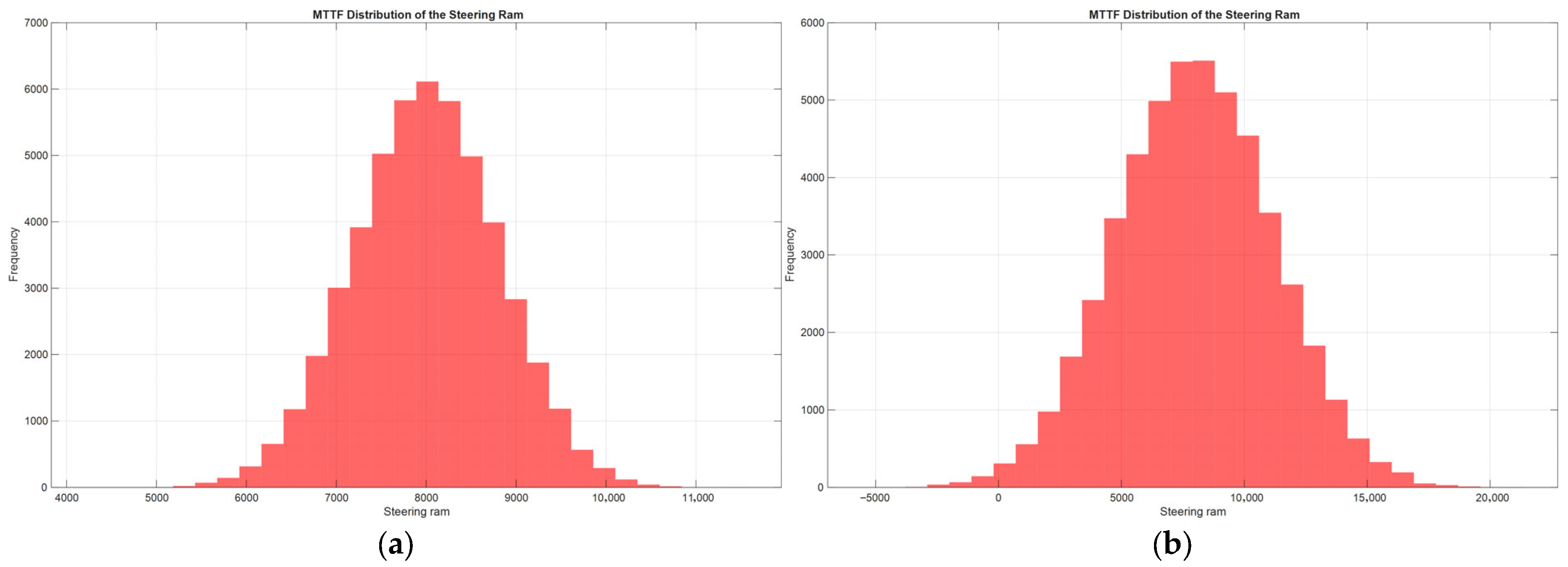
The standard deviation of the MTTF distributions has been varied between 10% and 40% of the nominal value in order to investigate the sensitivity of the model to uncertainty in failure data. This range is not intended to represent a precise statistical characterization of all components, but rather to provide a structured exploration of uncertainty levels typically encountered in early-stage design and in contexts where heterogeneous data sources are used.
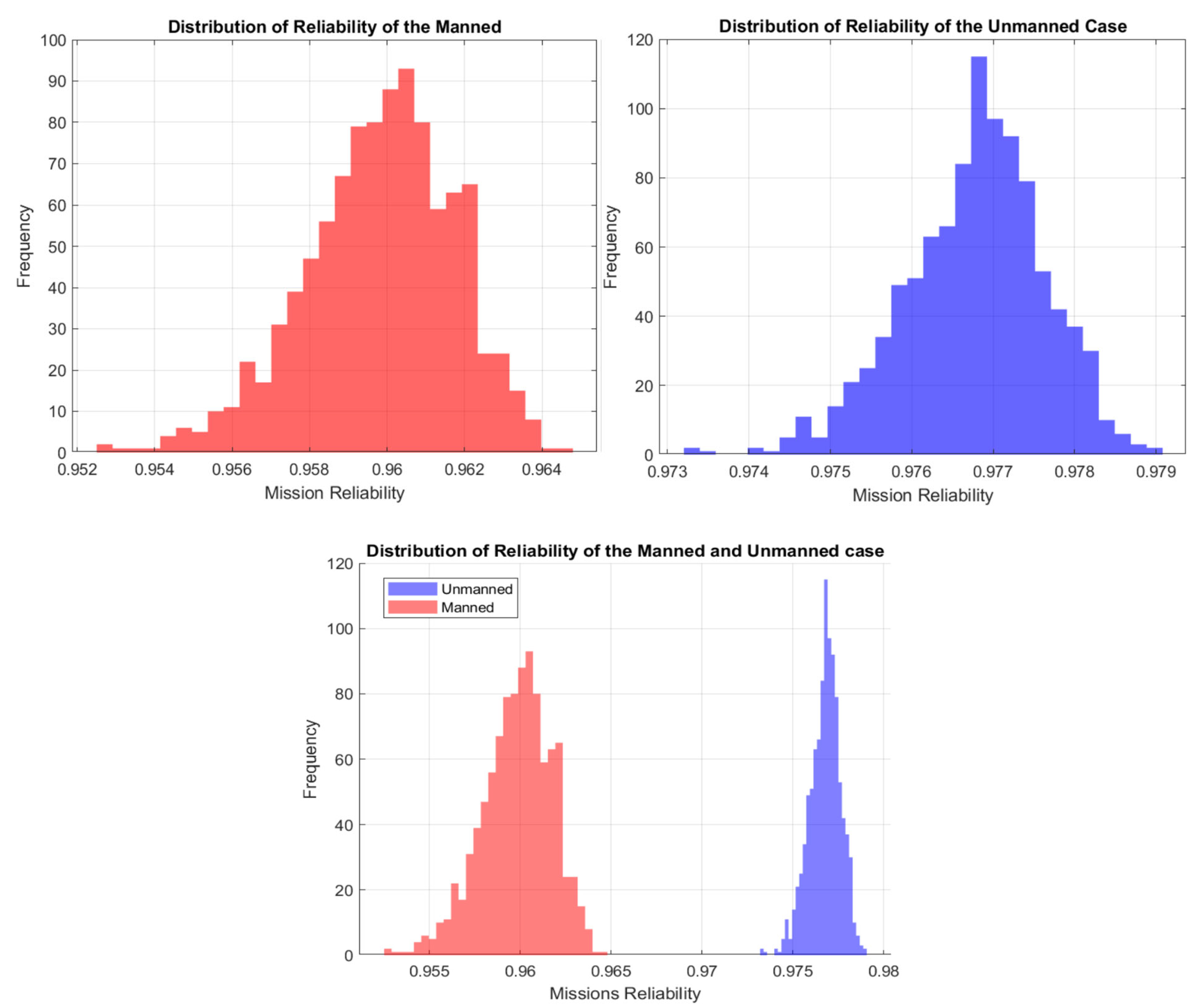
Lower values (10–20%) represent scenarios with relatively high confidence in failure data, such as well-documented components, while higher values (30–40%) represent conservative conditions where data uncertainty, variability in operating conditions, or limited empirical evidence may significantly affect reliability estimates (Figure 2a,b).
This sensitivity-based approach allows the robustness of the comparative results to be assessed and highlights the impact of uncertainty propagation on system-level reliability outcomes.
This approach allows us to consider the variability and limited confidence associated with failure rate data derived from heterogeneous sources. The stochastic simulations, performed in MATLAB R2022b, generated multiple iterations of perturbed MTTF datasets, with each cycle recalculating subsystem and mission reliability. The output of this process provides a probability distribution of reliability, from which confidence intervals and probabilistic comparisons between manned and unmanned configurations can be derived.
The developed code is structured in the following way:
-
Definition of the component MTTF;
-
Definition of the selected Standard Deviation;
-
Random number generation between −1 and +1;
-
Random MTTF generation for each component;
-
Calculation of the reliability of the various subsystems (n iterations);
-
Calculation of the n mission reliability;
-
Calculation of the average reliability of the mission;
-
Graphical representation of the distributions.

4. Stochastic Reliability Modeling for a SAR Autonomous Vessel

The reliability model implemented in this study is designed with the aim of providing a robust and realistic evaluation of the operational probability of success of a MASS compared to its manned counterpart: a Search and Rescue (SAR) fast patrol vessel. The reliability assessment is developed in two phases: a deterministic evaluation and a stochastic evaluation. The motivation behind this dual approach lies in the inherent uncertainties that characterize the estimation of component reliability parameters, in particular the mean time to failure (MTTF), which are rarely available with the precision and consistency required for a purely deterministic model.
In the deterministic study, the system is decomposed hierarchically into five critical subsystems—Navigation Control, Situation Awareness, Propulsion, Maneuver, and Buoyancy/Stability—(Figure 3) each of which is further divided into sub-modules up to the last single components/units. The complete model is reported in Appendix A for the manned and unmanned configurations. The reliability of the subsystems and of the mission itself is computed using Reliability Block Diagrams (RBDs) with exponential failure laws. Two missions of different duration and operative profile are considered: a 8 h SAR mission and a patrol 100 h mission scenario. Input data for the deterministic model were obtained from multiple sources and presented in the following.
Down to the second level the manned and unmanned configuration are equivalent; the differences start from level 3 as detailed in Appendix A.
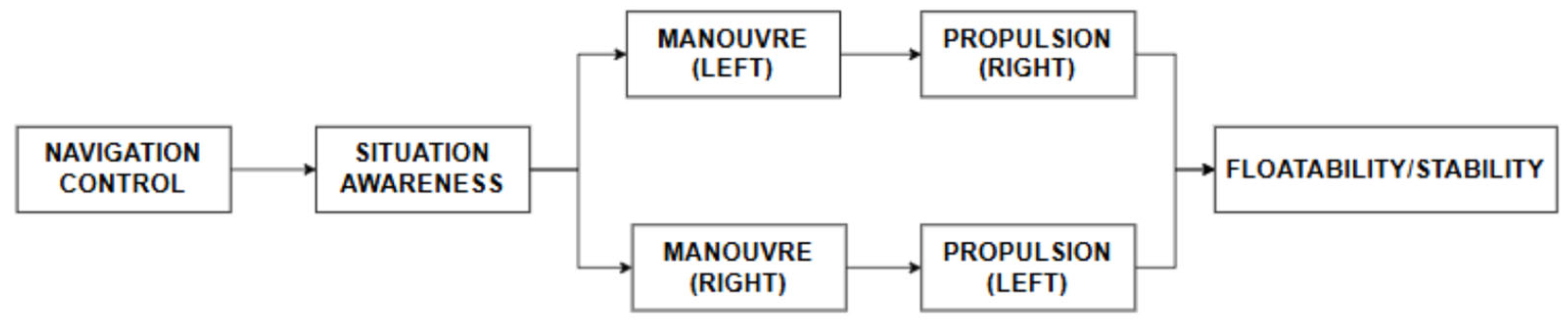
For the SAR mission both shaft lines are required, and the mission is modeled with a series of blocks in the RBD (Figure 4).
For the patrolling operational profile the hypothesis that the mission is accomplished with at least one shaft line has been assumed. The shaft line modules are set as a parallel in the RBD scheme (Figure 5).
Two different mission duration are considered: 8 h and 100 h.

5. Results

This section presents the simulation results of the stochastic reliability model applied to the two ship configurations: manned and unmanned for the two different mission profiles. The model uses a continuous-time Markov chain (CTMC) framework, based on the system architecture and component-level failure data, to estimate system availability, failure probability and mission success likelihood for both rescue and patrol missions.

5.1. Manned Ship Configuration—Deterministic Model

In the manned vessel configuration, systems are subdivided according to traditional operational layers—propulsion, navigation, auxiliary and command/control—as explained in Appendix A. The failure rate for each component is a fixed value and it is not considered in this approach a possible human intervention that can mitigate certain failure modes (Table 1).

5.2. Unmanned Ship Configuration—Deterministic Model

The results of the same simulation with the unmanned vessel model are presented in the following (Table 2).
The results are obtained applying the methodology presented in paragraph 3, assigning MTTF data available in the literature or declared by the manufacturer of specific components used in the preliminary design of the vessel systems.

5.3. Comparative Preliminary Analysis of the Deterministic Model Results

One of the goals of this paragraph is the verification that the results of the model (Table 3) are coherent with the good practice and the experience of these kind of vessels and missions. The single main modules (level 2) reliability results are presented in order to better understand the importance of the single modules and how they affect the final result.
In the Reliability Block Diagrams reported in this section, the Propulsion, Maneuverability, Floatability blocks represent distinct functional capabilities required for mission completion to the vessel platform. The Propulsion block refers to the vessel’s ability to generate and maintain thrust through the main propulsion system and its essential auxiliaries, while the Maneuver block represents the capability to control heading and trajectory, including steering and control-related functions necessary to safely execute course changes.
The Navigation Control and situational awareness are the two key elements of the MASS technology or crew function.
All the RBDs are presented in Appendix B.
The results obtained represent the probability that the single module will positively conclude the mission (Table 3). In a second step the mission successful probability is calculated as the product of this Reliability Block.

5.4. Stochastic Modeling of Failure Scenarios Results

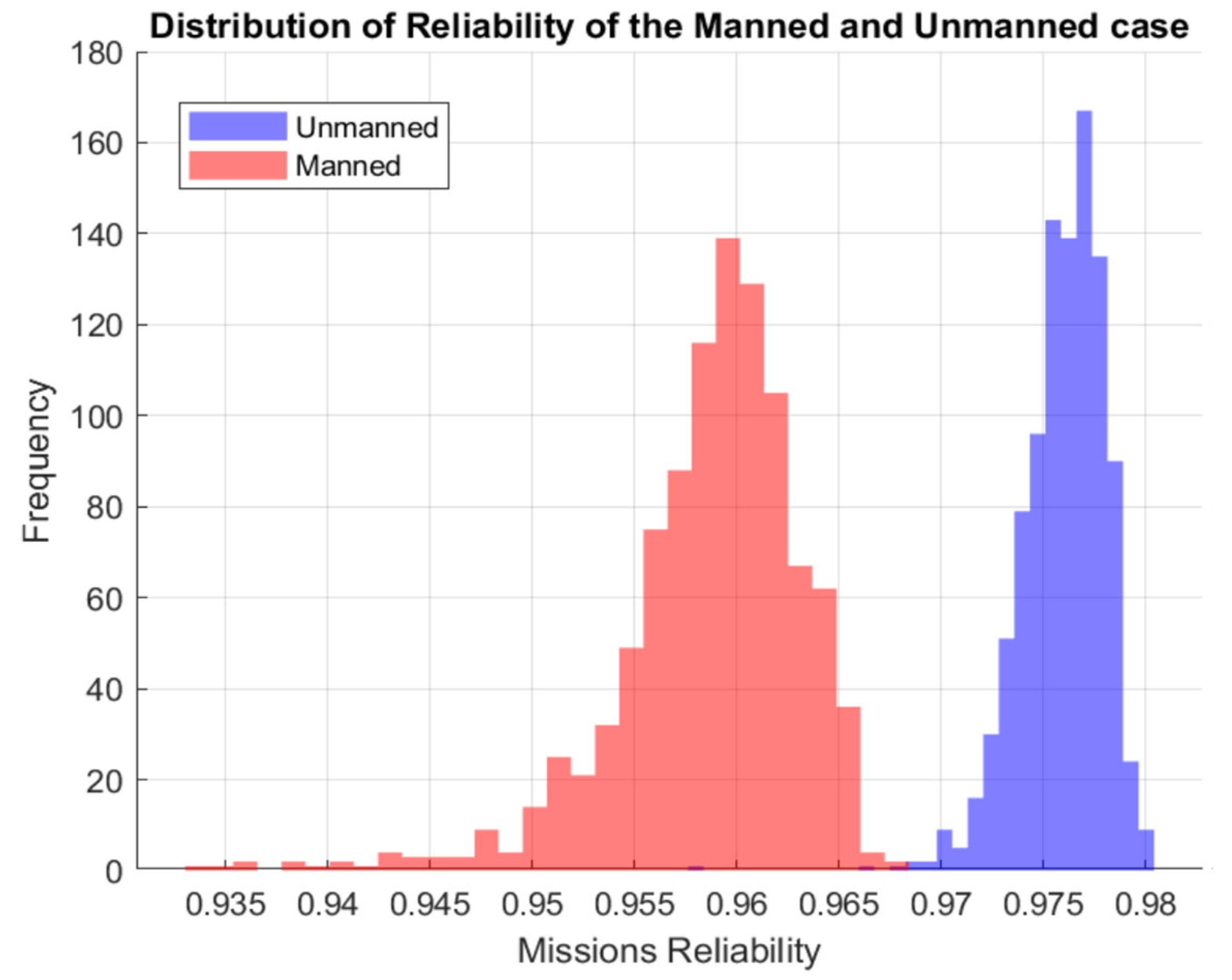
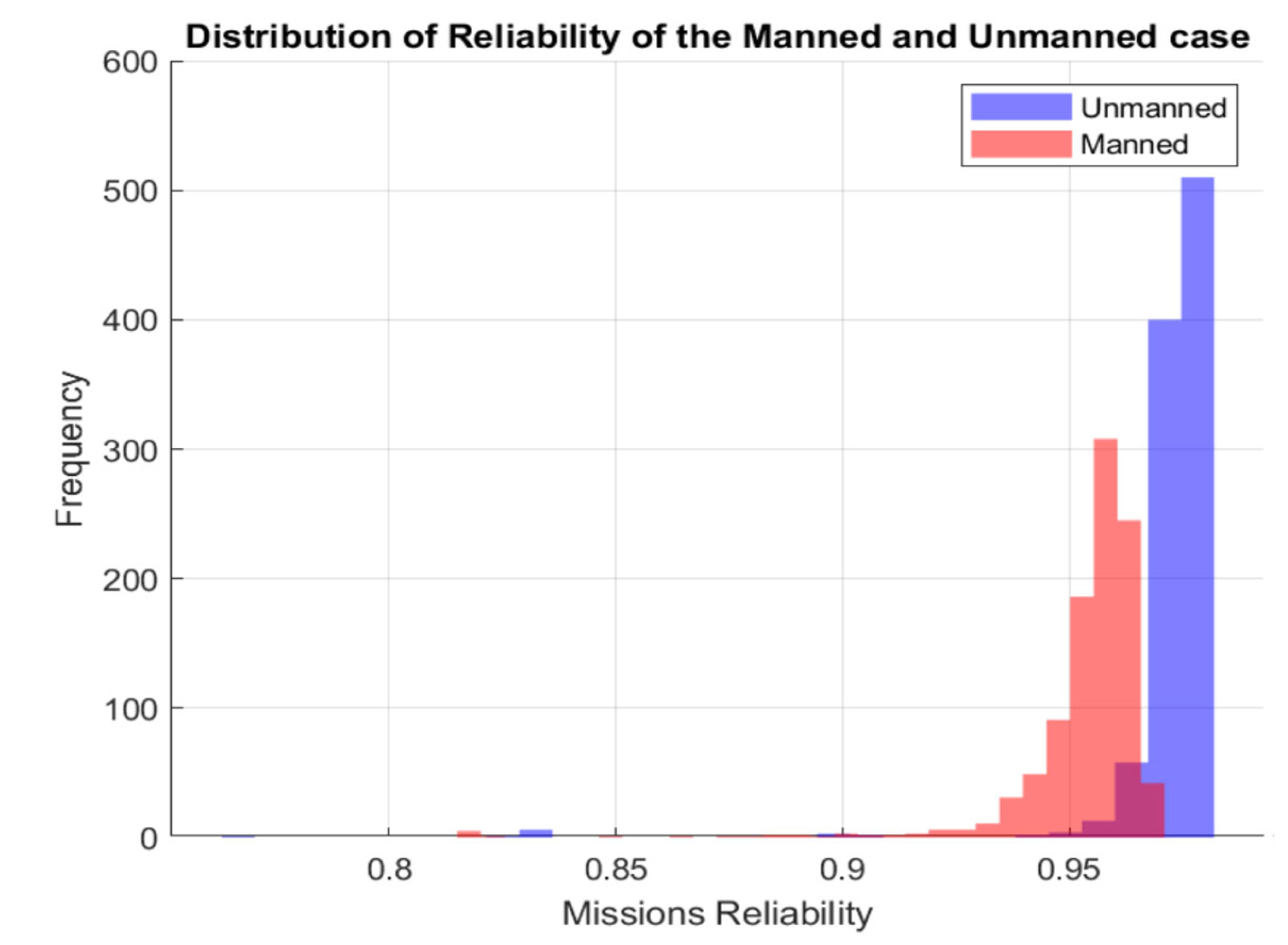
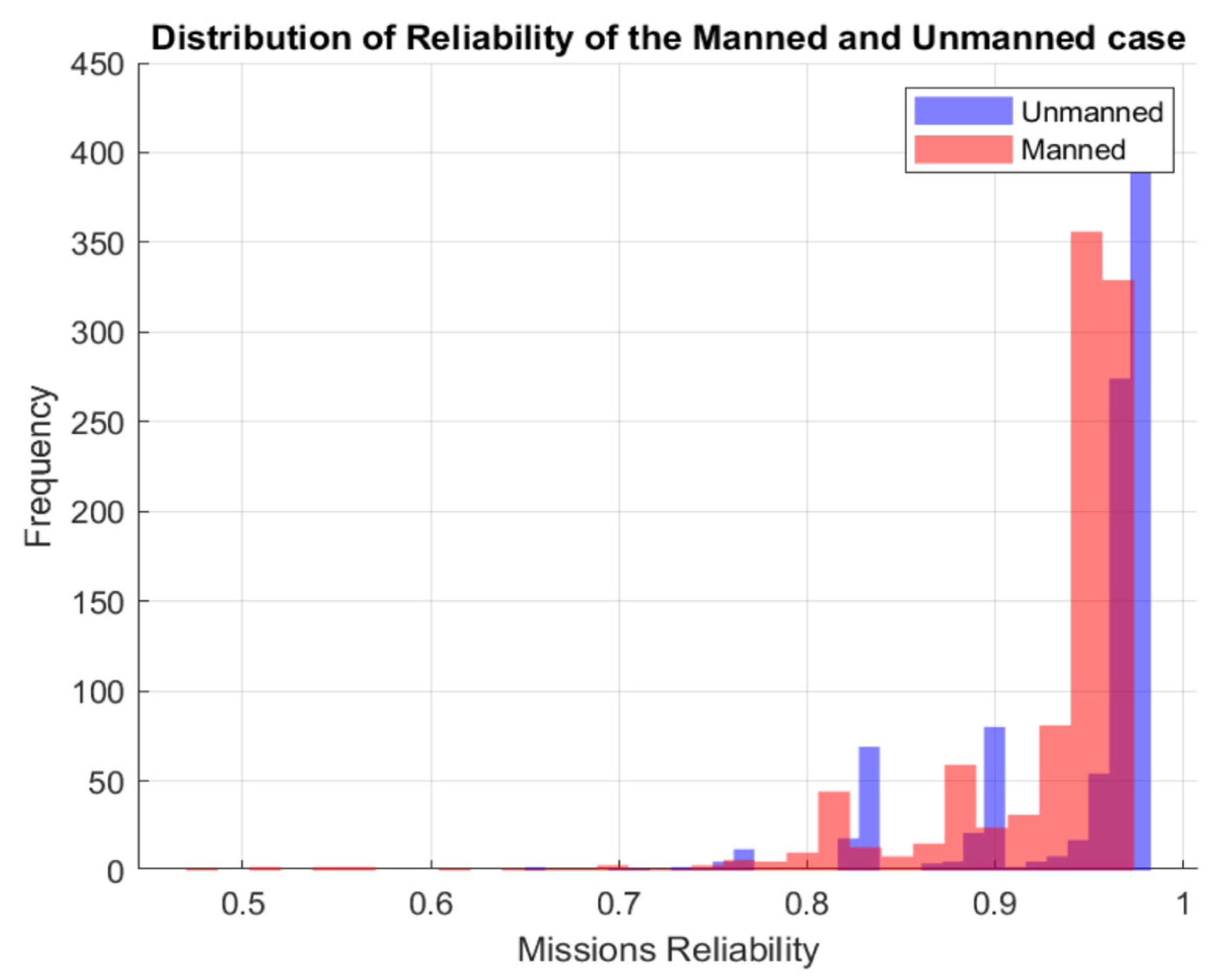
The results of the stochastic reliability modeling applied to the failure behavior of critical onboard systems are presented hereafter. The reliability of components is described by a Gaussian function with mean value MTTF and standard deviation ranging from 10% of MTTF to 40% of MTTF (Figure 6, Figure 7, Figure 8 and Figure 9). Several computations have been carried out iteratively in MATLAB environment to calculate in a stochastic way the reliability value of the various configurations, providing a graphical result histogram for each considered range of standard deviation.
With the distribution results it is possible to calculate the probability of overlapping of the two distributions, and the results obtained are presented in the following (Table 4):
Up to an uncertainty of the MTTF value related to a STD DEV equal to 20%, the probability that the manned configuration is more reliable is very low (0.30%). As the uncertainty on the MTTF increases, the variability of the reliability distributions also increases, leading to a larger overlap between the manned and unmanned configurations. Consequently, the statistical advantage of the unmanned configuration progressively reduces, and the likelihood that the manned configuration attains equal or higher reliability becomes non-negligible.

5.5. Comparison of Stochastic vs. Deterministic Reliability Models

The hypotheses underpinning the model include the memoryless property of the exponential failure distribution, the independence of component failures and the assumption that Gaussian distributions adequately represent the variability in MTTF values. While these assumptions are standard in reliability engineering, they introduce limitations when applied to complex MASS architectures. In real operational environments, failures may be correlated due to shared subsystems, environmental conditions or common-cause events, and system behavior may exhibit time-dependent degradation rather than memoryless characteristics [68,69,70,71,72,73,74]. As a result, the model may underestimate or oversimplify certain failure propagation mechanisms. In particular, the Markovian nature of the model does not account for degradation mechanisms with memory effects, which are relevant in long-term operations (i.e., the vessel is considered a New Building in each simulation). Furthermore, the mission-limited focus excludes life-cycle phenomena and the Gaussian approximation may not capture the skewed nature of real-world failure distributions.
The proposed framework focuses on hardware subsystems and does not explicitly model higher-level navigational decision-making processes. Therefore, the results reflect mission-level hardware reliability rather than the full operational safety process. This limitation is acknowledged and will be addressed in future developments.
The results demonstrated that with moderate levels of uncertainty of the failure rate (10–20% variability in MTTF), the unmanned vessel consistently exhibited higher reliability than the manned configuration. This outcome reflects the elimination of human-related failure rates, which are statistically non-negligible in traditional vessels, even if the result reflects some important hypothesis, including the decision to exclude the possible failure of the software in the above-described model. However, when the variability of the MTTF data increases beyond approximately 30%, the uncertainty introduced at the component level propagates through the reliability model, leading to a significant widening of the resulting reliability distributions. Under these conditions, the separation between the manned and unmanned configurations is reduced and the relative ranking of the two solutions is no longer statistically robust. As a consequence, the stochastic realizations may yield scenarios in which the manned configuration attains reliability values comparable to, or higher than, those of the unmanned vessel. This behavior does not indicate systematic superiority of the manned configuration, but rather reflects the loss of model stability and discriminative power caused by highly uncertain input data.
One of the main results is the demonstration that for this case study, a small variance of the MTTF data does not impair the final result, allowing us to compare different design solutions even if exact data are not available.

6. Conclusions

This study has presented a stochastic reliability framework tailored for MASSs, using Markov chains to model the dynamic failure and repair behavior of critical systems of a MASS compared to a traditional vessel. Unlike conventional deterministic methodologies, the proposed approach captures the probabilistic evolution of system states allowing them to manage the problem of MTTF data availability.
The simulation results reveal that reliability outcomes are highly sensitive to architectural choices and component repair assumptions. This reinforces the necessity of adopting stochastic processes during the early design and verification phases of MASS development. Furthermore, the model enables direct comparison between manned and unmanned configurations, providing a quantitative basis for verifying functional equivalence in line with the IMO MASS Code and emerging goal-based Class Society requirements. In particular, the ability to evaluate how redundancy, repair latency and mission duration affect operational resilience is crucial for meeting the safety assurance obligations of autonomous systems.
The use of a stochastic approach was not merely a methodological enhancement but a practical response to the inherent variability and uncertainty in MASS reliability data. By incorporating probabilistic transitions, the model offers a more realistic and flexible representation of system behavior under imperfect operational conditions. It also allows critical analyses, helping to identify critical design parameters and operational thresholds beyond which the expected performance of autonomous configurations may degrade below acceptable levels.
Ultimately, the integration of Markov-based stochastic modeling within a broader reliability assessment framework contributes to a more rigorous, transparent and regulation-aligned evaluation of MASS safety based on a scientific methodology.
Future research will focus on extending the presented Markov modeling framework toward real-time, adaptive reliability assessment. One promising direction involves the development of non-homogeneous Markov models whose transition rates are dynamically updated based on sensor feedback and operational context. Coupling these models with condition-based maintenance (CBM) policies and AI-based diagnostics may significantly improve the responsiveness of autonomous vessels to incipient failures. Additionally, the integration of stochastic reliability results into holistic digital twin environments would enable continuous risk assessment throughout the vessel’s lifecycle.
A future improvement of the analysis should also include the evaluation of the reliability of the software, not limited to the hardware as presented in this work.
Experimental validation of the models using sea trials or high-fidelity simulation platforms is also envisaged to refine parameter estimates and ensure alignment with actual system behavior. Finally, interdisciplinary collaboration between naval architects, control engineers and classification societies will be essential to embed these methodologies into practical safety assurance and regulatory frameworks for future MASS operations.

Author Contributions

Conceptualization, P.C. and M.F.; methodology, P.C. and S.J.; software, P.C.; validation, V.D., S.J. and M.F.; formal analysis, V.D.; investigation, P.C. and S.J.; resources, P.C. and M.F.; data curation, P.C.; writing—original draft preparation, P.C.; writing—review and editing, P.C., V.D. and M.F.; visualization, M.F. and V.D.; supervision, S.J.; funding acquisition, M.F. and S.J. All authors have read and agreed to the published version of the manuscript.

Funding

This research received no external funding.

Data Availability Statement

The original contributions presented in this study are included in the article. Further inquiries can be directed to the corresponding author.

Conflicts of Interest

Author Pietro Corsi was employed by the company Rina Services. The remaining authors declare that the research was conducted in the absence of any commercial or financial relationships that could be construed as a potential conflict of interest.

Appendix A

Table A1. System Hierarchy for the manned and unmanned vessel.
AbbreviationDescriptionManned
Level
Unmanned Level
MissionMission to be carried out by the vessel, such as patrolling or rescue 11
Navigation ControlAllows control of the unit’s motion in mode automatic 22
Track KeepingControl system to maintain the long-term course 33
Course Control and Speed Control system to maintain the instant course and speed 33
Collision AvoidanceReactive maneuver planning system following obstacle detectionNA3
GNSS Global Navigation Satellite System44
AESAction Execution System44
DMSDecision-Making System44
INSInertial Navigation System44
SASSituation Awareness System44
Situation AwarenessManages, controls the on-board systems and sensors to enable navigation functionalities 22
Weather SensorsSensors that detect environmental conditions, such as wind intensity and wave height 33
Surveillance Remote surveillance of the external spaces with camerasNA3
IRProvides infrared night visionNA4
Server VideoCollects and integrates the information from the cameras NA4
Surveillance CameraProvides external vision in visible lightNA4
Surveillance CommunicationsTransfers the information from camers to servers NA4
Communication towards the baseManages communications towards the remote control station NA3
Main LinkEnsures the transfer of navigation and patrolling data to the remote station NA4
Emergency LinkReceives the minimum set of return information unit safety in case of emergency NA4
Transmitter Transmits information to the remote locationNA4
Receiver Receives information from the remote location NA4
HMIThe Human–Machine Interface allows operators to interact with on-board systems and machines33
Radar Identifies obstacles in the surrounding space 44
AISTracking system of surrounding vessels, standard device installed also on crewed ships 44
Integrated BridgeIntegrate images with navigation information 44
Multifunctional VideoDisplay images on board 44
ManeuverAllows for course change and directional control of the ship22
Maneuverability ControlClosed loop verification of correct execution of the steering command33
PLC Maneuverability Generates control signals for the implementation of the nozzle44
Hydraulic Power PackPower the manuevre nozzle hydraulic ram33
Maneuver Nozzle Hydraulic RamPiston for handling the nozzle33
PropulsionAllows for variation and control of the speed of the ship22
Control of the Propulsion Control and adjust propulsion engines 33
PLC PropulsionProcess the set point and determine the control signal for the fuel valve44
TelegraphGenerate the speed setpoint44
EncoderMeasure engine rpm44
Can. BusTransmits the information44
Main EngineMain engine of the ship33
TransmissionTransmits the torque required by the propeller 33
GearboxReduces engine speeds to a speed compatible with the propulsor44
Sterntube Prevents water from entering the hull by the slow axis44
JointAllows the connection of misaligned shafts 44
PropulsorAllows the generation of thrust33
Impeller Hydrojet component that accelerates water flow44
Hydraulic Power Pack Power the reversing bucket hydraulic ram44
Reversing Hydraulic RamPiston for handling the bucket44
Flotability/StabilityAbility of the vessel to ensure floatability and stability22
Bilge Pumping System System ensuring that the engine room remains dry33
Main Pump The bilge system main pump removes water from the ship’s bilge44
Emergency Pump Pump that is activated in the case of failure of the main pump 44
PLC Bilge SystemControl the bilge system NA4

Appendix B

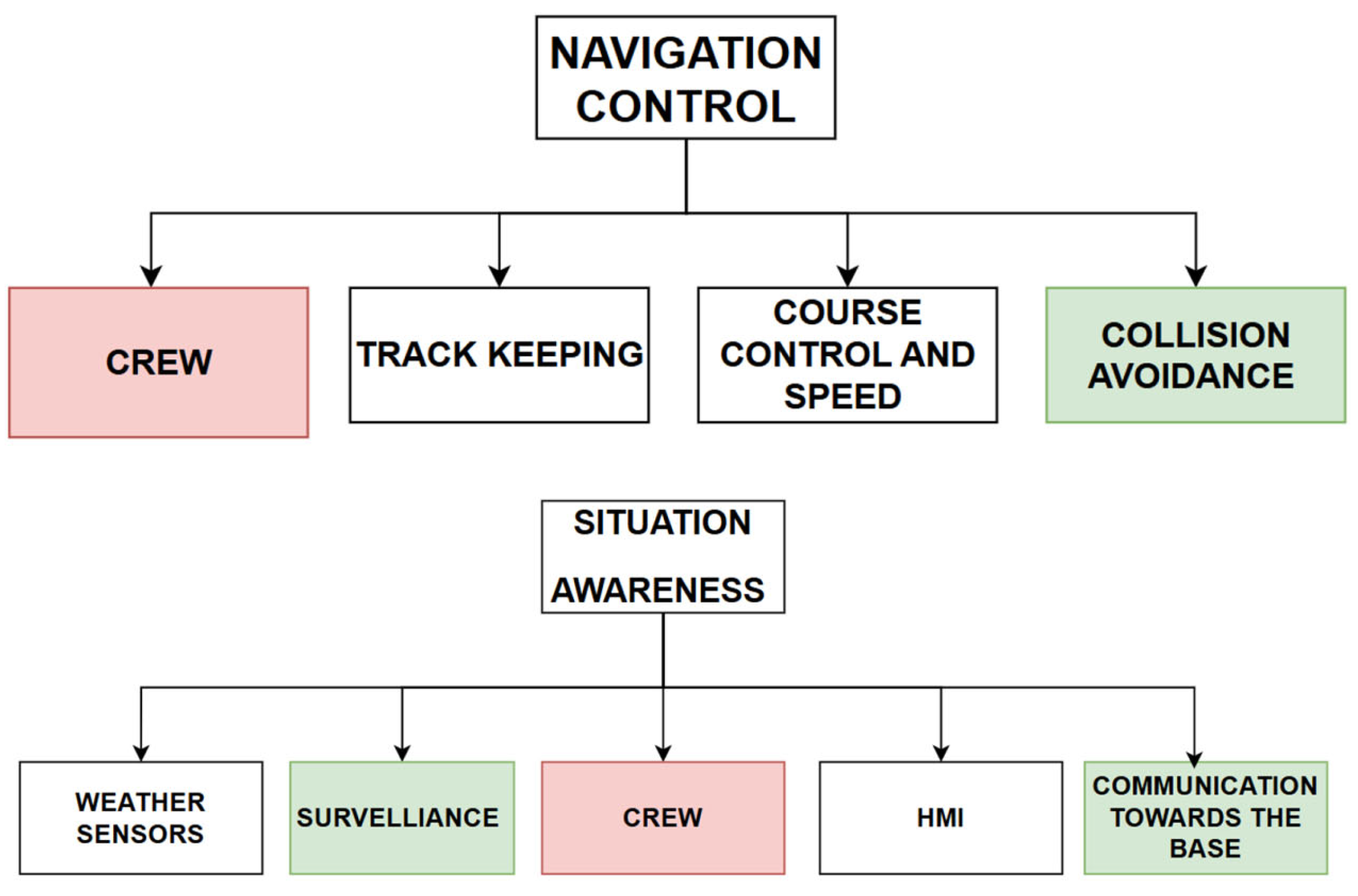
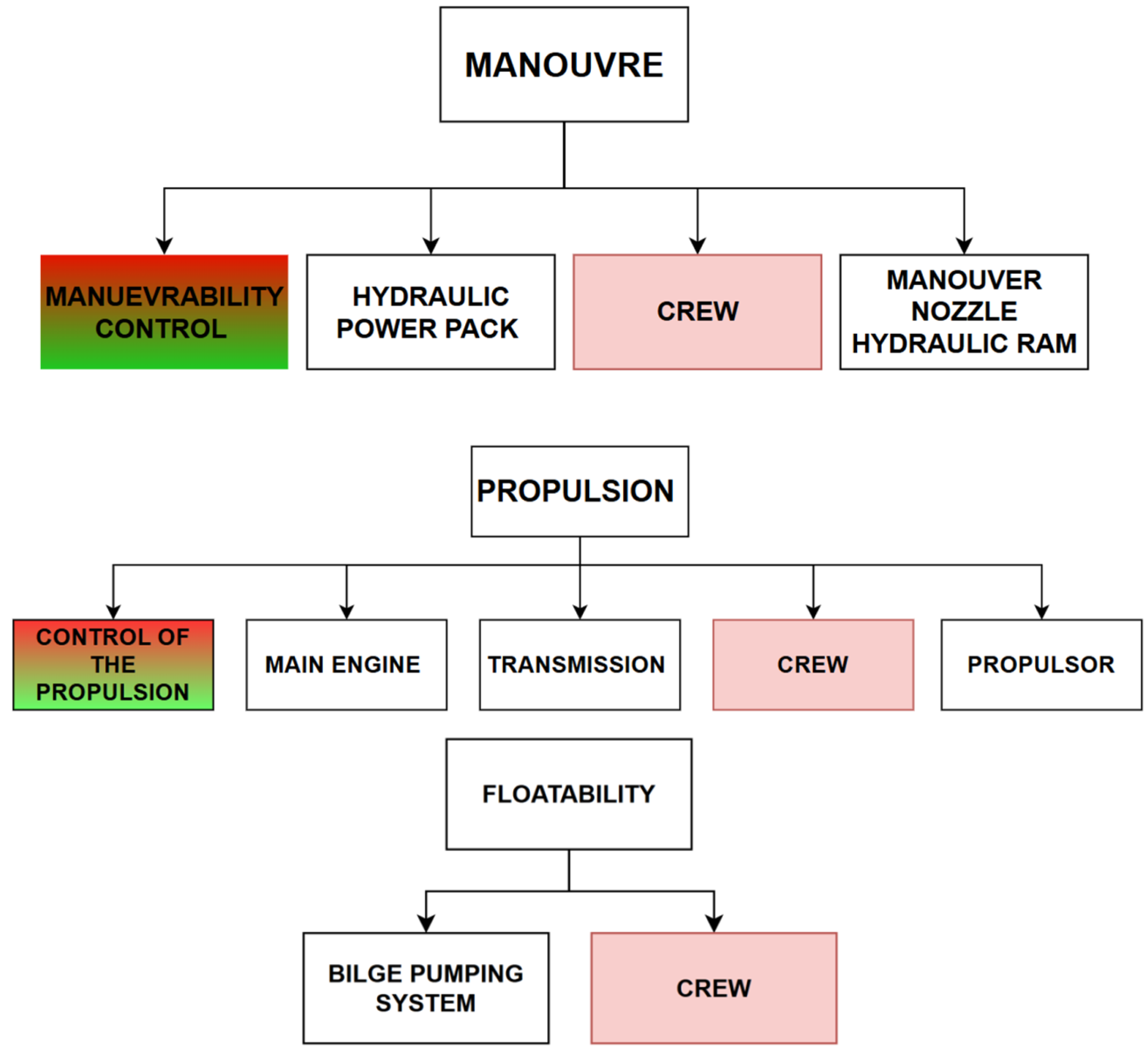
In the figure below the colors represent:
-
GREEN: System added for the unmanned ship;
-
RED: System removed for the unmanned ship;
-
GREEN and RED: System modified for the unmanned ship;
Figure A1. Hierarchical structure of the main RBD modules (Level 2/3) for unmanned ship.
Jmse 14 00814 g0a1aJmse 14 00814 g0a1b

Appendix C

Table A2. Main time to failure of the components integrated in the reliability model.
Type of ComponentλMTTF
NAVIGATION CONTROL
GNSS6.12 × 10−6163,312
INS2.22 × 10−544,976
AES2.37 × 10−6421,625
DMS8.73 × 10−71,145,632
SITUATIONAL AWARENESS
Weather Sensor4.57 × 10−521,893
Radar9.82 × 10−6101,788
AIS1.12 × 10−589,157
Integrated Bridge3.74 × 10−6267,148
Multifunctional Video1.17 × 10−48555
MANEUVER
Manuevrability Control/PLC1.18 × 10−585,000
Hydraulic Power Pack1.00 × 10−5100,000
Maneuver Nozzle Hydraulic Ram1.25 × 10−48000
PROPULSION
PLC Propulsion1.18 × 10−585,000
Telegraph3.18 × 10−531,400
Encoder1.61 × 10−562,150
Can. Bus1.00 × 10−79,999,999
Main Engine2.24 × 10−45804
Gearbox3.47 × 10−43744
SternTube6.67 × 10−515,000
Joint3.61 × 10−42770
Impeller6.67 × 10−515,000
Hydraulic Power pack1.00 × 10−5100,000
Reversing Hydraulic Ram1.25 × 10−48000
Crew2.95 × 10−533,932
FLOATABILITY—STABILITY
Main Bilge Pump6.00 × 10−516,667
Emergency Bilge Pump6.00 × 10−516,667

References

  1. Wariishi, K. Maritime Autonomous Surface Ships: Development Trends and Prospects, How Digitalization Drives Changes in Maritime Industry; Mitsui & Co. Global Strategic Studies Institute: Tokyo, Japan, 2019. [Google Scholar]
  2. Porathe, T.; Hoem, Å.; Rødseth, Ø.; Fjørtoft, K.; Johnsen, S.O. At least as safe as manned shipping? Autonomous shipping, safety and “human error”. In Safety and Reliability–Safe Societies in a Changing World; CRC Press: Boca Raton, FL, USA, 2018; pp. 417–425. [Google Scholar] [CrossRef]
  3. Leveson, N. Engineering a Safer World: Systems Thinking Applied to Safety; MIT Press: Cambridge, MA, USA, 2012. [Google Scholar] [CrossRef]
  4. Mayflower. Mayflower Autonomous Ship, Mayflower 400. 2020. Available online: https://www.mayflower400uk.org/mayflower-autonomous-ship/ (accessed on 31 December 2024).
  5. Lee, P.; Theotokatos, G.; Boulougouris, E.; Bolbot, V. Risk-informed collision avoidance system design for maritime autonomous surface ships. Ocean. Eng. 2023, 279, 113750. [Google Scholar] [CrossRef]
  6. CCS China Classification Society. Rules for Intelligent Ships; CCS: Beijing, China, 2024. [Google Scholar]
  7. RINA. Guide for Maritime Autonomous Surface Ships (MASS); RINA: Genova, Italy, 2021. [Google Scholar]
  8. MCA. General Exemption for Mass of Less than 2.5 Meters in Length Overall; Maritime and Coastguard Agency (MCA): Southampton, UK, 2024. [Google Scholar]
  9. MUNIN. Maritime Unmanned Navigation Through Intelligence in Networks; EU Project. 2015. Available online: https://cordis.europa.eu/project/id/314286 (accessed on 31 December 2024).
  10. IMO. MSC108. Roadmap Revised for the Development of a Code to Regulate Autonomous Ships (MASS); IMO: London, UK, 2024. [Google Scholar]
  11. IMO. MSC 107. Development of a Goal-Based Instrument for MASS; Report of the MSC-LEG-FAL Joint Working Group; IMO: London, UK, 2023. [Google Scholar]
  12. Corsi, P.; Jakovlev, S.; Figari, M. Ship maneuvrability modeling for Autonomous Navigation. In Proceedings of the IEEE Workshop on Complexity in Engineering, Firenze, Italy, 22–24 July 2024. [Google Scholar]
  13. IMO. MSC103, Regulatory Scoping Exercise on Maritime Autonomous Surface Ships; IMO: London, UK, 2021. [Google Scholar]
  14. International Maritime Organization. MSC 100/20/Add.1 Annex 2: Framework for the Regulatory Scoping Excercise for the Use of Maritime Autonomous Surface Ships (MASS); International Maritime Organization: London, UK, 2019. [Google Scholar]
  15. Norway Administration. MSC 108-INF.16—Ongoing MASS Projects in Norway; IMO: London, UK, 2024. [Google Scholar]
  16. Russian Federation. MSC 108/4/3—Report on Experiments of MASS Operations; IMO: London, UK, 2024. [Google Scholar]
  17. Campbell, S.; Montague, G.; Irwin, G.W. A Review on Improving the Autonomy of Unmanned Surface Vehicles Through Intelligent Collision Avoidance Manoeuvres; Queen’s University Belfast: Belfast, UK, 2012. [Google Scholar]
  18. Tsolakis, A.; Negenborn, R.R.; Reppa, V.; Ferranti, L. Model Predictive Trajectory Optimization and Control for Autonomous Surface Vessels Considering Traffic Rules. IEEE Trans. Intell. Transp. Syst. 2024, 25, 9895–9908. [Google Scholar] [CrossRef]
  19. Fruzzetti, C.; Martelli, M. Unmanned Surface Vehicle Chase a Moving Target Remotely Controlled. Lect. Notes Comput. Sci. 2023, 13866, 243–254. [Google Scholar]
  20. Larson, J.; Bruch, M.; Ebken, J. Autonomous Navigation and Obstacle Avoidance for Unmanned Surface Vehicles; Space and Naval Warfare Systems Center: San Diego, CA, USA, 2006. [Google Scholar]
  21. Benjamin, M.R.; Leonard, J.J.; Curcio, J.A.; Newman, P.M. A Method for Protocol-Based Collision Avoidance Between Autonomous Marine Surface Craft. J. Field Robot. 2006, 23, 333–346. [Google Scholar] [CrossRef]
  22. International Maritime Organization. COLREG—Preventing Collisions at Sea; IMO: London, UK, 1972. [Google Scholar]
  23. Statheros, T.; Howells, G.; Maier, K.M. Autonomous Ship Collision Avoidance Navigation Concepts, Technologies and Techniques. J. Navig. 2008, 61, 129–142. [Google Scholar] [CrossRef]
  24. DNV. Class Guideline, Autonomous and Remotely Operated Ships; DNV-CG-0264; DNV: Oslo, Norway, 2021. [Google Scholar]
  25. Stepien, B. Yara Birkeland and the Legal Problems of Autonomous Shipping; Boletim de Sociedade Brasileira de Direito Internacional: Brasília, Brazil, 2018. [Google Scholar]
  26. Evensen, M.H. Safety and Security of Autonomous Vessels; Universitas Bergensis: Bergen, Norway, 2020. [Google Scholar]
  27. NavalDrones. MAST. 2016. Available online: http://www.navaldrones.com/MAST.html (accessed on 31 December 2024).
  28. The UK’s Maritime Robotics Platform for Proving, Validating and Demonstrating Advanced Marine Autonomy, Technology and Digitalization; Smart Sound Plymouth. 2024. Available online: https://www.smartsoundplymouth.co.uk/ (accessed on 31 December 2024).
  29. The Nippon Foundation MEGURI2040; Japan’s Ministry of Land, Industry, Transport and Tourism (MLIT). 2021. Available online: https://www.nippon-foundation.or.jp/en/what/projects/meguri2040 (accessed on 31 December 2024).
  30. “The Largest Domestic Unmanned Surface Vessel “Zhikun”, Surveyed by CCS, Was Successfully Completed; China Classification Society. 23 August 2023. Available online: https://www.ccs.org.cn/ccswzen/articleDetail?id=202308230380661732 (accessed on 31 December 2024).
  31. Largest EU Funded Defence Research Project Tested in the Mediterranean Sea; Europea Defence Agency (EDA): Brussels, Belgium, 2019; Available online: https://eda.europa.eu/news-and-events/press-office/latest-press-releases/2019/11/21/largest-eu-funded-defence-research-project-tested-in-the-mediterranean-sea (accessed on 31 December 2024).
  32. AutoMated Vessels and Supply Chain Optimisation for Sustainable Short SEa Shipping; EU Project. 2023. Available online: https://cordis.europa.eu/project/id/861678 (accessed on 31 December 2024).
  33. Maritime Coast Agency. MASS UK Industry Conduct Principles and Code of Practice; MCA: Southampton, UK, 2019. [Google Scholar]
  34. Norway Administration. MSC 108, INF.18—Results of the Sea Trial Verification and the Application for the Actual Vessel Operation; IMO: London, UK, 2024. [Google Scholar]
  35. EDA. SARUMS—Safety and Regulations for European Unmanned Maritime Systems summary. Available online: https://eda.europa.eu/docs/documents/SARUMS-Flyer-2012.pdf?sfvrsn=0 (accessed on 31 December 2024).
  36. Naval News. Keel Laying for the New Italian Navy Hydro-Oceanographic Ship; Naval News. 17 May 2024. Available online: https://www.navalnews.com/naval-news/2024/05/keel-laying-for-the-new-italian-navy-hydro-oceanographic-ship/ (accessed on 31 December 2024).
  37. ARES Difesa. FREMM EVO, una Evoluzione Completa su Sensori e Capacità Anti-Drone. 5 August 2024. Available online: https://aresdifesa.it/fremm-evo-una-evoluzione-completa-su-sensori-e-capacita-anti-drone/ (accessed on 31 December 2024).
  38. RINA. Guide for Risk Analysis (GUI15); RINA: Genova, Italy, 2010. [Google Scholar]
  39. Distefano, S.; Puliafito, A. Reliability and availability analysis of dependent dynamic systems with DRBDs. Reliab. Eng. Syst. Saf. 2009, 94, 1381–1393. [Google Scholar] [CrossRef]
  40. Corsi, P.; Jakovlev, S.; Figari, M.; Djackov, V. Analysis and Definition of Certification Requirements for Maritime Autonomous Surface Ship Operation. J. Mar. Sci. Eng. 2025, 13, 751. [Google Scholar] [CrossRef]
  41. U.S. Department of Defense, Naval Sea Systems Command (NAVSEA). Reliability-Centered Maintenance; MIL-HDBK; U.S. Department of Defense: Washington, DC, USA, 2007; p. 217. [Google Scholar]
  42. UK Ministry of Defence. RCM Guidance Notes; Ministry of Defence: London, UK, 2007. [Google Scholar]
  43. Ait Allal, A.; Mansouri, K.; Youssfi, M.; Qbadou, M. Toward a Reliable Main Engine Lubricating Oil System for a Safe Operation of Autonomous Ships. In Proceedings of the International Conference on Maritime Autonomous Surface Ships, Ulsan, Republic of Korea, 11–12 November 2020. [Google Scholar]
  44. Ait Allal, A.; Mansouri, K.; Youssfi, M.; Qbadou, M. Reliability analysis of the seawater cooling system for conventional ships and adaptation for MASS. In Proceedings of the International Conference on Recent Innovations in Engineering and Technology (ICRIET), Erode, India, 4–5 December 2020. [Google Scholar]
  45. Edge, W.; Field, C.; Walsh, K. Engineering Reliability for Tx Ship: Designing Power and Propulsion Systems for Naval Unmanned Vessels. In Proceedings of the 15th International Naval Engineering Conference & Exhibition (INEC), Online, 5–9 October 2020. [Google Scholar]
  46. Bolbot, V.; Theotokatos, G.; McCloskey, J.; Vassalos, D.; Boulougouris, E.; Twomey, B. A methodology to define risk matrices—application to inland waterways autonomous ships. Int. J. Nav. Archit. Ocean. Eng. 2022, 14, 100457. [Google Scholar] [CrossRef]
  47. Zaccone, R.; Campora, U.; Martelli, M. Optimisation of a diesel-electric ship propulsion and power generation system using a genetic algorithm. J. Mar. Sci. Eng. 2021, 9, 587. [Google Scholar] [CrossRef]
  48. Michetti, S.; Ratto, M.; Spadoni, A.; Figari, M.; Altosole, M.; Marcilli, G. Ship Control system wide integration and the use of dynamic simulation techniques in the Fremm project. In Proceedings of the Electrical Systems for Aircraft, Railway and Ship Propulsion (ESARS), Bologna, Italy, 19–21 October 2010. [Google Scholar]
  49. Rana, P.; Majumder, P.D. Towards Predictive Maintenance and Remote Monitoring for Unat-tended Machinery Plants. In Proceedings of the International Ship Control Systems Symposium (iSCSS), Delft, Netherlands, 6–8 October 2020. [Google Scholar]
  50. Daya, A.A.; Lazakis, I. Developing an Advanced Reliability Analysis Framework for Marine Systems Operations and Maintenance. Ocean. Eng. 2023, 272, 113766. [Google Scholar] [CrossRef]
  51. Zhu, C.; Zhang, T. A review on the realization methods of dynamic fault tree. Qual. Reliab. Eng. Int. 2022, 38, 3233–3251. [Google Scholar] [CrossRef]
  52. Kabir, S.; Papadopoulos, Y. Applications of Bayesian networks and Petri nets in safety, reliability, and risk assessments: A review. Saf. Sci. 2019, 105, 24–39. [Google Scholar] [CrossRef]
  53. La Fata, C.M.; Giallanza, A.; Micale, R.; La Scalia, G. Improved FMECA for effective risk management decision making by failure modes classification under uncertainty. Eng. Fail. Anal. 2022, 135, 106163. [Google Scholar] [CrossRef]
  54. Daya, A.A.; Lazakis, I. Systems Reliability and Data-Driven Analysis for Marine Machinery Maintenance Planning and Decision Making. Machines 2024, 12, 294. [Google Scholar] [CrossRef]
  55. ISO 19847:2018; Ships and Marine Technology—Shipboard Data Servers to Share Field Data on the Sea. International Organization for Standardization: Geneva, Switzerland, 2018.
  56. ISO 19845:2018; Ships and Marine Technology—Specification for a Shipboard Data Model. International Organization for Standardization: Geneva, Switzerland, 2018.
  57. IMO. International Safety Management (ISM) Code; International Maritime Organization: London, UK, 2018. [Google Scholar]
  58. Lee, S.M.; Kwon, K.Y.; Joh, J. A Fuzzy Logic for Autonomous Navigation of Marine Vehicles Satisfying COLREG Guidelines. Int. J. Control. Autom. Syst. 2004, 2, 171–181. [Google Scholar]
  59. Edge, W.; Field, C.; Walsh, K. The Autonomous Machinery Design of Tx Ship. In Proceedings of the 15th International Naval Engineering Conference & Exhibition (INEC), Online, 5–9 October 2020; pp. 1–9. [Google Scholar]
  60. Namgung, H.; Kim, J.S. Collision Risk Inference System for Maritime Autonomous Surface Ships Using COLREGs Rules Compliant Collision Avoidance. IEEE Access 2021, 9, 7823–7835. [Google Scholar] [CrossRef]
  61. Ho, N. Local Route Planning for Collision Avoidance of Maritime Autonomous Surface Ships in Compliance with COLREGs Rules. Sustainability 2022, 14, 198. [Google Scholar]
  62. Deyin, J.; Zhixuan, G.; Keke, W.; Senke, J.; Weimin, C.; Song, B. A reliability analysis method for evaluating performance degradation considering the coupling of multiple progressive damage factors and multiple stochastic factors. Reliab. Eng. Syst. Saf. 2025, 254, 110584. [Google Scholar] [CrossRef]
  63. Marrese, L. Reliability Assessment of an Unmanned Rescue Vessel Through a Probabilistic Approach. Master’s Thesis, University of Genoa, Genova, Italy, 2025. [Google Scholar]
  64. Abreu, D.T.; Martins, M.R.; Maturana, M.C.; Montewka, J.; Ramos, M.A. Review of Human Error Assessment Methods Suitable for the Design of Maritime Remote Operations. Saf. Sci. 2023, 157, 105866. [Google Scholar]
  65. Pulsipher, J.L.; Zavala, V.M. Measuring and optimizing system reliability: A stochastic programming approach. TOP 2020, 28, 626–645. [Google Scholar] [CrossRef]
  66. Abaei, M.M.; Hekkenberg, R.; BahooToroody, A. A multinomial process tree for reliability assessment of machinery in Autonomous ships. Reliab. Eng. Syst. Saf. 2021, 210, 107484. [Google Scholar] [CrossRef]
  67. OREDA. Offshore & Onshore Reliability Data; Offshore Reliability Data Association: Oslo, Norway, 2015. [Google Scholar]
  68. IACS. IACS UR E26 and E27 Press Release. 2023. Available online: https://iacs.org.uk/news/iacs-ur-e26-and-e27-press-release (accessed on 31 December 2024).
  69. CCDCOE Nato Cooperative. Cybersecurity Considerations in Autonomous Ships; NATO Cooperative Cyber Defence Centre of Excellence: Tallinn, Estonia, 2022. [Google Scholar]
  70. RINA. Rules for the Classification of Ships; RINA: Genova, Italy, 2024. [Google Scholar]
  71. RINA. RINA Rules for the Classification of Fast Patrol Vessels; RINA: Genova, Italy, 2007. [Google Scholar]
  72. Robinson, B. Dull, Dirty, Dangerous Mission? Send in the Robot Vehicle; U.S. Army: Washington, DC, USA, 2015. [Google Scholar]
  73. NAVSEA. Unmanned Maritime Systems (PMS 406): Unmanned Maritime Autonomy Archi-Tecture (UMAA) Architecture Design Description (ADD); Version 1.1a; Naval Sea System Command: Washington, DC, USA, 2019. [Google Scholar]
  74. Roa, M.J. Autonomous Control Systems for Naval Unmanned Surface Vessels. In Proceedings of the International Ship Control Systems Symposium (iSCSS), Liverpool, UK, 5–7 November 2024. [Google Scholar]
Figure 1. A Pathway for MASS Flag State Authorization as presented in [40].
Jmse 14 00814 g001
Figure 2. (a): Standard deviation 10% MTTF; (b): standard deviation 20% MTTF.
Jmse 14 00814 g002
Figure 3. Hierarchical structure Level 2 system for manned Ship.
Jmse 14 00814 g003
Figure 4. RBD scheme of the SAR Mission.
Jmse 14 00814 g004
Figure 5. RBD scheme of the Patrol Mission.
Jmse 14 00814 g005
Figure 6. Distribution Reliability for a 8 h Rescue mission, 10% of std. deviation, manned and unmanned configuration.
Jmse 14 00814 g006
Figure 7. Distribution Reliability for a 8 h Rescue mission, 20% of std. deviation, manned and unmanned configuration.
Jmse 14 00814 g007
Figure 8. Distribution Reliability for a 8 h Rescue mission, 30% of std. deviation, manned and unmanned configuration.
Jmse 14 00814 g008
Figure 9. Distribution Reliability for a 8 h Rescue mission, 40% of std. deviation, manned and unmanned configuration.
Jmse 14 00814 g009
Table 1. Reliability model result for the manned vessel.
Mission DurationRescue MissionPatrol Mission
8 h0.9580.988
100 h0.6140.856
Table 2. Reliability model result for the unmanned vessel.
Mission DurationRescue MissionPatrol Mission
8 h0.9700.992
100 h0.7300.895
Table 3. Comparative analysis of the reliability results obtained for each block.
Mission TypeReliability MannedReliability UnmannedDifference (%)
NAVIGATION CONTROL
  8 h—SAR0.9950.9960.10%
  100 h—Patrol0.9410.950.96%
SITUATION AWARENESS
  8 h—SAR0.9960.9970.10%
  100 h—Patrol0.9530.9560.31%
PROPULSION
  8 h—SAR0.9760.980.41%
  100 h—Patrol0.7790.8276.16%
MANEUVRABILITY
  8 h—SAR0.9930.9980.50%
  100 h—Patrol0.9150.976.01%
FLOATABILITY
  8 h—SAR0.9970.9990.20%
  100 h—Patrol0.9590.9872.92%
Table 4. Distribution overlap results.
% STD DEV P R m a n n e d > R u n m a n n e d
100%
200.3%
255.2%
3013.4%
3527.7%
4050.8%
Disclaimer/Publisher’s Note: The statements, opinions and data contained in all publications are solely those of the individual author(s) and contributor(s) and not of MDPI and/or the editor(s). MDPI and/or the editor(s) disclaim responsibility for any injury to people or property resulting from any ideas, methods, instructions or products referred to in the content.