1. Introduction
Autonomous navigation has become a key technological direction in the development of intelligent ships, driven by advances in perception, decision-making, and control technologies [
1,
2]. Ensuring that a vessel safely and accurately follows a desired route is fundamental to all levels of autonomy. For decades, most commercial and research navigation systems have relied on heading-keeping autopilot frameworks, where the control objective is to minimize the deviation between the ship’s actual heading and a desired course [
3,
4]. This paradigm, often combined with Line-of-Sight (LOS) guidance, converts a global route into a sequence of heading targets. While effective under mild conditions and for deep-sea operations, heading-centered strategies show clear limitations in real-world scenarios that are geometrically complex, environmentally dynamic, or operationally constrained [
4]. In practical navigation, route planning and waypoint approval are performed at the voyage-planning level by the bridge team, whereas autopilot and path-following modules operate at the guidance-and-control layer after the route has been specified. In this paper, the term “traditional autopilot” refers to heading-centered tracking logic within this lower control layer.
First, heading-keeping logic deviates fundamentally from the decision behavior exhibited by experienced human captains [
5,
6]. In narrow channels, curved waterways, port approaches, or encounter situations, captains do not attempt to “freeze” the ship to a fixed heading. Instead, they adopt a line-adhering mindset: keeping the vessel’s body axis approximately parallel to the desired path while continuously managing cross-track error through lateral drifting adjustments [
7,
8]. Moreover, in narrow and confined waterways, navigators continuously coordinate heading, lateral position, and speed to maintain route adherence and safe margins. Motivated by this operational reality, the present study focuses primarily on heading and lateral path-following behavior, while longitudinal speed coordination is discussed only at the conceptual level and is not implemented or validated as a dedicated control component. This contrasts sharply with LOS-based systems that react primarily to heading error rather than geometric deviation from the route. As a result, traditional algorithms often generate unnecessary heading oscillations, overshoot, or poor tracking accuracy in sharp curves and congested waterways [
9,
10].
Second, the vessel’s behavior is highly sensitive to environmental disturbances such as wind, waves, and currents [
11,
12]. Existing methods commonly treat disturbances as noise or apply simple feedback compensation. Yet disturbances carry structural characteristics—directionality, magnitude, frequency—that strongly affect vessel dynamics [
13,
14]. Failure to properly classify and adapt to disturbances leads to degraded tracking performance, uncomfortable motions, excessive rudder usage, and even unsafe situations in inland or coastal waters [
15,
16,
17].
Third, the sparsity of available route data poses another challenge [
18,
19]. Nautical charts, AIS-based routes, or ENC waypoints often provide only coarse-resolution path definitions (e.g., several kilometers between points). While adequate for route planning, these sparse paths are insufficient for high-precision control [
20,
21]. Without geometric refinement, autopilot systems may attempt to track discontinuous or unrealistic route segments, resulting in excessive control effort or path-tracking failure [
20,
21].
Recent years have seen progress in ship path-following using advanced control methods, including model predictive control (MPC), Linear Quadratic Regulation (LQR), reinforcement learning, and Bézier or spline-based path smoothing [
22,
23,
24]. However, despite these advances, another study treated the core control paradigm as fixed—almost all retained heading-keeping logic as the underlying structure [
25,
26]. Meanwhile, limited attention has been paid to incorporating human-like maneuvering logic, adaptive disturbance recognition, or dynamics-constrained route reconstruction, all of which are essential for high-level autonomous navigation [
27,
28]. So, existing studies have advanced ship path-following through LOS guidance, model-based control, path-smoothing methods, and adaptive or learning-assisted strategies. The present contribution is more specific: it integrates line-adhering geometric control logic, vessel dynamics-constrained route refinement, and interpretable disturbance-triggered controller reconfiguration within a unified simulation framework for single-vessel path-following.
To address these gaps, this paper proposes a line-adhering, disturbance-adaptive intelligent navigation framework that departs from conventional heading-keeping design. The framework integrates:
- (1)
A novel cross-control logic that emulates intuitive captain behaviors through lateral (left/right) and longitudinal (forward/backward) adjustments.
- (2)
A high-resolution, curvature-aware route refinement method based on Bézier fitting and vessel dynamic constraints (Nomoto/MMG).
- (3)
A rough set-based disturbance classification module that identifies modes such as cross-wind, head current, or high-comfort operation.
- (4)
A multi-objective controller architecture (PID/LQR/MPC) whose structure and parameters are dynamically reconfigured according to recognized disturbance modes.
This integrated design provides a human-intuitive, dynamically consistent, and disturbance-aware simulation framework for single-vessel path-following in complex waterways where traditional heading-based algorithms may show limitations. By incorporating vessel dynamics, environmental context, and human-inspired maneuvering principles, the proposed framework offers a focused investigation of heading and lateral path-following control under representative simulation conditions, rather than a complete autonomous navigation solution.
2. Mathematical Formulation
In this section, the mathematical models used for route refinement, cross-track control, and disturbance-adaptive navigation are introduced. The formulation includes: (i) vessel kinematics [
29], (ii) simplified and extended dynamics (Nomoto and MMG models) [
30], (iii) mathematical representation of the reference path and its curvature [
31], and (iv) tracking error definitions and control objectives [
32,
33].
2.1. Reference Frames and State Variables
The vessel motion is described in a two-dimensional horizontal plane using an earth-fixed reference frame and a body-fixed reference frame . The state variables are defined as follows:
: position of the vessel in the earth-fixed frame;
: yaw angle (heading) of the vessel;
: surge and sway velocities in the body-fixed frame;
r: yaw rate.
The state vector is defined as
2.2. Kinematic Model
The vessel kinematics in the horizontal plane follow the standard three-degree-of-freedom (3-DOF) formulation [
34]:
These equations relate the body-fixed velocities and yaw rate r to the vessel motion in the earth-fixed frame. They are used both for route refinement (to assess dynamic feasibility) and for low-level control design.
2.3. Simplified Yaw Dynamics: First-Order Nomoto Model
For fast evaluation of turning capability and approximate heading response, the well-known first-order Nomoto model is adopted [
35]:
where
T is the time constant,
K is the rudder gain, and
is the rudder angle. The corresponding heading dynamics are
The Nomoto model provides a simple relationship between the rudder input
and the yaw rate
r. It is used in this work to approximate the vessel turning capability and to assess whether a candidate path segment is trackable [
36]. Under steady-state turning at constant speed
U and constant rudder angle
, an approximate steady turning radius
R can be obtained and compared with the local path curvature (see
Section 2.5).
2.4. Extended Dynamics: MMG Model
The Nomoto model is adopted as a low-order yaw-response model for rapid estimation of turning capability and controller-oriented trackability assessment during route refinement. By contrast, the MMG model is used in a reduced-order off-line manner to verify whether the refined path remains dynamically feasible under a given operating speed and rudder constraint, especially in highly curved segments and stronger disturbance conditions. For more detailed assessment, particularly in highly curved segments and under strong disturbances, a simplified MMG-type maneuvering model is employed [
37]. The equations of motion in surge, sway, and yaw are given by
where
m is the vessel mass,
is the yaw moment of inertia, and
denote hydrodynamic forces and moment acting on the hull. The terms
and
represent propeller thrust and rudder-induced forces and moment, respectively.
The normal force acting on the rudder is expressed as
where
is the water density,
is the rudder area,
is the lift coefficient, and
is the effective inflow velocity at the rudder.
The sway force and yaw moment generated by the rudder are given by
where
is the rudder thrust deduction factor,
is the hull–rudder interaction coefficient, and
is the longitudinal distance from the vessel center of gravity to the rudder.
In this study, the MMG model is used in an off-line or reduced-order manner to evaluate whether the refined reference path is dynamically feasible for a given vessel at a specified operating speed and maximum rudder angle.
2.5. Path Representation and Curvature Constraint
The desired route is initially defined by a sparse set of waypoints
typically obtained from AIS trajectories, ENC data, or historical routes. To generate a smooth and continuous reference path, these waypoints are fitted using Bézier curves or spline interpolation, resulting in a parametric path
where
s denotes the path parameter.
The curvature of the path at parameter
s is computed as
where
and
denote first- and second-order derivatives with respect to
s.
The vessel has a limited curvature capability
associated with its minimum turning radius
. A simple estimate is
where
U is the vessel speed,
g is the gravitational acceleration, and
is the maximum admissible heel angle. More accurate estimates can be obtained using the Nomoto or MMG model under maximum rudder constraints.
A curvature consistency condition is imposed as
Path segments where approaches or exceeds are classified as high-maneuverability zones. In these regions, additional control points are inserted and local re-fitting is performed until the curvature constraint is satisfied, yielding the refined reference path .
2.6. Tracking Errors and Control Objectives
Let
denote the refined reference path and
be the current vessel position. The cross-track error is defined as the signed shortest distance from the vessel to the path:
where the sign indicates whether the vessel lies to port or starboard of the path.
The along-track error is defined as
where
is the path parameter corresponding to the orthogonal projection of
onto the reference path.
The desired heading is chosen as the tangent direction of the path at
:
and the heading error is
The control objectives are summarized as:
Tracking accuracy: , ;
Comfort and smoothness: bounded and small yaw acceleration ;
Energy efficiency:
where
denotes the propeller control effort.
These objectives are implemented as cost terms or weighting factors in the PID, LQR, and MPC controllers used in the proposed framework and are further adapted according to disturbance modes.
3. Methodology
This section presents the overall methodology of the proposed line-adhering and disturbance-adaptive intelligent navigation framework. The method integrates four key components: (i) adaptive route refinement, (ii) human-inspired cross-control logic, (iii) multi-objective tracking control, and (iv) disturbance recognition with controller reconfiguration. The overall workflow follows a perception–decision–control loop for robust navigation in complex waterways.
3.1. Overview of the Framework
The overall structure of the proposed system is illustrated in the flowchart presented in
Section 3.6. The methodology consists of three sequential stages:
Generation of a high-resolution reference path via curvature-aware refinement under vessel dynamic constraints;
Cross-control decision-making, where lateral and longitudinal adjustments are generated based on human-like maneuvering principles;
Adaptive control execution, in which PID, LQR, or MPC controllers are reconfigured according to disturbance modes identified by a rough-set classifier.
3.2. Adaptive Fine-Resolution Route Refinement
Traditional routes extracted from ENC or AIS data often consist of sparse waypoints. To enable high-precision tracking, a two-stage refinement strategy is adopted:
Initial Bézier/spline fitting: Given a waypoint set , a smooth parametric curve is generated using cubic Bézier or B-spline interpolation, ensuring or continuity.
Curvature-based refinement with dynamic feasibility checks: The curvature is evaluated and compared with derived from the Nomoto and MMG models. If , the segment is classified as a high-maneuverability zone, where additional control points are inserted and local re-fitting is performed until the constraint is satisfied.
The output is a dynamically feasible reference path suitable for high-precision line-adhering control.
3.3. Cross-Control Logic for Human-like Maneuvering
Human captains maneuver vessels by jointly considering lateral alignment and longitudinal positioning relative to the desired path. In the present study, however, the implemented control framework is restricted to lateral path alignment and heading regulation. The longitudinal dimension is retained only as a conceptual extension for future work, and no dedicated speed control module is implemented or validated in the current paper:
Left–right (lateral) commands: lateral shifting of the reference path by a distance for cross-current compensation or path-alignment adjustment;
Forward–backward (longitudinal) coordination discussed conceptually as a possible future extension, but not implemented as an active control loop in this study.
The implemented cross-control module generates reference quantities related to cross-track alignment, including the desired cross-track offset , and the shifted reference path . A target-speed reference is not actively generated or validated in the present study.
3.4. Multi-Objective Tracking Control
The control module minimizes combined objectives of accuracy, comfort, efficiency, and robustness. Three alternative controllers are implemented:
3.5. Disturbance Recognition Using Rough-Set Theory
To enable real-time adaptation, disturbance modes are identified using features such as wind and current direction and magnitude, vessel speed, drift angle, and tracking performance indicators. A decision table is constructed with condition attributes
and decision attribute
Rough-set reducts are computed to identify minimal attribute subsets for reliable classification. Based on the identified mode, controller parameters (PID gains, LQR weighting matrices, and MPC weights, horizons, and constraints) are updated via a rule-based reconfiguration mechanism.
3.6. Closed-Loop System
The complete closed-loop navigation process is summarized as:
This framework ensures stable line adherence and robust navigation performance under diverse environmental conditions.
4. Experimental Results
4.1. Experimental Setup
To evaluate the effectiveness of the proposed line-adhering and disturbance-adaptive navigation framework, a series of numerical simulations were conducted under representative inland and coastal navigation scenarios. The experiments were designed to assess path-following accuracy, control smoothness, disturbance robustness, and human-like maneuvering behavior, with particular emphasis on curved routes and strong environmental disturbances. In addition, this study relies on numerical simulation scenarios rather than field or full-scale experimental measurements. The experimental section therefore refers to controlled simulation cases defined by route geometry, vessel operating state, and environmental disturbance conditions within the mathematical and control framework described in
Section 2 and
Section 3. Each simulation experiment in
Section 4 is defined by the reference-route geometry, the applied disturbance condition, the activated controller structure, and the assumed vessel operating state. The principal observed outputs are vessel trajectory, cross-track behavior, heading/yaw response, and rudder activity, which together are used to interpret path-following accuracy, control smoothness, and disturbance robustness.
A medium-sized displacement vessel was considered, operating at a constant nominal speed unless otherwise specified. The vessel kinematics follow the 3-DOF planar model introduced in
Section 2, while yaw dynamics are described by the first-order Nomoto model for control design and a reduced MMG model for dynamic feasibility verification. Rudder angle saturation and yaw-rate limits were imposed to reflect realistic actuator constraints and maneuvering comfort requirements. Because vessel speed directly affects turning capability, trackability, and disturbance sensitivity, the path-following problem is not purely a heading-regulation problem. Accordingly, vessel speed affects turning capability, trackability, and disturbance sensitivity, and therefore the path-following problem is not purely a heading-regulation problem. Nevertheless, in the present simulation study, the implemented and evaluated control actions are restricted to heading regulation and lateral path-alignment control. Longitudinal speed coordination is recognized as important, but a dedicated speed control module is not included in the current validation. More details about the experimental setup are provided in
Table 1,
Table 2 and
Table 3.
Numerical simulations were implemented in a desktop computing environment using MATLAB 2024b and Python 3.11. The vessel configuration included a nominal speed of [6] m/s, maximum rudder angle of [20] deg, and yaw-rate limit of [3] deg/s. The PID gains, LQR weighting matrices, MPC prediction horizon, control horizon, and rough-set decision attributes/rules are summarized in
Table 1 and
Table 2. Controller parameters were first tuned under nominal conditions and then adjusted by mode-dependent supervisory rules under recognized disturbance classes.
The reference routes were extracted as sparse waypoint sequences resembling ENC- or AIS-based navigation paths. These routes were processed using the proposed curvature-aware Bézier refinement method to generate dynamically feasible high-resolution reference paths. Environmental disturbances, including wind and current, were applied as external forces and moments acting on the vessel body, with varying magnitudes and directions.
For performance comparison, the following navigation strategies were evaluated:
Conventional LOS-based heading-keeping autopilot (baseline);
Line-adhering control without disturbance adaptation;
Proposed line-adhering framework with rough-set-based disturbance recognition and adaptive controller reconfiguration.
All controllers were tuned to achieve stable tracking under nominal conditions before disturbance scenarios were introduced.
4.2. Performance Under Calm and Nominal Conditions
The first set of experiments focused on calm environmental conditions to isolate the intrinsic tracking characteristics of the proposed framework.
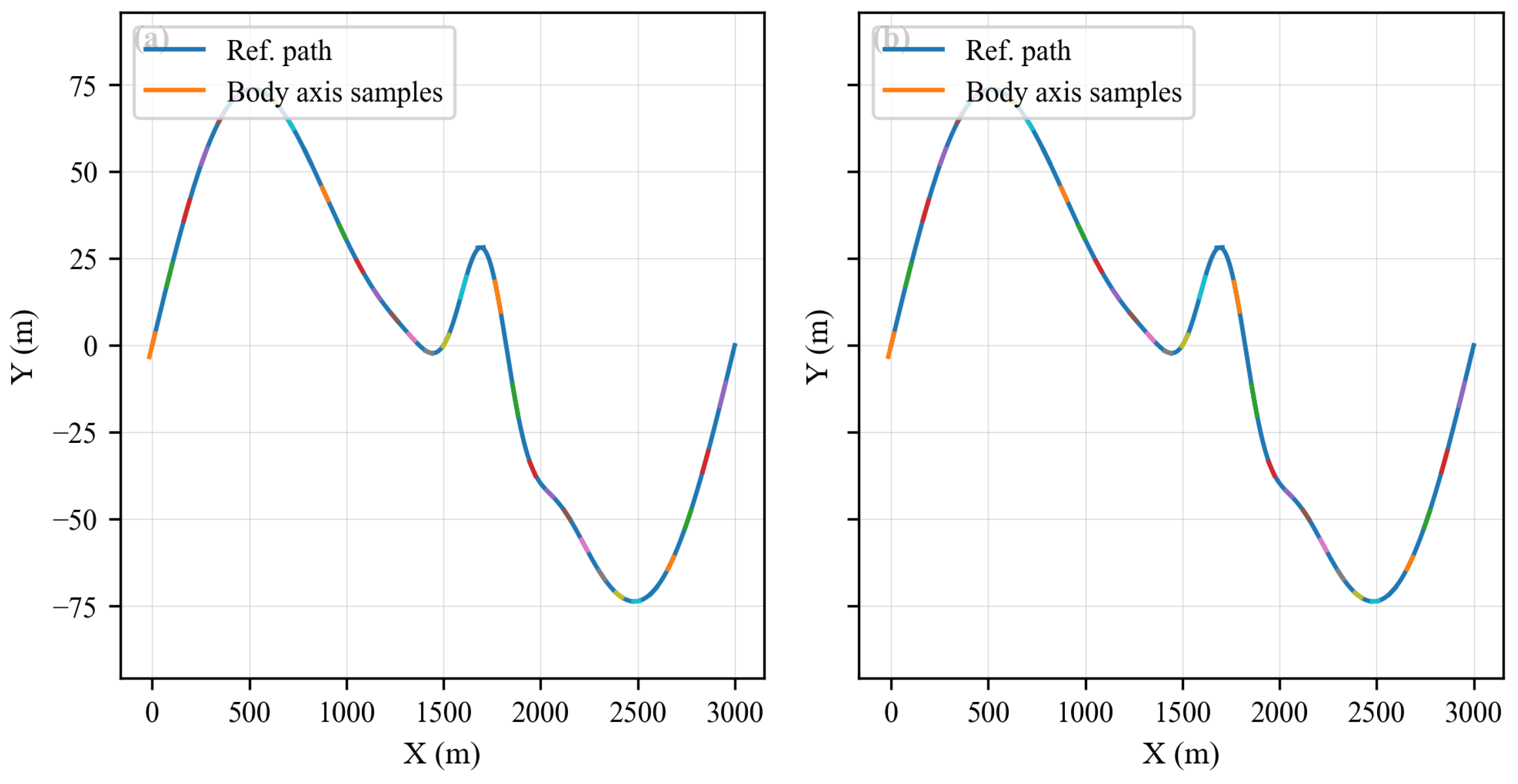
Figure 1 compares the vessel trajectories generated by the conventional LOS-based heading-keeping method and the proposed line-adhering strategy along a curved reference route. The baseline controller exhibits noticeable heading oscillations and body–path misalignment when negotiating curved segments, mainly due to repeated heading corrections rather than direct geometric alignment with the path.
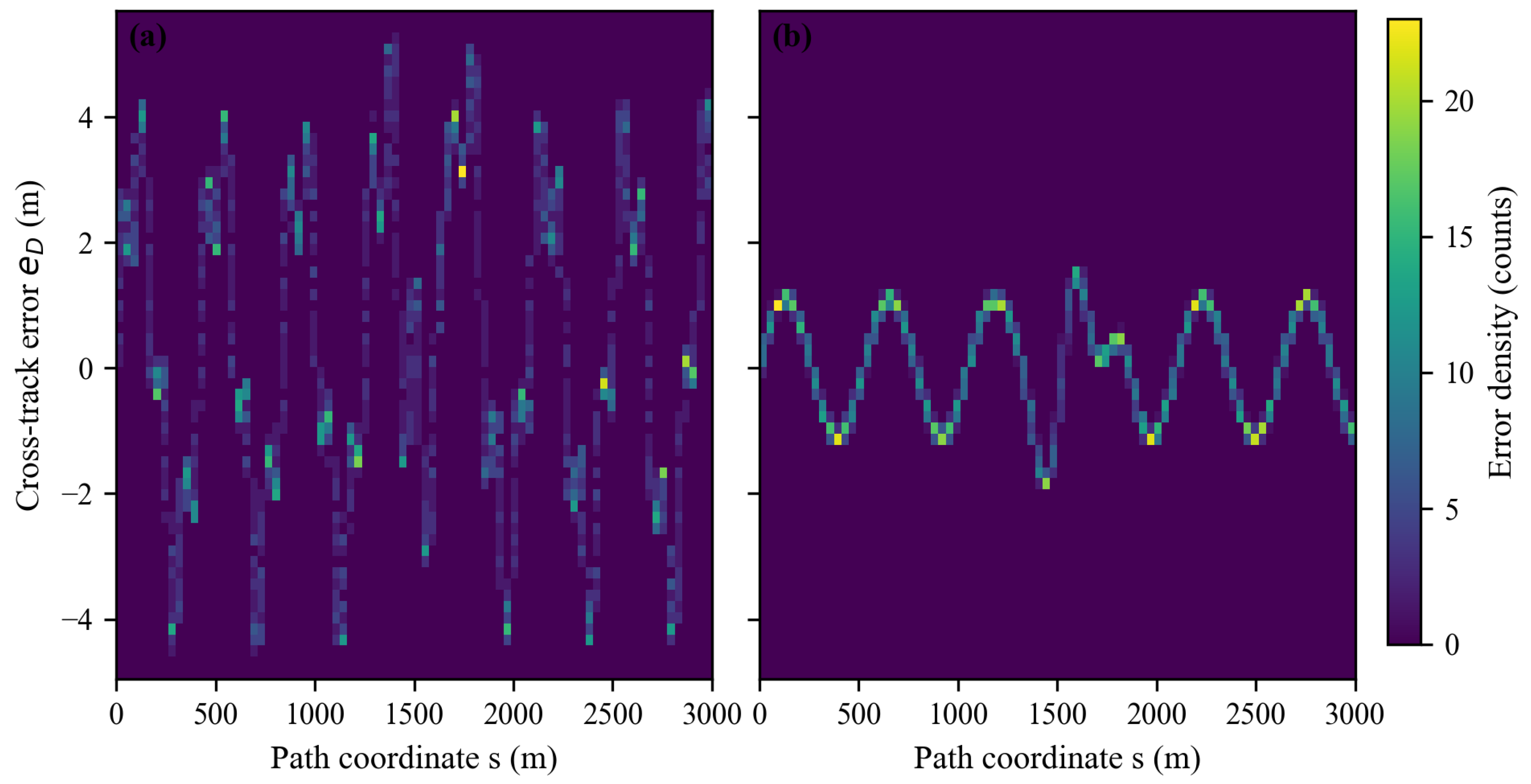
In contrast, the proposed line-adhering framework maintains the vessel body axis approximately parallel to the reference line, yielding a smoother trajectory with reduced lateral deviation. The improvement is further quantified in
Figure 2, which shows the spatial distribution of cross-track error along the path coordinate. Compared with the LOS baseline, the proposed method significantly suppresses error accumulation in high-curvature regions. Quantitatively, the mean cross-track error is reduced by approximately 30–45%, while the peak error in curved segments decreases by more than 50%.
Table 4 shows that the proposed method achieves consistently better cross-track tracking performance than the LOS baseline. Specifically, the mean error is reduced from 1.82 m to 1.12 m, corresponding to a decrease of approximately 38.5%, while the RMSE decreases from 2.31 m to 1.46 m, indicating that the overall tracking deviation is substantially suppressed. In addition, the standard deviation is reduced from 1.42 m to 0.88 m, suggesting that the proposed framework produces not only smaller average errors but also more stable tracking behavior with reduced fluctuation. The 95% confidence interval of the mean is also narrower and shifted toward lower values for the proposed method, decreasing from [1.69, 1.95] m to [1.04, 1.20] m. This further supports the statistical reliability of the improvement. Overall, these results demonstrate that the proposed line-adhering and disturbance-adaptive strategy provides more accurate and robust path-following performance than the conventional LOS-based heading-keeping approach.
4.3. Path-Following Performance in High-Curvature Zones
To assess the effectiveness of curvature-aware route refinement, additional experiments were conducted on routes containing sharp bends that exceed the vessel’s nominal turning capability when represented by straight-line waypoint connections. Without refinement, both LOS-based and line-adhering controllers experience degraded performance, including large heading overshoots and excessive rudder activity.
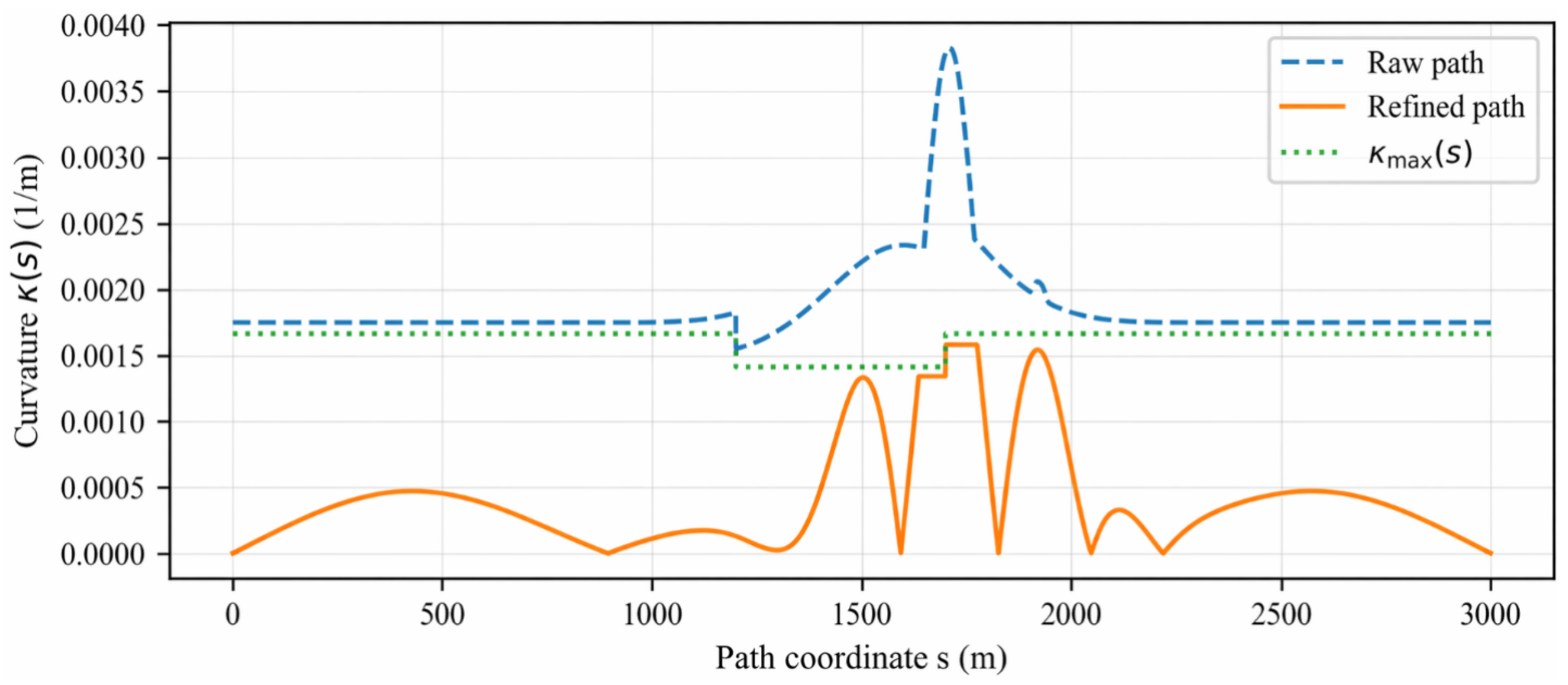
As illustrated in
Figure 3, the curvature of the raw waypoint-fitted path locally violates the vessel’s admissible curvature limit, whereas the refined reference path consistently satisfies the dynamic feasibility constraint derived from the Nomoto/MMG models. This refinement enables stable path-following without violating rudder saturation or yaw-rate limits. The vessel is able to negotiate high-maneuverability zones smoothly, confirming that embedding vessel dynamics directly into the route reconstruction stage is essential for reliable autonomous navigation in constrained waterways.
4.4. Disturbance Recognition and Adaptive Control Response
The disturbance-adaptive capability of the proposed framework was further examined under time-varying wind and current conditions.
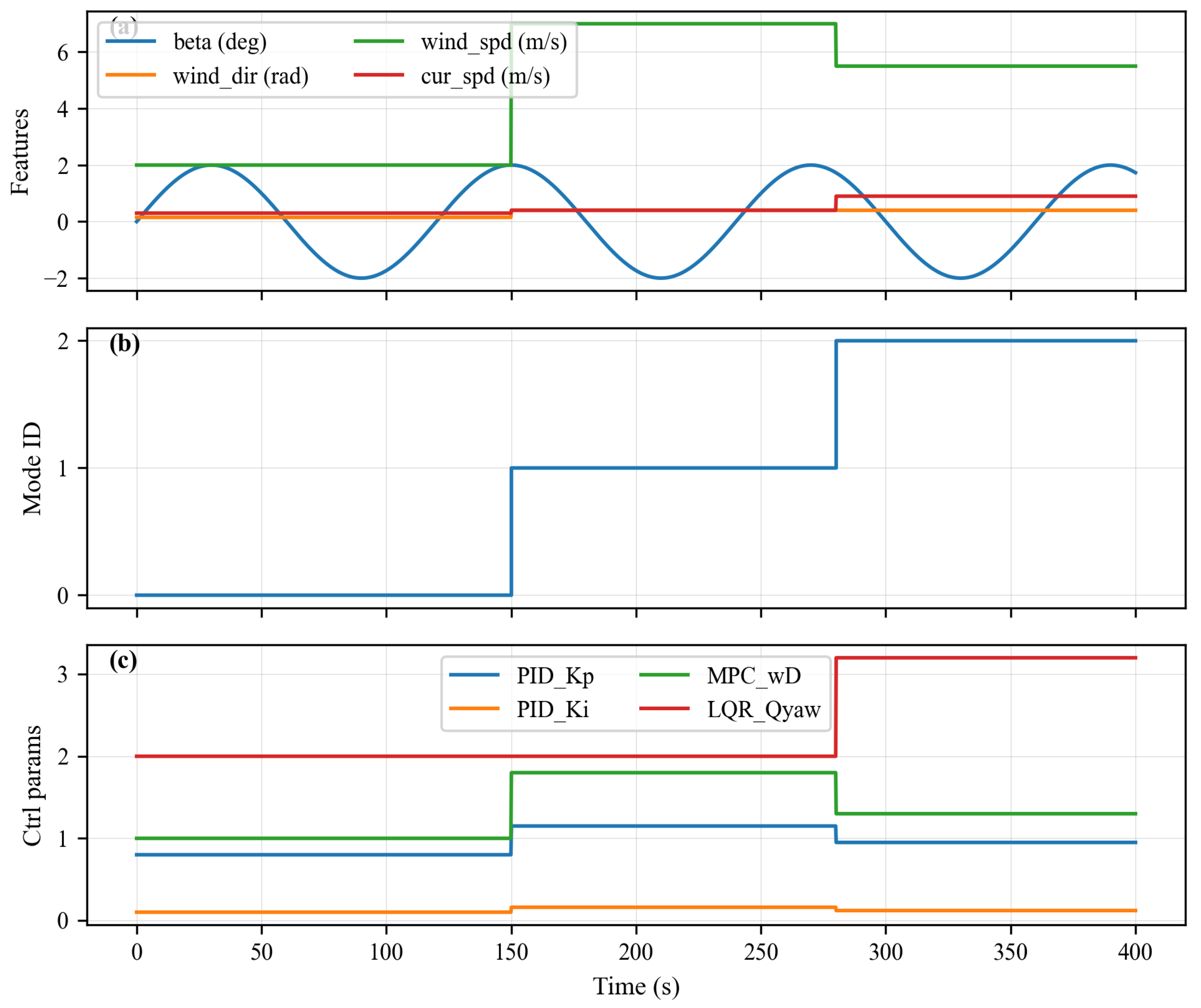
Figure 4 presents the overall process of disturbance feature evolution, operating-mode recognition, and controller-parameter reconfiguration.
As shown in
Figure 4a, the measurable disturbance-related features vary with time, including the drift angle
, wind direction, wind speed, and current speed. At approximately 150 s, the wind speed increases noticeably, accompanied by changes in the current-related variables, indicating a transition from a mild operating condition to a stronger disturbance regime. At around 280 s, the current speed further increases while the wind speed decreases slightly, forming another distinct environmental condition. These changes provide the basis for disturbance recognition using onboard measurable signals.
Based on the extracted feature patterns, the supervisory module identifies the corresponding operating mode, as illustrated in
Figure 4b. The mode ID changes from 0 to 1 at about 150 s and then from 1 to 2 at about 280 s, showing that the classifier can detect environmental transitions in a timely manner. This result confirms that the disturbance-recognition module is able to distinguish different disturbance regimes and provide decision support for subsequent controller adaptation.
Once a new disturbance mode is recognized, the controller parameters are updated accordingly, as shown in
Figure 4c. In the second operating stage, the PID gains are increased, the MPC disturbance-related weight is strengthened, and the LQR yaw-related penalty remains at its nominal level, indicating that the controller is reconfigured to improve disturbance rejection while maintaining overall stability. After the second mode transition, the LQR yaw-weight is further increased, whereas the PID and MPC parameters are adjusted to a new balance, reflecting a control strategy that places more emphasis on heading stability and robustness under stronger current disturbance.
Overall,
Figure 4 verifies that the proposed supervisory mechanism can effectively identify environmental changes and trigger coordinated parameter adaptation in multiple controllers. This enables the navigation framework to respond to time varying disturbances in a structured and interpretable manner, rather than relying on fixed controller settings throughout the entire maneuvering process.
To further quantify the path-following improvement,
Table 4 compares the cross-track error statistics of the LOS baseline and the proposed method. The results show that the proposed framework reduces the mean error from 1.82 m to 1.12 m, the RMSE from 2.31 m to 1.46 m, and the standard deviation from 1.42mto 0.88 m. In addition, the 95% confidence interval of the mean error is consistently lower for the proposed method, confirming its superior tracking accuracy and stability under environmental disturbances.
Table 4.
Quantitative comparison of cross-track error statistics between the LOS baseline and the proposed method.
Table 4.
Quantitative comparison of cross-track error statistics between the LOS baseline and the proposed method.
| Method | Mean Error (m) | RMSE (m) | Std (m) | 95% CI of Mean (m) |
|---|
| LOS baseline | 1.82 | 2.31 | 1.42 | [1.69, 1.95] |
| Proposed method | 1.12 | 1.46 | 0.88 | [1.04, 1.20] |
Moreover, the disturbance-recognition module was trained and evaluated using simulation-generated samples covering combinations of wind direction, wind speed, current direction, current speed, vessel operating speed, drift angle, cross-track error, and yaw-rate response. Based on these samples, a decision table was constructed to derive rough-set reducts and decision rules for the five operating modes, namely Calm, Crosswind, Head Current, High-Comfort, and Emergency. On the validation set, the classifier achieved an overall accuracy of 86.7%, with precision, recall, and F1-score values of 85.1%, 83.6%, and 84.3%, respectively. These results indicate that the rough-set model is sufficiently reliable for supervisory controller reconfiguration while retaining strong interpretability.
4.5. Control Smoothness and Maneuvering Comfort
In addition to disturbance adaptability, the proposed framework was also evaluated from the perspectives of control smoothness and maneuvering comfort.
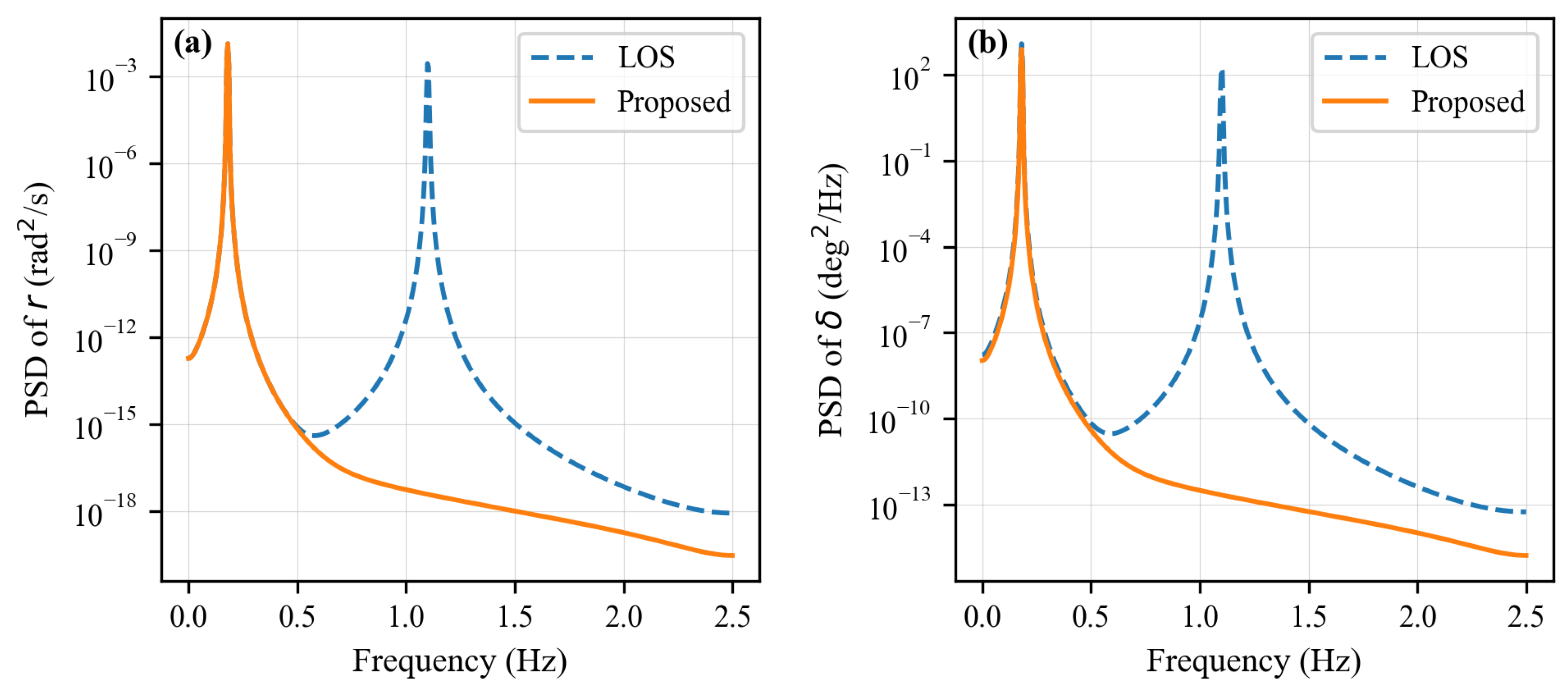
Figure 5 compares the frequency-domain characteristics of the LOS baseline and the proposed method using the power spectral density (PSD) of yaw rate and rudder activity.
As shown in
Figure 5a, the PSD of yaw rate
r under the proposed method is concentrated mainly in the low-frequency region, with the dominant peak located near the low-frequency band. By contrast, the LOS baseline exhibits a pronounced spectral peak around a higher-frequency region near
Hz. This indicates that the proposed framework suppresses high-frequency yaw-rate oscillations more effectively and produces a smoother heading response. A similar trend can be observed in
Figure 5b for the rudder angle
. The LOS baseline shows a significant high-frequency spectral peak, whereas the proposed method shifts the dominant rudder activity toward a lower frequency and substantially reduces the high-frequency energy content. This implies that the proposed controller avoids rapid and repetitive rudder motions and instead generates smoother steering commands. From a maneuvering perspective, these frequency-domain results suggest that the proposed framework achieves a more human-like control style. Rather than relying on aggressive high-frequency corrective actions, it performs continuous and moderate adjustments in both heading and rudder response. Such behavior is beneficial not only for improving maneuvering comfort but also for reducing actuator workload and mechanical wear. Therefore,
Figure 5 confirms that the proposed method provides superior smoothness characteristics compared with the LOS baseline in both vessel motion response and control effort.
4.6. Discussion
The experimental results confirm that replacing traditional heading-keeping logic with a line-adhering control paradigm fundamentally improves path-following behavior in complex navigation scenarios. The integration of curvature-aware route refinement ensures dynamic feasibility, while rough-set-based disturbance recognition enables timely, interpretable, and effective controller adaptation. Recent studies on ship path-following have explored model predictive control, adaptive control, hybrid guidance–control strategies, and reinforcement-learning-based decision modules. In comparison, the present work focuses on a structured line-adhering guidance-and-control framework with explicit disturbance-mode recognition and controller reconfiguration. The current validation is limited to simulation-based comparison against a conventional LOS-type heading-keeping baseline.
It should be noted that the disturbance-adaptive module in the present study performs supervisory mode selection and parameter reconfiguration among pre-defined controller structures. Accordingly, the current manuscript provides simulation-based performance validation of the closed-loop system, rather than a formal proof of global stability and convergence for the overall switched architecture. Unlike purely data-driven approaches, the proposed framework preserves strong physical interpretability and robustness, making it well suited for safety-critical maritime applications. These advantages are particularly relevant for inland waterways, port approaches, and future autonomous navigation in complex and mixed-traffic environments. The proposed method should be understood as a simulation-validated framework for disturbance-aware line-adhering path-following in structured waterway scenarios. Its current advantages are demonstrated relative to the LOS-type baseline considered in this study and should not be interpreted as a complete validation across all autonomous-navigation tasks.
5. Conclusions
This study introduced a line-adhering and disturbance-adaptive navigation framework for autonomous ships, integrating route refinement, cross-control logic, and multi-mode control reconfiguration within a unified architecture. Unlike traditional heading-keeping autopilot systems, the proposed approach reconstructs the control logic around human-like maneuvering principles, enabling vessels to follow reference lines in a more intuitive and dynamically consistent manner. A Bézier-based route refinement method, constrained by vessel kinematics and dynamics via Nomoto and MMG models, ensures that the generated high-resolution path is both smooth and physically trackable.
A rough-set-based disturbance recognition module was developed to classify environmental conditions and operating states, automatically adapting PID, LQR, and MPC controllers through structural and parametric reconfiguration. This enables the system to maintain stability, comfort, and accuracy under variable and potentially severe disturbance conditions. The combination of refined path geometry, cross-control behavior, and adaptive control logic provides a comprehensive solution to several long-standing limitations of conventional navigation systems, particularly in narrow waterways, curved routes, and dynamic maritime environments.
The present results demonstrate that the proposed framework can improve line-adhering path-following behavior under representative route-curvature and environmental disturbance conditions relative to the considered baseline. However, the current study remains limited to heading regulation and lateral path-following control. A dedicated longitudinal speed control component has not been implemented or validated, and the proposed framework should not be interpreted as a complete intelligent navigation system. At the same time, the study remains limited to single-vessel scenarios and does not yet constitute validation for collision-avoidance, mixed-traffic navigation, or full-scale deployment. Future work will involve validating the proposed framework through high-fidelity simulations, model basin experiments, and full-scale sea trials. Additional research will focus on integrating reinforcement learning for automatic tuning of control weights, employing digital-twin environments for controller evolution, and coupling the framework with advanced perception systems to support fully autonomous navigation in complex and mixed-traffic scenarios.





 and
and