1. Introduction
The marine environment represents a vast reservoir of renewable energy resources, with global estimates indicating an annual electricity generation potential of up to
kWh [
1]. Among the various forms of marine energy, tidal current energy has emerged as a promising option for sustainable power generation [
2,
3]. However, the harsh and dynamic marine environment introduces significant challenges of reliability. Ensuring the safe and stable operation of tidal current turbines (TCTs) is crucial for long-term sustainability and economic viability. During operation, TCT blades are exposed to impacts from marine organisms or floating debris, which can damage blade surfaces, reduce corrosion resistance, and induce mechanical fatigue [
4]. These faults compromise the quality of the power generation and shorten the lifespan of the turbine. Detecting blade impact faults is therefore critical for operational safety and maintenance planning. However, the complex marine environment and bidirectional fluid–structure interaction (FSI) [
5,
6] cause unstable operating conditions. Variations in flow velocity and cycle periods distort signal characteristics, making it difficult to extract the fault features and reducing detection accuracy. Conventional detection methods often struggle to maintain performance under these non-stationary conditions, resulting in an increase in false alarms and missed detections.
To address these challenges, a growing number of studies have investigated current signal-based fault detection methods for tidal current turbines. Goktas et al. [
7] extracted features capable of identifying system components and characterizing their dynamic behavior by analyzing the stator electromotive force and phase currents. However, strong interference from the marine environment and noise complicates signal interpretation. Instantaneous variations in tidal flow cause fluctuations in turbine operating parameters, and some amplitude and frequency components may be partially or completely masked [
8]. Wei et al. [
9] proposed a fault detection method based on Variational Mode Decomposition (VMD) denoising and phase demodulation. The method separated interference and fault-related frequency components using VMD and employed the Maximal Information Coefficient (MIC) to select relevant intrinsic mode functions (IMFs). Power spectral density (PSD) analysis was then used to reveal imbalance fault characteristics. This method improved fault feature extraction under strong marine interference and non-stationary conditions. However, its computational complexity may limit real-time applicability, particularly for long-duration signals. Xie et al. [
10] presented a Principal Component Analysis (PCA)-based fault detection method. The method involved Fourier transform analysis of the stator current envelope, followed by fault feature extraction and PCA-based impact detection. The workflow of this method is relatively simplified, which improves real-time performance to some extent. However, there is no clear explanation for the mechanism of how to suppress impact-induced interference components, and its interpretability and reliability remain insufficient.
To further improve impact fault identification under complex operating conditions, anomaly detection-based methods have also been applied to TCT blade impact fault detection. Wu et al. [
11] developed a fault detection approach based on the Local Outlier Factor (LOF) [
12,
13] for impact fault identification. After applying the Teager–Kaiser Energy Operator (TKEO) [
14,
15,
16] to obtain the stator current envelope and extract fault features, Density-Based Spatial Clustering of Applications with Noise (DBSCAN) [
17,
18] was used to identify high-risk samples. LOF values of these samples were then used for impact fault detection. This method enhanced fault detection performance under complex operating conditions to a certain degree and achieved satisfactory accuracy under periodically varying flow conditions. However, when the flow velocity cycle changed, the feature-space density distribution became unstable, resulting in reduced detection accuracy.
Under non-stationary operating conditions, such as variable-period flows, the feature-space density becomes unstable, and fault features tend to overlap with normal fluctuations, which significantly degrades the performance of impact fault detection. Although existing signal-based fault detection methods have shown effectiveness under relatively stable conditions, they often lack sufficient robustness when facing flow-induced non-stationarity and partial overlap between normal and fault features. Therefore, there remains a need for a fault detection method that can effectively suppress environmental interference while enhancing fault-sensitive characteristics under variable operating conditions. To address these, this study proposes a fault detection method based on a sliding-window strategy [
19,
20,
21] and KNN [
22,
23,
24]. The proposed method is designed to characterize local feature variations and maintain high sensitivity and robustness even when fault features partially overlap with normal data. Experimental results under steady, periodic, and variable-period flow conditions demonstrate that the proposed method achieves high fault detection accuracy and strong adaptability under complex non-stationary environments.
The remaining sections are organized as follows.
Section 2 outlines the problem background and discusses the limitations of existing approaches.
Section 3 presents the proposed KNN-MS approach, including feature extraction, weighting design, and anomaly index construction.
Section 4 describes the experimental setup and results.
Section 5 discusses performance comparisons and robustness analysis. Finally,
Section 6 concludes the paper and outlines future research directions.
2. Challenges in Impact Fault Detection of TCT
The TCT is driven by tidal flow acting on the blades, which generates rotor torque, and the resulting mechanical energy is converted into electrical energy by the generator. While the turbine is operating, rigid blades interact with marine fluid, creating complex FSI phenomena at the blade–flow interface. These interactions significantly influence blade vibration modes and amplitudes, which propagate through the rotor and manifest as amplitude modulation components in the stator current signal. A key characteristic of this interaction is vortex shedding, which induces periodic blade vibrations and modulates the electrical signal. The vortex shedding frequency is related to the Strouhal number as expressed in Equation (
1):
where
is the Strouhal number,
is the vortex shedding frequency,
C is the blade chord length, and
V is the flow velocity.
As shown in
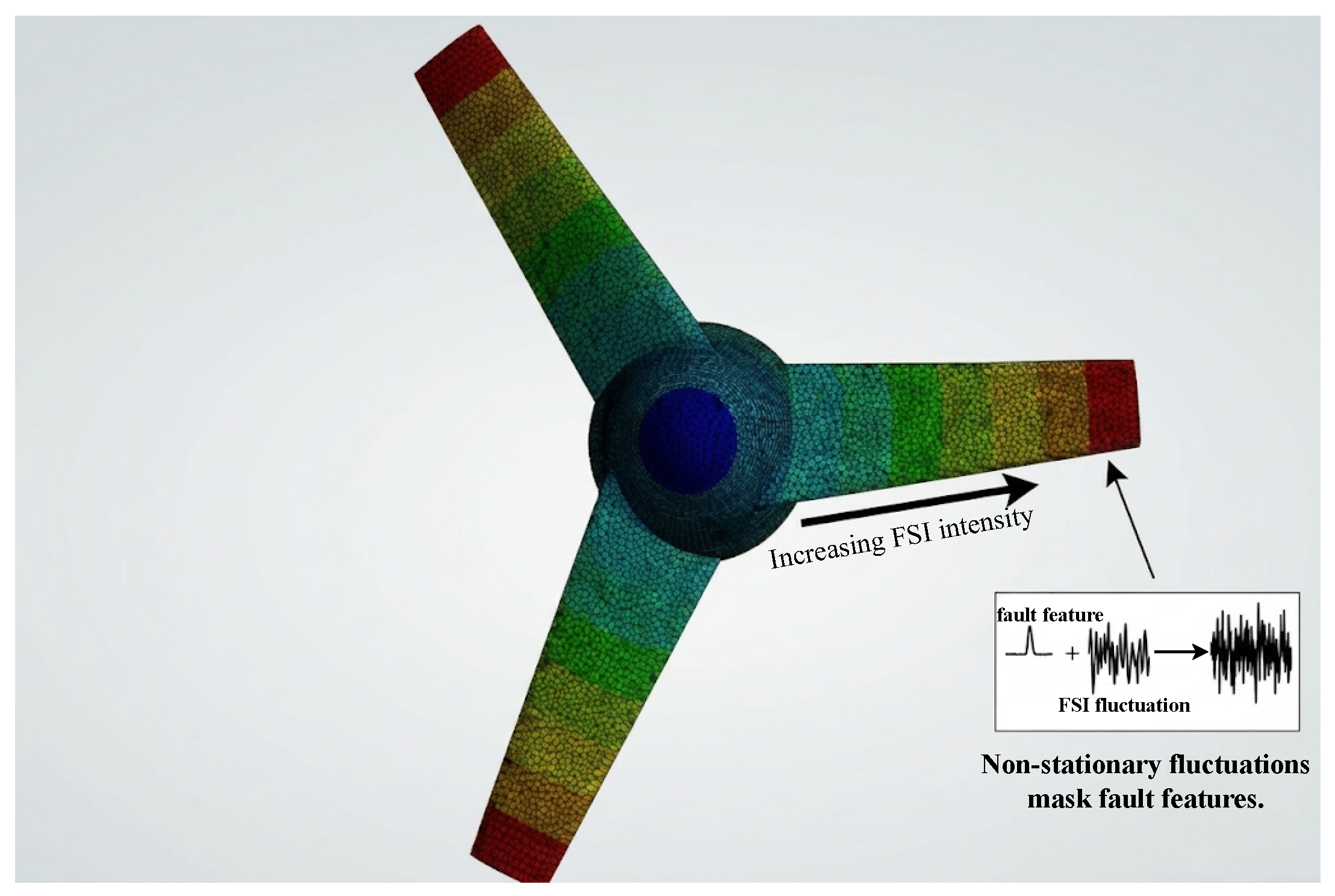
Figure 1, the color transition from blue to red indicates an increase in FSI intensity from weak to strong. The FSI intensity along the blade exhibits a pronounced non-uniform radial distribution, with significant differences between the root and tip regions. Under time-varying flow conditions, this FSI intensity becomes inherently time-dependent, leading to periodic variations in the blade vibration characteristics. These vibrations propagate through the rotor–stator coupling path and continuously modulate the stator current. As a consequence, the electrical features extracted from the current signals exhibit non-stationary behavior, with their amplitudes and spectral components drifting over time. This time-varying modulation can overlap with or mask the transient signatures caused by impact faults. Therefore, under variable-period flow conditions, the FSI effect adversely affects stator current-based impact fault detection by destabilizing extracted features, widening spectral distributions, and diminishing the separability between fault-induced transients and flow-induced fluctuations.
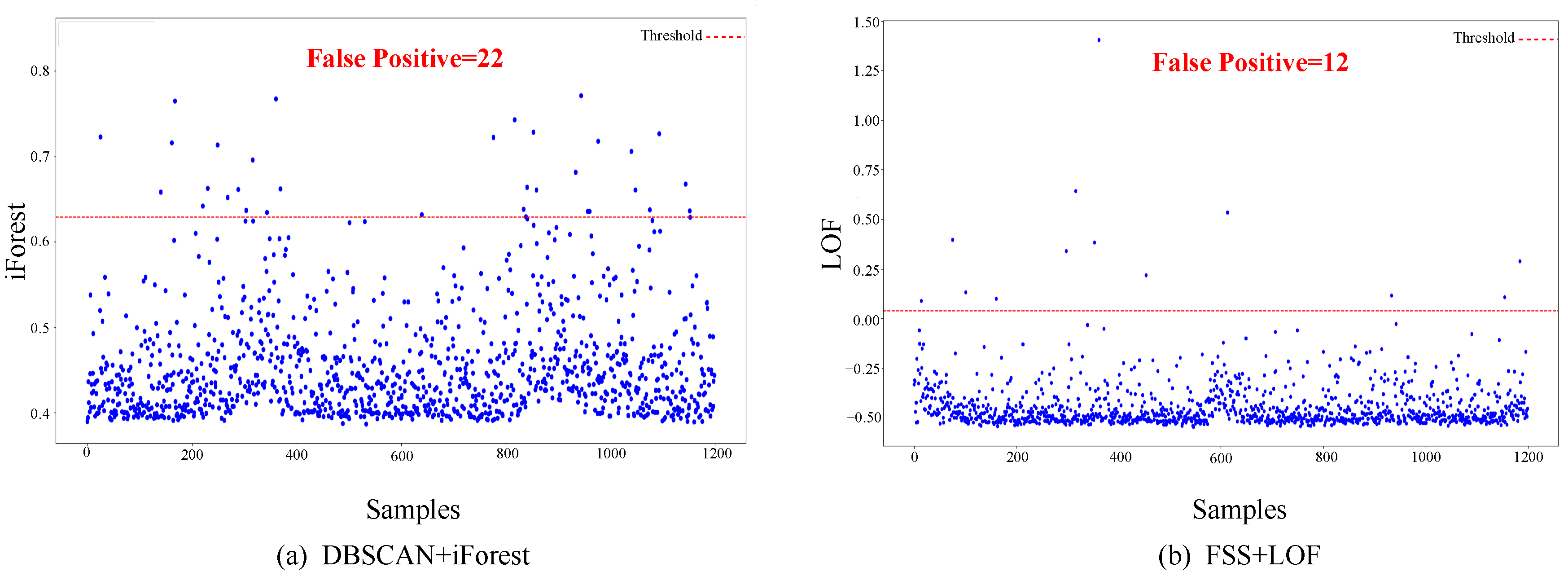
The fault detection results using DBSCAN+Isolation Forest (iForest) and Feature Subspace Segmentation (FSS)+LOF are shown in
Figure 2. Under variable-period FSI conditions, the amplitude fluctuations of certain health-state features approach or even exceed the variation scale induced by actual fault disturbances, causing some healthy data to be misclassified as faulty and leading to a high false alarm rate in impact fault detection when conventional methods are applied. This can be explained by the fact that FSI-driven modulation, transient impact events, and flow-induced non-stationarity distort the feature-space structure (decreased density, unstable neighborhoods, and overlapping distributions), thereby reducing impact fault detection accuracy and increasing false alarms. Consequently, reducing interference and enhancing robustness are necessary to improve the accuracy of fault detection.
3. KNN-Multiplicative Score Approach for TCT Impact Fault Detection Under Variable-Period Conditions
To improve the detection accuracy of blade impact faults in TCT under variable-period operating conditions, experimental studies were conducted to reproduce realistic operating scenarios. The dataset was acquired from a 0.1 kW TCT experimental platform, where a sensor was installed at the generator output terminal to collect stator current signals at a sampling frequency of 1000 Hz. Blade impact faults were simulated by striking the TCT blades with small balls. Based on this setup, stator current signals were collected under constant-flow, periodically varying-flow, and variable-period varying-flow conditions, while the detailed flow velocity and cycle period settings are given in
Section 5.
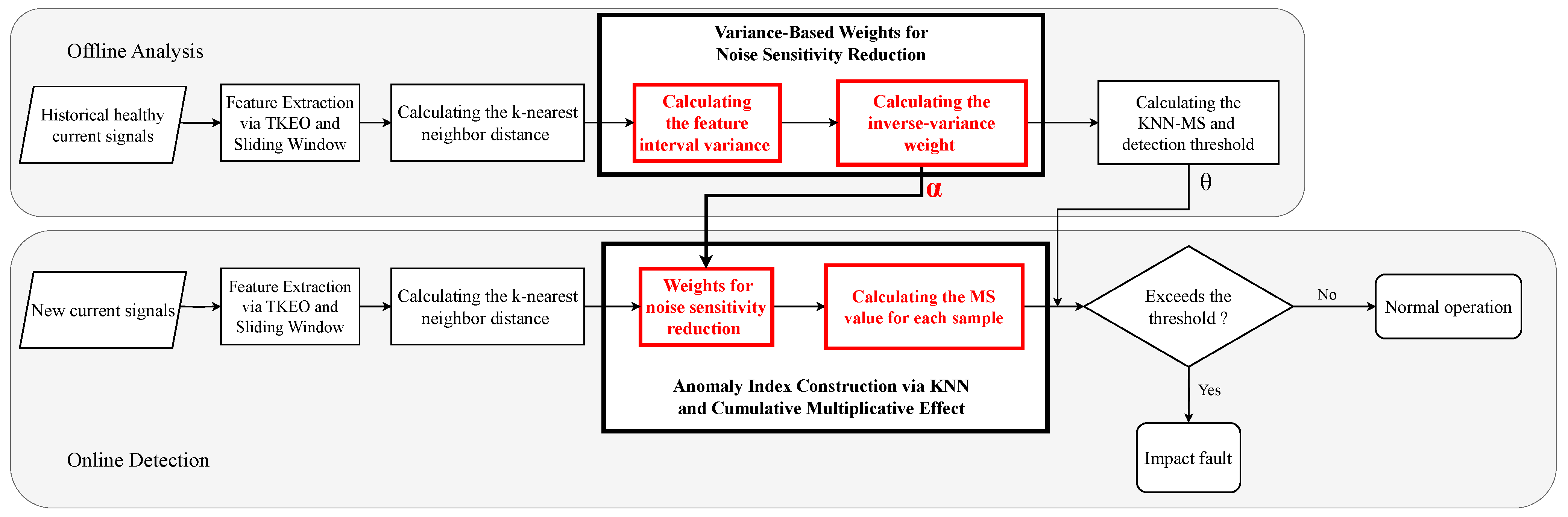
One phase current extracted from the three-phase stator current signals, including historical healthy data and newly collected faulty data, was used as the raw input data. After preprocessing and TKEO-based energy-envelope extraction, sliding-window statistical features were constructed for fault detection. These features were selected because preliminary analyses indicated that they were sensitive to local impact-induced fluctuations and could effectively distinguish healthy from faulty states. On this basis, a fault detection method combining outlier analysis and a cumulative multiplicative scoring mechanism was developed. Detection thresholds were established using historical healthy data, enabling accurate identification of blade impact faults.
It should be noted that the raw stator current signal must first undergo the following preprocessing steps. Specifically, one-phase current is extracted, and a second-order Butterworth band-pass filter is applied for filtering, followed by the selection of the effective signal segment during the stable operating stage. Subsequently, mean removal and smoothing are performed to reduce the influence of noise interference and baseline drift on subsequent feature extraction. The preprocessed signal is then used as the input for the subsequent TKEO-based energy-envelope analysis.
3.1. Impact-Sensitive Feature Extraction Using Energy-Envelope Operators and Sliding Windows
To effectively characterize transient impact-induced energy fluctuations in stator current signals under variable-period and non-stationary operating conditions, an impact-sensitive feature extraction strategy based on the TKEO and sliding-window statistics is adopted. TKEO computes a nonlinear combination of neighboring signal samples, providing an effective estimate of instantaneous signal energy,
where
i denotes the discrete sampling index and
N is the total number of samples,
denotes the stator current signal,
denotes the TKEO operator, and
represents the instantaneous energy estimate at sample
i, which emphasizes short-duration energy variations while suppressing slowly varying components related to normal operating states. Based on the TKEO output, the instantaneous amplitude (energy envelope)
of the current signal can be estimated as:
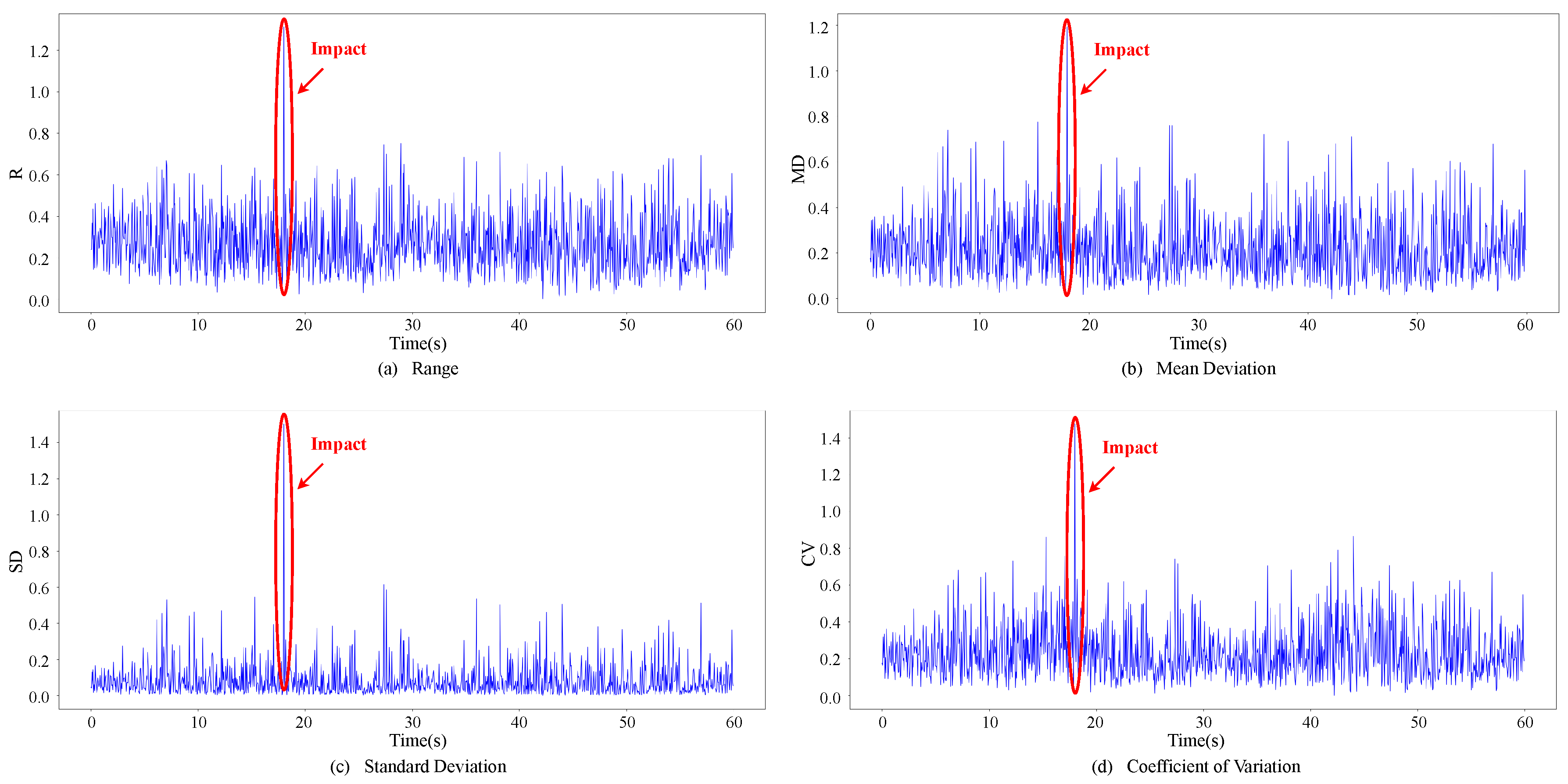
To characterize temporal variations under fluctuating tidal flow conditions, the envelope signal is segmented using a sliding window of length (w). Within each sub-window, four statistical indicators are computed:
Range (R): reflects peak-to-peak variation and is sensitive to impulsive shocks;
Mean Deviation (): measures average fluctuation while being less sensitive to outliers;
Standard Deviation (): represents overall energy dispersion within the window;
Coefficient of Variation (): normalizes amplitude variations and mitigates the influence of flow velocity-induced magnitude drift.
Figure 3 presents representative feature responses extracted under variable flow conditions. As can be seen, the four statistical indicators all show distinct local variations near the impact instant, demonstrating their effectiveness in characterizing impact-related disturbances under non-stationary flow conditions.
For the
j-th sub-window, the extracted feature vector is defined as:
where
denotes the four-dimensional real space. By stacking all feature vectors, the feature matrix is constructed as:
where
n represents the total number of sliding sub-windows. This matrix serves as the input to the subsequent anomaly detection framework.
Through the above processing, the original non-stationary current signals are mapped into a low-dimensional feature space, which highlights impact-induced energy variations while suppressing the influence of operating-condition fluctuations. Therefore, a stable and more discriminative feature basis is provided for subsequent fault detection based on local anomaly measures.
3.2. Variance-Based Weights for Noise Sensitivity Reduction
Unlike conventional preprocessing techniques that treat signal fluctuations as noise to be filtered out, the proposed approach introduces an operating condition-aware weighting mechanism, where signal variance is not merely a statistical descriptor but a physical indicator of turbine operating stability. Under tidal environments, turbulence intensity and flow irregularity directly lead to increased variance in stator current signals, which does not necessarily imply fault occurrence. Therefore, instead of applying uniform feature contributions, the proposed method establishes a variance-adaptive reliability model to differentiate between flow-induced fluctuations and fault-consistent signal intervals.
is defined as the variance of the interval, a global normalization term
Z is defined as:
where
and
m is the total number of intervals. To assign higher importance to more stable intervals, inverse-variance weighting is adopted. The weighting coefficient for the
l-th interval is defined as:
This formulation differs fundamentally from traditional denoising schemes: it does not suppress high-variance intervals through filtering, but rather modulates their contribution during anomaly aggregation. In this way, signal segments dominated by hydrodynamic disturbances are prevented from overwhelming fault-consistent patterns. This reliability-weighted feature representation enables the anomaly detector to remain sensitive to weak impact signatures even when global signal variance is elevated due to marine turbulence.
As a result, the variance-adaptive weighting scheme highlights stable operating intervals while suppressing highly fluctuating regions. There is a more reliable and noise-robust basis for subsequent local anomaly computation and multiplicative fault feature enhancement that is provided by this mechanism.
3.3. Anomaly Index Construction via KNN and Cumulative Multiplicative Effect
Variations in tidal flow velocity and cycle period introduce distortions in feature-space density under non-stationary conditions, which degrade the effectiveness of conventional anomaly detection methods. To address this challenge, an anomaly index integrating KNN-based local analysis with a cumulative multiplicative scoring mechanism is developed. In the KNN-based local anomaly analysis, the number of nearest neighbors was set to
. This value was determined empirically through preliminary experiments in order to balance local sensitivity and robustness. If
K is too small, the anomaly score becomes overly sensitive to random fluctuations and measurement noise; if
K is too large, local fault-related deviations may be excessively smoothed. Therefore,
was adopted in this study. KNN is employed to quantify local neighborhood deviations by computing Euclidean distances between each sample and its nearest neighbors, enabling the identification of fault-related outliers. Under highly unstable flow conditions, these deviations may be masked by turbulence-induced fluctuations and noise, reducing detection sensitivity. To enhance fault saliency while suppressing random disturbances, variance-weighted KNN distance measures are combined with multiplicative accumulation. This integration reinforces persistent anomaly patterns and attenuates uncorrelated variations, thereby improving the separability between normal and faulty states and enhancing detection robustness under variable operating conditions. Mathematically, the Euclidean distance between the
j-th point and its
k-th nearest neighbor is defined as follows:
where
represents the feature vector of the
j-th sample,
represents the feature vector of its
k-th nearest neighbor,
represents the
p-th feature component of the
j-th sample, and
represents the
p-th feature component of the
j-th sample’s
k-th nearest neighbor.
To account for the varying stability of flow conditions, a variance-based weighting coefficient
is applied to adjust the contribution of each feature interval. This coefficient assigns higher weights to intervals with smaller variance, thereby emphasizing more stable regions and reducing the influence of noisy segments. To explicitly distinguish the robustness-enhancement stage from the fault-amplification stage, a weighted local anomaly term is first defined as:
Through this formulation, the original KNN distance is transformed into a reliability-weighted local anomaly response. High-variance intervals caused by unstable flow conditions contribute less to the subsequent anomaly aggregation, where as relatively stable intervals contribute more.
Based on the weighted local anomaly term, the final multiplicative score is constructed as:
where
K denotes the total number of nearest neighbors considered. This multiplicative accumulation mainly serves to enhance the saliency of persistent fault-related deviations. If multiple adjacent local responses remain consistently abnormal, their product increases rapidly, allowing weak impact signatures to become more distinguishable from random disturbances.
There are two key innovations produced by this:
- (1)
Persistence amplification—Consecutive abnormal deviations grow exponentially, enabling weak but consistent impact signatures to emerge clearly.
- (2)
Random fluctuation suppression—Isolated large deviations caused by turbulence do not persist multiplicatively and therefore have limited influence.
Accordingly, the proposed anomaly index consists of two coordinated stages: variance-adaptive reliability weighting for robustness enhancement and multiplicative accumulation for persistent fault-feature amplification.
By combining variance-adaptive reliability weights with multiplicative accumulation, the proposed index establishes a stability-aware anomaly metric that emphasizes structural consistency rather than instantaneous deviation magnitude. This makes the detector inherently robust to feature-space drift induced by variable marine operating conditions. Compared with LOF, standard KNN scoring, and density-based approaches, KNN-MS employs a dynamic deviation accumulation mechanism to enhance adaptability under non-stationary flow conditions. The proposed anomaly index amplifies fault-related features while suppressing random fluctuations, enabling robust real-time detection of blade impact faults under varying tidal flow conditions. Its primary computational cost arises from calculating KNN distances; since the number of neighbors K is typically small, the overall complexity remains low, making the method suitable for real-time applications. Unlike conventional approaches based solely on local density or distance (such as LOF or standard KNN-based scores), variance-adaptive weighting and multiplicative accumulation are incorporated. High sensitivity and stability are ensured, even when fault characteristics partially overlap with normal operating data. Overall, by combining variance-weighted KNN distances with cumulative multiplicative accumulation, the proposed anomaly index enhances the sensitivity to impact-related anomalies while suppressing disturbances caused by non-stationary flow conditions, thereby improving the reliability of fault detection under practical operating scenarios.
5. Experiment Results and Analysis
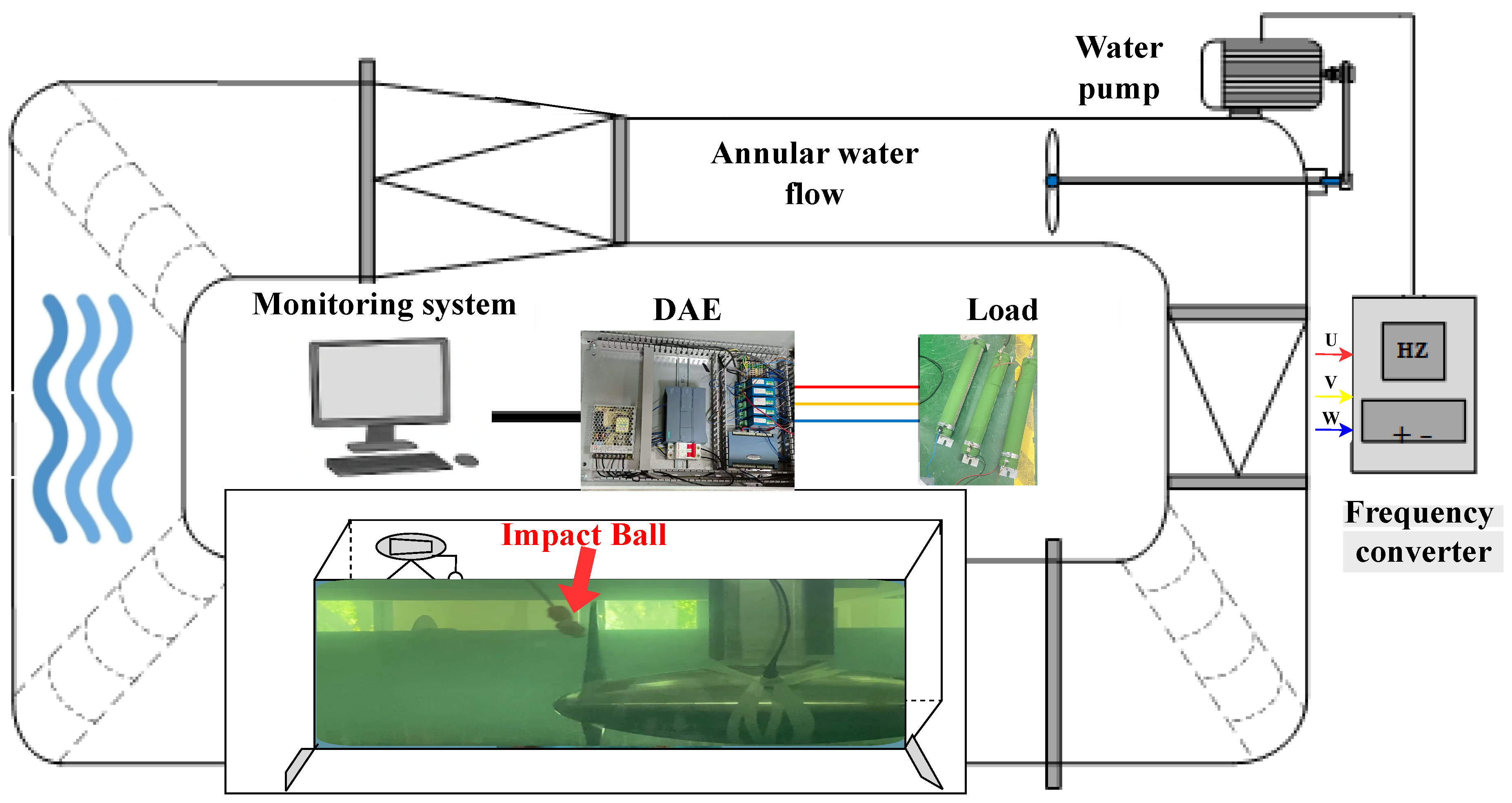
The experiments were carried out on a 230 w horizontal-axis direct-drive TCT prototype [
25], as shown in
Figure 5. The test rig consists of a water tank, a TCT prototype, a resistive electrical load, and a data acquisition system. The tank volume is approximately 45 m
3, and the incoming flow velocity can be adjusted from 0.2 m/s to 1.8 m/s by circulating pump. Flow deflectors and a honeycomb structure are installed to stabilize the inflow in the test section. The turbine adopts a NACA0018 blade profile, with a rotor diameter of 0.6 m, a blade chord length ranging from 5.68 cm to 9.68 cm, and a pitch angle varying from 3.4° to 25.2°. The generator is a permanent-magnet synchronous generator with eight pole pairs. The electrical signals were collected by a National Instruments data acquisition system with a sampling frequency of 1 kHz. The dataset contains 16 healthy samples and 112 faulty samples, with a total of 128 samples collected under the experimental operating conditions described above. Each acquisition lasted 3 min, corresponding to 180,000 sampling points for each signal. To evaluate the fault detection performance under different hydrodynamic scenarios, three types of operating conditions were designed: constant-flow, periodically varying-flow, and variable-period varying-flow conditions. Under these conditions, stator current signals were collected for subsequent analysis. The detailed flow velocity and cycle period settings are listed in
Table 1.
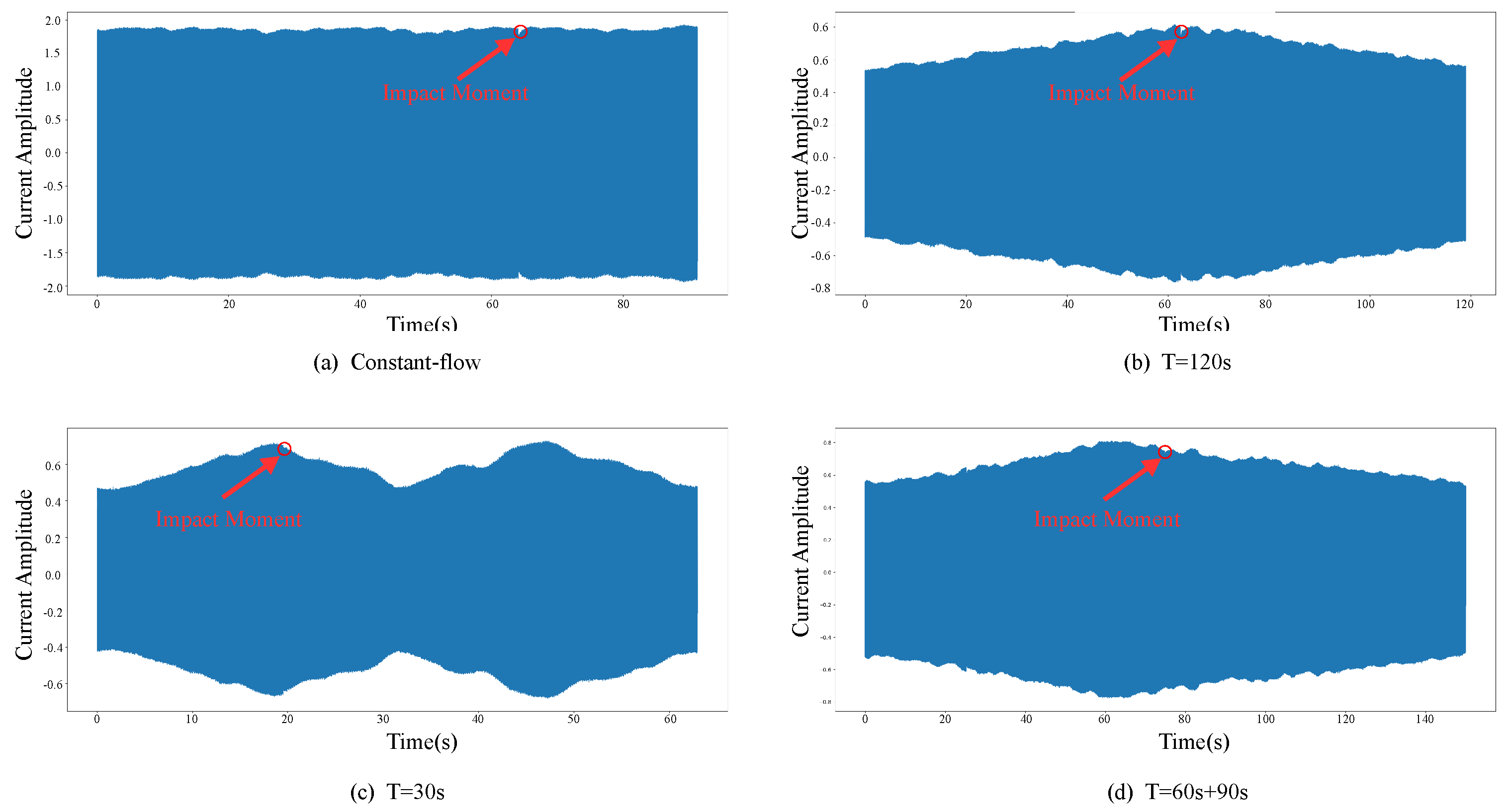
Based on the above settings, multiple sets of stator current signals under different cycle conditions were acquired through experiments, as shown in
Figure 6. The red-marked regions in the figure indicate the occurrence of impact faults. As the flow velocity and cycle conditions become increasingly variable, the impact faults become progressively more difficult to identify directly from the signals.
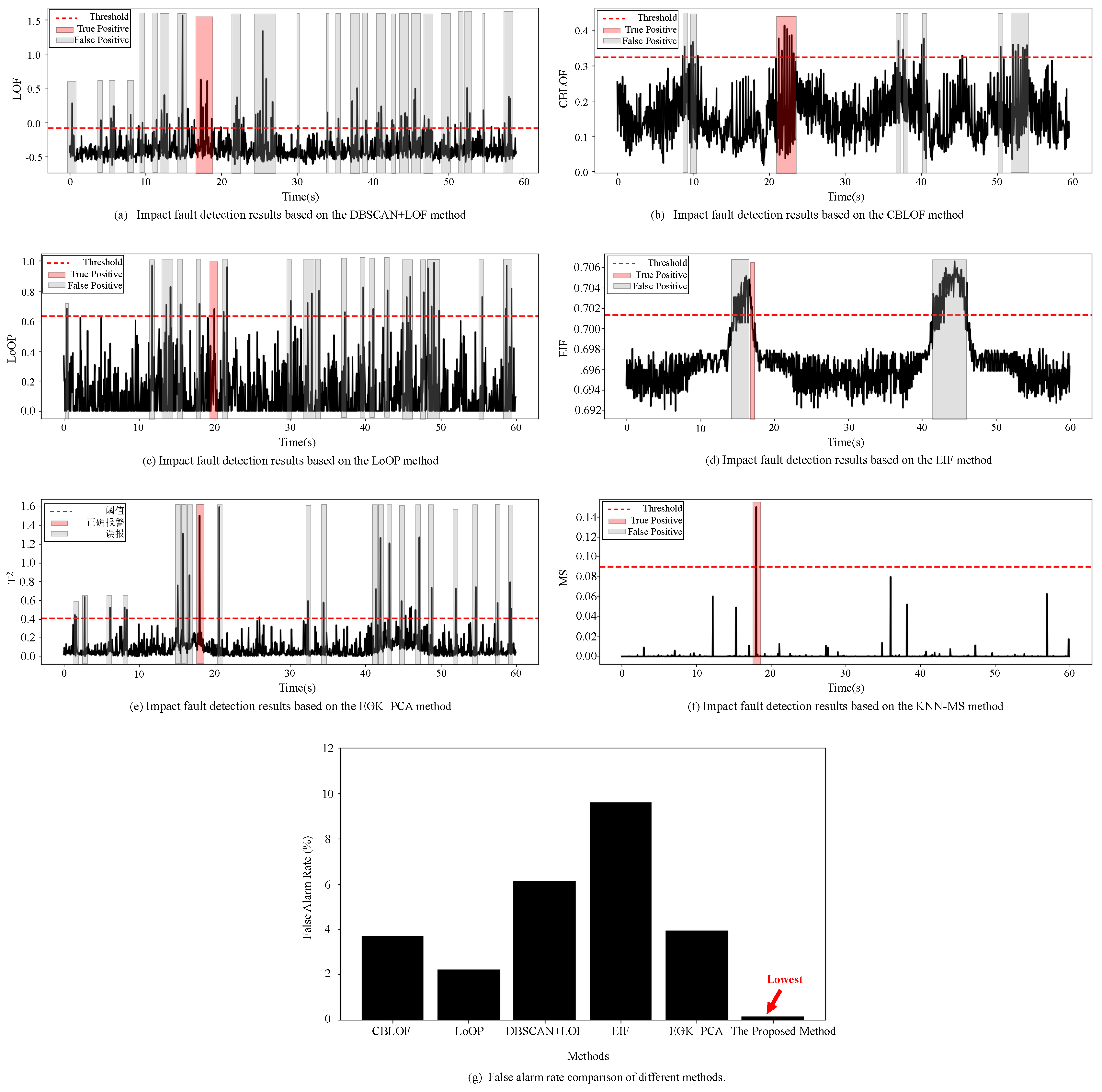
For a fair comparison, the detection threshold for each method was determined individually using historical healthy stator current signals under the corresponding operating condition. Specifically, the threshold of each model was trained using healthy data under the corresponding method, so that the detection results in
Figure 7 reflect the fault-identification capability of different methods under their own health-based decision criteria. It should be noted that the 60 s interval shown in
Figure 7 does not correspond to the startup transition stage. Instead, the data were collected after the experimental platform had reached a stable operating state, and the displayed segment contains the period in which blade impact faults were introduced. The current signals can be continuously extended beyond 60 s; only a representative 60 s segment is presented here for clarity of visualization and comparison among different methods. The results of six fault detection methods under variable flow velocity periods are presented, as shown in
Figure 7. The red dashed line represents the threshold derived from healthy data, and points exceeding this threshold are classified as faults. These results show that the proposed KNN-MS method outperforms all baseline approaches in terms of detection accuracy and stability. The methods evaluated and their observed performance are as follows:
- (1)
DBSCAN + LOF (
Figure 7a):This method exhibit numerous false alarms. This occurs because their cluster-based thresholding becomes unreliable when fault and normal samples overlap in the feature space under short flow periods.
- (2)
Cluster-Based Local Outlier Factor (CBLOF) (
Figure 7b) and Local Outlier Probability (LoOP) (
Figure 7c): These approaches show multiple sharp peaks in score distribution, indicating high sensitivity to flow fluctuations and weak responsiveness to impact fault features.
- (3)
Extended Isolation Forest (EIF) (
Figure 7d): Demonstrates instability under fluctuating conditions, with performance degrading as noise increases.
- (4)
Envelope Geometrical K-Means (EGK)+PCA (Hotelling’s
) (
Figure 7e): Performs better than clustering-based methods but still suffers accuracy loss in high-noise scenarios.
- (5)
Proposed KNN-MS (
Figure 7f): Fault and normal samples are clearly separated, resulting in high sensitivity to impact features and a significantly lower false alarm rate. This robustness stems from variance-adaptive weighting and multiplicative accumulation, which effectively mitigate the limitations of conventional algorithms under non-stationary flow conditions.
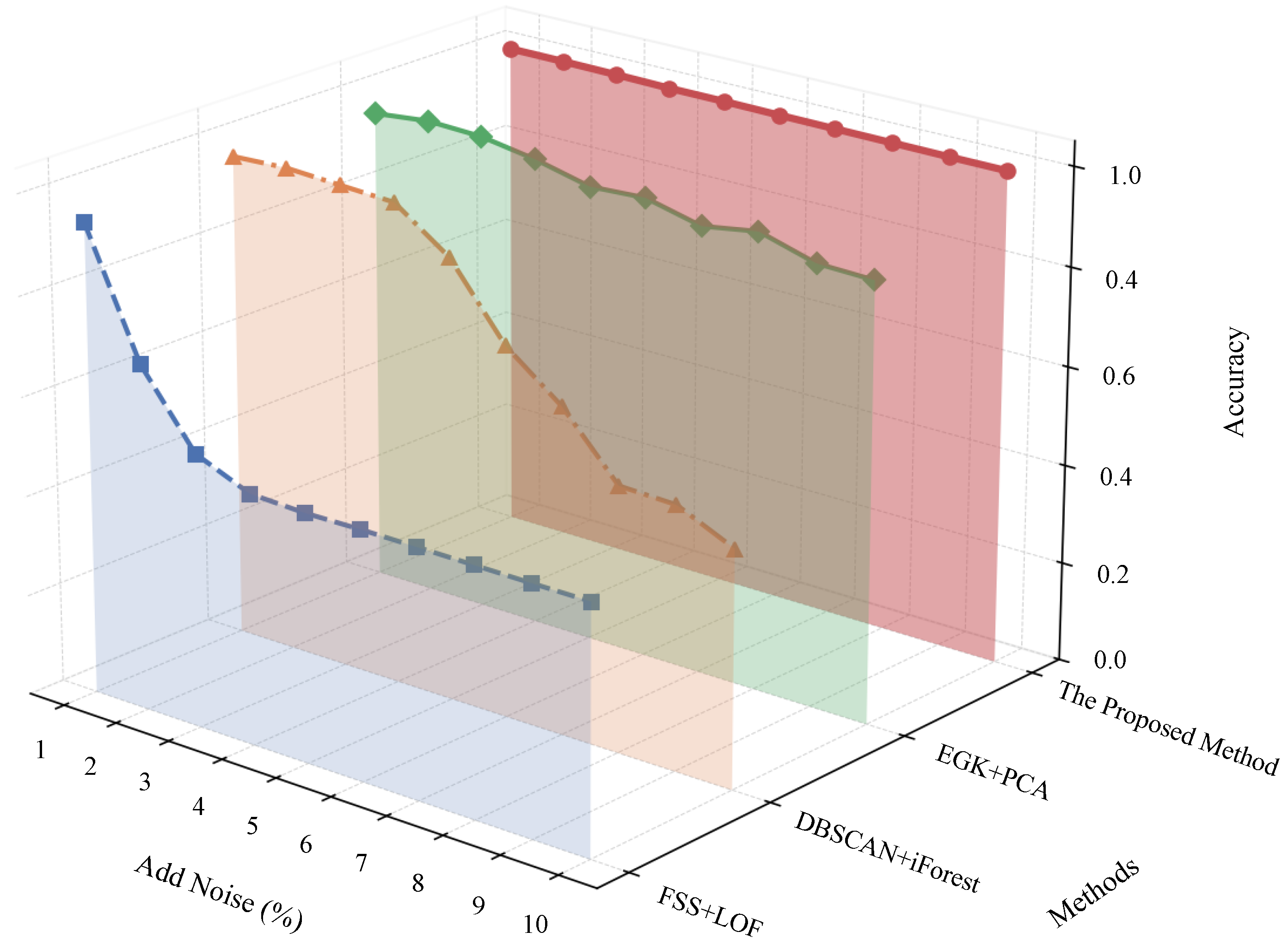
As shown in
Figure 8, the variation of detection accuracy under different noise levels is illustrated, and noticeable performance degradation is observed in conventional methods as noise increases. For instance, FSS+LOF and DBSCAN+iForest maintain acceptable accuracy at low noise ratios (0–3%), but their performance declines sharply beyond this range, revealing high sensitivity to noise and limited robustness. EGK+PCA performs better than these two methods; however, its accuracy also deteriorates once noise exceeds a certain threshold, indicating persistent challenges in high-noise scenarios. In contrast, the proposed KNN-MS method consistently achieves the highest and most stable accuracy across all noise levels. Compared with other methods, the proposed KNN-MS method shows the least decline in performance. These results display the superior noise resistance of the proposed approach, which effectively mitigates the adverse effects of noise through robust feature extraction and anomaly suppression.
The performance metrics of mainstream fault detection methods are compared in
Table 2. To evaluate the stability of the proposed method, the False Alarm Rate, Accuracy, and Precision reported in the table are presented in the form of mean ± SD. The proposed KNN-MS method records the lowest mean false alarm rate (0.12%) and the highest mean accuracy (99.88%), enabling a highly reliable distinction between normal and faulty samples. Its mean precision (95.96%) is also significantly higher than that of the competing techniques Moreover, the
p-values of the compared methods relative to the proposed KNN-MS method are all below 0.05, indicating that the performance differences between the proposed KNN-MS method and the compared methods are statistically significant rather than caused by random variations. These findings indicate that KNN-MS effectively minimizes false alarms while maintaining high detection sensitivity. In contrast, clustering-based methods such as DBSCAN+LOF and EIF are prone to density variations, while feature selection-based approaches like FSS+LOF still exhibit instability in boundary detection. Overall, the proposed method exhibits high robustness and accuracy in impact fault detection compared to existing alternatives.
6. Conclusions
Detecting underwater blade impact faults of TCT is inherently challenging due to the variability of operating conditions, including fluctuations in tidal flow velocity and cycle period. These dynamic changes distort signal characteristics, reduce feature separability, and significantly compromise the accuracy of fault detection. To address this problem, a novel method that combines KNN with a multiplicative scoring mechanism is proposed. The main contributions of this study are summarized as follows: (1) A variance-adaptive weighting strategy is proposed to enhance feature stability and robustness under non-stationary and noisy operating conditions. (2) A multiplicative cumulative scoring mechanism is developed to amplify fault-sensitive features and improve the separability between normal and faulty states in KNN-based fault detection. (3) Using a controlled test platform that replicates marine conditions, the proposed method achieved an accuracy of 99.88% and the false alarm rate of 0.12%. Its superior performance under varying flow conditions and noise levels reflects high robustness and practical applicability. These results indicate that variance-adaptive weighting and multiplicative accumulation are effective strategies for mitigating the limitations of traditional clustering-based and feature selection-based methods.
While the proposed method delivers high accuracy and stability, future research should explore its extension to multi-fault scenarios and large-scale deployments in real marine environments. Incorporating adaptive windowing or deep learning models could further enhance feature extraction and scalability. Such developments would strengthen the applicability of this method for complex operational settings and long-term monitoring.