This study aims to develop a comprehensive safety assessment framework for vehicle operations in maritime ports, including both autonomous (unmanned) and human-driven vehicles. The methodology integrates microsimulation techniques, advanced safety proxy measures, and empirically derived trajectory datasets to evaluate operational risks under realistic port scenarios. The framework is context-specific, capturing dynamic vehicle behavior and port environment complexities.
The study utilizes microscopic traffic simulation to model the intricate movements of individual vehicles within the constrained geometric layouts of a maritime port. This framework allows for the representation of diverse vehicle types, including automated guided vehicles, autonomous trucks, and human-driven terminal tractors. The simulation environment is calibrated to replicate the high-density operational spaces and frequent crossing movements characteristic of port terminals.
2.1. Data Collection and Study Environment
2.1.1. Trajectory Data
Empirical trajectory data used in this study were generated using the AIMSUN Next 24.0.1 microscopic simulation platform and exported for surrogate safety analysis. AIMSUN (Barcelona, Spain) enables the extraction of detailed vehicle-position data during simulation, allowing the creation of trajectory datasets suitable for safety evaluation. AIMSUN Next 44.0.1 was selected because the study required four capabilities within a single workflow: microscopic vehicle-level simulation, programmable mission-based control logic, direct generation of SSAM-compatible trajectories, and explicit representation of automated car-following behavior. These requirements are critical in port environments, where vehicle movements are task-driven rather than destination-driven and must therefore be controlled through operational logic in addition to conventional traffic-flow models. AIMSUN provides microscopic, mesoscopic, and hybrid simulation options, native ACC/CACC functionality, Python 3.13.13/C++26 APIs for customized control, and an SSAM extension for trajectory export, which made it suitable for the present study. Compared with PTV Vissim 2025, which is particularly strong for fully multimodal microscopic simulation and external model coupling, and with SUMO 1.26.0, which offers an open-source microscopic/intermodal framework, AIMSUN provided a more integrated workflow for this application because automated vehicle behavior, scenario execution, trajectory export, and safety-evaluation preparation could be handled within one environment. At the same time, AIMSUN has limitations: it is a licensed commercial platform, some extensions depend on API-enabled functionality, and it provides less code-level transparency than open-source platforms such as SUMO. Accordingly, AIMSUN was selected as the most appropriate compromise between model detail, extensibility, and SSAM compatibility for mission-based port safety analysis.
Within AIMSUN, vehicle trajectory files were created using the SSAM exporter. This exporter generates trajectory files that contain detailed vehicle movement information recorded during microscopic simulation. Only trajectory data derived from microscopic simulations are compatible with SSAM analysis.
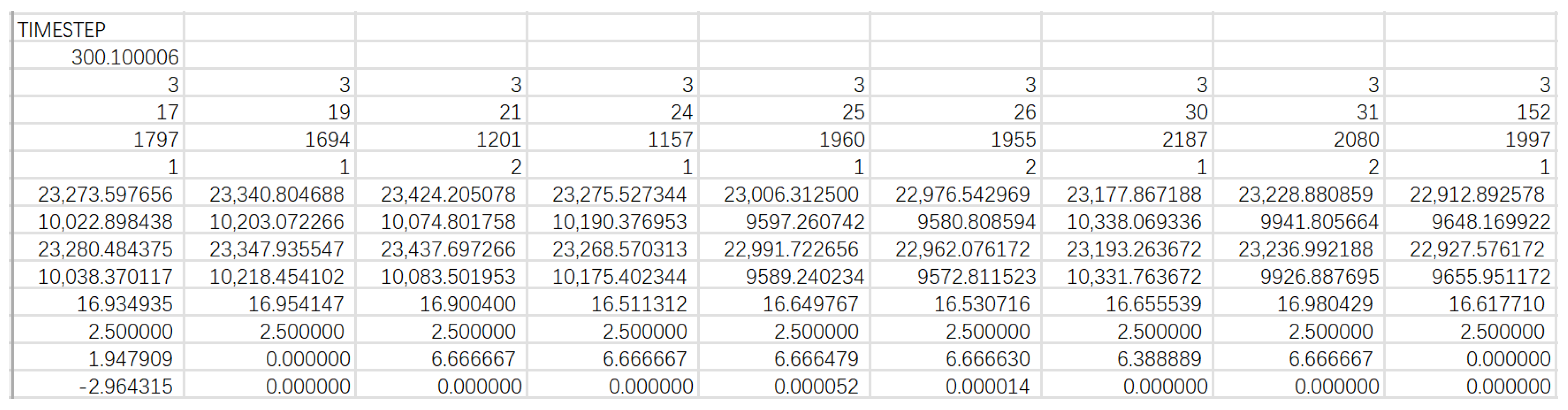
The exported trajectory files include time-dependent vehicle information such as vehicle identification, position coordinates, speed, and acceleration at each simulation step. These high-resolution trajectory datasets provide a detailed representation of interactions between autonomous and human-driven vehicles within the simulated port network.
To generate the trajectory data, the SSAM export option was activated in the AIMSUN scenario settings. During simulation, vehicle positions were recorded and stored in trajectory (.trj) files over specified time intervals. The exported files also included coordinate system information to ensure correct spatial positioning of vehicle movements.
These trajectory files were subsequently used as input for the SSAM, which analyzes vehicle interactions and identifies potential conflicts using surrogate safety indicators such as TTC and PET.
Figure 1 shows a fragment of the trajectory file exported from AIMSUN for subsequent SSAM analysis. Each record contains the simulation time stamp, vehicle identifier, spatial coordinates, speed, and acceleration, which together reconstruct the time-dependent trajectory of each vehicle. These data constitute the direct input for TTC and PET calculations and therefore form the evidential link between the microsimulation model and the surrogate safety assessment.
2.1.2. Port Terminal Representation
The port terminal was modeled as a microscopic traffic network using AIMSUN. Following [
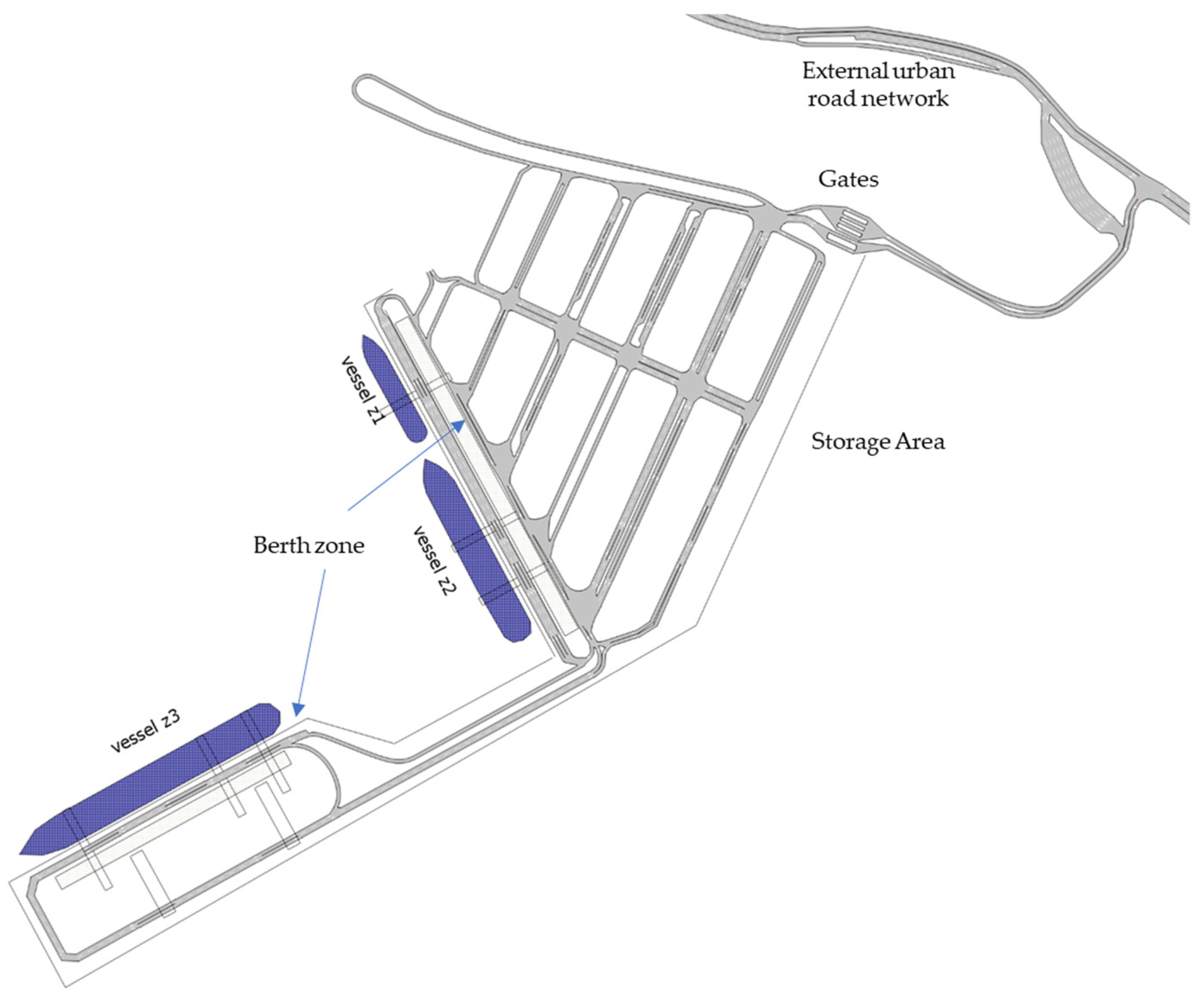
22], the terminal is represented as a system of interconnected operational areas, including internal road infrastructure, loading and unloading zones, and storage areas. These areas are connected through a network of links and nodes representing internal circulation routes and intersections. The port operational environment provides a realistic and structured setting for analyzing conflicts between unmanned and human-driven vehicles. This environment is characterized by the following: the port operational environment is a confined industrial zone, closed to public traffic and dedicated exclusively to freight handling. Its infrastructure comprises several interconnected components: an internal road network, terminal gates, parking and staging areas (storage yard), and berths. The internal roads feature specific lane configurations, intersections, and traffic management schemes such as give-way rules, speed limits, and reserved lanes, which collectively define how vehicles navigate and interact. Parking areas are organized into zones associated with specific berths, with each parking spot uniquely identified to enable precise maneuvering for parking, reversing, and trailer handling. At the boundaries, in-gates and out-gates act as controlled checkpoints where vehicles must stop for administrative processing, creating queues and potential bottlenecks.
Traffic within this environment is characterized by a heterogeneous mix of vehicle types, including AGVs and human-driven trucks (lorries with trailers, articulated lorries), tractors, passenger cars, and specialized cargo carriers. Demand is event-driven, generated primarily by vessel schedules: ship arrivals and departures trigger waves of truck movements, creating predictable but intense periods of high activity.
Operational rules and procedures govern all vehicle movements. At gates, vehicles experience delays due to customs, security checks, or administrative formalities—stops that are mandatory and vary in duration. Once inside, vehicles are assigned to specific parking areas based on their destination berth; however, if a designated area reaches full capacity, vehicles overflow into adjacent zones, leading to unplanned interactions. Finally, at the berths, vehicles must interact closely with vessel ramps and loading equipment, requiring careful coordination and precise movements to ensure safe and efficient loading and unloading processes. The environment naturally generates specific points where interactions between unmanned and human-driven vehicles are most intense and safety risks are highest.
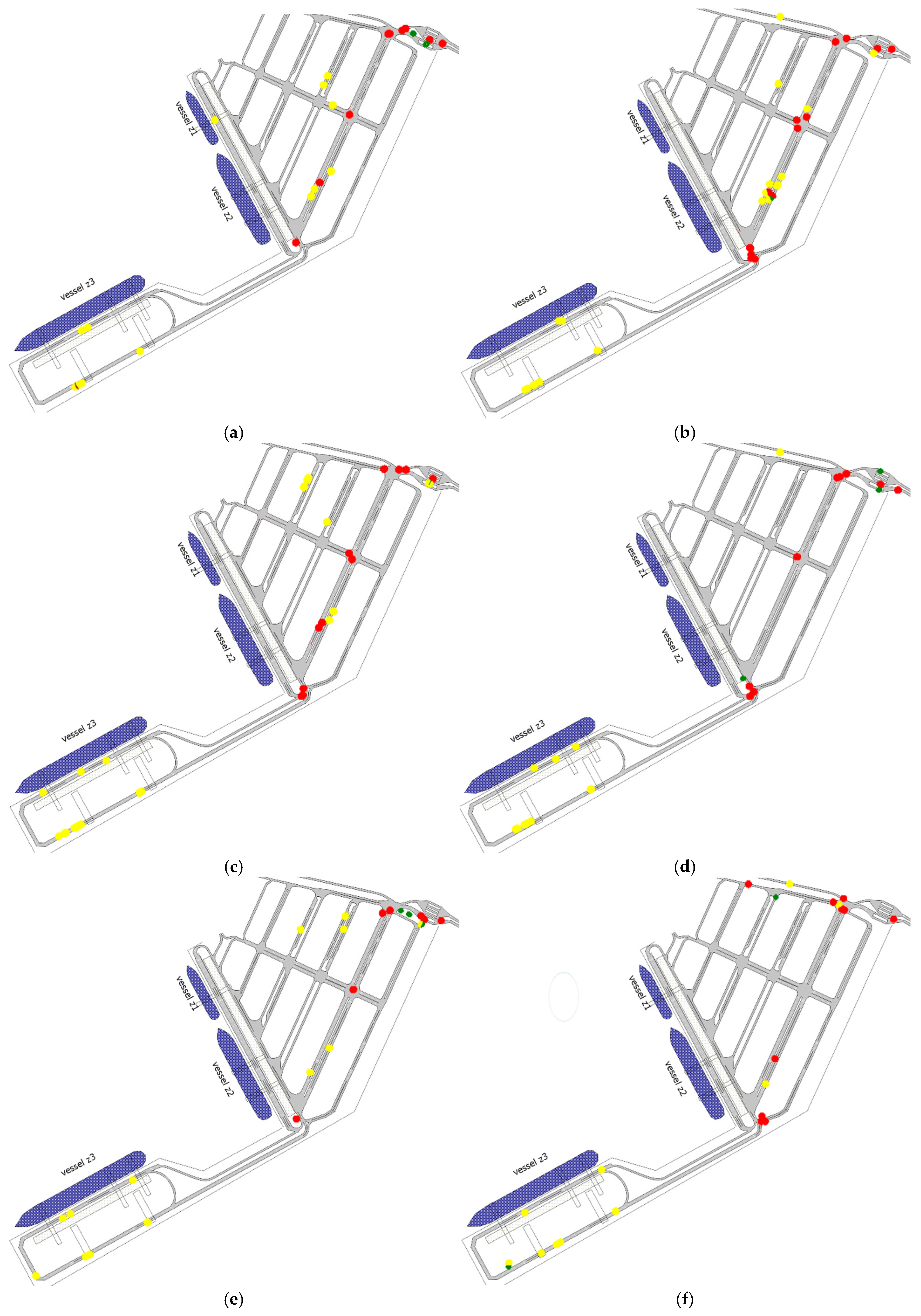
Table 1 presents a description of the key conflict zones.
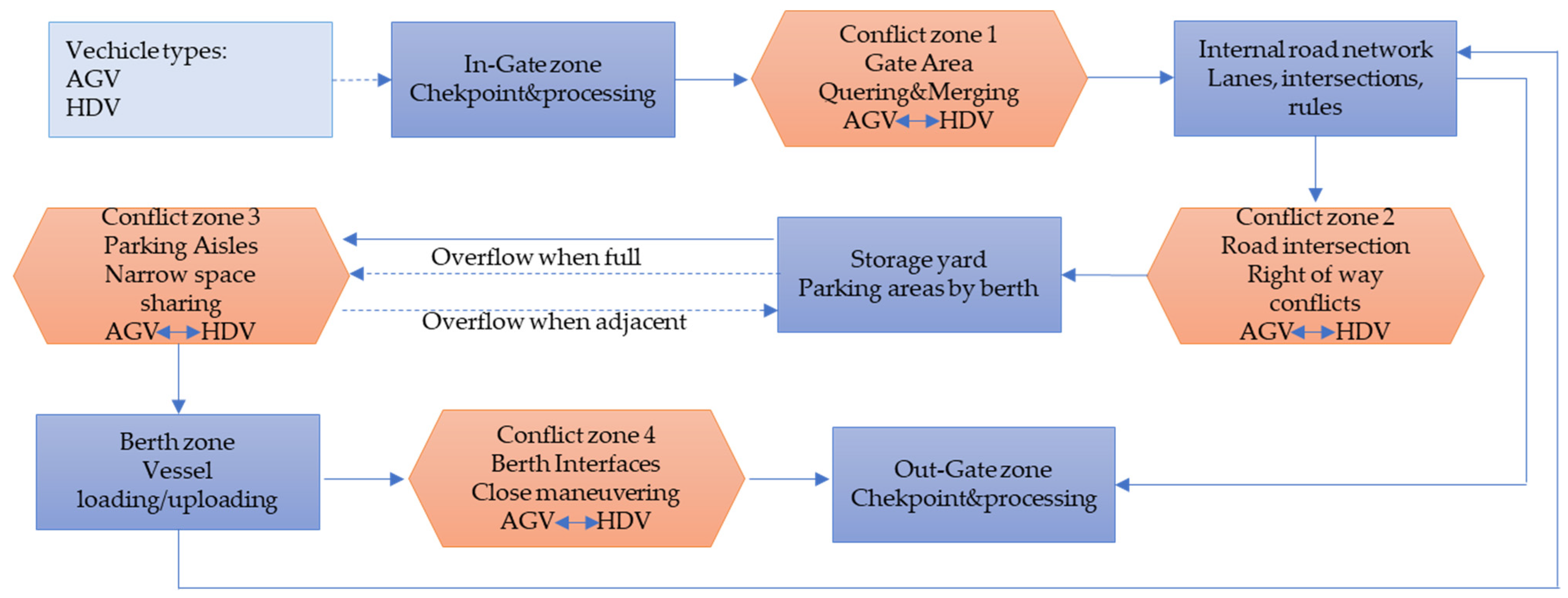
The conceptual diagram presented in
Figure 2 illustrates the spatial configuration of a maritime port environment, delineating both infrastructural components and zones of heightened interaction between unmanned and human-driven vehicles. This representation serves as a foundational tool for analyzing traffic dynamics and identifying critical points where conflicts are most likely to emerge.
Infrastructure Zones are depicted in blue and represent the physical assets that constitute the port’s operational backbone. These include the in-gate and out-gate zones, where vehicles undergo administrative processing; the internal road network, which facilitates connectivity between functional areas; the storage yard, organized into parking zones associated with specific berths; and the berth interfaces themselves, where vessel loading and unloading occur. Each of these zones possesses distinct geometric and operational characteristics that influence vehicle behavior and interaction patterns.
Conflict Hotspots are highlighted in red and mark the specific locations where interactions between automated and human-driven vehicles become most intense. These zones are not arbitrary but emerge from the convergence of traffic flows, spatial constraints, and operational procedures. Conflict Zone 1 at the gate area involves queuing and merging maneuvers under stop-and-go conditions. Conflict Zone 2 at road intersections involves right-of-way negotiations where human driver unpredictability poses challenges for automated logic. Conflict Zone 3 within parking aisles involves narrow-space sharing, reversing maneuvers, and blocking events. Conflict Zone 4 at the berth interface involves close-proximity maneuvering under time pressure during loading operations.
Primary Vehicle Flow Paths are indicated by solid arrows and represent the intended trajectories of vehicles as they move through the port system. Vehicles enter through the in-gate, proceed along internal roads, access designated parking areas, and ultimately approach the berth for loading or unloading. After completing these operations, they depart via the internal road network to the out-gate. These flow paths define the baseline operational pattern against which deviations and disruptions must be assessed.
Overflow Paths are represented by dashed arrows and illustrate the alternative trajectories that vehicles must adopt when primary parking areas reach full capacity. Under such conditions, vehicles are redirected to adjacent parking zones, creating unplanned interactions and introducing additional complexity into traffic patterns. These overflow movements are critical to understanding system resilience and the propagation of congestion under peak demand conditions.
The integration of these elements within a single diagrammatic framework enables systematic analysis of port operations from a safety perspective. By mapping infrastructure, conflict zones, and vehicle trajectories onto a common spatial reference, researchers and practitioners can identify vulnerable points in the system, design targeted interventions, and evaluate the potential impacts of introducing unmanned vehicles into existing operational environments. This visual tool thus serves not merely as an illustration but as an analytical instrument for understanding and mitigating conflict dynamics in mixed-traffic port settings.
While
Figure 2 establishes the spatial architecture of the port terminal, delineating infrastructure components, vehicle trajectories, and localized conflict hotspots, it primarily reflects the geometric and topological structure of the system. However, in complex freight terminals, conflict formation is not governed solely by spatial co-location. It is the outcome of coupled operational processes, traffic demand fluctuations, capacity constraints, and heterogeneous vehicle behavior operating within that spatial framework.
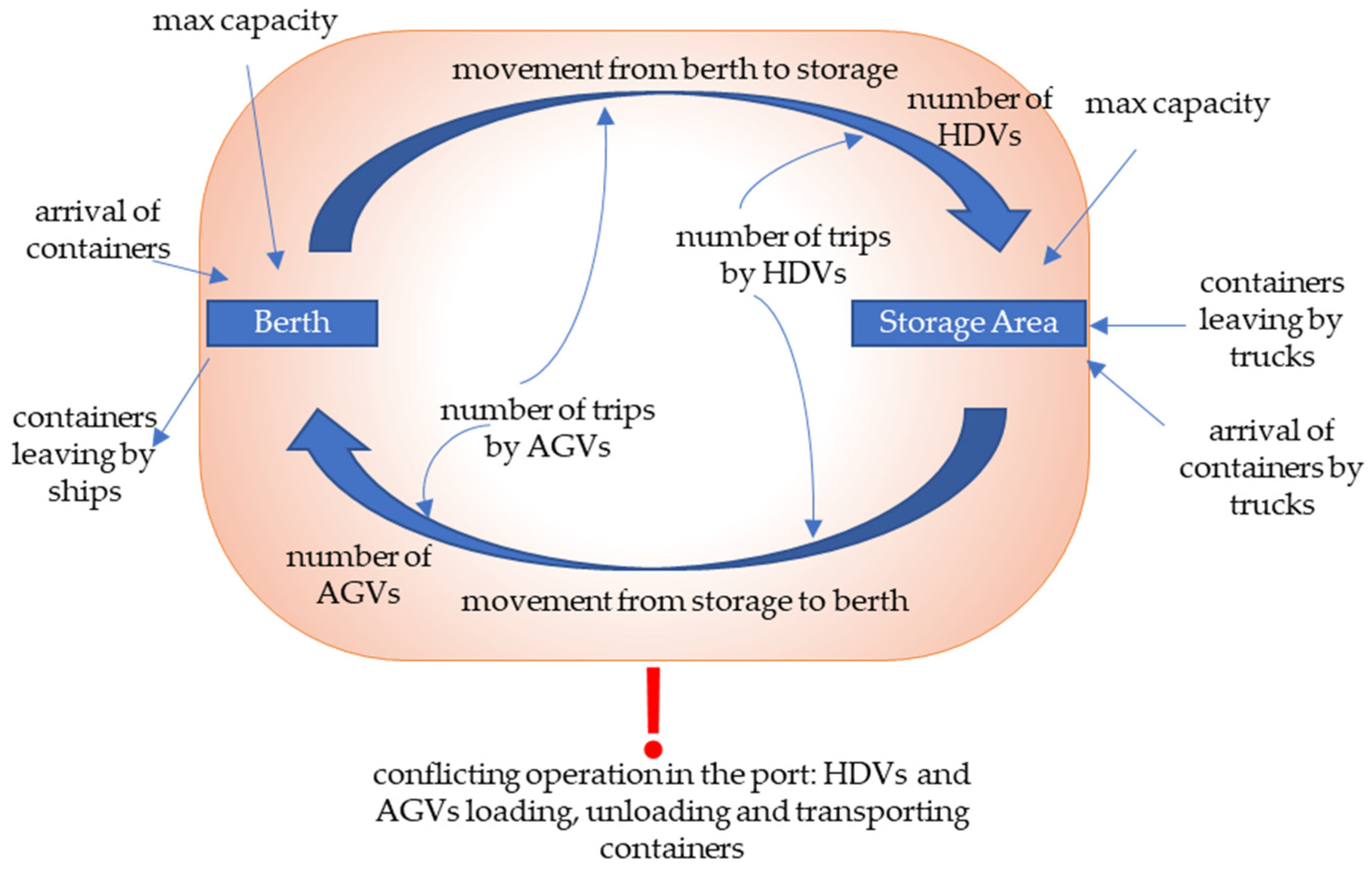
To extend the analysis beyond static configuration, the subsequent diagram on
Figure 3 reformulates the port terminal as a capacity-constrained, flow-driven dynamic system in which conflicts emerge as endogenous products of interacting operational subsystems. In this representation, the berth and storage yard function as interconnected service nodes with finite handling capacities. Container arrivals and departures generate transport demand, which in turn induces bidirectional vehicle flows between these nodes through the internal road network.
The number of trips performed by AGVs and HDVs becomes a key state variable governing interaction density. As transport intensity increases, shared corridors, intersections, and merging areas experience elevated vehicle encounters. Under mixed-traffic conditions, behavioral heterogeneity—algorithm-driven control in AGVs versus stochastic human driving responses—introduces additional variability into gap acceptance, yielding behavior, and speed adaptation processes.
Within this systems perspective, conflicts are conceptualized as emergent phenomena resulting from:
Flow imbalance between berth and yard operations.
Saturation effects at capacity-constrained nodes.
Fleet composition and AGV penetration rate.
Delay propagation and queuing dynamics within the internal network.
Capacity saturation at either the berth or storage yard induces spillback effects that propagate upstream through the transport network, increasing vehicle density and reducing available maneuvering space. These conditions amplify the probability of temporal and spatial proximity events, which are subsequently captured through surrogate safety indicators such as TTC and Post-Encroachment Time-PET.
Accordingly, while the initial diagram characterizes the spatial distribution of conflict-prone locations, the dynamic representation models the system-level mechanisms that generate and intensify conflict exposure. The integration of both perspectives establishes a multi-layer analytical framework that links infrastructure geometry, operational throughput, fleet interaction dynamics, and safety performance within a unified port traffic model.
2.2. Surrogate Safety Assessment
The exported vehicle trajectory files were analyzed using the Surrogate Safety Assessment Model (SSAM). SSAM processes time-dependent vehicle trajectories to identify potential traffic conflicts based on spatial and temporal proximity between vehicles [
23].
Two surrogate safety measures were used to evaluate operational safety:
Time-to-Collision (TTC): Indicates the remaining time before a potential collision occurs if two vehicles maintain their current speed and trajectory.
Post-Encroachment Time (PET): Represents the time difference between two vehicles passing through the same conflict point.
TTC represents the remaining time before two vehicles would collide if they continue moving with their current speeds and trajectories.
For a longitudinal car-following scenario:
where
—relative distance between the rear of the leading vehicle and the front of the following vehicle, m;
—relative speed, m/s.
—speed of the following vehicle, m/s;
—speed of the leading vehicle, m/s.
TTC is only defined when > 0 (i.e., when the following vehicle is approaching the leader).
For crossing or intersecting trajectories (as in SSAM), TTC is computed as:
where
—projected time at which vehicle trajectories intersect;
—current simulation time.
A conflict is identified when TTC falls below a predefined threshold (commonly 1.5–2.0 s).
TTC is typically illustrated as:
Distance gap between vehicles = ;
Closing speed = ;
If no braking occurs, collision happens after time = TTC;
In intersection conflicts:
Two projected trajectories intersect at a future point.
TTC measures how soon both vehicles would reach that collision point simultaneously.
Post-Encroachment Time (PET) measures the time difference between two vehicles passing through the same conflict point.
where
t1—time when the first vehicle leaves the conflict area, s;
t2—time when the second vehicle enters the same area, s.
PET ≥ 0 by definition.
A small PET indicates a severe near-miss situation. Typical critical thresholds range between 1.0 and 2.5 s.
Consider two vehicles crossing at an intersection:
Vehicle A passes through the conflict point at time t1; Vehicle B arrives at the same point at time t2
The safety margin is (4).
If PET is small, the vehicles passed the same spatial location within a very short time interval, indicating high conflict severity [
24].
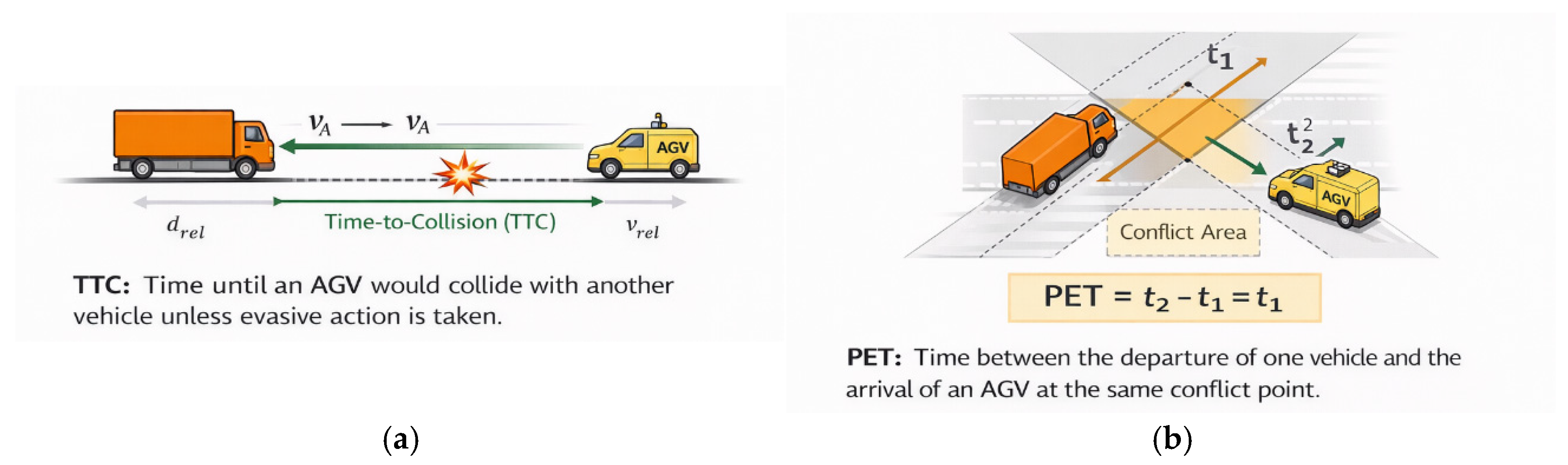
In mixed AGVs–HDVs port operations, surrogate safety indicators are employed to quantify different dimensions of interaction risk (see
Figure 4). TTC measures the remaining time until a projected collision would occur if two vehicles continued along their current trajectories without evasive action. As such, TTC captures prospective collision risk, particularly in longitudinal and merging situations, including queuing areas, approach segments, and berth access corridors.
In contrast, PET measures the temporal separation between two vehicles sequentially occupying the same spatial conflict area. PET therefore reflects realized temporal proximity in shared spaces, such as intersections, parking aisles, and berth interface zones, where vehicle paths cross rather than follow one another.
Whereas TTC evaluates the imminence of a potential collision under dynamic approach conditions, PET quantifies the safety margin after one vehicle has cleared a conflict zone and before another enters it. The two indicators thus capture complementary aspects of traffic safety: TTC represents anticipatory risk in continuous interaction, while PET represents residual safety margins in discrete spatial conflicts.
Together, TTC and PET enable a comprehensive assessment of:
Interaction intensity within shared operational corridors, and the severity and frequency of near-conflict events in mixed autonomous–human traffic environments.
In this study, both indicators are derived from time-stamped vehicle trajectory data obtained through microscopic simulation and subsequently processed using a surrogate safety assessment framework. This approach allows conflict identification without relying on observed crash data, which are typically rare in controlled port environments [
25].
In surrogate safety analysis, TTC and PET thresholds are analyst-defined parameters used to classify conflict severity. Typical threshold values reported in microscopic simulation and SSAM-based studies range between 1.0 and 2.0 s for TTC and between 1.0 and 2.5 s for PET [
26]. However, these values are context-dependent and must be calibrated according to the operational environment and speed regime under investigation [
27].
These indicators are extracted from time-stamped vehicle trajectory data exported from microscopic simulation (e.g., AIMSUN) and processed using SSAM. TTC and PET were used to detect, classify, and quantify conflicts between vehicles operating in the port terminal environment. Conflict frequency and severity were calculated to evaluate safety performance under mixed-traffic conditions.
2.3. Calibration and Simulation Execution
The microscopic simulation model was configured to replicate realistic vehicle movement patterns within the port road network. Simulation runs were conducted under a fixed nominal traffic demand profile and consistent operational conditions to generate stable and representative vehicle trajectory datasets. Each run used a 6 h simulation horizon with an initial 30 min stabilization (warm-up) period, and the full modeled period was retained for safety evaluation. Behavioral parameters governing both autonomous and human-driven vehicles were calibrated to ensure consistent and realistic interaction dynamics throughout the simulated environment. The behavioral parameters for AGVs were calibrated based on values reported in the recent literature and industry standards (see
Table 2):
- -
Desired Speed: 15–25 km/h (4.2–6.9 m/s).
The selection of this speed range is based on a trade-off between operational efficiency and energy consumption. Research indicates that AGV speed optimization is a key factor in task scheduling. In [
28], it is demonstrated that at a fixed speed, higher travel speeds may lead to increased idle time and energy consumption. Speed optimization allows these factors to be balanced. In port terminals, AGVs operate on dedicated routes with speed limits dictated by safety requirements and the geometry of the pathways.
- -
Reaction Time: 0.1–0.3 s
AGV reaction time is determined by sensor delays (LIDAR/camera) and the data processing time of the controller. Industrial standards establish strict requirements for the response time of safety systems. According to the [
29], the response time tolerance for control systems of autonomous machines must not exceed 50 ms (0.05 s). This confirms that values of 0.1–0.3 s are realistic, accounting for various sensors and computational delays. Additionally, research [
30] examines AGV interactions with humans in dispatch areas and emphasizes the importance of fast reaction times for collision prevention.
- -
Sensitivity Factor: 1–1.2
AGVs employ more responsive acceleration control algorithms compared to human drivers. This is due to the absence of human perceptual delays and the availability of precise real-time sensor data. A factor of 1.0 represents the standard human response—smooth, linear, and limited by biological reaction times. Humans estimate distance visually and react gradually. Research confirms that human driver behavior exhibits “asymmetric importance of parameters” where different input factors have varying levels of influence on model outputs, requiring complex calibration to account for driver heterogeneity. The 1.2 value for AGVs reflects their superior capabilities. Studies on the Intelligent Driver Model demonstrate that variance-based sensitivity analysis can identify “which of the input factors can be fixed anywhere in their range of variation without appreciably affecting a specific output of interest”.
- -
Maximum Deceleration: 1.5–4.0 m/s2
AGV braking must be sufficient to ensure safety but not excessively abrupt, in order to avoid cargo shifting and the creation of hazardous situations for following vehicles. The Chinese national safety standard GB/T 41355-2022 establishes a methodology for calculating dynamic safety distances considering braking capability [
29]. In applications with laser safety scanners, verified deceleration of at least 3 m/s
2 is required for emergency braking. For comfort/operational braking, values of 1.5–4.0 m/s
2 are realistic. Additionally, the speed control strategy proposed [
31] allows for the avoidance of sudden stops, thereby reducing equipment wear and enhancing safety. This confirms that smooth deceleration (1.5–4.0 m/s
2) is preferable to emergency braking.
- -
Maximum Acceleration: 0.5–1.0 m/s2
Acceleration limits for AGVs are determined by cargo stability requirements and the structural characteristics of the vehicle. Excessive acceleration can lead to tipping or cargo shifting. A study on the dynamic stability of forklift AGVs [
32] analyzes the influence of the center of gravity on the stability of a forklift AGV. At maximum load (1600 kg) and maximum lift height (3.405 m), the acceleration limit is 1.12 m/s
2, and the deceleration limit is 0.56 m/s
2. This directly supports the selected range. Furthermore, research on heavy-duty AGVs by [
33] defines optimal acceleration values for heavy-duty AGVs as 0.2 m/s
2 on straight sections and 0.3 m/s
2 on curves. These values vary depending on AGV type and operating conditions, confirming the need for calibration within the 0.5–1.0 m/s
2 range for standard port AGVs.
- -
Gap: 0.3–0.8 s
AGVs employ conservative decision-making algorithms when performing maneuvers such as turns, lane changes, and merging onto main roads. This is due to the absence of the ability for “risky” assessments characteristic of human drivers. The industrial safety standard R15.08 [
34], emphasizes the distinction between AGVs (which follow predetermined paths) and autonomous mobile robots. AGVs utilize obstacle detection and can adjust their path, but their decision-making algorithms are conservative by nature. This necessitates longer time gaps for performing maneuvers compared to human drivers.
Table 2.
Behavioral parameters for AGVs and HDVs.
Table 2.
Behavioral parameters for AGVs and HDVs.
| Parameter | HDV | AGV | Unit/Notes |
|---|
| Desired Speed | 30–40 | 15–25 | km/h |
| Reaction Time | 0.8–1.4 | 0.1 | s |
| Sensitivity Factor | 1.0 | 1.2 | |
| Max. Acceleration | 1.0 | 0.8 | m/s2 |
| Max. Deceleration | 2.5–3.5 | 3.5 | m/s2 |
| Gap | 1.5 | 0.8 | seconds |
Vehicle movements within the port terminal were simulated using the microscopic behavioral models implemented in AIMSUN, which represent vehicle dynamics through car-following and lane-changing mechanisms. These models determine the longitudinal and lateral motion of vehicles at each simulation time step and enable the realistic reproduction of traffic interactions within complex operational environments.
HDVs were modeled using the Gipps car-following model, which describes the longitudinal dynamics of a vehicle based on driver perception–reaction time and safety constraints relative to the leading vehicle.
The car-following model implemented in AIMSUN is based on the Gipps model. It can be regarded as a specific development of this empirical model, in which the parameters are not global but are determined by the influence of local factors depending on driver type, the geometric characteristics of the road section, the maximum speed allowed on the section, the speed on curved alignments, the influence of vehicles in adjacent lanes, and others. The model essentially consists of two main components: acceleration and braking.
The first component represents the driver’s intention to reach a certain desired speed, while the second reproduces the constraints imposed by the vehicle ahead traveling at its desired speed.
This model establishes the maximum speed to which vehicle (n) can accelerate over a time interval (t + T):
where
V(n,t)—speed of vehicle n at time t;
V∗(n)—desired speed of vehicle n for the given section;
a(n)—maximum acceleration for vehicle n;
T—reaction time, i.e., the update interval—simulation time step.
On the other hand, the maximum speed that the same vehicle (
n) can achieve over the same time interval (
t +
T), considering its own characteristics and the constraints imposed by the presence of the leading vehicle, is given by:
where
d(n) (<0)—maximum deceleration desired for vehicle n;
x(n,t)—position of vehicle n at time t;
x(n − 1,t)—position of the preceding vehicle (n − 1) at time t;
S(n − 1)—effective length of vehicle (n − 1);
d’(n − 1)—an estimate of the desired deceleration of vehicle (n − 1).
In any case, the determining speed for vehicle n over the time interval (
t +
T) is the minimum of these two previously defined speeds:
Subsequently, the position of vehicle
n within its current lane is updated using this speed in the equation of motion:
This behavioral structure captures the variability and uncertainty associated with human driver decisions within complex port traffic environments.
AGVs were modeled using the Adaptive Cruise Control (ACC) framework available in AIMSUN. In this model, vehicle motion is regulated through automated gap control to maintain a desired time headway relative to the leading vehicle.
The longitudinal acceleration of an ACC vehicle is defined as:
where
v(t)—current vehicle speed;
vdes—desired speed;
s(t)—actual spacing to the leading vehicle;
sdes—desired spacing;
kv, ks—control gains regulating speed and spacing adjustments.
The desired spacing is typically expressed as:
where:
—minimum standstill spacing;
T—desired time headway.
Unlike HDVs, AGVs follow predefined routes within the port terminal and typically operate without discretionary overtaking maneuvers. Therefore, lane-changing behavior was restricted to route-based movements, reflecting the deterministic navigation logic commonly used in automated terminal transport systems.
Accurate representation of vehicle operations in port microsimulation requires a custom control script [
35], as standard traffic assignment principles (e.g., shortest-path routing) do not reflect task-driven port logistics. In maritime terminals, vehicle movements are mission-based—transporting containers between berths, storage yards, and gates—rather than destination-driven. The custom script provides an operational control layer, assigning tasks and enforcing predetermined movement corridors.
The proposed multi-layer simulation architecture integrates operational control, traffic dynamics, and safety assessment:
Operational Logic Layer: A custom script governs terminal logistics—assigning missions, managing queues at checkpoints, and regulating access to loading areas—ensuring that vehicle behavior reflects real operational rules.
Traffic Dynamics Layer: Microscopic movement is simulated using the AIMSUN engine. HDVs follow the Gipps car-following model, while AGVs operate under an Adaptive Cruise Control based automated driving model. Both generate detailed trajectory data at each simulation step.
Safety Evaluation Layer: Trajectories are analyzed using the SSAM with two key indicators—TTC and PET—to detect and quantify conflicts without reliance on historical crash data.
This integrated framework enables comprehensive analysis of interaction patterns and conflict formation in mixed-traffic port environments involving both human-driven and automated vehicles.