Article

A CFD-in-the-Loop Control Simulation and Parameter Optimization Framework for Large-Angle Yaw Maneuvers of AUVs


1
School of Naval Architecture and Ocean Engineering, Jiangsu University of Science and Technology, Zhenjiang 212003, China
2
Wuhan Second Ship Design & Research Institute, Wuhan 430205, China
*
Author to whom correspondence should be addressed.
J. Mar. Sci. Eng. 2026, 14(8), 716; https://doi.org/10.3390/jmse14080716
Submission received: 10 March 2026 / Revised: 4 April 2026 / Accepted: 8 April 2026 / Published: 13 April 2026
(This article belongs to the Special Issue Overall Design of Underwater Vehicles)

Abstract

For AUVs operating under large-rudder-angle yaw maneuvering conditions, linearized hydrodynamic-derivative models often fail to accurately capture strongly nonlinear flow effects, and the applicability of control parameters becomes limited. To address these issues, this paper proposes a CFD-in-the-loop control simulation and parameter optimization framework for large-rudder-angle yaw maneuvers. Based on a coupled hull–propeller–rudder solution method, an unsteady CFD motion simulation model is developed that simultaneously accounts for propeller wake, rudder inflow, and hull-flow interaction, thereby enabling a strongly coupled solution of flow-field evolution and the six-degree-of-freedom motion of the vehicle. On this basis, a CFD-in-the-loop closed-loop control simulation framework is established by integrating the controller, actuator dynamic model, virtual sensors, and CFD motion simulation module into a unified framework, thereby realizing closed-loop computation of control input, flow response, motion update, and state feedback. Furthermore, under the same controller structure and parameter settings, the large-rudder-angle yaw responses predicted by the linearized hydrodynamic-derivative model and the CFD-in-the-loop simulation framework are compared and analyzed. This comparison reveals the dependence of control parameters on the underlying dynamic model and highlights their limited applicability under strongly nonlinear operating conditions. Finally, to address the high computational cost of CFD-in-the-loop simulations, a surrogate-model-based control parameter optimization method is developed to improve parameter tuning efficiency and enhance closed-loop control performance. The results show that the proposed CFD-in-the-loop control simulation framework can effectively characterize the nonlinear hydrodynamic effects arising during large-rudder-angle maneuvers, and provides a more physically consistent basis for control parameter optimization, analysis, and design.

1. Introduction

Autonomous underwater vehicles (AUVs), which possess the advantages of autonomous navigation, good concealment, high maneuverability, and strong adaptability to complex ocean environments, have been widely employed in tasks such as marine resource survey, underwater topographic mapping, target search, environmental monitoring, and equipment inspection [1,2,3]. As mission scenarios have gradually expanded from conventional cruising to operating conditions such as near-bottom operations, maneuvering in complex obstacle environments, and rapid emergency response, higher requirements have been imposed on the heading adjustment capability and motion control performance of AUVs under highly maneuvering conditions. In particular, during target avoidance, path replanning, station tracking, and emergency handling, the vehicle often needs to accomplish a large-amplitude turn within a short period of time, thereby entering a large-rudder-angle yaw maneuvering state [4]. Such maneuvering processes are characterized by rapid response, pronounced attitude variation, and complex flow-field evolution, and have become one of the important operating conditions affecting the maneuvering performance and control quality of AUVs [5].
AUV heading control is usually established on the basis of a six-degree-of-freedom dynamic model, with heading regulation achieved through the combined action of propeller thrust and rudder control forces [6]. Under conventional small-rudder-angle and weakly maneuvering conditions, hydrodynamic models linearized about a steady operating point possess the advantages of clear structure, concise parameterization, and convenience for controller design, and have therefore been widely applied in the analysis and parameter tuning of heading control systems. Mazin et al. [7] developed a fourth-order linear AUV state-space model for depth and pitch control, and designed an LQR controller based on this linear model. Fan et al. [8] derived a five-degree-of-freedom linearized AUV model and, on this basis, designed a fuzzy adaptive PID controller for trajectory tracking. Jin et al. [9] established a linear attitude control model for a small unmanned underwater vehicle and proposed a model-reference adaptive PID algorithm suitable for large-angle turning. These methods exhibit good control performance under small-disturbance conditions, but they remain fundamentally dependent on the linearization assumption. However, once an AUV enters a large-rudder-angle yaw maneuvering state, the interaction among hull flow, propeller wake, and the local flow around the rudder becomes significantly stronger, and the flow field is often accompanied by pronounced unsteady separation, wake evolution, and strong local interference effects, causing the hydrodynamic behavior of the system to exhibit strong nonlinearity and time-varying characteristics [10,11]. Under such conditions, linear models constructed on the basis of the small-disturbance assumption can no longer accurately describe the coupling between motion response and hydrodynamic loads during actual maneuvers, thereby leading to discrepancies between controller design results and the true dynamic environment.
To address the limited applicability of linear models under highly maneuvering conditions, existing studies have mainly proceeded along two lines. One approach seeks to improve the capability of low-order control models to characterize complex maneuvering behavior by introducing nonlinear hydrodynamic terms, augmented dynamic models, or system identification methods. The other adopts higher-order or more sophisticated control strategies to enhance system robustness in the presence of model uncertainty and external disturbances. Although these methods improve AUV heading control performance to a certain extent, their analysis and parameter tuning processes still rely largely on dynamic models based on hydrodynamic derivatives. Ahmed et al. [12] introduced hydrodynamic derivatives, including added mass, drag, lift, and moment, based on the ASE method, established a nonlinear six-degree-of-freedom dynamic model for an AUV with complex geometry, and validated the effectiveness of the model through CFD and free-running experiments. Lin [13] identified the hydrodynamic derivatives in the AUV dynamic model by using a planar constrained motion method combined with neural networks, and then designed an MPC controller based on the resulting derivative model, thereby achieving effective control under nonlinear conditions. When the vehicle deviates significantly from the range of the small-disturbance assumption, however, model parameter acquisition becomes more difficult and the applicability of the model becomes limited, particularly because it is difficult to fully capture the complex flow-field coupling among the hull, propeller, and rudder, as well as its influence on control response [14]. Therefore, control analysis and parameter tuning for large-rudder-angle conditions still exhibit certain limitations when they rely solely on simplified dynamic models.
In recent years, with the development of Computational Fluid Dynamics (CFD) methods, numerical simulation based on coupled hull–propeller–rudder solutions has gradually become an important means for analyzing complex hydrodynamic problems of underwater vehicles. Within a unified numerical framework, this method can account for the interactions among hull flow, propeller-induced flow, rudder inflow, and vehicle motion response, and can reveal unsteady flow structures and their evolution in relatively fine detail [15,16]. Wang et al. [17] proposed an integrated motion simulation and dynamic modeling method based on fully coupled CFD, in which the interactions among the hull, propeller, and rudder are considered simultaneously within a single simulation, and the full-system hydrodynamic coefficients are identified from the CFD results so as to improve the overall consistency and predictive accuracy of the model. Franceschi et al. [18] systematically evaluated the accuracy of CFD methods in predicting the influence of the hull and propeller on the inflow to the rudder, and revealed the interference-flow mechanism within the hull–propeller–rudder system. Badoe et al. [19] investigated the coupled hydrodynamic characteristics of the hull–propeller–rudder system under different drift-angle conditions through CFD, and the results showed that a nonzero drift angle can significantly alter the propeller wake structure and the effective angle of attack of the rudder, thereby exerting an important influence on lateral forces and maneuvering-related hydrodynamic characteristics. Liu et al. [20] analyzed the hull–propeller coupling effects of an AUV under different inflow angles of attack based on CFD, and found that propeller rotation and its interaction with the hull can significantly change the drag and thrust characteristics. However, existing related studies have mainly focused on hydrodynamic performance analysis of underwater vehicles, maneuvering motion simulation, and the investigation of propeller–rudder interference mechanisms, whereas relatively few studies have further embedded coupled CFD results into the control closed loop for control response simulation analysis and parameter optimization. For strongly nonlinear operating conditions such as large-rudder-angle yaw maneuvers, if a CFD model with relatively high physical fidelity can be directly embedded into the control simulation process, it is expected to provide a more realistic representation of complex dynamic behavior and a more reliable basis for control parameter evaluation and optimization.
Motivated by the above considerations, this paper proposes a CFD-in-the-loop control simulation and parameter optimization framework for AUV large-rudder-angle yaw maneuvers. With a coupled hull–propeller–rudder CFD numerical model serving as the dynamic core, the framework couples the controller, actuator dynamic model, and virtual sensor module with the flow solver in a closed loop, thereby establishing a numerical simulation environment suitable for large-rudder-angle yaw maneuvering conditions. On this basis, a PID controller, which is widely used in engineering practice and offers good interpretability, is selected as the basic control structure. Control parameter optimization is then carried out using a sequential optimization method based on a Kriging surrogate model, so as to reduce the computational cost of the CFD-in-the-loop process and improve parameter tuning efficiency. While retaining high-fidelity hydrodynamic modeling capability, the proposed framework achieves a unified treatment of control response analysis and parameter optimization, and provides an effective approach for control performance evaluation and parameter optimization under large-rudder-angle yaw maneuvering conditions.
The structure of this paper is organized as follows: Section 2 presents the overall framework for CFD-in-the-loop control simulation and parameter optimization; Section 3 establishes the coupled hull–propeller–rudder numerical model for the AUV and validates its predictive capability using experimental data; Section 4 develops the CFD-in-the-loop yaw control simulation framework and compares the large-rudder-angle yaw control responses under the linear model and the coupled CFD model; Section 5 introduces a sequential optimization algorithm based on a Kriging surrogate model to optimize the control parameters and analyze their influence on system performance; and Section 6 summarizes the work and outlines directions for future research.

2. Overall Framework for CFD-in-the-Loop Control Simulation and Parameter Optimization

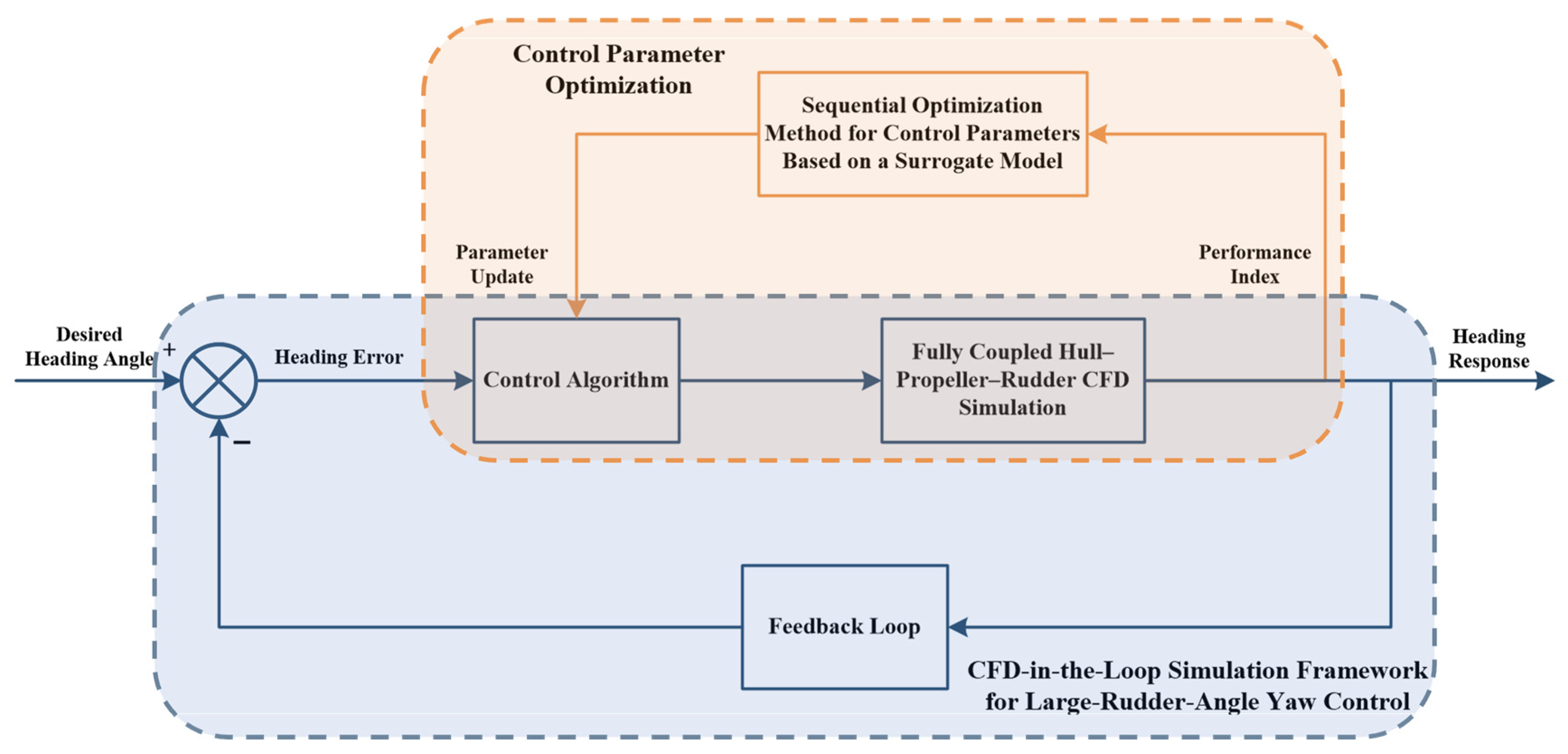
Considering the strong hydrodynamic nonlinearity of the controlled plant under large-rudder-angle yaw maneuvering conditions, the pronounced hull–propeller–rudder coupling effects, and the strong dependence of control parameter design on the dynamic model, this paper establishes an overall framework for CFD-in-the-loop control simulation and parameter optimization for AUV large-rudder-angle yaw maneuvers, as shown in Figure 1. With a coupled hull–propeller–rudder CFD numerical model serving as the dynamic core, the framework integrates vehicle motion response prediction, the controller, actuator dynamics, virtual sensor feedback, and parameter optimization into a unified architecture, thereby forming an integrated closed-loop framework for control response analysis and parameter optimization under large-rudder-angle maneuvering conditions.
Within this overall framework, the controller generates control commands based on the deviation between the desired heading and the feedback states. These commands are then converted by the actuator module into propeller speed and rudder angle inputs and applied to the vehicle. Under the current control inputs, the coupled hull–propeller–rudder CFD solver computes the unsteady flow field around the vehicle and the corresponding hydrodynamic loads, and updates the vehicle motion state by combining the results with the six-degree-of-freedom equations of motion of the AUV. The virtual sensor module further extracts state variables such as heading angle, angular velocity, and vehicle speed from the numerical results and feeds them back to the controller, thereby forming a closed-loop iterative process of “control input, flow response, motion update, and state feedback.” On this basis, to reduce the computational cost associated with direct control parameter search using high-fidelity CFD models, a surrogate model and an optimization algorithm are further introduced for controller parameter optimization.
The research presented in this paper is organized around the overall framework described above and consists of three closely connected parts. First, a CFD motion simulation model based on coupled hull–propeller–rudder analysis is established to enable the joint solution of the unsteady flow field and the vehicle motion response of the AUV under the interaction of the propeller, rudder, and hull. This provides the dynamic foundation for subsequent control analysis. Second, based on the coupled CFD motion simulation, a CFD-in-the-loop closed-loop control simulation framework is developed. By integrating the controller, actuator dynamics, and flow-field solution process into a unified framework, the coupled simulation of control actions and nonlinear hydrodynamic responses during large-rudder-angle yaw maneuvers is achieved. Finally, to address the high cost of parameter tuning and the large computational burden of iterative simulations in CFD-in-the-loop control design, a control parameter optimization method based on a surrogate model and optimization algorithm is established to improve the efficiency of parameter search and enhance the dynamic control performance of the system. The remainder of this paper is organized around these three parts in sequence, forming a complete research chain from high-fidelity dynamic modeling, to closed-loop control analysis, and finally to control parameter optimization.

3. CFD Motion Simulation Model Based on Coupled Hull–Propeller–Rudder Analysis

To support the design and optimization of control strategies for large-rudder-angle yaw maneuvers, this study first develops an AUV motion simulation model based on fully coupled hull–propeller–rudder analysis, enabling high-fidelity numerical evaluation of the interactions among the hull, propeller, and rudder. In constructing the model, the publicly available geometric parameters of the REMUS 100 vehicle, including the hull lines and rudder configuration, are adopted to establish the geometric model, while key physical properties such as the locations of the center of gravity and center of buoyancy, as well as the moments of inertia, are incorporated. The fully coupled CFD simulation results are then quantitatively compared with both full-scale sea-trial measurements and simulation results based on the linear equations of motion, thereby validating the accuracy and applicability of the proposed AUV motion simulation model under large-rudder-angle operating conditions.

3.1. Geometric Model and Basic Parameters

The Remus100 is selected as the research platform in this study. The vehicle has a regular external shape, well-documented parameters, and a relatively extensive foundation in maneuvering studies, making it a suitable representative platform for AUV motion simulation and control analysis.
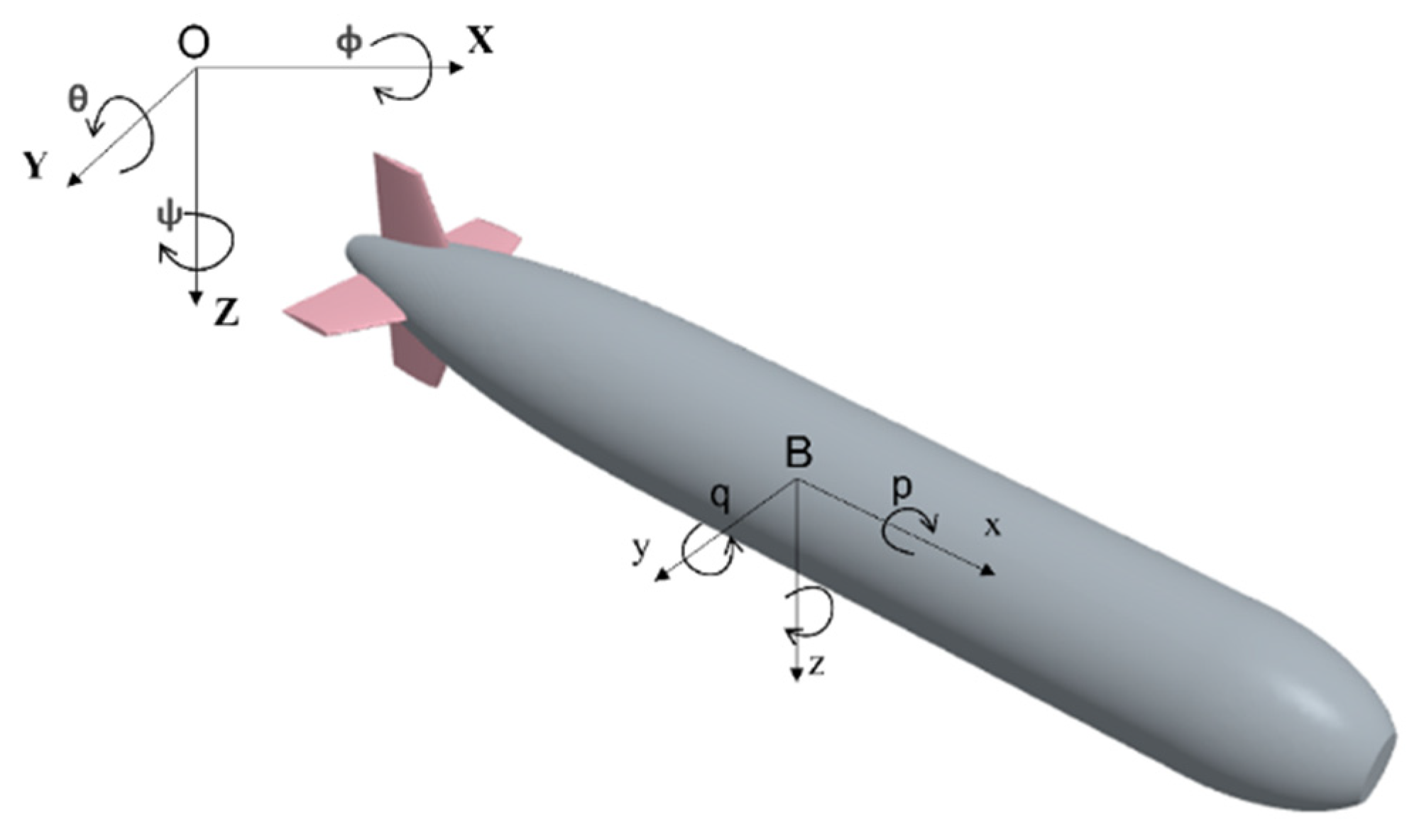
The geometric model of the REMUS 100 mainly includes the hull, the stern propeller, and a cruciform stern rudder system, with the hull geometry constructed using Myring profiles. To ensure a consistent dynamic basis between the fluid solution and the rigid-body motion response, the model further incorporates the basic physical parameters of the vehicle, including mass, center of gravity, center of buoyancy, and moments of inertia. The established geometric model can capture the fundamental coupling relationships among AUV propulsion, maneuvering, and appendage-induced flow, thereby providing the physical basis for subsequent unsteady motion simulations. The AUV geometric model is shown in Figure 2, and the main physical parameters are listed in Table 1.

3.2. Coupled Hull–Propeller–Rudder Solution Method

The flow field is solved using the Reynolds-averaged Navier–Stokes (RANS) equations as the governing equations, and the SST  k ω  turbulence model is employed to numerically simulate the viscous flow around the vehicle. In terms of the solution strategy, a segregated flow solver is adopted for pressure–velocity coupling. An implicit unsteady method is used for time marching, and a second-order scheme is employed for temporal discretization, thereby improving the accuracy of unsteady flow simulation while maintaining numerical stability. In the numerical solution process, the maximum number of inner iterations at each time step is set to five, and the computation is advanced using a fixed number of inner iterations.
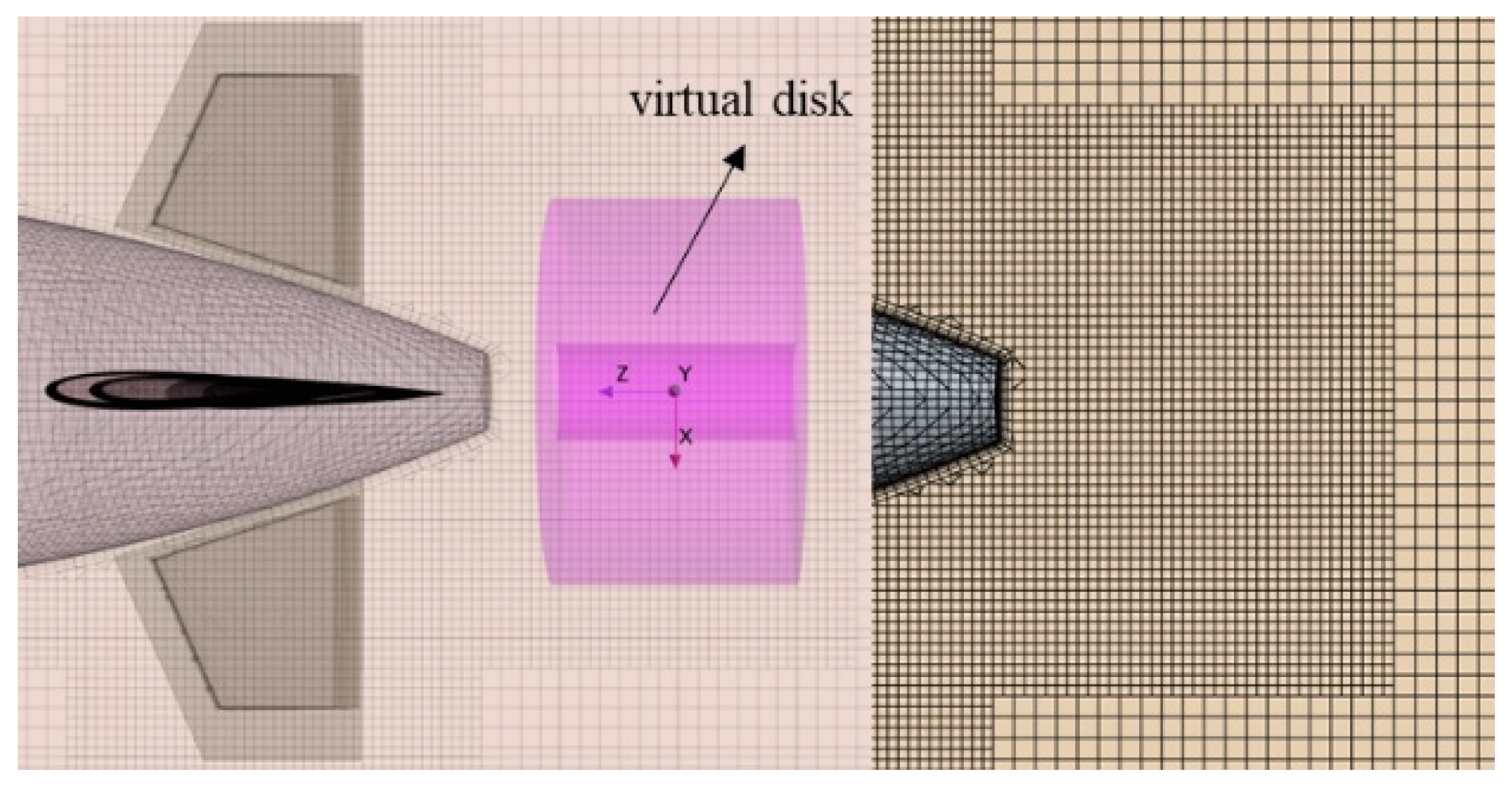
Considering that a large number of CFD-in-the-loop control simulations are required in the subsequent analysis [21], the propeller is modeled using the body force method [22,23]. This approach represents the thrust and torque generated by the propeller by applying distributed axial and tangential body forces within a virtual disk region, without resolving the blade-scale viscous flow structures, thereby avoiding the high computational cost associated with the small characteristic time scales of the propeller. In the numerical implementation, a virtual disk region is defined at the propeller location, and an inflow velocity plane is specified upstream of the virtual disk, with its direction aligned with the disk normal. The body force is incorporated into the fluid–rigid-body motion solution framework as an external loading term, thereby enabling dynamic coupling between the propeller thrust and the six-degree-of-freedom motion of the hull. To ensure a smooth body-force distribution and maintain numerical stability, local mesh refinement is applied in the virtual disk region so that the axial and tangential body forces can be distributed uniformly within the disk volume. The coordinate system of the virtual disk and the refined region are shown in Figure 3.
The AUV motion response is solved using the dynamic fluid–body interaction (DFBI) method. At each time step, the flow governing equations and the rigid-body dynamic equations are advanced simultaneously. First, the flow solver computes the distributions of pressure and shear stress acting on the hull and rudder surfaces. These loads are then integrated to obtain the resultant forces and moments acting on the vehicle, which are substituted into the rigid-body dynamic equations to update the AUV state variables, including translational velocity, angular velocity, position, and attitude. In this way, two-way coupling between flow evolution and rigid-body motion response is achieved.
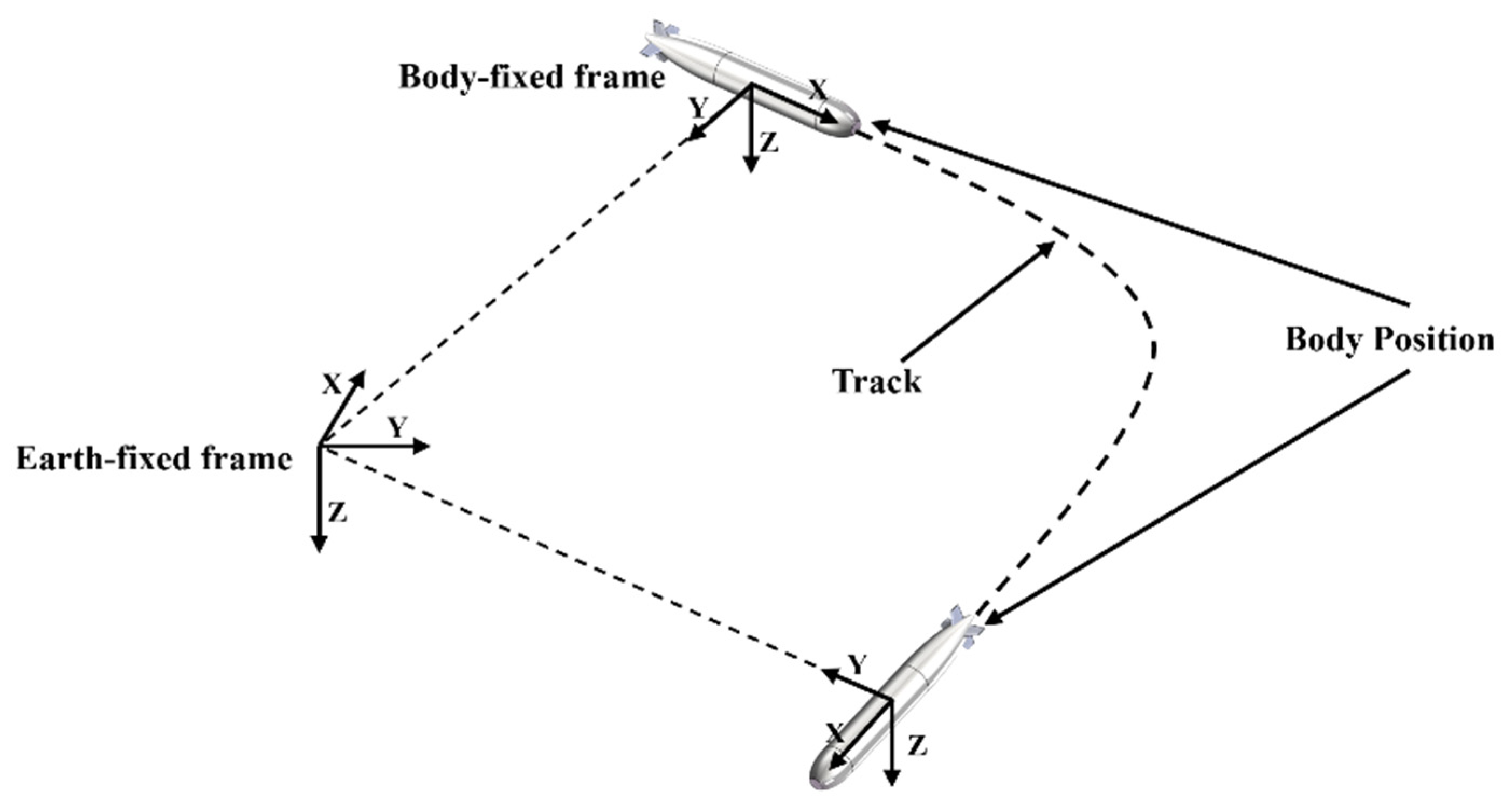
To describe the spatial motion of the AUV, a fixed Earth-fixed reference frame and a local body-fixed frame located at the vehicle’s center of mass are established in the computation, as shown in Figure 4. The Earth-fixed frame is used to represent the position and attitude variations in the AUV in the global space, while the body-fixed frame is employed to describe the vehicle’s velocities, angular velocities, and force characteristics. Based on these two coordinate systems, a unified representation and transformation of hydrodynamic loads, propeller thrust, and control moments generated by control surfaces can be achieved between different reference frames [24,25].
In the numerical solution process, propeller thrust, rudder control inputs, and fluid loads act simultaneously on the AUV, and its motion state is updated in real time through the rigid-body dynamic equations. As the attitude and position of the vehicle change, the surrounding flow field distribution and the hydrodynamic loads on the appendages also evolve accordingly, and are further fed back into the flow solution at the next time step. Through this treatment, the coupled solution of hull flow, propeller wake, rudder inflow, and vehicle motion response is achieved within a unified numerical framework.

3.3. Computational Domain and Mesh Generation

To balance the accuracy of the external flow-field simulation around the AUV with the need to handle rudder deflection, a mesh generation strategy combining a background domain and local overset domains is adopted in this study. The background domain is used to describe the overall flow field around the hull and the wake development, whereas the overset domains are used to handle the rotational motion of the stern rudders relative to the hull.
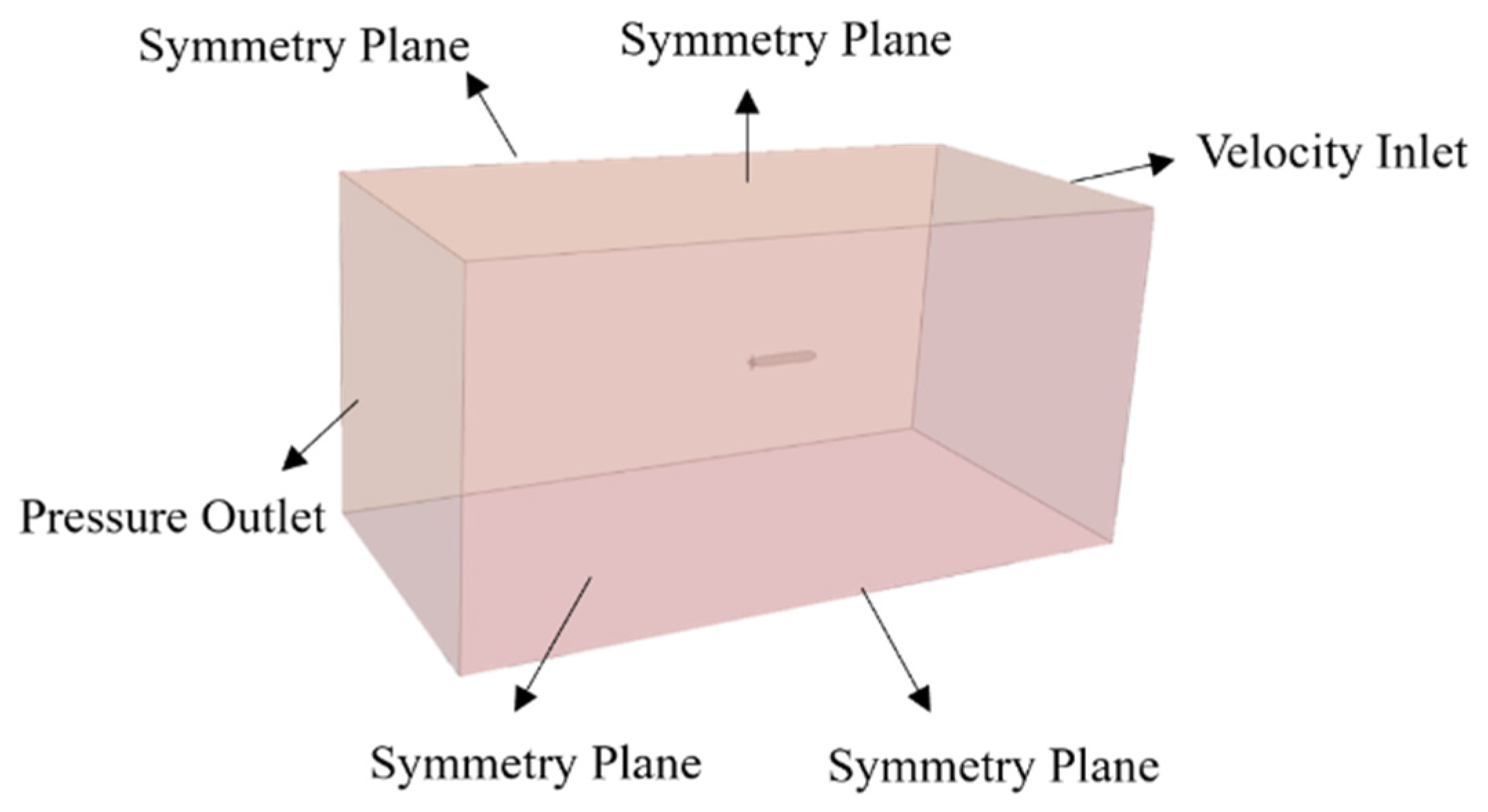
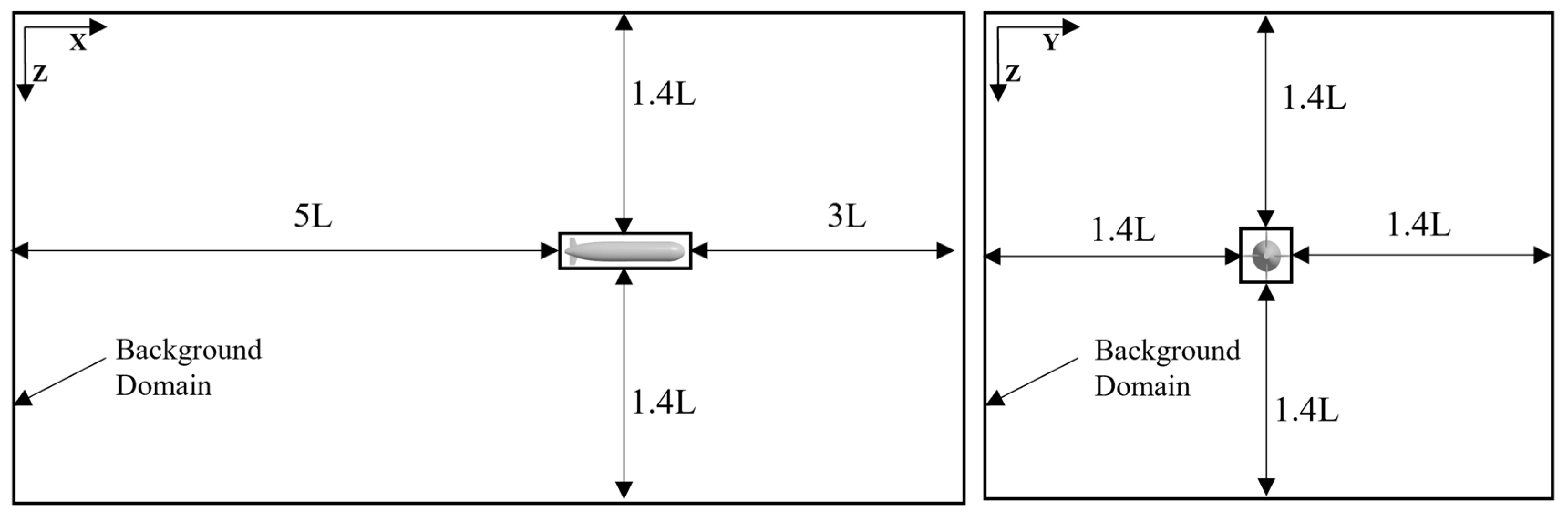
A three-dimensional rectangular computational domain is established around the hull and, after a Boolean subtraction with the hull geometry, is used as the background domain, as shown in Figure 5 and Figure 6. Taking the bow as the coordinate origin, the inlet boundary is located 3 L upstream of the bow, the outlet boundary is located 5 L downstream of the stern, and the upper, lower, left, and right boundaries are each placed at a distance of 1.4 L from the hull center, where  L  denotes the hull length. The inlet boundary is specified as a velocity inlet, the outlet boundary as a pressure outlet, and the remaining boundaries as symmetry boundaries. These settings ensure sufficient development of the near-field flow around the hull and the wake within the computational domain, while reducing the influence of boundary conditions on the flow solution.
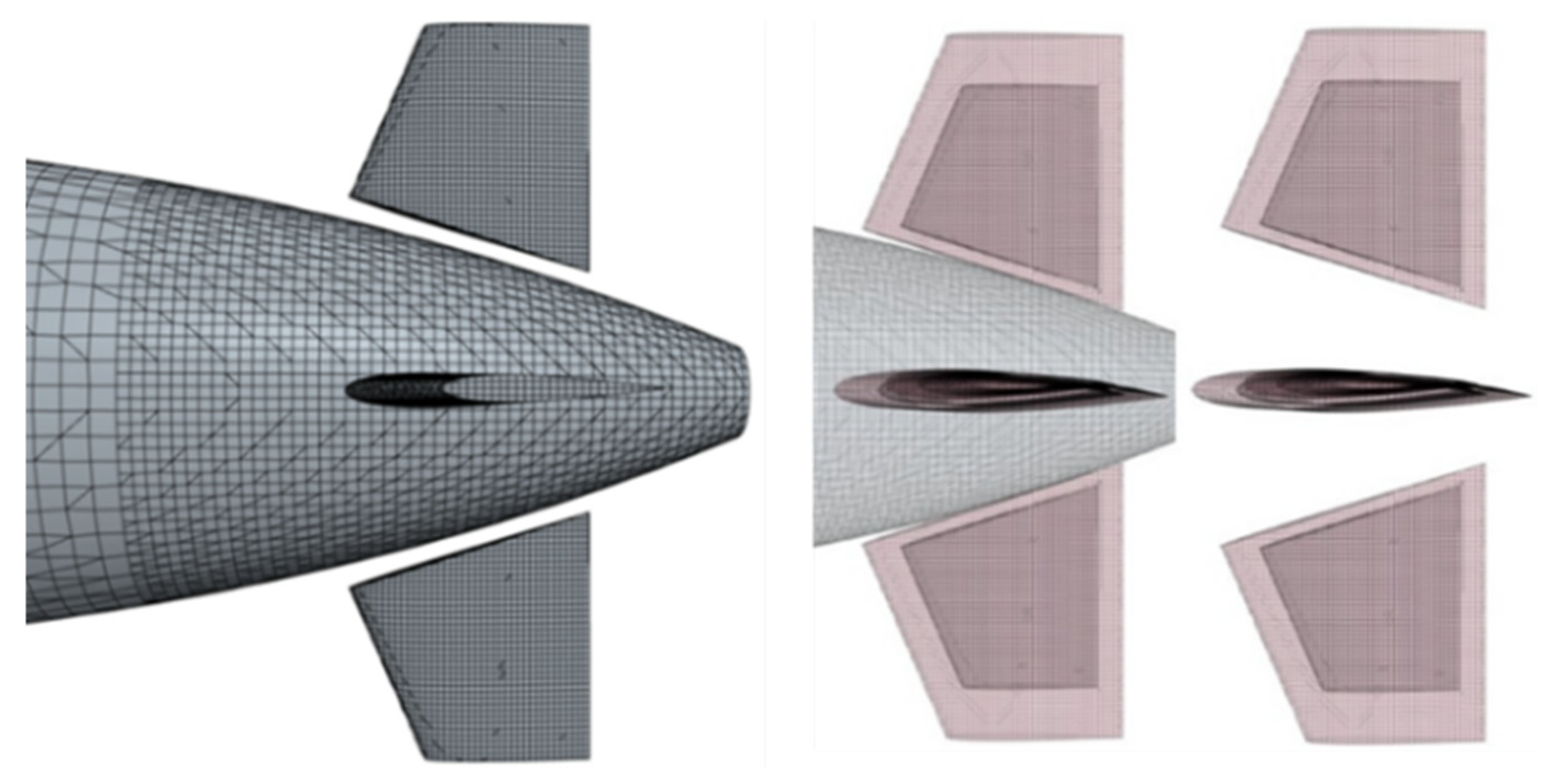
To account for the deflection motion of the stern rudders relative to the hull, the overset grid technique is employed to generate a local mesh in the rudder region, as shown in Figure 7. By introducing independent overset domains for the rudders, this method allows rudder rotation without reconstructing the entire mesh, thereby effectively avoiding mesh distortion and maintaining numerical stability. Flow-field information is exchanged between the rudder overset domains and the hull background domain through donor–acceptor cell interpolation. To ensure interpolation accuracy, at least 3–5 layers of grid cells are arranged within the rudder–hull gap region. With this mesh generation approach, the coupled solution of hull flow, wake evolution, and rudder deflection motion can be achieved within a unified numerical framework [26].

3.4. Grid and Time-Step Independence Verification

To ensure the reliability of the numerical results and to determine appropriate discretization parameters for the subsequent CFD motion simulations and CFD-in-the-loop control simulations, both grid independence and time-step independence studies are conducted in this work. By comparing the simulation results obtained with different grid resolutions and time-step sizes, the effects of spatial and temporal discretization on the numerical results are evaluated, and a balanced choice is made between computational accuracy and computational cost [27].
(1)
Grid Independence Verification
In the spatial discretization convergence analysis, different grid sizes were used to predict the vehicle’s resistance, and the resistance values were used as the convergence criterion. Within the framework of the RANS equations and the SST k-ω turbulence model, the numerical results were compared with the experimental resistance data [6] of the Remus100. The results are shown in Table 2.
As shown in Table 2, as the number of grid cells increases from 2.58 million to 4.88 million, the CFD-predicted drag increases from 8.85 N to 9.22 N and gradually approaches the experimental value of 9.51 N. At the same time, the relative error decreases from 6.94% to 3.05%, indicating a clear monotonic convergence trend as the mesh is refined. To further quantify the grid discretization error, Cases 1, 2, and 3 are selected for grid convergence analysis. According to the GCI method, for a three-dimensional computational mesh, the grid refinement ratio is defined as follows:
r = N fine N coarse 1 / 3
The calculated refinement ratio between the coarse and medium grids is approximately  r 32 1.111 , while that between the medium and fine grids is approximately  r 21 1.113 . The two values are essentially consistent, indicating that the three selected grid systems satisfy the requirement of geometrically similar refinement and are therefore suitable for GCI analysis. On this basis, the apparent order of convergence is evaluated using Richardson extrapolation, giving  p 2.56 , which indicates good convergence behavior of the numerical results. By taking the safety factor as  F s = 1.25 , the grid convergence index between the fine and medium grids is further obtained as  G C I 21 6.88 % , while that between the medium and coarse grids is  G C I 32 9.35 % . To verify whether the results have entered the asymptotic range of convergence, an asymptotic convergence check is further performed:
G C I 32 r p G C I 21 1.03
The asymptotic convergence indicator is close to 1, indicating that the present numerical results have essentially entered the asymptotic convergence range and that the evaluation of the grid discretization error is reasonably reliable. Considering that the difference between Case 2 and the finest-grid Case 3 is already small, while Case 2 requires a lower computational cost, Case 2 is ultimately selected as the computational mesh for the subsequent numerical simulations, taking both computational accuracy and efficiency into account.
(2)
Time-step independence study
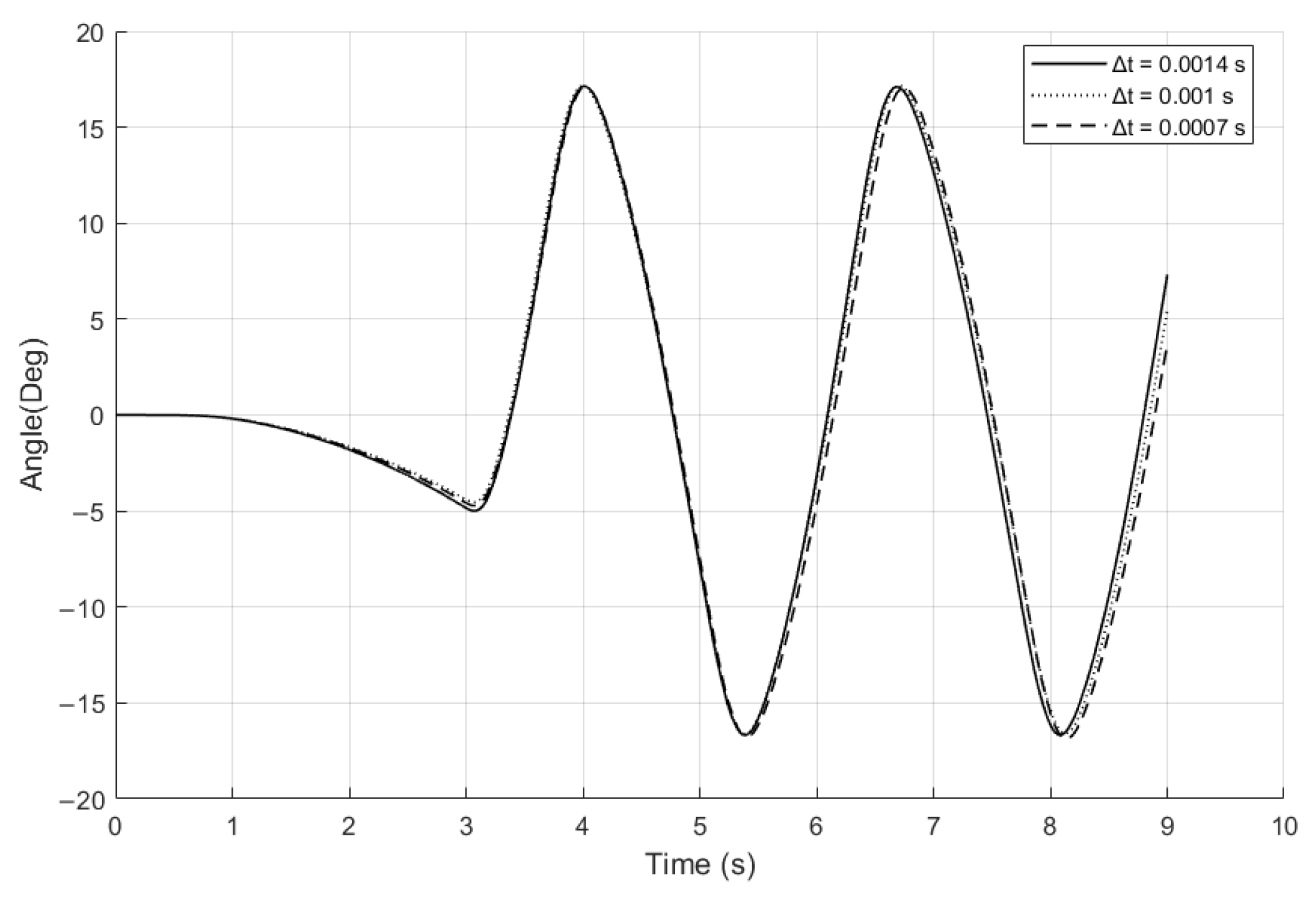
After completing the grid independence study, a time-step independence study is further conducted to evaluate the effect of temporal discretization on the simulation results of unsteady maneuvering motion. Under the condition that the Courant number satisfies  C 1 , three different time-step sizes, namely  Δ t = 0.0014 s 0.001 s , and  0.0007 s , are selected for zigzag maneuver simulations, and the corresponding heading responses are compared. The different time-step sizes and their corresponding Courant numbers are listed in Table 3.
The heading response curves obtained under different time-step sizes are shown in Figure 8. It can be seen that the overall trends of the heading variation curves are essentially consistent for all three time-step sizes, with only small differences appearing near local peaks and troughs. This indicates that, within the range of time-step sizes considered, the influence of the time step on the numerical results is relatively limited. As shown in Table 3, the Courant numbers corresponding to all three time-step sizes are below 1, satisfying the stability requirement for unsteady numerical simulations. Further considering both computational accuracy and efficiency, the difference between Case 2 and the smaller-time-step Case 3 is very small, whereas the computational cost of Case 2 is significantly lower than that of Case 3. Therefore, Case 2 is ultimately selected as the time step for the subsequent CFD-in-the-loop motion simulations.

3.5. Comparative Validation of Simulation Results

To evaluate the ability of the coupled hull–propeller–rudder CFD motion simulation model to predict the basic maneuvering responses of an AUV, comparative analyses are conducted under maneuvering conditions consistent with the sea trials reported by Prestero [6]. Using the Remus100 as the study vehicle, numerical simulations of the pitch and yaw responses under small-rudder-angle conditions are performed using both the CFD motion simulation model developed in this study and the motion model established by Prestero based on linearized hydrodynamic derivatives. The results are then compared with full-scale experimental data. By analyzing the differences in vertical-plane and horizontal-plane motion responses predicted by the two models, the applicability of the coupled CFD model under basic maneuvering conditions is assessed.
(1)
Comparison under pitch conditions
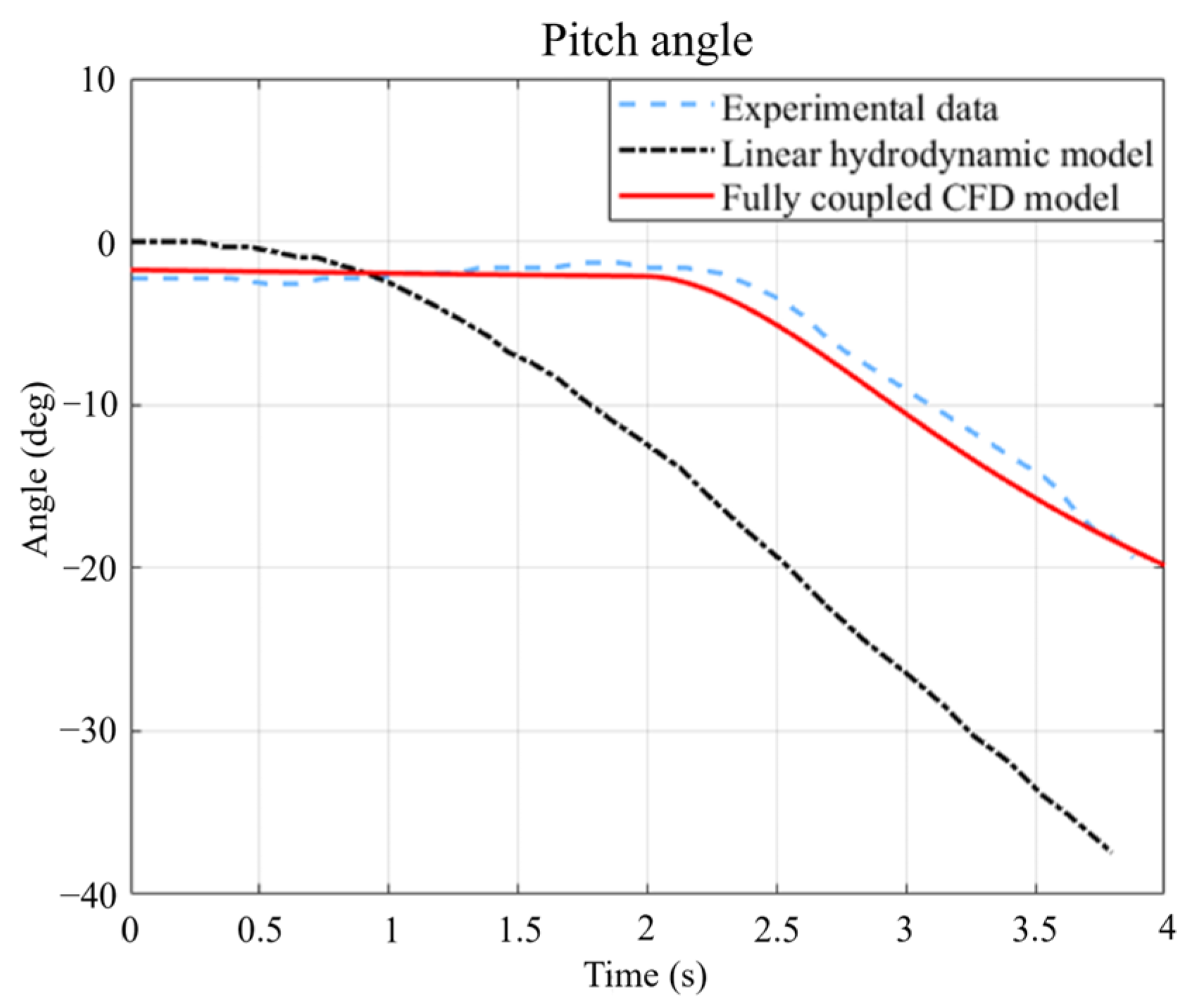
To validate the model’s capability in predicting vertical-plane motion, a pitch maneuver condition consistent with Prestero’s sea trials was selected [6]. The setup was as follows: the vehicle maintained a constant rudder angle for the first 2 s, after which the horizontal rudder deflected at a rate of 10°/s, reaching 4° within 0.4 s, and then remained constant. Both the linearized hydrodynamic derivative motion model and the CFD-based dynamic simulation model developed in this study were used to compute the AUV’s pitch-angle response over 5s before and after the rudder deflection, and the results were compared with Prestero’s sea-trial data, as shown in Figure 9.
As shown in Figure 9, after the rudder input begins, the pitch angle of the AUV in the sea trial changes by approximately    17.2    within about 2 s. The motion model based on linearized hydrodynamic derivatives predicts a pitch-angle change of approximately    37.4 , which is significantly higher than the experimental result. By contrast, the CFD motion simulation model developed in this study predicts a pitch-angle change of approximately    17.9 , which is in good agreement with the experimental result. These results indicate that, under pitch maneuvering conditions, the coupled CFD model can accurately capture the vertical-plane motion response characteristics of the AUV.
(2)
Comparison under yaw conditions
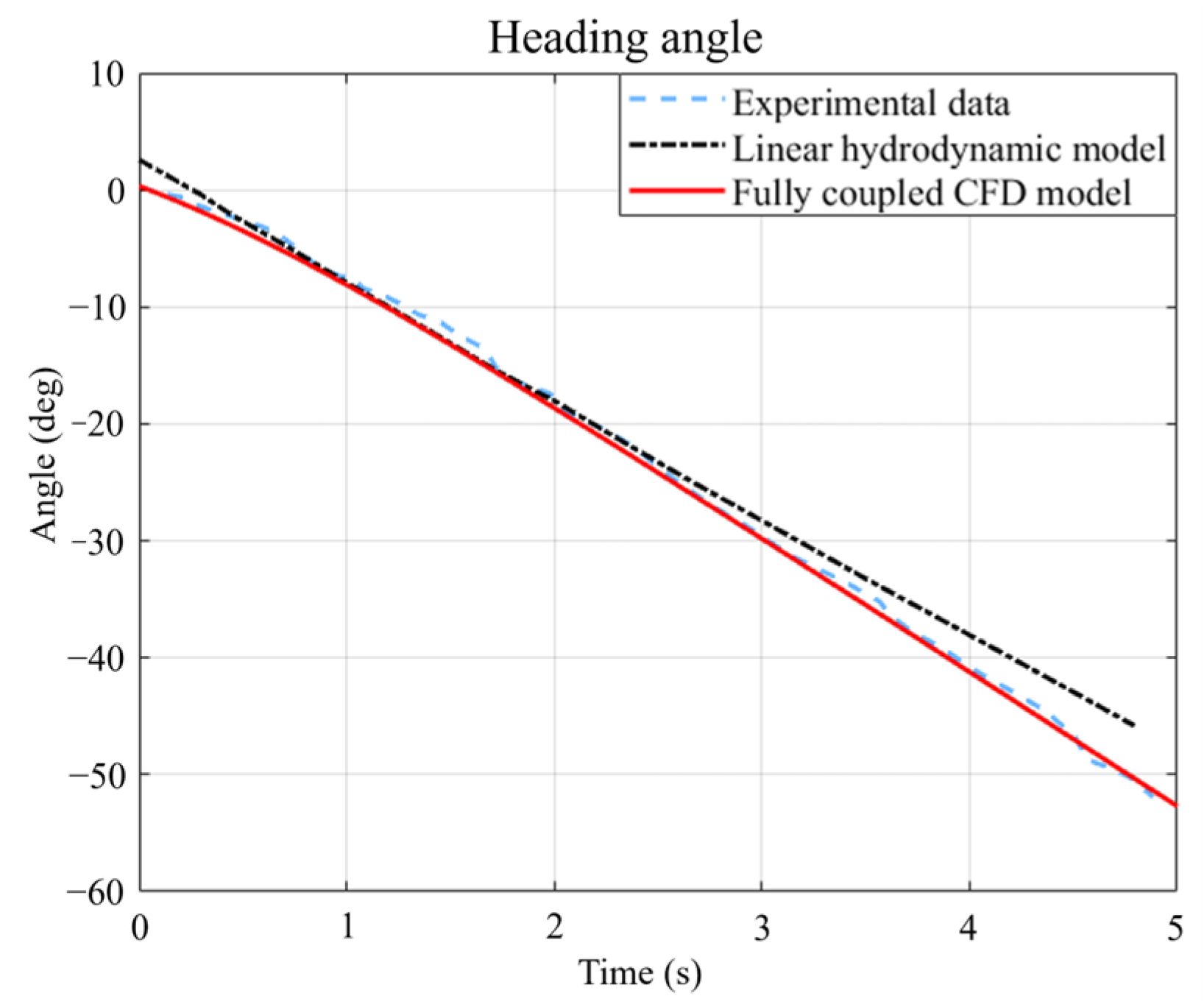
To further validate the model’s capability in predicting horizontal-plane motion, a yaw maneuver with the vertical rudder was set up consistent with Prestero’s sea trials [6]: the vertical rudder deflected at a rate of 10°/s, reaching 4° within 0.4 s, and then remained constant. Figure 10 presents a comparative analysis of the heading-angle time-history response over 5 s following the rudder deflection.
As shown in Figure 10, the heading angle of the AUV in the sea trial changes by approximately    51.9  within 5 s. The motion model based on linearized hydrodynamic derivatives predicts a heading change of approximately    48.4 , showing a certain deviation from the experimental result. In contrast, the CFD motion simulation model developed in this study predicts a heading change of approximately    52.4 , which agrees well with the experimental result. This indicates that the coupled CFD model established in this work can more accurately capture the horizontal-plane motion response characteristics of the AUV under yaw conditions.
(3)
Comparison of large-rudder-angle circular motion
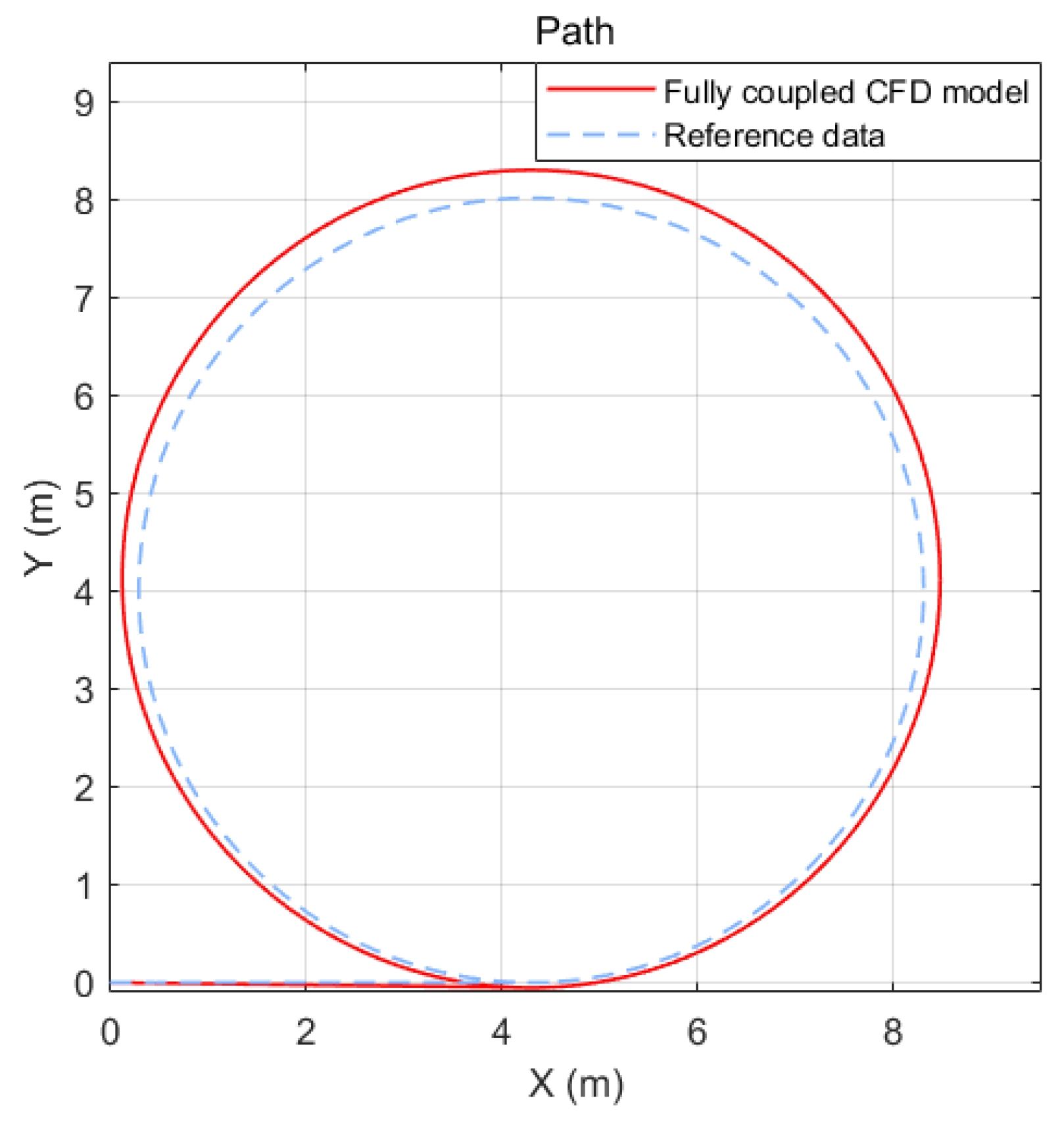
To further validate the predictive capability of the developed model under large-rudder-angle maneuvers, the operating condition from Reference [28] was adopted: the forward speed was set to 1.03 m/s, and the maximum allowable rudder deflection was applied to induce a circular motion, which was then maintained. Figure 11 presents a comparison between the CFD-based dynamic simulation results from this study and the data reported in Reference.
As shown in Figure 11, the AUV follows a circular path under the large-rudder-angle condition, and the simulation results closely match the data from Reference. The turning radius reported in Reference was 4 m, while the CFD-based dynamic simulation model developed in this study predicts a radius of 4.12 m, corresponding to a relative error of approximately 3%. This indicates that the developed CFD model can reliably predict the horizontal-plane maneuvering response of the AUV under large-rudder-angle conditions.
A synthesis of the comparative results for pitch, yaw, and large-rudder-angle circular maneuvers indicates that, compared with the motion model based on linearized hydrodynamic derivatives, the hull–propeller–rudder coupled CFD dynamic simulation model developed in this study shows higher consistency with experimental results in predicting both pitch and yaw responses, and also provides reliable accuracy under large-rudder-angle maneuvers. Therefore, the developed CFD-based dynamic simulation model can serve as the dynamical foundation for subsequent CFD-in-the-loop control analysis and parameter optimization of large-rudder-angle yaw maneuvers.

4. CFD-in-the-Loop Simulation Framework for Large-Rudder-Angle Yaw Control

When an AUV performs rapid turning or large heading adjustment tasks, the rudder deflection angle increases significantly, and the system enters a large-rudder-angle yaw maneuvering condition. Compared with the approximately linear maneuvering motion under small-rudder-angle conditions, the interaction among rudder inflow, propeller wake structure, and hull flow becomes much stronger during large-rudder-angle maneuvers, and the system hydrodynamics exhibit pronounced nonlinearity, unsteadiness, and strong coupling. Under such conditions, if control response analysis and parameter tuning are still carried out on the basis of a linearized hydrodynamic-derivative model, the dynamic behavior in the real fluid environment cannot be fully captured, which in turn affects the applicability of the control parameters.
Motivated by this, and building on the coupled hull–propeller–rudder CFD motion simulation model established in Section 2, this chapter further develops a CFD-in-the-loop simulation framework for large-rudder-angle yaw control. By coupling the heading controller, actuator dynamic model, virtual sensor feedback module, and CFD motion simulation model in a closed loop, the framework enables information exchange among control input, flow response, motion update, and state feedback under a unified time-stepping scheme. Based on this framework, control response analysis for large-rudder-angle yaw maneuvers can be carried out within a unified numerical environment, and the influence of nonlinear hydrodynamic effects on the dynamic characteristics of the closed-loop system can be revealed, thereby providing a basis for evaluating and optimizing the applicability of control parameters.

4.1. Framework Composition and Module Configuration

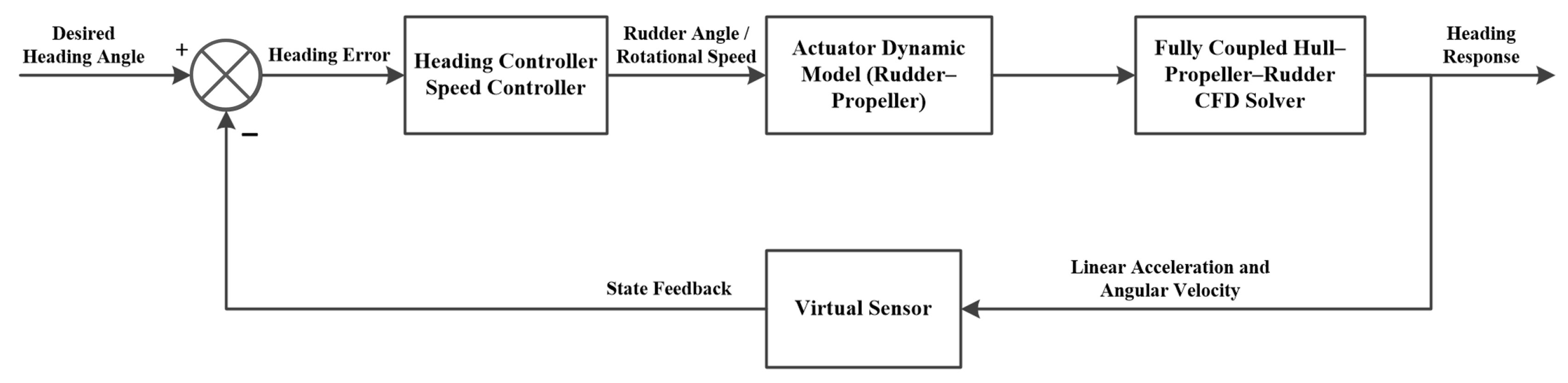
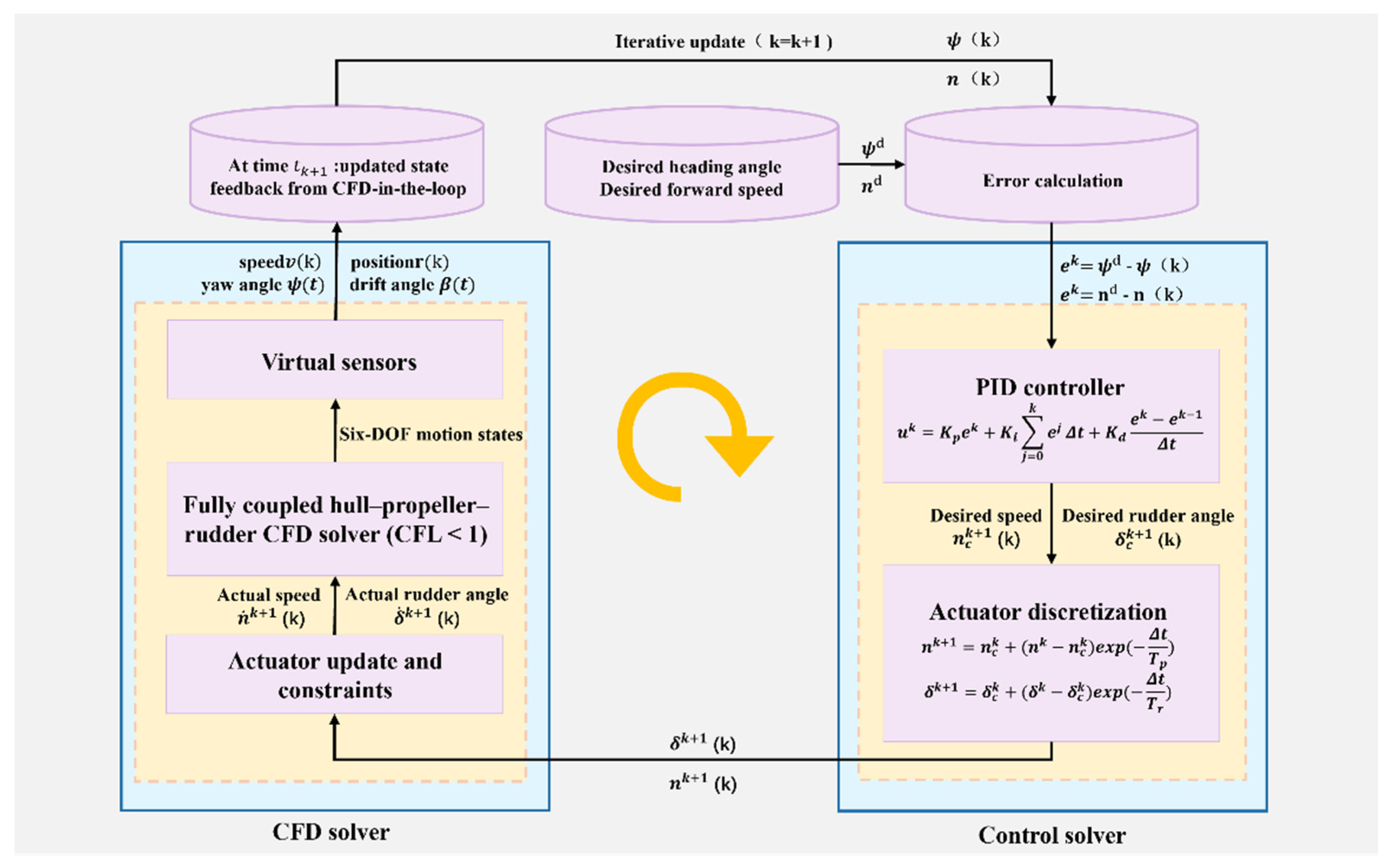
The CFD-in-the-loop simulation framework for large-rudder-angle yaw control developed in this study is shown in Figure 12. It mainly consists of a heading controller module, an actuator dynamic model, a coupled hull–propeller–rudder CFD solver, a six-degree-of-freedom motion response module, and a virtual sensor feedback module. All modules operate in coordination under a unified time-stepping scheme, together forming a closed-loop simulation environment for large-rudder-angle yaw maneuvers.
In this framework, the heading controller generates the corresponding control commands based on the deviations between the desired heading, desired speed, and the feedback states. The actuator dynamic model is used to describe the actual response process of the propeller and steering gear to the control commands. The coupled hull–propeller–rudder CFD solver and the six-degree-of-freedom motion response module together constitute the dynamic core of the framework, and are used to jointly solve the unsteady flow evolution around the AUV, the variation in hydrodynamic loads, and the vehicle motion response under given control inputs. The virtual sensor feedback module is responsible for extracting information such as heading angle, vehicle speed, angular velocity, and actuator states from the numerical results, and feeding them back to the controller, thereby forming a complete closed-loop control chain. In this way, controller design, actuator response, nonlinear dynamic simulation, and state feedback are integrated into a unified numerical framework, providing a foundation for control analysis and parameter design under large-rudder-angle yaw maneuvering conditions.
(1)
Actuator Dynamic Response Model
In the horizontal-plane yaw control of an AUV, the propeller and the steering gear are the primary actuators through which control commands are applied to the fluid environment. Considering that actuator responses in practical engineering applications are not ideally instantaneous, first-order dynamic response models are established for the propeller speed and rudder angle, respectively, to describe their inertial characteristics and the dynamic transition from control input to the actual actuator state.
For the propeller speed, the dynamic response is represented by a first-order low-pass model as follows:
T p d n d t + n = n c
where  n  is the actual propeller speed,  n c  is the commanded propeller speed, and  T p  is the propeller response time constant.
For the steering gear system, the rudder-angle dynamic response is likewise described by a first-order model as follows:
T r d δ d t + δ = δ c
where  δ  is the actual rudder deflection angle,  δ c  is the commanded rudder angle output by the controller, and  T r  is the response time constant of the steering gear.
The above models can effectively represent the gradual response processes of the propeller and steering gear under control inputs, and provide the basis for updating actuator states in the subsequent discrete time-stepping procedure.
(2)
Virtual Sensor Feedback Module
To enable the controller to achieve accurate state awareness within the CFD simulation environment, its control decision-making process must have access to the key motion states of the vehicle as well as feedback information from the actuators. During AUV operation, the controller needs to obtain in real time the motion states of the hull, including velocity, position, attitude angles (especially the yaw angle), and drift angle, while also acquiring the actual operating states of the actuators, such as rudder deflection and propeller speed. However, in the CFD solution process, the relevant motion information is mainly provided by the DFBI six-degree-of-freedom solver in the form of basic physical quantities such as linear acceleration and angular velocity, and cannot yet be directly used by the controller in a state-feedback form equivalent to that provided by actual onboard sensors of an AUV system.
To this end, based on the solution of the rigid-body motion equations using dynamic fluid–body interaction (DFBI), a virtual sensor feedback module is developed in this study to process and reconstruct the kinematic information produced by the CFD solver, thereby simulating the measurement and output characteristics of sensors in an actual AUV system during numerical simulation. The virtual sensor feedback module consists of three parts: a virtual inertial navigation system (INS) sensor, a rudder-angle feedback sensor, and a virtual propeller-speed feedback sensor. These components provide the controller with the vehicle motion states and actuator feedback information, respectively, thereby enabling closed-loop operation of the AUV control system in the CFD environment.
During the CFD simulation, the DFBI module updates the motion state of the hull in real time. In this study, the linear acceleration and angular velocity at the center of mass in the body-fixed coordinate system are extracted from the DFBI solution results, and are expressed as:
a ( t ) = [ a x ( t ) a y ( t ) a z ( t ) ] T , ω ( t ) = [ p ( t ) q ( t ) r ( t ) ] T
By integrating the linear acceleration, the velocity of the hull center of mass can be obtained as:
v ( t ) = 0 t a ( τ ) d τ + v ( 0 )
By further integrating the velocity, the position of the hull in the inertial coordinate system can be obtained as:
p ( t ) = 0 t v ( τ ) d τ + r ( 0 )
By integrating the angular velocity, the attitude angles of the hull can be obtained. For the large-rudder-angle yaw motion considered in this study, the yaw angle can be approximately expressed as:
ψ ( t ) = 0 t r ( τ ) d τ + ψ ( 0 )
Based on the velocity components, the drift angle of the hull can be further calculated as:
β ( t ) = a r c t a n ( v y ( t ) v x ( t ) )
Through the above procedure, the virtual sensor feedback module can reconstruct, within the CFD environment, the trajectory, yaw angle, and drift angle information equivalent to that provided by an actual AUV inertial navigation system, and use them as state-feedback inputs to the controller. In this way, a stable feedback channel is established between the CFD motion simulation model and the controller, thereby ensuring that the entire framework can operate in a closed-loop manner.
(3)
PID Control Algorithm
To achieve heading-tracking control during large-rudder-angle yaw maneuvers of the AUV, a PID controller is adopted in this study as the baseline heading controller because of its simple structure and wide use in engineering practice. The PID controller offers a clear formulation, well-defined physical meaning of its parameters, and ease of implementation, and has been widely applied in AUV heading control. More importantly, its control performance is highly sensitive to the dynamic characteristics of the system, making it well suited to reflecting differences in the applicability of control parameters under different dynamic models. Therefore, selecting the PID controller as the reference control structure helps highlight the influence of nonlinear hydrodynamic effects on control response within the CFD-in-the-loop simulation framework, and provides a unified basis for subsequent control parameter optimization.
The PID control law in the continuous-time domain can be written as:
u ( t ) = K p e ( t ) + K i 0 t e ( τ ) d τ + K d d e ( t ) d t
where  e ( t ) = ψ d ( t ) ψ ( t )  is the error between the desired heading and the actual heading,  u t  denotes the rudder-angle control command, and  K p K i , and  K d  are the proportional, integral, and derivative gains, respectively.
Considering that the heading angle is a periodic variable, directly using the angular difference as the error signal during large-rudder-angle yaw maneuvers may lead to angle wrap-around when the heading crosses  ± π , thereby causing discontinuities in the control command. To ensure the continuity and uniqueness of the error definition, the heading error is defined in this study as:
e t = a t a n 2 ( s i n ψ d t ψ t , c o s ψ d t ψ t )

4.2. Information Exchange and Time Discretization in the CFD-in-the-Loop Control System

In the control simulation framework established in this study, the CFD motion simulation model is directly embedded into the closed-loop control loop. As a result, the entire system is numerically represented as a strongly nonlinear discrete system formed by the coupling of the control law, actuator dynamics, fluid dynamic solution, and rigid-body motion response. To ensure stable interaction among all modules on a unified time scale, a unified discrete time-marching strategy governed by the CFD time step is adopted, so that the controller, actuator dynamic model, and CFD motion simulation model are updated synchronously on the same time scale. The information exchange structure of the system is shown in Figure 13.
At the discrete time step  t k , the virtual sensor module first extracts the motion state and actuator states from the previous time step and feeds them back to the controller. Based on the current heading error and speed error, the controller computes the rudder-angle command and the propeller-speed command. The actuator dynamic model then converts these control commands into the actual rudder angle and propeller speed inputs for the current time step. Subsequently, under the applied control inputs, the CFD solver advances the coupled solution of the flow field and the vehicle motion response, and updates the system state to  t k + 1 . The updated state is then passed again to the virtual sensor module to provide feedback for the control computation at the next time step, thereby forming a complete closed-loop iterative process over discrete time steps.
The selection of the CFD time step,  Δ t C F D , is jointly constrained by the CFL stability condition and the accuracy requirements for resolving unsteady hydrodynamics, and should satisfy the following condition [29]:
C F L = u Δ t C F D Δ x 1
where  u  is the characteristic flow velocity, and  Δ x  is the local grid size.
Under the Courant number constraint, the CFD time step adopted in this study is primarily determined on the basis of the time-step independence study presented in Section 3.5, so as to balance hydrodynamic simulation accuracy and computational cost. At the same time, the controller and actuator states are updated synchronously on the CFD time-step scale to ensure numerical stability.
In addition, within the above discrete-time information exchange framework, first-order dynamic models are established in discrete form for both the propeller-speed actuator and the rudder actuator, and the corresponding physical constraints are introduced to ensure numerical stability and engineering realizability. The update equation for the propeller speed in the discrete-time domain is given by:
n k + 1 = n c k + ( n k n c k ) e x p ( Δ t T p )
where  n k    and  n k + 1    denote the propeller rotational speed at the current and next time steps, respectively, and  n c k    is the commanded rotational speed at the corresponding time step.
To reflect the operating limits of the actual propulsion system, an amplitude constraint is imposed on the propeller rotational speed. The updated result is then used as the propulsor boundary condition and passed to the CFD solver, namely:
n k + 1 = s a t   ( n k + 1 , 0 , n m a x )
Similarly, the first-order dynamic model of the steering gear rudder angle can be expressed in the discrete-time domain as:
δ k + 1 = δ c k + δ k δ c k   e x p ( Δ t T r )
where  δ k    and  δ k + 1    denote the rudder-angle states at two successive time steps, respectively. Considering the structural and actuation limits of the actual steering gear, an amplitude constraint is imposed on the rudder angle:
δ k + 1 = s a t   ( δ k + 1 , δ m a x , δ m a x )
Furthermore, the rudder angle rate is calculated from the change in rudder angle between two successive time steps:
δ ˙ k + 1 = δ k + 1 δ k Δ t
A maximum rate-of-change constraint is imposed on it:
δ ˙ k + 1 = s a t ( δ ˙ k + 1 , δ ˙ m a x , δ ˙ m a x )
The heading controller is likewise updated in discrete form at the CFD time-step scale. The continuous-time PID control law is discretized using the forward Euler method, and its discrete form is given by:
u k = K p e k + K i j = 0 k e j Δ t + K d e k e k 1 Δ t
where  e k    is the heading error at the  k -th time step, and  u k    is the corresponding rudder-angle control command.

4.3. Comparison of Large-Rudder-Angle Yaw Control Responses and Analysis of Parameter Applicability

To analyze the influence of different dynamic modeling approaches on the large-rudder-angle yaw control response of an AUV, this study constructs closed-loop control models based on both a linearized hydrodynamic-derivative motion model and a coupled hull–propeller–rudder CFD motion simulation model. Under the same controller structure and the same initial control parameters, the yaw responses in these two dynamic environments are then compared and analyzed. By keeping the control law and parameter settings unchanged, the differences in response can be attributed mainly to the different capabilities of the dynamic models. In this way, the applicability of the control parameters in different dynamic environments can be evaluated, and the necessity of the proposed CFD-in-the-loop control simulation framework for nonlinear-condition analysis can be verified.
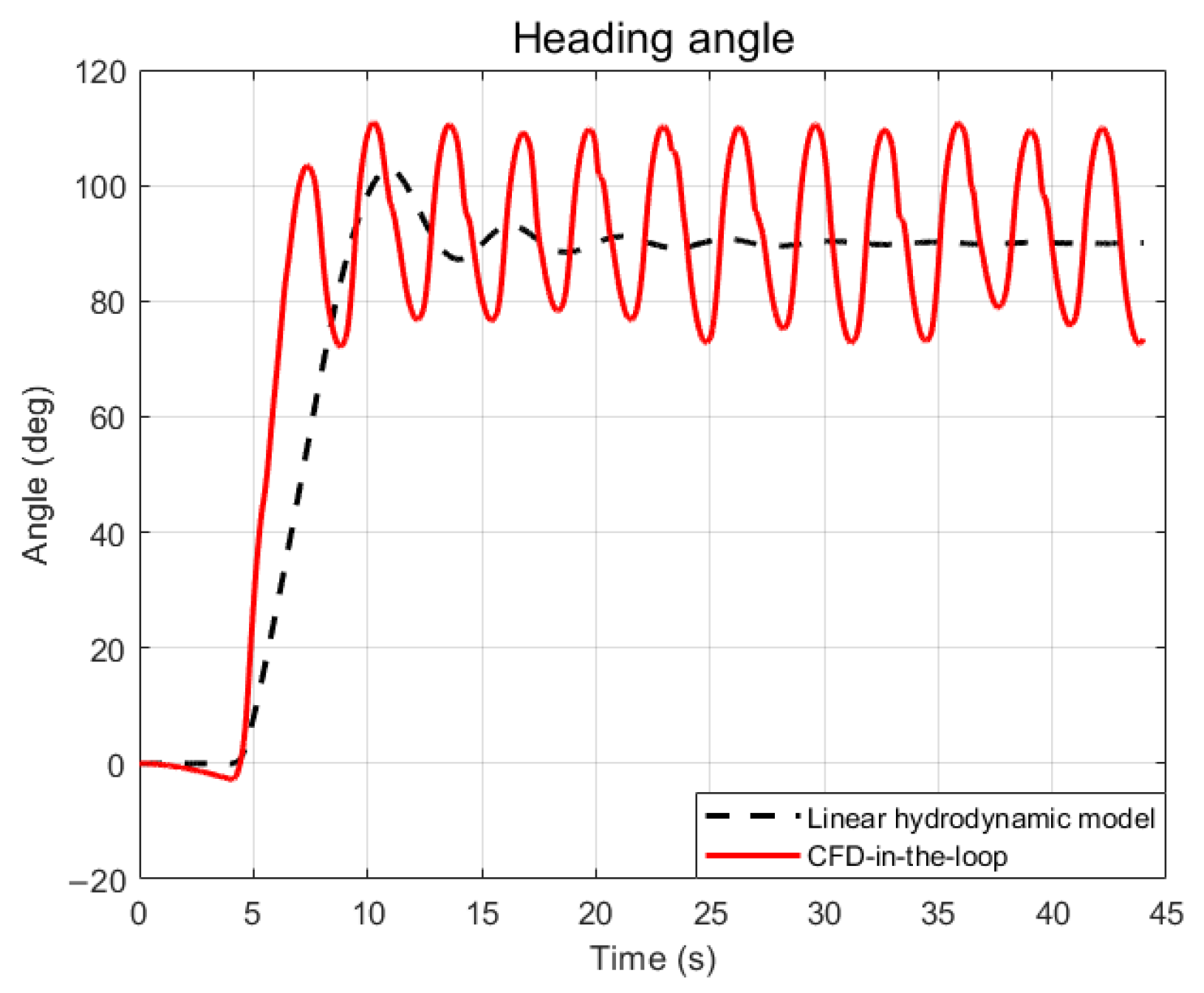
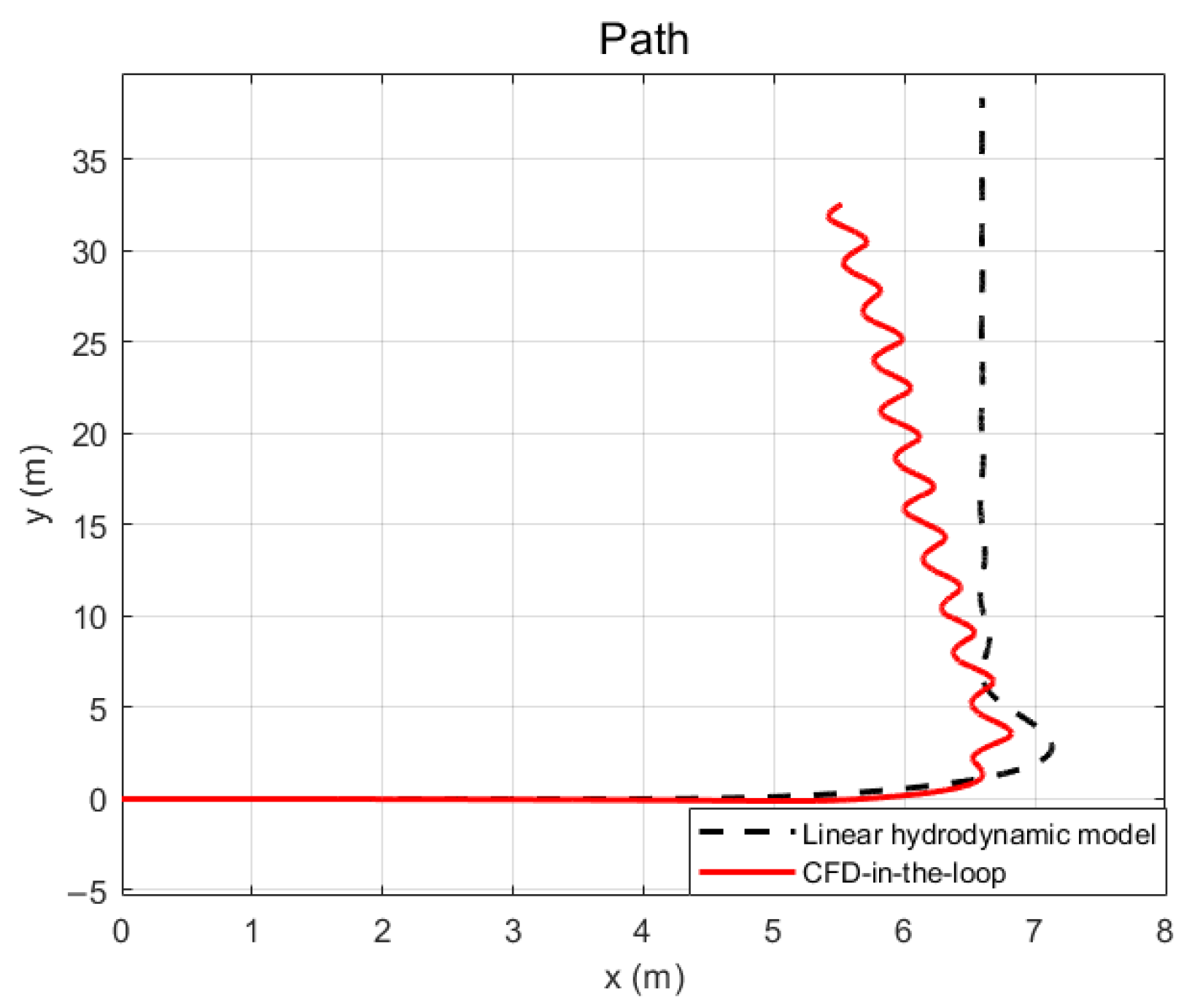
In the simulation, the initial heading of the AUV is set to  0 , and the target heading is  90 . The controller parameters are set as  K p = 1.5 K i = 0.6 , and  K d = 1.0 , while the propeller speed is kept constant. Figure 14 shows the heading responses obtained from the two models, and Figure 15 shows the corresponding trajectories. The results indicate that, under the same PID parameters, the closed-loop response based on the linearized hydrodynamic-derivative motion model can achieve relatively smooth heading tracking. In contrast, under the CFD-in-the-loop framework, although the heading initially changes rapidly toward the target value, more pronounced fluctuations and oscillations appear afterward.
The control performance indices are listed in Table 4, which shows clear differences in closed-loop control performance under different dynamic models. Under the linear hydrodynamic model, the rise time is 3.528 s, the settling time is 12.688 s, the peak value is  102.77 , the overshoot is 14.18%, and the ITAE is 2733.55, indicating that the system can reach a stable state relatively quickly and that the overall tracking error is relatively small. By contrast, under the CFD-in-the-loop condition, the rise time decreases to 1.312 s, indicating a faster initial response, but the peak value increases to  110.86 , the overshoot rises to 23.17%, about 1.63 times that under the linear model, and the ITAE increases to 12337.82, about 4.51 times that of the linear model, indicating that the accumulated error over the whole regulation process becomes significantly larger. In addition, under the CFD-in-the-loop condition, the system response exhibits more obvious oscillatory behavior and does not enter and remain near the target value within the simulation time. Nevertheless, the response remains bounded throughout the simulation, with no sustained divergence observed, indicating that the closed-loop system still possesses a certain degree of bounded stability under the condition studied.
As shown in Figure 14 and Figure 15, under the linear hydrodynamic model, the heading response is smooth and the oscillation is small. After the initial turn, the AUV velocity direction quickly becomes stable. The trajectory can therefore converge rapidly to the straight-line direction corresponding to the target heading, with a smooth overall path and only a small lateral deviation. By contrast, under the CFD-in-the-loop condition, the heading angle continues to oscillate around the target value, causing the velocity direction to undergo periodic deflection. This leads to a pronounced lateral swaying trajectory in space. This “snake-like” path feature corresponds closely to the oscillatory behavior observed in the heading response, indicating that dynamic fluctuations in heading can accumulate into path deviation errors in space. Furthermore, the nonlinear and coupled hydrodynamic effects captured by the CFD model introduce amplitude asymmetry and dynamic lag during heading regulation, making the lateral velocity component more difficult to attenuate in time and thereby intensifying the swaying feature of the trajectory.
The fundamental reason for the above difference lies in the different abilities of the two dynamic models to describe the hydrodynamic evolution under large-rudder-angle maneuvering conditions. In the linearized hydrodynamic-derivative motion model, the lateral force and yaw moment are usually represented by a small number of linear or weakly nonlinear derivative terms. In essence, this is only an approximate description of the small-disturbance dynamics near an equilibrium operating point. When the rudder angle becomes large, the heading changes rapidly, and significant lateral velocity and additional flow disturbances appear, effects such as propeller wake deflection, variation in rudder inflow, interference in the flow around the hull and appendages, and the evolution of additional drag will jointly alter the actual damping characteristics of the system and the law of control moment generation. By contrast, the CFD-in-the-loop simulation can directly capture these unsteady, nonlinear, and coupled hydrodynamic effects during time-step advancement. As a result, under the same control parameters, it exhibits closed-loop response characteristics that differ markedly from those of the linear model.
In summary, the control parameters tuned on the basis of the linearized hydrodynamic-derivative motion model can achieve a relatively stable control response within the corresponding linear model. However, within the CFD-in-the-loop control simulation framework that includes the nonlinear hull–propeller–rudder coupling effects, their dynamic performance deteriorates significantly, as reflected by stronger response oscillations, a slower convergence process, and a reduced closed-loop stability margin. This indicates that the control parameters depend strongly on the underlying dynamic model, and that parameters obtained from a linearized model are difficult to transfer directly to a coupled dynamic system under large-rudder-angle and strongly nonlinear maneuvering conditions.

5. Sequential Optimization Method of Control Parameters Based on a Surrogate Model

The CFD-in-the-loop simulation framework for large-rudder-angle yaw control established in the previous sections can directly reflect the influence of strongly nonlinear hydrodynamics on the control response, and thus provides a higher-fidelity basis for control performance analysis. However, because the CFD-in-the-loop simulation requires the unsteady flow field to be solved at every time step, a single closed-loop simulation is computationally expensive. If traditional parameter scanning or swarm-intelligence optimization methods are used directly for parameter tuning, problems such as high computational cost and low convergence efficiency will arise [30,31].
To reduce the computational cost of parameter optimization while fully exploiting the high-fidelity advantage of the CFD-in-the-loop simulation, this study proposes a sequential optimization method for control parameters based on a Kriging surrogate model [32]. The method uses a limited number of high-fidelity simulation samples to construct an approximate model of the objective function, and then gradually improves the prediction accuracy of the surrogate model in the optimal region through a sequential sampling strategy, thereby enabling an efficient approximation of the optimal control parameters.

5.1. PID Parameter Optimization Model for CFD-in-the-Loop Control

In the constructed CFD-in-the-loop simulation framework, the PID controller parameters directly determine the dynamic response characteristics of the system. To obtain control performance with good overall behavior under large-rudder-angle yaw maneuvering conditions, this study formulates the PID parameter tuning problem as a continuous-variable optimization problem.
To comprehensively evaluate the dynamic performance of the heading control system, the Integral of Time-weighted Absolute Error (ITAE) is selected as the objective function. This index introduces a time weight into the error integral and imposes a stronger penalty on late-stage errors and oscillatory behavior. It can therefore, to some extent, take into account response speed, overshoot suppression, and steady-state accuracy. Its expression is given as:
I T A E = 0 T   t | ψ r e f ψ ( t ; x i ) | d t
where  ψ r e f  denotes the target heading angle,  ψ ( t ; x i )  is the heading angle at the current time, and  T  is the simulation duration.
After selecting the ITAE index as the comprehensive evaluation criterion for the dynamic performance of the heading control system, the PID controller tuning problem can be formulated as an optimization problem in a continuous parameter space. Let the PID controller parameter vector be:
x = [ K p , K i , K d ] T
where  K p K i , and  K d  denote the proportional, integral, and derivative gains, respectively. Based on the stability requirements of the control system and the results of preliminary experiments, their value ranges are set as:
K p [ 0 , 3.5 ] , K i [ 0,1 ] , K d [ 0,1 ]
Based on the CFD-in-the-loop simulation, the mathematical model for PID parameter optimization is formulated as follows:
m i n x f ( x ) = I T A E ( x ) s . t . K p m i n K p K p m a x   K i m i n K i K i m a x   K d m i n K d K d m a x
where  f ( x )  denotes the ITAE value corresponding to the heading response obtained from the CFD simulation under a given PID parameter combination  x .

5.2. Sequential Optimization Framework Based on the Kriging Model

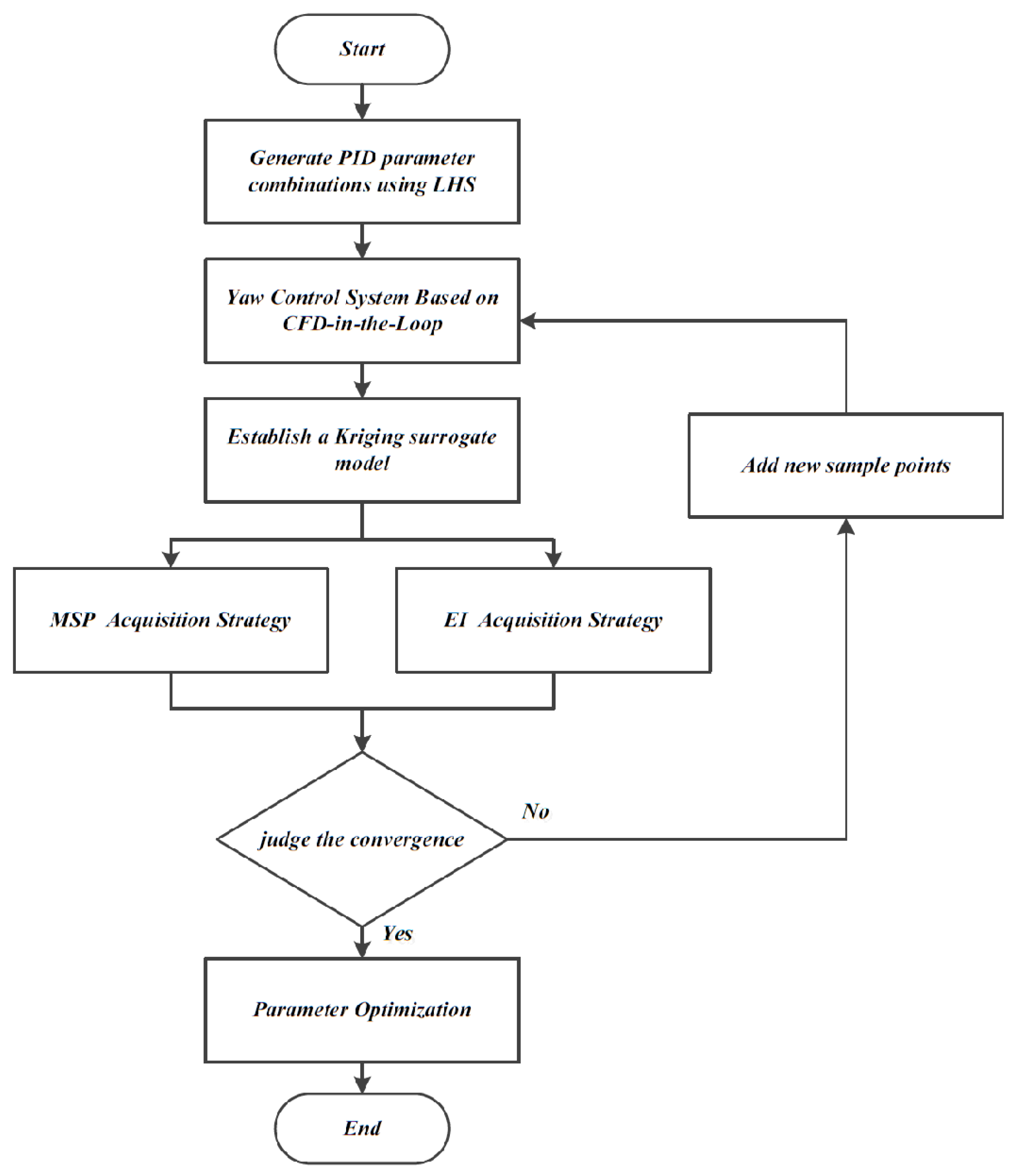
This method constructs a sequential optimization framework for CFD-in-the-loop control parameters based on a Kriging surrogate model. The overall process is shown in Figure 16 and mainly includes the following five steps.
(1)
Experimental Design and Initial Sample Collection
Based on the characteristics of the controller parameters, the proportional, integral, and derivative control parameters are selected as the design variables to be optimized, and their upper and lower limits are set to construct a multidimensional parameter space. To improve the global prediction ability of the surrogate model in the initial stage, the Latin Hypercube Sampling (LHS) method is used to uniformly sample the parameter space. Corresponding heading responses are obtained through numerical simulations, and an input-output sample set is constructed to initial a Kriging surrogate model [33].
(2)
High-Fidelity Simulation and Performance Evaluation
Each sample parameter  X j  is input into the CFD-in-the-loop heading control system to perform a high-fidelity closed-loop simulation and obtain the time-domain response curve of the heading angle during large rudder angle yaw maneuvering. The corresponding performance index, ITAE, is calculated based on the response curve, completing the performance evaluation of the sample points.
(3)
Surrogate Model Construction
To avoid frequent calls to the computationally expensive CFD solver during the optimization process, this paper uses the ITAE index to quantify and characterize the heading angle response. Based on this index, a Kriging surrogate model is constructed. Using the collected sample points  x j f j , where  f j  represents the corresponding performance index value, the Kriging surrogate model is built. The predictive function form of the Kriging model is:
f ^ x = μ + r ( x ) T R 1 ( f μ 1 )
where  μ  is the global mean,  R  cis the sample correlation matrix, and  r ( x )  is the correlation vector between the new point and the sample points. The function  R  uses a Gaussian kernel:
R i j = e x p ( k = 1 d   θ k | x i k x j k | 2 )
where  θ k  is the correlation length scale parameter.
In this study, the initial value of the hyperparameters is set as  θ 0 = [ 1,1 , 1 ] T . The lower and upper bounds of the search are set as  θ L = [ 10 2 , 10 2 , 10 2 ] T  and  θ U = [ 10,10,10 ] T , respectively, so as to ensure the stability of the parameter optimization process and the fitting accuracy of the model.
(4)
Sampling Strategy and Iterative Optimization
To improve the prediction accuracy of the surrogate model in the optimal region while maintaining global exploration ability, this paper introduces the error-based sampling priority indicator Minimum Surrogate Prediction (MSP) and the Expected Improvement (EI) strategy [34,35]. The MSP strategy enhances the local modeling accuracy of the optimal region by searching for the design point with the smallest predicted objective function value based on the current surrogate model. The sampling location can be expressed as:
x n e w = arg min f ^ x ,   x D
where  D  is the design variable space, and  f ^ ( x )  is the predicted minimum value of the objective function.
For the PID parameter optimization problem, the MSP sampling criterion selects sample points by solving the following optimization problem with boundary constraints:
M i n . f ^ x s . t . x m i n x x m a x
EI is a sequential sampling strategy that considers both the predicted value and uncertainty of the surrogate model [31]. Let the best objective function value from the currently evaluated samples be  f ( x ) * . Under the assumption of the Kriging surrogate model, the objective function at the design point  x  is predicted to follow a normal distribution with a mean of  y ^ ( x )  and a standard deviation of  σ ( x ) . The expected improvement (EI) can be expressed as:
E I x = [ f ( x ) * f ^ x ] Φ Z + σ x ϕ Z
In the equation,  Z = f ( x ) * f ^ ( x ) σ ( x ) Φ ( Z )  and  φ ( Z )  represent the cumulative distribution function (CDF) and the probability density function (PDF) of the standard normal distribution, respectively.
For the PID parameter optimization model, the EI sampling criterion determines the new sample points by solving the following optimization problem with boundary constraints:
M a x . E I x s . t . x m i n x x m a x
To prevent newly added sample points from being overly close to each other during the dual-criterion collaborative sampling process, this study adopts the Euclidean distance in the normalized parameter space as the similarity criterion for candidate points. Let the two candidate points be  x M S P  and  x E I , respectively, and their distance is defined as:
d = K p , M S P K p , E I K p m a x 2 + K i , M S P K i , E I K i m a x 2 + K d , M S P K d , E I K d m a x 2
When  d 0.01 , the two points are regarded as too close, and only  x E I  is retained as the evaluation point in the current iteration to avoid sample redundancy.
Through this dual-criterion collaborative mechanism, MSP can enhance the local fitting accuracy of the surrogate model in the current optimal region, whereas EI helps discover new regions with potential improvement value that are not yet sufficiently covered by the existing samples. The combination of the two can achieve a balance between optimization efficiency and global search capability.
(5)
Convergence Criterion
To ensure the effectiveness of the surrogate model optimization process and control the computational cost, this paper uses a dual convergence criterion as the iteration termination condition. On one hand, a maximum iteration count is set as the upper limit for the optimization process, and the optimization terminates when the iteration count reaches the preset maximum. On the other hand, a convergence criterion based on the improvement in the objective function is introduced. When the change in the optimal value of the objective function between two consecutive iterations is sufficiently small, the optimization process is considered to have converged, and the iteration is terminated. The convergence criterion based on the improvement of the objective function can be expressed as:
| f b e s t ( k ) f b e s t ( k 1 ) | < ε
where  f b e s t k  and  f b e s t k 1  denote the optimal objective-function values obtained at the  k -th and  k 1 -th iterations, respectively, and  ε  is the prescribed convergence threshold. When any one of the convergence conditions is satisfied, the iteration is terminated, and the current optimal parameter combination is taken as the final optimization result.

5.3. Control Parameter Optimization and Comparative Analysis of Results

Based on the Kriging surrogate model and the sequential sampling strategy described above, the PID parameters of the CFD-in-the-loop yaw control system are iteratively optimized in this study. By continuously updating the surrogate model on the basis of a limited number of high-fidelity CFD-in-the-loop simulation evaluations, the optimization process gradually approaches the optimal region of the objective function.
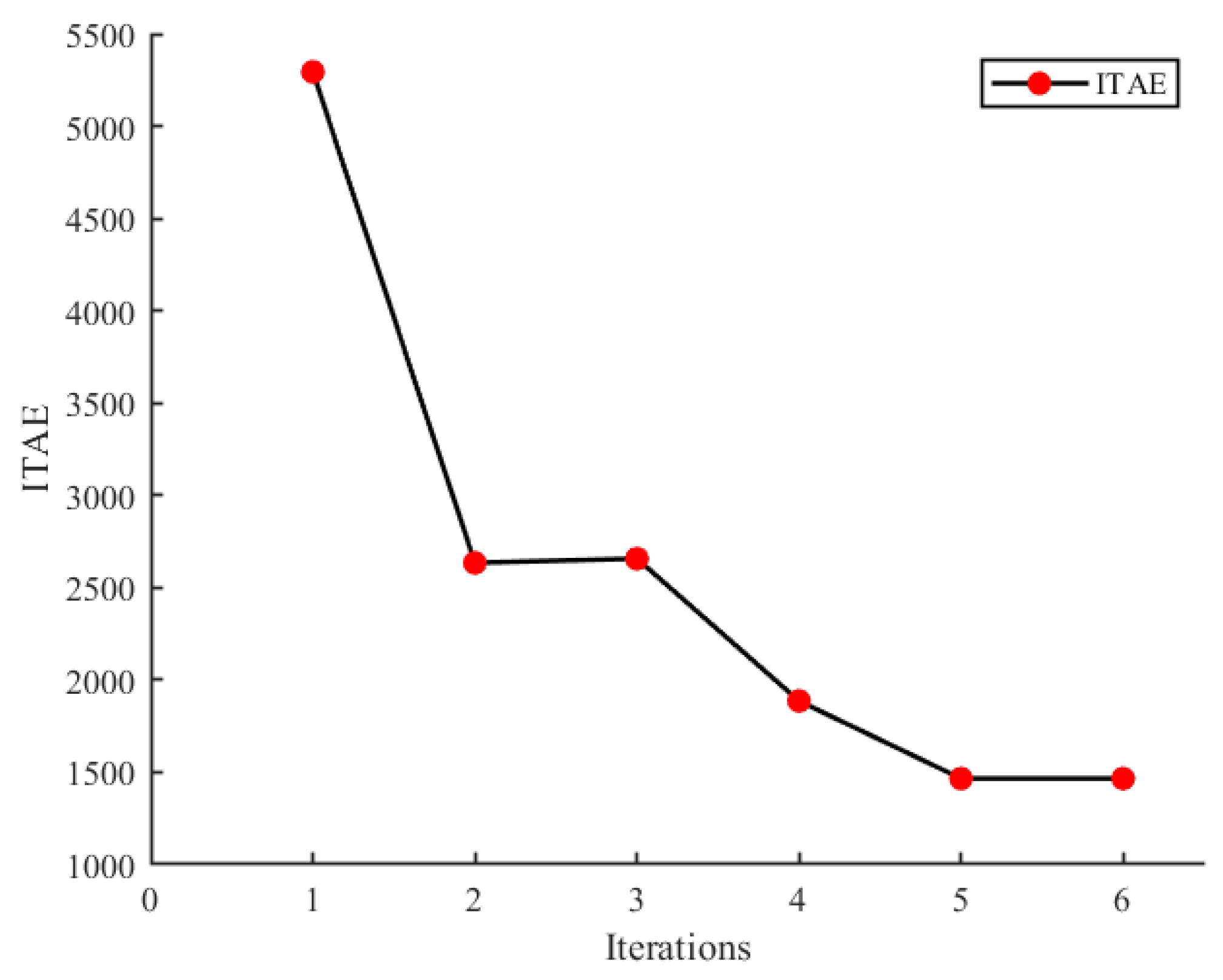
During the optimization process, Latin hypercube sampling (LHS) is first used to select 20 sample points within the feasible parameter domain, and the corresponding objective-function values are obtained through high-fidelity CFD evaluations to construct the initial surrogate model. Meanwhile, the convergence threshold is set to  ε = 10 3 , and the maximum number of iterations is set to 15. The MSP criterion and the EI criterion are then used as the sampling objectives to formulate the corresponding optimization subproblems within the feasible parameter domain, and particle swarm optimization (PSO) is employed to solve them, thereby obtaining candidate points with further sampling value. After high-fidelity CFD evaluation of these candidate points, the new samples are added to the original sample set, and the surrogate model is updated accordingly. This process is repeated until the convergence condition is satisfied. The optimization finally converges at the 6th iteration, with a total of 12 new sample points added. Including the initial samples, the entire optimization process requires 32 CFD evaluations. Figure 17 shows the variation in the ITAE objective function with the number of high-fidelity CFD evaluations during the optimization process.
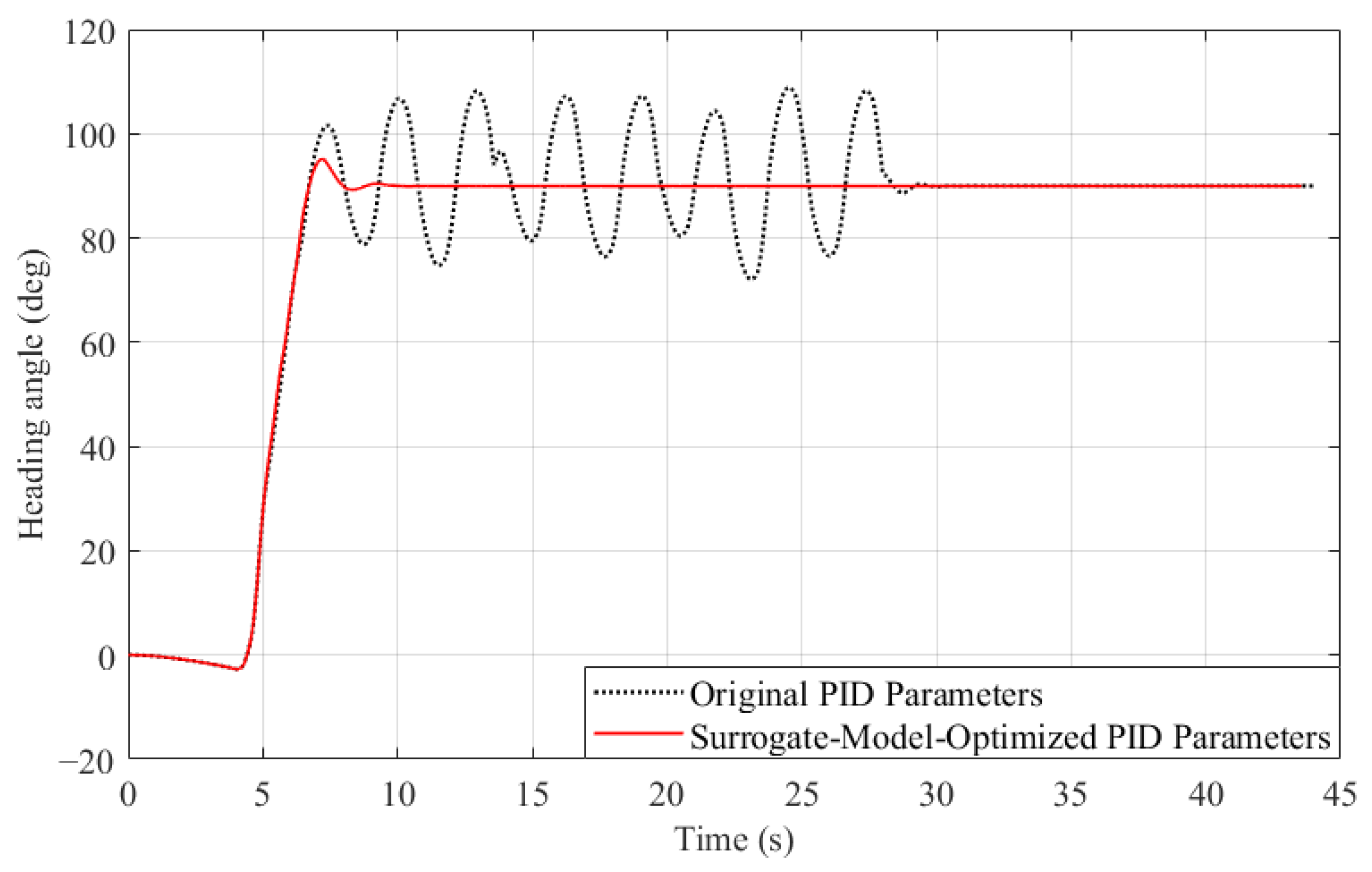
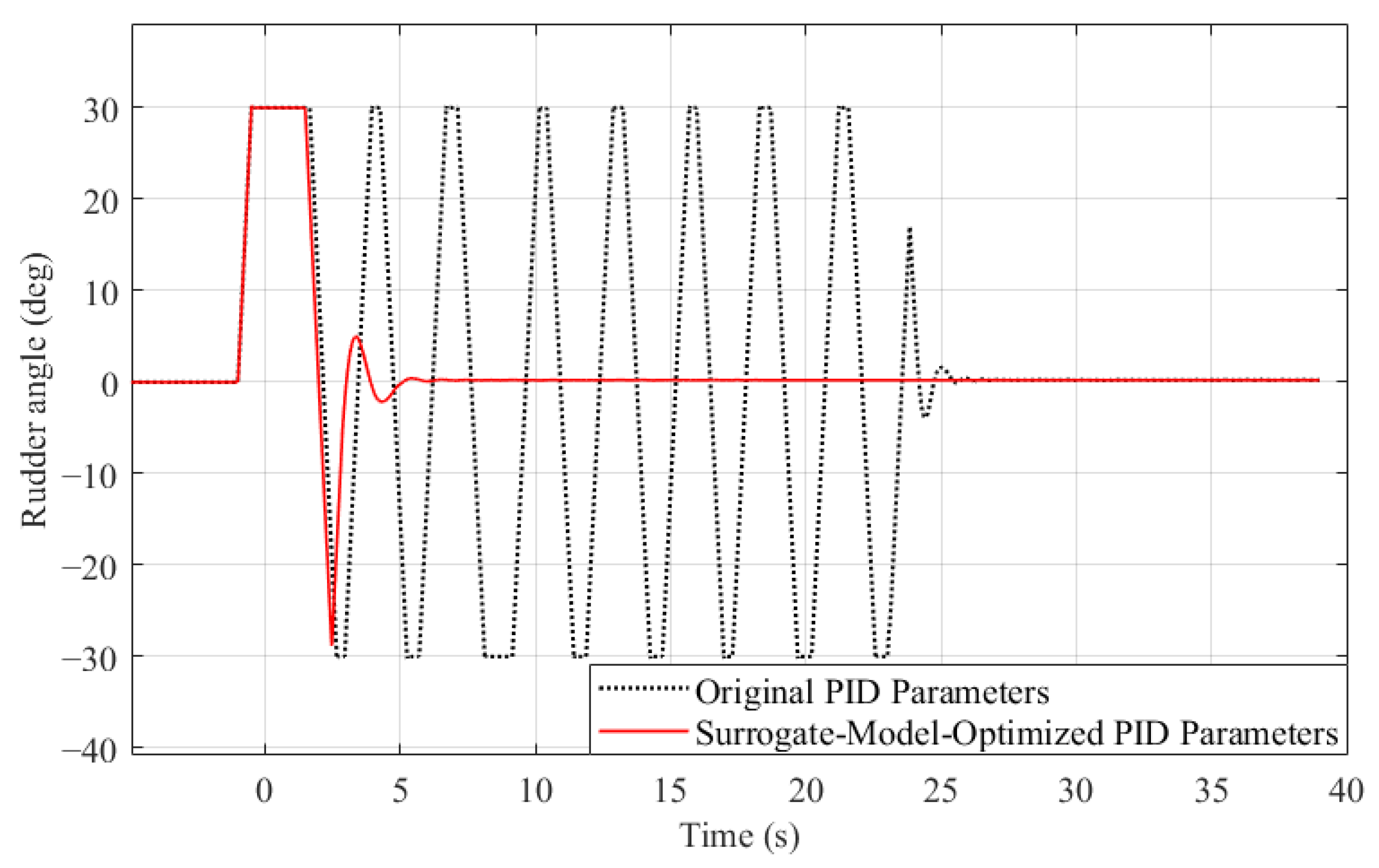
As shown in Figure 17, as the number of iterations increases, the objective function ITAE shows an overall downward trend and gradually becomes stable in the later stage. The optimization results indicate that the ITAE value corresponding to the initial parameters is 5293.83, and it decreases to 1466.17 after optimization, representing a reduction of about 72.3%. This demonstrates that the overall control performance of the system is significantly improved. Figure 18 presents the comparison of heading responses under the original PID parameters and the PID parameters optimized by the surrogate model, while Figure 19 shows the comparison of rudder-angle commands before and after control parameter optimization.
The parameters and control performance indices before and after optimization listed in Table 5 are obtained from Figure 18 and Figure 19. A comparison of the heading responses and rudder-angle commands before and after optimization shows that, with the original PID parameters, the heading overshoot is about 21.07% and the settling time is about 28.16 s, while the rudder-angle command exhibits obvious oscillations during the yaw process and repeatedly approaches the saturation limit. After adopting the optimized PID parameters, the overshoot of the heading response is reduced to about 5.77%, and the system can stably track the target heading within about 7.71 s. At the same time, the oscillation amplitude and adjustment frequency of the optimized rudder-angle command are both reduced, and the variation process becomes smoother.
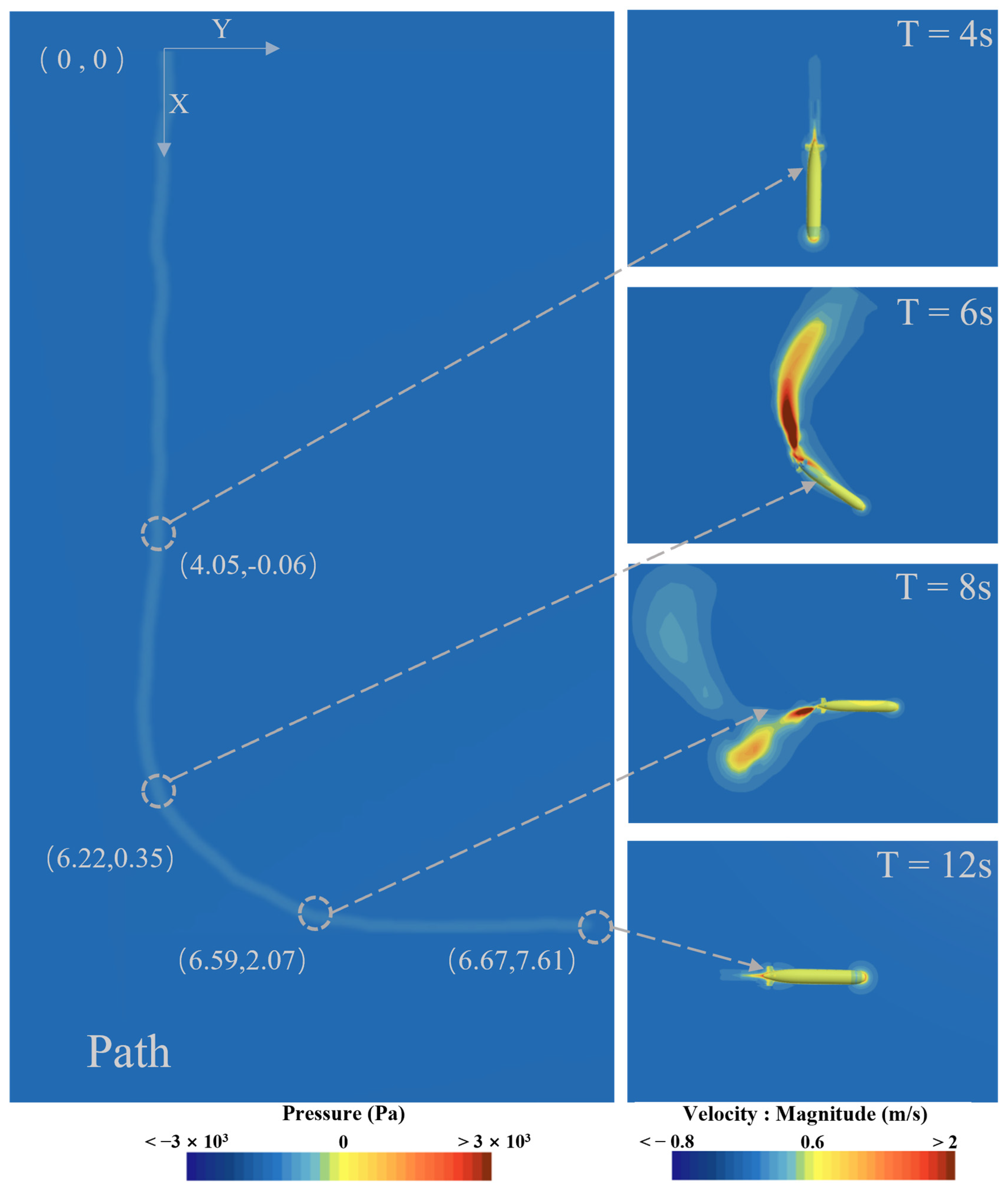
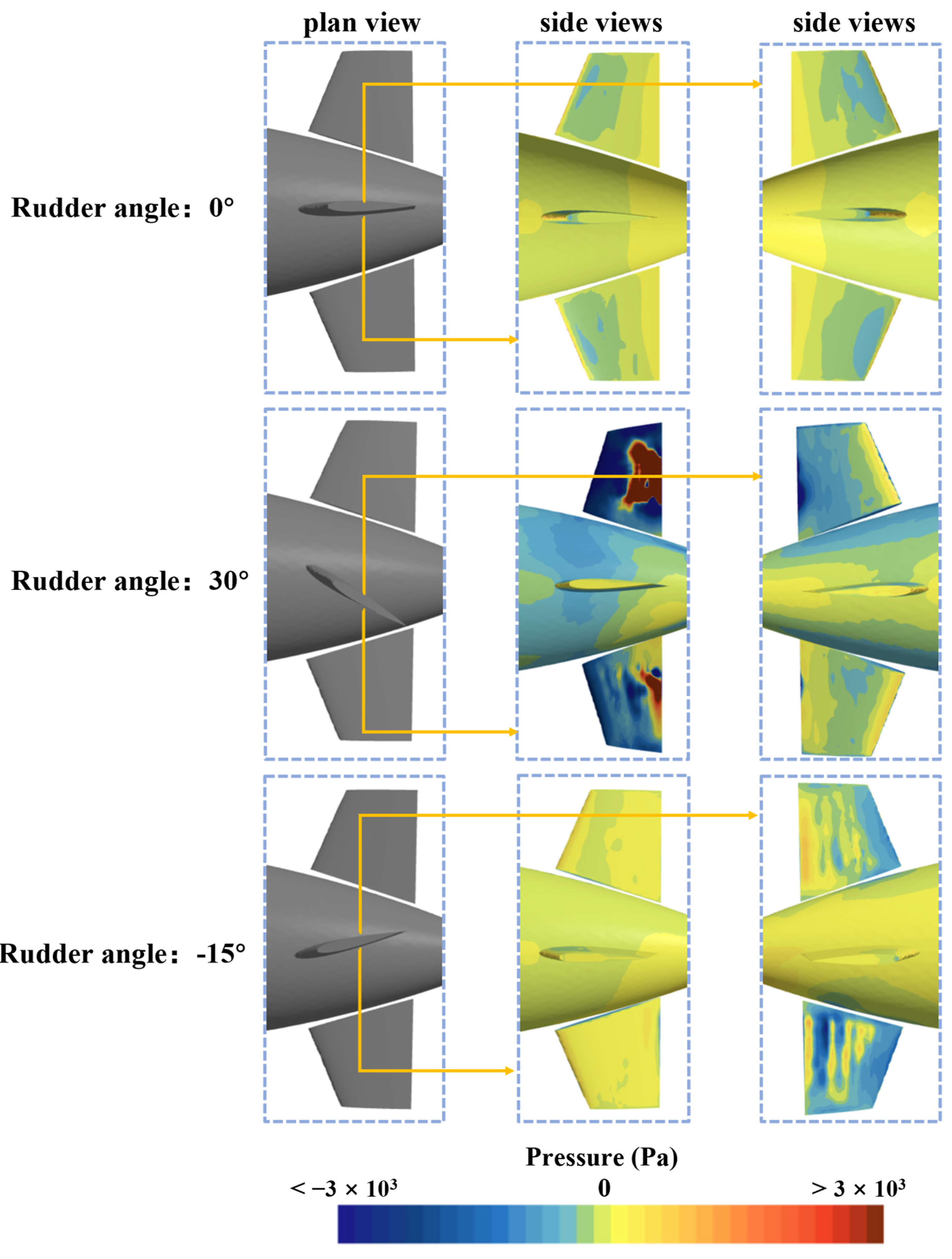
To further analyze the physical mechanism behind the above improvement in control performance from the perspective of flow dynamics, Figure 20 and Figure 21 present the evolution of the velocity flow field and the pressure distribution on the rudder surface at different moments during the large-rudder-angle maneuver with the optimal PID parameters, respectively. These results are used to analyze the nonlinear hydrodynamic characteristics under large-rudder-angle conditions.
From the evolution of the velocity flow field shown in Figure 21, it can be observed that at T = 4 s, the vehicle still maintains a small attitude change, the wake structure is almost symmetric, the flow distribution is relatively uniform, and the motion trajectory is close to a straight line. As the rudder angle rapidly increases and the system enters the large rudder angle maneuvering phase, at T = 6 s, the wake field at the stern shows significant asymmetry. The rudder deflection induces strong lateral velocity components, with localized high-speed jets and low-speed recirculation zones gradually forming, and the wake begins to show noticeable deflection. At this point, flow separation intensifies, the wake vortex structure strengthens, and the vehicle’s motion trajectory exhibits significant curvature, indicating that the system has entered a strongly nonlinear maneuvering state. At T = 8 s, the wake structure further evolves, forming distinct asymmetric vortex clusters. Although the vehicle’s attitude gradually stabilizes, the wake still maintains a strong lateral displacement, with localized high-speed jets and vortex structures continuing to exist. This indicates that unsteady hydrodynamic effects continue to dominate the motion response under large rudder angle conditions. By T = 12 s, the vehicle’s attitude has stabilized, and the motion trajectory begins to level off. The wake structure gradually returns to a more regular configuration, the velocity distribution becomes more uniform, and the pressure difference across the rudder surfaces decreases, indicating that the system is gradually returning to a quasi-steady flow state.
The hydrodynamic mechanisms can be further analyzed by considering the rudder surface pressure distribution shown in Figure 21. At a rudder angle of 0°, the pressure distribution on both sides of the rudder surface is nearly symmetric, with a small pressure gradient, having a weak effect on the vehicle’s attitude. When the rudder angle increases to 30°, a distinct high-pressure region appears on the inflow side of the rudder, while a large low-pressure region forms on the leeward side, resulting in a significant pressure difference and a sharp increase in the yawing moment generated by the rudder. Additionally, localized pressure discontinuities and uneven pressure distributions can be observed, indicating the occurrence of flow separation and vortex shedding near the rudder surface. These are key manifestations of the nonlinear hydrodynamic effects during large rudder angle maneuvers. At a rudder angle of −15°, the rudder surface pressure distribution still shows strong asymmetry, and localized pressure discontinuities can still be observed.
By combining the velocity flow field and rudder surface pressure distribution results, it can be concluded that large rudder angle maneuvers significantly alter the local flow structure around the rudder, leading to asymmetric wake development and the formation of strong vortex structures. This generates larger control forces and moments, enabling the vehicle to achieve rapid attitude adjustments and trajectory deflection. However, this process is accompanied by significant nonlinear hydrodynamic characteristics, such as flow separation, pressure concentration, and wake instability, which impose higher requirements on the vehicle’s maneuvering stability and structural safety.

6. Conclusions

To address the prominent strongly nonlinear hydrodynamic effects during large-rudder-angle yaw maneuvers of AUVs, the limited applicability of linearized dynamic models, and the difficulty of directly transferring control parameters, this study develops a CFD-in-the-loop control simulation and parameter optimization framework for AUV large-rudder-angle yaw maneuvers. Based on this framework, the following main research work is carried out:
(1)
A CFD-based motion simulation model was developed based on a coupled hull–propeller–rudder solver. By integrating overset grids, a propeller body-force model, and the DFBI six-degree-of-freedom motion solver, the model achieves coupled computation of the vehicle’s unsteady flow field, hydrodynamic loads, and motion response. The basic motion response prediction capability of the model was validated against publicly available experimental data, providing a dynamic foundation for subsequent CFD-in-the-loop closed-loop control simulations.
(2)
A CFD-in-the-loop simulation framework for large-rudder-angle yaw control was developed. By coupling the controller, the actuator dynamic model, the virtual sensor feedback module, and the CFD motion simulation model within a unified framework, a closed-loop computational process of control input, flow-field response, motion update, and state feedback was achieved. Comparative analysis shows that, under the same controller structure and initial parameter settings, the control parameters obtained from the linearized hydrodynamic-derivative model can produce a relatively smooth response in the linear model, but exhibit more pronounced fluctuations and degraded convergence performance in the CFD-in-the-loop simulation framework. This indicates that the control parameters depend strongly on the dynamic model, and that parameters tuned on the basis of a linearized model are difficult to apply directly to strongly nonlinear large-rudder-angle maneuvering conditions.
(3)
A sequential optimization method for control parameters based on a Kriging surrogate model was proposed. To address the high computational cost of CFD-in-the-loop simulation, a surrogate model was used to approximate the objective function, and parameter optimization was carried out in combination with a sequential sampling strategy. The results show that the optimized PID parameters can significantly reduce the ITAE index, while also improving the overshoot, settling time, and rudder-angle oscillation characteristics of the heading response. This demonstrates that the proposed method can effectively enhance the dynamic performance of the system while controlling the computational cost.
In summary, the CFD-in-the-loop control simulation and parameter optimization framework developed in this study can provide a relatively realistic representation of the nonlinear hydrodynamic characteristics during AUV large-rudder-angle yaw maneuvers, and offers a unified numerical basis for the analysis and optimization of control parameter applicability.
Future work will build on the present study by further conducting experimental validation under large-rudder-angle conditions, incorporating sensor errors and non-ideal actuator characteristics, and extending the CFD-in-the-loop framework to more advanced control strategies. Meanwhile, considering that the comparative analyses involving the linear hydrodynamic model in this paper are all based on Prestero’s publicly available experimental data and the published Remus100 model, future development of the linear hydrodynamic model will place greater emphasis on the effects of net buoyancy treatment, the relative positions of the center of gravity and center of buoyancy, the initial trim condition, and other key parameter settings on the response results. In terms of control parameter optimization, to further enhance the engineering realizability of the optimized results, future studies may explicitly incorporate engineering constraints such as rudder saturation, rudder rate limits, and actuator loads into the optimization model, and on this basis carry out multi-objective optimization design to comprehensively balance heading-tracking accuracy, response speed, overshoot suppression, and actuator workload, thereby further improving the engineering applicability and robustness of the control strategy in a high-fidelity nonlinear hydrodynamic environment.

Author Contributions

Conceptualization, C.B.; Methodology, D.Z.; Software, N.W. and Z.L.; Formal analysis, D.Z.; Investigation, F.H.; Data curation, N.W.; Writing—original draft, D.Z. and N.W.; Writing—review & editing, Z.L., C.B. and Q.L.; Supervision, F.H. All authors have read and agreed to the published version of the manuscript.

Funding

This research was supported by The National Natural Science Foundation of China under Grant No. 52372356, Zhenjiang City Science and Technology Program Project JC2024015 and the “Qinglan Project” of Jiangsu Higher Education.

Data Availability Statement

The original contributions presented in this study are included in the article. Further inquiries can be directed to the corresponding author.

Conflicts of Interest

Author Fangfang Hu was employed by the company Wuhan Second Ship Design & Research Institute. The remaining authors declare that the research was conducted in the absence of any commercial or financial relationships that could be construed as a potential conflict of interest.

References

  1. Vangi, M.; Topini, E.; Liverani, G.; Topini, A.; Ridolfi, A.; Allotta, B. Design, Development, and Testing of an Innovative Autonomous Underwater Reconfigurable Vehicle for Versatile Applications. IEEE J. Ocean. Eng. 2025, 50, 509–526. [Google Scholar] [CrossRef]
  2. Vallicrosa, G.; Fumas, M.J.; Huber, F.; Ridao, P. Sparus II AUV as a sensor suite for underwater archaeology: Falconera cave experiments. In Proceedings of the 2020 IEEE/OES Autonomous Underwater Vehicles Symposium (AUV); IEEE: New York, NY, USA, 2020; pp. 1–5. [Google Scholar]
  3. Li, D.; Du, L. AUV trajectory tracking models and control strategies: A review. J. Mar. Sci. Eng. 2021, 9, 1020. [Google Scholar] [CrossRef]
  4. Dantas, J.L.D.; de Barros, E.A. Numerical analysis of control surface effects on AUV manoeuvrability. Appl. Ocean Res. 2013, 42, 168–181. [Google Scholar] [CrossRef]
  5. Okuda, R.; Yasukawa, H.; Yamashita, T.; Matsuda, A. Maneuvering simulations at large drift angles of a ship with a flapped rudder. Appl. Ocean Res. 2023, 135, 103567. [Google Scholar] [CrossRef]
  6. Prestero, T. Verification of a Six-Degree-of-Freedom Simulation Model for the REMUS Autonomous Underwater Vehicle. Master’s Thesis, Massachusetts Institute of Technology, Cambridge, MA, USA, Woods Hole Oceanographic Institution, Woods Hole, MA, USA, 2001. [Google Scholar]
  7. Mazin, T.M.; Ajaweed, M.N.; Khalaf, S.K. Optimal control of underwater vehicle using LQR controller driven by a new matrix decision control algorithm. Int. J. Dyn. Control 2023, 11, 2911–2923. [Google Scholar]
  8. Fan, S.; Wang, H.; Zuo, C.; Han, J. Fuzzy adaptive PID-based tracking control for autonomous underwater vehicles. Actuators 2025, 14, 470. [Google Scholar] [CrossRef]
  9. Jin, T.; Yang, X.; Qi, C.; Wu, Y.; Zhang, Y.; Xu, W. Model reference adaptive PID control for enhanced stability and posture control of unmanned underwater vehicles. Ocean Eng. 2025, 330, 121218. [Google Scholar] [CrossRef]
  10. Fureby, C.; Anderson, B.; Clarke, D.; Erm, L.; Henbest, S.; Giacobello, M.; Jones, D.; Johansson, M.; Jones, M.; Kumar, C.; et al. Experimental and numerical study of a generic conventional submarine at 10° yaw. Ocean Eng. 2016, 116, 1–20. [Google Scholar] [CrossRef]
  11. Toxopeus, S.L.; Atsavapranee, P.; Wolf, E.; Daum, S.; Pattenden, R.; Widjaja, R.; Zhang, J.T.; Gerber, A. Collaborative CFD exercise for a submarine in a steady turn. In Proceedings of the ASME 31st International Conference on Ocean, Offshore and Arctic Engineering (OMAE2012); American Society of Mechanical Engineers: New York, NY, USA, 2012; pp. 1–12. [Google Scholar]
  12. Ahmed, F.; Xiang, X.; Wang, H.; Zhang, J.; Xiang, G.; Yang, S. Nonlinear dynamics of novel flight-style autonomous underwater vehicle with bow wings: ASE- and CFD-based estimations of hydrodynamic coefficients and nonlinear dynamic modeling with experimental validations. Appl. Ocean Res. 2023, 141, 103739. [Google Scholar] [CrossRef]
  13. Lin, L.; Chen, Y.; Xiong, H.; Yu, C.; Zhu, H.; Xing, Y.; Zheng, G. Hydrodynamics model identification and model-based control application of a new type of AUV. J. Mar. Sci. Eng. 2025, 13, 310. [Google Scholar] [CrossRef]
  14. Ljung, L. System Identification: Theory for the User, 2nd ed.; Prentice Hall: Upper Saddle River, NJ, USA, 1999. [Google Scholar]
  15. Safari, F.; Rafeeyan, M.; Danesh, M. Estimation of hydrodynamic coefficients and simplification of the depth model of an AUV using CFD and sensitivity analysis. Ocean Eng. 2022, 263, 112369. [Google Scholar] [CrossRef]
  16. Fan, G.; Liu, X.; Hao, Y.; Yin, G.; He, L. Optimized hydrodynamic design for autonomous underwater vehicles. Machines 2025, 13, 194. [Google Scholar] [CrossRef]
  17. Wang, D.; Wang, Y.; Liu, J.; Hu, Z.; Zhang, W.; Wang, Z.; Jiang, Y. An integrated dynamic modeling method for underwater vehicle with hull, propeller and rudder. Ocean Eng. 2023, 282, 115036. [Google Scholar] [CrossRef]
  18. Franceschi, A.; Piaggio, B.; Villa, D.; Viviani, M. Development and assessment of CFD methods to calculate propeller and hull impact on the rudder inflow for a twin-screw ship. Appl. Ocean Res. 2022, 125, 103227. [Google Scholar] [CrossRef]
  19. Badoe, C.E.; Phillips, A.B.; Turnock, S.R. Influence of drift angle on the computation of hull–propeller–rudder interaction. Ocean Eng. 2015, 103, 64–77. [Google Scholar] [CrossRef]
  20. Liu, J.; Wang, M.; Yu, F.; Gao, S.; Yan, T.; He, B. Numerical study on the hull–propeller interaction of autonomous underwater vehicle. Ocean Eng. 2023, 271, 113777. [Google Scholar] [CrossRef]
  21. Krishna, H.R.; Isaac, M.T.; Ebenezer, D.D. Numerical investigation of two-dimensional axisymmetric and three-dimensional flow simulations over a benchmark underwater vehicle. J. Mar. Sci. Eng. 2023, 11, 1765. [Google Scholar]
  22. Knight, B.G.; Maki, K.J. A semi-empirical multi-degree-of-freedom body force propeller model. Ocean Eng. 2019, 178, 270–282. [Google Scholar] [CrossRef]
  23. Hong, L.; Wang, X.; Zhang, D.-S. CFD-based hydrodynamic performance investigation of autonomous underwater vehicles: A survey. Ocean Eng. 2024, 305, 117911. [Google Scholar] [CrossRef]
  24. Wang, Z.; Gu, H.; Lang, J.; Xing, L. Safety analysis of initial separation phase for AUV deployment of mission payloads. J. Mar. Sci. Eng. 2024, 12, 608. [Google Scholar] [CrossRef]
  25. Xu, Y.; Shi, W.; Song, Y.; Jia, L.B. Dynamic docking strategies for a bioinspired AUV. Ocean Eng. 2025, 312, 114892. [Google Scholar] [CrossRef]
  26. Xi, K.; Milne, I.A.; Draper, S.; Chen, L. On the application of overset meshing to numerical studies of roll damping of hulls in complex scenarios. Ocean Eng. 2023, 290, 116173. [Google Scholar] [CrossRef]
  27. Salari, M.; Rava, A. Numerical investigation of hydrodynamic flow over an AUV moving in the water-surface vicinity considering the laminar–turbulent transition. J. Mar. Sci. Appl. 2017, 16, 298–304. [Google Scholar] [CrossRef]
  28. Ahmed, F.; Xiang, X.; Zhou, G.; Xiang, G.; Yang, S. Dynamic Modeling and Maneuvering of REMUS 100 AUV: The Impact of Added Mass Coefficients. In Proceedings of the 2023 42nd Chinese Control Conference (CCC), Tianjin, China, 24–26 July 2023; pp. 1424–1429. [Google Scholar]
  29. Haro, M.P.E.; Park, J.C.; Kim, D.H.; Lee, S.B. CFD simulation on workability of a seaweed harvesting boat due to wake-wash. J. Mar. Sci. Eng. 2020, 8, 544. [Google Scholar] [CrossRef]
  30. Wu, Y.; Long, T.; Shi, R.; Wang, G.G. Mode Pursuing Sampling Method Using Discriminative Coordinate Perturbation for High Dimensional Expensive Black Box Optimization. J. Mech. Des. 2021, 143, 041703. [Google Scholar] [CrossRef]
  31. Dong, H.; Wang, J.; Wang, W.; Shen, J. Data-Driven Multi-Task Global Optimization with Two-Stage Knowledge Transfer for Blended-Wing-Body Underwater Gliders Design. Appl. Soft Comput. 2026, 194, 114867. [Google Scholar] [CrossRef]
  32. Forrester, A.I.J.; Sobester, A.; Keane, A.J. Engineering Design via Surrogate Modelling: A Practical Guide; Wiley: Chichester, UK, 2008. [Google Scholar]
  33. Borisut, P.; Nuchitprasittichai, A. Adaptive Latin Hypercube Sampling for a Surrogate-Based Optimization with Artificial Neural Network. Processes 2023, 11, 3232. [Google Scholar] [CrossRef]
  34. Legashev, L.; Tolmachev, S.; Bolodurina, I.; Shukhman, A.; Grishina, L. Investigation into the hyperparameters of error-based adaptive sampling approach for surrogate modeling. Modelling 2024, 5, 106. [Google Scholar] [CrossRef]
  35. Zhan, D.; Xing, H. Expected improvement for expensive optimization: A review. J. Glob. Optim. 2020, 78, 507–544. [Google Scholar] [CrossRef]
Figure 1. Control design framework for AUV large-rudder-angle yaw maneuvers based on CFD-in-the-loop simulation. The orange and blue dashed boxes denote the optimization module and CFD simulation framework, respectively.
Jmse 14 00716 g001
Figure 2. Geometric model of the underwater vehicle. The gray and pink regions represent the hull and rudder, respectively.
Jmse 14 00716 g002
Figure 3. Virtual disk coordinate system and local mesh refinement.
Jmse 14 00716 g003
Figure 4. Six-degree-of-freedom coordinate systems of the underwater vehicle.
Jmse 14 00716 g004
Figure 5. Computational domain setup.
Jmse 14 00716 g005
Figure 6. Hull position within the computational domain.
Jmse 14 00716 g006
Figure 7. Stern mesh and overset grid region of the underwater vehicle.
Jmse 14 00716 g007
Figure 8. Heading responses for different time-step sizes.
Jmse 14 00716 g008
Figure 9. Comparison of pitch responses from different simulation models.
Jmse 14 00716 g009
Figure 10. Comparison of yaw responses predicted by different simulation models.
Jmse 14 00716 g010
Figure 11. Comparison of circular motion at large rudder angle.
Jmse 14 00716 g011
Figure 12. Schematic of the AUV control system based on CFD-in-the-loop simulation.
Jmse 14 00716 g012
Figure 13. Information flow and interaction process. The yellow arrows indicate the direction of data transfer.
Jmse 14 00716 g013
Figure 14. Heading Angle Comparison Chart.
Jmse 14 00716 g014
Figure 15. Path comparison chart.
Jmse 14 00716 g015
Figure 16. PID Parameter Optimization Framework Based on Kriging Model.
Jmse 14 00716 g016
Figure 17. Convergence history of ITAE during the control parameter optimization process.
Jmse 14 00716 g017
Figure 18. Comparison of heading angles before and after control parameter optimization.
Jmse 14 00716 g018
Figure 19. Comparison of rudder angles before and after control parameter optimization.
Jmse 14 00716 g019
Figure 20. Velocity flow fields at different time instants.
Jmse 14 00716 g020
Figure 21. Pressure distribution comparison on both sides of the vertical rudder.
Jmse 14 00716 g021
Table 1. Main parameters of the REMUS 100.
ParameterValueUnitDescription
a+1.91 × 10⁻¹mBow length
a o f f s e t +1.65 × 10⁻²mBow offset
b+6.54 × 10⁻¹mMid-body length
c+5.41 × 10⁻¹mStern length
c o f f s e t +3.68 × 10⁻²mStern offset
d+1.91 × 10⁻¹mMaximum hull diameter
n+2n/aExponential coefficient
θ+4.36 × 10⁻¹radiansTail angle
Table 2. Drag simulation results with different mesh resolutions.
CaseMeshes (×104)CFD Drag (N)Experimental Drag (N)Relative Error
12588.859.516.94%
23549.069.514.73%
34889.229.513.05%
Table 3. Different time-step sizes and their corresponding Courant numbers.
Scheme Time   Step   Size   ( t / s ) Courant Number
10.00140.79
20.0010.46
30.00070.39
Table 4. Control performance indices.
Model t r  (s) t s  (s) ψ m a x  (°) σ  (%) ITAE  (°⋅s2)
Linear hydrodynamic model3.52812.688102.7714.182733.55
CFD-in-the-loop1.312-110.8623.1712,337.82
Table 5. Comparison of parameters and control performance indices before and after optimization.
CategoryParameterBefore OptimizationAfter Optimization
PID Parameters   K p 1.971.51
  K i 0.270.01
  K d 0.140.05
Performance   t r 24.517.19
  t s 28.167.71
  σ % 21.07%5.77%
Disclaimer/Publisher’s Note: The statements, opinions and data contained in all publications are solely those of the individual author(s) and contributor(s) and not of MDPI and/or the editor(s). MDPI and/or the editor(s) disclaim responsibility for any injury to people or property resulting from any ideas, methods, instructions or products referred to in the content.