Article

Joint Optimization of Berth and Shore Power Allocation Considering Vessel Priority Under the Dual Carbon Goals


1
Shanghai International Shipping Institute, Shanghai Maritime University, Shanghai 201306, China
2
Logistics Engineering College, Shanghai Maritime University, Shanghai 201306, China
*
Author to whom correspondence should be addressed.
J. Mar. Sci. Eng. 2026, 14(7), 688; https://doi.org/10.3390/jmse14070688
Submission received: 10 March 2026 / Revised: 30 March 2026 / Accepted: 31 March 2026 / Published: 7 April 2026
(This article belongs to the Special Issue Maritime Ports Energy Infrastructure)

Abstract

Against the backdrop of the dual-carbon strategy promoting the green and low-carbon transformation of the shipping industry, pollutant emissions generated during vessel berthing operations have become a critical challenge in port environmental governance. To address the combined effects of the priority berthing policy for new energy vessels and time-of-use electricity pricing, a joint optimization model for berth and shore power allocation is developed with the objectives of minimizing the total economic cost of vessels and the environmental tax cost associated with pollutant emissions. An improved Adaptive Large Neighborhood Search algorithm (ALNS-II) is further designed to solve the model. Numerical experiments based on actual port data verify the effectiveness of the proposed model and the superiority of the algorithm. The results indicate that, under time-of-use electricity pricing, the priority berthing policy for new energy vessels can shorten their waiting time at anchorage and encourage fuel-powered vessels to shift toward electrification. When the peak-to-valley electricity price ratio increases from 4.1:1 to 7.5:1, the environmental tax cost of pollutant emissions decreases slightly, whereas the total economic cost of vessels rises by 4.17%, suggesting that the peak-to-valley electricity price ratio should not be set excessively high. In addition, increasing the proportion of new energy vessels to 70% is more conducive to improving the overall economic and environmental performance of ports. The findings provide a theoretical basis and decision support for the optimal allocation of port resources under the coordination of multiple policies.

1. Introduction

Shipping and ports are pivotal drivers of global trade and economic growth, accounting for approximately 80% of international trade volume and promoting economic cooperation. Automation has strengthened the competitiveness and efficiency of ports [1]. However, with the continuous growth of maritime activities, ports and their surrounding areas have gradually become major zones of energy consumption and pollution emissions. China has set ambitious targets to peak carbon emissions by 2030 and achieve carbon neutrality by 2060. Ports are among the primary sources of air pollution, with emissions mainly arising from handling operations and incoming vessels. Key measures include promoting the electrification of container terminals, supporting the application of shore power technology for berthing vessels, and converting diesel-powered container cranes to electric operation. Shore power refers to the provision of onshore electricity to vessels during their berthing period, enabling them to shut down auxiliary engines, thus reducing fuel consumption and emissions. The approach serves as an effective measure for energy conservation and emission reduction, and is a key initiative in the development of green ports. The time-of-use (TOU) pricing policy, charging different electricity rates at different times, serves as a demand-side management tool with the continued growth of global electricity demand.
To further accelerate the development of low-carbon ports, the government has introduced a series of incentive policies, such as multi-energy powered vessels. It aims to gradually expand the application of green electricity, LNG, biodiesel, and green alcohol in the shipping sector. Incentives for new energy vessels include priority berthing and unberthing, such as partial reduction in berthing fees and preferential berth allocation. Consequently, ports need to account for the priority service of new energy vessels when formulating their berth allocation plans. However, under TOU pricing policies, new energy vessels may not necessarily choose to prioritize berthing. Currently, domestic shore power electricity pricing is beginning to implement the TOU mechanism, with peak, flat, and valley electricity price ratios reaching 1.5:1.0:0.3. This pricing structure means that if new energy vessels prioritize berthing and use shore power during peak electricity periods, they incur high electricity costs. Therefore, balancing priority berthing service for multi-energy powered vessels with the impact of TOU pricing policies has become a critical issue for port managers in advancing low-carbon ports.

1.1. Literature Review

The existing literature relevant to this study focuses on three main areas: ship priority, joint optimization of berth allocation and shore power, and TOU pricing. Vessel service priority has been recognized as an effective approach to improving port operational efficiency, and has been extensively studied in the existing literature [2,3,4]. Ganji et al. (2024) demonstrated that well-designed priority strategies can reduce vessel waiting times and enhance port operational efficiency [5]. Yıldırım et al. (2020) applied artificial bee colony optimization and simulation optimization techniques to solve flexible vessel priority management in container terminal berth allocation [6]. Chen et al. (2023) addressed a maritime rescue coverage problem by minimizing response time for heterogeneous rescue vessels [7]. Lu et al. (2025) presented an integrated model that incorporates tidal factors into the joint optimization of berth and quay crane operations, addressing both service standards and emissions during port stays and crane activities [8]. Ursavas et al. (2022) developed an efficient berth allocation decision support system by embedding a dynamic discrete event simulation model to determine berth allocation priorities for arriving vessels [9]. Considering uncertain vessel arrival time, Jiang et al. (2025) reviewed the corresponding prediction methods and influencing factors for maritime operational efficiency [10]. Wang et al. (2024) introduced an optimization method based on an active–reactive strategy for solving continuous berth allocation and quay crane allocation problems with mixed uncertainties [11]. The above studies provide valuable theoretical foundations and methodological insights for vessel priority scheduling.
Research on shore power primarily focuses on government subsidies, port optimization, and emission reduction benefits. Zhen et al. (2022a) compared two incentive policies on shore power system deployment, constructing a nonlinear programming model to optimize shore power deployment, berth allocation, and vessel service sequences [12]. Song et al. (2022) proposed that the government should prioritize subsidies for vessels using shore power to enhance the investment attractiveness of emission reduction technologies and optimize low-carbon port operation paths [13]. Peng et al. (2019) studied the shore power allocation, aiming to minimize total shore power costs and carbon emissions, through determining the capacity expansion and usage patterns [14]. Zhang et al. (2025) developed a multi-objective optimization model for the coordinated allocation of shore power and berth scheduling, integrating economic benefits, environmental benefits, and operational efficiency [15].
In berth allocation research, Wang et al. (2020) considered carbon emission taxes, establishing a model aiming to minimize total completion delay costs and quay crane operational costs [16]. Rodrigues et al. (2022) and Zhen et al. (2022b) focused on the berth allocation problem that incorporates uncertainties like weather conditions, vessel arrival times, and container handling volumes [17,18]. Guo et al. (2024) explored a collaborative model for multiple terminals sharing shore-side and yard resources [19]. Zhang et al. (2022) considered a balance in port economic costs and environmental performance through the coordinated optimization of berth allocation and shore power assignment [20]. Wang et al. (2024) established a collaborative optimization model for berth allocation, quay crane, and shore power scheduling, which enhanced port throughput efficiency and service levels [21]. These studies collectively indicate that collaborative optimization of berth and shore power can reduce vessel waiting times and fuel consumption while balancing environmental protection and economic benefits.
The time-of-use (TOU) pricing mechanism has a significant impact on port energy scheduling costs, and some studies have begun to incorporate TOU pricing into optimization models. Parise et al. (2016) optimized the number of quay cranes operating during peak periods, reducing peak electricity demand by approximately 60% [22]. Van et al. (2018) achieved about a 10% electricity cost saving by limiting peak electricity demand for refrigerated containers in the yard. Some studies on collaborative scheduling of berths and terminal equipment have incorporated TOU pricing mechanisms [23]. Iris et al. (2021) proposed a mixed-integer linear programming model to address integrated operation planning and energy management issues considering different energy pricing schemes and bidirectional energy transactions between energy and storage systems [24]. Yu et al. (2022) studied the berth allocation and quay crane assignment problem (BACAP) to minimize electricity costs, delay times, and vessel emission costs, analyzing vessel costs under different TOU pricing [25]. The above studies take into account the practical characteristics of TOU pricing and are more aligned with the requirements of low-carbon port operations.
Table 1 summarizes literature related to joint optimization of berth and shore power allocation under TOU electricity pricing, considering vessel priority.
In summary, Existing research has made significant progress in the joint optimization of berth allocation and shore power scheduling, particularly in the application of multi-objective optimization models and meta-heuristic algorithms such as adaptive large neighborhood search (ALNS) and genetic algorithms (GA). These studies have effectively reduced vessel waiting times, energy consumption costs, and pollutant emissions, providing theoretical support for the development of green ports under the dual-carbon goals. For instance, some studies have incorporated carbon emission taxation into berth allocation models to balance operational efficiency and environmental costs, while others have explored the coordinated scheduling of berth resources and shore power systems under uncertainty. However, there are still some limitations in the existing research. First, the quantification of vessel priority rules requires further refinement. Most existing studies adopt fixed weight assignments, which fail to fully capture the dynamic influence of multiple factors, such as the remaining energy of new energy vessels and cargo handling volumes, on priority determination. Second, current research tends to examine either the impact of time-of-use (TOU) pricing or vessel priority on berth allocation in isolation, with limited efforts devoted to integrating these two factors within a unified framework. Finally, most studies focus on a single type of vessel, while the coexistence of heterogeneous vessels—such as fuel-powered, electric, and methanol-powered vessels—has received in-sufficient attention.
Therefore, this study investigates the joint optimization problem of berth allocation and shore power assignment under time-of-use (TOU) pricing while considering vessel priority. Multiple factors are comprehensively incorporated, including vessel types, TOU electricity pricing, berthing priority, shore power service coverage, safety distance constraints, and energy replenishment requirements. A bi-objective optimization model is developed to minimize the total economic cost of vessels and the environmental tax cost associated with pollutant emissions. To solve the model, an improved adaptive large neighborhood search (ALNS-II) algorithm is proposed. The results provide decision support for the coordinated optimization of berth allocation and shore power usage in the context of green port development.

1.2. The Contributions of This Paper

This paper addresses the joint allocation problem of berths and shore power in green port operations, with a particular focus on the simultaneous consideration of time-of-use (TOU) electricity pricing and vessel priority policies—a combination that has been largely overlooked in the existing literature. It compares and summarizes previous models and methods, identifying their limitations, especially the tendency to examine either TOU pricing mechanisms or vessel priority rules in isolation, as well as the insufficient treatment of heterogeneous vessel types and their distinct energy replenishment requirements. By incorporating TOU pricing, vessel priority rules, multi-energy vessel characteristics, shore power service coverage, safety distance constraints, and energy replenishment processes into the modeling framework, the study improves upon these models, thereby establishing a more realistic and comprehensive bi-objective mixed-integer programming model. The objectives of this model are to minimize the total economic cost of vessels and the environmental tax cost associated with pollutant emissions. To solve this model, the study employs an improved adaptive large neighborhood search (ALNS-II) algorithm. This algorithm is designed to provide high-quality Pareto optimal solutions for berth and shore power allocation, outperforming traditional meta-heuristic methods such as multi-objective particle swarm optimization (MOPSO) and genetic algorithms (GA) in terms of solution quality, convergence, distribution uniformity, and diversity. Additionally, a sensitivity analysis of key parameters—including the peak-to-valley electricity price ratio, the proportion of new energy vessels, and vessel cost components—is conducted to assess the robustness of the proposed model under varying conditions and to provide decision support for port managers balancing economic and environmental objectives.

2. Problem Description and Model Formulations

2.1. Problem Description

Suppose a container terminal has B berths, each with dedicated quayside equipment. Currently, I vessels are scheduled to arrive, comprising three types: conventional fuel vessels, electric vessels, and methanol vessels. Under low-carbon incentive policies, electric and methanol vessels enjoy priority berthing rights. The time period is also divided into peak, flat, and valley segments with differentiated rates to incentivize shipowners to optimize berthing schedules and energy service plans based on TOU.
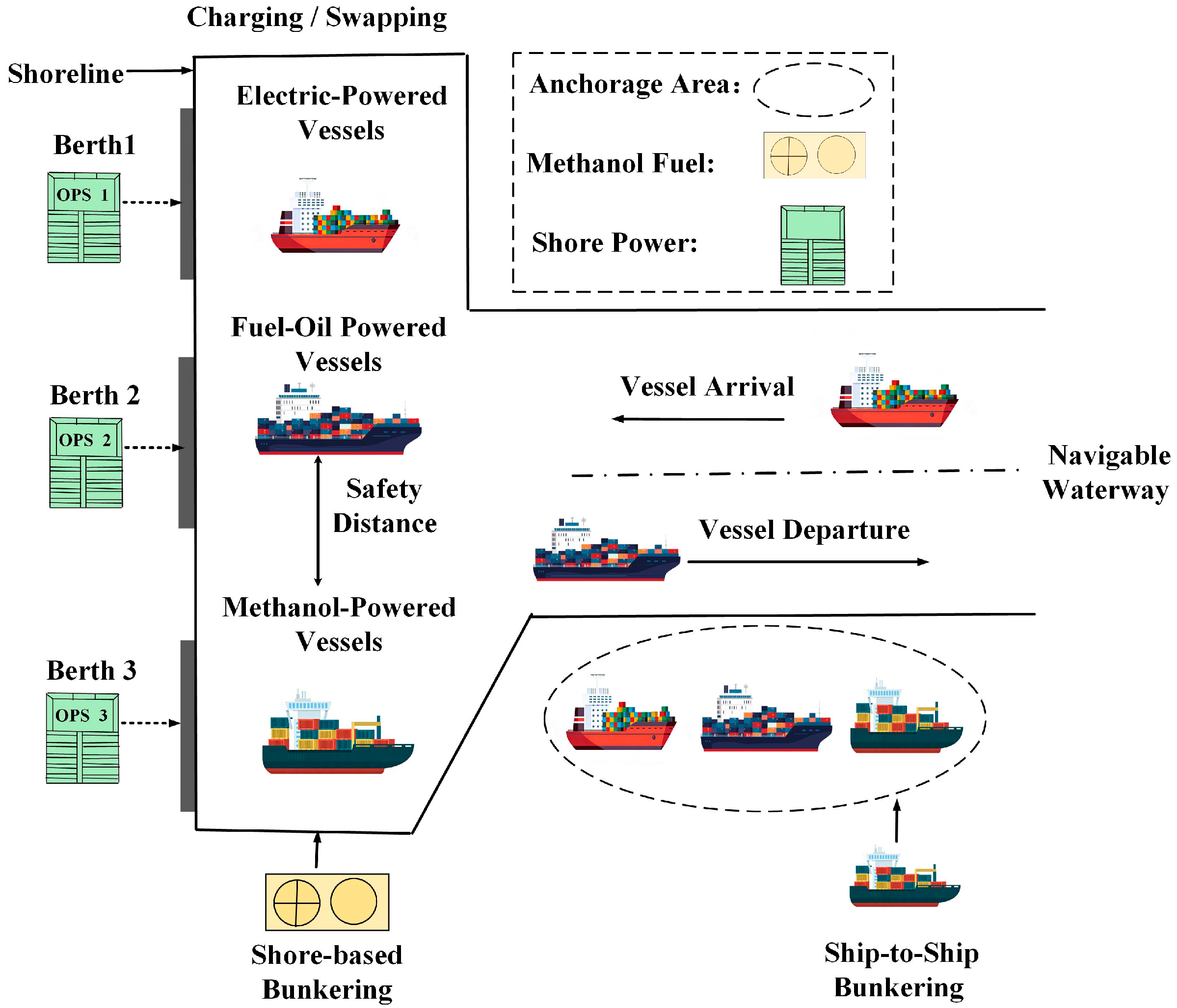
Vessel berthing priorities are given based on the following operational rules. Berthing is prioritized for new energy vessels, followed by fuel-powered vessels. For new energy vessels, those with lower remaining energy reserves receive priority berthing to promptly meet their energy replenishment needs. For vessels with the same type, those with larger cargo volumes receive priority berthing to enhance overall port operational efficiency. During berthing, energy usage varies by vessel type. Electric vessels must connect to shore power equipment for charging. Since shore power usage costs are influenced by TOU pricing policies, charging during off-peak hours is recommended to reduce expenses. Methanol vessels refuel at anchorages or berths, requiring maintenance of safe distances from adjacent vessels during refueling, as shown in Figure 1.
Under TOU pricing, effective coordination of berth allocation and shore power usage is essential to improving operational efficiency and reducing vessel-related emissions. This requires comprehensive consideration of practical constraints, including vessel types, arrival schedules, handling durations, service range, and capacity of shore power facilities. Moreover, port operations involve multiple stakeholders with differing objectives, where governments prioritize emission reduction, port authorities seek efficient resource utilization, and vessels aim to minimize wait costs. Therefore, this study investigates a joint berth and shore power allocation problem under realistic operational constraints, aiming to balance economic efficiency and environmental sustainability in low-carbon port operations.

2.2. Model Formulations

2.2.1. Model Assumption Conditions

For the sake of simplicity and clarity of the model, the following key assumptions are made.
(1)
Waterway conditions are assumed to consistently satisfy navigation requirements, ensuring that all vessels can safely access and depart from the terminal.
(2)
The vessels’ arrival time is known due to ships’ time table, and the influence of weather, accidents and other interference on the vessels are not into consideration.
(3)
All berths and shore power systems are assumed to be initially idle, ensuring a well-defined initial system state and avoiding the complexity associated with pre-existing allocations.
(4)
The shore power connection time is assumed to be negligible compared to the vessel berthing and handling time.

2.2.2. Model Parameters and Definitions

To facilitate the model description, Table 2 presents the symbols used in the modeling process and their meanings.

2.2.3. Mathematical Model

The model aims to minimize the total economic costs and environmental tax costs from pollutant emissions for all vessels, where the total economic cost primarily consists of vessel time costs and energy consumption. Time costs for vessels, including anchorage waiting costs and delayed departure costs, are calculated as Equation (1).
C cw = i I ( T f i E DT i ) × C Z i + i I ( T s i T a i ) × C M i ( i I )
Energy consumption costs encompass shore power usage fees and auxiliary genera tor fuel expenses, as provided in Equation (2). Shore power costs include TOU electricity rates across peak, flat, and valley periods. Auxiliary generator costs primarily reflect fuel expenditures for onboard power generation during berthing.
C mt = i I ( C h T i h + C m T i m + C l T i l ) l A P i A O i + i I C D W i D ( 1 O i )
Beyond carbon emissions, this study also considers the environmental impacts of other pollutants such as SO2, NOx, and PMx. Environmental taxes are imposed to uni- formly quantify these pollutants as economic penalty costs. During berthing operations, if shore power is not utilized, diesel fuel must be consumed by auxiliary engines for power generation. Diesel consumption is calculated in Equation (3). The pollutant emissions from auxiliary diesel engines are calculated using Equation (4).
W i D = l A P i A R A T z i , i I
E M i = W i D W p , i I
Thus, the objective functions of this model are provided as follows. Objective (5) minimizes the total economic cost of vessels. Objective (6) minimizes the environmental tax payment of pollutant emissions.
min F 1 = C m t + C c w
min F 2 = i I p P E   M i ( 1 O i ) C p , i I , p P
i I b B t T X i b t 1 , i I , b B , t T
T fi T sj M ( 1 Z ij ) , i , j I , i j
b i + l i b j + M ( 1 U ij ) , i , j I , i j
Z ij + Z ji + U ij + U ji 1 , i , j I , i j
T s i T a i , i I
e E i I Y i e X i b t 1 , e E , i I , t T
A 1 i I P i A Y i e A 2 , t T , e E
Y i e d e b D e X i b t , i I , e E , b B , t T
T ih + T i m + T i l = T z i O i , i I
T s i T s j + M ( 1 σ i j ) + M ( 1 α i j ) , i , j I , i j , V i { 1,3 } , V j = 2
α i j = 1 , if   T a i T a j Δ T 0 , otherwise
T s i T s j + M ( 1 Z i j ) , i , j I , i j , v i = v j , Q i > Q j
T si T sj + M ( 1 Z i j ) , i , j I , i j , V i { 1,3 } , R i < R j
X i b t + X j , b 1 , t + X j , b + 1 , t 1 , i I , V i = 3 , j i , b B , t T
T k i t T k i + T g i , i I , V i = 3 , t T  
T f i T s i = T z i , i I , V i = 2
T w i T s i , i I , V i = 1
T f i M a x ( T s i + T z i , T w i + T c i ) , i I , V i = 1
T k i T s i M ( 1 A i ) , i I , V i = 3
T k i + T g i T f i + M ( 1 A i ) , i I , V i = 3
T k i T a i M A i , i I , V i = 3
T k i + T g i T s i + M A i , i I , V i = 3
Constraints (7) ensure that at any given time, each vessel can dock at only one berth, and each berth can accommodate only one vessel simultaneously. Constraints (8) ensure that vessels at the same berth must complete operations in the order of their arrival. Constraints (9) prohibit spatial overlap of vessels during berthing. Constraints (10) ensure that for any two vessels, both relationships in operation sequence and vertical offset are satisfied to prevent conflicts in time and space. Constraints (11) ensure that a vessel’s actual berthing time is not earlier than its arrival time. Constraints (12) ensure that each vessel uses at most one shore power unit, and each shore power unit can supply power to only one vessel at a time. Constraints (13) ensure that the total power demand of all vessels using shore power is within the minimum and maximum power supply capacities of the port. Constraints (14) restrict shore power units to serving their designated berth and adjacent berths. Constraints (15) ensure that the total duration of electricity usage in each TOU pricing period for a vessel equals its total berthing time. Constraints (16) and (17) grant new energy vessels priority berthing rights within the effective time window, allowing them to berth before fuel-powered vessels. Constraints (18) ensure that among vessels of the same type, those with larger loading/unloading volumes have priority berthing rights. Constraints (19) ensure that among new energy vessels, those with lower energy reserves have higher berthing priority. Constraints (20) and (21) impose safety distance constraints on methanol vessels, ensuring that during the entire refueling process, no other vessels can berth within the safety distance range. Constraints (22) ensure that the actual departure time of a fuel-powered vessel equals its berthing time plus its loading/unloading duration. Constraints (23) ensure that electric vessels can only begin charging after berthing. Constraints (24) ensure that electric vessels can only depart after completing all necessary operations (loading/unloading, charging). Constraints (25) ensure that methanol vessels’ refueling start time cannot be earlier than their berthing time. Constraints (26) ensure that methanol vessels’ refueling must be completed before departure. Constraints (27) ensure that the refueling process of methanol vessels at anchorage must not start earlier than their arrival time. Constraints (28) ensure that the refueling of methanol vessels at anchorage is completed before vessel berthing.

3. Solution Method

This section designs a tailored heuristic algorithm for the abovementioned model based on the ALNS framework. Algorithm 1 presents the pseudocode for the improved ALNS-II algorithm. Here, S , S 0 and S * denote the current solution, optimal solution, and temporary solution, respectively; W d and W r represent the weight vectors for destruction and restoration operations; θ d and θ r denote the real-time scores for destruction and restoration operators; π d and π r are operator scores;   Ω and   Ω + denote the method sets for destruction and restoration operations.
Algorithm 1: Pseudo-code for the improved ALNS-II algorithm
  1   Input: Model parameters, maximum iteration count K m a x , initial temperature T 0 ,
  cooling rate α , destruction ratio δ
  2   Output: Pareto archive 𝒜 (set of non-dominated solutions), best compromise solution
  3   Initialization:
  4     Generate initial solution S0 using heuristic rules S ← S0, T ← T0
  5     Initialize Pareto archive 𝒜 ← {S0}
  6     Initialize destruction operator weights W d ← [0.25, 0.25, 0.25, 0.25]
  7     Initialize repair operator weights W r ← [0.33, 0.33, 0.34]
  8     Initialize operator scores π d ← 0, π r ← 0
  9     Initialize operator usage counters   θ d ← 0, θ r ← 0
  10   Main Loop:
  11     for k = 1 to   K m a x do
  12       Select destruction operator d ∈ Ω based on weights W d
  13       Select repair operator r ∈ Ω+ based on weights W r
  14          θ d   θ d + 1, θ r θ r + 1
  15       S’ ← Apply destruction operator d to S (remove ξ·|I| vessels)
  16        S’ ← Apply repair operator r to reconstruct S’
  17       Compute objective values F1(S’) and F2(S’) using Equations (5) and (6)
  18       //Multi-Objective Acceptance Criterion
  19        if S’ dominates S (i.e., F1(S’) ≤ F1(S) and F2(S’) ≤ F2(S), with at least one strict inequality) then
  20         S ← S’
  21         Update operator scores π d π d + 30, π r π r + 30
  22        else if S’ is not dominated by S then
  23         Δmin ← min {F1 (S’) − F1(S), F2(S’) − F2(S)}
  24         if exp (−Δmin/T) > random (0,1) then
  25           S ← S’
  26           Update operator scores π d π d + 15, π r π r + 15
  27         else
  28           Update operator scores π d π d + 5, π r π r + 5
  29         end if
  30        end if
  31       //Pareto Archive Update
  32        if S’ is not dominated by any solution in 𝒜 then
  33         Add S’ to 𝒜
  34          Remove from 𝒜 any solution dominated by S’
  35       end if
  36       //Adaptive Weight Update
  37       Update destruction operator weights W d ← (1 − r) W d + r ( π d /   θ d )
  38       Update repair operator weights W r ← (1 − r) W r + r ( π r /   θ r )
  39       T ← αT
  40     end for
  41   Return: Pareto archive 𝒜 and best compromise solution (closest to origin)

3.1. Initial Solution Generation

The initial solution generation strategy is designed based on heuristic rules. First, vessels are sorted by their arrival time T a i . Then, berths b and operation times t are sequentially assigned to each vessel, ensuring compliance with berth length constraints and spatiotemporal uniqueness constraints. This initial solution comprises the decision variable set V = { X , Y , T , O } , where X = { X i b t | X i b t { 0,1 } } denotes the spatiotemporal allocation matrix indicating whether vessel i occupies berth b at time t , and Y = { y i e | y i e { 0,1 } } denotes the matching relationship matrix indicating whether vessel i uses shore power equipment e , T = { t s i , t f i } records the actual berthing and unberthing times of vessels, and O = { O i | O i { 0,1 } } represents the decision variable for whether vessels use shore power. The algorithm employs a multi-level nested dictionary data structure, balancing data integrity and operational efficiency.
It should be noted that the initial solution generated by the above heuristic serves only as a starting point for the ALNS-II algorithm. The assignment decision for each vessel i can be expressed as:
assign ( i ) = a r g m i n b B , t     T a i { t : feasible ( i , b , t ) }
where B denotes the set of berths, T a i is the arrival time, and feasible ( i , b , t ) indicates that vessel i can be moored at berth b from time t without violating any constraints. This greedy, earliest-available-time rule mimics the common first come first served practice in port operations, providing a feasible and reproducible baseline.

3.2. Design of Destruction and Repair Operators

The proposed algorithm has four types of disruption operators and three types of restoration operators to construct new solutions, tailored to the characteristics of the berth and shore power allocation.
The algorithm employs four destruction operators to remove selected vessels from the current solution, controlled by a destruction ratio ξ ( 0,1 ) . Let I denote the set of all vessels, and let I assigned I be the set of vessels currently assigned in the solution.
(1) Random destruction operator. Randomly selects ξ I assigned vessels uniformly from I assigned and removes their allocations from the current solution. This operator ensures diversity in the search.
(2) Worst-case destruction operator. Computes a cost contribution C i for each vessel i I assigned based on the current composite objective:
C i = ω 1 C i W + ω 2 C i E + ω 3 C i D
where C i W , C i E , and C i D denote the waiting cost, energy cost, and delay cost of vessel i , respectively. The weights ω 1 , ω 2 , ω 3 are dynamically adjusted according to the current Pareto archive. The vessels with the highest C i values are selected for destruction until ξ I assigned vessels are removed.
(3) Correlation disruption operator. This operator targets vessels that are temporally correlated with a randomly selected seed vessel. Let i 0 be a randomly chosen vessel from I assigned . The set of vessels to be destroyed is defined as:
D corr = j I assigned : T s j T s i 0 ε
where T s i is the actual berthing time of vessel i , and ε is a predefined overlap threshold (set to 0.5 h in this study). If D corr < ξ I assigned , additional vessels are randomly selected from I assigned D corr to meet the destruction ratio.
(4) Time-slot disruption operator. This operator focuses on vessels that berth during peak electricity tariff periods. Let P denote the set of time intervals corresponding to peak periods (e.g., 9:00–12:00 and 19:00–22:00). The set of vessels to be destroyed is defined as:
D time = i I assigned : T s i P
If D time < ξ I assigned , additional vessels are randomly selected from I assigned D time to satisfy the destruction ratio.
After applying a destruction operator, the removed vessels are stored in a list of unassigned vessels, which will be re-inserted by the subsequent repair operator.
The algorithm employs three repair operators to reassign the vessels removed by the destruction operator. Each operator constructs a feasible allocation for the unassigned vessels in sequence.
(1) Greedy repair operator. For each unassigned vessel, the operator evaluates all feasible berth-time combinations (b, t) that satisfy the spatial and temporal constraints. The combination with the smallest incremental contribution to the composite objective F is selected.
(2) Regret-based repair operator. This operator calculates a regret value for each unassigned vessel to avoid locally myopic decisions. The regret value r i for vessel i is defined as:
r i = Δ i , 2 Δ i , 1
where Δ i , 1 and Δ i , 2 are the first- and second-best objective improvements achievable by assigning vessel i to its best feasible berth-time combination. Vessels with higher regret values are assigned first, followed by the greedy assignment for the remaining vessels.
(3) Random repair operator. For each unassigned vessel, this operator randomly selects a feasible berth-time combination b t from the set of all feasible combinations, with uniform probability. This operator enhances solution diversity.
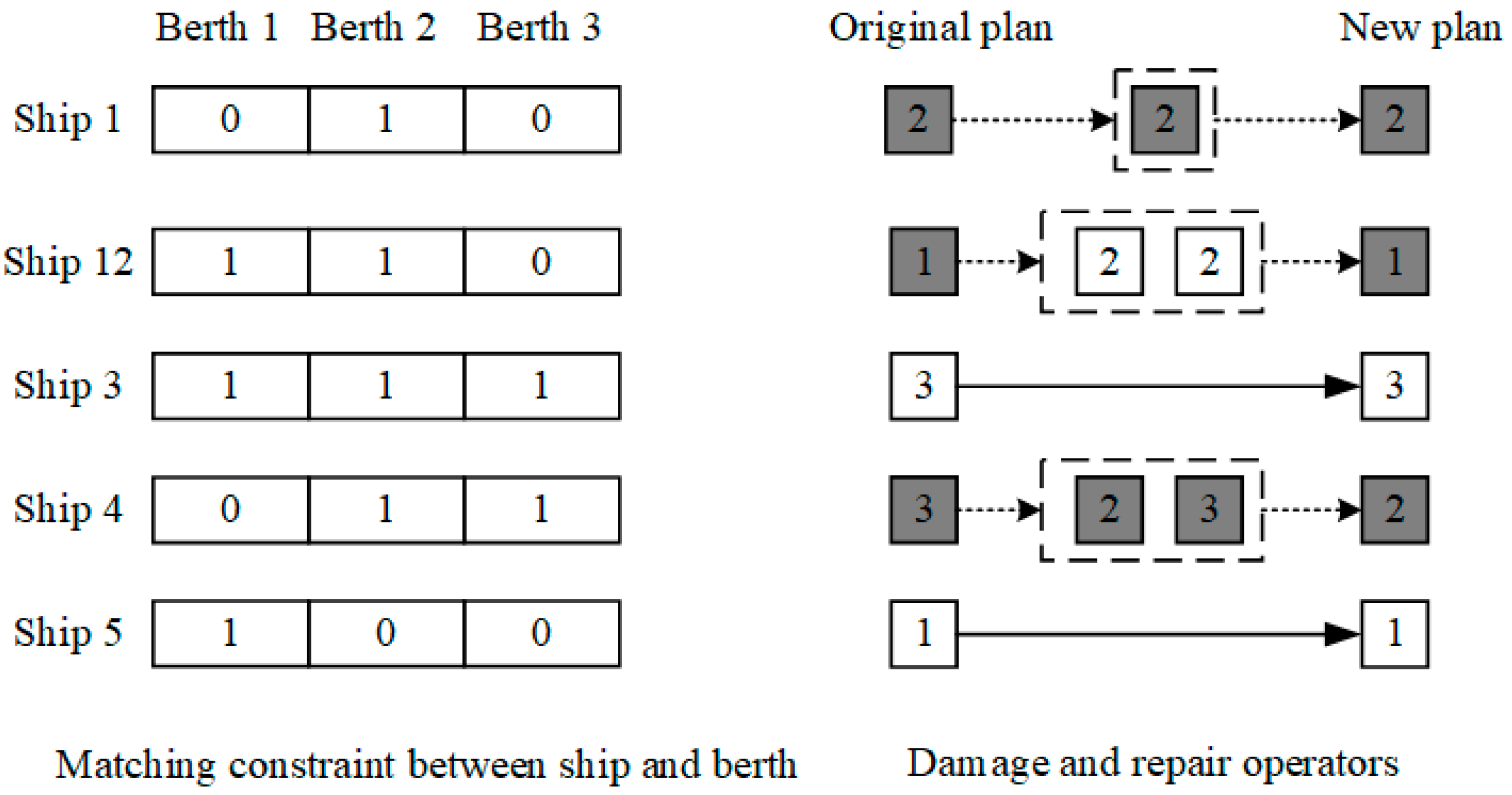
Figure 2 illustrates an example of the aforementioned operator addressing a berth allocation problem involving 3 berths and 5 vessels. Each vessel corresponds to a set of available berths, where 1 indicates the vessel can berth at the corresponding berth and 0 indicates it cannot. The break-fix operator randomly adjusts the strategy, changing the assigned berths for Vessels 1, 2, and 4 from Berths 2, 1, and 3 to Berths 2, 1, and 2.

3.3. Adaptive Mechanism

The adaptive mechanism of this algorithm primarily manifests in the dynamic adjustment of weights for the disruption and repair operators. The weights W k for each operator are updated via the equation W k ( t + 1 ) = ( 1 r ) · W k t + r · π k t , where r is the response factor ( 0 < r < 1 ), and π k t represents the operator’s performance score at iteration t . Specifically, when an operator combination generates a new optimal solution, it receives the highest score ( π k t = 30); if it produces a solution superior to the current one, it receives the next-highest score ( π k t = 15); even if it only generates a solution close to the current one, it still receives a base score ( π k t = 5). Through this scoring mechanism, the algorithm dynamically updates the selection probabilities of each operator, enabling operators with superior performance to gain more application opportunities. This achieves self-optimization and dynamic equilibrium of the operator combinations.

3.4. Acceptance Criteria and Termination Conditions

The acceptance criterion employs a simulated annealing-based mechanism with an acceptance probability. This mechanism permits acceptance of suboptimal solutions during the early search phase. As the temperature updates according to the cooling rate, the algorithm progressively shifts toward accepting only superior solutions.
The proposed algorithm employs multiple criteria. It stops when any of the following occurs: reaching the maximum iteration count, failing to improve for consecutive iterations, dropping below a specific temperature threshold, and exceeding the predefined computation time. This design of multiple termination conditions ensures the algorithm has sufficient search time while avoiding excessive computational resource consumption during ineffective searches.

3.5. Multi-Objective Handling Strategy

The proposed ALNS-II algorithm addresses the bi-objective optimization problem using a Pareto-based approach. Unlike weighted-sum methods that combine multiple objectives into a single scalar function, the algorithm maintains an external archive of non-dominated solutions throughout the search process, allowing it to directly approximate the Pareto frontier. The multi-objective mechanism consists of three key components:
First, a pareto dominance check. Given the current solution S and a candidate solution S , we evaluate both objectives F 1 (total economic cost of vessels) and F 2 (environmental tax cost of pollutant emissions). If S dominates S , i.e., with at least one strict inequality, the candidate is unconditionally accepted.
F 1 ( S ) F 1 S   and   F 2 ( S ) F 2 ( S )
Next, non-dominated acceptance criterion. If neither solution dominates the other, the candidate may be accepted with a probability that depends on the current temperature, allowing the algorithm to explore the trade-off region. Following common practice in multi-objective simulated annealing, the acceptance probability is defined as:
P = e x p ( Δ m i n T )
where Δ m i n = m i n { F 1 ( S ) F 1 ( S ) ,   F 2 ( S ) F 2 ( S ) } and T is the current temperature. This formulation encourages movement toward the Pareto front while permitting occasional acceptance of solutions that improve one objective at the expense of the other.
Finally, pareto archive maintenance. All non-dominated solutions encountered during the search are stored in an external archive A . After each iteration, the archive is updated as follows: If the candidate solution S is not dominated by any solution in A , it is added to A . Any solution in A that is dominated by S is removed. At the termination of the algorithm, the set A constitutes the approximate Pareto frontier.
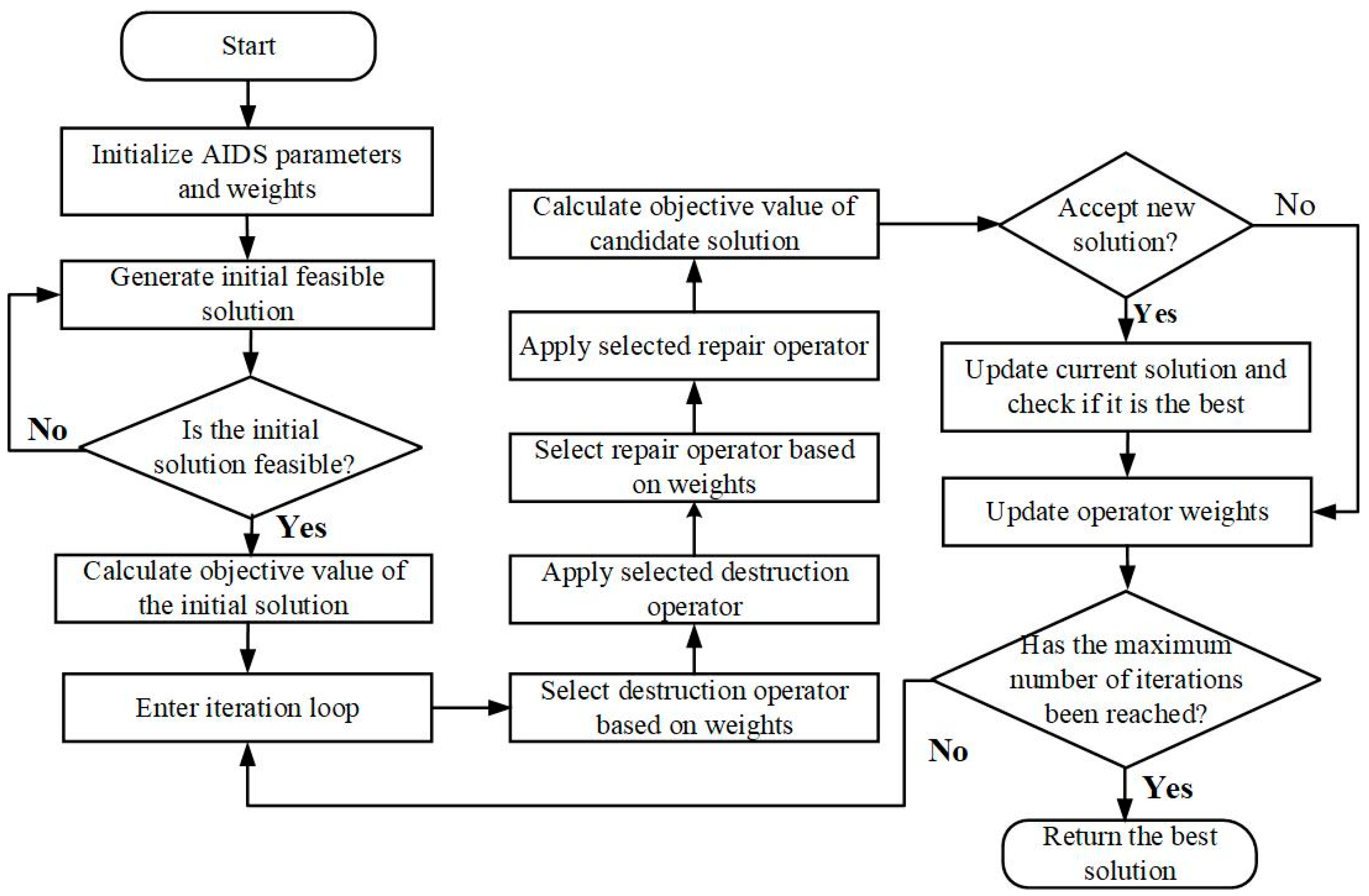
The flowchart of the ALNS-II algorithm is shown in Figure 3. First, initialize the ALNS-II parameters and weights, and generate an initial feasible solution. Then, enter the iterative loop to select and apply the destruction and repair operators based on weights, compute the objective value of the candidate solution, update the current solution and check for optimality based on whether the new solution is accepted. Simultaneously, update the operator weights until the maximum iteration count is reached, then return the optimal solution.

3.6. Comparison with Classical ALNS

To highlight the novelty of the proposed ALNS-II algorithm, Table 3 summarizes the key differences between the classical ALNS framework and our improved version.
Compared with the classical ALNS framework, the proposed ALNS-II algorithm incorporates several key improvements: (i) a Pareto-based multi-objective handling strategy with a dominance-based acceptance criterion and an external archive; (ii) two problem-specific destruction operators (correlation disruption and time-slot disruption) that exploit the temporal structure of berthing schedules; (iii) a regret-based repair operator to avoid myopic decisions; and (iv) an adaptive weight update mechanism that uses multi-objective scores.

4. Numerical Experiments

4.1. Experiment Settings

This section designs a case study based on data from a container terminal to validate the effectiveness of the proposed model and algorithm. The berthing length is 1500 m for vessels with three berths equipped with shore power facilities. TOU electricity rates are shown in Table 4. The planning cycle spans from 8:00 AM to 8:00 PM the following day at a container terminal. During this period, 12 vessels arrive at the port, including 4 fuel-powered, 4 electric, and 4 methanol-powered vessels. Detailed vessel information is provided in Table 5. The unit time cost for vessel waiting and the unit cost for delay are calculated as 1000 l i /2760 and 2000 l i /2760 respectively [26]. Other parameters are determined based on actual terminal data and literature references. Referencing China’s fuel market, the average diesel price is 7.2 $/kg. The diesel emission factors for S O 2 , N O 2 , P M 10 , and P M 2.5 are listed in Table 6. Currently, there is no unified pricing policy for these pollutants. Their equivalent values relative to C O 2 are 0.95, 0.95, 0.28, and 2.28, respectively. The equivalent value auxiliary machinery load factor is 0.5, with auxiliary machinery fuel consumption rate at 0.2 L/kWh. The carbon tax rate is 2.66 $/kg. Numerical experiments are implemented on a laptop equipped with an Intel Core@ 1.60 GHz processor and 32 GB of memory, running through the PyCharm 2023.2.1 plat form.
The ALNS-II algorithm proposed in this paper consists of 12 parameters, including the number of iterations, cooling rate, operator weights, and acceptance criteria-related parameters. To determine the appropriate parameter configuration, this paper adopts the Irace automatic parameter configuration framework. Twelve representative examples are selected as the parameter tuning sample set, and the parameter space is searched during 30 generations of iterations. Each parameter configuration is evaluated by running the ALNS-II algorithm, and the single run time is limited to 5 min. The final parameter settings were those identified as the optimal combination by Irace. The parameter value range and the final results are shown in Table 7.

4.2. Results and Analysis of Numerical Examples

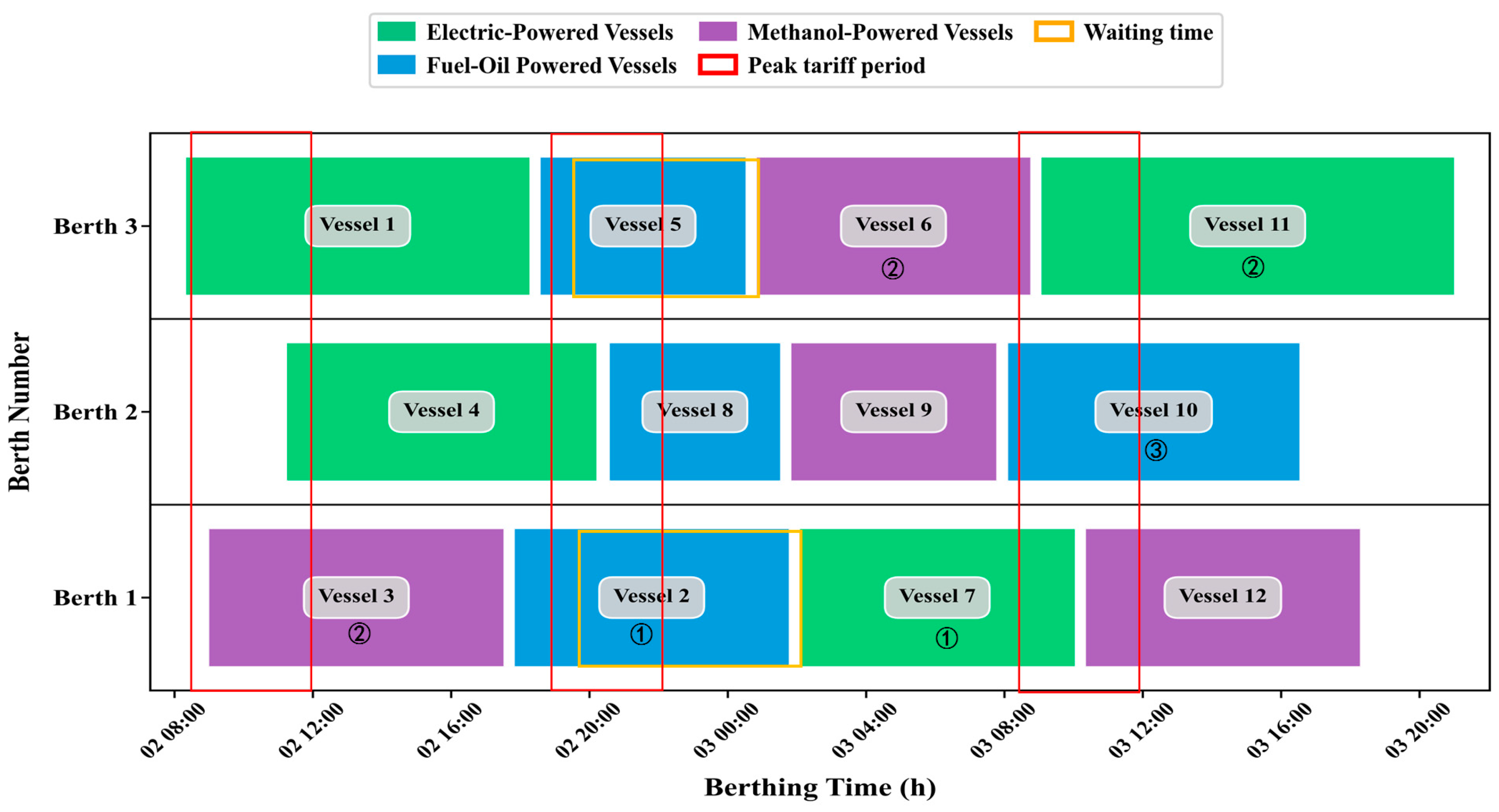
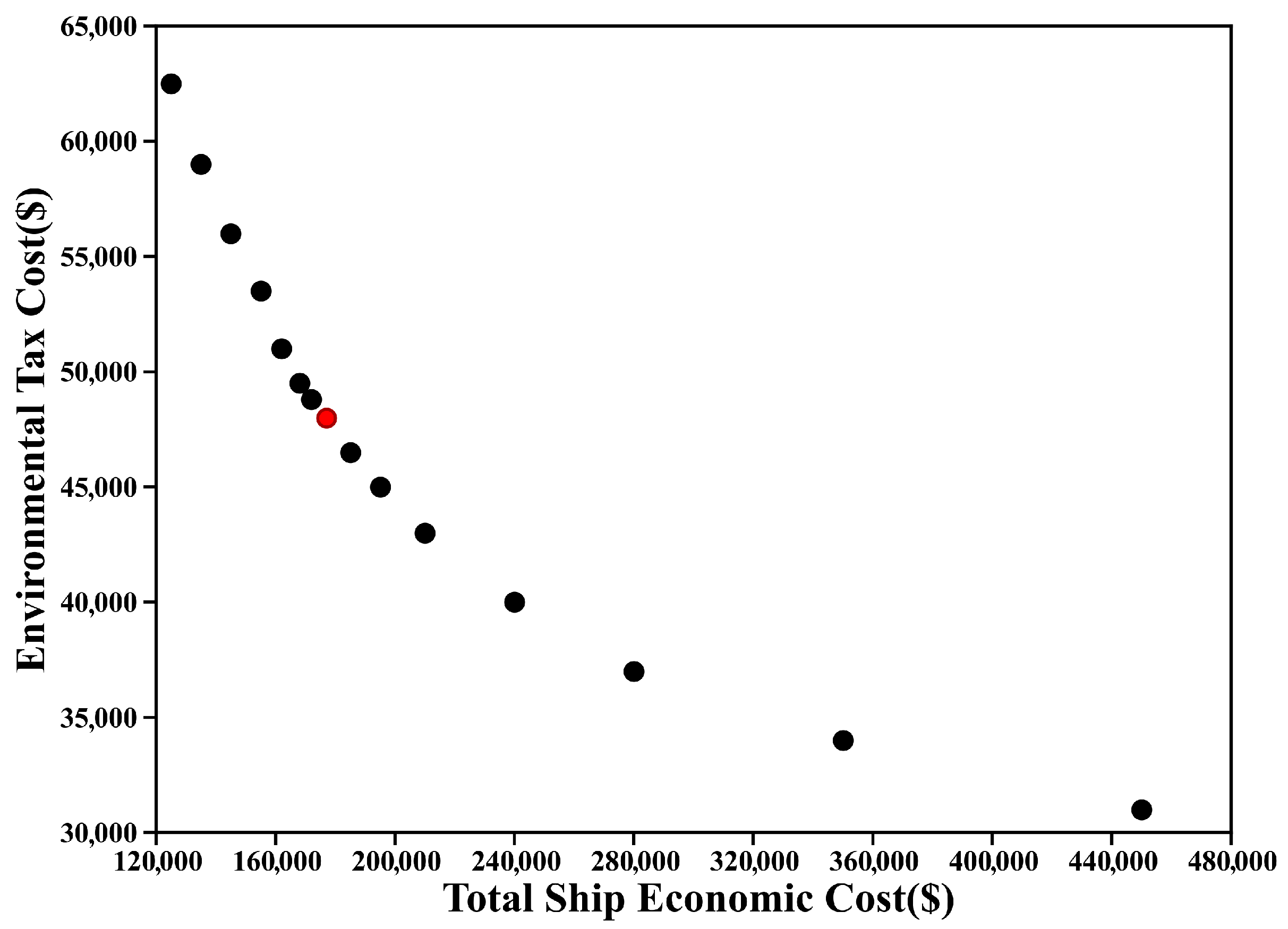
The distribution of Pareto optimal solutions obtained using the improved ALNS-II algorithm is shown in Figure 4, where each solution corresponds to a specific joint berth–shore power allocation scheme. Terminal operators can select an appropriate scheduling plan according to practical requirements. In this study, a balanced solution between total economic cost and environmental tax cost of pollutant emissions is selected, corresponding to the Pareto optimal solution closest to the origin in Figure 4 (red point). The resulting berth–shore power allocation scheme is illustrated in Figure 5. The horizontal axis represents time, and the vertical axis represents discrete berth indices. Within each berth, vessels are vertically stacked to indicate their temporal sequence; the vertical position does not represent their physical location along the quay, as each berth is treated as an independent unit. The red bars indicate peak electricity tariff periods, while the yellow bars represent the waiting time of vessels at anchorage after arrival but before berthing. Each rectangle corresponds to the berthing time interval of a vessel, where the first line denotes the vessel ID and the second line indicates the identifier of the shore power unit used.
The corresponding solution is shown in Figure 4. In the berth-shore power allocation scheme, electric vessels (1, 4, 7, 11) and methanol vessels (3, 6, 9, 12) must decide whether to prioritize berthing. Electric vessel 4 and methanol vessel 9 opted for priority berthing but did not use shore power. Meanwhile, methanol vessel 6 and electric vessel 7 arrived during peak electricity pricing periods. Although they met the berth and shore power usage criteria, they did not immediately prioritize berthing operations. Instead, they waited until the next lower-cost pricing period (flat or valley period) to commence operations.
The decision on whether methanol vessel 6 and electric vessel 7 should be prioritized for berthing will impact fuel vessels 2 and 5. Four scenarios were designed for comparison, as shown in Table 8. Analysis reveals that if Vessel 6 forgoes priority berthing, it avoids peak electricity costs, reducing shore power usage costs by 76.71% and total economic costs by 51.04%. However, it incurs delay and waiting costs associated with anchoring for 1.48 h. If electric vessel 7 chooses priority berthing, it avoids anchorage waiting but operates during peak electricity pricing, increasing shore power costs by 303.32% and total economic costs by 64.24%. Therefore, both new energy vessels prefer to forgo priority berthing to reduce shore power costs. This decision simultaneously impacts the cost structure of fuel vessels. The total economic cost of fuel vessel 5 decreases by 65.49%, whereas that of fuel vessel 2 increases by 27.01%.
Although prioritizing berthing for new energy vessels can reduce anchorage waiting time under a TOU pricing mechanism, it may also increase their overall economic costs. Consequently, new energy vessels can choose whether to prioritize berthing based on the cost–benefit analysis. Moreover, providing priority berthing to new energy vessels increases waiting costs for other fuel-powered vessels. This cost pressure will enhance the incentive for fuel-powered vessels to retrofit and adopt shore power.
To validate the model against real-world operations, we compare it with the terminal’s current scheduling practice, which follows a simple first-come-first-served(FCFS) rule and does not consider the joint optimization of berth and shore power allocation, time-of-use electricity pricing, or vessel priority policies. The comparison results are presented in Table 9.
Compared with the FCFS baseline, the proposed joint optimization model for berth and shore power allocation, which simultaneously accounts for time-of-use electricity pricing and vessel priority, reduces the total economic cost by an average of 23.03% and the environmental tax cost by an average of 21.44%. This result demonstrates that the model effectively captures the operational trade-offs introduced by time-of-use pricing and vessel priority, achieving synergistic improvements in both economic and environmental performance while enhancing resource utilization efficiency, thereby providing actionable decision support for terminal managers.

4.3. Algorithm Performance

This section evaluates the ALNS-II algorithm from two aspects of effectiveness and superiority. Comparative experiments are conducted with the GUROBI solver, Multi-objective Particle Swarm Optimization (MOPSO), and Genetic Algorithm (GA).

4.3.1. Algorithm Effectiveness Analysis

To evaluate the effectiveness and scalability of the proposed ALNS-II algorithm, we compare it against the GUROBI solve. When the GUROBI optimal solution is known, the gap is calculated as ( ALNS-II G U R O B I Optimal ) / G U R O B I Optimal × 100 % . When only a lower bound is available, the gap is computed as ( ALNS-II G U R O B I Lower   bound ) / G U R O B I Lower   bound × 100 % . This dual definition ensures a fair and transparent comparison across all instance scales. The objective function values and running times obtained by GUROBI and the algorithm are presented in Table 10.
The experimental results indicate that as the problem size increases, the solver’s computation time grows exponentially. For the smaller instances, GUROBI successfully finds the optimal solution, but its running time increases rapidly. For the larger instances, GUROBI fails to find a feasible solution within the 10,800s time limit. In contrast, the improved ALNS-II algorithm designed in this paper completes the solution within 250 s for all test cases. For the instances where GUROBI finds the optimal solution, ALNS-II yields objective values with an average gap of less than 1.5%. For the larger instances where GUROBI fails to return a feasible solution, ALNS-II produces solutions that lie within 2.0% of the best lower bound provided by GUROBI. Therefore, the ALNS-II algorithm provides efficient and effective solutions for the proposed problem.

4.3.2. Algorithm Comparisons

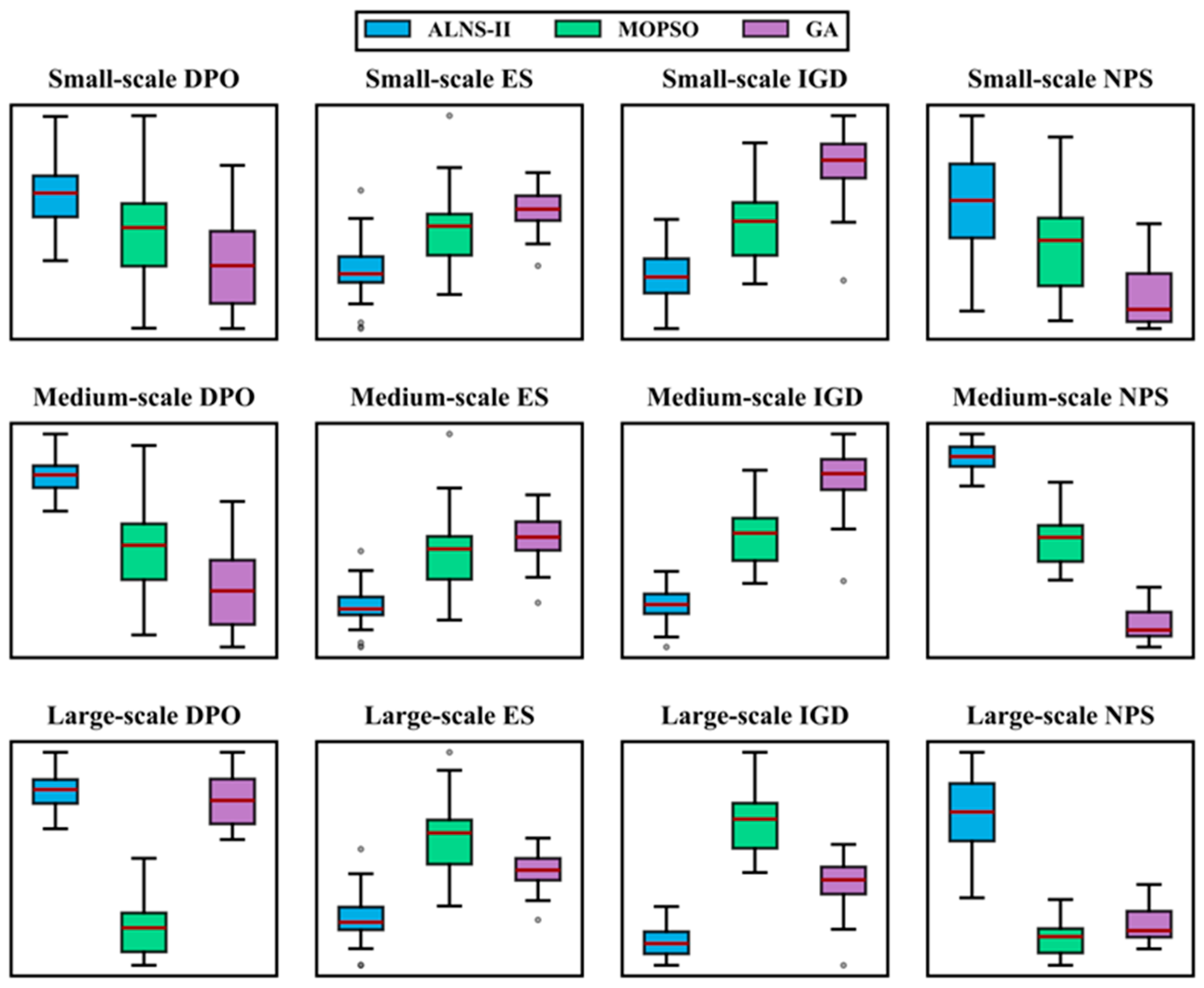
To further validate the superiority of the ALNS-II algorithm, three algorithms were compared across different scales. Each scale included 10 test instances, and each algorithm was run 10 times per instance. Four metrics were used for comparison: Pareto Optimality Distance (DPO), Extended Spread (ES), Number of Pareto Solutions (NPS), and Inverse Generation Distance (IGD). For IGD, a reference Pareto front is required. Since the true front is unknown, the reference is constructed by merging all non-dominated solutions from all three algorithms across all runs for each instance, and then removing dominated solutions. Figure 6 shows the distribution of these metrics for the solution sets generated by the three algorithms.
In terms of the DPO metric, the box position of the ALNS-II algorithm is significantly higher than that of MOPSO and GA, indicating that the Pareto solutions obtained by ALNS-II have the highest quality. For the ES metric, the box position of the ALNS-II algorithm is lower than that of the other two algorithms, suggesting that its solution set is more evenly distributed. Regarding the IGD metric, the overall distribution of the ALNS-II algorithm is clearly superior to MOPSO and GA, reflecting better convergence performance and a closer proximity to the true Pareto front. For the NPS metric, the box position of the ALNS-II algorithm significantly leads the other algorithms, demonstrating its ability to achieve a larger number of non-dominated solutions. Furthermore, from the distribution characteristics of the boxes, the data distribution of the ALNS-II algorithm across all metrics is relatively compact, showcasing good algorithm stability and consistency. This fully validates the comprehensive advantages of the ALNS-II algorithm in terms of solution quality, convergence, uniformity, and the number of solutions.

4.4. Sensitivity Analysis

This section explores how the berth and shore power optimization model can adapt its decision-making strategies in response to variations in electricity prices, changes in the number of renewable energy vessels, and shifts in vessel operating costs.

4.4.1. Impact of Electricity Pricing Mechanisms

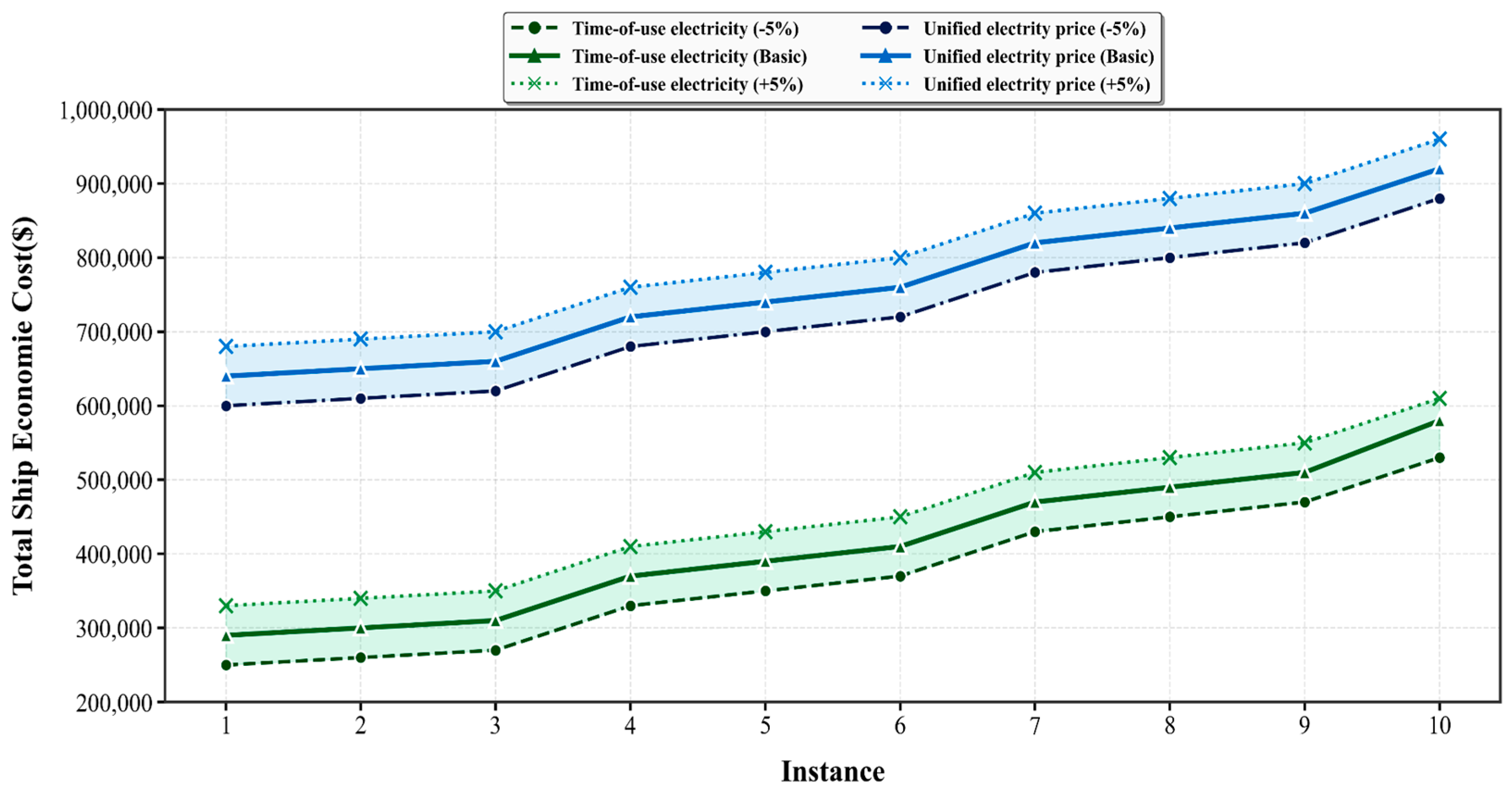
Electricity price is a key factor influencing shore power costs. This study compares a uniform pricing scheme (fixed at 0.75 $/kWh) with a TOU pricing scheme. Using the base prices of these two schemes as reference points, two additional scenarios were generated by adjusting hourly prices by 5% upward and 5% downward, respectively. The impact of different pricing schemes on the total economic cost of vessels was analyzed. Figure 7 presents the comparison of total economic costs for vessels under different pricing scenarios. The TOU pricing scheme consistently yields the lowest total economic cost for vessels, while the flat rate scheme results in higher costs. Moreover, a 5% fluctuation in electricity prices significantly impacts the total economic costs.
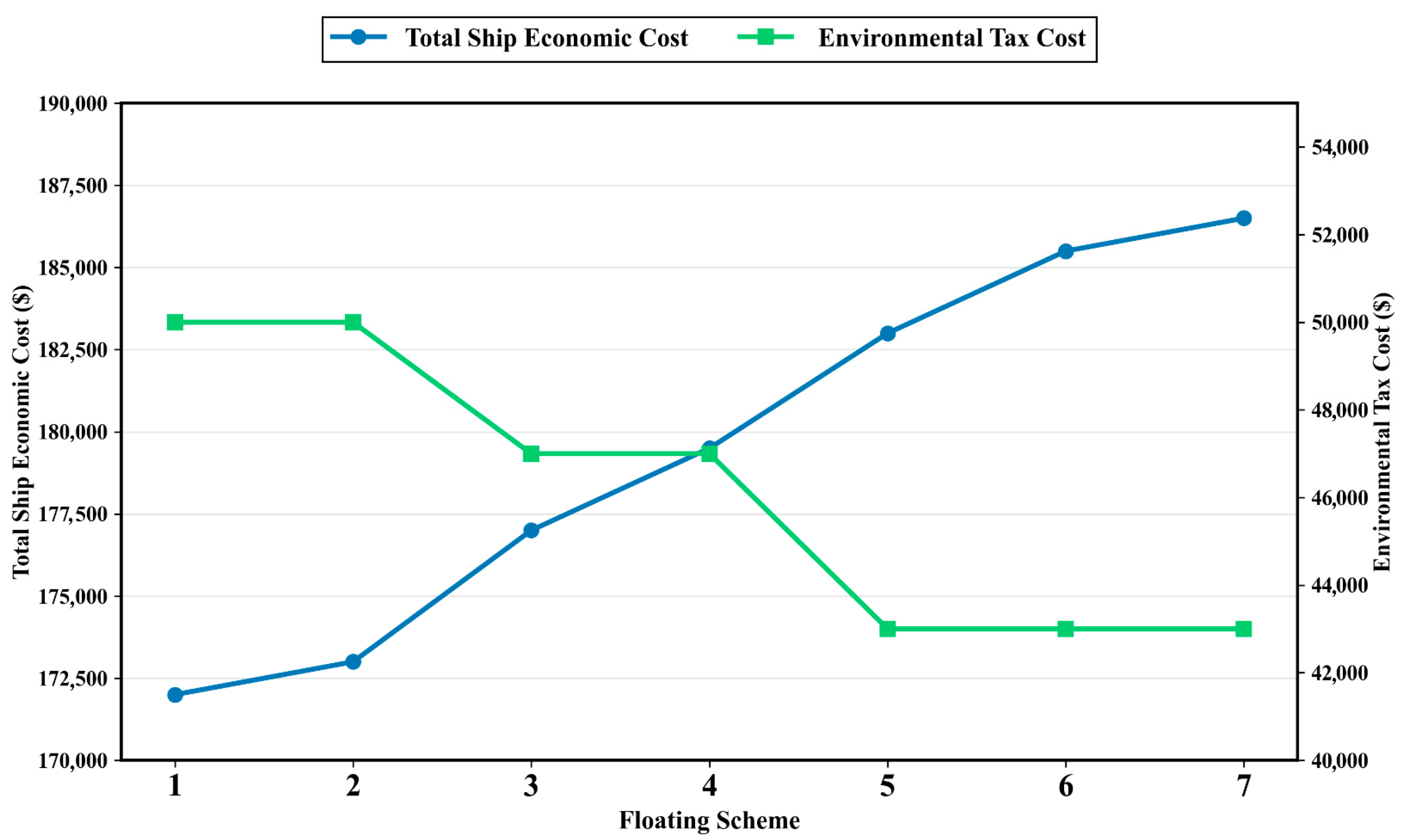
To achieve the objective of peak shaving, the current TOU pricing adjustment strategy typically widens the price differential between peak and off-peak periods. This means increasing electricity rates during peak hours, while reducing them during valley hours. Peak rates are increased by 30%, valley rates are decreased by 20%, and intermediate rates are adjusted by 10%. The peak-to-off-peak price differential will be incrementally increased, with the specific adjustment plan detailed in Table 11.
Figure 8 shows the results of different peak-off-peak electricity pricing strategies. As the peak-off-peak electricity price differential gradually increases, the environmental tax cost of pollutant emissions from the berth-to-shore power allocation scheme exhibits a decreasing trend. This indicates that widening the peak-off-peak price differential can effectively reduce pollutant emissions, while the total economic costs for vessels continue to rise simultaneously.
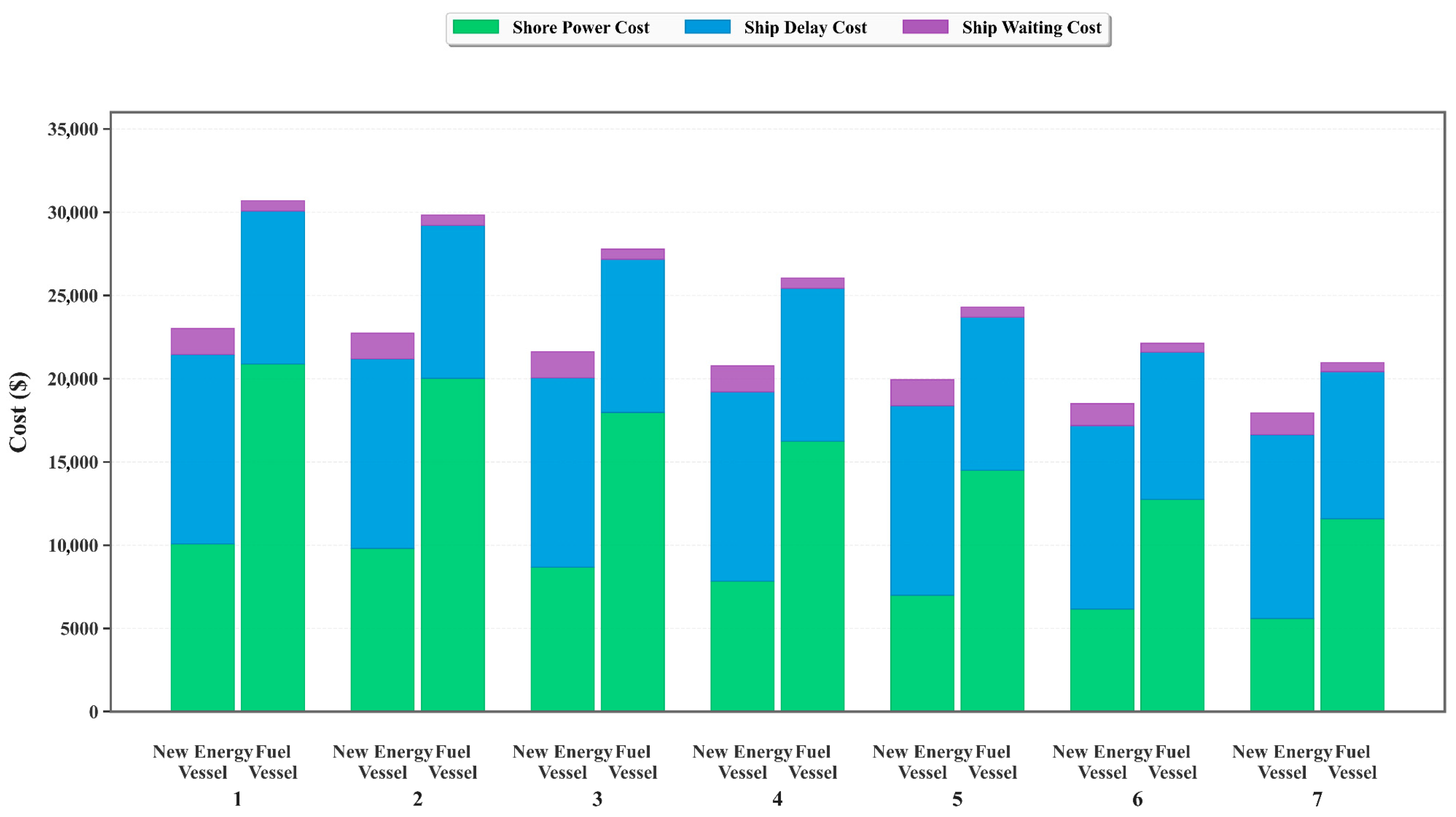
The cost trends for new energy vessels and fuel-powered vessels are shown in Figure 9. As the peak-off-peak electricity price differential gradually increases, the shore power usage costs for both new energy vessels and fuel-powered vessels show a decreasing trend, which may impact the promotion and application of shore power. When the peak-off-peak price differential exceeds 4.11:1, the delay costs for new energy vessels begin to rise gradually, while those for fuel vessels continue to decrease. This indicates that in the scheduling scheme, more new energy vessels choose not to prioritize berthing to avoid peak electricity prices, while fuel-powered vessels gain priority berthing opportunities. Therefore, to prevent adverse scheduling incentives and preserve the effectiveness of the priority berthing policy for new energy vessels, port authorities should consider maintaining the peak-to-valley price ratio at or below 4.11:1, where environmental benefits and economic costs reach a practical balance.

4.4.2. Impact of New Energy Vessel Proportions

To analyze the impact of new energy vessel ratios on port operations, this section designs nine distinct scenarios, each corresponding to a different proportion of new energy vessels. Based on a 48 h operational scenario involving 30 vessel arrivals, the analysis investigates how new energy vessel ratios influence port economic and environmental benefits, as shown in Table 12.
The research results show that when the proportion of new energy vessels increases from 10% to 90%, the vessel time cost increases by 3.69%, while the environmental tax cost from pollutant emissions and energy consumption cost decrease by 17.38% and 31.93%, respectively. This is because, in addition to the routine loading and unloading tasks, new energy vessels require additional energy replenishment during berthing, which increases their berth occupancy time. At the same time, the use of shore power or clean fuel by new energy vessels significantly reduces pollutant emissions, leading to a decrease in environmental tax costs from pollutant emissions. Therefore, a proportion of 70% new energy vessels is more conducive to improving both the economic and environmental performance of ports. Therefore, a proportion of 70% new energy vessels is more conducive to improving both economic and environmental performance. Beyond this point, the environmental benefits start to diminish, while economic costs continue to rise. At 70%, the port achieves an optimal balance, where the reduction in emissions outweighs the increased operational costs, maximizing overall performance.

4.4.3. Impact of Vessel Costs

To analyze the impact of cost-related parameters on berth and shore power allocation schemes, vessels’ costs of waiting, deviation, and delay were increased by 50% from their original levels while keeping other parameters constant. Table 13 indicates that waiting costs constitute a component of the overall operating expenses.
Delay costs exert a lesser influence on total vessel economic costs, as terminal operational efficiency necessitates maintaining vessel delays within reasonable limits, resulting in minimal variation in delay levels. The most significant factor affecting vessel energy costs is waiting costs. When waiting costs increase, vessels reduce their electricity consumption during off-peak hours, consequently raising vessel energy costs.

4.4.4. Impact of Carbon Tax Pricing Mechanisms

Carbon tax is a widely used policy instrument to internalize the environmental cost of emissions. Currently, there is no unified carbon tax pricing policy; therefore, analyzing the impact of different carbon tax structures on the model’s outcomes is essential. Consider two carbon tax functions: a single-rate tax and a tiered (piecewise) tax.
The single-rate tax applies a constant rate to all emissions, defined as:
C 2 C T ( z )   = r 0 z
where z denotes the total carbon emissions, and r 0 is the constant tax rate. In this study, r 0 is set to 2.66 $/kg.
The tiered tax adopts a piecewise linear structure, where the tax rate increases progressively with emissions, as given in Equation (37):
C 2 C T ( z ) = z x 1 , 0 < z z 1 z x 2 + b 1 , z 1 < z z 2 z x 3 + b 2 , z > z 2
In the formula: The tax rates x 1 ,   x 2 , and x 3 are 1.36 $/kg, 2.71 $/kg, and 5.43 $/kg re spectively. z 1 and z 1 are 10,000 and 15,000 kg respectively. The comparison between the two carbon tax schemes is presented in Table 14.
The results show that the tiered carbon tax scheme leads to a 20.9% reduction in total Pollutant emissions volume compared to the single-rate scheme, while pollutant emission environmental tax cost decreases by 19.3%. This indicates that the tiered structure, which imposes higher rates on larger emitters, provides a stronger incentive for vessels to reduce emissions, particularly by shifting to shore power. Notably, the number of vessels using shore power increases from six under the single-rate scheme to eight under the tiered scheme, demonstrating the effectiveness of progressive carbon pricing in promoting cleaner energy adoption.

5. Discussion

This section summarizes and discusses the key findings and insights from a management perspective, demonstrating the practical significance and applicability of this study. In terms of trade-off analysis and decision support, the bi-objective optimization model presented in this study offers a Pareto optimal solution set, facilitating a balanced coordination between economic and environmental performances. Port managers can make informed decisions based on their strategic priorities: selecting solutions with lower total costs when emphasizing economic efficiency or opting for those with reduced pollution costs when prioritizing environmental responsibility.
In terms of the coordination mechanism for TOU pricing policies, as shown in Figure 8, when the peak-to-valley price ratio increased from 2.25:1 to 4.11:1, the delay costs for new energy vessels rose by 6.12%. and when the peak-to-valley differential further increased from 4.1:1 to 7.5:1, the delay cost surge significantly expanded to 25.92%. This indicates that as the peak-off-peak price differential widens, more new energy vessels forgo priority berthing to avoid peak-hour electricity rates, contradicting the original intent of promoting priority berthing policies for new energy vessels. Therefore, it is recommended that government departments, when formulating TOU pricing policies, comprehensively consider coordination with the priority berthing policy for new energy vessels. The peak-off-peak electricity price differential should be controlled within 4.1:1 to prevent negative interactions between policies.
Regarding infrastructure investment and resource allocation, increasing the proportion of new energy vessels from 10% to 90% reduces environmental tax costs for pollutant emissions by 17.38%, reflecting the significant emission-reduction effect of new energy adoption. However, vessel time costs correspondingly increase by 3.69%. Therefore, port managers should consider the actual number of new energy vessels arriving daily and the service capacity to deploy shore power and energy supply facilities.

6. Conclusions

This study addresses the berth and shore power allocation problem considering the TOU pricing and vessel priority. A bi-objective optimization model is developed to minimize both the total economic costs of vessels and the environmental tax costs of pollutant emissions, while balancing economic and environmental benefits at the terminal. The improved ALNS-II algorithm is designed to solve the model, and its effectiveness is validated through empirical analysis. Experimental results demonstrate the superiority of the proposed algorithm in terms of solution quality, distribution uniformity, solution diversity, and algorithm convergence, particularly for medium- and large-scale cases. Sensitivity analysis revealed that lower electricity prices reduce vessels’ energy consumption costs and environmental tax costs, while increasing the number of vessels using shore power. Although a higher share of new energy vessels significantly decreases pollutant emissions, it may increase vessels’ waiting costs. Therefore, port authorities should set electricity prices and plan shore power investments by jointly considering operational impacts, emission reductions, and service capacity.
However, this study does not explicitly account for the impact of stochastic factors, such as uncertainty in vessel arrival times, non-negligible shore power connection times, and fluctuations in electricity demand. Future research could extend this work by developing robust or stochastic optimization models that incorporate uncertainties in vessel arrivals and the non-instantaneous nature of shore power connection processes. In addition, further studies may explore integrated scheduling frameworks that combine shore power systems with smart grids, energy storage technologies, and renewable energy sources.

Author Contributions

Writing—original draft preparation, W.W.; writing—review and editing, H.L. and Y.Z. All authors have read and agreed to the published version of the manuscript.

Funding

This research received no external funding.

Data Availability Statement

The original contributions presented in this study are included in the article. Further inquiries can be directed to the corresponding author.

Conflicts of Interest

The authors declare no conflicts of interest.

References

  1. Yu, H.; Huang, M.; He, J.; Tan, C. The clustering strategy for stacks allocation in automated container terminals. Marit. Policy Manag. 2023, 50, 1102–1117. [Google Scholar] [CrossRef]
  2. Imai, A.; Nishimura, E.; Papadimitriou, S. Berth allocation with service priority. Transp. Res. Part B Methodol. 2003, 37, 437–457. [Google Scholar] [CrossRef]
  3. Lin, X.; Pu, X.; Bai, X. On the efficiency impacts of berthing priority provision. Transp. Sci. 2024, 58, 578–596. [Google Scholar] [CrossRef]
  4. Gao, Y.; Zhen, L.; Lu, H.; Xu, X. Ship Scheduling for Taicang Port. Inf. J. Appl. Anal. 2025, 55, 484–505. [Google Scholar] [CrossRef]
  5. Ganji, F.; Gholami, S. Minimizing fuel emission by optimizing ship scheduling considering priorities and release times. Int. J. Environ. Sci. Technol. 2024, 21, 135–152. [Google Scholar] [CrossRef]
  6. Yıldırım, M.S.; Aydın, M.M.; Gökkuş, Ü. Simulation optimization of the berth allocation in a container terminal with flexible vessel priority management. Marit. Policy Manag. 2020, 47, 833–848. [Google Scholar] [CrossRef]
  7. Chen, X.; Yan, R.; Wu, S.; Liu, Z.; Mo, H.; Wang, S. A fleet deployment model to minimise the covering time of maritime rescue missions. Marit. Policy Manag. 2023, 50, 724–749. [Google Scholar] [CrossRef]
  8. Lu, H.; Lu, X. Joint optimization of berths and quay cranes considering carbon emissions: A case study of a container terminal in China. J. Mar. Sci. Eng. 2025, 13, 148. [Google Scholar] [CrossRef]
  9. Ursavas, E. Priority control of berth allocation problem in container terminals. Ann. Oper. Res. 2022, 317, 805–824. [Google Scholar] [CrossRef]
  10. Jiang, S.; Liu, L.; Peng, P.; Xu, M.; Yan, R. Prediction of vessel arrival time to port: A review of current studies. Marit. Policy Manag. 2025, 53, 301–326. [Google Scholar] [CrossRef]
  11. Wang, Z.; Cheng, J.; Hu, H. A proactive-reactive-based approach for continuous berth allocation and quay crane assignment problems with hybrid uncertainty. J. Mar. Sci. Eng. 2024, 12, 182. [Google Scholar] [CrossRef]
  12. Zhen, L.; Wang, W.; Lin, S. Analytical comparison on two incentive policies for shore power equipped ships in berthing activities. Transp. Res. Part E Logist. Transp. Rev. 2022, 161, 102686. [Google Scholar] [CrossRef]
  13. Song, Z.; Tang, W.; Zhao, R.; Zhang, G. Implications of government subsidies on ship companies’ shore power usage strategies in port. Transp. Res. Part E Logist. Transp. Rev. 2022, 165, 102840. [Google Scholar] [CrossRef]
  14. Peng, Y.; Li, X.; Wang, W.; Wei, Z.; Bing, X.; Song, X. A method for determining the allocation strategy of on-shore power supply from a green container terminal perspective. Ocean Coast. Manag. 2019, 167, 158–175. [Google Scholar] [CrossRef]
  15. Zhang, Z.; Zhu, Y.; Zhu, J.; Huang, D.; Yin, C.; Li, J. Collaborative optimization of shore power and berth allocation based on economic, environmental, and operational efficiency. J. Mar. Sci. Eng. 2025, 13, 776. [Google Scholar] [CrossRef]
  16. Wang, T.; Du, Y.; Fang, D.; Li, Z. Berth allocation and quay crane assignment for the trade-off between service efficiency and operating cost considering carbon emission taxation. Transp. Sci. 2020, 54, 1307–1331. [Google Scholar] [CrossRef]
  17. Rodrigues, F.; Agra, A. Berth allocation and quay crane assignment/scheduling problem under uncertainty: A survey. Eur. J. Oper. Res. 2022, 303, 501–524. [Google Scholar] [CrossRef]
  18. Zhen, L.; Zhuge, D.; Wang, S.; Wang, K. Integrated berth and yard space allocation under uncertainty. Transp. Res. Part B Methodol. 2022, 162, 1–27. [Google Scholar] [CrossRef]
  19. Guo, L.; Zheng, J.; Du, J.; Du, J.; Gao, Z.; Fagerholt, K. Integrated planning of berth allocation, quay crane assignment and yard assignment in multiple cooperative terminals. Transp. Res. Part E Logist. Transp. Rev. 2024, 183, 103456. [Google Scholar] [CrossRef]
  20. Zhang, Y.; Liang, C.; Shi, J.; Lim, G.; Wu, Y. Optimal port microgrid scheduling incorporating onshore power supply and berth allocation under uncertainty. Appl. Energy 2022, 313, 118856. [Google Scholar] [CrossRef]
  21. Wang, Z.; Hu, H.; Zhen, L. Berth and quay cranes allocation problem with on-shore power supply assignment in container terminals. Comput. Ind. Eng. 2024, 188, 109910. [Google Scholar] [CrossRef]
  22. Parise, G.; Parise, L.; Malerba, A.; Pepe, F.M.; Honorati, A.; Chavdarian, P.B. Comprehensive peak-shaving solutions for port cranes. IEEE Trans. Ind. Appl. 2016, 53, 1799–1806. [Google Scholar] [CrossRef]
  23. van Duin, J.H.R.; Geerlings, H.; Verbraeck, A.; Nafde, T. Cooling down: A simulation approach to reduce energy peaks of reefers at terminals. J. Clean. Prod. 2018, 193, 72–86. [Google Scholar] [CrossRef]
  24. Iris, Ç.; Lam, J.S.L. Optimal energy management and operations planning in seaports with smart grid while harnessing renewable energy under uncertainty. Omega 2021, 103, 102445. [Google Scholar] [CrossRef]
  25. Yu, J.; Voß, S.; Song, X. Multi-objective optimization of daily use of shore side electricity integrated with quayside operation. J. Clean. Prod. 2022, 351, 131406. [Google Scholar] [CrossRef]
  26. Dai, H.; Ma, J.; Yang, Y.; Sun, J.; Dai, Y. A bi-layer model for berth allocation problem based on proactive-reactive strategy. Comput. Ind. Eng. 2023, 179, 109200. [Google Scholar] [CrossRef]
Figure 1. Vessel Operations Process in Port.
Jmse 14 00688 g001
Figure 2. Example of Berth Allocation Operator.
Jmse 14 00688 g002
Figure 3. Flow chart of the ALNS-II Algorithm.
Jmse 14 00688 g003
Figure 4. Pareto Frontier Distribution.
Jmse 14 00688 g004
Figure 5. Gantt Chart of the Pareto Optimal Berth Shore Power Allocation Plan.
Jmse 14 00688 g005
Figure 6. Boxplots of DPO, ES, IGD, and NPS from three algorithm solutions.
Jmse 14 00688 g006
Figure 7. Sensitivity Analysis of Different Electricity Pricing Schemes.
Jmse 14 00688 g007
Figure 8. Sensitivity Analysis of TOU Pricing.
Jmse 14 00688 g008
Figure 9. Ship Operator Costs Under Different Electricity Price Fluctuations.
Jmse 14 00688 g009
Table 1. Summary of the most related articles.
PaperBerth
Allocation
Shore Power
Allocation
TOU PricingObjectiveSolution Method
[4] Gao et al. (2025) Minimize ships’ total stay timeGUROBI + ALNS
[5] Ganji et al. (2024) Minimize ship pollutant emissionsGAMS(38.2) + Simulation
[19] Guo et al. (2024) Minimize total port operating costCPLEX + ALNS
[20] Zhang et al. (2022) Minimize ship berthing cost and microgrid operation costCPLEX + Heuristic Algorithm
[21] Wang et al. (2024) Minimize port operation cost, energy consumption, and total crane emissionsAdaptive Immune Clonal Selection Algorithm
[25] Yu et al.
(2022)
Minimize shore power usage cost, berthing delay, and carbon emissionsMeta-Heuristic Algorithm
This paperMinimizing the total economic costs of vessels and environmental tax costs from pollutant emissionsALNS Algorithm
Table 2. Notation definitions.
SetDescription
I   The set of vessels i during the planning period, I = { i = 1,2 , 3 , , N }
B   The set of discretized continuous berths, B = { b = 1,2 , 3 , , N }
T   Set of operational periods t within the planning period, T =   { t = 1,2 , 3 , , N }
P   Set of pollutants, P =   { C O 2 , S O 2 , N O 2 , P M 2.5 }
V   Set of vessel types, V =   { v = 1,2 , 3 } 1 = Electric vessels, 2 = Fuel vessels, 3 = Methane vessels
E   Set of shore power equipment, E =   { e = 1,2 , 3 N }
K   Electricity period, K =   { h , m , l } , where h = peak period, m = flat period, l = valley period
Parameters
V i   Vessel type i , V i ϵ V
Q i   Cargo handling capacity of vessel i (tons)
l i   Length of vessel i (m)
P i A   Engine power of vessel i (kW)
T a i   Arrival time of vessel i (hours)
T z i   Duration of berthing and cargo handling operations for Vessel i (hours)
E D T i   Estimated departure time of vessel i (hours)
C D   Diesel price ($/liter)
C h   Peak Electricity Rate ($/kWh)
C m   Flat electricity rate ($/kWh)
C l   Valley electricity rate ($/kWh)
C Z i   Delay Cost for Vessel i ($/hour)
C M i   Waiting cost for vessel i at anchorage ($/hour)
C p   Pollutant p unit emission tax ($/kg)
D e   Maximum power supply distance of shore power equipment (m)
d e b   Distance from shore power equipment to berth (m)
l A   Ship auxiliary machinery load factor
R A   Ship auxiliary machinery diesel consumption rate (liters/kWh)
W p   Pollutant p emission factor (kg/L)
A 1   Minimum shore power supply capacity (kW)
A 2   Maximum shore power supply capacity (kW)
L   Total shoreline length (m)
M   Sufficiently large positive number
D s   Minimum safety distance for methanol vessels (m)
A i   Selection of methanol vessel refueling sites
T c i   Charging time required for electric vessel i (hours)
T g i   Fueling time required for methanol vessel i (hours)
R i   Remaining energy capacity of vessel i upon arrival at port (%)
T   Priority time window (hours), set to 1 h
Auxiliary Variables
U i j   Binary, equal to 1 if berthing areas of ships i and j do not overlap; else 0
Z i j   Binary, equal to 1 if the berthing time windows of vessels i and j do not overlap; else 0
σ i j   Binary, equal to 1 if vessel i is prioritized over vessel j for berthing; else 0
α i j   Binary, equal to 1 if the arrival time difference between new energy vessel i and fuel-powered vessel j is within T ; else 0
Decision Variables
X i b t   Binary, equal to 1 if Ship i docked at berth b at time t; else 0
Y i e   Binary, equal to 1 if Ship i uses shore power equipment e ; else 0
O i   Binary, equal to 1 if Ship i uses shore power during berthing; else 0
T s i   Actual berthing time for vessel i
T f i   Vessel i Actual Departure Time
T i h   Duration of Ship’s Electricity Consumption During Peak Pricing Period
T i m   Duration of electricity consumption by vessel i during flat periods
T i l   Duration of electricity consumption by vessel i during valley pricing periods
T w i   Start time of charging for the electric vessel i
T k i   Start time of the methanol vessels fuel replenishment
Table 3. Comparison between classical ALNS and the proposed ALNS-II algorithm.
AspectClassical ALNSProposed ALNS-II
ObjectiveSingle-objectiveBi-objective (Pareto-based)
Acceptance criterionSimulated annealing based on single objective improvementPareto dominance check + non-dominated acceptance probability
Pareto archiveNot maintainedExternal archive A stores all non-dominated solutions; updated after each iteration
Destruction operatorsRandom, worst-cost (general purpose)Random, worst-cost, correlation disruption, time-slot disruption
Correlation disruption_Destroys vessels with overlapping berthing times:
Time-slot disruption_Destroys vessels berthing during peak tariff periods
Repair operatorsGreedy (general purpose)Greedy, regret-based, random
Regret-based repair_Prioritizes vessels with higher regret
Adaptive weight updateBased on single objective improvement scoresBased on multi-objective scores
Operator weightsAdjust according to the historical scores dynamicallyThe same mechanism, but the scores are derived from multi-objective scoring
Table 4. TOU pricing.
Time PeriodElectricity Price/($/kWh)Time Period
Peak Period1.159:00 AM–12:00 PM, 7:00 PM–10:00 PM
Flat Period0.558:00 AM–9:00 AM, 12:00 PM–7:00 PM,
10:00 PM–12:00 AM
Valley Period0.370:00 AM–8:00 AM
Table 5. Ship Parameters.
Vessel IDLength
/m
Vessel TypeArrival TimeEstimated Departure TimeLoading/
Unloading Time (h)
Delay Cost ($)Waiting Cost
($)
Loading/
Unloading Volume
(TEU)
Energy
Reserve (%)
Charging Time (h)Refueling Time (h)
1123Fuel08:1819:001089.1344.579003500
2119Electric08:4517:00886.2343.127303490
3113Methanol08:5818:00881.8840.947802708.6
4115Fuel11:1421:30983.3341.678802600
595Electric16:3522:40668.8434.425803550
6105Methanol19:554:55776.0938.046203808
7106Fuel20:2706:00876.8138.418602200
889Electric20:3403:00564.7932.254502360
993Methanol21:0005:00667.3933.705403105
10138Fuel22:1010:4012100.0050.009502600
1196Electric21:356:00869.5734.78750378.50
1295Methanol23:488:30868.8434.427203608
Table 6. Fuel Oil Vessel Emission Factors.
Emitted Pollutants C O 2 S O 2 N O 2 P M 10 P M 2.5
Emission Factor0.3080.000020.04680.00140.0014
Table 7. Algorithm Parameter Configurations.
SymbolDescriptionMinimumMaximumOptimal Value
ηMaximum Iterations50050001000
TInitial temperature (simulated annealing)1000100,00050,000
αTemperature cooling rate0.900.9990.995
ρFailure rate parameter0.10.30.2
π k 1 t New Optimal Solution Reward Weight205030
π k 2 t Better Solution Reward Weight103015
π k 3 t Acceptable Solution Reward Weight1105
PAcceptance Probability Parameter0.150.250.2
d 1 Random Destruction of Initial Weights0.10.40.25
d 2 Correlated initial weight perturbation0.10.40.25
d 3 Initial weight for the time period damage0.10.40.25
d 4 Worst-case disruption initial weight0.10.40.25
r 1 Greedy Repair Initial Weight0.20.60.33
r 2 Regret value correction initial weight0.20.60.33
r 3 Randomly restore initial weight0.20.60.33
Table 8. Comparison of cost changes in the priority berthing strategy.
Vessel Decision ScenarioAffected VesselShore Power
Usage Cost ($)
Vessel Delay
Cost ($)
Vessel Waiting
Cost ($)
Total Economic Cost ($)
Scenario AMethanol Vessel 65635.621118.7506753.37
Fuel Vessel 501584.231336.362920.59
Scenario BMethanol Vessel 61312.41936.571058.413306.39
Fuel Vessel 501007.5601007.76
Scenario CElectric Vessel 75228.451204.1306432.58
Fuel Vessel 22668.311356.731376.625400.56
Scenario DElectric Vessel 71296.341372.421248.133916.49
Fuel Vessel 23107.561145.6104252.17
Table 9. Comparison between model decisions and terminal’s FCFS scheduling practice.
Objective Function ValueFCFS BaselineProposed ModelImprovement
Total Economic Cost ($)225,438.52183,245.7623.03%
Environmental Tax Cost ($)62,723.1551,648.2321.44%
Table 10. Comparison Results Between the ALNS-II Algorithm and the GUROBI.
INS Total Economic Cost ($) Environmental Tax Cost ($)
GUROBIALNS-IIGAP
(%)
GUROBI
Running Time (s)
GUROBIALNS-IIALNS-II
Running Time (s)
GAP (%)
B4_S18_P4186,382.52186,382.520.00%21952,453.9552,453.95100.00%
B4_S21_P4195,218.93195,218.930.00%28853,690.2153,690.36130.00%
B4_S24_P4197,892.31198,255.450.18%17455,218.7555,418.23150.36%
B4_S27_P4204,126.13205,079.530.47%44057,640.3657,880.27190.42%
B4_S30_P4210,653.83211,424.630.37%35658,482.4258,693.42230.36%
B4_S33_P4221,989.54223,493.520.68%69159,690.9660,038.46270.58%
B5_S36_P5232,914.76234,712.630.77%15762,694.2563,067.46290.60%
B5_S39_P5236,782.49239,186.361.02%121565,603.4666,211.48480.93%
B5_S42_P5246,317.56248,562.590.91%262467,723.5268,302.51610.85%
B5_S45_P5249,932.43253,028.181.24%207271,994.2172,920.36781.29%
B5_S48_P5256,684.82258,329.640.64%625873,684.0574,315.34980.86%
B5_S51_P5289,066.48290,217.340.40%198074,824.1575,214.661030.52%
B5_S54_P5297,926.35299,371.560.49%363475,573.4876,122.521200.73%
B6_S57_P6307,025.62309,937.710.95%207976,917.3677,939.031461.33%
B6_S60_P6315,292.831.15% 10,80078,243.681671.52%
B6_S63_P6329,980.451.32% 10,80081,437.811821.78%
B6_S66_P6332,965.611.08% 10,80082,269.451961.45%
B6_S69_P6349,950.321.21% 10,80086,479.072171.60%
B6_S72_P6351,314.960.94% 10,80088,974.862281.27%
B6_S75_P6382,919.371.45% 10,80089,381.462421.93%
Note: “—” indicates that GUROBI failed to obtain a feasible solution within the time limit. “” indicates that the GAP is calculated based on the best lower bound obtained by GUROBI.
Table 11. TOU Rate Floating Adjustment.
Floating SchemeTOU Pricing Adjustment StrategyElectricity Price/[($·(kWh))]Peak-Valley Price Differential
1Peak Electricity Price Reduced by 30%Peak: 0.81, flat: 0.69, Valley: 0.362.25:1
Valley electricity rates increased by 30%
2Peak electricity rates reduced by 20%Peak: 0.92, flat: 0.69, Valley: 0.342.71:1
Valley electricity rates increased by 20%
3Peak electricity rates reduced by 10%Peak: 1.04, flat: 0.69, Valley: 0.313.35:1
Valley electricity rates increased by 10%
4Electricity rates unchangedPeak: 1.15, flat: 0.69, Valley: 0.284.11:1
5Peak electricity rates increased by 10%Peak: 1.27, flat: 0.69, Valley: 0.255.08:1
Valley electricity rates reduced by 10%
6Peak electricity rates increased by 20%Peak: 1.38, flat: 0.69, Valley: 0.226.27:1
Valley electricity rates reduced by 20%
7Peak electricity rates increased by 30%Peak: 1.50, flat: 0.69, Valley: 0.207.50:1
Valley electricity rates reduced by 30%
Table 12. Comparison of Allocation Schemes for Different New Energy Vessel Ratios.
ExampleNew Energy
Vessels
Ratio (%)
Ship Time
Cost ($)
Energy
Consumption
Cost ($)
Total Ship Economics
Cost ($)
Pollutant Emissions
Environmental Tax Cost ($)
110101,169.2685,213.46188,373.2865,829.35
220101,713.4690,487.15195,394.3664,921.48
330102,167.4495,642.78197,356.2462,793.62
430102,373.15100,328.91202,496.3561,836.63
550102,784.76105,791.23208,164.3859,374.45
660102,913.76110,255.37211,424.6358,693.42
770103,159.82115,638.49218,423.2557,104.55
880103,272.52120,472.56223,386.3256,280.35
990104,907.21125,186.84228,459.3654,391.24
Table 13. Impact of Vessel Waiting and Delay Costs on Results.
Cost ItemBaseline ($)Waiting Cost
Increased by 50%
Difference from Benchmark Difference/%Delay Cost
Increased by 50%
Compared to Baseline
Difference/%
Total Economic Cost
per Vessel ($)
177,061.7523,826.4834.77%189,256.656.89%
Environmental Tax Cost Pollutant Emission ($)48,089.7056,483.5017.46%50,997.306.05%
Vessel Time
Cost ($)
108,386.65125,233.4315.54%112,761.354.04%
Ship Energy Consumption Cost ($)68,675.1083,393.0521.46%71,495.304.11%
Table 14. Comparison of single-rate and tiered carbon tax schemes.
MetricSingle-Rate TaxTiered Tax
Total Pollutant emissions volume (kg)23,580.1318,920.04
Vessels using shore power (ID)2,3,6,7,10,111,2,4,7,8,9,10,12
Shore power cost ($)5635.6231,731.52
Pollutant emission environmental tax cost ($)62,723.1550,617.58
Disclaimer/Publisher’s Note: The statements, opinions and data contained in all publications are solely those of the individual author(s) and contributor(s) and not of MDPI and/or the editor(s). MDPI and/or the editor(s) disclaim responsibility for any injury to people or property resulting from any ideas, methods, instructions or products referred to in the content.