Article

Frequency-Dependent Acoustic Effects of Wind on Ambient Sound and Current Velocities of Natural Reefs


1
Centre for Marine and Environmental Research (CIMA), Campus de Gambelas Building 7, University of Algarve, 8005-139 Faro, Portugal
2
Department of Civil Engineering, Advanced Production and Intelligent Systems (ARISE), Institute of Science and Innovation for Bio-Sustainability (IB-S), Institute for Sustainability and Innovation in Structural Engineering (ISISE), University of Minho, 4800-058 Guimarães, Portugal
3
Faculty of Science and Technology, Centre for Marine and Environmental Research (CIMA), UNESCO Chair in Ecohydrology: Water for Ecosystems and Societies, University of Algarve, 8005-139 Faro, Portugal
*
Authors to whom correspondence should be addressed.
J. Mar. Sci. Eng. 2026, 14(7), 649; https://doi.org/10.3390/jmse14070649
Submission received: 11 February 2026 / Revised: 5 March 2026 / Accepted: 16 March 2026 / Published: 31 March 2026
(This article belongs to the Special Issue Applications of Sensors in Marine Observation)

Abstract

Wind-driven surface processes are a major source of underwater ambient sound and are therefore an important component of coastal soundscapes. Yet their frequency-dependent expression in shallow nearshore reef environments remains insufficiently characterized from field observations. This study investigates low-to-mid-frequency (20–1000 Hz) ambient acoustic variability at Faro’s natural reef (southern Portugal) using short-term passive acoustic monitoring combined with concurrent sea state measurements. The results show evidence of a relationship between frequency-dependent acoustic response and wind-driven surface processes. At frequencies of 20–100 Hz, ambient sound levels exhibit a weak relationship with wind-driven surface conditions, with elevated variability under low agitation. This is attributed to persistent background anthropogenic noise, particularly vessel traffic. In contrast, above 100 Hz, the ambient sound level increases consistently with wind-driven agitation, indicating that wind-driven surface processes dominate ambient sound in the 100–1000 Hz frequency range. Transient high-energy peaks increase in frequency and intensity with surface agitation, consistent with breaking-wave events, even though elevated background sound levels persist after peak removal. These findings demonstrate that wind-related ambient sound variability at Faro’s natural reef is robustly expressed above approximately 100 Hz. This highlights the importance of frequency-dependent interpretation in passive acoustic monitoring as a necessary baseline for assessing the nearshore reef environment’s influence on ambient sound levels and acoustic propagation under variable sea state conditions.

1. Introduction

Underwater ambient sound constitutes an integral component of the marine environment and provides a measurable expression of natural, biological, and anthropogenic processes acting in the ocean [1,2,3]. Among natural sources, wind and wave-related surface processes represent the main contributors to the underwater acoustic environment [1,4,5]. Through surface agitation and wave breaking, these processes generate acoustic energy that propagates into the water column [6,7]. As a result, changes in wind speed and sea state are associated with systematic variations in ambient sound levels across multiple frequency bands, as documented in numerous observational studies [8,9].
As ambient sound responds to surface conditions [10], passive acoustic monitoring (PAM) is widely used in environmental monitoring as a non-invasive means of characterizing variability in surface wave- and wind-driven processes over time [3,5,11,12]. In this context, ambient sound has been analyzed to examine how wind and wave-related variability is expressed in the underwater acoustic field [9], complementing traditional sea state measurements by reflecting the variability driven by wind–wave surface processes [6].
In shallow waters, typically regarded as including the continental shelves, ambient sound fields commonly contain persistent low frequency (1–100 Hz) sound contributions from human activities [1,4,13], while variability at higher frequencies (400 Hz–20 kHz) remains strongly associated with natural surface conditions [6,14]. This separation of dominant sound sources across sound frequencies spectrum provides a conceptual framework, consistent with conventional ambient noise frameworks, such as those described by Knudsen et al. [7] and Wenz [4], for interpreting how wind- and wave-driven surface processes and anthropogenic activities are differentially expressed within coastal acoustic fields.
Conventional descriptions of ocean ambient sound show that different sound-generation mechanisms dominate distinct parts of the frequency spectrum, with important implications for how environmental conditions are expressed acoustically [4,7]. At lower frequencies (<100 Hz), ambient sound generally exhibits low dependency (5 dB/decade) on wind-generated sound (WGS). The lower frequencies spectrum is mostly influenced by a combination of anthropogenic sources [1,4,6,13], as well as, in shallow environments, turbulent pressure fluctuations and flow-related noise [3,15,16,17]. Towards higher frequencies (400 Hz–20 kHz), wind- and wave-related surface processes become dominant contributors to ambient sound (WGS frequency dependence of 15 dB/decade) through surface wave breaking, and the associated production, as well as the oscillation of air bubbles [4,6,7,18]. The transition between the low-frequency sources with weak wind dependence and wind-generated surface processes typically spans from 50 to 400 Hz, where wind-related effects on ambient sound levels increase progressively with frequency [6,14].
Although the dependency of ambient sound on wind speed and sea state has been extensively documented in open-ocean and well-controlled shallow-water settings [6,8,9], the expression of these relationships in shallow coastal environments and natural reef areas remains more difficult to interpret [12]. In nearshore settings, wind and wave-related acoustic signatures coexist with biological activity, vessel traffic, and complex propagation conditions. This leads to strong variability across acoustic frequency spectrum complicating the attribution of observed acoustic effects to specific environmental drivers [12,13,19,20,21]. As a result, there remains a need for field-based case studies that characterize how wind- and wave-related conditions are expressed across sound frequency in shallow coastal soundscapes. The specific attention is dedicated to nearshore natural reef environments where environmental conditions and anthropogenic noise sources overlap [20,22].
Within the coastal region of Faro-Olhão, Portugal, existing PAM studies have predominantly focused on the lagoonal habitats of the Ria Formosa system, with emphasis placed on biological sound production and anthropogenic noise sources [23,24,25,26]. As a result, the relationship between sea state factors, specifically wind- and wave-related conditions, and the underwater ambient sound field at nearshore natural reef environments in this region remains insufficiently characterized.
The present investigation examines how wind and wave-related conditions influence low- to mid-frequency (20–1000 Hz) ambient sound variability at Faro’s natural reef, focusing on the frequency-dependent response of the ambient underwater sound field to changes in surface conditions. As part of a broader effort to investigate reef-related influences on ambient sound and acoustic propagation, this analysis contributes to clarifying the hydrodynamic–acoustic relationships at Faro’s natural reef, providing a basis for subsequent studies of how reef–water mass interactions affect coastal ambient sound fields.

2. Study Area

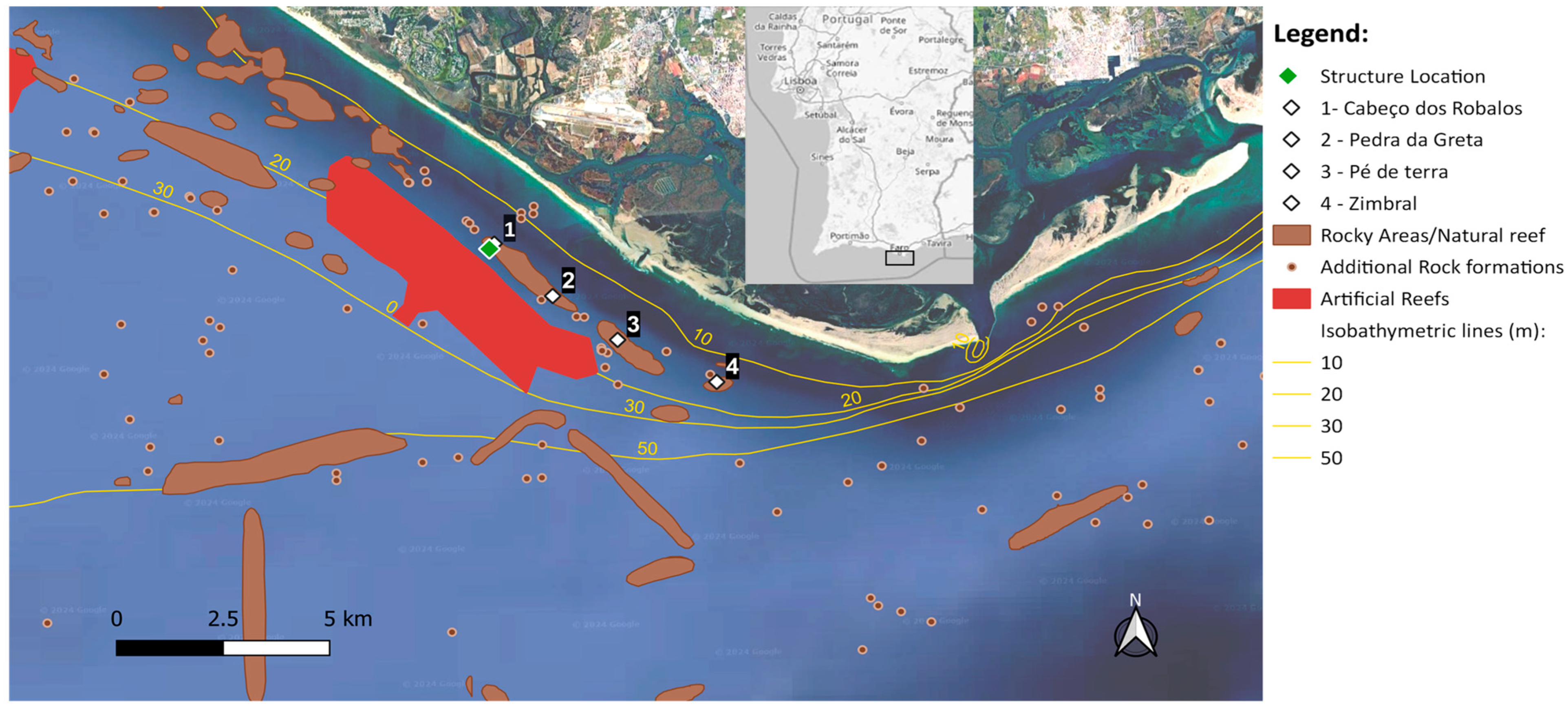
The study area is located on the western sector of Faro’s natural reef, approximately 1.8 km offshore of Ilha de Faro, on the south coast of Portugal (Figure 1). This naturally formed shallow reef extends from northwest to southeast for approximately 1.5 km, with a width of 50–70 m and depths ranging between 15 and 18 m and comprises three main sectors: (i) Pedra da Greta, (ii) Pé de Terra, and (iii) Zimbral [23]. The investigated site corresponds to the western portion of Pedra da Greta, locally known as Cabeço dos Robalos. This area is characterized by a rough, rocky morphology, consisting of an orthogonal network of cuboid-shaped vertical rocky features (2–5 m wide) composed of hard substrate, separated by narrow fissures and slits [27].
The Faro’s natural reef region exhibits a semidiurnal meso-tidal regime, with tidal ranges varying between approximately 0.5 m during neap tides and 3.5 m during spring tides [28]. Wave conditions are generally fair to moderate, with significant wave heights between 1 and 4 m and peak periods between 6 and 13 s [29,30]. Wave climate is dominated by west to southwest directions (68% of annual occurrence), associated with a mean offshore significant wave height of 0.92 m, while east to southeast waves account for 23% of the year [29]. Storm events are characterized by significant wave heights exceeding 3.5 m, primarily from the southwest and southeast [29]. The local nearshore ocean circulation is dominated by along-shore barotropic flow driven by longitudinal pressure gradients, reaching velocities up to 0.4 m/s, with predominantly north-eastward currents and limited non-seasonal variability [31]. Cross-shore currents are mainly tide-driven, with average velocities of approximately 0.04 m/s and no clearly dominant direction [31,32].

3. Materials and Methods

To assess the mutual influence of wind- and wave-related conditions on low- to mid-frequency ambient acoustic variability at Faro’s natural reef, the following data was collected and later analyzed: ocean current velocity, water pressure variation, and underwater acoustic data. In addition, a complementary sea state information was considered, obtained from the Spanish government’s Puertos del Estado Portus web platform [33].

3.1. Data Collection

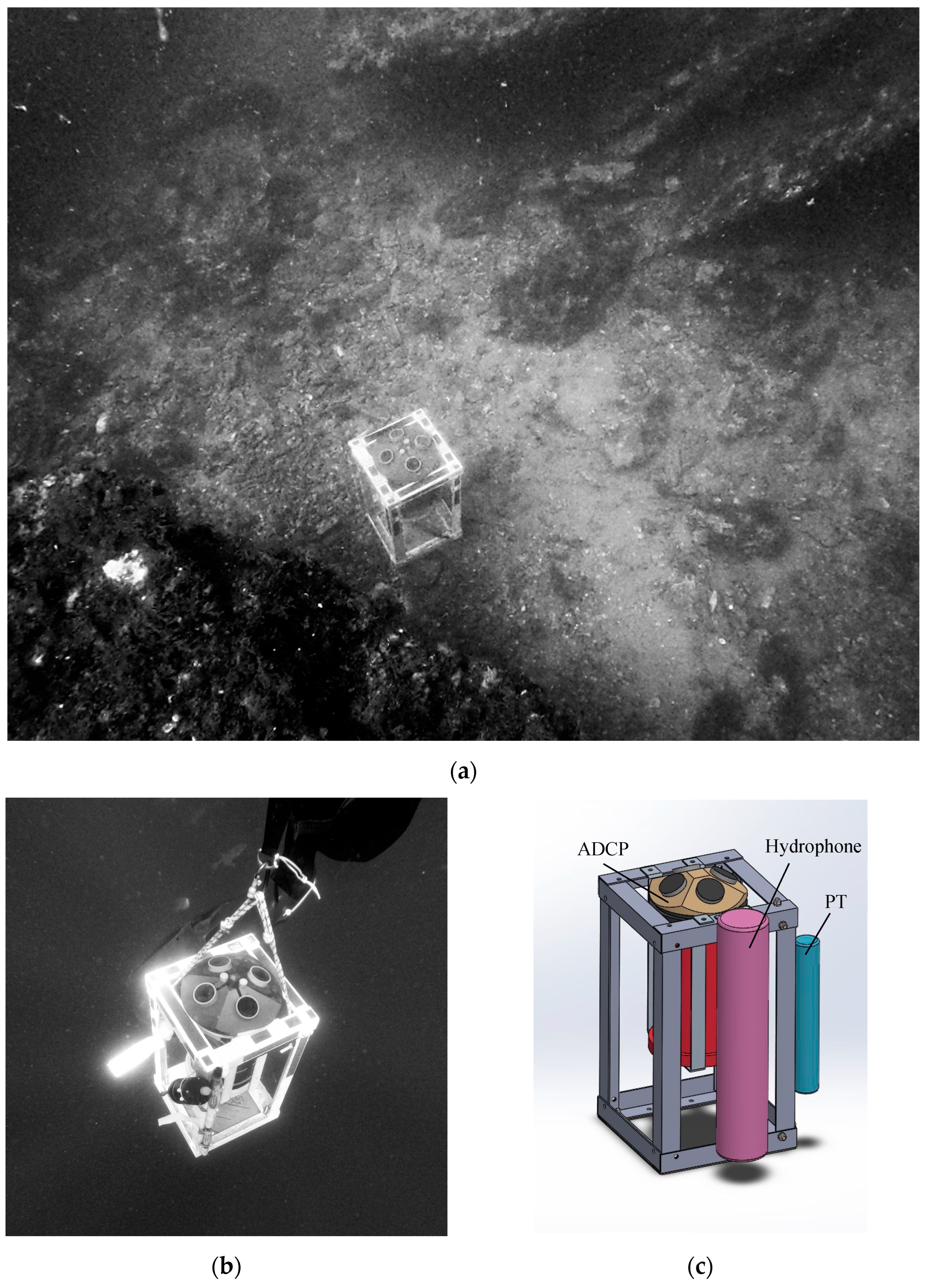
At the sensing system deployment zone, a seabed-mounted structure (see Figure 2) was equipped with the following sensors:
-
Acoustic Doppler Current Profiler (ADCP), model FlowQuest1000 by LinkQuest (San Diego, CA, USA); The ADCP, recorded ensembles of 30 pings at 5 min intervals, with a vertical bin size of 0.25 m and a blanking distance of 0.4 m.
-
Pressure transducer (PT), model Level TROLL 700 by In-Situ Inc. (Fort Collins, CO, USA). Pressure was recorded every 3 s using a fast linear logging mode.
-
Autonomous hydrophone, SoundTrap 300 STD model by Ocean Instruments NZ (Auckland, New Zealand). Acoustic data was acquired continuously at a 288 kS/s sampling rate with a bandwidth limit of 20 Hz–155 kHz and the recordings were saved in consecutive one-hour files. The hydrophone operated with the high-pass filter disabled to preserve low-frequency signal content, and the pre-amplifier gain set to Low (manufacturer defines the low-gain mode as having a maximum sound pressure level (SPL) before clipping of 184 dB re 1 µPa) to avoid signal saturation and clipping during periods of elevated sound levels, while retaining sufficient sensitivity for ambient sound analysis [34].
The structure was deployed at a depth of 16.7 m on a sandy patch between rocky outcrops at Cabeço dos Robalos (36.986226° N, −7.998588° W; Figure 1). The deployment remained in place for seven days, between the 11th and the 18th of June 2025. The deployment and recovery operations were carried out by two SCUBA divers.
To correct for atmospheric pressure variability, an additional land-based PT (Level TROLL 700, In-Situ Inc., Fort Collins, CO, USA) was deployed at Praia de Faro and used as a reference, recording every 3 s using a fast linear logging mode. Complementary sea state data, including wind speed at 10 m height ( U 10 ) and direction and significant wave ( H s ), swell ( H s , sw ), and wind wave ( H s , ww ) height and direction, were obtained from the Spanish government’s Puertos del Estado Portus web platform [33].

3.2. Data Quality Control

The analysis time window was defined between 13:58 (UTC+1) of the 11 June 2025 and 06:30 (UTC+1) of the 18 June 2025. Data recorded outside of this interval, or other data affected by deployment, recovery, instrument malfunction or data recording/structure instability were excluded from further analysis.

3.2.1. Current Velocity

The reliability of the current velocity measurements in the water column was assessed using two quality indicators: Percentage Good and the signal-to-noise ratio (SNR). Acceptable thresholds for these parameters were defined following the approach described by O’Byrne [35], based on the visual inspection of data quality across multiple depth bins using proprietary software FlowQuest (v. 3.2.3) using the same ADCP model.
For depth bins closer to the water column surface, data was retained only when the Percentage Good data was ≥30% and SNR was ≥30, analyzed using the FlowQuest software. No quality thresholds were applied to bins closer to the seabed, as no systematic anomalies were observed in the recorded data.

3.2.2. Pressure Variation

Underwater pressure measurements were recorded as absolute pressure and therefore required correction for atmospheric pressure variability. Pressure and derived depth records were barometrically compensated, using atmospheric pressure measured by the land-based pressure transducer to correct for atmospheric pressure variability, following Equation (1) described in Rau et al. [36], where p p t , a b s and p p t are, respectively, the absolute and PT relative recorded pressures, p b , is the atmospheric pressure measured by the land-based PT, and ρ w ¯ is the average density across the water column.
h p t s p t ,   t i = p p t , a b s s p t ,   t i p b s b ,   t i ρ w ¯   t i g
Due to the technical limitations of the Level TROLL 700 (In-Situ Inc., Fort Collins, CO, USA) pressure transducer deployed at the reef, free-surface variability associated with short- and long-period wave motion (including swell-related variability) was found to underestimate wave amplitudes when compared to the complementary sea state data from the Puertos del Estado Portus web platform [33]. Consequently, these pressure-derived wave measurements were not used in the quantitative analysis of wave conditions.

3.2.3. Acoustic Data

Acoustic recordings were visually and audibly inspected using Audacity (v. 3.7.5) and JASCO’s PAMLab Lite (v. 11.4.2). Time segments were excluded when they exhibited identifiable anthropogenic signatures, including persistent broadband low-frequency tonal components, engine harmonic structures, or clearly audible vessel passages. A total of 129 out of 161 files contained such features and were removed from further analysis. The resulting analysis therefore represents ambient conditions after the removal of segments affected by identifiable or suspected anthropogenic noise, rather than the total soundscape including such contributions.
Persistent biological sound components present in the recordings extended from 1 kHz to approximately 24 kHz. To prevent these high-frequency contributions from influencing the ambient sound field analysis, the acoustic data was down sampled to 8 kS/s and the analysis restricted to the 20–1000 Hz frequency range, excluding frequency bands persistently influenced by biological sources, similarly to [19].

3.3. Data Analysis

3.3.1. Current Velocity

Current velocity ( V d) magnitude was calculated as the vector sum of the three orthogonal velocity components following Equation (2), taken from Stewart [37].
V d = u 2 + v 2 + w 2
To characterize sea state conditions, the depth-averaged current velocity was computed for each profile with the following methodology. Based on the distribution of ocean current values, three agitation modes were defined using quartile-based thresholds: high agitation (current velocity > 0.77 m/s, third quartile), medium agitation (0.71–0.77 m/s, first to third quartile), and low agitation (velocity < 0.71 m/s, first quartile).

3.3.2. Acoustic Data

Acoustic data was analyzed using the Merchant et al. [34] PAMGuide MATLAB (R2022b) framework. Analysis was conducted over the 20–1000 Hz frequency band using a 0.5 s Hann window with 50% overlap, which provides a 2 Hz frequency resolution while minimizing spectral leakage and producing stable spectral estimates for low-frequency ambient sound analysis. Additionally, a hydrophone sensitivity of −188 dB re 1 V μPa−1 was applied for calibration, based on in-house system characterization. The PAMGuide acoustic analyses framework includes power spectral density (PSD) and one-third-octave band level (TOL) as functions of frequency and time to characterize frequency-dependent acoustic energy. Furthermore, additional analysis features such as the broadband SPL’s cumulative distribution function (CDF) analyses to describe overall sound level variability and statistical distribution were used for the analysis.
To quantify frequency-dependent spectral decay, octave-band level differences were computed from the median PSD and median TOL spectra for frequencies above 100 Hz. For each agitation mode, highlighted in Section 3.3.1, level differences were calculated between the 100–200 Hz and 200–400 Hz octave bands, and between the 200–400 Hz and 400–800 Hz octave bands, and expressed as decibels per octave. The resulting calculations are summarized and interpreted in Section 4.

4. Results

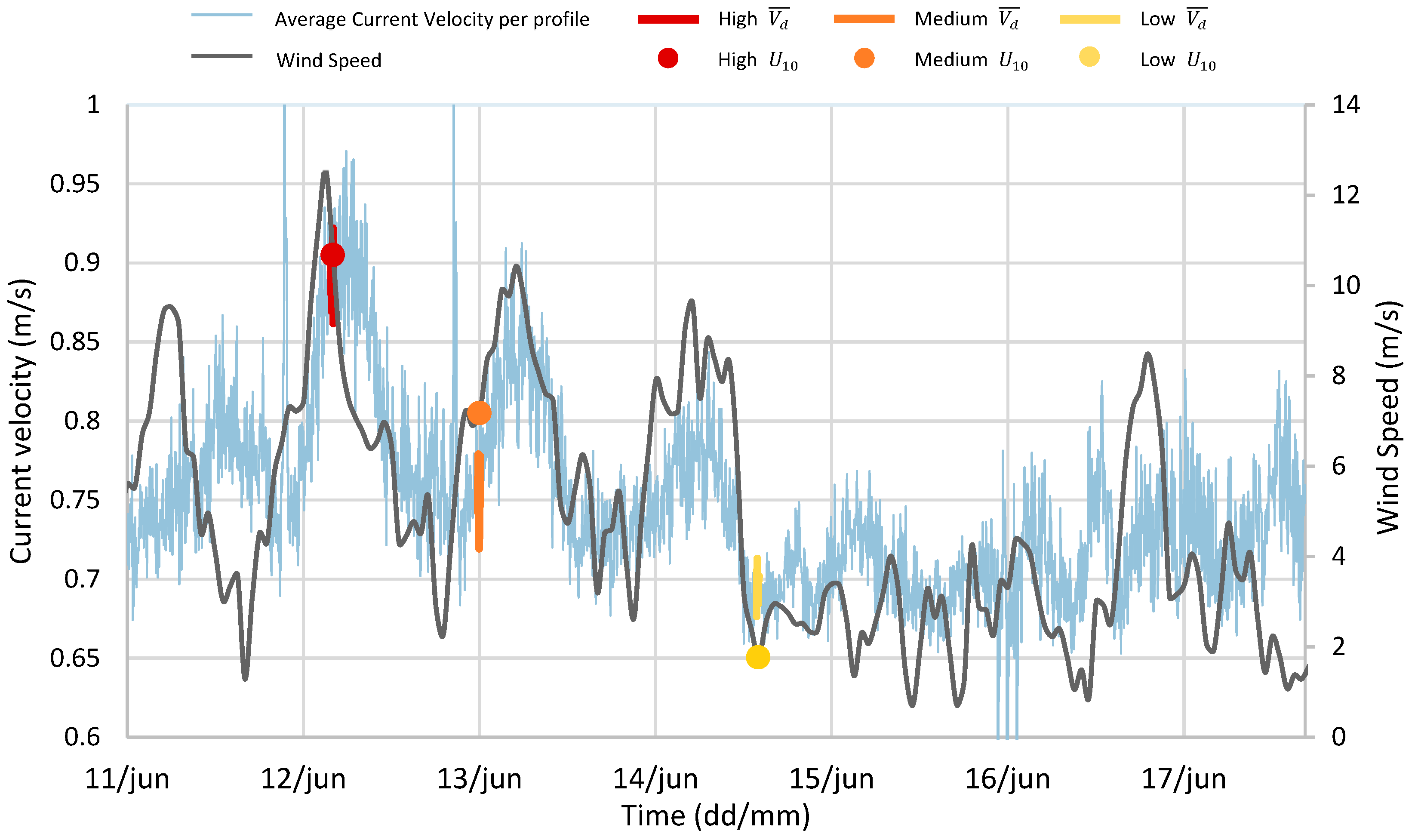
Three representative agitation modes (high, medium, and low), as discussed in Section 3.3.1, were defined based on the previously established current velocity thresholds. For each mode, a 25 min interval of measured current velocity (five consecutive current velocity profiles) was selected, starting at 17:46 on the 12 June 2025 (High), 13:46 on 13 June 2025 (Medium), and 03:46 on 15 June 2025 (Low) (Figure 3). Mode’s intervals were selected to coincide with periods for which acoustic recordings were available, and during similar tidal amplitudes, in order to limit variability associated with tidal conditions. The vertical structure of the average current velocity profiles corresponding to these selected agitation modes is presented in Figure 4. From each 25 min interval, a continuous segment of acoustic data recorded over the same time period was extracted for analysis, corresponding to 15 min for the high and low agitation modes and 10 min for the medium agitation mode.

4.1. Sea State Conditions

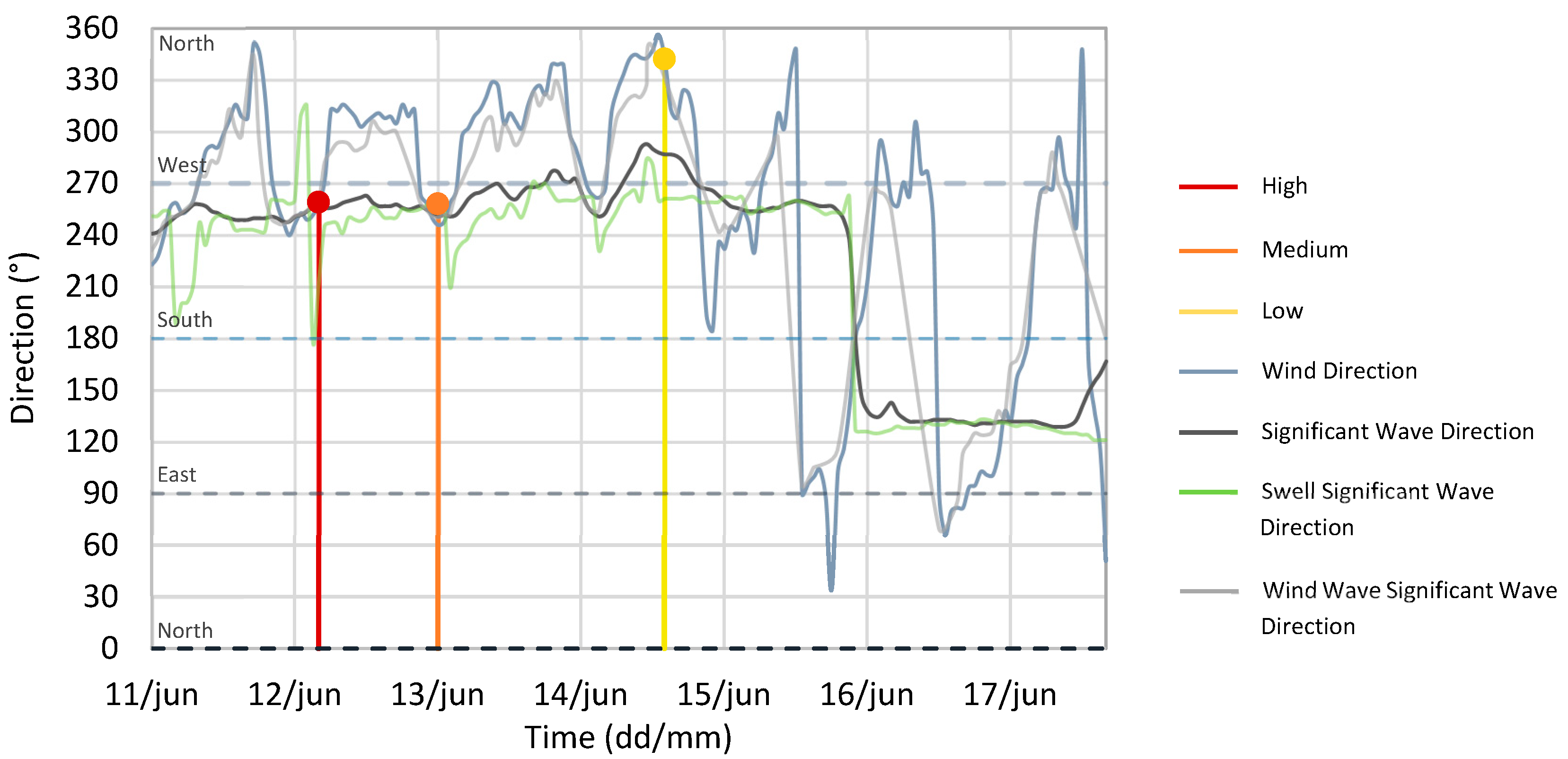
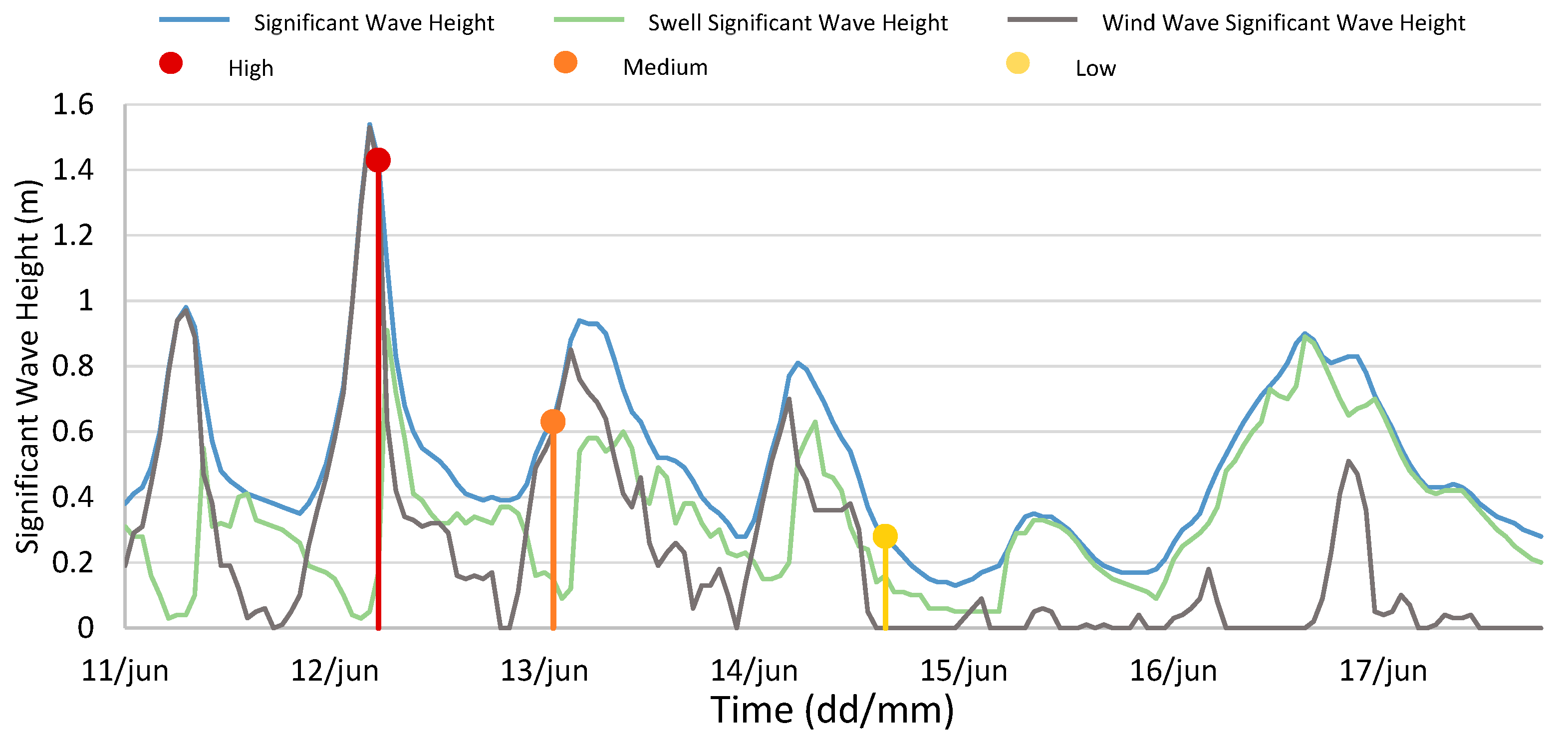
Hydrodynamic and environmental conditions varied coherently over the deployment time period, with average current velocity ( V d ¯ ) , wind speed and directions, and wave conditions displaying similar patterns over the observation period. This is shown by the average current velocity and wind speed time series (Figure 3), temporal variation in wind and wave directions (Figure 5), and the variability in significant wave, wind-wave, and swell heights (Figure 6). The deployment period between the 11th and the 15th of June was characterized by higher average current velocity (0.75–1 m/s), wind speed (7–13 m/s), and wave height (0.8–1.5 m), whereas the second half was dominated by values across those three parameters.
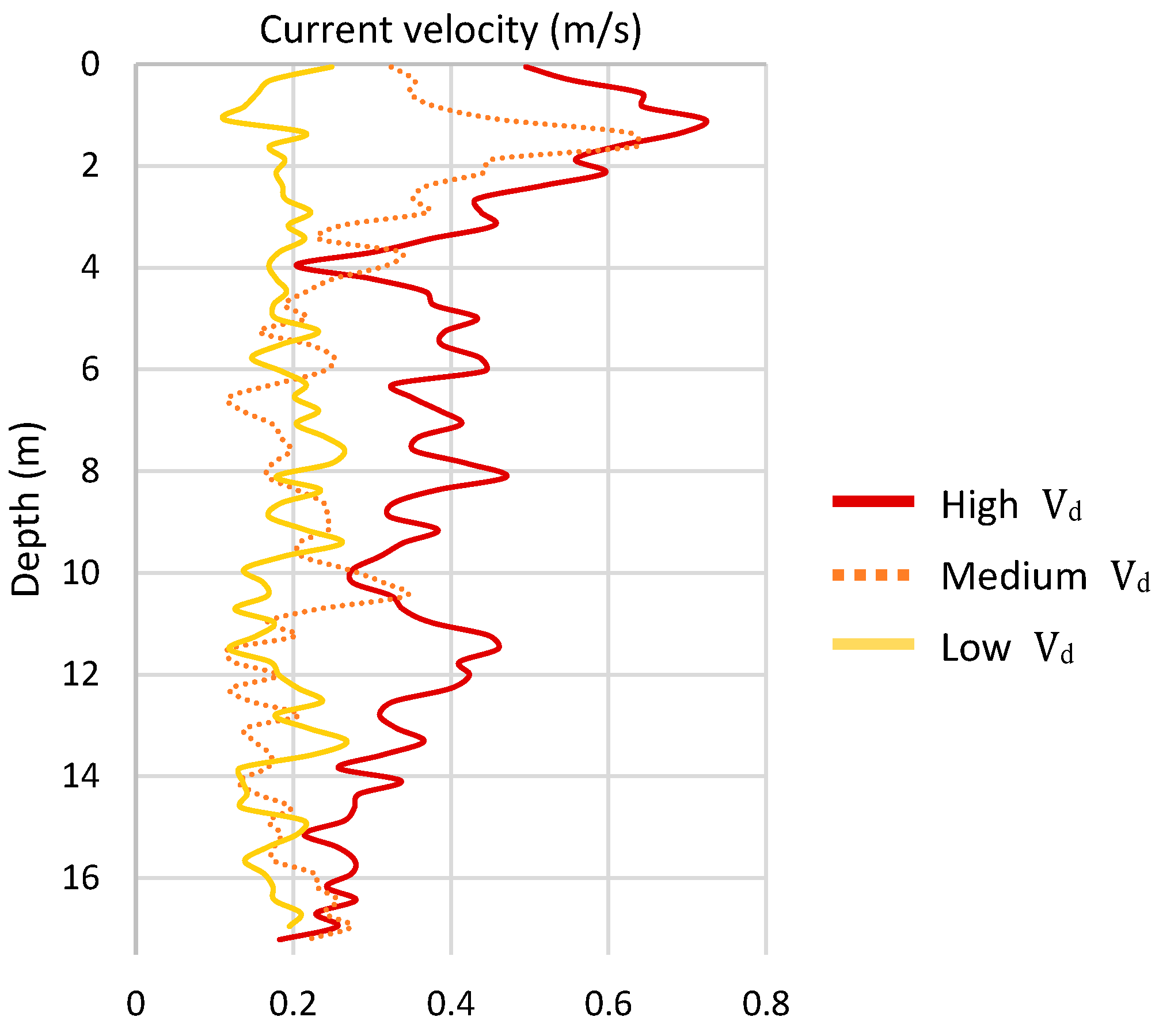
Periods of higher wind speed and enhanced current velocity were predominantly associated with wind directions from 250 to 270 degrees, encompassing the high and medium agitation modes (Figure 3, Figure 4 and Figure 5). In contrast, calmer conditions characterized by lower wind speed (1–3 m/s) and reduced average current velocity (<0.7 m/s) were generally associated with wind directions from 300 to 340°, corresponding to the low agitation mode. Wind direction exhibited a diurnal pattern during the deployment. Until the 15th of June, winds were predominantly north-westerly, with recurrent shifts toward westerly directions around midday (240–340). From the 15th of June onwards, the diurnal pattern changed, with winds alternating between westerly directions from midday to late evening and easterly directions from early morning until noon (90–270°). Wind–wave direction closely followed the wind direction throughout the deployment time. Following the change in the wind-direction diurnal pattern, wind–wave and swell directions shifted towards easterly to southeasterly sectors on 16 June, which was also reflected in the significant wave direction.
Wave conditions exhibited temporal patterns consistent with both wind speed and ocean current velocity variability (Figure 3 and Figure 6). Significant wave height increased during periods of elevated wind speed and current velocity, reaching its highest values during the period characterized by the highest wind speeds and wave heights. At the same time intervals, the wind–wave component contributed most to the total significant wave height, while the swell component remained lower. In contrast, periods characterized by lower wind speed and reduced average current velocity were associated with smaller significant wave heights ( H s < 0.4 m) and lower swell wave height conditions ( H s , s w < 0.4 m).

4.2. Ambient Sound Variability

4.2.1. PSD Across Frequency

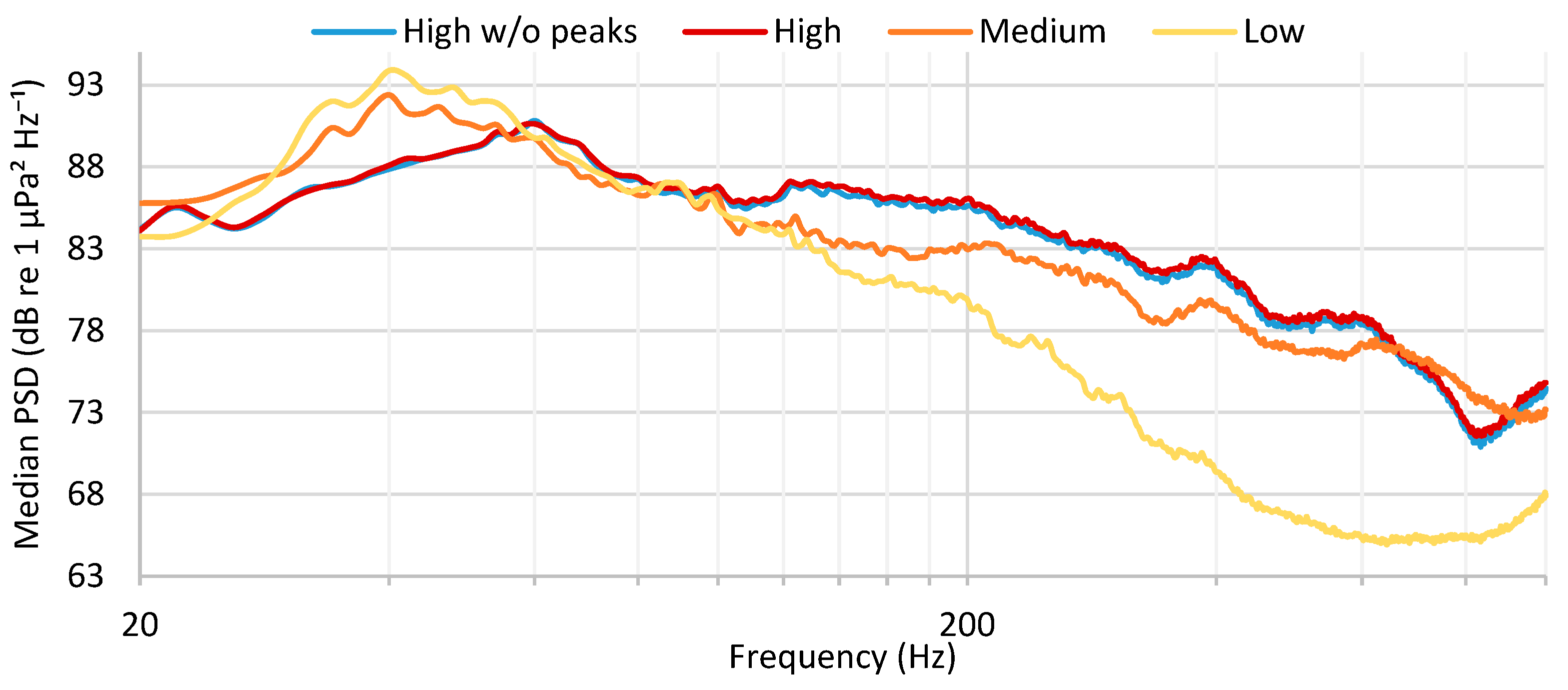
Above 100 Hz, the high agitation mode exhibited the highest median PSD levels and the low agitation mode the lowest, with differences reaching up to 10 dB at 630 Hz, as shown by the median PSD as a function of frequency for the different agitation modes (Figure 7). The medium and high agitation modes followed similar spectral shapes across frequency, with PSD showing consistently higher acoustic levels for the high agitation mode.
In contrast, below 100 Hz, the relative ordering differed, with the low and medium agitation modes exhibiting comparable or higher median PSD levels than the high agitation mode. The comparison between the High agitation mode spectrum and the high agitation mode spectrum excluding transient peaks (“High without peaks”) shows close agreement below 100 Hz, while above this frequency, a consistent separation of approximately 1 dB is revealed.
This contrast is further supported by the octave-band level differences, which indicate a similar spectral decay for the high and medium agitation modes (2.5–4.5 dB per octave between 100 and 800 Hz), in contrast to a markedly steeper decay under low agitation mode conditions (7–8.5 dB per octave across the 100–800 Hz frequency range), as quantified by the median PSD level differences per octave reported in Table 1.

4.2.2. PSD Across Time

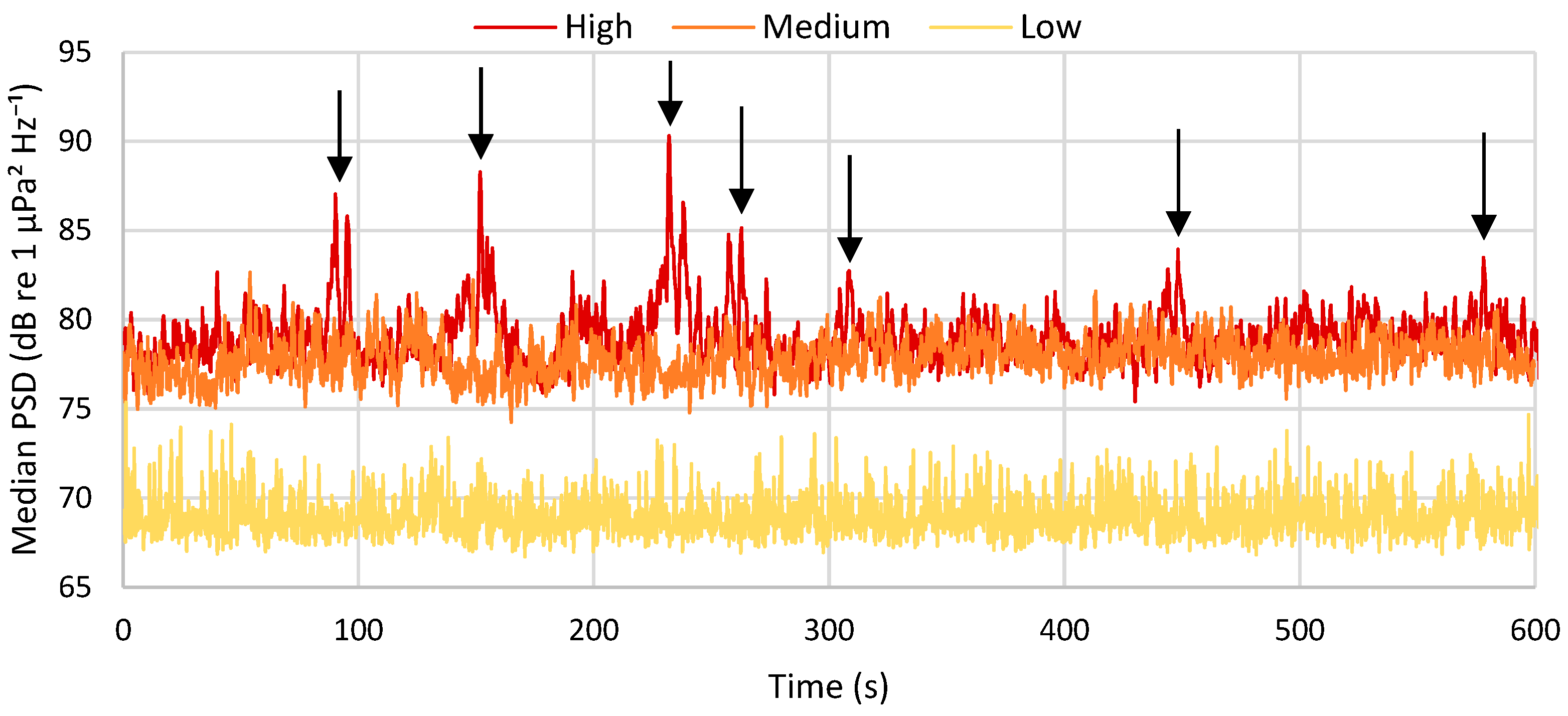
During the high agitation mode, median PSD levels were elevated and exhibited frequent high-energy peaks, with values typically ranging between 77 and 82 dB re 1 µPa2 Hz−1 and transient peaks reaching up to 90 dB re 1 µPa2 Hz−1, as observed by the time series of median PSD levels for the different agitation modes (Figure 8). The medium agitation mode displayed lower median PSD levels, between 75 and 80, with fewer and less pronounced high-energy peaks. In contrast, the low agitation mode remained more stable, with median PSD values mostly between 68 and 74 dB and an absence of significant high-energy peaks.

4.2.3. TOL Across Frequency

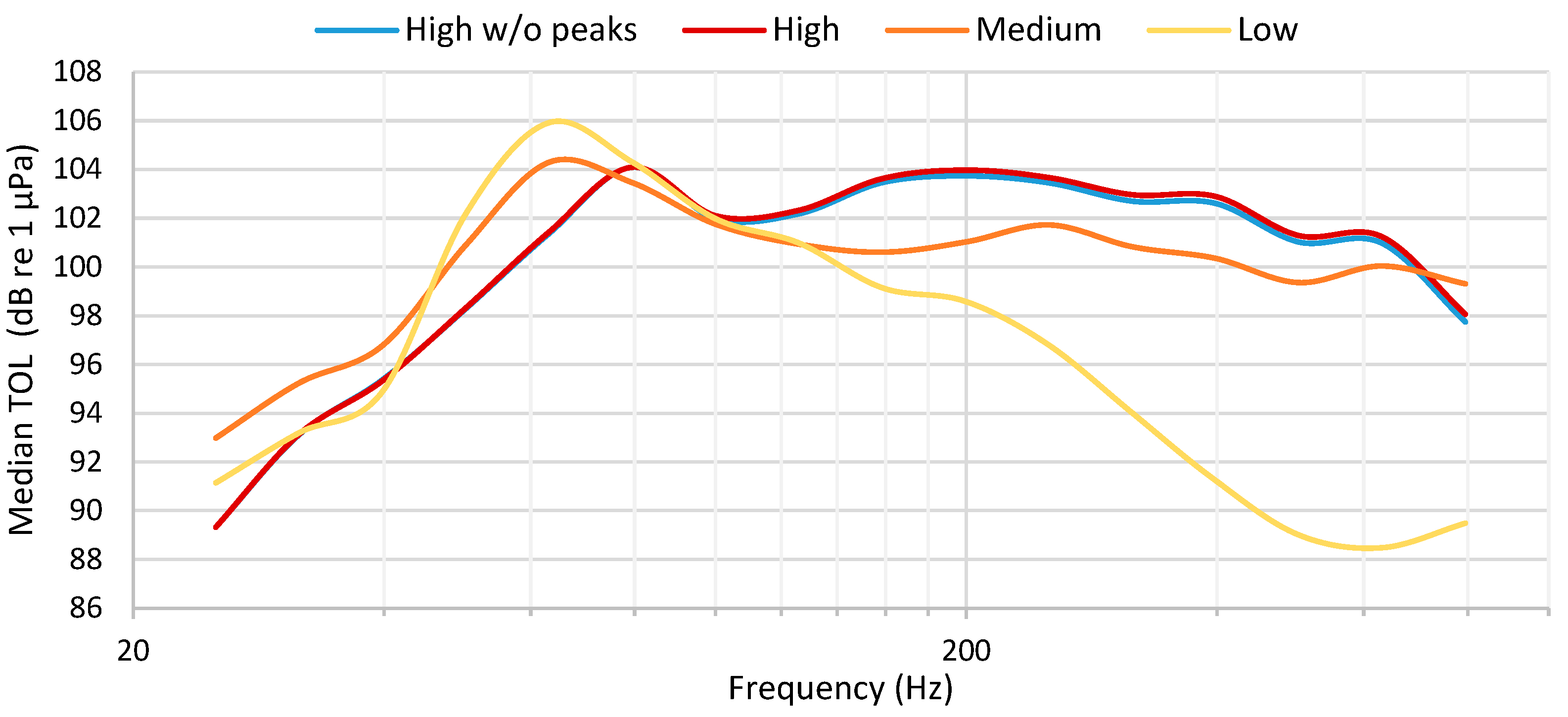
Above 100 Hz, median TOL during the low agitation mode are lower than during the Medium and High agitation modes, reaching a maximum difference of 13 dB at 630 Hz, as evidenced in the frequency-dependent TOLs for the different agitation modes (Figure 9). The Medium and High agitation modes follow similar variations across frequency with the High agitation mode showing slightly higher TOL values.
In contrast, below 100 Hz, the low and medium agitation modes exhibited higher acoustic levels than the High agitation mode. This behaviour is consistent with the one observed for low-frequency sound when considering PSD results. Also as before, the removal of high-energy peaks from the high agitation mode produced an offset of approximately 1 dB above 100 Hz.
This separation is further supported by the low octave-band SPL differences in the high and medium agitation modes (0–1.75 dB per octave between 100 and 800 Hz), indicating a relatively flat spectral behaviour that contrast to a steeper decay under low agitation mode conditions (5–6 dB per octave across 100–800 Hz frequency range), as reflected in the median TOL differences per octave reported in Table 2.

4.2.4. TOL Across Time

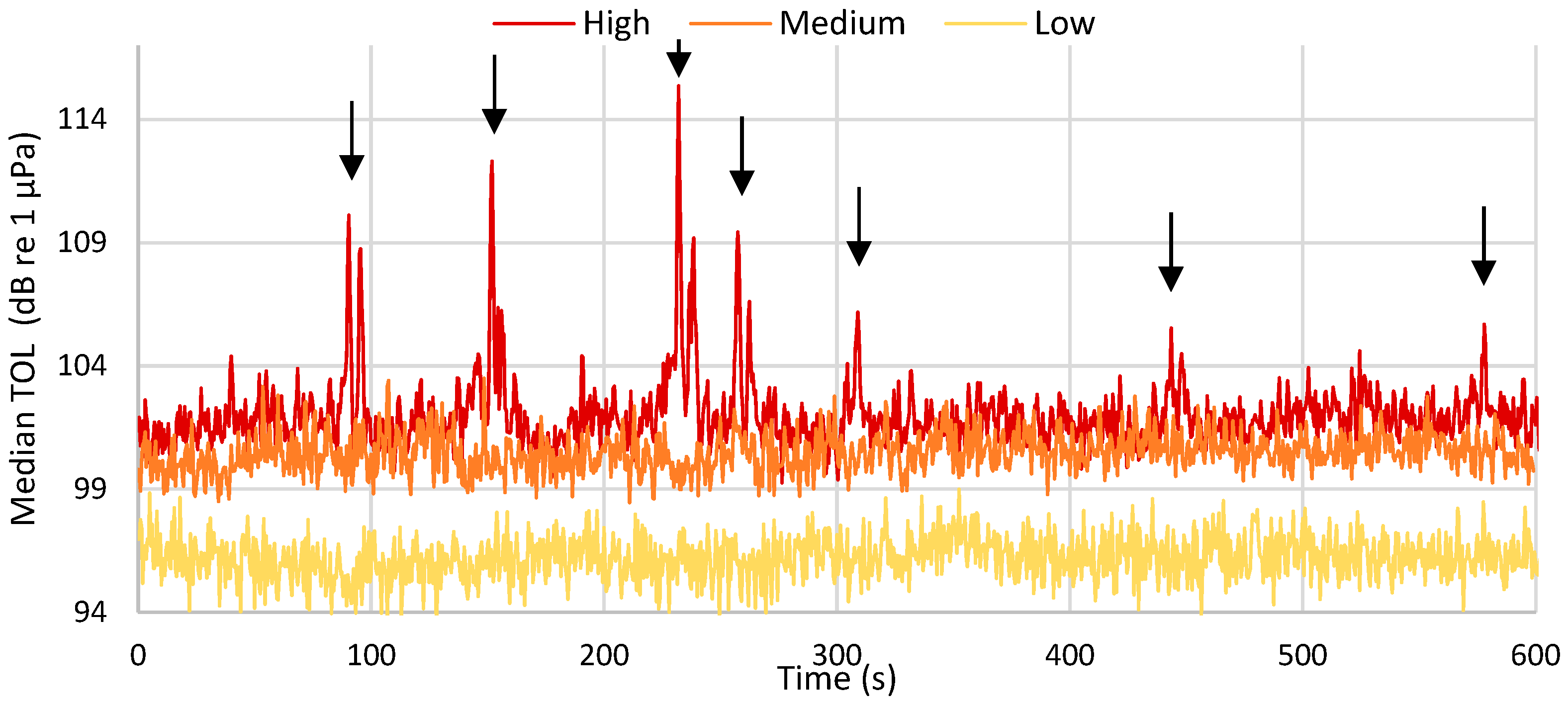
During the high agitation mode, median TOLs were elevated, typically ranging between 100 and 103 dB, with frequent high-energy peaks reaching up to 115 dB, as evident in the time series of the TOLs across agitation modes (Figure 10). The medium agitation mode exhibited levels about 1 dB below those of the high agitation mode, with high-energy peaks occurring less frequently and less pronounced. In contrast, the low agitation mode exhibited a lower SPL value and low variability, with band levels typically between 68 and 74 dB and the absence of pronounced high-energy peaks.

4.2.5. SPL Cumulative Distribution Functions (CDFs)

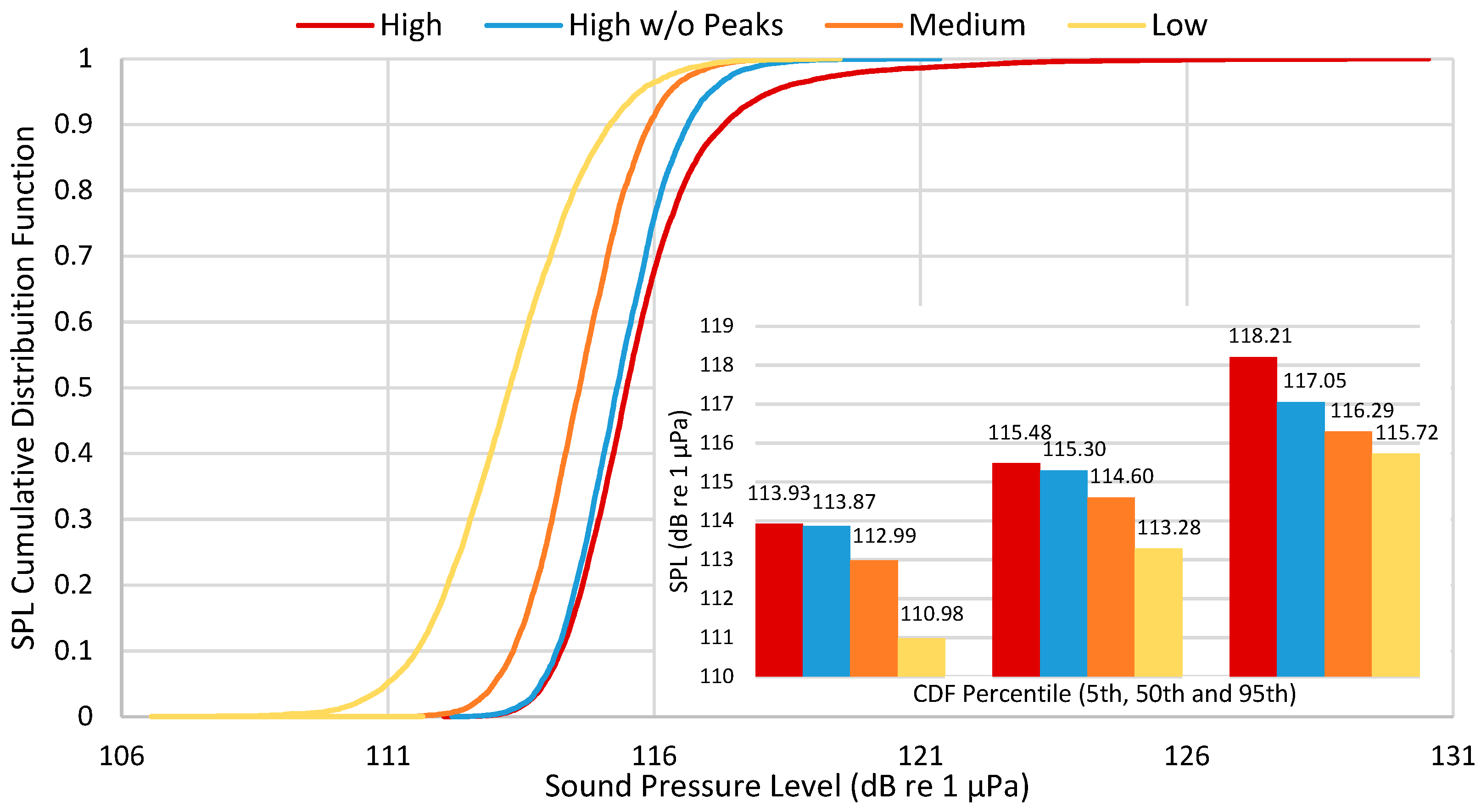
CDFs show that most of the broadband SPL values observed under the medium agitation mode and high agitation after exclusion of transient peaks cluster within a relatively small interval. SPL values observed under the medium agitation mode showed a 3.30 dB difference between the 5th and 95th percentiles, and high agitation after the exclusion of transient peaks showed a 3.18 dB difference between the same percentiles. In contrast, the low agitation mode exhibited the broadest distribution, with a difference of 4.74 dB between percentiles, followed by the High agitation mode, with a difference of 4.28 dB between percentiles, as illustrated by the percentile distributions across agitation modes in Figure 11.
The removal of transient peaks from the high agitation mode primarily affects the upper tail of the distribution, reducing the 95th percentile by approximately 1.16 dB, while differences at the median (0.18 dB) and lower percentile (0.06 dB) remain small, and the overall SPL difference between the medium and low agitation modes is maintained.
PSD and TOL analyses showed opposite correlations with agitation for frequencies below 100 Hz. This behaviour was not observed for the entire broadband SPL distributions. In contrast, the CDF analysis delivered a much clearer correlation between distinct agitation modes and observed sound features, with relative differences in CDF or SPL for distinct agitation modes showing almost similar values for all frequency domains.

5. Discussion

The results demonstrate a consistent association between wind-driven sea state conditions, current structure, and ambient acoustic variability at Faro’s natural reef. The following discussion interprets these observations in relation to established descriptions of wind-generated sound and shallow-water hydrodynamics. It first examines how variations in sea state and current structure correspond to changes in broadband acoustic levels and subsequently addresses the frequency-dependent behaviour of the acoustic field.

5.1. Ambient Sound Response to Sea State Conditions

Time periods characterized by stronger winds, increased wave heights, and higher current velocities (7–13 m/s, 0.8–1.5 m and 0.75–1 m/s, respectively; Figure 3 and Figure 6) were consistently associated with elevated ambient sound levels (75–82 dB; 99–103 dB; see Figure 8 and Figure 10), whereas low wind velocity (<5 m/s) and wave height (<0.4 m) intervals corresponded to lower acoustic levels with lower variability (67–72 dB; 94–97 dB). This correspondence indicates that variations in wind- and wave-related surface agitation are reflected in the acoustic field recorded at the reef. Similar relationships between surface agitation and ambient sound levels are consistent with coastal observations, where wind-driven processes such as wave breaking and near-surface turbulence are recognized as dominant contributors to sound generation above low frequencies [4,6,7,18].
During the first half of the deployment (11th–15th of June), when wind speed, wind-wave activity, and current velocity exhibited pronounced and recurrent increases, acoustic metrics showed higher acoustic levels (75–82 dB re 1 µPa2 Hz−1; 99–103 dB re 1 μPa; Figure 8 and Figure 10), reduced spectral decay above 100 Hz (Figure 7 and Figure 9), and frequent energetic peaks in both PSD and TOL time series. In contrast, the second half of the deployment (15th–18th of June) was characterized by weaker wind conditions (1–3 m/s), reduced wave heights ( H s < 0.4m), and lower current velocities ( V d < 0.7 m/s), coinciding with lower acoustic levels, steeper spectral decay, and the near absence of high-energy acoustic events. These temporal correspondences between hydrodynamic conditions and acoustic patterns indicates that periods of enhanced surface agitation are accompanied by increased ambient acoustic levels recorded at the reef. Such findings are consistent with classical and contemporary descriptions of wind-dependent ambient sound, in which increasing sea state leads to enhanced acoustic production and propagation, particularly at low to mid frequencies [4,6,18,38].
Differences in the vertical structure of current velocity across agitation modes provide additional context for the acoustic variability observed above 100 Hz (Figure 4). High and medium agitation modes, associated with higher wind speeds (10.68 and 7.18 m/s, respectively), exhibited a more developed surface-intensified current layer extending to approximately 4 m depth and a more evident near-bottom ocean current layer (from around 10 m depth to seabed). Conversely, the low agitation mode, associated with weaker wind conditions (mean wind speed of 1.77 m/s), was characterized by a more uniform flow in the water column (Figure 3 and Figure 4). Similar depth-dependent responses of coastal currents to wind variability were documented by Garel et al. [31] for the inner shelf of the Gulf of Cádiz, as well as in classical descriptions of coastal circulation distinguishing surface-influenced and bottom boundary layers [37,38]. In the present investigation, time intervals characterized by a deeper surface-intensified current layer correspond to elevated median PSD and TOL above 100 Hz (Figure 7 and Figure 9), indicating that acoustic variability in this frequency range occurs under hydrodynamic conditions dominated by wind-driven surface processes.

5.2. Frequency-Dependent WGS at Faro’s Natural Reefp

The acoustic variability observed at Faro’s natural reef exhibits a clear frequency dependence, with PSD and TOL analyses revealing pronounced differences between agitation modes above approximately 100 Hz and contrasting behaviour at lower frequencies (Figure 7 and Figure 9). This pattern is consistent with the frequency–dependence description proposed by Hildebrand et al. [6], which describes a weak dependence of ambient sound on WGS at low frequencies (10–100 Hz) and a substantially stronger dependence at higher frequencies (400 Hz–20 kHz), where wind-driven surface processes dominate sound generation. Accordingly, the following sections examine the acoustic field by frequency band to reflect this observed frequency dependence.

5.2.1. Low-Frequency Band (20–100 Hz)

Between 20 and 100 Hz, the acoustic behaviour at Faro’s natural reef shows an inconsistent relationship with agitation intensity. Both PSD and TOL results indicate that median acoustic levels during the low agitation mode are slightly higher than those observed during the high agitation mode (Figure 7 and Figure 9). This behaviour contrasts with the clear agitation-dependent separation observed above 100 Hz and indicates that wind-driven surface processes do not dominate sound generation in this band.
Classical and contemporary descriptions of ocean ambient sound indicate that below approximately 100 Hz, acoustic levels exhibit limited dependence on wind conditions and are increasingly influenced by turbulent pressure fluctuations and anthropogenic sources, particularly in shallow-water environments [1,4,6,39]. Flow-related noise associated with turbulent pressure fluctuations is expected to increase with current velocity, turbulence intensity, with its influence becoming stronger toward lower frequencies [15,16,17,21]. However, the present observations show lower acoustic levels during periods of higher current velocity, indicating that turbulent flow noise alone cannot account for the observed variability in this frequency band.
The spectral shape of the PSD curves in the 20–100 Hz range, particularly during the low and medium agitation modes, closely resembles the traffic-dominated regime described by the classical Wenz curves (Figure 7) [4]. Between 20 and 50 Hz, the low and medium agitation spectra increase from roughly 88–90 dB to 92–94 dB re 1 µPa2 Hz−1, following the Wenz traffic curve within 1–2 dB, whereas the High agitation spectrum remains 3–4 dB lower. From 50 to 100 Hz, the three agitation modes converge, decreasing to approximately 85–90 dB and aligning with the Wenz traffic curve within about 1–3 dB, suggesting that acoustic levels below 100 Hz are primarily governed by anthropogenic sources rather than wind- and wave-driven surface processes.
Evidence for anthropogenic dominance at low frequencies is further supported by the acoustic quality-control analysis, which identified recurring low-frequency anthropogenic signatures in the recordings, indicating that residual non-environmental acoustic contributions persisted despite the applied filtering and screening procedures. Such persistence of anthropogenic dominance below 200–300 Hz is widely reported in shallow coastal environments where vessel traffic is a major contributor to ambient sound levels even after careful data screening [13,21,39,40].
In addition to marine traffic, other anthropogenic sources may intermittently contribute to the low-frequency sound field. Given the proximity of Faro Airport (approximately 3 km), aircraft noise may occasionally contribute to low frequencies under favourable propagation conditions, as previously documented for shallow receivers, although such contributions are expected to be sporadic [41,42].
Collectively, these results indicate that acoustic variability in the 20–100 Hz band at Faro’s natural reef exhibits limited dependence on wind and wave conditions and is instead primarily controlled by persistent anthropogenic acoustic sources (Figure 7 and Figure 9), consistent with previous descriptions of weak wind dependence at low frequencies [6]. This interpretation is corroborated by the SPL CDF analysis, which shows that the low agitation mode exhibits the broadest broadband SPL distribution (4.74 dB between the 5th and 95th percentiles) despite the absence of pronounced transient peaks, indicating that low-frequency variability is dominated by sustained background fluctuations rather than episodic high-energy events (Figure 11).

5.2.2. Low- to Mid-Frequency Band (100–1000 Hz)

Above 100 Hz, the acoustic behaviour at Faro’s natural reef exhibits a consistent dependence on agitation intensity. Both PSD and TOL results show that the medium and high agitation modes are characterized by elevated sound levels across this frequency range, whereas the low agitation mode displays lower sound levels and a more rapid decay with increasing frequency (Figure 7 and Figure 9). Differences between the high and low agitation modes reach approximately 10 dB, indicating a pronounced response of acoustic levels to wind-related conditions above this threshold.
This contrast is further reflected in the rate at which acoustic levels decrease for increasing frequency. Median PSD levels decrease by approximately 3–5 dB per octave above 100 Hz under high and medium agitation, whereas the low agitation mode exhibits a markedly steeper decay of about 7–8 dB per octave (Table 1). A similar pattern is observed in the TOL results (Table 2), where level changes are comparatively small under medium and high agitation modes (1.75 dB per octave) but increase substantially during low agitation mode (5–6 dB per octave).
The frequency-dependent behaviour observed above 100 Hz is consistent with classical descriptions of wind-generated ambient sound. Across the 100–1000 Hz band, the medium and high agitation spectra broadly resemble the higher sea-state curves described by Wenz [4], remaining typically within 3–5 dB of the upper limit of prevailing noise, with the largest divergence (7–10 dB) occurring near 600 Hz. The low agitation mode exhibits an acoustic pattern more consistent with lower prevailing acoustic conditions, remaining 5–10 dB above the lower limit of prevailing noise across most of the band (Figure 7). This correspondence suggests that the observed distribution of acoustic energy across frequency follows the characteristic wind-dependent patterns reported in both classical and more recent ambient sound studies [4,6].
According to Hildebrand et al. [6] and Li et al. [43], the strong frequency dependence of WGS typically becomes dominant above approximately 400 Hz, with the 50–400 Hz range representing a transitional regime in which the primary ambient sound-generation mechanisms shift from turbulent pressure fluctuations toward bubble-related processes associated with wave breaking and surface agitation. In the present dataset, however, elevated median PSD and TOL sound levels associated with the medium and high agitation modes are already evident from approximately 100 Hz onward, suggesting that the transitional regime between turbulent-pressure-related sound and wind-generated surface sound is less evident at Faro’s natural reef (Figure 7 and Figure 9).
Further evidence for a dominant wave breaking-contribution is provided by the behaviour of transient peaks in this frequency band (Figure 8 and Figure 10). Transient peaks are observed in this frequency band (Figure 8 and Figure 10). Discrete high-energy peaks occurring under medium and high agitation are consistent with individual breaking-wave events, as divergence between the high agitation mode’s frequency distribution with and without the most pronounced peaks becomes apparent only above approximately 100 Hz, coinciding with the frequency range associated with breaking-wave and bubble-oscillation sound [44,45,46]. Previous field and laboratory studies have shown that individual breaking waves generate short-duration, high-amplitude acoustic bursts with energy concentrated above 100 Hz, producing transient features similar those removed from the high agitation mode [10,18,44,46].
At the same time, the similarity between the high agitation mode acoustic levels with and without the most pronounced transient peaks further indicates that the separation between agitation modes above 100 Hz is not solely driven by isolated high-energy events (Figure 7 and Figure 9). Instead, elevated background acoustic levels persist after peak removal, indicating a sustained contribution from wind-driven surface processes during periods of increased wind and wave activity [6], onto which discrete breaking-wave bursts are superimposed. This interpretation is further supported by the SPL CDF analysis, where the removal of transient peaks reduces the percentile spread under high agitation (from 4.28 to 3.18 dB between the 5th and 95th percentiles) while maintaining separation from the medium and low agitation modes (Figure 11). This indicates that the background broadband SPL during high agitation is comparatively stable and that the observed CDF variability is primarily associated with transient events rather than background fluctuations.
Together, the persistence of elevated median PSD and TOL sound levels across frequency, the reduced rate of level decrease under stronger agitation, and the confinement of transient peak effects to frequencies above 100 Hz indicate that acoustic variability in the 100–1000 Hz band at Faro’s natural reef is primarily controlled by wind-driven surface processes, consisting of a persistent wind-generated background sound field with superimposed breaking-wave acoustic bursts (Figure 7 and Figure 9).
The confinement of transient high-energy peaks to the medium and high agitation modes and near absence under low agitation conditions further indicates the frequency and intensity of breaking-wave-related acoustic bursts increase with surface agitation (Figure 8 and Figure 10), consistent with laboratory and field observations showing that breaking-wave-related acoustic bursts become more frequent and energetic with increasing wind speed and sea state [18,44,46].

6. Conclusions

This study examined how wind- and wave-related conditions influence low to mid-frequency (20–1000 Hz) ambient sound variability at Faro’s natural reef using short-term using short-term PAM combined with sea state observations.
The main findings of this study can be summarized as follows:
  • Ambient sound variability at Faro’s natural reef exhibits a clear frequency dependence, with WGS effects becoming dominant above approximately 100 Hz.
  • Below 100 Hz, ambient sound levels show limited response to agitation intensity and are largely influenced by persistent anthropogenic noise sources.
  • Above 100 Hz, sound levels increase consistently with agitation intensity and exhibit reduced spectral decay under stronger wind- and wave-driven surface conditions.
  • Acoustic variability in the 100–1000 Hz band reflects both a persistent background component associated with wind-driven surface processes and transient high-energy events linked to individual breaking waves.
  • From a monitoring perspective, frequencies above approximately 100 Hz exhibit the most consistent and physically interpretable response to changes in agitation intensity at Faro’s natural reef, a pattern observed consistently across the spectral, band-level, and statistical representations of the acoustic data.
  • The extensive presence of anthropogenic noise identified during acoustic screening and analysis reflects the current acoustic environment at Faro’s natural reef.
Although this investigation focuses on a specific nearshore reef environment, the results illustrate how the frequency-dependent analysis of ambient sound can help relate underwater acoustic variability to wind- and wave-driven surface processes. While the observations are site-specific, the analytical approach can be replicated in other coastal environments to help distinguish sea-state-related acoustic variability from other components of the underwater soundscape.
Future work should extend passive acoustic monitoring at Faro’s natural reef over longer time periods and across seasons to further assess the persistence of the frequency-dependent acoustic patterns identified here. Comparative deployments at additional reef and non-reef sites in the nearshore Algarve region would support the clearer evaluation of how the presence of the reef modifies ambient sound variability relative to broader shallow-water conditions. Integrating PAM with sound-propagation modelling, the direct measurements of wave breaking and bubble dynamics, and seabed morphology characterization would then allow these reef-related hydrodynamic–acoustic relationships to be attributed to specific reef–water mass interaction processes, including the influence of cross-shore flow, tidal amplitude, and tidally driven currents on reef-associated ambient sound fields.

Author Contributions

Conceptualization, D.F., E.P. and D.D.; methodology, D.F., E.P. and D.D.; software, D.F.; validation, D.F., D.M., E.P. and D.D.; formal analysis, D.F.; investigation, D.F. and D.D.; resources, D.F., D.M., E.P. and D.D.; data curation, D.F.; writing—original draft preparation, D.F.; writing—review and editing, D.F., D.M., E.P. and D.D.; visualization, D.F.; supervision, E.P. and D.D.; project administration, E.P. and D.D.; funding acquisition, E.P. and D.D. All authors have read and agreed to the published version of the manuscript.

Funding

This research received no external funding.

Data Availability Statement

The data supporting the findings of this study is available from the corresponding author upon reasonable request.

Acknowledgments

The authors acknowledge the University of Algarve for logistical support during field operations, and the University of Minho for providing the acoustic and oceanographic equipment used in this study. The authors would like to thank the support by the R&D Project “New Space Portugal”, with the reference 02/C05-i01.01/2022.C644936537-00000046, funded by PRR—Plano de Recuperação e Resiliência and by Next Generation EU European Recovery Funds, through the incentives system “Agendas para a Inovação Empresarial”. This work was developed within the framework of the MaréFormosa Project. The authors are grateful to Rafael Martínez Pérez for the design and construction of the deployment structure.

Conflicts of Interest

The authors declare no conflicts of interest.

Abbreviations

The following abbreviations are used in this manuscript:
ADCPAcoustic Doppler Current Profiler
CDFCumulative distribution function
H s Significant wave height
H s , w w Significant wind wave height
H s , s w Significant swell wave height
PAMPassive acoustic monitoring
PTPressure transducer
PSDPower spectral density
SNRSignal-to-noise ratio
SPLSound pressure level
TOL1/3-octave band level
U 10 Wind speed at 10 m height
V dCurrent velocity
V d ¯ Average current velocity
WGSWind-generated sound

References

  1. National Research Council (US) Committee on Potential Impacts of Ambient Noise in the Ocean on Marine Mammals. Ocean Noise and Marine Mammals; National Academies Press: Washington, DC, USA, 2003; ISBN 978-0-309-08536-6. [Google Scholar]
  2. Hildebrand, J.A. Anthropogenic and Natural Sources of Ambient Noise in the Ocean. Mar. Ecol. Prog. Ser. 2009, 395, 5–20. [Google Scholar] [CrossRef]
  3. Cauchy, P.; Heywood, K.J.; Merchant, N.D.; Risch, D.; Queste, B.Y.; Testor, P. Gliders for Passive Acoustic Monitoring of the Oceanic Environment. Front. Remote Sens. 2023, 4, 1106533. [Google Scholar] [CrossRef]
  4. Wenz, G.M. Acoustic Ambient Noise in the Ocean: Spectra and Sources. J. Acoust. Soc. Am. 1962, 34, 1936–1956. [Google Scholar] [CrossRef]
  5. Zambra, M.; Cazau, D.; Farrugia, N.; Gensse, A.; Pensieri, S.; Bozzano, R.; Fablet, R. Learning-Based Temporal Estimation of In-Situ Wind Speed from Underwater Passive Acoustics. IEEE J. Ocean. Eng. 2023, 48, 1215–1225. [Google Scholar] [CrossRef]
  6. Hildebrand, J.A.; Frasier, K.E.; Baumann-Pickering, S.; Wiggins, S.M. An Empirical Model for Wind-Generated Ocean Noise. J. Acoust. Soc. Am. 2021, 149, 4516–4533. [Google Scholar] [CrossRef]
  7. Knudsen, V.O.; Alford, R.S.; Emling, J.W. Underwater Ambient Noise. J. Mar. Res. 1948, 7, 410–429. [Google Scholar]
  8. Ramji, S.; Latha, G.; Rajendran, V.; Ramakrishnan, S. Wind Dependence of Ambient Noise in Shallow Water of Bay of Bengal. Appl. Acoust. 2008, 69, 1294–1298. [Google Scholar] [CrossRef]
  9. Thomson, J.; Yang, J.; Taylor, R.; Rainville, E.J.; Zeiden, K.; Rainville, L.; Brenner, S.; Ballard, M.; Cronin, M.F. Surface Wave Development and Ambient Sound in the Ocean. J. Geophys. Res. Ocean. 2024, 129, e2024JC021921. [Google Scholar] [CrossRef]
  10. Dahl, P.; Miller, J.; Cato, D.; Andrew, R. Underwater Ambient Noise. Acoust. Today 2007, 3, 23–33. [Google Scholar] [CrossRef]
  11. Havlik, M.-N.; Predragovic, M.; Duarte, C.M. State of Play in Marine Soundscape Assessments. Front. Mar. Sci. 2022, 9, 919418. [Google Scholar] [CrossRef]
  12. Azofeifa-Solano, J.C.; Erbe, C.; Tollefsen, C.; McCauley, R.D.; Brooker, R.M.; Pygas, D.; Parsons, M.J.G. Distance and Orientation of Hydrophones Influence the Received Soundscape in Shallow Coral Reefs. Front. Remote Sens. 2025, 6, 1527988. [Google Scholar] [CrossRef]
  13. Wilcock, W.S.D.; Stafford, K.M.; Andrew, R.K.; Odom, R.I. Sounds in the Ocean at 1–100 Hz. Annu. Rev. Mar. Sci. 2014, 6, 117–140. [Google Scholar] [CrossRef]
  14. Zakarauskas, P. Ambient Noise in Shallow Water: A Literature Review. Can. Acoust. 1986, 14, 3–17. [Google Scholar]
  15. Strasberg, M. Hydrodynamic Flow Noise in Hydrophones. In Adaptive Methods in Underwater Acoustics; Urban, H.G., Ed.; Springer: Dordrecht, The Netherlands, 1985; pp. 125–143. ISBN 978-94-009-5361-1. [Google Scholar]
  16. Bassett, C.; Thomson, J.; Dahl, P.H.; Polagye, B. Flow-Noise and Turbulence in Two Tidal Channels. J. Acoust. Soc. Am. 2014, 135, 1764–1774. [Google Scholar] [CrossRef]
  17. Wunsch, C. Can Oceanic Flows Be Heard? Abyssal Melodies. J. Acoust. Soc. Am. 2022, 152, 2160–2168. [Google Scholar] [CrossRef]
  18. Manasseh, R.; Babanin, A.V.; Forbes, C.; Rickards, K.; Bobevski, I.; Ooi, A. Passive Acoustic Determination of Wave-Breaking Events and Their Severity across the Spectrum. J. Atmos. Ocean. Technol. 2006, 23, 599–618. [Google Scholar] [CrossRef]
  19. Mathias, D.; Gervaise, C.; Di Iorio, L. Wind Dependence of Ambient Noise in a Biologically Rich Coastal Area. J. Acoust. Soc. Am. 2016, 139, 839–850. [Google Scholar] [CrossRef]
  20. McKenna, M.F.; Baumann-Pickering, S.; Kok, A.C.M.; Oestreich, W.K.; Adams, J.D.; Barkowski, J.; Fristrup, K.M.; Goldbogen, J.A.; Joseph, J.; Kim, E.B.; et al. Advancing the Interpretation of Shallow Water Marine Soundscapes. Front. Mar. Sci. 2021, 8, 719258. [Google Scholar] [CrossRef]
  21. Volaric, M.P.; Stine, E.M.; Burtner, M.; Andrews, S.S.; Berg, P.; Reidenbach, M.A. The Turbulent Soundscape of Intertidal Oyster Reefs. PLoS ONE 2025, 20, e0309503. [Google Scholar] [CrossRef]
  22. Turlington, K.; Suárez-Castro, A.F.; Teixeira, D.; Linke, S.; Sheldon, F. Exploring the Relationship between the Soundscape and the Environment: A Systematic Review. Ecol. Indic. 2024, 166, 112388. [Google Scholar] [CrossRef]
  23. Felisberto, P.; Rodríguez, O.C.; Silva, J.P.; Jesus, S.; Ferreira, H.Q.; Ferreira, P.P.; Cunha, M.E.; de los Santos, C.B.; Olivé, I.; Santos, R. Monitoring Bubble Production in a Seagrass Meadow Using a Source of Opportunity. Proc. Mtgs. Acoust. 2017, 30, 005002. [Google Scholar] [CrossRef]
  24. Felisberto, P.; Silva, J.P.; Silva, A.J.; Jesus, S.M.; Olivé, I.; Santos, R.; Quental-Ferreira, H.; Pousão-Ferreira, P.; Cunha, M.E. Acoustic Detection of Bubbles in a Pond Covered by the Seagrass Cymodocea nodosa. In Proceedings of the OCEANS 2017—Aberdeen; IEEE: Piscataway, NJ, USA, 2017; pp. 1–7. [Google Scholar]
  25. Felisberto, P.; Silva, J.P.; Silva, J.; Silva, A.; Santos, R.; Jesus, S.M. Background Noise in Areas Covered by Marine Plants in the Ria Formosa Lagoon During the Summer. In Proceedings of the 2018 OCEANS—MTS/IEEE Kobe Techno-Oceans (OTO); IEEE: Piscataway, NJ, USA, 2018; pp. 1–5. [Google Scholar]
  26. Soares, C.; Pacheco, A.; Zabel, F.; González-Goberña, E.; Sequeira, C. Baseline Assessment of Underwater Noise in the Ria Formosa. Mar. Pollut. Bull. 2020, 150, 110731. [Google Scholar] [CrossRef]
  27. Teixeira, S.; Aleixo Pinto, C. Submarine Evidences of Holocene Shoreline Migration on Quarteira Coast (Southern Algarve-Portugal); EUROCOAST: Porto, Portugal, 2002. [Google Scholar]
  28. Gamito, S. Sustainable Management of a Coastal Lagoonal System (Ria Formosa, Portugal): An Ecological Model for Extensive Aquaculture. Int. J. Salt Lake Res. 1997, 6, 145–173. [Google Scholar] [CrossRef]
  29. Costa, M.; Silva, R.; Vitorino, J. Contribuição para o estudo do clima de agitação marítima na costa portuguesa. In 2ª Jornadas Portuguesas de Engenharia Costeira e Portuária; Associação Internacional de Navegação (PIANC): Brussels, Belgium, 2001; 20p. [Google Scholar]
  30. Dias, J.M.; Sousa, M.C.; Bertin, X.; Fortunato, A.B.; Oliveira, A. Numerical Modeling of the Impact of the Ancão Inlet Relocation (Ria Formosa, Portugal). Environ. Model. Softw. 2009, 24, 711–725. [Google Scholar] [CrossRef]
  31. Garel, E.; Laiz, I.; Drago, T.; Relvas, P. Characterisation of Coastal Counter-Currents on the Inner Shelf of the Gulf of Cadiz. J. Mar. Syst. 2016, 155, 19–34. [Google Scholar] [CrossRef]
  32. Bosnic, I.; Cascalho, J.; Taborda, R.; Drago, T.; Hermínio, J.; Rosa, M.; Dias, J.; Garel, E. Nearshore Sediment Transport: Coupling Sand Tracer Dynamics with Oceanographic Forcing. Mar. Geol. 2017, 385, 293–303. [Google Scholar] [CrossRef]
  33. PORTUS (Puertos Del Estado). Available online: https://portus.puertos.es/#/ (accessed on 6 February 2026).
  34. Merchant, N.D.; Fristrup, K.M.; Johnson, M.P.; Tyack, P.L.; Witt, M.J.; Blondel, P.; Parks, S.E. Measuring Acoustic Habitats. Methods Ecol. Evol. 2015, 6, 257–265. [Google Scholar] [CrossRef]
  35. O’Byrne, P. Concurrent Measurements of Inflow, Power Performance and Loads for a Grid-Synchronized Cross-Flow Turbine Operating in a Tidal Estuary. Master’s Thesis, University of New Hampshire, Durham, NH, USA, 2023. [Google Scholar]
  36. Rau, G.C.; Post, V.E.A.; Shanafield, M.; Krekeler, T.; Banks, E.W.; Blum, P. Error in Hydraulic Head and Gradient Time-Series Measurements: A Quantitative Appraisal. Hydrol. Earth Syst. Sci. 2019, 23, 3603–3629. [Google Scholar] [CrossRef]
  37. Stewart, R.H. Introduction to Physical Oceanography; Texas A&M University: College Station, TX, USA, 2008. [Google Scholar]
  38. Talley, L.D. Descriptive Physical Oceanography: An Introduction; Academic Press: Cambridge, MA, USA, 2011; ISBN 978-0-08-093911-7. [Google Scholar]
  39. Haxel, J.H.; Dziak, R.P.; Matsumoto, H. Observations of Shallow Water Marine Ambient Sound: The Low Frequency Underwater Soundscape of the Central Oregon Coast. J. Acoust. Soc. Am. 2013, 133, 2586–2596. [Google Scholar] [CrossRef]
  40. Duarte, C.M.; Chapuis, L.; Collin, S.P.; Costa, D.P.; Devassy, R.P.; Eguiluz, V.M.; Erbe, C.; Gordon, T.A.C.; Halpern, B.S.; Harding, H.R.; et al. The Soundscape of the Anthropocene Ocean. Science 2021, 371, eaba4658. [Google Scholar] [CrossRef]
  41. Ribeiro de Almeida, C. The New Challenges of Tourism Airports: The Case of Faro Airport. Tour. Manag. Stud. 2011, 7, 109–120. [Google Scholar]
  42. Erbe, C.; Williams, R.; Parsons, M.; Parsons, S.K.; Hendrawan, I.G.; Dewantama, I.M.I. Underwater Noise from Airplanes: An Overlooked Source of Ocean Noise. Mar. Pollut. Bull. 2018, 137, 656–661. [Google Scholar] [CrossRef] [PubMed]
  43. Li, Z.; Yang, Y.; Wen, H.; Zhou, H.; Ruan, H.; Zhang, Y. The Extraction and Validation of Low-Frequency Wind-Generated Noise Source Levels in the Chukchi Plateau. J. Mar. Sci. Eng. 2025, 13, 49. [Google Scholar] [CrossRef]
  44. Francke, K.; Dhanak, M.; Beaujean, P.-P. Study of Wave Breaking Through Spectral Analysis of the Dissipated Sound Energy. In Proceedings of the OCEANS 2019 MTS/IEEE SEATTLE; IEEE: Piscataway, NJ, USA, 2019; pp. 1–8. [Google Scholar]
  45. Cho, S.; Kim, S.; Kang, D.; Park, J. Wind-Dependent Ambient Noise Level Estimation in Shallow Water Using Wind Speed Data. Ocean Eng. 2021, 223, 108653. [Google Scholar] [CrossRef]
  46. Zou, X.; Babanin, A.V.; Schulz, E.W.; Manasseh, R.; Guan, C. Passive Acoustic Determination of Spectral Wave Breaking Dissipation. J. Phys. Oceanogr. 2022, 52, 2807–2823. [Google Scholar] [CrossRef]
Figure 1. Map of artificial reefs, natural reefs, and rocky area distribution of Faro’s coastal system, including the sensing equipment deployment zone, depicted by the green lozenge symbol. The overview map indicates the geographic location of the study area along the Portuguese coast.
Jmse 14 00649 g001
Figure 2. Representation of the deployed structure: (a) positioned at the reef during deployment; (b) retrieval process after seven days of deployment; (c) three-dimensional design of the deployed structure showing instrument configuration.
Jmse 14 00649 g002
Figure 3. Average current velocity per profile and wind speed over time throughout the deployment period, showing the selected high, medium, and low agitation modes as highlighted.
Jmse 14 00649 g003
Figure 4. Average current velocity profiles for the selected High, Medium, and Low agitation modes.
Jmse 14 00649 g004
Figure 5. Variation in wind and wave direction (significant wave, swell and wind waves) during the deployment, highlighting the selected high, medium, and low agitation modes. Cardinal directions are indicated on the vertical axis for reference (with 0° corresponding to north, 90° to east, 180° to south, and 270° to west).
Jmse 14 00649 g005
Figure 6. Significant wave, swell, and wind wave height variation during the deployment. Coloured markers and vertical lines indicate the selected agitation modes (high—red, medium—orange, low—yellow).
Jmse 14 00649 g006
Figure 7. Median power spectral density as a function of frequency (20 Hz–1 kHz) for the high, high (without high-energy peaks), medium, and low agitation modes.
Jmse 14 00649 g007
Figure 8. Ten-minute sample of the median power spectral density as a function of time for the high, medium, and low agitation modes. Transient high-energy peaks are indicated by black arrows. Peak occurrences are observed at 90, 150, 233, 258, 308, 449, and 578 s, with corresponding levels of 87, 87.5, 90, 85.1, 82.1, 83.9, and 82.7 dB re 1 µPa2 Hz−1.
Jmse 14 00649 g008
Figure 9. Median TOL as a function of frequency (20–800 Hz) for the high, high (without high-energy peaks), medium, and low agitation modes.
Jmse 14 00649 g009
Figure 10. Ten-minute sample of the median TOL as a function of time for the high, high (without high-energy peaks), medium, and low agitation modes. Transient high-energy peaks are indicated with black arrows. Peak occurrences are observed at 90, 150, 233, 258, 308, 449, and 578 s, with corresponding levels of 110.1, 112.3, 115.4, 109.4, 106.2, 105.5, and 106.7 dB re 1 µPa.
Jmse 14 00649 g010
Figure 11. Cumulative distribution functions of sound pressure level for the high, high (without high-energy peaks), medium, and low agitation modes, showing the 5th, 50th, and 95th percentiles.
Jmse 14 00649 g011
Table 1. Median PSD sound-level differences per octave for the high, high without peaks, medium, and low agitation modes, for the frequency ranges 100 to 200 Hz, 200 to 400 Hz, and 400 to 800 Hz.
Δ dB per Octave (dB/oct, Hz)HighHigh w/o PeaksMediumLow
(200 to 400)–(100 to 200)−2.98−3.09−2.36−7.38
(400 to 800)–(200 to 400)−4.55−4.53−4.12−8.45
Table 2. Median TOL differences per octave for the high, high without peaks, medium, and low agitation modes, for the frequency ranges 100 to 200 Hz, 200 to 400 Hz, and 400 to 800 Hz.
Δ dB per Octave (dB/oct, Hz)HighHigh w/o PeaksMediumLow
(200 to 400)–(100 to 200)−0.01−0.12−0.15−6.05
(400 to 800)–(200 to 400)−1.72−1.73−1.47−5.01
Disclaimer/Publisher’s Note: The statements, opinions and data contained in all publications are solely those of the individual author(s) and contributor(s) and not of MDPI and/or the editor(s). MDPI and/or the editor(s) disclaim responsibility for any injury to people or property resulting from any ideas, methods, instructions or products referred to in the content.