Review

Quantifying Underwater Acoustic Noise and Its Possible Effects on Fishes: A Review

1
Istituto Nazionale di Oceanografia e di Geofisica Sperimentale—OGS, 34010 Trieste, Italy
2
Departamento de Física, Ingeniería de Sistemas y Teoría de la Señal, University of Alicante, 03690 San Vicente del Raspeig, Spain
3
Dipartimento di Ingegneria e Architettura, Università degli Studi di Trieste, 34127 Trieste, Italy
4
Instituto de Investigación para la Gestión Integrada de Zonas Costeras, Universitat Politècnica de València, 46730 Valencia, Spain
5
Department of Biological Chemical and Pharmaceutical Science and Technology (STEBICEF), University of Palermo, 90128 Palermo, Italy
*
Author to whom correspondence should be addressed.
J. Mar. Sci. Eng. 2026, 14(7), 610; https://doi.org/10.3390/jmse14070610
Submission received: 19 February 2026 / Revised: 20 March 2026 / Accepted: 23 March 2026 / Published: 26 March 2026
(This article belongs to the Section Marine Pollution)

Abstract

This article presents a literature review aimed at outlining the state of the art in the assessment of underwater noise and in the evaluation of its effects on fish behavior and health. We examine current methodologies for characterizing the underwater soundscape, emphasizing the importance of incorporating particle motion sensors alongside pressure sensors due to the nature of fish auditory systems. Guidelines for simulating underwater acoustic environments in laboratory settings are also summarized. To characterize anthropogenic noise sources, we consider ship propellers as the primary source of continuous underwater noise, whereas we consider the equipment used in marine seismic surveys as the primary source of impulsive underwater noise. Finally, we summarize documented effects of acoustic pollution on a commercially important species, European seabass (Dicentrarchus labrax), and describe experimental setups suitable for observing these effects.

1. Introduction

Anthropogenic underwater noise has emerged as a pervasive pollutant in marine ecosystems, raising concerns about its potential impacts on fish physiology, behavior, and survival. Modern maritime activities, including commercial shipping, offshore construction, and seismic exploration, introduce continuous and impulsive acoustic signals that alter the natural soundscape, often at levels overlapping with the auditory sensitivity of many fish species.
While decades of research have focused on marine mammals, our understanding of the noise effects on fishes remains fragmented, particularly regarding particle motion, the primary acoustic stimulus detected by most species. Current monitoring practices often emphasize sound pressure alone, neglecting the multidimensional nature of acoustic fields and the specialized auditory systems of fishes [1,2,3,4,5,6,7,8,9,10,11,12]. Furthermore, experimental designs vary widely in methodology, from controlled laboratory tanks to semi-natural enclosures and field studies. Variability in the characteristics of the generated sound field—largely determined by the modal behavior of the enclosure—and the use of different noise sources complicates cross-study comparisons and ecological extrapolation and also hinders the establishment of clear complementarity between research efforts.
The alteration of the natural soundscape has documented impacts on fish physiology, anatomy, and behavior throughout various life stages, from embryos to adults [13,14,15]. Experimental and field studies demonstrate that acoustic disturbances can modify stress physiology [16,17,18,19,20], immune function [21,22], sensory systems [20,23,24,25], and fitness-related behaviors [26,27,28,29,30,31], potentially impacting population dynamics and ecosystem functioning [21,32].
Because fish rely on acoustic cues for essential functions, such as communication, predator avoidance, and habitat selection, understanding how noise interferes with these processes is critical for biodiversity conservation and sustainable aquaculture.
This review synthesizes the state of the art in underwater acoustic characterization and in the biological implications of acoustic noise for fish. We examine the principles of sound propagation, the role of particle motion, and the instrumentation required for accurate soundscape measurement. Continuous noise sources, such as ship propellers, and impulsive sources, including air guns and other seismic survey devices, are analyzed in terms of their acoustic signatures and operational contexts. We also summarize experimental approaches for simulating soundscapes and assessing fish responses, highlighting physiological, behavioral, and developmental endpoints. Finally, we discuss documented effects on a commercially important species—European seabass (Dicentrarchus labrax)—to illustrate the relevance of noise research for fisheries and aquaculture. By integrating physical, biological, and methodological perspectives, this review aims to inform best practices for noise assessment and mitigation in marine environments.

2. The Auditory System of Fish

Fish possess a highly specialized auditory system adapted to their aquatic environment. Their hearing is the result of the integration of multiple sensory systems: the inner ear, lateral line, and swim bladder, whose structure and function vary depending on the species and living environment [33]. All these anatomical systems rely on hair cells as their sensory receptors. Thanks to these systems, fish are able to perceive, localize, and interpret sounds and vibrations in the aquatic environment with great precision [34,35].
The inner ear, or membranous labyrinth, is the main organ that informs the animal of changes in speed and in the direction of movement. It is located in the otic region of the skull and consists of three chambers—the utricle, the saccule, and the lagena—that contain calcium carbonate structures called otoliths that rest upon the sensory hair cells [33]. The fish’s body is acoustically coupled to the surrounding water and vibrates as sound waves pass through. Due to their larger mass density (up to 2.9 g/cm3 of biogenic aragonite vs. ~1.05 g/cm3 of fish tissue [36]), the otoliths lag behind the body’s motion; this relative displacement bends the cilia of the sensory cells, generating a neural signal that the brain interprets as sound [37]. Significant progress in understanding sound-induced otolith motion has recently been achieved by means of X-ray phase contrast imaging, which has revealed micrometric-scale displacements occurring under high sound pressure levels [38]. Thanks to improved data analysis techniques [39], future experiments are expected to clarify the dynamics of otolith motion under the sound levels typical of natural acoustic communication [40]. Nevertheless, the fact that the inner ears of fishes act as an accelerometer and function primarily as particle-motion detectors is supported by numerous experimental studies [41].
In addition to the inner ear, fish have a unique sensory system, the lateral line, which runs along the sides of the body. It is composed of a series of receptors, composed of hair cells called neuromasts, that are sensitive to low-frequency (10–200 Hz) vibrations and the movement of water. Both the auditory and, more generally, the mechanoreceptive functions in fish, are mediated by hair cells, characterized by the presence of cilia, a longer kinocilium, and numerous shorter stereocilia [42,43,44]. In cartilaginous and bony fish, hair cells, along with supporting cells, are embedded in a gelatinous matrix called the cupula and aggregate to form neuromasts. These are arranged within canals that extend from the head to the tail, forming the lateral line system [33,45]. Currents and pressure vibrations distort the cupula and inform the fish of the direction of water flow. This system complements auditory perception by providing spatial and hydrodynamic information about the surrounding environment. This enables fish to detect the presence of predators or prey, orient themselves in groups, and perceive obstacles, even in poor visibility.
Many species have an additional component that contributes to improved acoustic perception: the swim bladder [33,43]. The swim bladder functions as a pressure-to-displacement transducer by exploiting the compressibility of the gas it contains. When mechanically coupled to the inner ear, either through direct contact or via specialized anterior extensions, it transmits amplified, displacement-based vibrations to the auditory hair cells. These vibrations are superimposed onto those generated by the motion of the otoliths, thereby enhancing the overall sensitivity of the auditory system, in comparison to species lacking these structures [46].
Not all fish perceive sounds in the same way. Cartilaginous fishes lack a swim bladder; thus, their hearing depends mainly on the inner ear and the lateral line [47] and, as a result, they are most sensitive to low-frequency sounds, typically those up to about 500–800 Hz [48,49]. Among bony fishes, certain species exhibit anatomical adaptations—such as a connection between the swim bladder and the inner ear—that enhance auditory sensitivity, enabling them to detect frequencies up to 3–5 kHz or higher [50]. Among the most remarkable adaptations that enhance the hearing of bony fish is the Weberian apparatus [49]. This is made up of a series of small, movable bones called Weberian ossicles. The vibrations of the bladder are transferred to the ossicles, which amplify and conduct them to the sensory cells in the saccule, where they are converted into nerve signals. Fish with this structure possess exceptional acoustic sensitivity, capable of perceiving faint sounds and high frequencies up to 5 kHz and can also more precisely discriminate the direction and source of the sound.
Ultimately, hearing differences exist even between marine and freshwater fish and are largely determined by the type of environments they inhabit. In marine environments, sound propagation is more efficient due to the higher density and salinity of the water; for this reason, many species recognize medium- to low-frequency sounds in noisy environments dominated by wave motion, currents, or biological activity. Freshwater fish, on the other hand, live in more enclosed and variable environments, such as rivers or lakes, where sound attenuates more rapidly and undergoes multiple reflections. These habitats have favored the selection and development of more specialized hearing systems [51,52].
Fish species that have evolved specialized auditory systems are commonly classified as hearing specialists, in contrast to hearing generalists, which lack such adaptations [53]. Traditionally, hearing generalists are defined as species that either lack a swim bladder or possess a highly reduced one, with auditory sensitivity primarily tuned to the particle motion component of the acoustic field. In contrast, hearing specialists have a fully functional swim bladder that allows for the detection of both particle motion and sound pressure, resulting in lower hearing thresholds and an extended frequency range. Recently, this classical terminology has been reconsidered, aiming to move beyond a narrow focus on swim bladder adaptations and sound pressure detection toward a more integrated concept of acoustic sensitivity that may also include contributions from the central nervous system [53].
In Table 1, we provide a schematic comparison of hearing specialists and generalists.
Several studies indicate that adult fish may be more susceptible to acoustic stress due to the larger size of their swim bladders [54]. Conversely, other research suggests that the swim bladder may dampen vibrations and mitigate resonance effects due to its viscoelastic properties [55]. It is demonstrated that morphological changes in the swim bladder and its relationship with otoliths during larval development can significantly influence auditory capacity. These changes may affect physiology and behavior, increasing vulnerability to predators, and potentially impacting survival and future generations. Notably, the effects of acoustic noise exposure during the early larval stage, particularly during swim bladder inflation [56], remain largely unexplored.

3. Sound Pressure and Particle Motion

From the physical point of view, sound consists in the alteration in pressure, stress, or material displacement propagated via the action of elastic stresses in an elastic medium and that involves local compression and expansion of the medium [57].
Sound is perceived by living organisms and is detected by instruments because of the energy carried by sound waves. This energy manifests in two forms: potential energy, associated with sound pressure, and kinetic energy, linked to the motion of the medium’s particles induced by the sound wave. Given the physiognomy of the auditory system of fishes and its ability to detect sound in terms of kinetic energy, it is essential to include particle motion as a key quantity when monitoring the soundscape or when studying the effects of noise in marine animals [41]. Unfortunately, sound is typically quantified solely by its pressure values because these can be easily measured using standard hydrophones.
Direct conversion of single-hydrophone pressure measurements into particle velocity is theoretically feasible only when the sound field can be approximated as a plane wave or a spherical wave [58]. Many practical cases, however, deviate from both the ideal spherical and the plane wave cases; experiments or calculations made based on such simplifying assumptions can lead to substantially erroneous results and flawed study conclusions [59]. In order to describe how much in a given situation the effective ratio between the pressure and particle velocity deviates from the ideal case of the plane wave, we can resort to the concept of the frequency-dependent scaled impedance, ZSC [60].
Under plane-wave conditions, ZSC equals unity by definition. Measurements of scaled impedance conducted by Jansen et al. [60], in both an anechoic tank and a shallow inland water environment, revealed significantly higher near-field values than anticipated, primarily due to boundary effects and waveguide phenomena. Under these conditions, accurate characterization requires direct measurement of particle motion using a dedicated sensor rather than estimating it from single-point pressure measurements.
As an alternative to direct measurements, particle motion in complex acoustic environments can be estimated using advanced computational propagation models. Hovem [61] introduced a modeling approach based on ray theory to determine particle motion. However, the ray theory-based technique has notable limitations, particularly at very low frequencies and when both the source and receiver are positioned near a solid elastic bottom. More recently, several alternative modeling methods capable of solving for both particle velocity and sound pressure have been validated for shallow-water scenarios [62].

4. Methods and Equipment in Soundscape Measurement

The characterization of underwater soundscapes requires not only theoretical knowledge but also robust measurement methodologies and specialized equipment. A monitoring system will typically consist of a transducer, a signal conditioner, an analogue-to-digital converter, and a storage system. Models that integrate all elements under a single device are known as autonomous underwater systems; their main advantage is that they do not require continuous supervision. The following sections describe the most common systems for obtaining both sound pressure and particle velocity, with particular attention to the different technologies used in each case.

4.1. Measurement of Sound Pressure

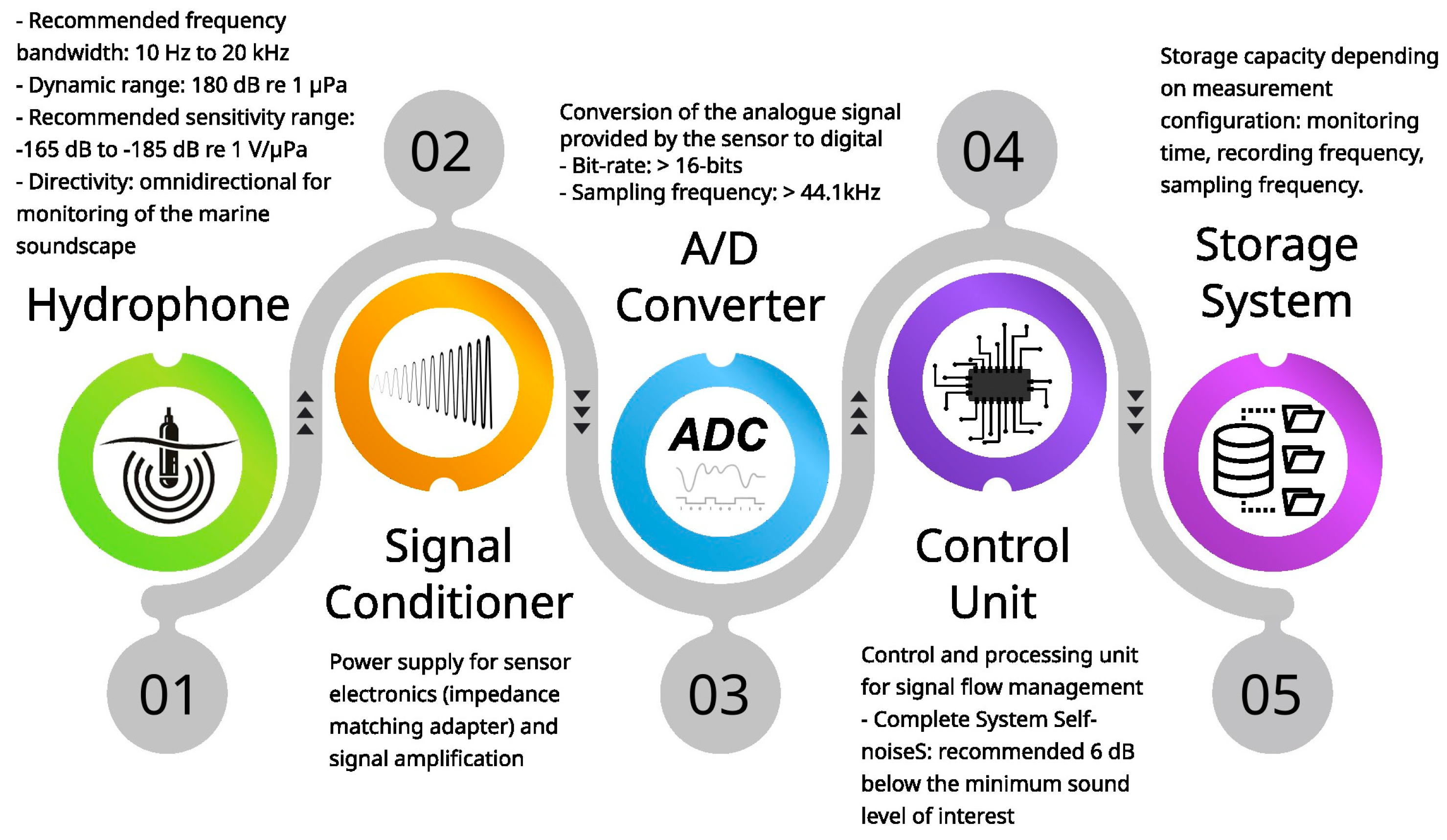
Sound pressure in the marine environment is usually measured using hydrophones. These devices operate based on the piezoelectric effect, discovered by Pierre and Jacques Curie, which is present in materials from the crystal group such as single crystals, ceramics, polymers, or composites [63,64,65,66,67,68]. The incidence of a sound wave on the crystal causes compression of the material, producing a variation in the potential difference between its faces. For harmonic excitation, a signal proportional to the disturbance is obtained at the output of the sensor [69]. As a rule, the sensor is connected to a signal conditioner followed by an ADC conversion system, thereby constituting the so-called sound acquisition system. The elements involved in the sound acquisition chain are represented in Figure 1.
Among the most important characteristics of an acquisition system, special attention should be paid to the frequency range, dynamic range, sensitivity, and directivity of the sensor. These characteristics are all included in ISO 17208 and are also described in different underwater acoustic monitoring guidelines [70,71,72,73].
In relation to the frequency range of hydrophones, different recommendations can be found in the literature regarding the bandwidth to be used in underwater acoustic monitoring. According to the Joint IWC/IQOE/NOAA/ONR/TNO Workshop 2014, a minimum bandwidth of 10 Hz to 1 kHz is to be established. This range should be extended to 20 kHz according to the 2019 IQOE Standards Workshop. In addition, the Marine Strategy Framework Directive (MSFD)—which defines the descriptors in the European Union for monitoring the acoustic energy discharged into the underwater environment—specifies that the bandwidth of the hydrophones must include at least the 63 and 125 Hz third octave bands, which is the recommended bandwidth between 10 Hz and 20 kHz [70]. The ISO [74] encompasses all these recommendations, establishing the lower limit as the 10 Hz third-octave band and the upper limit as 20 kHz, with the latter being extendable to 50 kHz. However, the frequency range of the transducer must be adapted according to the application. For marine seismic explorations, the necessary bandwidth is between 1–300 Hz [75,76]. For underwater soundscape monitoring, it is essential to consider the auditory response of marine animals, whose bandwidth can range from very low (10–20 Hz) to very high frequencies (100 kHz) [77]. In this case, the use of transducers with a frequency response between 10 and 150 kHz is recommended.
The dynamic range refers to the minimum and maximum amplitude levels correctly measured by the system. The effectiveness of an acoustic monitoring system in relation to the minimum measurable level depends on two key factors: the minimum level of the sound to be monitored and the system self-noise. A self-noise level of 6 dB below the minimum sound level of interest is recommended [70,71]. On the other hand, the maximum level must reach 180 dB re 1 μPa, according to Dekeling et al. [70] and will depend, in any case, on the characteristics of the sound to be monitored.
Sensitivity represents the ratio between the output voltage and the incident pressure on the sensor and, therefore, provides information on the efficiency of the transduction. Hydrophones with different sensitivities are used in the literature, varying from at least −156 to −206 dB relative to 1 V per 1 μPa, depending on the model. According to ISO [74], the sensitivity must be appropriate to the noise source to be monitored (e.g., ships). A higher sensitivity results in a better signal-to-noise ratio, and, therefore, better signal quality and accuracy. According to Dekeling et al. [70], a sensitivity in the range of −165 dB to −185 dB re 1 V/μPa is recommended. To ensure maximum accuracy in the sound pressure levels obtained, hydrophones must be regularly calibrated for all third-octave bands, with an accuracy of ±2 dB [74]. Laboratory calibration should be carried out every 12 months following IEC 60500 [78]. This is critical for long-term monitoring, e.g., ref. [79], as any degradation in calibration over time can significantly compromise the accuracy and reliability of the collected data.
Finally, the directivity of the transducer should be considered. For applications based on the monitoring of the marine soundscape, the use of omnidirectional hydrophones is recommended, thus maintaining a constant sensitivity regardless of the angle of incidence of the sound wave. This is generally not a problem for low frequencies (e.g., 63 Hz and 125 Hz in MSFD). However, directivity is closely linked to frequency; therefore, as the frequency increases, the hydrophone becomes more directive. In this case, directionality effects will require a sensitivity adjustment in accordance with the standard ISO [74]. This adjustment consists of a signal post-processing that should also account for possible effects due to cable sensitivity or amplifier gain.
In Table 2 we resume the hydrophone specifications recommended by the main guidelines found in literature.

4.2. Measurement of Sound Particle Motion

Particle motion measurement systems, also known as acoustic vector sensors (AVS), can be divided into two main groups: pressure gradient sensors (P-P vector sensors) and inertial motion sensors (P-V vector sensors). In the former, the particle motion is obtained from the pressure difference between two nearby points in space [80,81]. In the latter, the signal is obtained from the relative motion of a mass with respect to a frame, and these systems generally use accelerometers or geophone-type sensors [82,83,84].
The requirements for a particle motion sensor have been described by Jansen et al. [85]. One of the most important characteristics is, as for hydrophones, the frequency range of the transducer. In this case, a frequency range of 20 Hz to 2 kHz is established, considering the sensitivity of the fish to particle motion. Similarly, self-noise should be reduced, especially in applications devoted to ambient noise monitoring. On the other hand, the mounting for inertial systems must be such that the suspension supporting the sensor enables it to move in the presence of a sound disturbance. Likewise, the resonance frequency of the mechanical mass-spring system must be below 20 Hz. Finally, it should be noted that particle motion devices are vector sensors; it is therefore essential to control their orientation to properly identify the different components of the magnitude.

4.2.1. Pressure Gradient Sensors (P-P Vector Sensors)

Pressure gradient measurement systems used to obtain particle motion in the marine environment are based on the same principle as sound intensity probes. From the signals provided by two hydrophones, it is possible to determine the particle velocity along the axis of interest using the Euler equation and applying a finite difference approximation [85]:
ξ x = 1 ω 2 ρ   p ( x + Δ / 2 ) p ( x Δ / 2 )
where Δ is the spacing between hydrophones, which determines the sensitivity and bandwidth of the measurement system.
To fully characterize the particle displacement, it is necessary to measure the pressure gradient in three different directions: x, y, and z. This involves the use of at least four hydrophones placed at the vertices of a tetrahedron [86,87]. In confined spaces or areas where reflection phenomena may occur, the sound field can be affected in terms of level and directivity due to wave ambiguity, and the accuracy of pressure gradient-based sensors may be compromised.

4.2.2. Inertial Motion Sensors (P-U Vector Sensors)

Inertial motion sensors are based on the relative motion of a mass with respect to the sensor structure. Based on displacement-sensitive transducers, they measure particle motion directly from the motion of water. Although they overcome some of the problems of pressure gradient systems, inertial motion sensors are sensitive to water oscillations that are not related to the acoustic field; their bandwidth is related to the frequency response of the motion transducer, normally an accelerometer, which is generally considerably narrower than that of a hydrophone. It should also be noted that their shape and size can modify the acoustic field [59,82,84,88].
Different models of particle displacement sensors can be found in the literature. The earlier models were based on the signals provided by geophones, moving coil or spring-mass transducers whose output voltage was proportional to velocity [89]. One of the first systems was proposed by Leslie et al. [88], and consists of two moving coil inertial sensors capable of recording particle velocity at low and high frequencies. Banner [1] also proposed a sensor consisting of two refraction geophones (horizontal and vertical) encapsulated in a plexiglass sphere. The design includes a highly flexible suspension to ensure a wider bandwidth. The sensor has a flat frequency response between 20 and 3000 Hz.
Over the years, inertial sensors have moved towards the use of accelerometers as the primary transducer for particle motion measurement. The use of piezoelectric materials, piezoresistive materials, polymers, and even capacitors, has resulted in more accurate and sensitive systems [85,90,91,92,93].
In addition, different studies point to the use of micro-electromechanical systems (MEMS) technology for the design and manufacture of particle velocity measurement devices [94,95,96]. These sensors consist of a microstructure based on cantilever beams whose deformation is proportional to the particle velocity. Today, MEMS technology is considered one of the most promising approaches for vector acoustic sensing underwater, especially for low-frequency and near-field applications. The intrinsic directivity of these sensors (8-shape pattern) makes them ideal for sound detection compared to traditional pressure hydrophones. However, there are also certain limitations associated with these devices. In addition to manufacturing complexity and fragility due to their micro-scale, their structural integrity significantly limits their operational depth. Regarding bandwidth, it is limited to frequencies below 2000 Hz due to the presence of resonances and the increase in self-noise for higher frequencies [94,95]. The effect of static pressure on the MEMS membranes leads to a reduction in the resonance frequency, thereby modifying the device’s frequency response. Furthermore, these sensors are highly sensitive to flow, which can result in excessive background noise or even signal saturation in certain environments.

5. Anthropogenic Noise Sources

The quantification of underwater sound fields requires knowledge of the characteristics of the sound sources that produce them, including their source level and other descriptors [9]. However, no single universal metric exists for defining source levels across the diverse range of anthropogenic noise sources. Anthropogenic sounds may be of short duration (i.e., impulsive) or long-lasting (i.e., continuous) [70]. This chapter provides an overview of the measurements of ship noise as the dominant example of a continuous anthropogenic source, and of the sound generating systems used in marine seismic surveys, which represent typical impulsive sources. It is important to note that many offshore and port constructions rely on impact pile driving, which generates strong impulsive underwater noise with source levels comparable to those produced by seismic surveys [97]. In Table 3, we provide a schematic comparison between the main anthropogenic underwater noise sources.
A standardized terminology for underwater noise measurements is provided by ISO 18405:2017 and the related ITTC guidelines [57,100]. The most used quantity is the sound pressure level (SPL), expressed in relation to a reference pressure of 1 μPa. SPL refers to the sound pressure measured directly by a hydrophone at a given location. To characterize the source of the noise, either the radiated noise level (RNL) or source level (SL) are used. RNL is obtained by normalizing SPL to a reference distance, typically assuming spherical spreading. SL further corrects SPL for propagation effects such as surface reflections, absorption, and seabed interactions. A clear distinction among these measures is essential to avoid ambiguity when comparing results across studies. Continuous noise is generally quantified using SPL, while impulsive noise is more appropriately described by the level of the peak sound pressure or by the sound exposure level (SEL) [101]. To account for the effects of multiple iterations of the impulsive signal from the same source (which are typical in seismic surveys), the use of a cumulative SEL (i.e., SELcum defined as the level of the sum of sound exposure values over the individual iterations) has been proposed. However the appropriateness of the usage of SELcum is questioned, e.g., ref. [13], on the basis of the observation that the same SELcum can be reached either through many low-energy impulsive sounds or fewer high-energy impulsive sounds having different effects on the fauna.
Quantification of the noise source involves normalizing the measured acoustic metric to a reference distance from the source (usually 1 m). This is achieved by correcting the measurement for propagation loss, incorporating geometrical spreading and other propagation processes, including surface reflections, absorption, and seabed interactions. The resulting quantities are referred to as the source level (SL) and energy source level (ESL) when derived from SPL and SEL, respectively. Although ISO 18405 does not provide definitions for other levels that could be associated to an impulsive source, we can also consider the source level of the peak, as defined in Crocker et al. [102].
As an alternative to SL, the radiated noise level (RNL) is also used to describe a source of continuous underwater noise. It is derived by normalizing the measured SPL to a reference distance of 1 m through the application of spherical-spreading propagation loss [103].

5.1. Sources of Continuous Noise: Ship Propellers

The acoustic emissions generated by the rotation of propellers in water during the operation of ships form a significant component of a ship’s underwater-radiated noise (URN), particularly as vessel speed increases [99]. However, identifying, measuring, and classifying propeller-generated noise remains a complex task, owing to both experimental limitations and the intrinsic variability of propeller designs and operating conditions. A distinction is typically made between non-cavitating (wetted) and cavitating propellers. Another distinction is made between investigations performed at model scale and full-scale measurements conducted in open water. A review of URN measurement procedures and recent efforts toward harmonization, particularly in shallow water environments, can be found in Ainslie et al. [103]. We provide a discussion on issues regarding the quantification of the source level of propeller designs and operating conditions in Appendix A.

5.2. Sources of Impulsive Noise: Marine Seismic Surveys

Today’s knowledge about the impact of marine seismic surveys on marine fauna still presents several gaps that prevent the setting up of effective mitigation measures and policies [104]. For fish in particular, there are only a few studies, e.g., ref. [105] on the physical effects of the acoustic sources used in marine seismic surveys, while the studies on the effects on behavior are not yet sufficient to obtain conclusive results [106].
Since marine seismic technologies were the key factor in discovering several offshore petroleum deposits, they are usually associated with oil and gas exploration. Nevertheless, marine seismic surveys are also indispensable for other purposes today such as engineering harbors and ship channels, geological research, earthquake and tsunami preparedness, the planning of offshore wind farms, and the laying of underground cables and pipelines [107]. The resolution and penetration depth of the sub-surface’s seismic image depend on the frequency band of the acoustic signal. Different types of acoustic sources that operate in different frequency bands are, therefore, used in the function of the survey.
The most practical type of artificial marine acoustic source in use today is the compressed air source, commonly referred to as the air gun. A seismic air gun operates by rapidly releasing compressed air from an internal reservoir through ports controlled by a shuttle valve. The sudden discharge forms a transient gas bubble in the water that expands and collapses, producing an acoustic pulse. Single air gun usage is, however, rarely adopted in scientific or industrial applications. As a rule, several air guns are arranged in a planar horizontal array and fired simultaneously.
Seismic surveys conducted with large air gun arrays are expected to have the greatest impact on marine fauna. In their effort to categorize sound sources according to their potential impact, Ruppel et al. [98] identified high-energy air gun array configurations with the source level of the peak in the order of 240 dB 1 μPa m and higher, which warrant regulatory evaluation and appropriate monitoring and mitigation protocols. Smaller arrays can be classified as low/intermediate energy; a relaxation of some mitigation requirements is possible.
A number of sophisticated numerical models were developed in order to obtain a detailed prediction of the signature of an air gun as a function of its operative configuration [108,109]. However, for the purposes of testing the effects of changing the main air gun parameters on the signature, the simplified model proposed by Watson et al. [110] seems appropriate. On the basis of their model, Watson et al. [110] suggested the adoption of air guns with lower pressure and larger volumes in order to suppress the collateral generation of high frequencies without compromising the usable low-frequency content compared to that of a conventional air gun.
Advanced data processing today enables the seismic imaging of the subsurface even for non-impulsive acoustic signals, provided the source signature can be controlled. This capability characterizes the chirp sub-bottom profilers (SBP), which are marine sonar systems with frequency-modulated (typically in the 1 kHz to 10 kHz range), highly repeatable source signatures that provide decimeter-scale vertical resolution in the upper 20–30 m of sediments [111]. The SBPs acoustic energy is distributed in longer wavelets, enabling it to have enough return of acoustic energy for seismic data processing with a lower sound-pressure peak compared to single-impulse signals.
The adoption of controllable sources, like those used in SBP systems but working at lower frequencies (less than 100 Hz), would represent an interesting alternative to air guns. Since its introduction in the late 1950s, the use of vibroseis, a mechanical device emitting quasi-monochromatic acoustic sweeps in the subsoil on land, has gained popularity; however, several operational problems have limited its success in use at sea until now. In the last decade, the theoretical higher-resolution imaging capabilities and the potential environmental advantages of marine vibroseis with respect to traditional air guns prompted several companies to support the development of efficient vibrating sources for off-shore usage. Marine seismic vibrators allow for the control of the source’s energy spectrum through the volume displacement of water using a vibrating plate or shell [112]. While different prototypes of marine vibroseis are in an advanced testing phase, e.g., ref. [113], a number of simulation studies have been performed to assess the design specifications of the vibrators and their deployment arrangements. Matthews et al. [114] reported source levels of 219 dB for peak pressure and 223 dB for exposure in the vertical radiation direction of a simulated horizontal array.

6. Methodologies for Soundscape Simulations

The study of the behavior of marine animals in a free environment is extremely complicated, especially when it comes to their exposure to different sound sources. We can find, in the literature, different works that analyze magnitudes such as pressure or particle motion in the open sea [115,116,117]. For this reason, the research is usually carried out in a laboratory, either in an aquarium (small, transparent container, usually made of glass) or in tanks (medium-sized and generally opaque), providing a controlled environment where the behavior of fish can be continuously monitored [118,119,120,121,122,123,124,125].
In this section, the experimental methodology used in different studies in the literature will be described, paying special attention to the guidelines, the stimuli, or the instrumentation used during the process. Finally, we will discuss the characteristics of the excitation source or the limitations inherent in the enclosures used for the experiments.

6.1. Measurement Setup for the Study of the Effect of Noise on Fish

Despite significant scientific interest in determining the impact of noise on marine animals, there is no common protocol that guarantees a fully reliable comparison of results. The experiment enclosure, the measuring equipment, the sound source or the characteristics of the emitted signals vary considerably between studies, increasing uncertainty in the results.
The first experiments were aimed at establishing the hearing range of fishes. To this end, two different techniques predominated. The first consisted of studying changes in fish behavior in response to a sound stimulus. Tavolga et al. [126] established auditory sensitivity for different species of marine teleost: Equetus acuminatus, Haemulon sciurus, and Lutjanus apodus, among others. Similarly, Fay [127], Popper [128], and Tavolga [129] focused on Carassius auratus; Iversen [130,131] Thunnus albacares, and Euthynnus affinis, respectively. Chapman et al. [132] focused on Gadus morhua. Hawkins et al. [133] focused on Salmon salar. Kojima et al. [134] focused on Pagrus major. Dale et al. [135] focused on Thunnus orientalis.
The second technique is more invasive and makes use of the electrical signals generated by the brain in response to a specific sound. This technique is known as auditory evoked potential (AEP) audiometry. The results obtained in both behavioral and AEP studies differ significantly [24]. The AEP technique offers greater sensitivity to sound stimuli and allows for both a reliable analysis of the frequency response of the fish auditory system and a comparison of the results among individuals and species. However, these techniques do not allow for an assessment of the animal’s behavioral response, which is essential when establishing sensitivity to noise. The study of the fish auditory system can, therefore, benefit from the complementary techniques that provide additional information. Further details on the study of hearing thresholds in fish can be found in Popper and Hawkins [136].
Over the years, researchers have shifted their focus towards the effects of sound on fish. Behavioral techniques and biochemical analyses are used for these studies.
To establish the effects of anthropogenic noise on fish, laboratory experiments are mainly conducted. Smith et al. [137] analyzed the response of Carassius auratus to sound stimuli, the hearing loss induced, and the recovery time of the hearing loss. To this end, three glass tanks with a capacity of 79 L were used, assigning noise exposure times of 0 min, 10 min, and 60 min. The signal used to stimulate the fish was white noise with a frequency range between 0.1 and 10 kHz and a sound pressure level of 160–170 dB re 1μPa. The noise source was an underwater loudspeaker placed in the center of the tank. The stress caused to the fish was determined using cortisol and glucose analysis, while the auditory response of the fish was analyzed using the auditory brainstem response technique.
On the other hand, Kastelein et al. [138] investigated the startle response of fish to pure tones. The authors used frequencies of 0.1, 0.125, 0.250, 0.4, 0.5, 0.6, 0.7, 0.8, 0.9, 1, 2, 4, 6, 8, 16, 32, 45, and 64 kHz. In this case, the experiments took place in a rectangular tank (7 m × 4 m × 2 m) and the fish (between 4 and 17 individuals) were confined to a specific area using a net, ensuring proper monitoring by video cameras. The experiment was divided into 1 h sessions. Ten signals of 30 s were emitted, with a 5 min break between them. For each species, the process was repeated 12 times. The emitted sound, as well as the background noise, were monitored using a hydrophone. For the emission of frequencies above 16 kHz, the authors used a heterodyne frequency reducer.
In the case of Voellmy et al. [139], the tests consisted of sound generated by boats using an underwater loudspeaker (Aqua30, effective range 80 Hz to 20 kHz). The work was carried out in tanks (90 × 36.5 × 30 cm), and the authors divided the space between the loudspeaker area and the fish passage area. Two individuals were used for each test, one of them confined to a small space. The acoustic stimuli were presented continuously for 5 min.
In another experiment, Sabet et al. [140] used rectangular tanks (200 × 35 × 45 cm, water depth 35 cm) with 30 fish. The authors used two sound sources located at the opposite ends of the tanks. The reproduced signals corresponded to artificial soundtracks with the characteristic bandwidth of anthropogenic noise. Each sound was played continuously for 45 min, with a 15 min break between trials. Again, the behavior of the fish was monitored by video cameras.
Spiga et al. [141] analyzed the effect of piling and drilling noises on the anti-predator ability of juvenile Dicentrarchus labrax. To achieve this, the authors observed the behavior of 54 individuals in a glass tank (54.8 × 45.1 × 45.2 cm, 20 cm water depth). A loudspeaker placed at the bottom of the tank and directed towards the surface emitted recorded drilling, piling and ambient noises with a bandwidth between 0.1 and 3 kHz. Emissions were maintained for 60 min for each type of noise; during this time, a visual predator stimulus was introduced. The behavior of the fish was analyzed using a camcorder.
Similarly, Herbert-Read et al. [142] studied the effects of pile-driving noise on group cohesion in juvenile Dicentrarchus labrax, corroborating the risks posed by an acoustically polluted soundscape in the presence of predators. For this study, the authors used two glass tanks (40 × 70 × 34 cm and 20 × 70 × 34 cm, respectively) with 5 mm thick walls. Ambient and pile-driving sounds were used as stimuli in 5 min blocks. An underwater loudspeaker was used as an emitter. The sound inside the tank was monitored using a hydrophone, while the behavior of the fish was recorded using cameras.
Hasan et al. [143] used the recorded noise of different boats to determine the alarm responses of Pimephales promelas. The experiments were conducted in 37-litre tanks; an underwater loudspeaker was used. The authors focused on a frequency band comprising 1 to 2 kHz. During the experiment, 8 min series were performed in which anthropogenic noise was emitted for 2 min followed by 2 min of recorded background noise. The emitted sound pressure level was monitored with a hydrophone and the effect on the fish was monitored visually.
Another study was conducted by McCormick et al. [144]. The authors used a 30-L tank to determine the effects of the noise produced by ships on fish (particularly juveniles). To carry out the tests, the authors used ambient sound recorded on reefs and two types of engines, using five different combinations of the three sounds (ambient sound, engine 1, engine 2, ambient sound with engine 1, and ambient sound with engine 2). The stimuli were played continuously for 10 min; at the end of the playback, a piece of metal was thrown into the tank to assess the reaction of the fish (alarm state). Individual behavior was recorded by video cameras.
Mauro et al. [120] analyzed the effect of low-frequency noise on juvenile Sparus aurata by emitting white noise centered on different frequency bands (63 Hz, 125 Hz, 500 Hz, and 1 kHz). The emission took place continuously for 7 h in 15 circular tanks (three for each frequency band and three as controls) with six individuals per tank. The emitted pressure level was controlled by a hydrophone, while the behavior of the fish was monitored by a camera.
On the other hand, Pieniazek et al. [145] used opaque tanks with a circular cross-section and a capacity of 90 L, in which a loudspeaker was separated from the fish by a physical barrier. The tests were divided into 2 min blocks, with a 5 min break between repetitions. During the analysis period, four sound treatments were randomly applied, consisting of: a ship noise emission (80 to 10,000 Hz), a white noise emission filtered in the fish hearing range (10 to 5000 Hz), and two treatments without noise emissions. The sound pressure level was monitored by a hydrophone, while the fish behavior is analyzed by video.
In their case study, Smith et al. [146] examined the effects of noise on Scomber japonicus. Impulsive noises corresponding to explosions (C-4) with a sound exposure level between 193 and 215 dB re 1 µPa2 s were used as stimuli; the effect of this disturbance on the fish’s inner ear was analyzed with a microscope. The tests were conducted in the open sea, with cages positioned at various distances from the noise source.
More recently, Rojas et al. [147] focused their research on a more complex ecosystem consisting of phytoplankton, zooplankton and planktivorous fish. In this case, the ecosystem was in a freshwater environment, and the authors analyzed the resilience to motorboat noise. To achieve this, the authors used four aquariums (80 × 35 × 40 cm) with a loudspeaker placed on one side of each. Fish were exposed to two noise conditions: ambient noise recorded in the mesocosm, and ambient noise mixed with motorboat noise. The noise was emitted in 40 min blocks; behavior and predation were analyzed using HD-TVI cameras.
Trabulo et al. [148] analyzed the impact of ship noise on the survival and development of Argyrosomus regius during their embryonic and larval stages. To achieve this, tests were carried out in six tanks: three treatment tanks and three control tanks (49 × 29 × 25 cm). Sound stimuli were emitted using JBL loudspeakers submerged inside the tanks via waterproof containers. To assess the possible influence of the electromagnetic field generated on the fish, the control tanks were equipped with a copper coil system similar to that of the loudspeakers. The stimuli used included original recordings of ten ferries and four small boats and were emitted at a level of 29 dB above the background noise level in the control tanks (101 dB re 1 μPa). The sound was monitored using a hydrophone with a frequency range of 0.1 Hz to 180 kHz. The influence of noise on the fish was analyzed based on morphological changes and biochemical parameters.
Blom et al. [149] examined the impact of noise on the early development of Pomatoschistus microps. Experiments were conducted in 26 20-L aquariums. Three treatments were applied: silence (control), intermittent sound, and continuous sound. The acoustic emission system used involved noise produced by soft air gun balls moving in the tank when air was pumped in. According to the authors, the sound system produced a broadband signal similar to certain anthropogenic noises, with a noise level 34 dB above the background noise present in control tanks. This method was employed to avoid the potential effects of electromagnetic noise generated by a conventional loudspeaker. Intermittent noise was generated at random intervals between 1 and 15 min. In all cases, the generated level was monitored by four hydrophones distributed inside the aquarium. The aquariums were conditioned to minimize possible vibrations or external visual stimuli. Analyses were carried out based on sample studies.
On the other hand, Bendig et al. [150] investigated the impact of noise on Lepomis macrochirus, Lepomis gibbosus, and Ambloplites rupestris. The authors employed a setup comprising three interconnected cages, with a loudspeaker placed in the middle. Six pure tones, ranging from 142 to 149 dB. The noise produced by two types of boats with different sound levels and spectral content—a two-stroke outboard motor (153 dB re 1 μPa, 10–5501 Hz) and a four-stroke outboard motor (147 dB re 1 μPa, 43–22,006 Hz)—were used as stimuli. The test was carried out at random 2 min intervals, with each stimulus lasting 10 s. In contrast to other studies, the authors measured particle acceleration using a waterproof, neutrally buoyant triaxial accelerometer. Analysis of the effects of the noise on fish behavior was carried out by video, paying attention to the moments before, and during, the generation of the sound stimulus.
For clarity and ease of reference, Table 4 provides a summary of the cited studies.

6.2. Sound Sources

In a soundscape simulation, the sound generation system generally consists of a control system, an emission and acquisition device, a signal amplifier, and an underwater source. This allows for greater flexibility in selecting the type of signal to be emitted during tests, and the researcher can use their own stimuli. Both the signal acquisition and emission system and the power amplifier must guarantee a linear and flat response over the bandwidth of interest, thus avoiding any variation in the signal emitted by the controller. The power supplied by the amplifier should be limited by the characteristics of the sound source and the sound pressure level defined in the experimental methodology.
As far as the excitation source is concerned, there are no clear guidelines in the literature as to its characteristics. As a result, a wide variety of devices with different performances can be found. Solé et al. [123] used a high-power piezoelectric device designed for underwater deterrent systems and other military applications. It features high power (SL max. 197 dB re 1 μPa2m2 at 600 Hz) and a useful frequency response in the range between 200 Hz and 9 kHz. The unit is designed for an operating depth of 2 to 12 m, making it particularly useful in shallow water. Its dimensions, approximately 56 × 56 × 56 cm, make it unsuitable for small tanks, being appropriate for free-field experiments. As it is a piezoelectric transducer, it is supplied with a transformer box to ensure correct impedance matching between the loudspeaker and the amplifier for maximum power transfer.
On the other hand, Neo et al. [151] used two underwater piezoelectric devices with a useful frequency response of 150 Hz to 18 kHz to study the auditory preferences of zebrafish.
Another device found in the literature is an electrodynamic loudspeaker with a flat frequency response between 80 Hz and 1.3 kHz and a sensitivity of 125 dB re 1 μPa/V at 1 m [119]. Its limited power, small size (182.6 mm diameter) and maximum operating depth (3 m), make it ideal for small enclosures such as aquariums or tanks.
Oliver et al. [121] used an underwater loudspeaker designed for underwater leisure activities in swimming pools with a flat frequency response between 20 Hz and 17 kHz at power levels between 125 and 150 W. Its size (20 cm in diameter) and power are of great interest for studying the effects of noise on marine animals.
In other cases, the excitation of the medium was carried out by means of a shaker-type vibrating system. Zeddies and Fay et al. [152] and Bhandiwad et al. [153] used a shaker to excite a plate with small 12 mm diameter wells in which Zebrafish larvae were placed.
Researchers sometimes use out-of-water sources as a method to insonify fish. The methodology was proposed by Parvulescu [154], with the aim of generating a more uniform field inside experiment tanks. This way of operating considerably expands the possibilities in terms of the number of sources available on the market, as well as their frequency range, allowing for systems with greater low-frequency presence. Neo et al. [151] used two electrodynamic loudspeakers placed under a test tank to establish the effect of acoustic exposure on zebrafish. Campbel et al. [118], in contrast, used a loudspeaker radiating on the central part of one of the side walls of the experimental tank. However, the use of one or more external sources may have certain implications from an acoustic point of view [133,155]. The difference in impedance between media—air/water or air/solid material/water—will lead to a significant attenuation of the emitted signal and the filtering effect may affect the spectral content of the stimulus. At the same time, the correlation between pressure and particle motion becomes more complex, which can lead to the underestimation of response thresholds. A uniform pressure field inside the tank means that the particle motion is equal to zero in every coordinate, which does not conform to free-field conditions.
According to studies by Ladich and Fay [24], Suedel et al. [77], and Popper et al. [156], which include reviews of the auditory abilities of fish, the hearing spectrum of most species is between 100 Hz and 5 kHz, with considerable variations, depending on the case. In addition, auditory evoked potential (AEP) tests provided hearing thresholds between 60 and 140 dB, depending on the frequency, with much greater sensitivity in the 100 Hz to 1 kHz range. The limitations of commercially available playback systems make it difficult to study fish behavior at lower frequencies (below 100 Hz); thus, very few experiments provide information in this range [157]. Based on these data, for a sound source to be suitable for investigating the effects of noise on fish, it must have a flat frequency response at least in the range 100 Hz to 10 kHz, preferably extending to lower frequencies. In addition, the systems used should be capable of producing a sound pressure level greater than 150 dB (re 1 μPa) over the entire useful range.
The cited studies are summarized in Table 5 for clarity.

6.3. Particularities of Measurements in Confined Spaces

As previously noted, most of the existing studies in the literature are conducted in closed environments such as tanks or aquariums. This allows researchers to control the variables involved in the experiments in a simpler way. However, the sound field in an enclosed space has different characteristics to those found in a free environment, which will not only limit the scope of the study but may also lead to misleading results [158].
Whereas deep water propagation is considered a free-field condition, the existence of multiple reflections in shallow water and confined spaces may result in the presence of a diffuse field. In this case, all propagation directions are equally probable and, therefore, the sound pressure level is homogeneous throughout the area and the effective sound intensity at each point is equal to zero, e.g., the same average energy arriving from all directions.
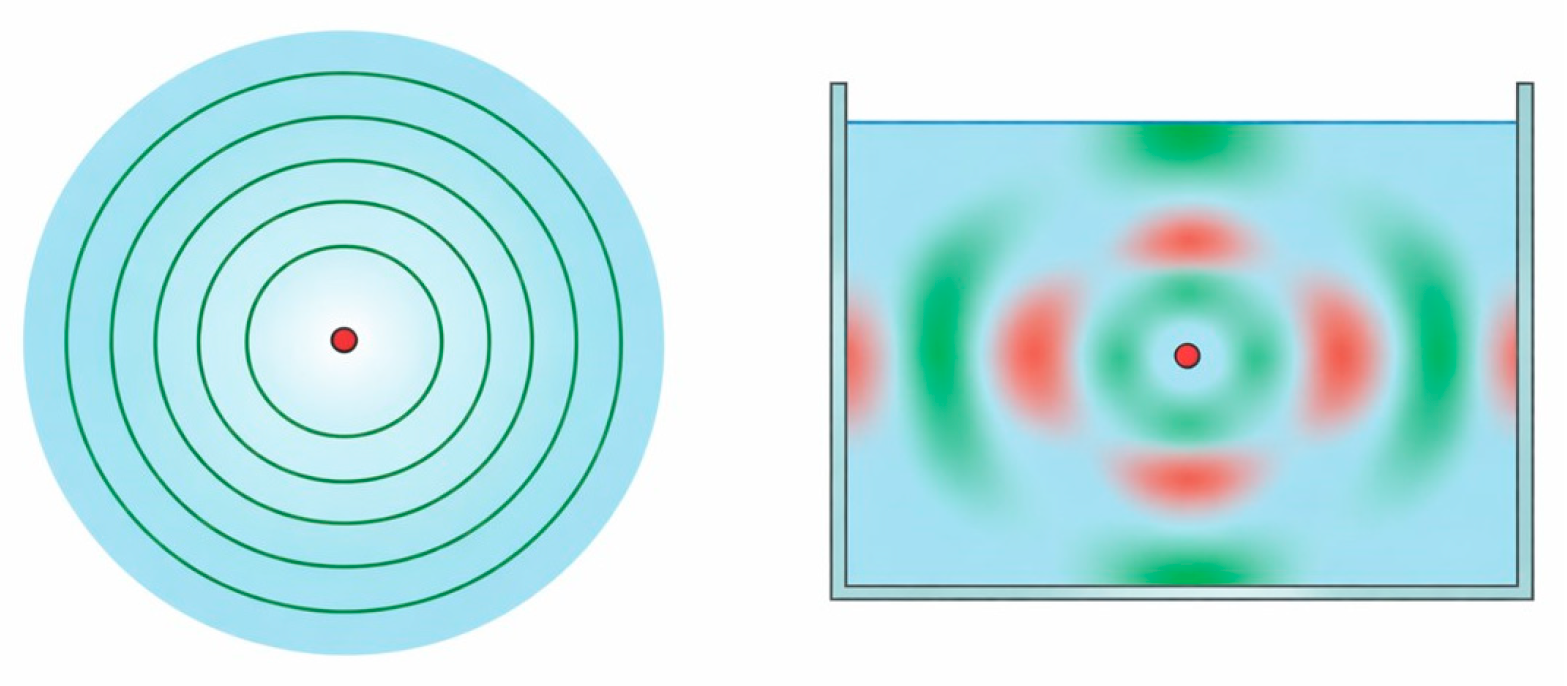
In general, a diffuse field is found in large, enclosed spaces that are large compared to the wavelength range of interest and that are irregularly shaped or contain a variety of sound-reflecting objects. For enclosures with parallel walls or parallelepiped shapes, which are common in fish tanks or laboratory tanks, a stationary field appears. Sound oscillates in phase and opposite phase in all locations, leading to the emergence of the enclosure’s modes, and, therefore, to the existence of maximum and minimum pressure areas.
The appearance of frequency modes will depend both on the dimensions of the enclosure and the wavelength of the excitation signal [159]. The problems associated with the modal behavior of a water enclosure are addressed in the literature as either numerical approaches [155,160,161], analytical models [162], and combined analytical and experimental analyses [163]. The characteristics of the water tank strongly influence the experimental results, making it essential to determine an optimal configuration that produces a sound field approximating free-field conditions as closely as possible.
The characteristics of the water tank will have a significant influence on the results of the experiments; it is necessary to find an optimum configuration to generate a sound field as close as possible to free-field conditions [118,158,164].

6.4. Remarks on the Measurement Setup for the Study of the Effect of Noise on Fish

The studies reviewed in this section highlight substantial variability in the methodologies and materials used in experiments aimed at assessing the effects of anthropogenic noise on fish. On the one hand, results obtained from captive experiments could be strongly influenced by the acoustic behavior of the enclosure, which is closely related to its size. In addition, the confinement of fish constrains their behavioral responses, as they are restricted to a limited space that reduces both movement and escape opportunities. Conducting experiments in open environments may help to mitigate some of these limitations or, alternatively, serve to confirm the results obtained under laboratory conditions.
On the other hand, the use of noise signals with different origins and characteristics limits not only comparisons among studies but also their complementarity. Similar issues arise from differences and limitations in the noise sources used in experimental setups, which affect both the sound levels and the spectral content of the emitted noise, particularly at low frequencies.
Based on the conducted analysis, it is crucial to implement standardized experimental protocols to ensure the comparability of results. This entails, at least, defining the dimensions and volumes of laboratory test chambers, supplying reference noise signals, and specifying the frequency characteristics of the noise sources to be employed.

7. Analysis of Fish Responses to Acoustic Pollution

This work focuses on empirical studies published during the last 20–30 years that investigate how anthropogenic noise affects behavior, physiology, sensory systems, development and fitness of fish. It covers teleost species from marine, estuarine and freshwater habitats, across life stages from embryos to adults, and including both experiments in laboratory and field or semi-natural studies, focusing on the controlled experiments. The acoustic exposure was quantified in terms of sound pressure and, where available, particle motion. The studies considered examined responses to explicitly anthropogenic sounds (e.g., vessels, pile driving, seismic surveys, aquaculture and industrial infrastructure, traffic noise) rather than purely natural ambient noise. Conceptual and modelling papers are used to frame the problem but are not part of the primary evidence base This focus necessarily biases the synthesis towards teleosts, coastal and marine systems, and to short- to medium-term individual-levels, while elasmobranchs, many freshwater and deep-sea species, and long-term population-level consequences of noise remain comparatively under-represented.
Therefore, analyzing fish responses to acoustic stimuli requires consideration of several key factors. First, the environment in which the study takes place—whether in the wild, in a confined tank or cage, or under controlled laboratory conditions. Second, the properties of the acoustic signals being tested. Third, the biological and behavioral characteristics of the fish involved. Finally, the type of analysis planned. These aspects are discussed in detail in the following.

7.1. The Environment

There have been many studies on how fish react to noise, in places like fully controlled laboratory aquaria, semi-natural tanks and cages, in open water in rivers, estuaries, and the sea [16,17,30]. Laboratory and reduced tank designs make it easier to control the acoustic level, the exposure duration, and the environmental variables, such as temperature and oxygen, which is essential for elucidating causal mechanisms in physiology, biochemistry, and gene expression. The influence of noise can be clearly isolated from possible effects related to other secondary stressors that can appear in other experimental configurations. However, the acoustic field in small tanks is often propagating under reverberant or partially reverberant conditions, modifying the free propagation of the acoustic waves (see Figure 2). In this situation, complex standing waves and altered particle motion can be present [163], making it difficult to extrapolate absolute thresholds or dose–response relationships to animals in the wild [23,32]. Conversely, research conducted in net pens, coastal nurseries, or along migration routes captures more realistic noise produced by shipping or construction, thereby yielding more ecologically pertinent estimates of survival, growth, and reproductive output, despite diminished experimental control and increased environmental variability [26,29,31,165].
The spatial relationship between the fish and the source is significantly influenced by context. Numerous experiments in confined systems subject animals to short and relatively uniform distances from speakers or transducers, potentially elevating received levels and increasing the likelihood of physiological or anatomical damage, compared to natural conditions [16,25]. In contrast, wild fish can move freely to take advantage of sound shadow zones, look for quieter microhabitats, or change their activity patterns over time. This may lower or change their exposure [26,31,166]. These variations in environmental context—small tanks compared to large cages, coastal facilities versus deep offshore habitats—partially elucidate why certain studies indicate significant effects (e.g., diminished growth, modified ventilation, or substantial tissue damage) [16,21], while others observe minimal or reversible alterations in survival or condition at equivalent or similar sound pressure levels [30,165].

7.2. Characteristics of the Acoustic Signal

The second key factor in analyzing fish responses is the characterization of the sound they perceive, including its frequency range, temporal structure, and acoustic level. Impulsive sources, like air guns or pile-driving noise, create short, high-amplitude peaks with quick rise times. These are especially linked to barotrauma, hair cell damage, temporary or permanent threshold shifts, and internal lesions in species with gas-filled structures [18,25,167]. Continuous or quasi-continuous sources, such as vessel traffic, industrial pumps, wind turbines and recirculating aquaculture systems, generally produce lower peak levels but extended exposure times, which can maintain elevated stress hormone concentrations, alter energy allocation, modify immune and oxidative status, and change fish behavior [16,21,22,168].
Impact is also affected by how the frequency is made up and how it changes over time. Low-frequency components (<1 kHz), generated by vessels and industrial sources, overlap with the auditory range of numerous species, thereby masking communication signals or modifying predator–prey interactions [24,169,170,171]. Intermittent sounds, characterized by repeated on–off cycles, may elicit more intense or enduring stress responses compared to continuous noise at the same average level, as repeated onsets can trigger startle or vigilance reactions and inhibit habituation [17,28,172]. In particular, the characteristics of particle motion carried by the sound wave can significantly influence both behavior and physiology, especially when fish are near the sound source or in shallow habitats [23,24,173].

7.3. Biological Characteristics of the Fish

Fish susceptibility to noise is significantly dependent on the species and developmental stage, related to variations in the sensory anatomy, life history, or ecological niche [167,172]. Hearing specialists with swim bladders connected to the inner ear or with specialized structures are more sensitive to pressure, being more vulnerable to changes in the auditory threshold, masking, and communication problems [24,26,170]. On the other hand, generalist fish species and numerous elasmobranchs may primarily perceive particle motion more than the pressure field. Nevertheless, they may still show significant behavioral and stress responses to noise [25,30,166]. Finally, the configuration of the swim bladder affects the possibility of barotrauma: physoclistous species can exhibit more internal damage after sudden exposure than physostomous species in similar circumstances [167].
Life stage and condition add further complexity. Embryos and larvae may experience altered development, growth, and survival when exposed to anthropogenic noise; however, reported outcomes range from negligible effects to substantial mortality or developmental anomalies, depending on the species, exposure history and distance from the source [26,27,148]. Juvenile and adult fish can display changes in ventilation, heart, and metabolic rates, foraging efficiency, social cohesion, and reproductive behavior, with possible effects on growth, disease resistance, and reproductive success [16,19,21,28,29,169]. Recovery trajectories also differ. While some physiological and biochemical parameters, such as cortisol, glucose or certain heat shock proteins, may return to baseline within hours or days after exposure [17,18,21], inner ear damage and associated auditory threshold shifts can persist for weeks, and, in some cases, full morphological recovery may lag behind functional improvement [20,25]. In any case, the capacity for acclimation or habituation is influenced by several factors, both internal (genetic, reproductive status, previous exposure to noise) and external (environmental variables) [19,169,172].

7.4. Type of Analysis and Response Metrics

The type of analysis used to investigate the effects of noise has a large impact on the conclusions provided by a study. Short-term experiments often examine acute endpoints like immediate death, lesions, startle responses, changes in ventilation, or quick changes in behavior. These are good indicators of direct impact but do not give us much information about longer-term fitness effects [18,28,30]. Instead, chronic or repeated exposure designs examine growth, condition indices, disease resistance, reproductive success, or the recovery of hearing and tissue integrity over several weeks. These designs are better at capturing sublethal but ecologically important effects [16,21,22,29,148,167,169]. At physiological and biochemical levels, studies quantify a wide set of markers—including stress hormones, metabolites, oxidative status, immune parameters, heat shock proteins and gene expression—to trace how noise perturbs homeostasis and energy allocation; interpretation requires an understanding that some markers are transient while others integrate exposure over longer periods [17,18,19,21].
Analytical approaches at the behavioral and population scale range from fine-scale observations of swimming kinematics, group cohesion and C start reactions in tanks, to acoustic telemetry, habitat use modelling and dose–response analyses in the wild [28,31,165,166]. Behavioral metrics are particularly potent, as they correlate physiological disturbances with ecological functions such as foraging, predator evasion and reproduction. However, they are influenced by other factors such as environmental conditions, social structures, and prior experiences [27,28,29,30,31]. Integrative studies that explicitly connect the acoustic environment and signal characteristics to species and stage-specific traits, utilizing multi-level analyses from molecular to population scales, are crucial for thoroughly evaluating the impact of anthropogenic noise on fish and for formulating evidence-based mitigation and management strategies [167,169,171,174].
Meta-analyses confirm that anthropogenic noise affects a wide range of aquatic species, with effects observed across taxa and biological scales [14,175]. In addition, recent syntheses stress the need to consider particle motion and to conduct more field-based research to improve ecological relevance [13,15]. Despite growing evidence of negative impacts, significant knowledge gaps remain regarding the long-term and population-level consequences of noise exposure, as highlighted by recent reviews [15,176].

8. Known Effects of Acoustic Pollution on a Commercial Fish Species: Dicentrarchus labrax

Noise effects differ from species to species; some animals can recover over time while others suffer irreversible damage [177]. The cetaceans are among one of the most studied taxonomic groups [178]. Despite an increasing number of studies carried out during recent years, the number of scientific publications devoted to studying the impacts of noise on other species is much smaller, as is the case with fish. We will focus on the effect of underwater noise pollution on fish, and on a Mediterranean commercial species of great interest to the aquaculture industry: the Dicentrarchus labrax.
Noise exposure significantly impacts Dicentrarchus labrax across life stages and environments. Available evidence indicates that anthropogenic noise, particularly that generated by pile-driving, drilling, and vessel traffic, affects the physiology, behavior, and social dynamics of European seabass across life stages and habitat types. Studies have examined both impulsive sounds (e.g., pile-driving, seismic surveys) and continuous noise (e.g., drilling, ship traffic), using laboratory tanks, outdoor pens, and in situ field conditions. Although most research has focused on juveniles, early-life stages (larvae) and adults have also been investigated [141,179,180,181,182].
At larval and early developmental stages, exposure to construction and operational noise from offshore wind farms can negatively affect individuals, although more detailed characterization is required [179]. Work on related species shows that chronic noise during early development increases mortality and physiological stress, suggesting a potential vulnerability of seabass larvae under similar acoustical conditions [183].
In juveniles and adults, exposure to acute noise (e.g., pile-driving, drilling) triggers startle responses and increases stress, observed as elevated ventilation rates, and impairs anti-predator behaviors, making fish more susceptible to predation [141,181,184,185,186]. The physiological stress responses include reduced oxygen consumption and altered blood parameters (increased lactate, hematocrit) [185,187]. Noise also disrupts group cohesion and shoaling, reducing the benefits of collective behavior, such as predator avoidance [142,180], and it modifies the behavior, with changes including increased swimming depth, altered motility, and reduced predator inspection [141,180,187]. In addition, noise has been shown to disrupt shoal cohesion and schooling behavior, thereby reducing the benefits of group living such as predator dilution and enhanced vigilance.
Results from both laboratory and field studies indicate that noise effects are generally consistent across controlled and natural settings [180,182,185,188]. However, responses are strongly context-dependent. For example, noise can provoke stronger behavioral reactions at night than during the day, as a consequence of the diel rhythms in physiology and behavior [188]. In aquaculture systems, the use of ultrasonic antifouling devices has been associated with alterations in skin and gill microbiota, raising concerns about the potential long-term health implications [189].
Repeated or chronic exposure can result in habituation, as evidenced by the attenuation of stress responses and the absence of noticeable effects on growth or mortality following prolonged exposure, even to impulsive noise [182,184,188]. After short-term exposure, fish often recover rapidly, with physiological parameters returning to baseline within minutes. Nevertheless, recurrent acute stress events in the wild may still reduce overall fitness [179].
In terms of the interplay among several and simultaneous stressing factors, the final output on the stress is not clear. For example, higher levels of CO2 and acidification do not make necessarily the noise-induced stress responses worse. However, noise alone does raise ventilation rates and other signs of stress [181]. The roles of background sound levels, signal-to-noise ratios, and pulse rates in shaping behavioral responses are complex and remain incompletely understood [180].
Anthropogenic noise has been demonstrated to modify the behavior of European seabass, with more pronounced effects in juveniles, and is being evidenced across different environments and times of day. While habituation may occur, repeated exposure during sensitive life stages could jeopardize wild populations.

9. Discussion

Anthropogenic underwater noise is now recognized as a pervasive pollutant with significant implications for fish physiology, behavior, and ecosystem functioning. This review highlights the following critical aspects for advancing research.
A more comprehensive acoustic characterization is needed. Current monitoring practices often rely solely on sound pressure measurements, overlooking particle motion, which is the primary stimulus for most fish species. Accurate characterization of the underwater soundscape requires integrating pressure and particle motion sensors, supported by robust calibration and modeling approaches. This is essential for both ecological studies and regulatory frameworks.
There are persistent knowledge gaps regarding biological responses. Evidence confirms that noise can affect fish across life stages, altering stress physiology, immune function, sensory systems, and fitness-related behaviors. However, responses vary widely by species, developmental stage, and environmental context. Long-term and population-level consequences remain poorly understood, particularly for early life stages and cumulative exposure scenarios.
Several methodological challenges inherent to this type of analysis must be considered. Laboratory experiments provide valuable insights but often suffer from acoustic artifacts in confined spaces. To avoid these artifacts, anechoic absorbent materials can be applied to the tank walls. To ensure reliable results, it is essential to perform an adequate acoustic characterization of the tank based on the simulation of its vibration modes. This characterization must be considered when delimiting the area inhabited by the fish under study; a homogeneous insonification of this zone is imperative to ensure that all individuals are subjected to the same stimulus throughout the study area. Finally, measuring the acoustic field in the study area with calibrated hydrophones—to confirm both the homogeneous distribution of the field and the actual acoustic levels to which the individuals are exposed—serves to validate the obtained results. Field-based studies and integrative approaches that combine behavioral, physiological, and biochemical metrics, are needed to improve realism and predictive power. Standardized protocols for soundscape simulation and exposure assessment should be prioritized.
The review also highlights key priorities for future research in this field. These include:
  • Establishing best-practice guidelines for measuring and reporting particle motion;
  • Expanding field studies to capture ecologically relevant exposure scenarios;
  • Investigating species-specific vulnerability and recovery patterns, with attention to developmental stages;
  • Advancing mitigation strategies, such as the adoption of quieter vessel technologies or the usage of alternative seismic sources (e.g., marine vibroseis), to reduce the underwater acoustic footprints of anthropic activities.
Bridging physical acoustics with fish biology and ecological modeling will be key to designing effective noise management policies that safeguard marine biodiversity and support sustainable aquaculture.

Author Contributions

Conceptualization, P.K., P.P., M.C., I.P.-A., M.M. and J.R.; investigation, P.P., M.C., I.P.-A., M.M., A.A., J.C., A.F., V.E. and M.V.; writing—original draft preparation, P.K., P.P., M.C., I.P.-A. and M.V.; writing—review and editing, P.K., P.P., I.P.-A. and M.M.; supervision, U.T. and J.R.; project administration, J.R. All authors have read and agreed to the published version of the manuscript.

Funding

The review paper was compiled in the framework of the project SONORA (“Filling the gap: Thresholds assessment and impact beyond acoustic pressure level linked to emerging blue-growth activities,” under the JPI Oceans (2022), Joint call for proposals: Underwater Noise in the Marine Environment), with financial support from: Ministry of University and Research (Italy) with CUP identifier F83C22002770006 and Ministry of Science and Innovation (Spain) MCIN/AEI/10.13039/501100011033/ with FEDER, UE projects PID2021-127426OB-C21 and C22, and with Next Generation EU/PRTR projects PCI2022-135081-2 and PCI2022-135054-2.

Data Availability Statement

No new data were created or analyzed in this study. Data sharing is not applicable to this article.

Acknowledgments

The authors would like to express sincere gratitude to the two anonymous reviewers for their thoughtful and constructive comments, which have greatly improved the quality of the manuscript.

Conflicts of Interest

The authors declare no conflicts of interest.

Appendix A. Quantification of the Source Level of Propeller Designs and Operating Conditions

For propellers operating in non-cavitating conditions, it is possible to define a generalized acoustic spectrum. Research programs, such as SONIC, SILENV, and AQUO, have significantly improved the understanding of ship-radiated noise, highlighting both tonal and broadband components [190]. In this regime, tonal noise is associated primarily with blade passage frequency and its harmonics, which depend on the propeller rotational speed and number of blades. These tonal components dominate the low-frequency range and have been consistently observed in both numerical and experimental studies [191,192,193]. Broadband noise arises from inflow turbulence, trailing-edge noise, vortex shedding, and hub-related flow phenomena. Additional contributions come from onboard machinery, which transmits vibrations through the hull structure and radiates sound into the water [192]. Low-speed diesel engines produce distinct tonal components associated with firing rates, which can often be identified in acoustic spectra [194]. A key observation is that URN behavior depends more strongly on operating conditions than on propeller geometry alone [195].
As vessel speeds increase, most propellers eventually enter cavitating regimes, where noise generation becomes significantly more complex. Cavitation dynamics are highly sensitive to water quality and operating conditions, making repeatability difficult, even in controlled tank experiments. Moreover, numerical models often struggle to resolve the fine-scale dynamics of cavitation and the associated acoustic emissions [196]. No universally accepted procedure exists for model-scale URN testing; each facility adopts its own methodologies [197]. Several benchmark propellers have been widely studied to facilitate comparison among institutions. The Potsdam Propeller Test Case (PPTC), developed by SVA, is an example; its geometry and experimental data have been made publicly available to support the validation of numerical models. Studies have shown that, under cavitating conditions, PPTC exhibits pronounced tonal components at blade frequencies along with significant broadband noise at higher frequencies, although numerical predictions often under-resolve these features [198]. Another important benchmark is the INSEAN E779A propeller, a four-bladed, skewed propeller originally designed for ferry applications. Round-robin tests involving multiple institutions revealed substantial variability in measured pressure amplitudes under identical operating conditions [199]. Differences exceeding 15–20 dB were observed, highlighting the sensitivity of cavitation noise to experimental setup and measurement location. Even in non-cavitating conditions, significant broadband noise was detected close to the propeller [200]. The Princess Royal propeller, studied extensively within the SONIC project, provides an example of coordinated laboratory, numerical, and full-scale investigations. Studies demonstrated that cavitation inception and development depend strongly on shaft inclination and vacuum level, leading to marked differences in noise signatures [201,202]. High-frequency noise levels were found to be particularly sensitive to cavitation type and extent, while low-frequency noise showed less dependence on inclination.
Full-scale open-water measurements differ fundamentally from model-scale experiments, as they involve real vessels operating in complex acoustic environments. Such measurements typically aim to characterize overall ship noise rather than isolating individual sources. To promote consistency, ITTC guidelines for full-scale underwater noise measurements were issued in 2021, complementing existing ISO and IMO standards. These guidelines emphasize the importance of low-speed measurements to minimize background noise and discuss differences between deep and shallow water environments. Hydrophone placement and array configuration are critical factors influencing data quality. Advanced signal processing techniques, such as cross-correlation methods, have been shown to successfully extract individual ship acoustic signatures in multi-source environments, using relatively simple hydrophone setups [203].
Attempts to compare model-scale and full-scale measurements reveal both similarities and discrepancies. While low-frequency tonal components associated with blade rate and engine firing frequencies are consistently observed, higher-frequency content often differs due to scaling effects and environmental influences [204]. Sea trials conducted as part of the SONIC project further demonstrated that shallow and deep water measurements can yield different results, even when standardized procedures are followed [205]. Large-scale sound mapping efforts increasingly rely on AIS data coupled with semi-empirical source models. However, AIS-based approaches have limitations, particularly in accurately representing noise emissions. Recent developments within the JOMOPANS project led to the JOMOPANS-ECHO model, which improves upon earlier reference spectra by incorporating class-specific parameters and updated coefficients. Validation against full-scale measurements suggests an uncertainty of approximately 6 dB in predicted source-level spectra [206].
Recent work on underwater radiated noise from ships has progressively moved from source-specific analyses toward more integrated perspectives that combine propeller dynamics, machinery noise, and mitigation options, e.g., ref. [207]. At the same time, technical “status review” documents prepared by specialized institutes, such as MARIN, synthesize current measurement procedures, modelling approaches, and standardization efforts, thereby linking the experimental and numerical studies discussed in this chapter with emerging industrial best practices [208]. Large-scale sound mapping initiatives based on AIS-driven source models, including recent North Sea and regional projects, further extend this perspective to the basin scale by quantifying uncertainties and validating shipping noise maps against multi-site field measurements, which is directly relevant for applications in ambient noise mapping and management [209,210,211].

References

  1. Banner, A. Simple Velocity Hydrophones for Bioacoustic Application. J. Acoust. Soc. Am. 1973, 53, 1134–1136. [Google Scholar] [CrossRef]
  2. Lammers, M.O.; Brainard, R.E.; Au, W.W.L.; Mooney, T.A.; Wong, K.B. An Ecological Acoustic Recorder (EAR) for Long-Term Monitoring of Biological and Anthropogenic Sounds on Coral Reefs and Other Marine Habitats. J. Acoust. Soc. Am. 2008, 123, 1720–1728. [Google Scholar] [CrossRef]
  3. Götz, T.; Hastie, G.; Hatch, L.; Raustein, O.; Southall, B.; Tasker, M.; Thomsen, F.; Campbell, J.; Fredheim, B. Overview of the Impacts of Anthropogenic Underwater Sound in the Marine Environment; OSPAR Commission: London, UK, 2009. [Google Scholar]
  4. Sigray, P.; Andersson, M.H. Particle Motion Measured at an Operational Wind Turbine in Relation to Hearing Sensitivity in Fish. J. Acoust. Soc. Am. 2011, 130, 200–207. [Google Scholar] [CrossRef]
  5. Rowell, T.J.; Schärer, M.T.; Appeldoorn, R.S.; Nemeth, M.I.; Mann, D.A.; Rivera, J.A. Sound Production as an Indicator of Red Hind Density at a Spawning Aggregation. Mar. Ecol. Prog. Ser. 2012, 462, 241–250. [Google Scholar] [CrossRef]
  6. Staaterman, E.; Rice, A.N.; Mann, D.A.; Paris, C.B. Soundscapes from a Tropical Eastern Pacific Reef and a Caribbean Sea Reef. Coral Reefs 2013, 32, 553–557. [Google Scholar] [CrossRef]
  7. Locascio, J.V.; Burton, M.L. A Passive Acoustic Survey of Fish Sound Production at Riley’s Hump within Tortugas South Ecological Reserve: Implications Regarding Spawning and Habitat Use. Fish. Bull. 2016, 114, 103–116. [Google Scholar] [CrossRef]
  8. Lillis, A.; Bohnenstiehl, D.; Peters, J.W.; Eggleston, D. Variation in Habitat Soundscape Characteristics Influences Settlement of a Reef-Building Coral. PeerJ 2016, 4, e2557. [Google Scholar] [CrossRef]
  9. Ainslie, M.A.; de Jong, C.A.F. Sources of Underwater Sound and Their Characterization. In Proceedings of the The Effects of Noise on Aquatic Life II; Popper, A.N., Hawkins, A., Eds.; Springer: New York, NY, USA, 2016; pp. 27–35. [Google Scholar]
  10. Erbe, C.; McCauley, R.; Gavrilov, A. Characterizing Marine Soundscapes. In Proceedings of the The Effects of Noise on Aquatic Life II; Popper, A.N., Hawkins, A., Eds.; Springer: New York, NY, USA, 2016; pp. 265–271. [Google Scholar]
  11. Heenehan, H.L.; Van Parijs, S.M.; Bejder, L.; Tyne, J.A.; Southall, B.L.; Southall, H.; Johnston, D.W. Natural and Anthropogenic Events Influence the Soundscapes of Four Bays on Hawaii Island. Mar. Pollut. Bull. 2017, 124, 9–20. [Google Scholar] [CrossRef] [PubMed]
  12. MacGillivray, A. Underwater Noise from Pile Driving of Conductor Casing at a Deep-Water Oil Platform. J. Acoust. Soc. Am. 2018, 143, 450–459. [Google Scholar] [CrossRef] [PubMed]
  13. Hawkins, A.D.; Popper, A.N. A Sound Approach to Assessing the Impact of Underwater Noise on Marine Fishes and Invertebrates. ICES J. Mar. Sci. 2017, 74, 635–651. [Google Scholar] [CrossRef]
  14. Kunc, H.P.; Schmidt, R. The Effects of Anthropogenic Noise on Animals: A Meta-Analysis. Biol. Lett. 2019, 15, 20190649. [Google Scholar] [CrossRef]
  15. Popper, A.N.; Hawkins, A.D. An Overview of Fish Bioacoustics and the Impacts of Anthropogenic Sounds on Fishes. J. Fish Biol. 2019, 94, 692–713. [Google Scholar] [CrossRef]
  16. Hang, S.; Zhao, J.; Ji, B.; Li, H.; Zhang, Y.; Peng, Z.; Zhou, F.; Ding, X.; Ye, Z. Impact of Underwater Noise on the Growth, Physiology and Behavior of Micropterus Salmoides in Industrial Recirculating Aquaculture Systems. Environ. Pollut. 2021, 291, 118152. [Google Scholar] [CrossRef]
  17. Kusku, H. Acoustic Sound–Induced Stress Response of Nile Tilapia (Oreochromis niloticus) to Long-Term Underwater Sound Transmissions of Urban and Shipping Noises. Environ. Sci. Pollut. Res. 2020, 27, 36857–36864. [Google Scholar] [CrossRef] [PubMed]
  18. Kusku, H.; Yigit, M.; Yilmaz, S.; Yigit, Ü.; Ergün, S. Multiple Exposure to Thunderstorm Sound in Nile Tilapia (Oreochromis niloticus): Physiological Response and Stress Recovery. Ann. Anim. Sci. 2023, 23, 449–459. [Google Scholar] [CrossRef]
  19. Sapozhnikova, Y.P.; Koroleva, A.G.; Yakhnenko, V.M.; Khanaev, I.V.; Glyzina, O.Y.; Avezova, T.N.; Volkova, A.A.; Mushinskaya, A.V.; Tyagun, M.L.; Shagun, A.N.; et al. Sex Associated Effects of Noise Pollution in Stone Sculpin (Paracottus knerii) as a Model Object in the Context of Human-Induced Rapid Environmental Change. Biology 2021, 10, 1063. [Google Scholar] [CrossRef] [PubMed]
  20. Stanley, J.A.; Caiger, P.E.; Phelan, B.; Shelledy, K.; Mooney, T.A.; Van Parijs, S.M. Ontogenetic Variation in the Auditory Sensitivity of Black Sea Bass (Centropristis striata) and the Implications of Anthropogenic Sound on Behavior and Communication. J. Exp. Biol. 2020, 223, jeb219683. [Google Scholar] [CrossRef]
  21. Lin, T.; Wang, C.; Liu, X.; Zhang, D. Impacts of Ship Noise on the Growth and Immunophysiological Response in the Juveniles of Two Sciaenidae Species, Larimichthys crocea and Nibea albiflora. J. Appl. Ichthyol. 2019, 35, 1234–1241. [Google Scholar] [CrossRef]
  22. Masud, N.; Hayes, L.; Crivelli, D.; Grigg, S.; Cable, J. Noise Pollution: Acute Noise Exposure Increases Susceptibility to Disease and Chronic Exposure Reduces Host Survival. R. Soc. Open Sci. 2020, 7, 200172. [Google Scholar] [CrossRef]
  23. Higgs, D.M.; Radford, C.A. The Contribution of the Lateral Line to ‘Hearing’ in Fish. J. Exp. Biol. 2013, 216, 1484–1490. [Google Scholar] [CrossRef]
  24. Ladich, F.; Fay, R.R. Auditory Evoked Potential Audiometry in Fish. Rev. Fish Biol. Fish. 2013, 23, 317–364. [Google Scholar] [CrossRef] [PubMed]
  25. Scholik, A.R.; Yan, H.Y. The Effects of Noise on the Auditory Sensitivity of the Bluegill Sunfish, Lepomis macrochirus. Comp. Biochem. Physiol. Part A Mol. Integr. Physiol. 2002, 133, 43–52. [Google Scholar] [CrossRef]
  26. Faria, A.; Fonseca, P.J.; Vieira, M.; Alves, L.M.F.; Lemos, M.F.L.; Novais, S.C.; Matos, A.B.; Vieira, D.; Amorim, M.C.P. Boat Noise Impacts Early Life Stages in the Lusitanian Toadfish: A Field Experiment. Sci. Total Environ. 2022, 811, 151367. [Google Scholar] [CrossRef]
  27. Gendron, G.; Tremblay, R.; Jolivet, A.; Olivier, F.; Chauvaud, L.; Winkler, G.; Audet, C. Anthropogenic Boat Noise Reduces Feeding Success in Winter Flounder Larvae (Pseudopleuronectes americanus). Environ. Biol. Fish. 2020, 103, 1079–1090. [Google Scholar] [CrossRef]
  28. Jimenez, L.V.; Fakan, E.P.; McCormick, M.I. Vessel Noise Affects Routine Swimming and Escape Response of a Coral Reef Fish. PLoS ONE 2020, 15, e0235742. [Google Scholar] [CrossRef]
  29. Nedelec, S.L.; Radford, A.N.; Gatenby, P.; Davidson, I.K.; Velasquez Jimenez, L.; Travis, M.; Chapman, K.E.; McCloskey, K.P.; Lamont, T.A.C.; Illing, B.; et al. Limiting Motorboat Noise on Coral Reefs Boosts Fish Reproductive Success. Nat. Commun. 2022, 13, 2822. [Google Scholar] [CrossRef]
  30. Staaterman, E.; Gallagher, A.J.; Holder, P.E.; Reid, C.H.; Altieri, A.H.; Ogburn, M.B.; Rummer, J.L.; Cooke, S.J. Exposure to Boat Noise in the Field Yields Minimal Stress Response in Wild Reef Fish. Aquat. Biol. 2020, 29, 93–103. [Google Scholar] [CrossRef]
  31. van der Knaap, I.; Ashe, E.; Hannay, D.; Bergman, A.G.; Nielsen, K.A.; Lo, C.F.; Williams, R. Behavioural Responses of Wild Pacific Salmon and Herring to Boat Noise. Mar. Pollut. Bull. 2022, 174, 113257. [Google Scholar] [CrossRef]
  32. Ferrier-Pagès, C.; Leal, M.C.; Calado, R.; Schmid, D.W.; Bertucci, F.; Lecchini, D.; Allemand, D. Noise Pollution on Coral Reefs?—A yet Underestimated Threat to Coral Reef Communities. Mar. Pollut. Bull. 2021, 165, 112129. [Google Scholar] [CrossRef]
  33. Kasumyan, A.O. Structure and Function of Auditory System in Fish. J. Ichthyol. 2005, 45, S223–S270. [Google Scholar]
  34. Coffin, A.B.; Zeddies, D.G.; Fay, R.R.; Brown, A.D.; Alderks, P.W.; Bhandiwad, A.A.; Mohr, R.A.; Gray, M.D.; Rogers, P.H.; Sisneros, J.A. Use of the Swim Bladder and Lateral Line in Near-Field Sound Source Localization by Fish. J. Exp. Biol. 2014, 217, 2078–2088. [Google Scholar] [CrossRef]
  35. Hastings, M.C.; Thomas, J.A. Fishes. In Exploring Animal Behavior Through Sound: Volume 2: Applications; Erbe, C., Thomas, J.A., Eds.; Springer Nature: Cham, Switzerland, 2025; pp. 223–284. [Google Scholar]
  36. Schulz-Mirbach, T.; Ladich, F.; Mittone, A.; Olbinado, M.; Bravin, A.; Maiditsch, I.P.; Melzer, R.R.; Krysl, P.; Heß, M. Auditory Chain Reaction: Effects of Sound Pressure and Particle Motion on Auditory Structures in Fishes. PLoS ONE 2020, 15, e0230578. [Google Scholar] [CrossRef]
  37. Popper, A.N.; Lu, Z. Structure–Function Relationships in Fish Otolith Organs. Fish. Res. 2000, 46, 15–25. [Google Scholar] [CrossRef]
  38. Maiditsch, I.P.; Ladich, F.; Heß, M.; Schlepütz, C.M.; Schulz-Mirbach, T. Revealing Sound-Induced Motion Patterns in Fish Hearing Structures in 4D: A Standing Wave Tube-like Setup Designed for High-Resolution Time-Resolved Tomography. J. Exp. Biol. 2022, 225, jeb243614. [Google Scholar] [CrossRef]
  39. Qu, Q.; Maiditsch, I.P.; Heß, M.; Schulz-Mirbach, T.; Stampanoni, M.; Schlepütz, C.M. Measurement of Sub-Micron Motion of Fish Hearing Structures in 4D Synchrotron CT. Measurement 2025, 253, 117654. [Google Scholar] [CrossRef]
  40. Ladich, F. Diversity of Sound Production and Hearing in Fishes: Exploring the Riddles of Communication and Sensory Biology. J. Acoust. Soc. Am. 2024, 155, 218–228. [Google Scholar] [CrossRef]
  41. Popper, A.N.; Hawkins, A.D. The Importance of Particle Motion to Fishes and Invertebrates. J. Acoust. Soc. Am. 2018, 143, 470–488. [Google Scholar] [CrossRef]
  42. Bleckmann, H. The Lateral Line System of Fish. In Fish Physiology; Academic Press: Cambridge, MA, USA, 2006; Volume 25, pp. 411–453. [Google Scholar]
  43. Bleckmann, H.; Zelick, R. Lateral Line System of Fish. Integr. Zool. 2009, 4, 13–25. [Google Scholar] [CrossRef] [PubMed]
  44. Jiang, Y.; Ma, Z.; Zhang, D. Flow Field Perception Based on the Fish Lateral Line System. Bioinspir. Biomim. 2019, 14, 041001. [Google Scholar] [CrossRef] [PubMed]
  45. Popper, A.N.; Higgs, D.M. Fish: Hearing, Lateral Lines (Mechanisms, Role in Behavior, Adaptations to Life Underwater). In Encyclopedia of Ocean Sciences (Second Edition); Steele, J.H., Ed.; Academic Press: Oxford, UK, 2009; pp. 476–482. [Google Scholar]
  46. Schulz-Mirbach, T.; Metscher, B.; Ladich, F. Relationship between Swim Bladder Morphology and Hearing Abilities–A Case Study on Asian and African Cichlids. PLoS ONE 2012, 7, e42292. [Google Scholar] [CrossRef]
  47. Chapuis, L.; Collin, S.P. The Auditory System of Cartilaginous Fishes. Rev. Fish Biol. Fish. 2022, 32, 521–554. [Google Scholar] [CrossRef]
  48. Rosen, D.E.; Greenwood, P.H.; Anderson, S.; Weitzman, S.H. Origin of the Weberian Apparatus and the Relationships of the Ostariophysan and Gonorynchiform Fishes; American Museum Novitates: New York, NY, USA, 1970; No. 2428. [Google Scholar]
  49. Diogo, R. Origin, Evolution and Homologies of the Weberian Apparatus: A New Insight. Int. J. Morphol. 2009, 27, 333–354. [Google Scholar] [CrossRef]
  50. Wiernicki, C.J.; Liang, D.; Bailey, H.; Secor, D.H. The Effect of Swim Bladder Presence and Morphology on Sound Frequency Detection for Fishes. Rev. Fish. Sci. Aquac. 2020, 28, 459–477. [Google Scholar] [CrossRef]
  51. Amoser, S.; Ladich, F. Are Hearing Sensitivities of Freshwater Fish Adapted to the Ambient Noise in Their Habitats? J. Exp. Biol. 2005, 208, 3533–3542. [Google Scholar] [CrossRef]
  52. Putland, R.L.; Montgomery, J.C.; Radford, C.A. Ecology of Fish Hearing. J. Fish Biol. 2019, 95, 39–52. [Google Scholar] [CrossRef] [PubMed]
  53. Popper, A.N.; Hawkins, A.D.; Sisneros, J.A. Fish Hearing “Specialization”—A Re-Evaluation1. Hear. Res. 2022, 425, 108393. [Google Scholar] [CrossRef]
  54. Casper, B.M.; Halvorsen, M.B.; Matthews, F.; Carlson, T.J.; Popper, A.N. Recovery of Barotrauma Injuries Resulting from Exposure to Pile Driving Sound in Two Sizes of Hybrid Striped Bass. PLoS ONE 2013, 8, e73844. [Google Scholar] [CrossRef] [PubMed]
  55. Parmentier, E.; Fine, M.L. Fish Sound Production: Insights. In Vertebrate Sound Production and Acoustic Communication; Suthers, R.A., Fitch, W.T., Fay, R.R., Popper, A.N., Eds.; Springer International Publishing: Cham, Switzerland, 2016; pp. 19–49. [Google Scholar]
  56. Chatain, B. Abnormal Swimbladder Development and Lordosis in Sea Bass (Dicentrarchus labrax) and Sea Bream (Sparus auratus). Aquaculture 1994, 119, 371–379. [Google Scholar] [CrossRef]
  57. ISO 18405:2017; Underwater Acoustics—Terminology. ISO: Geneva, Switzerland, 2017.
  58. Nedelec, S.L.; Ainslie, M.A.; Andersson, M.H.; Cheong, S.H.; Halvorsen, M.B.; Linné, M.; Martin, B.; Nöjd, A.; Robinson, S.; Simpson, S.D.; et al. Best Practice Guide for Underwater Particle Motion Measurement for Biological Applications; University of Exeter: Exeter, UK, 2021. [Google Scholar]
  59. Gray, M.; Rogers, P.H.; Zeddies, D.G. Acoustic Particle Motion Measurement for Bioacousticians: Principles and Pitfalls. Proc. Mtgs. Acoust. 2016, 27, 010022. [Google Scholar] [CrossRef]
  60. Jansen, E.; Prior, M.; Brouns, E. On the Conversion between Sound Pressure and Particle Motion. Proc. Mtgs. Acoust. 2019, 37, 070012. [Google Scholar] [CrossRef]
  61. Hovem, J.M. Particle Motions in Underwater Sound Fields. In Proceedings of the Institute of Acoustics, Cambridge, UK, 15–17 November 2016; Institute of Acoustics: Edinburgh, UK, 2016; Volume 28. [Google Scholar]
  62. Oppeneer, V.O.; de Jong, C.A.F.; Binnerts, B.; Wood, M.A.; Ainslie, M.A. Modelling Sound Particle Motion in Shallow Water. J. Acoust. Soc. Am. 2023, 154, 4004–4015. [Google Scholar] [CrossRef]
  63. Park, S.-E.; Shrout, T.R. Ultrahigh Strain and Piezoelectric Behavior in Relaxor Based Ferroelectric Single Crystals. J. Appl. Phys. 1997, 82, 1804–1811. [Google Scholar] [CrossRef]
  64. Haertling, G.H. Ferroelectric Ceramics: History and Technology. J. Am. Ceram. Soc. 1999, 82, 797–818. [Google Scholar] [CrossRef]
  65. Fukada, E. History and Recent Progress in Piezoelectric Polymers. IEEE Trans. Ultrason. Ferroelectr. Freq. Control 2000, 47, 1277–1290. [Google Scholar] [CrossRef]
  66. Damjanovic Piezoelectricity. In Encyclopedia of Condensed Matter Physics; Elsevier: Amsterdam, The Netherlands, 2005; pp. 300–309.
  67. Liu, W.; Ren, X. Large Piezoelectric Effect in Pb-Free Ceramics. Phys. Rev. Lett. 2009, 103, 257602. [Google Scholar] [CrossRef]
  68. Elahi, H.; Eugeni, M. Gaudenzi Piezoelectric Material. In Piezoelectric Aeroelastic Energy Harvesting; Elsevier: Amsterdam, The Netherlands, 2022; pp. 3–19. [Google Scholar]
  69. Kuttruff, H. Ultrasonics: Fundamentals and Applications; Springer: Dordrecht, The Netherlands, 1991. [Google Scholar]
  70. Dekeling, R.; Tasker, M.; Van, D.G.S.; Ainslie, M.; Andersson, M.; André, M.; Borsani, J.F.; Brensing, K.; Castellote, M.; Cronin, D.; et al. Monitoring Guidance for Underwater Noise in European Seas—Part II: Monitoring Guidance Specifications; Publications Office of the European Union: Luxembourg, 2014; Available online: https://publications.jrc.ec.europa.eu/repository/handle/JRC88045 (accessed on 15 December 2025).
  71. Sánchez, M.; Madrid, E.; Felis, I.; Martinez, R. Guía de Buenas Prácticas Para La Medición de Sonido Submarino; Fundación Biodiversidad y CTN: Madrid, Spain, 2020. [Google Scholar]
  72. Robinson, S.P.; Lepper, P.A.; Hazelwood, R.A. Good Practice Guide for Underwater Noise Measurement; National Measurement Office: Teddington, UK, 2014.
  73. IRClass. Guidelines on Underwater Radiated Noise and Measurements; IRClass: Mumbai, India, 2025. [Google Scholar]
  74. ISO 17208-1:2016; Underwater Acoustics—Quantities and Procedures for Description and Measurement of Underwater Sound from Ships. ISO: Geneva, Switzerland, 2016.
  75. Egorov, E.; Shabalina, A.; Zaitsev, D.; Kurkov, S.; Gueorguiev, N.; Egorov, E.; Shabalina, A.; Zaitsev, D.; Kurkov, S.; Gueorguiev, N. Frequency Response Stabilization and Comparative Studies of MET Hydrophone at Marine Seismic Exploration Systems. Sensors 2020, 20, 1944. [Google Scholar] [CrossRef] [PubMed]
  76. Guardato, S.; Riccio, R.; Janneh, M.; Bruno, F.A.; Pisco, M.; Cusano, A.; Iannaccone, G.; Guardato, S.; Riccio, R.; Janneh, M.; et al. An Innovative Fiber-Optic Hydrophone for Seismology: Testing Detection Capacity for Very Low-Energy Earthquakes. Sensors 2023, 23, 3374. [Google Scholar] [CrossRef]
  77. Suedel, B.C.; Fields, M.P.; McQueen, A.D.; Wilkens, J.L. Evaluating Effects of Dredging-Induced Underwater Sound on Aquatic Species: A Literature Review; Engineer Research and Development Center: Vicksburg, MS, USA, 2019. [Google Scholar]
  78. IEC 60500:2017; Underwater Acoustics—Hydrophones—Properties of Hydrophones in the Frequency Range 1 Hz to 500 kHz. IEC: Geneva, Switzerland, 2017.
  79. Curtis, K.R.; Howe, B.M.; Mercer, J.A. Low-Frequency Ambient Sound in the North Pacific: Long Time Series Observations. J. Acoust. Soc. Am. 1999, 106, 3189–3200. [Google Scholar] [CrossRef]
  80. Pauzin, S.; Biron, D. Hydrophonic Probe for Underwater Intensity Measurements. J. Acoust. Soc. Am. 1987, 81, S89. [Google Scholar] [CrossRef]
  81. MacGillivray, A.; Racca, R. Sound Pressure and Particle Velocity Measurements from Marine Pile Driving at Eagle Harbor; JASCO Research Ltd.: Dartmouth, NS, Canada, 2005. [Google Scholar]
  82. Kendall, J.M. The Standard Velocity Microphone. J. Acoust. Soc. Am. 1951, 23, 625. [Google Scholar] [CrossRef]
  83. Bauer, B.B.; DiMattia, A. Moving-Coil Pressure-Gradient Hydrophone. J. Acoust. Soc. Am. 1966, 39, 1264. [Google Scholar] [CrossRef]
  84. Gabrielson, T.B.; Gardner, D.L.; Garrett, S.L. A Simple Neutrally Buoyant Sensor for Direct Measurement of Particle Velocity and Intensity in Water. J. Acoust. Soc. Am. 1995, 97, 2227–2237. [Google Scholar] [CrossRef]
  85. Jansen, H.W.; Brouns, E.; Prior, M.K. Vector Sensors and Acoustic Calibration Procedures; TNO: The Hague, The Netherlands, 2017. [Google Scholar]
  86. Agarwal, A.; Kumar, A.; Aggarwal, M.; Bahl, R. Design and Experimentation with Acoustic Vector Sensors. In Proceedings of the 2009 International Symposium on Ocean Electronics (SYMPOL 2009), Kochi, India, 18 November 2009; IEEE: Piscataway, NJ, USA, 2009; pp. 139–146. [Google Scholar]
  87. Farina, A.; Armelloni, E.; Pinardi, D. The Forgotten Measurement: Sound Pressure and Particle Velocity. Environment Coastal & Offshore Magazine 2019, Ocean Sound Special Issue. Available online: https://digital.ecomagazine.com/publication/frame.php?i=598395&p=&pn=&ver=html5&view=articleBrowser&article_id=3416314 (accessed on 22 March 2026).
  88. Leslie, C.B.; Kendall, J.M.; Jones, J.L. Hydrophone for Measuring Particle Velocity. J. Acoust. Soc. Am. 1956, 28, 711–715. [Google Scholar] [CrossRef]
  89. Poletto, F.; Miranda, F. SWD Acquisition: Tools and Systems. In Seismic While Drilling; Elsevier: Amsterdam, The Netherlands, 2022; pp. 239–281. ISBN 978-0-12-823145-6. [Google Scholar]
  90. Josserand, M.A.; Maerfeld, C. PVF2 Velocity Hydrophones. J. Acoust. Soc. Am. 1985, 78, 861–867. [Google Scholar] [CrossRef]
  91. Kim, K.; Gabrielson, T.B.; Lauchle, G.C. Development of an Accelerometer-Based Underwater Acoustic Intensity Sensor. J. Acoust. Soc. Am. 2004, 116, 3384–3392. [Google Scholar] [CrossRef]
  92. Mantouka, A.; Felisberto, P.; Jesus, S.M.; Santos, P.; Sebastião, L.; Pascoal, A. The Application of a Dual Accelerometer Vector Sensor for the Discrimination of Seismic Reflections. In Proceedings of the OCEANS 2017, Aberdeen, UK, 19–22 June 2017; IEEE: Piscataway, NJ, USA, 2017; pp. 1–4. [Google Scholar]
  93. Mantouka, A.; Felisberto, P.; Santos, P.; Zabel, F.; Saleiro, M.; Jesus, S.M.; Sebastião, L.; Mantouka, A.; Felisberto, P.; Santos, P.; et al. Development and Testing of a Dual Accelerometer Vector Sensor for AUV Acoustic Surveys. Sensors 2017, 17, 1328. [Google Scholar] [CrossRef]
  94. Chen, S.; Xue, C.; Zhang, B.; Xie, B.; Qiao, H. A Novel MEMS Based Piezoresistive Vector Hydrophone for Low Frequency Detection. In Proceedings of the 2007 International Conference on Mechatronics and Automation, Harbin, China, 5–8 August 2007; IEEE: Piscataway, NJ, USA, 2007; pp. 1839–1844. [Google Scholar]
  95. Li, J.; Chen, L.; Gong, Z.; Xin, S.; Hong, M. A Low-Noise MEMS Acoustic Vector Sensor. In Proceedings of the 2013 International Conference on Optoelectronics and Microelectronics (ICOM), Harbin, China, 7–9 September 2013; IEEE: Piscataway, NJ, USA, 2013; pp. 121–124. [Google Scholar]
  96. Lakshmi, S.S.; Amirtharaj, V.; Daniel, R.J. An Efficient and Robust MEMS Vector Hydrophone for Earthquake Detections in Underwater Applications. J. Eng. Sci. Technol. Rev. 2025, 18, 17–23. [Google Scholar] [CrossRef]
  97. Rand, R.W. Pile Driving Noise Survey; Rand Acoustics, LLC: Brunswick, ME, USA, 2024. [Google Scholar]
  98. Ruppel, C.D.; Weber, T.C.; Staaterman, E.R.; Labak, S.J.; Hart, P.E. Categorizing Active Marine Acoustic Sources Based on Their Potential to Affect Marine Animals. J. Mar. Sci. Eng. 2022, 10, 1278. [Google Scholar] [CrossRef]
  99. McKenna, M.F.; Ross, D.; Wiggins, S.M.; Hildebrand, J.A. Underwater Radiated Noise from Modern Commercial Ships. J. Acoust. Soc. Am. 2012, 131, 92–103. [Google Scholar] [CrossRef] [PubMed]
  100. ITTC. Underwater Noise Measurements from Ships—Full-Scale Measurements, ITTC—Recommended Procedures and Guidelines. In Proceedings of the International Towing Tank Conference, Hobart, Australia, 22–27 September 2024. [Google Scholar]
  101. Ainslie, M.A.; Halvorsen, M.B.; Robinson, S.P. A Terminology Standard for Underwater Acoustics and the Benefits of International Standardization. IEEE J. Ocean. Eng. 2022, 47, 179–200. [Google Scholar] [CrossRef]
  102. Crocker, S.E.; Fratantonio, F.D. Characteristics of Sounds Emitted During High-Resolution Marine Geophysical Surveys; Warfare Center Division-Newport: Newport, RI, USA, 2016; p. 266. [Google Scholar]
  103. Ainslie, M.A.; Martin, S.B.; Trounce, K.B.; Hannay, D.E.; Eickmeier, J.M.; Deveau, T.J.; Lucke, K.; MacGillivray, A.O.; Nolet, V.; Borys, P. International Harmonization of Procedures for Measuring and Analyzing of Vessel Underwater Radiated Noise. Mar. Pollut. Bull. 2022, 174, 113124. [Google Scholar] [CrossRef] [PubMed]
  104. Elliott, B.W.; Read, A.J.; Godley, B.J.; Nelms, S.E.; Nowacek, D.P. Critical Information Gaps Remain in Understanding Impacts of Industrial Seismic Surveys on Marine Vertebrates. Endanger. Species Res. 2019, 39, 247–254. [Google Scholar] [CrossRef]
  105. Popper, A.N.; Gross, J.A.; Carlson, T.J.; Skalski, J.; Young, J.V.; Hawkins, A.D.; Zeddies, D. Effects of Exposure to the Sound from Seismic Airguns on Pallid Sturgeon and Paddlefish. PLoS ONE 2016, 11, e0159486. [Google Scholar] [CrossRef]
  106. Carroll, A.G.; Przeslawski, R.; Duncan, A.; Gunning, M.; Bruce, B. A Critical Review of the Potential Impacts of Marine Seismic Surveys on Fish & Invertebrates. Mar. Pollut. Bull. 2017, 114, 9–24. [Google Scholar] [CrossRef]
  107. Gisiner, R.C. Sound and Marine Seismic Surveys. Acoust. Today, 2016. Available online: https://acousticstoday.org/sound-marine-seismic-surveys-robert-c-gisiner/ (accessed on 22 March 2026).
  108. de Graaf, K.L.; Penesis, I.; Brandner, P.A. Modelling of Seismic Airgun Bubble Dynamics and Pressure Field Using the Gilmore Equation with Additional Damping Factors. Ocean Eng. 2014, 76, 32–39. [Google Scholar] [CrossRef]
  109. Li, G.-F.; Cao, M.-Q.; Chen, H.-L.; Ni, C.-Z. Modeling Air Gun Signatures in Marine Seismic Exploration Considering Multiple Physical Factors. Appl. Geophys. 2010, 7, 158–165. [Google Scholar] [CrossRef]
  110. Watson, L.; Dunham, E.; Ronen, S. Numerical Modeling of Seismic Airguns and Low-Pressure Sources. In SEG Technical Program Expanded Abstracts 2016; SEG Technical Program Expanded Abstracts; Society of Exploration Geophysicists: Houston, TX, USA, 2016; pp. 219–224. [Google Scholar]
  111. Gutowski, M.; Bull, J.; Henstock, T.; Dix, J.; Hogarth, P.; Leighton, T.; White, P. Chirp Sub-Bottom Profiler Source Signature Design and Field Testing. Mar. Geophys. Res. 2002, 23, 481–492. [Google Scholar] [CrossRef]
  112. Amar, S.; Supawala, M.; Hanssen, P.; Laws, R.; Elboth, T. A Practical Marine-Vibrator System Optimized for Geophysical Applications; European Association of Geoscientists & Engineers: Houten, The Netherlands, 2021; Volume 2021, pp. 1–5. [Google Scholar]
  113. Alfaro, R.; Secker, S.; Cozzens, A.; Henderson, N.; Jenkerson, M.; Nechayuk, V.; Johnson, G. Development of the MVJIP Marine Vibrator: What’s Next? European Association of Geoscientists & Engineers: Houten, The Netherlands, 2022; Volume 2022, pp. 1–3. [Google Scholar]
  114. Matthews, M.-N.R.; Ireland, D.S.; Zeddies, D.G.; Brune, R.H.; Pyć, C.D. A Modeling Comparison of the Potential Effects on Marine Mammals from Sounds Produced by Marine Vibroseis and Air Gun Seismic Sources. J. Mar. Sci. Eng. 2021, 9, 12. [Google Scholar] [CrossRef]
  115. Mooney, T.A.; Kaplan, M.B.; Lammers, M.O. Singing Whales Generate High Levels of Particle Motion: Implications for Acoustic Communication and Hearing? Biol. Lett. 2016, 12, 20160381. [Google Scholar] [CrossRef]
  116. Puig-Pons, V.; Soliveres, E.; Pérez-Arjona, I.; Espinosa, V.; Poveda-Martínez, P.; Ramis-Soriano, J.; Ordoñez-Cebrián, P.; Moszyński, M.; de la Gándara, F.; Bou-Cabo, M.; et al. Monitoring of Caged Bluefin Tuna Reactions to Ship and Offshore Wind Farm Operational Noises. Sensors 2021, 21, 6998. [Google Scholar] [CrossRef] [PubMed]
  117. Roberts, L.; Laidre, M.E. Finding a Home in the Noise: Cross-Modal Impact of Anthropogenic Vibration on Animal Search Behaviour. Biol. Open 2019, 8, bio041988. [Google Scholar] [CrossRef]
  118. Campbell, J.; Shafiei Sabet, S.; Slabbekoorn, H. Particle Motion and Sound Pressure in Fish Tanks: A Behavioural Exploration of Acoustic Sensitivity in the Zebrafish. Behav. Process. 2019, 164, 38–47. [Google Scholar] [CrossRef]
  119. Hubert, J.; Moens, R.; Witbaard, R.; Slabbekoorn, H. Acoustic Disturbance in Blue Mussels: Sound-Induced Valve Closure Varies with Pulse Train Speed but Does Not Affect Phytoplankton Clearance Rate. ICES J. Mar. Sci. 2022, 79, 2540–2551. [Google Scholar] [CrossRef]
  120. Mauro, M.; Pérez-Arjona, I.; Perez, E.J.B.; Ceraulo, M.; Bou-Cabo, M.; Benson, T.; Espinosa, V.; Beltrame, F.; Mazzola, S.; Vazzana, M.; et al. The Effect of Low Frequency Noise on the Behaviour of Juvenile Sparus aurata. J. Acoust. Soc. Am. 2020, 147, 3795–3807. [Google Scholar] [CrossRef]
  121. Olivier, F.; Gigot, M.; Mathias, D.; Jezequel, Y.; Meziane, T.; L’Her, C.; Chauvaud, L.; Bonnel, J. Assessing the Impacts of Anthropogenic Sounds on Early Stages of Benthic Invertebrates: The “Larvosonic System”. Limnol. Oceanogr. Methods 2023, 21, 53–68. [Google Scholar] [CrossRef]
  122. Solé, M.; De Vreese, S.; Sánchez, A.M.; Fortuño, J.-M.; van der Schaar, M.; Sancho, N.; André, M. Cross-Sensory Interference Assessment after Exposure to Noise Shows Different Effects in the Blue Crab Olfactory and Sound Sensing Capabilities. Sci. Total Environ. 2023, 873, 162260. [Google Scholar] [CrossRef]
  123. Solé, M.; De Vreese, S.; Fortuño, J.-M.; van der Schaar, M.; Sánchez, A.M.; André, M. Commercial Cuttlefish Exposed to Noise from Offshore Windmill Construction Show Short-Range Acoustic Trauma. Environ. Pollut. 2022, 312, 119853. [Google Scholar] [CrossRef]
  124. Solé, M.; Kaifu, K.; Mooney, T.A.; Nedelec, S.L.; Olivier, F.; Radford, A.N.; Vazzana, M.; Wale, M.A.; Semmens, J.M.; Simpson, S.D.; et al. Marine Invertebrates and Noise. Front. Mar. Sci. 2023, 10, 1129057. [Google Scholar] [CrossRef]
  125. Vazzana, M.; Mauro, M.; Ceraulo, M.; Dioguardi, M.; Papale, E.; Mazzola, S.; Arizza, V.; Beltrame, F.; Inguglia, L.; Buscaino, G. Underwater High Frequency Noise: Biological Responses in Sea Urchin Arbacia lixula (Linnaeus, 1758). Comp. Biochem. Physiol. Part A Mol. Integr. Physiol. 2020, 242, 110650. [Google Scholar] [CrossRef] [PubMed]
  126. Tavolga, W.N.; Wodinsky, J. Auditory Capacities in Fishes: Pure Tone Thresholds in Nine Species of Marine Teleosts. Bull. AMNH 1963, 126, 2. [Google Scholar]
  127. Fay, R.R. Auditory Sensitivity of the Goldfish within the near Acoustic Field; U.S. Naval Submarine Medical Center: Groton, CT, USA, 1969. [Google Scholar]
  128. Popper, A.N. Pure-Tone Auditory Thresholds for the Carp, Cyprinis Carpio. J. Acoust. Soc. Am. 1972, 52, 1714–1717. [Google Scholar] [CrossRef]
  129. Tavolga, W.N. Signal/Noise Ratio and the Critical Band in Fishes. J. Acoust. Soc. Am. 1974, 55, 1323–1333. [Google Scholar] [CrossRef] [PubMed]
  130. Iversen, R. Auditory Thresholds of the Scombrid Fish (Euthynnus affinis) with Comments on the Use of Sound in Tuna Fishing. In FAO Fisheries and Aquaculture Report; FAO: Rome, Italy, 1969. [Google Scholar]
  131. Iversen, R.T.B. Response of the Yellowfin Tuna (Thunnus albacares) to Underwater Sound. In Marine Bioacoustics; Pergamon: Oxford, UK, 1967; Volume 2. [Google Scholar]
  132. Chapman, C.J.; Hawkins, A.D. A Field Study of Hearing in the Cod, Gadus morhua L. J. Comp. Physiol. 1973, 85, 147–167. [Google Scholar] [CrossRef]
  133. Hawkins, A.D.; Johnstone, A.D.F. The Hearing of the Atlantic Salmon, Salmo Salar. J. Fish Biol. 1978, 13, 655–673. [Google Scholar] [CrossRef]
  134. Kojima, T.; Suga, T.; Kusano, A.; Shimizu, S.; Matsumoto, H.; Aoki, S.; Takai, N.; Taniuchi, T. Acoustic Pressure Sensitivities and Effects of Particle Motion in Red Sea Bream Pagrus Major. Fish. Sci. 2010, 76, 13–20. [Google Scholar] [CrossRef]
  135. Dale, J.J.; Gray, M.D.; Popper, A.N.; Rogers, P.H.; Block, B.A. Hearing Thresholds of Swimming Pacific Bluefin Tuna Thunnus Orientalis. J. Comp. Physiol. A 2015, 201, 441–454. [Google Scholar] [CrossRef]
  136. Popper, A.N.; Hawkins, A.D. Fish Hearing and How It Is Best Determined. ICES J. Mar. Sci. 2021, 78, 2325–2336. [Google Scholar] [CrossRef]
  137. Smith, M.E.; Kane, A.S.; Popper, A.N. Noise-Induced Stress Response and Hearing Loss in Goldfish (Carassius Auratus). J. Exp. Biol. 2004, 207, 427–435. [Google Scholar] [CrossRef]
  138. Kastelein, R.A.; van der Heul, S.; Verboom, W.C.; Jennings, N.; van der Veen, J.; de Haan, D. Startle Response of Captive North Sea Fish Species to Underwater Tones between 0.1 and 64 kHz. Mar. Environ. Res. 2008, 65, 369–377. [Google Scholar] [CrossRef]
  139. Voellmy, I.K.; Purser, J.; Flynn, D.; Kennedy, P.; Simpson, S.D.; Radford, A.N. Acoustic Noise Reduces Foraging Success in Two Sympatric Fish Species via Different Mechanisms. Anim. Behav. 2014, 89, 191–198. [Google Scholar] [CrossRef]
  140. Sabet, S.S.; Wesdorp, K.; van Dooren, D.; Slabbekoorn, H. Sound Affects Behavior of Captive Zebrafish: Always Consider the Potential for Acoustic Effects on Your Laboratory Tests. Proc. Mtgs. Acoust. 2016, 27, 010010. [Google Scholar] [CrossRef]
  141. Spiga, I.; Aldred, N.; Caldwell, G.S. Anthropogenic Noise Compromises the Anti-Predator Behaviour of the European Seabass, Dicentrarchus labrax (L.). Mar. Pollut. Bull. 2017, 122, 297–305. [Google Scholar] [CrossRef]
  142. Herbert-Read, J.E.; Kremer, L.; Bruintjes, R.; Radford, A.N.; Ioannou, C.C. Anthropogenic Noise Pollution from Pile-Driving Disrupts the Structure and Dynamics of Fish Shoals. Proc. Biol. Sci. 2017, 284, 20171627. [Google Scholar] [CrossRef]
  143. Hasan, M.R.; Crane, A.L.; Ferrari, M.C.O.; Chivers, D.P. A Cross-Modal Effect of Noise: The Disappearance of the Alarm Reaction of a Freshwater Fish. Anim. Cogn. 2018, 21, 419–424. [Google Scholar] [CrossRef]
  144. McCormick, M.I.; Fakan, E.P.; Nedelec, S.L.; Allan, B.J.M. Effects of Boat Noise on Fish Fast-Start Escape Response Depend on Engine Type. Sci. Rep. 2019, 9, 6554. [Google Scholar] [CrossRef]
  145. Pieniazek, R.H.; Mickle, M.F.; Higgs, D.M. Comparative Analysis of Noise Effects on Wild and Captive Freshwater Fish Behaviour. Anim. Behav. 2020, 168, 129–135. [Google Scholar] [CrossRef]
  146. Smith, M.E.; Accomando, A.W.; Bowman, V.; Casper, B.M.; Dahl, P.H.; Jenkins, A.K.; Kotecki, S.; Popper, A.N. Physical Effects of Sound Exposure from Underwater Explosions on Pacific Mackerel (Scomber japonicus): Effects on the Inner Eara. J. Acoust. Soc. Am. 2022, 152, 733–744. [Google Scholar] [CrossRef]
  147. Rojas, E.; Gouret, M.; Agostini, S.; Fiorini, S.; Fonseca, P.; Lacroix, G.; Médoc, V. From Behaviour to Complex Communities: Resilience to Anthropogenic Noise in a Fish-Induced Trophic Cascade. Environ. Pollut. 2023, 335, 122371. [Google Scholar] [CrossRef]
  148. Trabulo, R.; Amorim, M.C.P.; Fonseca, P.J.; Vieira, M.; Matos, A.B.; Marin-Cudraz, T.; Lemos, M.F.L.; Moutinho, A.B.; Novais, S.C.; Pousão-Ferreira, P.; et al. Impact of Anthropogenic Noise on the Survival and Development of Meagre (Argyrosomus regius) Early Life Stages. Mar. Environ. Res. 2023, 185, 105894. [Google Scholar] [CrossRef] [PubMed]
  149. Blom, E.-L.; Dekhla, I.K.; Bertram, M.G.; Manera, J.L.; Kvarnemo, C.; Svensson, O. Anthropogenic Noise Disrupts Early-Life Development in a Fish with Paternal Care. Sci. Total Environ. 2024, 935, 173055. [Google Scholar] [CrossRef] [PubMed]
  150. Bendig, T.A.; Dycha, G.M.; Higgs, D.M. Responses to Sound in Three Centrarchid Species: Do Heterospecific Interactions Change Behavior? J. Fish Biol. 2025, 106, 256–265. [Google Scholar] [CrossRef] [PubMed]
  151. Neo, Y.Y.; Parie, L.; Bakker, F.; Snelderwaard, P.; Tudorache, C.; Schaaf, M.; Slabbekoorn, H. Behavioral Changes in Response to Sound Exposure and No Spatial Avoidance of Noisy Conditions in Captive Zebrafish. Front. Behav. Neurosci. 2015, 9, 28. [Google Scholar] [CrossRef]
  152. Zeddies, D.G.; Fay, R.R. Development of the Acoustically Evoked Behavioral Response in Zebrafish to Pure Tones. J. Exp. Biol. 2005, 208, 1363–1372. [Google Scholar] [CrossRef]
  153. Bhandiwad, A.A.; Zeddies, D.G.; Raible, D.W.; Rubel, E.W.; Sisneros, J.A. Auditory Sensitivity of Larval Zebrafish (Danio rerio) Measured Using a Behavioral Prepulse Inhibition Assay. J. Exp. Biol. 2013, 216, 3504–3513. [Google Scholar] [CrossRef]
  154. Parvulescu, A. Problems of Propagation and Processing. In Marine Bioacoustics; Pergamon: Oxford, UK, 1964; pp. 87–100. [Google Scholar]
  155. Rogers, P.H.; Hawkins, A.D.; Popper, A.N.; Fay, R.R.; Gray, M.D. Parvulescu Revisited: Small Tank Acoustics for Bioacousticians. In Proceedings of the The Effects of Noise on Aquatic Life II; Popper, A.N., Hawkins, A., Eds.; Springer: New York, NY, USA, 2016; pp. 933–941. [Google Scholar]
  156. Popper, A.N.; Hawkins, A.D.; Sand, O.; Sisneros, J.A. Examining the Hearing Abilities of Fishes. J. Acoust. Soc. Am. 2019, 146, 948–955. [Google Scholar] [CrossRef]
  157. Fish, J.F.; Offutt, G.C. Hearing Thresholds from Toadfish, Opsanus Tau, Measured in the Laboratory and Field. J. Acoust. Soc. Am. 1972, 51, 1318–1321. [Google Scholar] [CrossRef]
  158. Filiciotto, F.; Vazzana, M.; Celi, M.; Maccarrone, V.; Ceraulo, M.; Buffa, G.; Stefano, V.D.; Mazzola, S.; Buscaino, G. Behavioural and Biochemical Stress Responses of Palinurus Elephas after Exposure to Boat Noise Pollution in Tank. Mar. Pollut. Bull. 2014, 84, 104–114. [Google Scholar] [CrossRef]
  159. Parvulescu, A. The Acoustics of Small Tanks. Mar. Bio Acoust. 1967, 2, 7–13. [Google Scholar]
  160. Duncan, A.J.; Lucke, K.; Erbe, C.; McCauley, R.D. Issues Associated with Sound Exposure Experiments in Tanks. Proc. Mtgs. Acoust. 2016, 27, 070008. [Google Scholar] [CrossRef]
  161. Li, Q.; Xing, J.; Tang, R.; Zhang, Y. Finite-Element Method for Calculating the Sound Field in a Tank with Impedance Boundaries. Math. Probl. Eng. 2020, 2020, 6794760. [Google Scholar] [CrossRef]
  162. Novak, A.; Bruneau, M.; Lotton, P. Small-Sized Rectangular Liquid-Filled Acoustical Tank Excitation: A Modal Approach Including Leakage Through the Walls. Acta Acust. United Acust. 2018, 104, 586–596. [Google Scholar] [CrossRef]
  163. Carbajo, J.; Poveda, P.; Ullah, N.; Ramis, J. Acoustic Analysis of Fish Tanks for Marine Bioacoustics Research. J. Mar. Sci. Eng. 2025, 13, 1253. [Google Scholar] [CrossRef]
  164. Au, W.W.L.; Hastings, M.C. Principles of Marine Bioacoustics; Springer: New York, NY, USA, 2008; ISBN 978-0-387-78364-2. [Google Scholar]
  165. Leduc, A.O.H.C.; Costa, J.S.O.; do Nascimento Silva, R.R.; Winandy, G.S.M.; de Araújo, C.B. Spatial Cognitive Abilities of a Tide-Pool Fish Show Resilience to Noise Pollution. J. Ethol. 2021, 39, 225–234. [Google Scholar] [CrossRef]
  166. Albano, P.S.; Fallows, C.; Fallows, M.; Williams, L.H.; Murray, T.; Sedgwick, O.; Hammerschlag, N. Acoustic Tracking of a Threatened Juvenile Shark Species, the Smooth Hammerhead (Sphyrna zygaena), Reveals Vulnerability to Exploitation at the Boundary of a Marine Reserve. Front. Mar. Sci. 2023, 10, 1082049. [Google Scholar] [CrossRef]
  167. Sivle, L.D.; Vereide, E.H.; de Jong, K.; Forland, T.N.; Dalen, J.; Wehde, H.; Sivle, L.D.; Vereide, E.H.; de Jong, K.; Forland, T.N.; et al. Effects of Sound from Seismic Surveys on Fish Reproduction, the Management Case from Norway. J. Mar. Sci. Eng. 2021, 9, 436. [Google Scholar] [CrossRef]
  168. Wahlberg, M.; Westerberg, H. Hearing in Fish and Their Reactions to Sounds from Offshore Wind Farms. Mar. Ecol. Prog. Ser. 2005, 288, 295–309. [Google Scholar] [CrossRef]
  169. de Jong, K.; Forland, T.N.; Amorim, M.C.P.; Rieucau, G.; Slabbekoorn, H.; Sivle, L.D. Predicting the Effects of Anthropogenic Noise on Fish Reproduction. Rev. Fish Biol. Fish. 2020, 30, 245–268. [Google Scholar] [CrossRef]
  170. Vieira, M.; Beauchaud, M.; Amorim, M.C.P.; Fonseca, P.J. Boat Noise Affects Meagre (Argyrosomus regius) Hearing and Vocal Behaviour. Mar. Pollut. Bull. 2021, 172, 112824. [Google Scholar] [CrossRef] [PubMed]
  171. Wang, Z.-T.; Duan, P.-X.; Akamatsu, T.; Chen, Y.-W.; An, X.; Yuan, J.; Lei, P.-Y.; Li, J.; Zhou, L.; Liu, M.-C.; et al. Riverside Underwater Noise Pollution Threaten Porpoises and Fish along the Middle and Lower Reaches of the Yangtze River, China. Ecotoxicol. Environ. Saf. 2021, 226, 112860. [Google Scholar] [CrossRef]
  172. Stasso, J.J.; Pieniazek, R.H.; Higgs, D.M. Interspecific Variation in the Response of Fish to Anthropogenic Noise. Freshw. Biol. 2023, 68, 25–32. [Google Scholar] [CrossRef]
  173. Durif, C.M.F.; Nyqvist, D.; Taormina, B.; Shema, S.D.; Skiftesvik, A.B.; Freytet, F.; Browman, H.I. Magnetic Fields Generated by Submarine Power Cables Have a Negligible Effect on the Swimming Behavior of Atlantic Lumpfish (Cyclopterus lumpus) Juveniles. PeerJ 2023, 11, e14745. [Google Scholar] [CrossRef]
  174. Di Franco, E.; Pierson, P.; Di Iorio, L.; Calò, A.; Cottalorda, J.M.; Derijard, B.; Di Franco, A.; Galvé, A.; Guibbolini, M.; Lebrun, J.; et al. Effects of Marine Noise Pollution on Mediterranean Fishes and Invertebrates: A Review. Mar. Pollut. Bull. 2020, 159, 111450. [Google Scholar] [CrossRef]
  175. Cox, K.; Brennan, L.P.; Gerwing, T.G.; Dudas, S.E.; Juanes, F. Sound the Alarm: A Meta-Analysis on the Effect of Aquatic Noise on Fish Behavior and Physiology. Glob. Change Biol. 2018, 24, 3105–3116. [Google Scholar] [CrossRef]
  176. Pieniazek, R.H.; Beach, R.K.; Dycha, G.M.; Mickle, M.F.; Higgs, D.M. Navigating Noisy Waters: A Review of Field Studies Examining Anthropogenic Noise Effects on Wild Fisha. J. Acoust. Soc. Am. 2023, 154, 2828–2842. [Google Scholar] [CrossRef]
  177. Kight, C.R.; Swaddle, J.P. How and Why Environmental Noise Impacts Animals: An Integrative, Mechanistic Review. Ecol. Lett. 2011, 14, 1052–1061. [Google Scholar] [CrossRef]
  178. Williams, R.; Cholewiak, D.; Clark, C.W.; Erbe, C.; George, C.; Lacy, R.; Leaper, R.; Moore, S.; New, L.; Parsons, C.; et al. Chronic Ocean Noise and Cetacean Population Models. J. Cetacean Res. Manag. 2020, 21, 85–94. [Google Scholar] [CrossRef]
  179. Debusschere, E.; De Coensel, B.; Vandendriessche, S.; Botteldooren, D.; Hostens, K.; Vincx, M.; Degraer, S. Effects of Offshore Wind Farms on the Early Life Stages of Dicentrarchus Labrax. In Proceedings of the The Effects of Noise on Aquatic Life II; Popper, A.N., Hawkins, A., Eds.; Springer: New York, NY, USA, 2016; pp. 197–204. [Google Scholar]
  180. Hubert, J.; Neo, Y.Y.; Winter, H.V.; Slabbekoorn, H. The Role of Ambient Sound Levels, Signal-to-Noise Ratio, and Stimulus Pulse Rate on Behavioural Disturbance of Seabass in a Net Pen. Behav. Process. 2020, 170, 103992. [Google Scholar] [CrossRef] [PubMed]
  181. Poulton, D.A.; Porteus, C.S.; Simpson, S.D. Combined Impacts of Elevated CO2 and Anthropogenic Noise on European Sea Bass (Dicentrarchus labrax). ICES J. Mar. Sci. 2017, 74, 1230–1236. [Google Scholar] [CrossRef]
  182. Radford, A.N.; Lèbre, L.; Lecaillon, G.; Nedelec, S.L.; Simpson, S.D. Repeated Exposure Reduces the Response to Impulsive Noise in European Seabass. Glob. Change Biol. 2016, 22, 3349–3360. [Google Scholar] [CrossRef] [PubMed]
  183. Lara, R.A.; Vasconcelos, R.O. Impact of Noise on Development, Physiological Stress and Behavioural Patterns in Larval Zebrafish. Sci. Rep. 2021, 11, 6615. [Google Scholar] [CrossRef]
  184. Bruintjes, R.; Purser, J.; Everley, K.A.; Mangan, S.; Simpson, S.D.; Radford, A.N. Rapid Recovery Following Short-Term Acoustic Disturbance in Two Fish Species. R. Soc. Open Sci. 2016, 3, 150686. [Google Scholar] [CrossRef] [PubMed]
  185. Debusschere, E.; Hostens, K.; Adriaens, D.; Ampe, B.; Botteldooren, D.; De Boeck, G.; De Muynck, A.; Sinha, A.K.; Vandendriessche, S.; Van Hoorebeke, L.; et al. Acoustic Stress Responses in Juvenile Sea Bass Dicentrarchus Labrax Induced by Offshore Pile Driving. Environ. Pollut. 2016, 208, 747–757. [Google Scholar] [CrossRef]
  186. Everley, K.A.; Radford, A.N.; Simpson, S.D. Pile-Driving Noise Impairs Antipredator Behavior of the European Sea Bass Dicentrarchus Labrax. In Proceedings of the The Effects of Noise on Aquatic Life II; Popper, A.N., Hawkins, A., Eds.; Springer: New York, NY, USA, 2016; pp. 273–279. [Google Scholar]
  187. Buscaino, G.; Filiciotto, F.; Buffa, G.; Bellante, A.; Stefano, V.D.; Assenza, A.; Fazio, F.; Caola, G.; Mazzola, S. Impact of an Acoustic Stimulus on the Motility and Blood Parameters of European Sea Bass (Dicentrarchus labrax L.) and Gilthead Sea Bream (Sparus aurata L.). Mar. Environ. Res. 2010, 69, 136–142. [Google Scholar] [CrossRef]
  188. Neo, Y.Y.; Hubert, J.; Bolle, L.J.; Winter, H.V.; Slabbekoorn, H. European Seabass Respond More Strongly to Noise Exposure at Night and Habituate over Repeated Trials of Sound Exposure. Environ. Pollut. 2018, 239, 367–374. [Google Scholar] [CrossRef]
  189. Knobloch, S.; Philip, J.; Ferrari, S.; Benhaïm, D.; Bertrand, M.; Poirier, I. The Effect of Ultrasonic Antifouling Control on the Growth and Microbiota of Farmed European Sea Bass (Dicentrarchus labrax). Mar. Pollut. Bull. 2021, 164, 112072. [Google Scholar] [CrossRef]
  190. Carlton, J.S. Marine Propellers and Propulsion; Butterworth-Heinemann: Oxford, UK, 2018. [Google Scholar]
  191. Posa, A.; Broglia, R.; Felli, M.; Cianferra, M.; Armenio, V. Hydroacoustic Analysis of a Marine Propeller Using Large-Eddy Simulation and Acoustic Analogy. J. Fluid Mech. 2022, 947, A46. [Google Scholar] [CrossRef]
  192. Spence, J.H.; Fischer, R.W. Requirements for Reducing Underwater Noise from Ships. IEEE J. Ocean. Eng. 2016, 42, 388–398. [Google Scholar] [CrossRef]
  193. Wittekind, D.K. A Simple Model for Ship Underwater Noise. J. Ship Prod. Des. 2014, 30, 7–14. [Google Scholar] [CrossRef]
  194. Arveson, P.T.; Vendittis, D.J. Radiated Noise Characteristics of a Modern Cargo Ship. J. Acoust. Soc. Am. 2000, 107, 118–129. [Google Scholar] [CrossRef] [PubMed]
  195. McIntyre, D.; Lee, W.; Frouin-Mouy, H.; Hannay, D.; Oshkai, P. Influence of Propellers and Operating Conditions on Underwater Radiated Noise from Coastal Ferry Vessels. Ocean Eng. 2021, 232, 109075. [Google Scholar] [CrossRef]
  196. Hynninen, A.; Tanttari, J.; Viitanen, V.M.; Sipilä, T. On Predicting the Sound from a Cavitating Marine Propeller in a Tunnel. In Proceedings of the Fifth International Symposium on Marine Propulsors (smp’17), Helsinki, Finland, 12–15 June 2017. [Google Scholar]
  197. Tani, G.; Viviani, M.; Felli, M.; Lafeber, F.H.; Lloyd, T.; Aktas, B.; Atlar, M.; Seol, H.; Hallander, J.; Sakamoto, N.; et al. Round Robin Test on Radiated Noise of a Cavitating Propeller. In Proceedings of the Sixth International Symposium on Marine Propulsors, Rome, Italy, 26–30 May 2019. [Google Scholar]
  198. Viitanen, V.M.; Hynninen, A.; Sipilä, T.; Siikonen, T.; Viitanen, V.M.; Hynninen, A.; Sipilä, T.; Siikonen, T. DDES of Wetted and Cavitating Marine Propeller for CHA Underwater Noise Assessment. J. Mar. Sci. Eng. 2018, 6, 56. [Google Scholar] [CrossRef]
  199. Vaz, G.; Hally, D.; Huuva, T.; Bulten, N.; Muller, P.; Becchi, P.; Herrer, J.L.; Whitworth, S.; Macé, R.; Korsström, A. Cavitating Flow Calculations for the E779A Propeller in Open Water and behind Conditions: Code Comparison and Solution Validation. In Proceedings of the 4th International Symposium on Marine Propulsors, Austin, TX, USA, 31 May–4 June 2015. [Google Scholar]
  200. Salvatore, F.; Pereira, F.; Felli, M.; Calcagni, D.; Di Felice, F. Description of the INSEAN E779A Propeller Experimental Dataset; INSEAN—Italian Ship Model Basin: Rome, Italy, 2006. [Google Scholar]
  201. Aktas, B.; Atlar, M.; Turkmen, S.; Korkut, E.; Fitzsimmons, P. Systematic Cavitation Tunnel Tests of a Propeller in Uniform and Inclined Flow Conditions as Part of a Round Robin Test Campaign. Ocean Eng. 2016, 120, 136–151. [Google Scholar] [CrossRef][Green Version]
  202. Sezen, S.; Uzun, D.; Ozyurt, R.; Turan, O.; Atlar, M. Effect of Biofouling Roughness on a Marine Propeller’s Performance Including Cavitation and Underwater Radiated Noise (URN). Appl. Ocean Res. 2021, 107, 102491. [Google Scholar] [CrossRef]
  203. Fillinger, L.; Sutin, A.; Sedunov, A. Acoustic Ship Signature Measurements by Cross-Correlation Method. J. Acoust. Soc. Am. 2011, 129, 774–778. [Google Scholar] [CrossRef]
  204. Tani, G.; Viviani, M.; Hallander, J.; Johansson, T.; Rizzuto, E. Propeller Underwater Radiated Noise: A Comparison between Model Scale Measurements in Two Different Facilities and Full Scale Measurements. Appl. Ocean Res. 2016, 56, 48–66. [Google Scholar] [CrossRef]
  205. Brooker, A.; Humphrey, V. Measurement of Radiated Underwater Noise from a Small Research Vessel in Shallow Water. Ocean Eng. 2016, 120, 182–189. [Google Scholar] [CrossRef]
  206. MacGillivray, A.; de Jong, C. A Reference Spectrum Model for Estimating Source Levels of Marine Shipping Based on Automated Identification System Data. J. Mar. Sci. Eng. 2021, 9, 369. [Google Scholar] [CrossRef]
  207. Smith, T.A.; Rigby, J. Underwater Radiated Noise from Marine Vessels: A Review of Noise Reduction Methods and Technology. Ocean Eng. 2022, 266, 112863. [Google Scholar] [CrossRef]
  208. Lloyd, T. Underwater Radiated Noise from Ships: Status Review and Future Trends; MARIN: Wageningen, The Netherlands, 2022. [Google Scholar]
  209. de Jong, C.A.F.; Binnerts, B.; de Krom, P.; Gaida, T.C. North Sea Sound Maps 2019–2020; TNO: The Hague, The Netherlands, 2022. [Google Scholar]
  210. Putland, R.L.; de Jong, C.A.F.; Binnerts, B.; Farcas, A.; Merchant, N.D. Multi-Site Validation of Shipping Noise Maps Using Field Measurements. Mar. Pollut. Bull. 2022, 179, 113733. [Google Scholar] [CrossRef] [PubMed]
  211. Sakai, M.; Haga, R.; Tsuchiya, T.; Akamatsu, T.; Umeda, N. Statistical Analysis of Measured Underwater Radiated Noise from Merchant Ships Using Ship Operational and Design Parameters. J. Acoust. Soc. Am. 2023, 154, 1095–1105. [Google Scholar] [CrossRef] [PubMed]
Figure 1. Scheme of the sound acquisition chain.
Jmse 14 00610 g001
Figure 2. (Left): the green concentric circles represent wavefronts of free propagation from a point source (red circle). As the waves travel outward, their energy spreads uniformly, with smooth and predictable decay (e.g., −6 dB per doubling of distance). (Right): Reverberant acoustic field generated by a point source inside a rigid-walled tank. Reflections from the walls, floor, and water surface are superimposed on the direct wave. The interference creates complex, frequency-dependent standing wave patterns with antinodes (high SPL, red shadowed) and nodes (low amplitude, green shadowed).
Jmse 14 00610 g002
Table 1. Comparative overview of auditory specializations in fishes.
FeatureHearing Specialists
(Otophysans)
Hearing Specialists
(Non-Otophysans)
Hearing Generalists
Swim bladder (SB) coupling with
inner ear (IE)
SB coupled with IE SB coupled with IESB not coupled with IE
via Weberian apparatusvia extensionsor
or direct contactSB absent
Typical auditory frequency rangeup to ~6 kHzup to ~3 kHzless than ~1 kHz
Representative common fish familiesCharacidaeClupeidaeMoronidae
(e.g., Dicentrarchus labrax)
CyprinidaeHolocentridaeScombridae
Siluridae
Ciclidae *
* species with anterior bladder extensions only.
Table 2. Hydrophone specifications as recommended by the main guidelines for underwater noise measurement.
ParameterISO 17208 [74]Dekeling et al. [70]IRCLASS [73]Robinson et al. [72]
Frequency Range10 Hz to 20 kHz.
Up to 50 kHz if required.
Mandatory: 63 Hz and 125 Hz.
Desirable: 10 Hz to 20 kHz.
10 Hz to 20 kHzWithin the frequency range of interest.
Bandwidth1/3 octave band.1/3 octave band.1/3 octave band.1/3 octave band.
Dynamic RangeDepends on the noise source to be measured.up to 180 dB re 1 μPa90 dB or higherDepends on the noise source to be measured.
SensitivityAs required. Linked to the noise source to be measured (±2 dB).As required. Linked to the noise source to be measured.
Recommended between −165 dB to −185 dB re 1 V/μPa.
Less than 3 dB of uncertainty.Linear over the full dynamic range.
DirectionalityOmnidirectional (±2dB).Omnidirectional.Omnidirectional.Ideal omnidirectional.
Data StorageAppropriate sample rate and anti-aliasing filters. Time stamp data included.Lossless.
Metadata included.
Appropriate sample rate (Nyquist criteria).
Metadata included.
Compression accepted
Metadata included.
Others-24-bit resolution
Self-noise 6 dB below the lowest noise level to be measured.
-24-bit resolution
Self-noise 6 dB below the lowest noise level to be measured.
Table 3. Main anthropogenic underwater noise sources, their typical frequency ranges, representative source levels, and key references.
Noise SourceTypical Frequency RangeRepresentative Source Level (s)Key References
Seismic air guns~30–300 HzUp to ~240 dB re 1 µPa @1 m
(level of peak)
Ruppel et al. 2022 [98]
Commercial shippingPeak energy 50–150 Hz; components up to ~10 kHzUp to ~177–188 dB re 1 µPa @1 m (source level)McKenna et al. 2012 [99]
Pile-driving
(offshore construction)
~10–200 HzUp to ~240 dB re 1 µPa @1 m
(level of peak)
Rand 2024 [97]
Table 4. Summary of studies on the effects of underwater noise on fish behavior and physiology.
StudyObjectiveExperimental SetupSound StimulusMeasurement/ResponseKey Finding
Mauro et al. [120]Effect of low-frequency noiseCircular tanksWhite noise centered at 63 Hz, 125 Hz, 500 Hz and 1 kHzBehavioral
observation
Long exposures to low-frequency noise affects group dispersion, motility, and swimming height
Tavolga et al. [126]
Fay [127]
Popper [128]
Tavolga [129]
Iversen [130,131]
Chapman et al. [132]
Hawkins et al. [133]
Kojima et al. [134]
Dale et al. [135]
Popper and Hawkins [136]
Determine fish hearing ranges and auditory sensitivityVarious laboratory setupsControlled acoustic stimuliBehavioral
observation,
Auditory evoked potential (AEP) signals
Established hearing sensitivity ranges for many fish species
Smith et al. [137]Hearing loss and recovery in Carassius auratus79-litre tanksWhite noise (0.1–10 kHz, 160–170 dB)Cortisol, glucose, auditory brainstem responseNoise exposure induces temporary hearing loss and physiological stress
Kastelein et al. [138]Startle responses to soundLarge tank (7 × 4 × 2 m)Pure tones from 0.1–64 kHzBehavioral
observation
Fish exhibit startle responses depending on frequency and species
Voellmy et al. [139]Behavioral effects of boat noiseSmall tanks (90 × 36.5 × 30 cm) with separated fish zonesRecorded boat noise (up to 5 kHz)Behavioral
observation
Anthropogenic noise alters feeding and social
Sabet et al. [140]Behavioral responses to anthropogenic soundSmall tanks (200 × 35 × 45 cm)Artificial anthropogenic noise tracksBehavioral
observation
Continuous anthropogenic noise modifies fish behavior (anxiety-related response)
Spiga et al. [141]Impact of piling/drilling noise on predator avoidanceSmall tanks (54.8 × 45.1 × 45.2 cm)Noise 0.1–3 kHzBehavioral
observation
Reduction in predator inspection behavior
Herbert-Read et al. [142]Effect of pile-driving noise on group cohesionTwo glass small tanks (40 × 70 × 34 cm and 20 × 70 × 34 cm)Pile-driving vs. ambient noiseBehavioral
observation
Noise disrupts the collective dynamics
Hasan et al. [143]Alarm responses to boat noise37-litre tanksBoat noise (1–2 kHz)Behavioral
observation
Effect of noise on
the antipredator behavior
McCormick et al. [144]Response to the noise produced by ships30-litre tanksReef sound and engine noise combinationsBehavioral
observation
Engine noise increases stress and alters reactions
Pieniazek et al. [145]Noise effects on wild and captive freshwater90-litre tanksShip noise (80–10,000 Hz) and white noiseBehavioral
observation
Consistent results between wild and captive environments. Alteration of foraging behavior during noise exposure
Smith et al. [146]Inner-ear damage from explosionsOpen sea cagesC-4 explosions (193–215 dB SEL)Microscopic ear analysisHigh-intensity impulsive noise damages fish auditory organs
Rojas et al. [147]Ecosystem-level effects of boat noiseFreshwater mesocosm with plankton and fishAmbient + motorboat noiseBehavioral
observation
Less group cohesion and altered feeding preference.
Trabulo et al. [148]Effects of ship noise on early life stagesSmall tanks (49 × 29 × 25 cm)Ferry and boat recordingsMorphological and biochemical analysisNo conclusive effects of the impact of boat noise
Blom et al. [149]Early development under noise exposure26-litre tanksIntermittent or continuous broadband noiseSample analysesContinuous/intermittent noise influences development
Bendig et al. [150]Behavioral response to tones and boat enginesInterconnected cagesPure tones and engine noiseBehavioral
observation
Noise affects behavior (fin beats per second, time spent swimming, etc.)
Table 5. Sound sources used in aquatic acoustic experiments: type, frequency range, power/SPL, and suitable tank size.
StudySound Source/TypeFrequency RangePower/SPL/SensitivitySuitable Tank Size/Use Case
Ladich et al. [24]Electrodynamic underwater loudspeaker (Navy J9 Projector)40 Hz–20 kHz--Large tanks; off-shore experiments
Campbell et al. [118]Air loudspeaker mounted against tank wall (JBL EON500)20 Hz–14.7 kHz500 WExperimental tanks; introduces attenuation and filtering due to air–water/solid impedance mismatch
Hubert et al. [119]Electrodynamic underwater loudspeaker80 Hz–1.3 kHzSensitivity: 125 dB re 1 µPa/V @1 mSmall aquariums or tanks; small size (≈182.6 mm diameter); max operating depth 3 m
Mauro et al. [120]Electrodynamic underwater loudspeaker (prototype)------
Oliver et al. [121]Underwater leisure-type loudspeaker20 Hz–17 kHz125–150 WMedium–large tanks or off-shore studies; 20 cm diameter
Solé et al. [122]Underwater piezoelectric transducer (military/deterrent type)200 Hz–9 kHzMax SL 197 dB re 1 µPa @1 m (600 Hz)Large tanks or free-field experiments; not suitable for small tanks due to large size (56 × 56 × 56 cm); shallow water (2–12 m depth)
Tavolga et al. [126]Not specified (own design)------
Kojima et al. [134]Underwater loudspeaker (US300)--60 W--
Kastelein et al. [138]Heterodyne frequency reducer (Batbox III)>16 kHz350 mWSmall tanks
Voellmy et al. [139]Underwater loudspeaker (Aqua-30)80 Hz–20 kHz20/30 WSmall tanks; low depth
Sensitivity: 105 dB re 1 µPa/V @1 m
Sabet et al. [140]Underwater loudspeaker (UW-30, Lubell Labs)100 Hz–10 kHz30 WSmall tanks; max operating depth 3 m
Spiga et al. [141]Underwater loudspeaker (Aqua-30)80 Hz–20 kHz20/30 WSmall tanks; low depth
Sensitivity: 105 dB re 1 µPa/V @1 m
Herbert-Read et al. [142]Underwater loudspeaker (Aqua-30)80 Hz–20 kHz20/30 WSmall tanks; low depth
Sensitivity: 105 dB re 1 µPa/V @1 m
Hasan et al. [143]Underwater loudspeaker (ECOXGEAR EcoRox)----Small tanks
Pieniazek et al. [145]Underwater loudspeaker (UW-30, Lubell Labs)100 Hz–10 kHz30 WSmall tanks; max operating depth 3 m
Rojas et al. [147]Underwater loudspeaker (UW-30, Lubell Labs)100 Hz–10 kHz30 WSmall tanks; max operating depth 3 m
Bendig et al. [150]Underwater loudspeaker (UW-30, Lubell Labs)100 Hz–10 kHz30 WSmall tanks; max operating depth 3 m
Neo et al. [151]Underwater piezoelectric transducers (DRS-8)150 Hz–18 kHz--Experimental tanks; used to insonify water through structure
Neo et al. [151]Air loudspeakers coupled through tank bottom (CB4500)60 Hz–20 kHz100 WExperimental tanks; used to insonify water through structure
Zeddies and Fay [152]
Bhandiwad et al. [153]
Mechanical shaker exciting a plate supporting wells----Very small experimental setups
Disclaimer/Publisher’s Note: The statements, opinions and data contained in all publications are solely those of the individual author(s) and contributor(s) and not of MDPI and/or the editor(s). MDPI and/or the editor(s) disclaim responsibility for any injury to people or property resulting from any ideas, methods, instructions or products referred to in the content.