Article

A Small-Sample Graph Neural Network Approach for Predicting Sortie Mission Reliability of Shipborne Vehicle Layouts


College of Mechanical and Electrical Engineering, Harbin Engineering University, Harbin 150001, China
*
Author to whom correspondence should be addressed.
J. Mar. Sci. Eng. 2026, 14(7), 599; https://doi.org/10.3390/jmse14070599
Submission received: 27 February 2026 / Revised: 17 March 2026 / Accepted: 23 March 2026 / Published: 24 March 2026
(This article belongs to the Section Ocean Engineering)

Abstract

Conventional methods for calculating sortie mission reliability of shipborne vehicle layouts suffer from excessive computational overhead, long runtimes, and large labeled data requirements. To address these limitations, this work proposes a specialized graph neural network architecture tailored for limited-data small-sample scenarios, denoted as the Small-Sample Graph Neural Network (SS-GNN). The proposed SS-GNN integrates multi-relational graph convolutional layers, an adaptive attention weighting mechanism, small-sample regularization techniques, and an uncertainty quantification module to accurately capture the heterogeneous multidimensional dependencies between vehicles. To further improve learning performance under data-scarce conditions, we employ a hybrid training strategy combining meta-learning-based pretraining, contrastive learning for representation enhancement, knowledge distillation, and transfer learning. Experimental results demonstrate that SS-GNN substantially outperforms traditional reliability calculation methods, classical machine learning models, and state-of-the-art GNN baselines across three key dimensions: predictive accuracy, computational efficiency, and generalization robustness, while also providing theoretically grounded uncertainty estimates for all predictions. This work provides both a theoretical foundation and a practical technical framework for shipborne vehicle reliability prediction and offers a generalizable solution for small-sample graph regression tasks in industrial domains. Future work will focus on extending the approach to extremely low-data regimes via specialized few-shot learning algorithms, incorporating dynamic relation modeling for time-varying sortie processes, and integrating domain knowledge graphs to broaden its operational applicability.

1. Introduction

As modern naval combat environments grow increasingly complex, shipborne vehicle systems are evolving toward higher integration density, greater structural complexity, and more diverse operational mission profiles [1,2]. The layout of shipborne vehicles represents a critical interface between individual platform performance and overall combat effectiveness, as the sortie mission reliability of a given layout directly determines the operational capability of the entire naval task group and the probability of successful mission completion [3,4].
At present, the computation of sortie-mission reliability for shipborne vehicle layouts is based primarily on exact numerical methods [5]. Reference [6] proposed an exact computational theory for sortie-mission reliability of shipborne unmanned vehicle layouts based on two-terminal network reliability [6]. This theory transforms the reliability problem of vehicle layout for sortie missions into a two-terminal network connectivity problem. The minimal path-set method is commonly used to compute the two-terminal reliability of the network [7]. However, this approach in practice is characterized by long computation times and high resource consumption, making it unsuitable for meeting real-time operational requirements. In particular, when addressing large-scale vehicle layout, the computational complexity grows exponentially, resulting in prohibitively long solution times.
Graph neural networks, as an emerging machine learning technique, have demonstrated strong performance on graph-structured data [8]. References [9,10] chronicle the historical development of GNNs, outlining their evolution from inception to the present [9,10]. Reference [11] provides a detailed exposition of the fundamental theory and application domains of GNNs, establishing a comprehensive framework from theory to practice [11]. These works indicate that GNNs can effectively learn the relationships among nodes and edges in a graph, making them suitable for modeling and predicting the relationships among vehicle types, spatial locations, and mission reliability within shipborne vehicle layouts [12]. Reference [13] clearly presents the operational mechanisms intrinsic to GNN model architectures, while [14] systematically analyzes the design characteristics and applicable scenarios of different neural network architectures. Reference [15] focuses on the mathematical formulation of GNNs and examines the operational principles of their core equations. Reference [16] investigates specific challenges posed to GNNs by graph irregularity, complex inter-node relationships, and limited sample sizes. Taken together, these studies suggest that through their inductive biases and message-passing mechanisms, GNNs can learn effective feature representations from small samples and achieve favorable generalization performance [17]. Nevertheless, in practical applications, the particularity and confidentiality of shipborne vehicles limit the available sample size of layout, posing significant challenges to the training and layouts of GNN models [18].
Learning from small sample sizes is a major challenge in machine learning, and it is especially acute for graph neural networks [19,20]. With limited data, models are prone to overfitting and therefore struggle to capture the true data distribution and to generalize to unseen cases [21,22]. Reference [23] demonstrates that multi-relational graph convolutional network models can extend data to achieve uniform stability in the learning process [23]. However, multi-relational graph convolutional networks have been shown to enhance the ability of GNNs to model diverse relation types and complex relational patterns, but they increase computational burden and introduce strong dependence on graph construction [24]. Reference [25] enhances the effectiveness of graph neural network models in small-sample scenarios by introducing a multi-attention mechanism [25]. But, introducing multiple attention mechanisms can improve representational capacity and mitigate overfitting and oversmoothing in GNNs, though such approaches still exhibit limited generalization [26]. Combining graph-learning regularization with transfer learning has been demonstrated to improve generalization to novel events in few-shot scenarios [27,28], and augmenting regularization with meta-training substantially alleviates overfitting and generalization issues in small-sample learning [29,30]. The application of Bayesian inference to GNNs, by placing probability distributions over network weights, enables principled quantification of predictive uncertainty [31,32].
Accordingly, the three research objectives of this work are clearly defined:
  • To develop an effective modeling framework for capturing the complex multidimensional dependencies between shipborne vehicles, to improve the accuracy of sortie mission reliability prediction [33];
  • To design a specialized graph neural network architecture that achieves robust generalization performance under extremely small-sample conditions [34,35];
  • To implement a theoretically sound uncertainty quantification module that provides calibrated uncertainty estimates for all predictions to support risk-aware decision-making in operational naval scenarios [36].
Correspondingly, we propose two core hypotheses:
Hypothesis 1.
Multi-relational graph modeling combined with an adaptive attention mechanism can capture the heterogeneous interactions among vehicles more effectively than single-relation GNN architectures, leading to higher prediction accuracy.
Hypothesis 2.
The integration of meta-learning pretraining, contrastive learning, and regularization strategies can mitigate overfitting in small-sample scenarios [37].
In summary, the central objective of this study is to develop a few-shot graph neural network (SS-GNN) framework for predicting sortie mission reliability of shipborne vehicle layouts. The framework must meet two key performance criteria: predictive accuracy comparable to that of traditional exact reliability computation methods, and inference speed at least two orders of magnitude faster than conventional exact reliability calculations to satisfy real-time operational requirements.

2. Methods

2.1. Problem Definition and Graph Representation Learning

This study addresses the problem of predicting the reliability of shipborne vehicle layouts by developing a graph neural network-based learning method tailored to limited-sample scenarios. We formalize a layout configuration as an attributed graph G = ( V ,   E ,   X ) , where V denotes the set of vehicle nodes, E the set of edges encoding spatial relations or inter-vehicle dependencies, and X the node feature matrix. Each node v V represents a single vehicle and is associated with a feature vector x v X that describes characteristics such as vehicle type, size, and spatial coordinates. An edge e i j E encodes the relationship between vehicles i and j , which may reflect physical distance, mutual influence, or sortie sequencing.
A principal challenge is to learn the complex mapping from layout configurations to mission reliability under small-sample conditions: conventional GNNs typically perform well on large-scale graph data but are prone to overfitting when training data are scarce. To mitigate this, we introduce a domain-knowledge-guided graph representation learning strategy that incorporates vehicle physical properties and spatial constraints during graph construction.
Specifically, we define three distinct edge types to capture heterogeneous inter-vehicle relationships:
  • Spatial adjacency edges: These connect physically adjacent vehicles; edge weights are given by the Euclidean distance between vehicle positions.
  • Functional dependency edges: These link vehicles that exhibit functional dependencies under physical constraints or mission rules. Edge weights represent dependency strength, determined according to vehicle types, constraint conditions, and mission-specific criteria.
  • Sortie-order edges: These are directed edges that represent the temporal ordering of vehicle sorties; edge weights correspond to inter-sortie time intervals.
This multi-relational graph formulation enables more comprehensive modeling of the complex interactions among vehicles and provides richer structural information for subsequent GNN-based learning.

2.2. Small-Sample Graph Neural Network Architecture Design

To address the limited-sample nature of shipborne-vehicle-layout sortie-mission reliability predictions, we designed a graph neural network architecture tailored for small-sample learning. The proposed architecture comprises four principal components: multi-relational graph convolutional layers, an attention mechanism with adaptive weighting, small-sample regularization techniques, and an uncertainty quantification module. The operational principles of these four key components are described in detail below.

2.2.1. Multi-Relational Graph Convolutional Layer

Conventional graph convolutional networks typically account for a single type of node relation and thus struggle to capture the multi-dimensional interactions among vehicles. To address this, we designed a multi-relational graph convolutional layer capable of processing three distinct edge types simultaneously. The update rule for the l -th layer feature of node v , denoted h v ( l ) , is defined as:
h v ( l ) = σ ( { r R } { u N r ( v ) } ( 1 / c { v r } ) W r ( l ) h u ( l 1 ) + W 0 ( l ) h v ( l 1 ) )
This multi-relational convolution simultaneously accounts for spatial adjacency, functional dependency, and sortie-order relations among vehicles, thereby providing a more comprehensive representation of layout configurations.

2.2.2. Attention Mechanism with Adaptive Weighting

To enhance the model’s ability to capture salient features under small-sample conditions, a graph attention mechanism is incorporated. Distinct from conventional graph attention networks, we propose a domain-knowledge-driven adaptive attention scheme that dynamically modulates attention weights according to vehicles’ type and spatial location.
For a target node v and its neighbor u under relation r , the attention coefficient is computed as:
e v u r = L e a k y R e L U ( a T [ W h v | | W h u | | φ ( r ) ] )
and the normalized attention weight is obtained by
α v u r = s o f t m a x u ( e v u r )
This attention formulation enables the model to automatically learn the relative importance of different relation types and vehicle combinations, thereby more effectively exploiting limited data in small-sample scenarios.

2.2.3. Small-Sample Regularization Techniques

To mitigate overfitting under limited-data conditions, we employ three complementary regularization strategies: graph Laplacian regularization, DropEdge, and feature noise injection. First, graph Laplacian regularization incorporates prior information from the graph topology to constrain feature learning by promoting smoothness over the graph; concretely, the Laplacian regularization term integrated into the loss is defined as:
Ω = i , j A i j | | h i h j | | 2
Minimizing Ω encourages adjacent nodes to have similar embeddings, thereby imposing a topology-aware inductive bias.
Second, DropEdge randomly removes a subset of edges during training to enhance model generalization. Unlike conventional Dropout, DropEdge operates directly on the graph structure, preventing the model from becoming overly dependent on specific connections and enabling it to learn more general association patterns among vehicles from scarce samples.
Third, feature noise injection augments robustness by adding small Gaussian perturbations to node features, simulating uncertainty in real-world vehicle attributes and forcing the model to learn stable representations. Formally, at each training iteration, we replace the feature matrix X with
X = X + ε , ε   N ( 0 , σ 2 )
This procedure effectively expands the feature space represented by the limited samples and reduces memorization of noise or outliers.
Together, these three techniques—structural smoothness, edge-level robustness, and feature-space augmentation—act synergistically to alleviate overfitting in small-sample scenarios and to improve the generalization stability of the shipborne-vehicle-layout sortie-mission reliability prediction model.

2.2.4. Uncertainty Quantification Module

Under small-sample conditions, model predictions often exhibit substantial uncertainty. To quantify this uncertainty, we design an uncertainty quantification module based on Bayesian neural networks. Network weights are treated as random variables, and the posterior is approximated by variational inference:
q ( W | θ ) = i q ( w i | θ i )
At prediction time, Monte Carlo sampling is used to perform multiple stochastic forward passes, yielding an empirical predictive distribution from which the predictive mean and variance are computed and used as the point estimate and uncertainty measure, respectively.
In the context of shipborne vehicle layouts for sortie missions, a large estimated uncertainty indicates considerable variability in the reliability prediction for the current layout, signaling that decision-makers should re-evaluate the layout configuration or acquire additional key samples to reduce uncertainty; conversely, a small predictive variance implies stable model outputs that can be relied upon for decision making. Moreover, this module complements the aforementioned small-sample regularization techniques: regularization improves generalization, while uncertainty quantification provides a credibility measure for those generalized predictions, jointly enhancing the method’s practicality and reliability in low-data regimes. Practically, the uncertainty estimates can also guide subsequent data-collection strategies (active learning), prioritizing layouts with high predictive uncertainty for labeling so as to most efficiently improve model accuracy with minimal additional samples.

2.3. Training Strategy

To address the limited data, susceptibility to overfitting, and poor generalization characteristic of small-sample learning, we designed a tailored training protocol comprising meta-learning-based pretraining, contrastive representation learning, knowledge distillation, and transfer learning. This combined training strategy effectively mitigates the challenges of sample scarcity and markedly improves the model’s generalization performance and predictive accuracy on unseen data.

2.3.1. Meta-Learning Pretraining

To fully exploit limited samples in the few-shot learning regime, we employ the model-agnostic meta-learning (MAML) algorithm for pretraining. The core idea of MAML is to learn a favorable initialization of model parameters that permits rapid adaptation to a new mission using only a few samples and a small number of gradient updates. The meta-learning procedure is as follows:
  • Sample a batch of missions T i = { L i } ;
  • For each mission, compute the adapted parameters via one (or several) inner-loop gradient steps: θ i = θ α θ L i ( f θ ) ;
  • Evaluate the meta-objective across missions: L ( θ ) = T L T ( f θ ) ;
  • Update the initialization by taking a gradient step on the meta-objective: θ = θ β θ L ( θ ) .
By pretraining in this meta-learning fashion, the model acquires an initialization that facilitates fast adaptation to new layouts, thereby improving performance under small-sample conditions. Unlike conventional pretraining that optimizes for a single mission, meta-learning pretraining optimizes the initialization at the mission-distribution level and thus can capture common structural characteristics and reliability-related patterns across shipborne vehicles’ layouts.

2.3.2. Contrastive Learning for Enhanced Representations

To improve the discriminability of graph representations, a graph contrastive learning approach is introduced. This method employs a self-supervised learning framework to optimize the graph neural network such that representations of similar graphs are mapped close together in the embedding space, while representations of dissimilar graphs are pushed apart. Two data-augmentation strategies are designed to generate positive graph pairs:
  • Node-feature perturbation: Add Gaussian noise to node features or apply feature masking;
  • Edge perturbation: Randomly add or delete a proportion of edges.
Given an original graph G and an augmented counterpart G , their representations h G and h G are obtained via the graph neural network. A contrastive loss is then used to pull positive pairs together and push negative pairs apart:
L c o n t r a s t = l o g [ e x p ( s i m ( h G , h G ) / τ ) / { G } e x p ( s i m ( h G , h G ) / τ ) ]
These augmentation strategies increase the diversity of training data and enhance the model’s robustness to graph-structural perturbations, thereby effectively improving the quality of learned graph representations.

2.3.3. Knowledge Distillation and Transfer Learning

To further exploit external knowledge, we adopt a combined knowledge-distillation and transfer learning strategy. A graph neural network is first pretrained on large-scale, general-purpose graph datasets to learn transferable structural features. Knowledge from this pretrained (teacher) model is then transferred to the small-sample (student) model via distillation:
L d i s t i l l = α L t a s k + ( 1 α ) L K D
The distillation loss is defined as:
L K D = i K L ( s o f t m a x ( z i / T ) | | s o f t m a x ( z i * / T ) )
This approach effectively transfers the general knowledge captured by the pretrained model to the small-sample mission, thereby improving the student model’s generalization and overall performance.

2.4. Reliability Prediction and Evaluation Methods

Based on the above graph neural network architecture, we design a specific method for predicting the reliability of shipborne vehicles’ sortie missions and establish corresponding evaluation metrics.

2.4.1. Reliability Prediction Pipeline

The reliability prediction pipeline for shipborne vehicles’ sortie missions comprises the following steps:
  • Graph construction: Construct a multi-relational graph according to the vehicles’ layouts, including nodes, edges and associated features.
  • Graph encoding: Employ multi-relational graph convolutional layers together with attention mechanisms to learn low-dimensional node representations.
  • Graph pooling: Aggregate node representations into a graph-level representation using attention pooling. h G = v V α v h v , where α v denotes the attention weight of node v, which is computed by a small neural network.
  • Reliability prediction: Feed the graph-level representation into a fully connected layer to obtain the reliability prediction y . y = σ ( W y h G + b y ) , where σ denotes the sigmoid activation function, mapping the output to the interval [0, 1] to represent a reliability probability.
  • Uncertainty estimation: Obtain an uncertainty estimate by performing multiple forward passes via Monte Carlo sampling and computing the variance of the predictions.

2.4.2. Evaluation Metrics

To comprehensively evaluate model performance, we adopt three complementary categories of metrics: predictive accuracy, reliability assessment, and computational efficiency.
  • Predictive accuracy metrics: Mean squared error (MSE)— M S E = ( 1 / n ) i = 1 n ( y i y ^ i ) 2 ; mean absolute error (MAE)— M A E = ( 1 / n ) i = 1 n | y i y ^ i | ; and coefficient of determination (R2)— R 2 = 1 ( y i y ^ i ) 2 / ( y i y ¯ ) 2 ;
  • Reliability assessment metrics: Reliability accuracy—the proportion of predictions whose deviation from the true reliability lies within a preset allowable tolerance; interval coverage—the proportion of predicted uncertainty intervals that contain the true value, used to assess the calibration of uncertainty estimates;
  • Computational efficiency metrics: Training time—wall-clock time required to train the model, inference time—time required for a single prediction, computational complexity—theoretical analysis of the model’s time and space complexity.

2.4.3. Baseline Comparisons

To validate the effectiveness of the proposed method, we compare it against the following baselines:
  • Traditional reliability analysis method: Minimal path-set method;
  • Classical machine learning methods: Support vector regression (SVR), random forest regression, and multilayer perceptron (MLP);
  • Standard graph neural network methods: Graph convolutional network (GCN), graph attention network (GAT), and graph sampling and aggregation (GraphSAGE).
Such a multi-dimensional comparison enables a thorough assessment of the proposed method’s advantages for reliability prediction of shipborne vehicle layouts for sortie missions under small-sample conditions.

3. Experiments

3.1. Experimental Setup

3.1.1. Dataset Description

The dataset used in this study comprises 60 shipborne vehicle layouts and their corresponding sortie mission reliability values. Each layout includes 60–90 vehicles of three distinct types (helicopters, unmanned aerial vehicles, and amphibious assault vehicles), and all samples satisfy hard constraints, including spatial non-overlapping, sortie channel accessibility, and functional partition requirements, eliminating invalid configurations that cannot be implemented in practice.
Each sample contains the following information:
  • Vehicles’ attributes: Vehicle type, physical dimensions, failure rates and other basic parameters.
  • Spatial layout: Two-dimensional coordinates, exit coordinates, orientation and other positional information.
  • Spatial relationships: Inter-vehicle distances, relative positions and mutual influence information.
  • Sortie-mission information: Vehicle dispatch order, path planning and other mission-related details.
  • Reliability labels: Sortie-mission reliability values computed by the improved minimal path-set method proposed in our previous work [6]. The calculation process adopts the disjoint sum-of-products algorithm with a computational error controlled below 0.1% to ensure label accuracy. The reliability values are normalized to the interval [0, 1].
Given the limited sample size, we employ a 7:2:1 data split strategy, which is widely adopted in small-sample graph learning studies. The dataset is partitioned into training, validation and test sets containing 42, 12 and 6 samples, respectively. The training set is used for model parameter estimation, the validation set for hyperparameter tuning and model selection, and the test set for final assessment of generalization performance. Additionally, four-fold cross-validation is performed by evenly dividing the dataset into four subsets, iteratively using one subset as the validation set and the remaining three as the training set; training and validation are repeated ten times, and the performance metrics are averaged to reduce bias arising from a particular data split and to ensure more robust and reliable evaluation.

3.1.2. Experimental Environment and Hyperparameter Settings

Experiments were conducted on a server equipped with an Intel Xeon Gold 6248R CPU, 256 GB of RAM, and an NVIDIA Tesla V100 GPU. The software environment consisted of Ubuntu 20.04, Python 3.8, PyTorch 1.9.0 and PyTorch Geometric 1.7.2.
The primary hyperparameters of the proposed small-sample graph neural network are listed below in Table 1.

3.1.3. Comparative Methods and Parameter Settings

To comprehensively assess the proposed method, it was compared with the baseline approaches described in Section 2.4.3, comprising conventional reliability-calculation methods, classical machine learning regressors, and graph neural network (GNN) models. The parameter settings for each comparative method are as follows.
Conventional reliability-calculation method:
  • Minimal path-set method: Minimal path sets are identified using an improved tabu-search algorithm augmented with a divide-and-conquer strategy, and the resulting minimal path sets are processed using the disjoint sum-of-products method.
  • Classical machine learning methods:
  • Support Vector Regression (SVR): Radial basis function (RBF) kernel; regularization parameter C = 1.0; kernel coefficient γ = 0.1.
  • Random Forest Regression: Ensemble of 100 decision trees; maximum tree depth = 10.
  • Multilayer Perceptron (MLP): Three hidden layers, each with 64 neurons; ReLU activation.
  • Graph neural network methods:
  • Graph Convolutional Network (GCN): 2 GCN layers; hidden dimension = 64.
  • Graph Attention Network (GAT): 2 GAT layers; 4 attention heads; hidden dimension = 64.
  • GraphSAGE (sampling and aggregation): Neighbor sample size = 10; LSTM aggregator.
All machine learning and GNN models were trained and evaluated using the same training, validation and test splits.

3.2. Experimental Results and Analysis

3.2.1. Comparison of Predictive Accuracy

We first compare the predictive accuracy of all methods listed in Section 3.1.3 on the mission of predicting the reliability of shipborne vehicles during sortie missions. Table 2 presents the performance metrics of each method evaluated on the test set.
As shown in Table 2, SS-GNN outperforms all other methods across every accuracy metric. Specifically, SS-GNN achieves an MSE of 0.0043, representing a 33.8% reduction relative to the best baseline (GraphSAGE); an MAE of 0.0462, a 24.0% reduction versus GraphSAGE; and an R2 of 0.9247, an improvement of 5.2% over GraphSAGE. Paired t-tests confirm that all performance improvements are statistically significant at the ρ < 0.01 level, ruling out the possibility that the observed performance gains result from random statistical fluctuations.
Among the baselines, the classical reliability calculation method is notably inferior to both conventional machine learning approaches and graph neural network (GNN) methods. Within the traditional machine learning group, the MLP attains the best performance (MSE = 0.0095) but still lags behind the GNNs, underscoring the importance of exploiting graph-structured information for reliability prediction. Among the GNNs, GraphSAGE performs best (MSE = 0.0065) except for our proposed model, demonstrating that the small-sample learning strategy introduced here effectively enhances model performance under limited-data conditions.

3.2.2. Computation-Efficiency Comparison

In addition to predictive accuracy, computational efficiency is an important criterion for method evaluation. The last column of Table 2 reports the computation time for a single prediction (seconds).
The classical reliability calculation method exhibits the longest computation time, indicating high computational complexity that may not meet real-time requirements for large-scale vehicle-layout scenarios. Conventional machine learning methods are the fastest: SVR requires 0.8 s, RFR 1.2 s, and MLP 1.5 s per prediction, demonstrating a clear advantage in computational efficiency. Graph neural network (GNN) approaches show intermediate runtimes: GCN 2.3 s, GAT 2.8 s, and GraphSAGE 3.1 s. SS-GNN requires 3.5 s, slightly exceeding other GNNs; this increase is attributable to additional small-sample learning components (e.g., uncertainty estimation and contrastive learning) that raise computational cost.
Considering both predictive accuracy and computational efficiency, SS-GNN achieves a favorable trade-off by substantially improving prediction performance while maintaining acceptable runtime, and it is particularly advantageous in small-sample settings.

3.2.3. Effectiveness Analysis of the Small-Sample Learning Strategy

To validate the effectiveness of the small-sample learning strategy, we conducted ablation experiments to evaluate the impact of each component on model performance. Table 3 summarizes the performance of the various strategy combinations.
As shown in Table 3, each small-sample learning strategy substantially improves model performance. In particular, the contrastive learning strategy is the most effective relative to the baseline GCN, it reduces the mean squared error (MSE) by 26.8% and increases R 2 by 4.7%, indicating that contrastive learning can markedly enhance the discriminability of graph representations in small-sample settings. Meta-learning pretraining also performs strongly, yielding a 24.0% reduction in MSE and a 3.7% increase in R 2 compared with the baseline, which suggests that meta-learning facilitates rapid adaptation to novel few-shot missions and improves generalization. Regularization techniques produce a notable MSE reduction of 18.3%, demonstrating their effectiveness in mitigating overfitting. When all strategies are combined, the model achieves its best performance (MSE = 0.0043, a 39.4% reduction versus the baseline GCN; R 2 = 0.9247). These results indicate that the examined small-sample learning strategies are complementary and that their joint application yields superior performance.
As shown in Table 4, the three components with the highest contribution to performance are contrastive learning (24.6%), meta-learning pretraining (22.4%), and multi-relational graph convolution (20.7%), collectively accounting for more than 67% of the total performance improvement. These results validate the synergy of the proposed components and also provide clear guidance for model lightweighting in practical deployment.

3.2.4. Analysis of Uncertainty Estimation Performance

SS-GNN not only predicts reliability values but also quantifies the uncertainty of its predictions. To assess the quality of the uncertainty estimates, we computed the coverage and the width of the prediction intervals. Table 5 reports the performance of the prediction intervals at different confidence levels.
As shown in Table 5, SS-GNN provides accurate uncertainty estimates. At the 95% confidence level, the prediction interval coverage reaches 93.8%, which is close to the nominal 95% and indicates the reliability of the uncertainty quantification. Meanwhile, the average prediction interval width is 0.106, reflecting a high level of predictive precision.
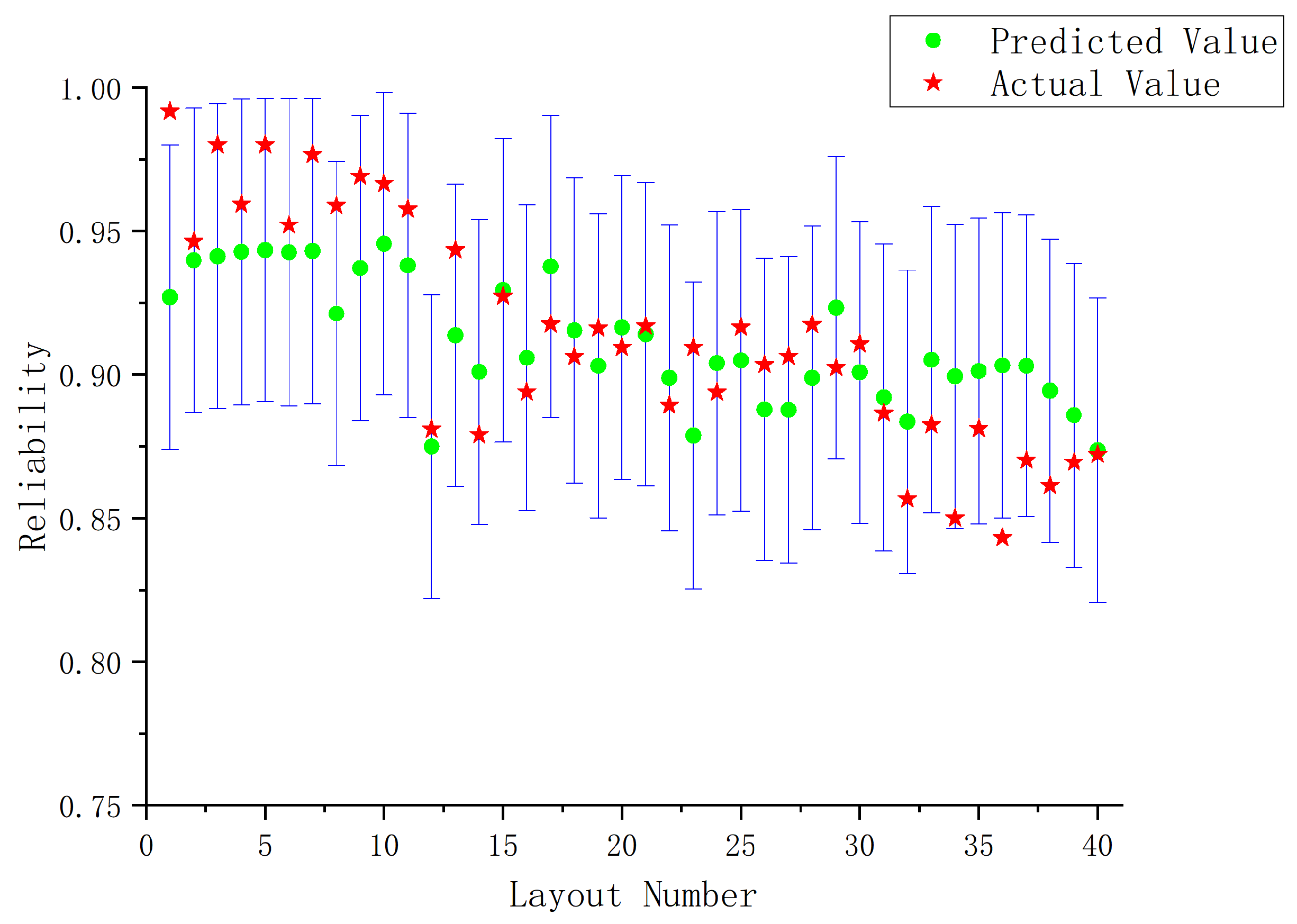
As shown in Figure 1, the test-set predictions are presented together with their uncertainty intervals. The actual reliability values of shipborne vehicles’ sortie missions all fall within the predicted intervals, and the interval widths are appropriately calibrated—neither overly wide nor excessively narrow.

3.2.5. Parameter Sensitivity Analysis

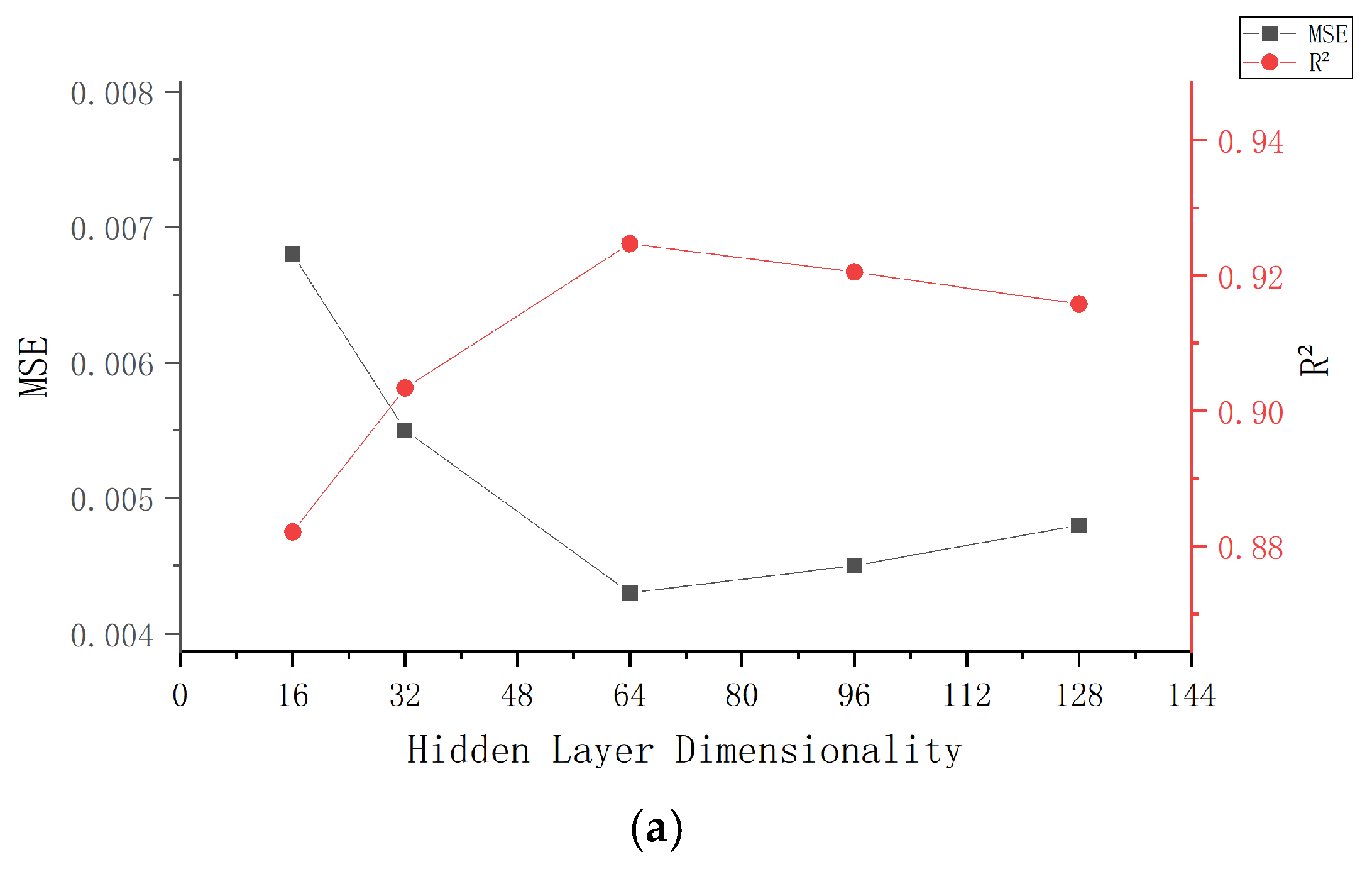
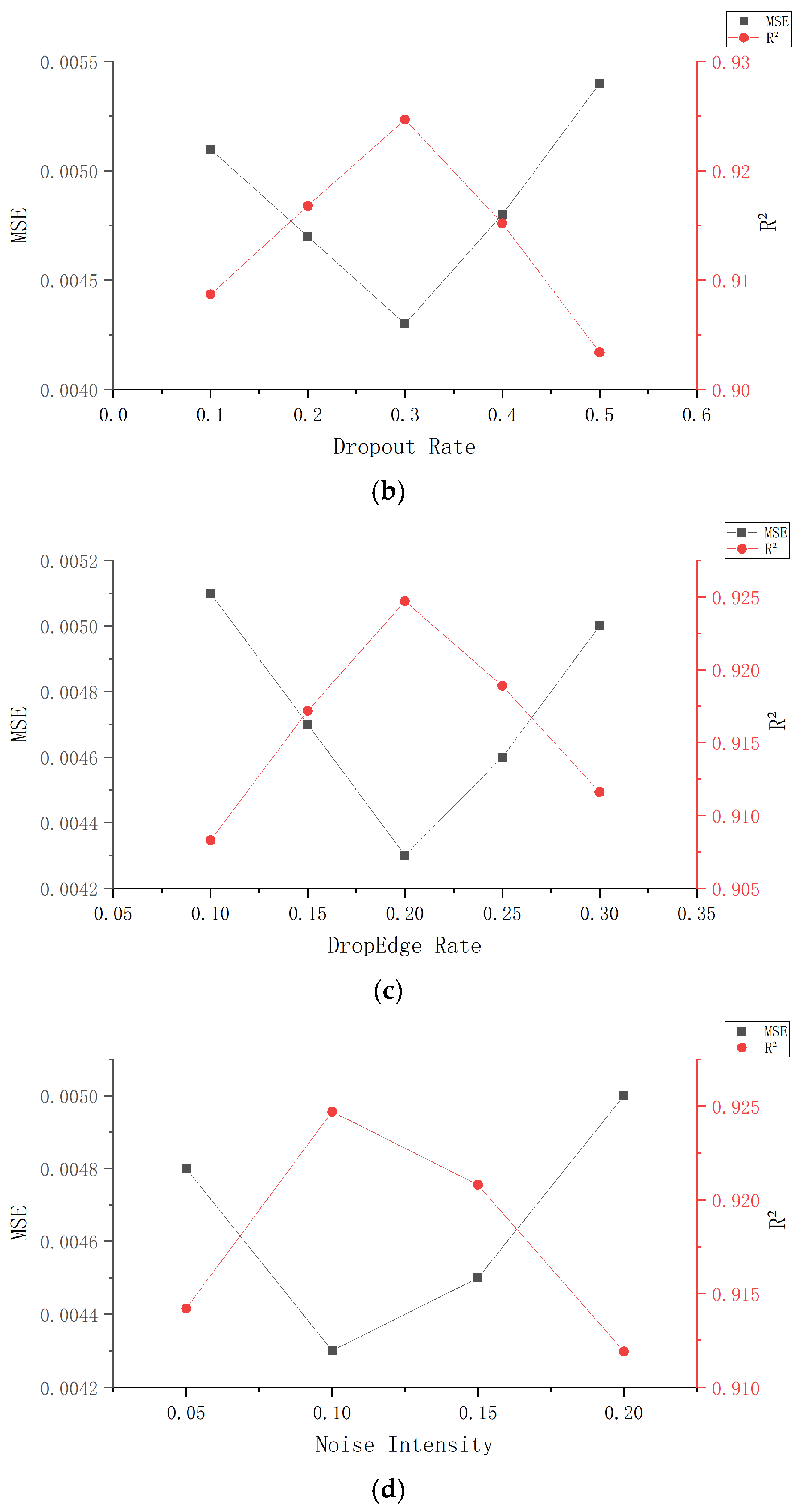
To assess the sensitivity of S-GNN to key hyperparameters, we conducted a parameter sensitivity analysis. The investigation focused on the following parameters: hidden layer dimensionality, Dropout rate, DropEdge rate, and noise intensity. The effects of these parameters on model performance are presented in Figure 2.
As shown in Figure 2, hidden layer dimensionality has a marked impact on performance. Increasing the hidden dimensionality from 16 to 64 reduces the MSE from 0.0068 to 0.0043 and increases R 2 from 0.8821 to 0.9247. Further increasing the dimensionality to 128 yields no substantial improvement and even a slight performance decline, suggesting that in small-sample settings, an excessively large model capacity may lead to overfitting. Dropout and DropEdge rates also significantly influence performance. Raising the Dropout rate from 0.1 to 0.3 decreases the MSE from 0.0051 to 0.0043 and increases R 2 from 0.9087 to 0.9247; however, increasing the Dropout rate further to 0.5 results in performance degradation. Similarly, the DropEdge rate attains optimal performance at 0.2. These observations indicate that appropriate regularization can improve model performance under limited data, whereas overly strong regularization may cause underfitting. The effect of noise intensity is comparatively minor: increasing noise intensity from 0.05 to 0.1 yields a slight performance improvement, but further increasing it to 0.2 degrades performance. This suggests that moderate feature-noise injection can enhance model robustness, while excessive noise may corrupt informative features.

4. Discussion

The experimental results presented in Section 3 clearly demonstrate that SS-GNN achieves state-of-the-art performance for sortie mission reliability prediction of shipborne vehicle layouts. This section provides an in-depth analysis of the factors driving these results, organized around four key themes: the unique advantages of the proposed framework, its interpretability analysis, its practical operational implications for naval forces, and a comparison with related existing studies.

4.1. Advantages of the Proposed Method

Conventional reliability calculation methods typically simplify vehicles’ systems into rudimentary network structures, which makes it difficult to fully capture the complex interdependencies among components. Although such methods can sometimes yield accurate point estimates, their computational cost is prohibitively high and thus unsuitable for real-time applications. In particular, when evaluating large-scale vehicle layouts, computational complexity grows exponentially, and the solution process becomes excessively time-consuming.
In contrast, SS-GNN employs multi-relational graph representation learning to simultaneously account for spatial proximity, functional dependency, and layout–sequence relationships among vehicles, thereby providing a more comprehensive characterization of layouts. Experimental results show that incorporating multi-relational graph convolution substantially improves performance: MSE decreases from 0.0071 to 0.0065 and R 2 increases from 0.8654 to 0.8789. Moreover, SS-GNN can predict the reliability of new layouts at orders of magnitude faster than traditional reliability computation methods, greatly reducing runtime while markedly enhancing predictive accuracy. These findings indicate that multi-relational graph representation learning supplies richer feature information that benefits prediction performance.
Standard machine learning methods tend to overfit under small-sample conditions and therefore struggle to learn the true data distribution and generalize. SS-GNN mitigates this problem through multiple small-sample learning strategies. The experiments demonstrate that all evaluated small-sample learning strategies improve model performance; the contrastive learning strategy yields the most pronounced effect, reducing MSE by 26.8% relative to the baseline GCN. The meta-learning pretraining strategy also performs strongly, producing a 24.0% reduction in MSE versus the baseline GCN.
Under limited data, predictions often carry substantial uncertainty. Traditional approaches typically provide only point estimates and do not quantify predictive uncertainty, which can lead to poor decisions in practice. SS-GNN addresses this by integrating a Bayesian neural network to produce reliable uncertainty estimates. Empirically, at the 95% confidence level, the prediction interval coverage reaches 93.8%, close to the nominal 95%, indicating the credibility of the uncertainty quantification. Such uncertainty estimates are valuable in practice because they help decision-makers better understand the reliability of predictions and thus make more informed choices.

4.2. Interpretability Analysis

To improve the transparency of the model, we conducted an interpretability analysis based on attention weight distribution. As shown in Table 6, sortie-order edges have the highest average attention weight (0.42), followed by functional dependency edges (0.35) and spatial adjacency edges (0.23), indicating that the sortie sequence is the most critical factor affecting mission reliability, which is consistent with domain expertise.
We also analyzed the attention weight distribution of nodes in typical high-reliability and low-reliability layouts, as shown in Table 7. For low-reliability layouts, nodes located near the sortie channel exit have the highest average attention weight (0.31), indicating that the model mainly identifies bottleneck nodes in the sortie process to judge reliability, which matches actual operational experience. This interpretability analysis demonstrates that the model’s decision-making process is consistent with domain knowledge, enhancing the trustworthiness of prediction results.

4.3. Practical Value

We find that SS-GNN offers significant practical value for predicting the sortie reliability of shipborne vehicles. First, it substantially improves decision efficiency. Traditional reliability computation methods require prohibitive runtimes and cannot meet real-time requirements, whereas SS-GNN, once trained, can rapidly predict the reliability of novel layout configurations, thereby greatly accelerating the decision-making process. In time-sensitive military operations, this fast inference capability can provide commanders with timely decision support.
Second, SS-GNN enables comparative evaluation of alternative layouts, allowing decision-makers to select the configuration with the highest expected reliability. This capability is particularly important under limited resource conditions, where optimizing layouts to maximize mission reliability is a key operational concern; SS-GNN can provide an effective tool for addressing this problem.
Third, with respect to computational cost, traditional methods demand large computational resources—especially for large-scale layout plans—whereas SS-GNN incurs most of its cost during training and requires relatively little computation at inference. This characteristic can substantially reduce overall computational expense in practical use.
Finally, SS-GNN not only predicts reliability metrics but also quantifies predictive uncertainty. Such uncertainty information is of high practical value because it helps decision-makers better understand the confidence in predictions and thus supports more informed and risk-aware operational decisions.

4.4. Comparison with Existing Studies

In existing research on the sortie-reliability of shipborne vehicles, traditional reliability computation methods suffer from excessive computational latency and cannot meet real-time requirements. By learning patterns from historical layouts, SS-GNN can rapidly infer the reliability of novel configurations, thereby substantially reducing computation time. Moreover, SS-GNN maintains high predictive accuracy under small-sample conditions, a regime in which conventional reliability methods typically struggle.
Conventional machine learning approaches, while computationally efficient at inference, often fail to capture the complex interrelationships among vehicles and therefore yield lower predictive accuracy. SS-GNN, by explicitly modeling the problem as a graph, better represents these complex spatial, functional, and sequential dependencies and achieves markedly improved prediction performance. This advantage is especially pronounced with limited data: standard machine learning models are prone to overfitting in small-sample settings, whereas SS-GNN incorporates tailored small-sample learning strategies that effectively mitigate overfitting.
General graph neural network architectures such as GCN, GAT, and GraphSAGE can process graph-structured data but tend to exhibit limited performance when training samples are scarce. SS-GNN addresses this limitation through specifically designed small-sample learning mechanisms, demonstrating substantially enhanced performance in low-data regimes relative to both traditional methods and baseline GNN variants.

5. Limitations

Despite the promising performance of SS-GNN, several limitations need to be addressed in future research:
  • Extreme small-sample scenario constraints: While SS-GNN achieves satisfactory performance with 60 training samples, preliminary experiments show that its R 2 drops to 0.83 when the sample size is reduced to 15, indicating that the model still has limitations in extreme, few-shot scenarios with fewer than 20 samples. Future work will introduce few-shot learning methods based on prototype learning to further improve performance in ultra-low data regimes.
  • Insufficient domain knowledge integration: The current model only incorporates basic spatial and functional constraints, and does not integrate deeper domain knowledge such as failure propagation mechanisms, mission priority rules, and marine environmental impacts. The integration of domain knowledge graphs and physics-informed neural networks will be explored in future work to further improve prediction fidelity.
  • Interpretability deficiencies: Although we have conducted attention-weight-based interpretability analysis, the model still lacks causal interpretability for decision-making. Future work will introduce explainable AI frameworks to provide explicit causal chains between layout features and reliability predictions, to meet the transparency requirements of military decision support systems.

6. Conclusions

This study systematically investigated the application of graph neural networks to the reliability prediction of shipborne vehicles’ sortie missions under small-sample conditions and proposed a specialized architecture tailored for limited data regimes (SS-GNN). The proposed architecture integrates key components—multi-relation graph convolutional layers, attention mechanisms with adaptive weighting, small-sample regularization techniques, and an uncertainty-quantification module—that together enable effective modeling of complex inter-vehicle relationships while maintaining high predictive accuracy when training data are scarce.
We also developed a suite of small-sample learning strategies, including meta-learning pretraining, contrastive representation learning, knowledge distillation and transfer learning, and multi-mission joint optimization. These strategies substantially enhance model performance in low-data regimes. Experimental results demonstrate that SS-GNN not only yields accurate reliability predictions for shipborne vehicles’ sortie missions but also provides calibrated uncertainty estimates; such uncertainty information is of practical value because it helps decision-makers assess the confidence of predictions. Empirical evaluation confirms the effectiveness and practical utility of SS-GNN: compared with conventional approaches, it achieves superior prediction accuracy, computational efficiency, and robustness, with advantages that are particularly pronounced when available samples are limited.
SS-GNN thus offers a novel and practical solution for sortie reliability prediction and provides a valuable reference for applying graph neural networks in small-sample settings. With continued research and technological development, we anticipate further integration of capabilities—such as handling extreme, low-sample regimes, explicit modeling of dynamic relationships, deeper fusion of domain knowledge, multimodal data integration, and improved interpretability—into small-sample GNN frameworks, broadening their applicability and impact on reliability prediction and related engineering problems.

Author Contributions

Conceptualization, H.S. and N.W.; methodology, H.S. and Q.L.; software, H.S.; validation, H.S.; formal analysis, H.S.; investigation, H.S.; resources, H.S.; data curation, H.S.; writing—original draft preparation, H.S.; writing—review and editing, H.S.; visualization, H.S.; supervision, N.W.; project administration, Q.L.; funding acquisition, Q.L. All authors have read and agreed to the published version of the manuscript.

Funding

This research was funded by the Central University Basic Research Business Fund Project of Harbin Engineering University under Grant No. 3072021CFJ0707.

Data Availability Statement

The original contributions presented in the study are included in the article; further inquiries can be directed to the corresponding author.

Acknowledgments

The authors would like to thank all the reviewers for their constructive suggestions.

Conflicts of Interest

The authors declare no conflicts of interest.

Nomenclature

ClassificationSymbolDescription
Basic Parameters G = ( V , E , X ) Attributed graph corresponding to the shipborne vehicle layout
V Set of shipborne vehicle nodes
E Set of edges encoding spatial relations or inter-vehicle dependencies
X Node feature matrix
v Individual shipborne vehicle node
x Feature vector of node v
e i j Edge connecting node i and j
Parameters for the multi-relational graph convolutional layer h v ( l ) Feature vector of node v in the l -th network layer
σ Non-linear activation function
R Set of edge relation types
N r ( v ) Set of neighbor nodes of node v under relation r
c { v r } Normalization constant for node v under relation r
W r ( l ) Learnable weight matrix for relation r in the l -th layer
W 0 ( l ) Learnable weight matrix for self-feature transformation of nodes in the l -th layer
h v ( l 1 ) Feature vector of node v in the ( l 1 ) -th network layer
Parameters for the attention mechanism e v u r Raw attention coefficient between target node v and neighbor u under relation r
L e a k y R e L U Leaky Rectified Linear Unit activation function
a Learnable attention weight vector
W Feature transformation matrix
φ ( r ) Embedding vector of relation r
α v u r Normalized attention weight
s o f t m a x u Softmax normalization operation performed over the neighbor set of node v under relation r
Parameters for the small-sample regularization Ω Graph Laplacian regularization term
A i j Adjacency matrix element, indicating whether node i and j are connected
h i / h j Feature representation of node i / j
X Feature matrix after noise injection
ε Injected Gaussian noise
N ( 0 , σ 2 ) Gaussian distribution with mean 0 and variance σ 2
σ 2 Hyperparameter of noise intensity
Parameters for the uncertainty quantification W Set of model weights
θ Set of variational parameters
w i Individual model weight parameter
θ i Variational parameter corresponding to individual weight
Parameters for the Meta-learning pretraining T i Sampled individual task
L i Loss function for individual task
θ i Adapted parameters after inner-loop update for a single task
α Inner-loop learning rate for meta-learning
θ Gradient operation with respect to parameter θ
f θ Model parameterized by θ
L ( θ ) Meta-objective loss function
β Outer-loop learning rate for meta-learning
Parameters for the contrastive learning L c o n t r s t Contrastive learning loss function
G Original graph sample
G Positive sample graph after data augmentation
h G / h G Representation vector of original graph / augmented graph
s i m Similarity calculation function, typically cosine similarity
τ Temperature hyperparameter
G Negative sample graph
Parameters for the knowledge distillation and transfer learning L d i s t i l l Total distillation loss function
α Weight coefficient of task loss
L t a s k Task-specific prediction loss
L K D Knowledge distillation loss
K L Kullback-Leibler divergence calculation function
z i Output logits of the student model
z i * Output logits of the teacher model
T Temperature hyperparameter for distillation
Parameters for the reliability prediction h G Graph-level representation vector, obtained by weighted aggregation of node representations
α v Pooling attention weight of node v
y Reliability prediction value
W y Weight matrix of the output layer
b y Bias term of the output layer
σ Sigmoid activation function
Parameters for the evaluation metrics M S E Mean Squared Error
M A E Mean Absolute Error
R 2 Coefficient of Determination
n Total number of samples
y i Ground-truth reliability value of the i -th sample
y ^ i Predicted reliability value of the i -th sample
y ¯ Mean value of ground-truth reliability

References

  1. Bildik, E.; Yuksek, B.; Tsourdos, A.; Inalhan, G. Development of Reinforcement Learning Based Mission Planning Method for Active Off-board Decoys on Naval Platforms. In Proceedings of the AIAA Science and Technology Forum and Exposition (AIAA SciTech Forum), San Diego, CA, USA, 3–7 January 2022. [Google Scholar] [CrossRef]
  2. Park, S.; Min, S.; Ha, Y. Analysis of the Combat Effectiveness of the Unmanned Surface Vehicle. J. Korea Soc. Nav. Sci. Technol. 2022, 5, 134–142. [Google Scholar] [CrossRef]
  3. Lee, B.Y.; Lee, J.-Y. A Study on the Required Capacities of the Multi-Purpose Unmanned Vehicle System in Marine Environment. J. Korea Soc. Syst. Eng. 2022, 18, 14–32. [Google Scholar] [CrossRef]
  4. Boretti, A. Unmanned surface vehicles for naval warfare and maritime security. J. Def. Model. Simul. Appl. Methodol. Technol. 2024, 15485129241283056. [Google Scholar] [CrossRef]
  5. Dui, H.; Zhang, C.; Bai, G.; Chen, L. Mission reliability modeling of UAV swarm and its structure optimization based on importance measure. Reliab. Eng. Syst. Saf. 2021, 215, 107879. [Google Scholar] [CrossRef]
  6. Shi, H.; Wang, N.; Liu, Q. Calculation Method for Sortie Mission Reliability of Shipborne Unmanned Vehicle Group. J. Mar. Sci. Eng. 2024, 12, 1309. [Google Scholar] [CrossRef]
  7. Wang, L.; Zhao, X.; Zhang, Y.; Wang, X.; Ma, T.; Gao, X. Unmanned aerial vehicle swarm mission reliability modeling and evaluation method oriented to systematic and networked mission. Chin. J. Aeronaut. 2021, 34, 466–478. [Google Scholar] [CrossRef]
  8. Nie, J.J.; Xu, Y.; Huang, Y.C.; Li, J.H. The Review of Image Processing Based on Graph Neural Network. In Proceedings of the 14th International Conference on Intelligent Robotics and Applications (ICIRA), Yantai, China, 22–25 October 2021. [Google Scholar] [CrossRef]
  9. Gkarmpounis, G.; Vranis, C.; Vretos, N.; Daras, P. Survey on Graph Neural Networks. IEEE Access 2024, 12, 128816–128832. [Google Scholar] [CrossRef]
  10. Maghdid, S.S.; Rashid, T.A.; Askar, S.K. Graph neural networks: Historical backgrounds, present revolutions, and conventionalization for the future. Int. J. Data Sci. Anal. 2025, 20, 5237–5299. [Google Scholar] [CrossRef]
  11. Wu, L.F.; Cui, P.; Pei, J.; Zhao, L.; Guo, X.J. Graph Neural Networks: Foundation, Frontiers and Applications. In Proceedings of the 29th ACM SIGKDD Conference on Knowledge Discovery and Data Mining (KDD), Long Beach, CA, USA, 6–10 August 2023. [Google Scholar] [CrossRef]
  12. Liu, Z.H.; Tan, H.C. Traffic Prediction with Graph Neural Network: A Survey. In Proceedings of the 20th and 21st Joint COTA International Conference of Transportation Professionals—Advanced Transportation, Enhanced Connection, Xian, China, 16–20 December 2021. [Google Scholar]
  13. Zhou, Y.; Zheng, H.X.; Huang, X.; Hao, S.F.; Li, D.A.; Zhao, J.M. Graph Neural Networks: Taxonomy, Advances, and Trends. ACM Trans. Intell. Syst. Technol. 2022, 13, 15. [Google Scholar] [CrossRef]
  14. Ruiz, L.; Gama, F.; Ribeiro, A. Graph Neural Networks: Architectures, Stability, and Transferability. Proc. IEEE 2021, 109, 660–682. [Google Scholar] [CrossRef]
  15. Lachaud, G.; Conde-Cespedes, P.; Trocan, M. Mathematical Expressiveness of Graph Neural Networks. Mathematics 2022, 10, 4770. [Google Scholar] [CrossRef]
  16. Asif, N.A.; Sarker, Y.; Chakrabortty, R.K.; Ryan, M.; Ahamed, M.H.; Saha, D.K.; Badal, F.R.; Das, S.K.; Ali, M.F.; Moyeen, S.I.; et al. Graph Neural Network: A Comprehensive Review on Non-Euclidean Space. IEEE Access 2021, 9, 60588–60606. [Google Scholar] [CrossRef]
  17. Skarding, J.; Gabrys, B.; Musial, K. Foundations and Modeling of Dynamic Networks Using Dynamic Graph Neural Networks: A Survey. IEEE Access 2021, 9, 79143–79168. [Google Scholar] [CrossRef]
  18. Cheung, M.; Shi, J.; Jiang, L.; Wright, O.; Moura, J.M.F. Pooling in Graph Convolutional Neural Networks. In Proceedings of the 53rd Asilomar Conference on Signals, Systems, and Computers (ACSSC), Pacific Grove, CA, USA, 3–6 November 2019. [Google Scholar] [CrossRef]
  19. Tan, Q.; Lai, J.L.; Zhao, C.R.; Wu, Z.Z.; Zhang, X. AFGN: Adaptive Filtering Graph Neural Network for Few-Shot Learning. Appl. Sci. 2024, 14, 8988. [Google Scholar] [CrossRef]
  20. Zhou, Y.F.; Yu, L.L. Few-shot learning via weighted prototypes from graph structure. Pattern Recognit. Lett. 2023, 176, 230–235. [Google Scholar] [CrossRef]
  21. Liu, Z.; Xia, Y.T.; Zhang, B.C. Graph Embedding Relation Network for Few-Shot Learning. In Proceedings of the 39th Chinese Control Conference (CCC), Shenyang, China, 27–29 July 2020. [Google Scholar] [CrossRef]
  22. Zhang, R.H.; Yang, S.; Zhang, Q.; Xu, L.X.; He, Y.; Zhang, F. Graph-based few-shot learning with transformed feature propagation and optimal class allocation. Neurocomputing 2021, 470, 247–256. [Google Scholar] [CrossRef]
  23. Li, X.T.; Ng, M.K.; Xu, G.N.; Yip, A. Multi-relational graph convolutional networks: Generalization guarantees and experiments. Neural Netw. 2023, 161, 343–358. [Google Scholar] [CrossRef] [PubMed]
  24. Li, S.Y.; Jin, T.; Wang, E.R.; Tao, R.T.; Lu, J.X..; Xi, K. DMGNN: A Dual Multi-Relational GNN Model for Enhanced Recommendation. Comput. Mater. Contin. 2025, 84, 2331–2353. [Google Scholar] [CrossRef]
  25. Yi, R.; Lu, J.G.; Tang, X.H. Dynamic graph-enhanced multi-scale attention network for FW-UAV fault diagnosis under small sample. Appl. Soft Comput. 2026, 190, 114589. [Google Scholar] [CrossRef]
  26. Cheng, H.; Zhou, J.T.; Tay, W.P.; Wen, B.H. Graph Neural Networks With Triple Attention for Few-Shot Learning. IEEE Trans. Multimed. 2023, 25, 8225–8239. [Google Scholar] [CrossRef]
  27. Lai, V.D.; Nguyen, M.V.; Nguyen, T.H.; Dernoncourt, F. Graph Learning Regularization and Transfer Learning for Few-Shot Event Detection. In Proceedings of the 44th International ACM SIGIR Conference on Research and Development in Information Retrieval, Virtual Event, 11–15 July 2021. [Google Scholar] [CrossRef]
  28. Wu, Z.H.; Wang, T.X.; Cao, Y.; Zhang, M.; Guo, W.J.; Yang, L.X. Transfer Learning-Based Dual GCN for Radar Active Deceptive Jamming Few-Shot Recognition. IEEE Trans. Aerosp. Electron. Syst. 2025, 61, 2185–2197. [Google Scholar] [CrossRef]
  29. Walsh, R.; Shehata, M. Regularized Meta-Training with Embedding Mixup for Improved Few-Shot Learning. In Proceedings of the 18th International Symposium on Visual Computing (ISVC), Lake Tahoe, NV, USA, 16–18 October 2023. [Google Scholar] [CrossRef]
  30. Huang, Y.H.; Hu, X.X.; Chen, F.; Cao, J.M.; He, Y.M.; Ming, Q.; Wang, H.; Wang, J.N.; Tang, T. Dynamic graph meta-learning with multi-sensor spatial dependencies for cross-category small-sample fault diagnosis in ZDJ9-RTAs. Adv. Eng. Inform. 2026, 70, 104132. [Google Scholar] [CrossRef]
  31. Wang, P.; He, R.K.; Zhang, Q.B.; Wang, J.K.; Mihaylova, L.; Bouaynaya, N.C. Bayesian Neural Networks Uncertainty Quantification with Cubature Rules. In Proceedings of the International Joint Conference on Neural Networks (IJCNN) Held as Part of the IEEE World Congress on Computational Intelligence (IEEE WCCI), Glasgow, Scotland, 19–24 July 2020. [Google Scholar] [CrossRef]
  32. Valkanas, A.; Panzini, A.W.; Coates, M. Towards Bayesian Learning of the Architecture, Graph and Parameters for Graph Neural Networks. In Proceedings of the 2022 56th Asilomar Conference on Signals, Systems, And Computers, Pacific Grove, CA, USA, 31 October–2 November 2022. [Google Scholar] [CrossRef]
  33. Qiu, T.; Lam, C.T.; Liu, B.W.; Ng, B.K.; Yuan, X.C.; Im, S.K. FEN-MRMGCN: A Frontend-Enhanced Network Based on Multi-Relational Modeling GCN for Bus Arrival Time Prediction. IEEE Access 2025, 13, 5296–5307. [Google Scholar] [CrossRef]
  34. Lee, S.B.; Park, J.H.; Kim, J.Y.; Lee, S.Y.; Heo, J.P. Regularization with Multiple Feature Combination for Few-Shot Learning. In Proceedings of the IEEE International Conference on Big Data and Smart Computing (BigComp), Jeju Island, Republic of Korea, 17–20 January 2021. [Google Scholar] [CrossRef]
  35. Heidari, M.; Alchihabi, A.; En, Q.; Guo, Y.H. Adaptive Parametric Prototype Learning for Cross-Domain Few-Shot Classification. In Proceedings of the 27th International Conference on Artificial Intelligence and Statistics (AISTATS), Valencia, Spain, 2–4 May 2024. [Google Scholar]
  36. Xiao, G.; Cao, Y.; Huang, J.C.; Jin, X.H.; Zhang, Y.M. Knowledge Graph Metric Learning Network for Few-Shot Health Status Assessment. IEEE Sens. J. 2025, 25, 3898–3908. [Google Scholar] [CrossRef]
  37. Sang, L.; Zhang, C.; Huang, M.H.; Mu, L.; Zhang, Y.W.; Wu, X.D. Heterogeneous Neighborhood-Enhanced Graph Contrastive Learning for Recommendation. IEEE Trans. Comput. Soc. Syst. 2025, 1–17. [Google Scholar] [CrossRef]
Figure 1. Test-set predictions and their confidence intervals.
Jmse 14 00599 g001
Figure 2. Parameter sensitivity analysis: (a) Influence of hidden-layer dimensionality; (b) influence of Dropout rate; (c) influence of DropEdge rate; (d) influence of noise intensity.
Jmse 14 00599 g002aJmse 14 00599 g002b
Table 1. Information on each vehicle type.
Parameter NameParameter ValueDescription
Learning rate0.001Initial learning rate for the Adam optimizer
Batch size4Number of samples per training batch
Epochs1000Maximum number of training epochs
Early-stopping patience50Number of epochs without improvement in validation loss before early stopping
Hidden dimension64Dimensionality of hidden layers in the graph neural network
Number of attention heads4Number of heads in the multi-head attention mechanism
Dropout rate0.3Dropout probability
DropEdge rate0.2Edge dropout probability
Noise intensity0.1Standard deviation of injected feature noise
Temperature parameter0.5Temperature used in contrastive learning
Monte Carlo sampling count20Number of forward-pass samples for uncertainty estimation
Table 2. Predictive performance metrics of the evaluated methods (mean ± standard deviation, n = 10 cross-validation runs).
MethodMSE (↓)MAE (↓)R2 (↑)Computation Time (s) (↓)
Minimal path-set method0.0087 ± 0.00030.0732 ± 0.00210.8421 ± 0.0056284.6 ± 12.3
SVR0.0124 ± 0.00070.0893 ± 0.00320.7765 ± 0.00870.8 ± 0.1
RFR0.0108 ± 0.00050.0817 ± 0.00280.8032 ± 0.00741.2 ± 0.1
MLP0.0095 ± 0.00040.0764 ± 0.00250.8247 ± 0.00681.5 ± 0.2
GCN0.0071 ± 0.00030.0643 ± 0.00220.8654 ± 0.00592.3 ± 0.2
GAT0.0068 ± 0.00030.0621 ± 0.00200.8712 ± 0.00542.8 ± 0.2
GraphSAGE0.0065 ± 0.00020.0608 ± 0.00180.8789 ± 0.00493.1 ± 0.2
SS-GNN0.0043 ± 0.0001 *0.0462 ± 0.0012 *0.9247 ± 0.0028 *3.5 ± 0.3
Note: * indicates p < 0.01 compared with the GraphSAGE baseline via paired t-test.
Table 3. Performance of different strategies when integrated with the baseline GCN and SS-GNN.
Strategy CombinationsMSE (↓)MAE (↓)R2 (↑)
Baseline GCN0.00710.06430.8654
Baseline GCN + multi-relational graph convolution0.00650.06120.8789
Baseline GCN + attention mechanism0.00620.05970.8834
Baseline GCN + small-sample regularization techniques0.00580.05690.8912
Baseline GCN + uncertainty quantification0.00600.05780.8887
Baseline GCN + meta-learning pretraining0.00540.05360.9021
Baseline GCN + contrastive learning0.00520.05210.9068
Baseline GCN + knowledge distillation0.00550.05430.8997
SS-GNN0.00430.04620.9247
Table 4. Fine-grained ablation experimental results (MSE metric).
Model ConfigurationMSE (↓)Performance Degradation vs. Full SS-GNNComponent Contribution
Full SS-GNN0.0043--
Multi-relational graph convolution0.0057+32.6%20.7%
Attention mechanism0.0060+39.5%18.5%
Small-sample regularization techniques0.0059+37.2%19.2%
Uncertainty quantification0.0047+9.3%4.8%
Meta-learning pretraining0.0055+27.9%22.4%
Contrastive learning0.0052+20.9%24.6%
Knowledge distillation0.0050+16.3%9.8%
Table 5. Performance of prediction intervals at different confidence levels.
Confidence LevelPrediction Interval Coverage (%)Average Prediction Interval Width (%)
90%87.50.082
95%93.80.106
99%97.50.143
Table 6. Average attention weight distribution of different relation types.
Relation TypeAverage Attention WeightContribution to Prediction
Sortie order0.42 ± 0.0542.0%
Functional dependency0.35 ± 0.0435.0%
Spatial adjacency0.23 ± 0.0323.0%
Table 7. Node attention weight distribution in typical layouts.
Node Position CategoryAverage Attention Weight
(High-Reliability Layout)
Average Attention Weight
(Low-Reliability Layout)
Near sortie channel exit0.17 ± 0.030.31 ± 0.05
Middle area0.12 ± 0.020.14 ± 0.03
Rear area0.08 ± 0.020.09 ± 0.02
Auxiliary vehicle area0.06 ± 0.010.07 ± 0.01
Disclaimer/Publisher’s Note: The statements, opinions and data contained in all publications are solely those of the individual author(s) and contributor(s) and not of MDPI and/or the editor(s). MDPI and/or the editor(s) disclaim responsibility for any injury to people or property resulting from any ideas, methods, instructions or products referred to in the content.