1. Introduction
Wind energy has experienced rapid global expansion over the last two decades as a response to increasing concerns over climate change, energy security, and the environmental impacts of fossil fuel-based power generation [
1,
2]. Among renewable energy technologies, wind power is widely recognized for its relatively low operational greenhouse gas emissions and its capability to generate electricity at large scales [
3,
4]. Continuous technological advancements have enabled the development of wind turbines with higher rated capacities, larger rotor diameters, and taller hub heights, thereby significantly increasing electricity generation efficiency [
5]. However, these improvements have also resulted in increased material demand, more complex manufacturing processes, and higher energy consumption during non-operational phases of wind energy systems [
6].
While wind turbines generate electricity without direct emissions during operation, their overall environmental performance cannot be accurately evaluated by considering only the operational phase [
7,
8]. The production of raw materials, component manufacturing, transportation of large turbine parts, installation activities, maintenance operations, and end-of-life treatment all contribute to the environmental footprint of wind power systems [
9,
10]. As wind turbines increase in size and complexity, these upstream and downstream processes become increasingly significant. Therefore, a comprehensive assessment approach is required to evaluate the true environmental sustainability of wind energy technologies.
Life Cycle Assessment (LCA) is a standardized methodological framework used to quantify the environmental impacts associated with all stages of a product’s life cycle, from raw material extraction to disposal or recycling [
11,
12]. LCA has been extensively applied to energy systems to evaluate energy use, greenhouse gas emissions, and resource consumption. In the context of wind energy, LCA provides valuable insights into the environmental trade-offs associated with different turbine designs, installation locations, and support structures [
8]. By adopting a life cycle perspective, LCA enables the identification of environmental hotspots and supports the development of strategies to reduce the overall environmental impact of wind energy systems [
8,
9].
As wind energy deployment expanded to offshore locations, researchers increasingly began to examine offshore wind turbines, emphasizing both their higher energy yields and their greater material and installation requirements [
13]. Offshore wind turbines typically require larger foundations, specialized installation vessels, and more frequent maintenance operations, all of which contribute to higher life cycle environmental impacts compared to onshore systems. Nevertheless, offshore wind farms often benefit from stronger and more stable wind resources, resulting in enhanced energy production and lower emissions per unit of electricity generated [
13,
14].
In recent years, floating wind turbine technologies have emerged as a promising solution for harnessing wind resources in deep-water regions where bottom-fixed foundations are not feasible [
13]. Floating wind turbines enable the deployment of wind energy systems far from shore, where wind speeds are typically higher and visual impacts are reduced. Several floating platform concepts have been proposed and developed, including spar, semi-submersible, tension-leg platform, and barge-type structures [
9,
13]. Each of these platform designs exhibits distinct structural characteristics, material requirements, and installation procedures, which directly influence their life cycle environmental performance.
The motivation for this study arises from the need to better understand the life cycle environmental impacts of floating wind turbine systems, with particular emphasis on the processes and equipment involved in their deployment and operation. By synthesizing existing life cycle assessment studies of onshore, offshore, and floating wind turbines, this paper aims to provide a comprehensive overview of the environmental performance of floating wind energy systems and to identify the key factors influencing their life cycle impacts. This study follows a qualitative literature synthesis approach aimed at examining methodological aspects of floating wind turbine LCA studies rather than conducting a statistical meta-analysis of reported emission values. Special attention is given to the transportation of large turbine components, offshore installation procedures, operation and maintenance activities, and end-of-life management, focusing on the materials, vessels, heavy lifting equipment, mooring systems, and logistical operations used during these stages, as these elements have been consistently identified as major contributors to the overall environmental impacts of floating wind turbines.
Although several life cycle assessment studies have evaluated the environmental performance of wind energy systems, most of these studies primarily report aggregated environmental indicators such as total greenhouse gas emissions. As a result, the modelling of individual life cycle stages is often simplified or inconsistently represented. This issue is particularly relevant for floating wind turbine systems, where additional offshore infrastructure and operational processes must be considered. Elements such as transportation logistics, offshore installation procedures, maintenance vessel operations, and end-of-life management can significantly influence the overall environmental performance of these systems, yet they are not always consistently modelled across existing LCA studies. Consequently, beyond reporting life cycle emission values, there is a need to examine how these stages are defined, modelled, and integrated within the system boundaries of floating wind turbine LCA studies. The present study addresses this gap by analysing the methodological approaches used in existing LCA studies of floating wind turbines and by identifying key modelling assumptions and research gaps related to transportation, installation, operation and maintenance logistics, and decommissioning processes.
2. Life Cycle Assessment
Sustainability is defined by the need to maintain a balanced interaction between economic viability, environmental protection, and social considerations over the entire life cycle of a product [
13]. Life Cycle Assessment (LCA) is a systematic and standardized approach used to quantify the environmental impacts associated with the consumption of energy and raw materials, as well as waste generation and emissions arising from a product, process, or service, in accordance with ISO 14040 and ISO 14044 standards [
11,
12].
The LCA methodology consists of four main phases. The first phase involves defining the goal and scope of the study, including system boundaries, assumptions, and methodological choices. In the second phase, a life cycle inventory (LCI) is developed by identifying and quantifying all relevant inputs and outputs within the defined system boundaries. The third phase, life cycle impact assessment (LCIA), evaluates the potential environmental impacts using the inventory data obtained in the previous stage. Finally, the results are analyzed and interpreted in the fourth phase to support conclusions and decision-making [
13].
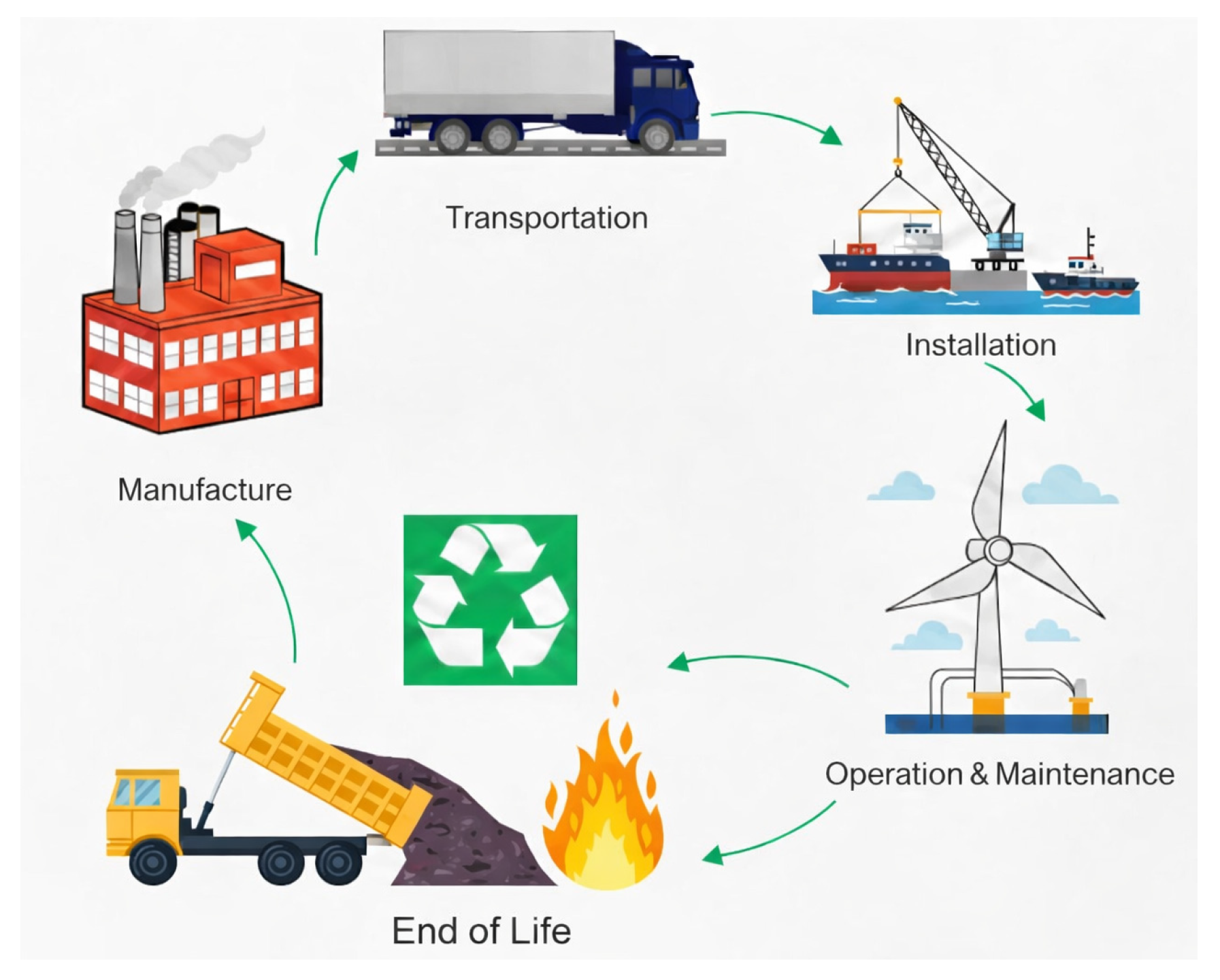
The life cycle assessment (LCA) framework for a typical wind energy system is illustrated in
Figure 1. The system boundary generally encompasses all major life cycle stages, including manufacturing, transportation, erection, operation and maintenance, disposal, and recycling. The system boundary defines the life cycle stages of the wind energy system as well as the associated material and energy inputs and outputs. As depicted in
Figure 1, the boundary system for the LCA of a wind turbine is established to represent the complete life cycle of the system. Accordingly, all relevant life cycle stages are commonly considered in the environmental assessment of a typical wind energy system.
2.1. Manufacture Step
The manufacturing phase of floating wind turbines represents a critical stage in their life cycle assessment due to the substantial material requirements and energy-intensive production processes involved [
13]. Unlike onshore and bottom-fixed offshore wind turbines, floating wind turbines incorporate additional structural elements that enable buoyancy and stability in deep-water environments. These additional components, including floating platforms, mooring systems, and anchoring devices, significantly increase the complexity and environmental burden of the manufacturing phase [
13,
15].
Compared with bottom-fixed offshore wind turbines, floating wind turbine systems generally require different structural support concepts that influence material demand during the manufacturing phase. Bottom-fixed offshore wind turbines typically rely on seabed-mounted foundations such as monopiles, jackets, or gravity-based structures, which concentrate material use primarily in the foundation system [
3,
16]. In contrast, floating wind turbines require buoyant platforms together with mooring lines and anchoring systems to maintain station in deep-water environments. These additional structural components often lead to increased steel requirements, particularly for semi-submersible and barge-type platforms, where large steel pontoons and structural frames are required to ensure stability and buoyancy [
7,
17]. Consequently, several LCA studies report that material production, especially steel manufacturing, represents a dominant contributor to the overall environmental impacts of floating wind turbine systems when compared with conventional bottom-fixed offshore wind technologies.
Floating wind turbines are designed to operate in water depths where conventional bottom-fixed foundations are not technically or economically feasible [
13]. As a result, the manufacturing phase extends beyond the production of conventional wind turbine components such as towers, nacelles, and rotor blades to include large-scale floating support structures and specialized connection systems [
15]. From a life cycle assessment perspective, this phase is frequently identified as one of the dominant contributors to cumulative energy demand and greenhouse gas emissions of floating wind energy systems. In addition to manufacturing related impacts, appropriate site selection plays a critical role in ensuring the overall sustainability and feasibility of floating wind projects. GIS-based spatial analysis is commonly employed to integrate wind resource availability with environmental, technical, and regulatory constraints such as protected areas, shipping routes, and bathymetry limits. Furthermore, logistical and economic factors such as distance to shore, grid connection requirements, and port infrastructure suitability must be considered to identify technically viable and cost-effective deployment areas [
18].
The material composition of floating wind turbines differs markedly from that of onshore and fixed offshore systems. In addition to standard turbine components, floating wind turbines require platforms constructed from large volumes of steel and, in some cases, reinforced concrete [
19]. Steel is the predominant material used in floating platform fabrication due to its high strength, durability, and suitability for marine environments. However, steel production is highly energy-intensive and is a major source of carbon dioxide emissions, making it a key environmental hotspot in the manufacturing phase [
13].
Concrete is also used in certain floating platform designs, particularly spar-type structures, where large ballast sections are required to ensure stability [
20]. Cement production associated with concrete manufacturing contributes significantly to greenhouse gas emissions, further increasing the environmental impact of this phase [
9,
10]. In addition, floating wind turbines incorporate extensive mooring and anchoring systems composed of steel chains, cables, and anchors, all of which add to material demand and embodied energy [
13].
Rotor blades in floating wind turbines are typically larger than those used in onshore systems, as floating installations often target high-wind offshore locations. These blades are commonly manufactured from composite materials such as glass-fiber-reinforced polymers [
21]. The production of composite materials involves energy-intensive processes and chemical inputs, which contribute to both energy consumption and environmental emissions. Moreover, the limited recyclability of composite materials exacerbates the environmental challenges associated with blade manufacturing [
22].
Floating wind turbine platforms can be broadly categorized into spar, semi-submersible, tension-leg platform, and barge-type designs. Each design exhibits distinct structural characteristics and material requirements, leading to variations in manufacturing-related environmental impacts.
Spar-type floating wind turbine structures are characterized by their slender, cylindrical buoyancy elements and elongated vertical geometry. Stability is achieved through the use of catenary mooring lines that anchor the structure to the seabed [
23]. Owing to their relatively straightforward structural configuration, spar platforms offer several advantages over other floating support concepts, including reduced complexity in design, lower mooring installation costs, and improved dynamic performance with respect to wave-induced motions [
20]. In particular, spar structures tend to exhibit smaller critical responses under wave loading, making them well suited for deployment in deep-water offshore environments [
23].
Semisubmersible floating wind turbine platforms consist of several interconnected vertical cylindrical columns supported by horizontal pontoons. The submerged sections of the structure generate the primary buoyant force required for stability, while the pontoons contribute additional buoyancy and structural support [
20]. Station keeping is achieved through either catenary or taut-spread mooring systems, which secure the platform to the seabed and enable controlled motion under environmental loading conditions [
15,
19].
Tension leg platforms (TLPs) are floating wind turbine support structures composed of vertical columns interconnected by horizontal pontoons, similar in general configuration to semi-submersible platforms. These structures are anchored to the seabed through vertically oriented mooring tendons that are continuously maintained under high tensile forces [
24]. The mooring system is designed to resist substantial vertical loads, thereby providing strong positional stability. Owing to the constant tension in the tendons, TLP-supported wind turbines exhibit significantly reduced heave and pitch motions, as the mooring system effectively restrains vertical and rotational degrees of freedom [
25].
Barge-type floating wind turbine platforms are characterized by a rectangular geometry with extensive flat-plate surfaces and a large pontoon-based structure [
23]. Owing to their simple configuration, these platforms are relatively straightforward to fabricate compared to other floating support concepts. Stability is primarily achieved through the utilization of the platform’s waterplane area and mass distribution, which generate the necessary restoring moments [
26]. For station keeping, barge-type floating wind turbines typically employ conventional catenary mooring systems incorporating anchor chains and synthetic fiber ropes [
13].
Life cycle assessment studies of floating wind turbines consistently identify several environmental hotspots within the manufacturing phase. Steel production emerges as the dominant contributor to greenhouse gas emissions due to its high energy requirements [
27]. Concrete production, where applicable, also represents a significant source of emissions [
13]. In addition, the manufacture of composite materials for rotor blades contributes notably to cumulative energy demand and overall environmental impacts.
The manufacturing of mooring systems and anchoring components further increases the environmental burden as a result of the extensive use of high-strength steel and energy-intensive fabrication processes [
13,
23]. These components are often overlooked in simplified assessments; however, they can account for a substantial share of total manufacturing-related impacts in floating wind turbine systems.
2.2. Transportation Step
Wind turbine components are transported from manufacturing facilities to installation sites using various modes of transportation, including maritime vessels, railways, and road vehicles. The primary objective of the transportation stage within a life cycle assessment framework is to quantify the environmental impacts associated with the selected transport modes. Since wind turbine components are typically produced at geographically dispersed locations, they are often delivered to intermediate storage facilities or directly to sites located near the planned wind farm prior to installation [
28].
As wind turbine rated capacity continues to increase, the physical dimensions and weights of individual components have expanded accordingly. This trend poses significant logistical challenges, particularly for rotor blades, which are manufactured as single, elongated units [
29]. Due to their length and structural sensitivity, blade transportation requires careful planning and specialized handling to avoid damage during transit [
14].
Transportation regulations, which vary considerably across countries, govern permissible vehicle dimensions, axle loads, and routing restrictions. These regulations directly influence the number of vehicles required, the choice of transport mode, and the overall logistics strategy [
29]. Consequently, the transportation process is highly route-dependent, and identifying optimal transport routes and methods is essential to minimize both environmental impacts and logistical constraints [
13,
29].
Although floating wind turbines are generally composed of modular components that can be manufactured, transported, and assembled in separate units, the transportation stage remains a critical aspect of their life cycle [
29]. In particular, while many structural and mechanical components of floating wind turbines can be disassembled or transported in sections, rotor blades are typically manufactured as single, continuous elements [
30]. Owing to their considerable length, weight, and structural sensitivity, wind turbine blades represent the most challenging components in terms of mobility and logistics. Consequently, blade transportation plays a decisive role in determining transportation routes, vehicle selection, regulatory compliance, and associated environmental impacts within the life cycle assessment framework [
30].
Table 1 summarizes the maximum allowable dimensions and weight limits for wind turbine blade transportation according to different transport modes. The key constraints associated with each transportation type can be outlined as follows.
It should be noted that transportation limits for wind turbine components may vary depending on national regulations, infrastructure constraints, and permitting procedures. The values reported in
Table 1 are representative limits commonly cited in wind turbine logistics studies and are primarily derived from transportation analyses conducted in the United States by the National Renewable Energy Laboratory (NREL) [
30,
31]. In practice, transport constraints may differ across regions such as Europe, Brazil, and China due to variations in road regulations, bridge clearance limits, axle load restrictions, and special transport permitting procedures. Therefore, the values presented in
Table 1 should be interpreted as indicative reference limits frequently used in wind energy logistics analyses rather than universally applicable thresholds.
2.3. Installination Step
Following the transportation stage, installation constitutes the next critical phase in the life cycle assessment of wind turbine systems. During this phase, the components delivered to the project site are assembled and erected. Owing to the considerable size and weight of wind turbine components, installation activities typically require the use of heavy-duty machinery and specialized equipment. Consequently, the installation phase contributes to environmental impacts through fuel consumption and exhaust emissions generated by construction vehicles, lifting equipment, and installation vessels, all of which are accounted for within the life cycle assessment framework [
14].
The complexity of installation processes varies significantly between onshore, offshore, and floating wind turbine systems. Onshore wind turbine installation is generally less complex and more cost-effective compared to offshore and floating alternatives [
32]. Onshore turbines are typically erected using conventional lifting equipment such as mobile cranes, crawler cranes, and forklifts, with relatively straightforward logistical and operational requirements [
33].
In contrast, offshore wind turbine installation is highly site-specific and depends on several factors, including rotor diameter, foundation type, technological configuration, and wind farm layout. Each offshore wind farm requires tailored installation strategies, and the installation of offshore wind turbines invariably relies on specialized marine vessels [
32]. The selection of appropriate installation vessels is influenced by economic considerations, turbine characteristics (such as component size and quantity), and foundation design. Installation-related expenditures and vessel selection therefore represent significant determinants of the overall environmental and economic performance of offshore wind projects [
33].
In typical floating wind turbine installation procedures, the turbine–platform assembly is completed onshore and subsequently towed to the deployment site. Mooring systems, including anchors and mooring lines, are often preinstalled and temporarily placed on the seabed before the arrival of the floating foundation [
32,
33]. Once the platform reaches its designated position, remotely operated or robotic vehicles are employed to retrieve pre-laid mooring lines or connect them to the anchors. The final step involves attaching the mooring lines to the floating structure via top connections, thereby securing the turbine in its operational position [
32].
Table 2 provides an overview of the vessel types involved in offshore wind turbine installation activities, along with their respective operational roles and fuel consumption rates. This information highlights the significance of marine vessel operations as a contributor to the environmental impacts associated with the installation phase, particularly for offshore and floating wind energy systems. The reported fuel consumption rates represent average operational values derived from the literature for specific activity modes such as transit, dynamic positioning, lifting, and standby operations, rather than maximum fuel consumption at full engine capacity, thereby reflecting realistic installation conditions within the LCA system boundaries.
2.4. Operation and Maintenance Step
Following the installation of wind turbine systems, the operation and maintenance (O&M) phase constitutes the next stage in the life cycle assessment. During long-term operation, wind turbines are subjected to mechanical loads and environmental stresses that lead to gradual degradation and deformation, particularly in rotating components such as blades, gearboxes, and bearings [
8]. Wind turbines are typically designed for an operational lifetime of at least 20 years. Onshore wind turbines are generally assumed to operate for approximately 2000 h annually, whereas offshore and floating wind turbines installed in high wind-resource regions are expected to achieve higher annual operating durations of around 3000 h [
34,
35].
The environmental impacts associated with the O&M phase arise primarily from the use of vehicles, vessels, spare parts, and consumable materials required to address operational wear, component failures, and system faults [
36]. This phase includes a wide range of activities such as routine inspections, scheduled maintenance visits, lubrication of gearboxes and generators, oil replacement, component refurbishment, and the replacement of major turbine parts when failures occur [
36,
37].
For offshore and floating wind turbines in particular, maintenance operations rely heavily on marine vessels, which contribute significantly to fuel consumption and associated emissions. Access limitations, harsh environmental conditions, and the need for specialized equipment further increase the resource intensity of maintenance activities [
14].
Table 3 presents an overview of the vessel types involved in offshore wind turbine maintenance operations, along with their corresponding functions and fuel consumption rates. This information underscores the importance of maintenance-related vessel operations as a notable contributor to life cycle environmental impacts during the operational phase. The reported fuel consumption values represent literature-based average operational rates rather than full engine capacity consumption.
2.5. End-of-Life Step
The end-of-life (EoL) phase represents the final stage in the life cycle assessment of wind turbine systems. At this stage, wind turbines that have reached the end of their operational lifetime are decommissioned, and the management of remaining materials and components is evaluated. Materials recovered from decommissioned wind turbines must be handled in accordance with the European Waste Framework Directive to ensure minimal environmental impact [
38]. This directive establishes a hierarchy of waste management strategies, including waste minimization, reuse, recycling, incineration with energy recovery, and landfill disposal [
38,
39].
Waste minimization aims to reduce the overall quantity of waste generated by promoting the use of recyclable materials and by incorporating components with extended service lifetimes during the design phase [
40]. Such strategies enable a reduction in material disposal and contribute to improved environmental performance [
40,
41].
Reuse within wind energy systems involves the redeployment of functional turbine components or subassemblies in new or refurbished turbines. Reuse practices can significantly reduce waste generation and resource demand by extending the functional life of existing components [
22,
42].
Recycling is applied to materials and components that cannot be re-used due to technical or economic limitations. Wind turbines generally exhibit high recyclability rates, typically around 80%, with the majority of non-recyclable materials associated with composite rotor blades [
22]. In this context, recent research indicates that advanced recycling methods such as pyrolysis, chemical dissolution, and thermoplastic reprocessing offer promising pathways for composite blade waste management. These approaches aim to improve material recovery efficiency while reducing environmental impacts compared to conventional disposal methods. Additionally, ongoing techno-economic assessments suggest that such innovations could enhance the overall sustainability and feasibility of composite recycling in the wind energy sector [
43].
Incineration is primarily used for composite materials that are unsuitable for reuse or recycling. Through controlled combustion, incineration enables partial energy recovery from these materials, thereby reducing the volume of waste requiring final disposal [
44].
Landfill disposal is considered the least preferred option and is applied only to materials that cannot be recycled or incinerated. These materials are deposited in designated facilities designed to minimize adverse effects on the environment and human health over their entire lifecycle [
45].
Although the European Waste Framework Directive provides a widely recognized regulatory framework for waste management, the waste management hierarchy defined in this directive is broadly adopted as a general conceptual framework in life cycle assessment studies of energy systems. While specific waste management regulations and implementation mechanisms may differ across countries and regions, the fundamental principles of waste prevention, reuse, recycling, energy recovery, and environmentally responsible disposal are widely reflected in national waste management policies worldwide. Therefore, the hierarchy presented in this section is used as a general reference framework for end-of-life assessment of wind turbine systems across different geographic contexts.
Decommissioning floating wind turbines may involve additional technical complexities compared with bottom-fixed offshore wind systems. In addition to turbine dismantling, the removal of floating platforms, mooring systems, anchors, and dynamic subsea cables must be considered. These components may require specialized offshore vessels and lifting equipment, which can influence both environmental impacts and logistical planning in end-of-life scenarios. Consequently, the decommissioning phase of floating wind turbines may involve more complex offshore operations than those of conventional wind turbine systems.
Recent research has increasingly focused on circular economy approaches for wind turbine materials, particularly for composite rotor blades, which remain one of the main recycling challenges in the wind energy sector [
46]. Emerging recycling technologies such as pyrolysis, chemical dissolution, and thermoplastic recovery processes have been investigated to improve the recovery of fibers and resins from composite materials. These technologies aim to reduce landfill disposal and increase material circularity in wind turbine systems [
47]. Although many of these recycling solutions are still under development or early industrial implementation, they represent promising pathways for improving the sustainability of wind turbine end-of-life management.
In life cycle assessment studies of wind turbines, the waste management scenarios outlined above are systematically incorporated into end-of-life analyses. In addition to material treatment pathways, the EoL phase also accounts for fuel consumption and emissions associated with decommissioning activities and waste transportation. The distribution and relative contributions of different end-of-life scenarios for wind turbine materials are presented in
Table 4.
2.6. Life Cycle Impact Calculation Framework
In life cycle assessment studies of wind energy systems, environmental impacts are quantified by combining life cycle inventory data with corresponding emission factors. The life cycle inventory (LCI) includes all relevant material inputs, energy consumption, transportation activities, and operational processes occurring throughout the system boundary. The environmental impacts associated with these inputs are calculated by multiplying the quantity of each input with its corresponding emission factor [
50].
The total life cycle greenhouse gas emissions of a wind turbine system can be expressed as the sum of emissions generated during material production and energy consumption processes:
where
represents the quantity of material used in the system (kg),
represents the emission factor associated with material production (kg CO2-eq/kg),
represents the energy consumption of process (MJ or kWh),
represents the emission factor for the energy source used.
To enable comparison between electricity generation technologies, life cycle emissions are commonly expressed per unit of electricity generated over the entire operational lifetime of the turbine. The normalized life cycle global warming potential can therefore be calculated as:
where
represents the life cycle greenhouse gas emissions per unit of electricity (g CO2-eq/kWh),
represents the total electricity generated during the turbine lifetime.
The lifetime electricity production of a wind turbine is estimated as:
where
is the rated turbine capacity (MW),
is the capacity factor,
represents the number of hours in a year,
is the operational lifetime of the turbine (years).
In floating offshore wind turbines, additional emissions arise from marine vessel operations during installation and maintenance. These emissions can be estimated using fuel consumption rates and emission factors:
where
is the vessel fuel consumption rate (L/h),
is the emission factor of marine fuel (kg CO2-eq/L),
is the operational time of the vessel (hours).
This framework is commonly applied in LCA studies of offshore and floating wind turbines to quantify the environmental impacts associated with materials, energy use, and operational logistics throughout the system life cycle.
3. LCA of Floating Wind Turbines
Life cycle assessment of floating wind turbines has attracted growing attention as floating offshore wind technology advances toward commercial deployment. Compared to onshore and bottom fixed offshore wind turbines, floating systems introduce additional components such as floating platforms and mooring systems that significantly influence life cycle environmental impacts [
7,
13]. Consequently, life cycle assessment of floating wind turbines requires a comprehensive approach that accounts for floating specific design and operational characteristics.
The literature consistently applies a cradle-to-grave perspective including manufacturing, transportation, installation, operation and maintenance, and end of life stages. As summarized in
Table 5, the manufacturing phase is identified as the dominant contributor to global warming potential, primarily due to the extensive use of steel and in some cases concrete in floating platforms and mooring systems. Semi-submersible platforms generally exhibit higher global warming potential values because of their steel intensive structures, whereas tension leg and sway type platforms tend to show comparatively lower impacts.
Transportation and installation impacts are strongly influenced by vessel use and logistics strategies. Although floating wind turbines benefit from dockside assembly and simplified installation procedures compared to bottom fixed systems, fuel consumption of marine vessels remains a non-negligible source of emissions [
14]. Similarly, operation and maintenance activities contribute to life cycle impacts, particularly through vessel-based maintenance operations in offshore environments [
14].
End of life treatment is generally characterized by high recycling rates for metallic components, which partially offset manufacturing related emissions. However, composite materials used in rotor blades continue to pose significant challenges due to limited recycling options. Overall, the reviewed studies report life cycle global warming potential values ranging from 7.23 to 31.4 g CO2 eq per kWh, confirming that floating wind turbines achieve competitive environmental performance among low carbon electricity generation technologies.
Table 5 provides an overview of representative life cycle assessment studies on floating wind turbine systems and highlights that platform design, material intensity, and maintenance strategy are key factors influencing life cycle environmental performance.
It should be noted that the Global Warming Potential (GWP) values reported in
Table 5 are drawn from studies with heterogeneous methodological assumptions and should therefore be interpreted with caution. Although all studies assess floating wind systems from a life cycle perspective, they differ in important aspects such as system boundaries, background databases, electricity grid mixes, lifetime assumptions, capacity factors, turbine sizes, platform configurations, recycling credits, and the treatment of offshore logistics such as vessel operations and maintenance strategies. In addition, the studies were conducted over a wide time span and across different geographic contexts, which further affects industrial conditions, supply chains, and technology maturity. Therefore, the numerical GWP values summarized here are not intended to provide a strict one-to-one comparison, but rather to illustrate the range of results reported in the literature and to identify the main drivers of environmental performance.
4. Discussion
The results synthesized in this review highlight the growing role of floating wind turbines (FWTs) in the global energy transition, particularly in deep-water regions where bottom-fixed foundations are technically or economically infeasible. Compared with onshore wind systems, floating wind turbines typically require greater material inputs and more complex installation procedures, which can increase life cycle environmental impacts during manufacturing and installation stages. However, offshore locations generally provide stronger and more stable wind resources, resulting in higher capacity factors and improved electricity generation over the system lifetime.
When compared with bottom-fixed offshore wind turbines, floating systems introduce additional structural elements such as floating platforms and mooring systems. These components increase the material intensity of the system, particularly due to the extensive use of steel in semi-submersible, spar, or tension-leg platform designs. Nevertheless, floating wind turbines offer important advantages for the future expansion of offshore wind energy by enabling deployment in deeper waters where wind resources are typically stronger and spatial conflicts with coastal activities are reduced. As a result, floating wind technologies are increasingly viewed as a key component of long-term offshore renewable energy strategies.
In order to place floating wind turbines within the broader context of wind energy technologies, it is useful to compare their environmental performance with that of onshore and bottom-fixed offshore wind systems. Life cycle assessment studies generally report that onshore wind turbines exhibit relatively low material requirements and simpler installation procedures, resulting in lower life cycle emissions per unit of electricity generated. Bottom-fixed offshore wind turbines require larger foundations and specialized installation vessels, which increase material consumption and installation impacts.
Floating wind turbines introduce additional structural components such as floating platforms, mooring systems, and anchoring structures, which further increase material intensity and manufacturing-related environmental impacts. However, floating systems enable deployment in deeper waters where wind resources are typically stronger and more stable. As a result, higher capacity factors and increased electricity generation may partially offset the additional material requirements associated with floating support structures. Consequently, floating wind turbines are increasingly considered a key technology for expanding offshore wind energy into deep-water regions as part of the long-term global energy transition. A comparative overview of the main life cycle environmental drivers across different wind energy technologies is presented in
Table 6.
Another important aspect influencing life cycle environmental performance is technological learning. As floating wind technology continues to develop, improvements in platform design, turbine capacity, manufacturing processes, and installation logistics are expected to reduce both material requirements and operational emissions. Increasing turbine capacities and optimized offshore installation strategies may significantly reduce environmental impacts per unit of electricity generated in future deployments. Technological learning effects observed in other renewable energy technologies suggest that cost reductions and environmental performance improvements may occur as floating wind technology matures and large-scale deployment increases.
Furthermore, site-specific parameters play a critical role in determining life cycle environmental performance. Factors such as wind resource availability, water depth, distance to shore, port infrastructure, and maintenance accessibility can significantly influence transportation requirements, vessel operations, and operational strategies. Consequently, future life cycle assessments of floating wind turbines should incorporate detailed site-specific modelling in order to provide more accurate environmental performance evaluations.
In addition, several floating wind turbine-specific technical elements may influence life cycle environmental performance but are not yet fully represented in existing LCA studies. For example, floating systems rely on dynamic subsea power cables that must accommodate continuous platform motion caused by waves, wind, and ocean currents. Platform motion can also influence maintenance accessibility, safety conditions, and vessel requirements during operation and maintenance activities. Despite their technical importance, the environmental contributions of these components have not yet been systematically quantified in most LCA studies of floating wind turbines, mainly due to limited data availability. Therefore, more detailed modelling of dynamic cable systems, platform motion effects, and associated maintenance logistics represents an important area for future research in the life cycle assessment of floating offshore wind technologies.
5. Conclusions
This study presents a comprehensive review of life cycle assessment applications for floating wind turbine systems and provides a clear methodological framework for how LCA of floating wind turbines should be conducted. By systematically analysing existing studies, the research highlights the life cycle stages and processes that are critical for accurately evaluating the environmental performance of floating offshore wind energy systems.
The reviewed literature reports life cycle global warming potential values for floating wind turbines typically ranging from 7.23 to 31.4 g CO
2-eq/kWh. However, these values should be interpreted as indicative literature-based estimates rather than directly comparable results, because the underlying studies differ in methodological assumptions, geographic context, technology maturity, and life cycle modelling choices. For comparison, solar photovoltaic systems generally report life cycle emissions in the range of approximately 35–40 g CO
2-eq/kWh, depending on technology and regional conditions [
57]. The reviewed studies consistently indicate that environmental impacts are not limited to the operational phase alone but are significantly influenced by non-operational stages, particularly manufacturing, transportation, installation, and operation and maintenance.
A key finding of this review is that the materials and equipment used during transportation, installation, and operation phases play a decisive role in shaping overall life cycle impacts. Heavy-duty marine vessels, installation equipment, mooring systems, and offshore maintenance vessels contribute significantly to fuel consumption and emissions. Consequently, assumptions related to vessel type, operating time, logistics strategies, and maintenance concepts have a substantial effect on LCA outcomes and must be explicitly defined in floating wind turbine assessments.
Manufacturing remains the dominant contributor to life cycle impacts, mainly due to the extensive use of steel in floating platforms, towers, and mooring components. Nevertheless, the results also show that site-specific factors such as wind resource availability, distance to shore, and electrical infrastructure strongly affect emissions per unit of electricity generated, particularly through their influence on transportation requirements and operational strategies.
Overall, this review demonstrates that a robust LCA of floating wind turbines must adopt a holistic and site-specific approach, with particular attention given to transportation logistics, installation procedures, and operation and maintenance activities, alongside material production. Future LCA studies should therefore prioritize transparent system boundaries, detailed modelling of offshore equipment and vessel operations, and improved data for floating-specific components in order to support the sustainable deployment of floating offshore wind energy. In addition, more specific research directions include the integration of dynamic LCA approaches that account for interactions with evolving power grid structures; synergistic LCAs of floating wind power coupled with hydrogen production and aquaculture systems; post-evaluation studies based on real operational data; and investigations into the effects of extreme weather events on system lifespan, structural reliability, and decommissioning timing.