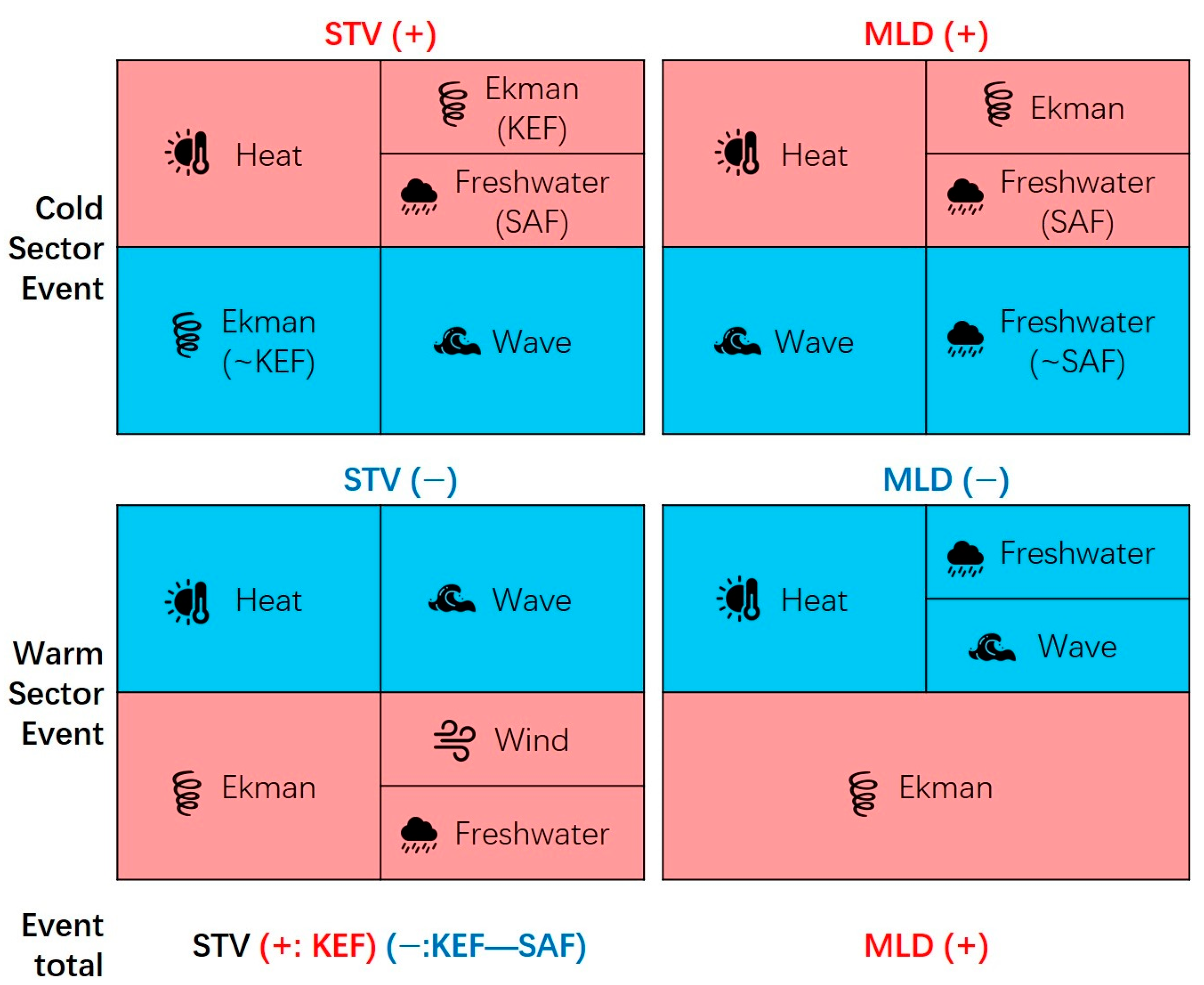
Impacts of Extratropical-Cyclone Extreme Events on SST and Mixed-Layer Depth over the Kuroshio Extension

Abstract
1. Introduction
2. Data and Model
2.1. Reanalysis Data
2.2. GOTM
2.3. Experimental Design
3. Results
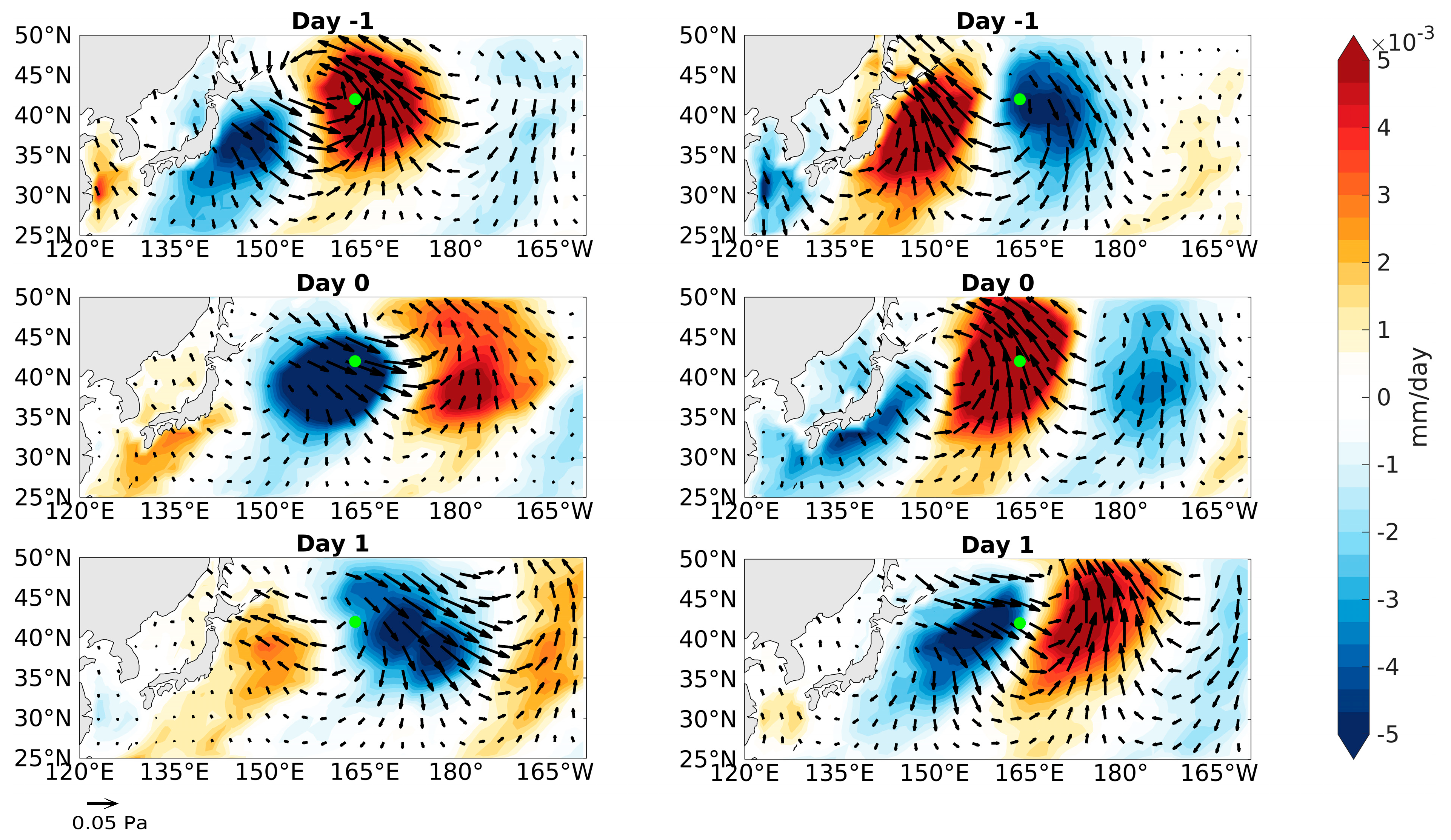
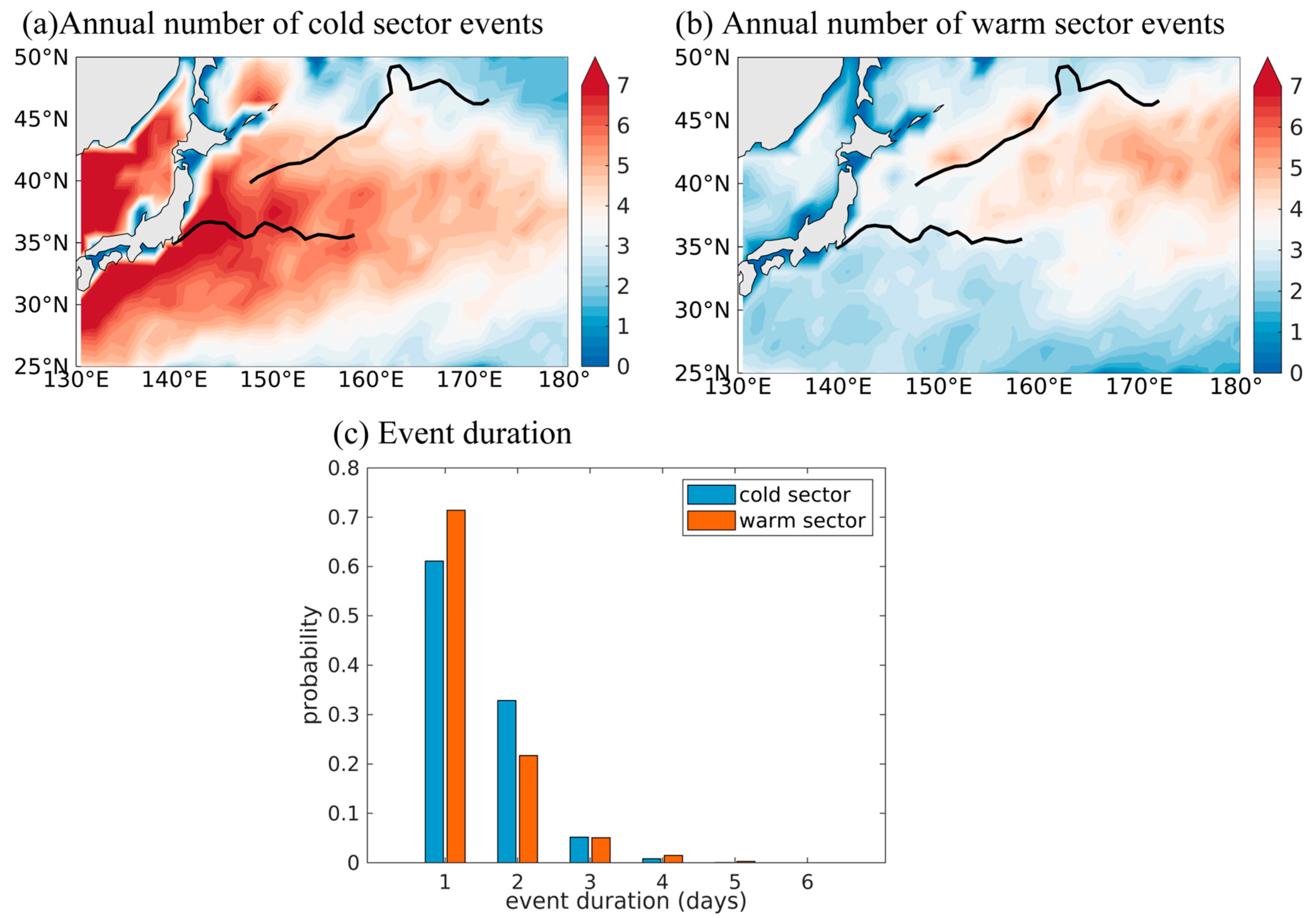
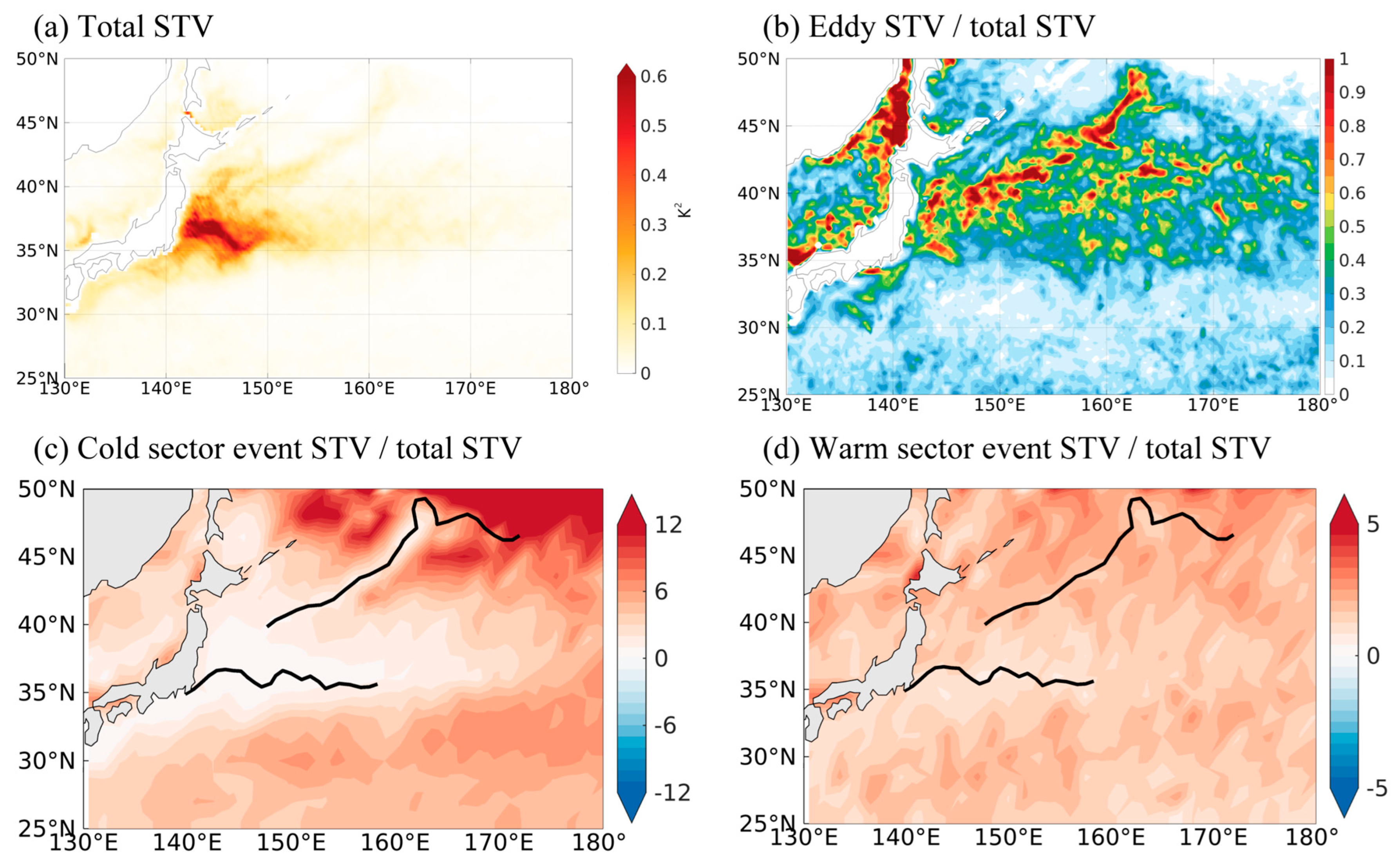
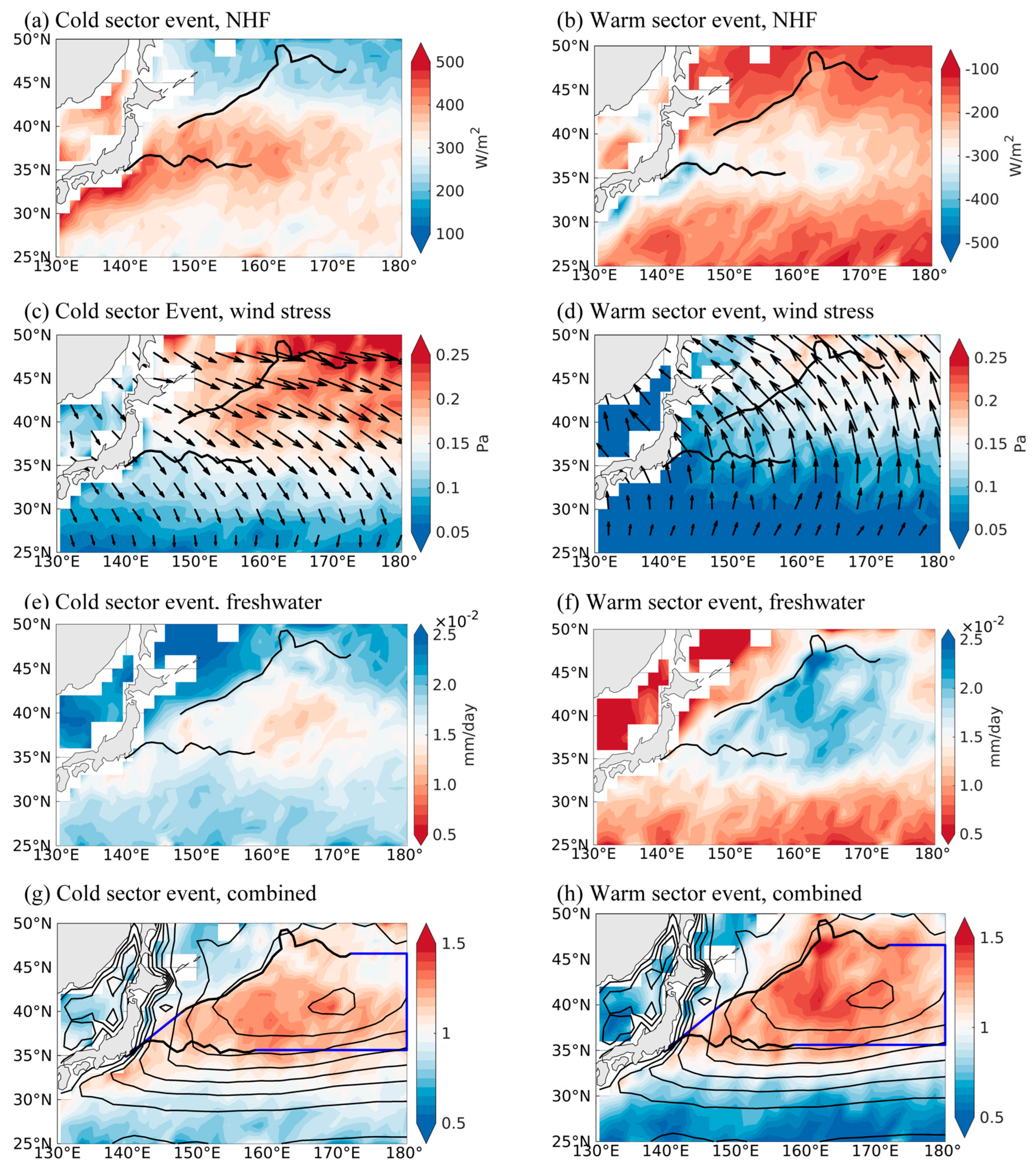
3.1. Atmospheric Forcing Characteristics of Cold- and Warm-Sector Extreme Events
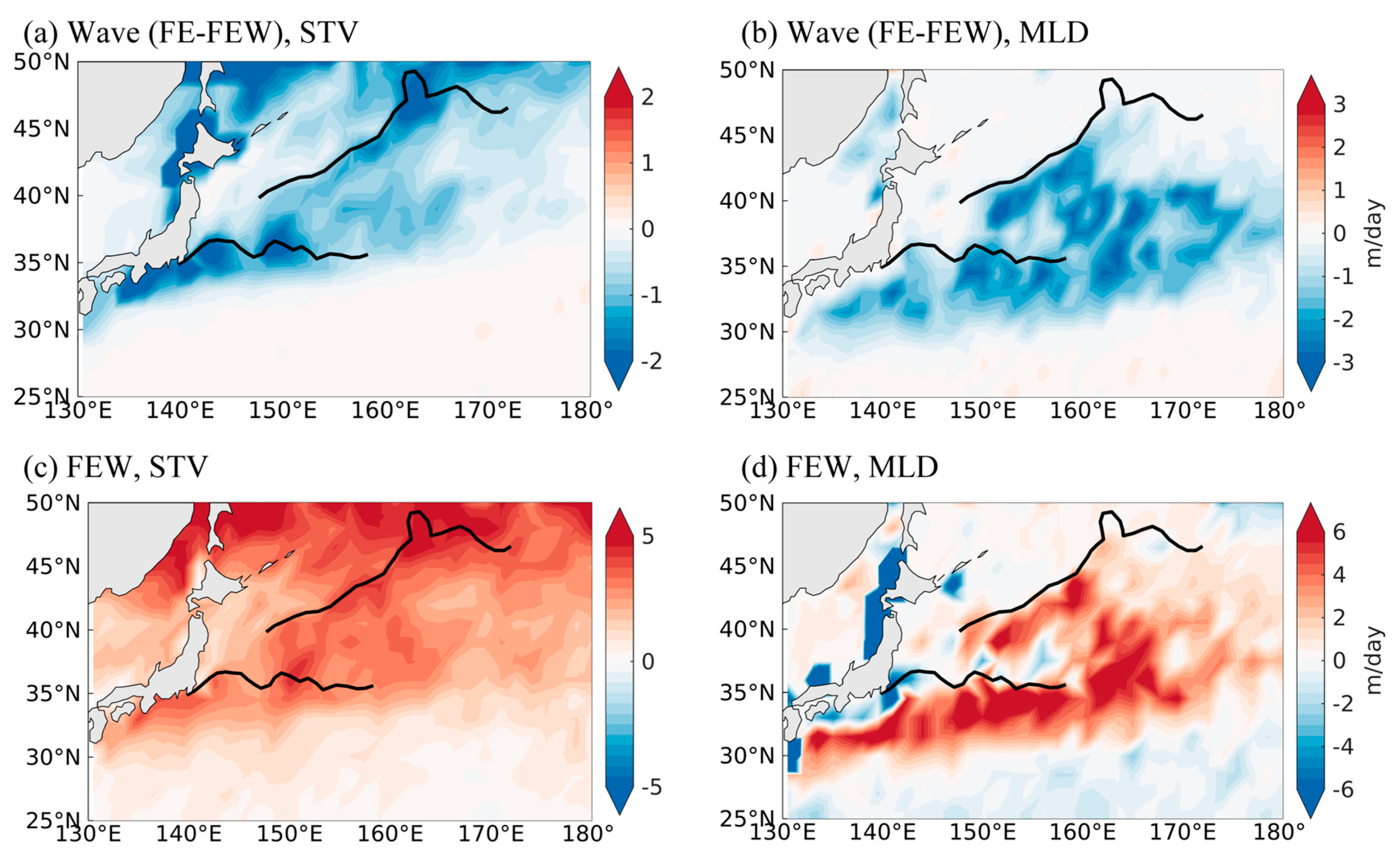
3.2. Cold-Sector Events: Roles of Ekman Advection, Wave Breaking, and Flux Forcing
3.3. Cold-Sector Events: Contributions from Heat, Momentum, and Freshwater Fluxes
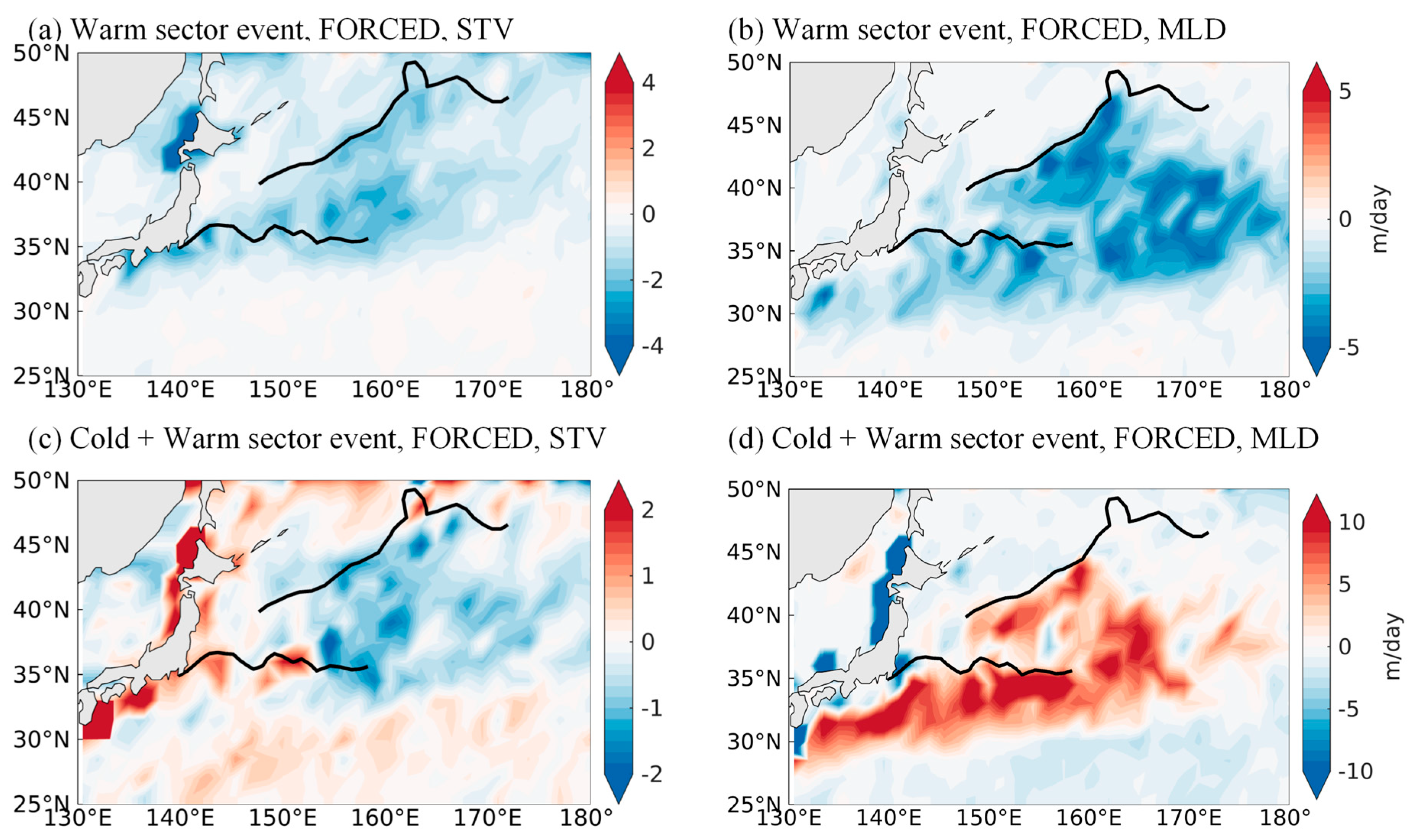
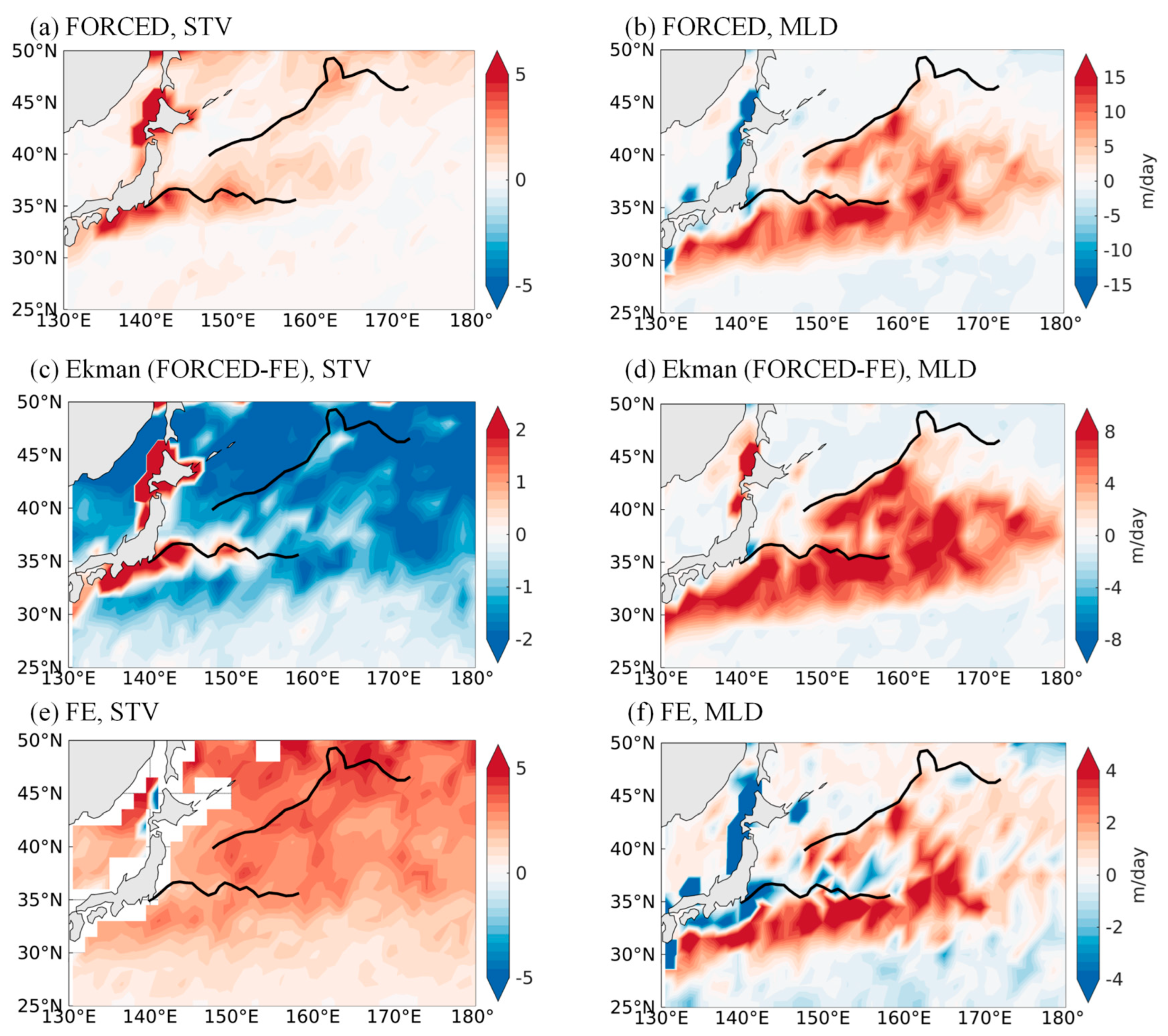
3.4. Warm-Sector Events and Total Forced Response
3.5. Background Winter Ocean State and Responses During Cold- and Warm-Sector Events
4. Conclusions
5. Discussions
Supplementary Materials
Author Contributions
Funding
Data Availability Statement
Conflicts of Interest
Abbreviations
| SST | sea-surface temperature |
| KOE | Kuroshio–Oyashio Extension |
| KEF | Kuroshio Extension Front |
| SAF | Subarctic Front |
| GOTM | General Ocean Turbulence Model |
| TKE | turbulent kinetic energy |
| NHF | net heat flux |
| STV | synoptic temperature variability |
| MLD | mixed-layer depth |
References
- Chang, E.K.M.; Lee, S.; Swanson, K.L. Storm track dynamics. J. Clim. 2002, 15, 2163–2183. [Google Scholar] [CrossRef]
- Nakamura, H.; Sampe, T.; Tanimoto, Y.; Shimpo, A. Observed associations among storm tracks, jet streams and midlatitude oceanic fronts. In Earth’s Climate: The Ocean-Atmosphere Interaction; Geophysical Monograph Series; American Geophysical Union: Washington, DC, USA, 2004; Volume 147, pp. 329–345. [Google Scholar] [CrossRef]
- Kwon, Y.O.; Alexander, M.A.; Bond, N.A.; Frankignoul, C.; Nakamura, H.; Qiu, B.; Thompson, L. Role of the Gulf Stream and Kuroshio–Oyashio systems in large-scale atmosphere–ocean interaction: A review. J. Clim. 2010, 23, 3249–3281. [Google Scholar] [CrossRef]
- Kida, S.; Mitsudera, H.; Aoki, S.; Guo, X.; Ito, S.-I.; Kobashi, F.; Komori, N.; Kubokawa, A.; Miyama, T.; Morie, R.; et al. Oceanic fronts and jets around Japan: A review. J. Oceanogr. 2015, 71, 469–497. [Google Scholar] [CrossRef]
- Taguchi, B.; Nakamura, H.; Nonaka, M.; Xie, S.-P. Influences of the Kuroshio/Oyashio Extensions on air–sea heat exchanges and storm-track activity as revealed in regional atmospheric model simulations for the 2003/04 cold season. J. Clim. 2009, 22, 6536–6560. [Google Scholar] [CrossRef]
- Kuwano-Yoshida, A.; Minobe, S. Storm-track response to SST fronts in the Northwestern Pacific region in an AGCM. J. Clim. 2017, 30, 1081–1102. [Google Scholar] [CrossRef]
- Zhou, G.; Cheng, X. Impacts of oceanic fronts and eddies in the Kuroshio–Oyashio Extension region on the atmospheric general circulation and storm track. Adv. Atmos. Sci. 2022, 39, 22–54. [Google Scholar] [CrossRef]
- Joh, Y.; Di Lorenzo, E. Interactions between Kuroshio Extension and Central Tropical Pacific lead to preferred decadal-timescale oscillations in Pacific climate. Sci. Rep. 2019, 9, 13558. [Google Scholar] [CrossRef] [PubMed]
- Joh, Y.; Di Lorenzo, E.; Siqueira, L.; Kirtman, B.P. Enhanced interactions of Kuroshio Extension with tropical Pacific in a changing climate. Sci. Rep. 2021, 11, 6247. [Google Scholar] [CrossRef]
- Joh, Y.; Delworth, T.L.; Wittenberg, A.T.; Cooke, W.F.; Rosati, A.J.; Zhang, L. Stronger decadal variability of the Kuroshio Extension under simulated future climate change. npj Clim. Atmos. Sci. 2022, 5, 63. [Google Scholar] [CrossRef]
- Serykh, I.; Sonechkin, D.; Vakulenko, N. Decadal oscillations of the Northern Hemisphere average temperature within current global warming. Oceanology 2025, 65, 5–22. [Google Scholar] [CrossRef]
- Bjerknes, J. Atlantic air-sea interaction. Adv. Geophys. 1964, 10, 1–82. [Google Scholar] [CrossRef]
- Cayan, D.R. Latent and sensible heat-flux anomalies over the northern oceans: The connection to monthly atmospheric circulation. J. Clim. 1992, 5, 354–369. [Google Scholar] [CrossRef]
- Frankignoul, C. Sea surface temperature anomalies, planetary waves, and air–sea feedback in the middle latitudes. Rev. Geophys. 1985, 23, 357–390. [Google Scholar] [CrossRef]
- Alexander, M.A.; Scott, J.D.; Deser, C. Processes that influence sea surface temperature and ocean mixed layer depth variability in a coupled model. J. Geophys. Res. Ocean. 2000, 105, 16823–16842. [Google Scholar] [CrossRef]
- Gulev, S.K.; Latif, M.; Keenlyside, N.; Park, W.; Koltermann, K.P. North Atlantic Ocean control on surface heat flux on multidecadal timescales. Nature 2013, 499, 464–467. [Google Scholar] [CrossRef]
- Wu, Y.; Zhou, G.; Wang, G.; Cheng, X. Forced vs. intrinsic wintertime submonthly variability of sea surface temperature in the midlatitude western North Pacific. Front. Mar. Sci. 2022, 9, 847144. [Google Scholar] [CrossRef]
- Bishop, S.P.; Small, R.J.; Bryan, F.O.; Tomas, R.A. Scale dependence of midlatitude air–sea interaction. J. Clim. 2017, 30, 8207–8221. [Google Scholar] [CrossRef]
- Ma, X.; Chang, P.; Saravanan, R.; Wu, D.; Lin, X.; Wu, L.; Wan, X. Winter extreme flux events in the Kuroshio and Gulf Stream extension regions and relationship with modes of North Pacific and Atlantic variability. J. Clim. 2015, 28, 4950–4970. [Google Scholar] [CrossRef]
- Tilinina, N.; Gavrikov, A.; Gulev, S.K. Association of the North Atlantic surface turbulent heat fluxes with midlatitude cyclones. Mon. Weather Rev. 2018, 146, 3691–3715. [Google Scholar] [CrossRef]
- Yang, J.; Cheng, X.; Qin, J.; Zhou, G.; Li, L. The synoptic and interannual variability of extreme turbulent heat flux events during austral winter in the Southern Indian Ocean. J. Geophys. Res. Atmos. 2022, 127, e2021JD035792. [Google Scholar] [CrossRef]
- Bond, N.A.; Cronin, M.F. Regional weather patterns during anomalous air–sea fluxes at the Kuroshio Extension Observatory (KEO). J. Clim. 2008, 21, 1680–1697. [Google Scholar] [CrossRef]
- Rudeva, I.; Gulev, S.K. Composite analysis of North Atlantic extratropical cyclones in NCEP–NCAR reanalysis data. Mon. Weather Rev. 2011, 139, 1419–1446. [Google Scholar] [CrossRef]
- Qiu, B.; Chen, S.; Hacker, P. Synoptic-scale air–sea flux forcing in the western North Pacific: Observations and their impact on SST and the mixed layer. J. Phys. Oceanogr. 2004, 34, 2148–2159. [Google Scholar] [CrossRef]
- Oka, E.; Talley, L.D.; Suga, T. Temporal variability of winter mixed layer in the mid-to high-latitude North Pacific. J. Oceanogr. 2007, 63, 293–307. [Google Scholar] [CrossRef]
- Zhang, H.; He, H.; Zhang, W.Z.; Tian, D. Upper ocean response to tropical cyclones: A review. Geosci. Lett. 2021, 8, 1. [Google Scholar] [CrossRef]
- Kobashi, F.; Doi, H.; Iwasaka, N. Sea surface cooling induced by extratropical cyclones in the subtropical North Pacific: Mechanism and interannual variability. J. Geophys. Res. Ocean. 2019, 124, 2179–2194. [Google Scholar] [CrossRef]
- Menemenlis, D.; Campin, J.-M.; Heimbach, P.; Hill, C.N.; Lee, T.; Nguyen, A.T.; Schodlok, M.P.; Zhang, H. ECCO2: High resolution global ocean and sea ice data synthesis. Mercat. Ocean. Q. Newsl. 2008, 31, 13–21. [Google Scholar]
- Qiu, B.; Chen, S.; Schneider, N. Dynamical Links between the Decadal Variability of the Oyashio and Kuroshio Extensions. J. Clim. 2017, 30, 9591–9605. [Google Scholar] [CrossRef]
- Yang, Y.; Liang, X.S.; Qiu, B.; Chen, S. On the Decadal Variability of the Eddy Kinetic Energy in the Kuroshio Extension. J. Phys. Oceanogr. 2017, 47, 1169–1187. [Google Scholar] [CrossRef]
- Yang, H.; Qiu, B.; Chang, P.; Wu, L.; Wang, S.; Chen, Z.; Yang, Y. Decadal Variability of Eddy Characteristics and Energetics in the Kuroshio Extension: Un-stable Versus Stable States. J. Geophys. Res. Ocean. 2018, 123, 6653–6669. [Google Scholar] [CrossRef]
- Burchard, H. Applied Turbulence Modelling in Marine Waters; Springer: Berlin/Heidelberg, Germany, 2002. [Google Scholar] [CrossRef]
- Umlauf, L.; Burchard, H. Second-order turbulence closure models for geophysical boundary layers: A review of recent work. Cont. Shelf Res. 2005, 25, 795–827. [Google Scholar] [CrossRef]
- Craig, P.D.; Banner, M.L. Modeling wave-enhanced turbulence in the ocean surface layer. J. Phys. Oceanogr. 1994, 24, 2546–2559. [Google Scholar] [CrossRef]
- Burchard, H.; Bolding, K. Comparative analysis of four second-moment turbulence closure models for the oceanic mixed layer. J. Phys. Oceanogr. 2001, 31, 1943–1968. [Google Scholar] [CrossRef]
- Simpson, J.H.; Burchard, H.; Fisher, N.R.; Rippeth, T.P. The semi-diurnal cycle of dissipation in a ROFI: Model-measurement comparisons. Cont. Shelf Res. 2002, 22, 1615–1628. [Google Scholar] [CrossRef]
- Burchard, H.; Bolding, K.; Kühn, W.; Meister, A.; Neumann, T.; Umlauf, L. Description of a flexible and extendable physical–biogeochemical model system for the water column. J. Mar. Syst. 2006, 61, 180–211. [Google Scholar] [CrossRef]
- Shaman, J.; Samelson, R.M.; Skyllingstad, E. Air–sea fluxes over the Gulf Stream region: Atmospheric controls and trends. J. Clim. 2010, 23, 2651–2670. [Google Scholar] [CrossRef]
- Holte, J.; Talley, L. A new algorithm for finding mixed layer depths with applications to Argo data and Subantarctic Mode Water formation. J. Atmos. Ocean. Technol. 2009, 26, 1920–1939. [Google Scholar] [CrossRef]
- Brainerd, K.E.; Gregg, M.C. Surface mixed and mixing layer depths. Deep-Sea Res. Part I Oceanogr. Res. Pap. 1995, 42, 1521–1543. [Google Scholar] [CrossRef]
- Terray, E.A.; Donelan, M.A.; Agrawal, Y.C.; Drennan, W.M.; Kahma, K.K.; Williams, A.J.; Hwang, P.A.; Kitaigorodskii, S.A. Estimates of kinetic energy dissipation under breaking waves. J. Phys. Oceanogr. 1996, 26, 792–807. [Google Scholar] [CrossRef]
- Kantha, L.H.; Clayson, C.A. On the effect of surface gravity waves on mixing in the oceanic mixed layer. Ocean. Model. 2004, 6, 101–124. [Google Scholar] [CrossRef]
- Burchard, H. Simulating the wave-enhanced layer under breaking surface waves with two-equation turbulence models. J. Phys. Oceanogr. 2001, 31, 3133–3145. [Google Scholar] [CrossRef]
- Mellor, G.; Blumberg, A. Wave breaking and ocean surface layer thermal response. J. Phys. Oceanogr. 2004, 34, 693–698. [Google Scholar] [CrossRef]
- Moghimi, S.; Thomson, J.; Özkan-Haller, T.; Umlauf, L.; Zippel, S. On the modeling of wave-enhanced turbulence nearshore. Ocean. Model. 2016, 103, 118–132. [Google Scholar] [CrossRef]
- Faure, V.; Kawai, Y. Heat and salt budgets of the mixed layer around the Subarctic Front of the North Pacific Ocean. J. Oceanogr. 2015, 71, 527–539. [Google Scholar] [CrossRef]
- Kido, S.; Nonaka, M.; Tanimoto, Y. Impacts of salinity variation on the mixed-layer processes and sea surface temperature in the Kuroshio–Oyashio confluence region. J. Geophys. Res. Ocean. 2021, 126, e2020JC016914. [Google Scholar] [CrossRef]
- Tomita, H.; Kouketsu, S.; Oka, E.; Kubota, M. Locally enhanced wintertime air–sea interaction and deep oceanic mixed layer formation associated with the subarctic front in the North Pacific. Geophys. Res. Lett. 2011, 38, L24607. [Google Scholar] [CrossRef]
- Li, Y.; Xu, Z.; Lv, X. The generation and propagation of wind- and tide-induced near-inertial waves in the ocean. J. Mar. Sci. Eng. 2024, 12, 1565. [Google Scholar] [CrossRef]
- Zhou, J.; Zhou, G.; Liu, H.; Li, Z.; Cheng, X. Mesoscale eddy-induced ocean dynamic and thermodynamic anomalies in the North Pacific. Front. Mar. Sci. 2021, 8, 756918. [Google Scholar] [CrossRef]
- Small, R.J.; deSzoeke, S.P.; Xie, S.-P.; O’Neill, L.; Seo, H.; Song, Q.; Cornillon, P.; Spall, M.; Minobe, S. Air–sea interaction over ocean fronts and eddies. Dyn. Atmos. Ocean. 2008, 45, 274–319. [Google Scholar] [CrossRef]
- Shan, X.; Jing, Z.; Gan, B.; Wu, L.; Chang, P.; Ma, X.; Wang, S.; Chen, Z.; Yang, H. Surface heat flux induced by mesoscale eddies cools the Kuroshio–Oyashio Extension region. Geophys. Res. Lett. 2020, 47, e2019GL086050. [Google Scholar] [CrossRef]
- Zhai, X.; Greatbatch, R.J. Wind work in a model of the northwest Atlantic Ocean. Geophys. Res. Lett. 2007, 34, L04606. [Google Scholar] [CrossRef]
- Renault, L.; McWilliams, J.C.; Masson, S. Satellite observations of imprint of oceanic current on wind stress by air–sea coupling. Sci. Rep. 2017, 7, 17747. [Google Scholar] [CrossRef] [PubMed]
- Myslenkov, S.; Shestakova, A.; Chechin, D. The impact of sea waves on turbulent heat fluxes in the Barents Sea according to numerical modeling. Atmos. Chem. Phys. 2021, 21, 5575–5595. [Google Scholar] [CrossRef]






| Experiment | Ekman Advection | Wave-Breaking Mixing | Net Heat-Flux | Wind Stress | Freshwater Flux |
|---|---|---|---|---|---|
| FORCED | On | On | Original | Original | Original |
| FE | Off | On | Original | Original | Original |
| FEW | Off | Off | Original | Original | Original |
| FEWH | Off | Off | Linear | Original | Original |
| FEWHW | Off | Off | Linear | Linear | Original |
| FEWHWF | Off | Off | Linear | Linear | Linear |
Disclaimer/Publisher’s Note: The statements, opinions and data contained in all publications are solely those of the individual author(s) and contributor(s) and not of MDPI and/or the editor(s). MDPI and/or the editor(s) disclaim responsibility for any injury to people or property resulting from any ideas, methods, instructions or products referred to in the content. |
© 2026 by the authors. Licensee MDPI, Basel, Switzerland. This article is an open access article distributed under the terms and conditions of the Creative Commons Attribution (CC BY) license.
Share and Cite
Wang, Y.; Zhou, G. Impacts of Extratropical-Cyclone Extreme Events on SST and Mixed-Layer Depth over the Kuroshio Extension. J. Mar. Sci. Eng. 2026, 14, 575. https://doi.org/10.3390/jmse14060575
Wang Y, Zhou G. Impacts of Extratropical-Cyclone Extreme Events on SST and Mixed-Layer Depth over the Kuroshio Extension. Journal of Marine Science and Engineering. 2026; 14(6):575. https://doi.org/10.3390/jmse14060575
Chicago/Turabian StyleWang, Yiqiao, and Guidi Zhou. 2026. "Impacts of Extratropical-Cyclone Extreme Events on SST and Mixed-Layer Depth over the Kuroshio Extension" Journal of Marine Science and Engineering 14, no. 6: 575. https://doi.org/10.3390/jmse14060575
APA StyleWang, Y., & Zhou, G. (2026). Impacts of Extratropical-Cyclone Extreme Events on SST and Mixed-Layer Depth over the Kuroshio Extension. Journal of Marine Science and Engineering, 14(6), 575. https://doi.org/10.3390/jmse14060575