Article

Characterizing Axonal Guidance Molecules in Regenerating Tissues of the Sea Cucumber Holothuria glaberrima


by
Glen Wickersham-García
,
Joshua G. Medina-Feliciano
and
Jose E. García-Arrarás
*
Biology Department, University of Puerto Rico, Rio Piedras Campus, San Juan 00925, Puerto Rico
*
Author to whom correspondence should be addressed.
J. Mar. Sci. Eng. 2026, 14(6), 547; https://doi.org/10.3390/jmse14060547
Submission received: 29 January 2026 / Revised: 6 March 2026 / Accepted: 12 March 2026 / Published: 14 March 2026
(This article belongs to the Section Marine Biology)

Abstract

Successful organ regeneration depends on coordinated cell-to-cell communication mediated by ligand–receptor interactions that regulate proliferation, differentiation, and axonal guidance. Sea cucumbers, particularly Holothuria glaberrima, exhibit remarkable regenerative capacity following evisceration, regenerating their complete intestinal system within weeks. To identify molecular signals orchestrating these events, we characterized five ligand–receptor groups of axonal guidance molecules (Netrin/UNC5-DSCAM, Ephrin/Eph receptors, Semaphorin/Plexin, RGMα/Neogenin, and SLIT/ROBO) using transcriptomic databases from regenerating intestines and the radial nerve cord. Comparative analyses confirmed these as highly conserved orthologs, retaining characteristic structural domains essential for guidance signaling. Multiple alternatively spliced isoforms were detected, with tissue-specific variants suggesting functional diversification. Differential gene expression analysis across intestinal regeneration stages (12 h to 21 days post-evisceration) revealed distinct temporal patterns: Netrin-1 showed significant upregulation at 7–14 days post-evisceration, coinciding with nerve fiber invasion into the intestinal anlage, while the Ephrin, Semaphorin, and SLIT–ROBO pathways exhibited late-stage expression associated with luminal tissue formation. Single-cell RNA sequencing from 9-dpe regenerating intestines localized Netrin to coelomic epithelial cells and UNC5B to differentiating epithelial cells, with CellChat analysis predicting strong epithelial-to-epithelial signaling. These findings strongly suggest that axonal guidance molecules play dual roles during intestinal regeneration: directing neural innervation in early-to-mid stages and orchestrating tissue boundary formation at later stages.

1. Introduction

Successful organ regeneration, similar to embryological organogenesis, largely depends on cell-to-cell communication as a way to orchestrate the events required for the formation of the new organ. Most of these intercellular communications take place via ligand–receptor interactions, where ligands expressed by one type of cell, either soluble or membrane-bound, trigger an effect in a second type of cell by binding to its receptors. Cellular events activated or inhibited by ligand–receptor interactions include cell proliferation, apoptosis, migration, and differentiation [1], as well as more specific events such as axonal guidance and target innervation [2,3,4]. Establishing the role of these ligand/receptor systems in regenerative events usually begins with their molecular characterization and the analysis of their differential expression profile throughout the process. For this purpose, transcriptomic databases from regeneration events have become useful tools as an initial step in the search for candidate signals that might be involved in a particular process [5,6,7].
Sea cucumbers, alongside other echinoderms, exhibit remarkable regenerative abilities in response to autotomy or injury. One of the best-studied regenerative processes involves the regeneration of the intestinal system following evisceration [8,9]. These animals are known to eviscerate when stressed and to regenerate their main digestive tract within a month. The cellular events that take place during the regenerative process have been well studied in the sea cucumber Holothuria glaberrima both in vivo and in vitro, and different stages have been identified [8,9,10]. During the first 12 h post-evisceration (hpe), the mesothelial cells that cover the remaining intestinal mesentery begin to dedifferentiate. These mesothelial cells include peritoneocytes (coelomic epithelial cells) and muscle (myoepithelial) cells [11,12]. As these cells dedifferentiate, they are thought to migrate and proliferate, giving rise to the intestinal precursor of the new organ. By 7 days post-evisceration (dpe), a well-defined blastema-like structure, named an “anlage”, has formed. The anlage consists of a thickening of connective tissue and mesenchymal cells surrounded by coelomic epithelium. After 7-dpe, the luminal cavity begins to form by the invasion of luminal epithelial cells from the esophagus and cloaca into the anlage. Thus, during the second week of regeneration, we find anterior and posterior regions of the regenerating intestine with luminal epithelia (and cavity) and a mid-section where the anlage still lacks luminal cells. By 21-dpe, we find a continuous lumen from the esophagus to the cloaca. Besides dedifferentiation, migration and proliferation, other cellular events take place during the regenerative process, namely apoptosis and epithelial-to-mesenchymal transition (EMT).
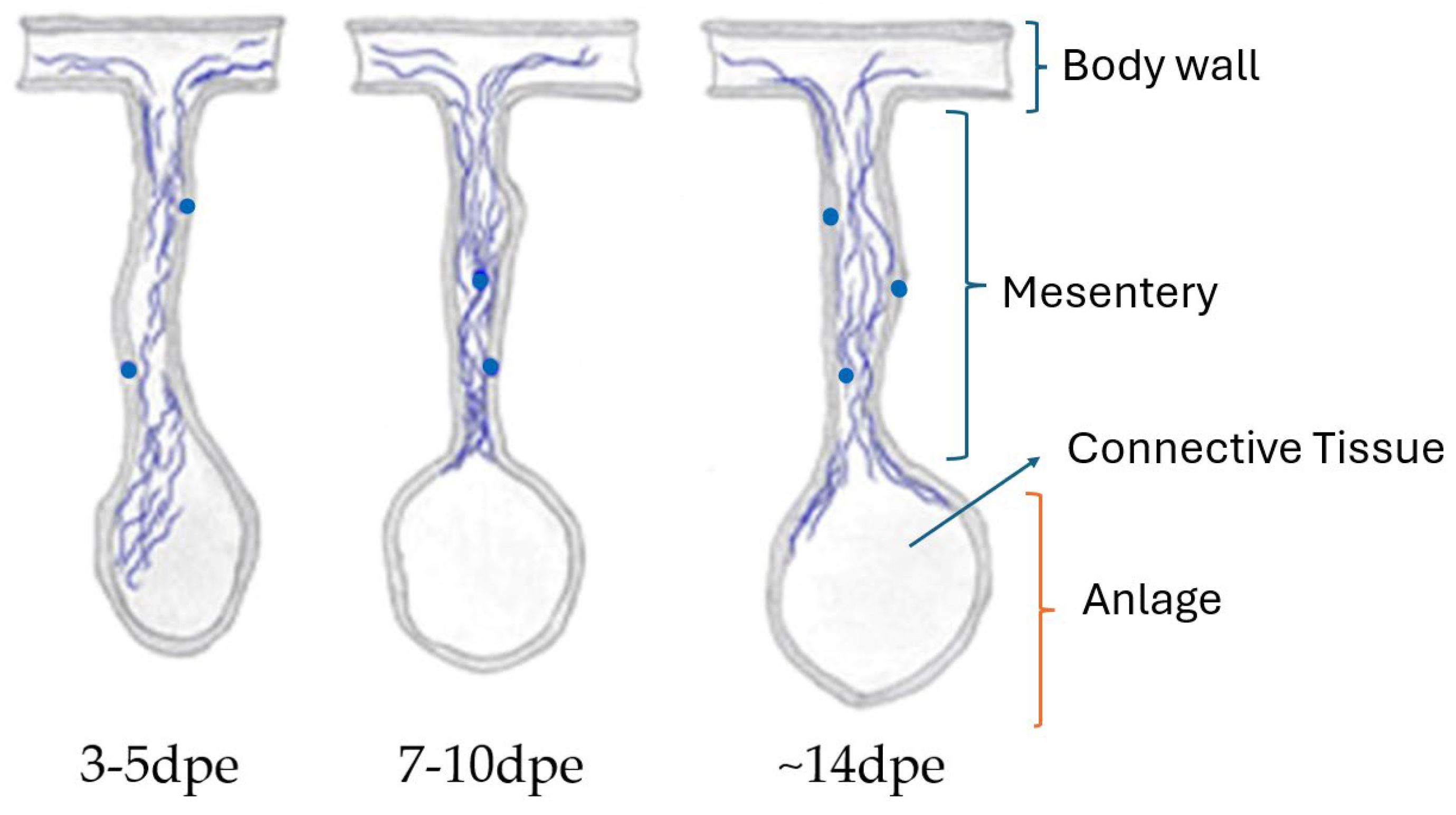
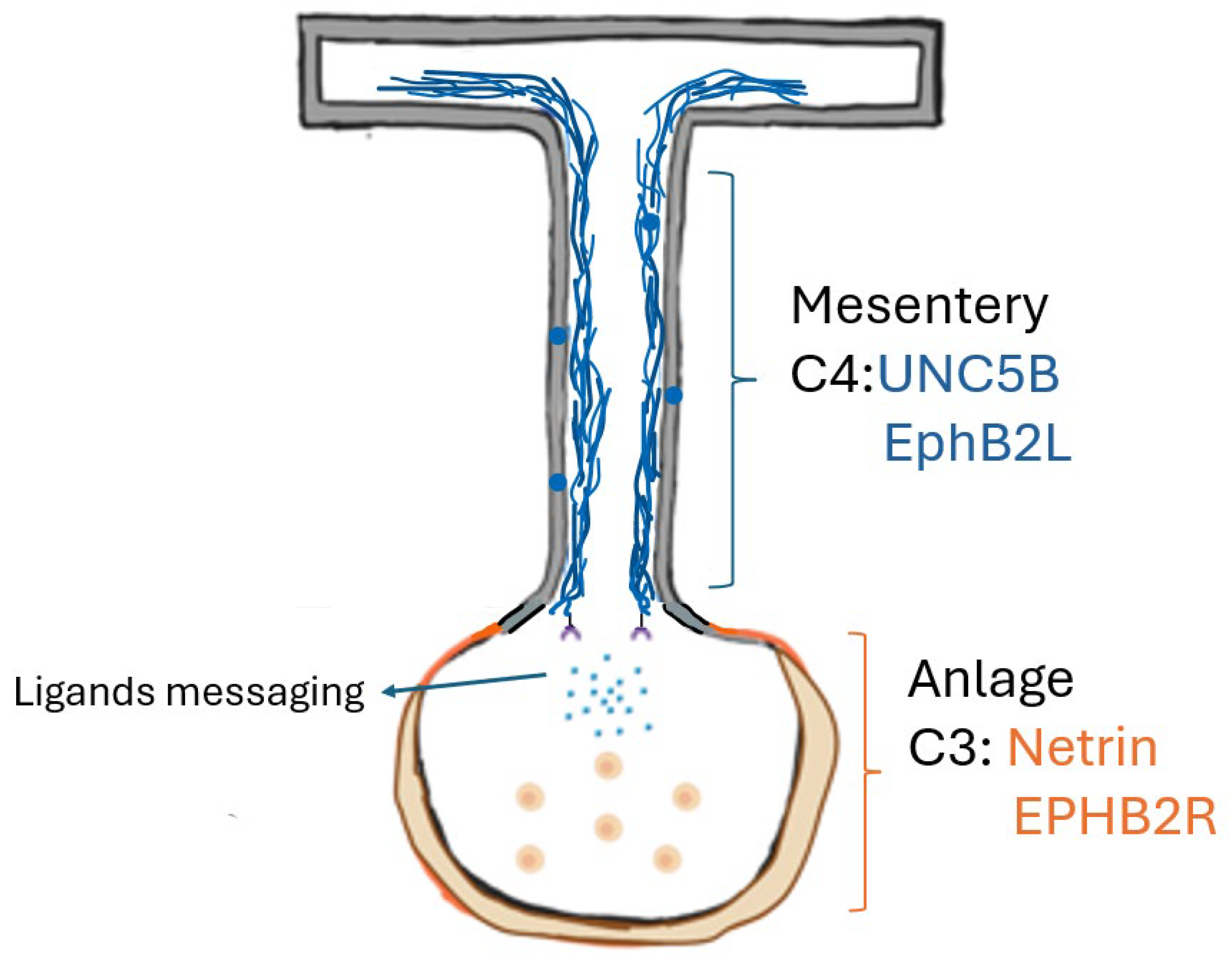
In addition to these regeneration-associated processes, intestinal regeneration also involves re-innervation of the forming intestine by fibers originating from extrinsic and intrinsic neurons [4]. Following evisceration, between 4-dpe and 10-dpe, fibers in the forming anlage are progressively lost at the tip of the mesentery, triggering a retraction of fibers from the forming anlage (Figure 1). This retraction continues to around 10-dpe, where few, if any, fibers are observed within the anlage, but, in contrast, a notable increase in fibers is observed in the mesothelial plexus of the adjacent mesentery. Eventually, these fibers extend into the regenerating anlage, causing massive reinnervation activity around the second week of regeneration (14-dpe stage), restoring the intestinal plexus throughout most of the 21-dpe intestine [13,14,15]. Given the dynamic nature of this process, axonal guidance molecules likely serve as critical mediators in directing fiber movement, necessitating a detailed characterization of isoform-specific expression patterns across these regenerative stages.
Our laboratory has now accrued large amounts of transcriptomic data from specimens at different stages of intestinal regeneration [12,16]. Additionally, we have assembled genomic sequences of H. glaberrima, initially into a draft genome, and more recently into a chromosome-level assembly [17]. In this work, we used our transcriptome data bank to characterize orthologues of axonal guidance molecules in the intestinal (IN) transcriptomes of our animal model. These sequences were also searched and compared to sequences found in transcriptomes of nervous components and in the genome. The transcript sequence and genome location were annotated for each sequence. A total of 29 sequences that pertain to five ligand/receptor groups were identified. Some of these sequences correspond to ones previously described in echinoderms [18,19,20]. Having identified the sequences of interest, we then used them to determine which, if any, were differentially expressed in our RNA-seq transcriptomic data bank [16,17]. Moreover, sequences were also identified in our recently completed scRNA-seq, thus offering a hint of the cell phenotype that expressed them. Since this scRNA-seq corresponds to the stage where extrinsic neurons in the mesentery and elsewhere begin to regrow their fibers into the intestinal anlage, it provided a perfect venue to correlate the transcripts being expressed by different cell populations with the re-innervation event. Thus, we used CellChat programs and prepared prediction patterns between clusters. Together, these findings open the door to a more detailed characterization of the spatial and temporal expression dynamics of the five groups of axonal guidance molecules during intestinal regeneration and lay the groundwork for future experiments aimed at fully elucidating the regeneration process.
In summary, while previous studies of echinoderm intestinal regeneration have largely focused on descriptive transcriptomic profiling of differentially expressed genes, our work moves beyond cataloging to functionally prioritize candidate signaling pathways specifically associated with organ re-innervation. By integrating bulk regeneration transcriptomes with newly available genomic resources and stage-specific single-cell RNA-seq data, we identify, annotate, and map axonal guidance ligand–receptor systems to defined cell populations during the critical window of nerve fiber re-extension. This multi-layered approach enables prediction of cell–cell communication networks linked to the re-innervation process, providing a spatially and temporally resolved framework that has not been achievable in prior transcriptomic studies.

2. Materials and Methods

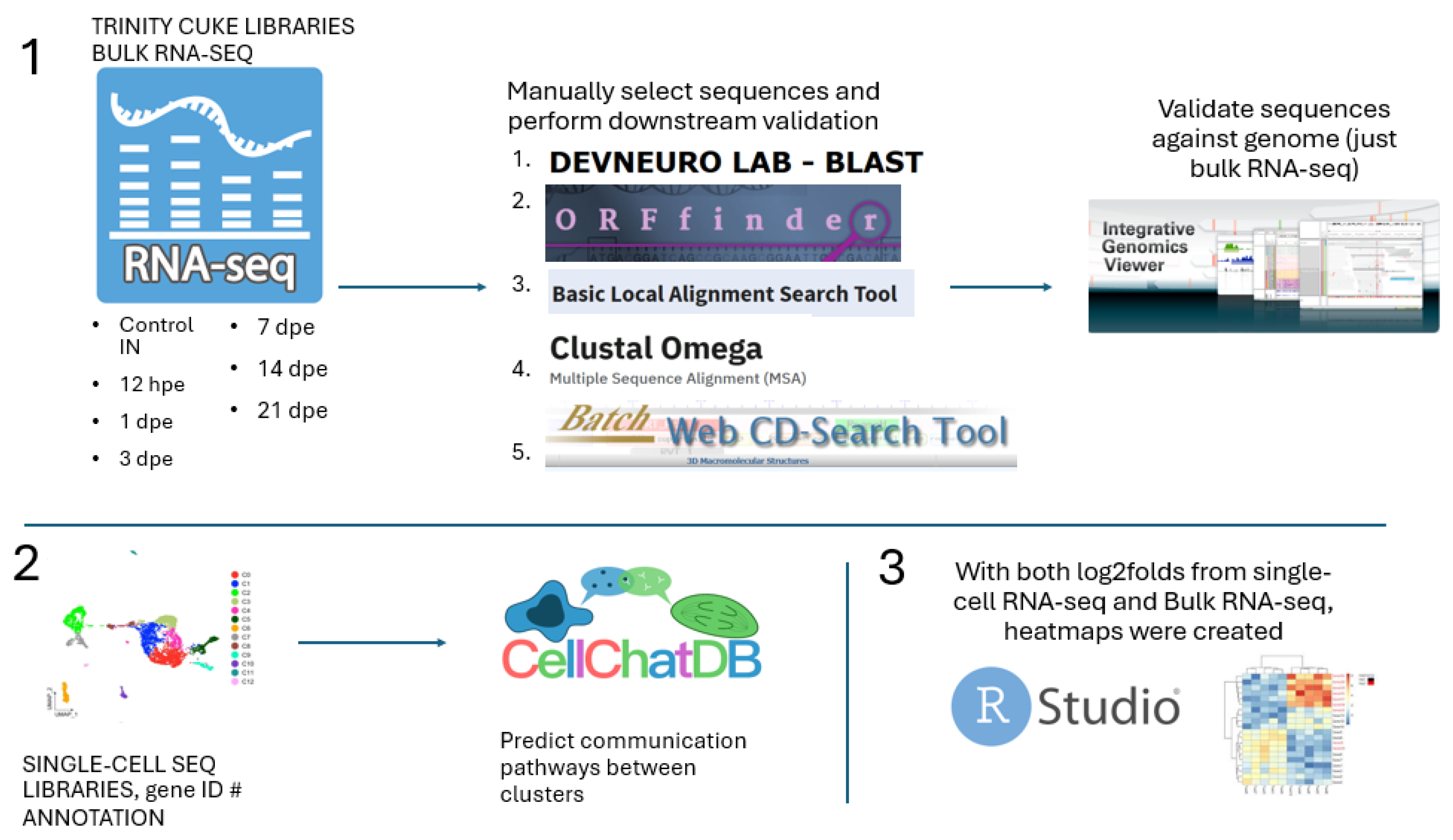
The workflow used for this work is shown in a diagram in Figure 2.

2.1. Transcriptomic Data

Our laboratory has assembled a large dataset of normal and regenerating tissues, particularly intestinal and radial nerve cords. The information on these transcriptomes can be obtained from works by [16] with assembly accession number GIVL00000000 and GEO database differential gene expression data number GSE160340. Additional RNA-seq data for late-stage intestinal regeneration timepoints (7-, 14-, and 21-dpe) were generated and analyzed as described in [12], with differential gene expression analysis methods available at https://github.com/devneurolab/HgWnt2023 (accessed on 11 March 2026). Briefly, transcripts were assembled de novo using Trinity [16]. In this analysis, early regenerative tissues (12 h to 14 days), which consist mainly of mesenterial tissue, were compared to normal (non-eviscerated, non-regenerating) mesenterium. Late regenerating tissues (14–21 days), which already have a luminal epithelium, were compared to normal (non-eviscerated, non-regenerating) large intestine. Fold change levels were set at log2fold change < −2 or > 2 with a pADJ (p-adjusted) value of 0.001, which is a common value used in the field. Differential gene expression log2fold change values for each identified Trinity sequence were annotated in Excel documents (DGE_Cluter_Heatmap_AGM.xlsx) [Heatmap representing the Differential Gene Expression (DGE) of Axonal Guidance Molecules (AGM)]. All transcriptomic data published for the RNC are found in the SRA051990 and our portal https://blastkit.hpcf.upr.edu/hglaberrima-v1 (accessed on 11 March 2026) [18,21].

2.2. Transcriptome Mining

Query sequences from vertebrates (H. sapiens, M. musculus, R. norvegicus) and echinoderms (S. purpuratus, H. scabra, H. leucopsilota, A. japonicus) were inserted into the query box in the viroBLAST program created by [22]. For all cases, the tblastn selection method and the TRINITYcuke libraries were chosen for both the intestine transcriptome from 2022 and the radial nerve cord transcriptome. For tblastn searches, an initial E-value threshold of 1 × 10⁻¹⁰ was applied to ensure statistical significance while capturing divergent homologs. Hits were filtered for a minimum query coverage of 60% and a bit score of 50 or higher. We also selected only the highest-scoring segment pair (HSP) per Trinity locus (gene level). Trinity contigs were then processed with the Open Reading Frame (ORF) Finder from NCBI [23] to extract the open reading frame. Parameters were set to read only ATG start codons, and the longest open reading frame was selected to obtain the protein sequence. ORFs with at least 100 amino acids were retained for final analysis. Protein sequences were submitted to BLASTp in NCBI, where the top 5 closest sequences were selected, as well as sequences from D. rerio, H. sapiens, M. musculus, and R. norvegicus.

2.3. Multiple Sequence Alignment and Domain Analysis

Using the NCBI BLASTp feature, sequences were compared qualitatively with each other to determine complete sequences. Sequences that shared the protein name and were found to be different between the intestine and the radial nerve cord were compared using Clustal Omega [24] and visualized using GeneDoc v2.7. Positive values of hit sequence scores were annotated. Once regions were identified, sequences were fed to NCBI Batch CD Domain Analysis [25] to identify the conserved regions. Differences between sequences extracted from the intestinal and radial nerve cord transcriptomes were aligned and compared.

2.4. Genome Mining

Nucleotide sequences were searched in the BLASTn program of the draft genome Hglab_hic_2023_v4_final.wMito.fasta. Data can be accessed at the following location: SRR9695030 (https://www.ncbi.nlm.nih.gov/sra/?term=SRR9695030, accessed on 11 March 2026) [17]. The de novo genome assembly was generated with Platanus and independently verified for genome completeness using BUSCO, as detailed in [17]. Sequences with greater than 95% identity and 90% coverage were retained for downstream analyses. These sequences were localized to the H. glaberrima scaffold. The scaffold name was annotated, and we used the IGV (Integrated Genomes Viewer) tool (Broad Institute, Cambridge, MA, USA) v2.19.0 [26] to verify the regions that matched the BLASTn in the search toolbar. Braker, FASTA and FASTA index files were used to annotate genes and validate molecular differences.

2.5. Single-Cell Sequencing Analysis for CellChat

Single-cell RNA-seq data from 9-dpe intestinal tissue were used as reference for analysis, obtained from work by Medina-Feliciano et al. (2025) [27]. The sequencing data were made publicly available via the Figshare repository as described in the eLife Data Availability statement, including both raw and processed scRNA-seq reads [27]. The original publication did not deposit these raw reads into the NCBI Sequence Read Archive (SRA) or list an SRA BioProject accession. In this work, cell populations were sorted into 13 clusters, including coelomocyte populations (C6, C10, C11, C12), mesenchymal cells (C2, C7), proliferating cells (C8), muscle precursors (C5), neuroepithelial cells (C9), differentiating coelomic epithelial cells (C4), and precursor populations (C0, C1, C3). NCBI BLAST v2.17.0 was performed between TRINITY (bulk RNA-seq transcriptomes) and the single-cell seq FASTA to further determine the best matches. To determine the level of significant overexpression/underexpression, the cutoff point was set to x ≥ 1.0 and x ≤ −1.0 log2fold expression. Annotated sequences were then aggregated into Excel files with clusters as columns, genes as rows and log2folds per cluster/gene (Heatmap_SC_9dpe_mod.xlsx). CellChat v2 (https://github.com/jinworks/CellChat, accessed on 11 March 2026) [28] analysis was utilized with human genome annotations (CellChatDB v2) to better visualize cell–cell communication relationships between identified cell populations.

2.6. Statistics

The Excel files (Microsoft Corporation, Redmond, WA, USA) storing heatmap data for both bulk and single-cell RNA-seq data were converted to matrices or tables for heatmap or pheatmap analysis in MATLAB R2023a and RStudio version 4.4.1 (Posit, BC, Boston, MA, USA), respectively. In MATLAB (Mathworks, Natick, MA, USA), the function heatmap was used with a custom color template, and in RStudio, the function pheatmap was used with a modified red-white-blue color template.

3. Results

We present the results of our analysis by describing the identified components of the ligand–receptor groups, characterizing their sequence similarity to orthologs of other species, providing evidence for the existence of gene-splicing isoforms and describing their intron/exon sequences in the genome. Twenty-nine [29] sequences, representing five [5] ligand/receptor groups, were identified.
These groups are Group 1—Netrin/Netrin receptors UNC5 and DSCAM (Down Syndrome Cell Adhesion Molecule), Group 2—Ephrin ligand/Ephrin receptors, Group 3—Semaphorin/Semaphorin receptor Plexin, Group 4—RGMα/RGMα receptor Neogenin, and Group 5—SLIT/SLIT receptor ROBO (Roundabout Guidance Receptor). In some cases, the transcriptome-derived sequence was not complete. Nonetheless, in these cases, the obtained sequence was long enough so that it could be verified from the genome, and/or its similarity to other transcriptomic sequences could be determined. In addition, most sequences present motifs for binding sites with their respective receptors, and GTPase or phosphorylating capabilities, reflective of their respective receptors/ligands. Table 1 presents the ligand–receptor groups found, providing information on their origin, length, domain presence, possible variants, and exon structure.

3.1. Netrin, UNC5 and DSCAM Sequences

3.1.1. Netrin

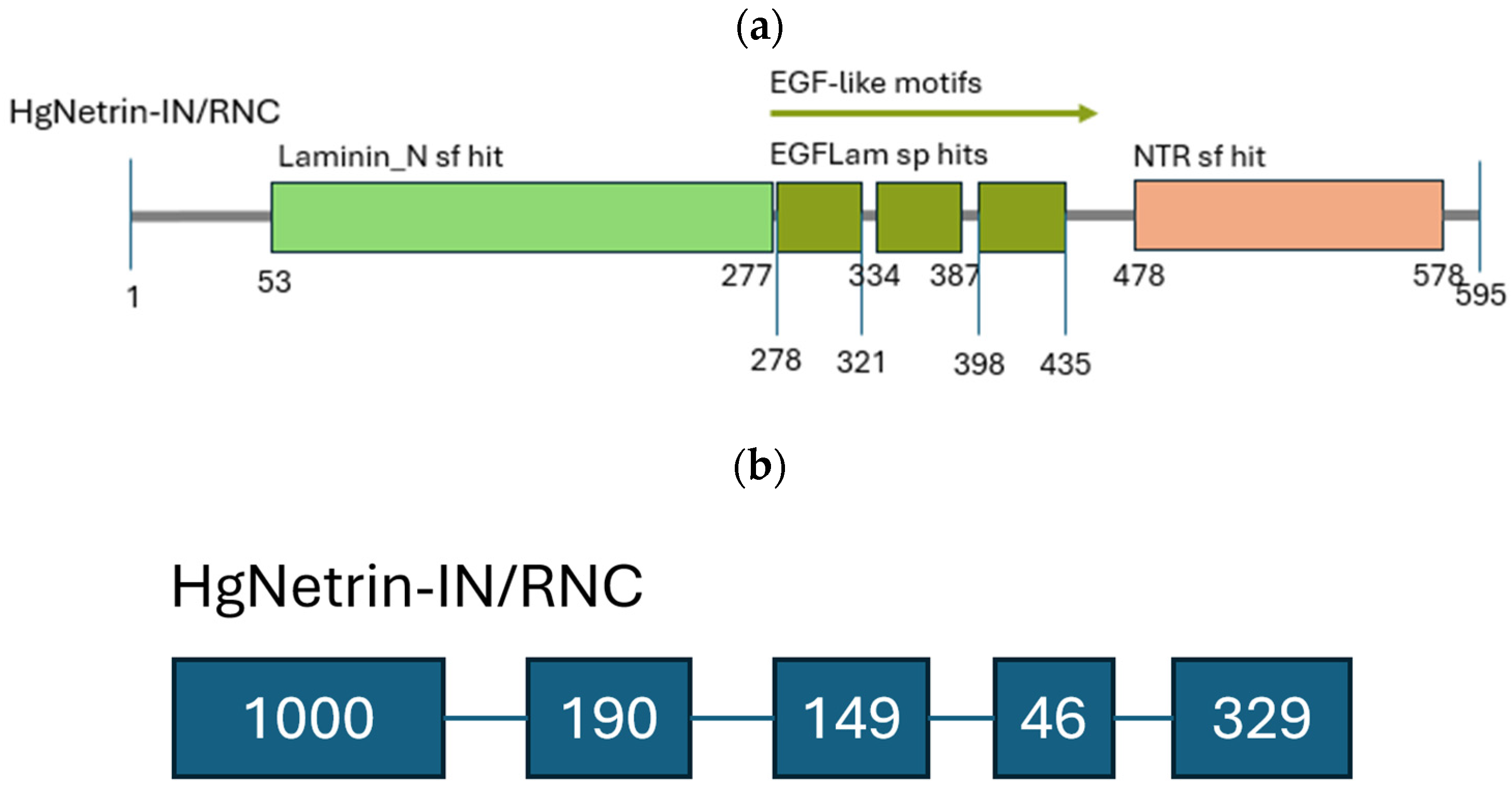
One sequence encoding putative netrin-1 (HgNetrin-IN/RNC) was identified in both the intestinal (IN) and radial nerve cord (RNC) transcriptomes (Figure S1). A correlation matrix demonstrates that the HgNetrin-IN/RNC sequence shares 90.7% identity with the netrin-1 from H. leucospilota. The HgNetrin-IN/RNC shows one superfamily hit for a large Laminin domain near the N-terminal region, three specific hits for EGF domains and an NTR superfamily hit near the C-terminal region (Figure 3). This sequence was found in the genome in scaffold #7 (Figure 3). Although the HgNetrin-IN/RNC shows high similarity to the netrin-1 from H. leucospilota, it is 4 aa larger and has one fewer exon compared to the H. leucospilota gene (Figure S1).

3.1.2. UNC5

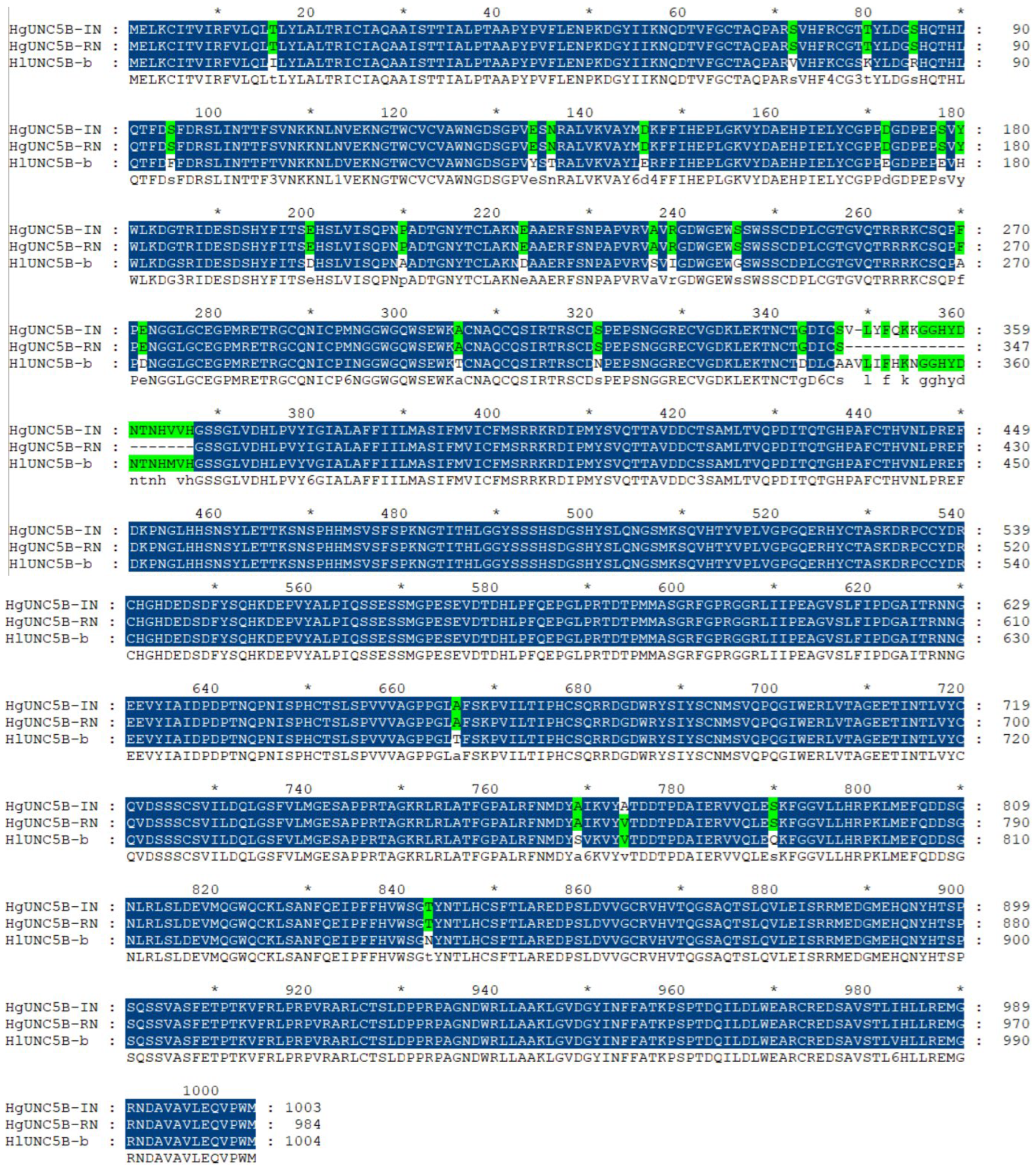
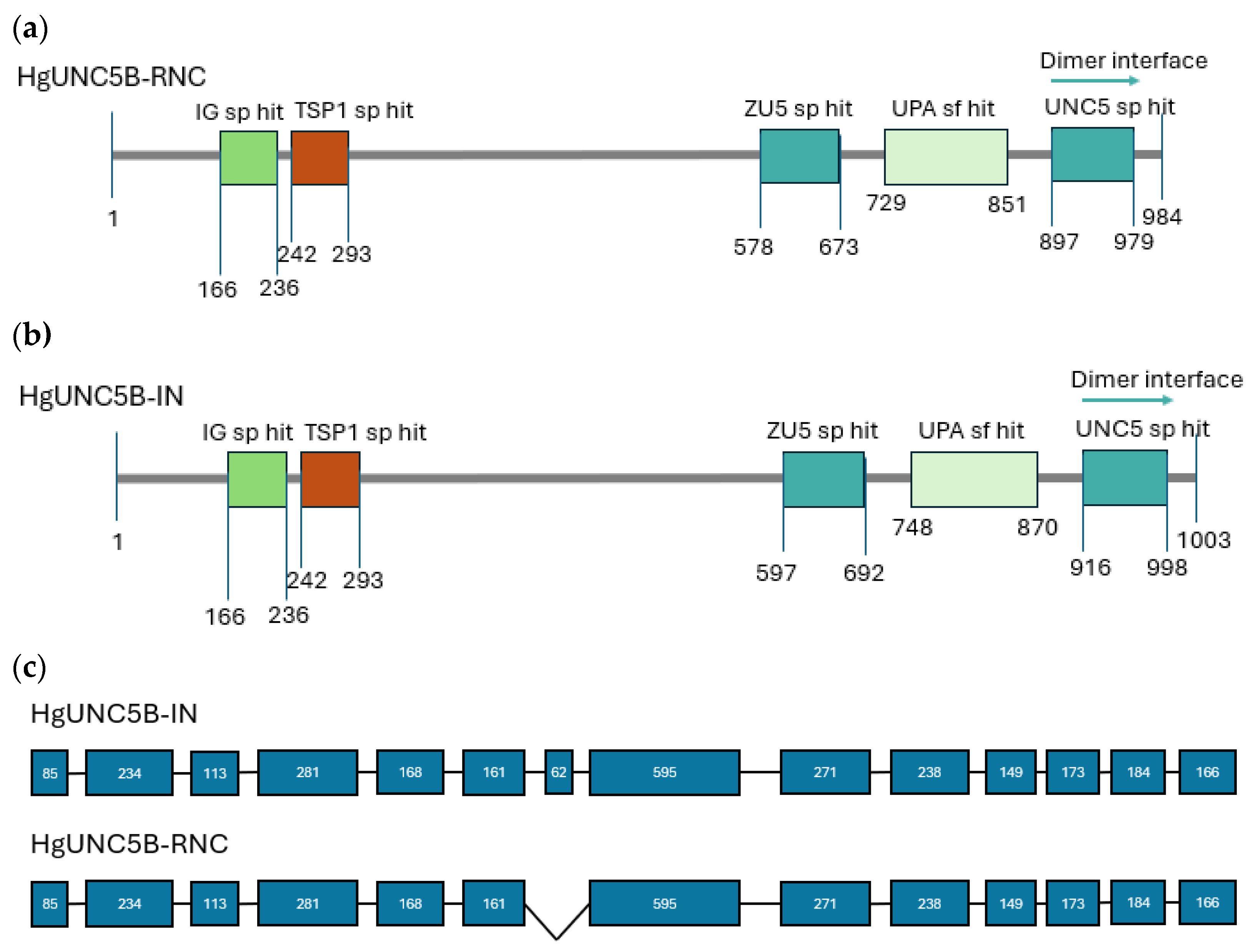
Two sequences were identified as possible unc-5 netrin receptor B (UNC5B). One sequence was only found in the IN transcriptome, while the other was only found in the RNC transcriptome. HgUNC5B-RNC scores a 95.9% identity, while HgUNC5B-IN scores 95.5% identity with the UNC5B from H. leucospilota (Figure S2). The difference between the two sequences is due to a putative alternative splicing event where HgUNC5B-RNC lacks a 20 aa region found in HgUNC5B-IN (Figure 4). Both sequences show hits for one Immunoglobulin-2 domain, thrombospondin type 1 repeat near the N-terminal region and one ZU5 domain found in netrin receptors, one conserved UPA domain with beta-sandwich structure, and one death UNC5 domain with a dimer interface near the C-terminal region (Figure 5a).
As expected, both HgUNC5B-IN and HgUNC5B-RNC were localized to the same site in genome scaffold #21. One additional exon was identified in the HgUNC5B-IN compared to the HgUNC5B-RNC. Our largest sequence, HgUNC5B-IN, has 14 exons compared to HlUNC5B [KAJ8023071.1], which has 15 identified exons (Figure 5b).

3.1.3. DSCAM

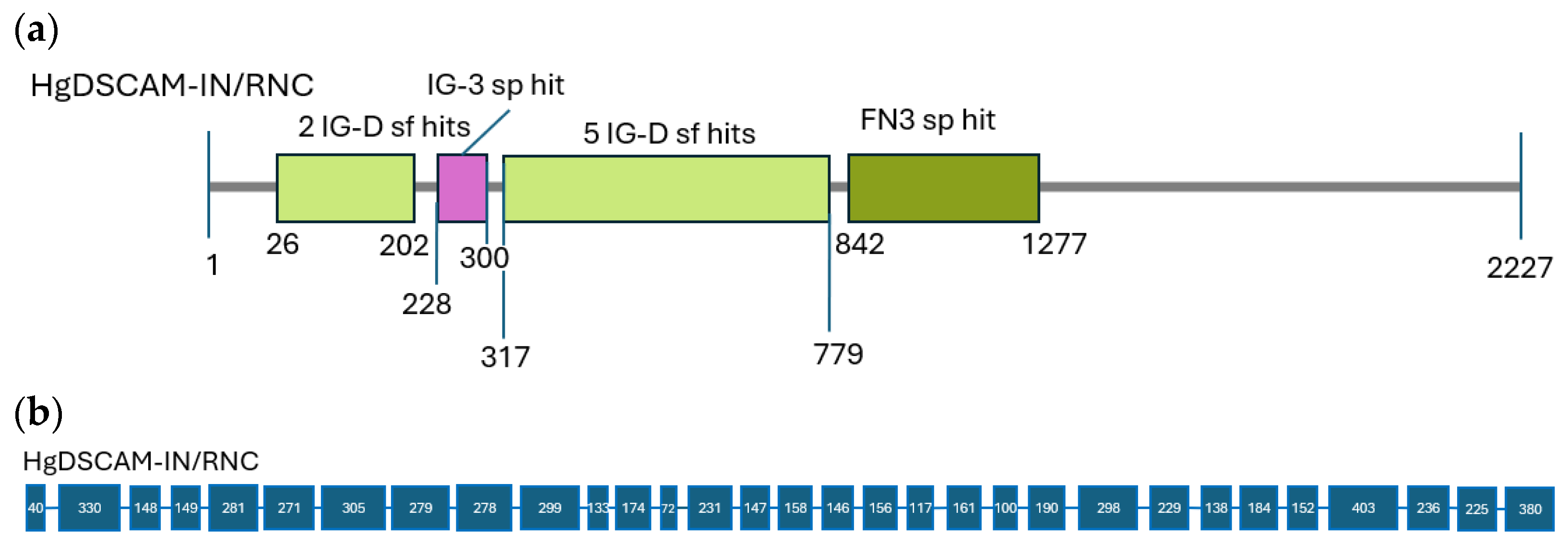
One sequence encoding putative Down Syndrome cell adhesion molecule (DSCAM) was found both in the IN and RNC transcriptomes. The sequence demonstrates overall high similarity (95.2%) when aligned with H. leucospilota DSCAM (Figure S3). The HgDSCAM-IN/RNC shows two Immunoglobulin-D hits, three Immunoglobulin-3 hits in between, and five Immunoglobulin-D hits near the N-terminal region. Near the middle of the sequence, specific hits were found for a large 435 amino acid fibronectin-3 domain (Figure 6a). HgDSCAM was found in genome scaffold #2. HgDSCAM-IN/RNC has 32 exons, the same number as that from H. leucospilota [KAJ8034760.1] (Figure 6b).

3.2. Ephrin Ligand and Ephrin Receptor Sequences

3.2.1. Ephrin Ligand

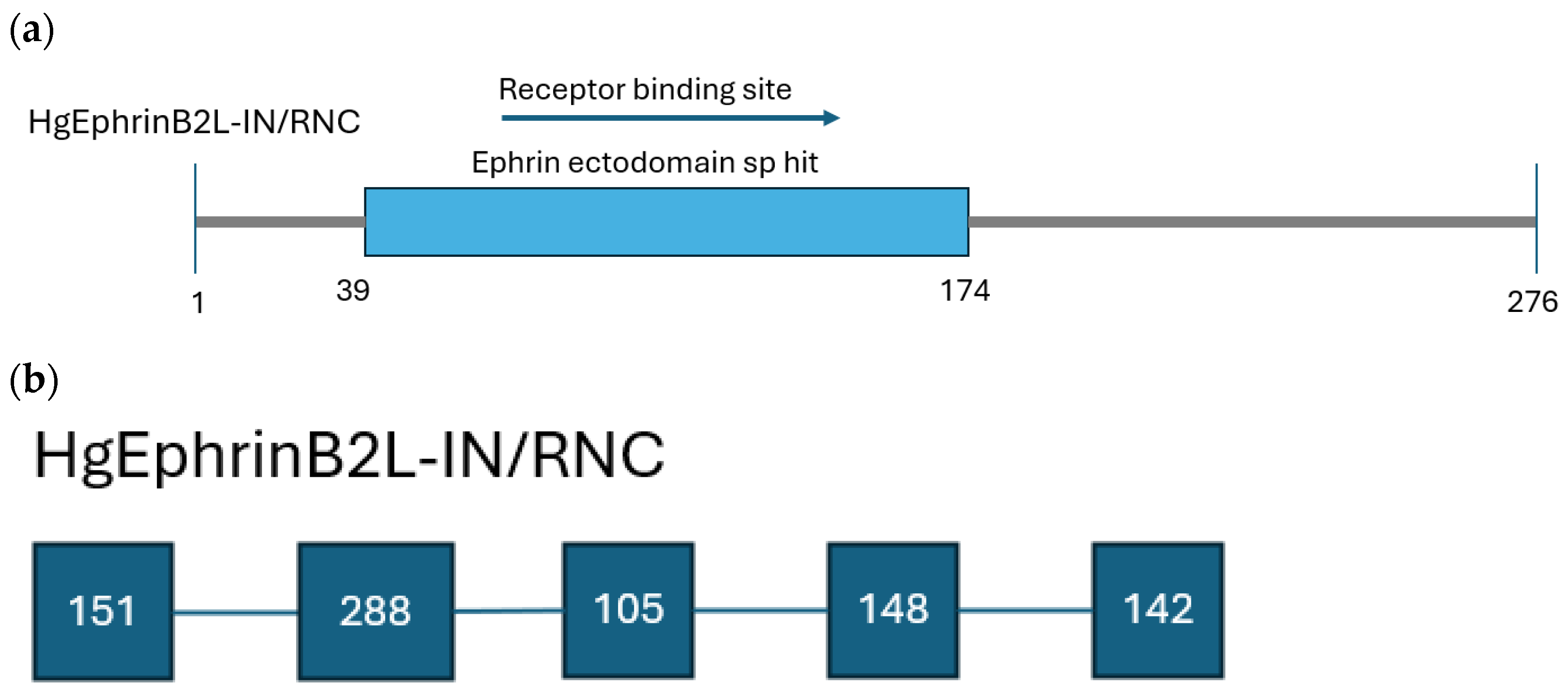
One sequence encoding putative ephrin ligand (EphrinB2L) was identified in both the IN and RNC transcriptomes. A correlation matrix demonstrates that HgEphrinB2L-IN/RNC has 92.4% identity with H. leucospilota EphrinB2L (Figure S4). The sequence shows hits for the Ephrin-ectodomain and one receptor-binding site (Figure 7a). It was found in genome scaffold #5 and possesses five exons, similar to HlEphrinB2L [KAJ8048855.1] (Figure 7b).

3.2.2. Ephrin Receptor

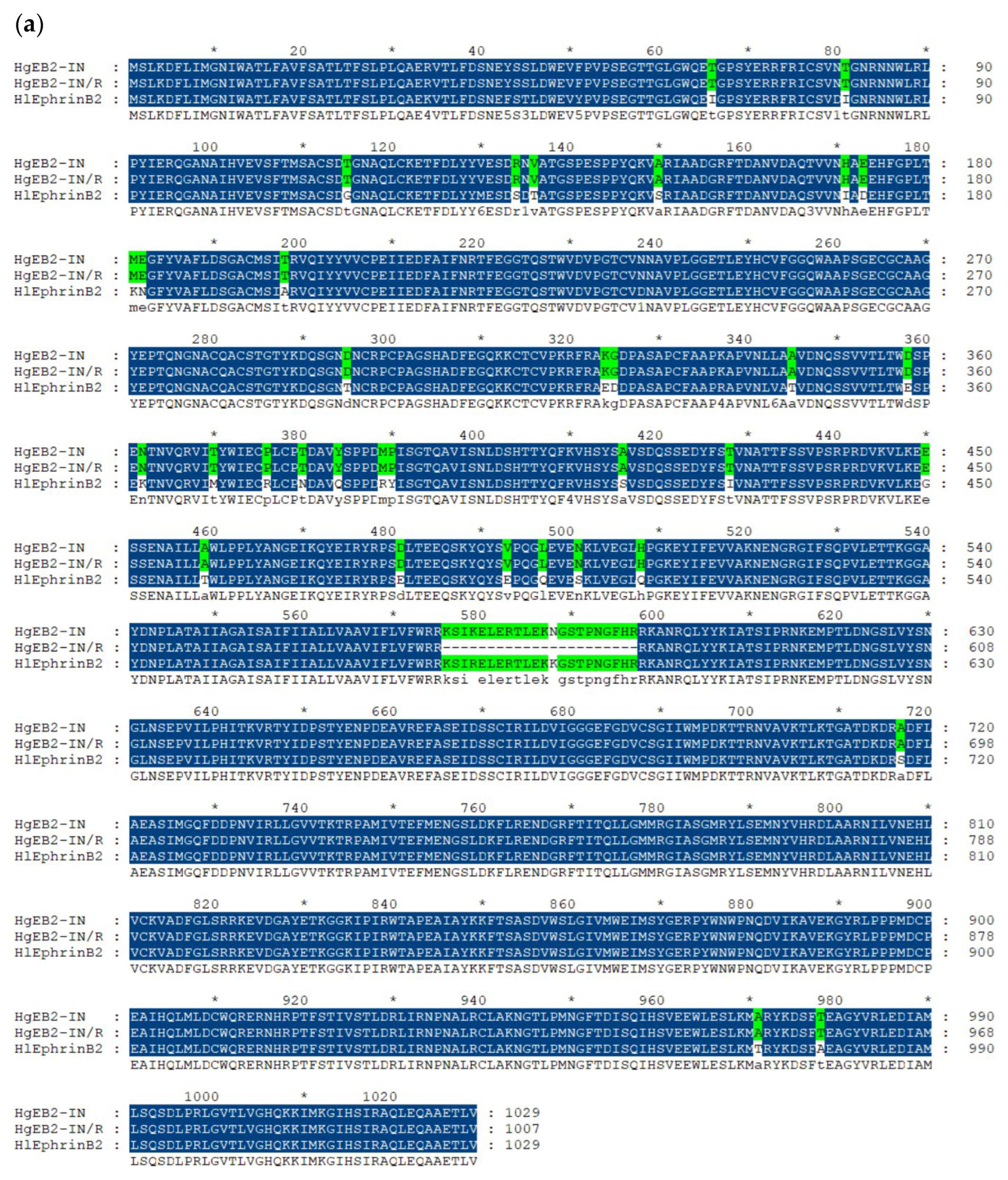
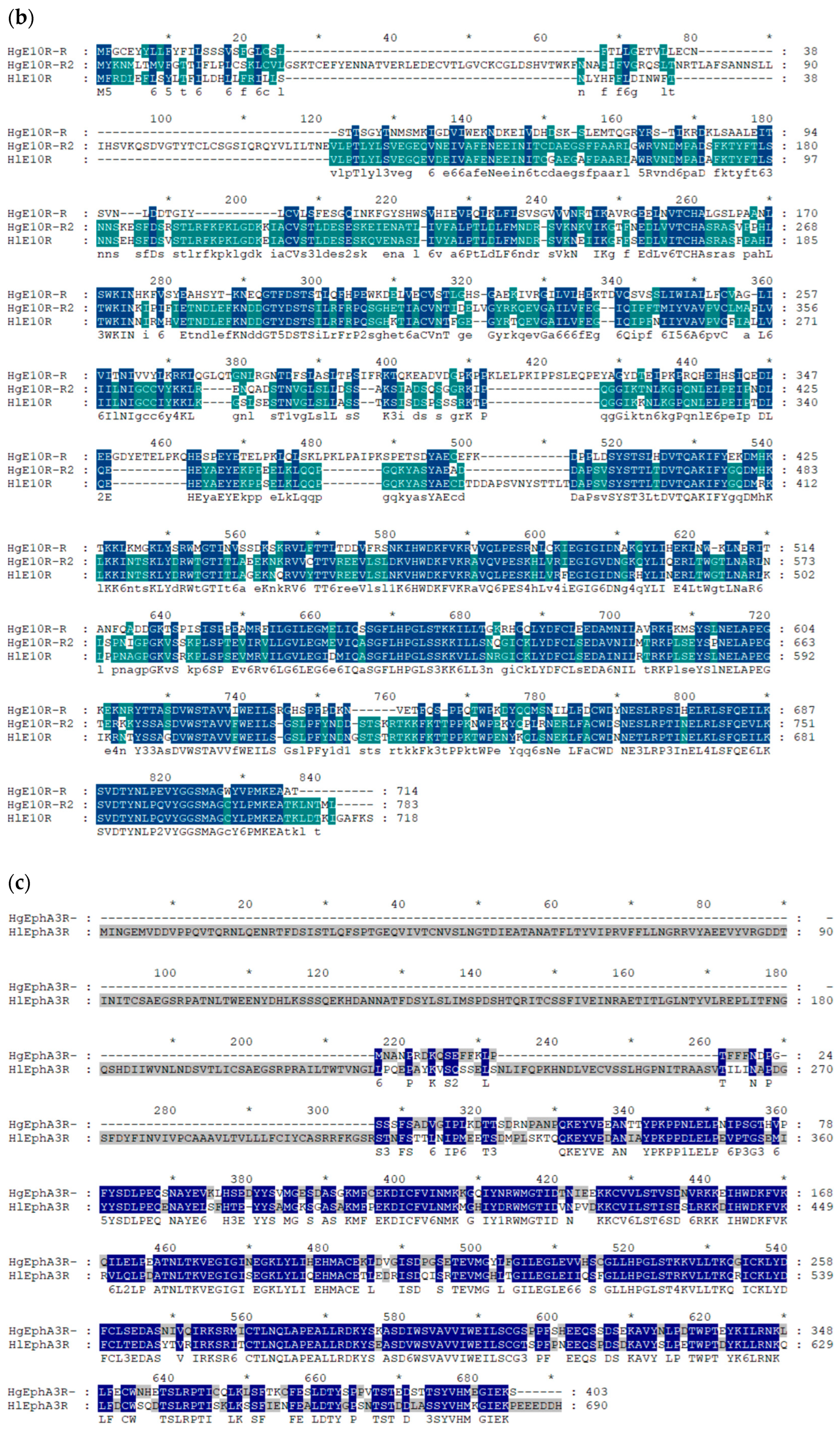
Five sequences were identified as possible ephrin receptors. Two of these showed similarities to EphrinB2R, one was similar to EphrinA3R, one was similar to EphrinA10R and one was similar to EphrinA1R. One of the EphrinB2R sequences was found in the IN transcriptome (HgEphrinB2R-IN), and the other was found in both transcriptomes (HgEphrinB2R-IN/RNC) (Figure 8a). Sequences for EphrinA10R were found only in the RNC transcriptome (HgEphrinA10R-RNC and HgEphrinA10R-RNC2) (Figure 8b), and a sequence for EphrinA3 was only found in the IN transcriptome (HgEphrinA3R-IN) (Figure 8c).
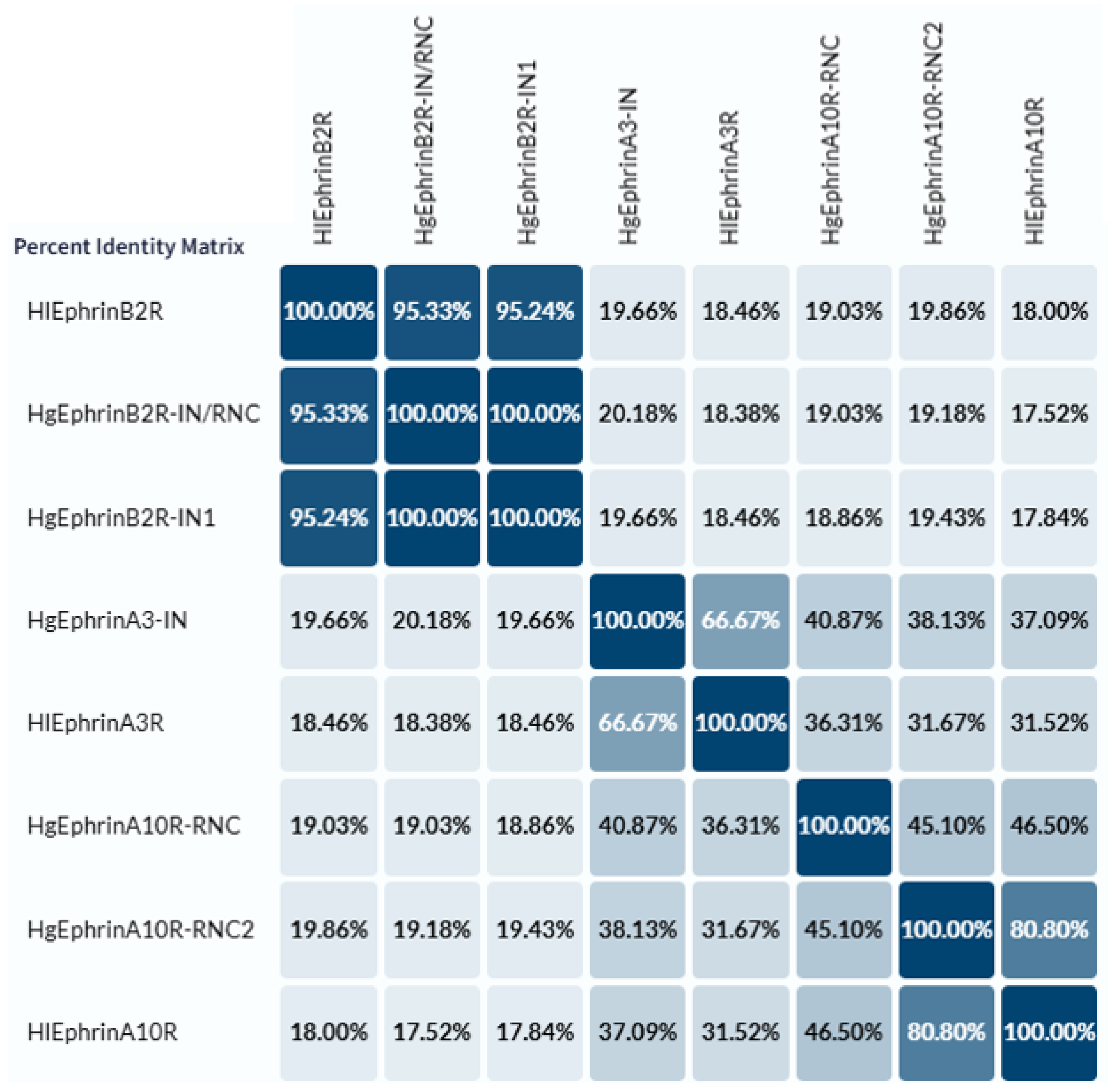
HgEphrinB2R-IN/RNC scores 95.3% identity with the EphrinB2R from H. leucospilota. HgEphrinA3R-IN also scores the highest identity percentage with EphrinA3R from H. leucospilota (66.7%) compared to all other sequences. EphrinA10R-RNC2 scores 80.8% identity with the EphrinA10R from H. leucospilota (Figure 9). One putative alternative splicing event was detected with EphrinB2R sequences, with HgEphrinB2R-IN/RNC missing a 22 aa region when compared to HgEphrinB2R-IN (Figure 8a).
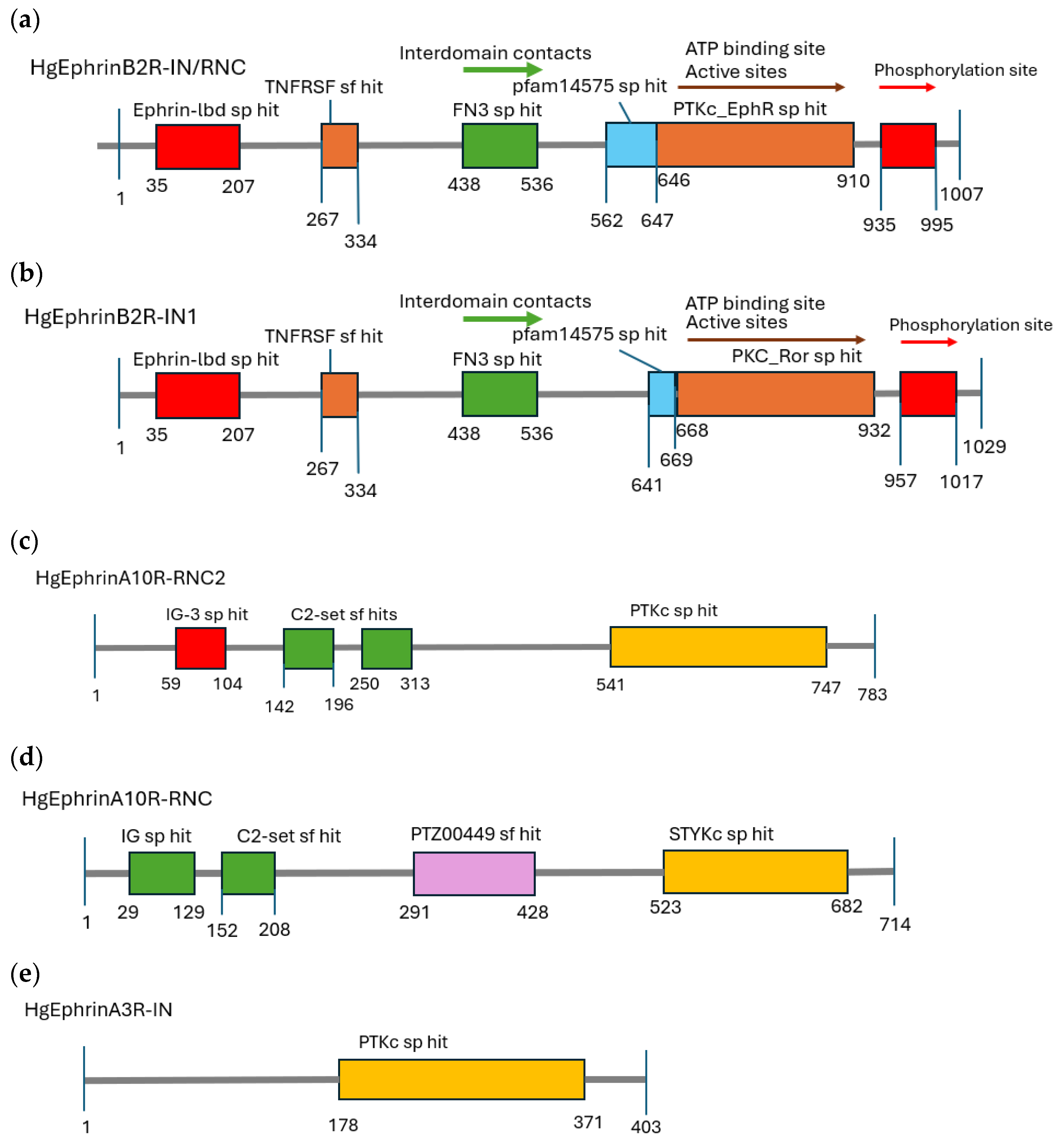
HgEphrinB2R-IN/RNC shows hits for an Ephrin receptor ligand-binding domain, a tyrosine-protein kinase ephrin A/B domain, two fibronectin-3 domains, one interdomain contact, two cytokine receptor motifs near the N-terminal regions and EphrinA2R transmembrane domain, an ATP binding site, a polypeptide substrate binding site, an activation loop, an active site, a protein kinase catalytic domain with serine-threonine-rich regions, one putative phosphorylation site and a SAM domain near the C-terminal region (Figure 10a). HgEphrinB2R-IN shows very similar domain hits to the HgEphrinB2R-IN/RNC sequence, where the difference is that the EphrinA2R transmembrane domain is much shorter in length compared to the domain found in HgEphrinB2R-IN/RNC (Figure 10b). HgEphrinA10R-RNC2 shows hits for one Immunoglobulin-3 domain, one second immunoglobulin of nectin molecules domain, two CD-80 C2 domains near the N-terminal region and a protein kinase with serine-threonine-rich regions domain near the C-terminal region of the sequence (Figure 10c). HgEphrinA10R-RNC shows hits for one immunoglobulin variable domain of T-cell receptor, one second immunoglobulin of nectin molecules domain, one 104 kDa microneme/rhoptry antigen domain near the N-terminal region and protein kinase with protein tyrosine serine-threonine-rich regions near the C-terminal region (Figure 10d). HgEphrinA3R-IN lacks most of the same domains near the N-terminal region that the other ephrin sequences have; however, it shows hits for protein kinases with protein tyrosine serine-threonine-rich regions (Figure 10e).
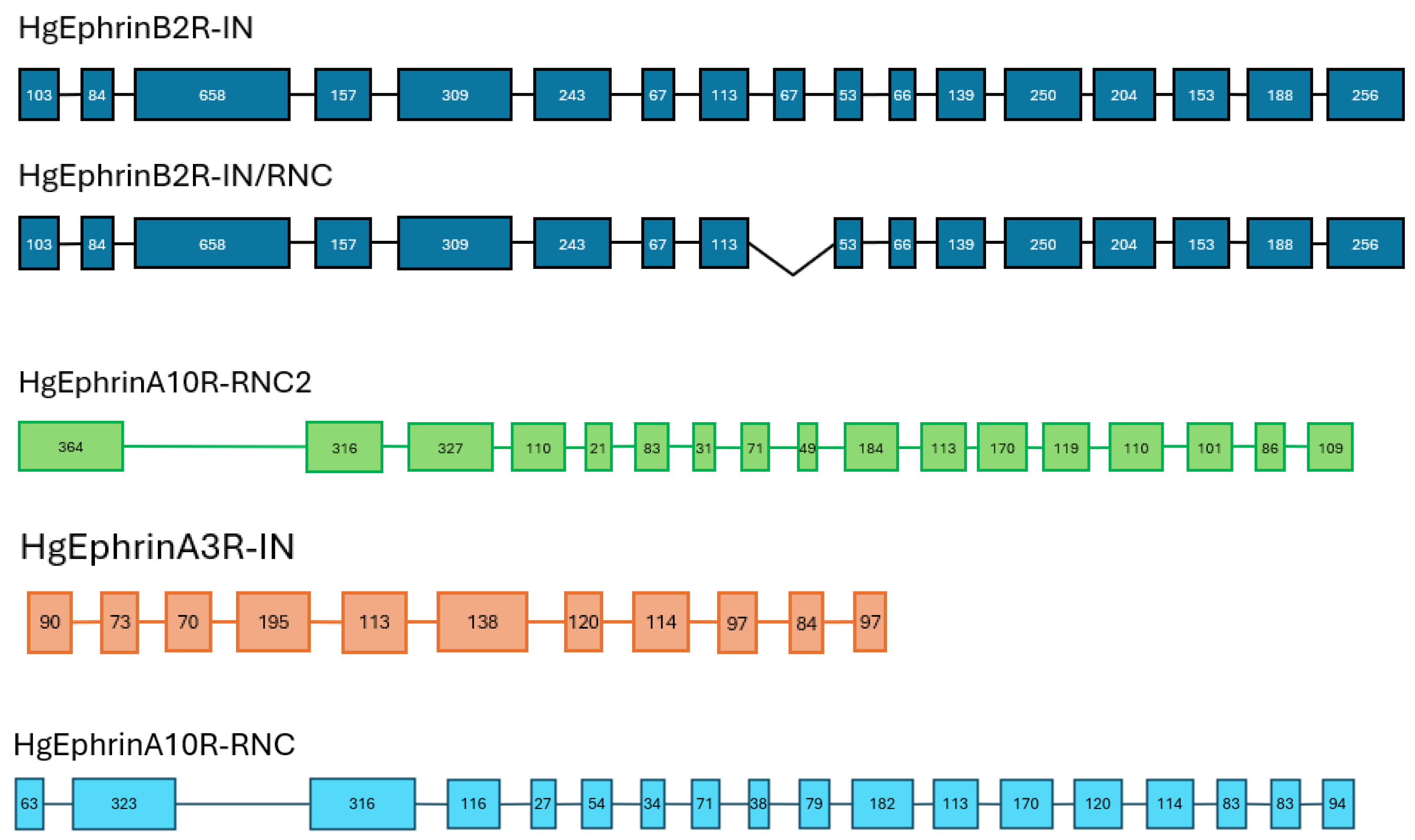
HgEphrinB2R-IN and HgEphrinB2R-IN/RNC were both found in the same location in genome scaffold #1, HgEphrinA10R-RNC was found in genome scaffold #4, HgEphrinA10R-RNC2 was found in genome scaffold #21, and HgEphrinA3R-IN was found in genome scaffold #17. HgEphrinB2R-IN/RNC has one fewer exon [16] compared with HgEphrinB2R-IN [17], with HgEphrinB2R-IN having the same number of exons as HlEphrinB2R [KAJ8021805.1]. HgEphrinA10R-RNC with 19 exons and HgEphrinA10R-RNC2 with 17 exons are much larger than HlEphrinA10R’s [KAJ8022495.1] sequence (16 exons). HgEphrinA3R-IN has 11 exons compared to the larger sequence HlEphrinA3, which has 16 exons [KAJ8044287.1] (Figure 11).

3.3. Semaphorin and Plexin Sequences

3.3.1. Semaphorins

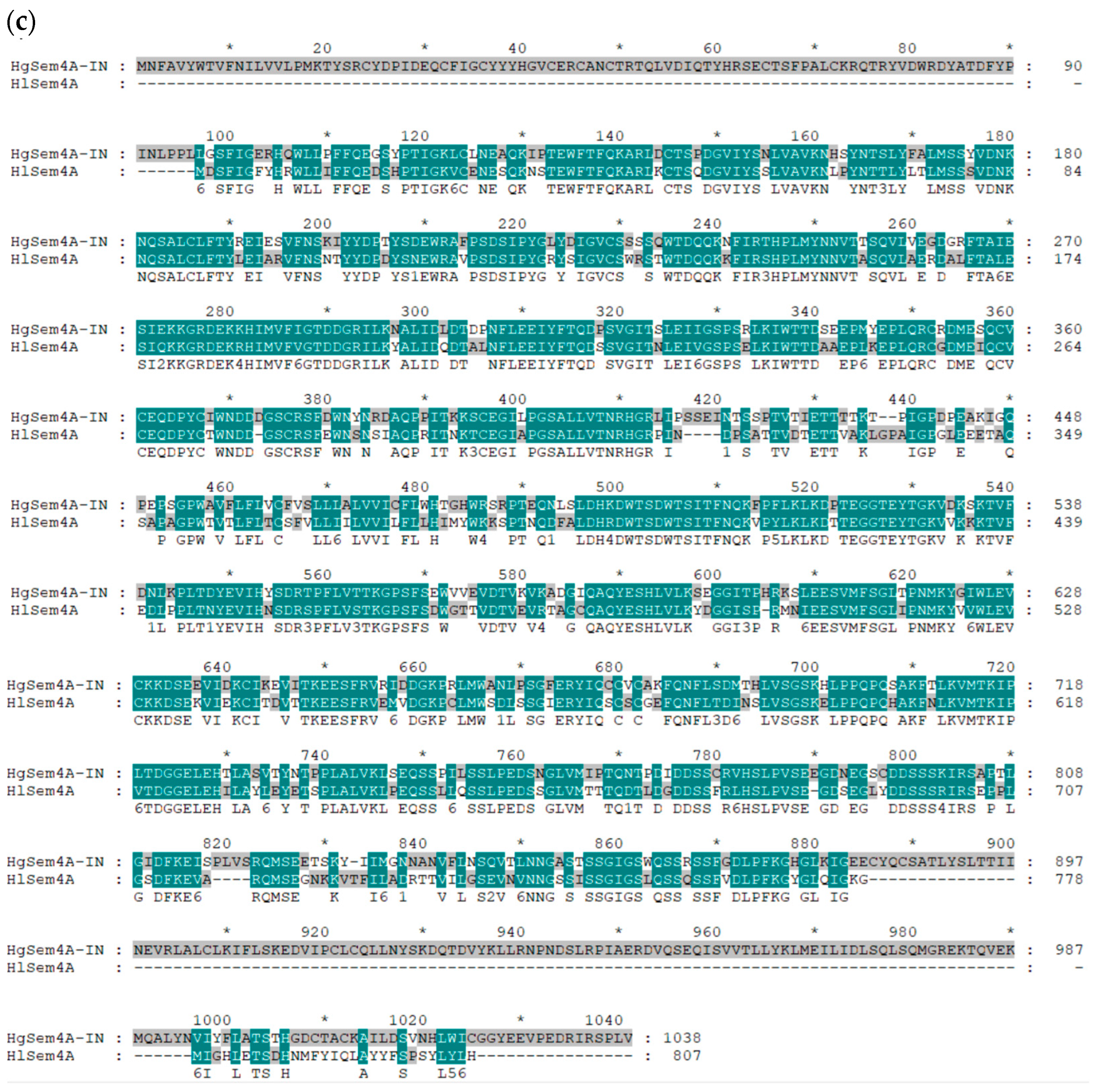
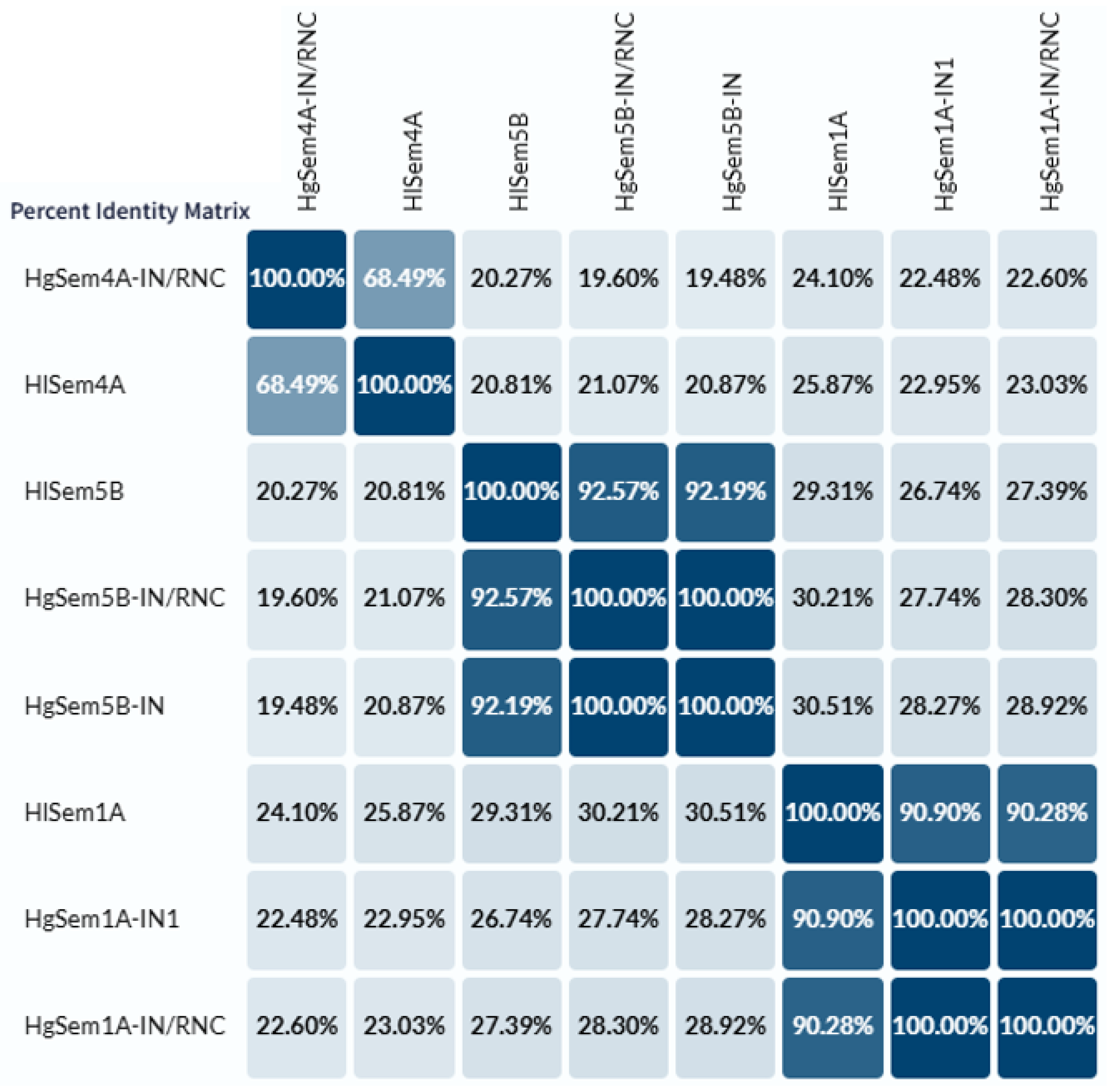
Five distinct sequences encoding putative semaphorins were identified in our transcriptome database (Figure 12). Three of these (HgSem5B-IN/RNC, HgSem1A-IN/RNC and HgSem4A-IN/RNC) were found in both the IN and RNC and two (HgSem1A-IN1 and HgSem5B-IN) were found only in the IN transcriptome. A correlation matrix demonstrates that HgSem5B-IN/RNC scores 92.6% identity with the Sem5B from H. leucospilota. HgSem1A-IN1 scores 90.9% identity with Sem1A from H. leucospilota. HgSem4A-IN/RNC scores 68.5% identity with Sem4A from H. leucospilota (Figure 13).
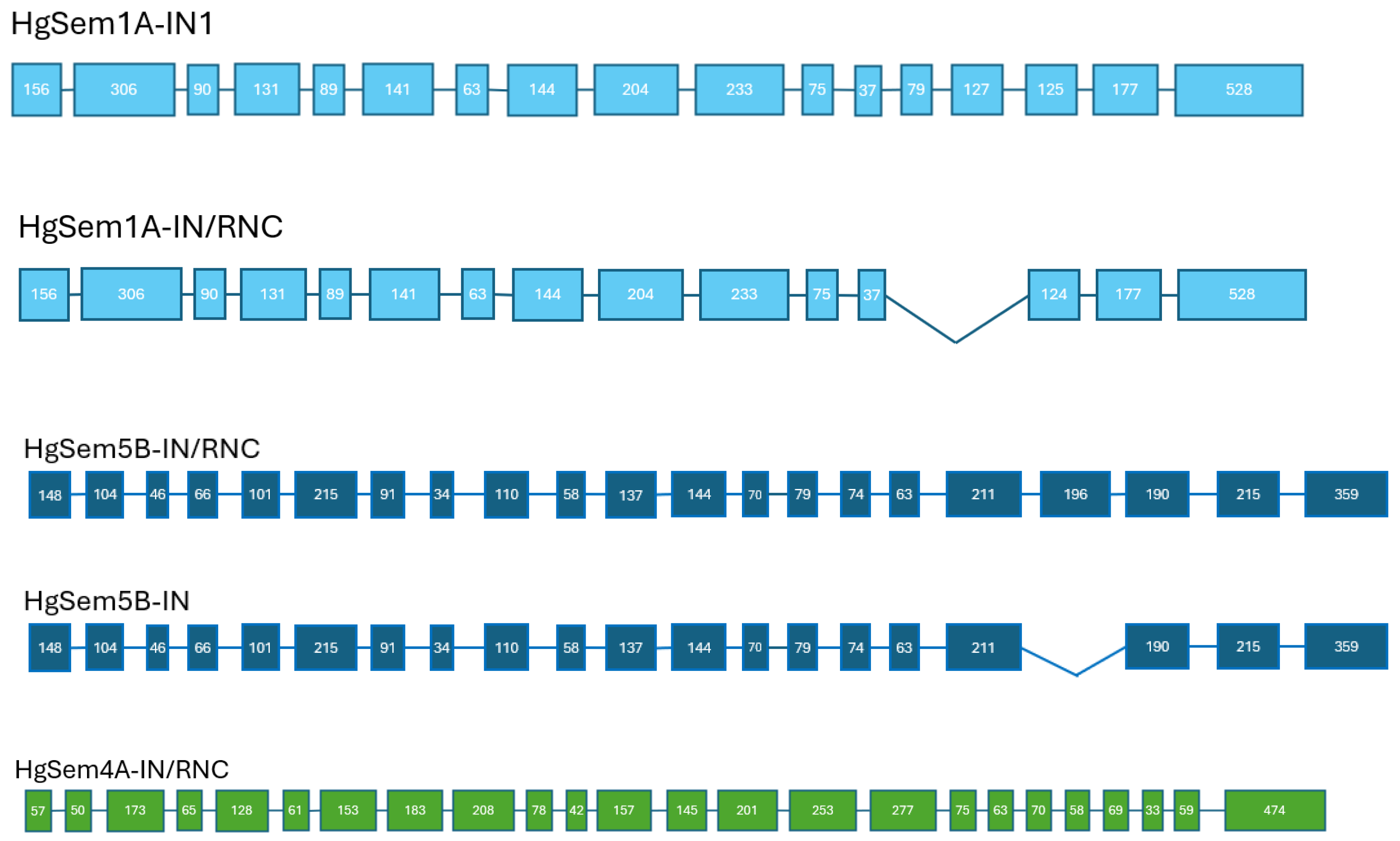
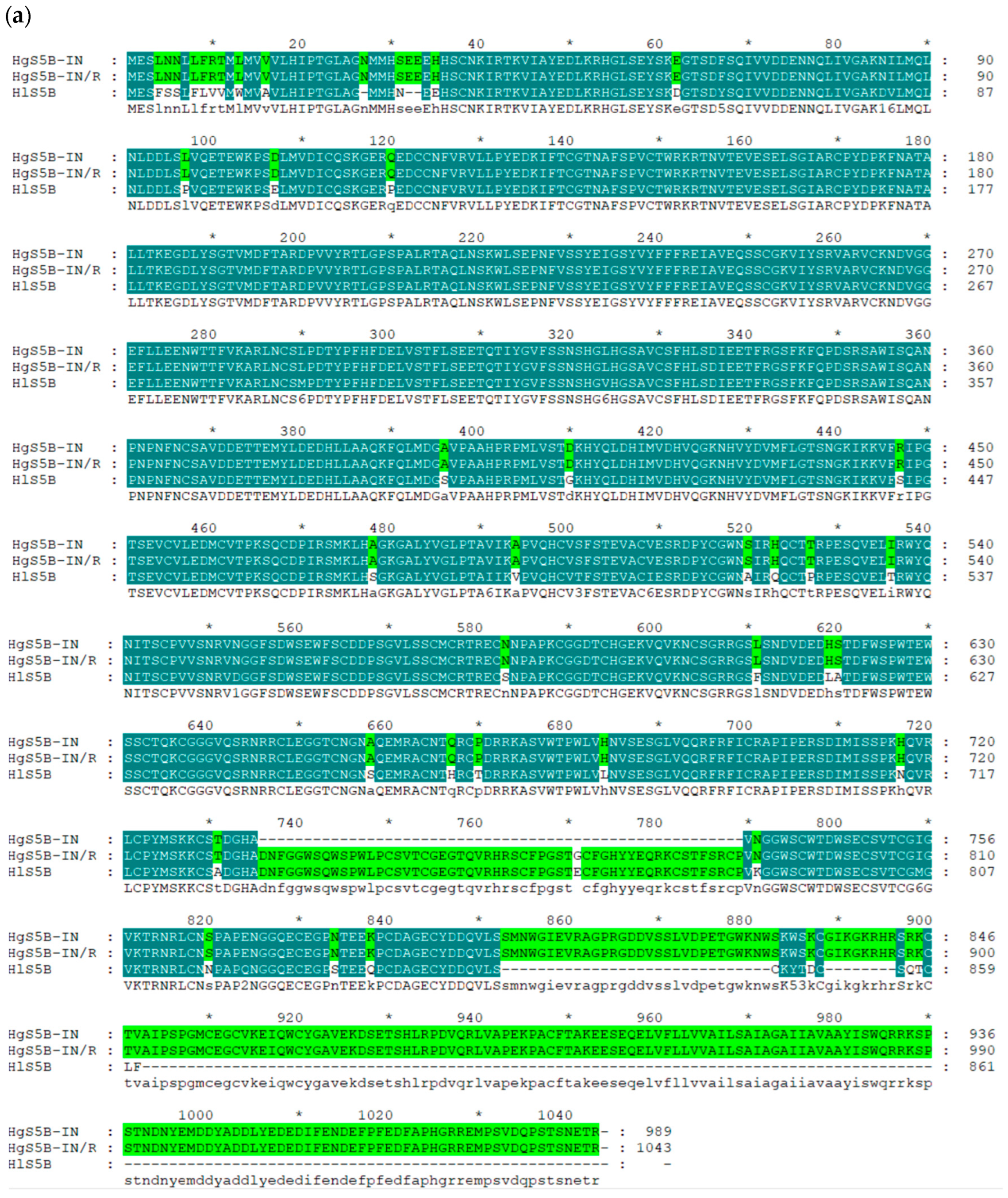
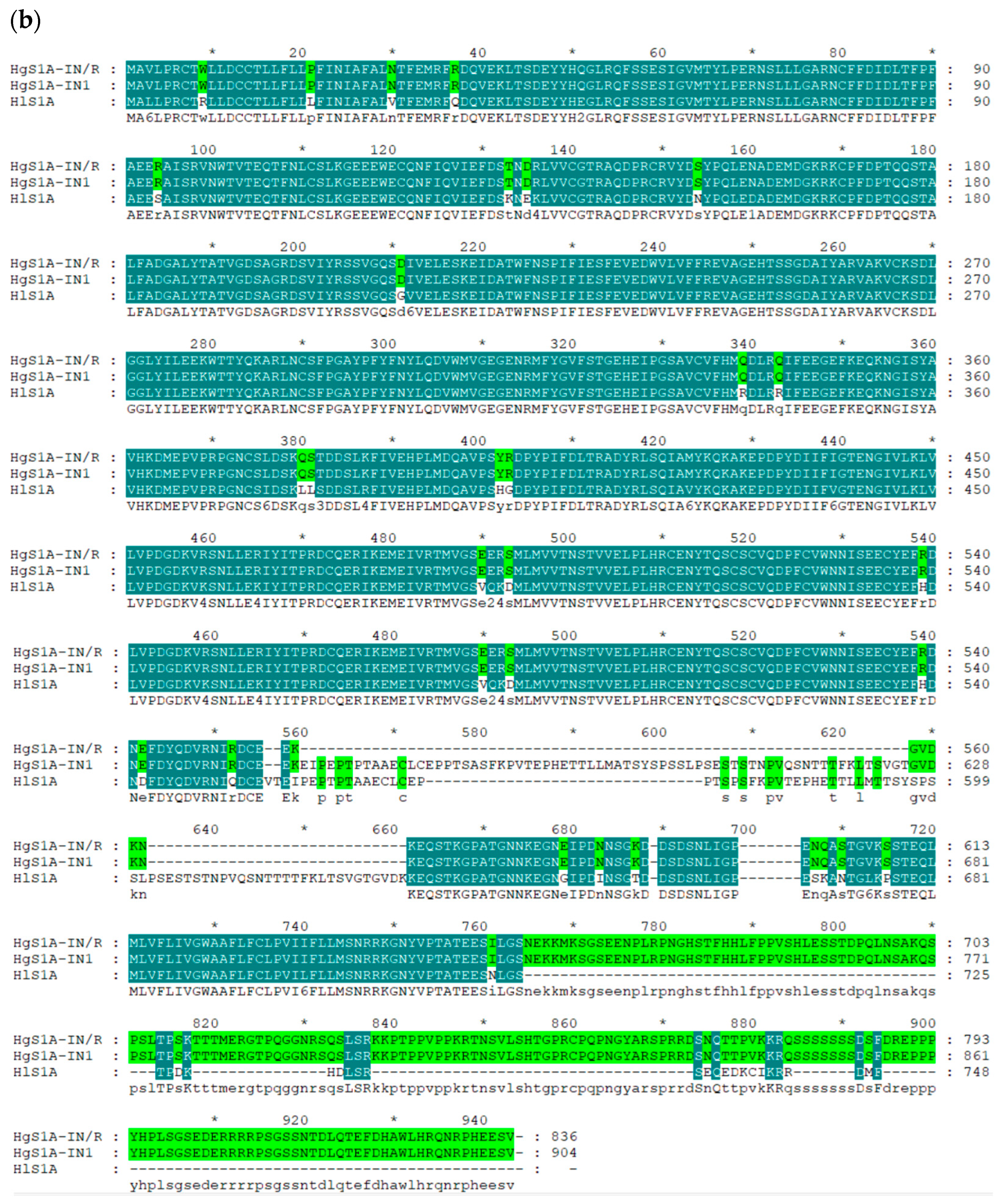
In the case of Semaphorin5B, one putative site of alternative splicing was detected, with HgSem5B-IN/RNC having an additional aa PON region compared to HgSem5B-IN (Figure 10a). HgSem1A-IN/RNC also displays one putative site of alternative splicing, lacking a PON aa region compared to HgSem1A-IN (Figure 12b).
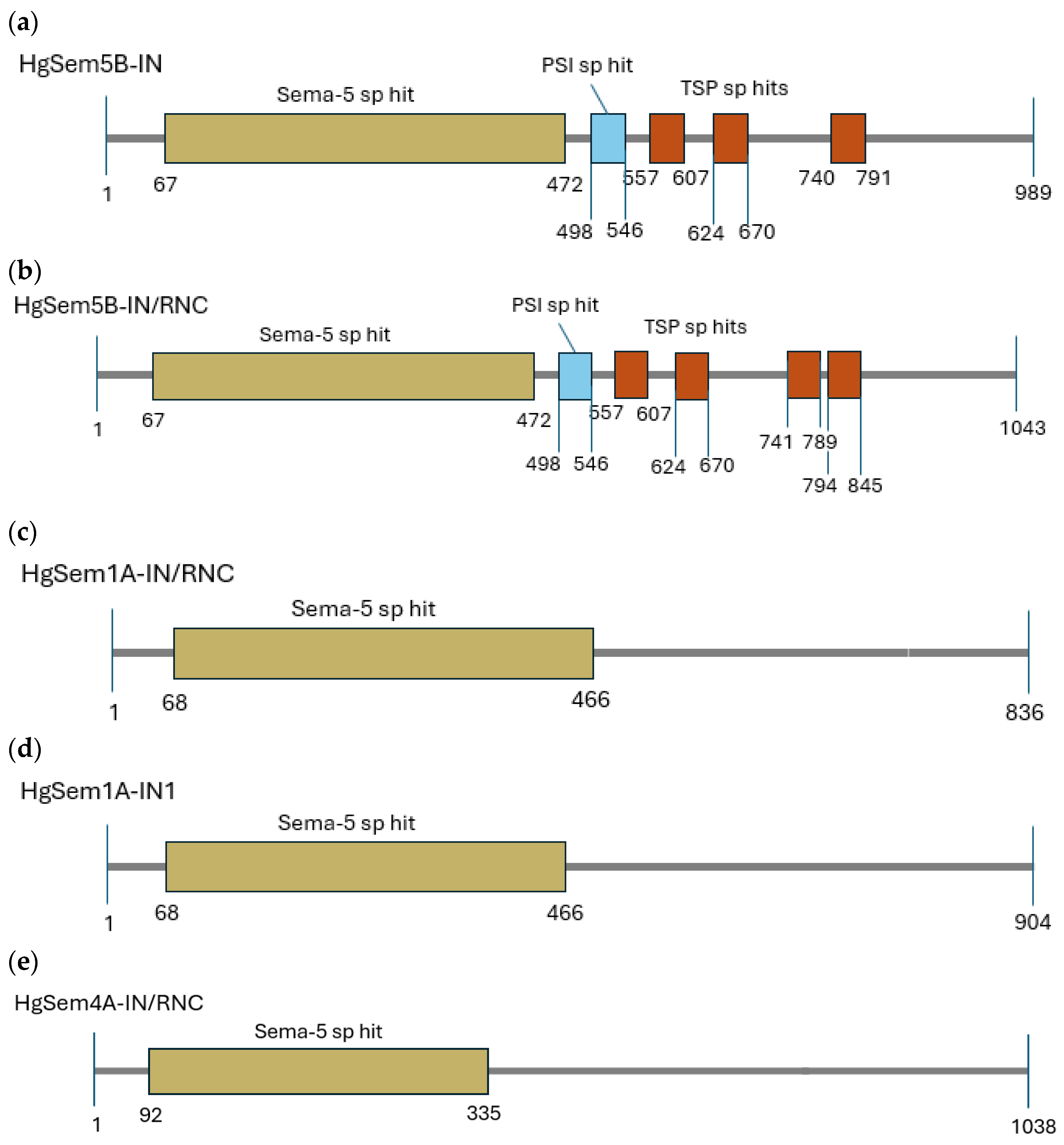
HgSem5B-IN shows hits for one semaphorin domain, one Semaphorin–Plexin domain near the N-terminal region and one plexin repeat domain and three thrombospondin domains near the C-terminal region (Figure 14a). HgSem5B-IN/RNC contains very similar domains to HgSem5B-IN, except there is one more thrombospondin domain near the C-terminal region (Figure 14b). HgSem1A-IN/RNC and HgSem1A-IN1 have the same N-terminal domains as Semaphorin-5B sequences; however, they lack the PSI and TSP hits (Figure 14c,d). HgSem4A-IN/RNC has the same N-terminal Semaphorin–Plexin domain but lacks any of the C-terminal domains of semaphorin1A sequences (Figure 14e).
HgSem5B-IN and HgSem5B-IN/RNC were found in the same location in genome scaffold #10, while all HgSem1A-IN/RNC and HgSem1A-IN1 were found in scaffold #9. HgSem4A-IN/RNC was found in scaffold #7. Putative alternative splicing sites were also confirmed for semaphorin1A, with two exons being spliced. HgSem1A-IN1 has the same number of putative exons as HlSem1A [KAJ8029543.1]. One exon splicing site was identified between HgSem5B-IN and HgSem5B-IN/RNC, with the largest sequence, HgSem5B-IN/RNC, having 21 exons compared to HlSem5B [KAJ8036294.1], which has 23 exons. HgSemA4-IN/RNC has 24 exons, six more than HlSemA4 [KAJ8037772.1], which contains 18 annotated exons (Figure 15).

3.3.2. Plexins

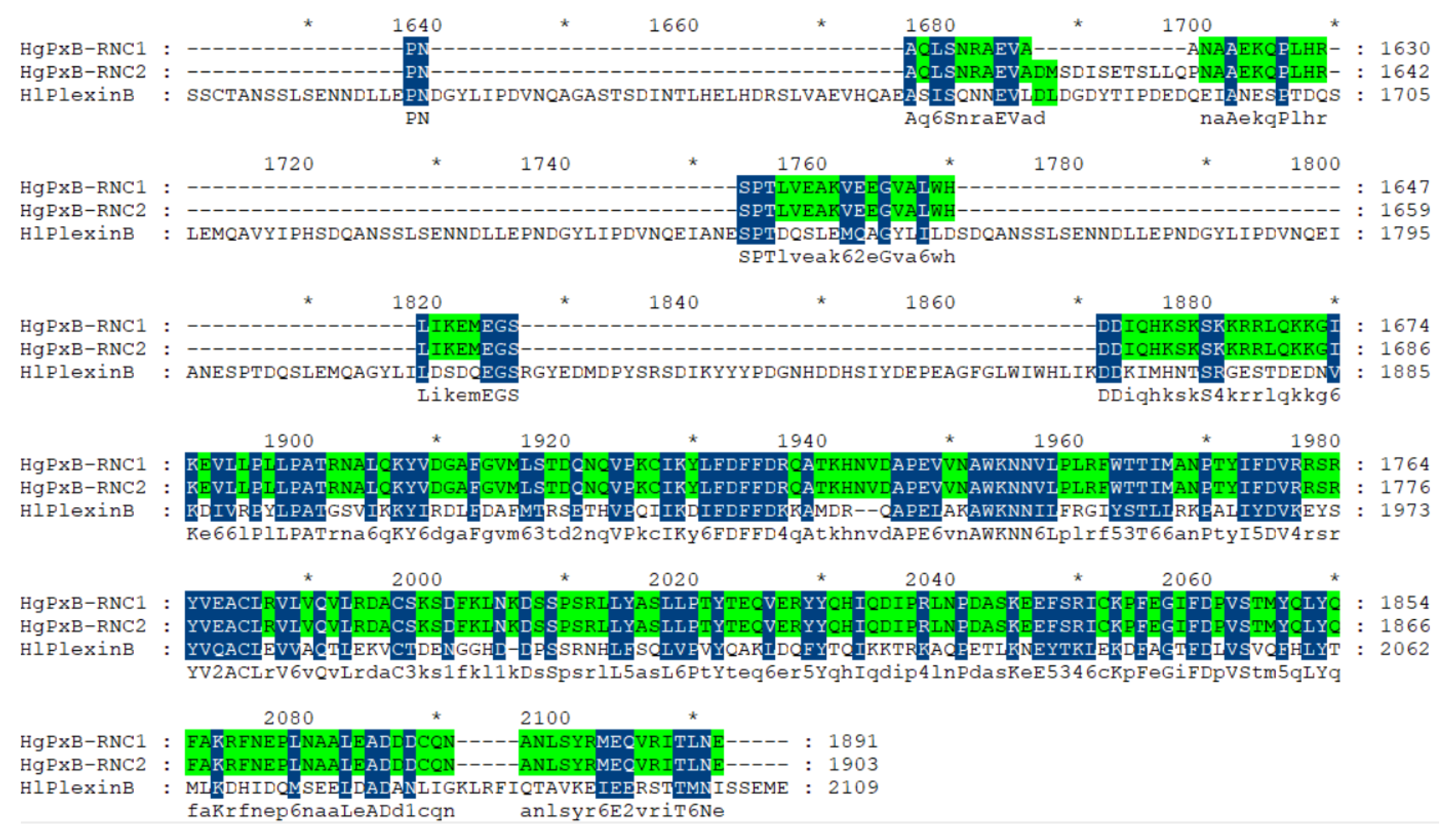
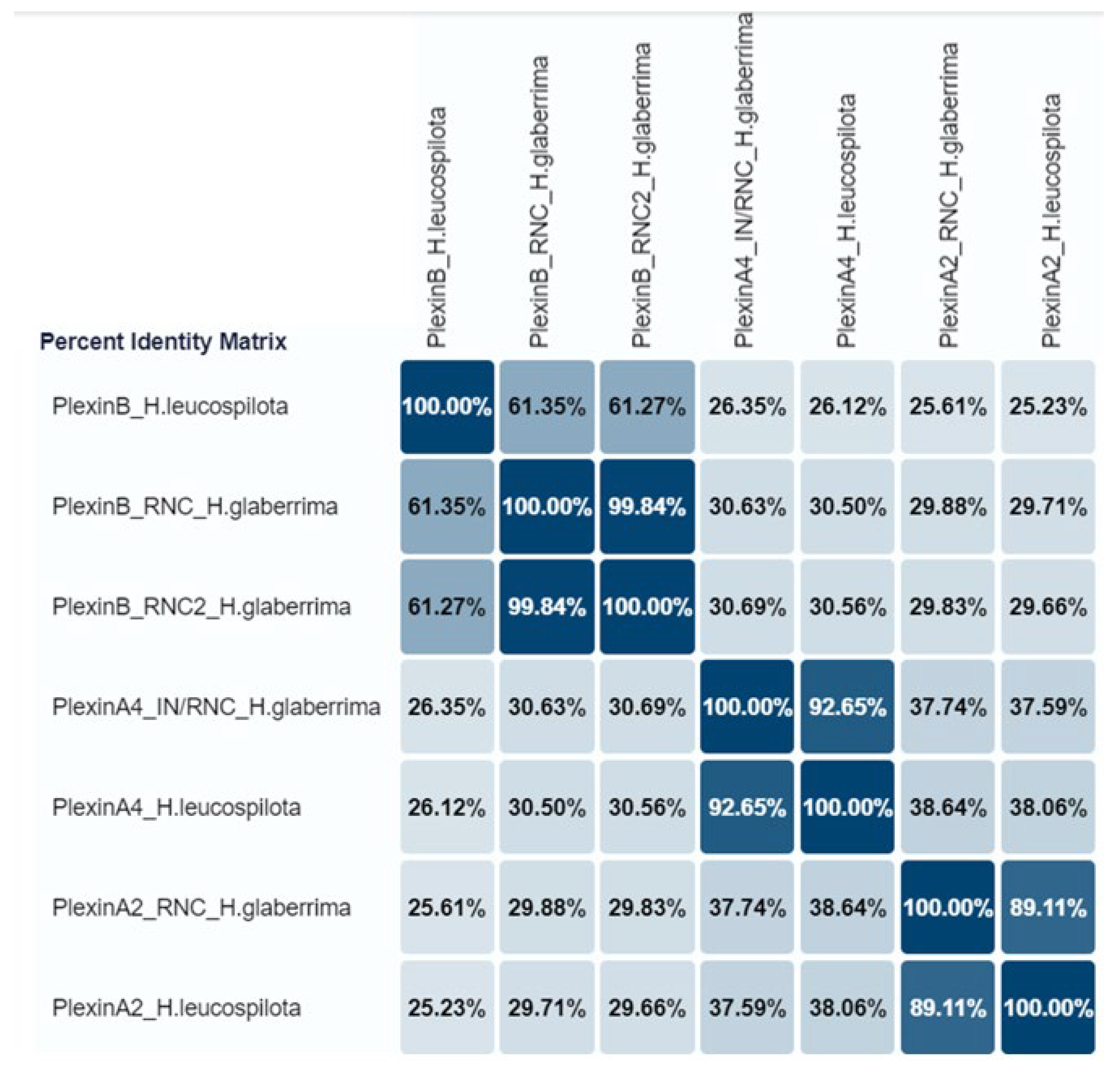
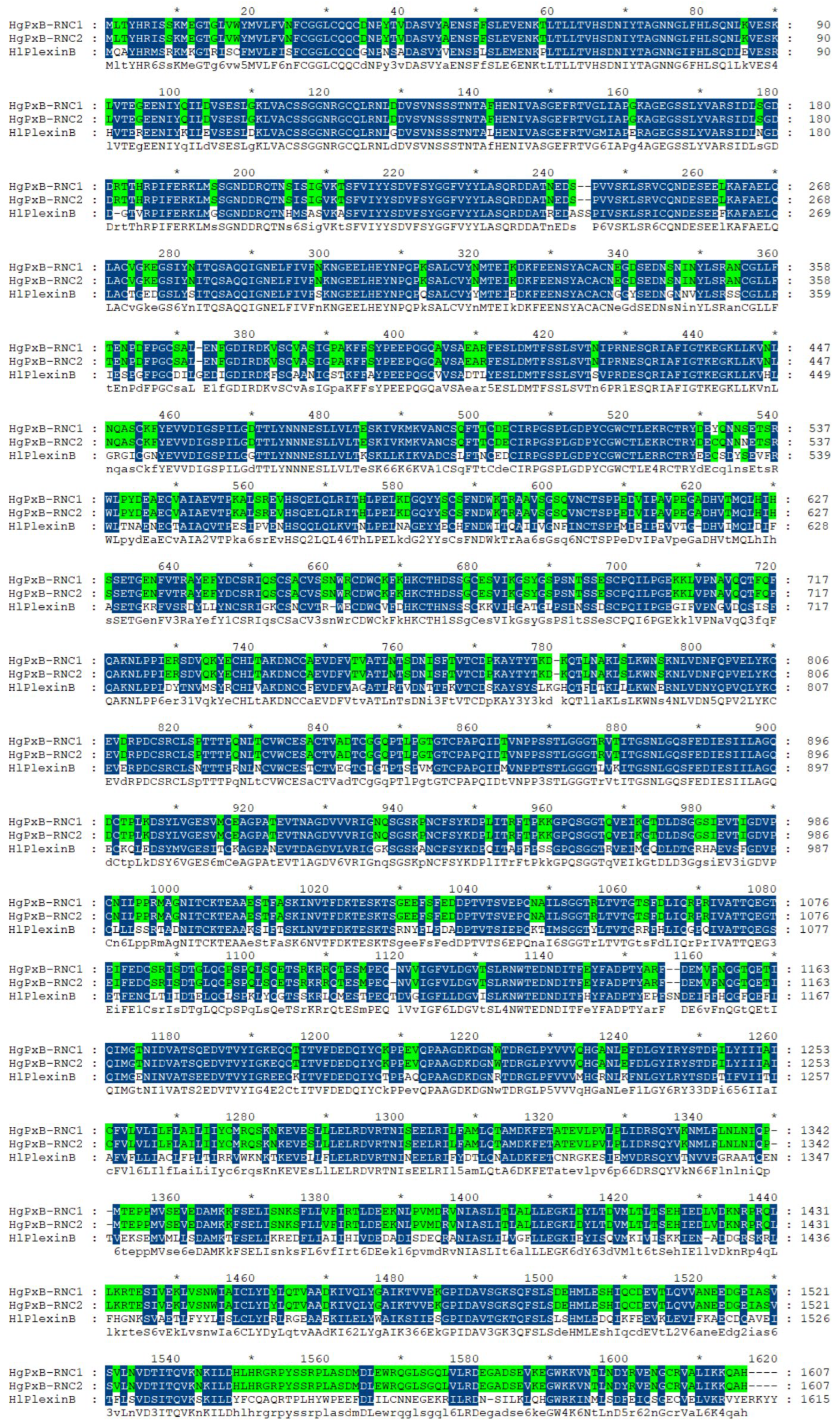
Four sequences were identified as possible plexin receptors (Figure 16). Two of these showed similarities to PlexinB, one was similar to PlexinA4, and another sequence was similar to PlexinA2. Both PlexinB sequences and PlexinA2 were found in the RNC transcriptome, while the PlexinA4 sequence was found in both IN and RNC transcriptomes (Figure S5). HgPlexinB-RNC1 scores 61.3% identity with the PlexinB from H. leucospilota. HgPlexinA4-IN/RNC scores 92.7% identity with the PlexinA4 sequence from H. leucospilota. PlexinA2-RNC scores 89.11% identity with the PlexinA2 sequence from H. leucospilota (Figure 17). One putative alternative splicing site was detected for the PlexinB sequences, with HgPlexinB-RNC1 having one extra region compared to HgPlexinB-RNC2 (Figure 16).
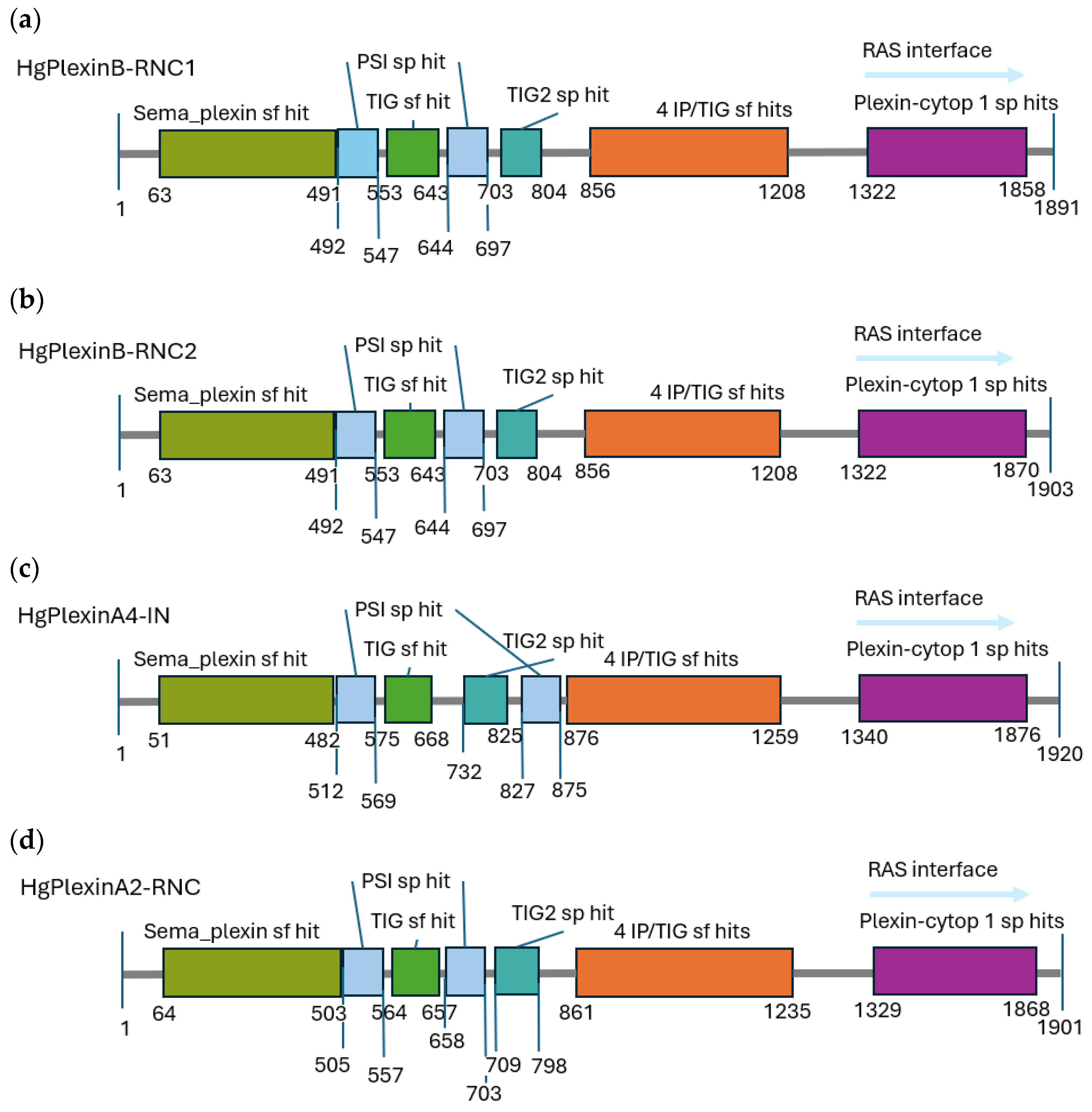
HgPlexinB-RNC1 shows hits for semaphorin/plexin domains, plexin cysteine-rich repeat regions, TIG2_plexin, and TIG_plexin near the N-terminal region, and three repeats in the order of immunoglobulin-like folds, Ras-GTPase Activating Domain, plexin-cytop1 domain and one RAS-interface region near the C-terminal region (Figure 18a). HgPlexinB-RNC2 shows very similar hits in both the N-terminal and C-terminal regions compared to PlexinB-RNC, except that the last immunoglobulin-like fold is incomplete (Figure 18b). HgPlexinA4-IN/RNC shows hits for semaphorin/plexin domains, two plexin cysteine-rich repeats, a TIG_plexin and TIG2_plexin domain near the N-terminal region, and three sequential immunoglobulin-like folds, a RasGAP domain with a putative Rap interface and Plexin_cytop1 domain near the C-terminal region (Figure 18c). HgPlexinA2-RNC shows hits for semaphorin/plexin domains, two plexin cysteine-rich repeats, with TIG_plexin and TIG1_plexin each following one plexin cysteine-rich repeat domain near the N-terminal region, and one immunoglobulin-like fold domain, RAS interface, Plexin_cytop1 domain and RasGAP domain near the C-terminal region (Figure 18d).
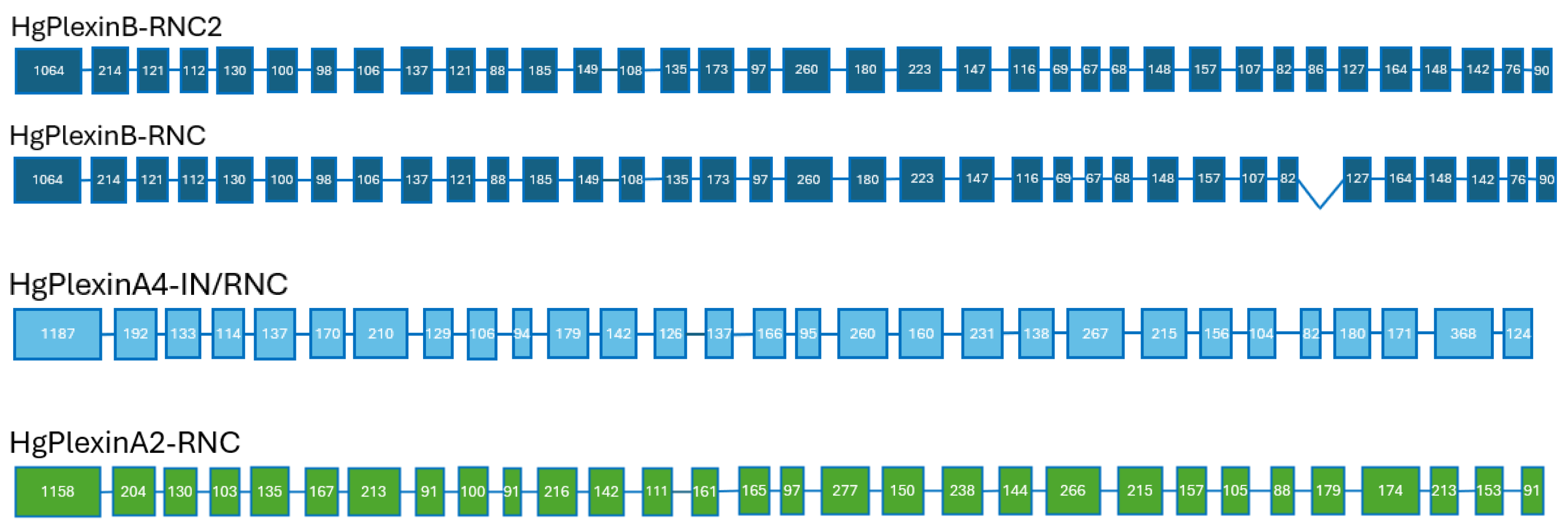
HgPlexinB-RNC1 and HgPlexinB-RNC2 are both found in scaffold #17. A putative splicing event was identified, in which HgPlexinB-RNC1 has 38 exons in this location, while HgPlexinB-RNC2 has 37 exons, with one fewer exon in HgPlexinB-RNC1’s 32nd exon. HlPlexinB [KAJ8046456.1] has 45 exons, seven more than HgPlexinB-RNC1. HgPlexinA4-IN/RNC has 29 exons compared to HlPlexinA4 [KAJ8046243.1], which has 35 exons, and HgPlexinA2-RNC has 30 exons, the same number as HlPlexinA2 [KAJ8047497.1]. Both HgPlexinA4-IN/RNC and HgPlexinA2-RNC are found in scaffold #3 (Figure 19).

3.4. RGMα and Neogenin Sequences

3.4.1. RGMα

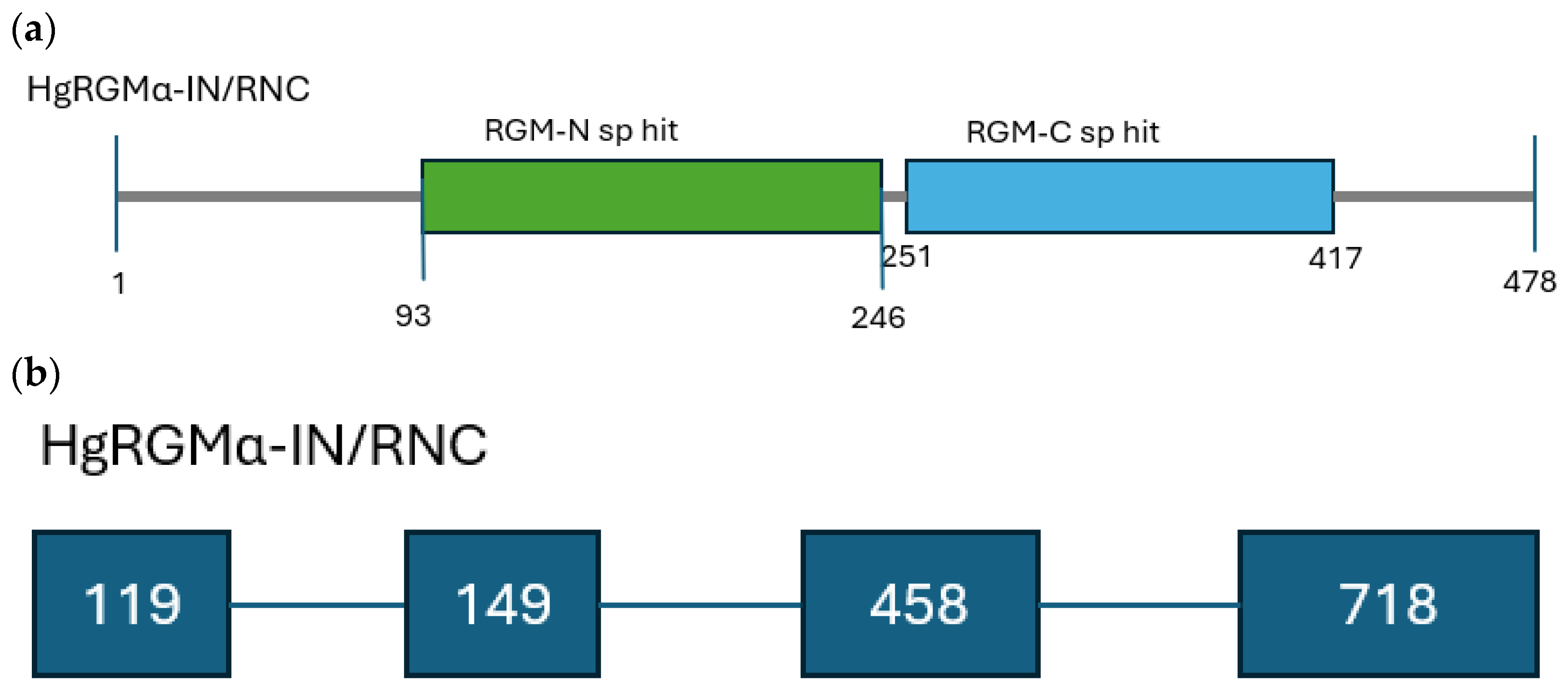
One sequence encoding putative repulsive guidance molecule α (RGMα) was identified in both the IN and RNC transcriptomes (Figure S6). A correlation matrix demonstrates that the HgRGMα sequence has 92.1% identity with the RGMα of H. leucospilota. The HgRGMα sequence shows hits for both RGM_N and RGM_C, indicating the presence of Repulsive Guidance regions near the N-terminal and C-terminal regions (Figure 18a). The HgRGMα-IN/RNC was found in genome scaffold #4 and has four exons, similar to the HlRGMα sequence [KAJ8029038.1] (Figure 20b).

3.4.2. Neogenin

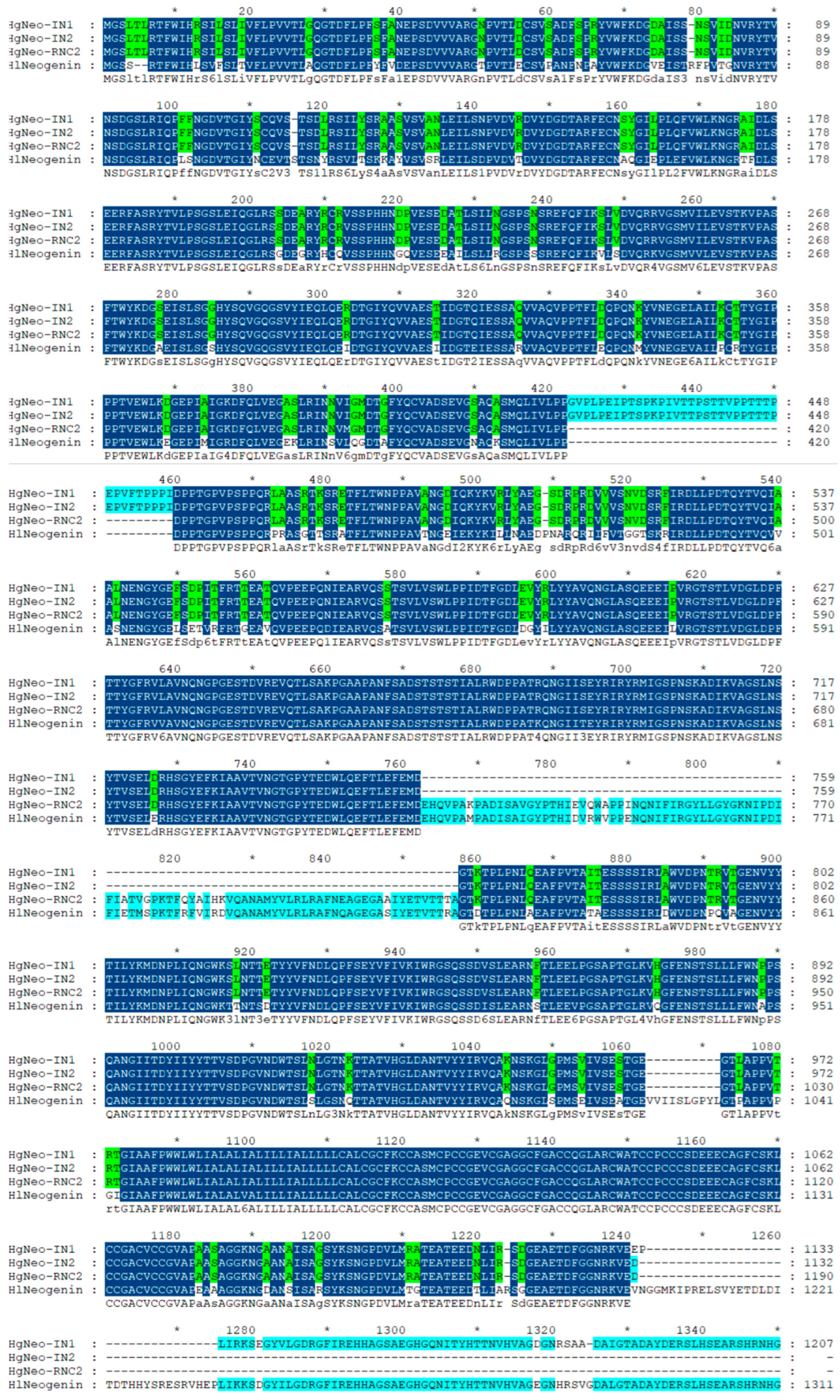
Three sequences were identified as possible neogenin receptors. Two of these were found in the intestinal (IN) transcriptome (HgNeogenin-IN1 and HgNeogenin-IN2), while the third was found only in the radial nerve cord transcriptome (RNC) (HgNeogenin-RNC) (Figure 21).
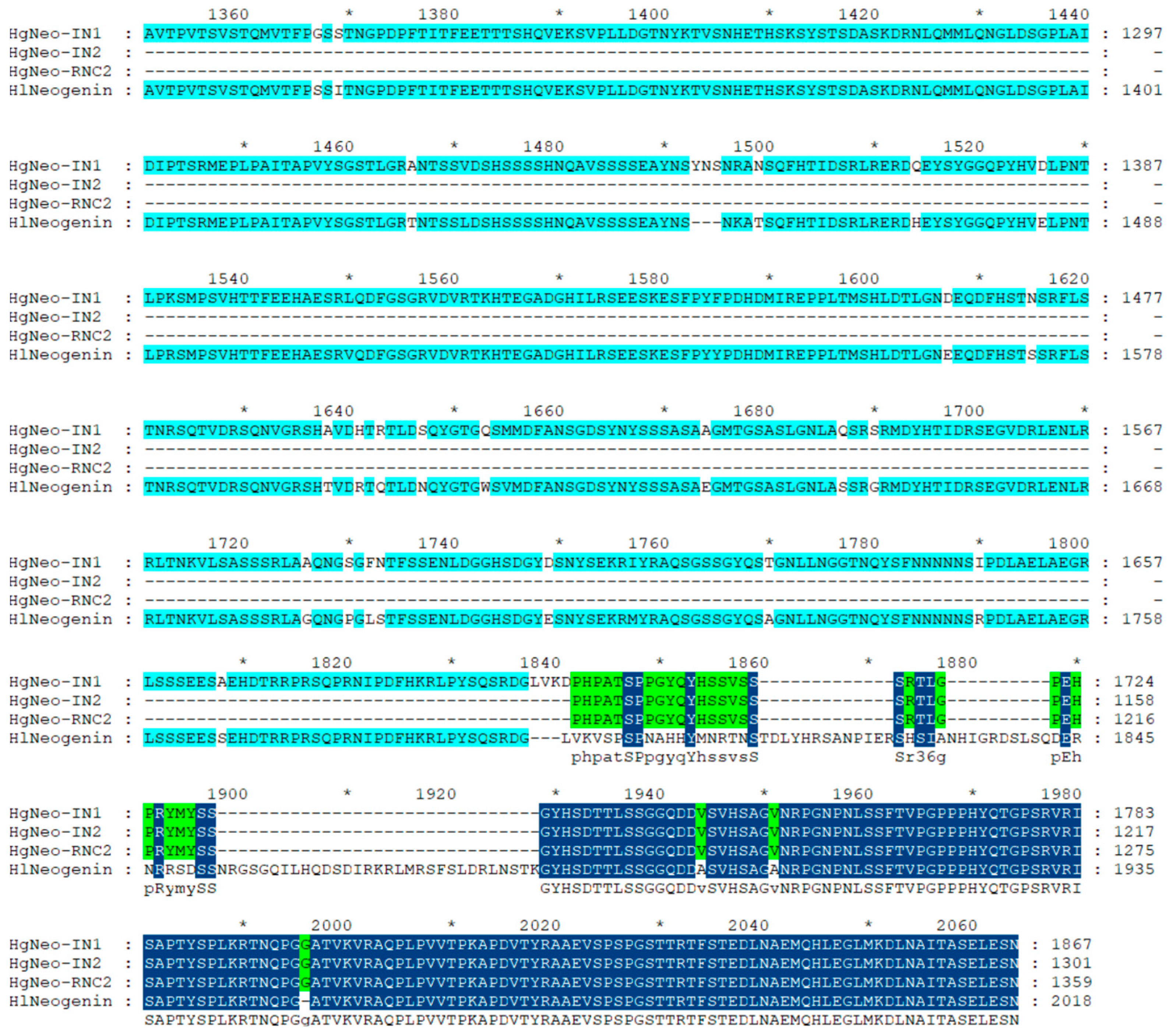
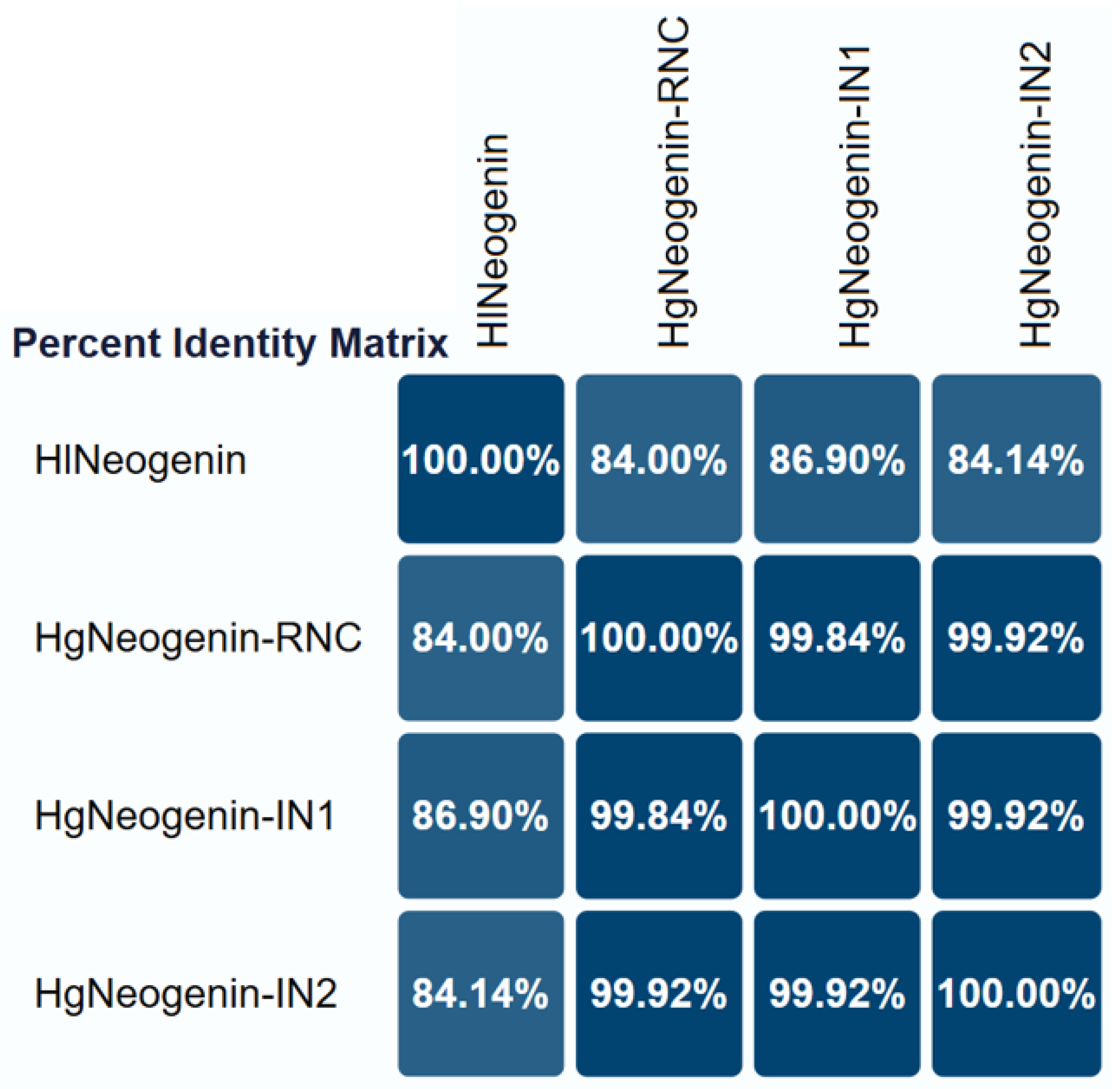
HgNeogenin-IN1 scores 86.9% identity with the Neogenin sequence from H. leucospilota (Figure 20). Multiple sequence alignment analysis reveals three sites of putative alternative splicing mechanisms, with HgNeogenin-IN1 having the largest region: one splicing event leaves a region for HgNeogenin-RNC, and one splicing event leaves a region for both HgNeogenin-IN1 and HgNeogenin-IN2 (Figure 22).
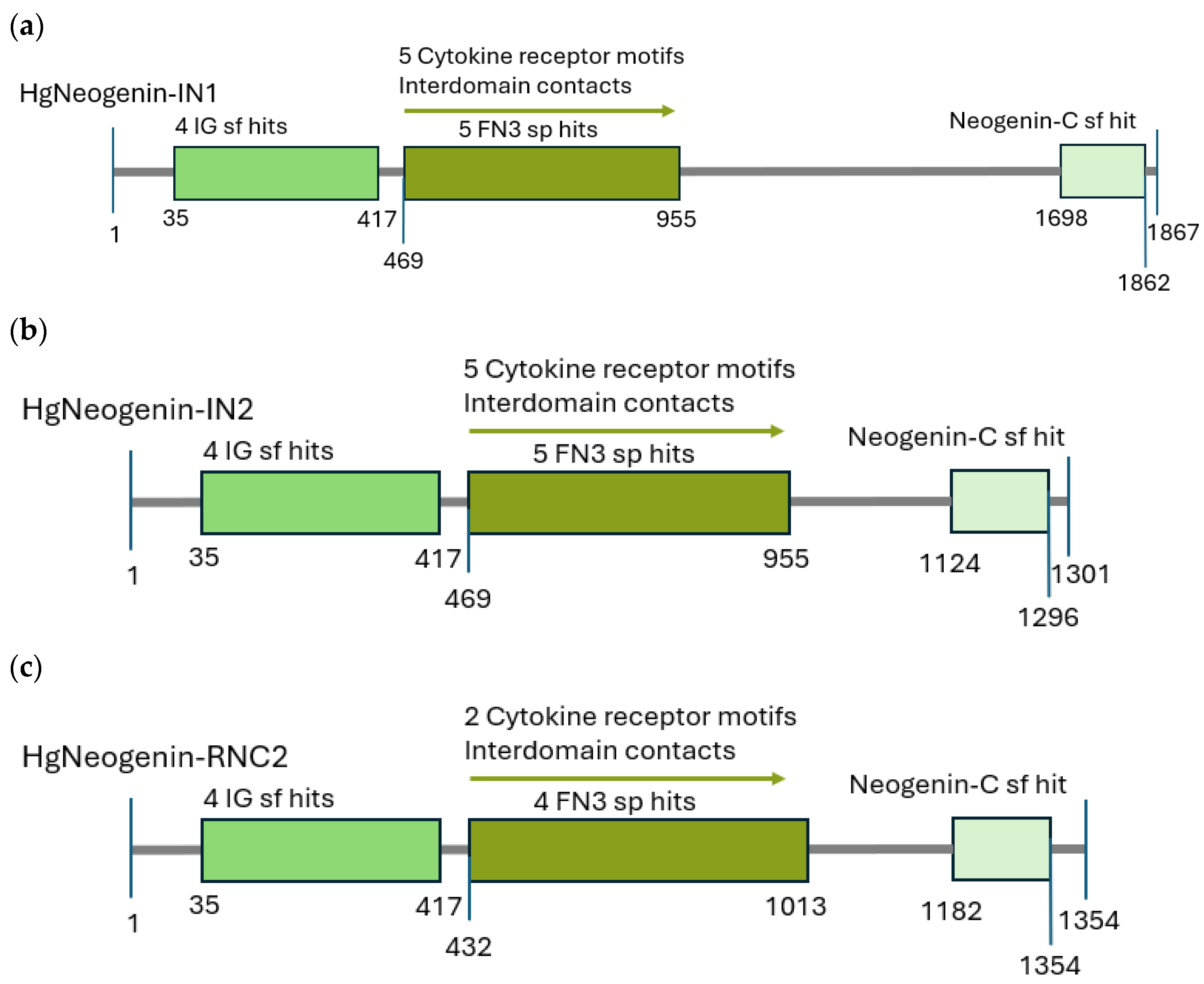
HgNeogenin-IN1 shows hits for two Immunoglobulin-3 domains, two Immunoglobulin-1 domains, five fibronectin-3 domains, phage-related protein domains, interdomain contacts, five cytokine receptor motifs near the N-terminal region, and a single neogenin C-terminal domain near the C-terminal region (Figure 23a). HgNeogenin-IN2 shows very similar domains compared to HgNeogenin-IN1 but lacks the larger spacing between the N-terminal and C-terminal region domains (Figure 23b). HgNeogenin-RNC has very similar domains compared to HgNeogenin-IN2; however, it has an additional fibronectin-3 domain and an interdomain contact between two cytokine receptor motifs, and lacks one cytokine receptor motif (Figure 23c).
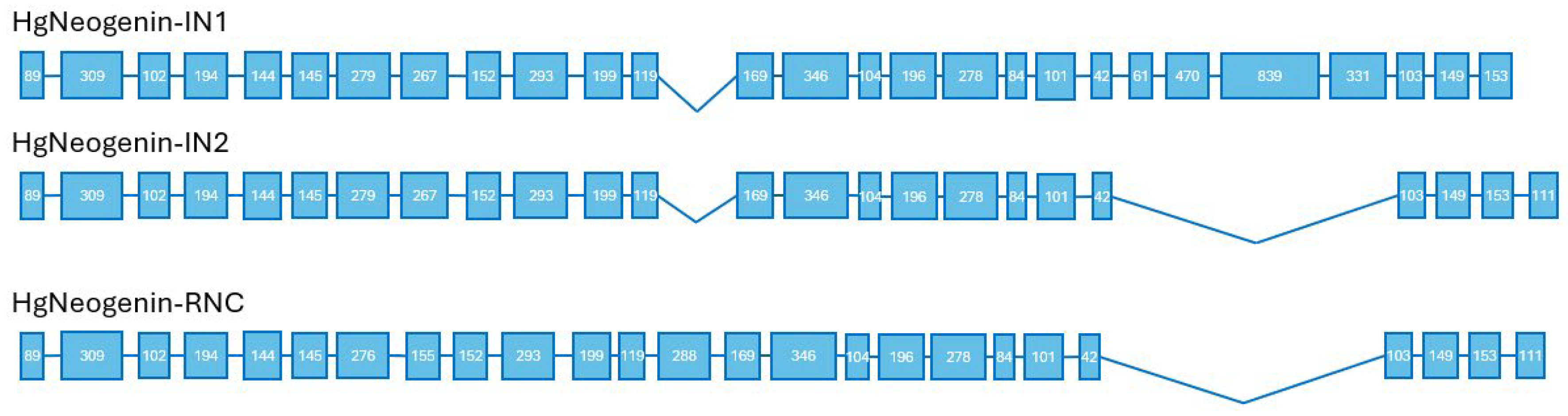
All Neogenin sequences were located in scaffold #10. HgNeogenin-IN1, the longest sequence, is shorter when compared with the Neogenin sequence from H. leucospilota. When locating the exons in the genome assembly, the region from the 1133rd proline residue to the 1134th lysine residue has no exons in this region. This leaves a continuous exon in which the additional amino acids found in HlNeogenin could not be located in our genome assembly. In terms of exon counts, HgNeogenin-IN1 has 27 exons compared to 32 exons in HlNeogenin [KAJ8035533.1] (Figure 24).

3.5. SLIT and ROBO Sequences

3.5.1. SLIT

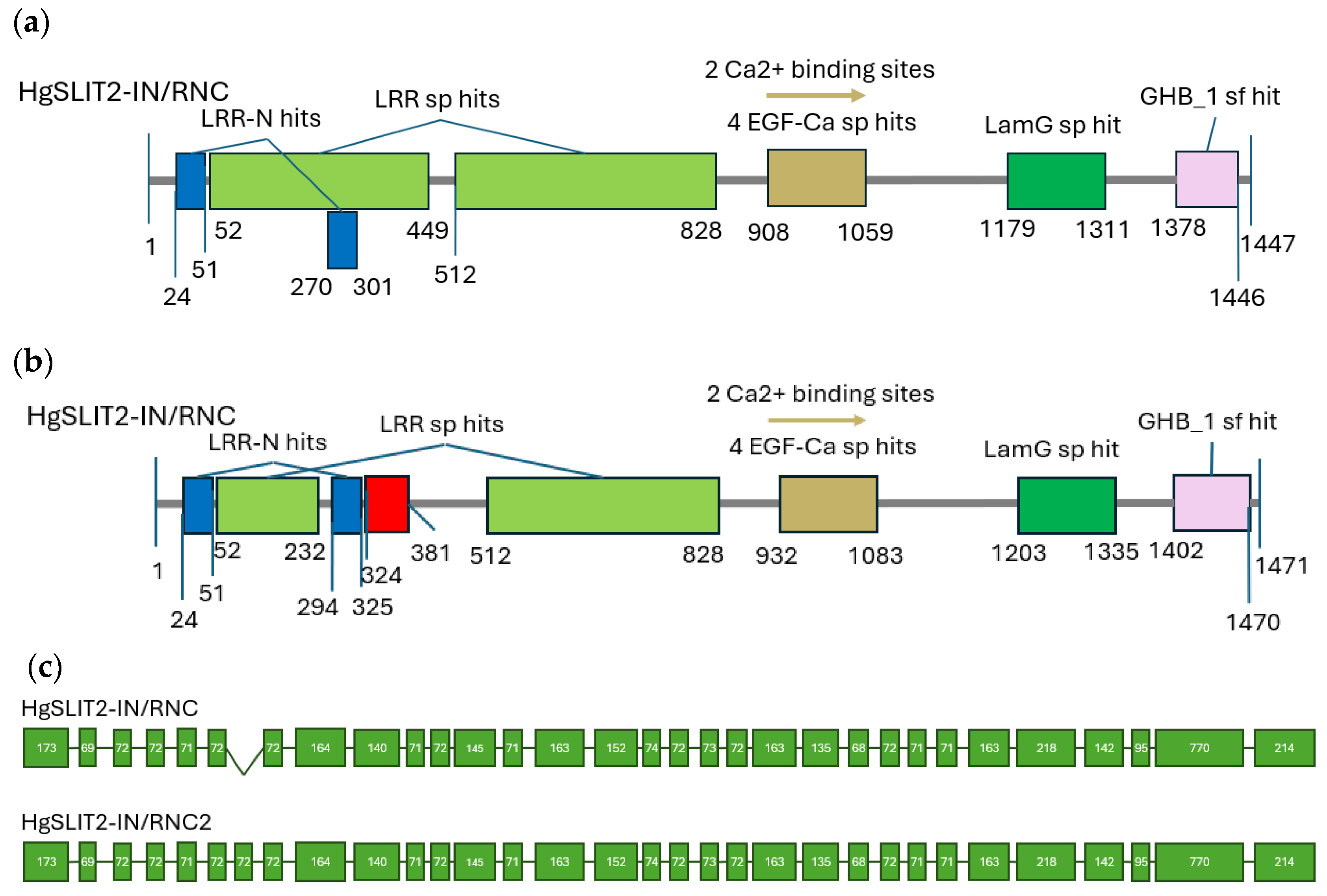
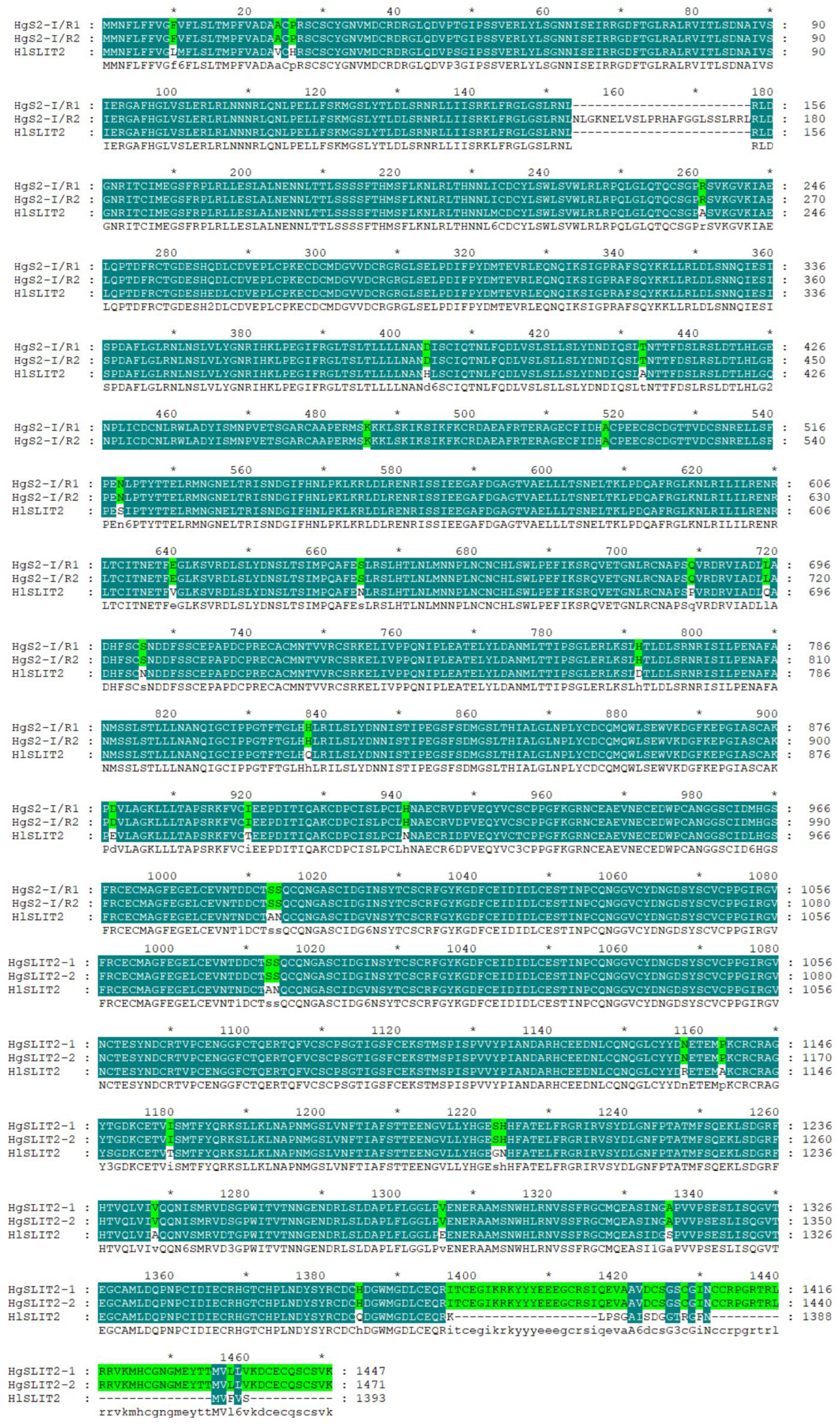
Two distinct sequences encoding putative SLIT proteins were identified in our transcriptome database. These sequences (HgSLIT2-IN/RNC and HgSLIT2-IN/RNC2) were found in both the IN and RNC and are splice variants. A correlation matrix demonstrates that the HgSLIT2-IN/RNC has a 95.3% identity with the SLIT2 from H. leucospilota (Figure 25 and Figure S7).
Both HgSLIT2-IN/RNC and HgSLIT2-IN/RNC2 sequences show hits near the N-terminal region for LRR8, PPP1R42, PRK15370, and LRRCT, while showing hits near the C-terminal region for Ca++ binding sites, Laminin_G and GHB-like domains. The additional 24 amino acids show an additional leucine-rich repeat (LRR_8) region for the HgSLIT2-IN/RNC2 sequence and a continued LRR superfamily repeat for the HgSLIT2-IN/RNC sequence (Figure 26a,b).
Both HgSLIT2-IN/RNC and HgSLIT2-IN/RNC2 are found in the same location in genome scaffold #17. A putative splicing event was identified, where HgSLIT2-IN/RNC2 has an additional exon in the seventh exon position compared to HgSLIT2-IN/RNC. HgSLIT2-IN/RNC has 32 exons, one fewer exon than HlSLIT2 [KAJ8025760.1] (Figure 26c).

3.5.2. ROBO

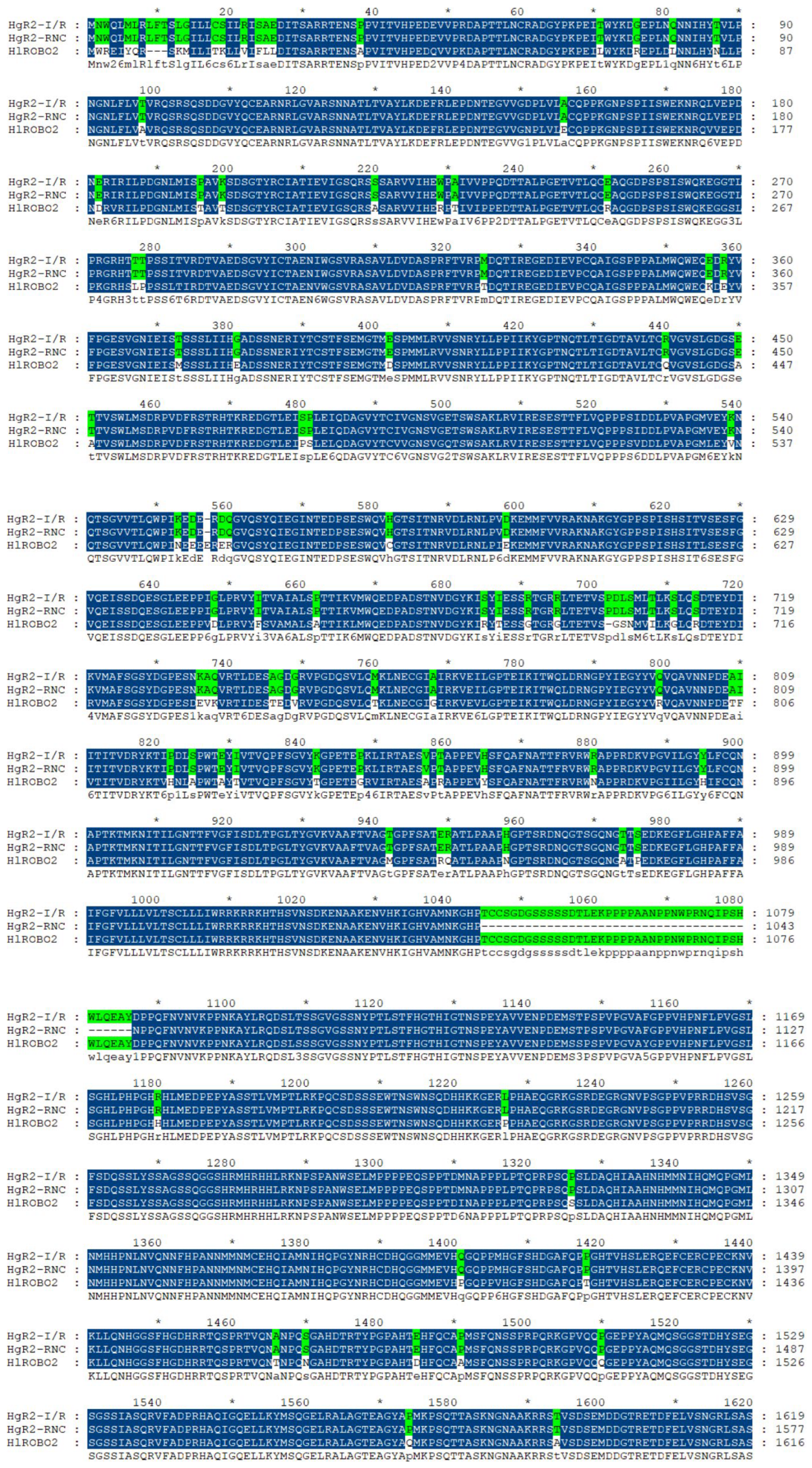
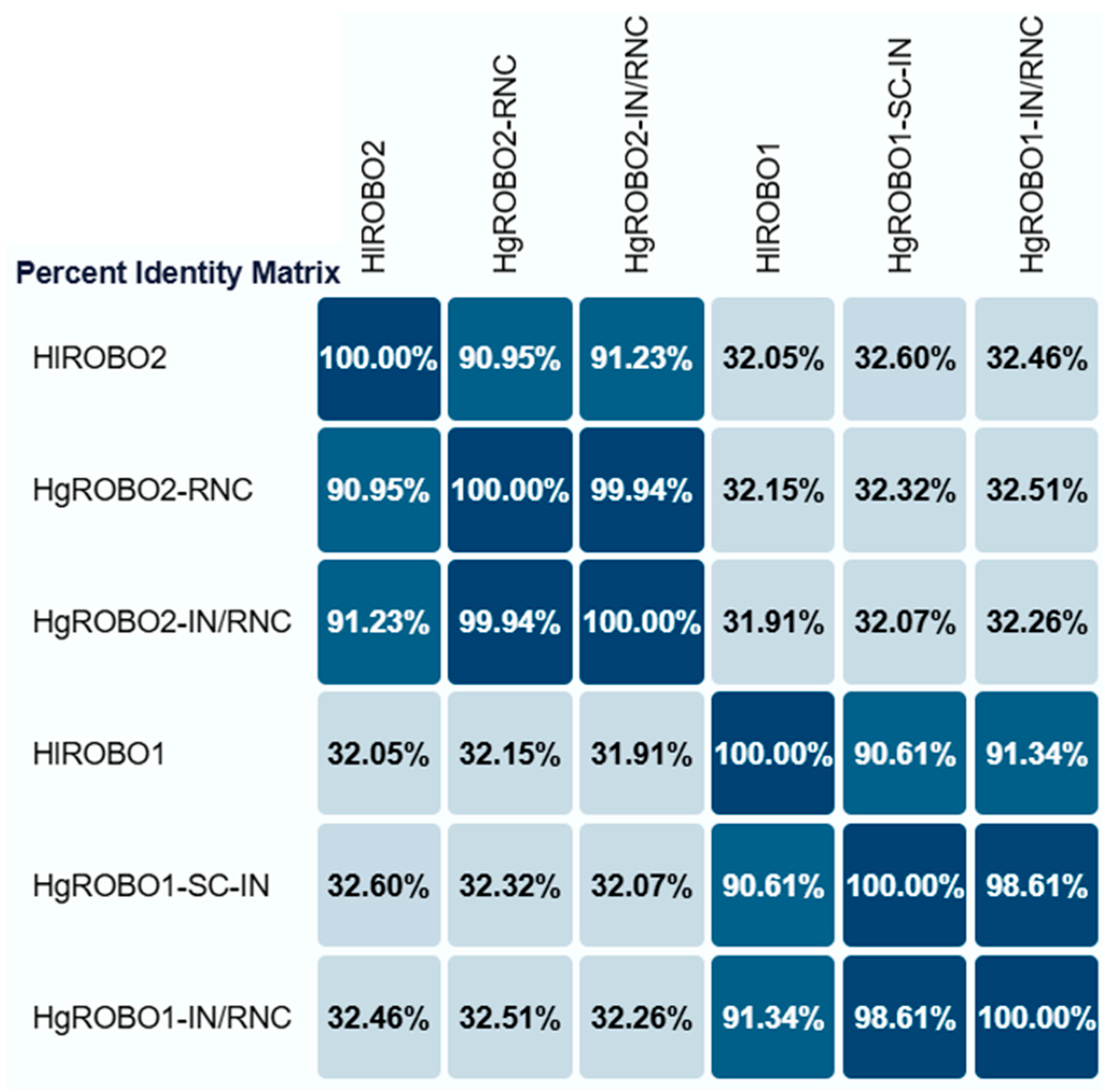
Three sequences were identified as possible roundabout guidance receptors (ROBO). Two of these sequences showed similarities to ROBO2 and are probably splice variants (Figure 27). The other sequence is similar to ROBO1 (Figure S8). One sequence was only found in the RNC transcriptome (HgROBO2-RNC), while two sequences were found in both the IN and RNC transcriptomes (HgROBO1-IN/RNC and HgROBO2-IN/RNC). The two HgROBO2-IN/RNC sequences share a 91.2% identity with ROBO2 from H. leucospilota. HgROBO1-IN/RNC shares 91.3% identity with ROBO1 from H. leucospilota (Figure 28).
HgROBO1-IN/RNC shows hits for Immunoglobulin-3, Immunoglobulin-1, and Immunoglobulin sets near the N-terminal region, and two specific hits for Fibronectin-3 and cytokine receptor motifs near the C-terminal region (Figure 29a). HgROBO2-RNC shows hits for various immunoglobulin domains, except that this sequence has two additional hits for Immunoglobulin 4 and 5 and a PHA02785 domain near the N-terminal region. HgROBO2-RNC contains fewer fibronectin-3 domains and only two cytokine receptor motifs compared to the ROBO1 sequences (Figure 29b). HgROBO2-IN/RNC contains very similar motifs compared to the HgROBO2-RNC sequences (Figure 29c).
All ROBO sequences were found in scaffold #13, with the HgROBO2-IN/RNC and HgROBO2-RNC localized upstream of HgROBO1-IN/RNC. A putative splicing event was identified, where HgROBO2-IN/RNC has an additional exon in its 23rd position compared to HgROBO2-RNC. HgROBO1-IN/RNC has 25 exons compared to HlROBO1 [KAJ8035154.1] with 26 exons. HgROBO2-IN/RNC has 29 exons, the same exon count as HlROBO2 [KAJ8034791.1] (Figure 29d).

3.6. Differential Gene Expression

To determine if the characterized genes were differentially expressed during the intestinal regeneration process (see Figure 1), we proceeded to analyze gene expression in our transcriptome data bank. These transcriptomes were generated at various stages of sea cucumber intestinal regeneration [8,15]. Using the annotated sequences and corresponding log2fold expression levels, we constructed heatmaps to visualize gene expression dynamics. These patterns were then analyzed to infer the putative biological functions active at each regenerative stage (Figure 30).
Analysis of ligand–receptor (LR) pair expression revealed distinct temporal patterns during intestinal regeneration. Notably, none of the LR pairs showed significant overexpression during the early stages of regeneration (12-hpe to 3-dpe); in fact, several pairs, including Netrin-1/UNC5B and ephrin receptors/ligands, were significantly underexpressed during this period. A shift in expression patterns emerged at the intermediate stage, with Netrin-1 displaying marked overexpression at 7-dpe, particularly in the posterior mesentery at 14-dpe, though its receptor UNC5B remained unchanged throughout regeneration. The ephrin system maintained significant underexpression across most timepoints (12-hpe, 1-dpe, 3-dpe, 14-dpe, and 21-dpe), with EphrinA3 showing the most pronounced underexpression at 21-dpe. In contrast, later regeneration stages (14-dpe and 21-dpe) were characterized by coordinated overexpression of several guidance cue systems: RGMα and its receptor both peaked at 14-dpe, while the SLIT/ROBO system showed progressive overexpression, with ROBO receptors reaching their highest levels at 21-dpe despite early underexpression of SLIT ligands at 12-hpe and SLIT2-IN at 3-dpe (Figure 30).

3.7. Cell Communication Patterns

Our laboratory has recently published a single-cell RNA-seq atlas of the 9-day regenerating anlage [26]. In this case, gene expression patterns allow for cell type identification by determining the gene expression profile at a cellular level. When comparing this information with the differential expression obtained by the bulk RNA-seq, we can correlate the overexpression of a specific gene in the transcriptome with the representative genes expressed by a cell cluster or population.
In the scRNA-seq, clusters were identified according to their most expressed/highly represented sequences (C0: mesentery coelomic epithelial cells; C1, C3: cells in the regenerating coelomic epithelium; C2, C7: mesenchymal phenotype cells; C6, C10, C11, C12: coelomocytes; C4: differentiating intestinal coelomic epithelium; C5: differentiating muscle; C8: proliferating cells; C9: differentiating neuroepithelium). Differential gene expression analysis revealed distinct expression patterns of axon guidance molecules across all cell clusters, with particularly interesting expression in some of them (Figure 31a). High expression of Sem1A-1 distinguished a putative immune cell cluster (C11), while ROBO2 was highly expressed in differentiating neuroepithelial cells (C9). Semaphorin and plexin expression was also found in a cluster of mesenchymal cells (C2). However, the highest expression of axonal guidance genes was found in clusters C3 and C4. These cells represent those in the coelomic epithelium of the anlage and of the adjacent mesentery. Two receptor–ligand groups are highly expressed in these two cell clusters. Netrin1 and EPHB2 are highly expressed in the cell population that represents the anlage coelomic epithelia (C3), while their corresponding partners, UNC5B and EphrinB2, are expressed in those cells that are found in the mature intestinal and/or mesentery coelomic epithelium (C4) (Figure 31a).
The CellChat v2 [27] program can be used together with the DGE data to further validate the inferred communication pathways between the distinct cell types in the 9-dpe regenerating intestine. Of the five ligand/receptor groups, three groups were identified to have strong communication probabilities in the regenerating 9-dpe intestinal tissue. One of these corresponds to the Netrin–UNC5 (C3–C4) group described above. In addition, two other groups were highlighted: Ephrin ligand/receptor and Semaphorin–Plexin. Netrin–UNC5 communication was found to be most probable between most other cells in the coelomic epithelium (C3—Netrin) and differentiating coelomic epithelial cells (C4—UNC5), while most other cells in the coelomic epithelium and proliferating cells showed communication probabilities with differentiating coelomic epithelial cells (Figure 31b). In terms of the ephrin network, both coelomic epithelial cells (C0—EphrinB2) and differentiating coelomic epithelial cells (C4—EphrinB2) appear to have the strongest communication with cells in the regenerating coelomic epithelium (C3—EPHB4) (Figure 31c). The strongest communication patterns in the Semaphorin/Plexin network occur with mesenchymal phenotype cells (C2) and coelomocytes (C11) expressing the Semaphorin ligand, with differentiating coelomic epithelial cells having the most prominent expression of the PlexinA2 receptor (Figure 31d).

4. Discussion

In this study, we identified and characterized five ligand–receptor groups of axonal guidance molecules in the sea cucumber Holothuria glaberrima using transcriptomic and genomic databases. The detection of these factors and their receptors aligns with expectations, as most have been reported across a broad range of both vertebrate and invertebrate species, including members of the phylum Echinodermata. The increasing availability of echinoderm transcriptomic and genomic resources has greatly enhanced our ability to identify and compare these molecules among related species. Our analyses benefited from recent genomic data from H. leucospilota and A. japonicus, the first holothurian species to have their genomes sequenced and annotated [30,31]. While the presence of axonal guidance molecules in H. glaberrima is consistent with evolutionary predictions, our study provides valuable confirmation and contributes new insights into the evolution of orthologous genes among echinoderms, particularly among holothurians. It also offers an opportunity to expand current knowledge by highlighting specific features and potential novel aspects unique to these species. More importantly, it places these results within the context of regenerative responses, both for the enteric nervous system and within the radial nerve cord. This approach facilitates the identification of candidate genes that can now be targeted in experimental investigations.
  • Identification of Axonal Guidance Molecules in both intestine and radial nerve cord transcriptomes of H. glaberrima
Comparative analyses of the five groups of axonal guidance molecules, particularly the presence of the corresponding domains, clearly identify the holothurian genes as orthologs of those in other echinoderms and vertebrates. What follows is a detailed discussion of each ligand/receptor group.
HgNetrin-IN/RNC represents a highly conserved ortholog that retains key structural features, including an LN/LNS N-terminal module, three EGF-like repeats, and a C-terminal NTR/basic domain, all essential for receptor interaction and axonal guidance. Likewise, HgDSCAM-IN/RNC maintains multiple Ig and FN3 domains characteristic of vertebrate DSCAMs, such as Mus musculus DSCAM1 [32], suggesting that functions associated with these domains, such as cell adhesion and recognition motifs, might be conserved in the echinoderm.
UNC5B is a classical receptor found in various organisms, such as C. elegans and Schmidtea mediterranea, as a single trans-membrane protein receptor [33,34]. HgUNC5B sequences from both the IN (HgUNC5B-IN) and RNC (HgUNC5B-RNC) preserve common structural features of the sequence, like extracellular Ig-like, thrombospondin, transmembrane, and intracellular ZU5–UPA–Death domains. The two UNC5B sequences from H. glaberrima show one fewer domain for immunoglobulin and thrombospondin1 near the N-terminal domain, with matching Zu5, UPA, and UNC5 domains near the C-terminal domain. Differences from other sequences are found in the extracellular region of the sequence, rather than in the intracellular region, suggesting changes in binding with the ligand.
The ephrinB2 ligand is a membrane-anchored protein involved in regulating bidirectional axonal guidance processes [35,36]. The H. glaberrima sequence shares the ectodomain binding site region near the N-terminal region; however, it does not show hits with PDZ or phosphate-bound domains in the intracellular region. The absence of these intracellular motifs suggests this isoform may lack the capacity for reverse signaling, as ephrinB-mediated reverse signaling requires phosphorylation of conserved tyrosine residues in the C-terminal tail and PDZ-domain interactions [37].
Ephrin receptors are also membrane-anchored proteins that respond to Ephrin ligands presented by other cells. Both HgEphrinB2R-IN and HgEphrinB2-IN/RNC receptor contain the characteristic N-terminal ligand-binding domain (LBD), cysteine-rich/EGF-like motifs, two FN3 repeats extracellularly, a single transmembrane helix, and the intracellular tyrosine kinase → SAM → PDZ-binding modules, all diagnostic of EphB-class receptors. HgEphrinA3R-IN, another identified receptor, is stable with 11 exons, shares the ectodomain binding site region near the N-terminal region, but does not show hits with PDZ or phosphate-bound domains in the intracellular region. Ephrin receptors commonly share epidermal growth factor-like domains and fibronectin type III domains in the extracellular regions, with a transmembrane hydrophobic domain, and kinase and sterile α motif (SAM) domains in the intracellular region [37,38]. The presence of gene splicing isoforms on different genomic scaffolds (e.g., EphrinB2R in scaffold #1 and EphrinA10R in scaffolds #4 and #21) confirms the diversity of the ephrin receptor family in H. glaberrima and suggests that different functions might be mediated by the various forms.
HgSem5B-IN/RNC and HgSem1A-IN/RNC display hallmark Semaphorin features: N-terminal Sema domains (~500 aa), PSI modules, and, for Class 5 Semaphorins, thrombospondin (TSR) repeats. Both the IN and IN/RNC selective sequences, Sema1A and Sema5B, show hits for the N-terminal semaphorin domain, while only the Sem5B sequences show hits for thrombospondin type-1 and PSI domains after the sema domain. Sema5B sequences in our model are also more similar in domain and size to traditional transmembrane-presented semaphorins in vertebrate and invertebrate models [39,40].
Plexin molecules are receptors that interact with semaphorin ligands in models of CNS innervation and guidance modules for neuron motility [41,42]. Our transcriptomes revealed non-shared and shared sequences showing homology to PlexinB, retaining canonical extracellular Sema → PSI → IPT/TIG domains, a single transmembrane segment, and intracellular split RhoGAP-like modules, including RBD insertions [39,40]. Two sequences with complete domains and high scores were found in the RNC for PlexinB, and two were found complete in the IN transcriptome for PlexinA2 and PlexinA4. PlexinB sequences show similar semaphorin domains near the N-terminal region, flanked with PSI, Ig-like fold TIG domains 1 and 2, four IPT/TIG domains and a Plexin-cytoplasm 1 domain near the C-terminal region. Our sequences do not show identifiable GAP domains in the intracellular region that are present in some animal groups [42]. PlexinB sequences are located on the same genomic scaffold (#3), suggesting their origin from a single gene.
The HgRGMα ligand (HgRGMα-IN/RNC) preserves the RGM_N and RGM_C domains flanking a cysteine-rich central region, consistent with canonical RGM structure [42]. Similar domain arrangements have been reported in other echinoderm RGMs, including A. japonicus [30], S. purpuratus [43] and P. lividus [44], emphasizing the evolutionary conservation of structural modules critical for receptor interaction. Our sequence, however, lacks cysteine-rich hits with the v-WFD domain between these two domains. This may indicate a differing binding strength between RGMα and Neogenin receptors [45].
Neogenin is a single-pass transmembrane receptor expressed by neurons and non-neuronal cells, with high binding affinity for RGMα ligands [46,47]. HgNeogenin is represented in H. glaberrima by multiple transcripts reflecting tissue-specific transcript diversity. All isoforms, however, preserve the characteristic Neogenin domain architecture, which includes four extracellular immunoglobulin-like (Ig) domains, five to six fibronectin type III (FN3) repeats, a single transmembrane domain, and a conserved cytoplasmic tail (Neogenin-C) [47]. The preservation of Ig and FN3 repeats in Neogenin supports the homology of these sequences and their annotation as bona fide neuronal guidance factors [47], with Neogenin homologs identifiable in transcriptomes and genomes of other echinoderms, including H. leucospilota [31], A. japonicus [30], and S. purpuratus [43]. Gene copy number analysis confirms that Neogenin is encoded by a single-copy, multi-exon gene in H. glaberrima, consistent with other holothurians and echinoderms [17]. The preservation of Ig and FN3 repeats in Neogenin, which are characteristic structural features of this guidance receptor family [44,45], supports the homology of these sequences and their annotation as bona fide neuronal guidance factors. All three sequences are found on the same genomic scaffold (#10), suggesting their origin from a single gene.
HgSLIT2 is represented by two isoforms in H. glaberrima: HgSLIT2-IN/RNC (32 exons, Group 4, −1 exon) and HgSLIT2-IN/RNC2 (33 exons, Group 5, +1 exon). HgSLIT2-IN/RNC contains leucine-rich repeat (LRR) domains with two N-terminal-specific LRR domains, two Ca2+ binding site regions, four EGF-like domains, and a C-terminal cysteine knot, consistent with canonical SLIT protein architecture [48,49]. HgSLIT2-IN/RNC2 displays a missing exon compared to HgSLIT2-IN/RNC, which results in non-specific hits for polycystin cation channel domains appearing in place of the longer LRR-specific hit (Figure 26b). These two sequences are found on the same genomic scaffold (#17), suggesting their origin from a single gene.
ROBO is a transmembrane receptor that regulates axonal guidance and cell migration, specifically in growth cones and in binding to SLIT ligands [50,51]. ROBO receptors in H. glaberrima include HgROBO1-IN/RNC (25 exons, stable) and two HgROBO2 variants: HgROBO2-IN/RNC (+1 exon, 29) and HgROBO2-RNC (−1 exon, 28). All ROBO sequences preserve the classical extracellular domain structure of immunoglobulin (Ig) domains followed by fibronectin type III (FN3) repeats, a single transmembrane helix, and long cytoplasmic tails [50,51,52]. HgROBO1 displays four immunoglobulin domains and three fibronectin-3 domains near the N-terminal region of the extracellular region [50]. HgROBO2-IN/RNC and HgROBO2-IN/RNC2 show similar domains compared to other ROBO2 sequences, with a hydrophobic region after the last fibronectin type III domain ending at the 951st tryptophan residue. These variants, however, lack the conserved cysteine motifs near the C-terminal region. ROBO2 sequences are found on the same genomic scaffold (#13), suggesting their origin from a single gene.
  • Gene splicing across Intestine and Radial Nerve Cord transcriptomes
Our transcriptome revealed axonal guidance mRNA molecules, seven of which demonstrate possible alternative splicing events (for a total of 11 different molecules). These include Semaphorin5B, Semaphorin1A, EphrinB2R, UNC5B, PlexinB, Neogenin, and ROBO2. Some of these splicing events have been previously reported in other species [53,54,55,56,57]. In most cases, the splicing event does not disrupt the structural or signaling domains, suggesting that protein function is maintained. Exceptions to these observations will be discussed in this section. Nonetheless, our results only provide an initial assessment of possible function conservation based mainly on sequence similarities. Definite proof of function conservation will require more in-depth analyses that could include modeling, other software programs and in vivo cellular and molecular studies.
HgUNC5B exhibits tissue-associated splicing differences: the intestinal transcript contains 15 exons, while the radial nerve cord variant contains 14 exons. The missing exon in the RNC variant corresponds to a juxtamembrane sequence rich in serine and threonine residues, including a predicted N-linked glycosylation motif, but does not disrupt the structural or signaling domains, suggesting that receptor functionality is maintained. This splicing pattern parallels vertebrate cases, such as the endothelial-specific UNC5B-Δ8 isoform in Danio rerio described by Pradella, D. et al. 2021 [55], which lacks a juxtamembrane exon yet preserves intracellular signaling capacity. Across echinoderms, similar patterns of alternative splicing in axon guidance genes have been reported, including netrin–UNC-5 signaling during sea urchin embryogenesis [58] and extensive isoform diversity in holothurian regeneration transcriptomes [57]. The high sequence identity between H. glaberrima UNC5B isoforms and their H. leucospilota orthologs (~96%) further supports evolutionary conservation of this receptor. Both HgDSCAM-IN/RNC and HgNetrin-IN/RNC appear invariant across tissues, supporting a consistent structural role during regeneration. These observations reinforce the presence of genuine tissue-specific isoforms in neuronal guidance factors.
Tissue-specific alternative splicing events were detected for both EphrinB2R and EphrinA10R. For EphrinB2R, the HgEphrinB2R-IN/RNC isoform is shorter, missing a 22-amino-acid region compared to HgEphrinB2R-IN, and contains one fewer exon (16 vs. 17). This specific splicing event, which alters the transmembrane domain length, maintains the core intracellular domain integrity, including the protein kinase catalytic domain and SAM domain. This suggests that the splicing modulates receptor interactions or signal propagation without altering catalytic function [56,59,60]. Similarly, the RNC-specific EphrinA10R sequences show exon differences, with HgEphrinA10R-RNC having 19 exons and HgEphrinA10R-RNC2 having 17. In other organisms, alternative splicing affects the core intracellular domain integrity, producing catalytically active and non-catalytically active isoforms with distinct functional roles, where kinase-dead variants can act as dominant-negative regulators that modulate signaling outputs of their catalytically competent counterparts [60]. Further research needs to be performed to detect expression of non-catalytically active splicing isoforms of EphrinB receptors in our tissue.
The evidence for tissue-specific alternative splicing is clear in the semaphorin sequences identified. For Semaphorin-5B, two isoforms, HgSem5B-IN and HgSem5B-IN/RNC, were found. HgSem5B exhibits a minor intestinal splicing shift (24 exons IN vs. 25 exons shared). This results in a longer protein (HgSem5B-IN/RNC) containing an extra thrombospondin domain near the C-terminus. The longer HgSem5B-IN/RNC isoform is found in both the intestine and radial nerve cord, while the shorter HgSem5B-IN isoform is found only in the intestine, indicating that the alternative splicing event occurs in the intestine while still producing a normal copy. Semaphorin-1A also exhibits alternative splicing, where HgSem1A shows a larger intestine-biased difference (15 vs. 17 exons). The HgSem1A-IN1 isoform lacks a putative PON amino acid region found in HgSem1A-IN/RNC. The longer HgSem1A-IN/RNC isoform is found in both the intestine and radial nerve cord, while the shorter HgSem1A-IN1 isoform is found only in the intestine, again indicating that the alternative splicing event occurs in the intestine while a normal copy is present. Alternative splicing of Sema1A in invertebrate models generates distinct protein isoforms that vary in receptor-binding affinity [61]. These sequenced variations suggest a conserved evolutionary strategy where ‘isoform switching’ fine-tunes cellular responses during complex tissue reorganization.
Alternative splicing was identified in the PlexinB sequences, with HgPlexinB-RNC1 possessing one extra exon (38 exons total) compared to HgPlexinB-RNC2 (37 exons), resulting in a difference in their C-terminal domain architecture. The longer HgPlexinB-RNC1 contains an additional immunoglobulin-like fold that is incomplete in HgPlexinB-RNC2. This alternative splicing event, which alters the domain structure, is a well-established mechanism for tuning the function of plexin receptors [62].
Of all previously identified pairs of sequences, Neogenin displayed the highest degree of tissue-specific alternative splicing. HgNeogenin-IN1 is the largest isoform and possesses a complete domain architecture of Ig-like, FN3, and a neogenin C-terminus domain. In contrast, HgNeogenin-IN2 and HgNeogenin-RNC2 lack specific domains, such as cytokine receptor motifs or fibronectin-3 domains, and have different exon counts. The RNC-specific HgNeogenin-RNC2 lacks a large region containing two cytokine receptor motifs and two fibronectin-3 domains compared to the HgNeogenin-IN1 isoform, suggesting a significant functional difference [63]. These exon variations preserve the core Ig/FN3 scaffolds but modulate the specific domains, consistent with observations in other species where alternative splicing of the FN4–FN5 linker region generates neogenin isoforms with distinct signaling-complex architectures and tissue-specific functions [63]. HgNeogenin-IN1 and HgNeogenin-IN2 show similar four immunoglobulin and five fibronectin-3 domain hits near the N-terminal region, with a superfamily hit for Neogenin-C domain near the C-terminal region. HgNeogenin-RNC shows similar hits but lacks one fibronectin-3 domain compared to the other sequences from the IN transcriptome. The existence of these tissue-specific neogenin isoforms suggests a finely tuned regulatory system, where alternative splicing allows for diverse receptor functions in different tissues of H. glaberrima.
The guidance cues SLIT and their receptors, ROBO, exhibit alternative splicing that is not necessarily tissue-specific, reflecting an adaptive modulation of guidance signaling. Two SLIT isoforms, HgSLIT2-IN/RNC and HgSLIT2-IN/RNC2, are expressed in both the IN and RNC. The longer HgSLIT2-IN/RNC2 isoform has 33 exons, containing an additional leucine-rich repeat (LRR_8) compared to the 32-exon HgSLIT2-IN/RNC isoform. This difference in the extracellular domain, which is crucial for ligand–receptor binding, suggests a functional distinction between the isoforms.
Similarly, three ROBO sequences were identified, with two of them, HgROBO2-IN/RNC and HgROBO2-RNC, likely being splice variants. HgROBO2-IN/RNC is found in both the IN and RNC, while HgROBO2-RNC is found only in the RNC. A specific alternative splicing event was identified where HgROBO2-IN/RNC has an additional exon in its 23rd position compared to HgROBO2-RNC. The exon counts and domain architectures of the ROBO isoforms vary, but the core domains, such as Immunoglobulin and Fibronectin-3 repeats, are preserved. This suggests that the splicing modulates the extracellular or juxtamembrane regions without compromising the receptor’s fundamental function. The high conservation of HgROBO2-IN/RNC with its H. leucospilota ortholog (91.2%) and HgROBO1-IN/RNC with its H. leucospilota ortholog (91.3%) highlights the evolutionary importance of these receptors. ROBO2 isoforms are found on the same genomic scaffold (#13), reinforcing the idea that alternative splicing is a primary source of functional diversification in this gene family. While differential splicing of Slit/Robo signaling is a well-established mechanism for fine-tuning axonal repulsion in vertebrate models [64], further research is required to determine if similar isoform-specific modulation occurs within the echinoderm lineage to facilitate tissue regeneration.
Patterns of gene differential splicing revealing tissue-specific exon usage likely reflects adaptation to distinct signaling environments in the echinoderm nervous system and visceral tissues, something that could be further explored with knockout experiments.
  • Insights into possible functions during regeneration
It has been shown that the innervation of the regenerating intestine by extrinsic neurons begins at approximately 8–10 days post-evisceration [4]. These fibers enter the intestinal anlage via the mesentery and innervate the newly formed intestinal cells, primarily the muscle cells that are differentiating below the coelomic epithelium. In this scenario, the most likely axonal guidance candidate to be involved is the Netrin/UNC5 ligand/receptor group.
Our transcriptomic studies show that Netrin1 exhibits coordinated expression patterns during regeneration. Netrin1 shows significant underexpression at 12-hpe, followed by significant overexpression at 7- and 14-dpe, with higher expression levels in the 14-dpe posterior tissue. UNC5B does not exhibit significant differential gene expression near these stages. This specific upregulation of Netrin-1 during the mid-to-late stages of regeneration—a period coinciding with anlage formation, luminal cavity development, and, critically, the timeframe when nerve fibers are actively innervating the regenerating tissue—strongly suggests that Netrin signaling might be crucial for orchestrating nerve fiber guidance toward the developing intestine.
scRNA-seq data and HCR-FISH expression data from 9-dpe regenerating intestines [27] provide additional cellular resolution supporting this hypothesis. The analysis reveals that Netrin is predominantly expressed in the coelomic epithelial cells of the anlage, while the UNC5B receptor is predominantly expressed in the coelomic epithelial cells of the mesentery and mature intestine. This strategic localization positions Netrin as an attractive guidance cue that could direct incoming nerve fibers and differentiating cells from the mesentery toward the regenerating tissue. The spatial expression pattern suggests that the regenerating coelomic epithelium serves as a source of chemoattractant signals that guide extrinsic neurons into the intestinal anlage. With scRNA-seq, UNC5B signaling is predicted to be more significant compared to expression levels seen in the bulk RNA transcriptome. However, Netrin-1 shows significant enrichment in the scRNA-seq data and overexpression between 7-dpe and 14-dpe in the bulk RNA-seq data, thus showing similar results between data points. This needs further analysis to determine the patterns of expression of UNC5B to see if they coincide with Netrin1 during reinnervation and differentiation.
CellChat analysis also predicts prominent Netrin–UNC5 signaling interactions between cells of the regenerating coelomic epithelium and mature coelomic cells. This suggests that Netrin acts as more than a guidance cue; it may function as a morphogenetic regulator, similar to its role in organogenesis, where it directs epithelial cell migration and polarization [65,66]. Furthermore, given that Netrin signaling can determine cell fate by modulating intracellular signaling pathways [65], it likely influences the differentiation trajectory of regenerating epithelial cells as they reorganize into the new intestinal wall. An important limitation of our current scRNA-seq dataset is that it does not capture the neurons from the mesentery, which, according to our proposed model, should express the highest levels of the UNC5 receptor as they respond to Netrin signals and navigate into the regenerating intestine.
Only three other members of the axonal guidance molecule set described by us exhibit differential expression during regeneration. However, the expression changes take place notably later in the regeneration stages and only in tissues where the luminal tissue has formed or is forming (14-dpe anterior (dpea), 14-dpe posterior (dpep), and 21-dpe). Thus, it is most likely that these guidance factors are involved in the innervation of the mucosal tissue or in other cell–cell interactions that take place during later phases of regeneration.
The Ephrin–Eph system shows distinctive late-stage expression patterns. EphrinB2 ligand exhibits underexpression at 12-hpe, with no significant expression changes in subsequent early stages, while the receptors EphrinA1R and EphrinA3R show significant underexpression at 1-dpe, 14-dpe, and 21-dpe. Both sequences from EphrinB2R show no significant gene expression patterns throughout the stages of regeneration. scRNA-seq analysis reveals that EphrinB2 ligand is predominantly expressed by coelomic epithelial cells and differentiating cells, while the EphrinB2 receptor is primarily found on “other nearby” epithelial cells. This spatial organization suggests direct epithelial-to-epithelial signaling that mediates cell–cell repulsion, which is crucial for establishing tissue boundaries during intestinal anlage maturation [67], mirroring the EphrinB1 ligand–EphrinB2/B3 receptor boundary formation observed in mouse intestinal crypt–villus patterning [68,69]. Furthermore, similar bidirectional signaling between EphrinB1 and EphB3b has been shown to coordinate the movements of the hepatic endoderm and adjacent lateral plate mesoderm (LPM) in zebrafish [69]. In this context, Eph/Ephrin interactions mediate hepatoblast motility and long-distance cell–cell contacts via cellular protrusions, where EphB3b in the LPM repels hepatoblasts to ensure the correct asymmetric positioning and laterality of the liver bud [69].
Plexin genes exhibit moderate late-stage upregulation, with relative underexpression of PlexinA2 at 12-hpe and 3-dpe and PlexinA1 at 14-dpea (days post-evisceration in the anterior mesentery), while PlexinA4 shows specific upregulation at 14-dpe. scRNA-seq data reveals that Semaphorin ligands are expressed in mesenchymal cells and coelomocytes, while the receptor PlexinA2 is highly enriched in differentiating coelomic epithelium. CellChat analysis predicts strong mesenchymal-to-epithelial signaling, indicating that Semaphorin signals from mesenchymal cells and immune-like coelomocytes guide the behavior of differentiating epithelial cells during tissue reorganization, extending the mesenchymal Semaphorin3A–neuronal PlexinA guidance paradigm described in neural development [39] to a mesenchymal–epithelial context during visceral regeneration. Similar mechanisms between mesenchymal–epithelial cells are seen in the Semaphorin3E–PlexinD1 axis in mouse endothelial tissue, where mesenchymal cues trigger integrin-mediated adhesion changes and cytoskeletal reorganization to direct epithelial cell positioning [70].
RGMα shows significant overexpression at 14-dpe, while Neogenin does not exhibit substantial differential expression changes. scRNA-seq places Neogenin expression in both differentiating epithelial cells and mesenchymal cells, with CellChat predicting RGMα-to-Neogenin signaling from epithelial to mesenchymal clusters. The observed signaling implies a role in coordinating mesenchymal cell migration and differentiation as they integrate into the developing epithelial architecture during late-stage intestinal tissue organization, extending the RGMα–Neogenin repulsive guidance mechanisms characterized in neural development [71,72] to an epithelial–mesenchymal context where RGMα functions as a positional cue modulating mesenchymal cell migration through RhoA/ROCK-dependent cytoskeletal reorganization, analogous to its regulation of leukocyte positioning during tissue remodeling in mouse inflammatory responses [73,74]. Further analysis will be performed, including single-cell or single-nuclei neuronal groups, to explore Neogenin/RGMα axonal guidance pathways [74,75,76,77].
The SLIT–ROBO pathway shows tissue-specific late-stage regulation. ROBO1 is underexpressed at 12-hpe but overexpressed in the posterior mesentery at 14-dpe, while ROBO2 is specifically overexpressed at 14-dpe and 21-dpe. scRNA-seq reveals that SLIT2 ligand is expressed across multiple epithelial and mesenchymal clusters, while ROBO2 is enriched in differentiating coelomic epithelium. CellChat predicts epithelial-to-epithelial interactions from differentiating coelomic epithelium to “other nearby” epithelial cells, with minor epithelial-to-mesenchymal signaling during anlage formation. These expression patterns extend SLIT–ROBO’s well-characterized repulsive guidance mechanisms from neural pathfinding [48,50] to epithelial tissue organization, where SLIT2–ROBO2 signaling maintains cellular compartmentalization and spatial boundaries in mouse vascular and retinal epithelia through regulation of cell migration and adhesion [78], and parallels SLIT–ROBO-mediated positional patterning during Drosophila intestinal epithelial stem cell differentiation, where ligand gradients establish territorial boundaries between adjacent cell populations [79].
In conclusion, successful organ regeneration depends on tightly coordinated intercellular communication mediated by ligand–receptor interactions that regulate proliferation, differentiation, migration, and axonal guidance. In this study, we provide a comprehensive molecular survey of five conserved axonal guidance signaling systems—Netrin–UNC5, Ephrin–Eph, Semaphorin–Plexin, SLIT–ROBO, and Neogenin–RGM—during digestive tract regeneration in the sea cucumber Holothuria glaberrima. By mining intestinal and radial nerve cord transcriptomes alongside genomic resources, we identified 29 candidate pathway components and characterized their temporal and cellular expression patterns. Differential expression analyses across regeneration stages (12 h to 21 days post-evisceration) revealed dynamic pathway deployment, with Netrin–UNC5 signaling enriched during early nerve ingrowth and innervation, and Ephrin–Eph, Semaphorin–Plexin, and SLIT–ROBO pathways predominating at later stages associated with luminal formation, tissue patterning, and boundary establishment. Single-cell RNA sequencing at 9 days post-evisceration further localized Netrin expression to the regenerating coelomic epithelium and UNC5B to differentiating epithelial populations, with computational inference predicting robust intercellular signaling between these compartments (Figure 32). Although these findings are inherently correlative and require functional validation, they establish a critical molecular framework for understanding how axonal guidance cues are repurposed during organ regeneration. Collectively, this work provides a much-needed roadmap for prioritizing specific molecular elements and interactions for future mechanistic studies, advancing both regenerative biology and the broader exploration of evolutionarily conserved regeneration strategies.

Supplementary Materials

The following supporting information can be downloaded at: https://www.mdpi.com/article/10.3390/jmse14060547/s1, Supplementary Figure S1. Sequence alignment performed by Clustal Omega between netrin sequences in H. glaberrima and H. leucospilota. A large portion of the sequence is very similar between both species, sharing three main regions; Supplementary Figure S2. Percent identity matrix performed by UniProt between netrin receptor UNC5B sequences in H. glaberrima and H. leucospilota. HlUNC5B shows a high identity percentage with both H. glaberrima UNC5B sequences, showing slightly more similarity with the UNC5B-RNC sequence; Supplementary Figure S3. Sequence alignment performed by Clustal Omega between DSCAM receptor sequences in H. glaberrima and H. leucospilota. Both sequences show high conservation between each other; Supplementary Figure S4. Sequence alignment performed by Clustal Omega between EphrinB2 ligand sequences in H. glaberrima and H. leucospilota. Both the H. leucospilota and the H. glaberrima sequences show significant similarities with each other; Supplementary Figure S5. Multiple sequence alignment performed by Clustal Omega between plexin sequences in H. glaberrima and H. leucospilota. (a) PlexinA4 sequences, (b) PlexinA2 sequences. Both (b) PlexinA2 sequences from H. leucospilota and H. glaberrima show more exact matching regions compared to (a) PlexinA4 sequences from H. leucospilota and H. glaberrima sequences; Supplementary Figure S6. Sequence alignment performed by Clustal Omega between RGMα sequences in H. glaberrima and H. leucospilota. RGMα-IN/RNC from H. glaberrima has a high conservation of amino acids when compared to the RGMα from H. leucospilota; Supplementary Figure S7. Percent identity matrix performed by UniProt between SLIT sequences in H. glaberrima and H. leucospilota. SLIT2 sequences from H. leucospilota and H. glaberrima share high percentage identity between each other (95.3%); Supplementary Figure S8. Multiple sequence alignment performed by Clustal Omega between tyrosine protein receptor sequences in H. glaberrima and H. leucospilota. ROBO1 sequences from H. glaberrima and H. leucospilota show high events of exact match when aligned.

Author Contributions

All authors—G.W.-G., J.G.M.-F. and J.E.G.-A.—are affiliated with the Department of Biology, University of Puerto Rico, San Juan, Puerto Rico. Following the CRediT (Contributor Roles Taxonomy) guidelines, their contributions are as follows: G.W.-G. was responsible for conceptualization, resources, data curation, software development, formal analysis, validation, investigation, visualization, methodology, and writing the original draft, as well as reviewing and editing the final manuscript. J.G.M.-F. contributed to resources, data curation, visualization, methodology, and provided supervision. J.E.G.-A. led the conceptualization, project administration, and funding acquisition, while also contributing to resources, data curation, formal analysis, supervision, validation, investigation, visualization, methodology, and the writing, reviewing, and editing of the manuscript. All authors have declared that they have no competing interests. All authors have read and agreed to the published version of the manuscript.

Funding

We thank the funding support from the National Institute of Health (NIH) under grant number 2R15GM124595. We acknowledge the High-Performance Computing Facility of the University of Puerto Rico, the Sequencing and Genotyping Facility sponsored by the University of Puerto Rico, and the Institutional Development Award (IDeA) INBRE grant P20 GM103475 from the National Institute for General Medical Sciences (NIGMS), a component of the NIH, and the Bioinformatics Research Core of INBRE.

Data Availability Statement

As stated in the methods, the transcriptomic datasets analyzed in this study are available in public repositories. The assembly for the H. glaberrima transcriptome is available via NCBI under accession number GIVL00000000, and differential gene expression data are deposited in the Gene Expression Omnibus (GEO) under accession GSE160340. Radial nerve cord (RNC) transcriptomic data are available in the Sequence Read Archive (SRA) under accession SRA051990. Single-cell RNA-seq data from 9-dpe intestinal tissue are available under the identifiers described in Medina-Feliciano et al. (2025) [27]. The draft genome sequence data is available in the SRA under accession SRR9695030. Analytical scripts and differential gene expression methods are available at the laboratory’s GitHub repository v3.15 (https://github.com/devneurolab/HgWnt2023) (accessed on 11 March 2026) [12] and via the local portal (https://blastkit.hpcf.upr.edu/hglaberrima-v1, accessed on 11 March 2026).

Acknowledgments

This research was supported by data and resources provided by Echinobase [80]. We thank the Echinobase team for maintaining this community resource. The tools and data provided by this platform were instrumental in supporting the research presented here.

Conflicts of Interest

The authors declare no conflicts of interest.

Abbreviations

The following abbreviations are used in this manuscript:
DGEDifferential Gene Expression
SCSingle-Cell
INIntestine
RNCRadial Nerve Cord
DPEDays Post-Evisceration
HPEHours Post-Evisceration

References

  1. García-Arrarás, J.E.; Valentín-Tirado, G.; Flores, J.E.; Rosa, R.J.; Rivera-Cruz, A.; San Miguel-Ruiz, J.E.; Tossas, K. Cell dedifferentiation and epithelial to mesenchymal transitions during intestinal regeneration in H. glaberrima. BMC Dev. Biol. 2011, 11, 61. [Google Scholar] [CrossRef]
  2. Lodish, H.; Berk, A.; Kaiser, C.A.; Krieger, M.; Bretscher, A.; Ploegh, H.; Martin, K.C.; Yaffe, M.; Amon, A. Molecular Cell Biology, 9th ed.; W. H. Freeman: New York, NY, USA, 2021. [Google Scholar]
  3. Barresi, M.J.F.; Gilbert, S.F. Developmental Biology, 13th ed.; Oxford University Press: New York, NY, USA, 2023. [Google Scholar]
  4. Tossas, K.; Qi-Huang, S.; Cuyar, E.; García-Arrarás, J.E. Temporal and spatial analysis of enteric nervous system regeneration in the sea cucumber Holothuria glaberrima. Regeneration 2014, 1, 10–26. [Google Scholar] [CrossRef] [PubMed]
  5. Paré, L.; Bideau, L.; Baduel, L.; Dalle, C.; Benchouaia, M.; Schneider, S.Q.; Laplane, L.; Clément, Y.; Vervoort, M.; Gazave, E. Transcriptomic landscape of posterior regeneration in the annelid Platynereis dumerilii. BMC Genom. 2023, 24, 583. [Google Scholar] [CrossRef]
  6. Sosa, E.A.; Moriyama, Y.; Ding, Y.; Tejeda-Muñoz, N.; Colozza, G.; De Robertis, E.M. Transcriptome analysis of regeneration during Xenopus laevis experimental twinning. Int. J. Dev. Biol. 2019, 63, 301–309. [Google Scholar] [CrossRef]
  7. Bryant, D.M.; Johnson, K.; DiTommaso, T.; Tickle, T.; Couger, M.B.; Payzin-Dogru, D.; Town, J.P.; Gundu, V.; Pollack, J.L.; Sigal, R.; et al. A tissue-mapped axolotl de novo transcriptome enables identification of limb regeneration factors. Cell Rep. 2017, 18, 762–776. [Google Scholar] [CrossRef]
  8. García-Arrarás, J.E.; Estrada-Rodgers, L.; Santiago, R.; Torres, I.I.; Díaz-Miranda, L.; Torres-Avillán, I. Cellular mechanisms of intestine regeneration in the sea cucumber, Holothuria glaberrima Selenka (Holothuroidea: Echinodermata). J. Exp. Zool. 1998, 281, 288–304. [Google Scholar] [CrossRef]
  9. Quispe-Parra, D.; Valentín, G.; García-Arrarás, J.E. A roadmap for intestinal regeneration. Int. J. Dev. Biol. 2020, 65, 427–437. [Google Scholar] [CrossRef]
  10. Bello, S.A.; García-Arrarás, J.E. Intestine Explants in Organ Culture: A Tool to Broaden the Regenerative Studies in Echinoderms. J. Mar. Sci. Eng. 2022, 10, 244. [Google Scholar] [CrossRef] [PubMed]
  11. Candelaria, A.G.; Murray, G.; File, S.K.; García-Arrarás, J.E. Contribution of mesenterial muscle dedifferentiation to intestine regeneration in the sea cucumber Holothuria glaberrima. Cell Tissue Res. 2006, 325, 55–65. [Google Scholar] [CrossRef] [PubMed]
  12. Auger, N.A.; Medina-Feliciano, J.G.; Quispe-Parra, D.J.; Colón-Marrero, S.; Ortiz-Zuazaga, H.; García-Arrarás, J.E. Characterization and expression of holothurian Wnt signaling genes during adult intestinal organogenesis. Genes 2023, 14, 309. [Google Scholar] [CrossRef]
  13. Nieves-Ríos, C.; Alvarez-Falcón, S.; Malavez, S.; Rodriguez-Otero, J.; García-Arrarás, J.E. The nervous system component of the mesentery of the sea cucumber Holothuria glaberrima in normal and regenerating animals. Cell Tissue Res. 2020, 380, 67–77. [Google Scholar] [CrossRef]
  14. Díaz-Miranda, L.; Blanco, R.E.; García-Arrarás, J.E. Localization of neuropeptides in the nervous system of the marine annelid Sabellastarte magnifica. Cell Tissue Res. 1991, 266, 209–217. [Google Scholar] [CrossRef] [PubMed]
  15. Díaz-Miranda, L.; Price, D.A.; Greenberg, M.J.; Holms, L.S.; García-Arrarás, J.E. Characterization of molecules immunoreactive to FMRFamide-like luminescent antisera in the sea cucumber Holothuria glaberrima. Biol. Bull. 1992, 182, 241–247. [Google Scholar] [CrossRef] [PubMed]
  16. Quispe-Parra, D.J.; Medina-Feliciano, J.G.; Cruz-González, S.; Díaz-Balzac, C.A.; Laboy-Cintron, D.; Soto-Montoya, A.D.; García-Arrarás, J.E. Transcriptomic analysis of early stages of intestinal regeneration in Holothuria glaberrima. Sci. Rep. 2021, 11, 346. [Google Scholar] [CrossRef]
  17. Medina-Feliciano, J.G.; Pirro, S.; García-Arrarás, J.E.; Mashanov, V.; Ryan, J.F. Draft genome of the sea cucumber Holothuria glaberrima, a model for the study of regeneration. Front. Mar. Sci. 2021, 8, 603410. [Google Scholar] [CrossRef]
  18. Cruz-González, S.; Quesada-Díaz, E.; Miranda-Negrón, Y.; García-Rosario, R.; Ortiz-Zuazaga, H.; García-Arrarás, J.E. The stress response of the holothurian central nervous system: A transcriptomic analysis. Int. J. Mol. Sci. 2022, 23, 13393. [Google Scholar] [CrossRef]
  19. Mashanov, V.S.; García-Arrarás, J.E. Gut regeneration in holothurians: A snapshot of recent developments. Biol. Bull. 2011, 221, 93–109. [Google Scholar] [CrossRef]
  20. Sun, L.; Yang, H.; Chen, M.; Ma, D.; Lin, C. RNA-Seq reveals dynamic changes of gene expression in key stages of intestine regeneration in the sea cucumber Apostichopus japonicus. PLoS ONE 2013, 8, e66720. [Google Scholar] [CrossRef]
  21. Mashanov, V.S.; Zueva, O.R.; García-Arrarás, J.E. Transcriptomic changes during regeneration of the central nervous system in an echinoderm. BMC Genom. 2014, 15, 357. [Google Scholar] [CrossRef]
  22. Deng, W.; Nickle, D.C.; Learn, G.H.; Maust, B.; Mullins, J.I. ViroBLAST: A stand-alone BLAST web server for flexible queries of multiple databases and user’s datasets. Bioinformatics 2007, 23, 2334–2336. [Google Scholar] [CrossRef]
  23. National Center for Biotechnology Information (nd) ORFFinder (RRID:SCR_016643), U.S. National Library of Medicine. Available online: https://www.ncbi.nlm.nih.gov/orffinder/ (accessed on 10 March 2026).
  24. Madeira, F.; Madhusoodanan, N.; Lee, J.; Eusebi, A.; Niewielska Poland, A.; Tivey, A.R.N.; Lopez, R.; Butcher, S. The EMBL-EBI Job Dispatcher sequence analysis tools framework in 2024. Nucleic Acids Res. 2024, 52, W521–W525. [Google Scholar] [CrossRef] [PubMed]
  25. Wang, J.; Chitsaz, F.; Derbyshire, M.K.; Gonzales, N.R.; Gwadz, M.; Lu, S.; Marchler, G.H.; Song, J.S.; Thanki, N.; Yamashita, R.A.; et al. The conserved domain database in 2023. Nucleic Acids Res. 2023, 51, D384–D388. [Google Scholar] [CrossRef]
  26. Robinson, J.T.; Thorvaldsdóttir, H.; Turner, D.; Mesirov, J.P. igv.js: An embeddable JavaScript implementation of the Integrative Genomics Viewer (IGV). Bioinformatics 2023, 39, btac830. [Google Scholar] [CrossRef]
  27. Medina-Feliciano, J.G.; Valentín-Tirado, G.; Luna-Martínez, K.; Beltran-Rivera, A.; Miranda-Negrón, Y.; Garcia-Arraras, J.E. Single-cell RNA sequencing of the holothurian regenerating intestine reveals the pluripotency of the coelomic epithelium. eLife 2025, 13, RP100796. [Google Scholar] [CrossRef]
  28. Jin, S.; Guerrero-Juarez, C.F.; Zhang, L.; Chang, I.; Ramos, R.; Kuan, C.-H.; Myung, P.; Plikus, M.V.; Nie, Q. Inference and analysis of cell–cell communication using CellChat. Nat. Commun. 2021, 12, 1088. [Google Scholar] [CrossRef]
  29. Ahmad, S.; Gonzales, L.J.d.C.; Bowler-Barnett, E.H.; Rice, D.L.; Kim, M.; Wijerathne, S.; Luciani, A.; Kandasaamy, S.; Luo, J.; Watkins, X.; et al. The UniProt website API: Facilitating programmatic access to protein knowledge. Nucleic Acids Res. 2025, 53, W547–W554. [Google Scholar] [CrossRef]
  30. Zhang, X.; Sun, L.; Yuan, J.; Sun, Y.; Gao, Y.; Zhang, L.; Li, S.; Dai, H.; Hamel, J.-F.; Liu, C.; et al. The sea cucumber genome provides insights into morphological evolution and visceral regeneration. PLoS Biol. 2017, 15, e2003790. [Google Scholar] [CrossRef] [PubMed]
  31. Liu, M.; Zhang, L.; Sun, L.; Yuan, J.; Li, S.; Sun, Y.; Gao, Y.; Zhang, L.; Hamel, J.-F.; Mercier, A.; et al. The Holothuria leucospilota genome elucidates sacrificial organ expulsion and bioadhesive trap enriched with amyloid-patterned proteins. Proc. Natl. Acad. Sci. USA 2023, 120, e2213512120. [Google Scholar] [CrossRef]
  32. Agarwala, V.; Ganesh, S.; Tichon, A.; Blevins, S.; Okun, I.; Raine, C.S. DSCAM, a highly conserved gene in mammals, expressed in differentiating mouse brain. Hum. Mol. Genet. 2001, 10, 1339–1347. [Google Scholar] [CrossRef]
  33. Zang, Y.; Chaudhari, K.; Bashaw, G.J. New insights into the molecular mechanisms of axon guidance receptor regulation and signaling. Curr. Top. Dev. Biol. 2021, 147, 147–196. [Google Scholar] [CrossRef]
  34. Cebrià, F.; Newmark, P.A. Planarian homologs of netrin and netrin receptor are required for proper regeneration of the central nervous system. Development 2005, 132, 3691–3703. [Google Scholar] [CrossRef]
  35. Egea, J.; Klein, R. Bidirectional Eph–ephrin signaling during axon guidance. Trends Cell Biol. 2007, 17, 230–238. [Google Scholar] [CrossRef]
  36. Xu, N.J.; Henkemeyer, M.J. Ephrin reverse signaling in axon guidance and synaptogenesis. Semin. Cell Dev. Biol. 2011, 23, 58–64. [Google Scholar] [CrossRef]
  37. Himanen, J.P. Ectodomain structures of Eph receptors. Semin. Cell Dev. Biol. 2011, 23, 35–42. [Google Scholar] [CrossRef]
  38. Gomez-Soler, M.; Pasquale, E.B. Eph receptors and ephrins. In Encyclopedia of Molecular Pharmacology; Offermanns, S., Rosenthal, W., Eds.; Springer: Berlin/Heidelberg, Germany, 2021. [Google Scholar] [CrossRef]
  39. Hu, H.; Marton, T.F.; Goodman, C.S. Plexin B mediates axon guidance in drosophila by simultaneously inhibiting active RAC and enhancing RHOA signaling. Neuron 2001, 32, 39–51. [Google Scholar] [CrossRef] [PubMed]
  40. Tamagnone, L.; Artigiani, S.; Chen, H.; He, Z.; Ming, G.; Song, H.; Chedotal, A.; Winberg, M.L.; Goodman, C.S.; Poo, M.; et al. Plexins are a large family of receptors for transmembrane, secreted, and GPI-anchored semaphorins in vertebrates. Cell 1999, 99, 71–80. [Google Scholar] [CrossRef] [PubMed]
  41. Neufeld, G.; Mumblat, Y.; Smolkin, T.; Toledano, S.; Nir-Zvi, I.; Ziv, K.; Kessler, O. The semaphorins and their receptors as modulators of tumor progression. Drug Resist. Updates 2016, 29, 1–12. [Google Scholar] [CrossRef] [PubMed]
  42. Janssen, B.J.C.; Robinson, R.A.; Pérez-Brangulí, F.; Bell, C.H.; Mitchell, K.J.; Siebold, C.; Jones, E.Y. Structural basis of semaphorin–plexin signalling. Nature 2010, 467, 1118–1122. [Google Scholar] [CrossRef]
  43. Sodergren, E.; Weinstock, G.; Davidson, E.H.; Cameron, R.A.; Gibbs, R.A.; Angerer, R.C.; Angerer, L.M.; Arnone, M.I.; Burgess, D.R.; Burke, R.D.; et al. The genome of the sea urchin Strongylocentrotus purpuratus. Science 2006, 314, 941–952. [Google Scholar] [CrossRef] [PubMed]
  44. Costantini, M.; Esposito, R.; Ruocco, N.; Caramiello, D.; Cordella, A.; Ventola, G.M.; Zupo, V. De novo assembly of the genome of the sea urchin Paracentrotus lividus (Lamarck 1816). Int. J. Mol. Sci. 2024, 25, 1685. [Google Scholar] [CrossRef]
  45. Bell, C.H.; Healey, E.; Van Erp, S.; Bishop, B.; Tang, C.; Gilbert, R.J.; Aricescu, A.R.; Pasterkamp, R.J.; Siebold, C. Structure of the Repulsive Guidance Molecule (RGM)–Neogenin signaling hub. Science 2013, 341, 77–80. [Google Scholar] [CrossRef]
  46. Siebold, C.; Yamashita, T.; Monnier, P.P.; Mueller, B.K.; Pasterkamp, R.J. RGMS: Structural insights, molecular regulation, and downstream signaling. Trends Cell Biol. 2016, 27, 365–378. [Google Scholar] [CrossRef]
  47. Cortés, E.; Pak, J.S.; Özkan, E. Structure and evolution of neuronal wiring receptors and ligands. Dev. Dyn. 2022, 252, 27–60. [Google Scholar] [CrossRef] [PubMed]
  48. Bagri, A.; Marín, O.; Plump, A.S.; Mak, J.; Pleasure, S.J.; Rubenstein, J.L.; Tessier-Lavigne, M. Slit proteins prevent midline crossing and determine the dorsoventral position of major axonal pathways in the mammalian forebrain. Neuron 2002, 33, 233–248. [Google Scholar] [CrossRef]
  49. Rothberg, J.M.; Hartley, D.A.; Walther, Z.; Artavanis-Tsakonas, S. slit: An EGF-homologous locus of D. melanogaster involved in the development of the embryonic central nervous system. Cell 1988, 55, 1047–1059. [Google Scholar] [CrossRef]
  50. Hao, J.C.; Yu, T.W.; Fujisawa, K.; Culotti, J.G.; Gengyo-Ando, K.; Mitani, S.; Moulder, G.; Barstead, R.; Tessier-Lavigne, M.; Bargmann, C.I. C. elegans Slit acts in midline, dorsal-ventral, and anterior-posterior guidance via the SAX-3/Robo receptor. Neuron 2001, 32, 25–38. [Google Scholar] [CrossRef]
  51. Spitzweck, B.; Brankatschk, M.; Dickson, B.J. Distinct protein domains and expression patterns confer divergent axon guidance functions for drosophila robo receptors. Cell 2010, 140, 409–420. [Google Scholar] [CrossRef] [PubMed]
  52. Aleksandrova, N.; Gutsche, I.; Kandiah, E.; Avilov, S.V.; Petoukhov, M.V.; Seiradake, E.; McCarthy, A.A. Robo1 forms a compact Dimer-of-Dimers assembly. Structure 2018, 26, 320–328.e4. [Google Scholar] [CrossRef] [PubMed]
  53. Chen, H.; Guo, Y.; Hu, M.; Duan, W.; Chang, G.; Li, C. Differential expression and alternative splicing of genes in lumbar spinal cord of an amyotrophic lateral sclerosis mouse model. Brain Res. 2010, 1340, 52–69. [Google Scholar] [CrossRef]
  54. Lara-Pezzi, E.; Desco, M.; Gatto, A.; Gómez-Gaviro, M.V. Neurogenesis: Regulation by alternative splicing and related posttranscriptional processes. Neuroscientist 2016, 23, 466–477. [Google Scholar] [CrossRef]
  55. Pradella, D.; Deflorian, G.; Pezzotta, A.; Di Matteo, A.; Belloni, E.; Campolungo, D.; Paradisi, A.; Bugatti, M.; Vermi, W.; Campioni, M.; et al. A ligand-insensitive UNC5B splicing isoform regulates angiogenesis by promoting apoptosis. eLife 2021, 10, e68482. [Google Scholar] [CrossRef]
  56. Tang, X.; Pleasure, D.; Brodeur, G.M.; Pawson, T.; Ikegaki, N. A variant transcript encoding an isoform of the human protein tyrosine kinase EPHB2 is generated by alternative splicing and alternative use of polyadenylation signals. Oncogene 1998, 17, 521–526. [Google Scholar] [CrossRef][Green Version]
  57. Zheng, S. Alternative splicing programming of axon formation. Wiley Interdiscip. Rev. RNA 2020, 11, e1585. [Google Scholar] [CrossRef]
  58. Yaguchi, J.; Takeda, N.; Inaba, K.; Yaguchi, S. Involvement of Netrin/Unc-5 interaction in ciliary beating and in pattern formation of the ciliary band-associated strand (CBAS) in the sea urchin, Hemicentrotus pulcherrimus. Int. J. Mol. Sci. 2020, 21, 6587. [Google Scholar] [CrossRef]
  59. Fukuda, T.; Tsytsarev, A.; Lee, J. Repelling class discrimination: Ephrin-A5 binds to and activates EphB2 receptor signaling. Nat. Neurosci. 2004, 7, 441–449. [Google Scholar] [CrossRef]
  60. Liang, L.Y.; Patel, O.; Janes, P.W.; Paoli, M.; Lucet, I.S. Eph receptor signalling: From catalytic to non-catalytic functions. Oncogene 2019, 38, 6567–6584. [Google Scholar] [CrossRef] [PubMed]
  61. He, L.; Buhler, K.; Winant, M.; Vulsteke, V.; Callaerts, P. Glial and neuronal Neuroglian, Semaphorin-1a and Plexin A regulate morphological and functional differentiation of Drosophila insulin-producing cells. Front. Endocrinol. 2022, 12, 600251. [Google Scholar] [CrossRef]
  62. Sherchan, P.; Huang, L.; Akyol, O.; Reis, C.; Zhang, J.H.; Tang, J. Plexin B2 and Semaphorin 4C guide neuronal and glial differentiation after intracerebral hemorrhage. Front. Endocrinol. 2024, 18, 1292969. [Google Scholar] [CrossRef]
  63. Robinson, R.A.; Griffiths, S.C.; Van De Haar, L.L.; Malinauskas, T.; Van Battum, E.Y.; Zelina, P.; Schwab, R.A.; Karia, D.; Malinauskaite, L.; Brignani, S.; et al. Simultaneous binding of guidance cues NET1 and RGM blocks extracellular NEO1 signaling. Cell 2021, 184, 2103–2120.e31. [Google Scholar] [CrossRef]
  64. Chen, Z.; Gore, B.B.; Long, H.; Ma, L.; Tessier-Lavigne, M. Alternative splicing of the Robo3 axon guidance receptor governs the midline switch from attraction to repulsion. Neuron 2008, 58, 325–332. [Google Scholar] [CrossRef]
  65. Ko, S.Y.; Dass, C.R.; Nurgali, K. Netrin-1 in the developing enteric nervous system and colorectal cancer. Trends Mol. Med. 2012, 18, 608–617. [Google Scholar] [CrossRef]
  66. Cortes, A.; Ikeno, T.; Takei, Y. Netrin-1 regulates intestinal epithelial cell migration during zebrafish development. Dev. Biol. 2014, 386, 346–355. [Google Scholar] [CrossRef][Green Version]
  67. Batlle, E.; Henderson, J.T.; Beghtel, H.; van den Born, M.M.; Sancho, E.; Vogel, G.; Blauwkamp, J.; Greten, J.; Arthur, A.; Clevers, H.; et al. Beta-catenin and TCF mediate cell positioning in the intestinal epithelium by controlling the expression of EphB/ephrinB. Cell 2002, 111, 251–263. [Google Scholar] [CrossRef]
  68. Solanas, G.; Cortina, C.; Sevillano, M.; Batlle, E. Cleavage of E-cadherin by ADAM10 mediates epithelial cell sorting downstream of EphB signalling. Nat. Cell Biol. 2011, 13, 1100–1107. [Google Scholar] [CrossRef]
  69. Cayuso, J.; Dzementsei, A.; Fischer, J.C.; Karemore, G.; Caviglia, S.; Bartholdson, J.; Wright, G.J.; Ober, E.A. EphrinB1/EphB3b coordinate bidirectional epithelial-mesenchymal interactions controlling liver morphogenesis and laterality. Dev. Cell 2016, 39, 316–328. [Google Scholar] [CrossRef]
  70. Sakurai, A.; Doçi, C.L.; Miller, J.; Vitolo, M.I.; Tamagnone, L.; Gutkind, J.S. Semaphorin 3E initiates antiangiogenic signaling through plexin D1 by regulating Arf6 and R-Ras. Mol. Cell. Biol. 2010, 30, 3086–3098. [Google Scholar] [CrossRef]
  71. Matsunaga, E.; Tauszig-Delamasure, S.; Monnier, P.P.; Mueller, B.K.; Strittmatter, S.M.; Mehlen, P.; Chédotal, A. RGM and its receptor neogenin regulate neuronal survival. Nat. Cell Biol. 2004, 6, 749–755. [Google Scholar] [CrossRef]
  72. Kee, N.; Wilson, N.; De Vries, M.; Bradford, D.; Key, B.; Cooper, H.M. Neogenin and RGMa control neural tube closure and neuroepithelial morphology by regulating cell polarity. J. Neurosci. 2008, 28, 12643–12653. [Google Scholar] [CrossRef] [PubMed]
  73. Conrad, S.; Genth, H.; Hofmann, F.; Just, I.; Skutella, T. Neogenin-RGMa signaling at the growth cone is bone morphogenetic protein-independent and involves RhoA, ROCK, and PKC. J. Biol. Chem. 2007, 282, 16423–16433. [Google Scholar] [CrossRef]
  74. Mirakaj, V.; Thix, C.A.; Laucher, S.; Mielke, C.; Pötzsch, B.; Schiedel, E.; Niehues, A.; Rosenberger, P. Repulsive guidance molecule-A (RGM-A) inhibits leukocyte migration and mitigates inflammation. Proc. Natl. Acad. Sci. USA 2010, 107, 6555–6560. [Google Scholar] [CrossRef] [PubMed]
  75. Rajagopalan, S.; Deitinghoff, L.; Davis, D.; Conrad, S.; Skutella, T.; Chedotal, A.; Mueller, B.K.; Strittmatter, S.M. Neogenin mediates the action of repulsive guidance molecule. Nat. Cell Biol. 2004, 6, 756–762. [Google Scholar] [CrossRef]
  76. Yamashita, T.; Mueller, B.K.; Hata, K. Neogenin and repulsive guidance molecule signaling in the central nervous system. Curr. Opin. Neurobiol. 2006, 17, 29–34. [Google Scholar] [CrossRef]
  77. O’Leary, C.; Cole, S.J.; Langford, M.; Hewage, J.; White, A.; Cooper, H.M. RGMA regulates cortical interneuron migration and differentiation. PLoS ONE 2013, 8, e81711. [Google Scholar] [CrossRef]
  78. Rama, N.; Dubrac, A.; Mathivet, T.; Ní Chárthaigh, R.A.; Genet, G.; Cristofaro, B.; Pibouin-Fragner, L.; Ma, L.; Eichmann, A.; Chédotal, A. Slit2 signaling through Robo1 and Robo2 is required for retinal neovascularization. Nat. Med. 2015, 21, 483–491. [Google Scholar] [CrossRef] [PubMed]
  79. Biteau, B.; Jasper, H. Slit/Robo signaling regulates cell fate decisions in the intestinal stem cell lineage of Drosophila. Cell Rep. 2014, 7, 1867–1875. [Google Scholar] [CrossRef] [PubMed]
  80. Telmer, C.A.; Agalakov, S.; Arshinoff, B.I.; Barsi, J.C.; Foley, S.; Karlow, L.P.; Li, K.; Pells, T.J.; Vallanadu, V.; Varghese, R.; et al. Echinobase: A resource to support the echinoderm research community. Genetics 2024, 226, iyae002. [Google Scholar] [CrossRef] [PubMed]
Figure 1. Schematic diagram representing the changes in the innervation of the regenerating intestine at different stages. Blue dots represent neuronal soma. The diagram shows a transversal view of the regenerating intestine at 3–5 days post-evisceration (dpe), when the nervous component undergoes degradation. At 7–10-dpe, nervous components are mainly lost from the regenerating anlage, while a rich neuronal network is found in the mesentery. Reinnervation takes place at about 14-dpe, with extrinsic fibers from the mesentery entering the newly forming intestine.
Jmse 14 00547 g001
Figure 2. Schematic illustration of the methods timeline. 1. Characterization of sequences from TRINITY assembled bulk RNA-seq libraries and comparison with the genome. 2. Analysis of single-cell RNA-seq libraries and processing of data using CellChatDB. 3. Assembling heatmaps using log2fold data from both selected single-cell RNA-seq and bulk RNA-seq.
Jmse 14 00547 g002
Figure 3. (a) Domain analysis and (b) exon counts of the netrin sequence using NCBI Batch CD-search tool. (Holothuria glaberrima Netrin-IN/RNC) HgNetrin-IN/RNC retains Laminin_N, EGF repeated domains and a C-terminal NTR domain. The laminin domain appears near the first exon with 1000 nucleotides, and the EGF domains are between the first exon and the following three exons. The last exon contains the NTR hit.
Jmse 14 00547 g003
Figure 4. Sequence alignment performed by Clustal Omega [24] and visualized on GeneDoc v2.7 between netrin receptor UNC5B sequences in H. glaberrima and H. leucospilota. The UNC5B sequence from H. leucospilota shares the absence of an exon near the transmembrane region in the UNC5B-RNC from H. glaberrima. Asterisks are spaced every 20 amino acids.
Jmse 14 00547 g004
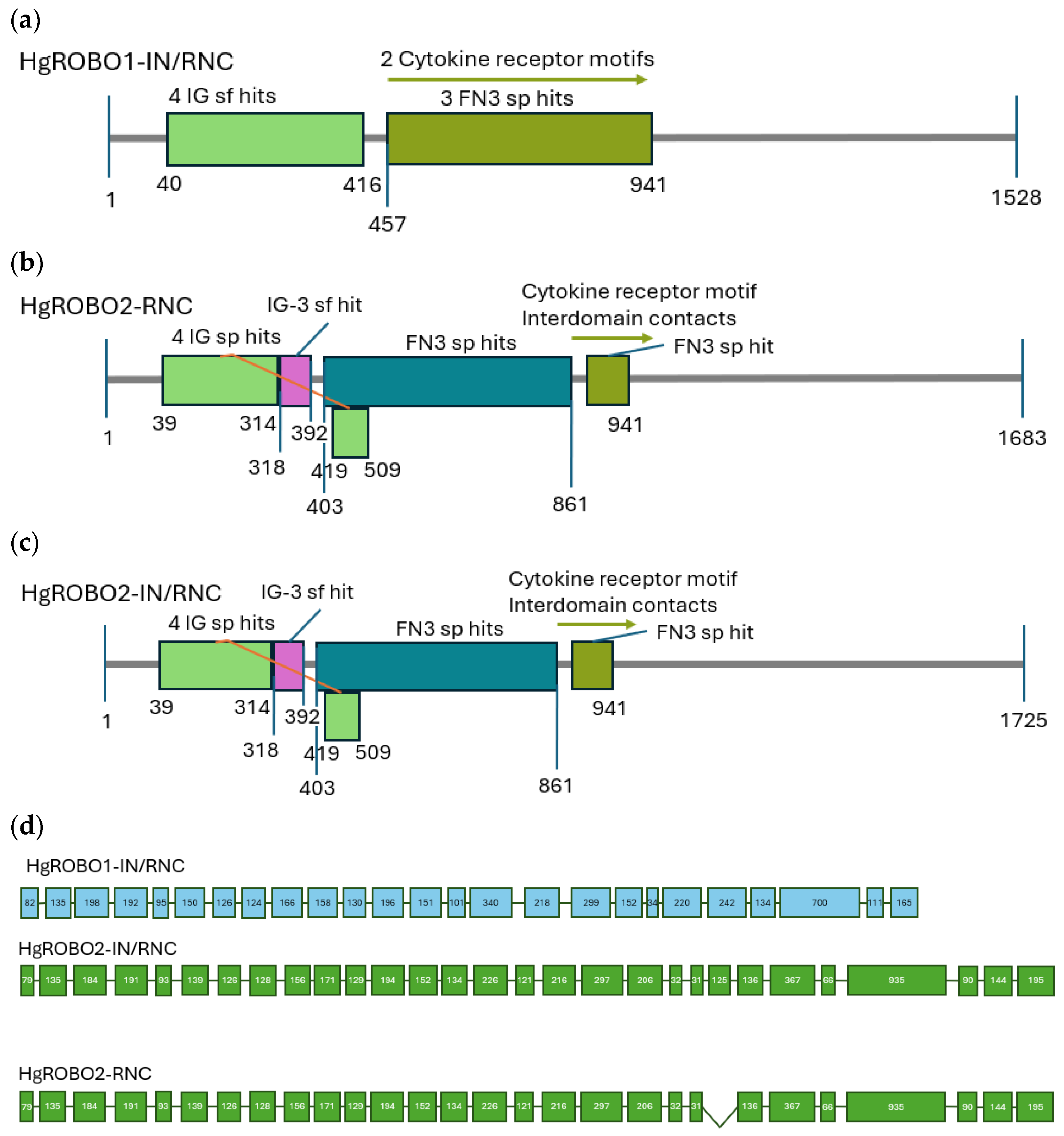
Figure 5. Domain analysis of netrin receptor UNC5B sequences using Batch CD-search NCBI. (a) UNC5B-RNC. (b) UNC5B-IN. (c) mRNA models of UNC5B sequences from H. glaberrima. Both sequences have shared IG and TSP1 domains before the transmembrane region, with IG found in the 4th exon and TSP1 in the 5th exon. The ZU5 domain is found in the 9th exon (HgUNC5B-IN), while both UPA and UNC5 sp hits are found between the 10th and 15th exons.
Jmse 14 00547 g005
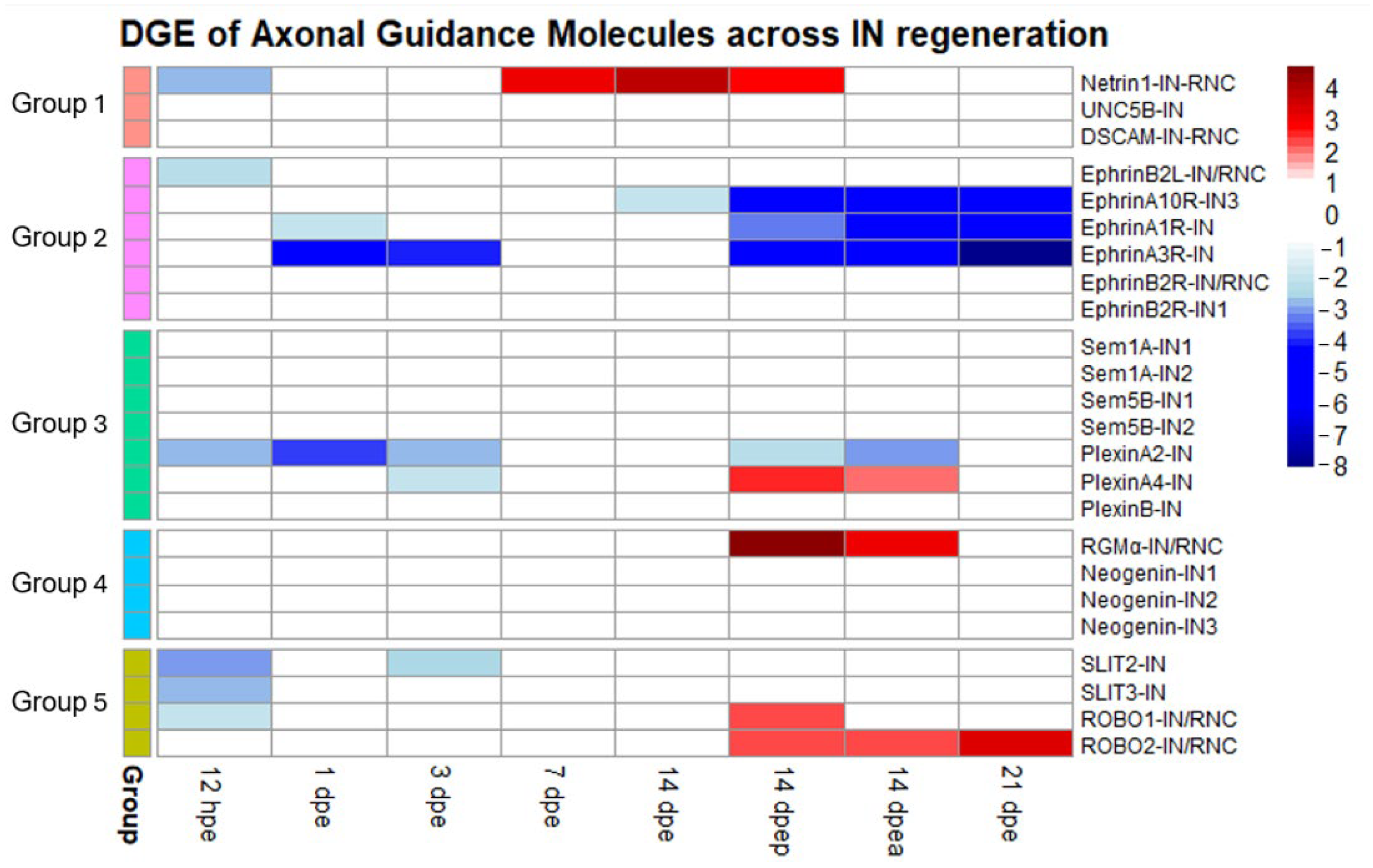
Figure 6. (a) Domain analysis of the HgDSCAM-IN/RNC sequence using Batch CD-search NCBI. (b) mRNA model of DSCAM receptor sequences from H. glaberrima. Our DSCAM sequence shows the typical Immunoglobulin domains flanked near the N-terminal region, with FN3 domains near the middle of the sequence.
Jmse 14 00547 g006
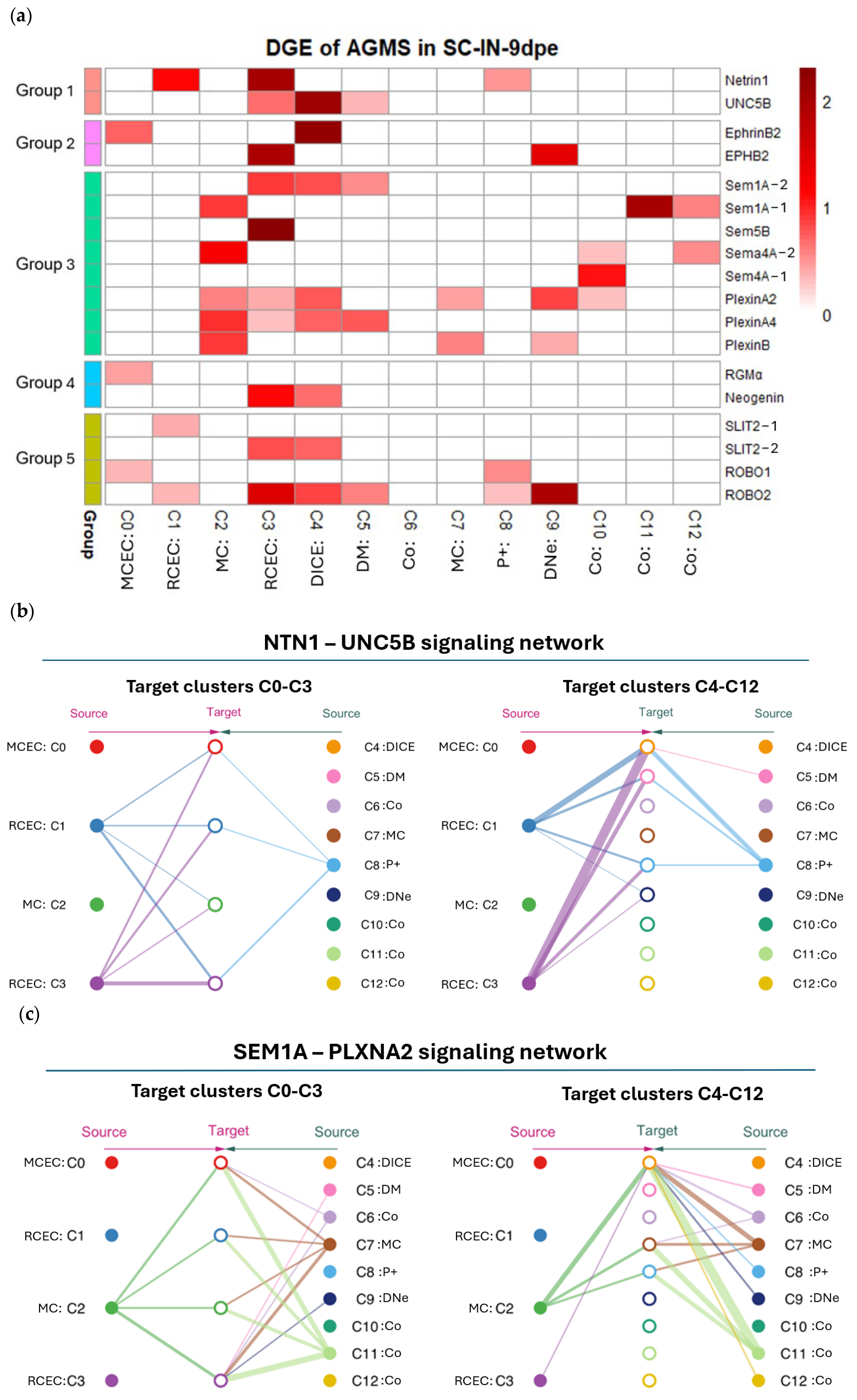
Figure 7. (a) Domain analysis of EphrinB2 ligand using Batch CD-search NCBI. (b) mRNA model of the HgEphrinB2L-IN/RNC sequence. The receptor-binding site domain, flanked near the N-terminal region, matches the first three exons of the mRNA sequence.
Jmse 14 00547 g007
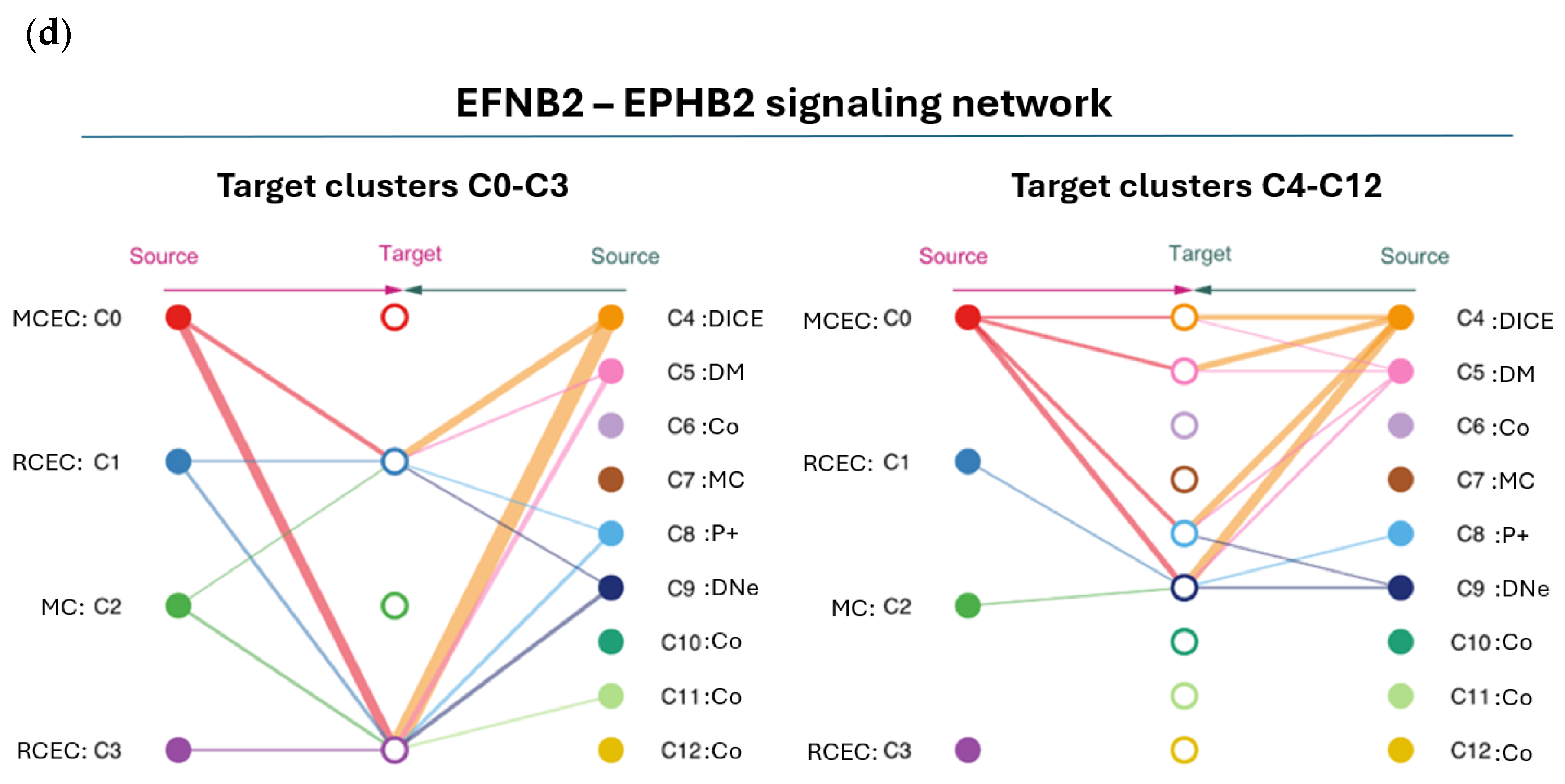
Figure 8. Multiple sequence alignment performed by Clustal Omega between ephrin receptor sequences in H. glaberrima and H. leucospilota. (a) EphrinB2R sequences, (b) EphrinA10R sequences, (c) EphrinA3R sequences (a small fragment was sequenced; however, enough conservation of the C-terminal is present). Both EphrinB2R sequences from H. glaberrima show significant similarities to H. leucospilota. EphrinA10R and EphrinA3R sequences show more regions with no exact match compared to H. leucospilota’s EphrinA10R and EphrinA3R sequences. Asterisks are spaced every 20 amino acids.
Jmse 14 00547 g008aJmse 14 00547 g008b
Figure 9. Percent identity matrix performed by UniProt [29] between ephrin receptor sequences in H. glaberrima and H. leucospilota. Using identity percentages, EphrinAR sequences between H. glaberrima and H. leucospilota colocalized with each other. EphrinA10R shares 45/46% identity with HlEphrinA10R, HgEphrinA3R-IN shares 66.7% identity with HlEphrinA3R, and HgEphrinB2R-IN and HgEphrinB2R-IN/RNC both share 95% identity with HlEphrinB2R.
Jmse 14 00547 g009
Figure 10. Domain analysis of ephrin receptor sequences using Batch CD-search NCBI. (a) EphrinB2R-IN/RNC, (b) EphrinB2R-IN1, (c) EphrinA10R-RNC2, (d) EphrinA10R-RNC, (e) EphrinA3R-IN. (a,b) EphrinB2R sequences retain classical domains, with the EphrinB2R-IN1 displaying a shorter pfam domain compared to the EphrinB2R-IN/RNC sequence. (c,d) EphrinA10R sequences have a protein kinase domain hit near the C-terminal region with IG2 and C2 domains near the N-terminal region; the difference lies in EphrinA10R-RNC having an additional PTZ00449 sf hit. (e) EphrinA3R displays only a protein kinase hit near the C-terminal region.
Jmse 14 00547 g010
Figure 11. mRNA models of ephrin receptor sequences from H. glaberrima. The 67-nucleotide exon is missing from the EphrinB2R-IN/RNC sequence compared to the EphrinB2R-IN. EphrinA10R-RNC2 and EphrinA10-RNC have varying nucleotide numbers and proportions, and EphrinA3R-IN, the largest sequence from both transcriptomes, shows 11 exons.
Jmse 14 00547 g011
Figure 12. Sequence alignment performed by Clustal Omega between semaphorin sequences in H. glaberrima and H. leucospilota. (a) Sem5B alignments, (b) Sem1A alignments, (c) Sem4A alignments. Sem5B from H. leucospilota is closest to the Sem5B-IN/RNC from H. glaberrima. Sem1A from H. leucospilota is closest to the Sem1A-IN from H. glaberrima. Both Sem1A sequences from H. glaberrima show additional and missing regions when aligned. Sem4A-IN/RNC shows varying matching regions with the Sem4A from H. leucospilota. Asterisks are spaced every 20 amino acids.
Jmse 14 00547 g012aJmse 14 00547 g012bJmse 14 00547 g012c
Figure 13. Percent identity matrix performed by UniProt between semaphorin sequences in H. glaberrima and H. leucospilota. Sem4A percentage identities between H. glaberrima and H. leucospilota show 68.4%, which is much higher compared with other sequences. The same observation is present with the Sem5B and Sem1A sequences, which show greater than 90% identities between H. glaberrima and H. leucospilota.
Jmse 14 00547 g013
Figure 14. Domain analysis of semaphorin sequences using Batch CD-search NCBI. (a) Sem5B-IN, (b) Sem5B-IN/RNC, (c) Sem1A-IN/RNC, (d) Sem1A-IN1, (e) Sem4A-IN/RNC. All of the sequences from our transcriptome have the Sema-5 N-terminal domain, but the Sem5B sequences have PSI and TSP domains near the C-terminal region. Sem5B-IN/RNC has an additional TSP domain compared to Sem5B-IN.
Jmse 14 00547 g014
Figure 15. mRNA models of semaphorin sequences from H. glaberrima. Sem5B-IN has putative differential splicing with the absence of one exon, leaving one TSP domain fewer compared to the Sem5B-IN/RNC. Sem1A-IN has an additional two exons near the end of the gene sequence compared to Sem1A-IN/RNC. Sem4A-IN/RNC shows a similar number of exons compared to other sequences.
Jmse 14 00547 g015
Figure 16. Multiple sequence alignment performed by Clustal Omega between plexin sequences in H. glaberrima and H. leucospilota. PlexinB sequences: The PlexinB sequence from H. leucospilota is closest to PlexinB-RNC2 compared to PlexinB-RNC1 from H. glaberrima. Asterisks are spaced every 20 amino acids.
Jmse 14 00547 g016aJmse 14 00547 g016b
Figure 17. Percent identity matrix performed by UniProt between plexin sequences in H. glaberrima and H. leucospilota. PlexinB sequences from H. glaberrima and H. leucospilota share 61.4% (PlexinB-RNC1) and 61.3% (PlexinB-RNC2) identity compared to other sequences. PlexinA4 sequences from H. leucospilota and H. glaberrima share 89.1% identity with each other, while PlexinA2 sequences from H. leucospilota and H. glaberrima share 92.7% identity.
Jmse 14 00547 g017
Figure 18. Domain analysis of plexin sequences from H. glaberrima using Batch CD-search NCBI. (a) PlexinB-RNC1, (b) PlexinB-RNC2, (c) PlexinA4-IN, (d) PlexinA2-RNC. All plexin sequences retain N-terminal domains (Sema_plexin sf, TIG, PSI) and C-terminal domains (Plexin-cytop 1, IP/TIG); however, PlexinA4 displays a shift in the order of TIG2 and PSI domain locations, and all sequences display varying spacing between domains.
Jmse 14 00547 g018
Figure 19. mRNA models of plexin sequences from H. glaberrima. PlexinB-RNC1 has one fewer exon compared to PlexinB-RNC2 near the end of the gene region. PlexinA4-IN/RNC and PlexinA2-RNC have similar exon numbers compared to other PlexinA2 and PlexinA4 sequences, respectively.
Jmse 14 00547 g019
Figure 20. (a) Domain analysis and (b) exon count of the RGMα from H. glaberrima using Batch CD-search NCBI. The first and second exons do not contain any specific domain hits, while the third and fourth exons contain RGM-N and RGM-C.
Jmse 14 00547 g020
Figure 21. Multiple sequence alignment performed by Clustal Omega between Neogenin sequences in H. glaberrima and H. leucospilota. Asterisks are spaced every 20 amino acids.
Jmse 14 00547 g021aJmse 14 00547 g021b
Figure 22. Percent identity matrix performed by UniProt between Neogenin sequences in H. glaberrima and H. leucospilota. HgNeogenin-IN1 displays the closest identity percentage to the Neogenin receptor from H. leucospilota compared to HgNeogenin-RNC2 and HgNeogenin-IN2.
Jmse 14 00547 g022
Figure 23. Domain analysis of Neogenin sequences using Batch CD-search NCBI. (a) HgNeogenin-IN1, (b) HgNeogenin-IN2, (c) HgNeogenin-RNC. Neogenin-RNC displays fewer cytokine receptor motifs flanking the four fibronectin-3 domains compared to Neogenin-IN1 and Neogenin-IN2. Neogenin-IN1 shows a larger transmembrane region between the fibronectin-3 and Neogenin-C domains compared to Neogenin-IN2 and Neogenin-RNC2.
Jmse 14 00547 g023
Figure 24. mRNA models of Neogenin sequences from H. glaberrima. HgNeogenin-IN1’s 21st to 24th exons constitute the additional region near the transmembrane domains that the other Neogenin sequences lack.
Jmse 14 00547 g024
Figure 25. Multiple sequence alignment performed by Clustal Omega between SLIT sequences in H. glaberrima and H. leucospilota. Both SLIT2-IN/RNC1 and the SLIT2 from H. leucospilota are missing a region of alignment that SLIT2-IN/RNC2 possesses. Asterisks are spaced every 20 amino acids.
Jmse 14 00547 g025
Figure 26. Domain analysis of SLIT sequences using Batch CD-search NCBI. (a) SLIT2-IN/RNC1, (b) SLIT2-IN/RNC2 and (c) mRNA models of SLIT sequences from H. glaberrima. SLIT2-IN/RNC1 is missing an exon near the N-terminal region compared to SLIT2-IN/RNC2, leading to a disruption of the fusion between LRR domains, making the LRR-N not distinguishable.
Jmse 14 00547 g026
Figure 27. Multiple sequence alignment performed by Clustal Omega between ROBO sequences in H. glaberrima and H. leucospilota. Among the ROBO2 sequences from H. glaberrima, the sequence closest in alignment to the ROBO2 sequence from H. leucospilota is ROBO2-IN/RNC, as it is not missing a matched region. Asterisks are spaced every 20 amino acids.
Jmse 14 00547 g027aJmse 14 00547 g027b
Figure 28. Percent identity matrix performed by UniProt between ROBO sequences in H. glaberrima and H. leucospilota. ROBO2-RNC and ROBO2-IN/RNC both show high percentage identity with the ROBO2 sequence from H. leucospilota when compared to the ROBO1 sequences. Similarly, ROBO1-IN/RNC shows high percentage identity with the ROBO1 sequence from H. leucospilota.
Jmse 14 00547 g028
Figure 29. Domain analysis of ROBO sequences using Batch CD-search NCBI. (a) ROBO1-IN/RNC, (b) ROBO2-RNC, (c) ROBO2-IN/RNC. ROBO1 displays four immunoglobulin and three fibronectin-3 domains associated with a cytokine receptor binding site. (d) mRNA models of ROBO sequences from H. glaberrima. ROBO2-RNC displays one fewer exon compared to ROBO2-IN/RNC near the C-terminal region, creating a difference in the transmembrane region of the sequence. Both ROBO2 sequences have identical positions and sizes for the immunoglobulin and fibronectin-3 domains but have differences near the C-terminal region. ROBO1-IN/RNC displays all of its conserved domains when compared with other sequences from model and echinoderm organisms.
Jmse 14 00547 g029
Figure 30. Heatmap of the expression of axonal guidance molecules during early- and late-stage intestinal regeneration. This heatmap contains all timepoints collected from our bulk RNA-seq transcriptomic databases. Early and late stages mainly refer to the presence of the luminal epithelium. The timepoints 12-hpe through 14-dpe were compared to normal mesentery, where the luminal epithelium has not formed yet. Timepoints 14-dpeA, 14-dpeP, and 21-dpe were compared to normal intestine; these stages already show luminal epithelium formation. The 14-dpe intestine was divided into three sections: anterior (14-dpeA), middle (14-dpe), and posterior (14-dpeP). The anterior and posterior sections have formed a lumen, while the middle section represents the anlage without a lumen. The color scale represents log2fold change, where red implies overexpression and blue implies underexpression. A significance threshold was set at log2fold change <−2 or >2 with a pADJ value of 0.001. Thus, measurements that lie within 2 to −2 are shown in blank spaces; those overexpressed are in red and those underexpressed are in blue. hpe—hours post-evisceration, dpe—days post-evisceration.
Jmse 14 00547 g030
Figure 31. Differential gene expression between clusters from single-cell sequencing datasets and the IN transcriptome. C0: mesentery coelomic epithelial cells (MCEC); C1/C3: regenerating coelomic epithelial cells (RCEC); C2/C7: mesenchymal cells (MC); C6/C10/C11/C12: coelomocytes (Co); C8: proliferating cells (P+); C4: differentiating intestinal coelomic epithelium (DICE); C5: differentiating muscle (DM); C9: differentiating neuroepithelium (DNe). (a) Unclustered heatmap of transcriptome axonal guidance molecules DGE in the IN. The color scale represents log2fold change, where red represents overexpression when compared to other cell clusters. (bd) CellChat analysis results from the single-cell dataset elucidating communication probability strengths between ligand/receptor pairs in clusters. The clusters below the source column represent the clusters expressing the ligand, while clusters under the target column represent the clusters expressing the receptor. The thicker the line between source and target, the stronger the communication probability with that specific signaling network between source/target. (b) Netrin–UNC5 signaling network, (c) Ephrin signaling network, (d) Semaphorin–Plexin signaling network.
Jmse 14 00547 g031aJmse 14 00547 g031b
Figure 32. Schematic diagram illustrating a proposed ligand–receptor signaling interaction during intestinal regeneration in H. glaberrima. The interaction occurs between re-innervating axons (blue), which originate from the mesentery, and the anlage cells (cream). In this model, signaling may occur bidirectionally. Ligands secreted by regenerating nerve fibers could bind to receptors expressed on anlage cells, influencing their proliferation, differentiation, or patterning. Conversely, anlage cells may secrete chemoattractive ligands that bind to receptors on growing axons, guiding their extension toward the regenerating intestinal tissue. This reciprocal ligand–receptor communication may coordinate tissue regeneration and re-innervation.
Jmse 14 00547 g032
Table 1. Summarized annotations of all the sequences identified in both intestinal and nerve cord transcriptomes of Holothuria glaberrima. Sequences are grouped with their variants, indicating the number of the variant, length in nucleotides/amino acids, the grade of completeness, on which scaffold the sequences are located, and the number of exons. Splice variant n.a. implies that only one sequence was found. IN and RNC identify the sequence to have been found in the intestine or radial nerve cord transcriptomes, respectively. The different colors represent different ligands, darker tones represent the ligands, the lighter colors represent the receptors. The column titled #Domains represents number of domains found in that sequence.
GroupLigand/
Receptor
H. glaberrima Sequence IDSplice VariantLength nt/aaComplete#DomainsScaffoldExon Count
1NetrinHgNetrin-IN/RNCn.a.1785/595Yes575
UNC5BHgUNC5B-IN13009/1003Yes52115
HgUNC5B-RNC22952/984No52114
DSCAMHgDSCAM-IN/RNCn.a.6681/2227Yes121332
2EphrinB2 LigandHgEphrinB2L-IN/RNCn.a.828/276Yes115
EphrinA3 ReceptorHgEphrinA3R-INn.a.1209/403No11711
EphrinB2 ReceptorHgEphrinB2R-IN/RNC13201/1007No6116
HgEphrinB2R-IN23087/1029Yes6117
EphrinA10 ReceptorHgEphrinA10R-RNCn.a.2142/714No4419
HgEphrinA10R-RNC2n.a.2349/783Yes52117
3Semaphorin5BHgSem5B-IN/RNC13129/1043Yes61025
HgSem5B-IN 22967/989No51024
Semaphorin1AHgSem1A-IN/RNC12508/836No1915
HgSem1A-IN122712/904Yes1917
Semaphorin4AHgSem4A-IN/RNCn.a.3114/1038Yes1724
PlexinA4HgPlexinA4-IN/RNCn.a.5760/1920No10329
PlexinBHgPlexinB-RNC115673/1891No10337
HgPlexinB-RNC225709/1903No10338
PlexinA2HgPlexinA2-RNCn.a.5703/1901Yes10330
4RGMαHgRGMα-IN/RNCn.a.1434/478Yes244
NeogeninHgNeogenin-IN115601/1867No101027
HgNeogenin-IN223903/1301No101024
HgNeogenin-RNC234077/1359No91025
5SLIT2HgSLIT2-IN/RNC14341/1447No101732
HgSLIT2-IN/RNC224413/1471Yes111733
ROBO1HgROBO1-IN/RNCn.a.4560/1520Yes71325
ROBO2HgROBO2-IN/RNC15275/1725Yes101329
HgROBO2-RNC25049/1683No101328
Disclaimer/Publisher’s Note: The statements, opinions and data contained in all publications are solely those of the individual author(s) and contributor(s) and not of MDPI and/or the editor(s). MDPI and/or the editor(s) disclaim responsibility for any injury to people or property resulting from any ideas, methods, instructions or products referred to in the content.