
Review

Sustainable Marine Energy Solutions: Assessing the Renewable Potential of the Adriatic Sea in Croatia


Faculty of Mechanical Engineering and Naval Architecture, University of Zagreb, Ivana Lučića 5, 10000 Zagreb, Croatia
*
Author to whom correspondence should be addressed.
J. Mar. Sci. Eng. 2026, 14(6), 541; https://doi.org/10.3390/jmse14060541
Submission received: 13 February 2026 / Revised: 11 March 2026 / Accepted: 13 March 2026 / Published: 13 March 2026
(This article belongs to the Special Issue Marine Renewable Energy and Environment Evaluation)

Abstract

Marine energy technologies offer renewable alternatives to conventional energy sources by harnessing ocean-based resources such as wave motion, tides, temperature, and salinity gradients. They are particularly promising for coastal and island regions. This paper presents a literature-based assessment of the technical potential and limitations of these resources, with a focus on the Adriatic Sea as a model for low-energy, semi-enclosed basins. Resource availability and technological maturity are systematically reviewed. Results indicate that wave energy offers the highest regional potential, with peak annual mean wave power reachig up to 2.784 kW/m near the southern offshore regions of the Adriatic. However, current resource levels limit feasibility to down-scaled, modular installations. Tidal and thermal energy are constrained by the Adriatic’s microtidal regime and limited temperature gradients. Although still in early development, salinity gradient systems may become viable near major river mouths such as those of the Po and Neretva. In addition to technical analysis, broad environmental and socio-economic considerations are reviewed to inform responsible marine energy development. These findings help define strategic development and research priorities for marine renewables in enclosed seas and other resource-constrained marine environments.

1. Introduction

Marine energy involves harnessing the vast renewable potential of the world’s oceans and seas. As global energy demands rise, the pursuit of sustainable alternatives has become increasingly urgent, and marine energy technologies are receiving growing attention. Exploiting this resource relies on converting natural ocean movements, such as tides and waves, as well as seawater properties, including salinity and temperature, into usable energy through specialized technologies. While many of these technologies remain in the early stages of commercialization, recent progress has sparked renewed interest in assessing their full potential [1]. Today, a diverse array of technologies is being developed to capture different forms of ocean energy, including offshore wind [2], wave [3], and tidal [4] energy as well as salinity [5] and thermal [6] gradients. A review by Khan et al. [7] highlights not only the technical, but also the socio-economic and environmental dimensions of marine energy, emphasizing both the progress achieved and the research gaps that persist. Of the various types, wave energy stands out for its high global potential, estimated at up to 30,000 TWh/year, comparable to or even exceeding wind energy [3].
Although wave power density is approximately half that of wind, wave energy has the advantage of being available around 90% of the time, significantly more than solar and wind, making it a reliable candidate for renewable energy generation [1]. Tidal energy offers another predictable source, with technologies focused on extracting either the kinetic energy of tidal currents or the potential energy from tidal height differences [8]. Si et al. [9] assessed the modern technologies used for harvesting tidal current energy in China and provided insights into future trends in the advancement of tidal current energy converters. More details about harvesting potential energy from the tides, also known as tidal range energy, can be found in [10]. The authors outlined the main principles of such technologies and provided a solution for the variability in electrical energy generation by utilizing multiple power plants that are complementary in phase.
Recent research has also refined Ocean Thermal Energy Conversion (OTEC) systems, which utilize the temperature difference between the warm ocean surface and the cold water at depth. These systems are used to generate electrical energy, but heat energy can be used directly in conjunction with low-temperature thermal desalination or seawater air conditioning systems [11]. Ishaq and Dincer [12] evaluated OTEC systems, as well as solar and wind energy, for clean hydrogen production. Abbas et al. [13] reviewed the closed thermodynamic cycles and showed various efficiency-improving strategies for OTEC systems. The authors investigated the impact of different working fluids, i.e., changes in condensing and evaporating temperatures, on cycle efficiency.
Finally, salinity gradient energy conversion systems use the difference in salt concentration in the seawater. The salinity of seawater is around 35 ppt, while freshwater is below 0.5 ppt. Technology that takes advantage of differences in the salt concentration to produce electrical energy use membrane-based processes to harvest the energy. Pressure Retarded Osmosis (PRO) and Reverse Electrodialysis (RED) are the most researched approaches [14,15]; however, other experimental methods, such as vapor compression and hydrothermal generators, have also been explored [16].
Most research and implementation efforts to date have concentrated on high-energy, open-ocean sites. The suitability and impact of marine energy systems in enclosed or low-energy basins remain less explored. This study addresses that gap by evaluating the technical feasibility of marine energy exploitation in the Adriatic Sea, a semi-enclosed basin characterized by moderate wave climates, small tidal ranges, and minimal temperature and salinity gradients. A comprehensive analysis of recent developments in marine energy technologies is presented, along with a review of the specific challenges and opportunities associated with the Adriatic Sea, to inform future research and development efforts. In addition to technological and resource assessments, this article also provides a general overview of the key environmental and socio-economic considerations relevant to the implementation of marine energy systems.

2. Worldwide Potentials

Covering more than two-thirds of our planet’s surface, the oceans hold an immense and largely untapped reservoir of energy, far exceeding both humanity’s current and future energy demands. In just four days, the oceans absorb as much thermal and kinetic energy as is contained in all known global oil reserves. Consequently, ocean energy stands out as a renewable and comparatively clean alternative to conventional fossil fuels. In terms of numbers, Wilberforce et al. [17] estimate that the global wave energy potential could reach as high as 32,000 TWh/year, while tidal current energy potential amounts to 48 TWh/year from only 106 locations identified in Europe. Regarding OTEC systems, the global potential upper limit is estimated to be 35,000 TWh/year without harming the environment [18]. The potential energy harnessed through the use of a salinity gradient is estimated to be nearly 1650 TWh/year, according to [19].

2.1. Worldwide Wave Energy Potential

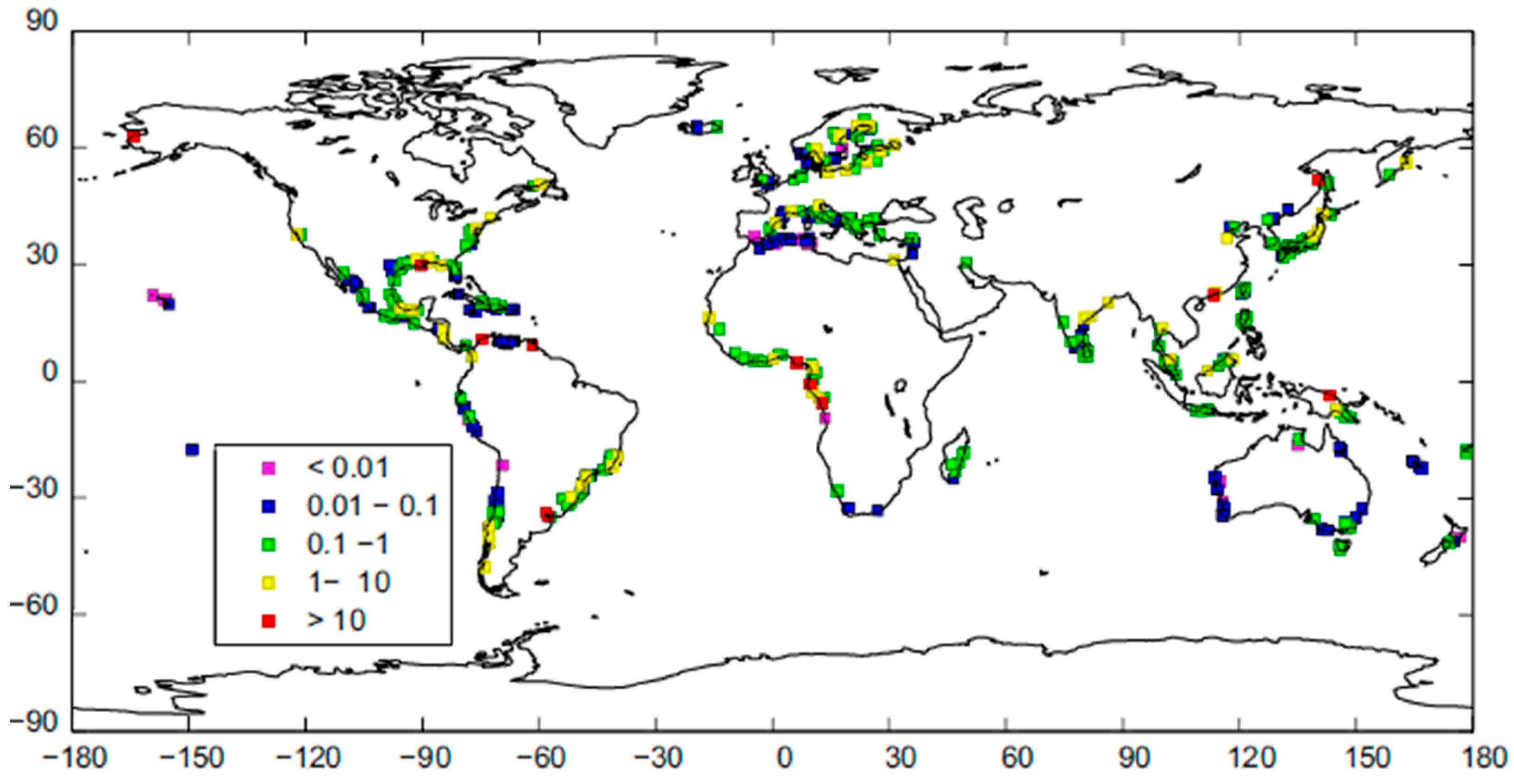
Estimates of the global wave energy resource are substantial, ranging from approximately 29,500 TWh/year [3] to potentially as high as 32,000 TWh/year [17]. Wave energy density typically ranges between 2 and 3 kW/m2, surpassing that of wind (0.4–0.6 kW/m2) and solar power (0.1–0.2 kW/m2). This positions wave energy among the renewable energy sources with the highest energy density worldwide. Despite this advantage, only about 0.5–0.6% of the global wave energy potential is currently being harnessed for electricity production [20]. Figure 1 presents the estimated mean wave energy potential (in MW), and the typical water depth ranges suitable for wave energy converter (WEC) deployment along the coasts of key countries, highlighting the wide disparities in natural resource availability worldwide.
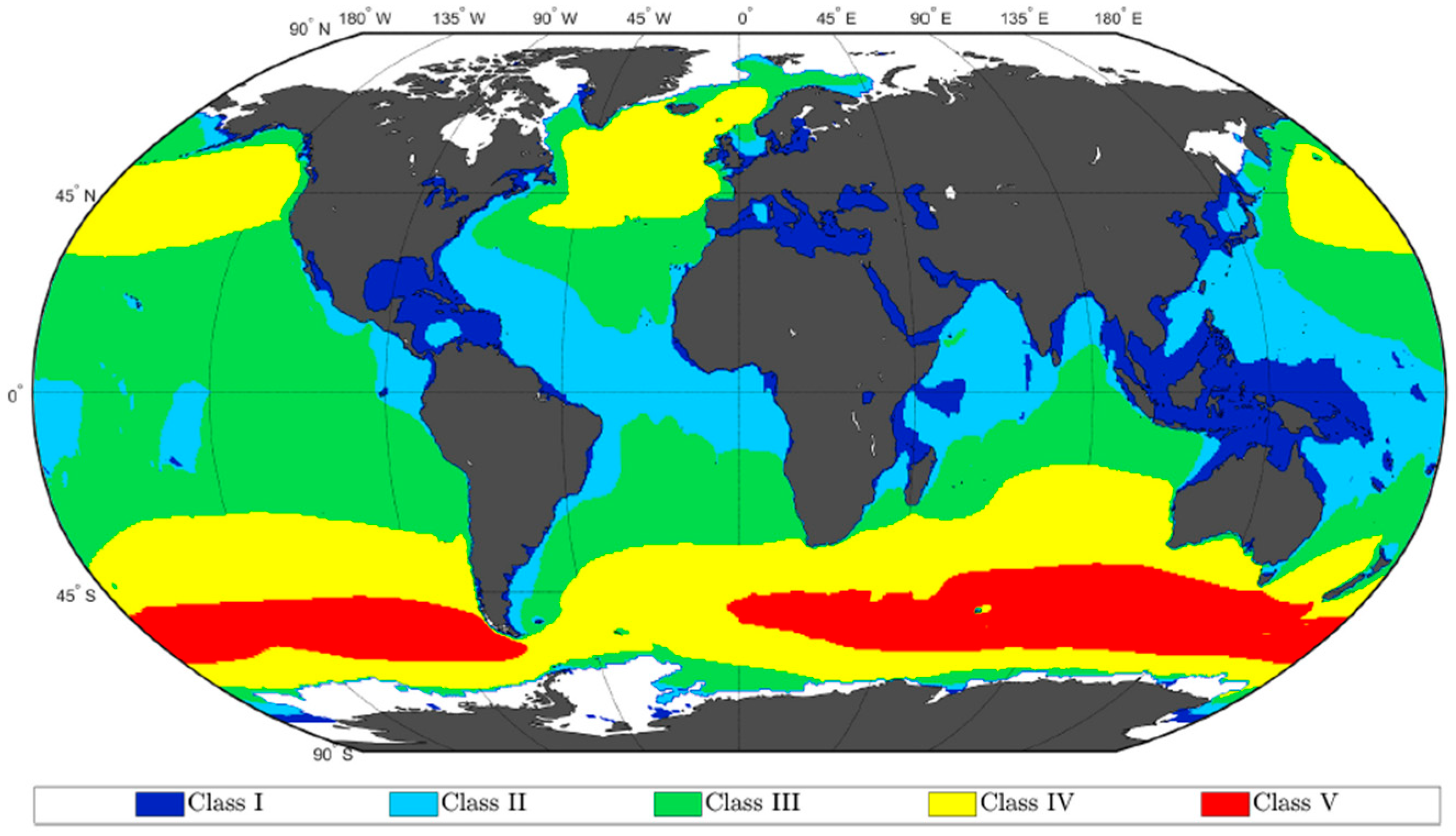
Martinez and Iglesias [21] established a classification system to assess the global spatial distribution and development potential of wave energy, based on mean wave power and structured into five classes. The global spatial distribution of these classes is shown in Figure 2. Class I (<10 kW/m) includes enclosed and semi-enclosed seas such as the Mediterranean Sea and the Gulf of Mexico and is considered unsuitable for large-scale energy production. Classes II and III (10–40 kW/m) occur primarily in open ocean environments at lower and lower-middle latitudes, including regions off Chile and southwestern Australia. Class IV (40–80 kW/m) and Class V (>80 kW/m) are found in upper-middle to high latitudes, particularly in the North Atlantic, North Pacific, and Southern Ocean, where long fetches and persistent westerlies enhance wave generation. The wave resource classes are shown in Figure 2 [21].
In summary, global wave energy potential is governed not just by the sheer magnitude of available energy, but also by the regularity and predictability of the wave climate. Both factors are essential when considering the optimal sites and the adaptation of technology for practical energy conversion from ocean waves.

2.2. Worldwide Tidal Energy Potential

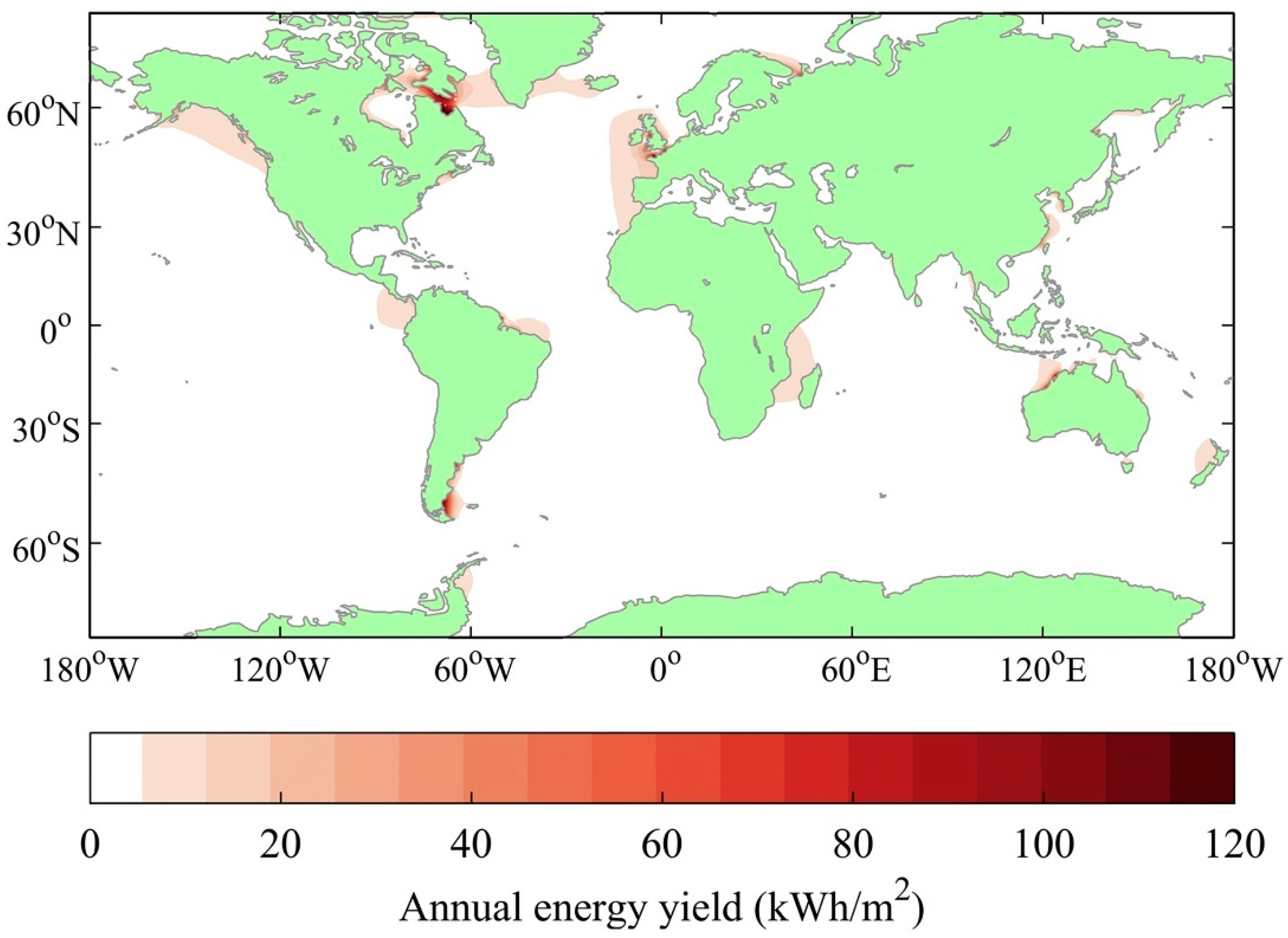
Neill et al. [10] provided the global theoretical tidal range resource. The worldwide estimate of the tidal range resource is approximately 25,880 TWh, with the majority of the resource concentrated in just 11 countries. Figure 3 shows the distribution of the global potential energy density, i.e., the tidal range resource.
Despite this large theoretical value, only about 0.22 % of the world’s ocean areas combine adequate tidal amplitudes and suitable seabed topography for economic exploitation. After accounting for climatic, geographic, and environmental constraints, the realistically accessible resource is reduced to approximately 5792 TWh annually, with about 90% concentrated in five countries: Australia, the United Kingdom, Canada, France, and the United States (mainly Alaska).
Among these, Australia represents the single largest share of global tidal range energy potential, accounting for nearly a third of the accessible resource. Canada’s Bay of Fundy is globally recognized for its exceptional tidal range, exceeding 16 m in some locations, and alone contributes over 20% of the world’s tidal energy potential. The United Kingdom’s significant sites include the Severn Estuary, Bristol Channel, Mersey, and Solway, offering an annual resource estimated at 734 TWh, which is roughly comparable to the northern coasts of France in Brittany and Normandy, where the tidal regime is similarly strong and conducive to large-scale projects. Alaska’s remote inlets supply most of the US potential. Other countries, including Brazil, South Korea, Argentina, Russia, India, and China, also have notable but more modest resources [10]. For example, South Korea is home to Lake Sihwa, the world’s largest tidal power station, demonstrating the scale and feasibility of contemporary tidal range projects [4]. Assessments consistently confirm that most of the world’s usable tidal energy is concentrated in a few hotspots where bays, inlets, or estuaries boost tidal range or current speed. Consequently, while the global practical potential is immense, its contribution depends on targeted development in these concentrated areas.

2.3. Worldwide OTEC Energy Potential

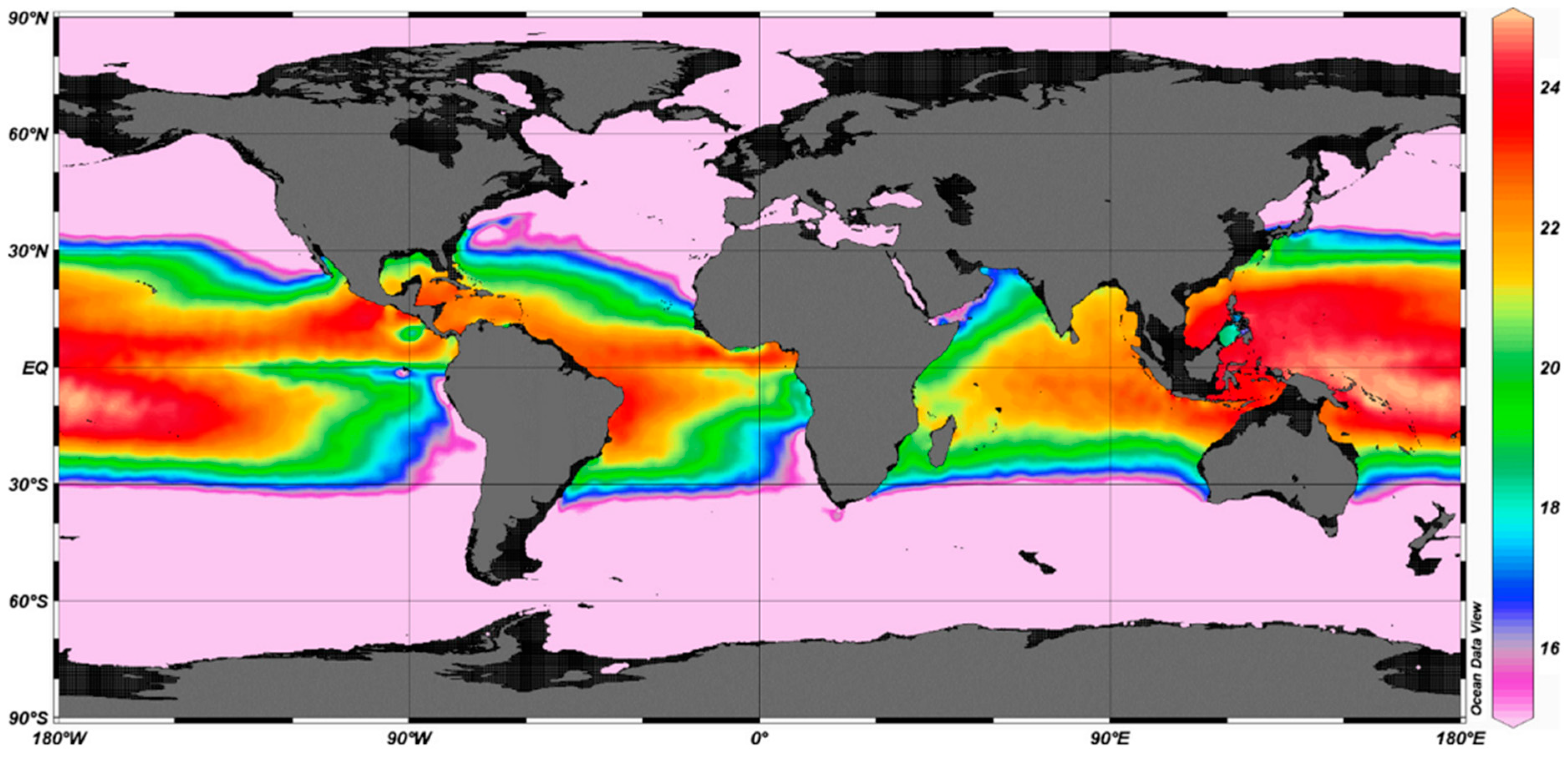
Nihous [22] utilized data from the World Ocean Atlas (WOA05) to map the average OTEC thermal resource, specifically the average temperature difference between ocean depths of 20 m and 1000 m. Figure 4 indicates that the latitude range between 30° S and 30° N is the most favourable for OTEC systems. The ocean thermal gradient is exploitable throughout the Pacific and Indian Oceans, with some potential also present in the Atlantic Ocean, though to a lesser degree.
Recent research utilizing advanced ocean modelling indicates that, if OTEC technology is implemented under ideal and environmentally responsible conditions, it could provide up to 14 TW of continuous power, nearly equivalent to today’s total global primary energy use. Even when scaled conservatively to minimize ecological impacts, the achievable OTEC generation is still projected at approximately 7 TW globally [23].
The highest resource concentrations are found in parts of the Pacific, such as around Papua New Guinea, Indonesia, the Philippines, and Kiribati, as well as in the Indian Ocean near the Maldives, Seychelles, and Sri Lanka [24]. The Caribbean and sections of the Atlantic, including the Gulf of Mexico, parts of West Africa, and northern Brazil, also offer localized opportunities. However, the Atlantic generally provides fewer ideal sites [24].

2.4. Worldwide Salinity Gradient Energy Potential

Finally, the salinity gradient conversion energy resource is estimated to be 15,102 TWh/year, which is equal to 74% of the total worldwide consumption of electrical energy [25]. Alvarez-Silva et al. [25] have shown that the exploitation of salinity gradient energy is decentralized, meaning it is broadly available worldwide, with a potential installed capacity of 10 MW at suitable river mouths.
The global mapping of extractable salinity gradient energy resources, shown in Figure 5, reveals that several major river systems stand out for their vast extractable energy reserves and suitability for large-scale deployment. Rivers such as the Congo, Orinoco, Mississippi, Paraná, and Amur rank at the top, with the Congo River alone estimated to support an extractable potential of 114 TWh per year. Each of these rivers is capable of supporting facilities with installed capacities exceeding 10 MW, highlighting the feasibility of significant energy projects at these sites. Altogether, over 280 river mouths worldwide have been identified as capable of supporting at least 10 MW of installed capacity, further emphasizing the distributed nature of this resource [25].
The Mediterranean Sea is recognized for its high salinity due to a combination of limited freshwater runoff and high evaporation, creating sharper gradients at river estuaries. Similarly, the Caribbean Sea and Gulf of Mexico offer favourable conditions for salinity gradient energy projects, with 34% of river mouths with the highest energy densities located in the Mediterranean and 29% in the Caribbean and Gulf regions [25].

3. Technologies

3.1. Wave Energy

There are numerous challenges in harnessing wave energy. The wave patterns exhibit irregular variations in amplitude, phase, and direction, making it challenging to design devices that can efficiently extract energy across such a wide range of conditions. Extreme weather conditions can generate waves with amplitudes 10 times greater than the average wave [26], which means that the structures must be designed to withstand around 100 times the power intensity to which they are typically subjected. The large wave periods, which have the highest energy density, are difficult to couple with the electrical generators, which require high frequency. Additionally, regarding the exploitation of deep-water waves, there are issues with the mooring of offshore systems, as well as with the transmission of power from deep water to land.
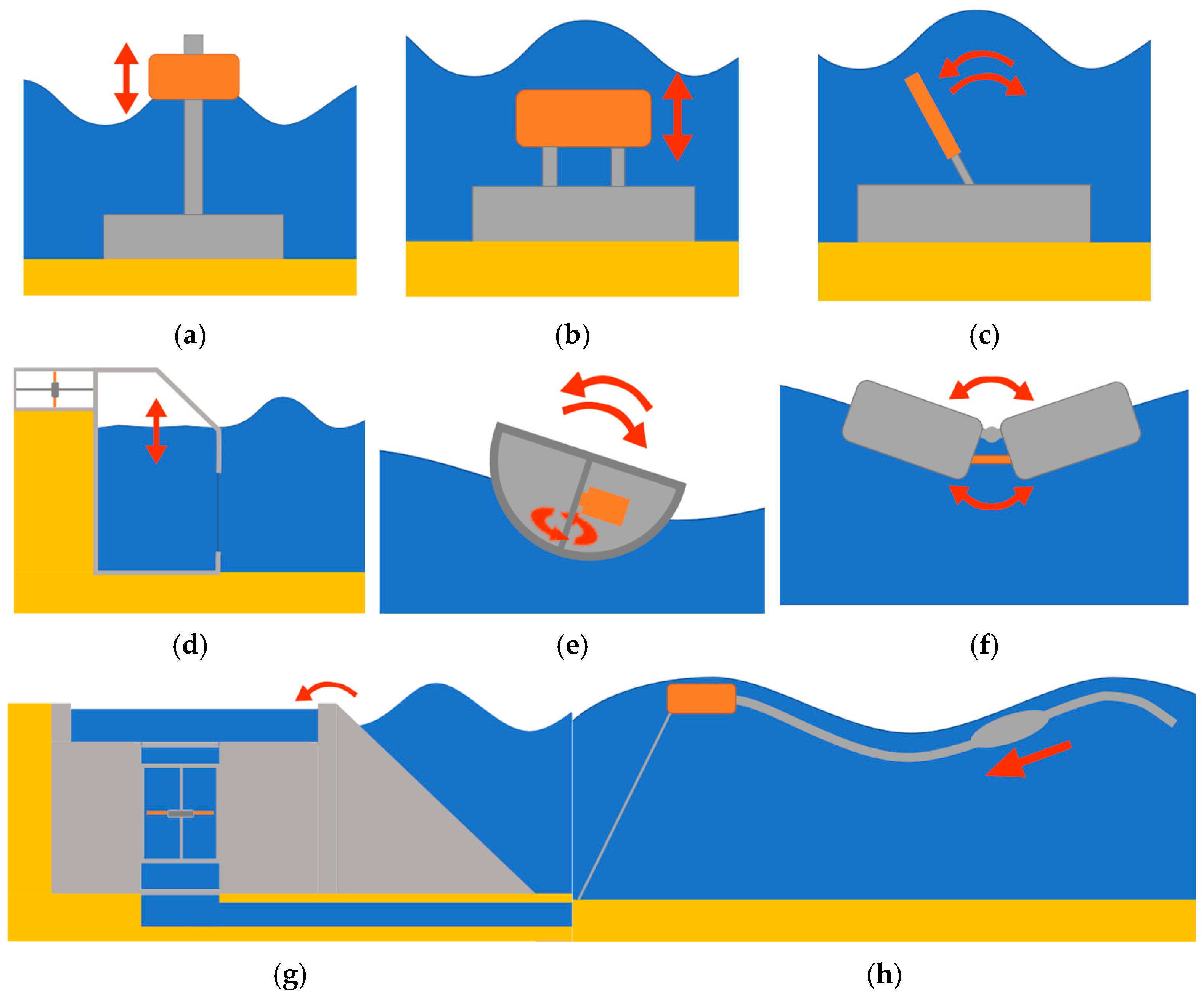
To capture and convert wave energy into electrical energy, various types of WECs [27] can be utilized. The different types of WEC are shown in Figure 6. In the figure, the blue color represents the sea, while yellow color represents the land. The red arrows indicate the direction of motion.
WEC systems can be classified depending on the location in relation to the bathymetry and the distance to the coast [28] into onshore, nearshore, and offshore. Offshore systems are located in deep waters with depths of 50 m or more. Nearshore systems refer to those located in shallow waters, typically less than 50 m deep, situated relatively close to the shore. Onshore systems are built directly on the coast, often integrated into existing structures, such as breakwaters.

3.2. Tidal Energy

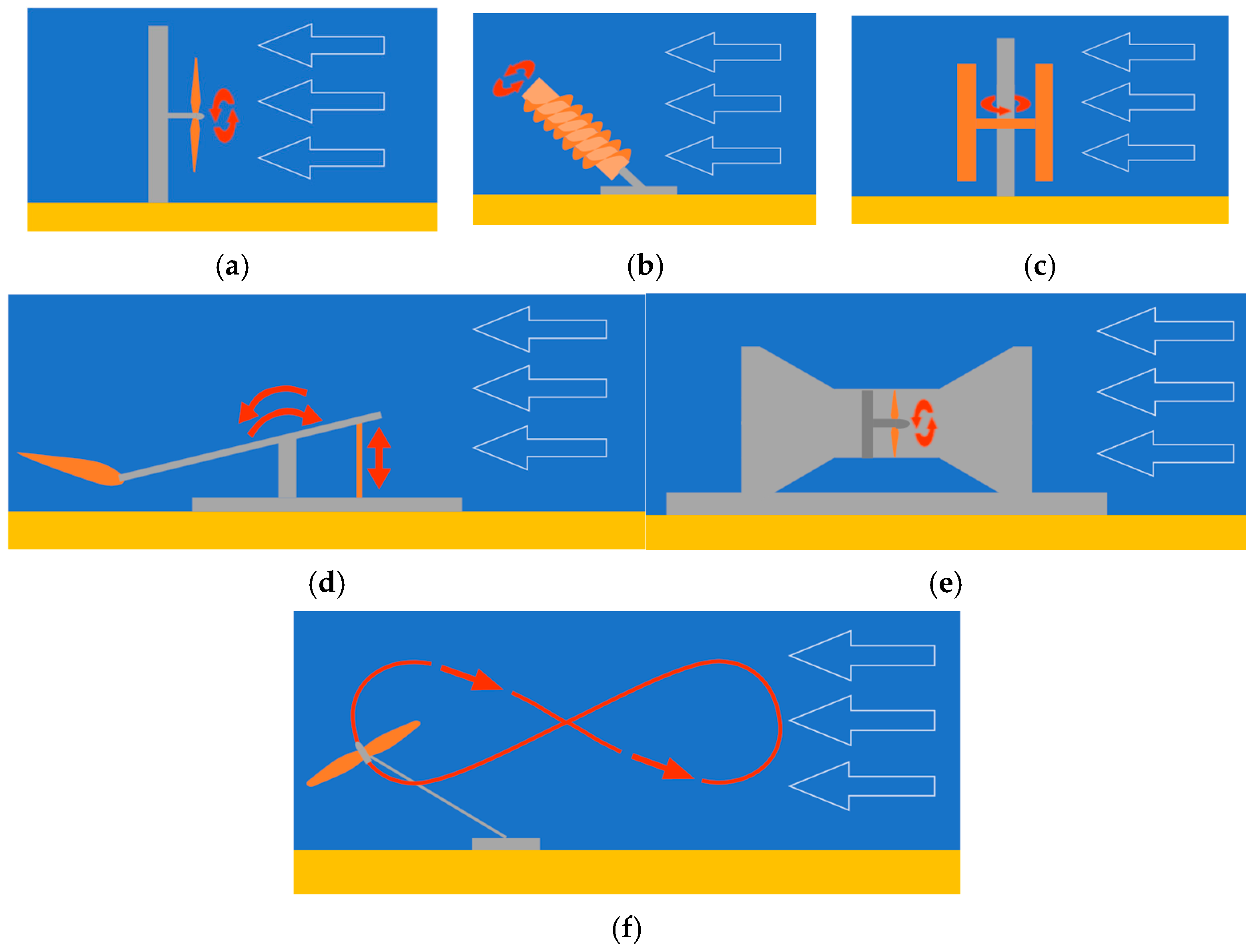
Tidal energy technologies focus on extracting the kinetic energy from tide-induced currents or the potential energy of sea level height differences. The two methods of extracting the tidal energy differ in the method of generating the electrical energy. The former is extracted similarly to wind energy [29], while the latter requires a dam or some other barrier to capture the high tide. With the captured water mass, electrical energy is generated using conventional turbines employed in hydroelectric power generation. The downside is that the tide range, i.e., the difference between the high and low tides, must be at least 3 m for the economically viable generation of electrical energy. The extraction of kinetic energy from tidal currents is accomplished using various types of tidal energy converters (TECs), as shown in Figure 7. In the figure, the blue color represents the sea, while yellow color represents the land. The red arrows indicate the direction of motion.
Tidal energy can be harnessed through several main system types: tidal barrages and lagoons, which utilize the difference in water levels between high and low tide; tidal stream turbines, which extract energy from fast-moving underwater currents; and in-river tidal converters designed for estuaries or tidal rivers [29]. The choice of system depends on local geography and resource characteristics, allowing tidal power to be adapted to a range of coastal and estuarine environments [30].
These TECs may be used to extract the kinetic energy of any type of ocean current. It should be noted that in addition to tides, currents can be caused by other factors such as the effect of wind on the sea surface, the effects of the sun heating the water in equatorial regions and the cooling in the polar regions, salinity, and density variations as well as the Earth’s rotation, i.e., Coriolis effect. However, these factors induce slow ocean currents, except for wind-induced surface currents, which can reach greater speeds in extreme weather conditions.

3.3. Ocean Thermal Energy Conversion (OTEC)

OTEC systems exploit the difference in temperature between the warm surface waters, which are heated by the Sun, and the colder waters in the ocean depths. A difference of 20 °C or more between the warm and cold-water masses is required to exploit the resource. Thus, the OTEC systems are limited to certain areas in the world with suitable intense resources and the potential market for energy. The OTEC systems can be located onshore or at sea. The latter is technically challenging due to the large volumes of water that must be pumped from the seabed to a floating system. Additionally, a very large heat exchanger is required, as well as the need to transmit the generated power from a floating system to the shore. Only the onshore OTEC systems are economically feasible if used as a multi-purpose technology. For example, nutrient-rich cold water can be drawn from the deep ocean and utilized in fish farming, while cool water can be used in air conditioning systems.
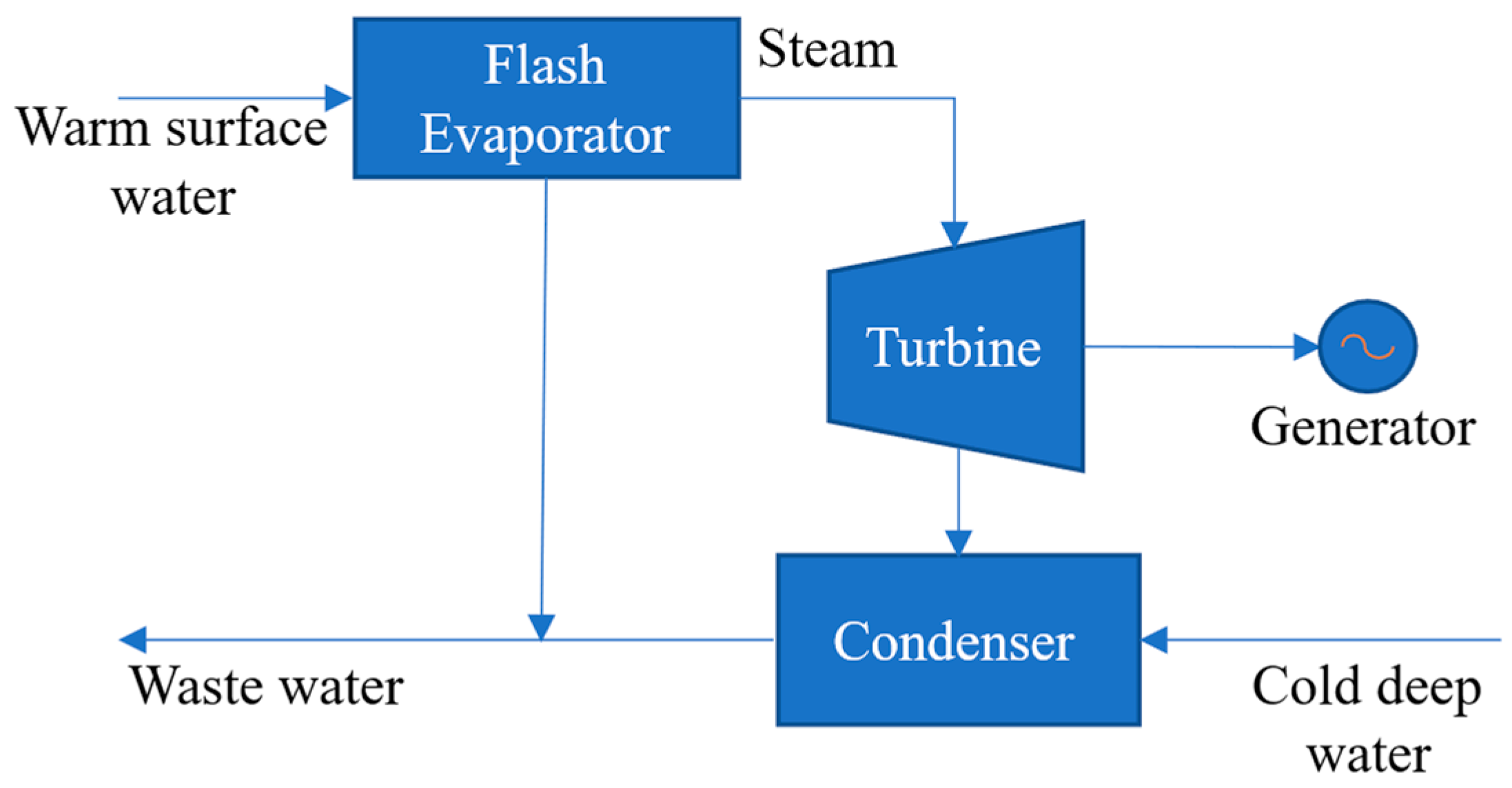
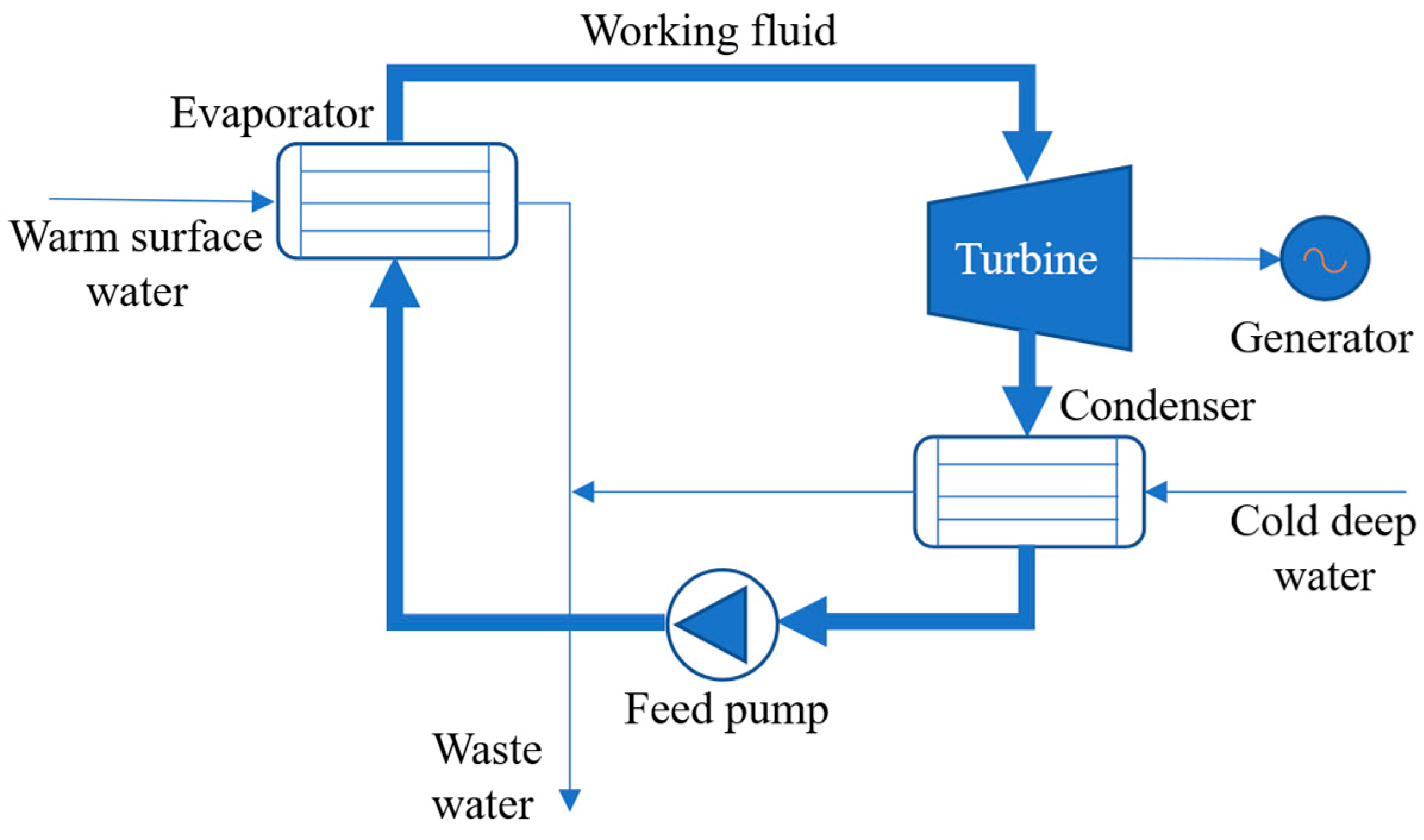
The OTEC systems can be divided into open-cycle, closed-cycle, and hybrid systems. Open-cycle systems utilize the warm seawater itself as the working fluid. In contrast, closed-cycle systems employ a low-boiling-point working fluid, such as ammonia, which is vaporized using warm surface seawater. The schematic diagrams of the open-cycle and closed-cycle systems are shown in Figure 8 and Figure 9, respectively. The hybrid systems combine the features of both the closed-cycle and open-cycle systems. Hybrid systems combine features of both closed-cycle and open-cycle designs, where warm surface seawater is flash-evaporated into steam to vaporize a low-boiling-point fluid.

3.4. Salinity Gradient Energy Conversion

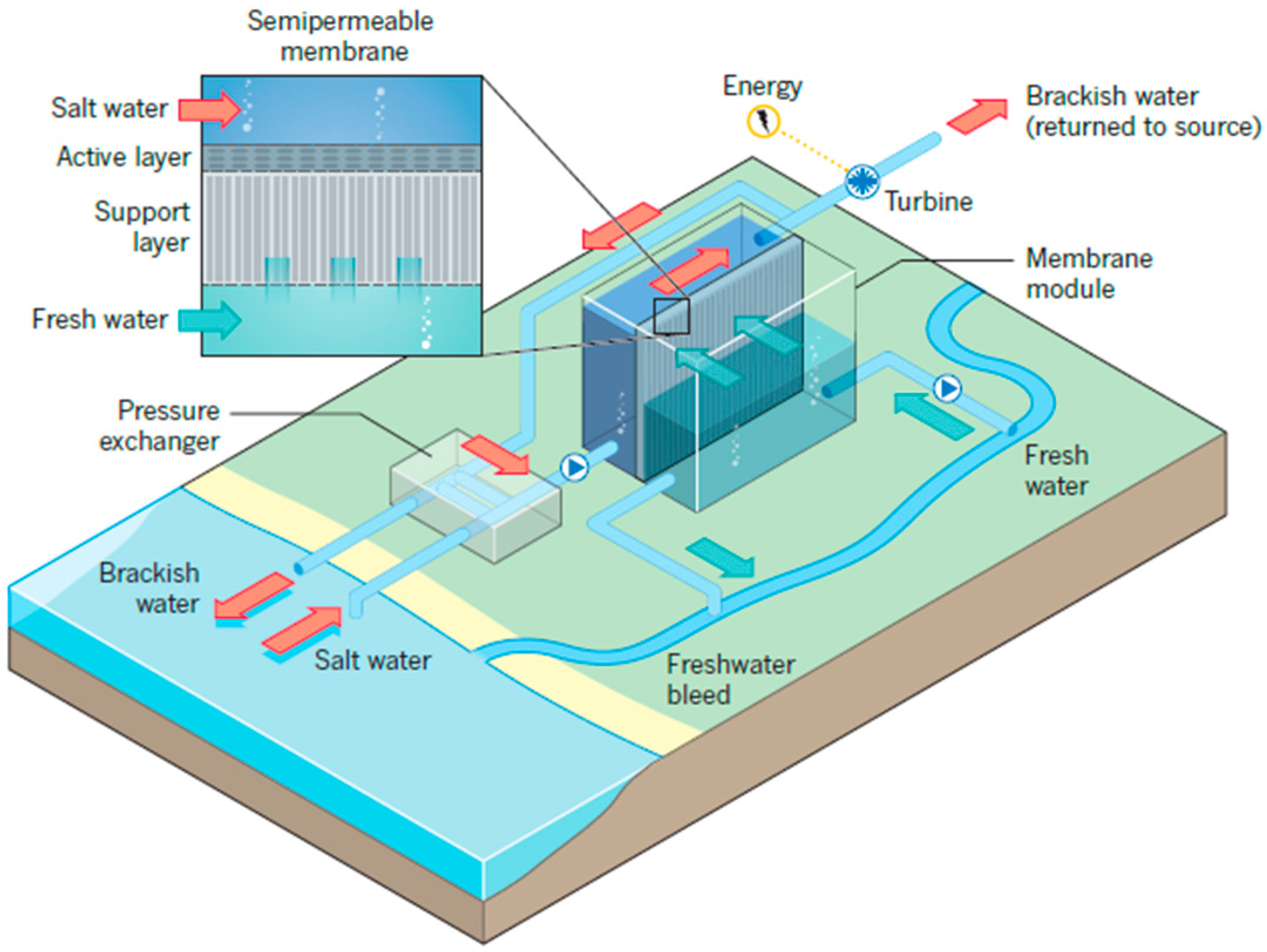
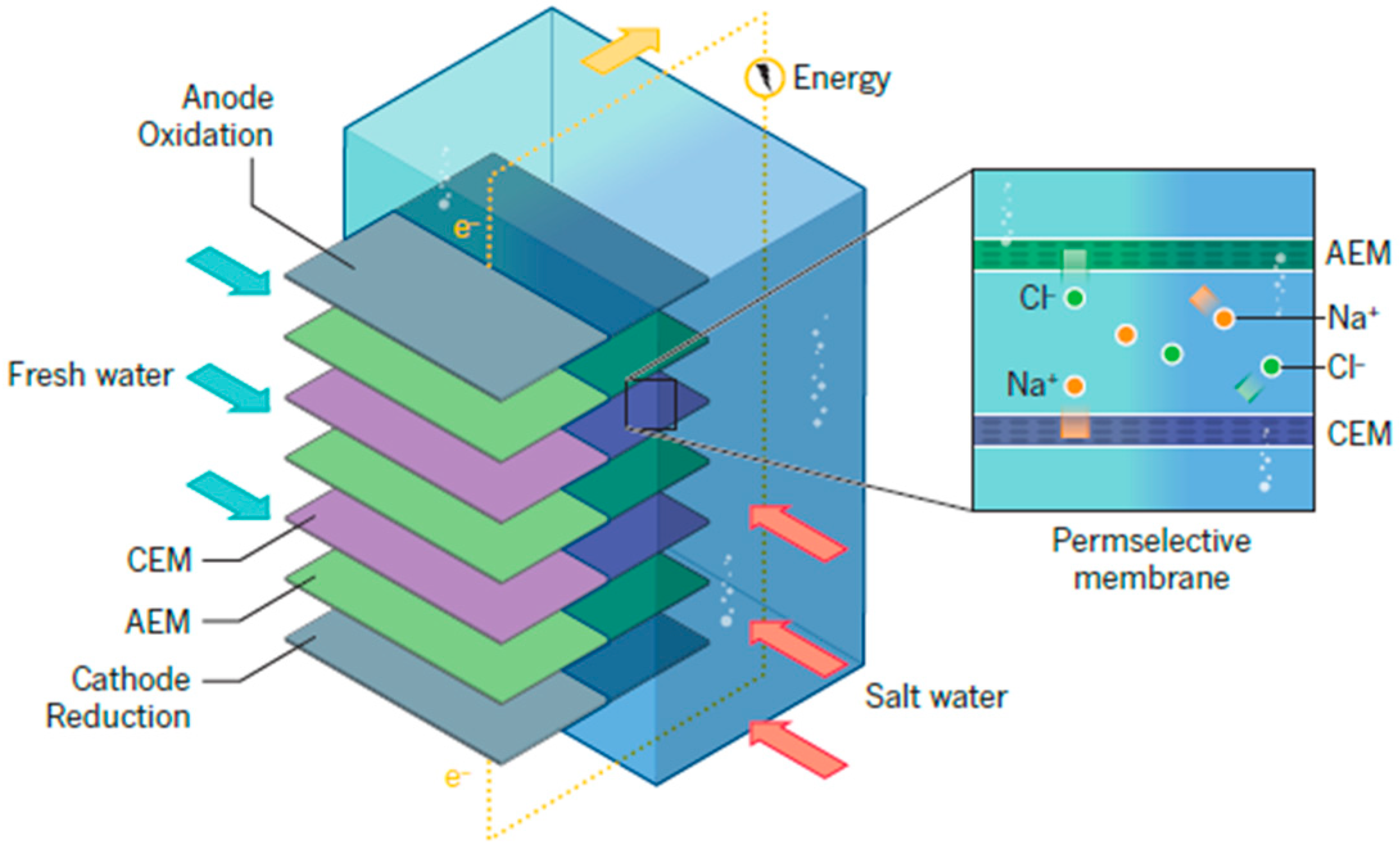
Harnessing the salinity gradient energy is based on the difference in the salt concentration between seawater and fresh water. Two methods are being developed: Reverse Electro-Dialysis (RED) [31] and Pressure Retarded Osmosis (PRO) [32]. Both rely on semi-permeable membranes but differ in their challenges. Figure 10 and Figure 11 provide schematic illustrations of the RED and PRO systems. The arrows indicate the direction of water motion. In RED, driven by the concentration difference between the saltwater and freshwater streams, stacks of alternating cation and anion exchange membranes allow the selective migration of salt ions. This selective ion movement generates an electrical current via redox reactions at the electrodes. In PRO, the membrane is more permeable to water than to salt, allowing water molecules to pass through from the freshwater side to the seawater side, thereby creating high hydrostatic pressure. The pressurized water is then used to power a turbine, generating electrical energy. The downside of both processes is that the semi-permeable membranes are still in an early stage of development, making them relatively low in performance and expensive [33].
The other approaches, such as a hydrocratic generator and vapour compression [16], do not use semi-permeable membranes. The hydrocratic generator uses the fresh water natural flow, i.e., the water from the rivers, and mixes it with seawater. The difference in densities between the mixed water and the surrounding water induces upward velocity, and with the use of a tube, the flow is directed and accelerated. Finally, the diameter of the tube is reduced in the turbine region where the electrical energy is generated. The vapour compression approach uses fresh water, which is evaporated under low pressure and condensed in seawater, which in turn drives a turbine.

3.5. Designed Devices

As interest in marine energy exploitation has grown significantly, numerous technologies have been developed over the years. The PRIMRE Marine Energy Projects Database [35] provides a comprehensive list of various worldwide projects, test sites, devices, technologies, and organizations that intend to harness marine energy. In this subsection, devices that are actively being developed are extracted from the database.
Table 1 shows that the point absorber types of WEC are the most popular. The maximum rated power capacity of WEC systems ranges from 0.1 MW to 100 MW [35]. Analysis of the PRIMRE dataset indicates that nearly half of the 197 documented wave energy converters are currently inactive. This high attrition rate underscores persistent constraints to the successful commercialization of wave energy technologies. The most important among these is suboptimal performance under irregular and highly variable wave conditions, often resulting from non-optimized buoy geometries, immature PTO systems, and inadequate adaptive control strategies to address the dynamic marine environment [20,36,37].
Advancement in the field is complicated by the extensive range of WEC concepts. While this variety results from extensive research, development, and adaptation to site-specific conditions, it also leads to sector fragmentation and hinders the emergence of scalable, proven solutions. Beyond point absorbers, other device classes include attenuators (e.g., Pelamis), oscillating wave surge converters (e.g., WaveRoller), oscillating water columns (e.g., Mutriku), and overtopping devices (e.g., Wave Dragon). Each design is optimized for specific marine conditions. However, competition for limited demonstration projects and investment opportunities continues to hinder widespread adoption [35].
Despite before mentioned challenges, a few high-profile projects demonstrate the sector’s innovation and potential. For instance, the Mutriku OWC plant in Spain is notable as one of the rare commercial-scale facilities that has demonstrated consistent operation over several years. It also serves as a testbed for emerging turbine technologies, with ongoing capacity enhancements designed to foster further innovation. In Denmark, the Wave Dragon project is progressing toward the construction of a 3 MW demonstration facility that will combine wave and wind energy at the PLOCAN test site in the Canary Islands. Meanwhile, the WaveRoller device in Portugal, an oscillating wave-surge converter, completed its commercial-scale pilot and continues to be recognized as a key example of European wave energy deployment [38].
Nonetheless, one of the foremost barriers to widespread deployment remains the reliability of WECs in harsh marine environments. Devices are subjected to extreme wave impacts, fluctuating loads, corrosion, and biofouling, which increase maintenance needs and can compromise their performance. Examples such as China’s “NanKun” device, which successfully operates through multiple typhoons, illustrate what is possible. Ongoing R&D in the US and Sweden continues to progress on advanced controls, PTO innovations, and materials development to enhance durability and lower costs [38].
Open-sea test sites like PLOCAN (Spain) and PacWave (USA) are crucial for performance validation because laboratory simulations cannot fully capture the complexity and variability of real ocean conditions. Field experiences show that even well-designed devices can undergo unexpected performance losses or heightened maintenance when exposed to true marine dynamics [36].
Ultimately, overcoming these challenges will require more sophisticated modelling tools, advanced adaptive control systems, innovative materials and coatings, and stronger collaboration among research institutions, industry stakeholders, and policymakers.
The TECs are close behind the WECs in terms of the number of constructed devices, with the most common systems utilizing horizontal and vertical axis turbines, as shown in Table 2. The maximum rated power capacity per unit is slightly lower than that of WEC systems. TECs have generally reached a higher level of technology readiness, with several large-scale deployments and commercial projects demonstrating long-term viability, particularly in geographically favourable locations. HATTs are the most mature and widely deployed tidal energy converters. They are used in large-scale arrays at notable sites including MeyGen (UK), La Rance (France), and Sihwa (Korea). HATTs offer advantages in maintenance and stability, with single device rated outputs ranging from several kilowatts to over 2 MW, and large installations benefiting from modular expansion and economies of scale [30]. Other TECs have also been developed but remain less commercially established. VATTs can capture tidal energy from all flow directions but typically exhibit lower technology readiness levels and face challenges with starting torque and efficiency [39]. Alternative concepts, such as oscillating hydrofoils, tidal kites, and venturi-type devices, have been prototyped to accommodate diverse flow and site conditions. However, their deployment remains limited due to technical and economic constraints [39].
Many early and alternative TEC designs remain inactive or are still at the demonstration stage, primarily due to ongoing technical, economic, and regulatory barriers. Critical challenges include mechanical robustness, frequent maintenance needs, and the high levelized cost of energy (with capital costs that can reach $8000–12,000/kW) [39]. Furthermore, environmental and permitting challenges, such as potential effects on sediment transport, marine life, and navigation, can delay or restrict deployments, even with minor, measurable long-term impacts.
OTEC and salinity gradient conversion systems are among the least developed marine energy technologies. Table 3 presents existing OTEC systems, with the largest being the Sea Solar Power Plant, which has a rated power capacity of 25 MW. However, it is still in the early stages of development by Sea Solar Power in the United States.
In recent years, OTEC developments have focused on validating key system components and building operational experience at the 100 kW scale. A closed-cycle demonstration plant, commissioned in 2013 on Kumejima Island, Japan, continues to operate, confirming system stability in a subtropical environment. In Hawaii, a 100 kW grid-connected facility at the Makai Research Pier has used an ammonia Rankine cycle to supply electricity to the local grid since 2015 [40].
India’s National Institute of Ocean Technology is developing an OTEC-powered desalination plant on Kavaratti Island with a 100 m3/day capacity, utilizing open-cycle turbine technology [40]. In Korea, KRISO has built a 200 kW pilot plant in Goseong, integrating warm industrial effluent and cold seawater, and has tested floating and barge-mounted systems in various marine conditions [24].
OTEC systems rely on several critical components, including deep-sea intake pipelines, corrosion-resistant titanium heat exchangers, and low-boiling-point working fluids, such as ammonia, that enhance thermal efficiency [41]. Scaling the technology to multi-megawatt floating platforms remains in the research and development or early demonstration stages. Researchers are also investigating hybrid approaches, such as combining OTEC with desalination or hydrogen production, to make the technology more economically viable [24,42].
To the best of the author’s knowledge, only one system utilizing salinity gradient energy is currently under active development, as shown in Table 4. Located in the Netherlands, RED-Stack Blue Energy employs the RED method to produce electricity. The RED-Stack facility at Afsluitdijk has been operational since 2014, serving as a demonstration site for the viability and scalability of this technology. Ongoing developments include the implementation of automated membrane manufacturing lines to support broader deployment and enhance system efficiency, with completion expected by 2025 [38].

4. European and Croatian Strategies for Marine Energy Exploitation

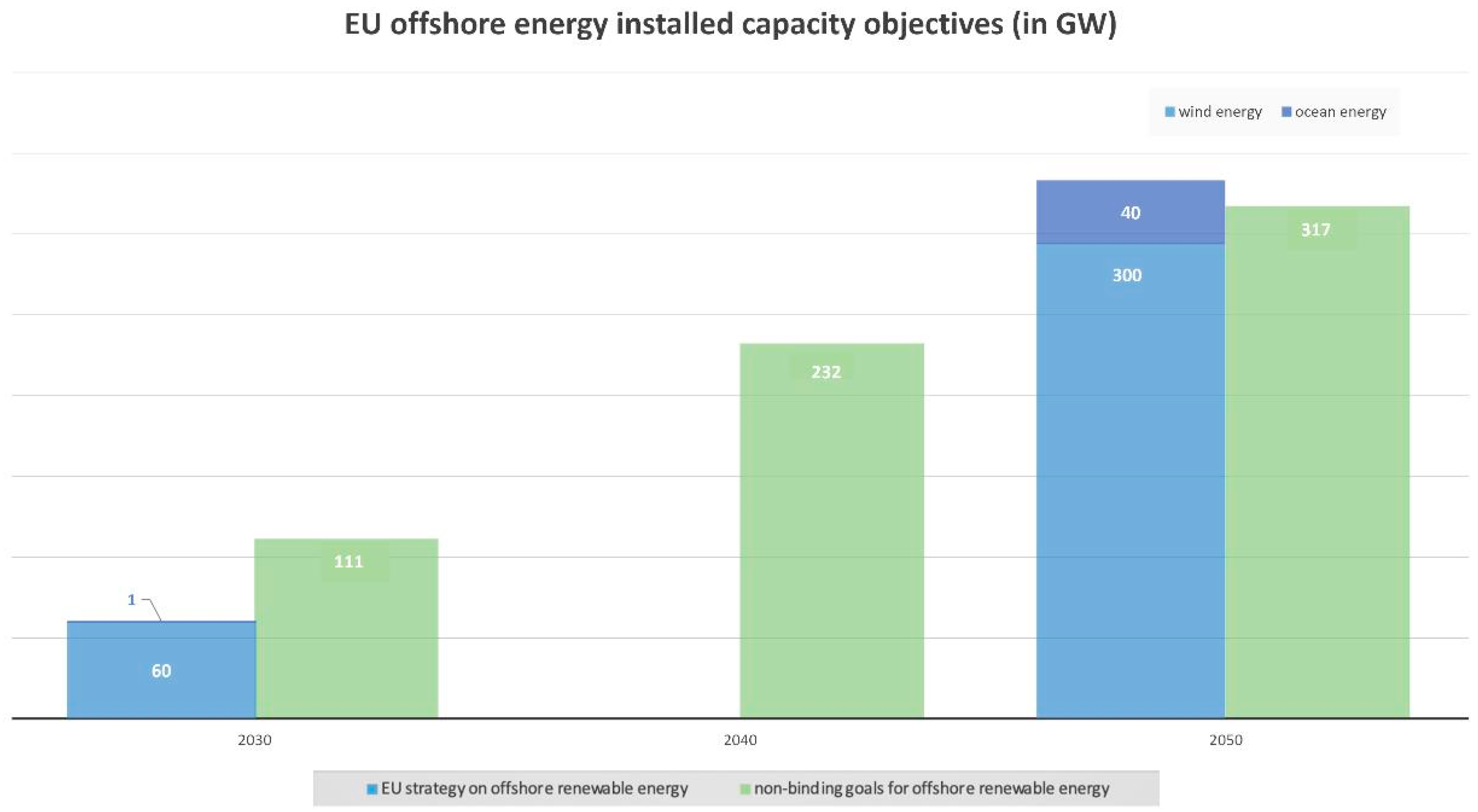
Marine energy technologies are gaining increasing attention within the European Union as part of broader efforts to diversify energy sources and achieve long-term climate goals. In its 2023 Communication on the 2040 Climate Target, the European Commission significantly raised its offshore renewable energy targets, aiming for at least 111 GW of offshore wind capacity by 2030 and setting new goals for ocean energy: 100 MW by 2027 and 1 GW by the late 2020s or early 2030s [43]. These targets are part of a broader vision for offshore renewable capacity expansion across the EU, as illustrated in Figure 12.
Offshore wind remains central to current development, but wave and tidal energy are also gaining interest, especially for their potential to offer environmental benefits and support socio-economic development in island and remote coastal regions.
To help advance wave energy converter development, the EU has launched initiatives like EuropeWave, a €19.6 million cross-border pre-commercial procurement (PCP) program. This effort aims to reduce risks and support technological progress through competitive phases, including prototype trials at certified testing sites such as BiMEP in Spain and EMEC in Scotland. The aim is to bring these devices closer to operational readiness and commercial market entry. Complementing EuropeWave, the EU demonstrates its commitment to wave energy through substantial funding and coordinated research efforts under Horizon Europe and the Innovation Fund [38]. Policy instruments such as the revised Renewable Energy Directive set an indicative target of at least 5% of new installations by 2030 from innovative renewables, including ocean energy. The EU also encourages Member States to include marine energy in their National Energy and Climate Plans, reinforcing a comprehensive strategy for sector development [38].
Tidal energy development in the EU is advancing through coordinated international projects and cross-country partnerships. Projects such as FLOWATT in France’s Raz Blanchard and SEASTAR in the UK are deploying advanced tidal turbines, targeting both horizontal and vertical axis technologies. These projects, hosted at established marine energy test sites like EMEC in Scotland and the Paimpol–Bréhat site in France, are designed to prove technical viability and develop operational practices in complex tidal environments. These initiatives are supported by a strong foundation of research and development collaboration, led by specialized institutions such as IFREMER (France), MaREI (Ireland), and WavEC Offshore Renewables (Portugal) [38]. Unlike wave energy, tidal energy benefits from the predictability of ocean currents, providing grid operators with reliable generation potential. However, the sector faces regulatory challenges, including harsh operating conditions that require robust engineering solutions and rigorous permitting processes to address local environmental sensitivities. While currently at a pre-commercial stage, the progress of flagship tidal arrays contributes to Europe’s strategy for grid resiliency, low-carbon infrastructure, and technological leadership, aligning with ambitious EU targets for ocean energy expansion over the next decade.
Within the European marine energy strategy, OTEC and salinity gradient energy are at the forefront of innovative renewable energy sources, with support through research and pilot demonstrations. Notably, the IEA-OES, with active participation from EU Member States, including France and the Netherlands, published a report in 2024 addressing the economics and feasibility of OTEC, reflecting European contributions to global assessments and standardization efforts. At the project level, EU-backed initiatives such as pilot-scale collaborations and ongoing research under Horizon Europe sustain European engagement with OTEC despite geographical limitations. In parallel, salinity gradient energy, exemplified by the Netherlands’ REDstack pilot at Afsluitdijk, benefits from focused EU and national support, primarily through Horizon Europe and targeted research calls. Although environmental protections restrict large-scale deployment at many promising estuarine sites, continued advances in membrane technology and project design keep this sector under active investigation within the EU’s strategic framework [38].
Together, advancements in wave, tidal, OTEC, and salinity gradient technologies demonstrate the EU’s multi-faceted strategy: combining supportive policy instruments, sustained funding, and coordinated research with stringent environmental standards. This integrated approach is vital for embedding marine energy as a fundamental component of Europe’s evolving low-carbon energy system.
Croatia’s National Energy and Climate Plan (NECP) for 2021–2030 aligns partially with the European Union’s offshore renewable energy objectives [44]. While commercial marine energy deployment is not yet present in the Adriatic, the NECP expresses support for research and innovation in offshore technologies and highlights the importance of integrating renewable sources into island and coastal systems [44]. However, wave and tidal energy are not explicitly mentioned, and the lack of dedicated initiatives or pilot programmes continues to present a barrier to aligning national strategies with the EU’s broader marine energy objectives.
Previous assessments of Croatian energy infrastructure highlighted this as a significant missed opportunity. Despite the country’s long coastline and numerous islands, marine energy has yet to be integrated into national energy planning. Wave and offshore wind resources in the Adriatic represent untapped potential that could support regional development and contribute to energy self-sufficiency in island communities [45]. While marine energy is not yet explicitly prioritized in national planning, assessing the Adriatic Sea’s marine energy potential can provide valuable insight for future development pathways.

5. Marine Energy Potentials in the Adriatic Sea

The Adriatic Sea is situated in the Mediterranean Sea, and it is a semi-enclosed basin with an opening through the Strait of Otranto in the southern part. It is approximately 800 km long and 150 km wide, and it is formally divided based on bathymetry into the relatively shallow North Adriatic, the mid-Adriatic Pit, and the deep Southern Adriatic Pit [46]. The Adriatic Sea has a long history of sea level studies [47] in part because its coastal regions are highly exposed to flooding and sea level extremes. Historic cities along its shores, such as Venice and Split, have long faced the challenges of rising and fluctuating sea levels, prompting systematic observations as early as the 19th century. Its shape and semi-enclosed nature make it exceptionally responsive to atmospheric and oceanographic influences, allowing researchers to study a wide range of sea level processes. Over time, the Adriatic has become an important reference point for understanding sea level variability in enclosed seas.

5.1. Wave Energy Potential

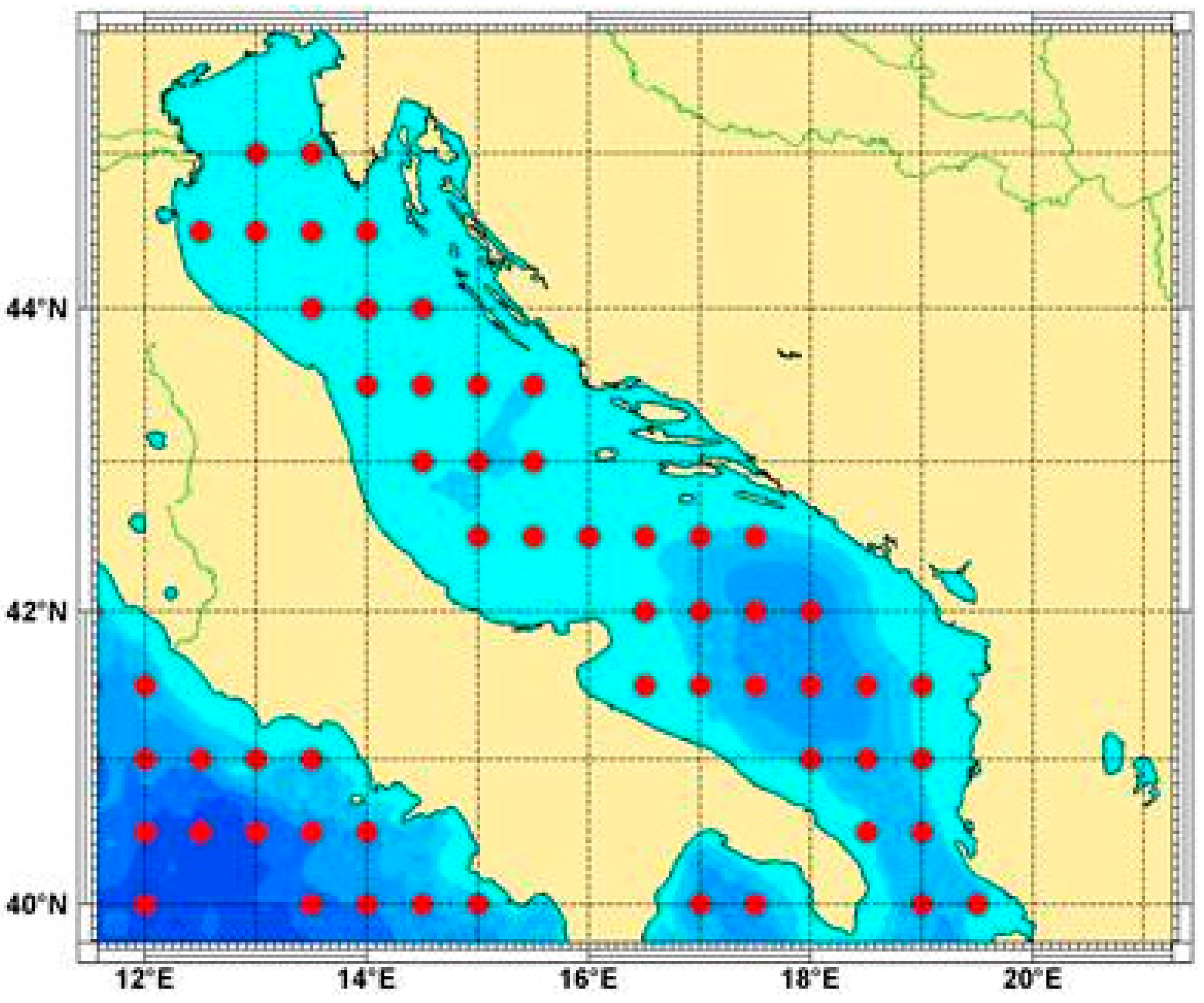
To assess the wave energy potential of the Adriatic Sea, researchers have extensively drawn on long-term data from the World Wave Atlas (WWA). The WWA combines satellite altimetry, buoy observations, and advanced numerical wave modelling using the third generation WAM model. As described in [48], this global resource delivers high-resolution wave datasets validated through robust methodologies, effectively addressing gaps where long-term in situ measurements are scarce. Such comprehensive data are especially beneficial for semi-enclosed basins, such as the Adriatic, where wave characteristics exhibit significant spatial and temporal variability. Leveraging this resource, Farkas et al. [49] conducted an in-depth evaluation of the offshore wave energy potential in Croatian Adriatic waters. Their study spanned seven locations across the central and southern Adriatic, analysing a 24-year record (1992–2016). Findings revealed that average wave power ranged from roughly 2 to 4 kW/m, with the highest values observed southeast of Lastovo Island. The energy resource showed marked seasonal variation, with the bulk of wave energy generated during autumn and winter due to prevailing southeast and northeast winds. Furthermore, the performance of two offshore wave energy converters (Pelamis and AquaBuoy) was assessed, emphasizing the critical role of aligning device specifications with the unique local sea states for optimal energy yield. The grid points for the Adriatic Sea provided by the WWA are shown in Figure 13. This comprehensive mapping enabled the accumulation of 34,460 data outputs for the basin, though datasets with missing entries were excluded prior to statistical analysis to ensure accuracy [49].
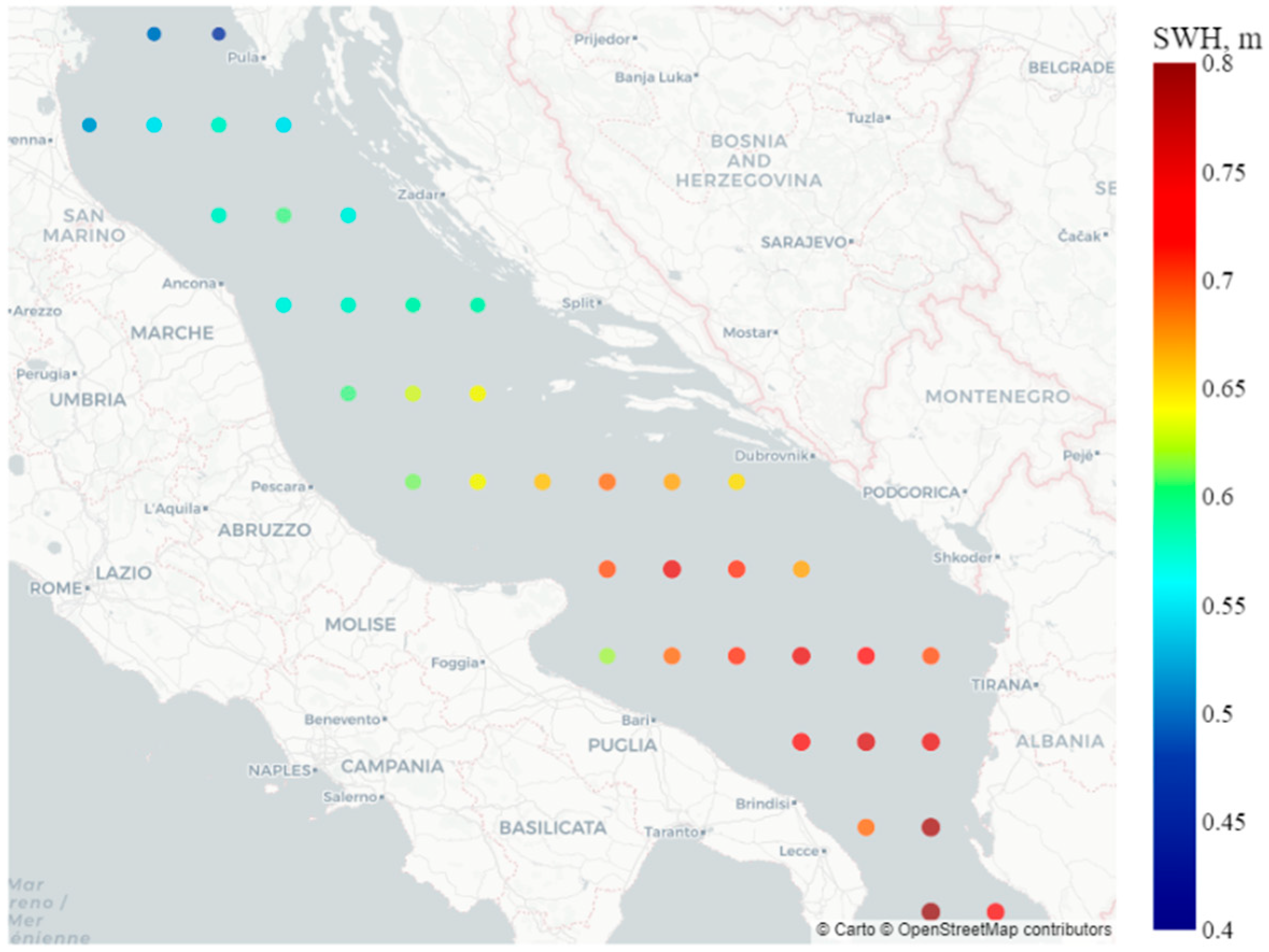
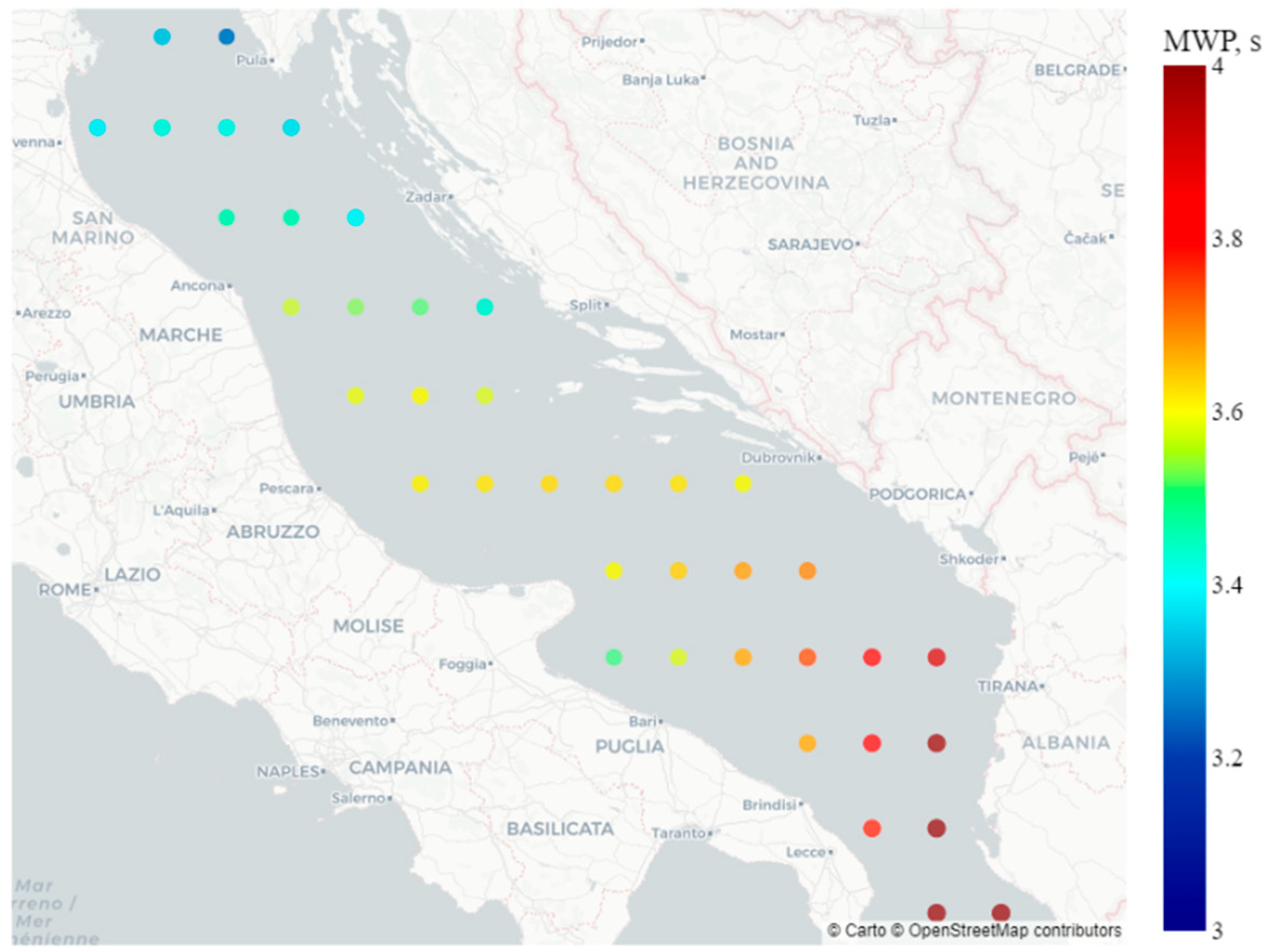
Figure 14 shows the calculated medians of the Significant Wave Heights (SWH) in the Adriatic Sea in the period from 1992 to 2016. It can be seen that the significant wave heights range from 0.45 m to 0.8 m. To calculate the theoretical potential of wave energy, Mean Wave Periods (MWP) are also required. Figure 15 shows the calculated medians of the mean wave periods across the Adriatic Sea in the period from 1992 to 2016. The wave power can be calculated with the following equation:
P = ρ g 2 64 π H m 0 2 T e
where ρ is the sea density, g is the gravity acceleration, H m 0 is the significant wave height and T e is the wave energy period.
The Adriatic’s moderate wave climate and resource variability are strongly influenced by region-specific factors, including synoptic and seasonal winds (such as the sirocco and bora), pronounced tidal effects, and basin-scale seiches. These dynamic and meteorological features not only drive seasonal and extreme events but also inform optimal device design, siting, and operational planning for WECs [47].
Recent assessments of wave energy potential in the Adriatic Sea reveal opportunities despite these modest overall values [49,50]. While the general wave energy resource is limited compared to oceanic environments, detailed spatial and temporal analyses indicate specific zones where wave energy extraction could be viable with appropriately adapted technologies. The highest wave power values are recorded in the southern offshore regions, particularly in the vicinity of islands such as Lastovo, where annual mean wave power reaches 2.784 kW/m [49], which is far less than the oceans’ worldwide potential. This spatial distribution is primarily influenced by fetch length and exposure to Mediterranean weather systems, with the most energetic sites consistently found in the southern and central offshore locations [50]. A pronounced seasonal variation in wave energy availability has been documented, with winter months showing significantly higher energy potential. Research indicates that capacity factors of WECs vary dramatically between seasons, dropping below 0.5% in summer for devices like AquaBuoy, while reaching up to 3.81% in autumn/winter periods [49]. This seasonal disparity suggests the need for specialized deployment strategies. Recent studies have demonstrated that technological adaptation through device scaling can substantially improve WEC performance in the Adriatic’s moderate wave climate. Notably, downscaled versions of established WEC designs have shown promising results. When optimally scaled, the AquaBuoy and Pelamis devices have achieved capacity factors of 29% and 42% respectively [50], representing a significant improvement over their full-scale counterparts in this environment.
Despite moderate wave energy potential, research indicates three key strategies for viable wave energy extraction in the Adriatic Sea. First, device optimization through downscaling of wave energy converters shows that units scaled to 70% of their original size achieve significantly improved capacity factors while maintaining economic viability [50]. Second, strategic deployment in the southern Adriatic region, where mean wave power exceeds 2.5 kW/m, can maximize energy yield potential [49]. Third, integration with existing maritime infrastructure or other renewable technologies, particularly offshore wind installations, can enhance economic viability through shared infrastructure and maintenance costs [51]. These findings emphasize that success in the Adriatic’s depends on developing specialized solutions optimized for its specific wave characteristics rather than implementing standard oceanic WEC designs [50].

Comparison with Other Enclosed Seas

To contextualize wave energy development in the Adriatic Sea, it is instructive to examine how similar challenges are addressed in other semi-enclosed and enclosed seas. Enclosed and semi-enclosed basins such as the Black Sea, Baltic Sea, Caspian Sea, and the eastern Mediterranean present a contrasting environment to the open Atlantic and North Sea locations that have traditionally driven WEC development. These regions exhibit distinct yet comparable limitations resulting from restricted fetch, the absence of long-period swell, variable local winds, and pronounced seasonality. Comparing wave energy potential and actual WEC deployments across regions reveals common limitations and effective adaptation strategies that can guide technology choices for the Adriatic.
The Black Sea, like the Adriatic, is a semi-enclosed basin with restricted fetch, yielding moderate wave energy potential, typically in the range of 2–4 kW/m, substantially lower than open oceans due to limited wave development and the absence of persistent ocean swell. Wave heights are generally small except during strong storm events when heights can reach 6–8 m, but the lack of persistent ocean swell further limits energy extraction potential [52]. However, overall wave energy variability remains relatively low, which improves predictability and makes regular WEC operation more feasible [53]. The wave climate is dominated by low average wave heights (often ≤0.5 m) and short periods, which pose challenges for energy extraction and commercial viability with conventional full-sized, ocean-optimized WECs. As such, studies emphasize the necessity for downscaled and tailored WECs with optimized mass and geometry, explicitly designed for frequent, local, low-amplitude wave conditions [52].
The Baltic Sea is characterized by its shallow bathymetry, narrow fetch, and unique hydrological regime, leading to relatively low and highly variable wave energy resources. Mean wave power typically ranges from 1.5 to 5 kW/m, with significant spatial and seasonal variability, and most wave energy concentrated in infrequent, powerful winter storms [52]. Notably, about 30% of the annual wave energy can arrive within just a few days each year, underscoring the region’s pronounced intermittency [52]. A distinctive challenge in the Baltic is seasonal ice cover, which can persist for over 100 days per year in the northern gulfs, impacting device survivability and operational availability [54]. This necessitates robust WEC designs against ice loading or strategies such as seasonal removal or protective measures. Pilot deployments have focused on small-scale, nearshore devices, like point absorbers and prototypes installed on piers, which are better suited to the mild, short-period waves common to the Baltic [52,55]. Environmental regulations and the dense maritime traffic also play a significant role in siting and scaling projects, further favouring modular, adaptable WEC solutions [54].
The Mediterranean Sea shares many of these constraints, standing as an example of a semi-enclosed basin with moderate wave energy potential, typically between 3 and 10 kW/m in its most energetic western regions but generally lower elsewhere [49,56,57]. The wave climate is defined by short fetches, the absence of persistent long-period swell, and pronounced seasonal variability, features it shares with the Black and Baltic Seas. While the region sees occasional strong storms, most waves are of low to moderate amplitude and short period, further limiting energy extraction and dictating device survivability requirements [52]. These factors render conventional WECs economically unfeasible and highlight the need for specially designed solutions [52,58]. In response, recent projects and studies in the Mediterranean increasingly emphasize the design and deployment of downscaled, tailored WECs. smaller, lighter, and more adaptive, optimized for frequent, low-energy, short-period waves [52,58].
For instance, Bozzi et al. [58] show that reducing device size to approximately one-quarter or one-third of the original, ocean-optimized scale enables alignment with the Mediterranean’s typical sea state, substantially improving real-world performance. Their analysis demonstrated that six technologies, including AquaBuoy, AWS, Pelamis, OE Buoy, SeaPower, and Wavebob, achieved capacity factors greater than 0.2 across 40% of the coastline when downscaled, with three (AquaBuoy, Pelamis, Wavebob) reaching over 0.3 in especially suitable zones such as the Gulf of Lion, Channel of Sicily, Alboran Sea, Libyan coast, Crete, and Cyprus. These sites’ optimal rated power for scaled devices ranged from 10 to 30 kW, dramatically lower than their full-scale counterparts. Notably, the highest energy areas, dominated by rare, extreme waves, are less productive for WECs because most existing designs cannot efficiently convert such irregular energy, further emphasizing the value of tuning device characteristics to prevailing, moderate sea states [57,58].
Further supporting this approach, Dialyna and Tsoutsos [51] point out that most successful Mediterranean deployments, such as nearshore or port-based point absorbers, oscillating water columns, and overtopping devices, reflect this move toward smaller, site-specific solutions. They highlight projects like the integration of WECs into harbour breakwaters (e.g., OBREC in Naples, REWEC3 in Civitavecchia) and the use of hybrid systems combining wave, wind, and solar energy, which not only reduce costs but also support multi-functional goals, such as coastal protection and desalination. The ongoing trend in the region involves modular, scalable technologies that can be adapted to local resource patterns and easily integrated into existing infrastructure, further boosting economic and operational viability [51,58]. This Mediterranean case provides valuable insights for the Adriatic context, highlighting the strategic need for customized, multi-purpose WEC solutions suited to moderate-energy and variable wave conditions.

5.2. Tidal Energy Potential

The tidal regime of the Adriatic Sea is primarily governed by four semidiurnal (M2, S2, N2, K2) and three diurnal (K1, O1, P1) constituents, with additional influence from the Mediterranean tidal system via the Strait of Otranto, where resonance leads to some amplification [59]. However, maximum tidal amplitudes remain limited, ranging from 0.18 to 0.27 m [46]. Therefore, it can be concluded that extracting tidal-range energy in the Adriatic Sea is not economically viable. However, the existing tidal currents may still serve as a potential source of blue energy. Various studies have reported different measurements of sea currents in the Adriatic Sea [60,61]. Martin et al. [62] conducted numerical simulations of the currents in the Adriatic Sea and the results were compared with 12 acoustic Doppler current profilers located in the central Adriatic between the Gargano Peninsula on the Italian side and Split on the Croatian side of the Adriatic Sea. From the beforementioned measurements, Hadžić et al. [45] selected potential locations for the tidal current energy exploitation with the fastest tidal current velocities ranging from 0.2 up to 0.24 m/s. This is a relatively slow current speed as conventional tidal current turbines are rated for velocities of 1.5–5.4 m/s [63]. Lewis et al. [64] provided a simple equation for the calculation of power generated by a hydrokinetic turbine, which can be used to calculate the power density of TEC systems:
q = C p ρ u 3 2
where q is the power density, ρ = 1025   kg / m 3 is water density, C p = 0.4 is the power coefficient (efficiency) and u is the tidal current velocity. Using this equation, the power density that can be achieved with a tidal current velocity is equal to q = 2.83   W / m . If the intercepted area of the TEC system is 1000   m 2 , total power generation would be 2.83   kW or 24.79   MWh annually.
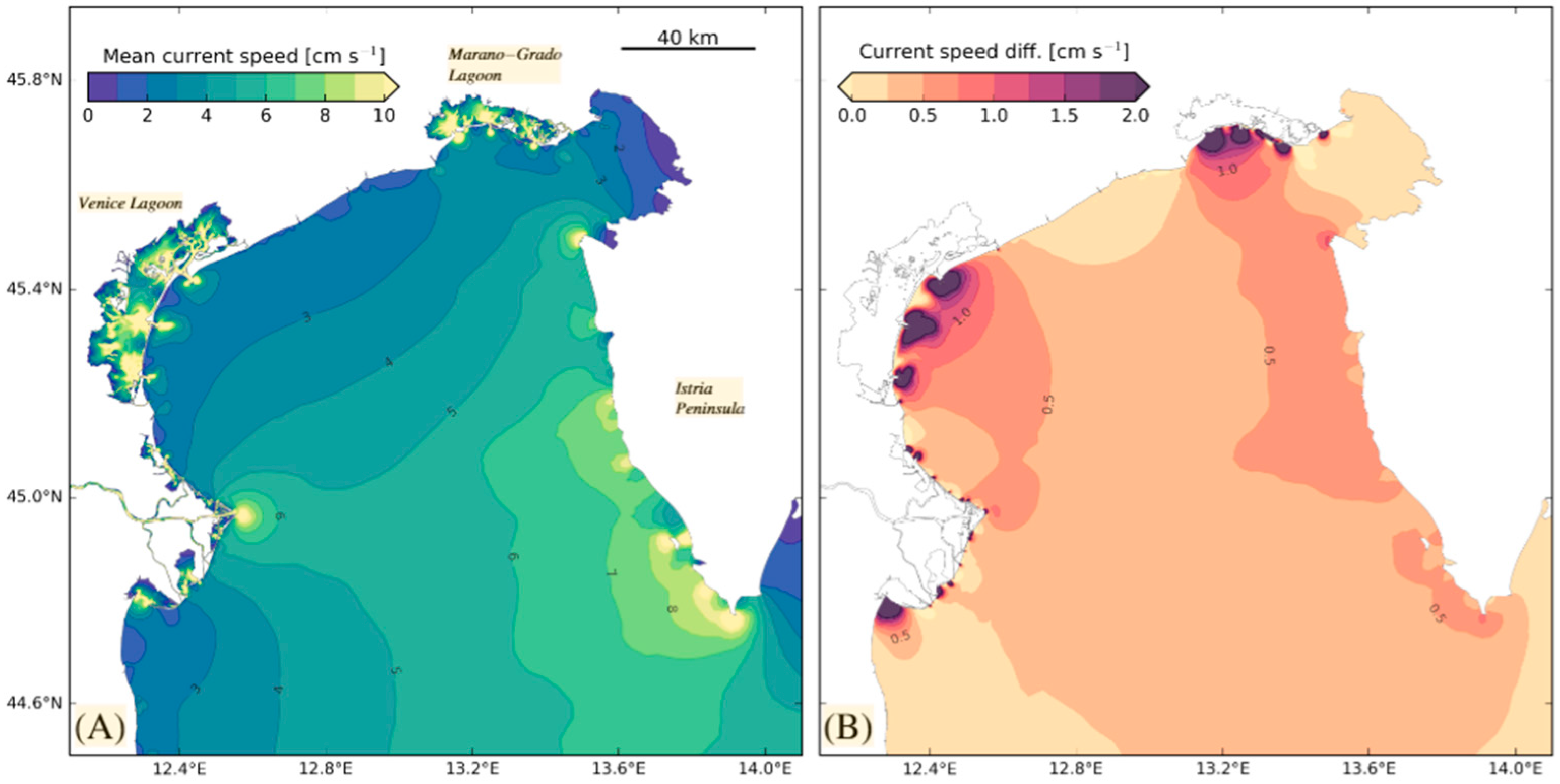
Although the calculated annual energy production demonstrates the theoretical potential of tidal currents in the Adriatic, practical implementation faces significant constraints. High-resolution hydrodynamic modelling has identified local amplification effects, particularly in the northern Adriatic, where interactions with lagoon systems such as Venice and Marano-Grado can enhance tidal current velocities by up to 10% [46]. This is illustrated in Figure 16, where numerical modelling of the northern Adriatic quantifies both the regional pattern of tidal currents and the local amplification effect produced by lagoon interactions [46]. Nevertheless, even in these areas, current velocities remain well below the thresholds of 1 m/s required for economically viable tidal energy extraction using conventional technology [65].
To date, there have been no deployments, tests, or operational demonstrations of tidal energy converter devices in the Adriatic Sea. Existing studies remain theoretical or rely on numerical modelling for resource assessment, while practical projects and prototype testing are absent from the region [45]. Interest remains in the possibility that narrow straits or channels between islands exhibit locally elevated current velocities. Modern modelling emphasizes the importance of targeted, site-specific measurement campaigns in these potential hot spots as the next step toward clarifying the region’s real tidal energy prospects [46].

Comparison with Other Enclosed Seas

Although comparable in size to major European seas, the Black Sea experiences very weak tidal amplitudes due to limited tidal propagation through the Turkish Strait System. Typically, tidal ranges are less than 10–20 cm, with only minor local increases in semidiurnal components on the northwestern shelf due to resonance, making it unsuitable for exploitation [66]. As in other enclosed basins, water level variability is dominated by meteorological forcing and seiches rather than astronomical tides.
The Caspian Sea, the largest enclosed inland sea globally, offers a similarly low tidal energy resource. Cut off entirely from global oceanic tidal forcing, the Caspian’s tides arise only from direct gravitational (primarily solar) forcing and exhibit ranges typically below 25 cm throughout the basin. While the southern Caspian may experience slightly greater amplitudes due to localized resonance, these remain insufficient to be of practical interest for tidal barrage or current technology deployment [66].
The Baltic Sea, mainly isolated except for its constricted connection to the North Sea via the Danish straits, also displays a pronounced microtidal regime. Maximum tidal ranges generally do not exceed 25 cm, except in funnel-shaped branches such as the Gulf of Finland, where local resonance can marginally boost diurnal amplitudes. Outside these rare, resonance-enforced localities, the tidal energy flux remains markedly lower than in open-ocean environments [66]. Furthermore, in much of the Baltic, meteorological factors and seiches dominate over tidal motion in shaping sea level variability, further complicating any prospective energy extraction. As a result, the region lacks active commercial or large-scale pilot projects for tidal energy development.
Aside from a handful of locally resonant locations such as the Gulf of Gabes, the North Aegean Sea, and the North Adriatic Sea, the Mediterranean is also characterized by low tidal amplitudes, typically below 50 cm. Only very isolated areas benefit from minor local amplification via topographic funnelling, but the bulk of the Mediterranean remains microtidal. These limitations significantly constrain the practical potential for tidal energy conversion technologies in most of the basins.
Across these enclosed seas, weak tidal forcing, low energy densities, and the absence of consistent tidal currents pose fundamental barriers to large-scale tidal energy development. While local resonance can amplify tidal amplitudes in specific sites, the overall resource typically falls below the threshold for economically viable exploitation with current technologies. As a result, tidal energy in these regions is limited to small-scale, site-specific demonstration projects rather than broad commercial deployment. This regional trend highlights the distinct geophysical constraints on tidal versus the more adaptable, downscaled wave energy technologies in enclosed and semi-enclosed seas.

5.3. OTEC Potential

For the sustainable exploitation of ocean thermal energy, a temperature difference of 20 °C is required, which is typically found between water depths of approximately 20 to 1000 m [67]. The Adriatic Sea is relatively shallow with an average depth of 259.5 m and a maximum depth located in the Southern Adriatic Pit at 1200 m [68]. However, Šantić et al. [69] provided the vertical distribution of sea temperature, where a difference of around 4 °C is reported between the surface water and the deep water. This is far from the required temperature difference; therefore, the exploitation of ocean thermal energy using conventional methods for generating electrical energy in the Adriatic Sea is not feasible. Nevertheless, small-scale seawater heat pumps can be used for heating and cooling [70].

Comparison with Other Enclosed Seas

In the Baltic Sea, the combination of high latitude and limited depth precludes the development of the necessary thermal stratification. Even during summer, the temperature differential is far below OTEC requirements, and technical assessments explicitly exclude the Baltic as a candidate for OTEC deployment due to its geographic and thermal constraints [71].
The Black Sea exhibits similar limitations. Despite its relatively greater depth compared to the Baltic or the Adriatic, its mid-latitude location and hydrographic regime mean that the temperature gap between surface and deep water falls short of the 20 °C threshold for most of the year. Thermal gradients are either too weak or too transient to support OTEC, and there is no evidence of suitable or persistent stratification required for the practical or economic operation of OTEC [24].
In the Mediterranean, seasonal stratification is present; however, the temperature profile resembles that of the Black and Baltic Seas. Only during brief summer periods does the upper layer warm sufficiently; however, even then, the temperature at depth remains too high, and the differential too small, for OTEC. The shallow and semi-enclosed nature of these basins, frequent mixing, and limited bathymetric range further restrict the development of the kind of stable, robust thermal gradient on which OTEC depends [24].
The only enclosed sea showing marginal OTEC potential is the Caspian. Here, the deep waters in the southern basin reach the required ΔT of 20 °C, but only for a short time, up to 54 days per year at specific sites, such as the Sardar Jangal field. Even this seasonal, site-specific window does not permit year-round or large-scale exploitation, and most of the Caspian, especially its northern and middle basins, remain entirely unsuitable [72].

5.4. Salinity Gradient Potential

The Adriatic Sea exchanges its entire volume through the Strait of Otranto in approximately 3.4 years, which is attributed to the high river water inflow at 5700 m3/s. The greatest portion of the total river inflow comes from the river Po, which has a discharge of 1569 m3/s, which is equivalent to 27.5% of the total freshwater inflow in the Adriatic Sea [73]. Another source of freshwater inflow into the Adriatic Sea is submarine groundwater discharge, which contributes approximately 29% of the total freshwater inflow in the Adriatic Sea [74]. The rest of the inflow comes from the rivers of Neretva and Drin.
This substantial freshwater input, combined with a pronounced salinity contrast, approximately 38 g/L in Adriatic seawater versus 0.25 g/L in the Po River, creates favourable conditions for salinity gradient energy (SGE) exploitation, particularly at the Po delta [75]. These characteristics make the region highly suitable for energy harvesting technologies such as RED. Within this context, the Po River mouth stands out as one of the most promising sites worldwide for SGE development. Alvarez-Silva et al. [25] estimate the theoretical SGE potential at the Po mouth to be 2.7 GW, with an environmentally sustainable extractable potential of approximately 0.55 GW. Furthermore, the Adriatic’s low tidal mixing promotes the persistence and steepness of salinity gradients at river mouths, further enhancing energy recovery efficiency.
Further studies are needed to assess the salinity gradient potential of other river mouths in the Adriatic Sea. It can be concluded that the salinity gradient potential in the Adriatic Sea may prove to be significant when compared to the other marine energy sources.

Comparison with Other Enclosed Seas

The Baltic Sea features brackish waters due to substantial freshwater inflows from rivers combined with limited exchange with the saline North Sea. Surface salinity ranges from approximately 2 g/kg in the Bay of Bothnia to 6–8 g/kg centrally and up to 30 g/kg near the Danish Straits. Although horizontal and vertical salinity gradients exist, their magnitudes are relatively low, especially in estuarine zones where both river and adjacent seawater remain fresh. Consequently, the Baltic coastline exhibits limited salinity differences, which restricts high-yield SGP generation [76].
The Black Sea exhibits a moderate surface salinity of 17–20 g/kg, exceeding that of the Baltic but lower than typical oceanic values. River-sea mixing here generates somewhat stronger salinity gradients, which modestly enhance SGP potential along most coasts. Notably, the northwestern margin hosts hypersaline limans and lakes (e.g., Kuialnyk, Sasyk-Sivash) with salinities exceeding 200–300 g/kg during dry periods. These hypersaline waters, when mixed with Black Sea or river water, produce exceptionally high local salinity gradients and SGP densities [77]. However, such conditions are highly site-specific, often reliant on active water management and subject to seasonal and climatic variability, confining exceptional SGP potential to limited areas.
The Caspian Sea has an average salinity of approximately 12.3 g/kg, which is lower than that of both the Black Sea and the Mediterranean. Its hydrology, dominated by significant river inflows and lacking oceanic outflow, results in a relatively uniform brackish salinity profile, with minor vertical salinity increases in deeper southern regions [78]. Consequently, the salinity contrast between river and ambient waters is slight, limiting SGP opportunities. Unlike the Black Sea, no highly saline sub-basins exist, and horizontal or vertical gradients are minimal. While localized SGP projects near river mouths are theoretically feasible, the Caspian’s overall blue energy potential remains low.
In contrast, the Mediterranean Sea exhibits strong, persistent salinity gradients, with surface salinities ranging from 36 to 39 g/kg from the Atlantic entrance at Gibraltar to the Levantine Basin. River discharges from the Ebro, Rhone, Po, and Nile maintain substantial and stable salinity contrasts along the European and North African coasts [57]. These estuarine zones provide optimal conditions for large-scale SGP, including conventional river-sea applications and hybrid systems incorporating desalination brines or wastewater. Supported by high evaporation rates and limited precipitation, these gradients are spatially extensive and temporally stable, making the Mediterranean a prime region for significant technical and exploitable SGP potential, and a strategic focus for blue energy development.

6. Environmental Considerations

The deployment of marine renewable energy (MRE) technologies is influenced not only by technical and economic factors but also by environmental and socio-cultural constraints [18,79]. Responsible MRE expansion requires understanding and managing these factors in varied marine settings.
In recent years, researchers and regulators have undertaken comprehensive environmental assessments at more than 80 MRE sites worldwide, which has resulted in a robust dataset for evaluating key environmental interactions [80]. These case studies, especially from pioneering projects in the UK, Europe, and North America, help clarify both anticipated risks and real-world outcomes associated with various types of devices in different marine environments.
One of the most widely studied environmental concerns is underwater noise. During the construction phase, activities such as pile driving and increased vessel traffic generate high-intensity, short-duration acoustic signals that may cause temporary avoidance behaviour in marine mammals. Areas affected by these acute noises are typically reoccupied once activity ceases, indicating that disturbances tend to be short-term rather than chronic or widespread [79,81]. Operational noise, though generally less intense, can still temporarily interfere with marine animal communication or echolocation if exposure persists [82]. Empirical monitoring at sites such as Scotland’s MeyGen Tidal Energy Project and Northern Ireland’s SeaGen installation has confirmed these patterns. At both locations, post-installation acoustic measurements and wildlife observations revealed only brief declines in marine mammal presence during noisy activities, followed by a rapid return to baseline conditions. As a result, regulatory bodies increasingly consider construction and operational noise risks from single or limited MRE deployments as low, although further research will be needed as larger arrays come online [80].
Collision risks remain a key concern, as marine species may encounter turbine blades or mooring lines. Consequences may range from minor injuries to mortality, potentially affecting migration or foraging behaviour [83]. However, pilot site field data from Northern Ireland, Scotland, and the USA show that such collisions are rare. Documented avoidance behaviours, combined with the absence of verified strike-related injuries or large-scale habitat exclusion, suggest a generally low risk under current deployment conditions [84]. Collision risk is influenced by site and device factors, and spacing within arrays can reduce risks, although model-based assessments indicate elevated risk in low-visibility environments. Overall, real-world monitoring supports a low risk, though vulnerable individuals may be more exposed [83,85].
Entanglement with mooring lines and cables has been another focus of environmental monitoring. Evidence from real-world deployments shows that entanglement risk is minimal for single devices and taut mooring systems, with no confirmed cases reported to date [86,87]. Routine inspections at sites such as Billia Croo (Orkney) have yet to document any cases of entanglement with marine mammals or large fish, with best practices focused on taut line designs and regular monitoring for marine debris as the main controls [80].
Beyond direct risks to individual animals, the presence of MRE arrays can lead to subtle changes in local hydrodynamics. These changes may affect wave height, current speeds, and sediment transport, which in turn can influence coastal morphology and benthic habitat structure [80,83]. Modelling studies, such as those by Millar et al. [88], predict minor wave height reductions from large arrays. Fieldwork at Lysekil (Sweden), EMEC, and PacWave South (Oregon) has found that minor physical alterations remain within natural variability, and no major negative effects on benthic communities have been recorded at demonstration scales [80,83,89].
Electromagnetic fields (EMFs) from subsea power cables present potential stressors for certain sensitive marine species capable of detecting magnetic or electric fields [79]. While EMFs are a natural component of the marine environment, cables associated with MRE devices introduce additional, localized fields. Laboratory and field studies report only temporary, species-specific behavioural changes, such as brief alterations in swimming direction or attraction to cables, with no evidence for population-level or ecologically significant impacts to date [83,89,90]. EMF intensity has been shown to decline rapidly with distance from the cable, typically reaching background levels within tens of meters. Mitigation measures, including cable burial and electromagnetic shielding, are routinely implemented to minimize exposure, particularly to electric field components [83,90]. Overall, current evidence suggests that EMFs from single devices or small-scale deployments pose minimal ecological risk [83,87]. However, the potential for cumulative and long-term effects from large MRE arrays remains uncertain and warrants continued investigation [87,91].
Installation of MRE infrastructure, including foundations, anchors, and moorings, introduces hard substrate into previously soft-bottom environments, creating novel habitats that function as artificial reefs [82,87,89]. Studies at Sweden’s Lysekil wave energy site have shown high concentrations of predators and suspension feeders, such as brown crab, European lobster, cod, and several species of flatfish, aggregating around WECs foundations [92]. These structures were rapidly colonized by native species, resulting in greater local abundance and biodiversity compared to nearby soft-bottom areas. However, Bonar et al. [83] note that the ecological benefits of such artificial reefs are species-specific, and it remains unclear whether they are universally beneficial to benthic habitats. Similar patterns are observed at offshore wind and oil platforms, where increased species richness and trophic complexity have been found. However, these structures can also attract predators and occasionally non-native species [83]. Thus, while these structures can support biodiversity and function as de facto reserves, further research is necessary to evaluate long-term, cumulative, and ecosystem-level impacts, particularly regarding invasive species and shifts in food webs [83,89].
Although local impacts are generally manageable at demonstration scale, uncertainties persist concerning larger-scale and long-term effects. Interactions among multiple stressors and their combined consequences remain relatively poorly understood, highlighting the importance of adaptive management, long-term monitoring, and regulatory frameworks for sustainable MRE development [89,93].
In the context of the Adriatic Sea, environmental considerations are particularly important due to the region’s ecological sensitivity and intense human use. The Adriatic Sea comprises several protected marine areas and supports numerous endemic and vulnerable species, while simultaneously sustaining extensive tourism and long-established fishing activities. Consequently, the deployment of MRE technologies in this basin must carefully account for potential ecological and socio-economic interactions. Although existing studies from other regions indicate that environmental impacts such as underwater noise, collision risks, entanglement, electromagnetic fields, and local hydrodynamic changes are generally limited at demonstration scale, the Adriatic Sea semi-enclosed nature and high biodiversity require a precautionary approach. Particular attention should be given to potential disturbances to marine mammals, fish populations, and benthic habitats that support local fisheries, as well as to possible spatial conflicts with tourism and marine protected areas. At the same time, certain effects, such as the creation of artificial reef habitats around device foundations, could potentially enhance local biodiversity if properly managed. Therefore, any future deployment of MRE systems in the Adriatic Sea should be accompanied by site-specific environmental impact assessments, long-term monitoring programs, and careful spatial planning to ensure compatibility with conservation priorities and existing maritime activities.

7. Socio-Economic Considerations

MRE projects are deeply entwined with socio-economic contexts at local, regional, and national levels. These projects impact, and are themselves shaped by, social acceptance, economic opportunity, public policy, and the equitable distribution of benefits and costs [57,80]. Key stakeholder groups, including fisheries, other maritime industries, local workforces, coastal communities, tourism operators, conservation organizations, and energy end-users, may all be affected in distinct ways, necessitating a holistic approach to social and economic assessment [80]. Addressing these socio-economic dimensions in tandem with environmental factors is essential for sustainable development, regulatory approval, and the long-term success of MRE initiatives.
Public support and the dynamics of stakeholder participation are among the most influential determinants of MRE project success [83]. While international and national surveys frequently show strong support for renewable energy, actual siting of offshore and nearshore projects often encounters scepticism or resistance from affected coastal and sea-dependent communities [83]. Factors that shape acceptance or opposition are multifaceted, covering visual and aesthetic impacts, effects on recreation and tourism, community attachment to place, procedural justice, and especially perceptions of equity in how risks and benefits are allocated [83].
Concerns over visual impacts and landscape values are widely documented in both the academic literature and project experience. The siting of MRE installations may raise issues about impacts on tourism, place identity, and the local sense of landscape, sometimes leading to delays or significant modification of project plans. However, some Mediterranean studies reveal minimal impact if arrays are located more than 8–12 km from shore, and in a few cases, installations even became a tourism novelty when paired with local information campaigns or boat tours [57]. In the North Sea, adapting foundations for artificial reefs or facilitating recreation demonstrates that co-benefits are possible, but these outcomes depend on tailored engagement, careful planning, and the willingness to negotiate and mitigate project-specific concerns [57].
The relationship between MRE projects and fisheries is a central and complex issue, involving real and perceived risks of displacement from traditional fishing grounds, loss of income, and changes in local livelihoods [80]. Fishermen face reduced access to traditional fishing areas due to exclusion zones around offshore wind farms (OWFs), typically 500 m in most European countries, though only 50 m in the UK. This spatial displacement can lead to perceived or real losses of income, as navigation and fishing within farm areas are often deemed unsafe or incompatible, with only certain fishing types allowed [57]. Despite these challenges, surveys (e.g., in the UK and Ireland) report a generally positive attitude among fishermen toward coexistence with MRE, especially when stakeholder consultation is involved [94]. Moreover, exclusion zones may generate ecological benefits, acting as artificial reefs and protected areas that enhance biodiversity and support fisheries outside the restricted zones [57,95].
Given these complexities, the success of MRE projects increasingly hinges on robust governance frameworks and decision-making processes that respect both local needs and regional priorities. Integrated marine spatial planning (MSP), supported by early and meaningful stakeholder engagement, emerges as a foundational tool for minimizing user conflicts and optimizing site selection [57,89]. Northern European experiences show that comprehensive MSP facilitates co-existence and even synergy among multiple marine uses, such as the combination of offshore wind farms with aquaculture or designated marine protected areas, helping to align environmental protection with new economic opportunities.
In practice, social acceptance for MRE projects is most sustainable when communities and impacted groups are substantively involved from the earliest stages and where material and procedural benefits are equitably distributed. Evidence from projects such as Denmark’s Horns Rev and Nysted wind farms, as well as locally owned initiatives like Scotland’s Isle of Gigha, illustrates the value of early consultation, transparent monitoring, and benefit-sharing in building local support and legitimacy [83,96]. Strengthening participatory approaches, monitoring, and legal frameworks for equitable benefit distribution will be critical for realizing the promise of MRE as a driver of sustainable, community-supported development [83,95,96].
The economic rationale for MRE rests on its potential to support local, regional, and national economies by creating jobs, driving supply chain development, and spurring innovation in coastal infrastructure. Numerous assessments demonstrate that well-designed MRE projects catalyse both direct and indirect employment [96]. For instance, the FORCE tidal energy facility in Nova Scotia catalysed the creation of up to 22,000 full-time-equivalent jobs, directly engaged over 300 local companies, and generated $1.5 billion in new area goods and services [87]. In Ireland, scenario modelling for a 500 MW ocean energy sector projected up to 1431 direct jobs by 2020 and tens of thousands more by 2030 under optimal market conditions [96]. Wave Hub in the UK, the Oyster device deployments in Orkney, and the Strangford Lough tidal array in Northern Ireland similarly yielded boosts in local labour demand and supply chain activity [96].
Economic effects are, however, not uniform. Construction phases yield the bulk of job creation; the persistence and quality of employment through the operational life of MRE projects are more variable. Geographic disparities can arise if regional supply chains lack the expertise or capacity to capture ongoing maintenance or manufacturing work, leading to “leakage” of benefits away from more remote or underdeveloped communities [96]. These uneven outcomes have sharpened calls for deliberate strategies to ensure that economic gains are equitably shared, especially in regions bearing the brunt of environmental or spatial trade-offs.
Equitable benefit distribution in affected communities is an increasingly prominent concern. While job creation figures are frequently highlighted in planning documents, direct community benefit schemes, such as cash funds, community ownership models, and profit or tax sharing, have become a routine part of onshore wind project development in the UK. Their adaptation to the marine context, however, remains limited and less institutionalized [83]. Moreover, the scale and capital intensity of ocean energy projects, which typically involve large arrays of high-capacity devices, make small-scale or fully community-led ownership models difficult to realize. Despite these challenges, some MRE pilot projects in places like Orkney and Cornwall have begun implementing community benefit approaches on a voluntary or case-specific basis [96]. These efforts, though still emerging, highlight the potential for adapting onshore benefit frameworks to support more inclusive and locally beneficial marine energy development.
A further economic complexity is the potential displacement of other economic activity [96]. Losses from restricted fishing access, reduced tourism revenues (as observed locally in France and Spain), or challenges to navigation and maritime trade must be weighed against new income streams and may justify compensation payments or sectoral diversification support [57]. The high capital expenditures and current levelized costs of energy for offshore wind, wave, and tidal remain major hurdles to widespread expansion. Most economic scenarios reveal that while costs are likely to fall with technological maturation and deployment at scale, targeted public policy support remains essential in the medium term if MRE sectors are to realize their full economic promise and compete with incumbent technologies [57].
In summary, maximizing the benefits of marine renewable energy, across employment, community development, and broader economic innovation, while minimizing its social and economic risks requires a holistic approach, one that prioritizes early and sustained stakeholder participation, equitable benefit-sharing, and adaptive, integrated planning. Only through transparent governance, inclusive engagement, and continuous evaluation can MRE projects overcome persistent challenges and realize their full potential as drivers of sustainable and widely accepted regional development.

8. Conclusions

Numerous research efforts are underway and innovative technologies are being developed to harness marine energy. These efforts encompass the utilization of wave energy, tidal energy, ocean thermal energy, and salinity gradient power. This paper provides an overview of current technologies and presents the global potential for harnessing marine energy. The potential of harnessing the marine energy from the Adriatic Sea is shown, and the results are compared to the worldwide potential. The findings indicate that the Adriatic Sea offers considerably lower potential for marine energy extraction compared to the world’s oceans.
Despite these limitations, detailed resource assessments indicate that wave energy remains the most technically promising option for the region. In particular, the southern offshore Adriatic exhibits peak mean annual wave power densities. While these values are modest compared to high-energy oceanic zones, the application of downscaled WECs, optimized for short-period and low-amplitude wave regimes, has been shown to yield capacity factors exceeding 30% under favourable conditions. Tidal energy potential is constrained by microtidal amplitudes and weak tidal current velocities, which lie well below the operational thresholds of standard tidal energy converter technologies. Although localized amplification due to lagoon interactions may slightly increase flow velocities, current models suggest that the kinetic resource remains insufficient for economically viable deployment. Similarly, Ocean Thermal Energy Conversion is not feasible due to the shallow depth and minimal thermal stratification of the Adriatic, where vertical temperature differentials rarely exceed 4–5 °C. While this precludes power generation through conventional OTEC cycles, small-scale thermal uses such as seawater-source heat pumps remain viable. In contrast, salinity gradient energy presents an emerging opportunity, especially near high freshwater discharge zones such as the Po and Neretva rivers. The Adriatic’s combination of high seawater salinity and substantial freshwater inflow creates favourable conditions for technologies like Reverse Electrodialysis.
This study underscores that even in low-energy marine environments, renewable energy solutions can be viable when technology is tailored to site-specific oceanographic characteristics. The Adriatic Sea, though unsuitable for large-scale marine energy extraction, may benefit from pilot-scale, modular deployments, especially for wave and salinity gradient energy. The results highlight that obtaining high-resolution site-specific oceanographic data is essential for adapting existing marine energy technologies to local sea states, particularly in low-energy environments such as the Adriatic Sea, where performance strongly depends on matching device design to local conditions.
Future steps should include high-resolution site assessment, technology adaptation to local sea states, and ongoing evaluation of environmental and socio-economic factors to ensure successful, sustainable integration of marine renewables in the region.

Author Contributions

Conceptualization, N.D., C.G.G. and I.M.; methodology, N.D., C.G.G. and I.M.; software, C.G.G.; validation, N.D., C.G.G. and I.M.; formal analysis, N.D., C.G.G. and I.M.; investigation, N.D., C.G.G. and I.M.; resources, N.D., C.G.G. and I.M.; data curation, N.D.; writing—original draft preparation, N.D., C.G.G. and I.M.; writing—review and editing, N.D., C.G.G. and I.M.; visualization, C.G.G.; supervision, N.D.; project administration, N.D.; funding acquisition, N.D. All authors have read and agreed to the published version of the manuscript.

Funding

This work was funded by the Croatian Science Foundation under the project number IP-2025-02-4779.

Data Availability Statement

Dataset available on request from the authors.

Acknowledgments

This work was supported by the Croatian Science Foundation under the project number IP-2025-02-4779.

Conflicts of Interest

The authors declare no conflicts of interest.

References

  1. Rehman, S.; Alhems, L.M.; Alam, M.M.; Wang, L.; Toor, Z. A review of energy extraction from wind and ocean: Technologies, merits, efficiencies, and cost. Ocean. Eng. 2023, 267, 113192. [Google Scholar] [CrossRef]
  2. Li, J.; Wang, G.; Li, Z.; Yang, S.; Chong, W.T.; Xiang, X. A review on development of offshore wind energy conversion system. Int. J. Energy Res. 2020, 44, 9283–9297. [Google Scholar] [CrossRef]
  3. Rusu, E.; Onea, F. A review of the technologies for wave energy extraction. Clean Energy 2018, 2, 10–19. [Google Scholar] [CrossRef]
  4. Chowdhury, M.S.; Rahman, K.S.; Selvanathan, V.; Nuthammachot, N.; Suklueng, M.; Mostafaeipour, A.; Habib, A.; Akhtaruzzaman, M.; Amin, N.; Techato, K. Current trends and prospects of tidal energy technology. Environ. Dev. Sustain. 2021, 23, 8179–8194. [Google Scholar] [CrossRef]
  5. Ahmed, F.E.; Hashaikeh, R.; Hilal, N. Hybrid technologies: The future of energy efficient desalination-A review. Desalination 2020, 495, 114659. [Google Scholar] [CrossRef]
  6. Langer, J.; Quist, J.; Blok, K. Recent progress in the economics of ocean thermal energy conversion: Critical review and research agenda. Renew. Sustain. Energy Rev. 2020, 130, 109960. [Google Scholar] [CrossRef]
  7. Khan, M.Z.A.; Khan, H.A.; Aziz, M. Harvesting energy from ocean: Technologies and perspectives. Energies 2022, 15, 3456. [Google Scholar] [CrossRef]
  8. Khare, V.; Bhuiyan, M.A. Tidal energy-Path towards sustainable energy: A technical review. Clean. Energy Syst. 2022, 3, 100041. [Google Scholar] [CrossRef]
  9. Si, Y.; Liu, X.; Wang, T.; Feng, B.; Qian, P.; Ma, Y.; Zhang, D. State-of-the-art review and future trends of development of tidal current energy converters in China. Renew. Sustain. Energy Rev. 2022, 167, 112720. [Google Scholar] [CrossRef]
  10. Neill, S.P.; Angeloudis, A.; Robins, P.E.; Walkington, I.; Ward, S.L.; Masters, I.; Lewis, M.J.; Piano, M.; Avdis, A.; Piggott, M.D.; et al. Tidal range energy resource and optimization-Past perspectives and future challenges. Renew. Energy 2018, 127, 763–778. [Google Scholar] [CrossRef]
  11. Hunt, J.D.; Weber, N.D.A.B.; Zakeri, B.; Diaby, A.T.; Byrne, P.; Leal Filho, W.; Schneider, P.S. Deep seawater cooling and desalination: Combining seawater air conditioning and desalination. Sustain. Cities Soc. 2021, 74, 103257. [Google Scholar] [CrossRef]
  12. Ishaq, H.; Dincer, I. A comparative evaluation of OTEC, solar and wind energy based systems for clean hydrogen production. J. Clean. Prod. 2020, 246, 118736. [Google Scholar] [CrossRef]
  13. Abbas, S.M.; Alhassany, H.D.S.; Vera, D.; Jurado, F. Review of enhancement for ocean thermal energy conversion system. J. Ocean. Eng. Sci. 2023, 8, 533–545. [Google Scholar] [CrossRef]
  14. Abdelkader, B.A.; Navas, D.R.; Sharqawy, M.H. A novel spiral wound module design for harvesting salinity gradient energy using pressure retarded osmosis. Renew. Energy 2023, 203, 542–553. [Google Scholar] [CrossRef]
  15. Kang, S.; Li, J.; Wang, Z.; Zhang, C.; Kong, X. Salinity gradient energy capture for power production by reverse electrodialysis experiment in thermal desalination plants. J. Power Sources 2022, 519, 230806. [Google Scholar] [CrossRef]
  16. Jones, A.T.; Finley, W. Recent developments in salinity gradient power. In Proceedings of the Oceans 2003. Celebrating the Past…Teaming Toward the Future (IEEE Cat. No. 03CH37492), San Diego, CA, USA, 22–26 September 2003; pp. 2284–2287. [Google Scholar] [CrossRef]
  17. Wilberforce, T.; El Hassan, Z.; Durrant, A.; Thompson, J.; Soudan, B.; Olabi, A.G. Overview of ocean power technology. Energy 2019, 175, 165–181. [Google Scholar] [CrossRef]
  18. Johnson, V.B. Powering the oceans: Environmental considerations for marine renewables. J. Mar. Sci. Res. Dev. 2023, 13, 404. [Google Scholar]
  19. Skilhagen, S.E.; Dugstad, J.E.; Aaberg, R.J. Osmotic power-power production based on the osmotic pressure difference between waters with varying salt gradients. Desalination 2008, 220, 476–482. [Google Scholar] [CrossRef]
  20. Azam, A.; Ahmed, A.; Yi, M.; Zhang, Z.; Zhang, Z.; Aslam, T.; Mugheri, S.A.; Abdelrahman, M.; Ali, A.; Qi, L. Wave energy evolution: Knowledge structure, advancements, challenges and future opportunities. Renew. Sustain. Energy Rev. 2024, 205, 114880. [Google Scholar] [CrossRef]
  21. Martinez, A.; Iglesias, G. Wave exploitability index and wave resource classification. Renew. Sustain. Energy Rev. 2020, 134, 110393. [Google Scholar] [CrossRef]
  22. Nihous, G.C. Mapping available Ocean Thermal Energy Conversion resources around the main Hawaiian Islands with state-of-the-art tools. J. Renew. Sustain. Energy 2010, 2, 043104. [Google Scholar] [CrossRef]
  23. Rajagopalan, K.; Nihous, G.C. An assessment of global ocean thermal energy conversion resources with a high-resolution ocean general circulation model. J. Energy Resour. Technol. 2013, 135, 041202. [Google Scholar] [CrossRef]
  24. Kim, H.J.; Kim, A.S. Ocean Thermal Energy Conversion (OTEC)-Past, Present, and Progress; IntechOpen: London, UK, 2020. [Google Scholar] [CrossRef]
  25. Alvarez-Silva, O.A.; Osorio, A.F.; Winter, C. Practical global salinity gradient energy potential. Renew. Sustain. Energy Rev. 2016, 60, 1387–1395. [Google Scholar] [CrossRef]
  26. Chen, C.; Peng, C.; Xiao, H.; Wang, T.; Wei, M. Numerical distribution simulation of typhoons’ wave energy in the Taiwan Strait and its adjacent waters. Brodogradnja 2022, 73, 39–52. [Google Scholar] [CrossRef]
  27. Zhang, Y.; Zhao, Y.; Sun, W.; Li, J. Ocean wave energy converters: Technical principle, device realization, and performance evaluation. Renew. Sustain. Energy Rev. 2021, 141, 110764. [Google Scholar] [CrossRef]
  28. Legaz, M.J.; Soares, C.G. Evaluation of various wave energy converters in the Bay of Cádiz. Brodogradnja 2022, 73, 57–88. [Google Scholar] [CrossRef]
  29. Nachtane, M.; Tarfaoui, M.; Goda, I.; Rouway, M. A review on the technologies, design considerations and numerical models of tidal current turbines. Renew. Energy 2020, 157, 1274–1288. [Google Scholar] [CrossRef]
  30. Munaweera Thanthirige, T.R.; Flanagan, M.; Goggins, J.; Finnegan, W. Advancing tidal energy generation: A comprehensive approach towards sustainable and scalable solutions. In Proceedings of the Civil Engineering Research in Ireland 2024 Conference, Galway, Ireland, 29–30 August 2024. [Google Scholar]
  31. Okampo, E.J.; Nwulu, N. Optimisation of renewable energy powered reverse osmosis desalination systems: A state-of-the-art review. Renew. Sustain. Energy Rev. 2021, 140, 110712. [Google Scholar] [CrossRef]
  32. Helfer, F.; Lemckert, C.; Anissimov, Y.G. Osmotic power with pressure retarded osmosis: Theory, performance and trends-A review. J. Membr. Sci. 2014, 453, 337–358. [Google Scholar] [CrossRef]
  33. Othman, N.H.; Kabay, N.; Guler, E. Principles of reverse electrodialysis and development of integrated-based system for power generation and water treatment: A review. Rev. Chem. Eng. 2022, 38, 921–958. [Google Scholar] [CrossRef]
  34. Logan, B.E.; Elimelech, M. Membrane-based processes for sustainable power generation using water. Nature 2012, 488, 313–319. [Google Scholar] [CrossRef] [PubMed]
  35. PRIMRE. PRIMRE Projects Database-Devices. 2025. Available online: https://openei.org/wiki/PRIMRE/Databases/Projects_Database/Devices (accessed on 23 June 2025).
  36. Pasta, E.; Faedo, N.; Mattiazzo, G.; Ringwood, J.V. Towards data-driven and data-based control of wave energy systems: Classification, overview, and critical assessment. Renew. Sustain. Energy Rev. 2023, 188, 113877. [Google Scholar] [CrossRef]
  37. Zhang, Y.; Li, D.; Hong, S.; Zhang, M. Design of a new oscillating-buoy type wave energy converter and numerical study on its hydrodynamic performance. Brodogradnja 2023, 74, 145–168. [Google Scholar] [CrossRef]
  38. IEA-OES. Annual Report: An Overview of Ocean Energy Activities in 2024; Ocean Energy Systems: Paris, France, 2024. [Google Scholar]
  39. Zhang, D.; Yang, K.; Zhang, H.; Yang, K.; Zeng, S.; Si, K.; Zhang, Y. Challenges in tidal energy commercialization and technological advancements for sustainable solutions. iScience 2025, 28, 112348. [Google Scholar] [CrossRef]
  40. Ciappi, L.; Socci, L.; Calabrese, M.; Di Francesco, C.; Savelli, F.; Manfrida, G.; Rocchetti, A.; Talluri, L.; Fiaschi, D. Exploiting the Ocean Thermal Energy Conversion (OTEC) technology for green hydrogen production and storage: Exergo-economic analysis. Int. J. Hydrogen Energy 2024, 92, 1448–1462. [Google Scholar] [CrossRef]
  41. Aydin, H.; Lee, H.S.; Kim, H.J.; Shin, S.K.; Park, K. Off-design performance analysis of a closed-cycle ocean thermal energy conversion system with solar thermal preheating and superheating. Renew. Energy 2014, 72, 154–163. [Google Scholar] [CrossRef]
  42. Baltazar, J.; WavEC Offshore Renewables. White Paper OTEC; Ocean Energy Systems: Paris, France, 2024. [Google Scholar]
  43. European Commission. Delivering on the EU offshore renewable energy ambitions. In Communication from the Commission to the European Parliament, the Council, the European Economic and Social Committee and the Committee of the Regions; European Commission: Brussels, Belgium, 2023. [Google Scholar]
  44. Croatian Ministry of Economy. Integrated National Energy and Climate Plan for the Republic of Croatia for the Period 2021–2030; Croatian Ministry of Economy: Zagreb, Croatia, 2025.
  45. Hadžić, N.; Kozmar, H.; Tomić, M. Offshore renewable energy in the Adriatic Sea with respect to the Croatian 2020 energy strategy. Renew. Sustain. Energy Rev. 2014, 40, 597–607. [Google Scholar] [CrossRef]
  46. Ferrarin, C.; Maicu, F.; Umgiesser, G. The effect of lagoons on Adriatic Sea tidal dynamics. Ocean. Model. 2017, 119, 57–71. [Google Scholar] [CrossRef]
  47. Vilibić, I.; Šepić, J.; Pasarić, M.; Orlić, M. The Adriatic Sea: A long-standing laboratory for sea level studies. Pure Appl. Geophys. 2017, 174, 3765–3811. [Google Scholar] [CrossRef]
  48. Barstow, S.; Mork, G.; Lonseth, L.; Schjolberg, P.; Machado, U.; Athanassoulis, G.; Belibassakis, K.; Gerostathis, T.; Stefanakos, C.; Spaan, G. WORLDWAVES: Fusion of data from many sources in a user-friendly software package for timely calculation of wave statistics in global coastal waters. In Proceedings of the Thirteenth International Offshore and Polar Engineering Conference, Honolulu, HI, USA, 25–30 May 2003. [Google Scholar]
  49. Farkas, A.; Degiuli, N.; Martić, I. Assessment of offshore wave energy potential in the Croatian part of the Adriatic Sea and comparison with wind energy potential. Energies 2019, 12, 2357. [Google Scholar] [CrossRef]
  50. Martić, I.; Degiuli, N.; Grlj, C.G. Scaling of wave energy converters for optimum performance in the Adriatic Sea. Energy 2024, 294, 130922. [Google Scholar] [CrossRef]
  51. Dialyna, E.; Tsoutsos, T. Wave energy in the Mediterranean Sea: Resource assessment, deployed WECs and prospects. Energies 2021, 14, 4764. [Google Scholar] [CrossRef]
  52. Foteinis, S. Wave energy converters in low energy seas: Current state and opportunities. Renew. Sustain. Energy Rev. 2022, 162, 112448. [Google Scholar] [CrossRef]
  53. Karagiorgos, J.; Dallenga, R.; Vervatis, V.; Sofianos, S. Wave energy potential in the Mediterranean and Black Seas: A 15-year hindcast and ocean current influence. Tech. Ann. 2024, 1. [Google Scholar] [CrossRef]
  54. Vidjajev, N.; Palu, R.; Terentjev, J.; Hilmola, O.P.; Alari, V. Assessment of the development limitations for wave energy utilization in the Baltic Sea. Sustainability 2022, 14, 2832. [Google Scholar] [CrossRef]
  55. Blažauskas, N.; Pašilis, A.; Knolis, A. Potential applications for small scale wave energy installations. Renew. Sustain. Energy Rev. 2015, 49, 297–305. [Google Scholar] [CrossRef]
  56. Besio, G.; Mentaschi, L.; Mazzino, A. Wave energy resource assessment in the Mediterranean Sea on the basis of a 35-year hindcast. Energy 2016, 94, 50–63. [Google Scholar] [CrossRef]
  57. Soukissian, T.H.; Denaxa, D.; Karathanasi, F.; Prospathopoulos, A.; Sarantakos, K.; Iona, A.; Georgantas, K.; Mavrakos, S. Marine renewable energy in the Mediterranean Sea: Status and perspectives. Energies 2017, 10, 1512. [Google Scholar] [CrossRef]
  58. Bozzi, S.; Besio, G.; Passoni, G. Wave power technologies for the Mediterranean offshore: Scaling and performance analysis. Coast. Eng. 2018, 136, 130–146. [Google Scholar] [CrossRef]
  59. Umgiesser, G.; Ferrarin, C.; Bajo, M.; Bellafiore, D.; Cucco, A.; De Pascalis, F.; Ghezzo, M.; McKiver, W.; Arpaia, L. Hydrodynamic modelling in marginal and coastal seas-The case of the Adriatic Sea as a permanent laboratory for numerical approach. Ocean Model. 2022, 179, 102123. [Google Scholar] [CrossRef]
  60. Orlić, M.; Dadić, V.; Grbec, B.; Leder, N.; Marki, A.; Matić, F.; Mihanović, H.; Paklar, G.B.; Pasarić, M.; Pasarić, Z.; et al. Wintertime buoyancy forcing, changing seawater properties, and two different circulation systems produced in the Adriatic. J. Geophys. Res. Ocean. 2006, 111, C03S07. [Google Scholar] [CrossRef]
  61. Vilibić, I.; Book, J.W.; Paklar, G.B.; Orlić, M.; Dadić, V.; Tudor, M.; Martin, P.J.; Pasarić, M.; Grbec, B.; Matić, F.; et al. West Adriatic coastal water excursions into the East Adriatic. J. Mar. Syst. 2009, 78, S132–S156. [Google Scholar] [CrossRef]
  62. Martin, P.J.; Book, J.W.; Burrage, D.M.; Rowley, C.D.; Tudor, M. Comparison of model-simulated and observed currents in the central Adriatic during DART. J. Geophys. Res. Ocean. 2009, 114. [Google Scholar] [CrossRef]
  63. Qian, P.; Feng, B.; Liu, H.; Tian, X.; Si, Y.; Zhang, D. Review on configuration and control methods of tidal current turbines. Renew. Sustain. Energy Rev. 2019, 108, 125–139. [Google Scholar] [CrossRef]
  64. Lewis, M.; McNaughton, J.; Márquez-Dominguez, C.; Todeschini, G.; Togneri, M.; Masters, I.; Allmark, M.; Stallard, T.; Neill, S.; Goward-Brown, A.; et al. Power variability of tidal-stream energy and implications for electricity supply. Energy 2019, 183, 1061–1074. [Google Scholar] [CrossRef]
  65. Buigues, G.; Zamora, I.; Mazón, A.J.; Valverde, V.; Pérez, F.J. Sea energy conversion: Problems and possibilities. Renew. Energy Power Qual. J. 2006, 4, 85–92. [Google Scholar] [CrossRef]
  66. Medvedev, I.P.; Rabinovich, A.B.; Kulikov, E.A. Tides in three enclosed basins: The Baltic, Black, and Caspian Seas. Front. Mar. Sci. 2016, 3, 46. [Google Scholar] [CrossRef]
  67. Vera, D.; Baccioli, A.; Jurado, F.; Desideri, U. Modeling and optimization of an ocean thermal energy conversion system for remote islands electrification. Renew. Energy 2020, 162, 1399–1414. [Google Scholar] [CrossRef]
  68. Blake, G.H.; Topalović, D. The Maritime Boundaries of the Adriatic Sea; IBRU: Durham, UK, 1996. [Google Scholar]
  69. Šantić, D.; Kovačević, V.; Bensi, M.; Giani, M.; Tomaš, A.V.; Ordulj, M.; Santinelli, C.; Šestanović, S.; Šolić, M.; Grbec, B. Picoplankton distribution and activity in the deep waters of the Southern Adriatic Sea. Water 2019, 11, 1655. [Google Scholar] [CrossRef]
  70. Maruševac, T.; Ćosić, B.; Duić, N. Using high-temperature seawater heat pump for pool heating and domestic hot water preparation in a special hospital. In Proceedings of the 2019 4th International Conference on Smart and Sustainable Technologies (SpliTech), Split, Croatia, 18–21 June 2019. [Google Scholar] [CrossRef]
  71. Hüffmeier, J. BalticLines 2030 and 2050 Baltic Sea Energy Scenarios; RISE Research Institutes of Sweden: Gothenburg, Sweden, 2019. [Google Scholar]
  72. Zereshkian, S.; Mansoury, D. A study on the feasibility of using solar radiation energy and ocean thermal energy conversion to supply electricity for offshore oil and gas fields in the Caspian Sea. Renew. Energy 2021, 163, 66–77. [Google Scholar] [CrossRef]
  73. Babagolimatikolaei, J.; Schultz, D.M.; Draycott, S.; Parkes, B. Impacts of the Po River on Adriatic Sea hydrodynamics and interbasin exchanges. J. Geophys. Res. Ocean. 2025, 130, e2024JC022196. [Google Scholar] [CrossRef]
  74. Muir, M.A.K. Adriatic Sea Ecosystem. 2025. Available online: https://www.ebsco.com/research-starters/science/adriatic-sea-ecosystem (accessed on 8 July 2025).
  75. Giacalone, F.; Papapetrou, M.; Kosmadakis, G.; Tamburini, A.; Micale, G.; Cipollina, A. Application of reverse electrodialysis to site-specific types of saline solutions: A techno-economic assessment. Energy 2019, 181, 532–547. [Google Scholar] [CrossRef]
  76. Essalhi, M.; Avci, A.H.; Lipnizki, F.; Tavajohi, N. The potential of salinity gradient energy based on natural and anthropogenic resources in Sweden. Renew. Energy 2023, 215, 118984. [Google Scholar] [CrossRef]
  77. Slizhe, M.; Berlinsky, N.; El Hadri, Y. Salinity gradient power using in the Black Sea regions (in frame of the blue growth development), Visnyk of VN Karazin Kharkiv National University. Geology. Geography. Ecol. 2023, 58, 371–385. [Google Scholar] [CrossRef]
  78. Peeters, F.; Kipfer, R.; Achermann, D.; Hofer, M.; Aeschbach-Hertig, W.; Beyerle, U.; Imboden, D.M.; Rozanski, K.; Fröhlich, K. Analysis of deep-water exchange in the Caspian Sea based on environmental tracers. Deep. Sea Res. Part Oceanogr. Res. Pap. 2000, 47, 621–654. [Google Scholar] [CrossRef]
  79. Boehlert, G.W.; Gill, A.B. Environmental and ecological effects of ocean renewable energy development: A current synthesis. Oceanography 2010, 23, 68–81. [Google Scholar] [CrossRef]
  80. Garavelli, L.; Copping, A.E.; Hemery, L.G.; Freeman, M.C. OES-Environmental 2024 State of the Science Report: Environmental Effects of Marine Renewable Energy Development Around the World; Ocean Energy Systems (OES): Paris, France, 2024. [Google Scholar] [CrossRef]
  81. Brandt, M.J.; Diederichs, A.; Betke, K.; Nehls, G. Responses of harbour porpoises to pile driving at the Horns Rev II offshore wind farm in the Danish North Sea. Mar. Ecol. Prog. Ser. 2011, 421, 205–216. [Google Scholar] [CrossRef]
  82. Frid, C.; Andonegi, E.; Depestele, J.; Judd, A.; Rihan, D.; Rogers, S.I.; Kenchington, E. The environmental interactions of tidal and wave energy generation devices. Environ. Impact Assess. Rev. 2012, 21, 133–139. [Google Scholar] [CrossRef]
  83. Bonar, P.A.; Bryden, I.G.; Borthwick, A.G. Social and ecological impacts of marine energy development. Renew. Sustain. Energy Rev. 2015, 47, 486–495. [Google Scholar] [CrossRef]
  84. Copping, A.; Battey, H.; Brown-Saracino, J.; Massaua, M.; Smith, C. An international assessment of the environmental effects of marine energy development. Ocean Coast. Manag. 2014, 99, 3–13. [Google Scholar] [CrossRef]
  85. Wilson, B.; Batty, R.S.; Daunt, F.; Carter, C. Collision Risks Between Marine Renewable Energy Devices and Mammals, Fish and Diving Birds; Report to the Scottish Executive; Scottish Association for Marine Science: Oban, Scotland, 2006. [Google Scholar]
  86. Harnois, V.; Smith, H.C.; Benjamins, S.; Johanning, L. Assessment of entanglement risk to marine megafauna due to offshore renewable energy mooring systems. Int. J. Mar. Energy 2015, 11, 27–49. [Google Scholar] [CrossRef]
  87. OES-Environmental. Marine Renewable Energy: An Introduction to Environmental Effects. 2025. Available online: https://tethys.pnnl.gov/mre-brochure (accessed on 18 July 2025).
  88. Millar, D.L.; Smith, H.C.M.; Reeve, D.E. Modelling analysis of the sensitivity of shoreline change to a wave farm. Ocean. Eng. 2007, 34, 884–901. [Google Scholar] [CrossRef]
  89. Copping, A.E.; Hemery, L.G.; Overhus, D.M.; Garavelli, L.; Freeman, M.C.; Whiting, J.M.; Gorton, A.M.; Farr, H.K.; Rose, D.J.; Tugade, L.G. Potential environmental effects of marine renewable energy development-the state of the science. J. Mar. Sci. Eng. 2020, 8, 879. [Google Scholar] [CrossRef]
  90. Thomsen, F.; Gill, A.; Kosecka, M.; Andersson, M.; Andre, M.; Degraer, S.; Folegot, T.; Gabriel, J.; Judd, A.; Neumann, T.; et al. MaRVEN-Environmental Impacts of Noise, Vibrations and Electromagnetic Emissions from Marine Renewable Energy; Final study report; European Commission, Directorate-General for Research and Innovation: Brussels, Belgium, 2015. [Google Scholar] [CrossRef]
  91. ETIP Ocean. Ocean Energy and the Environment: Research and Strategic Actions; European Commission: Brussels, Belgium, 2020. Available online: https://tethys.pnnl.gov/sites/default/files/publications/ETIP-Ocean-Ocean-energy-and-the-environment.pdf (accessed on 18 July 2025).
  92. Langhamer, O.; Wilhelmsson, D.; Engström, J. Artificial reef effect and fouling impacts on offshore wave power foundations and buoys-a pilot study. Estuar. Coast. Shelf. Sci. 2009, 82, 426–432. [Google Scholar] [CrossRef]
  93. Leeney, R.H.; Greaves, D.; Conley, D.; O’Hagan, A.M. Environmental impact assessments for wave energy developments-learning from existing activities and informing future research priorities. Ocean. Coast. Manag. 2014, 99, 14–22. [Google Scholar] [CrossRef]
  94. Hooper, T.; Ashley, M.; Austen, M. Perceptions of fishers and developers on the co-location of offshore wind farms and decapod fisheries in the UK. Mar. Policy 2015, 61, 16–22. [Google Scholar] [CrossRef]
  95. Westerberg, V.; Jacobsen, J.B.; Lifran, R. The case for offshore wind farms, artificial reefs and sustainable tourism in the French Mediterranean. Tour. Manag. 2013, 34, 172–183. [Google Scholar] [CrossRef]
  96. Dalton, G.; Allan, G.; Beaumont, N.; Georgakaki, A.; Hacking, N.; Hooper, T.; Kerr, S.; O’Hagan, A.M.; Reilly, K.; Ricci, P.; et al. Economic and socio-economic assessment methods for ocean renewable energy: Public and private perspectives. Renew. Sustain. Energy Rev. 2015, 45, 850–878. [Google Scholar] [CrossRef]
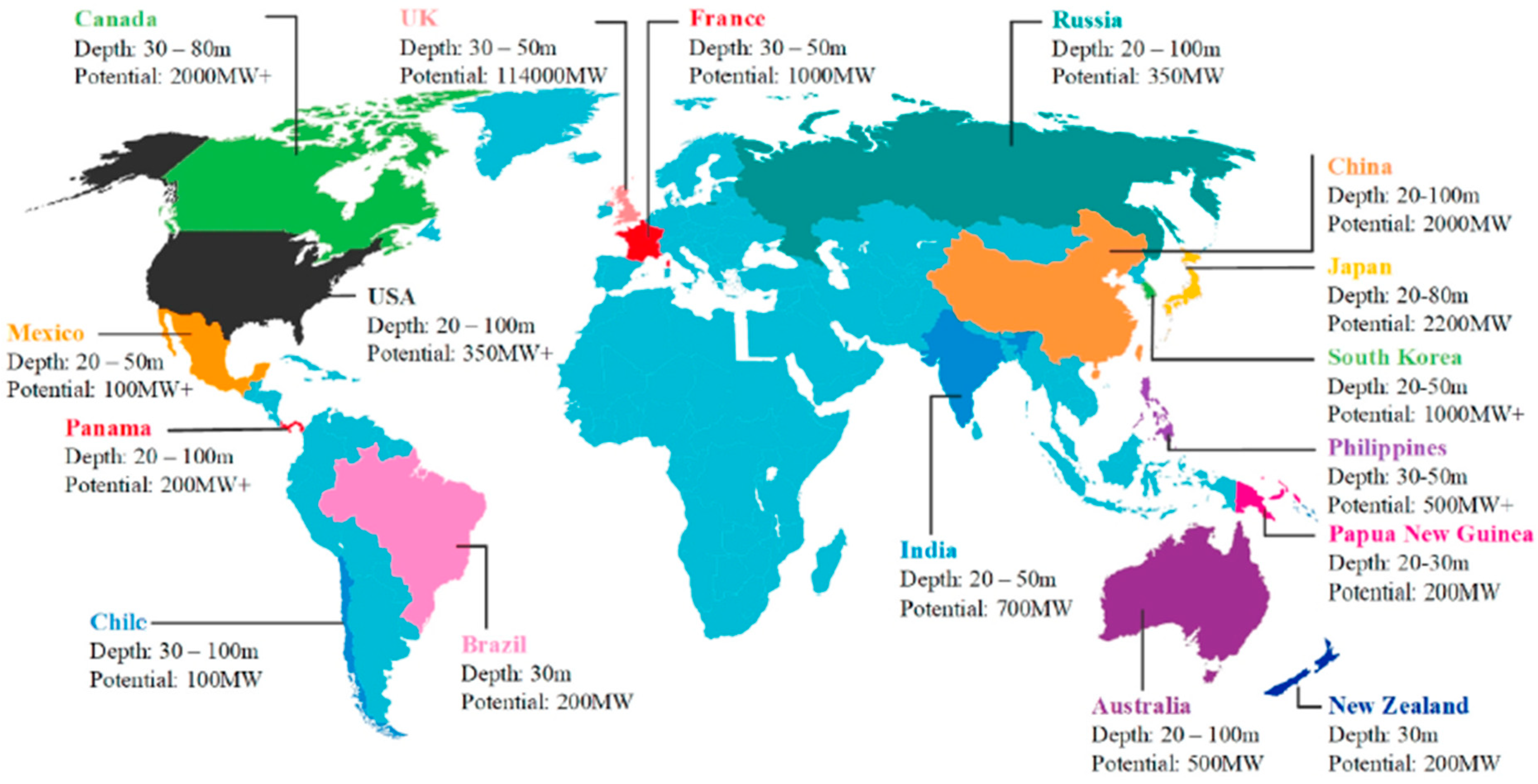
Figure 1. The global distribution of wave energy potential across various countries and typical deployment depths suitable for installing wave energy converters [20].
Jmse 14 00541 g001
Figure 2. Global distribution the Wave Resources Classes [21].
Jmse 14 00541 g002
Figure 3. The distribution of the global potential energy density is calculated in kWh/m2 [10].
Jmse 14 00541 g003
Figure 4. Average ocean temperature differences between 20 and 1000 m depths [22].
Jmse 14 00541 g004
Figure 5. Global map of extractable salinity gradient energy resources (TWh/a) [25].
Jmse 14 00541 g005
Figure 6. Different types of WEC systems: (a) Point absorber, (b) Submerged pressure differential, (c) Oscillating wave surge converter, (d) Oscillating Water Column (OWC), (e) Rotating mass, (f) Attenuator, (g) Overtopping/terminator device, (h) Bulge wave.
Jmse 14 00541 g006
Figure 7. Different types of TEC systems: (a) Horizontal axis turbine, (b) Archimedes screw, (c) Vertical axis turbine, (d) Oscillating hydrofoil, (e) Enclosed tips (Venturi tube), (f) Tidal kite.
Jmse 14 00541 g007
Figure 8. Schematic diagram of the open-cycle OTEC system.
Jmse 14 00541 g008
Figure 9. Schematic diagram of the closed-cycle OTEC system.
Jmse 14 00541 g009
Figure 10. Schematic illustration of the RED system [34].
Jmse 14 00541 g010
Figure 11. Schematic illustration of the PRO system [34].
Jmse 14 00541 g011
Figure 12. EU targets for Offshore Renewable Energy capacity (GW) [43].
Jmse 14 00541 g012
Figure 13. The grid points for the Adriatic Sea provided by WWA.
Jmse 14 00541 g013
Figure 14. Medians of the significant wave heights in the Adriatic Sea from 1992 to 2016.
Jmse 14 00541 g014
Figure 15. Medians of the mean wave periods in the Adriatic Sea from 1992 to 2016.
Jmse 14 00541 g015
Figure 16. (A) Mean tidal current speed in the northern Adriatic Sea; (B) difference in tidal current speed caused by lagoon interactions [46].
Jmse 14 00541 g016
Table 1. Developed WEC devices.
NameTypePower (MW)
Seabased WECPoint absorber2
xWavePoint absorber20
AquaBuoyPoint absorber0.25
WaveSurferPoint absorber2.1
CETO 6Point absorber1.5
Inertial Sea WECPoint absorber0.26
Wave Line MagnetAttenuator100
WEPTOS WECAttenuator1
Pelamis WEC (Inactive)Attenuator0.75
NoviOcean WECAttenuator0.5
StingRAYAttenuator0.5
HACE WECOscillating Water Column10
OE Buoy WECOscillating Water Column1.75
LEANCON Wave (Inactive)Oscillating Water Column4.6
REWEC3Oscillating Water Column0.06
MutrikuOscillating Water Column0.296
DrakooOscillating Water Column0.1
Wave DragonOvertopping19
WaveRoller Oscillating wave surge converter1
SurgeWEC (Inactive)Oscillating wave surge converter0.72
bioWAVE Oscillating wave surge converter0.25
S3 Wave Energy Converter Submerged pressure differential2
Etymol WEC (Inactive)Submerged pressure differential4
mWave Submerged pressure differential3
AnacondaSubmerged pressure differential1
Table 2. Developed TEC devices.
NameTypePower (MW)
Bulb turbine (La Rance Tidal Barrage) Horizontal Axis Turbine10
ATIRHorizontal Axis Turbine1.5
O2 TurbineHorizontal Axis Turbine2
AR1500Horizontal Axis Turbine1.5
Rotech Tidal Turbine (Inactive)Horizontal Axis Turbine1
GMax Tidal Energy SystemVertical Axis Turbine3.7
WaterotorVertical Axis Turbine1
Jupiter Hydro Tidal PlatformArchimedes Screw2
Deep Green Tidal KiteKite0.5
EEL Energy Tidal ConverterOscillating Hydrofoil1
Table 3. Developed OTEC devices.
NameType Power (MW)
Alcan 210 kW OTEC (Inactive)Open-Cycle0.21
KRISO OTEC (Inactive)Open-Cycle0.02
Sea Solar Power PlantClosed-Cycle25
Makai OTECClosed-Cycle0.1
Okinawa Rankine OTECHybrid-Cycle0.05
Table 4. Developed salinity gradient energy conversion devices.
NameType
RED-Stack Blue EnergyReverse Electrodialysis
Osmotic Energy Storage OES (Inactive)Pressure Retarded Osmosis
Disclaimer/Publisher’s Note: The statements, opinions and data contained in all publications are solely those of the individual author(s) and contributor(s) and not of MDPI and/or the editor(s). MDPI and/or the editor(s) disclaim responsibility for any injury to people or property resulting from any ideas, methods, instructions or products referred to in the content.