Article

Characteristics and Migration Patterns of Deltaic Channels in Tide-Controlled Coal-Accumulating Environments: A Case Study of the Pinghu Formation in the K Area, Xihu Depression

1
School of Geosciences, Yangtze University, Wuhan 430100, China
2
Key Laboratory of Exploration Technologies for Oil and Gas Resources, Ministry of Education, Yangtze University, Wuhan 430000, China
*
Author to whom correspondence should be addressed.
J. Mar. Sci. Eng. 2026, 14(6), 523; https://doi.org/10.3390/jmse14060523
Submission received: 31 January 2026 / Revised: 3 March 2026 / Accepted: 9 March 2026 / Published: 10 March 2026

Abstract

This paper focuses on the Pinghu Formation in the K region of the Xihu Depression, conducting a systematic study on the channel types, migration patterns, and the coupling mechanisms of tectonics, paleogeomorphology, and tidal dynamics in the tidal-controlled and river-controlled composite delta system of the region. By integrating core, well logging, and 3D seismic data, and addressing the challenges of channel identification under the influence of coal seams, methods such as PCA, K-means clustering, and fuzzy c-means clustering were employed for multi-attribute fusion analysis. An indicator system for channel identification and type classification was established, revealing the sedimentary characteristics of tidal-modified delta channels and their planar distribution and migration evolution process. The results of the study indicate that: (1) The early stage of the Pinghu Formation developed a tidal-controlled delta, with channels in network, linear, and dendritic shapes, where individual channels were small and fragmented; in the later stage, it transformed into a river-controlled delta, with sandbodies more concentrated; (2) In areas with weak tectonic constraints, the control of geomorphic boundaries became more prominent, and the barrier islands’ shielding effect on tides led to river-controlled migration of the channels, with limited tidal channels and tidal-modified sandbodies developed only in local areas; (3) The planar distribution and evolution of channels in the study area showed significant differences at different times due to the influences of geomorphology and tectonics. The findings of this paper provide new insights into the sedimentary evolution of tidal-modified delta channels.

1. Introduction

Tidal-controlled and tide-affected deltaic sedimentary systems are widely developed in the estuarine–coastal transition zone, one of the environments with the strongest sea–land interactions and the most complex sedimentary processes. Compared to typical river-controlled or wave-controlled deltas, tidal modification often leads to pronounced periodicity and bidirectionality in hydrodynamics, causing frequent switching between sand and mud deposition on short time scales. The channel morphology and sand body distribution exhibit diverse patterns [1,2,3]. In the ancient stratigraphic record, these systems are often characterized by thin interbedding of sand, mud, and coal, bidirectional progradation reflections, lens-shaped or network-like sandbodies, and complex channel stacking. These features present significant challenges for sedimentary facies interpretation, sand body connectivity prediction, and reservoir fine characterization [4,5,6].
The Pinghu Formation in the Xihu Depression of the East China Sea Shelf Basin records typical river-tidal coupling-controlled marine-terrestrial transitional facies sedimentation in a semi-closed bay setting. Previous studies have shown that the western slope zone of the Xihu Depression is influenced by both sediment supply and tidal energy, with widespread development of tidal-controlled delta and tidal flat systems. During the sedimentary period, multiple cycles of transgression and regression occurred frequently. Tectonic subsidence provided substantial accommodation space, and the semi-closed geomorphological pattern further enhanced the concentration and amplification effects of tidal energy in the slope and fault trough areas, leading to the formation of a sedimentary filling sequence characterized by significant tidal modification [7]. In this context, the Pinghu Formation commonly exhibits thin interbedding of sandstone and mudstone, accompanied by the development of coal seams, reflecting the rapid changes in the sedimentary environment and frequent tidal modification. This not only controls the migration and evolution process of the channels but also significantly impacts the preservation of coal seams and the formation and spatial stacking relationships of the sandbodies beneath the coal seams.
However, there are two prominent challenges in the identification and characterization of migration patterns of channels in tidal-modified delta systems: First, tidal modification causes individual channels to have relatively small scales, unclear boundaries, and complex planar shapes, often exhibiting bifurcations and network-like structures. These channels are frequently interconnected and interwoven with tidal flat sandbodies or tidal channels, leading to unstable results when interpreted based on single seismic attributes or coherence bodies [8]; Second, in the coal accumulation context, the strong reflections of coal seams overlap with the responses of sandbodies, resulting in complex coal-seam-sandbody interfaces. This often leads to issues such as “coal seam masking” and misinterpretation of sand body boundaries, which limits the fine characterization and connectivity evaluation of the channels beneath the coal seams [9,10]. In recent years, multi-attribute fusion techniques such as Principal Component Analysis (PCA), K-means clustering, and fuzzy c-means clustering have shown potential in identifying complex sedimentary bodies [11,12,13]. However, in the tidal-controlled coal accumulation context, there is still a lack of targeted processes and case studies to effectively couple multi-attribute fusion results with core-logging and seismic attribute systems, and further apply them to channel type classification and migration evolution mechanism interpretation.
Based on this, this paper takes the Pinghu Formation in the Pinghu Slope Zone of the Xihu Depression K area as the research object. By integrating drilling, core, well logging, and 3D seismic data, the study focuses on “the fine identification and migration evolution of channels beneath coal seams in a tidal-controlled coal accumulation context”. The main objectives include: establishing a comprehensive diagnostic indicator system for the Pinghu Formation tidal-delta facies, constraining channel sedimentary environment and coal seam development background using multi-scale evidence from core sedimentary structures, well log responses, and seismic facies characteristics; and, based on differences in hydrodynamic origins, classifying channels into two basic types: tidal-controlled and river-controlled [9], the study systematically characterizes the profile structure and planar morphological features of the channels, forming a scalable classification and development model. To address the interpretation challenges caused by the significant influence of coal seams, a “multi-seismic attribute fusion-cluster validation-well-seismic constraint” process for the fine identification of channels beneath coal seams is constructed, enhancing the reliability of channel boundary delineation and planar distribution interpretation. Based on the characterization of channel planar distribution and stacking patterns, the study reveals the control mechanisms of coeval faults, paleogeomorphological undulations, and tidal/river hydrodynamic coupling on channel migration and evolution, ultimately establishing typical migration models for tidal-modified delta channels in the study area. The research contributes to the understanding of the formation-modification-reoccupation process of tidal-modified delta channels in a semi-closed bay setting.

2. Geological Overview

2.1. Structural Setting and Paleogeomorphic Framework

The East China Sea Shelf Basin develops from north to south, with four first-order structural units: the Fujian Depression, Zhejiang East Depression, Taipei Depression, and Taixi Depression [14,15]. The Zhejiang East Depression is an important structural unit for oil and gas exploration and is further subdivided into the Xihu Depression, Changjiang Depression, Qiantang Depression, and two uplifts: Hupi Reef and Hai Reef. These structural units are arranged in an arcuate pattern from south to north, exhibiting an east-west zoning structure [16]. The structural pattern of the Xihu Depression can be summarized as “east-west zoning, north-south faulting.” It is composed of northeastward faults and fold belts from west to east, with distinct fault-block characteristics from south to north. The secondary structural units of the Xihu Depression include the western slope zone, western sub-basin, central inversion structural belt, eastern sub-basin, and eastern marginal fault belt. The overall structural framework is “two basins and one uplift” [16,17].
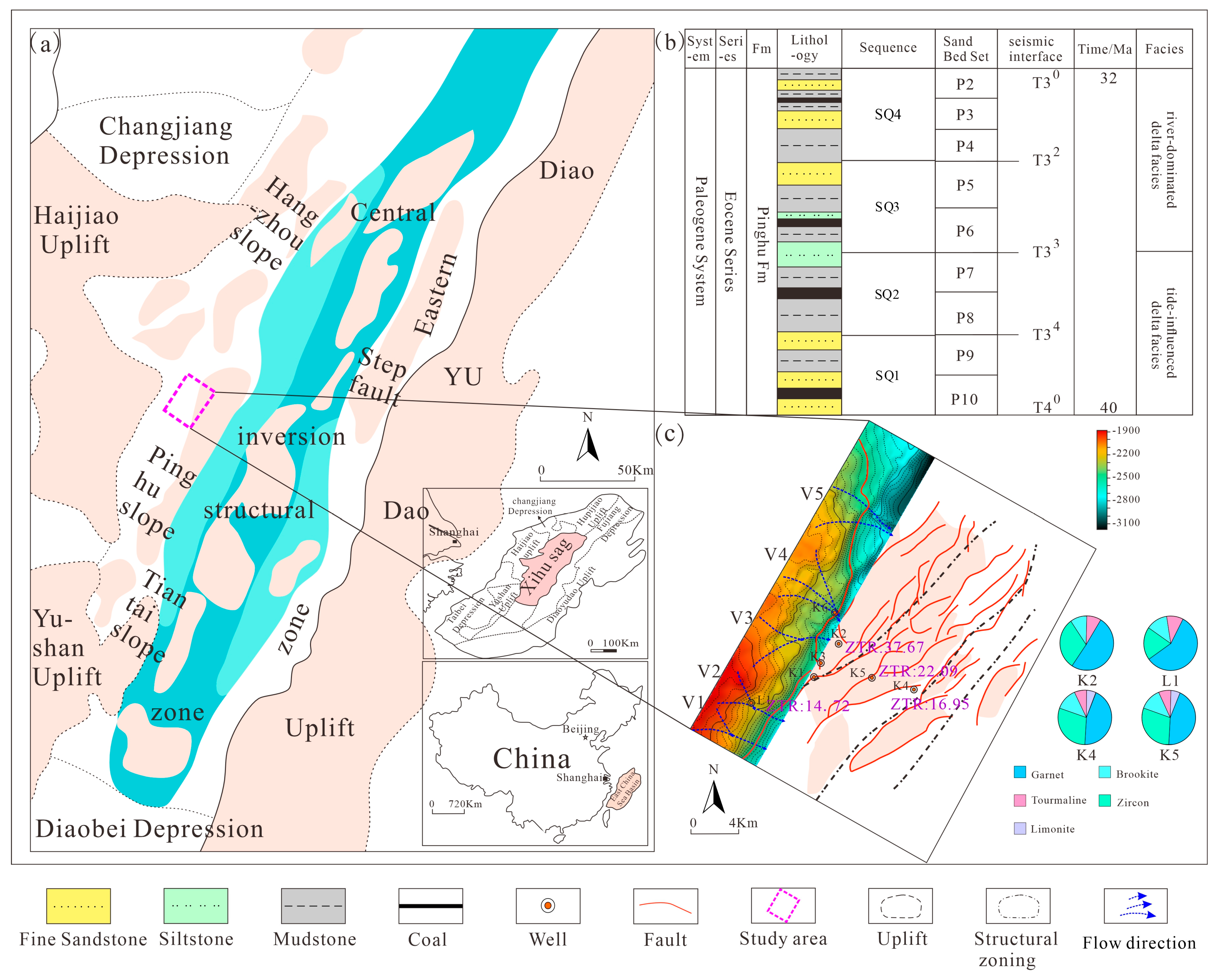
The structural evolution of the Xihu Depression has gone through three stages: the faulting stage (Paleocene-Eocene), the sagging stage (Oligocene-Miocene), and the regional subsidence stage (Pliocene-Quaternary) [18,19]. The strata, from bottom to top, include the Paleocene, Eocene Baoshi Formation, Pinghu Formation, Oligocene Huagang Formation, Miocene Longjing Formation, Yuquan Formation, Liulang Formation, and the Pliocene Santan Formation and Quaternary Donghai Group [20,21]. Among these, the Pinghu Formation is an important oil and gas-bearing sequence and the focus of this study [22,23,24,25]. The sedimentary strata of the Pinghu Formation in the study area are mainly divided into four stratigraphic sequences, SQ1 to SQ4, each composed of different rock types, including sandstone, siltstone, mudstone, and coal seams, reflecting the transition from tidal-influenced to river-dominated sedimentary environments. Based on seismic reflection interfaces and time (Ma) markers, the stratigraphic sequences range from T40 to T30. Additionally, SQ1 corresponds to tidal-dominated deltaic facies, while SQ4 represents river-dominated sedimentary facies. This change reveals the migration and evolution of channels in the region (Figure 1b).
The K area, approximately 600 km2 in size as shown in Figure 1a [26], is located in the western slope zone of the East China Sea Shelf Basin, situated in the middle section of the Pinghu Slope Zone, with a reef uplift marking its western boundary. The heavy mineral components include garnet, chlorite, zircon, and iron–aluminum minerals. The distribution of these minerals is closely related to the regional sedimentary environment and tectonic activities. Changes in mineral composition may be influenced by tectonic movements, further indicating the interaction between sedimentation and tectonic evolution in this region. In the east-west direction, the K area is controlled by NE-SW trending faults (as shown in Figure 1c), which divide the area into high, middle, and low zones, exhibiting a series of forward multi-step fault block structures [27,28]. These faults have been active since the Paleocene, with the upper fault boundary reaching the top of the Pinghu Formation and the lower fault boundary extending to the basement, forming a typical coeval fault system that has had a long-term controlling effect on paleogeomorphology and sedimentary patterns.

2.2. Background of Tidal Effects

Recent studies have shown that during the deposition of the Pinghu Formation, the western slope zone of the Xihu Depression primarily developed fan deltas, braided deltas, and tidal flat sedimentary facies types [29,30], the region is generally in a semi-closed bay marine-terrestrial transitional sedimentary background significantly influenced by tidal action [31]. Controlled by regional tectonic patterns and paleogeomorphological conditions, the Xihu Depression exhibits clear sedimentary differentiation features: riverine influences are relatively weak in the western part (Figure 1a), while tidal influences are more prominent in the eastern part (Figure 1a), resulting in a sedimentary pattern mainly dominated by tidal-modified delta and tidal flat deposits [32].
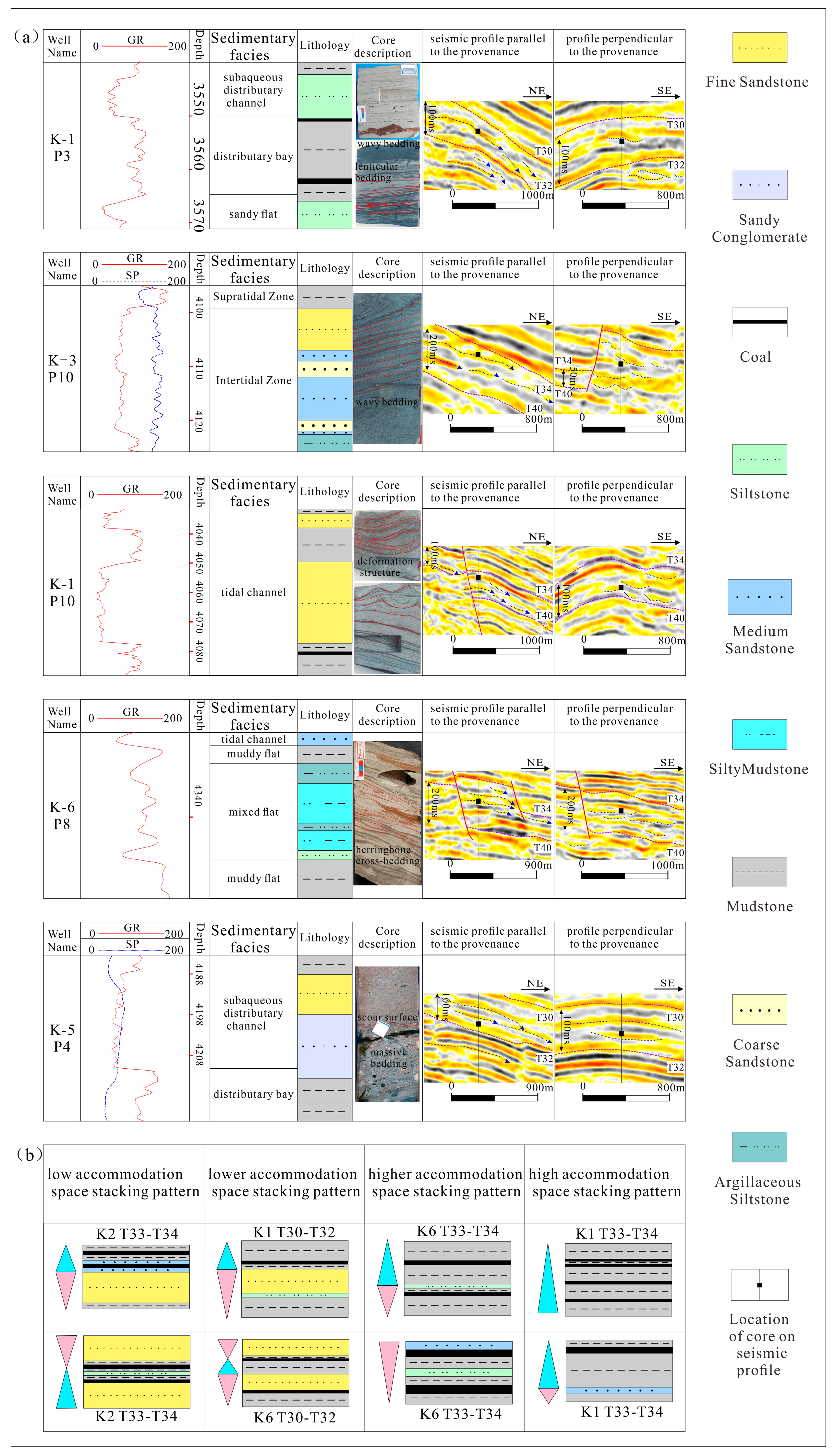
The sedimentary facies types of the Pinghu Formation in the study area mainly include tidal-controlled delta and tidal flat systems. Among them, the tidal-controlled delta facies can be further divided into delta plain subfacies and delta front subfacies, with the delta front subfacies being the most developed [33]. In this subfacies, the clastic particles are generally finer, with lithologies mainly consisting of fine sandstone and siltstone, and the sedimentation rate is relatively low [15], the water advance-recession cycles are clearly defined, and typical tidal sedimentary structures, such as lenticular bedding and flaser bedding, are commonly developed (as shown in Figure 2a) [34,35].
The tidal flat sedimentary system primarily develops in gently sloping coastal environments with a clear tidal cycle but without strong wave action. It can generally be divided into the supratidal, intertidal, and subtidal zones, with the intertidal zone being the most developed. Tidal flat sediments show significant zonation in their distribution: mudflat deposits dominate the nearshore side, while the seaward side, influenced by tidal action, gradually transitions into sandflat deposits. Typical sedimentary structures in tidal flats include ripple bedding and feather cross-lamination (as shown in Figure 2a) [36].
During the deposition of the Pinghu Formation, the region underwent multiple cycles of transgression and regression. On one hand, the coeval tectonic subsidence created large accommodation space, facilitating the development of fine-grained sediments and coal seams; on the other hand, the semi-closed bay environment and relatively narrow basin shape enhanced the concentration and amplification of tidal energy in the slope and fault trough areas, providing favorable conditions for the full development of tidal action [37].
Influenced by these various factors, the Pinghu Formation generally developed thin interbedding of sandstone and mudstone in the vertical direction (as shown in Figure 1b), with thin sandbodies and poor continuity [15,17,38], reflecting sedimentary characteristics of frequent tidal modification and rapid changes in the sedimentary environment.

2.3. Characteristics of the Deltaic Source-to-Sink System

During the deposition of the Pinghu Formation, the primary sediment source in the study area came from the western reef uplift zone and its adjacent highland regions. Clastic material was transported by river systems developed in fault-controlled lowland zones, with the overall transport directed towards the northeast into the Pinghu Slope Zone. Controlled by the regional tectonic framework and paleogeomorphological differentiation, the heavy mineral composition was generally similar, and the sediment supply was relatively stable (as shown in Figure 1c). At the same time, the ZTR index gradually increased from southwest to northeast, reflecting the increase in maturity of the sediments during transportation [34,39]. Based on the integration of heavy mineral characteristics and the spatial variation in the ZTR index, it is concluded that the primary source for the Pinghu Formation in the K area is from the west.
The sediment sources in the K area mainly developed five valleys: V1, V2, V3, V4, and V5. However, the rivers were of limited scale and energy. During the SQ1 and SQ2 stages, the sediment supply was abundant from the V1 and V2 valleys in the southwest, resulting in larger delta and delta-complex deposits. However, due to strong tidal influence, a typical river-controlled delta system was difficult to form [34]. The central and northern water systems were more singular, and the early stages of the Pinghu Formation had less sediment supply, leading to smaller deltas. During the SQ3 and SQ4 stages, sediment supply was abundant, tidal influence was weaker, and the deltas were larger, mainly dominated by river-controlled delta systems.
In the early depositional stages of the Pinghu Formation (stage SQ1 and SQ2), the study area was primarily dominated by tidal-modified deltaic sedimentary systems, with significant tidal influence. Tidal energy was enhanced in the semi-closed tectonic-paleogeomorphological setting and dominated the redistribution of sediments, continuously modifying the clastic material input from rivers [36].
Under the combined control of the source-sink system and tectonic activity, the study area developed a sedimentary pattern characterized by “fault-controlled source pathways and tidal-modified sedimentary depressions.” Clastic material entered the basin along the fault-guided lowland belts, and under the influence of tidal scour and lateral transport, multiple periods of stacked and complex planar tidal-controlled channels and tidal-controlled sandbodies were developed. Their distribution was constrained by both the intensity of fault activity and the distribution of tidal energy.
In summary, the formation and evolution of the tidal-modified delta in the Pinghu Formation of the K area in the Xihu Depression is the result of coeval fault activity, paleogeomorphological differences, and the interaction between river and tidal forces. Tectonic activity shaped a semi-closed sedimentary environment favorable for tidal energy accumulation, while the river system provided continuous sediment supply for the delta. Tidal influence played a key regulatory role in sediment redistribution, channel morphology evolution, and coal seam development, laying the important regional sedimentary foundation for subsequent channel migration and the formation of sandbodies beneath the coal seams.

3. Data and Methods

This study used core and well logging data from four wells, combined with 3D seismic data covering the study area, for a comprehensive analysis. The aim was to investigate and discuss the controlling factors and migration patterns of tidal-modified deltas during the Pinghu Formation. The research methodology includes the following steps:
(1)
Identifying typical sedimentary structures, lithofacies associations, and tidal sediment indicators within the Pinghu Formation using core, well logging, and seismic interpretation profiles;
(2)
Addressing the difficulty in identifying channel boundaries caused by strong reflections from coal seams, PCA, K-means clustering, and fuzzy c-means clustering were applied to geological attributes extracted from the study area using Petrel (version 2018) and SMI (version 3.0) geological software to improve the accuracy of channel identification beneath the coal seams;
(3)
Using Petrel geological software, the study area’s typical sedimentary features were classified, and five source-aligned and five vertical source cross-sections were drawn to analyze progradation, overstep, lateral migration of channels, and stacking seismic emission characteristics. The planar division of river-controlled and tidal-modified delta channels was conducted by combining PCA-fused attributes, K-means clustering, and fuzzy c-means clustering;
(4)
Using PCA-fused attributes, K-means clustering, fuzzy c-means clustering, and well logging data, the sedimentary facies types and their planar distribution characteristics for different sequence development stages were determined. The sedimentary facies planar evolution diagrams for the SQ1~SQ4 periods were drawn;
(5)
A comprehensive analysis of the channel development style and planar evolution characteristics was conducted to identify the controlling factors of channel development and the migration patterns of tidal-modified delta channels.
The core photos, well logging data, 3D seismic data, and attribute maps used in this study were all derived from actual data from this project, aiming to provide scientific evidence for the discussion of channel development and migration patterns.

4. Results

4.1. Tidal-Delta Facies Indicators

Tidal-controlled and tide-affected deltas have traditionally been considered the most difficult to characterize, whether in modern or ancient examples [3,5,40]. Taking the K area of the Xihu Depression as an example, the tidal-controlled delta in the study area is mainly distributed in the middle-high zone of the western slope belt. As rivers from the western reef uplift source area inject into regions with strong tidal influences, tidal forces play an important role in controlling the formation of delta sandbodies [41]. In the study area’s delta plain, apart from distributary channel deposits of sandstone, the majority of the sediment is mudstone, with rich organic carbon content, and the sediments are either coal or carbonaceous mudstone (Figure 2b).
Sedimentary facies analysis of the Pinghu Formation from core and well logging data shows that in the early stages, the lithology was mainly fine sandstone, siltstone, and mudstone, occasionally interbedded with black coal seams. The GR curve shows a low-value, high-amplitude, tooth-shaped or finger-like box shape, mainly developing tidal flat sediments. Vertically, the core displays tidal rhythm bedding and bioclastic structures, reflecting the periodic rise and fall of tidal hydrodynamic conditions (Figure 2a). In the late stages of the Pinghu Formation, tidal modification was weaker, and braided river deltas mainly developed, characterized by underwater distributary channels and interdistributary bay microfacies. The well log curve shows a low natural potential, with the GR curve exhibiting a box-like or bell-shaped form. Fine sandstone with gravel and mudstone is visible in the core, commonly showing parallel bedding and cross-bedding, with an overall upward fining, reflecting a normal rhythmic feature. Channel bases show scour surfaces (Figure 2a).
Additionally, the reflection amplitude, frequency, continuity, external morphology, and internal reflection configuration in seismic facies can also explain geological information [17]. In the early stages of the Pinghu Formation, the seismic facies profiles show sheet-like or thin-layered distribution, with reflection layers exhibiting medium-to-weak amplitude, discontinuous undulating waves or domed structures. Internal reflections are chaotic, and lateral continuity is poor. In the late stages of the Pinghu Formation, the seismic layers show S-shaped progradation reflections with better lateral continuity [42].
Coal seams are sedimentary rocks formed under specific paleoenvironments, representing the long-term burial and compaction of peat, and coal-bearing strata preserve rich geological information [43]. The formation of coal seams in the Pinghu Formation is widespread and can be roughly divided into four depositional models (Figure 1b): low accommodation space depositional model, lower accommodation space depositional model, higher accommodation space depositional model, and high accommodation space depositional model. Each depositional model has different sequence arrangements, reflecting various sedimentary environments and forces. Based on their vertical stacking patterns, coal seams and channels in the T30–T33 interval of the Pinghu Formation are associated, and the formation of coal seams is related to allochthonous transport rather than in situ deposition. In contrast, the coal seams in the T33–T34 section are primarily influenced by high accommodation space tidal-controlled processes, resulting in the development of mud-rich primary coal seams, reflecting the sedimentary environment and genesis characteristics of this area.

4.2. Identification of Coal Underlying Waterways

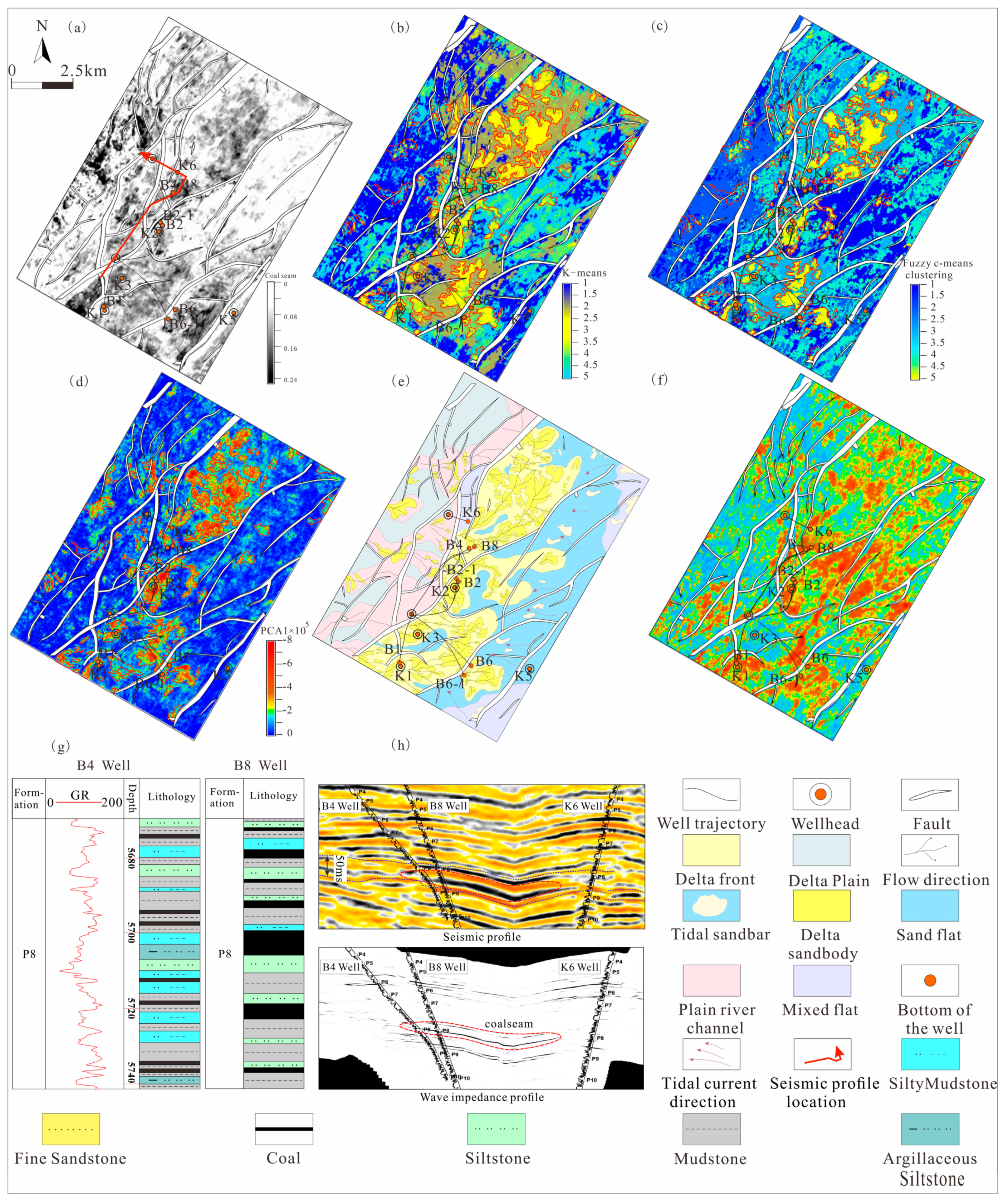
The K area is characterized by a tidal sedimentary environment, which has a suppressive effect on the development of channels and facilitates the formation of coal-bearing environments [44]. The coal-bearing strata of the Pinghu Formation display characteristics of “multiple points, multiple layers, and thin layers,” as well as a dynamic coal accumulation model [45]. Taking the P8 layer as an example, in Figure 3a, the black and gray colors represent the proportion and thickness of the coal seams, with darker colors indicating a higher proportion of coal. It can be seen that the coal seams are widely distributed in the P8 layer (as shown in Figure 3a,g).
From the impedance profiles, it can be observed that the coal seams in the P8 layer are relatively enriched in wells B4, B6, and K-6 (Figure 3h). The strong energy anomalies on the seismic profile are more likely to represent coal seams, and these coal seams have a significant impact on the channels. Additionally, the conventional method using the VP/VS minimum amplitude attribute shows that the P8 channel is more developed in wells B4 and B8 (represented by the red part), but the actual drilling results show that there are almost no sand layers or the sand layers are thin (as shown in Figure 3g). The coal seam thickness ratio indicates that the coal seams are relatively thick in this area (Figure 3a). Therefore, the VP/VS minimum amplitude attribute might be heavily influenced by the coal seams, leading to a false interpretation.
The use of K-means clustering results effectively eliminated possible coal seam interference, indicating the location of channel development. In the K-means clustering, the light green color represents the part where coal seam interference was eliminated, and the yellow color represents the channels (as shown in Figure 3b).
Therefore, the P8 layer was subjected to attribute selection, and the attributes were fused with the VP/VS minimum amplitude attribute. This resulted in the fusion of K-means clustering, fuzzy c-means clustering, and PCA attributes (Figure 3b–d). This method, when compared with actual drilling results, shows a high degree of correlation and provides a viable method for identifying channels beneath the coal seams. In both fuzzy c-means and K-means clustering, the yellow parts represent the channels, and in PCA, the red and yellow values represent the channels. The redder the color, the more developed the channels. It can be seen that all three methods show the morphology of the channels, but the K-means clustering results have better continuity.
The sedimentary facies map of the P8 interval in the Pinghu Formation (Figure 3e) integrates seismic attribute clustering analysis, drill core lithology, and well log interpretations, clearly revealing the spatial distribution and facies differentiation of the deltaic sedimentary system under a tide-dominated setting.
In terms of facies composition, the study area exhibits an orderly transition from land to sea, with delta plain, delta front sandbodies, mixed flats, and sand flats successively developed from northwest to southeast. Among these, delta front sandbodies are centered around wells B2, B2-1, B8, and K6, displaying lobate and wide-banded geometries and constituting the primary sandy depocenters in the study area. Mixed flats are extensively distributed along the lateral and peripheral margins of the delta front, representing low-to-moderate energy environments of mixed sand-mud deposition, which act as critical zones for lateral sealing and interlayer development within sandbodies. Sand flats, mainly developed on the outer delta front and nearshore zones, correspond to high-energy intertidal–subtidal environments where sandy deposits are relatively enriched.
Tectonic and geomorphic conditions exert significant controls on sedimentary facies distribution. Multiple NE-trending faults traverse the study area, and their strikes are highly consistent with the orientation of delta front sandbodies. This indicates that syndepositional faults not only provided local accommodation space for sand deposition but also imposed geometric constraints on the distribution directions of channels and sandbodies. Structural lows at the intersections of northern faults (e.g., near well B2) favored “corner-type” sandbody enrichment, further confirming the dominant control of tectonic activity on sandbody accumulation and migration.
Flow direction indicators suggest that sediment provenance was primarily from the northwest, with delta front sandbodies prograding seaward along this direction, consistent with the channel distribution identified by seismic attributes. Drill core data (e.g., from wells B4, B8, and K6) reveal that delta front sandbodies are dominated by fine-grained sandstone and siltstone, locally containing gravel and mud clasts, and exhibit multi-stage stacked composite channel sandbodies in vertical succession, which are highly consistent with seismic facies analysis results.
In summary, the sedimentary facies map (Figure 3e) clearly illustrates the coupled sedimentary model of “fluvial sand supply, tidal reworking, and tectonic accommodation control” for the P8 interval of the Pinghu Formation, providing key sedimentological evidence for subsequent studies on channel migration, evolution, and reservoir heterogeneity.

4.3. Channel Development Patterns and Classification

Based on hydrodynamic origin differences and sedimentary morphological characteristics, the channels in the tidal-deltaic system of the Pinghu Formation in the K area of the Xihu Depression are classified into two major types: tidal channels and normal river channels. Their seismic response characteristics and planar morphology have a good correspondence.

4.3.1. River-Controlled Delta Channels

In the river-dominated sedimentary background, the channels in the study area exhibit distinct directional and combinatory features on the attribute plane map (as shown in Table 1). River-controlled channels primarily display two typical styles in terms of their planar morphology: the lobe-shaped channel assemblage and the banded channel distribution [46], both of which have a close association in space.
(1)
Wide Band-shaped Channels
Wide band-shaped channels appear as continuous, high-value strip-like zones with stable orientation and relatively limited width variations, with slight curvature visible locally. In seismic profiles, they show S-shaped progradational reflections, with no significant lateral migration. These channels generally extend and converge in multiple directions, indicating concentrated flow energy and strong sediment transport capacity, suggesting that under river-controlled conditions, channel development is strongly linearly constrained.
(2)
Lobe-shaped Channels
Lobe-shaped channels mainly develop at the leading edge of the main channel or distributary positions. On the attribute plane map, they are represented as high-value areas that fan out from a single main channel towards the front, forming fan-shaped or irregularly lumped zones. In seismic profiles, they manifest as oblique progradational reflections, developing into composite W-shaped channels. The lobe-shaped geometry reflects the process of river branching and sediment diffusion after entering a zone of rapid energy attenuation, representing an important form of concentrated sediment unloading in river-controlled systems.
From the perspective of planar combination characteristics, wide band-shaped channels typically serve as the upstream main channels and gradually transition into lobe-shaped channel assemblages toward the front. This combination reflects the evolutionary process of rivers advancing toward the basin or delta front, transitioning from a stable, single-channel system to a multi-branched system, and is a typical manifestation of river-controlled channel planar distribution.

4.3.2. Tidal-Controlled Delta Channels

In the tidal-dominated sedimentary background, the channels in the study area display distinctly different and more complex distribution characteristics on the attribute plane map compared to river-controlled systems (as shown in Table 1). Tidal-controlled channels mainly appear as networked, forked, and dendritic channel assemblages, with highly variable channel orientations and frequent branching, generally lacking a single stable dominant direction.
(1)
Networked Channels
Networked channels exhibit a composite V-shaped, dumbbell-like form in the seismic profile, with disordered reflections. On the plane, they present a dense, fragmented pattern, with multiple channels interweaving and frequently converging and diverging, and unclear channel boundaries. This type of channel has a complex planar morphology, reflecting the continuous reworking and reorganization of the channels under the combined influence of tidal and river forces, making it one of the most representative channel styles in tidal-controlled sedimentary systems.
(2)
Linear and Banded Channels
Linear channels show poor continuity of progradation in the longitudinal profile, with frequent alternations between sand and mud extending along the direction, displaying linear reflection anomalies and migration stacking. In the vertical source profile, they appear as lenticular, multi-stacked channels with sandbodies that taper off at both ends. On the plane, they manifest as narrow, strip-like or ribbon-like shapes.
(3)
Dendritic Channels
Dendritic channels appear on the attribute plane map as radial or tree-like structures, developing progressively from the main stem towards the periphery, with many small-scale secondary branches. These channels often coexist with networked channels, reflecting the sedimentary process of energy attenuation in the tidal-dominated system and the expansion of the channel system toward the outer edges.
Overall, tidal-controlled channels are primarily characterized by networked, forked, and dendritic distributions on the plane, reflecting the high complexity and instability of the channel system under the dominance of tidal forces.

4.4. Planar Distribution and Migration Evolution Process of Channels

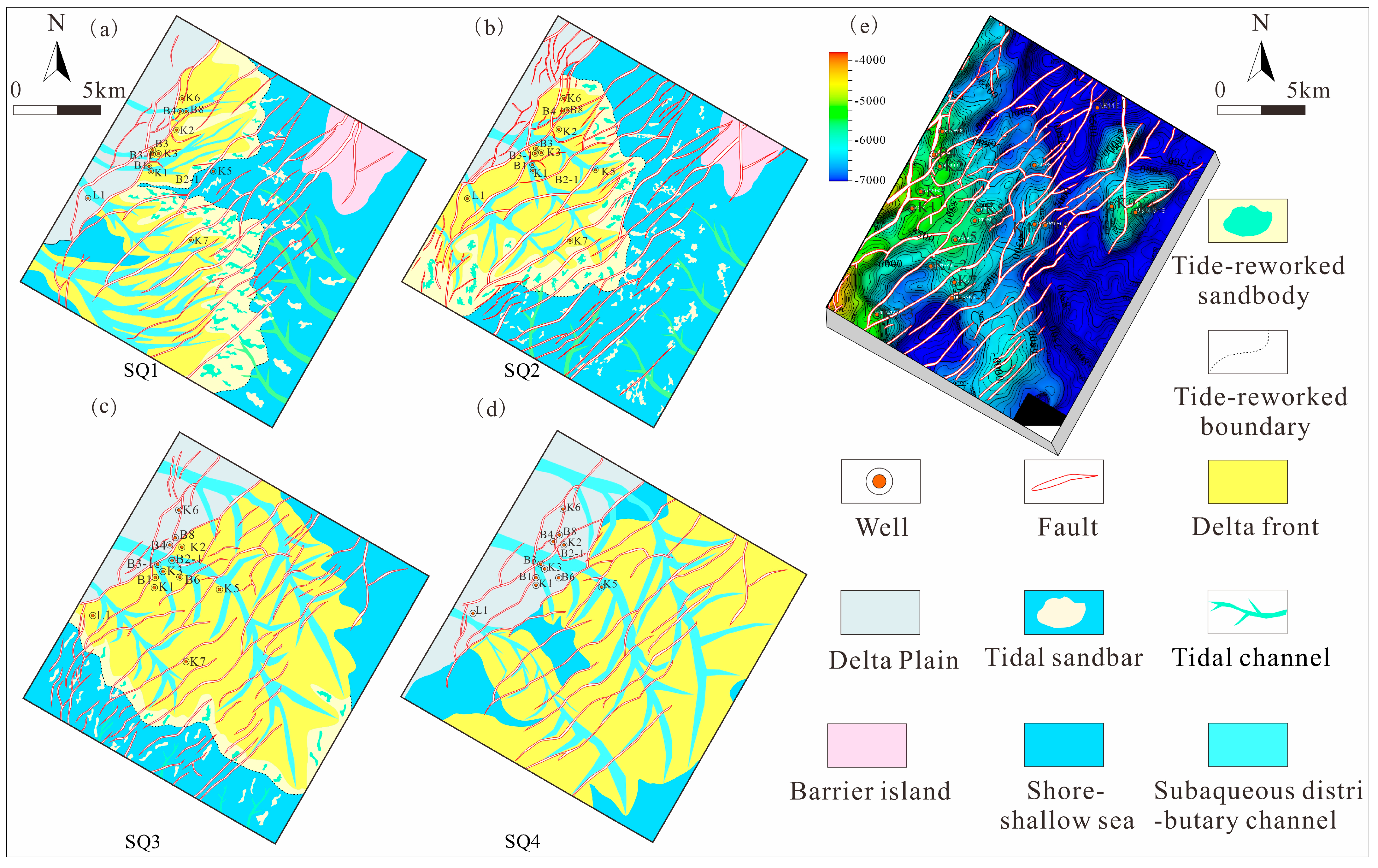
The topography of the Pinghu Formation in the study area is high in the west and low in the east, with an overall faulted step-like distribution and numerous northeast-trending faults. The color changes from yellow and green to deep blue in the figure reflect the transition from shallow to deep water areas within the basin (Figure 4e). Based on the PCA attribute plane map and the sedimentary facies plane distribution characteristics (as shown in Figure 4), the channels in the study area show significant stage-specific evolution from SQ1 to SQ4. Their planar distribution, branching characteristics, and spatial migration modes exhibit significant differences at different stages, with the early stage being strongly influenced by the development of barrier islands.
During the SQ1 stage, large-scale barrier island systems developed extensively in the study area’s delta front (Figure 4a) [34,37]. In the delta front and shallow coastal areas, the tidal influence was hindered by the barrier islands, with tidal action being weaker in the northern part and stronger in the southern part, where there was no barrier island. The channels in the planar view form a dense, networked and bifurcated system, with multiple tidal channels intertwining, frequently bifurcating and converging, and a significant change in direction.
In the SQ2 stage, barrier islands continued to develop but were significantly smaller compared to SQ1 (Figure 4b). At this time, the tidal influence in the northern part increased compared to SQ1. In this context, the extent of the channel distribution shrank accordingly, with bifurcated channels remaining dominant and local network features still preserved, but the branch density decreased compared to SQ1. Some channels began to exhibit relatively stable main channel forms.
During the SQ3 stage, the influence of barrier islands significantly weakened or almost disappeared. The channel system was mainly controlled by river forces, with smaller-scale fragmentation of delta front sandbodies and a significant reduction in tidal influence (Figure 4c). The planar channels were characterized primarily by dendritic-bifurcated combinations, with main channels becoming gradually clearer and secondary branches extending toward the periphery. Compared to the previous two stages, the continuity of the channels increased, but a certain degree of multi-branching was still present, showing that the channel system continued to adjust and migrate on a relatively stable basis.
In the SQ4 stage, the planar distribution of the channels further simplified, with channels primarily exhibiting banded shapes and stronger directional characteristics, with bifurcated and networked features significantly reduced (Figure 4d). The main channel locations were relatively fixed, with migration significantly reduced, indicating that the channel system’s evolution had become more stable during this stage.

5. Discussion

5.1. Controlling Factors of Channel Evolution

The formation and evolution of tide-modified deltaic channels in the Pinghu Formation are not products of a single dynamic process, but the result of the combined effects of multiple factors, including syndepositional tectonic activity, paleogeomorphic conditions, and tidal-fluvial hydrodynamic coupling. Among these, the differential dominance of various controlling factors across different periods and spatial locations constitutes the fundamental cause of the diverse channel types and complex migration patterns in the study area.

5.1.1. Coupled Control of Syndepositional Faults and Geomorphology

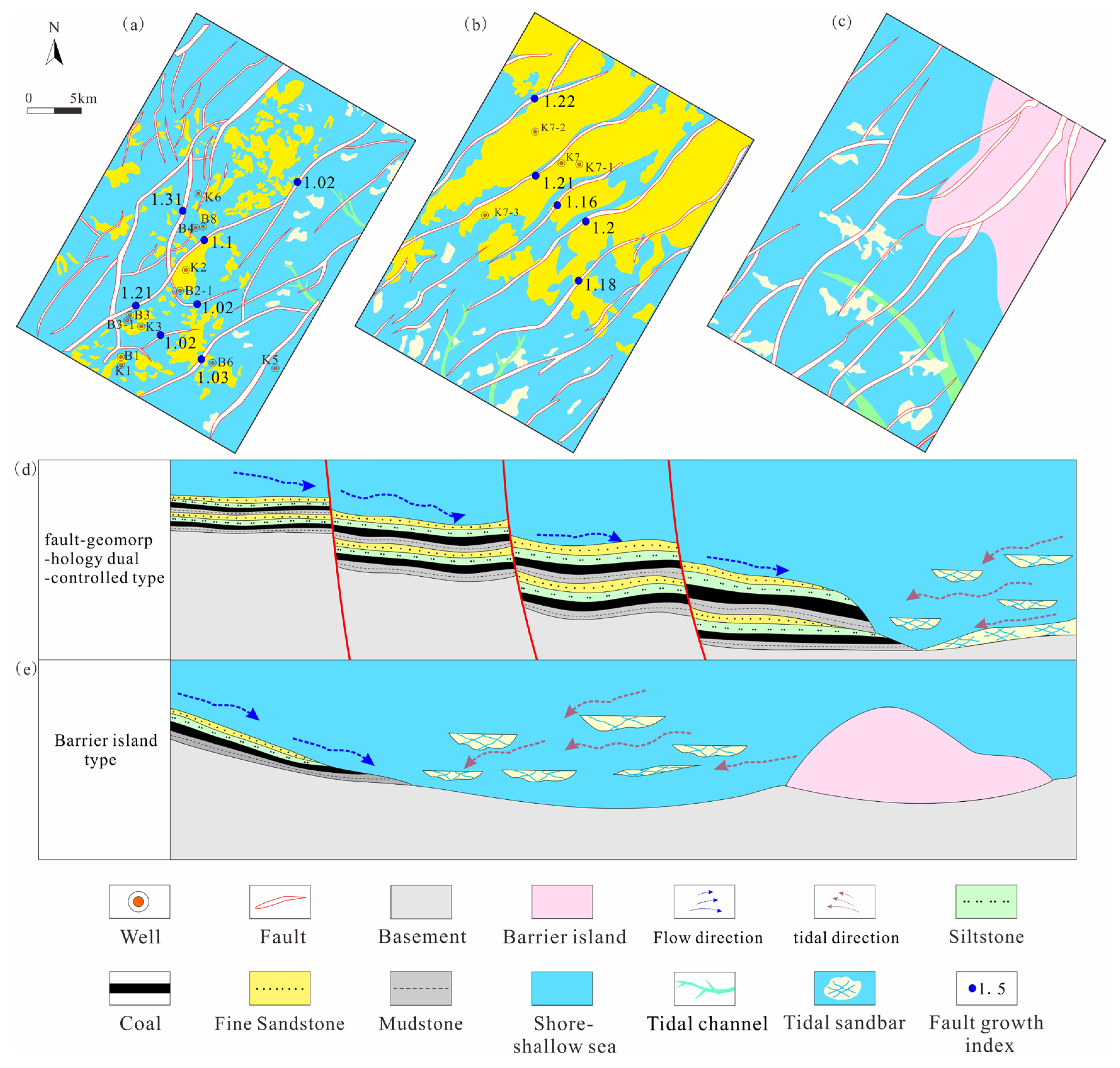
The channel migration in the study area exhibits distinct spatial heterogeneity, reflecting the combined constraints of tectonic activity and geomorphic boundaries on the evolution of drainage pathways. Normal faulting can influence the migration and distribution of channels by modifying topographic gradients and accommodation space distribution [47]. Systematic differences exist in channel migration patterns among different segments (Figure 5), indicating that channel evolution is not controlled by a single dynamic condition, but results from the combined effects of tectonic constraints and geomorphic boundaries.
Based on the sand-control mechanism of the East China Sea Basin proposed by Chen [48], channel migration in tectonically active segments is apparently guided by fault geometry. In the northern part, channels are distributed along fault strikes (Figure 5a), forming typical fault-guided “corner-type” sand control, with migration paths highly consistent with structural boundaries. This phenomenon suggests that syndepositional faults not only provide local accommodation space but also impose persistent geometric constraints on channel migration directions by forming linear structural boundaries [49], thus restricting free lateral swinging and favoring the stable development of channels along linear structural pathways.
In contrast, the southern segment in Figure 5a and the area shown in Figure 5b have fault growth ratios significantly greater than 1, and channel migration displays obvious step-fault characteristics [50]. Channels migrate between step-like geomorphic units controlled by multiple fault terraces, and their planform distribution is highly consistent with fault segmentation. Multi-stage stacked composite channel sandbodies are formed in the low-lying zones of fault terraces (Figure 5d,e). This migration pattern reflects that when fault activity is dominated by segmented subsidence, channels tend to repeatedly occupy structurally low areas, with limited lateral migration and significantly enhanced vertical stacking [51].

5.1.2. The Control of Barrier Islands on Tidal Channels

In segments where tectonic constraints are relatively weak, the control of geomorphic boundaries on channel migration becomes more prominent. Channels are mainly constrained by the barrier island system (Figure 5c,e). In this area, sandbodies are influenced by both fluvial and tidal processes; however, tidal modification is relatively weak due to the barrier effect of barrier islands. Channel migration is dominated by fluvial processes, with only limited-scale tidal channels and tide-modified sandbodies developed locally, showing an evolutionary characteristic of “barrier island-modulated type” [52].
By synthesizing the above differences, it can be concluded that the spatial differentiation of channel migration patterns in the study area essentially reflects a continuous variation in the control intensity of syndepositional faults from strong to weak and in geomorphic boundaries from open to closed. When tectonic control is dominant, channel migration is dominated by fault-guided and step-fault patterns. As tectonic constraints weaken and barrier island geomorphology becomes dominant, channel migration gradually shifts to a fluvial-dominated type with restricted tidal modification. This evolutionary law indicates that the coupled control of syndepositional faults and geomorphic differentiation is responsible for the diversity of channel migration styles and the heterogeneous spatial distribution of sandbodies.

5.2. Tide-Modified Deltaic Channel Migration Patterns

Based on an integrated analysis of planar distribution characteristics, vertical stacking relationships, and controlling factors of channels, the morphological characteristics of channel migration and evolution under the tide-dominated depositional setting of the Pinghu Formation in the study area can be summarized into the following two typical models.

5.2.1. Channel Migration Pattern Under the Coupled Control of Syndepositional Faults and Geomorphology

This study investigates the coupled controls of syndepositional faulting and paleogeomorphic framework on channel migration patterns in the study area. The results show that the main distributary channels do not migrate randomly (Figure 6), but are preferentially distributed along low-lying zones controlled by faults. This indicates that tectonic deformation not only provides sedimentary accommodation space but also exerts an obvious guiding effect on channel pathways. This phenomenon suggests that channel migration is not entirely governed by self-organization processes, but is largely constrained by exogenic tectonic and geomorphic conditions.
In addition, syndepositional faults significantly influence channel stability by forming local subsidence centers. Sustained increases in accommodation space within fault-bounded areas favor long-term occupation and multi-stage stacking of channels. Compared with tectonically stable areas, channels in fault-developed regions exhibit higher stacking frequencies and greater cumulative sandbody thicknesses, indicating that syndepositional faults enhance the “fixed-position” characteristic of channels to a certain extent.
The paleogeomorphic framework further modulates the control of faults on channel migration. Paleogeomorphic highs block and deflect channels, whereas fault-bounded lowlands act as preferred migration pathways [49], promoting concentrated channel distribution along structural lows. The combined effects of fault activity and paleotopography result in distinctly non-random spatial channel distributions, characterized by banded or clustered sandbody enrichment in structural lows and restricted development over geomorphic highs.
Marked differences in migration styles exist between tectonically controlled zones and geomorphically open areas. In regions with strong fault control, lateral channel swinging is limited, forming multi-stage stacked composite channel sandbodies, which strongly influences the vertical distribution of reservoirs. In areas with weaker tectonic constraints and gentle paleotopography, channels are more prone to lateral migration, leading to relatively dispersed sandbody distribution. Specifically, in areas of intense tectonic deformation, channels show higher stacking frequencies, with thicker and more concentrated sandbodies, which helps improve vertical reservoir connectivity and reserve prediction accuracy. Conversely, in areas with low paleotopographic relief, channels migrate more freely, sandbodies are relatively dispersed, and lateral reservoir connectivity is poorer.

5.2.2. Tidal Modification-Dominated Migration Pattern

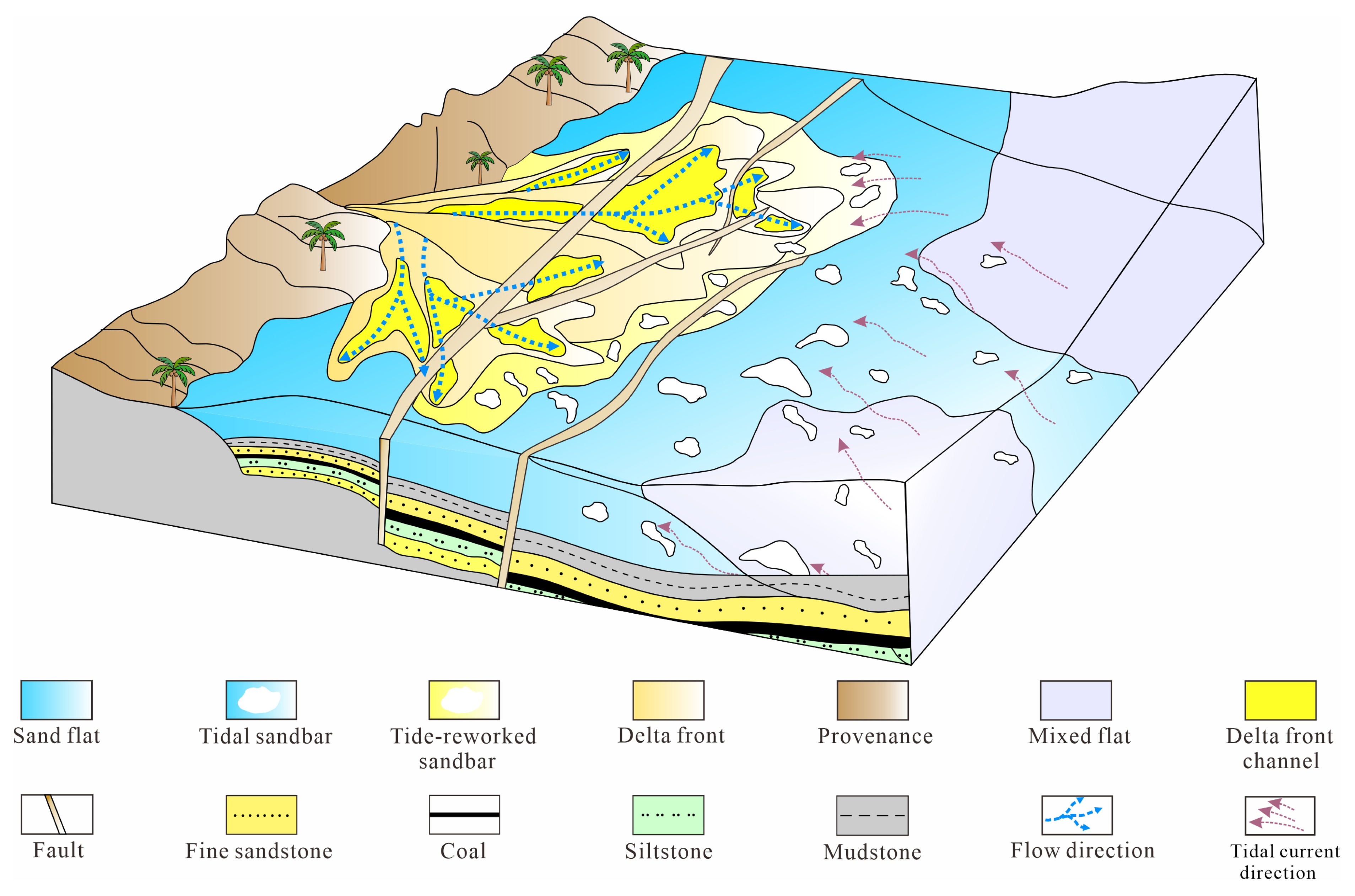
Combined with the tide-dominated delta sedimentary model shown in Figure 6, the Pinghu Formation sedimentary system can be interpreted as the coupled result of fluvial sand supply, tidal reworking, and fault-bounded accommodation partitioning. Under this model, fluvial runoff controls the input of siliciclastic sediment and the distribution of distributary channels, while tidal processes intensely rework and redistribute sandbodies within the delta front and shallow marine settings. As a result, the geometry, connectivity, and heterogeneity of sandbodies differ significantly from those of fluvial-dominated or wave-dominated deltas.
Sediments are transported from terrestrial provenance highs into the basin via distributary channels, driving the progradation and aggradation of the delta front. At the river mouth and delta front, however, tidal currents exhibit pronounced bidirectional flow, which reworks mouth-bar sandbodies to form tidal sand bars and reworked tidal bars. Therefore, the commonly observed sand-mud interbeds and lateral facies changes in the Pinghu Formation are not only related to distributary channel shifting, but more importantly, to the “sandbody segmentation–reconnection” process caused by periodic tidal reworking: distributary channel sandbodies are mainly controlled by unidirectional runoff and act as relatively stable sand transport pathways; mouth-bar and front sandbodies evolve from lobate or fan-shaped to banded and sheet-like geometries, with irregular boundaries that may migrate and stack along tidal channels; tidal reversing currents promote mud deposition during slack-water periods, forming mud interlayers and enhancing sand-mud alternations.
From the nearshore to the offshore in Figure 6, sand flats, tidal sand bars, and mixed flats develop successively, indicating distinct zonal differentiation of the sedimentary environment under the control of tidal range and tidal channels. Sand flats correspond to high-energy shallow intertidal–subtidal zones where sandy deposits are better preserved; however, facies boundaries can shift rapidly over short distances due to tidal channel migration. Mixed flats represent low-to-moderate energy zones characterized by mixed sand-mud deposition, which act as the main sites for mud accumulation and sand pinch-out, controlling lateral sealing and the development of interlayers within sandbodies. Combinations of tidal channels and sand bars may form banded high-permeability pathways, while muddy deposits in mixed flats create lateral barriers, resulting in pronounced banding and compartmentalization of reservoirs.
The development of syndepositional faults cuts and modifies sandbody geometry. A series of syndepositional faults form step-like terraces descending toward the depocenter, promoting continuous channel progradation into the basin and generating step-fault controlled sandbodies. In addition, the northern syndepositional faults differ from the step-like sandbodies associated with southern faults by displaying a certain geometric angle between fault strikes. Zones at these angular intersections are commonly structural lows prone to the formation of corner-type sandbodies, which dominate the main sediment transport and migration directions. This fault configuration does not block sand accumulation but, similar to forward-step fault systems, concentrates sandbodies on the downthrown sides adjacent to fault planes, favoring sand transport into the basin interior. Thus, the key feature of corner-type fault assemblages is their control over the planar distribution of sandbodies.
In addition, the major sedimentary environments for coal-bed development in the Pinghu Formation include tide-influenced delta plains and tide-influenced interdistributary bays on the delta front. In the early tide-dominated delta, periodic tidal currents led to cyclic sediment transport and redistribution, promoting the formation of extensive tidal flats favorable for peat accumulation. Under relatively high accommodation conditions, peat accumulated in stable settings, providing conditions for the primary formation of coal beds. Step-fault activity was conducive to increasing accommodation space [53]. Overall, coal beds in the Pinghu Formation reflect the dynamic interactions among tectonic activity, accommodation fluctuations, and tidal dynamics.

6. Conclusions

Tide-dominated to fluvial-dominated deltaic sedimentary systems are developed in the Pinghu Formation, K area, Xihu Depression. This study focuses on the developmental styles, controlling factors, and migration and evolution models of channels. The main conclusions are as follows:
(1)
The early Pinghu Formation is dominated by fine sandstone, siltstone, and mudstone, occasionally intercalated with black coal beds, with well-developed tidal flat deposits. During the late Pinghu Formation, tidal modification was relatively weak, and fluvial-dominated deltas were dominant, characterized by subaqueous distributary channels and interdistributary bays. Fine sandstone, gravel, and mud clasts can be observed in cores.
(2)
PCA-fused attributes, K-means clustering, and fuzzy c-means clustering can effectively eliminate the interference of coal beds and allow for fine identification of channels beneath coal seams. Among these, K-means clustering provides a clearer delineation of channel boundaries. The comprehensive application of multiple attributes significantly improves the reliability and accuracy of subsurface coal-channel identification under tidal influence.
(3)
During the early stage of the Pinghu Formation, when tidal influence was dominant, bidirectional tidal currents significantly enhanced the frequency of lateral channel migration and avulsion. Channels exhibited dendritic, reticular, or intersecting planar distributions, with small individual scales but large numbers, and were dominated by lenticular, multi-stage vertical stacking. In the late fluvial-dominated stage, channels were mainly lobate or wide-banded in plan view, with larger individual scales.
(4)
Under the influence of faulting, channel migration is dominated by fault-guided and step-fault patterns. Fault-guided channels are stably distributed along fault strikes with limited lateral swinging, showing a typical “corner-type” pattern. Step-fault channels repeatedly occupy low-lying fault terrace zones, forming multi-stage stacked composite channel sandbodies, characterized by “restricted lateral swinging and enhanced vertical stacking”. In tectonically weaker areas, tidal modification is relatively weak due to the barrier effect of barrier islands, and channel migration on the barrier island side is mainly fluvial-dominated.

Author Contributions

Conceptualization, Y.W. and B.S.; methodology, Y.Z.; software, Y.W.; validation, Y.W., S.J. and Y.Z.; formal analysis, Y.W.; investigation, B.S.; resources, S.J.; data curation, B.S.; writing—original draft preparation, B.S.; writing—review and editing, B.S.; visualization, Y.W.; supervision, Y.W.; project administration, S.J.; funding acquisition, S.J. All authors have read and agreed to the published version of the manuscript.

Funding

This research was funded by Funded by the National Key Science and Technology Major Project, grant number 2025ZD1402802-04.

Data Availability Statement

The original contributions presented in this study are included in the article. Further inquiries can be directed to the corresponding author.

Conflicts of Interest

The authors declare no conflicts of interest.

References

  1. Dalrymple, R.W.; Choi, K. Morphologic and facies trends through the fluvial–marine transition in tide-dominated depositional systems: A schematic framework for environmental and sequence-stratigraphic interpretation. Earth-Sci. Rev. 2007, 81, 135–174. [Google Scholar] [CrossRef]
  2. Plink-Björklund, P. Effects of tides on deltaic deposition: Causes and responses. Sediment. Geol. 2012, 279, 107–133. [Google Scholar] [CrossRef]
  3. Goodbred, S.L.; Saito, Y. Tide-Dominated Deltas. In Principles of Tidal Sedimentology; Springer: Dordrecht, The Netherlands, 2012; pp. 129–149. [Google Scholar]
  4. Gugliotta, M.; Saito, Y. Matching trends in channel width, sinuosity, and depth along the fluvial to marine transition zone of tide-dominated river deltas: The need for a revision of depositional and hydraulic models. Earth-Sci. Rev. 2019, 191, 93–113. [Google Scholar] [CrossRef]
  5. Gugliotta, M.; Collins, D.S.; MacEachern, J.A.; El Euch-El Koundi, N. Reevaluating the process regime in the Sego Sandstone: Sedimentological and ichnological evidence for an underemphasised fluvial signature. Depos. Rec. 2023, 9, 989–1009. [Google Scholar] [CrossRef]
  6. Eide, C.H.; Howell, J.A.; Buckley, S.J.; Martinius, A.W.; Oftedal, B.T.; Henstra, G.A.; Marzo, M. Facies model for a coarse-grained, tide-influenced delta: Gule Horn Formation (Early Jurassic), Jameson Land, Greenland. Sedimentology 2016, 63, 1474–1506. [Google Scholar] [CrossRef]
  7. Chang, Y.; Duan, D.; Zhang, L.; Ding, F.; Quan, B. Quantitative characterization of the depositional system in Gas field A, Pinghu slope belt, Xihu Sag and its bearing on periodicity of sea level changes. Mar. Geol. Quat. Geol. 2021, 41, 12–21. [Google Scholar] [CrossRef]
  8. Tänavsuu-Milkeviciene, K.; Plink-Björklund, P. Recognizing Tide-Dominated Versus Tide-Influenced Deltas: Middle Devonian Strata of the Baltic Basin. J. Sediment. Res. 2009, 79, 887–905. [Google Scholar] [CrossRef]
  9. Luo, P.; Li, J. Prediction method of thin sand reservoir with coal bearing: An example from PB area of Xihu Sag at East China Sea. Bull. Geol. Sci. Technol. 2024, 43, 258–270. [Google Scholar] [CrossRef]
  10. Ghosh, D.; Sajid, M.; Ibrahim, N.A.; Viratno, B. Seismic attributes add a new dimension to prospect evaluation and geomorphology offshore Malaysia. Lead. Edge 2014, 33, 536–545. [Google Scholar] [CrossRef]
  11. Troccoli, E.B.; Cerqueira, A.G.; Lemos, J.B.; Holz, M. K-means clustering using principal component analysis to automate label organization in multi-attribute seismic facies analysis. J. Appl. Geophys. 2022, 198, 104555. [Google Scholar] [CrossRef]
  12. Song, C.; Liu, Z.; Cai, H.; Wang, Y.; Li, X.; Hu, G. Unsupervised seismic facies analysis with spatial constraints using regularized fuzzy c-means. J. Geophys. Eng. 2017, 14, 1535–1543. [Google Scholar] [CrossRef]
  13. Zhang, Y.; Qiu, L.; Li, J.; Feng, L.; Yan, W.; Zhao, W. Sedimentary facies analysis based on cluster of seismic attributes by fuzzy C-means algorithm. J. China Univ. Pet. (Ed. Nat. Sci.) 2015, 39, 53–61. [Google Scholar]
  14. Yang, Y.; Jiang, Z.; Jiang, X. The Cretaceous Sedimentary Environments and Tectonic Setting of the Southern East China Sea Shelf Basin. Energies 2023, 16, 4205. [Google Scholar] [CrossRef]
  15. Wang, M.; Jiang, X.; Lei, B.; Huang, L.; Pan, J. Tectonic evolution and its control on oil–gas accumulation in southern East China Sea since the Jurassic. Front. Earth Sci. 2023, 10, 1015832. [Google Scholar] [CrossRef]
  16. Sun, J.; Chen, J.; Yang, C.; Wang, J.; Yuan, Y.; Cao, K.; Zhao, Y. Cenozoic Sedimentary Characteristics of the East China Sea Shelf Basin and an Evaluation of the Suitability of Geological Storage of Carbon Dioxide in the Saline Water Layer. Sustainability 2023, 15, 8085. [Google Scholar] [CrossRef]
  17. Abbas, A.; Zhu, H.; Zeng, Z.; Zhou, X. Sedimentary facies analysis using sequence stratigraphy and seismic sedimentology in the Paleogene Pinghu Formation, Xihu Depression, East China Sea Shelf Basin. Mar. Pet. Geol. 2018, 93, 287–297. [Google Scholar] [CrossRef]
  18. Liu, J.; Lin, C.; Xiao, J. Characteristics and erosions of the major tertiary unconformities and their significance to petroleum exploration in the Xihu trough, the East China Sea. Geoscience 1999, 13, 432–438. [Google Scholar]
  19. Wu, F.; Zhang, Y.; Zhou, P. Tertiary basin setting analysis and sedimentary dynamics of the East China Sea shelf basin. Geoscience 1999, 13, 157–161. [Google Scholar]
  20. Tao, R. Discussion on basin formation mechanism and basin types in East China Sea continental shelf basin based on West Pacific plate tectonics. China Offshore Oil Gas (Geol.) 1994, 8, 14–20. [Google Scholar]
  21. Liang, R.; Li, Y.; Li, C. Geological characteristics and exploration targets of Pinghu Oilfiled. Offshore Oil 2008, 28, 8. [Google Scholar]
  22. Lei, C.; Ye, J.; Wu, J.; Shan, C.; Yin, S. Dynamic process of hydrocarbon accumulation in low-exploration basins: A case study of Xihu depression. Earth Sci. 2014, 39, 837–847. [Google Scholar]
  23. He, J.; Wang, T.; Tang, Y.; Zhang, D.; Zhang, T.; Diao, H.; Liu, B.; Hu, Y. Geochemical characteristics and gas-washing accumulation mechanism of hydrocarbon from the Xihu Sag, East China Sea Basin. Geoenergy Sci. Eng. 2023, 224, 211639. [Google Scholar] [CrossRef]
  24. Yan, B.; Yuan, H.-Q.; Li, N.; Zou, W.; Sun, P.; Li, M.; Zhao, Y.-Y.; Zhao, Q. Differences in hydrocarbon accumulation and controlling factors of slope belt in graben basin: A case study of Pinghu Slope Belt in the Xihu sag of the east China Sea Shelf basin (ECSSB). Pet. Sci. 2024, 21, 2901–2926. [Google Scholar] [CrossRef]
  25. Yu, Y.; Zhang, J.; Cheng, C.; Tang, X.; Xu, H. Main controlling factors and reservoir forming model for hydrocarbon accumulation in the Xihu Sag. Mar. Geol. Front. 2022, 38, 40–47. [Google Scholar]
  26. Chen, S.; Wang, J.; Liu, S. Sedimentary characteristics of the middle member Pinghu Formation of Eocene in Kongqueting area, Xihu Sag, East China Sea Shelf Basin. Lithol. Reserv. 2025, 37, 103–114. [Google Scholar]
  27. Li, C.; Wei, L.; Diao, H.; Cheng, X.; Hou, D. Hydrocarbon source and charging characteristics of the Pinghu Formation in the Kongqueting Structure, Xihu Depression. Pet. Sci. Bull. 2021, 6, 196–208. [Google Scholar]
  28. Yang, C.; Zhuang, J.; Zhang, R.; Yang, H.; Zhang, S. Quantitative Evaluation of Fault Sealing Property in Kongqueting Area of Xihu Sag, East China Sea. Offshore Oil 2023, 43, 7–11. [Google Scholar]
  29. Qin, L.; Xu, J.; Xu, D.; Liu, H.; Cai, K. Paleogeomorphology reconstruction and its control on sand dispersal systems: A case study from the Pinghu formation in the Hangzhou slope belt, Xihu Sag, East China sea shelf basin. Front. Earth Sci. 2025, 13, 1626431. [Google Scholar] [CrossRef]
  30. Zhou, S.; Li, Y.; Li, J.; Ding, W.; Li, X.; Zhang, W. Supply of terrigenous organic matter from tidal flat to the marine environment: An example of neritic source rocks in the Eocene Pinghu Formation, Xihu Depression, East China Sea Shelf Basin. Acta Oceanol. Sin. 2023, 42, 138–150. [Google Scholar] [CrossRef]
  31. Zhu, Z.; Hao, W.; Li, Y.; Wu, Y.; Jinlin, C.; Li, L.; Li, X. Deposition evolution and controlling factors of the Pinghu Formation in the central Western Slope of the Xihu Sag, East China Shelf Basin. Mar. Geol. Quat. Geol. 2026, 46, 133–146. [Google Scholar] [CrossRef]
  32. Yang, C.; Gao, Z.; Jiang, Y.; Gao, W. Reunderstanding of Clastic Rock Sedimentary Facies of Eocene Pinghu Formation in Pinghu Slope of Xihu Sag. J. Oil Gas Technol. 2013, 35, 11–14. [Google Scholar]
  33. Yang, P.; Li, L.; Chen, Z.; Li, S.; Zhang, Z.; Chai, Y.; Zhao, X. Complex geomorphology and fluvio-tidal interaction and sedimentary response of the Pinghu Formation in Pingbei area, the Xihu Sag, East China Sea Basin. Geol. Rev. 2025, 71, 1265–1276. [Google Scholar] [CrossRef]
  34. Chen, Z.; Du, X.; Li, S. Distributional signatures of depositional system of Pinghu Formation, Pinghu slope, Xihu Sag, East China Sea Shelf Basin. Pet. Geol. Exp. 2022, 44, 780–789. [Google Scholar]
  35. Liu, Y.; Cai, H.; Duan, D.; Rong, C.; Chang, Y.; Xu, Q. The sedimentary characteristics of tidal delta and tidal flat in transgressive system tract of Pinghu Formation in Pinghu area, Xihu Sag. Mar. Geol. Front. 2022, 38, 33–40. [Google Scholar] [CrossRef]
  36. Li, N.; Liu, J.; Li, S.; He, M. The coupling effects of topography-river-tide and their control on sedimentary systems: Taking the Pinghu slope in Xihu Sag as an example. Mar. Orig. Pet. Geol. 2025, 30, 326–342. [Google Scholar]
  37. Yin, G.; Zhao, Y. Barrier coastal depositional system and its characteristics in Xihu Sag, East China Sea Shelf Basin: A case study of lower Pinghu Formation in Pingbei area. Pet. Reserv. Eval. Dev. 2026, 16, 186–197. [Google Scholar] [CrossRef]
  38. He, X.; Li, W.; Duan, D.; Rong, C.; Xia, Z. Micro-petrological characteristics and its sedimentological significance of thin coal seam and mudstone in Pinghu Formation in the northern part of Pinghu Slope, Xihu Sag. Mar. Geol. Quat. Geol. 2024, 44, 210–222. [Google Scholar] [CrossRef]
  39. Wu, J.; Zhang, L.; Wan, L.; Zhao, Q.; Yang, C.; Wang, Y. Provenance analysis of Pinghu Formation in Xihu sag. China Pet. Explor. 2017, 22, 50–57. [Google Scholar]
  40. Albadran, B.; Al-Mulla, S.; Abd-Alqader, M. Physiographic study of Shatt Al-Arab delta south of Iraq by application of remote sensing technique. Mesopotamian J. Mar. Sci. 2016, 31, 169–180. [Google Scholar] [CrossRef]
  41. Hubbard, D.K.; Oertel, G.; Nummedal, D. The role of waves and tidal currents in the development of tidal-inlet sedimentary structures and sand body geometry; examples from North Carolina, South Carolina, and Georgia. J. Sediment. Res. 1979, 49, 1073–1091. [Google Scholar] [CrossRef]
  42. Zhang, L.; He, X.; Duan, D.; Chang, S.; Wang, W.; Liu, Y. Seismic sedimentological analysis of coal stratigraphy of Pinghu Formation in the Pinghu slope belt, Xihu Sag, EastChina Sea Shelf Basin. Mar. Geol. Quat. Geol. 2023, 43, 140–149. [Google Scholar] [CrossRef]
  43. Wei, H.; Chen, J.; Guo, W.; Liu, G.; Zhang, J.; Chen, F. Concentrating Coal Characteristics and Sequences Stratigraphic Division of Pinghu Formation in Xihu Depression. J. Jilin Univ. (Earth Sci. Ed.) 2013, 43, 669–679. [Google Scholar] [CrossRef]
  44. Li, J.; Jiang, B.; Qu, Z.; Yin, S.; Xu, J.; Li, P. Tectonic evolution and control of coal in Donghai Xihu sag. Coal Geol. Explor. 2016, 44, 22–27. [Google Scholar]
  45. Wang, H.; Zhou, X.; Hu, W.; Cai, K.; Yang, M.; Tang, R. Prediction of coal-bearing strata reservoir in the Pingbei slope zone of the Xihu Depression. Geophys. Prospect. Pet. 2021, 60, 595–603. [Google Scholar]
  46. Olariu, C.; Bhattacharya, J.P. Terminal Distributary Channels and Delta Front Architecture of River-Dominated Delta Systems. J. Sediment. Res. 2006, 76, 212–233. [Google Scholar] [CrossRef]
  47. Hardy, S.; Gawthorpe, R. Normal fault control on bedrock channel incision and sediment supply: Insights from numerical modeling. J. Geophys. Res. Solid Earth 2002, 107, EPM 9-1–EPM 9-15. [Google Scholar] [CrossRef]
  48. Chen, Z.; Zhang, C.; Hou, G.; Feng, W.; Xu, Q. Fault distribution patterns and their control on sand bodies in Pinghu Formation of Xihu Sag in East China Sea Shelf Basin. Oil Gas Geol. 2020, 41, 824–837. [Google Scholar]
  49. Radaideh, O.M.A.; Mosar, J. Tectonics controls on fluvial landscapes and drainage development in the westernmost part of Switzerland: Insights from DEM-derived geomorphic indices. Tectonophysics 2019, 768, 228179. [Google Scholar] [CrossRef]
  50. Clark, I.R.; Cartwright, J.A. Interactions between submarine channel systems and deformation in deepwater fold belts: Examples from the Levant Basin, Eastern Mediterranean sea. Mar. Pet. Geol. 2009, 26, 1465–1482. [Google Scholar] [CrossRef]
  51. Ian, C.; Joseph, C. Key controls on submarine channel development in structurally active settings. Mar. Pet. Geol. 2011, 28, 1333–1349. [Google Scholar] [CrossRef]
  52. Mulhern, J.S.; Johnson, C.L.; Green, A.N. When Is a Barrier Island Not an Island? When It Is Preserved in the Rock Record. Front. Earth Sci. 2021, 8, 560437. [Google Scholar] [CrossRef]
  53. Kevin, B.; John, S. Sequence Stratigraphic Distribution of Coaly Rocks: Fundamental Controls and Paralic Examples1. AAPG Bull. 1997, 81, 1612–1639. [Google Scholar] [CrossRef]
Figure 1. Tectonic map of the Xihu Depression in the East China Sea Shelf Basin (a) Tectonic units of the Xihu Depression in the East China Sea Basin; (b) Composite lithostratigraphic column of the Pinghu Formation; (c) Distribution of sediment source areas, tectonic framework, and planar distribution of the ZTR index.
Jmse 14 00523 g001
Figure 2. (a) Composite column diagram of typical well sedimentary facies-lithology-log response in the Pinghu Formation; (b) Stacking pattern of coal seams in the Pinghu Formation.
Jmse 14 00523 g002
Figure 3. (a) P8 coal seam thickness proportion map; (b) P8 K-means clustering; (c) P8 fuzzy c-means clustering; (d) P8 PCA attribute fusion; (e) P8 sedimentary facies map; (f) VP/VS minimum amplitude attribute; (g) Core samples from B4 and B8 wells; (h) Well-point validation of coal seam impedance inversion method.
Jmse 14 00523 g003
Figure 4. (a) SQ1 Sedimentary Facies Map; (b) SQ2 Sedimentary Facies Map; (c) SQ3 Sedimentary Facies Map; (d) SQ4 Sedimentary Facies Map; (e) Topographic Map of the K Area.
Jmse 14 00523 g004
Figure 5. (a) Sedimentary facies map of P8b, (b) Sedimentary facies map of P4, (c) Sedimentary facies map of P9b, (d) Model diagram of channel evolution under the combined control of syndepositional faults and geomorphology, (e) Model diagram of barrier island-tidal dominated sedimentary system.
Jmse 14 00523 g005
Figure 6. Sedimentary model of tidal-controlled delta in the study area.
Jmse 14 00523 g006
Table 1. Development Styles and Classification of Channels.
Typical Cross-Sectional FeaturesPlanar Morphology
River-controlled channelsJmse 14 00523 i001
Amplitude is medium to weak, frequency is low, continuity is good, with progradational S-shaped reflections, and the profile morphology exhibits relatively disordered progradational reflections.
Jmse 14 00523 i002
Wide ribbon-shaped, with smooth sides of the channel.
Jmse 14 00523 i003
Medium to weak amplitude, low frequency, good continuity, oblique progradational reflections, with profile morphology showing composite W-shaped channels.
Jmse 14 00523 i004
Lobe-shaped, internal structure is chaotic.
Tidal-controlled channelsJmse 14 00523 i005
Amplitude is medium to strong, frequency is medium, with overhangs, and the profile morphology shows composite V-shaped dumbbell structures with chaotic reflections.
Jmse 14 00523 i006
Network-like, fragmented
Jmse 14 00523 i007
Amplitude is moderate to slightly low, frequency is medium, controlled by frequent alternation of sand and mud, with poor continuity, lateral thinning, and the channel profile morphology appears as superimposed, gently inclined lens-shaped structures.
Jmse 14 00523 i008
Linear, ribbon-shaped
Jmse 14 00523 i009
Amplitude is medium to strong, frequency is medium, continuity is good, and the profile morphology shows bidirectional foreset reflection lens-shaped structures.
Jmse 14 00523 i010
Dendritic
Jmse 14 00523 i011
Disclaimer/Publisher’s Note: The statements, opinions and data contained in all publications are solely those of the individual author(s) and contributor(s) and not of MDPI and/or the editor(s). MDPI and/or the editor(s) disclaim responsibility for any injury to people or property resulting from any ideas, methods, instructions or products referred to in the content.