Article

Settlement Analysis and Parameter Inversion of a Deep-Water Mega Caisson Foundation Using the HSS Constitutive Model

1
State Key Laboratory of Geomechanics and Geotechnical Engineering Safety, Institute of Rock and Soil Mechanics, Chinese Academy of Sciences, Wuhan 430071, China
2
University of Chinese Academy of Sciences, Beijing 100049, China
*
Author to whom correspondence should be addressed.
J. Mar. Sci. Eng. 2026, 14(5), 453; https://doi.org/10.3390/jmse14050453
Submission received: 23 January 2026 / Revised: 21 February 2026 / Accepted: 26 February 2026 / Published: 27 February 2026
(This article belongs to the Section Ocean Engineering)

Abstract

The advancement of large-scale marine infrastructure demands increasingly accurate prediction of settlement in deep-water foundations. The caisson is an important type of deep-water foundation whose additional settlement induced by superstructure construction directly impacts the overall safety of the project. This study focuses on the main tower foundation of the Changtai Yangtze River Bridge, recognized as the world’s largest deep-water caisson foundation. A three-dimensional finite element model was developed using the hardening soil model with small-strain stiffness (HSS) constitutive model to simulate the settlement response of the caisson foundation throughout the entire superstructure construction process. The model’s reliability was verified through systematic comparison with field monitoring data. Furthermore, an inversion analysis was conducted on the initial shear modulus ( G 0 ref ), the most sensitive parameter of the HSS model, based on the measured data. The results reveal that its optimal value exhibits significant load dependency, varying according to the construction stage. Accordingly, practical strategies for parameter determination are proposed: a fixed-value method ( G 0 ref = 2 E ur ref ) suitable for conventional design and a more precise stage-specific value method. Both approaches markedly enhance the settlement prediction accuracy, particularly under high-load conditions. The findings offer valuable insights for the refined design and safety assessment of similar deep-water mega-foundation projects.

1. Introduction

The development of global marine resource utilization and cross-sea transportation is driving a significant increase in the construction of large-scale marine engineering structures, including cross-sea bridges, deep-water ports, and offshore wind farms [1,2,3,4,5,6]. These structures are often situated in complex marine environments and are required to withstand substantial loads. The caisson foundation, a classical type of deep-water gravity foundation, has become one of the key foundation solutions for such projects due to its notable advantages of high integral stiffness, superior bearing capacity, and strong adaptability to complex strata [7,8].
As a prefabricated deep-water foundation, the caisson is installed by excavating soil from its dredge wells, allowing it to sink to the designed bearing stratum, and its base is then sealed to form a permanent load-bearing system [9]. Upon construction completion, the caisson supports the full load from the superstructure [10]. Consequently, the additional settlement induced by superstructure construction is a critical control parameter for assessing its performance and ensuring long-term structural safety [11]. The settlement of a caisson foundation stems primarily from the additional stress on the subsoil caused by its self-weight and the superstructure load [12,13,14]. Classical methods, such as the layer-wise summation method based on linear elastic assumptions, offer simplicity but often lack accuracy for large-scale caissons with extensive plan dimensions and embedment depths. This limitation arises from their inability to adequately consider soil nonlinearity, complex stress paths, and soil-foundation interactions [11]. In contrast, the finite element (FE) numerical simulation method provides a powerful tool for realistically modeling geotechnical responses [15]. Its capability to incorporate material nonlinearity, complex geometry, and detailed construction sequences [16] make it particularly promising for the settlement prediction of mega caisson foundations.
The accuracy of numerical simulations hinges critically on the selection of an appropriate constitutive model. While classical models like Mohr–Coulomb are simple in their parameter requirements, they frequently fail to adequately capture soil hardening/softening behavior and the stress-dependency of soil stiffness, which limits their precision in settlement analysis [17]. In contrast, the Hardening Soil Model with Small-Strain Stiffness (HSS) model is an advanced constitutive model well-suited for complex geotechnical problems. By explicitly incorporating the high initial stiffness of soil within the small-strain range into a hardening soil framework [18], the HSS model significantly improves the accuracy of deformation predictions from small to medium strain levels. It effectively reproduces key soil behaviors such as stress-path dependency and stiffness evolution, and has been validated across numerous geotechnical applications.
For example, Li et al. [19] applied the HSS model to simulate soil behavior in a deep excavation project, demonstrating good agreement between the predicted ground settlements, lateral displacements of retaining piles, and field monitoring data. Zhong [20] conducted a comparative study of various constitutive models for loess (terrestrial, clastic sediment composed primarily of wind-blown silt-sized particles) in excavations through integrated theoretical, experimental, and numerical approaches, concluding that the HSS model offered high performance when validated against monitoring data from a real-world project. In the context of tunneling, Deng et al. [21] utilized the HSS model to analyze ground deformation induced by shield tunneling in soft soils, subsequently developing an integrated three-dimensional (3D) model of tunnel-soil-buildings which was validated using a case study from the Suzhou Metro. Wang et al. [22] also employed the HSS model to evaluate bridge pile deformation caused by adjacent tunnel construction, with results proving significantly more accurate than those derived from the Mohr–Coulomb model. For offshore engineering, Kou et al. [23] reliably simulated the horizontal cyclic bearing behavior of an offshore wind turbine foundation using the HSS model, providing valuable insights for refined foundation design. In the specific domain of caisson foundations for major bridges, Tan et al. [11] successfully simulated the settlement of a cable-stayed bridge main tower caisson, achieving close alignment with measured data and enabling reliable prediction of future settlement trends. To enhance its practical utility, Tang et al. [17] implemented the HSS model through secondary development in the FLAC3D 3.0 software, broadening its accessibility for geotechnical engineers.
Despite this broad applicability, existing research utilizing the HSS model has predominantly concentrated on excavation and unloading scenarios, such as foundation pits and tunnels. Systematic numerical studies focusing on caisson foundations subjected to the multi-stage, progressive vertical loading typical of superstructure construction remain limited. And the dimensions of the caisson foundations examined in existing studies are relatively small, providing insufficient guidance for the design of the ever-larger caisson foundations required in current engineering. The HSS model itself requires a relatively large number of input parameters, and determining all of them solely through laboratory testing can be time-consuming and costly. Moreover, the determination of the key parameter highly sensitive within settlement predictions in HSS model, the initial shear modulus ( G 0 ref ) [11,24], often relies on empirical judgment. A comprehensive inversion analysis and investigation into its behavioral patterns based on full-scale, full-cycle field monitoring data remain largely unexplored.
This study is conducted with the main tower foundation of the Changtai Yangtze River Bridge, the world’s largest deep-water caisson foundation, as the engineering context for analysis. A refined 3D FE model employing the HSS model is developed to simulate the settlement response of the caisson throughout the complete superstructure construction sequence. The model is validated through quantitative comparison with full-cycle field monitoring data. The study further examines the sensitivity of calculated settlement to the key parameter G 0 ref , conducts its inversion based on measurements across the entire loading history, and elucidates the relationship between its optimal value and the applied load levels. Practical guidelines for HSS parameter selection are formulated to enhance settlement prediction for similar mega caisson foundations, offering a reference for future design and assessment.

2. Project Profile and Settlement Monitoring Analysis

2.1. Project Profile

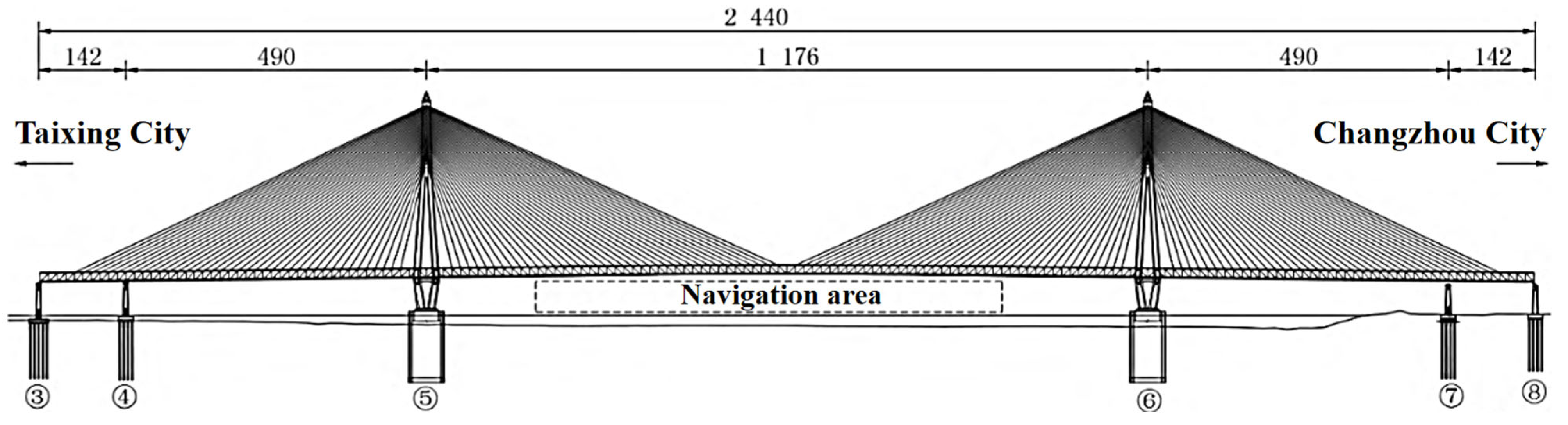
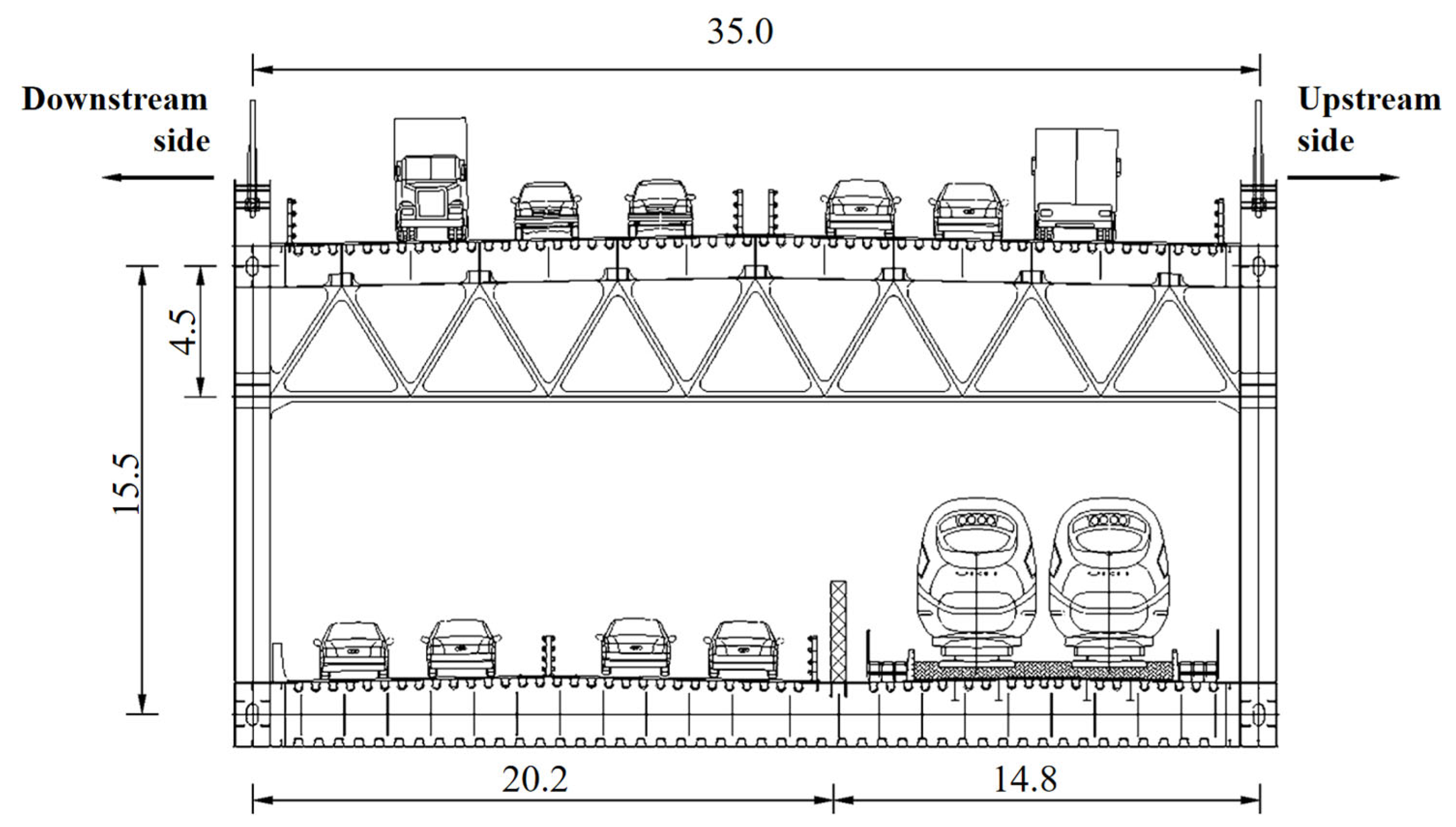
The Changtai Yangtze River Bridge connects Changzhou and Taixing City in Jiangsu Province, China, spanning the main channel of the Yangtze River, Lu’an Shoal, and the river’s distributary [25]. It is a crucial component of both Jiangsu Province’s expressway network and the comprehensive transportation corridor of the Yangtze River Economic Belt. The total bridge length is 10.03 km [26]. Its main navigational channel bridge is a rail-cum-road cable-stayed bridge with steel truss girder structure, spanning 2440 m [27]. The elevation layout of the bridge is shown in Figure 1. The numbers 3, 4, 5, 6, 7, 8, and 9 denote the engineering designations of the bridge pier foundations. To conserve land resources, the deck asymmetrically integrates three types of traffic: a six-lane expressway on the upper deck; on the lower deck, two tracks for intercity railway on the upstream side and a four-lane first grade highway on the downstream side (Figure 2) [28].
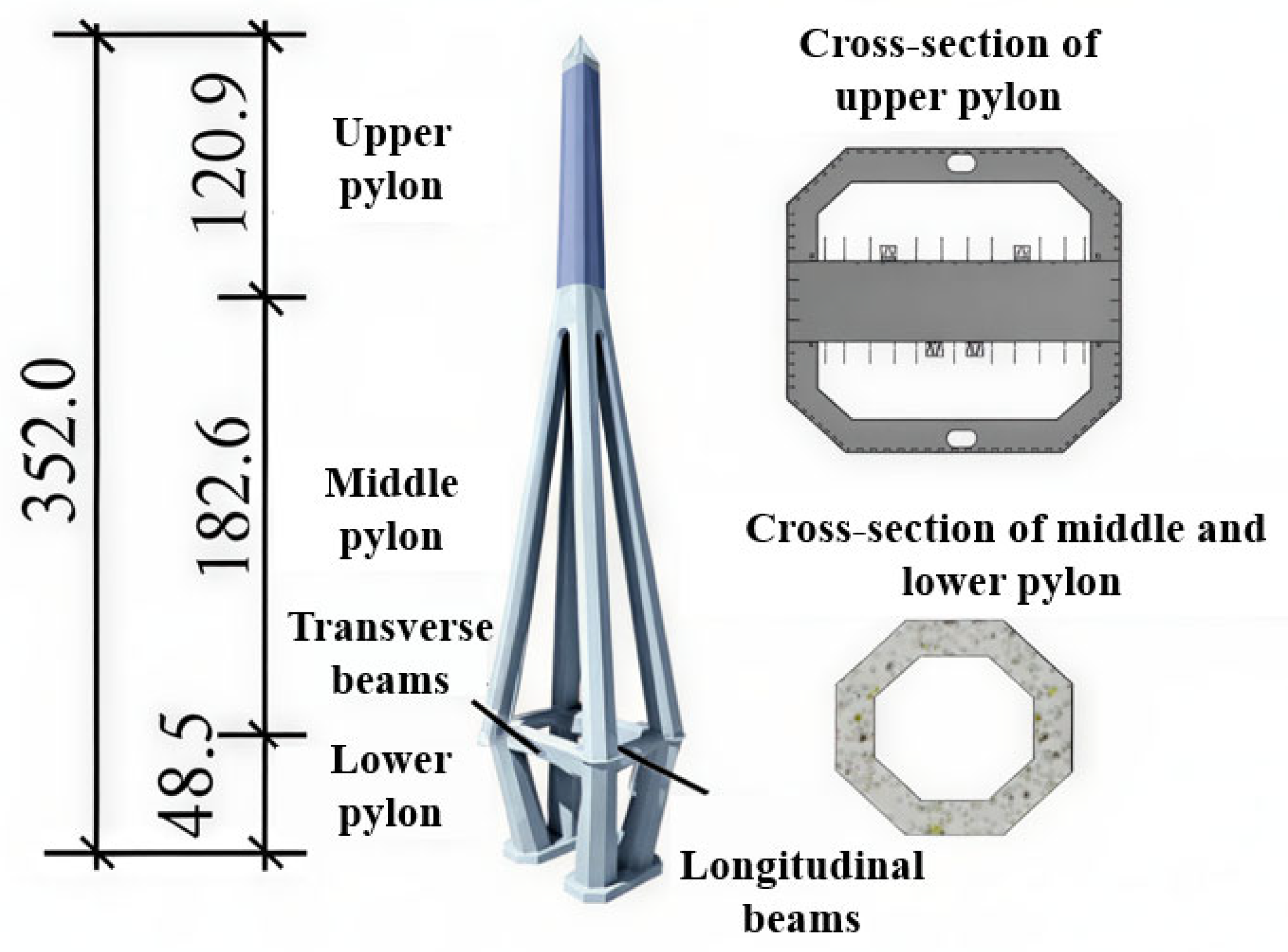
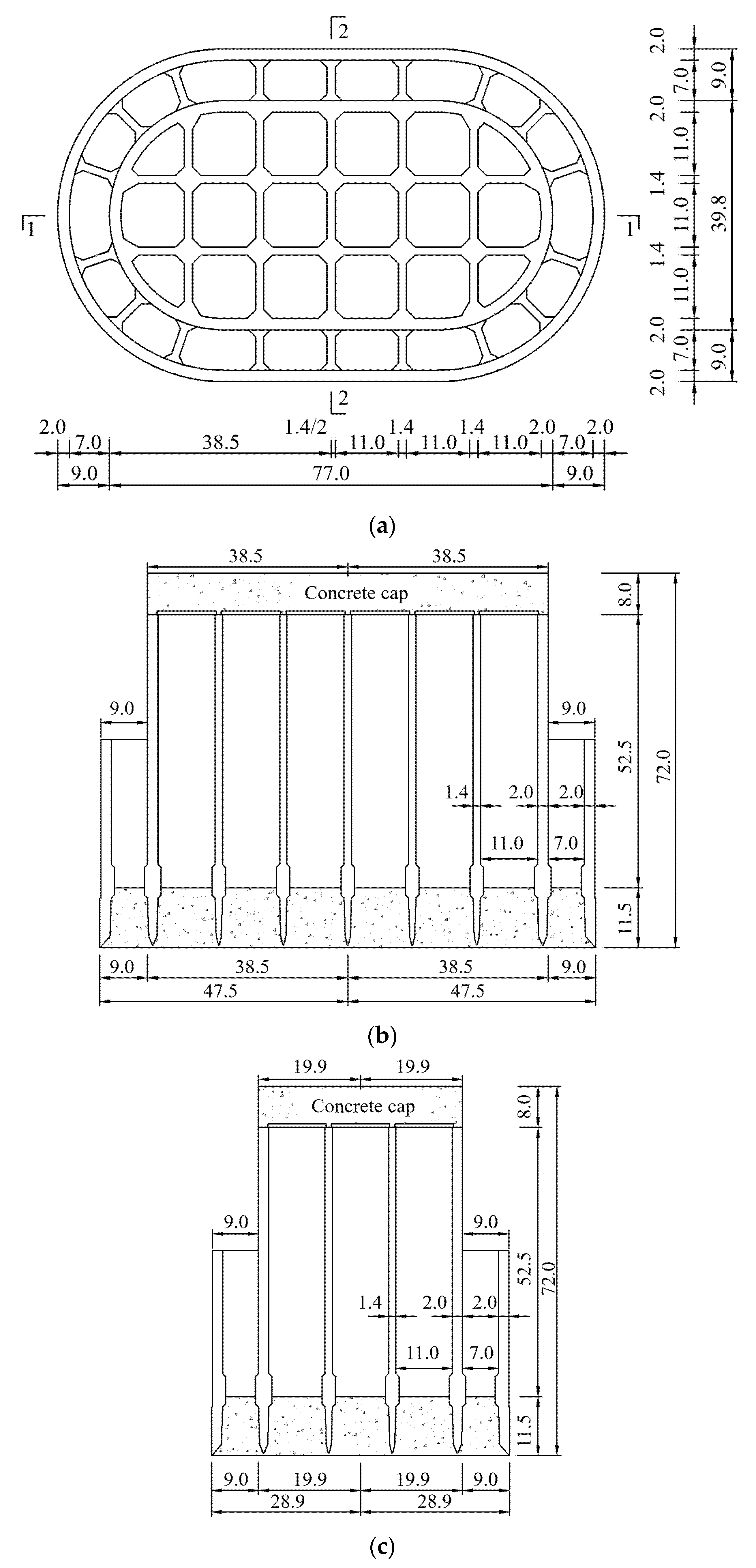
The main bridge tower is constructed with a spatial diamond-shaped concrete structure, standing at a design height of 352 m, which currently makes it the tallest cable-stayed bridge tower in the world [29]. This main tower is divided into three segments: the upper, middle, and lower bridge pylon. At the junction between the middle and lower pylons, two transverse beams and two longitudinal beams are arranged [30], as detailed in Figure 3. With a total weight exceeding 175,000 t, the mega caisson foundation is adopted to support the superstructure, including the self-weight of the main tower and deck system as well as vehicular loads during operation [31]. The caisson foundation measures 95 m in length and 57.8 m in width, making it the world’s largest deep-water caisson foundation. Its total height reaches 72 m, consisting of an 8 m-thick concrete cap and a 64 m-high steel-shell concrete structure [32]. The foundation features a round-ended stepped configuration, as shown in Figure 4: the plan is designed with rounded ends (radius: 28.9 m) to mitigate scouring effects from water flow, while the elevation adopts a double-stepped profile with a step width of 9.0 m to reduce structural self-weight [33].
The main tower caisson foundation of the Changtai Yangtze River Bridge is constructed within the river channel, founded directly on the Yangtze River bed. The site topography is flat, with the riverbed situated at an elevation of approximately −14.7 m. The surficial riverbed deposit consists of a 2–3 m thick layer of loose silty sand. Upon completion of construction, the foundation base reaches an elevation of −65 m, bearing on a dense coarse sand stratum that serves as the bearing layer. Underlying this bearing layer is a deep deposit of dense sand. Between the riverbed surface and the bearing stratum, the subsurface profile comprises alternating layers of sand and silty clay. Borehole sampling was performed at the caisson foundation site, and laboratory tests were conducted to determine the physico-mechanical parameters of each identified stratum. The subsurface profile and the corresponding parameters at the foundation location are summarized in Table 1 [33], where E s represents the compression modulus of the soil within the relevant stress range for each layer.

2.2. Overall Settlement Monitoring Data Analysis for the Caisson Foundation

Upon completion of the caisson foundation, the superstructure was erected in a phased sequence. Construction began with the in situ segmental casting of the bridge pylons from the base upward. Once the pylons were completed, prefabricated steel truss segments were successively lifted and installed until the main girder achieved full structural closure. As construction progressed, the load transmitted to the top of the caisson foundation increased incrementally. The cumulative load rose from the start of pylon construction to the closure of the main girder, reaching a final value of 2572.80 MN. The major construction stages of the superstructure and the corresponding cumulative loads acting on the caisson foundation at the completion of each stage are summarized in Table 2.
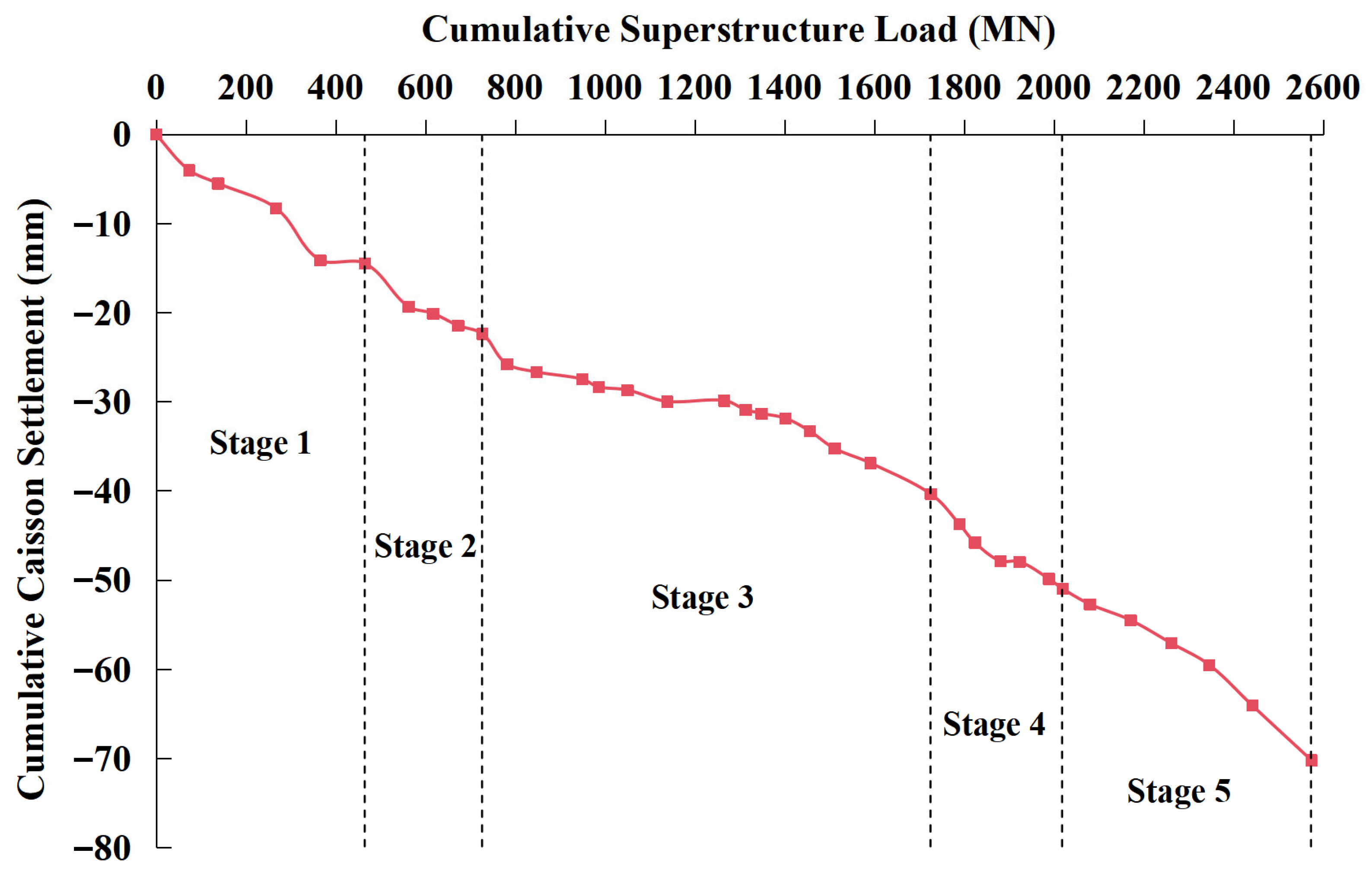
To monitor the settlement of the caisson foundation during superstructure construction, four monitoring points were set at the ends of the long and short axes on the top surface of the caisson, and high-precision total stations were used to measure vertical displacements throughout the entire construction period. No significant differences were observed among the four points at any stage, indicating uniform settlement without notable tilting, and the final settlement was therefore calculated as the average of the four measurements. The resulting load–settlement curve (Figure 5) exhibits a smooth and consistent progression.
In Figure 5, discrete markers along the curve denote specific intermediate construction steps and negative settlement values represent downward vertical displacement of the caisson foundation. Figure 5 indicates that during the casting of the lower pylon and the transverse beam, corresponding to a load range of 0 to 726.44 MN, the foundation settlement increased with limited fluctuations, exhibiting an overall quasi-linear progression. The cumulative settlement reached 22.4 mm upon completion of the cross beams. In the initial phase of the middle pylon casting, the rate of settlement increase moderated, characterized by a reduction in settlement increment per unit load applied. This pattern suggests the onset of soil hardening behavior. When 53.9% of the middle pylon was complete, under a cumulative load of 1265 MN, the recorded settlement was 29.9 mm. This value constitutes 41.7% of the total settlement increment attributed to the middle pylon construction stage. During the latter half of the middle pylon casting, the magnitude of settlement increase grew progressively. Final closure of the steel truss girder, at a cumulative load of 2572.80 MN, resulted in a total settlement of 70.2 mm.
This analysis confirms that the development of settlement in the caisson foundation exhibits significant load dependency and distinct nonlinear, time-variant characteristics. The complete and high-quality field monitoring dataset provides a critical benchmark for validating numerical constitutive models and conducting subsequent parameter inversion analysis.

3. The 3D FE Numerical Simulation

3.1. Numerical Simulation Model

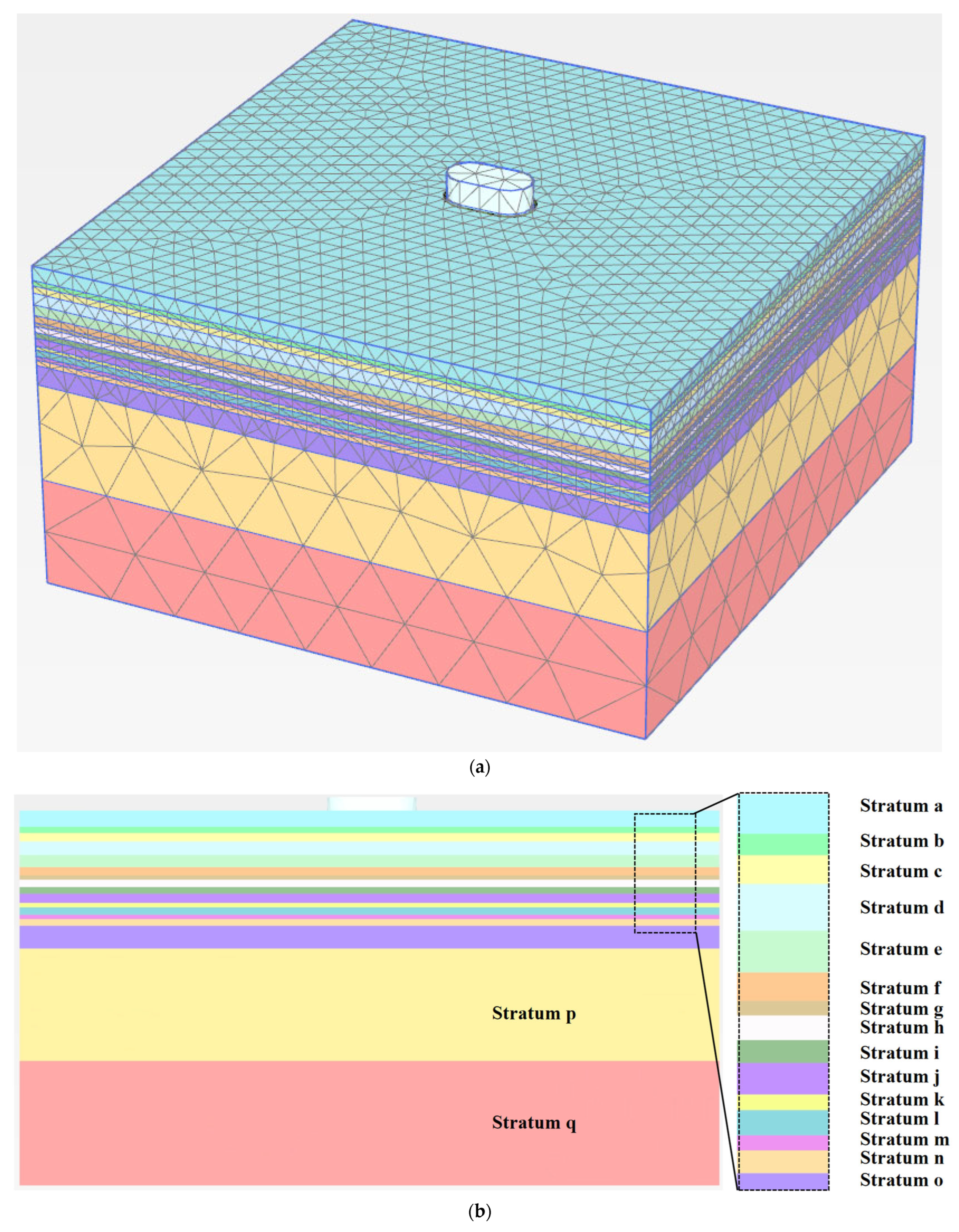
A 3D FE model was developed in PLAXIS 3D to simulate and analyze the settlement characteristics of the caisson foundation during superstructure construction. The model represents the caisson’s full-scale geometry and incorporates the complex stratigraphy of the site. As the caisson foundation measures 95 m in length and 57.8 m in width, yielding an aspect ratio of approximately 1.6, the soil domain was extended to dimensions of 560 m × 560 m in plan to mitigate boundary effects on the settlement analysis, with the caisson’s central axis aligned with the center of the soil mass. The top of the soil model was set at an elevation of −14.7 m, matching the mean riverbed level. The total soil depth was modeled as 300 m, with a specified hydraulic head of +0.6 m applied at the top boundary (Figure 6).
Seepage effects were not explicitly considered in the FE analysis for the following reasons. First, after the caisson sinking is completed, the water level inside the dredge wells is maintained equal to the external river level via openings in the caisson structure, resulting in a balanced hydrostatic condition with no significant net hydraulic gradient across the foundation base. Second, the primary focus of this study is the additional settlement caused by incremental superstructure loads, which is a mechanical consolidation problem dominated by changes in effective stress due to applied loading, rather than transient seepage from water level fluctuations. Third, although river levels fluctuate seasonally, the net change in average river level is modest compared to the depth of the foundation (caisson base at elevation −65 m). The resulting variations in hydrostatic pressure at depth are small relative to the magnitude of the applied structural loads.
The boundary conditions for the numerical model were defined as follows: the model base was fixed, and the four vertical sides were constrained in the normal direction. During the construction of the superstructure following the sinking of the caisson, the water level inside the caisson wells was consistent with that of the river. Therefore, seepage effects were not considered in the FE analysis. The foundation base is located at an elevation of −65.0 m. An interface was introduced between the foundation and the soil to simulate their interaction. The interface behavior was governed by the properties of the surrounding soil, with an interface strength reduction factor, R inter , set to 0.67. This value was selected based on published recommendations for interfaces: the PLAXIS material models manual and other literature [24,34] suggest a typical range of 0.6 to 0.7 for sand and silty sand materials. To assess the sensitivity of the model results to this parameter, a brief sensitivity analysis was performed. Additional simulations were conducted with R inter values of 0.5 and 0.8, representing the lower and upper bounds of the recommended range. The resulting settlements at the final construction stage differed by less than 5% compared to the simulation with R inter = 0.67. This indicates that within the plausible range, the choice of R inter does not significantly affect the main findings of this study.
The stratum at the caisson location corresponds to the profile given in Table 1. The domain was discretized with 10-node tetrahedral elements, incorporating local mesh refinement around the caisson. A mesh-sensitivity study was carried out to verify that the results were independent of the discretization. Comparison of settlements under representative construction loads for meshes of different refinement levels showed differences of less than 5%. The final mesh, consisting of 161,881 elements (Figure 6), thus represents a well-balanced compromise between numerical accuracy and computational efficiency. All other numerical settings (convergence criteria, element type, solver parameters) were kept at their PLAXIS 3D default values without additional tuning.

3.2. HSS Model and Parameter Setting

The HSS model was adopted to simulate the soil behavior. This advanced constitutive model captures nonlinear soil responses, including stress-path dependence and the evolution of strength and stiffness during loading and unloading. It is particularly suitable for predicting the overall settlement of ultra-deep, large-scale foundations under the progressive loading imposed during superstructure construction.
The HSS model incorporates 13 parameters, which can be grouped into three categories [24,35,36]:
  • Seven stiffness-related parameters: triaxial secant stiffness E 50 ref , oedometric tangent stiffness E oed ref , unloading/reloading stiffness E ur ref , power of stress dependency m , Poisson’s ratio ν ur , reference stress for stiffness p ref , K 0 -value (normal consolidation) K 0 nc ;
  • Four strength-related parameters: effective cohesion c’, effective friction angle φ’, dilatancy angle ψ , failure ratio R f ;
  • Two small-strain parameters: initial shear modulus G 0 ref , threshold shear strain γ 0.7 .
Recommended ranges for these parameters, as summarized in references [18,24,35,36,37,38,39,40,41,42,43], are listed in Table 3. The final column of Table 3 presents the parameter values adopted in this study. For most parameters (except for G 0 ref ), the recommended ranges reported in the literature are relatively narrow, and these parameters are generally less sensitive to settlement predictions. The selected values fall within these ranges and have been widely validated across various geotechnical applications. The effective cohesion c’ and effective friction angle φ’ were determined directly from laboratory test results.

3.3. Numerical Simulation Results

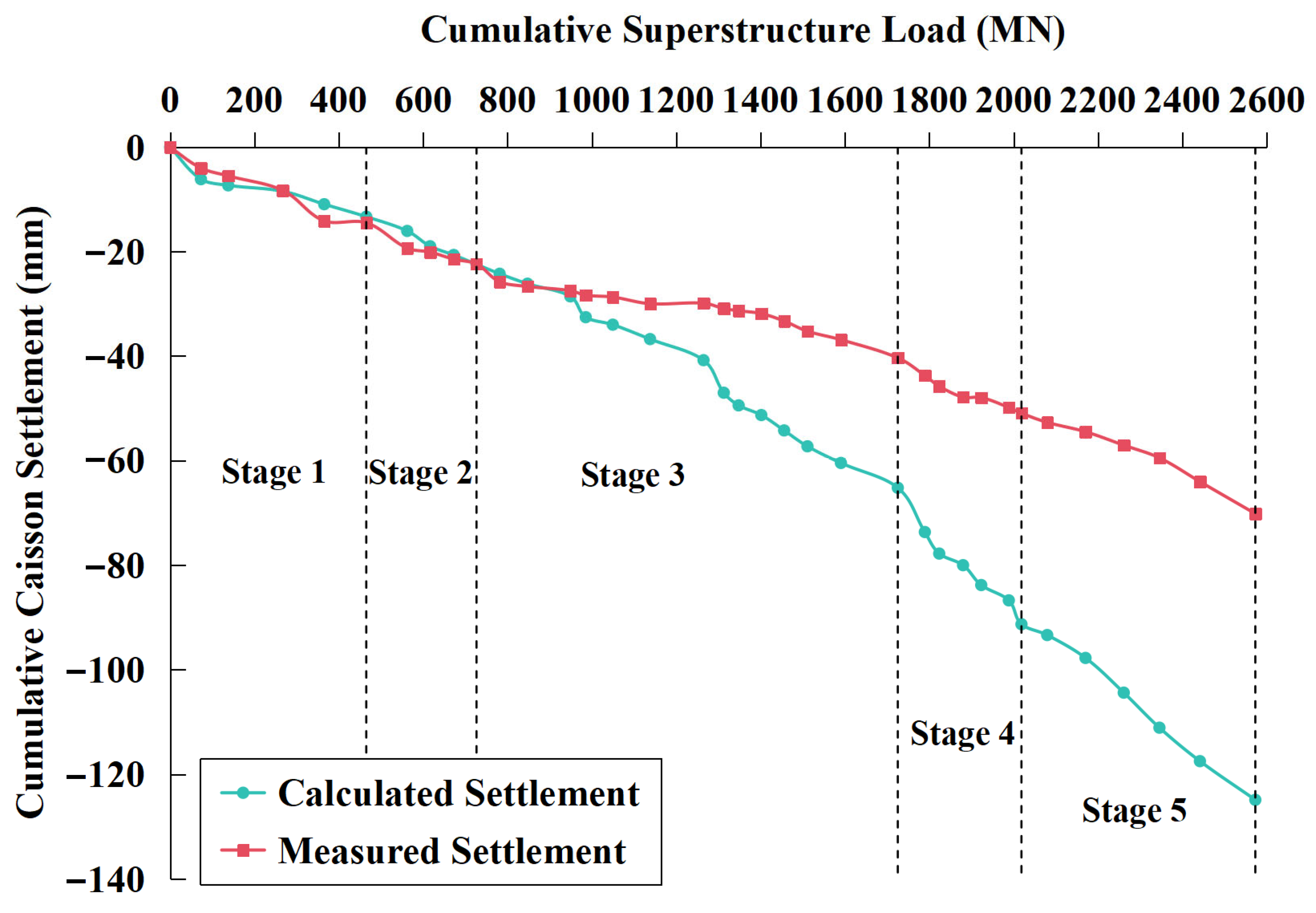
Using the established 3D FE model, the settlement of the caisson foundation caused by the superstructure construction was simulated. The results are presented in Figure 7, with each analysis step corresponding to the detailed substages within the key construction phases outlined in Table 2. The simulated settlements are compared against field monitoring data, and their deviations are quantified. Markers along the curves indicate intermediate construction substages, where negative values denote downward vertical displacement.
As shown in Figure 7, the numerical simulations show good agreement with the monitored settlements during the early construction stages, including the casting of the lower pylon, the cross beams, and the initial phase of the middle pylon. At a cumulative load of 948.87 MN, the difference between calculated and measured settlement is only 1.1 mm. Up to this stage, the maximum deviation is 3.3 mm, with a mean deviation of 1.3 mm. In subsequent construction stages, although the simulated settlement trend remains consistent with the measured response, the magnitude of deviation increases progressively, following an approximately linear trend. The maximum discrepancy occurs at the closure of the main girder, reaching 54.7 mm. During the middle to late construction period (cumulative load: 948.87–2572.80 MN), the absolute deviation increases steadily, with the relative error increasing from 4% to 78%.
This systematic deviation suggests that the model parameters, particularly the initial shear modulus G 0 ref initially assigned based on empirical values for low-stress conditions, may not fully capture the complex nonlinear deformation and accelerated stiffness degradation of the soil under high stress levels. Previous studies have identified G 0 ref as one of the most settlement-sensitive parameters in the HSS model [4], and its optimal value is likely not constant but rather dependent on the prevailing stress state or load level. Therefore, to calibrate the model and enhance its predictive reliability throughout the entire construction process, a dedicated inversion analysis of G 0 ref based on field monitoring data is required. This constitutes the central objective of the following section.

4. Inversion of the Key HSS Model Parameter G 0 ref

The systematic discrepancy observed in the later construction stages between numerical predictions and field monitoring data (Section 3.3) suggests that the initial parameterization, especially for the parameters governing small-strain stiffness, may not sufficiently capture the soil’s actual mechanical response under high stress levels. Existing research has identified G 0 ref as one of the most influential parameters for settlement prediction within the HSS model in large foundation analysis [4]. Its assigned value directly controls the initial soil stiffness and the ensuing stiffness degradation, thereby largely determining the accuracy of settlement computations. Consequently, to calibrate the model and enhance its predictive performance, this section performs a systematic inversion analysis of G 0 ref utilizing the field settlement monitoring data. The fundamental principle of the inversion is to iteratively adjust the value of G 0 ref until the simulated load–settlement curve achieves the best possible fit to the measured curve, thereby identifying its optimal value under the specific loading conditions.
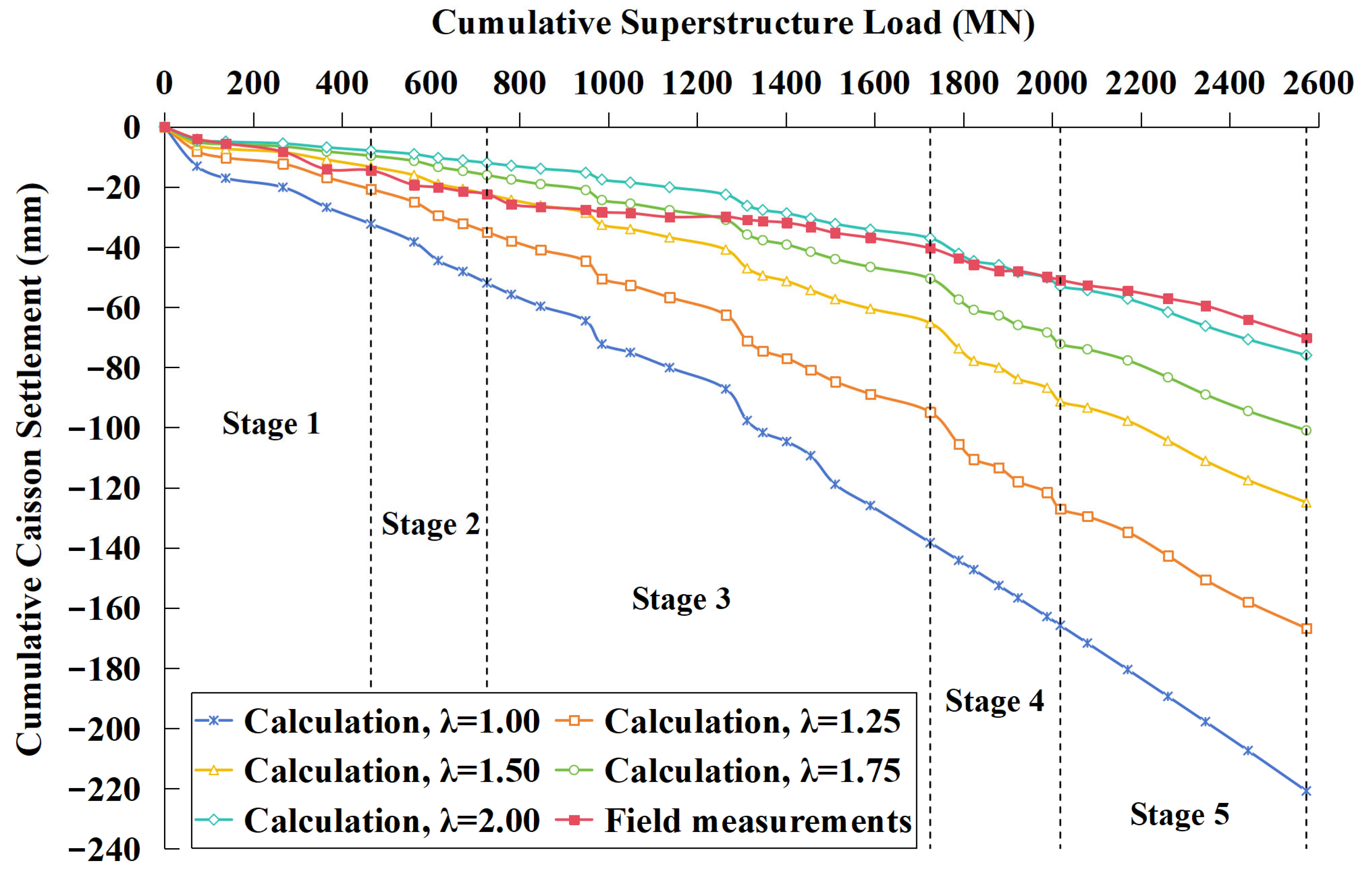
Based on common practice, G 0 ref is frequently expressed as a multiple of the unloading/reloading stiffness E ur ref ; i.e., G 0 ref = λ E ur ref , where λ is a scaling factor. To investigate its influence and determine the optimal value, λ was varied within the recommended range of 1.0 to 2.0 at intervals of 0.25, taking the values 1.0, 1.25, 1.5, 1.75, and 2.0 for a series of parametric simulations. This discrete set was selected after consultation with the project’s engineering team, prioritizing practical utility over mathematical precision. The resulting parameter guidance is simple, repeatable, and readily applicable in engineering practice, which was considered essential for the study’s objectives. The calculated settlement curves corresponding to these different λ values are presented in Figure 8. Figure 8 shows that for all five selected scaling factors, the overall trend of the load–settlement curves remains similar, while their global slopes differ. To quantitatively evaluate the performance of the five λ values, Table 4 presents the stage-wise absolute and relative errors at each major construction stage, together with overall error metrics including root mean square error (RMSE), mean absolute error (MAE), and maximum absolute error.
A clear regularity is observed from Figure 8 and Table 4: a larger scaling factor λ (and thus a larger G 0 ref ) results in a flatter overall curve slope, indicating reduced predicted settlement for a given load. Specifically, the curve calculated using G 0 ref = 1.5 E ur ref aligns well with the measured data during the casting of the lower pylon, the cross beams, and the early phase of the middle pylon. For the later stage of the middle pylon casting, the upper pylon casting, and the steel truss segments installation, the curve corresponding to G 0 ref = 2.0 E ur ref shows good agreement with measurements. The intermediate phase of the middle pylon casting is best represented by G 0 ref = 1.75 E ur ref . A comparative evaluation of all curves indicates that employing G 0 ref = 2.0 E ur ref yields the highest overall accuracy (RMSE = 6.3 mm, MAE = 5.6 mm, maximum error = 10.4 mm) in settlement prediction across the entire construction sequence. Therefore, if a single, constant value for G 0 ref = 2.0 E ur ref is to be adopted for the complete superstructure construction process, the optimal choice is λ = 2 , which minimizes the average deviation between the calculated and measured settlements.
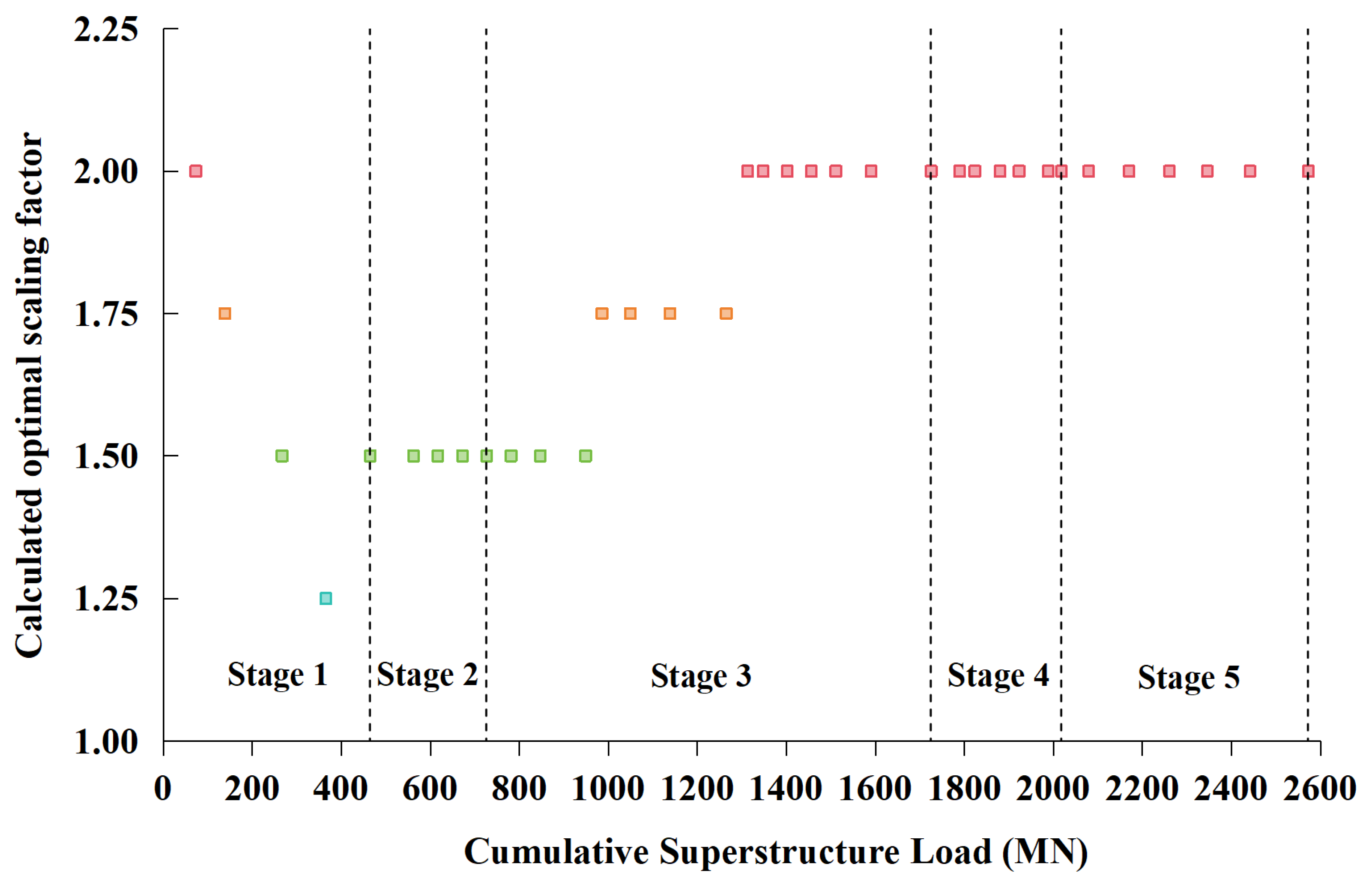
For each of the five adopted G 0 ref values, the deviation between the simulated and monitored settlement of the caisson foundation was quantified. The G 0 ref value that minimized the deviation under each loading condition was identified, from which the corresponding optimal scaling factor λ was derived, as illustrated in Figure 9. Figure 9 shows that the optimal λ decreased from 2.0 to 1.25 during the lower pylon casting phase. It remained at 1.5 throughout the cross beams casting and the early stage of the middle pylon casting, increased to 1.75 in the mid-stage of the middle pylon casting, and stabilized at 2.0 during the later middle pylon casting, the upper pylon casting, and the steel truss segments installation phase.
The inversion results demonstrate that the optimal scaling factor λ for G 0 ref shows a generally increasing trend with the progression of superstructure construction loads. This observed trend can be interpreted as a consequence of the soil’s mechanical response under increasing stress. During initial loading, the foundation soil remains in a near-elastic or small-strain state, and a relatively low G 0 ref value is sufficient to capture its behavior. As the load increases, the stress level within the soil rises sharply, and the rate of stiffness degradation appears to accelerate beyond that predicted by the default HSS model formulation.
A plausible explanation at the micro-scale is that elevated stresses may induce irreversible particle sliding, rearrangement, or even crushing at highly stressed contacts, particularly in dense sands, thereby accelerating the degradation of shear stiffness [44,45,46,47]. In the inversion analysis, adopting a higher G 0 ref value effectively assigns a greater initial small-strain stiffness, which compensates for this accelerated degradation and brings the simulated settlement closer to the measurements. It is important to emphasize that this micro-scale interpretation remains speculative in the absence of direct experimental evidence. The current study does not include such investigations, and the proposed mechanisms are offered as a hypothesis consistent with the observed macro-scale behavior rather than as a proven explanation.
Based on the load-dependent pattern identified through the inversion analysis, this study proposes two parameter optimization strategies to improve the overall predictive accuracy of the model. The constant-value strategy adopts a fixed scaling factor of λ = 2.0 throughout the entire superstructure construction process. This approach reduces the average settlement deviation at major construction stages to 5.4 mm, with a maximum deviation of 10.4 mm, representing a significant improvement over the initial setting of λ   =   1 .5 and satisfying the requirements of routine engineering design. For applications demanding higher precision, a stage-adaptive strategy is proposed, in which λ is dynamically adjusted according to the load level. As indicated by the analysis in Figure 8 and Figure 9, suitable values of G 0 ref generally lie between ( 1 ~ 2 ) E ur ref . Accordingly, λ is taken as 1.5 for load levels below approximately 950 MN (early construction phases) and increased to 2.0 for loads exceeding 950 MN (middle to late construction phases). This refined strategy further reduces localized errors in settlement prediction. The constant-value strategy is straightforward to implement and sufficient for conventional design purposes. In contrast, the stage-adaptive strategy more closely aligns with the actual stress-dependent response of the soil and is recommended for projects requiring high-precision settlement control. Both strategies achieve prediction accuracies that are acceptable for engineering practice. They are not mutually exclusive but rather provide engineers with flexible options, allowing them to select the most convenient approach based on project characteristics, data availability, and accuracy requirements. In practical applications, fine-tuning within the recommended range ( λ   =   1 .0~2.0) using site-specific data is also possible. For the remaining HSS model parameters, the values recommended in this study provide reliable predictions of caisson foundation settlement.

5. Conclusions and Discussion

This study presents a systematic investigation into the settlement behavior and prediction of a mega deep-water caisson foundation during superstructure construction, based on the world-class Changtai Yangtze River Bridge Project. By combining 3D FE modeling utilizing the HSS model, field-monitoring data validation, and parameter inversion analysis, the settlement characteristics are thoroughly examined. The main conclusions are summarized as follows:
  • The development of caisson foundation settlement exhibits pronounced nonlinearity and load dependency. Settlement progresses continuously with the step-wise increase in superstructure load. During the early construction phase under relatively low loads, settlement increases approximately linearly with load. In the middle to late construction stages under higher loads, the settlement rate accelerates significantly, exhibiting pronounced nonlinear characteristics.
  • The established 3D FE model based on the HSS model effectively simulates the nonlinear settlement process of the caisson foundation under progressive vertical loading. The predicted settlement trend shows close agreement with field measurements, confirming the applicability and reliability of this advanced constitutive model for such complex working conditions.
  • The initial shear modulus G 0 ref is a key parameter in the HSS model that governs the accuracy of settlement prediction for the caisson foundation. Its value directly determines the initial stiffness of the soil. A higher G 0 ref results in greater small-strain stiffness of the foundation, leading to smaller settlements under the same load; settlement predictions thus show a significant negative correlation with the value of G 0 ref .
  • Based on the load-dependent patterns revealed through parameter inversion, two practical parameter-determination strategies are proposed: a constant-value approach ( G 0 ref = 2.0 E ur ref ) and a stage-dependent optimization strategy ( G 0 ref = 1.5 E ur ref for low-load stages and 2.0 E ur ref for high-load stages). These strategies offer flexible and reliable options for engineering practice.
  • The proposed strategies offer tangible engineering value. The constant-value method improves design-stage settlement predictions without complex calibration, helping avoid over-conservative designs and unnecessary material costs. The stage-adaptive method enables more precise settlement control during construction, facilitating early deviation detection and enhancing safety and risk management. Applied to this case study, these strategies would have reduced the maximum settlement prediction error from 54.7 mm to within 10.4 mm, demonstrating the practical utility of the proposed methods for mega-foundation projects.
The model contains 161,881 elements and required approximately 1.5 h of computation on a personal workstation (Intel i9-13900K CPU, 64 GB memory), reflecting the trade-off between fidelity and efficiency. While this study provides evidence for the load-dependent behavior of G 0 ref through inversion analysis of high-quality field data, several limitations should be acknowledged. First, the micro-scale interpretation of this behavior, involving particle rearrangement and possible crushing, remains speculative, as no corresponding laboratory investigations were conducted. Future research incorporating such experiments would be valuable to validate or refine the hypothesized mechanisms. Second, the proposed parameter strategies, while effective for this case study, require further validation on other mega-foundation projects to assess their general applicability. Third, the numerical model itself has inherent limitations: the HSS model in PLAXIS 3D employs a mixed flow rule (non-associated for shear hardening, associated for cap hardening) and does not account for cyclic degradation, dynamic effects, and creep processes. It is designed for mechanical response to incremental static loading, consistent with this study’s objectives, and should be applied with caution to scenarios involving rapid drawdown, cyclic loading, or long-term time effects. Additionally, the model could be extended to incorporate fully coupled flow–deformation analysis for cases with significant water level fluctuations. Addressing these limitations represents important directions for ongoing and future work.

Author Contributions

Conceptualization, X.D. and M.G.; methodology, X.D. and M.G.; software, X.D.; validation, X.D., M.G. and J.L.; formal analysis, Z.L.; investigation, J.J.; resources, M.G.; data curation, M.G.; writing—original draft preparation, X.D.; writing—review and editing, X.D., M.G. and Z.L.; visualization, J.L. and J.J.; supervision, M.G. and Z.L.; project administration, M.G.; funding acquisition, Z.L. All authors have read and agreed to the published version of the manuscript.

Funding

This research was funded by the National Natural Science Foundation of China (Nos. U25A20348, 42477205), the Innovation Group Project of Natural Science Foundation of Hubei Province (No. 2023AFA019), the China Postdoctoral Science Foundation (No. 2025M773223), and the Open Projects Foundation of State Key Laboratory of Bridge Intelligent and Green Construction (No. BIGCSKL25-10-GF).

Data Availability Statement

Regarding the data availability, due to the sensitive nature of the measured data, we are unable to deposit them in a public repository. However, the data underlying this study are available from the corresponding author upon reasonable request for interested researchers.

Conflicts of Interest

The authors declare no conflicts of interest. This submitted manuscript is approved by all authors for publication. We would like to declare that the work described is original research that has not been published previously, and is not under consideration for publication elsewhere, in whole or in part.

Abbreviations

The following abbreviations are used in this manuscript:
HSSHardening soil model with small-strain stiffness
3DThree-dimensional
FEFinite element
RMSERoot mean square error
MAEMean absolute error

References

  1. Chen, J.; Qu, Y.; Sun, Z. Protection mechanisms, countermeasures, assessments and prospects of local scour for cross-sea bridge foundation: A review. Ocean Eng. 2023, 288, 116145. [Google Scholar] [CrossRef]
  2. Su, H.; Guo, C.; Han, T.; Li, R.; Liu, Z.; Su, F.; Shang, L. Research on safety state evaluation of cable-stayed bridge structures across the sea. J. Mar. Sci. Eng. 2023, 11, 2034. [Google Scholar] [CrossRef]
  3. Li, W.; Tao, Q.; Li, C.; Wang, X.; Gong, W.; Dai, G. In-situ experimental study of closed-diaphragm wall foundations for cross-sea suspension bridges. J. Mar. Sci. Eng. 2024, 12, 2304. [Google Scholar] [CrossRef]
  4. Greaney, T.M.; Gyawali, P. Deep-water ports and international trade: A structural gravity estimation. J. Mar. Sci. Eng. 2024, 12, 2304. [Google Scholar] [CrossRef]
  5. Díaz, H.; Soares, C.G. Review of the current status, technology and future trends of offshore wind farms. Ocean Eng. 2020, 209, 107381. [Google Scholar] [CrossRef]
  6. Kafshgarkolaei, H.J.; Lotfollahi-Yaghin, M.A.; Mojtahedi, A. A modified orthonormal polynomial series expansion tailored to thin beams undergoing slamming loads. Ocean Eng. 2019, 182, 38–47. [Google Scholar] [CrossRef]
  7. Mu, B.; Zhu, J.; Gong, W. Design, Construction and Monitoring of Large Open Caisson, 1st ed.; China Architecture and Building Press: Beijing, China, 2015; pp. 1–21. [Google Scholar]
  8. Dong, X. Investigation on Intelligent Monitoring of Sinking of Large Open Caisson Foundations Based on Data-Driven Strategies. Ph.D. Thesis, University of Chinese Academy of Sciences, Beijing, China, 30 June 2023. [Google Scholar]
  9. Cui, Z.; Zhang, Z.; Yuan, L.; Zhan, Z.; Zhang, W. Design of Underground Structures, 1st ed.; Springer: Singapore, 2020; pp. 493–552. [Google Scholar]
  10. Ahmad, S.; Peng, T.; Khan, M.S. Numerical and experimental study on the seismic performance of caisson foundations. Soils Found. 2025, 65, 101702. [Google Scholar] [CrossRef]
  11. Tan, G.; Xiao, H.; Du, X.; Hu, W. Settlement analysis of caisson foundation under main tower of a long span cable-stayed bridge for highway and railway. Rock Soil Mech. 2019, 40, 1113–1120. [Google Scholar]
  12. Xie, S.; Sun, C.; Liu, B.; Huang, L.; Deng, H.; Zhu, M.; Li, X.; Dai, G. Numerical simulation on anchored load-bearing characteristics of suction caisson for floating offshore wind power. J. Mar. Sci. Eng. 2025, 13, 1653. [Google Scholar] [CrossRef]
  13. Jin, Z.; Liu, X.; Cheng, M.; Peng, M.; Yang, J. Influence of seabed scouring on the bearing capacity of suction caisson foundations of offshore wind turbines. J. Mar. Sci. Eng. 2026, 14, 171. [Google Scholar] [CrossRef]
  14. Romero-Sánchez, C.; Bordón, J.D.R.; Padrón, L.A. Influence of foundation–soil–foundation interaction on the dynamic response of offshore wind turbine jackets founded on buckets. J. Mar. Sci. Eng. 2024, 12, 2089. [Google Scholar] [CrossRef]
  15. Bagheri, M.; Malidarreh, N.R.; Ghaseminejad, V.; Asgari, A. Seismic resilience assessment of RC superstructures on long–short combined piled raft foundations: 3D SSI modeling with pounding effects. Structures 2025, 81, 110176. [Google Scholar] [CrossRef]
  16. Huang, S.; Han, Y.; Li, S.; Zhou, M. Numerical simulation of the behavior of caisson based on physical modeling. J. Mar. Sci. Eng. 2024, 12, 1284. [Google Scholar] [CrossRef]
  17. Tang, D.; Wang, C. Development and application of hardening soil model with small strain stiffness in FLAC3D. J. Shanghai Univ. (Nat. Sci.) 2023, 29, 549–561. [Google Scholar]
  18. Luo, M.; Chen, Y.; Zhou, J. Research status and prospect of parameter selection for the HS-Small model. Ind. Constr. 2021, 51, 172–180. [Google Scholar]
  19. Li, L.; Ma, X.; Du, W.; Li, S.; Chen, J.; Suri, G. Numerical analysis method of soil-rock dual element foundation pit and anchor cable recovery scheme. J. Shandong Univ. (Eng. Sci.) 2023, 53, 65–73. [Google Scholar]
  20. Zhong, P. Research on the Deformation Characteristics of Loess Pit Excavation Based on Hardening Soil Small. Master’s Thesis, Chang’an University, Xi’an, China, 30 June 2023. [Google Scholar]
  21. Deng, S.; He, Y.; Chen, H.; Zhou, F.; Zhu, R.; Shi, W.; Wang, Y.; Ma, Q. Real-time dynamic simulation and deformation prediction of shield tunneling through soft soil layer in complex environment: A case study of Suzhou metro line S1 shield section. Tunn. Constr. 2022, 42, 2024–2035. [Google Scholar]
  22. Wang, B.; Zhou, D.; Han, X.; Zhao, J.; Cao, Y.; Wang, S. Influence analysis of tunnel construction adjacent to pile group foundation base on HSS model. J. Archit. Civ. Eng. 2023, 40, 160–171. [Google Scholar]
  23. Kou, H.; Fang, W.; Xu, X.; An, Z.; Zhang, H. Comparative study on horizontal cyclic bearing characteristics of offshore wind turbine bucket foundations based on HSS model. Ocean. Eng. 2024, 42, 1–12. [Google Scholar]
  24. Benz, T. Small-Strain Stiffness of Soils and Its Numerical Consequences. Ph.D. Thesis, Universität Stuttgart, Stuttgart, Germany, 1 March 2007. [Google Scholar]
  25. Sohu. Available online: https://www.sohu.com/a/782367013_121321033 (accessed on 29 May 2024).
  26. Xinhua News Agency. Available online: http://www.js.xinhuanet.com/20250910/d8306005976940599832877a2ed4d380/c.html (accessed on 10 September 2025).
  27. Zheng, Q.; Li, Y.; Wang, Q.; Zhang, H.; Zhang, J. Active internal stress and shape control techniques during construction of spatial diamond-shaped pylons of main navigational channel bridge of Changtai Changjiang River Bridge. Bridge Constr. 2025, 55, 1–9. [Google Scholar]
  28. Zhang, M.; Zhou, Y.; Shen, K.; Yuan, R.; Zheng, Q. Lateral offset of pylons of main navigational channel bridge of Changtai Changjiang River Bridge and control solutions. Bridge Constr. 2023, 53, 1–8. [Google Scholar]
  29. Zhang, J.; Fu, Z.; Qin, S.; Jiang, Z.; Zhang, R. Pylon design for main navigational channel bridge of Changtai Changjiang River Bridge. Bridge Constr. 2022, 52, 1–7. [Google Scholar]
  30. Zhang, H.; Zheng, Q.; Zhang, J.; Jiang, F. Construction control of spatial longitudinal and transverse girders of Changtai Yangtze River Bridge Tower. Railway Eng. 2023, 63, 69–73. [Google Scholar]
  31. Qin, S.; Zhang, J.; Lu, Q.; Fu, Z.; Zhang, R. Research on pylon types for main navigational channel bridge of Changtai Changjiang River Bridge. Bridge Constr. 2021, 51, 1–9. [Google Scholar]
  32. Qin, S.; Xu, W.; Lu, Q.; Zheng, Q.; Fu, Z.; Yuan, R.; Sun, J. Overall design and concept development for main navigational channel bridge of Changtai Changjiang River Bridge. Bridge Constr. 2020, 50, 1–10. [Google Scholar]
  33. Dong, X.; Guo, M.; Wang, S. An information-entropy-inspired optimal layout method for structural stress sensors of supersized open caissons. Ocean Eng. 2023, 286, 115545. [Google Scholar] [CrossRef]
  34. GB/T 50123-2019; Standard for Geotechnical Testing Method. China Planning Press: Beijing, China, 2019.
  35. Liu, Z. Fundamentals Tutorial of PLAXIS 3D, 1st ed.; China Machine Press: Beijing, China, 2015; pp. 79–142. [Google Scholar]
  36. Chen, Y.; Luo, M.; Xia, N.; He, P. Statistical analysis of existing test results of HSS model parameters for soft soils. Chin. J. Geotech. Eng. 2021, 43, 197–201. [Google Scholar]
  37. Shen, D.; Chen, Y.; Luo, M.; Huang, J. Experimental research on parameter selection of HSS model for Ningbo shallow soft soil. Chin. J. Geotech. Eng. 2023, 45, 114–118. [Google Scholar]
  38. Gu, X.; Liu, W.; Chen, X.; Lin, Y.; Xiao, J.; Wu, C. Experimental study on HSS model parameters for marine soft soils in Yangjiang, Guangdong Province. Chin. J. Geotech. Eng. 2021, 43, 41–44. [Google Scholar]
  39. Li, L.; Liu, J.; Li, K.; Huang, H.; Ji, X. Study of parameters selection and applicability of HSS model in typical stratum of Jinan. Rock Soil Mech. 2019, 40, 4021–4029. [Google Scholar]
  40. Liang, F.; Jia, Y.; Ding, Y.; Huang, M. Experimental study on parameters of HSS model for soft soils in Shanghai. Chin. J. Geotech. Eng. 2017, 39, 269–278. [Google Scholar]
  41. Elsawwaf, A.; Naggar, H.E.; Choksi, F.A.; Amin, H. Predicting the lateral capacity of short step-tapered and straight piles in cohesionless soils using an FE-AI hybrid technique. Ocean Eng. 2025, 338, 121941. [Google Scholar] [CrossRef]
  42. Mu, L.; Huang, M. Small strain based method for predicting three-dimensional soil displacements induced by braced excavation. Tunn. Undergr. Space Technol. 2016, 52, 12–22. [Google Scholar] [CrossRef]
  43. Kim, T.; Jung, Y. Optimizing material parameters to best capture deformation responses in supported bottom-up excavation: Field monitoring and inverse analysis. KSCE J. Civ. Eng. 2022, 26, 3384–3401. [Google Scholar] [CrossRef]
  44. Shi, K.; Zhu, F.; Zhao, J. Multi-scale analysis of shear behaviour of crushable granular sand under general stress conditions. Géotechnique 2022, 74, 443–460. [Google Scholar] [CrossRef]
  45. Wang, J.; Yan, H. On the role of particle breakage in the shear failure behavior of granular soils by DEM. Int. J. Numer. Anal. Met. 2011, 37, 832–854. [Google Scholar] [CrossRef]
  46. Ding, H.; Han, Z.; Li, Y.; Xie, W.; Fu, B.; Li, C.; Zhao, L. Particle breakage and its mechanical response in granular soils: A review and prospect. Constr. Build. Mater. 2023, 409, 133948. [Google Scholar] [CrossRef]
  47. Irani, N.; Tafili, M.; Salimi, M.; Goudarzy, M.; Wichtmann, T. Particle Breakage: Exploring the numerical and experimental approaches in crushable soil mechanics. Arch. Appl. Mech. 2025, 95, 151. [Google Scholar] [CrossRef]
Figure 1. Elevation view of the main navigational channel bridge (unit: m).
Jmse 14 00453 g001
Figure 2. Cross-section of main girder (unit: m).
Jmse 14 00453 g002
Figure 3. Detailed structure of the main tower (unit: m).
Jmse 14 00453 g003
Figure 4. Structure layout of the caisson foundation (unit: m): (a) Planar graph; (b) Vertical section 1–1; (c) Vertical section 2–2.
Jmse 14 00453 g004
Figure 5. Load–settlement curve of the caisson foundation during superstructure construction.
Jmse 14 00453 g005
Figure 6. The 3D FE numerical simulation model: (a) 3D perspective view; (b) Front view.
Jmse 14 00453 g006
Figure 7. Calculated versus measured settlement of the caisson foundation.
Jmse 14 00453 g007
Figure 8. Settlement of the caisson foundation corresponding to different values of λ .
Jmse 14 00453 g008
Figure 9. Optimal value of the scaling factor.
Jmse 14 00453 g009
Table 1. Soil profile and physico-mechanical parameters of each stratum.
Stratum No.Stratum TypeTop
Elevation
(m)
Bottom
Elevation
(m)
Saturated Unit Weight γ
(kN/m3)
Effective Cohesion c’ (kPa)Effective Friction Angle φ
(°)
Compression Modulus Es
(MPa)
aSilty clay−14.7−27.719.826.921.46.2
bSlightly dense fine sand−27.7−32.720.06.842.17.7
cMedium dense silt sand−32.7−39.419.311.136.48.5
dMedium dense fine sand−39.4−50.219.54.036.010.5
eCoarse sand−50.2−60.019.85.037.719.6
fGravelly sand−60.0−66.621.04.838.049.8
gCoarse sand−66.6−70.019.84.738.032.5
hMedium sand−70.0−75.719.94.238.722.3
iFine sand−75.7−81.019.85.236.917.1
jSilt sand−81.0−88.419.64.437.825.7
kSilty clay−88.4−92.019.151.320.223.6
lSilt sand−92.0−97.919.64.738.324.9
mGravelly sand−97.9−101.421.04.838.049.8
nSilty clay−101.4−106.719.151.320.233.2
oMedium sand−106.7−124.719.94.738.325.0
pCoarse sand−124.7−215.019.94.738.349.8
qCoarse sand−215.0−314.719.94.738.551.3
Note: The geotechnical parameters presented are derived from the comprehensive geotechnical investigation report for the Changtai Yangtze River Bridge site. All laboratory tests were conducted on undisturbed soil samples retrieved from boreholes at the caisson foundation location, following the procedures specified in the Chinese National Standard for Geotechnical Testing Methods (GB/T 50123) [34]. The effective cohesion c and effective friction angle φ were determined from consolidated drained direct shear tests (slow shear). This test method allows full drainage during shearing, ensuring that the measured total stresses represent effective stresses, which is appropriate for the relatively slow, multi-stage loading characteristic of superstructure construction. The compression modulus Es was calculated from oedometer test results within the stress range corresponding to each layer’s in situ and anticipated loading conditions. The values listed represent the characteristic (mean) values adopted for design and analysis.
Table 2. Main construction stages of the superstructure and corresponding cumulative loads on the caisson foundation.
Construction StageSpecific ContentCumulative Superstructure Load at Stage Completion (MN)
1Casting of lower pylon465.05
2Casting of pylon cross beams726.44
3Casting of middle pylon1725.25
4Casting of upper pylon2018.41
5Steel truss segments installation2572.80
Table 3. Recommended ranges and adopted values of HSS model parameters [18,24,35,36,37,38,39,40,41,42,43].
ParameterRecommended Range/ValueValue Adopted in This Study
E 50 ref ( 0.9 ~ 1.3 )     E s E s
E oed ref ( 0.9 ~ 1.0 )   E s E s
E ur ref ( 4.3 ~ 9.3 )   E s 5 E s
m Sand: 0.5~0.75; Clay: 0.5~1.0Sand: 0.5; Clay: 0.8
ν ur 0.1~0.250.2
p ref 100 kPa100 kPa
K 0 nc 1 sin φ 1 sin φ
ψ max ( φ − 30, 0) max ( φ − 30, 0)
R f Approx. 0.90.9
G 0 ref ( 1 ~ 2 ) E ur ref 1.5 E ur ref
γ 0.7 ( 1 ~ 2 )   ×   10 4 2   ×   10 4
Table 4. Error analysis for different λ values (absolute error in mm/relative error in %).
Construction
Stage
Cumulative
Superstructure
Load (MN)
Measured
Cumulative
Settlement (mm)
λ = 1.0λ = 1.25 λ = 1.5 λ = 1.75 λ = 2.0
1465.0514.517.8/123%6.3/43%1.2/8%4.8/34%6.6/45%
2726.4422.429.6/132%12.6/56%0.1/1%6.3/28%10.4/46%
31725.2540.397.9/243%54.5/135%24.9/62%10.1/25%3.3/8%
42018.4150.9114.8/225%76.1/149%40.4/79%21.3/42%2.1/4%
52572.8070.2150.6/215%96.6/138%54.7/78%30.8/44%5.8/8%
RMSE (mm)96.6 60.5 32.4 17.7 6.3
MAE (mm)82.1 49.2 24.2 14.7 5.6
Max absolute
error (mm)
150.6 96.6 54.7 30.8 10.4
Note: “—” indicates not applicable.
Disclaimer/Publisher’s Note: The statements, opinions and data contained in all publications are solely those of the individual author(s) and contributor(s) and not of MDPI and/or the editor(s). MDPI and/or the editor(s) disclaim responsibility for any injury to people or property resulting from any ideas, methods, instructions or products referred to in the content.