1. Introduction
Marine geohazards encompass a wide variety of processes, including submarine landslides, canyon morphodynamics, turbidity currents, gas hydrates, seafloor fluid emissions, and the impacts of internal solitary waves on sediments. These hazards pose significant risks to offshore engineering, coastal communities, and marine economic development, as well as to environmental sustainability and resource exploration [
1,
2]. Moreover, ongoing climate change and growing human activities have exacerbated the occurrence and spatial distribution of regional marine geohazards, thereby increasing risks to seabed instability [
3,
4]. While many features of marine geohazards can be identified through existing geophysical and observational technologies, effective in situ monitoring remains challenging, particularly for sudden-onset events. Addressing these challenges requires the integration of advanced monitoring technologies, predictive models, and interdisciplinary collaboration [
5].
Recent research has made significant strides in enhancing our understanding of the mechanisms behind marine geohazards—as well as their monitoring and prediction [
6,
7]. New technological developments have provided more accurate and reliable tools for detecting and modeling these hazards [
8,
9]. For instance, recent advancements in remote sensing, underwater robotics, and computational modeling has enabled researchers to study marine geohazards in greater detail and over larger areas.
This editorial highlights some of the key breakthroughs in the field, drawing on a range of recent studies that examine various aspects of marine geohazards through case studies, numerical modeling, geophysical imaging, and literature reviews. These advancements hold great promise for improving our ability to assess and mitigate the risks associated with marine geohazards, ultimately enhancing the safety and sustainability of offshore activities.
2. Recent Advances in Marine Geohazard Research
Current research on marine geohazards can be broadly grouped into several subject areas: sediment gravity flows and continental slope morphodynamics, observation-driven detection and image-based modeling of marine geohazards, and fluid–sediment–hydrate coupling and seabed instability.
2.1. Sediment Gravity Flows and Continental Slope Morphoynamics
Recent research in this area of study have significantly enhanced our understanding of the role of gravity-driven sedimentary processes in shaping continental margins and governing slope morphology.
It is clear that active continental margins—which are generally characterized by narrow shelves incised by canyons—are pervasively shaped by submarine landslides near coastal areas [
10]. Reviews on submarine landslides, primarily focusing on summarizing their triggering mechanisms and flow characteristics from the perspective of the landslides themselves, demonstrate a relative importance [
11,
12].
Frascati et al. [
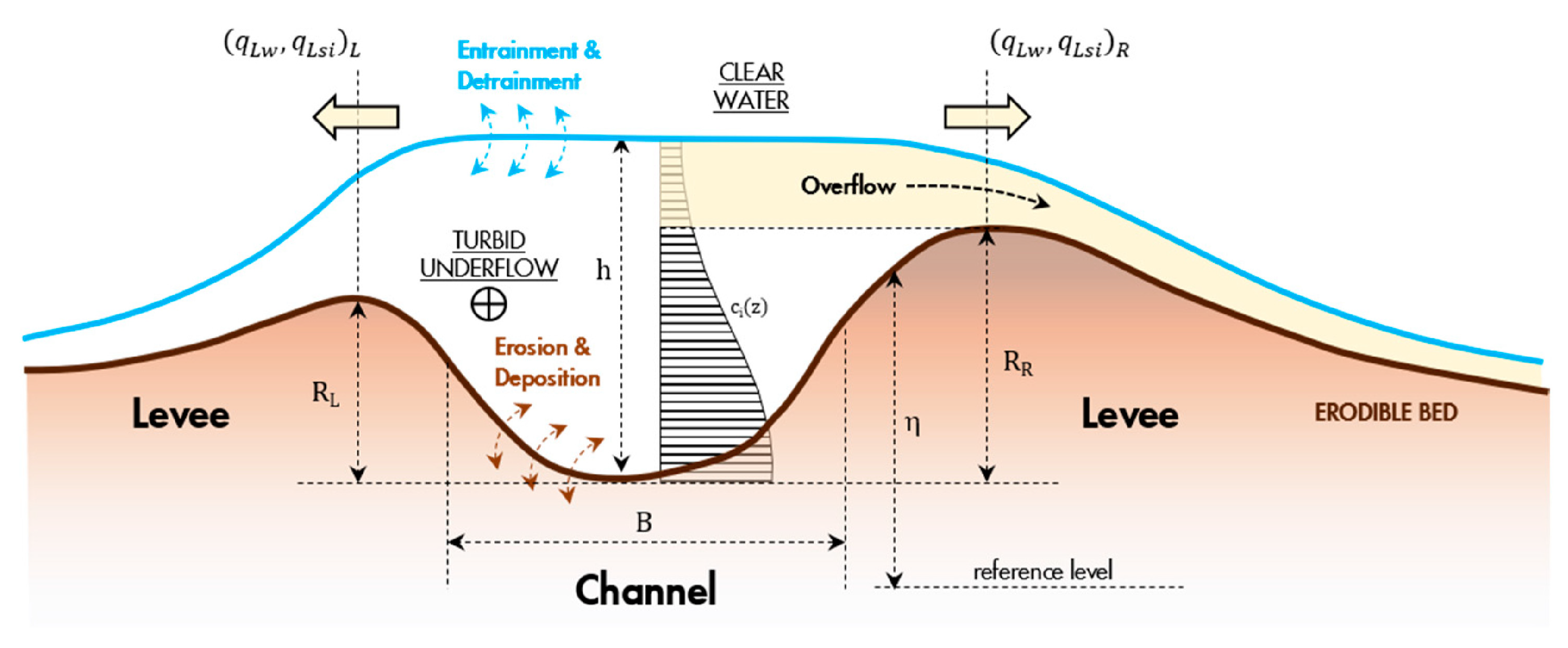
13] developed a channel centerline-based model for turbidity currents in the Baco–Malaylay Canyon system, Philippines, which successfully captured erosion–deposition patterns with simplified yet robust methods. A schematic channel cross-section depicting the dynamics of water entrainment and detrainment across the turbidity interface, together with the associated processes of sediment uptake from, and deposition onto, the erodible bed (
Figure 1).
Similarly, Sun et al. [
14] analyzed the Dongdaobei Canyon system in the Xisha Sea, South China Sea, revealing the multifactorial controls of sediment supply, slope failure, and bottom currents on canyon development. Chen et al. [
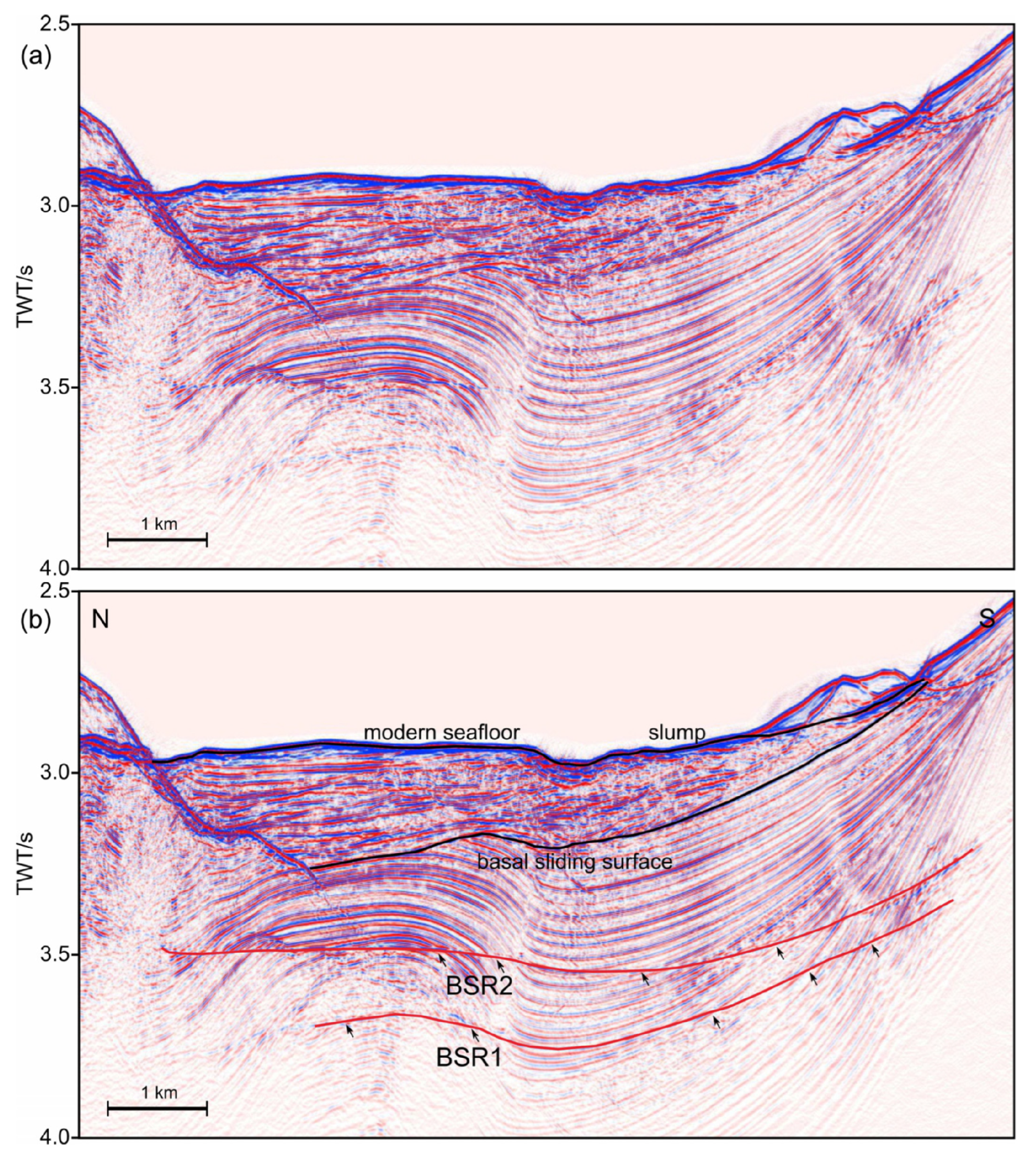
15] examined the occurrence of double bottom simulating reflectors (BSRs) in the Makran Accretionary Zone, linking them to variations in gas hydrate stability and subsurface fluid activity. The full-stack seismic profile of the Makran accretionary wedge, shown in
Figure 2b, reveals east–west ridges and north–south canyons along the continental slope. Amphitheater-shaped scarps indicate a mega-slump that formed the elongated N–S depression with a “blind” northern end, filling canyon one and truncating upper stratified sediments. The white and black dashed circles highlight zones of sedimentary interaction: chaotic reflectors dominate the southern region and continuous reflections dominate the north, while the central area exhibits transitional features. The southern ridge likely contributed to the slump, as suggested by seismic and bathymetric data.
Jin et al. [
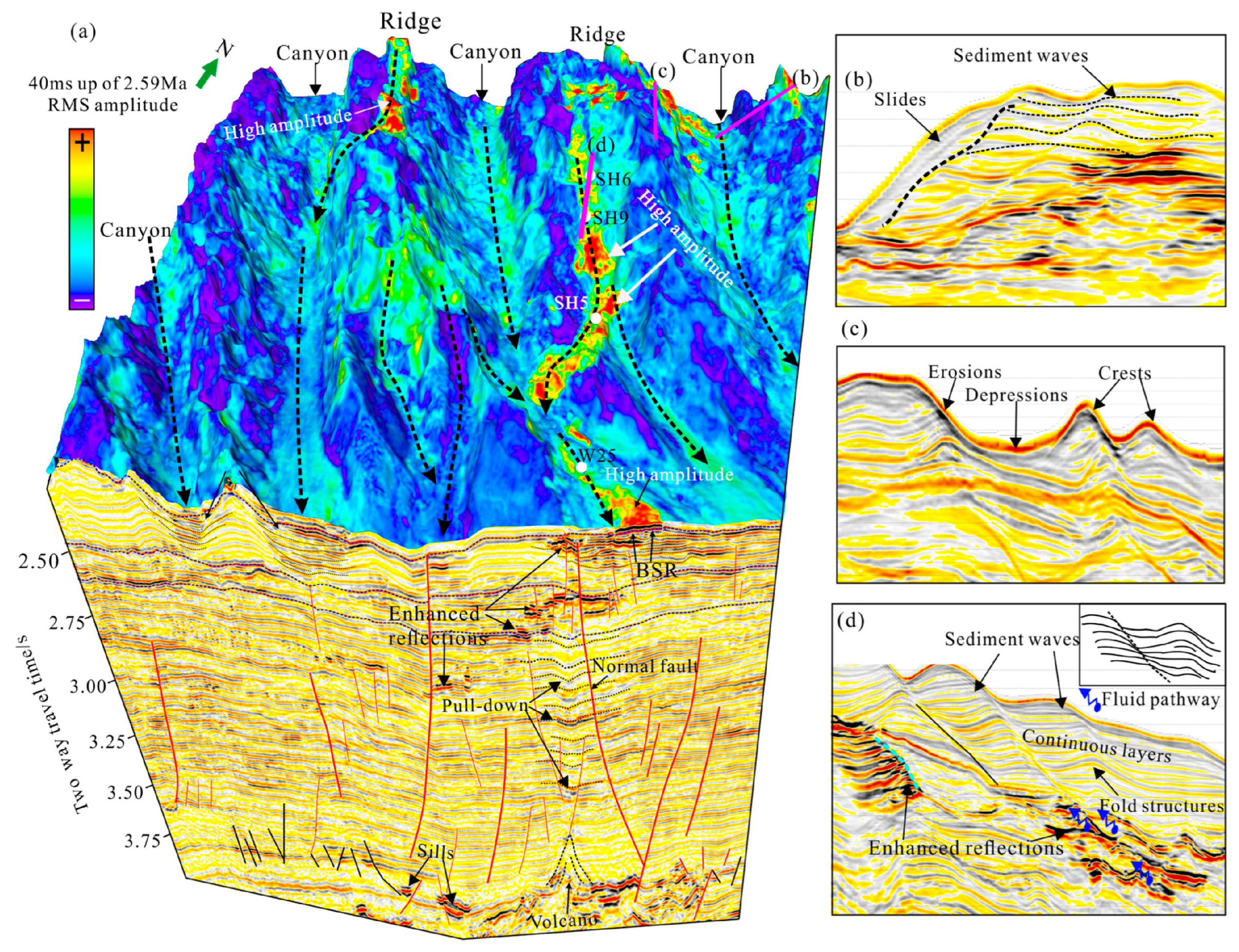
16] focused on submarine slides in the Pearl River Mouth Basin, highlighting how slope failures interact with shallow gas and gas hydrates, influencing their stability and migration. Northern submarine canyons exhibit sediment waves along their ridges, with sidewalls serving as pathways for shallow free gas migration and local collapses. Enhanced RMS reflections along ridges and sidewalls indicate downstream turbidite transport. The canyon terminus acts as a depositional zone for coarse-grained sediments, forming a sand-rich reservoir that is favorable for gas hydrate accumulation. Faults and magmatic intrusions facilitate vertical fluid migration and locally increase the geothermal gradient, promoting hydrate dissociation and supplying gas for shallow hydrates and free gas (
Figure 3a–d).
Collectively, these findings demonstrate that gravity-driven sediment dynamics—whether driven by turbidity currents, slope failures, or internal solitary waves—constitute a fundamental control on continental slope evolution and sediment stability, thereby providing essential insights into marine geohazard assessment.
2.2. Observation-Driven Detection and Image-Based Modeling of Marine Geohazards
Advances in marine observation technologies and data analytics have opened new avenues for the detection and modeling of large-scale marine geohazards.
Recently, semi-automated and hybrid GIS-AI workflows have been developed to process high-resolution multibeam echosounder (MBES) data [
17]. In addition to traditional remote sensing hardware, physics-guided deep learning architectures are emerging as powerful tools for seabed image interpretation [
18].
Du et al. [
19] proposed a CNN-based recognition method using side-scan sonar imagery to automatically detect underwater engineering structures such as pipelines and platforms, providing a practical tool for offshore monitoring. Liu et al. [
20] proposed SAMU-Net, a CNN incorporating spatial attention and multi-scale fusion, to accurately segment sediment particles in digital images despite challenges like uneven illumination. This expands the application of image-based monitoring from identifying large-scale infrastructure to characterizing fine-grained seabed morphology, enriching the toolkit for marine geohazard assessment.
Zhang et al. [
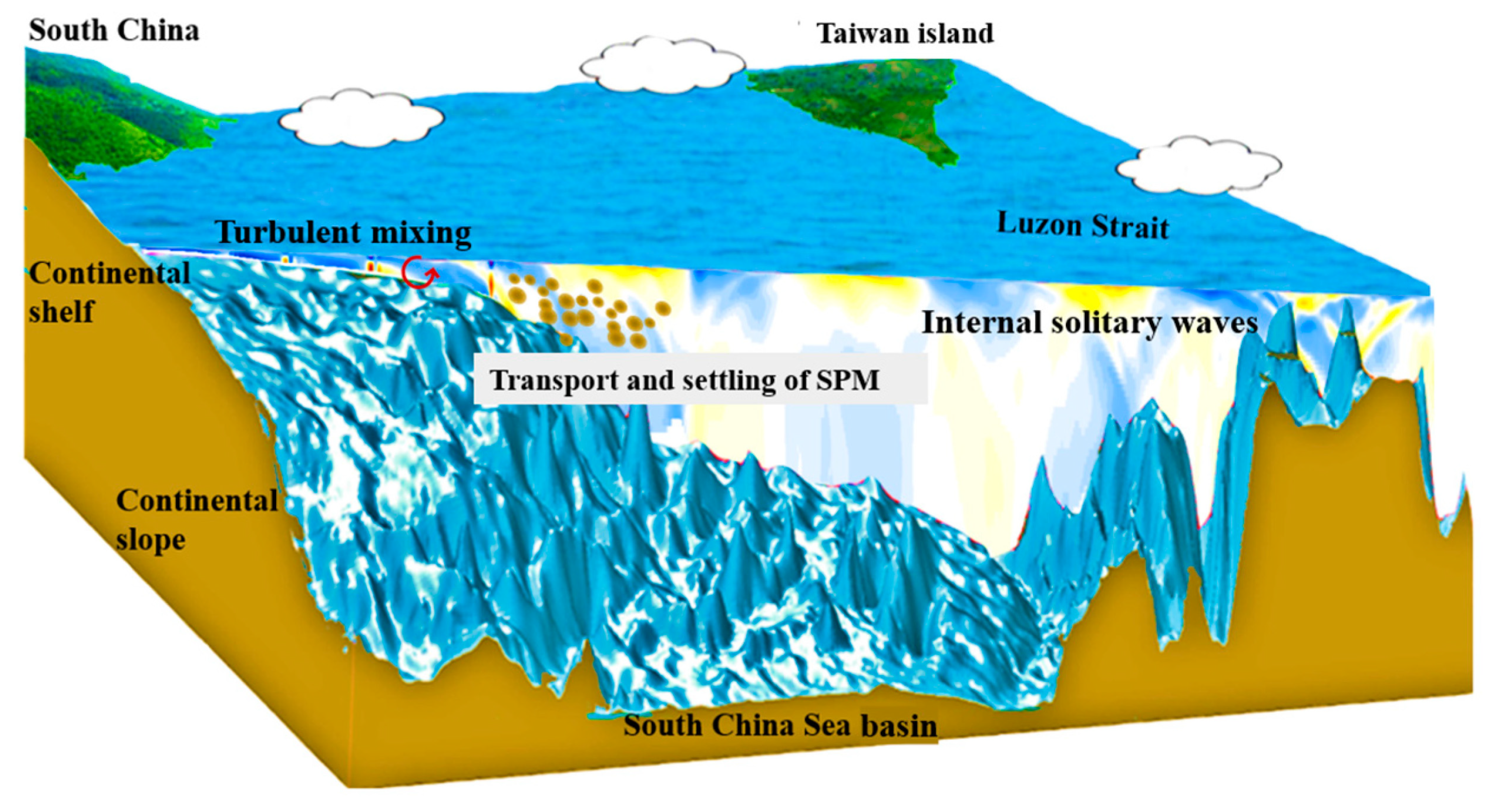
21] reviewed the impacts of internal solitary waves (ISWs) on suspended particulate matter, stressing their role in vertical mixing, resuspension, and sediment transport (
Figure 4). In addition, Zhu et al. [
22] provided a novel experimental perspective, demonstrating how episodic gas release can rapidly generate suspended sediment plumes. This study effectively bridges laboratory-scale observations and field-scale hazard phenomena, extending the applicability of monitoring technologies to eruptive and transient processes.
Recent studies have introduced new monitoring and modeling techniques for marine geohazards, highlighting advancements in the development of novel technologies in this field.
To estimate the approximate age of the landslide, Portnov et al. [
23] applied a novel desktop technique that uses the response time of gas hydrate to slope failure. Gas hydrate is a significant component of near-seafloor sediments, evidenced by the widespread occurrence of bottom-simulating reflections and borehole well log data marking the base of the gas hydrate stability zone [
24,
25].
Cukur et al. [
26] examined major parameters that dominate the interaction between the submarine landslide and the resulting tsunami heights. They used the simulated scenarios to predict 200 m inundation extent on land with flow depths of 2 m in low-lying areas of coastal cities. The simulations exemplified how the rate of displaced volume of material with time is closely linked to the steepness of the slip surface, which significantly affects the height of the tsunamis.
Collectively, these studies illustrate that integrating image-based techniques with experimental and field observations can substantially enhance both the understanding and predictive capability of basin-scale marine geohazards.
2.3. Fluid–Sediment–Hydrate Coupling and Seabed Instability
Submarine fluid flow and seepage processes are now widely recognized as critical controls governing seabed deformation and the initiation of marine geohazards [
27]. This category highlights the interactions between submarine fluid flow, pore-pressure changes, and seabed instability.
Submarine groundwater discharge (SGD), which involves the transport of groundwater across the seabed surface, can induce significant fluctuations in pore-water pressure that reduce effective stress and weaken sediment strength [
28], thereby preconditioning slopes to failure and promoting instability across continental margins.
Two companion reviews by Zhang et al. [
29] and Jia et al. [
30] summarized how submarine groundwater discharge (SGD) influences seabed pockmark formation and overall stability, pointing out the close coupling between fluid seepage and geohazard development. Complementing these findings, KP et al. [
31] systematically explored the coupled thermal, hydraulic, and mechanical behavior of hydrate-bearing layers, revealing the controlling role of multiphase interactions in sediment stability. Similarly, Zhu et al. [
32] demonstrates, with visualization approaches, how hydrate dissociation can trigger pore pressure buildup and initiate slope failure. Together with the work of Chen et al. [
15], these studies advance our understanding of the mediating role of geo-fluid systems in linking fluid migration, sediment mechanics, and submarine slope failure.
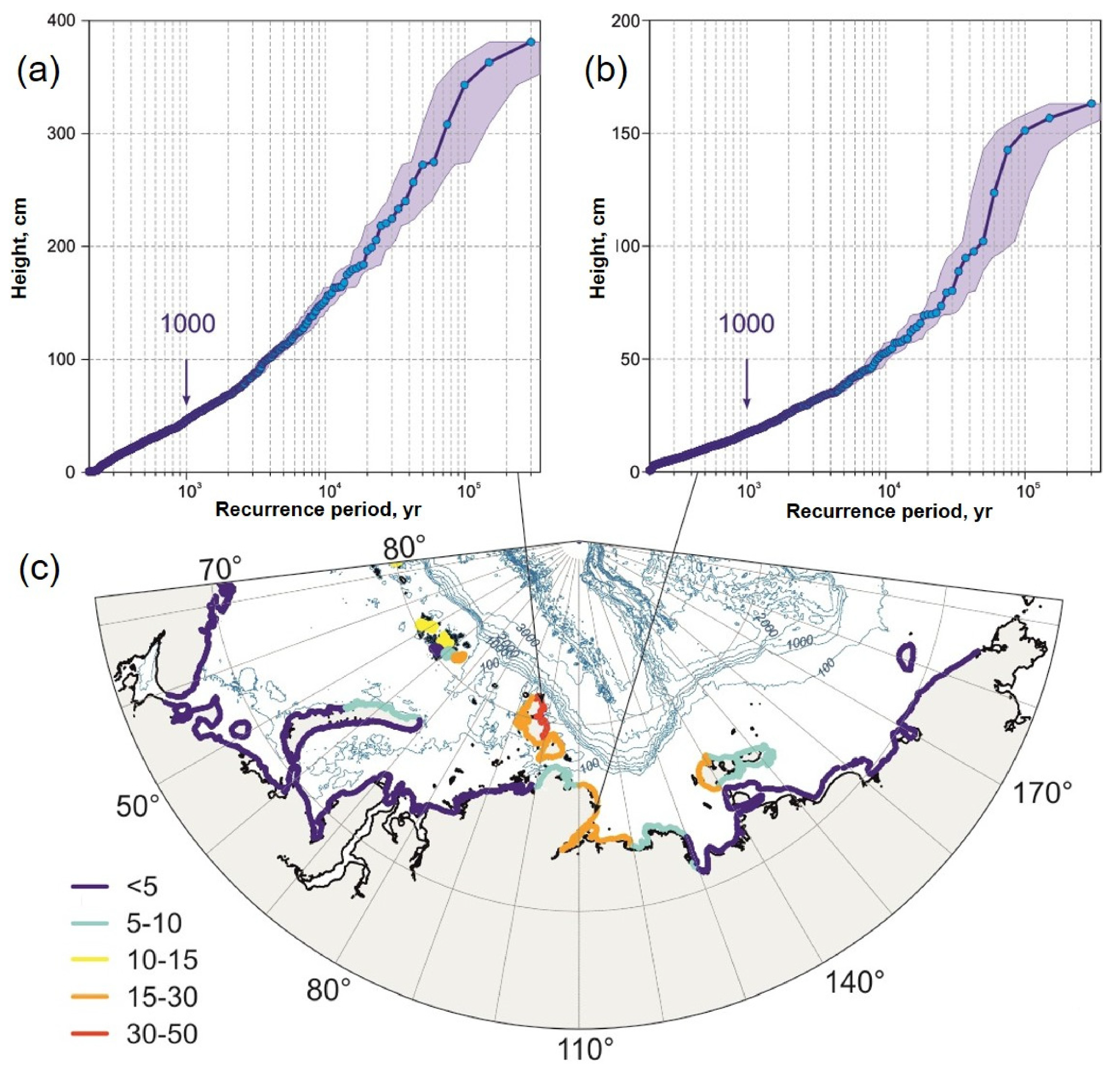
Finally, Krylov et al. [
33] assessed the major marine geohazards in the Russian Arctic Ocean, including landslides, earthquakes, methane release, and permafrost degradation, highlighting the increasing risks posed by climate change in polar regions. Earthquakes of Mw ≥ 7 from the Gakkel Ridge, Laptev Sea, and Chukchi Sea (including the Bering Strait) pose the main tsunami hazard (
Figure 5).
Chen et al. [
15] emphasized the importance of fluid–sediment interactions in assessing marine geohazard risks. Moreover, Tian et al. [
34] highlighted the substantial impact of energetic internal waves on sediment resuspension and downslope transport. These processes highlight the dynamic coupling between hydrodynamic forcing and slope morphology, revealing a previously underestimated pathway of gravity-driven sediment redistribution in canyon systems.
Employing automated identification of side-scan sonar (SSS) images can enhance marine geophysical survey efficiency, enabling high-frequency assessment of seabed anthropogenic footprints. Wei et al. [
35] presented the convolutional neural network (CNN) models, especially GoogleNet, focusing on their prediction accuracy and computational efficiency in analyzing SSS data.
These studies collectively highlight fluid-driven coupling mechanisms as a key link between subsurface processes and large-scale seabed instability across diverse tectonic and climatic settings.
3. Outlook
Together, these contributions advance our understanding of marine geohazards in two major ways.
First, they shed light on the mechanisms controlling hazard initiation and evolution, particularly the roles of topography, stratigraphy, and fluids such as gas, groundwater, and suspended matter. Second, they emphasize the importance of predictive approaches, integrating multi-scale data, geophysical imaging, numerical modeling, and emerging tools like machine learning. These advances provide critical insights for hazard prediction and management, particularly under the accelerating impacts of climate change and offshore development.
This collection of recent work thus represents a valuable contribution to the field, offering both conceptual frameworks and applied methodologies for the characterization and prediction of marine geohazards.
Author Contributions
Conceptualization, X.Z. and C.Z.; writing—original draft preparation, X.Z. and C.Z.; writing—review and editing, Q.S. and C.Z.; supervision, Q.S. and C.Z.; project administration, C.Z. All authors have read and agreed to the published version of the manuscript.
Funding
This work was supported by the Shandong Provincial Natural Science Foundation (No. ZR2022QD002), the National Natural Science Foundation of China (No. 42207173), the Shandong Provincial Taishan Scholar Construction Project (No. tsqn202507091), the Shandong Provincial Young Innovators Team (No. 2024KJH183), and the National Key Research and Development Program of China (No. 2022YFC2808305).
Conflicts of Interest
The authors declare no conflicts of interest.
References
- Shen, Y.; Peng, J.; Jia, Y.; Ma, P.; Fan, W.; Shen, W.; Tian, Z.; Huo, B. Research status and prospect of development characteristics and monitoring techniques of submarine geological hazards. Strateg. Study Chin. Acad. Eng. 2023, 25, 95–108. [Google Scholar] [CrossRef]
- Zhu, C.; Peng, J.; Jia, Y. Marine geohazards: Past, present, and future. Eng. Geol. 2023, 323, 107230. [Google Scholar] [CrossRef]
- Guo, X.; Wang, H.; Zhan, L. Typical Geological Hazard Chain in Coastal Areas: Progress and Prospects. Strateg. Study Chin. Acad. Eng. 2025, 27, 272–286. [Google Scholar]
- Sun, M.; Liu, Y.; Zhao, L.; Xie, W.; Mao, W. Advances and challenges in assessing submarine landslide risks to marine infrastructure. Nat. Hazards 2025, 121, 7811–7837. [Google Scholar] [CrossRef]
- Aiello, G. Submarine Instability Processes on the Continental Slope Offshore of Campania (Southern Italy). GeoHazards 2025, 6, 20. [Google Scholar] [CrossRef]
- Sun, Z.; Li, Y.; Wu, N.; Fan, Z.; Li, K.; Sun, Z.; Song, X.; Xue, L.; Jia, Y. Dynamic Analysis of Subsea Sediment Engineering Properties Based on Long-Term In Situ Observations in the Offshore Area of Qingdao. J. Mar. Sci. Eng. 2025, 13, 723. [Google Scholar] [CrossRef]
- Huang, X.; De Santis, L.; Leitchenkov, G.; Escutia, C.; Accaino, F.; Urlaub, M.; McKay, R.M. Giant submarine landslide on the East Antarctic margin during the Plio-Pleistocene. Geophys. Res. Lett. 2025, 52, e2025GL115073. [Google Scholar]
- Nian, T.; Wang, Z.; Zheng, D.; Gu, Z.; Yan, C.; Guo, X. Numerical investigation of the instability process in underwater sedimentary slopes subjected to seismic action. Eng. Geol. 2025, 349, 107977. [Google Scholar] [CrossRef]
- Li, W.; Jing, S.; Urlaub, M.; Rebesco, M. Sea-level variations influence weak layer formation and submarine landslides on a low-latitude continental margin. Commun. Earth Environ. 2025, 6, 950. [Google Scholar] [CrossRef]
- Scacchia, E.; Casalbore, D.; Gamberi, F.; Spatola, D.; Bianchini, M.; Chiocci, F.L. Shallow-Water Submarine Landslide Susceptibility Map: The Example in a Sector of Capo d’Orlando Continental Margin (Southern Tyrrhenian Sea). J. Mar. Sci. Eng. 2025, 13, 1350. [Google Scholar] [CrossRef]
- Liu, Z.; Wu, Z.; Liu, Y.; Shang, J.; Zhou, J.; Zhang, J. Effects of slope instability on pockmark deformation on the continental slope in the southern South China Sea. Front. Mar. Sci. 2025, 12, 1605830. [Google Scholar] [CrossRef]
- Chhushyabaga, B.; Ferdowsi, B. On the interaction of dilatancy and friction in the behavior of fluid-saturated sheared granular materials: A coupled computational fluid dynamics–discrete element method study. Phys. Fluids 2025, 37, 123308. [Google Scholar] [CrossRef]
- Frascati, A.; Bolla Pittaluga, M.; Sequeiros, O.E.; Pirmez, C.; Cantelli, A. A Channel Centerline-Based Method for Modeling Turbidity Currents Morphodynamics: Case Study of the Baco–Malaylay Submarine Canyon System. J. Mar. Sci. Eng. 2025, 13, 1495. [Google Scholar]
- Sun, M.; Chen, H.; Yang, C.; Hu, X.; Liu, J. Multifactorial Controls on the Dongdaobei Submarine Canyon System, Xisha Sea, South China Sea. J. Mar. Sci. Eng. 2025, 13, 564. [Google Scholar] [CrossRef]
- Chen, J.; Zhao, W.; Tong, S.; Azevedo, L.; Wu, N.; Liu, B.; Xu, H.; Gong, J.; Liao, J.; Liang, J. Study on the Occurrence of Double Bottom Simulating Reflectors in the Makran Accretionary Zone. J. Mar. Sci. Eng. 2025, 13, 68. [Google Scholar] [CrossRef]
- Jin, J.; Hu, J.; Li, L.; Li, J.; Zhu, Z.; Wang, X.; Zhou, J.; Wang, W. Submarine Slides and Their Influence on Gas Hydrate and Shallow Gas in the Pearl River Mouth Basin. J. Mar. Sci. Eng. 2025, 13, 308. [Google Scholar] [CrossRef]
- Downing, E.; O’Reilly, L.; Majcher, J.; O’Mahony, E.; Peters, J. A Semi-Automated, Hybrid GIS-AI Approach to Seabed Boulder Detection Using High Resolution Multibeam Echosounder. Remote Sens. 2025, 17, 2711. [Google Scholar] [CrossRef]
- Lei, C.; Rajani, H.; Gracias, N.; Garcia, R.; Wang, H. PhysDNet: Physics-Guided Decomposition Network of Side-Scan Sonar Imagery. arXiv 2025, arXiv:2511.19539. [Google Scholar]
- Du, X.; Sun, Y.; Song, Y.; Dong, L.; Tao, C.; Wang, D. Recognition of Underwater Engineering Structures Using CNN Models and Data Expansion on Side-Scan Sonar Images. J. Mar. Sci. Eng. 2025, 13, 424. [Google Scholar] [CrossRef]
- Liu, Y.; Du, K.; Shan, L.; Zhu, L.; Jiang, H.; Wang, Y.; Hei, X. Segmentation of Seabed Sediment Images Based on Convolutional Neural Network. J. Mar. Environ. Eng. 2024, 11, 173–189. [Google Scholar] [CrossRef]
- Zhang, Z.; Feng, X.; Fan, X.; Lin, Y.; Zhu, C. Impact of Internal Solitary Waves on Marine Suspended Particulate Matter: A Review. J. Mar. Sci. Eng. 2025, 13, 1433. [Google Scholar] [CrossRef]
- Zhu, C.; Li, S.; Chen, J.; Wang, D.; Song, X.; Li, Z.; Chen, B.; Shan, H.; Jia, Y. Nepheloid layer generation by gas eruption: Unexpected experimental results. J. Oceanol. Limnol. 2023, 41, 769–777. [Google Scholar] [CrossRef]
- Portnov, A.; Hillman, J.I.; Watson, S.; Cook, A.E.; Laake, A.; Lobo, F.J. Unlocking the style and timing of submarine landslides: Insights from the Tuaheni North slide, Hikurangi Margin. Geophys. Res. Lett. 2025, 52, e2025GL115159. [Google Scholar] [CrossRef]
- Portnov, A.; You, K.; Flemings, P.B.; Cook, A.E.; Heidari, M.; Sawyer, D.E.; Bünz, S. Dating submarine landslides using the transient response of gas hydrate stability. Geology 2023, 51, 387–391. [Google Scholar] [CrossRef]
- Wang, X.; Gong, Z.; Zhou, J.; Kuang, Z.; Deng, W.; Hu, J.; Jin, J.; Li, S. Highly saturated free gas accumulations below the gas hydrate stability zone in the Qiongdongnan Basin, South China Sea. Geophysics 2026, 91, 1–64. [Google Scholar] [CrossRef]
- Cukur, D.; Wang, X.; Micallef, A.; Horozal, S.; Um, I.-K.; Kong, G.-S.; Kim, S.-P.; Liu, Y. Tsunami hazard potential of submarine landslides in the southwestern East Sea (Sea of Japan). Nat. Hazards 2025, 121, 16447–16479. [Google Scholar] [CrossRef]
- Løvholt, F.; Carlton, B.; Forsberg, C.; Harbitz, C.; Liu, Z.; Vanneste, M.; Urgeles, R. Submarine landslides–from process understanding to hazard assessment. In Proceedings of the 5th International Symposium on Frontiers in Offshore Geotechnics, Nantes, France, 9–13 June 2025. [Google Scholar]
- Quiuqui, J.P.C.; Maghous, S. A yield design approach to the stability analysis of A seabed subjected to wave loading and pseudo-static seismic forces. Sci. Rep. 2025, 16, 1816. [Google Scholar] [CrossRef]
- Zhang, Z.; Shan, H.; Feng, X.; Jia, Z.; Jiang, L.; Wang, S.; Zhu, C. Review of Research Progress on the Impact of Submarine Groundwater Discharge on Pockmark Formation and Evolution. J. Mar. Sci. Eng. 2025, 13, 1070. [Google Scholar] [CrossRef]
- Jia, Z.; Shan, H.; Liu, H.; Zhang, Z.; Jiang, L.; Wang, S.; Jia, Y.; Quan, Y. Review of Research Progress on the Influence of Groundwater Discharge on Seabed Stability. J. Mar. Sci. Eng. 2025, 13, 560. [Google Scholar] [CrossRef]
- Lijith, K.P.; Singh, D. Unveiling the Realm of Thermo-Hydro-Mechanical Characteristics of Gas Hydrate Bearing Sediments. J. Mar. Environ. Eng. 2024, 11, 277–302. [Google Scholar]
- Zhu, C.; Jiao, X.; Cheng, S.; Li, Q.; Liu, K.; Shan, H.; Li, C.; Jia, Y. Visualising fluid migration due to hydrate dissociation: Implications for submarine slides. Environ. Geotech. 2023, 10, 218–226. [Google Scholar] [CrossRef]
- Krylov, A.A.; Rukavishnikova, D.D.; Novikov, M.A.; Baranov, B.V.; Medvedev, I.P.; Kovachev, S.A.; Lobkovsky, L.I.; Semiletov, I.P. The Main Geohazards in the Russian Sector of the Arctic Ocean. J. Mar. Sci. Eng. 2024, 12, 2209. [Google Scholar] [CrossRef]
- Tian, Z.; Huang, J.; Song, L.; Zhang, M.; Jia, Y.; Yue, J. The Interaction Between Internal Solitary Waves and Submarine Canyons. J. Mar. Environ. Eng. 2024, 11, 129–139. [Google Scholar] [CrossRef]
- Wei, M.; Yu, Y.; Du, X.; Song, Y.; Dong, L.; Zhou, Q.; Wang, L.; Zhang, L.; Wang, Y. Automated detection of submarine pipelines in the Yellow River Estuary: A deep learning approach for side-scan sonar data in dynamic deltaic systems. Front. Earth Sci. 2025, 13, 1596238. [Google Scholar] [CrossRef]
| Disclaimer/Publisher’s Note: The statements, opinions and data contained in all publications are solely those of the individual author(s) and contributor(s) and not of MDPI and/or the editor(s). MDPI and/or the editor(s) disclaim responsibility for any injury to people or property resulting from any ideas, methods, instructions or products referred to in the content. |