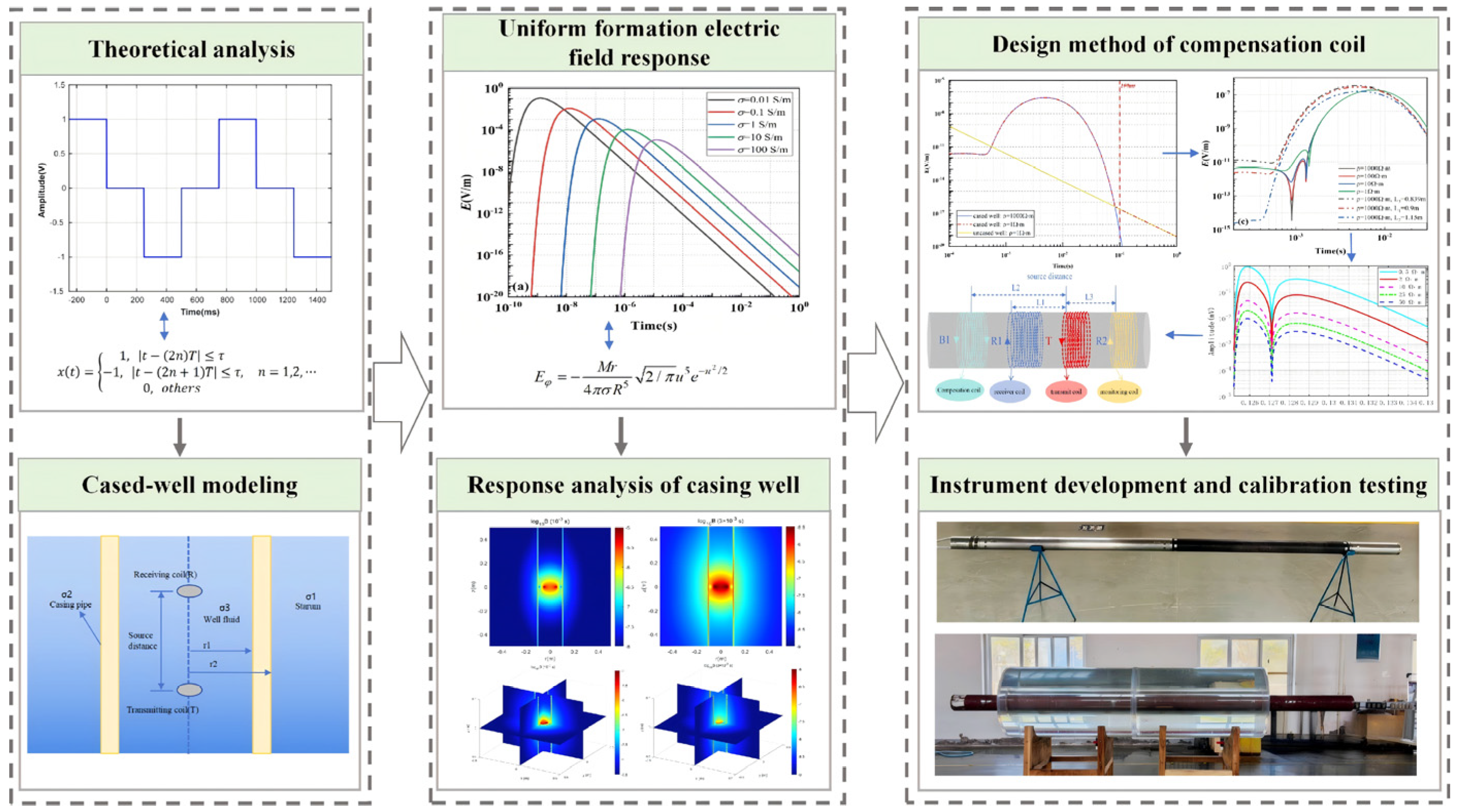
Time-Domain Electromagnetic Instrument for Onshore and Offshore Petroleum Resource Prospecting
 ,
, Abstract
Share and Cite
Zhang, Q.; Li, Z.; Li, G.; Xia, J.; Li, F.; Huang, K.; Yang, X.; Wu, X. Time-Domain Electromagnetic Instrument for Onshore and Offshore Petroleum Resource Prospecting. J. Mar. Sci. Eng. 2026, 14, 407. https://doi.org/10.3390/jmse14050407
Zhang Q, Li Z, Li G, Xia J, Li F, Huang K, Yang X, Wu X. Time-Domain Electromagnetic Instrument for Onshore and Offshore Petroleum Resource Prospecting. Journal of Marine Science and Engineering. 2026; 14(5):407. https://doi.org/10.3390/jmse14050407
Chicago/Turabian StyleZhang, Qingle, Zhiqiang Li, Guangming Li, Jigen Xia, Fangong Li, Kegong Huang, Xiaodong Yang, and Xiaoping Wu. 2026. "Time-Domain Electromagnetic Instrument for Onshore and Offshore Petroleum Resource Prospecting" Journal of Marine Science and Engineering 14, no. 5: 407. https://doi.org/10.3390/jmse14050407
APA StyleZhang, Q., Li, Z., Li, G., Xia, J., Li, F., Huang, K., Yang, X., & Wu, X. (2026). Time-Domain Electromagnetic Instrument for Onshore and Offshore Petroleum Resource Prospecting. Journal of Marine Science and Engineering, 14(5), 407. https://doi.org/10.3390/jmse14050407