Article

Piezoelectric Analysis of a Hydrofoil Undergoing Vortex-Induced Vibration

School of Naval Architecture & Ocean Engineering, Jiangsu University of Science and Technology, Zhenjiang 212003, China
*
Author to whom correspondence should be addressed.
J. Mar. Sci. Eng. 2026, 14(4), 385; https://doi.org/10.3390/jmse14040385
Submission received: 19 January 2026 / Revised: 13 February 2026 / Accepted: 13 February 2026 / Published: 18 February 2026
(This article belongs to the Special Issue Advances in Marine Engineering Hydrodynamics, 2nd Edition)

Abstract

This study numerically investigates the piezoelectric behavior of a hydrofoil under vortex-induced excitation. The fluid field, characterized by a Kármán vortex street forming around the hydrofoil, is solved using the finite volume method (FVM) based on viscous flow theory. The resulting vortex-induced pressure is then imported to compute the electric field by solving a coupled electromechanical problem within the finite element method (FEM) framework, which links the electric and strain fields. The temporal and spatial distribution of the voltage under the periodic excitation force is provided, and the affecting factors, including the attack angle and the flow velocity, are analyzed in detail.

1. Introduction

Hydrofoils have important applications in the field of naval architecture and ocean engineering, such as drag reduction and motion stabilization and energy conversion through turbines [1,2]. However, the vortex-induced vibration during the flow around a hydrofoil may have adverse effects. Hence, some scholars utilize piezoelectric materials to suppress vortex-induced vibrations. For example, Shigeki et al. [3] developed an active control method for vortex-induced vibration using a piezoelectric actuator, and Hasheminejad and Masoumi [4] developed a feedback control model incorporating piezoelectric actuators to suppress vortex-induced vibrations of an elastic cylinder.
Apart from suppressing vibrations, it represents a more attractive proposition to harness piezoelectric materials for converting the mechanical energy from vortex-induced vibrations into electrical power which can directly support marine equipment. Taylor et al. [5] and Allen and Smits [6] proposed the design of the energy-harvesting Eel by placing the piezoelectric plate in the wake of a rectangular plate and bluff body. Du et al. [7] placed a piezoelectric plate in the wake region of a cylinder. Another important design is employing cylinders as the basic flow-around structure to induce deformation in connected piezoelectric components [8,9,10]. Building on the cylindrical structure, Kan et al. [11] introduced a flow-blocking plate, which effectively enhanced the vortex-induced vibration effect. Jamil et al. [12] designed a flapping-wing-based piezoelectric energy harvesting device, which utilizes ocean currents to drive periodic motion of the wings, thereby exciting deformation in the piezoelectric material. Hafizh et al. [13] proposed a piezoelectric energy harvester based on a pipe array for capturing energy from vortex-induced vibrations.
Utilizing wave energy to harvest electric energy through piezoelectric materials is also frequently considered. Shoele [14] developed a numerical model for flexible piezoelectric plates under the simultaneous action of waves and currents. Many designs are for wave energy only. One such concept is that wave energy is first transformed into mechanical energy, which is then converted into electrical energy through the interaction between the device’s internal structure and a piezoelectric plate. Notable works in this area include studies by Viñolo et al. [15] and Okada et al. [16]. Another approach involves exposing the piezoelectric plate directly to waves, enabling the wave energy to be converted into electrical energy via the uneven temporal and spatial distribution of wave pressure. For example, Zurkinden et al. [17] applied the finite element method on seabed-fixed piezoelectric plates, Tanaka et al. [18] conducted experimental studies for piezoelectric plate arrays, Mutsuda et al. [19] used the experimental method and SPH method for a plate piercing through the water’s surface, and Wang et al. [20] used the immersed boundary method for a vertically installed plate fixed at the seabed and extending through the water surface. Wu et al. [21] investigated a piezoelectric-coupled buoy wave energy harvester. Zheng et al. [22] installed a PWEC on the wave-facing side of a breakwater. He et al. [23] and Yang et al. [24] undertook experimental studies on piezoelectric waver energy converters, and a CFD-based numerical method was employed by Li et al. [25] to investigate the piezoelectric conversion mechanism of wave energy using a plate-based structure.
In designs that achieve piezoelectric conversion using uniform flow, piezoelectric devices are typically placed in the wake vortex behind flow-around structures or driven by vortex-induced vibrations of these structures to facilitate energy conversion. This requires more complex configurations and greater spatial occupation for the deployment of piezoelectric devices. Therefore, we propose a piezoelectric hydrofoil that directly utilizes the flow-around structure as the piezoelectric output device. Such a device can be installed on ships for purposes like anti-rolling or drag reduction while simultaneously generating electricity. To obtain the vortex-induced excitation force, viscous flow theory in conjunction with the finite volume method (FVM) is employed, accounting for the effects of currents. The electric field is obtained using the finite element method (FEM).

2. Description of the System

The sketch in Figure 1 depicts the incoming flow passing the piezoelectric composite hydrofoil, and the NACA0006 hydrofoil, with a chord length c of 0.1 m, a width b of 0.1 m, and a maximum thickness of 0.006 m, was chosen as the hydrofoil model. The vortex shedding that occurs as fluid flows around the hydrofoil induces structural deformation, which in turn is converted into electrical power. The origin (Point O) is defined at the middle point of the chord, the x axis is aligned with the flow direction, the y axis represents the transverse span perpendicular to the flow, and the z axis extends vertically, defining the direction of the gravitational field (opposite to the gravity acceleration vector). The blue arrow points in the direction of fluid movement. The Reynolds number in this work ranged from Re = 15,000 to 35,000. This range was selected to facilitate small-scale experimental validation and ensure stable vortex shedding.

3. Numerical Procedure

3.1. Fluid Field

This numerical model was based on viscous, incompressible flow theory. The computational domain is discretized using the finite volume method (FVM), and the free surface is captured with the volume of fluid (VOF) method. The flow is governed by the Reynolds-averaged Navier–Stokes (RANS) and continuity equations. The RANS equations are obtained by decomposing flow variables into mean and fluctuating parts and time-averaging the Navier–Stokes equations. The RANS approach was selected over more computationally expensive methods like LES or DES because this study focuses primarily on fluid pressure for piezoelectric response analysis, prioritizing computational efficiency. For incompressible flow, the time-averaged continuity and RANS equations can be written in tensor form:
u ¯ i x i = 0
ρ u ¯ i t + u j ρ u ¯ i x j = p ¯ x i + ρ f ¯ i + x j μ u ¯ i x j + u ¯ j x i ρ u i u j ¯ x j
where t is the time, ρ is the density of the fluid, μ is the viscosity coefficient, p ¯ refers to the mean pressure where the overbar illustrates the time average, u ¯ i ( u ¯ j ) are the mean velocity components of the fluid, and f ¯ i is the mean mass force which, in general, is the acceleration of gravity in a gravity field.
The SST   k ω turbulence model [26] was used to close the RANS equations:
ρ k t = τ i j u i x j β * ρ k ω + x j μ + σ k μ T k x j
ρ ω t = γ ν t τ i j u i x j β ρ ω 2 + x j [ ( μ + σ ω μ T ) ω x j ] + 2 ρ 1 F 1 σ ω 2 1 ω k x j ω x j
In Equation (3), k denotes the turbulent kinetic energy, while ω in Equation (4) represents the turbulent dissipation rate. Meanwhile μ T = ρ k / ω is the coefficient of the eddy viscosity, F 1 is a parameter whose equation can be found in the work of Menter [26], and other parameters, including σ k , σ ω , β * , β , k , and γ , are calculated with ϕ = ϕ 1 F 1 + ϕ 2 1 F 1 , in which ϕ denotes any one of former parameters, ϕ 1 is obtained from Wilcox model, and ϕ 2 is from the standard k ε model. The turbulence tensor τ i j = ρ u i u j ¯ is given by
τ i j = μ T u ¯ i x j + u ¯ j x i 2 3 u ¯ k x k δ i j 2 3 ρ k δ i j
Moreover, the volume of fluid (VOF) method is used to capture the free surface elevation in the two-phase flow model, which is governed by
α t + ( α u i ) x i = 0
where a volume fraction α is described as the ratio of the water volume to the total volume in a cell. In grid cells containing the interface, the fluid properties (such as the density ρ and dynamic viscosity μ) are calculated by a weighted average based on the volume fraction α:
ρ = ρ w α + ρ a 1 α
μ = μ w α + μ a 1 α
where ρ w and ρ a are the densities of water and air, respectively.

3.2. Structural Response

When piezoelectric effects are involved, the relationship between the electric field and strain field take the form illustrated by Jbaily and Yeung [27]:
σ i j = c i j , k l ε k l e i j , k E k ,  
D m = e m , k l ε k l + ϵ m k s E k ,    
where ε k l and σ k l denote the strain tensor and stress tensor, respectively, E k ( V / m ) and D m ( C / m 2 ) are the electric field and electric displacement, respectively, with three components, and ϵ m q s = ϵ m q d m , i j c i j , k l d k l , q is a dielectric constant matrix under constant strain (fixed edge condition), in which ϵ m q ( C / V m ) is the dielectric permittivities under constant stress (free edge condition) (values given in Table 1) and c i j , k l is the elastic matrix of the material, which can be calculated through the coefficients in Table 2. The material “PZT-5A” is used in Table 2, and the parameters were obtained from the material library of ANSYS (2022R1). Additionally, d m , i j ( C / N ) and e m , k l = d m , i j c i j , k l   ( C / m 2 , Table 3) represents the piezoelectric coefficients, which represent the electrical displacement created in the m direction by a stress applied in the ij direction or a strain in the kl direction, and vice versa. The controlling equations for the electric field consist of both mechanical equilibrium equations and electrical equilibrium equations, and they take the form of
σ i j x j + ρ u ¨ i = p i
· D m = 0
where u i is the displacement field within each element, with the relationship ε i j = 1 2 u i x j + u j x i , in which u ¨ i is the resulting acceleration and p i is the fluid pressure (Section 3.1). The electric field is the negative gradient of the electric potential E m = ϕ x m . By substituting Equations (9) and (10) into Equations (11) and (12), we have
ρ u ¨ i c i j k l 2 u k x j x i e i j m 2 ϕ x j x m = F i ,  
e m k l 2 u k x l x m ϵ m k s 2 ϕ x q x k = 0 ,
In the finite element method, the entire structure is discretized into numerous small elements. The displacement field u i within each element is approximated using the nodal displacement vector { U i } and the shape functions N u . The electric potential field (φ) within each element is approximated using the nodal potential vector {V} and the shape functions N v such that
u i = [ N u ] U i , φ = [ N v ] V ,
By submitting Equation (15) into (14) and using the Galerkin method, Equations (13) and (14) can be transformed into
K U U K U V K U V T K V V   U V + M U U 0 0 0   U ˙ V ˙ = F 0  
where K U U is structural stiffness, K V V is the dielectric permittivity, K U V is the piezoelectric coupling, M U U is the mass of the structure, and F is the fluid force.

4. Numerical Results and Discussions

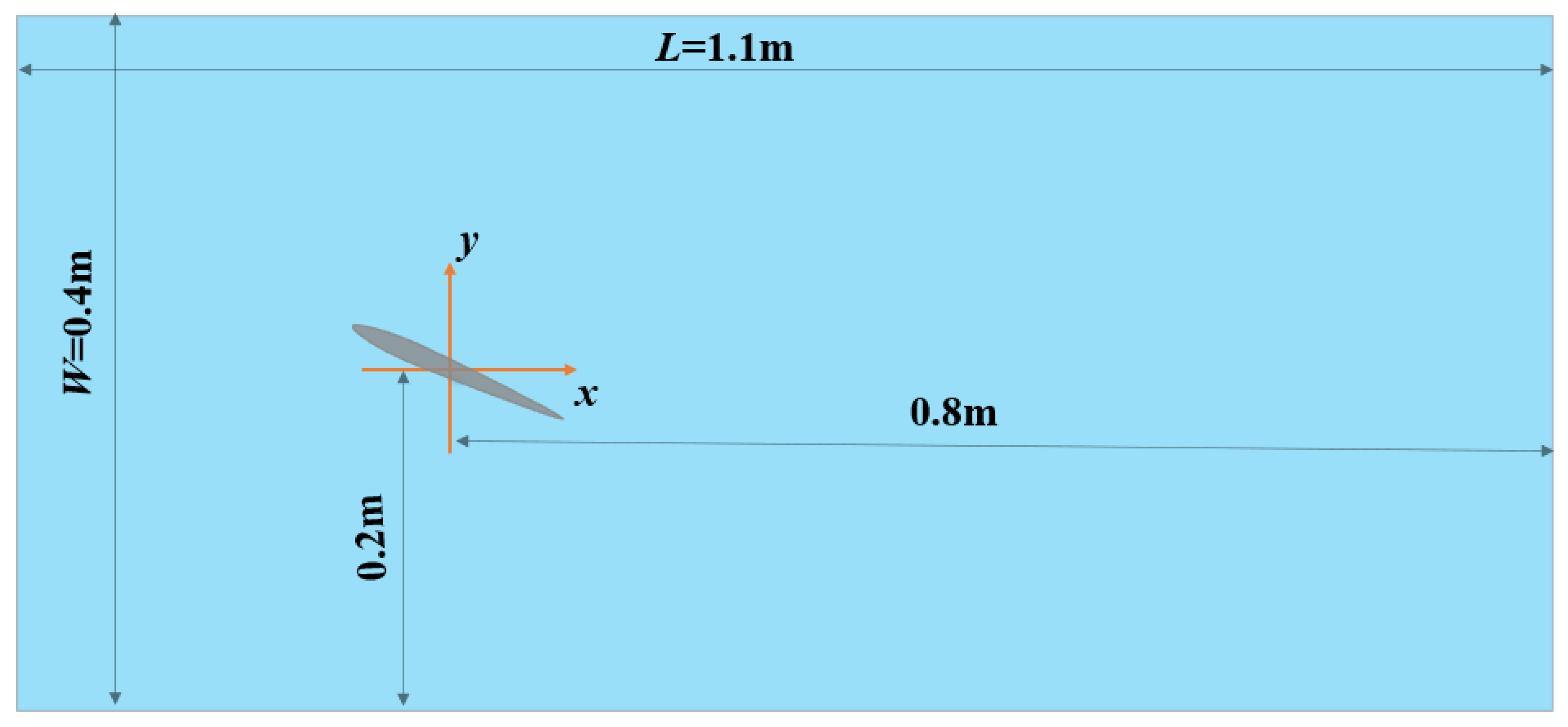
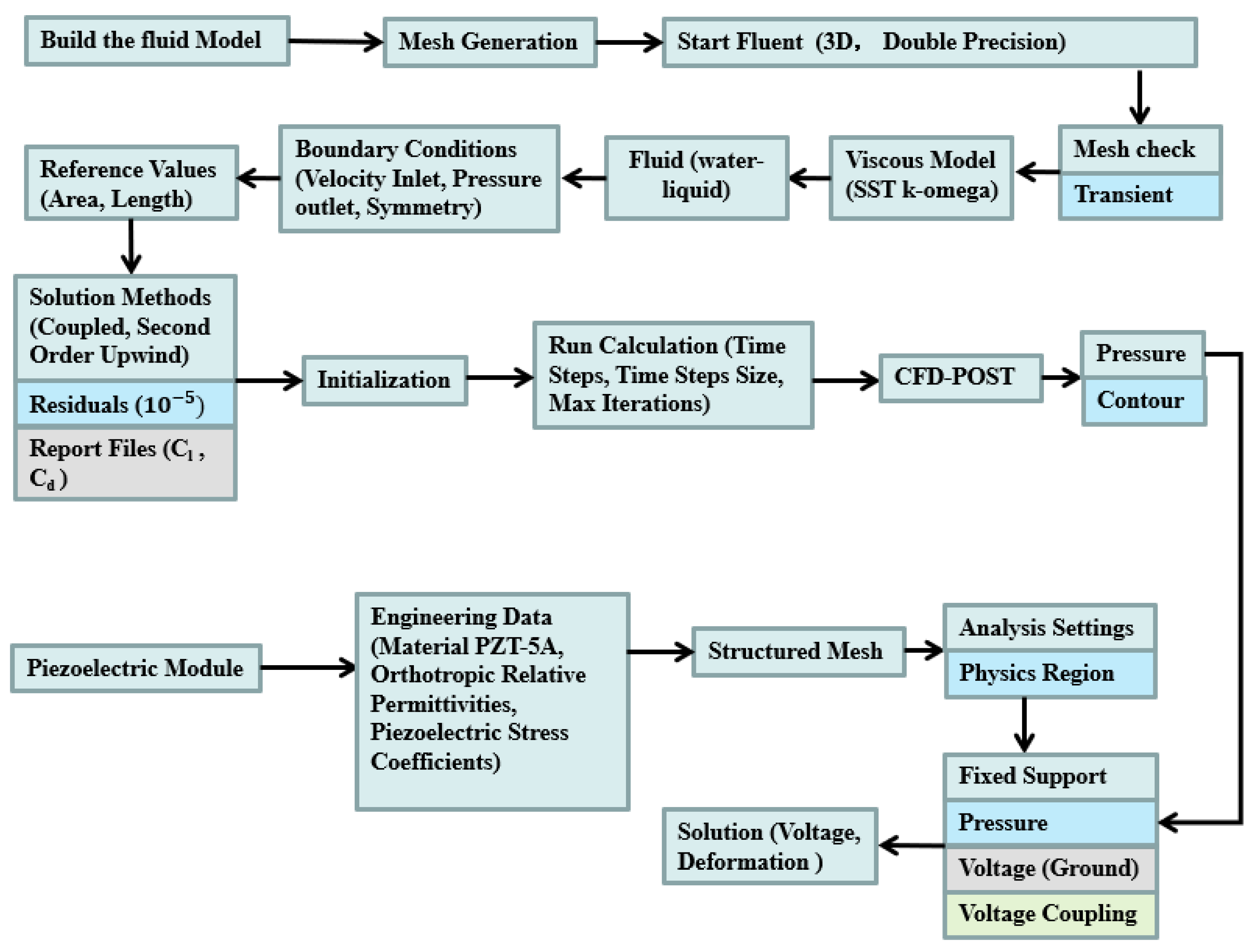
The computational domain had a size of 1.1 m, 0.4 m, 0.1 m in the x, y, and z directions, respectively. The specific distances from the middle point of the chord of the hydrofoil to the inlet, outlet, and top or bottom boundaries of the domain are indicated in Figure 2. The gray area indicates the projection view of the wing in the z direction. A uniform-velocity inlet boundary condition was applied at x = 0.3   m , while a pressure outlet boundary condition with a zero-velocity gradient was specified at x = 0.8   m . Given the sufficient distances from the hydrofoil to the top and bottom boundaries, these were modelled as no-slip walls. The surface of the hydrofoil was also treated as no-slip wall boundaries. The fluid field was solved using the finite volume method (FVM) implemented in ANSYS Fluent. The pressure obtained in Fluent would be loaded to the ANSYS Piezo and MEMS module for the piezoelectric analysis, as shown in the flowchart in Figure 3.
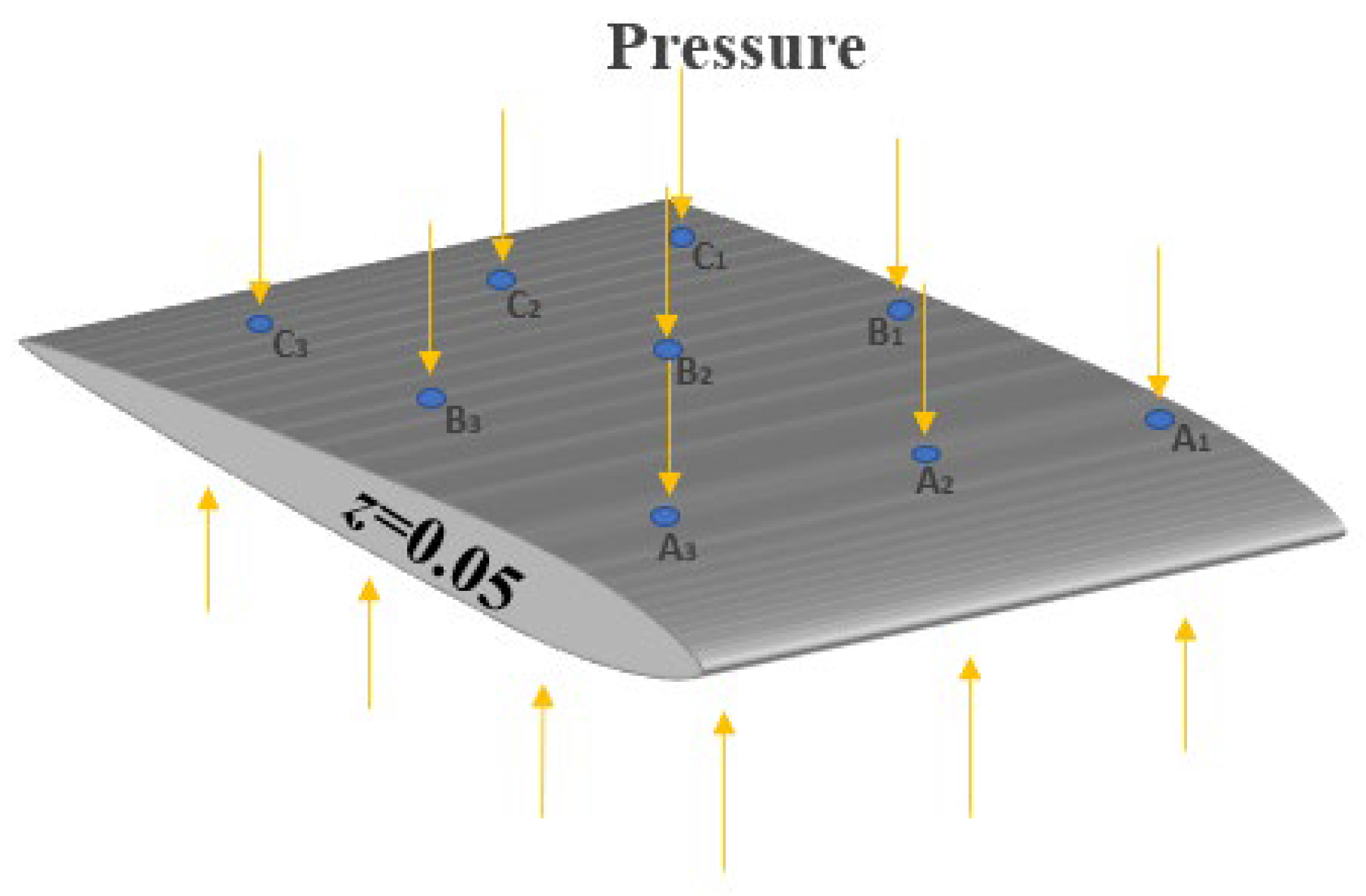
The piezoelectric hydrofoil, subjected to the vortex-induced excitation force on its upper and lower surfaces within the flow field, was constrained with a fixed-edge boundary condition at the plane z = 0.05 m. The piezoelectric body was divided into nine areas. In each area, the pressure difference at the center of each area was used for the loading of the hydrofoil in the piezoelectric module. The electric field could then be generated under the fluid pressure, and the division of the pressure area can be found in Figure 4.

4.1. Convergence Study

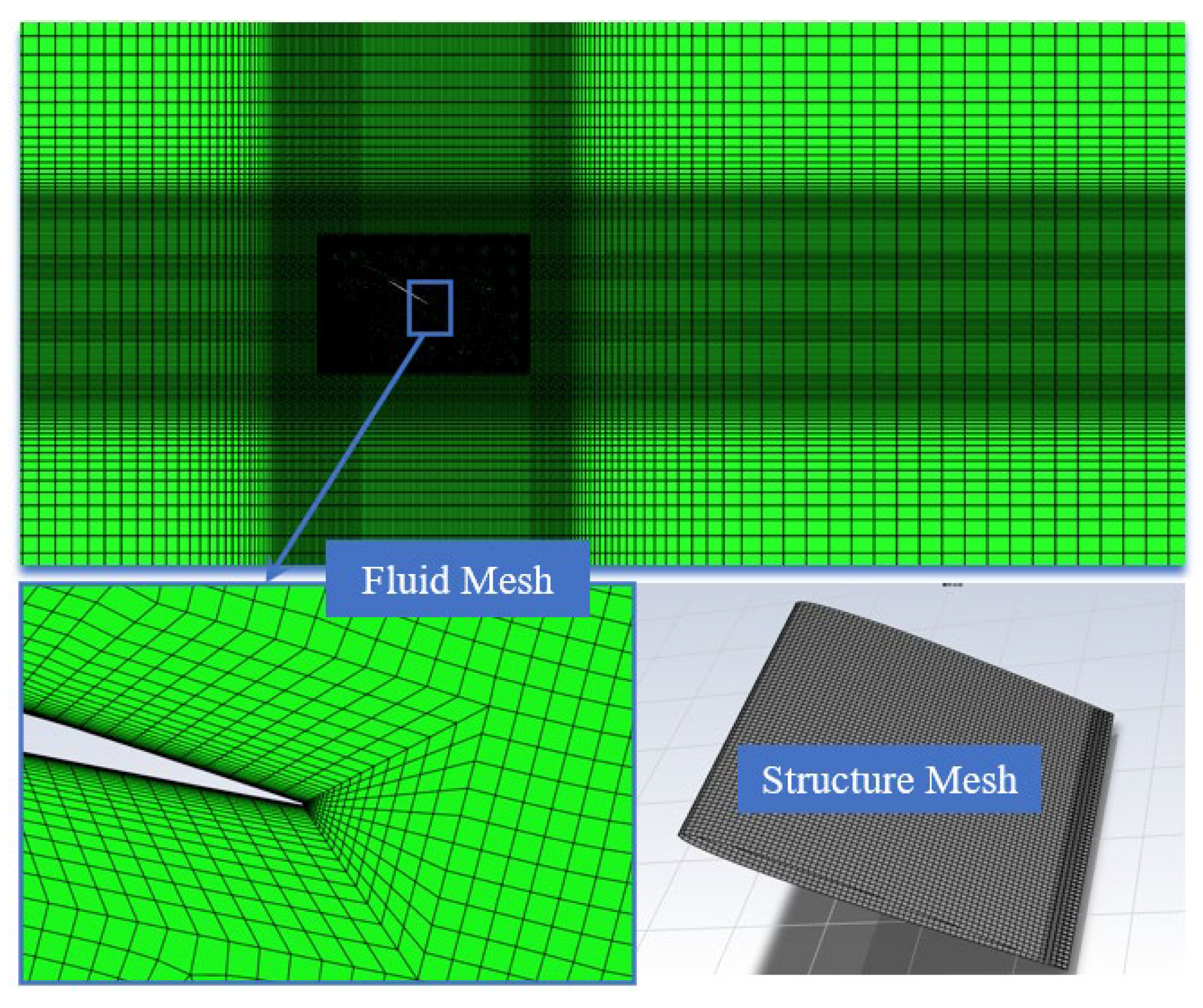
The computational domain was discretized using ANSYS Meshing software, with a hexahedral-dominant topology adopted throughout to balance computational accuracy and convergence efficiency. Figure 5 illustrates the mesh distribution of the fluid domain and the piezoelectric structure. For clarity, the grid sizes in the x, y, and z directions are denoted as Δx, Δy, and Δz, respectively. In the piezoelectric structural module, the hydrofoil was discretized using hexahedral elements via ANSYS Meshing, with a uniform grid size of Δx, Δy, Δz = 0.001, 0.001, 0.001 m applied throughout the structural component (see Figure 5).
Figure 5 also provides the grid division of the fluid domain, in which uneven mesh distribution was used, and Δz = 0.001 m was used throughout the fluid domain. A local mesh refinement for the x direction and y direction was applied to the region surrounding the flexible hydrofoil. Within the refined region of 0.1 x 0.1 , Δx = 0.001 m was used, while in the domain outside of the refined region, the grid size Δx increased gradually at a fixed ratio of 1.2 until reaching a maximum size of 0.004 m. A similar grid variation strategy was applied in Δy, apart from the boundary layer attached to the body surface, whose thickness was taken to be 1.098 × 10 3 m . In this thin layer, a much smaller Δy was used, which increased gradually from 0.00002 m on the body surface to 2.126 × 10 4 m on the outer boundary of the boundary layer. The thickness of the first layer was calculated to achieve y + = 2 through the equation y + = 0.172 Δ y c R e 0.9 [28]. For the region beyond the boundary layer and within the confined region, Δy = 0.001 was used.
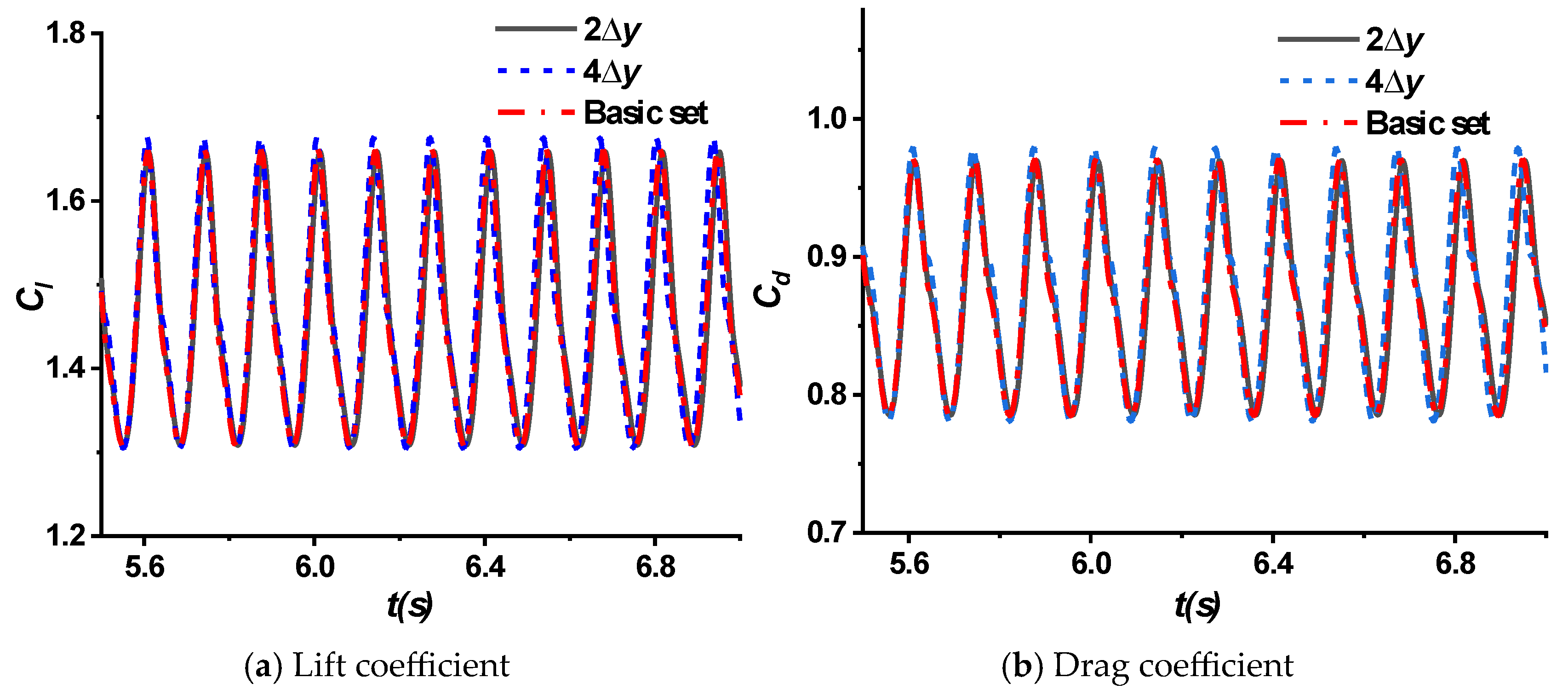
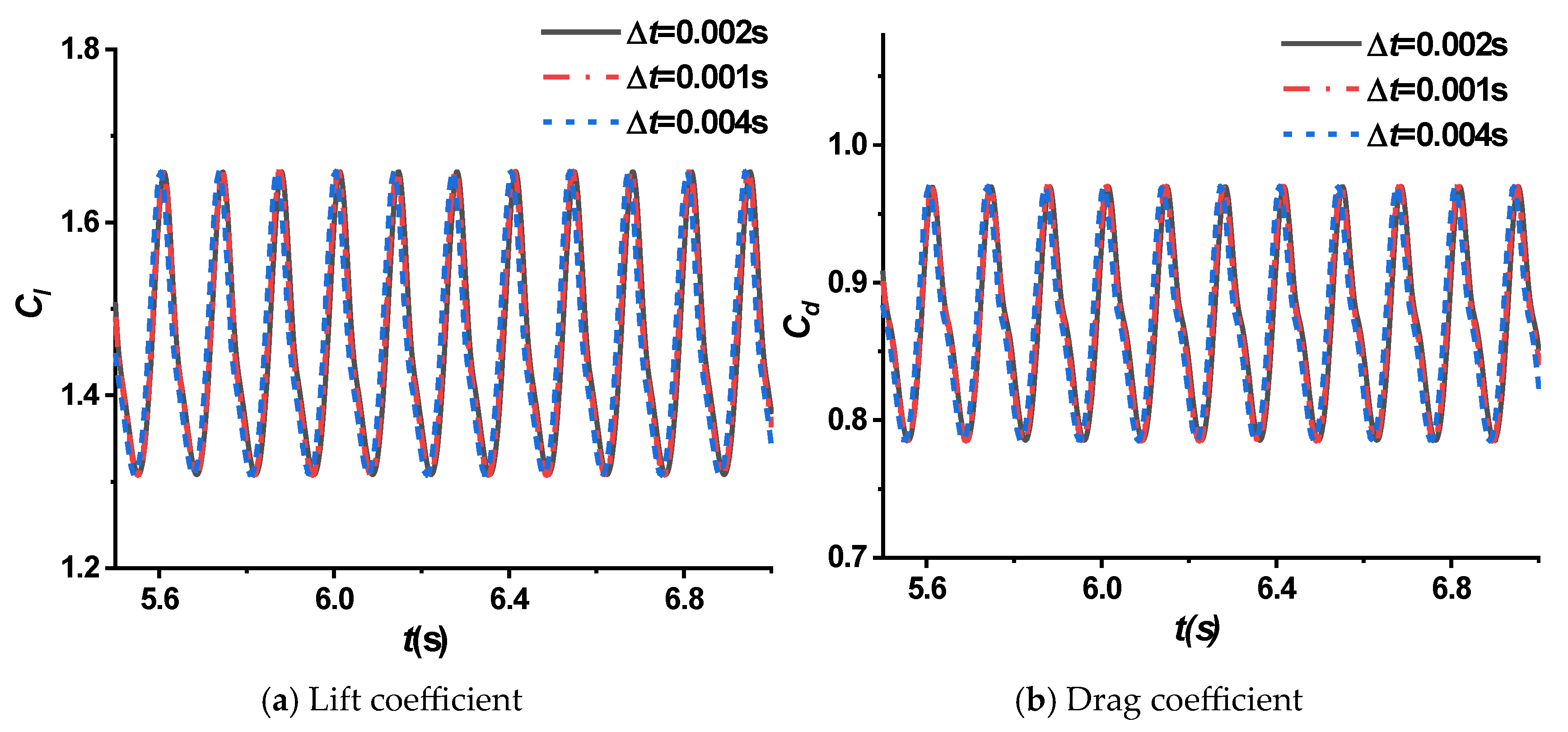
Three types of grids were chosen for the convergence study. In addition to the above grid settings, two new grids were used for comparison: one with a twofold increase and the other with a fourfold increase in Δy. The time step Δt was set to 0.001 s, 0.002 s, and 0.004 s for the convergence study. As shown in Figure 6 and Figure 7, both the lift coefficient C l and drag coefficient C d with different grids and time steps were in good agreement, and this means the present work is convergent.
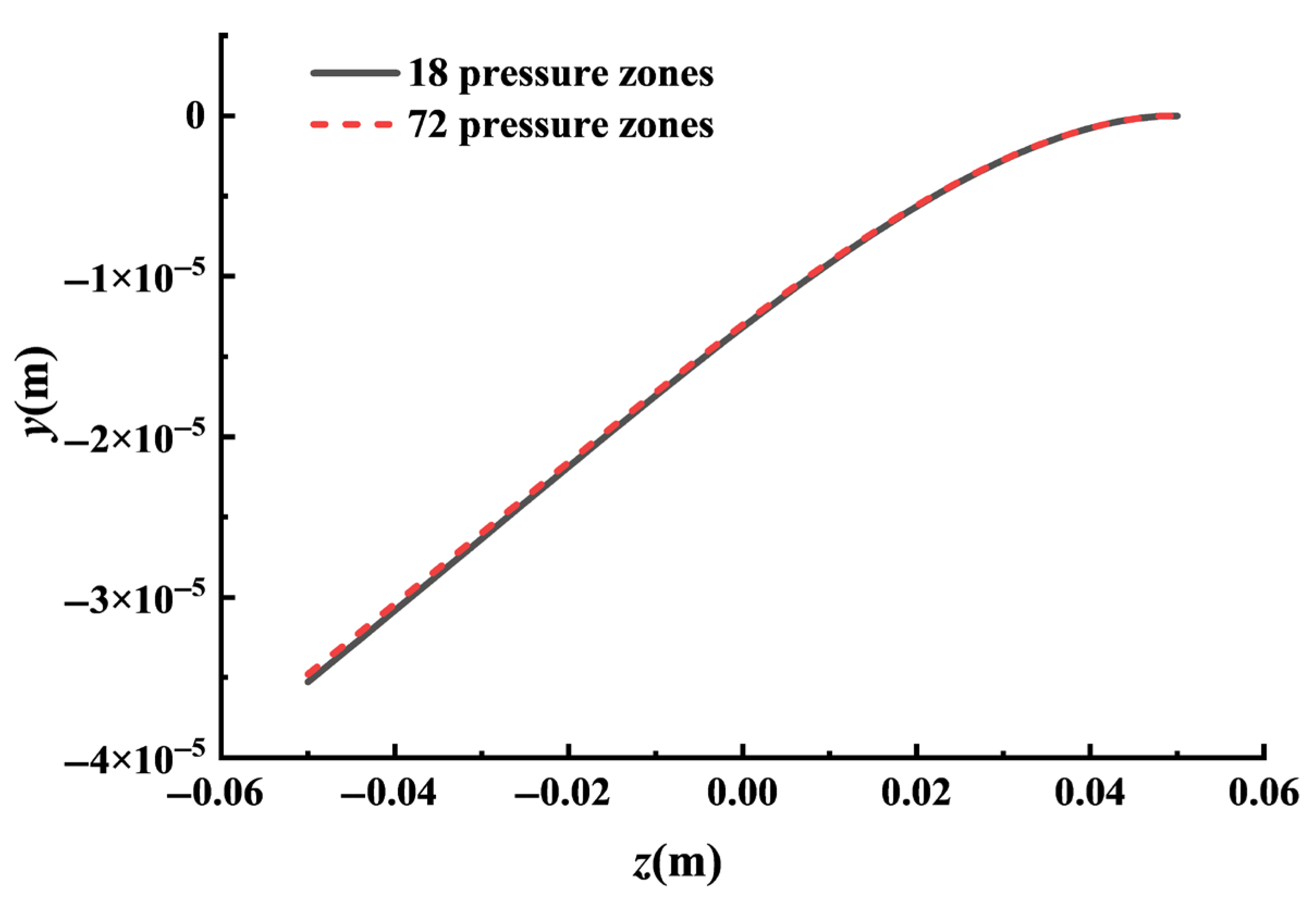
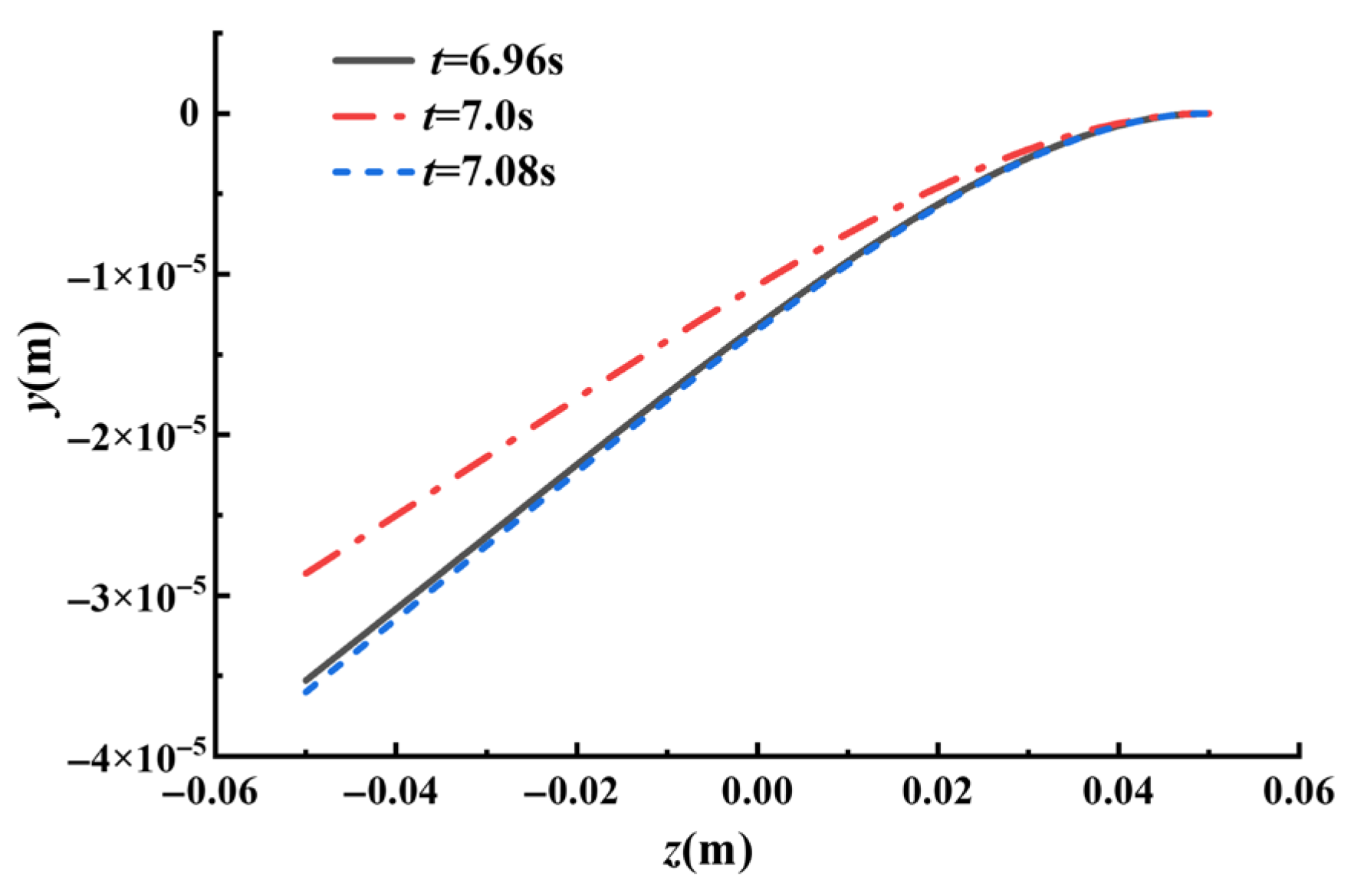
To investigate the convergence of the pressure zone division, the pressure surface is divided into 18 and 72 zones. These configurations were then imported into the piezoelectric module, causing the foil to deform and generate voltage. Figure 8 shows the deformation of the hydrofoil at the plane x = 0 m with α = 30 ° and v = 2 m/s. The two curves corresponding to different numbers of pressure zones were quite close to each other. Therefore, in the subsequent analysis, the pressure surface was divided into 18 zones for the piezoelectric study.

4.2. The Flow Field and Electric Field at Different Times

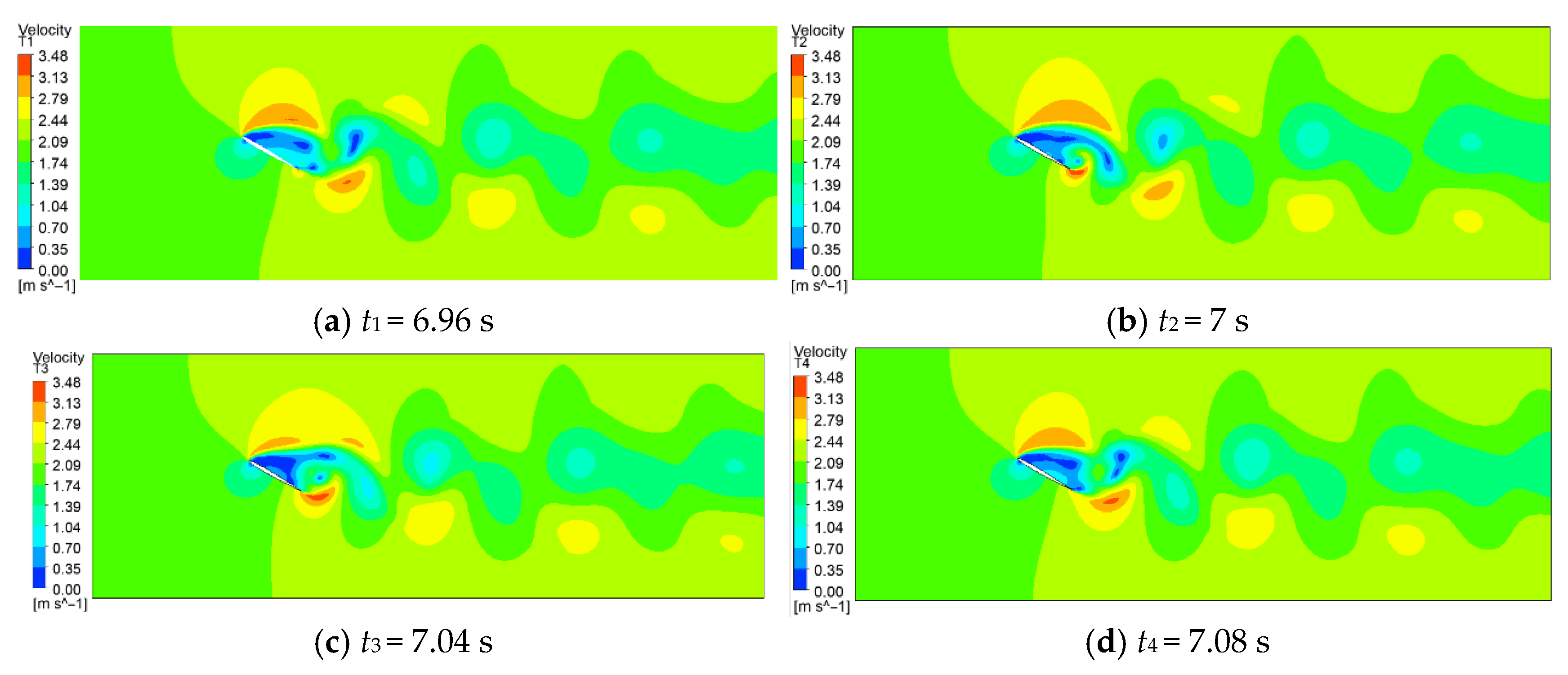
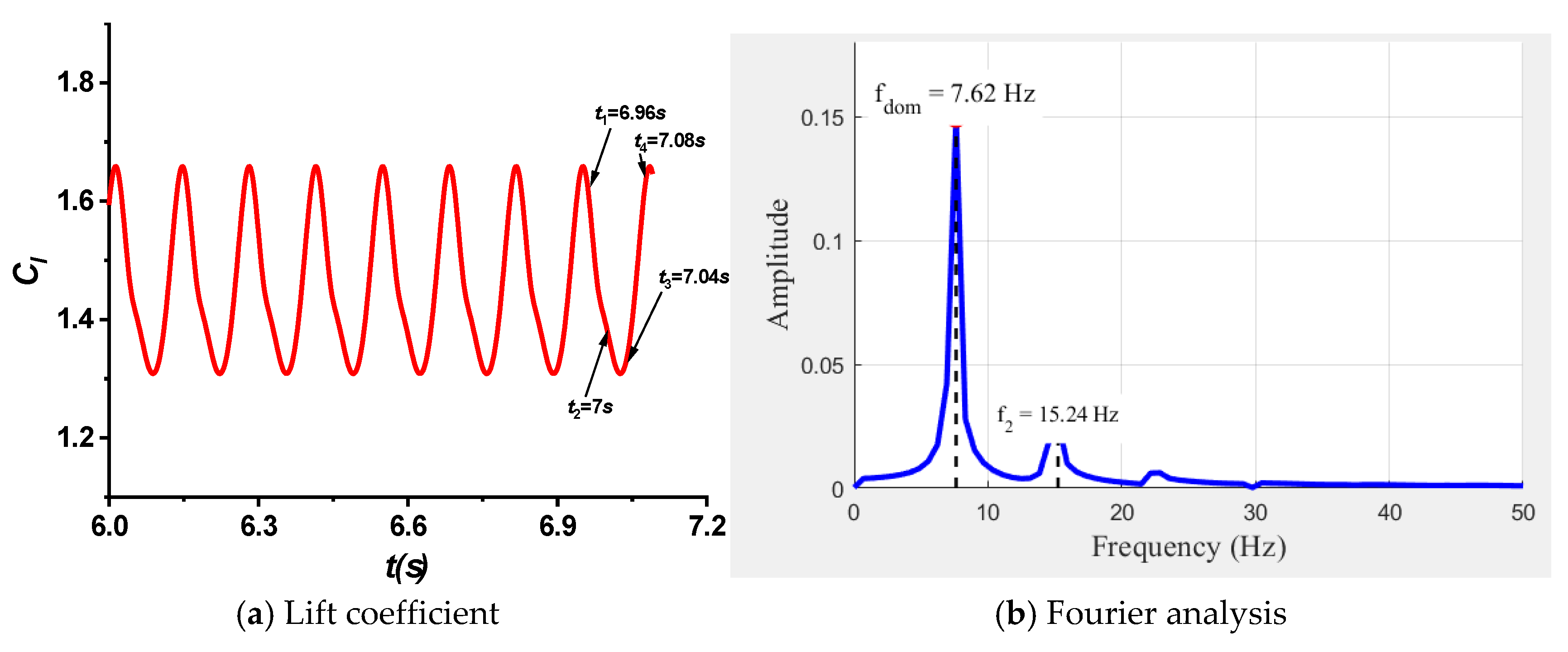
Figure 9a illustrates the time history of the lift coefficient of the hydrofoil at an attack angle of 30° under a flow velocity of 2 m/s, and Figure 9b provides the corresponding amplitude spectrum based on Fourier analysis. The lift coefficient demonstrated distinct periodic oscillations. The dominant frequency f d o m = 7.62   H z , and the second-order natural frequency was 15.25 Hz, which arose from the detachment of the boundary layer and the periodic vortex shedding from the back of the foil, as shown in Figure 10, which provides the velocity contour maps at four instants (t1 = 6.96 s, t2 = 7.00 s, t3 = 7.04 s, t4 = 7.08 s) corresponding to one complete oscillation cycle marked in Figure 9a. These maps show that at a small area on the upper part of the hydrofoil close to the leading edge, the velocities of fluid were close to zero. This created the conditions for boundary layer separation. As a result, the upper surface of the hydrofoil became fully engulfed in the vortex region. The inherent periodicity of the vortex shedding caused the surface pressure, and consequently the lift force, to fluctuate at a dominant frequency ( f d o m ). This transformed the steady flow energy into a periodic vortex-induced excitation force. The periodic excitation force acted on the integrated piezoelectric material. Through the material’s direct piezoelectric effect, this mechanical stress was converted into an alternating electric charge or output.
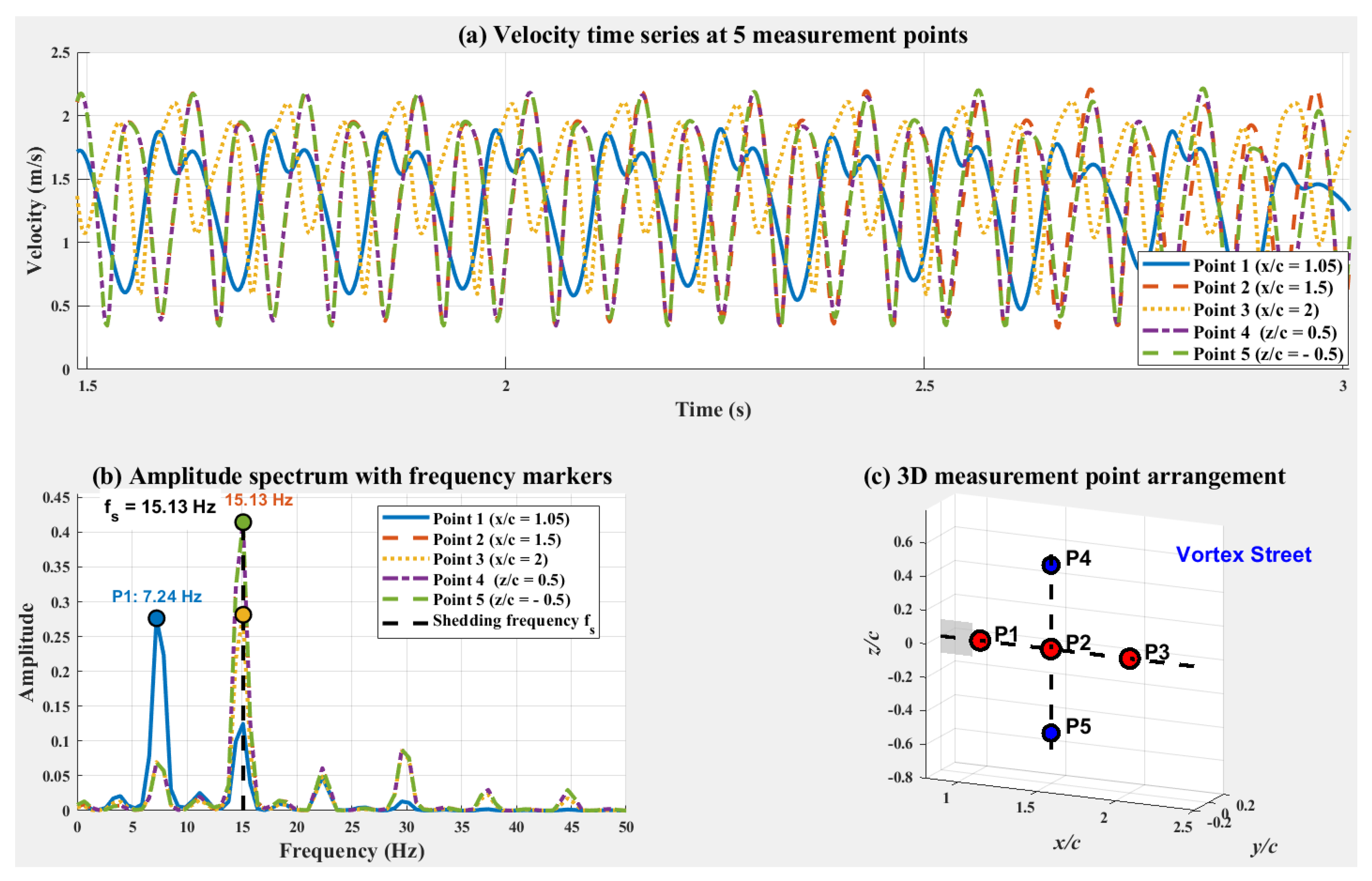
Figure 11 presents a Fourier analysis of the flow field structure based on velocity magnitude time series recorded at five monitoring points of the vortex zone shown in Figure 10. The spatial arrangement of these points is illustrated in Figure 11c, where all five points are set at the plane y = 0, points 1, 2, and 3 are arranged behind the trailing edge along the middle line or z = 0 at x c = 1.05 , 1.5 , and 2, respectively, and points 4 and 5 are arranged at the two sides of the middle line at x c = 1.5 and z c = ± 0.5 , respectively. Figure 11a shows the time histories of the velocity magnitude for all five points. Due to symmetry, the curves for points 4 and 5 overlap. Two dominant frequencies were observed in the time history of point 1, which can be attributed to its proximity to the trailing edge, where the flow was directly influenced by the hydrofoil’s geometry. This observation is further confirmed by the amplitude spectra in Figure 11b. From point 1 to point 2 or 3, the flow evolved from being dominated by 7.24 Hz with a secondary peak at 15.13 Hz to being dominated by 15.13 Hz with a secondary peak near 30 Hz. This reflects the evolution of vortex structures from large-scale (low-frequency) to small-scale (high-frequency), which may be attributed to vortex breakup or the energy cascade process. A comparison with Figure 9b and Figure 11b shows that the dominant frequency of the pressure closely matched that of point 1, which was the closest point to the hydrofoil. This indicates that the vortex shedding frequency from the trailing edge was 7.24 Hz. The observed twofold increase in frequency, relative to the natural frequency in the vortex field away from the trailing edge, resulted from the evolution of the vortex structures. This finding also implies that pressure fluctuation is primarily governed by the trailing-edge shedding frequency, which in turn influences the period of the electric field.
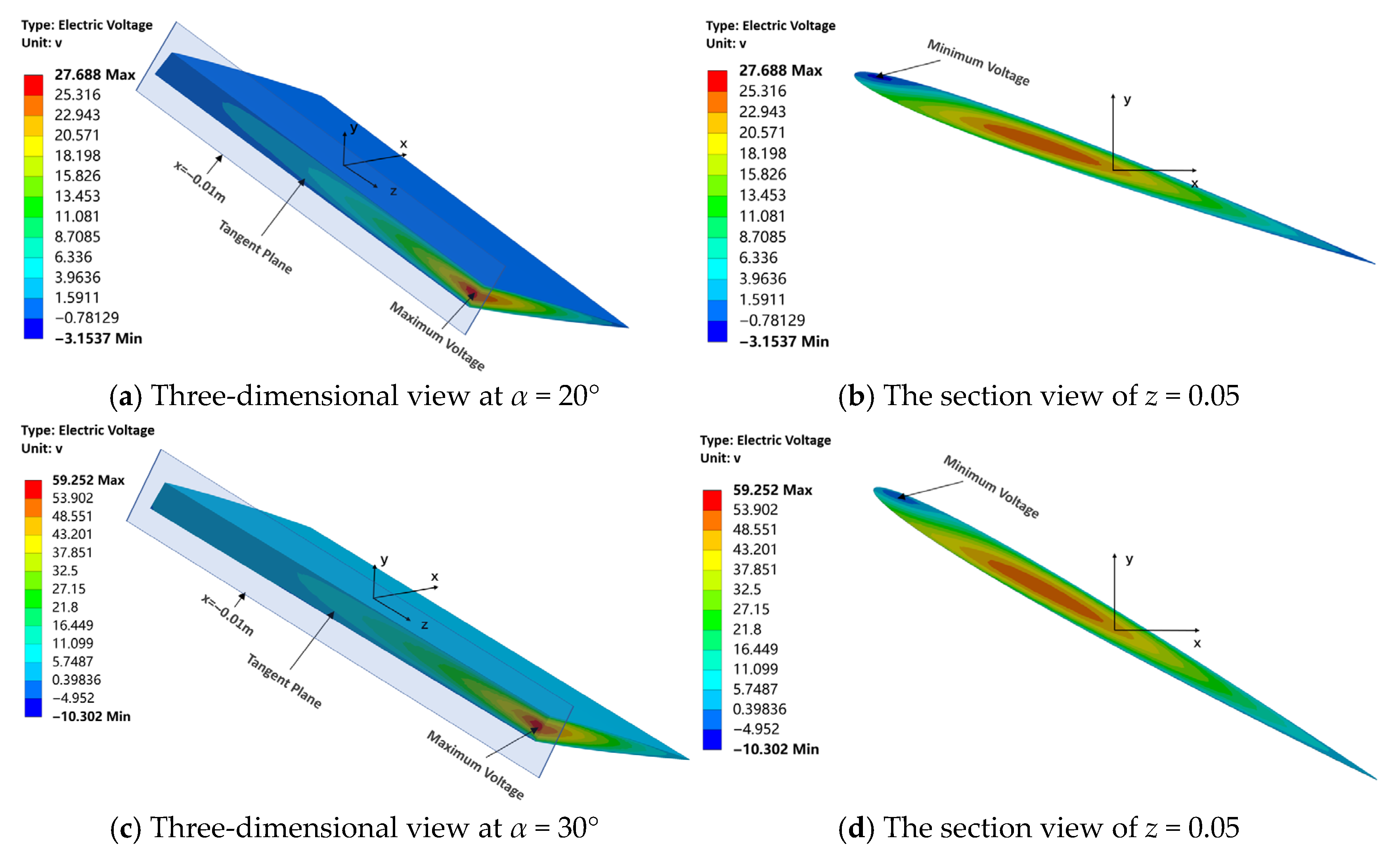
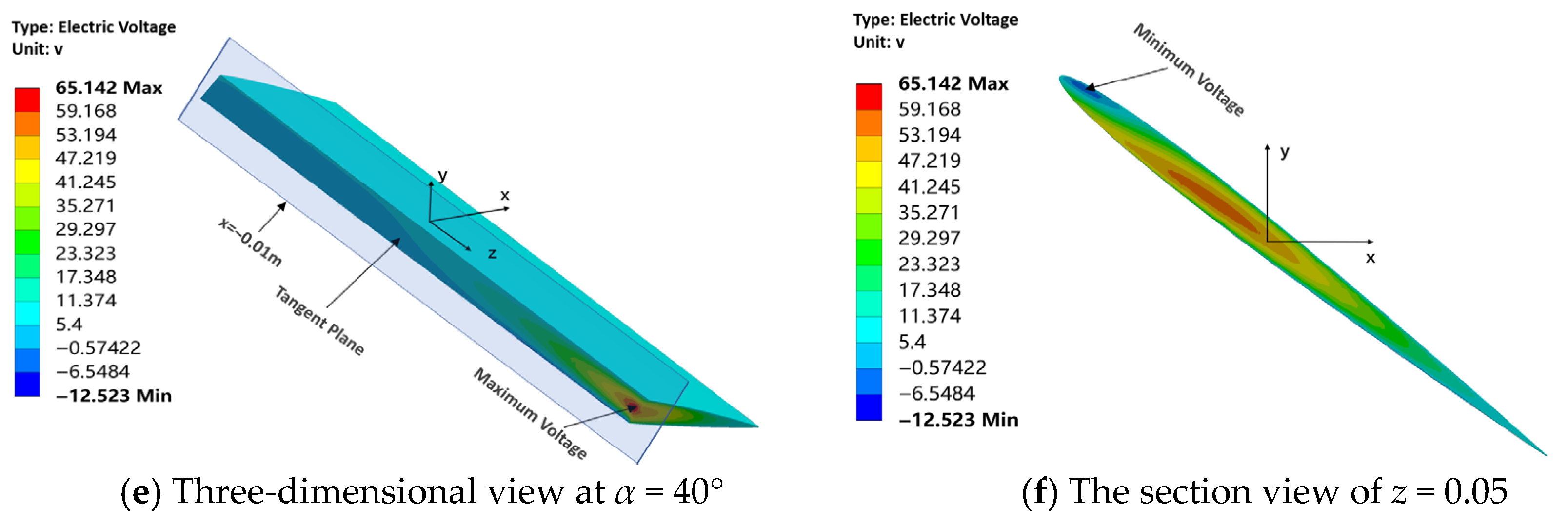
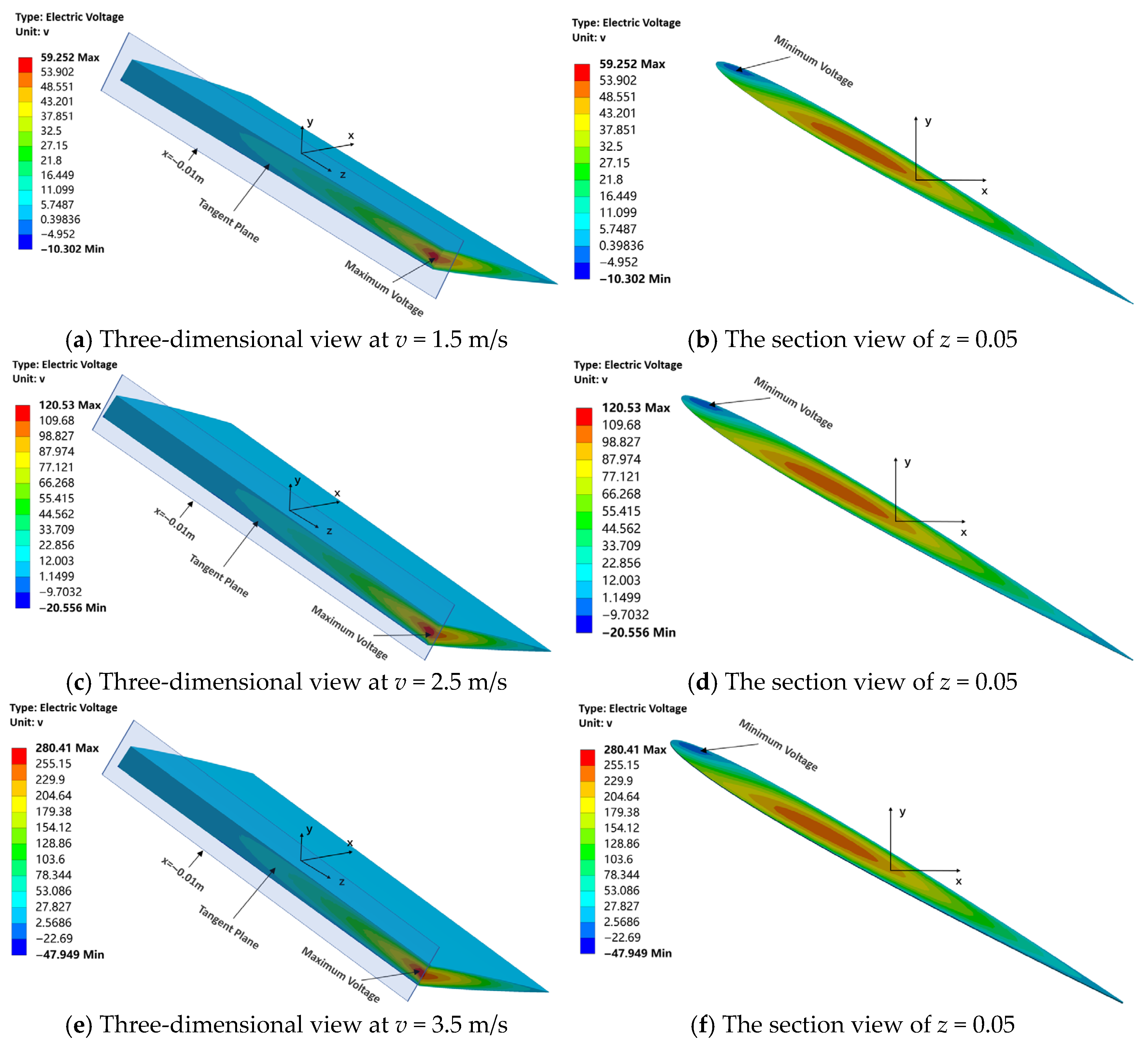
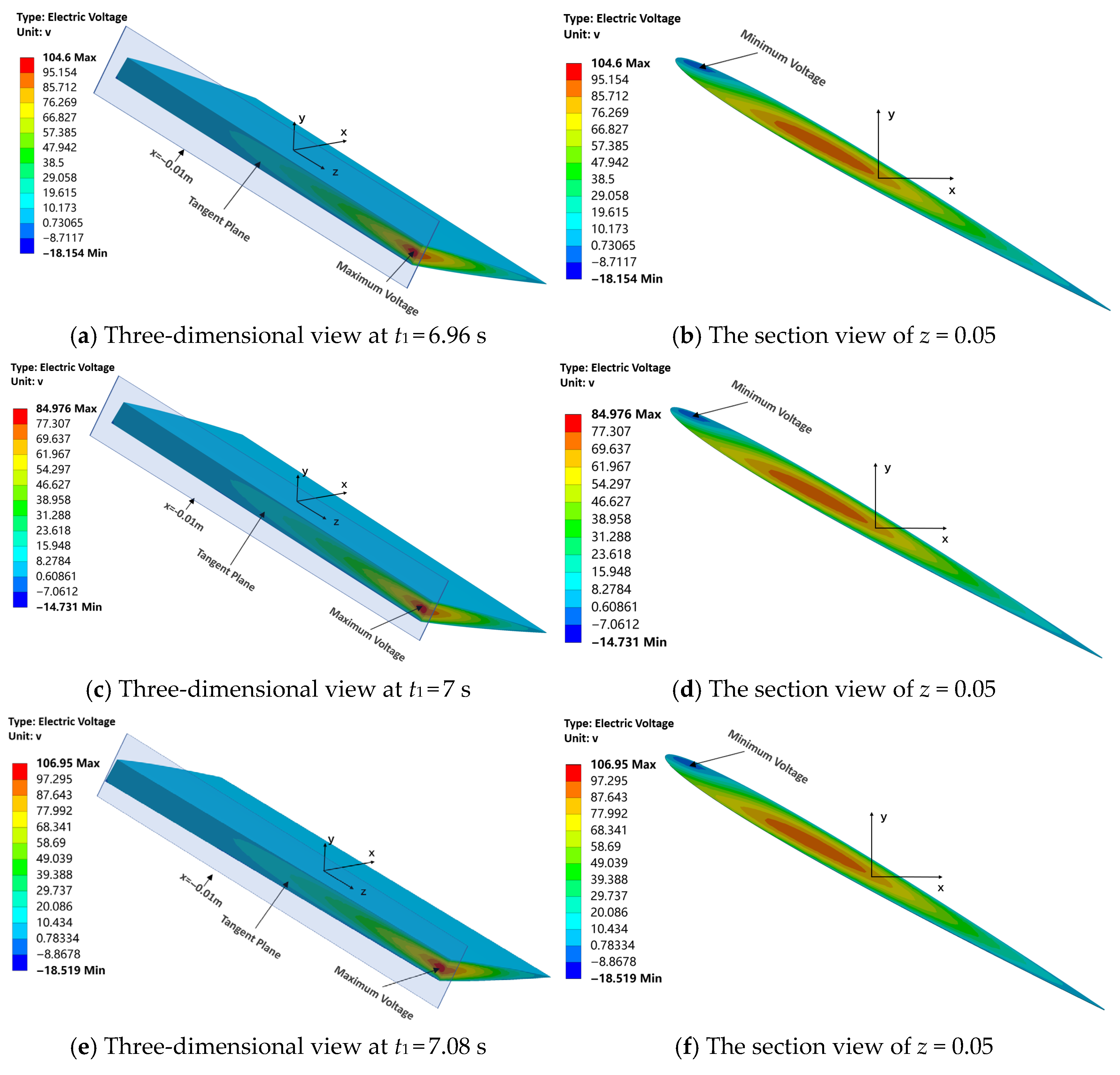
Figure 12 provides the deformation of the plane x = 0 m, and Figure 13a–f provides the voltage distribution at three instants, corresponding to t1, t2, and t4, as marked in Figure 9a. In Figure 13a,c,e, it can be observed that the voltage difference was most prominent at the fixed edge (z = 0.05 m). In the plane subjected to the fixed-edge boundary condition, the maximum positive voltage occurred near the center of the chord line, while the largest negative voltage appeared in a small area on the upper part of the leading edge, as shown in Figure 13b,d,f. Since the vortex-induced vibration force was periodic, the voltage difference was also periodic. Therefore, the largest voltage difference occurred at t1 = 7.08 s, as shown in Figure 13e,f, which corresponds to the instant when the lift coefficient nearly reached its peak, as seen in Figure 9a. This coincides with the conclusions in the work by Li et al. [25]. The result at 6.96 s was close to that at 7.08 s, since its lift coefficient was also close to the peak. At t = 7 s, the voltage difference became significantly smaller, which is because the lift coefficient or the pressure difference was noticeably smaller at this instant, as shown in Figure 9a. Correspondingly, the deformations of t = 6.96 s and 7.08 s were close and to larger than that at 7 s, as seen in Figure 12. Thus, it can be concluded that the periodic vortex-induced excitation force led to periodic variation in the lifting force and the voltage difference of the piezoelectric hydrofoil.

4.3. Piezoelectric Field at Different Attack Angles

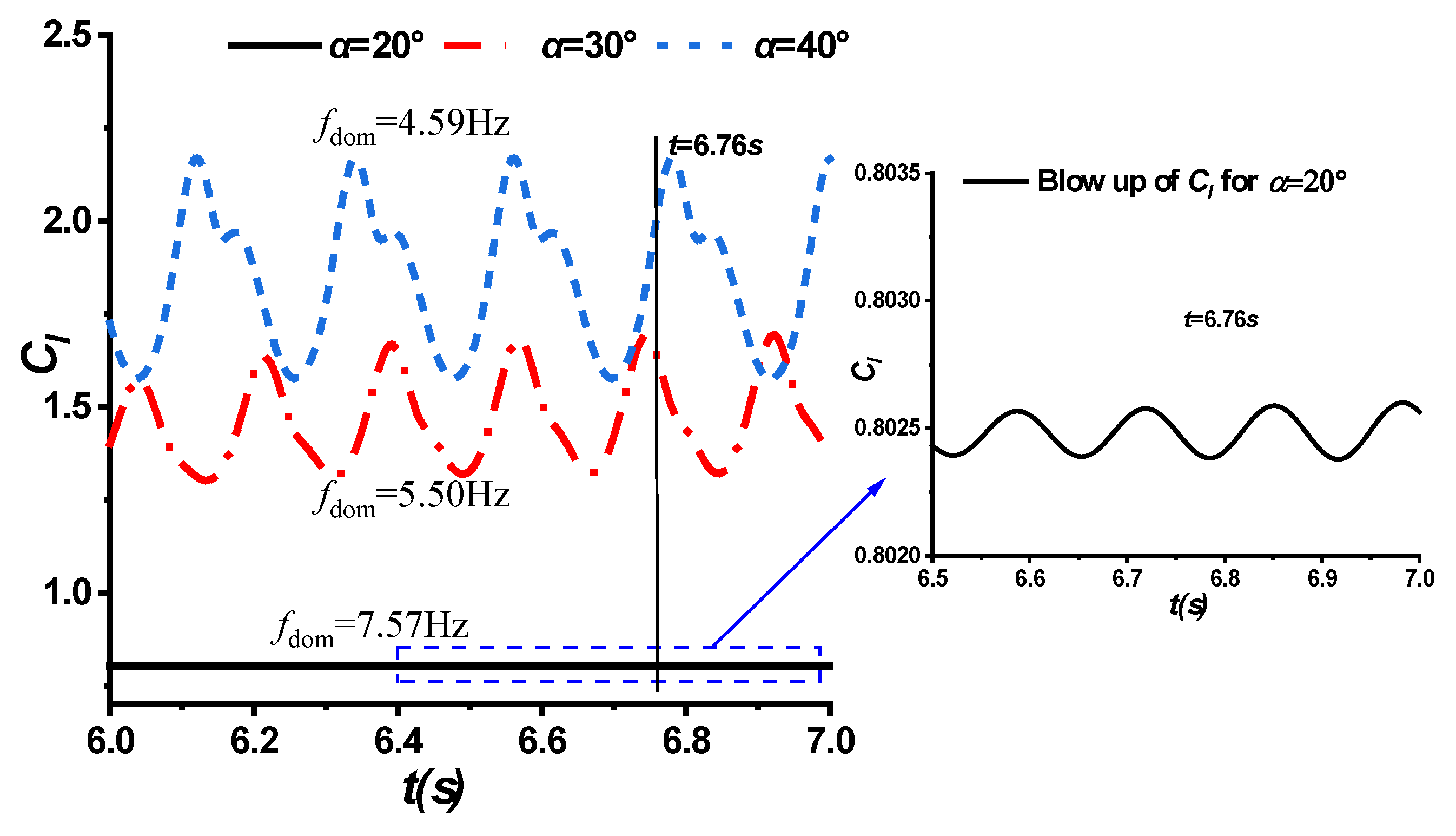
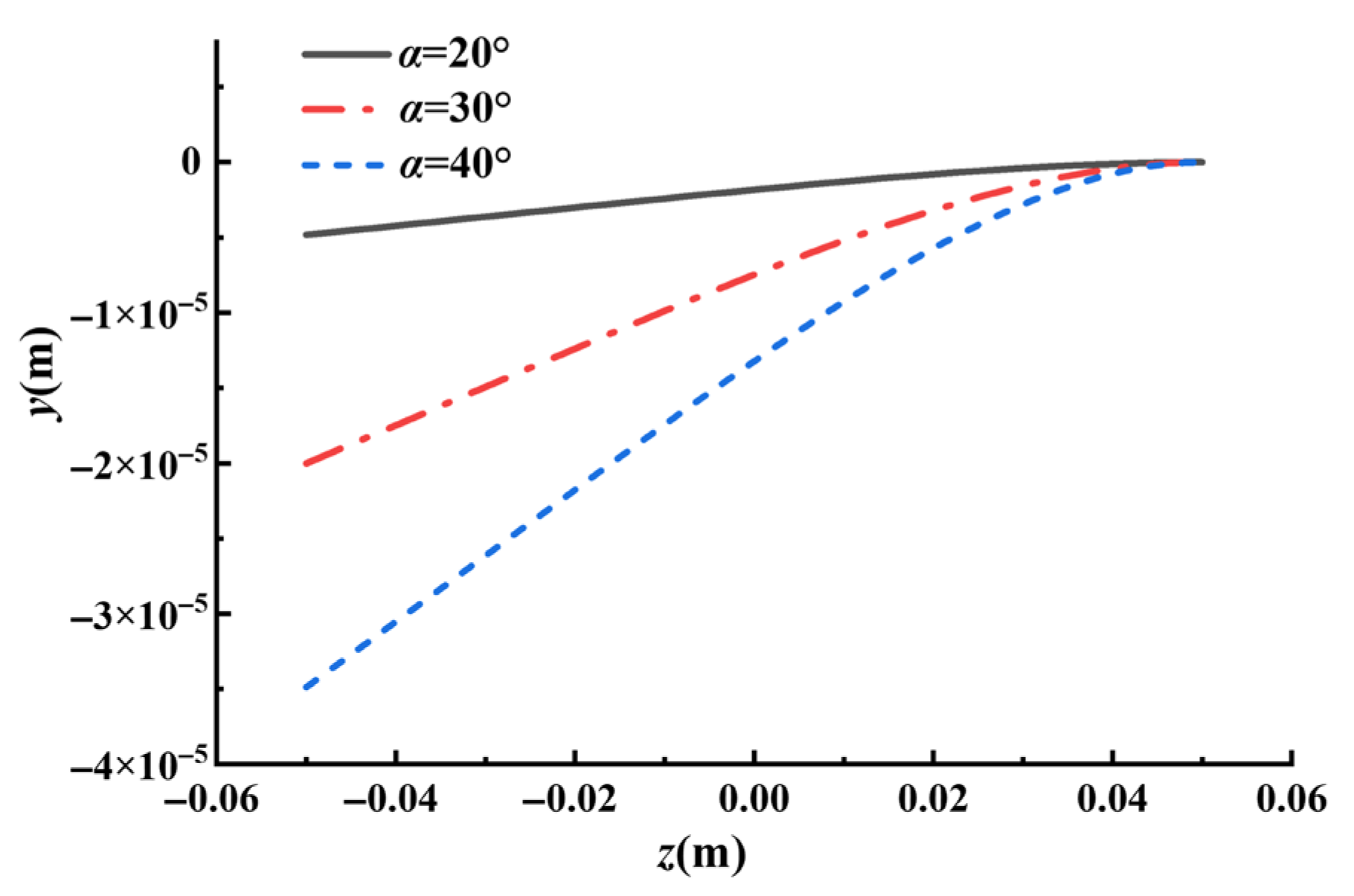
Figure 14 illustrates the time histories of the lift coefficients of the hydrofoil facing a uniform flow under different attack angles— 20 ° , 30 ° , and 40 ° —and the velocity of the flow was set to v = 1.5 m/s. Figure 15 provides the deformation of the plane x = 0 m, and Figure 16 gives the corresponding voltage distributions at the same instant t = 6.75 s. As the attack angle increased, the magnitude of the lift coefficient in Figure 14, and the deformation of the foil in Figure 15 also rose, but the dominant frequency f d o m dropped. This means that a larger attack angle increased the voltage difference amplitude while reducing its dominant frequency. Thus, in Figure 16, it can be found that when the attack angle is larger, the voltage difference is larger. In Figure 16, it can also be found that both the area of negative voltage (the blue area near the leading edge) and the area of positive voltage (the red area near the center of the chord) decreased as the attack angle increased. This indicates a stronger local electric field under the condition of high attack angles.

4.4. Piezoelectric Field at Different Velocities of Incoming Flow

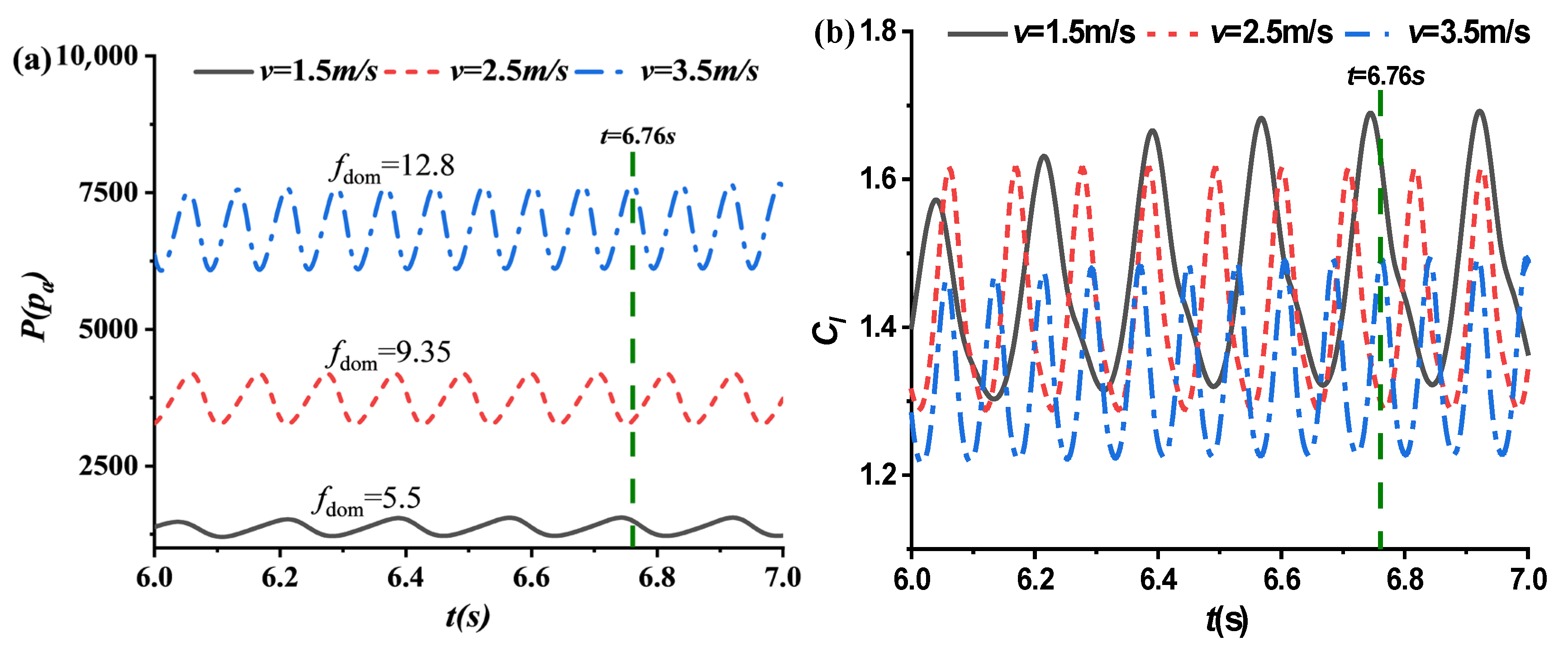
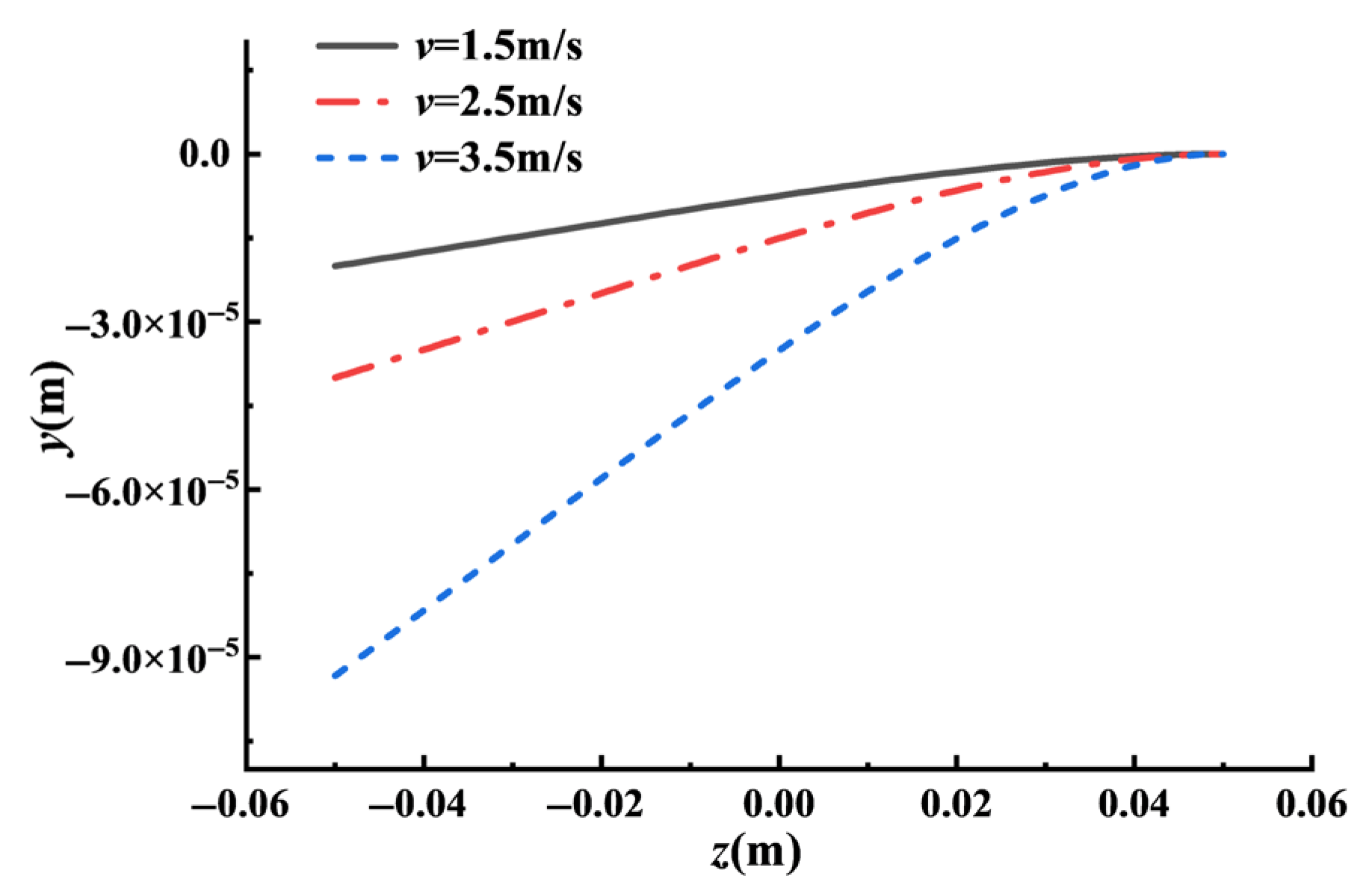
Figure 17 gives the time histories of (a) the pressure monitored at point A1 and (b) the lift coefficient of the hydrofoil, with the attack angle set to 30 ° . The lift coefficient normalized by the square of v dropped slightly as v increased (see Figure 17b), but both the absolute pressure and the dominant frequency f d o m increased with v noticeably, as shown Figure 17a. This means the higher incoming flow velocity would generate a voltage difference with a larger amplitude and higher dominant frequency. Thus, the deformation of the foil in Figure 18 and the voltage difference in Figure 19 also increased dramatically as v increased. But in the spatial distribution, the voltage seemed to be less affected by the varying of velocities of the incoming flow. This can be concluded through the similar voltage figures among different velocities. This means the velocity of the incoming flow mainly affected the magnitude of the voltage difference and variation period, but it exerted less effects on the distribution of the voltage. When the incoming flow velocity rose further, the characteristics and periodicity of the wake vortex field would change, and correspondingly, the piezoelectric characteristics would also be altered. This requires further research in the future.

5. Conclusions

This study examined the piezoelectric response of a hydrofoil excited by vortex-induced vibrations. The finite volume method (FVM) employing viscous flow theory simulated the fluid field and the resulting Kármán vortex street. The electric field was determined through the finite element method. The following conclusions are drawn:
(1) The voltage difference was most prominent in the plane subjected to the fixed edge boundary condition, and the zone near the leading edge had the maximum negative voltage, while the zone near the chord’s center had the maximum positive voltage. The pressure fluctuation was primarily governed by the trailing-edge shedding frequency, which in turn influenced the period of the electric field.
(2) A larger attack angle increased the voltage difference amplitude while reducing its dominant frequency. Spatially, both the positive and negative voltage areas diminished as the attack angle grew, indicating a stronger local electric field at higher attack angles.
(3) The higher incoming flow velocity would generate voltage differences with larger amplitudes and higher dominant frequencies. The incoming flow velocity primarily affected the magnitude of the voltage difference without significantly altering its spatial distribution.
(4) Future work will focus on developing integration strategies for piezoelectric hydrofoils within marine structures, supported by experimental validation. Current limitations include the lack of consideration for complex turbulent flow effects and power generation efficiency in practical circuit conditions. The results demonstrate potential for applications in marine energy harvesting and smart flow sensing.

Author Contributions

Software, Y.Y.; validation, Q.W.; data curation, Y.Y.; writing—original draft preparation, S.S.; supervision, Q.W.; funding acquisition, S.S. All authors have read and agreed to the published version of the manuscript.

Funding

This research was funded by the National Natural Science Foundation of China (Grant No. 52271276).

Institutional Review Board Statement

Not applicable.

Informed Consent Statement

Not applicable.

Data Availability Statement

Data is contained within the article.

Conflicts of Interest

The authors declare no conflicts of interest.

References

  1. Kong, M.; Ji, R.; Sun, K.; Zhang, J.; Cheng, Y.; Wu, H.; Zhang, Y.; Reabroy, R. Quantifying the pitch-induced response of side-by-side horizontal-axis tidal stream turbines in wave-current interaction. Energy 2026, 342, 139650. [Google Scholar] [CrossRef]
  2. Yin, M.; Ji, R.; Zhu, R.; Xu, S.; Sun, K.; Zhang, J.; Zhang, Y.; Reabroy, R. Performance and wake prediction of a ducted tidal stream turbine in yaw misalignment using the lattice Boltzmann method. Energy Convers. Manag. 2026, 347, 120574. [Google Scholar] [CrossRef]
  3. Shigeki, K.; Giwon, H.; Naoto, M.; Tomonori, Y.; Shinobu, Y. Numerical study of active control by piezoelectric materials for fluid–structure interaction problems. J. Sound Vib. 2018, 435, 23–35. [Google Scholar] [CrossRef]
  4. Hasheminejad, S.M.; Masoumi, Y. Hybrid active flow induced vibration control of a circular cylinder equipped with a wake-mounted smart piezoelectric bimorph splitter plate. J. Fluid Struct. 2022, 110, 103531. [Google Scholar] [CrossRef]
  5. Taylor, G.W.; Burns, J.R.; Kammann, S.M.; Powers, W.B.; Welsh, T.R. The energy harvesting Eel: A small subsurface ocean/river power generator. IEEE J. Ocean. Eng. 2001, 26, 539–547. [Google Scholar] [CrossRef]
  6. Allen, J.J.; Smits, A.J. Energy harvesting eel. J. Fluids Struct. 2001, 15, 629–640. [Google Scholar] [CrossRef]
  7. Du, X.; Wang, Y.; Chen, H.; Li, C.; Han, Y.; Yurchenko, D.; Wang, J.; Yu, H. Vortex-induced piezoelectric cantilever beam vibration for ocean wave energy harvesting via airflow from the orifice of oscillation water column chamber. Nano Energy 2022, 104, 107870. [Google Scholar] [CrossRef]
  8. Wang, J.L.; Xia, B.; Yurchenko, D.; Tian, H. Enhanced performance of cutting angle cylinder piezoelectric energy harvester via coupling vortex-induced vibration and galloping. Mech. Syst. Signal Process. 2023, 205, 110838. [Google Scholar] [CrossRef]
  9. Latif, U.; Younis, M.Y.; Idrees, S.; Uddin, E.; Abdelkefi, A.; Munir, A.; Zhao, M. Synergistic analysis of wake effect of two cylinders on energy harvesting characteristics of piezoelectric flag. Renew. Sustain. Energy Rev. 2023, 173, 113114. [Google Scholar] [CrossRef]
  10. Zhang, M.; Zhang, C.; Abdelkefi, A.; Yu, H.; Gaidai, O.; Qin, X.; Zhu, H.; Wang, J. Piezoelectric energy harvesting from vortex-induced vibration of a circular cylinder: Effect of Reynolds number. Ocean Eng. 2021, 235, 109478. [Google Scholar] [CrossRef]
  11. Kan, J.; Liao, W.; Wang, J.; Wang, S.; Yan, M.; Jiang, Y.; Zhang, Z. Enhanced piezoelectric wind-induced vibration energy harvester via the interplay between cylindrical shell and diamond-shaped baffle. Nano Energy 2021, 89, 106466. [Google Scholar] [CrossRef]
  12. Jamil, M.; Javed, A.; Shah, S.I.A.; Mansoor, M.; Hameed, A.; Djidjeli, K. Performance Analysis of Flapping Foil Flow Energy Harvester Mounted on Piezoelectric Transducer using Meshfree Particle Method. J. Appl. Fluid Mech. 2020, 13, 1859–1872. [Google Scholar] [CrossRef]
  13. Hafizh, M.; Muthalif, A.G.A.; Renno, J.; Paurobally, M.R.; Bahadur, I.; Ouakad, H.; Ali, M.S.M. Vortex induced vibration energy harvesting using magnetically coupled broadband circular-array piezoelectric patch: Modelling, parametric study, and experiments. Energy Convers. Manag. 2023, 276, 116559. [Google Scholar] [CrossRef]
  14. Shoele, K. Hybrid wave/current energy harvesting with a flexible piezoelectric plate. J. Fluid Mech. 2023, 968, A31. [Google Scholar] [CrossRef]
  15. Nabavi, S.F.; Farshidianfar, A.; Afsharfard, A. Novel piezoelectric-based ocean wave energy harvesting from offshore buoys. Appl. Ocean Res. 2018, 76, 174–183. [Google Scholar] [CrossRef]
  16. Okada, N.; Yabe, S.; Fujimoto, H.; Murai, M. Experiments on floating wave-power generation using piezoelectric elements and pendulums in the water tank. In Proceedings of the 2012 Oceans-Yeosu, Yeosu, Republic of Korea, 21–24 May 2012; IEEE: Piscataway, NJ, USA, 2012. [Google Scholar]
  17. Zurkinden, A.S.; Campanile, F.; Martinelli, L. Wave Energy Converter through Piezoelectric Polymers. In Proceedings of the COMSOL Users Conference, Grenoble, France, 23–24 October 2007. [Google Scholar]
  18. Tanaka, Y.; Oko, T.; Mutsuda, H.; Patel, R.; McWilliam, S.; Popov, A.A. An experimental study of wave power generation using flexible piezoelectric device. In Proceedings of the ISOPE International Ocean and Polar Engineering Conference, Busan, Republic of Korea, 15–20 June 2014. [Google Scholar]
  19. Mutsuda, H.; Tanaka, Y.; Patel, R.; Doi, Y.; Moriyama, Y.; Umino, Y. A painting type of flexible piezoelectric device for ocean energy harvesting. Appl. Ocean Res. 2017, 68, 182–193. [Google Scholar] [CrossRef]
  20. Wang, C.; Wei, Y.; Chen, W.; Huang, L. Hydroelastic modelling of a deformable wave energy converter including power take-off. Mar. Struct. 2024, 98, 103678. [Google Scholar] [CrossRef]
  21. Wu, N.; Wang, Q.; Xie, X. Ocean wave energy harvesting with a piezoelectric coupled buoy structure. Appl. Ocean Res. 2015, 50, 110–118. [Google Scholar] [CrossRef]
  22. Zheng, S.; Meylan, M.; Zhang, X.; Iglesias, G.; Greaves, D. Performance of a plate-wave energy converter integrated in a floating breakwater. IET Renew. Power Gener. 2021, 15, 3206–3219. [Google Scholar] [CrossRef]
  23. He, L.; Wang, S.; Zheng, X.; Liu, L.; Tian, X.; Sun, B. Research-based on a low-frequency non-contact magnetic coupling piezoelectric energy harvester. Energy 2022, 258, 124844. [Google Scholar] [CrossRef]
  24. Yang, B.; He, L.; Ren, H.; Zhang, L.; Xu, C.; Wan, Q. A piezoelectric-electromagnetic smart structure for wave energy harvesting. Eng. Struct. 2026, 348, 121800. [Google Scholar] [CrossRef]
  25. Li, S.; Sun, S.; Cui, J. Fluid–structure interaction analysis of a piezoelectric wave energy converter positioned at the wave surface. Phys. Fluids 2025, 37, 013121. [Google Scholar] [CrossRef]
  26. Menter, F.R. Two-equation eddy-viscosity turbulence models for engineering applications. AIAA J. 1994, 32, 1598–1605. [Google Scholar] [CrossRef]
  27. Jbaily, A.; Yeung, R.W. Piezoelectric devices for ocean energy: A brief survey. J. Ocean Eng. Mar. Energy 2015, 1, 101–118. [Google Scholar] [CrossRef]
  28. Pope, S.B. Turbulent Flows; Cambridge University Press: Cambridge, UK, 2000. [Google Scholar]
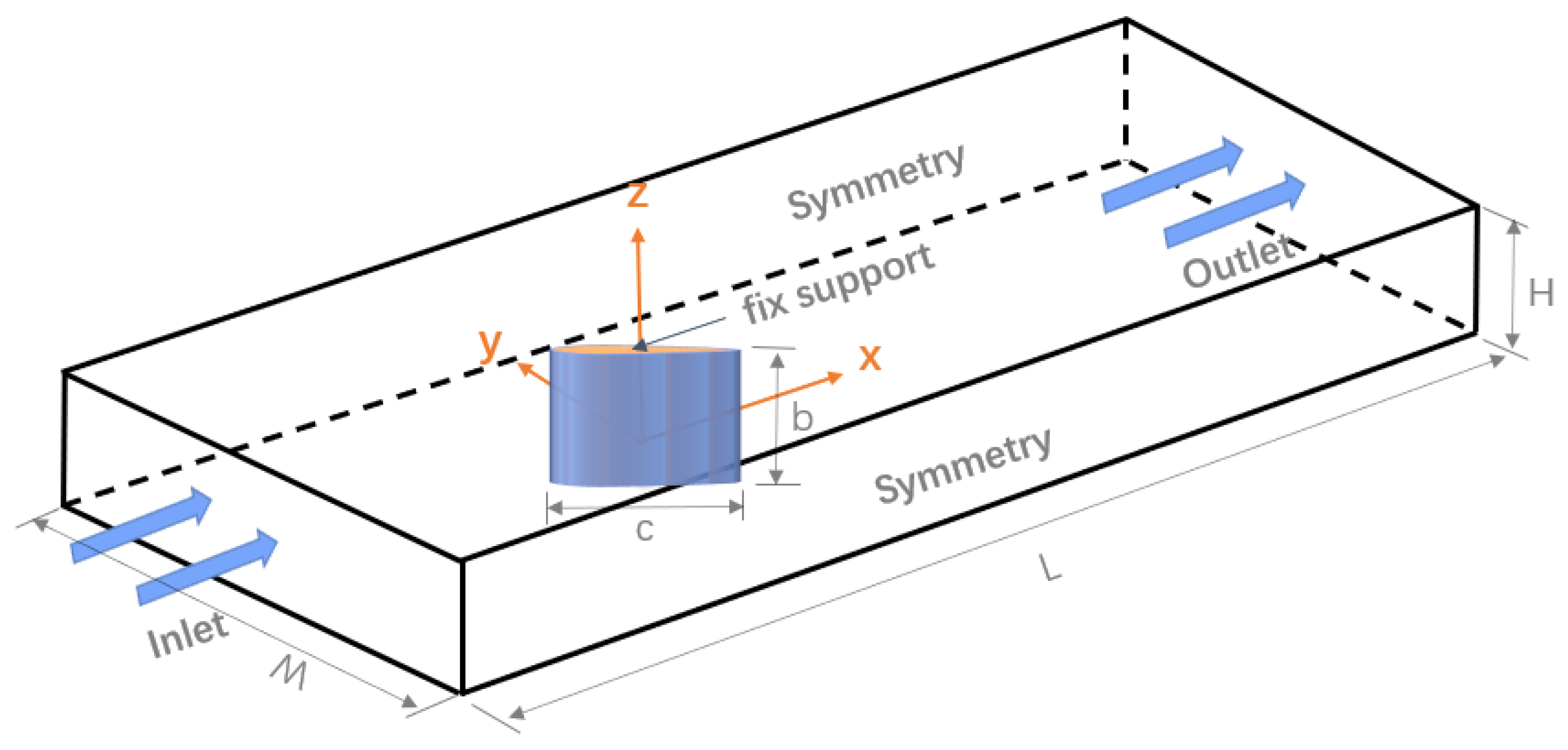
Figure 1. A sketch of the problem.
Jmse 14 00385 g001
Figure 2. Top view of the computational domain.
Jmse 14 00385 g002
Figure 3. Algorithm flowchart.
Jmse 14 00385 g003
Figure 4. The pressure division of the structural fields.
Jmse 14 00385 g004
Figure 5. The grid distribution of the fluid domain and structure.
Jmse 14 00385 g005
Figure 6. Convergence study of the grid.
Jmse 14 00385 g006
Figure 7. Convergence study of the time step.
Jmse 14 00385 g007
Figure 8. Convergence study of division of pressure surface (x = 0 m).
Jmse 14 00385 g008
Figure 9. The time history of the lift coefficient and its Fourier analysis (α = 30°, v = 2 m/s).
Jmse 14 00385 g009
Figure 10. The velocity contour maps at four instants (t1 = 6.96 s, t2 = 7.00 s, t3 = 7.04 s, and t4 = 7.08 s).
Jmse 14 00385 g010
Figure 11. Fourier analysis of flow field structures using multi-point velocity magnitude time series.
Jmse 14 00385 g011
Figure 12. Deformation distribution of the hydrofoil at different instants ( α = 30 ° ,  v = 2 m/s, x = 0 m).
Jmse 14 00385 g012
Figure 13. Voltage distribution at different instants (α = 30°, v = 2 m/s).
Jmse 14 00385 g013
Figure 14. Lift coefficients at different attack angles (v = 1.5 m/s).
Jmse 14 00385 g014
Figure 15. Deformation distribution of the hydrofoil at different angles of attack (v = 1.5 m/s, t = 6.76 s, and x = 0 m).
Jmse 14 00385 g015
Figure 16. Voltage distributions of different attack angles (v = 1.5 m/s, t = 6.75 s).
Jmse 14 00385 g016aJmse 14 00385 g016b
Figure 17. The time histories of (a) the pressures at point A1 and (b) the lift coefficients with different velocities of incoming flow ( α = 30 ° ).
Jmse 14 00385 g017
Figure 18. Deformation distribution of the hydrofoil at different inflow velocities ( α = 30 ° , t = 6.76 s).
Jmse 14 00385 g018
Figure 19. Voltage distribution at different velocities of incoming flow ( α = 30 ° ).
Jmse 14 00385 g019
Table 1. Orthotropic relative permittivities.
ϵ m k ( C / V m ) x y z
916830916
Table 2. Material properties (PZT-5A).
Density   ( k g m 3 ) ρ B 7750
Young’s Modulus (x, Pa) E x 1.21 × 1 0 11
Young’s Modulus (y, Pa) E y 1.21 × 1 0 11
Young’s Modulus (z, Pa) E z 1.11 × 1 0 11
Poisson’s Ratio (xy) ν x y 0.29
Poisson’s Ratio (yz) ν y z 0.51
Poisson’s Ratio (xz) ν x z 0.45
Shear Modulus (xy, Pa) G x y 2.11 × 1 0 11
Shear Modulus (yz, Pa) G y z 2.11 × 1 0 11
Shear Modulus (xz, Pa) G x z 2.26 × 1 0 11
Table 3. Piezoelectric stress coefficients.
e m , k l ( C / m 2 ) x y z x y y z x z
x 00012.300
y −5.415.8−5.4000
z 000012.30
Disclaimer/Publisher’s Note: The statements, opinions and data contained in all publications are solely those of the individual author(s) and contributor(s) and not of MDPI and/or the editor(s). MDPI and/or the editor(s) disclaim responsibility for any injury to people or property resulting from any ideas, methods, instructions or products referred to in the content.