Article

Research on Dynamic Beamforming Methods for Uniform Circular Frequency Diverse Array Sonar

School of Marine Science and Technology, Northwestern Polytechnical University, Xi’an 710129, China
*
Author to whom correspondence should be addressed.
J. Mar. Sci. Eng. 2026, 14(4), 371; https://doi.org/10.3390/jmse14040371
Submission received: 20 January 2026 / Revised: 10 February 2026 / Accepted: 13 February 2026 / Published: 15 February 2026
(This article belongs to the Section Ocean Engineering)

Abstract

Frequency diverse array (FDA) sonar achieves a range- and azimuth-dependent transmit beam by applying a small frequency increment to each transmitting element. However, beam position is difficult to control due to range–azimuth coupling and time-varying characteristics. While existing FDA research has primarily focused on uniform linear arrays, there remains a lack of analysis on the Uniform Circular Frequency Diverse Array (UCFDA). Moreover, studies on transmit beampatterns have largely concentrated on continuous waveforms, resulting in time-varying beam characteristics. In the field of sonar, however, pulse signals are commonly employed for target detection. Therefore, to more accurately characterize the behavior of the beampattern under such conditions, further investigation is warranted. This paper focuses on the UCFDA sonar, specifically studying the time-varying characteristics and “dot”-shaped beam synthesis under pulsed operation. First, the time-varying and spatial scanning characteristics of the UCFDA transmit beam under linear frequency offset are analyzed. Second, a nonlinear frequency offset model is constructed, and its characteristics of high range sidelobes and significant trailing are analyzed. Then, a time-modulated nonlinear frequency offset model is built, and the relationship between the time variable in the frequency offset term and the time variable in the signal propagation term is studied in detail. When the two are identical, cancellation can theoretically eliminate the beam’s time variance. However, their physical meanings differ: the time variable in the frequency offset term reflects the signal generation moment, while the signal propagation time variable reflects the propagation law of the signal in space; they cannot cancel each other out. Finally, a nonlinear multi-carrier frequency offset model is constructed. Simulation experiments on the transmit beams under these three models are conducted to synthesize dynamically propagating “dot”-shaped transmit beams. Comparative results verify that the multi-carrier frequency offset model yields the lowest range sidelobes.

1. Introduction

The frequency diverse array (FDA) was first introduced at the 2006 IEEE Radar Conference by Paul Antonik [1]. Based on phased arrays, an additional small and uniform frequency offset is introduced between adjacent transmitting elements, forming a time-varying transmit beam dependent on range and angle [2,3,4,5,6], thereby obtaining range resolution capabilities that phased arrays lack.
Since the concept of FDA was proposed, the study of its beam characteristics has become a hot topic. One important research direction is the desired range-angle beam design. Commonly used frequency offset design schemes mainly include linear frequency offset, nonlinear frequency offset, and time-modulated frequency offset [7,8,9,10,11]. In recent years, novel methods for range–angle decoupling in FDA transmit beams have been proposed. Higgins et al. [12] used iterative minimum mean square error-based space-range adaptive processing and time-range adaptive processing algorithms for transmit beam optimization. References [13,14] used second-order cone programming and genetic algorithms, respectively, to optimize the frequency increments and achieve FDA “dot”-shaped transmit beam design. Chen et al. [15] proposed a Lagrange programming neural network method for transmit beam focusing. Wang et al. [16,17] detailed the analysis of the range–angle decoupling performance of log-FDA, cubic-FDA, sin-FDA, and reciprocal-FDA structures based on the SD-LCMV algorithm, and further studied “dot”-shaped beam synthesis using logarithmic frequency increment linear overlapping sub-arrays and planar arrays. Although the above methods can achieve “dot”-shaped beams, their analyses all adopt a fixed time term, ignoring the signal propagation characteristics and the time-varying characteristics of the beam.
To address the time-varying characteristics of the beam, several control and optimization methods have been proposed. In response to this challenge, A. Basit et al. [18] first introduced an adaptive beam steering technique. This method estimates the target position at the receiver and continuously calculates and updates the frequency increment based on the target location feedback, thereby ensuring the main beam consistently points to the desired angle and range. However, the effectiveness of this approach is highly dependent on the accuracy of the target position feedback, and the frequency increment update requires an ongoing iterative process. Subsequently, A. Basit et al. [19] further proposed a method for setting the frequency increment based on a Hamming window taper, which generates a well-focused “dot”-shaped beam pattern. Compared to the conventional logarithmic frequency offset method, this approach demonstrates superior performance in terms of range resolution and sidelobe suppression. Building on this work, Cui Y. S. et al. [20] formulated the calculation of the frequency increment as a constrained nonlinear optimization problem, employing the optimal solution under the given constraints as the frequency offset. Comparative analyses with the logarithmic and Hamming-window-based frequency offset methods demonstrated that this technique yields a transmit beam pattern with enhanced performance, albeit at the cost of increased computational complexity. Regarding the beam’s time-varying characteristics, Xu et al. [21] proposed a pulsed FDA transmit beam synthesis method, deriving constraints for generating quasi-static transmit/receive beams. By constraining pulse time and frequency offset, the transmit/receive beam remains essentially unchanged at the specified position during pulse duration. Khan et al. [8,22] proposed a pulsed FDA using time-modulated frequency offset, where the transmit beam is time-invariant at the specified range–angle during pulse duration, while remaining time-varying at other range–angles. Yao et al. [23] combined time modulation with nonlinear frequency offset and used an artificial bee colony algorithm to optimize the distribution of the nonlinear function to obtain an optimized time-modulated frequency offset, achieving time-invariant optimized spatial focusing beams. Wang et al. [24] also used a combination of time modulation and nonlinear frequency offset, while utilizing time division technology to form multiple beams at different range–angles within one pulse period, thus achieving FDA multi-beam synthesis. Liao et al. [25], based on time-modulated FDA, selected the center element as the symmetry center, used elements with identical logarithmic spacing on both sides, and the same logarithmic frequency offset, also achieving time-invariant range–angle transmit beams. For the uniform linear array, Xiong J et al. [26] introduced a multicarrier FDA transmit beampattern design scheme. To enhance its resolution in both range and angle dimensions, this scheme employs a sparse reconstruction method via compressed sensing. It jointly optimizes the weighting coefficients for each carrier on each antenna element using convex optimization tools, ultimately synthesizing a focused “dot”-shaped main beam with low sidelobe levels. Separately, Wang Z et al. [27] designed a time-modulated multicarrier FDA system based on pseudo-random frequency offsets. This system utilizes pseudo-random frequency offsets to effectively decouple the range and angle dependence of the main beam, leverages the multicarrier structure to suppress sidelobe levels, and achieves a time-invariant “dot”-shaped beampattern through the time-modulated frequency increments. From a mathematical perspective, the time-modulated frequency offset methods used in references [8,22,23,24,25,27] indeed solve the time-varying problem of “dot”-shaped beams, keeping the FDA synthesized beam static in space. This thereby lengthens the beam illumination time on the target and allows good accumulation of target reflected energy, improving target detection capability. However, this result is obtained by treating the time variable in the frequency offset term and the time variable in the signal propagation term as the same variable. References [8,23,24,25,27] do not explicitly explain these two time variables. Shi et al. [28] analyzed from the perspective of the time–range relationship and concluded that FDA cannot synthesize time-invariant beam patterns, but did not study “dot”-shaped beam synthesis.
While conducting FDA beamforming research, studies combining the advantages of FDA beamforming with the MIMO system have also developed rapidly. For example, FDA-MIMO transceiver beamforming precise nulling technology has been used to suppress interference in SAR imaging [29,30]. FDA-MIMO radar has been used for parameter estimation, target detection, imaging, etc. [31,32,33,34,35]. It is worth noting that all the above literature on FDA analysis is based on linear arrays, called Uniform Linear Frequency Diverse Array (ULFDA). Combining FDA with uniform circular arrays has become a new research direction, called Uniform Circular Frequency Diverse Array (UCFDA). Sarah et al. [36] pointed out that UCFDA can better suppress range-dependent clutter and interference, thereby potentially improving the received signal-to-interference-plus-noise ratio. Similar to radar systems, in sonar systems, active sonar also needs to form transmit beams through element amplitude, phase, and frequency control to obtain transmit directivity gain. Applying FDA technology to sonar transmit systems can provide new research ideas for underwater detection.
This paper focuses on the UCFDA sonar model, studying dynamic beam synthesis for UCFDA sonar under pulsed signals. It points out that time variance is an inherent property of UCFDA sonar transmit beams and cannot be eliminated. By comparing and analyzing the beam performance of nonlinear frequency offset models, time-modulated nonlinear frequency offset models, and nonlinear multi-carrier frequency offset models, the proposed nonlinear multi-carrier frequency offset model has excellent sidelobe suppression capability and range resolution. By selecting an appropriate total number of carriers, a good “dot”-shaped beam can be synthesized.
The structure of this paper is as follows. In Section 2, the beam characteristics of linear frequency offset UCFDA are mathematically analyzed. In Section 3, we systematically analyze three dynamic beam design methods based on nonlinear frequency offsets. Specifically, Section 3.1 examines the dynamic beam characteristics of a UCFDA employing a natural logarithmic frequency offset model as a representative case. Section 3.2 constructs a time-modulated logarithmic frequency offset model. It provides a detailed explanation of the physical significance and the relationship between the time variables in the frequency offset term and the signal propagation term, accompanied by simulation results. Building upon the natural logarithmic model, Section 3.3 introduces a multicarrier design. The proposed nonlinear multicarrier frequency offset model is analyzed, simulation results are presented, and its beam performance is compared with the models discussed in Section 3.1 and Section 3.2. Finally, Section 4 concludes the paper.

2. UCFDA Sonar Transmit Beam Analysis

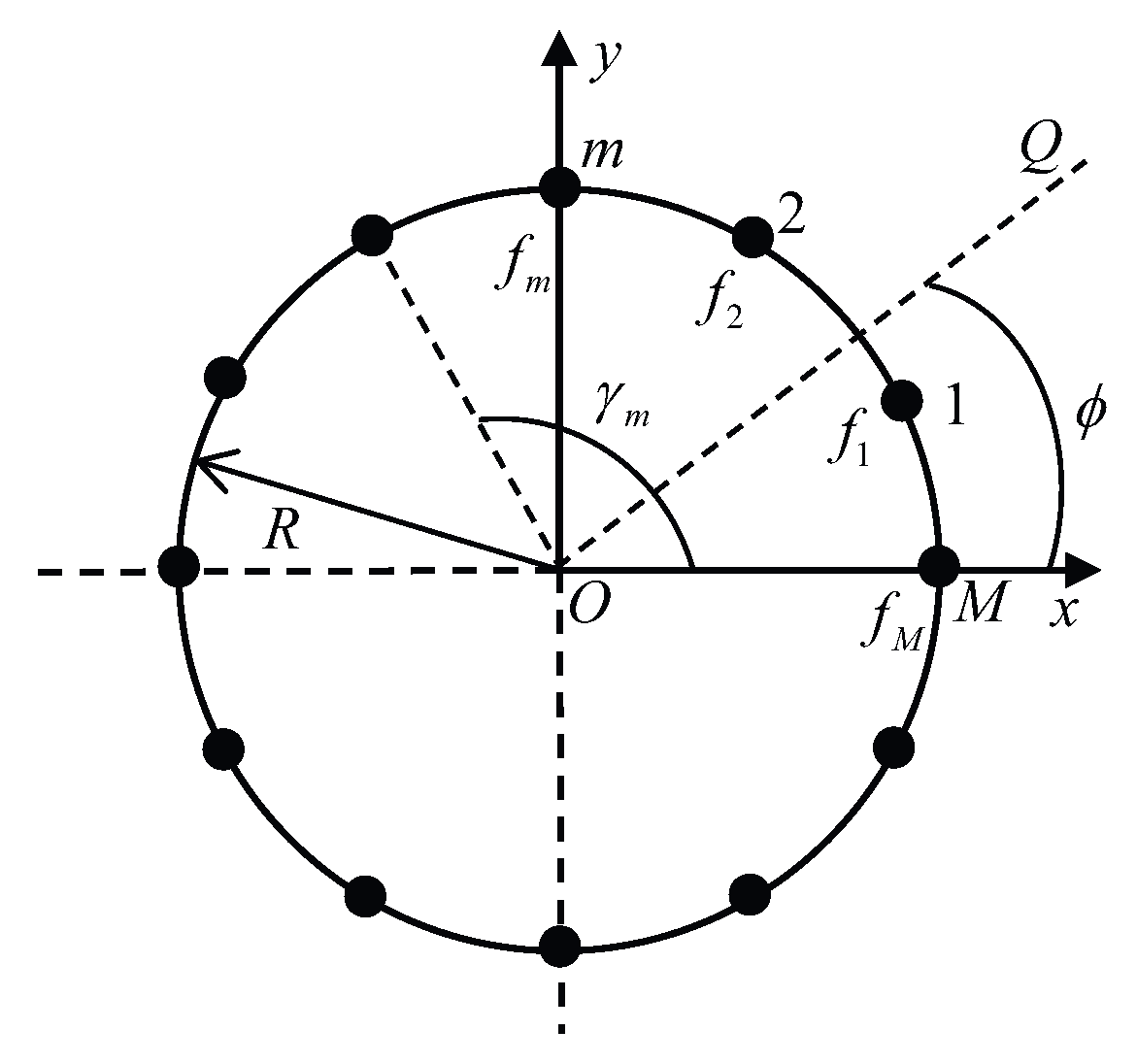
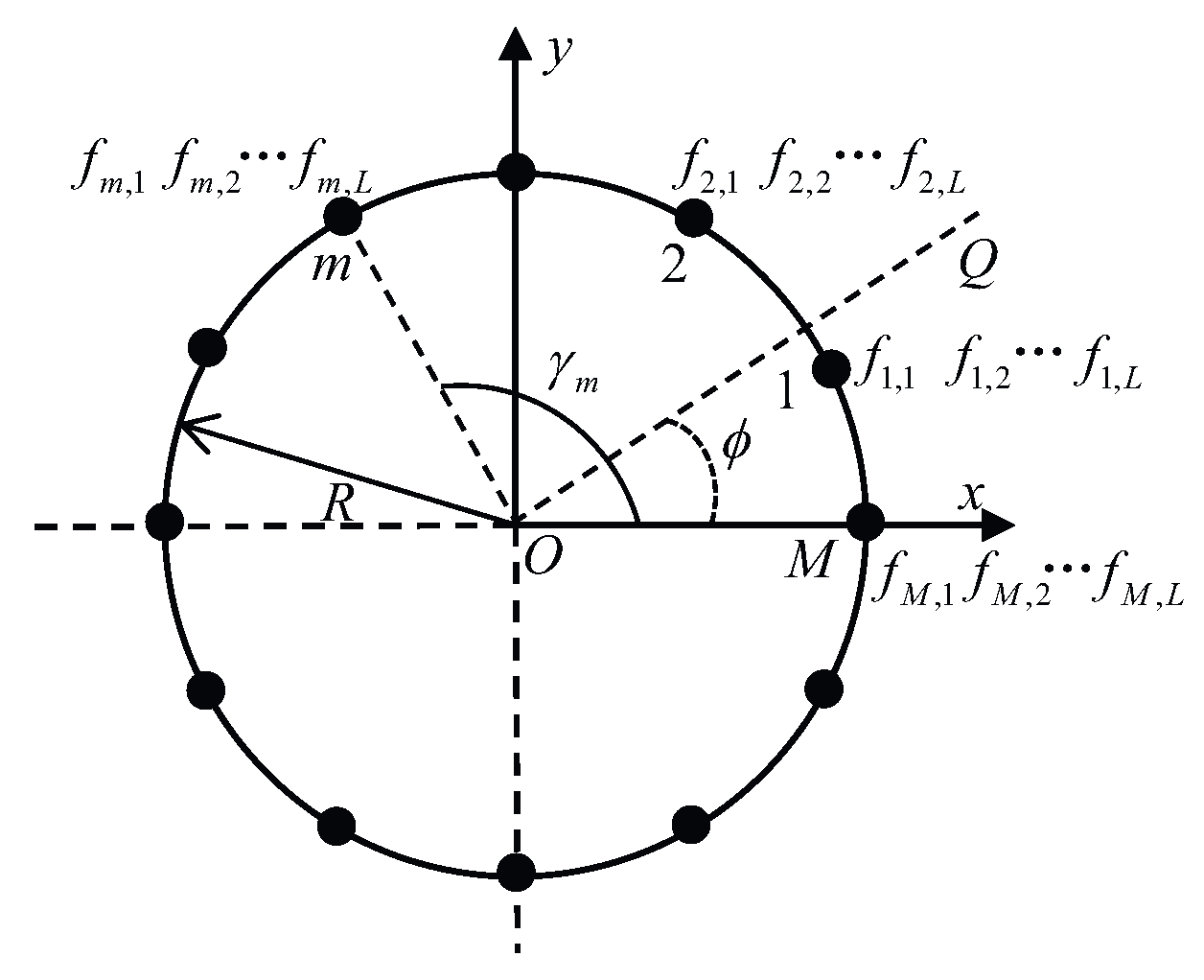
First, a circular array model with radius R is established, as shown in Figure 1. The origin is set at the center O of the circle, with M isotropic elements uniformly arranged on the circumference. The angle between the line connecting the mth element and the center O and the x-axis is γ m = 2 π m / M . Q is the target direction, ϕ [ π , π ] is the azimuth angle of the target, the reference frequency of the array is f 0 , and the radius is set to R = k λ 0 , where λ 0 = c / f 0 is the wavelength corresponding to the reference frequency, and k is a constant representing the relationship between the UCFDA sonar radius and λ 0 .
The frequency offset of the transmit signal frequency f m of the mth element relative to the reference frequency f 0 is denoted as Δ f m . Then the transmit frequency of the mth element can be expressed as
f m = f 0 + Δ f m
and | Δ f m | f 0 , satisfying the narrowband signal model. The transmit signal of the mth element is expressed as
s m ( t ) = w m exp ( j 2 π f m t )
where w m is the weight coefficient of the element. Then the distance from the mth element to the far-field point Q ( d , ϕ ) can be expressed as d m = d R cos ( ϕ γ m ) , and the corresponding delay can be expressed as d m / c . When d R , it can be considered that d m d . At this time, the signal from all elements arriving at the far-field point Q ( d , ϕ ) can be expressed as
S ( d , ϕ , t ) = 1 d · m = 1 M w m · s m ( t d m c )
where c is the sound speed in water. Substituting Equations (1) and (2) into Equation (3), we obtain
S ( d , ϕ , t ) = 1 d exp j 2 π f 0 ( t d / c ) · m = 1 M w m exp j 2 π Δ f m ( t d c ) + k ( 1 + Δ f m f 0 ) cos ( ϕ γ m )
When | Δ f m | f 0 , the term Δ f m f 0 can be neglected. The first exponential term on the right side of Equation (4) expresses the propagation process of the sound wave, and the second exponential summation term reflects the characteristics of the UCFDA sonar transmit pattern in the azimuth plane. The array factor can be expressed as
AF ( d , ϕ , t ) = m = 1 M w m exp j 2 π Δ f m ( t d c ) + k cos ( ϕ γ m )
The weight coefficient of the mth element is [36]
w m = exp j 2 π k cos ( ϕ 0 γ m )
where ϕ 0 is the desired azimuth angle. Then the expression for the UCFDA sonar transmit beam pattern is
B ( d , ϕ , t ) = | AF ( d , ϕ , t ) | 2
For the traditional linear frequency offset form, let Δ f be the frequency offset of each element relative to the reference frequency f 0 , where Δ f is a fixed frequency change constant. Under linear frequency offset, the frequency offset between adjacent elements is fixed as Δ f . Then the transmit frequency of the mth element is
f m = f 0 + ( m 1 ) Δ f
and the expression for the UCFDA sonar transmit beam pattern is [36]
B ( d , ϕ , t ) = m = 1 M w m exp j 2 π ( m 1 ) Δ f ( t d c ) + k ( cos ( ϕ γ m ) cos ( ϕ 0 γ m ) ) 2
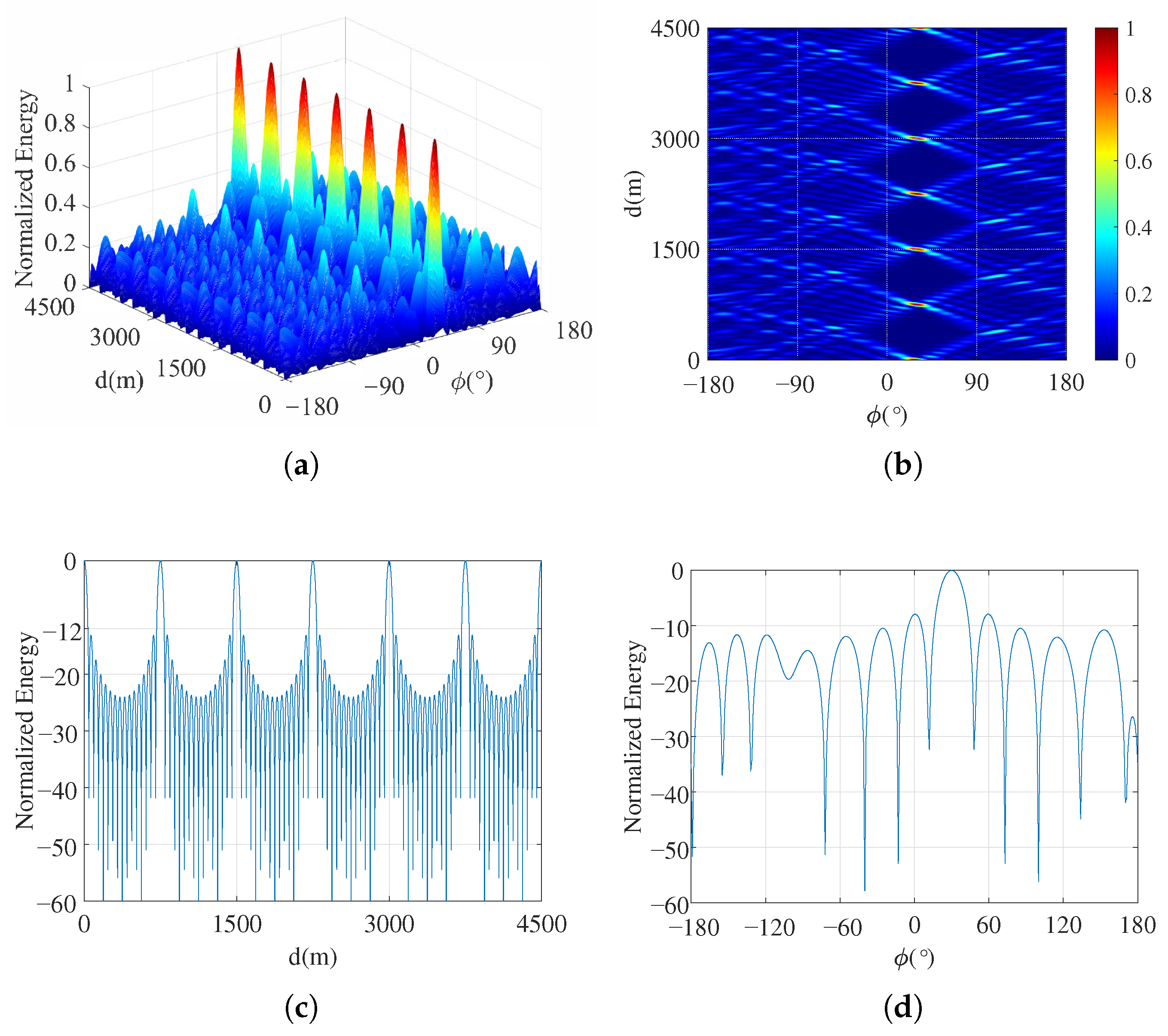
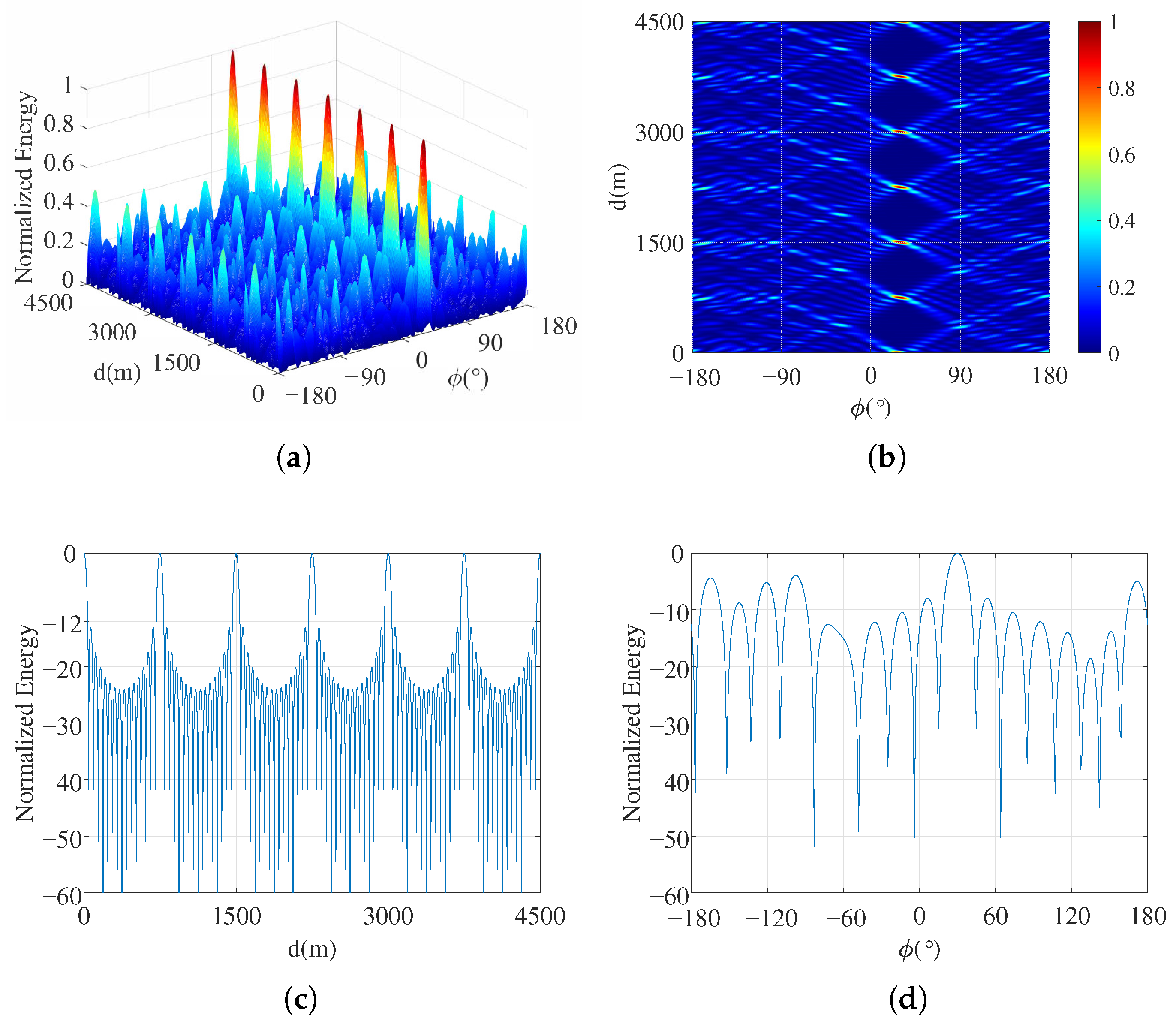
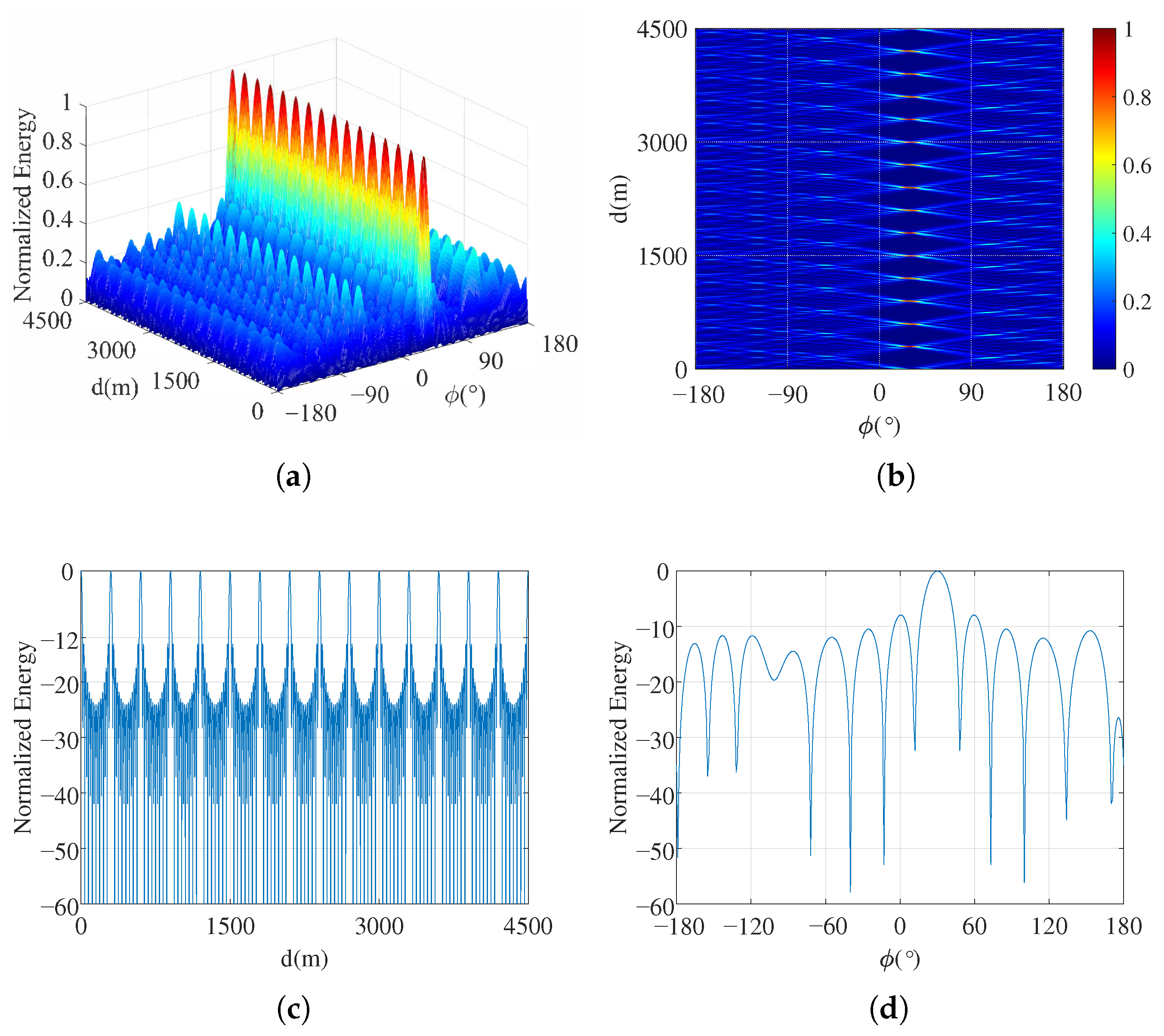
In the field of underwater acoustics, the 16-element uniform circular array is a commonly employed array configuration. The transmit signal frequency of active sonar systems used for detection or communication typically ranges from several hundred hertz to several tens of kilohertz. Accordingly, in the simulations conducted in this paper, the number of array elements is set to M = 16 , reference frequency f 0 = 10 kHz, sound speed c = 1500 m/s, ϕ 0 = 30 ° . Three sets of parameters are taken: (1) R = 1.2 λ 0 , Δ f = 2 Hz; (2) R = 1.5 λ 0 , Δ f = 2 Hz; (3) R = 1.2 λ 0 , Δ f = 5 Hz. Set the far-field observation area as d [ 0 , 4500 ] m, ϕ [ 180 ° , 180 ° ] . Figure 2, Figure 3, and Figure 4 show the 3D transmit beam pattern, 2D transmit beam pattern, range beam pattern at ϕ = ϕ 0 cross-section, and azimuth beam pattern at the main beam range cross-section under different parameters for the UCFDA sonar, respectively.
Through the above simulation analysis, the following conclusions can be drawn:
1. Under linear frequency offset, the main beam of the UCFDA sonar transmit beam appears as a “dot” shape, and there is a range–azimuth coupling problem, forming peak beams at multiple ranges; i.e., “grating lobes” appear. The range periodicity is related to the fixed frequency offset Δ f , i.e., Δ R = c / Δ f , and Δ f only affects the range beam pattern and has no effect on the azimuth beam pattern.
2. Changing the array radius of the UCFDA sonar does not affect its range–azimuth coupling, nor does it change the range periodicity of the transmit beam pattern. However, it affects the main lobe width and sidelobe level of the azimuth beam pattern. As the radius increases, the array aperture increases, the main lobe width of the azimuth beam pattern narrows, but higher sidelobes appear away from the main lobe.
Here, a note on the selection of the array radius for UCFDA sonar: when the element spacing is λ 0 / 2 , the array radius can be obtained through geometric relationships as R = λ 0 / ( 4 sin ( π / M ) ) . When the element spacing is less than λ 0 / 2 , the main lobe width of the azimuth beam pattern becomes wider. When the element spacing is greater than λ 0 / 2 , as the radius increases, the main lobe width of the azimuth beam pattern narrows, but the sidelobe level increases, and even some sidelobes close to the main lobe height may appear. Therefore, to balance main lobe width and sidelobe level, the array radius can be chosen slightly less than λ 0 / ( 4 sin ( π / M ) ) . When the number of elements M = 16 , then R 1.28 λ 0 , so we choose radius R = 1.2 λ 0 .

3. Non-Linear Frequency Offset UCFDA Sonar Dynamic Transmit Beam Design

3.1. Frequency Offset UCFDA Sonar Dynamic Transmit Beam

Based on the above analysis, for traditional UCFDA sonar, its linear frequency offset causes the array factor to exhibit periodic peaks, and the transmit main beam has range–azimuth coupling, resulting in grating lobes. Currently, there are two main categories of schemes to eliminate range and angle coupling: one is from the array configuration perspective, by changing the element spacing or array geometry to break the periodicity of the array factor. In 2014, Wang et al. [37] used a non-uniformly spaced FDA transmit array, where the element spacing is inversely proportional to frequency, and used a phased array for signal reception, achieving two-dimensional range–angle imaging through transmit-receive beamforming.
The other category is from the frequency offset form perspective, using nonlinear frequency offset design. Khan and Mahmood et al. [9,38] proposed a nonlinear frequency offset design using natural logarithms, where the frequency offset of each element’s transmit signal relative to the reference frequency f 0 follows a natural logarithmic function. Essentially, the nonlinear characteristics of the frequency offset are used to break the periodicity of the spatial transmit signal energy distribution, thereby achieving ULFDA focusing beams. Jiang et al. [39] analyzed the beam characteristics of ULFDA under logarithmic frequency offset, square frequency offset, cubic frequency offset, and sinusoidal frequency offset, and compared the beam widths and sidelobes for range and angle under several nonlinear frequency offset forms. Comparatively, the second method is easier to implement in software and has higher flexibility. This section takes the natural logarithmic frequency offset model, time-modulated frequency offset model, and nonlinear multi-carrier model as examples to analyze the dynamic transmit beam of UCFDA sonar under pulsed operation.
The expression for natural logarithmic frequency offset is
Δ f m = Δ f ln · ln ( m )
where Δ f ln is the corresponding fixed frequency change constant, and satisfies | Δ f m | f 0 . The pulsed signal transmitted by the mth element is
s m ( t ) = w m rect ( t / T ) exp ( j 2 π f m t )
where T is the pulse width. Assume the desired main beam points to the two-dimensional spatial position ( d 0 , ϕ 0 ) , where ϕ 0 is the desired azimuth angle and d 0 is the desired range. For a pulsed signal, the beam maximum should appear within the spatial region covered by the pulsed signal. The constraint condition is
T d 0 c > 0
Then, the weight coefficient of the mth element is
w m = exp j 2 π k cos ( ϕ 0 γ m ) + Δ f m ( T d 0 c ) , d 0 [ 0 , c T ] , ϕ 0 [ π , π ]
Substituting Equations (10) and (13) into Equation (7), the corresponding ln-UCFDA sonar transmit beam pattern expression is obtained:
B ( d , ϕ , t ) = m = 1 M exp j 2 π ln ( m ) Δ f ln ( t d + ( c T d 0 ) c ) + k ( cos ( ϕ γ m ) cos ( ϕ 0 γ m ) ) 2 , d 0 [ 0 , c T ] , ϕ 0 [ π , π ]
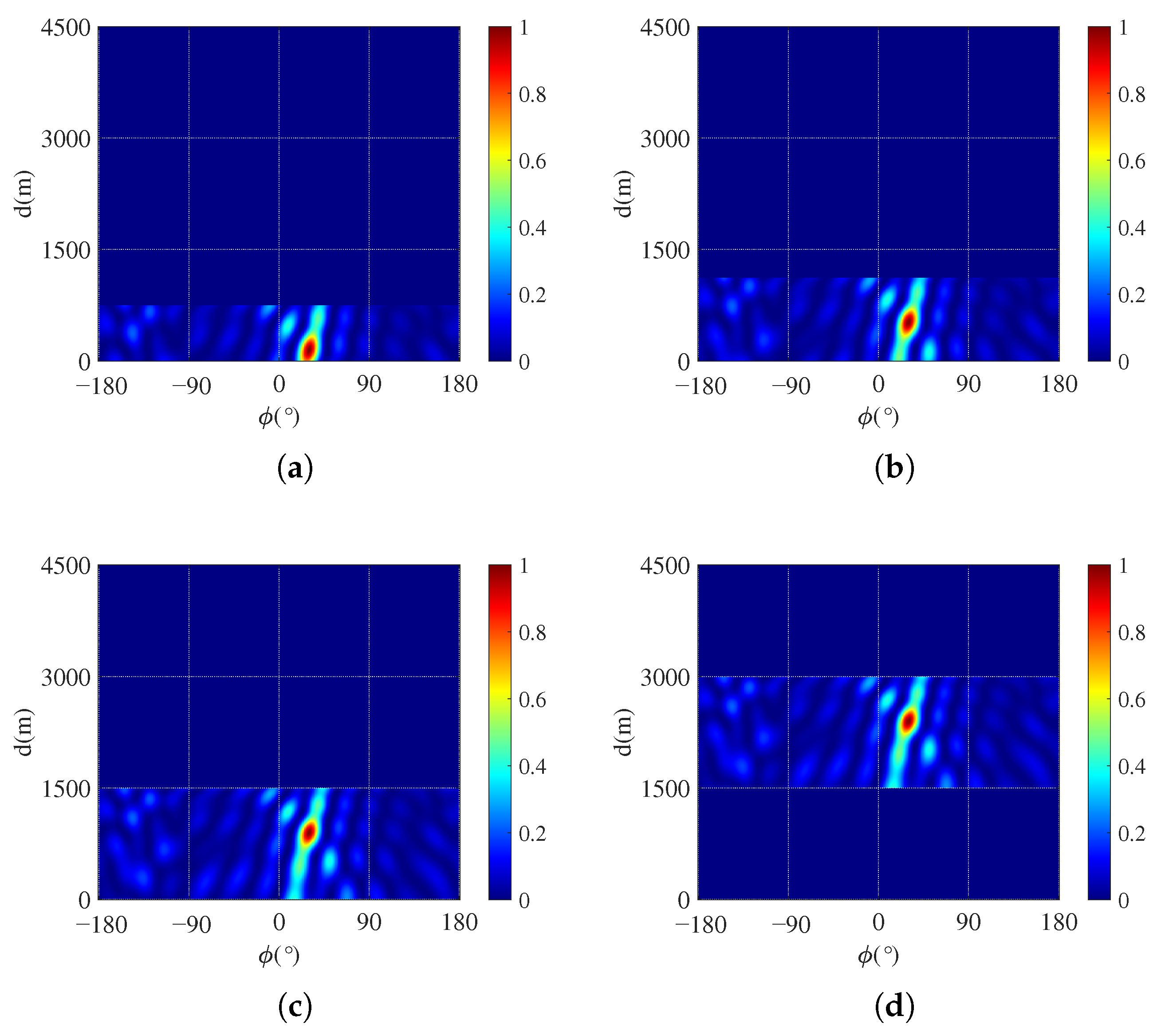
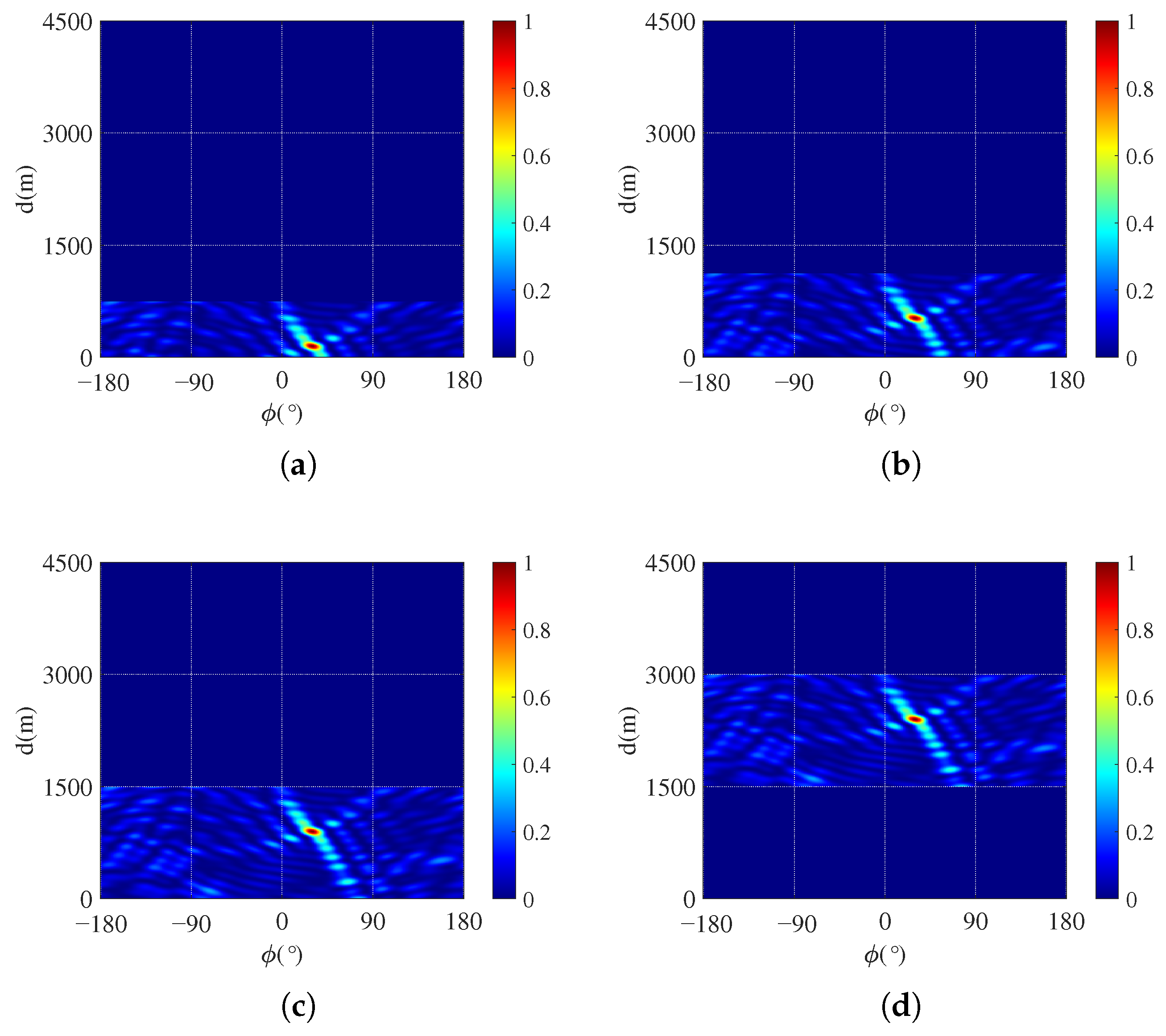
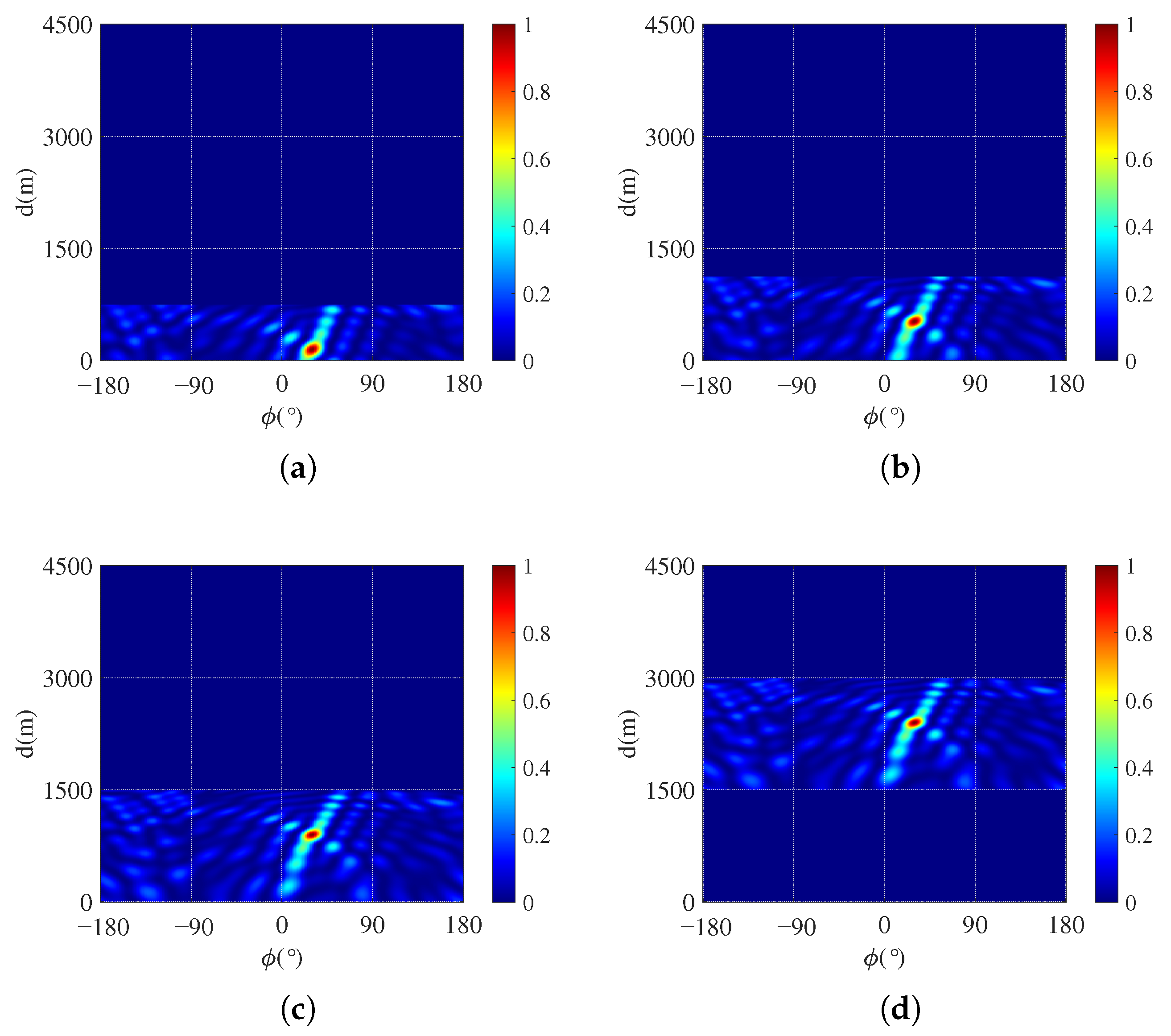
Assume the number of elements of the UCFDA sonar is M = 16 . Furthermore, the pulse width (or pulse duration) of the transmitted signal in active sonar operations typically ranges from tens of milliseconds to several seconds. Thus, pulse width T = 1 s, reference frequency f 0 = 10 kHz, radius R = 1.2 λ 0 , Δ f ln = 5 Hz, sound speed c = 1500 m/s, main beam desired angle ϕ 0 = 30 ° , desired range d 0 = 900 m. Set the far-field observation area as d [ 0 , 4500 ] m, ϕ [ 180 ° , 180 ° ] . Figure 5 shows the 2D transmit beam pattern of the natural logarithmic frequency offset UCFDA sonar at different times. Figure 6 shows the azimuth beam projection, azimuth beam pattern at the main beam range cross-section, range beam projection, and range beam pattern at the ϕ = ϕ 0 cross-section at t = 2.0 s. Table 1 lists the main beam positions at different times.

3.2. Time-Modulated Frequency Offset UCFDA Sonar Dynamic Transmit Beam Design

The time-modulated frequency offset function is denoted as g ( t ) . The pulse width of the signal is T. The transmit signal of the mth element is
s m ( t ) = w m rect ( t / T ) exp j 2 π [ f 0 + Δ f m g ( t ) ] t
The expression for natural logarithmic frequency offset [8,23,24,25] is
Δ f m g ( t ) = Δ f ln · ln ( m ) ( t d 0 c )
where d 0 is the target range; Δ f ln is the corresponding fixed frequency change constant, and satisfies | Δ f m g ( t ) | f 0 . The weight coefficient of the mth element is
w m = exp j 2 π k cos ( ϕ 0 γ m ) + ln ( m ) Δ f ln
Substituting Equations (16) and (17) into Equation (7), the corresponding TMln-UCFDA sonar transmit beam pattern expression is obtained:
B ( d , ϕ , t ) = m = 1 M exp j 2 π ln ( m ) Δ f ln ( t d / c t d 0 / c 1 ) + k ( cos ( ϕ γ m ) cos ( ϕ 0 γ m ) ) 2 t [ 0 , T ]
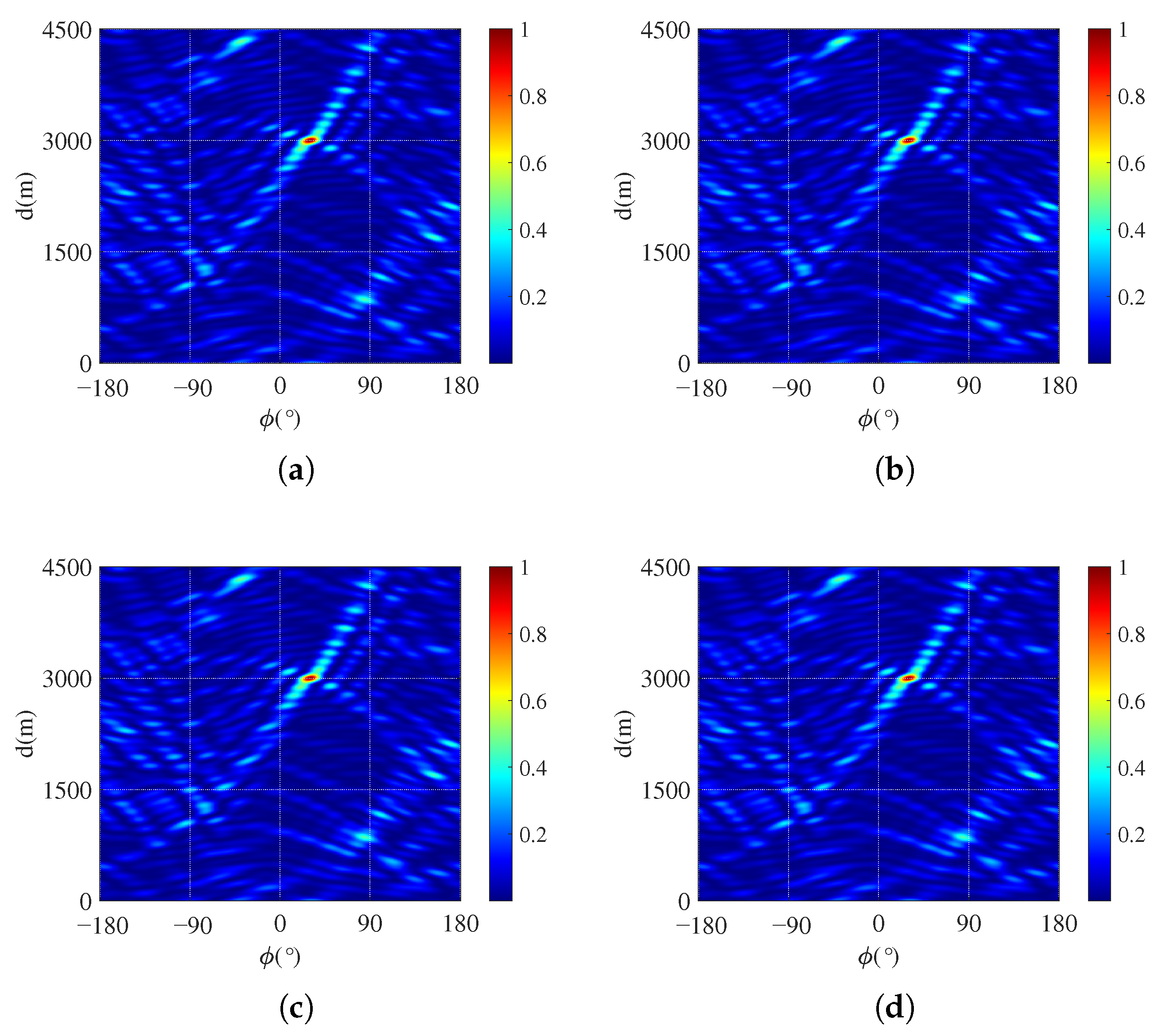
Assume the number of elements of the UCFDA sonar is M = 16 , pulse width T = 1 s, reference frequency f 0 = 10 kHz, radius R = 1.2 λ 0 , Δ f ln = 10 Hz, sound speed c = 1500 m/s, main beam desired angle ϕ 0 = 0 ° , desired range d 0 = 3000 m. Set the far-field observation area as d [ 0 , 4500 ] m, ϕ [ 180 ° , 180 ° ] . Figure 7 shows the 2D transmit beam pattern of the TMln-UCFDA sonar at different times.
From Figure 7, it can be seen that when the time changes from 0 to T = 1 s, the main beam of the UCFDA sonar always focuses on the position ( d 0 , ϕ 0 ) = ( 3000 m , 30 ° ) , achieving long-time illumination of the target position by the main beam, which is important for target detection and is the original intention of time-modulated frequency offset design. However, careful analysis reveals a major problem with this simulation. According to sound propagation principles, when time changes from 0 to T = 1 s, the signal only exists in the space from 0 to 1500 m. The position ( 3000 m , 30 ° ) does not contain a signal, so there should be no energy distribution, let alone beam formation. The reason is that Equation (18) incorrectly equates the variable t in the time-modulated frequency offset function with the variable t in the signal propagation term and cancels them out, thereby eliminating the inherent time variance of the beam, which is highly misleading.
According to signal generation and sound wave propagation principles, the parameters t d / c and t d 0 / c in Equation (18) have different meanings. When a pulsed signal is generated, the signal has different frequencies at different generation moments. During spatial propagation, its frequency does not change. The variable t in the time-modulated frequency offset function Equation (16) is a value determined at the signal generation moment; once determined, the signal’s frequency during propagation is fixed. In contrast, the variable t d / c is the signal propagation time variable. The two cannot be represented by the same variable. Therefore, now change the time variable in the time-modulated frequency offset function to t (instantaneous time within the pulse). At this time, the parameter d 0 in Equations (16) and (18) no longer represents the desired range of the main beam but is merely a time modulation parameter, now changed to d 0 . Equation (16) is rewritten as
Δ f m g ( t ) = Δ f ln · ln ( m ) ( t d 0 / c ) , t [ 0 , T ]
Note that d 0 appears in the denominator, so t d 0 / c 0 must be satisfied. Therefore, the value of d 0 should be appropriate.
Assume the desired main beam points to the two-dimensional spatial position ( d 0 , ϕ 0 ) , where ϕ 0 is the desired azimuth angle and d 0 is the desired range. Then the weight coefficient of the mth element is
w m = exp j 2 π k cos ( ϕ 0 γ m ) + ln ( m ) Δ f ln ( T d 0 c )
Substituting Equations (19) and (20) into Equation (7), the TMln-UCFDA sonar transmit beam pattern expression is
B ( t , r , ϕ ) = m = 1 M exp j 2 π ln ( m ) Δ f ln ( t d / c t d 0 / c c T d 0 c t d 0 ) + k ( cos ( ϕ γ m ) cos ( ϕ 0 γ m ) ) 2 t [ 0 , T ] , d 0 [ 0 , c T ] , ϕ 0 [ π , π ] .
Assume the number of elements of the UCFDA sonar is M = 16 , pulse width T = 1 s, reference frequency f 0 = 10 kHz, radius R = 1.2 λ 0 , Δ f ln = 5 Hz, sound speed c = 1500 m/s, main beam desired angle ϕ 0 = 30 ° , desired range d 0 = 900 m. Take d 0 = 3000 m and d 0 = 6000 m respectively. Set the far-field observation area as d [ 0 , 4500 ] m, ϕ [ 180 ° , 180 ° ] . Figure 8 and Figure 9 show the 2D transmit beam pattern of the TMln-UCFDA sonar at different times for d 0 = 3000 m and d 0 = 6000 m, respectively. Figure 10 and Figure 11 show the azimuth beam projection, azimuth beam pattern at the main beam range cross-section, range beam projection, and range beam pattern at the ϕ = ϕ 0 cross-section at t = 2.0 s for d 0 = 3000 m and d 0 = 6000 m, respectively. Table 2 compares the beam characteristics of ln-UCFDA and TMln-UCFDA sonar, including −3 dB azimuth beam width, −3 dB range beam width, and maximum sidelobe level.
Through the above simulation analysis, the following conclusions can be drawn:
1. The time-modulated natural logarithmic frequency offset UCFDA sonar can form an aperiodic “dot”-shaped beam. The shape of its main beam is similar to that of the ln-UCFDA sonar main beam in Figure 5 and Figure 6, with high beam sidelobes and significant trailing. Changing d 0 actually changes the time modulation coefficient of the frequency offset, which affects the shape of the main beam.
2. Under time-modulated frequency offset, the beam also propagates dynamically forward in space. The beam position is fixed at azimuth ϕ 0 , but it is not time-invariant. Therefore, it must be clearly pointed out: the time-modulated frequency offset UCFDA.
Sonar cannot achieve a time-invariant “dot”-shaped beam. This is different from the results in references [8,23,24,25]. Moreover, the time variance of the UCFDA sonar transmit beam is its inherent property and cannot be eliminated.
3. In the above analysis, the same element weight coefficients are used in Equations (13) and (20). It should be noted that for the desired range d 0 , it actually refers to the position of the UCFDA sonar main beam at the moment when the pulsed signal transmission is completed. From Figure 5, Figure 8 and Figure 9, and Table 1, it can be seen that the movement of the main beam position satisfies the principles of sound wave propagation.
4. Through the above analysis and simulation, compared to natural logarithmic frequency offset, the introduction of time modulation does not improve the performance of the UCFDA sonar transmit beam, but instead increases the complexity of frequency offset design. Therefore, a new method is needed to reduce the transmit beam sidelobes and mitigate the trailing phenomenon of the main beam.

3.3. Nonlinear Multi-Carrier UCFDA Sonar Dynamic Transmit Beam Design

The array configuration of the Multi-Carrier UCFDA (MC-UCFDA) sonar is the same as that of conventional UCFDA, as shown in Figure 12. The main difference is that in conventional UCFDA sonar, each element’s transmit signal is a single-frequency signal, while in MC-UCFDA sonar, each element’s transmit signal is the superposition of multiple single-frequency signals.
Assume the total number of carriers per element is L, where Δ f c l represents the frequency offset due to the increase in the number of carriers, and Δ f m represents the frequency offset due to the change in element position. Then the frequency of the lth carrier on the mth element can be expressed as
f l , m = f 0 + Δ f c l + Δ f a m
and | Δ f c l + Δ f a m | f 0 , satisfying the narrowband signal model. The transmit signal of the mth element is expressed as
s m ( t ) = l = 1 L w l , m exp ( j 2 π f l , m t )
This paper uses a nonlinear frequency offset to design the MC-UCFDA sonar transmit beam. Both carrier frequency offset and element frequency offset adopt a natural logarithmic form. For the nonlinear MC-UCFDA sonar, its carrier frequency offset Δ f c l and element frequency offset Δ f a m can be expressed respectively as
Δ f c l = Δ f ln l · ln ( l ) , Δ f a m = Δ f ln m · ln ( m )
where Δ f ln l and Δ f ln m represents fixed carrier frequency offset and fixed element frequency offset, respectively. We use the element weight coefficient shown as
w l , m = exp j 2 π k cos ( ϕ 0 γ m ) + ( Δ f c l + Δ f a m ) ( T d 0 c ) , d 0 [ 0 , c T ] , ϕ 0 [ π , π ] ,
Thus, the MC-UCFDA sonar transmit beam pattern expression can be obtained:
B ( d , ϕ , t ) = | m = 1 M l = 1 L exp ( j 2 π [ ( ln ( l ) Δ f ln l + ln ( m ) Δ f ln m ) · ( t d + ( c T d 0 ) c ) + k ( cos ( ϕ γ m ) cos ( ϕ 0 γ m ) ) ] ) | 2 d 0 [ 0 , c T ] , ϕ 0 [ π , π ] ,
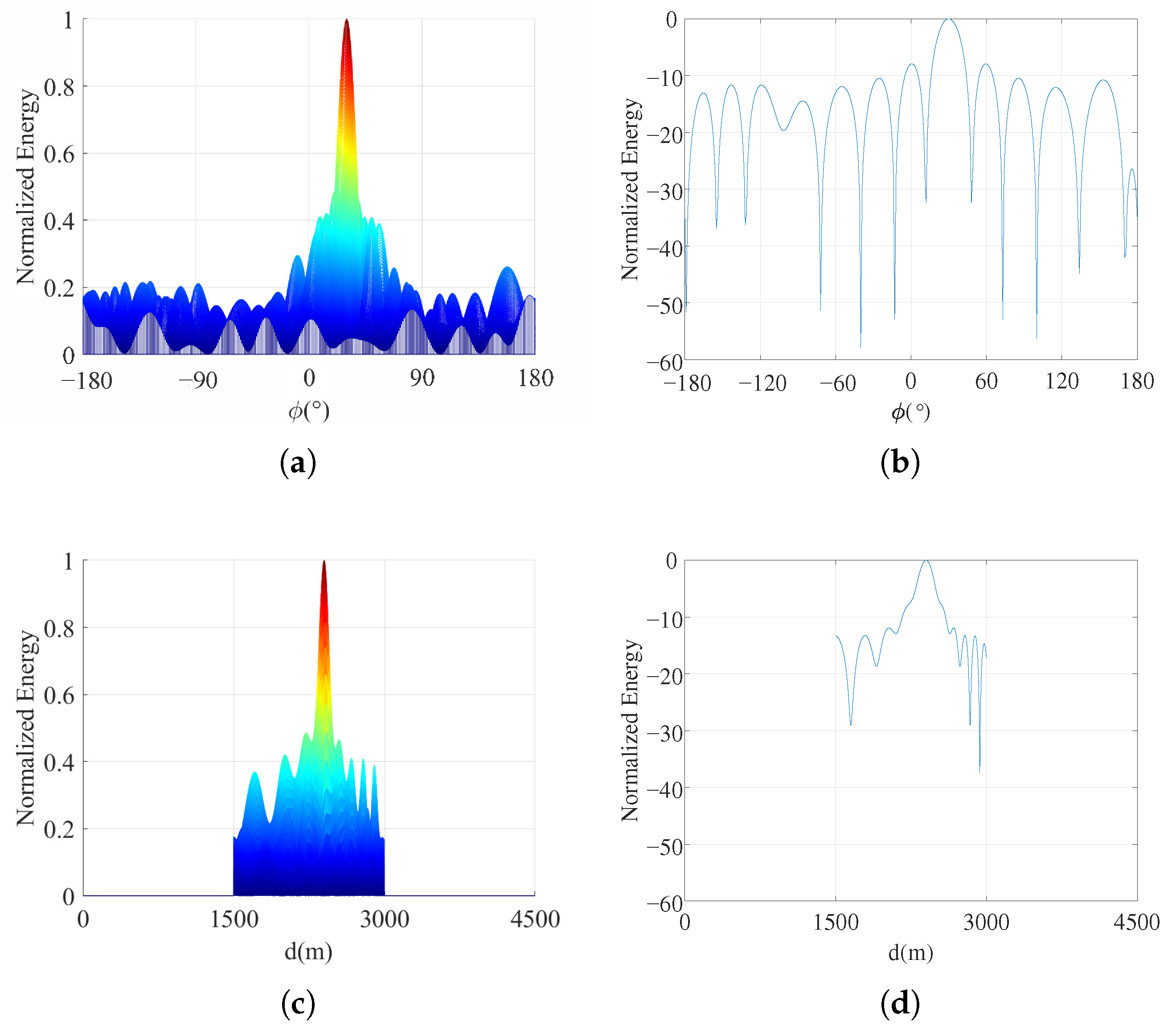
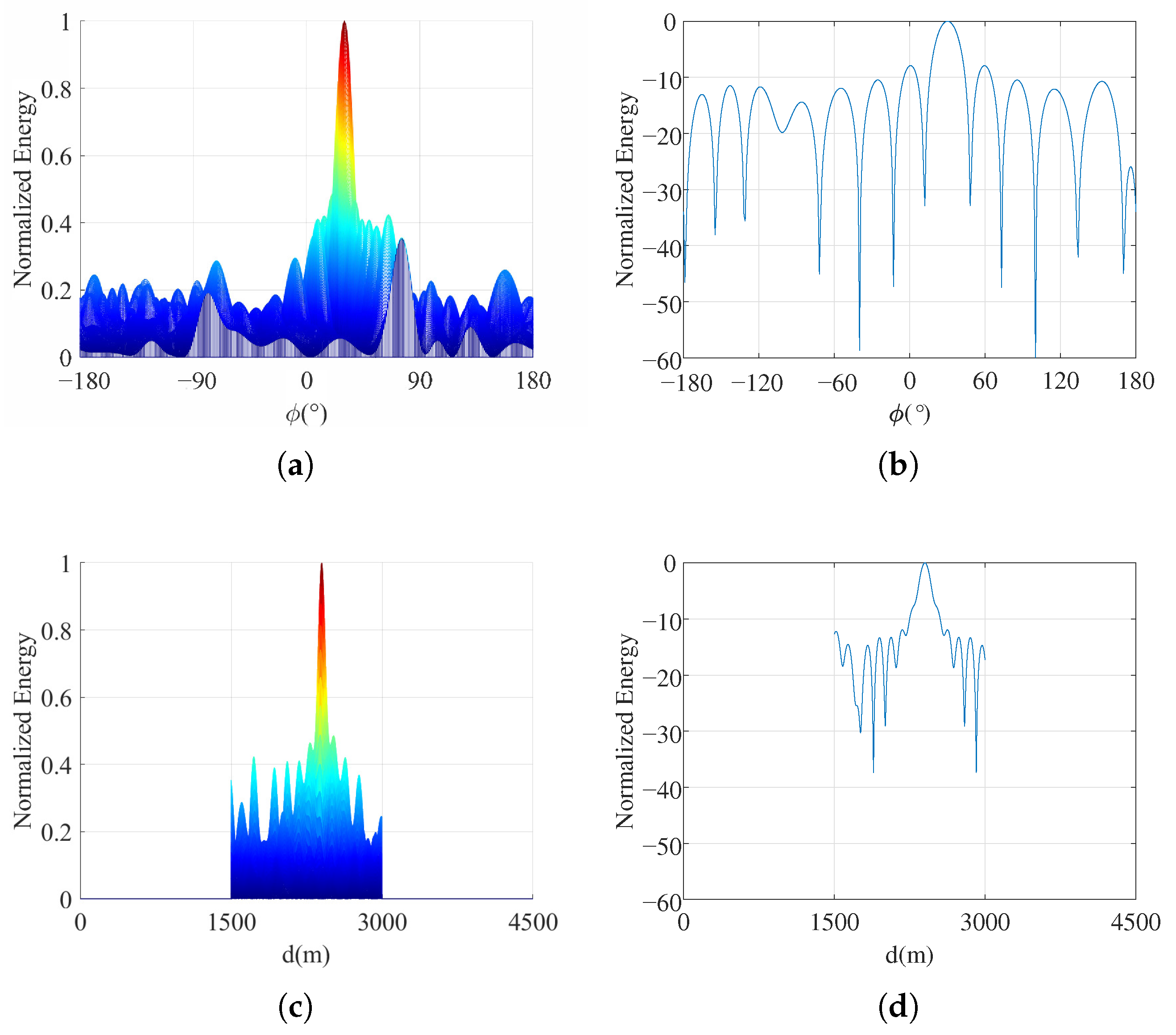
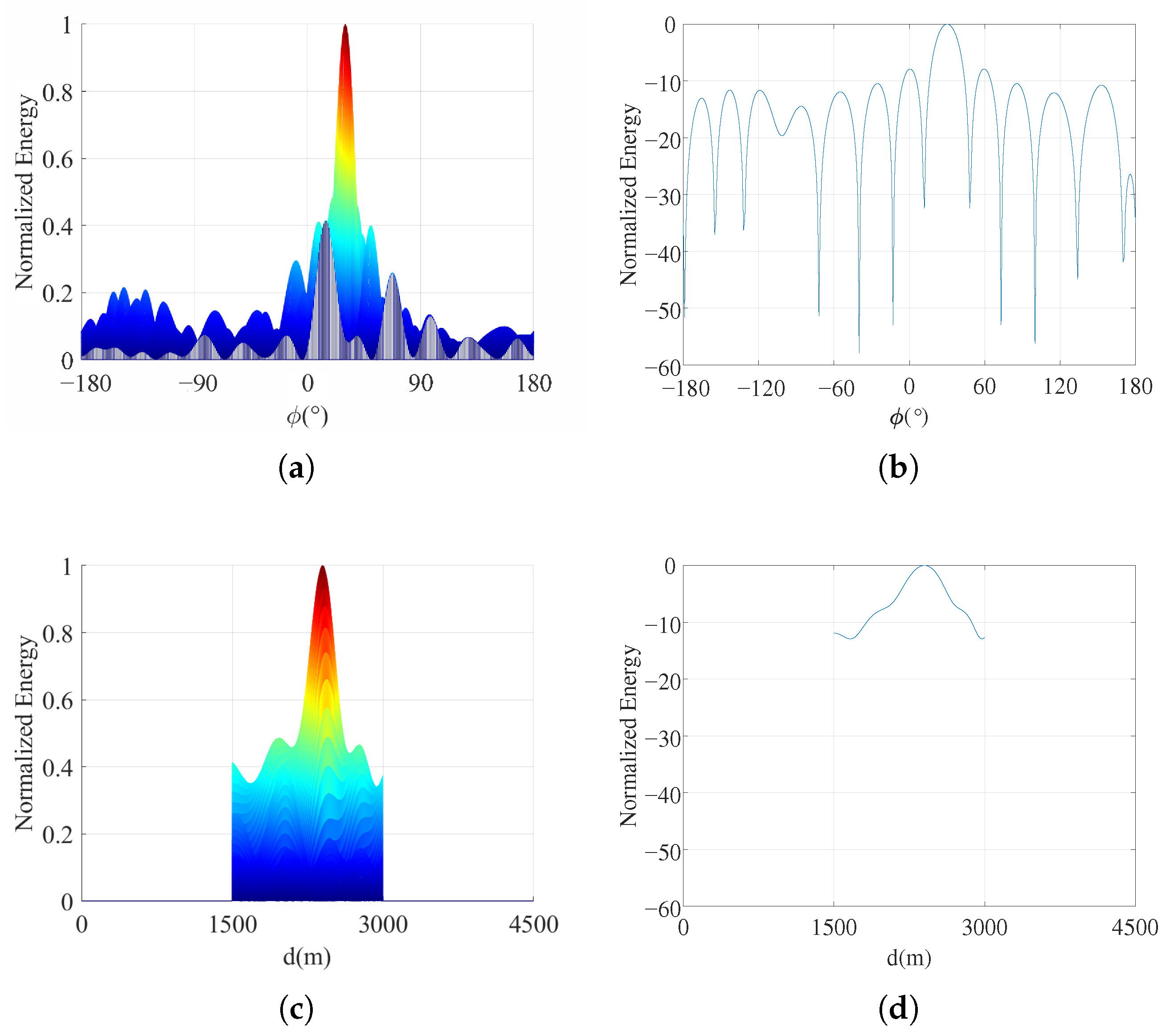
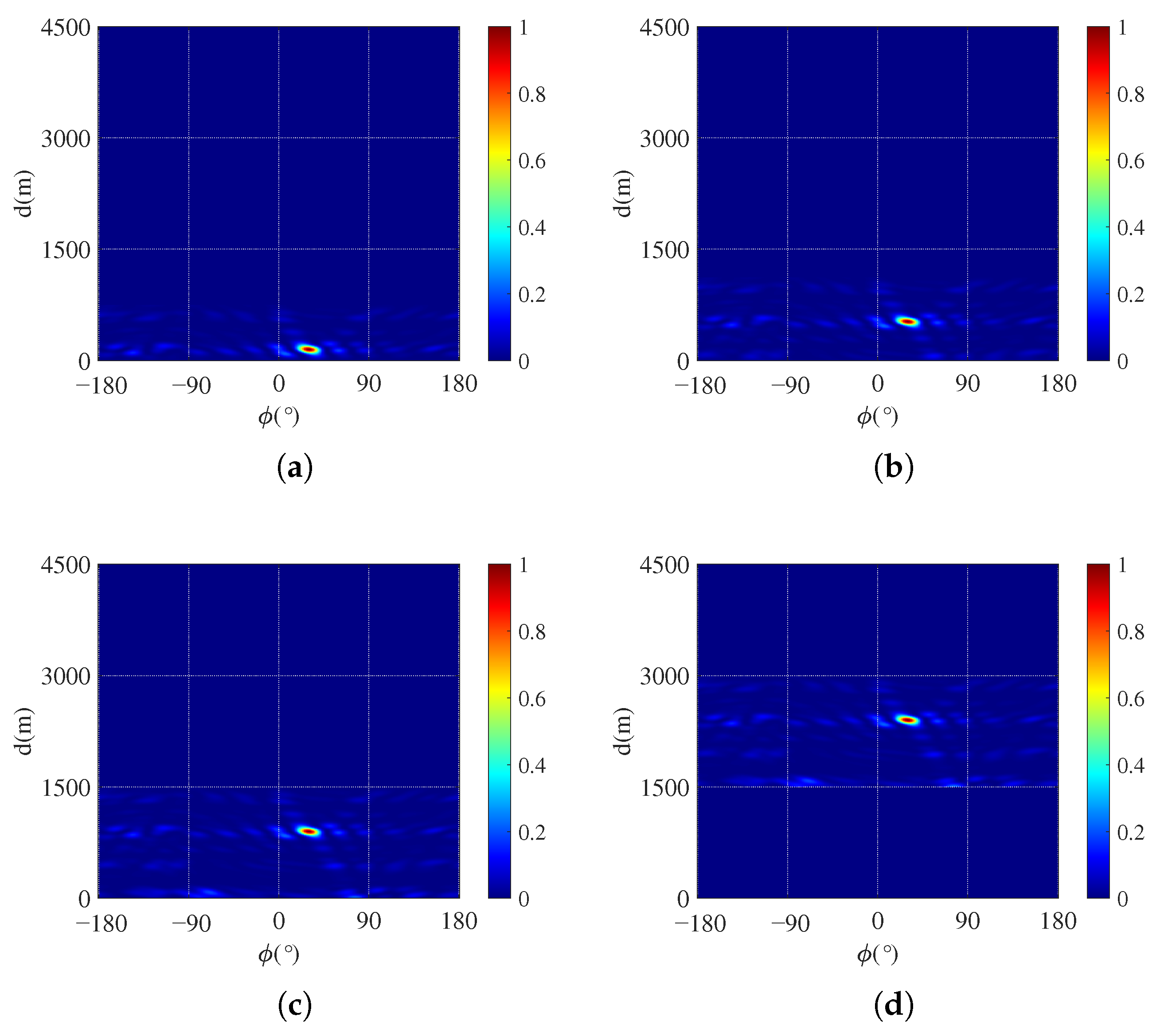
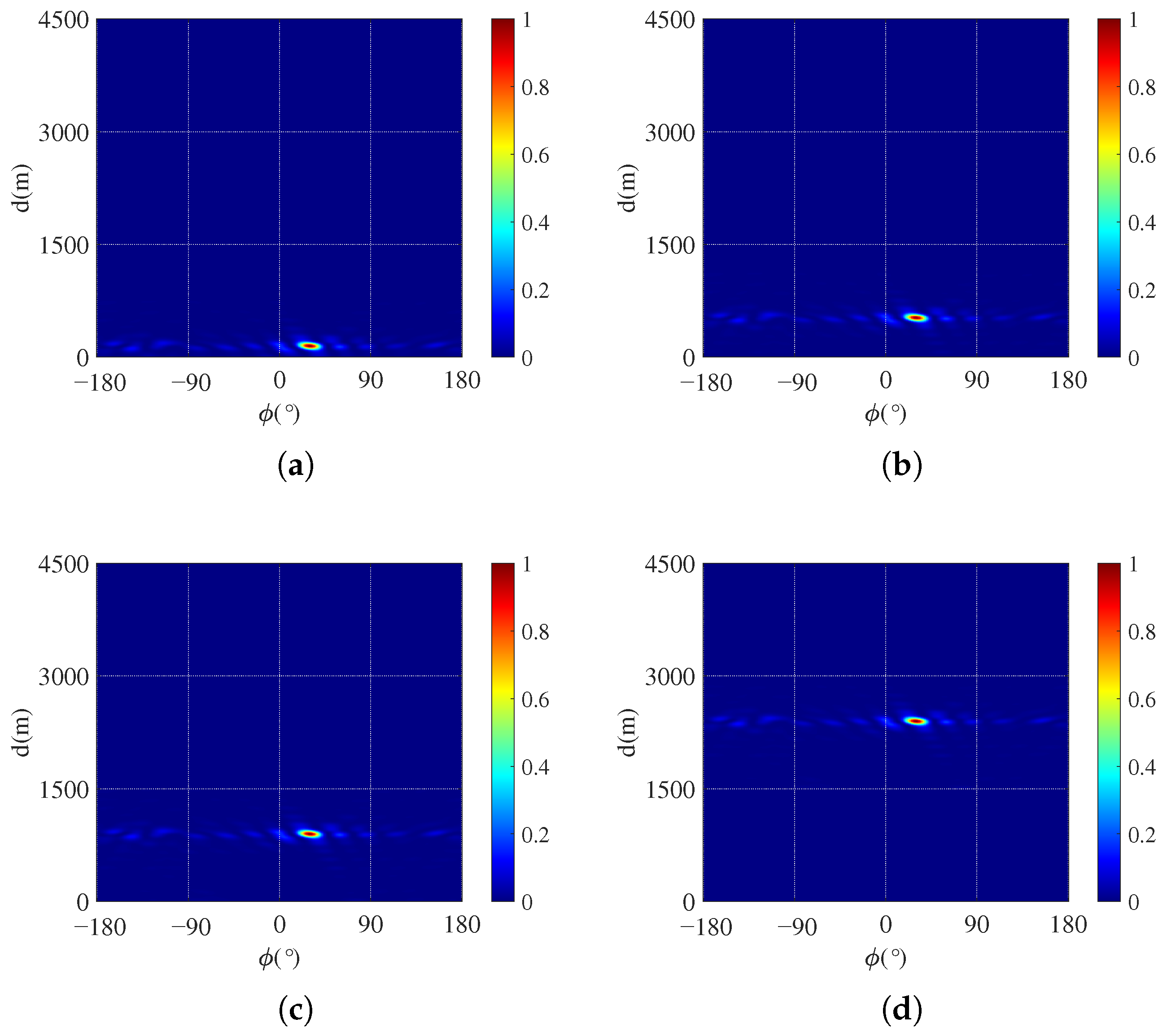
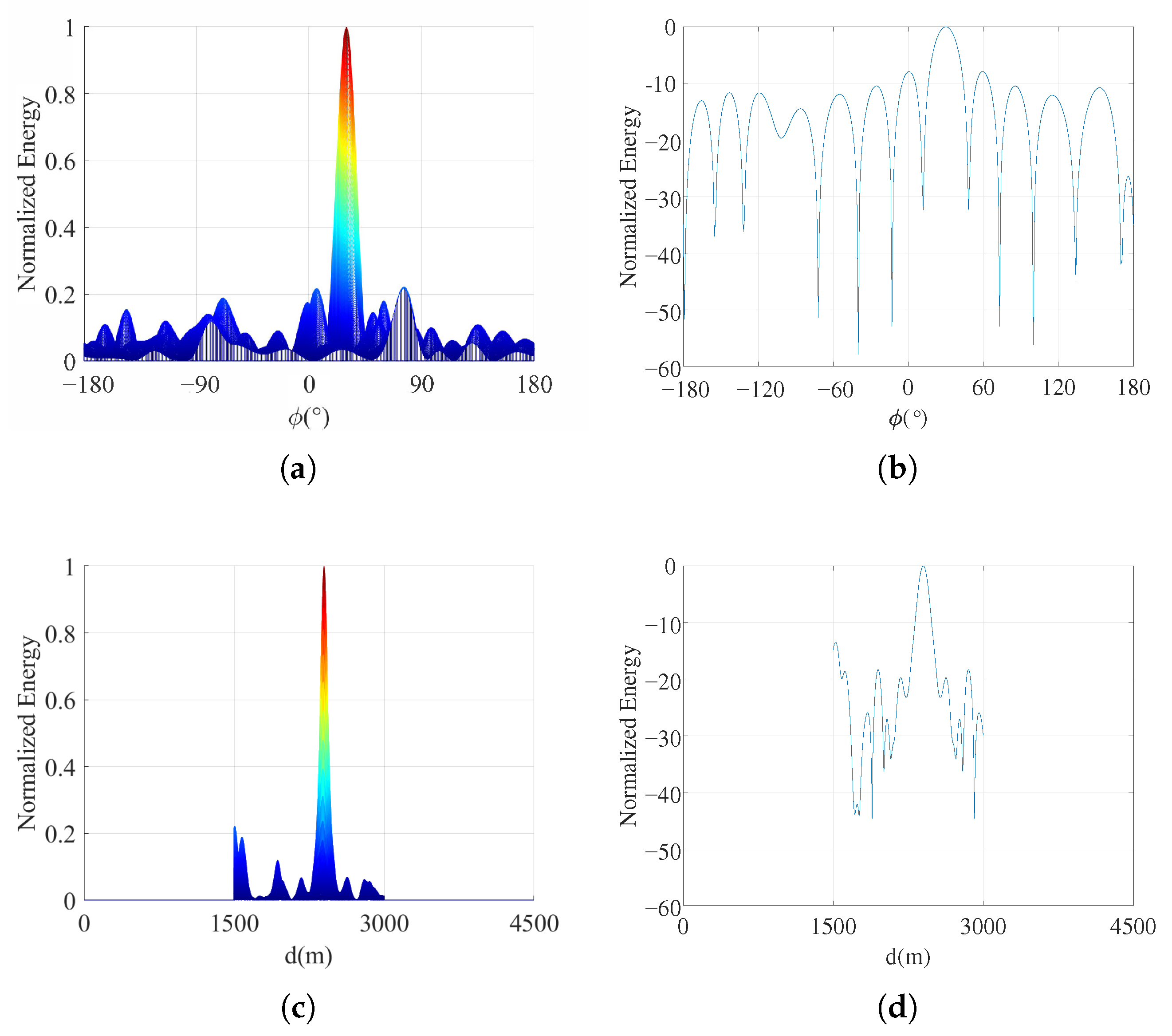
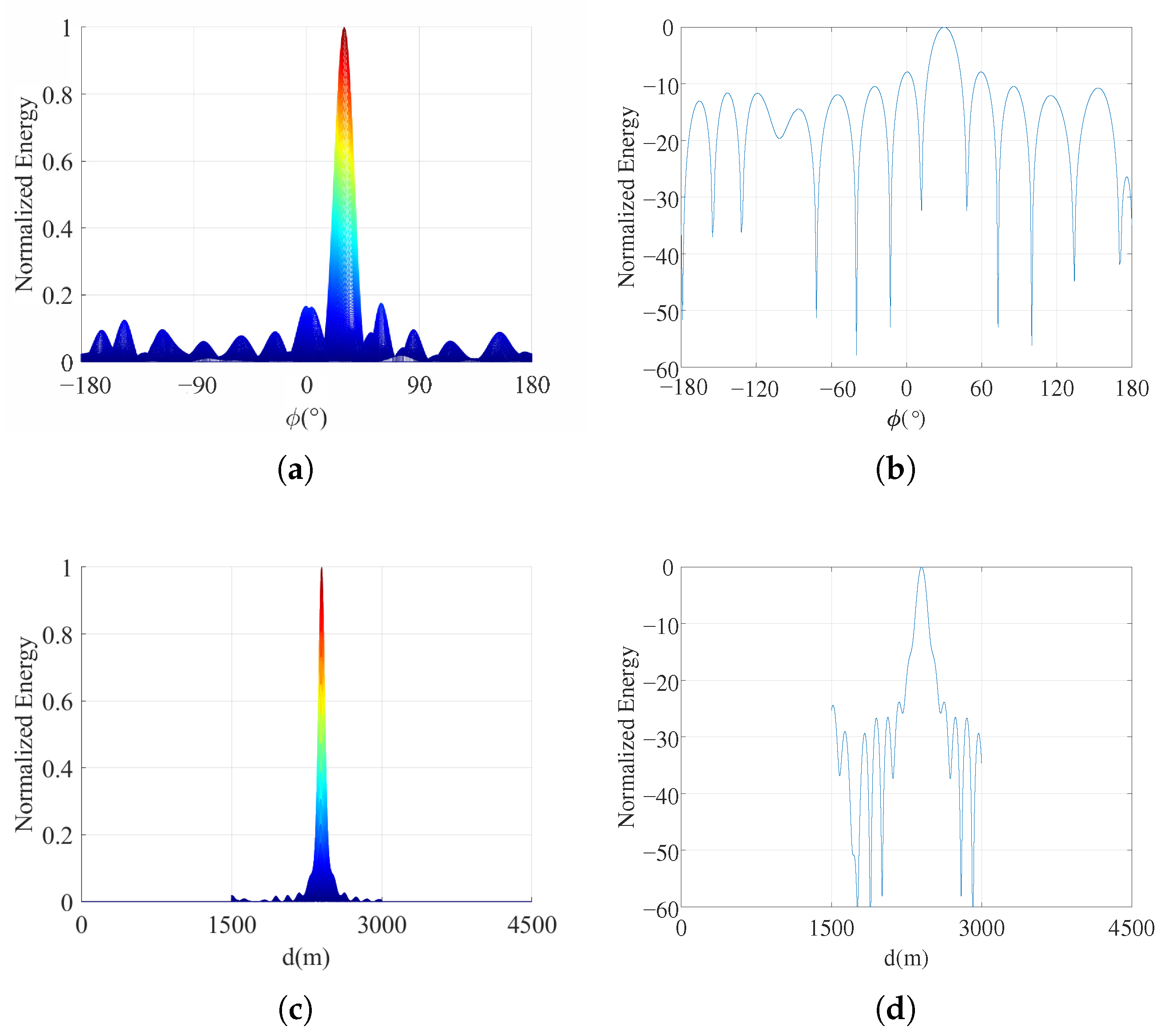
Assume the number of elements of the MC-UCFDA sonar is M = 16 , pulse width T = 1 s, reference frequency f 0 = 10 kHz, radius R = 1.2 λ 0 , Δ f ln l = 5 Hz, Δ f ln m = 5 Hz, sound speed c = 1500 m/s, total carriers L = 4 and L = 16 , main beam desired angle ϕ 0 = 0 ° , desired range d 0 = 900 m. Set the far-field observation area as d [ 0 , 4500 ] m, ϕ [ 180 ° , 180 ° ] . Figure 13 and Figure 14 show the 2D transmit beam pattern of the MC-UCFDA sonar at different times for L = 4 and L = 16 , respectively. Figure 15 and Figure 16 show the azimuth beam projection, azimuth beam pattern at the main beam range cross-section, range beam projection, and range beam pattern at the ϕ = ϕ 0 cross-section at t = 2.0 s for L = 4 and L = 16 , respectively. Table 3 compares the beam characteristics of the MC-UCFDA sonar under different parameters, including 3 dB azimuth beam width, 3 dB range beam width, and maximum sidelobe level.
Through the above simulation analysis, the following conclusions can be drawn:
1. The nonlinear multi-carrier frequency offset design effectively solves the range–azimuth coupling and periodicity problems of traditional UCFDA sonar transmit beams, eliminates grating lobes, and at the same time greatly reduces the trailing phenomenon of the main beam, presenting a relatively ideal “dot” shape. The beam also propagates dynamically forward in space, and the position is fixed at azimuth ϕ 0 .
2. As the total number of carriers L increases, the range main lobe width of the MC-UCFDA sonar beam decreases and range resolution increases, but the azimuth beam performance basically does not change.
3. Compared with In-UCFDA and TMln-UCFDA in Section 3.1 and Section 3.2, the introduction of the multi-carrier method greatly improves the performance of the UCFDA sonar transmit beam. The azimuth beam projection and range beam projection can well reflect the sidelobe situation in the space outside the main beam angle cross-section and range cross-section. For UCFDA, the azimuth beam pattern at the main beam range cross-section is not affected by frequency offset changes, and the maximum sidelobe level is fixed at 0.16, approximately 7.9 dB. Combining Figure 5, Figure 6, Figure 8, Figure 9, Figure 10 and Figure 11, and the data in Table 2, it is not difficult to find that in the space outside the main beam angle cross-section of ln-UCFDA and TMln-UCFDA sonar, a large number of sidelobes with levels higher than 0.16 appear, and the maximum sidelobe level is about 0.48. Combining Figure 13, Figure 14, Figure 15 and Figure 16 and the data in Table 3, it can be seen that in the space outside the main beam angle cross-section of the MC-UCFDA sonar, the sidelobe level is very well suppressed. When the total number of carriers L = 16 , the sidelobe level is basically less than 0.16.
For the computational complexity analysis of the proposed methods, firstly, the computational loads of the three nonlinear frequency offset designs presented in this paper are all lower than that of the nonlinear programming approach adopted in [20] and the compressed sensing-based sparse reconstruction method used in [22]. Specifically, for the natural logarithmic frequency offset design, generating the frequency offsets for all M array elements according to Equation (10) requires only M multiplication operations. For the time-modulated frequency offset design, as shown in Equation (19), the offset is a function related to the signal generation time. Consequently, on top of the M multiplications, its overall computational load is also proportional to the signal pulse width T: a larger T leads to a higher load. It is worth noting that, compared to the natural logarithmic design, the introduction of time modulation does not enhance the performance of the UCFDA sonar transmit beampattern but rather increases the complexity of the frequency offset design. For the nonlinear multicarrier frequency offset design, according to Equations (22) and (24), the generation of frequency offsets for M elements requires a total of M + M L multiplication operations and M ( L 1 ) addition operations due to the incorporation of multiple carriers. When the number of subcarriers L = 1 , its computational complexity is identical to that of the conventional single-carrier natural logarithmic design. The computational load increases with the total number of carriers L. Therefore, in practical engineering applications, the value of L can be dynamically adjusted according to specific scenario requirements to strike a balance between beampattern performance and system complexity.
Through the above analysis, a nonlinear frequency offset design can effectively eliminate grating lobes and solve the range–azimuth coupling and periodicity problems of the transmit beam. The introduction of multi-carrier technology can effectively improve the range beam performance of the transmit beam. However, for the azimuth dimension, especially the azimuth beam pattern at the main beam range cross-section, it is almost not affected by the frequency offset design. To effectively reduce azimuth beam sidelobes, other methods or design perspectives need to be chosen. Furthermore, for UCFDA sonar under pulsed operation, this paper mainly analyzes from the perspectives of “dot”-shaped beam design, sidelobe suppression, and propagation law. The selection of the transmit signal pulse width needs to be comprehensively considered with factors such as transmit beam resolution, main lobe width, operating range, and system power for design, which is not discussed in detail in this paper.

4. Conclusions

This paper delves into the UCFDA sonar model, focusing on enhancing the natural logarithmic frequency offset design. The primary goal is to address issues related to grating lobes, as well as to tackle the coupling and periodicity challenges encountered in the transmit beam within the range–azimuth dimensions. An in-depth analysis of the time-modulated frequency offset design is performed to build upon the existing research. The investigation highlights that the time variable in the time-modulated frequency offset function and the time variable in the signal propagation term are distinct entities with unique physical interpretations, indicating that they cannot be treated as interchangeable to eliminate the time-varying nature of the beam. It is underscored that the time-varying property of the UCFDA sonar transmit beam is inherent. Simulation outcomes demonstrate that the pulse signal emitted by the UCFDA sonar can create a “dot”-shaped beam within the pulse-covered space, dynamically moving forward in space while maintaining a fixed position in the azimuth dimension. In order to minimize sidelobes and optimize beam performance, multicarrier technology is introduced, effectively reducing the sidelobe level in spatial areas beyond the main beam’s angular cross-section. Furthermore, the influence of altering the total number of carriers on the UCFDA sonar transmit beam’s performance is examined through simulations.
The study presented in this paper focuses primarily on optimizing beams at the transmitter end. It builds upon existing phased uniform circular array sonar transmission systems without making changes to the array or hardware structure. Instead, the approach involves adjusting the transmit signal frequency of each element through software to introduce a slight frequency offset between elements, enhancing the range resolution of the transmit beam. However, compared to conventional phased transmission systems, frequency-diverse transmission systems place greater demands on the frequency response capability of the transmitting transducer. A reduced frequency response error is necessary to minimize the impact of frequency errors on beam performance. Moreover, in the marine environment, variations in water temperature and salinity lead to fluctuations in sound speed, which in turn affect the UCFDA sonar transmit beam. Future research should include additional experiments to thoroughly analyze the effects of transmit signal frequency errors and environmental sound speed variations on beam performance. Furthermore, future research directions will focus on achieving higher range resolution through signal processing at the receiver end.

Author Contributions

Conceptualization, W.L. and Y.Y.; methodology, W.L. and Y.Y.; software, W.L. and Y.Y.; validation, W.L. and Y.Y.; formal analysis, W.L. and Y.Y.; investigation, W.L. and Y.Y.; resources, W.L. and Y.Y.; data curation, W.L. and Y.Y.; writing—original draft preparation, W.L. and Y.Y.; writing—review and editing, W.L. and Y.Y.; visualization, W.L.; supervision, Y.Y.; project administration, Y.Y.; funding acquisition, Y.Y. All authors have read and agreed to the published version of the manuscript.

Funding

This research received no external funding.

Institutional Review Board Statement

Not applicable.

Data Availability Statement

Dataset available on request from the authors.

Conflicts of Interest

The authors declare no conflicts of interest.

References

  1. Antonik, P.; Wicks, M.C.; Griffiths, H.D.; Baker, C.J. Frequency diverse array radars. In 2006 IEEE Conference on Radar; IEEE: Verona, NY, USA, 2006; pp. 215–217. [Google Scholar]
  2. Xu, Y.; Luk, K.M. Enhanced transmit-receive beamforming for frequency diverse array. IEEE Trans. Antennas Propag. 2020, 68, 5344–5352. [Google Scholar] [CrossRef]
  3. Wang, W. Information geometry resolution optimization for frequency diverse array in DOA estimation. Signal Process. 2020, 169, 107376. [Google Scholar] [CrossRef]
  4. Wang, W.; Chen, H.; Zheng, Z.; Shunsheng, Z. Advances on frequency diverse array radar and its applications. J. Radars 2018, 7, 153–166. [Google Scholar]
  5. Liu, M.; Wang, C.; Gong, J.; Tan, M.; Bao, L.; Zhou, C. Ambiguity Function Analysis and Optimization of Coherent FDA Radar. IEEE Geosci. Remote Sens. Lett. 2024, 21, 3507205. [Google Scholar] [CrossRef]
  6. Xu, J.; Zhang, Y.; Liao, G.; Xu, Y.; Wang, W. Angle-Dependent Matched Filtering for Moving Target Indication with Coherent FDA Radar. IEEE Trans. Aerosp. Electron. Syst. 2024, 60, 3523–3536. [Google Scholar] [CrossRef]
  7. Secmen, M.; Demir, S.; Hizal, A.; Eker, T. Frequency diverse array antenna with periodic time modulated pattern in range and angle. In 2007 IEEE Radar Conference; IEEE: Waltham, MA, USA, 2007; pp. 427–430. [Google Scholar]
  8. Khan, W.; Qureshi, I.M. Frequency diverse array radar with time-dependent frequency offset. IEEE Antennas Wirel. Propag. Lett. 2014, 13, 758–761. [Google Scholar] [CrossRef]
  9. Khan, W.; Qureshi, I.M.; Saeed, S. Frequency diverse array radar with logarithmically increasing frequency offset. IEEE Antennas Wirel. Propag. Lett. 2015, 14, 499–502. [Google Scholar] [CrossRef]
  10. Gao, K.D.; Wang, W.Q.; Cai, J.Y.; Xiong, J. Decoupled frequency diverse array range-angle-dependent beampattern synthesis using non-linearly increasing frequency offsets. IET Microwaves Antennas Propag. 2016, 10, 880–884. [Google Scholar] [CrossRef]
  11. Jia, W.; Jakobsson, A.; Wang, W.Q. Coherent FDA Receiver and Joint Range-Space-Time Processing. IEEE Trans. Antennas Propag. 2024, 72, 745–755. [Google Scholar] [CrossRef]
  12. Higgins, T.; Blunt, S.D. Analysis of range-angle coupled beamforming with frequency diverse chirps. In 2009 International Waveform Diversity and Design Conference; IEEE: Kissimmee, FL, USA, 2009; pp. 1–4. [Google Scholar]
  13. Xu, Y.; Shi, X.; Li, W.; Xu, J. Flat-top beampattern synthesis in range and angle domains for frequency diverse array via second-order cone programming. IEEE Antennas Wirel. Propag. Lett. 2016, 15, 1479–1482. [Google Scholar] [CrossRef]
  14. Xiong, J.; Wang, W.; Shao, H.; Chen, H. Frequency diverse array transmit beampattern optimization with genetic algorithm. IEEE Antennas Wirel. Propag. Lett. 2016, 16, 469–472. [Google Scholar] [CrossRef]
  15. Chen, T.; Xia, D. Lagrange programming neural network approach for frequency diverse array beampattern synthesis. Circuits Syst. Signal Process. 2020, 39, 439–455. [Google Scholar] [CrossRef]
  16. Wang, B.; Xie, J.; Zhang, J.; Zhang, H. Dot-shaped beamforming analysis based on OSB log-FDA. J. Syst. Eng. Electron. 2020, 31, 312–320. [Google Scholar] [CrossRef]
  17. Wang, B.; Xie, J.; Zhang, J.; Feng, X.Y. Frequency diverse array beam control based on nonlinear frequency offset. Trans. Beijing Inst. Technol. 2019, 39, 311–319. [Google Scholar]
  18. Basit, A.; Qureshi, I.; Khan, W.; Khan, S. Cognitive frequency offset calculation for frequency diverse array radar. In 2015 12th International Bhurban Conference on Applied Sciences and Technology (IBCAST); IEEE: Islamabad, Pakistan, 2015; pp. 641–645. [Google Scholar] [CrossRef]
  19. Basit, A.; Qureshi, I.M.; Khan, W.; Rehman, S.u.; Khan, M.M. Beam Pattern Synthesis for an FDA Radar with Hamming Window-Based Nonuniform Frequency Offset. IEEE Antennas Wirel. Propag. Lett. 2017, 16, 2283–2286. [Google Scholar] [CrossRef]
  20. Cui, Y.S.; Chen, H.; Wang, W.Q. Frequency Diverse Array Focusing Beampattern Synthesis With Constrained Nonlinear Programming Frequency Offsets. In 2019 27th European Signal Processing Conference (EUSIPCO); IEEE: A Coruna, Spain, 2019; pp. 1–5. [Google Scholar] [CrossRef]
  21. Xu, Y.; Shi, X.; Xu, J.; Li, P. Range-angle-dependent beamforming of pulsed frequency diverse array. IEEE Trans. Antennas Propag. 2015, 63, 3262–3267. [Google Scholar] [CrossRef]
  22. Yao, A.M.; Wu, W.; Fang, D.G. Solutions of Time-Invariant Spatial Focusing for Multi-Targets Using Time Modulated Frequency Diverse Antenna Arrays. IEEE Trans. Atennas Propag. 2017, 65, 552–566. [Google Scholar] [CrossRef]
  23. Yao, A.; Wu, W.; Fang, D. Frequency diverse array antenna using time-modulated optimized frequency offset to obtain time-invariant spatial fine focusing beampattern. IEEE Trans. Antennas Propag. 2016, 64, 4434–4446. [Google Scholar] [CrossRef]
  24. Wang, Y.; Li, W.; Huang, G.; Li, J. Time-invariant range-angle-dependent beampattern synthesis for FDA radar targets tracking. IEEE Antennas Wirel. Propag. Lett. 2017, 16, 2375–2379. [Google Scholar] [CrossRef]
  25. Liao, Y.; Wang, W.; Zheng, Z. Frequency diverse array beampattern synthesis using symmetrical logarithmic frequency offsets for target indication. IEEE Trans. Antennas Propag. 2019, 67, 3505–3509. [Google Scholar] [CrossRef]
  26. Xiong, J.; Wang, W.Q. Sparse reconstruction-based beampattern synthesis for multi-carrier frequency diverse array antenna. In 2017 IEEE International Conference on Acoustics, Speech and Signal Processing (ICASSP); IEEE: Orleans, LA, USA, 2017; pp. 3395–3398. [Google Scholar] [CrossRef]
  27. Wang, Z.; Mu, T.; Song, Y.; Ahmad, Z. Beamforming of frequency diverse array radar with nonlinear frequency offset based on logistic map. Prog. Electromagn. Res. M 2018, 64, 55–63. [Google Scholar] [CrossRef]
  28. Shi, J. On time-invariant FDA beam-pattern design based on time-dependent frequency offsets. In 2020 IEEE 11th Sensor Array and Multichannel Signal Processing Workshop (SAM); IEEE: Hangzhou, China, 2020; pp. 1–4. [Google Scholar]
  29. Lan, L.; Liao, G.; Xu, J.; Zhang, Y.; Liao, B. Transceive beamforming with accurate nulling in FDA-MIMO radar for imaging. IEEE Trans. Geosci. Remote Sens. 2020, 58, 4145–4159. [Google Scholar] [CrossRef]
  30. Lan, L.; Xu, J.; Liao, G.; Zhang, Y.; Fioranelli, F.; So, H.C. Suppression of mainbeam deceptive jammer with FDA-MIMO radar. IEEE Trans. Veh. Technol. 2020, 69, 11584–11598. [Google Scholar] [CrossRef]
  31. Wang, Y.; Zhu, S. Main-beam range deceptive jamming suppression with simulated annealing FDA-MIMO radar. IEEE Sens. J. 2020, 20, 9056–9070. [Google Scholar] [CrossRef]
  32. Xu, J.; Zhu, S.; Liao, G. Range ambiguous clutter suppression for airborne FDA-STAP radar. IEEE J. Sel. Top. Signal Process. 2015, 9, 1620–1631. [Google Scholar] [CrossRef]
  33. Zhu, Y.; Liu, L.; Lu, Z.; Zhang, S. Target detection performance analysis of FDA-MIMO radar. IEEE Access 2019, 7, 164276–164285. [Google Scholar] [CrossRef]
  34. Liu, Q.; Xu, J.; Ding, Z.; So, H.C. Target localization with jammer removal using frequency diverse array. IEEE Trans. Veh. Technol. 2020, 69, 11685–11696. [Google Scholar] [CrossRef]
  35. Liu, Z.; Zhu, S.; Xu, J.; He, X.; Duan, K.; Lan, L. Range-Ambiguous Clutter Suppression for STAP-Based Radar with Vertical Coherent Frequency Diverse Array. IEEE Trans. Geosci. Remote Sens. 2023, 61, 5106517. [Google Scholar] [CrossRef]
  36. Saeed, S.; Qureshi, I.M.; Khan, W.; Salman, A. An investigation into uniform circular frequency diverse array (UCFDA) radars. Remote Sens. Lett. 2015, 6, 707–714. [Google Scholar] [CrossRef]
  37. Wang, W.Q.; So, H.C.; Shao, H.Z. Non-uniform frequency diverse array for range-angle imaging of targets. IEEE Sens. J. 2014, 14, 2469–2476. [Google Scholar] [CrossRef]
  38. Mahmood, M.; Mir, H. Frequency diverse array beamforming using nonuniform logarithmic frequency increments. IEEE Antennas Wirel. Propag. Lett. 2018, 17, 1817–1821. [Google Scholar] [CrossRef]
  39. Jiang, Y.; Chen, Z.; Zhao, C. Simulation and analysis of frequency diverse array radar beampattern based on non-linearly increasing frequency offset. Sci. Technol. Eng. 2019, 19, 188–193. [Google Scholar]
Figure 1. Schematic diagram of UCFDA sonar.
Jmse 14 00371 g001
Figure 2. Transmit beam pattern of UCFDA sonar when R = 1.2 λ 0 , Δ f = 1 Hz. (a) 3D transmit beam pattern. (b) 2D transmit beam pattern. (c) Range-dimensional beam pattern at ϕ = 0 ° section. (d) Azimuth-dimensional beam pattern at the main beam range section.
Jmse 14 00371 g002
Figure 3. Transmit beam pattern of UCFDA sonar when R = 1.5 λ 0 , Δ f = 1 Hz. (a) 3D transmit beam pattern. (b) 2D transmit beam pattern. (c) Range-dimensional beam pattern at ϕ = 0 ° section. (d) Azimuth-dimensional beam pattern at the main beam range section.
Jmse 14 00371 g003
Figure 4. Transmit beam pattern of UCFDA sonar when R = 1.2 λ 0 , Δ f = 2 Hz. (a) 3D transmit beam pattern. (b) 2D transmit beam pattern. (c) Range-dimensional beam pattern at ϕ = 0 ° section. (d) Azimuth-dimensional beam pattern at the main beam range section.
Jmse 14 00371 g004
Figure 5. 2D transmit beam pattern of natural logarithmic frequency offset UCFDA sonar at different times: (a) t = 0.5 s, (b) t = 0.75 s, (c) t = 1.0 s, (d) t = 2.0 s.
Jmse 14 00371 g005
Figure 6. Beam projections and beam cross-sections of natural logarithmic frequency offset UCFDA sonar at t = 2.0 s. (a) Azimuth-dimensional beam projection. (b) Azimuth-dimensional beam pattern at d = d 0 section. (c) Range-dimensional beam projection. (d) Range-dimensional beam pattern at ϕ = ϕ 0 section.
Jmse 14 00371 g006
Figure 7. 2D transmit beam pattern of TMln-UCFDA sonar at different times: (a) t = 0.25 s, (b) t = 0.50 s, (c) t = 0.75 s, (d) t = 1.0 s.
Jmse 14 00371 g007
Figure 8. 2D transmit beam pattern of TMln-UCFDA sonar ( d 0 = 3000 m) at different times: (a) t = 0.5 s, (b) t = 0.75 s, (c) t = 1.0 s, (d) t = 2.0 s.
Jmse 14 00371 g008
Figure 9. 2D transmit beam pattern of TMln-UCFDA sonar ( d 0 = 6000 m) at different times: (a) Azimuth-dimensional beam projection. (a) t = 0.5 s, (b) t = 0.75 s, (c) t = 1.0 s, (d) t = 2.0 s.
Jmse 14 00371 g009
Figure 10. Beam projections and beam cross-sections of TMln-UCFDA sonar ( d 0 = 3000 m) at t = 2.0 s. (a) Azimuth-dimensional beam projection. (b) Azimuth-dimensional beam pattern at d = d 0 section. (c) Range-dimensional beam projection. (d) Range-dimensional beam pattern at ϕ = ϕ 0 section.
Jmse 14 00371 g010
Figure 11. Beam projections and beam cross-sections of TMln-UCFDA sonar ( d 0 = 6000 m) at t = 2.0 s. (a) Azimuth-dimensional beam projection. (b) Azimuth-dimensional beam pattern at d = d 0 section. (c) Range-dimensional beam projection. (d) Range-dimensional beam pattern at ϕ = ϕ 0 section.
Jmse 14 00371 g011
Figure 12. MC-UCFDA sonar model.
Jmse 14 00371 g012
Figure 13. 2D transmit beam pattern of MC-UCFDA sonar ( L = 4 ) at different times: (a) t = 0.5 s, (b) t = 0.75 s, (c) t = 1.0 s, (d) t = 2.0 s.
Jmse 14 00371 g013
Figure 14. 2D transmit beam pattern of MC-UCFDA sonar ( L = 16 ) at different times: (a) t = 0.5 s, (b) t = 0.75 s, (c) t = 1.0 s, (d) t = 2.0 s.
Jmse 14 00371 g014
Figure 15. Beam projections and beam cross-sections of MC-UCFDA sonar ( L = 4 ) at t = 2.0 s. (a) Azimuth-dimensional beam projection. (b) Azimuth-dimensional beam pattern at d = d 0 section. (c) Range-dimensional beam projection. (d) Range-dimensional beam pattern at ϕ = ϕ 0 section.
Jmse 14 00371 g015
Figure 16. Beam projections and beam cross-sections of MC-UCFDA sonar ( L = 16 ) at t = 2.0 s. (a) Azimuth-dimensional beam projection. (b) Azimuth-dimensional beam pattern at d = d 0 section. (c) Range-dimensional beam projection. (d) Range-dimensional beam pattern at ϕ = ϕ 0 section.
Jmse 14 00371 g016
Table 1. Main beam positions at different times.
Time t = 0.5 s t = 0.75 s t = 1.0 s t = 2.0 s
Position of Main Beam ( 150 m, 0 ° ) ( 525 m, 0 ° ) ( 900 m, 0 ° ) ( 2400 m, 0 ° )
Table 2. Beam characteristics of UCFDA under different frequency offset models and parameters.
Model−3 dB Beam Width (d/m)−3 dB Beam Width ( ϕ /deg)Max SLL
ln-UCFDA10517.00.48
TMln-UCFDA
( d 0 = 3000  m)15017.00.48
TMln-UCFDA
( d 0 = 6000  m)36117.00.48
Table 3. Beam characteristics of MC-UCFDA under different parameters.
Model 3 dB Beam Width (d/m) 3 dB Beam Width ( ϕ /deg)Max SLL
ln-UCFDA10517.00.48
MC-UCFDA
( L = 4 )8717.00.22
MC-UCFDA
( L = 16 )7517.00.16
Disclaimer/Publisher’s Note: The statements, opinions and data contained in all publications are solely those of the individual author(s) and contributor(s) and not of MDPI and/or the editor(s). MDPI and/or the editor(s) disclaim responsibility for any injury to people or property resulting from any ideas, methods, instructions or products referred to in the content.