Article

A Soft Bionic Pectoral Fin Actuated by a Series of Differential Gear Units

1
Donghai Laboratory, Zhoushan 316021, China
2
Ocean College, Zhejiang University, Zhoushan 316021, China
3
Laboratory for Marine Geology, Qingdao National Laboratory for Marine Science and Technology, Qingdao 266061, China
4
Hainan Institute of Zhejiang University, Sanya 572025, China
*
Author to whom correspondence should be addressed.
J. Mar. Sci. Eng. 2026, 14(4), 367; https://doi.org/10.3390/jmse14040367
Submission received: 12 January 2026 / Revised: 11 February 2026 / Accepted: 12 February 2026 / Published: 14 February 2026
(This article belongs to the Special Issue Bionic Design and Control of Underwater Robots)

Abstract

The bionic pectoral fin serves as the primary propulsion component of ray-inspired robots. In our previous research, a motion equation was proposed for the real pectoral fin, which can be modeled as a series of NACA airfoil-shaped cross-sections distributed along the spanwise direction. Each cross-section undergoes two coupled rotational motions about its chord line and spanwise rotational axis. To achieve this type of motion, this article introduces a novel bionic pectoral fin mechanism driven by a series of differential gear units. The differential unit generates two coupled rotational motions corresponding to the cross-section of the pectoral fin in motion. A series of interconnected differential units provides a unique topology for the bionic mechanism and can generate a diverse range of motions. Through kinematic analysis, the motion equation was mapped onto the rotational angles of motors in the differential units. The proposed bionic mechanism was then fabricated and subjected to experimental test, demonstrating its effectiveness with a maximum thrust of 0.71 N. The distinctive structure of this bionic mechanism differentiates it from conventional designs and is expected to provide some inspiration for bionic pectoral fins and ray-inspired robots.

1. Introduction

By emulating the body shape and swimming patterns of fish, researchers have designed various types of bionic fish for underwater exploration [1,2,3,4,5]. Fish swimming modes can be categorized into body and/or caudal fin (BCF) locomotion or median and/or paired fin (MPF) locomotion, depending on the body parts engaged during swimming [6]. The manta ray and cownose ray, which use their paired pectoral fins for propulsion, are typical examples of MPF swimmers and often imitated in the design of ray-inspired robots capable of underwater exploration, aquatic rescue, and other tasks [7]. Both the manta ray and cownose ray belong to the Batoidea group of fish. Despite differences in their sizes, they exhibit similar morphological features and motion patterns. Therefore, when studying their respective bionic counterparts, significant distinctions are generally not made.
The bionic pectoral fin acts as the primary propulsion component of ray-inspired robots, significantly influencing their performance. It can be categorized into actively controlled type [8,9,10,11,12] and passively deformation type [13,14,15,16,17]. This paper focuses on active bionic pectoral fins, as they are more suitable for achieving targeted motion compared to their passive counterparts. Motion of the real pectoral fin is complex and can be decomposed into oscillatory motion along both the chordwise and spanwise directions. Most active bionic pectoral fins employ simple rod-like fin rays [10,11,12], which mainly generate chordwise oscillation. To introduce spanwise motion, some researchers have implemented multi-link mechanisms as fin rays [18,19,20]. Nevertheless, these mechanisms often lead to excessive tensile deformation of the covering membrane, which contrasts with the strong bending and limited telescopic deformation observed in the real pectoral fin [21]. Other researchers have proposed more elaborate drive mechanisms to better approximate the geometry of the real pectoral fin, including designs based on flexible beam, cable-driven actuation, spatial parallel mechanism, and hybrid rigid–flexible structure [22,23,24,25]. While these fins resemble real pectoral fins in appearance and can generate three-dimensional motion, most are still limited to a small number of degrees of freedom or rely primarily on rigid-body rotations. As a result, they struggle to realize series-coupled motions with a layered topology, which is a key characteristic of the real pectoral fin. A comparison of representative designs and the proposed bionic pectoral fin mechanism is provided in Table 1.
In our previous research [26], a motion equation was proposed for the pectoral fin, which can be modeled as a series of NACA airfoil-shaped cross-sections distributed along the spanwise direction, analogous to the skeletal structure of a real pectoral fin [27]. Each cross-section exhibits two coupled rotational motions about its chord line and spanwise rotational axis, resulting in a distinct topology in both motion and structure. However, existing bionic pectoral fins based on parallel mechanisms or multilink actuation are generally unable to realize this type of series-coupled motion across the spanwise. To address this limitation, this study proposes a novel bionic pectoral fin mechanism actuated by a series of differential gear units. These differential units have identical structures, with each providing two coupled rotational motions corresponding to the cross-section of the real pectoral fin in both structure and motion. When connected in series, these differential units enable the bionic pectoral fin to achieve flexible oscillation. The resulting bionic pectoral fin mechanism closely mimics the appearance and motion of the real pectoral fin and allows for the adjustment of motion parameters such as flapping speed (angular frequency), amplitude, wave number, flapping mode, and phase, making it highly motion flexible.
The remainder of the paper is organized as follows. In Section 2, the bionic process from real biology to the bionic pectoral fin model and mechanism is introduced, including both motion and structure. The ability of the bionic model to generate thrust is validated through Computational Fluid Dynamics (CFD) simulations. In Section 3, the structure of the bionic mechanism is presented. Through kinematic analysis, the motion of the real pectoral fin is translated into the rotational motion of the motors that drive the bionic mechanism. In Section 4, the bionic pectoral fin mechanism was fabricated and tested to verify its applicability, followed by a discussion of the results. Section 5 provides a brief summary of the results and innovations presented in this paper, while also highlighting its limitations.

2. Establishment of the Bionic Pectoral Fin Model

2.1. Bionic Analysis for the Pectoral Fin

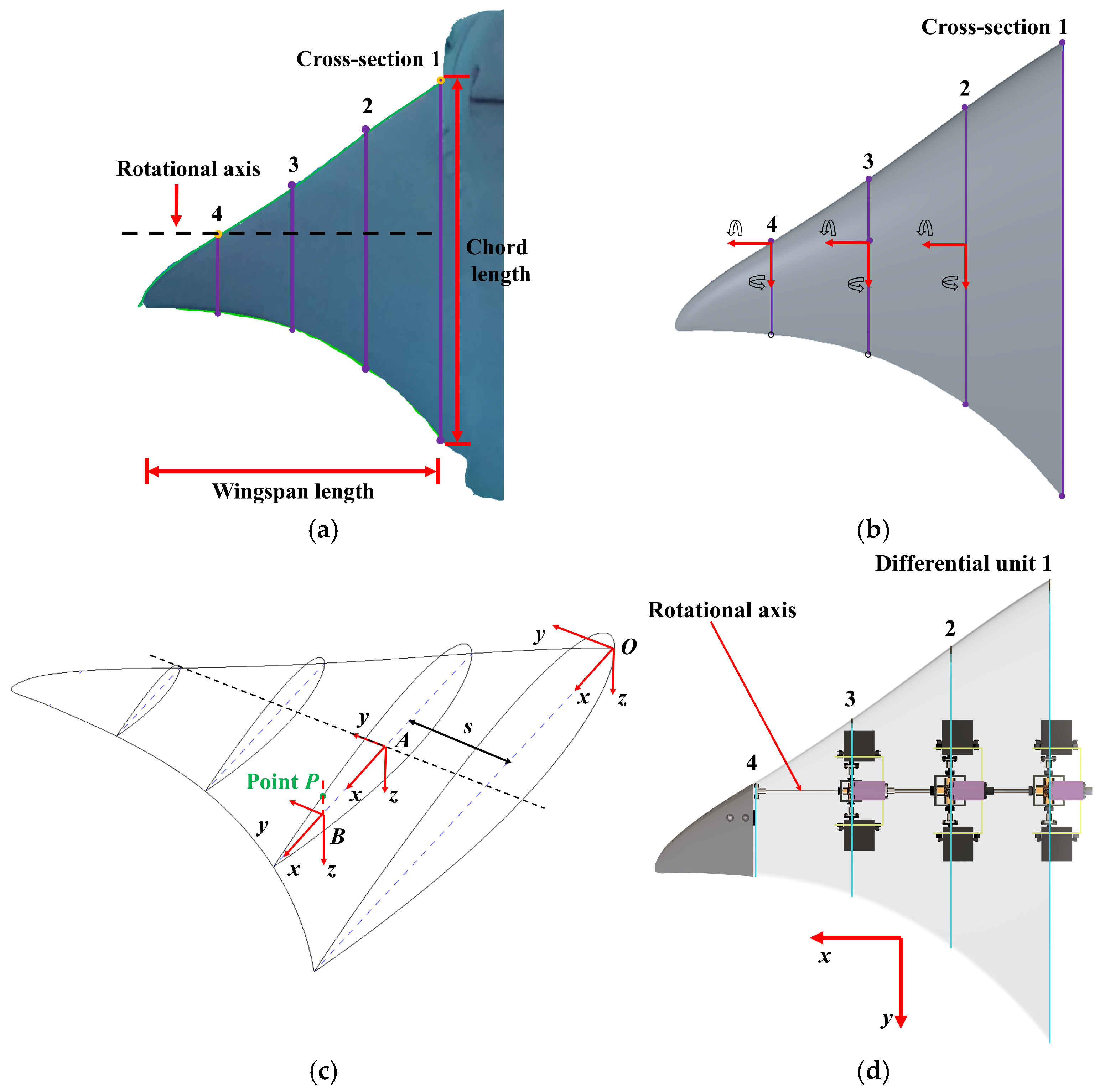
This section introduces how the structure and motion of the real pectoral fin inform the development of the bionic pectoral fin mechanism. Hall et al. [27] performed CT scans of the cownose ray, revealing numerous cartilaginous joints and bones inside the pectoral fin. These bones are interconnected and aligned along the spanwise direction, forming a distinct topology that enables the flexible motion of the real pectoral fin. In our earlier research, we developed a motion equation for the pectoral fin by analyzing video footage of real pectoral fin motion frame by frame [26]. The resulting motion equation exhibits a unique topological structure. It can be described as dividing the pectoral fin into multiple cross-sections along the spanwise direction, such as cross-sections 1, 2, 3, and 4 shown in Figure 1a, and each cross-section is capable of executing two coupled motions around the rotational axis and its own chord line.
Before designing the bionic pectoral fin mechanism, we first need to establish a bionic pectoral fin model based on the shape of the real pectoral fin. The maximum chord length of the real pectoral fin, observed at the Shanghai Chang Feng Ocean World aquarium, is 0.4 m and its cross-sectional shape was approximated as a NACA 0012 airfoil consistent with the approach taken by other researchers [28,29]. To ensure the bionic mechanism has sufficient space to accommodate the drive mechanisms, the bionic model is scaled up by a factor of 1.5, resulting in a maximum chord length of 0.6 m. The cross-sectional shape of the scaled model is adopted as a NACA 0024 airfoil, as shown in Figure 1b. To facilitate fabrication and enhance structural strength at the tip of the bionic mechanism, the outer 1/4 portion (wingtip) is considered rigid. Further reduction (e.g., to one-fifth of the span) would make the integration of the differential gear mechanism impractical. For any point P on the pectoral fin, as shown in Figure 1c, the length ratio s is defined as the spanwise position of the cross-section containing point P, normalized by the total span length. To facilitate the description of the bionic model motion, one global coordinate system O-xyz and two local coordinate systems A-xyz and B-xyz are established on the fin. The x-axis is aligned with the spanwise direction, while the y-axis is aligned with the chordwise direction. Using the motion equation developed in our previous work, the spanwise motion equation for the bionic model is derived as follows:
α ( s ) = α max a 1 s k s + ( a 2 s 2 + a 3 s ) cos ω t                                               ( s 0.75 ) α ( s ) = α max 0.75 a 1 0.75 k + ( 0.75 2 a 2 + 0.75 a 3 ) cos ω t       ( s > 0.75 )  
where α(s) refers to the slope at the position s, αmax is the flapping amplitude, ω is the angular frequency, t is time, and k is a mode variable that adjusts flapping modes of the bionic mode. When k = a1, the fin exhibits a symmetric flapping mode, oscillating evenly about the O-xy plane. For k < a1, the motion becomes asymmetric and biased upward, with the flapping confined to the region above the O-xy plane. Conversely, when k > a1, the fin operates in an asymmetric downward flapping mode, with its movement occurring below the O-xy plane. Constants a1, a2, and a3 are the coefficients listed in Table 2. The chordwise motion equation is
β ( s ) = β max ( b 1 s 2 + b 2 s ) sin ( ω t + b 3 s 2 + b 4 s + b 5 )                                                   ( s 0.75 ) β ( s ) = β max ( 0.75 2 b 1 + 0.75 b 2 ) sin ( ω t + 0 . 75 2 b 3 + 0.75 b 4 + b 5 )       ( s > 0.75 )
where β(s) is the rotational angle of each cross-section and βmax is the rotational amplitude. Constants b1, b2, b3, b4, and b5 are the coefficients listed in Table 2. The spanwise motion and chordwise motion equations can be combined into a comprehensive motion equation for the bionic model through the homogeneous coordinate transformation method [30]. The position of any point P in the bionic model [x(s), y(s), z(s)]T can be simply expressed as
x ( s ) y ( s ) z ( s ) 1 = T A O T A B 0 0 z p 1
where T A O is the conversion matrix from the coordinate system A-xyz to the O-xyz, and T B A is the transformation matrix from the coordinate system B-xyz to A-xyz, zp is the thickness of the fin at the location of point P. Since point P can represent any point in the bionic pectoral fin model, Equation (3) is the comprehensive motion equation. Based on the bionic model, the shape of the bionic mechanism can be designed, as shown in Figure 1d. Driving the bionic mechanism to execute the motion specified by the motion equation requires careful consideration. In this paper, a series of differential gear units is used to drive the bionic mechanism, with each unit adopting a NACA airfoil profile and generating coupled rotational motions that correspond to the cross-section of the pectoral fin. The details of the bionic mechanism are provided in Section 3.

2.2. CFD Simulation Analysis of the Bionic Model

The bionic pectoral fin model and its motion equation were established. Before the bionic model is used in the design of the bionic pectoral fin mechanism, its effectiveness needs to be validated using the CFD simulation method.
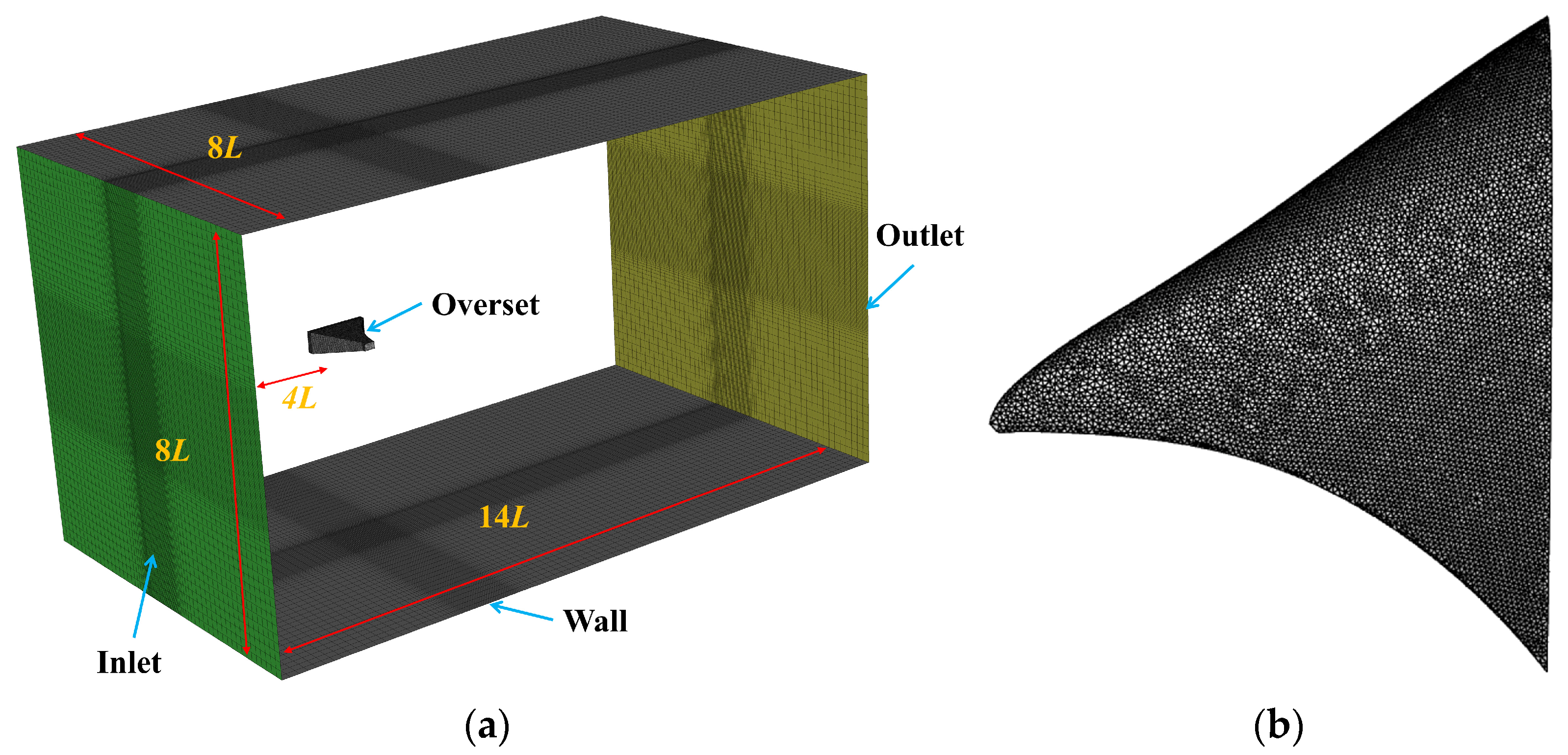
The simulation domain for the pectoral fin is shown in Figure 2a,b. The domain was divided into an inner moving region and an outer stationary region. The outer region was defined as a cuboid with dimensions of 8L × 8L × 14L, where L denotes the characteristic length, taken as the maximum chord length of the fin. A velocity inlet and pressure outlet were imposed at the upstream and downstream boundaries, respectively, while the remaining boundaries were treated as no-slip walls. The inner region, which encloses the pectoral fin, was constructed with a polyhedral shape and embedded within the outer region. An overset condition was specified on the outer surface of the inner region. The fin was positioned at a distance of 4L downstream of the inlet boundary, and a no-slip boundary condition was applied to its surface. The Reynolds number Re is calculated by
Re = ρ U L μ
where μ is the dynamic viscosity and U is the inlet velocity, set to 0.2 m/s. Substituting the relevant parameters into Equation (4) yields a Reynolds number of approximately 120,000. The incompressible viscous shear-stress transport (SST) kω model was chosen. The outer and inner regions were discretized using structured hexahedral meshes and unstructured tetrahedral meshes, respectively. Near the fin surface, a boundary layer mesh was generated with an initial thickness of 9.4 × 10⁻⁵ m and a growth rate of 1.2, with the dimensionless wall distance y+ maintained at approximately 1. To perform the oscillation motion of the pectoral fin, the dynamic mesh method was adopted. The motion of all meshes in the inner region was prescribed according to Equation (3). Since the force generated by the pectoral fin changes periodically, a transient calculation was used for the simulation.
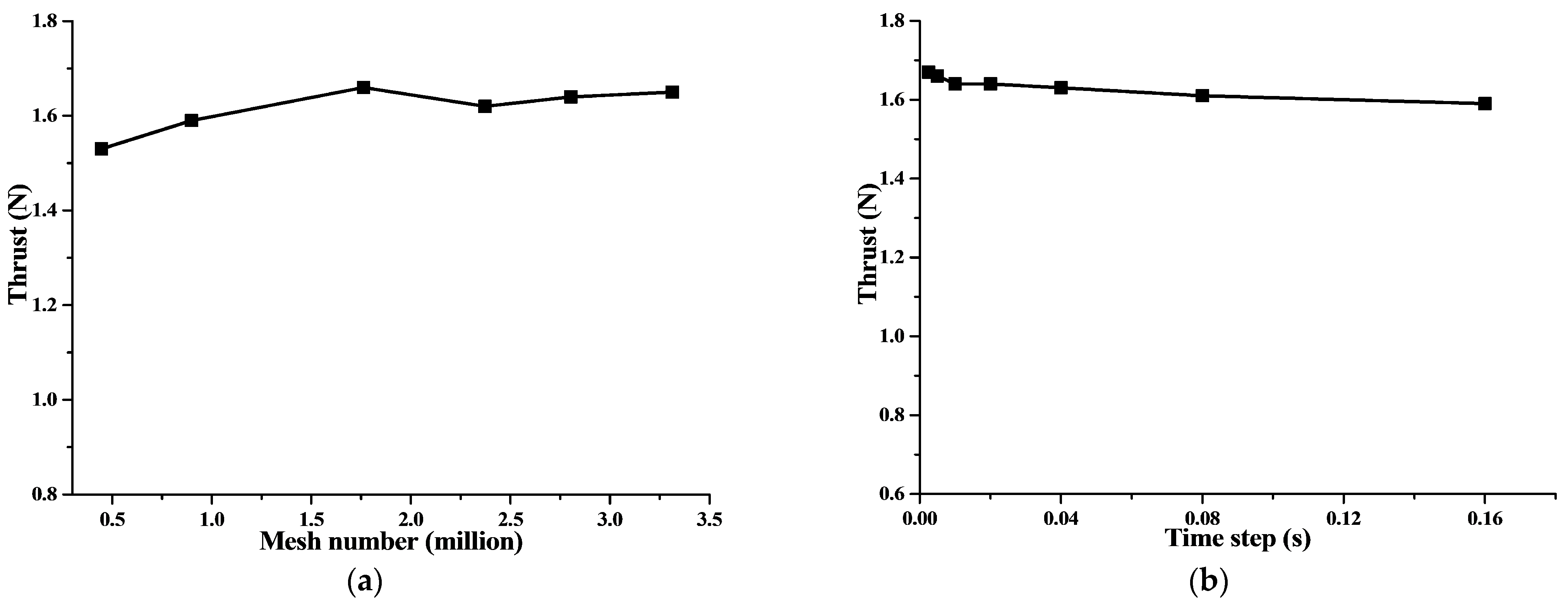
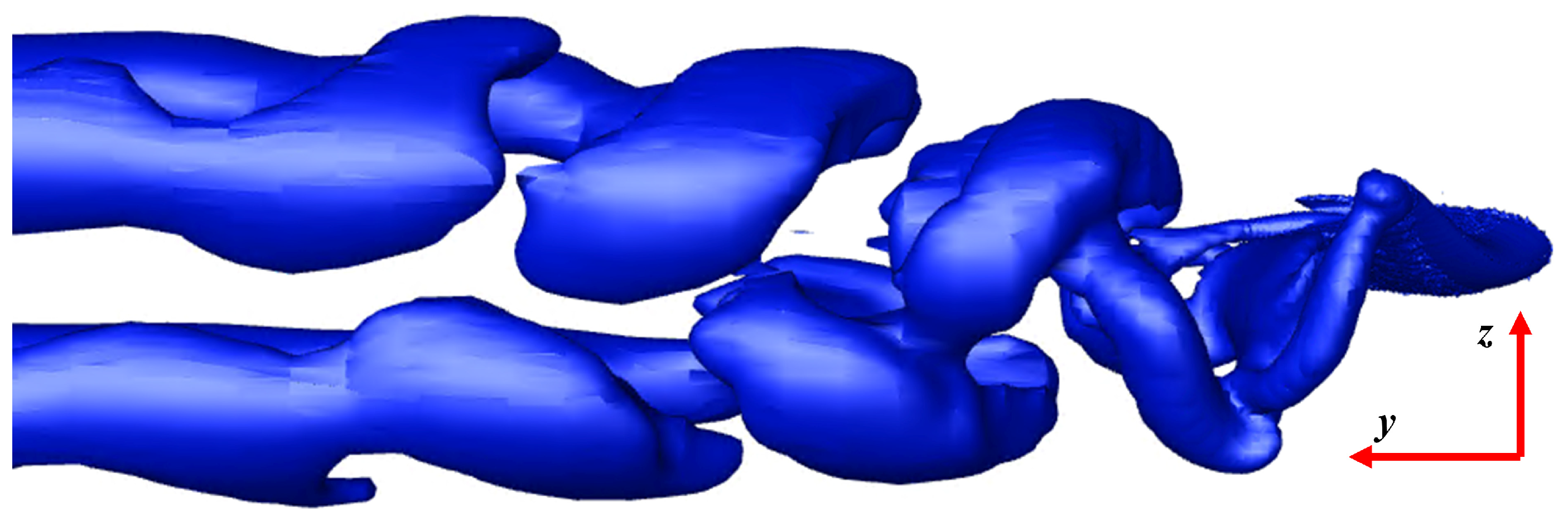
A mesh convergence study was performed for simulation models containing 0.45, 0.90, 1.76, 2.37, 2.80, and 3.31 million mesh cells, as shown in Figure 3a. The motion parameters αmax, βmax, ω, and k were set to 0.8, 1.2, 0.8π, and 0.7, respectively. It can be found that the thrust changes little when the cell number is greater than 2.37 million. Considering the calculation cost and accuracy, 2.80 million mesh was selected for the simulation model. A time step convergence study was performed using time steps of 0.0025, 0.005, 0.01, 0.02, 0.04, 0.08, and 0.16 s, as shown in Figure 3b. It can be observed that the predicted thrust varies only slightly when the time step is smaller than 0.04 s. Considering both computational cost and numerical accuracy, a time step of 0.01 s was selected for the subsequent simulations. Figure 4 shows the iso-surface of the Q-criterion vorticity with a value of 0.08 under the above motion parameters. It can be observed that the bionic model generates two rows of vortices propagating obliquely backward, a key feature contributing to the thrust generation of the pectoral fin [31,32,33,34,35].
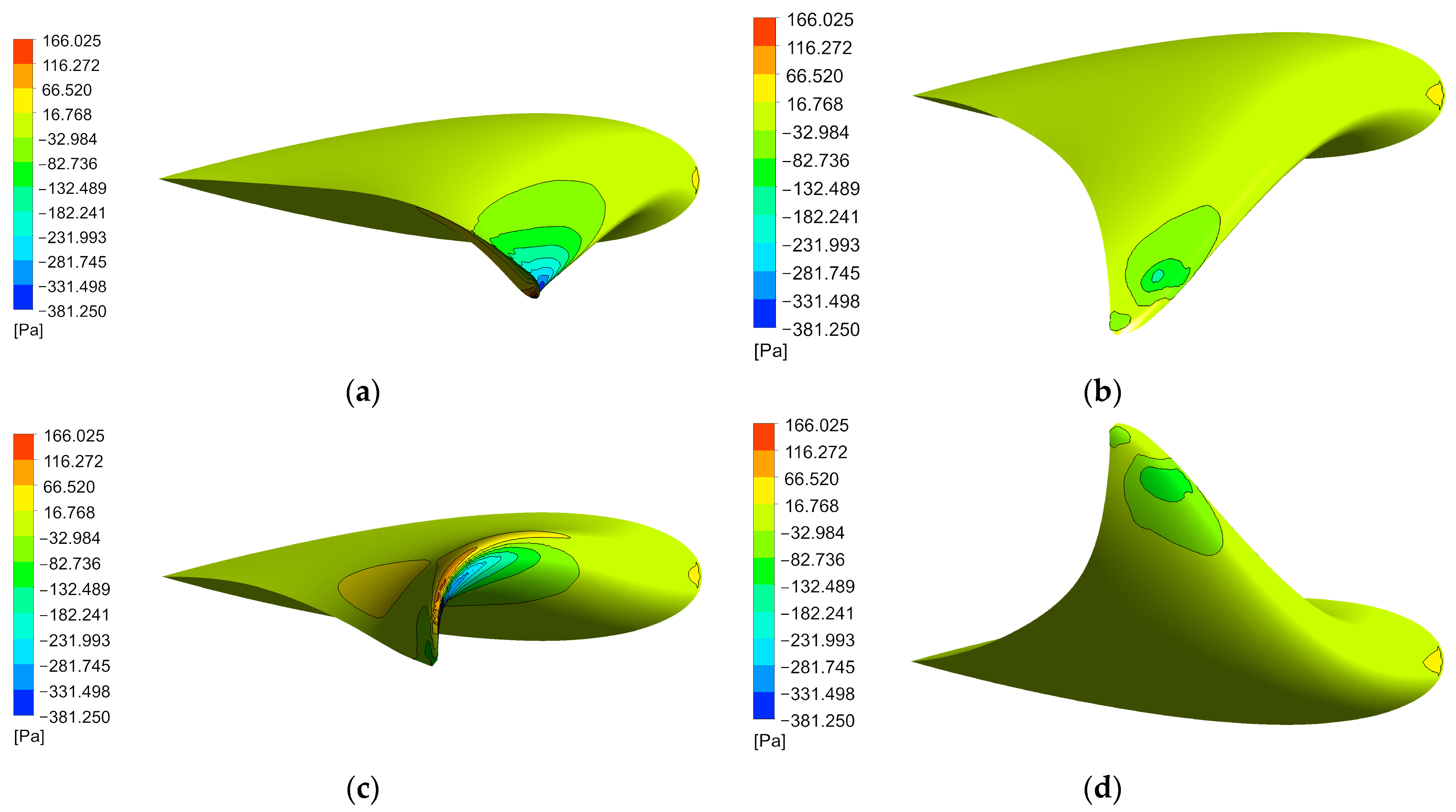
Figure 5 shows the pressure contours on the pectoral fin surface over one cycle. The red regions indicate high pressure, while the blue regions represent low pressure. Figure 5a,b correspond to the downstroke of the pectoral fin, during which the high-pressure regions are mainly distributed on the lower surface and the low-pressure regions on the upper surface. The resulting pressure difference provides thrust for the pectoral fin. Conversely, in Figure 5c,d, the pectoral fin moves upward, with high-pressure regions appearing on the upper surface and low-pressure regions on the lower surface, which also generates thrust.
The thrust of the bionic pectoral fin model under different motion parameters was analyzed. The ranges of αmax and βmax adopted in the simulations are primarily inspired by the kinematics of the real pectoral fin, whereas the flapping frequency ω is mainly constrained by the servo motor used in Section 4 for the fabrication of the bionic pectoral fin mechanism. To facilitate comparison with the real pectoral fin described in Section 2.1, the thrust is nondimensionalized in this study. The nondimensional thrust FT is defined as
F T = F 0.5 ρ U 2 L 2
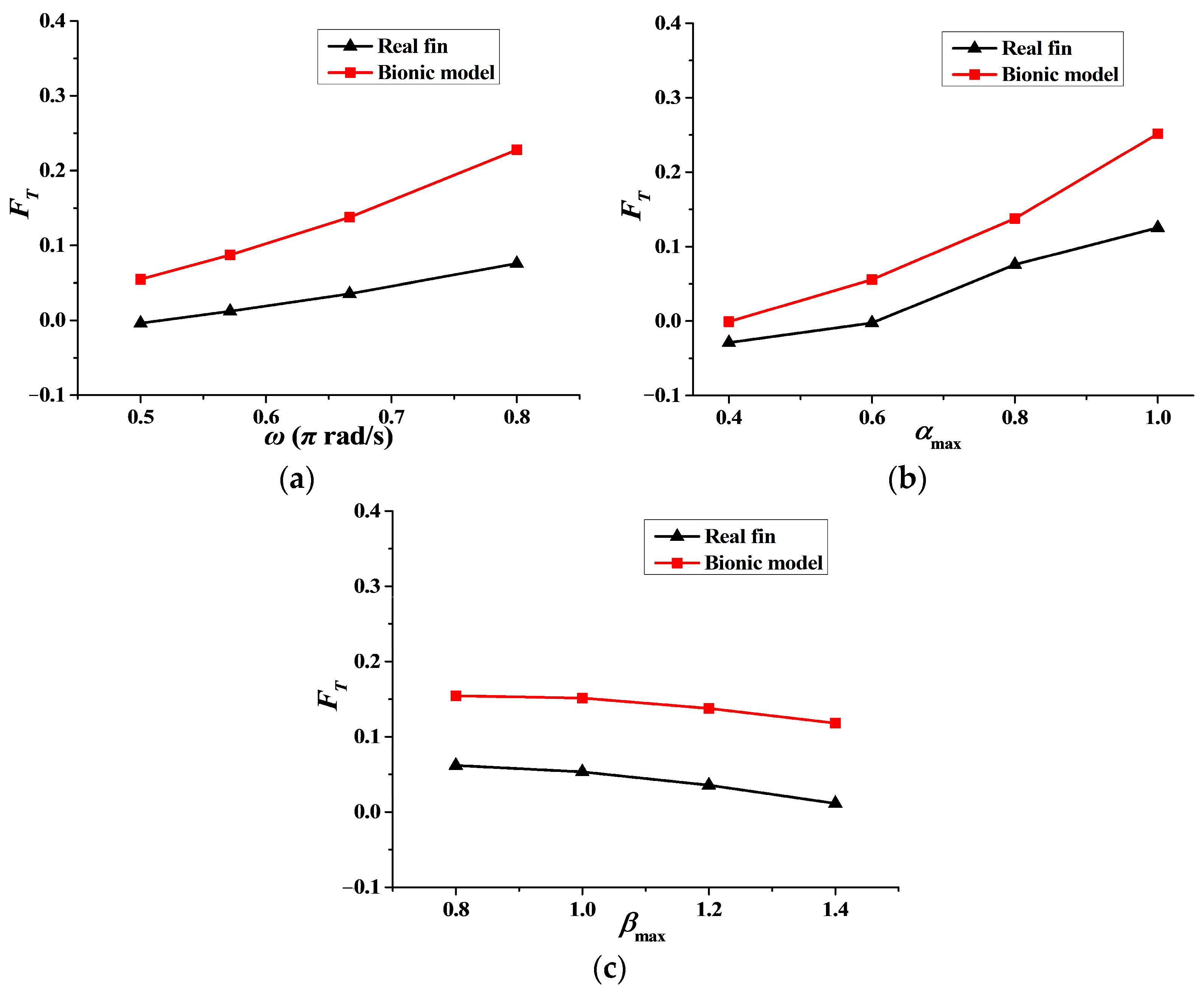
where F denotes the thrust. L is taken as the maximum chord length of the bionic model or the real pectoral fin. Figure 6a presents the simulation results at varying angular frequencies ω, with other motion parameters αmax, βmax, and k set to 0.8, 1.2, and 0.7, respectively. The values of ω were adjusted sequentially to 0.5π, 0.57π, 0.67π, and 0.8π. As ω increases, the thrust shows a continuous rise. Figure 6b illustrates the thrust at different flapping amplitude αmax, with other motion parameters βmax, k, and ω set to 1.2, 0.7, and 0.67π, respectively. αmax is incremented to 0.4, 0.6, 0.8, and 1. The thrust increases with rising αmax, reaching a maximum of 1.81 N at αmax = 1. Figure 6c shows the thrust at varying flapping amplitude βmax, with αmax, k, and ω fixed at 0.8, 0.7, and 0.67π, respectively. βmax was varied from 0.8 to 1.4 in increments of 0.2. With increasing βmax, the thrust decreases continuously. These results demonstrate that the bionic pectoral fin model can generate effective thrust, providing valuable guidance for the design of the bionic pectoral fin mechanism in Section 3. Figure 6 also presents the simulation results of the real pectoral fin. The inflow velocity in the computational domain and the motion parameters are set to be identical to those of the bionic model. It can be observed that the nondimensional thrust generated by the real fin is consistently lower than that of the bionic model. This indicates that, after geometric scaling, the pectoral fin is more suitable for operation at the working point of U = 0.2 m/s. In contrast, the real fin performs more effectively at higher inflow velocities, such as U = 0.4 m/s, which has been adopted in previous studies.

3. Design of the Bionic Pectoral Fin Mechanism

3.1. Structure of the Bionic Mechanism

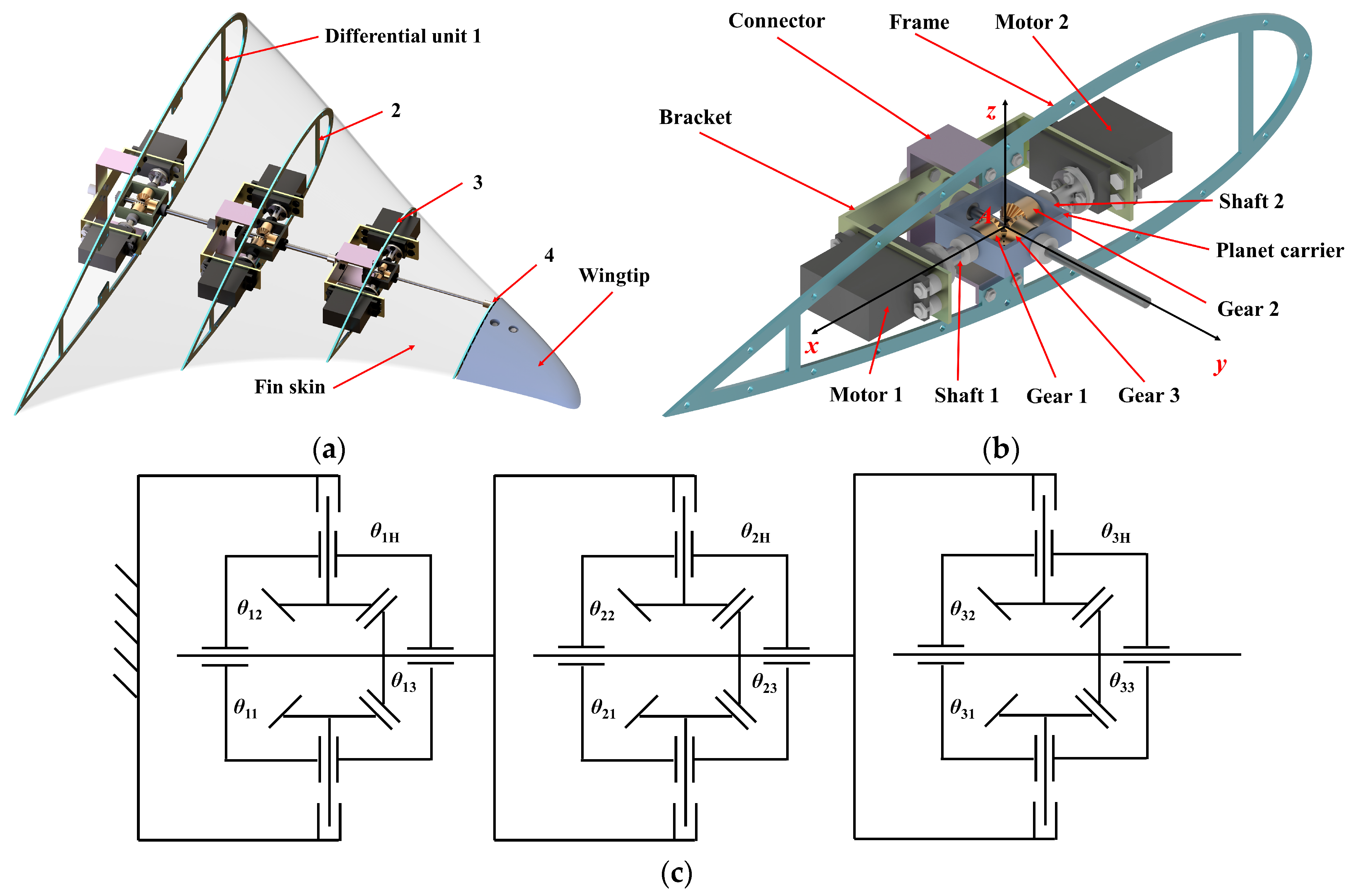
The bionic pectoral fin mechanism was developed based on the bionic model, which includes several key components: differential gear units, a flexible fin skin, and a rigid wingtip. Due to space constraints within the bionic mechanism, four differential units were used, as illustrated in Figure 7a. The differential units 1, 2, 3, and 4 correspond to the cross-sections 1, 2, 3, and 4 of the bionic model, and are arranged in parallel along the spanwise direction with chord lengths gradually decreasing from the base to the tip. Note that differential unit 4 functions as a simple frame but is named consistently for analytical purposes. The differential units are connected by shafts spaced at a quarter of the wingspan length, aligned with the rotational axis of the bionic model. Positioned at the mechanism’s outermost part, the wingtip mirrors the shape of the outermost 1/4 portion of the bionic model. The surface, excluding the wingtip, is covered with silicone fin skin. The internal structure of the bionic mechanism is filled with floating material to balance gravity and buoyancy in water. The frames are linked by elastic materials to enhance the compression resistance of the fin skin.
In addition to forming the basic structure of the bionic mechanism, the differential units also act as power sources. Each differential unit includes a NACA0024-shaped frame, a connector, a U-shaped bracket, a gear mechanism, and two servo motors, as shown in Figure 7b. The bracket holds two motors mounted in opposite orientations and is secured to the frame using the connector. The gear mechanism, located centrally within the bracket and powered by the motors, consists of three bevel gears, three rotating shafts, and a planet carrier. For clarity, the gears, shafts, and motors are numbered. Under the combined drive of motors 1 and 2, shaft 3 and the planet carrier can rotate. Shaft 3 not only rotates around its own axis but also moves around the motor axis or the frame’s chord line along with the planet carrier. This configuration allows shaft 3 to produce coupled rotational motions in two directions, matching the capability of each cross-section of the bionic model to perform bi-directional rotation.
Figure 7c presents a schematic diagram of the bionic mechanism, illustrating how three differential units are connected in series. The series-connected differential units provide a unique topology for both the structure and motion of the bionic mechanism, resulting in a diverse range of motions. Modifying angular frequency ω adjusts the flapping speed, while changing αmax alters the flapping amplitude. Adjustments constant coefficients in Equations (1) and (2), such as b5, can modify the flapping phase and wave number. For simplicity, this study will focus on varying ω, αmax, and βmax, with constant coefficients set according to our earlier research. Only symmetric flapping motions of the bionic pectoral fin will be considered, where k is set to a1.

3.2. Kinematic Analysis of the Bionic Mechanism

This section focuses on analyzing the kinematics of the bionic pectoral fin mechanism to establish the relationship between the motion equation and the rotational angles of the motors, which is essential for designing the control system. It is important to note that only the motions of differential units 2, 3, and 4 can be directly controlled within the bionic mechanism. To clearly describe the gear rotation directions, a coordinate system A-xyz was established at the center of the gear mechanism, as shown in Figure 7b. θi3 and θiH represent the rotational angles of the i-th differential unit’s axis 3 and the planet carrier, respectively. They can be calculated by
θ i 3 = θ i 2 θ i 1 2 θ i H = θ i 1 + θ i 2 2
where θi1 and θi2 are the rotational angles of the motor 1 and motor 2 of i-th differential unit, separately. The length ratio of each differential unit in the bionic model is
s = 0.25 i 0.25
Taking the position of each differential unit as the target position, according to Equations (1), (2) and (7), the target attitude angles of the differential units are given by [αmi, βmi, 0]T = [α(0.25i − 0.25), β(0.25i − 0.25), 0]T. According to Equations (3) and (7), the target displacements of the differential units are [xmi, ymi, zmi]T = [0.27, y(0.25i − 0.25), z(0.25i − 0.25)]T. Each differential unit rotates around the chord line of the preceding differential unit, while the corresponding cross-section in the bionic model rotates around its chord. It is hard for a differential unit to achieve the target roll angle, i.e., α(0.25i − 0.25), unless the number of differential units is increased. Here, the inclination between the cross-sections is defined as the target roll angle. According to Equation (3), it can be calculated by
α m i = arctan z ( 0.25 i ) z ( 0.25 ( i 1 ) ) y ( 0.25 i ) y ( 0.25 ( i 1 ) )
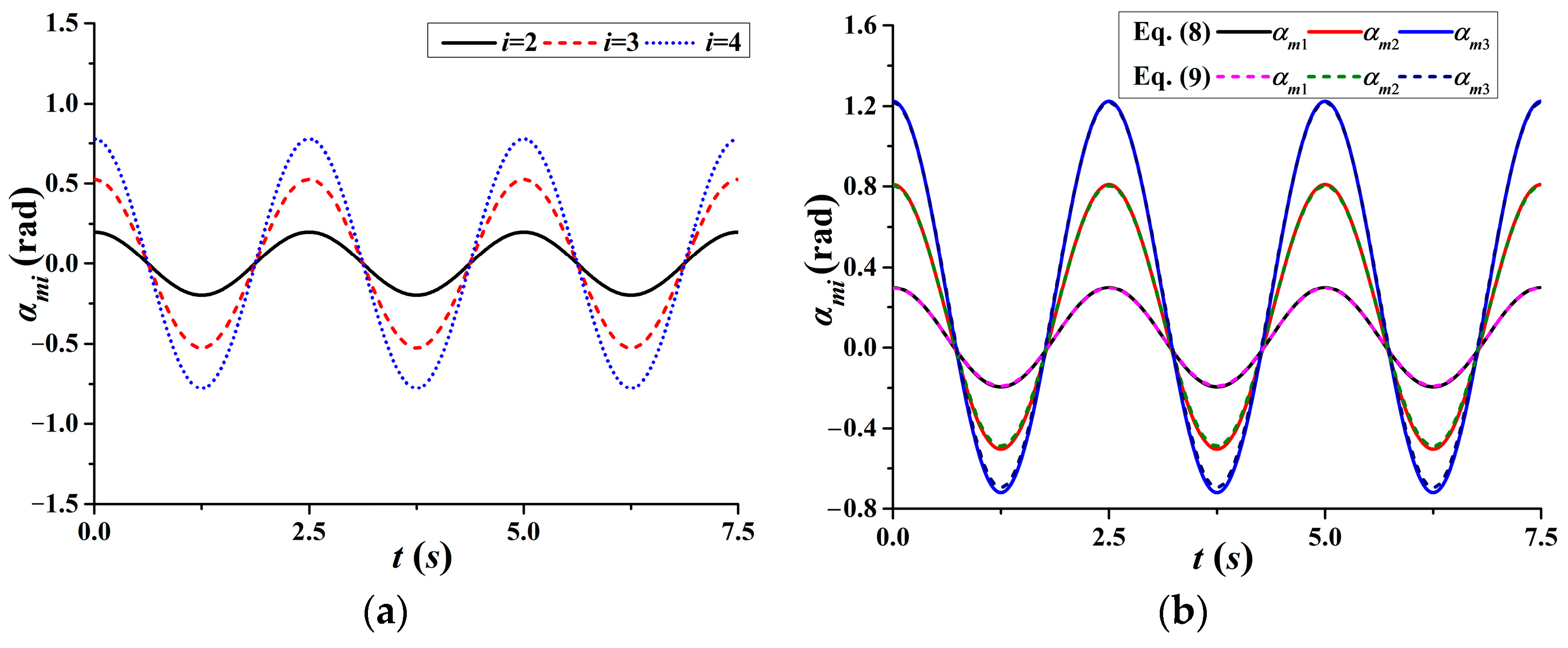
Figure 8a shows the roll angle of the differential units with the motion parameters αmax, ω, and k set to 0.8, 0.8π, and 0.7, respectively. It can be observed that the roll angle of each differential unit over time exhibits an approximately trigonometric relationship. The coordinates z and y in Equation (8) are solved using a numerical discretization method, which complicates the subsequent calculation of motor angles and is unfavorable for the design of the control system. Therefore, a simplified equation is required to represent αmi. Since Equation (1) is a trigonometric function that includes the motion parameters, it is used to represent αmi. A coefficient kαi is introduced to adjust the amplitude of α(s). According to kαi and Equation (1), αmi can be expressed as
α m i = k α i α max 0.25 a 1 ( i 1 ) 0.25 k ( i 1 ) + ( a 2 ( 0.25 i 0.25 ) 2 + 0.25 a 3 ( i 1 ) ) cos ω t  
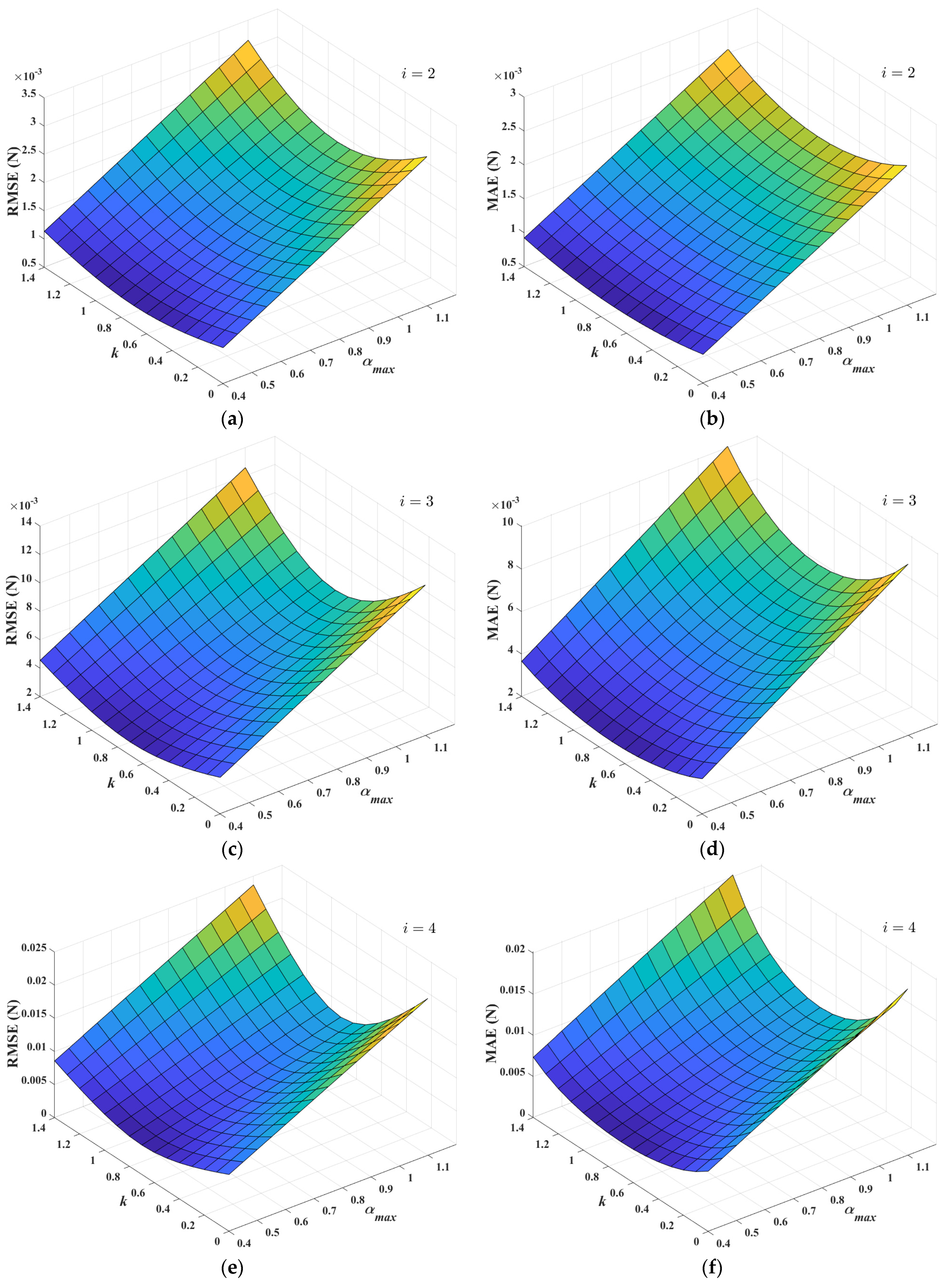
Using Equation (9) to perform curve fitting on the data from Figure 8a, the values of kαi are 0.530, 0.785, and 0.875 when i is 2, 3, and 4, respectively. Figure 8b shows the roll angles calculated both by Equations (8) and (9), when the motion parameters αmax, ω, and k are 1, 0.8π, and 0.3, respectively. The root mean square error (RMSE) and mean absolute error (MAE) between the exact solution in Equation (8) and the approximated solution in Equation (9) are calculated 2.4 × 10⁻³ and 2.1 × 10⁻³ for i = 2, 8.9 × 10⁻³ and 7.4 × 10⁻³ for i = 3, 15.3 × 10⁻³ and 12.3 × 10⁻³ for i = 4, respectively. For all values of i, the RMSE being close to the MAE indicates that the errors are stable and smoothly distributed. Moreover, the MAE remains very small relative to the corresponding amplitude of αmi, demonstrating that the discrepancy between the two equations is minimal. Figure 9 shows the RMSE and MAE values under different k and αmax. It can be observed that for different i, the distributions of RMSE and MAE are consistent, and the values are close, indicating that the errors between Equations (8) and (9) remain stable across the overall motion parameters. For different i, the MAE values are several orders of magnitude smaller than amplitude of αmi, indicating that the discrepancy between Equations (8) and (9) is minor. The results suggest that Equation (9) can effectively replace Equation (8) in representing αmi.
The rotation of the differential unit around axis 3 corresponds well with the rotation of the cross-section around the rotational axis, allowing it to achieve the target pitch angle. According to Equations (2) and (7), the pitch angles of the differential units are
β m i = β max ( b 1 ( 0.25 i 0.25 ) 2 + 0.25 b 2 ( i 1 ) ) sin ( ω t + b 3 ( 0.25 i 0.25 ) 2 + 0.25 b 4 ( i 1 ) + b 5 )
The angular relationship between the differential units, axis 3, and planetary carrier is expressed as
θ i 3 = β m ( i + 1 ) β m i θ i H = α m ( i + 1 ) α m i
According to Equations (6) and (11), the rotational angles of the motors are
θ i 1 = ( α m ( i + 1 ) α m i ) ( β m ( i + 1 ) β m i ) θ i 2 = ( α m ( i + 1 ) α m i ) + ( β m ( i + 1 ) β m i )

4. Experiment and Discussion

In the previous section, the kinematics of the bionic pectoral fin mechanism was analyzed to determine the rotational angles of the motors needed to replicate a fin motion close to that described by Equation (3). To validate the bionic mechanism’s ability to generate effective thrust, a prototype was constructed and tested in this section.
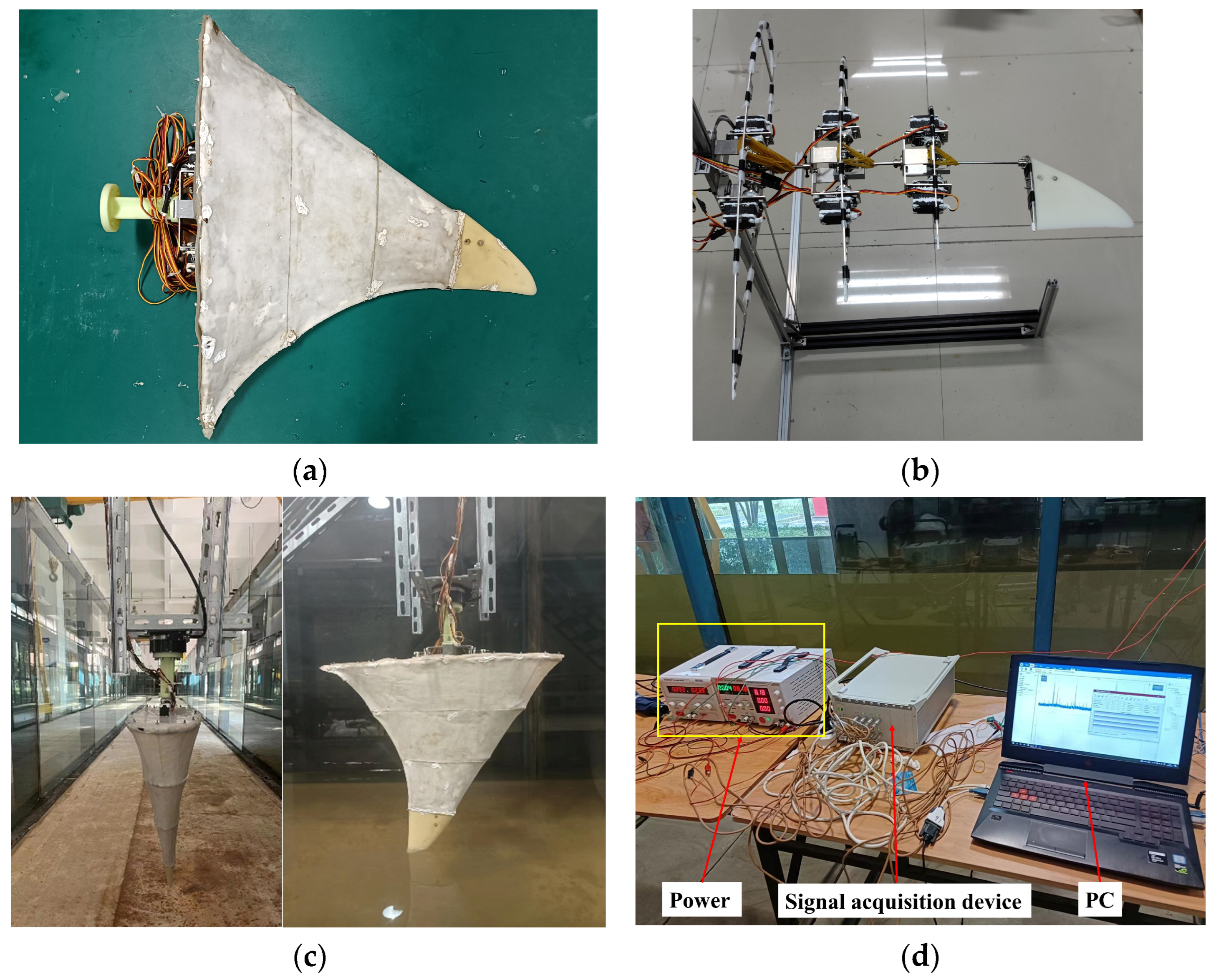
Figure 10a,b shows the physical appearance and internal structure of the bionic mechanism, with a total mass of 2.3 kg. The fin skin was made of flexible silicone rubber cast from a mold, while the gear mechanisms were constructed from 304 stainless steel. The rigid wingtip was produced using a 3D printer with epoxy resin as the material. The frames of each differential unit were connected by a rubber material, enhancing the compression resistance of the fin skin during motion. The remaining internal space of the bionic mechanism was filled with polystyrene foam to balance its gravity and buoyancy. The bevel gears inside support units 1 and 2 have a module of 1 and 15 teeth, while support unit 3 features a module of 0.8 and 15 teeth. The model of the servo motors is 9imod BLS-HV456NG, controlled by an Arduino Uno microcontroller (Arduino, Boston, MA, USA), with the corresponding control algorithm set according to Equation (12).
The thrust of the bionic mechanism was tested in a 75.0 m × 1.8 m × 2.0 m tank, as shown in Figure 10c. During the experiment, the velocity and depth of water were set to 0.2 m/s and 0.8 m, respectively. A steel frame was positioned at the center of the tank, to which the bionic mechanism was mounted using a six-dimensional force sensor (DAYSENSOR DYDW-100) with a maximum range of 10 N. The tip of the bionic mechanism was positioned 0.3 m above the bottom of the tank. Voltage signals from the sensor were collected by a DH8302 signal acquisition device and converted into thrust measurements based on the range of the sensor, as shown in Figure 10d. The thrust values over several cycles were averaged for analysis.
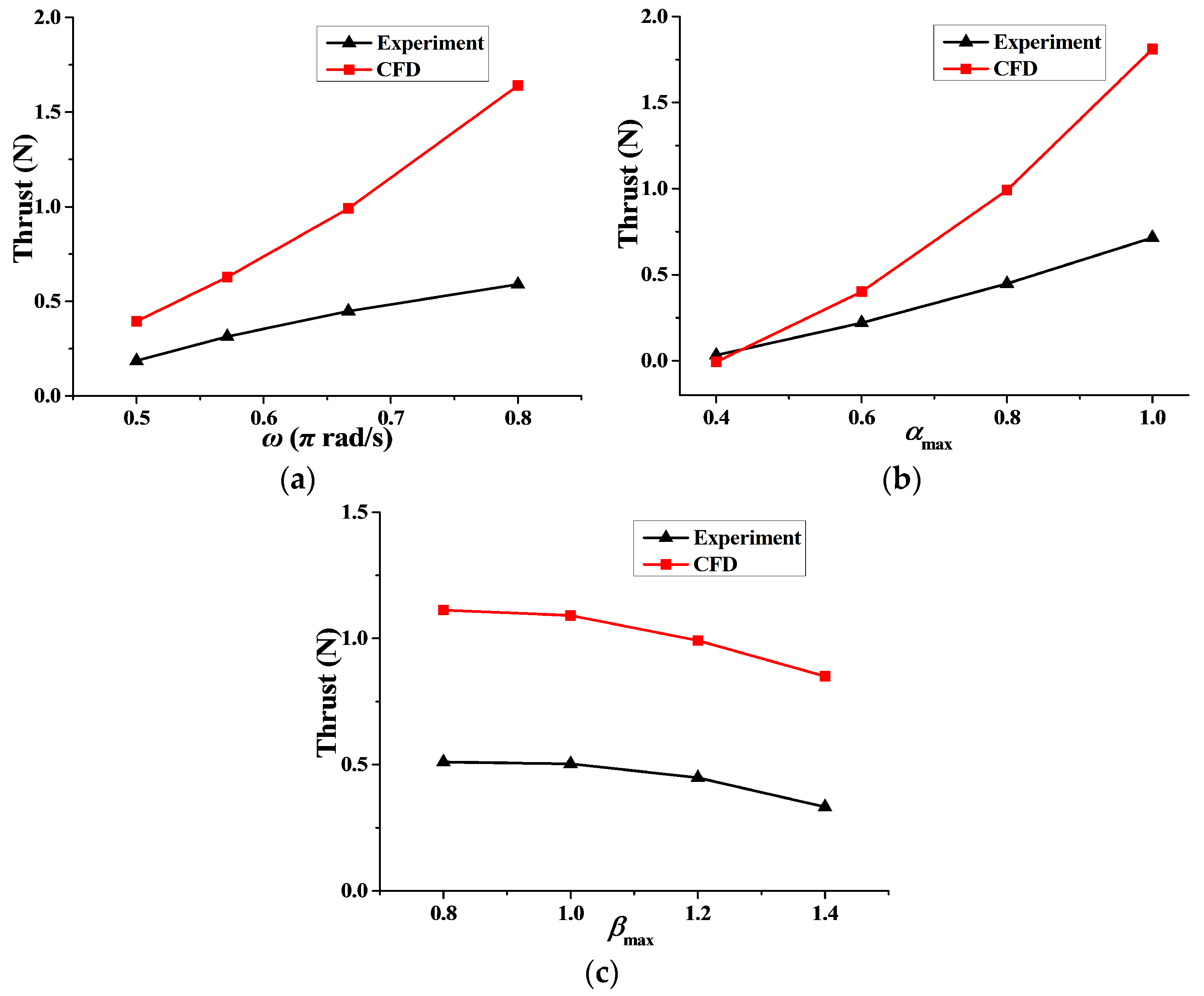
The thrust generated by the pectoral fin under different motion parameters was analyzed. Figure 11a shows the experimental thrust results at varying angular frequencies ω with other motion parameters αmax and βmax set to 0.8 and 1.2, respectively. The values of ω were adjusted sequentially to 0.5π, 0.57π, 0.67π, and 0.8π. As ω increases, the thrust shows a continuous rise, peaking at 0.59 N when ω = 0.8π. Figure 11b shows the experimental thrust at different flapping amplitude αmax with other motion parameters βmax and ω set to 1.2 and 0.67π, respectively. αmax is incremented to 0.4, 0.6, 0.8, and 1. The thrust increases with rising αmax, reaching a maximum of 0.71 N at αmax = 1. Figure 11c shows the experimental thrust results at varying flapping amplitude βmax with αmax and ω fixed at 0.8 and 0.67π, respectively. βmax was set to 0.8, 1.0, 1.2, and 1.4 in sequence. Unlike the trend observed with αmax and βmax, the thrust gradually decreased as βmax increased.
The bionic pectoral fin mechanism is shown to generate effective thrust, thereby validating the proposed bionic pectoral fin structure. Figure 11 also presents the CFD simulation results for the thrust generated by the bionic model under various motion parameters. A comparison between the experimental thrust values of the bionic mechanism and the CFD simulation results of the bionic model revealed a certain degree of error. Although the motion of the differential units in the bionic mechanism can be directly controlled and closely mirrors the motion of the cross-sections in the bionic model, the limited number of differential units constrains the ability to fully replicate the comprehensive motion effect of the model. This limitation is identified as the main source of error. Nevertheless, both the experimental and CFD simulation thrust values demonstrated similar trends, showing consistent variations in thrust and preliminarily confirming the validity of the hydrodynamic analysis for the bionic pectoral fin.

5. Conclusions

This paper introduces a novel bionic pectoral fin that utilizes a series of differential gear units as its drive mechanisms. The differential unit can generate two coupled rotational motions, which correspond to the cross-section of the pectoral fin in motion. Kinematic analysis established the relationship between the motion equation of the bionic model and the rotational angles of the motors inside the bionic pectoral fin mechanism. Experimental thrust tests demonstrated that the developed prototype generates effective thrust, achieving a maximum thrust of 0.71 N. These results confirm the feasibility of the proposed bionic pectoral fin structure, providing valuable insights for designing bionic pectoral fins and ray-inspired robots. Key contributions of this study include:
(1)
The use of differential gear units as the drive mechanism, offering advantages over traditional linkage systems, such as two coupled motions, a compact structure, and ease of integration within the pectoral fin.
(2)
The alignment of the bionic mechanism, which consists of a series of differential gear units, in both structure and motion, with the fin motion equation, accurately reflecting the topology of the pectoral fin.
(3)
The capability of the bionic mechanism to achieve the specified fin motion, while also allowing for the adjustment of motion parameters like flapping amplitude, speed, phase, model, and wavenumber, thus providing flexibility and a range of motion variations.
Despite the precise control over the differential units’ motion, the limited number of differential units results in an approximation that may not fully capture the complex motion effects of the bionic model, leading to discrepancies between experimental results and CFD simulation results. Increasing the number of differential units could potentially reduce this error and bring experimental outcomes closer to the simulation results. In future work, smaller motors and alternative actuation methods will be considered to enable the integration of a greater number of units, thereby achieving a more accurate reproduction of ray fin motion.

6. Patents

The structural design proposed in this study has resulted in the following patent: ZL202110405472.5 (China National Invention Patent).

Author Contributions

Conceptualization, C.S. and H.H.; methodology, C.S.; software, C.S. and L.N.; formal analysis, C.S., L.N. and H.G.; data curation, P.Z.; writing—original draft preparation, C.S.; writing—review and editing, J.C. and H.H.; visualization, Q.G.; supervision, J.C. and H.H.; funding acquisition, L.N. and H.H. All authors have read and agreed to the published version of the manuscript.

Funding

This research was funded by Young Talent Launch Program of Donghai Laboratory (No. L25QH019, No. L24QH010), Pilot National Laboratory for Marine Science and Technology (Qingdao) (No. 2017WHZZB0302), and Department of Natural Resources of Guangdong Province (No. GDNRC [2024]34). All authors have read and agreed to the published version of the manuscript.

Data Availability Statement

The original contributions presented in this study are included in the article. Further inquiries can be directed to the corresponding author.

Conflicts of Interest

The authors declare no conflicts of interest.

References

  1. Omari, M.; Ghommem, M.; Hajj, M.R. Performance analysis of bio-inspired transformable robotic fish tail. Ocean Eng. 2022, 244, 110406. [Google Scholar] [CrossRef]
  2. Yuan, W.; Hao, S.; Liu, Z.; Zhou, F.; Wu, Y. Performance analysis and design of a robotic fish for in-water monitoring. J. Mar. Sci. Eng. 2025, 13, 1116. [Google Scholar] [CrossRef]
  3. Ye, J.; Yao, Y.C.; Gao, J.Y.; Chen, S.; Zhang, P.; Sheng, L.; Liu, J. LM-jelly: Liquid metal enabled biomimetic robotic jellyfish. Soft Robot. 2022, 9, 1098–1107. [Google Scholar] [CrossRef]
  4. Liu, G.; Wang, M.; Xu, L.; Incecik, A.; Sotelo, M.A.; Li, Z.; Li, W. A new bionic lateral line system applied to pitch motion parameters perception for autonomous underwater vehicles. Appl. Ocean Res. 2020, 99, 102142. [Google Scholar] [CrossRef]
  5. Li, G.; Liu, G.; Leng, D.; Fang, X.; Li, G.; Wang, W. Underwater undulating propulsion biomimetic robots: A review. Biomimetics 2023, 8, 318. [Google Scholar] [CrossRef]
  6. Sfakiotakis, M.; Lane, D.M.; Davies, J.B.C. Review of fish swimming modes for aquatic locomotion. IEEE J. Ocean. Eng. 1999, 24, 237–252. [Google Scholar] [CrossRef]
  7. Huang, H.; Sheng, C.; Wu, J.; Wu, G.; Zhou, C.; Wang, H. Hydrodynamic analysis and motion simulation of fin and propeller driven manta ray robot. Appl. Ocean Res. 2021, 108, 102528. [Google Scholar] [CrossRef]
  8. Chen, Z.; Um, T.I.; Bart-Smith, H. A novel fabrication of ionic polymer–metal composite membrane actuator capable of 3-dimensional kinematic motions. Sens. Actuat. A Phys. 2011, 168, 131–139. [Google Scholar] [CrossRef]
  9. Wang, Z.; Hang, G.; Wang, Y.; Li, J.; Du, W. Embedded SMA wire actuated biomimetic fin: A module for biomimetic underwater propulsion. Smart Mater. Struct. 2008, 17, 025039. [Google Scholar] [CrossRef]
  10. Yang, S.; Qiu, J.; Han, X. Kinematics modeling and experiments of pectoral oscillation propulsion robotic fish. J. Bionic Eng. 2009, 6, 174–179. [Google Scholar] [CrossRef]
  11. Cao, Y.; Ma, S.; Cao, Y.; Pan, G.; Huang, Q.; Cao, Y. Similarity evaluation rule and motion posture optimization for a manta ray robot. J. Mar. Sci. Eng. 2022, 10, 908. [Google Scholar] [CrossRef]
  12. Zhou, C.; Low, K.H. Better endurance and load capacity: An improved design of manta ray robot (RoMan-II). J. Bionic Eng. 2010, 7, 137–144. [Google Scholar] [CrossRef]
  13. Wang, Z.; Wang, Y.; Li, J.; Hang, G. A micro biomimetic manta ray robot fish actuated by SMA. In Proceedings of the 2009 IEEE International Conference on Robotics and Biomimetics (ROBIO), Guilin, China, 22–28 December 2009; pp. 1809–1813. [Google Scholar]
  14. Chen, Z.; Um, T.I.; Bart-Smith, H. Bio-inspired robotic manta ray powered by ionic polymer–metal composite artificial muscles. Int. J. Smart Nano Mat. 2012, 3, 296–308. [Google Scholar] [CrossRef]
  15. Gao, J.; Bi, S.; Li, J.; Liu, C. Design and experiments of robot fish propelled by pectoral fins. In Proceedings of the 2009 IEEE International Conference on Robotics and Biomimetics (ROBIO), Guilin, China, 22–28 December 2009; pp. 445–450. [Google Scholar]
  16. Arastehfar, S.; Chew, C.M.; Jalalian, A.; Gunawan, G.; Yeo, K.S. A relationship between sweep angle of flapping pectoral fins and thrust generation. J. Mech. Robot. 2019, 11, 011014. [Google Scholar] [CrossRef]
  17. Li, T.; Li, G.; Liang, Y.; Cheng, T.; Dai, J.; Yang, X.; Liu, B.; Zeng, Z.; Huang, Z.; Luo, Y.; et al. Fast-moving soft electronic fish. Sci. Adv. 2017, 3, 1602045. [Google Scholar] [CrossRef]
  18. Bianchi, G.; Cinquemani, S.; Resta, F. Bio-inspired design of an underwater robot exploiting fin undulation propulsion. Appl. Sci. 2021, 11, 2556. [Google Scholar] [CrossRef]
  19. Cao, Y.; Lu, Y.; Cai, Y.; Bi, S.; Pan, G. CPG-fuzzy-based control of a cownose-ray-like fish robot. Ind. Robot 2019, 46, 779–791. [Google Scholar] [CrossRef]
  20. Sun, Q.; Wu, J.; Sheng, C.; Hu, S.; Wang, Z.; Huang, H. Design and implementation of multi-level linkage mechanism bionic pectoral fin for manta ray robot. Ocean Eng. 2023, 284, 115152. [Google Scholar] [CrossRef]
  21. Russo, R.S.; Blemker, S.S.; Fish, F.E.; Bart-Smith, H. Biomechanical model of batoid (skates and rays) pectoral fins predicts the influence of skeletal structure on fin kinematics: Implications for bio-inspired design. Bioinspir. Biomim. 2015, 10, 046002. [Google Scholar] [CrossRef]
  22. Zhang, Y.; Wang, S.; Wang, X.; Geng, Y. Design and control of bionic manta ray robot with flexible pectoral fin. In Proceedings of the 2018 IEEE International Conference on Control and Automation (ICCA), Anchorage, AK, USA, 20–22 April 2018; pp. 1034–1039. [Google Scholar]
  23. Ma, H.; Cai, Y.; Wang, Y.; Bi, S.; Gong, Z. A biomimetic cownose ray robot fish with oscillating and chordwise twisting flexible pectoral fins. Ind. Robot 2015, 42, 214–221. [Google Scholar] [CrossRef]
  24. Niu, C.; Zhang, L.; Bi, S.; Cai, Y. Mechanical design and implementation of a bio-inspired robotic fish with flapping foils. In Proceedings of the 2013 IEEE International Conference on Robotics and Biomimetics (ROBIO), Shenzhen, China, 12–14 December 2013; pp. 2291–2296. [Google Scholar]
  25. Zhang, D.; Pan, G.; Cao, Y.; Huang, Q.; Cao, Y. A novel integrated gliding and flapping propulsion biomimetic manta-ray robot. J. Mar. Sci. Eng. 2022, 10, 924. [Google Scholar] [CrossRef]
  26. Sheng, C.; Sun, Q.; Huang, H. Motion modeling and hydrodynamic analysis of pectoral fin. Ocean Eng. 2024, 310, 118769. [Google Scholar] [CrossRef]
  27. Hall, K.C.; Hundt, P.J.; Swenson, J.D.; Summers, A.P.; Crow, K.D. The evolution of underwater flight: The redistribution of pectoral fin rays, in manta rays and their relatives (Myliobatidae). J. Morphol. 2018, 279, 1155–1170. [Google Scholar] [CrossRef] [PubMed]
  28. Mulvany, S.; Motta, P.J. The morphology of the cephalic lobes and anterior pectoral fins in six species of batoids. J. Morphol. 2013, 274, 1070–1083. [Google Scholar] [CrossRef]
  29. Clark, R.P.; Smits, A.J. Thrust production and wake structure of a batoid-inspired oscillating fin. J. Fluid Mech. 2006, 562, 415–429. [Google Scholar] [CrossRef] [PubMed]
  30. Huang, H.; Sheng, C.; Wu, G.; Shen, Y.; Wang, H. Stroke kinematics analysis and hydrodynamic modeling of a buoyancy-supported water strider robot. Appl. Sci. 2020, 10, 6300. [Google Scholar] [CrossRef]
  31. Liu, G.; Ren, Y.; Zhu, J.; Bart-Smith, H.; Dong, H. Thrust producing mechanisms in ray-inspired underwater vehicle propulsion. Theor. Appl. Mech. Lett. 2015, 5, 54–57. [Google Scholar] [CrossRef]
  32. Zhang, D.; Huang, Q.G.; Pan, G.; Yang, L.M.; Huang, W.X. Vortex dynamics and hydrodynamic performance enhancement mechanism in batoid fish oscillatory swimming. J. Fluid Mech. 2022, 930, A28. [Google Scholar] [CrossRef]
  33. Fish, F.E.; Schreiber, C.M.; Moored, K.W.; Liu, G.; Dong, H.; Bart-Smith, H. Hydrodynamic performance of aquatic flapping: Efficiency of underwater flight in the manta. Aerospace 2016, 3, 20. [Google Scholar] [CrossRef]
  34. Lu, H.; Yeo, K.S.; Chew, C.M. Effect of pectoral fin kinematics on manta ray propulsion. Mod. Phys. Lett. B 2018, 32, 1840025. [Google Scholar] [CrossRef]
  35. Chen, Y.J.; Huang, H.; Bu, W.; Zhang, X.; Sheng, C.; Chen, Z.S. Kinematic modelling and hydrodynamic analysis of biomimetic pectoral fins of cownose ray. Ocean Eng. 2024, 302, 117577. [Google Scholar] [CrossRef]
Figure 1. The bionic design of the pectoral fin. (a) Image of a real pectoral fin. (b) Bionic pectoral fin model. (c) Coordinate systems for the bionic model. (d) Bionic pectoral fin mechanism.
Jmse 14 00367 g001
Figure 2. CFD simulation of the bionic pectoral fin model. (a) Calculation domain and boundary conditions. (b) Meshes around the pectoral fin.
Jmse 14 00367 g002
Figure 3. (a) The thrust of the bionic pectoral fin as a function of the mesh number. (b) The thrust of the bionic pectoral fin as a function of the time step.
Jmse 14 00367 g003
Figure 4. Iso-surface visualization of Q-criterion vorticity for the bionic pectoral fin model.
Jmse 14 00367 g004
Figure 5. Pressure contour of the pectoral fin over one motion cycle: (a) 0.25T; (b) 0.5T. (c) 0.75T. (d) T.
Jmse 14 00367 g005
Figure 6. Nondimensional thrust FT simulation values of the bionic pectoral fin model and the real pectoral fin under different motion parameters. (a) Thrust at different angular frequency ω. (b) Thrust at different flapping amplitude αmax. (c) Thrust at different rotational amplitude βmax.
Jmse 14 00367 g006
Figure 7. Structure of the bionic pectoral fin mechanism. (a) Overall structure of the bionic mechanism. (b) Detailed structure of the differential gear unit. (c) Schematic diagram of the bionic mechanism.
Jmse 14 00367 g007
Figure 8. Motion analysis of the bionic pectoral fin mechanism. (a) Roll angles of the support units αmi as a function of time t. (b) Calculated roll angle s of the support units from Equations (8) and (9).
Jmse 14 00367 g008
Figure 9. The root mean square error (RMSE) and mean absolute error (MAE) of αmi for different i under varying k and αmax. (a) RMSE for i = 2; (b) MAE for i = 2; (c) RMSE for i = 3; (d) RMSE for i = 3; (e) MAE for i = 4; (f) MAE for i = 4.
Jmse 14 00367 g009
Figure 10. Image of (a) the bionic pectoral fin mechanism and (b) its internal structure. (c) The bionic mechanism installed in the tank. (d) Signal acquisition system.
Jmse 14 00367 g010
Figure 11. Thrust experimental values of the bionic pectoral fin mechanism and CFD simulation values of the bionic pectoral fin model under different motion parameters. (a) Thrust at different angular frequency ω. (b) Thrust at different flapping amplitude αmax. (c) Thrust at different rotational amplitude βmax.
Jmse 14 00367 g011
Table 1. Comparison of pectoral fin structures in ray-inspired robots.
Ref.DOFJoint DOFMotionActuationKey Constraints
[11]31chordwiseInclined rodsWithout spanwise motion
[12]31chordwiseSimple rodsWithout spanwise motion
[19]31Uncoupled bidirectional motionmulti-link mechanismsFixed spanwise motion parameters
[20]31Uncoupled bidirectional motionmulti-link mechanismsFixed spanwise motion parameters
[22]22Uncoupled bidirectional motionCable-driven flexible beamDifficulty in achieving target trajectories
[23]22Uncoupled bidirectional motionMotor-driven flexible beamDifficulty in achieving target trajectories
[24]22Single Coupled2 DOF spatial parallel mechanismRigid rotation with limited flexibility
[25]22Single CoupledSpatial linkage mechanism and hybrid structureRigid rotation with limited flexibility and bulky mechanism
This work62Series CoupledCompact differential gear mechanismsHigh manufacturing precision required
Table 2. Coefficients related to the motion equation of the pectoral [26].
Parametera1a2a3b1b2b3b4b5
Value0.70−0.772.031.080.082.10−3.761.46
Disclaimer/Publisher’s Note: The statements, opinions and data contained in all publications are solely those of the individual author(s) and contributor(s) and not of MDPI and/or the editor(s). MDPI and/or the editor(s) disclaim responsibility for any injury to people or property resulting from any ideas, methods, instructions or products referred to in the content.